
ChemistryQ51–150 of 900 questions
Page 2 of 10 · English
51
ChemistryMediumMCQMHT CET · 2024
Which of the following molecules is an example of $sp$ hybridization?
A
Methane
B
Acetylene
C
Ethylene
D
Ammonia
Solution
(B) Methane $(CH_4)$ involves $sp^3$ hybridization.
Acetylene ($C_2H_2$ or $HC \equiv CH$) involves $sp$ hybridization where each carbon atom is bonded to one hydrogen and one carbon via a triple bond.
Ethylene $(C_2H_4)$ involves $sp^2$ hybridization.
Ammonia $(NH_3)$ involves $sp^3$ hybridization.
Acetylene ($C_2H_2$ or $HC \equiv CH$) involves $sp$ hybridization where each carbon atom is bonded to one hydrogen and one carbon via a triple bond.
Ethylene $(C_2H_4)$ involves $sp^2$ hybridization.
Ammonia $(NH_3)$ involves $sp^3$ hybridization.
0 likesView Solution
52
ChemistryEasyMCQMHT CET · 2024
What is the bond order in $CO$ molecule?
A
$1$
B
$3$
C
$2$
D
$0.5$
Solution
(B) According to Molecular Orbital Theory,the bond order is calculated as $\frac{N_b - N_a}{2}$,where $N_b$ is the number of bonding electrons and $N_a$ is the number of antibonding electrons.
For $CO$ molecule,the total number of electrons is $6 + 8 = 14$.
The molecular orbital configuration is $\sigma 1s^2, \sigma^* 1s^2, \sigma 2s^2, \sigma^* 2s^2, \pi 2p_x^2 = \pi 2p_y^2, \sigma 2p_z^2$.
Here,$N_b = 10$ and $N_a = 4$.
Bond order = $\frac{10 - 4}{2} = \frac{6}{2} = 3$.
For $CO$ molecule,the total number of electrons is $6 + 8 = 14$.
The molecular orbital configuration is $\sigma 1s^2, \sigma^* 1s^2, \sigma 2s^2, \sigma^* 2s^2, \pi 2p_x^2 = \pi 2p_y^2, \sigma 2p_z^2$.
Here,$N_b = 10$ and $N_a = 4$.
Bond order = $\frac{10 - 4}{2} = \frac{6}{2} = 3$.
0 likesView Solution
53
ChemistryEasyMCQMHT CET · 2024
Identify the bond order and magnetic nature of $Li_2$ molecule respectively.
A
$1$ and diamagnetic
B
$2$ and diamagnetic
C
$1$ and paramagnetic
D
$2$ and paramagnetic
Solution
(A) The electronic configuration of $Li_2$ molecule is $(\sigma 1s)^2 (\sigma^* 1s)^2 (\sigma 2s)^2$.
Bond order of $Li_2$ molecule is calculated as:
$\text{Bond Order} = \frac{N_b - N_a}{2} = \frac{4 - 2}{2} = 1$.
Since all electrons are paired in the $Li_2$ molecule,it is diamagnetic.
Bond order of $Li_2$ molecule is calculated as:
$\text{Bond Order} = \frac{N_b - N_a}{2} = \frac{4 - 2}{2} = 1$.
Since all electrons are paired in the $Li_2$ molecule,it is diamagnetic.
0 likesView Solution
54
ChemistryEasyMCQMHT CET · 2024
Identify the orbital having the lowest energy from the following.
A
$2p$
B
$3s$
C
$3d$
D
$4p$
Solution
(A) The energy of an orbital is determined by the $(n+l)$ rule,where $n$ is the principal quantum number and $l$ is the azimuthal quantum number. The orbital with the lowest $(n+l)$ value has the lowest energy. If $(n+l)$ values are equal,the orbital with the lower $n$ value has lower energy.
Calculating $(n+l)$ for each:
$2p: n=2, l=1 \implies n+l = 3$
$3s: n=3, l=0 \implies n+l = 3$
$3d: n=3, l=2 \implies n+l = 5$
$4p: n=4, l=1 \implies n+l = 5$
Comparing $2p$ and $3s$,both have $(n+l) = 3$. Since $2p$ has a lower $n$ value $(n=2)$ compared to $3s$ $(n=3)$,$2p$ has the lowest energy.
Calculating $(n+l)$ for each:
$2p: n=2, l=1 \implies n+l = 3$
$3s: n=3, l=0 \implies n+l = 3$
$3d: n=3, l=2 \implies n+l = 5$
$4p: n=4, l=1 \implies n+l = 5$
Comparing $2p$ and $3s$,both have $(n+l) = 3$. Since $2p$ has a lower $n$ value $(n=2)$ compared to $3s$ $(n=3)$,$2p$ has the lowest energy.
0 likesView Solution
55
ChemistryEasyMCQMHT CET · 2024
Which of the following molecules has a bond order of $2$?
A
$N_2$
B
$H_2$
C
$O_2$
D
$F_2$
Solution
(C) The electronic configuration of the $O_2$ molecule is $(\sigma 1s)^2 (\sigma^* 1s)^2 (\sigma 2s)^2 (\sigma^* 2s)^2 (\sigma 2p_z)^2 (\pi 2p_x)^2 (\pi 2p_y)^2 (\pi^* 2p_x)^1 (\pi^* 2p_y)^1$.
Bond order is calculated as $\frac{N_b - N_a}{2}$,where $N_b$ is the number of bonding electrons and $N_a$ is the number of antibonding electrons.
For $O_2$,$N_b = 10$ and $N_a = 6$.
Bond order $= \frac{10 - 6}{2} = \frac{4}{2} = 2$.
Bond order is calculated as $\frac{N_b - N_a}{2}$,where $N_b$ is the number of bonding electrons and $N_a$ is the number of antibonding electrons.
For $O_2$,$N_b = 10$ and $N_a = 6$.
Bond order $= \frac{10 - 6}{2} = \frac{4}{2} = 2$.
0 likesView Solution
56
ChemistryEasyMCQMHT CET · 2024
What is the total number of electrons present in bonding orbitals of $O_2$ molecule according to molecular orbital theory?
A
$16$
B
$06$
C
$10$
D
$04$
Solution
(C) The electronic configuration of $O_2$ molecule is $(\sigma 1s)^2 (\sigma^* 1s)^2 (\sigma 2s)^2 (\sigma^* 2s)^2 (\sigma 2p_z)^2 (\pi 2p_x)^2 (\pi 2p_y)^2 (\pi^* 2p_x)^1 (\pi^* 2p_y)^1$.
Bonding molecular orbitals are those without an asterisk $(*)$.
These are $(\sigma 1s)^2$,$(\sigma 2s)^2$,$(\sigma 2p_z)^2$,$(\pi 2p_x)^2$,and $(\pi 2p_y)^2$.
Total number of electrons in bonding orbitals = $2 + 2 + 2 + 2 + 2 = 10$.
Bonding molecular orbitals are those without an asterisk $(*)$.
These are $(\sigma 1s)^2$,$(\sigma 2s)^2$,$(\sigma 2p_z)^2$,$(\pi 2p_x)^2$,and $(\pi 2p_y)^2$.
Total number of electrons in bonding orbitals = $2 + 2 + 2 + 2 + 2 = 10$.
0 likesView Solution
57
ChemistryEasyMCQMHT CET · 2024
What is the number of electrons present in antibonding orbitals of $N_2$ molecule according to molecular orbital theory?
A
$14$
B
$04$
C
$10$
D
$06$
Solution
(B) The electronic configuration of $N_2$ molecule ($14$ electrons) is $(\sigma 1s)^2 (\sigma^* 1s)^2 (\sigma 2s)^2 (\sigma^* 2s)^2 (\pi 2p_x)^2 (\pi 2p_y)^2 (\sigma 2p_z)^2$.
Antibonding orbitals are those denoted with an asterisk $(*)$.
These are $(\sigma^* 1s)^2$ and $(\sigma^* 2s)^2$.
Total number of electrons in antibonding orbitals $= 2 + 2 = 4$.
Antibonding orbitals are those denoted with an asterisk $(*)$.
These are $(\sigma^* 1s)^2$ and $(\sigma^* 2s)^2$.
Total number of electrons in antibonding orbitals $= 2 + 2 = 4$.
0 likesView Solution
58
ChemistryDifficultMCQMHT CET · 2024
Calculate the radius of the fourth orbit of the $B^{4+}$ ion. (in $pm$)
A
$169.3$
B
$211.6$
C
$380.8$
D
$413.2$
Solution
(A) The formula for the radius of the $n^{th}$ orbit of a hydrogen-like species is given by $r_n = \frac{52.9 \times n^2}{Z} \ pm$.
For the $B^{4+}$ ion, the atomic number $Z = 5$ and the orbit number $n = 4$.
Substituting these values into the formula:
$r_4 = \frac{52.9 \times (4)^2}{5} \ pm$
$r_4 = \frac{52.9 \times 16}{5} \ pm$
$r_4 = \frac{846.4}{5} \ pm$
$r_4 = 169.28 \ pm \approx 169.3 \ pm$.
For the $B^{4+}$ ion, the atomic number $Z = 5$ and the orbit number $n = 4$.
Substituting these values into the formula:
$r_4 = \frac{52.9 \times (4)^2}{5} \ pm$
$r_4 = \frac{52.9 \times 16}{5} \ pm$
$r_4 = \frac{846.4}{5} \ pm$
$r_4 = 169.28 \ pm \approx 169.3 \ pm$.
0 likesView Solution
59
ChemistryMediumMCQMHT CET · 2024
Which of the following molecules exhibits the lowest dipole moment?
A
$CH_3F$
B
$CH_3Cl$
C
$CH_3Br$
D
$CH_3I$
Solution
(D) The dipole moment of $CH_3X$ molecules depends on the electronegativity difference between the carbon atom and the halogen atom $(X)$.
As we move down the group from $F$ to $I$,the electronegativity of the halogen decreases,which leads to a decrease in the $C-X$ bond polarity.
Although the bond length increases down the group,the decrease in electronegativity is the dominant factor.
Therefore,the dipole moment decreases in the order: $CH_3F > CH_3Cl > CH_3Br > CH_3I$.
Thus,$CH_3I$ has the lowest dipole moment.
As we move down the group from $F$ to $I$,the electronegativity of the halogen decreases,which leads to a decrease in the $C-X$ bond polarity.
Although the bond length increases down the group,the decrease in electronegativity is the dominant factor.
Therefore,the dipole moment decreases in the order: $CH_3F > CH_3Cl > CH_3Br > CH_3I$.
Thus,$CH_3I$ has the lowest dipole moment.
0 likesView Solution
60
ChemistryMediumMCQMHT CET · 2024
Which of the following molecules has zero dipole moment?
A
$HF$
B
$NH_3$
C
$BF_3$
D
$CHCl_3$
Solution
(C) The dipole moment $(\mu)$ of a molecule depends on its geometry and the polarity of its bonds.
$HF$ is a polar molecule with a linear geometry,so $\mu \neq 0$.
$NH_3$ has a trigonal pyramidal geometry with a lone pair on the nitrogen atom,resulting in a net dipole moment $(\mu = 1.48 \ D)$.
$BF_3$ has a trigonal planar geometry. The three $B-F$ bonds are arranged at an angle of $120^{\circ}$ to each other. The vector sum of the dipole moments of the three $B-F$ bonds is zero,making the molecule non-polar $(\mu = 0)$.
$CHCl_3$ is a polar molecule with a tetrahedral geometry where the bond dipoles do not cancel out $(\mu = 1.04 \ D)$.
Therefore,$BF_3$ has a zero dipole moment.
$HF$ is a polar molecule with a linear geometry,so $\mu \neq 0$.
$NH_3$ has a trigonal pyramidal geometry with a lone pair on the nitrogen atom,resulting in a net dipole moment $(\mu = 1.48 \ D)$.
$BF_3$ has a trigonal planar geometry. The three $B-F$ bonds are arranged at an angle of $120^{\circ}$ to each other. The vector sum of the dipole moments of the three $B-F$ bonds is zero,making the molecule non-polar $(\mu = 0)$.
$CHCl_3$ is a polar molecule with a tetrahedral geometry where the bond dipoles do not cancel out $(\mu = 1.04 \ D)$.
Therefore,$BF_3$ has a zero dipole moment.
0 likesView Solution
61
ChemistryEasyMCQMHT CET · 2024
Which of the following molecules can form hydrogen bonding with itself?
A
$NH_3$
B
$C_2H_6$
C
$H_2S$
D
$CH_3-O-CH_3$
Solution
(A) Hydrogen bonding occurs when a hydrogen atom is covalently bonded to a highly electronegative atom (like $N$,$O$,or $F$).
In $NH_3$,the hydrogen atoms are bonded to a highly electronegative nitrogen atom,allowing it to form intermolecular hydrogen bonds with other $NH_3$ molecules.
$C_2H_6$ (ethane) is non-polar and lacks such bonds.
$H_2S$ does not form significant hydrogen bonds because sulfur is not electronegative enough.
$CH_3-O-CH_3$ (dimethyl ether) has an oxygen atom but lacks a hydrogen atom directly bonded to it,so it cannot form hydrogen bonds with itself.
In $NH_3$,the hydrogen atoms are bonded to a highly electronegative nitrogen atom,allowing it to form intermolecular hydrogen bonds with other $NH_3$ molecules.
$C_2H_6$ (ethane) is non-polar and lacks such bonds.
$H_2S$ does not form significant hydrogen bonds because sulfur is not electronegative enough.
$CH_3-O-CH_3$ (dimethyl ether) has an oxygen atom but lacks a hydrogen atom directly bonded to it,so it cannot form hydrogen bonds with itself.
0 likesView Solution
62
ChemistryMediumMCQMHT CET · 2024
What is the total number of unpaired electrons in an element placed at period-$4$ and group-$12$ either in excited or at ground state?
A
Zero
B
One
C
Two
D
Three
Solution
(A) The element located in period-$4$ and group-$12$ is Zinc $(Zn)$.
$Zn$ has an atomic number of $30$.
The electronic configuration of $Zn$ in the ground state is $[Ar] \ 3d^{10} \ 4s^2$.
In this configuration,all $3d$ and $4s$ orbitals are completely filled,meaning there are $0$ unpaired electrons.
In the excited state (e.g.,$Zn^{2+}$ ion),the configuration is $[Ar] \ 3d^{10}$,which also contains $0$ unpaired electrons.
Therefore,the total number of unpaired electrons is $0$.
$Zn$ has an atomic number of $30$.
The electronic configuration of $Zn$ in the ground state is $[Ar] \ 3d^{10} \ 4s^2$.
In this configuration,all $3d$ and $4s$ orbitals are completely filled,meaning there are $0$ unpaired electrons.
In the excited state (e.g.,$Zn^{2+}$ ion),the configuration is $[Ar] \ 3d^{10}$,which also contains $0$ unpaired electrons.
Therefore,the total number of unpaired electrons is $0$.
0 likesView Solution
63
ChemistryEasyMCQMHT CET · 2024
Which of the following elements belongs to the $1^{st}$ group and $5^{th}$ period of the periodic table?
A
Rubidium
B
Strontium
C
Caesium
D
Barium
Solution
(A) $1$. Rubidium $(Rb)$: Rubidium is in Group $1$ (alkali metal) and Period $5$. This is a correct match.
$2$. Strontium $(Sr)$: Strontium is in Group $2$ (alkaline earth metals),not Group $1$.
$3$. Caesium $(Cs)$: Caesium is in Group $1$,but it is in Period $6$,not Period $5$.
$4$. Barium $(Ba)$: Barium is in Group $2$ (alkaline earth metals),not Group $1$.
$2$. Strontium $(Sr)$: Strontium is in Group $2$ (alkaline earth metals),not Group $1$.
$3$. Caesium $(Cs)$: Caesium is in Group $1$,but it is in Period $6$,not Period $5$.
$4$. Barium $(Ba)$: Barium is in Group $2$ (alkaline earth metals),not Group $1$.
0 likesView Solution
64
ChemistryMediumMCQMHT CET · 2024
Which among the following elements has the highest electronegativity?
A
$Li$
B
$Na$
C
$K$
D
$Cs$
Solution
(A) The electronegativity of Group $1$ elements decreases down the group as the atomic size increases and the effective nuclear charge decreases.
Therefore,the decreasing order of electronegativity is $Li > Na > K > Cs$.
Thus,$Li$ has the highest electronegativity among the given elements.
Therefore,the decreasing order of electronegativity is $Li > Na > K > Cs$.
Thus,$Li$ has the highest electronegativity among the given elements.
0 likesView Solution
65
ChemistryMediumMCQMHT CET · 2024
Which of the following species does not have the same number of electrons as the other three species?
A
$Ne$
B
$O^{2-}$
C
$Na$
D
$Na^{+}$
Solution
(C) The number of electrons in each species is as follows:
$Ne$ (Atomic number $10$): $10$ electrons.
$O^{2-}$ (Atomic number $8$): $8 + 2 = 10$ electrons.
$Na^{+}$ (Atomic number $11$): $11 - 1 = 10$ electrons.
$Na$ (Atomic number $11$): $11$ electrons.
Since $Ne$,$O^{2-}$,and $Na^{+}$ are isoelectronic (all have $10$ electrons),$Na$ is the species that does not have the same number of electrons.
$Ne$ (Atomic number $10$): $10$ electrons.
$O^{2-}$ (Atomic number $8$): $8 + 2 = 10$ electrons.
$Na^{+}$ (Atomic number $11$): $11 - 1 = 10$ electrons.
$Na$ (Atomic number $11$): $11$ electrons.
Since $Ne$,$O^{2-}$,and $Na^{+}$ are isoelectronic (all have $10$ electrons),$Na$ is the species that does not have the same number of electrons.
0 likesView Solution
66
ChemistryEasyMCQMHT CET · 2024
Which element from the following is used in photoelectric cells?
A
$Li$
B
$Be$
C
$Cs$
D
$Mg$
Solution
(C) Cesium $(Cs)$ is the element used in photoelectric cells.
Explanation: Cesium is the preferred metal for photoelectric cells because it can easily convert sunlight into electricity.
It has a very low ionization energy and is the most electropositive element among the alkali metals.
The amount of energy required to eject electrons from a cesium surface is relatively small,only $206.5 \ kJ/mol$.
Explanation: Cesium is the preferred metal for photoelectric cells because it can easily convert sunlight into electricity.
It has a very low ionization energy and is the most electropositive element among the alkali metals.
The amount of energy required to eject electrons from a cesium surface is relatively small,only $206.5 \ kJ/mol$.
0 likesView Solution
67
ChemistryEasyMCQMHT CET · 2024
Identify the element with the lowest electronegativity.
A
$O$
B
$S$
C
$F$
D
$Cl$
Solution
(B) Electronegativity generally increases across a period from left to right and decreases down a group.
Comparing the given elements: $O$ and $F$ are in the $2^{nd}$ period,while $S$ and $Cl$ are in the $3^{rd}$ period.
Since electronegativity decreases down a group,the elements in the $3^{rd}$ period ($S$ and $Cl$) have lower electronegativity than those in the $2^{nd}$ period ($O$ and $F$).
Between $S$ and $Cl$,$S$ is to the left of $Cl$ in the $3^{rd}$ period,therefore $S$ has the lowest electronegativity among the given options.
Comparing the given elements: $O$ and $F$ are in the $2^{nd}$ period,while $S$ and $Cl$ are in the $3^{rd}$ period.
Since electronegativity decreases down a group,the elements in the $3^{rd}$ period ($S$ and $Cl$) have lower electronegativity than those in the $2^{nd}$ period ($O$ and $F$).
Between $S$ and $Cl$,$S$ is to the left of $Cl$ in the $3^{rd}$ period,therefore $S$ has the lowest electronegativity among the given options.
0 likesView Solution
68
ChemistryEasyMCQMHT CET · 2024
Identify the element having lowest first ionization enthalpy.
A
$Po$
B
$Te$
C
$Br$
D
$Kr$
Solution
(A) The ionization enthalpy $(I.E.)$ decreases down the group due to an increase in atomic size.
Therefore,the $I.E.$ of $Te$ is higher than that of $Po$.
Across a period,$I.E.$ increases with an increase in atomic number.
Comparing the given elements,$Po$ (Polonium) is in Group $16$ and Period $6$,$Te$ (Tellurium) is in Group $16$ and Period $5$,$Br$ (Bromine) is in Group $17$ and Period $4$,and $Kr$ (Krypton) is in Group $18$ and Period $4$.
Since $I.E.$ increases from left to right across a period and decreases down a group,$Po$ has the lowest $I.E.$ among the given elements.
Therefore,the $I.E.$ of $Te$ is higher than that of $Po$.
Across a period,$I.E.$ increases with an increase in atomic number.
Comparing the given elements,$Po$ (Polonium) is in Group $16$ and Period $6$,$Te$ (Tellurium) is in Group $16$ and Period $5$,$Br$ (Bromine) is in Group $17$ and Period $4$,and $Kr$ (Krypton) is in Group $18$ and Period $4$.
Since $I.E.$ increases from left to right across a period and decreases down a group,$Po$ has the lowest $I.E.$ among the given elements.
0 likesView Solution
69
ChemistryMediumMCQMHT CET · 2024
Which of the following elements has the highest value of first ionization enthalpy $(\Delta_i H_1)$?
A
$He$
B
$Ar$
C
$Cl$
D
$I$
Solution
(A) The ionization enthalpy $(IE)$ is highest for noble gases due to their stable electronic configuration. Therefore,the $IE$ of $Ar$ and $He$ is higher than that of the halogens $Cl$ and $I$.
Down a group,$IE$ decreases due to an increase in atomic size.
Comparing $He$ and $Ar$,$He$ has a smaller atomic size,so $IE$ of $He > Ar$.
Across a period,$IE$ increases with an increase in atomic number.
Comparing $Cl$ and $Ar$,$Ar$ has a higher $IE$ than $Cl$.
Thus,the overall order of ionization enthalpy is $I < Cl < Ar < He$.
Therefore,$He$ has the highest ionization enthalpy.
Down a group,$IE$ decreases due to an increase in atomic size.
Comparing $He$ and $Ar$,$He$ has a smaller atomic size,so $IE$ of $He > Ar$.
Across a period,$IE$ increases with an increase in atomic number.
Comparing $Cl$ and $Ar$,$Ar$ has a higher $IE$ than $Cl$.
Thus,the overall order of ionization enthalpy is $I < Cl < Ar < He$.
Therefore,$He$ has the highest ionization enthalpy.
0 likesView Solution
70
ChemistryEasyMCQMHT CET · 2024
If four different elements $A, B, C$ and $D$ have electronic configurations as $A = [Ne] 3s^2 3p^4$,$B = [Ne] 3s^2 3p^5$,$C = [Ar] 3d^{10} 4s^2 4p^4$ and $D = [Ar] 3d^{10} 4s^2 4p^5$,identify the element with the largest atomic radius.
A
$A$
B
$B$
C
$C$
D
$D$
Solution
(C) Elements $C$ and $D$ belong to period $4$,while elements $A$ and $B$ belong to period $3$.
Atomic radius increases down a group,so elements in period $4$ are larger than those in period $3$.
Comparing $C$ and $D$ in period $4$,$D$ has a higher effective nuclear charge than $C$ because it is to the right of $C$ in the same period.
Therefore,$D$ is smaller than $C$.
Thus,element $C$ has the largest atomic radius.
Atomic radius increases down a group,so elements in period $4$ are larger than those in period $3$.
Comparing $C$ and $D$ in period $4$,$D$ has a higher effective nuclear charge than $C$ because it is to the right of $C$ in the same period.
Therefore,$D$ is smaller than $C$.
Thus,element $C$ has the largest atomic radius.
0 likesView Solution
71
ChemistryEasyMCQMHT CET · 2024
Which element from the following has the largest atomic size compared to the other three?
A
$S$
B
$Se$
C
$Cl$
D
$Br$
Solution
(B) Atomic size increases down a group due to the addition of new electron shells and decreases across a period from left to right due to an increase in effective nuclear charge.
In the periodic table,$S$ and $Cl$ belong to period $3$,while $Se$ and $Br$ belong to period $4$.
Since $Se$ and $Br$ are in a higher period,they have larger atomic sizes than $S$ and $Cl$.
Within period $4$,$Se$ is to the left of $Br$,so $Se$ has a larger atomic size than $Br$.
Therefore,the atomic size order is $Cl < S < Br < Se$,making $Se$ the element with the largest atomic size.
In the periodic table,$S$ and $Cl$ belong to period $3$,while $Se$ and $Br$ belong to period $4$.
Since $Se$ and $Br$ are in a higher period,they have larger atomic sizes than $S$ and $Cl$.
Within period $4$,$Se$ is to the left of $Br$,so $Se$ has a larger atomic size than $Br$.
Therefore,the atomic size order is $Cl < S < Br < Se$,making $Se$ the element with the largest atomic size.
0 likesView Solution
72
ChemistryEasyMCQMHT CET · 2024
Identify the basic oxide from the following.
A
$SO_3$
B
$NO$
C
$Al_2O_3$
D
$CaO$
Solution
(D) $SO_3$ is an acidic oxide.
$NO$ is a neutral oxide.
$Al_2O_3$ is an amphoteric oxide.
$CaO$ is a basic oxide.
Generally,oxides of metals in Group $1$ and Group $2$ are basic,while oxides of non-metals are acidic.
$NO$ is a neutral oxide.
$Al_2O_3$ is an amphoteric oxide.
$CaO$ is a basic oxide.
Generally,oxides of metals in Group $1$ and Group $2$ are basic,while oxides of non-metals are acidic.
0 likesView Solution
73
ChemistryMediumMCQMHT CET · 2024
What is the oxidation number of underlined species in $\underline{P}F_6^{-}$ and $\underline{V}_2 O_7^{4-}$ ions respectively?
A
$+5$ and $-5$
B
$+5$ and $+5$
C
$-5$ and $+5$
D
$+3$ and $+3$
Solution
(B) For $PF_6^{-}$: Let the oxidation number of $P$ be $x$.
$x + (6 \times -1) = -1$
$x - 6 = -1$
$x = +5$
For $V_2 O_7^{4-}$: Let the oxidation number of $V$ be $y$.
$2y + (7 \times -2) = -4$
$2y - 14 = -4$
$2y = +10$
$y = +5$
Thus,the oxidation numbers are $+5$ and $+5$ respectively.
$x + (6 \times -1) = -1$
$x - 6 = -1$
$x = +5$
For $V_2 O_7^{4-}$: Let the oxidation number of $V$ be $y$.
$2y + (7 \times -2) = -4$
$2y - 14 = -4$
$2y = +10$
$y = +5$
Thus,the oxidation numbers are $+5$ and $+5$ respectively.
0 likesView Solution
74
ChemistryEasyMCQMHT CET · 2024
What is the number of electrons present in the $3d$ orbital of $Ti$ in the $+2$ oxidation state?
A
Zero
B
One
C
Two
D
Three
Solution
(C) The atomic number of $Ti$ is $22$. The electronic configuration of $Ti$ is $[Ar] 3d^2 4s^2$.
In the $+2$ oxidation state,$Ti^{2+}$ loses two electrons from the $4s$ orbital.
Therefore,the electronic configuration of $Ti^{2+}$ is $[Ar] 3d^2$.
Thus,there are $2$ electrons present in the $3d$ orbital.
In the $+2$ oxidation state,$Ti^{2+}$ loses two electrons from the $4s$ orbital.
Therefore,the electronic configuration of $Ti^{2+}$ is $[Ar] 3d^2$.
Thus,there are $2$ electrons present in the $3d$ orbital.
0 likesView Solution
75
ChemistryMediumMCQMHT CET · 2024
What is the oxidation number of $Mn$ in $MnO_4^{-}$?
A
$ -5 $
B
$ 6 $
C
$ 5 $
D
$ 7 $
Solution
(D) Let the oxidation number of $Mn$ be $x$.
In $MnO_4^{-}$,the sum of oxidation numbers of all atoms equals the charge on the ion.
$x + (4 \times -2) = -1$
$x - 8 = -1$
$x = +7$
Therefore,the oxidation number of $Mn$ is $+7$.
In $MnO_4^{-}$,the sum of oxidation numbers of all atoms equals the charge on the ion.
$x + (4 \times -2) = -1$
$x - 8 = -1$
$x = +7$
Therefore,the oxidation number of $Mn$ is $+7$.
0 likesView Solution
76
ChemistryMediumMCQMHT CET · 2024
Calculate the oxidation number of $Cr$ in $CrO_4^{2-}$ ion and $K_2Cr_2O_7$ respectively.
A
$+4$ and $+6$
B
$+3$ and $+2$
C
$+6$ and $+6$
D
$+8$ and $+2$
Solution
(C) In $CrO_4^{2-}$,let the oxidation state of $Cr$ be $x$.
$x + 4(-2) = -2$ $\Rightarrow x - 8 = -2$ $\Rightarrow x = +6$.
In $K_2Cr_2O_7$,let the oxidation state of $Cr$ be $x$.
$2(+1) + 2x + 7(-2) = 0$ $\Rightarrow 2 + 2x - 14 = 0$ $\Rightarrow 2x = 12$ $\Rightarrow x = +6$.
$x + 4(-2) = -2$ $\Rightarrow x - 8 = -2$ $\Rightarrow x = +6$.
In $K_2Cr_2O_7$,let the oxidation state of $Cr$ be $x$.
$2(+1) + 2x + 7(-2) = 0$ $\Rightarrow 2 + 2x - 14 = 0$ $\Rightarrow 2x = 12$ $\Rightarrow x = +6$.
0 likesView Solution
77
ChemistryDifficultMCQMHT CET · 2024
Find the number of electrons that generate $1$ coulomb charge?
A
$6.24 \times 10^{18}$
B
$1.25 \times 10^{18}$
C
$6.22 \times 10^{23}$
D
$3.12 \times 10^{18}$
Solution
(A) The charge on $1$ electron is $e = 1.602 \times 10^{-19} \ C$.
To find the number of electrons $(n)$ required to generate a total charge of $Q = 1 \ C$,we use the formula $Q = n \times e$.
Therefore,$n = \frac{Q}{e} = \frac{1 \ C}{1.602 \times 10^{-19} \ C} \approx 6.242 \times 10^{18}$ electrons.
To find the number of electrons $(n)$ required to generate a total charge of $Q = 1 \ C$,we use the formula $Q = n \times e$.
Therefore,$n = \frac{Q}{e} = \frac{1 \ C}{1.602 \times 10^{-19} \ C} \approx 6.242 \times 10^{18}$ electrons.
0 likesView Solution
78
ChemistryDifficultMCQMHT CET · 2024
The molar conductivity of $0.01 \ M$ acetic acid at $25^{\circ} C$ is $16.5 \ \Omega^{-1} \ cm^2 \ mol^{-1}$ and its molar conductivity at infinite dilution is $390.7 \ \Omega^{-1} \ cm^2 \ mol^{-1}$. What is its degree of dissociation?
A
$0.0223$
B
$0.0422$
C
$0.0642$
D
$0.0821$
Solution
(B) The degree of dissociation $(\alpha)$ is calculated using the formula: $\alpha = \frac{\Lambda_m^c}{\Lambda_m^0}$
Given: $\Lambda_m^c = 16.5 \ \Omega^{-1} \ cm^2 \ mol^{-1}$ and $\Lambda_m^0 = 390.7 \ \Omega^{-1} \ cm^2 \ mol^{-1}$.
Substituting the values: $\alpha = \frac{16.5}{390.7} = 0.04223$
Therefore,the degree of dissociation is approximately $0.0422$.
Given: $\Lambda_m^c = 16.5 \ \Omega^{-1} \ cm^2 \ mol^{-1}$ and $\Lambda_m^0 = 390.7 \ \Omega^{-1} \ cm^2 \ mol^{-1}$.
Substituting the values: $\alpha = \frac{16.5}{390.7} = 0.04223$
Therefore,the degree of dissociation is approximately $0.0422$.
0 likesView Solution
79
ChemistryEasyMCQMHT CET · 2024
Calculate the percentage dissociation of a $0.05 \ M$ solution of a weak electrolyte if its molar conductivity and molar conductivity at infinite dilution are respectively $3.3 \ \Omega^{-1} \ cm^2 \ mol^{-1}$ and $132 \ \Omega^{-1} \ cm^2 \ mol^{-1}$. (in $\%$)
A
$4.0$
B
$3.5$
C
$2.5$
D
$10.0$
Solution
(C) The degree of dissociation $(\alpha)$ is given by the ratio of molar conductivity at a specific concentration $(\Lambda_c)$ to the molar conductivity at infinite dilution $(\Lambda_0)$:
$\alpha = \frac{\Lambda_c}{\Lambda_0}$
Given: $\Lambda_c = 3.3 \ \Omega^{-1} \ cm^2 \ mol^{-1}$ and $\Lambda_0 = 132 \ \Omega^{-1} \ cm^2 \ mol^{-1}$.
$\alpha = \frac{3.3}{132} = 0.025$
Percentage dissociation $= \alpha \times 100 = 0.025 \times 100 = 2.5 \%$.
$\alpha = \frac{\Lambda_c}{\Lambda_0}$
Given: $\Lambda_c = 3.3 \ \Omega^{-1} \ cm^2 \ mol^{-1}$ and $\Lambda_0 = 132 \ \Omega^{-1} \ cm^2 \ mol^{-1}$.
$\alpha = \frac{3.3}{132} = 0.025$
Percentage dissociation $= \alpha \times 100 = 0.025 \times 100 = 2.5 \%$.
0 likesView Solution
80
ChemistryMediumMCQMHT CET · 2024
Which from the following concentrations of a weak electrolyte solution exhibits maximum molar conductivity (in $M$)?
A
$0.004$
B
$0.002$
C
$0.005$
D
$0.001$
Solution
(D) The molar conductivity of weak electrolytes increases as the concentration of the solution decreases.
This is because the degree of dissociation of the weak electrolyte increases with dilution.
Therefore,among the given concentrations,the lowest concentration,$0.001 \ M$,will exhibit the maximum molar conductivity.
This is because the degree of dissociation of the weak electrolyte increases with dilution.
Therefore,among the given concentrations,the lowest concentration,$0.001 \ M$,will exhibit the maximum molar conductivity.
0 likesView Solution
81
ChemistryDifficultMCQMHT CET · 2024
Which of the following solvents reduces the environmental pollution?
A
Water
B
Dichloromethane
C
Trichloromethane
D
Tetrachloromethane
Solution
(A) Among the given options,$Water$ $(H_2O)$ is the only solvent that is non-toxic,non-flammable,and does not contribute to environmental pollution. It is widely considered a green solvent in chemical processes.
0 likesView Solution
82
ChemistryDifficultMCQMHT CET · 2024
Which of the following statements is $NOT$ true according to the principles of green chemistry?
A
It is good to use the technique of protection and deprotection of functional groups in organic synthesis.
B
Use of chemicals derived from plant resources is better than crude oil.
C
Use of biodegradable pesticides is advantageous.
D
Use of supercritical $CO_2$ as a solvent is better than organic solvents.
Solution
(A) According to the principles of green chemistry,unnecessary derivatization (i.e.,the use of blocking or protecting groups) should be avoided or minimized whenever possible.
These steps require additional reagents and generate additional waste,which contradicts the goal of atom economy and waste reduction.
Therefore,the statement suggesting that protection and deprotection techniques are 'good' is not true in the context of green chemistry.
These steps require additional reagents and generate additional waste,which contradicts the goal of atom economy and waste reduction.
Therefore,the statement suggesting that protection and deprotection techniques are 'good' is not true in the context of green chemistry.
0 likesView Solution
83
ChemistryDifficultMCQMHT CET · 2024
Which of the following reactions exhibits good atom economy according to the principles of green chemistry?
A
$C_4H_9OH + NaBr + H_2SO_4 \longrightarrow C_4H_9Br + NaHSO_4 + H_2O$
B
$C_2H_4 + H_2 \xrightarrow{Ni} C_2H_6$
C
$C_2H_5OH + C_2H_5COOH \longrightarrow C_2H_5COOC_2H_5 + H_2O$
D
$C_4H_9OH + SOCl_2 \xrightarrow{\Delta} C_4H_9Cl + HCl + SO_2$
Solution
(B) Atom economy is defined as the ratio of the molecular weight of the desired product to the sum of the molecular weights of all reactants,expressed as a percentage.
Reaction $B$: $C_2H_4 + H_2 \xrightarrow{Ni} C_2H_6$ is an addition reaction where all atoms of the reactants are incorporated into the product.
Atom economy = $\frac{\text{Mol. wt of } C_2H_6}{\text{Mol. wt of } (C_2H_4 + H_2)} \times 100 = \frac{30}{30} \times 100 = 100 \%$.
Since the atom economy is $100 \%$,this reaction exhibits the best atom economy among the given options.
Reaction $B$: $C_2H_4 + H_2 \xrightarrow{Ni} C_2H_6$ is an addition reaction where all atoms of the reactants are incorporated into the product.
Atom economy = $\frac{\text{Mol. wt of } C_2H_6}{\text{Mol. wt of } (C_2H_4 + H_2)} \times 100 = \frac{30}{30} \times 100 = 100 \%$.
Since the atom economy is $100 \%$,this reaction exhibits the best atom economy among the given options.
0 likesView Solution
84
ChemistryDifficultMCQMHT CET · 2024
What is the percentage atom economy when the formula weight of the product obtained is $70 \ u$ and the sum of the formula weights of the reactants is $140 \ u$ (in $\%$)?
A
$30$
B
$35$
C
$50$
D
$75$
Solution
(C) $\text{Percentage atom economy} = \frac{\text{Formula weight of the desired product}}{\text{Sum of formula weight of all the reactants}} \times 100$
$\text{Percentage atom economy} = \frac{70 \ u}{140 \ u} \times 100 = 50 \%$
$\text{Percentage atom economy} = \frac{70 \ u}{140 \ u} \times 100 = 50 \%$
0 likesView Solution
85
ChemistryMediumMCQMHT CET · 2024
What is the $IUPAC$ name of the following compound?
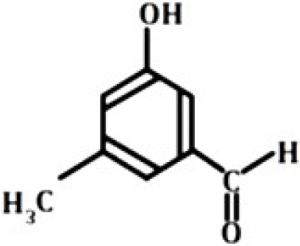
A
$3-$Formyl$-5-$methylphenol
B
$5-$Formyl$-3-$methylphenol
C
$3-$Hydroxy$-5-$methylbenzaldehyde
D
$5-$Hydroxy$-3-$methylbenzaldehyde
Solution
(C) $1$. Identify the principal functional group: The compound contains a benzene ring with $-OH$,$-CHO$,and $-CH_3$ groups. According to $IUPAC$ priority rules,the aldehyde $(-CHO)$ group has higher priority than the hydroxyl $(-OH)$ group. Therefore,the parent compound is benzaldehyde.
$2$. Numbering the ring: The carbon atom attached to the $-CHO$ group is assigned position $1$. We then number the ring to give the lowest possible locants to the substituents. If we start from the $-CHO$ group as $1$,the $-OH$ group is at position $3$ and the $-CH_3$ group is at position $5$. Thus,the name is $3-$hydroxy$-5-$methylbenzaldehyde.
$2$. Numbering the ring: The carbon atom attached to the $-CHO$ group is assigned position $1$. We then number the ring to give the lowest possible locants to the substituents. If we start from the $-CHO$ group as $1$,the $-OH$ group is at position $3$ and the $-CH_3$ group is at position $5$. Thus,the name is $3-$hydroxy$-5-$methylbenzaldehyde.
0 likesView Solution
86
ChemistryEasyMCQMHT CET · 2024
According to the carbinol system,$tert-butyl$ alcohol is named as:
A
Methyl carbinol
B
Ethyl carbinol
C
Propyl carbinol
D
Trimethyl carbinol
Solution
(D) In the carbinol system,methyl alcohol $(CH_3OH)$ is considered the parent compound and is called $carbinol$.
Other alcohols are named as derivatives of $carbinol$ by replacing the hydrogen atoms of the $CH_3$ group with alkyl groups.
$tert-butyl$ alcohol has the structure $(CH_3)_3C-OH$.
Here,all three hydrogen atoms of the $CH_3$ group in $carbinol$ are replaced by three methyl groups.
Therefore,it is named as $trimethyl$ $carbinol$.
Other alcohols are named as derivatives of $carbinol$ by replacing the hydrogen atoms of the $CH_3$ group with alkyl groups.
$tert-butyl$ alcohol has the structure $(CH_3)_3C-OH$.
Here,all three hydrogen atoms of the $CH_3$ group in $carbinol$ are replaced by three methyl groups.
Therefore,it is named as $trimethyl$ $carbinol$.
0 likesView Solution
87
ChemistryMediumMCQMHT CET · 2024
Which functional group from the following is considered as the principal functional group if a polyfunctional compound is to be named by the $IUPAC$ system?
A
$-CN$
B
$-OH$
C
$-C \equiv C-$
D
$-COOH$
Solution
(D) According to $IUPAC$ nomenclature rules,the priority order for functional groups determines the principal functional group. \\ The priority sequence is $-COOH > -CN > -OH > -C \equiv C-$. \\ Therefore,among the given options,$-COOH$ is the principal functional group.
0 likesView Solution
88
ChemistryEasyMCQMHT CET · 2024
What is the $IUPAC$ name of $(CH_3)_4C$?
A
Neopentane
B
$2-$Methylbutane
C
$2-$Methylpropane
D
$2,2-$Dimethylpropane
Solution
(D) The structure of $(CH_3)_4C$ is a central carbon atom bonded to four methyl groups.
To determine the $IUPAC$ name,we first identify the longest carbon chain,which contains $3$ carbon atoms (propane).
There are two methyl groups attached to the second carbon atom.
Therefore,the $IUPAC$ name is $2,2-$dimethylpropane.
To determine the $IUPAC$ name,we first identify the longest carbon chain,which contains $3$ carbon atoms (propane).
There are two methyl groups attached to the second carbon atom.
Therefore,the $IUPAC$ name is $2,2-$dimethylpropane.
0 likesView Solution
89
ChemistryEasyMCQMHT CET · 2024
What is the $IUPAC$ name of the following compound?
$CH_3-CH_2-C(Br)=C(CH_3)-CH_2-CH_3$
$CH_3-CH_2-C(Br)=C(CH_3)-CH_2-CH_3$
A
$3-$Bromo$-4-$ethylbut$-3-$ene
B
$3-$Bromo$-4-$methylhex$-3-$ene
C
$4-$Bromo$-3-$methylhex$-3-$ene
D
$4-$Bromo$-4-$ethyl$-3-$methylbut$-3-$ene
Solution
(B) To determine the $IUPAC$ name,follow these steps:
$1$. Identify the longest carbon chain containing the double bond. The longest chain has $6$ carbons,so it is a hexene derivative.
$2$. Number the chain from the end that gives the double bond the lowest possible locant. Numbering from left to right gives the double bond the position $3$.
$3$. Identify substituents: There is a bromo group at position $3$ and a methyl group at position $4$.
$4$. Combine these to get the name: $3-$Bromo$-4-$methylhex$-3-$ene.
$1$. Identify the longest carbon chain containing the double bond. The longest chain has $6$ carbons,so it is a hexene derivative.
$2$. Number the chain from the end that gives the double bond the lowest possible locant. Numbering from left to right gives the double bond the position $3$.
$3$. Identify substituents: There is a bromo group at position $3$ and a methyl group at position $4$.
$4$. Combine these to get the name: $3-$Bromo$-4-$methylhex$-3-$ene.
0 likesView Solution
90
ChemistryMediumMCQMHT CET · 2024
What is the $IUPAC$ name of the following compound?
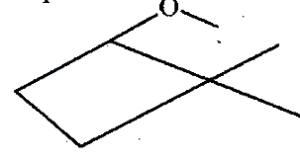
A
$1-$Methoxy$-2,2-$dimethylcyclobutane
B
$1-$Methoxy$-4,4-$dimethylcyclobutane
C
$2-$Methoxy$-1,1-$dimethylcyclobutane
D
$2,2-$dimethylcyclobutoxymethane
Solution
(C) $1$. Identify the parent chain: The parent ring is a cyclobutane ring.
$2$. Numbering the ring: Numbering should start such that the substituents get the lowest possible locants. The methoxy group $(-OCH_3)$ and the two methyl groups $(-CH_3)$ are attached to the ring.
$3$. Assigning locants: If we assign the carbon with the two methyl groups as position $1$,the methoxy group is at position $2$. This gives the locants $1, 1, 2$.
$4$. Alphabetical order: 'Methoxy' comes before 'methyl'.
$5$. Combining the parts: The name is $2-$Methoxy$-1,1-$dimethylcyclobutane.
$2$. Numbering the ring: Numbering should start such that the substituents get the lowest possible locants. The methoxy group $(-OCH_3)$ and the two methyl groups $(-CH_3)$ are attached to the ring.
$3$. Assigning locants: If we assign the carbon with the two methyl groups as position $1$,the methoxy group is at position $2$. This gives the locants $1, 1, 2$.
$4$. Alphabetical order: 'Methoxy' comes before 'methyl'.
$5$. Combining the parts: The name is $2-$Methoxy$-1,1-$dimethylcyclobutane.
0 likesView Solution
91
ChemistryMCQMHT CET · 2024
Which of the following is a tricarboxylic acid?
A
Propionic acid
B
Oxalic acid
C
Malonic acid
D
Citric acid
Solution
(D) tricarboxylic acid is an organic compound that contains three carboxyl $(-COOH)$ groups.
$1$. Propionic acid $(CH_3CH_2COOH)$ is a monocarboxylic acid.
$2$. Oxalic acid $(HOOC-COOH)$ is a dicarboxylic acid.
$3$. Malonic acid $(HOOC-CH_2-COOH)$ is a dicarboxylic acid.
$4$. Citric acid $(HOOC-CH_2-C(OH)(COOH)-CH_2-COOH)$ contains three carboxyl groups,making it a tricarboxylic acid.
$1$. Propionic acid $(CH_3CH_2COOH)$ is a monocarboxylic acid.
$2$. Oxalic acid $(HOOC-COOH)$ is a dicarboxylic acid.
$3$. Malonic acid $(HOOC-CH_2-COOH)$ is a dicarboxylic acid.
$4$. Citric acid $(HOOC-CH_2-C(OH)(COOH)-CH_2-COOH)$ contains three carboxyl groups,making it a tricarboxylic acid.
0 likesView Solution
92
ChemistryEasyMCQMHT CET · 2024
What is the $IUPAC$ name of propylene glycerol?
A
Propane-$1,2$-diol
B
Propane-$1,3$-diol
C
Propene-$1,2,3$-triol
D
Propane-$1,2,3$-triol
Solution
(D) The structural formula for propylene glycerol is $CH_2(OH)-CH(OH)-CH_2(OH)$.
This compound contains three carbon atoms in the main chain and three hydroxyl $(-OH)$ groups attached to each carbon atom.
According to $IUPAC$ nomenclature rules,the parent alkane is propane,and the presence of three $-OH$ groups is indicated by the suffix $-triol$.
The positions of the hydroxyl groups are at carbons $1$,$2$,and $3$.
Therefore,the $IUPAC$ name is Propane-$1,2,3$-triol.
This compound contains three carbon atoms in the main chain and three hydroxyl $(-OH)$ groups attached to each carbon atom.
According to $IUPAC$ nomenclature rules,the parent alkane is propane,and the presence of three $-OH$ groups is indicated by the suffix $-triol$.
The positions of the hydroxyl groups are at carbons $1$,$2$,and $3$.
Therefore,the $IUPAC$ name is Propane-$1,2,3$-triol.
0 likesView Solution
93
ChemistryEasyMCQMHT CET · 2024
Which of the following groups is selected as the principal functional group for the nomenclature of a polyfunctional compound according to the $IUPAC$ system?
A
$-CONH_2$
B
$-CN$
C
$-OH$
D
$-C \equiv C-$
Solution
(A) The principal functional group is decided based on the following $IUPAC$ priority order:
$-COOH > -SO_3H > -COOR > -COCl > -CONH_2 > -CN > -CHO > >C=O > -OH > -NH_2 > -C=C- > -C \equiv C-$.
Comparing the given options:
$1$. $-CONH_2$
$2$. $-CN$
$3$. $-OH$
$4$. $-C \equiv C-$
According to the priority order,$-CONH_2$ appears first among the given choices,making it the principal functional group.
$-COOH > -SO_3H > -COOR > -COCl > -CONH_2 > -CN > -CHO > >C=O > -OH > -NH_2 > -C=C- > -C \equiv C-$.
Comparing the given options:
$1$. $-CONH_2$
$2$. $-CN$
$3$. $-OH$
$4$. $-C \equiv C-$
According to the priority order,$-CONH_2$ appears first among the given choices,making it the principal functional group.
0 likesView Solution
94
ChemistryMediumMCQMHT CET · 2024
What is the $IUPAC$ name of Acrylic acid?
A
Propanoic acid
B
Prop$-2-$enoic acid
C
$2-$Methylpropanoic acid
D
$2-$Hydroxypropanoic acid
Solution
(B) The structure of Acrylic acid is $CH_2=CH-COOH$.
It contains a three-carbon chain with a carboxylic acid functional group and a double bond.
The carbon atom of the carboxylic acid group is assigned position $1$.
The double bond starts at position $2$.
Therefore,the $IUPAC$ name is Prop$-2-$enoic acid.
It contains a three-carbon chain with a carboxylic acid functional group and a double bond.
The carbon atom of the carboxylic acid group is assigned position $1$.
The double bond starts at position $2$.
Therefore,the $IUPAC$ name is Prop$-2-$enoic acid.
0 likesView Solution
95
ChemistryMediumMCQMHT CET · 2024
What is the $IUPAC$ name of the following compound?
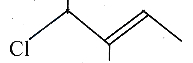
A
$1-$chloro$-1,2-$dimethylbut$-2-$ene
B
$4-$chloro$-3,4-$dimethylbut$-2-$ene
C
$4-$chloro$-3-$methylpent$-2-$ene
D
$2-$chloro$-3-$methylpent$-3-$ene
Solution
(C) $1$. Identify the longest carbon chain containing the double bond. The chain has $5$ carbon atoms,so the parent alkane is pentane,and the alkene is pent$-2-$ene.
$2$. Number the chain from the end that gives the double bond the lowest possible locant. Numbering from right to left gives the double bond position at $C-2$.
$3$. Identify the substituents: a chloro group at $C-4$ and a methyl group at $C-3$.
$4$. Combine these to get the $IUPAC$ name: $4-$chloro$-3-$methylpent$-2-$ene.
$2$. Number the chain from the end that gives the double bond the lowest possible locant. Numbering from right to left gives the double bond position at $C-2$.
$3$. Identify the substituents: a chloro group at $C-4$ and a methyl group at $C-3$.
$4$. Combine these to get the $IUPAC$ name: $4-$chloro$-3-$methylpent$-2-$ene.
0 likesView Solution
96
ChemistryMediumMCQMHT CET · 2024
Identify the name of the following compound:
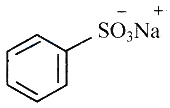
A
Benzene sulphonic acid
B
Sodium benzene sulphonate
C
Sodium phenoxide
D
Benzene diazonium sulphate
Solution
(B) . The given structure is a benzene ring attached to a $-SO_3^-Na^+$ group.
This compound is the sodium salt of benzene sulphonic acid,known as sodium benzene sulphonate.
This compound is the sodium salt of benzene sulphonic acid,known as sodium benzene sulphonate.
0 likesView Solution
97
ChemistryMediumMCQMHT CET · 2024
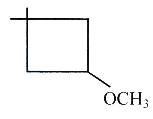
What is the $IUPAC$ name of the given compound?
A
$1-$Methoxy$-3, 3-$dimethylbutane
B
$1-$Methoxy$-3, 3-$dimethylcyclobutane
C
$3-$Methoxy$-1, 1-$dimethylbutane
D
$3-$Methoxy$-1, 1-$dimethylcyclobutane
Solution
(D) $1$. Identify the parent carbon chain: The compound is a cyclic structure with $4$ carbon atoms,which is a cyclobutane ring.
$2$. Numbering the ring: Start numbering from the carbon atom with the substituents to give them the lowest possible locants. The carbon with two methyl groups is assigned position $1$,and the carbon with the methoxy group is assigned position $3$.
$3$. Naming the substituents: There are two methyl groups at position $1$ and one methoxy group at position $3$.
$4$. Combining the parts: The name is $3-$methoxy$-1, 1-$dimethylcyclobutane.
$2$. Numbering the ring: Start numbering from the carbon atom with the substituents to give them the lowest possible locants. The carbon with two methyl groups is assigned position $1$,and the carbon with the methoxy group is assigned position $3$.
$3$. Naming the substituents: There are two methyl groups at position $1$ and one methoxy group at position $3$.
$4$. Combining the parts: The name is $3-$methoxy$-1, 1-$dimethylcyclobutane.
0 likesView Solution
98
ChemistryDifficultMCQMHT CET · 2024
Identify the bond line formula for propan$-1-$ol.
A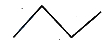
B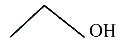
C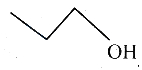
D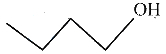
Solution
(C) The $IUPAC$ name propan$-1-$ol indicates a chain of $3$ carbon atoms with an alcohol $(-OH)$ functional group attached to the first carbon atom.
In a bond line formula,each vertex and endpoint represents a carbon atom.
For propan$-1-$ol $(CH_3-CH_2-CH_2-OH)$,we need a $3$-carbon chain where the $-OH$ group is at the end.
Option $C$ correctly represents this structure,where the terminal carbon is bonded to the $-OH$ group.
In a bond line formula,each vertex and endpoint represents a carbon atom.
For propan$-1-$ol $(CH_3-CH_2-CH_2-OH)$,we need a $3$-carbon chain where the $-OH$ group is at the end.
Option $C$ correctly represents this structure,where the terminal carbon is bonded to the $-OH$ group.
0 likesView Solution
99
ChemistryMediumMCQMHT CET · 2024
Which of the following is a correct priority order for the selection of the principal functional group for the nomenclature of a polyfunctional compound?
A
$-COOH > -SO_3H > -COOR$
B
$-COOR > -COOH > -SO_3H$
C
$-SO_3H > -COOR > -COOH$
D
$-COOR > -SO_3H > -COOH$
Solution
(A) According to the $IUPAC$ nomenclature rules for polyfunctional compounds,the priority order for selecting the principal functional group is as follows:
$-COOH > -SO_3H > -COOR > -COCl > -CONH_2 > -CN > -CHO > >C=O > -OH > -NH_2 > -C=C- > -C\equiv C-$
Comparing the given options with this standard order,the correct priority sequence is $-COOH > -SO_3H > -COOR$.
$-COOH > -SO_3H > -COOR > -COCl > -CONH_2 > -CN > -CHO > >C=O > -OH > -NH_2 > -C=C- > -C\equiv C-$
Comparing the given options with this standard order,the correct priority sequence is $-COOH > -SO_3H > -COOR$.
0 likesView Solution
100
ChemistryMCQMHT CET · 2024
What is the $IUPAC$ name of the following compound?
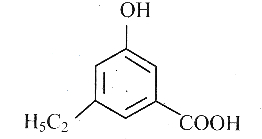
A
$3-$Carboxy$-5-$ethylphenol
B
$5-$Carboxy$-3-$ethylphenol
C
$3-$Ethyl$-5-$hydroxybenzoic acid
D
$5-$Ethyl$-3-$hydroxybenzoic acid
Solution
(C) $1$. Identify the principal functional group. The $-COOH$ group has higher priority than the $-OH$ group,so the parent chain is benzoic acid.
$2$. Number the benzene ring starting from the carbon attached to the $-COOH$ group as position $1$.
$3$. The $-OH$ group is at position $3$ and the $-C_2H_5$ (ethyl) group is at position $5$.
$4$. Alphabetically,'ethyl' comes before 'hydroxy'.
$5$. Therefore,the $IUPAC$ name is $3-$ethyl$-5-$hydroxybenzoic acid.
$2$. Number the benzene ring starting from the carbon attached to the $-COOH$ group as position $1$.
$3$. The $-OH$ group is at position $3$ and the $-C_2H_5$ (ethyl) group is at position $5$.
$4$. Alphabetically,'ethyl' comes before 'hydroxy'.
$5$. Therefore,the $IUPAC$ name is $3-$ethyl$-5-$hydroxybenzoic acid.
0 likesView Solution
101
ChemistryEasyMCQMHT CET · 2024
Which of the following compounds when treated with ammoniacal silver nitrate exhibits silver mirror test?
A
Ethanol
B
Ethanal
C
Ethoxyethane
D
Ethanoic acid
Solution
(B) The silver mirror test is a characteristic reaction of aldehydes.
Ammoniacal silver nitrate is known as Tollen's reagent.
$CH_3CHO + 2[Ag(NH_3)_2]^+ + 3OH^- \rightarrow CH_3COO^- + 2Ag(s) + 4NH_3 + 2H_2O$.
Ethanal $(CH_3CHO)$ is an aldehyde and thus gives a positive silver mirror test.
Ammoniacal silver nitrate is known as Tollen's reagent.
$CH_3CHO + 2[Ag(NH_3)_2]^+ + 3OH^- \rightarrow CH_3COO^- + 2Ag(s) + 4NH_3 + 2H_2O$.
Ethanal $(CH_3CHO)$ is an aldehyde and thus gives a positive silver mirror test.
0 likesView Solution
102
ChemistryMediumMCQMHT CET · 2024
Identify an aromatic,mixed,$3^{\circ}$ amine among the following compounds.
A
$C_6H_5NHC_2H_5$
B
$(C_2H_5)_3N$
C
$(CH_3)_3N$
D
$C_6H_5N(CH_3)_2$
Solution
(D) An aromatic amine is one where the nitrogen atom is directly attached to an aromatic ring.
$A$ mixed amine (or unsymmetrical amine) has different alkyl or aryl groups attached to the nitrogen atom.
$A$ $3^{\circ}$ (tertiary) amine has three groups (alkyl or aryl) attached to the nitrogen atom.
Let us analyze the options:
$A$: $C_6H_5NHC_2H_5$ is an aromatic,mixed,$2^{\circ}$ amine.
$B$: $(C_2H_5)_3N$ is an aliphatic,simple,$3^{\circ}$ amine.
$C$: $(CH_3)_3N$ is an aliphatic,simple,$3^{\circ}$ amine.
$D$: $C_6H_5N(CH_3)_2$ ($N$,$N$-dimethylaniline) has a phenyl group and two methyl groups attached to the nitrogen. It is aromatic,mixed,and a $3^{\circ}$ amine.
Therefore,the correct option is $D$.
$A$ mixed amine (or unsymmetrical amine) has different alkyl or aryl groups attached to the nitrogen atom.
$A$ $3^{\circ}$ (tertiary) amine has three groups (alkyl or aryl) attached to the nitrogen atom.
Let us analyze the options:
$A$: $C_6H_5NHC_2H_5$ is an aromatic,mixed,$2^{\circ}$ amine.
$B$: $(C_2H_5)_3N$ is an aliphatic,simple,$3^{\circ}$ amine.
$C$: $(CH_3)_3N$ is an aliphatic,simple,$3^{\circ}$ amine.
$D$: $C_6H_5N(CH_3)_2$ ($N$,$N$-dimethylaniline) has a phenyl group and two methyl groups attached to the nitrogen. It is aromatic,mixed,and a $3^{\circ}$ amine.
Therefore,the correct option is $D$.
0 likesView Solution
103
ChemistryMediumMCQMHT CET · 2024
Which among the following has the highest basic strength?
A
Ammonia
B
Ethylamine
C
Diethylamine
D
Triethylamine
Solution
(C) As a consequence of the combined effect of the inductive effect,steric effect,and solvation,the secondary amines are the strongest bases among aliphatic amines in the aqueous phase.
Therefore,the basic strength varies as: $2^{\circ} \text{ amine} > 3^{\circ} \text{ amine} > 1^{\circ} \text{ amine} > \text{ammonia}$.
Hence,among the given options,diethylamine $(2^{\circ})$ has the highest basic strength.
Therefore,the basic strength varies as: $2^{\circ} \text{ amine} > 3^{\circ} \text{ amine} > 1^{\circ} \text{ amine} > \text{ammonia}$.
Hence,among the given options,diethylamine $(2^{\circ})$ has the highest basic strength.
0 likesView Solution
104
ChemistryEasyMCQMHT CET · 2024
Which of the following does not have intermolecular hydrogen bonding?
A
Cyclohexylamine
B
Allylamine
C
Trimethylamine
D
Diphenylamine
Solution
(C) Intermolecular hydrogen bonding requires a hydrogen atom directly bonded to a highly electronegative atom like $N$,$O$,or $F$.
In $Trimethylamine$ $(N(CH_3)_3)$,the nitrogen atom is bonded to three methyl groups and has no hydrogen atom attached to it.
Therefore,it cannot form intermolecular hydrogen bonds.
In contrast,$Cyclohexylamine$ $(C_6H_{11}NH_2)$,$Allylamine$ $(CH_2=CH-CH_2NH_2)$,and $Diphenylamine$ $((C_6H_5)_2NH)$ all contain at least one $N-H$ bond,allowing them to participate in intermolecular hydrogen bonding.
In $Trimethylamine$ $(N(CH_3)_3)$,the nitrogen atom is bonded to three methyl groups and has no hydrogen atom attached to it.
Therefore,it cannot form intermolecular hydrogen bonds.
In contrast,$Cyclohexylamine$ $(C_6H_{11}NH_2)$,$Allylamine$ $(CH_2=CH-CH_2NH_2)$,and $Diphenylamine$ $((C_6H_5)_2NH)$ all contain at least one $N-H$ bond,allowing them to participate in intermolecular hydrogen bonding.
0 likesView Solution
105
ChemistryMediumMCQMHT CET · 2024
Identify the alkene obtained as the major product in the following Hofmann elimination reaction.
$(CH_3CH_2CH_2)N^{+}(CH_2CH_3)_3 I^{-}$ $\xrightarrow[\Delta]{\text{moist } Ag_2O} A$ $\xrightarrow[\Delta]{\text{heat}} \text{Alkene} + \text{Amine}$
$(CH_3CH_2CH_2)N^{+}(CH_2CH_3)_3 I^{-}$ $\xrightarrow[\Delta]{\text{moist } Ag_2O} A$ $\xrightarrow[\Delta]{\text{heat}} \text{Alkene} + \text{Amine}$
A
Propene
B
Ethene
C
But$-1-$ene
D
But$-2-$ene
Solution
(B) In Hofmann elimination,the quaternary ammonium hydroxide undergoes thermal decomposition to form the least substituted alkene as the major product.
Step $1$: The quaternary ammonium iodide is converted to the corresponding hydroxide using moist $Ag_2O$.
$(CH_3CH_2CH_2)N^{+}(CH_2CH_3)_3 I^{-} + AgOH \rightarrow (CH_3CH_2CH_2)N^{+}(CH_2CH_3)_3 OH^{-} + AgI$
Step $2$: Upon heating,the $OH^{-}$ ion abstracts a $\beta$-hydrogen from the alkyl groups attached to the nitrogen atom.
The available $\beta$-hydrogens are on the propyl group (at the $\beta$-carbon) and the ethyl groups (at the $\beta$-carbon).
Removal of $\beta$-hydrogen from the ethyl group yields ethene $(CH_2=CH_2)$.
Removal of $\beta$-hydrogen from the propyl group yields propene $(CH_3CH=CH_2)$.
According to the Hofmann rule,the less substituted alkene is the major product. Since ethene is less substituted than propene,ethene is the major product.
Step $1$: The quaternary ammonium iodide is converted to the corresponding hydroxide using moist $Ag_2O$.
$(CH_3CH_2CH_2)N^{+}(CH_2CH_3)_3 I^{-} + AgOH \rightarrow (CH_3CH_2CH_2)N^{+}(CH_2CH_3)_3 OH^{-} + AgI$
Step $2$: Upon heating,the $OH^{-}$ ion abstracts a $\beta$-hydrogen from the alkyl groups attached to the nitrogen atom.
The available $\beta$-hydrogens are on the propyl group (at the $\beta$-carbon) and the ethyl groups (at the $\beta$-carbon).
Removal of $\beta$-hydrogen from the ethyl group yields ethene $(CH_2=CH_2)$.
Removal of $\beta$-hydrogen from the propyl group yields propene $(CH_3CH=CH_2)$.
According to the Hofmann rule,the less substituted alkene is the major product. Since ethene is less substituted than propene,ethene is the major product.
0 likesView Solution
106
ChemistryDifficultMCQMHT CET · 2024
Identify the number of moles of ethene obtained when $n$ moles of $N, N, N$-triethylpropylammonium iodide is treated with moist $Ag_2O$ and then heated.
A
$n$
B
$2n$
C
$3n$
D
$4n$
Solution
(A) The reaction is an example of the Hofmann elimination reaction.
$1$ mole of $N, N, N$-triethylpropylammonium iodide reacts with moist $Ag_2O$ to form the corresponding quaternary ammonium hydroxide.
Upon heating,the quaternary ammonium hydroxide undergoes elimination to yield ethene $(CH_2=CH_2)$ and $N, N$-diethylpropylamine.
The stoichiometry of the reaction is $1:1$ with respect to the quaternary ammonium salt and ethene.
Therefore,$n$ moles of $N, N, N$-triethylpropylammonium iodide will yield $n$ moles of ethene.
$1$ mole of $N, N, N$-triethylpropylammonium iodide reacts with moist $Ag_2O$ to form the corresponding quaternary ammonium hydroxide.
Upon heating,the quaternary ammonium hydroxide undergoes elimination to yield ethene $(CH_2=CH_2)$ and $N, N$-diethylpropylamine.
The stoichiometry of the reaction is $1:1$ with respect to the quaternary ammonium salt and ethene.
Therefore,$n$ moles of $N, N, N$-triethylpropylammonium iodide will yield $n$ moles of ethene.
0 likesView Solution
107
ChemistryMediumMCQMHT CET · 2024
How many isomers of $C_4H_{11}N$ are secondary amines?
A
One
B
Two
C
Three
D
Four
Solution
(C) secondary amine has the general formula $R-NH-R'$. For the molecular formula $C_4H_{11}N$,the possible secondary amine isomers are:
$1$. $CH_3CH_2-NH-CH_2CH_3$ (Diethylamine)
$2$. $CH_3-NH-CH_2CH_2CH_3$ (Methylpropylamine)
$3$. $CH_3-NH-CH(CH_3)_2$ (Methylisopropylamine)
Thus,there are $3$ such isomers.
$1$. $CH_3CH_2-NH-CH_2CH_3$ (Diethylamine)
$2$. $CH_3-NH-CH_2CH_2CH_3$ (Methylpropylamine)
$3$. $CH_3-NH-CH(CH_3)_2$ (Methylisopropylamine)
Thus,there are $3$ such isomers.
0 likesView Solution
108
ChemistryMediumMCQMHT CET · 2024
Identify the product '$B$' in the following series of reactions: Isopropyl cyanide $\xrightarrow[HCl]{SnCl_2} A$ $\xrightarrow{H_3O^{+}} B + NH_4Cl$
A
Propanal
B
Propanone
C
$2-$Methylpropanal
D
$2-$Methylpropanoic acid
Solution
(C) The reaction sequence is a Stephen reduction followed by hydrolysis.
$1$. Isopropyl cyanide $((CH_3)_2CH-CN)$ reacts with $SnCl_2$ and $HCl$ to form an imine hydrochloride intermediate $(A)$,which is $(CH_3)_2CH-CH=NH \cdot HCl$.
$2$. Subsequent acid hydrolysis $(H_3O^{+})$ of the imine hydrochloride converts the imine group into an aldehyde group,yielding $2-$Methylpropanal as product $B$ along with $NH_4Cl$.
$3$. The reaction is: $(CH_3)_2CH-CN$ $\xrightarrow[HCl]{SnCl_2} (CH_3)_2CH-CH=NH \cdot HCl$ $\xrightarrow{H_3O^{+}} (CH_3)_2CH-CHO + NH_4Cl$.
$1$. Isopropyl cyanide $((CH_3)_2CH-CN)$ reacts with $SnCl_2$ and $HCl$ to form an imine hydrochloride intermediate $(A)$,which is $(CH_3)_2CH-CH=NH \cdot HCl$.
$2$. Subsequent acid hydrolysis $(H_3O^{+})$ of the imine hydrochloride converts the imine group into an aldehyde group,yielding $2-$Methylpropanal as product $B$ along with $NH_4Cl$.
$3$. The reaction is: $(CH_3)_2CH-CN$ $\xrightarrow[HCl]{SnCl_2} (CH_3)_2CH-CH=NH \cdot HCl$ $\xrightarrow{H_3O^{+}} (CH_3)_2CH-CHO + NH_4Cl$.
0 likesView Solution
109
ChemistryEasyMCQMHT CET · 2024
Which among the following compounds does not correctly match with its formula?
A
Hydrazine: $NH_2-NH_2$
B
Semicarbazide: $NH_2-CONH-NH_2$
C
Phenylhydrazine: $C_6H_5-NH-NH-C_6H_5$
D
Hydroxylamine: $NH_2-OH$
Solution
(C) The correct formula for Phenylhydrazine is $C_6H_5-NH-NH_2$.
Option $C$ is incorrect because $C_6H_5-NH-NH-C_6H_5$ represents $1,2$-diphenylhydrazine.
Option $C$ is incorrect because $C_6H_5-NH-NH-C_6H_5$ represents $1,2$-diphenylhydrazine.
0 likesView Solution
110
ChemistryMediumMCQMHT CET · 2024
The major product formed in carbylamine reaction is
A
Alkyl halide
B
Alkyl cyanide
C
Nitroalkane
D
Alkyl isocyanide
Solution
(D) Aliphatic or aromatic primary amines on heating with chloroform $(CHCl_3)$ and alcoholic potassium hydroxide $(KOH)$ give foul-smelling products called alkyl or aryl isocyanides (carbylamines).
The chemical reaction is:
$R-NH_2 + CHCl_3 + 3KOH \xrightarrow[\text{alc.}]{\Delta} R-NC + 3KCl + 3H_2O$
Here,$R-NC$ is the alkyl isocyanide.
The chemical reaction is:
$R-NH_2 + CHCl_3 + 3KOH \xrightarrow[\text{alc.}]{\Delta} R-NC + 3KCl + 3H_2O$
Here,$R-NC$ is the alkyl isocyanide.
0 likesView Solution
111
ChemistryMediumMCQMHT CET · 2024
Which of the following amines undergoes acylation reaction?
A
Ethyldimethylamine
B
$N$-Methylaniline
C
$N,N$-Dimethylmethanamine
D
$N,N$-Dimethylaniline
Solution
(B) Acylation reaction occurs with primary and secondary amines because they possess at least one hydrogen atom attached to the nitrogen atom,which can be replaced by an acyl group.
$N$-Methylaniline $(C_6H_5NHCH_3)$ is a secondary amine and thus undergoes acylation.
Ethyldimethylamine,$N,N$-Dimethylmethanamine,and $N,N$-Dimethylaniline are all tertiary amines,which lack a hydrogen atom on the nitrogen and therefore do not undergo acylation.
$N$-Methylaniline $(C_6H_5NHCH_3)$ is a secondary amine and thus undergoes acylation.
Ethyldimethylamine,$N,N$-Dimethylmethanamine,and $N,N$-Dimethylaniline are all tertiary amines,which lack a hydrogen atom on the nitrogen and therefore do not undergo acylation.
0 likesView Solution
112
ChemistryMediumMCQMHT CET · 2024
Which one of the following compounds does not react with acetyl chloride?
A
$CH_3CH_2NH_2$
B
$CH_3CH_2CH_2NHCH_3$
C
$(CH_3CH_2)_3N$
D
$(CH_3)_3CNH_2$
Solution
(C) Aliphatic and aromatic primary and secondary amines undergo acylation reactions because they contain replaceable hydrogen atoms attached to the nitrogen atom.
Triethylamine,$(CH_3CH_2)_3N$,is a tertiary amine and does not possess any replaceable hydrogen atom on the nitrogen.
Therefore,it does not react with acetyl chloride.
Triethylamine,$(CH_3CH_2)_3N$,is a tertiary amine and does not possess any replaceable hydrogen atom on the nitrogen.
Therefore,it does not react with acetyl chloride.
0 likesView Solution
113
ChemistryEasyMCQMHT CET · 2024
Identify the correct decreasing order of $pK_b$ values of the following compounds.
A
$NH_3 > RNH_2 > R_2NH$
B
$R_2NH > RNH_2 > NH_3$
C
$RNH_2 > R_2NH > NH_3$
D
$R_2NH > NH_3 > RNH_2$
Solution
(A) The basic strength of amines depends on the electron-donating inductive effect of the alkyl group $(R)$.
As the number of alkyl groups increases,the electron density on the nitrogen atom increases,making the amine more basic.
Therefore,the order of basic strength is $NH_3 < RNH_2 < R_2NH$.
Since $pK_b = -\log(K_b)$,a higher basic strength corresponds to a lower $pK_b$ value.
Thus,the decreasing order of $pK_b$ values is $NH_3 > RNH_2 > R_2NH$.
As the number of alkyl groups increases,the electron density on the nitrogen atom increases,making the amine more basic.
Therefore,the order of basic strength is $NH_3 < RNH_2 < R_2NH$.
Since $pK_b = -\log(K_b)$,a higher basic strength corresponds to a lower $pK_b$ value.
Thus,the decreasing order of $pK_b$ values is $NH_3 > RNH_2 > R_2NH$.
0 likesView Solution
114
ChemistryMediumMCQMHT CET · 2024
Which from the following amines has the highest $pK_{b}$ value?
A
Arylamine
B
Tertiary alkanamine
C
Secondary alkanamine
D
Primary alkanamine
Solution
(A) The $pK_{b}$ value is inversely proportional to the basic strength of the amine.
Arylamines are much weaker bases than aliphatic amines due to the delocalization of the lone pair of electrons on the nitrogen atom into the benzene ring.
Among the given options,arylamine is the weakest base,and therefore,it possesses the highest $pK_{b}$ value.
Arylamines are much weaker bases than aliphatic amines due to the delocalization of the lone pair of electrons on the nitrogen atom into the benzene ring.
Among the given options,arylamine is the weakest base,and therefore,it possesses the highest $pK_{b}$ value.
0 likesView Solution
115
ChemistryEasyMCQMHT CET · 2024
Identify product $B$ in the following reaction:
Benzonitrile $\xrightarrow[\text{Dry ether}]{C_6H_5MgBr} A$ $\xrightarrow{H_3O^{+}} B$
Benzonitrile $\xrightarrow[\text{Dry ether}]{C_6H_5MgBr} A$ $\xrightarrow{H_3O^{+}} B$
A
Benzophenone
B
Benzaldehyde
C
Benzyl alcohol
D
Benzoic acid
Solution
(A) The reaction of benzonitrile $(C_6H_5CN)$ with phenylmagnesium bromide $(C_6H_5MgBr)$ in the presence of dry ether forms an intermediate imine salt $(A)$: $C_6H_5-C(C_6H_5)=NMgBr$.
Upon acid hydrolysis $(H_3O^{+})$,this intermediate is converted into a ketone,specifically benzophenone $(C_6H_5-CO-C_6H_5)$,along with ammonia $(NH_3)$ and magnesium hydroxybromide $(Mg(Br)OH)$.
Therefore,product $B$ is benzophenone.
Upon acid hydrolysis $(H_3O^{+})$,this intermediate is converted into a ketone,specifically benzophenone $(C_6H_5-CO-C_6H_5)$,along with ammonia $(NH_3)$ and magnesium hydroxybromide $(Mg(Br)OH)$.
Therefore,product $B$ is benzophenone.
0 likesView Solution
116
ChemistryMediumMCQMHT CET · 2024
Which of the following compounds is $NOT$ obtained at any stage of Gabriel phthalimide synthesis?
A
Potassium salt of phthalimide
B
$N$-alkyl phthalimide
C
Phthalic acid
D
Primary amine
Solution
(C) Gabriel phthalimide synthesis involves the following steps:
$1$. Phthalimide reacts with $alc. KOH$ to form the potassium salt of phthalimide.
$2$. The potassium salt of phthalimide reacts with an alkyl halide $(R-X)$ to form $N$-alkyl phthalimide.
$3$. $N$-alkyl phthalimide undergoes alkaline hydrolysis (using $NaOH_{(aq)}$) to yield a primary amine $(R-NH_2)$ and the sodium salt of phthalic acid (sodium phthalate).
Phthalic acid itself is not formed as a product; instead,its sodium salt is obtained. Therefore,phthalic acid is not obtained at any stage.
$1$. Phthalimide reacts with $alc. KOH$ to form the potassium salt of phthalimide.
$2$. The potassium salt of phthalimide reacts with an alkyl halide $(R-X)$ to form $N$-alkyl phthalimide.
$3$. $N$-alkyl phthalimide undergoes alkaline hydrolysis (using $NaOH_{(aq)}$) to yield a primary amine $(R-NH_2)$ and the sodium salt of phthalic acid (sodium phthalate).
Phthalic acid itself is not formed as a product; instead,its sodium salt is obtained. Therefore,phthalic acid is not obtained at any stage.
0 likesView Solution
117
ChemistryMediumMCQMHT CET · 2024
Identify the product in the following reaction: $Pent-3-enenitrile \xrightarrow[H_3O^+]{AlH(i-Bu)_2} \text{Product}$
A
$Pent-3-en-1-amine$
B
$Pentanal$
C
$Pent-3-enal$
D
$Pent-3-en-1-ol$
Solution
(C) The reagent $AlH(i-Bu)_2$ is Diisobutylaluminium hydride ($DIBAL$-$H$).
It is a selective reducing agent that reduces nitriles $(-CN)$ to imines,which upon acidic hydrolysis $(H_3O^+)$ yield aldehydes.
The reaction is: $CH_3-CH=CH-CH_2-CN \xrightarrow[2. H_3O^+]{1. AlH(i-Bu)_2} CH_3-CH=CH-CH_2-CHO$.
Thus,the product formed is $Pent-3-enal$.
It is a selective reducing agent that reduces nitriles $(-CN)$ to imines,which upon acidic hydrolysis $(H_3O^+)$ yield aldehydes.
The reaction is: $CH_3-CH=CH-CH_2-CN \xrightarrow[2. H_3O^+]{1. AlH(i-Bu)_2} CH_3-CH=CH-CH_2-CHO$.
Thus,the product formed is $Pent-3-enal$.
0 likesView Solution
118
ChemistryMediumMCQMHT CET · 2024
Which of the following is a primary amine?
A
$N$-methylmethanamine
B
Phenylmethanamine
C
$N$-phenylbenzenamine
D
$N$-methylbenzenamine
Solution
(B) primary $(1^{\circ})$ amine is an amine where the nitrogen atom is attached to only one alkyl or aryl group,represented by the general formula $R-NH_2$.
$1$. $N$-methylmethanamine $(CH_3-NH-CH_3)$ is a secondary $(2^{\circ})$ amine.
$2$. Phenylmethanamine $(C_6H_5-CH_2-NH_2)$ has the $-NH_2$ group attached to a carbon atom,making it a primary $(1^{\circ})$ amine.
$3$. $N$-phenylbenzenamine $(C_6H_5-NH-C_6H_5)$ is a secondary $(2^{\circ})$ amine.
$4$. $N$-methylbenzenamine $(C_6H_5-NH-CH_3)$ is a secondary $(2^{\circ})$ amine.
Therefore,Phenylmethanamine is the correct primary amine.
$1$. $N$-methylmethanamine $(CH_3-NH-CH_3)$ is a secondary $(2^{\circ})$ amine.
$2$. Phenylmethanamine $(C_6H_5-CH_2-NH_2)$ has the $-NH_2$ group attached to a carbon atom,making it a primary $(1^{\circ})$ amine.
$3$. $N$-phenylbenzenamine $(C_6H_5-NH-C_6H_5)$ is a secondary $(2^{\circ})$ amine.
$4$. $N$-methylbenzenamine $(C_6H_5-NH-CH_3)$ is a secondary $(2^{\circ})$ amine.
Therefore,Phenylmethanamine is the correct primary amine.
0 likesView Solution
119
ChemistryMediumMCQMHT CET · 2024
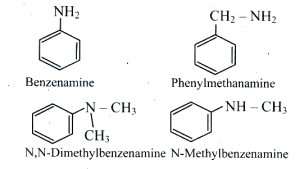
Which among the following is the strongest base?
A
Benzenamine
B
Phenylmethanamine
C
$N,N$-Dimethylbenzenamine
D
$N$-Methylbenzenamine
Solution
(B) In arylamines,the $-NH_2$ group is attached directly to an aromatic ring. The lone pair of electrons on nitrogen is conjugated to the aromatic ring and is less available for protonation.
In phenylmethanamine (an aliphatic amine),the lone pair of electrons on nitrogen is not involved in resonance with the aromatic ring and is thus more available for protonation.
Therefore,phenylmethanamine is the strongest base among the given amines.
In phenylmethanamine (an aliphatic amine),the lone pair of electrons on nitrogen is not involved in resonance with the aromatic ring and is thus more available for protonation.
Therefore,phenylmethanamine is the strongest base among the given amines.
0 likesView Solution
120
ChemistryEasyMCQMHT CET · 2024
Identify reagent '$A$' used in the following reaction:
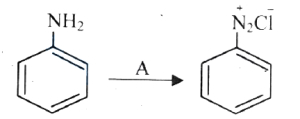
A
$\xrightarrow[\Delta]{\text{dil. } HCl}$
B
$\xrightarrow[\text{low temp.}]{NaNO_2+HCl}$
C
$\xrightarrow[\Delta]{H_3O^{+}}$
D
$NaOH, 623 \ K$
Solution
(B) The reaction shown is the conversion of aniline to benzene diazonium chloride.
This process is known as diazotisation.
Aniline reacts with nitrous acid $(HNO_2)$,which is generated in situ by the reaction of $NaNO_2$ and $HCl$ at a low temperature $(273-278 \ K)$,to form benzene diazonium chloride.
Therefore,the correct reagent '$A$' is $NaNO_2+HCl$ at low temperature.
This process is known as diazotisation.
Aniline reacts with nitrous acid $(HNO_2)$,which is generated in situ by the reaction of $NaNO_2$ and $HCl$ at a low temperature $(273-278 \ K)$,to form benzene diazonium chloride.
Therefore,the correct reagent '$A$' is $NaNO_2+HCl$ at low temperature.
0 likesView Solution
121
ChemistryMediumMCQMHT CET · 2024
Identify the product '$B$' in the following sequence of reactions.
$CH_3Br$ $\xrightarrow{KCN} A$ $\xrightarrow{Na / C_2H_5OH} B$
$CH_3Br$ $\xrightarrow{KCN} A$ $\xrightarrow{Na / C_2H_5OH} B$
A
Methyl cyanide
B
Ethyl amine
C
Methyl amine
D
Ethyl cyanide
Solution
(B) Step $1$: $CH_3Br$ reacts with $KCN$ to form methyl cyanide $(CH_3CN)$ as product $A$.
$CH_3Br + KCN \rightarrow CH_3CN + KBr$
Step $2$: Methyl cyanide $(CH_3CN)$ undergoes reduction with $Na / C_2H_5OH$ (Mendius reduction) to form ethyl amine $(CH_3CH_2NH_2)$ as product $B$.
$CH_3CN + 4[H] \xrightarrow{Na / C_2H_5OH} CH_3CH_2NH_2$
Therefore,the product $B$ is ethyl amine.
$CH_3Br + KCN \rightarrow CH_3CN + KBr$
Step $2$: Methyl cyanide $(CH_3CN)$ undergoes reduction with $Na / C_2H_5OH$ (Mendius reduction) to form ethyl amine $(CH_3CH_2NH_2)$ as product $B$.
$CH_3CN + 4[H] \xrightarrow{Na / C_2H_5OH} CH_3CH_2NH_2$
Therefore,the product $B$ is ethyl amine.
0 likesView Solution
122
ChemistryDifficultMCQMHT CET · 2024
Identify the class of $(C_6H_5)_3N$?
A
$3^{\circ}$ aliphatic simple amine
B
$3^{\circ}$ aromatic mixed amine
C
$3^{\circ}$ aromatic simple amine
D
$3^{\circ}$ aliphatic mixed amine
Solution
(C) The compound $(C_6H_5)_3N$ is known as triphenylamine.
It is classified as an aromatic amine because the nitrogen atom is directly attached to three phenyl groups $(C_6H_5)$,which are aromatic rings.
Since the nitrogen atom is bonded to three identical aryl groups and no hydrogen atoms,it is a tertiary $(3^{\circ})$ simple aromatic amine.
It is classified as an aromatic amine because the nitrogen atom is directly attached to three phenyl groups $(C_6H_5)$,which are aromatic rings.
Since the nitrogen atom is bonded to three identical aryl groups and no hydrogen atoms,it is a tertiary $(3^{\circ})$ simple aromatic amine.
0 likesView Solution
123
ChemistryEasyMCQMHT CET · 2024
Which of the following conversions is a Hofmann elimination reaction?
A
$RCONH_2 \xrightarrow{Br_2, KOH_{(aq)}} RNH_2$
B
$RNH_2 \xrightarrow[\text{excess}]{RX} R_4NX$
C
$R_4NX \xrightarrow[\Delta]{\text{moist } Ag_2O} \text{Alkene} + R_3N$
D
$RCN \xrightarrow{Na / C_2H_5OH} RCH_2NH_2$
Solution
(C) The Hofmann elimination reaction is a process where a quaternary ammonium hydroxide $(R_4N^{+}OH^{-})$ undergoes elimination upon heating to form an alkene and a tertiary amine.
This reaction typically involves the treatment of a quaternary ammonium halide with moist $Ag_2O$ (which generates $AgOH$ to provide the $OH^{-}$ ion),followed by thermal decomposition.
This reaction typically involves the treatment of a quaternary ammonium halide with moist $Ag_2O$ (which generates $AgOH$ to provide the $OH^{-}$ ion),followed by thermal decomposition.
0 likesView Solution
124
ChemistryEasyMCQMHT CET · 2024
What is the formula of Hinsberg's reagent?
A
$C_6H_5SOCl_2$
B
$C_2H_5SO_2Cl$
C
$C_6H_5SO_2Cl$
D
$C_2H_5CrOCl_2$
Solution
(C) Hinsberg's reagent is benzenesulfonyl chloride.
Its chemical formula is $C_6H_5SO_2Cl$.
Its chemical formula is $C_6H_5SO_2Cl$.
0 likesView Solution
125
ChemistryDifficultMCQMHT CET · 2024
How many moles of iodomethane are consumed in the following conversion?
$CH_3NH_2 \xrightarrow[\Delta]{CH_3I} (CH_3)_4N^{+}I^{-}$
$CH_3NH_2 \xrightarrow[\Delta]{CH_3I} (CH_3)_4N^{+}I^{-}$
A
Four
B
Three
C
Two
D
One
Solution
(B) The reaction of methylamine $(CH_3NH_2)$ with iodomethane $(CH_3I)$ proceeds via exhaustive alkylation until the quaternary ammonium salt is formed:
$CH_3NH_2 + CH_3I \rightarrow (CH_3)_2NH + HI$
$(CH_3)_2NH + CH_3I \rightarrow (CH_3)_3N + HI$
$(CH_3)_3N + CH_3I \rightarrow (CH_3)_4N^{+}I^{-}$
Summing these steps,$3$ moles of $CH_3I$ are consumed to convert $1$ mole of $CH_3NH_2$ into tetramethylammonium iodide $((CH_3)_4N^{+}I^{-})$.
$CH_3NH_2 + CH_3I \rightarrow (CH_3)_2NH + HI$
$(CH_3)_2NH + CH_3I \rightarrow (CH_3)_3N + HI$
$(CH_3)_3N + CH_3I \rightarrow (CH_3)_4N^{+}I^{-}$
Summing these steps,$3$ moles of $CH_3I$ are consumed to convert $1$ mole of $CH_3NH_2$ into tetramethylammonium iodide $((CH_3)_4N^{+}I^{-})$.
0 likesView Solution
126
ChemistryEasyMCQMHT CET · 2024
Identify the product '$A$' obtained in the following reaction.
$N$-alkyl phthalimide $\xrightarrow[\text{sodium phthalate } + A]{NaOH_{(aq)}}$
$N$-alkyl phthalimide $\xrightarrow[\text{sodium phthalate } + A]{NaOH_{(aq)}}$
A
Primary amine
B
Amide
C
Phenol
D
Benzoic acid
Solution
(A) The reaction shown is the alkaline hydrolysis of $N$-alkyl phthalimide,which is a step in the Gabriel phthalimide synthesis.
The reaction is: $N$-alkyl phthalimide + $2NaOH_{(aq)} \rightarrow \text{Sodium phthalate} + R-NH_2$ (Primary amine).
Therefore,the product '$A$' is a primary amine.
The reaction is: $N$-alkyl phthalimide + $2NaOH_{(aq)} \rightarrow \text{Sodium phthalate} + R-NH_2$ (Primary amine).
Therefore,the product '$A$' is a primary amine.
0 likesView Solution
127
ChemistryMediumMCQMHT CET · 2024
What is the product obtained when benzonitrile is treated with $C_6H_5MgBr$ in dry ether and then hydrolyzed?
A
Phenol
B
Benzophenone
C
Benzyl amine
D
Benzene
Solution
(B) The reaction of benzonitrile $(C_6H_5CN)$ with phenylmagnesium bromide $(C_6H_5MgBr)$ in dry ether proceeds via a nucleophilic addition to the nitrile group.
First,the phenyl group from the Grignard reagent attacks the electrophilic carbon of the nitrile,forming an imine complex intermediate: $C_6H_5CN + C_6H_5MgBr \rightarrow C_6H_5-C(C_6H_5)=N-MgBr$.
Subsequently,acid-catalyzed hydrolysis $(H_3O^+)$ of the imine complex converts the $C=N-MgBr$ group into a carbonyl group $(C=O)$,yielding benzophenone $(C_6H_5-CO-C_6H_5)$ as the final product along with ammonia and magnesium salts.
First,the phenyl group from the Grignard reagent attacks the electrophilic carbon of the nitrile,forming an imine complex intermediate: $C_6H_5CN + C_6H_5MgBr \rightarrow C_6H_5-C(C_6H_5)=N-MgBr$.
Subsequently,acid-catalyzed hydrolysis $(H_3O^+)$ of the imine complex converts the $C=N-MgBr$ group into a carbonyl group $(C=O)$,yielding benzophenone $(C_6H_5-CO-C_6H_5)$ as the final product along with ammonia and magnesium salts.
0 likesView Solution
128
ChemistryEasyMCQMHT CET · 2024
Which of the following is Mendius reduction?
A
$R-CONH_2 \xrightarrow[\Delta]{Br_2, KOH_{(aq)}} R-NH_2$
B
$R-NH_2 \xrightarrow{RX \text{ (excess)}} R_4N^+X^-$
C
$R_4N^+X^- \xrightarrow[\Delta]{\text{Moist } Ag_2O} \text{Alkene} + R_3N$
D
$R-CN \xrightarrow[\text{or } LiAlH_4]{Na / CH_3OH} R-CH_2NH_2$
Solution
(D) The correct answer is $D$.
Mendius reduction involves the reduction of nitriles $(R-CN)$ to primary amines $(R-CH_2NH_2)$ using reducing agents like sodium in ethanol or methanol ($Na / C_2H_5OH$ or $Na / CH_3OH$) or lithium aluminum hydride $(LiAlH_4)$.
Explanation of other options:
- $A$: This is Hofmann bromamide degradation,where an amide $(R-CONH_2)$ reacts with bromine and alkali to form a primary amine.
- $B$: This is the $N$-alkylation of amines,where an amine reacts with excess alkyl halide to form a quaternary ammonium salt.
- $C$: This is Hofmann elimination,where a quaternary ammonium hydroxide undergoes thermal decomposition to form an alkene and a tertiary amine.
Mendius reduction involves the reduction of nitriles $(R-CN)$ to primary amines $(R-CH_2NH_2)$ using reducing agents like sodium in ethanol or methanol ($Na / C_2H_5OH$ or $Na / CH_3OH$) or lithium aluminum hydride $(LiAlH_4)$.
Explanation of other options:
- $A$: This is Hofmann bromamide degradation,where an amide $(R-CONH_2)$ reacts with bromine and alkali to form a primary amine.
- $B$: This is the $N$-alkylation of amines,where an amine reacts with excess alkyl halide to form a quaternary ammonium salt.
- $C$: This is Hofmann elimination,where a quaternary ammonium hydroxide undergoes thermal decomposition to form an alkene and a tertiary amine.
0 likesView Solution
129
ChemistryMediumMCQMHT CET · 2024
Which of the following statements is $NOT$ correct regarding Mendius reduction?
A
It is useful for the preparation of $R-NH_2$.
B
In this,alkyl cyanides are reduced.
C
In this,sodium and ethanol are used for reduction.
D
In this method,one carbon atom is lost in the form of $CO_2$.
Solution
(D) Mendius reduction is a chemical reaction that involves the reduction of alkyl cyanides (nitriles) to primary amines using sodium in ethanol $(Na/C_2H_5OH)$.
The reaction is represented as: $R-CN + 4[H] \xrightarrow{Na/C_2H_5OH} R-CH_2NH_2$.
This reaction does not involve the loss of a carbon atom as $CO_2$.
Therefore,the statement that one carbon atom is lost as $CO_2$ is incorrect.
The reaction is represented as: $R-CN + 4[H] \xrightarrow{Na/C_2H_5OH} R-CH_2NH_2$.
This reaction does not involve the loss of a carbon atom as $CO_2$.
Therefore,the statement that one carbon atom is lost as $CO_2$ is incorrect.
0 likesView Solution
130
ChemistryDifficultMCQMHT CET · 2024
Which of the following $n$ mole molecules of carbohydrate contains $2n$ mole molecules of galactose,$n$ moles of glucose,and $n$ moles of fructose upon hydrolysis?
A
Lactose
B
Raffinose
C
Amylose
D
Stachyose
Solution
(D) Stachyose is a tetrasaccharide with the molecular formula $C_{24}H_{42}O_{21}$.
Upon complete hydrolysis,one mole of stachyose yields two moles of galactose,one mole of glucose,and one mole of fructose.
Therefore,$n$ moles of stachyose will yield $2n$ moles of galactose,$n$ moles of glucose,and $n$ moles of fructose.
Upon complete hydrolysis,one mole of stachyose yields two moles of galactose,one mole of glucose,and one mole of fructose.
Therefore,$n$ moles of stachyose will yield $2n$ moles of galactose,$n$ moles of glucose,and $n$ moles of fructose.
0 likesView Solution
131
ChemistryDifficultMCQMHT CET · 2024
Identify the molecular formula of laevulose.
A
$C_6H_{12}O_6$
B
$C_5H_{10}O_5$
C
$C_4H_8O_4$
D
$C_3H_6O_3$
Solution
(A) Fructose $(C_6H_{12}O_6)$ is a laevorotatory ketohexose.
It exhibits laevorotation with a specific rotation of $[\alpha]_D^{20} = -92.4^{\circ}$.
Due to this property,fructose is commonly referred to as laevulose.
It exhibits laevorotation with a specific rotation of $[\alpha]_D^{20} = -92.4^{\circ}$.
Due to this property,fructose is commonly referred to as laevulose.
0 likesView Solution
132
ChemistryMediumMCQMHT CET · 2024
Which of the following statements is $CORRECT$ about saccharic acid?
A
It contains two carboxyl and four hydroxyl groups.
B
It contains one carboxyl group and five hydroxyl groups.
C
It contains two carboxyl groups and five hydroxyl groups.
D
It contains three carboxyl and two hydroxyl groups.
Solution
(A) Saccharic acid is formed by the oxidation of both the terminal $-CHO$ and $-CH_2OH$ groups of glucose to $-COOH$ groups.
The structure of saccharic acid is $HOOC-(CHOH)_4-COOH$.
It contains two carboxyl $(-COOH)$ groups at the ends and four hydroxyl $(-OH)$ groups attached to the carbon chain.
Therefore,the correct statement is that it contains two carboxyl and four hydroxyl groups.
The structure of saccharic acid is $HOOC-(CHOH)_4-COOH$.
It contains two carboxyl $(-COOH)$ groups at the ends and four hydroxyl $(-OH)$ groups attached to the carbon chain.
Therefore,the correct statement is that it contains two carboxyl and four hydroxyl groups.
0 likesView Solution
133
ChemistryMediumMCQMHT CET · 2024
Identify the correct statement about glucose from the following.
A
It is an aldohexose.
B
It is a nonreducing sugar.
C
It contains three chiral carbon atoms.
D
Its ring structure is a hemiketal.
Solution
(A) Explanation:
- Glucose is an aldohexose,meaning it is a $6$-carbon sugar with an aldehyde group.
- It is a reducing sugar,not nonreducing,because it can reduce Fehling's solution and Tollens' reagent.
- It contains $4$ chiral carbon atoms,not $3$.
- The ring structure of glucose is a hemiacetal,not a hemiketal,because it forms from the reaction of an aldehyde group with a hydroxyl group.
- Glucose is an aldohexose,meaning it is a $6$-carbon sugar with an aldehyde group.
- It is a reducing sugar,not nonreducing,because it can reduce Fehling's solution and Tollens' reagent.
- It contains $4$ chiral carbon atoms,not $3$.
- The ring structure of glucose is a hemiacetal,not a hemiketal,because it forms from the reaction of an aldehyde group with a hydroxyl group.
0 likesView Solution
134
ChemistryDifficultMCQMHT CET · 2024
What type of glycosidic linkages are developed when excess glucose is to be stored for future use in animals?
A
$\beta-1,4$ and $\alpha-1,4$
B
$\alpha-1,6$ and $\beta-1,4$
C
$\beta-1,6$ and $\beta-1,4$
D
$\alpha-1,4$ and $\alpha-1,6$
Solution
(D) In animals,excess glucose is stored as glycogen,which is a polysaccharide that serves as an energy reserve.
Glycogen has a highly branched structure consisting of glucose units.
Linear chains of glucose units are connected by $\alpha-1,4$-glycosidic linkages.
Branch points in the glycogen molecule are formed by $\alpha-1,6$-glycosidic linkages.
Glycogen has a highly branched structure consisting of glucose units.
Linear chains of glucose units are connected by $\alpha-1,4$-glycosidic linkages.
Branch points in the glycogen molecule are formed by $\alpha-1,6$-glycosidic linkages.
0 likesView Solution
135
ChemistryDifficultMCQMHT CET · 2024
Identify glycosidic linkages for formation of chain and branches respectively in amylopectin.
A
$\beta-1, 6$ and $\alpha-1, 6$
B
$\alpha-1, 6$ and $\beta-1, 4$
C
$\beta-1, 4$ and $\alpha-1, 6$
D
$\alpha-1, 4$ and $\alpha-1, 6$
Solution
(D) Amylopectin is a branched-chain polymer of $\alpha-D-glucose$.
The linear chain of glucose units is formed by $\alpha-(1 \rightarrow 4)$ glycosidic linkages.
The branching points are formed by $\alpha-(1 \rightarrow 6)$ glycosidic linkages.
Therefore,the correct linkages for the chain and branches are $\alpha-(1 \rightarrow 4)$ and $\alpha-(1 \rightarrow 6)$ respectively.
The linear chain of glucose units is formed by $\alpha-(1 \rightarrow 4)$ glycosidic linkages.
The branching points are formed by $\alpha-(1 \rightarrow 6)$ glycosidic linkages.
Therefore,the correct linkages for the chain and branches are $\alpha-(1 \rightarrow 4)$ and $\alpha-(1 \rightarrow 6)$ respectively.
0 likesView Solution
136
ChemistryEasyMCQMHT CET · 2024
Identify the false statement from the following.
A
Cellulose is a constituent of the cell wall in animal cells.
B
Starch is a common constituent of food grains.
C
Lactose is a constituent of milk.
D
Animals store polysaccharides in their body in the form of glycogen.
Solution
(A) The false statement is that cellulose is a constituent of cell walls in animal cells.
Cellulose is a polysaccharide that makes up the cell walls of plant cells,but it is not found in animal cells.
Cellulose is a polysaccharide that makes up the cell walls of plant cells,but it is not found in animal cells.
0 likesView Solution
137
ChemistryMediumMCQMHT CET · 2024
Which of the following compounds is obtained when glucose is heated with $HI$ for a long time?
A
Glucose cyanohydrin
B
Glucose oxime
C
$n$-Hexane
D
Saccharic acid
Solution
(C) When glucose is heated with $HI$ for a long time,it undergoes reduction to form $n$-hexane.
The reaction is:
$CHO(CHOH)_4 CH_2 OH \xrightarrow{\Delta, HI} CH_3-(CH_2)_4-CH_3$
This reaction indicates that all six carbon atoms in glucose are linked in a straight chain.
The reaction is:
$CHO(CHOH)_4 CH_2 OH \xrightarrow{\Delta, HI} CH_3-(CH_2)_4-CH_3$
This reaction indicates that all six carbon atoms in glucose are linked in a straight chain.
0 likesView Solution
138
ChemistryDifficultMCQMHT CET · 2024
If $Cell-OH$ represents the formula of cellulose,identify the formula of cellulose xanthate from the following.
A
$Cell-ONa$
B
$Cell-O-C(=S)-SNa$
C
$Cell-O-C(=S)-SH$
D
$Cell-O-C(=S)-OH$
Solution
(B) The formation of cellulose xanthate occurs in the viscose process for manufacturing rayon.
First,cellulose $(Cell-OH)$ reacts with $NaOH$ to form alkali cellulose $(Cell-ONa)$.
Then,alkali cellulose reacts with carbon disulfide $(CS_2)$ to form cellulose xanthate,which has the formula $Cell-O-C(=S)-SNa$.
First,cellulose $(Cell-OH)$ reacts with $NaOH$ to form alkali cellulose $(Cell-ONa)$.
Then,alkali cellulose reacts with carbon disulfide $(CS_2)$ to form cellulose xanthate,which has the formula $Cell-O-C(=S)-SNa$.
0 likesView Solution
139
ChemistryMediumMCQMHT CET · 2024
Identify the glycosidic linkage present in maltose.
A
$\alpha, \beta-1,2$ glycosidic
B
$\alpha-1,4$ glycosidic
C
$\beta-1,4$ glycosidic
D
$\alpha-1,6$ glycosidic
Solution
(B) Maltose is a disaccharide composed of two $\alpha-D-glucose$ units.
The glycosidic linkage is formed between the $C-1$ of one $\alpha-D-glucose$ molecule and the $C-4$ of another $\alpha-D-glucose$ molecule.
Therefore,it is an $\alpha-1,4$ glycosidic linkage.
The glycosidic linkage is formed between the $C-1$ of one $\alpha-D-glucose$ molecule and the $C-4$ of another $\alpha-D-glucose$ molecule.
Therefore,it is an $\alpha-1,4$ glycosidic linkage.
0 likesView Solution
140
ChemistryMediumMCQMHT CET · 2024
Identify the carbon atoms of glucose and of fructose forming the glycosidic bond in sucrose.
A
$C-1$ of $\alpha$-glucose and $C-2$ of $\beta$-fructose
B
$C-1$ of $\beta$-glucose and $C-2$ of $\beta$-fructose
C
$C-2$ of $\alpha$-glucose and $C-2$ of $\beta$-fructose
D
$C-3$ of $\alpha$-glucose and $C-1$ of $\beta$-fructose
Solution
(A) Sucrose is a disaccharide formed by the condensation of one molecule of $\alpha$-$D$-glucose and one molecule of $\beta$-$D$-fructose.
The glycosidic linkage is formed between the $C-1$ of $\alpha$-$D$-glucose and the $C-2$ of $\beta$-$D$-fructose.
Since the reducing groups (aldehyde of glucose and ketone of fructose) are involved in this bond,sucrose is a non-reducing sugar.
The glycosidic linkage is formed between the $C-1$ of $\alpha$-$D$-glucose and the $C-2$ of $\beta$-$D$-fructose.
Since the reducing groups (aldehyde of glucose and ketone of fructose) are involved in this bond,sucrose is a non-reducing sugar.
0 likesView Solution
141
ChemistryMediumMCQMHT CET · 2024
Identify the essential amino acid from the following.
A
Glutamic acid
B
Proline
C
Cysteine
D
Histidine
Solution
(D) Essential amino acids are those that cannot be synthesized by the human body and must be obtained through the diet.
There are nine essential amino acids: $Histidine$,$Isoleucine$,$Leucine$,$Lysine$,$Methionine$,$Phenylalanine$,$Threonine$,$Tryptophan$,and $Valine$.
Among the given options,$Histidine$ is an essential amino acid.
There are nine essential amino acids: $Histidine$,$Isoleucine$,$Leucine$,$Lysine$,$Methionine$,$Phenylalanine$,$Threonine$,$Tryptophan$,and $Valine$.
Among the given options,$Histidine$ is an essential amino acid.
0 likesView Solution
142
ChemistryDifficultMCQMHT CET · 2024
Which of the following one-letter symbols is used to represent aspartic acid?
A
$D$
B
$R$
C
$A$
D
$S$
Solution
(A) Aspartic acid is an acidic amino acid,which is represented by the one-letter symbol '$D$'.
0 likesView Solution
143
ChemistryEasyMCQMHT CET · 2024
Identify the basic amino acid from the following.
A
Tryptophan
B
Threonine
C
Phenylalanine
D
Histidine
Solution
(D) Amino acids are classified as acidic,basic,or neutral based on the relative number of amino and carboxyl groups in the molecule.
Basic amino acids contain more amino groups than carboxyl groups.
Among the given options,$Histidine$ contains an imidazole ring in its side chain,which has a nitrogen atom capable of accepting a proton. Therefore,it is classified as a basic amino acid.
Basic amino acids contain more amino groups than carboxyl groups.
Among the given options,$Histidine$ contains an imidazole ring in its side chain,which has a nitrogen atom capable of accepting a proton. Therefore,it is classified as a basic amino acid.
0 likesView Solution
144
ChemistryDifficultMCQMHT CET · 2024
Identify the acidic amino acid from the following (represented by using three-letter symbols).
A
$Arg$
B
$Asp$
C
$Asn$
D
$Ala$
Solution
(B) $Asp$ stands for Aspartic acid,which is an acidic amino acid.
$Arg$ (Arginine) is basic.
$Asn$ (Asparagine) is neutral.
$Ala$ (Alanine) is neutral.
$Arg$ (Arginine) is basic.
$Asn$ (Asparagine) is neutral.
$Ala$ (Alanine) is neutral.
0 likesView Solution
145
ChemistryEasyMCQMHT CET · 2024
How many amino acids are linked together by $(n-1)$ amide bonds?
A
$n-1$
B
$n+1$
C
$n$
D
$2n$
Solution
(C) In a polypeptide chain,when $n$ amino acids are linked together,they form $(n-1)$ peptide (amide) bonds.
This is because each peptide bond is formed by the condensation reaction between the carboxyl group of one amino acid and the amino group of the adjacent amino acid.
Therefore,for $n$ amino acids,there are $(n-1)$ such linkages.
This is because each peptide bond is formed by the condensation reaction between the carboxyl group of one amino acid and the amino group of the adjacent amino acid.
Therefore,for $n$ amino acids,there are $(n-1)$ such linkages.
0 likesView Solution
146
ChemistryMediumMCQMHT CET · 2024
The correct zwitter ion structure of glycine is
A
$H_2N-CH_2-COOH$
B
$H_3N^{+}-CH_2-COO^{-}$
C
$H_3N^{+}-CH_2-COOH$
D
$H_2N-CH_2-COO^{-}$
Solution
(B) Glycine is the simplest amino acid with the formula $NH_2-CH_2-COOH$.
In an aqueous solution,the acidic carboxyl group $(-COOH)$ loses a proton to the basic amino group $(-NH_2)$.
This internal proton transfer results in the formation of a dipolar ion known as a zwitter ion.
The structure of the glycine zwitter ion is $H_3N^{+}-CH_2-COO^{-}$.
In an aqueous solution,the acidic carboxyl group $(-COOH)$ loses a proton to the basic amino group $(-NH_2)$.
This internal proton transfer results in the formation of a dipolar ion known as a zwitter ion.
The structure of the glycine zwitter ion is $H_3N^{+}-CH_2-COO^{-}$.
0 likesView Solution
147
ChemistryMediumMCQMHT CET · 2024
Identify the acidic amino acid from the following (represented by using three-letter symbols).
A
$Glu$
B
$Gly$
C
$Gln$
D
$Arg$
Solution
(A) Amino acids are classified based on the relative number of amino and carboxyl groups in their molecule.
$Glu$ (Glutamic acid) contains two carboxyl groups and one amino group,making it an acidic amino acid.
$Gly$ (Glycine) is neutral.
$Gln$ (Glutamine) is neutral.
$Arg$ (Arginine) is basic due to the presence of an extra amino group in its side chain.
$Glu$ (Glutamic acid) contains two carboxyl groups and one amino group,making it an acidic amino acid.
$Gly$ (Glycine) is neutral.
$Gln$ (Glutamine) is neutral.
$Arg$ (Arginine) is basic due to the presence of an extra amino group in its side chain.
0 likesView Solution
148
ChemistryMediumMCQMHT CET · 2024
Which from the following is $NOT$ a globular protein?
A
Myosin
B
Insulin
C
Egg albumin
D
Legumelin
Solution
(A) Myosin is a fibrous protein,not a globular protein. It is primarily involved in muscle contraction and has a long,elongated structure.
The other options are globular proteins:
- $(B)$ Insulin: $A$ hormone involved in regulating blood sugar levels. It is a small globular protein.
- $(C)$ Egg albumin: Also known as albumin,it is a globular protein found in egg whites.
- $(D)$ Legumelin: $A$ globular protein found in legumes,such as peas and beans.
Globular proteins generally have a spherical shape and are water-soluble,whereas fibrous proteins,like myosin,have elongated shapes and are typically insoluble in water.
The other options are globular proteins:
- $(B)$ Insulin: $A$ hormone involved in regulating blood sugar levels. It is a small globular protein.
- $(C)$ Egg albumin: Also known as albumin,it is a globular protein found in egg whites.
- $(D)$ Legumelin: $A$ globular protein found in legumes,such as peas and beans.
Globular proteins generally have a spherical shape and are water-soluble,whereas fibrous proteins,like myosin,have elongated shapes and are typically insoluble in water.
0 likesView Solution
149
ChemistryEasyMCQMHT CET · 2024
Identify the fibrous protein from the following.
A
Legumelin
B
Myosin
C
Insulin
D
Serum albumin
Solution
(B) Fibrous proteins consist of polypeptide chains held together by hydrogen and disulfide bonds to form fiber-like structures. They are generally insoluble in water.
$Myosin$ is a fibrous protein found in muscle tissue.
In contrast,$Legumelin$,$Insulin$,and $Serum \ albumin$ are globular proteins,which are generally soluble in water and have a spherical shape.
$Myosin$ is a fibrous protein found in muscle tissue.
In contrast,$Legumelin$,$Insulin$,and $Serum \ albumin$ are globular proteins,which are generally soluble in water and have a spherical shape.
0 likesView Solution
150
ChemistryEasyMCQMHT CET · 2024
Which of the following proteins acts as an enzyme to break proteins into $\alpha$-amino acids?
A
Trypsin
B
Pepsin
C
Myosin
D
Keratin
Solution
(B) Pepsin is a digestive enzyme that catalyzes the hydrolysis of proteins into $\alpha$-amino acids in the stomach.
0 likesView Solution
Vedclass Products
For Students
Vedclass Test Series
Mock tests in real MHT CET style covering Chemistry with performance analysis. 5-day free trial.
Start Free TrialFor Teachers
Exam Paper Generator
Generate Set A/B/C/D Chemistry papers from 7.5L+ questions in 2 minutes. 3 chapters free.
Try FreeFor Institutes
Online Exam Module
Run live MHT CET mock exams with unlimited students, 360° analytics & white-label branding.
See DemoFrequently Asked Questions
How many Chemistry questions are in MHT CET 2024?
There are 900 Chemistry questions from the MHT CET 2024 paper on Vedclass, each with a detailed step-by-step solution in English.
Are MHT CET 2024 Chemistry solutions available in English?
Yes. All solutions on this page are in English. You can also switch to English or Hindi using the language buttons above the questions.
Can I practice MHT CET 2024 Chemistry as a timed test?
Yes. Use the Vedclass Test Series to attempt a full MHT CET mock test covering Chemistry with time limits and instant score analysis.
Can teachers create Chemistry papers from MHT CET previous year questions?
Yes. The Vedclass Exam Paper Generator lets teachers mix MHT CET Chemistry questions and generate Set A/B/C/D papers in minutes.
For Teachers & Institutes
Build a Custom Chemistry Paper
Pick MHT CET 2024 Chemistry questions, set difficulty, and generate Set A/B/C/D in 2 minutes.