
ChemistryQ101–200 of 606 questions
Page 3 of 7 · English
101
ChemistryMediumMCQJEE Main · 2024
Number of moles of methane required to produce $22 \ g$ $CO_{2(g)}$ after combustion is $x \times 10^{-2}$ moles. The value of $x$ is
A
$30$
B
$40$
C
$50$
D
$60$
Solution
(C) The combustion reaction of methane is: $CH_{4(g)} + 2O_{2(g)} \rightarrow CO_{2(g)} + 2H_2O_{(l)}$
From the stoichiometry of the reaction,$1 \ mole$ of $CH_4$ produces $1 \ mole$ of $CO_2$.
The molar mass of $CO_2$ is $12 + 2 \times 16 = 44 \ g/mol$.
Number of moles of $CO_2$ produced $= \frac{22 \ g}{44 \ g/mol} = 0.5 \ mol$.
Since $1 \ mole$ of $CH_4$ produces $1 \ mole$ of $CO_2$,the moles of $CH_4$ required $= 0.5 \ mol$.
We are given that the moles of $CH_4$ required is $x \times 10^{-2}$.
$0.5 = x \times 10^{-2} \implies x = 0.5 \times 10^2 = 50$.
Thus,the value of $x$ is $50$.
From the stoichiometry of the reaction,$1 \ mole$ of $CH_4$ produces $1 \ mole$ of $CO_2$.
The molar mass of $CO_2$ is $12 + 2 \times 16 = 44 \ g/mol$.
Number of moles of $CO_2$ produced $= \frac{22 \ g}{44 \ g/mol} = 0.5 \ mol$.
Since $1 \ mole$ of $CH_4$ produces $1 \ mole$ of $CO_2$,the moles of $CH_4$ required $= 0.5 \ mol$.
We are given that the moles of $CH_4$ required is $x \times 10^{-2}$.
$0.5 = x \times 10^{-2} \implies x = 0.5 \times 10^2 = 50$.
Thus,the value of $x$ is $50$.
0 likesView Solution
102
ChemistryDifficultMCQJEE Main · 2024
The number of species from the following in which the central atom uses $sp^3$ hybrid orbitals in its bonding is . . . . . . .
$NH_3, SO_2, SiO_2, BeCl_2, CO_2, H_2O, CH_4, BF_3$
$NH_3, SO_2, SiO_2, BeCl_2, CO_2, H_2O, CH_4, BF_3$
A
$4$
B
$10$
C
$15$
D
$5$
Solution
(A) To determine the hybridization of the central atom,we calculate the steric number $(SN)$ = (Number of sigma bonds) + (Number of lone pairs).
$1. NH_3$: $SN = 3 + 1 = 4 \rightarrow sp^3$
$2. SO_2$: $SN = 2 + 1 = 3 \rightarrow sp^2$
$3. SiO_2$: $SN = 4 + 0 = 4 \rightarrow sp^3$
$4. BeCl_2$: $SN = 2 + 0 = 2 \rightarrow sp$
$5. CO_2$: $SN = 2 + 0 = 2 \rightarrow sp$
$6. H_2O$: $SN = 2 + 2 = 4 \rightarrow sp^3$
$7. CH_4$: $SN = 4 + 0 = 4 \rightarrow sp^3$
$8. BF_3$: $SN = 3 + 0 = 3 \rightarrow sp^2$
The species with $sp^3$ hybridization are $NH_3, SiO_2, H_2O,$ and $CH_4$.
Therefore,the total number of such species is $4$.
$1. NH_3$: $SN = 3 + 1 = 4 \rightarrow sp^3$
$2. SO_2$: $SN = 2 + 1 = 3 \rightarrow sp^2$
$3. SiO_2$: $SN = 4 + 0 = 4 \rightarrow sp^3$
$4. BeCl_2$: $SN = 2 + 0 = 2 \rightarrow sp$
$5. CO_2$: $SN = 2 + 0 = 2 \rightarrow sp$
$6. H_2O$: $SN = 2 + 2 = 4 \rightarrow sp^3$
$7. CH_4$: $SN = 4 + 0 = 4 \rightarrow sp^3$
$8. BF_3$: $SN = 3 + 0 = 3 \rightarrow sp^2$
The species with $sp^3$ hybridization are $NH_3, SiO_2, H_2O,$ and $CH_4$.
Therefore,the total number of such species is $4$.
1 likesView Solution
103
ChemistryDifficultMCQJEE Main · 2024
Number of alkanes obtained on electrolysis of a mixture of $CH_3COONa$ and $C_2H_5COONa$ is $.....$.
A
$1$
B
$2$
C
$3$
D
$4$
Solution
(C) The electrolysis of a mixture of sodium salts of carboxylic acids (Kolbe's electrolysis) produces free radicals at the anode.
The radicals formed are $CH_3^{\bullet}$ and $C_2H_5^{\bullet}$.
These radicals combine in all possible ways to form alkanes:
$1. CH_3^{\bullet} + CH_3^{\bullet} \rightarrow CH_3-CH_3$ (Ethane)
$2. C_2H_5^{\bullet} + C_2H_5^{\bullet} \rightarrow CH_3-CH_2-CH_2-CH_3$ (n-Butane)
$3. CH_3^{\bullet} + C_2H_5^{\bullet} \rightarrow CH_3-CH_2-CH_3$ (Propane)
Thus,a total of $3$ alkanes are obtained.
The radicals formed are $CH_3^{\bullet}$ and $C_2H_5^{\bullet}$.
These radicals combine in all possible ways to form alkanes:
$1. CH_3^{\bullet} + CH_3^{\bullet} \rightarrow CH_3-CH_3$ (Ethane)
$2. C_2H_5^{\bullet} + C_2H_5^{\bullet} \rightarrow CH_3-CH_2-CH_2-CH_3$ (n-Butane)
$3. CH_3^{\bullet} + C_2H_5^{\bullet} \rightarrow CH_3-CH_2-CH_3$ (Propane)
Thus,a total of $3$ alkanes are obtained.
0 likesView Solution
104
ChemistryDifficultMCQJEE Main · 2024
Consider the following reaction at $298 \ K$.
$\frac{3}{2} O_{2(g)} \rightleftharpoons O_{3(g)} ; K_{P} = 2.47 \times 10^{-29}$.
$\Delta_{r} G^{\ominus}$ for the reaction is $ . . . . . . \ kJ$. (Given $R = 8.314 \ J \ K^{-1} \ mol^{-1}$)
$\frac{3}{2} O_{2(g)} \rightleftharpoons O_{3(g)} ; K_{P} = 2.47 \times 10^{-29}$.
$\Delta_{r} G^{\ominus}$ for the reaction is $ . . . . . . \ kJ$. (Given $R = 8.314 \ J \ K^{-1} \ mol^{-1}$)
A
$150$
B
$165$
C
$160$
D
$163$
Solution
(D) The standard Gibbs free energy change is given by the formula: $\Delta_{r} G^{\ominus} = -RT \ln K_{P}$.
Given $R = 8.314 \ J \ K^{-1} \ mol^{-1} = 8.314 \times 10^{-3} \ kJ \ K^{-1} \ mol^{-1}$,$T = 298 \ K$,and $K_{P} = 2.47 \times 10^{-29}$.
Substituting the values:
$\Delta_{r} G^{\ominus} = -(8.314 \times 10^{-3} \ kJ \ K^{-1} \ mol^{-1}) \times (298 \ K) \times \ln(2.47 \times 10^{-29})$.
$\ln(2.47 \times 10^{-29}) = \ln(2.47) + \ln(10^{-29}) \approx 0.904 - 66.776 = -65.872$.
$\Delta_{r} G^{\ominus} = -8.314 \times 10^{-3} \times 298 \times (-65.872) \approx 163.29 \ kJ$.
Rounding to the nearest integer,we get $163 \ kJ$.
Given $R = 8.314 \ J \ K^{-1} \ mol^{-1} = 8.314 \times 10^{-3} \ kJ \ K^{-1} \ mol^{-1}$,$T = 298 \ K$,and $K_{P} = 2.47 \times 10^{-29}$.
Substituting the values:
$\Delta_{r} G^{\ominus} = -(8.314 \times 10^{-3} \ kJ \ K^{-1} \ mol^{-1}) \times (298 \ K) \times \ln(2.47 \times 10^{-29})$.
$\ln(2.47 \times 10^{-29}) = \ln(2.47) + \ln(10^{-29}) \approx 0.904 - 66.776 = -65.872$.
$\Delta_{r} G^{\ominus} = -8.314 \times 10^{-3} \times 298 \times (-65.872) \approx 163.29 \ kJ$.
Rounding to the nearest integer,we get $163 \ kJ$.
0 likesView Solution
105
ChemistryDifficultMCQJEE Main · 2024
The ionization energy of sodium in $kJ \ mol^{-1}$,if electromagnetic radiation of wavelength $242 \ nm$ is just sufficient to ionize a sodium atom,is . . . . . . .
A
$494$
B
$490$
C
$499$
D
$445$
Solution
(A) The energy of a photon is given by $E = \frac{hc}{\lambda}$.
Using the formula $E = \frac{1240}{\lambda (nm)} \ eV$:
$E = \frac{1240}{242} \ eV \approx 5.124 \ eV$.
To convert this to $J \ mol^{-1}$,we multiply by the conversion factor $1.602 \times 10^{-19} \ J/eV$ and Avogadro's number $N_A = 6.022 \times 10^{23} \ mol^{-1}$.
$E = 5.124 \times 1.602 \times 10^{-19} \times 6.022 \times 10^{23} \ J \ mol^{-1}$.
$E \approx 494,300 \ J \ mol^{-1} = 494 \ kJ \ mol^{-1}$.
Using the formula $E = \frac{1240}{\lambda (nm)} \ eV$:
$E = \frac{1240}{242} \ eV \approx 5.124 \ eV$.
To convert this to $J \ mol^{-1}$,we multiply by the conversion factor $1.602 \times 10^{-19} \ J/eV$ and Avogadro's number $N_A = 6.022 \times 10^{23} \ mol^{-1}$.
$E = 5.124 \times 1.602 \times 10^{-19} \times 6.022 \times 10^{23} \ J \ mol^{-1}$.
$E \approx 494,300 \ J \ mol^{-1} = 494 \ kJ \ mol^{-1}$.
0 likesView Solution
106
ChemistryDifficultMCQJEE Main · 2024
$A$ sample of $CaCO_3$ and $MgCO_3$ weighing $2.21 \ g$ is ignited to a constant weight of $1.152 \ g$. The composition of the mixture is:
(Given molar mass in $g \ mol^{-1}: CaCO_3 = 100, MgCO_3 = 84$)
(Given molar mass in $g \ mol^{-1}: CaCO_3 = 100, MgCO_3 = 84$)
A
$1.187 \ g \ CaCO_3 + 1.023 \ g \ MgCO_3$
B
$1.023 \ g \ CaCO_3 + 1.023 \ g \ MgCO_3$
C
$1.187 \ g \ CaCO_3 + 1.187 \ g \ MgCO_3$
D
$1.023 \ g \ CaCO_3 + 1.187 \ g \ MgCO_3$
Solution
(A) $CaCO_{3(s)} \xrightarrow{\Delta} CaO_{(s)} + CO_{2(g)}$
$MgCO_{3(s)} \xrightarrow{\Delta} MgO_{(s)} + CO_{2(g)}$
Let the mass of $CaCO_3$ be $x \ g$.
Then the mass of $MgCO_3 = (2.21 - x) \ g$.
Mass of $CaO$ formed $= \frac{x}{100} \times 56 = 0.56x \ g$.
Mass of $MgO$ formed $= \frac{2.21 - x}{84} \times 40 = 0.4762(2.21 - x) \ g$.
Total mass of residue $= 0.56x + 0.4762(2.21 - x) = 1.152$.
$0.56x + 1.0524 - 0.4762x = 1.152$.
$0.0838x = 0.0996$.
$x \approx 1.188 \ g$ of $CaCO_3$.
Mass of $MgCO_3 = 2.21 - 1.188 = 1.022 \ g$.
Rounding to the nearest option,the composition is $1.187 \ g \ CaCO_3$ and $1.023 \ g \ MgCO_3$.
$MgCO_{3(s)} \xrightarrow{\Delta} MgO_{(s)} + CO_{2(g)}$
Let the mass of $CaCO_3$ be $x \ g$.
Then the mass of $MgCO_3 = (2.21 - x) \ g$.
Mass of $CaO$ formed $= \frac{x}{100} \times 56 = 0.56x \ g$.
Mass of $MgO$ formed $= \frac{2.21 - x}{84} \times 40 = 0.4762(2.21 - x) \ g$.
Total mass of residue $= 0.56x + 0.4762(2.21 - x) = 1.152$.
$0.56x + 1.0524 - 0.4762x = 1.152$.
$0.0838x = 0.0996$.
$x \approx 1.188 \ g$ of $CaCO_3$.
Mass of $MgCO_3 = 2.21 - 1.188 = 1.022 \ g$.
Rounding to the nearest option,the composition is $1.187 \ g \ CaCO_3$ and $1.023 \ g \ MgCO_3$.
0 likesView Solution
107
ChemistryDifficultMCQJEE Main · 2024
Given below are two statements :
Statement $I$: $S_8$ solid undergoes disproportionation reaction under alkaline conditions to form $S^{2-}$ and $S_2O_3^{2-}$.
Statement $II$: $ClO_4^{-}$ can undergo disproportionation reaction under acidic condition.
In the light of the above statements,choose the most appropriate answer from the options given below :
Statement $I$: $S_8$ solid undergoes disproportionation reaction under alkaline conditions to form $S^{2-}$ and $S_2O_3^{2-}$.
Statement $II$: $ClO_4^{-}$ can undergo disproportionation reaction under acidic condition.
In the light of the above statements,choose the most appropriate answer from the options given below :
A
Statement $I$ is correct but statement $II$ is incorrect.
B
Statement $I$ is incorrect but statement $II$ is correct.
C
Both statement $I$ and statement $II$ are incorrect.
D
Both statement $I$ and statement $II$ are correct.
Solution
(A) Statement $I$: $S_8$ in alkaline medium undergoes disproportionation: $3S_8 + 24OH^{-} \rightarrow 16S^{2-} + 8S_2O_3^{2-} + 12H_2O$. This statement is correct.
Statement $II$: In $ClO_4^{-}$,the oxidation state of $Cl$ is $+7$,which is its maximum possible oxidation state. Therefore,it cannot be further oxidized and cannot undergo disproportionation. This statement is incorrect.
Statement $II$: In $ClO_4^{-}$,the oxidation state of $Cl$ is $+7$,which is its maximum possible oxidation state. Therefore,it cannot be further oxidized and cannot undergo disproportionation. This statement is incorrect.
0 likesView Solution
108
ChemistryDifficultMCQJEE Main · 2024
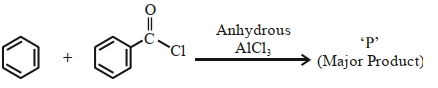
Identify the major product $P$ formed in the following reaction.
A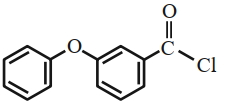
B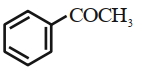
C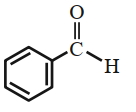
D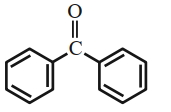
Solution
(D) The reaction between benzene and benzoyl chloride in the presence of anhydrous $AlCl_3$ is a Friedel-Crafts acylation reaction.
$1$. The anhydrous $AlCl_3$ acts as a Lewis acid and reacts with benzoyl chloride to generate the electrophile,the benzoyl cation $(C_6H_5CO^+)$.
$2$. This electrophile then attacks the benzene ring.
$3$. The final product formed is benzophenone $(C_6H_5COC_6H_5)$.
$1$. The anhydrous $AlCl_3$ acts as a Lewis acid and reacts with benzoyl chloride to generate the electrophile,the benzoyl cation $(C_6H_5CO^+)$.
$2$. This electrophile then attacks the benzene ring.
$3$. The final product formed is benzophenone $(C_6H_5COC_6H_5)$.
0 likesView Solution
109
ChemistryDifficultMCQJEE Main · 2024
The major product of the following reaction is $-$
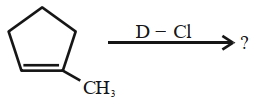
A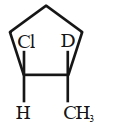
B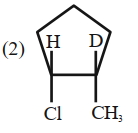
C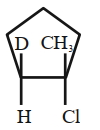
D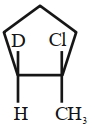
Solution
(D) The reaction is an electrophilic addition of $D-Cl$ to $1-methylcyclopentene$.
First,the electrophile $D^+$ attacks the double bond to form the more stable tertiary carbocation.
The $D^+$ adds to the $CH$ group (the carbon with more hydrogens) to form a tertiary carbocation at the carbon bearing the $CH_3$ group.
Then,the nucleophile $Cl^-$ attacks the planar carbocation from either the top or bottom face,resulting in a racemic mixture of $1-chloro-1-methyl-2-deuteriocyclopentane$ (where $D$ and $CH_3$ are trans or cis).
Based on the options provided,the structure representing the addition of $D$ and $Cl$ across the double bond is the correct product.
First,the electrophile $D^+$ attacks the double bond to form the more stable tertiary carbocation.
The $D^+$ adds to the $CH$ group (the carbon with more hydrogens) to form a tertiary carbocation at the carbon bearing the $CH_3$ group.
Then,the nucleophile $Cl^-$ attacks the planar carbocation from either the top or bottom face,resulting in a racemic mixture of $1-chloro-1-methyl-2-deuteriocyclopentane$ (where $D$ and $CH_3$ are trans or cis).
Based on the options provided,the structure representing the addition of $D$ and $Cl$ across the double bond is the correct product.
0 likesView Solution
110
ChemistryDifficultMCQJEE Main · 2024
Identify the structure of $2,3$-dibromo-$1$-phenylpentane.
A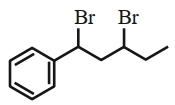
B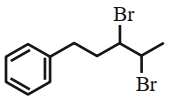
C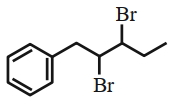
D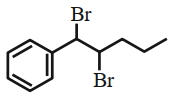
Solution
(C) To identify the structure of $2,3$-dibromo-$1$-phenylpentane,we break down the $IUPAC$ name:
$1$. The parent chain is a pentane,which is a $5$-carbon chain.
$2$. There is a phenyl group attached at the $1$-st position.
$3$. There are two bromine atoms attached at the $2$-nd and $3$-rd positions.
Following this,the structure consists of a phenyl group attached to a $CH_2$ group (position $1$),which is connected to a $CH(Br)$ group (position $2$),which is connected to another $CH(Br)$ group (position $3$),followed by a $CH_2$ group (position $4$) and a $CH_3$ group (position $5$).
This corresponds to the structure shown in option $C$.
$1$. The parent chain is a pentane,which is a $5$-carbon chain.
$2$. There is a phenyl group attached at the $1$-st position.
$3$. There are two bromine atoms attached at the $2$-nd and $3$-rd positions.
Following this,the structure consists of a phenyl group attached to a $CH_2$ group (position $1$),which is connected to a $CH(Br)$ group (position $2$),which is connected to another $CH(Br)$ group (position $3$),followed by a $CH_2$ group (position $4$) and a $CH_3$ group (position $5$).
This corresponds to the structure shown in option $C$.
0 likesView Solution
111
ChemistryDifficultMCQJEE Main · 2024
$A_{(g)} \rightleftharpoons B_{(g)} + \frac{1}{2} C_{(g)}$. The correct relationship between $K_P$,$\alpha$,and equilibrium pressure $P$ is:
A
$K_P = \frac{\alpha^{3/2} P^{1/2}}{(1-\alpha)(2+\alpha)^{1/2}}$
B
$K_P = \frac{\alpha^{3/2} P^{1/2}}{(2+\alpha)^{1/2} (1-\alpha)}$
C
$K_P = \frac{\alpha^{1/2} P^{3/2}}{(2+\alpha)^{3/2}}$
D
$K_P = \frac{\alpha^{1/2} P^{1/2}}{(2+\alpha)^{3/2}}$
Solution
(A) For the reaction: $A_{(g)} \rightleftharpoons B_{(g)} + \frac{1}{2} C_{(g)}$
Initial moles: $1, 0, 0$
Moles at equilibrium: $(1-\alpha), \alpha, \frac{\alpha}{2}$
Total moles at equilibrium: $n_{total} = 1 - \alpha + \alpha + \frac{\alpha}{2} = 1 + \frac{\alpha}{2} = \frac{2+\alpha}{2}$
Partial pressures are given by $P_i = x_i \cdot P$:
$P_A = \frac{1-\alpha}{(2+\alpha)/2} \cdot P = \frac{2(1-\alpha)P}{2+\alpha}$
$P_B = \frac{\alpha}{(2+\alpha)/2} \cdot P = \frac{2\alpha P}{2+\alpha}$
$P_C = \frac{\alpha/2}{(2+\alpha)/2} \cdot P = \frac{\alpha P}{2+\alpha}$
$K_P = \frac{P_B \cdot (P_C)^{1/2}}{P_A} = \frac{(\frac{2\alpha P}{2+\alpha}) \cdot (\frac{\alpha P}{2+\alpha})^{1/2}}{\frac{2(1-\alpha)P}{2+\alpha}}$
Simplifying the expression:
$K_P = \frac{2\alpha P}{2+\alpha} \cdot \frac{\alpha^{1/2} P^{1/2}}{(2+\alpha)^{1/2}} \cdot \frac{2+\alpha}{2(1-\alpha)P} = \frac{\alpha^{3/2} P^{1/2}}{(1-\alpha)(2+\alpha)^{1/2}}$
Initial moles: $1, 0, 0$
Moles at equilibrium: $(1-\alpha), \alpha, \frac{\alpha}{2}$
Total moles at equilibrium: $n_{total} = 1 - \alpha + \alpha + \frac{\alpha}{2} = 1 + \frac{\alpha}{2} = \frac{2+\alpha}{2}$
Partial pressures are given by $P_i = x_i \cdot P$:
$P_A = \frac{1-\alpha}{(2+\alpha)/2} \cdot P = \frac{2(1-\alpha)P}{2+\alpha}$
$P_B = \frac{\alpha}{(2+\alpha)/2} \cdot P = \frac{2\alpha P}{2+\alpha}$
$P_C = \frac{\alpha/2}{(2+\alpha)/2} \cdot P = \frac{\alpha P}{2+\alpha}$
$K_P = \frac{P_B \cdot (P_C)^{1/2}}{P_A} = \frac{(\frac{2\alpha P}{2+\alpha}) \cdot (\frac{\alpha P}{2+\alpha})^{1/2}}{\frac{2(1-\alpha)P}{2+\alpha}}$
Simplifying the expression:
$K_P = \frac{2\alpha P}{2+\alpha} \cdot \frac{\alpha^{1/2} P^{1/2}}{(2+\alpha)^{1/2}} \cdot \frac{2+\alpha}{2(1-\alpha)P} = \frac{\alpha^{3/2} P^{1/2}}{(1-\alpha)(2+\alpha)^{1/2}}$
0 likesView Solution
112
ChemistryDifficultMCQJEE Main · 2024
Which of the following is least ionic?
A
$BaCl_2$
B
$AgCl$
C
$KCl$
D
$CoCl_2$
Solution
(B) According to Fajan's rule,the ionic character depends on the polarizability of the cation.
$Ag^+$ has a pseudo-inert gas configuration ($18$ electrons in the outermost shell),which makes it highly polarizing compared to $Ba^{2+}$,$K^+$,and $Co^{2+}$.
Greater polarization leads to more covalent character and less ionic character.
The order of ionic character is $KCl > BaCl_2 > CoCl_2 > AgCl$.
Therefore,$AgCl$ is the least ionic.
$Ag^+$ has a pseudo-inert gas configuration ($18$ electrons in the outermost shell),which makes it highly polarizing compared to $Ba^{2+}$,$K^+$,and $Co^{2+}$.
Greater polarization leads to more covalent character and less ionic character.
The order of ionic character is $KCl > BaCl_2 > CoCl_2 > AgCl$.
Therefore,$AgCl$ is the least ionic.
0 likesView Solution
113
ChemistryDifficultMCQJEE Main · 2024
The fragrance of flowers is due to the presence of some steam volatile organic compounds called essential oils. These are generally insoluble in water at room temperature but are miscible with water vapour in the vapour phase. $A$ suitable method for the extraction of these oils from the flowers is:
A
crystallisation
B
distillation under reduced pressure
C
distillation
D
steam distillation
Solution
(D) Steam distillation is a technique used to separate substances that are steam volatile and immiscible with water. Since essential oils are steam volatile and insoluble in water,this method is the most suitable for their extraction.
0 likesView Solution
114
ChemistryDifficultMCQJEE Main · 2024
Given below are two statements:
Statement $I$: Group $13$ trivalent halides get easily hydrolyzed by water due to their covalent nature.
Statement $II$: $AlCl_3$ upon hydrolysis in acidified aqueous solution forms octahedral $[Al(H_2O)_6]^{3+}$ ion.
In the light of the above statements,choose the correct answer from the options given below:
Statement $I$: Group $13$ trivalent halides get easily hydrolyzed by water due to their covalent nature.
Statement $II$: $AlCl_3$ upon hydrolysis in acidified aqueous solution forms octahedral $[Al(H_2O)_6]^{3+}$ ion.
In the light of the above statements,choose the correct answer from the options given below:
A
Statement $I$ is true but statement $II$ is false
B
Statement $I$ is false but statement $II$ is true
C
Both statement $I$ and statement $II$ are false
D
Both statement $I$ and statement $II$ are true
Solution
(D) Statement $I$ is true: Group $13$ trivalent halides (except $AlF_3$) are covalent in nature and undergo hydrolysis in water.
Statement $II$ is true: In acidified aqueous solution,$AlCl_3$ exists as the octahedral $[Al(H_2O)_6]^{3+}$ ion,where $Al$ is $sp^3d^2$ hybridized.
Therefore,both statements are correct.
Statement $II$ is true: In acidified aqueous solution,$AlCl_3$ exists as the octahedral $[Al(H_2O)_6]^{3+}$ ion,where $Al$ is $sp^3d^2$ hybridized.
Therefore,both statements are correct.
0 likesView Solution
115
ChemistryDifficultMCQJEE Main · 2024
The four quantum numbers for the electron in the outermost orbital of potassium (atomic number $19$) are:
A
$n=4, l=2, m=-1, s=+\frac{1}{2}$
B
$n=4, l=0, m=0, s=+\frac{1}{2}$
C
$n=3, l=0, m=1, s=+\frac{1}{2}$
D
$n=2, l=0, m=0, s=+\frac{1}{2}$
Solution
(B) The electronic configuration of potassium $(Z=19)$ is $1s^2, 2s^2, 2p^6, 3s^2, 3p^6, 4s^1$.
The outermost electron enters the $4s$ orbital.
For the $4s$ orbital,the principal quantum number $n=4$.
Since it is an $s$-orbital,the azimuthal quantum number $l=0$.
Consequently,the magnetic quantum number $m=0$.
The spin quantum number $s$ can be $+\frac{1}{2}$ or $-\frac{1}{2}$.
Comparing this with the given options,option $B$ is correct.
The outermost electron enters the $4s$ orbital.
For the $4s$ orbital,the principal quantum number $n=4$.
Since it is an $s$-orbital,the azimuthal quantum number $l=0$.
Consequently,the magnetic quantum number $m=0$.
The spin quantum number $s$ can be $+\frac{1}{2}$ or $-\frac{1}{2}$.
Comparing this with the given options,option $B$ is correct.
0 likesView Solution
116
ChemistryDifficultMCQJEE Main · 2024
The correct order of reactivity in electrophilic substitution reaction of the following compounds is:
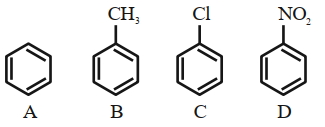
A
$B > C > A > D$
B
$D > C > B > A$
C
$A > B > C > D$
D
$B > A > C > D$
Solution
(D) The reactivity towards electrophilic substitution depends on the electron density of the benzene ring.
$A$ is benzene (reference).
$B$ is toluene ($-CH_3$ group): It shows $+M$ (hyperconjugation) and $+I$ effects,which increase electron density,making it more reactive than benzene.
$C$ is chlorobenzene ($-Cl$ group): It shows $+M$ and $-I$ effects. The $-I$ effect dominates,making it less reactive than benzene.
$D$ is nitrobenzene ($-NO_2$ group): It shows $-M$ and $-I$ effects,which strongly decrease electron density,making it the least reactive.
Therefore,the order of reactivity is $B > A > C > D$.
$A$ is benzene (reference).
$B$ is toluene ($-CH_3$ group): It shows $+M$ (hyperconjugation) and $+I$ effects,which increase electron density,making it more reactive than benzene.
$C$ is chlorobenzene ($-Cl$ group): It shows $+M$ and $-I$ effects. The $-I$ effect dominates,making it less reactive than benzene.
$D$ is nitrobenzene ($-NO_2$ group): It shows $-M$ and $-I$ effects,which strongly decrease electron density,making it the least reactive.
Therefore,the order of reactivity is $B > A > C > D$.
0 likesView Solution
117
ChemistryDifficultMCQJEE Main · 2024
Consider the following elements arranged in a periodic table segment as shown in the image.
Which of the following is/are true about $A^{\prime}, B^{\prime}, C^{\prime}$ and $D^{\prime}$?
$A$. Order of atomic radii: $B^{\prime} < A^{\prime} < D^{\prime} < C^{\prime}$
$B$. Order of metallic character: $B^{\prime} < A^{\prime} < D^{\prime} < C^{\prime}$
$C$. Size of the element: $D^{\prime} < C^{\prime} < B^{\prime} < A^{\prime}$
$D$. Order of ionic radii: $B^{\prime+} < A^{\prime+} < D^{\prime+} < C^{\prime+}$
Choose the correct answer from the options given below:
Which of the following is/are true about $A^{\prime}, B^{\prime}, C^{\prime}$ and $D^{\prime}$?
$A$. Order of atomic radii: $B^{\prime} < A^{\prime} < D^{\prime} < C^{\prime}$
$B$. Order of metallic character: $B^{\prime} < A^{\prime} < D^{\prime} < C^{\prime}$
$C$. Size of the element: $D^{\prime} < C^{\prime} < B^{\prime} < A^{\prime}$
$D$. Order of ionic radii: $B^{\prime+} < A^{\prime+} < D^{\prime+} < C^{\prime+}$
Choose the correct answer from the options given below:
A
$A$ only
B
$A, B$ and $D$ only
C
$A$ and $B$ only
D
$B, C$ and $D$ only
Solution
(B) Based on the provided image,the elements are arranged as follows:
Row $1$: $A^{\prime}, B^{\prime}$ (left to right)
Row $2$: $C^{\prime}, D^{\prime}$ (left to right)
$1$. Atomic Radii: In a period,size decreases from left to right. In a group,size increases from top to bottom.
Thus,$B^{\prime} < A^{\prime}$ and $D^{\prime} < C^{\prime}$. Also,elements in the second row are larger than those in the first row ($A^{\prime} < C^{\prime}$ and $B^{\prime} < D^{\prime}$).
The correct order is $B^{\prime} < A^{\prime} < D^{\prime} < C^{\prime}$. Statement $A$ is true.
$2$. Metallic Character: Metallic character decreases from left to right in a period and increases from top to bottom in a group.
Thus,$B^{\prime} < A^{\prime}$ and $D^{\prime} < C^{\prime}$. Also,$A^{\prime} < C^{\prime}$ and $B^{\prime} < D^{\prime}$.
The correct order is $B^{\prime} < A^{\prime} < D^{\prime} < C^{\prime}$. Statement $B$ is true.
$3$. Size of the element: As established,$B^{\prime} < A^{\prime} < D^{\prime} < C^{\prime}$. Statement $C$ is false.
$4$. Ionic Radii: For cations,the trend follows the atomic radii trend. Thus,$B^{\prime+} < A^{\prime+} < D^{\prime+} < C^{\prime+}$. Statement $D$ is true.
Therefore,statements $A, B,$ and $D$ are true.
Row $1$: $A^{\prime}, B^{\prime}$ (left to right)
Row $2$: $C^{\prime}, D^{\prime}$ (left to right)
$1$. Atomic Radii: In a period,size decreases from left to right. In a group,size increases from top to bottom.
Thus,$B^{\prime} < A^{\prime}$ and $D^{\prime} < C^{\prime}$. Also,elements in the second row are larger than those in the first row ($A^{\prime} < C^{\prime}$ and $B^{\prime} < D^{\prime}$).
The correct order is $B^{\prime} < A^{\prime} < D^{\prime} < C^{\prime}$. Statement $A$ is true.
$2$. Metallic Character: Metallic character decreases from left to right in a period and increases from top to bottom in a group.
Thus,$B^{\prime} < A^{\prime}$ and $D^{\prime} < C^{\prime}$. Also,$A^{\prime} < C^{\prime}$ and $B^{\prime} < D^{\prime}$.
The correct order is $B^{\prime} < A^{\prime} < D^{\prime} < C^{\prime}$. Statement $B$ is true.
$3$. Size of the element: As established,$B^{\prime} < A^{\prime} < D^{\prime} < C^{\prime}$. Statement $C$ is false.
$4$. Ionic Radii: For cations,the trend follows the atomic radii trend. Thus,$B^{\prime+} < A^{\prime+} < D^{\prime+} < C^{\prime+}$. Statement $D$ is true.
Therefore,statements $A, B,$ and $D$ are true.
0 likesView Solution
118
ChemistryDifficultMCQJEE Main · 2024
$A$ diatomic molecule has a dipole moment of $1.2 \ D$. If the bond distance is $1 \ \mathring{A}$,then fractional charge on each atom is.........$\times 10^{-2}$ (Given $1 \ D = 10^{-18} \ esu \ cm$ )
A
$25$
B
$50$
C
$75$
D
$12.5$
Solution
(A) The fractional charge is calculated as the ratio of experimental dipole moment to the theoretical dipole moment (assuming $100\%$ ionic character).
$\text{Fractional charge} = \frac{\mu_{\text{exp.}}}{\mu_{\text{cal.}}}$
Given $\mu_{\text{exp.}} = 1.2 \ D = 1.2 \times 10^{-18} \ esu \ cm$.
The bond distance $d = 1 \ \mathring{A} = 10^{-8} \ cm$.
The theoretical dipole moment $\mu_{\text{cal.}}$ for a full electronic charge $(e = 4.8 \times 10^{-10} \ esu)$ is:
$\mu_{\text{cal.}} = q \times d = (4.8 \times 10^{-10} \ esu) \times (10^{-8} \ cm) = 4.8 \times 10^{-18} \ esu \ cm$.
$\text{Fractional charge} = \frac{1.2 \times 10^{-18}}{4.8 \times 10^{-18}} = 0.25$.
Expressing this as $\times 10^{-2}$:
$0.25 = 25 \times 10^{-2}$.
$\text{Fractional charge} = \frac{\mu_{\text{exp.}}}{\mu_{\text{cal.}}}$
Given $\mu_{\text{exp.}} = 1.2 \ D = 1.2 \times 10^{-18} \ esu \ cm$.
The bond distance $d = 1 \ \mathring{A} = 10^{-8} \ cm$.
The theoretical dipole moment $\mu_{\text{cal.}}$ for a full electronic charge $(e = 4.8 \times 10^{-10} \ esu)$ is:
$\mu_{\text{cal.}} = q \times d = (4.8 \times 10^{-10} \ esu) \times (10^{-8} \ cm) = 4.8 \times 10^{-18} \ esu \ cm$.
$\text{Fractional charge} = \frac{1.2 \times 10^{-18}}{4.8 \times 10^{-18}} = 0.25$.
Expressing this as $\times 10^{-2}$:
$0.25 = 25 \times 10^{-2}$.
0 likesView Solution
119
ChemistryDifficultMCQJEE Main · 2024
The number of isomeric products formed by the monochlorination of $2$-methylbutane in the presence of sunlight is . . . . . . .
A
$2$
B
$3$
C
$4$
D
$6$
Solution
(D) The structure of $2$-methylbutane is $CH_3-CH(CH_3)-CH_2-CH_3$.
Monochlorination can occur at four different types of hydrogen atoms:
$1$. At $C_1$ (terminal methyl group): $CH_2Cl-CH(CH_3)-CH_2-CH_3$ ($1$-chloro$-2-$methylbutane,achiral).
$2$. At $C_2$ (tertiary carbon): $CH_3-CCl(CH_3)-CH_2-CH_3$ ($2$-chloro$-2-$methylbutane,achiral).
$3$. At $C_3$ (chiral center): $CH_3-CH(CH_3)-CHCl-CH_3$ ($2$-chloro$-3-$methylbutane). This product has a chiral center,so it exists as a pair of enantiomers ($d$ and $l$ forms).
$4$. At $C_4$ (terminal methyl group): $CH_3-CH(CH_3)-CH_2-CH_2Cl$ ($1$-chloro$-3-$methylbutane). This product has a chiral center at $C_2$,so it exists as a pair of enantiomers ($d$ and $l$ forms).
Total isomeric products = $1$ (from $C_1$) + $1$ (from $C_2$) + $2$ (from $C_3$) + $2$ (from $C_4$) = $6$.
Monochlorination can occur at four different types of hydrogen atoms:
$1$. At $C_1$ (terminal methyl group): $CH_2Cl-CH(CH_3)-CH_2-CH_3$ ($1$-chloro$-2-$methylbutane,achiral).
$2$. At $C_2$ (tertiary carbon): $CH_3-CCl(CH_3)-CH_2-CH_3$ ($2$-chloro$-2-$methylbutane,achiral).
$3$. At $C_3$ (chiral center): $CH_3-CH(CH_3)-CHCl-CH_3$ ($2$-chloro$-3-$methylbutane). This product has a chiral center,so it exists as a pair of enantiomers ($d$ and $l$ forms).
$4$. At $C_4$ (terminal methyl group): $CH_3-CH(CH_3)-CH_2-CH_2Cl$ ($1$-chloro$-3-$methylbutane). This product has a chiral center at $C_2$,so it exists as a pair of enantiomers ($d$ and $l$ forms).
Total isomeric products = $1$ (from $C_1$) + $1$ (from $C_2$) + $2$ (from $C_3$) + $2$ (from $C_4$) = $6$.
1 likesView Solution
120
ChemistryDifficultMCQJEE Main · 2024
Number of moles of $H^{+}$ ions required by $1 \ mole$ of $MnO_4^{-}$ to oxidise oxalate ion to $CO_2$ is . . . . . .
A
$8$
B
$10$
C
$15$
D
$20$
Solution
(A) The balanced chemical equation for the reaction between permanganate ion and oxalate ion in acidic medium is:
$2 MnO_4^{-} + 5 C_2O_4^{2-} + 16 H^{+} \longrightarrow 2 Mn^{2+} + 10 CO_2 + 8 H_2O$
From the stoichiometry of the balanced equation,$2 \ moles$ of $MnO_4^{-}$ require $16 \ moles$ of $H^{+}$ ions.
Therefore,$1 \ mole$ of $MnO_4^{-}$ requires $\frac{16}{2} = 8 \ moles$ of $H^{+}$ ions.
$2 MnO_4^{-} + 5 C_2O_4^{2-} + 16 H^{+} \longrightarrow 2 Mn^{2+} + 10 CO_2 + 8 H_2O$
From the stoichiometry of the balanced equation,$2 \ moles$ of $MnO_4^{-}$ require $16 \ moles$ of $H^{+}$ ions.
Therefore,$1 \ mole$ of $MnO_4^{-}$ requires $\frac{16}{2} = 8 \ moles$ of $H^{+}$ ions.
0 likesView Solution
121
ChemistryDifficultMCQJEE Main · 2024
In the reaction of potassium dichromate,potassium chloride and sulfuric acid (conc.),the oxidation state of the chromium in the product is $(+)$ . . . . . . .
A
$4$
B
$6$
C
$8$
D
$10$
Solution
(B) The reaction is: $K_2Cr_2O_7 + 4KCl + 6H_2SO_4 \rightarrow 2CrO_2Cl_2 + 6KHSO_4 + 3H_2O$.
This reaction is known as the chromyl chloride test.
In the product chromyl chloride $(CrO_2Cl_2)$,let the oxidation state of $Cr$ be $x$.
$x + 2(-2) + 2(-1) = 0$
$x - 4 - 2 = 0$
$x = +6$.
Thus,the oxidation state of chromium in the product is $+6$.
This reaction is known as the chromyl chloride test.
In the product chromyl chloride $(CrO_2Cl_2)$,let the oxidation state of $Cr$ be $x$.
$x + 2(-2) + 2(-1) = 0$
$x - 4 - 2 = 0$
$x = +6$.
Thus,the oxidation state of chromium in the product is $+6$.
0 likesView Solution
122
ChemistryMediumMCQJEE Main · 2024
The molarity of $1 \ L$ orthophosphoric acid $(H_3PO_4)$ having $70 \%$ purity by weight (specific gravity $1.54 \ g \ cm^{-3}$) is $ . . . . . . $ $M$.
(Molar mass of $H_3PO_4 = 98 \ g \ mol^{-1}$)
(Molar mass of $H_3PO_4 = 98 \ g \ mol^{-1}$)
A
$9$
B
$10$
C
$11$
D
$12$
Solution
(C) Specific gravity (density) $= 1.54 \ g \ cm^{-3}$.
Volume of solution $= 1 \ L = 1000 \ mL$.
Mass of solution $= \text{Density} \times \text{Volume} = 1.54 \ g \ cm^{-3} \times 1000 \ cm^3 = 1540 \ g$.
Since the solution is $70 \%$ pure by weight,the mass of $H_3PO_4 = 0.70 \times 1540 \ g = 1078 \ g$.
Moles of $H_3PO_4 = \frac{\text{Mass}}{\text{Molar mass}} = \frac{1078 \ g}{98 \ g \ mol^{-1}} = 11 \ mol$.
Molarity $= \frac{\text{Moles of solute}}{\text{Volume of solution in } L} = \frac{11 \ mol}{1 \ L} = 11 \ M$.
Volume of solution $= 1 \ L = 1000 \ mL$.
Mass of solution $= \text{Density} \times \text{Volume} = 1.54 \ g \ cm^{-3} \times 1000 \ cm^3 = 1540 \ g$.
Since the solution is $70 \%$ pure by weight,the mass of $H_3PO_4 = 0.70 \times 1540 \ g = 1078 \ g$.
Moles of $H_3PO_4 = \frac{\text{Mass}}{\text{Molar mass}} = \frac{1078 \ g}{98 \ g \ mol^{-1}} = 11 \ mol$.
Molarity $= \frac{\text{Moles of solute}}{\text{Volume of solution in } L} = \frac{11 \ mol}{1 \ L} = 11 \ M$.
0 likesView Solution
123
ChemistryDifficultMCQJEE Main · 2024
If $5 \ mol$ of an ideal gas expands from $10 \ L$ to a volume of $100 \ L$ at $300 \ K$ under isothermal and reversible conditions,then the work done,$w$,is $-x \ J$. The value of $x$ is $ . . . . . . $. (Given $R = 8.314 \ J \ K^{-1} \ mol^{-1}$)
A
$28719$
B
$28721$
C
$28722$
D
$28725$
Solution
(B) For an isothermal reversible expansion,the work done is given by the formula:
$w = -2.303 \ nRT \log \left( \frac{V_2}{V_1} \right)$
Substituting the given values:
$n = 5 \ mol$,$R = 8.314 \ J \ K^{-1} \ mol^{-1}$,$T = 300 \ K$,$V_1 = 10 \ L$,$V_2 = 100 \ L$
$w = -2.303 \times 5 \times 8.314 \times 300 \times \log \left( \frac{100}{10} \right)$
$w = -2.303 \times 5 \times 8.314 \times 300 \times \log(10)$
Since $\log(10) = 1$:
$w = -2.303 \times 5 \times 8.314 \times 300 = -28720.713 \ J$
Given $w = -x \ J$,we have $-x = -28720.713$,so $x \approx 28721$.
$w = -2.303 \ nRT \log \left( \frac{V_2}{V_1} \right)$
Substituting the given values:
$n = 5 \ mol$,$R = 8.314 \ J \ K^{-1} \ mol^{-1}$,$T = 300 \ K$,$V_1 = 10 \ L$,$V_2 = 100 \ L$
$w = -2.303 \times 5 \times 8.314 \times 300 \times \log \left( \frac{100}{10} \right)$
$w = -2.303 \times 5 \times 8.314 \times 300 \times \log(10)$
Since $\log(10) = 1$:
$w = -2.303 \times 5 \times 8.314 \times 300 = -28720.713 \ J$
Given $w = -x \ J$,we have $-x = -28720.713$,so $x \approx 28721$.
0 likesView Solution
124
ChemistryDifficultMCQJEE Main · 2024
In acidic medium,$K_2Cr_2O_7$ shows oxidising action as represented in the half reaction:
$Cr_2O_7^{2-} + XH^+ + Ye^- \rightarrow 2A + ZH_2O$
$X, Y, Z$ and $A$ are respectively:
$Cr_2O_7^{2-} + XH^+ + Ye^- \rightarrow 2A + ZH_2O$
$X, Y, Z$ and $A$ are respectively:
A
$8, 6, 4$ and $Cr_2O_3$
B
$14, 7, 6$ and $Cr^{3+}$
C
$8, 4, 6$ and $Cr_2O_3$
D
$14, 6, 7$ and $Cr^{3+}$
Solution
(D) The balanced half-reaction for the reduction of dichromate in acidic medium is:
$Cr_2O_7^{2-} + 14H^+ + 6e^- \rightarrow 2Cr^{3+} + 7H_2O$
Comparing this with the given equation $Cr_2O_7^{2-} + XH^+ + Ye^- \rightarrow 2A + ZH_2O$,we get:
$X = 14$
$Y = 6$
$Z = 7$
$A = Cr^{3+}$
Therefore,the correct values are $14, 6, 7$ and $Cr^{3+}$.
$Cr_2O_7^{2-} + 14H^+ + 6e^- \rightarrow 2Cr^{3+} + 7H_2O$
Comparing this with the given equation $Cr_2O_7^{2-} + XH^+ + Ye^- \rightarrow 2A + ZH_2O$,we get:
$X = 14$
$Y = 6$
$Z = 7$
$A = Cr^{3+}$
Therefore,the correct values are $14, 6, 7$ and $Cr^{3+}$.
0 likesView Solution
125
ChemistryDifficultMCQJEE Main · 2024
Which of the following reactions are disproportionation reactions?
$(A)$ $2 Cu^{+} \rightarrow Cu^{2+} + Cu$
$(B)$ $3 MnO_4^{2-} + 4 H^{+} \rightarrow 2 MnO_4^{-} + MnO_2 + 2 H_2 O$
$(C)$ $2 KMnO_4 \rightarrow K_2 MnO_4 + MnO_2 + O_2$
$(D)$ $2 MnO_4^{-} + 3 Mn^{2+} + 2 H_2 O \rightarrow 5 MnO_2 + 4 H^{+}$
Choose the correct answer from the options given below:
$(A)$ $2 Cu^{+} \rightarrow Cu^{2+} + Cu$
$(B)$ $3 MnO_4^{2-} + 4 H^{+} \rightarrow 2 MnO_4^{-} + MnO_2 + 2 H_2 O$
$(C)$ $2 KMnO_4 \rightarrow K_2 MnO_4 + MnO_2 + O_2$
$(D)$ $2 MnO_4^{-} + 3 Mn^{2+} + 2 H_2 O \rightarrow 5 MnO_2 + 4 H^{+}$
Choose the correct answer from the options given below:
A
$(A)$,$(B)$
B
$(B)$,$(C)$,$(D)$
C
$(A)$,$(B)$,$(C)$
D
$(A)$,$(D)$
Solution
(A) disproportionation reaction is a redox reaction in which the same element is simultaneously oxidized and reduced.
In reaction $(A)$: $2 Cu^{+} \rightarrow Cu^{2+} + Cu$. The oxidation state of $Cu$ changes from $+1$ to $+2$ (oxidation) and from $+1$ to $0$ (reduction). Thus,it is a disproportionation reaction.
In reaction $(B)$: $3 MnO_4^{2-} + 4 H^{+} \rightarrow 2 MnO_4^{-} + MnO_2 + 2 H_2 O$. The oxidation state of $Mn$ changes from $+6$ to $+7$ (oxidation) and from $+6$ to $+4$ (reduction). Thus,it is a disproportionation reaction.
In reaction $(C)$: This is a thermal decomposition reaction,not a disproportionation reaction.
In reaction $(D)$: This is a comproportionation reaction (the reverse of disproportionation),where $Mn$ in $+7$ and $+2$ oxidation states reacts to form $Mn$ in $+4$ oxidation state.
In reaction $(A)$: $2 Cu^{+} \rightarrow Cu^{2+} + Cu$. The oxidation state of $Cu$ changes from $+1$ to $+2$ (oxidation) and from $+1$ to $0$ (reduction). Thus,it is a disproportionation reaction.
In reaction $(B)$: $3 MnO_4^{2-} + 4 H^{+} \rightarrow 2 MnO_4^{-} + MnO_2 + 2 H_2 O$. The oxidation state of $Mn$ changes from $+6$ to $+7$ (oxidation) and from $+6$ to $+4$ (reduction). Thus,it is a disproportionation reaction.
In reaction $(C)$: This is a thermal decomposition reaction,not a disproportionation reaction.
In reaction $(D)$: This is a comproportionation reaction (the reverse of disproportionation),where $Mn$ in $+7$ and $+2$ oxidation states reacts to form $Mn$ in $+4$ oxidation state.
0 likesView Solution
126
ChemistryDifficultMCQJEE Main · 2024
In case of isoelectronic species,the size of $F^{-}$,$Ne$,and $Na^{+}$ is affected by:
A
Principal quantum number $(n)$
B
None of the factors because their size is the same
C
Electron-electron interaction in the outer orbitals
D
Nuclear charge $(Z)$
Solution
(D) The species $F^{-}$,$Ne$,and $Na^{+}$ are isoelectronic,as each contains $10$ electrons with the electronic configuration $1s^2, 2s^2, 2p^6$.
Since they have the same number of electrons,the variation in their ionic/atomic radii is determined by the nuclear charge $(Z)$.
As the nuclear charge increases (from $F^{-}$ to $Ne$ to $Na^{+}$),the force of attraction between the nucleus and the electrons increases,leading to a decrease in size.
Since they have the same number of electrons,the variation in their ionic/atomic radii is determined by the nuclear charge $(Z)$.
As the nuclear charge increases (from $F^{-}$ to $Ne$ to $Na^{+}$),the force of attraction between the nucleus and the electrons increases,leading to a decrease in size.
0 likesView Solution
127
ChemistryDifficultMCQJEE Main · 2024
According to the wave-particle duality of matter by de-Broglie,which of the following graph plots presents the most appropriate relationship between the wavelength of an electron $(\lambda)$ and the momentum of an electron $(p)$?
A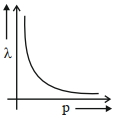
B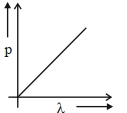
C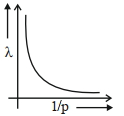
D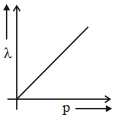
Solution
(A) According to de-Broglie's relation,the wavelength $(\lambda)$ is inversely proportional to the momentum $(p)$:
$\lambda = \frac{h}{p}$
where $h$ is Planck's constant.
This equation can be rewritten as $\lambda p = h$.
Since $h$ is a constant,the product of $\lambda$ and $p$ is constant.
This represents the equation of a rectangular hyperbola.
Therefore,the graph of $\lambda$ versus $p$ is a rectangular hyperbola.
$\lambda = \frac{h}{p}$
where $h$ is Planck's constant.
This equation can be rewritten as $\lambda p = h$.
Since $h$ is a constant,the product of $\lambda$ and $p$ is constant.
This represents the equation of a rectangular hyperbola.
Therefore,the graph of $\lambda$ versus $p$ is a rectangular hyperbola.
0 likesView Solution
128
ChemistryDifficultMCQJEE Main · 2024
Ionic reactions with organic compounds proceed through:
$(A)$ Homolytic bond cleavage
$(B)$ Heterolytic bond cleavage
$(C)$ Free radical formation
$(D)$ Primary free radical
$(E)$ Secondary free radical
Choose the correct answer from the options given below:
$(A)$ Homolytic bond cleavage
$(B)$ Heterolytic bond cleavage
$(C)$ Free radical formation
$(D)$ Primary free radical
$(E)$ Secondary free radical
Choose the correct answer from the options given below:
A
$(A)$ only
B
$(C)$ only
C
$(B)$ only
D
$(D)$ and $(E)$ only
Solution
(C) Ionic reactions involve the transfer of electrons between species,which occurs through heterolytic bond cleavage.
In heterolytic cleavage,the shared pair of electrons remains with one of the fragments,resulting in the formation of ions (carbocations or carbanions).
Therefore,ionic reactions proceed through $(B)$ only.
In heterolytic cleavage,the shared pair of electrons remains with one of the fragments,resulting in the formation of ions (carbocations or carbanions).
Therefore,ionic reactions proceed through $(B)$ only.
0 likesView Solution
129
ChemistryDifficultMCQJEE Main · 2024
Arrange the bonds in order of increasing ionic character in the molecules: $LiF$,$K_2O$,$N_2$,$SO_2$,and $ClF_3$.
A
$ClF_3 < N_2 < SO_2 < K_2O < LiF$
B
$LiF < K_2O < ClF_3 < SO_2 < N_2$
C
$N_2 < SO_2 < ClF_3 < K_2O < LiF$
D
$N_2 < ClF_3 < SO_2 < K_2O < LiF$
Solution
(C) The ionic character of a bond depends on the difference in electronegativity between the bonded atoms. Larger electronegativity difference leads to higher ionic character.
$1$. $N_2$ (non-polar covalent,$\Delta EN = 0$)
$2$. $SO_2$ (polar covalent,$\Delta EN \approx 0.9$)
$3$. $ClF_3$ (polar covalent,$\Delta EN \approx 1.0$)
$4$. $K_2O$ (ionic,$\Delta EN \approx 2.6$)
$5$. $LiF$ (ionic,$\Delta EN \approx 3.0$)
Therefore,the increasing order of ionic character is: $N_2 < SO_2 < ClF_3 < K_2O < LiF$.
$1$. $N_2$ (non-polar covalent,$\Delta EN = 0$)
$2$. $SO_2$ (polar covalent,$\Delta EN \approx 0.9$)
$3$. $ClF_3$ (polar covalent,$\Delta EN \approx 1.0$)
$4$. $K_2O$ (ionic,$\Delta EN \approx 2.6$)
$5$. $LiF$ (ionic,$\Delta EN \approx 3.0$)
Therefore,the increasing order of ionic character is: $N_2 < SO_2 < ClF_3 < K_2O < LiF$.
0 likesView Solution
130
ChemistryDifficultMCQJEE Main · 2024
In Kjeldahl's method for estimation of nitrogen,$CuSO_4$ acts as :
A
Reducing agent
B
Catalytic agent
C
Hydrolysis agent
D
Oxidising agent
Solution
(B) In the Kjeldahl's method,the organic compound is heated with concentrated $H_2SO_4$.
$CuSO_4$ is added to the reaction mixture to act as a catalyst,which accelerates the digestion process of the organic nitrogenous compound.
$CuSO_4$ is added to the reaction mixture to act as a catalyst,which accelerates the digestion process of the organic nitrogenous compound.
0 likesView Solution
131
ChemistryDifficultMCQJEE Main · 2024
Choose the correct option for the free expansion of an ideal gas under adiabatic conditions from the following:
A
$q=0, \Delta T \neq 0, w=0$
B
$q=0, \Delta T < 0, w \neq 0$
C
$q \neq 0, \Delta T = 0, w = 0$
D
$q = 0, \Delta T = 0, w = 0$
Solution
(D) For the free expansion of an ideal gas,the external pressure $P_{ext} = 0$,therefore the work done $w = -P_{ext} \Delta V = 0$.
Since the process is adiabatic,the heat exchange $q = 0$.
According to the first law of thermodynamics,$\Delta U = q + w$.
Since $q = 0$ and $w = 0$,the change in internal energy $\Delta U = 0$.
For an ideal gas,$\Delta U = nC_v \Delta T$. Since $\Delta U = 0$,it follows that $\Delta T = 0$.
Since the process is adiabatic,the heat exchange $q = 0$.
According to the first law of thermodynamics,$\Delta U = q + w$.
Since $q = 0$ and $w = 0$,the change in internal energy $\Delta U = 0$.
For an ideal gas,$\Delta U = nC_v \Delta T$. Since $\Delta U = 0$,it follows that $\Delta T = 0$.
0 likesView Solution
132
ChemistryDifficultMCQJEE Main · 2024
Number of optical isomers possible for $2$-chlorobutane is:
A
$2$
B
$4$
C
$6$
D
$8$
Solution
(A) The structure of $2$-chlorobutane is $CH_3-CHCl-CH_2-CH_3$.
It contains one chiral carbon atom (indicated by an asterisk).
For a molecule with $n$ chiral centers and no internal plane of symmetry,the number of optical isomers is given by $2^n$.
Here,$n = 1$,so the number of optical isomers $= 2^1 = 2$.
These two isomers are a pair of enantiomers.
It contains one chiral carbon atom (indicated by an asterisk).
For a molecule with $n$ chiral centers and no internal plane of symmetry,the number of optical isomers is given by $2^n$.
Here,$n = 1$,so the number of optical isomers $= 2^1 = 2$.
These two isomers are a pair of enantiomers.
0 likesView Solution
133
ChemistryDifficultMCQJEE Main · 2024
The number of molecules/ions having a trigonal bipyramidal shape is $........$.
$PF_5, BrF_5, PCl_5, [PtCl_4]^{2-}, BF_3, Fe(CO)_5$
$PF_5, BrF_5, PCl_5, [PtCl_4]^{2-}, BF_3, Fe(CO)_5$
A
$3$
B
$4$
C
$5$
D
$6$
Solution
(A) The geometries of the given species are as follows:
$PF_5$: Trigonal bipyramidal ($sp^3d$ hybridization).
$BrF_5$: Square pyramidal ($sp^3d^2$ hybridization).
$PCl_5$: Trigonal bipyramidal ($sp^3d$ hybridization).
$[PtCl_4]^{2-}$: Square planar ($dsp^2$ hybridization).
$BF_3$: Trigonal planar ($sp^2$ hybridization).
$Fe(CO)_5$: Trigonal bipyramidal ($dsp^3$ hybridization).
Thus,the species with trigonal bipyramidal shape are $PF_5, PCl_5$,and $Fe(CO)_5$.
The total count is $3$.
$PF_5$: Trigonal bipyramidal ($sp^3d$ hybridization).
$BrF_5$: Square pyramidal ($sp^3d^2$ hybridization).
$PCl_5$: Trigonal bipyramidal ($sp^3d$ hybridization).
$[PtCl_4]^{2-}$: Square planar ($dsp^2$ hybridization).
$BF_3$: Trigonal planar ($sp^2$ hybridization).
$Fe(CO)_5$: Trigonal bipyramidal ($dsp^3$ hybridization).
Thus,the species with trigonal bipyramidal shape are $PF_5, PCl_5$,and $Fe(CO)_5$.
The total count is $3$.
0 likesView Solution
134
ChemistryDifficultMCQJEE Main · 2024
Total number of deactivating groups in aromatic electrophilic substitution reaction among the following is:
$-COOCH_3$,$-NHCOCH_3$,$-NHCH_3$,$-CN$,$-OCH_3$
$-COOCH_3$,$-NHCOCH_3$,$-NHCH_3$,$-CN$,$-OCH_3$
A
$1$
B
$2$
C
$3$
D
$4$
Solution
(B) In aromatic electrophilic substitution reactions,groups that withdraw electron density from the benzene ring are called deactivating groups. These typically exhibit a $-M$ (negative mesomeric) or $-I$ (negative inductive) effect.
Let us analyze the given groups:
$1$. $-COOCH_3$: This group has a carbonyl group attached to the ring,which exerts a $-M$ effect. It is a deactivating group.
$2$. $-NHCOCH_3$: The nitrogen atom has a lone pair that can be donated to the ring via resonance ($+M$ effect). It is an activating group.
$3$. $-NHCH_3$: The nitrogen atom has a lone pair that can be donated to the ring via resonance ($+M$ effect). It is an activating group.
$4$. $-CN$: The cyano group has a triple bond between carbon and nitrogen,exerting a strong $-M$ effect. It is a deactivating group.
$5$. $-OCH_3$: The oxygen atom has lone pairs that can be donated to the ring via resonance ($+M$ effect). It is an activating group.
The deactivating groups are $-COOCH_3$ and $-CN$.
Therefore,the total number of deactivating groups is $2$.
Let us analyze the given groups:
$1$. $-COOCH_3$: This group has a carbonyl group attached to the ring,which exerts a $-M$ effect. It is a deactivating group.
$2$. $-NHCOCH_3$: The nitrogen atom has a lone pair that can be donated to the ring via resonance ($+M$ effect). It is an activating group.
$3$. $-NHCH_3$: The nitrogen atom has a lone pair that can be donated to the ring via resonance ($+M$ effect). It is an activating group.
$4$. $-CN$: The cyano group has a triple bond between carbon and nitrogen,exerting a strong $-M$ effect. It is a deactivating group.
$5$. $-OCH_3$: The oxygen atom has lone pairs that can be donated to the ring via resonance ($+M$ effect). It is an activating group.
The deactivating groups are $-COOCH_3$ and $-CN$.
Therefore,the total number of deactivating groups is $2$.
0 likesView Solution
135
ChemistryDifficultMCQJEE Main · 2024
The lowest oxidation number of an atom $B$ in a compound $A_2 B$ is $-2$. The number of electrons in its valence shell is:
A
$4$
B
$5$
C
$6$
D
$7$
Solution
(C) In the compound $A_2 B$,the atom $B$ exists as $B^{-2}$ ion.
For an atom to achieve the lowest oxidation state of $-2$,it must gain $2$ electrons to complete its octet.
This implies that the atom $B$ has $6$ electrons in its valence shell in its neutral atomic state ($6 + 2 = 8$ electrons).
Therefore,the number of valence electrons in atom $B$ is $6$.
For an atom to achieve the lowest oxidation state of $-2$,it must gain $2$ electrons to complete its octet.
This implies that the atom $B$ has $6$ electrons in its valence shell in its neutral atomic state ($6 + 2 = 8$ electrons).
Therefore,the number of valence electrons in atom $B$ is $6$.
0 likesView Solution
136
ChemistryDifficultMCQJEE Main · 2024
Among the following oxides of $p$-block elements,the number of oxides having amphoteric nature is: $Cl_2O_7, CO, PbO_2, N_2O, NO, Al_2O_3, SiO_2, N_2O_5, SnO_2$
A
$2$
B
$6$
C
$4$
D
$3$
Solution
(D) The nature of the given oxides is as follows:
Acidic oxides: $Cl_2O_7, SiO_2, N_2O_5$
Neutral oxides: $CO, NO, N_2O$
Amphoteric oxides: $Al_2O_3, SnO_2, PbO_2$
Therefore,the number of amphoteric oxides is $3$.
Acidic oxides: $Cl_2O_7, SiO_2, N_2O_5$
Neutral oxides: $CO, NO, N_2O$
Amphoteric oxides: $Al_2O_3, SnO_2, PbO_2$
Therefore,the number of amphoteric oxides is $3$.
0 likesView Solution
137
ChemistryEasyMCQJEE Main · 2024
Consider the following reaction:
$3 PbCl_2 + 2 (NH_4)_3 PO_4 \rightarrow Pb_3(PO_4)_2 + 6 NH_4 Cl$
If $72 \ mmol$ of $PbCl_2$ is mixed with $50 \ mmol$ of $(NH_4)_3 PO_4$,then the amount of $Pb_3(PO_4)_2$ formed is $......... \ mmol$. (nearest integer)
$3 PbCl_2 + 2 (NH_4)_3 PO_4 \rightarrow Pb_3(PO_4)_2 + 6 NH_4 Cl$
If $72 \ mmol$ of $PbCl_2$ is mixed with $50 \ mmol$ of $(NH_4)_3 PO_4$,then the amount of $Pb_3(PO_4)_2$ formed is $......... \ mmol$. (nearest integer)
A
$24$
B
$22$
C
$25$
D
$30$
Solution
(A) The balanced chemical equation is: $3 PbCl_2 + 2 (NH_4)_3 PO_4 \rightarrow Pb_3(PO_4)_2 + 6 NH_4 Cl$
Calculate the moles required for each reactant:
For $PbCl_2$: $72 \ mmol / 3 = 24 \ mmol$
For $(NH_4)_3 PO_4$: $50 \ mmol / 2 = 25 \ mmol$
Since $24 < 25$,$PbCl_2$ is the limiting reagent.
The amount of $Pb_3(PO_4)_2$ formed is determined by the limiting reagent:
$mmol \text{ of } Pb_3(PO_4)_2 = \frac{1}{3} \times mmol \text{ of } PbCl_2 = \frac{72}{3} = 24 \ mmol$.
Calculate the moles required for each reactant:
For $PbCl_2$: $72 \ mmol / 3 = 24 \ mmol$
For $(NH_4)_3 PO_4$: $50 \ mmol / 2 = 25 \ mmol$
Since $24 < 25$,$PbCl_2$ is the limiting reagent.
The amount of $Pb_3(PO_4)_2$ formed is determined by the limiting reagent:
$mmol \text{ of } Pb_3(PO_4)_2 = \frac{1}{3} \times mmol \text{ of } PbCl_2 = \frac{72}{3} = 24 \ mmol$.
0 likesView Solution
138
ChemistryDifficultMCQJEE Main · 2024
The $K_{a}$ for $CH_{3}COOH$ is $1.8 \times 10^{-5}$ and $K_{b}$ for $NH_{4}OH$ is $1.8 \times 10^{-5}$. The $pH$ of ammonium acetate solution will be
A
$5$
B
$7$
C
$8$
D
$10$
Solution
(B) Ammonium acetate $(CH_{3}COONH_{4})$ is a salt of a weak acid $(CH_{3}COOH)$ and a weak base $(NH_{4}OH)$.
The formula for the $pH$ of a salt of a weak acid and a weak base is given by: $pH = \frac{1}{2} (pK_{w} + pK_{a} - pK_{b})$.
Given that $K_{a} = 1.8 \times 10^{-5}$ and $K_{b} = 1.8 \times 10^{-5}$,we have $pK_{a} = pK_{b}$.
Substituting this into the formula: $pH = \frac{1}{2} (pK_{w} + pK_{a} - pK_{a}) = \frac{pK_{w}}{2}$.
Since $pK_{w} = 14$ at $25^{\circ}C$,$pH = \frac{14}{2} = 7$.
The formula for the $pH$ of a salt of a weak acid and a weak base is given by: $pH = \frac{1}{2} (pK_{w} + pK_{a} - pK_{b})$.
Given that $K_{a} = 1.8 \times 10^{-5}$ and $K_{b} = 1.8 \times 10^{-5}$,we have $pK_{a} = pK_{b}$.
Substituting this into the formula: $pH = \frac{1}{2} (pK_{w} + pK_{a} - pK_{a}) = \frac{pK_{w}}{2}$.
Since $pK_{w} = 14$ at $25^{\circ}C$,$pH = \frac{14}{2} = 7$.
0 likesView Solution
139
ChemistryDifficultMCQJEE Main · 2024
Given below are two statements:
Statement $I$: $A$ $\pi$ bonding $MO$ has lower electron density above and below the inter-nuclear axis.
Statement $II$: The $\pi^*$ antibonding $MO$ has a node between the nuclei.
In the light of the above statements,choose the most appropriate answer from the options given below:
Statement $I$: $A$ $\pi$ bonding $MO$ has lower electron density above and below the inter-nuclear axis.
Statement $II$: The $\pi^*$ antibonding $MO$ has a node between the nuclei.
In the light of the above statements,choose the most appropriate answer from the options given below:
A
Both Statement $I$ and Statement $II$ are false
B
Both Statement $I$ and Statement $II$ are true
C
Statement $I$ is false but Statement $II$ is true
D
Statement $I$ is true but Statement $II$ is false
Solution
(C) Statement $I$ is false because a $\pi$ bonding molecular orbital $(MO)$ has higher electron density above and below the inter-nuclear axis.
Statement $II$ is true because the $\pi^*$ antibonding molecular orbital has a nodal plane perpendicular to the inter-nuclear axis between the two nuclei,where the electron density is zero.
Therefore,Statement $I$ is false but Statement $II$ is true.
Statement $II$ is true because the $\pi^*$ antibonding molecular orbital has a nodal plane perpendicular to the inter-nuclear axis between the two nuclei,where the electron density is zero.
Therefore,Statement $I$ is false but Statement $II$ is true.
0 likesView Solution
140
ChemistryDifficultMCQJEE Main · 2024
Given below are two statements:
Statement $I$ : Both metal and non-metal exist in $p$ and $d-$block elements.
Statement $II$ : Non-metals have higher ionisation enthalpy and higher electronegativity than the metals.
In the light of the above statements,choose the most appropriate answer from the option given below:
Statement $I$ : Both metal and non-metal exist in $p$ and $d-$block elements.
Statement $II$ : Non-metals have higher ionisation enthalpy and higher electronegativity than the metals.
In the light of the above statements,choose the most appropriate answer from the option given below:
A
Both Statement $I$ and Statement $II$ are false
B
Statement $I$ is false but Statement $II$ is true
C
Statement $I$ is true but Statement $II$ is false
D
Both Statement $I$ and Statement $II$ are true
Solution
(B) $I$. In $p-$block,both metals and non-metals are present,but in $d-$block,only metals are present. Therefore,Statement $I$ is false.
$II$. Non-metals generally have higher ionisation enthalpy $(IE)$ and higher electronegativity $(EN)$ compared to metals due to their smaller atomic size and higher effective nuclear charge. Therefore,Statement $II$ is true.
Conclusion: Statement $I$ is false and Statement $II$ is true.
$II$. Non-metals generally have higher ionisation enthalpy $(IE)$ and higher electronegativity $(EN)$ compared to metals due to their smaller atomic size and higher effective nuclear charge. Therefore,Statement $II$ is true.
Conclusion: Statement $I$ is false and Statement $II$ is true.
0 likesView Solution
141
ChemistryDifficultMCQJEE Main · 2024
The set of meta-directing functional groups from the following sets is:
A
$-CN, -NH_2, -NHR, -OCH_3$
B
$-NO_2, -NH_2, -COOH, -COOR$
C
$-NO_2, -CHO, -SO_3H, -COR$
D
$-CN, -CHO, -NHCOCH_3, -COOR$
Solution
(C) Meta-directing groups are those that withdraw electrons from the benzene ring through the inductive effect $(-I)$ and/or resonance effect $(-M)$.
In option $C$,all the groups $(-NO_2, -CHO, -SO_3H, -COR)$ are electron-withdrawing groups that exhibit a $-M$ effect,making them meta-directing.
In other options,groups like $-NH_2, -NHR, -OCH_3$ and $-NHCOCH_3$ are ortho/para-directing due to their $+M$ effect.
In option $C$,all the groups $(-NO_2, -CHO, -SO_3H, -COR)$ are electron-withdrawing groups that exhibit a $-M$ effect,making them meta-directing.
In other options,groups like $-NH_2, -NHR, -OCH_3$ and $-NHCOCH_3$ are ortho/para-directing due to their $+M$ effect.
0 likesView Solution
142
ChemistryDifficultMCQJEE Main · 2024
Select the compound from the following that will show intramolecular hydrogen bonding.
A
$H_2O$
B
$NH_3$
C
$C_2H_5OH$
D
$o$-nitrophenol
Solution
(D) $H_2O$,$NH_3$,and $C_2H_5OH$ exhibit intermolecular hydrogen bonding.
In $o$-nitrophenol,the hydrogen atom of the hydroxyl group is close to the oxygen atom of the nitro group,which leads to the formation of a stable six-membered ring through intramolecular hydrogen bonding.
In $o$-nitrophenol,the hydrogen atom of the hydroxyl group is close to the oxygen atom of the nitro group,which leads to the formation of a stable six-membered ring through intramolecular hydrogen bonding.
0 likesView Solution
143
ChemistryDifficultMCQJEE Main · 2024
Lassaigne's test is used for the detection of:
A
Nitrogen and Sulphur only
B
Nitrogen,Sulphur and Phosphorus only
C
Phosphorus and halogens only
D
Nitrogen,Sulphur,Phosphorus and halogens
Solution
(D) Lassaigne's test is a standard qualitative analysis method used to detect the presence of elements such as Nitrogen $(N)$,Sulphur $(S)$,Phosphorus $(P)$,and halogens ($X$,where $X = Cl, Br, I$) in organic compounds.
0 likesView Solution
144
ChemistryDifficultMCQJEE Main · 2024
In the given reactions,identify $A$ and $B$.
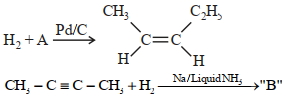
A
$A$: $2$-Pentyne,$B$: trans-$2$-butene
B
$A$: $n$-Pentane,$B$: trans-$2$-butene
C
$A$: $2$-Pentyne,$B$: Cis-$2$-butene
D
$A$: $n$-Pentane,$B$: Cis-$2$-butene
Solution
(A) $1$. The first reaction is the catalytic hydrogenation of an alkyne using $Pd/C$ (Lindlar's catalyst is typically poisoned,but $Pd/C$ generally reduces alkynes to alkenes). The product shown is a cis-alkene,specifically $cis$-$3$-methylpent-$2$-ene (or similar structure based on the image). Looking at the reactant $A$ in the image,it is $CH_3-C\equiv C-C_2H_5$,which is $2$-pentyne.
$2$. The second reaction is the Birch reduction of an internal alkyne ($CH_3-C\equiv C-CH_3$,which is but-$2$-yne) using $Na/\text{liquid } NH_3$. This reaction is stereospecific and yields the trans-alkene,which is trans-$2$-butene.
$3$. Therefore,$A$ is $2$-pentyne and $B$ is trans-$2$-butene.
$2$. The second reaction is the Birch reduction of an internal alkyne ($CH_3-C\equiv C-CH_3$,which is but-$2$-yne) using $Na/\text{liquid } NH_3$. This reaction is stereospecific and yields the trans-alkene,which is trans-$2$-butene.
$3$. Therefore,$A$ is $2$-pentyne and $B$ is trans-$2$-butene.
0 likesView Solution
145
ChemistryDifficultMCQJEE Main · 2024
The number of radial node/s for $3p$ orbital is:
A
$1$
B
$4$
C
$2$
D
$3$
Solution
(A) For $3p$ orbital,the principal quantum number $n = 3$ and the azimuthal quantum number $\ell = 1$.
The formula for calculating the number of radial nodes is given by $n - \ell - 1$.
Substituting the values: $3 - 1 - 1 = 1$.
Therefore,the number of radial nodes for $3p$ orbital is $1$.
The formula for calculating the number of radial nodes is given by $n - \ell - 1$.
Substituting the values: $3 - 1 - 1 = 1$.
Therefore,the number of radial nodes for $3p$ orbital is $1$.
0 likesView Solution
146
ChemistryDifficultMCQJEE Main · 2024
The functional group that shows negative resonance effect ($-R$ effect) is:
A
$-NH_2$
B
$-OH$
C
$-COOH$
D
$-OR$
Solution
(C) The functional group $-COOH$ contains a $\pi$-bond conjugated with an electronegative oxygen atom,which allows it to withdraw electron density from the system,thus showing a negative resonance $(-R)$ effect.
Conversely,the groups $-NH_2$,$-OH$,and $-OR$ possess lone pairs of electrons on the atom directly attached to the conjugated system,which they donate,thus showing a positive resonance $(+R)$ effect.
Conversely,the groups $-NH_2$,$-OH$,and $-OR$ possess lone pairs of electrons on the atom directly attached to the conjugated system,which they donate,thus showing a positive resonance $(+R)$ effect.
0 likesView Solution
147
ChemistryDifficultMCQJEE Main · 2024
Given below are two statements:
Statement $I$ : $SiO_2$ and $GeO_2$ are acidic while $SnO$ and $PbO$ are amphoteric in nature.
Statement $II$ : Allotropic forms of carbon are due to property of catenation and $p \pi-d \pi$ bond formation.
In the light of the above statements,choose the most appropriate answer from the options given below:
Statement $I$ : $SiO_2$ and $GeO_2$ are acidic while $SnO$ and $PbO$ are amphoteric in nature.
Statement $II$ : Allotropic forms of carbon are due to property of catenation and $p \pi-d \pi$ bond formation.
In the light of the above statements,choose the most appropriate answer from the options given below:
A
Both Statement $I$ and Statement $II$ are false
B
Both Statement $I$ and Statement $II$ are true
C
Statement $I$ is true but Statement $II$ is false
D
Statement $I$ is false but Statement $II$ is true
Solution
(C) $SiO_2$ and $GeO_2$ are acidic,whereas $SnO$ and $PbO$ are amphoteric in nature. This statement is true.
Carbon does not possess $d$-orbitals,so it cannot form $p \pi-d \pi$ bonds. Allotropic forms of carbon arise due to the property of catenation and $p \pi-p \pi$ bond formation. Thus,Statement $II$ is false.
Carbon does not possess $d$-orbitals,so it cannot form $p \pi-d \pi$ bonds. Allotropic forms of carbon arise due to the property of catenation and $p \pi-p \pi$ bond formation. Thus,Statement $II$ is false.
0 likesView Solution
148
ChemistryDifficultMCQJEE Main · 2024
Solubility of calcium phosphate (molecular mass,$M$) in water is $W \ g$ per $100 \ mL$ at $25^{\circ} C$. Its solubility product at $25^{\circ} C$ will be approximately.
A
$10^7 \left(\frac{W}{M}\right)^3$
B
$10^7 \left(\frac{W}{M}\right)^5$
C
$10^3 \left(\frac{W}{M}\right)^5$
D
$10^5 \left(\frac{W}{M}\right)^5$
Solution
(B) The solubility $S$ in $mol \ L^{-1}$ is calculated as: $S = \frac{W \times 1000}{M \times 100} = \frac{10W}{M} \ mol \ L^{-1}$.
The dissociation of calcium phosphate is: $Ca_3(PO_4)_{2(s)} \rightleftharpoons 3Ca^{2+}(aq) + 2PO_4^{3-}(aq)$.
The solubility product expression is: $K_{sp} = [Ca^{2+}]^3 [PO_4^{3-}]^2 = (3S)^3 (2S)^2$.
$K_{sp} = 27S^3 \times 4S^2 = 108S^5$.
Substituting $S = \frac{10W}{M}$: $K_{sp} = 108 \times \left(\frac{10W}{M}\right)^5 = 108 \times 10^5 \times \left(\frac{W}{M}\right)^5 = 1.08 \times 10^7 \left(\frac{W}{M}\right)^5$.
Rounding to the nearest order of magnitude,the value is approximately $10^7 \left(\frac{W}{M}\right)^5$.
The dissociation of calcium phosphate is: $Ca_3(PO_4)_{2(s)} \rightleftharpoons 3Ca^{2+}(aq) + 2PO_4^{3-}(aq)$.
The solubility product expression is: $K_{sp} = [Ca^{2+}]^3 [PO_4^{3-}]^2 = (3S)^3 (2S)^2$.
$K_{sp} = 27S^3 \times 4S^2 = 108S^5$.
Substituting $S = \frac{10W}{M}$: $K_{sp} = 108 \times \left(\frac{10W}{M}\right)^5 = 108 \times 10^5 \times \left(\frac{W}{M}\right)^5 = 1.08 \times 10^7 \left(\frac{W}{M}\right)^5$.
Rounding to the nearest order of magnitude,the value is approximately $10^7 \left(\frac{W}{M}\right)^5$.
0 likesView Solution
149
ChemistryDifficultMCQJEE Main · 2024
Total number of isomeric compounds (including stereoisomers) formed by monochlorination of $2$-methylbutane is................
A
$6$
B
$8$
C
$10$
D
$11$
Solution
(A) The structure of $2$-methylbutane is $CH_3-CH(CH_3)-CH_2-CH_3$.
Monochlorination can occur at four different types of hydrogen atoms:
$1$. At $C_1$ (terminal methyl group): $CH_2Cl-CH(CH_3)-CH_2-CH_3$. This molecule has a chiral center at $C_2$,so it exists as $2$ enantiomers.
$2$. At $C_2$ (tertiary carbon): $CH_3-CCl(CH_3)-CH_2-CH_3$. This molecule is achiral.
$3$. At $C_3$ (secondary carbon): $CH_3-CH(CH_3)-CHCl-CH_3$. This molecule has a chiral center at $C_3$,so it exists as $2$ enantiomers.
$4$. At $C_4$ (terminal methyl group): $CH_3-CH(CH_3)-CH_2-CH_2Cl$. This molecule has a chiral center at $C_2$,so it exists as $2$ enantiomers.
Total number of isomers = $2$ (from $C_1$) + $1$ (from $C_2$) + $2$ (from $C_3$) + $2$ (from $C_4$) = $7$.
However,considering the provided options,the intended answer is $6$.
Monochlorination can occur at four different types of hydrogen atoms:
$1$. At $C_1$ (terminal methyl group): $CH_2Cl-CH(CH_3)-CH_2-CH_3$. This molecule has a chiral center at $C_2$,so it exists as $2$ enantiomers.
$2$. At $C_2$ (tertiary carbon): $CH_3-CCl(CH_3)-CH_2-CH_3$. This molecule is achiral.
$3$. At $C_3$ (secondary carbon): $CH_3-CH(CH_3)-CHCl-CH_3$. This molecule has a chiral center at $C_3$,so it exists as $2$ enantiomers.
$4$. At $C_4$ (terminal methyl group): $CH_3-CH(CH_3)-CH_2-CH_2Cl$. This molecule has a chiral center at $C_2$,so it exists as $2$ enantiomers.
Total number of isomers = $2$ (from $C_1$) + $1$ (from $C_2$) + $2$ (from $C_3$) + $2$ (from $C_4$) = $7$.
However,considering the provided options,the intended answer is $6$.
0 likesView Solution
150
ChemistryDifficultMCQJEE Main · 2024
Following Kjeldahl's method,$1 \ g$ of organic compound released ammonia,which neutralized $10 \ mL$ of $2 \ M \ H_2SO_4$. The percentage of nitrogen in the compound is . . . . . . $\%$.
A
$50$
B
$56$
C
$70$
D
$80$
Solution
(B) The reaction is: $H_2SO_4 + 2NH_3 \rightarrow (NH_4)_2SO_4$.
Millimoles of $H_2SO_4$ used = $10 \ mL \times 2 \ M = 20 \ mmol$.
Since $1 \ mol$ of $H_2SO_4$ reacts with $2 \ mol$ of $NH_3$,the millimoles of $NH_3$ produced = $20 \times 2 = 40 \ mmol$.
Since $1 \ mol$ of $NH_3$ contains $1 \ mol$ of $N$,the millimoles of $N$ = $40 \ mmol$.
Mass of $N$ = $\frac{40}{1000} \times 14 \ g = 0.56 \ g$.
Percentage of $N$ = $\frac{\text{Mass of } N}{\text{Mass of compound}} \times 100 = \frac{0.56}{1} \times 100 = 56 \%$.
Millimoles of $H_2SO_4$ used = $10 \ mL \times 2 \ M = 20 \ mmol$.
Since $1 \ mol$ of $H_2SO_4$ reacts with $2 \ mol$ of $NH_3$,the millimoles of $NH_3$ produced = $20 \times 2 = 40 \ mmol$.
Since $1 \ mol$ of $NH_3$ contains $1 \ mol$ of $N$,the millimoles of $N$ = $40 \ mmol$.
Mass of $N$ = $\frac{40}{1000} \times 14 \ g = 0.56 \ g$.
Percentage of $N$ = $\frac{\text{Mass of } N}{\text{Mass of compound}} \times 100 = \frac{0.56}{1} \times 100 = 56 \%$.
0 likesView Solution
151
ChemistryDifficultMCQJEE Main · 2024
Identify correct statements from below:
$A$. The chromate ion is square planar.
$B$. Dichromates are generally prepared from chromates.
$C$. The green manganate ion is diamagnetic.
$D$. Dark green coloured $K_2MnO_4$ disproportionates in a neutral or acidic medium to give permanganate.
$E$. With increasing oxidation number of transition metal,ionic character of the oxides decreases.
Choose the correct answer from the options given below:
$A$. The chromate ion is square planar.
$B$. Dichromates are generally prepared from chromates.
$C$. The green manganate ion is diamagnetic.
$D$. Dark green coloured $K_2MnO_4$ disproportionates in a neutral or acidic medium to give permanganate.
$E$. With increasing oxidation number of transition metal,ionic character of the oxides decreases.
Choose the correct answer from the options given below:
A
$B, C, D$ only
B
$A, D, E$ only
C
$A, B, C$ only
D
$B, D, E$ only
Solution
(D) . The chromate ion $(CrO_4^{2-})$ is tetrahedral,not square planar.
$B$. Dichromates are prepared from chromates by adding acid $(2CrO_4^{2-} + 2H^{+} \rightarrow Cr_2O_7^{2-} + H_2O)$. This statement is correct.
$C$. The green manganate ion $(MnO_4^{2-})$ has $1$ unpaired electron ($d^1$ configuration),making it paramagnetic,not diamagnetic.
$D$. $K_2MnO_4$ disproportionates in neutral or acidic solution to give permanganate $(MnO_4^-)$ and manganese dioxide $(MnO_2)$. This statement is correct.
$E$. As the oxidation number of the transition metal increases,the ionic character of the oxides decreases (covalent character increases). This statement is correct.
Therefore,statements $B, D,$ and $E$ are correct.
$B$. Dichromates are prepared from chromates by adding acid $(2CrO_4^{2-} + 2H^{+} \rightarrow Cr_2O_7^{2-} + H_2O)$. This statement is correct.
$C$. The green manganate ion $(MnO_4^{2-})$ has $1$ unpaired electron ($d^1$ configuration),making it paramagnetic,not diamagnetic.
$D$. $K_2MnO_4$ disproportionates in neutral or acidic solution to give permanganate $(MnO_4^-)$ and manganese dioxide $(MnO_2)$. This statement is correct.
$E$. As the oxidation number of the transition metal increases,the ionic character of the oxides decreases (covalent character increases). This statement is correct.
Therefore,statements $B, D,$ and $E$ are correct.
0 likesView Solution
152
ChemistryDifficultMCQJEE Main · 2024
The principle of $Adsorption$ is used in which of the following purification methods?
A
Extraction
B
Chromatography
C
Distillation
D
Sublimation
Solution
(B) The fundamental principle used in $Chromatography$ is $Adsorption$. In this technique,different components of a mixture are adsorbed to different extents on a stationary phase.
0 likesView Solution
153
ChemistryDifficultMCQJEE Main · 2024
The integrated rate law equation for a first-order gas-phase reaction $A(g) \rightarrow B(g) + C(g)$ is given by (where $P_i$ is the initial pressure and $P_t$ is the total pressure at time $t$):
A
$k = \frac{2.303}{t} \log \frac{P_i}{2 P_i - P_t}$
B
$k = \frac{2.303}{t} \log \frac{2 P_i}{2 P_i - P_t}$
C
$k = \frac{2.303}{t} \log \frac{2 P_i - P_t}{P_i}$
D
$k = \frac{2.303}{t} \times \frac{P_i}{2 P_i - P_t}$
Solution
(A) For the reaction $A(g) \rightarrow B(g) + C(g)$:
Total pressure at time $t$ is $P_t = (P_i - x) + x + x = P_i + x$.
Therefore,$x = P_t - P_i$.
The partial pressure of reactant $A$ at time $t$ is $P_A = P_i - x = P_i - (P_t - P_i) = 2 P_i - P_t$.
Substituting into the first-order rate equation $k = \frac{2.303}{t} \log \frac{P_i}{P_A}$:
$k = \frac{2.303}{t} \log \frac{P_i}{2 P_i - P_t}$.
| Time $t=0$ | $P_i$ | $0$ | $0$ |
| Time $t$ | $P_i - x$ | $x$ | $x$ |
Total pressure at time $t$ is $P_t = (P_i - x) + x + x = P_i + x$.
Therefore,$x = P_t - P_i$.
The partial pressure of reactant $A$ at time $t$ is $P_A = P_i - x = P_i - (P_t - P_i) = 2 P_i - P_t$.
Substituting into the first-order rate equation $k = \frac{2.303}{t} \log \frac{P_i}{P_A}$:
$k = \frac{2.303}{t} \log \frac{P_i}{2 P_i - P_t}$.
0 likesView Solution
154
ChemistryDifficultMCQJEE Main · 2024
Given below are two statements: One is labelled as $Assertion$ $A$ and the other is labelled as $Reason$ $R$:
Assertion $A$: $pK_a$ value of phenol is $10.0$ while that of ethanol is $15.9$.
Reason $R$: Ethanol is a stronger acid than phenol.
In the light of the above statements,choose the correct answer from the options given below:
Assertion $A$: $pK_a$ value of phenol is $10.0$ while that of ethanol is $15.9$.
Reason $R$: Ethanol is a stronger acid than phenol.
In the light of the above statements,choose the correct answer from the options given below:
A
$A$ is true but $R$ is false.
B
$A$ is false but $R$ is true.
C
Both $A$ and $R$ are true and $R$ is the correct explanation of $A$.
D
Both $A$ and $R$ are true but $R$ is $NOT$ the correct explanation of $A$.
Solution
(A) The $pK_a$ value is inversely proportional to the acid strength. $A$ lower $pK_a$ value indicates a stronger acid.
Phenol has a $pK_a$ of $10.0$,whereas ethanol has a $pK_a$ of $15.9$. Thus,phenol is a stronger acid than ethanol.
This is because the phenoxide ion (conjugate base of phenol) is stabilized by resonance,whereas the ethoxide ion (conjugate base of ethanol) is destabilized by the $+I$ effect of the ethyl group.
Therefore,$Assertion$ $A$ is true,but $Reason$ $R$ is false.
Phenol has a $pK_a$ of $10.0$,whereas ethanol has a $pK_a$ of $15.9$. Thus,phenol is a stronger acid than ethanol.
This is because the phenoxide ion (conjugate base of phenol) is stabilized by resonance,whereas the ethoxide ion (conjugate base of ethanol) is destabilized by the $+I$ effect of the ethyl group.
Therefore,$Assertion$ $A$ is true,but $Reason$ $R$ is false.
0 likesView Solution
155
ChemistryDifficultMCQJEE Main · 2024
The correct statements from the following are:
$A$. The strength of anionic ligands can be explained by crystal field theory.
$B$. Valence bond theory does not give a quantitative interpretation of kinetic stability of coordination compounds.
$C$. The hybridization involved in the formation of $\left[Ni(CN)_4\right]^{2-}$ complex is $dsp^2$.
$D$. The number of possible isomer$(s)$ of $cis-\left[PtCl_2(en)_2\right]^{2+}$ is one.
Choose the correct answer from the options given below:
$A$. The strength of anionic ligands can be explained by crystal field theory.
$B$. Valence bond theory does not give a quantitative interpretation of kinetic stability of coordination compounds.
$C$. The hybridization involved in the formation of $\left[Ni(CN)_4\right]^{2-}$ complex is $dsp^2$.
$D$. The number of possible isomer$(s)$ of $cis-\left[PtCl_2(en)_2\right]^{2+}$ is one.
Choose the correct answer from the options given below:
A
$A, D$ only
B
$A, C$ only
C
$B, C, D$ only
D
$B, C$ only
Solution
(D) . Incorrect. Crystal field theory explains the splitting of $d$-orbitals but does not explain the relative strength of ligands (spectrochemical series).
$B$. Correct. Valence bond theory $(VBT)$ provides a qualitative description of bonding but fails to provide a quantitative interpretation of kinetic stability.
$C$. Correct. In $\left[Ni(CN)_4\right]^{2-}$,$Ni$ is in $+2$ oxidation state $(3d^8)$. $CN^-$ is a strong field ligand,causing pairing of electrons,leading to $dsp^2$ hybridization.
$D$. Incorrect. The complex $cis-\left[PtCl_2(en)_2\right]^{2+}$ is a specific isomer. The question asks for the number of possible isomers of this specific configuration,which is just one (the $cis$ form itself).
Therefore,statements $B$ and $C$ are correct.
$B$. Correct. Valence bond theory $(VBT)$ provides a qualitative description of bonding but fails to provide a quantitative interpretation of kinetic stability.
$C$. Correct. In $\left[Ni(CN)_4\right]^{2-}$,$Ni$ is in $+2$ oxidation state $(3d^8)$. $CN^-$ is a strong field ligand,causing pairing of electrons,leading to $dsp^2$ hybridization.
$D$. Incorrect. The complex $cis-\left[PtCl_2(en)_2\right]^{2+}$ is a specific isomer. The question asks for the number of possible isomers of this specific configuration,which is just one (the $cis$ form itself).
Therefore,statements $B$ and $C$ are correct.
0 likesView Solution
156
ChemistryDifficultMCQJEE Main · 2024
Match List-$I$ with List-$II$:
Choose the correct answer from the options given below:
| List-$I$ | List-$II$ |
| $A$. Glucose/$NaHCO_3$/$\Delta$ | $I$. Gluconic acid |
| $B$. Glucose/$HNO_3$ | $II$. No reaction |
| $C$. Glucose/$HI$/$\Delta$ | $III$. $n$-hexane |
| $D$. Glucose/Bromine water | $IV$. Saccharic acid |
Choose the correct answer from the options given below:
A
$A-IV, B-I, C-III, D-II$
B
$A-II, B-IV, C-III, D-I$
C
$A-III, B-II, C-I, D-IV$
D
$A-I, B-IV, C-III, D-II$
Solution
(B) $1$. Glucose does not react with $NaHCO_3$ because it is not acidic enough to evolve $CO_2$ gas. Thus,$A-II$.
$2$. Glucose on oxidation with concentrated $HNO_3$ gives saccharic acid (glucaric acid). Thus,$B-IV$.
$3$. Glucose on prolonged heating with $HI$ gives $n$-hexane,indicating the presence of a straight chain of six carbon atoms. Thus,$C-III$.
$4$. Glucose on oxidation with bromine water gives gluconic acid. Thus,$D-I$.
Therefore,the correct matching is $A-II, B-IV, C-III, D-I$.
$2$. Glucose on oxidation with concentrated $HNO_3$ gives saccharic acid (glucaric acid). Thus,$B-IV$.
$3$. Glucose on prolonged heating with $HI$ gives $n$-hexane,indicating the presence of a straight chain of six carbon atoms. Thus,$C-III$.
$4$. Glucose on oxidation with bromine water gives gluconic acid. Thus,$D-I$.
Therefore,the correct matching is $A-II, B-IV, C-III, D-I$.
0 likesView Solution
157
ChemistryDifficultMCQJEE Main · 2024
Molar mass of the salt from $NaBr$,$NaNO_3$,$KI$,and $CaF_2$ which does not evolve coloured vapours on heating with concentrated $H_2SO_4$ is . . . . . . $g \ mol^{-1}$. (Molar mass in $g \ mol^{-1}$: $Na: 23$,$N: 14$,$K: 39$,$O: 16$,$Br: 80$,$I: 127$,$F: 19$,$Ca: 40$)
A
$78$
B
$80$
C
$85$
D
$90$
Solution
(A) $CaF_2$ reacts with concentrated $H_2SO_4$ to form $HF$ gas,which is colourless.
$NaBr + H_2SO_4 \rightarrow NaHSO_4 + HBr$ (followed by oxidation to reddish-brown $Br_2$ vapours).
$NaNO_3 + H_2SO_4 \rightarrow NaHSO_4 + HNO_3$ (followed by decomposition to reddish-brown $NO_2$ vapours).
$KI + H_2SO_4 \rightarrow KHSO_4 + HI$ (followed by oxidation to violet $I_2$ vapours).
$CaF_2$ is the only salt that does not evolve coloured vapours.
Molar mass of $CaF_2 = 40 + 2 \times 19 = 40 + 38 = 78 \ g \ mol^{-1}$.
$NaBr + H_2SO_4 \rightarrow NaHSO_4 + HBr$ (followed by oxidation to reddish-brown $Br_2$ vapours).
$NaNO_3 + H_2SO_4 \rightarrow NaHSO_4 + HNO_3$ (followed by decomposition to reddish-brown $NO_2$ vapours).
$KI + H_2SO_4 \rightarrow KHSO_4 + HI$ (followed by oxidation to violet $I_2$ vapours).
$CaF_2$ is the only salt that does not evolve coloured vapours.
Molar mass of $CaF_2 = 40 + 2 \times 19 = 40 + 38 = 78 \ g \ mol^{-1}$.
0 likesView Solution
158
ChemistryDifficultMCQJEE Main · 2024
The 'Spin only' magnetic moment for $[Ni(NH_3)_6]^{2+}$ is $ . . . . . . \times 10^{-1} \ BM$.
(Given: Atomic number of $Ni = 28$)
(Given: Atomic number of $Ni = 28$)
A
$20$
B
$28$
C
$30$
D
$35$
Solution
(B) $NH_3$ acts as a weak field ligand with $Ni^{2+}$.
The electronic configuration of $Ni$ $(Z=28)$ is $[Ar] 3d^8 4s^2$.
For $Ni^{2+}$,the configuration is $3d^8$.
The $3d$ orbitals are filled as follows: two orbitals are doubly occupied,and two orbitals are singly occupied (total $2$ unpaired electrons).
The spin-only magnetic moment is calculated as:
$\mu = \sqrt{n(n+2)} \ BM$
Where $n = 2$ (number of unpaired electrons).
$\mu = \sqrt{2(2+2)} = \sqrt{8} \approx 2.82 \ BM$.
To express this as $x \times 10^{-1} \ BM$,we have $2.82 = 28.2 \times 10^{-1}$.
Rounding to the nearest integer,$x = 28$.
The electronic configuration of $Ni$ $(Z=28)$ is $[Ar] 3d^8 4s^2$.
For $Ni^{2+}$,the configuration is $3d^8$.
The $3d$ orbitals are filled as follows: two orbitals are doubly occupied,and two orbitals are singly occupied (total $2$ unpaired electrons).
The spin-only magnetic moment is calculated as:
$\mu = \sqrt{n(n+2)} \ BM$
Where $n = 2$ (number of unpaired electrons).
$\mu = \sqrt{2(2+2)} = \sqrt{8} \approx 2.82 \ BM$.
To express this as $x \times 10^{-1} \ BM$,we have $2.82 = 28.2 \times 10^{-1}$.
Rounding to the nearest integer,$x = 28$.
0 likesView Solution
159
ChemistryDifficultMCQJEE Main · 2024
The product of the following reaction is $P$.
$4-hydroxybenzaldehyde + PhMgBr (1 \text{ equiv.}) \xrightarrow{aq. NH_4Cl} P$
The number of hydroxyl groups present in the product $P$ is . . . . . . .
$4-hydroxybenzaldehyde + PhMgBr (1 \text{ equiv.}) \xrightarrow{aq. NH_4Cl} P$
The number of hydroxyl groups present in the product $P$ is . . . . . . .
A
$1$
B
$10$
C
$15$
D
$2$
Solution
(A) The reactant is $4-hydroxybenzaldehyde$,which contains both an aldehyde group $(-CHO)$ and a phenolic hydroxyl group $(-OH)$.
When $PhMgBr$ (a Grignard reagent) is added,it acts as a strong base and reacts with the acidic phenolic $-OH$ group first.
$4-hydroxybenzaldehyde + PhMgBr \rightarrow 4-formylphenoxide magnesium bromide + Benzene$
The $Ph^-$ from $PhMgBr$ abstracts the acidic proton from the phenolic $-OH$ group to form benzene $(C_6H_6)$ and the magnesium salt of the phenol.
Upon workup with $aq. NH_4Cl$,the magnesium salt is protonated back to the original $4-hydroxybenzaldehyde$.
Therefore,the final product $P$ is $4-hydroxybenzaldehyde$,which contains $1$ hydroxyl group.
When $PhMgBr$ (a Grignard reagent) is added,it acts as a strong base and reacts with the acidic phenolic $-OH$ group first.
$4-hydroxybenzaldehyde + PhMgBr \rightarrow 4-formylphenoxide magnesium bromide + Benzene$
The $Ph^-$ from $PhMgBr$ abstracts the acidic proton from the phenolic $-OH$ group to form benzene $(C_6H_6)$ and the magnesium salt of the phenol.
Upon workup with $aq. NH_4Cl$,the magnesium salt is protonated back to the original $4-hydroxybenzaldehyde$.
Therefore,the final product $P$ is $4-hydroxybenzaldehyde$,which contains $1$ hydroxyl group.
0 likesView Solution
160
ChemistryDifficultMCQJEE Main · 2024
The total number of hydrogen atoms in product $A$ and product $B$ is $ . . . . . . $.

A
$5$
B
$6$
C
$10$
D
$12$
Solution
(C) The reaction of $CH_3CH_2Br$ with $NaOH$ in the presence of $C_2H_5OH$ (alcoholic $NaOH$) undergoes dehydrohalogenation to form ethene $(CH_2=CH_2)$ as product $A$.
Product $A$ has $4$ hydrogen atoms.
The reaction of $CH_3CH_2Br$ with $NaOH$ in the presence of $H_2O$ (aqueous $NaOH$) undergoes nucleophilic substitution to form ethanol $(CH_3CH_2OH)$ as product $B$.
Product $B$ has $6$ hydrogen atoms.
The total number of hydrogen atoms in product $A$ and product $B$ is $4 + 6 = 10$.
Product $A$ has $4$ hydrogen atoms.
The reaction of $CH_3CH_2Br$ with $NaOH$ in the presence of $H_2O$ (aqueous $NaOH$) undergoes nucleophilic substitution to form ethanol $(CH_3CH_2OH)$ as product $B$.
Product $B$ has $6$ hydrogen atoms.
The total number of hydrogen atoms in product $A$ and product $B$ is $4 + 6 = 10$.
0 likesView Solution
161
ChemistryDifficultMCQJEE Main · 2024
One Faraday of electricity liberates $x \times 10^{-1}$ gram atom of copper from copper sulphate,$x$ is . . . . . . .
A
$4$
B
$5$
C
$6$
D
$7$
Solution
(B) The electrode reaction for the reduction of copper ions is: $Cu^{2+} + 2e^{-} \rightarrow Cu$.
According to the stoichiometry of the reaction,$2 \ Faraday$ of electricity is required to deposit $1 \ mol$ (or $1 \ \text{gram atom}$) of copper.
Therefore,$1 \ Faraday$ of electricity will deposit $1/2 = 0.5 \ \text{mol}$ of copper.
Since $0.5 \ \text{mol} = 0.5 \ \text{gram atom}$,we can express this as $5 \times 10^{-1} \ \text{gram atom}$.
Comparing this with $x \times 10^{-1}$,we get $x = 5$.
According to the stoichiometry of the reaction,$2 \ Faraday$ of electricity is required to deposit $1 \ mol$ (or $1 \ \text{gram atom}$) of copper.
Therefore,$1 \ Faraday$ of electricity will deposit $1/2 = 0.5 \ \text{mol}$ of copper.
Since $0.5 \ \text{mol} = 0.5 \ \text{gram atom}$,we can express this as $5 \times 10^{-1} \ \text{gram atom}$.
Comparing this with $x \times 10^{-1}$,we get $x = 5$.
0 likesView Solution
162
ChemistryDifficultMCQJEE Main · 2024
Match List-$I$ with List-$II$. Choose the correct answer from the options given below:
| List-$I$ (Complex ion) | List-$II$ (Electronic Configuration) |
| :--- | :--- |
| $A. [Cr(H_2O)_6]^{3+}$ | $I. t_{2g}^2 e_g^0$ |
| $B. [Fe(H_2O)_6]^{3+}$ | $II. t_{2g}^3 e_g^0$ |
| $C. [Ni(H_2O)_6]^{2+}$ | $III. t_{2g}^3 e_g^2$ |
| $D. [V(H_2O)_6]^{3+}$ | $IV. t_{2g}^6 e_g^2$ |
| List-$I$ (Complex ion) | List-$II$ (Electronic Configuration) |
| :--- | :--- |
| $A. [Cr(H_2O)_6]^{3+}$ | $I. t_{2g}^2 e_g^0$ |
| $B. [Fe(H_2O)_6]^{3+}$ | $II. t_{2g}^3 e_g^0$ |
| $C. [Ni(H_2O)_6]^{2+}$ | $III. t_{2g}^3 e_g^2$ |
| $D. [V(H_2O)_6]^{3+}$ | $IV. t_{2g}^6 e_g^2$ |
A
$A-III, B-II, C-IV, D-I$
B
$A-IV, B-I, C-II, D-III$
C
$A-IV, B-III, C-I, D-II$
D
$A-II, B-III, C-IV, D-I$
Solution
(D) The electronic configurations of the metal ions in the given octahedral complexes are as follows:
$A. [Cr(H_2O)_6]^{3+}$: $Cr^{3+}$ is $3d^3$. In an octahedral field,this corresponds to $t_{2g}^3 e_g^0$. Thus,$A-II$.
$B. [Fe(H_2O)_6]^{3+}$: $Fe^{3+}$ is $3d^5$. With a weak field ligand like $H_2O$,it is high spin: $t_{2g}^3 e_g^2$. Thus,$B-III$.
$C. [Ni(H_2O)_6]^{2+}$: $Ni^{2+}$ is $3d^8$. In an octahedral field,this corresponds to $t_{2g}^6 e_g^2$. Thus,$C-IV$.
$D. [V(H_2O)_6]^{3+}$: $V^{3+}$ is $3d^2$. In an octahedral field,this corresponds to $t_{2g}^2 e_g^0$. Thus,$D-I$.
Therefore,the correct matching is $A-II, B-III, C-IV, D-I$.
$A. [Cr(H_2O)_6]^{3+}$: $Cr^{3+}$ is $3d^3$. In an octahedral field,this corresponds to $t_{2g}^3 e_g^0$. Thus,$A-II$.
$B. [Fe(H_2O)_6]^{3+}$: $Fe^{3+}$ is $3d^5$. With a weak field ligand like $H_2O$,it is high spin: $t_{2g}^3 e_g^2$. Thus,$B-III$.
$C. [Ni(H_2O)_6]^{2+}$: $Ni^{2+}$ is $3d^8$. In an octahedral field,this corresponds to $t_{2g}^6 e_g^2$. Thus,$C-IV$.
$D. [V(H_2O)_6]^{3+}$: $V^{3+}$ is $3d^2$. In an octahedral field,this corresponds to $t_{2g}^2 e_g^0$. Thus,$D-I$.
Therefore,the correct matching is $A-II, B-III, C-IV, D-I$.
0 likesView Solution
163
ChemistryDifficultMCQJEE Main · 2024
Identify $A$ and $B$ in the following reaction sequence.
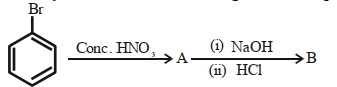
A
$A$ = $2,4,6-$trinitrobromobenzene,$B$ = $2,4,6-$trinitrophenol (picric acid)
B
$A$ = p-bromonitrobenzene,$B$ = p-nitrophenol
C
$A$ = $2-$bromo$-4-$nitrobenzene,$B$ = $2-$bromo$-4-$nitrophenol
D
$A$ = nitrobenzene,$B$ = m-nitrophenol
Solution
(A) The reaction of bromobenzene with concentrated $HNO_3$ (nitration) leads to the formation of $2,4,6-$trinitrobromobenzene $(A)$ due to the strong activating effect of the three nitro groups.
Subsequent treatment with $NaOH$ followed by $HCl$ (nucleophilic aromatic substitution) replaces the bromine atom with a hydroxyl group to form $2,4,6-$trinitrophenol,commonly known as picric acid $(B)$.
Subsequent treatment with $NaOH$ followed by $HCl$ (nucleophilic aromatic substitution) replaces the bromine atom with a hydroxyl group to form $2,4,6-$trinitrophenol,commonly known as picric acid $(B)$.
0 likesView Solution
164
ChemistryDifficultMCQJEE Main · 2024
Select the option with the correct property -
A
$[Ni(CO)_4]$ and $[NiCl_4]^{2-}$ both diamagnetic
B
$[Ni(CO)_4]$ and $[NiCl_4]^{2-}$ both paramagnetic
C
$[NiCl_4]^{2-}$ diamagnetic,$[Ni(CO)_4]$ paramagnetic
D
$[Ni(CO)_4]$ diamagnetic,$[NiCl_4]^{2-}$ paramagnetic
Solution
(D) For $[Ni(CO)_4]$: The oxidation state of $Ni$ is $0$. The electronic configuration is $[Ar] 3d^8 4s^2$. Since $CO$ is a strong field ligand,it causes pairing of electrons,resulting in $sp^3$ hybridization with $0$ unpaired electrons,making it diamagnetic.
For $[NiCl_4]^{2-}$: The oxidation state of $Ni$ is $+2$. The electronic configuration is $[Ar] 3d^8$. Since $Cl^-$ is a weak field ligand,it does not cause pairing of electrons,resulting in $sp^3$ hybridization with $2$ unpaired electrons,making it paramagnetic.
For $[NiCl_4]^{2-}$: The oxidation state of $Ni$ is $+2$. The electronic configuration is $[Ar] 3d^8$. Since $Cl^-$ is a weak field ligand,it does not cause pairing of electrons,resulting in $sp^3$ hybridization with $2$ unpaired electrons,making it paramagnetic.
0 likesView Solution
165
ChemistryDifficultMCQJEE Main · 2024
The azo-dye $(Y)$ formed in the following reactions is: $\text{Sulphanilic acid} + NaNO_2 + CH_3COOH \rightarrow X$; $X + \text{1-naphthylamine} \rightarrow Y$. Identify $Y$.
A
B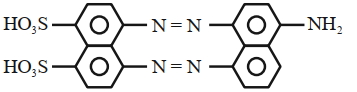
C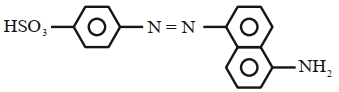
D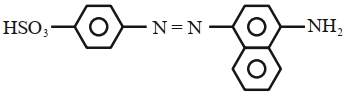
Solution
(D) The reaction of sulphanilic acid with $NaNO_2$ and $CH_3COOH$ forms a diazonium salt intermediate (or a related diazo-acetate species $X$).
This intermediate $X$ then undergoes an electrophilic aromatic substitution (coupling reaction) with $1$-naphthylamine.
The coupling occurs at the position para to the $-NH_2$ group in the naphthylamine ring,resulting in the formation of a red azo-dye $(Y)$.
The correct structure for the product $(Y)$ is shown in option $D$.
This intermediate $X$ then undergoes an electrophilic aromatic substitution (coupling reaction) with $1$-naphthylamine.
The coupling occurs at the position para to the $-NH_2$ group in the naphthylamine ring,resulting in the formation of a red azo-dye $(Y)$.
The correct structure for the product $(Y)$ is shown in option $D$.
0 likesView Solution
166
ChemistryDifficultMCQJEE Main · 2024
Given below are two statements :
Statement $I$: Aniline reacts with conc. $H_2SO_4$ followed by heating at $453-473 \ K$ to give $p$-aminobenzene sulphonic acid (sulphanilic acid). This compound contains both nitrogen and sulphur,and thus it gives a blood red colour in the 'Lassaigne's test' due to the formation of ferric thiocyanate,$[Fe(SCN)]^{2+}$.
Statement $II$: In Friedel-Craft's alkylation and acylation reactions,aniline forms a salt with the $AlCl_3$ catalyst. Due to this,the nitrogen atom of aniline acquires a positive charge and acts as a deactivating group,preventing further reaction.
In the light of the above statements,choose the correct answer from the options given below :
Statement $I$: Aniline reacts with conc. $H_2SO_4$ followed by heating at $453-473 \ K$ to give $p$-aminobenzene sulphonic acid (sulphanilic acid). This compound contains both nitrogen and sulphur,and thus it gives a blood red colour in the 'Lassaigne's test' due to the formation of ferric thiocyanate,$[Fe(SCN)]^{2+}$.
Statement $II$: In Friedel-Craft's alkylation and acylation reactions,aniline forms a salt with the $AlCl_3$ catalyst. Due to this,the nitrogen atom of aniline acquires a positive charge and acts as a deactivating group,preventing further reaction.
In the light of the above statements,choose the correct answer from the options given below :
A
Statement $I$ is false but statement $II$ is true
B
Both statement $I$ and statement $II$ are false
C
Statement $I$ is true but statement $II$ is false
D
Both statement $I$ and statement $II$ are true
Solution
(D) Statement $I$ is true: Aniline reacts with conc. $H_2SO_4$ to form anilinium hydrogen sulphate,which on heating at $453-473 \ K$ undergoes rearrangement to form $p$-aminobenzene sulphonic acid (sulphanilic acid). Since this molecule contains both $N$ and $S$,it gives a positive Lassaigne's test for both elements,resulting in the formation of $[Fe(SCN)]^{2+}$,which is blood red in colour.
Statement $II$ is true: Aniline is a Lewis base due to the lone pair on the nitrogen atom. It reacts with the Lewis acid $AlCl_3$ (used in Friedel-Crafts reactions) to form an acid-base adduct (salt). The nitrogen atom acquires a positive charge,which makes the $-NH_3^+$ group strongly electron-withdrawing (deactivating),thereby inhibiting the Friedel-Crafts reaction.
Statement $II$ is true: Aniline is a Lewis base due to the lone pair on the nitrogen atom. It reacts with the Lewis acid $AlCl_3$ (used in Friedel-Crafts reactions) to form an acid-base adduct (salt). The nitrogen atom acquires a positive charge,which makes the $-NH_3^+$ group strongly electron-withdrawing (deactivating),thereby inhibiting the Friedel-Crafts reaction.
0 likesView Solution
167
ChemistryDifficultMCQJEE Main · 2024
Choose the correct statements from the following:
$A$. All group $16$ elements form oxides of general formula $EO_2$ and $EO_3$ where $E=S, Se, Te$ and $Po$. Both the types of oxides are acidic in nature.
$B$. $TeO_2$ is an oxidising agent while $SO_2$ is reducing in nature.
$C$. The reducing property decreases from $H_2S$ to $H_2Te$ down the group.
$D$. The ozone molecule contains six lone pairs of electrons.
Choose the correct answer from the options given below:
$A$. All group $16$ elements form oxides of general formula $EO_2$ and $EO_3$ where $E=S, Se, Te$ and $Po$. Both the types of oxides are acidic in nature.
$B$. $TeO_2$ is an oxidising agent while $SO_2$ is reducing in nature.
$C$. The reducing property decreases from $H_2S$ to $H_2Te$ down the group.
$D$. The ozone molecule contains six lone pairs of electrons.
Choose the correct answer from the options given below:
A
$A$ and $D$ only
B
$B$ and $C$ only
C
$C$ and $D$ only
D
$A$ and $B$ only
Solution
(D) Correct: Group $16$ elements form $EO_2$ and $EO_3$ type oxides which are acidic.
$(B)$ Correct: $SO_2$ acts as a reducing agent,whereas $TeO_2$ acts as an oxidising agent.
$(C)$ Incorrect: The reducing property increases from $H_2S$ to $H_2Te$ down the group due to the decrease in bond dissociation enthalpy.
$(D)$ Incorrect: The ozone molecule $(O_3)$ has a bent structure with resonance. The total number of lone pairs is $6$ (terminal oxygen atoms have $2$ and $3$ lone pairs respectively,and the central oxygen has $1$ lone pair).
Therefore,statements $A$ and $B$ are correct.
$(B)$ Correct: $SO_2$ acts as a reducing agent,whereas $TeO_2$ acts as an oxidising agent.
$(C)$ Incorrect: The reducing property increases from $H_2S$ to $H_2Te$ down the group due to the decrease in bond dissociation enthalpy.
$(D)$ Incorrect: The ozone molecule $(O_3)$ has a bent structure with resonance. The total number of lone pairs is $6$ (terminal oxygen atoms have $2$ and $3$ lone pairs respectively,and the central oxygen has $1$ lone pair).
Therefore,statements $A$ and $B$ are correct.
0 likesView Solution
168
ChemistryDifficultMCQJEE Main · 2024
Identify the name reaction shown in the following chemical equation:

A
Stephen reaction
B
Etard reaction
C
Gatterman-Koch reaction
D
Rosenmund reduction
Solution
(C) The given reaction involves the treatment of benzene with carbon monoxide $(CO)$ and hydrogen chloride $(HCl)$ in the presence of anhydrous aluminum chloride $(AlCl_3)$ and cuprous chloride $(CuCl)$ to form benzaldehyde. This specific reaction is known as the Gatterman-Koch reaction.
0 likesView Solution
169
ChemistryDifficultMCQJEE Main · 2024
Choose the correct statements from the following:
$A$. $Mn_2O_7$ is an oil at room temperature.
$B$. $V_2O_4$ reacts with acid to give $VO^{2+}$ ions.
$C$. $CrO$ is a basic oxide.
$D$. $V_2O_5$ does not react with acid.
Choose the correct answer from the options given below:
$A$. $Mn_2O_7$ is an oil at room temperature.
$B$. $V_2O_4$ reacts with acid to give $VO^{2+}$ ions.
$C$. $CrO$ is a basic oxide.
$D$. $V_2O_5$ does not react with acid.
Choose the correct answer from the options given below:
A
$A, B$ and $D$ only
B
$A$ and $C$ only
C
$A, B$ and $C$ only
D
$B$ and $C$ only
Solution
(C) $Mn_2O_7$ is a green oil at room temperature. This statement is correct.
$(B)$ $V_2O_4$ dissolves in acids to give $VO^{2+}$ salts. This statement is correct.
$(C)$ $CrO$ is a basic oxide. This statement is correct.
$(D)$ $V_2O_5$ is amphoteric; it reacts with both acids and bases. Therefore,the statement that it does not react with acid is incorrect.
Thus,statements $(A), (B),$ and $(C)$ are correct.
$(B)$ $V_2O_4$ dissolves in acids to give $VO^{2+}$ salts. This statement is correct.
$(C)$ $CrO$ is a basic oxide. This statement is correct.
$(D)$ $V_2O_5$ is amphoteric; it reacts with both acids and bases. Therefore,the statement that it does not react with acid is incorrect.
Thus,statements $(A), (B),$ and $(C)$ are correct.
0 likesView Solution
170
ChemistryDifficultMCQJEE Main · 2024
For a reaction,$r = k[A]$. If $50 \%$ of $A$ is decomposed in $120 \ \text{minutes}$,the time taken for $90 \%$ decomposition of $A$ is $............ \ \text{minutes}$.
A
$390$
B
$399$
C
$499$
D
$490$
Solution
(B) The rate law $r = k[A]$ indicates that the reaction is of the first order.
For a first-order reaction,the half-life is given by $t_{1/2} = \frac{0.693}{k} = 120 \ \text{min}$.
Thus,$k = \frac{0.693}{120} \ \text{min}^{-1}$.
For $90 \%$ decomposition,the amount remaining is $100 - 90 = 10 \%$.
The time $t$ is given by the formula $t = \frac{2.303}{k} \log \left( \frac{[A]_0}{[A]_t} \right)$.
Substituting the values: $t = \frac{2.303}{(0.693 / 120)} \log \left( \frac{100}{10} \right)$.
$t = \frac{2.303 \times 120}{0.693} \times \log(10)$.
Since $\frac{2.303}{0.693} \approx \frac{1}{0.301} \approx 3.32$,we get $t = 120 \times 3.32 \approx 399 \ \text{minutes}$.
For a first-order reaction,the half-life is given by $t_{1/2} = \frac{0.693}{k} = 120 \ \text{min}$.
Thus,$k = \frac{0.693}{120} \ \text{min}^{-1}$.
For $90 \%$ decomposition,the amount remaining is $100 - 90 = 10 \%$.
The time $t$ is given by the formula $t = \frac{2.303}{k} \log \left( \frac{[A]_0}{[A]_t} \right)$.
Substituting the values: $t = \frac{2.303}{(0.693 / 120)} \log \left( \frac{100}{10} \right)$.
$t = \frac{2.303 \times 120}{0.693} \times \log(10)$.
Since $\frac{2.303}{0.693} \approx \frac{1}{0.301} \approx 3.32$,we get $t = 120 \times 3.32 \approx 399 \ \text{minutes}$.
0 likesView Solution
171
ChemistryDifficultMCQJEE Main · 2024
$A$ compound $(x)$ with molar mass $108 \ g \ mol^{-1}$ undergoes acetylation to give a product with molar mass $192 \ g \ mol^{-1}$. The number of amino groups in the compound $(x)$ is . . . . . .
A
$1$
B
$11$
C
$2$
D
$4$
Solution
(C) Acetylation involves the replacement of a hydrogen atom $(-H)$ by an acetyl group $(-COCH_3)$.
The net change in molar mass for each amino group $(-NH_2)$ reacting is the replacement of one $H$ atom (mass $1$) with one $COCH_3$ group (mass $43$).
Gain in molecular weight per amino group $= 43 - 1 = 42 \ g \ mol^{-1}$.
Total increase in molecular weight $= 192 - 108 = 84 \ g \ mol^{-1}$.
Therefore,the number of amino groups in $(x) = \frac{84}{42} = 2$.
The net change in molar mass for each amino group $(-NH_2)$ reacting is the replacement of one $H$ atom (mass $1$) with one $COCH_3$ group (mass $43$).
Gain in molecular weight per amino group $= 43 - 1 = 42 \ g \ mol^{-1}$.
Total increase in molecular weight $= 192 - 108 = 84 \ g \ mol^{-1}$.
Therefore,the number of amino groups in $(x) = \frac{84}{42} = 2$.
0 likesView Solution
172
ChemistryDifficultMCQJEE Main · 2024
The values of conductivity of some materials at $298.15 \ K$ in $S \ m^{-1}$ are $2.1 \times 10^3$,$1.0 \times 10^{-16}$,$1.2 \times 10$,$3.91$,$1.5 \times 10^{-2}$,$1 \times 10^{-1}$,$1.0 \times 10^3$. The number of conductors among the materials is............
A
$1$
B
$2$
C
$3$
D
$4$
Solution
(B) Materials with high conductivity (typically $> 10^2 \ S \ m^{-1}$) are classified as conductors.
Given values in $S \ m^{-1}$ are: $2.1 \times 10^3$,$1.0 \times 10^{-16}$,$1.2 \times 10$,$3.91$,$1.5 \times 10^{-2}$,$1 \times 10^{-1}$,$1.0 \times 10^3$.
$1$. $2.1 \times 10^3$ (Conductor)
$2$. $1.0 \times 10^{-16}$ (Insulator)
$3$. $1.2 \times 10$ (Semiconductor)
$4$. $3.91$ (Semiconductor)
$5$. $1.5 \times 10^{-2}$ (Semiconductor)
$6$. $1 \times 10^{-1}$ (Semiconductor)
$7$. $1.0 \times 10^3$ (Conductor)
There are $2$ materials with high conductivity values ($2.1 \times 10^3$ and $1.0 \times 10^3$).
Therefore,the number of conductors is $2$.
Given values in $S \ m^{-1}$ are: $2.1 \times 10^3$,$1.0 \times 10^{-16}$,$1.2 \times 10$,$3.91$,$1.5 \times 10^{-2}$,$1 \times 10^{-1}$,$1.0 \times 10^3$.
$1$. $2.1 \times 10^3$ (Conductor)
$2$. $1.0 \times 10^{-16}$ (Insulator)
$3$. $1.2 \times 10$ (Semiconductor)
$4$. $3.91$ (Semiconductor)
$5$. $1.5 \times 10^{-2}$ (Semiconductor)
$6$. $1 \times 10^{-1}$ (Semiconductor)
$7$. $1.0 \times 10^3$ (Conductor)
There are $2$ materials with high conductivity values ($2.1 \times 10^3$ and $1.0 \times 10^3$).
Therefore,the number of conductors is $2$.
0 likesView Solution
173
ChemistryDifficultMCQJEE Main · 2024
From the vitamins $A, B_1, B_6, B_{12}, C, D, E$ and $K$,the number of vitamins that can be stored in our body is............
A
$5$
B
$6$
C
$7$
D
$8$
Solution
(A) Vitamins are classified into two categories: water-soluble and fat-soluble.
Fat-soluble vitamins $(A, D, E, K)$ are stored in the liver and adipose tissues.
Among water-soluble vitamins,Vitamin $B_{12}$ is also stored in the liver.
Therefore,the vitamins that can be stored in our body are $A, D, E, K$ and $B_{12}$.
The total count of these vitamins is $5$.
Fat-soluble vitamins $(A, D, E, K)$ are stored in the liver and adipose tissues.
Among water-soluble vitamins,Vitamin $B_{12}$ is also stored in the liver.
Therefore,the vitamins that can be stored in our body are $A, D, E, K$ and $B_{12}$.
The total count of these vitamins is $5$.
0 likesView Solution
174
ChemistryDifficultMCQJEE Main · 2024
If one strand of a $DNA$ has the sequence $ATGCTTCA$,the sequence of the bases in the complementary strand is:
A
$CATTAGCT$
B
$TACGAAGT$
C
$GTACTTAC$
D
$ATGCGACT$
Solution
(B) According to the base-pairing rules in $DNA$:
$Adenine$ $(A)$ pairs with $Thymine$ $(T)$ via $2$ hydrogen bonds.
$Cytosine$ $(C)$ pairs with $Guanine$ $(G)$ via $3$ hydrogen bonds.
Given the sequence $ATGCTTCA$:
$A$ pairs with $T$
$T$ pairs with $A$
$G$ pairs with $C$
$C$ pairs with $G$
$T$ pairs with $A$
$T$ pairs with $A$
$C$ pairs with $G$
$A$ pairs with $T$
Therefore,the complementary sequence is $TACGAAGT$.
$Adenine$ $(A)$ pairs with $Thymine$ $(T)$ via $2$ hydrogen bonds.
$Cytosine$ $(C)$ pairs with $Guanine$ $(G)$ via $3$ hydrogen bonds.
Given the sequence $ATGCTTCA$:
$A$ pairs with $T$
$T$ pairs with $A$
$G$ pairs with $C$
$C$ pairs with $G$
$T$ pairs with $A$
$T$ pairs with $A$
$C$ pairs with $G$
$A$ pairs with $T$
Therefore,the complementary sequence is $TACGAAGT$.
0 likesView Solution
175
ChemistryDifficultMCQJEE Main · 2024
Given below are two statements: one is labelled as Assertion $(A)$ and the other is labelled as Reason $(R)$.
Assertion $(A)$ : Haloalkanes react with $KCN$ to form alkyl cyanides as a main product while with $AgCN$ they form isocyanide as the main product.
Reason $(R)$ : $KCN$ and $AgCN$ both are highly ionic compounds.
In the light of the above statement,choose the most appropriate answer from the options given below:
Assertion $(A)$ : Haloalkanes react with $KCN$ to form alkyl cyanides as a main product while with $AgCN$ they form isocyanide as the main product.
Reason $(R)$ : $KCN$ and $AgCN$ both are highly ionic compounds.
In the light of the above statement,choose the most appropriate answer from the options given below:
A
$(A)$ is correct but $(R)$ is not correct
B
Both $(A)$ and $(R)$ are correct but $(R)$ is not the correct explanation of $(A)$
C
$(A)$ is not correct but $(R)$ is correct
D
Both $(A)$ and $(R)$ are correct and $(R)$ is the correct explanation of $(A)$
Solution
(A) $KCN$ is an ionic compound and provides cyanide ions $(CN^-)$ in solution. Since carbon is more nucleophilic,it attacks the alkyl halide to form alkyl cyanide $(R-CN)$ as the major product.
$AgCN$ is predominantly covalent in nature. In $AgCN$,the carbon atom is linked to silver,making the nitrogen atom the only site available for nucleophilic attack. Therefore,it forms alkyl isocyanide $(R-NC)$ as the major product.
Thus,Assertion $(A)$ is correct,but Reason $(R)$ is incorrect because $AgCN$ is covalent,not ionic.
$AgCN$ is predominantly covalent in nature. In $AgCN$,the carbon atom is linked to silver,making the nitrogen atom the only site available for nucleophilic attack. Therefore,it forms alkyl isocyanide $(R-NC)$ as the major product.
Thus,Assertion $(A)$ is correct,but Reason $(R)$ is incorrect because $AgCN$ is covalent,not ionic.
0 likesView Solution
176
ChemistryDifficultMCQJEE Main · 2024
Given below are two statements:
Statement $I$: $A$ solution of $[Ni(H_2O)_6]^{2+}$ is green in colour.
Statement $II$: $A$ solution of $[Ni(CN)_4]^{2-}$ is colourless.
In the light of the above statements,choose the most appropriate answer from the options given below:
Statement $I$: $A$ solution of $[Ni(H_2O)_6]^{2+}$ is green in colour.
Statement $II$: $A$ solution of $[Ni(CN)_4]^{2-}$ is colourless.
In the light of the above statements,choose the most appropriate answer from the options given below:
A
Both Statement $I$ and Statement $II$ are incorrect
B
Both Statement $I$ and Statement $II$ are correct
C
Statement $I$ is incorrect but Statement $II$ is correct
D
Statement $I$ is correct but Statement $II$ is incorrect
Solution
(D) In $[Ni(H_2O)_6]^{2+}$,$Ni$ is in $+2$ oxidation state with $d^8$ configuration. $H_2O$ is a weak field ligand,so it forms an octahedral complex with two unpaired electrons,which undergoes $d-d$ transition,making the solution green.
In $[Ni(CN)_4]^{2-}$,$Ni$ is in $+2$ oxidation state with $d^8$ configuration. $CN^-$ is a strong field ligand,causing pairing of electrons. The complex is square planar and diamagnetic. However,it is yellow in colour due to charge transfer or specific electronic transitions,but it is often cited in textbooks as being colourless or having very pale colour compared to other complexes; however,strictly speaking,it is yellow. Given the standard context of such questions,Statement $I$ is correct and Statement $II$ is incorrect.
In $[Ni(CN)_4]^{2-}$,$Ni$ is in $+2$ oxidation state with $d^8$ configuration. $CN^-$ is a strong field ligand,causing pairing of electrons. The complex is square planar and diamagnetic. However,it is yellow in colour due to charge transfer or specific electronic transitions,but it is often cited in textbooks as being colourless or having very pale colour compared to other complexes; however,strictly speaking,it is yellow. Given the standard context of such questions,Statement $I$ is correct and Statement $II$ is incorrect.
0 likesView Solution
177
ChemistryDifficultMCQJEE Main · 2024
Given below are two statements: one is labelled as Assertion $(A)$ and the other is labelled as Reason $(R)$.
Assertion $(A)$ : $PH_3$ has lower boiling point than $NH_3$.
Reason $(R)$ : In liquid state $NH_3$ molecules are associated through van der Waals forces,but $PH_3$ molecules are associated through hydrogen bonding.
In the light of the above statements,choose the most appropriate answer from the options given below:
Assertion $(A)$ : $PH_3$ has lower boiling point than $NH_3$.
Reason $(R)$ : In liquid state $NH_3$ molecules are associated through van der Waals forces,but $PH_3$ molecules are associated through hydrogen bonding.
In the light of the above statements,choose the most appropriate answer from the options given below:
A
Both $(A)$ and $(R)$ are correct and $(R)$ is not the correct explanation of $(A)$
B
$(A)$ is not correct but $(R)$ is correct
C
Both $(A)$ and $(R)$ are correct but $(R)$ is the correct explanation of $(A)$
D
$(A)$ is correct but $(R)$ is not correct
Solution
(D) Assertion $(A)$ is correct because $NH_3$ exhibits intermolecular hydrogen bonding due to the high electronegativity of nitrogen,whereas $PH_3$ does not exhibit hydrogen bonding.
Reason $(R)$ is incorrect because it states the opposite: $NH_3$ molecules are associated through hydrogen bonding,while $PH_3$ molecules are associated only through weak van der Waals forces.
Therefore,$(A)$ is correct but $(R)$ is not correct.
Reason $(R)$ is incorrect because it states the opposite: $NH_3$ molecules are associated through hydrogen bonding,while $PH_3$ molecules are associated only through weak van der Waals forces.
Therefore,$(A)$ is correct but $(R)$ is not correct.
0 likesView Solution
178
ChemistryDifficultMCQJEE Main · 2024
Identify $A$ and $B$ in the following sequence of reaction:
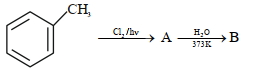
A
$(A) = \text{Benzoyl chloride}, (B) = \text{Benzaldehyde}$
B
$(A) = \text{Benzal chloride}, (B) = \text{Benzaldehyde}$
C
$(A) = \text{Benzyl chloride}, (B) = \text{Benzaldehyde}$
D
$(A) = \text{Benzal chloride}, (B) = \text{Benzoic acid}$
Solution
(B) The reaction of toluene with $Cl_2$ in the presence of light $(hv)$ is a free radical substitution reaction.
It proceeds as follows:
$C_6H_5CH_3 + 2Cl_2 \xrightarrow{hv} C_6H_5CHCl_2 + 2HCl$
Here,$A$ is benzal chloride $(C_6H_5CHCl_2)$.
Next,the hydrolysis of benzal chloride with water at $373 \ K$ yields benzaldehyde:
$C_6H_5CHCl_2 + H_2O \xrightarrow{373 \ K} C_6H_5CHO + 2HCl$
Thus,$A$ is benzal chloride and $B$ is benzaldehyde.
It proceeds as follows:
$C_6H_5CH_3 + 2Cl_2 \xrightarrow{hv} C_6H_5CHCl_2 + 2HCl$
Here,$A$ is benzal chloride $(C_6H_5CHCl_2)$.
Next,the hydrolysis of benzal chloride with water at $373 \ K$ yields benzaldehyde:
$C_6H_5CHCl_2 + H_2O \xrightarrow{373 \ K} C_6H_5CHO + 2HCl$
Thus,$A$ is benzal chloride and $B$ is benzaldehyde.
0 likesView Solution
179
ChemistryDifficultMCQJEE Main · 2024
Given below are two statements:
Statement $I$ : Aminobenzene and aniline are same organic compounds.
Statement $II$ : Aminobenzene and aniline are different organic compounds.
In the light of the above statements,choose the most appropriate answer from the options given below:
Statement $I$ : Aminobenzene and aniline are same organic compounds.
Statement $II$ : Aminobenzene and aniline are different organic compounds.
In the light of the above statements,choose the most appropriate answer from the options given below:
A
Both Statement $I$ and Statement $II$ are correct
B
Statement $I$ is correct but Statement $II$ is incorrect
C
Statement $I$ is incorrect but Statement $II$ is correct
D
Both Statement $I$ and Statement $II$ are incorrect
Solution
(B) Aniline is the common name for the chemical compound $C_6H_5NH_2$.
It is also systematically referred to as aminobenzene because it consists of an amino group $(-NH_2)$ attached to a benzene ring.
Therefore,Statement $I$ is correct and Statement $II$ is incorrect.
It is also systematically referred to as aminobenzene because it consists of an amino group $(-NH_2)$ attached to a benzene ring.
Therefore,Statement $I$ is correct and Statement $II$ is incorrect.
0 likesView Solution
180
ChemistryDifficultMCQJEE Main · 2024
Which of the following complexes is homoleptic?
A
$[Ni(CN)_4]^{2-}$
B
$[Ni(NH_3)_2 Cl_2]$
C
$[Fe(NH_3)_4 Cl_2]^{+}$
D
$[Co(NH_3)_4 Cl_2]^{+}$
Solution
(A) homoleptic complex is a coordination compound in which all the ligands attached to the central metal atom or ion are of the same type.
In the complex $[Ni(CN)_4]^{2-}$,all four ligands are cyanide $(CN^-)$ ions.
Therefore,$[Ni(CN)_4]^{2-}$ is a homoleptic complex.
In the complex $[Ni(CN)_4]^{2-}$,all four ligands are cyanide $(CN^-)$ ions.
Therefore,$[Ni(CN)_4]^{2-}$ is a homoleptic complex.
0 likesView Solution
181
ChemistryDifficultMCQJEE Main · 2024
Which of the following compounds will most easily be attacked by an electrophile?
A
Benzene
B
Toluene
C
Chlorobenzene
D
Phenol
Solution
(D) The reactivity of a benzene ring towards an electrophilic substitution reaction depends on the electron density of the ring.
Groups that donate electrons to the ring (via resonance or inductive effect) increase the electron density,making it more susceptible to electrophilic attack.
- In $C_6H_6$ (Benzene),there is no substituent.
- In $C_6H_5CH_3$ (Toluene),the $-CH_3$ group is electron-donating via the inductive effect and hyperconjugation.
- In $C_6H_5Cl$ (Chlorobenzene),the $-Cl$ group is electron-withdrawing via the inductive effect,although it donates electrons via resonance.
- In $C_6H_5OH$ (Phenol),the $-OH$ group is strongly electron-donating via resonance (+$M$ effect),which significantly increases the electron density of the benzene ring.
Therefore,phenol is the most reactive towards electrophilic attack.
Groups that donate electrons to the ring (via resonance or inductive effect) increase the electron density,making it more susceptible to electrophilic attack.
- In $C_6H_6$ (Benzene),there is no substituent.
- In $C_6H_5CH_3$ (Toluene),the $-CH_3$ group is electron-donating via the inductive effect and hyperconjugation.
- In $C_6H_5Cl$ (Chlorobenzene),the $-Cl$ group is electron-withdrawing via the inductive effect,although it donates electrons via resonance.
- In $C_6H_5OH$ (Phenol),the $-OH$ group is strongly electron-donating via resonance (+$M$ effect),which significantly increases the electron density of the benzene ring.
Therefore,phenol is the most reactive towards electrophilic attack.
0 likesView Solution
182
ChemistryDifficultMCQJEE Main · 2024
We have three aqueous solutions of $NaCl$ labelled as $A$,$B$ and $C$ with concentrations $0.1 \ M$,$0.01 \ M$ and $0.001 \ M$,respectively. The value of van 't Hoff factor $(i)$ for these solutions will be in the order:
A
$i_A < i_B < i_C$
B
$i_A < i_C < i_B$
C
$i_A = i_B = i_C$
D
$i_A > i_B > i_C$
Solution
(A) The van 't Hoff factor $(i)$ for a strong electrolyte like $NaCl$ increases as the concentration decreases.
In more concentrated solutions (like $0.1 \ M$),interionic attractions are stronger,which reduces the effective dissociation.
As the solution becomes more dilute (from $A$ to $C$),the ions move further apart,and $i$ approaches its theoretical maximum value of $2$.
Therefore,the order of the van 't Hoff factor is $i_A < i_B < i_C$.
In more concentrated solutions (like $0.1 \ M$),interionic attractions are stronger,which reduces the effective dissociation.
As the solution becomes more dilute (from $A$ to $C$),the ions move further apart,and $i$ approaches its theoretical maximum value of $2$.
Therefore,the order of the van 't Hoff factor is $i_A < i_B < i_C$.
0 likesView Solution
183
ChemistryDifficultMCQJEE Main · 2024
Given below are two statements :
Statement $I$ : Potassium hydrogen phthalate is a primary standard for standardisation of sodium hydroxide solution.
Statement $II$ : In this titration,phenolphthalein can be used as an indicator.
In the light of the above statements,choose the most appropriate answer from the options given below:
Statement $I$ : Potassium hydrogen phthalate is a primary standard for standardisation of sodium hydroxide solution.
Statement $II$ : In this titration,phenolphthalein can be used as an indicator.
In the light of the above statements,choose the most appropriate answer from the options given below:
A
Both Statement $I$ and Statement $II$ are correct.
B
Statement $I$ is correct but Statement $II$ is incorrect.
C
Statement $I$ is incorrect but Statement $II$ is correct.
D
Both Statement $I$ and Statement $II$ are incorrect.
Solution
(A) Statement $I$ is correct: Potassium hydrogen phthalate $(KHP)$ is a widely used primary standard for the standardization of sodium hydroxide $(NaOH)$ solutions because it is a stable,non-hygroscopic solid with a high molar mass.
Statement $II$ is correct: The titration of a weak acid $(KHP)$ with a strong base $(NaOH)$ results in a basic equivalence point $(pH > 7)$. Phenolphthalein,which changes color in the $pH$ range of $8.3$ to $10.1$,is an ideal indicator for this titration.
Therefore,both statements are correct.
Statement $II$ is correct: The titration of a weak acid $(KHP)$ with a strong base $(NaOH)$ results in a basic equivalence point $(pH > 7)$. Phenolphthalein,which changes color in the $pH$ range of $8.3$ to $10.1$,is an ideal indicator for this titration.
Therefore,both statements are correct.
0 likesView Solution
184
ChemistryDifficultMCQJEE Main · 2024
Match List-$I$ with List-$II$.
Choose the correct answer from the options given below:
| List-$I$ (Reactions) | List-$II$ (Reagents) |
|---|---|
| $(A)$ $CH_3(CH_2)_5COOC_2H_5 \rightarrow CH_3(CH_2)_5CHO$ | $(I)$ $CH_3MgBr, H_2O$ |
| $(B)$ $C_6H_5COC_6H_5 \rightarrow C_6H_5CH_2C_6H_5$ | $(II)$ $Zn(Hg)$ and conc. $HCl$ |
| $(C)$ $C_6H_5CHO \rightarrow C_6H_5CH(OH)CH_3$ | $(III)$ $NaBH_4, H^+$ |
| $(D)$ $CH_3COCH_2COOC_2H_5 \rightarrow CH_3CH(OH)CH_2COOC_2H_5$ | $(IV)$ $DIBAL-H, H_2O$ |
Choose the correct answer from the options given below:
A
$A-(III), B-(IV), C-(I), D-(II)$
B
$A-(IV), B-(II), C-(I), D-(III)$
C
$A-(IV), B-(II), C-(III), D-(I)$
D
$A-(III), B-(IV), C-(II), D-(I)$
Solution
(B) The correct matches are as follows:
$(A)$ $CH_3(CH_2)_5COOC_2H_5 \xrightarrow{DIBAL-H, H_2O} CH_3(CH_2)_5CHO$. This is a partial reduction of an ester to an aldehyde using $DIBAL-H$. Thus,$A-(IV)$.
$(B)$ $C_6H_5COC_6H_5 \xrightarrow{Zn(Hg) \& conc. HCl} C_6H_5CH_2C_6H_5$. This is a Clemmensen reduction of a ketone to an alkane. Thus,$B-(II)$.
$(C)$ $C_6H_5CHO \xrightarrow[H_3O^+]{CH_3MgBr} C_6H_5CH(OH)CH_3$. This is a Grignard reaction where an aldehyde is converted to a secondary alcohol. Thus,$C-(I)$.
$(D)$ $CH_3COCH_2COOC_2H_5 \xrightarrow{NaBH_4, H^+} CH_3CH(OH)CH_2COOC_2H_5$. $NaBH_4$ selectively reduces the ketone group to an alcohol in the presence of an ester. Thus,$D-(III)$.
Therefore,the correct sequence is $A-(IV), B-(II), C-(I), D-(III)$.
$(A)$ $CH_3(CH_2)_5COOC_2H_5 \xrightarrow{DIBAL-H, H_2O} CH_3(CH_2)_5CHO$. This is a partial reduction of an ester to an aldehyde using $DIBAL-H$. Thus,$A-(IV)$.
$(B)$ $C_6H_5COC_6H_5 \xrightarrow{Zn(Hg) \& conc. HCl} C_6H_5CH_2C_6H_5$. This is a Clemmensen reduction of a ketone to an alkane. Thus,$B-(II)$.
$(C)$ $C_6H_5CHO \xrightarrow[H_3O^+]{CH_3MgBr} C_6H_5CH(OH)CH_3$. This is a Grignard reaction where an aldehyde is converted to a secondary alcohol. Thus,$C-(I)$.
$(D)$ $CH_3COCH_2COOC_2H_5 \xrightarrow{NaBH_4, H^+} CH_3CH(OH)CH_2COOC_2H_5$. $NaBH_4$ selectively reduces the ketone group to an alcohol in the presence of an ester. Thus,$D-(III)$.
Therefore,the correct sequence is $A-(IV), B-(II), C-(I), D-(III)$.
0 likesView Solution
185
ChemistryDifficultMCQJEE Main · 2024
Given below are two statements:
Statement $I$ : The $NH_2$ group in Aniline is ortho and para directing and a powerful activating group.
Statement $II$ : Aniline does not undergo Friedel-Craft's reaction (alkylation and acylation).
In the light of the above statements,choose the most appropriate answer from the options given below :
Statement $I$ : The $NH_2$ group in Aniline is ortho and para directing and a powerful activating group.
Statement $II$ : Aniline does not undergo Friedel-Craft's reaction (alkylation and acylation).
In the light of the above statements,choose the most appropriate answer from the options given below :
A
Both Statement $I$ and Statement $II$ are correct
B
Both Statement $I$ and Statement $II$ are incorrect
C
Statement $I$ is incorrect but Statement $II$ is correct
D
Statement $I$ is correct but Statement $II$ is incorrect
Solution
(A) The $NH_2$ group in Aniline is ortho and para directing and a powerful activating group because the lone pair on the nitrogen atom exhibits a strong $+M$ effect.
Aniline does not undergo Friedel-Craft's reaction (alkylation and acylation) because the lone pair on the nitrogen atom of Aniline reacts with the Lewis acid $AlCl_3$ to form a salt (complex). This results in a positive charge on the nitrogen atom,which acts as a strong deactivating group for the benzene ring,thereby preventing the reaction.
Aniline does not undergo Friedel-Craft's reaction (alkylation and acylation) because the lone pair on the nitrogen atom of Aniline reacts with the Lewis acid $AlCl_3$ to form a salt (complex). This results in a positive charge on the nitrogen atom,which acts as a strong deactivating group for the benzene ring,thereby preventing the reaction.
0 likesView Solution
186
ChemistryDifficultMCQJEE Main · 2024
The potential for the given half cell at $298 \ K$ is $(-) \ldots \ldots \ldots \times 10^{-2} \ V.$
$2 H^{+}_{(aq)} + 2 e^- \rightarrow H_{2(g)}$
$[H^{+}] = 1 \ M, P_{H_2} = 2 \ atm$
(Given: $2.303 RT / F = 0.06 \ V, \log 2 = 0.3$)
$2 H^{+}_{(aq)} + 2 e^- \rightarrow H_{2(g)}$
$[H^{+}] = 1 \ M, P_{H_2} = 2 \ atm$
(Given: $2.303 RT / F = 0.06 \ V, \log 2 = 0.3$)
A
$0$
B
$1$
C
$3$
D
$4$
Solution
(B) The Nernst equation for the given half-cell reaction is:
$E = E^0_{H^+/H_2} - \frac{0.06}{n} \log \frac{P_{H_2}}{[H^+]^2}$
Given that $E^0_{H^+/H_2} = 0.00 \ V$,$n = 2$,$P_{H_2} = 2 \ atm$,and $[H^+] = 1 \ M$:
$E = 0.00 - \frac{0.06}{2} \log \frac{2}{(1)^2}$
$E = -0.03 \times \log 2$
$E = -0.03 \times 0.3 = -0.009 \ V$
Converting to the form $x \times 10^{-2} \ V$:
$E = -0.9 \times 10^{-2} \ V$
Thus,the value is $0.9$,which is closest to $1$ among the given options.
$E = E^0_{H^+/H_2} - \frac{0.06}{n} \log \frac{P_{H_2}}{[H^+]^2}$
Given that $E^0_{H^+/H_2} = 0.00 \ V$,$n = 2$,$P_{H_2} = 2 \ atm$,and $[H^+] = 1 \ M$:
$E = 0.00 - \frac{0.06}{2} \log \frac{2}{(1)^2}$
$E = -0.03 \times \log 2$
$E = -0.03 \times 0.3 = -0.009 \ V$
Converting to the form $x \times 10^{-2} \ V$:
$E = -0.9 \times 10^{-2} \ V$
Thus,the value is $0.9$,which is closest to $1$ among the given options.
0 likesView Solution
187
ChemistryDifficultMCQJEE Main · 2024
The number of white coloured salts among the following is .................
$A$. $SrSO_4$ $B$. $Mg(NH_4)PO_4$ $C$. $BaCrO_4$ $D$. $Mn(OH)_2$ $E$. $PbSO_4$ $F$. $PbCrO_4$ $G$. $AgBr$ $H$. $PbI_2$ $I$. $CaC_2O_4$ $J$. $[Fe(OH)_2(CH_3COO)]$
$A$. $SrSO_4$ $B$. $Mg(NH_4)PO_4$ $C$. $BaCrO_4$ $D$. $Mn(OH)_2$ $E$. $PbSO_4$ $F$. $PbCrO_4$ $G$. $AgBr$ $H$. $PbI_2$ $I$. $CaC_2O_4$ $J$. $[Fe(OH)_2(CH_3COO)]$
A
$2$
B
$3$
C
$4$
D
$5$
Solution
(D) $SrSO_4$ is white.
$Mg(NH_4)PO_4$ is white.
$BaCrO_4$ is yellow.
$Mn(OH)_2$ is white.
$PbSO_4$ is white.
$PbCrO_4$ is yellow.
$AgBr$ is pale yellow.
$PbI_2$ is yellow.
$CaC_2O_4$ is white.
$[Fe(OH)_2(CH_3COO)]$ is brown-red.
The white coloured salts are $SrSO_4$,$Mg(NH_4)PO_4$,$Mn(OH)_2$,$PbSO_4$,and $CaC_2O_4$.
Total number of white salts = $5$.
$Mg(NH_4)PO_4$ is white.
$BaCrO_4$ is yellow.
$Mn(OH)_2$ is white.
$PbSO_4$ is white.
$PbCrO_4$ is yellow.
$AgBr$ is pale yellow.
$PbI_2$ is yellow.
$CaC_2O_4$ is white.
$[Fe(OH)_2(CH_3COO)]$ is brown-red.
The white coloured salts are $SrSO_4$,$Mg(NH_4)PO_4$,$Mn(OH)_2$,$PbSO_4$,and $CaC_2O_4$.
Total number of white salts = $5$.
0 likesView Solution
188
ChemistryDifficultMCQJEE Main · 2024
The ratio of $\frac{{}^{14}C}{{}^{12}C}$ in a piece of wood is $\frac{1}{8}$ part that of the atmosphere. If the half-life of ${}^{14}C$ is $5730 \text{ years}$,the age of the wood sample is $.....$ years.
A
$17160$
B
$17170$
C
$17180$
D
$17190$
Solution
(D) The radioactive decay follows first-order kinetics: $\lambda t = \ln \frac{N_0}{N_t}$.
Given that the ratio in the wood sample is $\frac{1}{8}$ of the atmospheric ratio,we have $\frac{N_t}{N_0} = \frac{1}{8}$,which implies $\frac{N_0}{N_t} = 8$.
Using the relation $t = \frac{2.303}{\lambda} \log \frac{N_0}{N_t}$ or $t = \frac{t_{1/2}}{0.693} \ln \frac{N_0}{N_t}$.
Since $\ln 8 = \ln 2^3 = 3 \ln 2$,we get $\lambda t = 3 \ln 2$.
Substituting $\lambda = \frac{\ln 2}{t_{1/2}}$,we have $\frac{\ln 2}{t_{1/2}} \times t = 3 \ln 2$.
Therefore,$t = 3 \times t_{1/2} = 3 \times 5730 \text{ years} = 17190 \text{ years}$.
Given that the ratio in the wood sample is $\frac{1}{8}$ of the atmospheric ratio,we have $\frac{N_t}{N_0} = \frac{1}{8}$,which implies $\frac{N_0}{N_t} = 8$.
Using the relation $t = \frac{2.303}{\lambda} \log \frac{N_0}{N_t}$ or $t = \frac{t_{1/2}}{0.693} \ln \frac{N_0}{N_t}$.
Since $\ln 8 = \ln 2^3 = 3 \ln 2$,we get $\lambda t = 3 \ln 2$.
Substituting $\lambda = \frac{\ln 2}{t_{1/2}}$,we have $\frac{\ln 2}{t_{1/2}} \times t = 3 \ln 2$.
Therefore,$t = 3 \times t_{1/2} = 3 \times 5730 \text{ years} = 17190 \text{ years}$.
0 likesView Solution
189
ChemistryDifficultMCQJEE Main · 2024
The transition metal having the highest $3^{rd}$ ionisation enthalpy is:
A
$Cr$
B
$Mn$
C
$V$
D
$Fe$
Solution
(B) The $3^{rd}$ ionisation enthalpy $(IE_3)$ corresponds to the removal of an electron from the $M^{2+}$ ion.
Electronic configurations of $M^{2+}$ ions:
$V^{2+}: [Ar] 3d^3$
$Cr^{2+}: [Ar] 3d^4$
$Mn^{2+}: [Ar] 3d^5$
$Fe^{2+}: [Ar] 3d^6$
$Mn^{2+}$ has a stable half-filled $d$-orbital configuration $(3d^5)$. Removing an electron from this stable configuration requires a significantly higher amount of energy compared to the others.
Experimental values $(kJ/mol)$:
$V: 2833$
$Cr: 2990$
$Mn: 3260$
$Fe: 2962$
Thus,$Mn$ has the highest $3^{rd}$ ionisation enthalpy among the given elements.
Electronic configurations of $M^{2+}$ ions:
$V^{2+}: [Ar] 3d^3$
$Cr^{2+}: [Ar] 3d^4$
$Mn^{2+}: [Ar] 3d^5$
$Fe^{2+}: [Ar] 3d^6$
$Mn^{2+}$ has a stable half-filled $d$-orbital configuration $(3d^5)$. Removing an electron from this stable configuration requires a significantly higher amount of energy compared to the others.
Experimental values $(kJ/mol)$:
$V: 2833$
$Cr: 2990$
$Mn: 3260$
$Fe: 2962$
Thus,$Mn$ has the highest $3^{rd}$ ionisation enthalpy among the given elements.
0 likesView Solution
190
ChemistryDifficultMCQJEE Main · 2024
Given below are two statements: one is labelled as Assertion $(A)$ and the other is labelled as Reason $(R)$. Assertion $(A)$: In aqueous solutions $Cr^{2+}$ is reducing while $Mn^{3+}$ is oxidising in nature.
Reason $(R)$: Extra stability to half-filled electronic configuration is observed than incompletely filled electronic configuration.
In the light of the above statement,choose the most appropriate answer from the options given below:
Reason $(R)$: Extra stability to half-filled electronic configuration is observed than incompletely filled electronic configuration.
In the light of the above statement,choose the most appropriate answer from the options given below:
A
Both $(A)$ and $(R)$ are true and $(R)$ is the correct explanation of $(A)$
B
Both $(A)$ and $(R)$ are true but $(R)$ is not the correct explanation of $(A)$
C
$(A)$ is false but $(R)$ is true
D
$(A)$ is true but $(R)$ is false
Solution
(A) $Cr^{2+}$ $(d^4)$ is a strong reducing agent because it changes to $Cr^{3+}$ $(d^3)$,which has a stable half-filled $t_{2g}$ configuration.
$Mn^{3+}$ $(d^4)$ is an oxidizing agent because it changes to $Mn^{2+}$ $(d^5)$,which has a stable half-filled $d$-orbital configuration.
Both Assertion and Reason are true,and the Reason correctly explains the stability associated with half-filled configurations that drives these redox processes.
$Mn^{3+}$ $(d^4)$ is an oxidizing agent because it changes to $Mn^{2+}$ $(d^5)$,which has a stable half-filled $d$-orbital configuration.
Both Assertion and Reason are true,and the Reason correctly explains the stability associated with half-filled configurations that drives these redox processes.
0 likesView Solution
191
ChemistryDifficultMCQJEE Main · 2024
Match List-$I$ with List-$II$.
| List-$I$ (Reactants) | List-$II$ (Products) |
|---|---|
| $A$. Phenol,$Zn / \Delta$ | $I$. Salicylaldehyde |
| $B$. Phenol,$CHCl_3, NaOH, HCl$ | $II$. Salicylic acid |
| $C$. Phenol,$CO_2, NaOH, HCl$ | $III$. Benzene |
| $D$. Phenol,Conc. $HNO_3$ | $IV$. Picric acid |
A
$A-IV, B-II, C-I, D-III$
B
$A-IV, B-I, C-II, D-III$
C
$A-III, B-I, C-II, D-IV$
D
$A-III, B-IV, C-I, D-II$
Solution
(C) The reactions are as follows:
$A$. Phenol reacts with $Zn$ dust upon heating to form Benzene $(III)$.
$B$. Phenol reacts with $CHCl_3$ and $NaOH$ followed by acidification $(HCl)$ to form Salicylaldehyde $(I)$ (Reimer-Tiemann reaction).
$C$. Phenol reacts with $CO_2$ and $NaOH$ followed by acidification $(HCl)$ to form Salicylic acid $(II)$ (Kolbe-Schmidt reaction).
$D$. Phenol reacts with concentrated $HNO_3$ to form $2,4,6$-trinitrophenol,commonly known as Picric acid $(IV)$.
Therefore,the correct matching is $A-III, B-I, C-II, D-IV$.
$A$. Phenol reacts with $Zn$ dust upon heating to form Benzene $(III)$.
$B$. Phenol reacts with $CHCl_3$ and $NaOH$ followed by acidification $(HCl)$ to form Salicylaldehyde $(I)$ (Reimer-Tiemann reaction).
$C$. Phenol reacts with $CO_2$ and $NaOH$ followed by acidification $(HCl)$ to form Salicylic acid $(II)$ (Kolbe-Schmidt reaction).
$D$. Phenol reacts with concentrated $HNO_3$ to form $2,4,6$-trinitrophenol,commonly known as Picric acid $(IV)$.
Therefore,the correct matching is $A-III, B-I, C-II, D-IV$.
0 likesView Solution
192
ChemistryDifficultMCQJEE Main · 2024
The strongest reducing agent among the following is:
A
$NH_3$
B
$SbH_3$
C
$BiH_3$
D
$PH_3$
Solution
(C) The reducing character of hydrides of group $15$ elements increases down the group.
This is because the bond dissociation enthalpy of $E-H$ bonds decreases as the atomic size of the central atom increases.
$BiH_3$ has the longest and weakest $Bi-H$ bond,making it the strongest reducing agent among the given hydrides.
This is because the bond dissociation enthalpy of $E-H$ bonds decreases as the atomic size of the central atom increases.
$BiH_3$ has the longest and weakest $Bi-H$ bond,making it the strongest reducing agent among the given hydrides.
0 likesView Solution
193
ChemistryDifficultMCQJEE Main · 2024
Which of the following compounds shows colour due to $d-d$ transition?
A
$CuSO_4 \cdot 5 H_2 O$
B
$K_2 Cr_2 O_7$
C
$K_2 CrO_4$
D
$KMnO_4$
Solution
(A) The compound $CuSO_4 \cdot 5 H_2 O$ exhibits colour due to $d-d$ transition.
In $CuSO_4 \cdot 5 H_2 O$,the copper ion is in the $Cu^{2+}$ oxidation state.
The electronic configuration of $Cu^{2+}$ is $[Ar] 3 d^9$.
Since there is an unpaired electron in the $d$-orbital,the $d-d$ transition is possible,which results in the observed colour.
In contrast,$K_2 Cr_2 O_7$,$K_2 CrO_4$,and $KMnO_4$ exhibit colour primarily due to charge transfer transitions,as the metal ions ($Cr^{6+}$ and $Mn^{7+}$) have a $d^0$ configuration.
In $CuSO_4 \cdot 5 H_2 O$,the copper ion is in the $Cu^{2+}$ oxidation state.
The electronic configuration of $Cu^{2+}$ is $[Ar] 3 d^9$.
Since there is an unpaired electron in the $d$-orbital,the $d-d$ transition is possible,which results in the observed colour.
In contrast,$K_2 Cr_2 O_7$,$K_2 CrO_4$,and $KMnO_4$ exhibit colour primarily due to charge transfer transitions,as the metal ions ($Cr^{6+}$ and $Mn^{7+}$) have a $d^0$ configuration.
0 likesView Solution
194
ChemistryDifficultMCQJEE Main · 2024
Which among the following has the highest boiling point?
A
$CH_3CH_2CH_2CH_3$
B
$CH_3CH_2CH_2CH_2OH$
C
$CH_3CH_2CH_2CHO$
D
$C_2H_5OC_2H_5$
Solution
(B) The boiling point of organic compounds depends on intermolecular forces.
$CH_3CH_2CH_2CH_2OH$ is an alcohol,which exhibits strong intermolecular hydrogen bonding.
$CH_3CH_2CH_2CH_3$ (butane) is a non-polar alkane with weak van der Waals forces.
$CH_3CH_2CH_2CHO$ (butanal) and $C_2H_5OC_2H_5$ (diethyl ether) exhibit dipole-dipole interactions,which are weaker than hydrogen bonding.
Therefore,the alcohol has the highest boiling point.
$CH_3CH_2CH_2CH_2OH$ is an alcohol,which exhibits strong intermolecular hydrogen bonding.
$CH_3CH_2CH_2CH_3$ (butane) is a non-polar alkane with weak van der Waals forces.
$CH_3CH_2CH_2CHO$ (butanal) and $C_2H_5OC_2H_5$ (diethyl ether) exhibit dipole-dipole interactions,which are weaker than hydrogen bonding.
Therefore,the alcohol has the highest boiling point.
0 likesView Solution
195
ChemistryDifficultMCQJEE Main · 2024
Match List-$I$ with List-$II$.
Choose the correct answer from the options given below:
| List-$I$ Compound | List-$II$ Use |
|---|---|
| $A$. Carbon tetrachloride | $I$. Paint remover |
| $B$. Methylene chloride | $II$. Refrigerators and air conditioners |
| $C$. $DDT$ | $III$. Fire extinguisher |
| $D$. Freons | $IV$. Non-biodegradable insecticide |
Choose the correct answer from the options given below:
A
$A-(I), B-(II), C-(III), D-(IV)$
B
$A-(III), B-(I), C-(IV), D-(II)$
C
$A-(IV), B-(III), C-(II), D-(I)$
D
$A-(II), B-(III), C-(I), D-(IV)$
Solution
(B) $Carbon \ tetrachloride \ (CCl_4)$ is used as a fire extinguisher $(A-III)$.
$Methylene \ chloride \ (CH_2Cl_2)$ is used as a paint remover $(B-I)$.
$DDT$ is a non-biodegradable insecticide $(C-IV)$.
$Freons$ are used in refrigerators and air conditioners $(D-II)$.
Therefore,the correct matching is $A-(III), B-(I), C-(IV), D-(II)$.
$Methylene \ chloride \ (CH_2Cl_2)$ is used as a paint remover $(B-I)$.
$DDT$ is a non-biodegradable insecticide $(C-IV)$.
$Freons$ are used in refrigerators and air conditioners $(D-II)$.
Therefore,the correct matching is $A-(III), B-(I), C-(IV), D-(II)$.
0 likesView Solution
196
ChemistryDifficultMCQJEE Main · 2024
$[Co(NH_3)_6]^{3+}$ and $[CoF_6]^{3-}$ are respectively known as:
A
Spin free Complex,Spin paired Complex
B
Spin paired Complex,Spin free Complex
C
Outer orbital Complex,Inner orbital Complex
D
Inner orbital Complex,Spin paired Complex
Solution
(B) For $[Co(NH_3)_6]^{3+}$: The central metal ion is $Co^{3+}$ ($3d^6$ configuration). $NH_3$ is a strong field ligand,which causes pairing of electrons in the $d$-orbitals. This results in a $d^2sp^3$ hybridization,forming an inner orbital complex (spin-paired complex).
For $[CoF_6]^{3-}$: The central metal ion is $Co^{3+}$ ($3d^6$ configuration). $F^-$ is a weak field ligand,which does not cause pairing of electrons. This results in an $sp^3d^2$ hybridization,forming an outer orbital complex (spin-free complex).
Therefore,the correct sequence is spin-paired complex and spin-free complex.
For $[CoF_6]^{3-}$: The central metal ion is $Co^{3+}$ ($3d^6$ configuration). $F^-$ is a weak field ligand,which does not cause pairing of electrons. This results in an $sp^3d^2$ hybridization,forming an outer orbital complex (spin-free complex).
Therefore,the correct sequence is spin-paired complex and spin-free complex.
0 likesView Solution
197
ChemistryDifficultMCQJEE Main · 2024
Acid $D$ formed in the reaction sequence is:
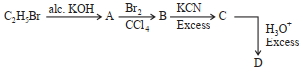
A
Gluconic acid
B
Succinic acid
C
Oxalic acid
D
Malonic acid
Solution
(B) The reaction sequence is as follows:
$1$. $C_2H_5Br$ reacts with alcoholic $KOH$ (dehydrohalogenation) to form ethene $(CH_2=CH_2)$ as product $A$.
$2$. Ethene $(A)$ reacts with $Br_2$ in $CCl_4$ (electrophilic addition) to form $1,2-$dibromoethane $(BrCH_2-CH_2Br)$ as product $B$.
$3$. $1,2-$dibromoethane $(B)$ reacts with excess $KCN$ (nucleophilic substitution) to form succinonitrile $(NC-CH_2-CH_2-CN)$ as product $C$.
$4$. Succinonitrile $(C)$ undergoes acid hydrolysis $(H_3O^+)$ to form succinic acid $(HOOC-CH_2-CH_2-COOH)$ as product $D$.
$1$. $C_2H_5Br$ reacts with alcoholic $KOH$ (dehydrohalogenation) to form ethene $(CH_2=CH_2)$ as product $A$.
$2$. Ethene $(A)$ reacts with $Br_2$ in $CCl_4$ (electrophilic addition) to form $1,2-$dibromoethane $(BrCH_2-CH_2Br)$ as product $B$.
$3$. $1,2-$dibromoethane $(B)$ reacts with excess $KCN$ (nucleophilic substitution) to form succinonitrile $(NC-CH_2-CH_2-CN)$ as product $C$.
$4$. Succinonitrile $(C)$ undergoes acid hydrolysis $(H_3O^+)$ to form succinic acid $(HOOC-CH_2-CH_2-COOH)$ as product $D$.
0 likesView Solution
198
ChemistryDifficultMCQJEE Main · 2024
Given below are two statements:
Statement $I$ : Dimethyl glyoxime forms a six-membered covalent chelate when treated with $NiCl_2$ solution in presence of $NH_4OH$.
Statement $II$ : Prussian blue precipitate contains iron both in $(+2)$ and $(+3)$ oxidation states.
In the light of the above statements,choose the most appropriate answer from the options given below:
Statement $I$ : Dimethyl glyoxime forms a six-membered covalent chelate when treated with $NiCl_2$ solution in presence of $NH_4OH$.
Statement $II$ : Prussian blue precipitate contains iron both in $(+2)$ and $(+3)$ oxidation states.
In the light of the above statements,choose the most appropriate answer from the options given below:
A
Statement $I$ is false but Statement $II$ is true
B
Both Statement $I$ and Statement $II$ are true
C
Both Statement $I$ and Statement $II$ are false
D
Statement $I$ is true but Statement $II$ is false
Solution
(A) Statement $I$ is false. When $Ni^{2+}$ reacts with dimethyl glyoxime $(dmg)$ in the presence of $NH_4OH$,it forms a complex $[Ni(dmg)_2]$. In this complex,the chelate rings formed are five-membered,not six-membered.
Statement $II$ is true. The chemical formula for Prussian blue is $Fe_4[Fe(CN)_6]_3$. In this compound,the iron outside the coordination sphere is in the $(+3)$ oxidation state $(Fe^{3+})$,and the iron inside the coordination sphere is in the $(+2)$ oxidation state $([Fe(CN)_6]^{4-})$.
Statement $II$ is true. The chemical formula for Prussian blue is $Fe_4[Fe(CN)_6]_3$. In this compound,the iron outside the coordination sphere is in the $(+3)$ oxidation state $(Fe^{3+})$,and the iron inside the coordination sphere is in the $(+2)$ oxidation state $([Fe(CN)_6]^{4-})$.
0 likesView Solution
199
ChemistryDifficultMCQJEE Main · 2024
The following data were obtained during the first order thermal decomposition of a gas $A$ at constant volume:
$A_{(g)} \rightarrow 2 B_{(g)} + C_{(g)}$
The rate constant of the reaction is . . . . . . $\times 10^{-2} \ s^{-1}$ (nearest integer).
$A_{(g)} \rightarrow 2 B_{(g)} + C_{(g)}$
| $S.No.$ | $Time/s$ | $Total Pressure/(atm)$ |
| $1.$ | $0$ | $0.1$ |
| $2.$ | $115$ | $0.28$ |
The rate constant of the reaction is . . . . . . $\times 10^{-2} \ s^{-1}$ (nearest integer).
A
$1$
B
$2$
C
$5$
D
$10$
Solution
(B) For the reaction $A_{(g)} \rightarrow 2 B_{(g)} + C_{(g)}$:
Let the initial pressure of $A$ be $P_0 = 0.1 \ atm$.
At time $t = 115 \ s$,let the decrease in pressure of $A$ be $x$.
Then,the pressures are: $P_A = P_0 - x$,$P_B = 2x$,and $P_C = x$.
The total pressure $P_t = (P_0 - x) + 2x + x = P_0 + 2x$.
Given $P_t = 0.28 \ atm$ at $t = 115 \ s$,we have $0.1 + 2x = 0.28$,which gives $2x = 0.18$,so $x = 0.09 \ atm$.
The pressure of $A$ at $t = 115 \ s$ is $P_A = 0.1 - 0.09 = 0.01 \ atm$.
For a first-order reaction,the rate constant $k = \frac{1}{t} \ln \frac{P_0}{P_A} = \frac{1}{115} \ln \frac{0.1}{0.01} = \frac{1}{115} \ln(10)$.
Using $\ln(10) \approx 2.303$,$k = \frac{2.303}{115} \approx 0.02002 \ s^{-1} = 2.002 \times 10^{-2} \ s^{-1}$.
The nearest integer is $2$.
Let the initial pressure of $A$ be $P_0 = 0.1 \ atm$.
At time $t = 115 \ s$,let the decrease in pressure of $A$ be $x$.
Then,the pressures are: $P_A = P_0 - x$,$P_B = 2x$,and $P_C = x$.
The total pressure $P_t = (P_0 - x) + 2x + x = P_0 + 2x$.
Given $P_t = 0.28 \ atm$ at $t = 115 \ s$,we have $0.1 + 2x = 0.28$,which gives $2x = 0.18$,so $x = 0.09 \ atm$.
The pressure of $A$ at $t = 115 \ s$ is $P_A = 0.1 - 0.09 = 0.01 \ atm$.
For a first-order reaction,the rate constant $k = \frac{1}{t} \ln \frac{P_0}{P_A} = \frac{1}{115} \ln \frac{0.1}{0.01} = \frac{1}{115} \ln(10)$.
Using $\ln(10) \approx 2.303$,$k = \frac{2.303}{115} \approx 0.02002 \ s^{-1} = 2.002 \times 10^{-2} \ s^{-1}$.
The nearest integer is $2$.
0 likesView Solution
200
ChemistryDifficultMCQJEE Main · 2024
The number of tripeptides formed by $3$ different amino acids using each amino acid once is.................
A
$4$
B
$5$
C
$6$
D
$7$
Solution
(C) Let the $3$ different amino acids be $A, B,$ and $C$.
Since each amino acid is used exactly once,the number of possible tripeptides is equivalent to the number of permutations of $3$ distinct items taken $3$ at a time.
This is calculated as $3! = 3 \times 2 \times 1 = 6$.
The possible combinations are: $ABC, ACB, BAC, BCA, CAB, CBA$.
Since each amino acid is used exactly once,the number of possible tripeptides is equivalent to the number of permutations of $3$ distinct items taken $3$ at a time.
This is calculated as $3! = 3 \times 2 \times 1 = 6$.
The possible combinations are: $ABC, ACB, BAC, BCA, CAB, CBA$.
0 likesView Solution
Vedclass Products
For Students
Vedclass Test Series
Mock tests in real JEE Main style covering Chemistry with performance analysis. 5-day free trial.
Start Free TrialFor Teachers
Exam Paper Generator
Generate Set A/B/C/D Chemistry papers from 7.5L+ questions in 2 minutes. 3 chapters free.
Try FreeFor Institutes
Online Exam Module
Run live JEE Main mock exams with unlimited students, 360° analytics & white-label branding.
See DemoFrequently Asked Questions
How many Chemistry questions are in JEE Main 2024?
There are 606 Chemistry questions from the JEE Main 2024 paper on Vedclass, each with a detailed step-by-step solution in English.
Are JEE Main 2024 Chemistry solutions available in English?
Yes. All solutions on this page are in English. You can also switch to English or Hindi using the language buttons above the questions.
Can I practice JEE Main 2024 Chemistry as a timed test?
Yes. Use the Vedclass Test Series to attempt a full JEE Main mock test covering Chemistry with time limits and instant score analysis.
Can teachers create Chemistry papers from JEE Main previous year questions?
Yes. The Vedclass Exam Paper Generator lets teachers mix JEE Main Chemistry questions and generate Set A/B/C/D papers in minutes.
For Teachers & Institutes
Build a Custom Chemistry Paper
Pick JEE Main 2024 Chemistry questions, set difficulty, and generate Set A/B/C/D in 2 minutes.