
ChemistryQ151–250 of 606 questions
Page 4 of 7 · English
151
ChemistryDifficultMCQJEE Main · 2024
For a certain reaction at $300 \ K$,$K=10$,then $\Delta G^{\circ}$ for the same reaction is . . . . . . $\times 10^{-1} \ kJ \ mol^{-1}$. (Given $R=8.314 \ J \ K^{-1} \ mol^{-1}$)
A
$70$
B
$60$
C
$80$
D
$57$
Solution
(D) The relationship between standard Gibbs free energy change and equilibrium constant is given by $\Delta G^{\circ} = -RT \ln(K)$.
Given $R = 8.314 \ J \ K^{-1} \ mol^{-1}$,$T = 300 \ K$,and $K = 10$.
$\Delta G^{\circ} = -8.314 \times 300 \times \ln(10)$
$\Delta G^{\circ} = -8.314 \times 300 \times 2.303 \ J \ mol^{-1}$
$\Delta G^{\circ} = -5744.14 \ J \ mol^{-1}$
Converting to $kJ \ mol^{-1}$ by dividing by $1000$:
$\Delta G^{\circ} = -5.744 \ kJ \ mol^{-1}$
Expressing in terms of $\times 10^{-1} \ kJ \ mol^{-1}$:
$-5.744 \ kJ \ mol^{-1} = -57.44 \times 10^{-1} \ kJ \ mol^{-1}$.
Rounding to the nearest integer value as per the options,we get $57$.
Given $R = 8.314 \ J \ K^{-1} \ mol^{-1}$,$T = 300 \ K$,and $K = 10$.
$\Delta G^{\circ} = -8.314 \times 300 \times \ln(10)$
$\Delta G^{\circ} = -8.314 \times 300 \times 2.303 \ J \ mol^{-1}$
$\Delta G^{\circ} = -5744.14 \ J \ mol^{-1}$
Converting to $kJ \ mol^{-1}$ by dividing by $1000$:
$\Delta G^{\circ} = -5.744 \ kJ \ mol^{-1}$
Expressing in terms of $\times 10^{-1} \ kJ \ mol^{-1}$:
$-5.744 \ kJ \ mol^{-1} = -57.44 \times 10^{-1} \ kJ \ mol^{-1}$.
Rounding to the nearest integer value as per the options,we get $57$.
0 likesView Solution
152
ChemistryMediumMCQJEE Main · 2024
$10 \ mL$ of a gaseous hydrocarbon on combustion gives $40 \ mL$ of $CO_{2(g)}$ and $50 \ mL$ of water vapour. The total number of carbon and hydrogen atoms in the hydrocarbon is:
A
$20$
B
$14$
C
$30$
D
$13$
Solution
(B) The combustion reaction for a hydrocarbon $C_xH_y$ is given by:
$C_xH_y + (x + \frac{y}{4}) O_2 \rightarrow xCO_2 + \frac{y}{2} H_2O$
According to Avogadro's Law,the volume of gases is proportional to the number of moles.
Given: $10 \ mL$ of $C_xH_y$ produces $40 \ mL$ of $CO_2$ and $50 \ mL$ of $H_2O$.
From the stoichiometry,$1 \ mol$ of $C_xH_y$ produces $x \ mol$ of $CO_2$ and $\frac{y}{2} \ mol$ of $H_2O$.
Thus,$10x = 40 \implies x = 4$.
And $10 \times (\frac{y}{2}) = 50 \implies 5y = 50 \implies y = 10$.
The hydrocarbon is $C_4H_{10}$.
Total number of atoms $= x + y = 4 + 10 = 14$.
$C_xH_y + (x + \frac{y}{4}) O_2 \rightarrow xCO_2 + \frac{y}{2} H_2O$
According to Avogadro's Law,the volume of gases is proportional to the number of moles.
Given: $10 \ mL$ of $C_xH_y$ produces $40 \ mL$ of $CO_2$ and $50 \ mL$ of $H_2O$.
From the stoichiometry,$1 \ mol$ of $C_xH_y$ produces $x \ mol$ of $CO_2$ and $\frac{y}{2} \ mol$ of $H_2O$.
Thus,$10x = 40 \implies x = 4$.
And $10 \times (\frac{y}{2}) = 50 \implies 5y = 50 \implies y = 10$.
The hydrocarbon is $C_4H_{10}$.
Total number of atoms $= x + y = 4 + 10 = 14$.
1 likesView Solution
153
ChemistryMediumMCQJEE Main · 2024
Match List-$I$ with List-$II$:
| List-$I$ (Mechanism steps) | List-$II$ (Effect) |
| :--- | :--- |
| $(A)$ Aniline resonance structure | $(I)$ $-E$ effect |
| $(B)$ Electrophilic addition of $H^+$ to alkene | $(II)$ $-R$ effect |
| $(C)$ Nucleophilic addition of $CN^-$ to alkene | $(III)$ $+E$ effect |
| $(D)$ Nitrobenzene resonance structure | $(IV)$ $+R$ effect |
Choose the correct answer from the options given below:
| List-$I$ (Mechanism steps) | List-$II$ (Effect) |
| :--- | :--- |
| $(A)$ Aniline resonance structure | $(I)$ $-E$ effect |
| $(B)$ Electrophilic addition of $H^+$ to alkene | $(II)$ $-R$ effect |
| $(C)$ Nucleophilic addition of $CN^-$ to alkene | $(III)$ $+E$ effect |
| $(D)$ Nitrobenzene resonance structure | $(IV)$ $+R$ effect |
Choose the correct answer from the options given below:
A
$A-IV, B-III, C-I, D-II$
B
$A-III, B-I, C-II, D-IV$
C
$A-II, B-IV, C-III, D-I$
D
$A-I, B-II, C-IV, D-III$
Solution
(A) The matching is as follows:
$(A)$ The $-NH_2$ group donates electrons to the benzene ring via resonance,which is a $+R$ effect. Thus,$(A)-(IV)$.
$(B)$ The addition of an electrophile $(H^+)$ to an alkene involves the shift of $\pi$-electrons towards the electrophile,which is a $+E$ effect. Thus,$(B)-(III)$.
$(C)$ The addition of a nucleophile $(CN^-)$ to an alkene involves the shift of $\pi$-electrons away from the nucleophile,which is a $-E$ effect. Thus,$(C)-(I)$.
$(D)$ The $-NO_2$ group withdraws electrons from the benzene ring via resonance,which is a $-R$ effect. Thus,$(D)-(II)$.
Therefore,the correct match is $A-IV, B-III, C-I, D-II$.
$(A)$ The $-NH_2$ group donates electrons to the benzene ring via resonance,which is a $+R$ effect. Thus,$(A)-(IV)$.
$(B)$ The addition of an electrophile $(H^+)$ to an alkene involves the shift of $\pi$-electrons towards the electrophile,which is a $+E$ effect. Thus,$(B)-(III)$.
$(C)$ The addition of a nucleophile $(CN^-)$ to an alkene involves the shift of $\pi$-electrons away from the nucleophile,which is a $-E$ effect. Thus,$(C)-(I)$.
$(D)$ The $-NO_2$ group withdraws electrons from the benzene ring via resonance,which is a $-R$ effect. Thus,$(D)-(II)$.
Therefore,the correct match is $A-IV, B-III, C-I, D-II$.
0 likesView Solution
154
ChemistryMediumMCQJEE Main · 2024
What will be the decreasing order of basic strength of the following conjugate bases?
$OH^{-}, RO^{-}, CH_3COO^{-}, Cl^{-}$
$OH^{-}, RO^{-}, CH_3COO^{-}, Cl^{-}$
A
$Cl^{-} > OH^{-} > RO^{-} > CH_3COO^{-}$
B
$RO^{-} > OH^{-} > CH_3COO^{-} > Cl^{-}$
C
$OH^{-} > RO^{-} > CH_3COO^{-} > Cl^{-}$
D
$Cl^{-} > RO^{-} > OH^{-} > CH_3COO^{-}$
Solution
(B) The basic strength of a conjugate base is inversely proportional to the acidic strength of its corresponding acid.
The order of acidic strength of the corresponding acids is:
$HCl > CH_3COOH > H_2O > ROH$
Since $HCl$ is the strongest acid,its conjugate base $Cl^{-}$ is the weakest base.
Since $ROH$ (alcohol) is a weaker acid than $H_2O$,its conjugate base $RO^{-}$ is a stronger base than $OH^{-}$.
Therefore,the decreasing order of basic strength is:
$RO^{-} > OH^{-} > CH_3COO^{-} > Cl^{-}$
The order of acidic strength of the corresponding acids is:
$HCl > CH_3COOH > H_2O > ROH$
Since $HCl$ is the strongest acid,its conjugate base $Cl^{-}$ is the weakest base.
Since $ROH$ (alcohol) is a weaker acid than $H_2O$,its conjugate base $RO^{-}$ is a stronger base than $OH^{-}$.
Therefore,the decreasing order of basic strength is:
$RO^{-} > OH^{-} > CH_3COO^{-} > Cl^{-}$
0 likesView Solution
155
ChemistryMediumMCQJEE Main · 2024
In the precipitation of the iron group $(III)$ in qualitative analysis,ammonium chloride is added before adding ammonium hydroxide to :
A
prevent interference by phosphate ions
B
decrease concentration of ${OH}^{-}$ ions
C
increase concentration of $Cl^{-}$ ions
D
increase concentration of $NH_{4}^{+}$ ions
Solution
(B) The dissociation of ammonium hydroxide is given by: $NH_{4}OH \rightleftharpoons NH_{4}^{+} + OH^{-}$.
Ammonium chloride is a strong electrolyte and dissociates completely: $NH_{4}Cl \rightarrow NH_{4}^{+} + Cl^{-}$.
Due to the common ion effect of $NH_{4}^{+}$,the equilibrium of $NH_{4}OH$ shifts to the left.
This decreases the concentration of $OH^{-}$ ions to such an extent that only the hydroxides of group-$III$ cations (like $Fe^{3+}$,$Al^{3+}$,$Cr^{3+}$) are precipitated,as they have very low $K_{sp}$ values (in the range of $10^{-18}$ to $10^{-38}$),while other group cations remain in solution.
Ammonium chloride is a strong electrolyte and dissociates completely: $NH_{4}Cl \rightarrow NH_{4}^{+} + Cl^{-}$.
Due to the common ion effect of $NH_{4}^{+}$,the equilibrium of $NH_{4}OH$ shifts to the left.
This decreases the concentration of $OH^{-}$ ions to such an extent that only the hydroxides of group-$III$ cations (like $Fe^{3+}$,$Al^{3+}$,$Cr^{3+}$) are precipitated,as they have very low $K_{sp}$ values (in the range of $10^{-18}$ to $10^{-38}$),while other group cations remain in solution.
0 likesView Solution
156
ChemistryMediumMCQJEE Main · 2024
Which one of the following molecules has the maximum dipole moment?
A
$NF_3$
B
$CH_4$
C
$NH_3$
D
$PF_5$
Solution
(C) $CH_4$ and $PF_5$ are non-polar molecules with a net dipole moment $\mu_{net} = 0$.
In $NH_3$ and $NF_3$,both have a trigonal pyramidal geometry with one lone pair on the central atom.
In $NH_3$,the direction of the bond dipoles $(N-H)$ is towards the nitrogen atom,which is in the same direction as the lone pair moment. Thus,they add up.
In $NF_3$,the fluorine atoms are more electronegative than nitrogen,so the bond dipoles $(N-F)$ point away from the nitrogen atom,opposing the direction of the lone pair moment.
Therefore,the dipole moment of $NH_3$ $(1.46 \ D)$ is greater than that of $NF_3$ $(0.24 \ D)$.
In $NH_3$ and $NF_3$,both have a trigonal pyramidal geometry with one lone pair on the central atom.
In $NH_3$,the direction of the bond dipoles $(N-H)$ is towards the nitrogen atom,which is in the same direction as the lone pair moment. Thus,they add up.
In $NF_3$,the fluorine atoms are more electronegative than nitrogen,so the bond dipoles $(N-F)$ point away from the nitrogen atom,opposing the direction of the lone pair moment.
Therefore,the dipole moment of $NH_3$ $(1.46 \ D)$ is greater than that of $NF_3$ $(0.24 \ D)$.
0 likesView Solution
157
ChemistryMediumMCQJEE Main · 2024
The number of molecules/ions from the following in which the central atom is involved in $sp^3$ hybridization is: $NO_3^{-}, BCl_3, ClO_2^{-}, ClO_3$
A
$2$
B
$4$
C
$3$
D
$1$
Solution
(A) To determine the hybridization of the central atom,we calculate the steric number $(SN)$ using the formula: $SN = \frac{1}{2} (V + M - C + A)$,where $V$ is the number of valence electrons of the central atom,$M$ is the number of monovalent atoms,$C$ is the cationic charge,and $A$ is the anionic charge.
$1$. For $NO_3^{-}$: $N$ has $5$ valence electrons. $SN = \frac{1}{2} (5 + 0 - 0 + 1) = 3$. Hybridization is $sp^2$.
$2$. For $BCl_3$: $B$ has $3$ valence electrons. $SN = \frac{1}{2} (3 + 3 - 0 + 0) = 3$. Hybridization is $sp^2$.
$3$. For $ClO_2^{-}$: $Cl$ has $7$ valence electrons. $SN = \frac{1}{2} (7 + 0 - 0 + 1) = 4$. Hybridization is $sp^3$.
$4$. For $ClO_3$: $Cl$ has $7$ valence electrons. $SN = \frac{1}{2} (7 + 0 - 0 + 0) = 3.5$ (radical species). However,considering the structure with $3$ double bonds and $1$ lone electron,the central $Cl$ atom is $sp^3$ hybridized.
Thus,$ClO_2^{-}$ and $ClO_3$ have $sp^3$ hybridization.
The total number of such species is $2$.
$1$. For $NO_3^{-}$: $N$ has $5$ valence electrons. $SN = \frac{1}{2} (5 + 0 - 0 + 1) = 3$. Hybridization is $sp^2$.
$2$. For $BCl_3$: $B$ has $3$ valence electrons. $SN = \frac{1}{2} (3 + 3 - 0 + 0) = 3$. Hybridization is $sp^2$.
$3$. For $ClO_2^{-}$: $Cl$ has $7$ valence electrons. $SN = \frac{1}{2} (7 + 0 - 0 + 1) = 4$. Hybridization is $sp^3$.
$4$. For $ClO_3$: $Cl$ has $7$ valence electrons. $SN = \frac{1}{2} (7 + 0 - 0 + 0) = 3.5$ (radical species). However,considering the structure with $3$ double bonds and $1$ lone electron,the central $Cl$ atom is $sp^3$ hybridized.
Thus,$ClO_2^{-}$ and $ClO_3$ have $sp^3$ hybridization.
The total number of such species is $2$.
0 likesView Solution
158
ChemistryMediumMCQJEE Main · 2024
Which among the following is an incorrect statement?
A
Electromeric effect dominates over inductive effect
B
The electromeric effect is a temporary effect
C
The organic compound shows electromeric effect in the presence of the reagent only
D
Hydrogen ion $(H^{+})$ shows negative electromeric effect
Solution
(D) The electromeric effect is a temporary effect that occurs in the presence of an attacking reagent. When the $\pi$-electrons are transferred towards the attacking reagent,it is called the positive electromeric effect ($+E$ effect). Since the hydrogen ion $(H^{+})$ acts as an electrophile,the $\pi$-electrons move towards it,making it a positive electromeric effect. Thus,the statement that $(H^{+})$ shows a negative electromeric effect is incorrect.
0 likesView Solution
159
ChemistryMediumMCQJEE Main · 2024
Which of the following nitrogen-containing compounds does not give Lassaigne's test?
A
Phenyl hydrazine
B
Glycine
C
Urea
D
Hydrazine
Solution
(D) Lassaigne's test is used to detect nitrogen,sulfur,and halogens in organic compounds.
It involves the fusion of the organic compound with sodium metal,which converts the elements present into their corresponding sodium salts.
For nitrogen,it forms sodium cyanide $(NaCN)$.
Since $NaCN$ requires both carbon and nitrogen,the organic compound must contain both elements.
Hydrazine $(NH_2-NH_2)$ contains nitrogen but lacks carbon,therefore it cannot form $NaCN$ and does not give a positive Lassaigne's test.
It involves the fusion of the organic compound with sodium metal,which converts the elements present into their corresponding sodium salts.
For nitrogen,it forms sodium cyanide $(NaCN)$.
Since $NaCN$ requires both carbon and nitrogen,the organic compound must contain both elements.
Hydrazine $(NH_2-NH_2)$ contains nitrogen but lacks carbon,therefore it cannot form $NaCN$ and does not give a positive Lassaigne's test.
0 likesView Solution
160
ChemistryMediumMCQJEE Main · 2024
Number of elements from the following that $CANNOT$ form compounds with valencies which match with their respective group valencies is
$B, C, N, S, O, F, P, Al, Si$
$B, C, N, S, O, F, P, Al, Si$
A
$7$
B
$5$
C
$6$
D
$3$
Solution
(D) The group valency is determined by the number of valence electrons or $8$ minus the number of valence electrons.
Elements in the second period $(N, O, F)$ cannot exhibit valencies matching their group number (e.g.,$N$ in group $15$ cannot show a valency of $5$) because they lack vacant $d$-orbitals in their valence shell.
$B, C, Al, Si, P, S$ can exhibit valencies corresponding to their group numbers.
Thus,the elements that cannot form compounds with valencies matching their group valencies are $N, O, F$.
The total count is $3$.
Elements in the second period $(N, O, F)$ cannot exhibit valencies matching their group number (e.g.,$N$ in group $15$ cannot show a valency of $5$) because they lack vacant $d$-orbitals in their valence shell.
$B, C, Al, Si, P, S$ can exhibit valencies corresponding to their group numbers.
Thus,the elements that cannot form compounds with valencies matching their group valencies are $N, O, F$.
The total count is $3$.
0 likesView Solution
161
ChemistryMediumMCQJEE Main · 2024
The Molarity $(M)$ of an aqueous solution containing $5.85 \ g$ of $NaCl$ in $500 \ mL$ water is :
(Given : Molar Mass $Na: 23$ and $Cl: 35.5 \ g \ mol^{-1}$ )
(Given : Molar Mass $Na: 23$ and $Cl: 35.5 \ g \ mol^{-1}$ )
A
$20$
B
$0.2$
C
$2$
D
$4$
Solution
(B) $1$. Calculate the molar mass of $NaCl$: $23 + 35.5 = 58.5 \ g \ mol^{-1}$.
$2$. Calculate the number of moles of $NaCl$: $n = \frac{\text{mass}}{\text{molar mass}} = \frac{5.85 \ g}{58.5 \ g \ mol^{-1}} = 0.1 \ mol$.
$3$. Convert the volume of the solution to liters: $500 \ mL = 0.5 \ L$.
$4$. Calculate Molarity $(M)$: $M = \frac{n}{V(L)} = \frac{0.1 \ mol}{0.5 \ L} = 0.2 \ M$.
$2$. Calculate the number of moles of $NaCl$: $n = \frac{\text{mass}}{\text{molar mass}} = \frac{5.85 \ g}{58.5 \ g \ mol^{-1}} = 0.1 \ mol$.
$3$. Convert the volume of the solution to liters: $500 \ mL = 0.5 \ L$.
$4$. Calculate Molarity $(M)$: $M = \frac{n}{V(L)} = \frac{0.1 \ mol}{0.5 \ L} = 0.2 \ M$.
0 likesView Solution
162
ChemistryMediumMCQJEE Main · 2024
The correct order of first ionization enthalpy values of the following elements is:
$A. O$,$B. N$,$C. Be$,$D. F$,$E. B$
Choose the correct answer from the options given below:
$A. O$,$B. N$,$C. Be$,$D. F$,$E. B$
Choose the correct answer from the options given below:
A
$B < E < C < A < B < D$
B
$E < C < A < B < D$
C
$C < E < A < B < D$
D
$A < B < D < C < E$
Solution
(B) The first ionization enthalpy $(IE_1)$ generally increases across a period from left to right due to an increase in effective nuclear charge.
However,there are exceptions due to stable electronic configurations.
For the given elements in the second period,the order is:
$B (2s^2 2p^1) < Be (2s^2) < C (2s^2 2p^2) < O (2s^2 2p^4) < N (2s^2 2p^3) < F (2s^2 2p^5)$.
Note that $Be$ has a higher $IE_1$ than $B$ due to a fully filled $s$-orbital,and $N$ has a higher $IE_1$ than $O$ due to a half-filled $p$-orbital.
Mapping the elements to their labels: $A=O, B=N, C=Be, D=F, E=B$.
The order is $B < Be < O < N < F$,which corresponds to $E < C < A < B < D$.
However,there are exceptions due to stable electronic configurations.
For the given elements in the second period,the order is:
$B (2s^2 2p^1) < Be (2s^2) < C (2s^2 2p^2) < O (2s^2 2p^4) < N (2s^2 2p^3) < F (2s^2 2p^5)$.
Note that $Be$ has a higher $IE_1$ than $B$ due to a fully filled $s$-orbital,and $N$ has a higher $IE_1$ than $O$ due to a half-filled $p$-orbital.
Mapping the elements to their labels: $A=O, B=N, C=Be, D=F, E=B$.
The order is $B < Be < O < N < F$,which corresponds to $E < C < A < B < D$.
0 likesView Solution
163
ChemistryMediumMCQJEE Main · 2024
The enthalpy of formation of ethane $(C_2H_6)$ from ethylene $(C_2H_4)$ by the addition of hydrogen,where the bond energies of $C-H$,$C-C$,$C=C$,and $H-H$ are $414 \ kJ/mol$,$347 \ kJ/mol$,$615 \ kJ/mol$,and $435 \ kJ/mol$ respectively,is $........$ $kJ/mol$.
A
$-125$
B
$-128$
C
$-130$
D
$-135$
Solution
(A) The reaction is: $C_2H_{4(g)} + H_{2(g)} \rightarrow C_2H_{6(g)}$
The enthalpy change of the reaction is calculated using bond energies: $\Delta H = \sum BE_{\text{reactants}} - \sum BE_{\text{products}}$
$\Delta H = [BE(C=C) + 4 \times BE(C-H) + BE(H-H)] - [BE(C-C) + 6 \times BE(C-H)]$
$\Delta H = BE(C=C) + BE(H-H) - BE(C-C) - 2 \times BE(C-H)$
Substituting the given values:
$\Delta H = 615 + 435 - 347 - 2 \times 414$
$\Delta H = 1050 - 347 - 828$
$\Delta H = 1050 - 1175 = -125 \ kJ/mol$
The enthalpy change of the reaction is calculated using bond energies: $\Delta H = \sum BE_{\text{reactants}} - \sum BE_{\text{products}}$
$\Delta H = [BE(C=C) + 4 \times BE(C-H) + BE(H-H)] - [BE(C-C) + 6 \times BE(C-H)]$
$\Delta H = BE(C=C) + BE(H-H) - BE(C-C) - 2 \times BE(C-H)$
Substituting the given values:
$\Delta H = 615 + 435 - 347 - 2 \times 414$
$\Delta H = 1050 - 347 - 828$
$\Delta H = 1050 - 1175 = -125 \ kJ/mol$
0 likesView Solution
164
ChemistryMediumMCQJEE Main · 2024
The de-Broglie's wavelength of an electron in the $4^{th}$ orbit is . . . . . . . . $\pi a_0$. ($a_0 =$ Bohr's radius)
A
$5$
B
$4$
C
$7$
D
$8$
Solution
(D) According to Bohr's quantization rule:
$2 \pi r_n = n \lambda$
Radius of $n^{th}$ orbit,$r_n = a_0 \frac{n^2}{Z}$
For hydrogen atom,$Z = 1$ and given $n = 4$.
$2 \pi \left(a_0 \frac{4^2}{1}\right) = 4 \lambda$
$2 \pi a_0 (16) = 4 \lambda$
$32 \pi a_0 = 4 \lambda$
$\lambda = 8 \pi a_0$
Therefore,the value is $8$.
$2 \pi r_n = n \lambda$
Radius of $n^{th}$ orbit,$r_n = a_0 \frac{n^2}{Z}$
For hydrogen atom,$Z = 1$ and given $n = 4$.
$2 \pi \left(a_0 \frac{4^2}{1}\right) = 4 \lambda$
$2 \pi a_0 (16) = 4 \lambda$
$32 \pi a_0 = 4 \lambda$
$\lambda = 8 \pi a_0$
Therefore,the value is $8$.
0 likesView Solution
165
ChemistryMediumMCQJEE Main · 2024
Only $2 \ mL$ of $KMnO_4$ solution of unknown molarity is required to reach the end point of a titration of $20 \ mL$ of oxalic acid $(2 \ M)$ in acidic medium. The molarity of $KMnO_4$ solution should be . . . . . . . . . $M$.
A
$50$
B
$49$
C
$46$
D
$40$
Solution
(NONE OF THE ABOVE) The balanced chemical equation for the reaction between $KMnO_4$ and oxalic acid in acidic medium is:
$2KMnO_4 + 5H_2C_2O_4 + 3H_2SO_4 \rightarrow K_2SO_4 + 2MnSO_4 + 10CO_2 + 8H_2O$.
According to the law of equivalence,the number of equivalents of $KMnO_4$ equals the number of equivalents of oxalic acid:
$n_{eq}(KMnO_4) = n_{eq}(H_2C_2O_4)$.
Equivalents are calculated as $Molarity \times Volume \times n-factor$.
For $KMnO_4$ in acidic medium,the $n-factor = 5$.
For oxalic acid $(H_2C_2O_4)$,the $n-factor = 2$.
Let the molarity of $KMnO_4$ be $M$.
$M \times 2 \ mL \times 5 = 2 \ M \times 20 \ mL \times 2$.
$10M = 80$.
$M = 8 \ M$.
$2KMnO_4 + 5H_2C_2O_4 + 3H_2SO_4 \rightarrow K_2SO_4 + 2MnSO_4 + 10CO_2 + 8H_2O$.
According to the law of equivalence,the number of equivalents of $KMnO_4$ equals the number of equivalents of oxalic acid:
$n_{eq}(KMnO_4) = n_{eq}(H_2C_2O_4)$.
Equivalents are calculated as $Molarity \times Volume \times n-factor$.
For $KMnO_4$ in acidic medium,the $n-factor = 5$.
For oxalic acid $(H_2C_2O_4)$,the $n-factor = 2$.
Let the molarity of $KMnO_4$ be $M$.
$M \times 2 \ mL \times 5 = 2 \ M \times 20 \ mL \times 2$.
$10M = 80$.
$M = 8 \ M$.
0 likesView Solution
166
ChemistryMediumMCQJEE Main · 2024
Consider the following reaction:
$MnO_2 + KOH + O_2 \rightarrow A + H_2O$
Product '$A$' in neutral or acidic medium disproportionates to give products '$B$' and '$C$' along with water. The sum of spin-only magnetic moment values of '$B$' and '$C$' is . . . . . $BM$. (nearest integer)
(Given atomic number of $Mn$ is $25$)
$MnO_2 + KOH + O_2 \rightarrow A + H_2O$
Product '$A$' in neutral or acidic medium disproportionates to give products '$B$' and '$C$' along with water. The sum of spin-only magnetic moment values of '$B$' and '$C$' is . . . . . $BM$. (nearest integer)
(Given atomic number of $Mn$ is $25$)
A
$3$
B
$4$
C
$5$
D
$7$
Solution
(B) The reaction is: $2MnO_2 + 4KOH + O_2 \rightarrow 2K_2MnO_4 + 2H_2O$. Thus,$A$ is $K_2MnO_4$.
In neutral or acidic medium,$K_2MnO_4$ disproportionates: $3MnO_4^{2-} + 4H^+ \rightarrow 2MnO_4^- + MnO_2 + 2H_2O$.
Here,$B$ is $MnO_4^-$ ($Mn^{+7}$,$d^0$ configuration,$n=0$,$\mu = 0 \ BM$) and $C$ is $MnO_2$ ($Mn^{+4}$,$d^3$ configuration,$n=3$,$\mu = \sqrt{3(3+2)} = \sqrt{15} \approx 3.87 \ BM$).
The sum of magnetic moments is $0 + 3.87 = 3.87 \ BM$.
The nearest integer is $4$.
In neutral or acidic medium,$K_2MnO_4$ disproportionates: $3MnO_4^{2-} + 4H^+ \rightarrow 2MnO_4^- + MnO_2 + 2H_2O$.
Here,$B$ is $MnO_4^-$ ($Mn^{+7}$,$d^0$ configuration,$n=0$,$\mu = 0 \ BM$) and $C$ is $MnO_2$ ($Mn^{+4}$,$d^3$ configuration,$n=3$,$\mu = \sqrt{3(3+2)} = \sqrt{15} \approx 3.87 \ BM$).
The sum of magnetic moments is $0 + 3.87 = 3.87 \ BM$.
The nearest integer is $4$.
0 likesView Solution
167
ChemistryMediumMCQJEE Main · 2024
The number of different chain isomers for $C_7H_{16}$ is . . . . . . .
A
$9$
B
$10$
C
$15$
D
$16$
Solution
(A) The molecular formula $C_7H_{16}$ represents heptane and its isomers.
Chain isomers are compounds with the same molecular formula but different carbon skeletons.
The possible chain isomers for $C_7H_{16}$ are:
$1$. $n$-heptane
$2$. $2$-methylhexane
$3$. $3$-methylhexane
$4$. $3$-ethylpentane
$5$. $2,2$-dimethylpentane
$6$. $2,3$-dimethylpentane
$7$. $2,4$-dimethylpentane
$8$. $3,3$-dimethylpentane
$9$. $2,2,3$-trimethylbutane
There are a total of $9$ chain isomers for $C_7H_{16}$.
Chain isomers are compounds with the same molecular formula but different carbon skeletons.
The possible chain isomers for $C_7H_{16}$ are:
$1$. $n$-heptane
$2$. $2$-methylhexane
$3$. $3$-methylhexane
$4$. $3$-ethylpentane
$5$. $2,2$-dimethylpentane
$6$. $2,3$-dimethylpentane
$7$. $2,4$-dimethylpentane
$8$. $3,3$-dimethylpentane
$9$. $2,2,3$-trimethylbutane
There are a total of $9$ chain isomers for $C_7H_{16}$.
0 likesView Solution
168
ChemistryMediumMCQJEE Main · 2024
Number of molecules/species from the following having one unpaired electron: $O_2, O_2^{-}, NO, CN^{-}, O_2^{2-}$
A
$1$
B
$2$
C
$3$
D
$4$
Solution
(B) According to $M.O.T.$ (Molecular Orbital Theory):
$O_2$ ($16$ electrons): $\sigma 1s^2, \sigma^* 1s^2, \sigma 2s^2, \sigma^* 2s^2, \sigma 2p_z^2, \pi 2p_x^2 = \pi 2p_y^2, \pi^* 2p_x^1 = \pi^* 2p_y^1$. Unpaired electrons $= 2$.
$O_2^{-}$ ($17$ electrons): $\sigma 1s^2, \sigma^* 1s^2, \sigma 2s^2, \sigma^* 2s^2, \sigma 2p_z^2, \pi 2p_x^2 = \pi 2p_y^2, \pi^* 2p_x^2 = \pi^* 2p_y^1$. Unpaired electrons $= 1$.
$NO$ ($15$ electrons): $\sigma 1s^2, \sigma^* 1s^2, \sigma 2s^2, \sigma^* 2s^2, \sigma 2p_z^2, \pi 2p_x^2 = \pi 2p_y^2, \pi^* 2p_x^1$. Unpaired electrons $= 1$.
$CN^{-}$ ($14$ electrons): $\sigma 1s^2, \sigma^* 1s^2, \sigma 2s^2, \sigma^* 2s^2, \pi 2p_x^2 = \pi 2p_y^2, \sigma 2p_z^2$. Unpaired electrons $= 0$.
$O_2^{2-}$ ($18$ electrons): $\sigma 1s^2, \sigma^* 1s^2, \sigma 2s^2, \sigma^* 2s^2, \sigma 2p_z^2, \pi 2p_x^2 = \pi 2p_y^2, \pi^* 2p_x^2 = \pi^* 2p_y^2$. Unpaired electrons $= 0$.
Thus,the species with one unpaired electron are $O_2^{-}$ and $NO$. The total number is $2$.
$O_2$ ($16$ electrons): $\sigma 1s^2, \sigma^* 1s^2, \sigma 2s^2, \sigma^* 2s^2, \sigma 2p_z^2, \pi 2p_x^2 = \pi 2p_y^2, \pi^* 2p_x^1 = \pi^* 2p_y^1$. Unpaired electrons $= 2$.
$O_2^{-}$ ($17$ electrons): $\sigma 1s^2, \sigma^* 1s^2, \sigma 2s^2, \sigma^* 2s^2, \sigma 2p_z^2, \pi 2p_x^2 = \pi 2p_y^2, \pi^* 2p_x^2 = \pi^* 2p_y^1$. Unpaired electrons $= 1$.
$NO$ ($15$ electrons): $\sigma 1s^2, \sigma^* 1s^2, \sigma 2s^2, \sigma^* 2s^2, \sigma 2p_z^2, \pi 2p_x^2 = \pi 2p_y^2, \pi^* 2p_x^1$. Unpaired electrons $= 1$.
$CN^{-}$ ($14$ electrons): $\sigma 1s^2, \sigma^* 1s^2, \sigma 2s^2, \sigma^* 2s^2, \pi 2p_x^2 = \pi 2p_y^2, \sigma 2p_z^2$. Unpaired electrons $= 0$.
$O_2^{2-}$ ($18$ electrons): $\sigma 1s^2, \sigma^* 1s^2, \sigma 2s^2, \sigma^* 2s^2, \sigma 2p_z^2, \pi 2p_x^2 = \pi 2p_y^2, \pi^* 2p_x^2 = \pi^* 2p_y^2$. Unpaired electrons $= 0$.
Thus,the species with one unpaired electron are $O_2^{-}$ and $NO$. The total number is $2$.
0 likesView Solution
169
ChemistryMediumMCQJEE Main · 2024
The equilibrium constant for the reaction $SO_{3(g)} \rightleftharpoons SO_{2(g)} + \frac{1}{2} O_{2(g)}$ is $K_{C} = 4.9 \times 10^{-2}$. The value of $K_{C}$ for the reaction $2 SO_{2(g)} + O_{2(g)} \rightleftharpoons 2 SO_{3(g)}$ is:
A
$4.9$
B
$41.6$
C
$49$
D
$416$
Solution
(D) The given reaction is $SO_{3(g)} \rightleftharpoons SO_{2(g)} + \frac{1}{2} O_{2(g)}$ with $K_{C} = 4.9 \times 10^{-2}$.
The target reaction is $2 SO_{2(g)} + O_{2(g)} \rightleftharpoons 2 SO_{3(g)}$.
First,reverse the original reaction: $SO_{2(g)} + \frac{1}{2} O_{2(g)} \rightleftharpoons SO_{3(g)}$. The new equilibrium constant is $K_{C1} = \frac{1}{K_{C}} = \frac{1}{4.9 \times 10^{-2}}$.
Next,multiply the reversed reaction by $2$: $2 SO_{2(g)} + O_{2(g)} \rightleftharpoons 2 SO_{3(g)}$. The new equilibrium constant is $K_{C}^{\prime} = (K_{C1})^2 = \left( \frac{1}{4.9 \times 10^{-2}} \right)^2$.
$K_{C}^{\prime} = \left( \frac{100}{4.9} \right)^2 \approx (20.408)^2 \approx 416.49 \approx 416$.
The target reaction is $2 SO_{2(g)} + O_{2(g)} \rightleftharpoons 2 SO_{3(g)}$.
First,reverse the original reaction: $SO_{2(g)} + \frac{1}{2} O_{2(g)} \rightleftharpoons SO_{3(g)}$. The new equilibrium constant is $K_{C1} = \frac{1}{K_{C}} = \frac{1}{4.9 \times 10^{-2}}$.
Next,multiply the reversed reaction by $2$: $2 SO_{2(g)} + O_{2(g)} \rightleftharpoons 2 SO_{3(g)}$. The new equilibrium constant is $K_{C}^{\prime} = (K_{C1})^2 = \left( \frac{1}{4.9 \times 10^{-2}} \right)^2$.
$K_{C}^{\prime} = \left( \frac{100}{4.9} \right)^2 \approx (20.408)^2 \approx 416.49 \approx 416$.
0 likesView Solution
170
ChemistryMediumMCQJEE Main · 2024
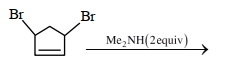
Find out the major product formed from the following reaction. $[Me = -CH_3]$
A
$3,4-$bis(dimethylamino)cyclopent$-1-$ene
B
$3,5-$bis(dimethylamino)cyclopent$-1-$ene
C
$1,2-$bis(dimethylamino)cyclopent$-3-$ene
D
$1,5-$bis(dimethylamino)cyclopent$-2-$ene
Solution
(A) The reaction involves the nucleophilic substitution of bromine atoms by dimethylamine $(Me_2NH)$.
First,one $Me_2NH$ molecule attacks the allylic position,displacing one $Br^-$ ion.
Then,the lone pair on the nitrogen atom of the newly attached dimethylamino group participates in the formation of an aziridinium ion intermediate by displacing the second $Br^-$ ion.
Finally,a second molecule of $Me_2NH$ attacks the aziridinium ring,opening it to form the final product,which is $3,4$-bis(dimethylamino)cyclopent-$1$-ene.
First,one $Me_2NH$ molecule attacks the allylic position,displacing one $Br^-$ ion.
Then,the lone pair on the nitrogen atom of the newly attached dimethylamino group participates in the formation of an aziridinium ion intermediate by displacing the second $Br^-$ ion.
Finally,a second molecule of $Me_2NH$ attacks the aziridinium ring,opening it to form the final product,which is $3,4$-bis(dimethylamino)cyclopent-$1$-ene.
0 likesView Solution
171
ChemistryMediumMCQJEE Main · 2024
When $MnO_2$ and $H_2SO_4$ are added to a salt $(A)$,the greenish yellow gas liberated indicates that salt $(A)$ is:
A
$NaBr$
B
$CaI_2$
C
$KNO_3$
D
$NH_4Cl$
Solution
(D) The reaction of a chloride salt with $MnO_2$ and concentrated $H_2SO_4$ produces chlorine gas,which is greenish-yellow in color.
$2NH_4Cl + MnO_2 + 2H_2SO_4 \xrightarrow{\Delta} MnSO_4 + (NH_4)_2SO_4 + 2H_2O + Cl_2 \uparrow$
Since $Cl_2$ is the greenish-yellow gas,the salt $(A)$ must be a chloride salt,which is $NH_4Cl$.
$2NH_4Cl + MnO_2 + 2H_2SO_4 \xrightarrow{\Delta} MnSO_4 + (NH_4)_2SO_4 + 2H_2O + Cl_2 \uparrow$
Since $Cl_2$ is the greenish-yellow gas,the salt $(A)$ must be a chloride salt,which is $NH_4Cl$.
0 likesView Solution
172
ChemistryMediumMCQJEE Main · 2024
The correct statement/s about Hydrogen bonding is/are:
$A$. Hydrogen bonding exists when $H$ is covalently bonded to a highly electronegative atom.
$B$. Intermolecular $H$ bonding is present in $o$-nitrophenol.
$C$. Intramolecular $H$ bonding is present in $HF$.
$D$. The magnitude of $H$ bonding depends on the physical state of the compound.
$E$. $H$-bonding has a powerful effect on the structure and properties of compounds.
Choose the correct answer from the options given below:
$A$. Hydrogen bonding exists when $H$ is covalently bonded to a highly electronegative atom.
$B$. Intermolecular $H$ bonding is present in $o$-nitrophenol.
$C$. Intramolecular $H$ bonding is present in $HF$.
$D$. The magnitude of $H$ bonding depends on the physical state of the compound.
$E$. $H$-bonding has a powerful effect on the structure and properties of compounds.
Choose the correct answer from the options given below:
A
$A$ only
B
$A, D, E$ only
C
$A, B, D$ only
D
$A, B, C$ only
Solution
(B) . Correct: Hydrogen bonding occurs when $H$ is covalently bonded to highly electronegative atoms like $F, O,$ or $N$.
$B$. Incorrect: $o$-nitrophenol exhibits intramolecular $H$-bonding,not intermolecular.
$C$. Incorrect: $HF$ exhibits intermolecular $H$-bonding,not intramolecular.
$D$. Correct: The magnitude of $H$-bonding is influenced by the physical state (e.g.,solid vs. liquid).
$E$. Correct: $H$-bonding significantly affects physical properties like melting point,boiling point,and solubility.
Therefore,statements $A, D,$ and $E$ are correct.
$B$. Incorrect: $o$-nitrophenol exhibits intramolecular $H$-bonding,not intermolecular.
$C$. Incorrect: $HF$ exhibits intermolecular $H$-bonding,not intramolecular.
$D$. Correct: The magnitude of $H$-bonding is influenced by the physical state (e.g.,solid vs. liquid).
$E$. Correct: $H$-bonding significantly affects physical properties like melting point,boiling point,and solubility.
Therefore,statements $A, D,$ and $E$ are correct.
0 likesView Solution
173
ChemistryMediumMCQJEE Main · 2024
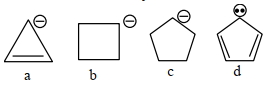
The correct order of stability of the given carbanions is:
A
$c > b > d > a$
B
$a > b > c > d$
C
$d > a > c > b$
D
$d > c > b > a$
Solution
(D) The stability of carbanions is determined by factors like aromaticity,resonance,and hybridization.
$1$. Compound $(d)$ is the cyclopentadienyl anion,which is aromatic ($6\pi$ electrons) and therefore highly stable.
$2$. Compound $(a)$ is the cyclopropenyl anion,which is anti-aromatic ($4\pi$ electrons) and therefore the least stable.
$3$. Between $(b)$ and $(c)$,both are non-aromatic and the negative charge is on an $sp^3$ hybridized carbon atom. Stability in such cases is influenced by angle strain. The five-membered ring $(c)$ has less angle strain compared to the four-membered ring $(b)$.
$4$. Thus,the correct order of stability is $d > c > b > a$.
$1$. Compound $(d)$ is the cyclopentadienyl anion,which is aromatic ($6\pi$ electrons) and therefore highly stable.
$2$. Compound $(a)$ is the cyclopropenyl anion,which is anti-aromatic ($4\pi$ electrons) and therefore the least stable.
$3$. Between $(b)$ and $(c)$,both are non-aromatic and the negative charge is on an $sp^3$ hybridized carbon atom. Stability in such cases is influenced by angle strain. The five-membered ring $(c)$ has less angle strain compared to the four-membered ring $(b)$.
$4$. Thus,the correct order of stability is $d > c > b > a$.
0 likesView Solution
174
ChemistryMediumMCQJEE Main · 2024
The correct order of the first ionization enthalpy is
A
$Al > Ga > Tl$
B
$Ga > Al > B$
C
$B > Al > Ga$
D
$Tl > Ga > Al$
Solution
(D) $(i)$ The first ionization enthalpy $(IE_1)$ decreases down the group from $B$ to $Al$ due to an increase in atomic size.
$(ii)$ From $Al$ to $Ga$,the $IE_1$ increases due to the poor shielding effect of $d$-electrons (scandide contraction).
$(iii)$ From $Ga$ to $Tl$,the $IE_1$ increases due to the poor shielding effect of $f$-electrons (lanthanide contraction).
$(iv)$ Combining these trends,the correct order is $Tl > Ga > Al$.
$(ii)$ From $Al$ to $Ga$,the $IE_1$ increases due to the poor shielding effect of $d$-electrons (scandide contraction).
$(iii)$ From $Ga$ to $Tl$,the $IE_1$ increases due to the poor shielding effect of $f$-electrons (lanthanide contraction).
$(iv)$ Combining these trends,the correct order is $Tl > Ga > Al$.
0 likesView Solution
175
ChemistryMediumMCQJEE Main · 2024
Choose the incorrect statement about Dalton's Atomic Theory.
A
Compounds are formed when atoms of different elements combine in any ratio.
B
All the atoms of a given element have identical properties including identical mass.
C
Matter consists of indivisible atoms.
D
Chemical reactions involve reorganization of atoms.
Solution
(A) According to Dalton's Atomic Theory,atoms of different elements combine in a fixed ratio by mass to form compounds. Therefore,the statement that they combine in 'any' ratio is incorrect.
0 likesView Solution
176
ChemistryMediumMCQJEE Main · 2024
Given below are two statements:
Statement $I$ : The correct order of first ionization enthalpy values of $Li, Na, F$ and $Cl$ is $Na < Li < Cl < F$.
Statement $II$ : The correct order of negative electron gain enthalpy values of $Li, Na, F$ and $Cl$ is $Na < Li < F < Cl$.
In the light of the above statements,choose the correct answer from the options given below :
Statement $I$ : The correct order of first ionization enthalpy values of $Li, Na, F$ and $Cl$ is $Na < Li < Cl < F$.
Statement $II$ : The correct order of negative electron gain enthalpy values of $Li, Na, F$ and $Cl$ is $Na < Li < F < Cl$.
In the light of the above statements,choose the correct answer from the options given below :
A
Both Statement $I$ and Statement $II$ are true
B
Both Statement $I$ and Statement $II$ are false
C
Statement $I$ is false but Statement $II$ is true
D
Statement $I$ is true but Statement $II$ is false
Solution
(A) Statement $I$: The first ionization enthalpy $(IE_1)$ increases across a period and decreases down a group. The values are: $Na$ $(496 \ kJ/mol)$,$Li$ $(520 \ kJ/mol)$,$Cl$ $(1256 \ kJ/mol)$,$F$ $(1681 \ kJ/mol)$. Thus,the order $Na < Li < Cl < F$ is correct.
Statement $II$: The negative electron gain enthalpy $(-\Delta_{eg}H)$ generally increases across a period and decreases down a group. However,due to the small size of $F$,the electron-electron repulsion is high,making its electron gain enthalpy less negative than that of $Cl$. The values are: $Na$ $(-53 \ kJ/mol)$,$Li$ $(-60 \ kJ/mol)$,$F$ $(-328 \ kJ/mol)$,$Cl$ $(-349 \ kJ/mol)$. Thus,the order $Na < Li < F < Cl$ is correct.
Both statements are true.
Statement $II$: The negative electron gain enthalpy $(-\Delta_{eg}H)$ generally increases across a period and decreases down a group. However,due to the small size of $F$,the electron-electron repulsion is high,making its electron gain enthalpy less negative than that of $Cl$. The values are: $Na$ $(-53 \ kJ/mol)$,$Li$ $(-60 \ kJ/mol)$,$F$ $(-328 \ kJ/mol)$,$Cl$ $(-349 \ kJ/mol)$. Thus,the order $Na < Li < F < Cl$ is correct.
Both statements are true.
0 likesView Solution
177
ChemistryMediumMCQJEE Main · 2024
The number of species from the following that have pyramidal geometry around the central atom is . . . . . . . . .
$S_2O_3^{2-}, SO_4^{2-}, SO_3^{2-}, S_2O_7^{2-}$
$S_2O_3^{2-}, SO_4^{2-}, SO_3^{2-}, S_2O_7^{2-}$
A
$4$
B
$3$
C
$1$
D
$2$
Solution
(C) To determine the geometry,we analyze the structure of each species:
$1$. $SO_3^{2-}$ (Sulfite ion): The central $S$ atom has $3$ bond pairs and $1$ lone pair. According to $VSEPR$ theory,this results in a trigonal pyramidal geometry.
$2$. $SO_4^{2-}$ (Sulfate ion): The central $S$ atom has $4$ bond pairs and $0$ lone pairs,resulting in a tetrahedral geometry.
$3$. $S_2O_3^{2-}$ (Thiosulfate ion): The central $S$ atom is bonded to $3$ oxygen atoms and $1$ sulfur atom,with $0$ lone pairs,resulting in a tetrahedral geometry.
$4$. $S_2O_7^{2-}$ (Pyrosulfate ion): Each central $S$ atom is bonded to $4$ oxygen atoms with $0$ lone pairs,resulting in a tetrahedral geometry around each sulfur atom.
Thus,only $SO_3^{2-}$ has a pyramidal geometry. The total number of such species is $1$.
$1$. $SO_3^{2-}$ (Sulfite ion): The central $S$ atom has $3$ bond pairs and $1$ lone pair. According to $VSEPR$ theory,this results in a trigonal pyramidal geometry.
$2$. $SO_4^{2-}$ (Sulfate ion): The central $S$ atom has $4$ bond pairs and $0$ lone pairs,resulting in a tetrahedral geometry.
$3$. $S_2O_3^{2-}$ (Thiosulfate ion): The central $S$ atom is bonded to $3$ oxygen atoms and $1$ sulfur atom,with $0$ lone pairs,resulting in a tetrahedral geometry.
$4$. $S_2O_7^{2-}$ (Pyrosulfate ion): Each central $S$ atom is bonded to $4$ oxygen atoms with $0$ lone pairs,resulting in a tetrahedral geometry around each sulfur atom.
Thus,only $SO_3^{2-}$ has a pyramidal geometry. The total number of such species is $1$.
0 likesView Solution
178
ChemistryMediumMCQJEE Main · 2024
The maximum number of orbitals which can be identified with $n=4$ and $m_l=0$ is $\qquad$
A
$4$
B
$8$
C
$7$
D
$10$
Solution
(A) For a given principal quantum number $n$,the possible values of azimuthal quantum number $l$ range from $0$ to $n-1$.
For $n=4$,the possible values of $l$ are $0, 1, 2, 3$,which correspond to the $4s, 4p, 4d,$ and $4f$ subshells,respectively.
The magnetic quantum number $m_l$ for a given $l$ ranges from $-l$ to $+l$.
- For $4s$ $(l=0)$: $m_l = 0$ ($1$ orbital)
- For $4p$ $(l=1)$: $m_l = -1, 0, +1$ ($1$ orbital with $m_l=0$)
- For $4d$ $(l=2)$: $m_l = -2, -1, 0, +1, +2$ ($1$ orbital with $m_l=0$)
- For $4f$ $(l=3)$: $m_l = -3, -2, -1, 0, +1, +2, +3$ ($1$ orbital with $m_l=0$)
Thus,there is exactly one orbital with $m_l=0$ in each subshell.
Total number of orbitals with $n=4$ and $m_l=0$ is $1+1+1+1 = 4$.
For $n=4$,the possible values of $l$ are $0, 1, 2, 3$,which correspond to the $4s, 4p, 4d,$ and $4f$ subshells,respectively.
The magnetic quantum number $m_l$ for a given $l$ ranges from $-l$ to $+l$.
- For $4s$ $(l=0)$: $m_l = 0$ ($1$ orbital)
- For $4p$ $(l=1)$: $m_l = -1, 0, +1$ ($1$ orbital with $m_l=0$)
- For $4d$ $(l=2)$: $m_l = -2, -1, 0, +1, +2$ ($1$ orbital with $m_l=0$)
- For $4f$ $(l=3)$: $m_l = -3, -2, -1, 0, +1, +2, +3$ ($1$ orbital with $m_l=0$)
Thus,there is exactly one orbital with $m_l=0$ in each subshell.
Total number of orbitals with $n=4$ and $m_l=0$ is $1+1+1+1 = 4$.
0 likesView Solution
179
ChemistryMediumMCQJEE Main · 2024
Number of compounds/species from the following with non-zero dipole moment is. . . . . . $BeCl_2, BCl_3, NF_3, XeF_4, CCl_4, H_2O, H_2S, HBr, CO_2, H_2, HCl$
A
$3$
B
$5$
C
$7$
D
$8$
Solution
(B) molecule has a non-zero dipole moment if it is polar,which occurs when there is an asymmetric distribution of charge.
$1$. $BeCl_2$: Linear,$\mu = 0$ (Non-polar)
$2$. $BCl_3$: Trigonal planar,$\mu = 0$ (Non-polar)
$3$. $NF_3$: Pyramidal,$\mu \neq 0$ (Polar)
$4$. $XeF_4$: Square planar,$\mu = 0$ (Non-polar)
$5$. $CCl_4$: Tetrahedral,$\mu = 0$ (Non-polar)
$6$. $H_2O$: Bent,$\mu \neq 0$ (Polar)
$7$. $H_2S$: Bent,$\mu \neq 0$ (Polar)
$8$. $HBr$: Heteronuclear diatomic,$\mu \neq 0$ (Polar)
$9$. $CO_2$: Linear,$\mu = 0$ (Non-polar)
$10$. $H_2$: Homonuclear diatomic,$\mu = 0$ (Non-polar)
$11$. $HCl$: Heteronuclear diatomic,$\mu \neq 0$ (Polar)
The species with non-zero dipole moment are $NF_3, H_2O, H_2S, HBr, HCl$.
Total count = $5$.
$1$. $BeCl_2$: Linear,$\mu = 0$ (Non-polar)
$2$. $BCl_3$: Trigonal planar,$\mu = 0$ (Non-polar)
$3$. $NF_3$: Pyramidal,$\mu \neq 0$ (Polar)
$4$. $XeF_4$: Square planar,$\mu = 0$ (Non-polar)
$5$. $CCl_4$: Tetrahedral,$\mu = 0$ (Non-polar)
$6$. $H_2O$: Bent,$\mu \neq 0$ (Polar)
$7$. $H_2S$: Bent,$\mu \neq 0$ (Polar)
$8$. $HBr$: Heteronuclear diatomic,$\mu \neq 0$ (Polar)
$9$. $CO_2$: Linear,$\mu = 0$ (Non-polar)
$10$. $H_2$: Homonuclear diatomic,$\mu = 0$ (Non-polar)
$11$. $HCl$: Heteronuclear diatomic,$\mu \neq 0$ (Polar)
The species with non-zero dipole moment are $NF_3, H_2O, H_2S, HBr, HCl$.
Total count = $5$.
1 likesView Solution
180
ChemistryMediumMCQJEE Main · 2024
Three moles of an ideal gas are compressed isothermally from $60 \ L$ to $20 \ L$ using a constant external pressure of $5 \ atm$. The heat exchange $Q$ for the compression is $....... \ L \cdot atm$.
A
$199$
B
$100$
C
$200$
D
$300$
Solution
(C) For an isothermal process,the change in internal energy $\Delta U = 0$.
According to the first law of thermodynamics,$\Delta U = Q + W$,so $Q = -W$.
Since the process is irreversible and occurs against a constant external pressure $P_{ext}$,the work done is $W = -P_{ext} \times \Delta V$.
Given $P_{ext} = 5 \ atm$,$V_1 = 60 \ L$,and $V_2 = 20 \ L$,the change in volume $\Delta V = V_2 - V_1 = 20 \ L - 60 \ L = -40 \ L$.
$W = -5 \ atm \times (-40 \ L) = 200 \ L \cdot atm$.
Therefore,$Q = -W = -200 \ L \cdot atm$.
According to the first law of thermodynamics,$\Delta U = Q + W$,so $Q = -W$.
Since the process is irreversible and occurs against a constant external pressure $P_{ext}$,the work done is $W = -P_{ext} \times \Delta V$.
Given $P_{ext} = 5 \ atm$,$V_1 = 60 \ L$,and $V_2 = 20 \ L$,the change in volume $\Delta V = V_2 - V_1 = 20 \ L - 60 \ L = -40 \ L$.
$W = -5 \ atm \times (-40 \ L) = 200 \ L \cdot atm$.
Therefore,$Q = -W = -200 \ L \cdot atm$.
0 likesView Solution
181
ChemistryMediumMCQJEE Main · 2024
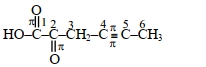
The total number of $\sigma$ and $\pi$ bonds in $2$-oxohex-$4$-ynoic acid is . . . . . . .
A
$1$
B
$10$
C
$18$
D
$20$
Solution
(C) The structural formula of $2$-oxohex-$4$-ynoic acid is $CH_3-C \equiv C-CH_2-C(=O)-COOH$.
To find the total number of bonds,we count the $\sigma$ and $\pi$ bonds:
$1.$ $\sigma$ bonds:
- $C-H$ bonds: $3$ (from $CH_3$) + $2$ (from $CH_2$) + $1$ (from $COOH$) = $6$
- $C-C$ single bonds: $3$
- $C \equiv C$ triple bond: $1$ $\sigma$
- $C=O$ double bonds: $2$ $\sigma$
- $C-O$ single bond: $1$
- $O-H$ single bond: $1$
Total $\sigma$ bonds = $6 + 3 + 1 + 2 + 1 + 1 = 14$.
$2.$ $\pi$ bonds:
- $C \equiv C$ triple bond: $2$ $\pi$
- $C=O$ double bonds: $2$ $\pi$
Total $\pi$ bonds = $2 + 2 = 4$.
Total number of bonds = $\sigma + \pi = 14 + 4 = 18$.
To find the total number of bonds,we count the $\sigma$ and $\pi$ bonds:
$1.$ $\sigma$ bonds:
- $C-H$ bonds: $3$ (from $CH_3$) + $2$ (from $CH_2$) + $1$ (from $COOH$) = $6$
- $C-C$ single bonds: $3$
- $C \equiv C$ triple bond: $1$ $\sigma$
- $C=O$ double bonds: $2$ $\sigma$
- $C-O$ single bond: $1$
- $O-H$ single bond: $1$
Total $\sigma$ bonds = $6 + 3 + 1 + 2 + 1 + 1 = 14$.
$2.$ $\pi$ bonds:
- $C \equiv C$ triple bond: $2$ $\pi$
- $C=O$ double bonds: $2$ $\pi$
Total $\pi$ bonds = $2 + 2 = 4$.
Total number of bonds = $\sigma + \pi = 14 + 4 = 18$.
0 likesView Solution
182
ChemistryMediumMCQJEE Main · 2024
Vanillin,a compound obtained from vanilla beans,has a total sum of oxygen atoms and $\pi$-electrons equal to . . .
A
$10$
B
$11$
C
$15$
D
$20$
Solution
(B) Vanillin is an organic compound with the molecular formula $C_8H_8O_3$. It is a phenolic aldehyde containing aldehyde,hydroxyl,and ether functional groups.
Structure analysis:
$1$. Total number of oxygen atoms = $3$ (one in $-CHO$,one in $-OH$,and one in $-OCH_3$).
$2$. Total number of $\pi$-bonds:
- $3$ $\pi$-bonds in the benzene ring.
- $1$ $\pi$-bond in the $C=O$ group of the aldehyde.
- Total $\pi$-bonds = $4$.
$3$. Total number of $\pi$-electrons = $4 \times 2 = 8$.
Sum of oxygen atoms and $\pi$-electrons = $3 + 8 = 11$.
Structure analysis:
$1$. Total number of oxygen atoms = $3$ (one in $-CHO$,one in $-OH$,and one in $-OCH_3$).
$2$. Total number of $\pi$-bonds:
- $3$ $\pi$-bonds in the benzene ring.
- $1$ $\pi$-bond in the $C=O$ group of the aldehyde.
- Total $\pi$-bonds = $4$.
$3$. Total number of $\pi$-electrons = $4 \times 2 = 8$.
Sum of oxygen atoms and $\pi$-electrons = $3 + 8 = 11$.
0 likesView Solution
183
ChemistryDifficultMCQJEE Main · 2024
The incorrect postulates of the Dalton's atomic theory are :
$A$. Atoms of different elements differ in mass.
$B$. Matter consists of divisible atoms.
$C$. Compounds are formed when atoms of different element combine in a fixed ratio.
$D$. All the atoms of given element have different properties including mass.
$E$. Chemical reactions involve reorganisation of atoms.
Choose the correct answer from the options given below :
$A$. Atoms of different elements differ in mass.
$B$. Matter consists of divisible atoms.
$C$. Compounds are formed when atoms of different element combine in a fixed ratio.
$D$. All the atoms of given element have different properties including mass.
$E$. Chemical reactions involve reorganisation of atoms.
Choose the correct answer from the options given below :
A
$B, D, E$ only
B
$A, B, D$ only
C
$C, D, E$ only
D
$B, D$ only
Solution
(D) Dalton's atomic theory states that atoms are indivisible,so statement $B$ (Matter consists of divisible atoms) is incorrect.
Dalton's theory states that all atoms of a given element are identical in all respects,including mass,so statement $D$ (All the atoms of given element have different properties including mass) is incorrect.
Statements $A$,$C$,and $E$ are consistent with the original postulates of Dalton's atomic theory.
Therefore,the incorrect statements are $B$ and $D$.
Dalton's theory states that all atoms of a given element are identical in all respects,including mass,so statement $D$ (All the atoms of given element have different properties including mass) is incorrect.
Statements $A$,$C$,and $E$ are consistent with the original postulates of Dalton's atomic theory.
Therefore,the incorrect statements are $B$ and $D$.
0 likesView Solution
184
ChemistryMediumMCQJEE Main · 2024
The following reaction occurs in the blast furnace where iron ore is reduced to iron metal:
$Fe_2O_{3(s)} + 3CO_{(g)} \rightleftharpoons 2Fe_{(l)} + 3CO_{2(g)}$
Using Le Chatelier's principle,predict which one of the following will not disturb the equilibrium.
$Fe_2O_{3(s)} + 3CO_{(g)} \rightleftharpoons 2Fe_{(l)} + 3CO_{2(g)}$
Using Le Chatelier's principle,predict which one of the following will not disturb the equilibrium.
A
Addition of $Fe_2O_3$
B
Addition of $CO_2$
C
Removal of $CO$
D
Removal of $CO_2$
Solution
(A) According to Le Chatelier's principle,the equilibrium position is affected by changes in the concentration of gaseous or aqueous species.
In the given reaction,$Fe_2O_{3(s)}$ is a solid.
The active mass of a pure solid or pure liquid is taken as unity $(1)$ and remains constant regardless of the amount present.
Therefore,the addition or removal of $Fe_2O_{3(s)}$ does not change the concentration of the reactants or products involved in the equilibrium expression,and thus it will not disturb the equilibrium.
In the given reaction,$Fe_2O_{3(s)}$ is a solid.
The active mass of a pure solid or pure liquid is taken as unity $(1)$ and remains constant regardless of the amount present.
Therefore,the addition or removal of $Fe_2O_{3(s)}$ does not change the concentration of the reactants or products involved in the equilibrium expression,and thus it will not disturb the equilibrium.
0 likesView Solution
185
ChemistryMediumMCQJEE Main · 2024
Given below are two statements: One is labelled as Assertion $(A)$ and the other is labelled as Reason $(R)$
Assertion $(A)$: Enthalpy of neutralisation of strong monobasic acid with strong monoacidic base is always $-57 \ kJ \ mol^{-1}$.
Reason $(R)$: Enthalpy of neutralisation is the amount of heat liberated when one mole of $H^{+}$ ions furnished by acid combine with one mole of $OH^{-}$ ions furnished by base to form one mole of water.
In the light of the above statements,choose the correct answer from the options given below.
Assertion $(A)$: Enthalpy of neutralisation of strong monobasic acid with strong monoacidic base is always $-57 \ kJ \ mol^{-1}$.
Reason $(R)$: Enthalpy of neutralisation is the amount of heat liberated when one mole of $H^{+}$ ions furnished by acid combine with one mole of $OH^{-}$ ions furnished by base to form one mole of water.
In the light of the above statements,choose the correct answer from the options given below.
A
$(A)$ is true but $(R)$ is false.
B
Both $(A)$ and $(R)$ are true and $(R)$ is the correct explanation of $(A)$.
C
$(A)$ is false but $(R)$ is true.
D
Both $(A)$ and $(R)$ are true but $(R)$ is not the correct explanation of $(A)$.
Solution
(B) The enthalpy of neutralisation of a strong acid and a strong base is the heat released when $1 \ mol$ of $H^{+}$ ions from the acid react with $1 \ mol$ of $OH^{-}$ ions from the base to form $1 \ mol$ of water.
Since strong acids and strong bases are completely dissociated in aqueous solution,the net reaction is always $H^{+}(aq) + OH^{-}(aq) \rightarrow H_2O(l)$.
The enthalpy change for this reaction is constant at approximately $-57.1 \ kJ \ mol^{-1}$ (often rounded to $-57 \ kJ \ mol^{-1}$).
Therefore,both the Assertion and the Reason are true,and the Reason correctly explains the Assertion.
Since strong acids and strong bases are completely dissociated in aqueous solution,the net reaction is always $H^{+}(aq) + OH^{-}(aq) \rightarrow H_2O(l)$.
The enthalpy change for this reaction is constant at approximately $-57.1 \ kJ \ mol^{-1}$ (often rounded to $-57 \ kJ \ mol^{-1}$).
Therefore,both the Assertion and the Reason are true,and the Reason correctly explains the Assertion.
0 likesView Solution
186
ChemistryMediumMCQJEE Main · 2024
The statement$(s)$ that are correct about the species $O^{2-}$,$F^{-}$,$Na^{+}$,and $Mg^{2+}$.
$(A)$ All are isoelectronic
$(B)$ All have the same nuclear charge
$(C)$ $O^{2-}$ has the largest ionic radii
$(D)$ $Mg^{2+}$ has the smallest ionic radii
Choose the most appropriate answer from the options given below :
$(A)$ All are isoelectronic
$(B)$ All have the same nuclear charge
$(C)$ $O^{2-}$ has the largest ionic radii
$(D)$ $Mg^{2+}$ has the smallest ionic radii
Choose the most appropriate answer from the options given below :
A
$(B), (C)$ and $(D)$ only
B
$(A), (B), (C)$ and $(D)$
C
$(C)$ and $(D)$ only
D
$(A), (C)$ and $(D)$ only
Solution
(D) The species $O^{2-}$,$F^{-}$,$Na^{+}$,and $Mg^{2+}$ are isoelectronic because they all contain $10$ electrons.
Nuclear charge $(Z)$ is determined by the number of protons: $O=8, F=9, Na=11, Mg=12$. Thus,they have different nuclear charges.
For isoelectronic species,the ionic radius decreases as the nuclear charge $(Z)$ increases.
The order of ionic radii is $O^{2-} > F^{-} > Na^{+} > Mg^{2+}$.
Therefore,statements $(A)$,$(C)$,and $(D)$ are correct.
Nuclear charge $(Z)$ is determined by the number of protons: $O=8, F=9, Na=11, Mg=12$. Thus,they have different nuclear charges.
For isoelectronic species,the ionic radius decreases as the nuclear charge $(Z)$ increases.
The order of ionic radii is $O^{2-} > F^{-} > Na^{+} > Mg^{2+}$.
Therefore,statements $(A)$,$(C)$,and $(D)$ are correct.
0 likesView Solution
187
ChemistryMediumMCQJEE Main · 2024
The number of $\sigma$ and $\pi$ bonds present in an ethylene molecule is respectively:
A
$3$ and $1$
B
$5$ and $2$
C
$4$ and $1$
D
$5$ and $1$
Solution
(D) The chemical formula of ethylene is $CH_2=CH_2$.
In this molecule,there are $4$ $C-H$ $\sigma$ bonds and $1$ $C-C$ $\sigma$ bond,making a total of $5$ $\sigma$ bonds.
There is also $1$ $C-C$ $\pi$ bond.
Therefore,the number of $\sigma$ and $\pi$ bonds is $5$ and $1$ respectively.
In this molecule,there are $4$ $C-H$ $\sigma$ bonds and $1$ $C-C$ $\sigma$ bond,making a total of $5$ $\sigma$ bonds.
There is also $1$ $C-C$ $\pi$ bond.
Therefore,the number of $\sigma$ and $\pi$ bonds is $5$ and $1$ respectively.
0 likesView Solution
188
ChemistryMediumMCQJEE Main · 2024
Given below are two statements: one is labelled as Assertion $(A)$ and the other is labelled as Reason $(R)$.
Assertion $(A)$: Cis form of alkene is found to be more polar than the trans form.
Reason $(R)$: Dipole moment of trans isomer of $2$-butene is zero.
In the light of the above statements,choose the correct answer from the options given below:
Assertion $(A)$: Cis form of alkene is found to be more polar than the trans form.
Reason $(R)$: Dipole moment of trans isomer of $2$-butene is zero.
In the light of the above statements,choose the correct answer from the options given below:
A
Both $(A)$ and $(R)$ are true but $(R)$ is $NOT$ the correct explanation of $(A)$
B
$(A)$ is true but $(R)$ is false
C
Both $(A)$ and $(R)$ are true and $(R)$ is the correct explanation of $(A)$
D
$(A)$ is false but $(R)$ is true
Solution
(C) Dipole moment is a vector quantity. In the $cis$-isomer,the bond dipoles of the two $C-CH_3$ bonds are in the same direction,leading to a non-zero net dipole moment.
In the $trans$-isomer,the bond dipoles of the two $C-CH_3$ bonds are equal in magnitude and opposite in direction,which cancel each other out,resulting in a net dipole moment of zero.
Since the $cis$-isomer has a non-zero dipole moment and the $trans$-isomer has a zero dipole moment,the $cis$-isomer is more polar.
Therefore,both Assertion $(A)$ and Reason $(R)$ are true,and $(R)$ is the correct explanation of $(A)$.
In the $trans$-isomer,the bond dipoles of the two $C-CH_3$ bonds are equal in magnitude and opposite in direction,which cancel each other out,resulting in a net dipole moment of zero.
Since the $cis$-isomer has a non-zero dipole moment and the $trans$-isomer has a zero dipole moment,the $cis$-isomer is more polar.
Therefore,both Assertion $(A)$ and Reason $(R)$ are true,and $(R)$ is the correct explanation of $(A)$.
0 likesView Solution
189
ChemistryMediumMCQJEE Main · 2024
Given below are two statements:
Statement $I$: Nitration of benzene involves the following step:
$H-O^+(H)-NO_2 \rightleftharpoons H_2O + NO_2^+$
Statement $II$: Use of Lewis base promotes the electrophilic substitution of benzene.
In the light of the above statements,choose the most appropriate answer from the options given below:
Statement $I$: Nitration of benzene involves the following step:
$H-O^+(H)-NO_2 \rightleftharpoons H_2O + NO_2^+$
Statement $II$: Use of Lewis base promotes the electrophilic substitution of benzene.
In the light of the above statements,choose the most appropriate answer from the options given below:
A
Both Statement $I$ and Statement $II$ are incorrect
B
Statement $I$ is correct but Statement $II$ is incorrect
C
Both Statement $I$ and Statement $II$ are correct
D
Statement $I$ is incorrect but Statement $II$ is correct
Solution
(B) In the nitration of benzene,concentrated $H_2SO_4$ and $HNO_3$ are used as reagents,which generate the electrophile $NO_2^+$ in the following steps:
$H_2SO_4 + HNO_3 \rightleftharpoons HSO_4^- + H_2O^+-NO_2$
$H_2O^+-NO_2 \rightleftharpoons H_2O + NO_2^+$
Statement $I$ is correct as it shows the dissociation of the protonated nitric acid into water and the nitronium ion $(NO_2^+)$.
Statement $II$ is incorrect because Lewis acids (like $AlCl_3$,$FeBr_3$) are used to promote electrophilic substitution by generating electrophiles,not Lewis bases.
$H_2SO_4 + HNO_3 \rightleftharpoons HSO_4^- + H_2O^+-NO_2$
$H_2O^+-NO_2 \rightleftharpoons H_2O + NO_2^+$
Statement $I$ is correct as it shows the dissociation of the protonated nitric acid into water and the nitronium ion $(NO_2^+)$.
Statement $II$ is incorrect because Lewis acids (like $AlCl_3$,$FeBr_3$) are used to promote electrophilic substitution by generating electrophiles,not Lewis bases.
0 likesView Solution
190
ChemistryDifficultMCQJEE Main · 2024
An organic compound has $42.1 \%$ carbon,$6.4 \%$ hydrogen and the remainder is oxygen. If its molecular weight is $342$,then its molecular formula is:
A
$C_{11}H_{18}O_{12}$
B
$C_{12}H_{20}O_{12}$
C
$C_{14}H_{20}O_{10}$
D
$C_{12}H_{22}O_{11}$
Solution
(D) $1$. Calculate the percentage of oxygen: $100 - (42.1 + 6.4) = 51.5 \%$.
$2$. Calculate the number of moles of each element in $100 \ g$ of the compound:
$n_C = \frac{42.1}{12} \approx 3.51$,$n_H = \frac{6.4}{1} = 6.4$,$n_O = \frac{51.5}{16} \approx 3.22$.
$3$. Determine the empirical formula ratio: $C : H : O = \frac{3.51}{3.22} : \frac{6.4}{3.22} : \frac{3.22}{3.22} \approx 1.09 : 1.99 : 1 \approx 1.1 : 2 : 1$.
$4$. Multiplying by $10$ gives $C_{11}H_{20}O_{10}$ (Empirical mass $\approx 312$).
$5$. Given molecular weight is $342$. For $C_{12}H_{22}O_{11}$,molecular weight $= (12 \times 12) + (22 \times 1) + (11 \times 16) = 144 + 22 + 176 = 342$.
$6$. Thus,the molecular formula is $C_{12}H_{22}O_{11}$.
$2$. Calculate the number of moles of each element in $100 \ g$ of the compound:
$n_C = \frac{42.1}{12} \approx 3.51$,$n_H = \frac{6.4}{1} = 6.4$,$n_O = \frac{51.5}{16} \approx 3.22$.
$3$. Determine the empirical formula ratio: $C : H : O = \frac{3.51}{3.22} : \frac{6.4}{3.22} : \frac{3.22}{3.22} \approx 1.09 : 1.99 : 1 \approx 1.1 : 2 : 1$.
$4$. Multiplying by $10$ gives $C_{11}H_{20}O_{10}$ (Empirical mass $\approx 312$).
$5$. Given molecular weight is $342$. For $C_{12}H_{22}O_{11}$,molecular weight $= (12 \times 12) + (22 \times 1) + (11 \times 16) = 144 + 22 + 176 = 342$.
$6$. Thus,the molecular formula is $C_{12}H_{22}O_{11}$.
0 likesView Solution
191
ChemistryMediumMCQJEE Main · 2024
The number of neutrons present in the more abundant isotope of boron is $x$. Amorphous boron upon heating with air forms a product,in which the oxidation state of boron is $y$. The value of $x+y$ is ...
A
$4$
B
$6$
C
$3$
D
$9$
Solution
(D) The more abundant isotope of boron is $^{11}B$.
Number of neutrons in $^{11}B = 11 - 5 = 6$.
So,$x = 6$.
Amorphous boron reacts with air (oxygen) upon heating to form boron trioxide: $4B + 3O_2 \rightarrow 2B_2O_3$.
In $B_2O_3$,the oxidation state of boron is $+3$.
So,$y = 3$.
Therefore,$x + y = 6 + 3 = 9$.
Number of neutrons in $^{11}B = 11 - 5 = 6$.
So,$x = 6$.
Amorphous boron reacts with air (oxygen) upon heating to form boron trioxide: $4B + 3O_2 \rightarrow 2B_2O_3$.
In $B_2O_3$,the oxidation state of boron is $+3$.
So,$y = 3$.
Therefore,$x + y = 6 + 3 = 9$.
0 likesView Solution
192
ChemistryMediumMCQJEE Main · 2024
The value of Rydberg constant $\left(R_H\right)$ is $2.18 \times 10^{-18} \ J$. The velocity of an electron having mass $9.1 \times 10^{-31} \ kg$ in Bohr's first orbit of a hydrogen atom $= \dots \dots \dots \times 10^5 \ ms^{-1}$ (nearest integer).
A
$22$
B
$25$
C
$30$
D
$35$
Solution
(A) The velocity of an electron in the $n^{th}$ orbit of a hydrogen-like atom is given by the formula: $v_n = 2.18 \times 10^6 \times \frac{Z}{n} \ ms^{-1}$.
For the first orbit of a hydrogen atom,$Z = 1$ and $n = 1$.
Substituting these values: $v_1 = 2.18 \times 10^6 \times \frac{1}{1} \ ms^{-1}$.
$v_1 = 2.18 \times 10^6 \ ms^{-1} = 21.8 \times 10^5 \ ms^{-1}$.
Rounding to the nearest integer,we get $22 \times 10^5 \ ms^{-1}$.
For the first orbit of a hydrogen atom,$Z = 1$ and $n = 1$.
Substituting these values: $v_1 = 2.18 \times 10^6 \times \frac{1}{1} \ ms^{-1}$.
$v_1 = 2.18 \times 10^6 \ ms^{-1} = 21.8 \times 10^5 \ ms^{-1}$.
Rounding to the nearest integer,we get $22 \times 10^5 \ ms^{-1}$.
0 likesView Solution
193
ChemistryMediumMCQJEE Main · 2024
The heat of combustion of solid benzoic acid at constant volume is $-321.30 \ kJ$ at $27^{\circ} C$. The heat of combustion at constant pressure is $(-321.30 - x R) \ kJ$. The value of $x$ is . . . . . . .
A
$100$
B
$120$
C
$150$
D
$160$
Solution
(C) The combustion reaction of benzoic acid is: $C_6H_5COOH_{(s)} + \frac{15}{2}O_{2(g)} \rightarrow 7CO_{2(g)} + 3H_2O_{(\ell)}$
The relationship between enthalpy change and internal energy change is given by: $\Delta H = \Delta U + \Delta n_g RT$
Here,$\Delta U = -321.30 \ kJ$,$T = 27 + 273 = 300 \ K$,and $\Delta n_g = n_{p(g)} - n_{r(g)} = 7 - 7.5 = -0.5 = -\frac{1}{2}$.
Substituting the values: $\Delta H = -321.30 + (-\frac{1}{2}) \times R \times 300$
$\Delta H = -321.30 - 150R \ kJ$.
Comparing this with the given expression $(-321.30 - xR) \ kJ$,we get $x = 150$.
The relationship between enthalpy change and internal energy change is given by: $\Delta H = \Delta U + \Delta n_g RT$
Here,$\Delta U = -321.30 \ kJ$,$T = 27 + 273 = 300 \ K$,and $\Delta n_g = n_{p(g)} - n_{r(g)} = 7 - 7.5 = -0.5 = -\frac{1}{2}$.
Substituting the values: $\Delta H = -321.30 + (-\frac{1}{2}) \times R \times 300$
$\Delta H = -321.30 - 150R \ kJ$.
Comparing this with the given expression $(-321.30 - xR) \ kJ$,we get $x = 150$.
1 likesView Solution
194
ChemistryMediumMCQJEE Main · 2024
In the Lewis dot structure for $NO_2^-$,the total number of valence electrons around the nitrogen atom is $.......$
A
$8$
B
$9$
C
$15$
D
$20$
Solution
(A) The nitrogen atom in the $NO_2^-$ ion is bonded to two oxygen atoms,one via a double bond and one via a single bond.
It also possesses one lone pair of electrons.
Total electrons around $N = (2 \times 2 \text{ from double bond}) + (1 \times 2 \text{ from single bond}) + (1 \times 2 \text{ from lone pair}) = 4 + 2 + 2 = 8$ electrons.
It also possesses one lone pair of electrons.
Total electrons around $N = (2 \times 2 \text{ from double bond}) + (1 \times 2 \text{ from single bond}) + (1 \times 2 \text{ from lone pair}) = 4 + 2 + 2 = 8$ electrons.
0 likesView Solution
195
ChemistryMediumMCQJEE Main · 2024
Match List-$I$ with List-$II$.
Choose the correct answer from the options given below:
| List-$I$ | List-$II$ |
| $A. ICl$ | $i. \text{Linear}$ |
| $B. ICl_3$ | $ii. \text{T-Shape}$ |
| $C. ClF_5$ | $iii. \text{Square pyramidal}$ |
| $D. IF_7$ | $iv. \text{Pentagonal bipyramidal}$ |
Choose the correct answer from the options given below:
A
$A-i, B-ii, C-iii, D-iv$
B
$A-i, B-ii, C-iv, D-iii$
C
$A-iv, B-ii, C-iii, D-i$
D
$A-iv, B-iii, C-ii, D-i$
Solution
$(A)$ The molecular geometries of the given interhalogen compounds are determined by the $VSEPR$ theory:
$1. ICl$: It has $2$ bond pairs and $3$ lone pairs on the central atom $I$, resulting in a linear geometry $(i)$.
$2. ICl_3$: It has $3$ bond pairs and $2$ lone pairs on the central atom $I$, resulting in a $T$-shape geometry $(ii)$.
$3. ClF_5$: It has $5$ bond pairs and $1$ lone pair on the central atom $Cl$, resulting in a square pyramidal geometry $(iii)$.
$4. IF_7$: It has $7$ bond pairs and $0$ lone pairs on the central atom $I$, resulting in a pentagonal bipyramidal geometry $(iv)$.
Therefore, the correct matching is $A-i, B-ii, C-iii, D-iv$.
$1. ICl$: It has $2$ bond pairs and $3$ lone pairs on the central atom $I$, resulting in a linear geometry $(i)$.
$2. ICl_3$: It has $3$ bond pairs and $2$ lone pairs on the central atom $I$, resulting in a $T$-shape geometry $(ii)$.
$3. ClF_5$: It has $5$ bond pairs and $1$ lone pair on the central atom $Cl$, resulting in a square pyramidal geometry $(iii)$.
$4. IF_7$: It has $7$ bond pairs and $0$ lone pairs on the central atom $I$, resulting in a pentagonal bipyramidal geometry $(iv)$.
Therefore, the correct matching is $A-i, B-ii, C-iii, D-iv$.
0 likesView Solution
196
ChemistryMediumMCQJEE Main · 2024
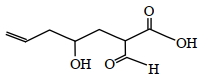
The correct nomenclature for the following compound is:
A
$2$-carboxy-$4$-hydroxyhept-$6$-enal
B
$2$-carboxy-$4$-hydroxyhept-$7$-enal
C
$2$-formyl-$4$-hydroxyhept-$7$-enoic acid
D
$2$-formyl-$4$-hydroxyhept-$6$-enoic acid
Solution
(D) $1$. Identify the principal functional group: The carboxylic acid group $(-COOH)$ has higher priority than the aldehyde $(-CHO)$,hydroxyl $(-OH)$,and alkene $(-C=C-)$ groups. Thus,the parent chain is an alkanoic acid.
$2$. Number the chain: Start numbering from the carbon of the carboxylic acid group as $C-1$. The chain is $7$ carbons long,so the parent name is heptenoic acid.
$3$. Identify substituents and their positions: There is a formyl group $(-CHO)$ at $C-2$,a hydroxyl group $(-OH)$ at $C-4$,and a double bond starting at $C-6$.
$4$. Combine: The name is $2$-formyl-$4$-hydroxyhept-$6$-enoic acid.
$2$. Number the chain: Start numbering from the carbon of the carboxylic acid group as $C-1$. The chain is $7$ carbons long,so the parent name is heptenoic acid.
$3$. Identify substituents and their positions: There is a formyl group $(-CHO)$ at $C-2$,a hydroxyl group $(-OH)$ at $C-4$,and a double bond starting at $C-6$.
$4$. Combine: The name is $2$-formyl-$4$-hydroxyhept-$6$-enoic acid.
1 likesView Solution
197
ChemistryMediumMCQJEE Main · 2024
Given below are two statements: one is labelled as Assertion $A$ and the other is labelled as Reason $R$.
Assertion $A$: $NH_3$ and $NF_3$ molecules have a pyramidal shape with a lone pair of electrons on the nitrogen atom. The resultant dipole moment of $NH_3$ is greater than that of $NF_3$.
Reason $R$: In $NH_3$,the orbital dipole due to the lone pair is in the same direction as the resultant dipole moment of the $N-H$ bonds. $F$ is the most electronegative element.
Assertion $A$: $NH_3$ and $NF_3$ molecules have a pyramidal shape with a lone pair of electrons on the nitrogen atom. The resultant dipole moment of $NH_3$ is greater than that of $NF_3$.
Reason $R$: In $NH_3$,the orbital dipole due to the lone pair is in the same direction as the resultant dipole moment of the $N-H$ bonds. $F$ is the most electronegative element.
A
Both $A$ and $R$ are true and $R$ is the correct explanation of $A$
B
$A$ is false but $R$ is true
C
$A$ is true but $R$ is false
D
Both $A$ and $R$ are true but $R$ is $NOT$ the correct explanation of $A$
Solution
(A) Assertion $A$ is true: Both $NH_3$ and $NF_3$ have a pyramidal geometry with one lone pair on the $N$ atom. The dipole moment of $NH_3$ $(1.46 \ D)$ is greater than that of $NF_3$ $(0.24 \ D)$.
Reason $R$ is true: In $NH_3$,the direction of the dipole moment of the $N-H$ bonds is towards the nitrogen atom,which is the same as the direction of the lone pair orbital dipole. This leads to reinforcement and a higher resultant dipole moment.
In $NF_3$,the $N-F$ bond dipoles are directed away from the nitrogen atom (since $F$ is more electronegative than $N$),which opposes the direction of the lone pair orbital dipole,resulting in a smaller net dipole moment.
Thus,$R$ is the correct explanation for $A$.
Reason $R$ is true: In $NH_3$,the direction of the dipole moment of the $N-H$ bonds is towards the nitrogen atom,which is the same as the direction of the lone pair orbital dipole. This leads to reinforcement and a higher resultant dipole moment.
In $NF_3$,the $N-F$ bond dipoles are directed away from the nitrogen atom (since $F$ is more electronegative than $N$),which opposes the direction of the lone pair orbital dipole,resulting in a smaller net dipole moment.
Thus,$R$ is the correct explanation for $A$.
0 likesView Solution
198
ChemistryDifficultMCQJEE Main · 2024
Given below are two statements:
Statement $I$: On passing $HCl_{(g)}$ through a saturated solution of $BaCl_2$,at room temperature white turbidity appears.
Statement $II$: When $HCl$ gas is passed through a saturated solution of $NaCl$,sodium chloride is precipitated due to common ion effect.
In the light of the above statements,choose the most appropriate answer from the options given below:
Statement $I$: On passing $HCl_{(g)}$ through a saturated solution of $BaCl_2$,at room temperature white turbidity appears.
Statement $II$: When $HCl$ gas is passed through a saturated solution of $NaCl$,sodium chloride is precipitated due to common ion effect.
In the light of the above statements,choose the most appropriate answer from the options given below:
A
Statement $I$ is correct but Statement $II$ is incorrect
B
Both Statement $I$ and Statement $II$ are incorrect
C
Statement $I$ is incorrect but Statement $II$ is correct
D
Both Statement $I$ and Statement $II$ are correct
Solution
(C) Statement $I$ is incorrect. $BaCl_2$ is highly soluble in water and does not precipitate upon the addition of $HCl$ gas at room temperature because the common ion effect is not sufficient to exceed the solubility product $(K_{sp})$ of $BaCl_2$.
Statement $II$ is correct. When $HCl_{(g)}$ is passed through a saturated solution of $NaCl$,the concentration of $Cl^-$ ions increases significantly. According to the common ion effect,the ionic product $[Na^+][Cl^-]$ exceeds the solubility product $(K_{sp})$ of $NaCl$,leading to the precipitation of $NaCl$.
Statement $II$ is correct. When $HCl_{(g)}$ is passed through a saturated solution of $NaCl$,the concentration of $Cl^-$ ions increases significantly. According to the common ion effect,the ionic product $[Na^+][Cl^-]$ exceeds the solubility product $(K_{sp})$ of $NaCl$,leading to the precipitation of $NaCl$.
0 likesView Solution
199
ChemistryMediumMCQJEE Main · 2024
Match List-$I$ with List-$II$:
Choose the correct answer from the options given below:
| List-$I$ (Pair of Compounds) | List-$II$ (Isomerism) |
| $A$. $n$-propanol and Isopropanol | $(I)$ Metamerism |
| $B$. Methoxypropane and ethoxyethane | $(II)$ Chain Isomerism |
| $C$. Propanone and propanal | $(III)$ Position Isomerism |
| $D$. Neopentane and Isopentane | $(IV)$ Functional Isomerism |
Choose the correct answer from the options given below:
A
$A-II, B-I, C-IV, D-III$
B
$A-III, B-I, C-II, D-IV$
C
$A-I, B-III, C-IV, D-II$
D
$A-III, B-I, C-IV, D-II$
Solution
(D) . $n$-propanol $(CH_3CH_2CH_2OH)$ and Isopropanol $(CH_3CH(OH)CH_3)$ differ in the position of the $-OH$ group,hence they are Position isomers $(III)$.
$B$. Methoxypropane $(CH_3OCH_2CH_2CH_3)$ and ethoxyethane $(CH_3CH_2OCH_2CH_3)$ have different alkyl groups attached to the same functional group $(-O-)$,hence they are Metamers $(I)$.
$C$. Propanone $(CH_3COCH_3)$ and propanal $(CH_3CH_2CHO)$ have different functional groups (ketone vs aldehyde),hence they are Functional isomers $(IV)$.
$D$. Neopentane $(C(CH_3)_4)$ and Isopentane $(CH_3CH(CH_3)CH_2CH_3)$ differ in the arrangement of the carbon chain,hence they are Chain isomers $(II)$.
Therefore,the correct matching is $A-III, B-I, C-IV, D-II$.
$B$. Methoxypropane $(CH_3OCH_2CH_2CH_3)$ and ethoxyethane $(CH_3CH_2OCH_2CH_3)$ have different alkyl groups attached to the same functional group $(-O-)$,hence they are Metamers $(I)$.
$C$. Propanone $(CH_3COCH_3)$ and propanal $(CH_3CH_2CHO)$ have different functional groups (ketone vs aldehyde),hence they are Functional isomers $(IV)$.
$D$. Neopentane $(C(CH_3)_4)$ and Isopentane $(CH_3CH(CH_3)CH_2CH_3)$ differ in the arrangement of the carbon chain,hence they are Chain isomers $(II)$.
Therefore,the correct matching is $A-III, B-I, C-IV, D-II$.
0 likesView Solution
200
ChemistryMediumMCQJEE Main · 2024
Given below are two statements:
Statement $I$: The metallic radius of $Na$ is $1.86 \ \mathring{A}$ and the ionic radius of $Na^{+}$ is lesser than $1.86 \ \mathring{A}$.
Statement $II$: Ions are always smaller in size than the corresponding elements.
In the light of the above statements,choose the correct answer from the options given below:
Statement $I$: The metallic radius of $Na$ is $1.86 \ \mathring{A}$ and the ionic radius of $Na^{+}$ is lesser than $1.86 \ \mathring{A}$.
Statement $II$: Ions are always smaller in size than the corresponding elements.
In the light of the above statements,choose the correct answer from the options given below:
A
Statement $I$ is correct but Statement $II$ is false.
B
Both Statement $I$ and Statement $II$ are true.
C
Both Statement $I$ and Statement $II$ are false.
D
Statement $I$ is incorrect but Statement $II$ is true.
Solution
(A) Statement $I$ is correct because the ionic radius of a cation $(Na^{+})$ is always smaller than its parent neutral atom $(Na)$ due to the loss of an electron and increased effective nuclear charge.
Statement $II$ is false because while cations are smaller than their parent atoms,anions are always larger than their parent neutral atoms due to increased electron-electron repulsion and decreased effective nuclear charge per electron.
Therefore,Statement $I$ is correct but Statement $II$ is false.
Statement $II$ is false because while cations are smaller than their parent atoms,anions are always larger than their parent neutral atoms due to increased electron-electron repulsion and decreased effective nuclear charge per electron.
Therefore,Statement $I$ is correct but Statement $II$ is false.
0 likesView Solution
201
ChemistryDifficultMCQJEE Main · 2024
The number of compounds which react with Hinsberg's reagent (benzenesulfonyl chloride) is $ . . . . . . $.
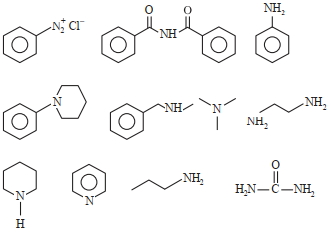
A
$8$
B
$6$
C
$10$
D
$5$
Solution
(D) Hinsberg's reagent $(C_6H_5SO_2Cl)$ reacts with primary $(1^{\circ})$ and secondary $(2^{\circ})$ amines to form sulfonamides. Tertiary $(3^{\circ})$ amines do not react with it.
Let us analyze the given compounds:
$1$. Benzenediazonium chloride: Does not react.
$2$. Dibenzamide: Does not react (amide).
$3$. Aniline ($1^{\circ}$ amine): Reacts.
$4$. $N$-phenylpiperidine ($3^{\circ}$ amine): Does not react.
$5$. $N$-methylbenzylamine ($2^{\circ}$ amine): Reacts.
$6$. $N,N$-dimethylaniline ($3^{\circ}$ amine): Does not react.
$7$. Ethylenediamine ($1^{\circ}$ amine): Reacts.
$8$. Piperidine ($2^{\circ}$ amine): Reacts.
$9$. Pyridine ($3^{\circ}$ amine): Does not react.
$10$. Propylamine ($1^{\circ}$ amine): Reacts.
$11$. Urea: Does not react.
The compounds that react are: Aniline,$N$-methylbenzylamine,Ethylenediamine,Piperidine,and Propylamine.
Total count = $5$.
Let us analyze the given compounds:
$1$. Benzenediazonium chloride: Does not react.
$2$. Dibenzamide: Does not react (amide).
$3$. Aniline ($1^{\circ}$ amine): Reacts.
$4$. $N$-phenylpiperidine ($3^{\circ}$ amine): Does not react.
$5$. $N$-methylbenzylamine ($2^{\circ}$ amine): Reacts.
$6$. $N,N$-dimethylaniline ($3^{\circ}$ amine): Does not react.
$7$. Ethylenediamine ($1^{\circ}$ amine): Reacts.
$8$. Piperidine ($2^{\circ}$ amine): Reacts.
$9$. Pyridine ($3^{\circ}$ amine): Does not react.
$10$. Propylamine ($1^{\circ}$ amine): Reacts.
$11$. Urea: Does not react.
The compounds that react are: Aniline,$N$-methylbenzylamine,Ethylenediamine,Piperidine,and Propylamine.
Total count = $5$.
0 likesView Solution
202
ChemistryDifficultMCQJEE Main · 2024
Mass of ethylene glycol (antifreeze) to be added to $18.6 \ kg$ of water to protect the freezing point at $-24^{\circ} C$ is . . . . . . $kg$ (Molar mass in $g \ mol^{-1}$ for ethylene glycol $= 62$,$K_{f}$ of water $= 1.86 \ K \ kg \ mol^{-1}$)
A
$15$
B
$10$
C
$9$
D
$8$
Solution
(NONE) The depression in freezing point is given by the formula: $\Delta T_{f} = K_{f} \times m$,where $m$ is the molality of the solution.
Given: $\Delta T_{f} = 0 - (-24) = 24 \ K$,$K_{f} = 1.86 \ K \ kg \ mol^{-1}$,Mass of solvent $(W_{solvent})$ $= 18.6 \ kg$,Molar mass of solute $(M_{solute})$ $= 62 \ g \ mol^{-1}$.
Molality $(m)$ $= \frac{W_{solute} \ (g)}{M_{solute} \times W_{solvent} \ (kg)} = \frac{W_{solute}}{62 \times 18.6}$.
Substituting the values: $24 = 1.86 \times \frac{W_{solute}}{62 \times 18.6}$.
$24 = \frac{1.86 \times W_{solute}}{1153.2}$.
$W_{solute} = \frac{24 \times 1153.2}{1.86} = 14880 \ g$.
Converting to $kg$: $W_{solute} = 14.88 \ kg$.
Given: $\Delta T_{f} = 0 - (-24) = 24 \ K$,$K_{f} = 1.86 \ K \ kg \ mol^{-1}$,Mass of solvent $(W_{solvent})$ $= 18.6 \ kg$,Molar mass of solute $(M_{solute})$ $= 62 \ g \ mol^{-1}$.
Molality $(m)$ $= \frac{W_{solute} \ (g)}{M_{solute} \times W_{solvent} \ (kg)} = \frac{W_{solute}}{62 \times 18.6}$.
Substituting the values: $24 = 1.86 \times \frac{W_{solute}}{62 \times 18.6}$.
$24 = \frac{1.86 \times W_{solute}}{1153.2}$.
$W_{solute} = \frac{24 \times 1153.2}{1.86} = 14880 \ g$.
Converting to $kg$: $W_{solute} = 14.88 \ kg$.
0 likesView Solution
203
ChemistryDifficultMCQJEE Main · 2024
The quantity of electricity (in $C$) required to oxidize $1 \ mol$ of $H_2O$ to $O_2$ is approximately ..................... $\times 10^5 \ C$.
A
$5$
B
$8$
C
$7$
D
$2$
Solution
(D) The oxidation reaction of water is: $2 \ H_2O \rightarrow O_2 + 4 \ H^+ + 4 \ e^-$.
From the stoichiometry of the reaction,$2 \ mol$ of $H_2O$ requires $4 \ mol$ of electrons for oxidation.
Therefore,$1 \ mol$ of $H_2O$ requires $2 \ mol$ of electrons.
The quantity of electricity $Q$ is given by $Q = n \times F$,where $n$ is the number of moles of electrons and $F$ is Faraday's constant $(96500 \ C/mol)$.
$Q = 2 \times 96500 \ C = 193000 \ C$.
This can be written as $1.93 \times 10^5 \ C$.
Rounding $1.93$ to the nearest integer,we get $2 \times 10^5 \ C$. Thus,the correct option is $D$.
From the stoichiometry of the reaction,$2 \ mol$ of $H_2O$ requires $4 \ mol$ of electrons for oxidation.
Therefore,$1 \ mol$ of $H_2O$ requires $2 \ mol$ of electrons.
The quantity of electricity $Q$ is given by $Q = n \times F$,where $n$ is the number of moles of electrons and $F$ is Faraday's constant $(96500 \ C/mol)$.
$Q = 2 \times 96500 \ C = 193000 \ C$.
This can be written as $1.93 \times 10^5 \ C$.
Rounding $1.93$ to the nearest integer,we get $2 \times 10^5 \ C$. Thus,the correct option is $D$.
0 likesView Solution
204
ChemistryDifficultMCQJEE Main · 2024
Consider the following redox reaction :
$MnO_4^{-} + H^{+} + H_2C_2O_4 \rightleftharpoons Mn^{2+} + H_2O + CO_2$
The standard reduction potentials are given as below $(E_{red}^{\circ})$ :
$E_{MnO_4^{-} / Mn^{2+}}^{\circ} = +1.51 \ V$
$E_{CO_2 / H_2C_2O_4}^{\circ} = -0.49 \ V$
If the equilibrium constant of the above reaction is given as $K_{eq} = 10^x$,then the value of $x = $ . . . . . . (nearest integer).
$MnO_4^{-} + H^{+} + H_2C_2O_4 \rightleftharpoons Mn^{2+} + H_2O + CO_2$
The standard reduction potentials are given as below $(E_{red}^{\circ})$ :
$E_{MnO_4^{-} / Mn^{2+}}^{\circ} = +1.51 \ V$
$E_{CO_2 / H_2C_2O_4}^{\circ} = -0.49 \ V$
If the equilibrium constant of the above reaction is given as $K_{eq} = 10^x$,then the value of $x = $ . . . . . . (nearest integer).
A
$339$
B
$350$
C
$390$
D
$340$
Solution
(A) The balanced redox reaction is: $2MnO_4^{-} + 16H^{+} + 5H_2C_2O_4 \rightarrow 2Mn^{2+} + 8H_2O + 10CO_2$.
The number of electrons transferred $(n)$ is $10$.
$E_{cell}^{\circ} = E_{cathode}^{\circ} - E_{anode}^{\circ} = 1.51 \ V - (-0.49 \ V) = 2.00 \ V$.
At equilibrium,$E_{cell} = 0$,so $E_{cell}^{\circ} = \frac{0.0591}{n} \log K_{eq}$.
$2.00 = \frac{0.0591}{10} \log K_{eq}$.
$\log K_{eq} = \frac{2.00 \times 10}{0.0591} \approx 338.4$.
Since $K_{eq} = 10^x$,then $x = \log K_{eq} \approx 338.4$.
The nearest integer is $338$ (or $339$ depending on the precision of the constant used; using $0.059$ gives $338.98 \approx 339$).
The number of electrons transferred $(n)$ is $10$.
$E_{cell}^{\circ} = E_{cathode}^{\circ} - E_{anode}^{\circ} = 1.51 \ V - (-0.49 \ V) = 2.00 \ V$.
At equilibrium,$E_{cell} = 0$,so $E_{cell}^{\circ} = \frac{0.0591}{n} \log K_{eq}$.
$2.00 = \frac{0.0591}{10} \log K_{eq}$.
$\log K_{eq} = \frac{2.00 \times 10}{0.0591} \approx 338.4$.
Since $K_{eq} = 10^x$,then $x = \log K_{eq} \approx 338.4$.
The nearest integer is $338$ (or $339$ depending on the precision of the constant used; using $0.059$ gives $338.98 \approx 339$).
0 likesView Solution
205
ChemistryMediumMCQJEE Main · 2024
What pressure $(bar)$ of $H_2$ would be required to make the $emf$ of a hydrogen electrode zero in pure water at $25^{\circ} C$?
A
$10^{-14}$
B
$10^{-7}$
C
$1$
D
$0.5$
Solution
(A) For the hydrogen electrode reaction: $2H^{+}_{(aq)} + 2e^{-} \rightarrow H_{2(g)}$
Using the Nernst equation: $E = E^{0} - \frac{0.059}{n} \log \frac{P_{H_2}}{[H^{+}]^2}$
Given $E = 0$,$E^{0} = 0$,$n = 2$,and for pure water $[H^{+}] = 10^{-7} \ M$:
$0 = 0 - \frac{0.059}{2} \log \frac{P_{H_2}}{(10^{-7})^2}$
$0 = \log \frac{P_{H_2}}{10^{-14}}$
Taking antilog on both sides:
$1 = \frac{P_{H_2}}{10^{-14}}$
$P_{H_2} = 10^{-14} \ bar$
Using the Nernst equation: $E = E^{0} - \frac{0.059}{n} \log \frac{P_{H_2}}{[H^{+}]^2}$
Given $E = 0$,$E^{0} = 0$,$n = 2$,and for pure water $[H^{+}] = 10^{-7} \ M$:
$0 = 0 - \frac{0.059}{2} \log \frac{P_{H_2}}{(10^{-7})^2}$
$0 = \log \frac{P_{H_2}}{10^{-14}}$
Taking antilog on both sides:
$1 = \frac{P_{H_2}}{10^{-14}}$
$P_{H_2} = 10^{-14} \ bar$
0 likesView Solution
206
ChemistryMediumMCQJEE Main · 2024
The correct sequence of ligands in the order of decreasing field strength is:
A
$CO > H_2O > F^{-} > S^{2-}$
B
$OH^{-} > F^{-} > NH_3 > CN^{-}$
C
$NCS^{-} > EDTA^{4-} > CN^{-} > CO$
D
$S^{2-} > OH^{-} > EDTA^{4-} > CO$
Solution
(A) The spectrochemical series arranges ligands in the order of increasing crystal field splitting energy (field strength).
Based on the spectrochemical series,the order of field strength is $CO > CN^{-} > en > NH_3 > H_2O > OH^{-} > F^{-} > S^{2-} > Cl^{-} > Br^{-} > I^{-}$.
Comparing the given options,option $A$ represents a valid sequence where the field strength decreases from left to right: $CO > H_2O > F^{-} > S^{2-}$.
Based on the spectrochemical series,the order of field strength is $CO > CN^{-} > en > NH_3 > H_2O > OH^{-} > F^{-} > S^{2-} > Cl^{-} > Br^{-} > I^{-}$.
Comparing the given options,option $A$ represents a valid sequence where the field strength decreases from left to right: $CO > H_2O > F^{-} > S^{2-}$.
0 likesView Solution
207
ChemistryMediumMCQJEE Main · 2024
Identify $(B)$ and $(C)$ and how are $(A)$ and $(C)$ related?
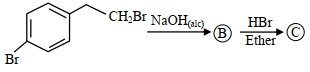
A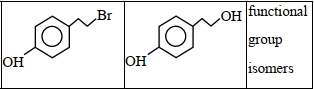
B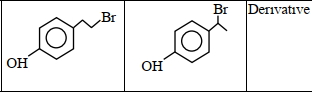
C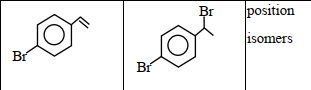
D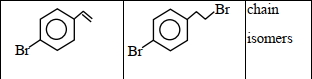
Solution
(C) $1$. The reaction of $(A)$ ($4$-bromophenethyl bromide) with alcoholic $NaOH$ proceeds via an $E2$ elimination mechanism to form $(B)$ ($4$-bromostyrene).
$2$. The reaction of $(B)$ with $HBr$ in ether follows an electrophilic addition mechanism (Markovnikov's rule) to form $(C)$ ($1$-($4$-bromophenyl)$-1-$bromoethane).
$3$. Comparing $(A)$ and $(C)$:
$(A)$ is $1-$bromo$-2-$($4$-bromophenyl)ethane.
$(C)$ is $1-$bromo$-1-$($4$-bromophenyl)ethane.
These are position isomers because the bromine atom on the side chain is at different positions relative to the benzene ring.
$2$. The reaction of $(B)$ with $HBr$ in ether follows an electrophilic addition mechanism (Markovnikov's rule) to form $(C)$ ($1$-($4$-bromophenyl)$-1-$bromoethane).
$3$. Comparing $(A)$ and $(C)$:
$(A)$ is $1-$bromo$-2-$($4$-bromophenyl)ethane.
$(C)$ is $1-$bromo$-1-$($4$-bromophenyl)ethane.
These are position isomers because the bromine atom on the side chain is at different positions relative to the benzene ring.
0 likesView Solution
208
ChemistryMediumMCQJEE Main · 2024
One of the commonly used electrodes is the calomel electrode. Under which of the following categories does the calomel electrode fall?
A
Metal - Insoluble Salt - Anion electrodes
B
Oxidation - Reduction electrodes
C
Gas - Ion electrodes
D
Metal ion - Metal electrodes
Solution
(A) The calomel electrode is represented as $Hg | Hg_2Cl_2(s) | Cl^-(aq)$.
It consists of mercury in contact with solid mercurous chloride $(Hg_2Cl_2)$ and a solution of chloride ions $(Cl^-)$.
This structure classifies it as a $Metal - Insoluble Salt - Anion$ electrode.
It consists of mercury in contact with solid mercurous chloride $(Hg_2Cl_2)$ and a solution of chloride ions $(Cl^-)$.
This structure classifies it as a $Metal - Insoluble Salt - Anion$ electrode.
1 likesView Solution
209
ChemistryMediumMCQJEE Main · 2024
Number of complexes from the following with an even number of unpaired $d$ electrons is . . . . . . . . . .
$[V(H_2O)_6]^{3+}, \quad [Cr(H_2O)_6]^{2+}, \quad [Fe(H_2O)_6]^{3+}, \quad [Ni(H_2O)_6]^{3+}, \quad [Cu(H_2O)_6]^{2+}$
[Given atomic numbers: $V=23, Cr=24, Fe=26, Ni=28, Cu=29$]
$[V(H_2O)_6]^{3+}, \quad [Cr(H_2O)_6]^{2+}, \quad [Fe(H_2O)_6]^{3+}, \quad [Ni(H_2O)_6]^{3+}, \quad [Cu(H_2O)_6]^{2+}$
[Given atomic numbers: $V=23, Cr=24, Fe=26, Ni=28, Cu=29$]
A
$2$
B
$4$
C
$5$
D
$1$
Solution
(A) To determine the number of unpaired $d$ electrons,we analyze the electronic configuration of the central metal ions in the given octahedral complexes:
$1$. $[V(H_2O)_6]^{3+}$: $V^{3+}$ is $3d^2$. Number of unpaired electrons $(n)$ = $2$ (Even).
$2$. $[Cr(H_2O)_6]^{2+}$: $Cr^{2+}$ is $3d^4$. Since $H_2O$ is a weak field ligand,electrons fill according to Hund's rule: $t_{2g}^3 e_g^1$. Number of unpaired electrons $(n)$ = $4$ (Even).
$3$. $[Fe(H_2O)_6]^{3+}$: $Fe^{3+}$ is $3d^5$. With a weak field ligand,$t_{2g}^3 e_g^2$. Number of unpaired electrons $(n)$ = $5$ (Odd).
$4$. $[Ni(H_2O)_6]^{3+}$: $Ni^{3+}$ is $3d^7$. With a weak field ligand,$t_{2g}^5 e_g^2$. Number of unpaired electrons $(n)$ = $3$ (Odd).
$5$. $[Cu(H_2O)_6]^{2+}$: $Cu^{2+}$ is $3d^9$. With a weak field ligand,$t_{2g}^6 e_g^3$. Number of unpaired electrons $(n)$ = $1$ (Odd).
The complexes with an even number of unpaired electrons are $[V(H_2O)_6]^{3+}$ and $[Cr(H_2O)_6]^{2+}$.
Therefore,the total number of such complexes is $2$.
$1$. $[V(H_2O)_6]^{3+}$: $V^{3+}$ is $3d^2$. Number of unpaired electrons $(n)$ = $2$ (Even).
$2$. $[Cr(H_2O)_6]^{2+}$: $Cr^{2+}$ is $3d^4$. Since $H_2O$ is a weak field ligand,electrons fill according to Hund's rule: $t_{2g}^3 e_g^1$. Number of unpaired electrons $(n)$ = $4$ (Even).
$3$. $[Fe(H_2O)_6]^{3+}$: $Fe^{3+}$ is $3d^5$. With a weak field ligand,$t_{2g}^3 e_g^2$. Number of unpaired electrons $(n)$ = $5$ (Odd).
$4$. $[Ni(H_2O)_6]^{3+}$: $Ni^{3+}$ is $3d^7$. With a weak field ligand,$t_{2g}^5 e_g^2$. Number of unpaired electrons $(n)$ = $3$ (Odd).
$5$. $[Cu(H_2O)_6]^{2+}$: $Cu^{2+}$ is $3d^9$. With a weak field ligand,$t_{2g}^6 e_g^3$. Number of unpaired electrons $(n)$ = $1$ (Odd).
The complexes with an even number of unpaired electrons are $[V(H_2O)_6]^{3+}$ and $[Cr(H_2O)_6]^{2+}$.
Therefore,the total number of such complexes is $2$.
0 likesView Solution
210
ChemistryMediumMCQJEE Main · 2024
Given below are two statements:
Statement $I$ : Acidity of $\alpha$-hydrogens of aldehydes and ketones is responsible for Aldol reaction.
Statement $II$ : Reaction between benzaldehyde and ethanal will $NOT$ give Cross-$Aldol$ product.
In the light of above statements,choose the most appropriate answer from the options given below.
Statement $I$ : Acidity of $\alpha$-hydrogens of aldehydes and ketones is responsible for Aldol reaction.
Statement $II$ : Reaction between benzaldehyde and ethanal will $NOT$ give Cross-$Aldol$ product.
In the light of above statements,choose the most appropriate answer from the options given below.
A
Both Statement $I$ and Statement $II$ are correct.
B
Both Statement $I$ and Statement $II$ are incorrect.
C
Statement $I$ is incorrect but Statement $II$ is correct.
D
Statement $I$ is correct but Statement $II$ is incorrect.
Solution
(D) Statement $I$ is correct: The presence of acidic $\alpha$-hydrogens in aldehydes and ketones allows them to form enolate ions in the presence of a base,which is the key step in the Aldol reaction.
Statement $II$ is incorrect: Benzaldehyde (which lacks $\alpha$-hydrogens) and ethanal (which has $\alpha$-hydrogens) undergo a Claisen-Schmidt condensation,which is a type of Cross-Aldol reaction,to form cinnamaldehyde $(C_6H_5CH=CHCHO)$.
Therefore,Statement $I$ is correct but Statement $II$ is incorrect.
Statement $II$ is incorrect: Benzaldehyde (which lacks $\alpha$-hydrogens) and ethanal (which has $\alpha$-hydrogens) undergo a Claisen-Schmidt condensation,which is a type of Cross-Aldol reaction,to form cinnamaldehyde $(C_6H_5CH=CHCHO)$.
Therefore,Statement $I$ is correct but Statement $II$ is incorrect.
0 likesView Solution
211
ChemistryEasyMCQJEE Main · 2024
Which of the following is the correct structure of $L$-Glucose?
A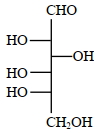
B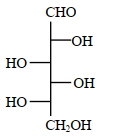
C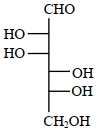
D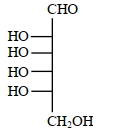
Solution
(A) -Glucose has the configuration $OH$ on the right at $C-2, C-4, C-5$ and on the left at $C-3$.
$L$-Glucose is the enantiomer of $D$-Glucose,meaning all chiral centers have the opposite configuration.
Therefore,in $L$-Glucose,the $OH$ groups are on the left at $C-2, C-4, C-5$ and on the right at $C-3$.
The structure corresponding to this is shown in option $A$.
$L$-Glucose is the enantiomer of $D$-Glucose,meaning all chiral centers have the opposite configuration.
Therefore,in $L$-Glucose,the $OH$ groups are on the left at $C-2, C-4, C-5$ and on the right at $C-3$.
The structure corresponding to this is shown in option $A$.
0 likesView Solution
212
ChemistryMediumMCQJEE Main · 2024
The element which shows only one oxidation state other than its elemental form is:
A
Cobalt
B
Scandium
C
Titanium
D
Nickel
Solution
(B) $Sc$ (Scandium) has an electronic configuration of $[Ar] 3d^1 4s^2$.
It loses three electrons to form $Sc^{3+}$ ion,which has a stable noble gas configuration.
Therefore,$Sc$ exhibits only a $+3$ oxidation state in its compounds.
In contrast,$Co$,$Ti$,and $Ni$ are transition elements that exhibit variable oxidation states.
It loses three electrons to form $Sc^{3+}$ ion,which has a stable noble gas configuration.
Therefore,$Sc$ exhibits only a $+3$ oxidation state in its compounds.
In contrast,$Co$,$Ti$,and $Ni$ are transition elements that exhibit variable oxidation states.
0 likesView Solution
213
ChemistryMediumMCQJEE Main · 2024
Identify the product in the following reaction :
$3$-acetylbenzaldehyde $\xrightarrow{Zn-Hg, HCl}$ Product
$3$-acetylbenzaldehyde $\xrightarrow{Zn-Hg, HCl}$ Product
A
$3-$($1$-hydroxyethyl)benzyl alcohol
B
$3-$acetyltoluene
C
$3-$($1$-hydroxyethyl)benzaldehyde
D
$1-$ethyl$-3-$methylbenzene
Solution
(D) The given reaction is a Clemmensen reduction,which uses $Zn-Hg$ and $HCl$ to reduce carbonyl groups (aldehydes and ketones) to methylene $(-CH_2-)$ groups.
The reactant is $3$-acetylbenzaldehyde,which contains both an aldehyde group $(-CHO)$ and a ketone group $(-COCH_3)$ attached to a benzene ring.
Clemmensen reduction reduces both the aldehyde and the ketone groups to their corresponding alkyl groups.
Therefore,the aldehyde group $(-CHO)$ is reduced to a methyl group $(-CH_3)$ and the ketone group $(-COCH_3)$ is reduced to an ethyl group $(-CH_2CH_3)$.
The final product is $1$-ethyl-$3$-methylbenzene.
The reactant is $3$-acetylbenzaldehyde,which contains both an aldehyde group $(-CHO)$ and a ketone group $(-COCH_3)$ attached to a benzene ring.
Clemmensen reduction reduces both the aldehyde and the ketone groups to their corresponding alkyl groups.
Therefore,the aldehyde group $(-CHO)$ is reduced to a methyl group $(-CH_3)$ and the ketone group $(-COCH_3)$ is reduced to an ethyl group $(-CH_2CH_3)$.
The final product is $1$-ethyl-$3$-methylbenzene.
0 likesView Solution
214
ChemistryMediumMCQJEE Main · 2024
Identify the correct set of reagents or reaction conditions '$X$' and '$Y$' in the following set of transformation.

A
$X = \text{conc. alc. } NaOH, 80^{\circ} C, Y = Br_2 / CHCl_3$
B
$X = \text{dil. aq. } NaOH, 20^{\circ} C, Y = HBr / \text{acetic acid}$
C
$X = \text{conc. alc. } NaOH, 80^{\circ} C, Y = HBr / \text{acetic acid}$
D
$X = \text{dil. aq. } NaOH, 20^{\circ} C, Y = Br_2 / CHCl_3$
Solution
(C) Step $1$: The starting material $CH_3-CH_2-CH_2-Br$ ($1$-bromopropane) undergoes dehydrohalogenation with concentrated alcoholic $NaOH$ at $80^{\circ} C$ to form propene $(CH_3-CH=CH_2)$.
Step $2$: Propene reacts with $HBr$ in the presence of acetic acid (or as a solvent) via electrophilic addition following Markovnikov's rule to yield $2-$bromopropane $(CH_3-CHBr-CH_3)$.
Step $2$: Propene reacts with $HBr$ in the presence of acetic acid (or as a solvent) via electrophilic addition following Markovnikov's rule to yield $2-$bromopropane $(CH_3-CHBr-CH_3)$.
0 likesView Solution
215
ChemistryMediumMCQJEE Main · 2024
The number of correct reaction$(s)$ among the following is $\qquad$
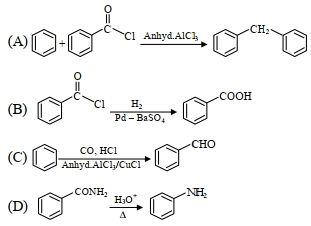
A
$0$
B
$1$
C
$5$
D
$8$
Solution
(B) Let us analyze each reaction:
$(A)$ Friedel-Crafts acylation of benzene with benzoyl chloride in the presence of anhydrous $AlCl_3$ yields benzophenone $(C_6H_5COC_6H_5)$,not diphenylmethane. Thus,this reaction is incorrect.
$(B)$ Rosenmund reduction of benzoyl chloride with $H_2$ in the presence of $Pd-BaSO_4$ yields benzaldehyde $(C_6H_5CHO)$,not benzoic acid. Thus,this reaction is incorrect.
$(C)$ Gattermann-Koch reaction of benzene with $CO$ and $HCl$ in the presence of anhydrous $AlCl_3/CuCl$ yields benzaldehyde $(C_6H_5CHO)$. This reaction is correct.
$(D)$ Acidic hydrolysis of benzamide $(C_6H_5CONH_2)$ yields benzoic acid $(C_6H_5COOH)$ and ammonium ions,not aniline. Thus,this reaction is incorrect.
Therefore,only one reaction $(C)$ is correct. The number of correct reactions is $1$.
$(A)$ Friedel-Crafts acylation of benzene with benzoyl chloride in the presence of anhydrous $AlCl_3$ yields benzophenone $(C_6H_5COC_6H_5)$,not diphenylmethane. Thus,this reaction is incorrect.
$(B)$ Rosenmund reduction of benzoyl chloride with $H_2$ in the presence of $Pd-BaSO_4$ yields benzaldehyde $(C_6H_5CHO)$,not benzoic acid. Thus,this reaction is incorrect.
$(C)$ Gattermann-Koch reaction of benzene with $CO$ and $HCl$ in the presence of anhydrous $AlCl_3/CuCl$ yields benzaldehyde $(C_6H_5CHO)$. This reaction is correct.
$(D)$ Acidic hydrolysis of benzamide $(C_6H_5CONH_2)$ yields benzoic acid $(C_6H_5COOH)$ and ammonium ions,not aniline. Thus,this reaction is incorrect.
Therefore,only one reaction $(C)$ is correct. The number of correct reactions is $1$.
0 likesView Solution
216
ChemistryMediumMCQJEE Main · 2024
$X \ g$ of ethylamine is subjected to reaction with $NaNO_2 / HCl$ followed by water; evolved dinitrogen gas which occupied $2.24 \ L$ volume at $STP$. $X$ is . . . . . . $\times 10^{-1} \ g$.
A
$39$
B
$40$
C
$45$
D
$50$
Solution
(C) The reaction of ethylamine $(CH_3CH_2NH_2)$ with $NaNO_2 / HCl$ followed by water produces ethanol,nitrogen gas,and water:
$CH_3CH_2NH_2 + NaNO_2 + HCl \rightarrow CH_3CH_2OH + N_2(g) + NaCl + H_2O$
From the stoichiometry,$1 \ mole$ of ethylamine $(45 \ g)$ produces $1 \ mole$ of $N_2$ gas.
At $STP$,$1 \ mole$ of gas occupies $22.4 \ L$.
Given that $2.24 \ L$ of $N_2$ gas is evolved,the number of moles of $N_2$ is:
$n = \frac{2.24 \ L}{22.4 \ L/mol} = 0.1 \ mol$
Since $1 \ mole$ of ethylamine produces $1 \ mole$ of $N_2$,$0.1 \ mol$ of ethylamine is required.
The mass of $0.1 \ mol$ of ethylamine is:
$Mass = 0.1 \ mol \times 45 \ g/mol = 4.5 \ g$
We need to express $4.5 \ g$ as $X \times 10^{-1} \ g$,so $X = 45$.
$CH_3CH_2NH_2 + NaNO_2 + HCl \rightarrow CH_3CH_2OH + N_2(g) + NaCl + H_2O$
From the stoichiometry,$1 \ mole$ of ethylamine $(45 \ g)$ produces $1 \ mole$ of $N_2$ gas.
At $STP$,$1 \ mole$ of gas occupies $22.4 \ L$.
Given that $2.24 \ L$ of $N_2$ gas is evolved,the number of moles of $N_2$ is:
$n = \frac{2.24 \ L}{22.4 \ L/mol} = 0.1 \ mol$
Since $1 \ mole$ of ethylamine produces $1 \ mole$ of $N_2$,$0.1 \ mol$ of ethylamine is required.
The mass of $0.1 \ mol$ of ethylamine is:
$Mass = 0.1 \ mol \times 45 \ g/mol = 4.5 \ g$
We need to express $4.5 \ g$ as $X \times 10^{-1} \ g$,so $X = 45$.
0 likesView Solution
217
ChemistryMediumMCQJEE Main · 2024
Consider the following transformation involving first order elementary reactions in each step at constant temperature as shown below.
$A + B \underset{\text{Step } 3}{\overset{\text{Step } 1}{\rightleftharpoons}} C \xrightarrow{\text{Step } 2} P$
Some details of the above reaction are listed below.
If the overall rate constant of the above transformation $(k)$ is given as $k = \frac{k_1 k_2}{k_3}$ and the overall activation energy $(E_a)$ is $400 \ kJ \ mol^{-1}$,then the value of $Ea_3$ is $\qquad$ $kJ \ mol^{-1}$ (nearest integer).
$A + B \underset{\text{Step } 3}{\overset{\text{Step } 1}{\rightleftharpoons}} C \xrightarrow{\text{Step } 2} P$
Some details of the above reaction are listed below.
| Step | Rate constant $(s^{-1})$ | Activation energy $(kJ \ mol^{-1})$ |
|---|---|---|
| $1$ | $k_1$ | $300$ |
| $2$ | $k_2$ | $200$ |
| $3$ | $k_3$ | $Ea_3$ |
If the overall rate constant of the above transformation $(k)$ is given as $k = \frac{k_1 k_2}{k_3}$ and the overall activation energy $(E_a)$ is $400 \ kJ \ mol^{-1}$,then the value of $Ea_3$ is $\qquad$ $kJ \ mol^{-1}$ (nearest integer).
A
$70$
B
$98$
C
$100$
D
$90$
Solution
(C) The overall rate constant is given by $k = \frac{k_1 k_2}{k_3}$.
Using the Arrhenius equation $k = A e^{\frac{-E_a}{RT}}$,we can write:
$A e^{\frac{-E_a}{RT}} = \frac{A_1 e^{\frac{-E_{a_1}}{RT}} \cdot A_2 e^{\frac{-E_{a_2}}{RT}}}{A_3 e^{\frac{-E_{a_3}}{RT}}}$
$A e^{\frac{-E_a}{RT}} = \frac{A_1 A_2}{A_3} e^{\frac{-(E_{a_1} + E_{a_2} - E_{a_3})}{RT}}$
Comparing the exponents,we get the overall activation energy expression:
$E_a = E_{a_1} + E_{a_2} - E_{a_3}$
Given $E_a = 400 \ kJ \ mol^{-1}$,$E_{a_1} = 300 \ kJ \ mol^{-1}$,and $E_{a_2} = 200 \ kJ \ mol^{-1}$:
$400 = 300 + 200 - E_{a_3}$
$400 = 500 - E_{a_3}$
$E_{a_3} = 500 - 400 = 100 \ kJ \ mol^{-1}$.
Using the Arrhenius equation $k = A e^{\frac{-E_a}{RT}}$,we can write:
$A e^{\frac{-E_a}{RT}} = \frac{A_1 e^{\frac{-E_{a_1}}{RT}} \cdot A_2 e^{\frac{-E_{a_2}}{RT}}}{A_3 e^{\frac{-E_{a_3}}{RT}}}$
$A e^{\frac{-E_a}{RT}} = \frac{A_1 A_2}{A_3} e^{\frac{-(E_{a_1} + E_{a_2} - E_{a_3})}{RT}}$
Comparing the exponents,we get the overall activation energy expression:
$E_a = E_{a_1} + E_{a_2} - E_{a_3}$
Given $E_a = 400 \ kJ \ mol^{-1}$,$E_{a_1} = 300 \ kJ \ mol^{-1}$,and $E_{a_2} = 200 \ kJ \ mol^{-1}$:
$400 = 300 + 200 - E_{a_3}$
$400 = 500 - E_{a_3}$
$E_{a_3} = 500 - 400 = 100 \ kJ \ mol^{-1}$.
0 likesView Solution
218
ChemistryMediumMCQJEE Main · 2024
$2.5 \ g$ of a non-volatile,non-electrolyte is dissolved in $100 \ g$ of water at $25^{\circ} C$. The solution showed a boiling point elevation by $2^{\circ} C$. Assuming the solute concentration is negligible with respect to the solvent concentration,the vapour pressure of the resulting aqueous solution is . . . . . . $mm$ of $Hg$ (nearest integer).
[Given : Molal boiling point elevation constant of water $(K_b) = 0.52 \ K \ kg \ mol^{-1}$,
$1 \ atm$ pressure $= 760 \ mm$ of $Hg$,molar mass of water $= 18 \ g \ mol^{-1}]$
[Given : Molal boiling point elevation constant of water $(K_b) = 0.52 \ K \ kg \ mol^{-1}$,
$1 \ atm$ pressure $= 760 \ mm$ of $Hg$,molar mass of water $= 18 \ g \ mol^{-1}]$
A
$702$
B
$704$
C
$705$
D
$707$
Solution
(D) Given: $\Delta T_b = 2 \ K$,$K_b = 0.52 \ K \ kg \ mol^{-1}$,$W_{\text{solvent}} = 100 \ g$,$M_{\text{solvent}} = 18 \ g \ mol^{-1}$,$P^{\circ} = 760 \ mm \ Hg$.
Step $1$: Calculate molality $(m)$ using $\Delta T_b = K_b \times m$.
$2 = 0.52 \times m \implies m = \frac{2}{0.52} \approx 3.846 \ mol \ kg^{-1}$.
Step $2$: Use Raoult's law for dilute solutions: $\frac{P^{\circ} - P_s}{P^{\circ}} = \frac{n_{\text{solute}}}{n_{\text{solvent}}}$.
Since $m = \frac{n_{\text{solute}}}{W_{\text{solvent}}(kg)}$,we have $n_{\text{solute}} = m \times \frac{W_{\text{solvent}}}{1000}$.
$n_{\text{solvent}} = \frac{100}{18} = 5.556 \ mol$.
Step $3$: Calculate relative lowering of vapour pressure.
$\frac{\Delta P}{P^{\circ}} = \frac{m \times W_{\text{solvent}}}{1000} \times \frac{1}{n_{\text{solvent}}} = \frac{m \times M_{\text{solvent}}}{1000}$.
$\Delta P = 760 \times \frac{3.846 \times 18}{1000} = 760 \times 0.069228 = 52.613 \ mm \ Hg$.
Step $4$: Calculate vapour pressure of solution $(P_s)$.
$P_s = P^{\circ} - \Delta P = 760 - 52.613 = 707.387 \ mm \ Hg$.
Rounding to the nearest integer,we get $707 \ mm \ Hg$.
Step $1$: Calculate molality $(m)$ using $\Delta T_b = K_b \times m$.
$2 = 0.52 \times m \implies m = \frac{2}{0.52} \approx 3.846 \ mol \ kg^{-1}$.
Step $2$: Use Raoult's law for dilute solutions: $\frac{P^{\circ} - P_s}{P^{\circ}} = \frac{n_{\text{solute}}}{n_{\text{solvent}}}$.
Since $m = \frac{n_{\text{solute}}}{W_{\text{solvent}}(kg)}$,we have $n_{\text{solute}} = m \times \frac{W_{\text{solvent}}}{1000}$.
$n_{\text{solvent}} = \frac{100}{18} = 5.556 \ mol$.
Step $3$: Calculate relative lowering of vapour pressure.
$\frac{\Delta P}{P^{\circ}} = \frac{m \times W_{\text{solvent}}}{1000} \times \frac{1}{n_{\text{solvent}}} = \frac{m \times M_{\text{solvent}}}{1000}$.
$\Delta P = 760 \times \frac{3.846 \times 18}{1000} = 760 \times 0.069228 = 52.613 \ mm \ Hg$.
Step $4$: Calculate vapour pressure of solution $(P_s)$.
$P_s = P^{\circ} - \Delta P = 760 - 52.613 = 707.387 \ mm \ Hg$.
Rounding to the nearest integer,we get $707 \ mm \ Hg$.
0 likesView Solution
219
ChemistryMediumMCQJEE Main · 2024
In the above chemical reaction sequence,"$A$" and "$B$" respectively are:
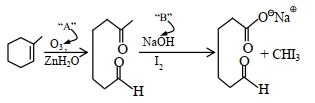
A
$O_3, Zn / H_2O$ and $NaOH_{(aq)} / I_2$
B
$H_2O, H^+$ and $NaOH_{(aq)} / I_2$
C
$H_2O, H^+$ and $KMnO_4$
D
$O_3, Zn / H_2O$ and $KMnO_4$
Solution
(A) $1$. The first step involves the oxidative cleavage of $1$-methylcyclohexene using ozone $(O_3)$ followed by reductive workup with $Zn / H_2O$. This reaction is known as ozonolysis,which breaks the double bond to form a dicarbonyl compound ($6$-oxoheptanal). Thus,"$A$" is $O_3, Zn / H_2O$.
$2$. The second step involves the reaction of the resulting ketone group with $NaOH$ and $I_2$. This is the iodoform test,which specifically reacts with methyl ketones to produce a carboxylate salt and iodoform $(CHI_3)$. Therefore,"$B$" represents the reagents for the iodoform test,which are $NaOH_{(aq)} / I_2$ (often written as $NaOH / I_2$).
$3$. Comparing these with the given options,option $A$ is the correct choice.
$2$. The second step involves the reaction of the resulting ketone group with $NaOH$ and $I_2$. This is the iodoform test,which specifically reacts with methyl ketones to produce a carboxylate salt and iodoform $(CHI_3)$. Therefore,"$B$" represents the reagents for the iodoform test,which are $NaOH_{(aq)} / I_2$ (often written as $NaOH / I_2$).
$3$. Comparing these with the given options,option $A$ is the correct choice.
1 likesView Solution
220
ChemistryMediumMCQJEE Main · 2024
The common name of Benzene-$1, 2$-diol is:
A
quinol
B
resorcinol
C
catechol
D
o-cresol
Solution
(C) $IUPAC$ name: Benzene-$1, 2$-diol
Common name: catechol
The structure consists of a benzene ring with two hydroxyl $(-OH)$ groups at the ortho $(1, 2)$ positions.
Common name: catechol
The structure consists of a benzene ring with two hydroxyl $(-OH)$ groups at the ortho $(1, 2)$ positions.
0 likesView Solution
221
ChemistryMediumMCQJEE Main · 2024
$CH_3-CH_2-CH_2-Br + NaOH \xrightarrow{C_2H_5OH} \text{Product } A$. Consider the above reactions,identify product $B$ and product $C$.
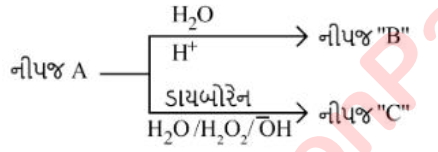
A
$B=C=2\text{-Propanol}$
B
$B=2\text{-Propanol}, C=1\text{-Propanol}$
C
$B=1\text{-Propanol}, C=2\text{-Propanol}$
D
$B=C=1\text{-Propanol}$
Solution
(B) $1$. The reaction of $CH_3-CH_2-CH_2-Br$ with $NaOH$ in $C_2H_5OH$ is a dehydrohalogenation reaction (elimination),which produces propene $(CH_3-CH=CH_2)$ as Product $A$.
$2$. The hydration of propene in the presence of acid $(H_2O/H^+)$ follows Markovnikov's rule,leading to the formation of $2\text{-Propanol}$ as Product $B$.
$3$. The hydroboration-oxidation of propene $(B_2H_6, H_2O_2/OH^-)$ follows anti-Markovnikov's rule,leading to the formation of $1\text{-Propanol}$ as Product $C$.
$4$. Therefore,$B = 2\text{-Propanol}$ and $C = 1\text{-Propanol}$.
$2$. The hydration of propene in the presence of acid $(H_2O/H^+)$ follows Markovnikov's rule,leading to the formation of $2\text{-Propanol}$ as Product $B$.
$3$. The hydroboration-oxidation of propene $(B_2H_6, H_2O_2/OH^-)$ follows anti-Markovnikov's rule,leading to the formation of $1\text{-Propanol}$ as Product $C$.
$4$. Therefore,$B = 2\text{-Propanol}$ and $C = 1\text{-Propanol}$.
0 likesView Solution
222
ChemistryMediumMCQJEE Main · 2024
The adsorbent used in adsorption chromatography is/are:
$A$. silica gel
$B$. alumina
$C$. quick lime
$D$. magnesia
Choose the most appropriate answer from the options given below:
$A$. silica gel
$B$. alumina
$C$. quick lime
$D$. magnesia
Choose the most appropriate answer from the options given below:
A
$B$ only
B
$C$ and $D$ only
C
$A$ and $B$ only
D
$A$ only
Solution
(C) In adsorption chromatography,the stationary phase consists of an adsorbent material.
Silica gel $(SiO_2 \cdot xH_2O)$ is the most commonly used polar adsorbent.
Alumina $(Al_2O_3)$ is also a widely used polar adsorbent in adsorption chromatography.
Both silica gel and alumina are standard materials used for the separation of organic compounds based on their polarity.
Therefore,both $A$ and $B$ are correct.
Silica gel $(SiO_2 \cdot xH_2O)$ is the most commonly used polar adsorbent.
Alumina $(Al_2O_3)$ is also a widely used polar adsorbent in adsorption chromatography.
Both silica gel and alumina are standard materials used for the separation of organic compounds based on their polarity.
Therefore,both $A$ and $B$ are correct.
0 likesView Solution
223
ChemistryMediumMCQJEE Main · 2024
$\xrightarrow[\Delta]{KOH \text{ (alc.) }}$ major product $P$
Product $P$ is
Product $P$ is
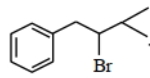
A
$1-$phenyl$-3-$methylbut$-1-$ene
B
$2-$phenyl$-3-$methylbut$-1-$ene
C
$1-$phenyl$-3-$methylbut$-2-$ene
D
$4-$phenyl$-2-$methylbut$-1-$ene
Solution
(A) The reaction is a dehydrohalogenation reaction using alcoholic $KOH$ (an elimination reaction,$E2$).
The substrate is $1\text{-phenyl-2-bromo-3-methylbutane}$.
Elimination of $HBr$ occurs from the $\beta$-carbon atoms adjacent to the carbon bearing the $Br$ atom.
There are two possible $\beta$-hydrogens:
$1$. From $C-1$ (benzylic position),which leads to a conjugated alkene $(1\text{-phenyl-3-methylbut-1-ene})$.
$2$. From $C-3$,which leads to a less substituted alkene $(1\text{-phenyl-3-methylbut-2-ene})$.
According to Saytzeff's rule,the more substituted and conjugated alkene is the major product.
Therefore,the major product $P$ is $1\text{-phenyl-3-methylbut-1-ene}$.
The substrate is $1\text{-phenyl-2-bromo-3-methylbutane}$.
Elimination of $HBr$ occurs from the $\beta$-carbon atoms adjacent to the carbon bearing the $Br$ atom.
There are two possible $\beta$-hydrogens:
$1$. From $C-1$ (benzylic position),which leads to a conjugated alkene $(1\text{-phenyl-3-methylbut-1-ene})$.
$2$. From $C-3$,which leads to a less substituted alkene $(1\text{-phenyl-3-methylbut-2-ene})$.
According to Saytzeff's rule,the more substituted and conjugated alkene is the major product.
Therefore,the major product $P$ is $1\text{-phenyl-3-methylbut-1-ene}$.
0 likesView Solution
224
ChemistryMediumMCQJEE Main · 2024
If an iron $(III)$ complex with the formula $[Fe(NH_3)_{x}(CN)_{y}]^{-}$ has no electron in its $e_g$ orbital, then the value of $x+y$ is
A
$5$
B
$6$
C
$3$
D
$4$
Solution
(B) The complex is $[Fe(NH_3)_{x}(CN)_{y}]^{-}$.
The oxidation state of $Fe$ is $+3$, so the electronic configuration of $Fe^{3+}$ is $3d^5$.
For the $e_g$ orbital to have no electrons, all $5$ electrons must occupy the $t_{2g}$ orbitals.
This requires a strong field ligand environment to cause large crystal field splitting $(\Delta_o > P)$.
$CN^-$ is a strong field ligand, while $NH_3$ is a moderate field ligand.
For the complex to be low-spin with $t_{2g}^5 e_g^0$, the coordination number must be $6$ to satisfy the geometry of an octahedral complex.
Thus, $x+y = 6$.
For example, in $[Fe(CN)_6]^{3-}$, $x=0$ and $y=6$, which satisfies the condition.
The oxidation state of $Fe$ is $+3$, so the electronic configuration of $Fe^{3+}$ is $3d^5$.
For the $e_g$ orbital to have no electrons, all $5$ electrons must occupy the $t_{2g}$ orbitals.
This requires a strong field ligand environment to cause large crystal field splitting $(\Delta_o > P)$.
$CN^-$ is a strong field ligand, while $NH_3$ is a moderate field ligand.
For the complex to be low-spin with $t_{2g}^5 e_g^0$, the coordination number must be $6$ to satisfy the geometry of an octahedral complex.
Thus, $x+y = 6$.
For example, in $[Fe(CN)_6]^{3-}$, $x=0$ and $y=6$, which satisfies the condition.
0 likesView Solution
225
ChemistryMediumMCQJEE Main · 2024
Which of the following statements are correct regarding a fuel cell that uses hydrogen and oxygen as fuels?
$A$. It has been used in spaceships.
$B$. It has an efficiency of about $40 \%$ to $60 \%$ to produce electricity.
$C$. It uses aluminium as a catalyst.
$D$. It is eco-friendly.
$E$. It is actually a type of galvanic cell.
$A$. It has been used in spaceships.
$B$. It has an efficiency of about $40 \%$ to $60 \%$ to produce electricity.
$C$. It uses aluminium as a catalyst.
$D$. It is eco-friendly.
$E$. It is actually a type of galvanic cell.
A
$A, B, C$ only
B
$A, B, D$ only
C
$A, B, D, E$ only
D
$A, D, E$ only
Solution
(C) $1$. Fuel cells,such as the $H_2-O_2$ fuel cell,were used in the Apollo space program,making statement $A$ correct.
$2$. Fuel cells are highly efficient,typically converting $60 \%$ to $70 \%$ of the energy of fuels into electricity,unlike thermal plants which are limited by Carnot efficiency. Statement $B$ is generally considered correct in the context of high efficiency,though $40 \%$ is a lower bound.
$3$. Fuel cells typically use catalysts like finely divided platinum or palladium,not aluminium. Statement $C$ is incorrect.
$4$. The only byproduct of the $H_2-O_2$ fuel cell is water,making it eco-friendly. Statement $D$ is correct.
$5$. $A$ fuel cell is a device that converts chemical energy directly into electrical energy,which is the definition of a galvanic cell. Statement $E$ is correct.
Therefore,statements $A, B, D,$ and $E$ are correct.
$2$. Fuel cells are highly efficient,typically converting $60 \%$ to $70 \%$ of the energy of fuels into electricity,unlike thermal plants which are limited by Carnot efficiency. Statement $B$ is generally considered correct in the context of high efficiency,though $40 \%$ is a lower bound.
$3$. Fuel cells typically use catalysts like finely divided platinum or palladium,not aluminium. Statement $C$ is incorrect.
$4$. The only byproduct of the $H_2-O_2$ fuel cell is water,making it eco-friendly. Statement $D$ is correct.
$5$. $A$ fuel cell is a device that converts chemical energy directly into electrical energy,which is the definition of a galvanic cell. Statement $E$ is correct.
Therefore,statements $A, B, D,$ and $E$ are correct.
0 likesView Solution
226
ChemistryMediumMCQJEE Main · 2024
Match List-$I$ with List-$II$:
Choose the correct answer from the options given below:
| List-$I$ | List-$II$ |
| $A$. $\alpha$-Glucose and $\alpha$-Galactose | $I$. Functional isomers |
| $B$. $\alpha$-Glucose and $\beta$-Glucose | $II$. Homologous |
| $C$. $\alpha$-Glucose and $\alpha$-Fructose | $III$. Anomers |
| $D$. $\alpha$-Glucose and $\alpha$-Ribose | $IV$. Epimers |
Choose the correct answer from the options given below:
A
$A-IV, B-III, C-I, D-II$
B
$A-III, B-IV, C-I, D-II$
C
$A-IV, B-III, C-II, D-I$
D
$A-III, B-IV, C-II, D-I$
Solution
(A) The correct matches are as follows:
$A$. $\alpha$-Glucose and $\alpha$-Galactose are $C-4$ epimers,so $A-IV$.
$B$. $\alpha$-Glucose and $\beta$-Glucose differ only in the configuration at the anomeric carbon $(C-1)$,so they are anomers,$B-III$.
$C$. $\alpha$-Glucose (an aldohexose) and $\alpha$-Fructose (a ketohexose) are functional isomers,so $C-I$.
$D$. $\alpha$-Glucose (hexose) and $\alpha$-Ribose (pentose) belong to the same homologous series (carbohydrates),so $D-II$.
Therefore,the correct sequence is $A-IV, B-III, C-I, D-II$.
$A$. $\alpha$-Glucose and $\alpha$-Galactose are $C-4$ epimers,so $A-IV$.
$B$. $\alpha$-Glucose and $\beta$-Glucose differ only in the configuration at the anomeric carbon $(C-1)$,so they are anomers,$B-III$.
$C$. $\alpha$-Glucose (an aldohexose) and $\alpha$-Fructose (a ketohexose) are functional isomers,so $C-I$.
$D$. $\alpha$-Glucose (hexose) and $\alpha$-Ribose (pentose) belong to the same homologous series (carbohydrates),so $D-II$.
Therefore,the correct sequence is $A-IV, B-III, C-I, D-II$.
0 likesView Solution
227
ChemistryMediumMCQJEE Main · 2024
For a strong electrolyte,a plot of molar conductivity against (concentration)$^{1/2}$ is a straight line,with a negative slope. The correct unit for the slope is:
A
$S \ cm^2 \ mol^{-3/2} \ L^{1/2}$
B
$S \ cm^2 \ mol^{-1} \ L^{1/2}$
C
$S \ cm^2 \ mol^{-3/2} \ L$
D
$S \ cm^2 \ mol^{-3/2} \ L^{-1/2}$
Solution
(A) The Kohlrausch equation for strong electrolytes is given by: $\Lambda_{m} = \Lambda_{m}^{\circ} - A \sqrt{C}$.
Here,$\Lambda_{m}$ is the molar conductivity,$C$ is the concentration,and $A$ is a constant.
The unit of $\Lambda_{m}$ is $S \ cm^2 \ mol^{-1}$.
The unit of $\sqrt{C}$ is $(mol \ L^{-1})^{1/2} = mol^{1/2} \ L^{-1/2}$.
Since the slope $A = \frac{\Lambda_{m}}{\sqrt{C}}$,the unit of $A$ is $\frac{S \ cm^2 \ mol^{-1}}{mol^{1/2} \ L^{-1/2}} = S \ cm^2 \ mol^{-3/2} \ L^{1/2}$.
Here,$\Lambda_{m}$ is the molar conductivity,$C$ is the concentration,and $A$ is a constant.
The unit of $\Lambda_{m}$ is $S \ cm^2 \ mol^{-1}$.
The unit of $\sqrt{C}$ is $(mol \ L^{-1})^{1/2} = mol^{1/2} \ L^{-1/2}$.
Since the slope $A = \frac{\Lambda_{m}}{\sqrt{C}}$,the unit of $A$ is $\frac{S \ cm^2 \ mol^{-1}}{mol^{1/2} \ L^{-1/2}} = S \ cm^2 \ mol^{-3/2} \ L^{1/2}$.
0 likesView Solution
228
ChemistryMediumMCQJEE Main · 2024
$A$ first row transition metal in its $+2$ oxidation state has a spin-only magnetic moment value of $3.86 \ BM$. The atomic number of the metal is
A
$25$
B
$26$
C
$22$
D
$23$
Solution
(D) The spin-only magnetic moment is given by the formula $\mu = \sqrt{n(n+2)} \ BM$,where $n$ is the number of unpaired electrons.
Given $\mu = 3.86 \ BM$,we have $\sqrt{n(n+2)} = 3.86$.
Squaring both sides,$n(n+2) \approx 15$,which gives $n = 3$.
For a metal ion in the $+2$ oxidation state to have $3$ unpaired electrons,the electronic configuration must be $d^3$.
Checking the options:
${}_{22} Ti^{+2} = [Ar] 3d^2$ $(n=2)$
${}_{23} V^{+2} = [Ar] 3d^3$ $(n=3)$
${}_{25} Mn^{+2} = [Ar] 3d^5$ $(n=5)$
${}_{26} Fe^{+2} = [Ar] 3d^6$ $(n=4)$
Thus,the metal is Vanadium $(V)$ with atomic number $23$.
Given $\mu = 3.86 \ BM$,we have $\sqrt{n(n+2)} = 3.86$.
Squaring both sides,$n(n+2) \approx 15$,which gives $n = 3$.
For a metal ion in the $+2$ oxidation state to have $3$ unpaired electrons,the electronic configuration must be $d^3$.
Checking the options:
${}_{22} Ti^{+2} = [Ar] 3d^2$ $(n=2)$
${}_{23} V^{+2} = [Ar] 3d^3$ $(n=3)$
${}_{25} Mn^{+2} = [Ar] 3d^5$ $(n=5)$
${}_{26} Fe^{+2} = [Ar] 3d^6$ $(n=4)$
Thus,the metal is Vanadium $(V)$ with atomic number $23$.
0 likesView Solution
229
ChemistryMediumMCQJEE Main · 2024
The number of unpaired $d$-electrons in $[Co(H_2O)_6]^{3+}$ is $\qquad$
A
$4$
B
$2$
C
$0$
D
$1$
Solution
(C) The atomic number of $Co$ is $27$. The electronic configuration of $Co$ is $[Ar] 3d^7 4s^2$.
In $[Co(H_2O)_6]^{3+}$,the oxidation state of $Co$ is $+3$. Thus,the configuration of $Co^{3+}$ is $[Ar] 3d^6$.
$H_2O$ is a weak field ligand,but for $Co^{3+}$ ($d^6$ system),the crystal field splitting energy is high enough that it forces pairing of electrons in the $t_{2g}$ orbitals.
According to the crystal field splitting diagram,all $6$ electrons occupy the $t_{2g}$ orbitals in pairs.
Therefore,the number of unpaired electrons is $0$.
In $[Co(H_2O)_6]^{3+}$,the oxidation state of $Co$ is $+3$. Thus,the configuration of $Co^{3+}$ is $[Ar] 3d^6$.
$H_2O$ is a weak field ligand,but for $Co^{3+}$ ($d^6$ system),the crystal field splitting energy is high enough that it forces pairing of electrons in the $t_{2g}$ orbitals.
According to the crystal field splitting diagram,all $6$ electrons occupy the $t_{2g}$ orbitals in pairs.
Therefore,the number of unpaired electrons is $0$.
0 likesView Solution
230
ChemistryMediumMCQJEE Main · 2024
From $6.55 \ g$ of aniline,the maximum amount of acetanilide that can be prepared will be _ $\times 10^{-1} \ g$.
A
$90$
B
$96$
C
$97$
D
$95$
Solution
(D) The reaction of aniline $(C_6H_5NH_2)$ with acetic anhydride forms acetanilide $(C_6H_5NHCOCH_3)$.
Molar mass of aniline $(C_6H_5NH_2)$ = $93 \ g/mol$.
Molar mass of acetanilide $(C_6H_5NHCOCH_3)$ = $135 \ g/mol$.
According to the stoichiometry,$1 \ mol$ of aniline produces $1 \ mol$ of acetanilide.
$93 \ g$ of aniline produces $135 \ g$ of acetanilide.
Therefore,$6.55 \ g$ of aniline produces $\frac{135}{93} \times 6.55 \ g = 9.508 \ g \approx 9.5 \ g$.
Converting to the required format: $9.5 \ g = 95 \times 10^{-1} \ g$.
Molar mass of aniline $(C_6H_5NH_2)$ = $93 \ g/mol$.
Molar mass of acetanilide $(C_6H_5NHCOCH_3)$ = $135 \ g/mol$.
According to the stoichiometry,$1 \ mol$ of aniline produces $1 \ mol$ of acetanilide.
$93 \ g$ of aniline produces $135 \ g$ of acetanilide.
Therefore,$6.55 \ g$ of aniline produces $\frac{135}{93} \times 6.55 \ g = 9.508 \ g \approx 9.5 \ g$.
Converting to the required format: $9.5 \ g = 95 \times 10^{-1} \ g$.
0 likesView Solution
231
ChemistryMediumMCQJEE Main · 2024
Consider the following reaction,the rate expression of which is given below:
$A + B \rightarrow C$
$\text{rate} = k[A]^{1/2}[B]^{1/2}$
The reaction is initiated by taking $1 \ M$ concentration of $A$ and $B$ each. If the rate constant $(k)$ is $4.6 \times 10^{-2} \ s^{-1}$,then the time taken for $A$ to become $0.1 \ M$ is . . . . . . . . . . $sec$. (nearest integer)
$A + B \rightarrow C$
$\text{rate} = k[A]^{1/2}[B]^{1/2}$
The reaction is initiated by taking $1 \ M$ concentration of $A$ and $B$ each. If the rate constant $(k)$ is $4.6 \times 10^{-2} \ s^{-1}$,then the time taken for $A$ to become $0.1 \ M$ is . . . . . . . . . . $sec$. (nearest integer)
A
$50$
B
$40$
C
$51$
D
$55$
Solution
(A) Given the reaction $A + B \rightarrow C$ and the rate law $\text{rate} = k[A]^{1/2}[B]^{1/2}$.
Since the initial concentrations $[A]_0 = [B]_0 = 1 \ M$,at any time $t$,$[A] = [B]$.
Substituting this into the rate law: $\text{rate} = k[A]^{1/2}[A]^{1/2} = k[A]$.
This confirms the reaction follows first-order kinetics with respect to $A$.
The integrated rate equation for a first-order reaction is $k = \frac{2.303}{t} \log \frac{[A]_0}{[A]_t}$.
Given $k = 4.6 \times 10^{-2} \ s^{-1}$,$[A]_0 = 1 \ M$,and $[A]_t = 0.1 \ M$.
Substituting the values: $4.6 \times 10^{-2} = \frac{2.303}{t} \log \frac{1}{0.1}$.
$4.6 \times 10^{-2} = \frac{2.303}{t} \times 1$.
$t = \frac{2.303}{4.6 \times 10^{-2}} \approx 50.06 \ s$.
Rounding to the nearest integer,$t = 50 \ s$.
Since the initial concentrations $[A]_0 = [B]_0 = 1 \ M$,at any time $t$,$[A] = [B]$.
Substituting this into the rate law: $\text{rate} = k[A]^{1/2}[A]^{1/2} = k[A]$.
This confirms the reaction follows first-order kinetics with respect to $A$.
The integrated rate equation for a first-order reaction is $k = \frac{2.303}{t} \log \frac{[A]_0}{[A]_t}$.
Given $k = 4.6 \times 10^{-2} \ s^{-1}$,$[A]_0 = 1 \ M$,and $[A]_t = 0.1 \ M$.
Substituting the values: $4.6 \times 10^{-2} = \frac{2.303}{t} \log \frac{1}{0.1}$.
$4.6 \times 10^{-2} = \frac{2.303}{t} \times 1$.
$t = \frac{2.303}{4.6 \times 10^{-2}} \approx 50.06 \ s$.
Rounding to the nearest integer,$t = 50 \ s$.
0 likesView Solution
232
ChemistryMediumMCQJEE Main · 2024
Phthalimide is made to undergo the following sequence of reactions. Total number of $\pi$ bonds present in product '$P$' is/are:
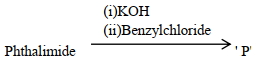
A
$7$
B
$8$
C
$9$
D
$10$
Solution
(B) $1$. Phthalimide reacts with $KOH$ to form potassium phthalimide.
$2$. Potassium phthalimide then undergoes an $S_N2$ reaction with benzyl chloride to form $N$-benzylphthalimide (product $P$).
$3$. The structure of $N$-benzylphthalimide contains a benzene ring ($3 \ \pi$ bonds),another benzene ring from the benzyl group ($3 \ \pi$ bonds),and two carbonyl groups ($C=O$,each having $1 \ \pi$ bond).
$4$. Total $\pi$ bonds = $3$ (phthalimide ring) + $3$ (benzyl ring) + $2$ ($C=O$ bonds) = $8$.
$2$. Potassium phthalimide then undergoes an $S_N2$ reaction with benzyl chloride to form $N$-benzylphthalimide (product $P$).
$3$. The structure of $N$-benzylphthalimide contains a benzene ring ($3 \ \pi$ bonds),another benzene ring from the benzyl group ($3 \ \pi$ bonds),and two carbonyl groups ($C=O$,each having $1 \ \pi$ bond).
$4$. Total $\pi$ bonds = $3$ (phthalimide ring) + $3$ (benzyl ring) + $2$ ($C=O$ bonds) = $8$.
0 likesView Solution
233
ChemistryMediumMCQJEE Main · 2024
$A$ first row transition metal with the highest enthalpy of atomization,upon reaction with oxygen at high temperature,forms oxides of the formula $M_2O_n$ (where $n=3, 4, 5$). The 'spin-only' magnetic moment value of the amphoteric oxide from the above oxides is $......$ $BM$ (nearest integer). (Given atomic number: $Sc: 21, Ti: 22, V: 23, Cr: 24, Mn: 25, Fe: 26, Co: 27, Ni: 28, Cu: 29, Zn: 30$)
A
$1$
B
$2$
C
$3$
D
$0$
Solution
(B) The first row transition metal with the highest enthalpy of atomization is Vanadium $(V)$.
Vanadium reacts with oxygen to form oxides like $V_2O_3$,$V_2O_4$,and $V_2O_5$.
Among these,$V_2O_4$ $(VO_2)$ is amphoteric in nature.
In $V_2O_4$,the oxidation state of $V$ is $+4$.
The electronic configuration of $V^{+4}$ is $[Ar] 3d^1$.
It has $1$ unpaired electron $(n=1)$.
The 'spin-only' magnetic moment is calculated as $\mu = \sqrt{n(n+2)} = \sqrt{1(1+2)} = \sqrt{3} \approx 1.732 \ BM$.
The nearest integer value is $2$ $BM$.
Vanadium reacts with oxygen to form oxides like $V_2O_3$,$V_2O_4$,and $V_2O_5$.
Among these,$V_2O_4$ $(VO_2)$ is amphoteric in nature.
In $V_2O_4$,the oxidation state of $V$ is $+4$.
The electronic configuration of $V^{+4}$ is $[Ar] 3d^1$.
It has $1$ unpaired electron $(n=1)$.
The 'spin-only' magnetic moment is calculated as $\mu = \sqrt{n(n+2)} = \sqrt{1(1+2)} = \sqrt{3} \approx 1.732 \ BM$.
The nearest integer value is $2$ $BM$.
0 likesView Solution
234
ChemistryMediumMCQJEE Main · 2024
$2.7 \ kg$ of each of water and acetic acid are mixed. The freezing point of the solution will be $-x^{\circ} C$. Consider the acetic acid does not dimerise in water,nor dissociates in water. $x = . . . . . . .$ (nearest integer)
[Given : Molar mass of water $= 18 \ g \ mol^{-1}$,acetic acid $= 60 \ g \ mol^{-1}$]
$K_f \ H_2O = 1.86 \ K \ kg \ mol^{-1}$
$K_f$ acetic acid $= 3.90 \ K \ kg \ mol^{-1}$
Freezing point: $H_2O = 273 \ K$,acetic acid $= 290 \ K$
[Given : Molar mass of water $= 18 \ g \ mol^{-1}$,acetic acid $= 60 \ g \ mol^{-1}$]
$K_f \ H_2O = 1.86 \ K \ kg \ mol^{-1}$
$K_f$ acetic acid $= 3.90 \ K \ kg \ mol^{-1}$
Freezing point: $H_2O = 273 \ K$,acetic acid $= 290 \ K$
A
$31$
B
$35$
C
$37$
D
$40$
Solution
(A) Moles of water $= \frac{2700 \ g}{18 \ g \ mol^{-1}} = 150 \ mol$.
Moles of acetic acid $= \frac{2700 \ g}{60 \ g \ mol^{-1}} = 45 \ mol$.
Since the amount of water is greater than the amount of acetic acid,water acts as the solvent.
The depression in freezing point is given by $\Delta T_f = K_f \times m$.
Molality $(m) = \frac{\text{moles of solute}}{\text{mass of solvent in kg}} = \frac{45 \ mol}{2.7 \ kg} = 16.667 \ mol \ kg^{-1}$.
$\Delta T_f = 1.86 \ K \ kg \ mol^{-1} \times 16.667 \ mol \ kg^{-1} \approx 31 \ K$.
Freezing point of solution $= T_f^{\circ} - \Delta T_f = 0^{\circ} C - 31^{\circ} C = -31^{\circ} C$.
Therefore,$x = 31$.
Moles of acetic acid $= \frac{2700 \ g}{60 \ g \ mol^{-1}} = 45 \ mol$.
Since the amount of water is greater than the amount of acetic acid,water acts as the solvent.
The depression in freezing point is given by $\Delta T_f = K_f \times m$.
Molality $(m) = \frac{\text{moles of solute}}{\text{mass of solvent in kg}} = \frac{45 \ mol}{2.7 \ kg} = 16.667 \ mol \ kg^{-1}$.
$\Delta T_f = 1.86 \ K \ kg \ mol^{-1} \times 16.667 \ mol \ kg^{-1} \approx 31 \ K$.
Freezing point of solution $= T_f^{\circ} - \Delta T_f = 0^{\circ} C - 31^{\circ} C = -31^{\circ} C$.
Therefore,$x = 31$.
0 likesView Solution
235
ChemistryMediumMCQJEE Main · 2024
Identify compound $(Z)$ in the following reaction sequence.
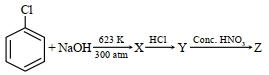
A
$2-$Nitrophenol
B
$2,4-$Dinitrophenol
C
$2,4,6-$Trinitrophenol (Picric acid)
D
$4-$Nitrophenol
Solution
(C) The reaction sequence is as follows:
$1$. Chlorobenzene reacts with $NaOH$ at $623 \ K$ and $300 \ atm$ pressure to form sodium phenoxide $(X)$.
$2$. Sodium phenoxide $(X)$ on acidification with $HCl$ gives phenol $(Y)$.
$3$. Phenol $(Y)$ on treatment with concentrated $HNO_3$ undergoes electrophilic aromatic substitution (nitration) to form $2,4,6$-trinitrophenol,commonly known as picric acid $(Z)$.
$1$. Chlorobenzene reacts with $NaOH$ at $623 \ K$ and $300 \ atm$ pressure to form sodium phenoxide $(X)$.
$2$. Sodium phenoxide $(X)$ on acidification with $HCl$ gives phenol $(Y)$.
$3$. Phenol $(Y)$ on treatment with concentrated $HNO_3$ undergoes electrophilic aromatic substitution (nitration) to form $2,4,6$-trinitrophenol,commonly known as picric acid $(Z)$.
0 likesView Solution
236
ChemistryMediumMCQJEE Main · 2024
For the compounds:
$(A)$ $H_3C-CH_2-O-CH_2-CH_2-CH_3$
$(B)$ $H_3C-CH_2-CH_2-CH_2-CH_3$
$(C)$ $CH_3-CH_2-CO-CH_2-CH_3$
$(D)$ $H_3C-CH(OH)-CH_2-CH_2-CH_3$
The increasing order of boiling point is:
Choose the correct answer from the options given below:
$(A)$ $H_3C-CH_2-O-CH_2-CH_2-CH_3$
$(B)$ $H_3C-CH_2-CH_2-CH_2-CH_3$
$(C)$ $CH_3-CH_2-CO-CH_2-CH_3$
$(D)$ $H_3C-CH(OH)-CH_2-CH_2-CH_3$
The increasing order of boiling point is:
Choose the correct answer from the options given below:
A
$B < A < C < D$
B
$B < C < A < D$
C
$D < C < A < B$
D
$B < A < D < C$
Solution
(A) The given compounds are:
$(A)$ Diethyl ether derivative (Ether): $H_3C-CH_2-O-CH_2-CH_2-CH_3$ (Polar,dipole-dipole interactions)
$(B)$ Pentane (Alkane): $H_3C-CH_2-CH_2-CH_2-CH_3$ (Non-polar,weak van der Waals forces)
$(C)$ Pentan$-3-$one (Ketone): $CH_3-CH_2-CO-CH_2-CH_3$ (Highly polar,strong dipole-dipole interactions)
$(D)$ Pentan$-2-$ol (Alcohol): $H_3C-CH(OH)-CH_2-CH_2-CH_3$ (Hydrogen bonding)
Boiling point order depends on intermolecular forces:
$1$. Hydrogen bonding (Alcohol) has the highest boiling point.
$2$. Dipole-dipole interactions (Ketone) have higher boiling point than ethers.
$3$. Ethers have higher boiling point than alkanes due to polarity.
$4$. Alkanes (Non-polar) have the lowest boiling point.
Thus,the order is: $B < A < C < D$.
$(A)$ Diethyl ether derivative (Ether): $H_3C-CH_2-O-CH_2-CH_2-CH_3$ (Polar,dipole-dipole interactions)
$(B)$ Pentane (Alkane): $H_3C-CH_2-CH_2-CH_2-CH_3$ (Non-polar,weak van der Waals forces)
$(C)$ Pentan$-3-$one (Ketone): $CH_3-CH_2-CO-CH_2-CH_3$ (Highly polar,strong dipole-dipole interactions)
$(D)$ Pentan$-2-$ol (Alcohol): $H_3C-CH(OH)-CH_2-CH_2-CH_3$ (Hydrogen bonding)
Boiling point order depends on intermolecular forces:
$1$. Hydrogen bonding (Alcohol) has the highest boiling point.
$2$. Dipole-dipole interactions (Ketone) have higher boiling point than ethers.
$3$. Ethers have higher boiling point than alkanes due to polarity.
$4$. Alkanes (Non-polar) have the lowest boiling point.
Thus,the order is: $B < A < C < D$.
0 likesView Solution
237
ChemistryMediumMCQJEE Main · 2024
Given below are two statements :
Statement $I$: In group $13$, the stability of $+1$ oxidation state increases down the group.
Statement $II$: The atomic size of gallium is greater than that of aluminium.
In the light of the above statements, choose the most appropriate answer from the options given below:
Statement $I$: In group $13$, the stability of $+1$ oxidation state increases down the group.
Statement $II$: The atomic size of gallium is greater than that of aluminium.
In the light of the above statements, choose the most appropriate answer from the options given below:
A
Statement $I$ is incorrect but Statement $II$ is correct
B
Both Statement $I$ and Statement $II$ are correct
C
Both Statement $I$ and Statement $II$ are incorrect
D
Statement $I$ is correct but Statement $II$ is incorrect
Solution
$(D)$ Statement $I$: As we move down group $13$, the number of $d$ and $f$ electrons increases. Due to the poor shielding effect of these electrons, the $ns^2$ electrons become more inert, leading to an increase in the stability of the $+1$ oxidation state. Thus, Statement $I$ is correct.
Statement $II$: The atomic size of $Ga$ $(135 \text{ pm})$ is slightly smaller than that of $Al$ $(143 \text{ pm})$ due to the poor shielding effect of $d$-electrons in $Ga$, which increases the effective nuclear charge. Thus, Statement $II$ is incorrect.
Statement $II$: The atomic size of $Ga$ $(135 \text{ pm})$ is slightly smaller than that of $Al$ $(143 \text{ pm})$ due to the poor shielding effect of $d$-electrons in $Ga$, which increases the effective nuclear charge. Thus, Statement $II$ is incorrect.
0 likesView Solution
238
ChemistryMediumMCQJEE Main · 2024
Identify $A$ in the following reaction:
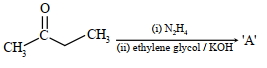
A
$CH_3-CH(OH)-CH_2-CH_3$
B
$CH_3-CH_2-CH_2-CH_3$
C
$CH_3-C(=N-NH_2)-CH_2-CH_3$
D
$CH_3-C(=N-NH_2)-CH_3$
Solution
(B) The given reaction is the Wolff-Kishner reduction.
In this reaction,a carbonyl group $(C=O)$ of an aldehyde or ketone is reduced to a methylene group $(CH_2)$ using hydrazine $(N_2H_4)$ followed by heating with a strong base like $KOH$ in a high-boiling solvent such as ethylene glycol.
The starting material is butan$-2-$one $(CH_3-CO-CH_2-CH_3)$.
Upon treatment with $N_2H_4$ and ethylene glycol/$KOH$,the ketone group is reduced to a methylene group,yielding butane $(CH_3-CH_2-CH_2-CH_3)$.
In this reaction,a carbonyl group $(C=O)$ of an aldehyde or ketone is reduced to a methylene group $(CH_2)$ using hydrazine $(N_2H_4)$ followed by heating with a strong base like $KOH$ in a high-boiling solvent such as ethylene glycol.
The starting material is butan$-2-$one $(CH_3-CO-CH_2-CH_3)$.
Upon treatment with $N_2H_4$ and ethylene glycol/$KOH$,the ketone group is reduced to a methylene group,yielding butane $(CH_3-CH_2-CH_2-CH_3)$.
0 likesView Solution
239
ChemistryMediumMCQJEE Main · 2024
The reaction at the cathode in the cells commonly used in clocks involves:
A
reduction of $Mn$ from $+4$ to $+3$
B
oxidation of $Mn$ from $+3$ to $+4$
C
reduction of $Mn$ from $+7$ to $+2$
D
oxidation of $Mn$ from $+2$ to $+7$
Solution
(A) The cells commonly used in clocks are mercury cells or zinc-carbon dry cells. In these cells,the cathode reaction involves the reduction of manganese dioxide $(MnO_2)$.
Specifically,in the dry cell,the reaction at the cathode is: $MnO_2 + NH_4^+ + e^- \rightarrow MnO(OH) + NH_3$.
In $MnO_2$,the oxidation state of $Mn$ is $+4$. In $MnO(OH)$,the oxidation state of $Mn$ is $+3$.
Therefore,the reaction involves the reduction of $Mn$ from $+4$ to $+3$.
Specifically,in the dry cell,the reaction at the cathode is: $MnO_2 + NH_4^+ + e^- \rightarrow MnO(OH) + NH_3$.
In $MnO_2$,the oxidation state of $Mn$ is $+4$. In $MnO(OH)$,the oxidation state of $Mn$ is $+3$.
Therefore,the reaction involves the reduction of $Mn$ from $+4$ to $+3$.
0 likesView Solution
240
ChemistryMediumMCQJEE Main · 2024
Which one of the following complexes will exhibit the least paramagnetic behaviour?
[Atomic number: $Cr=24, Mn=25, Fe=26, Co=27$]
[Atomic number: $Cr=24, Mn=25, Fe=26, Co=27$]
A
$[Co(H_2O)_6]^{2+}$
B
$[Fe(H_2O)_6]^{2+}$
C
$[Mn(H_2O)_6]^{2+}$
D
$[Cr(H_2O)_6]^{2+}$
Solution
(A) To determine the paramagnetic behaviour,we calculate the number of unpaired electrons $(n)$ for each complex. Since $H_2O$ is a weak field ligand,the electrons remain unpaired in the $d$-orbitals.
Paramagnetic behaviour is directly proportional to the number of unpaired electrons $(n)$.
Since $[Co(H_2O)_6]^{2+}$ has the minimum number of unpaired electrons $(n=3)$,it exhibits the least paramagnetic behaviour.
| Complex | Electronic Configuration and Unpaired Electrons $(n)$ |
| $[Co(H_2O)_6]^{2+}$ | $Co^{2+} (d^7): t_{2g}^5 e_g^2, n=3$ |
| $[Fe(H_2O)_6]^{2+}$ | $Fe^{2+} (d^6): t_{2g}^4 e_g^2, n=4$ |
| $[Mn(H_2O)_6]^{2+}$ | $Mn^{2+} (d^5): t_{2g}^3 e_g^2, n=5$ |
| $[Cr(H_2O)_6]^{2+}$ | $Cr^{2+} (d^4): t_{2g}^3 e_g^1, n=4$ |
Paramagnetic behaviour is directly proportional to the number of unpaired electrons $(n)$.
Since $[Co(H_2O)_6]^{2+}$ has the minimum number of unpaired electrons $(n=3)$,it exhibits the least paramagnetic behaviour.
0 likesView Solution
241
ChemistryMediumMCQJEE Main · 2024
The correct order of ligands arranged in increasing field strength.
A
$Cl^{-} < OH^{-} < Br^{-} < CN^{-}$
B
$F^{-} < Br^{-} < I^{-} < NH_3$
C
$Br^{-} < F^{-} < H_2O < NH_3$
D
$H_2O < OH^{-} < CN^{-} < NH_3$
Solution
(C) The spectrochemical series arranges ligands in order of increasing field strength.
Based on experimental data,the order for the given ligands is:
$I^{-} < Br^{-} < S^{2-} < SCN^{-} < Cl^{-} < F^{-} < OH^{-} < C_2O_4^{2-} < H_2O < NCS^{-} < NH_3 < en < NO_2^{-} < CN^{-} < CO$.
Comparing the options provided,the correct sequence is $Br^{-} < F^{-} < H_2O < NH_3$.
Based on experimental data,the order for the given ligands is:
$I^{-} < Br^{-} < S^{2-} < SCN^{-} < Cl^{-} < F^{-} < OH^{-} < C_2O_4^{2-} < H_2O < NCS^{-} < NH_3 < en < NO_2^{-} < CN^{-} < CO$.
Comparing the options provided,the correct sequence is $Br^{-} < F^{-} < H_2O < NH_3$.
0 likesView Solution
242
ChemistryMediumMCQJEE Main · 2024
Which of the following gives a positive test with ninhydrin?
A
Cellulose
B
Starch
C
Polyvinyl chloride
D
Egg albumin
Solution
(D) The ninhydrin test is a chemical test used to detect the presence of amino acids or proteins.
When ninhydrin reacts with amino acids or proteins,it produces a characteristic purple or blue color (Ruhemann's purple).
Among the given options,$A$,$B$,and $C$ are carbohydrates or synthetic polymers that do not contain amino groups.
$Egg \text{ } albumin$ is a protein,which is a polymer of amino acids,and therefore it will give a positive ninhydrin test.
When ninhydrin reacts with amino acids or proteins,it produces a characteristic purple or blue color (Ruhemann's purple).
Among the given options,$A$,$B$,and $C$ are carbohydrates or synthetic polymers that do not contain amino groups.
$Egg \text{ } albumin$ is a protein,which is a polymer of amino acids,and therefore it will give a positive ninhydrin test.
0 likesView Solution
243
ChemistryMediumMCQJEE Main · 2024
The metal that shows the highest and maximum number of oxidation states is:
A
$Fe$
B
$Mn$
C
$Ti$
D
$Co$
Solution
(B) $Mn$ (Manganese) exhibits the highest number of oxidation states among the $3d$ transition series metals,ranging from $+2$ to $+7$.
Specifically,it shows the maximum oxidation state of $+7$ in compounds like $KMnO_4$.
Specifically,it shows the maximum oxidation state of $+7$ in compounds like $KMnO_4$.
0 likesView Solution
244
ChemistryMediumMCQJEE Main · 2024
Given below are two statements:
Statement $I$: Bromination of phenol in solvent with low polarity such as $CHCl_3$ or $CS_2$ requires Lewis acid catalyst.
Statement $II$: The Lewis acid catalyst polarises the bromine to generate $Br^{+}$.
In the light of the above statements,choose the correct answer from the options given below:
Statement $I$: Bromination of phenol in solvent with low polarity such as $CHCl_3$ or $CS_2$ requires Lewis acid catalyst.
Statement $II$: The Lewis acid catalyst polarises the bromine to generate $Br^{+}$.
In the light of the above statements,choose the correct answer from the options given below:
A
Statement $I$ is true but Statement $II$ is false.
B
Both Statement $I$ and Statement $II$ are true.
C
Both Statement $I$ and Statement $II$ are false.
D
Statement $I$ is false but Statement $II$ is true.
Solution
(D) Phenol is a highly activated aromatic ring due to the strong electron-donating effect of the $-OH$ group.
Because of this high activation,phenol undergoes electrophilic substitution (bromination) even in non-polar solvents like $CHCl_3$ or $CS_2$ without the need for a Lewis acid catalyst.
Therefore,Statement $I$ is false.
Statement $II$ correctly describes the general role of a Lewis acid in halogenation reactions (polarizing $Br_2$ to generate $Br^+$),but since Statement $I$ is false,the correct choice is that Statement $I$ is false but Statement $II$ is true.
Because of this high activation,phenol undergoes electrophilic substitution (bromination) even in non-polar solvents like $CHCl_3$ or $CS_2$ without the need for a Lewis acid catalyst.
Therefore,Statement $I$ is false.
Statement $II$ correctly describes the general role of a Lewis acid in halogenation reactions (polarizing $Br_2$ to generate $Br^+$),but since Statement $I$ is false,the correct choice is that Statement $I$ is false but Statement $II$ is true.
0 likesView Solution
245
ChemistryMediumMCQJEE Main · 2024
Molar ionic conductivities of a divalent cation and a divalent anion are $57 \ S \ cm^2 \ mol^{-1}$ and $73 \ S \ cm^2 \ mol^{-1}$ respectively. The molar conductivity of a solution of an electrolyte containing these ions will be:
A
$65 \ S \ cm^2 \ mol^{-1}$
B
$130 \ S \ cm^2 \ mol^{-1}$
C
$187 \ S \ cm^2 \ mol^{-1}$
D
$260 \ S \ cm^2 \ mol^{-1}$
Solution
(B) According to Kohlrausch's law of independent migration of ions,the molar conductivity of an electrolyte at infinite dilution is the sum of the molar ionic conductivities of its constituent ions.
For an electrolyte $CA$ where $C$ is a divalent cation $(C^{2+})$ and $A$ is a divalent anion $(A^{2-})$,the molar conductivity is given by:
$\Lambda_m^\circ = \lambda_+ + \lambda_-$
Given:
$\lambda_{C^{2+}} = 57 \ S \ cm^2 \ mol^{-1}$
$\lambda_{A^{2-}} = 73 \ S \ cm^2 \ mol^{-1}$
Therefore:
$\Lambda_m^\circ = 57 + 73 = 130 \ S \ cm^2 \ mol^{-1}$
For an electrolyte $CA$ where $C$ is a divalent cation $(C^{2+})$ and $A$ is a divalent anion $(A^{2-})$,the molar conductivity is given by:
$\Lambda_m^\circ = \lambda_+ + \lambda_-$
Given:
$\lambda_{C^{2+}} = 57 \ S \ cm^2 \ mol^{-1}$
$\lambda_{A^{2-}} = 73 \ S \ cm^2 \ mol^{-1}$
Therefore:
$\Lambda_m^\circ = 57 + 73 = 130 \ S \ cm^2 \ mol^{-1}$
0 likesView Solution
246
ChemistryMediumMCQJEE Main · 2024
In a borax bead test under hot condition,a metal salt is heated at point $B$ of the flame,resulting in a green-coloured salt bead. The spin-only magnetic moment value of the salt is $..........$ $BM$ (Nearest integer). [Given atomic number of $Cu=29, Ni=28, Mn=25, Fe=26$]

A
$5$
B
$6$
C
$7$
D
$9$
Solution
(B) In the borax bead test,point $A$ represents the oxidizing flame (outer part) and point $B$ represents the reducing flame (inner part).
Copper salts $(Cu^{2+})$ produce a green-coloured bead in the oxidizing flame (hot) and a red-coloured bead in the reducing flame.
However,iron salts $(Fe^{3+})$ produce a yellow-brown bead in the oxidizing flame and a bottle-green bead in the reducing flame (point $B$).
For $Fe^{3+}$ $([Ar] 3d^5)$,the number of unpaired electrons $(n)$ is $5$.
The spin-only magnetic moment is calculated as $\mu = \sqrt{n(n+2)} = \sqrt{5(5+2)} = \sqrt{35} \approx 5.92 \ BM$.
The nearest integer value is $6$.
Copper salts $(Cu^{2+})$ produce a green-coloured bead in the oxidizing flame (hot) and a red-coloured bead in the reducing flame.
However,iron salts $(Fe^{3+})$ produce a yellow-brown bead in the oxidizing flame and a bottle-green bead in the reducing flame (point $B$).
For $Fe^{3+}$ $([Ar] 3d^5)$,the number of unpaired electrons $(n)$ is $5$.
The spin-only magnetic moment is calculated as $\mu = \sqrt{n(n+2)} = \sqrt{5(5+2)} = \sqrt{35} \approx 5.92 \ BM$.
The nearest integer value is $6$.
0 likesView Solution
247
ChemistryMediumMCQJEE Main · 2024
Consider the given chemical reaction sequence:
(Image provided)
Total sum of oxygen atoms in Product $A$ and Product $B$ are .........
(Image provided)
Total sum of oxygen atoms in Product $A$ and Product $B$ are .........
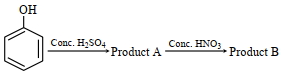
A
$10$
B
$11$
C
$15$
D
$14$
Solution
(D) The reaction of phenol with concentrated $H_2SO_4$ at $373 \ K$ yields phenol-$2,4$-disulphonic acid (Product $A$).
Chemical formula of Product $A$ $(C_6H_6O_7S_2)$: It contains $7$ oxygen atoms.
Reaction of phenol-$2,4$-disulphonic acid with concentrated $HNO_3$ yields $2,4,6$-trinitrophenol (Picric acid) (Product $B$).
Chemical formula of Product $B$ $(C_6H_3N_3O_7)$: It contains $7$ oxygen atoms.
Total sum of oxygen atoms = $7$ (in $A$) + $7$ (in $B$) = $14$.
Chemical formula of Product $A$ $(C_6H_6O_7S_2)$: It contains $7$ oxygen atoms.
Reaction of phenol-$2,4$-disulphonic acid with concentrated $HNO_3$ yields $2,4,6$-trinitrophenol (Picric acid) (Product $B$).
Chemical formula of Product $B$ $(C_6H_3N_3O_7)$: It contains $7$ oxygen atoms.
Total sum of oxygen atoms = $7$ (in $A$) + $7$ (in $B$) = $14$.
0 likesView Solution
248
ChemistryMediumMCQJEE Main · 2024
The spin-only magnetic moment value of the ion among $Ti^{2+}$,$V^{2+}$,$Co^{3+}$,and $Cr^{2+}$ that acts as a strong oxidizing agent in aqueous solution is .......... $BM$ (nearest integer).
(Given atomic numbers: $Ti = 22, V = 23, Cr = 24, Co = 27$)
(Given atomic numbers: $Ti = 22, V = 23, Cr = 24, Co = 27$)
A
$5$
B
$8$
C
$10$
D
$15$
Solution
(A) The ion that acts as a strong oxidizing agent in aqueous solution is $Co^{3+}$ because it has a high reduction potential $(Co^{3+} + e^{-} \rightarrow Co^{2+})$.
The electronic configuration of $Co^{3+}$ $(Z = 27)$ is $[Ar] 3d^6$.
The number of unpaired electrons $(n)$ in $3d^6$ is $4$.
The spin-only magnetic moment is calculated as $\mu = \sqrt{n(n+2)} \ BM$.
$\mu = \sqrt{4(4+2)} = \sqrt{24} \ BM \approx 4.9 \ BM$.
The nearest integer value is $5$.
The electronic configuration of $Co^{3+}$ $(Z = 27)$ is $[Ar] 3d^6$.
The number of unpaired electrons $(n)$ in $3d^6$ is $4$.
The spin-only magnetic moment is calculated as $\mu = \sqrt{n(n+2)} \ BM$.
$\mu = \sqrt{4(4+2)} = \sqrt{24} \ BM \approx 4.9 \ BM$.
The nearest integer value is $5$.
0 likesView Solution
249
ChemistryMediumMCQJEE Main · 2024
During the kinetic study of the reaction $2A + B \rightarrow C + D$,the following results were obtained:
Based on the above data,the overall order of the reaction is:
| Experiment | $[A] \ (M), [B] \ (M)$ and Initial rate of formation of $D$ |
|---|---|
| $i. \ [A]=0.1, [B]=0.1$ | $6.0 \times 10^{-3} \ M \ s^{-1}$ |
| $ii. \ [A]=0.3, [B]=0.2$ | $7.2 \times 10^{-2} \ M \ s^{-1}$ |
| $iii. \ [A]=0.3, [B]=0.4$ | $2.88 \times 10^{-1} \ M \ s^{-1}$ |
| $iv. \ [A]=0.4, [B]=0.1$ | $2.40 \times 10^{-2} \ M \ s^{-1}$ |
Based on the above data,the overall order of the reaction is:
A
$2$
B
$3$
C
$4$
D
$5$
Solution
(B) The rate law is given by $r = K[A]^{x}[B]^{y}$.
Using experiment $(i)$ and $(iv)$ where $[B]$ is constant:
$6.0 \times 10^{-3} = K(0.1)^{x}(0.1)^{y}$
$2.40 \times 10^{-2} = K(0.4)^{x}(0.1)^{y}$
Dividing $(iv)$ by $(i)$ gives: $4 = (4)^{x}$,so $x = 1$.
Using experiment $(ii)$ and $(iii)$ where $[A]$ is constant:
$7.2 \times 10^{-2} = K(0.3)^{x}(0.2)^{y}$
$2.88 \times 10^{-1} = K(0.3)^{x}(0.4)^{y}$
Dividing $(iii)$ by $(ii)$ gives: $4 = (2)^{y}$,so $y = 2$.
Overall order $= x + y = 1 + 2 = 3$.
Using experiment $(i)$ and $(iv)$ where $[B]$ is constant:
$6.0 \times 10^{-3} = K(0.1)^{x}(0.1)^{y}$
$2.40 \times 10^{-2} = K(0.4)^{x}(0.1)^{y}$
Dividing $(iv)$ by $(i)$ gives: $4 = (4)^{x}$,so $x = 1$.
Using experiment $(ii)$ and $(iii)$ where $[A]$ is constant:
$7.2 \times 10^{-2} = K(0.3)^{x}(0.2)^{y}$
$2.88 \times 10^{-1} = K(0.3)^{x}(0.4)^{y}$
Dividing $(iii)$ by $(ii)$ gives: $4 = (2)^{y}$,so $y = 2$.
Overall order $= x + y = 1 + 2 = 3$.
0 likesView Solution
250
ChemistryMediumMCQJEE Main · 2024
An artificial cell is made by encapsulating $0.2 \ M$ glucose solution within a semipermeable membrane. The osmotic pressure developed when the artificial cell is placed within a $0.05 \ M$ solution of $NaCl$ at $300 \ K$ is . . . . . . . . . .$\times 10^{-1} \ bar$. (Nearest Integer)
[Given : $R=0.083 \ L \ bar \ mol^{-1} \ K^{-1}$ ]
Assume complete dissociation of $NaCl$.
[Given : $R=0.083 \ L \ bar \ mol^{-1} \ K^{-1}$ ]
Assume complete dissociation of $NaCl$.
A
$10$
B
$20$
C
$25$
D
$30$
Solution
(C) The osmotic pressure $\pi$ is given by the formula $\pi = \Delta C \times R \times T$,where $\Delta C$ is the difference in molar concentrations of the particles.
For the glucose solution inside the cell: $C_{glucose} = 0.2 \ M$.
For the $NaCl$ solution outside the cell,assuming complete dissociation $(NaCl \rightarrow Na^{+} + Cl^{-})$,the total concentration of particles is $C_{NaCl} = 2 \times 0.05 \ M = 0.1 \ M$.
The net concentration difference is $\Delta C = C_{glucose} - C_{NaCl} = 0.2 \ M - 0.1 \ M = 0.1 \ M$.
Now,calculate the osmotic pressure:
$\pi = 0.1 \times 0.083 \times 300$
$\pi = 2.49 \ \text{bar}$
To express this in $\times 10^{-1} \ \text{bar}$:
$\pi = 24.9 \times 10^{-1} \ \text{bar}$.
Rounding to the nearest integer,we get $25$.
For the glucose solution inside the cell: $C_{glucose} = 0.2 \ M$.
For the $NaCl$ solution outside the cell,assuming complete dissociation $(NaCl \rightarrow Na^{+} + Cl^{-})$,the total concentration of particles is $C_{NaCl} = 2 \times 0.05 \ M = 0.1 \ M$.
The net concentration difference is $\Delta C = C_{glucose} - C_{NaCl} = 0.2 \ M - 0.1 \ M = 0.1 \ M$.
Now,calculate the osmotic pressure:
$\pi = 0.1 \times 0.083 \times 300$
$\pi = 2.49 \ \text{bar}$
To express this in $\times 10^{-1} \ \text{bar}$:
$\pi = 24.9 \times 10^{-1} \ \text{bar}$.
Rounding to the nearest integer,we get $25$.
0 likesView Solution
Vedclass Products
For Students
Vedclass Test Series
Mock tests in real JEE Main style covering Chemistry with performance analysis. 5-day free trial.
Start Free TrialFor Teachers
Exam Paper Generator
Generate Set A/B/C/D Chemistry papers from 7.5L+ questions in 2 minutes. 3 chapters free.
Try FreeFor Institutes
Online Exam Module
Run live JEE Main mock exams with unlimited students, 360° analytics & white-label branding.
See DemoFrequently Asked Questions
How many Chemistry questions are in JEE Main 2024?
There are 606 Chemistry questions from the JEE Main 2024 paper on Vedclass, each with a detailed step-by-step solution in English.
Are JEE Main 2024 Chemistry solutions available in English?
Yes. All solutions on this page are in English. You can also switch to English or Hindi using the language buttons above the questions.
Can I practice JEE Main 2024 Chemistry as a timed test?
Yes. Use the Vedclass Test Series to attempt a full JEE Main mock test covering Chemistry with time limits and instant score analysis.
Can teachers create Chemistry papers from JEE Main previous year questions?
Yes. The Vedclass Exam Paper Generator lets teachers mix JEE Main Chemistry questions and generate Set A/B/C/D papers in minutes.
For Teachers & Institutes
Build a Custom Chemistry Paper
Pick JEE Main 2024 Chemistry questions, set difficulty, and generate Set A/B/C/D in 2 minutes.