
ChemistryQ251–335 of 606 questions
Page 6 of 7 · English
251
ChemistryMediumMCQJEE Main · 2024
The shape of a carbocation is:
A
trigonal planar
B
trigonal pyramidal
C
tetrahedral
D
linear
Solution
(A) In a carbocation,the positively charged carbon atom is $sp^2$ hybridized.
It is bonded to three other atoms and has no lone pair of electrons.
According to the Valence Shell Electron Pair Repulsion $(VSEPR)$ theory,the arrangement of three bonding pairs around the central atom results in a trigonal planar geometry with bond angles of approximately $120^{\circ}$.
It is bonded to three other atoms and has no lone pair of electrons.
According to the Valence Shell Electron Pair Repulsion $(VSEPR)$ theory,the arrangement of three bonding pairs around the central atom results in a trigonal planar geometry with bond angles of approximately $120^{\circ}$.
0 likesView Solution
252
ChemistryMediumMCQJEE Main · 2024
The $IUPAC$ name of the following hydrocarbon $(X)$ is:

A
$2-$Ethyl$-3,6-$dimethylheptane
B
$2-$Ethyl$-2,6-$diethylheptane
C
$2,5,6-$Trimethyloctane
D
$3,4,7-$Trimethyloctane
Solution
(C) $1$. Identify the longest carbon chain: The longest chain contains $8$ carbon atoms,so the parent alkane is octane.
$2$. Number the chain: Number the chain from the end that gives the lowest locants to the substituents. Numbering from left to right gives substituents at positions $2, 5,$ and $6$.
$3$. Identify substituents: There are three methyl groups at positions $2, 5,$ and $6$.
$4$. Combine: The name is $2,5,6-$trimethyloctane.
$2$. Number the chain: Number the chain from the end that gives the lowest locants to the substituents. Numbering from left to right gives substituents at positions $2, 5,$ and $6$.
$3$. Identify substituents: There are three methyl groups at positions $2, 5,$ and $6$.
$4$. Combine: The name is $2,5,6-$trimethyloctane.
0 likesView Solution
253
ChemistryMediumMCQJEE Main · 2024
The equilibrium $Cr_2O_7^{2-} + H_2O \rightleftharpoons 2CrO_4^{2-} + 2H^{+}$ is shifted to the right in:
A
an acidic medium
B
a basic medium
C
a weakly acidic medium
D
a neutral medium
Solution
(B) The given equilibrium is $Cr_2O_7^{2-} + H_2O \rightleftharpoons 2CrO_4^{2-} + 2H^{+}$.
According to Le Chatelier's principle,if we add a base ($OH^-$ ions) to the system,the $OH^-$ ions will react with the $H^+$ ions produced in the reaction to form water $(H^+ + OH^- \rightarrow H_2O)$.
This removal of $H^+$ ions from the product side decreases the concentration of $H^+$,which causes the equilibrium to shift to the right to produce more $H^+$ ions.
Therefore,the equilibrium shifts to the right in a basic medium.
According to Le Chatelier's principle,if we add a base ($OH^-$ ions) to the system,the $OH^-$ ions will react with the $H^+$ ions produced in the reaction to form water $(H^+ + OH^- \rightarrow H_2O)$.
This removal of $H^+$ ions from the product side decreases the concentration of $H^+$,which causes the equilibrium to shift to the right to produce more $H^+$ ions.
Therefore,the equilibrium shifts to the right in a basic medium.
0 likesView Solution
254
ChemistryMediumMCQJEE Main · 2024
Given below are two statements:
Statement $I$: $A$ buffer solution is the mixture of a salt and an acid or a base mixed in any particular quantities.
Statement $II$: Blood is a naturally occurring buffer solution whose $pH$ is maintained by $H_2CO_3 / HCO_3^{-}$ concentrations.
In the light of the above statements,choose the correct answer from the options given below.
Statement $I$: $A$ buffer solution is the mixture of a salt and an acid or a base mixed in any particular quantities.
Statement $II$: Blood is a naturally occurring buffer solution whose $pH$ is maintained by $H_2CO_3 / HCO_3^{-}$ concentrations.
In the light of the above statements,choose the correct answer from the options given below.
A
Statement $I$ is false but Statement $II$ is true
B
Both Statement $I$ and Statement $II$ are true
C
Both Statement $I$ and Statement $II$ are false
D
Statement $I$ is true but Statement $II$ is false
Solution
(A) buffer solution is a mixture of a weak acid and its conjugate base or a weak base and its conjugate acid in specific proportions,not just any quantity.
Statement $I$ is false because it implies any quantity of salt and acid/base works,whereas buffer action depends on specific ratios.
Blood is a naturally occurring buffer system maintained by the $H_2CO_3 / HCO_3^{-}$ pair,which keeps the $pH$ constant.
Statement $II$ is true.
Therefore,Statement $I$ is false but Statement $II$ is true.
Statement $I$ is false because it implies any quantity of salt and acid/base works,whereas buffer action depends on specific ratios.
Blood is a naturally occurring buffer system maintained by the $H_2CO_3 / HCO_3^{-}$ pair,which keeps the $pH$ constant.
Statement $II$ is true.
Therefore,Statement $I$ is false but Statement $II$ is true.
0 likesView Solution
255
ChemistryMediumMCQJEE Main · 2024
Identify the correct statements about $p$-block elements and their compounds.
$(A)$ Non-metals have higher electronegativity than metals.
$(B)$ Non-metals have lower ionisation enthalpy than metals.
$(C)$ Compounds formed between highly reactive non-metals and highly reactive metals are generally ionic.
$(D)$ The non-metal oxides are generally basic in nature.
$(E)$ The metal oxides are generally acidic or neutral in nature.
$(A)$ Non-metals have higher electronegativity than metals.
$(B)$ Non-metals have lower ionisation enthalpy than metals.
$(C)$ Compounds formed between highly reactive non-metals and highly reactive metals are generally ionic.
$(D)$ The non-metal oxides are generally basic in nature.
$(E)$ The metal oxides are generally acidic or neutral in nature.
A
$D$ and $E$ only
B
$A$ and $C$ only
C
$B$ and $E$ only
D
$B$ and $D$ only
Solution
(B) Statement $(A)$ is correct: Non-metals have higher electronegativity compared to metals due to their smaller size and higher effective nuclear charge.
Statement $(B)$ is incorrect: Non-metals have higher ionisation enthalpy than metals because they hold their valence electrons more tightly.
Statement $(C)$ is correct: Highly reactive metals (low electronegativity) and highly reactive non-metals (high electronegativity) form ionic compounds due to a large electronegativity difference.
Statement $(D)$ is incorrect: Non-metal oxides are generally acidic in nature.
Statement $(E)$ is incorrect: Metal oxides are generally basic in nature.
Therefore,statements $(A)$ and $(C)$ are correct.
Statement $(B)$ is incorrect: Non-metals have higher ionisation enthalpy than metals because they hold their valence electrons more tightly.
Statement $(C)$ is correct: Highly reactive metals (low electronegativity) and highly reactive non-metals (high electronegativity) form ionic compounds due to a large electronegativity difference.
Statement $(D)$ is incorrect: Non-metal oxides are generally acidic in nature.
Statement $(E)$ is incorrect: Metal oxides are generally basic in nature.
Therefore,statements $(A)$ and $(C)$ are correct.
0 likesView Solution
256
ChemistryMediumMCQJEE Main · 2024
Given below are two statements :
Statement $I$ : Kjeldahl method is applicable to estimate nitrogen in pyridine.
Statement $II$ : The nitrogen present in pyridine can easily be converted into ammonium sulphate in Kjeldahl method.
In the light of the above statements,choose the correct answer from the options given below.
Statement $I$ : Kjeldahl method is applicable to estimate nitrogen in pyridine.
Statement $II$ : The nitrogen present in pyridine can easily be converted into ammonium sulphate in Kjeldahl method.
In the light of the above statements,choose the correct answer from the options given below.
A
Both Statement $I$ and Statement $II$ are false
B
Statement $I$ is false but Statement $II$ is true
C
Both Statement $I$ and Statement $II$ are true
D
Statement $I$ is true but Statement $II$ is false
Solution
(A) The Kjeldahl method is not applicable to compounds containing nitrogen in a ring,such as pyridine,because the nitrogen atom in the ring is not easily converted to ammonium sulphate $(NH_4)_2SO_4$ under the conditions of the Kjeldahl method.
Therefore,both Statement $I$ and Statement $II$ are false.
Therefore,both Statement $I$ and Statement $II$ are false.
0 likesView Solution
257
ChemistryMediumMCQJEE Main · 2024
$\Delta_{vap} H^{\ominus}$ for water is $+40.49 \ kJ \ mol^{-1}$ at $1 \ bar$ and $100^{\circ} C$. The change in internal energy for this vaporization under the same conditions is . . . . . . . . . . $kJ \ mol^{-1}$. (Integer answer) (Given $R = 8.3 \ J \ K^{-1} \ mol^{-1}$)
A
$38$
B
$39$
C
$40$
D
$45$
Solution
(A) The vaporization reaction is: $H_2O(\ell) \rightarrow H_2O(g)$.
For this reaction,the change in the number of moles of gas is $\Delta n_g = 1 - 0 = 1$.
The temperature is $T = 100^{\circ} C = 373.15 \ K$.
The relationship between enthalpy change and internal energy change is: $\Delta H = \Delta U + \Delta n_g RT$.
Given $\Delta H = 40.49 \ kJ \ mol^{-1} = 40490 \ J \ mol^{-1}$.
Substituting the values: $40490 = \Delta U + (1 \times 8.3 \times 373.15)$.
$\Delta U = 40490 - 3097.145 = 37392.855 \ J \ mol^{-1} \approx 37.39 \ kJ \ mol^{-1}$.
Rounding to the nearest integer,we get $37 \ kJ \ mol^{-1}$. However,based on the provided options and standard calculation,the closest integer is $38$.
For this reaction,the change in the number of moles of gas is $\Delta n_g = 1 - 0 = 1$.
The temperature is $T = 100^{\circ} C = 373.15 \ K$.
The relationship between enthalpy change and internal energy change is: $\Delta H = \Delta U + \Delta n_g RT$.
Given $\Delta H = 40.49 \ kJ \ mol^{-1} = 40490 \ J \ mol^{-1}$.
Substituting the values: $40490 = \Delta U + (1 \times 8.3 \times 373.15)$.
$\Delta U = 40490 - 3097.145 = 37392.855 \ J \ mol^{-1} \approx 37.39 \ kJ \ mol^{-1}$.
Rounding to the nearest integer,we get $37 \ kJ \ mol^{-1}$. However,based on the provided options and standard calculation,the closest integer is $38$.
0 likesView Solution
258
ChemistryMediumMCQJEE Main · 2024
Number of molecules having bond order $2$ from the following molecules is: $C_2, O_2, Be_2, Li_2, Ne_2, N_2, He_2$
A
$1$
B
$2$
C
$3$
D
$4$
Solution
(B) The bond order is calculated using the formula: $\text{B.O.} = \frac{N_b - N_a}{2}$.
$C_2$ $(12 \ e^-)$: $\sigma 1s^2, \sigma^* 1s^2, \sigma 2s^2, \sigma^* 2s^2, \pi 2p_x^2 = \pi 2p_y^2$. $\text{B.O.} = \frac{8-4}{2} = 2$.
$O_2$ $(16 \ e^-)$: $\sigma 1s^2, \sigma^* 1s^2, \sigma 2s^2, \sigma^* 2s^2, \sigma 2p_z^2, \pi 2p_x^2 = \pi 2p_y^2, \pi^* 2p_x^1 = \pi^* 2p_y^1$. $\text{B.O.} = \frac{10-6}{2} = 2$.
$Be_2$ $(8 \ e^-)$: $\text{B.O.} = 0$.
$Li_2$ $(6 \ e^-)$: $\text{B.O.} = 1$.
$Ne_2$ $(20 \ e^-)$: $\text{B.O.} = 0$.
$N_2$ $(14 \ e^-)$: $\text{B.O.} = 3$.
$He_2$ $(4 \ e^-)$: $\text{B.O.} = 0$.
Thus,only $C_2$ and $O_2$ have a bond order of $2$. The total count is $2$.
$C_2$ $(12 \ e^-)$: $\sigma 1s^2, \sigma^* 1s^2, \sigma 2s^2, \sigma^* 2s^2, \pi 2p_x^2 = \pi 2p_y^2$. $\text{B.O.} = \frac{8-4}{2} = 2$.
$O_2$ $(16 \ e^-)$: $\sigma 1s^2, \sigma^* 1s^2, \sigma 2s^2, \sigma^* 2s^2, \sigma 2p_z^2, \pi 2p_x^2 = \pi 2p_y^2, \pi^* 2p_x^1 = \pi^* 2p_y^1$. $\text{B.O.} = \frac{10-6}{2} = 2$.
$Be_2$ $(8 \ e^-)$: $\text{B.O.} = 0$.
$Li_2$ $(6 \ e^-)$: $\text{B.O.} = 1$.
$Ne_2$ $(20 \ e^-)$: $\text{B.O.} = 0$.
$N_2$ $(14 \ e^-)$: $\text{B.O.} = 3$.
$He_2$ $(4 \ e^-)$: $\text{B.O.} = 0$.
Thus,only $C_2$ and $O_2$ have a bond order of $2$. The total count is $2$.
0 likesView Solution
259
ChemistryMediumMCQJEE Main · 2024
Total number of optically active compounds from the following is $......$
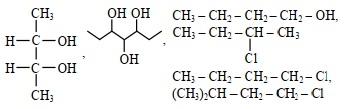
A
$5$
B
$8$
C
$1$
D
$9$
Solution
(C) To determine the number of optically active compounds,we check for the presence of chiral centers and the absence of a plane of symmetry $(POS)$ or center of symmetry $(COS)$.
$1$. $2,3$-butanediol (first structure): The structure shown is the meso form (due to a plane of symmetry),so it is optically inactive.
$2$. $2,3,4$-hexanetriol (second structure): This molecule has chiral centers at $C2, C3,$ and $C4$. It does not possess a plane of symmetry or center of symmetry,making it optically active.
$3$. $1$-butanol $(CH_3-CH_2-CH_2-CH_2-OH)$: No chiral center,optically inactive.
$4$. $2$-chlorobutane $(CH_3-CH_2-CHCl-CH_3)$: This molecule has a chiral center at $C2$. It is optically active.
$5$. $1$-chlorobutane $(CH_3-CH_2-CH_2-CH_2-Cl)$: No chiral center,optically inactive.
$6$. $1$-chloro-$3$-methylbutane $((CH_3)_2CH-CH_2-CH_2-Cl)$: No chiral center,optically inactive.
Thus,there are $2$ optically active compounds in the given list.
$1$. $2,3$-butanediol (first structure): The structure shown is the meso form (due to a plane of symmetry),so it is optically inactive.
$2$. $2,3,4$-hexanetriol (second structure): This molecule has chiral centers at $C2, C3,$ and $C4$. It does not possess a plane of symmetry or center of symmetry,making it optically active.
$3$. $1$-butanol $(CH_3-CH_2-CH_2-CH_2-OH)$: No chiral center,optically inactive.
$4$. $2$-chlorobutane $(CH_3-CH_2-CHCl-CH_3)$: This molecule has a chiral center at $C2$. It is optically active.
$5$. $1$-chlorobutane $(CH_3-CH_2-CH_2-CH_2-Cl)$: No chiral center,optically inactive.
$6$. $1$-chloro-$3$-methylbutane $((CH_3)_2CH-CH_2-CH_2-Cl)$: No chiral center,optically inactive.
Thus,there are $2$ optically active compounds in the given list.
0 likesView Solution
260
ChemistryMediumMCQJEE Main · 2024
Total number of aromatic compounds among the following compounds is:
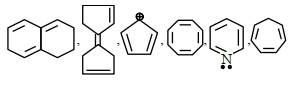
A
$2$
B
$1$
C
$5$
D
$8$
Solution
(A) To determine the aromaticity of the given compounds,we check for $H$ückel's rule ($4n+2$ $\pi$ electrons),planarity,and cyclic conjugation:
$1$. $1,4$-dihydronaphthalene: Non-aromatic (not fully conjugated).
$2$. Fulvalene: Non-aromatic (not fully conjugated).
$3$. Cyclopentadienyl cation: Aromatic ($2$ $\pi$ electrons,$n=0$,planar,cyclic,conjugated).
$4$. Cyclooctatetraene: Non-aromatic (tub-shaped,non-planar,$8$ $\pi$ electrons).
$5$. Pyridine: Aromatic ($6$ $\pi$ electrons,$n=1$,planar,cyclic,conjugated).
$6$. Cycloheptatriene: Non-aromatic ($sp^3$ carbon present).
Thus,there are $2$ aromatic compounds (Cyclopentadienyl cation and Pyridine).
$1$. $1,4$-dihydronaphthalene: Non-aromatic (not fully conjugated).
$2$. Fulvalene: Non-aromatic (not fully conjugated).
$3$. Cyclopentadienyl cation: Aromatic ($2$ $\pi$ electrons,$n=0$,planar,cyclic,conjugated).
$4$. Cyclooctatetraene: Non-aromatic (tub-shaped,non-planar,$8$ $\pi$ electrons).
$5$. Pyridine: Aromatic ($6$ $\pi$ electrons,$n=1$,planar,cyclic,conjugated).
$6$. Cycloheptatriene: Non-aromatic ($sp^3$ carbon present).
Thus,there are $2$ aromatic compounds (Cyclopentadienyl cation and Pyridine).
0 likesView Solution
261
ChemistryMediumMCQJEE Main · 2024
Wavenumber for a radiation having $5800 \ \mathring{A}$ wavelength is $x \times 10 \ cm^{-1}$. The value of $x$ is . . . . . . . .
A
$1724$
B
$1725$
C
$1727$
D
$1730$
Solution
(A) The wavenumber $(\bar{\nu})$ is defined as the reciprocal of wavelength $(\lambda)$:
$\bar{\nu} = \frac{1}{\lambda}$
Given $\lambda = 5800 \ \mathring{A} = 5800 \times 10^{-8} \ cm = 5.8 \times 10^{-5} \ cm$.
$\bar{\nu} = \frac{1}{5.8 \times 10^{-5} \ cm} = 17241.37 \ cm^{-1}$.
We are given $\bar{\nu} = x \times 10 \ cm^{-1}$.
So,$x \times 10 = 17241.37$.
$x = 1724.137 \approx 1724$.
$\bar{\nu} = \frac{1}{\lambda}$
Given $\lambda = 5800 \ \mathring{A} = 5800 \times 10^{-8} \ cm = 5.8 \times 10^{-5} \ cm$.
$\bar{\nu} = \frac{1}{5.8 \times 10^{-5} \ cm} = 17241.37 \ cm^{-1}$.
We are given $\bar{\nu} = x \times 10 \ cm^{-1}$.
So,$x \times 10 = 17241.37$.
$x = 1724.137 \approx 1724$.
0 likesView Solution
262
ChemistryMediumMCQJEE Main · 2024
Methods used for purification of organic compounds are based on:
A
neither on nature of compound nor on the impurity present.
B
nature of compound only.
C
nature of compound and presence of impurity.
D
presence of impurity only.
Solution
(C) The choice of a purification method for organic compounds depends on both the physical and chemical properties of the compound itself and the nature of the impurities present in the mixture.
0 likesView Solution
263
ChemistryMediumMCQJEE Main · 2024
In which one of the following pairs do the central atoms exhibit $sp^2$ hybridization?
A
$BF_3$ and $NO_2^{-}$
B
$NH_2^{-}$ and $H_2O$
C
$H_2O$ and $NO_2$
D
$NH_2^{-}$ and $BF_3$
Solution
(A) To determine the hybridization,we calculate the steric number using the formula: $\text{Steric Number} = \frac{1}{2} [V + M - C + A]$,where $V$ is the number of valence electrons,$M$ is the number of monovalent atoms,$C$ is the cationic charge,and $A$ is the anionic charge.
$1. BF_3$: Steric number = $\frac{1}{2} [3 + 3] = 3$ ($sp^2$ hybridization).
$2. NO_2^{-}$: Steric number = $\frac{1}{2} [5 + 0 + 1] = 3$ ($sp^2$ hybridization).
$3. NH_2^{-}$: Steric number = $\frac{1}{2} [5 + 2 + 1] = 4$ ($sp^3$ hybridization).
$4. H_2O$: Steric number = $\frac{1}{2} [6 + 2] = 4$ ($sp^3$ hybridization).
$5. NO_2$: The nitrogen atom has one unpaired electron,but for hybridization purposes,it is considered $sp^2$ due to the presence of one double bond and one lone electron.
Thus,both $BF_3$ and $NO_2^{-}$ exhibit $sp^2$ hybridization.
$1. BF_3$: Steric number = $\frac{1}{2} [3 + 3] = 3$ ($sp^2$ hybridization).
$2. NO_2^{-}$: Steric number = $\frac{1}{2} [5 + 0 + 1] = 3$ ($sp^2$ hybridization).
$3. NH_2^{-}$: Steric number = $\frac{1}{2} [5 + 2 + 1] = 4$ ($sp^3$ hybridization).
$4. H_2O$: Steric number = $\frac{1}{2} [6 + 2] = 4$ ($sp^3$ hybridization).
$5. NO_2$: The nitrogen atom has one unpaired electron,but for hybridization purposes,it is considered $sp^2$ due to the presence of one double bond and one lone electron.
Thus,both $BF_3$ and $NO_2^{-}$ exhibit $sp^2$ hybridization.
0 likesView Solution
264
ChemistryMediumMCQJEE Main · 2024
The $F^{-}$ ions make the enamel on teeth much harder by converting hydroxyapatite (the enamel on the surface of teeth) into much harder fluoroapatite having the formula.
A
$[3(Ca_3(PO_4)_2) \cdot CaF_2]$
B
$[3(Ca_2(PO_4)_2) \cdot Ca(OH)_2]$
C
$[3(Ca_3(PO_4)_3) \cdot CaF_2]$
D
$[3(Ca_3(PO_4)_2) \cdot Ca(OH)_2]$
Solution
(A) The enamel on the surface of teeth is made of hydroxyapatite,which is $[3(Ca_3(PO_4)_2) \cdot Ca(OH)_2]$.
When $F^{-}$ ions are present in drinking water,they react with hydroxyapatite to form fluoroapatite,which is much harder and more resistant to decay.
The chemical formula for fluoroapatite is $[3(Ca_3(PO_4)_2) \cdot CaF_2]$.
When $F^{-}$ ions are present in drinking water,they react with hydroxyapatite to form fluoroapatite,which is much harder and more resistant to decay.
The chemical formula for fluoroapatite is $[3(Ca_3(PO_4)_2) \cdot CaF_2]$.
0 likesView Solution
265
ChemistryMediumMCQJEE Main · 2024
The relative stability of the contributing structures is:
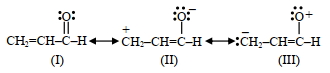
A
$I > III > II$
B
$I > II > III$
C
$II > I > III$
D
$III > II > I$
Solution
(B) $(1)$ Neutral structures are more stable than charged ones. Therefore,structure $I$ is more stable than structures $II$ and $III$.
$(2)$ In charged structures,a positive charge on a less electronegative atom is more stable. In structure $II$,the positive charge is on the carbon atom $(C^{\oplus})$,whereas in structure $III$,the positive charge is on the oxygen atom $(O^{\oplus})$. Since carbon is less electronegative than oxygen,structure $II$ is more stable than structure $III$.
$\therefore$ The order of stability is $I > II > III$.
$(2)$ In charged structures,a positive charge on a less electronegative atom is more stable. In structure $II$,the positive charge is on the carbon atom $(C^{\oplus})$,whereas in structure $III$,the positive charge is on the oxygen atom $(O^{\oplus})$. Since carbon is less electronegative than oxygen,structure $II$ is more stable than structure $III$.
$\therefore$ The order of stability is $I > II > III$.
0 likesView Solution
266
ChemistryMediumMCQJEE Main · 2024
Given below are two statements :
Statement $(I)$ : The oxidation state of an element in a particular compound is the charge acquired by its atom on the basis of electron gain enthalpy consideration from other atoms in the molecule.
Statement $(II)$ : $p\pi-p\pi$ bond formation is more prevalent in second period elements over other periods.
In the light of the above statements,choose the most appropriate answer from the options given below :
Statement $(I)$ : The oxidation state of an element in a particular compound is the charge acquired by its atom on the basis of electron gain enthalpy consideration from other atoms in the molecule.
Statement $(II)$ : $p\pi-p\pi$ bond formation is more prevalent in second period elements over other periods.
In the light of the above statements,choose the most appropriate answer from the options given below :
A
Both Statement $I$ and Statement $II$ are incorrect
B
Statement $I$ is correct but Statement $II$ is incorrect
C
Both Statement $I$ and Statement $II$ are correct
D
Statement $I$ is incorrect but Statement $II$ is correct
Solution
(D) Statement $(I)$ is incorrect because the oxidation state is defined based on electronegativity,not electron gain enthalpy.
Statement $(II)$ is correct because elements of the second period (like $C, N, O$) have small atomic sizes,which allow for effective side-on overlap of $2p$ orbitals,leading to strong $p\pi-p\pi$ bonding.
Therefore,Statement $(I)$ is incorrect but Statement $(II)$ is correct.
Statement $(II)$ is correct because elements of the second period (like $C, N, O$) have small atomic sizes,which allow for effective side-on overlap of $2p$ orbitals,leading to strong $p\pi-p\pi$ bonding.
Therefore,Statement $(I)$ is incorrect but Statement $(II)$ is correct.
0 likesView Solution
267
ChemistryMediumMCQJEE Main · 2024
Compare the energies of the following sets of quantum numbers for a multielectron system:
$A. n=4, \ell=1$
$B. n=4, \ell=2$
$C. n=3, \ell=1$
$D. n=3, \ell=2$
$E. n=4, \ell=0$
Choose the correct answer from the options given below:
$A. n=4, \ell=1$
$B. n=4, \ell=2$
$C. n=3, \ell=1$
$D. n=3, \ell=2$
$E. n=4, \ell=0$
Choose the correct answer from the options given below:
A
$(B) > (A) > (D) > (E) > (C)$
B
$(E) > (C) < (D) < (A) < (B)$
C
$(E) > (C) > (A) > (D) > (B)$
D
$(C) < (E) < (D) < (A) < (B)$
Solution
(A) The energy of an orbital in a multielectron system is determined by the $(n+\ell)$ rule.
$1$. Calculate $(n+\ell)$ for each set:
$A: 4+1 = 5$
$B: 4+2 = 6$
$C: 3+1 = 4$
$D: 3+2 = 5$
$E: 4+0 = 4$
$2$. Compare the $(n+\ell)$ values: $6 (B) > 5 (A, D) > 4 (C, E)$.
$3$. For orbitals with the same $(n+\ell)$ value,the orbital with the higher $n$ value has higher energy.
Comparing $A (n=4)$ and $D (n=3)$: $A > D$.
Comparing $E (n=4)$ and $C (n=3)$: $E > C$.
$4$. Combining these,the order of energy is: $(B) > (A) > (D) > (E) > (C)$.
$1$. Calculate $(n+\ell)$ for each set:
$A: 4+1 = 5$
$B: 4+2 = 6$
$C: 3+1 = 4$
$D: 3+2 = 5$
$E: 4+0 = 4$
$2$. Compare the $(n+\ell)$ values: $6 (B) > 5 (A, D) > 4 (C, E)$.
$3$. For orbitals with the same $(n+\ell)$ value,the orbital with the higher $n$ value has higher energy.
Comparing $A (n=4)$ and $D (n=3)$: $A > D$.
Comparing $E (n=4)$ and $C (n=3)$: $E > C$.
$4$. Combining these,the order of energy is: $(B) > (A) > (D) > (E) > (C)$.
0 likesView Solution
268
ChemistryMediumMCQJEE Main · 2024
Identify the major product $A$ and major product $B$ in the following set of reactions:
$CH_3-CH=CH_2 \xrightarrow{H_2O, H^+} \text{Major product } A$
$CH_3-CH=CH_2 \xrightarrow{(BH_3)_2, H_2O_2, OH^-} \text{Major product } B$
$CH_3-CH=CH_2 \xrightarrow{H_2O, H^+} \text{Major product } A$
$CH_3-CH=CH_2 \xrightarrow{(BH_3)_2, H_2O_2, OH^-} \text{Major product } B$
A
$A: CH_3CH_2CH_2-OH, B: CH_3CH_2CH_2-OH$
B
$A: CH_3CH_2CH_2-OH, B: CH_3CH(OH)CH_3$
C
$A: CH_3CH(OH)CH_3, B: CH_3CH_2CH_2-OH$
D
$A: CH_3CH_2CH_3, B: CH_3CH_2CH_3$
Solution
(C) $(1)$ Acid-catalyzed hydration of propene follows Markovnikov's rule,where the electrophile $H^+$ adds to the terminal carbon to form the more stable secondary carbocation $(CH_3-CH^+-CH_3)$,which is then attacked by $H_2O$ to form propan-$2$-ol as the major product $A$.
$(2)$ Hydroboration-oxidation of propene follows anti-Markovnikov's rule,where the boron atom adds to the terminal carbon,and subsequent oxidation with $H_2O_2/OH^-$ replaces boron with an $-OH$ group,resulting in propan-$1$-ol as the major product $B$.
$(2)$ Hydroboration-oxidation of propene follows anti-Markovnikov's rule,where the boron atom adds to the terminal carbon,and subsequent oxidation with $H_2O_2/OH^-$ replaces boron with an $-OH$ group,resulting in propan-$1$-ol as the major product $B$.
0 likesView Solution
269
ChemistryMediumMCQJEE Main · 2024
The heat of solution of anhydrous $CuSO_4$ and $CuSO_4 \cdot 5 H_2 O$ are $-70 \ kJ \ mol^{-1}$ and $+12 \ kJ \ mol^{-1}$ respectively. The heat of hydration of $CuSO_4$ to $CuSO_4 \cdot 5 H_2 O$ is $-x \ kJ$. The value of $x$ is:
A
$82$
B
$85$
C
$89$
D
$90$
Solution
(A) The given reactions are:
$(1)$ $CuSO_4(s) + 5H_2O(l) \rightarrow CuSO_4 \cdot 5H_2O(s) \quad \Delta H = -x \ kJ \ mol^{-1}$
$(2)$ $CuSO_4 \cdot 5H_2O(s) + aq \rightarrow CuSO_4(aq) \quad \Delta H = +12 \ kJ \ mol^{-1}$
$(3)$ $CuSO_4(s) + aq \rightarrow CuSO_4(aq) \quad \Delta H = -70 \ kJ \ mol^{-1}$
According to Hess's Law,the heat of solution of anhydrous $CuSO_4$ is the sum of the heat of hydration and the heat of solution of the hydrated salt:
$\Delta H_3 = \Delta H_1 + \Delta H_2$
$-70 = -x + 12$
$x = 12 + 70$
$x = 82$
Therefore,the value of $x$ is $82$.
$(1)$ $CuSO_4(s) + 5H_2O(l) \rightarrow CuSO_4 \cdot 5H_2O(s) \quad \Delta H = -x \ kJ \ mol^{-1}$
$(2)$ $CuSO_4 \cdot 5H_2O(s) + aq \rightarrow CuSO_4(aq) \quad \Delta H = +12 \ kJ \ mol^{-1}$
$(3)$ $CuSO_4(s) + aq \rightarrow CuSO_4(aq) \quad \Delta H = -70 \ kJ \ mol^{-1}$
According to Hess's Law,the heat of solution of anhydrous $CuSO_4$ is the sum of the heat of hydration and the heat of solution of the hydrated salt:
$\Delta H_3 = \Delta H_1 + \Delta H_2$
$-70 = -x + 12$
$x = 12 + 70$
$x = 82$
Therefore,the value of $x$ is $82$.
0 likesView Solution
270
ChemistryMediumMCQJEE Main · 2024
How many compounds among the following compounds show inductive,mesomeric as well as hyperconjugation effects?
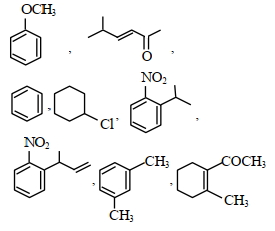
A
$5$
B
$3$
C
$4$
D
$8$
Solution
(C) To show all three effects (inductive,mesomeric,and hyperconjugation),a compound must have:
$1$. An electronegative atom or group (for inductive effect).
$2$. $A$ conjugated system or lone pair (for mesomeric effect).
$3$. An $\alpha$-hydrogen atom attached to an $sp^2$ hybridized carbon (for hyperconjugation).
Let's analyze the given compounds:
$1$. Anisole $(C_6H_5OCH_3)$: Shows inductive and mesomeric effects,but lacks $\alpha$-hydrogens on an $sp^2$ carbon for hyperconjugation.
$2$. $5$-methylhex-$3$-en-$2$-one: Shows inductive,mesomeric (conjugation with carbonyl),and hyperconjugation (due to $\alpha$-hydrogens on the isopropyl group).
$3$. Benzene: Shows only mesomeric effect (resonance).
$4$. Chlorocyclohexane: Shows only inductive effect.
$5$. $1$-isopropyl-$2$-nitrobenzene: Shows inductive,mesomeric (nitro group),and hyperconjugation (isopropyl group).
$6$. $1$-(o-nitrophenyl)prop-$2$-ene: Shows inductive,mesomeric,and hyperconjugation.
$7$. $m$-xylene: Shows inductive,hyperconjugation,but no mesomeric effect.
$8$. $1$-acetyl-$2$-methylcyclohexene: Shows inductive,mesomeric,and hyperconjugation.
The compounds that show all three effects are: $5$-methylhex-$3$-en-$2$-one,$1$-isopropyl-$2$-nitrobenzene,$1$-(o-nitrophenyl)prop-$2$-ene,and $1$-acetyl-$2$-methylcyclohexene.
Total count = $4$.
$1$. An electronegative atom or group (for inductive effect).
$2$. $A$ conjugated system or lone pair (for mesomeric effect).
$3$. An $\alpha$-hydrogen atom attached to an $sp^2$ hybridized carbon (for hyperconjugation).
Let's analyze the given compounds:
$1$. Anisole $(C_6H_5OCH_3)$: Shows inductive and mesomeric effects,but lacks $\alpha$-hydrogens on an $sp^2$ carbon for hyperconjugation.
$2$. $5$-methylhex-$3$-en-$2$-one: Shows inductive,mesomeric (conjugation with carbonyl),and hyperconjugation (due to $\alpha$-hydrogens on the isopropyl group).
$3$. Benzene: Shows only mesomeric effect (resonance).
$4$. Chlorocyclohexane: Shows only inductive effect.
$5$. $1$-isopropyl-$2$-nitrobenzene: Shows inductive,mesomeric (nitro group),and hyperconjugation (isopropyl group).
$6$. $1$-(o-nitrophenyl)prop-$2$-ene: Shows inductive,mesomeric,and hyperconjugation.
$7$. $m$-xylene: Shows inductive,hyperconjugation,but no mesomeric effect.
$8$. $1$-acetyl-$2$-methylcyclohexene: Shows inductive,mesomeric,and hyperconjugation.
The compounds that show all three effects are: $5$-methylhex-$3$-en-$2$-one,$1$-isopropyl-$2$-nitrobenzene,$1$-(o-nitrophenyl)prop-$2$-ene,and $1$-acetyl-$2$-methylcyclohexene.
Total count = $4$.
0 likesView Solution
271
ChemistryMediumMCQJEE Main · 2024
When equal volumes of $1 \ M \ HCl$ and $1 \ M \ H_2SO_4$ are separately neutralized by an excess volume of $1 \ M \ NaOH$ solution,$x \ J$ and $y \ J$ of heat are liberated,respectively. The value of $y / x$ is . . . .
A
$1$
B
$2$
C
$0.5$
D
$4$
Solution
(B) The heat of neutralization is the heat liberated when $1 \ \text{mole}$ of $H^+$ ions reacts with $1 \ \text{mole}$ of $OH^-$ ions to form $1 \ \text{mole}$ of $H_2O$. This value is constant at $-57.1 \ \text{kJ/mol}$.
For $1 \ \text{M} \ HCl$ (a strong monoprotic acid),$1 \ \text{L}$ contains $1 \ \text{mole}$ of $H^+$. Neutralization produces $1 \ \text{mole}$ of $H_2O$,releasing $x \ \text{J}$ of heat.
For $1 \ \text{M} \ H_2SO_4$ (a strong diprotic acid),$1 \ \text{L}$ contains $2 \ \text{moles}$ of $H^+$. Neutralization produces $2 \ \text{moles}$ of $H_2O$,releasing $y \ \text{J}$ of heat.
Since $y$ corresponds to the heat released by $2 \ \text{moles}$ of $H_2O$ and $x$ corresponds to $1 \ \text{mole}$,we have $y = 2x$.
Therefore,$y / x = 2$.
For $1 \ \text{M} \ HCl$ (a strong monoprotic acid),$1 \ \text{L}$ contains $1 \ \text{mole}$ of $H^+$. Neutralization produces $1 \ \text{mole}$ of $H_2O$,releasing $x \ \text{J}$ of heat.
For $1 \ \text{M} \ H_2SO_4$ (a strong diprotic acid),$1 \ \text{L}$ contains $2 \ \text{moles}$ of $H^+$. Neutralization produces $2 \ \text{moles}$ of $H_2O$,releasing $y \ \text{J}$ of heat.
Since $y$ corresponds to the heat released by $2 \ \text{moles}$ of $H_2O$ and $x$ corresponds to $1 \ \text{mole}$,we have $y = 2x$.
Therefore,$y / x = 2$.
0 likesView Solution
272
ChemistryMediumMCQJEE Main · 2024
The total number of species from the following in which one unpaired electron is present,is . . . . . . $N_2, O_2, C_2^{-}, O_2^{-}, O_2^{2-}, H_2^{+}, CN^{-}, He_2^{+}$
A
$2$
B
$3$
C
$4$
D
$8$
Solution
(C) To determine the number of unpaired electrons,we use Molecular Orbital Theory $(MOT)$:
$N_2$: $(14 \ e^-) \rightarrow \sigma 1s^2, \sigma^* 1s^2, \sigma 2s^2, \sigma^* 2s^2, \pi 2p_x^2 = \pi 2p_y^2, \sigma 2p_z^2$ ($0$ unpaired $e^-$)
$O_2$: $(16 \ e^-) \rightarrow \dots, \sigma 2p_z^2, \pi 2p_x^2 = \pi 2p_y^2, \pi^* 2p_x^1 = \pi^* 2p_y^1$ ($2$ unpaired $e^-$)
$C_2^{-}$: $(13 \ e^-) \rightarrow \dots, \sigma 2p_z^2, \pi 2p_x^2 = \pi 2p_y^1$ ($1$ unpaired $e^-$)
$O_2^{-}$: $(17 \ e^-) \rightarrow \dots, \pi^* 2p_x^2 = \pi^* 2p_y^1$ ($1$ unpaired $e^-$)
$O_2^{2-}$: $(18 \ e^-) \rightarrow \dots, \pi^* 2p_x^2 = \pi^* 2p_y^2$ ($0$ unpaired $e^-$)
$H_2^{+}$: $(1 \ e^-) \rightarrow \sigma 1s^1$ ($1$ unpaired $e^-$)
$CN^{-}$: $(14 \ e^-) \rightarrow \dots, \sigma 2p_z^2$ ($0$ unpaired $e^-$)
$He_2^{+}$: $(3 \ e^-) \rightarrow \sigma 1s^2, \sigma^* 1s^1$ ($1$ unpaired $e^-$)
Species with one unpaired electron are $C_2^{-}, O_2^{-}, H_2^{+}, He_2^{+}$.
Total count = $4$.
$N_2$: $(14 \ e^-) \rightarrow \sigma 1s^2, \sigma^* 1s^2, \sigma 2s^2, \sigma^* 2s^2, \pi 2p_x^2 = \pi 2p_y^2, \sigma 2p_z^2$ ($0$ unpaired $e^-$)
$O_2$: $(16 \ e^-) \rightarrow \dots, \sigma 2p_z^2, \pi 2p_x^2 = \pi 2p_y^2, \pi^* 2p_x^1 = \pi^* 2p_y^1$ ($2$ unpaired $e^-$)
$C_2^{-}$: $(13 \ e^-) \rightarrow \dots, \sigma 2p_z^2, \pi 2p_x^2 = \pi 2p_y^1$ ($1$ unpaired $e^-$)
$O_2^{-}$: $(17 \ e^-) \rightarrow \dots, \pi^* 2p_x^2 = \pi^* 2p_y^1$ ($1$ unpaired $e^-$)
$O_2^{2-}$: $(18 \ e^-) \rightarrow \dots, \pi^* 2p_x^2 = \pi^* 2p_y^2$ ($0$ unpaired $e^-$)
$H_2^{+}$: $(1 \ e^-) \rightarrow \sigma 1s^1$ ($1$ unpaired $e^-$)
$CN^{-}$: $(14 \ e^-) \rightarrow \dots, \sigma 2p_z^2$ ($0$ unpaired $e^-$)
$He_2^{+}$: $(3 \ e^-) \rightarrow \sigma 1s^2, \sigma^* 1s^1$ ($1$ unpaired $e^-$)
Species with one unpaired electron are $C_2^{-}, O_2^{-}, H_2^{+}, He_2^{+}$.
Total count = $4$.
0 likesView Solution
273
ChemistryMediumMCQJEE Main · 2024
The candela is the luminous intensity,in a given direction,of a source that emits monochromatic radiation of frequency '$A$' $\times 10^{12}$ hertz and that has a radiant intensity in that direction of $\frac{1}{B}$ watt per steradian. '$A$' and '$B$' are respectively
A
$540$ and $\frac{1}{683}$
B
$540$ and $683$
C
$450$ and $\frac{1}{683}$
D
$450$ and $683$
Solution
(B) The definition of the candela,as established by the $SI$ system,is the luminous intensity in a given direction of a source that emits monochromatic radiation of frequency $540 \times 10^{12} \ Hz$ and that has a radiant intensity in that direction of $\frac{1}{683} \ W \ sr^{-1}$.
Comparing this with the given expression '$A$' $\times 10^{12} \ Hz$ and $\frac{1}{B} \ W \ sr^{-1}$,we get $A = 540$ and $B = 683$.
Comparing this with the given expression '$A$' $\times 10^{12} \ Hz$ and $\frac{1}{B} \ W \ sr^{-1}$,we get $A = 540$ and $B = 683$.
0 likesView Solution
274
ChemistryMediumMCQJEE Main · 2024
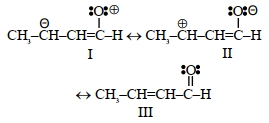
The correct stability order of the following resonance structures of $CH_3-CH=CH-CHO$ is:
A
$II > III > I$
B
$III > II > I$
C
$I > II > III$
D
$II > I > III$
Solution
(B) The stability of resonance structures is determined by the following rules:
$1$. Structures with more covalent bonds are more stable.
$2$. Structures with complete octets for all atoms are more stable.
$3$. Structures with negative charge on a more electronegative atom and positive charge on a less electronegative atom are more stable.
Analyzing the given structures:
- Structure $III$ $(CH_3-CH=CH-CHO)$ is a non-polar structure with the maximum number of covalent bonds and complete octets for all atoms,making it the most stable.
- Structure $II$ $(CH_3-CH^+-CH=CH-O^-)$ has a negative charge on the oxygen atom,which is more electronegative than carbon,making it more stable than structure $I$.
- Structure $I$ $(CH_3-CH^--CH=CH-O^+)$ has a negative charge on a carbon atom and a positive charge on an oxygen atom,which is unfavorable due to the electronegativity difference,making it the least stable.
Therefore,the correct stability order is $III > II > I$.
$1$. Structures with more covalent bonds are more stable.
$2$. Structures with complete octets for all atoms are more stable.
$3$. Structures with negative charge on a more electronegative atom and positive charge on a less electronegative atom are more stable.
Analyzing the given structures:
- Structure $III$ $(CH_3-CH=CH-CHO)$ is a non-polar structure with the maximum number of covalent bonds and complete octets for all atoms,making it the most stable.
- Structure $II$ $(CH_3-CH^+-CH=CH-O^-)$ has a negative charge on the oxygen atom,which is more electronegative than carbon,making it more stable than structure $I$.
- Structure $I$ $(CH_3-CH^--CH=CH-O^+)$ has a negative charge on a carbon atom and a positive charge on an oxygen atom,which is unfavorable due to the electronegativity difference,making it the least stable.
Therefore,the correct stability order is $III > II > I$.
0 likesView Solution
275
ChemistryMediumMCQJEE Main · 2024
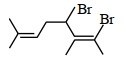
Total number of stereoisomers possible for the given structure:
A
$8$
B
$2$
C
$4$
D
$3$
Solution
(A) The given structure contains three stereogenic elements:
$1$. One chiral center (the carbon atom attached to the $Br$ atom).
$2$. Two double bonds capable of exhibiting geometrical isomerism ($E/Z$ isomerism).
Since all three stereogenic centers are independent and the molecule is unsymmetrical,the total number of stereoisomers is given by $2^n$,where $n$ is the number of stereocenters.
Here,$n = 3$.
Therefore,total stereoisomers $= 2^3 = 8$.
$1$. One chiral center (the carbon atom attached to the $Br$ atom).
$2$. Two double bonds capable of exhibiting geometrical isomerism ($E/Z$ isomerism).
Since all three stereogenic centers are independent and the molecule is unsymmetrical,the total number of stereoisomers is given by $2^n$,where $n$ is the number of stereocenters.
Here,$n = 3$.
Therefore,total stereoisomers $= 2^3 = 8$.
0 likesView Solution
276
ChemistryMediumMCQJEE Main · 2024
The correct increasing order for bond angles among $BF_3$,$PF_3$ and $ClF_3$ is:
A
$PF_3 < BF_3 < ClF_3$
B
$BF_3 < PF_3 < ClF_3$
C
$ClF_3 < PF_3 < BF_3$
D
$BF_3 = PF_3 < ClF_3$
Solution
(C) To determine the bond angles,we analyze the hybridisation and molecular geometry of each molecule:
$1$. $BF_3$: Boron is $sp^2$ hybridized with a trigonal planar geometry. The bond angle is $120^{\circ}$.
$2$. $PF_3$: Phosphorus is $sp^3$ hybridized with one lone pair,resulting in a trigonal pyramidal geometry. Due to the lone pair-bond pair repulsion,the bond angle is approximately $97^{\circ}$.
$3$. $ClF_3$: Chlorine is $sp^3d$ hybridized with two lone pairs,resulting in a $T$-shaped geometry. Due to the repulsion from two lone pairs,the bond angle is distorted to approximately $87.5^{\circ}$.
Comparing these values: $87.5^{\circ} (ClF_3) < 97^{\circ} (PF_3) < 120^{\circ} (BF_3)$.
Therefore,the correct increasing order is $ClF_3 < PF_3 < BF_3$.
$1$. $BF_3$: Boron is $sp^2$ hybridized with a trigonal planar geometry. The bond angle is $120^{\circ}$.
$2$. $PF_3$: Phosphorus is $sp^3$ hybridized with one lone pair,resulting in a trigonal pyramidal geometry. Due to the lone pair-bond pair repulsion,the bond angle is approximately $97^{\circ}$.
$3$. $ClF_3$: Chlorine is $sp^3d$ hybridized with two lone pairs,resulting in a $T$-shaped geometry. Due to the repulsion from two lone pairs,the bond angle is distorted to approximately $87.5^{\circ}$.
Comparing these values: $87.5^{\circ} (ClF_3) < 97^{\circ} (PF_3) < 120^{\circ} (BF_3)$.
Therefore,the correct increasing order is $ClF_3 < PF_3 < BF_3$.
0 likesView Solution
277
ChemistryMediumMCQJEE Main · 2024
For a sparingly soluble salt $AB_2$,the equilibrium concentrations of $A^{2+}$ ions and $B^{-}$ ions are $1.2 \times 10^{-4} \ M$ and $0.24 \times 10^{-3} \ M$,respectively. The solubility product of $AB_2$ is :
A
$0.069 \times 10^{-12}$
B
$6.91 \times 10^{-12}$
C
$0.276 \times 10^{-12}$
D
$27.65 \times 10^{-12}$
Solution
(B) The dissociation of the salt is given by: $AB_{2(s)} \rightleftharpoons A^{2+}_{(aq)} + 2B^{-}_{(aq)}$
The expression for the solubility product constant $(K_{sp})$ is: $K_{sp} = [A^{2+}] [B^{-}]^2$
Given concentrations: $[A^{2+}] = 1.2 \times 10^{-4} \ M$ and $[B^{-}] = 0.24 \times 10^{-3} \ M = 2.4 \times 10^{-4} \ M$
Substituting the values: $K_{sp} = (1.2 \times 10^{-4}) \times (2.4 \times 10^{-4})^2$
$K_{sp} = (1.2 \times 10^{-4}) \times (5.76 \times 10^{-8})$
$K_{sp} = 6.912 \times 10^{-12} \ M^3$
Thus,the correct option is $B$.
The expression for the solubility product constant $(K_{sp})$ is: $K_{sp} = [A^{2+}] [B^{-}]^2$
Given concentrations: $[A^{2+}] = 1.2 \times 10^{-4} \ M$ and $[B^{-}] = 0.24 \times 10^{-3} \ M = 2.4 \times 10^{-4} \ M$
Substituting the values: $K_{sp} = (1.2 \times 10^{-4}) \times (2.4 \times 10^{-4})^2$
$K_{sp} = (1.2 \times 10^{-4}) \times (5.76 \times 10^{-8})$
$K_{sp} = 6.912 \times 10^{-12} \ M^3$
Thus,the correct option is $B$.
0 likesView Solution
278
ChemistryMediumMCQJEE Main · 2024
The incorrect statement regarding ethyne is
A
The $C-C$ bond in ethyne is shorter than that in ethene
B
Both carbons are $sp$ hybridised
C
Ethyne is linear
D
The carbon-carbon bond in ethyne is weaker than that in ethene
Solution
(D) In ethyne $(HC \equiv CH)$,the carbon-carbon bond is a triple bond,which is shorter and stronger than the double bond in ethene $(CH_2=CH_2)$.
Ethyne is a linear molecule where both carbon atoms are $sp$ hybridised.
Therefore,the statement that the carbon-carbon bond in ethyne is weaker than that in ethene is incorrect.
Ethyne is a linear molecule where both carbon atoms are $sp$ hybridised.
Therefore,the statement that the carbon-carbon bond in ethyne is weaker than that in ethene is incorrect.
0 likesView Solution
279
ChemistryMediumMCQJEE Main · 2024
Match List-$I$ with List-$II$.
Choose the correct answer from the options given below:
| List-$I$ (Element) | List-$II$ (Electronic Configuration) |
|---|---|
| $A. N$ | $I. [Ar] 3d^{10} 4s^2 4p^5$ |
| $B. S$ | $II. [Ne] 3s^2 3p^4$ |
| $C. Br$ | $III. [He] 2s^2 2p^3$ |
| $D. Kr$ | $IV. [Ar] 3d^{10} 4s^2 4p^6$ |
Choose the correct answer from the options given below:
A
$A-IV, B-III, C-II, D-I$
B
$A-III, B-II, C-I, D-IV$
C
$A-I, B-IV, C-III, D-II$
D
$A-II, B-I, C-IV, D-III$
Solution
(B) The electronic configurations are as follows:
$(A)$ Nitrogen ($N$,$Z=7$): $[He] 2s^2 2p^3$ (Matches $III$)
$(B)$ Sulfur ($S$,$Z=16$): $[Ne] 3s^2 3p^4$ (Matches $II$)
$(C)$ Bromine ($Br$,$Z=35$): $[Ar] 3d^{10} 4s^2 4p^5$ (Matches $I$)
$(D)$ Krypton ($Kr$,$Z=36$): $[Ar] 3d^{10} 4s^2 4p^6$ (Matches $IV$)
Therefore,the correct matching is $A-III, B-II, C-I, D-IV$.
$(A)$ Nitrogen ($N$,$Z=7$): $[He] 2s^2 2p^3$ (Matches $III$)
$(B)$ Sulfur ($S$,$Z=16$): $[Ne] 3s^2 3p^4$ (Matches $II$)
$(C)$ Bromine ($Br$,$Z=35$): $[Ar] 3d^{10} 4s^2 4p^5$ (Matches $I$)
$(D)$ Krypton ($Kr$,$Z=36$): $[Ar] 3d^{10} 4s^2 4p^6$ (Matches $IV$)
Therefore,the correct matching is $A-III, B-II, C-I, D-IV$.
0 likesView Solution
280
ChemistryMediumMCQJEE Main · 2024
Match List-$I$ with List-$II$. Choose the correct answer from the options given below:
| List-$I$ | List-$II$ |
| $A$. Melting point $[K]$ | $I$. $Tl > In > Ga > Al > B$ |
| $B$. Ionic Radius $[M^{+3} / pm]$ | $II$. $B > Tl > Al \approx Ga > In$ |
| $C$. $\Delta_{i} H_1 [kJ \ mol^{-1}]$ | $III$. $Tl > In > Al > Ga > B$ |
| $D$. Atomic Radius $[pm]$ | $IV$. $B > Al > Tl > In > Ga$ |
A
$A-III, B-IV, C-I, D-II$
B
$A-II, B-III, C-IV, D-I$
C
$A-IV, B-I, C-II, D-III$
D
$A-I, B-II, C-III, D-IV$
Solution
(C) The correct matches are as follows:
$A$. Melting point $[K]$: The order is $B > Al > Tl > In > Ga$,which corresponds to $IV$.
$B$. Ionic Radius $[M^{+3} / pm]$: The order is $Tl > In > Ga > Al > B$,which corresponds to $I$.
$C$. $\Delta_{i} H_1 [kJ \ mol^{-1}]$: The order is $B > Tl > Al \approx Ga > In$,which corresponds to $II$.
$D$. Atomic Radius $[pm]$: The order is $Tl > In > Al > Ga > B$,which corresponds to $III$.
Therefore,the correct sequence is $A-IV, B-I, C-II, D-III$.
$A$. Melting point $[K]$: The order is $B > Al > Tl > In > Ga$,which corresponds to $IV$.
$B$. Ionic Radius $[M^{+3} / pm]$: The order is $Tl > In > Ga > Al > B$,which corresponds to $I$.
$C$. $\Delta_{i} H_1 [kJ \ mol^{-1}]$: The order is $B > Tl > Al \approx Ga > In$,which corresponds to $II$.
$D$. Atomic Radius $[pm]$: The order is $Tl > In > Al > Ga > B$,which corresponds to $III$.
Therefore,the correct sequence is $A-IV, B-I, C-II, D-III$.
0 likesView Solution
281
ChemistryMediumMCQJEE Main · 2024
Number of oxygen atoms present in the chemical formula of fuming sulphuric acid is . . . . .
A
$7$
B
$9$
C
$10$
D
$15$
Solution
(A) Fuming sulphuric acid,also known as oleum,is a solution of sulphur trioxide $(SO_3)$ in concentrated sulphuric acid $(H_2SO_4)$.
Its chemical formula is $H_2S_2O_7$ (pyrosulphuric acid).
In the formula $H_2S_2O_7$,the number of oxygen atoms is $7$.
Its chemical formula is $H_2S_2O_7$ (pyrosulphuric acid).
In the formula $H_2S_2O_7$,the number of oxygen atoms is $7$.
0 likesView Solution
282
ChemistryDifficultMCQJEE Main · 2024
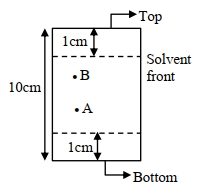
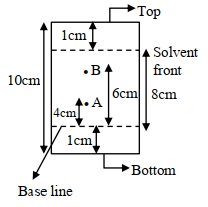
In the given $TLC$ plate,the distances of spots $A$ and $B$ from the base line are $4 \ cm$ and $6 \ cm$,respectively. The distance moved by the solvent front from the base line is $8 \ cm$. If the $R_f$ value of $B$ is $x \times 10^{-1}$ times that of $A$,find the value of $x$.
A
$10$
B
$15$
C
$20$
D
$25$
Solution
(B) $R_f = \frac{\text{Distance moved by substance from base line}}{\text{Distance moved by solvent from base line}}$
For spot $A$:
$(R_f)_A = \frac{4 \ cm}{8 \ cm} = 0.5$
For spot $B$:
$(R_f)_B = \frac{6 \ cm}{8 \ cm} = 0.75$
Given that $(R_f)_B = (x \times 10^{-1}) \times (R_f)_A$:
$0.75 = (x \times 10^{-1}) \times 0.5$
$0.75 = x \times 0.05$
$x = \frac{0.75}{0.05} = 15$
For spot $A$:
$(R_f)_A = \frac{4 \ cm}{8 \ cm} = 0.5$
For spot $B$:
$(R_f)_B = \frac{6 \ cm}{8 \ cm} = 0.75$
Given that $(R_f)_B = (x \times 10^{-1}) \times (R_f)_A$:
$0.75 = (x \times 10^{-1}) \times 0.5$
$0.75 = x \times 0.05$
$x = \frac{0.75}{0.05} = 15$
0 likesView Solution
283
ChemistryMediumMCQJEE Main · 2024
Based on Heisenberg's uncertainty principle,the uncertainty in the velocity of the electron to be found within an atomic nucleus of diameter $10^{-15} \ m$ is ............. $\times 10^9 \ ms^{-1}$ (nearest integer)
[Given : mass of electron $= 9.1 \times 10^{-31} \ kg$,Plank's constant $(h) = 6.626 \times 10^{-34} \ Js$ ]
(Value of $\pi = 3.14$ )
[Given : mass of electron $= 9.1 \times 10^{-31} \ kg$,Plank's constant $(h) = 6.626 \times 10^{-34} \ Js$ ]
(Value of $\pi = 3.14$ )
A
$12$
B
$65$
C
$58$
D
$20$
Solution
(C) According to Heisenberg's uncertainty principle:
$m \Delta V \cdot \Delta x \geq \frac{h}{4 \pi}$
Given:
$\Delta x = 10^{-15} \ m$
$m = 9.1 \times 10^{-31} \ kg$
$h = 6.626 \times 10^{-34} \ Js$
$\pi = 3.14$
Substituting the values:
$\Delta V = \frac{h}{4 \pi m \Delta x}$
$\Delta V = \frac{6.626 \times 10^{-34}}{4 \times 3.14 \times 9.1 \times 10^{-31} \times 10^{-15}}$
$\Delta V = \frac{6.626 \times 10^{-34}}{114.296 \times 10^{-46}}$
$\Delta V = 0.05797 \times 10^{12} \ ms^{-1}$
$\Delta V = 57.97 \times 10^9 \ ms^{-1}$
Rounding to the nearest integer,we get $58 \times 10^9 \ ms^{-1}$.
$m \Delta V \cdot \Delta x \geq \frac{h}{4 \pi}$
Given:
$\Delta x = 10^{-15} \ m$
$m = 9.1 \times 10^{-31} \ kg$
$h = 6.626 \times 10^{-34} \ Js$
$\pi = 3.14$
Substituting the values:
$\Delta V = \frac{h}{4 \pi m \Delta x}$
$\Delta V = \frac{6.626 \times 10^{-34}}{4 \times 3.14 \times 9.1 \times 10^{-31} \times 10^{-15}}$
$\Delta V = \frac{6.626 \times 10^{-34}}{114.296 \times 10^{-46}}$
$\Delta V = 0.05797 \times 10^{12} \ ms^{-1}$
$\Delta V = 57.97 \times 10^9 \ ms^{-1}$
Rounding to the nearest integer,we get $58 \times 10^9 \ ms^{-1}$.
0 likesView Solution
284
ChemistryMediumMCQJEE Main · 2024
Total number of electrons present in $(\pi^*)$ molecular orbitals of $O_2$,$O_2^{+}$,and $O_2^{-}$ is ............
A
$6$
B
$7$
C
$9$
D
$10$
Solution
(A) The molecular orbital configuration for $O_2$ $(16 \ e^-)$ is $(\sigma_{1s})^2(\sigma_{1s}^*)^2(\sigma_{2s})^2(\sigma_{2s}^*)^2(\sigma_{2p_z})^2(\pi_{2p_x})^2(\pi_{2p_y})^2(\pi_{2p_x}^*)^1(\pi_{2p_y}^*)^1$.
Number of electrons in $(\pi^*)$ of $O_2 = 2$.
For $O_2^{+}$ $(15 \ e^-)$,one electron is removed from the $(\pi^*)$ orbital,so number of electrons in $(\pi^*)$ of $O_2^{+} = 1$.
For $O_2^{-}$ $(17 \ e^-)$,one electron is added to the $(\pi^*)$ orbital,so number of electrons in $(\pi^*)$ of $O_2^{-} = 3$.
Total number of electrons in $(\pi^*)$ orbitals $= 2 + 1 + 3 = 6$.
Number of electrons in $(\pi^*)$ of $O_2 = 2$.
For $O_2^{+}$ $(15 \ e^-)$,one electron is removed from the $(\pi^*)$ orbital,so number of electrons in $(\pi^*)$ of $O_2^{+} = 1$.
For $O_2^{-}$ $(17 \ e^-)$,one electron is added to the $(\pi^*)$ orbital,so number of electrons in $(\pi^*)$ of $O_2^{-} = 3$.
Total number of electrons in $(\pi^*)$ orbitals $= 2 + 1 + 3 = 6$.
0 likesView Solution
285
ChemistryMediumMCQJEE Main · 2024
When $\Delta H_{vap} = 30 \ kJ \ mol^{-1}$ and $\Delta S_{vap} = 75 \ J \ mol^{-1} \ K^{-1}$,then the temperature of vapour,at one atmosphere is . . . . $K$.
A
$500$
B
$400$
C
$120$
D
$654$
Solution
(B) At equilibrium,the change in Gibbs free energy is $\Delta G = 0$.
Using the relation $\Delta G = \Delta H - T \Delta S$,at equilibrium we have $\Delta H_{vap} = T \Delta S_{vap}$.
Given $\Delta H_{vap} = 30 \ kJ \ mol^{-1} = 30000 \ J \ mol^{-1}$ and $\Delta S_{vap} = 75 \ J \ mol^{-1} \ K^{-1}$.
Substituting the values: $30000 \ J \ mol^{-1} = T \times 75 \ J \ mol^{-1} \ K^{-1}$.
$T = \frac{30000}{75} \ K = 400 \ K$.
Using the relation $\Delta G = \Delta H - T \Delta S$,at equilibrium we have $\Delta H_{vap} = T \Delta S_{vap}$.
Given $\Delta H_{vap} = 30 \ kJ \ mol^{-1} = 30000 \ J \ mol^{-1}$ and $\Delta S_{vap} = 75 \ J \ mol^{-1} \ K^{-1}$.
Substituting the values: $30000 \ J \ mol^{-1} = T \times 75 \ J \ mol^{-1} \ K^{-1}$.
$T = \frac{30000}{75} \ K = 400 \ K$.
0 likesView Solution
286
ChemistryMediumMCQJEE Main · 2024
Consider the two different first order reactions given below:
$A + B \rightarrow C$ (Reaction $1$)
$P \rightarrow Q$ (Reaction $2$)
The ratio of the half-life of Reaction $1$ : Reaction $2$ is $5 : 2$. If $t_1$ and $t_2$ represent the time taken to complete $2/3$ and $4/5$ of Reaction $1$ and Reaction $2$,respectively,then the value of the ratio $t_1 : t_2$ is $. . . . \times 10^{-1}$ (nearest integer).
[Given: $\log_{10}(3) = 0.477$ and $\log_{10}(5) = 0.699$]
$A + B \rightarrow C$ (Reaction $1$)
$P \rightarrow Q$ (Reaction $2$)
The ratio of the half-life of Reaction $1$ : Reaction $2$ is $5 : 2$. If $t_1$ and $t_2$ represent the time taken to complete $2/3$ and $4/5$ of Reaction $1$ and Reaction $2$,respectively,then the value of the ratio $t_1 : t_2$ is $. . . . \times 10^{-1}$ (nearest integer).
[Given: $\log_{10}(3) = 0.477$ and $\log_{10}(5) = 0.699$]
A
$15$
B
$18$
C
$20$
D
$17$
Solution
(D) For a first-order reaction,the half-life is given by $t_{1/2} = \frac{\ln 2}{k}$.
Given $\frac{(t_{1/2})_1}{(t_{1/2})_2} = \frac{k_2}{k_1} = \frac{5}{2}$.
For a first-order reaction,the time $t$ to complete a fraction $x$ is $t = \frac{1}{k} \ln \frac{1}{1-x}$.
For Reaction $1$,$t_1 = \frac{1}{k_1} \ln \frac{1}{1 - 2/3} = \frac{1}{k_1} \ln 3$.
For Reaction $2$,$t_2 = \frac{1}{k_2} \ln \frac{1}{1 - 4/5} = \frac{1}{k_2} \ln 5$.
Taking the ratio: $\frac{t_1}{t_2} = \frac{k_2}{k_1} \times \frac{\ln 3}{\ln 5} = \frac{5}{2} \times \frac{\log_{10} 3}{\log_{10} 5}$.
Substituting the given values: $\frac{t_1}{t_2} = \frac{5}{2} \times \frac{0.477}{0.699} = 2.5 \times 0.6824 = 1.706$.
Rounding to the nearest integer,$1.706 \approx 1.7 = 17 \times 10^{-1}$.
Given $\frac{(t_{1/2})_1}{(t_{1/2})_2} = \frac{k_2}{k_1} = \frac{5}{2}$.
For a first-order reaction,the time $t$ to complete a fraction $x$ is $t = \frac{1}{k} \ln \frac{1}{1-x}$.
For Reaction $1$,$t_1 = \frac{1}{k_1} \ln \frac{1}{1 - 2/3} = \frac{1}{k_1} \ln 3$.
For Reaction $2$,$t_2 = \frac{1}{k_2} \ln \frac{1}{1 - 4/5} = \frac{1}{k_2} \ln 5$.
Taking the ratio: $\frac{t_1}{t_2} = \frac{k_2}{k_1} \times \frac{\ln 3}{\ln 5} = \frac{5}{2} \times \frac{\log_{10} 3}{\log_{10} 5}$.
Substituting the given values: $\frac{t_1}{t_2} = \frac{5}{2} \times \frac{0.477}{0.699} = 2.5 \times 0.6824 = 1.706$.
Rounding to the nearest integer,$1.706 \approx 1.7 = 17 \times 10^{-1}$.
0 likesView Solution
287
ChemistryMediumMCQJEE Main · 2024
Among $VO_2^{+}$,$MnO_4^{-}$ and $Cr_2O_7^{2-}$,the spin-only magnetic moment value of the species with least oxidising ability is $BM$ (Nearest integer). (Given atomic number $V=23$,$Mn=25$,$Cr=24$)
A
$1$
B
$0$
C
$5$
D
$8$
Solution
(B) The oxidizing ability of these oxoanions depends on the oxidation state and the stability of the lower oxidation states of the central metal atom. The order of oxidizing power is $VO_2^{+} < Cr_2O_7^{2-} < MnO_4^{-}$.
Thus,$VO_2^{+}$ has the least oxidizing ability.
In $VO_2^{+}$,the oxidation state of $V$ is $+5$.
The electronic configuration of $V$ $(Z=23)$ is $[Ar] 3d^3 4s^2$.
For $V^{+5}$,the configuration is $[Ar] 3d^0 4s^0$.
Since there are no unpaired electrons $(n=0)$,the spin-only magnetic moment $\mu = \sqrt{n(n+2)} = \sqrt{0(0+2)} = 0 \ BM$.
Thus,$VO_2^{+}$ has the least oxidizing ability.
In $VO_2^{+}$,the oxidation state of $V$ is $+5$.
The electronic configuration of $V$ $(Z=23)$ is $[Ar] 3d^3 4s^2$.
For $V^{+5}$,the configuration is $[Ar] 3d^0 4s^0$.
Since there are no unpaired electrons $(n=0)$,the spin-only magnetic moment $\mu = \sqrt{n(n+2)} = \sqrt{0(0+2)} = 0 \ BM$.
0 likesView Solution
288
ChemistryMediumMCQJEE Main · 2024
Which among the following compounds will undergo the fastest $S_{N}2$ reaction?
A
B
C
D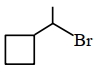
Solution
(C) The rate of $S_{N}2$ reaction depends on the steric hindrance around the electrophilic carbon atom. The order of reactivity is: $Methyl \ halide > 1^{\circ} \ halide > 2^{\circ} \ halide > 3^{\circ} \ halide$.
In the given options:
$(A)$ is a $3^{\circ}$ alkyl halide.
$(B)$ is a $3^{\circ}$ alkyl halide.
$(C)$ is a $1^{\circ}$ alkyl halide (cyclobutyl-methyl bromide).
$(D)$ is a $2^{\circ}$ alkyl halide.
Since $1^{\circ}$ alkyl halides have the least steric hindrance,they undergo $S_{N}2$ reactions the fastest. Therefore,cyclobutyl-methyl bromide will undergo the fastest $S_{N}2$ reaction.
In the given options:
$(A)$ is a $3^{\circ}$ alkyl halide.
$(B)$ is a $3^{\circ}$ alkyl halide.
$(C)$ is a $1^{\circ}$ alkyl halide (cyclobutyl-methyl bromide).
$(D)$ is a $2^{\circ}$ alkyl halide.
Since $1^{\circ}$ alkyl halides have the least steric hindrance,they undergo $S_{N}2$ reactions the fastest. Therefore,cyclobutyl-methyl bromide will undergo the fastest $S_{N}2$ reaction.
0 likesView Solution
289
ChemistryMediumMCQJEE Main · 2024
Identify the major products $A$ and $B$ respectively in the following set of reactions.
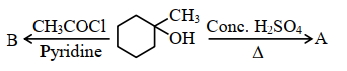
A
$A = \text{1-methylcyclohexene}$,$B = \text{1-methylcyclohexyl acetate}$
B
$A = \text{1-methylcyclohexene}$,$B = \text{4-acetylcyclohexanol}$
C
$A = \text{methylenecyclohexane}$,$B = \text{1-methylcyclohexyl ketone}$
D
$A = \text{methylenecyclohexane}$,$B = \text{1-methylcyclohexyl acetate}$
Solution
(A) The reaction of $1\text{-methylcyclohexanol}$ with $\text{conc. } H_2SO_4$ at high temperature involves acid-catalyzed dehydration. This proceeds via an $E1$ mechanism,where the hydroxyl group is protonated and leaves as water to form a tertiary carbocation. Subsequent loss of a proton from the adjacent carbon leads to the formation of the more stable,more substituted alkene,which is $1\text{-methylcyclohexene}$ $(A)$.
The reaction of $1\text{-methylcyclohexanol}$ with $CH_3COCl$ in the presence of pyridine is an acetylation reaction. The alcohol acts as a nucleophile,attacking the acetyl chloride to form an ester,$1\text{-methylcyclohexyl acetate}$ $(B)$.
The reaction of $1\text{-methylcyclohexanol}$ with $CH_3COCl$ in the presence of pyridine is an acetylation reaction. The alcohol acts as a nucleophile,attacking the acetyl chloride to form an ester,$1\text{-methylcyclohexyl acetate}$ $(B)$.
0 likesView Solution
290
ChemistryMediumMCQJEE Main · 2024
Match List-$I$ with List-$II$ and choose the correct answer from the options given below:
| List-$I$ (Name of the test) | List-$II$ (Reaction sequence involved) [$M$ is metal] |
|---|---|
| $A$. Borax bead test | $I$. $MCO_3$ $\rightarrow MO$ $\xrightarrow[+\Delta]{Co(NO_3)_2} CoO \cdot MO$ |
| $B$. Charcoal cavity test | $II$. $MCO_3$ $\rightarrow MCl_2$ $\rightarrow M^{2+}$ |
| $C$. Cobalt nitrate test | $III$. $MSO_4$ $\xrightarrow[\Delta]{Na_2B_4O_7} M(BO_2)_2$ $\rightarrow MBO_2$ $\rightarrow M$ |
| $D$. Flame test | $IV$. $MSO_4$ $\xrightarrow[\Delta]{Na_2CO_3} MCO_3$ $\rightarrow MO$ $\rightarrow M$ |
A
$A-III, B-IV, C-I, D-II$
B
$A-III, B-II, C-IV, D-I$
C
$A-III, B-I, C-II, D-IV$
D
$A-I, B-IV, C-III, D-II$
Solution
(A) The correct matches are as follows:
$A$. Borax bead test: $MSO_4$ $\xrightarrow[\Delta]{Na_2B_4O_7} M(BO_2)_2$ $\rightarrow MBO_2$ $\rightarrow M$ (Matches $III$)
$B$. Charcoal cavity test: $MSO_4$ $\xrightarrow[\Delta]{Na_2CO_3} MCO_3$ $\rightarrow MO$ $\rightarrow M$ (Matches $IV$)
$C$. Cobalt nitrate test: $MCO_3$ $\rightarrow MO$ $\xrightarrow[+\Delta]{Co(NO_3)_2} CoO \cdot MO$ (Matches $I$)
$D$. Flame test: $MCO_3$ $\rightarrow MCl_2$ $\rightarrow M^{2+}$ (Matches $II$)
Therefore,the correct sequence is $A-III, B-IV, C-I, D-II$.
$A$. Borax bead test: $MSO_4$ $\xrightarrow[\Delta]{Na_2B_4O_7} M(BO_2)_2$ $\rightarrow MBO_2$ $\rightarrow M$ (Matches $III$)
$B$. Charcoal cavity test: $MSO_4$ $\xrightarrow[\Delta]{Na_2CO_3} MCO_3$ $\rightarrow MO$ $\rightarrow M$ (Matches $IV$)
$C$. Cobalt nitrate test: $MCO_3$ $\rightarrow MO$ $\xrightarrow[+\Delta]{Co(NO_3)_2} CoO \cdot MO$ (Matches $I$)
$D$. Flame test: $MCO_3$ $\rightarrow MCl_2$ $\rightarrow M^{2+}$ (Matches $II$)
Therefore,the correct sequence is $A-III, B-IV, C-I, D-II$.
0 likesView Solution
291
ChemistryMediumMCQJEE Main · 2024
An octahedral complex with the formula $CoCl_3 \cdot nNH_3$ upon reaction with excess of $AgNO_3$ solution gives $2$ moles of $AgCl$. Consider the oxidation state of $Co$ in the complex is '$x$'. The value of $x+n$ is . . . . .
A
$3$
B
$6$
C
$8$
D
$5$
Solution
(C) The reaction of the complex with excess $AgNO_3$ yields $2$ moles of $AgCl$,which indicates that there are $2$ chloride ions outside the coordination sphere.
The formula of the complex is $[Co(NH_3)_nCl]Cl_2$.
Since the complex is octahedral,the coordination number of $Co$ is $6$. Thus,$n + 1 = 6$,which gives $n = 5$.
The complex is $[Co(NH_3)_5Cl]Cl_2$.
Let the oxidation state of $Co$ be $x$. The sum of oxidation states in the complex is $x + 5(0) + 1(-1) + 2(-1) = 0$,which gives $x - 3 = 0$,so $x = +3$.
Therefore,$x + n = 3 + 5 = 8$.
The formula of the complex is $[Co(NH_3)_nCl]Cl_2$.
Since the complex is octahedral,the coordination number of $Co$ is $6$. Thus,$n + 1 = 6$,which gives $n = 5$.
The complex is $[Co(NH_3)_5Cl]Cl_2$.
Let the oxidation state of $Co$ be $x$. The sum of oxidation states in the complex is $x + 5(0) + 1(-1) + 2(-1) = 0$,which gives $x - 3 = 0$,so $x = +3$.
Therefore,$x + n = 3 + 5 = 8$.
0 likesView Solution
292
ChemistryMediumMCQJEE Main · 2024
The incorrect statement regarding the given structure is:
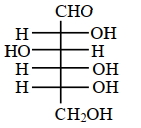
A
Can be oxidized to a dicarboxylic acid with $Br_2$ water
B
Despite the presence of $-CHO$,it does not give Schiff's test
C
Has $4$ asymmetric carbon atoms
D
Will coexist in equilibrium with $2$ other cyclic structures
Solution
(A) The structure provided is $D$-glucose.
$1$. $Br_2$ water is a mild oxidizing agent that oxidizes the $-CHO$ group to a $-COOH$ group,forming gluconic acid (a monocarboxylic acid),not a dicarboxylic acid. Thus,this statement is incorrect.
$2$. Glucose exists primarily in cyclic hemiacetal forms in solution,where the concentration of the free aldehyde group is extremely low. Therefore,it does not give Schiff's test.
$3$. $D$-glucose has $4$ chiral (asymmetric) carbon atoms (at $C_2, C_3, C_4, C_5$). This statement is correct.
$4$. In aqueous solution,$D$-glucose exists in equilibrium with its $\alpha$ and $\beta$ pyranose cyclic forms. This statement is correct.
$1$. $Br_2$ water is a mild oxidizing agent that oxidizes the $-CHO$ group to a $-COOH$ group,forming gluconic acid (a monocarboxylic acid),not a dicarboxylic acid. Thus,this statement is incorrect.
$2$. Glucose exists primarily in cyclic hemiacetal forms in solution,where the concentration of the free aldehyde group is extremely low. Therefore,it does not give Schiff's test.
$3$. $D$-glucose has $4$ chiral (asymmetric) carbon atoms (at $C_2, C_3, C_4, C_5$). This statement is correct.
$4$. In aqueous solution,$D$-glucose exists in equilibrium with its $\alpha$ and $\beta$ pyranose cyclic forms. This statement is correct.
0 likesView Solution
293
ChemistryMediumMCQJEE Main · 2024
Among the following halogens $F_2$,$Cl_2$,$Br_2$ and $I_2$,which can undergo disproportionation reaction?
A
Only $I_2$
B
$Cl_2$,$Br_2$ and $I_2$
C
$F_2$,$Cl_2$ and $Br_2$
D
$F_2$ and $Cl_2$
Solution
(B) disproportionation reaction is a type of redox reaction where the same element is simultaneously oxidized and reduced.
$F_2$ is the most electronegative element and cannot exhibit a positive oxidation state,so it cannot undergo disproportionation.
$Cl_2$,$Br_2$,and $I_2$ can exist in various positive oxidation states (such as $+1, +3, +5, +7$) and thus undergo disproportionation in alkaline media.
Therefore,$Cl_2$,$Br_2$,and $I_2$ can undergo disproportionation reactions.
$F_2$ is the most electronegative element and cannot exhibit a positive oxidation state,so it cannot undergo disproportionation.
$Cl_2$,$Br_2$,and $I_2$ can exist in various positive oxidation states (such as $+1, +3, +5, +7$) and thus undergo disproportionation in alkaline media.
Therefore,$Cl_2$,$Br_2$,and $I_2$ can undergo disproportionation reactions.
0 likesView Solution
294
ChemistryMediumMCQJEE Main · 2024
Given below are two statements:
Statement $I$ : $N(CH_3)_3$ and $P(CH_3)_3$ can act as ligands to form transition metal complexes.
Statement $II$: As $N$ and $P$ are from same group,the nature of bonding of $N(CH_3)_3$ and $P(CH_3)_3$ is always same with transition metals.
In the light of the above statements,choose the most appropriate answer from the options given below:
Statement $I$ : $N(CH_3)_3$ and $P(CH_3)_3$ can act as ligands to form transition metal complexes.
Statement $II$: As $N$ and $P$ are from same group,the nature of bonding of $N(CH_3)_3$ and $P(CH_3)_3$ is always same with transition metals.
In the light of the above statements,choose the most appropriate answer from the options given below:
A
Statement $I$ is incorrect but Statement $II$ is correct
B
Both Statement $I$ and Statement $II$ are correct
C
Statement $I$ is correct but Statement $II$ is incorrect
D
Both Statement $I$ and Statement $II$ are incorrect
Solution
(C) Statement $I$ is correct because both $N(CH_3)_3$ and $P(CH_3)_3$ possess a lone pair of electrons on the central atom ($N$ or $P$),allowing them to act as $\sigma$-donor ligands.
Statement $II$ is incorrect because,although $N$ and $P$ belong to the same group,their bonding behavior differs. $P(CH_3)_3$ has vacant $d$-orbitals that can accept electron density from the metal $d$-orbitals (back-bonding),exhibiting $\pi$-acceptor character,whereas $N(CH_3)_3$ lacks such orbitals and acts only as a $\sigma$-donor.
Statement $II$ is incorrect because,although $N$ and $P$ belong to the same group,their bonding behavior differs. $P(CH_3)_3$ has vacant $d$-orbitals that can accept electron density from the metal $d$-orbitals (back-bonding),exhibiting $\pi$-acceptor character,whereas $N(CH_3)_3$ lacks such orbitals and acts only as a $\sigma$-donor.
0 likesView Solution
295
ChemistryMediumMCQJEE Main · 2024
Iron $(III)$ catalyses the reaction between iodide and persulphate ions,in which
$A$. $Fe^{3+}$ oxidises the iodide ion
$B$. $Fe^{3+}$ oxidises the persulphate ion
$C$. $Fe^{2+}$ reduces the iodide ion
$D$. $Fe^{2+}$ reduces the persulphate ion
Choose the most appropriate answer from the options given below:
$A$. $Fe^{3+}$ oxidises the iodide ion
$B$. $Fe^{3+}$ oxidises the persulphate ion
$C$. $Fe^{2+}$ reduces the iodide ion
$D$. $Fe^{2+}$ reduces the persulphate ion
Choose the most appropriate answer from the options given below:
A
$B$ and $C$ only
B
$B$ only
C
$A$ only
D
$A$ and $D$ only
Solution
(D) The catalytic reaction proceeds in two steps:
$1$. $2 Fe^{3+} + 2 I^{-} \longrightarrow 2 Fe^{2+} + I_2$
$2$. $2 Fe^{2+} + S_2 O_8^{2-} \longrightarrow 2 Fe^{3+} + 2 SO_4^{2-}$
In the first step,$Fe^{3+}$ oxidises the iodide ion $(I^-)$ to iodine $(I_2)$ and is reduced to $Fe^{2+}$.
In the second step,$Fe^{2+}$ reduces the persulphate ion $(S_2 O_8^{2-})$ to sulphate $(SO_4^{2-})$ and is oxidised back to $Fe^{3+}$.
Thus,statements $A$ and $D$ are correct.
$1$. $2 Fe^{3+} + 2 I^{-} \longrightarrow 2 Fe^{2+} + I_2$
$2$. $2 Fe^{2+} + S_2 O_8^{2-} \longrightarrow 2 Fe^{3+} + 2 SO_4^{2-}$
In the first step,$Fe^{3+}$ oxidises the iodide ion $(I^-)$ to iodine $(I_2)$ and is reduced to $Fe^{2+}$.
In the second step,$Fe^{2+}$ reduces the persulphate ion $(S_2 O_8^{2-})$ to sulphate $(SO_4^{2-})$ and is oxidised back to $Fe^{3+}$.
Thus,statements $A$ and $D$ are correct.
0 likesView Solution
296
ChemistryMediumMCQJEE Main · 2024
Match List-$I$ with List-$II$.
Choose the correct answer from the options given below:
| List-$I$ (Compound) | List-$II$ (Colour) |
| $A$. $Fe_4[Fe(CN)_6]_3 \cdot xH_2O$ | $I$. Violet |
| $B$. $[Fe(CN)_5NOS]^{4-}$ | $II$. Blood Red |
| $C$. $[Fe(SCN)]^{2+}$ | $III$. Prussian Blue |
| $D$. $(NH_4)_3PO_4 \cdot 12MoO_3$ | $IV$. Yellow |
Choose the correct answer from the options given below:
A
$A-III, B-I, C-II, D-IV$
B
$A-IV, B-I, C-II, D-III$
C
$A-II, B-III, C-IV, D-I$
D
$A-I, B-II, C-III, D-IV$
Solution
(A) $Fe_4[Fe(CN)_6]_3 \cdot xH_2O$ is Prussian Blue.
$[Fe(CN)_5NOS]^{4-}$ is Violet.
$[Fe(SCN)]^{2+}$ is Blood Red.
$(NH_4)_3PO_4 \cdot 12MoO_3$ is Yellow.
Therefore,the correct matching is $A-III, B-I, C-II, D-IV$.
$[Fe(CN)_5NOS]^{4-}$ is Violet.
$[Fe(SCN)]^{2+}$ is Blood Red.
$(NH_4)_3PO_4 \cdot 12MoO_3$ is Yellow.
Therefore,the correct matching is $A-III, B-I, C-II, D-IV$.
0 likesView Solution
297
ChemistryMediumMCQJEE Main · 2024
Number of complexes with an even number of electrons in $t_{2g}$ orbitals is -
$[Fe(H_2O)_6]^{2+}, [Co(H_2O)_6]^{2+}, [Co(H_2O)_6]^{3+}, [Cu(H_2O)_6]^{2+}, [Cr(H_2O)_6]^{2+}$
$[Fe(H_2O)_6]^{2+}, [Co(H_2O)_6]^{2+}, [Co(H_2O)_6]^{3+}, [Cu(H_2O)_6]^{2+}, [Cr(H_2O)_6]^{2+}$
A
$1$
B
$3$
C
$2$
D
$5$
Solution
(B) We analyze the $d$-electron configuration of each complex in an octahedral field (weak field ligand $H_2O$):
$1$. $[Fe(H_2O)_6]^{2+}$: $Fe^{2+}$ is $d^6$. Configuration is $t_{2g}^4 e_g^2$. Number of electrons in $t_{2g} = 4$ (even).
$2$. $[Co(H_2O)_6]^{2+}$: $Co^{2+}$ is $d^7$. Configuration is $t_{2g}^5 e_g^2$. Number of electrons in $t_{2g} = 5$ (odd).
$3$. $[Co(H_2O)_6]^{3+}$: $Co^{3+}$ is $d^6$. Configuration is $t_{2g}^6 e_g^0$. Number of electrons in $t_{2g} = 6$ (even).
$4$. $[Cu(H_2O)_6]^{2+}$: $Cu^{2+}$ is $d^9$. Configuration is $t_{2g}^6 e_g^3$. Number of electrons in $t_{2g} = 6$ (even).
$5$. $[Cr(H_2O)_6]^{2+}$: $Cr^{2+}$ is $d^4$. Configuration is $t_{2g}^3 e_g^1$. Number of electrons in $t_{2g} = 3$ (odd).
The complexes with an even number of electrons in $t_{2g}$ orbitals are $[Fe(H_2O)_6]^{2+}$,$[Co(H_2O)_6]^{3+}$,and $[Cu(H_2O)_6]^{2+}$.
Total count = $3$.
$1$. $[Fe(H_2O)_6]^{2+}$: $Fe^{2+}$ is $d^6$. Configuration is $t_{2g}^4 e_g^2$. Number of electrons in $t_{2g} = 4$ (even).
$2$. $[Co(H_2O)_6]^{2+}$: $Co^{2+}$ is $d^7$. Configuration is $t_{2g}^5 e_g^2$. Number of electrons in $t_{2g} = 5$ (odd).
$3$. $[Co(H_2O)_6]^{3+}$: $Co^{3+}$ is $d^6$. Configuration is $t_{2g}^6 e_g^0$. Number of electrons in $t_{2g} = 6$ (even).
$4$. $[Cu(H_2O)_6]^{2+}$: $Cu^{2+}$ is $d^9$. Configuration is $t_{2g}^6 e_g^3$. Number of electrons in $t_{2g} = 6$ (even).
$5$. $[Cr(H_2O)_6]^{2+}$: $Cr^{2+}$ is $d^4$. Configuration is $t_{2g}^3 e_g^1$. Number of electrons in $t_{2g} = 3$ (odd).
The complexes with an even number of electrons in $t_{2g}$ orbitals are $[Fe(H_2O)_6]^{2+}$,$[Co(H_2O)_6]^{3+}$,and $[Cu(H_2O)_6]^{2+}$.
Total count = $3$.
0 likesView Solution
298
ChemistryMediumMCQJEE Main · 2024
Identify the product $(P)$ in the following reaction:
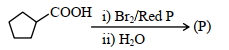
A
$1-$bromocyclopentanecarboxylic acid
B
cyclopentanecarbonyl bromide
C
$1-$bromocyclopentanecarbaldehyde
D
$2-$bromocyclopentanecarboxylic acid
Solution
(A) The reaction shown is the Hell-Volhard-Zelinsky $(HVZ)$ reaction.
In this reaction,carboxylic acids having an $\alpha$-hydrogen atom are reacted with $Br_2$ or $Cl_2$ in the presence of a small amount of red phosphorus to form $\alpha$-halo carboxylic acids.
The $\alpha$-carbon is the carbon atom directly attached to the carboxyl group.
In cyclopentanecarboxylic acid,the carbon atom of the cyclopentane ring attached to the $-COOH$ group is the $\alpha$-carbon.
Therefore,the bromine atom replaces the hydrogen atom at the $\alpha$-position,resulting in $1$-bromocyclopentanecarboxylic acid.
In this reaction,carboxylic acids having an $\alpha$-hydrogen atom are reacted with $Br_2$ or $Cl_2$ in the presence of a small amount of red phosphorus to form $\alpha$-halo carboxylic acids.
The $\alpha$-carbon is the carbon atom directly attached to the carboxyl group.
In cyclopentanecarboxylic acid,the carbon atom of the cyclopentane ring attached to the $-COOH$ group is the $\alpha$-carbon.
Therefore,the bromine atom replaces the hydrogen atom at the $\alpha$-position,resulting in $1$-bromocyclopentanecarboxylic acid.
0 likesView Solution
299
ChemistryMediumMCQJEE Main · 2024
How many of the following amine compounds form a product with Hinsberg's reagent $(C_6H_5SO_2Cl)$ that is soluble in $NaOH$?
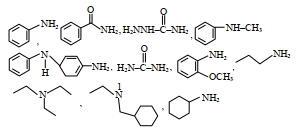
A
$3$
B
$4$
C
$5$
D
$6$
Solution
(C) Hinsberg's reagent $(C_6H_5SO_2Cl)$ reacts with primary amines $(R-NH_2)$ to form $N$-alkylbenzenesulfonamide,which contains an acidic hydrogen atom attached to the nitrogen. This acidic hydrogen makes the product soluble in aqueous $NaOH$.
Secondary amines $(R_2NH)$ form $N,N$-dialkylbenzenesulfonamide,which lacks an acidic hydrogen and is insoluble in $NaOH$.
Tertiary amines $(R_3N)$ do not react with Hinsberg's reagent.
Let us analyze the given compounds:
$1$. Aniline $(C_6H_5NH_2)$: Primary amine,forms soluble product.
$2$. $o$-methoxyaniline $(o-CH_3OC_6H_4NH_2)$: Primary amine,forms soluble product.
$3$. Ethanamine $(CH_3CH_2NH_2)$: Primary amine,forms soluble product.
$4$. $N$-phenyl-$p$-phenylenediamine $(C_6H_5NH-C_6H_4-NH_2)$: Contains a primary amine group,forms soluble product.
$5$. Cyclohexanamine $(C_6H_{11}NH_2)$: Primary amine,forms soluble product.
Other compounds like amides,ureas,and secondary/tertiary amines do not meet the criteria.
There are $5$ such primary amine compounds.
Secondary amines $(R_2NH)$ form $N,N$-dialkylbenzenesulfonamide,which lacks an acidic hydrogen and is insoluble in $NaOH$.
Tertiary amines $(R_3N)$ do not react with Hinsberg's reagent.
Let us analyze the given compounds:
$1$. Aniline $(C_6H_5NH_2)$: Primary amine,forms soluble product.
$2$. $o$-methoxyaniline $(o-CH_3OC_6H_4NH_2)$: Primary amine,forms soluble product.
$3$. Ethanamine $(CH_3CH_2NH_2)$: Primary amine,forms soluble product.
$4$. $N$-phenyl-$p$-phenylenediamine $(C_6H_5NH-C_6H_4-NH_2)$: Contains a primary amine group,forms soluble product.
$5$. Cyclohexanamine $(C_6H_{11}NH_2)$: Primary amine,forms soluble product.
Other compounds like amides,ureas,and secondary/tertiary amines do not meet the criteria.
There are $5$ such primary amine compounds.
0 likesView Solution
300
ChemistryMediumMCQJEE Main · 2024
The 'spin only' magnetic moment value of $MO_4^{2-}$ is . . . . . $BM$. (Where $M$ is a metal having least metallic radii among $Sc, Ti, V, Cr, Mn$ and $Zn$).
(Given atomic number: $Sc=21, Ti=22, V=23, Cr=24, Mn=25$ and $Zn=30$)
(Given atomic number: $Sc=21, Ti=22, V=23, Cr=24, Mn=25$ and $Zn=30$)
A
$0$
B
$5$
C
$8$
D
$9$
Solution
(A) The metallic radii of the given elements generally decrease across the period due to increasing effective nuclear charge,but $Zn$ has a larger radius due to metallic bonding characteristics. Among the transition metals $Sc$ to $Mn$,the atomic radius decreases. However,the question asks for the least metallic radii among the listed elements. $Cr$ has a smaller radius than $Sc, Ti, V$ and $Mn$.
In $CrO_4^{2-}$,the oxidation state of $Cr$ is $x + 4(-2) = -2$,so $x = +6$.
The electronic configuration of $Cr$ is $[Ar] 3d^5 4s^1$.
The electronic configuration of $Cr^{6+}$ is $[Ar] 3d^0$.
Since there are no unpaired electrons $(n=0)$,the spin-only magnetic moment $\mu = \sqrt{n(n+2)} = \sqrt{0(0+2)} = 0 \ BM$.
In $CrO_4^{2-}$,the oxidation state of $Cr$ is $x + 4(-2) = -2$,so $x = +6$.
The electronic configuration of $Cr$ is $[Ar] 3d^5 4s^1$.
The electronic configuration of $Cr^{6+}$ is $[Ar] 3d^0$.
Since there are no unpaired electrons $(n=0)$,the spin-only magnetic moment $\mu = \sqrt{n(n+2)} = \sqrt{0(0+2)} = 0 \ BM$.
0 likesView Solution
301
ChemistryMediumMCQJEE Main · 2024
If $279 \ g$ of aniline is reacted with one equivalent of benzenediazonium chloride,the maximum amount of aniline yellow formed will be $.........$ $g$. (nearest integer)
(consider complete conversion)
(consider complete conversion)
A
$590$
B
$599$
C
$591$
D
$589$
Solution
(C) The reaction between aniline $(C_6H_5NH_2)$ and benzenediazonium chloride $(C_6H_5N_2^+Cl^-)$ is an electrophilic substitution reaction (coupling reaction) that produces $p$-aminoazobenzene (aniline yellow).
The molar mass of aniline $(C_6H_5NH_2)$ is $93 \ g/mol$.
The number of moles of aniline given is $n = \frac{279 \ g}{93 \ g/mol} = 3 \ mol$.
Since the reaction is with one equivalent of benzenediazonium chloride,and assuming complete conversion,$3 \ moles$ of aniline will produce $3 \ moles$ of aniline yellow $(C_{12}H_{11}N_3)$.
The molar mass of aniline yellow $(C_{12}H_{11}N_3)$ is $(12 \times 12) + (11 \times 1) + (3 \times 14) = 144 + 11 + 42 = 197 \ g/mol$.
The mass of aniline yellow formed is $3 \ mol \times 197 \ g/mol = 591 \ g$.
The molar mass of aniline $(C_6H_5NH_2)$ is $93 \ g/mol$.
The number of moles of aniline given is $n = \frac{279 \ g}{93 \ g/mol} = 3 \ mol$.
Since the reaction is with one equivalent of benzenediazonium chloride,and assuming complete conversion,$3 \ moles$ of aniline will produce $3 \ moles$ of aniline yellow $(C_{12}H_{11}N_3)$.
The molar mass of aniline yellow $(C_{12}H_{11}N_3)$ is $(12 \times 12) + (11 \times 1) + (3 \times 14) = 144 + 11 + 42 = 197 \ g/mol$.
The mass of aniline yellow formed is $3 \ mol \times 197 \ g/mol = 591 \ g$.
0 likesView Solution
302
ChemistryMediumMCQJEE Main · 2024
Consider the following reaction $A + B \rightarrow C$.
The time taken for $A$ to become $1/4$ of its initial concentration is twice the time taken to become $1/2$ of the same. Also,when the change of concentration of $B$ is plotted against time,the resulting graph gives a straight line with a negative slope and a positive intercept on the concentration axis. The overall order of the reaction is . . . . .
The time taken for $A$ to become $1/4$ of its initial concentration is twice the time taken to become $1/2$ of the same. Also,when the change of concentration of $B$ is plotted against time,the resulting graph gives a straight line with a negative slope and a positive intercept on the concentration axis. The overall order of the reaction is . . . . .
A
$5$
B
$4$
C
$3$
D
$1$
Solution
(D) For a reaction,if the time taken for the concentration to become $1/4$ of its initial value $(t_{75\%})$ is twice the time taken to become $1/2$ of its initial value $(t_{50\%})$,it indicates a first-order reaction with respect to $A$.
Mathematically,for first-order: $t_{75\%} = 2 \times t_{50\%}$.
Regarding $B$,the graph of concentration $[B]$ versus time $t$ is a straight line with a negative slope and a positive intercept. This represents a zero-order reaction with respect to $B$,as $[B]_t = [B]_0 - kt$.
Therefore,the overall order of the reaction $= 1 + 0 = 1$.
Mathematically,for first-order: $t_{75\%} = 2 \times t_{50\%}$.
Regarding $B$,the graph of concentration $[B]$ versus time $t$ is a straight line with a negative slope and a positive intercept. This represents a zero-order reaction with respect to $B$,as $[B]_t = [B]_0 - kt$.
Therefore,the overall order of the reaction $= 1 + 0 = 1$.
1 likesView Solution
303
ChemistryMediumMCQJEE Main · 2024
$A$ solution containing $10 \ g$ of an electrolyte $AB_2$ in $100 \ g$ of water boils at $100.52^{\circ} C$. The degree of ionization of the electrolyte $(\alpha)$ is............ $\times 10^{-1}$.
(nearest integer)
[Given : Molar mass of $AB_2 = 200 \ g \ mol^{-1}$,$K_{b}$ (molal boiling point elevation constant of water) $= 0.52 \ K \ kg \ mol^{-1}$,boiling point of water $= 100^{\circ} C$;
$AB_2$ ionises as $AB_2 \rightarrow A^{2+} + 2B^{-}$]
(nearest integer)
[Given : Molar mass of $AB_2 = 200 \ g \ mol^{-1}$,$K_{b}$ (molal boiling point elevation constant of water) $= 0.52 \ K \ kg \ mol^{-1}$,boiling point of water $= 100^{\circ} C$;
$AB_2$ ionises as $AB_2 \rightarrow A^{2+} + 2B^{-}$]
A
$3$
B
$5$
C
$6$
D
$8$
Solution
(B) The dissociation reaction is $AB_2 \rightarrow A^{2+} + 2B^-$. The van't Hoff factor $i$ is given by $i = 1 + (n-1)\alpha$,where $n=3$. So,$i = 1 + 2\alpha$.
The boiling point elevation is $\Delta T_b = T_b - T_b^{\circ} = 100.52^{\circ} C - 100^{\circ} C = 0.52 \ K$.
The molality $m$ is calculated as $m = \frac{\text{moles of solute}}{\text{mass of solvent in kg}} = \frac{10/200}{100/1000} = \frac{0.05}{0.1} = 0.5 \ mol \ kg^{-1}$.
Using the formula $\Delta T_b = i \cdot K_b \cdot m$:
$0.52 = (1 + 2\alpha) \times 0.52 \times 0.5$
$1 = (1 + 2\alpha) \times 0.5$
$2 = 1 + 2\alpha$
$2\alpha = 1$
$\alpha = 0.5 = 5 \times 10^{-1}$.
Thus,the value is $5$.
The boiling point elevation is $\Delta T_b = T_b - T_b^{\circ} = 100.52^{\circ} C - 100^{\circ} C = 0.52 \ K$.
The molality $m$ is calculated as $m = \frac{\text{moles of solute}}{\text{mass of solvent in kg}} = \frac{10/200}{100/1000} = \frac{0.05}{0.1} = 0.5 \ mol \ kg^{-1}$.
Using the formula $\Delta T_b = i \cdot K_b \cdot m$:
$0.52 = (1 + 2\alpha) \times 0.52 \times 0.5$
$1 = (1 + 2\alpha) \times 0.5$
$2 = 1 + 2\alpha$
$2\alpha = 1$
$\alpha = 0.5 = 5 \times 10^{-1}$.
Thus,the value is $5$.
0 likesView Solution
304
ChemistryMediumMCQJEE Main · 2024
For a reaction $A$ $\xrightarrow{K_1} B$ $\xrightarrow{K_2} C$. If the rate of formation of $B$ is set to be zero,then the concentration of $B$ is given by:
A
$K_1 K_2[A]$
B
$(K_1 - K_2)[A]$
C
$(K_1 + K_2)[A]$
D
$(K_1 / K_2)[A]$
Solution
(D) The rate of formation of $B$ is given by the expression:
$\frac{d[B]}{dt} = K_1[A] - K_2[B]$
According to the steady-state approximation,the rate of formation of $B$ is set to zero:
$0 = K_1[A] - K_2[B]$
Rearranging the equation to solve for $[B]$:
$K_2[B] = K_1[A]$
$[B] = \frac{K_1}{K_2}[A]$
$\frac{d[B]}{dt} = K_1[A] - K_2[B]$
According to the steady-state approximation,the rate of formation of $B$ is set to zero:
$0 = K_1[A] - K_2[B]$
Rearranging the equation to solve for $[B]$:
$K_2[B] = K_1[A]$
$[B] = \frac{K_1}{K_2}[A]$
0 likesView Solution
305
ChemistryMediumMCQJEE Main · 2024
Which one of the following compounds will readily react with dilute $NaOH$?
A
$C_6H_5CH_2OH$
B
$C_2H_5OH$
C
$(CH_3)_3COH$
D
$C_6H_5OH$
Solution
(D) Phenol $(C_6H_5OH)$ is more acidic than water and aliphatic alcohols. Therefore,it reacts with a strong base like $NaOH$ to form sodium phenoxide and water.
$C_6H_5OH + NaOH \rightarrow C_6H_5O^-Na^+ + H_2O$
Aliphatic alcohols ($C_6H_5CH_2OH$,$C_2H_5OH$,$(CH_3)_3COH$) are less acidic than water and do not react with dilute $NaOH$.
$C_6H_5OH + NaOH \rightarrow C_6H_5O^-Na^+ + H_2O$
Aliphatic alcohols ($C_6H_5CH_2OH$,$C_2H_5OH$,$(CH_3)_3COH$) are less acidic than water and do not react with dilute $NaOH$.
0 likesView Solution
306
ChemistryMediumMCQJEE Main · 2024
Given below are two statements :
Statement $I$ : $S_N2$ reactions are 'stereospecific',indicating that they result in the formation of only one stereo-isomer as the product.
Statement $II$ : $S_N1$ reactions generally result in the formation of product as racemic mixtures.
In the light of the above statements,choose the correct answer from the options given below :
Statement $I$ : $S_N2$ reactions are 'stereospecific',indicating that they result in the formation of only one stereo-isomer as the product.
Statement $II$ : $S_N1$ reactions generally result in the formation of product as racemic mixtures.
In the light of the above statements,choose the correct answer from the options given below :
A
Statement $I$ is true but Statement $II$ is false
B
Statement $I$ is false but Statement $II$ is true
C
Both Statement $I$ and Statement $II$ are true
D
Both Statement $I$ and Statement $II$ are false
Solution
(C) $S_N2$ reactions proceed via a backside attack,leading to the inversion of configuration (Walden inversion). Since only one specific stereoisomer is formed,they are stereospecific.
$S_N1$ reactions proceed via the formation of a planar carbocation intermediate. The nucleophile can attack from either side with equal probability,leading to the formation of a racemic mixture (a mixture of both enantiomers).
Therefore,both Statement $I$ and Statement $II$ are true.
$S_N1$ reactions proceed via the formation of a planar carbocation intermediate. The nucleophile can attack from either side with equal probability,leading to the formation of a racemic mixture (a mixture of both enantiomers).
Therefore,both Statement $I$ and Statement $II$ are true.
0 likesView Solution
307
ChemistryMediumMCQJEE Main · 2024
Match List-$I$ with List-$II$.
Choose the correct answer from the options given below:
Choose the correct answer from the options given below:
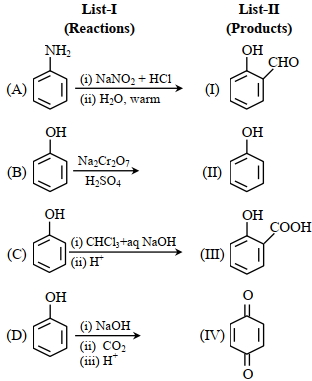
A
$A-III, B-II, C-I, D-IV$
B
$A-IV, B-II, C-III, D-I$
C
$A-I, B-IV, C-II, D-III$
D
$A-II, B-IV, C-I, D-III$
Solution
(D) The reactions are matched as follows:
$(A)$ Aniline reacts with $NaNO_2 + HCl$ followed by warm $H_2O$ to form phenol. This corresponds to product $(II)$.
$(B)$ Phenol reacts with $Na_2Cr_2O_7 / H_2SO_4$ to form $p$-benzoquinone. This corresponds to product $(IV)$.
$(C)$ Phenol reacts with $CHCl_3 + aq. NaOH$ followed by $H^+$ (Reimer-Tiemann reaction) to form salicylaldehyde. This corresponds to product $(I)$.
$(D)$ Phenol reacts with $NaOH$,$CO_2$,and $H^+$ (Kolbe's reaction) to form salicylic acid. This corresponds to product $(III)$.
Therefore,the correct matching is $A-II, B-IV, C-I, D-III$.
$(A)$ Aniline reacts with $NaNO_2 + HCl$ followed by warm $H_2O$ to form phenol. This corresponds to product $(II)$.
$(B)$ Phenol reacts with $Na_2Cr_2O_7 / H_2SO_4$ to form $p$-benzoquinone. This corresponds to product $(IV)$.
$(C)$ Phenol reacts with $CHCl_3 + aq. NaOH$ followed by $H^+$ (Reimer-Tiemann reaction) to form salicylaldehyde. This corresponds to product $(I)$.
$(D)$ Phenol reacts with $NaOH$,$CO_2$,and $H^+$ (Kolbe's reaction) to form salicylic acid. This corresponds to product $(III)$.
Therefore,the correct matching is $A-II, B-IV, C-I, D-III$.
0 likesView Solution
308
ChemistryMediumMCQJEE Main · 2024
Match List-$I$ with List-$II$:
Choose the correct answer from the options given below:
| List-$I$ (Test) | List-$II$ (Identification) |
| $A$. Bayer's test | $I$. Phenol |
| $B$. Ceric ammonium nitrate test | $II$. Aldehyde |
| $C$. Phthalein dye test | $III$. Alcoholic-$OH$ group |
| $D$. Schiff's test | $IV$. Unsaturation |
Choose the correct answer from the options given below:
A
$A-III, B-I, C-IV, D-II$
B
$A-II, B-III, C-IV, D-I$
C
$A-IV, B-I, C-II, D-III$
D
$A-IV, B-III, C-I, D-II$
Solution
(D) . Bayer's test $\rightarrow$ Unsaturation $(IV)$
$B$. Ceric ammonium nitrate test $\rightarrow$ Alcoholic-$OH$ group $(III)$
$C$. Phthalein dye test $\rightarrow$ Phenol $(I)$
$D$. Schiff's test $\rightarrow$ Aldehyde $(II)$
Therefore,the correct matching is $A-IV, B-III, C-I, D-II$.
$B$. Ceric ammonium nitrate test $\rightarrow$ Alcoholic-$OH$ group $(III)$
$C$. Phthalein dye test $\rightarrow$ Phenol $(I)$
$D$. Schiff's test $\rightarrow$ Aldehyde $(II)$
Therefore,the correct matching is $A-IV, B-III, C-I, D-II$.
0 likesView Solution
309
ChemistryMediumMCQJEE Main · 2024
Identify the incorrect statements about group $15$ elements :
$A$. Dinitrogen is a diatomic gas which acts like an inert gas at room temperature.
$B$. The common oxidation states of these elements are $-3, +3$ and $+5$.
$C$. Nitrogen has unique ability to form $p\pi-p\pi$ multiple bonds.
$D$. The stability of $+5$ oxidation states increases down the group.
$E$. Nitrogen shows a maximum covalency of $6$.
Choose the correct answer from the options given below.
$A$. Dinitrogen is a diatomic gas which acts like an inert gas at room temperature.
$B$. The common oxidation states of these elements are $-3, +3$ and $+5$.
$C$. Nitrogen has unique ability to form $p\pi-p\pi$ multiple bonds.
$D$. The stability of $+5$ oxidation states increases down the group.
$E$. Nitrogen shows a maximum covalency of $6$.
Choose the correct answer from the options given below.
A
$A, B, D$ only
B
$A, C, E$ only
C
$B, D, E$ only
D
$D$ and $E$ only
Solution
(C) . Incorrect: Dinitrogen is a diatomic gas,but it is not inert; it is relatively unreactive at room temperature due to the high bond enthalpy of the $N \equiv N$ bond.
$B$. Correct: The common oxidation states are $-3, +3, +5$.
$C$. Correct: Nitrogen has a small size and high electronegativity,allowing it to form $p\pi-p\pi$ multiple bonds.
$D$. Incorrect: The stability of the $+5$ oxidation state decreases down the group due to the inert pair effect.
$E$. Incorrect: Nitrogen has a maximum covalency of $4$ because it lacks $d$-orbitals in its valence shell.
$B$. Correct: The common oxidation states are $-3, +3, +5$.
$C$. Correct: Nitrogen has a small size and high electronegativity,allowing it to form $p\pi-p\pi$ multiple bonds.
$D$. Incorrect: The stability of the $+5$ oxidation state decreases down the group due to the inert pair effect.
$E$. Incorrect: Nitrogen has a maximum covalency of $4$ because it lacks $d$-orbitals in its valence shell.
0 likesView Solution
310
ChemistryMediumMCQJEE Main · 2024
The correct sequence of acidic strength of the following aliphatic acids in their decreasing order is: $CH_3CH_2COOH$,$CH_3COOH$,$CH_3CH_2CH_2COOH$,$HCOOH$
A
$HCOOH > CH_3COOH > CH_3CH_2COOH > CH_3CH_2CH_2COOH$
B
$HCOOH > CH_3CH_2CH_2COOH > CH_3CH_2COOH > CH_3COOH$
C
$CH_3CH_2CH_2COOH > CH_3CH_2COOH > CH_3COOH > HCOOH$
D
$CH_3COOH > CH_3CH_2COOH > CH_3CH_2CH_2COOH > HCOOH$
Solution
(A) The acidic strength of carboxylic acids depends on the electron-donating effect of the alkyl group attached to the $-COOH$ group.
Alkyl groups exhibit a $+I$ (positive inductive) effect,which destabilizes the carboxylate anion and decreases the acidic strength.
As the size of the alkyl group increases,the $+I$ effect increases,thereby decreasing the acidic strength.
$HCOOH$ has no alkyl group,so it is the strongest acid.
Comparing the others: $CH_3COOH$ (methyl group) > $CH_3CH_2COOH$ (ethyl group) > $CH_3CH_2CH_2COOH$ (propyl group).
Therefore,the correct decreasing order is: $HCOOH > CH_3COOH > CH_3CH_2COOH > CH_3CH_2CH_2COOH$.
Alkyl groups exhibit a $+I$ (positive inductive) effect,which destabilizes the carboxylate anion and decreases the acidic strength.
As the size of the alkyl group increases,the $+I$ effect increases,thereby decreasing the acidic strength.
$HCOOH$ has no alkyl group,so it is the strongest acid.
Comparing the others: $CH_3COOH$ (methyl group) > $CH_3CH_2COOH$ (ethyl group) > $CH_3CH_2CH_2COOH$ (propyl group).
Therefore,the correct decreasing order is: $HCOOH > CH_3COOH > CH_3CH_2COOH > CH_3CH_2CH_2COOH$.
0 likesView Solution
311
ChemistryMediumMCQJEE Main · 2024
Given below are two statements:
Statement $I$: All the following compounds react with $p$-toluenesulfonyl chloride:
$C_6H_5NH_2$
$(C_6H_5)_2NH$
$(C_6H_5)_3N$
Statement $II$: Their products in the above reaction are soluble in aqueous $NaOH$.
In the light of the above statements,choose the correct answer from the options given below.
Statement $I$: All the following compounds react with $p$-toluenesulfonyl chloride:
$C_6H_5NH_2$
$(C_6H_5)_2NH$
$(C_6H_5)_3N$
Statement $II$: Their products in the above reaction are soluble in aqueous $NaOH$.
In the light of the above statements,choose the correct answer from the options given below.
A
Both Statement $I$ and Statement $II$ are false
B
Statement $I$ is true but Statement $II$ is false
C
Statement $I$ is false but Statement $II$ is true
D
Both Statement $I$ and Statement $II$ are true
Solution
(A) $p$-Toluenesulfonyl chloride (Hinsberg reagent) reacts only with primary $(1^{\circ})$ and secondary $(2^{\circ})$ amines.
$C_6H_5NH_2$ ($1^{\circ}$ amine) reacts to form $N$-phenyl-$p$-toluenesulfonamide,which is soluble in aqueous $NaOH$ due to the acidic hydrogen on the nitrogen atom.
$(C_6H_5)_2NH$ ($2^{\circ}$ amine) reacts to form $N,N$-diphenyl-$p$-toluenesulfonamide,which is insoluble in aqueous $NaOH$ because it lacks an acidic hydrogen.
$(C_6H_5)_3N$ ($3^{\circ}$ amine) does not react with $p$-toluenesulfonyl chloride.
Therefore,Statement $I$ is false because not all compounds react,and Statement $II$ is false because the products are not all soluble in $NaOH$.
$C_6H_5NH_2$ ($1^{\circ}$ amine) reacts to form $N$-phenyl-$p$-toluenesulfonamide,which is soluble in aqueous $NaOH$ due to the acidic hydrogen on the nitrogen atom.
$(C_6H_5)_2NH$ ($2^{\circ}$ amine) reacts to form $N,N$-diphenyl-$p$-toluenesulfonamide,which is insoluble in aqueous $NaOH$ because it lacks an acidic hydrogen.
$(C_6H_5)_3N$ ($3^{\circ}$ amine) does not react with $p$-toluenesulfonyl chloride.
Therefore,Statement $I$ is false because not all compounds react,and Statement $II$ is false because the products are not all soluble in $NaOH$.
0 likesView Solution
312
ChemistryMediumMCQJEE Main · 2024
The $emf$ of cell $Tl | Tl^+_{(0.001M)} || Cu^{2+}_{(0.01M)} | Cu$ is $0.83 \ V$ at $298 \ K$. It could be increased by:
A
increasing concentration of $Tl^+$ ions
B
increasing concentration of both $Tl^+$ and $Cu^{2+}$ ions
C
decreasing concentration of both $Tl^+$ and $Cu^{2+}$ ions
D
increasing concentration of $Cu^{2+}$ ions
Solution
(D) The cell reaction is: $2Tl_{(s)} + Cu^{2+}_{(aq)} \rightarrow 2Tl^+_{(aq)} + Cu_{(s)}$
According to the Nernst equation:
$E_{cell} = E^o_{cell} - \frac{0.0591}{2} \log \frac{[Tl^+]^2}{[Cu^{2+}]}$
To increase $E_{cell}$,the value of the logarithmic term $\frac{[Tl^+]^2}{[Cu^{2+}]}$ must decrease.
This can be achieved by increasing the concentration of the reactant $[Cu^{2+}]$ or decreasing the concentration of the product $[Tl^+]$.
Therefore,increasing the concentration of $Cu^{2+}$ ions will increase the $E_{cell}$.
According to the Nernst equation:
$E_{cell} = E^o_{cell} - \frac{0.0591}{2} \log \frac{[Tl^+]^2}{[Cu^{2+}]}$
To increase $E_{cell}$,the value of the logarithmic term $\frac{[Tl^+]^2}{[Cu^{2+}]}$ must decrease.
This can be achieved by increasing the concentration of the reactant $[Cu^{2+}]$ or decreasing the concentration of the product $[Tl^+]$.
Therefore,increasing the concentration of $Cu^{2+}$ ions will increase the $E_{cell}$.
0 likesView Solution
313
ChemistryMediumMCQJEE Main · 2024
The reaction $\frac{1}{2} H_{2(g)} + AgCl_{(s)} \rightarrow H_{(aq)}^{+} + Cl_{(aq)}^{-} + Ag_{(s)}$ occurs in which of the following galvanic cells?
A
$Pt|H_{2(g)}|HCl_{(soln.)}|AgCl_{(s)}|Ag$
B
$Pt|H_{2(g)}|HCl_{(soln.)}|AgNO_{3(aq)}|Ag$
C
$Pt|H_{2(g)}|KCl_{(soln.)}|AgCl_{(s)}|Ag$
D
$Ag|AgCl_{(s)}|KCl_{(aq)}|AgNO_{3(aq)}|Ag$
Solution
(A) The given redox reaction is: $\frac{1}{2} H_{2(g)} + AgCl_{(s)} \rightarrow H_{(aq)}^{+} + Cl_{(aq)}^{-} + Ag_{(s)}$
Anodic half-cell reaction (Oxidation):
$\frac{1}{2} H_{2(g)} \rightarrow H_{(aq)}^{+} + e^{-}$
This corresponds to the hydrogen electrode: $Pt|H_{2(g)}|H_{(aq)}^{+}$
Cathodic half-cell reaction (Reduction):
$AgCl_{(s)} + e^{-} \rightarrow Ag_{(s)} + Cl_{(aq)}^{-}$
This corresponds to the silver-silver chloride electrode: $Cl_{(aq)}^{-}|AgCl_{(s)}|Ag$
Combining these,the cell representation is:
$Pt|H_{2(g)}|H_{(aq)}^{+}, Cl_{(aq)}^{-}|AgCl_{(s)}|Ag$
Since $HCl$ or $KCl$ provides the $H^{+}$ and $Cl^{-}$ ions,the representation $Pt|H_{2(g)}|HCl_{(soln.)}|AgCl_{(s)}|Ag$ is correct. Option $A$ represents this cell.
Anodic half-cell reaction (Oxidation):
$\frac{1}{2} H_{2(g)} \rightarrow H_{(aq)}^{+} + e^{-}$
This corresponds to the hydrogen electrode: $Pt|H_{2(g)}|H_{(aq)}^{+}$
Cathodic half-cell reaction (Reduction):
$AgCl_{(s)} + e^{-} \rightarrow Ag_{(s)} + Cl_{(aq)}^{-}$
This corresponds to the silver-silver chloride electrode: $Cl_{(aq)}^{-}|AgCl_{(s)}|Ag$
Combining these,the cell representation is:
$Pt|H_{2(g)}|H_{(aq)}^{+}, Cl_{(aq)}^{-}|AgCl_{(s)}|Ag$
Since $HCl$ or $KCl$ provides the $H^{+}$ and $Cl^{-}$ ions,the representation $Pt|H_{2(g)}|HCl_{(soln.)}|AgCl_{(s)}|Ag$ is correct. Option $A$ represents this cell.
0 likesView Solution
314
ChemistryMediumMCQJEE Main · 2024
Given below are two statements:
Statement $I$: Fusion of $MnO_2$ with $KOH$ and an oxidising agent gives dark green $K_2MnO_4$.
Statement $II$: Manganate ion on electrolytic oxidation in alkaline medium gives permanganate ion.
In the light of the above statements,choose the correct answer from the options given below.
Statement $I$: Fusion of $MnO_2$ with $KOH$ and an oxidising agent gives dark green $K_2MnO_4$.
Statement $II$: Manganate ion on electrolytic oxidation in alkaline medium gives permanganate ion.
In the light of the above statements,choose the correct answer from the options given below.
A
Both Statement $I$ and Statement $II$ are true
B
Both Statement $I$ and Statement $II$ are false
C
Statement $I$ is true but Statement $II$ is false
D
Statement $I$ is false but Statement $II$ is true
Solution
(A) $MnO_2 + 2 KOH + \frac{1}{2} O_2 \rightarrow K_2MnO_4 + H_2O$ (Dark green color).
Statement $I$ is true because the fusion of $MnO_2$ with $KOH$ in the presence of an oxidizing agent like $KNO_3$ or atmospheric oxygen yields potassium manganate $(K_2MnO_4)$,which is dark green in color.
Statement $II$ is true because the manganate ion $(MnO_4^{2-})$ undergoes electrolytic oxidation in an alkaline medium to form the purple-colored permanganate ion $(MnO_4^-)$.
The reaction at the anode is: $MnO_4^{2-} \rightarrow MnO_4^- + e^-$.
Statement $I$ is true because the fusion of $MnO_2$ with $KOH$ in the presence of an oxidizing agent like $KNO_3$ or atmospheric oxygen yields potassium manganate $(K_2MnO_4)$,which is dark green in color.
Statement $II$ is true because the manganate ion $(MnO_4^{2-})$ undergoes electrolytic oxidation in an alkaline medium to form the purple-colored permanganate ion $(MnO_4^-)$.
The reaction at the anode is: $MnO_4^{2-} \rightarrow MnO_4^- + e^-$.
0 likesView Solution
315
ChemistryMediumMCQJEE Main · 2024
Match List-$I$ with List-$II$.
Choose the correct answer from the options given below:
| List-$I$ (Complex) | List-$II$ (Spin only magnetic moment in $B$.$M$.) |
| $A$. $[Cr(NH_3)_6]^{3+}$ | $I$. $4.90$ |
| $B$. $[NiCl_4]^{2-}$ | $II$. $3.87$ |
| $C$. $[CoF_6]^{3-}$ | $III$. $0.0$ |
| $D$. $[Ni(CN)_4]^{2-}$ | $IV$. $2.83$ |
Choose the correct answer from the options given below:
A
$A-II, B-IV, C-I, D-III$
B
$A-IV, B-III, C-I, D-II$
C
$A-II, B-IV, C-I, D-III$
D
$A-II, B-III, C-I, D-IV$
Solution
(A) The spin-only magnetic moment is calculated using the formula $\mu = \sqrt{n(n+2)} \ B.M.$,where $n$ is the number of unpaired electrons.
$(A) [Cr(NH_3)_6]^{3+}$: $Cr^{3+}$ is $3d^3$. Number of unpaired electrons $n=3$. $\mu = \sqrt{3(3+2)} = \sqrt{15} \approx 3.87 \ B.M. \ (II)$.
$(B) [NiCl_4]^{2-}$: $Ni^{2+}$ is $3d^8$. In a tetrahedral field,$n=2$. $\mu = \sqrt{2(2+2)} = \sqrt{8} \approx 2.83 \ B.M. \ (IV)$.
$(C) [CoF_6]^{3-}$: $Co^{3+}$ is $3d^6$. $F^-$ is a weak field ligand,so $n=4$. $\mu = \sqrt{4(4+2)} = \sqrt{24} \approx 4.90 \ B.M. \ (I)$.
$(D) [Ni(CN)_4]^{2-}$: $Ni^{2+}$ is $3d^8$. $CN^-$ is a strong field ligand,causing pairing,so $n=0$. $\mu = 0 \ B.M. \ (III)$.
Thus,the correct match is $A-II, B-IV, C-I, D-III$.
$(A) [Cr(NH_3)_6]^{3+}$: $Cr^{3+}$ is $3d^3$. Number of unpaired electrons $n=3$. $\mu = \sqrt{3(3+2)} = \sqrt{15} \approx 3.87 \ B.M. \ (II)$.
$(B) [NiCl_4]^{2-}$: $Ni^{2+}$ is $3d^8$. In a tetrahedral field,$n=2$. $\mu = \sqrt{2(2+2)} = \sqrt{8} \approx 2.83 \ B.M. \ (IV)$.
$(C) [CoF_6]^{3-}$: $Co^{3+}$ is $3d^6$. $F^-$ is a weak field ligand,so $n=4$. $\mu = \sqrt{4(4+2)} = \sqrt{24} \approx 4.90 \ B.M. \ (I)$.
$(D) [Ni(CN)_4]^{2-}$: $Ni^{2+}$ is $3d^8$. $CN^-$ is a strong field ligand,causing pairing,so $n=0$. $\mu = 0 \ B.M. \ (III)$.
Thus,the correct match is $A-II, B-IV, C-I, D-III$.
0 likesView Solution
316
ChemistryMediumMCQJEE Main · 2024
The total number of carbon atoms present in tyrosine,an amino acid,is $................$
A
$8$
B
$7$
C
$6$
D
$9$
Solution
(D) The chemical structure of tyrosine is $HO-C_6H_4-CH_2-CH(NH_2)-COOH$.
Counting the carbon atoms:
$1$ carbon atom in the carboxylic acid group $(-COOH)$,
$1$ carbon atom in the alpha-carbon position $(-CH(NH_2)-)$,
$1$ carbon atom in the methylene bridge $(-CH_2-)$,
$6$ carbon atoms in the benzene ring.
Total number of carbon atoms $= 1 + 1 + 1 + 6 = 9$.
Counting the carbon atoms:
$1$ carbon atom in the carboxylic acid group $(-COOH)$,
$1$ carbon atom in the alpha-carbon position $(-CH(NH_2)-)$,
$1$ carbon atom in the methylene bridge $(-CH_2-)$,
$6$ carbon atoms in the benzene ring.
Total number of carbon atoms $= 1 + 1 + 1 + 6 = 9$.
0 likesView Solution
317
ChemistryMediumMCQJEE Main · 2024
Two moles of benzaldehyde and one mole of acetone under alkaline conditions using aqueous $NaOH$ after heating gives $x$ as the major product. The number of $\pi$ bonds in the product $x$ is.................
A
$9$
B
$10$
C
$15$
D
$20$
Solution
(A) The reaction between two moles of benzaldehyde $(C_6H_5CHO)$ and one mole of acetone $(CH_3COCH_3)$ in the presence of aqueous $NaOH$ and heat is a Claisen-Schmidt condensation reaction.
The product $x$ formed is dibenzylideneacetone,which has the structure: $C_6H_5-CH=CH-CO-CH=CH-C_6H_5$.
To calculate the number of $\pi$ bonds in dibenzylideneacetone:
$1$. Each phenyl ring $(C_6H_5)$ contains $3$ $\pi$ bonds.
$2$. There are two phenyl rings,so $2 \times 3 = 6$ $\pi$ bonds.
$3$. There are two $C=C$ double bonds,contributing $2$ $\pi$ bonds.
$4$. There is one $C=O$ double bond,contributing $1$ $\pi$ bond.
Total $\pi$ bonds = $6 + 2 + 1 = 9$.
The product $x$ formed is dibenzylideneacetone,which has the structure: $C_6H_5-CH=CH-CO-CH=CH-C_6H_5$.
To calculate the number of $\pi$ bonds in dibenzylideneacetone:
$1$. Each phenyl ring $(C_6H_5)$ contains $3$ $\pi$ bonds.
$2$. There are two phenyl rings,so $2 \times 3 = 6$ $\pi$ bonds.
$3$. There are two $C=C$ double bonds,contributing $2$ $\pi$ bonds.
$4$. There is one $C=O$ double bond,contributing $1$ $\pi$ bond.
Total $\pi$ bonds = $6 + 2 + 1 = 9$.
0 likesView Solution
318
ChemistryMediumMCQJEE Main · 2024
Molality of an aqueous solution of urea is $4.44 \ m$. Mole fraction of urea in solution is $x \times 10^{-5}$. Value of $x$ is. . . . . . (integer answer)
A
$70$
B
$73$
C
$74$
D
$80$
Solution
(C) Molality $(m)$ is defined as the number of moles of solute per kilogram of solvent.
Given $m = 4.44 \ m$,this means $4.44 \ mol$ of urea is dissolved in $1000 \ g$ $(1 \ kg)$ of water.
Moles of water $(n_{water})$ = $\frac{1000 \ g}{18 \ g/mol} \approx 55.56 \ mol$.
Mole fraction of urea $(X_{urea})$ = $\frac{n_{urea}}{n_{urea} + n_{water}} = \frac{4.44}{4.44 + 55.56} = \frac{4.44}{60} = 0.074$.
We are given $X_{urea} = x \times 10^{-5}$.
$0.074 = 7400 \times 10^{-5}$.
Therefore,$x = 7400$.
Given $m = 4.44 \ m$,this means $4.44 \ mol$ of urea is dissolved in $1000 \ g$ $(1 \ kg)$ of water.
Moles of water $(n_{water})$ = $\frac{1000 \ g}{18 \ g/mol} \approx 55.56 \ mol$.
Mole fraction of urea $(X_{urea})$ = $\frac{n_{urea}}{n_{urea} + n_{water}} = \frac{4.44}{4.44 + 55.56} = \frac{4.44}{60} = 0.074$.
We are given $X_{urea} = x \times 10^{-5}$.
$0.074 = 7400 \times 10^{-5}$.
Therefore,$x = 7400$.
0 likesView Solution
319
ChemistryMediumMCQJEE Main · 2024
Total number of unpaired electrons in the complex ions $[Co(NH_3)_6]^{3+}$ and $[NiCl_4]^{2-}$ is...............
A
$5$
B
$3$
C
$1$
D
$2$
Solution
(D) For $[Co(NH_3)_6]^{3+}$: $Co$ is in $+3$ oxidation state. The electronic configuration of $Co^{3+}$ is $[Ar] 3d^6$. Since $NH_3$ is a strong field ligand,it causes pairing of electrons in $d$-orbitals,resulting in $t_{2g}^6 e_g^0$. Thus,the number of unpaired electrons is $0$.
For $[NiCl_4]^{2-}$: $Ni$ is in $+2$ oxidation state. The electronic configuration of $Ni^{2+}$ is $[Ar] 3d^8$. Since $Cl^-$ is a weak field ligand,the electrons remain unpaired in the $d$-orbitals. The configuration is $e^4 t_2^4$,which results in $2$ unpaired electrons.
Total number of unpaired electrons = $0 + 2 = 2$.
For $[NiCl_4]^{2-}$: $Ni$ is in $+2$ oxidation state. The electronic configuration of $Ni^{2+}$ is $[Ar] 3d^8$. Since $Cl^-$ is a weak field ligand,the electrons remain unpaired in the $d$-orbitals. The configuration is $e^4 t_2^4$,which results in $2$ unpaired electrons.
Total number of unpaired electrons = $0 + 2 = 2$.
0 likesView Solution
320
ChemistryMediumMCQJEE Main · 2024
$A$ solution is prepared by adding $1 \ mole$ of ethyl alcohol in $9 \ mole$ of water. The mass percent of solute in the solution is. . . . . . . (Integer Answer)
(Given : Molar mass in $g \ mol^{-1}$ Ethyl alcohol : $46$,
water : $18$)
(Given : Molar mass in $g \ mol^{-1}$ Ethyl alcohol : $46$,
water : $18$)
A
$20$
B
$22$
C
$30$
D
$35$
Solution
(B) Mass of solute (ethyl alcohol) $= 1 \ mole \times 46 \ g \ mol^{-1} = 46 \ g$.
Mass of solvent (water) $= 9 \ mole \times 18 \ g \ mol^{-1} = 162 \ g$.
Total mass of solution $= 46 \ g + 162 \ g = 208 \ g$.
Mass percent of solute $= \frac{\text{Mass of solute}}{\text{Total mass of solution}} \times 100$.
Mass percent $= \frac{46}{208} \times 100 = \frac{4600}{208} \approx 22.11 \%$.
The integer value is $22$.
Mass of solvent (water) $= 9 \ mole \times 18 \ g \ mol^{-1} = 162 \ g$.
Total mass of solution $= 46 \ g + 162 \ g = 208 \ g$.
Mass percent of solute $= \frac{\text{Mass of solute}}{\text{Total mass of solution}} \times 100$.
Mass percent $= \frac{46}{208} \times 100 = \frac{4600}{208} \approx 22.11 \%$.
The integer value is $22$.
2 likesView Solution
321
ChemistryMediumMCQJEE Main · 2024
The molar conductivity for electrolytes $A$ and $B$ are plotted against $C^{1/2}$ as shown below. Electrolytes $A$ and $B$ respectively are:
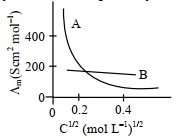
A
Weak electrolyte,weak electrolyte
B
Strong electrolyte,strong electrolyte
C
Weak electrolyte,strong electrolyte
D
Strong electrolyte,weak electrolyte
Solution
(C) For strong electrolytes,molar conductivity $(\Lambda_m)$ varies linearly with $C^{1/2}$ according to the Kohlrausch equation: $\Lambda_m = \Lambda_m^0 - A \sqrt{C}$. This is represented by the straight line $B$.
For weak electrolytes,molar conductivity increases sharply with dilution (decrease in $C^{1/2}$) due to an increase in the degree of dissociation,as shown by the curve $A$.
For weak electrolytes,molar conductivity increases sharply with dilution (decrease in $C^{1/2}$) due to an increase in the degree of dissociation,as shown by the curve $A$.
0 likesView Solution
322
ChemistryMediumMCQJEE Main · 2024
In the following sequence of reaction,the major products $B$ and $C$ respectively are :
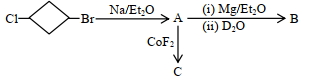
A
$D$-cyclobutylcyclobutane-$D$ and $F$-cyclobutylcyclobutane-$F$
B
$D$-cyclopropylcyclopropane-$D$ and $F$-cyclobutylcyclobutane-$F$
C
$D$-cyclobutylcyclobutane-$D$ and $F$-cyclobutylcyclobutane-$F$
D
$D$-cyclopropylcyclopropane-$D$ and $F$-cyclopropylcyclopropane-$F$
Solution
(A) $1$. The reaction of $1$-bromo-$3$-chlorocyclobutane with $Na/Et_2O$ is a Wurtz reaction. Since the $Br$ atom is a better leaving group than $Cl$,the coupling occurs at the $Br$ position,forming $1,1'$-dichloro-$3,3'$-bicyclobutane (compound $A$).
$2$. Compound $A$ reacts with $(i) Mg/Et_2O$ followed by $(ii) D_2O$. The $Mg$ forms a Grignard reagent with the $Cl$ atoms,which is then quenched by $D_2O$ to replace $Cl$ with $D$,yielding $B$ as $1,1'$-dideuterio-$3,3'$-bicyclobutane.
$3$. Compound $A$ reacts with $CoF_2$ (a fluorinating agent used in the Swarts reaction) to replace the $Cl$ atoms with $F$ atoms,yielding $C$ as $1,1'$-difluoro-$3,3'$-bicyclobutane.
$4$. Therefore,the products $B$ and $C$ are $1,1'$-dideuterio-$3,3'$-bicyclobutane and $1,1'$-difluoro-$3,3'$-bicyclobutane respectively.
$2$. Compound $A$ reacts with $(i) Mg/Et_2O$ followed by $(ii) D_2O$. The $Mg$ forms a Grignard reagent with the $Cl$ atoms,which is then quenched by $D_2O$ to replace $Cl$ with $D$,yielding $B$ as $1,1'$-dideuterio-$3,3'$-bicyclobutane.
$3$. Compound $A$ reacts with $CoF_2$ (a fluorinating agent used in the Swarts reaction) to replace the $Cl$ atoms with $F$ atoms,yielding $C$ as $1,1'$-difluoro-$3,3'$-bicyclobutane.
$4$. Therefore,the products $B$ and $C$ are $1,1'$-dideuterio-$3,3'$-bicyclobutane and $1,1'$-difluoro-$3,3'$-bicyclobutane respectively.
0 likesView Solution
323
ChemistryMediumMCQJEE Main · 2024
The correct order of basic strength of Pyrrole,Pyridine,and Piperidine is:
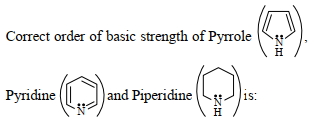
A
Pyrrole > Piperidine > Pyridine
B
Pyrrole > Pyridine > Piperidine
C
Pyridine > Piperidine > Pyrrole
D
Piperidine > Pyridine > Pyrrole
Solution
(D) The basic strength depends on the availability of the lone pair on the nitrogen atom.
$1$. In Piperidine,the nitrogen is $sp^3$ hybridized and the lone pair is localized,making it the most basic.
$2$. In Pyridine,the nitrogen is $sp^2$ hybridized and the lone pair is localized in an $sp^2$ orbital,making it less basic than Piperidine.
$3$. In Pyrrole,the lone pair on the nitrogen is involved in the aromatic sextet (delocalized),making it the least basic.
Therefore,the correct order is: $\text{Piperidine} > \text{Pyridine} > \text{Pyrrole}$.
$1$. In Piperidine,the nitrogen is $sp^3$ hybridized and the lone pair is localized,making it the most basic.
$2$. In Pyridine,the nitrogen is $sp^2$ hybridized and the lone pair is localized in an $sp^2$ orbital,making it less basic than Piperidine.
$3$. In Pyrrole,the lone pair on the nitrogen is involved in the aromatic sextet (delocalized),making it the least basic.
Therefore,the correct order is: $\text{Piperidine} > \text{Pyridine} > \text{Pyrrole}$.
0 likesView Solution
324
ChemistryMediumMCQJEE Main · 2024
Given below are two statements: one is labelled as Assertion $(A)$ and the other is labelled as Reason $(R)$ :
Assertion $(A)$ : $S_N2$ reaction of $C_6H_5CH_2Br$ occurs more readily than the $S_N2$ reaction of $CH_3CH_2Br$.
Reason $(R)$ : The partially bonded unhybridized $p$-orbital that develops in the trigonal bipyramidal transition state is stabilized by conjugation with the phenyl ring.
In the light of the above statements,choose the most appropriate answer from the options given below:
Assertion $(A)$ : $S_N2$ reaction of $C_6H_5CH_2Br$ occurs more readily than the $S_N2$ reaction of $CH_3CH_2Br$.
Reason $(R)$ : The partially bonded unhybridized $p$-orbital that develops in the trigonal bipyramidal transition state is stabilized by conjugation with the phenyl ring.
In the light of the above statements,choose the most appropriate answer from the options given below:
A
$(A)$ is not correct but $(R)$ is correct
B
Both $(A)$ and $(R)$ are correct but $(R)$ is not the correct explanation of $(A)$
C
Both $(A)$ and $(R)$ are correct and $(R)$ is the correct explanation of $(A)$
D
$(A)$ is correct but $(R)$ is not correct
Solution
(C) In an $S_N2$ reaction,the nucleophile attacks from the backside of the leaving group,leading to a trigonal bipyramidal transition state.
In the case of benzyl bromide $(C_6H_5CH_2Br)$,the transition state involves a partially bonded unhybridized $p$-orbital at the benzylic carbon.
This $p$-orbital is stabilized by conjugation with the $\pi$-electron system of the phenyl ring,which lowers the activation energy of the reaction.
Therefore,the $S_N2$ reaction of $C_6H_5CH_2Br$ occurs more readily than that of $CH_3CH_2Br$.
Both Assertion $(A)$ and Reason $(R)$ are correct,and $(R)$ is the correct explanation of $(A)$.
In the case of benzyl bromide $(C_6H_5CH_2Br)$,the transition state involves a partially bonded unhybridized $p$-orbital at the benzylic carbon.
This $p$-orbital is stabilized by conjugation with the $\pi$-electron system of the phenyl ring,which lowers the activation energy of the reaction.
Therefore,the $S_N2$ reaction of $C_6H_5CH_2Br$ occurs more readily than that of $CH_3CH_2Br$.
Both Assertion $(A)$ and Reason $(R)$ are correct,and $(R)$ is the correct explanation of $(A)$.
0 likesView Solution
325
ChemistryMediumMCQJEE Main · 2024
For the given compounds,the correct order of increasing $pK_{a}$ value is:
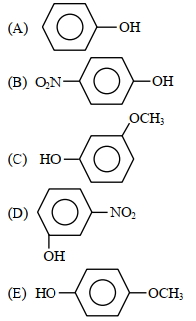
A
$(E) < (C) < (A) < (D) < (B)$
B
$(B) < (D) < (A) < (C) < (E)$
C
$(E) < (D) < (C) < (B) < (A)$
D
$(D) < (B) < (A) < (C) < (E)$
Solution
(A) The acidic strength of phenols is increased by electron-withdrawing groups $(-NO_2)$ and decreased by electron-donating groups $(-OCH_3)$.
$pK_{a}$ is inversely proportional to acidic strength.
$(A)$ Phenol
$(B)$ $p$-Nitrophenol (Strongest acid due to $-M$ and $-I$ effect of $-NO_2$)
$(C)$ $m$-Methoxyphenol ($-I$ effect of $-OCH_3$ increases acidity compared to phenol)
$(D)$ $o$-Nitrophenol (Strong acid due to $-I$ and $-M$ effect,but slightly weaker than $p$-nitrophenol due to intramolecular $H$-bonding)
$(E)$ $p$-Methoxyphenol (Strongest electron-donating effect $+M$ of $-OCH_3$ decreases acidity the most)
Acidic strength order: $(B) > (D) > (A) > (C) > (E)$
Therefore,the increasing order of $pK_{a}$ is: $(E) < (C) < (A) < (D) < (B)$.
$pK_{a}$ is inversely proportional to acidic strength.
$(A)$ Phenol
$(B)$ $p$-Nitrophenol (Strongest acid due to $-M$ and $-I$ effect of $-NO_2$)
$(C)$ $m$-Methoxyphenol ($-I$ effect of $-OCH_3$ increases acidity compared to phenol)
$(D)$ $o$-Nitrophenol (Strong acid due to $-I$ and $-M$ effect,but slightly weaker than $p$-nitrophenol due to intramolecular $H$-bonding)
$(E)$ $p$-Methoxyphenol (Strongest electron-donating effect $+M$ of $-OCH_3$ decreases acidity the most)
Acidic strength order: $(B) > (D) > (A) > (C) > (E)$
Therefore,the increasing order of $pK_{a}$ is: $(E) < (C) < (A) < (D) < (B)$.
0 likesView Solution
326
ChemistryMediumMCQJEE Main · 2024
Given below are two statements: one is labelled as Assertion $(A)$ and the other is labelled as Reason $(R)$.
Assertion $(A)$ : Both rhombic and monoclinic sulphur exist as $S_8$ while oxygen exists as $O_2$.
Reason $(R)$ : Oxygen forms $p \pi-p \pi$ multiple bonds with itself and other elements having small size and high electronegativity like $C, N$,which is not possible for sulphur.
In the light of the above statements,choose the most appropriate answer from the options given below:
Assertion $(A)$ : Both rhombic and monoclinic sulphur exist as $S_8$ while oxygen exists as $O_2$.
Reason $(R)$ : Oxygen forms $p \pi-p \pi$ multiple bonds with itself and other elements having small size and high electronegativity like $C, N$,which is not possible for sulphur.
In the light of the above statements,choose the most appropriate answer from the options given below:
A
Both $(A)$ and $(R)$ are correct and $(R)$ is the correct explanation of $(A)$.
B
Both $(A)$ and $(R)$ are correct but $(R)$ is not the correct explanation of $(A)$.
C
$(A)$ is correct but $(R)$ is not correct.
D
$(A)$ is not correct but $(R)$ is correct.
Solution
(A) Oxygen has a small atomic size and high electronegativity,which allows it to form stable $p \pi-p \pi$ multiple bonds with itself $(O_2)$ and other small atoms like $C$ and $N$.
Sulphur has a larger atomic size,making $p \pi-p \pi$ overlap ineffective; therefore,it prefers to form single bonds and exists as $S_8$ puckered rings.
Thus,Assertion $(A)$ is correct because $S_8$ is the stable form of sulphur.
Reason $(R)$ is also correct as it explains why oxygen exists as a diatomic molecule $(O_2)$ while sulphur exists as a polyatomic molecule $(S_8)$.
Sulphur has a larger atomic size,making $p \pi-p \pi$ overlap ineffective; therefore,it prefers to form single bonds and exists as $S_8$ puckered rings.
Thus,Assertion $(A)$ is correct because $S_8$ is the stable form of sulphur.
Reason $(R)$ is also correct as it explains why oxygen exists as a diatomic molecule $(O_2)$ while sulphur exists as a polyatomic molecule $(S_8)$.
0 likesView Solution
327
ChemistryMediumMCQJEE Main · 2024
Given below are two statements: one is labelled as Assertion $A$ and the other is labelled as Reason $R$.
Assertion $A$: The total number of geometrical isomers shown by $[Co(en)_2 Cl_2]^{+}$ complex ion is three.
Reason $R$: $[Co(en)_2 Cl_2]^{+}$ complex ion has an octahedral geometry.
In the light of the above statements,choose the most appropriate answer from the options given below:
Assertion $A$: The total number of geometrical isomers shown by $[Co(en)_2 Cl_2]^{+}$ complex ion is three.
Reason $R$: $[Co(en)_2 Cl_2]^{+}$ complex ion has an octahedral geometry.
In the light of the above statements,choose the most appropriate answer from the options given below:
A
Both $A$ and $R$ are correct and $R$ is the correct explanation of $A$.
B
$A$ is correct but $R$ is not correct.
C
$A$ is not correct but $R$ is correct.
D
Both $A$ and $R$ are correct but $R$ is not the correct explanation of $A$.
Solution
(C) The complex ion $[Co(en)_2 Cl_2]^{+}$ has an octahedral geometry.
It exhibits geometrical isomerism,specifically $cis$ and $trans$ isomers.
Therefore,the total number of geometrical isomers is $2$,not $3$.
Thus,Assertion $A$ is incorrect,while Reason $R$ is correct.
It exhibits geometrical isomerism,specifically $cis$ and $trans$ isomers.
Therefore,the total number of geometrical isomers is $2$,not $3$.
Thus,Assertion $A$ is incorrect,while Reason $R$ is correct.
0 likesView Solution
328
ChemistryMediumMCQJEE Main · 2024
The electronic configuration of $Cu(II)$ is $3d^9$ whereas that of $Cu(I)$ is $3d^{10}$. Which of the following is correct?
A
$Cu(II)$ is less stable
B
Stability of $Cu(I)$ and $Cu(II)$ depends on the nature of copper salts
C
$Cu(II)$ is more stable
D
$Cu(I)$ and $Cu(II)$ are equally stable
Solution
(C) In aqueous solution,$Cu(II)$ is more stable than $Cu(I)$.
This is because the high hydration energy of the $Cu^{2+}$ ion compensates for the second ionization energy $(IE_2)$ required to convert $Cu^+$ to $Cu^{2+}$.
This is because the high hydration energy of the $Cu^{2+}$ ion compensates for the second ionization energy $(IE_2)$ required to convert $Cu^+$ to $Cu^{2+}$.
0 likesView Solution
329
ChemistryMediumMCQJEE Main · 2024
What is the structure of $C$?
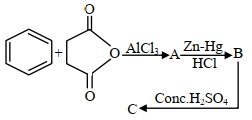
A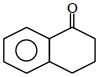
B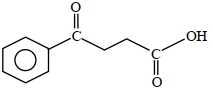
C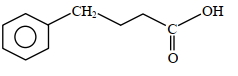
D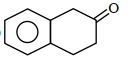
Solution
(D) The reaction sequence is as follows:
$1$. Friedel-Crafts acylation of benzene with succinic anhydride in the presence of $AlCl_3$ gives $4$-oxo-$4$-phenylbutanoic acid $(A)$.
$2$. Clemmensen reduction of $A$ using $Zn-Hg/HCl$ reduces the keto group to a methylene group,yielding $4$-phenylbutanoic acid $(B)$.
$3$. Intramolecular Friedel-Crafts acylation of $B$ in the presence of $conc. H_2SO_4$ leads to the formation of $\alpha$-tetralone $(C)$,which is $1,2,3,4$-tetrahydronaphthalen-$1$-one.
$1$. Friedel-Crafts acylation of benzene with succinic anhydride in the presence of $AlCl_3$ gives $4$-oxo-$4$-phenylbutanoic acid $(A)$.
$2$. Clemmensen reduction of $A$ using $Zn-Hg/HCl$ reduces the keto group to a methylene group,yielding $4$-phenylbutanoic acid $(B)$.
$3$. Intramolecular Friedel-Crafts acylation of $B$ in the presence of $conc. H_2SO_4$ leads to the formation of $\alpha$-tetralone $(C)$,which is $1,2,3,4$-tetrahydronaphthalen-$1$-one.
0 likesView Solution
330
ChemistryMediumMCQJEE Main · 2024
Identify the major product $X$ formed in the following reaction:
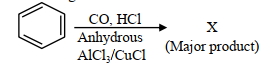
A
Benzoyl chloride
B
Benzophenone
C
Benzaldehyde
D
Benzyl chloride
Solution
(C) The given reaction is the Gattermann-Koch reaction. In this reaction,benzene reacts with carbon monoxide $(CO)$ and hydrogen chloride $(HCl)$ in the presence of anhydrous aluminum chloride $(AlCl_3)$ and cuprous chloride $(CuCl)$ to form benzaldehyde as the major product. The reaction is: $C_6H_6 + CO + HCl \xrightarrow{Anhydrous AlCl_3/CuCl} C_6H_5CHO$.
0 likesView Solution
331
ChemistryDifficultMCQJEE Main · 2024
On reaction of $Lead$ $Sulphide$ with dilute nitric acid,which of the following is not formed?
A
$Lead$ $nitrate$
B
$Sulphur$
C
$Nitric$ $oxide$
D
$Nitrous$ $oxide$
Solution
(D) The balanced chemical equation for the reaction of $Lead$ $Sulphide$ $(PbS)$ with dilute nitric acid $(HNO_3)$ is:
$3PbS + 8HNO_3 \rightarrow 3Pb(NO_3)_2 + 2NO + 3S + 4H_2O$
From the reaction,it is clear that $Lead$ $nitrate$ $(Pb(NO_3)_2)$,$Nitric$ $oxide$ $(NO)$,and $Sulphur$ $(S)$ are formed.
$Nitrous$ $oxide$ $(N_2O)$ is not formed during this reaction.
$3PbS + 8HNO_3 \rightarrow 3Pb(NO_3)_2 + 2NO + 3S + 4H_2O$
From the reaction,it is clear that $Lead$ $nitrate$ $(Pb(NO_3)_2)$,$Nitric$ $oxide$ $(NO)$,and $Sulphur$ $(S)$ are formed.
$Nitrous$ $oxide$ $(N_2O)$ is not formed during this reaction.
0 likesView Solution
332
ChemistryDifficultMCQJEE Main · 2024
Identify the incorrect statements regarding primary standard of titrimetric analysis.
$(A)$ It should be purely available in dry form.
$(B)$ It should not undergo chemical change in air.
$(C)$ It should be hygroscopic and should react with another chemical instantaneously and stoichiometrically.
$(D)$ It should be readily soluble in water.
$(E)$ $KMnO_4$ and $NaOH$ can be used as primary standard.
Choose the correct answer from the options given below:
$(A)$ It should be purely available in dry form.
$(B)$ It should not undergo chemical change in air.
$(C)$ It should be hygroscopic and should react with another chemical instantaneously and stoichiometrically.
$(D)$ It should be readily soluble in water.
$(E)$ $KMnO_4$ and $NaOH$ can be used as primary standard.
Choose the correct answer from the options given below:
A
$(C)$ and $(D)$ only
B
$(B)$ and $(E)$ only
C
$(A)$ and $(B)$ only
D
$(C)$ and $(E)$ only
Solution
(D) primary standard must be stable,non-hygroscopic,and available in a high state of purity.
Statement $(A)$ is correct: It should be available in a pure,dry form.
Statement $(B)$ is correct: It should not react with atmospheric components like moisture or $CO_2$.
Statement $(C)$ is incorrect: $A$ primary standard must $NOT$ be hygroscopic.
Statement $(D)$ is correct: It should be readily soluble in water.
Statement $(E)$ is incorrect: $KMnO_4$ and $NaOH$ are secondary standards because they are not stable or pure enough to be primary standards.
Therefore,the incorrect statements are $(C)$ and $(E)$.
Statement $(A)$ is correct: It should be available in a pure,dry form.
Statement $(B)$ is correct: It should not react with atmospheric components like moisture or $CO_2$.
Statement $(C)$ is incorrect: $A$ primary standard must $NOT$ be hygroscopic.
Statement $(D)$ is correct: It should be readily soluble in water.
Statement $(E)$ is incorrect: $KMnO_4$ and $NaOH$ are secondary standards because they are not stable or pure enough to be primary standards.
Therefore,the incorrect statements are $(C)$ and $(E)$.
0 likesView Solution
333
ChemistryMediumMCQJEE Main · 2024
$0.05 \ M \ CuSO_4$ when treated with $0.01 \ M \ K_2Cr_2O_7$ gives a green coloured solution of $Cu_2Cr_2O_7$. In an osmosis setup with a Semi Permeable Membrane $(SPM)$ separating Side $X$ $(K_2Cr_2O_7)$ and Side $Y$ $(CuSO_4)$,determine the observation due to osmosis.
A
Green colour formation observed on side $Y$.
B
Green colour formation observed on side $X$.
C
Molarity of $K_2Cr_2O_7$ solution is lowered.
D
Molarity of $CuSO_4$ solution is lowered.
Solution
(D) Osmosis is the movement of solvent molecules from a region of lower solute concentration to a region of higher solute concentration through a Semi Permeable Membrane $(SPM)$.
Here,$0.01 \ M \ K_2Cr_2O_7$ (Side $X$) has a lower concentration than $0.05 \ M \ CuSO_4$ (Side $Y$).
Therefore,solvent molecules move from Side $X$ to Side $Y$.
As solvent moves to Side $Y$,the $CuSO_4$ solution becomes more dilute,and the $K_2Cr_2O_7$ solution becomes more concentrated.
Since the solvent moves to Side $Y$,the $K_2Cr_2O_7$ molecules from Side $X$ cannot pass through the $SPM$ to react with $CuSO_4$ on Side $Y$. However,if we consider the net movement of solvent,the concentration of $CuSO_4$ on Side $Y$ decreases due to dilution.
Thus,the molarity of the $CuSO_4$ solution is lowered.
Here,$0.01 \ M \ K_2Cr_2O_7$ (Side $X$) has a lower concentration than $0.05 \ M \ CuSO_4$ (Side $Y$).
Therefore,solvent molecules move from Side $X$ to Side $Y$.
As solvent moves to Side $Y$,the $CuSO_4$ solution becomes more dilute,and the $K_2Cr_2O_7$ solution becomes more concentrated.
Since the solvent moves to Side $Y$,the $K_2Cr_2O_7$ molecules from Side $X$ cannot pass through the $SPM$ to react with $CuSO_4$ on Side $Y$. However,if we consider the net movement of solvent,the concentration of $CuSO_4$ on Side $Y$ decreases due to dilution.
Thus,the molarity of the $CuSO_4$ solution is lowered.
0 likesView Solution
334
ChemistryMediumMCQJEE Main · 2024
Given below are two statements:
Statement $I$: The rate law for the reaction $A + B \rightarrow C$ is rate $(r) = k[A]^2[B]$. When the concentration of both $A$ and $B$ is doubled,the reaction rate is increased "$x$" times.
Statement $II$: The figure shows the variation in concentration against time plot for a "$y$" order reaction.
Concentration of $R$ vs Time plot: $A$ straight line with a negative slope equal to $-K$.
The value of $x + y$ is . . . . . .
Statement $I$: The rate law for the reaction $A + B \rightarrow C$ is rate $(r) = k[A]^2[B]$. When the concentration of both $A$ and $B$ is doubled,the reaction rate is increased "$x$" times.
Statement $II$: The figure shows the variation in concentration against time plot for a "$y$" order reaction.
Concentration of $R$ vs Time plot: $A$ straight line with a negative slope equal to $-K$.
The value of $x + y$ is . . . . . .
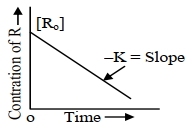
A
$7$
B
$8$
C
$10$
D
$15$
Solution
(B) For Statement $I$:
The rate law is $r = k[A]^2[B]$.
When concentrations of $A$ and $B$ are doubled,the new rate $r'$ is:
$r' = k[2A]^2[2B] = k(4[A]^2)(2[B]) = 8k[A]^2[B] = 8r$.
Thus,$x = 8$.
For Statement $II$:
The plot of concentration $[R]$ versus time $t$ is a straight line with a negative slope $-K$. This is characteristic of a zero-order reaction.
Thus,$y = 0$.
Therefore,$x + y = 8 + 0 = 8$.
The rate law is $r = k[A]^2[B]$.
When concentrations of $A$ and $B$ are doubled,the new rate $r'$ is:
$r' = k[2A]^2[2B] = k(4[A]^2)(2[B]) = 8k[A]^2[B] = 8r$.
Thus,$x = 8$.
For Statement $II$:
The plot of concentration $[R]$ versus time $t$ is a straight line with a negative slope $-K$. This is characteristic of a zero-order reaction.
Thus,$y = 0$.
Therefore,$x + y = 8 + 0 = 8$.
0 likesView Solution
335
ChemistryMediumMCQJEE Main · 2024
The standard reduction potentials at $298 \ K$ for the following half-cells are given below:
$Cr_2O_7^{2-} + 14H^+ + 6e^- \rightarrow 2Cr^{3+} + 7H_2O$,$E^{\circ} = 1.33 \ V$
$Fe^{3+} + 3e^- \rightarrow Fe$,$E^{\circ} = -0.04 \ V$
$Ni^{2+} + 2e^- \rightarrow Ni$,$E^{\circ} = -0.25 \ V$
$Ag^+ + e^- \rightarrow Ag$,$E^{\circ} = 0.80 \ V$
$Au^{3+} + 3e^- \rightarrow Au$,$E^{\circ} = 1.40 \ V$
Consider the given electrochemical reactions. The number of metal$(s)$ which will be oxidized by $Cr_2O_7^{2-}$ in aqueous solution is $.....$
$Cr_2O_7^{2-} + 14H^+ + 6e^- \rightarrow 2Cr^{3+} + 7H_2O$,$E^{\circ} = 1.33 \ V$
$Fe^{3+} + 3e^- \rightarrow Fe$,$E^{\circ} = -0.04 \ V$
$Ni^{2+} + 2e^- \rightarrow Ni$,$E^{\circ} = -0.25 \ V$
$Ag^+ + e^- \rightarrow Ag$,$E^{\circ} = 0.80 \ V$
$Au^{3+} + 3e^- \rightarrow Au$,$E^{\circ} = 1.40 \ V$
Consider the given electrochemical reactions. The number of metal$(s)$ which will be oxidized by $Cr_2O_7^{2-}$ in aqueous solution is $.....$
A
$1$
B
$2$
C
$3$
D
$4$
Solution
(C) metal will be oxidized by $Cr_2O_7^{2-}$ if the standard reduction potential $(E^{\circ})$ of the metal is less than the $E^{\circ}$ of the $Cr_2O_7^{2-} / Cr^{3+}$ half-cell $(1.33 \ V)$.
Comparing the given values:
$1. E^{\circ}(Fe^{3+}/Fe) = -0.04 \ V < 1.33 \ V$ (Oxidized)
$2. E^{\circ}(Ni^{2+}/Ni) = -0.25 \ V < 1.33 \ V$ (Oxidized)
$3. E^{\circ}(Ag^+/Ag) = 0.80 \ V < 1.33 \ V$ (Oxidized)
$4. E^{\circ}(Au^{3+}/Au) = 1.40 \ V > 1.33 \ V$ (Not oxidized)
Thus,$Fe$,$Ni$,and $Ag$ will be oxidized.
The total number of such metals is $3$.
Comparing the given values:
$1. E^{\circ}(Fe^{3+}/Fe) = -0.04 \ V < 1.33 \ V$ (Oxidized)
$2. E^{\circ}(Ni^{2+}/Ni) = -0.25 \ V < 1.33 \ V$ (Oxidized)
$3. E^{\circ}(Ag^+/Ag) = 0.80 \ V < 1.33 \ V$ (Oxidized)
$4. E^{\circ}(Au^{3+}/Au) = 1.40 \ V > 1.33 \ V$ (Not oxidized)
Thus,$Fe$,$Ni$,and $Ag$ will be oxidized.
The total number of such metals is $3$.
0 likesView Solution
Vedclass Products
For Students
Vedclass Test Series
Mock tests in real JEE Main style covering Chemistry with performance analysis. 5-day free trial.
Start Free TrialFor Teachers
Exam Paper Generator
Generate Set A/B/C/D Chemistry papers from 7.5L+ questions in 2 minutes. 3 chapters free.
Try FreeFor Institutes
Online Exam Module
Run live JEE Main mock exams with unlimited students, 360° analytics & white-label branding.
See DemoFrequently Asked Questions
How many Chemistry questions are in JEE Main 2024?
There are 606 Chemistry questions from the JEE Main 2024 paper on Vedclass, each with a detailed step-by-step solution in English.
Are JEE Main 2024 Chemistry solutions available in English?
Yes. All solutions on this page are in English. You can also switch to English or Hindi using the language buttons above the questions.
Can I practice JEE Main 2024 Chemistry as a timed test?
Yes. Use the Vedclass Test Series to attempt a full JEE Main mock test covering Chemistry with time limits and instant score analysis.
Can teachers create Chemistry papers from JEE Main previous year questions?
Yes. The Vedclass Exam Paper Generator lets teachers mix JEE Main Chemistry questions and generate Set A/B/C/D papers in minutes.
For Teachers & Institutes
Build a Custom Chemistry Paper
Pick JEE Main 2024 Chemistry questions, set difficulty, and generate Set A/B/C/D in 2 minutes.