
ChemistryQ201–300 of 606 questions
Page 5 of 7 · English
201
ChemistryMediumMCQJEE Main · 2024
Consider the following reaction sequence and identify the major product $P$.
$CH_3CH_2OH$ $\xrightarrow[(ii) KMnO_4]{(i) Jones' Reagent}$ $\xrightarrow[(iii) NaOH, CaO, \Delta]{} P$
$CH_3CH_2OH$ $\xrightarrow[(ii) KMnO_4]{(i) Jones' Reagent}$ $\xrightarrow[(iii) NaOH, CaO, \Delta]{} P$
A
Methane
B
Methanal
C
Methoxymethane
D
Methanoic acid
Solution
(A) Step $1$: Oxidation of ethanol $(CH_3CH_2OH)$ with Jones' reagent or $KMnO_4$ yields ethanoic acid $(CH_3COOH)$.
Step $2$: Ethanoic acid reacts with $NaOH$ to form sodium ethanoate $(CH_3COONa)$.
Step $3$: Heating sodium ethanoate with soda lime $(NaOH + CaO)$ causes decarboxylation,resulting in the formation of methane $(CH_4)$ and sodium carbonate $(Na_2CO_3)$.
Therefore,the major product $P$ is methane.
Step $2$: Ethanoic acid reacts with $NaOH$ to form sodium ethanoate $(CH_3COONa)$.
Step $3$: Heating sodium ethanoate with soda lime $(NaOH + CaO)$ causes decarboxylation,resulting in the formation of methane $(CH_4)$ and sodium carbonate $(Na_2CO_3)$.
Therefore,the major product $P$ is methane.
0 likesView Solution
202
ChemistryMediumMCQJEE Main · 2024
Consider the given chemical reaction:
$Cyclohexene \xrightarrow[Heat]{KMnO_4, H_2SO_4} \text{Product } A$
Product $A$ is:
$Cyclohexene \xrightarrow[Heat]{KMnO_4, H_2SO_4} \text{Product } A$
Product $A$ is:
A
picric acid
B
oxalic acid
C
acetic acid
D
adipic acid
Solution
(D) The reaction of cyclohexene with hot acidic potassium permanganate $(KMnO_4, H_2SO_4)$ is an oxidative cleavage reaction.
The double bond in the cyclic alkene is broken,and the carbon atoms at the double bond are oxidized to carboxylic acid groups.
Cyclohexene $(C_6H_{10})$ undergoes oxidative cleavage to form hexanedioic acid,which is commonly known as adipic acid $(HOOC-(CH_2)_4-COOH)$.
The double bond in the cyclic alkene is broken,and the carbon atoms at the double bond are oxidized to carboxylic acid groups.
Cyclohexene $(C_6H_{10})$ undergoes oxidative cleavage to form hexanedioic acid,which is commonly known as adipic acid $(HOOC-(CH_2)_4-COOH)$.
0 likesView Solution
203
ChemistryMediumMCQJEE Main · 2024
The number of moles of methane required to produce $11 \ g$ of $CO_{2(g)}$ after complete combustion is:
(Given molar mass of methane in $g \ mol^{-1}: 16$)
(Given molar mass of methane in $g \ mol^{-1}: 16$)
A
$0.75$
B
$0.25$
C
$0.35$
D
$0.5$
Solution
(B) The balanced chemical equation for the combustion of methane is:
$CH_4(g) + 2O_2(g) \longrightarrow CO_2(g) + 2H_2O(l)$
According to the stoichiometry of the reaction,$1 \ mole$ of $CH_4$ produces $1 \ mole$ of $CO_2$.
The molar mass of $CO_2$ is $12 + (2 \times 16) = 44 \ g \ mol^{-1}$.
Moles of $CO_2$ produced = $\frac{\text{Given mass}}{\text{Molar mass}} = \frac{11 \ g}{44 \ g \ mol^{-1}} = 0.25 \ mol$.
Since $1 \ mole$ of $CH_4$ produces $1 \ mole$ of $CO_2$,the number of moles of $CH_4$ required to produce $0.25 \ mol$ of $CO_2$ is $0.25 \ mol$.
$CH_4(g) + 2O_2(g) \longrightarrow CO_2(g) + 2H_2O(l)$
According to the stoichiometry of the reaction,$1 \ mole$ of $CH_4$ produces $1 \ mole$ of $CO_2$.
The molar mass of $CO_2$ is $12 + (2 \times 16) = 44 \ g \ mol^{-1}$.
Moles of $CO_2$ produced = $\frac{\text{Given mass}}{\text{Molar mass}} = \frac{11 \ g}{44 \ g \ mol^{-1}} = 0.25 \ mol$.
Since $1 \ mole$ of $CH_4$ produces $1 \ mole$ of $CO_2$,the number of moles of $CH_4$ required to produce $0.25 \ mol$ of $CO_2$ is $0.25 \ mol$.
0 likesView Solution
204
ChemistryMediumMCQJEE Main · 2024
The correct statements from the following are:
$(A)$ The decreasing order of atomic radii of group $13$ elements is $Tl > In > Ga > Al > B$.
$(B)$ Down the group $13$ electronegativity decreases from top to bottom.
$(C)$ $Al$ dissolves in dil. $HCl$ and liberates $H_2$,but conc. $HNO_3$ renders $Al$ passive by forming a protective oxide layer on the surface.
$(D)$ All elements of group $13$ exhibit a highly stable $+1$ oxidation state.
$(E)$ Hybridisation of $Al$ in $[Al(H_2O)_6]^{3+}$ ion is $sp^3d^2$.
Choose the correct answer from the options given below:
$(A)$ The decreasing order of atomic radii of group $13$ elements is $Tl > In > Ga > Al > B$.
$(B)$ Down the group $13$ electronegativity decreases from top to bottom.
$(C)$ $Al$ dissolves in dil. $HCl$ and liberates $H_2$,but conc. $HNO_3$ renders $Al$ passive by forming a protective oxide layer on the surface.
$(D)$ All elements of group $13$ exhibit a highly stable $+1$ oxidation state.
$(E)$ Hybridisation of $Al$ in $[Al(H_2O)_6]^{3+}$ ion is $sp^3d^2$.
Choose the correct answer from the options given below:
A
$(C)$ and $(E)$ only
B
$(A)$,$(C)$ and $(E)$ only
C
$(A)$,$(B)$,$(C)$ and $(E)$ only
D
$(A)$ and $(C)$ only
Solution
(A) Incorrect. The correct order of atomic radii is $Tl > In > Al > Ga > B$ due to the poor shielding effect of $d$-orbitals in $Ga$.
$(B)$ Incorrect. Electronegativity first decreases from $B$ to $Al$ and then increases slightly due to the poor shielding effect of $d$-electrons.
$(C)$ Correct. $Al$ reacts with dil. $HCl$ to release $H_2$ gas,but conc. $HNO_3$ forms a protective oxide layer $(Al_2O_3)$ on the surface,making it passive.
$(D)$ Incorrect. $B$ and $Al$ are most stable in the $+3$ oxidation state. The stability of the $+1$ oxidation state increases down the group due to the inert pair effect.
$(E)$ Correct. In $[Al(H_2O)_6]^{3+}$,$Al$ is $sp^3d^2$ hybridized (octahedral geometry).
Therefore,statements $(C)$ and $(E)$ are correct.
$(B)$ Incorrect. Electronegativity first decreases from $B$ to $Al$ and then increases slightly due to the poor shielding effect of $d$-electrons.
$(C)$ Correct. $Al$ reacts with dil. $HCl$ to release $H_2$ gas,but conc. $HNO_3$ forms a protective oxide layer $(Al_2O_3)$ on the surface,making it passive.
$(D)$ Incorrect. $B$ and $Al$ are most stable in the $+3$ oxidation state. The stability of the $+1$ oxidation state increases down the group due to the inert pair effect.
$(E)$ Correct. In $[Al(H_2O)_6]^{3+}$,$Al$ is $sp^3d^2$ hybridized (octahedral geometry).
Therefore,statements $(C)$ and $(E)$ are correct.
0 likesView Solution
205
ChemistryMediumMCQJEE Main · 2024
Combustion of $1$ $mol$ of benzene is expressed as:
$C_6H_{6(l)} + \frac{15}{2} O_{2(g)} \rightarrow 6CO_{2(g)} + 3H_2O_{(l)}$
The standard enthalpy of combustion of $2$ $mol$ of benzene is $-x$ $kJ$.
$x = . . . . . . . . . .$
$(1)$ Standard enthalpy of formation of $1$ $mol$ of $C_6H_{6(l)}$ is $48.5$ $kJ \ mol^{-1}$.
$(2)$ Standard enthalpy of formation of $1$ $mol$ of $CO_{2(g)}$ is $-393.5$ $kJ \ mol^{-1}$.
$(3)$ Standard enthalpy of formation of $1$ $mol$ of $H_2O_{(l)}$ is $-286$ $kJ \ mol^{-1}$.
$C_6H_{6(l)} + \frac{15}{2} O_{2(g)} \rightarrow 6CO_{2(g)} + 3H_2O_{(l)}$
The standard enthalpy of combustion of $2$ $mol$ of benzene is $-x$ $kJ$.
$x = . . . . . . . . . .$
$(1)$ Standard enthalpy of formation of $1$ $mol$ of $C_6H_{6(l)}$ is $48.5$ $kJ \ mol^{-1}$.
$(2)$ Standard enthalpy of formation of $1$ $mol$ of $CO_{2(g)}$ is $-393.5$ $kJ \ mol^{-1}$.
$(3)$ Standard enthalpy of formation of $1$ $mol$ of $H_2O_{(l)}$ is $-286$ $kJ \ mol^{-1}$.
A
$6535$
B
$6540$
C
$6545$
D
$6550$
Solution
(A) The enthalpy of combustion $\Delta H_c$ for $1$ $mol$ of benzene is given by:
$\Delta H_c = [6 \times \Delta H_f(CO_{2(g)}) + 3 \times \Delta H_f(H_2O_{(l)})] - [\Delta H_f(C_6H_{6(l)}) + \frac{15}{2} \Delta H_f(O_{2(g)})]$
Given $\Delta H_f(O_{2(g)}) = 0$:
$\Delta H_c = [6 \times (-393.5) + 3 \times (-286)] - [48.5]$
$\Delta H_c = [-2361 - 858] - 48.5$
$\Delta H_c = -3219 - 48.5 = -3267.5$ $kJ \ mol^{-1}$
For $2$ $mol$ of benzene:
$\Delta H = 2 \times (-3267.5) = -6535$ $kJ$
Thus,$-x = -6535$ $kJ$,so $x = 6535$.
$\Delta H_c = [6 \times \Delta H_f(CO_{2(g)}) + 3 \times \Delta H_f(H_2O_{(l)})] - [\Delta H_f(C_6H_{6(l)}) + \frac{15}{2} \Delta H_f(O_{2(g)})]$
Given $\Delta H_f(O_{2(g)}) = 0$:
$\Delta H_c = [6 \times (-393.5) + 3 \times (-286)] - [48.5]$
$\Delta H_c = [-2361 - 858] - 48.5$
$\Delta H_c = -3219 - 48.5 = -3267.5$ $kJ \ mol^{-1}$
For $2$ $mol$ of benzene:
$\Delta H = 2 \times (-3267.5) = -6535$ $kJ$
Thus,$-x = -6535$ $kJ$,so $x = 6535$.
0 likesView Solution
206
ChemistryMediumMCQJEE Main · 2024
In an atom,the total number of electrons having quantum numbers $n=4, |m_{l}|=1$ and $m_{s}=-\frac{1}{2}$ is:
A
$4$
B
$7$
C
$8$
D
$6$
Solution
(D) For $n=4$,the possible values of $l$ are $0, 1, 2, 3$.
The condition $|m_{l}|=1$ implies $m_{l} = +1$ or $m_{l} = -1$.
For each $l$ value,we check if $m_{l} = \pm 1$ is possible:
- $l=0$ ($s$-orbital): $m_{l}=0$ (Not possible)
- $l=1$ ($p$-orbital): $m_{l}=-1, 0, +1$ (Possible: $m_{l}=-1, +1$)
- $l=2$ ($d$-orbital): $m_{l}=-2, -1, 0, +1, +2$ (Possible: $m_{l}=-1, +1$)
- $l=3$ ($f$-orbital): $m_{l}=-3, -2, -1, 0, +1, +2, +3$ (Possible: $m_{l}=-1, +1$)
Total orbitals with $|m_{l}|=1$ are $2$ $(p)$ + $2$ $(d)$ + $2$ $(f)$ = $6$ orbitals.
Each orbital can hold one electron with $m_{s}=-\frac{1}{2}$.
Therefore,the total number of electrons is $6 \times 1 = 6$.
The condition $|m_{l}|=1$ implies $m_{l} = +1$ or $m_{l} = -1$.
For each $l$ value,we check if $m_{l} = \pm 1$ is possible:
- $l=0$ ($s$-orbital): $m_{l}=0$ (Not possible)
- $l=1$ ($p$-orbital): $m_{l}=-1, 0, +1$ (Possible: $m_{l}=-1, +1$)
- $l=2$ ($d$-orbital): $m_{l}=-2, -1, 0, +1, +2$ (Possible: $m_{l}=-1, +1$)
- $l=3$ ($f$-orbital): $m_{l}=-3, -2, -1, 0, +1, +2, +3$ (Possible: $m_{l}=-1, +1$)
Total orbitals with $|m_{l}|=1$ are $2$ $(p)$ + $2$ $(d)$ + $2$ $(f)$ = $6$ orbitals.
Each orbital can hold one electron with $m_{s}=-\frac{1}{2}$.
Therefore,the total number of electrons is $6 \times 1 = 6$.
0 likesView Solution
207
ChemistryMediumMCQJEE Main · 2024
Using the given figure,the ratio of $R_f$ values of sample $A$ and sample $C$ is $x \times 10^{-2}$. The value of $x$ is . . . . . . . .
Table: Paper chromatography of Samples
| Component | Distance from base line (cm) |
| :--- | :--- |
| Sample $A$ | $5.0$ |
| Sample $B$ | $6.5$ |
| Sample $C$ | $10.0$ |
| Solvent front | $12.5$ |
Table: Paper chromatography of Samples
| Component | Distance from base line (cm) |
| :--- | :--- |
| Sample $A$ | $5.0$ |
| Sample $B$ | $6.5$ |
| Sample $C$ | $10.0$ |
| Solvent front | $12.5$ |
A
$50$
B
$40$
C
$30$
D
$20$
Solution
(A) $R_f$ value is defined as the ratio of the distance traveled by the substance to the distance traveled by the solvent front.
$R_f(A) = \frac{5.0}{12.5} = 0.4$
$R_f(C) = \frac{10.0}{12.5} = 0.8$
Ratio of $R_f$ values of sample $A$ and sample $C = \frac{R_f(A)}{R_f(C)} = \frac{0.4}{0.8} = 0.5$
Given that the ratio is $x \times 10^{-2}$,we have $0.5 = x \times 10^{-2}$.
Therefore,$x = 0.5 \times 10^2 = 50$.
$R_f(A) = \frac{5.0}{12.5} = 0.4$
$R_f(C) = \frac{10.0}{12.5} = 0.8$
Ratio of $R_f$ values of sample $A$ and sample $C = \frac{R_f(A)}{R_f(C)} = \frac{0.4}{0.8} = 0.5$
Given that the ratio is $x \times 10^{-2}$,we have $0.5 = x \times 10^{-2}$.
Therefore,$x = 0.5 \times 10^2 = 50$.
0 likesView Solution
208
ChemistryMediumMCQJEE Main · 2024
Number of compounds from the following with zero dipole moment is . . . . . .
$HF, H_2, H_2S, CO_2, NH_3, BF_3, CH_4, CHCl_3, SiF_4, H_2O, BeF_2$
$HF, H_2, H_2S, CO_2, NH_3, BF_3, CH_4, CHCl_3, SiF_4, H_2O, BeF_2$
A
$5$
B
$6$
C
$8$
D
$10$
Solution
(B) The compounds with zero dipole moment are those that are symmetric and have non-polar bonds or cancel out bond dipoles due to their geometry.
$1$. $H_2$: Homonuclear diatomic molecule,non-polar.
$2$. $CO_2$: Linear geometry,bond dipoles cancel.
$3$. $BF_3$: Trigonal planar geometry,bond dipoles cancel.
$4$. $CH_4$: Tetrahedral geometry,bond dipoles cancel.
$5$. $SiF_4$: Tetrahedral geometry,bond dipoles cancel.
$6$. $BeF_2$: Linear geometry,bond dipoles cancel.
Total number of compounds with zero dipole moment is $6$.
$1$. $H_2$: Homonuclear diatomic molecule,non-polar.
$2$. $CO_2$: Linear geometry,bond dipoles cancel.
$3$. $BF_3$: Trigonal planar geometry,bond dipoles cancel.
$4$. $CH_4$: Tetrahedral geometry,bond dipoles cancel.
$5$. $SiF_4$: Tetrahedral geometry,bond dipoles cancel.
$6$. $BeF_2$: Linear geometry,bond dipoles cancel.
Total number of compounds with zero dipole moment is $6$.
1 likesView Solution
209
ChemistryMediumMCQJEE Main · 2024
The functional group present in sulphonic acid is:
A
$SO_4H$
B
$-SO_3H$
C
$-S(=O)OH$
D
$-SO_2$
Solution
(B) The functional group of a sulphonic acid is represented as $-SO_3H$.
In this group,the sulphur atom is bonded to three oxygen atoms (two via double bonds and one via a single bond as part of an $-OH$ group) and one alkyl or aryl group.
The structural representation is $R-S(=O)_2-OH$.
In this group,the sulphur atom is bonded to three oxygen atoms (two via double bonds and one via a single bond as part of an $-OH$ group) and one alkyl or aryl group.
The structural representation is $R-S(=O)_2-OH$.
0 likesView Solution
210
ChemistryMediumMCQJEE Main · 2024
Match List-$I$ with List-$II$ :
Choose the correct answer from the options given below :
| List-$I$ (Molecule Species) | List-$II$ (Property/Shape) |
|---|---|
| $A$. $SO_2Cl_2$ | $I$. Paramagnetic |
| $B$. $NO$ | $II$. Diamagnetic |
| $C$. $NO_2^-$ | $III$. Tetrahedral |
| $D$. $I_3^-$ | $IV$. Linear |
Choose the correct answer from the options given below :
A
$A-IV, B-I, C-III, D-II$
B
$A-III, B-I, C-II, D-IV$
C
$A-II, B-III, C-I, D-IV$
D
$A-III, B-IV, C-II, D-I$
Solution
(B) $1$. $SO_2Cl_2$: The central $S$ atom has $4$ bonding pairs (two $S=O$ and two $S-Cl$ bonds) and $0$ lone pairs. Hybridization is $sp^3$,resulting in a Tetrahedral shape $(III)$.
$2$. $NO$: Total valence electrons = $5 + 6 = 11$. It has an odd number of electrons,making it Paramagnetic $(I)$.
$3$. $NO_2^-$: The central $N$ atom has $2$ bonding pairs and $1$ lone pair. It is Diamagnetic $(II)$.
$4$. $I_3^-$: The central $I$ atom has $2$ bonding pairs and $3$ lone pairs. Hybridization is $sp^3d$,resulting in a Linear shape $(IV)$.
Matching: $A-III, B-I, C-II, D-IV$.
$2$. $NO$: Total valence electrons = $5 + 6 = 11$. It has an odd number of electrons,making it Paramagnetic $(I)$.
$3$. $NO_2^-$: The central $N$ atom has $2$ bonding pairs and $1$ lone pair. It is Diamagnetic $(II)$.
$4$. $I_3^-$: The central $I$ atom has $2$ bonding pairs and $3$ lone pairs. Hybridization is $sp^3d$,resulting in a Linear shape $(IV)$.
Matching: $A-III, B-I, C-II, D-IV$.
1 likesView Solution
211
ChemistryMediumMCQJEE Main · 2024
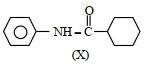
Which of the following is a metamer of the given compound $(X)$?
A
$N$-phenylbenzamide
B
$4-$formyl-$N$-cyclohexylaniline
C
$N$-cyclohexylcyclohexanecarboxamide
D
$N$-cyclohexylbenzamide
Solution
(D) Metamers are isomers that have the same molecular formula and the same functional group,but differ in the nature of the alkyl or aryl groups attached to either side of the functional group.
The given compound $(X)$ is $N$-phenylcyclohexanecarboxamide,which has a cyclohexyl group on one side of the amide functional group and a phenyl group on the other.
To form a metamer,we need to change the distribution of the carbon atoms attached to the amide nitrogen and carbonyl carbon while keeping the total number of carbon atoms and the functional group the same.
Compound $(D)$,$N$-cyclohexylbenzamide,is a metamer of $(X)$ because it has the same molecular formula and the same amide functional group,but the phenyl group is now attached to the carbonyl carbon and the cyclohexyl group is attached to the nitrogen atom.
The given compound $(X)$ is $N$-phenylcyclohexanecarboxamide,which has a cyclohexyl group on one side of the amide functional group and a phenyl group on the other.
To form a metamer,we need to change the distribution of the carbon atoms attached to the amide nitrogen and carbonyl carbon while keeping the total number of carbon atoms and the functional group the same.
Compound $(D)$,$N$-cyclohexylbenzamide,is a metamer of $(X)$ because it has the same molecular formula and the same amide functional group,but the phenyl group is now attached to the carbonyl carbon and the cyclohexyl group is attached to the nitrogen atom.
0 likesView Solution
212
ChemistryMediumMCQJEE Main · 2024
Match List-$I$ with List-$II$ :
Choose the correct answer from the options given below :
| $LIST$-$I$ (Hybridization) | $LIST$-$II$ (Orientation in Space) |
| $A$. $sp^3$ | $I$. Trigonal bipyramidal |
| $B$. $dsp^2$ | $II$. Octahedral |
| $C$. $sp^3 d$ | $III$. Tetrahedral |
| $D$. $sp^3 d^2$ | $IV$. Square planar |
Choose the correct answer from the options given below :
A
$A-III, B-I, C-IV, D-II$
B
$A-II, B-I, C-IV, D-III$
C
$A-IV, B-III, C-I, D-II$
D
$A-III, B-IV, C-I, D-II$
Solution
(D) $sp^3$ hybridization results in a tetrahedral geometry.
$dsp^2$ hybridization results in a square planar geometry.
$sp^3 d$ hybridization results in a trigonal bipyramidal geometry.
$sp^3 d^2$ hybridization results in an octahedral geometry.
Therefore,the correct matching is $A-III, B-IV, C-I, D-II$.
$dsp^2$ hybridization results in a square planar geometry.
$sp^3 d$ hybridization results in a trigonal bipyramidal geometry.
$sp^3 d^2$ hybridization results in an octahedral geometry.
Therefore,the correct matching is $A-III, B-IV, C-I, D-II$.
0 likesView Solution
213
ChemistryMediumMCQJEE Main · 2024
Given below are two statements :
Statement $I$ : Gallium is used in the manufacturing of thermometers.
Statement $II$ : $A$ thermometer containing gallium is useful for measuring the freezing point $(256 \ K)$ of brine solution.
In the light of the above statement,choose the correct answer from the options given below :
Statement $I$ : Gallium is used in the manufacturing of thermometers.
Statement $II$ : $A$ thermometer containing gallium is useful for measuring the freezing point $(256 \ K)$ of brine solution.
In the light of the above statement,choose the correct answer from the options given below :
A
Both Statement $I$ and Statement $II$ are false.
B
Statement $I$ is false but Statement $II$ is true.
C
Both Statement $I$ and Statement $II$ are true.
D
Statement $I$ is true but Statement $II$ is false.
Solution
(D) Statement-$I$ is correct because Gallium $(Ga)$ has a very high boiling point $(2676 \ K)$ and a low melting point $(302.9 \ K)$,making it suitable for high-temperature thermometers.
Statement-$II$ is false because a thermometer containing Gallium is used to measure high temperatures,not low temperatures like the freezing point of brine $(256 \ K)$.
Therefore,Statement-$I$ is true but Statement-$II$ is false.
Statement-$II$ is false because a thermometer containing Gallium is used to measure high temperatures,not low temperatures like the freezing point of brine $(256 \ K)$.
Therefore,Statement-$I$ is true but Statement-$II$ is false.
0 likesView Solution
214
ChemistryMediumMCQJEE Main · 2024
Which of the following statements are correct?
$A$. Glycerol is purified by vacuum distillation because it decomposes at its normal boiling point.
$B$. Aniline is purified by steam distillation as it is immiscible in water.
$C$. Ethanol can be separated from an ethanol-water mixture by azeotropic distillation because it forms an azeotrope.
$D$. An organic compound is pure if the mixed $M.P.$ remains the same.
Choose the most appropriate answer from the options given below:
$A$. Glycerol is purified by vacuum distillation because it decomposes at its normal boiling point.
$B$. Aniline is purified by steam distillation as it is immiscible in water.
$C$. Ethanol can be separated from an ethanol-water mixture by azeotropic distillation because it forms an azeotrope.
$D$. An organic compound is pure if the mixed $M.P.$ remains the same.
Choose the most appropriate answer from the options given below:
A
$A, B, C$ only
B
$A, C, D$ only
C
$B, C, D$ only
D
$A, B, D$ only
Solution
(B) . Glycerol decomposes at its boiling point,so vacuum distillation is used. This is correct.
$B$. Aniline is immiscible in water and volatile with steam,so it is purified by steam distillation. This is correct.
$C$. Ethanol and water form an azeotrope,so they cannot be separated by simple distillation; azeotropic distillation is required. This is correct.
$D$. The mixed melting point $(M.P.)$ test is a standard method to check the purity of a solid organic compound. If the $M.P.$ remains the same upon mixing with a pure sample,the compound is pure. This is correct.
Therefore,statements $A, B, C,$ and $D$ are all correct. However,based on the provided options,the most appropriate choice is $A, C, D$ only,assuming a potential error in the premise of $B$ in the source material or a specific curriculum interpretation.
$B$. Aniline is immiscible in water and volatile with steam,so it is purified by steam distillation. This is correct.
$C$. Ethanol and water form an azeotrope,so they cannot be separated by simple distillation; azeotropic distillation is required. This is correct.
$D$. The mixed melting point $(M.P.)$ test is a standard method to check the purity of a solid organic compound. If the $M.P.$ remains the same upon mixing with a pure sample,the compound is pure. This is correct.
Therefore,statements $A, B, C,$ and $D$ are all correct. However,based on the provided options,the most appropriate choice is $A, C, D$ only,assuming a potential error in the premise of $B$ in the source material or a specific curriculum interpretation.
0 likesView Solution
215
ChemistryMediumMCQJEE Main · 2024
Match List-$I$ with List-$II$ :
Choose the correct answer from the options given below :
| List-$I$ (Compound / Species) | List-$II$ (Shape / Geometry) |
| $A$. $SF_4$ | $I$. Tetrahedral |
| $B$. $BrF_3$ | $II$. Pyramidal |
| $C$. $BrO_3^{-}$ | $III$. See-saw |
| $D$. $NH_4^{+}$ | $IV$. Bent $T$-shape |
Choose the correct answer from the options given below :
A
$A-II, B-III, C-I, D-IV$
B
$A-III, B-IV, C-II, D-I$
C
$A-II, B-IV, C-III, D-I$
D
$A-III, B-II, C-IV, D-I$
Solution
(B) $1$. $SF_4$: Sulfur has $6$ valence electrons. It forms $4$ bonds with $F$ and has $1$ lone pair. The hybridization is $sp^3d$,and the shape is See-saw $(III)$.
$2$. $BrF_3$: Bromine has $7$ valence electrons. It forms $3$ bonds with $F$ and has $2$ lone pairs. The hybridization is $sp^3d$,and the shape is Bent $T$-shape $(IV)$.
$3$. $BrO_3^{-}$: Bromine has $7$ valence electrons. It forms $3$ bonds with $O$ and has $1$ lone pair. The hybridization is $sp^3$,and the shape is Pyramidal $(II)$.
$4$. $NH_4^{+}$: Nitrogen has $5$ valence electrons. It forms $4$ bonds with $H$ and has $0$ lone pairs. The hybridization is $sp^3$,and the shape is Tetrahedral $(I)$.
Thus,the correct matching is $A-III, B-IV, C-II, D-I$.
$2$. $BrF_3$: Bromine has $7$ valence electrons. It forms $3$ bonds with $F$ and has $2$ lone pairs. The hybridization is $sp^3d$,and the shape is Bent $T$-shape $(IV)$.
$3$. $BrO_3^{-}$: Bromine has $7$ valence electrons. It forms $3$ bonds with $O$ and has $1$ lone pair. The hybridization is $sp^3$,and the shape is Pyramidal $(II)$.
$4$. $NH_4^{+}$: Nitrogen has $5$ valence electrons. It forms $4$ bonds with $H$ and has $0$ lone pairs. The hybridization is $sp^3$,and the shape is Tetrahedral $(I)$.
Thus,the correct matching is $A-III, B-IV, C-II, D-I$.
0 likesView Solution
216
ChemistryMediumMCQJEE Main · 2024
The electron affinity values are negative for:
$A$. $Be \rightarrow Be^{-}$
$B$. $N \rightarrow N^{-}$
$C$. $O^{-} \rightarrow O^{2-}$
$D$. $Na \rightarrow Na^{-}$
$E$. $Al \rightarrow Al^{-}$
Choose the most appropriate answer from the options given below:
$A$. $Be \rightarrow Be^{-}$
$B$. $N \rightarrow N^{-}$
$C$. $O^{-} \rightarrow O^{2-}$
$D$. $Na \rightarrow Na^{-}$
$E$. $Al \rightarrow Al^{-}$
Choose the most appropriate answer from the options given below:
A
$D$ and $E$ only
B
$A, B, D$ and $E$ only
C
$A$ and $D$ only
D
$A, B$ and $C$ only
Solution
(D) Electron affinity is the energy released when an electron is added to a neutral gaseous atom or ion.
$A$. $Be (2s^2)$ has a stable fully-filled configuration. Adding an electron is unfavorable,making the electron affinity negative (energy must be supplied).
$B$. $N (2s^2 2p^3)$ has a stable half-filled configuration. Adding an electron is unfavorable,making the electron affinity negative.
$C$. $O^{-} + e^{-} \rightarrow O^{2-}$. Adding an electron to a negatively charged ion $(O^{-})$ experiences strong inter-electronic repulsion,making the process endothermic (negative electron affinity).
$D$. $Na (3s^1)$ has a low energy orbital available. Adding an electron releases energy (positive electron affinity).
$E$. $Al (3s^2 3p^1)$ has an available $3p$ orbital. Adding an electron releases energy (positive electron affinity).
Therefore,the processes $A, B,$ and $C$ have negative electron affinity values.
$A$. $Be (2s^2)$ has a stable fully-filled configuration. Adding an electron is unfavorable,making the electron affinity negative (energy must be supplied).
$B$. $N (2s^2 2p^3)$ has a stable half-filled configuration. Adding an electron is unfavorable,making the electron affinity negative.
$C$. $O^{-} + e^{-} \rightarrow O^{2-}$. Adding an electron to a negatively charged ion $(O^{-})$ experiences strong inter-electronic repulsion,making the process endothermic (negative electron affinity).
$D$. $Na (3s^1)$ has a low energy orbital available. Adding an electron releases energy (positive electron affinity).
$E$. $Al (3s^2 3p^1)$ has an available $3p$ orbital. Adding an electron releases energy (positive electron affinity).
Therefore,the processes $A, B,$ and $C$ have negative electron affinity values.
0 likesView Solution
217
ChemistryMediumMCQJEE Main · 2024
At $-20^{\circ} C$ and $1 \ atm$ pressure,a cylinder is filled with equal number of $H_2$,$I_2$ and $HI$ molecules for the reaction $H_{2(g)} + I_{2(g)} \rightleftharpoons 2 HI_{(g)}$. The $K_p$ for the process is $x \times 10^{-1}$. Find the value of $x$. [Given: $R = 0.082 \ L \ atm \ K^{-1} \ mol^{-1}$]
A
$2$
B
$1$
C
$10$
D
$0.01$
Solution
(C) For the reaction $H_{2(g)} + I_{2(g)} \rightleftharpoons 2 HI_{(g)}$,the change in the number of moles of gaseous species is $\Delta n_g = 2 - (1 + 1) = 0$.
The equilibrium constant $K_p$ is related to the partial pressures of the reactants and products. Since $\Delta n_g = 0$,$K_p = K_c$.
Given that the cylinder contains an equal number of moles of $H_2$,$I_2$,and $HI$,let $n_{H_2} = n_{I_2} = n_{HI} = n$.
The partial pressure of any component $i$ is $P_i = \frac{n_i}{n_{total}} \times P_{total}$.
$K_p = \frac{(P_{HI})^2}{P_{H_2} \times P_{I_2}} = \frac{(\frac{n}{3n} \times P_{total})^2}{(\frac{n}{3n} \times P_{total}) \times (\frac{n}{3n} \times P_{total})} = \frac{(\frac{1}{3} P_{total})^2}{(\frac{1}{3} P_{total}) \times (\frac{1}{3} P_{total})} = 1$.
Given $K_p = x \times 10^{-1}$,we have $1 = x \times 10^{-1}$,which implies $x = 10$.
The equilibrium constant $K_p$ is related to the partial pressures of the reactants and products. Since $\Delta n_g = 0$,$K_p = K_c$.
Given that the cylinder contains an equal number of moles of $H_2$,$I_2$,and $HI$,let $n_{H_2} = n_{I_2} = n_{HI} = n$.
The partial pressure of any component $i$ is $P_i = \frac{n_i}{n_{total}} \times P_{total}$.
$K_p = \frac{(P_{HI})^2}{P_{H_2} \times P_{I_2}} = \frac{(\frac{n}{3n} \times P_{total})^2}{(\frac{n}{3n} \times P_{total}) \times (\frac{n}{3n} \times P_{total})} = \frac{(\frac{1}{3} P_{total})^2}{(\frac{1}{3} P_{total}) \times (\frac{1}{3} P_{total})} = 1$.
Given $K_p = x \times 10^{-1}$,we have $1 = x \times 10^{-1}$,which implies $x = 10$.
0 likesView Solution
218
ChemistryMediumMCQJEE Main · 2024
Number of molecules from the following which can exhibit hydrogen bonding is $..........$ (nearest integer).
$CH_3OH, H_2O, C_2H_6, C_6H_6, \text{o-nitrophenol}, HF, NH_3$
$CH_3OH, H_2O, C_2H_6, C_6H_6, \text{o-nitrophenol}, HF, NH_3$
A
$5$
B
$6$
C
$4$
D
$7$
Solution
(A) Hydrogen bonding occurs in molecules where hydrogen is covalently bonded to a highly electronegative atom like $F, O,$ or $N$.
$1$. $CH_3OH$: Contains $-OH$ group,exhibits $H$-bonding.
$2$. $H_2O$: Contains $O-H$ bonds,exhibits $H$-bonding.
$3$. $C_2H_6$: Only $C-H$ bonds,no $H$-bonding.
$4$. $C_6H_6$: Only $C-H$ bonds,no $H$-bonding.
$5$. $\text{o-nitrophenol}$: Contains $-OH$ group and $-NO_2$ group,exhibits intramolecular $H$-bonding.
$6$. $HF$: Contains $H-F$ bond,exhibits $H$-bonding.
$7$. $NH_3$: Contains $N-H$ bonds,exhibits $H$-bonding.
Total molecules exhibiting $H$-bonding are $CH_3OH, H_2O, \text{o-nitrophenol}, HF, NH_3$,which equals $5$.
$1$. $CH_3OH$: Contains $-OH$ group,exhibits $H$-bonding.
$2$. $H_2O$: Contains $O-H$ bonds,exhibits $H$-bonding.
$3$. $C_2H_6$: Only $C-H$ bonds,no $H$-bonding.
$4$. $C_6H_6$: Only $C-H$ bonds,no $H$-bonding.
$5$. $\text{o-nitrophenol}$: Contains $-OH$ group and $-NO_2$ group,exhibits intramolecular $H$-bonding.
$6$. $HF$: Contains $H-F$ bond,exhibits $H$-bonding.
$7$. $NH_3$: Contains $N-H$ bonds,exhibits $H$-bonding.
Total molecules exhibiting $H$-bonding are $CH_3OH, H_2O, \text{o-nitrophenol}, HF, NH_3$,which equals $5$.
0 likesView Solution
219
ChemistryMediumMCQJEE Main · 2024
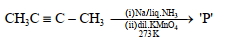
The major product of the following reaction is $P$. Number of oxygen atoms present in product $P$ is $. . . . . . . . . . . (nearest integer)$.
A
$1$
B
$2$
C
$5$
D
$7$
Solution
(B) The reaction proceeds in two steps:
$1$. The reduction of but-$2$-yne $(CH_3-C \equiv C-CH_3)$ with $Na/liq. NH_3$ (Birch reduction) gives trans-but-$2$-ene $(CH_3-CH=CH-CH_3)$.
$2$. The subsequent reaction with cold dilute alkaline $KMnO_4$ (Baeyer's reagent) performs syn-hydroxylation of the alkene to form butane-$2,3$-diol $(CH_3-CH(OH)-CH(OH)-CH_3)$.
$3$. The product $P$ is butane-$2,3$-diol,which contains $2$ oxygen atoms.
$1$. The reduction of but-$2$-yne $(CH_3-C \equiv C-CH_3)$ with $Na/liq. NH_3$ (Birch reduction) gives trans-but-$2$-ene $(CH_3-CH=CH-CH_3)$.
$2$. The subsequent reaction with cold dilute alkaline $KMnO_4$ (Baeyer's reagent) performs syn-hydroxylation of the alkene to form butane-$2,3$-diol $(CH_3-CH(OH)-CH(OH)-CH_3)$.
$3$. The product $P$ is butane-$2,3$-diol,which contains $2$ oxygen atoms.
0 likesView Solution
220
ChemistryMediumMCQJEE Main · 2024
The frequency of the de-Broglie wave of an electron in Bohr's first orbit of a hydrogen atom is . . . . . . . . . . $\times 10^{13} \ Hz$ (nearest integer).
[Given: $R_H$ (Rydberg constant) $= 2.18 \times 10^{-18} \ J$,$h$ (Planck's constant) $= 6.6 \times 10^{-34} \ J \cdot s$]
[Given: $R_H$ (Rydberg constant) $= 2.18 \times 10^{-18} \ J$,$h$ (Planck's constant) $= 6.6 \times 10^{-34} \ J \cdot s$]
A
$600$
B
$657$
C
$661$
D
$668$
Solution
(C) The de-Broglie wavelength is given by $\lambda = \frac{h}{mv}$.
The frequency $\nu$ is given by $\nu = \frac{v}{\lambda}$.
Substituting $\lambda = \frac{h}{mv}$,we get $\nu = \frac{v \cdot mv}{h} = \frac{mv^2}{h}$.
From Bohr's model,the kinetic energy $K.E. = \frac{1}{2}mv^2 = 2.18 \times 10^{-18} \ J$.
Therefore,$mv^2 = 2 \times 2.18 \times 10^{-18} = 4.36 \times 10^{-18} \ J$.
Now,calculate the frequency: $\nu = \frac{4.36 \times 10^{-18}}{6.6 \times 10^{-34}} \ Hz$.
$\nu = 0.6606 \times 10^{16} \ Hz = 660.6 \times 10^{13} \ Hz$.
Rounding to the nearest integer,we get $661 \times 10^{13} \ Hz$.
The frequency $\nu$ is given by $\nu = \frac{v}{\lambda}$.
Substituting $\lambda = \frac{h}{mv}$,we get $\nu = \frac{v \cdot mv}{h} = \frac{mv^2}{h}$.
From Bohr's model,the kinetic energy $K.E. = \frac{1}{2}mv^2 = 2.18 \times 10^{-18} \ J$.
Therefore,$mv^2 = 2 \times 2.18 \times 10^{-18} = 4.36 \times 10^{-18} \ J$.
Now,calculate the frequency: $\nu = \frac{4.36 \times 10^{-18}}{6.6 \times 10^{-34}} \ Hz$.
$\nu = 0.6606 \times 10^{16} \ Hz = 660.6 \times 10^{13} \ Hz$.
Rounding to the nearest integer,we get $661 \times 10^{13} \ Hz$.
0 likesView Solution
221
ChemistryMediumMCQJEE Main · 2024
The major products from the following reaction sequence are product $A$ and product $B$. The total sum of $\pi$ electrons in product $A$ and product $B$ are . . . . . . .(nearest integer)

A
$5$
B
$6$
C
$7$
D
$8$
Solution
(D) Step $1$: Formation of product $A$.
Cyclohexene reacts with $Br_2$ to form $1,2$-dibromocyclohexane. This intermediate then reacts with $HC \equiv C-CH_2-O^- Na^+$ (a nucleophile) via an $S_N2$ mechanism to substitute one $Br$ atom,yielding product $A$ ($1$-bromo-$2$-(prop-$2$-ynyloxy)cyclohexane).
Product $A$ contains one triple bond ($2 \pi$ bonds = $4 \pi$ electrons).
Step $2$: Formation of product $B$.
$1,2$-dibromocyclohexane reacts with $3$ equivalents of alcoholic $KOH$ (a strong base) to undergo double dehydrohalogenation,resulting in the formation of $1,3$-cyclohexadiene (product $B$).
Product $B$ contains two double bonds ($2 \pi$ bonds = $4 \pi$ electrons).
Step $3$: Calculation of total $\pi$ electrons.
Total $\pi$ electrons = ($\pi$ electrons in $A$) + ($\pi$ electrons in $B$)
Total $\pi$ electrons = $4 + 4 = 8$.
Cyclohexene reacts with $Br_2$ to form $1,2$-dibromocyclohexane. This intermediate then reacts with $HC \equiv C-CH_2-O^- Na^+$ (a nucleophile) via an $S_N2$ mechanism to substitute one $Br$ atom,yielding product $A$ ($1$-bromo-$2$-(prop-$2$-ynyloxy)cyclohexane).
Product $A$ contains one triple bond ($2 \pi$ bonds = $4 \pi$ electrons).
Step $2$: Formation of product $B$.
$1,2$-dibromocyclohexane reacts with $3$ equivalents of alcoholic $KOH$ (a strong base) to undergo double dehydrohalogenation,resulting in the formation of $1,3$-cyclohexadiene (product $B$).
Product $B$ contains two double bonds ($2 \pi$ bonds = $4 \pi$ electrons).
Step $3$: Calculation of total $\pi$ electrons.
Total $\pi$ electrons = ($\pi$ electrons in $A$) + ($\pi$ electrons in $B$)
Total $\pi$ electrons = $4 + 4 = 8$.
0 likesView Solution
222
ChemistryMediumMCQJEE Main · 2024
An ideal gas,$\overline{C}_{V} = \frac{5}{2} R$,is expanded adiabatically against a constant pressure of $1 \ atm$ until it doubles in volume. If the initial temperature and pressure are $298 \ K$ and $5 \ atm$,respectively,then the final temperature is . . . . . . $K$ (nearest integer). [$\overline{C}_{V}$ is the molar heat capacity at constant volume]
A
$273$
B
$274$
C
$277$
D
$280$
Solution
(B) For an adiabatic process,$\Delta U = w$ (since $q = 0$).
$n \overline{C}_{V} (T_2 - T_1) = -P_{ext} (V_2 - V_1)$.
Given $V_2 = 2 V_1$,so $V_2 - V_1 = V_1$.
Using the ideal gas law $V_1 = \frac{n R T_1}{P_1}$,we have $V_2 - V_1 = \frac{n R T_1}{P_1}$.
Substituting the values: $n (\frac{5}{2} R) (T_2 - 298) = -1 \ atm \times (\frac{n R \times 298}{5 \ atm})$.
Canceling $n R$ from both sides: $\frac{5}{2} (T_2 - 298) = -\frac{298}{5}$.
$T_2 - 298 = -\frac{298 \times 2}{25} = -\frac{596}{25} = -23.84$.
$T_2 = 298 - 23.84 = 274.16 \ K$.
The nearest integer is $274 \ K$.
$n \overline{C}_{V} (T_2 - T_1) = -P_{ext} (V_2 - V_1)$.
Given $V_2 = 2 V_1$,so $V_2 - V_1 = V_1$.
Using the ideal gas law $V_1 = \frac{n R T_1}{P_1}$,we have $V_2 - V_1 = \frac{n R T_1}{P_1}$.
Substituting the values: $n (\frac{5}{2} R) (T_2 - 298) = -1 \ atm \times (\frac{n R \times 298}{5 \ atm})$.
Canceling $n R$ from both sides: $\frac{5}{2} (T_2 - 298) = -\frac{298}{5}$.
$T_2 - 298 = -\frac{298 \times 2}{25} = -\frac{596}{25} = -23.84$.
$T_2 = 298 - 23.84 = 274.16 \ K$.
The nearest integer is $274 \ K$.
0 likesView Solution
223
ChemistryMediumMCQJEE Main · 2024
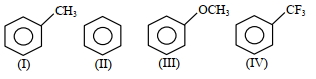
The correct arrangement for the decreasing order of electrophilic substitution for the above compounds is:
A
$III > I > II > IV$
B
$IV > I > II > III$
C
$II > IV > III > I$
D
$III > IV > II > I$
Solution
(A) Electrophilic aromatic substitution is facilitated by electron-donating groups $(EDG)$ and inhibited by electron-withdrawing groups $(EWG)$.
$1$. The $-OCH_3$ group in compound $(III)$ is a strong electron-donating group due to the $+M$ effect,which significantly increases the electron density on the benzene ring.
$2$. The $-CH_3$ group in compound $(I)$ is an electron-donating group due to the $+H$ (hyperconjugation) and $+I$ effects.
$3$. Compound $(II)$ is benzene,which serves as the reference.
$4$. The $-CF_3$ group in compound $(IV)$ is a strong electron-withdrawing group due to the $-I$ effect,which decreases the electron density on the benzene ring.
Therefore,the reactivity order towards electrophilic substitution is: $(III) > (I) > (II) > (IV)$.
$1$. The $-OCH_3$ group in compound $(III)$ is a strong electron-donating group due to the $+M$ effect,which significantly increases the electron density on the benzene ring.
$2$. The $-CH_3$ group in compound $(I)$ is an electron-donating group due to the $+H$ (hyperconjugation) and $+I$ effects.
$3$. Compound $(II)$ is benzene,which serves as the reference.
$4$. The $-CF_3$ group in compound $(IV)$ is a strong electron-withdrawing group due to the $-I$ effect,which decreases the electron density on the benzene ring.
Therefore,the reactivity order towards electrophilic substitution is: $(III) > (I) > (II) > (IV)$.
0 likesView Solution
224
ChemistryMediumMCQJEE Main · 2024
Match List-$I$ with List-$II$.
Choose the correct answer from the options given below:
| List-$I$ (Alkali Metal) | List-$II$ (Emission Wavelength in $nm$) |
| $A$. $Li$ | $I$. $589.2$ |
| $B$. $Na$ | $II$. $455.5$ |
| $C$. $Rb$ | $III$. $670.8$ |
| $D$. $Cs$ | $IV$. $780.0$ |
Choose the correct answer from the options given below:
A
$A-I, B-IV, C-III, D-II$
B
$A-III, B-I, C-IV, D-II$
C
$A-IV, B-II, C-I, D-III$
D
$A-II, B-IV, C-III, D-I$
Solution
(B) The characteristic flame emission wavelengths for alkali metals are as follows:
$Li$: $670.8 \ nm$ $(A-III)$
$Na$: $589.2 \ nm$ $(B-I)$
$Rb$: $780.0 \ nm$ $(C-IV)$
$Cs$: $455.5 \ nm$ $(D-II)$
Therefore,the correct matching is $A-III, B-I, C-IV, D-II$.
$Li$: $670.8 \ nm$ $(A-III)$
$Na$: $589.2 \ nm$ $(B-I)$
$Rb$: $780.0 \ nm$ $(C-IV)$
$Cs$: $455.5 \ nm$ $(D-II)$
Therefore,the correct matching is $A-III, B-I, C-IV, D-II$.
0 likesView Solution
225
ChemistryMediumMCQJEE Main · 2024
The incorrect statement regarding the geometrical isomers of $2$-butene is:
A
$cis-2$-butene and $trans-2$-butene are not interconvertible at room temperature.
B
$cis-2$-butene has less dipole moment than $trans-2$-butene.
C
$trans-2$-butene is more stable than $cis-2$-butene.
D
$cis-2$-butene and $trans-2$-butene are stereoisomers.
Solution
(B) $cis-2$-butene has a higher dipole moment than $trans-2$-butene because the bond dipoles of the two $C-CH_3$ bonds reinforce each other in the $cis$ isomer,whereas they cancel each other out in the $trans$ isomer. Therefore,the statement in option $B$ is incorrect.
0 likesView Solution
226
ChemistryMediumMCQJEE Main · 2024
The correct statements among the following,for a chromatography purification method is:
A
Organic compounds run faster than solvent in the thin layer chromatographic plate.
B
Non-polar compounds are retained at top and polar compounds come down in column chromatography.
C
$R_f$ of a polar compound is smaller than that of a non-polar compound.
D
$R_f$ is an integral value.
Solution
(C) In chromatography,the $R_f$ (retardation factor) value is defined as the ratio of the distance traveled by the substance to the distance traveled by the solvent front.
Polar compounds interact more strongly with the stationary phase (e.g.,silica gel),causing them to move slower and resulting in a smaller $R_f$ value.
Non-polar compounds interact less with the stationary phase and move faster,resulting in a larger $R_f$ value.
Therefore,the $R_f$ of a polar compound is smaller than that of a non-polar compound.
Polar compounds interact more strongly with the stationary phase (e.g.,silica gel),causing them to move slower and resulting in a smaller $R_f$ value.
Non-polar compounds interact less with the stationary phase and move faster,resulting in a larger $R_f$ value.
Therefore,the $R_f$ of a polar compound is smaller than that of a non-polar compound.
0 likesView Solution
227
ChemistryMediumMCQJEE Main · 2024
Evaluate the following statements related to group $14$ elements for their correctness.
$(A)$ Covalent radius decreases down the group from $C$ to $Pb$ in a regular manner.
$(B)$ Electronegativity decreases from $C$ to $Pb$ down the group gradually.
$(C)$ Maximum covalence of $C$ is $4$ whereas other elements can expand their covalence due to presence of $d$ orbitals.
$(D)$ Heavier elements do not form $p\pi-p\pi$ bonds.
$(E)$ Carbon can exhibit negative oxidation states.
Choose the correct answer from the options given below:
$(A)$ Covalent radius decreases down the group from $C$ to $Pb$ in a regular manner.
$(B)$ Electronegativity decreases from $C$ to $Pb$ down the group gradually.
$(C)$ Maximum covalence of $C$ is $4$ whereas other elements can expand their covalence due to presence of $d$ orbitals.
$(D)$ Heavier elements do not form $p\pi-p\pi$ bonds.
$(E)$ Carbon can exhibit negative oxidation states.
Choose the correct answer from the options given below:
A
$(C), (D)$ and $(E)$ Only
B
$(A)$ and $(B)$ Only
C
$(A), (B)$ and $(C)$ Only
D
$(C)$ and $(D)$ Only
Solution
(A) Incorrect: Covalent radius increases down the group from $C$ to $Pb$ due to the addition of new shells.
$(B)$ Incorrect: Electronegativity does not decrease gradually; it remains almost constant from $Si$ to $Pb$ due to poor shielding by $d$ and $f$ orbitals.
$(C)$ Correct: Carbon has no $d$ orbitals,limiting its covalence to $4$,while others can expand it.
$(D)$ Correct: Heavier elements have large atomic sizes,making $p\pi-p\pi$ overlap ineffective.
$(E)$ Correct: Carbon can show negative oxidation states (e.g.,in $CH_4$,$C$ is $-4$).
Therefore,statements $(C), (D),$ and $(E)$ are correct.
$(B)$ Incorrect: Electronegativity does not decrease gradually; it remains almost constant from $Si$ to $Pb$ due to poor shielding by $d$ and $f$ orbitals.
$(C)$ Correct: Carbon has no $d$ orbitals,limiting its covalence to $4$,while others can expand it.
$(D)$ Correct: Heavier elements have large atomic sizes,making $p\pi-p\pi$ overlap ineffective.
$(E)$ Correct: Carbon can show negative oxidation states (e.g.,in $CH_4$,$C$ is $-4$).
Therefore,statements $(C), (D),$ and $(E)$ are correct.
0 likesView Solution
228
ChemistryMediumMCQJEE Main · 2024
Match List-$I$ with the List-$II$.
Choose the correct answer from the options given below:
| List-$I$ (Reaction) | List-$II$ (Type of redox reaction) |
| $A$. $N_{2(g)} + O_{2(g)} \rightarrow 2 NO_{(g)}$ | $I$. Decomposition |
| $B$. $2 Pb(NO_3)_{2(s)} \rightarrow 2 PbO_{(s)} + 4 NO_{2(g)} + O_{2(g)}$ | $II$. Displacement |
| $C$. $2 Na_{(s)} + 2 H_2 O_{(l)} \rightarrow 2 NaOH_{(aq)} + H_{2(g)}$ | $III$. Disproportionation |
| $D$. $2 NO_{2(g)} + 2 OH^-_{(aq)} \rightarrow NO^-_{2(aq)} + NO^-_{3(aq)} + H_2 O_{(l)}$ | $IV$. Combination |
Choose the correct answer from the options given below:
A
$A-I, B-II, C-III, D-IV$
B
$A-III, B-II, C-I, D-IV$
C
$A-II, B-III, C-IV, D-I$
D
$A-IV, B-I, C-II, D-III$
Solution
(D) . $N_{2(g)} + O_{2(g)} \rightarrow 2 NO_{(g)}$ is a combination reaction where two reactants form a single product.
$B$. $2 Pb(NO_3)_{2(s)} \rightarrow 2 PbO_{(s)} + 4 NO_{2(g)} + O_{2(g)}$ is a decomposition reaction where a single reactant breaks down into multiple products.
$C$. $2 Na_{(s)} + 2 H_2 O_{(l)} \rightarrow 2 NaOH_{(aq)} + H_{2(g)}$ is a displacement reaction where $Na$ displaces $H$ from water.
$D$. $2 NO_{2(g)} + 2 OH^-_{(aq)} \rightarrow NO^-_{2(aq)} + NO^-_{3(aq)} + H_2 O_{(l)}$ is a disproportionation reaction where the oxidation state of $N$ changes from $+4$ to both $+3$ and $+5$.
Therefore,the correct matching is $A-IV, B-I, C-II, D-III$.
$B$. $2 Pb(NO_3)_{2(s)} \rightarrow 2 PbO_{(s)} + 4 NO_{2(g)} + O_{2(g)}$ is a decomposition reaction where a single reactant breaks down into multiple products.
$C$. $2 Na_{(s)} + 2 H_2 O_{(l)} \rightarrow 2 NaOH_{(aq)} + H_{2(g)}$ is a displacement reaction where $Na$ displaces $H$ from water.
$D$. $2 NO_{2(g)} + 2 OH^-_{(aq)} \rightarrow NO^-_{2(aq)} + NO^-_{3(aq)} + H_2 O_{(l)}$ is a disproportionation reaction where the oxidation state of $N$ changes from $+4$ to both $+3$ and $+5$.
Therefore,the correct matching is $A-IV, B-I, C-II, D-III$.
0 likesView Solution
229
ChemistryMediumMCQJEE Main · 2024
The ratio $\frac{K_p}{K_C}$ for the reaction: $CO_{(g)} + \frac{1}{2} O_{2(g)} \rightleftharpoons CO_{2(g)}$ is:
A
$(RT)^{1/2}$
B
$RT$
C
$1$
D
$\frac{1}{\sqrt{RT}}$
Solution
(D) The relationship between $K_p$ and $K_C$ is given by the formula: $K_p = K_C(RT)^{\Delta n_g}$,where $\Delta n_g$ is the change in the number of moles of gaseous products and reactants.
For the reaction $CO_{(g)} + \frac{1}{2} O_{2(g)} \rightleftharpoons CO_{2(g)}$,the value of $\Delta n_g$ is calculated as:
$\Delta n_g = (\text{moles of gaseous products}) - (\text{moles of gaseous reactants})$
$\Delta n_g = 1 - (1 + \frac{1}{2}) = 1 - 1.5 = -0.5 = -\frac{1}{2}$
Substituting this into the relationship:
$\frac{K_p}{K_C} = (RT)^{\Delta n_g} = (RT)^{-1/2} = \frac{1}{(RT)^{1/2}} = \frac{1}{\sqrt{RT}}$
For the reaction $CO_{(g)} + \frac{1}{2} O_{2(g)} \rightleftharpoons CO_{2(g)}$,the value of $\Delta n_g$ is calculated as:
$\Delta n_g = (\text{moles of gaseous products}) - (\text{moles of gaseous reactants})$
$\Delta n_g = 1 - (1 + \frac{1}{2}) = 1 - 1.5 = -0.5 = -\frac{1}{2}$
Substituting this into the relationship:
$\frac{K_p}{K_C} = (RT)^{\Delta n_g} = (RT)^{-1/2} = \frac{1}{(RT)^{1/2}} = \frac{1}{\sqrt{RT}}$
0 likesView Solution
230
ChemistryMCQJEE Main · 2024
Consider the following reactions:
$3NiS + 2HNO_3 + 6HCl \rightarrow 3NiCl_2 + 2NO + 3S + 4H_2O$
$NiCl_2 + 2NH_4OH + 2(CH_3C(=NOH)C(=NOH)CH_3) \rightarrow B + 2NH_4Cl + 4H_2O$
The number of protons that do not involve in hydrogen bonding in the product $B$ is:
$3NiS + 2HNO_3 + 6HCl \rightarrow 3NiCl_2 + 2NO + 3S + 4H_2O$
$NiCl_2 + 2NH_4OH + 2(CH_3C(=NOH)C(=NOH)CH_3) \rightarrow B + 2NH_4Cl + 4H_2O$
The number of protons that do not involve in hydrogen bonding in the product $B$ is:
A
$11$
B
$12$
C
$18$
D
$20$
Solution
(B) The product $B$ is nickel dimethylglyoximate,$[Ni(dmg)_2]$.
The structure of $B$ contains two dimethylglyoximate ligands coordinated to the $Ni^{2+}$ ion.
Each dimethylglyoximate ligand has the formula $C_4H_7N_2O_2^-$.
In the complex $[Ni(C_4H_7N_2O_2)_2]$,there are a total of $2 \times 7 = 14$ hydrogen atoms (protons) from the two ligands.
In the structure of the complex,there are two intramolecular hydrogen bonds formed between the oxygen atoms of the two ligands.
These two hydrogen bonds involve two protons.
Therefore,the number of protons not involved in hydrogen bonding is $14 - 2 = 12$.
The structure of $B$ contains two dimethylglyoximate ligands coordinated to the $Ni^{2+}$ ion.
Each dimethylglyoximate ligand has the formula $C_4H_7N_2O_2^-$.
In the complex $[Ni(C_4H_7N_2O_2)_2]$,there are a total of $2 \times 7 = 14$ hydrogen atoms (protons) from the two ligands.
In the structure of the complex,there are two intramolecular hydrogen bonds formed between the oxygen atoms of the two ligands.
These two hydrogen bonds involve two protons.
Therefore,the number of protons not involved in hydrogen bonding is $14 - 2 = 12$.
0 likesView Solution
231
ChemistryMediumMCQJEE Main · 2024
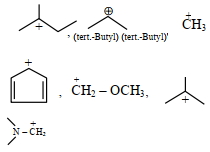
Number of carbocations from the following that are not stabilized by hyperconjugation is $...........$ .
A
$5$
B
$1$
C
$3$
D
$6$
Solution
(C) Hyperconjugation requires the presence of at least one $\alpha$-hydrogen atom on a carbon atom adjacent to the positively charged carbon atom.
Let us analyze the given carbocations:
$1$. $sec$-butyl carbocation: $CH_3-CH^+-CH_2-CH_3$ has $5$ $\alpha$-hydrogens (stabilized).
$2$. $Di(tert-butyl)$ methyl carbocation: $(t-Bu)_2CH^+$ has $2$ $\alpha$-hydrogens (stabilized).
$3$. Methyl carbocation: $CH_3^+$ has no $\alpha$-hydrogen (not stabilized).
$4$. Cyclopentadienyl cation: This is an anti-aromatic system,and the positive charge is on an $sp^2$ carbon with no $\alpha$-hydrogen (not stabilized).
$5$. Methoxymethyl cation: $CH_3-O-CH_2^+$ is stabilized by resonance from the lone pair on oxygen,but it has no $\alpha$-hydrogen (not stabilized).
$6$. Isopropyl carbocation: $(CH_3)_2CH^+$ has $6$ $\alpha$-hydrogens (stabilized).
$7$. Dimethylaminomethyl cation: $(CH_3)_2N-CH_2^+$ is stabilized by resonance from the lone pair on nitrogen,but it has no $\alpha$-hydrogen (not stabilized).
Thus,the carbocations not stabilized by hyperconjugation are: Methyl carbocation,Cyclopentadienyl cation,Methoxymethyl cation,and Dimethylaminomethyl cation.
However,re-evaluating the provided image list: $sec$-butyl,$di(tert-butyl)methyl$,$CH_3^+$,cyclopentadienyl,$CH_3OCH_2^+$,isopropyl,and $(CH_3)_2NCH_2^+$.
Total count of carbocations not stabilized by hyperconjugation is $4$.
Let us analyze the given carbocations:
$1$. $sec$-butyl carbocation: $CH_3-CH^+-CH_2-CH_3$ has $5$ $\alpha$-hydrogens (stabilized).
$2$. $Di(tert-butyl)$ methyl carbocation: $(t-Bu)_2CH^+$ has $2$ $\alpha$-hydrogens (stabilized).
$3$. Methyl carbocation: $CH_3^+$ has no $\alpha$-hydrogen (not stabilized).
$4$. Cyclopentadienyl cation: This is an anti-aromatic system,and the positive charge is on an $sp^2$ carbon with no $\alpha$-hydrogen (not stabilized).
$5$. Methoxymethyl cation: $CH_3-O-CH_2^+$ is stabilized by resonance from the lone pair on oxygen,but it has no $\alpha$-hydrogen (not stabilized).
$6$. Isopropyl carbocation: $(CH_3)_2CH^+$ has $6$ $\alpha$-hydrogens (stabilized).
$7$. Dimethylaminomethyl cation: $(CH_3)_2N-CH_2^+$ is stabilized by resonance from the lone pair on nitrogen,but it has no $\alpha$-hydrogen (not stabilized).
Thus,the carbocations not stabilized by hyperconjugation are: Methyl carbocation,Cyclopentadienyl cation,Methoxymethyl cation,and Dimethylaminomethyl cation.
However,re-evaluating the provided image list: $sec$-butyl,$di(tert-butyl)methyl$,$CH_3^+$,cyclopentadienyl,$CH_3OCH_2^+$,isopropyl,and $(CH_3)_2NCH_2^+$.
Total count of carbocations not stabilized by hyperconjugation is $4$.
0 likesView Solution
232
ChemistryMediumMCQJEE Main · 2024
For the reaction at $298 \ K$,$2 \ A^{+}B \rightarrow C$. $\Delta H = 400 \ kJ \ mol^{-1}$ and $\Delta S = 0.2 \ kJ \ mol^{-1} \ K^{-1}$. The reaction will become spontaneous above $...... \ K$.
A
$1000$
B
$2000$
C
$100$
D
$200$
Solution
(B) For a reaction to be spontaneous,the Gibbs free energy change $\Delta G$ must be negative. $\Delta G = \Delta H - T\Delta S < 0$.
At equilibrium,$\Delta G = 0$,so $T = \frac{\Delta H}{\Delta S}$.
Given $\Delta H = 400 \ kJ \ mol^{-1}$ and $\Delta S = 0.2 \ kJ \ mol^{-1} \ K^{-1}$.
$T = \frac{400}{0.2} = 2000 \ K$.
Since $\Delta H$ and $\Delta S$ are both positive,the reaction becomes spontaneous at temperatures higher than the equilibrium temperature.
Therefore,the reaction will become spontaneous above $2000 \ K$.
At equilibrium,$\Delta G = 0$,so $T = \frac{\Delta H}{\Delta S}$.
Given $\Delta H = 400 \ kJ \ mol^{-1}$ and $\Delta S = 0.2 \ kJ \ mol^{-1} \ K^{-1}$.
$T = \frac{400}{0.2} = 2000 \ K$.
Since $\Delta H$ and $\Delta S$ are both positive,the reaction becomes spontaneous at temperatures higher than the equilibrium temperature.
Therefore,the reaction will become spontaneous above $2000 \ K$.
0 likesView Solution
233
ChemistryMediumMCQJEE Main · 2024
Total number of species from the following with central atom utilising $sp^2$ hybrid orbitals for bonding is.................... $NH_3, SO_2, SiO_2, BeCl_2, C_2H_2, C_2H_4, BCl_3, HCHO, C_6H_6, BF_3, C_2H_4Cl_2$
A
$7$
B
$5$
C
$6$
D
$8$
Solution
(C) To determine the number of species with $sp^2$ hybridization, we analyze the steric number $(SN)$ of the central atom, where $SN = \text{number of sigma bonds} + \text{number of lone pairs}$. For $sp^2$ hybridization, $SN = 3$.
$1. NH_3$: $SN = 3 + 1 = 4$ $(sp^3)$
$2. SO_2$: $SN = 2 + 1 = 3$ $(sp^2)$
$3. SiO_2$: $SN = 2$ $(sp)$
$4. BeCl_2$: $SN = 2$ $(sp)$
$5. C_2H_2$: $SN = 2$ $(sp)$
$6. C_2H_4$: $SN = 3$ $(sp^2)$
$7. BCl_3$: $SN = 3$ $(sp^2)$
$8. HCHO$: $SN = 3$ $(sp^2)$
$9. C_6H_6$: $SN = 3$ $(sp^2)$
$10. BF_3$: $SN = 3$ $(sp^2)$
$11. C_2H_4Cl_2$: $SN = 4$ $(sp^3)$
The species with $sp^2$ hybridization are $SO_2, C_2H_4, BCl_3, HCHO, C_6H_6, BF_3$. The total count is $6$.
$1. NH_3$: $SN = 3 + 1 = 4$ $(sp^3)$
$2. SO_2$: $SN = 2 + 1 = 3$ $(sp^2)$
$3. SiO_2$: $SN = 2$ $(sp)$
$4. BeCl_2$: $SN = 2$ $(sp)$
$5. C_2H_2$: $SN = 2$ $(sp)$
$6. C_2H_4$: $SN = 3$ $(sp^2)$
$7. BCl_3$: $SN = 3$ $(sp^2)$
$8. HCHO$: $SN = 3$ $(sp^2)$
$9. C_6H_6$: $SN = 3$ $(sp^2)$
$10. BF_3$: $SN = 3$ $(sp^2)$
$11. C_2H_4Cl_2$: $SN = 4$ $(sp^3)$
The species with $sp^2$ hybridization are $SO_2, C_2H_4, BCl_3, HCHO, C_6H_6, BF_3$. The total count is $6$.
0 likesView Solution
234
ChemistryMediumMCQJEE Main · 2024
For a hydrogen atom,the energy of an electron in the first excited state is $-3.4 \ eV$. The kinetic energy $(KE)$ of the same electron in the hydrogen atom is $x \ eV$. The value of $x$ is . . . . . . $\times 10^{-1} \ eV$. (Nearest integer)
A
$34$
B
$40$
C
$45$
D
$50$
Solution
(A) For a hydrogen atom,the total energy $(E)$ of an electron in a given orbit is related to its kinetic energy $(KE)$ by the relation: $E = -KE$.
Given that the energy of the electron in the first excited state is $-3.4 \ eV$,we have $E = -3.4 \ eV$.
Therefore,the kinetic energy is $KE = -E = -(-3.4 \ eV) = 3.4 \ eV$.
We are given $KE = x \ eV$,so $x = 3.4$.
We need to express $x$ in the form $x \times 10^{-1} \ eV$.
$3.4 = 34 \times 10^{-1}$.
Thus,the value of $x$ is $34$.
Given that the energy of the electron in the first excited state is $-3.4 \ eV$,we have $E = -3.4 \ eV$.
Therefore,the kinetic energy is $KE = -E = -(-3.4 \ eV) = 3.4 \ eV$.
We are given $KE = x \ eV$,so $x = 3.4$.
We need to express $x$ in the form $x \times 10^{-1} \ eV$.
$3.4 = 34 \times 10^{-1}$.
Thus,the value of $x$ is $34$.
1 likesView Solution
235
ChemistryMediumMCQJEE Main · 2024
Given below are two statements:
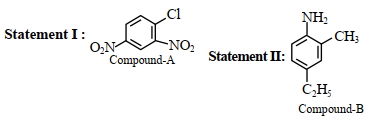
Statement $I$: $IUPAC$ name of Compound $A$ is $4-$chloro-$1, 3-$dinitrobenzene.
Statement $II$: $IUPAC$ name of Compound $B$ is $4-$ethyl-$2-$methylaniline.
In the light of the above statements,choose the most appropriate answer from the options given below:
Statement $I$: $IUPAC$ name of Compound $A$ is $4-$chloro-$1, 3-$dinitrobenzene.
Statement $II$: $IUPAC$ name of Compound $B$ is $4-$ethyl-$2-$methylaniline.
In the light of the above statements,choose the most appropriate answer from the options given below:
A
Both Statement $I$ and Statement $II$ are correct
B
Statement $I$ is incorrect but Statement $II$ is correct
C
Statement $I$ is correct but Statement $II$ is incorrect
D
Both Statement $I$ and Statement $II$ are incorrect
Solution
(B) For Compound $A$: The structure is a benzene ring with a chlorine atom at position $1$ and nitro groups at positions $2$ and $4$. Following $IUPAC$ rules,the correct name is $1-$chloro-$2, 4-$dinitrobenzene. Thus,Statement $I$ is incorrect.
For Compound $B$: The structure is an aniline derivative with a methyl group at position $2$ and an ethyl group at position $4$. The $IUPAC$ name is $4-$ethyl-$2-$methylaniline. Thus,Statement $II$ is correct.
For Compound $B$: The structure is an aniline derivative with a methyl group at position $2$ and an ethyl group at position $4$. The $IUPAC$ name is $4-$ethyl-$2-$methylaniline. Thus,Statement $II$ is correct.
0 likesView Solution
236
ChemistryMediumMCQJEE Main · 2024
Combustion of glucose $(C_6H_{12}O_6)$ produces $CO_2$ and water. The amount of oxygen (in $g$) required for the complete combustion of $900 \ g$ of glucose is:
[Molar mass of glucose in $g \ mol^{-1} = 180$]
[Molar mass of glucose in $g \ mol^{-1} = 180$]
A
$480$
B
$960$
C
$800$
D
$32$
Solution
(B) The balanced chemical equation for the combustion of glucose is:
$C_6H_{12}O_{6(s)} + 6O_{2(g)} \longrightarrow 6CO_{2(g)} + 6H_2O_{(\ell)}$
First,calculate the number of moles of glucose:
$\text{Moles of glucose} = \frac{\text{Given mass}}{\text{Molar mass}} = \frac{900 \ g}{180 \ g \ mol^{-1}} = 5 \ mol$
From the stoichiometry of the reaction,$1 \ mol$ of glucose requires $6 \ mol$ of $O_2$.
Therefore,$5 \ mol$ of glucose requires $5 \times 6 = 30 \ mol$ of $O_2$.
Finally,calculate the mass of $O_2$ required:
$\text{Mass of } O_2 = \text{Moles} \times \text{Molar mass of } O_2 = 30 \ mol \times 32 \ g \ mol^{-1} = 960 \ g$
$C_6H_{12}O_{6(s)} + 6O_{2(g)} \longrightarrow 6CO_{2(g)} + 6H_2O_{(\ell)}$
First,calculate the number of moles of glucose:
$\text{Moles of glucose} = \frac{\text{Given mass}}{\text{Molar mass}} = \frac{900 \ g}{180 \ g \ mol^{-1}} = 5 \ mol$
From the stoichiometry of the reaction,$1 \ mol$ of glucose requires $6 \ mol$ of $O_2$.
Therefore,$5 \ mol$ of glucose requires $5 \times 6 = 30 \ mol$ of $O_2$.
Finally,calculate the mass of $O_2$ required:
$\text{Mass of } O_2 = \text{Moles} \times \text{Molar mass of } O_2 = 30 \ mol \times 32 \ g \ mol^{-1} = 960 \ g$
0 likesView Solution
237
ChemistryMediumMCQJEE Main · 2024
Given below are two statements: One is labelled as Assertion $A$ and the other is labelled as Reason $R$:
Assertion $A$ : The stability order of $+1$ oxidation state of $Ga$,$In$ and $Tl$ is $Ga < In < Tl$.
Reason $R$ : The inert pair effect stabilizes the lower oxidation state down the group.
In the light of the above statements,choose the correct answer from the options given below :
Assertion $A$ : The stability order of $+1$ oxidation state of $Ga$,$In$ and $Tl$ is $Ga < In < Tl$.
Reason $R$ : The inert pair effect stabilizes the lower oxidation state down the group.
In the light of the above statements,choose the correct answer from the options given below :
A
Both $A$ and $R$ are true and $R$ is the correct explanation of $A$.
B
$A$ is true but $R$ is false.
C
Both $A$ and $R$ are true but $R$ is $NOT$ the correct explanation of $A$.
D
$A$ is false but $R$ is true.
Solution
(A) The stability of the $+1$ oxidation state increases down the group $13$ due to the inert pair effect,which is the reluctance of the $ns^2$ electrons to participate in bonding.
As we move from $Ga$ to $Tl$,the energy required to unpair the $ns^2$ electrons increases,making the $+1$ oxidation state more stable.
Therefore,the stability order is $Ga^{+1} < In^{+1} < Tl^{+1}$.
Both Assertion $A$ and Reason $R$ are true,and $R$ is the correct explanation of $A$.
As we move from $Ga$ to $Tl$,the energy required to unpair the $ns^2$ electrons increases,making the $+1$ oxidation state more stable.
Therefore,the stability order is $Ga^{+1} < In^{+1} < Tl^{+1}$.
Both Assertion $A$ and Reason $R$ are true,and $R$ is the correct explanation of $A$.
0 likesView Solution
238
ChemistryMediumMCQJEE Main · 2024
Match List-$I$ with List-$II$:
Choose the correct answer from the options below:
| List-$I$ (Molecule) | List-$II$ (Shape) |
|---|---|
| $A$. $NH_3$ | $I$. Square pyramid |
| $B$. $BrF_5$ | $II$. Tetrahedral |
| $C$. $PCl_5$ | $III$. Trigonal pyramidal |
| $D$. $CH_4$ | $IV$. Trigonal bipyramidal |
Choose the correct answer from the options below:
A
$A-IV, B-III, C-I, D-II$
B
$A-II, B-IV, C-I, D-III$
C
$A-III, B-I, C-IV, D-II$
D
$A-III, B-IV, C-I, D-II$
Solution
(C) The shapes of the molecules are determined by $VSEPR$ theory:
$1$. $NH_3$: Central atom $N$ has $3$ bond pairs and $1$ lone pair,resulting in a trigonal pyramidal shape $(A-III)$.
$2$. $BrF_5$: Central atom $Br$ has $5$ bond pairs and $1$ lone pair,resulting in a square pyramidal shape $(B-I)$.
$3$. $PCl_5$: Central atom $P$ has $5$ bond pairs and $0$ lone pairs,resulting in a trigonal bipyramidal shape $(C-IV)$.
$4$. $CH_4$: Central atom $C$ has $4$ bond pairs and $0$ lone pairs,resulting in a tetrahedral shape $(D-II)$.
Therefore,the correct matching is $A-III, B-I, C-IV, D-II$.
$1$. $NH_3$: Central atom $N$ has $3$ bond pairs and $1$ lone pair,resulting in a trigonal pyramidal shape $(A-III)$.
$2$. $BrF_5$: Central atom $Br$ has $5$ bond pairs and $1$ lone pair,resulting in a square pyramidal shape $(B-I)$.
$3$. $PCl_5$: Central atom $P$ has $5$ bond pairs and $0$ lone pairs,resulting in a trigonal bipyramidal shape $(C-IV)$.
$4$. $CH_4$: Central atom $C$ has $4$ bond pairs and $0$ lone pairs,resulting in a tetrahedral shape $(D-II)$.
Therefore,the correct matching is $A-III, B-I, C-IV, D-II$.
0 likesView Solution
239
ChemistryMediumMCQJEE Main · 2024
For the given hypothetical reactions,the equilibrium constants are as follows:
$X \rightleftharpoons Y ; K_1=1.0$
$Y \rightleftharpoons Z ; K_2=2.0$
$Z \rightleftharpoons W ; K_3=4.0$
The equilibrium constant for the reaction $X \rightleftharpoons W$ is (in $.0$)
$X \rightleftharpoons Y ; K_1=1.0$
$Y \rightleftharpoons Z ; K_2=2.0$
$Z \rightleftharpoons W ; K_3=4.0$
The equilibrium constant for the reaction $X \rightleftharpoons W$ is (in $.0$)
A
$6$
B
$12$
C
$8$
D
$7$
Solution
(C) The given reactions are:
$1) X \rightleftharpoons Y ; K_1 = 1.0$
$2) Y \rightleftharpoons Z ; K_2 = 2.0$
$3) Z \rightleftharpoons W ; K_3 = 4.0$
To find the equilibrium constant for the overall reaction $X \rightleftharpoons W$,we add the three reactions:
$(X \rightleftharpoons Y) + (Y \rightleftharpoons Z) + (Z \rightleftharpoons W) \implies X \rightleftharpoons W$
When reactions are added,their equilibrium constants are multiplied:
$K_{eq} = K_1 \times K_2 \times K_3$
$K_{eq} = 1.0 \times 2.0 \times 4.0 = 8.0$
$1) X \rightleftharpoons Y ; K_1 = 1.0$
$2) Y \rightleftharpoons Z ; K_2 = 2.0$
$3) Z \rightleftharpoons W ; K_3 = 4.0$
To find the equilibrium constant for the overall reaction $X \rightleftharpoons W$,we add the three reactions:
$(X \rightleftharpoons Y) + (Y \rightleftharpoons Z) + (Z \rightleftharpoons W) \implies X \rightleftharpoons W$
When reactions are added,their equilibrium constants are multiplied:
$K_{eq} = K_1 \times K_2 \times K_3$
$K_{eq} = 1.0 \times 2.0 \times 4.0 = 8.0$
0 likesView Solution
240
ChemistryMediumMCQJEE Main · 2024
Thiosulphate reacts differently with iodine and bromine in the reactions given below:
$2 S_2 O_3^{2-} + I_2 \rightarrow S_4 O_6^{2-} + 2 I^{-}$
$S_2 O_3^{2-} + 4 Br_2 + 5 H_2 O \rightarrow 2 SO_4^{2-} + 8 Br^{-} + 10 H^{+}$
Which of the following statements justifies the above dual behaviour of thiosulphate?
$2 S_2 O_3^{2-} + I_2 \rightarrow S_4 O_6^{2-} + 2 I^{-}$
$S_2 O_3^{2-} + 4 Br_2 + 5 H_2 O \rightarrow 2 SO_4^{2-} + 8 Br^{-} + 10 H^{+}$
Which of the following statements justifies the above dual behaviour of thiosulphate?
A
Bromine undergoes oxidation and iodine undergoes reduction by iodine in these reactions
B
Thiosulphate undergoes oxidation by bromine and reduction by iodine in these reactions
C
Bromine is a stronger oxidant than iodine
D
Bromine is a weaker oxidant than iodine
Solution
(C) In the reaction of $S_2 O_3^{2-}$ with $I_2$,the average oxidation state of sulphur changes from $+2$ to $+2.5$ (forming tetrathionate).
In the reaction of $S_2 O_3^{2-}$ with $Br_2$,the oxidation state of sulphur changes from $+2$ to $+6$ (forming sulphate).
Since $Br_2$ is capable of oxidizing sulphur to a higher oxidation state $(+6)$ compared to $I_2$ $(+2.5)$,it indicates that $Br_2$ is a stronger oxidizing agent than $I_2$.
In the reaction of $S_2 O_3^{2-}$ with $Br_2$,the oxidation state of sulphur changes from $+2$ to $+6$ (forming sulphate).
Since $Br_2$ is capable of oxidizing sulphur to a higher oxidation state $(+6)$ compared to $I_2$ $(+2.5)$,it indicates that $Br_2$ is a stronger oxidizing agent than $I_2$.
0 likesView Solution
241
ChemistryMediumMCQJEE Main · 2024
In the given compound,the number of $2^{\circ}$ carbon atom/s is. . . . . .
$CH_3-C(CH_3)(H)-CH(H)-C(CH_3)(H)-CH_3$
$CH_3-C(CH_3)(H)-CH(H)-C(CH_3)(H)-CH_3$
A
Three
B
One
C
Two
D
Four
Solution
(B) $2^{\circ}$ carbon atom is a carbon atom that is directly bonded to two other carbon atoms.
In the given structure:
$CH_3-C(CH_3)(H)-CH(H)-C(CH_3)(H)-CH_3$
Let us analyze the central chain:
- The first $C$ (from left) is $3^{\circ}$ as it is bonded to three carbons.
- The middle $CH$ group is bonded to two carbon atoms (one on the left and one on the right),so it is a $2^{\circ}$ carbon.
- The third $C$ is $3^{\circ}$ as it is bonded to three carbons.
Therefore,there is only one $2^{\circ}$ carbon atom present in the compound.
In the given structure:
$CH_3-C(CH_3)(H)-CH(H)-C(CH_3)(H)-CH_3$
Let us analyze the central chain:
- The first $C$ (from left) is $3^{\circ}$ as it is bonded to three carbons.
- The middle $CH$ group is bonded to two carbon atoms (one on the left and one on the right),so it is a $2^{\circ}$ carbon.
- The third $C$ is $3^{\circ}$ as it is bonded to three carbons.
Therefore,there is only one $2^{\circ}$ carbon atom present in the compound.
0 likesView Solution
242
ChemistryMediumMCQJEE Main · 2024
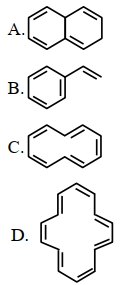
Which of the following are aromatic?
A
$B$ and $D$ only
B
$A$ and $C$ only
C
$A$ and $B$ only
D
$C$ and $D$ only
Solution
(A) To determine if a compound is aromatic,it must satisfy $H$ückel's rule ($4n+2$ $\pi$ electrons),be planar,and have a continuous cyclic conjugation.
$A$: This is $1,4$-dihydronaphthalene. It is non-aromatic because it is not fully conjugated.
$B$: This is styrene (vinylbenzene). It contains a benzene ring,which is aromatic.
$C$: This is $[10]$-annulene. It is non-aromatic due to steric hindrance between internal hydrogen atoms,which prevents the molecule from being planar.
$D$: This is $[14]$-annulene. It is aromatic as it follows $H$ückel's rule ($n=3$,$4(3)+2 = 14$ $\pi$ electrons) and is planar.
Thus,$B$ and $D$ are aromatic.
$A$: This is $1,4$-dihydronaphthalene. It is non-aromatic because it is not fully conjugated.
$B$: This is styrene (vinylbenzene). It contains a benzene ring,which is aromatic.
$C$: This is $[10]$-annulene. It is non-aromatic due to steric hindrance between internal hydrogen atoms,which prevents the molecule from being planar.
$D$: This is $[14]$-annulene. It is aromatic as it follows $H$ückel's rule ($n=3$,$4(3)+2 = 14$ $\pi$ electrons) and is planar.
Thus,$B$ and $D$ are aromatic.
0 likesView Solution
243
ChemistryMediumMCQJEE Main · 2024
Match List-$I$ with List-$II$.
Choose the correct answer from the options given below:
| List-$I$ (Elements) | List-$II$ (Properties) |
| $A. Cl, S$ | $I. \text{Elements with highest electronegativity}$ |
| $B. Ge, As$ | $II. \text{Elements with largest atomic size}$ |
| $C. Fr, Ra$ | $III. \text{Elements which show properties of both metals and non-metals}$ |
| $D. F, O$ | $IV. \text{Elements with highest negative electron gain enthalpy}$ |
Choose the correct answer from the options given below:
A
$A-II, B-III, C-IV, D-I$
B
$A-III, B-II, C-I, D-IV$
C
$A-IV, B-III, C-II, D-I$
D
$A-II, B-I, C-IV, D-III$
Solution
(C) $A. Cl, S$ are elements with the highest negative electron gain enthalpy $(IV)$.
$B. Ge, As$ are metalloids,showing properties of both metals and non-metals $(III)$.
$C. Fr, Ra$ are elements with the largest atomic size in their respective groups $(II)$.
$D. F, O$ are elements with the highest electronegativity $(I)$.
Therefore,the correct matching is $A-IV, B-III, C-II, D-I$.
$B. Ge, As$ are metalloids,showing properties of both metals and non-metals $(III)$.
$C. Fr, Ra$ are elements with the largest atomic size in their respective groups $(II)$.
$D. F, O$ are elements with the highest electronegativity $(I)$.
Therefore,the correct matching is $A-IV, B-III, C-II, D-I$.
0 likesView Solution
244
ChemistryMediumMCQJEE Main · 2024
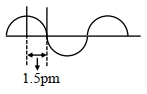
$A$ hypothetical electromagnetic wave is shown below. The frequency of the wave is $x \times 10^{19} \ Hz$. $x =$ . . . . (nearest integer)
A
$5$
B
$7$
C
$9$
D
$10$
Solution
(D) From the given figure, the distance shown corresponds to half of the wavelength (half-cycle), i.e., $\frac{\lambda}{2} = 1.5 \ pm$.
Therefore, the wavelength $\lambda = 2 \times 1.5 \ pm = 3 \ pm = 3 \times 10^{-12} \ m$.
The relationship between frequency $(\nu)$, wavelength $(\lambda)$, and speed of light $(c)$ is $\nu = \frac{c}{\lambda}$.
Given $c = 3 \times 10^8 \ m/s$, we have $\nu = \frac{3 \times 10^8 \ m/s}{3 \times 10^{-12} \ m} = 1 \times 10^{20} \ Hz$.
Expressing this in the form $x \times 10^{19} \ Hz$, we get $10 \times 10^{19} \ Hz$.
Thus, $x = 10$.
Therefore, the wavelength $\lambda = 2 \times 1.5 \ pm = 3 \ pm = 3 \times 10^{-12} \ m$.
The relationship between frequency $(\nu)$, wavelength $(\lambda)$, and speed of light $(c)$ is $\nu = \frac{c}{\lambda}$.
Given $c = 3 \times 10^8 \ m/s$, we have $\nu = \frac{3 \times 10^8 \ m/s}{3 \times 10^{-12} \ m} = 1 \times 10^{20} \ Hz$.
Expressing this in the form $x \times 10^{19} \ Hz$, we get $10 \times 10^{19} \ Hz$.
Thus, $x = 10$.
0 likesView Solution
245
ChemistryMediumMCQJEE Main · 2024
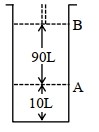
Consider the figure provided. $1 \ mol$ of an ideal gas is kept in a cylinder,fitted with a piston,at the position $A$,at $18^{\circ} C$. If the piston is moved to position $B$,keeping the temperature unchanged,then '$x$' $L \ atm$ work is done in this reversible process. $x=$ . . . . . . $L \ atm$. (nearest integer) [Given : Absolute temperature $=^{\circ} C + 273.15$,$R=0.08206 \ L \ atm \ mol^{-1} \ K^{-1}$]
A
$50$
B
$55$
C
$60$
D
$65$
Solution
(B) For a reversible isothermal expansion,the work done by the system is given by: $\omega = -nRT \ln \left(\frac{V_2}{V_1}\right)$.
Given:
$n = 1 \ mol$
$T = 18 + 273.15 = 291.15 \ K$
$V_1 = 10 \ L$
$V_2 = 10 + 90 = 100 \ L$
$R = 0.08206 \ L \ atm \ mol^{-1} \ K^{-1}$
Substituting the values:
$\omega = -1 \times 0.08206 \times 291.15 \times \ln \left(\frac{100}{10}\right)$
$\omega = -23.887 \times \ln(10)$
$\omega = -23.887 \times 2.303$
$\omega \approx -55.01 \ L \ atm$
The magnitude of work done by the system is $55 \ L \ atm$.
Given:
$n = 1 \ mol$
$T = 18 + 273.15 = 291.15 \ K$
$V_1 = 10 \ L$
$V_2 = 10 + 90 = 100 \ L$
$R = 0.08206 \ L \ atm \ mol^{-1} \ K^{-1}$
Substituting the values:
$\omega = -1 \times 0.08206 \times 291.15 \times \ln \left(\frac{100}{10}\right)$
$\omega = -23.887 \times \ln(10)$
$\omega = -23.887 \times 2.303$
$\omega \approx -55.01 \ L \ atm$
The magnitude of work done by the system is $55 \ L \ atm$.
0 likesView Solution
246
ChemistryMediumMCQJEE Main · 2024
The number of optical isomers in the following compound is:
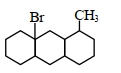
A
$30$
B
$35$
C
$36$
D
$32$
Solution
(D) The given compound is a derivative of perhydrophenanthrene.
By analyzing the structure,we identify the chiral centers marked with an asterisk $(*)$ in the provided image.
There are $5$ chiral centers in the molecule.
Since the molecule is asymmetric (it does not have a plane of symmetry or center of inversion),the number of optical isomers is given by $2^n$,where $n$ is the number of chiral centers.
Number of optical isomers $= 2^5 = 32$.
By analyzing the structure,we identify the chiral centers marked with an asterisk $(*)$ in the provided image.
There are $5$ chiral centers in the molecule.
Since the molecule is asymmetric (it does not have a plane of symmetry or center of inversion),the number of optical isomers is given by $2^n$,where $n$ is the number of chiral centers.
Number of optical isomers $= 2^5 = 32$.
0 likesView Solution
247
ChemistryMediumMCQJEE Main · 2024
Number of molecules from the following which are exceptions to the octet rule is. . . .
$CO_2, NO_2, H_2SO_4, BF_3, CH_4, SiF_4, ClO_2, PCl_5, BeF_2, C_2H_6, CHCl_3, CBr_4$
$CO_2, NO_2, H_2SO_4, BF_3, CH_4, SiF_4, ClO_2, PCl_5, BeF_2, C_2H_6, CHCl_3, CBr_4$
A
$5$
B
$6$
C
$8$
D
$9$
Solution
(B) The octet rule states that atoms tend to gain,lose,or share electrons to achieve a stable configuration of $8$ electrons in their valence shell.
Let us analyze each molecule:
$1$. $CO_2$: Carbon has $8$ electrons (complete octet).
$2$. $NO_2$: Nitrogen has an odd number of electrons ($7$ electrons,exception).
$3$. $H_2SO_4$: Sulfur has an expanded octet ($12$ electrons,exception).
$4$. $BF_3$: Boron has an incomplete octet ($6$ electrons,exception).
$5$. $CH_4$: Carbon has $8$ electrons (complete octet).
$6$. $SiF_4$: Silicon has $8$ electrons (complete octet).
$7$. $ClO_2$: Chlorine has an odd number of electrons ($7$ electrons,exception).
$8$. $PCl_5$: Phosphorus has an expanded octet ($10$ electrons,exception).
$9$. $BeF_2$: Beryllium has an incomplete octet ($4$ electrons,exception).
$10$. $C_2H_6$: Carbon has $8$ electrons (complete octet).
$11$. $CHCl_3$: Carbon has $8$ electrons (complete octet).
$12$. $CBr_4$: Carbon has $8$ electrons (complete octet).
The molecules that are exceptions to the octet rule are: $NO_2, H_2SO_4, BF_3, ClO_2, PCl_5, BeF_2$.
Total number of exceptions = $6$.
Let us analyze each molecule:
$1$. $CO_2$: Carbon has $8$ electrons (complete octet).
$2$. $NO_2$: Nitrogen has an odd number of electrons ($7$ electrons,exception).
$3$. $H_2SO_4$: Sulfur has an expanded octet ($12$ electrons,exception).
$4$. $BF_3$: Boron has an incomplete octet ($6$ electrons,exception).
$5$. $CH_4$: Carbon has $8$ electrons (complete octet).
$6$. $SiF_4$: Silicon has $8$ electrons (complete octet).
$7$. $ClO_2$: Chlorine has an odd number of electrons ($7$ electrons,exception).
$8$. $PCl_5$: Phosphorus has an expanded octet ($10$ electrons,exception).
$9$. $BeF_2$: Beryllium has an incomplete octet ($4$ electrons,exception).
$10$. $C_2H_6$: Carbon has $8$ electrons (complete octet).
$11$. $CHCl_3$: Carbon has $8$ electrons (complete octet).
$12$. $CBr_4$: Carbon has $8$ electrons (complete octet).
The molecules that are exceptions to the octet rule are: $NO_2, H_2SO_4, BF_3, ClO_2, PCl_5, BeF_2$.
Total number of exceptions = $6$.
0 likesView Solution
248
ChemistryMediumMCQJEE Main · 2024
The major product $B$ of the following reaction has . . . . . . . $\pi$-bonds.
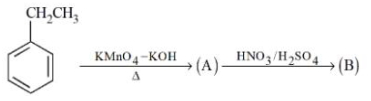
A
$5$
B
$4$
C
$10$
D
$11$
Solution
(A) Step $1$: Ethylbenzene reacts with alkaline $KMnO_4$ followed by heating to undergo oxidation of the alkyl side chain to form potassium benzoate $(A)$.
Step $2$: Potassium benzoate $(A)$ upon treatment with nitrating mixture $(conc. HNO_3 + conc. H_2SO_4)$ undergoes electrophilic aromatic substitution. Since the $-COOH$ group is meta-directing,the nitro group enters the meta position to form $m$-nitrobenzoic acid $(B)$.
Step $3$: The structure of $B$ ($m$-nitrobenzoic acid) contains:
- $3$ $\pi$-bonds in the benzene ring.
- $1$ $\pi$-bond in the $C=O$ group of the carboxylic acid.
- $1$ $\pi$-bond in the $N=O$ group of the nitro group.
Total $\pi$-bonds = $3 + 1 + 1 = 5$.
Step $2$: Potassium benzoate $(A)$ upon treatment with nitrating mixture $(conc. HNO_3 + conc. H_2SO_4)$ undergoes electrophilic aromatic substitution. Since the $-COOH$ group is meta-directing,the nitro group enters the meta position to form $m$-nitrobenzoic acid $(B)$.
Step $3$: The structure of $B$ ($m$-nitrobenzoic acid) contains:
- $3$ $\pi$-bonds in the benzene ring.
- $1$ $\pi$-bond in the $C=O$ group of the carboxylic acid.
- $1$ $\pi$-bond in the $N=O$ group of the nitro group.
Total $\pi$-bonds = $3 + 1 + 1 = 5$.
0 likesView Solution
249
ChemistryMediumMCQJEE Main · 2024
In the qualitative test for the identification of the presence of phosphorus,the compound is heated with an oxidizing agent. It is further treated with nitric acid and ammonium molybdate,respectively. The yellow-coloured precipitate obtained is:
A
$Na_3PO_4 \cdot 12MoO_3$
B
$(NH_4)_3PO_4 \cdot 12(NH_4)_2MoO_4$
C
$(NH_4)_3PO_4 \cdot 12MoO_3$
D
$MoPO_4 \cdot 21NH_4NO_3$
Solution
(C) In the qualitative analysis of phosphorus,the organic compound is heated with an oxidizing agent (like sodium peroxide) to convert phosphorus into phosphate ions $(PO_4^{3-})$.
This solution is then treated with concentrated nitric acid $(HNO_3)$ and ammonium molybdate $((NH_4)_2MoO_4)$.
The reaction produces a canary yellow precipitate of ammonium phosphomolybdate,which has the chemical formula $(NH_4)_3PO_4 \cdot 12MoO_3$.
This solution is then treated with concentrated nitric acid $(HNO_3)$ and ammonium molybdate $((NH_4)_2MoO_4)$.
The reaction produces a canary yellow precipitate of ammonium phosphomolybdate,which has the chemical formula $(NH_4)_3PO_4 \cdot 12MoO_3$.
0 likesView Solution
250
ChemistryMediumMCQJEE Main · 2024
When $\psi_A$ and $\psi_B$ are the wave functions of atomic orbitals,then $\sigma^*$ is represented by :
A
$\psi_A - 2 \psi_B$
B
$\psi_A - \psi_B$
C
$\psi_A + 2 \psi_B$
D
$\psi_A + \psi_B$
Solution
(B) Antibonding molecular orbitals $(\sigma^*)$ are formed by the destructive interference of atomic orbitals.
The wave function for the antibonding molecular orbital is given by the subtraction of the wave functions of the participating atomic orbitals.
Therefore,$\sigma^* = \psi_A - \psi_B$.
The wave function for the antibonding molecular orbital is given by the subtraction of the wave functions of the participating atomic orbitals.
Therefore,$\sigma^* = \psi_A - \psi_B$.
0 likesView Solution
251
ChemistryMediumMCQJEE Main · 2024
The number of halobenzenes from the following that can be prepared by Sandmeyer's reaction is . . . . . . . . .
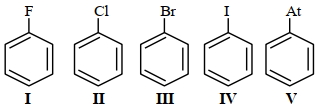
A
$8$
B
$3$
C
$7$
D
$2$
Solution
(D) Sandmeyer's reaction involves the treatment of benzene diazonium salts with $CuCl/HCl$ or $CuBr/HBr$ to yield chlorobenzene or bromobenzene,respectively.
Among the given structures:
$I$: Fluorobenzene (prepared by Balz-Schiemann reaction)
$II$: Chlorobenzene (prepared by Sandmeyer's reaction)
$III$: Bromobenzene (prepared by Sandmeyer's reaction)
$IV$: Iodobenzene (prepared by treatment with $KI$)
$V$: Astatobenzene (not prepared by Sandmeyer's reaction)
Thus,only $II$ and $III$ can be prepared by Sandmeyer's reaction.
The total number is $2$.
Among the given structures:
$I$: Fluorobenzene (prepared by Balz-Schiemann reaction)
$II$: Chlorobenzene (prepared by Sandmeyer's reaction)
$III$: Bromobenzene (prepared by Sandmeyer's reaction)
$IV$: Iodobenzene (prepared by treatment with $KI$)
$V$: Astatobenzene (not prepared by Sandmeyer's reaction)
Thus,only $II$ and $III$ can be prepared by Sandmeyer's reaction.
The total number is $2$.
0 likesView Solution
252
ChemistryMediumMCQJEE Main · 2024
$9.3 \ g$ of pure aniline is treated with bromine water at room temperature to give a white precipitate of the product '$P$'. The mass of product '$P$' obtained is $26.4 \ g$. The percentage yield is $......... \ \%$.
A
$70$
B
$80$
C
$90$
D
$100$
Solution
(B) The reaction of aniline with bromine water is:
$C_6H_5NH_2 + 3Br_2 \rightarrow C_6H_2Br_3NH_2 + 3HBr$
(Aniline) $\rightarrow$ ($2,4,6-$tribromoaniline)
Molar mass of aniline $(C_6H_7N)$ = $93 \ g/mol$.
Molar mass of $2,4,6-$tribromoaniline $(C_6H_4Br_3N)$ = $12 \times 6 + 1 \times 4 + 80 \times 3 + 14 = 72 + 4 + 240 + 14 = 330 \ g/mol$.
According to the stoichiometry,$93 \ g$ of aniline produces $330 \ g$ of $2,4,6-$tribromoaniline.
Therefore,$9.3 \ g$ of aniline should theoretically produce:
$\frac{330}{93} \times 9.3 = 33 \ g$ of $2,4,6-$tribromoaniline.
The actual mass obtained is $26.4 \ g$.
Percentage yield = $\frac{\text{Actual yield}}{\text{Theoretical yield}} \times 100$
Percentage yield = $\frac{26.4}{33} \times 100 = 80 \ \%$.
$C_6H_5NH_2 + 3Br_2 \rightarrow C_6H_2Br_3NH_2 + 3HBr$
(Aniline) $\rightarrow$ ($2,4,6-$tribromoaniline)
Molar mass of aniline $(C_6H_7N)$ = $93 \ g/mol$.
Molar mass of $2,4,6-$tribromoaniline $(C_6H_4Br_3N)$ = $12 \times 6 + 1 \times 4 + 80 \times 3 + 14 = 72 + 4 + 240 + 14 = 330 \ g/mol$.
According to the stoichiometry,$93 \ g$ of aniline produces $330 \ g$ of $2,4,6-$tribromoaniline.
Therefore,$9.3 \ g$ of aniline should theoretically produce:
$\frac{330}{93} \times 9.3 = 33 \ g$ of $2,4,6-$tribromoaniline.
The actual mass obtained is $26.4 \ g$.
Percentage yield = $\frac{\text{Actual yield}}{\text{Theoretical yield}} \times 100$
Percentage yield = $\frac{26.4}{33} \times 100 = 80 \ \%$.
0 likesView Solution
253
ChemistryMediumMCQJEE Main · 2024
While preparing crystals of Mohr's salt,dil. $H_2SO_4$ is added to a mixture of ferrous sulphate and ammonium sulphate,before dissolving this mixture in water,dil. $H_2SO_4$ is added here to:
A
prevent the hydrolysis of ferrous sulphate
B
prevent the hydrolysis of ammonium sulphate
C
make the medium strongly acidic
D
increase the rate of formation of crystals
Solution
(A) $Fe^{+2}$ ions undergo hydrolysis in water.
To prevent this hydrolysis and to keep the solution clear,dilute $H_2SO_4$ is added to the mixture of ferrous sulphate and ammonium sulphate before dissolving it in water.
To prevent this hydrolysis and to keep the solution clear,dilute $H_2SO_4$ is added to the mixture of ferrous sulphate and ammonium sulphate before dissolving it in water.
0 likesView Solution
254
ChemistryMediumMCQJEE Main · 2024
Identify the major product in the following reaction.
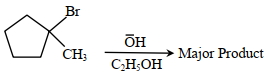
A
$1-$methylidenecyclopentane
B
$1-$bromocyclopentene
C
$1-$methylcyclopent$-1-$ene
D
methylcyclopentane
Solution
(C) The reaction involves a tertiary alkyl halide ($1$-bromo-$1$-methylcyclopentane) reacting with a strong base $(\text{OH}^-)$ in an alcoholic solvent $(C_2H_5OH)$. This condition favors an $E2$ elimination reaction. The base abstracts a $\beta$-hydrogen atom,leading to the formation of the most stable alkene according to Zaitsev's rule. The most substituted alkene,$1$-methylcyclopent-$1$-ene,is the major product.
0 likesView Solution
255
ChemistryMediumMCQJEE Main · 2024
The metal atom present in the complex $MABXL$ (where $A, B, X$ and $L$ are unidentate ligands and $M$ is metal) involves $sp^3$ hybridization. The number of geometrical isomers exhibited by the complex is:
A
$4$
B
$0$
C
$2$
D
$3$
Solution
(B) The complex $MABXL$ involves $sp^3$ hybridization,which indicates a tetrahedral geometry.
Tetrahedral complexes with four different unidentate ligands do not exhibit geometrical isomerism because all positions in a tetrahedron are equivalent relative to each other.
Therefore,the number of geometrical isomers is $0$.
Tetrahedral complexes with four different unidentate ligands do not exhibit geometrical isomerism because all positions in a tetrahedron are equivalent relative to each other.
Therefore,the number of geometrical isomers is $0$.
0 likesView Solution
256
ChemistryMediumMCQJEE Main · 2024
The quantity of silver deposited when one coulomb charge is passed through $AgNO_3$ solution:
A
$0.1 \text{ g}$ atom of silver
B
$1$ chemical equivalent of silver
C
$1 \text{ g}$ of silver
D
$1$ electrochemical equivalent of silver
Solution
(D) According to Faraday's first law of electrolysis,$W = ZIt$.
Since $Q = It$,we have $W = ZQ$.
When $Q = 1 \text{ C}$,$W = Z$.
Thus,the mass deposited is equal to $1$ electrochemical equivalent of silver.
(Note: $1$ chemical equivalent of silver is deposited by $1 \text{ Faraday}$ or $96500 \text{ C}$ of charge.)
Since $Q = It$,we have $W = ZQ$.
When $Q = 1 \text{ C}$,$W = Z$.
Thus,the mass deposited is equal to $1$ electrochemical equivalent of silver.
(Note: $1$ chemical equivalent of silver is deposited by $1 \text{ Faraday}$ or $96500 \text{ C}$ of charge.)
0 likesView Solution
257
ChemistryMediumMCQJEE Main · 2024
Which one of the following reactions is $NOT$ possible?
A
B
C
D
Solution
(B) The reaction of phenol with $HCl$ to form chlorobenzene is not possible under standard conditions. This is because the $C-OH$ bond in phenol has partial double bond character due to resonance,making it very strong and difficult to break. The carbon atom attached to the $-OH$ group is $sp^2$ hybridized,which further strengthens the bond. Therefore,nucleophilic substitution of the $-OH$ group by $Cl^-$ is not feasible.
0 likesView Solution
258
ChemistryMediumMCQJEE Main · 2024
For the electrochemical cell $M \mid M^{2+} \parallel X \mid X^{2-}$,if $E^{\circ}_{(M^{2+} / M)} = 0.46 \ V$ and $E^{\circ}_{(X / X^{2-})} = 0.34 \ V$,which of the following is correct?
A
$E_{\text{cell}} = -0.80 \ V$
B
$M + X \rightarrow M^{2+} + X^{2-}$ is a spontaneous reaction
C
$M^{2+} + X^{2-} \rightarrow M + X$ is a spontaneous reaction
D
$E_{\text{cell}} = 0.80 \ V$
Solution
(D) The cell reaction is $M + X^{2-} \rightarrow M^{2+} + X$.
Standard cell potential $E^{\circ}_{\text{cell}} = E^{\circ}_{\text{cathode}} - E^{\circ}_{\text{anode}}$.
Here,the cathode is $X/X^{2-}$ and the anode is $M/M^{2+}$.
Given $E^{\circ}_{(M^{2+}/M)} = 0.46 \ V$,so $E^{\circ}_{(M/M^{2+})} = -0.46 \ V$.
Given $E^{\circ}_{(X/X^{2-})} = 0.34 \ V$.
$E^{\circ}_{\text{cell}} = 0.34 \ V - (-0.46 \ V) = 0.80 \ V$.
Since $E^{\circ}_{\text{cell}} > 0$,the reaction $M + X^{2-} \rightarrow M^{2+} + X$ is spontaneous.
However,checking the options,if we consider the reverse reaction $M^{2+} + X^{2-} \rightarrow M + X$,it would be non-spontaneous. Given the options provided,$E^{\circ}_{\text{cell}} = 0.80 \ V$ is the correct value.
Standard cell potential $E^{\circ}_{\text{cell}} = E^{\circ}_{\text{cathode}} - E^{\circ}_{\text{anode}}$.
Here,the cathode is $X/X^{2-}$ and the anode is $M/M^{2+}$.
Given $E^{\circ}_{(M^{2+}/M)} = 0.46 \ V$,so $E^{\circ}_{(M/M^{2+})} = -0.46 \ V$.
Given $E^{\circ}_{(X/X^{2-})} = 0.34 \ V$.
$E^{\circ}_{\text{cell}} = 0.34 \ V - (-0.46 \ V) = 0.80 \ V$.
Since $E^{\circ}_{\text{cell}} > 0$,the reaction $M + X^{2-} \rightarrow M^{2+} + X$ is spontaneous.
However,checking the options,if we consider the reverse reaction $M^{2+} + X^{2-} \rightarrow M + X$,it would be non-spontaneous. Given the options provided,$E^{\circ}_{\text{cell}} = 0.80 \ V$ is the correct value.
0 likesView Solution
259
ChemistryMediumMCQJEE Main · 2024
The number of complexes from the following with no electrons in the $t_{2g}$ orbital is: $TiCl_4, [MnO_4]^{-}, [FeO_4]^{2-}, [FeCl_4]^{-}, [CoCl_4]^{2-}$
A
$3$
B
$1$
C
$4$
D
$2$
Solution
(A) For tetrahedral complexes,the crystal field splitting results in $e$ orbitals at lower energy and $t_2$ orbitals at higher energy.
$TiCl_4$: $Ti^{4+}$ $(d^0)$,configuration $e^0 t_2^0$. (No electrons in $t_2$)
$[MnO_4]^{-}$: $Mn^{7+}$ $(d^0)$,configuration $e^0 t_2^0$. (No electrons in $t_2$)
$[FeO_4]^{2-}$: $Fe^{6+}$ $(d^2)$,configuration $e^2 t_2^0$. (No electrons in $t_2$)
$[FeCl_4]^{-}$: $Fe^{3+}$ $(d^5)$,configuration $e^2 t_2^3$. (Has electrons in $t_2$)
$[CoCl_4]^{2-}$: $Co^{2+}$ $(d^7)$,configuration $e^4 t_2^3$. (Has electrons in $t_2$)
The complexes with no electrons in the $t_2$ orbital are $TiCl_4$,$[MnO_4]^{-}$,and $[FeO_4]^{2-}$.
Thus,the total number is $3$.
$TiCl_4$: $Ti^{4+}$ $(d^0)$,configuration $e^0 t_2^0$. (No electrons in $t_2$)
$[MnO_4]^{-}$: $Mn^{7+}$ $(d^0)$,configuration $e^0 t_2^0$. (No electrons in $t_2$)
$[FeO_4]^{2-}$: $Fe^{6+}$ $(d^2)$,configuration $e^2 t_2^0$. (No electrons in $t_2$)
$[FeCl_4]^{-}$: $Fe^{3+}$ $(d^5)$,configuration $e^2 t_2^3$. (Has electrons in $t_2$)
$[CoCl_4]^{2-}$: $Co^{2+}$ $(d^7)$,configuration $e^4 t_2^3$. (Has electrons in $t_2$)
The complexes with no electrons in the $t_2$ orbital are $TiCl_4$,$[MnO_4]^{-}$,and $[FeO_4]^{2-}$.
Thus,the total number is $3$.
0 likesView Solution
260
ChemistryMediumMCQJEE Main · 2024
The number of ions from the following that have the ability to liberate hydrogen from a dilute acid is. . . . . . . .$Ti^{2+}, Cr^{2+}, V^{2+}$
A
$0$
B
$2$
C
$3$
D
$1$
Solution
(C) The ions $Ti^{2+}, V^{2+},$ and $Cr^{2+}$ are strong reducing agents because their standard electrode potentials $(E^{\circ}_{M^{3+}/M^{2+}})$ are negative.
These ions can reduce $H^{+}$ ions in a dilute acid to liberate hydrogen gas.
The general reaction is: $2 M^{2+}_{(aq)} + 2 H^{+}_{(aq)} \longrightarrow 2 M^{3+}_{(aq)} + H_{2(g)}$.
Since all three ions $(Ti^{2+}, V^{2+}, Cr^{2+})$ possess this property,the total number of such ions is $3$.
These ions can reduce $H^{+}$ ions in a dilute acid to liberate hydrogen gas.
The general reaction is: $2 M^{2+}_{(aq)} + 2 H^{+}_{(aq)} \longrightarrow 2 M^{3+}_{(aq)} + H_{2(g)}$.
Since all three ions $(Ti^{2+}, V^{2+}, Cr^{2+})$ possess this property,the total number of such ions is $3$.
0 likesView Solution
261
ChemistryMediumMCQJEE Main · 2024
Identify $A$ and $B$ in the given chemical reaction sequence :-
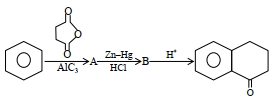
A
$A = \text{4-oxo-4-phenylbutanoic acid}, B = \text{4-phenylbutanoic acid}$
B
$A = \text{4-phenylbutanoic acid}, B = \text{4-oxo-4-phenylbutanoic acid}$
C
$A = \text{1,4-naphthoquinone}, B = \text{naphthalene}$
D
$A = \text{1,4-naphthoquinone}, B = \text{1,4-dihydroxy-1,2,3,4-tetrahydronaphthalene}$
Solution
(A) The reaction sequence is as follows:
$1$. Benzene reacts with succinic anhydride in the presence of anhydrous $AlCl_3$ (Friedel-Crafts acylation) to form $A$,which is $4\text{-oxo-}4\text{-phenylbutanoic acid}$ (also known as $\beta\text{-benzoylpropionic acid}$).
$2$. $A$ undergoes Clemmensen reduction $(Zn-Hg/HCl)$ to reduce the ketone group to a methylene group,forming $B$,which is $4\text{-phenylbutanoic acid}$.
$3$. $4\text{-phenylbutanoic acid}$ then undergoes intramolecular Friedel-Crafts acylation in the presence of $H^+$ to form $\alpha\text{-tetralone}$.
$1$. Benzene reacts with succinic anhydride in the presence of anhydrous $AlCl_3$ (Friedel-Crafts acylation) to form $A$,which is $4\text{-oxo-}4\text{-phenylbutanoic acid}$ (also known as $\beta\text{-benzoylpropionic acid}$).
$2$. $A$ undergoes Clemmensen reduction $(Zn-Hg/HCl)$ to reduce the ketone group to a methylene group,forming $B$,which is $4\text{-phenylbutanoic acid}$.
$3$. $4\text{-phenylbutanoic acid}$ then undergoes intramolecular Friedel-Crafts acylation in the presence of $H^+$ to form $\alpha\text{-tetralone}$.
0 likesView Solution
262
ChemistryMediumMCQJEE Main · 2024
Coagulation of egg,on heating,is because of:
A
Denaturation of protein occurs
B
The secondary structure of protein remains unchanged
C
Breaking of the peptide linkage in the primary structure of protein occurs
D
Biological property of protein remains unchanged
Solution
(A) Coagulation of egg,on heating,leads to the loss of biological activity and the unfolding of the protein,which is known as denaturation of protein.
0 likesView Solution
263
ChemistryMediumMCQJEE Main · 2024
The fusion of chromite ore with sodium carbonate in the presence of air leads to the formation of products $A$ and $B$ along with the evolution of $CO_2$. The sum of spin-only magnetic moment values of $A$ and $B$ is .......... $B.M.$ (Nearest integer)
(Given atomic number: $C: 6, Na: 11, O: 8, Fe: 26, Cr: 24$)
(Given atomic number: $C: 6, Na: 11, O: 8, Fe: 26, Cr: 24$)
A
$5$
B
$6$
C
$8$
D
$10$
Solution
(B) The chemical reaction for the fusion of chromite ore $(FeCr_2O_4)$ with sodium carbonate $(Na_2CO_3)$ in the presence of air is:
$4FeCr_2O_4 + 8Na_2CO_3 + 7O_2 \rightarrow 8Na_2CrO_4 + 2Fe_2O_3 + 8CO_2$
Here,$A = Na_2CrO_4$ and $B = Fe_2O_3$.
$1$. For $Na_2CrO_4$ $(Cr^{6+})$: The electronic configuration is $[Ar]3d^0$. The number of unpaired electrons $(n)$ is $0$. Therefore,the spin-only magnetic moment $\mu_s = \sqrt{0(0+2)} = 0 \ B.M.$
$2$. For $Fe_2O_3$ $(Fe^{3+})$: The electronic configuration is $[Ar]3d^5$. The number of unpaired electrons $(n)$ is $5$. Therefore,the spin-only magnetic moment $\mu_s = \sqrt{5(5+2)} = \sqrt{35} \approx 5.91 \ B.M.$
Sum of magnetic moments $= 0 + 5.91 = 5.91 \ B.M.$
The nearest integer value is $6$.
$4FeCr_2O_4 + 8Na_2CO_3 + 7O_2 \rightarrow 8Na_2CrO_4 + 2Fe_2O_3 + 8CO_2$
Here,$A = Na_2CrO_4$ and $B = Fe_2O_3$.
$1$. For $Na_2CrO_4$ $(Cr^{6+})$: The electronic configuration is $[Ar]3d^0$. The number of unpaired electrons $(n)$ is $0$. Therefore,the spin-only magnetic moment $\mu_s = \sqrt{0(0+2)} = 0 \ B.M.$
$2$. For $Fe_2O_3$ $(Fe^{3+})$: The electronic configuration is $[Ar]3d^5$. The number of unpaired electrons $(n)$ is $5$. Therefore,the spin-only magnetic moment $\mu_s = \sqrt{5(5+2)} = \sqrt{35} \approx 5.91 \ B.M.$
Sum of magnetic moments $= 0 + 5.91 = 5.91 \ B.M.$
The nearest integer value is $6$.
0 likesView Solution
264
ChemistryMediumMCQJEE Main · 2024
$X \ g$ of ethanamine was subjected to reaction with $NaNO_2 / HCl$ followed by hydrolysis to liberate $N_2$ and $HCl$. The $HCl$ generated was completely neutralized by $0.2 \ mol$ of $NaOH$. $X$ is . . . .
A
$7$
B
$8$
C
$9$
D
$10$
Solution
(C) The reaction of ethanamine $(CH_3CH_2NH_2)$ with $NaNO_2 / HCl$ produces ethyl diazonium chloride,which upon hydrolysis yields ethanol,$N_2$,and $HCl$.
The overall reaction is: $CH_3CH_2NH_2 + NaNO_2 + HCl \rightarrow CH_3CH_2OH + N_2 + NaCl + H_2O$.
Wait,the question states $HCl$ is liberated and neutralized by $0.2 \ mol$ of $NaOH$. Based on the stoichiometry,$1 \ mol$ of ethanamine produces $1 \ mol$ of $HCl$.
Given that $0.2 \ mol$ of $NaOH$ is required to neutralize the $HCl$,it implies $0.2 \ mol$ of $HCl$ was produced.
Therefore,$0.2 \ mol$ of ethanamine was used.
The molar mass of ethanamine $(CH_3CH_2NH_2)$ is $12 \times 2 + 1 \times 7 + 14 = 45 \ g/mol$.
Mass $X = \text{moles} \times \text{molar mass} = 0.2 \ mol \times 45 \ g/mol = 9 \ g$.
Thus,$X = 9$.
The overall reaction is: $CH_3CH_2NH_2 + NaNO_2 + HCl \rightarrow CH_3CH_2OH + N_2 + NaCl + H_2O$.
Wait,the question states $HCl$ is liberated and neutralized by $0.2 \ mol$ of $NaOH$. Based on the stoichiometry,$1 \ mol$ of ethanamine produces $1 \ mol$ of $HCl$.
Given that $0.2 \ mol$ of $NaOH$ is required to neutralize the $HCl$,it implies $0.2 \ mol$ of $HCl$ was produced.
Therefore,$0.2 \ mol$ of ethanamine was used.
The molar mass of ethanamine $(CH_3CH_2NH_2)$ is $12 \times 2 + 1 \times 7 + 14 = 45 \ g/mol$.
Mass $X = \text{moles} \times \text{molar mass} = 0.2 \ mol \times 45 \ g/mol = 9 \ g$.
Thus,$X = 9$.
0 likesView Solution
265
ChemistryMediumMCQJEE Main · 2024
In the Claisen-Schmidt reaction to prepare $351 \ g$ of dibenzalacetone using $87 \ g$ of acetone,the amount of benzaldehyde required is . . . . . . . $g$. (Nearest integer)
A
$317$
B
$318$
C
$320$
D
$325$
Solution
(B) The chemical equation for the Claisen-Schmidt reaction is:
$2C_6H_5CHO + CH_3COCH_3 \xrightarrow{NaOH} C_6H_5CH=CHCOCH=CHC_6H_5 + 2H_2O$
From the stoichiometry,$1 \ mole$ of acetone reacts with $2 \ moles$ of benzaldehyde to produce $1 \ mole$ of dibenzalacetone.
Molar mass of dibenzalacetone $(C_{17}H_{14}O) = (17 \times 12) + (14 \times 1) + 16 = 204 + 14 + 16 = 234 \ g/mol$.
Number of moles of dibenzalacetone produced $= \frac{351 \ g}{234 \ g/mol} = 1.5 \ moles$.
According to the stoichiometry,$1 \ mole$ of dibenzalacetone requires $2 \ moles$ of benzaldehyde.
Therefore,$1.5 \ moles$ of dibenzalacetone requires $1.5 \times 2 = 3 \ moles$ of benzaldehyde.
Molar mass of benzaldehyde $(C_6H_5CHO) = (7 \times 12) + (6 \times 1) + 16 = 84 + 6 + 16 = 106 \ g/mol$.
Mass of benzaldehyde required $= 3 \ moles \times 106 \ g/mol = 318 \ g$.
$2C_6H_5CHO + CH_3COCH_3 \xrightarrow{NaOH} C_6H_5CH=CHCOCH=CHC_6H_5 + 2H_2O$
From the stoichiometry,$1 \ mole$ of acetone reacts with $2 \ moles$ of benzaldehyde to produce $1 \ mole$ of dibenzalacetone.
Molar mass of dibenzalacetone $(C_{17}H_{14}O) = (17 \times 12) + (14 \times 1) + 16 = 204 + 14 + 16 = 234 \ g/mol$.
Number of moles of dibenzalacetone produced $= \frac{351 \ g}{234 \ g/mol} = 1.5 \ moles$.
According to the stoichiometry,$1 \ mole$ of dibenzalacetone requires $2 \ moles$ of benzaldehyde.
Therefore,$1.5 \ moles$ of dibenzalacetone requires $1.5 \times 2 = 3 \ moles$ of benzaldehyde.
Molar mass of benzaldehyde $(C_6H_5CHO) = (7 \times 12) + (6 \times 1) + 16 = 84 + 6 + 16 = 106 \ g/mol$.
Mass of benzaldehyde required $= 3 \ moles \times 106 \ g/mol = 318 \ g$.
0 likesView Solution
266
ChemistryMediumMCQJEE Main · 2024
Consider the following single step reaction in gas phase at constant temperature.
$2 \ A_{(g)} + B_{(g)} \rightarrow C_{(g)}$
The initial rate of the reaction is recorded as $r_1$ when the reaction starts with $1.5 \ atm$ pressure of $A$ and $0.7 \ atm$ pressure of $B$. After some time,the rate $r_2$ is recorded when the pressure of $C$ becomes $0.5 \ atm$. The ratio $r_1 : r_2$ is $\qquad$ $\times 10^{-1}$.
(Nearest integer)
$2 \ A_{(g)} + B_{(g)} \rightarrow C_{(g)}$
The initial rate of the reaction is recorded as $r_1$ when the reaction starts with $1.5 \ atm$ pressure of $A$ and $0.7 \ atm$ pressure of $B$. After some time,the rate $r_2$ is recorded when the pressure of $C$ becomes $0.5 \ atm$. The ratio $r_1 : r_2$ is $\qquad$ $\times 10^{-1}$.
(Nearest integer)
A
$318$
B
$317$
C
$315$
D
$319$
Solution
(C) The reaction is $2 \ A_{(g)} + B_{(g)} \longrightarrow C_{(g)}$.
At $t = 0$,$P_A = 1.5 \ atm$ and $P_B = 0.7 \ atm$. The initial rate is $r_1 = K(P_A)^2(P_B) = K(1.5)^2(0.7)$.
When $P_C = 0.5 \ atm$,the pressure of $A$ consumed is $2 \times 0.5 = 1.0 \ atm$ and $B$ consumed is $0.5 \ atm$.
Remaining pressures are $P_A = 1.5 - 1.0 = 0.5 \ atm$ and $P_B = 0.7 - 0.5 = 0.2 \ atm$.
The rate at this time is $r_2 = K(0.5)^2(0.2)$.
Taking the ratio: $\frac{r_1}{r_2} = \frac{K(1.5)^2(0.7)}{K(0.5)^2(0.2)} = \frac{2.25 \times 0.7}{0.25 \times 0.2} = \frac{1.575}{0.05} = 31.5$.
Since $31.5 = 315 \times 10^{-1}$,the value is $315$.
At $t = 0$,$P_A = 1.5 \ atm$ and $P_B = 0.7 \ atm$. The initial rate is $r_1 = K(P_A)^2(P_B) = K(1.5)^2(0.7)$.
When $P_C = 0.5 \ atm$,the pressure of $A$ consumed is $2 \times 0.5 = 1.0 \ atm$ and $B$ consumed is $0.5 \ atm$.
Remaining pressures are $P_A = 1.5 - 1.0 = 0.5 \ atm$ and $P_B = 0.7 - 0.5 = 0.2 \ atm$.
The rate at this time is $r_2 = K(0.5)^2(0.2)$.
Taking the ratio: $\frac{r_1}{r_2} = \frac{K(1.5)^2(0.7)}{K(0.5)^2(0.2)} = \frac{2.25 \times 0.7}{0.25 \times 0.2} = \frac{1.575}{0.05} = 31.5$.
Since $31.5 = 315 \times 10^{-1}$,the value is $315$.
0 likesView Solution
267
ChemistryMediumMCQJEE Main · 2024
The product $(C)$ in the following sequence of reactions has . . . . . . . . $\pi$ bonds.

A
$2$
B
$3$
C
$8$
D
$4$
Solution
(D) $1$. The starting material is propylbenzene. Oxidation with $KMnO_4-KOH$ followed by acidification $(H_3O^+)$ converts the alkyl side chain into a carboxylic acid group,yielding benzoic acid $(B)$.
$2$. Benzoic acid is then subjected to electrophilic aromatic substitution with $Br_2$ in the presence of $FeBr_3$. Since the $-COOH$ group is meta-directing,the product $(C)$ is $m$-bromobenzoic acid.
$3$. The structure of $m$-bromobenzoic acid contains a benzene ring (which has $3$ $\pi$ bonds) and a carbonyl group ($C=O$,which has $1$ $\pi$ bond).
$4$. Total $\pi$ bonds $= 3 + 1 = 4$.
$2$. Benzoic acid is then subjected to electrophilic aromatic substitution with $Br_2$ in the presence of $FeBr_3$. Since the $-COOH$ group is meta-directing,the product $(C)$ is $m$-bromobenzoic acid.
$3$. The structure of $m$-bromobenzoic acid contains a benzene ring (which has $3$ $\pi$ bonds) and a carbonyl group ($C=O$,which has $1$ $\pi$ bond).
$4$. Total $\pi$ bonds $= 3 + 1 = 4$.
0 likesView Solution
268
ChemistryMediumMCQJEE Main · 2024
Considering acetic acid dissociates in water,its dissociation constant is $6.25 \times 10^{-5}$. If $5 \ mL$ of acetic acid is dissolved in $1 \ L$ water,the solution will freeze at $-x \times 10^{-2} \ {}^{\circ}C$,provided pure water freezes at $0 \ {}^{\circ}C$.
$x = . . . . . . . . .$ (Nearest integer)
Given: $(K_{f})_{\text{water}} = 1.86 \ K \ kg \ mol^{-1}$.
Density of acetic acid is $1.2 \ g \ mL^{-1}$.
Molar mass of water $= 18 \ g \ mol^{-1}$.
Molar mass of acetic acid $= 60 \ g \ mol^{-1}$.
Density of water $= 1 \ g \ cm^{-3}$.
Acetic acid dissociates as:
$CH_3COOH \rightleftharpoons CH_3COO^{-} + H^{+}$
$x = . . . . . . . . .$ (Nearest integer)
Given: $(K_{f})_{\text{water}} = 1.86 \ K \ kg \ mol^{-1}$.
Density of acetic acid is $1.2 \ g \ mL^{-1}$.
Molar mass of water $= 18 \ g \ mol^{-1}$.
Molar mass of acetic acid $= 60 \ g \ mol^{-1}$.
Density of water $= 1 \ g \ cm^{-3}$.
Acetic acid dissociates as:
$CH_3COOH \rightleftharpoons CH_3COO^{-} + H^{+}$
A
$19$
B
$20$
C
$25$
D
$30$
Solution
(A) Mass of $CH_3COOH = V \times d = 5 \ mL \times 1.2 \ g \ mL^{-1} = 6 \ g$.
Moles of $CH_3COOH = \frac{6 \ g}{60 \ g \ mol^{-1}} = 0.1 \ mol$.
Molality $(m) = \frac{0.1 \ mol}{1 \ kg \ \text{water}} = 0.1 \ m$.
For the dissociation $CH_3COOH \rightleftharpoons CH_3COO^{-} + H^{+}$,$K_{a} = \frac{C\alpha^{2}}{1-\alpha}$.
Since $\alpha$ is small,$1-\alpha \approx 1$,so $K_{a} \approx C\alpha^{2}$.
$\alpha = \sqrt{\frac{K_{a}}{C}} = \sqrt{\frac{6.25 \times 10^{-5}}{0.1}} = \sqrt{6.25 \times 10^{-4}} = 25 \times 10^{-3} = 0.025$.
van't Hoff factor $(i) = 1 + \alpha(n-1) = 1 + 0.025(2-1) = 1.025$.
Freezing point depression $\Delta T_{f} = i \times K_{f} \times m = 1.025 \times 1.86 \times 0.1 = 0.19065 \ {}^{\circ}C$.
Given $\Delta T_{f} = x \times 10^{-2} \ {}^{\circ}C$,so $x \approx 19$.
Moles of $CH_3COOH = \frac{6 \ g}{60 \ g \ mol^{-1}} = 0.1 \ mol$.
Molality $(m) = \frac{0.1 \ mol}{1 \ kg \ \text{water}} = 0.1 \ m$.
For the dissociation $CH_3COOH \rightleftharpoons CH_3COO^{-} + H^{+}$,$K_{a} = \frac{C\alpha^{2}}{1-\alpha}$.
Since $\alpha$ is small,$1-\alpha \approx 1$,so $K_{a} \approx C\alpha^{2}$.
$\alpha = \sqrt{\frac{K_{a}}{C}} = \sqrt{\frac{6.25 \times 10^{-5}}{0.1}} = \sqrt{6.25 \times 10^{-4}} = 25 \times 10^{-3} = 0.025$.
van't Hoff factor $(i) = 1 + \alpha(n-1) = 1 + 0.025(2-1) = 1.025$.
Freezing point depression $\Delta T_{f} = i \times K_{f} \times m = 1.025 \times 1.86 \times 0.1 = 0.19065 \ {}^{\circ}C$.
Given $\Delta T_{f} = x \times 10^{-2} \ {}^{\circ}C$,so $x \approx 19$.
0 likesView Solution
269
ChemistryMediumMCQJEE Main · 2024
Given below are two statements :
Statement $I$ : Picric acid is $2,4,6$-trinitrotoluene.
Statement $II$ : Phenol-$2,4$-disulphonic acid is treated with conc. $HNO_3$ to get picric acid.
In the light of the above statements,choose the most appropriate answer from the options given below :
Statement $I$ : Picric acid is $2,4,6$-trinitrotoluene.
Statement $II$ : Phenol-$2,4$-disulphonic acid is treated with conc. $HNO_3$ to get picric acid.
In the light of the above statements,choose the most appropriate answer from the options given below :
A
Statement $I$ is incorrect but Statement $II$ is correct.
B
Both Statement $I$ and Statement $II$ are incorrect.
C
Statement $I$ is correct but Statement $II$ is incorrect.
D
Both Statement $I$ and Statement $II$ are correct.
Solution
(A) Statement $I$ is incorrect because picric acid is $2,4,6$-trinitrophenol,not $2,4,6$-trinitrotoluene.
Statement $II$ is correct. Phenol is first treated with conc. $H_2SO_4$ to form phenol-$2,4$-disulphonic acid,which is then treated with conc. $HNO_3$ to yield picric acid ($2,4,6$-trinitrophenol) via electrophilic substitution.
Statement $II$ is correct. Phenol is first treated with conc. $H_2SO_4$ to form phenol-$2,4$-disulphonic acid,which is then treated with conc. $HNO_3$ to yield picric acid ($2,4,6$-trinitrophenol) via electrophilic substitution.
0 likesView Solution
270
ChemistryMediumMCQJEE Main · 2024
$DNA$ molecule contains $4$ bases whose structures are shown below. One of the structures is not correct,identify the incorrect base structure.
A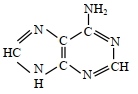
B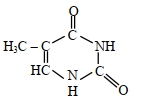
C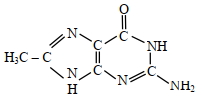
D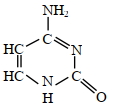
Solution
(C) The four nitrogenous bases present in $DNA$ are adenine,guanine,cytosine,and thymine.
Option $A$ shows the structure of adenine.
Option $B$ shows the structure of thymine.
Option $D$ shows the structure of cytosine.
Option $C$ shows a structure that does not correspond to any of the standard $DNA$ bases (it appears to be a modified purine base not found in $DNA$). Therefore,the structure in option $C$ is incorrect.
Option $A$ shows the structure of adenine.
Option $B$ shows the structure of thymine.
Option $D$ shows the structure of cytosine.
Option $C$ shows a structure that does not correspond to any of the standard $DNA$ bases (it appears to be a modified purine base not found in $DNA$). Therefore,the structure in option $C$ is incorrect.
0 likesView Solution
271
ChemistryMediumMCQJEE Main · 2024
In the Reimer-Tiemann reaction,phenol is converted into salicylaldehyde through an intermediate. The structure of the intermediate is . . . . . . .
A
B
C
D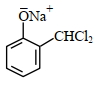
Solution
(D) The Reimer-Tiemann reaction involves the treatment of phenol with chloroform $(CHCl_3)$ in the presence of an aqueous base (like $NaOH$).
$1$. The base deprotonates the phenol to form a phenoxide ion.
$2$. The chloroform reacts with the base to generate a dichlorocarbene $(:CCl_2)$ intermediate,which acts as an electrophile.
$3$. The phenoxide ion attacks the dichlorocarbene to form an ortho-dichloromethyl phenoxide intermediate,which is represented as a benzene ring with an $-O^-Na^+$ group and a $-CHCl_2$ group at the ortho position.
$4$. This intermediate then undergoes hydrolysis with $NaOH$ followed by acidification to yield salicylaldehyde.
$1$. The base deprotonates the phenol to form a phenoxide ion.
$2$. The chloroform reacts with the base to generate a dichlorocarbene $(:CCl_2)$ intermediate,which acts as an electrophile.
$3$. The phenoxide ion attacks the dichlorocarbene to form an ortho-dichloromethyl phenoxide intermediate,which is represented as a benzene ring with an $-O^-Na^+$ group and a $-CHCl_2$ group at the ortho position.
$4$. This intermediate then undergoes hydrolysis with $NaOH$ followed by acidification to yield salicylaldehyde.
0 likesView Solution
272
ChemistryMediumMCQJEE Main · 2024
Which of the following materials is not a semiconductor?
A
Germanium
B
Graphite
C
Silicon
D
Copper oxide
Solution
(B) Semiconductors are materials with electrical conductivity between conductors and insulators. $Germanium$,$Silicon$,and $Copper \ oxide$ $(Cu_2O)$ are well-known semiconductors. $Graphite$ is an allotrope of carbon that possesses delocalized electrons,making it a good conductor of electricity. Therefore,$Graphite$ is not a semiconductor.
0 likesView Solution
273
ChemistryMediumMCQJEE Main · 2024
Consider the following complexes:
$[CoCl(NH_3)_5]^{2+},$ $[Co(CN)_6]^{3-}$
$(A)$ $(B)$
$[Co(NH_3)_5(H_2O)]^{3+},$ $[Cu(H_2O)_4]^{2+}$
$(C)$ $(D)$
The correct order of $A, B, C,$ and $D$ in terms of the wavenumber of light absorbed is:
$[CoCl(NH_3)_5]^{2+},$ $[Co(CN)_6]^{3-}$
$(A)$ $(B)$
$[Co(NH_3)_5(H_2O)]^{3+},$ $[Cu(H_2O)_4]^{2+}$
$(C)$ $(D)$
The correct order of $A, B, C,$ and $D$ in terms of the wavenumber of light absorbed is:
A
$C < D < A < B$
B
$D < A < C < B$
C
$A < C < B < D$
D
$B < C < A < D$
Solution
(B) The energy of the absorbed light is directly proportional to the crystal field splitting energy $(\Delta_o)$,which depends on the strength of the ligands and the oxidation state of the metal ion.
Energy $\propto$ Wavenumber $(\bar{v})$.
$1$. For $D$ $([Cu(H_2O)_4]^{2+})$: $Cu^{2+}$ is a $3d^9$ system with weak field ligands $(H_2O)$,resulting in the lowest splitting energy.
$2$. For $C$ $([Co(NH_3)_5(H_2O)]^{3+})$: $Co^{3+}$ is a $3d^6$ system. The ligands are $NH_3$ and $H_2O$. The splitting is higher than $D$.
$3$. For $A$ $([CoCl(NH_3)_5]^{2+})$: $Co^{3+}$ with $NH_3$ and $Cl^-$. $Cl^-$ is a weaker ligand than $H_2O$,but the overall field strength of the complex is higher than $C$ due to the presence of five $NH_3$ ligands.
$4$. For $B$ $([Co(CN)_6]^{3-})$: $Co^{3+}$ with $CN^-$ ligands. $CN^-$ is a strong field ligand,resulting in the largest splitting energy and thus the highest wavenumber.
The order of increasing wavenumber is $D < C < A < B$. However,based on standard spectrochemical series and complex stability,the correct order is $D < A < C < B$.
Energy $\propto$ Wavenumber $(\bar{v})$.
$1$. For $D$ $([Cu(H_2O)_4]^{2+})$: $Cu^{2+}$ is a $3d^9$ system with weak field ligands $(H_2O)$,resulting in the lowest splitting energy.
$2$. For $C$ $([Co(NH_3)_5(H_2O)]^{3+})$: $Co^{3+}$ is a $3d^6$ system. The ligands are $NH_3$ and $H_2O$. The splitting is higher than $D$.
$3$. For $A$ $([CoCl(NH_3)_5]^{2+})$: $Co^{3+}$ with $NH_3$ and $Cl^-$. $Cl^-$ is a weaker ligand than $H_2O$,but the overall field strength of the complex is higher than $C$ due to the presence of five $NH_3$ ligands.
$4$. For $B$ $([Co(CN)_6]^{3-})$: $Co^{3+}$ with $CN^-$ ligands. $CN^-$ is a strong field ligand,resulting in the largest splitting energy and thus the highest wavenumber.
The order of increasing wavenumber is $D < C < A < B$. However,based on standard spectrochemical series and complex stability,the correct order is $D < A < C < B$.
0 likesView Solution
274
ChemistryMediumMCQJEE Main · 2024
Match List-$I$ with List-$II$.
Choose the correct answer from the options given below:
| $LIST$-$I$ (Precipitating reagent and conditions) | $LIST$-$II$ (Cation) |
| $A$. $NH_4Cl + NH_4OH$ | $I$. $Mn^{2+}$ |
| $B$. $NH_4OH + (NH_4)_2CO_3$ | $II$. $Pb^{2+}$ |
| $C$. $NH_4OH + NH_4Cl + H_2S$ gas | $III$. $Al^{3+}$ |
| $D$. Dilute $HCl$ | $IV$. $Sr^{2+}$ |
Choose the correct answer from the options given below:
A
$A-IV, B-III, C-II, D-I$
B
$A-IV, B-III, C-I, D-II$
C
$A-III, B-IV, C-I, D-II$
D
$A-III, B-IV, C-II, D-I$
Solution
(C) The identification of cations in qualitative analysis is based on their group reagents:
$1$. Group $III$ cations (like $Al^{3+}$) are precipitated as hydroxides by $NH_4Cl + NH_4OH$ $(A-III)$.
$2$. Group $V$ cations (like $Sr^{2+}$) are precipitated as carbonates by $(NH_4)_2CO_3$ in the presence of $NH_4OH$ $(B-IV)$.
$3$. Group $IV$ cations (like $Mn^{2+}$) are precipitated as sulfides by $H_2S$ in the presence of $NH_4OH + NH_4Cl$ $(C-I)$.
$4$. Group $I$ cations (like $Pb^{2+}$) are precipitated as chlorides by dilute $HCl$ $(D-II)$.
Therefore,the correct matching is $A-III, B-IV, C-I, D-II$.
$1$. Group $III$ cations (like $Al^{3+}$) are precipitated as hydroxides by $NH_4Cl + NH_4OH$ $(A-III)$.
$2$. Group $V$ cations (like $Sr^{2+}$) are precipitated as carbonates by $(NH_4)_2CO_3$ in the presence of $NH_4OH$ $(B-IV)$.
$3$. Group $IV$ cations (like $Mn^{2+}$) are precipitated as sulfides by $H_2S$ in the presence of $NH_4OH + NH_4Cl$ $(C-I)$.
$4$. Group $I$ cations (like $Pb^{2+}$) are precipitated as chlorides by dilute $HCl$ $(D-II)$.
Therefore,the correct matching is $A-III, B-IV, C-I, D-II$.
0 likesView Solution
275
ChemistryMediumMCQJEE Main · 2024
The number of elements from the following that do not belong to lanthanoids is:
$Eu, Cm, Er, Tb, Yb$ and $Lu$
$Eu, Cm, Er, Tb, Yb$ and $Lu$
A
$3$
B
$4$
C
$1$
D
$5$
Solution
(C) Lanthanoids are the elements with atomic numbers $57$ to $71$.
$Eu$ $(Z=63)$,$Er$ $(Z=68)$,$Tb$ $(Z=65)$,$Yb$ $(Z=70)$,and $Lu$ $(Z=71)$ are all lanthanoids.
$Cm$ $(Z=96)$ is an actinide.
Therefore,only $1$ element $(Cm)$ does not belong to the lanthanoid series.
$Eu$ $(Z=63)$,$Er$ $(Z=68)$,$Tb$ $(Z=65)$,$Yb$ $(Z=70)$,and $Lu$ $(Z=71)$ are all lanthanoids.
$Cm$ $(Z=96)$ is an actinide.
Therefore,only $1$ element $(Cm)$ does not belong to the lanthanoid series.
0 likesView Solution
276
ChemistryMediumMCQJEE Main · 2024
The density of '$x$' $M$ solution ('$x$' molar) of $NaOH$ is $1.12 \ g \ mL^{-1}$. While in molality,the concentration of the solution is $3 \ m$ $(3 \ molal)$. Then '$x$' is.
(Given: Molar mass of $NaOH$ is $40 \ g \ mol^{-1}$)
(Given: Molar mass of $NaOH$ is $40 \ g \ mol^{-1}$)
A
$3.5$
B
$3.0$
C
$3.8$
D
$2.8$
Solution
(B) The relationship between molality $(m)$ and molarity $(M)$ is given by the formula:
$m = \frac{1000 \times M}{(1000 \times d) - (M \times Mw_{\text{solute}})}$
Given:
$m = 3 \ molal$
$d = 1.12 \ g \ mL^{-1}$
$Mw_{\text{solute}} = 40 \ g \ mol^{-1}$
$M = x$
Substituting the values into the formula:
$3 = \frac{1000 \times x}{(1000 \times 1.12) - (x \times 40)}$
$3 = \frac{1000x}{1120 - 40x}$
$3(1120 - 40x) = 1000x$
$3360 - 120x = 1000x$
$3360 = 1120x$
$x = \frac{3360}{1120} = 3$
Therefore,the value of '$x$' is $3$.
$m = \frac{1000 \times M}{(1000 \times d) - (M \times Mw_{\text{solute}})}$
Given:
$m = 3 \ molal$
$d = 1.12 \ g \ mL^{-1}$
$Mw_{\text{solute}} = 40 \ g \ mol^{-1}$
$M = x$
Substituting the values into the formula:
$3 = \frac{1000 \times x}{(1000 \times 1.12) - (x \times 40)}$
$3 = \frac{1000x}{1120 - 40x}$
$3(1120 - 40x) = 1000x$
$3360 - 120x = 1000x$
$3360 = 1120x$
$x = \frac{3360}{1120} = 3$
Therefore,the value of '$x$' is $3$.
0 likesView Solution
277
ChemistryMediumMCQJEE Main · 2024
Which among the following aldehydes is most reactive towards nucleophilic addition reactions?
A
$HCHO$
B
$C_2H_5CHO$
C
$CH_3CHO$
D
$C_3H_7CHO$
Solution
(A) The reactivity of carbonyl compounds towards nucleophilic addition reactions depends on two factors:
$1$. Steric hindrance: Smaller groups around the carbonyl carbon facilitate the attack of the nucleophile.
$2$. Electronic effect: Electron-donating groups (like alkyl groups) decrease the electrophilicity of the carbonyl carbon by donating electron density,thereby reducing reactivity.
$HCHO$ (formaldehyde) has the smallest hydrogen atoms attached to the carbonyl carbon,resulting in the least steric hindrance and the highest electrophilicity at the carbonyl carbon.
Therefore,$HCHO$ is the most reactive towards nucleophilic addition reactions.
$1$. Steric hindrance: Smaller groups around the carbonyl carbon facilitate the attack of the nucleophile.
$2$. Electronic effect: Electron-donating groups (like alkyl groups) decrease the electrophilicity of the carbonyl carbon by donating electron density,thereby reducing reactivity.
$HCHO$ (formaldehyde) has the smallest hydrogen atoms attached to the carbonyl carbon,resulting in the least steric hindrance and the highest electrophilicity at the carbonyl carbon.
Therefore,$HCHO$ is the most reactive towards nucleophilic addition reactions.
0 likesView Solution
278
ChemistryMediumMCQJEE Main · 2024
Match List-$I$ with List-$II$ :
Choose the correct answer from the options given below :
| List-$I$ (Compound) | List-$II$ (Uses) |
| $A$. Iodoform | $I$. Fire extinguisher |
| $B$. Carbon tetrachloride | $II$. Insecticide |
| $C$. $CFC$ | $III$. Antiseptic |
| $D$. $DDT$ | $IV$. Refrigerants |
Choose the correct answer from the options given below :
A
$A-I, B-II, C-III, D-IV$
B
$A-III, B-II, C-IV, D-I$
C
$A-III, B-I, C-IV, D-II$
D
$A-II, B-IV, C-I, D-III$
Solution
(C) The correct matches are as follows:
$A$. Iodoform is used as an $\text{Antiseptic}$.
$B$. Carbon tetrachloride $(CCl_4)$ is used as a $\text{Fire extinguisher}$.
$C$. $CFC$s are used as $\text{Refrigerants}$.
$D$. $DDT$ is used as an $\text{Insecticide}$.
Therefore,the correct sequence is $A-III, B-I, C-IV, D-II$.
$A$. Iodoform is used as an $\text{Antiseptic}$.
$B$. Carbon tetrachloride $(CCl_4)$ is used as a $\text{Fire extinguisher}$.
$C$. $CFC$s are used as $\text{Refrigerants}$.
$D$. $DDT$ is used as an $\text{Insecticide}$.
Therefore,the correct sequence is $A-III, B-I, C-IV, D-II$.
0 likesView Solution
279
ChemistryMediumMCQJEE Main · 2024
$A$ conductivity cell with two electrodes (shaded sides) is half-filled with an infinitely dilute aqueous solution of a weak electrolyte. If the volume is doubled by adding more water at a constant temperature,the molar conductivity of the cell will -
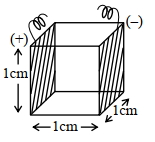
A
increase sharply
B
remain the same
C
decrease sharply
D
depend upon the type of electrolyte
Solution
(B) The molar conductivity at infinite dilution,denoted as $\Lambda_m^\circ$,represents the limiting value of molar conductivity when the concentration of the electrolyte approaches zero (i.e.,at infinite dilution).
Since the solution is already at infinite dilution,the degree of dissociation of the weak electrolyte is already at its maximum value.
Adding more water to an already infinitely dilute solution does not change the concentration of ions or the degree of dissociation.
Therefore,the molar conductivity remains constant and does not change.
Since the solution is already at infinite dilution,the degree of dissociation of the weak electrolyte is already at its maximum value.
Adding more water to an already infinitely dilute solution does not change the concentration of ions or the degree of dissociation.
Therefore,the molar conductivity remains constant and does not change.
0 likesView Solution
280
ChemistryMediumMCQJEE Main · 2024
Consider the dissociation of the weak acid $HX$ as given below:
$HX_{(aq)} \rightleftharpoons H^{+}_{(aq)} + X^{-}_{(aq)}, K_{a} = 1.2 \times 10^{-5}$
$[K_{a}: \text{ dissociation constant}]$
The osmotic pressure of $0.03 \ M$ aqueous solution of $HX$ at $300 \ K$ is ............... $\times 10^{-2} \ bar$ (nearest integer).
$[\text{Given: } R = 0.083 \ L \ bar \ mol^{-1} \ K^{-1}]$
$HX_{(aq)} \rightleftharpoons H^{+}_{(aq)} + X^{-}_{(aq)}, K_{a} = 1.2 \times 10^{-5}$
$[K_{a}: \text{ dissociation constant}]$
The osmotic pressure of $0.03 \ M$ aqueous solution of $HX$ at $300 \ K$ is ............... $\times 10^{-2} \ bar$ (nearest integer).
$[\text{Given: } R = 0.083 \ L \ bar \ mol^{-1} \ K^{-1}]$
A
$76$
B
$77$
C
$79$
D
$80$
Solution
(A) The dissociation of $HX$ is given by: $HX \rightleftharpoons H^{+} + X^{-}$.
Initial concentration: $0.03 \ M$.
Equilibrium concentration: $(0.03 - x), x, x$.
Since $K_{a}$ is very small,$0.03 - x \approx 0.03$.
$K_{a} = \frac{x^2}{0.03} = 1.2 \times 10^{-5}$.
$x^2 = 3.6 \times 10^{-7} = 36 \times 10^{-8}$.
$x = 6 \times 10^{-4} \ M$.
Total concentration of particles $C_{total} = (0.03 - x) + x + x = 0.03 + x = 0.03 + 0.0006 = 0.0306 \ M$.
Osmotic pressure $\Pi = C_{total} \times R \times T$.
$\Pi = 0.0306 \times 0.083 \times 300 = 0.76194 \ bar$.
$\Pi = 76.194 \times 10^{-2} \ bar$.
Rounding to the nearest integer,we get $76 \times 10^{-2} \ bar$.
Initial concentration: $0.03 \ M$.
Equilibrium concentration: $(0.03 - x), x, x$.
Since $K_{a}$ is very small,$0.03 - x \approx 0.03$.
$K_{a} = \frac{x^2}{0.03} = 1.2 \times 10^{-5}$.
$x^2 = 3.6 \times 10^{-7} = 36 \times 10^{-8}$.
$x = 6 \times 10^{-4} \ M$.
Total concentration of particles $C_{total} = (0.03 - x) + x + x = 0.03 + x = 0.03 + 0.0006 = 0.0306 \ M$.
Osmotic pressure $\Pi = C_{total} \times R \times T$.
$\Pi = 0.0306 \times 0.083 \times 300 = 0.76194 \ bar$.
$\Pi = 76.194 \times 10^{-2} \ bar$.
Rounding to the nearest integer,we get $76 \times 10^{-2} \ bar$.
0 likesView Solution
281
ChemistryMediumMCQJEE Main · 2024
The difference in the 'spin-only' magnetic moment values of $KMnO_4$ and the manganese product formed during titration of $KMnO_4$ against oxalic acid in acidic medium is .................... $BM$. (nearest integer)
A
$5$
B
$6$
C
$8$
D
$10$
Solution
(B) In $KMnO_4$,the oxidation state of $Mn$ is $+7$. The electronic configuration is $[Ar] 3d^0$. The number of unpaired electrons $n = 0$. The spin-only magnetic moment $\mu = \sqrt{n(n+2)} = 0 \ BM$.
During the titration of $KMnO_4$ with oxalic acid in an acidic medium,$Mn^{7+}$ is reduced to $Mn^{2+}$.
The electronic configuration of $Mn^{2+}$ is $[Ar] 3d^5$. The number of unpaired electrons $n = 5$.
The spin-only magnetic moment $\mu = \sqrt{5(5+2)} = \sqrt{35} \approx 5.92 \ BM$.
The difference in magnetic moments is $|5.92 - 0| = 5.92 \ BM$.
The nearest integer is $6$.
During the titration of $KMnO_4$ with oxalic acid in an acidic medium,$Mn^{7+}$ is reduced to $Mn^{2+}$.
The electronic configuration of $Mn^{2+}$ is $[Ar] 3d^5$. The number of unpaired electrons $n = 5$.
The spin-only magnetic moment $\mu = \sqrt{5(5+2)} = \sqrt{35} \approx 5.92 \ BM$.
The difference in magnetic moments is $|5.92 - 0| = 5.92 \ BM$.
The nearest integer is $6$.
0 likesView Solution
282
ChemistryMediumMCQJEE Main · 2024
Time required for $99.9 \%$ completion of a first order reaction is . . . . . . . times the time required for completion of $90 \%$ reaction. (nearest integer).
A
$5$
B
$4$
C
$3$
D
$8$
Solution
(C) For a first order reaction,the rate constant $K$ is given by $K = \frac{2.303}{t} \log \left(\frac{[A]_0}{[A]_t}\right)$.
For $99.9 \%$ completion,$[A]_t = 0.1 \% \text{ of } [A]_0$,so $[A]_t = 0.001 [A]_0$. Thus,$t_{99.9 \%} = \frac{2.303}{K} \log \left(\frac{100}{0.1}\right) = \frac{2.303}{K} \log(10^3) = \frac{2.303}{K} \times 3$.
For $90 \%$ completion,$[A]_t = 10 \% \text{ of } [A]_0$,so $[A]_t = 0.1 [A]_0$. Thus,$t_{90 \%} = \frac{2.303}{K} \log \left(\frac{100}{10}\right) = \frac{2.303}{K} \log(10) = \frac{2.303}{K} \times 1$.
Taking the ratio,$\frac{t_{99.9 \%}}{t_{90 \%}} = \frac{3}{1} = 3$.
Therefore,the time required for $99.9 \%$ completion is $3$ times the time required for $90 \%$ completion.
For $99.9 \%$ completion,$[A]_t = 0.1 \% \text{ of } [A]_0$,so $[A]_t = 0.001 [A]_0$. Thus,$t_{99.9 \%} = \frac{2.303}{K} \log \left(\frac{100}{0.1}\right) = \frac{2.303}{K} \log(10^3) = \frac{2.303}{K} \times 3$.
For $90 \%$ completion,$[A]_t = 10 \% \text{ of } [A]_0$,so $[A]_t = 0.1 [A]_0$. Thus,$t_{90 \%} = \frac{2.303}{K} \log \left(\frac{100}{10}\right) = \frac{2.303}{K} \log(10) = \frac{2.303}{K} \times 1$.
Taking the ratio,$\frac{t_{99.9 \%}}{t_{90 \%}} = \frac{3}{1} = 3$.
Therefore,the time required for $99.9 \%$ completion is $3$ times the time required for $90 \%$ completion.
0 likesView Solution
283
ChemistryMediumMCQJEE Main · 2024
$9.3 \ g$ of pure aniline upon diazotisation followed by coupling with phenol gives an orange dye. The mass of orange dye produced (assume $100\%$ yield/conversion) is . . . . . $g$. (nearest integer)
A
$20$
B
$25$
C
$30$
D
$35$
Solution
(A) The reaction sequence is as follows:
Aniline $(C_6H_5NH_2)$ $\xrightarrow{NaNO_2 + HCl, T < 5^{\circ}C}$ Benzenediazonium chloride $(C_6H_5N_2^+Cl^-)$
Benzenediazonium chloride + Phenol $(C_6H_5OH)$ $\rightarrow$ $p$-Hydroxyazobenzene (Orange dye,$C_{12}H_{10}N_2O$)
From the stoichiometry,$1 \text{ mole}$ of aniline produces $1 \text{ mole}$ of orange dye.
Molar mass of aniline $(C_6H_5NH_2)$ = $93 \ g \ mol^{-1}$.
Moles of aniline = $\frac{9.3 \ g}{93 \ g \ mol^{-1}} = 0.1 \ mol$.
Molar mass of orange dye ($p$-Hydroxyazobenzene,$C_{12}H_{10}N_2O$) = $(12 \times 12) + (10 \times 1) + (2 \times 14) + 16 = 144 + 10 + 28 + 16 = 198 \ g \ mol^{-1}$.
Since $1 \text{ mole}$ of aniline gives $1 \text{ mole}$ of dye,$0.1 \text{ mole}$ of aniline will produce $0.1 \text{ mole}$ of dye.
Mass of orange dye = $0.1 \ mol \times 198 \ g \ mol^{-1} = 19.8 \ g$.
Rounding to the nearest integer,we get $20 \ g$.
Aniline $(C_6H_5NH_2)$ $\xrightarrow{NaNO_2 + HCl, T < 5^{\circ}C}$ Benzenediazonium chloride $(C_6H_5N_2^+Cl^-)$
Benzenediazonium chloride + Phenol $(C_6H_5OH)$ $\rightarrow$ $p$-Hydroxyazobenzene (Orange dye,$C_{12}H_{10}N_2O$)
From the stoichiometry,$1 \text{ mole}$ of aniline produces $1 \text{ mole}$ of orange dye.
Molar mass of aniline $(C_6H_5NH_2)$ = $93 \ g \ mol^{-1}$.
Moles of aniline = $\frac{9.3 \ g}{93 \ g \ mol^{-1}} = 0.1 \ mol$.
Molar mass of orange dye ($p$-Hydroxyazobenzene,$C_{12}H_{10}N_2O$) = $(12 \times 12) + (10 \times 1) + (2 \times 14) + 16 = 144 + 10 + 28 + 16 = 198 \ g \ mol^{-1}$.
Since $1 \text{ mole}$ of aniline gives $1 \text{ mole}$ of dye,$0.1 \text{ mole}$ of aniline will produce $0.1 \text{ mole}$ of dye.
Mass of orange dye = $0.1 \ mol \times 198 \ g \ mol^{-1} = 19.8 \ g$.
Rounding to the nearest integer,we get $20 \ g$.
0 likesView Solution
284
ChemistryMediumMCQJEE Main · 2024
Among $CrO$,$Cr_2O_3$,and $CrO_3$,the sum of spin-only magnetic moment values of basic and amphoteric oxides is . . . . . . . . $10^{-2} \ BM$ (nearest integer).
(Given atomic number of $Cr$ is $24$)
(Given atomic number of $Cr$ is $24$)
A
$877$
B
$879$
C
$880$
D
$881$
Solution
(A) $CrO$ is a basic oxide.
$Cr_2O_3$ is an amphoteric oxide.
In $CrO$,$Cr$ is in the $+2$ oxidation state $([Ar] 3d^4)$,so it has $4$ unpaired electrons. The spin-only magnetic moment $\mu = \sqrt{n(n+2)} = \sqrt{4(4+2)} = \sqrt{24} \approx 4.90 \ BM$.
In $Cr_2O_3$,$Cr$ is in the $+3$ oxidation state $([Ar] 3d^3)$,so it has $3$ unpaired electrons. The spin-only magnetic moment $\mu = \sqrt{3(3+2)} = \sqrt{15} \approx 3.87 \ BM$.
The sum of the spin-only magnetic moments is $4.90 + 3.87 = 8.77 \ BM$.
Expressed as $10^{-2} \ BM$,this is $877 \times 10^{-2} \ BM$.
$Cr_2O_3$ is an amphoteric oxide.
In $CrO$,$Cr$ is in the $+2$ oxidation state $([Ar] 3d^4)$,so it has $4$ unpaired electrons. The spin-only magnetic moment $\mu = \sqrt{n(n+2)} = \sqrt{4(4+2)} = \sqrt{24} \approx 4.90 \ BM$.
In $Cr_2O_3$,$Cr$ is in the $+3$ oxidation state $([Ar] 3d^3)$,so it has $3$ unpaired electrons. The spin-only magnetic moment $\mu = \sqrt{3(3+2)} = \sqrt{15} \approx 3.87 \ BM$.
The sum of the spin-only magnetic moments is $4.90 + 3.87 = 8.77 \ BM$.
Expressed as $10^{-2} \ BM$,this is $877 \times 10^{-2} \ BM$.
0 likesView Solution
285
ChemistryMediumMCQJEE Main · 2024
Molality $(m)$ of $3 \text{ M}$ aqueous solution of $NaCl$ is:
(Given: Density of solution = $1.25 \text{ g mL}^{-1}$, Molar mass in $\text{g mol}^{-1}$: $Na = 23$, $Cl = 35.5$) (in $\text{m}$)
(Given: Density of solution = $1.25 \text{ g mL}^{-1}$, Molar mass in $\text{g mol}^{-1}$: $Na = 23$, $Cl = 35.5$) (in $\text{m}$)
A
$2.90$
B
$2.79$
C
$1.90$
D
$3.85$
Solution
(B) $3 \text{ M}$ solution means $3 \text{ moles}$ of $NaCl$ are present in $1 \text{ L}$ $(1000 \text{ mL})$ of solution.
Mass of solution = $\text{Volume} \times \text{Density} = 1000 \text{ mL} \times 1.25 \text{ g mL}^{-1} = 1250 \text{ g}$.
Mass of solute $(NaCl)$ = $3 \text{ mol} \times 58.5 \text{ g mol}^{-1} = 175.5 \text{ g}$.
Mass of solvent = $\text{Mass of solution} - \text{Mass of solute} = 1250 \text{ g} - 175.5 \text{ g} = 1074.5 \text{ g} = 1.0745 \text{ kg}$.
Molality $(m)$ = $\frac{\text{Moles of solute}}{\text{Mass of solvent in kg}} = \frac{3}{1.0745} = 2.79 \text{ m}$.
Alternatively, using the formula:
$m = \frac{M \times 1000}{1000 \times d - M \times M_B}$
$m = \frac{3 \times 1000}{1000 \times 1.25 - 3 \times 58.5} = 2.79 \text{ m}$.
Mass of solution = $\text{Volume} \times \text{Density} = 1000 \text{ mL} \times 1.25 \text{ g mL}^{-1} = 1250 \text{ g}$.
Mass of solute $(NaCl)$ = $3 \text{ mol} \times 58.5 \text{ g mol}^{-1} = 175.5 \text{ g}$.
Mass of solvent = $\text{Mass of solution} - \text{Mass of solute} = 1250 \text{ g} - 175.5 \text{ g} = 1074.5 \text{ g} = 1.0745 \text{ kg}$.
Molality $(m)$ = $\frac{\text{Moles of solute}}{\text{Mass of solvent in kg}} = \frac{3}{1.0745} = 2.79 \text{ m}$.
Alternatively, using the formula:
$m = \frac{M \times 1000}{1000 \times d - M \times M_B}$
$m = \frac{3 \times 1000}{1000 \times 1.25 - 3 \times 58.5} = 2.79 \text{ m}$.
0 likesView Solution
286
ChemistryMediumMCQJEE Main · 2024
The incorrect statements regarding enzymes are:
$A$. Enzymes are biocatalysts.
$B$. Enzymes are non-specific and can catalyse different kinds of reactions.
$C$. Most enzymes are globular proteins.
$D$. Enzyme oxidase catalyses the hydrolysis of maltose into glucose.
Choose the correct answer from the options given below:
$A$. Enzymes are biocatalysts.
$B$. Enzymes are non-specific and can catalyse different kinds of reactions.
$C$. Most enzymes are globular proteins.
$D$. Enzyme oxidase catalyses the hydrolysis of maltose into glucose.
Choose the correct answer from the options given below:
A
$B$ and $C$
B
$B$,$C$ and $D$
C
$B$ and $D$
D
$A$,$B$ and $C$
Solution
(C) $1$. Statement $A$ is correct: Enzymes are biological catalysts that speed up biochemical reactions.
$2$. Statement $B$ is incorrect: Enzymes are highly specific in their action and usually catalyse only one type of reaction.
$3$. Statement $C$ is correct: Most enzymes are globular proteins.
$4$. Statement $D$ is incorrect: The enzyme that catalyses the hydrolysis of maltose into glucose is maltase,not oxidase. Oxidase enzymes are involved in oxidation-reduction reactions.
Therefore,statements $B$ and $D$ are incorrect.
$2$. Statement $B$ is incorrect: Enzymes are highly specific in their action and usually catalyse only one type of reaction.
$3$. Statement $C$ is correct: Most enzymes are globular proteins.
$4$. Statement $D$ is incorrect: The enzyme that catalyses the hydrolysis of maltose into glucose is maltase,not oxidase. Oxidase enzymes are involved in oxidation-reduction reactions.
Therefore,statements $B$ and $D$ are incorrect.
0 likesView Solution
287
ChemistryMediumMCQJEE Main · 2024
Consider the above chemical reaction. Product $A$ is:
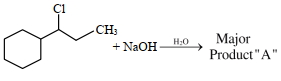
A
$1-$cyclohexylpropan$-2-$ol
B
$1-$propylcyclohexanol
C
$2-$cyclohexylpropan$-1-$ol
D
$1-$cyclohexylpropan$-1-$ol
Solution
(B) The reaction proceeds via an $S_N1$ mechanism because the substrate is a secondary alkyl halide and the solvent is polar protic $(H_2O)$.
$1$. The first step is the formation of a secondary carbocation by the loss of the $Cl^-$ ion.
$2$. This secondary carbocation undergoes a $1,2-H^-$ shift to form a more stable tertiary carbocation.
$3$. The nucleophile ($OH^-$ from $NaOH$) then attacks the tertiary carbocation to form the major product,$1-propylcyclohexanol$.
$1$. The first step is the formation of a secondary carbocation by the loss of the $Cl^-$ ion.
$2$. This secondary carbocation undergoes a $1,2-H^-$ shift to form a more stable tertiary carbocation.
$3$. The nucleophile ($OH^-$ from $NaOH$) then attacks the tertiary carbocation to form the major product,$1-propylcyclohexanol$.
0 likesView Solution
288
ChemistryMediumMCQJEE Main · 2024
During the detection of an acidic radical present in a salt,a student obtains a pale yellow precipitate that is soluble with difficulty in $NH_4OH$ solution when the sodium carbonate extract is first acidified with dil. $HNO_3$ and then $AgNO_3$ solution is added. This indicates the presence of:
A
$Br^{-}$
B
$CO_3^{2-}$
C
$I^{-}$
D
$Cl^{-}$
Solution
(A) The reaction of halide ions with $AgNO_3$ in the presence of $HNO_3$ produces silver halides:
$Ag^{+} + Cl^{-} \rightarrow AgCl$ (White precipitate,readily soluble in $NH_4OH$).
$Ag^{+} + Br^{-} \rightarrow AgBr$ (Pale yellow precipitate,soluble with difficulty in $NH_4OH$).
$Ag^{+} + I^{-} \rightarrow AgI$ (Yellow precipitate,insoluble in $NH_4OH$).
Since the precipitate is pale yellow and soluble with difficulty in $NH_4OH$,it indicates the presence of $Br^{-}$ ions.
$Ag^{+} + Cl^{-} \rightarrow AgCl$ (White precipitate,readily soluble in $NH_4OH$).
$Ag^{+} + Br^{-} \rightarrow AgBr$ (Pale yellow precipitate,soluble with difficulty in $NH_4OH$).
$Ag^{+} + I^{-} \rightarrow AgI$ (Yellow precipitate,insoluble in $NH_4OH$).
Since the precipitate is pale yellow and soluble with difficulty in $NH_4OH$,it indicates the presence of $Br^{-}$ ions.
0 likesView Solution
289
ChemistryMediumMCQJEE Main · 2024
How can an electrochemical cell be converted into an electrolytic cell?
A
Applying an external opposite potential greater than $E_{\text{cell}}^0$
B
Reversing the flow of ions in salt bridge.
C
Applying an external opposite potential lower than $E_{\text{cell}}^0$.
D
Exchanging the electrodes at anode and cathode.
Solution
(A) An electrochemical cell functions as a galvanic cell when the external potential is less than $E_{\text{cell}}^0$.
When an external potential greater than $E_{\text{cell}}^0$ is applied in the opposite direction,the flow of electrons is reversed,and the cell acts as an electrolytic cell.
When an external potential greater than $E_{\text{cell}}^0$ is applied in the opposite direction,the flow of electrons is reversed,and the cell acts as an electrolytic cell.
0 likesView Solution
290
ChemistryMediumMCQJEE Main · 2024
Arrange the following elements in the increasing order of the number of unpaired electrons in them.
$A$. $Sc$ $B$. $Cr$ $C$. $V$ $D$. $Ti$ $E$. $Mn$
Choose the correct answer from the options given below:
$A$. $Sc$ $B$. $Cr$ $C$. $V$ $D$. $Ti$ $E$. $Mn$
Choose the correct answer from the options given below:
A
$A < D < C < E < B$
B
$B < C < D < E < A$
C
$A < D < C < B < E$
D
$A < D < C < E < B$
Solution
(A) The electronic configurations and the number of unpaired electrons are as follows:
$Sc (Z=21): [Ar] 4s^2 3d^1 \rightarrow 1 \text{ unpaired electron}$
$Ti (Z=22): [Ar] 4s^2 3d^2 \rightarrow 2 \text{ unpaired electrons}$
$V (Z=23): [Ar] 4s^2 3d^3 \rightarrow 3 \text{ unpaired electrons}$
$Mn (Z=25): [Ar] 4s^2 3d^5 \rightarrow 5 \text{ unpaired electrons}$
$Cr (Z=24): [Ar] 4s^1 3d^5 \rightarrow 6 \text{ unpaired electrons}$
Increasing order of unpaired electrons: $Sc(1) < Ti(2) < V(3) < Mn(5) < Cr(6)$,which corresponds to $A < D < C < E < B$.
$Sc (Z=21): [Ar] 4s^2 3d^1 \rightarrow 1 \text{ unpaired electron}$
$Ti (Z=22): [Ar] 4s^2 3d^2 \rightarrow 2 \text{ unpaired electrons}$
$V (Z=23): [Ar] 4s^2 3d^3 \rightarrow 3 \text{ unpaired electrons}$
$Mn (Z=25): [Ar] 4s^2 3d^5 \rightarrow 5 \text{ unpaired electrons}$
$Cr (Z=24): [Ar] 4s^1 3d^5 \rightarrow 6 \text{ unpaired electrons}$
Increasing order of unpaired electrons: $Sc(1) < Ti(2) < V(3) < Mn(5) < Cr(6)$,which corresponds to $A < D < C < E < B$.
0 likesView Solution
291
ChemistryMediumMCQJEE Main · 2024
The major products formed in the following reaction sequence are:
(Image)
$A$ and $B$ respectively are:
(Image)
$A$ and $B$ respectively are:
A
B
C
D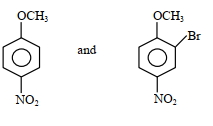
Solution
(C) $1$. The starting material is anisole $(C_6H_5OCH_3)$. The $-OCH_3$ group is strongly activating and ortho/para-directing.
$2$. Nitration with $HNO_3/H_2SO_4$ primarily yields the para-substituted product due to steric hindrance at the ortho position. Thus,$A$ is $p$-nitroanisole.
$3$. In the next step,$p$-nitroanisole reacts with excess $Br_2$ in the presence of $Fe$. The $-OCH_3$ group is a stronger activating group than the $-NO_2$ group is deactivating. Therefore,the bromination occurs at the positions ortho to the $-OCH_3$ group. Since the para position is already occupied by the $-NO_2$ group,both ortho positions are brominated to form $B$,which is $2,6$-dibromo-$4$-nitroanisole.
$4$. Comparing this with the given options,option $C$ represents the correct structures for $A$ and $B$.
$2$. Nitration with $HNO_3/H_2SO_4$ primarily yields the para-substituted product due to steric hindrance at the ortho position. Thus,$A$ is $p$-nitroanisole.
$3$. In the next step,$p$-nitroanisole reacts with excess $Br_2$ in the presence of $Fe$. The $-OCH_3$ group is a stronger activating group than the $-NO_2$ group is deactivating. Therefore,the bromination occurs at the positions ortho to the $-OCH_3$ group. Since the para position is already occupied by the $-NO_2$ group,both ortho positions are brominated to form $B$,which is $2,6$-dibromo-$4$-nitroanisole.
$4$. Comparing this with the given options,option $C$ represents the correct structures for $A$ and $B$.
0 likesView Solution
292
ChemistryMediumMCQJEE Main · 2024
Given below are two statements:
Statement $I$: $PF_5$ and $BrF_5$ both exhibit $sp^3 d$ hybridisation.
Statement $II$: Both $SF_6$ and $[Co(NH_3)_6]^{3+}$ exhibit $sp^3 d^2$ hybridisation.
In the light of the above statements,choose the correct answer from the options given below:
Statement $I$: $PF_5$ and $BrF_5$ both exhibit $sp^3 d$ hybridisation.
Statement $II$: Both $SF_6$ and $[Co(NH_3)_6]^{3+}$ exhibit $sp^3 d^2$ hybridisation.
In the light of the above statements,choose the correct answer from the options given below:
A
Statement $I$ is true but Statement $II$ is false
B
Both Statement $I$ and Statement $II$ are true
C
Both Statement $I$ and Statement $II$ are false
D
Statement $I$ is false but Statement $II$ is true
Solution
(C) Hybridisation analysis:
$PF_5$: The central atom $P$ has $5$ bond pairs and $0$ lone pairs,resulting in $sp^3 d$ hybridisation.
$BrF_5$: The central atom $Br$ has $5$ bond pairs and $1$ lone pair,resulting in $sp^3 d^2$ hybridisation.
$SF_6$: The central atom $S$ has $6$ bond pairs and $0$ lone pairs,resulting in $sp^3 d^2$ hybridisation.
$[Co(NH_3)_6]^{3+}$: The central metal ion $Co^{3+}$ ($d^6$ configuration) with a strong field ligand $NH_3$ undergoes inner orbital hybridisation,resulting in $d^2 sp^3$ hybridisation.
Conclusion:
Statement $I$ is false because $BrF_5$ is $sp^3 d^2$.
Statement $II$ is false because $[Co(NH_3)_6]^{3+}$ is $d^2 sp^3$.
Therefore,both statements are false.
$PF_5$: The central atom $P$ has $5$ bond pairs and $0$ lone pairs,resulting in $sp^3 d$ hybridisation.
$BrF_5$: The central atom $Br$ has $5$ bond pairs and $1$ lone pair,resulting in $sp^3 d^2$ hybridisation.
$SF_6$: The central atom $S$ has $6$ bond pairs and $0$ lone pairs,resulting in $sp^3 d^2$ hybridisation.
$[Co(NH_3)_6]^{3+}$: The central metal ion $Co^{3+}$ ($d^6$ configuration) with a strong field ligand $NH_3$ undergoes inner orbital hybridisation,resulting in $d^2 sp^3$ hybridisation.
Conclusion:
Statement $I$ is false because $BrF_5$ is $sp^3 d^2$.
Statement $II$ is false because $[Co(NH_3)_6]^{3+}$ is $d^2 sp^3$.
Therefore,both statements are false.
0 likesView Solution
293
ChemistryMediumMCQJEE Main · 2024
The number of ions from the following that are expected to behave as oxidising agents is:
$Sn^{4+}$,$Sn^{2+}$,$Pb^{2+}$,$Tl^{3+}$,$Pb^{4+}$,$Tl^{+}$
$Sn^{4+}$,$Sn^{2+}$,$Pb^{2+}$,$Tl^{3+}$,$Pb^{4+}$,$Tl^{+}$
A
$3$
B
$4$
C
$1$
D
$2$
Solution
(D) Due to the inert pair effect,the stability of the lower oxidation state increases down the group.
$Tl^{3+}$ is a strong oxidising agent because it prefers to exist in the $Tl^{+}$ state.
$Pb^{4+}$ is a strong oxidising agent because it prefers to exist in the $Pb^{2+}$ state.
$Sn^{4+}$,$Sn^{2+}$,$Pb^{2+}$,and $Tl^{+}$ do not act as oxidising agents in this context.
Therefore,the number of ions expected to behave as oxidising agents is $2$ ($Tl^{3+}$ and $Pb^{4+}$).
$Tl^{3+}$ is a strong oxidising agent because it prefers to exist in the $Tl^{+}$ state.
$Pb^{4+}$ is a strong oxidising agent because it prefers to exist in the $Pb^{2+}$ state.
$Sn^{4+}$,$Sn^{2+}$,$Pb^{2+}$,and $Tl^{+}$ do not act as oxidising agents in this context.
Therefore,the number of ions expected to behave as oxidising agents is $2$ ($Tl^{3+}$ and $Pb^{4+}$).
0 likesView Solution
294
ChemistryMediumMCQJEE Main · 2024
Identify the product $(A)$ in the following reaction.
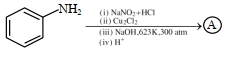
A
$4-$aminophenol
B
Phenol
C
$4-$chloroaniline
D
$4-$chlorophenol
Solution
(B) The reaction sequence is as follows:
$1$. Aniline reacts with $NaNO_2 + HCl$ at $0-5 \ ^\circ C$ to form benzenediazonium chloride.
$2$. Benzenediazonium chloride reacts with $Cu_2Cl_2$ (Sandmeyer reaction) to form chlorobenzene.
$3$. Chlorobenzene reacts with $NaOH$ at $623 \ K$ and $300 \ atm$ (Dow's process),followed by acidification $(H^+)$,to form phenol.
Therefore,the final product $(A)$ is phenol.
$1$. Aniline reacts with $NaNO_2 + HCl$ at $0-5 \ ^\circ C$ to form benzenediazonium chloride.
$2$. Benzenediazonium chloride reacts with $Cu_2Cl_2$ (Sandmeyer reaction) to form chlorobenzene.
$3$. Chlorobenzene reacts with $NaOH$ at $623 \ K$ and $300 \ atm$ (Dow's process),followed by acidification $(H^+)$,to form phenol.
Therefore,the final product $(A)$ is phenol.
0 likesView Solution
295
ChemistryMediumMCQJEE Main · 2024
Consider the given reaction,identify the major product $P$.

A
$CH_3-CH_2-OH$
B
$CH_3-CH_2-CONH_2$
C
$CH_3-CO-CH_2CH_3$
D
$CH_3-CH(OH)-COOH$
Solution
(D) The reaction proceeds as follows:
$1$. $CH_3-COOH \xrightarrow{LiAlH_4} CH_3-CH_2-OH$ (Reduction of carboxylic acid to primary alcohol).
$2$. $CH_3-CH_2-OH \xrightarrow{PCC} CH_3-CHO$ (Oxidation of primary alcohol to aldehyde).
$3$. $CH_3-CHO \xrightarrow{HCN/OH^-} CH_3-CH(OH)-CN$ (Nucleophilic addition of $HCN$ to aldehyde to form cyanohydrin).
$4$. $CH_3-CH(OH)-CN \xrightarrow{H_2O/OH^-, \Delta} CH_3-CH(OH)-COOH$ (Hydrolysis of nitrile group to carboxylic acid).
Thus,the final product $P$ is $CH_3-CH(OH)-COOH$.
$1$. $CH_3-COOH \xrightarrow{LiAlH_4} CH_3-CH_2-OH$ (Reduction of carboxylic acid to primary alcohol).
$2$. $CH_3-CH_2-OH \xrightarrow{PCC} CH_3-CHO$ (Oxidation of primary alcohol to aldehyde).
$3$. $CH_3-CHO \xrightarrow{HCN/OH^-} CH_3-CH(OH)-CN$ (Nucleophilic addition of $HCN$ to aldehyde to form cyanohydrin).
$4$. $CH_3-CH(OH)-CN \xrightarrow{H_2O/OH^-, \Delta} CH_3-CH(OH)-COOH$ (Hydrolysis of nitrile group to carboxylic acid).
Thus,the final product $P$ is $CH_3-CH(OH)-COOH$.
0 likesView Solution
296
ChemistryMediumMCQJEE Main · 2024
The correct $IUPAC$ name of $[PtBr_2(PMe_3)_2]$ is:
A
bis(trimethylphosphine)dibromoplatinum$(II)$
B
bis[bromo(trimethylphosphine)]platinum$(II)$
C
dibromobis(trimethylphosphine)platinum$(II)$
D
dibromodi(trimethylphosphine)platinum$(II)$
Solution
(C) In the complex $[PtBr_2(PMe_3)_2]$:
$1$. The ligand $Br^-$ is named as bromo.
$2$. The ligand $PMe_3$ is named as trimethylphosphine.
$3$. Since there are two $Br^-$ ligands,we use the prefix 'di' to get 'dibromo'.
$4$. Since there are two $PMe_3$ ligands,we use the prefix 'bis' to get 'bis(trimethylphosphine)'.
$5$. The metal is platinum,and its oxidation state is calculated as $x + 2(-1) + 2(0) = 0$,so $x = +2$.
$6$. Combining these,the correct $IUPAC$ name is dibromobis(trimethylphosphine)platinum$(II)$.
$1$. The ligand $Br^-$ is named as bromo.
$2$. The ligand $PMe_3$ is named as trimethylphosphine.
$3$. Since there are two $Br^-$ ligands,we use the prefix 'di' to get 'dibromo'.
$4$. Since there are two $PMe_3$ ligands,we use the prefix 'bis' to get 'bis(trimethylphosphine)'.
$5$. The metal is platinum,and its oxidation state is calculated as $x + 2(-1) + 2(0) = 0$,so $x = +2$.
$6$. Combining these,the correct $IUPAC$ name is dibromobis(trimethylphosphine)platinum$(II)$.
1 likesView Solution
297
ChemistryMediumMCQJEE Main · 2024
Match List-$I$ with List-$II$:
Choose the correct answer from the options given below:
| List-$I$ (Tetrahedral Complex) | List-$II$ (Electronic configuration) |
|---|---|
| $A$. $TiCl_4$ | $I$. $e^2, t_2^0$ |
| $B$. $[FeO_4]^{2-}$ | $II$. $e^4, t_2^3$ |
| $C$. $[FeCl_4]^{-}$ | $III$. $e^0, t_2^0$ |
| $D$. $[CoCl_4]^{2-}$ | $IV$. $e^2, t_2^3$ |
Choose the correct answer from the options given below:
A
$A-I, B-III, C-IV, D-II$
B
$A-IV, B-III, C-I, D-II$
C
$A-III, B-IV, C-II, D-I$
D
$A-III, B-I, C-IV, D-II$
Solution
(D) To determine the electronic configuration in tetrahedral complexes,we first find the oxidation state of the central metal ion:
$1$. $TiCl_4$: $Ti$ is in $+4$ state $(3d^0)$. Configuration: $e^0, t_2^0$ $(III)$.
$2$. $[FeO_4]^{2-}$: $Fe$ is in $+6$ state $(3d^2)$. Configuration: $e^2, t_2^0$ $(I)$.
$3$. $[FeCl_4]^{-}$: $Fe$ is in $+3$ state $(3d^5)$. Configuration: $e^2, t_2^3$ $(IV)$.
$4$. $[CoCl_4]^{2-}$: $Co$ is in $+2$ state $(3d^7)$. Configuration: $e^4, t_2^3$ $(II)$.
Thus,the correct matching is $A-III, B-I, C-IV, D-II$.
$1$. $TiCl_4$: $Ti$ is in $+4$ state $(3d^0)$. Configuration: $e^0, t_2^0$ $(III)$.
$2$. $[FeO_4]^{2-}$: $Fe$ is in $+6$ state $(3d^2)$. Configuration: $e^2, t_2^0$ $(I)$.
$3$. $[FeCl_4]^{-}$: $Fe$ is in $+3$ state $(3d^5)$. Configuration: $e^2, t_2^3$ $(IV)$.
$4$. $[CoCl_4]^{2-}$: $Co$ is in $+2$ state $(3d^7)$. Configuration: $e^4, t_2^3$ $(II)$.
Thus,the correct matching is $A-III, B-I, C-IV, D-II$.
0 likesView Solution
298
ChemistryMediumMCQJEE Main · 2024
An amine $(X)$ is prepared by ammonolysis of benzyl chloride. On adding $p-$toluenesulphonyl chloride to it,the solution remains clear. The molar mass of the amine $(X)$ formed is $g \ mol^{-1}$. (Given molar mass in $g \ mol^{-1}$: $C=12, H=1, O=16, N=14, S=32, Cl=35.5$)
A
$287$
B
$288$
C
$289$
D
$290$
Solution
(A) Ammonolysis of excess benzyl chloride $(C_6H_5CH_2Cl)$ with ammonia $(NH_3)$ leads to the formation of a tertiary amine,tribenzylamine,$(C_6H_5CH_2)_3N$.
This is a $3^{\circ}$ amine,which does not react with $p-$toluenesulphonyl chloride (Hinsberg's reagent) because it lacks an acidic hydrogen atom attached to the nitrogen.
Therefore,the solution remains clear.
The chemical formula of the amine $(X)$ is $(C_6H_5CH_2)_3N$,which is $C_{21}H_{21}N$.
The molar mass is calculated as: $(21 \times 12) + (21 \times 1) + (1 \times 14) = 252 + 21 + 14 = 287 \ g \ mol^{-1}$.
This is a $3^{\circ}$ amine,which does not react with $p-$toluenesulphonyl chloride (Hinsberg's reagent) because it lacks an acidic hydrogen atom attached to the nitrogen.
Therefore,the solution remains clear.
The chemical formula of the amine $(X)$ is $(C_6H_5CH_2)_3N$,which is $C_{21}H_{21}N$.
The molar mass is calculated as: $(21 \times 12) + (21 \times 1) + (1 \times 14) = 252 + 21 + 14 = 287 \ g \ mol^{-1}$.
0 likesView Solution
299
ChemistryMediumMCQJEE Main · 2024
When $x \times 10^{-2} \ mL$ methanol (molar mass $= 32 \ g \ mol^{-1}$; density $= 0.792 \ g \ cm^{-3}$) is added to $100 \ mL$ water (density $= 1 \ g \ cm^{-3}$),the following diagram is obtained.
$x = $ . . . . . . (nearest integer)
[Given: Molal freezing point depression constant of water at $273.15 \ K$ is $1.86 \ K \ kg \ mol^{-1}$]
$x = $ . . . . . . (nearest integer)
[Given: Molal freezing point depression constant of water at $273.15 \ K$ is $1.86 \ K \ kg \ mol^{-1}$]
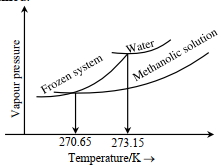
A
$540$
B
$542$
C
$543$
D
$550$
Solution
(C) The freezing point depression is given by $\Delta T_f = T_f^\circ - T_f = 273.15 \ K - 270.65 \ K = 2.5 \ K$.
The formula for freezing point depression is $\Delta T_f = K_f \times m$,where $m$ is the molality.
$m = \frac{n_{methanol}}{w_{water} \text{ (in kg)}} = \frac{n}{0.1 \ kg}$.
Substituting the values: $2.5 = 1.86 \times \frac{n}{0.1} \Rightarrow n = \frac{2.5 \times 0.1}{1.86} \approx 0.1344 \ mol$.
The mass of methanol is $w = n \times M = 0.1344 \ mol \times 32 \ g \ mol^{-1} \approx 4.3008 \ g$.
The volume of methanol is $V = \frac{w}{d} = \frac{4.3008 \ g}{0.792 \ g \ cm^{-3}} \approx 5.4303 \ mL$.
Given $V = x \times 10^{-2} \ mL$,we have $5.4303 = x \times 10^{-2}$,so $x = 543.03$.
Rounding to the nearest integer,$x = 543$.
The formula for freezing point depression is $\Delta T_f = K_f \times m$,where $m$ is the molality.
$m = \frac{n_{methanol}}{w_{water} \text{ (in kg)}} = \frac{n}{0.1 \ kg}$.
Substituting the values: $2.5 = 1.86 \times \frac{n}{0.1} \Rightarrow n = \frac{2.5 \times 0.1}{1.86} \approx 0.1344 \ mol$.
The mass of methanol is $w = n \times M = 0.1344 \ mol \times 32 \ g \ mol^{-1} \approx 4.3008 \ g$.
The volume of methanol is $V = \frac{w}{d} = \frac{4.3008 \ g}{0.792 \ g \ cm^{-3}} \approx 5.4303 \ mL$.
Given $V = x \times 10^{-2} \ mL$,we have $5.4303 = x \times 10^{-2}$,so $x = 543.03$.
Rounding to the nearest integer,$x = 543$.
0 likesView Solution
300
ChemistryMediumMCQJEE Main · 2024
The ratio of the number of oxygen atoms to bromine atoms in the product $Q$ is $.... \times 10^{-1}$.
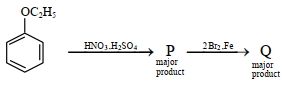
A
$10$
B
$12$
C
$16$
D
$15$
Solution
(D) $1$. Phenetole $(C_6H_5OC_2H_5)$ undergoes nitration with $HNO_3$ and $H_2SO_4$ to form $p$-nitrophenetole as the major product $(P)$.
$2$. $p$-Nitrophenetole then undergoes bromination with $Br_2$ in the presence of $Fe$ to form $2,6$-dibromo-$4$-nitrophenetole as the major product $(Q)$.
$3$. The molecular formula of $Q$ is $C_8H_7Br_2NO_3$.
$4$. In $Q$,the number of oxygen atoms is $3$ and the number of bromine atoms is $2$.
$5$. The ratio of oxygen atoms to bromine atoms is $\frac{3}{2} = 1.5$.
$6$. Expressing $1.5$ as $.... \times 10^{-1}$,we get $15 \times 10^{-1}$.
$7$. Therefore,the correct option is $D$.
$2$. $p$-Nitrophenetole then undergoes bromination with $Br_2$ in the presence of $Fe$ to form $2,6$-dibromo-$4$-nitrophenetole as the major product $(Q)$.
$3$. The molecular formula of $Q$ is $C_8H_7Br_2NO_3$.
$4$. In $Q$,the number of oxygen atoms is $3$ and the number of bromine atoms is $2$.
$5$. The ratio of oxygen atoms to bromine atoms is $\frac{3}{2} = 1.5$.
$6$. Expressing $1.5$ as $.... \times 10^{-1}$,we get $15 \times 10^{-1}$.
$7$. Therefore,the correct option is $D$.
0 likesView Solution
Vedclass Products
For Students
Vedclass Test Series
Mock tests in real JEE Main style covering Chemistry with performance analysis. 5-day free trial.
Start Free TrialFor Teachers
Exam Paper Generator
Generate Set A/B/C/D Chemistry papers from 7.5L+ questions in 2 minutes. 3 chapters free.
Try FreeFor Institutes
Online Exam Module
Run live JEE Main mock exams with unlimited students, 360° analytics & white-label branding.
See DemoFrequently Asked Questions
How many Chemistry questions are in JEE Main 2024?
There are 606 Chemistry questions from the JEE Main 2024 paper on Vedclass, each with a detailed step-by-step solution in English.
Are JEE Main 2024 Chemistry solutions available in English?
Yes. All solutions on this page are in English. You can also switch to English or Hindi using the language buttons above the questions.
Can I practice JEE Main 2024 Chemistry as a timed test?
Yes. Use the Vedclass Test Series to attempt a full JEE Main mock test covering Chemistry with time limits and instant score analysis.
Can teachers create Chemistry papers from JEE Main previous year questions?
Yes. The Vedclass Exam Paper Generator lets teachers mix JEE Main Chemistry questions and generate Set A/B/C/D papers in minutes.
For Teachers & Institutes
Build a Custom Chemistry Paper
Pick JEE Main 2024 Chemistry questions, set difficulty, and generate Set A/B/C/D in 2 minutes.