
ChemistryQ301–321 of 606 questions
Page 7 of 7 · English
301
ChemistryMediumMCQJEE Main · 2024
Molarity $(M)$ of an aqueous solution containing $x \ g$ of anhydrous $CuSO_4$ in $500 \ mL$ solution at $32^{\circ} C$ is $2 \times 10^{-1} \ M$. Its molality will be. . . . . .$\times 10^{-3} \ m$ (nearest integer). [Given density of the solution $= 1.25 \ g/mL$.]
A
$160$
B
$164$
C
$167$
D
$168$
Solution
(B) Given: Molarity $(M) = 0.2 \ M$,Volume $(V) = 500 \ mL = 0.5 \ L$,Density $(d) = 1.25 \ g/mL$,Molar mass of $CuSO_4 = 159.5 \ g/mol$.
Step $1$: Calculate moles of solute $(n)$:
$n = M \times V = 0.2 \times 0.5 = 0.1 \ mol$.
Step $2$: Calculate mass of solute $(x)$:
$x = n \times \text{Molar mass} = 0.1 \times 159.5 = 15.95 \ g$.
Step $3$: Calculate mass of solution:
$Mass_{soln} = V \times d = 500 \times 1.25 = 625 \ g$.
Step $4$: Calculate mass of solvent $(W_{solvent})$:
$W_{solvent} = Mass_{soln} - x = 625 - 15.95 = 609.05 \ g$.
Step $5$: Calculate molality $(m)$:
$m = \frac{n \times 1000}{W_{solvent} (in \ g)} = \frac{0.1 \times 1000}{609.05} \approx 0.16418 \ m$.
$m \approx 164 \times 10^{-3} \ m$.
Step $1$: Calculate moles of solute $(n)$:
$n = M \times V = 0.2 \times 0.5 = 0.1 \ mol$.
Step $2$: Calculate mass of solute $(x)$:
$x = n \times \text{Molar mass} = 0.1 \times 159.5 = 15.95 \ g$.
Step $3$: Calculate mass of solution:
$Mass_{soln} = V \times d = 500 \times 1.25 = 625 \ g$.
Step $4$: Calculate mass of solvent $(W_{solvent})$:
$W_{solvent} = Mass_{soln} - x = 625 - 15.95 = 609.05 \ g$.
Step $5$: Calculate molality $(m)$:
$m = \frac{n \times 1000}{W_{solvent} (in \ g)} = \frac{0.1 \times 1000}{609.05} \approx 0.16418 \ m$.
$m \approx 164 \times 10^{-3} \ m$.
1 likesView Solution
302
ChemistryMediumMCQJEE Main · 2024
Number of ambidentate ligands among the following is ................ $NO_2^{-}$,$SCN^{-}$,$C_2O_4^{2-}$,$NH_3$,$CN^{-}$,$SO_4^{2-}$,$H_2O$.
A
$5$
B
$8$
C
$3$
D
$4$
Solution
(C) Ambidentate ligands are those which possess two different donor atoms but can coordinate to the central metal atom through only one of them at a time.
In the given list:
$1$. $NO_2^{-}$ (can coordinate through $N$ or $O$)
$2$. $SCN^{-}$ (can coordinate through $S$ or $N$)
$3$. $CN^{-}$ (can coordinate through $C$ or $N$)
Other ligands like $C_2O_4^{2-}$,$NH_3$,$SO_4^{2-}$,and $H_2O$ are not ambidentate.
Therefore,the total number of ambidentate ligands is $3$.
In the given list:
$1$. $NO_2^{-}$ (can coordinate through $N$ or $O$)
$2$. $SCN^{-}$ (can coordinate through $S$ or $N$)
$3$. $CN^{-}$ (can coordinate through $C$ or $N$)
Other ligands like $C_2O_4^{2-}$,$NH_3$,$SO_4^{2-}$,and $H_2O$ are not ambidentate.
Therefore,the total number of ambidentate ligands is $3$.
0 likesView Solution
303
ChemistryMediumMCQJEE Main · 2024
Total number of essential amino acids among the given list of amino acids is . . . .
Arginine,Phenylalanine,Aspartic acid,Cysteine,Histidine,Valine,Proline
Arginine,Phenylalanine,Aspartic acid,Cysteine,Histidine,Valine,Proline
A
$4$
B
$5$
C
$8$
D
$10$
Solution
(A) Essential amino acids are those that cannot be synthesized by the human body and must be obtained from the diet.
From the given list:
$1$. Arginine (Essential for children/semi-essential)
$2$. Phenylalanine (Essential)
$3$. Histidine (Essential)
$4$. Valine (Essential)
Aspartic acid,Cysteine,and Proline are non-essential amino acids.
Note: Arginine and Histidine are often classified as essential in the context of human nutrition.
Counting the essential amino acids from the list: Arginine,Phenylalanine,Histidine,and Valine.
Total count = $4$.
From the given list:
$1$. Arginine (Essential for children/semi-essential)
$2$. Phenylalanine (Essential)
$3$. Histidine (Essential)
$4$. Valine (Essential)
Aspartic acid,Cysteine,and Proline are non-essential amino acids.
Note: Arginine and Histidine are often classified as essential in the context of human nutrition.
Counting the essential amino acids from the list: Arginine,Phenylalanine,Histidine,and Valine.
Total count = $4$.
0 likesView Solution
304
ChemistryMediumMCQJEE Main · 2024
Number of colourless lanthanoid ions among the following is . . . . .
$Eu^{3+}, Lu^{3+}, Nd^{3+}, La^{3+}, Sm^{3+}$
$Eu^{3+}, Lu^{3+}, Nd^{3+}, La^{3+}, Sm^{3+}$
A
$1$
B
$2$
C
$5$
D
$8$
Solution
(B) The colour of lanthanoid ions depends on the presence of unpaired $f$-electrons ($f-f$ transitions).
Electronic configurations of the given ions are:
$La^{3+} = [Xe] 4f^0$ (No unpaired electrons)
$Nd^{3+} = [Xe] 4f^3$ ($3$ unpaired electrons)
$Sm^{3+} = [Xe] 4f^5$ ($5$ unpaired electrons)
$Eu^{3+} = [Xe] 4f^6$ ($6$ unpaired electrons)
$Lu^{3+} = [Xe] 4f^{14}$ (No unpaired electrons)
Ions with $f^0$ or $f^{14}$ configurations are colourless because they lack unpaired electrons for $f-f$ transitions.
Thus,$La^{3+}$ and $Lu^{3+}$ are colourless.
The total number of colourless ions is $2$.
Electronic configurations of the given ions are:
$La^{3+} = [Xe] 4f^0$ (No unpaired electrons)
$Nd^{3+} = [Xe] 4f^3$ ($3$ unpaired electrons)
$Sm^{3+} = [Xe] 4f^5$ ($5$ unpaired electrons)
$Eu^{3+} = [Xe] 4f^6$ ($6$ unpaired electrons)
$Lu^{3+} = [Xe] 4f^{14}$ (No unpaired electrons)
Ions with $f^0$ or $f^{14}$ configurations are colourless because they lack unpaired electrons for $f-f$ transitions.
Thus,$La^{3+}$ and $Lu^{3+}$ are colourless.
The total number of colourless ions is $2$.
0 likesView Solution
305
ChemistryMediumMCQJEE Main · 2024
Match List-$I$ with List-$II$.
Choose the correct answer from the options given below:
| List-$I$ (Test) | List-$II$ (Observation) |
| $A$. $Br_2$ water test | $I$. Yellow orange or orange red precipitate formed |
| $B$. Ceric ammonium nitrate test | $II$. Reddish orange colour disappears |
| $C$. Ferric chloride test | $III$. Red colour appears |
| $D$. $2,4-DNP$ test | $IV$. Blue,Green,violet or Red colour appear |
Choose the correct answer from the options given below:
A
$A-II, B-III, C-IV, D-I$
B
$A-I, B-II, C-III, D-IV$
C
$A-III, B-IV, C-I, D-II$
D
$A-IV, B-I, C-II, D-III$
Solution
(A) . $Br_2$ water test is a test for unsaturation in which the reddish-orange colour of bromine water disappears.
$B$. Alcohols give a red colour with ceric ammonium nitrate.
$C$. Phenols give a violet colour with neutral ferric chloride.
$D$. Aldehydes and ketones give yellow,orange,or red coloured precipitates with $2,4-DNP$ ($2$,$4$-dinitrophenylhydrazine).
$B$. Alcohols give a red colour with ceric ammonium nitrate.
$C$. Phenols give a violet colour with neutral ferric chloride.
$D$. Aldehydes and ketones give yellow,orange,or red coloured precipitates with $2,4-DNP$ ($2$,$4$-dinitrophenylhydrazine).
0 likesView Solution
306
ChemistryMediumMCQJEE Main · 2024
Match List-$I$ with List-$II$.
Choose the correct answer from the options given below:
| $LIST$-$I$ (Cell) | $LIST$-$II$ (Use/Property/Reaction) |
| $A$. Leclanche cell | $I$. Converts energy of combustion into electrical energy |
| $B$. Ni-Cd cell | $II$. Does not involve any ion in solution and is used in hearing aids |
| $C$. Fuel cell | $III$. Rechargeable |
| $D$. Mercury cell | $IV$. Reaction at anode $Zn \rightarrow Zn^{2+} + 2e^-$ |
Choose the correct answer from the options given below:
A
$A-I, B-II, C-III, D-IV$
B
$A-III, B-I, C-IV, D-II$
C
$A-IV, B-III, C-I, D-II$
D
$A-II, B-III, C-IV, D-I$
Solution
(C) The correct matching is as follows:
$A$. Leclanche cell: The anode reaction is $Zn \rightarrow Zn^{2+} + 2e^-$. Thus,$A-IV$.
$B$. Ni-Cd cell: This is a rechargeable cell. Thus,$B-III$.
$C$. Fuel cell: It converts the energy of combustion of fuels like $H_2$ directly into electrical energy. Thus,$C-I$.
$D$. Mercury cell: It does not involve any ion in the solution,so the cell potential remains constant during its life. It is used in hearing aids. Thus,$D-II$.
Therefore,the correct sequence is $A-IV, B-III, C-I, D-II$.
$A$. Leclanche cell: The anode reaction is $Zn \rightarrow Zn^{2+} + 2e^-$. Thus,$A-IV$.
$B$. Ni-Cd cell: This is a rechargeable cell. Thus,$B-III$.
$C$. Fuel cell: It converts the energy of combustion of fuels like $H_2$ directly into electrical energy. Thus,$C-I$.
$D$. Mercury cell: It does not involve any ion in the solution,so the cell potential remains constant during its life. It is used in hearing aids. Thus,$D-II$.
Therefore,the correct sequence is $A-IV, B-III, C-I, D-II$.
0 likesView Solution
307
ChemistryMediumMCQJEE Main · 2024
Match List-$I$ with List-$II$:
Choose the correct answer from the options given below:
| List-$I$ | List-$II$ |
| $A. K_2[Ni(CN)_4]$ | $I. sp^3$ |
| $B. [Ni(CO)_4]$ | $II. sp^3d^2$ |
| $C. [Co(NH_3)_6]Cl_3$ | $III. dsp^2$ |
| $D. Na_3[CoF_6]$ | $IV. d^2sp^3$ |
Choose the correct answer from the options given below:
A
$A-III, B-I, C-II, D-IV$
B
$A-III, B-II, C-IV, D-I$
C
$A-I, B-III, C-II, D-IV$
D
$A-III, B-I, C-IV, D-II$
Solution
(D) To determine the hybridization,we analyze the electronic configuration of the central metal ion and the nature of the ligand:
$A. K_2[Ni(CN)_4]$: $Ni^{2+}$ is $[Ar] 3d^8$. $CN^-$ is a strong field ligand $(SFL)$,causing pairing of electrons in $3d$ orbitals,resulting in $dsp^2$ hybridization.
$B. [Ni(CO)_4]$: $Ni$ is $[Ar] 3d^8 4s^2$. $CO$ is a strong field ligand,causing pairing,resulting in $sp^3$ hybridization.
$C. [Co(NH_3)_6]Cl_3$: $Co^{3+}$ is $[Ar] 3d^6$. $NH_3$ is a strong field ligand for $Co^{3+}$,causing pairing,resulting in $d^2sp^3$ hybridization.
$D. Na_3[CoF_6]$: $Co^{3+}$ is $[Ar] 3d^6$. $F^-$ is a weak field ligand $(WFL)$,so no pairing occurs,resulting in $sp^3d^2$ hybridization.
Matching the results: $A-III, B-I, C-IV, D-II$.
$A. K_2[Ni(CN)_4]$: $Ni^{2+}$ is $[Ar] 3d^8$. $CN^-$ is a strong field ligand $(SFL)$,causing pairing of electrons in $3d$ orbitals,resulting in $dsp^2$ hybridization.
$B. [Ni(CO)_4]$: $Ni$ is $[Ar] 3d^8 4s^2$. $CO$ is a strong field ligand,causing pairing,resulting in $sp^3$ hybridization.
$C. [Co(NH_3)_6]Cl_3$: $Co^{3+}$ is $[Ar] 3d^6$. $NH_3$ is a strong field ligand for $Co^{3+}$,causing pairing,resulting in $d^2sp^3$ hybridization.
$D. Na_3[CoF_6]$: $Co^{3+}$ is $[Ar] 3d^6$. $F^-$ is a weak field ligand $(WFL)$,so no pairing occurs,resulting in $sp^3d^2$ hybridization.
Matching the results: $A-III, B-I, C-IV, D-II$.
0 likesView Solution
308
ChemistryMediumMCQJEE Main · 2024
The coordination environment of $Ca^{2+}$ ion in its complex with $EDTA^{4-}$ is:
A
tetrahedral
B
octahedral
C
square planar
D
trigonal prismatic
Solution
(B) $EDTA^{4-}$ is a hexadentate ligand,meaning it forms $6$ coordinate bonds with the central metal ion.
In the complex $[Ca(EDTA)]^{2-}$,the $Ca^{2+}$ ion is surrounded by $6$ donor atoms from the $EDTA^{4-}$ ligand.
Therefore,the coordination number is $6$,which corresponds to an octahedral geometry.
In the complex $[Ca(EDTA)]^{2-}$,the $Ca^{2+}$ ion is surrounded by $6$ donor atoms from the $EDTA^{4-}$ ligand.
Therefore,the coordination number is $6$,which corresponds to an octahedral geometry.
0 likesView Solution
309
ChemistryMediumMCQJEE Main · 2024
The incorrect statement about $Glucose$ is :
A
$Glucose$ is soluble in water because of having aldehyde functional group
B
$Glucose$ remains in multiple isomeric form in its aqueous solution
C
$Glucose$ is an aldohexose
D
$Glucose$ is one of the monomer unit in sucrose
Solution
(A) $Glucose$ is soluble in water due to the presence of multiple hydroxyl $(-OH)$ groups which facilitate extensive hydrogen bonding with water molecules. The aldehyde group does not primarily account for its high solubility.
$Glucose$ exists in equilibrium between open-chain and cyclic (pyranose) isomeric forms in its aqueous solution.
$Glucose$ contains $6$ carbon atoms,making it a hexose,and possesses an aldehyde functional group,making it an aldose. Thus,it is an aldohexose.
$Sucrose$ is a disaccharide composed of one unit of $\alpha-D-glucose$ and one unit of $\beta-D-fructose$ linked by a glycosidic bond.
Therefore,the statement that $Glucose$ is soluble in water because of the aldehyde group is incorrect.
$Glucose$ exists in equilibrium between open-chain and cyclic (pyranose) isomeric forms in its aqueous solution.
$Glucose$ contains $6$ carbon atoms,making it a hexose,and possesses an aldehyde functional group,making it an aldose. Thus,it is an aldohexose.
$Sucrose$ is a disaccharide composed of one unit of $\alpha-D-glucose$ and one unit of $\beta-D-fructose$ linked by a glycosidic bond.
Therefore,the statement that $Glucose$ is soluble in water because of the aldehyde group is incorrect.
0 likesView Solution
310
ChemistryMediumMCQJEE Main · 2024
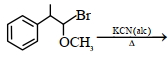
In the above reaction,the major product '$P$' is:
A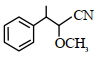
B
C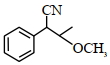
D
Solution
(A) The reaction involves the participation of the phenyl ring in a Neighboring Group Participation $(NGP)$ mechanism.
$1$. The $\pi$-electrons of the phenyl ring assist in the departure of the leaving group $(Br^{-})$.
$2$. This leads to the formation of a phenonium ion intermediate.
$3$. The nucleophile $(CN^{-})$ then attacks the more electrophilic carbon of the phenonium ion.
$4$. This process results in the substitution of the $Br$ atom by the $CN$ group,leading to the product shown in option $A$.
$1$. The $\pi$-electrons of the phenyl ring assist in the departure of the leaving group $(Br^{-})$.
$2$. This leads to the formation of a phenonium ion intermediate.
$3$. The nucleophile $(CN^{-})$ then attacks the more electrophilic carbon of the phenonium ion.
$4$. This process results in the substitution of the $Br$ atom by the $CN$ group,leading to the product shown in option $A$.
0 likesView Solution
311
ChemistryMediumMCQJEE Main · 2024
Which of the following compounds can give a positive iodoform test when treated with aqueous $KOH$ solution followed by potassium hypoiodite?
A
$CH_3-CH_2-CO-CH_2-CH_3$
B
$CH_3-CH_2-CCl_2-CH_3$
C
$CH_3-CH_2-CH_2-CHO$
D
$CH_3-CH_2-CH-CH_2$ (epoxide ring)
Solution
(B) The iodoform test is given by compounds containing the $CH_3CO-$ group or compounds that can be oxidized to this group.
Treatment of $CH_3-CH_2-CCl_2-CH_3$ with aqueous $KOH$ leads to the hydrolysis of the gem-dichloride to a gem-diol $(CH_3-CH_2-C(OH)_2-CH_3)$,which is unstable and loses a water molecule to form butan$-2-$one $(CH_3-CH_2-CO-CH_3)$.
Butan$-2-$one contains the $CH_3CO-$ group,which reacts with potassium hypoiodite $(KOI)$ to form iodoform $(CHI_3)$,a yellow precipitate.
Thus,the correct compound is $CH_3-CH_2-CCl_2-CH_3$.
Treatment of $CH_3-CH_2-CCl_2-CH_3$ with aqueous $KOH$ leads to the hydrolysis of the gem-dichloride to a gem-diol $(CH_3-CH_2-C(OH)_2-CH_3)$,which is unstable and loses a water molecule to form butan$-2-$one $(CH_3-CH_2-CO-CH_3)$.
Butan$-2-$one contains the $CH_3CO-$ group,which reacts with potassium hypoiodite $(KOI)$ to form iodoform $(CHI_3)$,a yellow precipitate.
Thus,the correct compound is $CH_3-CH_2-CCl_2-CH_3$.
0 likesView Solution
312
ChemistryMediumMCQJEE Main · 2024
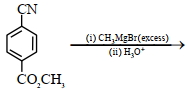
Find the main product of the following reaction:
A
$4-$($1$-hydroxy$-1-$methylethyl)benzonitrile
B
$4-$acetyl$-2-$($1$-hydroxy$-1-$methylethyl)benzene
C
methyl $4-$acetylbenzoate
D
$4-$acetylbenzonitrile
Solution
(A) The starting material is methyl $4-$cyanobenzoate. It contains two functional groups: a nitrile $(-CN)$ group and an ester $(-COOCH_3)$ group. Both groups react with Grignard reagents $(CH_3MgBr)$.
$1$. The ester group reacts with two equivalents of $CH_3MgBr$ to form a tertiary alcohol after acidic workup $(H_3O^+)$. The ester $-COOCH_3$ is converted to $-C(OH)(CH_3)_2$.
$2$. The nitrile group reacts with one equivalent of $CH_3MgBr$ to form an imine intermediate,which upon hydrolysis $(H_3O^+)$ yields a ketone. The $-CN$ group is converted to $-COCH_3$.
Therefore,the final product is $4-$($1$-hydroxy$-1-$methylethyl)acetophenone,which corresponds to the structure shown in option $A$.
$1$. The ester group reacts with two equivalents of $CH_3MgBr$ to form a tertiary alcohol after acidic workup $(H_3O^+)$. The ester $-COOCH_3$ is converted to $-C(OH)(CH_3)_2$.
$2$. The nitrile group reacts with one equivalent of $CH_3MgBr$ to form an imine intermediate,which upon hydrolysis $(H_3O^+)$ yields a ketone. The $-CN$ group is converted to $-COCH_3$.
Therefore,the final product is $4-$($1$-hydroxy$-1-$methylethyl)acetophenone,which corresponds to the structure shown in option $A$.
0 likesView Solution
313
ChemistryMediumMCQJEE Main · 2024
Given below are two statements :
Statement $I$ : The higher oxidation states are more stable down the group among transition elements unlike $p-$block elements.
Statement $II$ : Copper can not liberate hydrogen from weak acids.
In the light of the above statements,choose the correct answer from the options given below :
Statement $I$ : The higher oxidation states are more stable down the group among transition elements unlike $p-$block elements.
Statement $II$ : Copper can not liberate hydrogen from weak acids.
In the light of the above statements,choose the correct answer from the options given below :
A
Both Statement $I$ and Statement $II$ are false
B
Statement $I$ is false but Statement $II$ is true
C
Both Statement $I$ and Statement $II$ are true
D
Statement $I$ is true but Statement $II$ is false
Solution
(C) Statement $I$ is true: For transition elements,the stability of higher oxidation states increases down the group (e.g.,$W(VI)$ is more stable than $Cr(VI)$),whereas in $p-$block elements,the stability of higher oxidation states decreases down the group due to the inert pair effect.
Statement $II$ is true: Copper has a positive standard reduction potential $(E^{\circ}_{Cu^{2+}/Cu} = +0.34 \ V)$,which is higher than that of hydrogen $(E^{\circ}_{H^{+}/H_2} = 0.00 \ V)$. Therefore,copper cannot displace hydrogen from acids.
Statement $II$ is true: Copper has a positive standard reduction potential $(E^{\circ}_{Cu^{2+}/Cu} = +0.34 \ V)$,which is higher than that of hydrogen $(E^{\circ}_{H^{+}/H_2} = 0.00 \ V)$. Therefore,copper cannot displace hydrogen from acids.
0 likesView Solution
314
ChemistryMediumMCQJEE Main · 2024
Which of the following compounds will give a silver mirror test with ammoniacal silver nitrate (Tollens' reagent)?
$(A)$ Formic acid
$(B)$ Formaldehyde
$(C)$ Benzaldehyde
$(D)$ Acetone
Choose the correct answer from the options given below:
$(A)$ Formic acid
$(B)$ Formaldehyde
$(C)$ Benzaldehyde
$(D)$ Acetone
Choose the correct answer from the options given below:
A
$A$,$B$ and $C$ only
B
$B$ and $C$ only
C
$C$ and $D$ only
D
$A$ only
Solution
(A) The silver mirror test (Tollens' test) is given by aldehydes and $\alpha$-hydroxy ketones.
Among the given compounds:
$1$. Formic acid $(HCOOH)$ contains an aldehydic hydrogen atom attached to the carbonyl group,which allows it to be oxidized to $CO_2$ and $H_2O$ by Tollens' reagent,thus giving a positive silver mirror test.
$2$. Formaldehyde $(HCHO)$ is an aldehyde and gives a positive silver mirror test.
$3$. Benzaldehyde $(C_6H_5CHO)$ is an aromatic aldehyde and gives a positive silver mirror test.
$4$. Acetone $(CH_3COCH_3)$ is a ketone and does not give a silver mirror test.
Therefore,compounds $A$,$B$,and $C$ will give a silver mirror test.
Among the given compounds:
$1$. Formic acid $(HCOOH)$ contains an aldehydic hydrogen atom attached to the carbonyl group,which allows it to be oxidized to $CO_2$ and $H_2O$ by Tollens' reagent,thus giving a positive silver mirror test.
$2$. Formaldehyde $(HCHO)$ is an aldehyde and gives a positive silver mirror test.
$3$. Benzaldehyde $(C_6H_5CHO)$ is an aromatic aldehyde and gives a positive silver mirror test.
$4$. Acetone $(CH_3COCH_3)$ is a ketone and does not give a silver mirror test.
Therefore,compounds $A$,$B$,and $C$ will give a silver mirror test.
0 likesView Solution
315
ChemistryMediumMCQJEE Main · 2024
Which of the following is the correct equation representing the change in molar conductivity with respect to concentration for a weak electrolyte,where the symbols carry their usual meaning?
A
$\Lambda_{m}^2 C + K_{a} \Lambda_{m} - K_{a} \Lambda_{m}^{\circ} = 0$
B
$\Lambda_{m} - \Lambda_{m}^{\circ} + AC^{\frac{1}{2}} = 0$
C
$\Lambda_{m} - \Lambda_{m}^{\circ} - AC^{\frac{1}{2}} = 0$
D
$\Lambda_{m}^2 C + K_{a} \Lambda_{m} \Lambda_{m}^{\circ} - K_{a} (\Lambda_{m}^{\circ})^2 = 0$
Solution
(D) For a weak electrolyte $HA \rightleftharpoons H^{+} + A^{-}$,the dissociation constant $K_{a}$ is given by $K_{a} = \frac{\alpha^2 C}{1 - \alpha}$.
Since $\alpha = \frac{\Lambda_{m}}{\Lambda_{m}^{\circ}}$,we substitute this into the expression:
$K_{a} = \frac{(\Lambda_{m} / \Lambda_{m}^{\circ})^2 C}{1 - (\Lambda_{m} / \Lambda_{m}^{\circ})} = \frac{\Lambda_{m}^2 C}{\Lambda_{m}^{\circ}(\Lambda_{m}^{\circ} - \Lambda_{m})}$.
Rearranging this gives: $K_{a} \Lambda_{m}^{\circ}(\Lambda_{m}^{\circ} - \Lambda_{m}) = \Lambda_{m}^2 C$.
$K_{a} (\Lambda_{m}^{\circ})^2 - K_{a} \Lambda_{m} \Lambda_{m}^{\circ} = \Lambda_{m}^2 C$.
Therefore,the correct equation is $\Lambda_{m}^2 C + K_{a} \Lambda_{m} \Lambda_{m}^{\circ} - K_{a} (\Lambda_{m}^{\circ})^2 = 0$.
Since $\alpha = \frac{\Lambda_{m}}{\Lambda_{m}^{\circ}}$,we substitute this into the expression:
$K_{a} = \frac{(\Lambda_{m} / \Lambda_{m}^{\circ})^2 C}{1 - (\Lambda_{m} / \Lambda_{m}^{\circ})} = \frac{\Lambda_{m}^2 C}{\Lambda_{m}^{\circ}(\Lambda_{m}^{\circ} - \Lambda_{m})}$.
Rearranging this gives: $K_{a} \Lambda_{m}^{\circ}(\Lambda_{m}^{\circ} - \Lambda_{m}) = \Lambda_{m}^2 C$.
$K_{a} (\Lambda_{m}^{\circ})^2 - K_{a} \Lambda_{m} \Lambda_{m}^{\circ} = \Lambda_{m}^2 C$.
Therefore,the correct equation is $\Lambda_{m}^2 C + K_{a} \Lambda_{m} \Lambda_{m}^{\circ} - K_{a} (\Lambda_{m}^{\circ})^2 = 0$.
0 likesView Solution
316
ChemistryMediumMCQJEE Main · 2024
The electronic configuration of Einsteinium is : (Given atomic number of Einsteinium $= 99$)
A
$[Rn] 5f^{12} 6d^0 7s^2$
B
$[Rn] 5f^{11} 6d^0 7s^2$
C
$[Rn] 5f^{13} 6d^0 7s^2$
D
$[Rn] 5f^{10} 6d^0 7s^2$
Solution
(B) The atomic number of Einsteinium $(Es)$ is $99$.
The electronic configuration is based on the noble gas Radon ($Rn$,atomic number $86$).
The remaining $13$ electrons are filled in the $5f$,$6d$,and $7s$ orbitals.
The correct configuration is $[Rn] 5f^{11} 6d^0 7s^2$.
The electronic configuration is based on the noble gas Radon ($Rn$,atomic number $86$).
The remaining $13$ electrons are filled in the $5f$,$6d$,and $7s$ orbitals.
The correct configuration is $[Rn] 5f^{11} 6d^0 7s^2$.
0 likesView Solution
317
ChemistryMediumMCQJEE Main · 2024
$A$ transition metal $M$ among $Sc, Ti, V, Cr, Mn$ and $Fe$ has the highest second ionisation enthalpy. The spin only magnetic moment value of $M^{+}$ ion is $. . . . . . . BM$ (Near integer)
(Given atomic number $Sc: 21, Ti: 22, V: 23, Cr: 24, Mn: 25, Fe: 26$)
(Given atomic number $Sc: 21, Ti: 22, V: 23, Cr: 24, Mn: 25, Fe: 26$)
A
$5$
B
$6$
C
$9$
D
$10$
Solution
(B) The second ionization enthalpy $(IE_2)$ involves removing an electron from the $M^{+}$ ion. For $Cr$ $(Z=24)$,the electronic configuration is $[Ar] 3d^5 4s^1$. The $Cr^{+}$ ion has the configuration $[Ar] 3d^5$. Removing the second electron from this stable half-filled $d^5$ subshell requires a very high amount of energy.
Thus,$M = Cr$.
The $Cr^{+}$ ion has the configuration $[Ar] 3d^5$,which means it has $n = 5$ unpaired electrons.
The spin-only magnetic moment is calculated as $\mu = \sqrt{n(n+2)} \ BM$.
$\mu = \sqrt{5(5+2)} = \sqrt{35} \approx 5.92 \ BM$.
Rounding to the nearest integer,we get $6 \ BM$.
Thus,$M = Cr$.
The $Cr^{+}$ ion has the configuration $[Ar] 3d^5$,which means it has $n = 5$ unpaired electrons.
The spin-only magnetic moment is calculated as $\mu = \sqrt{n(n+2)} \ BM$.
$\mu = \sqrt{5(5+2)} = \sqrt{35} \approx 5.92 \ BM$.
Rounding to the nearest integer,we get $6 \ BM$.
0 likesView Solution
318
ChemistryMediumMCQJEE Main · 2024
The vapour pressure of pure benzene and methyl benzene at $27^{\circ} C$ is given as $80 \ Torr$ and $24 \ Torr$,respectively. The mole fraction of methyl benzene in vapour phase,in equilibrium with an equimolar mixture of those two liquids (ideal solution) at the same temperature is. . . . . . .$\times 10^{-2}$ (nearest integer)
A
$20$
B
$25$
C
$23$
D
$30$
Solution
(C) Given that the mixture is equimolar,the mole fraction of benzene $(X_B)$ and methyl benzene $(X_M)$ in the liquid phase are both $0.5$.
The partial vapour pressure of methyl benzene is $P_M = X_M \times P^{\circ}_M = 0.5 \times 24 \ Torr = 12 \ Torr$.
The partial vapour pressure of benzene is $P_B = X_B \times P^{\circ}_B = 0.5 \times 80 \ Torr = 40 \ Torr$.
The total vapour pressure is $P_{\text{total}} = P_M + P_B = 12 \ Torr + 40 \ Torr = 52 \ Torr$.
The mole fraction of methyl benzene in the vapour phase $(Y_M)$ is given by $Y_M = \frac{P_M}{P_{\text{total}}}$.
$Y_M = \frac{12}{52} \approx 0.2307$.
Rounding to the nearest integer as requested,$Y_M \approx 23 \times 10^{-2}$.
The partial vapour pressure of methyl benzene is $P_M = X_M \times P^{\circ}_M = 0.5 \times 24 \ Torr = 12 \ Torr$.
The partial vapour pressure of benzene is $P_B = X_B \times P^{\circ}_B = 0.5 \times 80 \ Torr = 40 \ Torr$.
The total vapour pressure is $P_{\text{total}} = P_M + P_B = 12 \ Torr + 40 \ Torr = 52 \ Torr$.
The mole fraction of methyl benzene in the vapour phase $(Y_M)$ is given by $Y_M = \frac{P_M}{P_{\text{total}}}$.
$Y_M = \frac{12}{52} \approx 0.2307$.
Rounding to the nearest integer as requested,$Y_M \approx 23 \times 10^{-2}$.
0 likesView Solution
319
ChemistryDifficultMCQJEE Main · 2024
Consider the following test for a group-$IV$ cation.
$M^{2+} + H_2S \rightarrow A$ (Black precipitate) $+$ byproduct
$A + \text{aqua regia} \rightarrow B + NOCl + S + H_2O$
$B + KNO_2 + CH_3COOH \rightarrow C + \text{byproduct}$
The spin only magnetic moment value of the metal complex $C$ is $BM$. (Nearest integer)
$M^{2+} + H_2S \rightarrow A$ (Black precipitate) $+$ byproduct
$A + \text{aqua regia} \rightarrow B + NOCl + S + H_2O$
$B + KNO_2 + CH_3COOH \rightarrow C + \text{byproduct}$
The spin only magnetic moment value of the metal complex $C$ is $BM$. (Nearest integer)
A
$5$
B
$8$
C
$9$
D
$0$
Solution
(D) The group-$IV$ cation forming a black precipitate with $H_2S$ is $Co^{2+}$.
$Co^{2+} + H_2S \rightarrow CoS \downarrow$ (Black precipitate,$A$)
$CoS + \text{aqua regia} \rightarrow Co^{2+} + NOCl + S + H_2O$ ($B$ is $Co^{2+}$)
$Co^{2+} + KNO_2 + CH_3COOH \rightarrow K_3[Co(NO_2)_6] + NO + H_2O$ ($C$ is $K_3[Co(NO_2)_6]$)
In $K_3[Co(NO_2)_6]$,the oxidation state of $Co$ is $+3$.
Electronic configuration of $Co^{3+}$ is $3d^6$.
Since $NO_2^-$ is a strong field ligand,it causes pairing of electrons,resulting in $d^2sp^3$ hybridization.
Number of unpaired electrons $(n)$ = $0$.
Magnetic moment = $\sqrt{n(n+2)} = \sqrt{0(0+2)} = 0 \ BM$.
$Co^{2+} + H_2S \rightarrow CoS \downarrow$ (Black precipitate,$A$)
$CoS + \text{aqua regia} \rightarrow Co^{2+} + NOCl + S + H_2O$ ($B$ is $Co^{2+}$)
$Co^{2+} + KNO_2 + CH_3COOH \rightarrow K_3[Co(NO_2)_6] + NO + H_2O$ ($C$ is $K_3[Co(NO_2)_6]$)
In $K_3[Co(NO_2)_6]$,the oxidation state of $Co$ is $+3$.
Electronic configuration of $Co^{3+}$ is $3d^6$.
Since $NO_2^-$ is a strong field ligand,it causes pairing of electrons,resulting in $d^2sp^3$ hybridization.
Number of unpaired electrons $(n)$ = $0$.
Magnetic moment = $\sqrt{n(n+2)} = \sqrt{0(0+2)} = 0 \ BM$.
0 likesView Solution
320
ChemistryMediumMCQJEE Main · 2024
Consider the following first order gas phase reaction at constant temperature:
$A_{(g)} \rightarrow 2B_{(g)} + C_{(g)}$
If the total pressure of the gases is found to be $200 \ torr$ after $23 \ s$ and $300 \ torr$ upon the complete decomposition of $A$ after a very long time,then the rate constant of the given reaction is . . . . . . $\times 10^{-2} \ s^{-1}$ (nearest integer).
[Given: $\log_{10}(2) = 0.301$]
$A_{(g)} \rightarrow 2B_{(g)} + C_{(g)}$
If the total pressure of the gases is found to be $200 \ torr$ after $23 \ s$ and $300 \ torr$ upon the complete decomposition of $A$ after a very long time,then the rate constant of the given reaction is . . . . . . $\times 10^{-2} \ s^{-1}$ (nearest integer).
[Given: $\log_{10}(2) = 0.301$]
A
$3$
B
$5$
C
$8$
D
$9$
Solution
(A) For the reaction $A_{(g)} \rightarrow 2B_{(g)} + C_{(g)}$,let the initial pressure of $A$ be $P_0$.
At $t = 0$: $P_A = P_0, P_B = 0, P_C = 0, P_{total} = P_0$.
At $t = 23 \ s$: $P_A = P_0 - x, P_B = 2x, P_C = x, P_{total} = P_0 + 2x = 200 \ torr$.
At $t = \infty$: $P_A = 0, P_B = 2P_0, P_C = P_0, P_{total} = 3P_0 = 300 \ torr$.
Thus,$P_0 = 100 \ torr$.
Substituting $P_0$ in $P_{total} = P_0 + 2x = 200$,we get $100 + 2x = 200$,so $x = 50 \ torr$.
The pressure of $A$ at $t = 23 \ s$ is $P_A = P_0 - x = 100 - 50 = 50 \ torr$.
For a first-order reaction,$k = \frac{2.303}{t} \log \frac{P_0}{P_A} = \frac{2.303}{23} \log \frac{100}{50} = \frac{2.303}{23} \log(2) = \frac{2.303 \times 0.301}{23} \approx 0.0301 \ s^{-1} = 3.01 \times 10^{-2} \ s^{-1}$.
The nearest integer is $3$.
At $t = 0$: $P_A = P_0, P_B = 0, P_C = 0, P_{total} = P_0$.
At $t = 23 \ s$: $P_A = P_0 - x, P_B = 2x, P_C = x, P_{total} = P_0 + 2x = 200 \ torr$.
At $t = \infty$: $P_A = 0, P_B = 2P_0, P_C = P_0, P_{total} = 3P_0 = 300 \ torr$.
Thus,$P_0 = 100 \ torr$.
Substituting $P_0$ in $P_{total} = P_0 + 2x = 200$,we get $100 + 2x = 200$,so $x = 50 \ torr$.
The pressure of $A$ at $t = 23 \ s$ is $P_A = P_0 - x = 100 - 50 = 50 \ torr$.
For a first-order reaction,$k = \frac{2.303}{t} \log \frac{P_0}{P_A} = \frac{2.303}{23} \log \frac{100}{50} = \frac{2.303}{23} \log(2) = \frac{2.303 \times 0.301}{23} \approx 0.0301 \ s^{-1} = 3.01 \times 10^{-2} \ s^{-1}$.
The nearest integer is $3$.
0 likesView Solution
321
ChemistryMediumMCQJEE Main · 2024
Number of compounds from the following which cannot undergo Friedel-Crafts reactions is ............ toluene,nitrobenzene,xylene,cumene,aniline,chlorobenzene,$m$-nitroaniline,$m$-dinitrobenzene
A
$8$
B
$5$
C
$3$
D
$4$
Solution
(D) Compounds which cannot undergo Friedel-Crafts reaction are:
$1$. Nitrobenzene: The $-NO_2$ group is a strongly deactivating group,which makes the ring electron-deficient and unsuitable for electrophilic substitution.
$2$. Aniline: The $-NH_2$ group forms a complex with the Lewis acid catalyst $AlCl_3$ (e.g.,$C_6H_5NH_2 \cdot AlCl_3$),which deactivates the ring and prevents the reaction.
$3$. $m$-nitroaniline: It contains both the strongly deactivating $-NO_2$ group and the $-NH_2$ group that forms a complex with the catalyst.
$4$. $m$-dinitrobenzene: It contains two strongly deactivating $-NO_2$ groups,making the ring highly electron-deficient.
Thus,a total of $4$ compounds cannot undergo Friedel-Crafts reaction.
$1$. Nitrobenzene: The $-NO_2$ group is a strongly deactivating group,which makes the ring electron-deficient and unsuitable for electrophilic substitution.
$2$. Aniline: The $-NH_2$ group forms a complex with the Lewis acid catalyst $AlCl_3$ (e.g.,$C_6H_5NH_2 \cdot AlCl_3$),which deactivates the ring and prevents the reaction.
$3$. $m$-nitroaniline: It contains both the strongly deactivating $-NO_2$ group and the $-NH_2$ group that forms a complex with the catalyst.
$4$. $m$-dinitrobenzene: It contains two strongly deactivating $-NO_2$ groups,making the ring highly electron-deficient.
Thus,a total of $4$ compounds cannot undergo Friedel-Crafts reaction.
0 likesView Solution
Vedclass Products
For Students
Vedclass Test Series
Mock tests in real JEE Main style covering Chemistry with performance analysis. 5-day free trial.
Start Free TrialFor Teachers
Exam Paper Generator
Generate Set A/B/C/D Chemistry papers from 7.5L+ questions in 2 minutes. 3 chapters free.
Try FreeFor Institutes
Online Exam Module
Run live JEE Main mock exams with unlimited students, 360° analytics & white-label branding.
See DemoFrequently Asked Questions
How many Chemistry questions are in JEE Main 2024?
There are 606 Chemistry questions from the JEE Main 2024 paper on Vedclass, each with a detailed step-by-step solution in English.
Are JEE Main 2024 Chemistry solutions available in English?
Yes. All solutions on this page are in English. You can also switch to English or Hindi using the language buttons above the questions.
Can I practice JEE Main 2024 Chemistry as a timed test?
Yes. Use the Vedclass Test Series to attempt a full JEE Main mock test covering Chemistry with time limits and instant score analysis.
Can teachers create Chemistry papers from JEE Main previous year questions?
Yes. The Vedclass Exam Paper Generator lets teachers mix JEE Main Chemistry questions and generate Set A/B/C/D papers in minutes.
For Teachers & Institutes
Build a Custom Chemistry Paper
Pick JEE Main 2024 Chemistry questions, set difficulty, and generate Set A/B/C/D in 2 minutes.