
ChemistryQ51–150 of 798 questions
Page 2 of 9 · English
51
ChemistryMediumMCQJEE Main · 2021
$A$ certain orbital has no angular nodes and two radial nodes. The orbital is
A
$2s$
B
$3s$
C
$3p$
D
$2p$
Solution
(B) The number of angular nodes is given by the azimuthal quantum number $l$.
Since there are no angular nodes,$l = 0$,which corresponds to an '$s$' orbital.
The number of radial nodes is given by the formula $n - l - 1$.
Given that the number of radial nodes is $2$,we have $n - 0 - 1 = 2$.
Solving for $n$,we get $n = 3$.
Therefore,the orbital is $3s$.
Since there are no angular nodes,$l = 0$,which corresponds to an '$s$' orbital.
The number of radial nodes is given by the formula $n - l - 1$.
Given that the number of radial nodes is $2$,we have $n - 0 - 1 = 2$.
Solving for $n$,we get $n = 3$.
Therefore,the orbital is $3s$.
0 likesView Solution
52
ChemistryDifficultMCQJEE Main · 2021
Given below are two statements: One is labelled as Assertion $A$ and the other labelled as Reason $R$.
Assertion $A$: During the boiling of water having temporary hardness,$Mg(HCO_3)_2$ is converted to $MgCO_3$.
Reason $R$: The solubility product of $Mg(OH)_2$ is greater than that of $MgCO_3$.
In the light of the above statements,choose the most appropriate answer from the options given below.
Assertion $A$: During the boiling of water having temporary hardness,$Mg(HCO_3)_2$ is converted to $MgCO_3$.
Reason $R$: The solubility product of $Mg(OH)_2$ is greater than that of $MgCO_3$.
In the light of the above statements,choose the most appropriate answer from the options given below.
A
Both $A$ and $R$ are true but $R$ is not the correct explanation of $A$.
B
$A$ is true but $R$ is false.
C
Both $A$ and $R$ are true and $R$ is the correct explanation of $A$.
D
$A$ is false but $R$ is true.
Solution
(D) For temporary hardness,the reaction on heating is:
$Mg(HCO_3)_2 \xrightarrow{\Delta} Mg(OH)_2 \downarrow + 2CO_2 \uparrow$
Thus,Assertion $A$ is false because $Mg(HCO_3)_2$ converts to $Mg(OH)_2$,not $MgCO_3$.
Regarding the solubility products $(K_{sp})$:
$K_{sp}(MgCO_3) = 3.5 \times 10^{-8}$
$K_{sp}(Mg(OH)_2) = 1.8 \times 10^{-11}$
Since $3.5 \times 10^{-8} > 1.8 \times 10^{-11}$,the solubility product of $MgCO_3$ is greater than that of $Mg(OH)_2$.
Therefore,Reason $R$ is also false.
Both statements are false.
$Mg(HCO_3)_2 \xrightarrow{\Delta} Mg(OH)_2 \downarrow + 2CO_2 \uparrow$
Thus,Assertion $A$ is false because $Mg(HCO_3)_2$ converts to $Mg(OH)_2$,not $MgCO_3$.
Regarding the solubility products $(K_{sp})$:
$K_{sp}(MgCO_3) = 3.5 \times 10^{-8}$
$K_{sp}(Mg(OH)_2) = 1.8 \times 10^{-11}$
Since $3.5 \times 10^{-8} > 1.8 \times 10^{-11}$,the solubility product of $MgCO_3$ is greater than that of $Mg(OH)_2$.
Therefore,Reason $R$ is also false.
Both statements are false.
0 likesView Solution
53
ChemistryMediumMCQJEE Main · 2021
The number of ionisable hydrogens present in the product obtained from a reaction of phosphorus trichloride $(PCl_3)$ and phosphonic acid $(H_3PO_3)$ is
A
$3$
B
$0$
C
$2$
D
$1$
Solution
(C) The reaction between phosphorus trichloride $(PCl_3)$ and phosphonic acid $(H_3PO_3)$ is given by:
$PCl_3 + 3H_3PO_3 \rightarrow 3H_3PO_2Cl + H_3PO_3$ (Note: The standard reaction for the formation of pyrophosphorous acid is $PCl_3 + 3H_3PO_3 \rightarrow 3H_3PO_2Cl + H_3PO_3$ is not the intended path here).
Based on the provided image,the reaction is $PCl_3 + H_3PO_3 \rightarrow H_4P_2O_5 + 3HCl$.
The product $H_4P_2O_5$ is pyrophosphorous acid.
In the structure of pyrophosphorous acid $(H_4P_2O_5)$,there are two $P-OH$ groups.
Since only the hydrogen atoms attached to oxygen atoms (in $P-OH$ groups) are ionisable,there are $2$ ionisable hydrogens in the molecule.
$PCl_3 + 3H_3PO_3 \rightarrow 3H_3PO_2Cl + H_3PO_3$ (Note: The standard reaction for the formation of pyrophosphorous acid is $PCl_3 + 3H_3PO_3 \rightarrow 3H_3PO_2Cl + H_3PO_3$ is not the intended path here).
Based on the provided image,the reaction is $PCl_3 + H_3PO_3 \rightarrow H_4P_2O_5 + 3HCl$.
The product $H_4P_2O_5$ is pyrophosphorous acid.
In the structure of pyrophosphorous acid $(H_4P_2O_5)$,there are two $P-OH$ groups.
Since only the hydrogen atoms attached to oxygen atoms (in $P-OH$ groups) are ionisable,there are $2$ ionisable hydrogens in the molecule.
0 likesView Solution
54
ChemistryMediumMCQJEE Main · 2021
$AX$ is a covalent diatomic molecule where $A$ and $X$ are second row elements of the periodic table. Based on Molecular Orbital Theory,the bond order of $AX$ is $2.5$. The total number of electrons in $AX$ is ........... (Round off to the nearest integer).
A
$13$
B
$15$
C
$17$
D
$19$
Solution
(B) According to Molecular Orbital Theory,the bond order is calculated as $\text{Bond Order} = \frac{N_b - N_a}{2}$.
For a diatomic molecule with $15$ electrons (like $NO$),the molecular orbital configuration is: $\sigma 1s^2, \sigma^* 1s^2, \sigma 2s^2, \sigma^* 2s^2, \sigma 2p_z^2, \pi 2p_x^2 = \pi 2p_y^2, \pi^* 2p_x^1$.
Number of bonding electrons $(N_b)$ = $2+2+2+2+2 = 10$.
Number of antibonding electrons $(N_a)$ = $2+2+1 = 5$.
$\text{Bond Order} = \frac{10 - 5}{2} = \frac{5}{2} = 2.5$.
Thus,the total number of electrons in $AX$ is $15$.
For a diatomic molecule with $15$ electrons (like $NO$),the molecular orbital configuration is: $\sigma 1s^2, \sigma^* 1s^2, \sigma 2s^2, \sigma^* 2s^2, \sigma 2p_z^2, \pi 2p_x^2 = \pi 2p_y^2, \pi^* 2p_x^1$.
Number of bonding electrons $(N_b)$ = $2+2+2+2+2 = 10$.
Number of antibonding electrons $(N_a)$ = $2+2+1 = 5$.
$\text{Bond Order} = \frac{10 - 5}{2} = \frac{5}{2} = 2.5$.
Thus,the total number of electrons in $AX$ is $15$.
0 likesView Solution
55
ChemistryMediumMCQJEE Main · 2021
In order to prepare a buffer solution of $pH = 5.74$,sodium acetate is added to acetic acid. If the concentration of acetic acid in the buffer is $1.0 \ M$,the concentration of sodium acetate in the buffer is $......... \ M$. (Round off to the nearest integer).
[Given: $pKa$ (acetic acid) $= 4.74$]
[Given: $pKa$ (acetic acid) $= 4.74$]
A
$5$
B
$15$
C
$20$
D
$10$
Solution
(D) The Henderson-Hasselbalch equation for an acidic buffer is given by:
$pH = pKa + \log \frac{[Salt]}{[Acid]}$
Given values are:
$pH = 5.74$
$pKa = 4.74$
$[Acid] = 1.0 \ M$
Substituting these values into the equation:
$5.74 = 4.74 + \log \frac{[Salt]}{1.0}$
$5.74 - 4.74 = \log [Salt]$
$1 = \log [Salt]$
Taking the antilog on both sides:
$[Salt] = 10^1 = 10 \ M$
Therefore,the concentration of sodium acetate is $10 \ M$.
$pH = pKa + \log \frac{[Salt]}{[Acid]}$
Given values are:
$pH = 5.74$
$pKa = 4.74$
$[Acid] = 1.0 \ M$
Substituting these values into the equation:
$5.74 = 4.74 + \log \frac{[Salt]}{1.0}$
$5.74 - 4.74 = \log [Salt]$
$1 = \log [Salt]$
Taking the antilog on both sides:
$[Salt] = 10^1 = 10 \ M$
Therefore,the concentration of sodium acetate is $10 \ M$.
0 likesView Solution
56
ChemistryMediumMCQJEE Main · 2021
For the reaction $C_{2}H_{6} \rightarrow C_{2}H_{4} + H_{2}$,the reaction enthalpy $\Delta_{r}H = \dots \dots \dots \dots \dots \dots \dots \dots \dots \dots \dots \dots \, kJ \, mol^{-1}$. (Round off to the Nearest Integer). [Given: Bond enthalpies in $kJ \, mol^{-1} : C-C : 347, C=C : 611, C-H : 414, H-H : 436$]
A
$120$
B
$132$
C
$128$
D
$125$
Solution
(C) The reaction is $C_{2}H_{6} \rightarrow C_{2}H_{4} + H_{2}$.
In $C_{2}H_{6}$ (ethane),there are $1$ $C-C$ bond and $6$ $C-H$ bonds.
In $C_{2}H_{4}$ (ethene),there are $1$ $C=C$ bond and $4$ $C-H$ bonds.
In $H_{2}$,there is $1$ $H-H$ bond.
Reaction enthalpy $\Delta_{r}H = \sum \text{Bond Enthalpies of Reactants} - \sum \text{Bond Enthalpies of Products}$.
$\Delta_{r}H = [1 \times \epsilon_{C-C} + 6 \times \epsilon_{C-H}] - [1 \times \epsilon_{C=C} + 4 \times \epsilon_{C-H} + 1 \times \epsilon_{H-H}]$.
Simplifying,$\Delta_{r}H = [\epsilon_{C-C} + 2 \times \epsilon_{C-H}] - [\epsilon_{C=C} + \epsilon_{H-H}]$.
Substituting the values: $\Delta_{r}H = [347 + 2 \times 414] - [611 + 436]$.
$\Delta_{r}H = [347 + 828] - [1047]$.
$\Delta_{r}H = 1175 - 1047 = 128 \, kJ \, mol^{-1}$.
In $C_{2}H_{6}$ (ethane),there are $1$ $C-C$ bond and $6$ $C-H$ bonds.
In $C_{2}H_{4}$ (ethene),there are $1$ $C=C$ bond and $4$ $C-H$ bonds.
In $H_{2}$,there is $1$ $H-H$ bond.
Reaction enthalpy $\Delta_{r}H = \sum \text{Bond Enthalpies of Reactants} - \sum \text{Bond Enthalpies of Products}$.
$\Delta_{r}H = [1 \times \epsilon_{C-C} + 6 \times \epsilon_{C-H}] - [1 \times \epsilon_{C=C} + 4 \times \epsilon_{C-H} + 1 \times \epsilon_{H-H}]$.
Simplifying,$\Delta_{r}H = [\epsilon_{C-C} + 2 \times \epsilon_{C-H}] - [\epsilon_{C=C} + \epsilon_{H-H}]$.
Substituting the values: $\Delta_{r}H = [347 + 2 \times 414] - [611 + 436]$.
$\Delta_{r}H = [347 + 828] - [1047]$.
$\Delta_{r}H = 1175 - 1047 = 128 \, kJ \, mol^{-1}$.
0 likesView Solution
57
ChemistryMediumMCQJEE Main · 2021
How many grams of $3-$hydroxypropanal $(MW=74)$ must be dehydrated to produce $7.8 \ g$ of acrolein $(MW=56)$ $(C_3H_4O)$ if the percentage yield is $64\%$? (Round off to the nearest integer).
[Given: Atomic masses: $C = 12.0 \ u, H = 1.0 \ u, O = 16.0 \ u$]
[Given: Atomic masses: $C = 12.0 \ u, H = 1.0 \ u, O = 16.0 \ u$]
A
$14$
B
$16$
C
$12$
D
$20$
Solution
(B) The dehydration reaction of $3-$hydroxypropanal is:
$HO-CH_2-CH_2-CHO \xrightarrow{\Delta} CH_2=CH-CHO + H_2O$
Let the mass of $3-$hydroxypropanal be $x \ g$.
Number of moles of $3-$hydroxypropanal $= \frac{x}{74} \ mol$.
Theoretical moles of acrolein produced $= \frac{x}{74} \ mol$.
Actual moles of acrolein produced $= \frac{7.8 \ g}{56 \ g/mol} \approx 0.1393 \ mol$.
Given percentage yield $= 64\% = 0.64$.
Actual yield $= \text{Theoretical yield} \times \text{Percentage yield}$.
$0.1393 = \left(\frac{x}{74}\right) \times 0.64$.
$x = \frac{0.1393 \times 74}{0.64} \approx 16.11 \ g$.
Rounding off to the nearest integer,we get $16 \ g$.
$HO-CH_2-CH_2-CHO \xrightarrow{\Delta} CH_2=CH-CHO + H_2O$
Let the mass of $3-$hydroxypropanal be $x \ g$.
Number of moles of $3-$hydroxypropanal $= \frac{x}{74} \ mol$.
Theoretical moles of acrolein produced $= \frac{x}{74} \ mol$.
Actual moles of acrolein produced $= \frac{7.8 \ g}{56 \ g/mol} \approx 0.1393 \ mol$.
Given percentage yield $= 64\% = 0.64$.
Actual yield $= \text{Theoretical yield} \times \text{Percentage yield}$.
$0.1393 = \left(\frac{x}{74}\right) \times 0.64$.
$x = \frac{0.1393 \times 74}{0.64} \approx 16.11 \ g$.
Rounding off to the nearest integer,we get $16 \ g$.
0 likesView Solution
58
ChemistryDifficultMCQJEE Main · 2021
Complete combustion of $3 \ g$ of ethane gives $x \times 10^{22}$ molecules of water. The value of $x$ is ......... (Round off to the Nearest Integer). [Use: $N_{A} = 6.023 \times 10^{23} ;$ Atomic masses in $u$ $C = 12.0, O = 16.0, H = 1.0$]
A
$24$
B
$22$
C
$20$
D
$18$
Solution
(D) The balanced chemical equation for the combustion of ethane $(C_2H_6)$ is:
$2C_2H_6(g) + 7O_2(g) \rightarrow 4CO_2(g) + 6H_2O(l)$
Molar mass of ethane $(C_2H_6)$ = $(2 \times 12.0) + (6 \times 1.0) = 30 \ g/mol$.
Moles of ethane = $\frac{3 \ g}{30 \ g/mol} = 0.1 \ mol$.
From the stoichiometry of the reaction,$2 \ mol$ of $C_2H_6$ produces $6 \ mol$ of $H_2O$.
Therefore,$1 \ mol$ of $C_2H_6$ produces $3 \ mol$ of $H_2O$.
So,$0.1 \ mol$ of $C_2H_6$ produces $0.1 \times 3 = 0.3 \ mol$ of $H_2O$.
Number of molecules of water = $\text{moles} \times N_A = 0.3 \times 6.023 \times 10^{23} = 1.8069 \times 10^{23} = 18.069 \times 10^{22}$.
Rounding to the nearest integer,the value of $x$ is $18$.
$2C_2H_6(g) + 7O_2(g) \rightarrow 4CO_2(g) + 6H_2O(l)$
Molar mass of ethane $(C_2H_6)$ = $(2 \times 12.0) + (6 \times 1.0) = 30 \ g/mol$.
Moles of ethane = $\frac{3 \ g}{30 \ g/mol} = 0.1 \ mol$.
From the stoichiometry of the reaction,$2 \ mol$ of $C_2H_6$ produces $6 \ mol$ of $H_2O$.
Therefore,$1 \ mol$ of $C_2H_6$ produces $3 \ mol$ of $H_2O$.
So,$0.1 \ mol$ of $C_2H_6$ produces $0.1 \times 3 = 0.3 \ mol$ of $H_2O$.
Number of molecules of water = $\text{moles} \times N_A = 0.3 \times 6.023 \times 10^{23} = 1.8069 \times 10^{23} = 18.069 \times 10^{22}$.
Rounding to the nearest integer,the value of $x$ is $18$.
0 likesView Solution
59
ChemistryMediumMCQJEE Main · 2021
The greenhouse gas(es) is/are:
$A$. Carbon dioxide
$B$. Oxygen
$C$. Water vapour
$D$. Methane
Choose the most appropriate answer from the options given below:
$A$. Carbon dioxide
$B$. Oxygen
$C$. Water vapour
$D$. Methane
Choose the most appropriate answer from the options given below:
A
$A$ and $C$ only
B
$A$ only
C
$A, C$ and $D$ only
D
$A$ and $B$ only
Solution
(C) Greenhouse gases are gases in the atmosphere that trap heat.
Major greenhouse gases include $CO_2$ (Carbon dioxide),$H_2O$ (Water vapour),and $CH_4$ (Methane).
Therefore,$A, C$ and $D$ are greenhouse gases.
Major greenhouse gases include $CO_2$ (Carbon dioxide),$H_2O$ (Water vapour),and $CH_4$ (Methane).
Therefore,$A, C$ and $D$ are greenhouse gases.
0 likesView Solution
60
ChemistryEasyMCQJEE Main · 2021
Identify the elements $X$ and $Y$ using the ionisation energy values given below :
| Element | Ionization energy $1^{st}$ $(kJ/mol)$ | Ionization energy $2^{nd}$ $(kJ/mol)$ |
| $X$ | $495$ | $4563$ |
| $Y$ | $731$ | $1450$ |
A
$X=Na, Y=Mg$
B
$X=Mg, Y=F$
C
$X=Mg, Y=Na$
D
$X=F, Y=Mg$
Solution
(A) For element $X$,the jump from $IE_1$ $(495 \ kJ/mol)$ to $IE_2$ $(4563 \ kJ/mol)$ is very large,indicating that the second electron is removed from a stable noble gas core. This corresponds to $Na$ $([Ne] 3s^1)$.
For element $Y$,the values $IE_1$ $(731 \ kJ/mol)$ and $IE_2$ $(1450 \ kJ/mol)$ are relatively close,which is characteristic of an alkaline earth metal like $Mg$ $([Ne] 3s^2)$,where both valence electrons are removed easily compared to the third electron.
Therefore,$X=Na$ and $Y=Mg$.
For element $Y$,the values $IE_1$ $(731 \ kJ/mol)$ and $IE_2$ $(1450 \ kJ/mol)$ are relatively close,which is characteristic of an alkaline earth metal like $Mg$ $([Ne] 3s^2)$,where both valence electrons are removed easily compared to the third electron.
Therefore,$X=Na$ and $Y=Mg$.
0 likesView Solution
61
ChemistryEasyMCQJEE Main · 2021
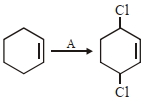
Identify the reagent$(s)$ $A$ and condition$(s)$ for the reaction shown in the image:
A
$A = HCl$; Anhydrous $AlCl_3$
B
$A = HCl, ZnCl_2$
C
$A = Cl_2$; $UV$ light
D
$A = Cl_2$; dark,Anhydrous $AlCl_3$
Solution
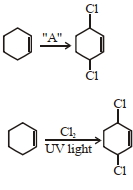
(C) The reaction shows the chlorination of cyclohexene to form a dichlorocyclohexene derivative.
Specifically,the reaction involves the substitution of hydrogen atoms at the allylic positions.
Free radical halogenation using $Cl_2$ in the presence of $UV$ light is the standard method for allylic substitution in alkenes.
Therefore,the correct reagent and condition is $A = Cl_2$ with $UV$ light.
Specifically,the reaction involves the substitution of hydrogen atoms at the allylic positions.
Free radical halogenation using $Cl_2$ in the presence of $UV$ light is the standard method for allylic substitution in alkenes.
Therefore,the correct reagent and condition is $A = Cl_2$ with $UV$ light.
0 likesView Solution
62
ChemistryEasyMCQJEE Main · 2021
$Fe x_2$ and $Fe y_3$ are known when $x$ and $y$ are :
A
$x = F, Cl, Br, I$ and $y = F, Cl, Br$
B
$x = F, Cl, Br$ and $y = F, Cl, Br, I$
C
$x = Cl, Br, I$ and $y = F, Cl, Br, I$
D
$x = F, Cl, Br, I$ and $y = F, Cl, Br, I$
Solution
(A) $FeI_3$ is unstable because $I^-$ is a strong reducing agent that reduces $Fe^{3+}$ to $Fe^{2+}$.
The reaction is: $2 FeI_3 \longrightarrow 2 FeI_2 + I_2$.
Therefore,$Fe$ forms dihalides with $F, Cl, Br, I$ $(FeF_2, FeCl_2, FeBr_2, FeI_2)$ and trihalides with $F, Cl, Br$ $(FeF_3, FeCl_3, FeBr_3)$.
The reaction is: $2 FeI_3 \longrightarrow 2 FeI_2 + I_2$.
Therefore,$Fe$ forms dihalides with $F, Cl, Br, I$ $(FeF_2, FeCl_2, FeBr_2, FeI_2)$ and trihalides with $F, Cl, Br$ $(FeF_3, FeCl_3, FeBr_3)$.
0 likesView Solution
63
ChemistryMediumMCQJEE Main · 2021
Statement $I$: Sodium hydride can be used as an oxidising agent.
Statement $II$: The lone pair of electrons on nitrogen in pyridine makes it basic.
Choose the $CORRECT$ answer from the options given below:
Statement $II$: The lone pair of electrons on nitrogen in pyridine makes it basic.
Choose the $CORRECT$ answer from the options given below:
A
Both statement $I$ and statement $II$ are false
B
Statement $I$ is true but statement $II$ is false
C
Statement $I$ is false but statement $II$ is true
D
Both statement $I$ and statement $II$ are true
Solution
(C) $I$. $NaH$ (sodium hydride) contains hydrogen in the $-1$ oxidation state,making it a strong reducing agent,not an oxidising agent. Thus,statement $I$ is false.
$II$. In pyridine,the nitrogen atom has a lone pair of electrons that is not involved in the aromatic sextet. This lone pair is available for donation,which makes pyridine basic in nature. Thus,statement $II$ is true.
$II$. In pyridine,the nitrogen atom has a lone pair of electrons that is not involved in the aromatic sextet. This lone pair is available for donation,which makes pyridine basic in nature. Thus,statement $II$ is true.
0 likesView Solution
64
ChemistryMediumMCQJEE Main · 2021
The $INCORRECT$ statement regarding the structure of $C_{60}$ is :
A
The six-membered rings are fused to both six and five-membered rings.
B
Each carbon atom forms three sigma bonds.
C
The five-membered rings are fused only to six-membered rings.
D
It contains $12$ six-membered rings and $24$ five-membered rings.
Solution
(D) The structure of $C_{60}$ (Buckminsterfullerene) consists of $60$ carbon atoms arranged in a truncated icosahedron shape.
It contains $20$ six-membered rings (hexagons) and $12$ five-membered rings (pentagons).
Each carbon atom is $sp^2$ hybridized and forms three sigma bonds.
The five-membered rings are fused only to six-membered rings,while the six-membered rings are fused to both six and five-membered rings.
Therefore,the statement that it contains $12$ six-membered rings and $24$ five-membered rings is incorrect.
It contains $20$ six-membered rings (hexagons) and $12$ five-membered rings (pentagons).
Each carbon atom is $sp^2$ hybridized and forms three sigma bonds.
The five-membered rings are fused only to six-membered rings,while the six-membered rings are fused to both six and five-membered rings.
Therefore,the statement that it contains $12$ six-membered rings and $24$ five-membered rings is incorrect.
0 likesView Solution
65
ChemistryMediumMCQJEE Main · 2021
The correct statements about $H_2O_2$ are:
$A$. Used in the treatment of effluents.
$B$. Used as both oxidising and reducing agents.
$C$. The two hydroxyl groups lie in the same plane.
$D$. Miscible with water.
Choose the correct answer from the options given below:
$A$. Used in the treatment of effluents.
$B$. Used as both oxidising and reducing agents.
$C$. The two hydroxyl groups lie in the same plane.
$D$. Miscible with water.
Choose the correct answer from the options given below:
A
$A, B, C$ and $D$
B
$A, B$ and $D$ only
C
$B, C$ and $D$ only
D
$A, C$ and $D$ only
Solution
(B) $H_2O_2$ is used in the treatment of effluents (industrial waste).
$H_2O_2$ acts as both an oxidising agent $(O.A.)$ and a reducing agent $(R.A.)$ in both acidic and basic media.
$H_2O_2$ has a non-planar,open-book structure. Therefore,the two hydroxyl groups do not lie in the same plane.
$H_2O_2$ is miscible with water in all proportions due to hydrogen bonding.
Thus,statements $A, B,$ and $D$ are correct.
$H_2O_2$ acts as both an oxidising agent $(O.A.)$ and a reducing agent $(R.A.)$ in both acidic and basic media.
$H_2O_2$ has a non-planar,open-book structure. Therefore,the two hydroxyl groups do not lie in the same plane.
$H_2O_2$ is miscible with water in all proportions due to hydrogen bonding.
Thus,statements $A, B,$ and $D$ are correct.
0 likesView Solution
66
ChemistryMediumMCQJEE Main · 2021
An unsaturated hydrocarbon $X$ on ozonolysis gives $A$. Compound $A$ when warmed with ammoniacal silver nitrate forms a bright silver mirror along the sides of the test tube. The unsaturated hydrocarbon $X$ is ..... .
A
$CH_3-C(CH_3)=C(CH_3)-CH_3$
B
$CH_3-C(CH_3)=C(CH_2)_2$
C
$CH_3-CH_2-C \equiv CH$
D
$CH_3-C \equiv C-CH_3$
Solution
(C) The reaction of an unsaturated hydrocarbon $X$ with ozone (ozonolysis) produces compound $A$.
Compound $A$ gives a positive Tollen's test (forms a silver mirror with ammoniacal silver nitrate),which indicates that $A$ is an aldehyde or formic acid $(HCOOH)$.
Let us analyze the options:
$(A)$ $CH_3-C(CH_3)=C(CH_3)-CH_3$ on ozonolysis gives $CH_3-CO-CH_3$ (acetone),which does not give Tollen's test.
$(B)$ $CH_3-C(CH_3)=C(CH_2)_2$ on ozonolysis gives $CH_3-CO-CH_3$ and cyclobutanone,neither of which gives Tollen's test.
$(C)$ $CH_3-CH_2-C \equiv CH$ on ozonolysis gives $CH_3-CH_2-COOH$ and $HCOOH$. Formic acid $(HCOOH)$ gives a positive Tollen's test.
$(D)$ $CH_3-C \equiv C-CH_3$ on ozonolysis gives $2CH_3-COOH$ (acetic acid),which does not give Tollen's test.
Therefore,the correct hydrocarbon is $CH_3-CH_2-C \equiv CH$.
Compound $A$ gives a positive Tollen's test (forms a silver mirror with ammoniacal silver nitrate),which indicates that $A$ is an aldehyde or formic acid $(HCOOH)$.
Let us analyze the options:
$(A)$ $CH_3-C(CH_3)=C(CH_3)-CH_3$ on ozonolysis gives $CH_3-CO-CH_3$ (acetone),which does not give Tollen's test.
$(B)$ $CH_3-C(CH_3)=C(CH_2)_2$ on ozonolysis gives $CH_3-CO-CH_3$ and cyclobutanone,neither of which gives Tollen's test.
$(C)$ $CH_3-CH_2-C \equiv CH$ on ozonolysis gives $CH_3-CH_2-COOH$ and $HCOOH$. Formic acid $(HCOOH)$ gives a positive Tollen's test.
$(D)$ $CH_3-C \equiv C-CH_3$ on ozonolysis gives $2CH_3-COOH$ (acetic acid),which does not give Tollen's test.
Therefore,the correct hydrocarbon is $CH_3-CH_2-C \equiv CH$.
0 likesView Solution
67
ChemistryMediumMCQJEE Main · 2021
The characteristics of elements $X$,$Y$ and $Z$ with atomic numbers,respectively,$33$,$53$ and $83$ are :
A
$X$ and $Y$ are metalloids and $Z$ is a metal.
B
$X$ is a metalloid,$Y$ is a non-metal and $Z$ is a metal.
C
$X$,$Y$ and $Z$ are metals.
D
$X$ and $Z$ are non-metals and $Y$ is a metalloid.
Solution
(B) The atomic number $33$ corresponds to Arsenic $(As)$,which is a metalloid.
The atomic number $53$ corresponds to Iodine $(I)$,which is a non-metal.
The atomic number $83$ corresponds to Bismuth $(Bi)$,which is a metal.
Therefore,$X$ is a metalloid,$Y$ is a non-metal,and $Z$ is a metal.
The atomic number $53$ corresponds to Iodine $(I)$,which is a non-metal.
The atomic number $83$ corresponds to Bismuth $(Bi)$,which is a metal.
Therefore,$X$ is a metalloid,$Y$ is a non-metal,and $Z$ is a metal.
1 likesView Solution
68
ChemistryMediumMCQJEE Main · 2021
Match List-$I$ with List-$II$:
The correct match is:
| List-$I$ (Test/Reagents/Observation) | List-$II$ (Species detected) |
| $(a)$ Lassaigne's Test | $(i)$ Carbon |
| $(b)$ $Cu(II)$ oxide | $(ii)$ Sulphur |
| $(c)$ Silver nitrate | $(iii)$ $N, S, P,$ and halogen |
| $(d)$ The sodium fusion extract gives black precipitate with acetic acid and lead acetate | $(iv)$ Halogen specifically |
The correct match is:
A
$(a)-(iii), (b)-(i), (c)-(ii), (d)-(iv)$
B
$(a)-(i), (b)-(iv), (c)-(iii), (d)-(ii)$
C
$(a)-(iii), (b)-(i), (c)-(iv), (d)-(ii)$
D
$(a)-(i), (b)-(ii), (c)-(iv), (d)-(iii)$
Solution
(C) The correct matches are as follows:
$(a)$ Lassaigne's test is used for the detection of nitrogen,sulphur,phosphorus,and halogens in organic compounds. Thus,$(a)-(iii)$.
$(b)$ $Cu(II)$ oxide is used in the detection of carbon in organic compounds (via the formation of $CO_2$). Thus,$(b)-(i)$.
$(c)$ Silver nitrate $(AgNO_3)$ is used specifically for the detection of halogens. Thus,$(c)-(iv)$.
$(d)$ The sodium fusion extract gives a black precipitate with acetic acid and lead acetate,which confirms the presence of sulphur $(PbS)$. Thus,$(d)-(ii)$.
Therefore,the correct sequence is $(a)-(iii), (b)-(i), (c)-(iv), (d)-(ii)$.
$(a)$ Lassaigne's test is used for the detection of nitrogen,sulphur,phosphorus,and halogens in organic compounds. Thus,$(a)-(iii)$.
$(b)$ $Cu(II)$ oxide is used in the detection of carbon in organic compounds (via the formation of $CO_2$). Thus,$(b)-(i)$.
$(c)$ Silver nitrate $(AgNO_3)$ is used specifically for the detection of halogens. Thus,$(c)-(iv)$.
$(d)$ The sodium fusion extract gives a black precipitate with acetic acid and lead acetate,which confirms the presence of sulphur $(PbS)$. Thus,$(d)-(ii)$.
Therefore,the correct sequence is $(a)-(iii), (b)-(i), (c)-(iv), (d)-(ii)$.
0 likesView Solution
69
ChemistryDifficultMCQJEE Main · 2021
The exact volumes of $1\, M\, NaOH$ solution required to neutralize $50\, mL$ of $1\, M\, H_3PO_3$ solution and $100\, mL$ of $2\, M\, H_3PO_2$ solution,respectively,are:
A
$100\, mL$ and $100\, mL$
B
$100\, mL$ and $50\, mL$
C
$100\, mL$ and $200\, mL$
D
$50\, mL$ and $50\, mL$
Solution
(C) $H_3PO_3$ is a dibasic acid ($n$-factor = $2$) and $H_3PO_2$ is a monobasic acid ($n$-factor = $1$).
For neutralization,equivalents of base = equivalents of acid.
$(M_1 \times n_1) \times V_1 = (M_2 \times n_2) \times V_2$
$1.$ For $H_3PO_3$:
$1 \times 1 \times V_{NaOH} = 1 \times 2 \times 50 \implies V_{NaOH} = 100\, mL$.
$2.$ For $H_3PO_2$:
$1 \times 1 \times V_{NaOH} = 2 \times 1 \times 100 \implies V_{NaOH} = 200\, mL$.
Therefore,the volumes are $100\, mL$ and $200\, mL$.
For neutralization,equivalents of base = equivalents of acid.
$(M_1 \times n_1) \times V_1 = (M_2 \times n_2) \times V_2$
$1.$ For $H_3PO_3$:
$1 \times 1 \times V_{NaOH} = 1 \times 2 \times 50 \implies V_{NaOH} = 100\, mL$.
$2.$ For $H_3PO_2$:
$1 \times 1 \times V_{NaOH} = 2 \times 1 \times 100 \implies V_{NaOH} = 200\, mL$.
Therefore,the volumes are $100\, mL$ and $200\, mL$.
0 likesView Solution
70
ChemistryDifficultMCQJEE Main · 2021
In Duma's method of estimation of nitrogen,$0.1840 \, g$ of an organic compound gave $30 \, mL$ of nitrogen collected at $287 \, K$ and $758 \, mm$ of $Hg$ pressure. The percentage composition of nitrogen in the compound is $......$ . (Round off to the Nearest Integer). [Given : Aqueous tension at $287 \, K = 14 \, mm$ of $Hg$ ]
A
$25$
B
$19$
C
$32$
D
$16$
Solution
(B) In Duma's method,the pressure of dry nitrogen is calculated by subtracting the aqueous tension from the total pressure: $P_{N_2} = 758 \, mm - 14 \, mm = 744 \, mm \, Hg$.
Using the ideal gas equation at $STP$ $(P_1V_1/T_1 = P_2V_2/T_2)$:
$V_{STP} = \frac{P_{N_2} \times V_{obs} \times 273}{760 \times T} = \frac{744 \times 30 \times 273}{760 \times 287} \approx 27.935 \, mL$.
Since $22400 \, mL$ of $N_2$ at $STP$ weighs $28 \, g$,the mass of $N_2$ obtained is:
$Mass_{N_2} = \frac{28 \times 27.935}{22400} \approx 0.03492 \, g$.
Percentage of nitrogen = $\frac{Mass_{N_2}}{Mass_{compound}} \times 100 = \frac{0.03492}{0.1840} \times 100 \approx 18.98 \%$.
Rounding off to the nearest integer,we get $19 \% $.
Using the ideal gas equation at $STP$ $(P_1V_1/T_1 = P_2V_2/T_2)$:
$V_{STP} = \frac{P_{N_2} \times V_{obs} \times 273}{760 \times T} = \frac{744 \times 30 \times 273}{760 \times 287} \approx 27.935 \, mL$.
Since $22400 \, mL$ of $N_2$ at $STP$ weighs $28 \, g$,the mass of $N_2$ obtained is:
$Mass_{N_2} = \frac{28 \times 27.935}{22400} \approx 0.03492 \, g$.
Percentage of nitrogen = $\frac{Mass_{N_2}}{Mass_{compound}} \times 100 = \frac{0.03492}{0.1840} \times 100 \approx 18.98 \%$.
Rounding off to the nearest integer,we get $19 \% $.
0 likesView Solution
71
ChemistryMediumMCQJEE Main · 2021
The number of orbitals with $n = 5, m_{l} = +2$ is $......$ . (Round off to the Nearest Integer)
A
$3$
B
$2$
C
$1$
D
$0$
Solution
(A) For a given principal quantum number $n = 5$,the possible values of azimuthal quantum number $\ell$ are $0, 1, 2, 3, 4$.
The magnetic quantum number $m_{l}$ ranges from $-\ell$ to $+\ell$ for each $\ell$.
We need to find the number of orbitals where $m_{l} = +2$:
$1$. For $\ell = 0$ $(5s)$,$m_{l} = 0$.
$2$. For $\ell = 1$ $(5p)$,$m_{l} = \{-1, 0, +1\}$.
$3$. For $\ell = 2$ $(5d)$,$m_{l} = \{-2, -1, 0, +1, +2\}$. Here,$m_{l} = +2$ is possible ($1$ orbital).
$4$. For $\ell = 3$ $(5f)$,$m_{l} = \{-3, -2, -1, 0, +1, +2, +3\}$. Here,$m_{l} = +2$ is possible ($1$ orbital).
$5$. For $\ell = 4$ $(5g)$,$m_{l} = \{-4, -3, -2, -1, 0, +1, +2, +3, +4\}$. Here,$m_{l} = +2$ is possible ($1$ orbital).
Total number of orbitals with $m_{l} = +2$ is $1 + 1 + 1 = 3$.
The magnetic quantum number $m_{l}$ ranges from $-\ell$ to $+\ell$ for each $\ell$.
We need to find the number of orbitals where $m_{l} = +2$:
$1$. For $\ell = 0$ $(5s)$,$m_{l} = 0$.
$2$. For $\ell = 1$ $(5p)$,$m_{l} = \{-1, 0, +1\}$.
$3$. For $\ell = 2$ $(5d)$,$m_{l} = \{-2, -1, 0, +1, +2\}$. Here,$m_{l} = +2$ is possible ($1$ orbital).
$4$. For $\ell = 3$ $(5f)$,$m_{l} = \{-3, -2, -1, 0, +1, +2, +3\}$. Here,$m_{l} = +2$ is possible ($1$ orbital).
$5$. For $\ell = 4$ $(5g)$,$m_{l} = \{-4, -3, -2, -1, 0, +1, +2, +3, +4\}$. Here,$m_{l} = +2$ is possible ($1$ orbital).
Total number of orbitals with $m_{l} = +2$ is $1 + 1 + 1 = 3$.
0 likesView Solution
72
ChemistryDifficultMCQJEE Main · 2021
Sulphurous acid $(H_{2}SO_{3})$ has $Ka_{1} = 1.7 \times 10^{-2}$ and $Ka_{2} = 6.4 \times 10^{-8}$. The $pH$ of $0.588 \ M \ H_{2}SO_{3}$ is ..... . (Round off to the Nearest Integer)
A
$2$
B
$1$
C
$3$
D
$4$
Solution
(B) $H_{2}SO_{3}$ is a dibasic acid with concentration $c = 0.588 \ M$.
Since $Ka_{1} \gg Ka_{2}$,the $pH$ is primarily determined by the first dissociation step:
$H_{2}SO_{3(aq)} \rightleftharpoons H^{+}_{(aq)} + HS{O_{3}}^{-}_{(aq)}$
$Ka_{1} = \frac{[H^{+}][HSO_{3}^{-}]}{[H_{2}SO_{3}]} = 1.7 \times 10^{-2}$
Let $x$ be the concentration of $H^{+}$ at equilibrium:
$\frac{x^{2}}{0.588 - x} = 0.017$
$x^{2} + 0.017x - 0.009996 = 0$
Using the quadratic formula $x = \frac{-b + \sqrt{b^{2} - 4ac}}{2a}$:
$x = \frac{-0.017 + \sqrt{(0.017)^{2} - 4(1)(-0.009996)}}{2} \approx 0.09186 \ M$
$pH = -\log[H^{+}] = -\log(0.09186) \approx 1.036$
Rounding to the nearest integer,the $pH$ is $1$.
Since $Ka_{1} \gg Ka_{2}$,the $pH$ is primarily determined by the first dissociation step:
$H_{2}SO_{3(aq)} \rightleftharpoons H^{+}_{(aq)} + HS{O_{3}}^{-}_{(aq)}$
$Ka_{1} = \frac{[H^{+}][HSO_{3}^{-}]}{[H_{2}SO_{3}]} = 1.7 \times 10^{-2}$
Let $x$ be the concentration of $H^{+}$ at equilibrium:
$\frac{x^{2}}{0.588 - x} = 0.017$
$x^{2} + 0.017x - 0.009996 = 0$
Using the quadratic formula $x = \frac{-b + \sqrt{b^{2} - 4ac}}{2a}$:
$x = \frac{-0.017 + \sqrt{(0.017)^{2} - 4(1)(-0.009996)}}{2} \approx 0.09186 \ M$
$pH = -\log[H^{+}] = -\log(0.09186) \approx 1.036$
Rounding to the nearest integer,the $pH$ is $1$.
0 likesView Solution
73
ChemistryDifficultMCQJEE Main · 2021
When $35 \ mL$ of $0.15 \ M$ lead nitrate solution is mixed with $20 \ mL$ of $0.12 \ M$ chromic sulphate solution,$....... \times 10^{-5}$ moles of lead sulphate precipitate out. (Round off to the Nearest Integer).
A
$565$
B
$525$
C
$235$
D
$412$
Solution
(B) The balanced chemical equation is: $3Pb(NO_3)_2 + Cr_2(SO_4)_3 \rightarrow 3PbSO_4 + 2Cr(NO_3)_3$
Calculate the initial moles of reactants:
Moles of $Pb(NO_3)_2 = 0.15 \ M \times 0.035 \ L = 0.00525 \ mol = 5.25 \times 10^{-3} \ mol$
Moles of $Cr_2(SO_4)_3 = 0.12 \ M \times 0.020 \ L = 0.0024 \ mol = 2.4 \times 10^{-3} \ mol$
Determine the limiting reagent:
For $Pb(NO_3)_2$,moles required per stoichiometric coefficient $= (5.25 \times 10^{-3}) / 3 = 1.75 \times 10^{-3}$
For $Cr_2(SO_4)_3$,moles required per stoichiometric coefficient $= (2.4 \times 10^{-3}) / 1 = 2.4 \times 10^{-3}$
Since $1.75 \times 10^{-3} < 2.4 \times 10^{-3}$,$Pb(NO_3)_2$ is the limiting reagent.
Calculate moles of $PbSO_4$ formed:
According to the stoichiometry,$3 \ mol$ of $Pb(NO_3)_2$ produces $3 \ mol$ of $PbSO_4$.
Therefore,$5.25 \times 10^{-3} \ mol$ of $Pb(NO_3)_2$ produces $5.25 \times 10^{-3} \ mol$ of $PbSO_4$.
$5.25 \times 10^{-3} \ mol = 525 \times 10^{-5} \ mol$.
Calculate the initial moles of reactants:
Moles of $Pb(NO_3)_2 = 0.15 \ M \times 0.035 \ L = 0.00525 \ mol = 5.25 \times 10^{-3} \ mol$
Moles of $Cr_2(SO_4)_3 = 0.12 \ M \times 0.020 \ L = 0.0024 \ mol = 2.4 \times 10^{-3} \ mol$
Determine the limiting reagent:
For $Pb(NO_3)_2$,moles required per stoichiometric coefficient $= (5.25 \times 10^{-3}) / 3 = 1.75 \times 10^{-3}$
For $Cr_2(SO_4)_3$,moles required per stoichiometric coefficient $= (2.4 \times 10^{-3}) / 1 = 2.4 \times 10^{-3}$
Since $1.75 \times 10^{-3} < 2.4 \times 10^{-3}$,$Pb(NO_3)_2$ is the limiting reagent.
Calculate moles of $PbSO_4$ formed:
According to the stoichiometry,$3 \ mol$ of $Pb(NO_3)_2$ produces $3 \ mol$ of $PbSO_4$.
Therefore,$5.25 \times 10^{-3} \ mol$ of $Pb(NO_3)_2$ produces $5.25 \times 10^{-3} \ mol$ of $PbSO_4$.
$5.25 \times 10^{-3} \ mol = 525 \times 10^{-5} \ mol$.
0 likesView Solution
74
ChemistryDifficultMCQJEE Main · 2021
At $25^{\circ} C$,$50 \ g$ of iron reacts with $HCl$ to form $FeCl_2$. The evolved hydrogen gas expands against a constant pressure of $1 \ bar$. The work done by the gas during this expansion is ....... $J$. (Round off to the Nearest Integer) [Given : $R = 8.314 \ J \ mol^{-1} \ K^{-1}$. Assume,hydrogen is an ideal gas] [Atomic mass of $Fe$ is $55.85 \ u$]
A
$2218$
B
$2222$
C
$2988$
D
$3418$
Solution
(A) The chemical reaction is: $Fe(s) + 2HCl(aq) \rightarrow FeCl_2(aq) + H_2(g)$.
Moles of $Fe = \frac{50 \ g}{55.85 \ g \ mol^{-1}} \approx 0.89526 \ mol$.
Since $1 \ mol$ of $Fe$ produces $1 \ mol$ of $H_2(g)$,moles of $H_2(g)$ produced $(n)$ $= 0.89526 \ mol$.
Work done $(w)$ $= -P_{ext} \Delta V = -\Delta n_g RT$.
Given $T = 25^{\circ} C = 298 \ K$,$R = 8.314 \ J \ mol^{-1} \ K^{-1}$,and $P_{ext} = 1 \ bar$.
$w = -nRT = -0.89526 \ mol \times 8.314 \ J \ mol^{-1} \ K^{-1} \times 298 \ K$.
$w = -2218.059 \ J$.
The magnitude of work done by the gas is $2218 \ J$.
Moles of $Fe = \frac{50 \ g}{55.85 \ g \ mol^{-1}} \approx 0.89526 \ mol$.
Since $1 \ mol$ of $Fe$ produces $1 \ mol$ of $H_2(g)$,moles of $H_2(g)$ produced $(n)$ $= 0.89526 \ mol$.
Work done $(w)$ $= -P_{ext} \Delta V = -\Delta n_g RT$.
Given $T = 25^{\circ} C = 298 \ K$,$R = 8.314 \ J \ mol^{-1} \ K^{-1}$,and $P_{ext} = 1 \ bar$.
$w = -nRT = -0.89526 \ mol \times 8.314 \ J \ mol^{-1} \ K^{-1} \times 298 \ K$.
$w = -2218.059 \ J$.
The magnitude of work done by the gas is $2218 \ J$.
0 likesView Solution
75
ChemistryMediumMCQJEE Main · 2021
The set of elements that differ in mutual relationship from those of the other sets is:
A
$Li-Mg$
B
$B-Si$
C
$Be-Al$
D
$Li-Na$
Solution
(D) The pairs $Li-Mg$,$B-Si$,and $Be-Al$ exhibit a diagonal relationship in the periodic table.
$Li$ and $Na$ belong to the same group $(Group \ 1)$ and do not show a diagonal relationship,as they are placed vertically relative to each other.
$Li$ and $Na$ belong to the same group $(Group \ 1)$ and do not show a diagonal relationship,as they are placed vertically relative to each other.
0 likesView Solution
76
ChemistryMediumMCQJEE Main · 2021
Given below are two statements :
Statement-$I$ : $2-$methylbutane on oxidation with $KMnO_4$ gives $2-$methylbutan$-2-$ol.
Statement-$II$ : $n-$alkanes can be easily oxidised to corresponding alcohol with $KMnO_4$.
Choose the correct option:
Statement-$I$ : $2-$methylbutane on oxidation with $KMnO_4$ gives $2-$methylbutan$-2-$ol.
Statement-$II$ : $n-$alkanes can be easily oxidised to corresponding alcohol with $KMnO_4$.
Choose the correct option:
A
Both statement $I$ and statement $II$ are correct
B
Both statement $I$ and statement $II$ are incorrect
C
Statement $I$ is correct but Statement $II$ is incorrect
D
Statement $I$ is incorrect but Statement $II$ is correct
Solution
(C) Alkanes are generally inert towards oxidation. However,alkanes containing a tertiary hydrogen atom can be oxidized to the corresponding tertiary alcohol using a strong oxidizing agent like $KMnO_4$.
Statement-$I$ is correct because $2-$methylbutane contains a tertiary hydrogen atom at the $C-2$ position,which can be oxidized to $2-$methylbutan$-2-$ol.
Statement-$II$ is incorrect because $n-$alkanes lack tertiary hydrogen atoms and are not easily oxidized to alcohols by $KMnO_4$ under normal conditions.
Statement-$I$ is correct because $2-$methylbutane contains a tertiary hydrogen atom at the $C-2$ position,which can be oxidized to $2-$methylbutan$-2-$ol.
Statement-$II$ is incorrect because $n-$alkanes lack tertiary hydrogen atoms and are not easily oxidized to alcohols by $KMnO_4$ under normal conditions.
0 likesView Solution
77
ChemistryMediumMCQJEE Main · 2021
Nitrogen can be estimated by Kjeldahl's method for which of the following compounds?
A
$CH_3-CH_2-NO_2$
B
$CH_3-CH_2-NH_2$
C
$C_6H_5-N=N-C_6H_5$
D
$C_5H_5N$
0 likesView Solution
78
ChemistryMediumMCQJEE Main · 2021
Amongst the following,the linear species is:
A
$NO_2$
B
$Cl_2O$
C
$O_3$
D
$N_3^-$
Solution
(D) To determine the shape of the given species,we analyze their structures based on $VSEPR$ theory:
$1$. $NO_2$: The nitrogen atom has one unpaired electron and two oxygen atoms attached,resulting in a bent shape due to the lone electron and repulsion.
$2$. $Cl_2O$: The central oxygen atom has two lone pairs and two bonded chlorine atoms,resulting in a bent shape (similar to $H_2O$).
$3$. $O_3$: The central oxygen atom has one lone pair and is bonded to two other oxygen atoms,resulting in a bent shape.
$4$. $N_3^-$ (Azide ion): The central nitrogen atom is $sp$ hybridized and bonded to two other nitrogen atoms with no lone pairs on the central atom,resulting in a linear shape.
Thus,the linear species is $N_3^-$.
$1$. $NO_2$: The nitrogen atom has one unpaired electron and two oxygen atoms attached,resulting in a bent shape due to the lone electron and repulsion.
$2$. $Cl_2O$: The central oxygen atom has two lone pairs and two bonded chlorine atoms,resulting in a bent shape (similar to $H_2O$).
$3$. $O_3$: The central oxygen atom has one lone pair and is bonded to two other oxygen atoms,resulting in a bent shape.
$4$. $N_3^-$ (Azide ion): The central nitrogen atom is $sp$ hybridized and bonded to two other nitrogen atoms with no lone pairs on the central atom,resulting in a linear shape.
Thus,the linear species is $N_3^-$.
0 likesView Solution
79
ChemistryMediumMCQJEE Main · 2021
One of the by-products formed during the recovery of $NH_{3}$ from the Solvay process is ..... .
A
$Ca(OH)_{2}$
B
$NaHCO_{3}$
C
$CaCl_{2}$
D
$NH_{4}Cl$
Solution
(C) In the Solvay process,$NH_{3}$ is recovered by treating the ammonium chloride $(NH_{4}Cl)$ solution with calcium hydroxide $(Ca(OH)_{2})$.
The chemical reaction is: $2NH_{4}Cl + Ca(OH)_{2} \rightarrow 2NH_{3} + CaCl_{2} + 2H_{2}O$.
Here,$CaCl_{2}$ (calcium chloride) is obtained as a by-product.
The chemical reaction is: $2NH_{4}Cl + Ca(OH)_{2} \rightarrow 2NH_{3} + CaCl_{2} + 2H_{2}O$.
Here,$CaCl_{2}$ (calcium chloride) is obtained as a by-product.
0 likesView Solution
80
ChemistryMediumMCQJEE Main · 2021
Which of the following statement$(s)$ is (are) incorrect reason for eutrophication?
$A$. excess usage of fertilisers
$B$. excess usage of detergents
$C$. dense plant population in water bodies
$D$. lack of nutrients in water bodies that prevent plant growth
Choose the most appropriate answer from the options given below:
$A$. excess usage of fertilisers
$B$. excess usage of detergents
$C$. dense plant population in water bodies
$D$. lack of nutrients in water bodies that prevent plant growth
Choose the most appropriate answer from the options given below:
A
$A$ only
B
$C$ only
C
$B$ and $D$ only
D
$D$ only
Solution
(D) Eutrophication is the process in which nutrient-enriched water bodies support a dense plant population,which kills animal life by depriving it of oxygen and results in a loss of biodiversity.
$A$. Excess usage of fertilisers leads to nutrient enrichment (e.g.,nitrates and phosphates),causing eutrophication.
$B$. Excess usage of detergents also adds phosphates to water bodies,causing eutrophication.
$C$. Dense plant population is a result/symptom of eutrophication,not a cause.
$D$. Lack of nutrients is the opposite of the condition required for eutrophication.
Since the question asks for the incorrect reason$(s)$,both $C$ and $D$ are incorrect as causes. However,looking at the provided options,$D$ is the most fundamentally incorrect statement regarding the cause of eutrophication.
$A$. Excess usage of fertilisers leads to nutrient enrichment (e.g.,nitrates and phosphates),causing eutrophication.
$B$. Excess usage of detergents also adds phosphates to water bodies,causing eutrophication.
$C$. Dense plant population is a result/symptom of eutrophication,not a cause.
$D$. Lack of nutrients is the opposite of the condition required for eutrophication.
Since the question asks for the incorrect reason$(s)$,both $C$ and $D$ are incorrect as causes. However,looking at the provided options,$D$ is the most fundamentally incorrect statement regarding the cause of eutrophication.
0 likesView Solution
81
ChemistryMediumMCQJEE Main · 2021
Choose the correct statement regarding the formation of carbocations $A$ and $B$ given:
$CH_3-CH_2-CH=CH_2 + HBr \to CH_3-CH_2-CH_2-CH_2^+ + Br^-$ $(A)$
$CH_3-CH_2-CH=CH_2 + HBr \to CH_3-CH_2-CH^+-CH_3 + Br^-$ $(B)$
$CH_3-CH_2-CH=CH_2 + HBr \to CH_3-CH_2-CH_2-CH_2^+ + Br^-$ $(A)$
$CH_3-CH_2-CH=CH_2 + HBr \to CH_3-CH_2-CH^+-CH_3 + Br^-$ $(B)$
A
Carbocation $B$ is more stable and formed relatively at a faster rate.
B
Carbocation $A$ is more stable and formed relatively at a slow rate.
C
Carbocation $B$ is more stable and formed relatively at a slow rate.
D
Carbocation $A$ is more stable and formed relatively at a faster rate.
Solution
(A) In the electrophilic addition of $HBr$ to but$-1-$ene,the proton $(H^+)$ attacks the double bond to form a carbocation intermediate.
Carbocation $A$ is a primary $(1^\circ)$ carbocation $(CH_3-CH_2-CH_2-CH_2^+)$,while carbocation $B$ is a secondary $(2^\circ)$ carbocation $(CH_3-CH_2-CH^+-CH_3)$.
Secondary carbocations are more stable than primary carbocations due to the inductive effect and hyperconjugation.
Because carbocation $B$ is more stable,its formation has a lower activation energy,meaning it is formed at a faster rate.
Carbocation $A$ is a primary $(1^\circ)$ carbocation $(CH_3-CH_2-CH_2-CH_2^+)$,while carbocation $B$ is a secondary $(2^\circ)$ carbocation $(CH_3-CH_2-CH^+-CH_3)$.
Secondary carbocations are more stable than primary carbocations due to the inductive effect and hyperconjugation.
Because carbocation $B$ is more stable,its formation has a lower activation energy,meaning it is formed at a faster rate.
0 likesView Solution
82
ChemistryMediumMCQJEE Main · 2021
During which of the following processes does entropy decrease?
A
$A, B, C$ and $D$ only
B
$B$ and $C$ only
C
$A$ and $E$ only
D
$A, C$ and $E$ only
Solution
(A) . Freezing of water to ice at $0^{\circ} C$ involves a phase change from liquid to solid,which decreases disorder,so $\Delta S < 0$.
$B$. Freezing of water to ice at $-10^{\circ} C$ is a spontaneous process where liquid water turns to solid ice,decreasing entropy,so $\Delta S < 0$.
$C$. In the reaction $N_{2(g)} + 3H_{2(g)} \rightarrow 2NH_{3(g)}$,the number of moles of gas decreases from $4$ to $2$,leading to a decrease in entropy,so $\Delta S < 0$.
$D$. Adsorption of $CO_{(g)}$ on a lead surface restricts the movement of gas molecules,decreasing entropy,so $\Delta S < 0$.
$E$. Dissolution of $NaCl$ in water increases the disorder of the system as the crystal lattice breaks down into ions,so $\Delta S > 0$.
Therefore,entropy decreases in processes $A, B, C,$ and $D$.
$B$. Freezing of water to ice at $-10^{\circ} C$ is a spontaneous process where liquid water turns to solid ice,decreasing entropy,so $\Delta S < 0$.
$C$. In the reaction $N_{2(g)} + 3H_{2(g)} \rightarrow 2NH_{3(g)}$,the number of moles of gas decreases from $4$ to $2$,leading to a decrease in entropy,so $\Delta S < 0$.
$D$. Adsorption of $CO_{(g)}$ on a lead surface restricts the movement of gas molecules,decreasing entropy,so $\Delta S < 0$.
$E$. Dissolution of $NaCl$ in water increases the disorder of the system as the crystal lattice breaks down into ions,so $\Delta S > 0$.
Therefore,entropy decreases in processes $A, B, C,$ and $D$.
0 likesView Solution
83
ChemistryMediumMCQJEE Main · 2021
The total number of $C-C$ sigma $(\sigma)$ bonds in mesityl oxide $(C_6H_{10}O)$ is $......$. (Round off to the nearest integer).
A
$5$
B
$6$
C
$7$
D
$8$
Solution
(A) The structure of mesityl oxide is $(CH_3)_2C=CH-CO-CH_3$.
Expanding the structure to identify $C-C$ sigma bonds:
$H_3C-C(CH_3)=CH-C(=O)-CH_3$.
The $C-C$ sigma bonds are:
$1$. $C_1-C_2$ (between $CH_3$ and $C$)
$2$. $C_2-C_3$ (between $C$ and $CH_3$)
$3$. $C_2-C_4$ (between $C$ and $CH$)
$4$. $C_4-C_5$ (between $CH$ and $C=O$)
$5$. $C_5-C_6$ (between $C=O$ and $CH_3$)
Total number of $C-C$ sigma bonds = $5$.
Expanding the structure to identify $C-C$ sigma bonds:
$H_3C-C(CH_3)=CH-C(=O)-CH_3$.
The $C-C$ sigma bonds are:
$1$. $C_1-C_2$ (between $CH_3$ and $C$)
$2$. $C_2-C_3$ (between $C$ and $CH_3$)
$3$. $C_2-C_4$ (between $C$ and $CH$)
$4$. $C_4-C_5$ (between $CH$ and $C=O$)
$5$. $C_5-C_6$ (between $C=O$ and $CH_3$)
Total number of $C-C$ sigma bonds = $5$.
0 likesView Solution
84
ChemistryEasyMCQJEE Main · 2021
In the ground state of atomic $Fe \,(Z = 26)$,the spin-only magnetic moment is ...... $\times 10^{-1} \,BM$. (Round off to the nearest integer).
$[$Given $: \sqrt{3} = 1.73, \sqrt{2} = 1.41]$
$[$Given $: \sqrt{3} = 1.73, \sqrt{2} = 1.41]$
A
$95$
B
$49$
C
$22$
D
$84$
Solution
(B) The electronic configuration of $Fe$ $(Z = 26)$ is $[Ar] 3d^6 4s^2$.
In the $3d$ subshell,there are $6$ electrons. According to Hund's rule,the distribution is:
Number of unpaired electrons $(n) = 4$.
The spin-only magnetic moment $(\mu)$ is given by the formula $\mu = \sqrt{n(n + 2)} \,BM$.
$\mu = \sqrt{4(4 + 2)} = \sqrt{24} \,BM$.
Using $\sqrt{24} \approx 4.899 \,BM$.
$\mu = 48.99 \times 10^{-1} \,BM$.
Rounding off to the nearest integer,we get $49$.
In the $3d$ subshell,there are $6$ electrons. According to Hund's rule,the distribution is:
| $\uparrow \downarrow$ | $\uparrow$ | $\uparrow$ | $\uparrow$ | $\uparrow$ |
Number of unpaired electrons $(n) = 4$.
The spin-only magnetic moment $(\mu)$ is given by the formula $\mu = \sqrt{n(n + 2)} \,BM$.
$\mu = \sqrt{4(4 + 2)} = \sqrt{24} \,BM$.
Using $\sqrt{24} \approx 4.899 \,BM$.
$\mu = 48.99 \times 10^{-1} \,BM$.
Rounding off to the nearest integer,we get $49$.
0 likesView Solution
85
ChemistryMediumMCQJEE Main · 2021
The number of chlorine atoms in $20 \, mL$ of chlorine gas at $STP$ is ..... $\times 10^{21}$. (Round off to the Nearest Integer).
[Assume chlorine is an ideal gas at $STP$,$R = 0.083 \, L \, bar \, mol^{-1} \, K^{-1}$,$N_{A} = 6.023 \times 10^{23}$]
[Assume chlorine is an ideal gas at $STP$,$R = 0.083 \, L \, bar \, mol^{-1} \, K^{-1}$,$N_{A} = 6.023 \times 10^{23}$]
A
$108$
B
$4$
C
$52$
D
$1$
Solution
(D) At $STP$,the pressure $P = 1 \, bar$ and temperature $T = 273.15 \, K$.
Using the ideal gas equation $PV = nRT$,where $n = \frac{N}{N_A}$:
$1 \times (20 \times 10^{-3} \, L) = \frac{N}{6.023 \times 10^{23}} \times 0.083 \times 273.15$
$N = \frac{0.020 \times 6.023 \times 10^{23}}{0.083 \times 273.15} \approx 5.31 \times 10^{20} \, \text{molecules of } Cl_2$.
Since each $Cl_2$ molecule contains $2$ chlorine atoms:
Number of $Cl$ atoms $= 2 \times 5.31 \times 10^{20} = 10.62 \times 10^{20} = 1.062 \times 10^{21}$.
Rounding to the nearest integer,we get $1 \times 10^{21}$.
Using the ideal gas equation $PV = nRT$,where $n = \frac{N}{N_A}$:
$1 \times (20 \times 10^{-3} \, L) = \frac{N}{6.023 \times 10^{23}} \times 0.083 \times 273.15$
$N = \frac{0.020 \times 6.023 \times 10^{23}}{0.083 \times 273.15} \approx 5.31 \times 10^{20} \, \text{molecules of } Cl_2$.
Since each $Cl_2$ molecule contains $2$ chlorine atoms:
Number of $Cl$ atoms $= 2 \times 5.31 \times 10^{20} = 10.62 \times 10^{20} = 1.062 \times 10^{21}$.
Rounding to the nearest integer,we get $1 \times 10^{21}$.
0 likesView Solution
86
ChemistryMediumMCQJEE Main · 2021
Consider the reaction $N_{2}O_{4(g)} \rightleftharpoons 2NO_{2(g)}$. The temperature at which $K_{C}=20.4$ and $K_{P}=600.1$ is ....... $K$. (Round off to the nearest integer).
[Assume all gases are ideal and $R=0.0831 \, L \, bar \, K^{-1} \, mol^{-1}$]
[Assume all gases are ideal and $R=0.0831 \, L \, bar \, K^{-1} \, mol^{-1}$]
A
$124$
B
$854$
C
$354$
D
$345$
Solution
(C) For the reaction $N_{2}O_{4(g)} \rightleftharpoons 2NO_{2(g)}$,the change in the number of moles of gaseous species is $\Delta n_{g} = 2 - 1 = 1$.
The relationship between $K_{P}$ and $K_{C}$ is given by $K_{P} = K_{C} \cdot (RT)^{\Delta n_{g}}$.
Substituting the given values: $600.1 = 20.4 \times (0.0831 \times T)^{1}$.
Solving for $T$: $T = \frac{600.1}{20.4 \times 0.0831} = \frac{600.1}{1.69524} \approx 353.99 \, K$.
Rounding off to the nearest integer,we get $T = 354 \, K$.
The relationship between $K_{P}$ and $K_{C}$ is given by $K_{P} = K_{C} \cdot (RT)^{\Delta n_{g}}$.
Substituting the given values: $600.1 = 20.4 \times (0.0831 \times T)^{1}$.
Solving for $T$: $T = \frac{600.1}{20.4 \times 0.0831} = \frac{600.1}{1.69524} \approx 353.99 \, K$.
Rounding off to the nearest integer,we get $T = 354 \, K$.
0 likesView Solution
87
ChemistryDifficultMCQJEE Main · 2021
Consider the reaction shown below. The percentage yield of the amide product is $......$ . (Round off to the Nearest Integer). (Given: Atomic mass: $C = 12.0 \, u, H = 1.0 \, u, N = 14.0 \, u, O = 16.0 \, u, Cl = 35.5 \, u$)
$C_6H_5COCl + (C_6H_5)_2NH \rightarrow C_6H_5CON(C_6H_5)_2 + HCl$
Given: $0.140 \, g$ of $C_6H_5COCl$ reacts with $0.388 \, g$ of $(C_6H_5)_2NH$ to produce $0.210 \, g$ of $C_6H_5CON(C_6H_5)_2$.
$C_6H_5COCl + (C_6H_5)_2NH \rightarrow C_6H_5CON(C_6H_5)_2 + HCl$
Given: $0.140 \, g$ of $C_6H_5COCl$ reacts with $0.388 \, g$ of $(C_6H_5)_2NH$ to produce $0.210 \, g$ of $C_6H_5CON(C_6H_5)_2$.
A
$74$
B
$75$
C
$77$
D
$78$
Solution
(C) The reaction is: $C_6H_5COCl + (C_6H_5)_2NH \rightarrow C_6H_5CON(C_6H_5)_2 + HCl$
Molar mass of $C_6H_5COCl = 77 + 12 + 16 + 35.5 = 140.5 \, g/mol$.
Molar mass of $C_6H_5CON(C_6H_5)_2 = 77 + 12 + 16 + 14 + 2(77) = 273 \, g/mol$.
Moles of $C_6H_5COCl = \frac{0.140 \, g}{140.5 \, g/mol} \approx 0.001 \, mol$.
Since the stoichiometry is $1:1$,theoretical moles of product $= 0.001 \, mol$.
Theoretical mass of product $= 0.001 \, mol \times 273 \, g/mol = 0.273 \, g$.
Actual mass of product formed $= 0.210 \, g$.
Percentage yield $= \frac{\text{Actual yield}}{\text{Theoretical yield}} \times 100 = \frac{0.210}{0.273} \times 100 \approx 76.92 \%$.
Rounding off to the nearest integer,we get $77 \%$.
Molar mass of $C_6H_5COCl = 77 + 12 + 16 + 35.5 = 140.5 \, g/mol$.
Molar mass of $C_6H_5CON(C_6H_5)_2 = 77 + 12 + 16 + 14 + 2(77) = 273 \, g/mol$.
Moles of $C_6H_5COCl = \frac{0.140 \, g}{140.5 \, g/mol} \approx 0.001 \, mol$.
Since the stoichiometry is $1:1$,theoretical moles of product $= 0.001 \, mol$.
Theoretical mass of product $= 0.001 \, mol \times 273 \, g/mol = 0.273 \, g$.
Actual mass of product formed $= 0.210 \, g$.
Percentage yield $= \frac{\text{Actual yield}}{\text{Theoretical yield}} \times 100 = \frac{0.210}{0.273} \times 100 \approx 76.92 \%$.
Rounding off to the nearest integer,we get $77 \%$.
0 likesView Solution
88
ChemistryMediumMCQJEE Main · 2021
The oxidation states of nitrogen in $NO$,$NO_{2}$,$N_{2}O$ and $NO_{3}^{-}$ are in the order of :
A
$NO_{3}^{-} > NO_{2} > NO > N_{2}O$
B
$NO_{2} > NO_{3}^{-} > NO > N_{2}O$
C
$N_{2}O > NO_{2} > NO > NO_{3}^{-}$
D
$NO > NO_{2} > N_{2}O > NO_{3}^{-}$
Solution
(A) To find the oxidation state of nitrogen $(N)$ in each species,we use the rule that the oxidation state of oxygen $(O)$ is $-2$.
$1$. In $NO_{3}^{-}$: $x + 3(-2) = -1 \implies x - 6 = -1 \implies x = +5$.
$2$. In $NO_{2}$: $x + 2(-2) = 0 \implies x - 4 = 0 \implies x = +4$.
$3$. In $NO$: $x + (-2) = 0 \implies x = +2$.
$4$. In $N_{2}O$: $2x + (-2) = 0 \implies 2x = 2 \implies x = +1$.
Comparing the values: $+5 (NO_{3}^{-}) > +4 (NO_{2}) > +2 (NO) > +1 (N_{2}O)$.
Thus,the correct order is $NO_{3}^{-} > NO_{2} > NO > N_{2}O$.
$1$. In $NO_{3}^{-}$: $x + 3(-2) = -1 \implies x - 6 = -1 \implies x = +5$.
$2$. In $NO_{2}$: $x + 2(-2) = 0 \implies x - 4 = 0 \implies x = +4$.
$3$. In $NO$: $x + (-2) = 0 \implies x = +2$.
$4$. In $N_{2}O$: $2x + (-2) = 0 \implies 2x = 2 \implies x = +1$.
Comparing the values: $+5 (NO_{3}^{-}) > +4 (NO_{2}) > +2 (NO) > +1 (N_{2}O)$.
Thus,the correct order is $NO_{3}^{-} > NO_{2} > NO > N_{2}O$.
0 likesView Solution
89
ChemistryMediumMCQJEE Main · 2021
In basic medium,$H_{2}O_{2}$ exhibits which of the following reactions?
$A$. $Mn^{2+} \rightarrow Mn^{4+}$
$B$. $I_{2} \rightarrow I^{-}$
$C$. $PbS \rightarrow PbSO_{4}$
Choose the most appropriate answer from the options given below:
$A$. $Mn^{2+} \rightarrow Mn^{4+}$
$B$. $I_{2} \rightarrow I^{-}$
$C$. $PbS \rightarrow PbSO_{4}$
Choose the most appropriate answer from the options given below:
A
$A, C$ only
B
$A$ only
C
$B$ only
D
$A, B$ only
Solution
(D) $H_{2}O_{2}$ acts as an oxidizing agent in basic medium:
$Mn^{2+} + H_{2}O_{2} \rightarrow Mn^{4+} + 2OH^{-}$
$H_{2}O_{2}$ acts as a reducing agent in basic medium:
$I_{2} + H_{2}O_{2} + 2OH^{-} \rightarrow 2I^{-} + 2H_{2}O + O_{2}$
$H_{2}O_{2}$ acts as an oxidizing agent in acidic medium:
$PbS_{(s)} + 4H_{2}O_{2(aq)} \rightarrow PbSO_{4(s)} + 4H_{2}O_{(\ell)}$
Thus,reactions $A$ and $B$ occur in basic medium.
$Mn^{2+} + H_{2}O_{2} \rightarrow Mn^{4+} + 2OH^{-}$
$H_{2}O_{2}$ acts as a reducing agent in basic medium:
$I_{2} + H_{2}O_{2} + 2OH^{-} \rightarrow 2I^{-} + 2H_{2}O + O_{2}$
$H_{2}O_{2}$ acts as an oxidizing agent in acidic medium:
$PbS_{(s)} + 4H_{2}O_{2(aq)} \rightarrow PbSO_{4(s)} + 4H_{2}O_{(\ell)}$
Thus,reactions $A$ and $B$ occur in basic medium.
0 likesView Solution
90
ChemistryMediumMCQJEE Main · 2021
The first ionization energy of magnesium is smaller as compared to that of elements $X$ and $Y$,but higher than that of $Z$. The elements $X$,$Y$ and $Z$,respectively,are :
A
chlorine,lithium and sodium
B
argon,lithium and sodium
C
argon,chlorine and sodium
D
neon,sodium and chlorine
Solution
(C) The first ionization energy $(IE_1)$ of $3^{rd}$ period elements follows the order: $Na < Al < Mg < Si < S < P < Cl < Ar$.
Magnesium $(Mg)$ has a higher $IE_1$ than $Na$ $(Z)$ but lower than $Cl$ and $Ar$ ($X$ and $Y$).
Therefore,$X$ and $Y$ are $Ar$ and $Cl$,and $Z$ is $Na$.
Magnesium $(Mg)$ has a higher $IE_1$ than $Na$ $(Z)$ but lower than $Cl$ and $Ar$ ($X$ and $Y$).
Therefore,$X$ and $Y$ are $Ar$ and $Cl$,and $Z$ is $Na$.
0 likesView Solution
91
ChemistryMediumMCQJEE Main · 2021
Given below are two statements:
Statement $I$: Bohr's theory accounts for the stability and line spectrum of $Li^{+}$ ion.
Statement $II$: Bohr's theory was unable to explain the splitting of spectral lines in the presence of a magnetic field.
In the light of the above statements,choose the most appropriate answer from the options given below:
Statement $I$: Bohr's theory accounts for the stability and line spectrum of $Li^{+}$ ion.
Statement $II$: Bohr's theory was unable to explain the splitting of spectral lines in the presence of a magnetic field.
In the light of the above statements,choose the most appropriate answer from the options given below:
A
Both statement $I$ and statement $II$ are true.
B
Statement $I$ is false but statement $II$ is true.
C
Both statement $I$ and statement $II$ are false.
D
Statement $I$ is true but statement $II$ is false.
Solution
(B) Statement $-I$ is false because Bohr's theory is applicable only to single-electron species (e.g.,$H$,$He^{+}$,$Li^{2+}$). Since $Li^{+}$ has $2$ electrons,Bohr's theory cannot explain its spectrum.
Statement $-II$ is true because the splitting of spectral lines in a magnetic field is known as the Zeeman effect,which Bohr's theory could not explain.
Statement $-II$ is true because the splitting of spectral lines in a magnetic field is known as the Zeeman effect,which Bohr's theory could not explain.
0 likesView Solution
92
ChemistryMediumMCQJEE Main · 2021
Match List-$I$ with List-$II$:
Choose the most appropriate answer from the options given below:
| List-$I$ | List-$II$ |
| $a$. $Be$ | $i$. Treatment of cancer |
| $b$. $Mg$ | $ii$. Extraction of metals |
| $c$. $Ca$ | $iii$. Incendiary bombs and signals |
| $d$. $Ra$ | $iv$. Windows of $X$-ray tubes |
| $v$. Bearings for motor engines |
Choose the most appropriate answer from the options given below:
A
$a-iv, b-iii, c-ii, d-i$
B
$a-iv, b-iii, c-ii, d-v$
C
$a-iii, b-iv, c-ii, d-i$
D
$a-iv, b-ii, c-iii, d-i$
Solution
(A) . $Be$ is used in the windows of $X$-ray tubes.
$b$. $Mg$ is used in incendiary bombs and signals.
$c$. $Ca$ is used in the extraction of metals (as a reducing agent).
$d$. $Ra$ is used in the treatment of cancer (radiotherapy).
Therefore,the correct matching is $a-iv, b-iii, c-ii, d-i$.
$b$. $Mg$ is used in incendiary bombs and signals.
$c$. $Ca$ is used in the extraction of metals (as a reducing agent).
$d$. $Ra$ is used in the treatment of cancer (radiotherapy).
Therefore,the correct matching is $a-iv, b-iii, c-ii, d-i$.
0 likesView Solution
93
ChemistryMediumMCQJEE Main · 2021
Given below are two statements:
Statement $I$: Non-biodegradable wastes are generated by the thermal power plants.
Statement $II$: Bio-degradable detergents lead to eutrophication.
In the light of the above statements,choose the most appropriate answer from the options given below:
Statement $I$: Non-biodegradable wastes are generated by the thermal power plants.
Statement $II$: Bio-degradable detergents lead to eutrophication.
In the light of the above statements,choose the most appropriate answer from the options given below:
A
Both statement $I$ and statement $II$ are false
B
Statement $I$ is true but statement $II$ is false
C
Statement $I$ is false but statement $II$ is true
D
Both statement $I$ and statement $II$ are true.
Solution
(D) Statement $I$ is true: Thermal power plants generate large amounts of fly ash,which is a non-biodegradable waste.
Statement $II$ is true: Biodegradable detergents,especially those containing phosphates,can lead to eutrophication in water bodies,which depletes dissolved oxygen and harms aquatic life.
Statement $II$ is true: Biodegradable detergents,especially those containing phosphates,can lead to eutrophication in water bodies,which depletes dissolved oxygen and harms aquatic life.
0 likesView Solution
94
ChemistryMediumMCQJEE Main · 2021
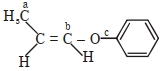
In the following molecule,determine the hybridisation of carbon atoms $a, b$ and $c$ respectively:
A
$sp^{3}, sp, sp$
B
$sp^{3}, sp^{2}, sp$
C
$sp^{3}, sp^{2}, sp^{2}$
D
$sp^{3}, sp, sp^{2}$
Solution
(C) To determine the hybridisation of a carbon atom,we count the number of sigma $(\sigma)$ bonds and lone pairs (if any) attached to it.
$1$. Carbon $a$ is part of a methyl group $(-CH_3)$. It is bonded to three hydrogen atoms and one carbon atom,forming four single bonds. Thus,it has four $\sigma$ bonds and is $sp^{3}$ hybridised.
$2$. Carbon $b$ is part of a double bond $(C=C)$. It is bonded to one carbon atom (via a double bond,which counts as one $\sigma$ bond),one hydrogen atom,and one oxygen atom. It has three $\sigma$ bonds and is $sp^{2}$ hybridised.
$3$. Carbon $c$ is part of the benzene ring. It is bonded to two other carbon atoms in the ring and one oxygen atom. It is involved in a double bond within the aromatic ring,giving it three $\sigma$ bonds. Thus,it is $sp^{2}$ hybridised.
Therefore,the hybridisation of $a, b$ and $c$ are $sp^{3}, sp^{2}$ and $sp^{2}$ respectively.
$1$. Carbon $a$ is part of a methyl group $(-CH_3)$. It is bonded to three hydrogen atoms and one carbon atom,forming four single bonds. Thus,it has four $\sigma$ bonds and is $sp^{3}$ hybridised.
$2$. Carbon $b$ is part of a double bond $(C=C)$. It is bonded to one carbon atom (via a double bond,which counts as one $\sigma$ bond),one hydrogen atom,and one oxygen atom. It has three $\sigma$ bonds and is $sp^{2}$ hybridised.
$3$. Carbon $c$ is part of the benzene ring. It is bonded to two other carbon atoms in the ring and one oxygen atom. It is involved in a double bond within the aromatic ring,giving it three $\sigma$ bonds. Thus,it is $sp^{2}$ hybridised.
Therefore,the hybridisation of $a, b$ and $c$ are $sp^{3}, sp^{2}$ and $sp^{2}$ respectively.
0 likesView Solution
95
ChemistryMediumMCQJEE Main · 2021
The number of species below that have two lone pairs of electrons on their central atom is ..... . (Round off to the nearest integer)
$SF_{4}, BF_{4}^{-}, ClF_{3}, AsF_{3}, PCl_{5}, BrF_{5}, XeF_{4}, SF_{6}$
$SF_{4}, BF_{4}^{-}, ClF_{3}, AsF_{3}, PCl_{5}, BrF_{5}, XeF_{4}, SF_{6}$
A
$6$
B
$4$
C
$2$
D
$3$
Solution
(C) To determine the number of lone pairs $(l.p.)$ on the central atom,we use the formula: $l.p. = \frac{1}{2} (V - N)$,where $V$ is the number of valence electrons of the central atom and $N$ is the number of monovalent atoms bonded to it.
$1$. $SF_{4}$: $S$ has $6$ valence electrons,$4$ bonded atoms. $l.p. = \frac{1}{2}(6 - 4) = 1$.
$2$. $BF_{4}^{-}$: $B$ has $3$ valence electrons,$4$ bonded atoms,plus $1$ negative charge. $l.p. = \frac{1}{2}(3 + 1 - 4) = 0$.
$3$. $ClF_{3}$: $Cl$ has $7$ valence electrons,$3$ bonded atoms. $l.p. = \frac{1}{2}(7 - 3) = 2$.
$4$. $AsF_{3}$: $As$ has $5$ valence electrons,$3$ bonded atoms. $l.p. = \frac{1}{2}(5 - 3) = 1$.
$5$. $PCl_{5}$: $P$ has $5$ valence electrons,$5$ bonded atoms. $l.p. = \frac{1}{2}(5 - 5) = 0$.
$6$. $BrF_{5}$: $Br$ has $7$ valence electrons,$5$ bonded atoms. $l.p. = \frac{1}{2}(7 - 5) = 1$.
$7$. $XeF_{4}$: $Xe$ has $8$ valence electrons,$4$ bonded atoms. $l.p. = \frac{1}{2}(8 - 4) = 2$.
$8$. $SF_{6}$: $S$ has $6$ valence electrons,$6$ bonded atoms. $l.p. = \frac{1}{2}(6 - 6) = 0$.
The species with two lone pairs are $ClF_{3}$ and $XeF_{4}$.
Therefore,the total number of such species is $2$.
$1$. $SF_{4}$: $S$ has $6$ valence electrons,$4$ bonded atoms. $l.p. = \frac{1}{2}(6 - 4) = 1$.
$2$. $BF_{4}^{-}$: $B$ has $3$ valence electrons,$4$ bonded atoms,plus $1$ negative charge. $l.p. = \frac{1}{2}(3 + 1 - 4) = 0$.
$3$. $ClF_{3}$: $Cl$ has $7$ valence electrons,$3$ bonded atoms. $l.p. = \frac{1}{2}(7 - 3) = 2$.
$4$. $AsF_{3}$: $As$ has $5$ valence electrons,$3$ bonded atoms. $l.p. = \frac{1}{2}(5 - 3) = 1$.
$5$. $PCl_{5}$: $P$ has $5$ valence electrons,$5$ bonded atoms. $l.p. = \frac{1}{2}(5 - 5) = 0$.
$6$. $BrF_{5}$: $Br$ has $7$ valence electrons,$5$ bonded atoms. $l.p. = \frac{1}{2}(7 - 5) = 1$.
$7$. $XeF_{4}$: $Xe$ has $8$ valence electrons,$4$ bonded atoms. $l.p. = \frac{1}{2}(8 - 4) = 2$.
$8$. $SF_{6}$: $S$ has $6$ valence electrons,$6$ bonded atoms. $l.p. = \frac{1}{2}(6 - 6) = 0$.
The species with two lone pairs are $ClF_{3}$ and $XeF_{4}$.
Therefore,the total number of such species is $2$.
0 likesView Solution
96
ChemistryMediumMCQJEE Main · 2021
The gas phase reaction $2A_{(g)} \rightleftharpoons A_{2(g)}$ at $400 \ K$ has $\Delta G^{\circ} = +25.2 \ kJ \ mol^{-1}$. The equilibrium constant $K_{C}$ for this reaction is $...... \times 10^{-2}$. (Round off to the nearest integer) $[$Use: $R = 8.3 \ J \ mol^{-1} \ K^{-1}$,$\ln 10 = 2.3$,$\log_{10} 2 = 0.30$,$1 \ atm = 1 \ bar]$ $[$antilog $(-3.3) = 5.01 \times 10^{-4}]$
A
$141$
B
$166$
C
$206$
D
$111$
Solution
(B) The relationship between standard Gibbs free energy change and equilibrium constant is given by $\Delta_{r} G^{\circ} = -RT \ln K_{p}$.
Given $\Delta_{r} G^{\circ} = 25200 \ J \ mol^{-1}$,$R = 8.3 \ J \ mol^{-1} \ K^{-1}$,and $T = 400 \ K$.
Substituting the values: $25200 = -8.3 \times 400 \times \ln K_{p}$.
$\ln K_{p} = -\frac{25200}{3320} \approx -7.59$.
Converting to base $10$: $\log_{10} K_{p} = \frac{-7.59}{2.3} \approx -3.3$.
$K_{p} = 10^{-3.3} = 5.01 \times 10^{-4}$.
For the reaction $2A_{(g)} \rightleftharpoons A_{2(g)}$,$\Delta n = 1 - 2 = -1$.
Using $K_{p} = K_{c}(RT)^{\Delta n}$,we have $K_{c} = K_{p}(RT)^{-\Delta n} = K_{p}(RT)^{1}$.
$K_{c} = 5.01 \times 10^{-4} \times (8.3 \times 400) = 5.01 \times 10^{-4} \times 3320 = 1.6632$.
Expressing in terms of $10^{-2}$: $1.6632 = 166.32 \times 10^{-2}$.
Rounding to the nearest integer,we get $166$.
Given $\Delta_{r} G^{\circ} = 25200 \ J \ mol^{-1}$,$R = 8.3 \ J \ mol^{-1} \ K^{-1}$,and $T = 400 \ K$.
Substituting the values: $25200 = -8.3 \times 400 \times \ln K_{p}$.
$\ln K_{p} = -\frac{25200}{3320} \approx -7.59$.
Converting to base $10$: $\log_{10} K_{p} = \frac{-7.59}{2.3} \approx -3.3$.
$K_{p} = 10^{-3.3} = 5.01 \times 10^{-4}$.
For the reaction $2A_{(g)} \rightleftharpoons A_{2(g)}$,$\Delta n = 1 - 2 = -1$.
Using $K_{p} = K_{c}(RT)^{\Delta n}$,we have $K_{c} = K_{p}(RT)^{-\Delta n} = K_{p}(RT)^{1}$.
$K_{c} = 5.01 \times 10^{-4} \times (8.3 \times 400) = 5.01 \times 10^{-4} \times 3320 = 1.6632$.
Expressing in terms of $10^{-2}$: $1.6632 = 166.32 \times 10^{-2}$.
Rounding to the nearest integer,we get $166$.
0 likesView Solution
97
ChemistryMediumMCQJEE Main · 2021
The solubility of $CdSO_{4}$ in water is $8.0 \times 10^{-4} \ mol \ L^{-1}$. Its solubility in $0.01 \ M \ H_{2}SO_{4}$ solution is $..... \ \times 10^{-6} \ mol \ L^{-1}$.
(Round off to the Nearest integer) (Assume that solubility is much less than $0.01 \ M$)
(Round off to the Nearest integer) (Assume that solubility is much less than $0.01 \ M$)
A
$64$
B
$32$
C
$128$
D
$1$
Solution
(A) In pure water,the solubility product constant $K_{sp}$ is given by $K_{sp} = S^{2} = (8.0 \times 10^{-4})^{2} = 64 \times 10^{-8}$.
In $0.01 \ M \ H_{2}SO_{4}$,the dissociation is $H_{2}SO_{4} \rightarrow 2H^{+} + SO_{4}^{2-}$.
The concentration of $SO_{4}^{2-}$ from $H_{2}SO_{4}$ is $0.01 \ M$.
Let the solubility of $CdSO_{4}$ in this solution be $x \ mol \ L^{-1}$.
$CdSO_{4} \rightleftharpoons Cd^{2+} + SO_{4}^{2-}$.
The equilibrium concentrations are $[Cd^{2+}] = x$ and $[SO_{4}^{2-}] = (x + 0.01) \ M$.
Since $x \ll 0.01$,we can approximate $(x + 0.01) \approx 0.01$.
$K_{sp} = [Cd^{2+}][SO_{4}^{2-}] = x(0.01) = 64 \times 10^{-8}$.
$x = \frac{64 \times 10^{-8}}{0.01} = 64 \times 10^{-6} \ mol \ L^{-1}$.
Thus,the value is $64$.
In $0.01 \ M \ H_{2}SO_{4}$,the dissociation is $H_{2}SO_{4} \rightarrow 2H^{+} + SO_{4}^{2-}$.
The concentration of $SO_{4}^{2-}$ from $H_{2}SO_{4}$ is $0.01 \ M$.
Let the solubility of $CdSO_{4}$ in this solution be $x \ mol \ L^{-1}$.
$CdSO_{4} \rightleftharpoons Cd^{2+} + SO_{4}^{2-}$.
The equilibrium concentrations are $[Cd^{2+}] = x$ and $[SO_{4}^{2-}] = (x + 0.01) \ M$.
Since $x \ll 0.01$,we can approximate $(x + 0.01) \approx 0.01$.
$K_{sp} = [Cd^{2+}][SO_{4}^{2-}] = x(0.01) = 64 \times 10^{-8}$.
$x = \frac{64 \times 10^{-8}}{0.01} = 64 \times 10^{-6} \ mol \ L^{-1}$.
Thus,the value is $64$.
0 likesView Solution
98
ChemistryMediumMCQJEE Main · 2021
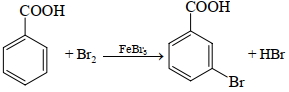
Consider the reaction shown below where $6.1 \,g$ of benzoic acid is used to obtain $7.8 \,g$ of $m$-bromobenzoic acid. The percentage yield of the product is ....... .
(Round off to the Nearest integer) [Given : Atomic masses : $C = 12.0 \,u, H = 1.0 \,u, O = 16.0 \,u, Br = 80.0 \,u$]
(Round off to the Nearest integer) [Given : Atomic masses : $C = 12.0 \,u, H = 1.0 \,u, O = 16.0 \,u, Br = 80.0 \,u$]
A
$78$
B
$70$
C
$80$
D
$52$
Solution
(A) The reaction is: $C_6H_5COOH + Br_2 \xrightarrow{FeBr_3} C_6H_4(Br)COOH + HBr$
Molar mass of benzoic acid $(C_7H_6O_2)$ $= (7 \times 12) + (6 \times 1) + (2 \times 16) = 84 + 6 + 32 = 122 \,g/mol$.
Molar mass of $m$-bromobenzoic acid $(C_7H_5BrO_2)$ $= 122 - 1 + 80 = 201 \,g/mol$.
Moles of benzoic acid used $= \frac{6.1 \,g}{122 \,g/mol} = 0.05 \,mol$.
According to the stoichiometry,$1 \,mol$ of benzoic acid produces $1 \,mol$ of $m$-bromobenzoic acid.
Theoretical yield of $m$-bromobenzoic acid $= 0.05 \,mol \times 201 \,g/mol = 10.05 \,g$.
Actual yield $= 7.8 \,g$.
Percentage yield $= \frac{\text{Actual yield}}{\text{Theoretical yield}} \times 100 = \frac{7.8}{10.05} \times 100 \approx 77.61 \,\%$.
Rounding off to the nearest integer,we get $78 \,\%$.
Molar mass of benzoic acid $(C_7H_6O_2)$ $= (7 \times 12) + (6 \times 1) + (2 \times 16) = 84 + 6 + 32 = 122 \,g/mol$.
Molar mass of $m$-bromobenzoic acid $(C_7H_5BrO_2)$ $= 122 - 1 + 80 = 201 \,g/mol$.
Moles of benzoic acid used $= \frac{6.1 \,g}{122 \,g/mol} = 0.05 \,mol$.
According to the stoichiometry,$1 \,mol$ of benzoic acid produces $1 \,mol$ of $m$-bromobenzoic acid.
Theoretical yield of $m$-bromobenzoic acid $= 0.05 \,mol \times 201 \,g/mol = 10.05 \,g$.
Actual yield $= 7.8 \,g$.
Percentage yield $= \frac{\text{Actual yield}}{\text{Theoretical yield}} \times 100 = \frac{7.8}{10.05} \times 100 \approx 77.61 \,\%$.
Rounding off to the nearest integer,we get $78 \,\%$.
0 likesView Solution
99
ChemistryMediumMCQJEE Main · 2021
The product formed in the first step of the reaction of $CH_3-CH_2-CH(Br)-CH_2-CH(Br)-CH_3$ with excess $Mg / Et_2O$ $(Et = C_2H_5)$ is
A
$CH_3-CH_2-CH(MgBr)-CH_2-CH(MgBr)-CH_3$
B
$CH_3-CH_2-CH(CH_3-CH_2-CH-CH_2-CH_3)-CH_2-CH(CH_3)-CH_2-CH_2-CH_3$
C
$A$ cyclopropane derivative
D
$MgBr-CH(CH_2CH_3)-CH_2-CH(MgBr)-CH_3$
Solution
(A) When a vicinal or geminal dihalide reacts with magnesium metal in the presence of dry ether $(Et_2O)$,it forms a Grignard reagent.
In the given reaction,$CH_3-CH_2-CH(Br)-CH_2-CH(Br)-CH_3$ reacts with excess $Mg$ in $Et_2O$ to form the corresponding di-Grignard reagent:
$CH_3-CH_2-CH(MgBr)-CH_2-CH(MgBr)-CH_3$.
This is the first step of the reaction.
In the given reaction,$CH_3-CH_2-CH(Br)-CH_2-CH(Br)-CH_3$ reacts with excess $Mg$ in $Et_2O$ to form the corresponding di-Grignard reagent:
$CH_3-CH_2-CH(MgBr)-CH_2-CH(MgBr)-CH_3$.
This is the first step of the reaction.
0 likesView Solution
100
ChemistryDifficultMCQJEE Main · 2021
Consider the elements $Mg$,$Al$,$S$,$P$ and $Si$. The correct increasing order of their first ionization enthalpy is:
A
$Mg < Al < Si < S < P$
B
$Al < Mg < Si < S < P$
C
$Mg < Al < Si < P < S$
D
$Al < Mg < S < Si < P$
Solution
(B) In general,from left to right in a period,the first ionization enthalpy increases due to an increase in effective nuclear charge.
However,due to the extra stability of half-filled $(p^3)$ and fully-filled $(s^2)$ electronic configurations,the ionization enthalpy of certain elements is higher than their neighbors.
The electronic configurations are: $Mg$ $([Ne] 3s^2)$,$Al$ $([Ne] 3s^2 3p^1)$,$Si$ $([Ne] 3s^2 3p^2)$,$P$ $([Ne] 3s^2 3p^3)$,and $S$ $([Ne] 3s^2 3p^4)$.
Due to the stable $s^2$ configuration of $Mg$,its ionization enthalpy is higher than $Al$.
Due to the stable half-filled $p^3$ configuration of $P$,its ionization enthalpy is higher than $S$.
Thus,the correct increasing order is $Al < Mg < Si < S < P$.
However,due to the extra stability of half-filled $(p^3)$ and fully-filled $(s^2)$ electronic configurations,the ionization enthalpy of certain elements is higher than their neighbors.
The electronic configurations are: $Mg$ $([Ne] 3s^2)$,$Al$ $([Ne] 3s^2 3p^1)$,$Si$ $([Ne] 3s^2 3p^2)$,$P$ $([Ne] 3s^2 3p^3)$,and $S$ $([Ne] 3s^2 3p^4)$.
Due to the stable $s^2$ configuration of $Mg$,its ionization enthalpy is higher than $Al$.
Due to the stable half-filled $p^3$ configuration of $P$,its ionization enthalpy is higher than $S$.
Thus,the correct increasing order is $Al < Mg < Si < S < P$.
0 likesView Solution
101
ChemistryMediumMCQJEE Main · 2021
In the above reaction,the reagent $A$ is :
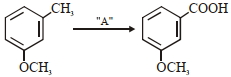
A
$NaBH_4, H_3O^{+}$
B
$LiAlH_4$
C
Alkaline $KMnO_4, H^{+}$
D
$HCl, Zn-Hg$
Solution
(C) The reaction shows the oxidation of an alkyl group (specifically a methyl group attached to a benzene ring) to a carboxylic acid group $(-COOH)$.
Alkaline $KMnO_4$ followed by acidic workup $(H^+)$ is a strong oxidizing agent that converts alkyl side chains on aromatic rings into carboxylic acid groups,regardless of the length of the alkyl chain,provided there is at least one benzylic hydrogen atom.
Therefore,the reagent $A$ is alkaline $KMnO_4$ followed by $H^+$.
Alkaline $KMnO_4$ followed by acidic workup $(H^+)$ is a strong oxidizing agent that converts alkyl side chains on aromatic rings into carboxylic acid groups,regardless of the length of the alkyl chain,provided there is at least one benzylic hydrogen atom.
Therefore,the reagent $A$ is alkaline $KMnO_4$ followed by $H^+$.
0 likesView Solution
102
ChemistryMediumMCQJEE Main · 2021
Which of the following reduction reactions $CANNOT$ be carried out with coke?
A
$Al_2O_3 \rightarrow Al$
B
$ZnO \rightarrow Zn$
C
$Fe_2O_3 \rightarrow Fe$
D
$Cu_2O \rightarrow Cu$
Solution
(A) The reduction of $Al_2O_3 \rightarrow Al$ cannot be carried out using coke (carbon) because aluminum has a very high affinity for oxygen and is more stable than $CO_2$.
It is instead carried out by the electrolytic reduction of its fused salts (Hall-Heroult process).
$ZnO$,$Fe_2O_3$,and $Cu_2O$ can be reduced to their respective metals using carbon (coke) as a reducing agent.
It is instead carried out by the electrolytic reduction of its fused salts (Hall-Heroult process).
$ZnO$,$Fe_2O_3$,and $Cu_2O$ can be reduced to their respective metals using carbon (coke) as a reducing agent.
0 likesView Solution
103
ChemistryMediumMCQJEE Main · 2021
The secondary structure of protein is stabilised by:
A
Peptide bond
B
Glycosidic bond
C
Hydrogen bonding
D
van der Waals forces
Solution
(C) The secondary structure of proteins includes two main types:
$(a)$ $\alpha-$Helix
$(b)$ $\beta-$pleated sheet
In the $\alpha-$Helix structure,the polypeptide chain is coiled due to the presence of intramolecular hydrogen bonding between the $C=O$ group of one amino acid and the $N-H$ group of another amino acid.
Similarly,in $\beta-$pleated sheets,the polypeptide chains are held together by intermolecular hydrogen bonding.
$(a)$ $\alpha-$Helix
$(b)$ $\beta-$pleated sheet
In the $\alpha-$Helix structure,the polypeptide chain is coiled due to the presence of intramolecular hydrogen bonding between the $C=O$ group of one amino acid and the $N-H$ group of another amino acid.
Similarly,in $\beta-$pleated sheets,the polypeptide chains are held together by intermolecular hydrogen bonding.
0 likesView Solution
104
ChemistryMediumMCQJEE Main · 2021
Which of the following polymers is used in the manufacture of wood laminates?
A
cis-polyisoprene
B
Melamine formaldehyde resin
C
Urea-formaldehyde resin
D
Phenol-formaldehyde resin
Solution
(C) Urea-formaldehyde resin is widely used in the manufacture of wood laminates and adhesives for bonding wood.
0 likesView Solution
105
ChemistryMediumMCQJEE Main · 2021
Ammonolysis of alkyl halides followed by treatment with $NaOH$ solution can be used to prepare primary,secondary,and tertiary amines. The purpose of $NaOH$ in the reaction is:
A
to remove basic impurities
B
to activate $NH_3$ used in the reaction
C
to remove acidic impurities
D
to increase the reactivity of alkyl halide
Solution
(C) In the reaction of alkyl halides with ammonia,the initial product is an alkylammonium salt,which is an acidic species (e.g.,$[R-NH_3]^+ X^-$).
$NaOH$ is added to the reaction mixture to neutralize this acidic salt,thereby liberating the free amine $(R-NH_2)$ which can then further react with more alkyl halide to form secondary and tertiary amines.
Thus,the purpose of $NaOH$ is to remove acidic impurities (the hydrogen halide salt) from the reaction medium.
$NaOH$ is added to the reaction mixture to neutralize this acidic salt,thereby liberating the free amine $(R-NH_2)$ which can then further react with more alkyl halide to form secondary and tertiary amines.
Thus,the purpose of $NaOH$ is to remove acidic impurities (the hydrogen halide salt) from the reaction medium.
0 likesView Solution
106
ChemistryMediumMCQJEE Main · 2021
Which of the following is least basic?
A
$(CH_3CO)\ddot{N}HC_2H_5$
B
$(C_2H_5)_3\ddot{N}$
C
$(CH_3CO)_2\ddot{N}H$
D
$(C_2H_5)_2\ddot{N}H$
Solution
(C) The basicity of an amine depends on the availability of the lone pair of electrons on the nitrogen atom for protonation.
$1$. In $(CH_3CO)\ddot{N}HC_2H_5$ (an amide),the lone pair on nitrogen is delocalized due to conjugation with the carbonyl group $(C=O)$,making it less available.
$2$. In $(C_2H_5)_3\ddot{N}$ (a tertiary amine),the lone pair is localized and available for donation.
$3$. In $(CH_3CO)_2\ddot{N}H$ (an imide),the lone pair on nitrogen is strongly delocalized due to conjugation with two electron-withdrawing carbonyl groups. This makes the lone pair least available for protonation,rendering it the least basic.
$4$. In $(C_2H_5)_2\ddot{N}H$ (a secondary amine),the lone pair is localized and available for donation.
Therefore,$(CH_3CO)_2\ddot{N}H$ is the least basic compound.
$1$. In $(CH_3CO)\ddot{N}HC_2H_5$ (an amide),the lone pair on nitrogen is delocalized due to conjugation with the carbonyl group $(C=O)$,making it less available.
$2$. In $(C_2H_5)_3\ddot{N}$ (a tertiary amine),the lone pair is localized and available for donation.
$3$. In $(CH_3CO)_2\ddot{N}H$ (an imide),the lone pair on nitrogen is strongly delocalized due to conjugation with two electron-withdrawing carbonyl groups. This makes the lone pair least available for protonation,rendering it the least basic.
$4$. In $(C_2H_5)_2\ddot{N}H$ (a secondary amine),the lone pair is localized and available for donation.
Therefore,$(CH_3CO)_2\ddot{N}H$ is the least basic compound.
0 likesView Solution
107
ChemistryMediumMCQJEE Main · 2021
Which of the following statements regarding colloidal solutions is $INCORRECT$?
A
$A$. $A$ colloidal solution shows colligative properties.
B
$B$. An ordinary filter paper can stop the flow of colloidal particles.
C
$C$. The flocculating power of $Al^{3+}$ is more than that of $Na^{+}$.
D
$D$. $A$ colloidal solution shows Brownian motion of colloidal particles.
Solution
(B) Colloidal solutions exhibit colligative properties due to the presence of particles,although the values are small compared to true solutions.
An ordinary filter paper has large pores that allow colloidal particles to pass through easily; therefore,it cannot stop the flow of colloidal particles.
According to the Hardy-Schulze rule,the flocculating power of an ion increases with the increase in the magnitude of its charge. Thus,$Al^{3+}$ has a much higher flocculating power than $Na^{+}$.
Colloidal particles exhibit Brownian motion due to the unbalanced bombardment of the particles by the molecules of the dispersion medium.
Therefore,statement $B$ is incorrect.
An ordinary filter paper has large pores that allow colloidal particles to pass through easily; therefore,it cannot stop the flow of colloidal particles.
According to the Hardy-Schulze rule,the flocculating power of an ion increases with the increase in the magnitude of its charge. Thus,$Al^{3+}$ has a much higher flocculating power than $Na^{+}$.
Colloidal particles exhibit Brownian motion due to the unbalanced bombardment of the particles by the molecules of the dispersion medium.
Therefore,statement $B$ is incorrect.
0 likesView Solution
108
ChemistryMediumMCQJEE Main · 2021
Arrange the following metal complexes/compounds in the increasing order of spin-only magnetic moment. Presume all three are high-spin systems.
(Atomic numbers: $Ce = 58$,$Gd = 64$,and $Eu = 63$.)
$(a)$ $(NH_4)_2[Ce(NO_3)_6]$
$(b)$ $Gd(NO_3)_3$
$(c)$ $Eu(NO_3)_3$
Answer is:
(Atomic numbers: $Ce = 58$,$Gd = 64$,and $Eu = 63$.)
$(a)$ $(NH_4)_2[Ce(NO_3)_6]$
$(b)$ $Gd(NO_3)_3$
$(c)$ $Eu(NO_3)_3$
Answer is:
A
$(b) < (a) < (c)$
B
$(c) < (a) < (b)$
C
$(a) < (b) < (c)$
D
$(a) < (c) < (b)$
Solution
(D) $_{58}Ce \rightarrow [Xe] 4f^1 5d^1 6s^2$. In the complex,$Ce^{4+} \rightarrow [Xe] 4f^0$. There are $0$ unpaired electrons,so $\mu_m = 0 \ B.M$.
$(b)$ $_{64}Gd^{3+} \rightarrow [Xe] 4f^7$. There are $7$ unpaired electrons,so $\mu_m = \sqrt{7(7+2)} = \sqrt{63} \ B.M$.
$(c)$ $_{63}Eu^{3+} \rightarrow [Xe] 4f^6$. There are $6$ unpaired electrons,so $\mu_m = \sqrt{6(6+2)} = \sqrt{48} \ B.M$.
Comparing the magnetic moments: $0 < \sqrt{48} < \sqrt{63}$.
Thus,the increasing order is $(a) < (c) < (b)$.
$(b)$ $_{64}Gd^{3+} \rightarrow [Xe] 4f^7$. There are $7$ unpaired electrons,so $\mu_m = \sqrt{7(7+2)} = \sqrt{63} \ B.M$.
$(c)$ $_{63}Eu^{3+} \rightarrow [Xe] 4f^6$. There are $6$ unpaired electrons,so $\mu_m = \sqrt{6(6+2)} = \sqrt{48} \ B.M$.
Comparing the magnetic moments: $0 < \sqrt{48} < \sqrt{63}$.
Thus,the increasing order is $(a) < (c) < (b)$.
0 likesView Solution
109
ChemistryMediumMCQJEE Main · 2021
The structure of $X$ is :
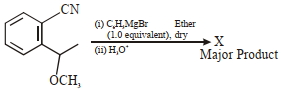
A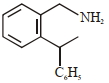
B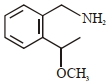
C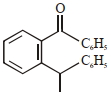
D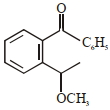
Solution
(D) The reaction of a nitrile $(-CN)$ with a Grignard reagent $(PhMgBr)$ followed by acid hydrolysis $(H_3O^+)$ is a standard method for the preparation of ketones.
$1$. The nucleophilic phenyl group $(Ph^-)$ from $PhMgBr$ attacks the electrophilic carbon of the nitrile group $(-CN)$ to form an imine magnesium salt intermediate.
$2$. Subsequent acid hydrolysis $(H_3O^+)$ converts the imine intermediate into a ketone $(C=O)$.
$3$. The other substituent on the benzene ring,$-\text{CH}(\text{CH}_3)\text{OCH}_3$,remains unaffected by these reagents.
$4$. Therefore,the final product $X$ is a ketone where the $-CN$ group is replaced by a $-COC_6H_5$ group,while the side chain $-\text{CH}(\text{CH}_3)\text{OCH}_3$ remains unchanged.
$1$. The nucleophilic phenyl group $(Ph^-)$ from $PhMgBr$ attacks the electrophilic carbon of the nitrile group $(-CN)$ to form an imine magnesium salt intermediate.
$2$. Subsequent acid hydrolysis $(H_3O^+)$ converts the imine intermediate into a ketone $(C=O)$.
$3$. The other substituent on the benzene ring,$-\text{CH}(\text{CH}_3)\text{OCH}_3$,remains unaffected by these reagents.
$4$. Therefore,the final product $X$ is a ketone where the $-CN$ group is replaced by a $-COC_6H_5$ group,while the side chain $-\text{CH}(\text{CH}_3)\text{OCH}_3$ remains unchanged.
0 likesView Solution
110
ChemistryMediumMCQJEE Main · 2021
$Ga$ (atomic mass $70 \, u$) crystallizes in a hexagonal close packed structure. The total number of voids in $0.581 \, g$ of $Ga$ is $\dots \dots \dots \dots \dots \times 10^{21}$. (Round off to the Nearest Integer).
A
$14$
B
$13$
C
$15$
D
$15.9$
Solution
(C) In an $HCP$ structure,for every $1$ atom,there is $1$ octahedral void $(OV)$ and $2$ tetrahedral voids $(TV)$.
Therefore,the total number of voids per atom is $1 + 2 = 3$.
Number of moles of $Ga = \frac{\text{Mass}}{\text{Molar Mass}} = \frac{0.581 \, g}{70 \, g/mol} = 0.0083 \, mol$.
Number of $Ga$ atoms $= \text{moles} \times N_A = 0.0083 \times 6.022 \times 10^{23} \approx 4.998 \times 10^{21}$ atoms.
Total number of voids $= 3 \times \text{Number of atoms} = 3 \times 4.998 \times 10^{21} = 14.994 \times 10^{21}$.
Rounding to the nearest integer,we get $15 \times 10^{21}$.
Therefore,the total number of voids per atom is $1 + 2 = 3$.
Number of moles of $Ga = \frac{\text{Mass}}{\text{Molar Mass}} = \frac{0.581 \, g}{70 \, g/mol} = 0.0083 \, mol$.
Number of $Ga$ atoms $= \text{moles} \times N_A = 0.0083 \times 6.022 \times 10^{23} \approx 4.998 \times 10^{21}$ atoms.
Total number of voids $= 3 \times \text{Number of atoms} = 3 \times 4.998 \times 10^{21} = 14.994 \times 10^{21}$.
Rounding to the nearest integer,we get $15 \times 10^{21}$.
0 likesView Solution
111
ChemistryDifficultMCQJEE Main · 2021
$A$ $5.0 \, mmol \, dm^{-3}$ aqueous solution of $KCl$ has a conductance of $0.55 \, mS$ when measured in a cell with a cell constant of $1.3 \, cm^{-1}$. The molar conductivity of this solution is ....... $mS \, m^{2} \, mol^{-1}$. (Round off to the Nearest Integer)
A
$133$
B
$195$
C
$143$
D
$241$
Solution
(C) Given: Concentration $(C) = 5.0 \, mmol \, dm^{-3} = 5.0 \times 10^{-3} \, mol \, L^{-1} = 5.0 \, mol \, m^{-3}$.
Conductance $(G) = 0.55 \, mS = 0.55 \times 10^{-3} \, S$.
Cell constant $(G^*) = 1.3 \, cm^{-1} = 130 \, m^{-1}$.
Conductivity $(\kappa) = G \times G^* = 0.55 \, mS \times 130 \, m^{-1} = 71.5 \, mS \, m^{-1} = 0.0715 \, S \, m^{-1}$.
Molar conductivity $(\lambda_m) = \frac{\kappa}{C} = \frac{0.0715 \, S \, m^{-1}}{5.0 \, mol \, m^{-3}} = 0.0143 \, S \, m^2 \, mol^{-1} = 14.3 \, mS \, m^2 \, mol^{-1}$.
Rounding to the nearest integer,the value is $14$.
Conductance $(G) = 0.55 \, mS = 0.55 \times 10^{-3} \, S$.
Cell constant $(G^*) = 1.3 \, cm^{-1} = 130 \, m^{-1}$.
Conductivity $(\kappa) = G \times G^* = 0.55 \, mS \times 130 \, m^{-1} = 71.5 \, mS \, m^{-1} = 0.0715 \, S \, m^{-1}$.
Molar conductivity $(\lambda_m) = \frac{\kappa}{C} = \frac{0.0715 \, S \, m^{-1}}{5.0 \, mol \, m^{-3}} = 0.0143 \, S \, m^2 \, mol^{-1} = 14.3 \, mS \, m^2 \, mol^{-1}$.
Rounding to the nearest integer,the value is $14$.
0 likesView Solution
112
ChemistryMediumMCQJEE Main · 2021
$A$ and $B$ decompose via first order kinetics with half-lives $54.0 \, min$ and $18.0 \, min$ respectively. Starting from an equimolar non-reactive mixture of $A$ and $B$,the time taken for the concentration of $A$ to become $16$ times that of $B$ is ...... $min.$ (Round off to the Nearest Integer).
A
$110$
B
$108$
C
$208$
D
$136$
Solution
(B) Given $(t_{1/2})_A = 54 \, min$ and $(t_{1/2})_B = 18 \, min$.
Starting with equimolar concentrations,let $[A]_0 = [B]_0 = x$.
For first order kinetics,the concentration at time $t$ is given by $[A]_t = [A]_0 \times (1/2)^n$,where $n = t / t_{1/2}$.
We want $[A]_t = 16 \times [B]_t$.
Substituting the expressions: $x \times (1/2)^{t/54} = 16 \times x \times (1/2)^{t/18}$.
$(1/2)^{t/54} = 2^4 \times (1/2)^{t/18}$.
$(1/2)^{t/54} = (1/2)^{-4} \times (1/2)^{t/18}$.
$(1/2)^{t/54} = (1/2)^{(t/18) - 4}$.
Equating the exponents: $t/54 = (t/18) - 4$.
$4 = t/18 - t/54 = (3t - t) / 54 = 2t / 54 = t / 27$.
$t = 4 \times 27 = 108 \, min$.
Starting with equimolar concentrations,let $[A]_0 = [B]_0 = x$.
For first order kinetics,the concentration at time $t$ is given by $[A]_t = [A]_0 \times (1/2)^n$,where $n = t / t_{1/2}$.
We want $[A]_t = 16 \times [B]_t$.
Substituting the expressions: $x \times (1/2)^{t/54} = 16 \times x \times (1/2)^{t/18}$.
$(1/2)^{t/54} = 2^4 \times (1/2)^{t/18}$.
$(1/2)^{t/54} = (1/2)^{-4} \times (1/2)^{t/18}$.
$(1/2)^{t/54} = (1/2)^{(t/18) - 4}$.
Equating the exponents: $t/54 = (t/18) - 4$.
$4 = t/18 - t/54 = (3t - t) / 54 = 2t / 54 = t / 27$.
$t = 4 \times 27 = 108 \, min$.
0 likesView Solution
113
ChemistryMediumMCQJEE Main · 2021
At $363 \ K,$ the vapour pressure of $A$ is $21 \ kPa$ and that of $B$ is $18 \ kPa$. One mole of $A$ and $2 \ moles$ of $B$ are mixed. Assuming that this solution is ideal,the vapour pressure of the mixture is $....... \ kPa$. (Round off to the Nearest Integer).
A
$19$
B
$21$
C
$25$
D
$36$
Solution
(A) Given: $P_{A}^{0} = 21 \ kPa$ and $P_{B}^{0} = 18 \ kPa$.
Number of moles of $A$ $(n_{A})$ = $1 \ mol$,Number of moles of $B$ $(n_{B})$ = $2 \ mol$.
Total moles = $1 + 2 = 3 \ mol$.
Mole fraction of $A$ $(X_{A})$ = $\frac{1}{3}$ and mole fraction of $B$ $(X_{B})$ = $\frac{2}{3}$.
According to Raoult's law for an ideal solution: $P_{T} = X_{A} P_{A}^{0} + X_{B} P_{B}^{0}$.
$P_{T} = (\frac{1}{3} \times 21) + (\frac{2}{3} \times 18)$.
$P_{T} = 7 + 12 = 19 \ kPa$.
Number of moles of $A$ $(n_{A})$ = $1 \ mol$,Number of moles of $B$ $(n_{B})$ = $2 \ mol$.
Total moles = $1 + 2 = 3 \ mol$.
Mole fraction of $A$ $(X_{A})$ = $\frac{1}{3}$ and mole fraction of $B$ $(X_{B})$ = $\frac{2}{3}$.
According to Raoult's law for an ideal solution: $P_{T} = X_{A} P_{A}^{0} + X_{B} P_{B}^{0}$.
$P_{T} = (\frac{1}{3} \times 21) + (\frac{2}{3} \times 18)$.
$P_{T} = 7 + 12 = 19 \ kPa$.
0 likesView Solution
114
ChemistryDifficultMCQJEE Main · 2021
$\left[ Ti \left( H_{2} O \right)_{6} \right]^{3+}$ absorbs light of wavelength $498 \, nm$ during a $d-d$ transition. The octahedral splitting energy for the above complex is $....... \times 10^{-19} \, J$. (Round off to the Nearest Integer). Given: $h = 6.626 \times 10^{-34} \, Js$,$c = 3 \times 10^{8} \, ms^{-1}$.
A
$4$
B
$3$
C
$2$
D
$1$
Solution
(A) The energy of the absorbed photon corresponds to the octahedral splitting energy $\Delta_{0}$.
Using the formula $E = \frac{hc}{\lambda}$:
Given $\lambda = 498 \, nm = 498 \times 10^{-9} \, m$,$h = 6.626 \times 10^{-34} \, Js$,and $c = 3 \times 10^{8} \, ms^{-1}$.
$\Delta_{0} = \frac{6.626 \times 10^{-34} \times 3 \times 10^{8}}{498 \times 10^{-9}} \, J$
$\Delta_{0} = \frac{19.878 \times 10^{-26}}{498 \times 10^{-9}} \, J$
$\Delta_{0} \approx 0.039915 \times 10^{-17} \, J = 3.9915 \times 10^{-19} \, J$.
Rounding off to the nearest integer,we get $4 \times 10^{-19} \, J$.
Using the formula $E = \frac{hc}{\lambda}$:
Given $\lambda = 498 \, nm = 498 \times 10^{-9} \, m$,$h = 6.626 \times 10^{-34} \, Js$,and $c = 3 \times 10^{8} \, ms^{-1}$.
$\Delta_{0} = \frac{6.626 \times 10^{-34} \times 3 \times 10^{8}}{498 \times 10^{-9}} \, J$
$\Delta_{0} = \frac{19.878 \times 10^{-26}}{498 \times 10^{-9}} \, J$
$\Delta_{0} \approx 0.039915 \times 10^{-17} \, J = 3.9915 \times 10^{-19} \, J$.
Rounding off to the nearest integer,we get $4 \times 10^{-19} \, J$.
0 likesView Solution
115
ChemistryMediumMCQJEE Main · 2021
Fructose is an example of :-
A
Pyranose
B
Ketohexose
C
Aldohexose
D
Heptose
Solution
(B) Fructose is a monosaccharide with the molecular formula $C_6H_{12}O_6$.
It contains a ketone group $(>C=O)$ at the $C-2$ position and six carbon atoms in its chain.
Therefore,it is classified as a ketohexose.
It contains a ketone group $(>C=O)$ at the $C-2$ position and six carbon atoms in its chain.
Therefore,it is classified as a ketohexose.
0 likesView Solution
116
ChemistryMediumMCQJEE Main · 2021
The functional groups that are responsible for the ion-exchange property of cation and anion exchange resins,respectively,are :
A
$-SO_3H$ and $-NH_2$
B
$-SO_3H$ and $-COOH$
C
$-NH_2$ and $-COOH$
D
$-NH_2$ and $-SO_3H$
Solution
(A) Cation exchange resins contain acidic functional groups such as $-SO_3H$ or $-COOH$ which can release $H^+$ ions.
Anion exchange resins contain basic functional groups such as $-NH_2$ or $-NH_3^+OH^-$ which can release $OH^-$ ions.
Therefore,the correct pair for cation and anion exchange resins is $-SO_3H$ and $-NH_2$ respectively.
Anion exchange resins contain basic functional groups such as $-NH_2$ or $-NH_3^+OH^-$ which can release $OH^-$ ions.
Therefore,the correct pair for cation and anion exchange resins is $-SO_3H$ and $-NH_2$ respectively.
0 likesView Solution
117
ChemistryMediumMCQJEE Main · 2021
Match List-$I$ and List-$II$ :
Choose the correct answer from the options given below :
| List-$I$ | List-$II$ |
|---|---|
| $(a).$ Haematite | $(i).$ $Al_{2}O_{3} \cdot xH_{2}O$ |
| $(b).$ Bauxite | $(ii).$ $Fe_{2}O_{3}$ |
| $(c).$ Magnetite | $(iii).$ $CuCO_{3} \cdot Cu(OH)_{2}$ |
| $(d).$ Malachite | $(iv).$ $Fe_{3}O_{4}$ |
Choose the correct answer from the options given below :
A
$(a)-(ii), (b)-(iii), (c)-(i), (d)-(iv)$
B
$(a)-(iv), (b)-(i), (c)-(ii), (d)-(iii)$
C
$(a)-(i), (b)-(iii), (c)-(ii), (d)-(iv)$
D
$(a)-(ii), (b)-(i), (c)-(iv), (d)-(iii)$
Solution
(D) The correct matches are as follows:
$(a).$ Haematite is $Fe_{2}O_{3}$ $(ii)$.
$(b).$ Bauxite is $Al_{2}O_{3} \cdot xH_{2}O$ $(i)$.
$(c).$ Magnetite is $Fe_{3}O_{4}$ $(iv)$.
$(d).$ Malachite is $CuCO_{3} \cdot Cu(OH)_{2}$ $(iii)$.
Therefore,the correct sequence is $(a)-(ii), (b)-(i), (c)-(iv), (d)-(iii)$.
$(a).$ Haematite is $Fe_{2}O_{3}$ $(ii)$.
$(b).$ Bauxite is $Al_{2}O_{3} \cdot xH_{2}O$ $(i)$.
$(c).$ Magnetite is $Fe_{3}O_{4}$ $(iv)$.
$(d).$ Malachite is $CuCO_{3} \cdot Cu(OH)_{2}$ $(iii)$.
Therefore,the correct sequence is $(a)-(ii), (b)-(i), (c)-(iv), (d)-(iii)$.
0 likesView Solution
118
ChemistryMediumMCQJEE Main · 2021
The correct pair$(s)$ of the ambident nucleophiles is (are):
$(A)$ $AgCN / KCN$
$(B)$ $RCOOAg / RCOOK$
$(C)$ $AgNO_{2} / KNO_{2}$
$(D)$ $AgI / KI$
$(A)$ $AgCN / KCN$
$(B)$ $RCOOAg / RCOOK$
$(C)$ $AgNO_{2} / KNO_{2}$
$(D)$ $AgI / KI$
A
$(B)$ and $(C)$ only
B
$(A)$ only
C
$(A)$ and $(C)$ only
D
$(B)$ only
Solution
(C) An ambident nucleophile is a species that has two or more nucleophilic sites through which it can attack.
$(A)$ $KCN$ and $AgCN$: $CN^-$ is an ambident nucleophile as it can attack through $C$ or $N$.
$(C)$ $AgNO_{2}$ and $KNO_{2}$: $NO_2^-$ is an ambident nucleophile as it can attack through $N$ or $O$.
$(B)$ $RCOOAg / RCOOK$ and $(D)$ $AgI / KI$ do not represent pairs of ambident nucleophiles in the context of typical organic reactions.
Therefore,the correct pairs are $(A)$ and $(C)$.
$(A)$ $KCN$ and $AgCN$: $CN^-$ is an ambident nucleophile as it can attack through $C$ or $N$.
$(C)$ $AgNO_{2}$ and $KNO_{2}$: $NO_2^-$ is an ambident nucleophile as it can attack through $N$ or $O$.
$(B)$ $RCOOAg / RCOOK$ and $(D)$ $AgI / KI$ do not represent pairs of ambident nucleophiles in the context of typical organic reactions.
Therefore,the correct pairs are $(A)$ and $(C)$.
0 likesView Solution
119
ChemistryMediumMCQJEE Main · 2021
The set that represents the pair of neutral oxides of nitrogen is :
A
$NO$ and $N_2O$
B
$N_2O$ and $N_2O_3$
C
$N_2O$ and $NO_2$
D
$NO$ and $NO_2$
Solution
(A) $N_2O$ (nitrous oxide) and $NO$ (nitric oxide) are neutral oxides of nitrogen.
$N_2O_3$,$NO_2$,and $N_2O_5$ are acidic oxides of nitrogen.
$N_2O_3$,$NO_2$,and $N_2O_5$ are acidic oxides of nitrogen.
0 likesView Solution
120
ChemistryMediumMCQJEE Main · 2021
Match List-$I$ with List-$II$ :
Choose the correct answer from the options given below:
| List-$I$ | List-$II$ |
| $(a).$ $[Co(NH_3)_6][Cr(CN)_6]$ | $(i).$ Linkage isomerism |
| $(b).$ $[Co(NH_3)_3(NO_2)_3]$ | $(ii).$ Solvate isomerism |
| $(c).$ $[Cr(H_2O)_6]Cl_3$ | $(iii).$ Coordination isomerism |
| $(d).$ $cis-[CrCl_2(ox)_2]^{3-}$ | $(iv).$ Optical isomerism |
Choose the correct answer from the options given below:
A
$(a)-(iii), (b)-(i), (c)-(ii), (d)-(iv)$
B
$(a)-(iv), (b)-(ii), (c)-(iii), (d)-(i)$
C
$(a)-(ii), (b)-(i), (c)-(iii), (d)-(iv)$
D
$(a)-(i), (b)-(ii), (c)-(iii), (d)-(iv)$
Solution
(A) The correct matching is as follows:
$1$. $[Co(NH_3)_6][Cr(CN)_6]$ shows Coordination isomerism because both the cation and anion are complex ions,and ligands can be exchanged between them.
$2$. $[Co(NH_3)_3(NO_2)_3]$ shows Linkage isomerism due to the presence of the ambidentate ligand $NO_2^-$.
$3$. $[Cr(H_2O)_6]Cl_3$ shows Solvate (or Hydrate) isomerism as water molecules can act as ligands or be present as lattice water.
$4$. $cis-[CrCl_2(ox)_2]^{3-}$ shows Optical isomerism because the $cis$ isomer lacks a plane of symmetry.
Thus,the correct sequence is $(a)-(iii), (b)-(i), (c)-(ii), (d)-(iv)$.
$1$. $[Co(NH_3)_6][Cr(CN)_6]$ shows Coordination isomerism because both the cation and anion are complex ions,and ligands can be exchanged between them.
$2$. $[Co(NH_3)_3(NO_2)_3]$ shows Linkage isomerism due to the presence of the ambidentate ligand $NO_2^-$.
$3$. $[Cr(H_2O)_6]Cl_3$ shows Solvate (or Hydrate) isomerism as water molecules can act as ligands or be present as lattice water.
$4$. $cis-[CrCl_2(ox)_2]^{3-}$ shows Optical isomerism because the $cis$ isomer lacks a plane of symmetry.
Thus,the correct sequence is $(a)-(iii), (b)-(i), (c)-(ii), (d)-(iv)$.
0 likesView Solution
121
ChemistryMediumMCQJEE Main · 2021
Primary,secondary and tertiary amines can be separated using :-
A
Para-Toluene sulphonyl chloride
B
Chloroform and $KOH$
C
Benzene sulphonic acid
D
Acetyl amide
Solution
(A) Primary,secondary,and tertiary amines can be distinguished using Hinsberg's reagent,which is $Para-Toluene$ sulphonyl chloride $(CH_3C_6H_4SO_2Cl)$.
$1.$ Primary amines react with $Para-Toluene$ sulphonyl chloride to form an $N-alkyl$ sulphonamide,which contains an acidic hydrogen atom attached to the nitrogen,making it soluble in $NaOH$.
$2.$ Secondary amines react to form an $N,N-dialkyl$ sulphonamide,which lacks an acidic hydrogen atom,rendering it insoluble in $NaOH$.
$3.$ Tertiary amines do not react with $Para-Toluene$ sulphonyl chloride because they lack a hydrogen atom on the nitrogen.
$1.$ Primary amines react with $Para-Toluene$ sulphonyl chloride to form an $N-alkyl$ sulphonamide,which contains an acidic hydrogen atom attached to the nitrogen,making it soluble in $NaOH$.
$2.$ Secondary amines react to form an $N,N-dialkyl$ sulphonamide,which lacks an acidic hydrogen atom,rendering it insoluble in $NaOH$.
$3.$ Tertiary amines do not react with $Para-Toluene$ sulphonyl chloride because they lack a hydrogen atom on the nitrogen.
0 likesView Solution
122
ChemistryEasyMCQJEE Main · 2021
The common positive oxidation states for an element with atomic number $24$ are:
A
$+2$ to $+6$
B
$+1$ and $+3$ to $+6$
C
$+1$ and $+3$
D
$+1$ to $+6$
Solution
(A) The element with atomic number $24$ is Chromium $(Cr)$.
The electronic configuration of $Cr$ is $[Ar] \, 4s^{1} \, 3d^{5}$.
Chromium exhibits a range of common oxidation states from $+2$ to $+6$ in its various compounds.
The electronic configuration of $Cr$ is $[Ar] \, 4s^{1} \, 3d^{5}$.
Chromium exhibits a range of common oxidation states from $+2$ to $+6$ in its various compounds.
0 likesView Solution
123
ChemistryMediumMCQJEE Main · 2021
Match List-$I$ with List-$II$ :
Choose the correct match:
| List-$I$ (Chemical) | List-$II$ (Used as) |
| $(a)$. Sucralose | $(i)$. Synthetic detergent |
| $(b)$. Glyceryl ester of stearic acid | $(ii)$. Artificial sweetener |
| $(c)$. Sodium benzoate | $(iii)$. Antiseptic |
| $(d)$. Bithionol | $(iv)$. Food preservative |
Choose the correct match:
A
$(a)-(iv), (b)-(iii), (c)-(ii), (d)-(i)$
B
$(a)-(ii), (b)-(i), (c)-(iv), (d)-(iii)$
C
$(a)-(iii), (b)-(ii), (c)-(iv), (d)-(i)$
D
$(a)-(i), (b)-(ii), (c)-(iv), (d)-(iii)$
Solution
(B) The correct matches are:
$(a)$. Sucralose is an artificial sweetener. $(a)-(ii)$
$(b)$. Glyceryl ester of stearic acid is a soap. $(b)-(i)$
$(c)$. Sodium benzoate is a food preservative. $(c)-(iv)$
$(d)$. Bithionol is an antiseptic. $(d)-(iii)$
Therefore,the correct sequence is $(a)-(ii), (b)-(i), (c)-(iv), (d)-(iii)$.
$(a)$. Sucralose is an artificial sweetener. $(a)-(ii)$
$(b)$. Glyceryl ester of stearic acid is a soap. $(b)-(i)$
$(c)$. Sodium benzoate is a food preservative. $(c)-(iv)$
$(d)$. Bithionol is an antiseptic. $(d)-(iii)$
Therefore,the correct sequence is $(a)-(ii), (b)-(i), (c)-(iv), (d)-(iii)$.
0 likesView Solution
124
ChemistryEasyMCQJEE Main · 2021
$C_{12}H_{22}O_{11} + H_2O \stackrel{\text{Enzyme A}}{\longrightarrow} C_6H_{12}O_6 + C_6H_{12}O_6$
$\text{Sucrose} \quad \quad \quad \quad \quad \quad \quad \quad \quad \quad \quad \text{Glucose} \quad \quad \quad \quad \text{Fructose}$
$C_6H_{12}O_6 \stackrel{\text{Enzyme B}}{\longrightarrow} 2C_2H_5OH + 2CO_2$
$\text{Glucose}$
In the above reactions,the enzyme $A$ and enzyme $B$ respectively are :-
$\text{Sucrose} \quad \quad \quad \quad \quad \quad \quad \quad \quad \quad \quad \text{Glucose} \quad \quad \quad \quad \text{Fructose}$
$C_6H_{12}O_6 \stackrel{\text{Enzyme B}}{\longrightarrow} 2C_2H_5OH + 2CO_2$
$\text{Glucose}$
In the above reactions,the enzyme $A$ and enzyme $B$ respectively are :-
A
Amylase and Invertase
B
Invertase and Amylase
C
Invertase and Zymase
D
Zymase and Invertase
Solution
(C) The hydrolysis of sucrose into glucose and fructose is catalyzed by the enzyme $Invertase$.
The fermentation of glucose into ethanol and carbon dioxide is catalyzed by the enzyme $Zymase$.
Therefore,the reactions are:
$C_{12}H_{22}O_{11} + H_2O \stackrel{\text{Invertase}}{\longrightarrow} C_6H_{12}O_6 + C_6H_{12}O_6$
$C_6H_{12}O_6 \stackrel{\text{Zymase}}{\longrightarrow} 2C_2H_5OH + 2CO_2$
Thus,enzyme $A$ is $Invertase$ and enzyme $B$ is $Zymase$.
The fermentation of glucose into ethanol and carbon dioxide is catalyzed by the enzyme $Zymase$.
Therefore,the reactions are:
$C_{12}H_{22}O_{11} + H_2O \stackrel{\text{Invertase}}{\longrightarrow} C_6H_{12}O_6 + C_6H_{12}O_6$
$C_6H_{12}O_6 \stackrel{\text{Zymase}}{\longrightarrow} 2C_2H_5OH + 2CO_2$
Thus,enzyme $A$ is $Invertase$ and enzyme $B$ is $Zymase$.
0 likesView Solution
125
ChemistryMediumMCQJEE Main · 2021
In the reaction shown below,the structural formula of $(A)$,$X$ and $Y$ respectively are:
$C_7H_7N_2OCl + C_2H_5OH \rightarrow \text{Anisole} + N_2 + X + Y$
$C_7H_7N_2OCl + C_2H_5OH \rightarrow \text{Anisole} + N_2 + X + Y$
A
$p-\text{methoxyphenyl diazonium chloride}, CH_3CHO, HCl$
B
$p-\text{methoxyphenyl diazonium chloride}, \text{ethylene oxide}, HCl$
C
$p-\text{methoxyphenyl diazonium chloride}, CH_3CHO, H_2O$
D
$p-\text{methoxyphenyl diazonium chloride}, \text{ethylene oxide}, H_2O$
Solution
(A) The reaction of $p-\text{methoxyphenyl diazonium chloride}$ with ethanol $(C_2H_5OH)$ is a reduction reaction where the diazonium group is replaced by a hydrogen atom to form anisole.
The reaction is as follows:
$CH_3O-C_6H_4-N_2^+Cl^- + CH_3CH_2OH \rightarrow CH_3O-C_6H_5 + N_2 + CH_3CHO + HCl$
Here,$(A)$ is $p-\text{methoxyphenyl diazonium chloride}$,$X$ is acetaldehyde $(CH_3CHO)$,and $Y$ is hydrogen chloride $(HCl)$.
The reaction is as follows:
$CH_3O-C_6H_4-N_2^+Cl^- + CH_3CH_2OH \rightarrow CH_3O-C_6H_5 + N_2 + CH_3CHO + HCl$
Here,$(A)$ is $p-\text{methoxyphenyl diazonium chloride}$,$X$ is acetaldehyde $(CH_3CHO)$,and $Y$ is hydrogen chloride $(HCl)$.
0 likesView Solution
126
ChemistryEasyMCQJEE Main · 2021
For the coagulation of a negative sol,the species below,that has the highest flocculating power is:
A
$SO_{4}^{2-}$
B
$Ba^{2+}$
C
$Na^{+}$
D
$PO_{4}^{3-}$
Solution
(B) According to the Hardy-Schulze rule,the coagulating power of an ion is directly proportional to the magnitude of its charge.
For a negative sol,the coagulating species must be a cation.
Comparing the given cations: $Na^{+}$ (charge $+1$) and $Ba^{2+}$ (charge $+2$).
Since $Ba^{2+}$ has a higher charge than $Na^{+}$,it will have a higher flocculating power.
Therefore,$Ba^{2+}$ is the correct species.
For a negative sol,the coagulating species must be a cation.
Comparing the given cations: $Na^{+}$ (charge $+1$) and $Ba^{2+}$ (charge $+2$).
Since $Ba^{2+}$ has a higher charge than $Na^{+}$,it will have a higher flocculating power.
Therefore,$Ba^{2+}$ is the correct species.
0 likesView Solution
127
ChemistryDifficultMCQJEE Main · 2021
$A$ $KCl$ solution of conductivity $0.14 \, S m^{-1}$ shows a resistance of $4.19 \, \Omega$ in a conductivity cell. If the same cell is filled with an $HCl$ solution,the resistance drops to $1.03 \, \Omega$. The conductivity of the $HCl$ solution is $....... \, \times 10^{-2} \, S m^{-1}$. (Round off to the Nearest Integer).
A
$28$
B
$107$
C
$67$
D
$57$
Solution
(D) The conductivity $\kappa$ is related to resistance $R$ and cell constant $G^{*}$ by the formula: $\kappa = \frac{1}{R} \cdot G^{*}$
For the same conductivity cell,$G^{*}$ is constant,therefore $\kappa \cdot R = G^{*} = \text{constant}$.
For the $KCl$ solution: $\kappa_{KCl} \cdot R_{KCl} = 0.14 \times 4.19 = 0.5866 \, S$.
For the $HCl$ solution: $\kappa_{HCl} \cdot R_{HCl} = 0.5866 \, S$.
$\kappa_{HCl} = \frac{0.5866}{1.03} \approx 0.5695 \, S m^{-1}$.
Converting to the required units: $0.5695 \, S m^{-1} = 56.95 \times 10^{-2} \, S m^{-1}$.
Rounding to the nearest integer,we get $57 \times 10^{-2} \, S m^{-1}$.
For the same conductivity cell,$G^{*}$ is constant,therefore $\kappa \cdot R = G^{*} = \text{constant}$.
For the $KCl$ solution: $\kappa_{KCl} \cdot R_{KCl} = 0.14 \times 4.19 = 0.5866 \, S$.
For the $HCl$ solution: $\kappa_{HCl} \cdot R_{HCl} = 0.5866 \, S$.
$\kappa_{HCl} = \frac{0.5866}{1.03} \approx 0.5695 \, S m^{-1}$.
Converting to the required units: $0.5695 \, S m^{-1} = 56.95 \times 10^{-2} \, S m^{-1}$.
Rounding to the nearest integer,we get $57 \times 10^{-2} \, S m^{-1}$.
0 likesView Solution
128
ChemistryEasyMCQJEE Main · 2021
On complete reaction of $FeCl_3$ with oxalic acid in an aqueous solution containing $KOH$,the product $A$ is formed. The secondary valency of $Fe$ in the product $A$ is $...$ (Round off to the nearest integer).
A
$1$
B
$10$
C
$4$
D
$6$
Solution
(D) The reaction of $FeCl_3$ with oxalic acid in the presence of $KOH$ leads to the formation of potassium trioxalatoferrate$(III)$:
$FeCl_3 + 3H_2C_2O_4 + 6KOH \rightarrow K_3[Fe(C_2O_4)_3] + 3KCl + 6H_2O$
The product $A$ is $K_3[Fe(C_2O_4)_3]$.
In this coordination complex,the oxalate ion $(C_2O_4^{2-})$ is a bidentate ligand.
Since there are $3$ oxalate ligands,the coordination number (secondary valency) of $Fe$ is $3 \times 2 = 6$.
$FeCl_3 + 3H_2C_2O_4 + 6KOH \rightarrow K_3[Fe(C_2O_4)_3] + 3KCl + 6H_2O$
The product $A$ is $K_3[Fe(C_2O_4)_3]$.
In this coordination complex,the oxalate ion $(C_2O_4^{2-})$ is a bidentate ligand.
Since there are $3$ oxalate ligands,the coordination number (secondary valency) of $Fe$ is $3 \times 2 = 6$.
0 likesView Solution
129
ChemistryEasyMCQJEE Main · 2021
The reaction $2A + B_{2} \rightarrow 2AB$ is an elementary reaction. For a certain quantity of reactants,if the volume of the reaction vessel is reduced by a factor of $3,$ the rate of the reaction increases by a factor of $.....$. (Round off to the Nearest Integer).
A
$27$
B
$37$
C
$47$
D
$57$
Solution
(A) The given reaction is $2A + B_{2} \rightarrow 2AB$.
Since it is an elementary reaction,the rate law is given by $r_{1} = k[A]^{2}[B_{2}]$.
When the volume of the reaction vessel is reduced by a factor of $3$,the concentration of each reactant increases by a factor of $3$ (since $C = n/V$).
Let the new concentrations be $[A]' = 3[A]$ and $[B_{2}]' = 3[B_{2}]$.
The new rate $r_{2}$ is $r_{2} = k(3[A])^{2}(3[B_{2}])$.
$r_{2} = k \cdot 9[A]^{2} \cdot 3[B_{2}] = 27 \cdot k[A]^{2}[B_{2}] = 27 \cdot r_{1}$.
Thus,the rate of reaction increases by a factor of $27$.
Since it is an elementary reaction,the rate law is given by $r_{1} = k[A]^{2}[B_{2}]$.
When the volume of the reaction vessel is reduced by a factor of $3$,the concentration of each reactant increases by a factor of $3$ (since $C = n/V$).
Let the new concentrations be $[A]' = 3[A]$ and $[B_{2}]' = 3[B_{2}]$.
The new rate $r_{2}$ is $r_{2} = k(3[A])^{2}(3[B_{2}])$.
$r_{2} = k \cdot 9[A]^{2} \cdot 3[B_{2}] = 27 \cdot k[A]^{2}[B_{2}] = 27 \cdot r_{1}$.
Thus,the rate of reaction increases by a factor of $27$.
0 likesView Solution
130
ChemistryMediumMCQJEE Main · 2021
$1$ molal $K_{4}[Fe(CN)_{6}]$ solution has a degree of dissociation of $0.4$. Its boiling point is equal to that of another solution which contains $18.1$ weight percent of a non-electrolytic solute $A$. The molar mass of $A$ is $.......\, u$. (Round off to the Nearest Integer). [Density of water $= 1.0\, g\, cm^{-3}$]
A
$95$
B
$85$
C
$105$
D
$26$
Solution
(B) The dissociation of $K_{4}[Fe(CN)_{6}]$ is given by: $K_{4}[Fe(CN)_{6}] \rightleftharpoons 4K^{+} + [Fe(CN)_{6}]^{4-}$.
Initial concentration: $1 \, m$,$0$,$0$.
Final concentration: $(1 - 0.4) \, m$,$4 \times 0.4 \, m$,$0.4 \, m$.
Total effective molality $= 0.6 + 1.6 + 0.4 = 2.6 \, m$.
Since the boiling point is the same,the molality of the non-electrolytic solution must also be $2.6 \, m$.
For $18.1 \%$ by weight solution,$18.1 \, g$ of solute $A$ is present in $81.9 \, g$ of water.
Using the formula for molality: $m = \frac{w_A \times 1000}{M_A \times w_{solvent}}$.
$2.6 = \frac{18.1 \times 1000}{M_A \times 81.9}$.
$M_A = \frac{18100}{2.6 \times 81.9} \approx 85 \, u$.
Initial concentration: $1 \, m$,$0$,$0$.
Final concentration: $(1 - 0.4) \, m$,$4 \times 0.4 \, m$,$0.4 \, m$.
Total effective molality $= 0.6 + 1.6 + 0.4 = 2.6 \, m$.
Since the boiling point is the same,the molality of the non-electrolytic solution must also be $2.6 \, m$.
For $18.1 \%$ by weight solution,$18.1 \, g$ of solute $A$ is present in $81.9 \, g$ of water.
Using the formula for molality: $m = \frac{w_A \times 1000}{M_A \times w_{solvent}}$.
$2.6 = \frac{18.1 \times 1000}{M_A \times 81.9}$.
$M_A = \frac{18100}{2.6 \times 81.9} \approx 85 \, u$.
0 likesView Solution
131
ChemistryDifficultMCQJEE Main · 2021
$KBr$ is doped with $10^{-5}$ mole percent of $SrBr_2$. The number of cationic vacancies in $1 \ g$ of $KBr$ crystal is ........ $\times 10^{14}$. (Round off to the Nearest Integer).
[Atomic Mass : $K = 39.1 \ u$,$Br = 79.9 \ u$; $N_A = 6.023 \times 10^{23} \ mol^{-1}$]
[Atomic Mass : $K = 39.1 \ u$,$Br = 79.9 \ u$; $N_A = 6.023 \times 10^{23} \ mol^{-1}$]
A
$105$
B
$25$
C
$15$
D
$5$
Solution
(D) Molar mass of $KBr = 39.1 + 79.9 = 119 \ g/mol$.
$1 \ mole$ of $KBr$ is doped with $\frac{10^{-5}}{100} = 10^{-7} \ moles$ of $SrBr_2$.
Since $1 \ Sr^{2+}$ ion replaces $2 \ K^+$ ions to maintain electrical neutrality,it creates $1$ cationic vacancy.
Therefore,$1 \ mole$ of $KBr$ contains $10^{-7} \ moles$ of cationic vacancies.
Number of cationic vacancies in $1 \ g$ of $KBr = \frac{10^{-7} \times N_A}{\text{Molar mass of } KBr} = \frac{10^{-7} \times 6.023 \times 10^{23}}{119}$.
$= \frac{6.023 \times 10^{16}}{119} \approx 0.0506 \times 10^{16} = 5.06 \times 10^{14}$.
Rounding to the nearest integer,we get $5 \times 10^{14}$.
$1 \ mole$ of $KBr$ is doped with $\frac{10^{-5}}{100} = 10^{-7} \ moles$ of $SrBr_2$.
Since $1 \ Sr^{2+}$ ion replaces $2 \ K^+$ ions to maintain electrical neutrality,it creates $1$ cationic vacancy.
Therefore,$1 \ mole$ of $KBr$ contains $10^{-7} \ moles$ of cationic vacancies.
Number of cationic vacancies in $1 \ g$ of $KBr = \frac{10^{-7} \times N_A}{\text{Molar mass of } KBr} = \frac{10^{-7} \times 6.023 \times 10^{23}}{119}$.
$= \frac{6.023 \times 10^{16}}{119} \approx 0.0506 \times 10^{16} = 5.06 \times 10^{14}$.
Rounding to the nearest integer,we get $5 \times 10^{14}$.
0 likesView Solution
132
ChemistryMediumMCQJEE Main · 2021
In the reaction of hypobromite with amide,the carbonyl carbon is lost as :
A
$CO_3^{2-}$
B
$HCO_3^{-}$
C
$CO_2$
D
$CO$
Solution
(A) The reaction described is the Hofmann bromamide degradation reaction.
In this reaction,an amide reacts with bromine in the presence of an aqueous or ethanolic solution of sodium hydroxide $(NaOH)$.
The overall reaction is: $R-CONH_2 + Br_2 + 4NaOH \rightarrow R-NH_2 + Na_2CO_3 + 2NaBr + 2H_2O$.
As shown in the reaction mechanism,the carbonyl carbon of the amide is released as the carbonate ion $(CO_3^{2-})$.
In this reaction,an amide reacts with bromine in the presence of an aqueous or ethanolic solution of sodium hydroxide $(NaOH)$.
The overall reaction is: $R-CONH_2 + Br_2 + 4NaOH \rightarrow R-NH_2 + Na_2CO_3 + 2NaBr + 2H_2O$.
As shown in the reaction mechanism,the carbonyl carbon of the amide is released as the carbonate ion $(CO_3^{2-})$.
0 likesView Solution
133
ChemistryMediumMCQJEE Main · 2021
The oxide that shows magnetic property is:
A
$SiO_{2}$
B
$Mn_{3}O_{4}$
C
$Na_{2}O$
D
$MgO$
Solution
(B) $Mn_{3}O_{4}$ is a mixed oxide of $MnO$ and $Mn_{2}O_{3}$.
It exhibits ferrimagnetism due to the presence of unpaired electrons in the $d$-orbitals of manganese ions,which makes it magnetic.
It exhibits ferrimagnetism due to the presence of unpaired electrons in the $d$-orbitals of manganese ions,which makes it magnetic.
0 likesView Solution
134
ChemistryMediumMCQJEE Main · 2021
Main products formed during a reaction of $1-$methoxy naphthalene with hydroiodic acid are:
A
$CH_3OH$ and $1-$naphthol
B
$CH_3I$ and $1-$naphthol
C
$CH_3OH$ and $1-$iodonaphthalene
D
$CH_3I$ and $1-$iodonaphthalene
Solution
(B) The reaction of an alkyl aryl ether with $HI$ involves the protonation of the ether oxygen atom followed by the nucleophilic attack of the iodide ion $(I^-)$ on the less sterically hindered alkyl group.
In $1-$methoxy naphthalene,the oxygen is attached to a methyl group and a naphthyl group.
The $I^-$ ion attacks the methyl group $(CH_3)$ via an $S_N2$ mechanism because the naphthyl group is bulky and the $C-O$ bond involving the aromatic ring has partial double bond character,making it resistant to nucleophilic substitution.
Thus,the products formed are $CH_3I$ (methyl iodide) and $1-$naphthol.
In $1-$methoxy naphthalene,the oxygen is attached to a methyl group and a naphthyl group.
The $I^-$ ion attacks the methyl group $(CH_3)$ via an $S_N2$ mechanism because the naphthyl group is bulky and the $C-O$ bond involving the aromatic ring has partial double bond character,making it resistant to nucleophilic substitution.
Thus,the products formed are $CH_3I$ (methyl iodide) and $1-$naphthol.
0 likesView Solution
135
ChemistryEasyMCQJEE Main · 2021
Deficiency of vitamin $K$ causes :
A
Increase in blood clotting time
B
Increase in fragility of $RBCs$
C
Cheilosis
D
Decrease in blood clotting time
Solution
(A) Vitamin $K$ is essential for the synthesis of clotting factors in the liver.
Deficiency of vitamin $K$ leads to a reduction in these clotting factors,which results in an increase in blood clotting time.
Deficiency of vitamin $K$ leads to a reduction in these clotting factors,which results in an increase in blood clotting time.
0 likesView Solution
136
ChemistryMediumMCQJEE Main · 2021
An organic compound $A$ on treatment with benzene sulphonyl chloride gives compound $B$. $B$ is soluble in dil. $NaOH$ solution. Compound $A$ is:
A
$C_6H_5-N(CH_3)_2$
B
$C_6H_5-NH-CH_2-CH_3$
C
$C_6H_5-CH_2-NH-CH_3$
D
$C_6H_5-CH(CH_3)-NH_2$
Solution
(D) The reaction of an organic compound $A$ with benzene sulphonyl chloride (Hinsberg's reagent) to form a product $B$ that is soluble in $NaOH$ indicates that $A$ is a primary amine $(R-NH_2)$.
Primary amines react with benzene sulphonyl chloride to form $N$-alkylbenzene sulphonamide,which contains an acidic hydrogen atom attached to the nitrogen,making it soluble in $NaOH$.
Secondary amines form $N,N$-dialkylbenzene sulphonamides,which lack an acidic hydrogen and are insoluble in $NaOH$.
Tertiary amines do not react with benzene sulphonyl chloride.
Among the given options:
$A$: $C_6H_5-N(CH_3)_2$ is a tertiary amine.
$B$: $C_6H_5-NH-CH_2-CH_3$ is a secondary amine.
$C$: $C_6H_5-CH_2-NH-CH_3$ is a secondary amine.
$D$: $C_6H_5-CH(CH_3)-NH_2$ is a primary amine.
Therefore,the correct compound is $C_6H_5-CH(CH_3)-NH_2$.
Primary amines react with benzene sulphonyl chloride to form $N$-alkylbenzene sulphonamide,which contains an acidic hydrogen atom attached to the nitrogen,making it soluble in $NaOH$.
Secondary amines form $N,N$-dialkylbenzene sulphonamides,which lack an acidic hydrogen and are insoluble in $NaOH$.
Tertiary amines do not react with benzene sulphonyl chloride.
Among the given options:
$A$: $C_6H_5-N(CH_3)_2$ is a tertiary amine.
$B$: $C_6H_5-NH-CH_2-CH_3$ is a secondary amine.
$C$: $C_6H_5-CH_2-NH-CH_3$ is a secondary amine.
$D$: $C_6H_5-CH(CH_3)-NH_2$ is a primary amine.
Therefore,the correct compound is $C_6H_5-CH(CH_3)-NH_2$.
0 likesView Solution
137
ChemistryDifficultMCQJEE Main · 2021
The secondary valency and the number of hydrogen bonded water molecule$(s)$ in $CuSO_{4} \cdot 5H_{2}O,$ respectively,are :
A
$6$ and $4$
B
$4$ and $1$
C
$6$ and $5$
D
$5$ and $1$
Solution
(B) In the structure of $CuSO_{4} \cdot 5H_{2}O,$ the copper ion $(Cu^{2+})$ is coordinated to $4$ water molecules directly,which defines its secondary valency as $4$.
The fifth water molecule is not directly coordinated to the $Cu^{2+}$ ion but is held in the crystal lattice by hydrogen bonding between the water molecule and the sulfate $(SO_{4}^{2-})$ group.
Therefore,the secondary valency is $4$ and the number of hydrogen-bonded water molecules is $1$.
The fifth water molecule is not directly coordinated to the $Cu^{2+}$ ion but is held in the crystal lattice by hydrogen bonding between the water molecule and the sulfate $(SO_{4}^{2-})$ group.
Therefore,the secondary valency is $4$ and the number of hydrogen-bonded water molecules is $1$.
0 likesView Solution
138
ChemistryMediumMCQJEE Main · 2021
Consider the given reaction,find the correct order of percentage yield for the products $A$,$B$,and $C$:
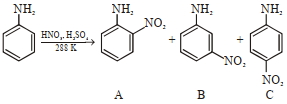
A
$C > A > B$
B
$B > C > A$
C
$A > C > B$
D
$C > B > A$
Solution
(D) In the nitration of aniline using concentrated $HNO_3$ and $H_2SO_4$ at $288 \ K$,the amino group $(-NH_2)$ is protonated to form the anilinium ion $(-NH_3^+)$ in the acidic medium.
The $-NH_3^+$ group is meta-directing,which leads to a significant amount of meta-nitroaniline $(B)$.
However,some unprotonated aniline also reacts,leading to ortho $(A)$ and para $(C)$ products.
The experimental percentage yields are approximately:
$p$-nitroaniline $(C)$ $\approx 51\%$
$m$-nitroaniline $(B)$ $\approx 47\%$
$o$-nitroaniline $(A)$ $\approx 2\%$
Thus,the order of percentage yield is $C > B > A$.
The $-NH_3^+$ group is meta-directing,which leads to a significant amount of meta-nitroaniline $(B)$.
However,some unprotonated aniline also reacts,leading to ortho $(A)$ and para $(C)$ products.
The experimental percentage yields are approximately:
$p$-nitroaniline $(C)$ $\approx 51\%$
$m$-nitroaniline $(B)$ $\approx 47\%$
$o$-nitroaniline $(A)$ $\approx 2\%$
Thus,the order of percentage yield is $C > B > A$.
0 likesView Solution
139
ChemistryMediumMCQJEE Main · 2021
The charges on the colloidal $CdS$ sol and $TiO_2$ sol are,respectively :
A
positive and positive
B
positive and negative
C
negative and negative
D
negative and positive
Solution
(D) $CdS$ sol is a negatively charged sol.
$TiO_2$ sol is a positively charged sol.
Therefore,the charges are negative and positive,respectively.
$TiO_2$ sol is a positively charged sol.
Therefore,the charges are negative and positive,respectively.
0 likesView Solution
140
ChemistryMediumMCQJEE Main · 2021
Match List-$I$ with List-$II$:
| List-$I$ (Class of Chemicals) | List-$II$ (Example) |
| $(a)$. Antifertility drug | $(i)$. Meprobamate |
| $(b)$. Antibiotic | $(ii)$. Alitame |
| $(c)$. Tranquilizer | $(iii)$. Norethindrone |
| $(d)$. Artificial Sweetener | $(iv)$. Salvarsan |
A
$(a)-(ii), (b)-(iii), (c)-(iv), (d)-(i)$
B
$(a)-(iv), (b)-(iii), (c)-(ii), (d)-(i)$
C
$(a)-(iii), (b)-(iv), (c)-(i), (d)-(ii)$
D
$(a)-(ii), (b)-(iv), (c)-(i), (d)-(iii)$
Solution
(C) . Antifertility drug $\rightarrow$ $(iii)$. Norethindrone
$(b)$. Antibiotic $\rightarrow$ $(iv)$. Salvarsan
$(c)$. Tranquilizer $\rightarrow$ $(i)$. Meprobamate
$(d)$. Artificial sweetener $\rightarrow$ $(ii)$. Alitame
Therefore,the correct matching is $(a)-(iii), (b)-(iv), (c)-(i), (d)-(ii)$.
$(b)$. Antibiotic $\rightarrow$ $(iv)$. Salvarsan
$(c)$. Tranquilizer $\rightarrow$ $(i)$. Meprobamate
$(d)$. Artificial sweetener $\rightarrow$ $(ii)$. Alitame
Therefore,the correct matching is $(a)-(iii), (b)-(iv), (c)-(i), (d)-(ii)$.
0 likesView Solution
141
ChemistryDifficultMCQJEE Main · 2021
Consider the above reaction,the products $X$ and $Y$ respectively are:
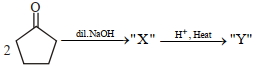
A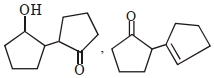
B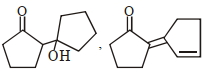
C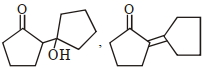
D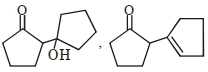
Solution
(D) The reaction is an Aldol condensation of cyclopentanone.
$1$. In the presence of $dil. NaOH$,two molecules of cyclopentanone undergo self-aldol condensation to form a $\beta$-hydroxy ketone,which is $X$ ($2$-($1$-hydroxycyclopentyl)cyclopentanone).
$2$. Upon heating with $H^+$,the $\beta$-hydroxy ketone undergoes dehydration to form an $\alpha,\beta$-unsaturated ketone,which is $Y$ ($2$-cyclopentylidenecyclopentanone).
$1$. In the presence of $dil. NaOH$,two molecules of cyclopentanone undergo self-aldol condensation to form a $\beta$-hydroxy ketone,which is $X$ ($2$-($1$-hydroxycyclopentyl)cyclopentanone).
$2$. Upon heating with $H^+$,the $\beta$-hydroxy ketone undergoes dehydration to form an $\alpha,\beta$-unsaturated ketone,which is $Y$ ($2$-cyclopentylidenecyclopentanone).
0 likesView Solution
142
ChemistryMediumMCQJEE Main · 2021
Given below are two statements:
Statement $I$ : $C_2H_5OH$ and $AgCN$ both can generate nucleophile.
Statement $II$ : $KCN$ and $AgCN$ both will generate nitrile nucleophile with all reaction conditions.
Choose the most appropriate option :
Statement $I$ : $C_2H_5OH$ and $AgCN$ both can generate nucleophile.
Statement $II$ : $KCN$ and $AgCN$ both will generate nitrile nucleophile with all reaction conditions.
Choose the most appropriate option :
A
Statement $I$ is true but statement $II$ is false
B
Both statement $I$ and statement $II$ are true
C
Statement $I$ is false but statement $II$ is true
D
Both statement $I$ and statement $II$ are false
Solution
(A) Statement $I$ is true. $C_2H_5OH$ can act as a nucleophile due to the lone pairs on the oxygen atom. $AgCN$ is a covalent compound where the nitrogen atom has a lone pair,making it an ambident nucleophile.
Statement $II$ is false. $KCN$ is an ionic compound that provides $CN^-$ ions,which act as carbon-centered nucleophiles (forming nitriles). However,$AgCN$ is covalent and primarily acts as a nitrogen-centered nucleophile (forming isonitriles) because the carbon atom is involved in a coordinate bond with silver.
Therefore,Statement $I$ is true and Statement $II$ is false.
Statement $II$ is false. $KCN$ is an ionic compound that provides $CN^-$ ions,which act as carbon-centered nucleophiles (forming nitriles). However,$AgCN$ is covalent and primarily acts as a nitrogen-centered nucleophile (forming isonitriles) because the carbon atom is involved in a coordinate bond with silver.
Therefore,Statement $I$ is true and Statement $II$ is false.
0 likesView Solution
143
ChemistryMediumMCQJEE Main · 2021
Match List-$I$ with List-$II$:
Choose the most appropriate answer from the options given below:
| List-$I$ | List-$II$ |
| $a$. Mercury | $i$. Vapour phase refining |
| $b$. Copper | $ii$. Distillation refining |
| $c$. Silicon | $iii$. Electrolytic refining |
| $d$. Nickel | $iv$. Zone refining |
Choose the most appropriate answer from the options given below:
A
$a-i, b-iv, c-ii, d-iii$
B
$a-ii, b-iii, c-i, d-iv$
C
$a-ii, b-iii, c-iv, d-i$
D
$a-ii, b-iv, c-iii, d-i$
Solution
(C) Mercury $\rightarrow$ Distillation refining $(ii)$
$(b)$ Copper $\rightarrow$ Electrolytic refining $(iii)$
$(c)$ Silicon $\rightarrow$ Zone refining $(iv)$
$(d)$ Nickel $\rightarrow$ Vapour phase refining $(i)$
Therefore,the correct matching is $a-ii, b-iii, c-iv, d-i$.
$(b)$ Copper $\rightarrow$ Electrolytic refining $(iii)$
$(c)$ Silicon $\rightarrow$ Zone refining $(iv)$
$(d)$ Nickel $\rightarrow$ Vapour phase refining $(i)$
Therefore,the correct matching is $a-ii, b-iii, c-iv, d-i$.
0 likesView Solution
144
ChemistryEasyMCQJEE Main · 2021
$A$ hard substance melts at high temperature and is an insulator in both solid and in molten state. This solid is most likely to be a / an :
A
Ionic solid
B
Molecular solid
C
Metallic solid
D
Covalent solid
Solution
(D) Covalent or network solids possess a giant three-dimensional structure held together by strong covalent bonds,which results in a very high melting point.
Since all electrons are involved in bonding and are not free to move,these substances act as insulators in both their solid and molten states.
Since all electrons are involved in bonding and are not free to move,these substances act as insulators in both their solid and molten states.
0 likesView Solution
145
ChemistryDifficultMCQJEE Main · 2021
$A$ reaction has a half-life of $1 \, \text{min}$. The time required for $99.9 \, \%$ completion of the reaction is ......... $\text{min}$. (Round off to the nearest integer)
[Use: $\ln 2 = 0.69, \ln 10 = 2.3$]
[Use: $\ln 2 = 0.69, \ln 10 = 2.3$]
A
$4$
B
$15$
C
$11$
D
$10$
Solution
(D) For a first-order reaction,the time required for $n \%$ completion is given by $t = \frac{1}{k} \ln \frac{[A]_0}{[A]_t}$.
Given $t_{1/2} = 1 \, \text{min}$,we know $k = \frac{\ln 2}{t_{1/2}} = \frac{0.69}{1} = 0.69 \, \text{min}^{-1}$.
For $99.9 \, \%$ completion,$[A]_t = [A]_0 - 0.999[A]_0 = 0.001[A]_0$.
$t_{99.9} = \frac{1}{k} \ln \frac{[A]_0}{0.001[A]_0} = \frac{1}{k} \ln 1000 = \frac{1}{k} \ln 10^3 = \frac{3 \ln 10}{k}$.
Substituting the values: $t_{99.9} = \frac{3 \times 2.3}{0.69} = \frac{6.9}{0.69} = 10 \, \text{min}$.
Given $t_{1/2} = 1 \, \text{min}$,we know $k = \frac{\ln 2}{t_{1/2}} = \frac{0.69}{1} = 0.69 \, \text{min}^{-1}$.
For $99.9 \, \%$ completion,$[A]_t = [A]_0 - 0.999[A]_0 = 0.001[A]_0$.
$t_{99.9} = \frac{1}{k} \ln \frac{[A]_0}{0.001[A]_0} = \frac{1}{k} \ln 1000 = \frac{1}{k} \ln 10^3 = \frac{3 \ln 10}{k}$.
Substituting the values: $t_{99.9} = \frac{3 \times 2.3}{0.69} = \frac{6.9}{0.69} = 10 \, \text{min}$.
0 likesView Solution
146
ChemistryMediumMCQJEE Main · 2021
The molar conductivities at infinite dilution of barium chloride,sulphuric acid and hydrochloric acid are $280$,$860$ and $426 \, S \, cm^{2} \, mol^{-1}$ respectively. The molar conductivity at infinite dilution of barium sulphate is $...... \, S \, cm^{2} \, mol^{-1}$ ($Round$ off to the Nearest Integer).
A
$102$
B
$328$
C
$488$
D
$288$
Solution
(D) According to Kohlrausch's law of independent migration of ions:
$\Lambda_{m}^{\infty}(BaSO_{4}) = \lambda_{m}^{\infty}(Ba^{2+}) + \lambda_{m}^{\infty}(SO_{4}^{2-})$
We can express this in terms of the given electrolytes:
$\Lambda_{m}^{\infty}(BaSO_{4}) = \Lambda_{m}^{\infty}(BaCl_{2}) + \Lambda_{m}^{\infty}(H_{2}SO_{4}) - 2\Lambda_{m}^{\infty}(HCl)$
Substituting the given values:
$\Lambda_{m}^{\infty}(BaSO_{4}) = 280 + 860 - 2(426)$
$= 1140 - 852$
$= 288 \, S \, cm^{2} \, mol^{-1}$
$\Lambda_{m}^{\infty}(BaSO_{4}) = \lambda_{m}^{\infty}(Ba^{2+}) + \lambda_{m}^{\infty}(SO_{4}^{2-})$
We can express this in terms of the given electrolytes:
$\Lambda_{m}^{\infty}(BaSO_{4}) = \Lambda_{m}^{\infty}(BaCl_{2}) + \Lambda_{m}^{\infty}(H_{2}SO_{4}) - 2\Lambda_{m}^{\infty}(HCl)$
Substituting the given values:
$\Lambda_{m}^{\infty}(BaSO_{4}) = 280 + 860 - 2(426)$
$= 1140 - 852$
$= 288 \, S \, cm^{2} \, mol^{-1}$
0 likesView Solution
147
ChemistryMediumMCQJEE Main · 2021
$A$ xenon compound '$A$' upon partial hydrolysis gives $XeO_{2}F_{2}$. The number of lone pairs of electrons present in compound $A$ is ....... . (Round off to the nearest integer)
A
$5$
B
$22$
C
$19$
D
$11$
Solution
(C) The partial hydrolysis of $XeF_{6}$ is given by the reaction:
$XeF_{6} + 2H_{2}O \longrightarrow XeO_{2}F_{2} + 4HF$
Thus,compound $A$ is $XeF_{6}$.
The structure of $XeF_{6}$ is distorted octahedral with $1$ lone pair on the $Xe$ atom.
Each fluorine $(F)$ atom has $3$ lone pairs of electrons.
Total number of lone pairs in $XeF_{6} = 1 \text{ (on } Xe) + (6 \times 3 \text{ on } F) = 1 + 18 = 19$.
$XeF_{6} + 2H_{2}O \longrightarrow XeO_{2}F_{2} + 4HF$
Thus,compound $A$ is $XeF_{6}$.
The structure of $XeF_{6}$ is distorted octahedral with $1$ lone pair on the $Xe$ atom.
Each fluorine $(F)$ atom has $3$ lone pairs of electrons.
Total number of lone pairs in $XeF_{6} = 1 \text{ (on } Xe) + (6 \times 3 \text{ on } F) = 1 + 18 = 19$.
0 likesView Solution
148
ChemistryDifficultMCQJEE Main · 2021
In Tollen's test for aldehyde,the overall number of electron$(s)$ transferred to the Tollen's reagent formula $[Ag(NH_{3})_{2}]^{+}$ per aldehyde group to form silver mirror is $......$. (Round off to the Nearest integer)
A
$1$
B
$2$
C
$4$
D
$6$
Solution
(B) The oxidation of an aldehyde to a carboxylate ion by Tollen's reagent is represented by the following balanced chemical equation:
$RCHO + 2[Ag(NH_{3})_{2}]^{+} + 3OH^{-} \rightarrow RCOO^{-} + 2Ag + 4NH_{3} + 2H_{2}O$
In this reaction,the aldehyde group $(-CHO)$ is oxidized to a carboxylate group $(-COO^{-})$,which involves the loss of $2$ electrons.
These $2$ electrons are transferred to the two silver ions $(Ag^{+})$ present in the Tollen's reagent,reducing them to metallic silver $(Ag^{0})$.
Therefore,the total number of electrons transferred to the Tollen's reagent per aldehyde group is $2$.
$RCHO + 2[Ag(NH_{3})_{2}]^{+} + 3OH^{-} \rightarrow RCOO^{-} + 2Ag + 4NH_{3} + 2H_{2}O$
In this reaction,the aldehyde group $(-CHO)$ is oxidized to a carboxylate group $(-COO^{-})$,which involves the loss of $2$ electrons.
These $2$ electrons are transferred to the two silver ions $(Ag^{+})$ present in the Tollen's reagent,reducing them to metallic silver $(Ag^{0})$.
Therefore,the total number of electrons transferred to the Tollen's reagent per aldehyde group is $2$.
0 likesView Solution
149
ChemistryMediumMCQJEE Main · 2021
$A$ solute $A$ dimerizes in water. The boiling point of a $2 \, M$ solution of $A$ is $100.52^{\circ} C$. The percentage association of $A$ is ..... $\%$.
(Round off to the Nearest integer)
[Use : $K_{b}$ for water $= 0.52 \, K \, kg \, mol^{-1}$,Boiling point of water $= 100^{\circ} C$]
(Round off to the Nearest integer)
[Use : $K_{b}$ for water $= 0.52 \, K \, kg \, mol^{-1}$,Boiling point of water $= 100^{\circ} C$]
A
$50$
B
$140$
C
$100$
D
$30$
Solution
(C) The elevation in boiling point is given by $\Delta T_{b} = T_{b} - T_{b}^{0} = 100.52^{\circ} C - 100^{\circ} C = 0.52^{\circ} C$.
For dimerization,the van't Hoff factor is $i = 1 - \alpha + \frac{\alpha}{2} = 1 - \frac{\alpha}{2}$.
Using the formula $\Delta T_{b} = i \times K_{b} \times m$,where $m = 2 \, M$:
$0.52 = (1 - \frac{\alpha}{2}) \times 0.52 \times 2$.
Dividing both sides by $0.52$,we get $1 = (1 - \frac{\alpha}{2}) \times 2$.
$1 = 2 - \alpha$.
$\alpha = 1$.
Thus,the percentage association is $1 \times 100 = 100 \, \%$.
For dimerization,the van't Hoff factor is $i = 1 - \alpha + \frac{\alpha}{2} = 1 - \frac{\alpha}{2}$.
Using the formula $\Delta T_{b} = i \times K_{b} \times m$,where $m = 2 \, M$:
$0.52 = (1 - \frac{\alpha}{2}) \times 0.52 \times 2$.
Dividing both sides by $0.52$,we get $1 = (1 - \frac{\alpha}{2}) \times 2$.
$1 = 2 - \alpha$.
$\alpha = 1$.
Thus,the percentage association is $1 \times 100 = 100 \, \%$.
0 likesView Solution
150
ChemistryDifficultMCQJEE Main · 2021
$10.0 \, mL$ of $Na_{2}CO_{3}$ solution is titrated against $0.2 \, M \, HCl$ solution. The following titre values were obtained in $5$ readings.
$4.8 \, mL, 4.9 \, mL, 5.0 \, mL, 5.0 \, mL$ and $5.0 \, mL$
Based on these readings,and convention of titrimetric estimation,the concentration of $Na_{2}CO_{3}$ solution is .... $mM$.
(Round off to the nearest integer)
$4.8 \, mL, 4.9 \, mL, 5.0 \, mL, 5.0 \, mL$ and $5.0 \, mL$
Based on these readings,and convention of titrimetric estimation,the concentration of $Na_{2}CO_{3}$ solution is .... $mM$.
(Round off to the nearest integer)
A
$250$
B
$150$
C
$50$
D
$100$
Solution
(C) The most consistent and precise volume of $HCl$ obtained from the readings is $5.0 \, mL$.
At the equivalence point,the number of milliequivalents $(meq)$ of $Na_{2}CO_{3}$ equals the number of milliequivalents of $HCl$.
Let the molarity of $Na_{2}CO_{3}$ solution be $M$.
The reaction is: $Na_{2}CO_{3} + 2HCl \rightarrow 2NaCl + H_{2}O + CO_{2}$.
The n-factor for $Na_{2}CO_{3}$ is $2$ and for $HCl$ is $1$.
Using the formula: $M_{1} \times V_{1} \times n_{1} = M_{2} \times V_{2} \times n_{2}$
$M \times 10 \, mL \times 2 = 0.2 \, M \times 5.0 \, mL \times 1$
$20 \times M = 1.0$
$M = 0.05 \, mol/L$
To convert to $mM$ (millimolar),we multiply by $1000$:
$0.05 \times 1000 = 50 \, mM$.
At the equivalence point,the number of milliequivalents $(meq)$ of $Na_{2}CO_{3}$ equals the number of milliequivalents of $HCl$.
Let the molarity of $Na_{2}CO_{3}$ solution be $M$.
The reaction is: $Na_{2}CO_{3} + 2HCl \rightarrow 2NaCl + H_{2}O + CO_{2}$.
The n-factor for $Na_{2}CO_{3}$ is $2$ and for $HCl$ is $1$.
Using the formula: $M_{1} \times V_{1} \times n_{1} = M_{2} \times V_{2} \times n_{2}$
$M \times 10 \, mL \times 2 = 0.2 \, M \times 5.0 \, mL \times 1$
$20 \times M = 1.0$
$M = 0.05 \, mol/L$
To convert to $mM$ (millimolar),we multiply by $1000$:
$0.05 \times 1000 = 50 \, mM$.
0 likesView Solution
Vedclass Products
For Students
Vedclass Test Series
Mock tests in real JEE Main style covering Chemistry with performance analysis. 5-day free trial.
Start Free TrialFor Teachers
Exam Paper Generator
Generate Set A/B/C/D Chemistry papers from 7.5L+ questions in 2 minutes. 3 chapters free.
Try FreeFor Institutes
Online Exam Module
Run live JEE Main mock exams with unlimited students, 360° analytics & white-label branding.
See DemoFrequently Asked Questions
How many Chemistry questions are in JEE Main 2021?
There are 798 Chemistry questions from the JEE Main 2021 paper on Vedclass, each with a detailed step-by-step solution in English.
Are JEE Main 2021 Chemistry solutions available in English?
Yes. All solutions on this page are in English. You can also switch to English or Hindi using the language buttons above the questions.
Can I practice JEE Main 2021 Chemistry as a timed test?
Yes. Use the Vedclass Test Series to attempt a full JEE Main mock test covering Chemistry with time limits and instant score analysis.
Can teachers create Chemistry papers from JEE Main previous year questions?
Yes. The Vedclass Exam Paper Generator lets teachers mix JEE Main Chemistry questions and generate Set A/B/C/D papers in minutes.
For Teachers & Institutes
Build a Custom Chemistry Paper
Pick JEE Main 2021 Chemistry questions, set difficulty, and generate Set A/B/C/D in 2 minutes.