
ChemistryQ101–200 of 798 questions
Page 3 of 9 · English
101
ChemistryMediumMCQJEE Main · 2021
Which of the following are isostructural pairs?
$A.$ $SO_{4}^{2-}$ and $CrO_{4}^{2-}$
$B.$ $SiCl_{4}$ and $TiCl_{4}$
$C.$ $NH_{3}$ and $NO_{3}^{-}$
$D.$ $BCl_{3}$ and $BrCl_{3}$
$A.$ $SO_{4}^{2-}$ and $CrO_{4}^{2-}$
$B.$ $SiCl_{4}$ and $TiCl_{4}$
$C.$ $NH_{3}$ and $NO_{3}^{-}$
$D.$ $BCl_{3}$ and $BrCl_{3}$
A
$C$ and $D$ only
B
$A$ and $B$ only
C
$A$ and $C$ only
D
$B$ and $C$ only
Solution
(B) Isostructural species have the same geometry and hybridization.
$A.$ $SO_{4}^{2-}$ and $CrO_{4}^{2-}$ are both tetrahedral ($sp^3$ hybridization).
$B.$ $SiCl_{4}$ and $TiCl_{4}$ are both tetrahedral ($sp^3$ hybridization).
$C.$ $NH_{3}$ is trigonal pyramidal $(sp^3)$,while $NO_{3}^{-}$ is trigonal planar $(sp^2)$.
$D.$ $BCl_{3}$ is trigonal planar $(sp^2)$,while $BrCl_{3}$ is $T$-shaped $(sp^3d)$.
Therefore,the isostructural pairs are $A$ and $B$.
$A.$ $SO_{4}^{2-}$ and $CrO_{4}^{2-}$ are both tetrahedral ($sp^3$ hybridization).
$B.$ $SiCl_{4}$ and $TiCl_{4}$ are both tetrahedral ($sp^3$ hybridization).
$C.$ $NH_{3}$ is trigonal pyramidal $(sp^3)$,while $NO_{3}^{-}$ is trigonal planar $(sp^2)$.
$D.$ $BCl_{3}$ is trigonal planar $(sp^2)$,while $BrCl_{3}$ is $T$-shaped $(sp^3d)$.
Therefore,the isostructural pairs are $A$ and $B$.
0 likesView Solution
102
ChemistryMediumMCQJEE Main · 2021
$(A) \ HOCl + H_2O_2 \rightarrow H_3O^{+} + Cl^{-} + O_2$
$(B) \ I_2 + H_2O_2 + 2 OH^{-} \rightarrow 2 I^{-} + 2 H_2O + O_2$
Choose the correct option.
$(B) \ I_2 + H_2O_2 + 2 OH^{-} \rightarrow 2 I^{-} + 2 H_2O + O_2$
Choose the correct option.
A
$H_2O_2$ acts as a reducing and oxidizing agent respectively in equations $(A)$ and $(B)$.
B
$H_2O_2$ acts as an oxidizing agent in equations $(A)$ and $(B)$.
C
$H_2O_2$ acts as a reducing agent in equations $(A)$ and $(B)$.
D
$H_2O_2$ acts as an oxidizing and reducing agent respectively in equations $(A)$ and $(B)$.
Solution
(C) In equation $(A)$: $HOCl + H_2O_2 \rightarrow H_3O^{+} + Cl^{-} + O_2$. The oxidation state of $Cl$ changes from $+1$ in $HOCl$ to $-1$ in $Cl^{-}$. Thus,$HOCl$ is reduced and $H_2O_2$ acts as a reducing agent.
In equation $(B)$: $I_2 + H_2O_2 + 2 OH^{-} \rightarrow 2 I^{-} + 2 H_2O + O_2$. The oxidation state of $I$ changes from $0$ in $I_2$ to $-1$ in $I^{-}$. Thus,$I_2$ is reduced and $H_2O_2$ acts as a reducing agent.
Therefore,in both equations $(A)$ and $(B)$,$H_2O_2$ acts as a reducing agent.
In equation $(B)$: $I_2 + H_2O_2 + 2 OH^{-} \rightarrow 2 I^{-} + 2 H_2O + O_2$. The oxidation state of $I$ changes from $0$ in $I_2$ to $-1$ in $I^{-}$. Thus,$I_2$ is reduced and $H_2O_2$ acts as a reducing agent.
Therefore,in both equations $(A)$ and $(B)$,$H_2O_2$ acts as a reducing agent.
0 likesView Solution
103
ChemistryDifficultMCQJEE Main · 2021
What is the major product formed by the reaction of $HI$ with $CH_3-C(CH_3)_2-CH=CH_2$?
A
$CH_3-C(CH_3)_2-CH_2-CH_2I$
B
$CH_3-C(CH_3)_2-CHI-CH_3$
C
$CH_3-CI(CH_3)-CH(CH_3)-CH_3$
D
$CH_3-CH(CH_3)-CHI-CH_2-CH_3$
Solution
(C) The reaction of $HI$ with $3,3$-dimethyl-$1$-butene $(CH_3-C(CH_3)_2-CH=CH_2)$ proceeds via a carbocation intermediate.
First,protonation of the alkene forms a secondary carbocation: $CH_3-C(CH_3)_2-C^+H-CH_3$.
To increase stability,a $1,2$-methyl shift occurs from the adjacent quaternary carbon,resulting in a more stable tertiary carbocation: $CH_3-C^+(CH_3)-CH(CH_3)-CH_3$.
Finally,the nucleophilic attack of the iodide ion $(I^-)$ on this tertiary carbocation yields the major product,$2$-iodo-$2,3$-dimethylbutane $(CH_3-CI(CH_3)-CH(CH_3)-CH_3)$.
First,protonation of the alkene forms a secondary carbocation: $CH_3-C(CH_3)_2-C^+H-CH_3$.
To increase stability,a $1,2$-methyl shift occurs from the adjacent quaternary carbon,resulting in a more stable tertiary carbocation: $CH_3-C^+(CH_3)-CH(CH_3)-CH_3$.
Finally,the nucleophilic attack of the iodide ion $(I^-)$ on this tertiary carbocation yields the major product,$2$-iodo-$2,3$-dimethylbutane $(CH_3-CI(CH_3)-CH(CH_3)-CH_3)$.
0 likesView Solution
104
ChemistryMediumMCQJEE Main · 2021
Which of the following reagents is used for the following reaction?
$CH_{3}CH_{2}CH_{3} \stackrel{?}{\longrightarrow} CH_{3}CH_{2}CHO$
$CH_{3}CH_{2}CH_{3} \stackrel{?}{\longrightarrow} CH_{3}CH_{2}CHO$
A
Manganese acetate
B
Copper at high temperature and pressure
C
Molybdenum oxide
D
Potassium permanganate
Solution
(C) The controlled oxidation of alkanes to aldehydes is a specific industrial process.
The reaction $CH_{3}CH_{2}CH_{3} \stackrel{Mo_{2}O_{3}}{\longrightarrow} CH_{3}CH_{2}CHO$ involves the catalytic oxidation of propane to propanal.
The reagent used for this transformation is Molybdenum oxide $(Mo_{2}O_{3})$.
The reaction $CH_{3}CH_{2}CH_{3} \stackrel{Mo_{2}O_{3}}{\longrightarrow} CH_{3}CH_{2}CHO$ involves the catalytic oxidation of propane to propanal.
The reagent used for this transformation is Molybdenum oxide $(Mo_{2}O_{3})$.
0 likesView Solution
105
ChemistryMediumMCQJEE Main · 2021
The gas released during anaerobic degradation of vegetation may lead to
A
Ozone hole
B
Acid rain
C
Corrosion of metals
D
Global warming and cancer
Solution
(D) The gas $CH_4$ (methane) is released during the anaerobic degradation of vegetation. $CH_4$ is a potent greenhouse gas that contributes to global warming,and some studies suggest it may be associated with health risks,including potential carcinogenic effects in specific contexts.
0 likesView Solution
106
ChemistryMediumMCQJEE Main · 2021
Identify products $A$ and $B$ in the following reaction sequence:
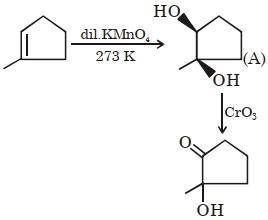
$1$-methylcyclopentene $\xrightarrow{\text{dil. } KMnO_4, 273 \ K} A$ $\xrightarrow{CrO_3} B$
$1$-methylcyclopentene $\xrightarrow{\text{dil. } KMnO_4, 273 \ K} A$ $\xrightarrow{CrO_3} B$
A
$A: \text{1-methylcyclopentane-1,2-diol}, B: \text{2-hydroxy-2-methylcyclopentanone}$
B
$A: \text{1-methylcyclopentane-1,2-diol}, B: \text{2-methylcyclopentanone}$
C
$A: \text{2-methylcyclopentanol}, B: \text{2-methylcyclopentanone}$
D
$A: \text{1-methylcyclopentene oxide}, B: \text{2-methylcyclopentanone}$
Solution
(A) $1$. The reaction of $1-$methylcyclopentene with dilute alkaline $KMnO_4$ at $273 \ K$ (Baeyer's reagent) is a syn-hydroxylation reaction,which adds two hydroxyl groups across the double bond to form $1-$methylcyclopentane$-1,2-$diol $(A)$.
$2$. The product $A$ is a vicinal diol. The secondary alcohol group is more easily oxidized than the tertiary alcohol group. Treatment with $CrO_3$ (Jones reagent or similar chromium-based oxidant) selectively oxidizes the secondary alcohol to a ketone,resulting in $2-$hydroxy$-2-$methylcyclopentanone $(B)$.
$2$. The product $A$ is a vicinal diol. The secondary alcohol group is more easily oxidized than the tertiary alcohol group. Treatment with $CrO_3$ (Jones reagent or similar chromium-based oxidant) selectively oxidizes the secondary alcohol to a ketone,resulting in $2-$hydroxy$-2-$methylcyclopentanone $(B)$.
0 likesView Solution
107
ChemistryEasyMCQJEE Main · 2021
At $1990 \ K$ and $1 \ atm$ pressure,there are equal number of $Cl_2$ molecules and $Cl$ atoms in the reaction mixture. The value $K_P$ for the reaction $Cl_{2(g)} \rightleftharpoons 2Cl_{(g)}$ under the above conditions is $x \times 10^{-1}$. The value of $x$ is ..........
(Rounded off to the nearest integer)
(Rounded off to the nearest integer)
A
$7$
B
$8$
C
$5$
D
$6$
Solution
(C) The reaction is $Cl_{2(g)} \rightleftharpoons 2Cl_{(g)}$.
Let the number of moles of $Cl_2$ molecules and $Cl$ atoms be $n$ each.
The total number of moles in the mixture is $n + n = 2n$.
The mole fraction of $Cl_2$ is $X_{Cl_2} = \frac{n}{2n} = 0.5$.
The mole fraction of $Cl$ is $X_{Cl} = \frac{n}{2n} = 0.5$.
Given the total pressure $P = 1 \ atm$,the partial pressures are:
$P_{Cl_2} = X_{Cl_2} \times P = 0.5 \times 1 = 0.5 \ atm$.
$P_{Cl} = X_{Cl} \times P = 0.5 \times 1 = 0.5 \ atm$.
The equilibrium constant $K_P$ is given by:
$K_P = \frac{(P_{Cl})^2}{P_{Cl_2}} = \frac{(0.5)^2}{0.5} = 0.5$.
We are given $K_P = x \times 10^{-1}$,so $0.5 = x \times 10^{-1}$.
Therefore,$x = 5$.
Let the number of moles of $Cl_2$ molecules and $Cl$ atoms be $n$ each.
The total number of moles in the mixture is $n + n = 2n$.
The mole fraction of $Cl_2$ is $X_{Cl_2} = \frac{n}{2n} = 0.5$.
The mole fraction of $Cl$ is $X_{Cl} = \frac{n}{2n} = 0.5$.
Given the total pressure $P = 1 \ atm$,the partial pressures are:
$P_{Cl_2} = X_{Cl_2} \times P = 0.5 \times 1 = 0.5 \ atm$.
$P_{Cl} = X_{Cl} \times P = 0.5 \times 1 = 0.5 \ atm$.
The equilibrium constant $K_P$ is given by:
$K_P = \frac{(P_{Cl})^2}{P_{Cl_2}} = \frac{(0.5)^2}{0.5} = 0.5$.
We are given $K_P = x \times 10^{-1}$,so $0.5 = x \times 10^{-1}$.
Therefore,$x = 5$.
0 likesView Solution
108
ChemistryEasyMCQJEE Main · 2021
Number of amphoteric compounds among the following is ...........
$A$. $BeO$
$B$. $BaO$
$C$. $Be(OH)_2$
$D$. $Sr(OH)_2$
$A$. $BeO$
$B$. $BaO$
$C$. $Be(OH)_2$
$D$. $Sr(OH)_2$
A
$1$
B
$3$
C
$4$
D
$2$
Solution
(D) Amphoteric compounds are those that can react with both acids and bases.
$BeO$ (Beryllium oxide) is amphoteric.
$Be(OH)_2$ (Beryllium hydroxide) is amphoteric.
$BaO$ (Barium oxide) is basic.
$Sr(OH)_2$ (Strontium hydroxide) is basic.
Therefore,there are $2$ amphoteric compounds in the given list.
$BeO$ (Beryllium oxide) is amphoteric.
$Be(OH)_2$ (Beryllium hydroxide) is amphoteric.
$BaO$ (Barium oxide) is basic.
$Sr(OH)_2$ (Strontium hydroxide) is basic.
Therefore,there are $2$ amphoteric compounds in the given list.
0 likesView Solution
109
ChemistryMediumMCQJEE Main · 2021
The reaction of sulphur in alkaline medium is given below:
$S_{8(s)} + a OH^{-}_{(aq)} \rightarrow b S^{2-}_{(aq)} + c S_{2}{O_{3}}^{2-}_{(aq)} + d H_{2}O_{(\ell)}$
The value of '$a$' is ............ (Integer answer)
$S_{8(s)} + a OH^{-}_{(aq)} \rightarrow b S^{2-}_{(aq)} + c S_{2}{O_{3}}^{2-}_{(aq)} + d H_{2}O_{(\ell)}$
The value of '$a$' is ............ (Integer answer)
A
$29$
B
$17$
C
$12$
D
$22$
Solution
(C) The reaction is a disproportionation reaction of $S_8$ in an alkaline medium.
Reduction half-reaction: $S_8 + 16e^{-} \rightarrow 8S^{2-}$
Oxidation half-reaction: $S_8 + 12H_2O \rightarrow 4S_2O_3^{2-} + 24H^{+} + 16e^{-}$
Adding both half-reactions: $2S_8 + 12H_2O \rightarrow 8S^{2-} + 4S_2O_3^{2-} + 24H^{+}$
To balance in basic medium,add $24OH^{-}$ to both sides:
$2S_8 + 12H_2O + 24OH^{-} \rightarrow 8S^{2-} + 4S_2O_3^{2-} + 24H_2O$
Simplifying the equation:
$2S_8 + 24OH^{-} \rightarrow 8S^{2-} + 4S_2O_3^{2-} + 12H_2O$
Dividing by $2$ to get the simplest integer coefficients:
$S_8 + 12OH^{-} \rightarrow 4S^{2-} + 2S_2O_3^{2-} + 6H_2O$
Comparing this with the given equation,the value of '$a$' is $12$.
Reduction half-reaction: $S_8 + 16e^{-} \rightarrow 8S^{2-}$
Oxidation half-reaction: $S_8 + 12H_2O \rightarrow 4S_2O_3^{2-} + 24H^{+} + 16e^{-}$
Adding both half-reactions: $2S_8 + 12H_2O \rightarrow 8S^{2-} + 4S_2O_3^{2-} + 24H^{+}$
To balance in basic medium,add $24OH^{-}$ to both sides:
$2S_8 + 12H_2O + 24OH^{-} \rightarrow 8S^{2-} + 4S_2O_3^{2-} + 24H_2O$
Simplifying the equation:
$2S_8 + 24OH^{-} \rightarrow 8S^{2-} + 4S_2O_3^{2-} + 12H_2O$
Dividing by $2$ to get the simplest integer coefficients:
$S_8 + 12OH^{-} \rightarrow 4S^{2-} + 2S_2O_3^{2-} + 6H_2O$
Comparing this with the given equation,the value of '$a$' is $12$.
0 likesView Solution
110
ChemistryMediumMCQJEE Main · 2021
For the reaction $A_{(g)} \rightarrow B_{(g)},$ the value of the equilibrium constant at $300 \ K$ and $1 \ atm$ is equal to $100.0.$ The value of $\Delta_{r}G^{\circ}$ for the reaction at $300 \ K$ and $1 \ atm$ in $J \ mol^{-1}$ is $-xR,$ where $x$ is ........... (Rounded off to the nearest integer) ($R = 8.31 \ J \ mol^{-1} K^{-1}$ and $\ln 10 = 2.3$)
A
$1255$
B
$1460$
C
$1380$
D
$1290$
Solution
(C) The relationship between standard Gibbs free energy change and the equilibrium constant is given by the equation: $\Delta_{r}G^{\circ} = -RT \ln K_p$
Given that $T = 300 \ K$,$K_p = 100.0$,and $\ln 10 = 2.3$.
Substituting the values: $\Delta_{r}G^{\circ} = -R \times 300 \times \ln(100)$
Since $\ln(100) = \ln(10^2) = 2 \ln(10) = 2 \times 2.3 = 4.6$.
Therefore,$\Delta_{r}G^{\circ} = -R \times 300 \times 4.6 = -1380 R$.
Comparing this with $-xR$,we get $x = 1380$.
Given that $T = 300 \ K$,$K_p = 100.0$,and $\ln 10 = 2.3$.
Substituting the values: $\Delta_{r}G^{\circ} = -R \times 300 \times \ln(100)$
Since $\ln(100) = \ln(10^2) = 2 \ln(10) = 2 \times 2.3 = 4.6$.
Therefore,$\Delta_{r}G^{\circ} = -R \times 300 \times 4.6 = -1380 R$.
Comparing this with $-xR$,we get $x = 1380$.
0 likesView Solution
111
ChemistryMediumMCQJEE Main · 2021
$A$ proton and a $Li^{3+}$ nucleus are accelerated by the same potential. If $\lambda_{Li}$ and $\lambda_{P}$ denote the de Broglie wavelengths of $Li^{3+}$ and proton respectively,then the value of $\frac{\lambda_{Li}}{\lambda_{P}}$ is $x \times 10^{-1}$. The value of $x$ is ............
(Rounded off to the nearest integer)
(Mass of $Li^{3+} = 8.3 \times \text{mass of proton}$)
(Rounded off to the nearest integer)
(Mass of $Li^{3+} = 8.3 \times \text{mass of proton}$)
A
$1$
B
$2$
C
$3$
D
$4$
Solution
(B) The de Broglie wavelength is given by $\lambda = \frac{h}{\sqrt{2mqV}}$.
For a proton $(P)$ and $Li^{3+}$ nucleus accelerated by the same potential $V$:
$\frac{\lambda_{Li}}{\lambda_{P}} = \sqrt{\frac{m_{P} \times q_{P}}{m_{Li} \times q_{Li}}} = \sqrt{\frac{m_{P} \times e}{8.3 m_{P} \times 3e}} = \sqrt{\frac{1}{8.3 \times 3}} = \sqrt{\frac{1}{24.9}} \approx \sqrt{0.04016} \approx 0.2004$.
Given $\frac{\lambda_{Li}}{\lambda_{P}} = x \times 10^{-1}$,we have $0.2004 = x \times 10^{-1}$,so $x \approx 2.004$.
Rounding to the nearest integer,$x = 2$.
For a proton $(P)$ and $Li^{3+}$ nucleus accelerated by the same potential $V$:
$\frac{\lambda_{Li}}{\lambda_{P}} = \sqrt{\frac{m_{P} \times q_{P}}{m_{Li} \times q_{Li}}} = \sqrt{\frac{m_{P} \times e}{8.3 m_{P} \times 3e}} = \sqrt{\frac{1}{8.3 \times 3}} = \sqrt{\frac{1}{24.9}} \approx \sqrt{0.04016} \approx 0.2004$.
Given $\frac{\lambda_{Li}}{\lambda_{P}} = x \times 10^{-1}$,we have $0.2004 = x \times 10^{-1}$,so $x \approx 2.004$.
Rounding to the nearest integer,$x = 2$.
0 likesView Solution
112
ChemistryMediumMCQJEE Main · 2021
According to molecular orbital theory,the species among the following that does not exist is
A
$He_{2}^{+}$
B
$He_{2}^{-}$
C
$Be_{2}$
D
$O_{2}^{2-}$
Solution
(C) .
According to $M.O.T.$,if the bond order of a chemical species is zero,then that chemical species does not exist.
| Chemical Species | Bond Order |
|---|---|
| $He_{2}^{+}$ | $0.5$ |
| $He_{2}^{-}$ | $0.5$ |
| $Be_{2}$ | $0$ |
| $O_{2}^{2-}$ | $1$ |
0 likesView Solution
113
ChemistryMediumMCQJEE Main · 2021
Which of the following equations depicts the oxidizing nature of $H_{2}O_{2}$?
A
$KIO_{4} + H_{2}O_{2} \rightarrow KIO_{3} + H_{2}O + O_{2}$
B
$2I^{-} + H_{2}O_{2} + 2H^{+} \rightarrow I_{2} + 2H_{2}O$
C
$I_{2} + H_{2}O_{2} + 2OH^{-} \rightarrow 2I^{-} + 2H_{2}O + O_{2}$
D
$Cl_{2} + H_{2}O_{2} \rightarrow 2HCl + O_{2}$
Solution
(B) In the reaction $2I^{-} + H_{2}O_{2} + 2H^{+} \rightarrow I_{2} + 2H_{2}O$,the oxidation state of iodine increases from $-1$ to $0$,which indicates that $I^{-}$ is oxidized to $I_{2}$ by $H_{2}O_{2}$.
Thus,$H_{2}O_{2}$ acts as an oxidizing agent.
In the other reactions,$H_{2}O_{2}$ acts as a reducing agent.
Hence,the correct answer is $(B)$.
Thus,$H_{2}O_{2}$ acts as an oxidizing agent.
In the other reactions,$H_{2}O_{2}$ acts as a reducing agent.
Hence,the correct answer is $(B)$.
0 likesView Solution
114
ChemistryMediumMCQJEE Main · 2021
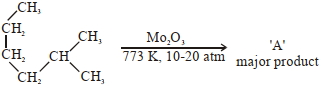
Identify $A$ in the given chemical reaction.
A
Benzene
B
Cyclohexane
C
Methylcyclohexane
D
Toluene
Solution
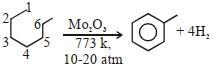
(D) The reaction involves the aromatization of an alkane using $Mo_{2}O_{3}$ as a catalyst at $773 \ K$ and $10-20 \ atm$ pressure.
The reactant is $2$-methylhexane,which undergoes cyclization and dehydrogenation to form toluene $(A)$.
The reactant is $2$-methylhexane,which undergoes cyclization and dehydrogenation to form toluene $(A)$.
0 likesView Solution
115
ChemistryMediumMCQJEE Main · 2021
Complete combustion of $1.80 \, g$ of an oxygen-containing compound $(C_xH_yO_z)$ gave $2.64 \, g$ of $CO_2$ and $1.08 \, g$ of $H_2O$. The percentage of oxygen in the organic compound is
A
$51.63$
B
$63.53$
C
$53.33$
D
$50.33$
Solution
(C) The mass of carbon in $2.64 \, g$ of $CO_2$ is: $m_C = \frac{12}{44} \times 2.64 = 0.72 \, g$.
The mass of hydrogen in $1.08 \, g$ of $H_2O$ is: $m_H = \frac{2}{18} \times 1.08 = 0.12 \, g$.
The mass of oxygen in the compound is: $m_O = \text{Total mass} - (m_C + m_H) = 1.80 - (0.72 + 0.12) = 1.80 - 0.84 = 0.96 \, g$.
The percentage of oxygen is: $\% \, O = \frac{0.96}{1.80} \times 100 = 53.33 \%$.
The mass of hydrogen in $1.08 \, g$ of $H_2O$ is: $m_H = \frac{2}{18} \times 1.08 = 0.12 \, g$.
The mass of oxygen in the compound is: $m_O = \text{Total mass} - (m_C + m_H) = 1.80 - (0.72 + 0.12) = 1.80 - 0.84 = 0.96 \, g$.
The percentage of oxygen is: $\% \, O = \frac{0.96}{1.80} \times 100 = 53.33 \%$.
0 likesView Solution
116
ChemistryEasyMCQJEE Main · 2021
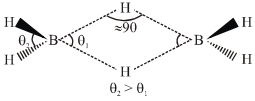
The correct statement about $B_{2}H_{6}$ is
A
Terminal $B-H$ bonds have less $p$-character when compared to bridging bonds.
B
The two $B-H-B$ bonds are not of the same length.
C
All $B-H-B$ angles are of $120^{\circ}$.
D
Its fragment,$BH_{3}$,behaves as a Lewis base.
Solution
(A) In $B_{2}H_{6}$,the terminal $B-H$ bonds are $sp^{3}$ hybridized,while the bridging $B-H-B$ bonds involve $3c-2e$ (three-center two-electron) bonds.
According to Bent's rule,more $p$-character is directed towards the more electronegative atom or the bond with a smaller bond angle.
Since the bond angle $\theta_{2}$ (terminal $H-B-H$) is greater than $\theta_{1}$ (bridging $B-H-B$ angle),the terminal $B-H$ bonds have more $s$-character and less $p$-character compared to the bridging bonds.
Thus,option $A$ is correct.
$BH_{3}$ is an electron-deficient species and acts as a Lewis acid,not a base.
According to Bent's rule,more $p$-character is directed towards the more electronegative atom or the bond with a smaller bond angle.
Since the bond angle $\theta_{2}$ (terminal $H-B-H$) is greater than $\theta_{1}$ (bridging $B-H-B$ angle),the terminal $B-H$ bonds have more $s$-character and less $p$-character compared to the bridging bonds.
Thus,option $A$ is correct.
$BH_{3}$ is an electron-deficient species and acts as a Lewis acid,not a base.
0 likesView Solution
117
ChemistryEasyMCQJEE Main · 2021
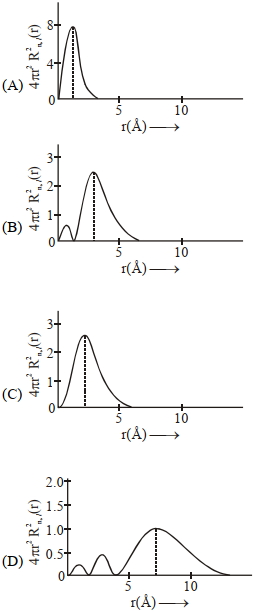
The plots of radial distribution functions for various orbitals of hydrogen atom against $r$ are given below.
The correct plot for $3s$ orbital is
The correct plot for $3s$ orbital is
A
$(A)$
B
$(B)$
C
$(C)$
D
$(D)$
Solution
(C) The number of radial nodes for an orbital is given by the formula: $\text{Number of radial nodes} = n - \ell - 1$.
For the $3s$ orbital,the principal quantum number $n = 3$ and the azimuthal quantum number $\ell = 0$.
Substituting these values: $\text{Number of radial nodes} = 3 - 0 - 1 = 2$.
$A$ radial distribution function plot for an orbital with $2$ radial nodes must show $2$ points where the probability density touches the $r$-axis (excluding $r=0$ and $r=\infty$).
Looking at the provided plots:
- Plot $(A)$ has $0$ radial nodes (corresponds to $1s$).
- Plot $(B)$ has $1$ radial node (corresponds to $2s$).
- Plot $(C)$ has $0$ radial nodes.
- Plot $(D)$ has $2$ radial nodes.
Therefore,the correct plot for the $3s$ orbital is $(D)$.
For the $3s$ orbital,the principal quantum number $n = 3$ and the azimuthal quantum number $\ell = 0$.
Substituting these values: $\text{Number of radial nodes} = 3 - 0 - 1 = 2$.
$A$ radial distribution function plot for an orbital with $2$ radial nodes must show $2$ points where the probability density touches the $r$-axis (excluding $r=0$ and $r=\infty$).
Looking at the provided plots:
- Plot $(A)$ has $0$ radial nodes (corresponds to $1s$).
- Plot $(B)$ has $1$ radial node (corresponds to $2s$).
- Plot $(C)$ has $0$ radial nodes.
- Plot $(D)$ has $2$ radial nodes.
Therefore,the correct plot for the $3s$ orbital is $(D)$.
0 likesView Solution
118
ChemistryEasyMCQJEE Main · 2021
Given below are two statements:
Statement $I$: An allotrope of oxygen is an important intermediate in the formation of reducing smog.
Statement $II$: Gases such as oxides of nitrogen and sulphur present in the troposphere contribute to the formation of photochemical smog.
In the light of the above statements,choose the correct answer from the options given below:
Statement $I$: An allotrope of oxygen is an important intermediate in the formation of reducing smog.
Statement $II$: Gases such as oxides of nitrogen and sulphur present in the troposphere contribute to the formation of photochemical smog.
In the light of the above statements,choose the correct answer from the options given below:
A
Both Statement $I$ and Statement $II$ are false.
B
Statement $I$ is true but Statement $II$ is false.
C
Both Statement $I$ and Statement $II$ are true.
D
Statement $I$ is false but Statement $II$ is true.
Solution
(D) Statement $I$ is false. Reducing smog (classical smog) is a mixture of smoke,fog,and sulphur dioxide $(SO_2)$. It does not involve an allotrope of oxygen as an intermediate.
Statement $II$ is true. Photochemical smog is formed by the action of sunlight on nitrogen oxides $(NO_x)$ and hydrocarbons present in the troposphere. Sulphur dioxide is primarily associated with reducing smog,not photochemical smog.
Therefore,Statement $I$ is false and Statement $II$ is true.
Statement $II$ is true. Photochemical smog is formed by the action of sunlight on nitrogen oxides $(NO_x)$ and hydrocarbons present in the troposphere. Sulphur dioxide is primarily associated with reducing smog,not photochemical smog.
Therefore,Statement $I$ is false and Statement $II$ is true.
0 likesView Solution
119
ChemistryDifficultMCQJEE Main · 2021
The solubility of $AgCN$ in a buffer solution of $pH = 3$ is $x$. The value of $x$ is [Assume : No cyano complex is formed; $K_{sp}(AgCN) = 2.2 \times 10^{-16}$ and $K_{a}(HCN) = 6.2 \times 10^{-10}$]
A
$0.625 \times 10^{-6}$
B
$1.9 \times 10^{-5}$
C
$2.2 \times 10^{-16}$
D
$1.6 \times 10^{-6}$
Solution
(B) The dissolution reaction is $AgCN_{(s)} + H^{+}_{(aq)} \rightleftharpoons Ag^{+}_{(aq)} + HCN_{(aq)}$.
The equilibrium constant $K_{eq} = \frac{K_{sp}(AgCN)}{K_a(HCN)} = \frac{2.2 \times 10^{-16}}{6.2 \times 10^{-10}} \approx 3.55 \times 10^{-7}$.
Since $s = [Ag^{+}] = [HCN]$ and $[H^{+}] = 10^{-pH} = 10^{-3}$,we have $K_{eq} = \frac{s^2}{[H^{+}]}$.
$s^2 = K_{eq} \times [H^{+}] = 3.55 \times 10^{-7} \times 10^{-3} = 3.55 \times 10^{-10}$.
$s = \sqrt{3.55 \times 10^{-10}} \approx 1.88 \times 10^{-5} \approx 1.9 \times 10^{-5}$.
The equilibrium constant $K_{eq} = \frac{K_{sp}(AgCN)}{K_a(HCN)} = \frac{2.2 \times 10^{-16}}{6.2 \times 10^{-10}} \approx 3.55 \times 10^{-7}$.
Since $s = [Ag^{+}] = [HCN]$ and $[H^{+}] = 10^{-pH} = 10^{-3}$,we have $K_{eq} = \frac{s^2}{[H^{+}]}$.
$s^2 = K_{eq} \times [H^{+}] = 3.55 \times 10^{-7} \times 10^{-3} = 3.55 \times 10^{-10}$.
$s = \sqrt{3.55 \times 10^{-10}} \approx 1.88 \times 10^{-5} \approx 1.9 \times 10^{-5}$.
0 likesView Solution
120
ChemistryEasyMCQJEE Main · 2021
In basic medium,$CrO_{4}^{2-}$ oxidises $S_{2}O_{3}^{2-}$ to form $SO_{4}^{2-}$ and itself changes into $Cr(OH)_{4}^{-}$. The volume of $0.154 \ M \ CrO_{4}^{2-}$ required to react with $40 \ mL$ of $0.25 \ M \ S_{2}O_{3}^{2-}$ is ........... $mL$ (Rounded-off to the nearest integer).
A
$170$
B
$173$
C
$181$
D
$141$
Solution
(B) The balanced redox reaction is:
$8CrO_{4}^{2-} + 3S_{2}O_{3}^{2-} + 10H_{2}O \rightarrow 8Cr(OH)_{4}^{-} + 6SO_{4}^{2-} + 2OH^{-}$
From the stoichiometry,the $n$-factor for $CrO_{4}^{2-}$ ($Cr^{+6}$ to $Cr^{+3}$) is $3$,and for $S_{2}O_{3}^{2-}$ ($S^{+2}$ to $S^{+6}$),the total change in oxidation state is $2 \times (6-2) = 8$.
Using the law of equivalence: $n_{1}M_{1}V_{1} = n_{2}M_{2}V_{2}$
$3 \times 0.154 \times V = 8 \times 0.25 \times 40$
$0.462 \times V = 80$
$V = \frac{80}{0.462} \approx 173.16 \ mL$
Rounding to the nearest integer,we get $173 \ mL$.
$8CrO_{4}^{2-} + 3S_{2}O_{3}^{2-} + 10H_{2}O \rightarrow 8Cr(OH)_{4}^{-} + 6SO_{4}^{2-} + 2OH^{-}$
From the stoichiometry,the $n$-factor for $CrO_{4}^{2-}$ ($Cr^{+6}$ to $Cr^{+3}$) is $3$,and for $S_{2}O_{3}^{2-}$ ($S^{+2}$ to $S^{+6}$),the total change in oxidation state is $2 \times (6-2) = 8$.
Using the law of equivalence: $n_{1}M_{1}V_{1} = n_{2}M_{2}V_{2}$
$3 \times 0.154 \times V = 8 \times 0.25 \times 40$
$0.462 \times V = 80$
$V = \frac{80}{0.462} \approx 173.16 \ mL$
Rounding to the nearest integer,we get $173 \ mL$.
0 likesView Solution
121
ChemistryDifficultMCQJEE Main · 2021
$A$ car tyre is filled with nitrogen gas at $35 \ psi$ at $27^{\circ} C$. It will burst if pressure exceeds $40 \ psi$. The temperature in $^{\circ} C$ at which the car tyre will burst is ............ (Rounded-off to the nearest integer)
A
$60$
B
$80$
C
$75$
D
$70$
Solution
(D) Assuming the volume of the tyre remains constant, according to Gay-Lussac's Law, $P \propto T$ (where $T$ is in Kelvin).
Given: $P_1 = 35 \ psi$, $T_1 = 27 + 273 = 300 \ K$, $P_2 = 40 \ psi$.
Using the formula $\frac{P_2}{P_1} = \frac{T_2}{T_1}$:
$\frac{40}{35} = \frac{T_2}{300}$
$T_2 = \frac{40 \times 300}{35} = \frac{12000}{35} \approx 342.86 \ K$.
Converting back to Celsius: $T_2(^{\circ} C) = 342.86 - 273 = 69.86^{\circ} C$.
Rounding to the nearest integer, we get $70^{\circ} C$.
Given: $P_1 = 35 \ psi$, $T_1 = 27 + 273 = 300 \ K$, $P_2 = 40 \ psi$.
Using the formula $\frac{P_2}{P_1} = \frac{T_2}{T_1}$:
$\frac{40}{35} = \frac{T_2}{300}$
$T_2 = \frac{40 \times 300}{35} = \frac{12000}{35} \approx 342.86 \ K$.
Converting back to Celsius: $T_2(^{\circ} C) = 342.86 - 273 = 69.86^{\circ} C$.
Rounding to the nearest integer, we get $70^{\circ} C$.
0 likesView Solution
122
ChemistryEasyMCQJEE Main · 2021
The reaction of cyanamide,$NH_{2}CN_{(s)}$ with oxygen was run in a bomb calorimeter and $\Delta U$ was found to be $-742.24 \ kJ \ mol^{-1}$. The magnitude of $\Delta H_{298}$ for the reaction
$NH_{2}CN_{(s)} + \frac{3}{2} O_{2(g)} \rightarrow N_{2(g)} + CO_{2(g)} + H_{2}O_{(l)}$
is $............ \ kJ$. (Rounded off to the nearest integer)
[Assume ideal gases and $R = 8.314 \ J \ mol^{-1} K^{-1}$]
$NH_{2}CN_{(s)} + \frac{3}{2} O_{2(g)} \rightarrow N_{2(g)} + CO_{2(g)} + H_{2}O_{(l)}$
is $............ \ kJ$. (Rounded off to the nearest integer)
[Assume ideal gases and $R = 8.314 \ J \ mol^{-1} K^{-1}$]
A
$743$
B
$741$
C
$783$
D
$561$
Solution
(B) The reaction is: $NH_{2}CN_{(s)} + \frac{3}{2} O_{2(g)} \rightarrow N_{2(g)} + CO_{2(g)} + H_{2}O_{(l)}$
The change in the number of moles of gaseous species is $\Delta n_{g} = (n_{products, g} - n_{reactants, g}) = (1 + 1) - \frac{3}{2} = 2 - 1.5 = 0.5 \ mol$.
Using the relation $\Delta H = \Delta U + \Delta n_{g} RT$:
$\Delta H = -742.24 \ kJ \ mol^{-1} + (0.5 \ mol) \times (8.314 \times 10^{-3} \ kJ \ mol^{-1} K^{-1}) \times (298 \ K)$
$\Delta H = -742.24 + 1.238786 \approx -741.001 \ kJ \ mol^{-1}$.
The magnitude of $\Delta H$ is $741 \ kJ \ mol^{-1}$.
The change in the number of moles of gaseous species is $\Delta n_{g} = (n_{products, g} - n_{reactants, g}) = (1 + 1) - \frac{3}{2} = 2 - 1.5 = 0.5 \ mol$.
Using the relation $\Delta H = \Delta U + \Delta n_{g} RT$:
$\Delta H = -742.24 \ kJ \ mol^{-1} + (0.5 \ mol) \times (8.314 \times 10^{-3} \ kJ \ mol^{-1} K^{-1}) \times (298 \ K)$
$\Delta H = -742.24 + 1.238786 \approx -741.001 \ kJ \ mol^{-1}$.
The magnitude of $\Delta H$ is $741 \ kJ \ mol^{-1}$.
0 likesView Solution
123
ChemistryMediumMCQJEE Main · 2021
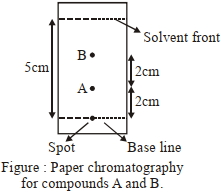
Using the provided information in the following paper chromatogram,calculate the $R_{f}$ value of $A$ .......... $\times 10^{-1}$.
A
$2$
B
$1$
C
$4$
D
$3$
Solution
(C) The $R_{f}$ value is calculated using the formula:
$R_{f} = \frac{\text{Distance travelled by compound from base line}}{\text{Distance travelled by solvent from base line}}$
From the chromatogram:
Distance travelled by compound $A$ from the base line $= 2 \, cm$
Distance travelled by solvent front from the base line $= 5 \, cm$
Therefore,$R_{f} = \frac{2}{5} = 0.4$
Expressing this as $\times 10^{-1}$:
$0.4 = 4 \times 10^{-1}$
Thus,the value is $4$.
$R_{f} = \frac{\text{Distance travelled by compound from base line}}{\text{Distance travelled by solvent from base line}}$
From the chromatogram:
Distance travelled by compound $A$ from the base line $= 2 \, cm$
Distance travelled by solvent front from the base line $= 5 \, cm$
Therefore,$R_{f} = \frac{2}{5} = 0.4$
Expressing this as $\times 10^{-1}$:
$0.4 = 4 \times 10^{-1}$
Thus,the value is $4$.
0 likesView Solution
124
ChemistryMediumMCQJEE Main · 2021
The ionization enthalpy of $Na^{+}$ formation from $Na_{(g)}$ is $495.8 \ kJ \ mol^{-1},$ while the electron gain enthalpy of $Br_{(g)}$ is $-325.0 \ kJ \ mol^{-1}$. Given the lattice enthalpy of $NaBr_{(s)}$ is $-728.4 \ kJ \ mol^{-1}$. The energy for the reaction $Na_{(g)} + Br_{(g)} \rightarrow NaBr_{(s)}$ is $(-) \dots \dots \dots \dots \dots \times 10^{-1} \ kJ \ mol^{-1}$.
A
$5581$
B
$4856$
C
$5596$
D
$5576$
Solution
(D) The reaction is $Na_{(g)} + Br_{(g)} \rightarrow NaBr_{(s)}$.
According to the Born-Haber cycle,the enthalpy change for this reaction is given by the sum of the ionization enthalpy of $Na_{(g)}$,the electron gain enthalpy of $Br_{(g)}$,and the lattice enthalpy of $NaBr_{(s)}$.
$\Delta H = IE_{1} + \Delta H_{eg} + LE$
$\Delta H = 495.8 \ kJ \ mol^{-1} + (-325.0 \ kJ \ mol^{-1}) + (-728.4 \ kJ \ mol^{-1})$
$\Delta H = 495.8 - 325.0 - 728.4 = -557.6 \ kJ \ mol^{-1}$
To express this in the form $x \times 10^{-1} \ kJ \ mol^{-1}$,we have:
$-557.6 \ kJ \ mol^{-1} = -5576 \times 10^{-1} \ kJ \ mol^{-1}$
Thus,the value is $5576$.
According to the Born-Haber cycle,the enthalpy change for this reaction is given by the sum of the ionization enthalpy of $Na_{(g)}$,the electron gain enthalpy of $Br_{(g)}$,and the lattice enthalpy of $NaBr_{(s)}$.
$\Delta H = IE_{1} + \Delta H_{eg} + LE$
$\Delta H = 495.8 \ kJ \ mol^{-1} + (-325.0 \ kJ \ mol^{-1}) + (-728.4 \ kJ \ mol^{-1})$
$\Delta H = 495.8 - 325.0 - 728.4 = -557.6 \ kJ \ mol^{-1}$
To express this in the form $x \times 10^{-1} \ kJ \ mol^{-1}$,we have:
$-557.6 \ kJ \ mol^{-1} = -5576 \times 10^{-1} \ kJ \ mol^{-1}$
Thus,the value is $5576$.
0 likesView Solution
125
ChemistryMediumMCQJEE Main · 2021
Find $A$,$B$ and $C$ in the following reactions:
$NH_3 + A + CO_2 \rightarrow (NH_4)_2CO_3$
$(NH_4)_2CO_3 + H_2O + B \rightarrow 2NH_4HCO_3$
$NH_4HCO_3 + NaCl \rightarrow NH_4Cl + C$
$NH_3 + A + CO_2 \rightarrow (NH_4)_2CO_3$
$(NH_4)_2CO_3 + H_2O + B \rightarrow 2NH_4HCO_3$
$NH_4HCO_3 + NaCl \rightarrow NH_4Cl + C$
A
$A - O_2; B - CO_2; C - Na_2CO_3$
B
$A - H_2O; B - O_2; C - Na_2CO_3$
C
$A - H_2O; B - O_2; C - NaHCO_3$
D
$A - H_2O; B - CO_2; C - NaHCO_3$
Solution
(D) The given reactions are part of the Solvay process for the production of sodium carbonate.
$1$. $2NH_3 + H_2O(A) + CO_2 \rightarrow (NH_4)_2CO_3$
$2$. $(NH_4)_2CO_3 + H_2O + CO_2(B) \rightarrow 2NH_4HCO_3$
$3$. $NH_4HCO_3 + NaCl \rightarrow NaHCO_3(C) + NH_4Cl$
Comparing these with the given equations,we identify $A = H_2O$,$B = CO_2$,and $C = NaHCO_3$.
$1$. $2NH_3 + H_2O(A) + CO_2 \rightarrow (NH_4)_2CO_3$
$2$. $(NH_4)_2CO_3 + H_2O + CO_2(B) \rightarrow 2NH_4HCO_3$
$3$. $NH_4HCO_3 + NaCl \rightarrow NaHCO_3(C) + NH_4Cl$
Comparing these with the given equations,we identify $A = H_2O$,$B = CO_2$,and $C = NaHCO_3$.
0 likesView Solution
126
ChemistryEasyMCQJEE Main · 2021
The presence of ozone in the troposphere:
A
Protects us from $UV$ radiation
B
Protects us from $X-ray$ radiation
C
Protects us from the greenhouse effect
D
Generates photochemical smog
Solution
(D) The presence of ozone in the troposphere is harmful as it acts as a pollutant and generates photochemical smog.
0 likesView Solution
127
ChemistryEasyMCQJEE Main · 2021
Match List-$I$ with List-$II$:
Choose the most appropriate answer from the options given below:
| List-$I$ (Electronic configuration) | List-$II$ ($\Delta_{i}H$ in $kJ\ mol^{-1}$) |
| $(a)$ $1s^{2} 2s^{2}$ | $(i)$ $801$ |
| $(b)$ $1s^{2} 2s^{2} 2p^{4}$ | $(ii)$ $899$ |
| $(c)$ $1s^{2} 2s^{2} 2p^{3}$ | $(iii)$ $1314$ |
| $(d)$ $1s^{2} 2s^{2} 2p^{1}$ | $(iv)$ $1402$ |
Choose the most appropriate answer from the options given below:
A
$(a)$ $\rightarrow (ii), (b)$ $\rightarrow (iii), (c)$ $\rightarrow (iv), (d)$ $\rightarrow (i)$
B
$(a)$ $\rightarrow (i), (b)$ $\rightarrow (iv), (c)$ $\rightarrow (iii), (d)$ $\rightarrow (ii)$
C
$(a)$ $\rightarrow (i), (b)$ $\rightarrow (iii), (c)$ $\rightarrow (iv), (d)$ $\rightarrow (ii)$
D
$(a)$ $\rightarrow (iv), (b)$ $\rightarrow (i), (c)$ $\rightarrow (ii), (d)$ $\rightarrow (iii)$
Solution
(A) The electronic configurations correspond to the following elements:
$(a)$ $1s^{2} 2s^{2} \rightarrow Be$ (Beryllium)
$(b)$ $1s^{2} 2s^{2} 2p^{4} \rightarrow O$ (Oxygen)
$(c)$ $1s^{2} 2s^{2} 2p^{3} \rightarrow N$ (Nitrogen)
$(d)$ $1s^{2} 2s^{2} 2p^{1} \rightarrow B$ (Boron)
Ionization enthalpy ($\Delta_{i}H$) values are influenced by electronic stability:
$Be$ $(2s^{2})$ has a fully filled orbital,making its $IE$ higher than $B$ $(2s^{2} 2p^{1})$.
$N$ $(2p^{3})$ has a half-filled $p$-orbital,making its $IE$ higher than $O$ $(2p^{4})$.
The values are:
$N = 1402 \ kJ\ mol^{-1}$
$O = 1314 \ kJ\ mol^{-1}$
$Be = 899 \ kJ\ mol^{-1}$
$B = 801 \ kJ\ mol^{-1}$
Matching:
$(a) \rightarrow (ii)$
$(b) \rightarrow (iii)$
$(c) \rightarrow (iv)$
$(d) \rightarrow (i)$
Therefore,the correct option is $(a)$ $\rightarrow (ii), (b)$ $\rightarrow (iii), (c)$ $\rightarrow (iv), (d)$ $\rightarrow (i)$.
$(a)$ $1s^{2} 2s^{2} \rightarrow Be$ (Beryllium)
$(b)$ $1s^{2} 2s^{2} 2p^{4} \rightarrow O$ (Oxygen)
$(c)$ $1s^{2} 2s^{2} 2p^{3} \rightarrow N$ (Nitrogen)
$(d)$ $1s^{2} 2s^{2} 2p^{1} \rightarrow B$ (Boron)
Ionization enthalpy ($\Delta_{i}H$) values are influenced by electronic stability:
$Be$ $(2s^{2})$ has a fully filled orbital,making its $IE$ higher than $B$ $(2s^{2} 2p^{1})$.
$N$ $(2p^{3})$ has a half-filled $p$-orbital,making its $IE$ higher than $O$ $(2p^{4})$.
The values are:
$N = 1402 \ kJ\ mol^{-1}$
$O = 1314 \ kJ\ mol^{-1}$
$Be = 899 \ kJ\ mol^{-1}$
$B = 801 \ kJ\ mol^{-1}$
Matching:
$(a) \rightarrow (ii)$
$(b) \rightarrow (iii)$
$(c) \rightarrow (iv)$
$(d) \rightarrow (i)$
Therefore,the correct option is $(a)$ $\rightarrow (ii), (b)$ $\rightarrow (iii), (c)$ $\rightarrow (iv), (d)$ $\rightarrow (i)$.
0 likesView Solution
128
ChemistryEasyMCQJEE Main · 2021
Given below are two statements: one is labelled as Assertion $A$ and the other is labelled as Reason $R$.
Assertion $A$: Dipole-dipole interactions are the only non-covalent interactions resulting in hydrogen bond formation.
Reason $R$: Fluorine is the most electronegative element and hydrogen bonds in $HF$ are symmetrical.
Assertion $A$: Dipole-dipole interactions are the only non-covalent interactions resulting in hydrogen bond formation.
Reason $R$: Fluorine is the most electronegative element and hydrogen bonds in $HF$ are symmetrical.
A
$A$ is false but $R$ is true
B
Both $A$ and $R$ are true and $R$ is the correct explanation of $A$
C
$A$ is true but $R$ is false
D
Both $A$ and $R$ are true but $R$ is $NOT$ the correct explanation of $A$
Solution
(A) Assertion $A$ is false. Hydrogen bonding is a special type of dipole-dipole interaction,but it is not the only non-covalent interaction that can be involved in molecular associations. Furthermore,the statement implies that only dipole-dipole interactions form hydrogen bonds,which is a restrictive definition.
Reason $R$ is true. Fluorine is indeed the most electronegative element. In the solid state,$HF$ molecules form a zig-zag chain structure where the hydrogen bonds are symmetrical,represented as $[F-H...F]^-$. The hydrogen atom is located symmetrically between two fluorine atoms.
Reason $R$ is true. Fluorine is indeed the most electronegative element. In the solid state,$HF$ molecules form a zig-zag chain structure where the hydrogen bonds are symmetrical,represented as $[F-H...F]^-$. The hydrogen atom is located symmetrically between two fluorine atoms.
0 likesView Solution
129
ChemistryEasyMCQJEE Main · 2021
Statements about heavy water are given below.
$A.$ Heavy water is used in exchange reactions for the study of reaction mechanisms.
$B.$ Heavy water is prepared by exhaustive electrolysis of water.
$C.$ Heavy water has higher boiling point than ordinary water.
$D.$ Viscosity of $H_2O$ is greater than $D_2O$.
$A.$ Heavy water is used in exchange reactions for the study of reaction mechanisms.
$B.$ Heavy water is prepared by exhaustive electrolysis of water.
$C.$ Heavy water has higher boiling point than ordinary water.
$D.$ Viscosity of $H_2O$ is greater than $D_2O$.
A
$A, B$ and $C$ only
B
$A$ and $B$ only
C
$A$ and $D$ only
D
$A$ and $C$ only
Solution
(A) Statement $A$ is correct: Heavy water $(D_2O)$ is used in exchange reactions to study reaction mechanisms.
Statement $B$ is correct: Heavy water is prepared by the exhaustive electrolysis of ordinary water.
Statement $C$ is correct: The boiling point of $D_2O$ $(374.4 \ K)$ is higher than that of $H_2O$ $(373 \ K)$ due to stronger hydrogen bonding.
Statement $D$ is incorrect: The viscosity of $D_2O$ $(1.107 \ \text{centipoise})$ is greater than that of $H_2O$ $(0.89 \ \text{centipoise})$.
Therefore,statements $A, B,$ and $C$ are correct.
Statement $B$ is correct: Heavy water is prepared by the exhaustive electrolysis of ordinary water.
Statement $C$ is correct: The boiling point of $D_2O$ $(374.4 \ K)$ is higher than that of $H_2O$ $(373 \ K)$ due to stronger hydrogen bonding.
Statement $D$ is incorrect: The viscosity of $D_2O$ $(1.107 \ \text{centipoise})$ is greater than that of $H_2O$ $(0.89 \ \text{centipoise})$.
Therefore,statements $A, B,$ and $C$ are correct.
0 likesView Solution
130
ChemistryMediumMCQJEE Main · 2021
The orbital having two radial as well as two angular nodes is
A
$3p$
B
$4f$
C
$4d$
D
$5d$
Solution
(D) The number of radial nodes is given by the formula $n-l-1$ and the number of angular nodes is given by $l$.
Given that radial nodes = $2$ and angular nodes = $2$,we have $l = 2$.
Substituting $l = 2$ into the radial node formula: $n-2-1 = 2$,which gives $n = 5$.
Since $l = 2$ corresponds to the $d$ orbital,the orbital is $5d$.
Given that radial nodes = $2$ and angular nodes = $2$,we have $l = 2$.
Substituting $l = 2$ into the radial node formula: $n-2-1 = 2$,which gives $n = 5$.
Since $l = 2$ corresponds to the $d$ orbital,the orbital is $5d$.
0 likesView Solution
131
ChemistryEasyMCQJEE Main · 2021
Given below are two statements:
Statement $I :$ $A$ mixture of chloroform and aniline can be separated by simple distillation.
Statement $II :$ When separating aniline from a mixture of aniline and water by steam distillation,aniline boils below its boiling point.
In the light of the above statements,choose the most appropriate answer from the options given below.
Statement $I :$ $A$ mixture of chloroform and aniline can be separated by simple distillation.
Statement $II :$ When separating aniline from a mixture of aniline and water by steam distillation,aniline boils below its boiling point.
In the light of the above statements,choose the most appropriate answer from the options given below.
A
Statement $-I$ is false but Statement $-II$ is true.
B
Both Statement $-I$ and Statement $-II$ are false.
C
Statement $-I$ is true but Statement $-II$ is false.
D
Both Statement $-I$ and Statement $-II$ are true.
Solution
(D) Statement $I :$ The boiling point $(B.P.)$ of chloroform is $334 \ K$ and the $B.P.$ of aniline is $457 \ K$. Since there is a large difference in their boiling points,they can be separated by simple distillation. Thus,Statement $I$ is true.
Statement $II :$ In steam distillation,the mixture boils at a temperature lower than the boiling point of either component. Aniline is steam volatile and is separated from water by this method,where it boils at a temperature lower than its normal $B.P.$ of $457 \ K$. Thus,Statement $II$ is true.
Statement $II :$ In steam distillation,the mixture boils at a temperature lower than the boiling point of either component. Aniline is steam volatile and is separated from water by this method,where it boils at a temperature lower than its normal $B.P.$ of $457 \ K$. Thus,Statement $II$ is true.
0 likesView Solution
132
ChemistryMediumMCQJEE Main · 2021
For the given reaction:
$CH_{3}-CH=CHBr \xrightarrow[2. \text{Red hot iron tube}, 873 \text{ K}]{1. \text{NaNH}_{2}} A$ (major product)
Identify the major product $A$.
$CH_{3}-CH=CHBr \xrightarrow[2. \text{Red hot iron tube}, 873 \text{ K}]{1. \text{NaNH}_{2}} A$ (major product)
Identify the major product $A$.
A
$CH_{3}CH_{2}CH_{2}NH_{2}$
B
$CH_{3}-C(CH_{3})=CH-NH_{2}$
C
Benzene
D
$1,3,5-$Trimethylbenzene
Solution
(D) Step $1$: Dehydrohalogenation of $CH_{3}-CH=CHBr$ with $NaNH_{2}$ removes $HBr$ to form propyne $(CH_{3}-C \equiv CH)$.
Step $2$: Cyclic polymerization of $3$ moles of propyne in the presence of a red hot iron tube at $873 \text{ K}$ yields $1,3,5$-trimethylbenzene (mesitylene).
Therefore,the major product $A$ is $1,3,5$-trimethylbenzene.
Step $2$: Cyclic polymerization of $3$ moles of propyne in the presence of a red hot iron tube at $873 \text{ K}$ yields $1,3,5$-trimethylbenzene (mesitylene).
Therefore,the major product $A$ is $1,3,5$-trimethylbenzene.
0 likesView Solution
133
ChemistryEasyMCQJEE Main · 2021
Which of the following is a $FALSE$ statement?
A
Carius tube is used in the estimation of sulphur in an organic compound.
B
Carius method is used for the estimation of nitrogen in an organic compound.
C
Phosphoric acid produced on oxidation of phosphorus present in an organic compound is precipitated as $Mg_2P_2O_7$ by adding magnesia mixture.
D
Kjeldahl's method is used for the estimation of nitrogen in an organic compound.
Solution
(B) The $Carius$ method is primarily used for the estimation of halogens,sulphur,and phosphorus in organic compounds.
It is $NOT$ used for the estimation of nitrogen.
Nitrogen is typically estimated using the $Dumas$ method or the $Kjeldahl$ method.
Therefore,the statement that the $Carius$ method is used for the estimation of nitrogen is $FALSE$.
It is $NOT$ used for the estimation of nitrogen.
Nitrogen is typically estimated using the $Dumas$ method or the $Kjeldahl$ method.
Therefore,the statement that the $Carius$ method is used for the estimation of nitrogen is $FALSE$.
0 likesView Solution
134
ChemistryEasyMCQJEE Main · 2021
Given below are two statements:
Statement $I$: $o$-Nitrophenol is steam volatile due to intramolecular hydrogen bonding.
Statement $II$: $o$-Nitrophenol has a high melting point due to hydrogen bonding.
In the light of the above statements,choose the most appropriate answer from the options given below:
Statement $I$: $o$-Nitrophenol is steam volatile due to intramolecular hydrogen bonding.
Statement $II$: $o$-Nitrophenol has a high melting point due to hydrogen bonding.
In the light of the above statements,choose the most appropriate answer from the options given below:
A
Statement $I$ is false but Statement $II$ is true
B
Both statement $I$ and statement $II$ are true
C
Both statement $I$ and statement $II$ are false
D
Statement $I$ is true but statement $II$ is false
Solution
(D) $o$-Nitrophenol exhibits intramolecular hydrogen bonding,which reduces the intermolecular forces of attraction between its molecules. This makes it steam volatile.
Conversely,$p$-Nitrophenol exhibits intermolecular hydrogen bonding,leading to association of molecules and a higher melting point. $o$-Nitrophenol has a relatively low melting point compared to its isomers due to the lack of intermolecular hydrogen bonding.
Therefore,Statement $I$ is true and Statement $II$ is false.
Conversely,$p$-Nitrophenol exhibits intermolecular hydrogen bonding,leading to association of molecules and a higher melting point. $o$-Nitrophenol has a relatively low melting point compared to its isomers due to the lack of intermolecular hydrogen bonding.
Therefore,Statement $I$ is true and Statement $II$ is false.
0 likesView Solution
135
ChemistryEasyMCQJEE Main · 2021
For a chemical reaction $A^{+} + B \rightleftharpoons C^{+} + D$ $(\Delta_{r} H^{0} = 80 \, kJ \, mol^{-1})$,the entropy change $\Delta_{r} S^{0}$ depends on the temperature $T$ (in $K$) as $\Delta_{r} S^{0} = 2T \, J \, K^{-1} \, mol^{-1}$.
Minimum temperature at which it will become spontaneous is ..... $K$. (Integer)
Minimum temperature at which it will become spontaneous is ..... $K$. (Integer)
A
$50$
B
$250$
C
$200$
D
$150$
Solution
(C) For a reaction to be spontaneous,the Gibbs free energy change $\Delta G^{0}$ must be less than $0$.
$\Delta G^{0} = \Delta_{r} H^{0} - T \Delta_{r} S^{0} < 0$
Given $\Delta_{r} H^{0} = 80 \, kJ \, mol^{-1} = 80000 \, J \, mol^{-1}$ and $\Delta_{r} S^{0} = 2T \, J \, K^{-1} \, mol^{-1}$.
Substituting the values:
$80000 - T(2T) < 0$
$80000 - 2T^{2} < 0$
$2T^{2} > 80000$
$T^{2} > 40000$
$T > \sqrt{40000}$
$T > 200 \, K$
Therefore,the minimum temperature at which the reaction becomes spontaneous is $200 \, K$.
$\Delta G^{0} = \Delta_{r} H^{0} - T \Delta_{r} S^{0} < 0$
Given $\Delta_{r} H^{0} = 80 \, kJ \, mol^{-1} = 80000 \, J \, mol^{-1}$ and $\Delta_{r} S^{0} = 2T \, J \, K^{-1} \, mol^{-1}$.
Substituting the values:
$80000 - T(2T) < 0$
$80000 - 2T^{2} < 0$
$2T^{2} > 80000$
$T^{2} > 40000$
$T > \sqrt{40000}$
$T > 200 \, K$
Therefore,the minimum temperature at which the reaction becomes spontaneous is $200 \, K$.
0 likesView Solution
136
ChemistryMediumMCQJEE Main · 2021
The number of significant figures in $50000.020 \times 10^{-3}$ is ..... .
A
$5$
B
$8$
C
$2$
D
$10$
Solution
(B) The number given is $50000.020 \times 10^{-3}$.
According to the rules for significant figures:
$1$. All non-zero digits are significant.
$2$. Zeros between two non-zero digits are significant.
$3$. Trailing zeros in a number with a decimal point are significant.
In the number $50000.020$,the digits are $5, 0, 0, 0, 0, ., 0, 2, 0$.
All these $8$ digits are significant.
The exponential term $10^{-3}$ does not affect the number of significant figures.
Therefore,the total number of significant figures is $8$.
According to the rules for significant figures:
$1$. All non-zero digits are significant.
$2$. Zeros between two non-zero digits are significant.
$3$. Trailing zeros in a number with a decimal point are significant.
In the number $50000.020$,the digits are $5, 0, 0, 0, 0, ., 0, 2, 0$.
All these $8$ digits are significant.
The exponential term $10^{-3}$ does not affect the number of significant figures.
Therefore,the total number of significant figures is $8$.
0 likesView Solution
137
ChemistryEasyJEE Main · 2021
$A$ certain gas obeys $P(V_{m}-b)=RT$. The value of $(\frac{\partial Z}{\partial P})_{T}$ is $\frac{xb}{RT}$. The value of $x$ is .... .
(Integer answer) ($Z$: compressibility factor)
(Integer answer) ($Z$: compressibility factor)
Solution
(C) The compressibility factor $Z$ is defined as $Z = \frac{PV_{m}}{RT}$.
Given the equation of state: $P(V_{m}-b) = RT$,we can write $PV_{m} - Pb = RT$.
Dividing by $RT$,we get $\frac{PV_{m}}{RT} - \frac{Pb}{RT} = 1$,which simplifies to $Z - \frac{Pb}{RT} = 1$,or $Z = 1 + \frac{Pb}{RT}$.
Now,we differentiate $Z$ with respect to $P$ at constant temperature $T$: $(\frac{\partial Z}{\partial P})_{T} = \frac{\partial}{\partial P}(1 + \frac{Pb}{RT}) = 0 + \frac{b}{RT} = \frac{1 \times b}{RT}$.
Comparing this with the given expression $\frac{xb}{RT}$,we find that $x = 1$.
Given the equation of state: $P(V_{m}-b) = RT$,we can write $PV_{m} - Pb = RT$.
Dividing by $RT$,we get $\frac{PV_{m}}{RT} - \frac{Pb}{RT} = 1$,which simplifies to $Z - \frac{Pb}{RT} = 1$,or $Z = 1 + \frac{Pb}{RT}$.
Now,we differentiate $Z$ with respect to $P$ at constant temperature $T$: $(\frac{\partial Z}{\partial P})_{T} = \frac{\partial}{\partial P}(1 + \frac{Pb}{RT}) = 0 + \frac{b}{RT} = \frac{1 \times b}{RT}$.
Comparing this with the given expression $\frac{xb}{RT}$,we find that $x = 1$.
0 likesView Solution
138
ChemistryMediumMCQJEE Main · 2021
$A$ homogeneous ideal gaseous reaction $AB_{2(g)} \rightleftharpoons A_{(g)} + 2B_{(g)}$ is carried out in a $25 \ L$ flask at $27^{\circ}C$. The initial amount of $AB_{2}$ was $1 \ mole$ and the equilibrium pressure was $1.9 \ atm$. The value of $K_{P}$ is $x \times 10^{-2}$. The value of $x$ is $...$ (Integer answer)
A
$63$
B
$74$
C
$82$
D
$51$
Solution
(B) The reaction is $AB_{2(g)} \rightleftharpoons A_{(g)} + 2B_{(g)}$.
Initial moles: $AB_{2} = 1$,$A = 0$,$B = 0$.
Moles at equilibrium: $AB_{2} = 1-\alpha$,$A = \alpha$,$B = 2\alpha$.
Total moles at equilibrium $n_{T} = (1-\alpha) + \alpha + 2\alpha = 1 + 2\alpha$.
Using the ideal gas law $PV = nRT$ at equilibrium:
$1.9 \times 25 = n_{T} \times 0.0821 \times 300$.
$n_{T} = \frac{1.9 \times 25}{0.0821 \times 300} \approx 1.93$.
$1 + 2\alpha = 1.93 \implies 2\alpha = 0.93 \implies \alpha = 0.465$.
Equilibrium moles: $n_{AB_{2}} = 0.535$,$n_{A} = 0.465$,$n_{B} = 0.93$.
Partial pressures: $P_{i} = \frac{n_{i}}{n_{T}} \times P_{total}$.
$P_{AB_{2}} = \frac{0.535}{1.93} \times 1.9 = 0.526 \ atm$.
$P_{A} = \frac{0.465}{1.93} \times 1.9 = 0.458 \ atm$.
$P_{B} = \frac{0.93}{1.93} \times 1.9 = 0.916 \ atm$.
$K_{P} = \frac{P_{A} \times (P_{B})^{2}}{P_{AB_{2}}} = \frac{0.458 \times (0.916)^{2}}{0.526} \approx 0.73 \ atm^{2}$.
$K_{P} = 73 \times 10^{-2}$. Thus,$x = 73$ (closest integer option is $74$ due to rounding variations).
Initial moles: $AB_{2} = 1$,$A = 0$,$B = 0$.
Moles at equilibrium: $AB_{2} = 1-\alpha$,$A = \alpha$,$B = 2\alpha$.
Total moles at equilibrium $n_{T} = (1-\alpha) + \alpha + 2\alpha = 1 + 2\alpha$.
Using the ideal gas law $PV = nRT$ at equilibrium:
$1.9 \times 25 = n_{T} \times 0.0821 \times 300$.
$n_{T} = \frac{1.9 \times 25}{0.0821 \times 300} \approx 1.93$.
$1 + 2\alpha = 1.93 \implies 2\alpha = 0.93 \implies \alpha = 0.465$.
Equilibrium moles: $n_{AB_{2}} = 0.535$,$n_{A} = 0.465$,$n_{B} = 0.93$.
Partial pressures: $P_{i} = \frac{n_{i}}{n_{T}} \times P_{total}$.
$P_{AB_{2}} = \frac{0.535}{1.93} \times 1.9 = 0.526 \ atm$.
$P_{A} = \frac{0.465}{1.93} \times 1.9 = 0.458 \ atm$.
$P_{B} = \frac{0.93}{1.93} \times 1.9 = 0.916 \ atm$.
$K_{P} = \frac{P_{A} \times (P_{B})^{2}}{P_{AB_{2}}} = \frac{0.458 \times (0.916)^{2}}{0.526} \approx 0.73 \ atm^{2}$.
$K_{P} = 73 \times 10^{-2}$. Thus,$x = 73$ (closest integer option is $74$ due to rounding variations).
0 likesView Solution
139
ChemistryEasyMCQJEE Main · 2021
Dichromate ion is treated with base,the oxidation number of $Cr$ in the product formed is .... .
A
$3$
B
$4$
C
$5$
D
$6$
Solution
(D) The reaction of dichromate ion with a base is given by: $Cr_{2}O_{7}^{2-} + 2OH^{-} \longrightarrow 2CrO_{4}^{2-} + H_{2}O$.
In the product chromate ion $(CrO_{4}^{2-})$,let the oxidation state of $Cr$ be $x$.
$x + 4(-2) = -2$
$x - 8 = -2$
$x = +6$.
Thus,the oxidation number of $Cr$ in the product is $6$.
In the product chromate ion $(CrO_{4}^{2-})$,let the oxidation state of $Cr$ be $x$.
$x + 4(-2) = -2$
$x - 8 = -2$
$x = +6$.
Thus,the oxidation number of $Cr$ in the product is $6$.
0 likesView Solution
140
ChemistryEasyMCQJEE Main · 2021
According to Bohr's atomic theory :-
$A$. Kinetic energy of electron is $\propto \frac{Z^{2}}{n^{2}}$.
$B$. The product of velocity $(v)$ of electron and principal quantum number $(n)$,'$vn$' $\propto Z^{2}$.
$C$. Frequency of revolution of electron in an orbit is $\propto \frac{Z^{3}}{n^{3}}$.
$D$. Coulombic force of attraction on the electron is $\propto \frac{Z^{3}}{n^{4}}$.
Choose the most appropriate answer from the options given below :
$A$. Kinetic energy of electron is $\propto \frac{Z^{2}}{n^{2}}$.
$B$. The product of velocity $(v)$ of electron and principal quantum number $(n)$,'$vn$' $\propto Z^{2}$.
$C$. Frequency of revolution of electron in an orbit is $\propto \frac{Z^{3}}{n^{3}}$.
$D$. Coulombic force of attraction on the electron is $\propto \frac{Z^{3}}{n^{4}}$.
Choose the most appropriate answer from the options given below :
A
$C$ Only
B
$A$ Only
C
$A, C$ and $D$ only
D
$A$ and $D$ only
Solution
(D) According to Bohr's theory :
$A$. $KE = 13.6 \frac{Z^{2}}{n^{2}} \ eV/atom \Rightarrow KE \propto \frac{Z^{2}}{n^{2}}$ (Correct)
$B$. Speed of $e^{-} \propto \frac{Z}{n} \Rightarrow v \times n \propto Z$ (Incorrect)
$C$. Frequency of revolution of $e^{-} = \frac{v}{2 \pi r}$. Since $v \propto \frac{Z}{n}$ and $r \propto \frac{n^{2}}{Z}$,then Frequency $\propto \frac{Z/n}{n^{2}/Z} = \frac{Z^{2}}{n^{3}}$ (Incorrect)
$D$. $F = \frac{kZe^{2}}{r^{2}}$. Since $r \propto \frac{n^{2}}{Z}$,then $F \propto \frac{Z}{(n^{2}/Z)^{2}} = \frac{Z^{3}}{n^{4}}$ (Correct)
Thus,statements $A$ and $D$ are correct.
$A$. $KE = 13.6 \frac{Z^{2}}{n^{2}} \ eV/atom \Rightarrow KE \propto \frac{Z^{2}}{n^{2}}$ (Correct)
$B$. Speed of $e^{-} \propto \frac{Z}{n} \Rightarrow v \times n \propto Z$ (Incorrect)
$C$. Frequency of revolution of $e^{-} = \frac{v}{2 \pi r}$. Since $v \propto \frac{Z}{n}$ and $r \propto \frac{n^{2}}{Z}$,then Frequency $\propto \frac{Z/n}{n^{2}/Z} = \frac{Z^{2}}{n^{3}}$ (Incorrect)
$D$. $F = \frac{kZe^{2}}{r^{2}}$. Since $r \propto \frac{n^{2}}{Z}$,then $F \propto \frac{Z}{(n^{2}/Z)^{2}} = \frac{Z^{3}}{n^{4}}$ (Correct)
Thus,statements $A$ and $D$ are correct.
0 likesView Solution
141
ChemistryEasyMCQJEE Main · 2021
Match List-$I$ with List-$II$:
Choose the correct answer from the options given below:
| List-$I$ (Salt) | List-$II$ (Flame colour wavelength) |
| $(a)$ $LiCl$ | $(i)$ $455.5 \text{ nm}$ |
| $(b)$ $NaCl$ | $(ii)$ $670.8 \text{ nm}$ |
| $(c)$ $RbCl$ | $(iii)$ $780.0 \text{ nm}$ |
| $(d)$ $CsCl$ | $(iv)$ $589.2 \text{ nm}$ |
Choose the correct answer from the options given below:
A
$(a)-(iv), (b)-(ii), (c)-(iii), (d)-(i)$
B
$(a)-(ii), (b)-(i), (c)-(iv), (d)-(iii)$
C
$(a)-(i), (b)-(iv), (c)-(ii), (d)-(iii)$
D
$(a)-(ii), (b)-(iv), (c)-(iii), (d)-(i)$
Solution
(D) Alkali metal salts impart characteristic colors to the flame due to the excitation of electrons to higher energy levels and their subsequent return to the ground state.
The characteristic wavelengths for these metals are:
$Li$: $670.8 \text{ nm}$ (Crimson Red)
$Na$: $589.2 \text{ nm}$ (Yellow)
$Rb$: $780.0 \text{ nm}$ (Red-violet)
$Cs$: $455.5 \text{ nm}$ (Blue)
Therefore,the correct matching is: $(a)-(ii), (b)-(iv), (c)-(iii), (d)-(i)$.
The characteristic wavelengths for these metals are:
$Li$: $670.8 \text{ nm}$ (Crimson Red)
$Na$: $589.2 \text{ nm}$ (Yellow)
$Rb$: $780.0 \text{ nm}$ (Red-violet)
$Cs$: $455.5 \text{ nm}$ (Blue)
Therefore,the correct matching is: $(a)-(ii), (b)-(iv), (c)-(iii), (d)-(i)$.
0 likesView Solution
142
ChemistryMediumMCQJEE Main · 2021
Which one of the following carbonyl compounds cannot be prepared by addition of water on an alkyne in the presence of $HgSO_4$ and $H_2SO_4$?
A
$CH_3-CHO$
B
Cyclohexyl methyl ketone
C
$CH_3-CH_2-CHO$
D
$CH_3-CO-CH_2CH_3$
Solution
(C) The hydration of alkynes in the presence of $HgSO_4$ and $H_2SO_4$ follows Markovnikov's rule.
$1$. $HC \equiv CH + H_2O \xrightarrow{HgSO_4, H_2SO_4} CH_2=CH(OH) \rightleftharpoons CH_3-CHO$ (Ethanal).
$2$. Cyclohexylacetylene + $H_2O \xrightarrow{HgSO_4, H_2SO_4} \text{Cyclohexyl methyl ketone}$.
$3$. $CH_3-C \equiv CH + H_2O \xrightarrow{HgSO_4, H_2SO_4} CH_3-C(OH)=CH_2 \rightleftharpoons CH_3-CO-CH_3$ (Propanone).
$4$. $CH_3-C \equiv C-CH_3 + H_2O \xrightarrow{HgSO_4, H_2SO_4} CH_3-C(OH)=CH-CH_3 \rightleftharpoons CH_3-CO-CH_2-CH_3$ (Butan$-2-$one).
$CH_3-CH_2-CHO$ (Propanal) is an aldehyde that cannot be formed by the hydration of any alkyne because the hydration of terminal alkynes (other than ethyne) always yields a ketone due to the formation of a more stable secondary enol intermediate.
$1$. $HC \equiv CH + H_2O \xrightarrow{HgSO_4, H_2SO_4} CH_2=CH(OH) \rightleftharpoons CH_3-CHO$ (Ethanal).
$2$. Cyclohexylacetylene + $H_2O \xrightarrow{HgSO_4, H_2SO_4} \text{Cyclohexyl methyl ketone}$.
$3$. $CH_3-C \equiv CH + H_2O \xrightarrow{HgSO_4, H_2SO_4} CH_3-C(OH)=CH_2 \rightleftharpoons CH_3-CO-CH_3$ (Propanone).
$4$. $CH_3-C \equiv C-CH_3 + H_2O \xrightarrow{HgSO_4, H_2SO_4} CH_3-C(OH)=CH-CH_3 \rightleftharpoons CH_3-CO-CH_2-CH_3$ (Butan$-2-$one).
$CH_3-CH_2-CHO$ (Propanal) is an aldehyde that cannot be formed by the hydration of any alkyne because the hydration of terminal alkynes (other than ethyne) always yields a ketone due to the formation of a more stable secondary enol intermediate.
0 likesView Solution
143
ChemistryEasyMCQJEE Main · 2021
Which one of the following compounds is nonaromatic?
A
Cyclooctatetraene
B
Furan
C
Cyclobutadiene dication
D
Anthracene
Solution
(A) To determine the aromaticity of a compound,we use $H$ückel's rule,which states that a planar,cyclic,fully conjugated system with $(4n+2) \pi$ electrons is aromatic,while one with $4n \pi$ electrons is antiaromatic. Nonaromatic compounds are those that do not satisfy these conditions (e.g.,they may not be planar or fully conjugated).
$1$. Cyclooctatetraene: It has $8 \pi$ electrons. It is not planar (it adopts a tub-shaped conformation) to avoid antiaromaticity,making it nonaromatic.
$2$. Furan: It is a cyclic,planar,fully conjugated system with $6 \pi$ electrons (including the lone pair on oxygen),making it aromatic.
$3$. Cyclobutadiene dication: It has $2 \pi$ electrons $(n=0)$,making it aromatic.
$4$. Anthracene: It is a polycyclic aromatic hydrocarbon with $14 \pi$ electrons,making it aromatic.
Therefore,cyclooctatetraene is nonaromatic.
$1$. Cyclooctatetraene: It has $8 \pi$ electrons. It is not planar (it adopts a tub-shaped conformation) to avoid antiaromaticity,making it nonaromatic.
$2$. Furan: It is a cyclic,planar,fully conjugated system with $6 \pi$ electrons (including the lone pair on oxygen),making it aromatic.
$3$. Cyclobutadiene dication: It has $2 \pi$ electrons $(n=0)$,making it aromatic.
$4$. Anthracene: It is a polycyclic aromatic hydrocarbon with $14 \pi$ electrons,making it aromatic.
Therefore,cyclooctatetraene is nonaromatic.
0 likesView Solution
144
ChemistryMediumMCQJEE Main · 2021
Given below are two statements :-
Statement $I :$ The value of the parameter "Biochemical Oxygen Demand $(BOD)$" is important for survival of aquatic life.
Statement $II :$ The optimum value of $BOD$ is $6.5 \ ppm$.
In the light of the above statements,choose the most appropriate answer from the options given below:
Statement $I :$ The value of the parameter "Biochemical Oxygen Demand $(BOD)$" is important for survival of aquatic life.
Statement $II :$ The optimum value of $BOD$ is $6.5 \ ppm$.
In the light of the above statements,choose the most appropriate answer from the options given below:
A
Statement $I$ is false but Statement $II$ is true
B
Both Statement $I$ and Statement $II$ are true
C
Statement $I$ is true but Statement $II$ is false
D
Both Statement $I$ and Statement $II$ are false
Solution
(C) Statement $I$ is true because $BOD$ is a measure of the amount of dissolved oxygen required by bacteria to decompose organic matter in water,which directly impacts aquatic life.
Statement $II$ is false because clean water typically has a $BOD$ value of less than $5 \ ppm$,while highly polluted water has a $BOD$ value of $17 \ ppm$ or more.
There is no single 'optimum' value of $6.5 \ ppm$ defined for $BOD$.
Statement $II$ is false because clean water typically has a $BOD$ value of less than $5 \ ppm$,while highly polluted water has a $BOD$ value of $17 \ ppm$ or more.
There is no single 'optimum' value of $6.5 \ ppm$ defined for $BOD$.
0 likesView Solution
145
ChemistryEasyMCQJEE Main · 2021
The correct shape and $I-I-I$ bond angle respectively in $I_{3}^{-}$ ion are :-
A
Distorted trigonal planar; $135^{\circ}$ and $90^{\circ}$
B
$T$-shaped; $180^{\circ}$ and $90^{\circ}$
C
Trigonal planar; $120^{\circ}$
D
Linear; $180^{\circ}$
Solution
(D) In $I_{3}^{-}$ ion,the central iodine atom has $7$ valence electrons. It forms $2$ bonds with other iodine atoms and has $3$ lone pairs of electrons.
Total electron pairs = $2$ (bond pairs) + $3$ (lone pairs) = $5$.
According to $VSEPR$ theory,the hybridization is $sp^{3}d$ and the electron geometry is trigonal bipyramidal.
The $3$ lone pairs occupy the equatorial positions to minimize repulsion.
Therefore,the $2$ iodine atoms occupy the axial positions,resulting in a linear shape with an $I-I-I$ bond angle of $180^{\circ}$.
Total electron pairs = $2$ (bond pairs) + $3$ (lone pairs) = $5$.
According to $VSEPR$ theory,the hybridization is $sp^{3}d$ and the electron geometry is trigonal bipyramidal.
The $3$ lone pairs occupy the equatorial positions to minimize repulsion.
Therefore,the $2$ iodine atoms occupy the axial positions,resulting in a linear shape with an $I-I-I$ bond angle of $180^{\circ}$.
0 likesView Solution
146
ChemistryEasyMCQJEE Main · 2021
Given below are two statements: one is labelled as Assertion $A$ and the other is labelled as Reason $R$.
Assertion $A$ : Hydrogen is the most abundant element in the Universe,but it is not the most abundant gas in the troposphere.
Reason $R$ : Hydrogen is the lightest element.
In the light of the above statements,choose the correct answer from the options given below:
Assertion $A$ : Hydrogen is the most abundant element in the Universe,but it is not the most abundant gas in the troposphere.
Reason $R$ : Hydrogen is the lightest element.
In the light of the above statements,choose the correct answer from the options given below:
A
$A$ is true but $R$ is false
B
Both $A$ and $R$ are true and $R$ is the correct explanation of $A$
C
$A$ is false but $R$ is true
D
Both $A$ and $R$ are true but $R$ is $NOT$ the correct explanation of $A$
Solution
(D) Assertion $A$ is true because hydrogen is indeed the most abundant element in the universe,but nitrogen $(N_2)$ is the most abundant gas in the Earth's troposphere.
Reason $R$ is true because hydrogen is the lightest element with atomic number $Z = 1$.
However,the fact that hydrogen is the lightest element is not the reason why it is not the most abundant gas in the troposphere. The low abundance of hydrogen in the atmosphere is due to its low density and high reactivity,which allows it to escape the Earth's gravitational pull.
Therefore,both $A$ and $R$ are true,but $R$ is not the correct explanation of $A$.
Reason $R$ is true because hydrogen is the lightest element with atomic number $Z = 1$.
However,the fact that hydrogen is the lightest element is not the reason why it is not the most abundant gas in the troposphere. The low abundance of hydrogen in the atmosphere is due to its low density and high reactivity,which allows it to escape the Earth's gravitational pull.
Therefore,both $A$ and $R$ are true,but $R$ is not the correct explanation of $A$.
0 likesView Solution
147
ChemistryEasyMCQJEE Main · 2021
The correct set from the following in which both pairs are in correct order of melting point is :-
A
$LiF > LiCl ; MgO > NaCl$
B
$LiCl > LiF ; NaCl > MgO$
C
$LiF > LiCl ; NaCl > MgO$
D
$LiCl > LiF ; MgO > NaCl$
Solution
(A) The melting point $(M.P.)$ of ionic compounds is directly proportional to their lattice energy $(L.E.)$.
Lattice energy depends on the charge of the ions and the distance between them $(L.E. \propto \frac{q_1 q_2}{r_+ + r_-})$.
For the pair $LiF$ and $LiCl$,$LiF$ has a smaller anion $(F^-)$ compared to $Cl^-$,resulting in a shorter interionic distance and higher lattice energy,so $LiF > LiCl$.
For the pair $MgO$ and $NaCl$,$MgO$ consists of $Mg^{2+}$ and $O^{2-}$ ions (charges $\pm 2$),while $NaCl$ consists of $Na^+$ and $Cl^-$ ions (charges $\pm 1$). Higher charges in $MgO$ lead to significantly higher lattice energy,so $MgO > NaCl$.
Therefore,the correct order is $LiF > LiCl$ and $MgO > NaCl$.
Lattice energy depends on the charge of the ions and the distance between them $(L.E. \propto \frac{q_1 q_2}{r_+ + r_-})$.
For the pair $LiF$ and $LiCl$,$LiF$ has a smaller anion $(F^-)$ compared to $Cl^-$,resulting in a shorter interionic distance and higher lattice energy,so $LiF > LiCl$.
For the pair $MgO$ and $NaCl$,$MgO$ consists of $Mg^{2+}$ and $O^{2-}$ ions (charges $\pm 2$),while $NaCl$ consists of $Na^+$ and $Cl^-$ ions (charges $\pm 1$). Higher charges in $MgO$ lead to significantly higher lattice energy,so $MgO > NaCl$.
Therefore,the correct order is $LiF > LiCl$ and $MgO > NaCl$.
0 likesView Solution
148
ChemistryDifficultMCQJEE Main · 2021
The formula of a gaseous hydrocarbon which requires $6$ times of its own volume of $O_{2}$ for complete oxidation and produces $4$ times its own volume of $CO_{2}$ is $C_{x}H_{y}$. The value of $y$ is $......$ .
A
$13$
B
$10$
C
$8$
D
$5$
Solution
(C) The combustion reaction for a hydrocarbon $C_{x}H_{y}$ is given by:
$C_{x}H_{y(g)} + (x + \frac{y}{4}) O_{2(g)} \rightarrow x CO_{2(g)} + \frac{y}{2} H_{2}O(\ell)$
According to Avogadro's Law,the volume ratio is equal to the stoichiometric coefficient ratio.
Given that $1$ volume of $C_{x}H_{y}$ produces $4$ volumes of $CO_{2}$,we have $x = 4$.
Given that $1$ volume of $C_{x}H_{y}$ requires $6$ volumes of $O_{2}$,we have $(x + \frac{y}{4}) = 6$.
Substituting $x = 4$ into the equation:
$4 + \frac{y}{4} = 6$
$\frac{y}{4} = 2$
$y = 8$.
$C_{x}H_{y(g)} + (x + \frac{y}{4}) O_{2(g)} \rightarrow x CO_{2(g)} + \frac{y}{2} H_{2}O(\ell)$
According to Avogadro's Law,the volume ratio is equal to the stoichiometric coefficient ratio.
Given that $1$ volume of $C_{x}H_{y}$ produces $4$ volumes of $CO_{2}$,we have $x = 4$.
Given that $1$ volume of $C_{x}H_{y}$ requires $6$ volumes of $O_{2}$,we have $(x + \frac{y}{4}) = 6$.
Substituting $x = 4$ into the equation:
$4 + \frac{y}{4} = 6$
$\frac{y}{4} = 2$
$y = 8$.
1 likesView Solution
149
ChemistryMediumMCQJEE Main · 2021
The volume occupied by $4.75 \, g$ of acetylene gas at $50^{\circ} C$ and $740 \, mm \, Hg$ pressure is ....... $L$.
(Rounded off to the nearest integer)
$[$ Given $R = 0.0826 \, L \, atm \, K^{-1} \, mol^{-1} ]$
(Rounded off to the nearest integer)
$[$ Given $R = 0.0826 \, L \, atm \, K^{-1} \, mol^{-1} ]$
A
$5$
B
$9$
C
$14$
D
$22$
Solution
(A) The molar mass of acetylene $(C_2H_2)$ is $26 \, g \, mol^{-1}$.
Number of moles $(n)$ $= \frac{4.75 \, g}{26 \, g \, mol^{-1}} \approx 0.1827 \, mol$.
Temperature $(T)$ $= 50 + 273 = 323 \, K$.
Pressure $(P)$ $= \frac{740}{760} \, atm \approx 0.9737 \, atm$.
Using the ideal gas equation $PV = nRT$,we get $V = \frac{nRT}{P}$.
$V = \frac{0.1827 \times 0.0826 \times 323}{0.9737} \approx 5.0059 \, L$.
Rounding off to the nearest integer,we get $5 \, L$.
Number of moles $(n)$ $= \frac{4.75 \, g}{26 \, g \, mol^{-1}} \approx 0.1827 \, mol$.
Temperature $(T)$ $= 50 + 273 = 323 \, K$.
Pressure $(P)$ $= \frac{740}{760} \, atm \approx 0.9737 \, atm$.
Using the ideal gas equation $PV = nRT$,we get $V = \frac{nRT}{P}$.
$V = \frac{0.1827 \times 0.0826 \times 323}{0.9737} \approx 5.0059 \, L$.
Rounding off to the nearest integer,we get $5 \, L$.
0 likesView Solution
150
ChemistryMediumMCQJEE Main · 2021
The solubility product of $PbI_{2}$ is $8.0 \times 10^{-9}$. The solubility of lead iodide in $0.1 \ M$ solution of lead nitrate is $x \times 10^{-6} \ mol/L$. The value of $x$ is ....... .(Rounded off to the nearest integer)
$[$Given: $\sqrt{2}=1.41]$
$[$Given: $\sqrt{2}=1.41]$
A
$196$
B
$169$
C
$112$
D
$141$
Solution
(D) The solubility product of $PbI_{2}$ is given by $K_{sp} = [Pb^{2+}][I^{-}]^{2} = 8.0 \times 10^{-9}$.
In $0.1 \ M$ $Pb(NO_{3})_{2}$ solution,$Pb(NO_{3})_{2}$ dissociates completely as $Pb(NO_{3})_{2} \rightarrow Pb^{2+} + 2NO_{3}^{-}$.
Thus,the concentration of $Pb^{2+}$ ions from $Pb(NO_{3})_{2}$ is $0.1 \ M$.
Let the solubility of $PbI_{2}$ be $s \ mol/L$. The dissociation of $PbI_{2}$ is $PbI_{2}(s) \rightleftharpoons Pb^{2+}(aq) + 2I^{-}(aq)$.
The total concentration of $Pb^{2+}$ is $(0.1 + s) \approx 0.1 \ M$ (since $s$ is very small) and $[I^{-}] = 2s$.
Substituting these into the $K_{sp}$ expression: $8.0 \times 10^{-9} = (0.1)(2s)^{2}$.
$8.0 \times 10^{-9} = 0.1 \times 4s^{2} = 0.4s^{2}$.
$s^{2} = \frac{8.0 \times 10^{-9}}{0.4} = 20 \times 10^{-9} = 2.0 \times 10^{-8}$.
$s = \sqrt{2.0 \times 10^{-8}} = \sqrt{2} \times 10^{-4} = 1.41 \times 10^{-4} = 141 \times 10^{-6} \ mol/L$.
Comparing this with $x \times 10^{-6} \ mol/L$,we get $x = 141$.
In $0.1 \ M$ $Pb(NO_{3})_{2}$ solution,$Pb(NO_{3})_{2}$ dissociates completely as $Pb(NO_{3})_{2} \rightarrow Pb^{2+} + 2NO_{3}^{-}$.
Thus,the concentration of $Pb^{2+}$ ions from $Pb(NO_{3})_{2}$ is $0.1 \ M$.
Let the solubility of $PbI_{2}$ be $s \ mol/L$. The dissociation of $PbI_{2}$ is $PbI_{2}(s) \rightleftharpoons Pb^{2+}(aq) + 2I^{-}(aq)$.
The total concentration of $Pb^{2+}$ is $(0.1 + s) \approx 0.1 \ M$ (since $s$ is very small) and $[I^{-}] = 2s$.
Substituting these into the $K_{sp}$ expression: $8.0 \times 10^{-9} = (0.1)(2s)^{2}$.
$8.0 \times 10^{-9} = 0.1 \times 4s^{2} = 0.4s^{2}$.
$s^{2} = \frac{8.0 \times 10^{-9}}{0.4} = 20 \times 10^{-9} = 2.0 \times 10^{-8}$.
$s = \sqrt{2.0 \times 10^{-8}} = \sqrt{2} \times 10^{-4} = 1.41 \times 10^{-4} = 141 \times 10^{-6} \ mol/L$.
Comparing this with $x \times 10^{-6} \ mol/L$,we get $x = 141$.
0 likesView Solution
151
ChemistryMediumMCQJEE Main · 2021
Identify $A$ and $B$ in the following reaction sequence:
Aniline $\xrightarrow[KCN]{NaNO_2/HCl} (A)$ $\xrightarrow{SnCl_2/HCl/H_3O^+} (B)$
Aniline $\xrightarrow[KCN]{NaNO_2/HCl} (A)$ $\xrightarrow{SnCl_2/HCl/H_3O^+} (B)$
A
$(A)$: Phenyl diazonium chloride,$(B)$: Benzaldehyde
B
$(A)$: Phenyl diazonium chloride,$(B)$: Chlorobenzene
C
$(A)$: Benzonitrile,$(B)$: Benzaldehyde
D
$(A)$: Benzonitrile,$(B)$: Chlorobenzene
Solution
(C) $1$. The reaction of aniline with $NaNO_2/HCl$ at $0-5^{\circ}C$ is a diazotization reaction,which produces benzene diazonium chloride $(C_6H_5N_2^+Cl^-)$.
$2$. The reaction of benzene diazonium chloride with $KCN$ (in the presence of $CuCN$) yields benzonitrile $(C_6H_5CN)$. Thus,$(A)$ is benzonitrile.
$3$. The reduction of benzonitrile with $SnCl_2/HCl$ followed by hydrolysis $(H_3O^+)$ is the Stephen reduction,which converts the nitrile group $(-CN)$ into an aldehyde group $(-CHO)$. Thus,$(B)$ is benzaldehyde.
$4$. Therefore,$(A)$ is benzonitrile and $(B)$ is benzaldehyde.
$2$. The reaction of benzene diazonium chloride with $KCN$ (in the presence of $CuCN$) yields benzonitrile $(C_6H_5CN)$. Thus,$(A)$ is benzonitrile.
$3$. The reduction of benzonitrile with $SnCl_2/HCl$ followed by hydrolysis $(H_3O^+)$ is the Stephen reduction,which converts the nitrile group $(-CN)$ into an aldehyde group $(-CHO)$. Thus,$(B)$ is benzaldehyde.
$4$. Therefore,$(A)$ is benzonitrile and $(B)$ is benzaldehyde.
0 likesView Solution
152
ChemistryMediumMCQJEE Main · 2021
Which of the following ores is concentrated using a group $1$ cyanide salt?
A
Sphalerite
B
Calamine
C
Siderite
D
Malachite
Solution
(A) The concentration of sulphide ores is often carried out by the froth flotation process.
In this process,depressants are used to selectively prevent one sulphide ore from forming froth.
For an ore containing $ZnS$ (Sphalerite) and $PbS$ (Galena),sodium cyanide $(NaCN)$,which is a group $1$ cyanide salt,is used as a depressant.
$NaCN$ selectively prevents $ZnS$ from coming to the froth by forming a complex,$Na_{2}[Zn(CN)_{4}]$,while $PbS$ forms froth.
Therefore,$ZnS$ (Sphalerite) is the ore associated with this process.
In this process,depressants are used to selectively prevent one sulphide ore from forming froth.
For an ore containing $ZnS$ (Sphalerite) and $PbS$ (Galena),sodium cyanide $(NaCN)$,which is a group $1$ cyanide salt,is used as a depressant.
$NaCN$ selectively prevents $ZnS$ from coming to the froth by forming a complex,$Na_{2}[Zn(CN)_{4}]$,while $PbS$ forms froth.
Therefore,$ZnS$ (Sphalerite) is the ore associated with this process.
0 likesView Solution
153
ChemistryMediumMCQJEE Main · 2021
$Al_{2}O_{3}$ was leached with alkali to get $X$. The solution of $X$ on passing of gas $Y$,forms $Z$. $X$,$Y$ and $Z$ respectively are
A
$X = Na[Al(OH)_{4}], Y = SO_{2}, Z = Al_{2}O_{3}$
B
$X = Na[Al(OH)_{4}], Y = CO_{2}, Z = Al_{2}O_{3} \cdot xH_{2}O$
C
$X = Al(OH)_{3}, Y = CO_{2}, Z = Al_{2}O_{3}$
D
$X = Al(OH)_{3}, Y = SO_{2}, Z = Al_{2}O_{3} \cdot xH_{2}O$
Solution
(B) In the Bayer's process,$Al_{2}O_{3}$ is leached with $NaOH$ to form sodium aluminate,$X = Na[Al(OH)_{4}]$.
Passing $CO_{2}$ gas $(Y)$ through the solution of $X$ results in the precipitation of hydrated alumina,$Z = Al_{2}O_{3} \cdot xH_{2}O$.
The chemical reactions are:
$Al_{2}O_{3}(s) + 2NaOH(aq) + 3H_{2}O(l) \rightarrow 2Na[Al(OH)_{4}](aq)$
$2Na[Al(OH)_{4}](aq) + CO_{2}(g) \rightarrow Al_{2}O_{3} \cdot xH_{2}O(s) + 2NaHCO_{3}(aq)$
Passing $CO_{2}$ gas $(Y)$ through the solution of $X$ results in the precipitation of hydrated alumina,$Z = Al_{2}O_{3} \cdot xH_{2}O$.
The chemical reactions are:
$Al_{2}O_{3}(s) + 2NaOH(aq) + 3H_{2}O(l) \rightarrow 2Na[Al(OH)_{4}](aq)$
$2Na[Al(OH)_{4}](aq) + CO_{2}(g) \rightarrow Al_{2}O_{3} \cdot xH_{2}O(s) + 2NaHCO_{3}(aq)$
0 likesView Solution
154
ChemistryMediumMCQJEE Main · 2021
What is the final product (major) $A$ in the given reaction?
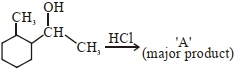
A
$1-$ethyl$-2-$methyl$-1-$chlorocyclohexane
B
$1-$methyl$-2-$ethylidenecyclohexane
C
$1-$methyl$-2-$vinylcyclohexane
D
$1-$chloro$-1-$($2$-methylcyclohexyl)ethane
Solution
(A) The reaction of a secondary alcohol with $HCl$ proceeds via an $S_N1$ mechanism involving the formation of a carbocation intermediate.
$1$. Protonation of the $-OH$ group by $HCl$ converts it into a good leaving group $(-OH_2^+)$.
$2$. Loss of water molecule generates a secondary carbocation at the carbon atom attached to the cyclohexane ring.
$3$. This secondary carbocation undergoes a $1,2$-hydride shift to form a more stable tertiary carbocation at the ring carbon.
$4$. Finally,the nucleophilic chloride ion $(Cl^-)$ attacks the tertiary carbocation to form the major product,$1$-ethyl-$1$-chloro-$2$-methylcyclohexane.
$1$. Protonation of the $-OH$ group by $HCl$ converts it into a good leaving group $(-OH_2^+)$.
$2$. Loss of water molecule generates a secondary carbocation at the carbon atom attached to the cyclohexane ring.
$3$. This secondary carbocation undergoes a $1,2$-hydride shift to form a more stable tertiary carbocation at the ring carbon.
$4$. Finally,the nucleophilic chloride ion $(Cl^-)$ attacks the tertiary carbocation to form the major product,$1$-ethyl-$1$-chloro-$2$-methylcyclohexane.
0 likesView Solution
155
ChemistryMediumMCQJEE Main · 2021
In the following reaction,the reason why the meta-nitro product is also formed is:
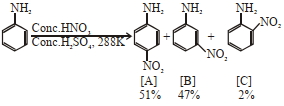
A
low temperature
B
$-NH_2$ group is highly meta-directive
C
Formation of anilinium ion
D
$-NO_2$ substitution always takes place at meta-position
Solution
(C) In the presence of concentrated $H_2SO_4$,aniline is protonated to form the anilinium ion $(-NH_3^+)$.
The $-NH_3^+$ group is strongly electron-withdrawing due to its $-I$ effect and is meta-directing.
Therefore,during the nitration of aniline,a significant amount of the meta-nitro product is formed due to the presence of the anilinium ion.
The $-NH_3^+$ group is strongly electron-withdrawing due to its $-I$ effect and is meta-directing.
Therefore,during the nitration of aniline,a significant amount of the meta-nitro product is formed due to the presence of the anilinium ion.
0 likesView Solution
156
ChemistryMediumMCQJEE Main · 2021
In the Freundlich adsorption isotherm,the slope of the $AB$ line is:
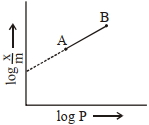
A
$n$ where $(n > 1)$
B
$n$ where $(n = 0.1 \text{ to } 0.5)$
C
$\log(1/n)$ where $(n < 1)$
D
$1/n$ where $(1/n = 0 \text{ to } 1)$
Solution
(D) The Freundlich adsorption isotherm is given by the equation: $\frac{x}{m} = K(P)^{1/n}$
Taking the logarithm on both sides:
$\log \left(\frac{x}{m}\right) = \log K + \frac{1}{n} \log P$
This equation is in the form of a straight line $y = mx + c$,where:
$y = \log \left(\frac{x}{m}\right)$
$x = \log P$
$c = \log K$
$m = \frac{1}{n}$ (slope)
In the Freundlich adsorption isotherm,the value of $\frac{1}{n}$ ranges between $0$ and $1$ (i.e.,$0 \leq \frac{1}{n} \leq 1$).
Thus,the slope of the line is $\frac{1}{n}$ where $\frac{1}{n}$ lies between $0$ and $1$.
Taking the logarithm on both sides:
$\log \left(\frac{x}{m}\right) = \log K + \frac{1}{n} \log P$
This equation is in the form of a straight line $y = mx + c$,where:
$y = \log \left(\frac{x}{m}\right)$
$x = \log P$
$c = \log K$
$m = \frac{1}{n}$ (slope)
In the Freundlich adsorption isotherm,the value of $\frac{1}{n}$ ranges between $0$ and $1$ (i.e.,$0 \leq \frac{1}{n} \leq 1$).
Thus,the slope of the line is $\frac{1}{n}$ where $\frac{1}{n}$ lies between $0$ and $1$.
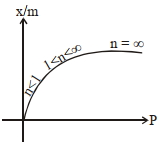
0 likesView Solution
157
ChemistryEasyMCQJEE Main · 2021
Given below are two statements:
Statement $I$: Colourless cupric metaborate is reduced to cuprous metaborate in a luminous flame.
Statement $II$: Cuprous metaborate is obtained by heating boric anhydride and copper sulphate in a non-luminous flame.
In the light of the above statements,choose the most appropriate answer from the options given below.
Statement $I$: Colourless cupric metaborate is reduced to cuprous metaborate in a luminous flame.
Statement $II$: Cuprous metaborate is obtained by heating boric anhydride and copper sulphate in a non-luminous flame.
In the light of the above statements,choose the most appropriate answer from the options given below.
A
Statement $I$ is true but Statement $II$ is false
B
Both Statement $I$ and Statement $II$ are false
C
Statement $I$ is false but Statement $II$ is true
D
Both Statement $I$ and Statement $II$ are true
Solution
(B) Statement $I$ is false because cupric metaborate $(Cu(BO_2)_2)$ is blue in color,not colourless.
Statement $II$ is false because heating boric anhydride $(B_2O_3)$ and copper sulphate $(CuSO_4)$ in a non-luminous (oxidizing) flame produces cupric metaborate $(Cu(BO_2)_2)$,which is blue. Cuprous metaborate $(CuBO_2)$ is formed in a luminous (reducing) flame.
Statement $II$ is false because heating boric anhydride $(B_2O_3)$ and copper sulphate $(CuSO_4)$ in a non-luminous (oxidizing) flame produces cupric metaborate $(Cu(BO_2)_2)$,which is blue. Cuprous metaborate $(CuBO_2)$ is formed in a luminous (reducing) flame.
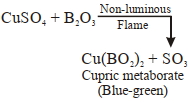
0 likesView Solution
158
ChemistryEasyMCQJEE Main · 2021
Out of the following,which type of interaction is responsible for the stabilisation of $\alpha$-helix structure of proteins?
A
Ionic bonding
B
Hydrogen bonding
C
Covalent bonding
D
van der Waals forces
Solution
(B) The $\alpha$-helix structure of proteins is stabilized by intramolecular hydrogen bonding between the carbonyl oxygen $(C=O)$ of one amino acid residue and the amide hydrogen $(N-H)$ of the fourth amino acid residue along the polypeptide chain.
0 likesView Solution
159
ChemistryEasyMCQJEE Main · 2021
Match List-$I$ with List-$II$.
Choose the correct answer from the options given below:
| List-$I$ (Monomer Unit) | List-$II$ (Polymer) |
| $(a)$ Caprolactum | $(i)$ Natural rubber |
| $(b)$ $2-$Chloro$-1,3-$butadiene | $(ii)$ Buna$-N$ |
| $(c)$ Isoprene | $(iii)$ Nylon$-6$ |
| $(d)$ Acrylonitrile | $(iv)$ Neoprene |
Choose the correct answer from the options given below:
A
$(a)$ $\rightarrow (iv), (b)$ $\rightarrow (iii), (c)$ $\rightarrow (ii), (d)$ $\rightarrow (i)$
B
$(a)$ $\rightarrow (ii), (b)$ $\rightarrow (i), (c)$ $\rightarrow (iv), (d)$ $\rightarrow (iii)$
C
$(a)$ $\rightarrow (iii), (b)$ $\rightarrow (iv), (c)$ $\rightarrow (i), (d)$ $\rightarrow (ii)$
D
$(a)$ $\rightarrow (i), (b)$ $\rightarrow (ii), (c)$ $\rightarrow (iii), (d)$ $\rightarrow (iv)$
Solution
(C) Caprolactum is the monomeric unit of polymer Nylon$-6$.
$(b)$ $2-$Chloro$-1,3-$butadiene is the monomeric unit of polymer Neoprene.
$(c)$ Isoprene ($2-$methylbuta$-1,3-$diene) is the monomeric unit of Natural rubber.
$(d)$ Acrylonitrile $(CH_2=CH-CN)$ is one of the monomeric units of polymer Buna$-N$.
Therefore,the correct matching is: $(a)$ $\rightarrow (iii), (b)$ $\rightarrow (iv), (c)$ $\rightarrow (i), (d)$ $\rightarrow (ii)$.
$(b)$ $2-$Chloro$-1,3-$butadiene is the monomeric unit of polymer Neoprene.
$(c)$ Isoprene ($2-$methylbuta$-1,3-$diene) is the monomeric unit of Natural rubber.
$(d)$ Acrylonitrile $(CH_2=CH-CN)$ is one of the monomeric units of polymer Buna$-N$.
Therefore,the correct matching is: $(a)$ $\rightarrow (iii), (b)$ $\rightarrow (iv), (c)$ $\rightarrow (i), (d)$ $\rightarrow (ii)$.
0 likesView Solution
160
ChemistryMediumMCQJEE Main · 2021
The major components in "Gun Metal" are
A
$Cu, Zn$ and $Ni$
B
$Cu, Sn$ and $Zn$
C
$Al, Cu, Mg$ and $Mn$
D
$Cu, Ni$ and $Fe$
Solution
(B) The major components in "Gun Metal" are:
$Cu : 87 \%$
$Sn : 10 \%$
$Zn : 3 \%$
Thus,the correct composition is $Cu, Sn$ and $Zn$.
$Cu : 87 \%$
$Sn : 10 \%$
$Zn : 3 \%$
Thus,the correct composition is $Cu, Sn$ and $Zn$.
0 likesView Solution
161
ChemistryEasyMCQJEE Main · 2021
The electrode potential of $M^{2+} / M$ for $3d$-series elements shows a positive value for which of the following?
A
$Zn$
B
$Fe$
C
$Co$
D
$Cu$
Solution
(D) The electrode potential $E^{\Theta}$ for the reduction of $M^{2+}$ to $M$ in the $3d$-series is generally negative,except for copper.
Copper $(Cu)$ has a positive standard electrode potential $(E^{\Theta} = +0.34 \ V)$ because the high energy required to transform $Cu(s)$ to $Cu^{2+}(aq)$ (sum of enthalpy of atomization and ionization enthalpy) is not compensated by its hydration enthalpy.
Therefore,the correct option is $D$.
Copper $(Cu)$ has a positive standard electrode potential $(E^{\Theta} = +0.34 \ V)$ because the high energy required to transform $Cu(s)$ to $Cu^{2+}(aq)$ (sum of enthalpy of atomization and ionization enthalpy) is not compensated by its hydration enthalpy.
Therefore,the correct option is $D$.
0 likesView Solution
162
ChemistryMediumMCQJEE Main · 2021
Which of the following compounds gives a pink colour on reaction with phthalic anhydride in conc. $H_2SO_4$ followed by treatment with $NaOH$?
A
$2-$propylphenol
B
$4-$methyl$-5-$propylbenzene$-1,2-$diol
C
$2-$methyl$-5-$propylbenzene$-1,3-$diol
D
$4-$propylphenol
Solution
(A) The reaction of phenols with phthalic anhydride in the presence of concentrated $H_2SO_4$ is a condensation reaction that forms phthalein dyes.
For a phenol to form a phthalein dye (which shows a pink colour in basic medium),it must have a free para-position relative to the hydroxyl $(-OH)$ group to allow for the electrophilic aromatic substitution $(EAS)$ by the phthalic anhydride intermediate.
In $2$-propylphenol,the para-position is free,allowing the reaction to proceed to form the corresponding phthalein derivative,which turns pink upon treatment with $NaOH$.
For a phenol to form a phthalein dye (which shows a pink colour in basic medium),it must have a free para-position relative to the hydroxyl $(-OH)$ group to allow for the electrophilic aromatic substitution $(EAS)$ by the phthalic anhydride intermediate.
In $2$-propylphenol,the para-position is free,allowing the reaction to proceed to form the corresponding phthalein derivative,which turns pink upon treatment with $NaOH$.
0 likesView Solution
163
ChemistryMediumMCQJEE Main · 2021
When $9.45 \text{ g}$ of $ClCH_2COOH$ is added to $500 \text{ mL}$ of water,its freezing point drops by $0.5^\circ \text{C}$. The dissociation constant of $ClCH_2COOH$ is $x \times 10^{-3}$. The value of $x$ is ............... (Rounded off to the nearest integer) $[K_{f(H_2O)} = 1.86 \text{ K kg mol}^{-1}]$
A
$38$
B
$42$
C
$36$
D
$44$
Solution
(C) Molar mass of $ClCH_2COOH = 94.5 \text{ g mol}^{-1}$.
Molality $(m) = \frac{9.45 \text{ g}}{94.5 \text{ g mol}^{-1} \times 0.5 \text{ kg}} = 0.2 \text{ m}$.
Using the formula $\Delta T_f = i \cdot K_f \cdot m$:
$0.5 = i \times 1.86 \times 0.2$.
$i = \frac{0.5}{0.372} \approx 1.344$.
For the dissociation $ClCH_2COOH \rightleftharpoons ClCH_2COO^- + H^+$,the van't Hoff factor is $i = 1 + \alpha$.
$\alpha = i - 1 = 0.344$.
The dissociation constant $K_a = \frac{C\alpha^2}{1-\alpha} = \frac{0.2 \times (0.344)^2}{1 - 0.344} = \frac{0.2 \times 0.118336}{0.656} \approx 0.0361 = 36.1 \times 10^{-3}$.
Thus,$x \approx 36$.
Molality $(m) = \frac{9.45 \text{ g}}{94.5 \text{ g mol}^{-1} \times 0.5 \text{ kg}} = 0.2 \text{ m}$.
Using the formula $\Delta T_f = i \cdot K_f \cdot m$:
$0.5 = i \times 1.86 \times 0.2$.
$i = \frac{0.5}{0.372} \approx 1.344$.
For the dissociation $ClCH_2COOH \rightleftharpoons ClCH_2COO^- + H^+$,the van't Hoff factor is $i = 1 + \alpha$.
$\alpha = i - 1 = 0.344$.
The dissociation constant $K_a = \frac{C\alpha^2}{1-\alpha} = \frac{0.2 \times (0.344)^2}{1 - 0.344} = \frac{0.2 \times 0.118336}{0.656} \approx 0.0361 = 36.1 \times 10^{-3}$.
Thus,$x \approx 36$.
0 likesView Solution
164
ChemistryMediumMCQJEE Main · 2021
$4.5 \ g$ of compound $A$ $(MW = 90)$ was used to make $250 \ mL$ of its aqueous solution. The molarity of the solution in $M$ is $x \times 10^{-1}$. The value of $x$ is ............ (Rounded off to the nearest integer)
A
$1$
B
$2$
C
$3$
D
$4$
Solution
(B) The number of moles of compound $A$ is calculated as: $n = \frac{\text{mass}}{\text{molar mass}} = \frac{4.5 \ g}{90 \ g/mol} = 0.05 \ mol$.
The volume of the solution in liters is: $V = 250 \ mL = 0.250 \ L$.
The molarity $(M)$ is given by: $M = \frac{n}{V} = \frac{0.05 \ mol}{0.250 \ L} = 0.2 \ M$.
Expressing this in the form $x \times 10^{-1}$: $0.2 = 2 \times 10^{-1}$.
Therefore,the value of $x$ is $2$.
The volume of the solution in liters is: $V = 250 \ mL = 0.250 \ L$.
The molarity $(M)$ is given by: $M = \frac{n}{V} = \frac{0.05 \ mol}{0.250 \ L} = 0.2 \ M$.
Expressing this in the form $x \times 10^{-1}$: $0.2 = 2 \times 10^{-1}$.
Therefore,the value of $x$ is $2$.
0 likesView Solution
165
ChemistryDifficultMCQJEE Main · 2021
The stepwise formation of $[Cu(NH_{3})_{4}]^{2+}$ is given below:
$Cu^{2+} + NH_{3} \rightleftharpoons [Cu(NH_{3})]^{2+} \quad K_{1}$
$[Cu(NH_{3})]^{2+} + NH_{3} \rightleftharpoons [Cu(NH_{3})_{2}]^{2+} \quad K_{2}$
$[Cu(NH_{3})_{2}]^{2+} + NH_{3} \rightleftharpoons [Cu(NH_{3})_{3}]^{2+} \quad K_{3}$
$[Cu(NH_{3})_{3}]^{2+} + NH_{3} \rightleftharpoons [Cu(NH_{3})_{4}]^{2+} \quad K_{4}$
The values of stability constants $K_{1}, K_{2}, K_{3}$ and $K_{4}$ are $10^{4}, 1.58 \times 10^{3}, 5 \times 10^{2}$ and $10^{2}$ respectively. The overall equilibrium constant for dissociation of $[Cu(NH_{3})_{4}]^{2+}$ is $x \times 10^{-12}$. The value of $x$ is ...............
(Rounded off to the nearest integer)
$Cu^{2+} + NH_{3} \rightleftharpoons [Cu(NH_{3})]^{2+} \quad K_{1}$
$[Cu(NH_{3})]^{2+} + NH_{3} \rightleftharpoons [Cu(NH_{3})_{2}]^{2+} \quad K_{2}$
$[Cu(NH_{3})_{2}]^{2+} + NH_{3} \rightleftharpoons [Cu(NH_{3})_{3}]^{2+} \quad K_{3}$
$[Cu(NH_{3})_{3}]^{2+} + NH_{3} \rightleftharpoons [Cu(NH_{3})_{4}]^{2+} \quad K_{4}$
The values of stability constants $K_{1}, K_{2}, K_{3}$ and $K_{4}$ are $10^{4}, 1.58 \times 10^{3}, 5 \times 10^{2}$ and $10^{2}$ respectively. The overall equilibrium constant for dissociation of $[Cu(NH_{3})_{4}]^{2+}$ is $x \times 10^{-12}$. The value of $x$ is ...............
(Rounded off to the nearest integer)
A
$3$
B
$1$
C
$5$
D
$7$
Solution
(B) The overall formation constant $K_{f}$ is the product of the stepwise stability constants:
$K_{f} = K_{1} \times K_{2} \times K_{3} \times K_{4}$
$K_{f} = 10^{4} \times (1.58 \times 10^{3}) \times (5 \times 10^{2}) \times 10^{2}$
$K_{f} = 7.9 \times 10^{11}$
The dissociation constant $K_{d}$ is the reciprocal of the formation constant $K_{f}$:
$K_{d} = \frac{1}{K_{f}} = \frac{1}{7.9 \times 10^{11}}$
$K_{d} \approx 1.26 \times 10^{-12}$
Given $K_{d} = x \times 10^{-12}$,we have $x = 1.26$.
Rounding to the nearest integer,$x = 1$.
$K_{f} = K_{1} \times K_{2} \times K_{3} \times K_{4}$
$K_{f} = 10^{4} \times (1.58 \times 10^{3}) \times (5 \times 10^{2}) \times 10^{2}$
$K_{f} = 7.9 \times 10^{11}$
The dissociation constant $K_{d}$ is the reciprocal of the formation constant $K_{f}$:
$K_{d} = \frac{1}{K_{f}} = \frac{1}{7.9 \times 10^{11}}$
$K_{d} \approx 1.26 \times 10^{-12}$
Given $K_{d} = x \times 10^{-12}$,we have $x = 1.26$.
Rounding to the nearest integer,$x = 1$.
0 likesView Solution
166
ChemistryEasyMCQJEE Main · 2021
The coordination number of an atom in a body-centered cubic $(BCC)$ structure is:
[Assume that the lattice is made up of atoms.]
[Assume that the lattice is made up of atoms.]
A
$8$
B
$7$
C
$1$
D
$2$
Solution
(A) In a body-centered cubic $(BCC)$ unit cell,an atom is present at the center of the cube.
This central atom is surrounded by $8$ corner atoms,each of which is at an equal distance from the center.
Therefore,the coordination number of an atom in a $BCC$ structure is $8$.
This central atom is surrounded by $8$ corner atoms,each of which is at an equal distance from the center.
Therefore,the coordination number of an atom in a $BCC$ structure is $8$.
0 likesView Solution
167
ChemistryMediumMCQJEE Main · 2021
Gaseous cyclobutene isomerizes to butadiene in a first order process which has a $k$ value of $3.3 \times 10^{-4} \ s^{-1}$ at $153^{\circ}C$. The time in minutes it takes for the isomerization to proceed $40\%$ to completion at this temperature is ..........
(Rounded off to the nearest integer)
(Rounded off to the nearest integer)
A
$10$
B
$20$
C
$26$
D
$30$
Solution
(C) The reaction is a first order process.
The integrated rate equation for a first order reaction is given by:
$Kt = \ln \frac{[A]_{0}}{[A]_{t}}$
Given that the reaction proceeds $40\%$ to completion,the remaining concentration $[A]_{t}$ is $60\%$ of the initial concentration $[A]_{0}$.
So,$[A]_{t} = 0.60 [A]_{0}$ or $\frac{[A]_{0}}{[A]_{t}} = \frac{100}{60} = \frac{5}{3}$.
Substituting the values:
$3.3 \times 10^{-4} \ s^{-1} \times t = \ln \left(\frac{100}{60}\right)$
$3.3 \times 10^{-4} \times t = \ln(1.6667)$
$3.3 \times 10^{-4} \times t = 0.5108$
$t = \frac{0.5108}{3.3 \times 10^{-4}} \ s$
$t = 1547.95 \ s$
To convert the time into minutes:
$t = \frac{1547.95}{60} \ min$
$t = 25.799 \ min$
Rounding off to the nearest integer,we get $26 \ min$.
The integrated rate equation for a first order reaction is given by:
$Kt = \ln \frac{[A]_{0}}{[A]_{t}}$
Given that the reaction proceeds $40\%$ to completion,the remaining concentration $[A]_{t}$ is $60\%$ of the initial concentration $[A]_{0}$.
So,$[A]_{t} = 0.60 [A]_{0}$ or $\frac{[A]_{0}}{[A]_{t}} = \frac{100}{60} = \frac{5}{3}$.
Substituting the values:
$3.3 \times 10^{-4} \ s^{-1} \times t = \ln \left(\frac{100}{60}\right)$
$3.3 \times 10^{-4} \times t = \ln(1.6667)$
$3.3 \times 10^{-4} \times t = 0.5108$
$t = \frac{0.5108}{3.3 \times 10^{-4}} \ s$
$t = 1547.95 \ s$
To convert the time into minutes:
$t = \frac{1547.95}{60} \ min$
$t = 25.799 \ min$
Rounding off to the nearest integer,we get $26 \ min$.
0 likesView Solution
168
ChemistryMediumMCQJEE Main · 2021
Given below are two statements:
Statement $I$: $CeO_{2}$ can be used for the oxidation of aldehydes and ketones.
Statement $II$: Aqueous solution of $EuSO_{4}$ is a strong reducing agent.
In the light of the above statements,choose the correct answer from the options given below:
Statement $I$: $CeO_{2}$ can be used for the oxidation of aldehydes and ketones.
Statement $II$: Aqueous solution of $EuSO_{4}$ is a strong reducing agent.
In the light of the above statements,choose the correct answer from the options given below:
A
Statement $I$ is false but statement $II$ is true
B
Statement $I$ is true but statement $II$ is false
C
Both statement $I$ and statement $II$ are true
D
Both statement $I$ and statement $II$ are false
Solution
(C) The $+3$ oxidation state of lanthanoids is the most stable. Therefore,lanthanoids in the $+4$ oxidation state have a strong tendency to gain an electron and convert into the $+3$ state,acting as strong oxidizing agents.
For example,$Ce^{+4}$ in $CeO_{2}$ is used to oxidize alcohols,aldehydes,and ketones.
Lanthanoids in the $+2$ oxidation state have a strong tendency to lose an electron and convert into the $+3$ oxidation state,thus acting as strong reducing agents.
Therefore,$EuSO_{4}$ (containing $Eu^{2+}$) acts as a strong reducing agent.
Both statements are true.
For example,$Ce^{+4}$ in $CeO_{2}$ is used to oxidize alcohols,aldehydes,and ketones.
Lanthanoids in the $+2$ oxidation state have a strong tendency to lose an electron and convert into the $+3$ oxidation state,thus acting as strong reducing agents.
Therefore,$EuSO_{4}$ (containing $Eu^{2+}$) acts as a strong reducing agent.
Both statements are true.
0 likesView Solution
169
ChemistryMediumMCQJEE Main · 2021
Which of the following reaction/s will not give $p-$aminoazobenzene?
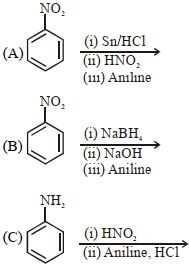
A
Only $A$
B
Only $B$
C
Only $C$
D
$A$ and $B$
Solution
(B) In basic or neutral medium,$N-N$ coupling is favourable,while in slightly acidic medium,$C-N$ coupling is favourable to form $p-$aminoazobenzene.
Reaction $A$: Nitrobenzene is reduced to aniline by $Sn/HCl$,then diazotized by $HNO_2$ to form benzene diazonium chloride,which couples with aniline in acidic medium to give $p-$aminoazobenzene.
Reaction $B$: $NaBH_4$ is a selective reducing agent and does not reduce nitrobenzene to aniline. Therefore,no diazonium salt is formed,and $p-$aminoazobenzene is not produced.
Reaction $C$: Aniline is directly diazotized by $HNO_2$ to form benzene diazonium chloride,which then couples with aniline in acidic medium to give $p-$aminoazobenzene.
Thus,only reaction $B$ will not give $p-$aminoazobenzene.
Reaction $A$: Nitrobenzene is reduced to aniline by $Sn/HCl$,then diazotized by $HNO_2$ to form benzene diazonium chloride,which couples with aniline in acidic medium to give $p-$aminoazobenzene.
Reaction $B$: $NaBH_4$ is a selective reducing agent and does not reduce nitrobenzene to aniline. Therefore,no diazonium salt is formed,and $p-$aminoazobenzene is not produced.
Reaction $C$: Aniline is directly diazotized by $HNO_2$ to form benzene diazonium chloride,which then couples with aniline in acidic medium to give $p-$aminoazobenzene.
Thus,only reaction $B$ will not give $p-$aminoazobenzene.
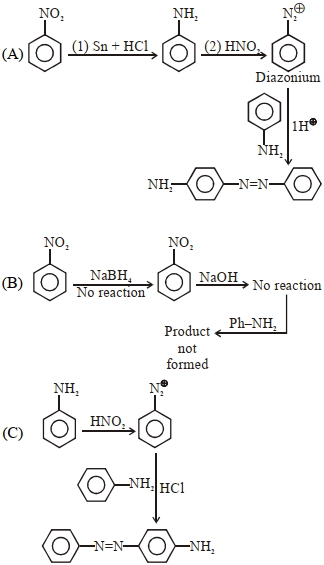
0 likesView Solution
170
ChemistryMediumMCQJEE Main · 2021
Which one of the following reactions will not form acetaldehyde?
A
$CH_3-CH_2-OH \xrightarrow[573 \ K]{Cu}$
B
$CH_3-CN \xrightarrow[(ii) H_2O]{(i) DIBAL-H}$
C
$CH_2=CH_2 + O_2 \xrightarrow[H_2O]{Pd(II)/Cu(II)}$
D
$CH_3-CH_2-OH \xrightarrow{CrO_3 - H_2SO_4}$
Solution
(D) $CH_3-CH_2-OH$ on oxidation with $CrO_3 - H_2SO_4$ (Jones reagent) gives acetic acid $(CH_3-COOH)$ because it is a strong oxidizing agent.
The other reactions produce acetaldehyde $(CH_3-CHO)$:
$(A)$ Dehydrogenation of ethanol: $CH_3-CH_2-OH \xrightarrow[573 \ K]{Cu} CH_3-CHO + H_2$
$(B)$ Reduction of nitrile: $CH_3-CN \xrightarrow[(ii) H_2O]{(i) DIBAL-H} CH_3-CHO$
$(C)$ Wacker process: $CH_2=CH_2 + O_2 \xrightarrow[H_2O]{Pd(II)/Cu(II)} CH_3-CHO$
The other reactions produce acetaldehyde $(CH_3-CHO)$:
$(A)$ Dehydrogenation of ethanol: $CH_3-CH_2-OH \xrightarrow[573 \ K]{Cu} CH_3-CHO + H_2$
$(B)$ Reduction of nitrile: $CH_3-CN \xrightarrow[(ii) H_2O]{(i) DIBAL-H} CH_3-CHO$
$(C)$ Wacker process: $CH_2=CH_2 + O_2 \xrightarrow[H_2O]{Pd(II)/Cu(II)} CH_3-CHO$
0 likesView Solution
171
ChemistryEasyMCQJEE Main · 2021
In which of the following pairs,the outermost electronic configuration will be the same?
A
$Cr^{+}$ and $Mn^{2+}$
B
$Ni^{2+}$ and $Cu^{+}$
C
$Fe^{2+}$ and $Co^{+}$
D
$V^{2+}$ and $Cr^{+}$
Solution
(A) The electronic configuration of $Cr$ $(Z=24)$ is $[Ar] 3d^5 4s^1$. Therefore,$Cr^{+}$ is $[Ar] 3d^5$.
The electronic configuration of $Mn$ $(Z=25)$ is $[Ar] 3d^5 4s^2$. Therefore,$Mn^{2+}$ is $[Ar] 3d^5$.
Both ions have the same outermost electronic configuration of $3d^5$.
The electronic configuration of $Mn$ $(Z=25)$ is $[Ar] 3d^5 4s^2$. Therefore,$Mn^{2+}$ is $[Ar] 3d^5$.
Both ions have the same outermost electronic configuration of $3d^5$.
1 likesView Solution
172
ChemistryEasyMCQJEE Main · 2021
Which glycosidic linkage between galactose and glucose is present in lactose?
A
$C-1$ of galactose and $C-4$ of glucose
B
$C-1$ of glucose and $C-6$ of galactose
C
$C-1$ of glucose and $C-4$ of galactose
D
$C-1$ of galactose and $C-6$ of glucose
Solution
(A) Lactose is a disaccharide composed of $\beta-D-galactose$ and $\beta-D-glucose$.
In lactose,the glycosidic linkage is formed between the $C-1$ of the galactose unit and the $C-4$ of the glucose unit.
This is specifically a $\beta-1,4-glycosidic$ linkage.
In lactose,the glycosidic linkage is formed between the $C-1$ of the galactose unit and the $C-4$ of the glucose unit.
This is specifically a $\beta-1,4-glycosidic$ linkage.
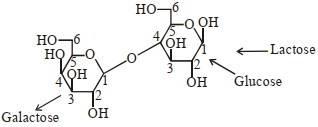
0 likesView Solution
173
ChemistryMediumMCQJEE Main · 2021
Compound$(s)$ which will liberate carbon dioxide with sodium bicarbonate solution is/are:
$A = \text{2,4,6-triamino phenol}$
$B = \text{Benzoic acid}$
$C = \text{Picric acid (2,4,6-trinitrophenol)}$
$A = \text{2,4,6-triamino phenol}$
$B = \text{Benzoic acid}$
$C = \text{Picric acid (2,4,6-trinitrophenol)}$
A
$B$ only
B
$C$ only
C
$B$ and $C$ only
D
$A$ and $B$ only
Solution
(C) Sodium bicarbonate $(NaHCO_3)$ is a weak base. It reacts with acids that are stronger than carbonic acid ($H_2CO_3$,$pK_a \approx 6.35$) to liberate $CO_2$ gas.
$1$. $B$ (Benzoic acid,$pK_a \approx 4.2$) is a stronger acid than $H_2CO_3$,so it reacts with $NaHCO_3$ to liberate $CO_2$.
$2$. $C$ (Picric acid,$pK_a \approx 0.38$) is a very strong acid due to the electron-withdrawing effect of three $-NO_2$ groups. It is much stronger than $H_2CO_3$ and thus liberates $CO_2$ with $NaHCO_3$.
$3$. $A$ ($2$,$4$,$6$-triamino phenol) is a very weak acid because the $-NH_2$ groups are electron-donating by resonance,which destabilizes the phenoxide ion. It is weaker than $H_2CO_3$ and does not liberate $CO_2$ with $NaHCO_3$.
Therefore,both $B$ and $C$ will liberate $CO_2$.
$1$. $B$ (Benzoic acid,$pK_a \approx 4.2$) is a stronger acid than $H_2CO_3$,so it reacts with $NaHCO_3$ to liberate $CO_2$.
$2$. $C$ (Picric acid,$pK_a \approx 0.38$) is a very strong acid due to the electron-withdrawing effect of three $-NO_2$ groups. It is much stronger than $H_2CO_3$ and thus liberates $CO_2$ with $NaHCO_3$.
$3$. $A$ ($2$,$4$,$6$-triamino phenol) is a very weak acid because the $-NH_2$ groups are electron-donating by resonance,which destabilizes the phenoxide ion. It is weaker than $H_2CO_3$ and does not liberate $CO_2$ with $NaHCO_3$.
Therefore,both $B$ and $C$ will liberate $CO_2$.
0 likesView Solution
174
ChemistryEasyMCQJEE Main · 2021
The hybridization and magnetic nature of $[Mn(CN)_6]^{4-}$ and $[Fe(CN)_6]^{3-}$,respectively are
A
$d^2sp^3$ and diamagnetic
B
$sp^3d^2$ and diamagnetic
C
$d^2sp^3$ and paramagnetic
D
$sp^3d^2$ and paramagnetic
Solution
(C) For $[Mn(CN)_6]^{4-}$:
$Mn$ is in $+2$ oxidation state ($3d^5$ configuration).
$CN^-$ is a strong field ligand $(SFL)$,so it causes pairing of electrons.
Thus,the configuration becomes $t_{2g}^5 e_g^0$,leaving one unpaired electron.
The hybridization is $d^2sp^3$ and it is paramagnetic.
For $[Fe(CN)_6]^{3-}$:
$Fe$ is in $+3$ oxidation state ($3d^5$ configuration).
$CN^-$ is a strong field ligand $(SFL)$,causing pairing of electrons.
Thus,the configuration becomes $t_{2g}^5 e_g^0$,leaving one unpaired electron.
The hybridization is $d^2sp^3$ and it is paramagnetic.
Therefore,both complexes have $d^2sp^3$ hybridization and are paramagnetic.
$Mn$ is in $+2$ oxidation state ($3d^5$ configuration).
$CN^-$ is a strong field ligand $(SFL)$,so it causes pairing of electrons.
Thus,the configuration becomes $t_{2g}^5 e_g^0$,leaving one unpaired electron.
The hybridization is $d^2sp^3$ and it is paramagnetic.
For $[Fe(CN)_6]^{3-}$:
$Fe$ is in $+3$ oxidation state ($3d^5$ configuration).
$CN^-$ is a strong field ligand $(SFL)$,causing pairing of electrons.
Thus,the configuration becomes $t_{2g}^5 e_g^0$,leaving one unpaired electron.
The hybridization is $d^2sp^3$ and it is paramagnetic.
Therefore,both complexes have $d^2sp^3$ hybridization and are paramagnetic.
0 likesView Solution
175
ChemistryEasyMCQJEE Main · 2021
The Ellingham diagram is a graphical representation of
A
$\Delta H$ vs $T$
B
$\Delta G$ vs $T$
C
$\Delta G$ vs $P$
D
$(\Delta G - T \Delta S)$ vs $T$
Solution
(B) The Ellingham diagram is a plot of the Gibbs free energy change $(\Delta G)$ versus temperature $(T)$ for the formation of metal oxides from their respective elements and oxygen. It helps in predicting the feasibility of the reduction of metal oxides.
0 likesView Solution
176
ChemistryEasyMCQJEE Main · 2021
In Freundlich adsorption isotherm at moderate pressure,the extent of adsorption $\left(\frac{x}{m}\right)$ is directly proportional to $P^x$. The value of $x$ is
A
zero
B
$\frac{1}{n}$
C
$1$
D
$\infty$
Solution
(B) The Freundlich adsorption isotherm is given by the equation $\frac{x}{m} = K P^{\frac{1}{n}}$.
At moderate pressure,the value of the exponent is $\frac{1}{n}$,where $n > 1$.
Comparing this with the given expression $\frac{x}{m} \propto P^x$,we find that $x = \frac{1}{n}$.
At moderate pressure,the value of the exponent is $\frac{1}{n}$,where $n > 1$.
Comparing this with the given expression $\frac{x}{m} \propto P^x$,we find that $x = \frac{1}{n}$.
0 likesView Solution
177
ChemistryMediumMCQJEE Main · 2021
Identify $A$ and $B$ in the chemical reaction.
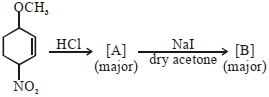
A
$A$ = $1-$methoxy$-2-$chloro$-4-$nitrocyclohexane,$B$ = $1-$methoxy$-2-$chloro$-4-$nitrocyclohexane
B
$A$ = $1-$methoxy$-2-$chloro$-4-$nitrocyclohexane,$B$ = $1-$methoxy$-2-$iodo$-4-$nitrocyclohexane
C
$A$ = $1-$methoxy$-2-$chloro$-4-$nitrocyclohexane,$B$ = $1-$iodo$-2-$chloro$-4-$nitrocyclohexane
D
$A$ = $1-$methoxy$-2-$chloro$-4-$nitrocyclohexane,$B$ = $1-$methoxy$-2-$iodo$-4-$nitrocyclohexane (with different substitution pattern)
Solution
(D) The first step is the electrophilic addition of $HCl$ to the double bond of the cyclohexene ring. According to Markovnikov's rule,the $H^+$ adds to the carbon with more hydrogens,and $Cl^-$ adds to the other carbon,forming the chloro-substituted product $[A]$.
In the second step,the reaction with $NaI$ in dry acetone is a Finkelstein reaction,which is an $S_N2$ substitution where the chlorine atom is replaced by an iodine atom to form the iodo-substituted product $[B]$.
In the second step,the reaction with $NaI$ in dry acetone is a Finkelstein reaction,which is an $S_N2$ substitution where the chlorine atom is replaced by an iodine atom to form the iodo-substituted product $[B]$.
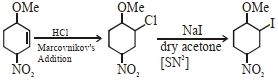
0 likesView Solution
178
ChemistryEasyMCQJEE Main · 2021
Which statement is correct?
A
Synthesis of $Buna-S$ needs nascent oxygen.
B
Neoprene is an addition copolymer used in plastic bucket manufacturing.
C
$Buna-S$ is a synthetic and linear thermosetting polymer.
D
$Buna-N$ is a natural polymer.
Solution
(A) The provided image shows the polymerization of $1,3-butadiene$ and styrene to form $Buna-S$ in the presence of nascent oxygen as an initiator.
$Buna-S$ is a synthetic elastomer (a type of rubber),not a thermosetting polymer.
$Neoprene$ is a homopolymer of $chloroprene$,not a copolymer.
$Buna-N$ is a synthetic copolymer,not a natural polymer.
Therefore,the statement that the synthesis of $Buna-S$ requires nascent oxygen is correct based on the provided reaction scheme.
$Buna-S$ is a synthetic elastomer (a type of rubber),not a thermosetting polymer.
$Neoprene$ is a homopolymer of $chloroprene$,not a copolymer.
$Buna-N$ is a synthetic copolymer,not a natural polymer.
Therefore,the statement that the synthesis of $Buna-S$ requires nascent oxygen is correct based on the provided reaction scheme.
0 likesView Solution
179
ChemistryEasyMCQJEE Main · 2021
The major product of the following chemical reaction is
$CH_{3}CH_{2}CN \xrightarrow[(3) Pd/BaSO_{4}, H_{2}]{(1) H_{3}O^{+}, \Delta \quad (2) SOCl_{2}} ?$
$CH_{3}CH_{2}CN \xrightarrow[(3) Pd/BaSO_{4}, H_{2}]{(1) H_{3}O^{+}, \Delta \quad (2) SOCl_{2}} ?$
A
$CH_{3}CH_{2}CH_{3}$
B
$CH_{3}CH_{2}CH_{2}OH$
C
$(CH_{3}CH_{2}CO)_{2}O$
D
$CH_{3}CH_{2}CHO$
Solution
(D) The reaction proceeds in three steps:
$1$. Acidic hydrolysis of propanenitrile $(CH_{3}CH_{2}CN)$ yields propanoic acid $(CH_{3}CH_{2}COOH)$.
$2$. Treatment of propanoic acid with $SOCl_{2}$ yields propanoyl chloride $(CH_{3}CH_{2}COCl)$.
$3$. Rosenmund reduction of propanoyl chloride using $Pd/BaSO_{4}$ and $H_{2}$ yields propanaldehyde $(CH_{3}CH_{2}CHO)$.
$1$. Acidic hydrolysis of propanenitrile $(CH_{3}CH_{2}CN)$ yields propanoic acid $(CH_{3}CH_{2}COOH)$.
$2$. Treatment of propanoic acid with $SOCl_{2}$ yields propanoyl chloride $(CH_{3}CH_{2}COCl)$.
$3$. Rosenmund reduction of propanoyl chloride using $Pd/BaSO_{4}$ and $H_{2}$ yields propanaldehyde $(CH_{3}CH_{2}CHO)$.
0 likesView Solution
180
ChemistryEasyMCQJEE Main · 2021
Among the following,the number of halide$(s)$ which is/are inert to hydrolysis is ..........
$(A)$ $BF_3$
$(B)$ $SiCl_4$
$(C)$ $PCl_5$
$(D)$ $SF_6$
$(A)$ $BF_3$
$(B)$ $SiCl_4$
$(C)$ $PCl_5$
$(D)$ $SF_6$
A
$7$
B
$9$
C
$4$
D
$1$
Solution
(D) $BF_3$,$SiCl_4$,and $PCl_5$ undergo hydrolysis because they have vacant orbitals or are highly reactive towards water.
$SF_6$ is inert towards hydrolysis due to steric hindrance and the fact that the sulfur atom is coordinatively saturated by six fluorine atoms,preventing the attack of water molecules.
Thus,the number of halides inert to hydrolysis is $1$.
$SF_6$ is inert towards hydrolysis due to steric hindrance and the fact that the sulfur atom is coordinatively saturated by six fluorine atoms,preventing the attack of water molecules.
Thus,the number of halides inert to hydrolysis is $1$.
0 likesView Solution
181
ChemistryEasyMCQJEE Main · 2021
$1$ molal aqueous solution of an electrolyte $A_{2}B_{3}$ is $60\%$ ionised. The boiling point of the solution at $1 \ atm$ is ......... $K$.
(Rounded-off to the nearest integer)
[Given $K_{b}$ for $H_{2}O = 0.52 \ K \ kg \ mol^{-1}$]
(Rounded-off to the nearest integer)
[Given $K_{b}$ for $H_{2}O = 0.52 \ K \ kg \ mol^{-1}$]
A
$370$
B
$380$
C
$375$
D
$385$
Solution
(C) The electrolyte $A_{2}B_{3}$ dissociates as: $A_{2}B_{3} \rightarrow 2A^{3+} + 3B^{2-}$.
The number of ions produced per formula unit is $n = 2 + 3 = 5$.
The degree of dissociation $\alpha = 0.60$.
The van't Hoff factor $i = 1 + \alpha(n - 1) = 1 + 0.60(5 - 1) = 1 + 0.60(4) = 1 + 2.4 = 3.4$.
The elevation in boiling point is given by $\Delta T_{b} = i K_{b} m$.
Substituting the values: $\Delta T_{b} = 3.4 \times 0.52 \times 1 = 1.768 \ K$.
The boiling point of the solution $T_{b} = T_{b}^{\circ} + \Delta T_{b} = 373.15 + 1.768 = 374.918 \ K$.
Rounding off to the nearest integer,we get $375 \ K$.
The number of ions produced per formula unit is $n = 2 + 3 = 5$.
The degree of dissociation $\alpha = 0.60$.
The van't Hoff factor $i = 1 + \alpha(n - 1) = 1 + 0.60(5 - 1) = 1 + 0.60(4) = 1 + 2.4 = 3.4$.
The elevation in boiling point is given by $\Delta T_{b} = i K_{b} m$.
Substituting the values: $\Delta T_{b} = 3.4 \times 0.52 \times 1 = 1.768 \ K$.
The boiling point of the solution $T_{b} = T_{b}^{\circ} + \Delta T_{b} = 373.15 + 1.768 = 374.918 \ K$.
Rounding off to the nearest integer,we get $375 \ K$.
0 likesView Solution
182
ChemistryMediumMCQJEE Main · 2021
For the reaction,$aA + bB \rightarrow cC + dD$,the plot of $\log k$ vs $\frac{1}{T}$ is given below. The temperature at which the rate constant of the reaction is $10^{-4} \ s^{-1}$ is ............... $K$. (Rounded-off to the nearest integer) [Given: The rate constant of the reaction is $10^{-5} \ s^{-1}$ at $500 \ K$.]
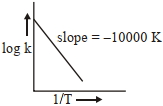
A
$500$
B
$526$
C
$426$
D
$486$
Solution
(B) The Arrhenius equation is given by $\log k = \log A - \frac{E_a}{2.303 RT}$.
Comparing this with the equation of a straight line $y = mx + c$,the slope is $m = -\frac{E_a}{2.303 R}$.
From the given graph,the slope is $-10,000 \ K$.
Therefore,$\frac{E_a}{2.303 R} = 10,000 \ K$.
Using the Arrhenius equation in the form $\log \left( \frac{k_2}{k_1} \right) = \frac{E_a}{2.303 R} \left( \frac{1}{T_1} - \frac{1}{T_2} \right)$:
Given $k_1 = 10^{-5} \ s^{-1}$ at $T_1 = 500 \ K$ and $k_2 = 10^{-4} \ s^{-1}$ at $T_2 = ?$.
Substituting the values: $\log \left( \frac{10^{-4}}{10^{-5}} \right) = 10,000 \left( \frac{1}{500} - \frac{1}{T_2} \right)$.
$\log(10) = 1 = 10,000 \left( \frac{1}{500} - \frac{1}{T_2} \right)$.
$\frac{1}{10,000} = \frac{1}{500} - \frac{1}{T_2}$.
$\frac{1}{T_2} = \frac{1}{500} - \frac{1}{10,000} = \frac{20 - 1}{10,000} = \frac{19}{10,000}$.
$T_2 = \frac{10,000}{19} \approx 526.31 \ K$.
Rounding to the nearest integer,$T_2 = 526 \ K$.
Comparing this with the equation of a straight line $y = mx + c$,the slope is $m = -\frac{E_a}{2.303 R}$.
From the given graph,the slope is $-10,000 \ K$.
Therefore,$\frac{E_a}{2.303 R} = 10,000 \ K$.
Using the Arrhenius equation in the form $\log \left( \frac{k_2}{k_1} \right) = \frac{E_a}{2.303 R} \left( \frac{1}{T_1} - \frac{1}{T_2} \right)$:
Given $k_1 = 10^{-5} \ s^{-1}$ at $T_1 = 500 \ K$ and $k_2 = 10^{-4} \ s^{-1}$ at $T_2 = ?$.
Substituting the values: $\log \left( \frac{10^{-4}}{10^{-5}} \right) = 10,000 \left( \frac{1}{500} - \frac{1}{T_2} \right)$.
$\log(10) = 1 = 10,000 \left( \frac{1}{500} - \frac{1}{T_2} \right)$.
$\frac{1}{10,000} = \frac{1}{500} - \frac{1}{T_2}$.
$\frac{1}{T_2} = \frac{1}{500} - \frac{1}{10,000} = \frac{20 - 1}{10,000} = \frac{19}{10,000}$.
$T_2 = \frac{10,000}{19} \approx 526.31 \ K$.
Rounding to the nearest integer,$T_2 = 526 \ K$.
0 likesView Solution
183
ChemistryMediumMCQJEE Main · 2021
$0.4 \ g$ mixture of $NaOH, Na_{2}CO_{3}$ and some inert impurities was first titrated with $\frac{N}{10} \ HCl$ using phenolphthalein as an indicator,$17.5 \ mL$ of $HCl$ was required at the end point. After this,methyl orange was added and titrated. $1.5 \ mL$ of same $HCl$ was required for the next end point. The weight percentage of $Na_{2}CO_{3}$ in the mixture is .......... (Rounded-off to the nearest integer)
A
$1$
B
$2$
C
$4$
D
$3$
Solution
(B) Let $x$ be the milliequivalents of $NaOH$ and $y$ be the milliequivalents of $Na_{2}CO_{3}$.
At the first end point (phenolphthalein indicator),$NaOH$ is neutralized and $Na_{2}CO_{3}$ is converted to $NaHCO_{3}$:
$x + y = \frac{1}{10} \times 17.5 = 1.75 \text{ meq} \dots (1)$
At the second end point (methyl orange indicator),$NaHCO_{3}$ is neutralized:
$y = \frac{1}{10} \times 1.5 = 0.15 \text{ meq} \dots (2)$
Mass of $Na_{2}CO_{3} = \text{milliequivalents} \times \text{equivalent weight} \times 10^{-3}$
$= 0.15 \times 53 \times 10^{-3} = 0.00795 \ g$
Weight percentage of $Na_{2}CO_{3} = \frac{0.00795}{0.4} \times 100 = 1.9875 \%$
Rounding off to the nearest integer,we get $2 \%$.
At the first end point (phenolphthalein indicator),$NaOH$ is neutralized and $Na_{2}CO_{3}$ is converted to $NaHCO_{3}$:
$x + y = \frac{1}{10} \times 17.5 = 1.75 \text{ meq} \dots (1)$
At the second end point (methyl orange indicator),$NaHCO_{3}$ is neutralized:
$y = \frac{1}{10} \times 1.5 = 0.15 \text{ meq} \dots (2)$
Mass of $Na_{2}CO_{3} = \text{milliequivalents} \times \text{equivalent weight} \times 10^{-3}$
$= 0.15 \times 53 \times 10^{-3} = 0.00795 \ g$
Weight percentage of $Na_{2}CO_{3} = \frac{0.00795}{0.4} \times 100 = 1.9875 \%$
Rounding off to the nearest integer,we get $2 \%$.
0 likesView Solution
184
ChemistryMediumMCQJEE Main · 2021
Consider the following chemical reaction.
$CH \equiv CH \xrightarrow[{(2) CO, HCl, AlCl_3}]{{(1) Red hot Fe tube, 873 K}} \text{Product}$
The number of $sp^{2}$ hybridized carbon atom$(s)$ present in the product is ..........
$CH \equiv CH \xrightarrow[{(2) CO, HCl, AlCl_3}]{{(1) Red hot Fe tube, 873 K}} \text{Product}$
The number of $sp^{2}$ hybridized carbon atom$(s)$ present in the product is ..........
A
$3$
B
$9$
C
$4$
D
$7$
Solution
(D) The reaction proceeds in two steps:
$1$. $3 CH \equiv CH \xrightarrow{\text{Red hot Fe tube, } 873 \text{ K}} C_6H_6$ (Benzene).
$2$. $C_6H_6 + CO + HCl \xrightarrow{AlCl_3} C_6H_5CHO$ (Benzaldehyde) via Gattermann-Koch reaction.
In benzaldehyde $(C_6H_5CHO)$,there are $6$ carbon atoms in the benzene ring,all of which are $sp^{2}$ hybridized.
The carbonyl carbon atom $(C=O)$ is also $sp^{2}$ hybridized.
Therefore,the total number of $sp^{2}$ hybridized carbon atoms is $6 + 1 = 7$.
$1$. $3 CH \equiv CH \xrightarrow{\text{Red hot Fe tube, } 873 \text{ K}} C_6H_6$ (Benzene).
$2$. $C_6H_6 + CO + HCl \xrightarrow{AlCl_3} C_6H_5CHO$ (Benzaldehyde) via Gattermann-Koch reaction.
In benzaldehyde $(C_6H_5CHO)$,there are $6$ carbon atoms in the benzene ring,all of which are $sp^{2}$ hybridized.
The carbonyl carbon atom $(C=O)$ is also $sp^{2}$ hybridized.
Therefore,the total number of $sp^{2}$ hybridized carbon atoms is $6 + 1 = 7$.
0 likesView Solution
185
ChemistryEasyMCQJEE Main · 2021
The structure of Neoprene is
A
$[-CH_2-C(Cl)=CH-CH_2-]_n$
B
$[-CH_2-C(CH_3)=CH-CH_2-]_n$
C
$[-CH_2-CH=CH-CH_2-]_n$
D
$[-CH_2-CH(CN)-]_n$
Solution
(A) Neoprene is a polymer of chloroprene ($2-$chloro$-1,3-$butadiene). Its structure is formed by the polymerization of the monomer $CH_2=C(Cl)-CH=CH_2$. The resulting polymer is $n[CH_2=C(Cl)-CH=CH_2] \rightarrow [-CH_2-C(Cl)=CH-CH_2-]_n$.
0 likesView Solution
186
ChemistryEasyMCQJEE Main · 2021
Match List-$I$ with List-$II$.
Choose the most appropriate answer from the options given below.
| List-$I$ (Ore) | List-$II$ (Element Present) |
|---|---|
| $a$. Kernite | $i$. Tin |
| $b$. Cassiterite | $ii$. Boron |
| $c$. Calamine | $iii$. Fluorine |
| $d$. Cryolite | $iv$. Zinc |
Choose the most appropriate answer from the options given below.
A
$a$ $\rightarrow i, b$ $\rightarrow iii, c$ $\rightarrow iv, d$ $\rightarrow ii$
B
$a$ $\rightarrow ii, b$ $\rightarrow i, c$ $\rightarrow iv, d$ $\rightarrow iii$
C
$a$ $\rightarrow ii, b$ $\rightarrow iv, c$ $\rightarrow i, d$ $\rightarrow iii$
D
$a$ $\rightarrow iii, b$ $\rightarrow i, c$ $\rightarrow ii, d$ $\rightarrow iv$
Solution
(B) The chemical compositions of the given ores are as follows:
$a$. Kernite: $Na_2B_4O_7 \cdot 4H_2O$ (contains Boron).
$b$. Cassiterite: $SnO_2$ (contains Tin).
$c$. Calamine: $ZnCO_3$ (contains Zinc).
$d$. Cryolite: $Na_3AlF_6$ (contains Fluorine).
Matching these with the elements in List-$II$:
$a \rightarrow ii$
$b \rightarrow i$
$c \rightarrow iv$
$d \rightarrow iii$
Therefore,the correct matching is $a$ $\rightarrow ii, b$ $\rightarrow i, c$ $\rightarrow iv, d$ $\rightarrow iii$.
$a$. Kernite: $Na_2B_4O_7 \cdot 4H_2O$ (contains Boron).
$b$. Cassiterite: $SnO_2$ (contains Tin).
$c$. Calamine: $ZnCO_3$ (contains Zinc).
$d$. Cryolite: $Na_3AlF_6$ (contains Fluorine).
Matching these with the elements in List-$II$:
$a \rightarrow ii$
$b \rightarrow i$
$c \rightarrow iv$
$d \rightarrow iii$
Therefore,the correct matching is $a$ $\rightarrow ii, b$ $\rightarrow i, c$ $\rightarrow iv, d$ $\rightarrow iii$.
0 likesView Solution
187
ChemistryMediumMCQJEE Main · 2021
Identify the major products $A$ and $B$ respectively in the following reactions of phenol.
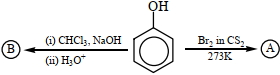
A
o-Bromophenol and p-Hydroxybenzaldehyde
B
p-Bromophenol and o-Hydroxybenzaldehyde
C
o-Bromophenol and o-Hydroxybenzaldehyde
D
p-Bromophenol and p-Hydroxybenzaldehyde
Solution
(B) $1$. Reaction with $Br_2$ in $CS_2$ at $273 \ K$: This is an electrophilic aromatic substitution reaction. Due to the low polarity of the solvent $CS_2$,the reaction is less polar,leading to the formation of the para-isomer as the major product. Thus,$A$ is $p$-bromophenol.
$2$. Reaction with $CHCl_3$ and $NaOH$ followed by $H_3O^+$: This is the Reimer-Tiemann reaction. It introduces a formyl group $(-CHO)$ at the ortho position of the phenol. Thus,$B$ is $o$-hydroxybenzaldehyde (salicylaldehyde).
Therefore,the major products are $p$-bromophenol and $o$-hydroxybenzaldehyde.
$2$. Reaction with $CHCl_3$ and $NaOH$ followed by $H_3O^+$: This is the Reimer-Tiemann reaction. It introduces a formyl group $(-CHO)$ at the ortho position of the phenol. Thus,$B$ is $o$-hydroxybenzaldehyde (salicylaldehyde).
Therefore,the major products are $p$-bromophenol and $o$-hydroxybenzaldehyde.
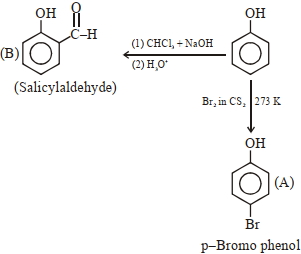
0 likesView Solution
188
ChemistryEasyMCQJEE Main · 2021
On treating a compound with warm dil. $H_{2}SO_{4}$,gas $X$ is evolved which turns $K_{2}Cr_{2}O_{7}$ paper acidified with dil. $H_{2}SO_{4}$ to a green compound $Y$. $X$ and $Y$ respectively are
A
$X = SO_{2}, Y = Cr_{2}O_{3}$
B
$X = SO_{3}, Y = Cr_{2}O_{3}$
C
$X = SO_{2}, Y = Cr_{2}(SO_{4})_{3}$
D
$X = SO_{3}, Y = Cr_{2}(SO_{4})_{3}$
Solution
(C) When a sulfite or bisulfite salt is treated with warm dil. $H_{2}SO_{4}$,sulfur dioxide gas $(X = SO_{2})$ is evolved.
$SO_{2}$ acts as a reducing agent and reacts with acidified potassium dichromate $(K_{2}Cr_{2}O_{7})$ paper.
The reaction is: $K_{2}Cr_{2}O_{7} + H_{2}SO_{4} + 3SO_{2} \longrightarrow K_{2}SO_{4} + Cr_{2}(SO_{4})_{3} + H_{2}O$.
The green compound $Y$ formed is chromium$(III)$ sulfate,$Cr_{2}(SO_{4})_{3}$.
$SO_{2}$ acts as a reducing agent and reacts with acidified potassium dichromate $(K_{2}Cr_{2}O_{7})$ paper.
The reaction is: $K_{2}Cr_{2}O_{7} + H_{2}SO_{4} + 3SO_{2} \longrightarrow K_{2}SO_{4} + Cr_{2}(SO_{4})_{3} + H_{2}O$.
The green compound $Y$ formed is chromium$(III)$ sulfate,$Cr_{2}(SO_{4})_{3}$.
0 likesView Solution
189
ChemistryEasyMCQJEE Main · 2021
Which of the following vitamins is helpful in delaying blood clotting?
A
Vitamin $C$
B
Vitamin $B$
C
Vitamin $E$
D
Vitamin $K$
Solution
(D) Vitamin $K$ is essential for the synthesis of clotting factors in the liver,which promotes blood coagulation. Conversely,substances that interfere with $Vitamin \ K$ or act as anticoagulants are used to delay blood clotting. Among the given options,$Vitamin \ K$ is the primary vitamin involved in the blood clotting process. However,if the question implies an anticoagulant effect,it is important to note that $Vitamin \ K$ promotes clotting,while its deficiency or specific inhibitors delay it.
0 likesView Solution
190
ChemistryEasyMCQJEE Main · 2021
$A$ $(C_{4}H_{8}Cl_{2})$ $\xrightarrow{\text{Hydrolysis at } 373 \text{ K}}$ $B$ $(C_{4}H_{8}O)$
$B$ reacts with hydroxylamine but does not give Tollen's test. Identify $A$ and $B$.
$B$ reacts with hydroxylamine but does not give Tollen's test. Identify $A$ and $B$.
A
$1,1-$Dichlorobutane and $2-$Butanone
B
$2,2-$Dichlorobutane and Butanal
C
$1,1-$Dichlorobutane and Butanal
D
$2,2-$Dichlorobutane and $2-$Butanone
Solution
(D) The compound $A$ $(C_{4}H_{8}Cl_{2})$ undergoes hydrolysis at $373 \text{ K}$ to form a geminal diol,which is unstable and loses a water molecule to form a carbonyl compound $B$ $(C_{4}H_{8}O)$.
Since $B$ reacts with hydroxylamine,it must be an aldehyde or a ketone.
Since $B$ does not give Tollen's test,it cannot be an aldehyde; therefore,$B$ must be a ketone.
$2,2-$Dichlorobutane on hydrolysis gives $2,2-$butanediol,which loses water to form $2-$butanone $(CH_{3}COCH_{2}CH_{3})$.
$2-$Butanone is a ketone,so it reacts with hydroxylamine and does not give Tollen's test.
Thus,$A$ is $2,2-$dichlorobutane and $B$ is $2-$butanone.
Since $B$ reacts with hydroxylamine,it must be an aldehyde or a ketone.
Since $B$ does not give Tollen's test,it cannot be an aldehyde; therefore,$B$ must be a ketone.
$2,2-$Dichlorobutane on hydrolysis gives $2,2-$butanediol,which loses water to form $2-$butanone $(CH_{3}COCH_{2}CH_{3})$.
$2-$Butanone is a ketone,so it reacts with hydroxylamine and does not give Tollen's test.
Thus,$A$ is $2,2-$dichlorobutane and $B$ is $2-$butanone.
0 likesView Solution
191
ChemistryEasyMCQJEE Main · 2021
Compound $A$ used as a strong oxidizing agent is amphoteric in nature. It is the part of lead storage batteries. Compound $A$ is
A
$PbO_2$
B
$PbO$
C
$PbSO_4$
D
$Pb_3O_4$
Solution
(A) $PbO_2$ is an amphoteric oxide and a strong oxidizing agent.
It acts as the cathode material in lead storage batteries.
It acts as the cathode material in lead storage batteries.
0 likesView Solution
192
ChemistryEasyMCQJEE Main · 2021
Which one of the following lanthanoids does not form $MO_{2}$? [$M$ is lanthanoid metal]
A
$Pr$
B
$Dy$
C
$Nd$
D
$Yb$
Solution
(D) Most lanthanoids form $M_{2}O_{3}$ type oxides.
However,$Ce$,$Pr$,$Nd$,$Tb$,and $Dy$ can form $MO_{2}$ type oxides.
$Yb$ does not form $MO_{2}$ type oxide; it typically forms $Yb_{2}O_{3}$.
However,$Ce$,$Pr$,$Nd$,$Tb$,and $Dy$ can form $MO_{2}$ type oxides.
$Yb$ does not form $MO_{2}$ type oxide; it typically forms $Yb_{2}O_{3}$.
0 likesView Solution
193
ChemistryEasyMCQJEE Main · 2021
For the given reaction,what is the major product '$A$'?
$3-\text{ethylbenzonitrile} + Br_2 \xrightarrow{UV \text{ light}} A$
$3-\text{ethylbenzonitrile} + Br_2 \xrightarrow{UV \text{ light}} A$
A
$2-$bromo$-3-$ethylbenzonitrile
B
$4-$bromo$-3-$ethylbenzonitrile
C
$3-$($1$-bromoethyl)benzonitrile
D
$5-$bromo$-3-$ethylbenzonitrile
Solution
(C) The reaction of an alkyl-substituted benzene with $Br_2$ in the presence of $UV$ light (or heat) proceeds via a free radical mechanism.
This reaction is a free radical substitution that occurs at the benzylic position.
The benzylic hydrogen is abstracted to form a stable benzylic radical,which then reacts with $Br_2$ to form the monobrominated product.
In the given molecule,$3-\text{ethylbenzonitrile}$,the benzylic carbon is the $CH_2$ group attached to the benzene ring.
Therefore,the bromine atom will substitute one of the hydrogen atoms on this benzylic carbon,resulting in $3-(1-\text{bromoethyl})benzonitrile$ as the major product.
This reaction is a free radical substitution that occurs at the benzylic position.
The benzylic hydrogen is abstracted to form a stable benzylic radical,which then reacts with $Br_2$ to form the monobrominated product.
In the given molecule,$3-\text{ethylbenzonitrile}$,the benzylic carbon is the $CH_2$ group attached to the benzene ring.
Therefore,the bromine atom will substitute one of the hydrogen atoms on this benzylic carbon,resulting in $3-(1-\text{bromoethyl})benzonitrile$ as the major product.
0 likesView Solution
194
ChemistryEasyMCQJEE Main · 2021
An amine on reaction with benzenesulphonyl chloride produces a compound insoluble in alkaline solution. This amine can be prepared by ammonolysis of ethyl chloride. The correct structure of the amine is:
A
$N$-propylaniline
B
$CH_3CH_2NH_2$
C
$CH_3CH_2CH_2NHCH_3$
D
$CH_3CH_2CH_2NHCH_2CH_3$
Solution
(D) The reaction of an amine with benzenesulphonyl chloride (Hinsberg reagent) produces a product that is insoluble in alkaline solution if the amine is a secondary $(2^{\circ})$ amine. This is because the resulting $N,N$-disubstituted sulphonamide does not contain any acidic hydrogen atom attached to the nitrogen atom.
The amine is prepared by the ammonolysis of ethyl chloride $(CH_3CH_2Cl)$,which implies the amine must contain an ethyl group $(CH_3CH_2-)$.
Among the options,$N$-propylaniline is a secondary amine,but it is not formed by the ammonolysis of ethyl chloride. The structure $CH_3CH_2CH_2NHCH_2CH_3$ ($N$-ethylpropylamine) is a secondary amine that can be formed by the reaction of propylamine with ethyl chloride. Therefore,the correct structure is $CH_3CH_2CH_2NHCH_2CH_3$.
The amine is prepared by the ammonolysis of ethyl chloride $(CH_3CH_2Cl)$,which implies the amine must contain an ethyl group $(CH_3CH_2-)$.
Among the options,$N$-propylaniline is a secondary amine,but it is not formed by the ammonolysis of ethyl chloride. The structure $CH_3CH_2CH_2NHCH_2CH_3$ ($N$-ethylpropylamine) is a secondary amine that can be formed by the reaction of propylamine with ethyl chloride. Therefore,the correct structure is $CH_3CH_2CH_2NHCH_2CH_3$.
0 likesView Solution
195
ChemistryEasyMCQJEE Main · 2021
An exothermic reaction $X \rightarrow Y$ has an activation energy of $30 \ kJ \ mol^{-1}$. If the energy change $\Delta E$ during the reaction is $-20 \ kJ \ mol^{-1}$,then the activation energy for the reverse reaction in $kJ \ mol^{-1}$ is $...$.
A
$40$
B
$250$
C
$50$
D
$150$
Solution
(C) For an exothermic reaction,the relationship between activation energy of forward reaction $(E_{a,f})$,activation energy of reverse reaction $(E_{a,r})$,and enthalpy change ($\Delta H$ or $\Delta E$) is given by:
$\Delta E = E_{a,f} - E_{a,r}$
Given:
$E_{a,f} = 30 \ kJ \ mol^{-1}$
$\Delta E = -20 \ kJ \ mol^{-1}$
Substituting the values:
$-20 = 30 - E_{a,r}$
$E_{a,r} = 30 + 20 = 50 \ kJ \ mol^{-1}$
Therefore,the activation energy for the reverse reaction is $50 \ kJ \ mol^{-1}$.
$\Delta E = E_{a,f} - E_{a,r}$
Given:
$E_{a,f} = 30 \ kJ \ mol^{-1}$
$\Delta E = -20 \ kJ \ mol^{-1}$
Substituting the values:
$-20 = 30 - E_{a,r}$
$E_{a,r} = 30 + 20 = 50 \ kJ \ mol^{-1}$
Therefore,the activation energy for the reverse reaction is $50 \ kJ \ mol^{-1}$.
0 likesView Solution
196
ChemistryMediumMCQJEE Main · 2021
Consider the following reaction:
$MnO_4^- + 8H^{+} + 5e^- \rightarrow Mn^{2+} + 4H_2O$,$E^\circ = 1.51 \ V$
The quantity of electricity required in Faraday to reduce five moles of $MnO_4^-$ is ..... .
$MnO_4^- + 8H^{+} + 5e^- \rightarrow Mn^{2+} + 4H_2O$,$E^\circ = 1.51 \ V$
The quantity of electricity required in Faraday to reduce five moles of $MnO_4^-$ is ..... .
A
$35$
B
$25$
C
$12$
D
$8$
Solution
(B) The given half-reaction is: $MnO_4^- + 8H^{+} + 5e^- \rightarrow Mn^{2+} + 4H_2O$
In this reaction,the reduction of $1 \ mol$ of $MnO_4^-$ involves the gain of $5 \ mol$ of electrons.
According to Faraday's laws,the charge required for $1 \ mol$ of electrons is $1 \ F$.
Therefore,the electricity required for $1 \ mol$ of $MnO_4^-$ is $5 \ F$.
For $5 \ mol$ of $MnO_4^-$,the total electricity required is $5 \ mol \times 5 \ F/mol = 25 \ F$.
In this reaction,the reduction of $1 \ mol$ of $MnO_4^-$ involves the gain of $5 \ mol$ of electrons.
According to Faraday's laws,the charge required for $1 \ mol$ of electrons is $1 \ F$.
Therefore,the electricity required for $1 \ mol$ of $MnO_4^-$ is $5 \ F$.
For $5 \ mol$ of $MnO_4^-$,the total electricity required is $5 \ mol \times 5 \ F/mol = 25 \ F$.
0 likesView Solution
197
ChemistryMediumMCQJEE Main · 2021
$224 \, mL$ of $SO_{2(g)}$ at $273 \, K$ and $1 \, atm$ is passed through $100 \, mL$ of $0.1 \, M \, NaOH$ solution. The non-volatile solute produced is dissolved in $36 \, g$ of water. The lowering of vapour pressure of the solution (assuming the solution is dilute) $(P^0_{H_2O} = 24 \, mm \, Hg)$ is $x \times 10^{-2} \, mm \, Hg$. The value of $x$ is ...... . (Integer answer)
A
$50$
B
$12$
C
$67$
D
$89$
Solution
(B) Step $1$: Calculate moles of reactants.
$n_{SO_2} = \frac{224 \, mL}{22400 \, mL/mol} = 0.01 \, mol$.
$n_{NaOH} = 0.1 \, M \times 0.1 \, L = 0.01 \, mol$.
Step $2$: Reaction stoichiometry.
$SO_2 + NaOH \rightarrow NaHSO_3$.
Since $n_{SO_2} = n_{NaOH} = 0.01 \, mol$, both are consumed to produce $0.01 \, mol$ of $NaHSO_3$.
Step $3$: Calculate lowering of vapour pressure.
$\Delta P = P^0_{H_2O} \times \chi_{solute} = P^0_{H_2O} \times \frac{n_{solute}}{n_{solute} + n_{solvent}}$.
$n_{solvent} = \frac{36 \, g}{18 \, g/mol} = 2 \, mol$.
$\Delta P = 24 \times \frac{0.01}{0.01 + 2} = 24 \times \frac{0.01}{2.01} \approx 24 \times 0.004975 = 0.1194 \, mm \, Hg$.
$\Delta P = 11.94 \times 10^{-2} \, mm \, Hg$.
Rounding to the nearest integer, $x = 12$.
$n_{SO_2} = \frac{224 \, mL}{22400 \, mL/mol} = 0.01 \, mol$.
$n_{NaOH} = 0.1 \, M \times 0.1 \, L = 0.01 \, mol$.
Step $2$: Reaction stoichiometry.
$SO_2 + NaOH \rightarrow NaHSO_3$.
Since $n_{SO_2} = n_{NaOH} = 0.01 \, mol$, both are consumed to produce $0.01 \, mol$ of $NaHSO_3$.
Step $3$: Calculate lowering of vapour pressure.
$\Delta P = P^0_{H_2O} \times \chi_{solute} = P^0_{H_2O} \times \frac{n_{solute}}{n_{solute} + n_{solvent}}$.
$n_{solvent} = \frac{36 \, g}{18 \, g/mol} = 2 \, mol$.
$\Delta P = 24 \times \frac{0.01}{0.01 + 2} = 24 \times \frac{0.01}{2.01} \approx 24 \times 0.004975 = 0.1194 \, mm \, Hg$.
$\Delta P = 11.94 \times 10^{-2} \, mm \, Hg$.
Rounding to the nearest integer, $x = 12$.
0 likesView Solution
198
ChemistryEasyMCQJEE Main · 2021
$3.12 \, g$ of oxygen is adsorbed on $1.2 \, g$ of platinum metal. The volume of oxygen adsorbed per gram of the adsorbent at $1 \, atm$ and $300 \, K$ in $L$ is ..... .
$[R = 0.0821 \, L \, atm \, K^{-1} \, mol^{-1}]$
$[R = 0.0821 \, L \, atm \, K^{-1} \, mol^{-1}]$
A
$2$
B
$1$
C
$5$
D
$6$
Solution
(A) First,calculate the number of moles of $O_2$ adsorbed:
$n = \frac{\text{mass}}{\text{molar mass}} = \frac{3.12 \, g}{32 \, g/mol} = 0.0975 \, mol$.
Next,calculate the volume of $O_2$ using the ideal gas equation $PV = nRT$:
$V = \frac{nRT}{P} = \frac{0.0975 \, mol \times 0.0821 \, L \, atm \, K^{-1} \, mol^{-1} \times 300 \, K}{1 \, atm} = 2.40 \, L$.
Since $1.2 \, g$ of platinum adsorbs $2.40 \, L$ of $O_2$,the volume adsorbed per gram is:
$\frac{2.40 \, L}{1.2 \, g} = 2 \, L/g$.
$n = \frac{\text{mass}}{\text{molar mass}} = \frac{3.12 \, g}{32 \, g/mol} = 0.0975 \, mol$.
Next,calculate the volume of $O_2$ using the ideal gas equation $PV = nRT$:
$V = \frac{nRT}{P} = \frac{0.0975 \, mol \times 0.0821 \, L \, atm \, K^{-1} \, mol^{-1} \times 300 \, K}{1 \, atm} = 2.40 \, L$.
Since $1.2 \, g$ of platinum adsorbs $2.40 \, L$ of $O_2$,the volume adsorbed per gram is:
$\frac{2.40 \, L}{1.2 \, g} = 2 \, L/g$.
0 likesView Solution
199
ChemistryEasyMCQJEE Main · 2021
The number of bridging $CO$ ligands in $[Mn_{2}(CO)_{10}]$ is $....$ .
A
$4$
B
$2$
C
$1$
D
$0$
Solution
(D) The structure of $[Mn_{2}(CO)_{10}]$ consists of two $Mn(CO)_{5}$ units joined by a $Mn-Mn$ metal-metal bond.
Each $Mn$ atom is bonded to five terminal $CO$ ligands.
There are no $CO$ ligands bridging the two $Mn$ atoms.
Therefore,the number of bridging $CO$ ligands is $0$.
Each $Mn$ atom is bonded to five terminal $CO$ ligands.
There are no $CO$ ligands bridging the two $Mn$ atoms.
Therefore,the number of bridging $CO$ ligands is $0$.
0 likesView Solution
200
ChemistryEasyMCQJEE Main · 2021
What is the correct sequence of reagents used for converting nitrobenzene into $m$-dibromobenzene?
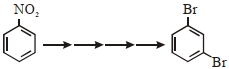
A
$\xrightarrow{NaNO_2 / HCl}$ $\xrightarrow{KBr}$ $\xrightarrow{H^+}$
B
$\xrightarrow{Br_2/Fe}$ $\xrightarrow{Sn/HCl}$ $\xrightarrow{NaNO_2/HCl}$ $\xrightarrow{CuBr/HBr}$
C
$\xrightarrow{Sn/HCl}$ $\xrightarrow{KBr}$ $\xrightarrow{Br_2}$ $\xrightarrow{H^+}$
D
$\xrightarrow{Sn/HCl}$ $\xrightarrow{Br_2}$ $\xrightarrow{NaNO_2}$ $\xrightarrow{NaBr}$
Solution
(B) The conversion of nitrobenzene to $m$-dibromobenzene involves the following steps:
$1$. Bromination of nitrobenzene using $Br_2/Fe$ gives $m$-bromonitrobenzene.
$2$. Reduction of $m$-bromonitrobenzene using $Sn/HCl$ gives $m$-bromoaniline.
$3$. Diazotization of $m$-bromoaniline using $NaNO_2/HCl$ at $0-5^{\circ}C$ gives $m$-bromobenzenediazonium chloride.
$4$. Sandmeyer reaction of $m$-bromobenzenediazonium chloride with $CuBr/HBr$ replaces the diazonium group with a bromine atom to yield $m$-dibromobenzene.
$1$. Bromination of nitrobenzene using $Br_2/Fe$ gives $m$-bromonitrobenzene.
$2$. Reduction of $m$-bromonitrobenzene using $Sn/HCl$ gives $m$-bromoaniline.
$3$. Diazotization of $m$-bromoaniline using $NaNO_2/HCl$ at $0-5^{\circ}C$ gives $m$-bromobenzenediazonium chloride.
$4$. Sandmeyer reaction of $m$-bromobenzenediazonium chloride with $CuBr/HBr$ replaces the diazonium group with a bromine atom to yield $m$-dibromobenzene.
0 likesView Solution
Vedclass Products
For Students
Vedclass Test Series
Mock tests in real JEE Main style covering Chemistry with performance analysis. 5-day free trial.
Start Free TrialFor Teachers
Exam Paper Generator
Generate Set A/B/C/D Chemistry papers from 7.5L+ questions in 2 minutes. 3 chapters free.
Try FreeFor Institutes
Online Exam Module
Run live JEE Main mock exams with unlimited students, 360° analytics & white-label branding.
See DemoFrequently Asked Questions
How many Chemistry questions are in JEE Main 2021?
There are 798 Chemistry questions from the JEE Main 2021 paper on Vedclass, each with a detailed step-by-step solution in English.
Are JEE Main 2021 Chemistry solutions available in English?
Yes. All solutions on this page are in English. You can also switch to English or Hindi using the language buttons above the questions.
Can I practice JEE Main 2021 Chemistry as a timed test?
Yes. Use the Vedclass Test Series to attempt a full JEE Main mock test covering Chemistry with time limits and instant score analysis.
Can teachers create Chemistry papers from JEE Main previous year questions?
Yes. The Vedclass Exam Paper Generator lets teachers mix JEE Main Chemistry questions and generate Set A/B/C/D papers in minutes.
For Teachers & Institutes
Build a Custom Chemistry Paper
Pick JEE Main 2021 Chemistry questions, set difficulty, and generate Set A/B/C/D in 2 minutes.