
ChemistryQ301–400 of 798 questions
Page 7 of 9 · English
301
ChemistryMediumMCQJEE Main · 2021
An organic compound $'A'$ $(C_4H_8)$ on treatment with $KMnO_4 / H^{+}$ yields compound $'B'$ $(C_3H_6O)$. Compound $'A'$ also yields compound $'B'$ on ozonolysis. Compound $'A'$ is:
A
but$-2-$ene
B
$2-$Methylpropene
C
Cyclobutane
D
$1-$Methylcyclopropane
Solution
(B) The reaction of an alkene with $KMnO_4 / H^{+}$ (oxidative cleavage) or ozonolysis ($O_3$ followed by $Zn/H_2O$) breaks the double bond.
Compound $'A'$ $(C_4H_8)$ yields $C_3H_6O$ (acetone) as one of the products.
$2-$Methylpropene $(CH_3-C(CH_3)=CH_2)$ undergoes oxidative cleavage with $KMnO_4 / H^{+}$ to form acetone $(CH_3COCH_3)$ and $CO_2$.
Similarly,ozonolysis of $2-$Methylpropene gives acetone $(CH_3COCH_3)$ and formaldehyde $(HCHO)$.
Since the question specifies that $'A'$ yields $'B'$ $(C_3H_6O)$,$2-$Methylpropene is the correct structure for $'A'$.
Compound $'A'$ $(C_4H_8)$ yields $C_3H_6O$ (acetone) as one of the products.
$2-$Methylpropene $(CH_3-C(CH_3)=CH_2)$ undergoes oxidative cleavage with $KMnO_4 / H^{+}$ to form acetone $(CH_3COCH_3)$ and $CO_2$.
Similarly,ozonolysis of $2-$Methylpropene gives acetone $(CH_3COCH_3)$ and formaldehyde $(HCHO)$.
Since the question specifies that $'A'$ yields $'B'$ $(C_3H_6O)$,$2-$Methylpropene is the correct structure for $'A'$.
0 likesView Solution
302
ChemistryMediumMCQJEE Main · 2021
Which one of the following compounds will liberate $CO_{2}$ when treated with $NaHCO_{3}$?
A
$(CH_{3})_{4}N^{+}OH^{-}$
B
$(CH_{3})_{3}NH^{+}Cl^{-}$
C
$CH_{3}NH_{2}$
D
$CH_{3}CONH_{2}$
Solution
(B) Compounds that are more acidic than $H_{2}CO_{3}$ (carbonic acid) will react with $NaHCO_{3}$ to liberate $CO_{2}$.
$(CH_{3})_{3}NH^{+}Cl^{-}$ is a salt of a weak base and a strong acid,making the cation $(CH_{3})_{3}NH^{+}$ acidic enough to react with $HCO_{3}^{-}$:
$(CH_{3})_{3}NH^{+}Cl^{-} + NaHCO_{3} \longrightarrow (CH_{3})_{3}N + NaCl + H_{2}CO_{3}$
$H_{2}CO_{3} \longrightarrow H_{2}O + CO_{2} \uparrow$
Therefore,option $B$ is the correct answer.
$(CH_{3})_{3}NH^{+}Cl^{-}$ is a salt of a weak base and a strong acid,making the cation $(CH_{3})_{3}NH^{+}$ acidic enough to react with $HCO_{3}^{-}$:
$(CH_{3})_{3}NH^{+}Cl^{-} + NaHCO_{3} \longrightarrow (CH_{3})_{3}N + NaCl + H_{2}CO_{3}$
$H_{2}CO_{3} \longrightarrow H_{2}O + CO_{2} \uparrow$
Therefore,option $B$ is the correct answer.
0 likesView Solution
303
ChemistryDifficultMCQJEE Main · 2021
At $298.2 \ K$,the relationship between the enthalpy of bond dissociation (in $kJ \ mol^{-1}$) for hydrogen $(E_{H})$ and its isotope,deuterium $(E_{D})$,is best described by:
A
$E_{H} = \frac{1}{2} E_{D}$
B
$E_{H} = E_{D}$
C
$E_{H} = 2 E_{D}$
D
$E_{H} \simeq E_{D} - 7.5$
Solution
(D) The enthalpy of bond dissociation at $298.2 \ K$ for hydrogen $(H_2)$ is approximately $435.88 \ kJ \ mol^{-1}$.
The enthalpy of bond dissociation at $298.2 \ K$ for deuterium $(D_2)$ is approximately $443.35 \ kJ \ mol^{-1}$.
Comparing these values,we find that $E_{H} \approx 435.88$ and $E_{D} \approx 443.35$.
Calculating the difference: $E_{D} - E_{H} = 443.35 - 435.88 = 7.47 \ kJ \ mol^{-1} \approx 7.5 \ kJ \ mol^{-1}$.
Therefore,the relationship is $E_{H} \simeq E_{D} - 7.5$.
The enthalpy of bond dissociation at $298.2 \ K$ for deuterium $(D_2)$ is approximately $443.35 \ kJ \ mol^{-1}$.
Comparing these values,we find that $E_{H} \approx 435.88$ and $E_{D} \approx 443.35$.
Calculating the difference: $E_{D} - E_{H} = 443.35 - 435.88 = 7.47 \ kJ \ mol^{-1} \approx 7.5 \ kJ \ mol^{-1}$.
Therefore,the relationship is $E_{H} \simeq E_{D} - 7.5$.
0 likesView Solution
304
ChemistryMediumMCQJEE Main · 2021
Which one among the following resonating structures is not correct?
A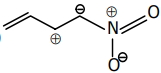
B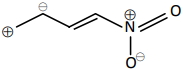
C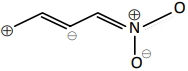
D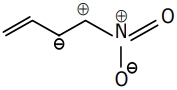
Solution
(D) Resonating structures must maintain the same number of paired and unpaired electrons and the same atomic positions.
In the given structures,we are looking for the one that violates the rules of resonance,such as exceeding the octet rule for nitrogen or having an invalid charge distribution.
Option $D$ shows a structure where the nitrogen atom is bonded to two oxygen atoms and a carbon atom,and it carries a positive charge. In this structure,the central carbon atom also carries a positive charge. This arrangement is unstable and does not represent a valid resonance contributor for the nitroalkene system because it creates an adjacent positive-positive charge repulsion and violates the stability criteria for resonance structures.
In the given structures,we are looking for the one that violates the rules of resonance,such as exceeding the octet rule for nitrogen or having an invalid charge distribution.
Option $D$ shows a structure where the nitrogen atom is bonded to two oxygen atoms and a carbon atom,and it carries a positive charge. In this structure,the central carbon atom also carries a positive charge. This arrangement is unstable and does not represent a valid resonance contributor for the nitroalkene system because it creates an adjacent positive-positive charge repulsion and violates the stability criteria for resonance structures.
0 likesView Solution
305
ChemistryMediumMCQJEE Main · 2021
Which one of the following chemical agents is not used for the dry-cleaning of clothes?
A
$H_{2}O_{2}$
B
$Cl_{2}C=CCl_{2}$
C
$CCl_{4}$
D
Liquid $CO_{2}$
Solution
(A) Dry cleaning of clothes typically involves the use of solvents that can dissolve grease and oil stains without damaging the fabric.
$Cl_{2}C=CCl_{2}$ (tetrachloroethene),$CCl_{4}$ (carbon tetrachloride),and liquid $CO_{2}$ are commonly used as dry-cleaning agents.
$H_{2}O_{2}$ (hydrogen peroxide) is primarily used as a bleaching agent in laundry to whiten fabrics,not as a solvent for dry cleaning.
$Cl_{2}C=CCl_{2}$ (tetrachloroethene),$CCl_{4}$ (carbon tetrachloride),and liquid $CO_{2}$ are commonly used as dry-cleaning agents.
$H_{2}O_{2}$ (hydrogen peroxide) is primarily used as a bleaching agent in laundry to whiten fabrics,not as a solvent for dry cleaning.
0 likesView Solution
306
ChemistryDifficultMCQJEE Main · 2021
Given below are two statements:
Statement $I$: None of the alkaline earth metal hydroxides dissolve in alkali.
Statement $II$: Solubility of alkaline earth metal hydroxides in water increases down the group.
In the light of the above statements,choose the most appropriate answer from the options given below:
Statement $I$: None of the alkaline earth metal hydroxides dissolve in alkali.
Statement $II$: Solubility of alkaline earth metal hydroxides in water increases down the group.
In the light of the above statements,choose the most appropriate answer from the options given below:
A
Statement $I$ is correct but Statement $II$ is incorrect.
B
Statement $I$ and Statement $II$ both are incorrect.
C
Statement $I$ is incorrect but Statement $II$ is correct.
D
Statement $I$ and Statement $II$ both are correct.
Solution
(C) Statement-$I$ is incorrect because $Be(OH)_2$ is amphoteric in nature and dissolves in alkali to form beryllates.
Statement-$II$ is correct because the solubility of alkaline earth metal hydroxides in water increases down the group as the lattice energy decreases more rapidly than the hydration energy.
Therefore,Statement-$I$ is incorrect and Statement-$II$ is correct.
Statement-$II$ is correct because the solubility of alkaline earth metal hydroxides in water increases down the group as the lattice energy decreases more rapidly than the hydration energy.
Therefore,Statement-$I$ is incorrect and Statement-$II$ is correct.
0 likesView Solution
307
ChemistryDifficultMCQJEE Main · 2021
$A$ source of monochromatic radiation of wavelength $400 \, nm$ provides $1000 \, J$ of energy in $10 \, seconds$. When this radiation falls on the surface of sodium,$x \times 10^{20}$ electrons are ejected per second. Assume that wavelength $400 \, nm$ is sufficient for ejection of electrons from the surface of sodium metal. The value of $x$ is $......$. (Nearest integer) $(h = 6.626 \times 10^{-34} \, Js)$
A
$2$
B
$4$
C
$6$
D
$8$
Solution
(A) Total energy provided by the source per second $= \frac{1000 \, J}{10 \, s} = 100 \, J/s$.
Energy of one photon $E = \frac{hc}{\lambda} = \frac{6.626 \times 10^{-34} \, Js \times 3 \times 10^8 \, m/s}{400 \times 10^{-9} \, m} = 4.9695 \times 10^{-19} \, J$.
Number of photons incident per second $= \frac{\text{Total energy per second}}{\text{Energy of one photon}} = \frac{100}{4.9695 \times 10^{-19}} \approx 2.012 \times 10^{20}$.
Since one photon ejects one electron,the number of electrons ejected per second is $2.012 \times 10^{20}$.
Comparing this with $x \times 10^{20}$,we get $x \approx 2$.
Energy of one photon $E = \frac{hc}{\lambda} = \frac{6.626 \times 10^{-34} \, Js \times 3 \times 10^8 \, m/s}{400 \times 10^{-9} \, m} = 4.9695 \times 10^{-19} \, J$.
Number of photons incident per second $= \frac{\text{Total energy per second}}{\text{Energy of one photon}} = \frac{100}{4.9695 \times 10^{-19}} \approx 2.012 \times 10^{20}$.
Since one photon ejects one electron,the number of electrons ejected per second is $2.012 \times 10^{20}$.
Comparing this with $x \times 10^{20}$,we get $x \approx 2$.
0 likesView Solution
308
ChemistryDifficultMCQJEE Main · 2021
At $298 \ K$,the enthalpy of fusion of a solid $(X)$ is $2.8 \ kJ \ mol^{-1}$ and the enthalpy of vaporisation of the liquid $(X)$ is $98.2 \ kJ \ mol^{-1}$. The enthalpy of sublimation of the substance $(X)$ in $kJ \ mol^{-1}$ is $.....$ (in nearest integer).
A
$99$
B
$100$
C
$101$
D
$201$
Solution
(C) According to Hess's Law,the enthalpy of sublimation is the sum of the enthalpy of fusion and the enthalpy of vaporization:
$\Delta H_{\text{sub}} = \Delta H_{\text{fus}} + \Delta H_{\text{vap}}$
Given:
$\Delta H_{\text{fus}} = 2.8 \ kJ \ mol^{-1}$
$\Delta H_{\text{vap}} = 98.2 \ kJ \ mol^{-1}$
Therefore:
$\Delta H_{\text{sub}} = 2.8 + 98.2 = 101 \ kJ \ mol^{-1}$
$\Delta H_{\text{sub}} = \Delta H_{\text{fus}} + \Delta H_{\text{vap}}$
Given:
$\Delta H_{\text{fus}} = 2.8 \ kJ \ mol^{-1}$
$\Delta H_{\text{vap}} = 98.2 \ kJ \ mol^{-1}$
Therefore:
$\Delta H_{\text{sub}} = 2.8 + 98.2 = 101 \ kJ \ mol^{-1}$
0 likesView Solution
309
ChemistryMediumMCQJEE Main · 2021
Consider the complete combustion of butane. The amount of butane utilized to produce $72.0 \ g$ of water is $.... \times 10^{-1} \ g$ (in nearest integer).
A
$123$
B
$742$
C
$652$
D
$464$
Solution
(D) The balanced chemical equation for the combustion of butane is:
$C_{4}H_{10} + \frac{13}{2} O_{2} \longrightarrow 4 CO_{2} + 5 H_{2}O$
Calculate the moles of water produced:
$\text{Moles of } H_{2}O = \frac{72.0 \ g}{18.0 \ g/mol} = 4.0 \ mol$
From the stoichiometry of the reaction,$1 \ mol$ of $C_{4}H_{10}$ produces $5 \ mol$ of $H_{2}O$.
Therefore,the moles of $C_{4}H_{10}$ required to produce $4.0 \ mol$ of $H_{2}O$ is:
$\text{Moles of } C_{4}H_{10} = \frac{1}{5} \times 4.0 = 0.8 \ mol$
The molar mass of butane $(C_{4}H_{10})$ is $(4 \times 12) + (10 \times 1) = 58 \ g/mol$.
Calculate the mass of butane:
$\text{Mass of } C_{4}H_{10} = 0.8 \ mol \times 58 \ g/mol = 46.4 \ g$
Expressing $46.4 \ g$ in the form $.... \times 10^{-1} \ g$:
$46.4 \ g = 464 \times 10^{-1} \ g$
Thus,the nearest integer value is $464$.
$C_{4}H_{10} + \frac{13}{2} O_{2} \longrightarrow 4 CO_{2} + 5 H_{2}O$
Calculate the moles of water produced:
$\text{Moles of } H_{2}O = \frac{72.0 \ g}{18.0 \ g/mol} = 4.0 \ mol$
From the stoichiometry of the reaction,$1 \ mol$ of $C_{4}H_{10}$ produces $5 \ mol$ of $H_{2}O$.
Therefore,the moles of $C_{4}H_{10}$ required to produce $4.0 \ mol$ of $H_{2}O$ is:
$\text{Moles of } C_{4}H_{10} = \frac{1}{5} \times 4.0 = 0.8 \ mol$
The molar mass of butane $(C_{4}H_{10})$ is $(4 \times 12) + (10 \times 1) = 58 \ g/mol$.
Calculate the mass of butane:
$\text{Mass of } C_{4}H_{10} = 0.8 \ mol \times 58 \ g/mol = 46.4 \ g$
Expressing $46.4 \ g$ in the form $.... \times 10^{-1} \ g$:
$46.4 \ g = 464 \times 10^{-1} \ g$
Thus,the nearest integer value is $464$.
0 likesView Solution
310
ChemistryDifficultMCQJEE Main · 2021
For the reaction $A + B \rightleftharpoons 2C$,the value of equilibrium constant is $100$ at $298 \ K$. If the initial concentration of all the three species is $1 \ M$ each,then the equilibrium concentration of $C$ is $X \times 10^{-1} \ M$. The value of $X$ is $.....$ (Nearest integer)
A
$25$
B
$30$
C
$35$
D
$40$
Solution
(A) The reaction is $A + B \rightleftharpoons 2C$.
Initial concentrations: $[A] = 1 \ M, [B] = 1 \ M, [C] = 1 \ M$.
Let the change in concentration be $x$.
At equilibrium: $[A] = 1 - x, [B] = 1 - x, [C] = 1 + 2x$.
$K_c = \frac{[C]^2}{[A][B]} = \frac{(1+2x)^2}{(1-x)(1-x)} = 100$.
Taking the square root on both sides: $\frac{1+2x}{1-x} = 10$.
$1 + 2x = 10 - 10x$.
$12x = 9$,so $x = \frac{9}{12} = 0.75$.
Equilibrium concentration of $C = 1 + 2x = 1 + 2(0.75) = 1 + 1.5 = 2.5 \ M$.
$2.5 \ M = 25 \times 10^{-1} \ M$.
Thus,$X = 25$.
Initial concentrations: $[A] = 1 \ M, [B] = 1 \ M, [C] = 1 \ M$.
Let the change in concentration be $x$.
At equilibrium: $[A] = 1 - x, [B] = 1 - x, [C] = 1 + 2x$.
$K_c = \frac{[C]^2}{[A][B]} = \frac{(1+2x)^2}{(1-x)(1-x)} = 100$.
Taking the square root on both sides: $\frac{1+2x}{1-x} = 10$.
$1 + 2x = 10 - 10x$.
$12x = 9$,so $x = \frac{9}{12} = 0.75$.
Equilibrium concentration of $C = 1 + 2x = 1 + 2(0.75) = 1 + 1.5 = 2.5 \ M$.
$2.5 \ M = 25 \times 10^{-1} \ M$.
Thus,$X = 25$.
0 likesView Solution
311
ChemistryMediumMCQJEE Main · 2021
$A$ home owner uses $4.00 \times 10^{3} \ m^{3}$ of methane $(CH_{4})$ gas (assume $CH_{4}$ is an ideal gas) in a year to heat his home. Under the pressure of $1.0 \ atm$ and $300 \ K$,the mass of gas used is $X \times 10^{5} \ g$. The value of $X$ is $.......$ (Nearest integer).
(Given $R = 0.083 \ L \ atm \ K^{-1} \ mol^{-1}$)
(Given $R = 0.083 \ L \ atm \ K^{-1} \ mol^{-1}$)
A
$24$
B
$25$
C
$26$
D
$27$
Solution
(C) Given:
Volume $V = 4.00 \times 10^{3} \ m^{3} = 4.00 \times 10^{3} \times 10^{3} \ L = 4.00 \times 10^{6} \ L$
Pressure $P = 1.0 \ atm$
Temperature $T = 300 \ K$
Gas constant $R = 0.083 \ L \ atm \ K^{-1} \ mol^{-1}$
Using the ideal gas equation $PV = nRT$,where $n = \frac{mass (m)}{Molar \ mass (M)}$:
$n = \frac{PV}{RT} = \frac{1.0 \times 4.00 \times 10^{6}}{0.083 \times 300} \ mol$
$n = \frac{4.00 \times 10^{6}}{24.9} \ mol \approx 1.6064 \times 10^{5} \ mol$
Molar mass of $CH_{4} = 12 + 4 \times 1 = 16 \ g \ mol^{-1}$
Mass $m = n \times M = 1.6064 \times 10^{5} \times 16 \ g$
$m = 25.7024 \times 10^{5} \ g$
Comparing with $X \times 10^{5} \ g$,we get $X = 25.7024$.
Rounding to the nearest integer,$X = 26$.
Volume $V = 4.00 \times 10^{3} \ m^{3} = 4.00 \times 10^{3} \times 10^{3} \ L = 4.00 \times 10^{6} \ L$
Pressure $P = 1.0 \ atm$
Temperature $T = 300 \ K$
Gas constant $R = 0.083 \ L \ atm \ K^{-1} \ mol^{-1}$
Using the ideal gas equation $PV = nRT$,where $n = \frac{mass (m)}{Molar \ mass (M)}$:
$n = \frac{PV}{RT} = \frac{1.0 \times 4.00 \times 10^{6}}{0.083 \times 300} \ mol$
$n = \frac{4.00 \times 10^{6}}{24.9} \ mol \approx 1.6064 \times 10^{5} \ mol$
Molar mass of $CH_{4} = 12 + 4 \times 1 = 16 \ g \ mol^{-1}$
Mass $m = n \times M = 1.6064 \times 10^{5} \times 16 \ g$
$m = 25.7024 \times 10^{5} \ g$
Comparing with $X \times 10^{5} \ g$,we get $X = 25.7024$.
Rounding to the nearest integer,$X = 26$.
0 likesView Solution
312
ChemistryMediumMCQJEE Main · 2021
The number of sigma $(\sigma)$ bonds in the molecule $CH_3-CH_2-CH_2-C \equiv CH$ is $......$
A
$10$
B
$11$
C
$12$
D
$13$
Solution
(C) The structure of the molecule is $CH_3-CH_2-CH_2-C \equiv CH$.
To find the number of $\sigma$ bonds,we count all single bonds and one bond from each multiple bond.
- $C-H$ bonds: $3$ (in $CH_3$) + $2$ (in $CH_2$) + $2$ (in $CH_2$) + $1$ (in $CH$) = $8$ $\sigma$ bonds.
- $C-C$ bonds: $1$ $(C-C)$ + $1$ $(C-C)$ + $1$ $(C-C)$ = $3$ $\sigma$ bonds.
- $C \equiv C$ bond: $1$ $\sigma$ bond.
Total $\sigma$ bonds = $8 + 3 + 1 = 12$.
To find the number of $\sigma$ bonds,we count all single bonds and one bond from each multiple bond.
- $C-H$ bonds: $3$ (in $CH_3$) + $2$ (in $CH_2$) + $2$ (in $CH_2$) + $1$ (in $CH$) = $8$ $\sigma$ bonds.
- $C-C$ bonds: $1$ $(C-C)$ + $1$ $(C-C)$ + $1$ $(C-C)$ = $3$ $\sigma$ bonds.
- $C \equiv C$ bond: $1$ $\sigma$ bond.
Total $\sigma$ bonds = $8 + 3 + 1 = 12$.
0 likesView Solution
313
ChemistryDifficultMCQJEE Main · 2021
The ionic radii of $F^{-}$ and $O^{2-}$ respectively are $1.33 \ \mathring{A}$ and $1.40 \ \mathring{A}$,while the covalent radius of $N$ is $0.74 \ \mathring{A}$. The correct statement for the ionic radius of $N^{3-}$ from the following is:
A
It is bigger than $F^{-}$ and $N$,but smaller than of $O^{2-}$
B
It is smaller than $O^{2-}$ and $F^{-}$,but bigger than of $N$
C
It is bigger than $O^{2-}$ and $F^{-}$
D
It is smaller than $F^{-}$ and $N$
Solution
(C) $F^{-}$,$O^{2-}$,and $N^{3-}$ are all isoelectronic species with $10$ electrons each.
In isoelectronic species,the ionic radius increases as the nuclear charge (number of protons) decreases.
The number of protons in $N^{3-}$,$O^{2-}$,and $F^{-}$ are $7$,$8$,and $9$ respectively.
Since $N^{3-}$ has the lowest nuclear charge,it experiences the least nuclear attraction on its valence electrons,resulting in the largest ionic radius.
Therefore,the order of ionic radii is $N^{3-} > O^{2-} > F^{-}$.
Thus,the ionic radius of $N^{3-}$ is bigger than both $O^{2-}$ and $F^{-}$.
In isoelectronic species,the ionic radius increases as the nuclear charge (number of protons) decreases.
The number of protons in $N^{3-}$,$O^{2-}$,and $F^{-}$ are $7$,$8$,and $9$ respectively.
Since $N^{3-}$ has the lowest nuclear charge,it experiences the least nuclear attraction on its valence electrons,resulting in the largest ionic radius.
Therefore,the order of ionic radii is $N^{3-} > O^{2-} > F^{-}$.
Thus,the ionic radius of $N^{3-}$ is bigger than both $O^{2-}$ and $F^{-}$.
0 likesView Solution
314
ChemistryMediumMCQJEE Main · 2021
Identify the species having one $\pi$-bond and the maximum number of canonical forms from the following:
A
$CO_{3}^{2-}$
B
$O_{2}$
C
$SO_{2}$
D
$SO_{3}$
Solution
(A) $1$. Analyze the number of $\pi$-bonds in each species:
- $CO_{3}^{2-}$: Has one $\pi$-bond (delocalized over three oxygen atoms).
- $O_{2}$: Has one $\pi$-bond (in its ground state,$O=O$).
- $SO_{2}$: Has two $\pi$-bonds (one $\pi$-bond per $S=O$ bond).
- $SO_{3}$: Has three $\pi$-bonds.
$2$. Analyze the number of canonical forms:
- $CO_{3}^{2-}$: Has $3$ equivalent canonical forms.
- $O_{2}$: Does not exhibit resonance in the standard sense of multiple canonical forms for a single Lewis structure in this context.
$3$. Conclusion:
$CO_{3}^{2-}$ is the species that contains one $\pi$-bond and exhibits $3$ canonical forms,which is the maximum among the given options.
- $CO_{3}^{2-}$: Has one $\pi$-bond (delocalized over three oxygen atoms).
- $O_{2}$: Has one $\pi$-bond (in its ground state,$O=O$).
- $SO_{2}$: Has two $\pi$-bonds (one $\pi$-bond per $S=O$ bond).
- $SO_{3}$: Has three $\pi$-bonds.
$2$. Analyze the number of canonical forms:
- $CO_{3}^{2-}$: Has $3$ equivalent canonical forms.
- $O_{2}$: Does not exhibit resonance in the standard sense of multiple canonical forms for a single Lewis structure in this context.
$3$. Conclusion:
$CO_{3}^{2-}$ is the species that contains one $\pi$-bond and exhibits $3$ canonical forms,which is the maximum among the given options.
0 likesView Solution
315
ChemistryMediumMCQJEE Main · 2021
In the following,the correct bond order sequence is:
A
$O_{2}^{+} > O_{2} > O_{2}^{-} > O_{2}^{2-}$
B
$O_{2} > O_{2}^{-} > O_{2}^{2-} > O_{2}^{+}$
C
$O_{2}^{2-} > O_{2}^{+} > O_{2}^{-} > O_{2}$
D
$O_{2}^{+} > O_{2}^{-} > O_{2}^{2-} > O_{2}$
Solution
(A) According to Molecular Orbital Theory $(MOT)$,the bond order is calculated as: $\text{Bond Order} = \frac{N_b - N_a}{2}$,where $N_b$ is the number of bonding electrons and $N_a$ is the number of antibonding electrons.
For $O_{2}^{+} (15 \ e^-)$: $\text{Bond Order} = \frac{10 - 5}{2} = 2.5$
For $O_{2} (16 \ e^-)$: $\text{Bond Order} = \frac{10 - 6}{2} = 2.0$
For $O_{2}^{-} (17 \ e^-)$: $\text{Bond Order} = \frac{10 - 7}{2} = 1.5$
For $O_{2}^{2-} (18 \ e^-)$: $\text{Bond Order} = \frac{10 - 8}{2} = 1.0$
Thus,the correct sequence is $O_{2}^{+} > O_{2} > O_{2}^{-} > O_{2}^{2-}$.
For $O_{2}^{+} (15 \ e^-)$: $\text{Bond Order} = \frac{10 - 5}{2} = 2.5$
For $O_{2} (16 \ e^-)$: $\text{Bond Order} = \frac{10 - 6}{2} = 2.0$
For $O_{2}^{-} (17 \ e^-)$: $\text{Bond Order} = \frac{10 - 7}{2} = 1.5$
For $O_{2}^{2-} (18 \ e^-)$: $\text{Bond Order} = \frac{10 - 8}{2} = 1.0$
Thus,the correct sequence is $O_{2}^{+} > O_{2} > O_{2}^{-} > O_{2}^{2-}$.
0 likesView Solution
316
ChemistryMediumMCQJEE Main · 2021
Which among the following is the strongest acid?
A
Cyclopentadiene
B
Toluene
C
Cyclopropene
D
$CH_3 CH_2 CH_2 CH_3$
Solution
(A) The acidity of a compound depends on the stability of its conjugate base.
When cyclopentadiene loses a proton $(H^+)$,it forms a cyclopentadienyl anion.
This anion has $6 \pi$ electrons and is cyclic and planar,making it aromatic according to $H$ückel's rule.
Since the conjugate base is aromatic,it is exceptionally stable,which makes cyclopentadiene the strongest acid among the given options.
When cyclopentadiene loses a proton $(H^+)$,it forms a cyclopentadienyl anion.
This anion has $6 \pi$ electrons and is cyclic and planar,making it aromatic according to $H$ückel's rule.
Since the conjugate base is aromatic,it is exceptionally stable,which makes cyclopentadiene the strongest acid among the given options.
0 likesView Solution
317
ChemistryMediumMCQJEE Main · 2021
Which one of the following metals forms interstitial hydride easily?
A
$Fe$
B
$Mn$
C
$Cr$
D
$Co$
Solution
(C) Transition metals of group $7, 8,$ and $9$ do not form hydrides. This is known as the hydride gap.
Among the given options,$Fe$ (group $8$),$Mn$ (group $7$),and $Co$ (group $9$) belong to the hydride gap.
$Cr$ (group $6$) does not fall into this gap and can form interstitial hydrides.
Among the given options,$Fe$ (group $8$),$Mn$ (group $7$),and $Co$ (group $9$) belong to the hydride gap.
$Cr$ (group $6$) does not fall into this gap and can form interstitial hydrides.
0 likesView Solution
318
ChemistryDifficultMCQJEE Main · 2021
Match List-$I$ with List-$II$ :
Choose the correct answer from the options given below :
| List-$I$ | List-$II$ |
| $(a)$ $Li$ | $(i)$ Poor water solubility of $I^{-}$ salt |
| $(b)$ $Na$ | $(ii)$ Most abundant element in cell fluid |
| $(c)$ $K$ | $(iii)$ Bicarbonate salt used in fire extinguisher |
| $(d)$ $Cs$ | $(iv)$ Carbonate salt decomposes easily on heating |
Choose the correct answer from the options given below :
A
$(a)-(iv), (b)-(iii), (c)-(ii), (d)-(i)$
B
$(a)-(i), (b)-(ii), (c)-(iii), (d)-(iv)$
C
$(a)-(iv), (b)-(ii), (c)-(iii), (d)-(i)$
D
$(a)-(i), (b)-(iii), (c)-(ii), (d)-(iv)$
Solution
(A) $Li_2CO_3$ decomposes easily on heating due to the high polarizing power of the small $Li^{+}$ cation,which imparts significant covalent character to the bond.
$(b)$ $NaHCO_3$ (sodium bicarbonate) is used in fire extinguishers because it releases $CO_2$ gas upon heating.
$(c)$ $K^{+}$ ions are the most abundant cations found within the intracellular fluid of cells.
$(d)$ $CsI$ (cesium iodide) has poor water solubility because both $Cs^{+}$ and $I^{-}$ are large ions,resulting in a low lattice energy and low hydration energy,making the dissolution process energetically unfavorable.
Therefore,the correct matching is: $(a)-(iv), (b)-(iii), (c)-(ii), (d)-(i)$.
$(b)$ $NaHCO_3$ (sodium bicarbonate) is used in fire extinguishers because it releases $CO_2$ gas upon heating.
$(c)$ $K^{+}$ ions are the most abundant cations found within the intracellular fluid of cells.
$(d)$ $CsI$ (cesium iodide) has poor water solubility because both $Cs^{+}$ and $I^{-}$ are large ions,resulting in a low lattice energy and low hydration energy,making the dissolution process energetically unfavorable.
Therefore,the correct matching is: $(a)-(iv), (b)-(iii), (c)-(ii), (d)-(i)$.
0 likesView Solution
319
ChemistryEasyMCQJEE Main · 2021
Identify the process in which the change in the oxidation state is $5$:
A
$C_{2}O_{4}^{2-} \rightarrow 2CO_{2}$
B
$CrO_{4}^{2-} \rightarrow Cr^{3+}$
C
$Cr_{2}O_{7}^{2-} \rightarrow 2Cr^{3+}$
D
$MnO_{4}^{-} \rightarrow Mn^{2+}$
Solution
(D) To find the change in oxidation state,we calculate the oxidation number of the central atom in both the reactant and the product.
$A$: In $C_{2}O_{4}^{2-}$,$2x + 4(-2) = -2$ $\Rightarrow 2x = 6$ $\Rightarrow x = +3$. In $CO_{2}$,$x + 2(-2) = 0 \Rightarrow x = +4$. Change = $|4 - 3| = 1$.
$B$: In $CrO_{4}^{2-}$,$x + 4(-2) = -2 \Rightarrow x = +6$. In $Cr^{3+}$,$x = +3$. Change = $|3 - 6| = 3$.
$C$: In $Cr_{2}O_{7}^{2-}$,$2x + 7(-2) = -2$ $\Rightarrow 2x = 12$ $\Rightarrow x = +6$. In $Cr^{3+}$,$x = +3$. Change per $Cr$ atom = $|3 - 6| = 3$.
$D$: In $MnO_{4}^{-}$,$x + 4(-2) = -1 \Rightarrow x = +7$. In $Mn^{2+}$,$x = +2$. Change = $|2 - 7| = 5$.
Thus,the process with a change of $5$ is $MnO_{4}^{-} \rightarrow Mn^{2+}$.
$A$: In $C_{2}O_{4}^{2-}$,$2x + 4(-2) = -2$ $\Rightarrow 2x = 6$ $\Rightarrow x = +3$. In $CO_{2}$,$x + 2(-2) = 0 \Rightarrow x = +4$. Change = $|4 - 3| = 1$.
$B$: In $CrO_{4}^{2-}$,$x + 4(-2) = -2 \Rightarrow x = +6$. In $Cr^{3+}$,$x = +3$. Change = $|3 - 6| = 3$.
$C$: In $Cr_{2}O_{7}^{2-}$,$2x + 7(-2) = -2$ $\Rightarrow 2x = 12$ $\Rightarrow x = +6$. In $Cr^{3+}$,$x = +3$. Change per $Cr$ atom = $|3 - 6| = 3$.
$D$: In $MnO_{4}^{-}$,$x + 4(-2) = -1 \Rightarrow x = +7$. In $Mn^{2+}$,$x = +2$. Change = $|2 - 7| = 5$.
Thus,the process with a change of $5$ is $MnO_{4}^{-} \rightarrow Mn^{2+}$.
0 likesView Solution
320
ChemistryDifficultMCQJEE Main · 2021
Given below are two statements:
Statement $I$: Chlorofluorocarbons breakdown by radiation in the visible energy region and release chlorine gas in the atmosphere which then reacts with stratospheric ozone.
Statement $II$: Atmospheric ozone reacts with nitric oxide to give nitrogen and oxygen gases,which add to the atmosphere.
For the above statements choose the correct answer from the options given below :
Statement $I$: Chlorofluorocarbons breakdown by radiation in the visible energy region and release chlorine gas in the atmosphere which then reacts with stratospheric ozone.
Statement $II$: Atmospheric ozone reacts with nitric oxide to give nitrogen and oxygen gases,which add to the atmosphere.
For the above statements choose the correct answer from the options given below :
A
Both statement $I$ and $II$ are correct
B
Both statement $I$ and $II$ are false
C
Statement $I$ is correct but statement $II$ is false
D
Statement $I$ is incorrect but statement $II$ is true
Solution
(B) Statement $I$ is false because $CFCs$ are broken down by powerful $UV$ radiation,not visible radiation,and they release chlorine free radicals,not chlorine gas.
$CF_{2}Cl_{2(g)} \xrightarrow{UV} \dot{Cl}_{(g)} + \dot{C}F_{2}Cl_{(g)}$
$\dot{Cl}_{(g)} + O_{3(g)} \rightarrow \dot{Cl}O_{(g)} + O_{2(g)}$
$\dot{Cl}O_{(g)} + O_{(g)} \rightarrow \dot{Cl}_{(g)} + O_{2(g)}$
Statement $II$ is false because atmospheric ozone reacts with nitric oxide to produce nitrogen dioxide and oxygen,not nitrogen and oxygen gases.
$NO_{(g)} + O_{3(g)} \rightarrow NO_{2(g)} + O_{2(g)}$
$CF_{2}Cl_{2(g)} \xrightarrow{UV} \dot{Cl}_{(g)} + \dot{C}F_{2}Cl_{(g)}$
$\dot{Cl}_{(g)} + O_{3(g)} \rightarrow \dot{Cl}O_{(g)} + O_{2(g)}$
$\dot{Cl}O_{(g)} + O_{(g)} \rightarrow \dot{Cl}_{(g)} + O_{2(g)}$
Statement $II$ is false because atmospheric ozone reacts with nitric oxide to produce nitrogen dioxide and oxygen,not nitrogen and oxygen gases.
$NO_{(g)} + O_{3(g)} \rightarrow NO_{2(g)} + O_{2(g)}$
0 likesView Solution
321
ChemistryMediumMCQJEE Main · 2021
Assuming that $Ba(OH)_{2}$ is completely ionised in aqueous solution under the given conditions,the concentration of $H_{3}O^{+}$ ions in $0.005 \, M$ aqueous solution of $Ba(OH)_{2}$ at $298 \, K$ is $..... \times 10^{-12} \, mol \, L^{-1}$. (Nearest integer)
A
$2$
B
$1$
C
$3$
D
$4$
Solution
(B) $Ba(OH)_{2}$ is a strong base and dissociates completely as: $Ba(OH)_{2} \rightarrow Ba^{2+} + 2OH^{-}$.
Given concentration of $Ba(OH)_{2} = 0.005 \, M$.
Therefore,$[OH^{-}] = 2 \times 0.005 \, M = 0.01 \, M = 10^{-2} \, M$.
At $298 \, K$,the ionic product of water is $K_{w} = [H_{3}O^{+}][OH^{-}] = 10^{-14}$.
Substituting the value of $[OH^{-}]$:
$[H_{3}O^{+}] = \frac{10^{-14}}{10^{-2}} = 10^{-12} \, M$.
Thus,the concentration is $1 \times 10^{-12} \, mol \, L^{-1}$.
Given concentration of $Ba(OH)_{2} = 0.005 \, M$.
Therefore,$[OH^{-}] = 2 \times 0.005 \, M = 0.01 \, M = 10^{-2} \, M$.
At $298 \, K$,the ionic product of water is $K_{w} = [H_{3}O^{+}][OH^{-}] = 10^{-14}$.
Substituting the value of $[OH^{-}]$:
$[H_{3}O^{+}] = \frac{10^{-14}}{10^{-2}} = 10^{-12} \, M$.
Thus,the concentration is $1 \times 10^{-12} \, mol \, L^{-1}$.
0 likesView Solution
322
ChemistryDifficultMCQJEE Main · 2021
An accelerated electron has a speed of $5 \times 10^{6} \ m \ s^{-1}$ with an uncertainty of $0.02 \ \%$. The uncertainty in finding its location while in motion is $x \times 10^{-9} \ m$. The value of $x$ is $......$ (Nearest integer)
[Use mass of electron $= 9.1 \times 10^{-31} \ kg, h = 6.63 \times 10^{-34} \ J \ s, \pi = 3.14]$
[Use mass of electron $= 9.1 \times 10^{-31} \ kg, h = 6.63 \times 10^{-34} \ J \ s, \pi = 3.14]$
A
$12$
B
$36$
C
$58$
D
$72$
Solution
(C) The uncertainty in velocity $\Delta v$ is calculated as:
$\Delta v = \frac{0.02}{100} \times 5 \times 10^{6} \ m \ s^{-1} = 10^{3} \ m \ s^{-1}$
According to Heisenberg's uncertainty principle:
$\Delta x \cdot m \cdot \Delta v \geq \frac{h}{4 \pi}$
Substituting the given values:
$\Delta x \times (9.1 \times 10^{-31} \ kg) \times (10^{3} \ m \ s^{-1}) = \frac{6.63 \times 10^{-34} \ J \ s}{4 \times 3.14 \times 9.1 \times 10^{-31} \ kg}$
$\Delta x \times 9.1 \times 10^{-28} = \frac{6.63 \times 10^{-34}}{114.296 \times 10^{-31}}$
$\Delta x = \frac{6.63 \times 10^{-34}}{114.296 \times 10^{-31} \times 9.1 \times 10^{-31}} \approx 5.79 \times 10^{-9} \ m$
Given $\Delta x = x \times 10^{-9} \ m$,we get $x \approx 5.79$. Rounding to the nearest integer,$x = 6$ (Note: Re-evaluating the calculation: $\Delta x = \frac{6.63 \times 10^{-34}}{4 \times 3.14 \times 9.1 \times 10^{-31} \times 10^{3}} = \frac{6.63 \times 10^{-34}}{114.296 \times 10^{-28}} \approx 0.058 \times 10^{-6} = 58 \times 10^{-9} \ m$. Thus,$x = 58$).
$\Delta v = \frac{0.02}{100} \times 5 \times 10^{6} \ m \ s^{-1} = 10^{3} \ m \ s^{-1}$
According to Heisenberg's uncertainty principle:
$\Delta x \cdot m \cdot \Delta v \geq \frac{h}{4 \pi}$
Substituting the given values:
$\Delta x \times (9.1 \times 10^{-31} \ kg) \times (10^{3} \ m \ s^{-1}) = \frac{6.63 \times 10^{-34} \ J \ s}{4 \times 3.14 \times 9.1 \times 10^{-31} \ kg}$
$\Delta x \times 9.1 \times 10^{-28} = \frac{6.63 \times 10^{-34}}{114.296 \times 10^{-31}}$
$\Delta x = \frac{6.63 \times 10^{-34}}{114.296 \times 10^{-31} \times 9.1 \times 10^{-31}} \approx 5.79 \times 10^{-9} \ m$
Given $\Delta x = x \times 10^{-9} \ m$,we get $x \approx 5.79$. Rounding to the nearest integer,$x = 6$ (Note: Re-evaluating the calculation: $\Delta x = \frac{6.63 \times 10^{-34}}{4 \times 3.14 \times 9.1 \times 10^{-31} \times 10^{3}} = \frac{6.63 \times 10^{-34}}{114.296 \times 10^{-28}} \approx 0.058 \times 10^{-6} = 58 \times 10^{-9} \ m$. Thus,$x = 58$).
0 likesView Solution
323
ChemistryEasyMCQJEE Main · 2021
The number of significant figures in $0.00340$ is $......$
A
$2$
B
$3$
C
$4$
D
$5$
Solution
(B) The number $0.00340$ contains leading zeros which are not significant.
According to the rules for significant figures,the trailing zeros in a decimal number are significant.
Therefore,the significant figures are $3, 4,$ and $0$.
The total number of significant figures is $3$.
According to the rules for significant figures,the trailing zeros in a decimal number are significant.
Therefore,the significant figures are $3, 4,$ and $0$.
The total number of significant figures is $3$.
0 likesView Solution
324
ChemistryMediumMCQJEE Main · 2021
An $LPG$ cylinder contains gas at a pressure of $300 \ kPa$ at $27^{\circ} C$. The cylinder can withstand a pressure of $1.2 \times 10^{6} \ Pa$. The room in which the cylinder is kept catches fire. The minimum temperature at which the bursting of the cylinder will take place is $.....^{\circ} C$. (Nearest integer)
A
$505$
B
$624$
C
$927$
D
$891$
Solution
(C) According to Gay-Lussac's Law,for a fixed volume of gas,pressure is directly proportional to temperature: $\frac{P_{1}}{T_{1}} = \frac{P_{2}}{T_{2}}$.
Given: $P_{1} = 300 \ kPa = 300 \times 10^{3} \ Pa$,$T_{1} = 27 + 273 = 300 \ K$,$P_{2} = 1.2 \times 10^{6} \ Pa$.
Substituting the values: $\frac{300 \times 10^{3}}{300} = \frac{1.2 \times 10^{6}}{T_{2}}$.
$1000 = \frac{1.2 \times 10^{6}}{T_{2}} \Rightarrow T_{2} = \frac{1.2 \times 10^{6}}{1000} = 1200 \ K$.
Converting to Celsius: $T(^{\circ} C) = 1200 - 273 = 927^{\circ} C$.
Given: $P_{1} = 300 \ kPa = 300 \times 10^{3} \ Pa$,$T_{1} = 27 + 273 = 300 \ K$,$P_{2} = 1.2 \times 10^{6} \ Pa$.
Substituting the values: $\frac{300 \times 10^{3}}{300} = \frac{1.2 \times 10^{6}}{T_{2}}$.
$1000 = \frac{1.2 \times 10^{6}}{T_{2}} \Rightarrow T_{2} = \frac{1.2 \times 10^{6}}{1000} = 1200 \ K$.
Converting to Celsius: $T(^{\circ} C) = 1200 - 273 = 927^{\circ} C$.
0 likesView Solution
325
ChemistryDifficultMCQJEE Main · 2021
$0.8 \ g$ of an organic compound was analysed by Kjeldahl's method for the estimation of nitrogen. If the percentage of nitrogen in the compound was found to be $42 \ \%$,then $.... \ mL$ of $1 \ M$ $H_2SO_4$ would have been neutralized by the ammonia evolved during the analysis.
A
$8$
B
$9$
C
$41$
D
$12$
Solution
(D) Mass of organic compound = $0.8 \ g$.
Percentage of nitrogen = $42 \ \%$.
Mass of nitrogen = $\frac{42}{100} \times 0.8 = 0.336 \ g$.
Moles of nitrogen = $\frac{0.336}{14} = 0.024 \ mol$.
Since $1 \ mol$ of $N$ produces $1 \ mol$ of $NH_3$,moles of $NH_3 = 0.024 \ mol$.
The reaction is $2NH_3 + H_2SO_4 \rightarrow (NH_4)_2SO_4$.
From the stoichiometry,$2 \ mol$ of $NH_3$ react with $1 \ mol$ of $H_2SO_4$.
Therefore,moles of $H_2SO_4$ required = $\frac{0.024}{2} = 0.012 \ mol$.
Using $M = \frac{n}{V(L)}$,we have $1 = \frac{0.012}{V(L)}$.
$V(L) = 0.012 \ L = 12 \ mL$.
Percentage of nitrogen = $42 \ \%$.
Mass of nitrogen = $\frac{42}{100} \times 0.8 = 0.336 \ g$.
Moles of nitrogen = $\frac{0.336}{14} = 0.024 \ mol$.
Since $1 \ mol$ of $N$ produces $1 \ mol$ of $NH_3$,moles of $NH_3 = 0.024 \ mol$.
The reaction is $2NH_3 + H_2SO_4 \rightarrow (NH_4)_2SO_4$.
From the stoichiometry,$2 \ mol$ of $NH_3$ react with $1 \ mol$ of $H_2SO_4$.
Therefore,moles of $H_2SO_4$ required = $\frac{0.024}{2} = 0.012 \ mol$.
Using $M = \frac{n}{V(L)}$,we have $1 = \frac{0.012}{V(L)}$.
$V(L) = 0.012 \ L = 12 \ mL$.
0 likesView Solution
326
ChemistryMediumMCQJEE Main · 2021
$A$ system does $200 \, J$ of work and at the same time absorbs $150 \, J$ of heat. The magnitude of the change in internal energy is $..... \, J.$ (Nearest integer)
A
$50$
B
$55$
C
$60$
D
$40$
Solution
(A) According to the first law of thermodynamics,$\Delta U = q + w$.
Here,the system does work,so $w = -200 \, J$.
The system absorbs heat,so $q = +150 \, J$.
Substituting these values into the equation: $\Delta U = 150 \, J + (-200 \, J) = -50 \, J$.
The magnitude of the change in internal energy is $|\Delta U| = |-50 \, J| = 50 \, J$.
Here,the system does work,so $w = -200 \, J$.
The system absorbs heat,so $q = +150 \, J$.
Substituting these values into the equation: $\Delta U = 150 \, J + (-200 \, J) = -50 \, J$.
The magnitude of the change in internal energy is $|\Delta U| = |-50 \, J| = 50 \, J$.
0 likesView Solution
327
ChemistryMediumMCQJEE Main · 2021
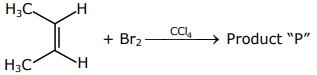
Consider the above chemical reaction. The total number of stereoisomers possible for product $'P'$ is $.....$
A
$4$
B
$3$
C
$1$
D
$2$
Solution
(D) The reaction of $cis-but-2-ene$ with $Br_2$ in $CCl_4$ proceeds via an anti-addition mechanism.
This results in the formation of a racemic mixture of $(2R, 3R)-2,3-dibromobutane$ and $(2S, 3S)-2,3-dibromobutane$.
Since these two enantiomers are stereoisomers,the total number of stereoisomers formed as product $'P'$ is $2$.
This results in the formation of a racemic mixture of $(2R, 3R)-2,3-dibromobutane$ and $(2S, 3S)-2,3-dibromobutane$.
Since these two enantiomers are stereoisomers,the total number of stereoisomers formed as product $'P'$ is $2$.
0 likesView Solution
328
ChemistryMediumMCQJEE Main · 2021
Which one of the following statements is $NOT$ correct?
A
The dissolved oxygen concentration below $6 \, ppm$ inhibits fish growth
B
Eutrophication indicates that water body is polluted
C
Eutrophication leads to increase in the oxygen level in water
D
Eutrophication leads to anaerobic conditions
Solution
(C) Eutrophication is the process where nutrient enrichment leads to excessive growth of algae,which consumes dissolved oxygen during decomposition.
This process leads to a decrease in the oxygen level of water.
Therefore,the statement that eutrophication leads to an increase in the oxygen level is incorrect.
This process leads to a decrease in the oxygen level of water.
Therefore,the statement that eutrophication leads to an increase in the oxygen level is incorrect.
0 likesView Solution
329
ChemistryDifficultMCQJEE Main · 2021
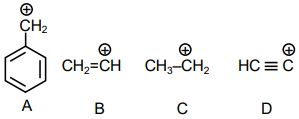
The correct order of stability of the given carbocations is:
A
$A > C > B > D$
B
$D > B > C > A$
C
$A > C > B > D$
D
$D > B > A > C$
Solution
(A) The stability of carbocations depends on factors like resonance,hyperconjugation,and the electronegativity of the carbon atom bearing the positive charge.
$A$ (Benzyl carbocation) is the most stable due to resonance stabilization by the benzene ring.
$C$ $(CH_3-CH_2^+)$ is a primary alkyl carbocation,which is stabilized by the inductive effect $(+I)$ of the methyl group.
$B$ $(CH_2=CH^+)$ is a vinyl carbocation where the positive charge is on an $sp^2$ hybridized carbon,which is more electronegative than an $sp^3$ carbon.
$D$ $(HC \equiv C^+)$ is an acetylenic carbocation where the positive charge is on an $sp$ hybridized carbon,which is the most electronegative among the three $(sp > sp^2 > sp^3)$.
Since a positive charge is less stable on a more electronegative atom,the order of stability for $B, C,$ and $D$ is $C > B > D$.
Combining these,the overall order of stability is $A > C > B > D$.
$A$ (Benzyl carbocation) is the most stable due to resonance stabilization by the benzene ring.
$C$ $(CH_3-CH_2^+)$ is a primary alkyl carbocation,which is stabilized by the inductive effect $(+I)$ of the methyl group.
$B$ $(CH_2=CH^+)$ is a vinyl carbocation where the positive charge is on an $sp^2$ hybridized carbon,which is more electronegative than an $sp^3$ carbon.
$D$ $(HC \equiv C^+)$ is an acetylenic carbocation where the positive charge is on an $sp$ hybridized carbon,which is the most electronegative among the three $(sp > sp^2 > sp^3)$.
Since a positive charge is less stable on a more electronegative atom,the order of stability for $B, C,$ and $D$ is $C > B > D$.
Combining these,the overall order of stability is $A > C > B > D$.
0 likesView Solution
330
ChemistryDifficultMCQJEE Main · 2021
Given below are two statements: One is labelled as Assertion $A$ and the other is labelled as Reason $R.$
Assertion $A :$ Lithium halides are somewhat covalent in nature.
Reason $R :$ Lithium possesses high polarization capability.
In the light of the above statements,choose the most appropriate answer from the options given below:
Assertion $A :$ Lithium halides are somewhat covalent in nature.
Reason $R :$ Lithium possesses high polarization capability.
In the light of the above statements,choose the most appropriate answer from the options given below:
A
Both $A$ and $R$ are true but $R$ is $NOT$ the correct explanation of $A$
B
$A$ is true but $R$ is false
C
$A$ is false but $R$ is true
D
Both $A$ and $R$ are true and $R$ is the correct explanation of $A$
Solution
(D) According to Fajan's rule,the covalent character in an ionic bond increases with the polarizing power of the cation.
Lithium $(Li^+)$ has a very small ionic radius,which results in a high charge density and high polarizing power.
This high polarizing power allows the $Li^+$ ion to distort the electron cloud of the halide anion,thereby introducing significant covalent character into the lithium halides.
Therefore,both Assertion $A$ and Reason $R$ are true,and $R$ is the correct explanation of $A$.
Lithium $(Li^+)$ has a very small ionic radius,which results in a high charge density and high polarizing power.
This high polarizing power allows the $Li^+$ ion to distort the electron cloud of the halide anion,thereby introducing significant covalent character into the lithium halides.
Therefore,both Assertion $A$ and Reason $R$ are true,and $R$ is the correct explanation of $A$.
0 likesView Solution
331
ChemistryMediumMCQJEE Main · 2021
Presence of which reagent will affect the reversibility of the following reaction,and change it to an irreversible reaction:
$CH_4 + I_2 \xrightarrow{hv} CH_3-I + HI$
$CH_4 + I_2 \xrightarrow{hv} CH_3-I + HI$
A
$HOCl$
B
Liquid $NH_3$
C
dilute $HNO_2$
D
Concentrated $HIO_3$
Solution
(D) The iodination of alkanes is a reversible reaction because the byproduct $HI$ is a strong reducing agent and reduces the alkyl iodide back to the alkane.
To make the reaction irreversible,the $HI$ must be removed or oxidized as it is formed.
This can be achieved by adding a strong oxidizing agent such as concentrated $HNO_3$ or concentrated $HIO_3$,which oxidizes $HI$ to $I_2$.
To make the reaction irreversible,the $HI$ must be removed or oxidized as it is formed.
This can be achieved by adding a strong oxidizing agent such as concentrated $HNO_3$ or concentrated $HIO_3$,which oxidizes $HI$ to $I_2$.
0 likesView Solution
332
ChemistryDifficultMCQJEE Main · 2021
Match List-$I$ with List-$II$ :
Choose the most appropriate answer from the options given below :
| List-$I$ | List-$II$ |
| $(a)$ $NaOH$ | $(i)$ Acidic |
| $(b)$ $Be(OH)_{2}$ | $(ii)$ Basic |
| $(c)$ $Ca(OH)_{2}$ | $(iii)$ Amphoteric |
| $(d)$ $B(OH)_{3}$ | |
| $(e)$ $Al(OH)_{3}$ |
Choose the most appropriate answer from the options given below :
A
$(a)-(ii), (b)-(ii), (c)-(iii), (d)-(ii), (e)-(iii)$
B
$(a)-(ii), (b)-(iii), (c)-(ii), (d)-(i), (e)-(iii)$
C
$(a)-(ii), (b)-(ii), (c)-(iii), (d)-(i), (e)-(iii)$
D
$(a)-(ii), (b)-(i), (c)-(ii), (d)-(iii), (e)-(iii)$
Solution
(B) $NaOH$ is a strong base,so it is $(ii)$ Basic.
$Be(OH)_{2}$ is amphoteric,so it is $(iii)$ Amphoteric.
$Ca(OH)_{2}$ is a strong base,so it is $(ii)$ Basic.
$B(OH)_{3}$ (or $H_{3}BO_{3}$) is a weak Lewis acid,so it is $(i)$ Acidic.
$Al(OH)_{3}$ is amphoteric,so it is $(iii)$ Amphoteric.
Therefore,the correct matching is: $(a)-(ii), (b)-(iii), (c)-(ii), (d)-(i), (e)-(iii)$.
$Be(OH)_{2}$ is amphoteric,so it is $(iii)$ Amphoteric.
$Ca(OH)_{2}$ is a strong base,so it is $(ii)$ Basic.
$B(OH)_{3}$ (or $H_{3}BO_{3}$) is a weak Lewis acid,so it is $(i)$ Acidic.
$Al(OH)_{3}$ is amphoteric,so it is $(iii)$ Amphoteric.
Therefore,the correct matching is: $(a)-(ii), (b)-(iii), (c)-(ii), (d)-(i), (e)-(iii)$.
0 likesView Solution
333
ChemistryMediumMCQJEE Main · 2021
Staggered and eclipsed conformers of ethane are:
A
Enantiomers
B
Rotamers
C
Mirror images
D
Polymers
Solution
(B) Staggered and eclipsed conformers of ethane are generated by rotation around the $C-C$ single bond.
These different spatial arrangements are known as conformational isomers or rotamers.
Since they are interconvertible by rotation about a single bond,they are classified as rotamers.
These different spatial arrangements are known as conformational isomers or rotamers.
Since they are interconvertible by rotation about a single bond,they are classified as rotamers.
0 likesView Solution
334
ChemistryMediumMCQJEE Main · 2021
Given below are two statements:
Statement $I$: Rutherford's gold foil experiment cannot explain the line spectrum of hydrogen atom.
Statement $II$: Bohr's model of hydrogen atom contradicts Heisenberg's uncertainty principle.
In the light of the above statements,choose the most appropriate answer from the options given below:
Statement $I$: Rutherford's gold foil experiment cannot explain the line spectrum of hydrogen atom.
Statement $II$: Bohr's model of hydrogen atom contradicts Heisenberg's uncertainty principle.
In the light of the above statements,choose the most appropriate answer from the options given below:
A
Statement $I$ is false but statement $II$ is true.
B
Both statement $I$ and statement $II$ are false.
C
Statement $I$ is true but statement $II$ is false.
D
Both statement $I$ and statement $II$ are true.
Solution
(D) Statement $I$ is true: Rutherford's model could not explain the stability of the atom or the origin of the line spectrum of hydrogen.
Statement $II$ is true: Bohr's model assumes that electrons move in well-defined circular orbits with fixed radii and velocities,which directly contradicts Heisenberg's uncertainty principle,which states that it is impossible to determine both the position and momentum of a subatomic particle simultaneously with absolute precision.
Therefore,both statements are true.
Statement $II$ is true: Bohr's model assumes that electrons move in well-defined circular orbits with fixed radii and velocities,which directly contradicts Heisenberg's uncertainty principle,which states that it is impossible to determine both the position and momentum of a subatomic particle simultaneously with absolute precision.
Therefore,both statements are true.
0 likesView Solution
335
ChemistryDifficultMCQJEE Main · 2021
The oxidation states of $P$ in $H_{4}P_{2}O_{7}$,$H_{4}P_{2}O_{5}$ and $H_{4}P_{2}O_{6}$,respectively,are:
A
$5, 3$ and $4$
B
$6, 4$ and $5$
C
$5, 4$ and $3$
D
$7, 5$ and $6$
Solution
(A) To find the oxidation state of $P$ (let it be $x$):
For $H_{4}P_{2}O_{7}$: $4(+1) + 2x + 7(-2) = 0 \implies 4 + 2x - 14 = 0 \implies 2x = 10 \implies x = +5$.
For $H_{4}P_{2}O_{5}$: $4(+1) + 2x + 5(-2) = 0 \implies 4 + 2x - 10 = 0 \implies 2x = 6 \implies x = +3$.
For $H_{4}P_{2}O_{6}$: $4(+1) + 2x + 6(-2) = 0 \implies 4 + 2x - 12 = 0 \implies 2x = 8 \implies x = +4$.
Thus,the oxidation states are $5, 3$ and $4$ respectively.
For $H_{4}P_{2}O_{7}$: $4(+1) + 2x + 7(-2) = 0 \implies 4 + 2x - 14 = 0 \implies 2x = 10 \implies x = +5$.
For $H_{4}P_{2}O_{5}$: $4(+1) + 2x + 5(-2) = 0 \implies 4 + 2x - 10 = 0 \implies 2x = 6 \implies x = +3$.
For $H_{4}P_{2}O_{6}$: $4(+1) + 2x + 6(-2) = 0 \implies 4 + 2x - 12 = 0 \implies 2x = 8 \implies x = +4$.
Thus,the oxidation states are $5, 3$ and $4$ respectively.
0 likesView Solution
336
ChemistryMediumMCQJEE Main · 2021
In gaseous triethylamine,the $C-N-C$ bond angle is $.....$ degrees.
A
$108$
B
$150$
C
$90$
D
$60$
Solution
(A) In gaseous triethylamine,the nitrogen atom is $sp^3$ hybridized with one lone pair. Due to the repulsion between the bulky ethyl groups,the $C-N-C$ bond angle is increased from the ideal tetrahedral angle of $109.5^\circ$ to approximately $108^\circ$ to $110^\circ$ depending on the specific experimental conditions,but $108^\circ$ is the standard accepted value in this context.
0 likesView Solution
337
ChemistryDifficultMCQJEE Main · 2021
$PCl_{5} \rightleftharpoons PCl_{3} + Cl_{2} \quad K_{c} = 1.844$
$3.0 \ \text{moles}$ of $PCl_{5}$ is introduced in a $1 \ \text{L}$ closed reaction vessel at $380 \ \text{K}$. The number of moles of $PCl_{5}$ at equilibrium is $..... \times 10^{-3}$. (Round off to the Nearest Integer)
$3.0 \ \text{moles}$ of $PCl_{5}$ is introduced in a $1 \ \text{L}$ closed reaction vessel at $380 \ \text{K}$. The number of moles of $PCl_{5}$ at equilibrium is $..... \times 10^{-3}$. (Round off to the Nearest Integer)
A
$1500$
B
$1292$
C
$1400$
D
$5123$
Solution
(C) $PCl_{5(g)} \rightleftharpoons PCl_{3(g)} + Cl_{2(g)} \quad K_{c} = 1.844$
$\text{Initial moles at } t = 0: \quad 3.0 \ \text{moles of } PCl_{5}$
$\text{Moles at equilibrium } (t = eq): \quad (3-x) \ \text{for } PCl_{5}, \ x \ \text{for } PCl_{3}, \ x \ \text{for } Cl_{2}$
$\text{Equilibrium constant expression: } K_{c} = \frac{[PCl_{3}][Cl_{2}]}{[PCl_{5}]} = \frac{x^{2}}{3-x} = 1.844$
$x^{2} + 1.844x - 5.532 = 0$
$\text{Using quadratic formula: } x = \frac{-b + \sqrt{b^{2} - 4ac}}{2a} = \frac{-1.844 + \sqrt{(1.844)^{2} + 4(5.532)}}{2}$
$x = \frac{-1.844 + \sqrt{3.400 + 22.128}}{2} = \frac{-1.844 + 5.052}{2} \approx 1.604$
$\text{Moles of } PCl_{5} \text{ at equilibrium} = 3 - 1.604 = 1.396 \ \text{moles}$
$1.396 \ \text{moles} = 1396 \times 10^{-3} \ \text{moles} \approx 1400 \times 10^{-3} \ \text{moles}$
$\text{Initial moles at } t = 0: \quad 3.0 \ \text{moles of } PCl_{5}$
$\text{Moles at equilibrium } (t = eq): \quad (3-x) \ \text{for } PCl_{5}, \ x \ \text{for } PCl_{3}, \ x \ \text{for } Cl_{2}$
$\text{Equilibrium constant expression: } K_{c} = \frac{[PCl_{3}][Cl_{2}]}{[PCl_{5}]} = \frac{x^{2}}{3-x} = 1.844$
$x^{2} + 1.844x - 5.532 = 0$
$\text{Using quadratic formula: } x = \frac{-b + \sqrt{b^{2} - 4ac}}{2a} = \frac{-1.844 + \sqrt{(1.844)^{2} + 4(5.532)}}{2}$
$x = \frac{-1.844 + \sqrt{3.400 + 22.128}}{2} = \frac{-1.844 + 5.052}{2} \approx 1.604$
$\text{Moles of } PCl_{5} \text{ at equilibrium} = 3 - 1.604 = 1.396 \ \text{moles}$
$1.396 \ \text{moles} = 1396 \times 10^{-3} \ \text{moles} \approx 1400 \times 10^{-3} \ \text{moles}$
0 likesView Solution
338
ChemistryDifficultMCQJEE Main · 2021
For water at $100^{\circ} C$ and $1 \, bar$,$\Delta_{vap} H - \Delta_{vap} U = ...... \times 10^{2} \, J \, mol^{-1}$. (Round off to the Nearest Integer) $[Use : R = 8.31 \, J \, mol^{-1} \, K^{-1}]$ [Assume volume of $H_{2}O_{(\ell)}$ is much smaller than volume of $H_{2}O_{(g)}$. Assume $H_{2}O_{(g)}$ treated as an ideal gas]
A
$70$
B
$89$
C
$40$
D
$31$
Solution
(D) The vaporization process is represented as: $H_{2}O_{(\ell)} \rightleftharpoons H_{2}O_{(g)}$
From the first law of thermodynamics,the relation between enthalpy change and internal energy change is given by: $\Delta H = \Delta U + \Delta n_{g} RT$
Rearranging the equation: $\Delta H - \Delta U = \Delta n_{g} RT$
For $1 \, mol$ of water vaporization,the change in the number of moles of gas is: $\Delta n_{g} = n_{g(product)} - n_{g(reactant)} = 1 - 0 = 1$
Given $T = 100^{\circ} C = 373 \, K$ and $R = 8.31 \, J \, mol^{-1} \, K^{-1}$
Substituting the values: $\Delta H - \Delta U = 1 \, mol \times 8.31 \, J \, mol^{-1} \, K^{-1} \times 373 \, K$
$\Delta H - \Delta U = 3099.63 \, J \, mol^{-1}$
Expressing in terms of $10^{2} \, J \, mol^{-1}$: $3099.63 \, J \, mol^{-1} \approx 31 \times 10^{2} \, J \, mol^{-1}$
Rounding to the nearest integer,the value is $31$.
From the first law of thermodynamics,the relation between enthalpy change and internal energy change is given by: $\Delta H = \Delta U + \Delta n_{g} RT$
Rearranging the equation: $\Delta H - \Delta U = \Delta n_{g} RT$
For $1 \, mol$ of water vaporization,the change in the number of moles of gas is: $\Delta n_{g} = n_{g(product)} - n_{g(reactant)} = 1 - 0 = 1$
Given $T = 100^{\circ} C = 373 \, K$ and $R = 8.31 \, J \, mol^{-1} \, K^{-1}$
Substituting the values: $\Delta H - \Delta U = 1 \, mol \times 8.31 \, J \, mol^{-1} \, K^{-1} \times 373 \, K$
$\Delta H - \Delta U = 3099.63 \, J \, mol^{-1}$
Expressing in terms of $10^{2} \, J \, mol^{-1}$: $3099.63 \, J \, mol^{-1} \approx 31 \times 10^{2} \, J \, mol^{-1}$
Rounding to the nearest integer,the value is $31$.
0 likesView Solution
339
ChemistryMediumMCQJEE Main · 2021
The difference between bond orders of $CO$ and $NO^{\oplus}$ is $\frac{x}{2}$ where $x = .....$
(Round off to the Nearest Integer)
(Round off to the Nearest Integer)
A
$0$
B
$1$
C
$2$
D
$3$
Solution
(A) The total number of electrons in $CO$ is $6 + 8 = 14$. According to Molecular Orbital Theory,the bond order of a $14$-electron species is $\frac{10-4}{2} = 3$.
The total number of electrons in $NO^{\oplus}$ is $7 + 8 - 1 = 14$. Similarly,the bond order of $NO^{\oplus}$ is $\frac{10-4}{2} = 3$.
The difference between the bond orders is $|3 - 3| = 0$.
Given that the difference is $\frac{x}{2}$,we have $\frac{x}{2} = 0$,which implies $x = 0$.
The total number of electrons in $NO^{\oplus}$ is $7 + 8 - 1 = 14$. Similarly,the bond order of $NO^{\oplus}$ is $\frac{10-4}{2} = 3$.
The difference between the bond orders is $|3 - 3| = 0$.
Given that the difference is $\frac{x}{2}$,we have $\frac{x}{2} = 0$,which implies $x = 0$.
0 likesView Solution
340
ChemistryDifficultMCQJEE Main · 2021
An organic compound is subjected to chlorination to get compound $A$. When $0.5 \ g$ of compound $A$ is reacted with $AgNO_3$ [Carius Method],it forms $0.3849 \ g$ of $AgCl$. Calculate the percentage of chlorine in compound $A$. (Round off to the nearest integer)
(Atomic masses of $Ag$ and $Cl$ are $107.87$ and $35.5$ respectively)
(Atomic masses of $Ag$ and $Cl$ are $107.87$ and $35.5$ respectively)
A
$19$
B
$21$
C
$25$
D
$80$
Solution
(A) The molar mass of $AgCl = 107.87 + 35.5 = 143.37 \ g/mol$.
The number of moles of $AgCl$ formed $= \frac{0.3849 \ g}{143.37 \ g/mol} = 0.0026846 \ mol$.
Since $1 \ mol$ of $AgCl$ contains $1 \ mol$ of $Cl$,the moles of $Cl = 0.0026846 \ mol$.
The mass of chlorine $= 0.0026846 \ mol \times 35.5 \ g/mol = 0.0953 \ g$.
The percentage of chlorine in compound $A = \frac{\text{mass of chlorine}}{\text{mass of compound } A} \times 100$.
$\% \ Cl = \frac{0.0953 \ g}{0.5 \ g} \times 100 = 19.06 \ \%$.
Rounding off to the nearest integer,we get $19$.
The number of moles of $AgCl$ formed $= \frac{0.3849 \ g}{143.37 \ g/mol} = 0.0026846 \ mol$.
Since $1 \ mol$ of $AgCl$ contains $1 \ mol$ of $Cl$,the moles of $Cl = 0.0026846 \ mol$.
The mass of chlorine $= 0.0026846 \ mol \times 35.5 \ g/mol = 0.0953 \ g$.
The percentage of chlorine in compound $A = \frac{\text{mass of chlorine}}{\text{mass of compound } A} \times 100$.
$\% \ Cl = \frac{0.0953 \ g}{0.5 \ g} \times 100 = 19.06 \ \%$.
Rounding off to the nearest integer,we get $19$.
0 likesView Solution
341
ChemistryDifficultMCQJEE Main · 2021
The conductivity of a weak acid $HA$ of concentration $0.001 \, mol \, L^{-1}$ is $2.0 \times 10^{-5} \, S \, cm^{-1} .$ If $\Lambda_{m}^{\circ} (HA)=190 \, S \, cm^{2} \, mol^{-1}$,the ionization constant $(K_{a})$ of $HA$ is equal to $....\, \times 10^{-6} .$ (Round off to the Nearest Integer)
A
$18$
B
$12$
C
$61$
D
$14$
Solution
(B) First,calculate the molar conductivity $(\Lambda_{m})$ using the formula: $\Lambda_{m} = \frac{1000 \times \kappa}{C}$
$\Lambda_{m} = \frac{1000 \times 2.0 \times 10^{-5}}{0.001} = 20 \, S \, cm^{2} \, mol^{-1}$
Next,calculate the degree of dissociation $(\alpha)$:
$\alpha = \frac{\Lambda_{m}}{\Lambda_{m}^{\circ}} = \frac{20}{190} = \frac{2}{19}$
For a weak acid $HA$,the ionization constant $K_{a}$ is given by:
$K_{a} = \frac{C \alpha^{2}}{1 - \alpha}$
Since $\alpha$ is very small,$1 - \alpha \approx 1$,but we can calculate it precisely:
$K_{a} = \frac{0.001 \times (2/19)^{2}}{1 - (2/19)} = \frac{0.001 \times (4/361)}{17/19} = \frac{0.001 \times 4}{361} \times \frac{19}{17} = \frac{0.004}{19 \times 17} = \frac{0.004}{323} \approx 1.238 \times 10^{-5} = 12.38 \times 10^{-6}$
Rounding to the nearest integer,we get $12 \times 10^{-6}$.
$\Lambda_{m} = \frac{1000 \times 2.0 \times 10^{-5}}{0.001} = 20 \, S \, cm^{2} \, mol^{-1}$
Next,calculate the degree of dissociation $(\alpha)$:
$\alpha = \frac{\Lambda_{m}}{\Lambda_{m}^{\circ}} = \frac{20}{190} = \frac{2}{19}$
For a weak acid $HA$,the ionization constant $K_{a}$ is given by:
$K_{a} = \frac{C \alpha^{2}}{1 - \alpha}$
Since $\alpha$ is very small,$1 - \alpha \approx 1$,but we can calculate it precisely:
$K_{a} = \frac{0.001 \times (2/19)^{2}}{1 - (2/19)} = \frac{0.001 \times (4/361)}{17/19} = \frac{0.001 \times 4}{361} \times \frac{19}{17} = \frac{0.004}{19 \times 17} = \frac{0.004}{323} \approx 1.238 \times 10^{-5} = 12.38 \times 10^{-6}$
Rounding to the nearest integer,we get $12 \times 10^{-6}$.
0 likesView Solution
342
ChemistryMediumMCQJEE Main · 2021
Which one of the following sets of elements can be detected using sodium fusion extract?
A
Halogens,Nitrogen,Oxygen,Sulfur
B
Sulfur,Nitrogen,Phosphorous,Halogens
C
Nitrogen,Phosphorous,Carbon,Sulfur
D
Phosphorous,Oxygen,Nitrogen,Halogens
Solution
(B) The sodium fusion extract (Lassaigne's extract) is used to detect elements like nitrogen,sulfur,halogens,and phosphorous in organic compounds.
These elements are converted into their respective water-soluble ionic forms by fusing the organic compound with sodium metal.
For example,nitrogen is converted to $NaCN$,sulfur to $Na_2S$,halogens to $NaX$ (where $X = Cl, Br, I$),and phosphorous to $Na_3PO_4$.
These elements are converted into their respective water-soluble ionic forms by fusing the organic compound with sodium metal.
For example,nitrogen is converted to $NaCN$,sulfur to $Na_2S$,halogens to $NaX$ (where $X = Cl, Br, I$),and phosphorous to $Na_3PO_4$.
0 likesView Solution
343
ChemistryMediumMCQJEE Main · 2021
The $CORRECT$ order of first ionisation enthalpy is:
A
$Mg < Al < S < P$
B
$Al < Mg < S < P$
C
$Mg < Al < P < S$
D
$Mg < S < Al < P$
Solution
(B) The electronic configurations of the elements are:
$Mg (Z=12): [Ne] 3s^2$
$Al (Z=13): [Ne] 3s^2 3p^1$
$P (Z=15): [Ne] 3s^2 3p^3$
$S (Z=16): [Ne] 3s^2 3p^4$
$1$. $Mg$ has a fully filled $3s$ orbital,making it more stable than $Al$,so $I.E._{Mg} > I.E._{Al}$.
$2$. $P$ has a half-filled $3p$ subshell $(3p^3)$,which is highly stable,making its $I.E.$ higher than that of $S$ $(3p^4)$.
$3$. Across a period,$I.E.$ generally increases. Combining these factors,the order is $Al < Mg < S < P$.
$Mg (Z=12): [Ne] 3s^2$
$Al (Z=13): [Ne] 3s^2 3p^1$
$P (Z=15): [Ne] 3s^2 3p^3$
$S (Z=16): [Ne] 3s^2 3p^4$
$1$. $Mg$ has a fully filled $3s$ orbital,making it more stable than $Al$,so $I.E._{Mg} > I.E._{Al}$.
$2$. $P$ has a half-filled $3p$ subshell $(3p^3)$,which is highly stable,making its $I.E.$ higher than that of $S$ $(3p^4)$.
$3$. Across a period,$I.E.$ generally increases. Combining these factors,the order is $Al < Mg < S < P$.
0 likesView Solution
344
ChemistryDifficultMCQJEE Main · 2021
Given below are two statements:
Statement $I:$ Hyperconjugation is a permanent effect.
Statement $II:$ Hyperconjugation in ethyl cation $(CH_{3}CH_{2}^{+})$ involves the overlapping of $C_{sp^{3}}-H_{1s}$ bond with the empty $2p$ orbital of the adjacent carbon.
Choose the correct option:
Statement $I:$ Hyperconjugation is a permanent effect.
Statement $II:$ Hyperconjugation in ethyl cation $(CH_{3}CH_{2}^{+})$ involves the overlapping of $C_{sp^{3}}-H_{1s}$ bond with the empty $2p$ orbital of the adjacent carbon.
Choose the correct option:
A
Both statement $I$ and statement $II$ are true
B
Statement $I$ is incorrect but statement $II$ is true
C
Statement $I$ is correct but statement $II$ is false
D
Both Statement $I$ and statement $II$ are false.
Solution
(A) Statement $I$: Hyperconjugation is a permanent electronic effect involving the delocalization of $\sigma$ electrons of a $C-H$ bond attached to an unsaturated system or a carbocation. It is indeed a permanent effect.
Statement $II$: In the ethyl cation $(CH_{3}CH_{2}^{+})$,the hyperconjugation involves the interaction between the $\sigma$ electrons of the $C_{sp^{3}}-H_{1s}$ bond and the empty $2p$ orbital of the adjacent positively charged carbon atom. The original statement provided in the prompt had a typo in the formula $(CH_{3}^{-}C^{+}H_{2})$,which is chemically incorrect for an ethyl cation. Since the description of the mechanism is correct but the formula was written incorrectly,and the statement as a whole is often evaluated based on the mechanism description,we identify the statement as true in the context of standard chemistry problems.
Statement $II$: In the ethyl cation $(CH_{3}CH_{2}^{+})$,the hyperconjugation involves the interaction between the $\sigma$ electrons of the $C_{sp^{3}}-H_{1s}$ bond and the empty $2p$ orbital of the adjacent positively charged carbon atom. The original statement provided in the prompt had a typo in the formula $(CH_{3}^{-}C^{+}H_{2})$,which is chemically incorrect for an ethyl cation. Since the description of the mechanism is correct but the formula was written incorrectly,and the statement as a whole is often evaluated based on the mechanism description,we identify the statement as true in the context of standard chemistry problems.
0 likesView Solution
345
ChemistryMediumMCQJEE Main · 2021
The number of neutrons and electrons,respectively,present in the radioactive isotope of hydrogen is:
A
$1$ and $1$
B
$2$ and $1$
C
$2$ and $2$
D
$3$ and $1$
Solution
(B) The radioactive isotope of hydrogen is Tritium,represented as ${}_{1}^{3}H$ or ${}_{1}^{3}T$.
For any atom,the number of protons is equal to the atomic number $(Z = 1)$.
Since the atom is neutral,the number of electrons is equal to the number of protons,which is $1$.
The number of neutrons is calculated as $A - Z$,where $A$ is the mass number $(3)$ and $Z$ is the atomic number $(1)$.
Number of neutrons $= 3 - 1 = 2$.
Therefore,the number of neutrons and electrons are $2$ and $1$,respectively.
For any atom,the number of protons is equal to the atomic number $(Z = 1)$.
Since the atom is neutral,the number of electrons is equal to the number of protons,which is $1$.
The number of neutrons is calculated as $A - Z$,where $A$ is the mass number $(3)$ and $Z$ is the atomic number $(1)$.
Number of neutrons $= 3 - 1 = 2$.
Therefore,the number of neutrons and electrons are $2$ and $1$,respectively.
0 likesView Solution
346
ChemistryDifficultMCQJEE Main · 2021
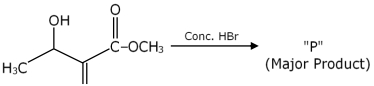
Consider the above reaction,the major product $P$ formed is:
A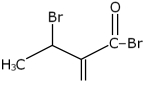
B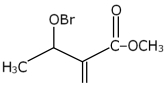
C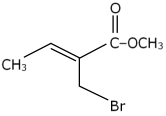
D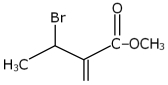
Solution
(C) The reaction involves the protonation of the hydroxyl group by $H^+$ from $Conc. \ HBr$,followed by the loss of water to form a stable carbocation. The carbocation is stabilized by resonance with the adjacent double bond. The bromide ion $(Br^-)$ then attacks the electrophilic carbon to form the final product. The mechanism is as follows:
$1$. Protonation of the $-OH$ group: $R-OH + H^+ \rightarrow R-OH_2^+$
$2$. Loss of $H_2O$ to form a resonance-stabilized carbocation: $CH_3-CH(OH)-C(=CH_2)-COOCH_3 \rightarrow CH_3-CH^+-C(=CH_2)-COOCH_3 \leftrightarrow CH_3-CH=C(CH_2^+)-COOCH_3$
$3$. Nucleophilic attack by $Br^-$: $CH_3-CH=C(CH_2^+)-COOCH_3 + Br^- \rightarrow CH_3-CH=C(CH_2Br)-COOCH_3$
Thus,the major product is $CH_3-CH=C(CH_2Br)-COOCH_3$.
$1$. Protonation of the $-OH$ group: $R-OH + H^+ \rightarrow R-OH_2^+$
$2$. Loss of $H_2O$ to form a resonance-stabilized carbocation: $CH_3-CH(OH)-C(=CH_2)-COOCH_3 \rightarrow CH_3-CH^+-C(=CH_2)-COOCH_3 \leftrightarrow CH_3-CH=C(CH_2^+)-COOCH_3$
$3$. Nucleophilic attack by $Br^-$: $CH_3-CH=C(CH_2^+)-COOCH_3 + Br^- \rightarrow CH_3-CH=C(CH_2Br)-COOCH_3$
Thus,the major product is $CH_3-CH=C(CH_2Br)-COOCH_3$.
0 likesView Solution
347
ChemistryDifficultMCQJEE Main · 2021
Match List-$I$ and List-$II$:
Choose the correct answer from the options given below:
| List-$I$ | List-$II$ |
| $(a)$ Carbon monoxide | $(i)$ Carcinogenic |
| $(b)$ Sulphur dioxide | $(ii)$ Metabolized by pyrus plants |
| $(c)$ Polychlorinated biphenyls | $(iii)$ Haemoglobin |
| $(d)$ Oxides of nitrogen | $(iv)$ Stiffness of flower buds |
Choose the correct answer from the options given below:
A
$(a)-(iii), (b)-(iv), (c)-(i), (d)-(ii)$
B
$(a)-(i), (b)-(ii), (c)-(iii), (d)-(iv)$
C
$(a)-(iii), (b)-(iv), (c)-(ii), (d)-(i)$
D
$(a)-(iv), (b)-(i), (c)-(iii), (d)-(ii)$
Solution
(A) Carbon monoxide $(CO)$ binds with haemoglobin in the blood to form carboxyhaemoglobin,which is more stable than oxyhaemoglobin.
$(b)$ Sulphur dioxide $(SO_2)$ causes stiffness of flower buds in plants.
$(c)$ Polychlorinated biphenyls $(PCBs)$ are known to be carcinogenic.
$(d)$ Oxides of nitrogen $(NO_x)$ are metabolized by certain plants like $Pyrus$ (pear).
Therefore,the correct matching is $(a)-(iii), (b)-(iv), (c)-(i), (d)-(ii)$.
$(b)$ Sulphur dioxide $(SO_2)$ causes stiffness of flower buds in plants.
$(c)$ Polychlorinated biphenyls $(PCBs)$ are known to be carcinogenic.
$(d)$ Oxides of nitrogen $(NO_x)$ are metabolized by certain plants like $Pyrus$ (pear).
Therefore,the correct matching is $(a)-(iii), (b)-(iv), (c)-(i), (d)-(ii)$.
0 likesView Solution
348
ChemistryMediumMCQJEE Main · 2021
If the Thomson model of the atom was correct,then the result of Rutherford's gold foil experiment would have been:
A
$\alpha$-Particles pass through the gold foil deflected by small angles and with reduced speed.
B
All $\alpha$-particles get bounced back by $180^{\circ}$.
C
$\alpha$-Particles are deflected over a wide range of angles.
D
All of the $\alpha$-particles pass through the gold foil without decrease in speed.
Solution
(A) In the Thomson model,the positive charge is assumed to be uniformly distributed throughout the atom.
Since the positive charge is not concentrated in a small central nucleus,the electrostatic repulsion experienced by the $\alpha$-particles would be very weak.
Consequently,the $\alpha$-particles would pass through the gold foil with only very small deflections and a slight decrease in speed due to the uniform distribution of positive charge.
Since the positive charge is not concentrated in a small central nucleus,the electrostatic repulsion experienced by the $\alpha$-particles would be very weak.
Consequently,the $\alpha$-particles would pass through the gold foil with only very small deflections and a slight decrease in speed due to the uniform distribution of positive charge.
0 likesView Solution
349
ChemistryDifficultMCQJEE Main · 2021
Match List-$I$ with List-$II$:
Choose the correct answer from the options given below:
| List-$I$ | List-$II$ |
| $(a)$ $Li$ | $(i)$ photoelectric cell |
| $(b)$ $Na$ | $(ii)$ absorbent of $CO_{2}$ |
| $(c)$ $K$ | $(iii)$ coolant in fast breeder nuclear reactor |
| $(d)$ $Cs$ | $(iv)$ treatment of cancer |
| $(v)$ bearings for motor engines |
Choose the correct answer from the options given below:
A
$(a)-(v), (b)-(iii), (c)-(ii), (d)-(i)$
B
$(a)-(v), (b)-(iii), (c)-(ii), (d)-(iv)$
C
$(a)-(iv), (b)-(iii), (c)-(i), (d)-(ii)$
D
$(a)-(v), (b)-(i), (c)-(ii), (d)-(iv)$
Solution
(A) $Li$ forms an alloy with lead to make white metal bearings for motor engines.
Liquid $Na$ metal is used as a coolant in fast breeder nuclear reactors.
$K$ is used as an absorbent of $CO_{2}$ (specifically in the form of potassium superoxide,$KO_{2}$).
$Cs$ is used in making photoelectric cells due to its low ionization energy.
Liquid $Na$ metal is used as a coolant in fast breeder nuclear reactors.
$K$ is used as an absorbent of $CO_{2}$ (specifically in the form of potassium superoxide,$KO_{2}$).
$Cs$ is used in making photoelectric cells due to its low ionization energy.
0 likesView Solution
350
ChemistryMediumMCQJEE Main · 2021
$A_{(s)} \rightleftharpoons M_{(s)} + \frac{1}{2} O_{2(g)}$
The equilibrium constant for the reaction is $K_{p} = 4$. At equilibrium,the partial pressure of $O_{2}$ is $.... \ atm.$ (Round off to the nearest integer).
The equilibrium constant for the reaction is $K_{p} = 4$. At equilibrium,the partial pressure of $O_{2}$ is $.... \ atm.$ (Round off to the nearest integer).
A
$16$
B
$20$
C
$25$
D
$31$
Solution
(A) For the reaction $A_{(s)} \rightleftharpoons M_{(s)} + \frac{1}{2} O_{2(g)}$,the equilibrium constant $K_{p}$ is given by the partial pressure of the gaseous product.
$K_{p} = (P_{O_{2}})^{\frac{1}{2}}$
Given $K_{p} = 4$,we have:
$4 = (P_{O_{2}})^{\frac{1}{2}}$
Squaring both sides:
$P_{O_{2}} = 4^{2} = 16 \ atm$.
$K_{p} = (P_{O_{2}})^{\frac{1}{2}}$
Given $K_{p} = 4$,we have:
$4 = (P_{O_{2}})^{\frac{1}{2}}$
Squaring both sides:
$P_{O_{2}} = 4^{2} = 16 \ atm$.
0 likesView Solution
351
ChemistryMediumMCQJEE Main · 2021
Which among the following is not a polyester?
A
Novolac
B
$PHBV$
C
Dacron
D
Glyptal
Solution
(A) Novolac is a phenol-formaldehyde resin formed by the condensation of phenol and formaldehyde.
It does not contain an ester linkage in its structure.
$PHBV$ (poly-$\beta$-hydroxybutyrate-co-$\beta$-hydroxyvalerate),Dacron (polyethylene terephthalate),and Glyptal are all examples of polyesters.
Therefore,Novolac is not a polyester.
It does not contain an ester linkage in its structure.
$PHBV$ (poly-$\beta$-hydroxybutyrate-co-$\beta$-hydroxyvalerate),Dacron (polyethylene terephthalate),and Glyptal are all examples of polyesters.
Therefore,Novolac is not a polyester.
0 likesView Solution
352
ChemistryEasyMCQJEE Main · 2021
Which one of the following correctly represents the order of stability of oxides,$X_{2}O$ $(X = \text{halogen})$?
A
$Br > Cl > I$
B
$Br > I > Cl$
C
$Cl > I > Br$
D
$I > Cl > Br$
Solution
(D) The stability of halogen oxides is determined by the bond dissociation energy and the electronegativity difference between the halogen and oxygen.
The order of stability for $X_{2}O$ type oxides is $I_{2}O > Cl_{2}O > Br_{2}O$.
Therefore,the correct order is $I > Cl > Br$.
The order of stability for $X_{2}O$ type oxides is $I_{2}O > Cl_{2}O > Br_{2}O$.
Therefore,the correct order is $I > Cl > Br$.
0 likesView Solution
353
ChemistryMediumMCQJEE Main · 2021
Match List-$I$ with List-$II$ :
Choose the most appropriate answer from the options given below :
| List-$I$ (Metal Ion) | List-$II$ (Group in Qualitative analysis) |
| $(a)$ $Mn^{2+}$ | $(i)$ Group-$III$ |
| $(b)$ $As^{3+}$ | $(ii)$ Group-$IIA$ |
| $(c)$ $Cu^{2+}$ | $(iii)$ Group-$IV$ |
| $(d)$ $Al^{3+}$ | $(iv)$ Group-$IIB$ |
Choose the most appropriate answer from the options given below :
A
$(a)-(i), (b)-(ii), (c)-(iii), (d)-(iv)$
B
$(a)-(iii), (b)-(iv), (c)-(ii), (d)-(i)$
C
$(a)-(i), (b)-(iv), (c)-(ii), (d)-(iii)$
D
$(a)-(iv), (b)-(ii), (c)-(iii), (d)-(i)$
Solution
(B) In qualitative analysis,metal ions are classified into groups based on their precipitation reactions:
$Mn^{2+}$ belongs to Group-$IV$ (precipitated as sulfide in alkaline medium).
$As^{3+}$ belongs to Group-$IIB$ (precipitated as sulfide in acidic medium).
$Cu^{2+}$ belongs to Group-$IIA$ (precipitated as sulfide in acidic medium).
$Al^{3+}$ belongs to Group-$III$ (precipitated as hydroxide in the presence of $NH_4Cl$ and $NH_4OH$).
Therefore,the correct matching is: $(a)-(iii), (b)-(iv), (c)-(ii), (d)-(i)$.
$Mn^{2+}$ belongs to Group-$IV$ (precipitated as sulfide in alkaline medium).
$As^{3+}$ belongs to Group-$IIB$ (precipitated as sulfide in acidic medium).
$Cu^{2+}$ belongs to Group-$IIA$ (precipitated as sulfide in acidic medium).
$Al^{3+}$ belongs to Group-$III$ (precipitated as hydroxide in the presence of $NH_4Cl$ and $NH_4OH$).
Therefore,the correct matching is: $(a)-(iii), (b)-(iv), (c)-(ii), (d)-(i)$.
0 likesView Solution
354
ChemistryMediumMCQJEE Main · 2021
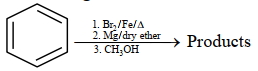
Predict the products for the following reaction sequence:
A
Anisole + $HMgBr$
B
Benzene + $Mg(OCH_3)Br$
C
Toluene + $Mg(OH)Br$
D
Bromobenzene + $Mg(H)(OCH_3)$
Solution
(B) The reaction proceeds in three steps:
$1$. Electrophilic aromatic substitution of benzene with $Br_2$ in the presence of $Fe$ catalyst gives bromobenzene $(C_6H_5Br)$.
$2$. Reaction of bromobenzene with $Mg$ in dry ether forms the Grignard reagent,phenylmagnesium bromide $(C_6H_5MgBr)$.
$3$. Grignard reagents are strong bases and react with protic sources like methanol $(CH_3OH)$ to form alkanes. Here,$C_6H_5MgBr + CH_3OH \rightarrow C_6H_6$ (benzene) $+ Mg(OCH_3)Br$.
$1$. Electrophilic aromatic substitution of benzene with $Br_2$ in the presence of $Fe$ catalyst gives bromobenzene $(C_6H_5Br)$.
$2$. Reaction of bromobenzene with $Mg$ in dry ether forms the Grignard reagent,phenylmagnesium bromide $(C_6H_5MgBr)$.
$3$. Grignard reagents are strong bases and react with protic sources like methanol $(CH_3OH)$ to form alkanes. Here,$C_6H_5MgBr + CH_3OH \rightarrow C_6H_6$ (benzene) $+ Mg(OCH_3)Br$.
0 likesView Solution
355
ChemistryEasyMCQJEE Main · 2021
Identify the correct $A$,$B$,and $C$ in the reaction sequence given below:

A
$A = \text{Nitrobenzene}$,$B = m\text{-Chloronitrobenzene}$,$C = m\text{-Chloroaniline}$
B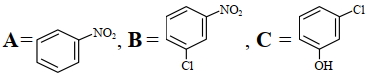
$A = \text{Nitrobenzene}$,$B = m\text{-Chloronitrobenzene}$,$C = m\text{-Chlorophenol}$
C
$A = \text{Nitrobenzene}$,$B = p\text{-Chloronitrobenzene}$,$C = p\text{-Chloroaniline}$
D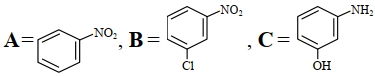
$A = \text{Nitrobenzene}$,$B = m\text{-Chloronitrobenzene}$,$C = m\text{-Chlorophenol}$
Solution
(A) $1$. The reaction of benzene with conc. $HNO_3$ and conc. $H_2SO_4$ (nitration) yields $A = \text{Nitrobenzene}$.
$2$. Nitrobenzene is a meta-directing group. Therefore,chlorination of nitrobenzene using $Cl_2$ and anhydrous $AlCl_3$ gives $B = m\text{-Chloronitrobenzene}$.
$3$. The reduction of the nitro group $(-NO_2)$ in $m\text{-Chloronitrobenzene}$ using $Fe/HCl$ yields $C = m\text{-Chloroaniline}$.
$2$. Nitrobenzene is a meta-directing group. Therefore,chlorination of nitrobenzene using $Cl_2$ and anhydrous $AlCl_3$ gives $B = m\text{-Chloronitrobenzene}$.
$3$. The reduction of the nitro group $(-NO_2)$ in $m\text{-Chloronitrobenzene}$ using $Fe/HCl$ yields $C = m\text{-Chloroaniline}$.
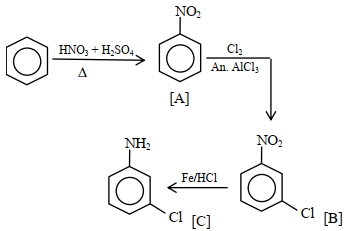
0 likesView Solution
356
ChemistryEasyMCQJEE Main · 2021
The number of $S=O$ bonds present in sulphurous acid,peroxodisulphuric acid and pyrosulphuric acid,respectively are :
A
$2, 3$ and $4$
B
$1, 4$ and $3$
C
$2, 4$ and $3$
D
$1, 4$ and $4$
Solution
(D) $1$. Sulphurous acid $(H_2SO_3)$: The structure contains $1$ $S=O$ bond.
$2$. Peroxodisulphuric acid $(H_2S_2O_8)$: The structure contains $4$ $S=O$ bonds.
$3$. Pyrosulphuric acid $(H_2S_2O_7)$: The structure contains $4$ $S=O$ bonds.
Therefore,the number of $S=O$ bonds are $1, 4$ and $4$ respectively.
$2$. Peroxodisulphuric acid $(H_2S_2O_8)$: The structure contains $4$ $S=O$ bonds.
$3$. Pyrosulphuric acid $(H_2S_2O_7)$: The structure contains $4$ $S=O$ bonds.
Therefore,the number of $S=O$ bonds are $1, 4$ and $4$ respectively.
0 likesView Solution
357
ChemistryDifficultMCQJEE Main · 2021
$CH_4$ is adsorbed on $1 \ g$ charcoal at $0^{\circ} C$ following the Freundlich adsorption isotherm. $10.0 \ mL$ of $CH_4$ is adsorbed at $100 \ mm$ of $Hg$,whereas $15.0 \ mL$ is adsorbed at $200 \ mm$ of $Hg$. The volume of $CH_4$ adsorbed at $300 \ mm$ of $Hg$ is $10^x \ mL$. The value of $x$ is $....\times 10^{-2}$ (Nearest integer). [Use $\log_{10} 2=0.3010, \log_{10} 3=0.4771$]
A
$1280$
B
$128$
C
$12.8$
D
$1.28$
Solution
(B) The Freundlich adsorption isotherm is given by $\frac{x}{m} = KP^{1/n}$. Since the mass of adsorbent $(m)$ is constant $(1 \ g)$,we have $V \propto \frac{x}{m}$,so $V = KP^{1/n}$.
For the given data:
$10 = K(100)^{1/n} \quad (1)$
$15 = K(200)^{1/n} \quad (2)$
$V = K(300)^{1/n} \quad (3)$
Dividing $(2)$ by $(1)$:
$\frac{15}{10} = \left(\frac{200}{100}\right)^{1/n} \Rightarrow 1.5 = 2^{1/n}$.
Taking $\log_{10}$ on both sides:
$\log_{10} 1.5 = \frac{1}{n} \log_{10} 2$
$\log_{10} \left(\frac{3}{2}\right) = \frac{1}{n} (0.3010)$
$0.4771 - 0.3010 = \frac{1}{n} (0.3010)$
$0.1761 = \frac{1}{n} (0.3010) \Rightarrow \frac{1}{n} = \frac{0.1761}{0.3010} \approx 0.585$.
Dividing $(3)$ by $(1)$:
$\frac{V}{10} = \left(\frac{300}{100}\right)^{1/n} = 3^{1/n}$.
Taking $\log_{10}$ on both sides:
$\log_{10} \left(\frac{V}{10}\right) = \frac{1}{n} \log_{10} 3$
$\log_{10} \left(\frac{V}{10}\right) = 0.585 \times 0.4771 = 0.2791$.
$\frac{V}{10} = 10^{0.2791} \Rightarrow V = 10 \times 10^{0.2791} = 10^{1.2791}$.
Given $V = 10^x$,so $x = 1.2791$.
Rounding to the nearest integer for $x \times 10^{-2}$,we get $128 \times 10^{-2}$.
For the given data:
$10 = K(100)^{1/n} \quad (1)$
$15 = K(200)^{1/n} \quad (2)$
$V = K(300)^{1/n} \quad (3)$
Dividing $(2)$ by $(1)$:
$\frac{15}{10} = \left(\frac{200}{100}\right)^{1/n} \Rightarrow 1.5 = 2^{1/n}$.
Taking $\log_{10}$ on both sides:
$\log_{10} 1.5 = \frac{1}{n} \log_{10} 2$
$\log_{10} \left(\frac{3}{2}\right) = \frac{1}{n} (0.3010)$
$0.4771 - 0.3010 = \frac{1}{n} (0.3010)$
$0.1761 = \frac{1}{n} (0.3010) \Rightarrow \frac{1}{n} = \frac{0.1761}{0.3010} \approx 0.585$.
Dividing $(3)$ by $(1)$:
$\frac{V}{10} = \left(\frac{300}{100}\right)^{1/n} = 3^{1/n}$.
Taking $\log_{10}$ on both sides:
$\log_{10} \left(\frac{V}{10}\right) = \frac{1}{n} \log_{10} 3$
$\log_{10} \left(\frac{V}{10}\right) = 0.585 \times 0.4771 = 0.2791$.
$\frac{V}{10} = 10^{0.2791} \Rightarrow V = 10 \times 10^{0.2791} = 10^{1.2791}$.
Given $V = 10^x$,so $x = 1.2791$.
Rounding to the nearest integer for $x \times 10^{-2}$,we get $128 \times 10^{-2}$.
0 likesView Solution
358
ChemistryDifficultMCQJEE Main · 2021
$1.22 \, g$ of an organic acid is separately dissolved in $100 \, g$ of benzene $(K_{b}=2.6 \, K \, kg \, mol^{-1})$ and $100 \, g$ of acetone $(K_{b}=1.7 \, K \, kg \, mol^{-1})$. The acid is known to dimerize in benzene but remain as a monomer in acetone. The boiling point of the solution in acetone increases by $0.17^{\circ} C$.
The increase in boiling point of solution in benzene in $^{\circ} C$ is $x \times 10^{-2}$. The value of $x$ is ..... .(Nearest integer)
$[$ Atomic mass : $C=12.0, H=1.0, O=16.0]$
The increase in boiling point of solution in benzene in $^{\circ} C$ is $x \times 10^{-2}$. The value of $x$ is ..... .(Nearest integer)
$[$ Atomic mass : $C=12.0, H=1.0, O=16.0]$
A
$12$
B
$13$
C
$10$
D
$11$
Solution
(B) For acetone as solvent:
$\Delta T_{b} = i \times K_{b} \times m$
$0.17 = 1 \times 1.7 \times \frac{1.22 / M_{w}}{100 / 1000} \dots (1)$
For benzene as solvent (dimerization,$i = 0.5$):
$\Delta T_{b} = 0.5 \times 2.6 \times \frac{1.22 / M_{w}}{100 / 1000} \dots (2)$
Dividing $(2)$ by $(1)$:
$\frac{\Delta T_{b}}{0.17} = \frac{0.5 \times 2.6}{1.7} = \frac{1.3}{1.7}$
$\Delta T_{b} = \frac{1.3 \times 0.17}{1.7} = 0.13 \, ^{\circ}C$
Given $\Delta T_{b} = x \times 10^{-2} \, ^{\circ}C$,we have $0.13 = x \times 10^{-2}$,so $x = 13$.
$\Delta T_{b} = i \times K_{b} \times m$
$0.17 = 1 \times 1.7 \times \frac{1.22 / M_{w}}{100 / 1000} \dots (1)$
For benzene as solvent (dimerization,$i = 0.5$):
$\Delta T_{b} = 0.5 \times 2.6 \times \frac{1.22 / M_{w}}{100 / 1000} \dots (2)$
Dividing $(2)$ by $(1)$:
$\frac{\Delta T_{b}}{0.17} = \frac{0.5 \times 2.6}{1.7} = \frac{1.3}{1.7}$
$\Delta T_{b} = \frac{1.3 \times 0.17}{1.7} = 0.13 \, ^{\circ}C$
Given $\Delta T_{b} = x \times 10^{-2} \, ^{\circ}C$,we have $0.13 = x \times 10^{-2}$,so $x = 13$.
0 likesView Solution
359
ChemistryDifficultMCQJEE Main · 2021
The empirical formula for a compound with a cubic close packed arrangement of anions and with cations occupying all the octahedral sites is $A_{x}B$. The value of $x$ is ..... .
(Integer answer)
(Integer answer)
A
$3$
B
$1$
C
$0$
D
$2$
Solution
(B) In a cubic close packed $(CCP)$ arrangement,the number of anions $(A^-)$ per unit cell is $4$.
The number of octahedral voids in a $CCP$ lattice is equal to the number of atoms forming the lattice,which is $4$.
Since cations $(B^+)$ occupy all octahedral sites,the number of cations per unit cell is $4$.
The formula of the unit cell is $A_4B_4$,which simplifies to the empirical formula $AB$.
Comparing $AB$ with $A_xB$,we get $x = 1$.
The number of octahedral voids in a $CCP$ lattice is equal to the number of atoms forming the lattice,which is $4$.
Since cations $(B^+)$ occupy all octahedral sites,the number of cations per unit cell is $4$.
The formula of the unit cell is $A_4B_4$,which simplifies to the empirical formula $AB$.
Comparing $AB$ with $A_xB$,we get $x = 1$.
0 likesView Solution
360
ChemistryMediumMCQJEE Main · 2021
In the electrolytic refining of blister copper,the total number of main impurities,from the following,removed as anode mud is .... .
$Pb, Sb, Se, Te, Ru, Ag, Au$ and $Pt$
$Pb, Sb, Se, Te, Ru, Ag, Au$ and $Pt$
A
$5$
B
$6$
C
$4$
D
$3$
Solution
(B) During the electrolytic refining of blister copper,the impurities that are less reactive than copper do not dissolve in the electrolyte and settle down at the bottom of the anode as anode mud.
These impurities include $Sb, Se, Te, Ag, Au,$ and $Pt$.
$Pb$ is more reactive than copper and dissolves in the electrolyte.
Therefore,the total number of impurities removed as anode mud is $6$.
These impurities include $Sb, Se, Te, Ag, Au,$ and $Pt$.
$Pb$ is more reactive than copper and dissolves in the electrolyte.
Therefore,the total number of impurities removed as anode mud is $6$.
0 likesView Solution
361
ChemistryDifficultMCQJEE Main · 2021
For the reaction $A \rightarrow B$,the rate constant $k$ (in $s^{-1}$) is given by $\log_{10} k = 20.35 - \frac{2.47 \times 10^{3}}{T}$. The energy of activation in $kJ \, mol^{-1}$ is ..... . (Nearest integer) [Given: $R = 8.314 \, J \, K^{-1} \, mol^{-1}$]
A
$85$
B
$47$
C
$12$
D
$4.7$
Solution
(B) The Arrhenius equation is given by $\log_{10} k = \log_{10} A - \frac{E_a}{2.303 RT}$.
Comparing this with the given equation $\log_{10} k = 20.35 - \frac{2.47 \times 10^{3}}{T}$,we get:
$\frac{E_a}{2.303 R} = 2.47 \times 10^{3}$.
$E_a = 2.47 \times 10^{3} \times 2.303 \times 8.314 \, J \, mol^{-1}$.
$E_a = 47306.6 \, J \, mol^{-1} = 47.3066 \, kJ \, mol^{-1}$.
Rounding to the nearest integer,we get $E_a = 47 \, kJ \, mol^{-1}$.
Comparing this with the given equation $\log_{10} k = 20.35 - \frac{2.47 \times 10^{3}}{T}$,we get:
$\frac{E_a}{2.303 R} = 2.47 \times 10^{3}$.
$E_a = 2.47 \times 10^{3} \times 2.303 \times 8.314 \, J \, mol^{-1}$.
$E_a = 47306.6 \, J \, mol^{-1} = 47.3066 \, kJ \, mol^{-1}$.
Rounding to the nearest integer,we get $E_a = 47 \, kJ \, mol^{-1}$.
0 likesView Solution
362
ChemistryMediumMCQJEE Main · 2021
Calamine and Malachite,respectively,are the ores of :
A
Nickel and Aluminium
B
Zinc and Copper
C
Copper and Iron
D
Aluminium and Zinc
Solution
(B) Calamine is the ore of Zinc,with the chemical formula $ZnCO_{3}$.
Malachite is the ore of Copper,with the chemical formula $Cu(OH)_{2} \cdot CuCO_{3}$.
Malachite is the ore of Copper,with the chemical formula $Cu(OH)_{2} \cdot CuCO_{3}$.
0 likesView Solution
363
ChemistryMediumMCQJEE Main · 2021
Which one of the following given graphs represents the variation of rate constant $(k)$ with temperature $(T)$ for an endothermic reaction?
A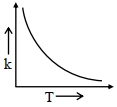
B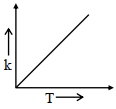
C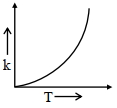
D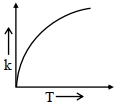
Solution
(C) The variation of the rate constant $(k)$ with temperature $(T)$ is given by the Arrhenius equation: $k = A e^{-E_a/RT}$.
For any chemical reaction (whether endothermic or exothermic),the rate constant $(k)$ increases exponentially with an increase in temperature $(T)$.
As $T$ increases,the term $e^{-E_a/RT}$ increases,leading to an exponential rise in the value of $k$.
Among the given options,Graph $C$ represents an exponential increase of $k$ with respect to $T$.
For any chemical reaction (whether endothermic or exothermic),the rate constant $(k)$ increases exponentially with an increase in temperature $(T)$.
As $T$ increases,the term $e^{-E_a/RT}$ increases,leading to an exponential rise in the value of $k$.
Among the given options,Graph $C$ represents an exponential increase of $k$ with respect to $T$.
0 likesView Solution
364
ChemistryDifficultMCQJEE Main · 2021
Identify $A$ in the following reaction.
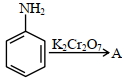
A
p-Benzoquinone
B
p-Aminophenol
C
Nitrobenzene
D
Nitrocyclohexane
Solution
(A) When aniline is treated with a strong oxidizing agent like $K_2Cr_2O_7$ in the presence of $H_2SO_4$,it undergoes oxidation to form $p$-benzoquinone as the final product. This is a characteristic oxidation reaction of aniline.
0 likesView Solution
365
ChemistryDifficultMCQJEE Main · 2021
In the following sequence of reactions,a compound $A$ (molecular formula $C_{6}H_{12}O_{2}$) with a straight chain structure gives a $C_{4}$ carboxylic acid. $A$ is :
$A$ $\xrightarrow{LiAlH_{4} / H_{3}O^{+}} B$ $\xrightarrow{\text{Oxidation}} C_{4} \text{ carboxylic acid}$
$A$ $\xrightarrow{LiAlH_{4} / H_{3}O^{+}} B$ $\xrightarrow{\text{Oxidation}} C_{4} \text{ carboxylic acid}$
A
$CH_{3}CH_{2}COOCH_{2}CH_{2}CH_{3}$
B
$CH_{3}CH_{2}CH(OH)CH_{2}OCH=CH_{2}$
C
$CH_{3}CH_{2}CH_{2}COOCH_{2}CH_{3}$
D
$CH_{3}CH_{2}CH_{2}OCH=CHCH_{2}OH$
Solution
(C) The compound $A$ is an ester with the molecular formula $C_{6}H_{12}O_{2}$.
Reduction of an ester with $LiAlH_{4}$ yields two alcohols.
For $A$ to yield a $C_{4}$ carboxylic acid upon oxidation of the resulting alcohol $B$,$B$ must be a primary alcohol with four carbon atoms,i.e.,butan$-1-$ol $(CH_{3}CH_{2}CH_{2}CH_{2}OH)$.
This implies that the ester $A$ must be propyl propanoate $(CH_{3}CH_{2}COOCH_{2}CH_{2}CH_{3})$ or ethyl butanoate $(CH_{3}CH_{2}CH_{2}COOCH_{2}CH_{3})$.
Looking at the options,$CH_{3}CH_{2}CH_{2}COOCH_{2}CH_{3}$ (ethyl butanoate) upon reduction gives butan$-1-$ol and ethanol. Oxidation of butan$-1-$ol yields butanoic acid ($C_{4}$ carboxylic acid).
Therefore,$A$ is $CH_{3}CH_{2}CH_{2}COOCH_{2}CH_{3}$.
Reduction of an ester with $LiAlH_{4}$ yields two alcohols.
For $A$ to yield a $C_{4}$ carboxylic acid upon oxidation of the resulting alcohol $B$,$B$ must be a primary alcohol with four carbon atoms,i.e.,butan$-1-$ol $(CH_{3}CH_{2}CH_{2}CH_{2}OH)$.
This implies that the ester $A$ must be propyl propanoate $(CH_{3}CH_{2}COOCH_{2}CH_{2}CH_{3})$ or ethyl butanoate $(CH_{3}CH_{2}CH_{2}COOCH_{2}CH_{3})$.
Looking at the options,$CH_{3}CH_{2}CH_{2}COOCH_{2}CH_{3}$ (ethyl butanoate) upon reduction gives butan$-1-$ol and ethanol. Oxidation of butan$-1-$ol yields butanoic acid ($C_{4}$ carboxylic acid).
Therefore,$A$ is $CH_{3}CH_{2}CH_{2}COOCH_{2}CH_{3}$.
0 likesView Solution
366
ChemistryDifficultMCQJEE Main · 2021
Match List-$I$ with List-$II$.
Choose the most appropriate answer from the options given below.
| List-$I$ (Colloid Preparation Method) | List-$II$ (Chemical Reaction) |
| $(a)$ Hydrolysis | $(i) \; 2 AuCl_{3} + 3 HCHO + 3 H_{2}O \rightarrow 2 Au(sol) + 3 HCOOH + 6 HCl$ |
| $(b)$ Reduction | $(ii) \; As_{2}O_{3} + 3 H_{2}S \rightarrow As_{2}S_{3}(sol) + 3 H_{2}O$ |
| $(c)$ Oxidation | $(iii) \; SO_{2} + 2 H_{2}S \rightarrow 3 S(sol) + 2 H_{2}O$ |
| $(d)$ Double Decomposition | $(iv) \; FeCl_{3} + 3 H_{2}O \rightarrow Fe(OH)_{3}(sol) + 3 HCl$ |
Choose the most appropriate answer from the options given below.
A
$(a)-(i), (b)-(iii), (c)-(ii), (d)-(iv)$
B
$(a)-(iv), (b)-(i), (c)-(iii), (d)-(ii)$
C
$(a)-(iv), (b)-(ii), (c)-(iii), (d)-(i)$
D
$(a)-(i), (b)-(ii), (c)-(iv), (d)-(iii)$
Solution
(B) The preparation of colloids by chemical methods involves various reactions:
$1$. Hydrolysis: $FeCl_{3} + 3 H_{2}O \rightarrow Fe(OH)_{3} (sol) + 3 HCl$. This corresponds to $(a)-(iv)$.
$2$. Reduction: $2 AuCl_{3} + 3 HCHO + 3 H_{2}O \rightarrow 2 Au (sol) + 3 HCOOH + 6 HCl$. This corresponds to $(b)-(i)$.
$3$. Oxidation: $SO_{2} + 2 H_{2}S \rightarrow 3 S (sol) + 2 H_{2}O$. This corresponds to $(c)-(iii)$.
$4$. Double Decomposition: $As_{2}O_{3} + 3 H_{2}S \rightarrow As_{2}S_{3} (sol) + 3 H_{2}O$. This corresponds to $(d)-(ii)$.
Thus,the correct matching is $(a)-(iv), (b)-(i), (c)-(iii), (d)-(ii)$.
$1$. Hydrolysis: $FeCl_{3} + 3 H_{2}O \rightarrow Fe(OH)_{3} (sol) + 3 HCl$. This corresponds to $(a)-(iv)$.
$2$. Reduction: $2 AuCl_{3} + 3 HCHO + 3 H_{2}O \rightarrow 2 Au (sol) + 3 HCOOH + 6 HCl$. This corresponds to $(b)-(i)$.
$3$. Oxidation: $SO_{2} + 2 H_{2}S \rightarrow 3 S (sol) + 2 H_{2}O$. This corresponds to $(c)-(iii)$.
$4$. Double Decomposition: $As_{2}O_{3} + 3 H_{2}S \rightarrow As_{2}S_{3} (sol) + 3 H_{2}O$. This corresponds to $(d)-(ii)$.
Thus,the correct matching is $(a)-(iv), (b)-(i), (c)-(iii), (d)-(ii)$.
0 likesView Solution
367
ChemistryEasyMCQJEE Main · 2021
The Crystal Field Stabilization Energy $(CFSE)$ and magnetic moment (spin-only) of an octahedral aqua complex of a metal ion $(M^{2+})$ are $-0.8\, \Delta_{0}$ and $3.87\, BM$,respectively. Identify $(M^{2+})$:
A
$V^{3+}$
B
$Cr^{3+}$
C
$Mn^{4+}$
D
$Co^{2+}$
Solution
(D) The magnetic moment $\mu = 3.87 \, BM$ corresponds to $n = 3$ unpaired electrons,as $\mu = \sqrt{n(n+2)} \, BM$.
For an octahedral complex,the $CFSE$ is given by the formula: $CFSE = (-0.4 \times n_{t_{2g}} + 0.6 \times n_{e_g}) \Delta_0$.
For a $d^7$ ion in a weak field (aqua complex),the configuration is $t_{2g}^5 e_g^2$.
$CFSE = (-0.4 \times 5 + 0.6 \times 2) \Delta_0 = (-2.0 + 1.2) \Delta_0 = -0.8 \Delta_0$.
This matches the given $CFSE$ and the number of unpaired electrons $(3)$.
Thus,the metal ion is $Co^{2+}$ ($d^7$ configuration).
For an octahedral complex,the $CFSE$ is given by the formula: $CFSE = (-0.4 \times n_{t_{2g}} + 0.6 \times n_{e_g}) \Delta_0$.
For a $d^7$ ion in a weak field (aqua complex),the configuration is $t_{2g}^5 e_g^2$.
$CFSE = (-0.4 \times 5 + 0.6 \times 2) \Delta_0 = (-2.0 + 1.2) \Delta_0 = -0.8 \Delta_0$.
This matches the given $CFSE$ and the number of unpaired electrons $(3)$.
Thus,the metal ion is $Co^{2+}$ ($d^7$ configuration).
0 likesView Solution
368
ChemistryDifficultMCQJEE Main · 2021
Monomer units of $Dacron$ polymer are :
A
ethylene glycol and phthalic acid
B
ethylene glycol and terephthalic acid
C
glycerol and terephthalic acid
D
glycerol and phthalic acid
Solution
(B) $Dacron$ (also known as $Terylene$) is a polyester polymer.
It is formed by the condensation polymerization of $Ethylene \ glycol$ $(HO-CH_2-CH_2-OH)$ and $Terephthalic \ acid$ $(HOOC-C_6H_4-COOH)$.
The reaction is as follows:
$n(HOOC-C_6H_4-COOH) + n(HO-CH_2-CH_2-OH) \rightarrow [-OC-C_6H_4-CO-O-CH_2-CH_2-O-]_n + 2n(H_2O)$
Thus,the correct option is $B$.
It is formed by the condensation polymerization of $Ethylene \ glycol$ $(HO-CH_2-CH_2-OH)$ and $Terephthalic \ acid$ $(HOOC-C_6H_4-COOH)$.
The reaction is as follows:
$n(HOOC-C_6H_4-COOH) + n(HO-CH_2-CH_2-OH) \rightarrow [-OC-C_6H_4-CO-O-CH_2-CH_2-O-]_n + 2n(H_2O)$
Thus,the correct option is $B$.
0 likesView Solution
369
ChemistryDifficultMCQJEE Main · 2021
In the following sequence of reactions,
$C_{3}H_{6}$ $\xrightarrow{H^{+}/H_{2}O} A$ $\xrightarrow[dil. KOH]{KIO} B + C$
The compounds $B$ and $C$ respectively are :
$C_{3}H_{6}$ $\xrightarrow{H^{+}/H_{2}O} A$ $\xrightarrow[dil. KOH]{KIO} B + C$
The compounds $B$ and $C$ respectively are :
A
$CHI_{3}, CH_{3}COOK$
B
$CI_{3}COOK, CH_{3}I$
C
$CH_{3}I, HCOOK$
D
$CHI_{3}, CH_{3}COOK$
Solution
(A) Step $1$: Hydration of propene $(C_{3}H_{6})$ with $H^{+}/H_{2}O$ follows Markovnikov's rule to form propan$-2-$ol $(A)$:
$CH_{3}-CH=CH_{2} + H_{2}O \xrightarrow{H^{+}} CH_{3}-CH(OH)-CH_{3} (A)$
Step $2$: Propan$-2-$ol $(A)$ is a secondary alcohol with a methyl group attached to the carbinol carbon,which undergoes the iodoform reaction with $KIO/dil. KOH$ to form iodoform $(B)$ and potassium acetate $(C)$:
$CH_{3}-CH(OH)-CH_{3} + 4KIO \rightarrow CHI_{3} (B) + CH_{3}COOK (C) + 3KOH + H_{2}O$
Thus,$B$ is $CHI_{3}$ and $C$ is $CH_{3}COOK$.
$CH_{3}-CH=CH_{2} + H_{2}O \xrightarrow{H^{+}} CH_{3}-CH(OH)-CH_{3} (A)$
Step $2$: Propan$-2-$ol $(A)$ is a secondary alcohol with a methyl group attached to the carbinol carbon,which undergoes the iodoform reaction with $KIO/dil. KOH$ to form iodoform $(B)$ and potassium acetate $(C)$:
$CH_{3}-CH(OH)-CH_{3} + 4KIO \rightarrow CHI_{3} (B) + CH_{3}COOK (C) + 3KOH + H_{2}O$
Thus,$B$ is $CHI_{3}$ and $C$ is $CH_{3}COOK$.
0 likesView Solution
370
ChemistryEasyMCQJEE Main · 2021
Given below are two statements :
Statement $I :$ The nucleophilic addition of sodium hydrogen sulphite to an aldehyde or a ketone involves proton transfer to form a stable ion.
Statement $II :$ The nucleophilic addition of hydrogen cyanide to an aldehyde or a ketone yields amine as final product.
In the light of the above statements,choose the most appropriate answer from the options given below :
Statement $I :$ The nucleophilic addition of sodium hydrogen sulphite to an aldehyde or a ketone involves proton transfer to form a stable ion.
Statement $II :$ The nucleophilic addition of hydrogen cyanide to an aldehyde or a ketone yields amine as final product.
In the light of the above statements,choose the most appropriate answer from the options given below :
A
Both Statement $I$ and Statement $II$ are true.
B
Statement $I$ is true but Statement $II$ is false.
C
Statement $I$ is false but Statement $II$ is true.
D
Both Statement $I$ and Statement $II$ are false.
Solution
(B) Statement $I$ is true. The nucleophilic addition of sodium hydrogen sulphite $(NaHSO_3)$ to an aldehyde or a ketone involves the attack of the sulphite nucleophile on the carbonyl carbon,followed by a proton transfer to the oxygen atom to form a stable bisulphite addition product (a white crystalline solid).
Statement $II$ is false. The nucleophilic addition of hydrogen cyanide $(HCN)$ to an aldehyde or a ketone yields a cyanohydrin,not an amine. The reaction involves the addition of the cyanide ion $(CN^-)$ to the carbonyl carbon followed by protonation of the oxygen.
Therefore,Statement $I$ is true but Statement $II$ is false.
Statement $II$ is false. The nucleophilic addition of hydrogen cyanide $(HCN)$ to an aldehyde or a ketone yields a cyanohydrin,not an amine. The reaction involves the addition of the cyanide ion $(CN^-)$ to the carbonyl carbon followed by protonation of the oxygen.
Therefore,Statement $I$ is true but Statement $II$ is false.
0 likesView Solution
371
ChemistryEasyMCQJEE Main · 2021
Which one of the following gives the most stable diazonium salt?
A
$CH_3-CH_2-CH_2-NH_2$
B
$p-CH_3-C_6H_4-NH_2$
C
$CH_3-CH(NH_2)-CH_3$
D
$C_6H_5-NH-CH_3$
Solution
(B) Aromatic primary amines,especially those with electron-donating groups on the ring,form the most stable diazonium salts due to resonance stabilization. Among the options,$p$-toluidine $(p-CH_3-C_6H_4-NH_2)$ forms a diazonium salt that is stabilized by both the resonance of the benzene ring and the electron-donating inductive effect ($+I$ effect) of the methyl group. Aliphatic amines form highly unstable diazonium salts that decompose readily,and secondary amines like $N$-methylaniline do not form diazonium salts under these conditions.
0 likesView Solution
372
ChemistryDifficultMCQJEE Main · 2021
The potassium ferrocyanide solution gives Prussian blue colour,when added to :
A
$CoCl_{3}$
B
$FeCl_{2}$
C
$CoCl_{2}$
D
$FeCl_{3}$
Solution
(D) The reaction between potassium ferrocyanide and ferric chloride is as follows:
$3K_{4}[Fe(CN)_{6}] + 4FeCl_{3} \rightarrow Fe_{4}[Fe(CN)_{6}]_{3} + 12KCl$
The product $Fe_{4}[Fe(CN)_{6}]_{3}$ is known as Prussian blue,which is a deep blue pigment.
$3K_{4}[Fe(CN)_{6}] + 4FeCl_{3} \rightarrow Fe_{4}[Fe(CN)_{6}]_{3} + 12KCl$
The product $Fe_{4}[Fe(CN)_{6}]_{3}$ is known as Prussian blue,which is a deep blue pigment.
0 likesView Solution
373
ChemistryMediumMCQJEE Main · 2021
The oxide without a nitrogen-nitrogen bond is:
A
$N_2O$
B
$N_2O_4$
C
$N_2O_3$
D
$N_2O_5$
Solution
(D) To determine which oxide lacks a nitrogen-nitrogen $(N-N)$ bond,let us examine the structures of the given nitrogen oxides:
$1$. $N_2O$ (Nitrous oxide): The structure is $N \equiv N^+ - O^-$,which contains an $N-N$ bond.
$2$. $N_2O_4$ (Dinitrogen tetroxide): The structure is $O_2N-NO_2$,which contains an $N-N$ bond.
$3$. $N_2O_3$ (Dinitrogen trioxide): The structure is $O=N-NO_2$,which contains an $N-N$ bond.
$4$. $N_2O_5$ (Dinitrogen pentoxide): The structure is $O_2N-O-NO_2$,which contains an $N-O-N$ linkage but no $N-N$ bond.
Therefore,$N_2O_5$ is the oxide that does not contain a nitrogen-nitrogen bond.
$1$. $N_2O$ (Nitrous oxide): The structure is $N \equiv N^+ - O^-$,which contains an $N-N$ bond.
$2$. $N_2O_4$ (Dinitrogen tetroxide): The structure is $O_2N-NO_2$,which contains an $N-N$ bond.
$3$. $N_2O_3$ (Dinitrogen trioxide): The structure is $O=N-NO_2$,which contains an $N-N$ bond.
$4$. $N_2O_5$ (Dinitrogen pentoxide): The structure is $O_2N-O-NO_2$,which contains an $N-O-N$ linkage but no $N-N$ bond.
Therefore,$N_2O_5$ is the oxide that does not contain a nitrogen-nitrogen bond.
0 likesView Solution
374
ChemistryMediumMCQJEE Main · 2021
Identify the element for which the electronic configuration in the $+3$ oxidation state is $[Ar] 3d^5$:
A
$Ru$
B
$Mn$
C
$Co$
D
$Fe$
Solution
(D) The electronic configuration of the element in the $+3$ oxidation state is $[Ar] 3d^5$.
To find the neutral atom,we add $3$ electrons back to the configuration: $[Ar] 3d^5 + 3e^- = [Ar] 3d^6 4s^2$.
This corresponds to the element Iron $(Fe)$,which has an atomic number of $26$.
To find the neutral atom,we add $3$ electrons back to the configuration: $[Ar] 3d^5 + 3e^- = [Ar] 3d^6 4s^2$.
This corresponds to the element Iron $(Fe)$,which has an atomic number of $26$.
0 likesView Solution
375
ChemistryMediumMCQJEE Main · 2021
The sum of oxidation states of two silver ions in $[Ag(NH_{3})_{2}][Ag(CN)_{2}]$ complex is $....$ .
A
$1$
B
$3$
C
$2$
D
$5$
Solution
(C) The given complex is $[Ag(NH_{3})_{2}][Ag(CN)_{2}]$.
This is a coordination compound consisting of a cationic part $[Ag(NH_{3})_{2}]^+$ and an anionic part $[Ag(CN)_{2}]^-$.
In the cationic part $[Ag(NH_{3})_{2}]^+$,let the oxidation state of $Ag$ be $x$. Since $NH_{3}$ is a neutral ligand,$x + 2(0) = +1$,so $x = +1$.
In the anionic part $[Ag(CN)_{2}]^-$,let the oxidation state of $Ag$ be $y$. Since $CN^-$ has a charge of $-1$,$y + 2(-1) = -1$,so $y - 2 = -1$,which gives $y = +1$.
The sum of the oxidation states of the two silver ions is $x + y = +1 + 1 = 2$.
This is a coordination compound consisting of a cationic part $[Ag(NH_{3})_{2}]^+$ and an anionic part $[Ag(CN)_{2}]^-$.
In the cationic part $[Ag(NH_{3})_{2}]^+$,let the oxidation state of $Ag$ be $x$. Since $NH_{3}$ is a neutral ligand,$x + 2(0) = +1$,so $x = +1$.
In the anionic part $[Ag(CN)_{2}]^-$,let the oxidation state of $Ag$ be $y$. Since $CN^-$ has a charge of $-1$,$y + 2(-1) = -1$,so $y - 2 = -1$,which gives $y = +1$.
The sum of the oxidation states of the two silver ions is $x + y = +1 + 1 = 2$.
0 likesView Solution
376
ChemistryMediumMCQJEE Main · 2021
If $80 \ g$ of copper sulphate $CuSO_{4} \cdot 5H_{2}O$ is dissolved in deionised water to make $5 \ L$ of solution. The concentration of the copper sulphate solution is $x \times 10^{-3} \ mol \ L^{-1}$. The value of $x$ is .... .
[Atomic masses: $Cu = 63.54 \ u, S = 32 \ u, O = 16 \ u, H = 1 \ u$]
[Atomic masses: $Cu = 63.54 \ u, S = 32 \ u, O = 16 \ u, H = 1 \ u$]
A
$49$
B
$80$
C
$64$
D
$17$
Solution
(C) $1$. Calculate the molar mass of $CuSO_{4} \cdot 5H_{2}O$:
$M = 63.54 + 32 + (4 \times 16) + 5 \times (2 \times 1 + 16) = 63.54 + 32 + 64 + 90 = 249.54 \ g \ mol^{-1}$.
$2$. Calculate the number of moles of $CuSO_{4} \cdot 5H_{2}O$:
$n = \frac{\text{mass}}{\text{molar mass}} = \frac{80 \ g}{249.54 \ g \ mol^{-1}} \approx 0.3206 \ mol$.
$3$. Calculate the molarity of the solution:
$Molarity = \frac{n}{V(L)} = \frac{0.3206 \ mol}{5 \ L} = 0.06412 \ mol \ L^{-1}$.
$4$. Express in the form $x \times 10^{-3} \ mol \ L^{-1}$:
$0.06412 = 64.12 \times 10^{-3}$.
Thus,the value of $x$ is $64$.
$M = 63.54 + 32 + (4 \times 16) + 5 \times (2 \times 1 + 16) = 63.54 + 32 + 64 + 90 = 249.54 \ g \ mol^{-1}$.
$2$. Calculate the number of moles of $CuSO_{4} \cdot 5H_{2}O$:
$n = \frac{\text{mass}}{\text{molar mass}} = \frac{80 \ g}{249.54 \ g \ mol^{-1}} \approx 0.3206 \ mol$.
$3$. Calculate the molarity of the solution:
$Molarity = \frac{n}{V(L)} = \frac{0.3206 \ mol}{5 \ L} = 0.06412 \ mol \ L^{-1}$.
$4$. Express in the form $x \times 10^{-3} \ mol \ L^{-1}$:
$0.06412 = 64.12 \times 10^{-3}$.
Thus,the value of $x$ is $64$.
0 likesView Solution
377
ChemistryDifficultMCQJEE Main · 2021
If the conductivity of mercury at $0^{\circ} \, C$ is $1.07 \times 10^{6} \, S \, m^{-1}$ and the resistance of a cell containing mercury is $0.243 \, \Omega$,then the cell constant of the cell is $x \times 10^{4} \, m^{-1}$. The value of $x$ is ...... (Nearest integer).
A
$260$
B
$39$
C
$26$
D
$13$
Solution
(C) Given: Conductivity $\kappa = 1.07 \times 10^{6} \, S \, m^{-1}$ and Resistance $R = 0.243 \, \Omega$.
The relationship between conductivity $(\kappa)$,conductance $(G)$,and cell constant $(G^{*})$ is $\kappa = G \times G^{*}$.
Since $G = \frac{1}{R}$,we have $\kappa = \frac{1}{R} \times G^{*}$.
Rearranging for the cell constant: $G^{*} = \kappa \times R$.
Substituting the values: $G^{*} = (1.07 \times 10^{6} \, S \, m^{-1}) \times (0.243 \, \Omega) = 0.26001 \times 10^{6} \, m^{-1}$.
Expressing in the form $x \times 10^{4} \, m^{-1}$: $G^{*} = 26.001 \times 10^{4} \, m^{-1}$.
Therefore,the value of $x$ is $26$.
The relationship between conductivity $(\kappa)$,conductance $(G)$,and cell constant $(G^{*})$ is $\kappa = G \times G^{*}$.
Since $G = \frac{1}{R}$,we have $\kappa = \frac{1}{R} \times G^{*}$.
Rearranging for the cell constant: $G^{*} = \kappa \times R$.
Substituting the values: $G^{*} = (1.07 \times 10^{6} \, S \, m^{-1}) \times (0.243 \, \Omega) = 0.26001 \times 10^{6} \, m^{-1}$.
Expressing in the form $x \times 10^{4} \, m^{-1}$: $G^{*} = 26.001 \times 10^{4} \, m^{-1}$.
Therefore,the value of $x$ is $26$.
0 likesView Solution
378
ChemistryDifficultMCQJEE Main · 2021
$A$ peptide synthesized by the reactions of one molecule each of Glycine,Leucine,Aspartic acid and Histidine will have ..... peptide linkages.
A
$6$
B
$5$
C
$3$
D
$4$
Solution
(C) peptide is formed by the condensation reaction between the amino group $(-NH_2)$ of one amino acid and the carboxyl group $(-COOH)$ of another amino acid.
For a peptide formed from $n$ amino acid molecules,the number of peptide linkages is given by $(n - 1)$.
Here,the peptide is synthesized from $4$ amino acids: Glycine,Leucine,Aspartic acid,and Histidine.
Therefore,the number of peptide linkages = $4 - 1 = 3$.
For a peptide formed from $n$ amino acid molecules,the number of peptide linkages is given by $(n - 1)$.
Here,the peptide is synthesized from $4$ amino acids: Glycine,Leucine,Aspartic acid,and Histidine.
Therefore,the number of peptide linkages = $4 - 1 = 3$.
0 likesView Solution
379
ChemistryEasyMCQJEE Main · 2021
Compound $A$ is converted to $B$ on reaction with $CHCl_3$ and $KOH$. The compound $B$ is toxic and can be decomposed by $C$. $A, B$ and $C$ respectively are:
A
secondary amine,nitrile compound,conc. $NaOH$
B
primary amine,isonitrile compound,conc. $HCl$
C
secondary amine,isonitrile compound,conc. $NaOH$
D
primary amine,nitrile compound,conc. $HCl$
Solution
(B) The reaction described is the Carbylamine reaction,which is a characteristic test for primary amines.
$R-NH_2 + CHCl_3 + 3KOH \rightarrow R-NC + 3KCl + 3H_2O$
Here,$A$ is a primary amine $(R-NH_2)$,and $B$ is an isonitrile $(R-NC)$,which is toxic.
Isonitriles can be decomposed (hydrolyzed) by treatment with concentrated mineral acids like $HCl$ to yield the original amine and formic acid:
$R-NC + 2H_2O \xrightarrow{HCl} R-NH_2 + HCOOH$
Thus,$A$ is a primary amine,$B$ is an isonitrile compound,and $C$ is conc. $HCl$.
$R-NH_2 + CHCl_3 + 3KOH \rightarrow R-NC + 3KCl + 3H_2O$
Here,$A$ is a primary amine $(R-NH_2)$,and $B$ is an isonitrile $(R-NC)$,which is toxic.
Isonitriles can be decomposed (hydrolyzed) by treatment with concentrated mineral acids like $HCl$ to yield the original amine and formic acid:
$R-NC + 2H_2O \xrightarrow{HCl} R-NH_2 + HCOOH$
Thus,$A$ is a primary amine,$B$ is an isonitrile compound,and $C$ is conc. $HCl$.
0 likesView Solution
380
ChemistryDifficultMCQJEE Main · 2021
According to the valence bond theory,the hybridization of the central metal atom is $dsp^{2}$ for which one of the following compounds?
A
$Na_{2}[NiCl_{4}]$
B
$NiCl_{2} \cdot 6 H_{2}O$
C
$K_{2}[Ni(CN)_{4}]$
D
$[Ni(CO)_{4}]$
Solution
(C) To determine the hybridization of the central metal atom,we analyze the coordination number and the nature of the ligands:
$1$. In $Na_{2}[NiCl_{4}]$,$Ni$ is in the $+2$ oxidation state ($3d^{8}$ configuration). $Cl^-$ is a weak field ligand,leading to $sp^{3}$ hybridization (tetrahedral geometry).
$2$. In $NiCl_{2} \cdot 6 H_{2}O$,the complex is $[Ni(H_{2}O)_{6}]^{2+}$. $Ni^{2+}$ is in an octahedral environment with $sp^{3}d^{2}$ hybridization.
$3$. In $K_{2}[Ni(CN)_{4}]$,$Ni$ is in the $+2$ oxidation state ($3d^{8}$ configuration). $CN^-$ is a strong field ligand,which causes pairing of electrons in the $3d$ orbitals. This leaves one $3d$ orbital,one $4s$ orbital,and two $4p$ orbitals available for hybridization,resulting in $dsp^{2}$ hybridization (square planar geometry).
$4$. In $[Ni(CO)_{4}]$,$Ni$ is in the $0$ oxidation state ($3d^{8} 4s^{2}$ configuration). $CO$ is a strong field ligand,causing the $4s$ electrons to pair into the $3d$ orbitals,resulting in $sp^{3}$ hybridization (tetrahedral geometry).
Therefore,the correct compound is $K_{2}[Ni(CN)_{4}]$.
$1$. In $Na_{2}[NiCl_{4}]$,$Ni$ is in the $+2$ oxidation state ($3d^{8}$ configuration). $Cl^-$ is a weak field ligand,leading to $sp^{3}$ hybridization (tetrahedral geometry).
$2$. In $NiCl_{2} \cdot 6 H_{2}O$,the complex is $[Ni(H_{2}O)_{6}]^{2+}$. $Ni^{2+}$ is in an octahedral environment with $sp^{3}d^{2}$ hybridization.
$3$. In $K_{2}[Ni(CN)_{4}]$,$Ni$ is in the $+2$ oxidation state ($3d^{8}$ configuration). $CN^-$ is a strong field ligand,which causes pairing of electrons in the $3d$ orbitals. This leaves one $3d$ orbital,one $4s$ orbital,and two $4p$ orbitals available for hybridization,resulting in $dsp^{2}$ hybridization (square planar geometry).
$4$. In $[Ni(CO)_{4}]$,$Ni$ is in the $0$ oxidation state ($3d^{8} 4s^{2}$ configuration). $CO$ is a strong field ligand,causing the $4s$ electrons to pair into the $3d$ orbitals,resulting in $sp^{3}$ hybridization (tetrahedral geometry).
Therefore,the correct compound is $K_{2}[Ni(CN)_{4}]$.
0 likesView Solution
381
ChemistryMediumMCQJEE Main · 2021
Which among the following compounds does not form a silver mirror when treated with Tollen's reagent?
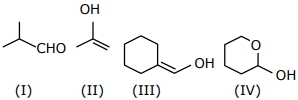
A
Only $II$
B
$I, III$ and $IV$ only
C
$III$ and $IV$ only
D
Only $IV$
Solution
(A) Tollen's reagent is used to detect the presence of aldehydes.
$I$ is an aldehyde (isobutyraldehyde),which gives a positive Tollen's test.
$II$ is an enol that tautomerizes to acetone (a ketone),which does not give a positive Tollen's test.
$III$ is an enol that tautomerizes to an aldehyde (cyclohexanecarbaldehyde),which gives a positive Tollen's test.
$IV$ is a hemiacetal,which exists in equilibrium with its open-chain aldehyde form in the presence of base,thus giving a positive Tollen's test.
Therefore,only compound $II$ does not form a silver mirror.
$I$ is an aldehyde (isobutyraldehyde),which gives a positive Tollen's test.
$II$ is an enol that tautomerizes to acetone (a ketone),which does not give a positive Tollen's test.
$III$ is an enol that tautomerizes to an aldehyde (cyclohexanecarbaldehyde),which gives a positive Tollen's test.
$IV$ is a hemiacetal,which exists in equilibrium with its open-chain aldehyde form in the presence of base,thus giving a positive Tollen's test.
Therefore,only compound $II$ does not form a silver mirror.
0 likesView Solution
382
ChemistryMediumMCQJEE Main · 2021
The metal that can be purified economically by fractional distillation method is:
A
$Ni$
B
$Cu$
C
$Zn$
D
$Fe$
Solution
(C) Fractional distillation is used for metals that have low boiling points.
$Zinc$ $(Zn)$ and $Cadmium$ $(Cd)$ are metals that can be purified economically by this method because they have relatively low boiling points compared to impurities.
$Zinc$ $(Zn)$ and $Cadmium$ $(Cd)$ are metals that can be purified economically by this method because they have relatively low boiling points compared to impurities.
0 likesView Solution
383
ChemistryDifficultMCQJEE Main · 2021
The conditions given below are in the context of observing Tyndall effect in colloidal solutions:
$A$. The diameter of the colloidal particles is comparable to the wavelength of light used.
$B$. The diameter of the colloidal particles is much smaller than the wavelength of light used.
$C$. The diameter of the colloidal particles is much larger than the wavelength of light used.
$D$. The refractive indices of the dispersed phase and the dispersion medium are comparable.
$E$. The dispersed phase has a very different refractive index from the dispersion medium.
Choose the most appropriate conditions from the options given below:
$A$. The diameter of the colloidal particles is comparable to the wavelength of light used.
$B$. The diameter of the colloidal particles is much smaller than the wavelength of light used.
$C$. The diameter of the colloidal particles is much larger than the wavelength of light used.
$D$. The refractive indices of the dispersed phase and the dispersion medium are comparable.
$E$. The dispersed phase has a very different refractive index from the dispersion medium.
Choose the most appropriate conditions from the options given below:
A
$A$ and $E$ only
B
$B$ and $E$ only
C
$A$ and $D$ only
D
$B$ and $D$ only
Solution
(A) The phenomenon of scattering of light by colloidal particles,which makes the path of the beam visible,is called the Tyndall effect.
$1$. The diameter of the dispersed phase particles must be comparable to the wavelength of light used to effectively scatter the light.
$2$. The refractive indices of the dispersed phase and the dispersion medium must differ significantly. If the refractive indices are similar,the scattering is negligible,and the Tyndall effect is not observed.
Therefore,conditions $A$ and $E$ are the necessary requirements for observing the Tyndall effect.
$1$. The diameter of the dispersed phase particles must be comparable to the wavelength of light used to effectively scatter the light.
$2$. The refractive indices of the dispersed phase and the dispersion medium must differ significantly. If the refractive indices are similar,the scattering is negligible,and the Tyndall effect is not observed.
Therefore,conditions $A$ and $E$ are the necessary requirements for observing the Tyndall effect.
0 likesView Solution
384
ChemistryMediumMCQJEE Main · 2021
Orlon fibres are made up of:
A
Polyacrylonitrile
B
Cellulose
C
Polyamide
D
Polyesters
Solution
(A) Orlon is a commercial name for polyacrylonitrile $(PAN)$.
It is prepared by the addition polymerization of acrylonitrile $(CH_2=CH-CN)$ in the presence of a peroxide catalyst.
The reaction is as follows:
$n(CH_2=CH-CN) \xrightarrow{\text{Polymerization}} [-CH_2-CH(CN)-]_n$
Thus,Orlon fibres are made up of polyacrylonitrile.
It is prepared by the addition polymerization of acrylonitrile $(CH_2=CH-CN)$ in the presence of a peroxide catalyst.
The reaction is as follows:
$n(CH_2=CH-CN) \xrightarrow{\text{Polymerization}} [-CH_2-CH(CN)-]_n$
Thus,Orlon fibres are made up of polyacrylonitrile.
0 likesView Solution
385
ChemistryDifficultMCQJEE Main · 2021
In the given reaction $3-$Bromo$-2,2-$dimethylbutane $\xrightarrow{C_2H_5OH}$ (Major product) $'A'$. Product $A$ is:
A
$2-$Hydroxy$-3,3-$dimethylbutane.
B
$2-$Ethoxy$-2,3-$dimethylbutane.
C
$2-$Ethoxy$-3,3-$dimethylbutane.
D
$1-$Ethoxy$-3,3-$dimethylbutane.
Solution
(B) The reaction proceeds via an $S_N1$ mechanism involving the formation of a carbocation intermediate.
$1$. The starting material $3-$Bromo$-2,2-$dimethylbutane loses a bromide ion to form a secondary $(2^{\circ})$ carbocation.
$2$. This $2^{\circ}$ carbocation undergoes a $1,2-$methyl shift to form a more stable tertiary $(3^{\circ})$ carbocation.
$3$. The nucleophile $C_2H_5OH$ then attacks the stable $3^{\circ}$ carbocation.
$4$. After deprotonation,the final major product formed is $2-$Ethoxy$-2,3-$dimethylbutane.
$1$. The starting material $3-$Bromo$-2,2-$dimethylbutane loses a bromide ion to form a secondary $(2^{\circ})$ carbocation.
$2$. This $2^{\circ}$ carbocation undergoes a $1,2-$methyl shift to form a more stable tertiary $(3^{\circ})$ carbocation.
$3$. The nucleophile $C_2H_5OH$ then attacks the stable $3^{\circ}$ carbocation.
$4$. After deprotonation,the final major product formed is $2-$Ethoxy$-2,3-$dimethylbutane.
0 likesView Solution
386
ChemistryDifficultMCQJEE Main · 2021
The correct order of intensity of colors of the compounds is:
A
$[Ni(CN)_{4}]^{2-} > [NiCl_{4}]^{2-} > [Ni(H_{2}O)_{6}]^{2+}$
B
$[NiCl_{4}]^{2-} > [Ni(CN)_{4}]^{2-} > [Ni(H_{2}O)_{6}]^{2+}$
C
$[NiCl_{4}]^{2-} > [Ni(H_{2}O)_{6}]^{2+} > [Ni(CN)_{4}]^{2-}$
D
$[Ni(H_{2}O)_{6}]^{2+} > [NiCl_{4}]^{2-} > [Ni(CN)_{4}]^{2-}$
Solution
(C) The intensity of color in coordination complexes is related to the probability of $d-d$ transitions. Complexes that lack a center of inversion (like tetrahedral complexes) exhibit more intense colors due to the relaxation of the Laporte selection rule compared to centrosymmetric complexes (like octahedral or square planar complexes).
The complexes are: $[NiCl_{4}]^{2-}$ (tetrahedral,non-centrosymmetric),$[Ni(H_{2}O)_{6}]^{2+}$ (octahedral,centrosymmetric),and $[Ni(CN)_{4}]^{2-}$ (square planar,centrosymmetric).
Thus,the intensity order is: $[NiCl_{4}]^{2-} > [Ni(H_{2}O)_{6}]^{2+} > [Ni(CN)_{4}]^{2-}$.
The complexes are: $[NiCl_{4}]^{2-}$ (tetrahedral,non-centrosymmetric),$[Ni(H_{2}O)_{6}]^{2+}$ (octahedral,centrosymmetric),and $[Ni(CN)_{4}]^{2-}$ (square planar,centrosymmetric).
Thus,the intensity order is: $[NiCl_{4}]^{2-} > [Ni(H_{2}O)_{6}]^{2+} > [Ni(CN)_{4}]^{2-}$.
0 likesView Solution
387
ChemistryDifficultMCQJEE Main · 2021
An inorganic compound $X$ on treatment with concentrated $H_{2}SO_{4}$ produces brown fumes and gives a dark brown ring with $FeSO_{4}$ in the presence of concentrated $H_{2}SO_{4}$. Also,compound $X$ gives a precipitate $Y$ when its solution in dilute $HCl$ is treated with $H_{2}S$ gas. The precipitate $Y$ on treatment with concentrated $HNO_{3}$ followed by excess of $NH_{4}OH$ further gives a deep blue coloured solution. Compound $X$ is:
A
$Cu(NO_{3})_{2}$
B
$Pb(NO_{3})_{2}$
C
$Pb(NO_{2})_{2}$
D
$Co(NO_{3})_{2}$
Solution
(A) $1$. The brown fumes produced with concentrated $H_{2}SO_{4}$ and the formation of a dark brown ring with $FeSO_{4}$ indicate the presence of the nitrate ion $(NO_{3}^{-})$ in compound $X$.
$2$. The formation of a precipitate $Y$ when the solution of $X$ in dilute $HCl$ is treated with $H_{2}S$ gas indicates the presence of a Group-$II$ cation. Among the options,$Cu^{2+}$ is a Group-$II$ cation that forms a black precipitate $(CuS)$ with $H_{2}S$.
$3$. The precipitate $CuS$ $(Y)$ dissolves in concentrated $HNO_{3}$ to form $Cu(NO_{3})_{2}$.
$4$. Adding excess $NH_{4}OH$ to the $Cu(NO_{3})_{2}$ solution forms the deep blue complex $[Cu(NH_{3})_{4}]^{2+}$.
$5$. Therefore,compound $X$ is $Cu(NO_{3})_{2}$.
$2$. The formation of a precipitate $Y$ when the solution of $X$ in dilute $HCl$ is treated with $H_{2}S$ gas indicates the presence of a Group-$II$ cation. Among the options,$Cu^{2+}$ is a Group-$II$ cation that forms a black precipitate $(CuS)$ with $H_{2}S$.
$3$. The precipitate $CuS$ $(Y)$ dissolves in concentrated $HNO_{3}$ to form $Cu(NO_{3})_{2}$.
$4$. Adding excess $NH_{4}OH$ to the $Cu(NO_{3})_{2}$ solution forms the deep blue complex $[Cu(NH_{3})_{4}]^{2+}$.
$5$. Therefore,compound $X$ is $Cu(NO_{3})_{2}$.
0 likesView Solution
388
ChemistryMediumMCQJEE Main · 2021
Identify the incorrect statement from the following:
A
Glycogen is called as animal starch
B
$\beta$-Glycosidic linkage makes cellulose polymer
C
Amylose is a branched chain polymer of glucose
D
Starch is a polymer of $\alpha-D$-glucose
Solution
(C) Amylose is a linear chain polymer of $\alpha-D$-glucose,whereas amylopectin is a branched chain polymer of $\alpha-D$-glucose. Therefore,the statement that amylose is a branched chain polymer is incorrect.
0 likesView Solution
389
ChemistryDifficultMCQJEE Main · 2021
The correct structure of Rhumann's Purple,the compound formed in the reaction of ninhydrin with proteins is :
A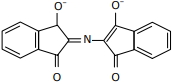
B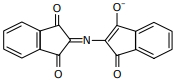
C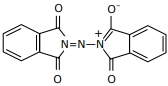
D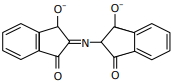
Solution
(A) The reaction of ninhydrin with amino acids or proteins leads to the formation of a deep blue or purple colored compound known as Rhumann's Purple.
The structure of Rhumann's Purple consists of two indane$-1,3-$dione moieties linked by a nitrogen atom,where one of the carbonyl oxygens is deprotonated (exists as an enolate).
Comparing the given options with the standard chemical structure of Rhumann's Purple,option $A$ represents the correct structure where the nitrogen atom connects the two indane rings,with one oxygen atom carrying a negative charge $(O^-)$ and the other carbonyl groups intact.
The structure of Rhumann's Purple consists of two indane$-1,3-$dione moieties linked by a nitrogen atom,where one of the carbonyl oxygens is deprotonated (exists as an enolate).
Comparing the given options with the standard chemical structure of Rhumann's Purple,option $A$ represents the correct structure where the nitrogen atom connects the two indane rings,with one oxygen atom carrying a negative charge $(O^-)$ and the other carbonyl groups intact.
0 likesView Solution
390
ChemistryDifficultMCQJEE Main · 2021
Given below are two statements. One is labelled as Assertion $A$ and the other is labelled as Reason $R$.
Assertion $A$: Sharp glass edge becomes smooth on heating it up to its melting point.
Reason $R$: The viscosity of glass decreases on melting.
Choose the most appropriate answer from the options given below.
Assertion $A$: Sharp glass edge becomes smooth on heating it up to its melting point.
Reason $R$: The viscosity of glass decreases on melting.
Choose the most appropriate answer from the options given below.
A
Both $A$ and $R$ are true and $R$ is the correct explanation of $A$.
B
$A$ is true but $R$ is false.
C
$A$ is false but $R$ is true.
D
Both $A$ and $R$ are true but $R$ is $NOT$ the correct explanation of $A$.
Solution
(D) Glass is an amorphous solid. On heating,it softens and flows,which causes the sharp edges to become smooth due to surface tension.
Assertion $A$ is true because heating glass to its melting point allows it to flow and round off sharp edges.
Reason $R$ is true because the viscosity of glass decreases as temperature increases,allowing it to flow more easily.
However,the smoothing of edges is primarily due to the effect of surface tension,not just the decrease in viscosity. Therefore,$R$ is not the correct explanation for $A$.
Assertion $A$ is true because heating glass to its melting point allows it to flow and round off sharp edges.
Reason $R$ is true because the viscosity of glass decreases as temperature increases,allowing it to flow more easily.
However,the smoothing of edges is primarily due to the effect of surface tension,not just the decrease in viscosity. Therefore,$R$ is not the correct explanation for $A$.
0 likesView Solution
391
ChemistryDifficultMCQJEE Main · 2021
Chemical nature of the nitrogen oxide compound obtained from a reaction of concentrated nitric acid and $P_{4}O_{10}$ (in $4:1$ ratio) is:
A
acidic
B
amphoteric
C
neutral
D
basic
Solution
(A) The reaction between concentrated nitric acid $(HNO_{3})$ and phosphorus pentoxide $(P_{4}O_{10})$ in a $4:1$ molar ratio is given by:
$4 HNO_{3} + P_{4}O_{10} \rightarrow 2 N_{2}O_{5} + 4 HPO_{3}$
The nitrogen oxide compound obtained is dinitrogen pentoxide $(N_{2}O_{5})$.
$N_{2}O_{5}$ is an anhydride of nitric acid and is acidic in nature.
$4 HNO_{3} + P_{4}O_{10} \rightarrow 2 N_{2}O_{5} + 4 HPO_{3}$
The nitrogen oxide compound obtained is dinitrogen pentoxide $(N_{2}O_{5})$.
$N_{2}O_{5}$ is an anhydride of nitric acid and is acidic in nature.
0 likesView Solution
392
ChemistryMediumMCQJEE Main · 2021
To synthesise $1.0 \ mole$ of $2-$methylpropan$-2-$ol from ethyl ethanoate,how many equivalents of $CH_{3}MgBr$ reagent will be required? (Integer value)
A
$5$
B
$4$
C
$2$
D
$1$
Solution
(C) The reaction of ethyl ethanoate $(CH_{3}COOCH_{2}CH_{3})$ with Grignard reagent $(CH_{3}MgBr)$ proceeds in two steps:
$1$. First,$1$ equivalent of $CH_{3}MgBr$ attacks the carbonyl carbon of the ester,leading to the elimination of the ethoxide group and the formation of acetone $(CH_{3}COCH_{3})$.
$2$. Second,another equivalent of $CH_{3}MgBr$ attacks the carbonyl carbon of the formed acetone to produce a tertiary alkoxide intermediate $(CH_{3}C(OMgBr)(CH_{3})_{2})$.
$3$. Upon acidic workup (hydrolysis),this intermediate yields $2-$methylpropan$-2-$ol.
Thus,a total of $2$ equivalents of $CH_{3}MgBr$ are required for the complete conversion of $1$ mole of ethyl ethanoate to $1$ mole of $2-$methylpropan$-2-$ol.
$1$. First,$1$ equivalent of $CH_{3}MgBr$ attacks the carbonyl carbon of the ester,leading to the elimination of the ethoxide group and the formation of acetone $(CH_{3}COCH_{3})$.
$2$. Second,another equivalent of $CH_{3}MgBr$ attacks the carbonyl carbon of the formed acetone to produce a tertiary alkoxide intermediate $(CH_{3}C(OMgBr)(CH_{3})_{2})$.
$3$. Upon acidic workup (hydrolysis),this intermediate yields $2-$methylpropan$-2-$ol.
Thus,a total of $2$ equivalents of $CH_{3}MgBr$ are required for the complete conversion of $1$ mole of ethyl ethanoate to $1$ mole of $2-$methylpropan$-2-$ol.
0 likesView Solution
393
ChemistryDifficultMCQJEE Main · 2021
At $20^{\circ} C$,the vapour pressure of benzene is $70 \, torr$ and that of methyl benzene is $20 \, torr$. The mole fraction of benzene in the vapor phase at $20^{\circ} C$ above an equimolar mixture of benzene and methyl benzene is $..... \times 10^{-2}$ (Nearest integer).
A
$71$
B
$87$
C
$95$
D
$78$
Solution
(D) Given: $P_{B}^{\circ} = 70 \, torr$,$P_{M}^{\circ} = 20 \, torr$.
Since the mixture is equimolar,the mole fractions in the liquid phase are $X_{B} = 0.5$ and $X_{M} = 0.5$.
The partial pressure of benzene is $P_{B} = X_{B} \times P_{B}^{\circ} = 0.5 \times 70 = 35 \, torr$.
The partial pressure of methyl benzene is $P_{M} = X_{M} \times P_{M}^{\circ} = 0.5 \times 20 = 10 \, torr$.
The total pressure is $P_{total} = P_{B} + P_{M} = 35 + 10 = 45 \, torr$.
The mole fraction of benzene in the vapor phase $(y_{B})$ is given by $y_{B} = \frac{P_{B}}{P_{total}} = \frac{35}{45} = 0.777...$.
Rounding to the nearest integer for $y_{B} \times 10^{-2}$,we get $78 \times 10^{-2}$.
Since the mixture is equimolar,the mole fractions in the liquid phase are $X_{B} = 0.5$ and $X_{M} = 0.5$.
The partial pressure of benzene is $P_{B} = X_{B} \times P_{B}^{\circ} = 0.5 \times 70 = 35 \, torr$.
The partial pressure of methyl benzene is $P_{M} = X_{M} \times P_{M}^{\circ} = 0.5 \times 20 = 10 \, torr$.
The total pressure is $P_{total} = P_{B} + P_{M} = 35 + 10 = 45 \, torr$.
The mole fraction of benzene in the vapor phase $(y_{B})$ is given by $y_{B} = \frac{P_{B}}{P_{total}} = \frac{35}{45} = 0.777...$.
Rounding to the nearest integer for $y_{B} \times 10^{-2}$,we get $78 \times 10^{-2}$.
0 likesView Solution
394
ChemistryMediumMCQJEE Main · 2021
The number of nitrogen atoms in a semicarbazone molecule of acetone is $.....$
A
$1$
B
$2$
C
$3$
D
$4$
Solution
(C) The reaction of acetone with semicarbazide produces acetone semicarbazone and water.
The chemical reaction is: $(CH_3)_2C=O + H_2N-NH-CONH_2 \rightarrow (CH_3)_2C=N-NH-CONH_2 + H_2O$.
In the structure of acetone semicarbazone,$(CH_3)_2C=N-NH-CONH_2$,we can count the nitrogen atoms:
$1$. One nitrogen atom is in the $C=N$ group.
$2$. One nitrogen atom is in the $-NH-$ group.
$3$. One nitrogen atom is in the $-NH_2$ group.
Therefore,the total number of nitrogen atoms in a molecule of acetone semicarbazone is $3$.
The chemical reaction is: $(CH_3)_2C=O + H_2N-NH-CONH_2 \rightarrow (CH_3)_2C=N-NH-CONH_2 + H_2O$.
In the structure of acetone semicarbazone,$(CH_3)_2C=N-NH-CONH_2$,we can count the nitrogen atoms:
$1$. One nitrogen atom is in the $C=N$ group.
$2$. One nitrogen atom is in the $-NH-$ group.
$3$. One nitrogen atom is in the $-NH_2$ group.
Therefore,the total number of nitrogen atoms in a molecule of acetone semicarbazone is $3$.
0 likesView Solution
395
ChemistryDifficultMCQJEE Main · 2021
The spin-only magnetic moment value for the complex $[Co(CN)_6]^{4-}$ is $...... \ BM$ [At. no. of $Co=27$]
A
$1$
B
$2$
C
$3$
D
$5$
Solution
(B) For the complex $[Co(CN)_6]^{4-}$,let the oxidation state of $Co$ be $x$.
$x + 6 \times (-1) = -4 \implies x = +2$.
Electronic configuration of $Co^{2+}$ $(Z=27)$ is $[Ar] 3d^7$.
In the presence of a strong field ligand like $CN^-$,the electrons in the $3d$ orbital undergo pairing.
For $3d^7$,the distribution is $t_{2g}^6 e_g^1$,which leaves $n = 1$ unpaired electron.
The spin-only magnetic moment is given by $\mu = \sqrt{n(n+2)} \ BM$.
Substituting $n=1$,we get $\mu = \sqrt{1(1+2)} = \sqrt{3} \approx 1.73 \ BM$.
The nearest integer value is $2 \ BM$.
$x + 6 \times (-1) = -4 \implies x = +2$.
Electronic configuration of $Co^{2+}$ $(Z=27)$ is $[Ar] 3d^7$.
In the presence of a strong field ligand like $CN^-$,the electrons in the $3d$ orbital undergo pairing.
For $3d^7$,the distribution is $t_{2g}^6 e_g^1$,which leaves $n = 1$ unpaired electron.
The spin-only magnetic moment is given by $\mu = \sqrt{n(n+2)} \ BM$.
Substituting $n=1$,we get $\mu = \sqrt{1(1+2)} = \sqrt{3} \approx 1.73 \ BM$.
The nearest integer value is $2 \ BM$.
0 likesView Solution
396
ChemistryDifficultMCQJEE Main · 2021
The inactivation rate of a viral preparation is proportional to the amount of virus. In the first minute after preparation,$10 \%$ of the virus is inactivated. The rate constant for viral inactivation is $..... \times 10^{-3} \ min^{-1}$. (Nearest integer)
[Use : $\ln 10 = 2.303; \log_{10} 3 = 0.477; \text{property of logarithm} : \log x^y = y \log x$]
[Use : $\ln 10 = 2.303; \log_{10} 3 = 0.477; \text{property of logarithm} : \log x^y = y \log x$]
A
$106$
B
$521$
C
$728$
D
$425$
Solution
(A) Since the unit of the rate constant is $min^{-1}$,it follows first-order kinetics.
The integrated rate equation is $K \times t = 2.303 \log(A_0 / A_t)$.
Given that $10 \%$ of the virus is inactivated in $1 \ min$,we have $A_0 = 100$ and $A_t = 100 - 10 = 90$.
Substituting the values: $K \times 1 = 2.303 \times \log(100 / 90)$.
$K = 2.303 \times (\log 10 - \log 9) = 2.303 \times (1 - 2 \log 3)$.
$K = 2.303 \times (1 - 2 \times 0.477) = 2.303 \times (1 - 0.954) = 2.303 \times 0.046 = 0.105938$.
$K = 105.938 \times 10^{-3} \ min^{-1}$.
Rounding to the nearest integer,we get $106 \times 10^{-3} \ min^{-1}$.
The integrated rate equation is $K \times t = 2.303 \log(A_0 / A_t)$.
Given that $10 \%$ of the virus is inactivated in $1 \ min$,we have $A_0 = 100$ and $A_t = 100 - 10 = 90$.
Substituting the values: $K \times 1 = 2.303 \times \log(100 / 90)$.
$K = 2.303 \times (\log 10 - \log 9) = 2.303 \times (1 - 2 \log 3)$.
$K = 2.303 \times (1 - 2 \times 0.477) = 2.303 \times (1 - 0.954) = 2.303 \times 0.046 = 0.105938$.
$K = 105.938 \times 10^{-3} \ min^{-1}$.
Rounding to the nearest integer,we get $106 \times 10^{-3} \ min^{-1}$.
0 likesView Solution
397
ChemistryDifficultMCQJEE Main · 2021
Which one of the following species does not have a magnetic moment of $1.73 \ BM$ (spin only value)?
A
$CuI$
B
$\left[Cu(NH_{3})_{4}\right]Cl_{2}$
C
$O_{2}^{+}$
D
$O_{2}^{-}$
Solution
(A) The magnetic moment $\mu$ is given by $\sqrt{n(n+2)} \ BM$,where $n$ is the number of unpaired electrons. For $\mu = 1.73 \ BM$,$n$ must be $1$.
$(1)$ $CuI$: In $CuI$,$Cu$ is in the $+1$ oxidation state $(Cu^{+})$. The electronic configuration of $Cu^{+}$ is $[Ar]3d^{10}$,which has $0$ unpaired electrons. Thus,$\mu = 0 \ BM$.
$(2)$ $\left[Cu(NH_{3})_{4}\right]Cl_{2}$: Here,$Cu$ is in the $+2$ oxidation state $(Cu^{2+})$. The electronic configuration of $Cu^{2+}$ is $[Ar]3d^{9}$,which has $1$ unpaired electron. Thus,$\mu = \sqrt{1(1+2)} = 1.73 \ BM$.
$(3)$ $O_{2}^{+}$: Total electrons = $15$. Molecular orbital configuration: $\sigma_{1s}^{2} \sigma_{1s}^{*2} \sigma_{2s}^{2} \sigma_{2s}^{*2} \sigma_{2pz}^{2} \pi_{2px}^{2} \pi_{2py}^{2} \pi_{2px}^{*1}$. It has $1$ unpaired electron. Thus,$\mu = 1.73 \ BM$.
$(4)$ $O_{2}^{-}$: Total electrons = $17$. Molecular orbital configuration: $\sigma_{1s}^{2} \sigma_{1s}^{*2} \sigma_{2s}^{2} \sigma_{2s}^{*2} \sigma_{2pz}^{2} \pi_{2px}^{2} \pi_{2py}^{2} \pi_{2px}^{*2} \pi_{2py}^{*1}$. It has $1$ unpaired electron. Thus,$\mu = 1.73 \ BM$.
Therefore,$CuI$ does not have a magnetic moment of $1.73 \ BM$.
$(1)$ $CuI$: In $CuI$,$Cu$ is in the $+1$ oxidation state $(Cu^{+})$. The electronic configuration of $Cu^{+}$ is $[Ar]3d^{10}$,which has $0$ unpaired electrons. Thus,$\mu = 0 \ BM$.
$(2)$ $\left[Cu(NH_{3})_{4}\right]Cl_{2}$: Here,$Cu$ is in the $+2$ oxidation state $(Cu^{2+})$. The electronic configuration of $Cu^{2+}$ is $[Ar]3d^{9}$,which has $1$ unpaired electron. Thus,$\mu = \sqrt{1(1+2)} = 1.73 \ BM$.
$(3)$ $O_{2}^{+}$: Total electrons = $15$. Molecular orbital configuration: $\sigma_{1s}^{2} \sigma_{1s}^{*2} \sigma_{2s}^{2} \sigma_{2s}^{*2} \sigma_{2pz}^{2} \pi_{2px}^{2} \pi_{2py}^{2} \pi_{2px}^{*1}$. It has $1$ unpaired electron. Thus,$\mu = 1.73 \ BM$.
$(4)$ $O_{2}^{-}$: Total electrons = $17$. Molecular orbital configuration: $\sigma_{1s}^{2} \sigma_{1s}^{*2} \sigma_{2s}^{2} \sigma_{2s}^{*2} \sigma_{2pz}^{2} \pi_{2px}^{2} \pi_{2py}^{2} \pi_{2px}^{*2} \pi_{2py}^{*1}$. It has $1$ unpaired electron. Thus,$\mu = 1.73 \ BM$.
Therefore,$CuI$ does not have a magnetic moment of $1.73 \ BM$.
0 likesView Solution
398
ChemistryDifficultMCQJEE Main · 2021
In the above reactions,product $A$ and product $B$ respectively are:
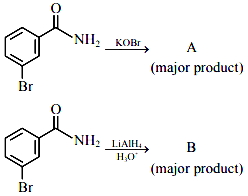
A
$3-$bromobenzenamine and $3-$bromobenzylamine
B
$3-$bromobenzenamine and $3-$bromobenzyl alcohol
C
$3-$bromobenzylamine and $3-$bromobenzenamine
D
$3-$bromobenzenamine and $3-$bromobenzyl amine
Solution
(A) $1$. The first reaction is the Hoffmann bromamide degradation reaction. In this reaction,an amide $(R-CONH_2)$ reacts with $Br_2$ in the presence of a strong base (like $KOH$) to form a primary amine $(R-NH_2)$ with one carbon atom less than the original amide. Thus,$3$-bromobenzamide reacts to form $3$-bromobenzenamine $(A)$:
$m-Br-C_6H_4-CONH_2 \xrightarrow{KOBr} m-Br-C_6H_4-NH_2$
$2$. The second reaction is the reduction of an amide using $LiAlH_4$ followed by $H_3O^+$. $LiAlH_4$ is a strong reducing agent that reduces an amide $(R-CONH_2)$ to a primary amine $(R-CH_2NH_2)$ with the same number of carbon atoms. Thus,$3$-bromobenzamide reacts to form $3$-bromobenzylamine $(B)$:
$m-Br-C_6H_4-CONH_2 \xrightarrow{LiAlH_4, H_3O^+} m-Br-C_6H_4-CH_2NH_2$
Therefore,the products $A$ and $B$ are $3$-bromobenzenamine and $3$-bromobenzylamine respectively.
$m-Br-C_6H_4-CONH_2 \xrightarrow{KOBr} m-Br-C_6H_4-NH_2$
$2$. The second reaction is the reduction of an amide using $LiAlH_4$ followed by $H_3O^+$. $LiAlH_4$ is a strong reducing agent that reduces an amide $(R-CONH_2)$ to a primary amine $(R-CH_2NH_2)$ with the same number of carbon atoms. Thus,$3$-bromobenzamide reacts to form $3$-bromobenzylamine $(B)$:
$m-Br-C_6H_4-CONH_2 \xrightarrow{LiAlH_4, H_3O^+} m-Br-C_6H_4-CH_2NH_2$
Therefore,the products $A$ and $B$ are $3$-bromobenzenamine and $3$-bromobenzylamine respectively.
0 likesView Solution
399
ChemistryDifficultMCQJEE Main · 2021
The major product $(P)$ in the following reaction is :
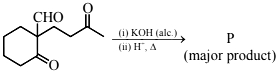
A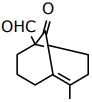
B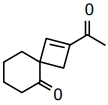
C
D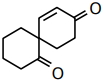
Solution
(D) The given reaction is an intramolecular aldol condensation.
$1$. The base $(KOH)$ abstracts an $\alpha$-hydrogen from the ketone group to form an enolate.
$2$. This enolate attacks the carbonyl carbon of the aldehyde group,forming a cyclic $\beta$-hydroxy ketone.
$3$. Subsequent dehydration (catalyzed by $H^+, \Delta$) leads to the formation of an $\alpha,\beta$-unsaturated ketone.
$4$. The resulting product is a spiro-compound where a cyclohexenone ring is fused to a cyclohexane ring.
$1$. The base $(KOH)$ abstracts an $\alpha$-hydrogen from the ketone group to form an enolate.
$2$. This enolate attacks the carbonyl carbon of the aldehyde group,forming a cyclic $\beta$-hydroxy ketone.
$3$. Subsequent dehydration (catalyzed by $H^+, \Delta$) leads to the formation of an $\alpha,\beta$-unsaturated ketone.
$4$. The resulting product is a spiro-compound where a cyclohexenone ring is fused to a cyclohexane ring.
0 likesView Solution
400
ChemistryDifficultMCQJEE Main · 2021
Consider two chemical reactions $(A)$ and $(B)$ that take place during metallurgical processes:
$(A)$ $ZnCO_{3(s)} \longrightarrow ZnO_{(s)} + CO_{2(g)}$
$(B)$ $2ZnS_{(s)} + 3O_{2(g)} \longrightarrow 2ZnO_{(s)} + 2SO_{2(g)}$
The correct names for these processes are:
$(A)$ $ZnCO_{3(s)} \longrightarrow ZnO_{(s)} + CO_{2(g)}$
$(B)$ $2ZnS_{(s)} + 3O_{2(g)} \longrightarrow 2ZnO_{(s)} + 2SO_{2(g)}$
The correct names for these processes are:
A
$(A)$ is calcination and $(B)$ is roasting
B
$(A)$ is roasting and $(B)$ is calcination
C
Both $(A)$ and $(B)$ produce the same product,so both are calcination
D
Both $(A)$ and $(B)$ produce the same product,so both are roasting
Solution
(A) $ZnCO_{3(s)} \xrightarrow{\Delta} ZnO_{(s)} + CO_{2(g)}$
Heating in the absence of air or limited supply of air is known as calcination.
$(B)$ $2ZnS_{(s)} + 3O_{2(g)} \longrightarrow 2ZnO_{(s)} + 2SO_{2(g)}$
Heating in the presence of excess air is known as roasting.
Therefore,$(A)$ is calcination and $(B)$ is roasting.
Heating in the absence of air or limited supply of air is known as calcination.
$(B)$ $2ZnS_{(s)} + 3O_{2(g)} \longrightarrow 2ZnO_{(s)} + 2SO_{2(g)}$
Heating in the presence of excess air is known as roasting.
Therefore,$(A)$ is calcination and $(B)$ is roasting.
0 likesView Solution
Vedclass Products
For Students
Vedclass Test Series
Mock tests in real JEE Main style covering Chemistry with performance analysis. 5-day free trial.
Start Free TrialFor Teachers
Exam Paper Generator
Generate Set A/B/C/D Chemistry papers from 7.5L+ questions in 2 minutes. 3 chapters free.
Try FreeFor Institutes
Online Exam Module
Run live JEE Main mock exams with unlimited students, 360° analytics & white-label branding.
See DemoFrequently Asked Questions
How many Chemistry questions are in JEE Main 2021?
There are 798 Chemistry questions from the JEE Main 2021 paper on Vedclass, each with a detailed step-by-step solution in English.
Are JEE Main 2021 Chemistry solutions available in English?
Yes. All solutions on this page are in English. You can also switch to English or Hindi using the language buttons above the questions.
Can I practice JEE Main 2021 Chemistry as a timed test?
Yes. Use the Vedclass Test Series to attempt a full JEE Main mock test covering Chemistry with time limits and instant score analysis.
Can teachers create Chemistry papers from JEE Main previous year questions?
Yes. The Vedclass Exam Paper Generator lets teachers mix JEE Main Chemistry questions and generate Set A/B/C/D papers in minutes.
For Teachers & Institutes
Build a Custom Chemistry Paper
Pick JEE Main 2021 Chemistry questions, set difficulty, and generate Set A/B/C/D in 2 minutes.