
ChemistryQ151–250 of 798 questions
Page 4 of 9 · English
151
ChemistryDifficultMCQJEE Main · 2021
$1.86 \ g$ of aniline completely reacts to form acetanilide. $10 \ \%$ of the product is lost during purification. Amount of acetanilide obtained after purification (in $g$) is ...... $\times 10^{-2}$.
A
$221$
B
$243$
C
$222$
D
$313$
Solution
(B) The molar mass of aniline $(C_6H_5NH_2)$ is $93 \ g/mol$ and the molar mass of acetanilide $(C_6H_5NHCOCH_3)$ is $135 \ g/mol$.
Reaction: $C_6H_5NH_2 + CH_3COCl \rightarrow C_6H_5NHCOCH_3 + HCl$.
$1 \ mol$ of aniline produces $1 \ mol$ of acetanilide.
Moles of aniline used $= \frac{1.86 \ g}{93 \ g/mol} = 0.02 \ mol$.
Theoretical yield of acetanilide $= 0.02 \ mol \times 135 \ g/mol = 2.70 \ g$.
Since $10 \ \%$ of the product is lost during purification,the yield is $90 \ \%$ of the theoretical yield.
Actual yield $= 2.70 \ g \times 0.90 = 2.43 \ g$.
$2.43 \ g = 243 \times 10^{-2} \ g$.
Reaction: $C_6H_5NH_2 + CH_3COCl \rightarrow C_6H_5NHCOCH_3 + HCl$.
$1 \ mol$ of aniline produces $1 \ mol$ of acetanilide.
Moles of aniline used $= \frac{1.86 \ g}{93 \ g/mol} = 0.02 \ mol$.
Theoretical yield of acetanilide $= 0.02 \ mol \times 135 \ g/mol = 2.70 \ g$.
Since $10 \ \%$ of the product is lost during purification,the yield is $90 \ \%$ of the theoretical yield.
Actual yield $= 2.70 \ g \times 0.90 = 2.43 \ g$.
$2.43 \ g = 243 \times 10^{-2} \ g$.
0 likesView Solution
152
ChemistryDifficultMCQJEE Main · 2021
Assuming ideal behaviour,the magnitude of $\log \, K$ for the following reaction at $25^{\circ} C$ is $x \times 10^{-1}$. The value of $x$ is $......$. (Integer answer)
$3 HC \equiv CH_{(g)} \rightleftharpoons C_6H_{6(\ell)}$
[Given: $\Delta_f G^{\circ}(HC \equiv CH) = -2.04 \times 10^5 \, J \, mol^{-1}$
$\Delta_f G^{\circ}(C_6H_6) = -1.24 \times 10^5 \, J \, mol^{-1}; R = 8.314 \, J \, K^{-1} \, mol^{-1}$]
$3 HC \equiv CH_{(g)} \rightleftharpoons C_6H_{6(\ell)}$
[Given: $\Delta_f G^{\circ}(HC \equiv CH) = -2.04 \times 10^5 \, J \, mol^{-1}$
$\Delta_f G^{\circ}(C_6H_6) = -1.24 \times 10^5 \, J \, mol^{-1}; R = 8.314 \, J \, K^{-1} \, mol^{-1}$]
A
$855$
B
$952$
C
$412$
D
$1054$
Solution
(A) For the reaction: $3 HC \equiv CH_{(g)} \rightleftharpoons C_6H_{6(\ell)}$
$\Delta G^{\circ} = \sum \Delta_f G^{\circ}(\text{products}) - \sum \Delta_f G^{\circ}(\text{reactants})$
$\Delta G^{\circ} = [1 \times (-1.24 \times 10^5)] - [3 \times (-2.04 \times 10^5)]$
$\Delta G^{\circ} = -1.24 \times 10^5 + 6.12 \times 10^5 = 4.88 \times 10^5 \, J \, mol^{-1}$
We know that $\Delta G^{\circ} = -RT \ln K = -2.303 RT \log K$
$4.88 \times 10^5 = -2.303 \times 8.314 \times 298 \times \log K$
$\log K = -\frac{4.88 \times 10^5}{2.303 \times 8.314 \times 298} \approx -85.52$
The magnitude of $\log K$ is $85.52$.
Given $\log K = x \times 10^{-1}$,so $85.52 = x \times 10^{-1} \Rightarrow x = 855.2 \approx 855$.
$\Delta G^{\circ} = \sum \Delta_f G^{\circ}(\text{products}) - \sum \Delta_f G^{\circ}(\text{reactants})$
$\Delta G^{\circ} = [1 \times (-1.24 \times 10^5)] - [3 \times (-2.04 \times 10^5)]$
$\Delta G^{\circ} = -1.24 \times 10^5 + 6.12 \times 10^5 = 4.88 \times 10^5 \, J \, mol^{-1}$
We know that $\Delta G^{\circ} = -RT \ln K = -2.303 RT \log K$
$4.88 \times 10^5 = -2.303 \times 8.314 \times 298 \times \log K$
$\log K = -\frac{4.88 \times 10^5}{2.303 \times 8.314 \times 298} \approx -85.52$
The magnitude of $\log K$ is $85.52$.
Given $\log K = x \times 10^{-1}$,so $85.52 = x \times 10^{-1} \Rightarrow x = 855.2 \approx 855$.
0 likesView Solution
153
ChemistryMediumMCQJEE Main · 2021
Which among the following species has unequal bond lengths?
A
$BF_{4}^{-}$
B
$XeF_{4}$
C
$SF_{4}$
D
$SiF_{4}$
Solution
(C) . In $SF_{4}$,the central atom $S$ undergoes $sp^{3}d$ hybridization,resulting in a see-saw geometry. Due to the presence of a lone pair in the equatorial position,the axial $S-F$ bonds are longer than the equatorial $S-F$ bonds. In contrast,$BF_{4}^{-}$,$XeF_{4}$,and $SiF_{4}$ have symmetric geometries where all bond lengths are equal.
| Species | Hybridization and Bond Length Characteristics |
|---|---|
| $BF_{4}^{-}$ | $sp^{3}$ (Tetrahedral); All bond lengths are equal |
| $XeF_{4}$ | $sp^{3}d^{2}$ (Square planar); All bond lengths are equal |
| $SF_{4}$ | $sp^{3}d$ (See-saw); Axial bond lengths > Equatorial bond lengths |
| $SiF_{4}$ | $sp^{3}$ (Tetrahedral); All bond lengths are equal |
0 likesView Solution
154
ChemistryEasyMCQJEE Main · 2021
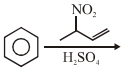
The major product of the following reaction is:
A
$3-$nitro$-2-$phenylbutane
B
$2-$nitro$-3-$phenylbutane
C
$1-$nitro$-3-$phenylbutane
D
$2-$methyl$-2-$nitro$-1-$phenylbutane
Solution
(B) The reaction involves the electrophilic addition of benzene to the alkene $CH_3-CH(NO_2)-CH=CH_2$ in the presence of an acid catalyst $(H_2SO_4)$.
$1$. The acid protonates the alkene to form a carbocation intermediate.
$2$. The most stable carbocation is formed,which is the secondary carbocation at the carbon adjacent to the $NO_2$ group due to resonance stabilization or inductive effects.
$3$. Benzene acts as a nucleophile and attacks the carbocation to form the final product,which is $2-nitro-3-phenylbutane$.
$1$. The acid protonates the alkene to form a carbocation intermediate.
$2$. The most stable carbocation is formed,which is the secondary carbocation at the carbon adjacent to the $NO_2$ group due to resonance stabilization or inductive effects.
$3$. Benzene acts as a nucleophile and attacks the carbocation to form the final product,which is $2-nitro-3-phenylbutane$.
0 likesView Solution
155
ChemistryMediumMCQJEE Main · 2021
Water does not produce $CO$ on reacting with:
A
$CO_2$
B
$C$
C
$CH_4$
D
$C_3H_8$
Solution
(A) The correct answer is $(A)$.
Water reacts with carbon and hydrocarbons at high temperatures to produce syngas $(CO + H_2)$.
$C + H_2O \xrightarrow{1270 \ K} CO + H_2$
$CH_4 + H_2O \xrightarrow{1270 \ K, \ Ni} CO + 3H_2$
$C_3H_8 + 3H_2O \xrightarrow{\Delta, \ Ni} 3CO + 7H_2$
Reaction with $CO_2$:
$CO_2 + H_2O \rightleftharpoons H_2CO_3$ (Carbonic acid).
No $CO$ is formed in this reaction.
Water reacts with carbon and hydrocarbons at high temperatures to produce syngas $(CO + H_2)$.
$C + H_2O \xrightarrow{1270 \ K} CO + H_2$
$CH_4 + H_2O \xrightarrow{1270 \ K, \ Ni} CO + 3H_2$
$C_3H_8 + 3H_2O \xrightarrow{\Delta, \ Ni} 3CO + 7H_2$
Reaction with $CO_2$:
$CO_2 + H_2O \rightleftharpoons H_2CO_3$ (Carbonic acid).
No $CO$ is formed in this reaction.
0 likesView Solution
156
ChemistryEasyMCQJEE Main · 2021
Given below are two statements :
Statement $I :$ The $pH$ of rain water is normally $\sim 5.6$.
Statement $II :$ If the $pH$ of rain water drops below $5.6,$ it is called acid rain.
In the light of the above statements,choose the correct answer from the options given below:
Statement $I :$ The $pH$ of rain water is normally $\sim 5.6$.
Statement $II :$ If the $pH$ of rain water drops below $5.6,$ it is called acid rain.
In the light of the above statements,choose the correct answer from the options given below:
A
Statement $I$ is true but Statement $II$ is false.
B
Both Statement $I$ and Statement $II$ are false.
C
Statement $I$ is false but Statement $II$ is true.
D
Both Statement $I$ and Statement $II$ are true.
Solution
(D) Statement $I$ is true because normal rain water has a $pH$ of approximately $5.6$ due to the dissolution of atmospheric $CO_2$ to form weak carbonic acid $(H_2CO_3)$.
Statement $II$ is true because when the $pH$ of rain water drops below $5.6$ due to the presence of pollutants like oxides of sulfur $(SO_x)$ and nitrogen $(NO_x)$,it is termed as acid rain.
Therefore,both statements are correct.
Statement $II$ is true because when the $pH$ of rain water drops below $5.6$ due to the presence of pollutants like oxides of sulfur $(SO_x)$ and nitrogen $(NO_x)$,it is termed as acid rain.
Therefore,both statements are correct.
0 likesView Solution
157
ChemistryEasyMCQJEE Main · 2021
Which of the following compounds is added to the sodium extract before the addition of silver nitrate for the testing of halogens?
A
Nitric acid
B
Ammonia
C
Hydrochloric acid
D
Sodium hydroxide
Solution
(A) For the testing of halogens,$HNO_3$ (Nitric acid) is added to the sodium extract.
This is done because if $CN^-$ or $S^{2-}$ ions are present in the extract,they would interfere with the test by forming $AgCN$ or $Ag_2S$ precipitates.
$HNO_3$ decomposes these ions into $HCN$ and $H_2S$ gases,respectively,which are then removed by boiling,ensuring that only halides react with $AgNO_3$.
This is done because if $CN^-$ or $S^{2-}$ ions are present in the extract,they would interfere with the test by forming $AgCN$ or $Ag_2S$ precipitates.
$HNO_3$ decomposes these ions into $HCN$ and $H_2S$ gases,respectively,which are then removed by boiling,ensuring that only halides react with $AgNO_3$.
0 likesView Solution
158
ChemistryMediumMCQJEE Main · 2021
The solubility of $Ca(OH)_2$ in water is ....... .
[Given : The solubility product of $Ca(OH)_2$ in water $= 5.5 \times 10^{-6}$]
[Given : The solubility product of $Ca(OH)_2$ in water $= 5.5 \times 10^{-6}$]
A
$1.77 \times 10^{-6}$
B
$1.11 \times 10^{-6}$
C
$1.11 \times 10^{-2}$
D
$1.77 \times 10^{-2}$
Solution
(C) The dissociation of $Ca(OH)_2$ is represented as:
$Ca(OH)_2(s) \rightleftharpoons Ca^{2+}(aq) + 2OH^-(aq)$
If $s$ is the solubility,then $[Ca^{2+}] = s$ and $[OH^-] = 2s$.
The solubility product expression is:
$K_{sp} = [Ca^{2+}][OH^-]^2 = (s)(2s)^2 = 4s^3$
Given $K_{sp} = 5.5 \times 10^{-6}$,we have:
$4s^3 = 5.5 \times 10^{-6}$
$s^3 = \frac{5.5}{4} \times 10^{-6} = 1.375 \times 10^{-6}$
$s = (1.375 \times 10^{-6})^{1/3} \approx 1.11 \times 10^{-2} \text{ M}$
$Ca(OH)_2(s) \rightleftharpoons Ca^{2+}(aq) + 2OH^-(aq)$
If $s$ is the solubility,then $[Ca^{2+}] = s$ and $[OH^-] = 2s$.
The solubility product expression is:
$K_{sp} = [Ca^{2+}][OH^-]^2 = (s)(2s)^2 = 4s^3$
Given $K_{sp} = 5.5 \times 10^{-6}$,we have:
$4s^3 = 5.5 \times 10^{-6}$
$s^3 = \frac{5.5}{4} \times 10^{-6} = 1.375 \times 10^{-6}$
$s = (1.375 \times 10^{-6})^{1/3} \approx 1.11 \times 10^{-2} \text{ M}$
0 likesView Solution
159
ChemistryMediumMCQJEE Main · 2021
What is $X$ in the given reaction?
$HOCH_2-CH_2OH + (COOH)_2 \xrightarrow{210^{\circ}C} X$
(major product)
$HOCH_2-CH_2OH + (COOH)_2 \xrightarrow{210^{\circ}C} X$
(major product)
A
$CH_2=CH_2$
B
$CH(OH)=CH_2$
C
$CHO-CHO$
D
$CH_2OH-CHO$
Solution
(A) The reaction of ethylene glycol $(HOCH_2-CH_2OH)$ with oxalic acid $((COOH)_2)$ at $110^{\circ}C$ forms a cyclic ester (ethylene oxalate).
Upon further heating to $210^{\circ}C$,this cyclic ester undergoes decarboxylation to produce ethene $(CH_2=CH_2)$ and carbon dioxide $(CO_2)$.
Therefore,the major product $X$ formed at $210^{\circ}C$ is ethene $(CH_2=CH_2)$.
Upon further heating to $210^{\circ}C$,this cyclic ester undergoes decarboxylation to produce ethene $(CH_2=CH_2)$ and carbon dioxide $(CO_2)$.
Therefore,the major product $X$ formed at $210^{\circ}C$ is ethene $(CH_2=CH_2)$.
0 likesView Solution
160
ChemistryEasyMCQJEE Main · 2021
Among the following,the number of metals that can be used as electrodes in a photoelectric cell is $.......$ (Integer answer)
$A. Li$
$B. Na$
$C. Rb$
$D. Cs$
$A. Li$
$B. Na$
$C. Rb$
$D. Cs$
A
$0$
B
$1$
C
$3$
D
$4$
Solution
(B) The photoelectric effect depends on the work function of the metal.
$Cs$ (Cesium) has the lowest ionization energy among the alkali metals,making it the most suitable for use in photoelectric cells.
While other alkali metals like $Na$ and $Rb$ can exhibit the photoelectric effect,$Cs$ is the standard choice for such applications due to its low work function.
Therefore,only $1$ metal $(Cs)$ is typically cited for this specific application in the context of this question.
$Cs$ (Cesium) has the lowest ionization energy among the alkali metals,making it the most suitable for use in photoelectric cells.
While other alkali metals like $Na$ and $Rb$ can exhibit the photoelectric effect,$Cs$ is the standard choice for such applications due to its low work function.
Therefore,only $1$ metal $(Cs)$ is typically cited for this specific application in the context of this question.
0 likesView Solution
161
ChemistryMediumMCQJEE Main · 2021
Electromagnetic radiation of wavelength $663 \ nm$ is just sufficient to ionise the atom of metal $A.$ The ionization energy of metal $A$ in $kJ \ mol^{-1}$ is ...... .
(Rounded-off to the nearest integer) $\left[ h = 6.63 \times 10^{-34} \ Js, c = 3.00 \times 10^{8} \ ms^{-1}, N_{A} = 6.02 \times 10^{23} \ mol^{-1} \right]$
(Rounded-off to the nearest integer) $\left[ h = 6.63 \times 10^{-34} \ Js, c = 3.00 \times 10^{8} \ ms^{-1}, N_{A} = 6.02 \times 10^{23} \ mol^{-1} \right]$
A
$145$
B
$90$
C
$40$
D
$181$
Solution
(D) The energy $E$ required to ionize one mole of atoms is given by the formula:
$E = \frac{hcN_{A}}{\lambda \times 1000} \text{ (in } kJ \ mol^{-1} \text{)}$
Given:
$h = 6.63 \times 10^{-34} \ J \cdot s$
$c = 3.00 \times 10^{8} \ m \cdot s^{-1}$
$N_{A} = 6.02 \times 10^{23} \ mol^{-1}$
$\lambda = 663 \ nm = 663 \times 10^{-9} \ m$
Substituting the values:
$E = \frac{6.63 \times 10^{-34} \times 3.00 \times 10^{8} \times 6.02 \times 10^{23}}{663 \times 10^{-9} \times 1000}$
$E = \frac{6.63 \times 3.00 \times 6.02 \times 10^{-3}}{663 \times 10^{-6}}$
$E = \frac{119.799 \times 10^{-3}}{663 \times 10^{-6}} = \frac{119.799}{0.663} \approx 180.69 \ kJ \ mol^{-1}$
Rounding off to the nearest integer,we get $181 \ kJ \ mol^{-1}$.
$E = \frac{hcN_{A}}{\lambda \times 1000} \text{ (in } kJ \ mol^{-1} \text{)}$
Given:
$h = 6.63 \times 10^{-34} \ J \cdot s$
$c = 3.00 \times 10^{8} \ m \cdot s^{-1}$
$N_{A} = 6.02 \times 10^{23} \ mol^{-1}$
$\lambda = 663 \ nm = 663 \times 10^{-9} \ m$
Substituting the values:
$E = \frac{6.63 \times 10^{-34} \times 3.00 \times 10^{8} \times 6.02 \times 10^{23}}{663 \times 10^{-9} \times 1000}$
$E = \frac{6.63 \times 3.00 \times 6.02 \times 10^{-3}}{663 \times 10^{-6}}$
$E = \frac{119.799 \times 10^{-3}}{663 \times 10^{-6}} = \frac{119.799}{0.663} \approx 180.69 \ kJ \ mol^{-1}$
Rounding off to the nearest integer,we get $181 \ kJ \ mol^{-1}$.
0 likesView Solution
162
ChemistryDifficultMCQJEE Main · 2021
Five moles of an ideal gas at $293 \, K$ is expanded isothermally from an initial pressure of $2.1 \, MPa$ to $1.3 \, MPa$ against a constant external pressure of $4.3 \, MPa$. The heat transferred in this process is $...... \, kJ \, mol^{-1}$. (Rounded-off to the nearest integer) $\left[\right.$ Use $R = 8.314 \, J \, mol^{-1} \, K^{-1}\left.\right]$
A
$35$
B
$15$
C
$4$
D
$5$
Solution
(C) For an isothermal process of an ideal gas,$\Delta U = 0$.
According to the first law of thermodynamics,$\Delta U = q + W$,so $q = -W$.
Work done against a constant external pressure is given by $W = -P_{ext} \Delta V$.
Using the ideal gas law $PV = nRT$,we have $V = \frac{nRT}{P}$.
Thus,$W = -P_{ext} \left( \frac{nRT}{P_2} - \frac{nRT}{P_1} \right) = -nRT P_{ext} \left( \frac{1}{P_2} - \frac{1}{P_1} \right)$.
Given $n = 5 \, mol$,$T = 293 \, K$,$P_{ext} = 4.3 \, MPa$,$P_1 = 2.1 \, MPa$,$P_2 = 1.3 \, MPa$.
$W = -5 \times 8.314 \times 293 \times 4.3 \times \left( \frac{1}{1.3} - \frac{1}{2.1} \right) \, J$.
$W = -52504.97 \times \left( 0.7692 - 0.4762 \right) \approx -52504.97 \times 0.293 = -15383.96 \, J \approx -15.38 \, kJ$.
Since $q = -W$,$q = 15.38 \, kJ$ for $5 \, moles$.
Heat transferred per mole $q_{mol} = \frac{15.38}{5} = 3.076 \, kJ \, mol^{-1}$.
Rounding to the nearest integer,we get $3 \, kJ \, mol^{-1}$ (closest option is $4$).
According to the first law of thermodynamics,$\Delta U = q + W$,so $q = -W$.
Work done against a constant external pressure is given by $W = -P_{ext} \Delta V$.
Using the ideal gas law $PV = nRT$,we have $V = \frac{nRT}{P}$.
Thus,$W = -P_{ext} \left( \frac{nRT}{P_2} - \frac{nRT}{P_1} \right) = -nRT P_{ext} \left( \frac{1}{P_2} - \frac{1}{P_1} \right)$.
Given $n = 5 \, mol$,$T = 293 \, K$,$P_{ext} = 4.3 \, MPa$,$P_1 = 2.1 \, MPa$,$P_2 = 1.3 \, MPa$.
$W = -5 \times 8.314 \times 293 \times 4.3 \times \left( \frac{1}{1.3} - \frac{1}{2.1} \right) \, J$.
$W = -52504.97 \times \left( 0.7692 - 0.4762 \right) \approx -52504.97 \times 0.293 = -15383.96 \, J \approx -15.38 \, kJ$.
Since $q = -W$,$q = 15.38 \, kJ$ for $5 \, moles$.
Heat transferred per mole $q_{mol} = \frac{15.38}{5} = 3.076 \, kJ \, mol^{-1}$.
Rounding to the nearest integer,we get $3 \, kJ \, mol^{-1}$ (closest option is $4$).
0 likesView Solution
163
ChemistryEasyMCQJEE Main · 2021
Which of the following forms of hydrogen emits low energy $\beta^{-}$ particles?
A
Deuterium ${ }_{1}^{2} H$
B
Tritium ${ }_{1}^{3} H$
C
Protium ${ }_{1}^{1} H$
D
Proton $H^{+}$
Solution
(B) Tritium $\left({ }_{1}^{3} H \right)$ is a radioactive isotope of hydrogen.
It undergoes $\beta^{-}$ decay to form Helium-$3$ according to the reaction: ${ }_{1}^{3} H \rightarrow { }_{2}^{3} He + { }_{-1}^{0} e + \bar{\nu}$.
This process involves the conversion of a neutron into a proton,emitting a low-energy $\beta^{-}$ particle.
It undergoes $\beta^{-}$ decay to form Helium-$3$ according to the reaction: ${ }_{1}^{3} H \rightarrow { }_{2}^{3} He + { }_{-1}^{0} e + \bar{\nu}$.
This process involves the conversion of a neutron into a proton,emitting a low-energy $\beta^{-}$ particle.
0 likesView Solution
164
ChemistryEasyMCQJEE Main · 2021
The correct order of electron gain enthalpy is
A
$S > Se > Te > O$
B
$Te > Se > S > O$
C
$O > S > Se > Te$
D
$S > O > Se > Te$
Solution
(A) The electron gain enthalpy becomes less negative as we move down the group from $S$ to $Te$ due to an increase in atomic size.
However,$O$ has an exceptionally low electron gain enthalpy because of its small size,which leads to strong inter-electronic repulsions when an electron is added.
Therefore,the correct order is $S > Se > Te > O$.
However,$O$ has an exceptionally low electron gain enthalpy because of its small size,which leads to strong inter-electronic repulsions when an electron is added.
Therefore,the correct order is $S > Se > Te > O$.
0 likesView Solution
165
ChemistryMediumMCQJEE Main · 2021
In the molecule $CH_2=C=CH-CH_3$ (where the atoms are numbered $1, 2, 3,$ and $4$ respectively),the hybridization of carbon $1, 2, 3,$ and $4$ are:
A
$sp^2, sp, sp^2, sp^3$
B
$sp^2, sp^2, sp^2, sp^3$
C
$sp^2, sp^2, sp, sp^3$
D
$sp^2, sp^3, sp^2, sp^3$
Solution
(A) In the molecule $CH_2=C=CH-CH_3$:
Carbon-$1$ $(CH_2=)$: It is bonded to two $H$ atoms and one $C$ atom via a double bond. It has $3$ sigma bonds and $0$ lone pairs,so it is $sp^2$ hybridized.
Carbon-$2$ $(=C=)$: It is bonded to two $C$ atoms via double bonds. It has $2$ sigma bonds and $0$ lone pairs,so it is $sp$ hybridized.
Carbon-$3$ $(=CH-)$: It is bonded to one $C$ atom via a double bond,one $C$ atom via a single bond,and one $H$ atom. It has $3$ sigma bonds and $0$ lone pairs,so it is $sp^2$ hybridized.
Carbon-$4$ $(-CH_3)$: It is bonded to one $C$ atom and three $H$ atoms via single bonds. It has $4$ sigma bonds and $0$ lone pairs,so it is $sp^3$ hybridized.
Thus,the hybridization of carbon $1, 2, 3,$ and $4$ is $sp^2, sp, sp^2, sp^3$.
Carbon-$1$ $(CH_2=)$: It is bonded to two $H$ atoms and one $C$ atom via a double bond. It has $3$ sigma bonds and $0$ lone pairs,so it is $sp^2$ hybridized.
Carbon-$2$ $(=C=)$: It is bonded to two $C$ atoms via double bonds. It has $2$ sigma bonds and $0$ lone pairs,so it is $sp$ hybridized.
Carbon-$3$ $(=CH-)$: It is bonded to one $C$ atom via a double bond,one $C$ atom via a single bond,and one $H$ atom. It has $3$ sigma bonds and $0$ lone pairs,so it is $sp^2$ hybridized.
Carbon-$4$ $(-CH_3)$: It is bonded to one $C$ atom and three $H$ atoms via single bonds. It has $4$ sigma bonds and $0$ lone pairs,so it is $sp^3$ hybridized.
Thus,the hybridization of carbon $1, 2, 3,$ and $4$ is $sp^2, sp, sp^2, sp^3$.
0 likesView Solution
166
ChemistryMediumMCQJEE Main · 2021
Which pair of oxides is acidic in nature?
A
$B_2O_3, CaO$
B
$B_2O_3, SiO_2$
C
$N_2O, BaO$
D
$CaO, SiO_2$
Solution
(B) $B_2O_3$ and $SiO_2$ are acidic oxides.
Generally,oxides of non-metals are acidic in nature.
$CaO$ and $BaO$ are basic oxides (metal oxides),and $N_2O$ is a neutral oxide.
Generally,oxides of non-metals are acidic in nature.
$CaO$ and $BaO$ are basic oxides (metal oxides),and $N_2O$ is a neutral oxide.
0 likesView Solution
167
ChemistryEasyMCQJEE Main · 2021
Calgon is used for water treatment. Which of the following statements is $NOT$ true about Calgon?
A
Calgon contains the $2^{nd}$ most abundant element by weight in the Earth's crust.
B
It is a polymeric compound and is water-soluble.
C
It is also known as Graham's salt.
D
It does not remove $Ca^{2+}$ ions by precipitation.
Solution
(A) Calgon is sodium hexametaphosphate,with the formula $(NaPO_{3})_{6}$ or $Na_{6}P_{6}O_{18}$.
$1$. The $2^{nd}$ most abundant element in the Earth's crust by weight is Silicon $(Si)$,which is not present in Calgon. Thus,statement $A$ is false.
$2$. Calgon is a polymeric compound and is water-soluble. Statement $B$ is true.
$3$. It is commonly known as Graham's salt. Statement $C$ is true.
$4$. It removes $Ca^{2+}$ and $Mg^{2+}$ ions by forming soluble complex ions,not by precipitation. Statement $D$ is true.
Therefore,the statement that is $NOT$ true is $A$.
$1$. The $2^{nd}$ most abundant element in the Earth's crust by weight is Silicon $(Si)$,which is not present in Calgon. Thus,statement $A$ is false.
$2$. Calgon is a polymeric compound and is water-soluble. Statement $B$ is true.
$3$. It is commonly known as Graham's salt. Statement $C$ is true.
$4$. It removes $Ca^{2+}$ and $Mg^{2+}$ ions by forming soluble complex ions,not by precipitation. Statement $D$ is true.
Therefore,the statement that is $NOT$ true is $A$.
0 likesView Solution
168
ChemistryMediumMCQJEE Main · 2021
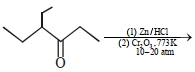
Considering the reaction shown below,identify the major product:
A
Ethylbenzene
B
Propylbenzene
C
o-Xylene
D
Propiophenone
Solution
(A) The given reaction involves two steps:
$1$. Clemmensen reduction: The ketone group $(C=O)$ is reduced to a methylene group $(-CH_2-)$ using $Zn-Hg/HCl$. The reactant is $3-ethylhexan-3-one$ (or a similar ketone structure). The reduction converts the carbonyl group into a methylene group,resulting in an alkane chain.
$2$. Dehydrocyclization (Aromatization): The resulting alkane is treated with $Cr_2O_3$ at $773 \ K$ and $10-20 \ atm$. This is a standard industrial process for the aromatization of alkanes to form aromatic hydrocarbons.
Given the structure,the alkane formed is $3-ethylhexane$. Upon aromatization,it cyclizes to form ethylbenzene.
$1$. Clemmensen reduction: The ketone group $(C=O)$ is reduced to a methylene group $(-CH_2-)$ using $Zn-Hg/HCl$. The reactant is $3-ethylhexan-3-one$ (or a similar ketone structure). The reduction converts the carbonyl group into a methylene group,resulting in an alkane chain.
$2$. Dehydrocyclization (Aromatization): The resulting alkane is treated with $Cr_2O_3$ at $773 \ K$ and $10-20 \ atm$. This is a standard industrial process for the aromatization of alkanes to form aromatic hydrocarbons.
Given the structure,the alkane formed is $3-ethylhexane$. Upon aromatization,it cyclizes to form ethylbenzene.
0 likesView Solution
169
ChemistryEasyMCQJEE Main · 2021
Match List-$I$ with List-$II$ based on the bond order of the molecules.
Choose the correct answer from the options given below:
| List-$I$ | List-$II$ |
| $(a)$ $Ne_2$ | $(i)$ $1$ |
| $(b)$ $N_2$ | $(ii)$ $2$ |
| $(c)$ $F_2$ | $(iii)$ $0$ |
| $(d)$ $O_2$ | $(iv)$ $3$ |
Choose the correct answer from the options given below:
A
$(a)$ $\rightarrow (iii), (b)$ $\rightarrow (iv), (c)$ $\rightarrow (i), (d)$ $\rightarrow (ii)$
B
$(a)$ $\rightarrow (i), (b)$ $\rightarrow (ii), (c)$ $\rightarrow (iii), (d)$ $\rightarrow (iv)$
C
$(a)$ $\rightarrow (ii), (b)$ $\rightarrow (i), (c)$ $\rightarrow (iv), (d)$ $\rightarrow (iii)$
D
$(a)$ $\rightarrow (iv), (b)$ $\rightarrow (iii), (c)$ $\rightarrow (ii), (d)$ $\rightarrow (i)$
Solution
(A) The bond order $(B.O.)$ is calculated using the formula: $B.O. = \frac{1}{2} (N_b - N_a)$,where $N_b$ is the number of bonding electrons and $N_a$ is the number of antibonding electrons.
$(a) \ Ne_2$ $(20 \ e^-)$: Configuration is $\sigma 1s^2, \sigma^* 1s^2, \sigma 2s^2, \sigma^* 2s^2, \sigma 2p_z^2, \pi 2p_x^2 = \pi 2p_y^2, \pi^* 2p_x^2 = \pi^* 2p_y^2, \sigma^* 2p_z^2$. $B.O. = \frac{10-10}{2} = 0$.
$(b) \ N_2$ $(14 \ e^-)$: $B.O. = \frac{10-4}{2} = 3$.
$(c) \ F_2$ $(18 \ e^-)$: $B.O. = \frac{10-8}{2} = 1$.
$(d) \ O_2$ $(16 \ e^-)$: $B.O. = \frac{10-6}{2} = 2$.
Thus,the correct matching is: $(a)$ $\rightarrow (iii), (b)$ $\rightarrow (iv), (c)$ $\rightarrow (i), (d)$ $\rightarrow (ii)$.
$(a) \ Ne_2$ $(20 \ e^-)$: Configuration is $\sigma 1s^2, \sigma^* 1s^2, \sigma 2s^2, \sigma^* 2s^2, \sigma 2p_z^2, \pi 2p_x^2 = \pi 2p_y^2, \pi^* 2p_x^2 = \pi^* 2p_y^2, \sigma^* 2p_z^2$. $B.O. = \frac{10-10}{2} = 0$.
$(b) \ N_2$ $(14 \ e^-)$: $B.O. = \frac{10-4}{2} = 3$.
$(c) \ F_2$ $(18 \ e^-)$: $B.O. = \frac{10-8}{2} = 1$.
$(d) \ O_2$ $(16 \ e^-)$: $B.O. = \frac{10-6}{2} = 2$.
Thus,the correct matching is: $(a)$ $\rightarrow (iii), (b)$ $\rightarrow (iv), (c)$ $\rightarrow (i), (d)$ $\rightarrow (ii)$.
0 likesView Solution
170
ChemistryEasyMCQJEE Main · 2021
The $NaNO_3$ weighed out to make $50 \ mL$ of an aqueous solution containing $70.0 \ mg$ $Na^{+}$ per $mL$ is $...... \ g$.
(Rounded off to the nearest integer) [Given : Atomic weight in $g \ mol^{-1}$ - $Na : 23$; $N : 14$; $O : 16$]
(Rounded off to the nearest integer) [Given : Atomic weight in $g \ mol^{-1}$ - $Na : 23$; $N : 14$; $O : 16$]
A
$19$
B
$13$
C
$17$
D
$10$
Solution
(B) Total mass of $Na^{+}$ required $= 70.0 \ mg/mL \times 50 \ mL = 3500 \ mg = 3.5 \ g$.
Molar mass of $NaNO_3 = 23 + 14 + (3 \times 16) = 85 \ g \ mol^{-1}$.
Moles of $Na^{+}$ $= \frac{3.5 \ g}{23 \ g \ mol^{-1}} \approx 0.15217 \ mol$.
Since $1 \ mol$ of $NaNO_3$ contains $1 \ mol$ of $Na^{+}$,moles of $NaNO_3 = 0.15217 \ mol$.
Mass of $NaNO_3 = 0.15217 \ mol \times 85 \ g \ mol^{-1} = 12.93445 \ g$.
Rounding off to the nearest integer,we get $13 \ g$.
Molar mass of $NaNO_3 = 23 + 14 + (3 \times 16) = 85 \ g \ mol^{-1}$.
Moles of $Na^{+}$ $= \frac{3.5 \ g}{23 \ g \ mol^{-1}} \approx 0.15217 \ mol$.
Since $1 \ mol$ of $NaNO_3$ contains $1 \ mol$ of $Na^{+}$,moles of $NaNO_3 = 0.15217 \ mol$.
Mass of $NaNO_3 = 0.15217 \ mol \times 85 \ g \ mol^{-1} = 12.93445 \ g$.
Rounding off to the nearest integer,we get $13 \ g$.
0 likesView Solution
171
ChemistryMediumMCQJEE Main · 2021
The average $S-F$ bond energy in $kJ \ mol^{-1}$ of $SF_{6}$ is $......$ . (Rounded off to the nearest integer) [Given : The values of standard enthalpy of formation of $SF_{6(g)}$,$S_{(g)}$ and $F_{(g)}$ are $-1100$,$275$ and $80 \ kJ \ mol^{-1}$ respectively.]
A
$309$
B
$459$
C
$193$
D
$123$
Solution
(A) The reaction for the atomization of $SF_{6(g)}$ is: $SF_{6(g)} \rightarrow S_{(g)} + 6F_{(g)}$
The enthalpy of reaction $(\Delta_{r}H)$ is given by: $\Delta_{r}H = \Delta_{f}H(S, g) + 6 \times \Delta_{f}H(F, g) - \Delta_{f}H(SF_{6}, g)$
Substituting the given values: $\Delta_{r}H = 275 + 6 \times 80 - (-1100)$
$\Delta_{r}H = 275 + 480 + 1100 = 1855 \ kJ \ mol^{-1}$
Since there are $6$ $S-F$ bonds in $SF_{6}$,the average bond energy $(\epsilon_{S-F})$ is: $\epsilon_{S-F} = \frac{1855}{6} \approx 309.16 \ kJ \ mol^{-1}$
Rounding off to the nearest integer,we get $309 \ kJ \ mol^{-1}$.
The enthalpy of reaction $(\Delta_{r}H)$ is given by: $\Delta_{r}H = \Delta_{f}H(S, g) + 6 \times \Delta_{f}H(F, g) - \Delta_{f}H(SF_{6}, g)$
Substituting the given values: $\Delta_{r}H = 275 + 6 \times 80 - (-1100)$
$\Delta_{r}H = 275 + 480 + 1100 = 1855 \ kJ \ mol^{-1}$
Since there are $6$ $S-F$ bonds in $SF_{6}$,the average bond energy $(\epsilon_{S-F})$ is: $\epsilon_{S-F} = \frac{1855}{6} \approx 309.16 \ kJ \ mol^{-1}$
Rounding off to the nearest integer,we get $309 \ kJ \ mol^{-1}$.
0 likesView Solution
172
ChemistryEasyMCQJEE Main · 2021
In mildly alkaline medium,thiosulphate ion is oxidized by $MnO_4^-$ to $A$. The oxidation state of sulphur in $A$ is ..... .
A
$4$
B
$5$
C
$6$
D
$12$
Solution
(C) In mildly alkaline medium,the reaction between thiosulphate ion $(S_2O_3^{2-})$ and permanganate ion $(MnO_4^-)$ is as follows:
$8MnO_4^- + 3S_2O_3^{2-} + H_2O \rightarrow 8MnO_2 + 6SO_4^{2-} + 2OH^-$
Here,the product $A$ is the sulphate ion $(SO_4^{2-})$.
To find the oxidation state of sulphur $(S)$ in $SO_4^{2-}$:
Let the oxidation state of $S$ be $x$.
$x + 4(-2) = -2$
$x - 8 = -2$
$x = +6$
Therefore,the oxidation state of sulphur in $A$ is $6$.
$8MnO_4^- + 3S_2O_3^{2-} + H_2O \rightarrow 8MnO_2 + 6SO_4^{2-} + 2OH^-$
Here,the product $A$ is the sulphate ion $(SO_4^{2-})$.
To find the oxidation state of sulphur $(S)$ in $SO_4^{2-}$:
Let the oxidation state of $S$ be $x$.
$x + 4(-2) = -2$
$x - 8 = -2$
$x = +6$
Therefore,the oxidation state of sulphur in $A$ is $6$.
0 likesView Solution
173
ChemistryMediumMCQJEE Main · 2021
The $pH$ of ammonium phosphate solution,if $pK_a$ of phosphoric acid and $pK_b$ of ammonium hydroxide are $5.23$ and $4.75$ respectively,is ..... .
A
$11$
B
$9$
C
$7$
D
$8$
Solution
(C) Ammonium phosphate $(NH_4)_3PO_4$ is a salt of a weak acid $(H_3PO_4)$ and a weak base $(NH_4OH)$.
The formula for the $pH$ of a salt of a weak acid and a weak base is:
$pH = 7 + \frac{1}{2}(pK_a - pK_b)$
Given:
$pK_a = 5.23$
$pK_b = 4.75$
Substituting the values:
$pH = 7 + \frac{1}{2}(5.23 - 4.75)$
$pH = 7 + \frac{1}{2}(0.48)$
$pH = 7 + 0.24$
$pH = 7.24$
Rounding to the nearest integer,the $pH$ is approximately $7$.
The formula for the $pH$ of a salt of a weak acid and a weak base is:
$pH = 7 + \frac{1}{2}(pK_a - pK_b)$
Given:
$pK_a = 5.23$
$pK_b = 4.75$
Substituting the values:
$pH = 7 + \frac{1}{2}(5.23 - 4.75)$
$pH = 7 + \frac{1}{2}(0.48)$
$pH = 7 + 0.24$
$pH = 7.24$
Rounding to the nearest integer,the $pH$ is approximately $7$.
0 likesView Solution
174
ChemistryDifficultMCQJEE Main · 2021
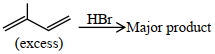
The major product formed in the following reaction is:
A
The structure of $1-$bromo$-3-$methylbut$-2-$ene.
B
The structure of $2,3-$dibromo$-2-$methylbutane.
C
The structure of $2-$bromo$-2-$methylbut$-3-$ene.
D
The structure of $1,4-$dibromo$-2-$methylbutane.
Solution
(A) The reaction involves the electrophilic addition of $HBr$ to a conjugated diene,$2$-methylbuta-$1,3$-diene (isoprene).
When $HBr$ is added to a conjugated diene,both $1,2$-addition and $1,4$-addition products can be formed.
In the presence of excess $HBr$,the reaction proceeds further. However,the question asks for the major product of the initial addition step or the primary outcome of the reaction.
The $1,4$-addition product is generally more stable due to the formation of a more substituted alkene.
The reaction of $2$-methylbuta-$1,3$-diene with $HBr$ yields $1$-bromo-$3$-methylbut-$2$-ene as the major $1,4$-addition product.
When $HBr$ is added to a conjugated diene,both $1,2$-addition and $1,4$-addition products can be formed.
In the presence of excess $HBr$,the reaction proceeds further. However,the question asks for the major product of the initial addition step or the primary outcome of the reaction.
The $1,4$-addition product is generally more stable due to the formation of a more substituted alkene.
The reaction of $2$-methylbuta-$1,3$-diene with $HBr$ yields $1$-bromo-$3$-methylbut-$2$-ene as the major $1,4$-addition product.
0 likesView Solution
175
ChemistryDifficultMCQJEE Main · 2021
The conversion of hydroxyapatite occurs due to the presence of $F^{-}$ ions in water. The correct formula of hydroxyapatite is:
A
$[3 Ca_{3}(PO_{4})_{2} \cdot Ca(OH)_{2}]$
B
$[3 Ca(OH)_{2} \cdot CaF_{2}]$
C
$[Ca_{3}(PO_{4})_{2} \cdot CaF_{2}]$
D
$[3 Ca_{3}(PO_{4})_{2} \cdot CaF_{2}]$
Solution
(A) The $F^{-}$ ions make the enamel on teeth much harder by converting hydroxyapatite,$[3 Ca_{3}(PO_{4})_{2} \cdot Ca(OH)_{2}]$,which is the enamel on the surface of the teeth,into much harder fluoroapatite,$[3 Ca_{3}(PO_{4})_{2} \cdot CaF_{2}]$.
Thus,the correct formula for hydroxyapatite is $[3 Ca_{3}(PO_{4})_{2} \cdot Ca(OH)_{2}]$.
Thus,the correct formula for hydroxyapatite is $[3 Ca_{3}(PO_{4})_{2} \cdot Ca(OH)_{2}]$.
0 likesView Solution
176
ChemistryDifficultMCQJEE Main · 2021
Given below are two statements.
Statement $I:$ In the titration between a strong acid and a weak base,methyl orange is a suitable indicator.
Statement $II:$ For the titration of acetic acid with $NaOH$,phenolphthalein is not a suitable indicator.
In the light of the above statements,choose the most appropriate answer from the options given below:
Statement $I:$ In the titration between a strong acid and a weak base,methyl orange is a suitable indicator.
Statement $II:$ For the titration of acetic acid with $NaOH$,phenolphthalein is not a suitable indicator.
In the light of the above statements,choose the most appropriate answer from the options given below:
A
Statement $I$ is false but Statement $II$ is true
B
Statement $I$ is true but Statement $II$ is false
C
Both Statement $I$ and Statement $II$ are true
D
Both Statement $I$ and Statement $II$ are false
Solution
(B) Statement $I$: In the titration of a strong acid with a weak base,the $pH$ at the equivalence point is in the acidic range $(pH < 7)$. Methyl orange has a $pH$ transition range of $3.2$ to $4.4$,which falls within the steep portion of the titration curve. Thus,it is a suitable indicator. Statement $I$ is true.
Statement $II$: In the titration of a weak acid (acetic acid) with a strong base $(NaOH)$,the $pH$ at the equivalence point is in the basic range $(pH > 7)$. Phenolphthalein has a $pH$ transition range of $8.2$ to $10.0$,which covers the steep portion of this titration curve. Thus,it is a suitable indicator. Statement $II$ is false.
Statement $II$: In the titration of a weak acid (acetic acid) with a strong base $(NaOH)$,the $pH$ at the equivalence point is in the basic range $(pH > 7)$. Phenolphthalein has a $pH$ transition range of $8.2$ to $10.0$,which covers the steep portion of this titration curve. Thus,it is a suitable indicator. Statement $II$ is false.
0 likesView Solution
177
ChemistryMediumMCQJEE Main · 2021
Which one of the following methods is most suitable for preparing deionized water?
A
Synthetic resin method
B
Clark's method
C
Calgon's method
D
Permutit method
Solution
(A) Pure demineralised (de-ionized) water,free from all soluble mineral salts,is obtained by passing water successively through a cation exchange resin (in the $H^{+}$ form) and an anion exchange resin (in the $OH^{-}$ form).
0 likesView Solution
178
ChemistryMediumMCQJEE Main · 2021
What are the products formed in sequence when excess of $CO_{2}$ is passed in slaked lime?
A
$Ca(HCO_{3})_{2}, CaCO_{3}$
B
$CaCO_{3}, Ca(HCO_{3})_{2}$
C
$CaO, Ca(HCO_{3})_{2}$
D
$CaO, CaCO_{3}$
Solution
(B) When $CO_{2}$ is passed through slaked lime $(Ca(OH)_{2})$,it first forms a white precipitate of calcium carbonate $(CaCO_{3})$:
$Ca(OH)_{2} + CO_{2} \longrightarrow CaCO_{3} \downarrow + H_{2}O$
When excess $CO_{2}$ is passed,the calcium carbonate reacts further to form soluble calcium bicarbonate $(Ca(HCO_{3})_{2})$:
$CaCO_{3} + CO_{2} + H_{2}O \longrightarrow Ca(HCO_{3})_{2}$
$Ca(OH)_{2} + CO_{2} \longrightarrow CaCO_{3} \downarrow + H_{2}O$
When excess $CO_{2}$ is passed,the calcium carbonate reacts further to form soluble calcium bicarbonate $(Ca(HCO_{3})_{2})$:
$CaCO_{3} + CO_{2} + H_{2}O \longrightarrow Ca(HCO_{3})_{2}$
0 likesView Solution
179
ChemistryMediumMCQJEE Main · 2021
Given below are two statements.
Statement $I:$ According to Bohr's model of an atom,qualitatively the magnitude of velocity of electron increases with decrease in positive charges on the nucleus as there is no strong hold on the electron by the nucleus.
Statement $II:$ According to Bohr's model of an atom,qualitatively the magnitude of velocity of electron increases with decrease in principal quantum number.
In the light of the above statements,choose the most appropriate answer from the options given below:
Statement $I:$ According to Bohr's model of an atom,qualitatively the magnitude of velocity of electron increases with decrease in positive charges on the nucleus as there is no strong hold on the electron by the nucleus.
Statement $II:$ According to Bohr's model of an atom,qualitatively the magnitude of velocity of electron increases with decrease in principal quantum number.
In the light of the above statements,choose the most appropriate answer from the options given below:
A
Both Statement $I$ and Statement $II$ are false
B
Both Statement $I$ and Statement $II$ are true
C
Statement $I$ is false but Statement $II$ is true
D
Statement $I$ is true but Statement $II$ is false
Solution
(C) The velocity of an electron in Bohr's model is given by the relation $V \propto \frac{Z}{n}$.
Here,$Z$ is the atomic number (representing the magnitude of positive charge on the nucleus) and $n$ is the principal quantum number.
Statement $I$ claims that velocity increases with a decrease in positive charge $(Z)$. However,since $V \propto Z$,the velocity actually decreases as the positive charge on the nucleus decreases. Thus,Statement $I$ is false.
Statement $II$ claims that velocity increases with a decrease in the principal quantum number $(n)$. Since $V \propto \frac{1}{n}$,the velocity increases as $n$ decreases. Thus,Statement $II$ is true.
Here,$Z$ is the atomic number (representing the magnitude of positive charge on the nucleus) and $n$ is the principal quantum number.
Statement $I$ claims that velocity increases with a decrease in positive charge $(Z)$. However,since $V \propto Z$,the velocity actually decreases as the positive charge on the nucleus decreases. Thus,Statement $I$ is false.
Statement $II$ claims that velocity increases with a decrease in the principal quantum number $(n)$. Since $V \propto \frac{1}{n}$,the velocity increases as $n$ decreases. Thus,Statement $II$ is true.
0 likesView Solution
180
ChemistryEasyMCQJEE Main · 2021
Excess of isobutane on reaction with $Br_{2}$ in presence of light at $125^{\circ} C$ gives which one of the following,as the major product?
A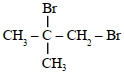
$1-$bromo$-2-$methylpropane
B
$2-$bromo$-2-$methylpropane
C
$1,3-$dibromo$-2-$methylpropane
D
$2-$bromo$-2-$methylpropane is the major product
Solution
(B) The bromination of alkanes is highly selective.
The stability of the free radical intermediate formed during the reaction determines the major product.
In isobutane,the tertiary radical $((CH_{3})_{3}C^{\bullet})$ is more stable than the primary radical $((CH_{3})_{2}CH-CH_{2}^{\bullet})$.
Thus,$2-$bromo$-2-$methylpropane is formed as the major product.
The stability of the free radical intermediate formed during the reaction determines the major product.
In isobutane,the tertiary radical $((CH_{3})_{3}C^{\bullet})$ is more stable than the primary radical $((CH_{3})_{2}CH-CH_{2}^{\bullet})$.
Thus,$2-$bromo$-2-$methylpropane is formed as the major product.
0 likesView Solution
181
ChemistryEasyMCQJEE Main · 2021
$AB_{3}$ is an interhalogen $T$-shaped molecule. The number of lone pairs of electrons on $A$ is $......$.
A
$2$
B
$3$
C
$4$
D
$1$
Solution
(A) According to the $VSEPR$ theory,for an $AB_{3}$ molecule to have a $T$-shaped geometry,the central atom $A$ must have $3$ bond pairs and $2$ lone pairs of electrons.
This corresponds to a steric number of $5$,which implies $sp^{3}d$ hybridization.
As shown in the structure,there are $2$ lone pairs on the central atom $A$.
This corresponds to a steric number of $5$,which implies $sp^{3}d$ hybridization.
As shown in the structure,there are $2$ lone pairs on the central atom $A$.
0 likesView Solution
182
ChemistryMediumMCQJEE Main · 2021
The $OH^{-}$ concentration in a mixture of $5.0 \ mL$ of $0.0504 \ M \ NH_{4}Cl$ and $2 \ mL$ of $0.0210 \ M \ NH_{3}$ solution is $x \times 10^{-6} \ M$. The value of $x$ is ..... .
(Nearest integer)
$[ \text{Given } K_{w}=1 \times 10^{-14} \text{ and } K_{b}=1.8 \times 10^{-5} ]$
(Nearest integer)
$[ \text{Given } K_{w}=1 \times 10^{-14} \text{ and } K_{b}=1.8 \times 10^{-5} ]$
A
$3$
B
$4$
C
$5$
D
$6$
Solution
(A) The mixture consists of a weak base $(NH_{3})$ and its salt $(NH_{4}Cl)$,forming a basic buffer.
First,calculate the moles of each component:
$n(NH_{4}Cl) = 0.0504 \ M \times 5.0 \ mL = 0.252 \ mmol$
$n(NH_{3}) = 0.0210 \ M \times 2.0 \ mL = 0.042 \ mmol$
Using the Henderson-Hasselbalch equation for a basic buffer:
$[OH^{-}] = K_{b} \times \frac{[Base]}{[Salt]} = K_{b} \times \frac{n(NH_{3})}{n(NH_{4}Cl)}$
$[OH^{-}] = 1.8 \times 10^{-5} \times \frac{0.042}{0.252}$
$[OH^{-}] = 1.8 \times 10^{-5} \times \frac{1}{6} = 0.3 \times 10^{-5} = 3 \times 10^{-6} \ M$
Comparing this with $x \times 10^{-6} \ M$,we get $x = 3$.
First,calculate the moles of each component:
$n(NH_{4}Cl) = 0.0504 \ M \times 5.0 \ mL = 0.252 \ mmol$
$n(NH_{3}) = 0.0210 \ M \times 2.0 \ mL = 0.042 \ mmol$
Using the Henderson-Hasselbalch equation for a basic buffer:
$[OH^{-}] = K_{b} \times \frac{[Base]}{[Salt]} = K_{b} \times \frac{n(NH_{3})}{n(NH_{4}Cl)}$
$[OH^{-}] = 1.8 \times 10^{-5} \times \frac{0.042}{0.252}$
$[OH^{-}] = 1.8 \times 10^{-5} \times \frac{1}{6} = 0.3 \times 10^{-5} = 3 \times 10^{-6} \ M$
Comparing this with $x \times 10^{-6} \ M$,we get $x = 3$.
0 likesView Solution
183
ChemistryDifficultMCQJEE Main · 2021
The ratio of the number of water molecules in Mohr's salt and potash alum is $.... \times 10^{-1}$.
A
$5$
B
$3$
C
$4$
D
$1$
Solution
(A) Mohr's salt is $(NH_4)_2Fe(SO_4)_2 \cdot 6H_2O$. The number of water molecules is $6$.
Potash alum is $KAl(SO_4)_2 \cdot 12H_2O$. The number of water molecules is $12$.
The ratio of the number of water molecules in Mohr's salt to potash alum is $\frac{6}{12} = \frac{1}{2} = 0.5$.
Expressing $0.5$ in the form $.... \times 10^{-1}$,we get $5 \times 10^{-1}$.
Potash alum is $KAl(SO_4)_2 \cdot 12H_2O$. The number of water molecules is $12$.
The ratio of the number of water molecules in Mohr's salt to potash alum is $\frac{6}{12} = \frac{1}{2} = 0.5$.
Expressing $0.5$ in the form $.... \times 10^{-1}$,we get $5 \times 10^{-1}$.
0 likesView Solution
184
ChemistryMediumMCQJEE Main · 2021
The Born-Haber cycle for $KCl$ is evaluated with the following data:
$\Delta_{f} H^{\ominus}$ for $KCl = -436.7 \ kJ \ mol^{-1}$
$\Delta_{sub} H^{\ominus}$ for $K = 89.2 \ kJ \ mol^{-1}$
$\Delta_{ionization} H^{\ominus}$ for $K = 419.0 \ kJ \ mol^{-1}$
$\Delta_{electron \ gain} H^{\ominus}$ for $Cl_{(g)} = -348.6 \ kJ \ mol^{-1}$
$\Delta_{bond} H^{\ominus}$ for $Cl_2 = 243.0 \ kJ \ mol^{-1}$
The magnitude of lattice enthalpy of $KCl$ in $kJ \ mol^{-1}$ is ..... . (Nearest integer)
$\Delta_{f} H^{\ominus}$ for $KCl = -436.7 \ kJ \ mol^{-1}$
$\Delta_{sub} H^{\ominus}$ for $K = 89.2 \ kJ \ mol^{-1}$
$\Delta_{ionization} H^{\ominus}$ for $K = 419.0 \ kJ \ mol^{-1}$
$\Delta_{electron \ gain} H^{\ominus}$ for $Cl_{(g)} = -348.6 \ kJ \ mol^{-1}$
$\Delta_{bond} H^{\ominus}$ for $Cl_2 = 243.0 \ kJ \ mol^{-1}$
The magnitude of lattice enthalpy of $KCl$ in $kJ \ mol^{-1}$ is ..... . (Nearest integer)
A
$718$
B
$951$
C
$632$
D
$521$
Solution
(A) The Born-Haber cycle equation is given by:
$\Delta_{f} H^{\ominus}_{KCl} = \Delta_{sub} H^{\ominus}_{(K)} + \Delta_{ionization} H^{\ominus}_{(K)} + \frac{1}{2} \Delta_{bond} H^{\ominus}_{(Cl_2)} + \Delta_{electron \ gain} H^{\ominus}_{(Cl)} + \Delta_{lattice} H^{\ominus}_{(KCl)}$
Substituting the given values:
$-436.7 = 89.2 + 419.0 + \frac{1}{2}(243.0) + (-348.6) + \Delta_{lattice} H^{\ominus}_{(KCl)}$
$-436.7 = 89.2 + 419.0 + 121.5 - 348.6 + \Delta_{lattice} H^{\ominus}_{(KCl)}$
$-436.7 = 281.1 + \Delta_{lattice} H^{\ominus}_{(KCl)}$
$\Delta_{lattice} H^{\ominus}_{(KCl)} = -436.7 - 281.1 = -717.8 \ kJ \ mol^{-1}$
The magnitude of lattice enthalpy is the absolute value,which is $717.8 \ kJ \ mol^{-1}$.
Rounding to the nearest integer,we get $718 \ kJ \ mol^{-1}$.
$\Delta_{f} H^{\ominus}_{KCl} = \Delta_{sub} H^{\ominus}_{(K)} + \Delta_{ionization} H^{\ominus}_{(K)} + \frac{1}{2} \Delta_{bond} H^{\ominus}_{(Cl_2)} + \Delta_{electron \ gain} H^{\ominus}_{(Cl)} + \Delta_{lattice} H^{\ominus}_{(KCl)}$
Substituting the given values:
$-436.7 = 89.2 + 419.0 + \frac{1}{2}(243.0) + (-348.6) + \Delta_{lattice} H^{\ominus}_{(KCl)}$
$-436.7 = 89.2 + 419.0 + 121.5 - 348.6 + \Delta_{lattice} H^{\ominus}_{(KCl)}$
$-436.7 = 281.1 + \Delta_{lattice} H^{\ominus}_{(KCl)}$
$\Delta_{lattice} H^{\ominus}_{(KCl)} = -436.7 - 281.1 = -717.8 \ kJ \ mol^{-1}$
The magnitude of lattice enthalpy is the absolute value,which is $717.8 \ kJ \ mol^{-1}$.
Rounding to the nearest integer,we get $718 \ kJ \ mol^{-1}$.
0 likesView Solution
185
ChemistryMediumMCQJEE Main · 2021
Given below are two statements: one is labelled as Assertion $(A)$ and the other is labelled as Reason $(R).$
Assertion $(A):$ Photochemical smog causes cracking of rubber.
Reason $(R):$ Presence of ozone,nitric oxide,acrolein,formaldehyde and peroxyacetyl nitrate in photochemical smog makes it oxidizing.
Choose the most appropriate answer from the options given below:
Assertion $(A):$ Photochemical smog causes cracking of rubber.
Reason $(R):$ Presence of ozone,nitric oxide,acrolein,formaldehyde and peroxyacetyl nitrate in photochemical smog makes it oxidizing.
Choose the most appropriate answer from the options given below:
A
Both $(A)$ and $(R)$ are true but $(R)$ is not the true explanation of $(A)$
B
$(A)$ is false but $(R)$ is true.
C
$(A)$ is true but $(R)$ is false
D
Both $(A)$ and $(R)$ are true and $(R)$ is the true explanation of $(A)$
Solution
(D) Photochemical smog is an oxidizing mixture of pollutants like ozone $(O_3)$,nitric oxide $(NO)$,acrolein,formaldehyde,and peroxyacetyl nitrate $(PAN)$.
These oxidizing agents react with the double bonds in rubber,leading to its degradation and cracking.
Therefore,both Assertion $(A)$ and Reason $(R)$ are true,and $(R)$ is the correct explanation for $(A)$.
These oxidizing agents react with the double bonds in rubber,leading to its degradation and cracking.
Therefore,both Assertion $(A)$ and Reason $(R)$ are true,and $(R)$ is the correct explanation for $(A)$.
0 likesView Solution
186
ChemistryMediumMCQJEE Main · 2021
The interaction energy of $London$ forces between two particles is proportional to $r^{x}$,where $r$ is the distance between the particles. The value of $x$ is:
A
$3$
B
$-3$
C
$-6$
D
$6$
Solution
(C) For $London$ dispersion forces,the interaction energy $E$ is inversely proportional to the sixth power of the distance $r$ between the particles.
Mathematically,$E \propto \frac{1}{r^{6}}$,which can be written as $E \propto r^{-6}$.
Therefore,comparing this to $E \propto r^{x}$,we get $x = -6$.
Mathematically,$E \propto \frac{1}{r^{6}}$,which can be written as $E \propto r^{-6}$.
Therefore,comparing this to $E \propto r^{x}$,we get $x = -6$.
0 likesView Solution
187
ChemistryMediumMCQJEE Main · 2021
The bond order and magnetic behaviour of $O_{2}^{-}$ ion are,respectively:
A
$1.5$ and paramagnetic
B
$1.5$ and diamagnetic
C
$2$ and diamagnetic
D
$1$ and paramagnetic
Solution
(A) The electronic configuration of $O_{2}^{-}$ ($17$ electrons) is: $(\sigma_{1s})^{2}(\sigma_{1s}^{*})^{2}(\sigma_{2s})^{2}(\sigma_{2s}^{*})^{2}(\sigma_{2p_{z}})^{2}(\pi_{2p_{x}}^{2} = \pi_{2p_{y}}^{2})(\pi_{2p_{x}}^{*2} = \pi_{2p_{y}}^{*1})$.
$\text{Bond order} = \frac{N_b - N_a}{2} = \frac{10 - 7}{2} = 1.5$.
Since there is one unpaired electron in the $\pi^{*}$ orbital,the ion is paramagnetic.
$\text{Bond order} = \frac{N_b - N_a}{2} = \frac{10 - 7}{2} = 1.5$.
Since there is one unpaired electron in the $\pi^{*}$ orbital,the ion is paramagnetic.
0 likesView Solution
188
ChemistryEasyMCQJEE Main · 2021
Given below are two statements: one is labelled as Assertion $A$ and the other is labelled as Reason $R$.
Assertion $A$: Barium carbonate is insoluble in water and is highly stable.
Reason $R$: The thermal stability of the carbonates increases with increasing cationic size.
Choose the most appropriate answer from the options given below for $A$ and $R$.
Assertion $A$: Barium carbonate is insoluble in water and is highly stable.
Reason $R$: The thermal stability of the carbonates increases with increasing cationic size.
Choose the most appropriate answer from the options given below for $A$ and $R$.
A
Both $A$ and $R$ are true but $R$ is the correct explanation of $A$.
B
$A$ is true but $R$ is false.
C
Both $A$ and $R$ are true and $R$ is not the correct explanation of $A$.
D
$A$ is false but $R$ is true.
Solution
(A) Assertion $A$ is true: $BaCO_3$ is insoluble in water due to high lattice energy and is thermally stable.
Reason $R$ is true: As the size of the alkaline earth metal cation increases down the group $(Be^{2+} < Mg^{2+} < Ca^{2+} < Sr^{2+} < Ba^{2+})$,the polarising power of the cation decreases,which leads to an increase in the thermal stability of the corresponding carbonates.
Since $Ba^{2+}$ is the largest cation in the group,$BaCO_3$ is the most thermally stable carbonate among them.
Therefore,$R$ is the correct explanation for $A$.
Reason $R$ is true: As the size of the alkaline earth metal cation increases down the group $(Be^{2+} < Mg^{2+} < Ca^{2+} < Sr^{2+} < Ba^{2+})$,the polarising power of the cation decreases,which leads to an increase in the thermal stability of the corresponding carbonates.
Since $Ba^{2+}$ is the largest cation in the group,$BaCO_3$ is the most thermally stable carbonate among them.
Therefore,$R$ is the correct explanation for $A$.
0 likesView Solution
189
ChemistryMediumMCQJEE Main · 2021
Given below are two statements: one is labelled as Assertion $(A)$ and the other is labelled as Reason $(R).$
Assertion $(A):$ Heavy water is used for the study of reaction mechanism.
Reason $(R):$ The rate of reaction for the cleavage of $O-H$ bond is slower than that of $O-D$ bond.
Choose the most appropriate answer from the options given below:
Assertion $(A):$ Heavy water is used for the study of reaction mechanism.
Reason $(R):$ The rate of reaction for the cleavage of $O-H$ bond is slower than that of $O-D$ bond.
Choose the most appropriate answer from the options given below:
A
Both $(A)$ and $(R)$ are true but $(R)$ is not the true explanation of $(A).$
B
Both $(A)$ and $(R)$ are true and $(R)$ is the true explanation of $(A).$
C
$(A)$ is false but $(R)$ is true.
D
$(A)$ is true but $(R)$ is false.
Solution
(D) Assertion $(A)$ is true because heavy water $(D_2O)$ is commonly used as a tracer in studying reaction mechanisms.
Reason $(R)$ is false because the $O-H$ bond is weaker than the $O-D$ bond due to the kinetic isotope effect. Consequently,the rate of cleavage of the $O-H$ bond is faster than that of the $O-D$ bond,not slower.
Therefore,$(A)$ is true but $(R)$ is false.
Reason $(R)$ is false because the $O-H$ bond is weaker than the $O-D$ bond due to the kinetic isotope effect. Consequently,the rate of cleavage of the $O-H$ bond is faster than that of the $O-D$ bond,not slower.
Therefore,$(A)$ is true but $(R)$ is false.
0 likesView Solution
190
ChemistryEasyMCQJEE Main · 2021
Which one of the following compounds is not aromatic?
A
Cycloheptatrienyl anion
B
Cyclopentadienyl anion
C
Cyclooctatetraene
D
Phenol
Solution
(C) To determine if a compound is aromatic,it must satisfy $H$ückel's rule: it must be cyclic,planar,fully conjugated,and have $(4n + 2) \pi$ electrons.
$A$. Cycloheptatrienyl anion: It has $8 \pi$ electrons (anti-aromatic) or is non-planar,but in many contexts,it is considered non-aromatic due to lack of planarity or anti-aromaticity.
$B$. Cyclopentadienyl anion: It has $6 \pi$ electrons $(n=1)$,is cyclic,planar,and fully conjugated. It is aromatic.
$C$. Cyclooctatetraene: It has $8 \pi$ electrons ($4n$ system). It is non-planar (tub-shaped) to avoid anti-aromaticity,making it non-aromatic.
$D$. Phenol: It is a benzene derivative,which is aromatic.
Comparing the options,Cyclooctatetraene is the most classic example of a non-aromatic compound due to its non-planar structure.
$A$. Cycloheptatrienyl anion: It has $8 \pi$ electrons (anti-aromatic) or is non-planar,but in many contexts,it is considered non-aromatic due to lack of planarity or anti-aromaticity.
$B$. Cyclopentadienyl anion: It has $6 \pi$ electrons $(n=1)$,is cyclic,planar,and fully conjugated. It is aromatic.
$C$. Cyclooctatetraene: It has $8 \pi$ electrons ($4n$ system). It is non-planar (tub-shaped) to avoid anti-aromaticity,making it non-aromatic.
$D$. Phenol: It is a benzene derivative,which is aromatic.
Comparing the options,Cyclooctatetraene is the most classic example of a non-aromatic compound due to its non-planar structure.
0 likesView Solution
191
ChemistryEasyMCQJEE Main · 2021
The number of stereoisomers possible for $1,2-$dimethylcyclopropane is:
A
$One$
B
$Four$
C
$Two$
D
$Three$
Solution
(D) For $1,2-$dimethylcyclopropane,there are two chiral centers at $C1$ and $C2$.
$1,2-$dimethylcyclopropane exists in three stereoisomeric forms:
$1$. $cis-1,2-$dimethylcyclopropane: This molecule has a plane of symmetry and is achiral (meso compound).
$2$. $trans-1,2-$dimethylcyclopropane: This exists as a pair of enantiomers (dextrorotatory and levorotatory forms).
Thus,there are a total of $3$ stereoisomers ($1$ meso form + $2$ enantiomers).
$1,2-$dimethylcyclopropane exists in three stereoisomeric forms:
$1$. $cis-1,2-$dimethylcyclopropane: This molecule has a plane of symmetry and is achiral (meso compound).
$2$. $trans-1,2-$dimethylcyclopropane: This exists as a pair of enantiomers (dextrorotatory and levorotatory forms).
Thus,there are a total of $3$ stereoisomers ($1$ meso form + $2$ enantiomers).
0 likesView Solution
192
ChemistryMediumMCQJEE Main · 2021
In the sulphur estimation,$0.471 \, g$ of an organic compound gave $1.44 \, g$ of barium sulphate. The percentage of sulphur in the compound is $...... \%$. (Nearest integer)
(Atomic Mass of $Ba=137 \, u$)
(Atomic Mass of $Ba=137 \, u$)
A
$142$
B
$42$
C
$471$
D
$233$
Solution
(B) Molecular mass of $BaSO_4 = 137 + 32 + (4 \times 16) = 233 \, g/mol$.
Since $233 \, g$ of $BaSO_4$ contains $32 \, g$ of sulphur,
$1.44 \, g$ of $BaSO_4$ contains $\frac{32}{233} \times 1.44 \, g$ of sulphur.
Percentage of sulphur = $\frac{\text{Mass of sulphur}}{\text{Mass of organic compound}} \times 100$
Percentage of sulphur = $\frac{32 \times 1.44}{233 \times 0.471} \times 100 = 41.98 \, \%$.
Rounding to the nearest integer,we get $42 \, \%$.
Since $233 \, g$ of $BaSO_4$ contains $32 \, g$ of sulphur,
$1.44 \, g$ of $BaSO_4$ contains $\frac{32}{233} \times 1.44 \, g$ of sulphur.
Percentage of sulphur = $\frac{\text{Mass of sulphur}}{\text{Mass of organic compound}} \times 100$
Percentage of sulphur = $\frac{32 \times 1.44}{233 \times 0.471} \times 100 = 41.98 \, \%$.
Rounding to the nearest integer,we get $42 \, \%$.
0 likesView Solution
193
ChemistryMediumMCQJEE Main · 2021
The equilibrium constant $K_{c}$ at $298 \ K$ for the reaction $A + B \rightleftharpoons C + D$ is $100$. Starting with an equimolar solution with concentrations of $A$,$B$,$C$ and $D$ all equal to $1 \ M$,the equilibrium concentration of $D$ is $....... \times 10^{-2} \ M$. (Nearest integer)
A
$18$
B
$182$
C
$45$
D
$18200$
Solution
(B) The reaction is $A + B \rightleftharpoons C + D$ with $K_{eq} = 100$.
Initial concentrations are $[A] = 1 \ M, [B] = 1 \ M, [C] = 1 \ M, [D] = 1 \ M$.
Calculate the reaction quotient $Q_{c} = \frac{[C][D]}{[A][B]} = \frac{1 \times 1}{1 \times 1} = 1$.
Since $Q_{c} < K_{eq}$,the reaction proceeds in the forward direction.
Let $x$ be the change in concentration at equilibrium:
$[A] = 1-x, [B] = 1-x, [C] = 1+x, [D] = 1+x$.
$K_{eq} = \frac{(1+x)(1+x)}{(1-x)(1-x)} = 100$.
Taking the square root: $\frac{1+x}{1-x} = 10$.
$1+x = 10 - 10x$ $\Rightarrow 11x = 9$ $\Rightarrow x = \frac{9}{11} \approx 0.818$.
Equilibrium concentration of $D = 1 + x = 1 + \frac{9}{11} = \frac{20}{11} \approx 1.8181 \ M$.
Expressing in terms of $10^{-2} \ M$: $1.8181 \times 10^{0} = 181.81 \times 10^{-2} \ M$.
Rounding to the nearest integer,we get $182 \times 10^{-2} \ M$.
Initial concentrations are $[A] = 1 \ M, [B] = 1 \ M, [C] = 1 \ M, [D] = 1 \ M$.
Calculate the reaction quotient $Q_{c} = \frac{[C][D]}{[A][B]} = \frac{1 \times 1}{1 \times 1} = 1$.
Since $Q_{c} < K_{eq}$,the reaction proceeds in the forward direction.
Let $x$ be the change in concentration at equilibrium:
$[A] = 1-x, [B] = 1-x, [C] = 1+x, [D] = 1+x$.
$K_{eq} = \frac{(1+x)(1+x)}{(1-x)(1-x)} = 100$.
Taking the square root: $\frac{1+x}{1-x} = 10$.
$1+x = 10 - 10x$ $\Rightarrow 11x = 9$ $\Rightarrow x = \frac{9}{11} \approx 0.818$.
Equilibrium concentration of $D = 1 + x = 1 + \frac{9}{11} = \frac{20}{11} \approx 1.8181 \ M$.
Expressing in terms of $10^{-2} \ M$: $1.8181 \times 10^{0} = 181.81 \times 10^{-2} \ M$.
Rounding to the nearest integer,we get $182 \times 10^{-2} \ M$.
0 likesView Solution
194
ChemistryMediumMCQJEE Main · 2021
For water $\Delta_{vap} H = 41 \ kJ \ mol^{-1}$ at $373 \ K$ and $1 \ bar$ pressure. Assuming that water vapour is an ideal gas that occupies a much larger volume than liquid water,the internal energy change during evaporation of water is $...... \ kJ \ mol^{-1}$.
[Use: $R = 8.3 \ J \ mol^{-1} \ K^{-1}$]
[Use: $R = 8.3 \ J \ mol^{-1} \ K^{-1}$]
A
$3.8$
B
$38$
C
$380$
D
$410$
Solution
(B) The evaporation reaction is: $H_2O(\ell) \longrightarrow H_2O(g)$.
Given $\Delta H = 41 \ kJ \ mol^{-1}$,$T = 373 \ K$,and $R = 8.3 \ J \ mol^{-1} \ K^{-1} = 8.3 \times 10^{-3} \ kJ \ mol^{-1} \ K^{-1}$.
The change in the number of moles of gas is $\Delta n_g = 1 - 0 = 1$.
Using the relation $\Delta H = \Delta U + \Delta n_g RT$:
$\Delta U = \Delta H - \Delta n_g RT$
$\Delta U = 41 \ kJ \ mol^{-1} - (1 \ mol) \times (8.3 \times 10^{-3} \ kJ \ mol^{-1} \ K^{-1}) \times (373 \ K)$
$\Delta U = 41 - 3.0959 = 37.9041 \ kJ \ mol^{-1} \approx 38 \ kJ \ mol^{-1}$.
Given $\Delta H = 41 \ kJ \ mol^{-1}$,$T = 373 \ K$,and $R = 8.3 \ J \ mol^{-1} \ K^{-1} = 8.3 \times 10^{-3} \ kJ \ mol^{-1} \ K^{-1}$.
The change in the number of moles of gas is $\Delta n_g = 1 - 0 = 1$.
Using the relation $\Delta H = \Delta U + \Delta n_g RT$:
$\Delta U = \Delta H - \Delta n_g RT$
$\Delta U = 41 \ kJ \ mol^{-1} - (1 \ mol) \times (8.3 \times 10^{-3} \ kJ \ mol^{-1} \ K^{-1}) \times (373 \ K)$
$\Delta U = 41 - 3.0959 = 37.9041 \ kJ \ mol^{-1} \approx 38 \ kJ \ mol^{-1}$.
0 likesView Solution
195
ChemistryMediumMCQJEE Main · 2021
$A$ metal surface is exposed to $500 \ nm$ radiation. The threshold frequency of the metal for photoelectric current is $4.3 \times 10^{14} \ Hz$. The velocity of the ejected electron is $....... \times 10^{5} \ ms^{-1}$ (Nearest integer).
[Use : $h=6.63 \times 10^{-34} \ Js, m_{e}=9.0 \times 10^{-31} \ kg$]
[Use : $h=6.63 \times 10^{-34} \ Js, m_{e}=9.0 \times 10^{-31} \ kg$]
A
$7$
B
$5$
C
$1$
D
$500$
Solution
(B) $v$: speed of electron having maximum kinetic energy.
From Einstein's photoelectric equation:
$E = \phi + K.E._{\max}$
$\frac{hc}{\lambda} = h \nu_{0} + \frac{1}{2} m_{e} v^{2}$
$\frac{6.63 \times 10^{-34} \times 3 \times 10^{8}}{500 \times 10^{-9}} = 6.63 \times 10^{-34} \times 4.3 \times 10^{14} + \frac{1}{2} \times 9.0 \times 10^{-31} \times v^{2}$
$3.978 \times 10^{-19} = 2.8509 \times 10^{-19} + 4.5 \times 10^{-31} \times v^{2}$
$1.1271 \times 10^{-19} = 4.5 \times 10^{-31} \times v^{2}$
$v^{2} = \frac{1.1271 \times 10^{-19}}{4.5 \times 10^{-31}} \approx 0.2504 \times 10^{12} = 25.04 \times 10^{10}$
$v \approx 5.004 \times 10^{5} \ ms^{-1}$
Rounding to the nearest integer,the value is $5$.
From Einstein's photoelectric equation:
$E = \phi + K.E._{\max}$
$\frac{hc}{\lambda} = h \nu_{0} + \frac{1}{2} m_{e} v^{2}$
$\frac{6.63 \times 10^{-34} \times 3 \times 10^{8}}{500 \times 10^{-9}} = 6.63 \times 10^{-34} \times 4.3 \times 10^{14} + \frac{1}{2} \times 9.0 \times 10^{-31} \times v^{2}$
$3.978 \times 10^{-19} = 2.8509 \times 10^{-19} + 4.5 \times 10^{-31} \times v^{2}$
$1.1271 \times 10^{-19} = 4.5 \times 10^{-31} \times v^{2}$
$v^{2} = \frac{1.1271 \times 10^{-19}}{4.5 \times 10^{-31}} \approx 0.2504 \times 10^{12} = 25.04 \times 10^{10}$
$v \approx 5.004 \times 10^{5} \ ms^{-1}$
Rounding to the nearest integer,the value is $5$.
0 likesView Solution
196
ChemistryMediumMCQJEE Main · 2021
$100 \, mL$ of $Na_{3}PO_{4}$ solution contains $3.45 \, g$ of sodium. The molarity of the solution is $..... \times 10^{-2} \, mol \, L^{-1}$ $(Nearest \, integer)$.
[$Atomic \, Masses - Na: 23.0 \, u, O: 16.0 \, u, P: 31.0 \, u$]
[$Atomic \, Masses - Na: 23.0 \, u, O: 16.0 \, u, P: 31.0 \, u$]
A
$500$
B
$50$
C
$5$
D
$0.50$
Solution
(B) The dissociation of $Na_{3}PO_{4}$ is given by: $Na_{3}PO_{4} \rightarrow 3Na^{+} + PO_{4}^{3-}$.
Number of moles of $Na$ atoms = $\frac{3.45 \, g}{23.0 \, g \, mol^{-1}} = 0.15 \, mol$.
Since $1 \, mol$ of $Na_{3}PO_{4}$ contains $3 \, mol$ of $Na$,the moles of $Na_{3}PO_{4}$ = $\frac{1}{3} \times 0.15 \, mol = 0.05 \, mol$.
Volume of solution = $100 \, mL = 0.1 \, L$.
Molarity $(M)$ = $\frac{\text{moles of solute}}{\text{Volume of solution in } L} = \frac{0.05 \, mol}{0.1 \, L} = 0.5 \, mol \, L^{-1}$.
Expressing in terms of $10^{-2}$: $0.5 = 50 \times 10^{-2} \, mol \, L^{-1}$.
Thus,the nearest integer is $50$.
Number of moles of $Na$ atoms = $\frac{3.45 \, g}{23.0 \, g \, mol^{-1}} = 0.15 \, mol$.
Since $1 \, mol$ of $Na_{3}PO_{4}$ contains $3 \, mol$ of $Na$,the moles of $Na_{3}PO_{4}$ = $\frac{1}{3} \times 0.15 \, mol = 0.05 \, mol$.
Volume of solution = $100 \, mL = 0.1 \, L$.
Molarity $(M)$ = $\frac{\text{moles of solute}}{\text{Volume of solution in } L} = \frac{0.05 \, mol}{0.1 \, L} = 0.5 \, mol \, L^{-1}$.
Expressing in terms of $10^{-2}$: $0.5 = 50 \times 10^{-2} \, mol \, L^{-1}$.
Thus,the nearest integer is $50$.
0 likesView Solution
197
ChemistryEasyMCQJEE Main · 2021
The reaction rate for the reaction $[PtCl_4]^{2-} + H_2O \rightleftharpoons [Pt(H_2O)Cl_3]^- + Cl^-$ was measured as a function of concentrations of different species. It was observed that $\frac{-d[[PtCl_4]^{2-}]}{dt} = 4.8 \times 10^{-5} [[PtCl_4]^{2-}] - 2.4 \times 10^{-3} [[Pt(H_2O)Cl_3]^-] [Cl^-]$,where square brackets are used to denote molar concentrations. The equilibrium constant $K_c = ...$. (Nearest integer)
A
$0$
B
$1$
C
$2$
D
$5$
Solution
(A) For the reaction $[PtCl_4]^{2-} + H_2O \rightleftharpoons [Pt(H_2O)Cl_3]^- + Cl^-$,the rate of the forward reaction is $r_f = k_f [[PtCl_4]^{2-}]$ and the rate of the backward reaction is $r_b = k_b [[Pt(H_2O)Cl_3]^-] [Cl^-]$.
At equilibrium,the rate of the forward reaction equals the rate of the backward reaction $(r_f = r_b)$.
Therefore,$k_f [[PtCl_4]^{2-}] = k_b [[Pt(H_2O)Cl_3]^-] [Cl^-]$.
The equilibrium constant $K_c$ is given by $K_c = \frac{k_f}{k_b} = \frac{[[Pt(H_2O)Cl_3]^-] [Cl^-]}{[[PtCl_4]^{2-}]}$.
From the given rate expression,$k_f = 4.8 \times 10^{-5} \ s^{-1}$ and $k_b = 2.4 \times 10^{-3} \ M^{-1} s^{-1}$.
$K_c = \frac{4.8 \times 10^{-5}}{2.4 \times 10^{-3}} = 0.02$.
The nearest integer to $0.02$ is $0$.
At equilibrium,the rate of the forward reaction equals the rate of the backward reaction $(r_f = r_b)$.
Therefore,$k_f [[PtCl_4]^{2-}] = k_b [[Pt(H_2O)Cl_3]^-] [Cl^-]$.
The equilibrium constant $K_c$ is given by $K_c = \frac{k_f}{k_b} = \frac{[[Pt(H_2O)Cl_3]^-] [Cl^-]}{[[PtCl_4]^{2-}]}$.
From the given rate expression,$k_f = 4.8 \times 10^{-5} \ s^{-1}$ and $k_b = 2.4 \times 10^{-3} \ M^{-1} s^{-1}$.
$K_c = \frac{4.8 \times 10^{-5}}{2.4 \times 10^{-3}} = 0.02$.
The nearest integer to $0.02$ is $0$.
0 likesView Solution
198
ChemistryDifficultMCQJEE Main · 2021
Match List-$I$ with List-$II$ :
Choose the most appropriate answer from the options given below:
| List-$I$ (Species) | List-$II$ (Number of lone pairs of electrons on the central atom) |
| $(a)$ $XeF_{2}$ | $(i)$ $0$ |
| $(b)$ $XeO_{2}F_{2}$ | $(ii)$ $1$ |
| $(c)$ $XeO_{3}F_{2}$ | $(iii)$ $2$ |
| $(d)$ $XeF_{4}$ | $(iv)$ $3$ |
Choose the most appropriate answer from the options given below:
A
$a-iv, b-ii, c-i, d-iii$
B
$a-iii, b-iv, c-ii, d-i$
C
$a-iii, b-ii, c-iv, d-i$
D
$a-iv, b-i, c-ii, d-iii$
Solution
(A) To determine the number of lone pairs on the central atom $(Xe)$ in each species:
$1$. $XeF_{2}$: $Xe$ has $8$ valence electrons. $2$ are used for bonding with $F$ atoms. Remaining electrons = $8-2 = 6$,which form $3$ lone pairs. Thus,$(a) - (iv)$.
$2$. $XeO_{2}F_{2}$: $Xe$ has $8$ valence electrons. $2$ are used for $F$ atoms and $4$ are used for $2$ double-bonded $O$ atoms. Remaining electrons = $8-2-4 = 2$,which form $1$ lone pair. Thus,$(b) - (ii)$.
$3$. $XeO_{3}F_{2}$: $Xe$ has $8$ valence electrons. $2$ are used for $F$ atoms and $6$ are used for $3$ double-bonded $O$ atoms. Remaining electrons = $8-2-6 = 0$. Thus,$(c) - (i)$.
$4$. $XeF_{4}$: $Xe$ has $8$ valence electrons. $4$ are used for bonding with $F$ atoms. Remaining electrons = $8-4 = 4$,which form $2$ lone pairs. Thus,$(d) - (iii)$.
Therefore,the correct matching is $a-iv, b-ii, c-i, d-iii$.
$1$. $XeF_{2}$: $Xe$ has $8$ valence electrons. $2$ are used for bonding with $F$ atoms. Remaining electrons = $8-2 = 6$,which form $3$ lone pairs. Thus,$(a) - (iv)$.
$2$. $XeO_{2}F_{2}$: $Xe$ has $8$ valence electrons. $2$ are used for $F$ atoms and $4$ are used for $2$ double-bonded $O$ atoms. Remaining electrons = $8-2-4 = 2$,which form $1$ lone pair. Thus,$(b) - (ii)$.
$3$. $XeO_{3}F_{2}$: $Xe$ has $8$ valence electrons. $2$ are used for $F$ atoms and $6$ are used for $3$ double-bonded $O$ atoms. Remaining electrons = $8-2-6 = 0$. Thus,$(c) - (i)$.
$4$. $XeF_{4}$: $Xe$ has $8$ valence electrons. $4$ are used for bonding with $F$ atoms. Remaining electrons = $8-4 = 4$,which form $2$ lone pairs. Thus,$(d) - (iii)$.
Therefore,the correct matching is $a-iv, b-ii, c-i, d-iii$.
0 likesView Solution
199
ChemistryMediumMCQJEE Main · 2021
In which one of the following molecules is the strongest back donation of an electron pair from halide to boron expected?
A
$BCl_{3}$
B
$BF_{3}$
C
$BBr_{3}$
D
$BI_{3}$
Solution
(B) Back bonding in boron trihalides involves the donation of a lone pair from the halide $p$-orbital to the empty $2p$-orbital of boron.
This is a $(p\pi-p\pi)$ back bonding.
The strength of back bonding depends on the effective overlap between the orbitals.
For $BF_{3}$,the overlap is $(2p\pi-2p\pi)$,which is the most effective due to similar size.
For $BCl_{3}$,it is $(2p\pi-3p\pi)$,for $BBr_{3}$ it is $(2p\pi-4p\pi)$,and for $BI_{3}$ it is $(2p\pi-5p\pi)$.
As the size of the halide increases,the energy gap increases and the overlap efficiency decreases.
Therefore,the order of back bonding strength is $BF_{3} > BCl_{3} > BBr_{3} > BI_{3}$.
This is a $(p\pi-p\pi)$ back bonding.
The strength of back bonding depends on the effective overlap between the orbitals.
For $BF_{3}$,the overlap is $(2p\pi-2p\pi)$,which is the most effective due to similar size.
For $BCl_{3}$,it is $(2p\pi-3p\pi)$,for $BBr_{3}$ it is $(2p\pi-4p\pi)$,and for $BI_{3}$ it is $(2p\pi-5p\pi)$.
As the size of the halide increases,the energy gap increases and the overlap efficiency decreases.
Therefore,the order of back bonding strength is $BF_{3} > BCl_{3} > BBr_{3} > BI_{3}$.
0 likesView Solution
200
ChemistryMediumMCQJEE Main · 2021
Deuterium resembles hydrogen in properties but:
A
reacts slower than hydrogen
B
reacts more vigorously than hydrogen
C
reacts just as hydrogen
D
emits $\beta^{+}$ particles
Solution
(A) The bond dissociation energy of $D_2$ is greater than $H_2$ due to the stronger $D-D$ bond compared to the $H-H$ bond.
Consequently,$D_2$ reacts slower than $H_2$ in chemical reactions.
Consequently,$D_2$ reacts slower than $H_2$ in chemical reactions.
0 likesView Solution
201
ChemistryEasyMCQJEE Main · 2021
Most suitable salt which can be used for efficient clotting of blood will be :-
A
$NaHCO_3$
B
$FeSO_4$
C
$Mg(HCO_3)_2$
D
$FeCl_3$
Solution
(D) Blood is a negatively charged colloidal sol.
According to the Hardy-Schulze rule,the coagulating power of an electrolyte depends on the valency of the active ion (ion with charge opposite to that of the sol).
For a negatively charged sol,a positively charged ion is required for coagulation.
The coagulating power increases with the increase in the magnitude of the charge on the cation.
Comparing the cations: $Na^+$,$Fe^{2+}$,$Mg^{2+}$,and $Fe^{3+}$.
The $Fe^{3+}$ ion has the highest charge $(+3)$,therefore it has the maximum coagulating power for the negatively charged blood sol.
Thus,$FeCl_3$ is the most suitable salt for the clotting of blood.
According to the Hardy-Schulze rule,the coagulating power of an electrolyte depends on the valency of the active ion (ion with charge opposite to that of the sol).
For a negatively charged sol,a positively charged ion is required for coagulation.
The coagulating power increases with the increase in the magnitude of the charge on the cation.
Comparing the cations: $Na^+$,$Fe^{2+}$,$Mg^{2+}$,and $Fe^{3+}$.
The $Fe^{3+}$ ion has the highest charge $(+3)$,therefore it has the maximum coagulating power for the negatively charged blood sol.
Thus,$FeCl_3$ is the most suitable salt for the clotting of blood.
0 likesView Solution
202
ChemistryEasyMCQJEE Main · 2021
The correct order of the following compounds showing increasing tendency towards nucleophilic substitution reaction is :-
$(i)$ Chlorobenzene
(ii) $p$-Nitrochlorobenzene
(iii) $2,4$-Dinitrochlorobenzene
(iv) $2,4,6$-Trinitrochlorobenzene
$(i)$ Chlorobenzene
(ii) $p$-Nitrochlorobenzene
(iii) $2,4$-Dinitrochlorobenzene
(iv) $2,4,6$-Trinitrochlorobenzene
A
$ ( i ) < ( ii ) < ( iii ) < ( iv ) $
B
$ ( iv ) < ( i ) < ( ii ) < ( iii ) $
C
$ ( iv ) < ( i ) < ( iii ) < ( ii ) $
D
$ ( i ) < ( ii ) < ( iii ) < ( iv ) $
Solution
(A) Nucleophilic aromatic substitution reactions are facilitated by the presence of electron-withdrawing groups (like $-NO_2$) on the benzene ring.
These groups stabilize the intermediate carbanion through the $-I$ and $-M$ effects.
As the number of $-NO_2$ groups increases,the electron density on the ring decreases,making it more susceptible to nucleophilic attack.
The order of reactivity is:
$(i)$ Chlorobenzene (no $-NO_2$ group)
(ii) $p$-Nitrochlorobenzene (one $-NO_2$ group)
(iii) $2,4$-Dinitrochlorobenzene (two $-NO_2$ groups)
(iv) $2,4,6$-Trinitrochlorobenzene (three $-NO_2$ groups)
Therefore,the increasing order of tendency towards nucleophilic substitution is $(i) < (ii) < (iii) < (iv)$.
These groups stabilize the intermediate carbanion through the $-I$ and $-M$ effects.
As the number of $-NO_2$ groups increases,the electron density on the ring decreases,making it more susceptible to nucleophilic attack.
The order of reactivity is:
$(i)$ Chlorobenzene (no $-NO_2$ group)
(ii) $p$-Nitrochlorobenzene (one $-NO_2$ group)
(iii) $2,4$-Dinitrochlorobenzene (two $-NO_2$ groups)
(iv) $2,4,6$-Trinitrochlorobenzene (three $-NO_2$ groups)
Therefore,the increasing order of tendency towards nucleophilic substitution is $(i) < (ii) < (iii) < (iv)$.
0 likesView Solution
203
ChemistryEasyMCQJEE Main · 2021
Match List-$I$ and List-$II$.
Choose the correct answer from the options given below:
| List-$I$ | List-$II$ |
| $(a)$ $R-COCl \to R-CHO$ | $(i)$ $Br_2 / NaOH$ |
| $(b)$ $R-CH_2-COOH \to R-CH(Cl)-COOH$ | $(ii)$ $H_2 / Pd-BaSO_4$ |
| $(c)$ $R-CONH_2 \to R-NH_2$ | $(iii)$ $Zn(Hg) / \text{Conc. } HCl$ |
| $(d)$ $R-CO-CH_3 \to R-CH_2-CH_3$ | $(iv)$ $Cl_2 / \text{Red } P, H_2O$ |
Choose the correct answer from the options given below:
A
$(a)-(ii), (b)-(i), (c)-(iv), (d)-(iii)$
B
$(a)-(iii), (b)-(iv), (c)-(i), (d)-(ii)$
C
$(a)-(ii), (b)-(iv), (c)-(i), (d)-(iii)$
D
$(a)-(iii), (b)-(i), (c)-(iv), (d)-(ii)$
Solution
(C) $R-COCl \to R-CHO$ is the Rosenmund reduction,which uses $H_2 / Pd-BaSO_4$ as the reagent. Thus,$(a)-(ii)$.
$(b)$ $R-CH_2-COOH \to R-CH(Cl)-COOH$ is the Hell-Volhard-Zelinsky $(HVZ)$ reaction,which uses $Cl_2 / \text{Red } P, H_2O$ as the reagent. Thus,$(b)-(iv)$.
$(c)$ $R-CONH_2 \to R-NH_2$ is the Hoffmann bromamide degradation,which uses $Br_2 / NaOH$ as the reagent. Thus,$(c)-(i)$.
$(d)$ $R-CO-CH_3 \to R-CH_2-CH_3$ is the Clemmensen reduction,which uses $Zn(Hg) / \text{Conc. } HCl$ as the reagent. Thus,$(d)-(iii)$.
Therefore,the correct match is $(a)-(ii), (b)-(iv), (c)-(i), (d)-(iii)$.
$(b)$ $R-CH_2-COOH \to R-CH(Cl)-COOH$ is the Hell-Volhard-Zelinsky $(HVZ)$ reaction,which uses $Cl_2 / \text{Red } P, H_2O$ as the reagent. Thus,$(b)-(iv)$.
$(c)$ $R-CONH_2 \to R-NH_2$ is the Hoffmann bromamide degradation,which uses $Br_2 / NaOH$ as the reagent. Thus,$(c)-(i)$.
$(d)$ $R-CO-CH_3 \to R-CH_2-CH_3$ is the Clemmensen reduction,which uses $Zn(Hg) / \text{Conc. } HCl$ as the reagent. Thus,$(d)-(iii)$.
Therefore,the correct match is $(a)-(ii), (b)-(iv), (c)-(i), (d)-(iii)$.
0 likesView Solution
204
ChemistryMediumMCQJEE Main · 2021
The calculated magnetic moments (spin only value) for species $[FeCl_{4}]^{2-}$,$[Co(C_{2}O_{4})_{3}]^{3-}$ and $MnO_{4}^{2-}$ respectively are ..... .
A
$5.82$,$0$ and $0 \ BM$
B
$4.90$,$0$ and $1.73 \ BM$
C
$5.92$,$4.90$ and $0 \ BM$
D
$4.90$,$0$ and $2.83 \ BM$
Solution
(B) $(i)$ $[FeCl_{4}]^{2-}$: $Fe^{2+}$ is $d^{6}$ in a tetrahedral field. Configuration is $e^{3} t_{2}^{3}$,so $n = 4$ unpaired electrons. $\mu = \sqrt{4(4+2)} = \sqrt{24} \approx 4.90 \ BM$.
$(ii)$ $[Co(C_{2}O_{4})_{3}]^{3-}$: $Co^{3+}$ is $d^{6}$ in an octahedral field with a strong field ligand ($C_{2}O_{4}^{2-}$ is often considered strong enough to cause pairing in $Co^{3+}$). Configuration is $t_{2g}^{6} e_{g}^{0}$,so $n = 0$ unpaired electrons. $\mu = 0 \ BM$.
$(iii)$ $MnO_{4}^{2-}$: $Mn$ is in $+6$ oxidation state. $Mn^{6+}$ is $3d^{1}$. $n = 1$ unpaired electron. $\mu = \sqrt{1(1+2)} = \sqrt{3} \approx 1.73 \ BM$.
$(ii)$ $[Co(C_{2}O_{4})_{3}]^{3-}$: $Co^{3+}$ is $d^{6}$ in an octahedral field with a strong field ligand ($C_{2}O_{4}^{2-}$ is often considered strong enough to cause pairing in $Co^{3+}$). Configuration is $t_{2g}^{6} e_{g}^{0}$,so $n = 0$ unpaired electrons. $\mu = 0 \ BM$.
$(iii)$ $MnO_{4}^{2-}$: $Mn$ is in $+6$ oxidation state. $Mn^{6+}$ is $3d^{1}$. $n = 1$ unpaired electron. $\mu = \sqrt{1(1+2)} = \sqrt{3} \approx 1.73 \ BM$.
0 likesView Solution
205
ChemistryEasyMCQJEE Main · 2021
In polymer Buna-$S$,'$S$' stands for :-
A
Sulphonation
B
Strength
C
Sulphur
D
Styrene
Solution
(D) Buna-$S$ is a copolymer formed by the polymerization of $1,3$-butadiene and styrene.
In the name Buna-$S$,'Bu' stands for $1,3$-butadiene,'na' stands for sodium (catalyst),and '$S$' stands for styrene.
In the name Buna-$S$,'Bu' stands for $1,3$-butadiene,'na' stands for sodium (catalyst),and '$S$' stands for styrene.
0 likesView Solution
206
ChemistryEasyMCQJEE Main · 2021
Which of the following reagents is suitable for the preparation of the product in the above reaction?
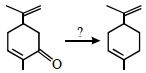
A
$NaBH_{4}$
B
$NH_{2}NH_{2} / C_{2}H_{5}O^{-}Na^{+}$
C
$Ni / H_{2}$
D
$Red \ P + Cl_{2}$
Solution
(B) The reaction involves the reduction of a carbonyl group $(C=O)$ to a methylene group $(-CH_{2}-)$ in the presence of a carbon-carbon double bond $(C=C)$.
Wolff-Kishner reduction,which uses hydrazine $(NH_{2}NH_{2})$ followed by a strong base like sodium ethoxide $(C_{2}H_{5}O^{-}Na^{+})$ and heat,is specifically used to reduce carbonyl groups to alkanes without affecting the $C=C$ double bond.
$NaBH_{4}$ reduces carbonyls but is typically used for alcohols,and $Ni/H_{2}$ would reduce both the carbonyl and the $C=C$ double bond.
Wolff-Kishner reduction,which uses hydrazine $(NH_{2}NH_{2})$ followed by a strong base like sodium ethoxide $(C_{2}H_{5}O^{-}Na^{+})$ and heat,is specifically used to reduce carbonyl groups to alkanes without affecting the $C=C$ double bond.
$NaBH_{4}$ reduces carbonyls but is typically used for alcohols,and $Ni/H_{2}$ would reduce both the carbonyl and the $C=C$ double bond.
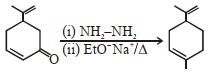
0 likesView Solution
207
ChemistryEasyMCQJEE Main · 2021
Match List-$I$ and List-$II$.
| List-$I$ | List-$II$ |
| $(a).$ Valium | $(i).$ Antifertility drug |
| $(b).$ Morphine | $(ii).$ Pernicious anaemia |
| $(c).$ Norethindrone | $(iii).$ Analgesic |
| $(d).$ Vitamin $B_{12}$ | $(iv).$ Tranquilizer |
A
$a-iv, b-iii, c-ii, d-i$
B
$a-iv, b-iii, c-i, d-ii$
C
$a-ii, b-iv, c-iii, d-i$
D
$a-i, b-iii, c-iv, d-ii$
Solution
(B) Valium $-$ Tranquilizer: $(a-iv)$
$(b)$ Morphine $-$ Analgesic: $(b-iii)$
$(c)$ Norethindrone $-$ Antifertility drug: $(c-i)$
$(d)$ Vitamin $B_{12}$ $-$ Pernicious anaemia: $(d-ii)$
Therefore,the correct matching is $a-iv, b-iii, c-i, d-ii$.
$(b)$ Morphine $-$ Analgesic: $(b-iii)$
$(c)$ Norethindrone $-$ Antifertility drug: $(c-i)$
$(d)$ Vitamin $B_{12}$ $-$ Pernicious anaemia: $(d-ii)$
Therefore,the correct matching is $a-iv, b-iii, c-i, d-ii$.
0 likesView Solution
208
ChemistryEasyMCQJEE Main · 2021
Match List-$I$ and List-$II$.
Choose the correct answer from the options given below:
| List-$I$ (Metal) | List-$II$ (Ores) |
|---|---|
| $a$. Aluminium | $i$. Siderite |
| $b$. Copper | $ii$. Calamine |
| $c$. Iron | $iii$. Kaolinite |
| $d$. Zinc | $iv$. Malachite |
Choose the correct answer from the options given below:
A
$a-iv, b-iii, c-ii, d-i$
B
$a-ii, b-iv, c-i, d-iii$
C
$a-i, b-ii, c-iii, d-iv$
D
$a-iii, b-iv, c-i, d-ii$
Solution
(D) The ores are identified as follows:
$a$. Aluminium: Kaolinite $(Al_{2}(OH)_{4} \cdot Si_{2}O_{5})$
$b$. Copper: Malachite $(Cu(OH)_{2} \cdot CuCO_{3})$
$c$. Iron: Siderite $(FeCO_{3})$
$d$. Zinc: Calamine $(ZnCO_{3})$
Therefore,the correct matching is $a-iii, b-iv, c-i, d-ii$.
$a$. Aluminium: Kaolinite $(Al_{2}(OH)_{4} \cdot Si_{2}O_{5})$
$b$. Copper: Malachite $(Cu(OH)_{2} \cdot CuCO_{3})$
$c$. Iron: Siderite $(FeCO_{3})$
$d$. Zinc: Calamine $(ZnCO_{3})$
Therefore,the correct matching is $a-iii, b-iv, c-i, d-ii$.
0 likesView Solution
209
ChemistryEasyMCQJEE Main · 2021
What is the correct order of the following elements with respect to their density?
A
$Cr < Zn < Co < Cu < Fe$
B
$Zn < Cu < Co < Fe < Cr$
C
$Zn < Cr < Fe < Co < Cu$
D
$Cr < Fe < Co < Cu < Zn$
Solution
(C) In the $3d$ transition series,density generally increases from left to right as atomic mass increases and atomic volume decreases.
However,$Zn$ has a lower density than $Cr$ because of its larger atomic size due to fully filled $d$-orbitals.
The density values (in $g/cm^3$) are: $Zn (7.13) < Cr (7.19) < Fe (7.87) < Co (8.90) < Cu (8.96)$.
Therefore,the correct order is $Zn < Cr < Fe < Co < Cu$.
However,$Zn$ has a lower density than $Cr$ because of its larger atomic size due to fully filled $d$-orbitals.
The density values (in $g/cm^3$) are: $Zn (7.13) < Cr (7.19) < Fe (7.87) < Co (8.90) < Cu (8.96)$.
Therefore,the correct order is $Zn < Cr < Fe < Co < Cu$.
0 likesView Solution
210
ChemistryEasyMCQJEE Main · 2021
The incorrect statement among the following is :-
A
$VOSO_4$ is a reducing agent
B
$Cr_2O_3$ is an amphoteric oxide
C
$RuO_4$ is an oxidizing agent
D
Red colour of ruby is due to the presence of $Co^{3+}$
Solution
(A, D) $(I)$ In $VOSO_4$,$V$ is in $+4$ oxidation state. It acts as an oxidizing agent,not a reducing agent.
$(II)$ $Cr_2O_3$ is an amphoteric oxide.
$(III)$ In $RuO_4$,$Ru$ is in $+8$ oxidation state. It acts as an oxidizing agent.
$(IV)$ The red colour of ruby is due to the presence of $Cr^{3+}$ ions in $Al_2O_3$ lattice,not $Co^{3+}$.
Therefore,both $(A)$ and $(D)$ are incorrect statements.
$(II)$ $Cr_2O_3$ is an amphoteric oxide.
$(III)$ In $RuO_4$,$Ru$ is in $+8$ oxidation state. It acts as an oxidizing agent.
$(IV)$ The red colour of ruby is due to the presence of $Cr^{3+}$ ions in $Al_2O_3$ lattice,not $Co^{3+}$.
Therefore,both $(A)$ and $(D)$ are incorrect statements.
0 likesView Solution
211
ChemistryMediumMCQJEE Main · 2021
The diazonium salt of which of the following compounds will form a coloured dye on reaction with $\beta$-Naphthol in $NaOH$?
A
Benzylamine $(C_6H_5CH_2NH_2)$
B
$N,N$-Dimethylaniline $(C_6H_5N(CH_3)_2)$
C
Aniline $(C_6H_5NH_2)$
D
$N$-Methylaniline $(C_6H_5NHCH_3)$
Solution
(C) The formation of a coloured dye (azo dye) occurs through the coupling reaction of a diazonium salt with an aromatic compound like $\beta$-Naphthol in an alkaline medium $(NaOH)$.
Primary aromatic amines,such as aniline $(C_6H_5NH_2)$,react with $NaNO_2$ and $HCl$ at $0-5 \ ^\circ C$ to form stable benzenediazonium chloride.
This diazonium salt then undergoes an electrophilic substitution (coupling) reaction with $\beta$-Naphthol to produce an orange-red azo dye.
Benzylamine is an aliphatic amine and does not form a stable diazonium salt under these conditions.
$N,N$-Dimethylaniline and $N$-Methylaniline are secondary and tertiary amines,respectively,and do not form the same type of stable diazonium salt required for this specific coupling reaction to produce the characteristic dye.
Primary aromatic amines,such as aniline $(C_6H_5NH_2)$,react with $NaNO_2$ and $HCl$ at $0-5 \ ^\circ C$ to form stable benzenediazonium chloride.
This diazonium salt then undergoes an electrophilic substitution (coupling) reaction with $\beta$-Naphthol to produce an orange-red azo dye.
Benzylamine is an aliphatic amine and does not form a stable diazonium salt under these conditions.
$N,N$-Dimethylaniline and $N$-Methylaniline are secondary and tertiary amines,respectively,and do not form the same type of stable diazonium salt required for this specific coupling reaction to produce the characteristic dye.
0 likesView Solution
212
ChemistryMediumJEE Main · 2021
The total number of amines among the following which can be synthesized by Gabriel phthalimide synthesis is:
$(A)$ $(CH_3)_2CH-CH_2-NH_2$
$(B)$ $CH_3CH_2NH_2$
$(C)$ $C_6H_5-CH_2-NH_2$
$(D)$ $C_6H_5-NH_2$
$(A)$ $(CH_3)_2CH-CH_2-NH_2$
$(B)$ $CH_3CH_2NH_2$
$(C)$ $C_6H_5-CH_2-NH_2$
$(D)$ $C_6H_5-NH_2$
Solution
(A) Gabriel phthalimide synthesis is used for the preparation of primary $(1^{\circ})$ aliphatic amines.
$1$. $(CH_3)_2CH-CH_2-NH_2$ is a primary aliphatic amine. It can be synthesized by this method.
$2$. $CH_3CH_2NH_2$ is a primary aliphatic amine. It can be synthesized by this method.
$3$. $C_6H_5-CH_2-NH_2$ (benzylamine) is a primary amine where the $-NH_2$ group is attached to an aliphatic carbon. It can be synthesized by this method.
$4$. $C_6H_5-NH_2$ (aniline) is an aromatic amine. Aromatic primary amines cannot be prepared by Gabriel phthalimide synthesis because aryl halides do not undergo nucleophilic substitution with the anion formed by phthalimide.
Thus,there are $3$ such amines that can be synthesized by this method.
$1$. $(CH_3)_2CH-CH_2-NH_2$ is a primary aliphatic amine. It can be synthesized by this method.
$2$. $CH_3CH_2NH_2$ is a primary aliphatic amine. It can be synthesized by this method.
$3$. $C_6H_5-CH_2-NH_2$ (benzylamine) is a primary amine where the $-NH_2$ group is attached to an aliphatic carbon. It can be synthesized by this method.
$4$. $C_6H_5-NH_2$ (aniline) is an aromatic amine. Aromatic primary amines cannot be prepared by Gabriel phthalimide synthesis because aryl halides do not undergo nucleophilic substitution with the anion formed by phthalimide.
Thus,there are $3$ such amines that can be synthesized by this method.
0 likesView Solution
213
ChemistryEasyMCQJEE Main · 2021
Among the following allotropic forms of sulphur,the number of allotropic forms,which will show paramagnetism is ..... .
$(A)$ $\alpha$-sulphur
$(B)$ $\beta$-sulphur
$(C)$ $S_2$-form
$(A)$ $\alpha$-sulphur
$(B)$ $\beta$-sulphur
$(C)$ $S_2$-form
A
$0$
B
$1$
C
$2$
D
$3$
Solution
(B) Sulphur exists in various allotropic forms like $\alpha$-sulphur (rhombic) and $\beta$-sulphur (monoclinic),which consist of $S_8$ puckered ring structures. These forms are diamagnetic because all electrons are paired in the $S_8$ molecules.
The $S_2$ form of sulphur is analogous to $O_2$ and is paramagnetic in the vapour state at high temperatures due to the presence of two unpaired electrons in its antibonding $\pi^*$ molecular orbitals.
Therefore,only the $S_2$ form shows paramagnetism.
The number of such allotropic forms is $1$.
The $S_2$ form of sulphur is analogous to $O_2$ and is paramagnetic in the vapour state at high temperatures due to the presence of two unpaired electrons in its antibonding $\pi^*$ molecular orbitals.
Therefore,only the $S_2$ form shows paramagnetism.
The number of such allotropic forms is $1$.
0 likesView Solution
214
ChemistryMediumMCQJEE Main · 2021
$C_{6}H_{6}$ freezes at $5.5^{\circ} C$. The temperature at which a solution of $10 \ g$ of $C_{4}H_{10}$ in $200 \ g$ of $C_{6}H_{6}$ freezes is $...... \ ^{\circ} C$. (The molal freezing point depression constant of $C_{6}H_{6}$ is $5.12 \ ^{\circ} C/m$.)
A
$3$
B
$1$
C
$5$
D
$9$
Solution
(B) Given:
Mass of solute $(C_{4}H_{10})$ = $10 \ g$
Molar mass of $C_{4}H_{10}$ = $(4 \times 12) + (10 \times 1) = 58 \ g/mol$
Moles of solute = $\frac{10}{58} \ mol$
Mass of solvent $(C_{6}H_{6})$ = $200 \ g = 0.2 \ kg$
Molality $(m)$ = $\frac{\text{moles of solute}}{\text{mass of solvent in kg}} = \frac{10/58}{0.2} = \frac{10}{58 \times 0.2} = \frac{10}{11.6} \approx 0.862 \ m$
Freezing point depression constant $(K_{f})$ = $5.12 \ ^{\circ} C/m$
Depression in freezing point $(\Delta T_{f})$ = $K_{f} \times m = 5.12 \times 0.862 \approx 4.41 \ ^{\circ} C$
Freezing point of solution $(T_{f})$ = $T_{f}^{\circ} - \Delta T_{f} = 5.5 - 4.41 = 1.09 \ ^{\circ} C$
Rounding to the nearest integer,the temperature is $1 \ ^{\circ} C$.
Mass of solute $(C_{4}H_{10})$ = $10 \ g$
Molar mass of $C_{4}H_{10}$ = $(4 \times 12) + (10 \times 1) = 58 \ g/mol$
Moles of solute = $\frac{10}{58} \ mol$
Mass of solvent $(C_{6}H_{6})$ = $200 \ g = 0.2 \ kg$
Molality $(m)$ = $\frac{\text{moles of solute}}{\text{mass of solvent in kg}} = \frac{10/58}{0.2} = \frac{10}{58 \times 0.2} = \frac{10}{11.6} \approx 0.862 \ m$
Freezing point depression constant $(K_{f})$ = $5.12 \ ^{\circ} C/m$
Depression in freezing point $(\Delta T_{f})$ = $K_{f} \times m = 5.12 \times 0.862 \approx 4.41 \ ^{\circ} C$
Freezing point of solution $(T_{f})$ = $T_{f}^{\circ} - \Delta T_{f} = 5.5 - 4.41 = 1.09 \ ^{\circ} C$
Rounding to the nearest integer,the temperature is $1 \ ^{\circ} C$.
0 likesView Solution
215
ChemistryMediumMCQJEE Main · 2021
The magnitude of the change in oxidising power of the $MnO_4^- / Mn^{2+}$ couple is $x \times 10^{-4} \, V$,if the $H^{+}$ concentration is decreased from $1 \, M$ to $10^{-4} \, M$ at $25^{\circ} C$. (Assume concentration of $MnO_4^-$ and $Mn^{2+}$ to be same on change in $H^{+}$ concentration). The value of $x$ is ....... .
(Rounded off to the nearest integer)
$[\text{Given} : \frac{2.303 RT}{F} = 0.059]$
(Rounded off to the nearest integer)
$[\text{Given} : \frac{2.303 RT}{F} = 0.059]$
A
$3776$
B
$3800$
C
$4276$
D
$1552$
Solution
(A) The reduction half-reaction is:
$MnO_4^- + 8H^{+} + 5e^- \rightarrow Mn^{2+} + 4H_2O$
Using the Nernst equation for the electrode potential:
$E = E^0 - \frac{0.059}{5} \log \frac{[Mn^{2+}]}{[MnO_4^-][H^{+}]^8}$
Case $I$: When $[H^{+}] = 1 \, M$
$E_1 = E^0 - \frac{0.059}{5} \log \frac{[Mn^{2+}]}{[MnO_4^-]}$
Case $II$: When $[H^{+}] = 10^{-4} \, M$
$E_2 = E^0 - \frac{0.059}{5} \log \frac{[Mn^{2+}]}{[MnO_4^-] \times (10^{-4})^8}$
$E_2 = E^0 - \frac{0.059}{5} \log \frac{[Mn^{2+}]}{[MnO_4^-]} + \frac{0.059}{5} \log (10^{-4})^8$
$E_2 = E^0 - \frac{0.059}{5} \log \frac{[Mn^{2+}]}{[MnO_4^-]} + \frac{0.059}{5} \times (-32)$
Calculating the magnitude of change $|E_1 - E_2|$:
$|E_1 - E_2| = \frac{0.059}{5} \times 32$
$|E_1 - E_2| = 0.0118 \times 32 = 0.3776 \, V$
Given the change is $x \times 10^{-4} \, V$:
$0.3776 \, V = 3776 \times 10^{-4} \, V$
Therefore,$x = 3776$.
$MnO_4^- + 8H^{+} + 5e^- \rightarrow Mn^{2+} + 4H_2O$
Using the Nernst equation for the electrode potential:
$E = E^0 - \frac{0.059}{5} \log \frac{[Mn^{2+}]}{[MnO_4^-][H^{+}]^8}$
Case $I$: When $[H^{+}] = 1 \, M$
$E_1 = E^0 - \frac{0.059}{5} \log \frac{[Mn^{2+}]}{[MnO_4^-]}$
Case $II$: When $[H^{+}] = 10^{-4} \, M$
$E_2 = E^0 - \frac{0.059}{5} \log \frac{[Mn^{2+}]}{[MnO_4^-] \times (10^{-4})^8}$
$E_2 = E^0 - \frac{0.059}{5} \log \frac{[Mn^{2+}]}{[MnO_4^-]} + \frac{0.059}{5} \log (10^{-4})^8$
$E_2 = E^0 - \frac{0.059}{5} \log \frac{[Mn^{2+}]}{[MnO_4^-]} + \frac{0.059}{5} \times (-32)$
Calculating the magnitude of change $|E_1 - E_2|$:
$|E_1 - E_2| = \frac{0.059}{5} \times 32$
$|E_1 - E_2| = 0.0118 \times 32 = 0.3776 \, V$
Given the change is $x \times 10^{-4} \, V$:
$0.3776 \, V = 3776 \times 10^{-4} \, V$
Therefore,$x = 3776$.
0 likesView Solution
216
ChemistryDifficultMCQJEE Main · 2021
Sucrose hydrolyses in acid solution into glucose and fructose following first order rate law with a half-life of $3.33 \ h$ at $25^{\circ} C$. After $9 \ h$,the fraction of sucrose remaining is $f$. The value of $\log _{10} (\frac{1}{f})$ is ..... $\times 10^{-2}$. (Rounded off to the nearest integer) [Assume : $\ln 10 = 2.303, \ln 2 = 0.693$ ]
A
$475$
B
$525$
C
$125$
D
$81$
Solution
(D) For a first order reaction,the rate constant $k$ is given by $k = \frac{\ln 2}{t_{1/2}} = \frac{0.693}{3.33 \ h} = \frac{0.693}{10/3 \ h} = 0.2079 \ h^{-1}$.
The integrated rate law for a first order reaction is $\ln \frac{[A]_0}{[A]_t} = kt$,which can be written as $\log_{10} \frac{[A]_0}{[A]_t} = \frac{kt}{2.303}$.
Given that the fraction of sucrose remaining is $f = \frac{[A]_t}{[A]_0}$,we have $\frac{1}{f} = \frac{[A]_0}{[A]_t}$.
Substituting the values: $\log_{10} (\frac{1}{f}) = \frac{0.2079 \times 9}{2.303} = \frac{0.693 \times 3 \times 9}{10 \times 2.303} = \frac{0.693}{2.303} \times 2.7 = 0.3009 \times 2.7 = 0.81243$.
Thus,$\log_{10} (\frac{1}{f}) = 81.24 \times 10^{-2}$.
Rounding to the nearest integer,we get $81$.
The integrated rate law for a first order reaction is $\ln \frac{[A]_0}{[A]_t} = kt$,which can be written as $\log_{10} \frac{[A]_0}{[A]_t} = \frac{kt}{2.303}$.
Given that the fraction of sucrose remaining is $f = \frac{[A]_t}{[A]_0}$,we have $\frac{1}{f} = \frac{[A]_0}{[A]_t}$.
Substituting the values: $\log_{10} (\frac{1}{f}) = \frac{0.2079 \times 9}{2.303} = \frac{0.693 \times 3 \times 9}{10 \times 2.303} = \frac{0.693}{2.303} \times 2.7 = 0.3009 \times 2.7 = 0.81243$.
Thus,$\log_{10} (\frac{1}{f}) = 81.24 \times 10^{-2}$.
Rounding to the nearest integer,we get $81$.
0 likesView Solution
217
ChemistryEasyMCQJEE Main · 2021
The carbylamine test is used to detect the presence of a primary amino group in an organic compound. Which of the following compounds is formed when this test is performed with aniline?
A
$C_6H_5NHCH_3$
B
$C_6H_5CONH_2$
C
$C_6H_5CN$
D
$C_6H_5NC$
Solution
(D) The carbylamine test is given by $1^{\circ}$ amines. When aniline $(C_6H_5NH_2)$ is treated with chloroform $(CHCl_3)$ and alcoholic potassium hydroxide $(KOH)$,it undergoes a reaction to form phenyl isocyanide $(C_6H_5NC)$,which is characterized by an extremely unpleasant odor.
The chemical equation is:
$C_6H_5NH_2 + CHCl_3 + 3KOH \rightarrow C_6H_5NC + 3KCl + 3H_2O$
The chemical equation is:
$C_6H_5NH_2 + CHCl_3 + 3KOH \rightarrow C_6H_5NC + 3KCl + 3H_2O$
0 likesView Solution
218
ChemistryEasyMCQJEE Main · 2021
Which of the following is the correct structure of the $\alpha-$anomer of maltose?
A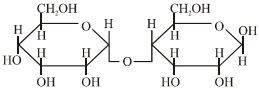
B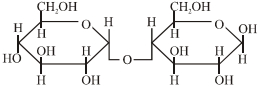
C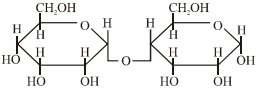
D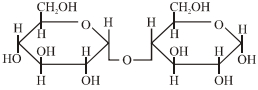
Solution
(A) Maltose is a disaccharide formed by two units of $\alpha-D-$glucopyranose joined by an $\alpha(1 \rightarrow 4)$ glycosidic linkage. In the $\alpha-$anomer of maltose,the hydroxyl group at the $C-1$ position of the second glucose unit is oriented downwards (axial position). The structure in image $983-$s843 represents the correct $\alpha-$anomer of maltose,where the $C-1$ hydroxyl group is in the $\alpha$ configuration.
0 likesView Solution
219
ChemistryMediumMCQJEE Main · 2021
The correct sequence of reagents used in the preparation of $4-$bromo$-2-$nitroethylbenzene from benzene is:
A
$HNO_3 / H_2SO_4, Br_2 / AlCl_3, CH_3COCl / AlCl_3, Zn-Hg / HCl$
B
$Br_2 / AlBr_3, CH_3COCl / AlCl_3, HNO_3 / H_2SO_4, Zn / HCl$
C
$CH_3COCl / AlCl_3, Br_2 / AlBr_3, HNO_3 / H_2SO_4, Zn / HCl$
D
$CH_3COCl / AlCl_3, Zn-Hg / HCl, Br_2 / AlBr_3, HNO_3 / H_2SO_4$
Solution
(D) The synthesis of $4-$bromo$-2-$nitroethylbenzene from benzene involves the following steps:
$1$. Friedel-Crafts acylation of benzene with $CH_3COCl / AlCl_3$ to form acetophenone.
$2$. Clemmensen reduction of acetophenone using $Zn-Hg / HCl$ to form ethylbenzene.
$3$. Electrophilic aromatic bromination of ethylbenzene using $Br_2 / AlBr_3$ to form $4-$bromoethylbenzene (para-product is major due to steric hindrance at ortho position).
$4$. Nitration of $4-$bromoethylbenzene using $HNO_3 / H_2SO_4$ to form $4-$bromo$-2-$nitroethylbenzene.
$1$. Friedel-Crafts acylation of benzene with $CH_3COCl / AlCl_3$ to form acetophenone.
$2$. Clemmensen reduction of acetophenone using $Zn-Hg / HCl$ to form ethylbenzene.
$3$. Electrophilic aromatic bromination of ethylbenzene using $Br_2 / AlBr_3$ to form $4-$bromoethylbenzene (para-product is major due to steric hindrance at ortho position).
$4$. Nitration of $4-$bromoethylbenzene using $HNO_3 / H_2SO_4$ to form $4-$bromo$-2-$nitroethylbenzene.
0 likesView Solution
220
ChemistryEasyMCQJEE Main · 2021
The correct order of acidic character of the following compounds is:
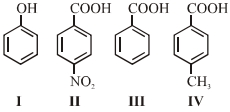
A
$III > II > I > IV$
B
$IV > III > II > I$
C
$I > II > III > IV$
D
$II > III > IV > I$
Solution
(D) The acidic strength depends on the stability of the conjugate base formed after the loss of a proton $(H^+)$.
$1.$ Phenol $(I)$ is much less acidic than carboxylic acids $(II, III, IV)$.
$2.$ Among the carboxylic acids,electron-withdrawing groups $(-NO_2)$ increase acidity,while electron-donating groups $(-CH_3)$ decrease it.
$3.$ Compound $II$ ($p$-nitrobenzoic acid) has a strong $-I$ and $-M$ effect,making it the most acidic.
$4.$ Compound $III$ (benzoic acid) is the reference.
$5.$ Compound $IV$ ($p$-toluic acid) has a $+I$ and $+H$ effect,making it the least acidic among the carboxylic acids.
$6.$ Therefore,the order is $II > III > IV > I$.
$1.$ Phenol $(I)$ is much less acidic than carboxylic acids $(II, III, IV)$.
$2.$ Among the carboxylic acids,electron-withdrawing groups $(-NO_2)$ increase acidity,while electron-donating groups $(-CH_3)$ decrease it.
$3.$ Compound $II$ ($p$-nitrobenzoic acid) has a strong $-I$ and $-M$ effect,making it the most acidic.
$4.$ Compound $III$ (benzoic acid) is the reference.
$5.$ Compound $IV$ ($p$-toluic acid) has a $+I$ and $+H$ effect,making it the least acidic among the carboxylic acids.
$6.$ Therefore,the order is $II > III > IV > I$.
0 likesView Solution
221
ChemistryMediumMCQJEE Main · 2021
The correct statement about the given chemical reaction is:
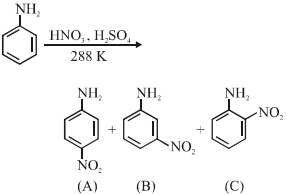
A
$-\ddot{N}H_2$ group is ortho and para directive,so product $(B)$ is not possible.
B
Reaction is possible and compound $(B)$ will be the major product.
C
The reaction will form a sulphonated product instead of nitration.
D
Reaction is possible and compound $(A)$ will be the major product.
Solution
(D) In the presence of strong acid $(H_2SO_4)$,aniline is protonated to form the anilinium ion $(C_6H_5NH_3^+)$.
The $-NH_3^+$ group is meta-directing due to its strong electron-withdrawing nature.
As a result,a significant amount of the $m$-nitroaniline (compound $(B)$) is formed,along with the $p$-nitroaniline (compound $(A)$) and $o$-nitroaniline (compound $(C)$).
Experimental data shows that $p$-nitroaniline $(51\%)$ is the major product,followed by $m$-nitroaniline $(47\%)$ and $o$-nitroaniline $(2\%)$.
The $-NH_3^+$ group is meta-directing due to its strong electron-withdrawing nature.
As a result,a significant amount of the $m$-nitroaniline (compound $(B)$) is formed,along with the $p$-nitroaniline (compound $(A)$) and $o$-nitroaniline (compound $(C)$).
Experimental data shows that $p$-nitroaniline $(51\%)$ is the major product,followed by $m$-nitroaniline $(47\%)$ and $o$-nitroaniline $(2\%)$.
0 likesView Solution
222
ChemistryEasyMCQJEE Main · 2021
The correct order of bond dissociation enthalpy of halogens is:
A
$Cl_2 > F_2 > Br_2 > I_2$
B
$I_2 > Br_2 > Cl_2 > F_2$
C
$Cl_2 > Br_2 > F_2 > I_2$
D
$F_2 > Cl_2 > Br_2 > I_2$
Solution
(C) The correct order of bond dissociation enthalpy for halogens is $Cl_2 > Br_2 > F_2 > I_2$.
Due to the small size of the fluorine atom,the lone pairs of electrons on the two fluorine atoms in $F_2$ experience significant inter-electronic repulsion.
This makes the $F-F$ bond weaker than the $Cl-Cl$ and $Br-Br$ bonds,resulting in a lower bond dissociation enthalpy for $F_2$ compared to $Cl_2$ and $Br_2$.
Due to the small size of the fluorine atom,the lone pairs of electrons on the two fluorine atoms in $F_2$ experience significant inter-electronic repulsion.
This makes the $F-F$ bond weaker than the $Cl-Cl$ and $Br-Br$ bonds,resulting in a lower bond dissociation enthalpy for $F_2$ compared to $Cl_2$ and $Br_2$.
0 likesView Solution
223
ChemistryEasyMCQJEE Main · 2021
The major components of German Silver are:
A
$Ge, Cu$ and $Ag$
B
$Zn, Ni$ and $Ag$
C
$Cu, Zn$ and $Ni$
D
$Cu, Zn$ and $Ag$
Solution
(C) German silver is an alloy that does not contain silver.
It is composed of copper $(Cu)$,zinc $(Zn)$,and nickel $(Ni)$.
The typical composition is approximately $50\% \ Cu$,$30\% \ Zn$,and $20\% \ Ni$.
It is composed of copper $(Cu)$,zinc $(Zn)$,and nickel $(Ni)$.
The typical composition is approximately $50\% \ Cu$,$30\% \ Zn$,and $20\% \ Ni$.
0 likesView Solution
224
ChemistryDifficultMCQJEE Main · 2021
In which of the following orders are the given complex ions arranged correctly with respect to their decreasing spin-only magnetic moment?
$(i)$ $[FeF_{6}]^{3-}$
$(ii)$ $[Co(NH_{3})_{6}]^{3+}$
$(iii)$ $[NiCl_{4}]^{2-}$
$(iv)$ $[Cu(NH_{3})_{4}]^{2+}$
$(i)$ $[FeF_{6}]^{3-}$
$(ii)$ $[Co(NH_{3})_{6}]^{3+}$
$(iii)$ $[NiCl_{4}]^{2-}$
$(iv)$ $[Cu(NH_{3})_{4}]^{2+}$
A
$i > iii > iv > ii$
B
$ii > iii > i > iv$
C
$iii > iv > ii > i$
D
$ii > i > iii > iv$
Solution
(A) To determine the spin-only magnetic moment $(\mu = \sqrt{n(n+2)} \ B.M.)$,we find the number of unpaired electrons $(n)$ for each complex:
$(i)$ $[FeF_{6}]^{3-}$: $Fe^{3+}$ is $3d^{5}$. $F^{-}$ is a weak field ligand $(WFL)$,so electrons remain unpaired. $n = 5$,$\mu = \sqrt{5(5+2)} = \sqrt{35} \ B.M.$
$(ii)$ $[Co(NH_{3})_{6}]^{3+}$: $Co^{3+}$ is $3d^{6}$. $NH_{3}$ is a strong field ligand $(SFL)$,causing pairing. $n = 0$,$\mu = 0 \ B.M.$
$(iii)$ $[NiCl_{4}]^{2-}$: $Ni^{2+}$ is $3d^{8}$. $Cl^{-}$ is a $WFL$. In tetrahedral geometry,$n = 2$,$\mu = \sqrt{2(2+2)} = \sqrt{8} \ B.M.$
$(iv)$ $[Cu(NH_{3})_{4}]^{2+}$: $Cu^{2+}$ is $3d^{9}$. $n = 1$,$\mu = \sqrt{1(1+2)} = \sqrt{3} \ B.M.$
Comparing the values: $\sqrt{35} > \sqrt{8} > \sqrt{3} > 0$,which corresponds to $i > iii > iv > ii$.
$(i)$ $[FeF_{6}]^{3-}$: $Fe^{3+}$ is $3d^{5}$. $F^{-}$ is a weak field ligand $(WFL)$,so electrons remain unpaired. $n = 5$,$\mu = \sqrt{5(5+2)} = \sqrt{35} \ B.M.$
$(ii)$ $[Co(NH_{3})_{6}]^{3+}$: $Co^{3+}$ is $3d^{6}$. $NH_{3}$ is a strong field ligand $(SFL)$,causing pairing. $n = 0$,$\mu = 0 \ B.M.$
$(iii)$ $[NiCl_{4}]^{2-}$: $Ni^{2+}$ is $3d^{8}$. $Cl^{-}$ is a $WFL$. In tetrahedral geometry,$n = 2$,$\mu = \sqrt{2(2+2)} = \sqrt{8} \ B.M.$
$(iv)$ $[Cu(NH_{3})_{4}]^{2+}$: $Cu^{2+}$ is $3d^{9}$. $n = 1$,$\mu = \sqrt{1(1+2)} = \sqrt{3} \ B.M.$
Comparing the values: $\sqrt{35} > \sqrt{8} > \sqrt{3} > 0$,which corresponds to $i > iii > iv > ii$.
0 likesView Solution
225
ChemistryEasyMCQJEE Main · 2021
Which one of the following statements is $FALSE$ for hydrophilic sols?
A
Their viscosity is of the order of that of $H_2O$.
B
The sols cannot be easily coagulated.
C
They do not require electrolytes for stability.
D
These sols are reversible in nature.
Solution
(A) The viscosity of hydrophilic sols is generally higher than that of the dispersion medium $(H_2O)$.
Hydrophilic sols are more stable due to strong interaction between the dispersed phase and the dispersion medium,making them difficult to coagulate.
Hydrophilic sols are reversible in nature,meaning they can be reformed by simply mixing the dispersed phase with the dispersion medium after coagulation.
They do not require electrolytes for stability; in fact,the addition of electrolytes can lead to coagulation.
Therefore,the statement that their viscosity is of the order of that of $H_2O$ is false.
Hydrophilic sols are more stable due to strong interaction between the dispersed phase and the dispersion medium,making them difficult to coagulate.
Hydrophilic sols are reversible in nature,meaning they can be reformed by simply mixing the dispersed phase with the dispersion medium after coagulation.
They do not require electrolytes for stability; in fact,the addition of electrolytes can lead to coagulation.
Therefore,the statement that their viscosity is of the order of that of $H_2O$ is false.
0 likesView Solution
226
ChemistryEasyMCQJEE Main · 2021
Given below are two statements :
Statement $I :$ The identification of $Ni^{2+}$ is carried out by dimethyl glyoxime in the presence of $NH_{4}OH$.
Statement $II :$ The dimethyl glyoxime is a bidentate neutral ligand.
In the light of the above statements,choose the correct answer from the options given below:
Statement $I :$ The identification of $Ni^{2+}$ is carried out by dimethyl glyoxime in the presence of $NH_{4}OH$.
Statement $II :$ The dimethyl glyoxime is a bidentate neutral ligand.
In the light of the above statements,choose the correct answer from the options given below:
A
Statement $I$ is false but Statement $II$ is true.
B
Both Statement $I$ and Statement $II$ are false.
C
Statement $I$ is true but Statement $II$ is false.
D
Both Statement $I$ and Statement $II$ are true.
Solution
(C) Statement $I$ is true because dimethyl glyoxime $(DMG)$ is used as a specific reagent for the detection of $Ni^{2+}$ ions in an ammoniacal medium $(NH_{4}OH)$.
Statement $II$ is false because dimethyl glyoxime $(C_{4}H_{8}N_{2}O_{2})$ acts as a bidentate monoanionic ligand $(dmg^{-})$ after losing a proton,not as a neutral ligand.
The reaction is: $Ni^{2+}_{(aq)} + 2dmg^{-} \rightarrow [Ni(dmg)_{2}] \text{ (rosy red precipitate)}$.
Statement $II$ is false because dimethyl glyoxime $(C_{4}H_{8}N_{2}O_{2})$ acts as a bidentate monoanionic ligand $(dmg^{-})$ after losing a proton,not as a neutral ligand.
The reaction is: $Ni^{2+}_{(aq)} + 2dmg^{-} \rightarrow [Ni(dmg)_{2}] \text{ (rosy red precipitate)}$.
0 likesView Solution
227
ChemistryMediumMCQJEE Main · 2021
The major product of the following reaction is:
$CH_3CH_2CH=CH_2$ $\xrightarrow[Rh \ \text{catalyst}]{H_2/CO}$
$CH_3CH_2CH=CH_2$ $\xrightarrow[Rh \ \text{catalyst}]{H_2/CO}$
A
$CH_3CH_2CH_2CH_2CHO$
B
$CH_3CH_2CH(CHO)CH_3$
C
$CH_3CH_2CH_2CH_2CHO$ (linear product) and $CH_3CH_2CH(CH_3)CHO$ (branched product)
D
$CH_3CH_2CH_2CHO$
Solution
(A) The reaction is the $OXO$ process or hydroformylation of alkenes.
In this reaction,an alkene reacts with $CO$ and $H_2$ in the presence of a rhodium $(Rh)$ or cobalt catalyst to form an aldehyde.
For the substrate $CH_3CH_2CH=CH_2$ (but$-1-$ene),the hydroformylation leads to two isomeric aldehydes:
$1$. $CH_3CH_2CH_2CH_2CHO$ (pentanal,linear product)
$2$. $CH_3CH_2CH(CH_3)CHO$ ($2$-methylbutanal,branched product)
Using a rhodium catalyst,the linear aldehyde is typically the major product due to less steric hindrance during the formation of the transition state.
Therefore,the major product is $CH_3CH_2CH_2CH_2CHO$.
In this reaction,an alkene reacts with $CO$ and $H_2$ in the presence of a rhodium $(Rh)$ or cobalt catalyst to form an aldehyde.
For the substrate $CH_3CH_2CH=CH_2$ (but$-1-$ene),the hydroformylation leads to two isomeric aldehydes:
$1$. $CH_3CH_2CH_2CH_2CHO$ (pentanal,linear product)
$2$. $CH_3CH_2CH(CH_3)CHO$ ($2$-methylbutanal,branched product)
Using a rhodium catalyst,the linear aldehyde is typically the major product due to less steric hindrance during the formation of the transition state.
Therefore,the major product is $CH_3CH_2CH_2CH_2CHO$.
0 likesView Solution
228
ChemistryEasyMCQJEE Main · 2021
The method used for the purification of $Indium$ is ..... .
A
van Arkel method
B
liquation
C
zone refining
D
vapour phase refining
Solution
(C) $Zone$ refining is used for the purification of $Indium$ $(In)$.
This method is based on the principle that the impurities are more soluble in the melt than in the solid state of the metal.
This method is based on the principle that the impurities are more soluble in the melt than in the solid state of the metal.
0 likesView Solution
229
ChemistryEasyMCQJEE Main · 2021
Given below are two statements:
Statement-$I$: $\alpha$ and $\beta$ forms of sulphur can change reversibly between themselves with slow heating or slow cooling.
Statement-$II$: At room temperature the stable crystalline form of sulphur is monoclinic sulphur.
In the light of the above statements,choose the correct answer from the options given below:
Statement-$I$: $\alpha$ and $\beta$ forms of sulphur can change reversibly between themselves with slow heating or slow cooling.
Statement-$II$: At room temperature the stable crystalline form of sulphur is monoclinic sulphur.
In the light of the above statements,choose the correct answer from the options given below:
A
Statement $I$ is false but Statement $II$ is true.
B
Both Statement $I$ and Statement $II$ are true.
C
Statement $I$ is true but Statement $II$ is false.
D
Both Statement $I$ and Statement $II$ are false.
Solution
(C) The transition temperature for sulphur is $369 \ K$. Below $369 \ K$,$\alpha-$sulphur (rhombic) is stable,and above $369 \ K$,$\beta-$sulphur (monoclinic) is stable.
These two forms can change reversibly between themselves with slow heating or slow cooling,making Statement-$I$ true.
At room temperature,$\alpha-$sulphur (rhombic) is the most stable form,not monoclinic sulphur. Therefore,Statement-$II$ is false.
These two forms can change reversibly between themselves with slow heating or slow cooling,making Statement-$I$ true.
At room temperature,$\alpha-$sulphur (rhombic) is the most stable form,not monoclinic sulphur. Therefore,Statement-$II$ is false.
0 likesView Solution
230
ChemistryMediumMCQJEE Main · 2021
If a compound $AB$ dissociates to the extent of $75\,\%$ in an aqueous solution,the molality of the solution which shows a $2.5\, K$ rise in the boiling point of the solution is $......$ molal.
(Rounded-off to the nearest integer) $[K_{b} = 0.52\, K\, kg\, mol^{-1}]$
(Rounded-off to the nearest integer) $[K_{b} = 0.52\, K\, kg\, mol^{-1}]$
A
$4$
B
$3$
C
$6$
D
$5$
Solution
(B) The degree of dissociation $\alpha = 0.75$ and for $AB$,the number of ions $n = 2$.
The van't Hoff factor $i = 1 - \alpha + n\alpha = 1 - 0.75 + 2 \times 0.75 = 1.75$.
The elevation in boiling point is given by $\Delta T_{b} = i \times K_{b} \times m$.
Substituting the values: $2.5 = 1.75 \times 0.52 \times m$.
Calculating molality $m = \frac{2.5}{1.75 \times 0.52} = \frac{2.5}{0.91} \approx 2.747$.
Rounding off to the nearest integer,we get $3$.
The van't Hoff factor $i = 1 - \alpha + n\alpha = 1 - 0.75 + 2 \times 0.75 = 1.75$.
The elevation in boiling point is given by $\Delta T_{b} = i \times K_{b} \times m$.
Substituting the values: $2.5 = 1.75 \times 0.52 \times m$.
Calculating molality $m = \frac{2.5}{1.75 \times 0.52} = \frac{2.5}{0.91} \approx 2.747$.
Rounding off to the nearest integer,we get $3$.
0 likesView Solution
231
ChemistryMediumMCQJEE Main · 2021
The number of compounds given below which contain the $-COOH$ group is .... .
$A$. Sulphanilic acid
$B$. Picric acid
$C$. Aspirin
$D$. Ascorbic acid
$A$. Sulphanilic acid
$B$. Picric acid
$C$. Aspirin
$D$. Ascorbic acid
A
$1$
B
$0$
C
$2$
D
$4$
Solution
(A) Let us analyze the structures of the given compounds:
$1$. Sulphanilic acid $(p-NH_2C_6H_4SO_3H)$: Contains a sulphonic acid group $(-SO_3H)$,not a carboxylic acid group $(-COOH)$.
$2$. Picric acid ($2,4,6-$trinitrophenol): Contains a phenolic hydroxyl group $(-OH)$ and nitro groups $(-NO_2)$,not a carboxylic acid group $(-COOH)$.
$3$. Aspirin (Acetylsalicylic acid): Contains a carboxylic acid group $(-COOH)$ and an ester group.
$4$. Ascorbic acid (Vitamin $C$): Contains hydroxyl groups and a cyclic ester (lactone),not a carboxylic acid group $(-COOH)$.
Thus,only Aspirin contains the $-COOH$ group.
The total number of such compounds is $1$.
$1$. Sulphanilic acid $(p-NH_2C_6H_4SO_3H)$: Contains a sulphonic acid group $(-SO_3H)$,not a carboxylic acid group $(-COOH)$.
$2$. Picric acid ($2,4,6-$trinitrophenol): Contains a phenolic hydroxyl group $(-OH)$ and nitro groups $(-NO_2)$,not a carboxylic acid group $(-COOH)$.
$3$. Aspirin (Acetylsalicylic acid): Contains a carboxylic acid group $(-COOH)$ and an ester group.
$4$. Ascorbic acid (Vitamin $C$): Contains hydroxyl groups and a cyclic ester (lactone),not a carboxylic acid group $(-COOH)$.
Thus,only Aspirin contains the $-COOH$ group.
The total number of such compounds is $1$.
0 likesView Solution
232
ChemistryMediumMCQJEE Main · 2021
The rate constant of a reaction increases by five times on increase in temperature from $27^{\circ} C$ to $52^{\circ} C$. The value of activation energy in $kJ \, mol^{-1}$ is $....$ . (Rounded-off to the nearest integer) $[R = 8.314 \, J \, K^{-1} \, mol^{-1}]$
A
$26$
B
$10$
C
$52$
D
$48$
Solution
(C) Given: $T_1 = 27 + 273 = 300 \, K$,$T_2 = 52 + 273 = 325 \, K$,$K_2 = 5K_1$,$R = 8.314 \, J \, K^{-1} \, mol^{-1}$.
Using the Arrhenius equation: $\ln \frac{K_2}{K_1} = \frac{E_a}{R} \left[ \frac{T_2 - T_1}{T_1 T_2} \right]$.
$\ln(5) = \frac{E_a}{8.314} \left[ \frac{325 - 300}{300 \times 325} \right]$.
$1.6094 = \frac{E_a}{8.314} \left[ \frac{25}{97500} \right]$.
$1.6094 = \frac{E_a}{8.314} \times 0.0002564$.
$E_a = \frac{1.6094 \times 8.314}{0.0002564} \approx 52194 \, J \, mol^{-1} = 52.194 \, kJ \, mol^{-1}$.
Rounding to the nearest integer,we get $52 \, kJ \, mol^{-1}$.
Using the Arrhenius equation: $\ln \frac{K_2}{K_1} = \frac{E_a}{R} \left[ \frac{T_2 - T_1}{T_1 T_2} \right]$.
$\ln(5) = \frac{E_a}{8.314} \left[ \frac{325 - 300}{300 \times 325} \right]$.
$1.6094 = \frac{E_a}{8.314} \left[ \frac{25}{97500} \right]$.
$1.6094 = \frac{E_a}{8.314} \times 0.0002564$.
$E_a = \frac{1.6094 \times 8.314}{0.0002564} \approx 52194 \, J \, mol^{-1} = 52.194 \, kJ \, mol^{-1}$.
Rounding to the nearest integer,we get $52 \, kJ \, mol^{-1}$.
0 likesView Solution
233
ChemistryMediumMCQJEE Main · 2021
The spin-only magnetic moment of a divalent ion in aqueous solution (atomic number $29$) is ...... $BM.$
A
$2$
B
$8$
C
$6$
D
$4$
Solution
(A) The atomic number of the element is $Z = 29$,which corresponds to Copper $(Cu)$.
The electronic configuration of $Cu$ is $[Ar] 3d^{10} 4s^1$.
For the divalent ion $Cu^{2+}$,the electronic configuration is $[Ar] 3d^9$.
In the $3d$ orbital,there are $9$ electrons,which means there is $1$ unpaired electron.
The spin-only magnetic moment formula is $\mu = \sqrt{n(n+2)} \ BM$,where $n$ is the number of unpaired electrons.
Substituting $n = 1$: $\mu = \sqrt{1(1+2)} = \sqrt{3} \approx 1.73 \ BM$.
Rounding $1.73$ to the nearest integer gives $2 \ BM$.
The electronic configuration of $Cu$ is $[Ar] 3d^{10} 4s^1$.
For the divalent ion $Cu^{2+}$,the electronic configuration is $[Ar] 3d^9$.
In the $3d$ orbital,there are $9$ electrons,which means there is $1$ unpaired electron.
The spin-only magnetic moment formula is $\mu = \sqrt{n(n+2)} \ BM$,where $n$ is the number of unpaired electrons.
Substituting $n = 1$: $\mu = \sqrt{1(1+2)} = \sqrt{3} \approx 1.73 \ BM$.
Rounding $1.73$ to the nearest integer gives $2 \ BM$.
0 likesView Solution
234
ChemistryMediumMCQJEE Main · 2021
Consider the titration of $NaOH$ solution versus $1.25\, M$ oxalic acid solution. At the end point,the following burette readings were obtained:
$(i)$ $4.5\, mL$ $\quad (ii)$ $4.5\, mL$ $\quad (iii)$ $4.4\, mL$
$(iv)$ $4.4\, mL$ $\quad (v)$ $4.4\, mL$
If the volume of oxalic acid taken was $10.0\, mL$,then the molarity of the $NaOH$ solution is .... $M$ (Rounded-off to the nearest integer).
$(i)$ $4.5\, mL$ $\quad (ii)$ $4.5\, mL$ $\quad (iii)$ $4.4\, mL$
$(iv)$ $4.4\, mL$ $\quad (v)$ $4.4\, mL$
If the volume of oxalic acid taken was $10.0\, mL$,then the molarity of the $NaOH$ solution is .... $M$ (Rounded-off to the nearest integer).
A
$6$
B
$16$
C
$32$
D
$1$
Solution
(A) The concordant volume of $NaOH$ is the average of the consistent readings $(iii, iv, v)$,which is $4.4\, mL$.
Using the principle of equivalence: $\text{equivalents of } NaOH = \text{equivalents of } H_2C_2O_4$.
$M_{NaOH} \times V_{NaOH} \times n_{factor} = M_{acid} \times V_{acid} \times n_{factor}$.
For $NaOH$,$n_{factor} = 1$. For oxalic acid $(H_2C_2O_4)$,$n_{factor} = 2$.
$M \times 4.4 \times 1 = 1.25 \times 10.0 \times 2$.
$M = \frac{25}{4.4} \approx 5.68\, M$.
Rounding to the nearest integer,we get $6\, M$.
Using the principle of equivalence: $\text{equivalents of } NaOH = \text{equivalents of } H_2C_2O_4$.
$M_{NaOH} \times V_{NaOH} \times n_{factor} = M_{acid} \times V_{acid} \times n_{factor}$.
For $NaOH$,$n_{factor} = 1$. For oxalic acid $(H_2C_2O_4)$,$n_{factor} = 2$.
$M \times 4.4 \times 1 = 1.25 \times 10.0 \times 2$.
$M = \frac{25}{4.4} \approx 5.68\, M$.
Rounding to the nearest integer,we get $6\, M$.
0 likesView Solution
235
ChemistryDifficultMCQJEE Main · 2021
Copper reduces $NO_{3}^{-}$ into $NO$ and $NO_{2}$ depending upon the concentration of $HNO_{3}$ in solution. Assuming fixed $[Cu^{2+}]$ and $P_{NO} = P_{NO_{2}} = 1 \ bar$,the $HNO_{3}$ concentration at which the thermodynamic tendency for reduction of $NO_{3}^{-}$ into $NO$ and $NO_{2}$ by copper is the same is $10^{x} \ M$. The value of $2x$ is ...... .
$[Given: E_{Cu^{2+} / Cu}^{\circ} = 0.34 \ V, E_{NO_{3}^{-} / NO}^{\circ} = 0.96 \ V, E_{NO_{3}^{-} / NO_{2}}^{\circ} = 0.79 \ V$ and at $298 \ K, \frac{RT}{F}(2.303) = 0.059]$
$[Given: E_{Cu^{2+} / Cu}^{\circ} = 0.34 \ V, E_{NO_{3}^{-} / NO}^{\circ} = 0.96 \ V, E_{NO_{3}^{-} / NO_{2}}^{\circ} = 0.79 \ V$ and at $298 \ K, \frac{RT}{F}(2.303) = 0.059]$
A
$2$
B
$4$
C
$6$
D
$8$
Solution
(B) For the reduction of $NO_{3}^{-}$ to $NO$:
$NO_{3}^{-} + 4H^{+} + 3e^{-} \longrightarrow NO + 2H_{2}O$
$E_{1} = E_{NO_{3}^{-} / NO}^{\circ} - \frac{0.059}{3} \log \frac{P_{NO}}{[NO_{3}^{-}][H^{+}]^{4}}$
For the reduction of $NO_{3}^{-}$ to $NO_{2}$:
$NO_{3}^{-} + 2H^{+} + e^{-} \longrightarrow NO_{2} + H_{2}O$
$E_{2} = E_{NO_{3}^{-} / NO_{2}}^{\circ} - \frac{0.059}{1} \log \frac{P_{NO_{2}}}{[NO_{3}^{-}][H^{+}]^{2}}$
Given $[HNO_{3}] = y$,so $[H^{+}] = y$ and $[NO_{3}^{-}] = y$. Also $P_{NO} = P_{NO_{2}} = 1 \ bar$.
Equating $E_{1} = E_{2}$:
$0.96 - \frac{0.059}{3} \log \frac{1}{y \cdot y^{4}} = 0.79 - 0.059 \log \frac{1}{y \cdot y^{2}}$
$0.17 = \frac{0.059}{3} \log (y^{-5}) - 0.059 \log (y^{-3})$
$0.17 = -\frac{0.059}{3} \cdot 5 \log y + 0.059 \cdot 3 \log y$
$0.17 = 0.059 \log y (3 - \frac{5}{3}) = 0.059 \log y (\frac{4}{3})$
$\log y = \frac{0.17 \times 3}{0.059 \times 4} = \frac{0.51}{0.236} \approx 2.16$
$y = 10^{2.16}$,so $x = 2.16$.
$2x = 4.32$.
$NO_{3}^{-} + 4H^{+} + 3e^{-} \longrightarrow NO + 2H_{2}O$
$E_{1} = E_{NO_{3}^{-} / NO}^{\circ} - \frac{0.059}{3} \log \frac{P_{NO}}{[NO_{3}^{-}][H^{+}]^{4}}$
For the reduction of $NO_{3}^{-}$ to $NO_{2}$:
$NO_{3}^{-} + 2H^{+} + e^{-} \longrightarrow NO_{2} + H_{2}O$
$E_{2} = E_{NO_{3}^{-} / NO_{2}}^{\circ} - \frac{0.059}{1} \log \frac{P_{NO_{2}}}{[NO_{3}^{-}][H^{+}]^{2}}$
Given $[HNO_{3}] = y$,so $[H^{+}] = y$ and $[NO_{3}^{-}] = y$. Also $P_{NO} = P_{NO_{2}} = 1 \ bar$.
Equating $E_{1} = E_{2}$:
$0.96 - \frac{0.059}{3} \log \frac{1}{y \cdot y^{4}} = 0.79 - 0.059 \log \frac{1}{y \cdot y^{2}}$
$0.17 = \frac{0.059}{3} \log (y^{-5}) - 0.059 \log (y^{-3})$
$0.17 = -\frac{0.059}{3} \cdot 5 \log y + 0.059 \cdot 3 \log y$
$0.17 = 0.059 \log y (3 - \frac{5}{3}) = 0.059 \log y (\frac{4}{3})$
$\log y = \frac{0.17 \times 3}{0.059 \times 4} = \frac{0.51}{0.236} \approx 2.16$
$y = 10^{2.16}$,so $x = 2.16$.
$2x = 4.32$.
0 likesView Solution
236
ChemistryMediumMCQJEE Main · 2021
The unit cell of copper corresponds to a face-centered cubic $(FCC)$ lattice with an edge length of $3.596 \, \mathring{A}$. The calculated density of copper in $kg / m^{3}$ is ....... .
[Molar mass of $Cu = 63.54 \, g/mol$; Avogadro Number $= 6.022 \times 10^{23} \, mol^{-1}$]
[Molar mass of $Cu = 63.54 \, g/mol$; Avogadro Number $= 6.022 \times 10^{23} \, mol^{-1}$]
A
$3596$
B
$1047$
C
$9077$
D
$4577$
Solution
(C) For an $FCC$ unit cell,the number of atoms per unit cell $(Z)$ is $4$.
The formula for density $(d)$ is $d = \frac{Z \times M}{N_{A} \times a^{3}}$.
Given: $Z = 4$,$M = 63.54 \, g/mol = 0.06354 \, kg/mol$,$N_{A} = 6.022 \times 10^{23} \, mol^{-1}$,and $a = 3.596 \, \mathring{A} = 3.596 \times 10^{-10} \, m$.
Substituting the values: $d = \frac{4 \times 0.06354}{6.022 \times 10^{23} \times (3.596 \times 10^{-10})^{3}} \approx 9076.6 \, kg/m^{3}$.
Thus,the density is approximately $9077 \, kg/m^{3}$.
The formula for density $(d)$ is $d = \frac{Z \times M}{N_{A} \times a^{3}}$.
Given: $Z = 4$,$M = 63.54 \, g/mol = 0.06354 \, kg/mol$,$N_{A} = 6.022 \times 10^{23} \, mol^{-1}$,and $a = 3.596 \, \mathring{A} = 3.596 \times 10^{-10} \, m$.
Substituting the values: $d = \frac{4 \times 0.06354}{6.022 \times 10^{23} \times (3.596 \times 10^{-10})^{3}} \approx 9076.6 \, kg/m^{3}$.
Thus,the density is approximately $9077 \, kg/m^{3}$.
0 likesView Solution
237
ChemistryDifficultMCQJEE Main · 2021
Given below are two statements: one is labelled as Assertion $A$ and the other is labelled as Reason $R$.
Assertion $A$: In $T \ell I_{3}$,isomorphous to $CsI_{3}$,the metal is present in $+1$ oxidation state.
Reason $R$: $T \ell$ metal has fourteen $f$ electrons in the electronic configuration.
In the light of the above statements,choose the most appropriate answer from the options given below:
Assertion $A$: In $T \ell I_{3}$,isomorphous to $CsI_{3}$,the metal is present in $+1$ oxidation state.
Reason $R$: $T \ell$ metal has fourteen $f$ electrons in the electronic configuration.
In the light of the above statements,choose the most appropriate answer from the options given below:
A
$A$ is correct but $R$ is not correct.
B
Both $A$ and $R$ are correct and $R$ is the correct explanation of $A$.
C
$A$ is not correct but $R$ is correct.
D
Both $A$ and $R$ are correct but $R$ is $NOT$ the correct explanation of $A$.
Solution
(D) $T \ell I_{3}$ is isomorphous to $CsI_{3}$,which means it contains the triiodide ion $I_{3}^{\ominus}$.
Thus,$T \ell I_{3}$ is formulated as $T \ell^{\oplus} I_{3}^{\ominus}$,where $T \ell$ is in the $+1$ oxidation state. So,Assertion $A$ is correct.
The electronic configuration of $T \ell$ $(Z=81)$ is $[Xe] 4f^{14} 5d^{10} 6s^{2} 6p^{1}$.
It contains fourteen $4f$ electrons. So,Reason $R$ is correct.
However,the presence of $14f$ electrons is a general feature of the $T \ell$ atom and is not the direct reason why $T \ell I_{3}$ exists as $T \ell^{\oplus} I_{3}^{\ominus}$ (which is due to the inert pair effect and the stability of the $T \ell^{\oplus}$ ion). Therefore,$R$ is not the correct explanation of $A$.
Thus,$T \ell I_{3}$ is formulated as $T \ell^{\oplus} I_{3}^{\ominus}$,where $T \ell$ is in the $+1$ oxidation state. So,Assertion $A$ is correct.
The electronic configuration of $T \ell$ $(Z=81)$ is $[Xe] 4f^{14} 5d^{10} 6s^{2} 6p^{1}$.
It contains fourteen $4f$ electrons. So,Reason $R$ is correct.
However,the presence of $14f$ electrons is a general feature of the $T \ell$ atom and is not the direct reason why $T \ell I_{3}$ exists as $T \ell^{\oplus} I_{3}^{\ominus}$ (which is due to the inert pair effect and the stability of the $T \ell^{\oplus}$ ion). Therefore,$R$ is not the correct explanation of $A$.
0 likesView Solution
238
ChemistryEasyMCQJEE Main · 2021
Match List-$I$ with List-$II$:
Choose the correct answer from the options given below:
| List-$I$ | List-$II$ |
|---|---|
| $(a)$. Sucrose | $(i)$. $\beta-D$-Galactose and $\beta-D$-Glucose |
| $(b)$. Lactose | $(ii)$. $\alpha-D$-Glucose and $\beta-D$-Fructose |
| $(c)$. Maltose | $(iii)$. $\alpha-D$-Glucose and $\alpha-D$-Glucose |
Choose the correct answer from the options given below:
A
$(a)$ $\rightarrow (i), (b)$ $\rightarrow (iii), (c)$ $\rightarrow (ii)$
B
$(a)$ $\rightarrow (iii), (b)$ $\rightarrow (i), (c)$ $\rightarrow (iii)$
C
$(a)$ $\rightarrow (ii), (b)$ $\rightarrow (i), (c)$ $\rightarrow (iii)$
D
$(a)$ $\rightarrow (iii), (b)$ $\rightarrow (ii), (c)$ $\rightarrow (i)$
Solution
(C) The hydrolysis products of disaccharides are as follows:
$1$. Sucrose on hydrolysis yields $\alpha-D$-Glucose and $\beta-D$-Fructose. Thus,$(a) \rightarrow (ii)$.
$2$. Lactose on hydrolysis yields $\beta-D$-Galactose and $\beta-D$-Glucose. Thus,$(b) \rightarrow (i)$.
$3$. Maltose on hydrolysis yields $\alpha-D$-Glucose and $\alpha-D$-Glucose. Thus,$(c) \rightarrow (iii)$.
Therefore,the correct matching is $(a)$ $\rightarrow (ii), (b)$ $\rightarrow (i), (c)$ $\rightarrow (iii)$.
$1$. Sucrose on hydrolysis yields $\alpha-D$-Glucose and $\beta-D$-Fructose. Thus,$(a) \rightarrow (ii)$.
$2$. Lactose on hydrolysis yields $\beta-D$-Galactose and $\beta-D$-Glucose. Thus,$(b) \rightarrow (i)$.
$3$. Maltose on hydrolysis yields $\alpha-D$-Glucose and $\alpha-D$-Glucose. Thus,$(c) \rightarrow (iii)$.
Therefore,the correct matching is $(a)$ $\rightarrow (ii), (b)$ $\rightarrow (i), (c)$ $\rightarrow (iii)$.
0 likesView Solution
239
ChemistryEasyMCQJEE Main · 2021
$A$. Phenyl methanamine
$B$. $N,N$-Dimethylaniline
$C$. $N$-Methylaniline
$D$. Benzenamine
Choose the correct order of basic nature of the above amines.
$B$. $N,N$-Dimethylaniline
$C$. $N$-Methylaniline
$D$. Benzenamine
Choose the correct order of basic nature of the above amines.
A
$A > C > B > D$
B
$D > C > B > A$
C
$D > B > C > A$
D
$A > B > C > D$
Solution
(D) The basic strength of amines depends on the availability of the lone pair on the nitrogen atom.
$A$ (Phenyl methanamine,$C_6H_5CH_2NH_2$): The lone pair is not in conjugation with the benzene ring,making it the most basic.
$B$ ($N,N$-Dimethylaniline,$C_6H_5N(CH_3)_2$): The lone pair is in conjugation with the benzene ring,but the two methyl groups provide inductive effect $(+I)$,increasing basicity compared to $C$ and $D$.
$C$ ($N$-Methylaniline,$C_6H_5NHCH_3$): The lone pair is in conjugation with the benzene ring,and one methyl group provides inductive effect $(+I)$.
$D$ (Benzenamine,$C_6H_5NH_2$): The lone pair is in conjugation with the benzene ring,and there is no inductive effect from alkyl groups.
Therefore,the order of basic strength is $A > B > C > D$.
$A$ (Phenyl methanamine,$C_6H_5CH_2NH_2$): The lone pair is not in conjugation with the benzene ring,making it the most basic.
$B$ ($N,N$-Dimethylaniline,$C_6H_5N(CH_3)_2$): The lone pair is in conjugation with the benzene ring,but the two methyl groups provide inductive effect $(+I)$,increasing basicity compared to $C$ and $D$.
$C$ ($N$-Methylaniline,$C_6H_5NHCH_3$): The lone pair is in conjugation with the benzene ring,and one methyl group provides inductive effect $(+I)$.
$D$ (Benzenamine,$C_6H_5NH_2$): The lone pair is in conjugation with the benzene ring,and there is no inductive effect from alkyl groups.
Therefore,the order of basic strength is $A > B > C > D$.
0 likesView Solution
240
ChemistryEasyMCQJEE Main · 2021
Seliwanoff test and Xanthoproteic test are used for the identification of $....$ and $....$ respectively.
A
Aldoses,ketoses
B
Proteins,ketoses
C
Ketoses,proteins
D
Ketoses,aldoses
Solution
(C) The Seliwanoff test is a chemical test which distinguishes between aldose and ketose sugars. It specifically identifies ketoses by producing a red color.
The Xanthoproteic test is used to detect the presence of proteins,specifically those containing amino acids with aromatic rings (like tyrosine,tryptophan,and phenylalanine),which produce a yellow color upon treatment with concentrated nitric acid.
The Xanthoproteic test is used to detect the presence of proteins,specifically those containing amino acids with aromatic rings (like tyrosine,tryptophan,and phenylalanine),which produce a yellow color upon treatment with concentrated nitric acid.
0 likesView Solution
241
ChemistryEasyMCQJEE Main · 2021
$2,4-DNP$ test can be used to identify:
A
Amine
B
Aldehyde
C
Ether
D
Halogens
Solution
(B) $2,4-DNP$ stands for $2,4-dinitrophenylhydrazine$.
This reagent is used to identify carbonyl compounds,which include both aldehydes and ketones.
Among the given options,aldehyde is a carbonyl compound.
This reagent is used to identify carbonyl compounds,which include both aldehydes and ketones.
Among the given options,aldehyde is a carbonyl compound.
0 likesView Solution
242
ChemistryEasyMCQJEE Main · 2021
Ceric ammonium nitrate and $CHCl_3 / \text{alc. } KOH$ are used for the identification of functional groups present in ...... and ........ respectively.
A
Alcohol,phenol
B
Amine,alcohol
C
Alcohol,amine
D
Amine,phenol
Solution
(C) Ceric ammonium nitrate is used as a test for the identification of alcohols,which gives a characteristic red or yellow color.
$CHCl_3 / \text{alc. } KOH$ is used in the carbylamine test,which is specific for the identification of primary amines $(R-NH_2)$.
$CHCl_3 / \text{alc. } KOH$ is used in the carbylamine test,which is specific for the identification of primary amines $(R-NH_2)$.
0 likesView Solution
243
ChemistryDifficultMCQJEE Main · 2021
Identify $A$ in the given chemical reaction:

A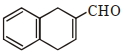
B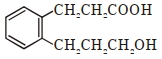
C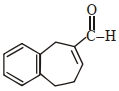
D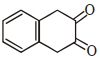
Solution
(A) The given reaction is an intramolecular aldol condensation of $o$-phenylenediacetaldehyde.
$1$. The base $(OH^-)$ abstracts an $\alpha$-hydrogen from one of the aldehyde groups to form an enolate ion.
$2$. This enolate ion performs a nucleophilic attack on the carbonyl carbon of the other aldehyde group,leading to the formation of a cyclic $\beta$-hydroxy aldehyde.
$3$. Upon heating in the presence of an acid or base (dehydration),the $\beta$-hydroxy aldehyde undergoes elimination of a water molecule to form an $\alpha,\beta$-unsaturated aldehyde.
$4$. The final product is $2$-formyl$-1,2,3,4-$tetrahydronaphthalene.
$1$. The base $(OH^-)$ abstracts an $\alpha$-hydrogen from one of the aldehyde groups to form an enolate ion.
$2$. This enolate ion performs a nucleophilic attack on the carbonyl carbon of the other aldehyde group,leading to the formation of a cyclic $\beta$-hydroxy aldehyde.
$3$. Upon heating in the presence of an acid or base (dehydration),the $\beta$-hydroxy aldehyde undergoes elimination of a water molecule to form an $\alpha,\beta$-unsaturated aldehyde.
$4$. The final product is $2$-formyl$-1,2,3,4-$tetrahydronaphthalene.
0 likesView Solution
244
ChemistryDifficultMCQJEE Main · 2021
Identify $A$ in the following chemical reaction:
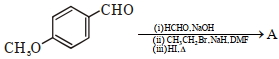
A
$4-$hydroxybenzyl ethyl ether
B
$4-$hydroxybenzyl iodide
C
$4-$methoxybenzyl alcohol
D
$4-$hydroxybenzyl alcohol
Solution
(B) The reaction proceeds in three steps:
$1$. Cross-Cannizzaro reaction: $p$-methoxybenzaldehyde reacts with $HCHO$ in the presence of $NaOH$ to form $p$-methoxybenzyl alcohol $(CH_3O-C_6H_4-CH_2OH)$ and sodium formate.
$2$. Williamson ether synthesis: The alcohol $p$-methoxybenzyl alcohol reacts with $CH_3CH_2Br$ in the presence of $NaH$ to form $p$-methoxybenzyl ethyl ether $(CH_3O-C_6H_4-CH_2-O-CH_2CH_3)$.
$3$. Cleavage with $HI$ and $\Delta$: The ether linkage and the methoxy group are cleaved by $HI$ upon heating. The methoxy group $(CH_3O-)$ is converted to $OH$ and $CH_3I$,and the benzyl ether $(R-CH_2-O-CH_2CH_3)$ is cleaved to form $p$-hydroxybenzyl iodide $(HO-C_6H_4-CH_2I)$ and ethanol (which further reacts with $HI$ to form $CH_3CH_2I$).
Thus,the final product $A$ is $4$-hydroxybenzyl iodide.
$1$. Cross-Cannizzaro reaction: $p$-methoxybenzaldehyde reacts with $HCHO$ in the presence of $NaOH$ to form $p$-methoxybenzyl alcohol $(CH_3O-C_6H_4-CH_2OH)$ and sodium formate.
$2$. Williamson ether synthesis: The alcohol $p$-methoxybenzyl alcohol reacts with $CH_3CH_2Br$ in the presence of $NaH$ to form $p$-methoxybenzyl ethyl ether $(CH_3O-C_6H_4-CH_2-O-CH_2CH_3)$.
$3$. Cleavage with $HI$ and $\Delta$: The ether linkage and the methoxy group are cleaved by $HI$ upon heating. The methoxy group $(CH_3O-)$ is converted to $OH$ and $CH_3I$,and the benzyl ether $(R-CH_2-O-CH_2CH_3)$ is cleaved to form $p$-hydroxybenzyl iodide $(HO-C_6H_4-CH_2I)$ and ethanol (which further reacts with $HI$ to form $CH_3CH_2I$).
Thus,the final product $A$ is $4$-hydroxybenzyl iodide.
0 likesView Solution
245
ChemistryEasyMCQJEE Main · 2021
Match List-$I$ with List-$II$:
Choose the correct answer from the options given below:
| List-$I$ | List-$II$ |
|---|---|
| $a$. Benzenediazonium chloride $\xrightarrow{Cu_2Cl_2/HCl}$ Chlorobenzene $+ N_2$ | $i$. Wurtz reaction |
| $b$. Benzenediazonium chloride $\xrightarrow{Cu/HCl}$ Chlorobenzene $+ N_2$ | $ii$. Sandmeyer reaction |
| $c$. $2 CH_3CH_2Cl + 2 Na \xrightarrow{Ether} C_2H_5-C_2H_5 + 2 NaCl$ | $iii$. Fittig reaction |
| $d$. $2 C_6H_5Cl + 2 Na \xrightarrow{Ether} C_6H_5-C_6H_5 + 2 NaCl$ | $iv$. Gatterman reaction |
Choose the correct answer from the options given below:
A
$a$ $\rightarrow iii, b$ $\rightarrow i, c$ $\rightarrow iv, d$ $\rightarrow ii$
B
$a$ $\rightarrow ii, b$ $\rightarrow i, c$ $\rightarrow iv, d$ $\rightarrow iii$
C
$a$ $\rightarrow ii, b$ $\rightarrow iv, c$ $\rightarrow i, d$ $\rightarrow iii$
D
$a$ $\rightarrow iii, b$ $\rightarrow iv, c$ $\rightarrow i, d$ $\rightarrow ii$
Solution
(C) . Benzenediazonium chloride reacting with $Cu_2Cl_2/HCl$ is the Sandmeyer reaction $(a \rightarrow ii)$.
$b$. Benzenediazonium chloride reacting with $Cu/HCl$ is the Gatterman reaction $(b \rightarrow iv)$.
$c$. The reaction of alkyl halides with $Na$ in ether to form alkanes is the Wurtz reaction $(c \rightarrow i)$.
$d$. The reaction of aryl halides with $Na$ in ether to form diaryls is the Fittig reaction $(d \rightarrow iii)$.
Therefore,the correct matching is $a$ $\rightarrow ii, b$ $\rightarrow iv, c$ $\rightarrow i, d$ $\rightarrow iii$.
$b$. Benzenediazonium chloride reacting with $Cu/HCl$ is the Gatterman reaction $(b \rightarrow iv)$.
$c$. The reaction of alkyl halides with $Na$ in ether to form alkanes is the Wurtz reaction $(c \rightarrow i)$.
$d$. The reaction of aryl halides with $Na$ in ether to form diaryls is the Fittig reaction $(d \rightarrow iii)$.
Therefore,the correct matching is $a$ $\rightarrow ii, b$ $\rightarrow iv, c$ $\rightarrow i, d$ $\rightarrow iii$.
0 likesView Solution
246
ChemistryMediumMCQJEE Main · 2021
Identify $A$ in the given reaction.
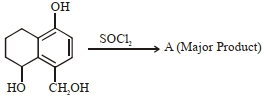
A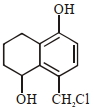
B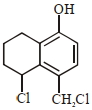
C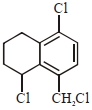
D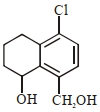
Solution
(B) The reaction involves the treatment of a polyfunctional compound with $SOCl_2$.
$SOCl_2$ (thionyl chloride) is a reagent commonly used to convert alcohols into alkyl chlorides.
In the given substrate,there are three hydroxyl groups:
$1$. $A$ phenolic $-OH$ group.
$2$. $A$ secondary aliphatic $-OH$ group on the saturated ring.
$3$. $A$ primary benzylic $-CH_2OH$ group.
$SOCl_2$ reacts readily with aliphatic alcohols (both primary and secondary) to form alkyl chlorides.
However,it does not typically convert phenolic $-OH$ groups into aryl chlorides under standard conditions.
Therefore,both the secondary $-OH$ and the primary benzylic $-CH_2OH$ groups will be converted into $-Cl$ and $-CH_2Cl$ respectively.
The resulting major product $A$ will have a phenolic $-OH$ group intact,a secondary $-Cl$ group,and a $-CH_2Cl$ group.
This corresponds to the structure shown in option $B$.
$SOCl_2$ (thionyl chloride) is a reagent commonly used to convert alcohols into alkyl chlorides.
In the given substrate,there are three hydroxyl groups:
$1$. $A$ phenolic $-OH$ group.
$2$. $A$ secondary aliphatic $-OH$ group on the saturated ring.
$3$. $A$ primary benzylic $-CH_2OH$ group.
$SOCl_2$ reacts readily with aliphatic alcohols (both primary and secondary) to form alkyl chlorides.
However,it does not typically convert phenolic $-OH$ groups into aryl chlorides under standard conditions.
Therefore,both the secondary $-OH$ and the primary benzylic $-CH_2OH$ groups will be converted into $-Cl$ and $-CH_2Cl$ respectively.
The resulting major product $A$ will have a phenolic $-OH$ group intact,a secondary $-Cl$ group,and a $-CH_2Cl$ group.
This corresponds to the structure shown in option $B$.
0 likesView Solution
247
ChemistryEasyMCQJEE Main · 2021
Match List-$I$ with List-$II$.
Choose the correct answer from the options given below:
| List-$I$ | List-$II$ |
| $(a)$ Siderite | $(i)$ $Cu$ |
| $(b)$ Calamine | $(ii)$ $Ca$ |
| $(c)$ Malachite | $(iii)$ $Fe$ |
| $(d)$ Cryolite | $(iv)$ $Al$ |
| $(v)$ $Zn$ |
Choose the correct answer from the options given below:
A
$(a)$ $\rightarrow (iii), (b)$ $\rightarrow (i), (c)$ $\rightarrow (v), (d)$ $\rightarrow (ii)$
B
$(a)$ $\rightarrow (i), (b)$ $\rightarrow (ii), (c)$ $\rightarrow (v), (d)$ $\rightarrow (iii)$
C
$(a)$ $\rightarrow (iii), (b)$ $\rightarrow (v), (c)$ $\rightarrow (i), (d)$ $\rightarrow (iv)$
D
$(a)$ $\rightarrow (i), (b)$ $\rightarrow (ii), (c)$ $\rightarrow (iii), (d)$ $\rightarrow (iv)$
Solution
(C) Siderite is $FeCO_{3}$,which is an ore of $Fe$.
$(b)$ Calamine is $ZnCO_{3}$,which is an ore of $Zn$.
$(c)$ Malachite is $Cu(OH)_{2} \cdot CuCO_{3}$,which is an ore of $Cu$.
$(d)$ Cryolite is $Na_{3}AlF_{6}$,which is an ore of $Al$.
Therefore,the correct matching is: $(a)$ $\rightarrow (iii), (b)$ $\rightarrow (v), (c)$ $\rightarrow (i), (d)$ $\rightarrow (iv)$.
$(b)$ Calamine is $ZnCO_{3}$,which is an ore of $Zn$.
$(c)$ Malachite is $Cu(OH)_{2} \cdot CuCO_{3}$,which is an ore of $Cu$.
$(d)$ Cryolite is $Na_{3}AlF_{6}$,which is an ore of $Al$.
Therefore,the correct matching is: $(a)$ $\rightarrow (iii), (b)$ $\rightarrow (v), (c)$ $\rightarrow (i), (d)$ $\rightarrow (iv)$.
0 likesView Solution
248
ChemistryEasyMCQJEE Main · 2021
The nature of charge on resulting colloidal particles when $FeCl_3$ is added to excess of hot water is:
A
Positive
B
Sometimes positive and sometimes negative
C
Neutral
D
Negative
Solution
(A) When $FeCl_3$ is added to excess of hot water,it undergoes hydrolysis to form hydrated ferric oxide,$Fe_2O_3 \cdot xH_2O$.
During this process,the colloidal particles preferentially adsorb $Fe^{3+}$ ions from the solution,resulting in the formation of a positively charged sol.
The representation is $Fe_2O_3 \cdot xH_2O / Fe^{3+}$.
Therefore,the nature of the charge is positive.
During this process,the colloidal particles preferentially adsorb $Fe^{3+}$ ions from the solution,resulting in the formation of a positively charged sol.
The representation is $Fe_2O_3 \cdot xH_2O / Fe^{3+}$.
Therefore,the nature of the charge is positive.
0 likesView Solution
249
ChemistryEasyMCQJEE Main · 2021
Match List-$I$ with List-$II$:
Choose the correct answer from the options given below:
| List-$I$ | List-$II$ |
|---|---|
| $(a)$ Sodium Carbonate | $(i)$ Deacon |
| $(b)$ Titanium | $(ii)$ Castner-Kellner |
| $(c)$ Chlorine | $(iii)$ Van-Arkel |
| $(d)$ Sodium hydroxide | $(iv)$ Solvay |
Choose the correct answer from the options given below:
A
$(a)$ $\rightarrow (iv), (b)$ $\rightarrow (iii), (c)$ $\rightarrow (i), (d)$ $\rightarrow (ii)$
B
$(a)$ $\rightarrow (i), (b)$ $\rightarrow (iii), (c)$ $\rightarrow (iv), (d)$ $\rightarrow (ii)$
C
$(a)$ $\rightarrow (iv), (b)$ $\rightarrow (i), (c)$ $\rightarrow (ii), (d)$ $\rightarrow (iii)$
D
$(a)$ $\rightarrow (iii), (b)$ $\rightarrow (ii), (c)$ $\rightarrow (i), (d)$ $\rightarrow (iv)$
Solution
(A) Sodium carbonate $(Na_2CO_3)$ is prepared by the Solvay process.
$(b)$ Titanium $(Ti)$ is refined by the Van-Arkel process.
$(c)$ Chlorine $(Cl_2)$ is prepared by the Deacon process.
$(d)$ Sodium hydroxide $(NaOH)$ is prepared by the Castner-Kellner process.
Therefore,the correct matching is $(a)$ $\rightarrow (iv), (b)$ $\rightarrow (iii), (c)$ $\rightarrow (i), (d)$ $\rightarrow (ii)$.
$(b)$ Titanium $(Ti)$ is refined by the Van-Arkel process.
$(c)$ Chlorine $(Cl_2)$ is prepared by the Deacon process.
$(d)$ Sodium hydroxide $(NaOH)$ is prepared by the Castner-Kellner process.
Therefore,the correct matching is $(a)$ $\rightarrow (iv), (b)$ $\rightarrow (iii), (c)$ $\rightarrow (i), (d)$ $\rightarrow (ii)$.
0 likesView Solution
250
ChemistryMediumMCQJEE Main · 2021
$Emf$ of the following cell at $298 \,K$ in $V$ is $x \times 10^{-2}$. $Zn | Zn^{2+}(0.1 \,M) || Ag^{+}(0.01 \,M) | Ag$. The value of $x$ is .... . (Rounded off to the nearest integer) [Given: $E^{0}_{Zn^{2+}/Zn} = -0.76 \,V$; $E^{0}_{Ag^{+}/Ag} = +0.80 \,V$; $\frac{2.303 RT}{F} = 0.059$]
A
$147$
B
$157$
C
$188$
D
$288$
Solution
(A) The cell reaction is: $Zn_{(s)} + 2Ag^{+}_{(aq)} \rightarrow Zn^{2+}_{(aq)} + 2Ag_{(s)}$
$E^{0}_{cell} = E^{0}_{cathode} - E^{0}_{anode} = 0.80 - (-0.76) = 1.56 \,V$
Using the Nernst equation: $E_{cell} = E^{0}_{cell} - \frac{0.059}{n} \log \frac{[Zn^{2+}]}{[Ag^{+}]^{2}}$
Here,$n = 2$,$[Zn^{2+}] = 0.1$,and $[Ag^{+}] = 0.01$
$E_{cell} = 1.56 - \frac{0.059}{2} \log \frac{0.1}{(0.01)^{2}}$
$E_{cell} = 1.56 - 0.0295 \times \log(1000)$
$E_{cell} = 1.56 - 0.0295 \times 3 = 1.56 - 0.0885 = 1.4715 \,V$
$E_{cell} = 147.15 \times 10^{-2} \,V$
Rounding to the nearest integer,$x = 147$.
$E^{0}_{cell} = E^{0}_{cathode} - E^{0}_{anode} = 0.80 - (-0.76) = 1.56 \,V$
Using the Nernst equation: $E_{cell} = E^{0}_{cell} - \frac{0.059}{n} \log \frac{[Zn^{2+}]}{[Ag^{+}]^{2}}$
Here,$n = 2$,$[Zn^{2+}] = 0.1$,and $[Ag^{+}] = 0.01$
$E_{cell} = 1.56 - \frac{0.059}{2} \log \frac{0.1}{(0.01)^{2}}$
$E_{cell} = 1.56 - 0.0295 \times \log(1000)$
$E_{cell} = 1.56 - 0.0295 \times 3 = 1.56 - 0.0885 = 1.4715 \,V$
$E_{cell} = 147.15 \times 10^{-2} \,V$
Rounding to the nearest integer,$x = 147$.
0 likesView Solution
Vedclass Products
For Students
Vedclass Test Series
Mock tests in real JEE Main style covering Chemistry with performance analysis. 5-day free trial.
Start Free TrialFor Teachers
Exam Paper Generator
Generate Set A/B/C/D Chemistry papers from 7.5L+ questions in 2 minutes. 3 chapters free.
Try FreeFor Institutes
Online Exam Module
Run live JEE Main mock exams with unlimited students, 360° analytics & white-label branding.
See DemoFrequently Asked Questions
How many Chemistry questions are in JEE Main 2021?
There are 798 Chemistry questions from the JEE Main 2021 paper on Vedclass, each with a detailed step-by-step solution in English.
Are JEE Main 2021 Chemistry solutions available in English?
Yes. All solutions on this page are in English. You can also switch to English or Hindi using the language buttons above the questions.
Can I practice JEE Main 2021 Chemistry as a timed test?
Yes. Use the Vedclass Test Series to attempt a full JEE Main mock test covering Chemistry with time limits and instant score analysis.
Can teachers create Chemistry papers from JEE Main previous year questions?
Yes. The Vedclass Exam Paper Generator lets teachers mix JEE Main Chemistry questions and generate Set A/B/C/D papers in minutes.
For Teachers & Institutes
Build a Custom Chemistry Paper
Pick JEE Main 2021 Chemistry questions, set difficulty, and generate Set A/B/C/D in 2 minutes.