
MathematicsQ1–26 of 26 questions
Page 1 of 1 · Gujarati
1
MathematicsEasyMCQGSEB · 2019
$f(x) = x^2 + 4x + 5$ ની ન્યૂનતમ કિંમત . . . . . . છે,જ્યાં $x \in R$.
A
$2$
B
$1$
C
$4$
D
$-1$
Solution
(B) દ્વિઘાત વિધેય $f(x) = x^2 + 4x + 5$ ની ન્યૂનતમ કિંમત શોધવા માટે,આપણે પૂર્ણવર્ગની રીત અથવા વિકલનનો ઉપયોગ કરી શકીએ છીએ.
રીત $1$: પૂર્ણવર્ગની રીત
$f(x) = x^2 + 4x + 4 + 1$
$f(x) = (x + 2)^2 + 1$
બધા $x \in R$ માટે $(x + 2)^2 \ge 0$ હોવાથી,$f(x)$ ની ન્યૂનતમ કિંમત $0 + 1 = 1$ થાય છે.
રીત $2$: વિકલનની રીત
$f'(x) = 2x + 4$
$f'(x) = 0$ લેતા,$2x + 4 = 0$,તેથી $x = -2$.
$f(-2) = (-2)^2 + 4(-2) + 5 = 4 - 8 + 5 = 1$.
આમ,ન્યૂનતમ કિંમત $1$ છે.
રીત $1$: પૂર્ણવર્ગની રીત
$f(x) = x^2 + 4x + 4 + 1$
$f(x) = (x + 2)^2 + 1$
બધા $x \in R$ માટે $(x + 2)^2 \ge 0$ હોવાથી,$f(x)$ ની ન્યૂનતમ કિંમત $0 + 1 = 1$ થાય છે.
રીત $2$: વિકલનની રીત
$f'(x) = 2x + 4$
$f'(x) = 0$ લેતા,$2x + 4 = 0$,તેથી $x = -2$.
$f(-2) = (-2)^2 + 4(-2) + 5 = 4 - 8 + 5 = 1$.
આમ,ન્યૂનતમ કિંમત $1$ છે.
0 likesView Solution
2
MathematicsEasyMCQGSEB · 2019
$\sin^{-1}$ નો પ્રદેશ . . . . . . છે.
A
$(-\infty, \infty)$
B
$[0, \pi]$
C
$[0, 1]$
D
$[-1, 1]$
Solution
(D) વિધેય $f(x) = \sin^{-1}(x)$ એ સાઈન વિધેય $f(x) = \sin(x)$ નું પ્રતિવિધેય છે.
સાઈન વિધેય માટે,તેનો વિસ્તાર $[-1, 1]$ છે.
પ્રતિ-ત્રિકોણમિતીય વિધેયોની વ્યાખ્યા મુજબ,પ્રતિવિધેયનો પ્રદેશ એ મૂળ વિધેયના વિસ્તાર જેટલો હોય છે.
તેથી,$\sin^{-1}(x)$ નો પ્રદેશ $[-1, 1]$ છે.
સાઈન વિધેય માટે,તેનો વિસ્તાર $[-1, 1]$ છે.
પ્રતિ-ત્રિકોણમિતીય વિધેયોની વ્યાખ્યા મુજબ,પ્રતિવિધેયનો પ્રદેશ એ મૂળ વિધેયના વિસ્તાર જેટલો હોય છે.
તેથી,$\sin^{-1}(x)$ નો પ્રદેશ $[-1, 1]$ છે.
0 likesView Solution
3
MathematicsEasyMCQGSEB · 2019
$\sec ^2(\tan ^{-1} 3) + \operatorname{cosec}^2(\cot ^{-1} 3) = $ . . . . . . .
A
$15$
B
$13$
C
$20$
D
$25$
Solution
(C) આપણે ત્રિકોણમિતીય નિત્યસમ જાણીએ છીએ: $\sec ^2(\theta) = 1 + \tan ^2(\theta)$ અને $\operatorname{cosec}^2(\theta) = 1 + \cot ^2(\theta)$.
ધારો કે $\theta_1 = \tan ^{-1} 3$,તો $\tan(\theta_1) = 3$.
ધારો કે $\theta_2 = \cot ^{-1} 3$,તો $\cot(\theta_2) = 3$.
આ કિંમતોને પદાવલિમાં મૂકતા:
$\sec ^2(\tan ^{-1} 3) = 1 + \tan ^2(\tan ^{-1} 3) = 1 + (3)^2 = 1 + 9 = 10$.
$\operatorname{cosec}^2(\cot ^{-1} 3) = 1 + \cot ^2(\cot ^{-1} 3) = 1 + (3)^2 = 1 + 9 = 10$.
આ પરિણામોનો સરવાળો કરતા:
$10 + 10 = 20$.
તેથી,સાચો વિકલ્પ $C$ છે.
ધારો કે $\theta_1 = \tan ^{-1} 3$,તો $\tan(\theta_1) = 3$.
ધારો કે $\theta_2 = \cot ^{-1} 3$,તો $\cot(\theta_2) = 3$.
આ કિંમતોને પદાવલિમાં મૂકતા:
$\sec ^2(\tan ^{-1} 3) = 1 + \tan ^2(\tan ^{-1} 3) = 1 + (3)^2 = 1 + 9 = 10$.
$\operatorname{cosec}^2(\cot ^{-1} 3) = 1 + \cot ^2(\cot ^{-1} 3) = 1 + (3)^2 = 1 + 9 = 10$.
આ પરિણામોનો સરવાળો કરતા:
$10 + 10 = 20$.
તેથી,સાચો વિકલ્પ $C$ છે.
0 likesView Solution
4
MathematicsEasyMCQGSEB · 2019
$\sin^{-1}\left(\sin \frac{5\pi}{3}\right)$ ની કિંમત . . . . . . બરાબર છે.
A
$-\frac{\pi}{3}$
B
$\frac{\pi}{3}$
C
$\frac{5\pi}{3}$
D
$\frac{2\pi}{3}$
Solution
(A) આપણે જાણીએ છીએ કે $\sin^{-1}(x)$ ની મુખ્ય કિંમતની શાખા $[-\frac{\pi}{2}, \frac{\pi}{2}]$ છે.
આપેલ પદ $\sin^{-1}\left(\sin \frac{5\pi}{3}\right)$ છે.
પ્રથમ,સાઈન વિધેયની અંદરના ખૂણાને સરળ બનાવો:
$\frac{5\pi}{3} = 2\pi - \frac{\pi}{3}$.
કારણ કે $\sin(2\pi - \theta) = -\sin(\theta)$,તેથી:
$\sin\left(\frac{5\pi}{3}\right) = \sin\left(2\pi - \frac{\pi}{3}\right) = -\sin\left(\frac{\pi}{3}\right) = \sin\left(-\frac{\pi}{3}\right)$.
હવે,આ કિંમતને પદમાં પાછી મૂકો:
$\sin^{-1}\left(\sin\left(-\frac{\pi}{3}\right)\right)$.
કારણ કે $-\frac{\pi}{3} \in [-\frac{\pi}{2}, \frac{\pi}{2}]$,તેથી કિંમત $-\frac{\pi}{3}$ થાય છે.
તેથી,સાચો વિકલ્પ $A$ છે.
આપેલ પદ $\sin^{-1}\left(\sin \frac{5\pi}{3}\right)$ છે.
પ્રથમ,સાઈન વિધેયની અંદરના ખૂણાને સરળ બનાવો:
$\frac{5\pi}{3} = 2\pi - \frac{\pi}{3}$.
કારણ કે $\sin(2\pi - \theta) = -\sin(\theta)$,તેથી:
$\sin\left(\frac{5\pi}{3}\right) = \sin\left(2\pi - \frac{\pi}{3}\right) = -\sin\left(\frac{\pi}{3}\right) = \sin\left(-\frac{\pi}{3}\right)$.
હવે,આ કિંમતને પદમાં પાછી મૂકો:
$\sin^{-1}\left(\sin\left(-\frac{\pi}{3}\right)\right)$.
કારણ કે $-\frac{\pi}{3} \in [-\frac{\pi}{2}, \frac{\pi}{2}]$,તેથી કિંમત $-\frac{\pi}{3}$ થાય છે.
તેથી,સાચો વિકલ્પ $A$ છે.
0 likesView Solution
5
MathematicsEasyMCQGSEB · 2019
$\cos \left(\cos ^{-1}\left(-\frac{1}{4}\right)+\sin ^{-1}\left(-\frac{1}{4}\right)\right) = $ . . . . . . .
A
$0$
B
$1$
C
$-1$
D
$\frac{1}{2}$
Solution
(A) આપણે જાણીએ છીએ કે કોઈપણ $x \in [-1, 1]$ માટે,નિત્યસમ $\sin^{-1}(x) + \cos^{-1}(x) = \frac{\pi}{2}$ સાચું છે.
આપેલ પદાવલિ $\cos \left(\cos ^{-1}\left(-\frac{1}{4}\right)+\sin ^{-1}\left(-\frac{1}{4}\right)\right)$ છે.
ધારો કે $x = -\frac{1}{4}$. કારણ કે $x \in [-1, 1]$,આપણે આ નિત્યસમનો ઉપયોગ કરી શકીએ છીએ.
તેથી,$\cos^{-1}\left(-\frac{1}{4}\right) + \sin^{-1}\left(-\frac{1}{4}\right) = \frac{\pi}{2}$.
આ કિંમતને મૂળ પદાવલિમાં મૂકતા,આપણને $\cos \left(\frac{\pi}{2}\right)$ મળે છે.
કારણ કે $\cos \left(\frac{\pi}{2}\right) = 0$,તેથી અંતિમ જવાબ $0$ છે.
આપેલ પદાવલિ $\cos \left(\cos ^{-1}\left(-\frac{1}{4}\right)+\sin ^{-1}\left(-\frac{1}{4}\right)\right)$ છે.
ધારો કે $x = -\frac{1}{4}$. કારણ કે $x \in [-1, 1]$,આપણે આ નિત્યસમનો ઉપયોગ કરી શકીએ છીએ.
તેથી,$\cos^{-1}\left(-\frac{1}{4}\right) + \sin^{-1}\left(-\frac{1}{4}\right) = \frac{\pi}{2}$.
આ કિંમતને મૂળ પદાવલિમાં મૂકતા,આપણને $\cos \left(\frac{\pi}{2}\right)$ મળે છે.
કારણ કે $\cos \left(\frac{\pi}{2}\right) = 0$,તેથી અંતિમ જવાબ $0$ છે.
0 likesView Solution
6
MathematicsEasyMCQGSEB · 2019
$\left|\begin{array}{rr}\sin 35^{\circ} & -\cos 35^{\circ} \\ \sin 55^{\circ} & \cos 55^{\circ}\end{array}\right|=$ . . . . . .
A
$0$
B
$-1$
C
$1$
D
$2$
Solution
(C) નિશ્ચાયક $\left|\begin{array}{rr}\sin 35^{\circ} & -\cos 35^{\circ} \\ \sin 55^{\circ} & \cos 55^{\circ}\end{array}\right|$ ની કિંમત શોધવા માટે,આપણે $2 \times 2$ નિશ્ચાયકના સૂત્રનો ઉપયોગ કરીએ છીએ: $\left|\begin{array}{rr}a & b \\ c & d\end{array}\right| = ad - bc$.
આપેલ શ્રેણિક પર આ લાગુ પાડતા:
$= (\sin 35^{\circ})(\cos 55^{\circ}) - (-\cos 35^{\circ})(\sin 55^{\circ})$
$= \sin 35^{\circ} \cos 55^{\circ} + \cos 35^{\circ} \sin 55^{\circ}$
ત્રિકોણમિતીય નિત્યસમ $\sin(A + B) = \sin A \cos B + \cos A \sin B$ નો ઉપયોગ કરતા,જ્યાં $A = 35^{\circ}$ અને $B = 55^{\circ}$ છે:
$= \sin(35^{\circ} + 55^{\circ})$
$= \sin(90^{\circ})$
$= 1$
આમ,સાચો વિકલ્પ $C$ છે.
આપેલ શ્રેણિક પર આ લાગુ પાડતા:
$= (\sin 35^{\circ})(\cos 55^{\circ}) - (-\cos 35^{\circ})(\sin 55^{\circ})$
$= \sin 35^{\circ} \cos 55^{\circ} + \cos 35^{\circ} \sin 55^{\circ}$
ત્રિકોણમિતીય નિત્યસમ $\sin(A + B) = \sin A \cos B + \cos A \sin B$ નો ઉપયોગ કરતા,જ્યાં $A = 35^{\circ}$ અને $B = 55^{\circ}$ છે:
$= \sin(35^{\circ} + 55^{\circ})$
$= \sin(90^{\circ})$
$= 1$
આમ,સાચો વિકલ્પ $C$ છે.
0 likesView Solution
7
MathematicsEasyMCQGSEB · 2019
જો $x = at^2$ અને $y = 2at$ હોય,તો $\frac{dy}{dx} =$ . . . . . . ,જ્યાં $t \neq 0$.
A
$\frac{2}{1}$
B
$at$
C
$\frac{t}{2}$
D
$\frac{1}{t}$
Solution
(D) આપેલ પ્રાચલિત સમીકરણો $x = at^2$ અને $y = 2at$ છે.
પ્રથમ,$x$ નું $t$ ની સાપેક્ષમાં વિકલન કરતા:
$\frac{dx}{dt} = \frac{d}{dt}(at^2) = 2at$.
ત્યારબાદ,$y$ નું $t$ ની સાપેક્ષમાં વિકલન કરતા:
$\frac{dy}{dt} = \frac{d}{dt}(2at) = 2a$.
પ્રાચલિત વિકલન માટે શૃંખલાના નિયમનો ઉપયોગ કરતા:
$\frac{dy}{dx} = \frac{dy/dt}{dx/dt} = \frac{2a}{2at}$.
અહીં $t \neq 0$ અને $a \neq 0$ હોવાથી,પદનું સાદું રૂપ આપતા:
$\frac{dy}{dx} = \frac{1}{t}$.
તેથી,સાચો વિકલ્પ $D$ છે.
પ્રથમ,$x$ નું $t$ ની સાપેક્ષમાં વિકલન કરતા:
$\frac{dx}{dt} = \frac{d}{dt}(at^2) = 2at$.
ત્યારબાદ,$y$ નું $t$ ની સાપેક્ષમાં વિકલન કરતા:
$\frac{dy}{dt} = \frac{d}{dt}(2at) = 2a$.
પ્રાચલિત વિકલન માટે શૃંખલાના નિયમનો ઉપયોગ કરતા:
$\frac{dy}{dx} = \frac{dy/dt}{dx/dt} = \frac{2a}{2at}$.
અહીં $t \neq 0$ અને $a \neq 0$ હોવાથી,પદનું સાદું રૂપ આપતા:
$\frac{dy}{dx} = \frac{1}{t}$.
તેથી,સાચો વિકલ્પ $D$ છે.
0 likesView Solution
8
MathematicsEasyMCQGSEB · 2019
$x \in R$ માટે $\tan ^{-1} x$ નું $\cot ^{-1} x$ ની સાપેક્ષમાં વિકલન કરો.
A
$1$
B
$\frac{1}{1+x^2}$
C
$-1$
D
$\frac{-1}{1+x^2}$
Solution
(C) ધારો કે $u = \tan^{-1} x$ અને $v = \cot^{-1} x$.
આપણે જાણીએ છીએ કે તમામ $x \in R$ માટે $\tan^{-1} x + \cot^{-1} x = \frac{\pi}{2}$ થાય છે.
તેથી,$u + v = \frac{\pi}{2}$,જેનો અર્થ છે કે $u = \frac{\pi}{2} - v$.
હવે,$u$ નું $v$ ની સાપેક્ષમાં વિકલન કરતા:
$\frac{du}{dv} = \frac{d}{dv} (\frac{\pi}{2} - v) = 0 - 1 = -1$.
આમ,$\tan^{-1} x$ નું $\cot^{-1} x$ ની સાપેક્ષમાં વિકલન $-1$ છે.
આપણે જાણીએ છીએ કે તમામ $x \in R$ માટે $\tan^{-1} x + \cot^{-1} x = \frac{\pi}{2}$ થાય છે.
તેથી,$u + v = \frac{\pi}{2}$,જેનો અર્થ છે કે $u = \frac{\pi}{2} - v$.
હવે,$u$ નું $v$ ની સાપેક્ષમાં વિકલન કરતા:
$\frac{du}{dv} = \frac{d}{dv} (\frac{\pi}{2} - v) = 0 - 1 = -1$.
આમ,$\tan^{-1} x$ નું $\cot^{-1} x$ ની સાપેક્ષમાં વિકલન $-1$ છે.
0 likesView Solution
9
MathematicsEasyMCQGSEB · 2019
$\frac{d}{dx}(\log_5 x^2) = $ . . . . . .
A
$\frac{1}{x^2}$
B
$\frac{2}{(\log 5)x}$
C
$\frac{1}{(\log 5)x}$
D
$\frac{1}{(\log 5)x^2}$
Solution
(B) આપણે જાણીએ છીએ કે $\log_a b = \frac{\log_e b}{\log_e a}$.
તેથી,$\log_5 x^2 = \frac{\ln x^2}{\ln 5} = \frac{2 \ln x}{\ln 5}$.
હવે,$x$ ની સાપેક્ષમાં વિકલન કરતા:
$\frac{d}{dx} \left( \frac{2 \ln x}{\ln 5} \right) = \frac{2}{\ln 5} \cdot \frac{d}{dx}(\ln x)$.
કારણ કે $\frac{d}{dx}(\ln x) = \frac{1}{x}$,આપણને મળે છે:
$\frac{2}{\ln 5} \cdot \frac{1}{x} = \frac{2}{x \ln 5}$.
કારણ કે $\ln 5 = \log 5$,પરિણામ $\frac{2}{x \log 5}$ છે.
તેથી,$\log_5 x^2 = \frac{\ln x^2}{\ln 5} = \frac{2 \ln x}{\ln 5}$.
હવે,$x$ ની સાપેક્ષમાં વિકલન કરતા:
$\frac{d}{dx} \left( \frac{2 \ln x}{\ln 5} \right) = \frac{2}{\ln 5} \cdot \frac{d}{dx}(\ln x)$.
કારણ કે $\frac{d}{dx}(\ln x) = \frac{1}{x}$,આપણને મળે છે:
$\frac{2}{\ln 5} \cdot \frac{1}{x} = \frac{2}{x \ln 5}$.
કારણ કે $\ln 5 = \log 5$,પરિણામ $\frac{2}{x \log 5}$ છે.
0 likesView Solution
10
MathematicsEasyMCQGSEB · 2019
$\int e^x \left( \frac{1 + \sin x}{1 + \cos x} \right) dx = $ . . . . . . $+ c$.
A
$e^x \tan x$
B
$e^x \tan \frac{x}{2}$
C
$e^x \cot \frac{x}{2}$
D
$e^x \cot x$
Solution
(B) આપણે જાણીએ છીએ કે $\int e^x [f(x) + f'(x)] dx = e^x f(x) + c$.
આપેલ સંકલન $I = \int e^x \left( \frac{1 + \sin x}{1 + \cos x} \right) dx$ છે.
ત્રિકોણમિતીય નિત્યસમનો ઉપયોગ કરતા: $1 + \sin x = 1 + 2 \sin \frac{x}{2} \cos \frac{x}{2}$ અને $1 + \cos x = 2 \cos^2 \frac{x}{2}$.
આ કિંમતો પદમાં મૂકતા: $\frac{1 + \sin x}{1 + \cos x} = \frac{1 + 2 \sin \frac{x}{2} \cos \frac{x}{2}}{2 \cos^2 \frac{x}{2}} = \frac{1}{2 \cos^2 \frac{x}{2}} + \frac{2 \sin \frac{x}{2} \cos \frac{x}{2}}{2 \cos^2 \frac{x}{2}} = \frac{1}{2} \sec^2 \frac{x}{2} + \tan \frac{x}{2}$.
ધારો કે $f(x) = \tan \frac{x}{2}$,તો $f'(x) = \sec^2 \frac{x}{2} \cdot \frac{1}{2} = \frac{1}{2} \sec^2 \frac{x}{2}$.
આમ,સંકલન $\int e^x [f(x) + f'(x)] dx = e^x f(x) + c = e^x \tan \frac{x}{2} + c$ થાય છે.
આપેલ સંકલન $I = \int e^x \left( \frac{1 + \sin x}{1 + \cos x} \right) dx$ છે.
ત્રિકોણમિતીય નિત્યસમનો ઉપયોગ કરતા: $1 + \sin x = 1 + 2 \sin \frac{x}{2} \cos \frac{x}{2}$ અને $1 + \cos x = 2 \cos^2 \frac{x}{2}$.
આ કિંમતો પદમાં મૂકતા: $\frac{1 + \sin x}{1 + \cos x} = \frac{1 + 2 \sin \frac{x}{2} \cos \frac{x}{2}}{2 \cos^2 \frac{x}{2}} = \frac{1}{2 \cos^2 \frac{x}{2}} + \frac{2 \sin \frac{x}{2} \cos \frac{x}{2}}{2 \cos^2 \frac{x}{2}} = \frac{1}{2} \sec^2 \frac{x}{2} + \tan \frac{x}{2}$.
ધારો કે $f(x) = \tan \frac{x}{2}$,તો $f'(x) = \sec^2 \frac{x}{2} \cdot \frac{1}{2} = \frac{1}{2} \sec^2 \frac{x}{2}$.
આમ,સંકલન $\int e^x [f(x) + f'(x)] dx = e^x f(x) + c = e^x \tan \frac{x}{2} + c$ થાય છે.
0 likesView Solution
11
MathematicsEasyMCQGSEB · 2019
$\int (x^2 + 3x + 2) e^x dx = $ . . . . . . $+ C$.
A
$(x^2 - x + 1) e^x$
B
$(x^2 + x - 1) e^x$
C
$(x^2 + x + 1) e^x$
D
$(x^2 - 1) e^x$
Solution
(C) સંકલન $I = \int (x^2 + 3x + 2) e^x dx$ ની ગણતરી કરવા માટે,આપણે ખંડશઃ સંકલન (integration by parts) ના સૂત્રનો ઉપયોગ કરીએ છીએ: $\int u dv = uv - \int v du$.
ધારો કે $u = x^2 + 3x + 2$ અને $dv = e^x dx$.
તેથી $du = (2x + 3) dx$ અને $v = e^x$ મળે.
$I = (x^2 + 3x + 2) e^x - \int (2x + 3) e^x dx$.
હવે,$\int (2x + 3) e^x dx$ માટે ફરીથી ખંડશઃ સંકલનનો ઉપયોગ કરતા:
ધારો કે $u_1 = 2x + 3$ અને $dv_1 = e^x dx$.
તેથી $du_1 = 2 dx$ અને $v_1 = e^x$ મળે.
$\int (2x + 3) e^x dx = (2x + 3) e^x - \int 2 e^x dx = (2x + 3) e^x - 2e^x = (2x + 1) e^x$.
આ કિંમતને $I$ ના સમીકરણમાં મૂકતા:
$I = (x^2 + 3x + 2) e^x - (2x + 1) e^x + C$.
$I = (x^2 + 3x + 2 - 2x - 1) e^x + C$.
$I = (x^2 + x + 1) e^x + C$.
આમ,સાચો વિકલ્પ $C$ છે.
ધારો કે $u = x^2 + 3x + 2$ અને $dv = e^x dx$.
તેથી $du = (2x + 3) dx$ અને $v = e^x$ મળે.
$I = (x^2 + 3x + 2) e^x - \int (2x + 3) e^x dx$.
હવે,$\int (2x + 3) e^x dx$ માટે ફરીથી ખંડશઃ સંકલનનો ઉપયોગ કરતા:
ધારો કે $u_1 = 2x + 3$ અને $dv_1 = e^x dx$.
તેથી $du_1 = 2 dx$ અને $v_1 = e^x$ મળે.
$\int (2x + 3) e^x dx = (2x + 3) e^x - \int 2 e^x dx = (2x + 3) e^x - 2e^x = (2x + 1) e^x$.
આ કિંમતને $I$ ના સમીકરણમાં મૂકતા:
$I = (x^2 + 3x + 2) e^x - (2x + 1) e^x + C$.
$I = (x^2 + 3x + 2 - 2x - 1) e^x + C$.
$I = (x^2 + x + 1) e^x + C$.
આમ,સાચો વિકલ્પ $C$ છે.
0 likesView Solution
12
MathematicsEasyMCQGSEB · 2019
$\int_0^\pi \sin^2 x \cos^3 x \, dx = $ . . . . . . .
A
$0$
B
$-1$
C
$1$
D
$\pi$
Solution
(A) ધારો કે $I = \int_0^\pi \sin^2 x \cos^3 x \, dx$.
ગુણધર્મ $\int_0^a f(x) \, dx = \int_0^a f(a-x) \, dx$ નો ઉપયોગ કરતા,આપણને મળે છે:
$I = \int_0^\pi \sin^2(\pi - x) \cos^3(\pi - x) \, dx$.
કારણ કે $\sin(\pi - x) = \sin x$ અને $\cos(\pi - x) = -\cos x$,તેથી:
$I = \int_0^\pi \sin^2 x (-\cos x)^3 \, dx = -\int_0^\pi \sin^2 x \cos^3 x \, dx$.
આમ,$I = -I$,જેનો અર્થ છે કે $2I = 0$,તેથી $I = 0$.
ગુણધર્મ $\int_0^a f(x) \, dx = \int_0^a f(a-x) \, dx$ નો ઉપયોગ કરતા,આપણને મળે છે:
$I = \int_0^\pi \sin^2(\pi - x) \cos^3(\pi - x) \, dx$.
કારણ કે $\sin(\pi - x) = \sin x$ અને $\cos(\pi - x) = -\cos x$,તેથી:
$I = \int_0^\pi \sin^2 x (-\cos x)^3 \, dx = -\int_0^\pi \sin^2 x \cos^3 x \, dx$.
આમ,$I = -I$,જેનો અર્થ છે કે $2I = 0$,તેથી $I = 0$.
0 likesView Solution
13
MathematicsEasyMCQGSEB · 2019
વિકલ સમીકરણ $2x \frac{dy}{dx} - y = 0$ અને શરત $y(1) = 2$ નો ઉકેલ . . . . . . દર્શાવે છે.
A
રેખા
B
વર્તુળ
C
પરવલય
D
ઉપવલય
Solution
(C) આપેલ વિકલ સમીકરણ: $2x \frac{dy}{dx} - y = 0$.
પદોને ફરીથી ગોઠવતા: $2x \frac{dy}{dx} = y$.
ચલને અલગ કરતા: $\frac{dy}{y} = \frac{dx}{2x}$.
બંને બાજુ સંકલન કરતા: $\int \frac{dy}{y} = \frac{1}{2} \int \frac{dx}{x}$.
આથી મળે છે: $\ln|y| = \frac{1}{2} \ln|x| + C$.
શરત $y(1) = 2$ નો ઉપયોગ કરતા: $\ln(2) = \frac{1}{2} \ln(1) + C \implies C = \ln(2)$.
$C$ ની કિંમત પાછી મૂકતા: $\ln(y) = \ln(\sqrt{x}) + \ln(2) = \ln(2\sqrt{x})$.
આમ,$y = 2\sqrt{x}$,જેનો અર્થ છે $y^2 = 4x$.
સમીકરણ $y^2 = 4ax$ એ પરવલય દર્શાવે છે.
તેથી,સાચો વિકલ્પ $C$ છે.
પદોને ફરીથી ગોઠવતા: $2x \frac{dy}{dx} = y$.
ચલને અલગ કરતા: $\frac{dy}{y} = \frac{dx}{2x}$.
બંને બાજુ સંકલન કરતા: $\int \frac{dy}{y} = \frac{1}{2} \int \frac{dx}{x}$.
આથી મળે છે: $\ln|y| = \frac{1}{2} \ln|x| + C$.
શરત $y(1) = 2$ નો ઉપયોગ કરતા: $\ln(2) = \frac{1}{2} \ln(1) + C \implies C = \ln(2)$.
$C$ ની કિંમત પાછી મૂકતા: $\ln(y) = \ln(\sqrt{x}) + \ln(2) = \ln(2\sqrt{x})$.
આમ,$y = 2\sqrt{x}$,જેનો અર્થ છે $y^2 = 4x$.
સમીકરણ $y^2 = 4ax$ એ પરવલય દર્શાવે છે.
તેથી,સાચો વિકલ્પ $C$ છે.
0 likesView Solution
14
MathematicsEasyMCQGSEB · 2019
વિકલ સમીકરણ $\frac{dy}{dx} + \frac{y}{x} = x^2$ નો સંકલ્યકારક અવયવ (Integrating Factor) . . . . . . છે.
A
$x$
B
$e^x$
C
$\frac{1}{x}$
D
$\log x$
Solution
(A) આપેલ વિકલ સમીકરણ $\frac{dy}{dx} + Py = Q$ સ્વરૂપમાં છે,જ્યાં $P = \frac{1}{x}$ અને $Q = x^2$ છે.
સંકલ્યકારક અવયવ $(IF)$ શોધવાનું સૂત્ર $IF = e^{\int P dx}$ છે.
$P$ ની કિંમત મૂકતા:
$IF = e^{\int \frac{1}{x} dx} = e^{\log x}$.
આપણે જાણીએ છીએ કે $e^{\log x} = x$,તેથી સંકલ્યકારક અવયવ $x$ મળે છે.
આથી,સાચો વિકલ્પ $A$ છે.
સંકલ્યકારક અવયવ $(IF)$ શોધવાનું સૂત્ર $IF = e^{\int P dx}$ છે.
$P$ ની કિંમત મૂકતા:
$IF = e^{\int \frac{1}{x} dx} = e^{\log x}$.
આપણે જાણીએ છીએ કે $e^{\log x} = x$,તેથી સંકલ્યકારક અવયવ $x$ મળે છે.
આથી,સાચો વિકલ્પ $A$ છે.
0 likesView Solution
15
MathematicsEasyMCQGSEB · 2019
વિકલ સમીકરણ $\frac{d^2 y}{d x^2} = \sqrt[3]{1 + \left(\frac{d y}{d x}\right)^2}$ નો ક્રમ અને ઘાત અનુક્રમે . . . . . . છે.
A
$3, 2$
B
$3, \text{વ્યાખ્યાયિત નથી}$
C
$2, 3$
D
$2, 2$
Solution
(C) આપેલ વિકલ સમીકરણ $\frac{d^2 y}{d x^2} = \left(1 + \left(\frac{d y}{d x}\right)^2\right)^{1/3}$ છે.
ઘાત શોધવા માટે,આપણે બંને બાજુ ઘન કરીને અપૂર્ણાંક ઘાતાંક દૂર કરવો પડશે:
$\left(\frac{d^2 y}{d x^2}\right)^3 = 1 + \left(\frac{d y}{d x}\right)^2$.
સૌથી વધુ વિકલનનો ક્રમ $2$ છે,તેથી વિકલ સમીકરણનો ક્રમ $2$ છે.
સમીકરણને વિકલનના બહુપદી સ્વરૂપમાં ફેરવ્યા પછી સૌથી વધુ વિકલનની ઘાત $3$ છે,તેથી ઘાત $3$ છે.
આમ,ક્રમ અને ઘાત અનુક્રમે $2$ અને $3$ છે.
ઘાત શોધવા માટે,આપણે બંને બાજુ ઘન કરીને અપૂર્ણાંક ઘાતાંક દૂર કરવો પડશે:
$\left(\frac{d^2 y}{d x^2}\right)^3 = 1 + \left(\frac{d y}{d x}\right)^2$.
સૌથી વધુ વિકલનનો ક્રમ $2$ છે,તેથી વિકલ સમીકરણનો ક્રમ $2$ છે.
સમીકરણને વિકલનના બહુપદી સ્વરૂપમાં ફેરવ્યા પછી સૌથી વધુ વિકલનની ઘાત $3$ છે,તેથી ઘાત $3$ છે.
આમ,ક્રમ અને ઘાત અનુક્રમે $2$ અને $3$ છે.
0 likesView Solution
16
MathematicsEasyMCQGSEB · 2019
$\mathbb{R}^3$ માં એકમ સદિશો $\bar{a}$ અને $\bar{b}$ વચ્ચેનો ખૂણો $\theta$ છે. તો,$\left|\frac{\bar{a} \cdot \bar{a}}{\bar{a} \cdot \bar{b}} \cdot \frac{\bar{b} \cdot \bar{a}}{\bar{b} \cdot \bar{b}}\right| + |\bar{a} \times \bar{b}|^2$ ની કિંમત શોધો.
A
$1 + \cos 2\theta$
B
$\sin^2 \theta$
C
$1 - \cos 2\theta$
D
$\cos^2 \theta$
Solution
(C) આપેલ છે કે $\bar{a}$ અને $\bar{b}$ એકમ સદિશો છે,તેથી $|\bar{a}| = 1$ અને $|\bar{b}| = 1$.
તેમની વચ્ચેનો ખૂણો $\theta$ હોવાથી,$\bar{a} \cdot \bar{b} = |\bar{a}||\bar{b}| \cos \theta = \cos \theta$.
વળી,$|\bar{a} \times \bar{b}| = |\bar{a}||\bar{b}| \sin \theta = \sin \theta$,તેથી $|\bar{a} \times \bar{b}|^2 = \sin^2 \theta$.
હવે,પદાવલિ $\left|\frac{\bar{a} \cdot \bar{a}}{\bar{a} \cdot \bar{b}} \cdot \frac{\bar{b} \cdot \bar{a}}{\bar{b} \cdot \bar{b}}\right| = \left|\frac{1}{\cos \theta} \cdot \frac{\cos \theta}{1}\right| = 1$.
આમ,કુલ પદાવલિ $1 + \sin^2 \theta$ થાય છે. વિકલ્પો મુજબ,સાચો જવાબ $1 - \cos 2\theta$ છે.
તેમની વચ્ચેનો ખૂણો $\theta$ હોવાથી,$\bar{a} \cdot \bar{b} = |\bar{a}||\bar{b}| \cos \theta = \cos \theta$.
વળી,$|\bar{a} \times \bar{b}| = |\bar{a}||\bar{b}| \sin \theta = \sin \theta$,તેથી $|\bar{a} \times \bar{b}|^2 = \sin^2 \theta$.
હવે,પદાવલિ $\left|\frac{\bar{a} \cdot \bar{a}}{\bar{a} \cdot \bar{b}} \cdot \frac{\bar{b} \cdot \bar{a}}{\bar{b} \cdot \bar{b}}\right| = \left|\frac{1}{\cos \theta} \cdot \frac{\cos \theta}{1}\right| = 1$.
આમ,કુલ પદાવલિ $1 + \sin^2 \theta$ થાય છે. વિકલ્પો મુજબ,સાચો જવાબ $1 - \cos 2\theta$ છે.
0 likesView Solution
17
MathematicsEasyMCQGSEB · 2019
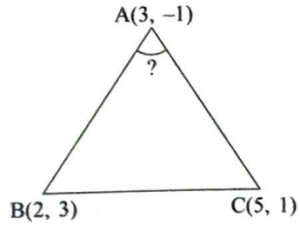
જો શિરોબિંદુઓ $A(3, -1)$,$B(2, 3)$ અને $C(5, 1)$ હોય,તો $m \angle A$ શોધો.
A
$\cos^{-1} \frac{3}{\sqrt{34}}$
B
$\sin^{-1} \frac{5}{\sqrt{34}}$
C
$\pi - \cos^{-1} \frac{3}{\sqrt{34}}$
D
$\frac{\pi}{2}$
Solution
(A) $m \angle A$ શોધવા માટે,આપણે સદિશો $\vec{AB}$ અને $\vec{AC}$ ને ધ્યાનમાં લઈએ છીએ.
$\vec{AB} = B - A = (2 - 3, 3 - (-1)) = (-1, 4)$.
$\vec{AC} = C - A = (5 - 3, 1 - (-1)) = (2, 2)$.
બે સદિશો $\vec{u}$ અને $\vec{v}$ વચ્ચેનો ખૂણો $\theta$ એ $\cos \theta = \frac{\vec{u} \cdot \vec{v}}{|\vec{u}| |\vec{v}|}$ દ્વારા આપવામાં આવે છે.
$\vec{AB} \cdot \vec{AC} = (-1)(2) + (4)(2) = -2 + 8 = 6$.
$|\vec{AB}| = \sqrt{(-1)^2 + 4^2} = \sqrt{1 + 16} = \sqrt{17}$.
$|\vec{AC}| = \sqrt{2^2 + 2^2} = \sqrt{4 + 4} = \sqrt{8} = 2\sqrt{2}$.
$\cos A = \frac{6}{\sqrt{17} \cdot 2\sqrt{2}} = \frac{3}{\sqrt{34}}$.
તેથી,$m \angle A = \cos^{-1} \frac{3}{\sqrt{34}}$.
$\vec{AB} = B - A = (2 - 3, 3 - (-1)) = (-1, 4)$.
$\vec{AC} = C - A = (5 - 3, 1 - (-1)) = (2, 2)$.
બે સદિશો $\vec{u}$ અને $\vec{v}$ વચ્ચેનો ખૂણો $\theta$ એ $\cos \theta = \frac{\vec{u} \cdot \vec{v}}{|\vec{u}| |\vec{v}|}$ દ્વારા આપવામાં આવે છે.
$\vec{AB} \cdot \vec{AC} = (-1)(2) + (4)(2) = -2 + 8 = 6$.
$|\vec{AB}| = \sqrt{(-1)^2 + 4^2} = \sqrt{1 + 16} = \sqrt{17}$.
$|\vec{AC}| = \sqrt{2^2 + 2^2} = \sqrt{4 + 4} = \sqrt{8} = 2\sqrt{2}$.
$\cos A = \frac{6}{\sqrt{17} \cdot 2\sqrt{2}} = \frac{3}{\sqrt{34}}$.
તેથી,$m \angle A = \cos^{-1} \frac{3}{\sqrt{34}}$.
0 likesView Solution
18
MathematicsEasyMCQGSEB · 2019
સદિશ $\vec{a} = -\hat{i} + 2\hat{j} - \hat{k}$ નો એકમ સદિશ $\hat{i}$ પરના પ્રક્ષેપનું મૂલ્ય . . . . . . છે.
A
$1/\sqrt{6}$
B
$1$
C
$-1/\sqrt{6}$
D
$-1$
Solution
(B) સદિશ $\vec{a}$ નો સદિશ $\vec{b}$ પરનો પ્રક્ષેપ શોધવાનું સૂત્ર $\text{proj}_{\vec{b}} \vec{a} = \frac{\vec{a} \cdot \vec{b}}{|\vec{b}|}$ છે.
અહીં,$\vec{a} = -\hat{i} + 2\hat{j} - \hat{k}$ અને $\vec{b} = \hat{i}$ છે.
એકમ સદિશ $\hat{b} = \hat{i}$ છે.
$\vec{a}$ નો $\hat{i}$ પરનો પ્રક્ષેપ $\vec{a} \cdot \hat{i} = (-\hat{i} + 2\hat{j} - \hat{k}) \cdot \hat{i} = -1$ થાય.
પ્રક્ષેપનું મૂલ્ય (magnitude) એ અદિશ પ્રક્ષેપનું નિરપેક્ષ મૂલ્ય છે.
મૂલ્ય $= |-1| = 1$.
અહીં,$\vec{a} = -\hat{i} + 2\hat{j} - \hat{k}$ અને $\vec{b} = \hat{i}$ છે.
એકમ સદિશ $\hat{b} = \hat{i}$ છે.
$\vec{a}$ નો $\hat{i}$ પરનો પ્રક્ષેપ $\vec{a} \cdot \hat{i} = (-\hat{i} + 2\hat{j} - \hat{k}) \cdot \hat{i} = -1$ થાય.
પ્રક્ષેપનું મૂલ્ય (magnitude) એ અદિશ પ્રક્ષેપનું નિરપેક્ષ મૂલ્ય છે.
મૂલ્ય $= |-1| = 1$.
0 likesView Solution
19
MathematicsEasyMCQGSEB · 2019
$\vec{x} = (2, 3, \sqrt{3})$ ની દિશામાં એકમ સદિશ . . . . . . છે.
A
$\left(\frac{2}{\sqrt{16}}, \frac{3}{\sqrt{16}}, \frac{\sqrt{3}}{\sqrt{16}}\right)$
B
$\left(\frac{2}{4}, \frac{3}{4}, \frac{\sqrt{3}}{4}\right)$
C
$\left(\frac{1}{2}, \frac{3}{2}, \frac{\sqrt{3}}{4}\right)$
D
$\left(\frac{1}{4}, \frac{3}{2}, \frac{\sqrt{3}}{2}\right)$
Solution
(B) $\vec{x} = (2, 3, \sqrt{3})$ ની દિશામાં એકમ સદિશ $\hat{x}$ શોધવા માટે,આપણે $\hat{x} = \frac{\vec{x}}{|\vec{x}|}$ સૂત્રનો ઉપયોગ કરીએ છીએ.
પ્રથમ,માન $|\vec{x}| = \sqrt{2^2 + 3^2 + (\sqrt{3})^2}$ ની ગણતરી કરો.
$|\vec{x}| = \sqrt{4 + 9 + 3} = \sqrt{16} = 4$.
હવે,$\vec{x}$ ના દરેક ઘટકને માન $4$ વડે ભાગો:
$\hat{x} = \left(\frac{2}{4}, \frac{3}{4}, \frac{\sqrt{3}}{4}\right)$.
આમ,સાચો વિકલ્પ $B$ છે.
પ્રથમ,માન $|\vec{x}| = \sqrt{2^2 + 3^2 + (\sqrt{3})^2}$ ની ગણતરી કરો.
$|\vec{x}| = \sqrt{4 + 9 + 3} = \sqrt{16} = 4$.
હવે,$\vec{x}$ ના દરેક ઘટકને માન $4$ વડે ભાગો:
$\hat{x} = \left(\frac{2}{4}, \frac{3}{4}, \frac{\sqrt{3}}{4}\right)$.
આમ,સાચો વિકલ્પ $B$ છે.
0 likesView Solution
20
MathematicsEasyMCQGSEB · 2019
રેખાઓ $\frac{x-5}{7}=\frac{y-5}{k}=\frac{z-2}{1}$ અને $\frac{x}{1}=\frac{y-3}{2}=\frac{z+1}{3}$ એકબીજાને લંબ હોય,તો $k$ ની કિંમત . . . . . . થાય.
A
$10$
B
$-5$
C
$5$
D
$0$
Solution
(B) બે રેખાઓ જેના દિક-ગુણોત્તર $(a_1, b_1, c_1)$ અને $(a_2, b_2, c_2)$ હોય,તે પરસ્પર લંબ હોય જો $a_1 a_2 + b_1 b_2 + c_1 c_2 = 0$ થાય.
આપેલ રેખાઓ $\frac{x-5}{7}=\frac{y-5}{k}=\frac{z-2}{1}$ અને $\frac{x}{1}=\frac{y-3}{2}=\frac{z+1}{3}$ છે.
પ્રથમ રેખાના દિક-ગુણોત્તર $(7, k, 1)$ છે અને બીજી રેખાના દિક-ગુણોત્તર $(1, 2, 3)$ છે.
રેખાઓ લંબ હોવાથી:
$(7)(1) + (k)(2) + (1)(3) = 0$
$7 + 2k + 3 = 0$
$10 + 2k = 0$
$2k = -10$
$k = -5$.
આમ,સાચો વિકલ્પ $B$ છે.
આપેલ રેખાઓ $\frac{x-5}{7}=\frac{y-5}{k}=\frac{z-2}{1}$ અને $\frac{x}{1}=\frac{y-3}{2}=\frac{z+1}{3}$ છે.
પ્રથમ રેખાના દિક-ગુણોત્તર $(7, k, 1)$ છે અને બીજી રેખાના દિક-ગુણોત્તર $(1, 2, 3)$ છે.
રેખાઓ લંબ હોવાથી:
$(7)(1) + (k)(2) + (1)(3) = 0$
$7 + 2k + 3 = 0$
$10 + 2k = 0$
$2k = -10$
$k = -5$.
આમ,સાચો વિકલ્પ $B$ છે.
0 likesView Solution
21
MathematicsEasyMCQGSEB · 2019
સુરેખ પ્રતિબંધોની સિસ્ટમ દ્વારા નિર્ધારિત શક્ય ઉકેલ પ્રદેશના શિરોબિંદુઓ $(0,10), (5,5), (15,15), (5,25)$ છે. ધારો કે $z = px + qy$ જ્યાં $p, q > 0$. $z$ નું મહત્તમ મૂલ્ય $(15,15)$ અને $(5,25)$ બંને બિંદુઓ પર મળે તે માટે $p$ અને $q$ પરની શરત . . . . . . છે.
A
$p = q$
B
$q = 2p$
C
$p = 2q$
D
$q = 3p$
Solution
(A) જો હેતુલક્ષી વિધેય $z = px + qy$ નું મહત્તમ મૂલ્ય બે ભિન્ન બિંદુઓ $(x_1, y_1)$ અને $(x_2, y_2)$ પર મળતું હોય,તો આ બે બિંદુઓ પર $z$ નું મૂલ્ય સમાન હોવું જોઈએ.
આપેલા બિંદુઓ $(15, 15)$ અને $(5, 25)$ છે.
$z(15, 15) = z(5, 25)$ લેતા:
$p(15) + q(15) = p(5) + q(25)$
$15p + 15q = 5p + 25q$
$15p - 5p = 25q - 15q$
$10p = 10q$
$p = q$
આમ,શરત $p = q$ છે.
આપેલા બિંદુઓ $(15, 15)$ અને $(5, 25)$ છે.
$z(15, 15) = z(5, 25)$ લેતા:
$p(15) + q(15) = p(5) + q(25)$
$15p + 15q = 5p + 25q$
$15p - 5p = 25q - 15q$
$10p = 10q$
$p = q$
આમ,શરત $p = q$ છે.
0 likesView Solution
22
MathematicsEasyMCQGSEB · 2019
સુરેખ પ્રતિબંધોની સિસ્ટમ દ્વારા નિર્ધારિત શક્ય ઉકેલ પ્રદેશના શિરોબિંદુઓ $(2, 72)$,$(15, 20)$ અને $(40, 15)$ છે. ધારો કે $Z = 6x + 3y$ એ હેતુલક્ષી વિધેય છે. $Z$ ની ન્યૂનતમ કિંમત કયા બિંદુએ મળે છે?
A
$(15, 20)$
B
$(2, 72)$
C
$(40, 15)$
D
$(0, 11)$
Solution
(A) હેતુલક્ષી વિધેય $Z = 6x + 3y$ ની ન્યૂનતમ કિંમત શોધવા માટે,આપણે શક્ય ઉકેલ પ્રદેશના દરેક શિરોબિંદુ પર $Z$ ની કિંમત શોધીશું:
$1$. બિંદુ $(2, 72)$ પર: $Z = 6(2) + 3(72) = 12 + 216 = 228$
$2$. બિંદુ $(15, 20)$ પર: $Z = 6(15) + 3(20) = 90 + 60 = 150$
$3$. બિંદુ $(40, 15)$ પર: $Z = 6(40) + 3(15) = 240 + 45 = 285$
કિંમતો $228$,$150$ અને $285$ ની સરખામણી કરતા,ન્યૂનતમ કિંમત $150$ છે,જે બિંદુ $(15, 20)$ પર મળે છે.
$1$. બિંદુ $(2, 72)$ પર: $Z = 6(2) + 3(72) = 12 + 216 = 228$
$2$. બિંદુ $(15, 20)$ પર: $Z = 6(15) + 3(20) = 90 + 60 = 150$
$3$. બિંદુ $(40, 15)$ પર: $Z = 6(40) + 3(15) = 240 + 45 = 285$
કિંમતો $228$,$150$ અને $285$ ની સરખામણી કરતા,ન્યૂનતમ કિંમત $150$ છે,જે બિંદુ $(15, 20)$ પર મળે છે.
0 likesView Solution
23
MathematicsEasyMCQGSEB · 2019
જો સંભાવના વિતરણ $P(x) = C \binom{4}{x}$ જ્યાં $x = 0, 1, 2, 3, 4$ હોય,તો $C$ ની કિંમત શોધો.
A
$\frac{1}{4}$
B
$4$
C
$0$
D
$\frac{1}{16}$
Solution
(D) સંભાવના વિતરણ માટે,તમામ સંભાવનાઓનો સરવાળો $1$ થવો જોઈએ.
તેથી,$\sum_{x=0}^{4} P(x) = 1$.
આપેલ પદ મૂકતા: $\sum_{x=0}^{4} C \binom{4}{x} = 1$.
$C \sum_{x=0}^{4} \binom{4}{x} = 1$.
આપણે જાણીએ છીએ કે દ્વિપદી સહગુણકોનો સરવાળો $\sum_{k=0}^{n} \binom{n}{k} = 2^n$ થાય છે.
$n = 4$ માટે,$\sum_{x=0}^{4} \binom{4}{x} = 2^4 = 16$.
તેથી,$C \times 16 = 1$.
$C = \frac{1}{16}$.
તેથી,$\sum_{x=0}^{4} P(x) = 1$.
આપેલ પદ મૂકતા: $\sum_{x=0}^{4} C \binom{4}{x} = 1$.
$C \sum_{x=0}^{4} \binom{4}{x} = 1$.
આપણે જાણીએ છીએ કે દ્વિપદી સહગુણકોનો સરવાળો $\sum_{k=0}^{n} \binom{n}{k} = 2^n$ થાય છે.
$n = 4$ માટે,$\sum_{x=0}^{4} \binom{4}{x} = 2^4 = 16$.
તેથી,$C \times 16 = 1$.
$C = \frac{1}{16}$.
0 likesView Solution
24
MathematicsEasyMCQGSEB · 2019
$n=5, p=0.30$ ચલ ધરાવતા દ્વિપદી વિતરણનું વિચરણ . . . . . . છે.
A
$1.5$
B
$1.4$
C
$1.05$
D
$1.15$
Solution
(C) દ્વિપદી વિતરણ માટે,વિચરણનું સૂત્ર $Var(X) = n \times p \times q$ છે,જ્યાં $q = 1 - p$ છે.
અહીં $n = 5$ અને $p = 0.30$ આપેલ છે.
તેથી $q = 1 - 0.30 = 0.70$ થાય.
આ કિંમતોને સૂત્રમાં મૂકતા:
$Var(X) = 5 \times 0.30 \times 0.70$
$Var(X) = 1.5 \times 0.70 = 1.05$.
તેથી,સાચો વિકલ્પ $C$ છે.
અહીં $n = 5$ અને $p = 0.30$ આપેલ છે.
તેથી $q = 1 - 0.30 = 0.70$ થાય.
આ કિંમતોને સૂત્રમાં મૂકતા:
$Var(X) = 5 \times 0.30 \times 0.70$
$Var(X) = 1.5 \times 0.70 = 1.05$.
તેથી,સાચો વિકલ્પ $C$ છે.
0 likesView Solution
25
MathematicsEasyMCQGSEB · 2019
જો $A$ અને $B$ સ્વતંત્ર ઘટનાઓ હોય અને $P(A) = 0.4$,$P(A \cup B) = 0.6$,અને $P(B) = p$ હોય,તો $p$ ની કિંમત . . . . . . છે.
A
$1/2$
B
$3/4$
C
$1/3$
D
$5/6$
Solution
(C) આપેલ છે કે $A$ અને $B$ સ્વતંત્ર ઘટનાઓ છે,તેથી $P(A \cap B) = P(A) \cdot P(B)$.
આપણે બે ઘટનાઓના યોગગણનું સૂત્ર જાણીએ છીએ: $P(A \cup B) = P(A) + P(B) - P(A \cap B)$.
આપેલ કિંમતો મૂકતા: $0.6 = 0.4 + p - (0.4 \cdot p)$.
$0.6 = 0.4 + p - 0.4p$.
$0.6 - 0.4 = p(1 - 0.4)$.
$0.2 = 0.6p$.
$p = \frac{0.2}{0.6} = \frac{1}{3}$.
આપણે બે ઘટનાઓના યોગગણનું સૂત્ર જાણીએ છીએ: $P(A \cup B) = P(A) + P(B) - P(A \cap B)$.
આપેલ કિંમતો મૂકતા: $0.6 = 0.4 + p - (0.4 \cdot p)$.
$0.6 = 0.4 + p - 0.4p$.
$0.6 - 0.4 = p(1 - 0.4)$.
$0.2 = 0.6p$.
$p = \frac{0.2}{0.6} = \frac{1}{3}$.
0 likesView Solution
26
MathematicsEasyMCQGSEB · 2019
જો $A$ અને $B$ એવી ઘટનાઓ હોય કે જેથી $P(A) > 0$ અને $P(B) \neq 1$ હોય,તો $P(A \mid B^{\prime}) = $ . . . . . . .
A
$1 - P(A \mid B^{\prime})$
B
$\frac{P(A^{\prime})}{P(B)}$
C
$1 - P(A \mid B)$
D
$1 - P(A^{\prime} \mid B^{\prime})$
Solution
(D) આપણે જાણીએ છીએ કે કોઈપણ ઘટના $A$ માટે,$P(A) + P(A^{\prime}) = 1$,જેનો અર્થ છે કે $P(A) = 1 - P(A^{\prime})$.
આને શરતી સંભાવના $P(A \mid B^{\prime})$ પર લાગુ કરતા,આપણને મળે છે:
$P(A \mid B^{\prime}) = 1 - P(A^{\prime} \mid B^{\prime})$.
આ શરતી સંભાવનાના ગુણધર્મ પરથી આવે છે જ્યાં સમાન શરત હેઠળ પૂરક ઘટનાઓની સંભાવનાઓનો સરવાળો $1$ થાય છે.
આને શરતી સંભાવના $P(A \mid B^{\prime})$ પર લાગુ કરતા,આપણને મળે છે:
$P(A \mid B^{\prime}) = 1 - P(A^{\prime} \mid B^{\prime})$.
આ શરતી સંભાવનાના ગુણધર્મ પરથી આવે છે જ્યાં સમાન શરત હેઠળ પૂરક ઘટનાઓની સંભાવનાઓનો સરવાળો $1$ થાય છે.
0 likesView Solution
Vedclass Products
For Students
Vedclass Test Series
Mock tests in real GSEB style covering Mathematics with performance analysis. 5-day free trial.
Start Free TrialFor Teachers
Exam Paper Generator
Generate Set A/B/C/D Mathematics papers from 7.5L+ questions in 2 minutes. 3 chapters free.
Try FreeFor Institutes
Online Exam Module
Run live GSEB mock exams with unlimited students, 360° analytics & white-label branding.
See DemoFrequently Asked Questions
How many Mathematics questions are in GSEB 2019?
There are 26 Mathematics questions from the GSEB 2019 paper on Vedclass, each with a detailed step-by-step solution in Gujarati.
Are GSEB 2019 Mathematics solutions available in Gujarati?
Yes. All solutions on this page are in Gujarati. You can also switch to English or Hindi using the language buttons above the questions.
Can I practice GSEB 2019 Mathematics as a timed test?
Yes. Use the Vedclass Test Series to attempt a full GSEB mock test covering Mathematics with time limits and instant score analysis.
Can teachers create Mathematics papers from GSEB previous year questions?
Yes. The Vedclass Exam Paper Generator lets teachers mix GSEB Mathematics questions and generate Set A/B/C/D papers in minutes.
For Teachers & Institutes
Build a Custom Mathematics Paper
Pick GSEB 2019 Mathematics questions, set difficulty, and generate Set A/B/C/D in 2 minutes.