
ChemistryQ101–200 of 502 questions
Page 3 of 7 · English
101
ChemistryEasyMCQAP EAMCET · 2021
To which group of the periodic table does an element having electronic configuration $[Ar] 3d^5 4s^2$ belong?
A
Second
B
Fourth
C
Seventh
D
Third
Solution
(C) The electronic configuration given is $[Ar] 3d^5 4s^2$.
For $d-$block elements,the group number is calculated as the number of electrons in $(n-1)d$ subshell + number of electrons in $ns$ subshell.
Here,$n=4$.
Number of electrons in $3d = 5$.
Number of electrons in $4s = 2$.
Group number $= 5 + 2 = 7$.
Thus,the element belongs to the $7^{th}$ group of the periodic table.
For $d-$block elements,the group number is calculated as the number of electrons in $(n-1)d$ subshell + number of electrons in $ns$ subshell.
Here,$n=4$.
Number of electrons in $3d = 5$.
Number of electrons in $4s = 2$.
Group number $= 5 + 2 = 7$.
Thus,the element belongs to the $7^{th}$ group of the periodic table.
0 likesView Solution
102
ChemistryEasyMCQAP EAMCET · 2021
The electron configuration of $Fe^{3+}$ is (atomic number of $Fe = 26$)
A
$[Ar] 3d^5 4s^1$
B
$[Ar] 3d^6 4s^0$
C
$[Ar] 3d^5 4s^0$
D
$[Ar] 3d^6 4s^2$
Solution
(C) The atomic number of $Fe$ is $26$. The ground state electronic configuration of a neutral $Fe$ atom is $[Ar] 3d^6 4s^2$.
To form the $Fe^{3+}$ ion,we must remove $3$ electrons from the neutral atom.
Electrons are removed from the outermost shell first,which is the $4s$ orbital,followed by the $3d$ orbital.
Removing $2$ electrons from $4s$ and $1$ electron from $3d$ results in the configuration: $[Ar] 3d^5 4s^0$.
To form the $Fe^{3+}$ ion,we must remove $3$ electrons from the neutral atom.
Electrons are removed from the outermost shell first,which is the $4s$ orbital,followed by the $3d$ orbital.
Removing $2$ electrons from $4s$ and $1$ electron from $3d$ results in the configuration: $[Ar] 3d^5 4s^0$.
0 likesView Solution
103
ChemistryEasyMCQAP EAMCET · 2021
Which of the following atoms,in its ground state,has the highest number of unpaired electrons?
A
Chromium $[Z=24]$
B
Iron $[Z=26]$
C
Manganese $[Z=25]$
D
Vanadium $[Z=23]$
Solution
(A) . Chromium $(Z=24)$: Electronic configuration $(EC) = [Ar] 3d^5 4s^1$. Number of unpaired electrons $= 6$.
$B$. Iron $(Z=26)$: $EC = [Ar] 3d^6 4s^2$. Number of unpaired electrons $= 4$.
$C$. Manganese $(Z=25)$: $EC = [Ar] 3d^5 4s^2$. Number of unpaired electrons $= 5$.
$D$. Vanadium $(Z=23)$: $EC = [Ar] 3d^3 4s^2$. Number of unpaired electrons $= 3$.
Therefore,chromium $(Cr)$ has the maximum number of unpaired electrons.
$B$. Iron $(Z=26)$: $EC = [Ar] 3d^6 4s^2$. Number of unpaired electrons $= 4$.
$C$. Manganese $(Z=25)$: $EC = [Ar] 3d^5 4s^2$. Number of unpaired electrons $= 5$.
$D$. Vanadium $(Z=23)$: $EC = [Ar] 3d^3 4s^2$. Number of unpaired electrons $= 3$.
Therefore,chromium $(Cr)$ has the maximum number of unpaired electrons.
0 likesView Solution
104
ChemistryEasyMCQAP EAMCET · 2021
The hydride gap corresponds to elements of
A
group $7, 8, 9$
B
group $13$
C
group $15, 16, 17$
D
group $14$
Solution
(A) The hydride gap refers to the region in the periodic table where elements do not form stable hydrides under normal conditions.
These transition metals exhibit a very low affinity for hydrogen in their standard oxidation states.
Specifically,the metals belonging to group $7$,$8$,and $9$ of the periodic table do not form hydrides.
Therefore,the group $7, 8, 9$ series is known as the hydride gap.
These transition metals exhibit a very low affinity for hydrogen in their standard oxidation states.
Specifically,the metals belonging to group $7$,$8$,and $9$ of the periodic table do not form hydrides.
Therefore,the group $7, 8, 9$ series is known as the hydride gap.
0 likesView Solution
105
ChemistryEasyMCQAP EAMCET · 2021
Which element belongs to the family of elements that also includes the element gallium?
A
Carbon
B
Aluminium
C
Iron
D
Arsenic
Solution
(B) In the periodic table of elements,gallium $(Ga)$ belongs to the boron family (group $13$).
This group includes the elements boron $(B)$,aluminium $(Al)$,gallium $(Ga)$,indium $(In)$,and thallium $(Tl)$.
Therefore,aluminium $(Al)$ belongs to the same family as gallium $(Ga)$.
The electronic configuration of these elements shows they have $ns^2 np^1$ valence shell configuration.
$Ga (Z=31) = [Ar] 3d^{10} 4s^2 4p^1$
$Al (Z=13) = [Ne] 3s^2 3p^1$
This group includes the elements boron $(B)$,aluminium $(Al)$,gallium $(Ga)$,indium $(In)$,and thallium $(Tl)$.
Therefore,aluminium $(Al)$ belongs to the same family as gallium $(Ga)$.
The electronic configuration of these elements shows they have $ns^2 np^1$ valence shell configuration.
$Ga (Z=31) = [Ar] 3d^{10} 4s^2 4p^1$
$Al (Z=13) = [Ne] 3s^2 3p^1$
0 likesView Solution
106
ChemistryEasyMCQAP EAMCET · 2021
The different types of bonds present in $CuSO_4 \cdot 5 H_2 O$ are
A
only ionic and covalent
B
only ionic,covalent and coordinate covalent
C
only covalent,coordinate covalent and hydrogen
D
ionic,covalent,coordinate covalent and hydrogen
Solution
(D) The structure of $CuSO_4 \cdot 5 H_2 O$ (copper$(II)$ sulphate pentahydrate) contains the following types of bonds:
$1$. Ionic bond: Present between the $Cu^{2+}$ ion and the $SO_4^{2-}$ ion.
$2$. Covalent bond: Present between sulphur and oxygen atoms within the sulphate ion $(SO_4^{2-})$,and between hydrogen and oxygen atoms within the water molecules.
$3$. Coordinate covalent bond: Present between the $Cu^{2+}$ ion and the oxygen atoms of the four water molecules coordinated to it.
$4$. Hydrogen bond: Present between the fifth water molecule (which is not directly coordinated to $Cu^{2+}$) and the sulphate ions or other water molecules.
Therefore,all four types of bonds are present.
$1$. Ionic bond: Present between the $Cu^{2+}$ ion and the $SO_4^{2-}$ ion.
$2$. Covalent bond: Present between sulphur and oxygen atoms within the sulphate ion $(SO_4^{2-})$,and between hydrogen and oxygen atoms within the water molecules.
$3$. Coordinate covalent bond: Present between the $Cu^{2+}$ ion and the oxygen atoms of the four water molecules coordinated to it.
$4$. Hydrogen bond: Present between the fifth water molecule (which is not directly coordinated to $Cu^{2+}$) and the sulphate ions or other water molecules.
Therefore,all four types of bonds are present.
0 likesView Solution
107
ChemistryEasyMCQAP EAMCET · 2021
Which condition among the following holds true at the state of half-completion for the reaction $A \rightleftharpoons B$?
A
$\Delta G^{\circ} = 0$
B
$\Delta G^{\circ} > 0$
C
$\Delta G^{\circ} < 0$
D
$\Delta G^{\circ} = -RT \ln 2$
Solution
(A) For a reversible reaction $A \rightleftharpoons B$,the equilibrium constant $K$ is defined as $K = \frac{[B]}{[A]}$.
At the state of half-completion,the concentration of reactant equals the concentration of product,i.e.,$[A] = [B]$.
Therefore,$K = \frac{[B]}{[A]} = 1$.
The relationship between standard Gibbs free energy change and the equilibrium constant is given by $\Delta G^{\circ} = -RT \ln K$.
Substituting $K = 1$ into the equation,we get $\Delta G^{\circ} = -RT \ln(1)$.
Since $\ln(1) = 0$,it follows that $\Delta G^{\circ} = 0$.
At the state of half-completion,the concentration of reactant equals the concentration of product,i.e.,$[A] = [B]$.
Therefore,$K = \frac{[B]}{[A]} = 1$.
The relationship between standard Gibbs free energy change and the equilibrium constant is given by $\Delta G^{\circ} = -RT \ln K$.
Substituting $K = 1$ into the equation,we get $\Delta G^{\circ} = -RT \ln(1)$.
Since $\ln(1) = 0$,it follows that $\Delta G^{\circ} = 0$.
0 likesView Solution
108
ChemistryEasyMCQAP EAMCET · 2021
The main constituent of enamel on the surface of teeth is:
A
$[3 Ca_3(PO_4)_2 \cdot CaF_2]$
B
$Ca_3(PO_4)_2 \cdot H_2O$
C
$[3 Ca_3(PO_4)_2 \cdot Ca(OH)_2]$
D
$CaF_2$
Solution
(C) Enamel provides the hard surface to the teeth.
It consists of carbonate-substituted hydroxyapatite crystallites.
It is primarily composed of calcium phosphate and calcium hydroxide.
Therefore,the main constituent of enamel on the surface of teeth is $[3 Ca_3(PO_4)_2 \cdot Ca(OH)_2]$.
It consists of carbonate-substituted hydroxyapatite crystallites.
It is primarily composed of calcium phosphate and calcium hydroxide.
Therefore,the main constituent of enamel on the surface of teeth is $[3 Ca_3(PO_4)_2 \cdot Ca(OH)_2]$.
0 likesView Solution
109
ChemistryEasyMCQAP EAMCET · 2021
Which region of the atmosphere is the domain of all living organisms?
A
Troposphere
B
Stratosphere
C
Mesosphere
D
Thermosphere
Solution
(A) The troposphere is the lowest layer of the Earth's atmosphere,extending up to about $10-15 \ km$ from the surface.
It is the region where all weather phenomena occur and it is the domain of all living organisms,as it contains the air we breathe and the necessary water vapour.
It is the region where all weather phenomena occur and it is the domain of all living organisms,as it contains the air we breathe and the necessary water vapour.
0 likesView Solution
110
ChemistryEasyMCQAP EAMCET · 2021
Which among the following has the highest concentration of $PAN$?
A
Acid Rain
B
Oxidizing Smog
C
Reducing Smog
D
Ozone
Solution
(B) Photochemical smog results from the action of sunlight on unsaturated hydrocarbons and nitrogen oxides produced by automobiles and large manufacturing factories.
Photochemical smog has a high concentration of oxidizing agents and is therefore called oxidizing smog.
Peroxyacetyl nitrate $(PAN)$ is formed by hydrocarbons in polluted air and is a characteristic component of oxidizing smog.
Photochemical smog has a high concentration of oxidizing agents and is therefore called oxidizing smog.
Peroxyacetyl nitrate $(PAN)$ is formed by hydrocarbons in polluted air and is a characteristic component of oxidizing smog.
0 likesView Solution
111
ChemistryEasyMCQAP EAMCET · 2021
Which among the following is not a greenhouse gas?
A
Nitrous oxide
B
Water vapour
C
Sulphur dioxide
D
Methane
Solution
(C) Greenhouse gases are gases in Earth's atmosphere that trap heat and energy.
These gases allow sunlight to pass through the atmosphere but prevent the heat radiated from the Earth's surface from escaping into space.
Common examples of greenhouse gases include $CO_2$,$CH_4$,$N_2O$,and water vapour.
$SO_2$ (Sulphur dioxide) is primarily responsible for air pollution and acid rain,but it is not considered a significant greenhouse gas.
Therefore,the correct option is $C$.
These gases allow sunlight to pass through the atmosphere but prevent the heat radiated from the Earth's surface from escaping into space.
Common examples of greenhouse gases include $CO_2$,$CH_4$,$N_2O$,and water vapour.
$SO_2$ (Sulphur dioxide) is primarily responsible for air pollution and acid rain,but it is not considered a significant greenhouse gas.
Therefore,the correct option is $C$.
0 likesView Solution
112
ChemistryEasyMCQAP EAMCET · 2021
Identify the coldest region among the following layers of atmosphere.
A
Troposphere
B
Mesosphere
C
Stratosphere
D
Thermosphere
Solution
(B) The $Mesosphere$ is the coldest region among the layers of the atmosphere.
It is the layer present between the $Stratosphere$ and the $Thermosphere$.
It extends from approximately $50 \ km$ to $85 \ km$ above the Earth's surface.
The temperature in this region can drop as low as $-90^{\circ}C$.
Therefore,the $Mesosphere$ is the coldest layer.
It is the layer present between the $Stratosphere$ and the $Thermosphere$.
It extends from approximately $50 \ km$ to $85 \ km$ above the Earth's surface.
The temperature in this region can drop as low as $-90^{\circ}C$.
Therefore,the $Mesosphere$ is the coldest layer.
0 likesView Solution
113
ChemistryEasyMCQAP EAMCET · 2021
Which gas among the following has the maximum global warming potential?
A
$CO_2$
B
$SF_6$
C
$CH_4$
D
$N_2O$
Solution
(B) Global warming potential $(GWP)$ is a measure of the heat absorbed by a greenhouse gas in the atmosphere relative to $CO_2$.
The $GWP$ of $SF_6$ is approximately $22,200$ times that of $CO_2$ over a $100$-year period.
Therefore,$SF_6$ has the maximum global warming potential among the given options.
The $GWP$ of $SF_6$ is approximately $22,200$ times that of $CO_2$ over a $100$-year period.
Therefore,$SF_6$ has the maximum global warming potential among the given options.
0 likesView Solution
114
ChemistryEasyMCQAP EAMCET · 2021
The secondary precursors of photochemical smog are
A
$SO_2$ and $NO_2$
B
$NO_2$ and hydrocarbons
C
$NO_2$ and $PAN$
D
$O_3$ and $PAN$
Solution
(D) The primary precursors of photochemical smog are $NO_2$ and hydrocarbons.
These react in the presence of sunlight to form secondary pollutants.
The secondary precursors (or secondary pollutants) of photochemical smog are ozone $(O_3)$ and peroxyacyl nitrates $(PAN)$.
These react in the presence of sunlight to form secondary pollutants.
The secondary precursors (or secondary pollutants) of photochemical smog are ozone $(O_3)$ and peroxyacyl nitrates $(PAN)$.
0 likesView Solution
115
ChemistryEasyMCQAP EAMCET · 2021
Green chemistry refers to reactions which . . . . . .
A
reduce the use and production of hazardous chemicals
B
study of the extremely slow reactions
C
are related to soil erosion
D
study of green leaves
Solution
(A) Green chemistry is a way of thinking and is about utilizing the existing knowledge and principles of chemistry and other sciences to reduce the adverse impact on the environment.
It is a production process that aims to bring about minimum pollution or deterioration to the environment.
Utilizing the existing knowledge base for reducing chemical hazards along with developmental activities is the foundation of green chemistry.
It is a production process that aims to bring about minimum pollution or deterioration to the environment.
Utilizing the existing knowledge base for reducing chemical hazards along with developmental activities is the foundation of green chemistry.
0 likesView Solution
116
ChemistryEasyMCQAP EAMCET · 2021
Which of the following practices will not come under green chemistry?
$1$. Using soaps made of vegetable oils instead of synthetic detergents,whenever possible.
$2$. Using $H_2O$ for bleaching purposes instead of chlorine-based bleaching agents.
$3$. Using liquefied $CO_2$ for dry cleaning clothes and laundry.
$4$. Using plastic cans for neatly storing substances.
$1$. Using soaps made of vegetable oils instead of synthetic detergents,whenever possible.
$2$. Using $H_2O$ for bleaching purposes instead of chlorine-based bleaching agents.
$3$. Using liquefied $CO_2$ for dry cleaning clothes and laundry.
$4$. Using plastic cans for neatly storing substances.
A
Only $1$
B
Only $2$
C
Only $3$
D
Only $4$
Solution
(D) Green chemistry is a philosophy of chemical research and engineering that encourages the design of products and processes that minimize the use and generation of hazardous substances.
$1$. Using soaps made of vegetable oils is an eco-friendly practice as they are biodegradable.
$2$. Using $H_2O$ for bleaching is eco-friendly as it avoids the use of harmful chlorine-based agents.
$3$. Using liquefied $CO_2$ for dry cleaning is an eco-friendly alternative to hazardous halogenated solvents.
$4$. Using plastic cans for storing substances is not considered a green chemistry practice because plastics are generally non-biodegradable and contribute to environmental pollution.
Therefore,the practice that does not come under green chemistry is $4$.
$1$. Using soaps made of vegetable oils is an eco-friendly practice as they are biodegradable.
$2$. Using $H_2O$ for bleaching is eco-friendly as it avoids the use of harmful chlorine-based agents.
$3$. Using liquefied $CO_2$ for dry cleaning is an eco-friendly alternative to hazardous halogenated solvents.
$4$. Using plastic cans for storing substances is not considered a green chemistry practice because plastics are generally non-biodegradable and contribute to environmental pollution.
Therefore,the practice that does not come under green chemistry is $4$.
0 likesView Solution
117
ChemistryEasyMCQAP EAMCET · 2021
What is the $IUPAC$ name of $CH_3CH(CH_2CH_3)CHO$?
A
$2-$methylbutanal
B
$2-$ethylpropanal
C
$3-$methylbutanal
D
$2-$methylbutanone
Solution
(A) The given compound is $CH_3-CH(CH_2CH_3)-CHO$,which can be written as $CH_3-CH_2-CH(CH_3)-CHO$.
First,identify the longest carbon chain containing the aldehyde group. The longest chain has $4$ carbon atoms,so the parent alkane is butane.
Number the chain starting from the aldehyde carbon as $C-1$. The methyl group is attached to the $C-2$ position.
Therefore,the $IUPAC$ name is $2-$methylbutanal.
First,identify the longest carbon chain containing the aldehyde group. The longest chain has $4$ carbon atoms,so the parent alkane is butane.
Number the chain starting from the aldehyde carbon as $C-1$. The methyl group is attached to the $C-2$ position.
Therefore,the $IUPAC$ name is $2-$methylbutanal.
0 likesView Solution
118
ChemistryDifficultMCQAP EAMCET · 2021
$A$ compound $A$ contains $C$ and $H$ only and has a molecular mass of $72$. Its photochlorination gives a mixture containing only one monochloro and two dichloro hydrocarbons. What is its $IUPAC$ name?
A
$2, 2-$dimethylpropane
B
$n-$pentane
C
$2-$methylbutane
D
cyclopentane
Solution
(A) The molecular formula $C_5H_{12}$ corresponds to a molecular mass of $72 \ g/mol$.
Among the isomers of pentane,$2, 2-$dimethylpropane $(neopentane)$ has all $12$ hydrogen atoms equivalent.
Therefore,it yields only one monochloro derivative upon photochlorination.
Further substitution leads to two distinct dichloro derivatives.
The structure of $A$ is $CH_3-C(CH_3)_2-CH_3$.
Among the isomers of pentane,$2, 2-$dimethylpropane $(neopentane)$ has all $12$ hydrogen atoms equivalent.
Therefore,it yields only one monochloro derivative upon photochlorination.
Further substitution leads to two distinct dichloro derivatives.
The structure of $A$ is $CH_3-C(CH_3)_2-CH_3$.
0 likesView Solution
119
ChemistryEasyMCQAP EAMCET · 2021
Identify the structure representing $3-$oxo$-2-$methylhex$-4-$enal.
A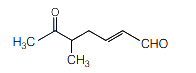
B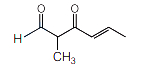
C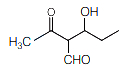
D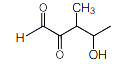
Solution
(B) The $IUPAC$ name $3-$oxo$-2-$methylhex$-4-$enal indicates the following features:
$1$. The parent chain is a hexane chain ($6$ carbons) with an aldehyde group $(-CHO)$ at position $1$.
$2$. There is a methyl group $(-CH_3)$ at position $2$.
$3$. There is an oxo group $(=O)$ at position $3$.
$4$. There is a double bond at position $4$ (between carbons $4$ and $5$).
The structure is: $CH_3-CH=CH-C(=O)-CH(CH_3)-CHO$.
Comparing this with the options,the structure is represented by option $B$.
$1$. The parent chain is a hexane chain ($6$ carbons) with an aldehyde group $(-CHO)$ at position $1$.
$2$. There is a methyl group $(-CH_3)$ at position $2$.
$3$. There is an oxo group $(=O)$ at position $3$.
$4$. There is a double bond at position $4$ (between carbons $4$ and $5$).
The structure is: $CH_3-CH=CH-C(=O)-CH(CH_3)-CHO$.
Comparing this with the options,the structure is represented by option $B$.
0 likesView Solution
120
ChemistryEasyMCQAP EAMCET · 2021
Based on the $IUPAC$ system,the tertiary butyl group is named as:
A
$2-$methylpropyl
B
$1,1-$dimethylethyl
C
$2-$methylbutyl
D
$1,3-$dimethylbutyl
Solution
(B) The structure of the tertiary butyl group is $(CH_3)_3C-$.
To name this according to the $IUPAC$ system,we identify the longest carbon chain attached to the main parent chain.
The carbon atom directly attached to the parent chain is assigned position $1$.
Thus,the structure becomes $CH_3-C(CH_3)_2-$,where two methyl groups are attached to the first carbon atom.
Therefore,the $IUPAC$ name is $1,1-$dimethylethyl.
To name this according to the $IUPAC$ system,we identify the longest carbon chain attached to the main parent chain.
The carbon atom directly attached to the parent chain is assigned position $1$.
Thus,the structure becomes $CH_3-C(CH_3)_2-$,where two methyl groups are attached to the first carbon atom.
Therefore,the $IUPAC$ name is $1,1-$dimethylethyl.
0 likesView Solution
121
ChemistryEasyMCQAP EAMCET · 2021
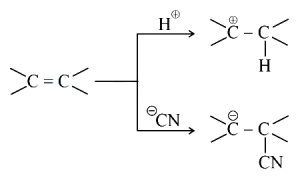
The following effect is known as . . . . . .
A
Inductive effect
B
Electromeric effect
C
Resonance effect
D
Hyperconjugation
Solution
(B) The Electromeric effect is a temporary effect in which a shared pair of $\pi$ electrons is completely transferred from a double or a triple bond to one of the atoms joined by the bond at the requirement of an attacking species.
It is represented by the symbol $E$.
It is said to be $+E$ when the displacement of $\pi$ electrons is away from the atom or group,and $-E$ when the displacement of $\pi$ electrons is towards the atom or group.
In the given image,the complete transfer of the $\pi$ bond occurs due to the presence of an attacking reagent ($H^+$ or $CN^-$),which is the characteristic feature of the Electromeric effect.
Hence,the correct option is $B$.
It is represented by the symbol $E$.
It is said to be $+E$ when the displacement of $\pi$ electrons is away from the atom or group,and $-E$ when the displacement of $\pi$ electrons is towards the atom or group.
In the given image,the complete transfer of the $\pi$ bond occurs due to the presence of an attacking reagent ($H^+$ or $CN^-$),which is the characteristic feature of the Electromeric effect.
Hence,the correct option is $B$.
0 likesView Solution
122
ChemistryEasyMCQAP EAMCET · 2021
The correct order of increasing stabilities of the following carbocations is:
$(i)$ Allyl carbocation
$(ii)$ Ethyl carbocation
$(iii)$ Benzyl carbocation
$(iv)$ Isobutyl carbocation
$(i)$ Allyl carbocation
$(ii)$ Ethyl carbocation
$(iii)$ Benzyl carbocation
$(iv)$ Isobutyl carbocation
A
$iv < ii < i < iii$
B
$iv < ii < iii < i$
C
$ii < iv < i < iii$
D
$ii < iv < iii < i$
Solution
(A) The stability of carbocations is determined by factors such as resonance,hyperconjugation,and the inductive effect.
$1$. Benzyl carbocation $(iii)$ is the most stable due to extensive delocalization of the positive charge through resonance with the benzene ring.
$2$. Allyl carbocation $(i)$ is stable due to delocalization of the positive charge through resonance with the adjacent $\pi$-bond.
$3$. Ethyl carbocation $(ii)$ is a primary $(1^{\circ})$ carbocation,which is stabilized by hyperconjugation from three $\alpha$-hydrogens.
$4$. Isobutyl carbocation $(iv)$ is also a primary $(1^{\circ})$ carbocation. Although it has a branched alkyl group,the positive charge is on the primary carbon,and it is less stable than the ethyl carbocation due to steric hindrance and electronic factors compared to the simpler ethyl system.
Comparing the stability: Benzyl $(iii)$ > Allyl $(i)$ > Ethyl $(ii)$ > Isobutyl $(iv)$.
Therefore,the increasing order of stability is $iv < ii < i < iii$.
$1$. Benzyl carbocation $(iii)$ is the most stable due to extensive delocalization of the positive charge through resonance with the benzene ring.
$2$. Allyl carbocation $(i)$ is stable due to delocalization of the positive charge through resonance with the adjacent $\pi$-bond.
$3$. Ethyl carbocation $(ii)$ is a primary $(1^{\circ})$ carbocation,which is stabilized by hyperconjugation from three $\alpha$-hydrogens.
$4$. Isobutyl carbocation $(iv)$ is also a primary $(1^{\circ})$ carbocation. Although it has a branched alkyl group,the positive charge is on the primary carbon,and it is less stable than the ethyl carbocation due to steric hindrance and electronic factors compared to the simpler ethyl system.
Comparing the stability: Benzyl $(iii)$ > Allyl $(i)$ > Ethyl $(ii)$ > Isobutyl $(iv)$.
Therefore,the increasing order of stability is $iv < ii < i < iii$.
0 likesView Solution
123
ChemistryMediumMCQAP EAMCET · 2021
Which of the following statements are correct?
$(i)$ Inductive effect and resonance effect are possible in chlorobenzene.
$(ii)$ Resonance effect dominates over inductive effect in anisole.
$(iii)$ $p-$nitrobenzoic acid is less acidic than $m-$nitrobenzoic acid.
$(iv)$ Diphenylamine is more basic than aniline.
$(i)$ Inductive effect and resonance effect are possible in chlorobenzene.
$(ii)$ Resonance effect dominates over inductive effect in anisole.
$(iii)$ $p-$nitrobenzoic acid is less acidic than $m-$nitrobenzoic acid.
$(iv)$ Diphenylamine is more basic than aniline.
A
$(i)$,$(ii)$,$(iii)$ and $(iv)$
B
$(i)$ and $(ii)$
C
$(iii)$ and $(iv)$
D
$(i)$ and $(iii)$
Solution
(B) $(i)$ In chlorobenzene,the $Cl$ atom has lone pairs,allowing for resonance ($+R$ effect),and it is also electronegative,exerting an inductive effect ($-I$ effect). Both are possible. Statement $(i)$ is correct.
$(ii)$ In anisole $(C_6H_5OCH_3)$,the oxygen atom donates electron density to the ring via resonance ($+R$ effect),which is stronger than its electron-withdrawing inductive effect ($-I$ effect). Statement $(ii)$ is correct.
$(iii)$ $p-$nitrobenzoic acid is more acidic than $m-$nitrobenzoic acid because the nitro group at the para position exerts a strong $-R$ effect,which significantly stabilizes the carboxylate anion compared to the meta position where only the $-I$ effect operates. Statement $(iii)$ is incorrect.
$(iv)$ Diphenylamine is less basic than aniline because the lone pair on the nitrogen atom is delocalized over two benzene rings,making it less available for protonation. Statement $(iv)$ is incorrect.
Therefore,only $(i)$ and $(ii)$ are correct.
$(ii)$ In anisole $(C_6H_5OCH_3)$,the oxygen atom donates electron density to the ring via resonance ($+R$ effect),which is stronger than its electron-withdrawing inductive effect ($-I$ effect). Statement $(ii)$ is correct.
$(iii)$ $p-$nitrobenzoic acid is more acidic than $m-$nitrobenzoic acid because the nitro group at the para position exerts a strong $-R$ effect,which significantly stabilizes the carboxylate anion compared to the meta position where only the $-I$ effect operates. Statement $(iii)$ is incorrect.
$(iv)$ Diphenylamine is less basic than aniline because the lone pair on the nitrogen atom is delocalized over two benzene rings,making it less available for protonation. Statement $(iv)$ is incorrect.
Therefore,only $(i)$ and $(ii)$ are correct.
0 likesView Solution
124
ChemistryEasyMCQAP EAMCET · 2021
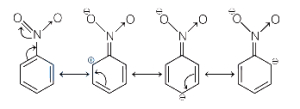
The $-NO_2$ group in the following conjugated system shows:
A
$-R$ effect
B
$-I$ effect
C
$+R$ effect
D
$+I$ effect
Solution
(A) The $-NO_2$ group is a strong electron-withdrawing group due to both its inductive effect $(-I)$ and its resonance effect $(-R)$.
In a conjugated system,such as nitrobenzene,the $-NO_2$ group pulls electron density away from the aromatic ring through resonance.
This delocalization of $\pi$-electrons towards the $-NO_2$ group is characteristic of the $-R$ (or $-M$) effect.
Therefore,the $-NO_2$ group shows the $-R$ effect.
In a conjugated system,such as nitrobenzene,the $-NO_2$ group pulls electron density away from the aromatic ring through resonance.
This delocalization of $\pi$-electrons towards the $-NO_2$ group is characteristic of the $-R$ (or $-M$) effect.
Therefore,the $-NO_2$ group shows the $-R$ effect.
0 likesView Solution
125
ChemistryEasyMCQAP EAMCET · 2021
Which of the following is not explained by hyperconjugation?
A
stability order of carbanions
B
stability order of free radicals
C
stability order of carbocations
D
stability of alkenes
Solution
(A) Hyperconjugation involves the delocalization of electrons from a $\sigma$ $C-H$ bond of an $sp^3$ hybridized carbon into an adjacent vacant $p$-orbital (in carbocations),a half-filled $p$-orbital (in free radicals),or a $\pi$-bond (in alkenes).
This interaction provides stability to these species.
Carbanions possess a lone pair of electrons on a carbon atom and do not have a vacant or half-filled $p$-orbital adjacent to the $C-H$ bond to facilitate this type of electron delocalization.
Therefore,the stability order of carbanions is not explained by hyperconjugation.
This interaction provides stability to these species.
Carbanions possess a lone pair of electrons on a carbon atom and do not have a vacant or half-filled $p$-orbital adjacent to the $C-H$ bond to facilitate this type of electron delocalization.
Therefore,the stability order of carbanions is not explained by hyperconjugation.
0 likesView Solution
126
ChemistryEasyMCQAP EAMCET · 2021
An organic compound of molecular formula $C_6H_6Br_2$ has six carbon atoms in a ring system,two non-conjugate double bonds and two bromo groups at $1,4$ positions. Then the compound is
A
aromatic but non-homo-cyclic
B
aromatic and hetero-cyclic
C
homo-cyclic but not aromatic
D
neither homo-cyclic nor hetero-cyclic
Solution
(C) The molecular formula is $C_6H_6Br_2$.
Double bond equivalent $(DBU)$ formula $= C - \frac{H}{2} - \frac{X}{2} + 1$.
For $C=6, H=6, X=2$:
$DBU = 6 - \frac{6}{2} - \frac{2}{2} + 1 = 6 - 3 - 1 + 1 = 3$.
This indicates the presence of one ring and two double bonds.
The structure consists of a six-membered carbon ring (homo-cyclic) with two non-conjugated double bonds and two bromo groups at the $1,4$ positions.
Since it does not satisfy $H$ückel's rule ($4n+2$ $\pi$ electrons in a planar,fully conjugated system),it is not aromatic.
Therefore,the compound is homo-cyclic but not aromatic.
Double bond equivalent $(DBU)$ formula $= C - \frac{H}{2} - \frac{X}{2} + 1$.
For $C=6, H=6, X=2$:
$DBU = 6 - \frac{6}{2} - \frac{2}{2} + 1 = 6 - 3 - 1 + 1 = 3$.
This indicates the presence of one ring and two double bonds.
The structure consists of a six-membered carbon ring (homo-cyclic) with two non-conjugated double bonds and two bromo groups at the $1,4$ positions.
Since it does not satisfy $H$ückel's rule ($4n+2$ $\pi$ electrons in a planar,fully conjugated system),it is not aromatic.
Therefore,the compound is homo-cyclic but not aromatic.
0 likesView Solution
127
ChemistryEasyMCQAP EAMCET · 2021
Bond order is an inverse measure of
A
bond length
B
bond angle
C
bond dissociation energy
D
stability
Solution
(A) The bond order is a measure of the number of chemical bonds between a pair of atoms.
It is directly proportional to the bond dissociation energy and the stability of the molecule.
However,it is inversely proportional to the bond length.
As the bond order increases,the atoms are pulled closer together,resulting in a shorter bond length.
Therefore,$Bond \ Order \propto \frac{1}{Bond \ Length}$.
It is directly proportional to the bond dissociation energy and the stability of the molecule.
However,it is inversely proportional to the bond length.
As the bond order increases,the atoms are pulled closer together,resulting in a shorter bond length.
Therefore,$Bond \ Order \propto \frac{1}{Bond \ Length}$.
0 likesView Solution
128
ChemistryMediumMCQAP EAMCET · 2021
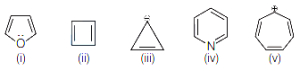
Which of the following compounds are aromatic?
A
$(i)$,$(ii)$ and $(iii)$
B
$(ii)$,$(iii)$ and $(iv)$
C
$(i)$,$(iv)$ and $(v)$
D
$(iii)$,$(iv)$ and $(v)$
Solution
(C) Aromatic compounds consist of a conjugated planar ring system accompanied by delocalized $\pi$-electron clouds. Compounds that follow $H$ückel's rule,i.e.,$(4n+2) \pi$ electrons,are aromatic.
$(i)$ Furan: Has $6 \pi$ electrons ($4$ from double bonds + $2$ from lone pair on $O$),follows $(4n+2) \pi$ rule $(n=1)$,hence aromatic.
$(ii)$ Cyclobutadiene: Has $4 \pi$ electrons,follows $4n \pi$ rule,hence anti-aromatic.
$(iii)$ Cyclopropenyl anion: Has $4 \pi$ electrons,follows $4n \pi$ rule,hence anti-aromatic.
$(iv)$ Pyridine: Has $6 \pi$ electrons,follows $(4n+2) \pi$ rule $(n=1)$,hence aromatic.
$(v)$ Tropylium cation: Has $6 \pi$ electrons,follows $(4n+2) \pi$ rule $(n=1)$,hence aromatic.
Therefore,$(i)$,$(iv)$ and $(v)$ are aromatic.
$(i)$ Furan: Has $6 \pi$ electrons ($4$ from double bonds + $2$ from lone pair on $O$),follows $(4n+2) \pi$ rule $(n=1)$,hence aromatic.
$(ii)$ Cyclobutadiene: Has $4 \pi$ electrons,follows $4n \pi$ rule,hence anti-aromatic.
$(iii)$ Cyclopropenyl anion: Has $4 \pi$ electrons,follows $4n \pi$ rule,hence anti-aromatic.
$(iv)$ Pyridine: Has $6 \pi$ electrons,follows $(4n+2) \pi$ rule $(n=1)$,hence aromatic.
$(v)$ Tropylium cation: Has $6 \pi$ electrons,follows $(4n+2) \pi$ rule $(n=1)$,hence aromatic.
Therefore,$(i)$,$(iv)$ and $(v)$ are aromatic.
0 likesView Solution
129
ChemistryEasyMCQAP EAMCET · 2021
Which compound among the following is most reactive towards electrophilic reagents?
A
$1,2-$dimethylbenzene
B
$1-$methoxy$-2-$(hydroxymethyl)benzene
C
$2-$methylphenol
D
$N$-($2$-methylphenyl)acetamide
Solution
(C) The reactivity of aromatic compounds towards electrophilic substitution depends on the electron-donating ability of the substituents attached to the benzene ring.
Groups that donate electrons via resonance (like $-OH$,$-OCH_3$,$-NHCOCH_3$) activate the ring.
The $-OH$ group is a strong activating group due to the $+M$ effect,which significantly increases the electron density on the benzene ring.
In $2$-methylphenol,the $-OH$ group is a strong activator,and the $-CH_3$ group is a weak activator (via hyperconjugation and $+I$ effect).
Comparing the given options:
$A$: $1,2$-dimethylbenzene (two weak activators).
$B$: $1$-methoxy-$2$-(hydroxymethyl)benzene (one strong activator $-OCH_3$ and one deactivating/weakly activating $-CH_2OH$).
$C$: $2$-methylphenol (one strong activator $-OH$ and one weak activator $-CH_3$).
$D$: $N$-($2$-methylphenyl)acetamide (one moderately activating $-NHCOCH_3$ and one weak activator $-CH_3$).
Among these,the $-OH$ group is the most powerful activating group,making $2$-methylphenol $(C)$ the most reactive towards electrophilic reagents.
Groups that donate electrons via resonance (like $-OH$,$-OCH_3$,$-NHCOCH_3$) activate the ring.
The $-OH$ group is a strong activating group due to the $+M$ effect,which significantly increases the electron density on the benzene ring.
In $2$-methylphenol,the $-OH$ group is a strong activator,and the $-CH_3$ group is a weak activator (via hyperconjugation and $+I$ effect).
Comparing the given options:
$A$: $1,2$-dimethylbenzene (two weak activators).
$B$: $1$-methoxy-$2$-(hydroxymethyl)benzene (one strong activator $-OCH_3$ and one deactivating/weakly activating $-CH_2OH$).
$C$: $2$-methylphenol (one strong activator $-OH$ and one weak activator $-CH_3$).
$D$: $N$-($2$-methylphenyl)acetamide (one moderately activating $-NHCOCH_3$ and one weak activator $-CH_3$).
Among these,the $-OH$ group is the most powerful activating group,making $2$-methylphenol $(C)$ the most reactive towards electrophilic reagents.
0 likesView Solution
130
ChemistryEasyMCQAP EAMCET · 2021
Which of the following is not an electrophile?
A
$CN^{-}$
B
$BF_3$
C
$NO_2^{+}$
D
$AlCl_3$
Solution
(A) An electrophile is a species that accepts an electron pair to form a bond with a nucleophile. Since electrophiles accept electrons,they act as Lewis acids.
$CN^{-}$ is a nucleophile because it is electron-rich and carries a negative charge.
$BF_3$ is a neutral electrophile (Lewis acid) because it is electron-deficient.
$NO_2^{+}$ is a positively charged electrophile.
$AlCl_3$ is an electrophile because it is electron-deficient.
Therefore,$CN^{-}$ is the only species listed that is not an electrophile.
$CN^{-}$ is a nucleophile because it is electron-rich and carries a negative charge.
$BF_3$ is a neutral electrophile (Lewis acid) because it is electron-deficient.
$NO_2^{+}$ is a positively charged electrophile.
$AlCl_3$ is an electrophile because it is electron-deficient.
Therefore,$CN^{-}$ is the only species listed that is not an electrophile.
0 likesView Solution
131
ChemistryMediumMCQAP EAMCET · 2021
The number of optical isomers possible for $2-$Bromo$-3-$chlorobutane are
A
$8$
B
$10$
C
$4$
D
$2$
Solution
(C) The structure of $2-$Bromo$-3-$chlorobutane is $CH_3-CH(Br)-CH(Cl)-CH_3$.
This molecule contains two chiral centers (at $C-2$ and $C-3$).
Since the molecule does not have a plane of symmetry (the groups attached to the chiral centers are different),the number of optical isomers is given by $2^n$,where $n$ is the number of chiral centers.
Here,$n = 2$.
Therefore,the number of optical isomers $= 2^2 = 4$.
The four isomers are $(2R, 3R)$,$(2S, 3S)$,$(2R, 3S)$,and $(2S, 3R)$.
This molecule contains two chiral centers (at $C-2$ and $C-3$).
Since the molecule does not have a plane of symmetry (the groups attached to the chiral centers are different),the number of optical isomers is given by $2^n$,where $n$ is the number of chiral centers.
Here,$n = 2$.
Therefore,the number of optical isomers $= 2^2 = 4$.
The four isomers are $(2R, 3R)$,$(2S, 3S)$,$(2R, 3S)$,and $(2S, 3R)$.
0 likesView Solution
132
ChemistryMediumMCQAP EAMCET · 2021
How many isomers (cyclic and acyclic) are possible for a compound with molecular formula $C_3H_6O$?
A
$4$
B
$5$
C
$9$
D
$7$
Solution
(C) The degree of unsaturation $(DU)$ for $C_3H_6O$ is calculated as: $DU = C + 1 - \frac{H}{2} = 3 + 1 - \frac{6}{2} = 1$.
This indicates the presence of either one double bond or one ring.
Possible acyclic isomers:
$1$. Propanal $(CH_3CH_2CHO)$
$2$. Propanone $(CH_3COCH_3)$
$3$. Allyl alcohol $(CH_2=CH-CH_2OH)$
$4$. $1$-propen$-1-$ol $(CH_3-CH=CH-OH)$
$5$. $2$-propen$-1-$ol $(CH_2=C(OH)-CH_3)$
$6$. Methoxyethene $(CH_3-O-CH=CH_2)$
Possible cyclic isomers:
$7$. Cyclopropanol
$8$. Methoxycyclopropane (Oxetane is not possible as it has $4$ atoms in ring,but $C_3H_6O$ can form $2$-methyloxirane or oxetane)
$9$. $2$-methyloxirane (propylene oxide)
$10$. Oxetane
Wait,let us list them carefully:
$(1)$ Propanal,$(2)$ Propanone,$(3)$ Allyl alcohol $(CH_2=CHCH_2OH)$,$(4)$ $1$-propen$-1-$ol $(CH_3CH=CHOH)$,$(5)$ $2$-propen$-1-$ol $(CH_2=C(OH)CH_3)$,$(6)$ Methoxyethene $(CH_3OCH=CH_2)$,$(7)$ Cyclopropanol,$(8)$ $2$-methyloxirane,$(9)$ Oxetane.
Total isomers = $9$.
This indicates the presence of either one double bond or one ring.
Possible acyclic isomers:
$1$. Propanal $(CH_3CH_2CHO)$
$2$. Propanone $(CH_3COCH_3)$
$3$. Allyl alcohol $(CH_2=CH-CH_2OH)$
$4$. $1$-propen$-1-$ol $(CH_3-CH=CH-OH)$
$5$. $2$-propen$-1-$ol $(CH_2=C(OH)-CH_3)$
$6$. Methoxyethene $(CH_3-O-CH=CH_2)$
Possible cyclic isomers:
$7$. Cyclopropanol
$8$. Methoxycyclopropane (Oxetane is not possible as it has $4$ atoms in ring,but $C_3H_6O$ can form $2$-methyloxirane or oxetane)
$9$. $2$-methyloxirane (propylene oxide)
$10$. Oxetane
Wait,let us list them carefully:
$(1)$ Propanal,$(2)$ Propanone,$(3)$ Allyl alcohol $(CH_2=CHCH_2OH)$,$(4)$ $1$-propen$-1-$ol $(CH_3CH=CHOH)$,$(5)$ $2$-propen$-1-$ol $(CH_2=C(OH)CH_3)$,$(6)$ Methoxyethene $(CH_3OCH=CH_2)$,$(7)$ Cyclopropanol,$(8)$ $2$-methyloxirane,$(9)$ Oxetane.
Total isomers = $9$.
0 likesView Solution
133
ChemistryMediumMCQAP EAMCET · 2021
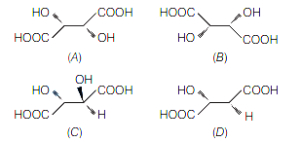
Which statement regarding the following structures is true?
A
$A$ and $B$ are diastereomers,$C$ and $D$ are enantiomers
B
$A$ and $B$ are enantiomers,$C$ and $D$ are enantiomers
C
$A$ and $B$ are enantiomers,$C$ and $D$ are diastereomers
D
$A$ and $B$ are diastereomers,$C$ and $D$ are diastereomers
Solution
(C) Structures $A$ and $B$ are mirror images of each other and are non-superimposable,therefore they are enantiomers.
Structures $C$ and $D$ have the same configuration at one chiral center but opposite configurations at the other,making them diastereomers.
Structures $C$ and $D$ have the same configuration at one chiral center but opposite configurations at the other,making them diastereomers.
0 likesView Solution
134
ChemistryMediumMCQAP EAMCET · 2021
$X$ and $Y$ are optically active isomers having the molecular formula $C_5H_9Cl$. When treated with one mole of $H_2$,$X$ gets converted to an optically inactive compound $Z$,but $Y$ gives an optically active compound $P$. The structures of $X$ and $Y$ respectively are:
A
$3-$chloropent$-1-$ene and $1-$chloropent$-2-$ene
B
$3-$chloropent$-1-$ene and $4-$chloropent$-1-$ene
C
$3-$chloropent$-1-$ene and $3-$chloropent$-2-$ene
D
$3-$chloropent$-1-$ene and $2-$chloropent$-1-$ene
Solution
(B) The molecular formula $C_5H_9Cl$ indicates a degree of unsaturation of $2$.
$X$ is $3$-chloropent-$1$-ene $(CH_3CH_2CH(Cl)CH=CH_2)$,which is optically active due to the chiral center at $C_3$.
Upon hydrogenation with $1 \ mole$ of $H_2$,$X$ forms $3$-chloropentane $(CH_3CH_2CH(Cl)CH_2CH_3)$,which is optically inactive $(Z)$ due to the presence of a plane of symmetry.
$Y$ is $4$-chloropent-$1$-ene $(CH_2=CHCH_2CH(Cl)CH_3)$,which is also optically active due to the chiral center at $C_4$.
Upon hydrogenation with $1 \ mole$ of $H_2$,$Y$ forms $2$-chloropentane $(CH_3CH_2CH_2CH(Cl)CH_3)$,which is still optically active $(P)$ because the chiral center at $C_2$ remains intact.
Thus,$X$ is $3$-chloropent-$1$-ene and $Y$ is $4$-chloropent-$1$-ene.
$X$ is $3$-chloropent-$1$-ene $(CH_3CH_2CH(Cl)CH=CH_2)$,which is optically active due to the chiral center at $C_3$.
Upon hydrogenation with $1 \ mole$ of $H_2$,$X$ forms $3$-chloropentane $(CH_3CH_2CH(Cl)CH_2CH_3)$,which is optically inactive $(Z)$ due to the presence of a plane of symmetry.
$Y$ is $4$-chloropent-$1$-ene $(CH_2=CHCH_2CH(Cl)CH_3)$,which is also optically active due to the chiral center at $C_4$.
Upon hydrogenation with $1 \ mole$ of $H_2$,$Y$ forms $2$-chloropentane $(CH_3CH_2CH_2CH(Cl)CH_3)$,which is still optically active $(P)$ because the chiral center at $C_2$ remains intact.
Thus,$X$ is $3$-chloropent-$1$-ene and $Y$ is $4$-chloropent-$1$-ene.
0 likesView Solution
135
ChemistryMediumMCQAP EAMCET · 2021
When the difference in boiling points of two liquids is very small,the separation is carried out by:
A
Steam distillation
B
Simple distillation
C
Fractional distillation
D
Vacuum distillation
Solution
(C) If the difference in boiling points of two liquids is not significant,simple distillation cannot be used to separate them effectively.
In such cases,the vapours of both liquids are formed within the same temperature range and condense simultaneously.
Therefore,the technique of fractional distillation is employed,which uses a fractionating column to allow for multiple vaporization-condensation cycles,effectively separating components with close boiling points.
In such cases,the vapours of both liquids are formed within the same temperature range and condense simultaneously.
Therefore,the technique of fractional distillation is employed,which uses a fractionating column to allow for multiple vaporization-condensation cycles,effectively separating components with close boiling points.
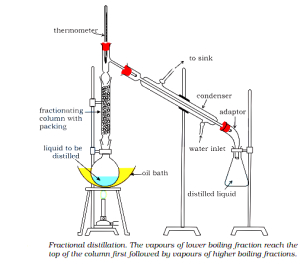
0 likesView Solution
136
ChemistryEasyMCQAP EAMCET · 2021
Among the following,in which type of chromatography,both stationary and mobile phases are in liquid state?
A
Gas-liquid chromatography
B
Ascending paper chromatography (Partition chromatography)
C
High performance liquid chromatography $(HPLC)$
D
Thin layer chromatography $(TLC)$
Solution
(B) In paper chromatography,both the mobile and stationary phases are liquids. The stationary phase is typically water trapped in the cellulose fibers of the paper,which acts as a liquid phase immiscible with the mobile phase.
Column chromatography,$HPLC$,and thin layer chromatography $(TLC)$ are examples of liquid-solid chromatography,where the mobile phase is a liquid and the stationary phase is a solid adsorbent.
Column chromatography,$HPLC$,and thin layer chromatography $(TLC)$ are examples of liquid-solid chromatography,where the mobile phase is a liquid and the stationary phase is a solid adsorbent.
0 likesView Solution
137
ChemistryMediumMCQAP EAMCET · 2021
$A$ mixture of dichloromethane and aniline can be separated by
A
distillation
B
sublimation
C
crystallisation
D
fractional distillation
Solution
(A) The boiling point of dichloromethane is $39.4^{\circ}C$ and the boiling point of aniline is $184.1^{\circ}C$.
Since both components exist in the liquid state and have a significant difference in their boiling points,they can be separated by the process of distillation.
Since both components exist in the liquid state and have a significant difference in their boiling points,they can be separated by the process of distillation.
0 likesView Solution
138
ChemistryEasyMCQAP EAMCET · 2021
In thin layer chromatography,a substance moved by a distance of $4 \ cm$,whereas the solvent moved by a distance of $5 \ cm$. Then the value of retardation factor $(R_f)$ is
A
$0.8$
B
$1.0$
C
$9.0$
D
$1.25$
Solution
(A) The retardation factor $(R_f)$ is defined as the ratio of the distance travelled by the solute to the distance travelled by the solvent front.
$R_f = \frac{\text{distance travelled by solute}}{\text{distance travelled by solvent}}$
Given,distance travelled by solute = $4 \ cm$ and distance travelled by solvent = $5 \ cm$.
$R_f = \frac{4}{5} = 0.8$
$R_f = \frac{\text{distance travelled by solute}}{\text{distance travelled by solvent}}$
Given,distance travelled by solute = $4 \ cm$ and distance travelled by solvent = $5 \ cm$.
$R_f = \frac{4}{5} = 0.8$
0 likesView Solution
139
ChemistryMediumMCQAP EAMCET · 2021
In Lassaigne's test for halogens,it is necessary to remove '$X$' and '$Y$' from the sodium fusion extract if nitrogen and sulphur are present. This is done by boiling the extract with '$Z$'. Identify $X, Y$ and $Z$.
A
$X = NaNO_3, Y = Na_2SO_4, Z = \text{conc. } HNO_3$
B
$X = NaNH_2, Y = NaSH, Z = \text{conc. } HCl$
C
$X = NaNO_2, Y = Na_2SO_3, Z = \text{conc. } H_2SO_4$
D
$X = NaCN, Y = Na_2S, Z = \text{conc. } HNO_3$
Solution
(D) In Lassaigne's test,if nitrogen and sulphur are present in the organic compound,they form $NaCN$ and $Na_2S$ respectively during sodium fusion.
These ions interfere with the test for halogens (like $Cl^-$,$Br^-$,$I^-$) by forming precipitates with $AgNO_3$.
To remove these,the sodium fusion extract is boiled with concentrated $HNO_3$.
This decomposes $NaCN$ and $Na_2S$ into volatile $HCN$ and $H_2S$ gases,respectively.
$NaCN (X) + HNO_3 (Z) \rightarrow NaNO_3 + HCN \uparrow$
$Na_2S (Y) + 2HNO_3 (Z) \rightarrow 2NaNO_3 + H_2S \uparrow$
Therefore,$X = NaCN$,$Y = Na_2S$,and $Z = \text{conc. } HNO_3$.
These ions interfere with the test for halogens (like $Cl^-$,$Br^-$,$I^-$) by forming precipitates with $AgNO_3$.
To remove these,the sodium fusion extract is boiled with concentrated $HNO_3$.
This decomposes $NaCN$ and $Na_2S$ into volatile $HCN$ and $H_2S$ gases,respectively.
$NaCN (X) + HNO_3 (Z) \rightarrow NaNO_3 + HCN \uparrow$
$Na_2S (Y) + 2HNO_3 (Z) \rightarrow 2NaNO_3 + H_2S \uparrow$
Therefore,$X = NaCN$,$Y = Na_2S$,and $Z = \text{conc. } HNO_3$.
0 likesView Solution
140
ChemistryMediumMCQAP EAMCET · 2021
In the Lassaigne sodium fusion test,$N$ and $S$ of an organic compound are converted into:
A
$NaCN$ and $Na_2S$
B
$Na_2S$ and $NaCNS$
C
$NaCN$ and $NaCNS$
D
$NaCN$,$Na_2S$ and $NaCNS$
Solution
(D) In the Lassaigne sodium fusion test,the organic compound is fused with metallic sodium.
If both nitrogen and sulphur are present in the organic compound,they react with sodium to form sodium thiocyanate,represented as $NaCNS$.
If only nitrogen is present,it forms $NaCN$.
If only sulphur is present,it forms $Na_2S$.
Therefore,$N$ and $S$ are converted into $NaCN$,$Na_2S$,and $NaCNS$ depending on the elements present.
If both nitrogen and sulphur are present in the organic compound,they react with sodium to form sodium thiocyanate,represented as $NaCNS$.
If only nitrogen is present,it forms $NaCN$.
If only sulphur is present,it forms $Na_2S$.
Therefore,$N$ and $S$ are converted into $NaCN$,$Na_2S$,and $NaCNS$ depending on the elements present.
0 likesView Solution
141
ChemistryMediumMCQAP EAMCET · 2021
In an organic compound,phosphorus is estimated as:
A
$Mg_3(PO_4)_2$
B
$P_2O_5$
C
$Mg_2P_2O_7$
D
$H_3PO_4$
Solution
(C) In an organic compound,phosphorus is estimated by heating the compound with fuming nitric acid,which converts phosphorus into phosphoric acid $(H_3PPO_4)$.
The phosphoric acid is then precipitated as ammonium phosphomolybdate by adding ammonium molybdate.
This precipitate is dissolved in ammonia and treated with magnesia mixture $(MgCl_2 + NH_4Cl + NH_4OH)$ to precipitate it as $MgNH_4PO_4$.
Finally,the precipitate is washed,dried,and ignited to yield magnesium pyrophosphate,$Mg_2P_2O_7$.
The phosphoric acid is then precipitated as ammonium phosphomolybdate by adding ammonium molybdate.
This precipitate is dissolved in ammonia and treated with magnesia mixture $(MgCl_2 + NH_4Cl + NH_4OH)$ to precipitate it as $MgNH_4PO_4$.
Finally,the precipitate is washed,dried,and ignited to yield magnesium pyrophosphate,$Mg_2P_2O_7$.
0 likesView Solution
142
ChemistryMediumMCQAP EAMCET · 2021
Using Kjeldahl's method on $1 \ g$ of a soil sample,the ammonia evolved neutralized $25 \ mL$ of $1 \ M \ H_2SO_4$. The percentage of nitrogen present in the sample is: (in $\%$)
A
$100$
B
$60$
C
$70$
D
$25$
Solution
(C) The reaction between ammonia and sulfuric acid is: $2NH_3 + H_2SO_4 \rightarrow (NH_4)_2SO_4$.
$25 \ mL$ of $1 \ M \ H_2SO_4$ contains $25 \ mmol$ of acid.
Since $1 \ mol$ of $H_2SO_4$ reacts with $2 \ mol$ of $NH_3$,the amount of $NH_3$ evolved is $2 \times 25 \ mmol = 50 \ mmol$.
The mass of nitrogen in $50 \ mmol$ of $NH_3$ is $50 \times 10^{-3} \ mol \times 14 \ g/mol = 0.7 \ g$.
The percentage of nitrogen is calculated as: $\frac{\text{mass of nitrogen}}{\text{mass of sample}} \times 100 = \frac{0.7 \ g}{1 \ g} \times 100 = 70\%$.
$25 \ mL$ of $1 \ M \ H_2SO_4$ contains $25 \ mmol$ of acid.
Since $1 \ mol$ of $H_2SO_4$ reacts with $2 \ mol$ of $NH_3$,the amount of $NH_3$ evolved is $2 \times 25 \ mmol = 50 \ mmol$.
The mass of nitrogen in $50 \ mmol$ of $NH_3$ is $50 \times 10^{-3} \ mol \times 14 \ g/mol = 0.7 \ g$.
The percentage of nitrogen is calculated as: $\frac{\text{mass of nitrogen}}{\text{mass of sample}} \times 100 = \frac{0.7 \ g}{1 \ g} \times 100 = 70\%$.
0 likesView Solution
143
ChemistryMediumMCQAP EAMCET · 2021
In Kjeldahl's method,organic $N$ is estimated as
A
nitrogen
B
ammonia
C
nitric acid
D
nitrogen dioxide
Solution
(B) In the Kjeldahl method,the organic substance containing nitrogen is heated with concentrated $H_2SO_4$.
The nitrogen in the organic compound is quantitatively converted into ammonium sulphate,$(NH_4)_2SO_4$.
When this solution is treated with excess alkali $(NaOH)$,ammonia $(NH_3)$ gas is evolved.
This evolved $NH_3$ is then absorbed in a known volume of standard acid or boric acid solution for titration to estimate the amount of nitrogen.
Thus,the organic $N$ is ultimately estimated as ammonia $(NH_3)$.
The nitrogen in the organic compound is quantitatively converted into ammonium sulphate,$(NH_4)_2SO_4$.
When this solution is treated with excess alkali $(NaOH)$,ammonia $(NH_3)$ gas is evolved.
This evolved $NH_3$ is then absorbed in a known volume of standard acid or boric acid solution for titration to estimate the amount of nitrogen.
Thus,the organic $N$ is ultimately estimated as ammonia $(NH_3)$.
0 likesView Solution
144
ChemistryMediumMCQAP EAMCET · 2021
Using Duma's method for estimating nitrogen,$1 \ g$ of an organic compound $X$ gave $82 \ mL$ of nitrogen,collected at $27^{\circ} C$ and $750 \ mm \ Hg$ pressure. If the aqueous tension at $27^{\circ} C$ is $30 \ mm \ Hg$ pressure,then the percentage of nitrogen in the given compound $X$ is: (in $\%$)
A
$22.09$
B
$88.36$
C
$44.18$
D
$70.69$
Solution
(B) First,calculate the pressure of dry nitrogen by subtracting the aqueous tension from the total pressure:
$P_{N_2} = 750 \ mm \ Hg - 30 \ mm \ Hg = 720 \ mm \ Hg$.
Next,convert the volume of nitrogen to $STP$ conditions using the combined gas law:
$V_{STP} = \frac{P \times V \times 273}{760 \times T} = \frac{720 \times 82 \times 273}{760 \times 300} \approx 70.68 \ mL$.
Finally,calculate the percentage of nitrogen using the formula:
$\text{Percentage of } N = \frac{28}{22400} \times \frac{V_{STP} \text{ (in mL)}}{\text{mass of compound (in g)}} \times 100$.
$\text{Percentage of } N = \frac{28}{22400} \times \frac{70.68}{1} \times 100 \approx 8.836 \ \%$.
Wait,re-calculating: $\frac{28 \times 70.68}{224} = 8.835$.
Re-evaluating the provided options,the calculation $\frac{70.68 \times 28}{22400} \times 100 = 8.835 \ \%$.
Given the options provided,there is a discrepancy. Let's re-check the formula: $\frac{28}{22400} \times \frac{70.68}{1} \times 100 = 8.835 \ \%$.
If the volume was $820 \ mL$,the answer would be $88.35 \ \%$. Assuming a typo in the question volume,the intended answer is $B$.
$P_{N_2} = 750 \ mm \ Hg - 30 \ mm \ Hg = 720 \ mm \ Hg$.
Next,convert the volume of nitrogen to $STP$ conditions using the combined gas law:
$V_{STP} = \frac{P \times V \times 273}{760 \times T} = \frac{720 \times 82 \times 273}{760 \times 300} \approx 70.68 \ mL$.
Finally,calculate the percentage of nitrogen using the formula:
$\text{Percentage of } N = \frac{28}{22400} \times \frac{V_{STP} \text{ (in mL)}}{\text{mass of compound (in g)}} \times 100$.
$\text{Percentage of } N = \frac{28}{22400} \times \frac{70.68}{1} \times 100 \approx 8.836 \ \%$.
Wait,re-calculating: $\frac{28 \times 70.68}{224} = 8.835$.
Re-evaluating the provided options,the calculation $\frac{70.68 \times 28}{22400} \times 100 = 8.835 \ \%$.
Given the options provided,there is a discrepancy. Let's re-check the formula: $\frac{28}{22400} \times \frac{70.68}{1} \times 100 = 8.835 \ \%$.
If the volume was $820 \ mL$,the answer would be $88.35 \ \%$. Assuming a typo in the question volume,the intended answer is $B$.
0 likesView Solution
145
ChemistryEasyMCQAP EAMCET · 2021
Carnallite in water dissociates to give $.....$ ions.
A
$K^{+}$,$Mg^{2+}$ and $Cl^{-}$
B
$K^{+}$,$Mg^{2+}$ and $Br^{-}$
C
$K^{+}$,$Zn^{2+}$ and $Cl^{-}$
D
$K^{+}$,$Ba^{2+}$ and $Br^{-}$
Solution
(A) Carnallite is a double salt. It dissociates into its constituent ions completely when dissolved in water to give $5$ ions,i.e.,$K^{+}$,$Mg^{2+}$,and $3 Cl^{-}$.
$KCl \cdot MgCl_2 \cdot 6 H_2O \longrightarrow K^{+} + Mg^{2+} + 3 Cl^{-} + 6 H_2O$
$KCl \cdot MgCl_2 \cdot 6 H_2O \longrightarrow K^{+} + Mg^{2+} + 3 Cl^{-} + 6 H_2O$
0 likesView Solution
146
ChemistryMCQAP EAMCET · 2021
If $A$ is the areal velocity of a planet of mass $M$,its angular momentum is
A
$\frac{M}{A}$
B
$2 M A$
C
$A^2 M$
D
$A M^2$
Solution
(B) According to Kepler's second law (law of areas),the areal velocity $(A)$ is defined as the rate at which the area is swept out by the position vector of the planet.
Mathematically,the areal velocity is given by the relation:
$A = \frac{dA}{dt} = \frac{L}{2M}$
where:
$L$ is the angular momentum of the planet,
$M$ is the mass of the planet.
Rearranging this formula to solve for the angular momentum $(L)$:
$L = 2 M A$
Therefore,the correct option is $B$.
Mathematically,the areal velocity is given by the relation:
$A = \frac{dA}{dt} = \frac{L}{2M}$
where:
$L$ is the angular momentum of the planet,
$M$ is the mass of the planet.
Rearranging this formula to solve for the angular momentum $(L)$:
$L = 2 M A$
Therefore,the correct option is $B$.
0 likesView Solution
147
ChemistryMediumMCQAP EAMCET · 2021
Identify $(P)$ and $(Q)$ in the following reaction:
$2 CH_3 Cl + Si$ $\xrightarrow[570 \ K]{\text{Cu powder}} (P)$ $\xrightarrow{H_2 O} (Q)$ $\longrightarrow \text{Straight chain polymer}$
$2 CH_3 Cl + Si$ $\xrightarrow[570 \ K]{\text{Cu powder}} (P)$ $\xrightarrow{H_2 O} (Q)$ $\longrightarrow \text{Straight chain polymer}$
A
$P: (CH_3)_3 SiCl$
$Q: (CH_3)_3 SiOH$
$Q: (CH_3)_3 SiOH$
B
$P: (CH_3)_2 SiCl_2$
$Q: (CH_3)_2 Si(OH)_2$
$Q: (CH_3)_2 Si(OH)_2$
C
$P: (CH_3)_2 SiCl_2$
$Q: (CH_3)_2 Si(OH)Cl$
$Q: (CH_3)_2 Si(OH)Cl$
D
$P: (CH_3)_2 SiCl_2$
$Q: (CH_3)_2 SiO$
$Q: (CH_3)_2 SiO$
Solution
(B) The reaction of methyl chloride with silicon in the presence of copper catalyst at $570 \ K$ is known as the Direct Process,which produces methylchlorosilanes.
$(P)$ is dimethyl dichlorosilane,$(CH_3)_2 SiCl_2$.
Hydrolysis of $(CH_3)_2 SiCl_2$ yields dimethyl silanediol,$(CH_3)_2 Si(OH)_2$,which is $(Q)$.
$(CH_3)_2 Si(OH)_2$ undergoes condensation polymerization to form straight-chain silicone polymers.
Reaction:
$2 CH_3 Cl + Si \xrightarrow[570 \ K]{\text{Cu powder}} (CH_3)_2 SiCl_2 (P)$
$(CH_3)_2 SiCl_2 + 2 H_2 O \longrightarrow (CH_3)_2 Si(OH)_2 (Q) + 2 HCl$
$(n) (CH_3)_2 Si(OH)_2 \longrightarrow \text{Straight chain polymer} + (n) H_2 O$
$(P)$ is dimethyl dichlorosilane,$(CH_3)_2 SiCl_2$.
Hydrolysis of $(CH_3)_2 SiCl_2$ yields dimethyl silanediol,$(CH_3)_2 Si(OH)_2$,which is $(Q)$.
$(CH_3)_2 Si(OH)_2$ undergoes condensation polymerization to form straight-chain silicone polymers.
Reaction:
$2 CH_3 Cl + Si \xrightarrow[570 \ K]{\text{Cu powder}} (CH_3)_2 SiCl_2 (P)$
$(CH_3)_2 SiCl_2 + 2 H_2 O \longrightarrow (CH_3)_2 Si(OH)_2 (Q) + 2 HCl$
$(n) (CH_3)_2 Si(OH)_2 \longrightarrow \text{Straight chain polymer} + (n) H_2 O$
0 likesView Solution
148
ChemistryMediumMCQAP EAMCET · 2021
Match the following reactions with their nature and choose the correct code.
| Reaction | Nature of reaction |
| $A. RBr \xrightarrow{Na}$ | $1. \text{Partial reduction}$ |
| $B. RCOO^-Na^+ \xrightarrow{NaOH/CaO, \Delta}$ | $2. \text{Electrophilic addition}$ |
| $C. R-C \equiv C-R' \xrightarrow{\text{Lindlar's catalyst } (H_2)}$ | $3. \text{Wurtz reaction}$ |
| $D. H_2C=CH_2 \xrightarrow{Br_2/CCl_4}$ | $4. \text{Decarboxylation}$ |
| $5. \text{Decarboxylative dimerisation}$ |
A
$A-3, B-4, C-1, D-2$
B
$A-3, B-5, C-1, D-2$
C
$A-5, B-4, C-1, D-2$
D
$A-3, B-4, C-2, D-1$
Solution
(A) The correct matching is as follows:
$A. RBr \xrightarrow{Na}$ represents the $Wurtz$ reaction $(3)$.
$B. RCOO^-Na^+ \xrightarrow{NaOH/CaO, \Delta}$ represents $Decarboxylation$ $(4)$.
$C. R-C \equiv C-R' \xrightarrow{\text{Lindlar's catalyst } (H_2)}$ represents $Partial$ $reduction$ $(1)$.
$D. H_2C=CH_2 \xrightarrow{Br_2/CCl_4}$ represents $Electrophilic$ $addition$ $(2)$.
Therefore,the correct sequence is $A-3, B-4, C-1, D-2$.
$A. RBr \xrightarrow{Na}$ represents the $Wurtz$ reaction $(3)$.
$B. RCOO^-Na^+ \xrightarrow{NaOH/CaO, \Delta}$ represents $Decarboxylation$ $(4)$.
$C. R-C \equiv C-R' \xrightarrow{\text{Lindlar's catalyst } (H_2)}$ represents $Partial$ $reduction$ $(1)$.
$D. H_2C=CH_2 \xrightarrow{Br_2/CCl_4}$ represents $Electrophilic$ $addition$ $(2)$.
Therefore,the correct sequence is $A-3, B-4, C-1, D-2$.
0 likesView Solution
149
ChemistryEasyMCQAP EAMCET · 2021
Assertion $(A):$ Sodium acetate on Kolbe's electrolysis gives ethane.
Reason $(R):$ Methyl free radical is formed at cathode.
Reason $(R):$ Methyl free radical is formed at cathode.
A
Both $A$ and $R$ are true and $R$ is a correct explanation for $A$
B
Both $A$ and $R$ are true but $R$ is not a correct explanation for $A$
C
$A$ is true,$R$ is false
D
$A$ is false,$R$ is true
Solution
(C) In Kolbe's electrolysis,sodium acetate $(CH_3COONa)$ undergoes electrolysis to produce ethane $(C_2H_6)$.
The dissociation is: $CH_3COONa \rightleftharpoons CH_3COO^{-} + Na^{+}$.
At the anode,the acetate ion loses an electron to form an acetoxy radical,which then decarboxylates to form a methyl free radical $(CH_3^{\bullet})$. Two methyl radicals combine to form ethane.
At the cathode,water is reduced to produce hydrogen gas $(H_2)$ and hydroxide ions $(OH^{-})$.
Therefore,the methyl free radical is formed at the anode,not the cathode. Thus,Assertion $(A)$ is true,but Reason $(R)$ is false.
The dissociation is: $CH_3COONa \rightleftharpoons CH_3COO^{-} + Na^{+}$.
At the anode,the acetate ion loses an electron to form an acetoxy radical,which then decarboxylates to form a methyl free radical $(CH_3^{\bullet})$. Two methyl radicals combine to form ethane.
At the cathode,water is reduced to produce hydrogen gas $(H_2)$ and hydroxide ions $(OH^{-})$.
Therefore,the methyl free radical is formed at the anode,not the cathode. Thus,Assertion $(A)$ is true,but Reason $(R)$ is false.
0 likesView Solution
150
ChemistryMediumMCQAP EAMCET · 2021
The suitable reagents for the conversion of methane into methyl iodide are
A
$I_2, HNO_2$
B
$I_2, H_2 O_2$
C
$I_2, H_2 O$
D
$I_2, HNO_3$
Solution
(D) The reaction of methane with iodine is a reversible process: $CH_4 + I_2 \rightleftharpoons CH_3I + HI$.
Since $HI$ is a strong reducing agent,it reduces $CH_3I$ back to $CH_4$.
To drive the reaction in the forward direction,an oxidizing agent like $HNO_3$ is added to consume $HI$ and convert it back into $I_2$: $2HNO_3 + 2HI \longrightarrow 2NO_2 + 2H_2O + I_2$.
Therefore,$I_2$ and $HNO_3$ are the suitable reagents.
Since $HI$ is a strong reducing agent,it reduces $CH_3I$ back to $CH_4$.
To drive the reaction in the forward direction,an oxidizing agent like $HNO_3$ is added to consume $HI$ and convert it back into $I_2$: $2HNO_3 + 2HI \longrightarrow 2NO_2 + 2H_2O + I_2$.
Therefore,$I_2$ and $HNO_3$ are the suitable reagents.
0 likesView Solution
151
ChemistryMediumMCQAP EAMCET · 2021
Bleaching powder can be obtained by which of the following reactions?
A
$Mg(OH)_2 + F_2 \xrightarrow{\Delta} MgOF_2 + H_2O$
B
$Ca(OH)_2 + Cl_2 \xrightarrow{\Delta} CaOCl_2 + H_2O$
C
$Ba(OH)_2 + Br_2 \xrightarrow{\Delta} BaOBr_2 + H_2O$
D
$Ca(OH)_2 + F_2 \xrightarrow{\Delta} CaOF_2 + H_2O$
Solution
(B) The chemical formula of bleaching powder is $CaOCl_2$.
It is prepared by the action of chlorine gas on dry slaked lime,$Ca(OH)_2$.
The reaction is:
$Ca(OH)_2 + Cl_2 \xrightarrow{\Delta} CaOCl_2 + H_2O$
It is prepared by the action of chlorine gas on dry slaked lime,$Ca(OH)_2$.
The reaction is:
$Ca(OH)_2 + Cl_2 \xrightarrow{\Delta} CaOCl_2 + H_2O$
0 likesView Solution
152
ChemistryMediumMCQAP EAMCET · 2021
The $FCC$ crystal contains how many atoms in each unit cell?
A
$4$
B
$8$
C
$10$
D
$12$
Solution
(A) In a face-centered cubic $(FCC)$ unit cell,atoms are present at each of the $8$ corners and at the center of each of the $6$ faces.
Each corner atom is shared by $8$ adjacent unit cells,so its contribution is $8 \times \frac{1}{8} = 1$.
Each face-centered atom is shared by $2$ adjacent unit cells,so its contribution is $6 \times \frac{1}{2} = 3$.
Therefore,the total number of atoms per unit cell is $1 + 3 = 4$.
Each corner atom is shared by $8$ adjacent unit cells,so its contribution is $8 \times \frac{1}{8} = 1$.
Each face-centered atom is shared by $2$ adjacent unit cells,so its contribution is $6 \times \frac{1}{2} = 3$.
Therefore,the total number of atoms per unit cell is $1 + 3 = 4$.
0 likesView Solution
153
ChemistryEasyMCQAP EAMCET · 2021
In the face-centered unit cell,the lattice points are present at
A
only the corners of the unit cell
B
the corners and the center of the unit cell
C
the corners and the face centers of the unit cell
D
only the face centers of the unit cell
Solution
(C) Cubic crystal systems are classified into three types based on the arrangement of lattice points:
$(a)$ Simple Cubic $(SC)$: Lattice points are arranged only at the corners of the cube.
$(b)$ Body-Centered Cubic $(BCC)$: Lattice points are arranged at the corners and at the center of the cube.
$(c)$ Face-Centered Cubic $(FCC)$: Lattice points are arranged at the corners and at the center of each face.
Therefore,in a face-centered unit cell,the lattice points are present at the corners and the face centers of the unit cell.
$(a)$ Simple Cubic $(SC)$: Lattice points are arranged only at the corners of the cube.
$(b)$ Body-Centered Cubic $(BCC)$: Lattice points are arranged at the corners and at the center of the cube.
$(c)$ Face-Centered Cubic $(FCC)$: Lattice points are arranged at the corners and at the center of each face.
Therefore,in a face-centered unit cell,the lattice points are present at the corners and the face centers of the unit cell.
0 likesView Solution
154
ChemistryEasyMCQAP EAMCET · 2021
$A$ metal crystallizes with a $FCC$ lattice, the edge of whose unit cell is $x \text{ pm}$. The diameter of this metal atom would be $\text{pm}$.
A
$x / \sqrt{2}$
B
$x / 2\sqrt{2}$
C
$\sqrt{2}x$
D
$2x$
Solution
(A) In a face-centered cubic $(FCC)$ unit cell, atoms touch along the face diagonal.
Let the edge length of the unit cell be $a = x \text{ pm}$ and the radius of the atom be $r$.
The length of the face diagonal is given by $d = \sqrt{2}a = \sqrt{2}x$.
Since the atoms touch along the face diagonal, the diagonal length is also equal to $4r$ $(r + 2r + r = 4r)$.
Therefore, $4r = \sqrt{2}x$, which gives $r = \frac{\sqrt{2}x}{4} = \frac{x}{2\sqrt{2}}$.
The diameter of the atom is $D = 2r = 2 \times \frac{x}{2\sqrt{2}} = \frac{x}{\sqrt{2}} \text{ pm}$.
Let the edge length of the unit cell be $a = x \text{ pm}$ and the radius of the atom be $r$.
The length of the face diagonal is given by $d = \sqrt{2}a = \sqrt{2}x$.
Since the atoms touch along the face diagonal, the diagonal length is also equal to $4r$ $(r + 2r + r = 4r)$.
Therefore, $4r = \sqrt{2}x$, which gives $r = \frac{\sqrt{2}x}{4} = \frac{x}{2\sqrt{2}}$.
The diameter of the atom is $D = 2r = 2 \times \frac{x}{2\sqrt{2}} = \frac{x}{\sqrt{2}} \text{ pm}$.
0 likesView Solution
155
ChemistryMediumMCQAP EAMCET · 2021
Iron exhibits $bcc$ structure at room temperature. Above $500^{\circ} C$,it transforms to $fcc$ structure. Find the ratio of the density of iron at room temperature to that at $500^{\circ} C$. (Assume the atomic radii and the molar mass of iron remain constant even with variation in temperature)
A
$3 \sqrt{3} : 4 \sqrt{2}$
B
$\sqrt{3} : \sqrt{2}$
C
$\sqrt{2} : \sqrt{3}$
D
$10 : 92$
Solution
(A) The density of a unit cell is given by the formula: $d = \frac{ZM}{a^3 N_0}$.
For a $bcc$ unit cell: $Z = 2$ and $a = \frac{4r}{\sqrt{3}}$.
Thus,$d_{bcc} = \frac{2M}{(\frac{4r}{\sqrt{3}})^3 N_0} = \frac{2M \times 3\sqrt{3}}{64r^3 N_0} = \frac{3\sqrt{3}M}{32r^3 N_0}$.
For an $fcc$ unit cell: $Z = 4$ and $a = \frac{4r}{\sqrt{2}} = 2\sqrt{2}r$.
Thus,$d_{fcc} = \frac{4M}{(2\sqrt{2}r)^3 N_0} = \frac{4M}{16\sqrt{2}r^3 N_0} = \frac{M}{4\sqrt{2}r^3 N_0}$.
The ratio of densities is $\frac{d_{bcc}}{d_{fcc}} = \frac{3\sqrt{3}M}{32r^3 N_0} \times \frac{4\sqrt{2}r^3 N_0}{M} = \frac{3\sqrt{3}}{8\sqrt{2}}$.
Wait,re-calculating: $\frac{d_{bcc}}{d_{fcc}} = \frac{3\sqrt{3}}{32} \times 4\sqrt{2} = \frac{3\sqrt{3}}{8\sqrt{2}}$.
Actually,$\frac{d_{bcc}}{d_{fcc}} = \frac{3\sqrt{3}}{32} \times 4\sqrt{2} = \frac{3\sqrt{3}}{8\sqrt{2}} = \frac{3\sqrt{3}}{4 \times 2 \times \sqrt{2}} = \frac{3\sqrt{3}}{4 \times \sqrt{2} \times \sqrt{2} \times \sqrt{2}} = \frac{3\sqrt{3}}{4 \times 2\sqrt{2}} = \frac{3\sqrt{3}}{8\sqrt{2}}$.
Let's re-evaluate the ratio: $\frac{d_{bcc}}{d_{fcc}} = \frac{2}{a_{bcc}^3} \times \frac{a_{fcc}^3}{4} = \frac{1}{2} \times (\frac{a_{fcc}}{a_{bcc}})^3 = \frac{1}{2} \times (\frac{4r/\sqrt{2}}{4r/\sqrt{3}})^3 = \frac{1}{2} \times (\frac{\sqrt{3}}{\sqrt{2}})^3 = \frac{1}{2} \times \frac{3\sqrt{3}}{2\sqrt{2}} = \frac{3\sqrt{3}}{4\sqrt{2}}$.
For a $bcc$ unit cell: $Z = 2$ and $a = \frac{4r}{\sqrt{3}}$.
Thus,$d_{bcc} = \frac{2M}{(\frac{4r}{\sqrt{3}})^3 N_0} = \frac{2M \times 3\sqrt{3}}{64r^3 N_0} = \frac{3\sqrt{3}M}{32r^3 N_0}$.
For an $fcc$ unit cell: $Z = 4$ and $a = \frac{4r}{\sqrt{2}} = 2\sqrt{2}r$.
Thus,$d_{fcc} = \frac{4M}{(2\sqrt{2}r)^3 N_0} = \frac{4M}{16\sqrt{2}r^3 N_0} = \frac{M}{4\sqrt{2}r^3 N_0}$.
The ratio of densities is $\frac{d_{bcc}}{d_{fcc}} = \frac{3\sqrt{3}M}{32r^3 N_0} \times \frac{4\sqrt{2}r^3 N_0}{M} = \frac{3\sqrt{3}}{8\sqrt{2}}$.
Wait,re-calculating: $\frac{d_{bcc}}{d_{fcc}} = \frac{3\sqrt{3}}{32} \times 4\sqrt{2} = \frac{3\sqrt{3}}{8\sqrt{2}}$.
Actually,$\frac{d_{bcc}}{d_{fcc}} = \frac{3\sqrt{3}}{32} \times 4\sqrt{2} = \frac{3\sqrt{3}}{8\sqrt{2}} = \frac{3\sqrt{3}}{4 \times 2 \times \sqrt{2}} = \frac{3\sqrt{3}}{4 \times \sqrt{2} \times \sqrt{2} \times \sqrt{2}} = \frac{3\sqrt{3}}{4 \times 2\sqrt{2}} = \frac{3\sqrt{3}}{8\sqrt{2}}$.
Let's re-evaluate the ratio: $\frac{d_{bcc}}{d_{fcc}} = \frac{2}{a_{bcc}^3} \times \frac{a_{fcc}^3}{4} = \frac{1}{2} \times (\frac{a_{fcc}}{a_{bcc}})^3 = \frac{1}{2} \times (\frac{4r/\sqrt{2}}{4r/\sqrt{3}})^3 = \frac{1}{2} \times (\frac{\sqrt{3}}{\sqrt{2}})^3 = \frac{1}{2} \times \frac{3\sqrt{3}}{2\sqrt{2}} = \frac{3\sqrt{3}}{4\sqrt{2}}$.
0 likesView Solution
156
ChemistryMediumMCQAP EAMCET · 2021
How many unit cells are present in a cube-shaped ideal crystal of $NaCl$ of mass $1 \ g$?
A
$5.14 \times 10^{21}$
B
$1.28 \times 10^{24}$
C
$1.71 \times 10^{21}$
D
$2.57 \times 10^{21}$
Solution
(D) Molar mass of $NaCl = 58.5 \ g/mol$.
$1 \ g$ of $NaCl = \frac{1}{58.5} \text{ mole of } NaCl$.
Number of formula units of $NaCl = \frac{1}{58.5} \times 6.022 \times 10^{23} \approx 1.03 \times 10^{22} \text{ units}$.
Since $NaCl$ has an $fcc$ structure,each unit cell contains $4$ formula units of $NaCl$.
Number of unit cells $= \frac{\text{Total formula units}}{4} = \frac{1.03 \times 10^{22}}{4} \approx 2.57 \times 10^{21} \text{ unit cells}$.
$1 \ g$ of $NaCl = \frac{1}{58.5} \text{ mole of } NaCl$.
Number of formula units of $NaCl = \frac{1}{58.5} \times 6.022 \times 10^{23} \approx 1.03 \times 10^{22} \text{ units}$.
Since $NaCl$ has an $fcc$ structure,each unit cell contains $4$ formula units of $NaCl$.
Number of unit cells $= \frac{\text{Total formula units}}{4} = \frac{1.03 \times 10^{22}}{4} \approx 2.57 \times 10^{21} \text{ unit cells}$.
0 likesView Solution
157
ChemistryMediumMCQAP EAMCET · 2021
If each edge of a cubic unit cell of an element having atomic mass $120$ and density $6.25 \ g \ cm^{-3}$ measures $400 \ pm$,then the crystal lattice is
A
primitive
B
body centered
C
face centered
D
end centered
Solution
(B) Given: Atomic mass $(M) = 120 \ g \ mol^{-1}$,Density $(d) = 6.25 \ g \ cm^{-3}$,Edge length $(a) = 400 \ pm = 400 \times 10^{-10} \ cm$,Avogadro number $(N_A) = 6.022 \times 10^{23} \ mol^{-1}$.
Using the formula for density: $d = \frac{Z \times M}{N_A \times a^3}$.
Substituting the values: $6.25 = \frac{Z \times 120}{6.022 \times 10^{23} \times (400 \times 10^{-10})^3}$.
$6.25 = \frac{Z \times 120}{6.022 \times 10^{23} \times 64 \times 10^{-24}}$.
$6.25 = \frac{Z \times 120}{6.022 \times 64 \times 10^{-1}}$.
$6.25 = \frac{Z \times 120}{38.54}$.
$Z = \frac{6.25 \times 38.54}{120} \approx 2$.
Since the number of atoms per unit cell $(Z)$ is $2$,the crystal lattice is body centered.
Using the formula for density: $d = \frac{Z \times M}{N_A \times a^3}$.
Substituting the values: $6.25 = \frac{Z \times 120}{6.022 \times 10^{23} \times (400 \times 10^{-10})^3}$.
$6.25 = \frac{Z \times 120}{6.022 \times 10^{23} \times 64 \times 10^{-24}}$.
$6.25 = \frac{Z \times 120}{6.022 \times 64 \times 10^{-1}}$.
$6.25 = \frac{Z \times 120}{38.54}$.
$Z = \frac{6.25 \times 38.54}{120} \approx 2$.
Since the number of atoms per unit cell $(Z)$ is $2$,the crystal lattice is body centered.
0 likesView Solution
158
ChemistryMediumMCQAP EAMCET · 2021
In a mixed oxide of $A$ and $B$,$A$ occupies all the octahedral voids while $B$ occupies $(2/3)$rd of the tetrahedral voids. The molecular formula of this oxide is
A
$A_3 B_4 O_3$
B
$A_3 B_2 O_3$
C
$A_3 BO_3$
D
$A B_2 O_3$
Solution
(A) In a close-packed structure of oxide ions $(O^{2-})$,let the number of $O^{2-}$ ions be $N = 4$.
Number of octahedral voids $= N = 4$.
Number of tetrahedral voids $= 2N = 8$.
$A$ occupies all octahedral voids,so number of $A$ atoms $= 4$.
$B$ occupies $(2/3)$rd of tetrahedral voids,so number of $B$ atoms $= 8 \times (2/3) = 16/3$.
The ratio of $A : B : O$ is $4 : (16/3) : 4$.
Multiplying by $3$ to get the simplest integer ratio: $12 : 16 : 12$.
Dividing by $4$: $3 : 4 : 3$.
Thus,the molecular formula is $A_3 B_4 O_3$.
Number of octahedral voids $= N = 4$.
Number of tetrahedral voids $= 2N = 8$.
$A$ occupies all octahedral voids,so number of $A$ atoms $= 4$.
$B$ occupies $(2/3)$rd of tetrahedral voids,so number of $B$ atoms $= 8 \times (2/3) = 16/3$.
The ratio of $A : B : O$ is $4 : (16/3) : 4$.
Multiplying by $3$ to get the simplest integer ratio: $12 : 16 : 12$.
Dividing by $4$: $3 : 4 : 3$.
Thus,the molecular formula is $A_3 B_4 O_3$.
0 likesView Solution
159
ChemistryMediumMCQAP EAMCET · 2021
For $NaCl$,the number of Schottky pairs per $cm^3$ at room temperature is
A
$10^{12}$
B
$10^{23}$
C
$10^{6}$
D
$10^{4}$
Solution
(C) The concentration of Schottky defects in a crystal is given by the formula $n = N \exp(-E/2kT)$,where $n$ is the number of Schottky pairs per $cm^3$,$N$ is the total number of lattice sites per $cm^3$,$E$ is the energy required to form a defect,$k$ is the Boltzmann constant,and $T$ is the temperature.
For $NaCl$ at room temperature $(298 \ K)$,the calculated value for the number of Schottky pairs is approximately $10^6$ per $cm^3$.
For $NaCl$ at room temperature $(298 \ K)$,the calculated value for the number of Schottky pairs is approximately $10^6$ per $cm^3$.
0 likesView Solution
160
ChemistryMediumMCQAP EAMCET · 2021
Identify the incorrect statement regarding crystals having $Frenkel$ defect.
A
$Frenkel$ defects are observed where the difference in sizes of cations and anions is large.
B
The density of crystals having $Frenkel$ defect is less than that of a pure perfect crystal.
C
An ionic crystal having $Frenkel$ defect may also contain $Schottky$ defect.
D
Alkali halides do not usually have $Frenkel$ defect.
Solution
(B) $Frenkel$ defect occurs when an ion (usually a cation) is dislocated from its normal lattice site to an interstitial site.
Because the ions remain within the crystal lattice,the total mass and volume of the crystal do not change.
Therefore,the density of the crystal remains constant,not less than that of a pure perfect crystal.
This defect is typically observed in ionic solids where there is a large difference in the size of the ions.
$Schottky$ and $Frenkel$ defects can coexist in the same crystal.
Alkali halides (except $AgBr$) generally do not show $Frenkel$ defect due to the similar sizes of their ions.
Because the ions remain within the crystal lattice,the total mass and volume of the crystal do not change.
Therefore,the density of the crystal remains constant,not less than that of a pure perfect crystal.
This defect is typically observed in ionic solids where there is a large difference in the size of the ions.
$Schottky$ and $Frenkel$ defects can coexist in the same crystal.
Alkali halides (except $AgBr$) generally do not show $Frenkel$ defect due to the similar sizes of their ions.
0 likesView Solution
161
ChemistryEasyMCQAP EAMCET · 2021
Which of the following will form an ideal solution?
A
$C_2H_5OH \& H_2O$
B
$HNO_3 \& H_2O$
C
$CHCl_3 \& CH_3COCH_3$
D
$C_6H_6 \& C_6H_5CH_3$
Solution
(D) An ideal solution is one that obeys Raoult's law over the entire range of concentration and temperature.
For an ideal solution,the enthalpy of mixing $(\Delta H_{mix})$ is $0$ and the volume of mixing $(\Delta V_{mix})$ is $0$.
Benzene $(C_6H_6)$ and toluene $(C_6H_5CH_3)$ have similar structures and intermolecular forces,which leads to the formation of an ideal solution.
Other options like $C_2H_5OH \& H_2O$,$HNO_3 \& H_2O$,and $CHCl_3 \& CH_3COCH_3$ show deviations from Raoult's law due to differences in intermolecular interactions.
Therefore,$C_6H_6 \& C_6H_5CH_3$ form an ideal solution.
For an ideal solution,the enthalpy of mixing $(\Delta H_{mix})$ is $0$ and the volume of mixing $(\Delta V_{mix})$ is $0$.
Benzene $(C_6H_6)$ and toluene $(C_6H_5CH_3)$ have similar structures and intermolecular forces,which leads to the formation of an ideal solution.
Other options like $C_2H_5OH \& H_2O$,$HNO_3 \& H_2O$,and $CHCl_3 \& CH_3COCH_3$ show deviations from Raoult's law due to differences in intermolecular interactions.
Therefore,$C_6H_6 \& C_6H_5CH_3$ form an ideal solution.
0 likesView Solution
162
ChemistryEasyMCQAP EAMCET · 2021
Which condition is not satisfied by an ideal solution?
A
Both $\Delta_{mix} H = 0$ and $\Delta_{mix} S = 0$
B
Obeyance on Raoult's law
C
Both $\Delta_{mix} H = 0$ and $\Delta_{mix} V = 0$
D
$\Delta_{mix} H = 0$
Solution
(A) An ideal solution is defined as a solution that obeys Raoult's law over the entire range of concentration.
For an ideal solution,the enthalpy change of mixing is zero $(\Delta_{mix} H = 0)$ and the volume change of mixing is zero $(\Delta_{mix} V = 0)$.
However,when two components are mixed to form a solution,the entropy of the system increases due to the increase in randomness,so $\Delta_{mix} S > 0$.
Therefore,the condition $\Delta_{mix} S = 0$ is not satisfied by an ideal solution.
For an ideal solution,the enthalpy change of mixing is zero $(\Delta_{mix} H = 0)$ and the volume change of mixing is zero $(\Delta_{mix} V = 0)$.
However,when two components are mixed to form a solution,the entropy of the system increases due to the increase in randomness,so $\Delta_{mix} S > 0$.
Therefore,the condition $\Delta_{mix} S = 0$ is not satisfied by an ideal solution.
0 likesView Solution
163
ChemistryEasyMCQAP EAMCET · 2021
The vapour pressure of a solvent decreases by $20 \ mm$ of $Hg$ when a non-volatile solute is added to the solvent. The mole fraction of the solute in the solution is $0.5$. What should be the mole fraction of the solvent for the decrease in the vapour pressure to be $10 \ mm$ of $Hg$?
A
$\frac{3}{4}$
B
$\frac{2}{3}$
C
$\frac{1}{4}$
D
$\frac{3}{2}$
Solution
(A) According to Raoult's law,the lowering of vapour pressure is given by $\Delta P = P^{\circ} - P_s = P^{\circ} \times X_{solute}$.
Given $\Delta P = 20 \ mm \ Hg$ and $X_{solute} = 0.5$.
So,$20 = P^{\circ} \times 0.5$,which gives $P^{\circ} = 40 \ mm \ Hg$.
Now,we want the new lowering of vapour pressure $\Delta P' = 10 \ mm \ Hg$.
Using $\Delta P' = P^{\circ} \times X'_{solute}$,we get $10 = 40 \times X'_{solute}$.
Therefore,$X'_{solute} = \frac{10}{40} = 0.25$.
The mole fraction of the solvent is $X_{solvent} = 1 - X'_{solute} = 1 - 0.25 = 0.75 = \frac{3}{4}$.
Given $\Delta P = 20 \ mm \ Hg$ and $X_{solute} = 0.5$.
So,$20 = P^{\circ} \times 0.5$,which gives $P^{\circ} = 40 \ mm \ Hg$.
Now,we want the new lowering of vapour pressure $\Delta P' = 10 \ mm \ Hg$.
Using $\Delta P' = P^{\circ} \times X'_{solute}$,we get $10 = 40 \times X'_{solute}$.
Therefore,$X'_{solute} = \frac{10}{40} = 0.25$.
The mole fraction of the solvent is $X_{solvent} = 1 - X'_{solute} = 1 - 0.25 = 0.75 = \frac{3}{4}$.
0 likesView Solution
164
ChemistryEasyMCQAP EAMCET · 2021
If two liquids $A$ and $B$ form a minimum boiling azeotrope at some specific composition,then which statement among the following is correct?
A
$A-B$ molecular interactions are stronger than $A-A$ and $B-B$ interactions.
B
The total vapour pressure of the mixture is greater than that corresponding to an ideal solution.
C
There is a slight decrease in volume when the two components are mixed.
D
$\Delta H_{mix}$ will have a negative value.
Solution
(B) Minimum boiling azeotropes are formed by non-ideal solutions that show a large positive deviation from Raoult's law.
In these solutions,the $A-B$ molecular interactions are weaker than the $A-A$ and $B-B$ interactions.
Due to these weaker interactions,the molecules escape more easily into the vapour phase,resulting in a total vapour pressure that is greater than that predicted by Raoult's law for an ideal solution.
Additionally,for such solutions,the enthalpy of mixing $(\Delta H_{mix})$ is positive and there is a slight increase in volume upon mixing.
Therefore,the correct statement is that the total vapour pressure of the mixture is greater than that corresponding to an ideal solution.
In these solutions,the $A-B$ molecular interactions are weaker than the $A-A$ and $B-B$ interactions.
Due to these weaker interactions,the molecules escape more easily into the vapour phase,resulting in a total vapour pressure that is greater than that predicted by Raoult's law for an ideal solution.
Additionally,for such solutions,the enthalpy of mixing $(\Delta H_{mix})$ is positive and there is a slight increase in volume upon mixing.
Therefore,the correct statement is that the total vapour pressure of the mixture is greater than that corresponding to an ideal solution.
0 likesView Solution
165
ChemistryEasyMCQAP EAMCET · 2021
Which of the following is not an ideal solution?
A
Benzene and toluene
B
Chlorobenzene and $1, 2-$dichlorobenzene
C
Methyl iodide and isopropanol
D
Ethyl bromide and methyl bromide
Solution
(C) An ideal solution obeys Raoult’s law at all temperatures and pressures.
In an ideal solution,the solute-solute and solvent-solvent interactions are similar to the solute-solvent interactions.
$1$. Benzene + Toluene: Ideal solution.
$2$. Chlorobenzene + $1, 2-$dichlorobenzene: Ideal solution.
$3$. Methyl iodide + Isopropanol: Non-ideal solution (due to different intermolecular forces).
$4$. Ethyl bromide + Methyl bromide: Ideal solution.
Therefore,the pair of methyl iodide and isopropanol does not form an ideal solution.
In an ideal solution,the solute-solute and solvent-solvent interactions are similar to the solute-solvent interactions.
$1$. Benzene + Toluene: Ideal solution.
$2$. Chlorobenzene + $1, 2-$dichlorobenzene: Ideal solution.
$3$. Methyl iodide + Isopropanol: Non-ideal solution (due to different intermolecular forces).
$4$. Ethyl bromide + Methyl bromide: Ideal solution.
Therefore,the pair of methyl iodide and isopropanol does not form an ideal solution.
0 likesView Solution
166
ChemistryMediumMCQAP EAMCET · 2021
If the $K_{H}$ values for $Ar_{(g)}$,$CO_{2_{(g)}}$,$HCHO_{(g)}$ and $CH_{4_{(g)}}$ respectively are $40.39$,$1.67$,$1.83 \times 10^{-5}$ and $0.413$,then identify the correct increasing order of their solubilities.
A
$HCHO < CH_{4} < CO_{2} < Ar$
B
$HCHO < CO_{2} < CH_{4} < Ar$
C
$Ar < CO_{2} < HCHO < CH_{4}$
D
$Ar < CO_{2} < CH_{4} < HCHO$
Solution
(D) According to Henry's law,the solubility of a gas in a liquid is inversely proportional to the Henry's law constant $(K_{H})$,given by the relation $S \propto \frac{1}{K_{H}}$.
Therefore,a lower $K_{H}$ value corresponds to higher solubility.
The given $K_{H}$ values are: $Ar = 40.39$,$CO_{2} = 1.67$,$CH_{4} = 0.413$,and $HCHO = 1.83 \times 10^{-5}$.
Comparing these values,the order of $K_{H}$ is: $Ar > CO_{2} > CH_{4} > HCHO$.
Thus,the increasing order of solubility is: $Ar < CO_{2} < CH_{4} < HCHO$.
Therefore,a lower $K_{H}$ value corresponds to higher solubility.
The given $K_{H}$ values are: $Ar = 40.39$,$CO_{2} = 1.67$,$CH_{4} = 0.413$,and $HCHO = 1.83 \times 10^{-5}$.
Comparing these values,the order of $K_{H}$ is: $Ar > CO_{2} > CH_{4} > HCHO$.
Thus,the increasing order of solubility is: $Ar < CO_{2} < CH_{4} < HCHO$.
0 likesView Solution
167
ChemistryEasyMCQAP EAMCET · 2021
$A$ gas $X$ is dissolved in water at $2 \ bar$ pressure. Its mole fraction in the solution is $0.02$. Find the mole fraction of water in the solution when the pressure of the gas is doubled at the same temperature.
A
$0.04$
B
$0.98$
C
$0.96$
D
$0.02$
Solution
(C) According to Henry's Law,$p = K_{H} \times \chi_{X}$,where $p$ is the partial pressure of the gas and $\chi_{X}$ is its mole fraction in the solution.
For the initial condition: $2 = K_{H} \times 0.02$ ...$(i)$
When the pressure is doubled,$p' = 4 \ bar$.
$4 = K_{H} \times \chi'_{X}$ ...$(ii)$
Dividing equation $(ii)$ by $(i)$: $\frac{4}{2} = \frac{\chi'_{X}}{0.02}$ $\Rightarrow 2 = \frac{\chi'_{X}}{0.02}$ $\Rightarrow \chi'_{X} = 0.04$.
The sum of mole fractions in a binary solution is $1$.
Therefore,the mole fraction of water is $\chi_{water} = 1 - \chi'_{X} = 1 - 0.04 = 0.96$.
For the initial condition: $2 = K_{H} \times 0.02$ ...$(i)$
When the pressure is doubled,$p' = 4 \ bar$.
$4 = K_{H} \times \chi'_{X}$ ...$(ii)$
Dividing equation $(ii)$ by $(i)$: $\frac{4}{2} = \frac{\chi'_{X}}{0.02}$ $\Rightarrow 2 = \frac{\chi'_{X}}{0.02}$ $\Rightarrow \chi'_{X} = 0.04$.
The sum of mole fractions in a binary solution is $1$.
Therefore,the mole fraction of water is $\chi_{water} = 1 - \chi'_{X} = 1 - 0.04 = 0.96$.
0 likesView Solution
168
ChemistryMediumMCQAP EAMCET · 2021
Henry's law constant for $CO_2$ in water is $1.67 \times 10^8 \ Pa$. Calculate the approximate quantity of $CO_2$ in $500 \ mL$ of soda water when packed under $5 \ atm$ $CO_2$ pressure at $298 \ K$. (in $g$)
A
$3.7$
B
$1.84$
C
$2.2$
D
$4.4$
Solution
(A) According to Henry's law,$p = K_H \times \chi$,where $p$ is the partial pressure,$K_H$ is Henry's law constant,and $\chi$ is the mole fraction of the gas.
Given: $p = 5 \ atm = 5 \times 1.01325 \times 10^5 \ Pa = 5.066 \times 10^5 \ Pa$,$K_H = 1.67 \times 10^8 \ Pa$.
Mole fraction $\chi = \frac{p}{K_H} = \frac{5.066 \times 10^5}{1.67 \times 10^8} \approx 3.033 \times 10^{-3}$.
Assuming $500 \ mL$ of water has a mass of $500 \ g$,the number of moles of water $n_{H_2O} = \frac{500}{18} \approx 27.78 \ mol$.
Since $\chi = \frac{n_{CO_2}}{n_{CO_2} + n_{H_2O}} \approx \frac{n_{CO_2}}{n_{H_2O}}$,we have $n_{CO_2} = \chi \times n_{H_2O} = 3.033 \times 10^{-3} \times 27.78 \approx 0.08426 \ mol$.
Mass of $CO_2 = n_{CO_2} \times \text{molar mass} = 0.08426 \times 44 \approx 3.71 \ g$.
Given: $p = 5 \ atm = 5 \times 1.01325 \times 10^5 \ Pa = 5.066 \times 10^5 \ Pa$,$K_H = 1.67 \times 10^8 \ Pa$.
Mole fraction $\chi = \frac{p}{K_H} = \frac{5.066 \times 10^5}{1.67 \times 10^8} \approx 3.033 \times 10^{-3}$.
Assuming $500 \ mL$ of water has a mass of $500 \ g$,the number of moles of water $n_{H_2O} = \frac{500}{18} \approx 27.78 \ mol$.
Since $\chi = \frac{n_{CO_2}}{n_{CO_2} + n_{H_2O}} \approx \frac{n_{CO_2}}{n_{H_2O}}$,we have $n_{CO_2} = \chi \times n_{H_2O} = 3.033 \times 10^{-3} \times 27.78 \approx 0.08426 \ mol$.
Mass of $CO_2 = n_{CO_2} \times \text{molar mass} = 0.08426 \times 44 \approx 3.71 \ g$.
0 likesView Solution
169
ChemistryEasyMCQAP EAMCET · 2021
The molal elevation constant is the ratio of elevation in boiling point to:
A
Molarity
B
Molality
C
Mole fraction of solute
D
Mole fraction of solvent
Solution
(B) The elevation in boiling point $(\Delta T_{b})$ is directly proportional to the molality $(m)$ of the solution when a non-volatile solute is added to a volatile solvent.
$\Delta T_{b} = K_{b} \times m$
Where:
$\Delta T_{b}$ is the elevation in boiling point.
$K_{b}$ is the molal elevation constant (ebullioscopic constant).
$m$ is the molality of the solution.
Rearranging the formula:
$K_{b} = \frac{\Delta T_{b}}{m}$
Therefore,the molal elevation constant is the ratio of the elevation in boiling point to the molality.
$\Delta T_{b} = K_{b} \times m$
Where:
$\Delta T_{b}$ is the elevation in boiling point.
$K_{b}$ is the molal elevation constant (ebullioscopic constant).
$m$ is the molality of the solution.
Rearranging the formula:
$K_{b} = \frac{\Delta T_{b}}{m}$
Therefore,the molal elevation constant is the ratio of the elevation in boiling point to the molality.
0 likesView Solution
170
ChemistryMediumMCQAP EAMCET · 2021
$A$ solution of urea (molar mass $60 \ g \ mol^{-1}$) boils at $100.20^{\circ}C$ at atmospheric pressure. If $K_{f}$ and $K_{b}$ for water are $1.86$ and $0.512 \ K \ kg \ mol^{-1}$ respectively,the freezing point of the solution will be:
A
$-0.654^{\circ}C$
B
$+0.654^{\circ}C$
C
$-0.726^{\circ}C$
D
$+0.726^{\circ}C$
Solution
(C) The elevation in boiling point is given by $\Delta T_{b} = K_{b} \cdot m$.
Given $\Delta T_{b} = 100.20^{\circ}C - 100^{\circ}C = 0.20^{\circ}C$.
Thus,the molality $m = \frac{\Delta T_{b}}{K_{b}} = \frac{0.20}{0.512} \ mol \ kg^{-1}$.
The depression in freezing point is given by $\Delta T_{f} = K_{f} \cdot m$.
Substituting the values: $\Delta T_{f} = 1.86 \times \frac{0.20}{0.512} \approx 0.726^{\circ}C$.
The freezing point of the solution is $T_{f} = T_{f}^{\circ} - \Delta T_{f} = 0^{\circ}C - 0.726^{\circ}C = -0.726^{\circ}C$.
Given $\Delta T_{b} = 100.20^{\circ}C - 100^{\circ}C = 0.20^{\circ}C$.
Thus,the molality $m = \frac{\Delta T_{b}}{K_{b}} = \frac{0.20}{0.512} \ mol \ kg^{-1}$.
The depression in freezing point is given by $\Delta T_{f} = K_{f} \cdot m$.
Substituting the values: $\Delta T_{f} = 1.86 \times \frac{0.20}{0.512} \approx 0.726^{\circ}C$.
The freezing point of the solution is $T_{f} = T_{f}^{\circ} - \Delta T_{f} = 0^{\circ}C - 0.726^{\circ}C = -0.726^{\circ}C$.
0 likesView Solution
171
ChemistryEasyMCQAP EAMCET · 2021
$A$ $0.6 \%$ solution of urea (molecular mass $= 60$) would be isotonic with
A
$0.1 \ M$ glucose solution
B
$0.6 \%$ solution of glucose
C
$0.1 \ M \ KCl$ solution
D
$0.6 \% \ KCl$ solution
Solution
(A) The molarity of a $0.6 \%$ solution of urea is calculated as: $\text{Molarity} = \frac{0.6 \ g}{60 \ g/mol} \times \frac{1000 \ mL}{100 \ mL} = 0.1 \ M$.
Two solutions are isotonic if they have the same molar concentration of solute particles.
For $0.1 \ M$ glucose solution,the concentration is $0.1 \ M$.
For $0.6 \%$ glucose solution,the molarity is $\frac{0.6}{180} \times 10 = 0.033 \ M$.
For $KCl$ solutions,the van't Hoff factor $i = 2$ due to dissociation,so the effective concentration is higher than the molarity.
Therefore,a $0.6 \%$ urea solution $(0.1 \ M)$ is isotonic with a $0.1 \ M$ glucose solution.
Two solutions are isotonic if they have the same molar concentration of solute particles.
For $0.1 \ M$ glucose solution,the concentration is $0.1 \ M$.
For $0.6 \%$ glucose solution,the molarity is $\frac{0.6}{180} \times 10 = 0.033 \ M$.
For $KCl$ solutions,the van't Hoff factor $i = 2$ due to dissociation,so the effective concentration is higher than the molarity.
Therefore,a $0.6 \%$ urea solution $(0.1 \ M)$ is isotonic with a $0.1 \ M$ glucose solution.
0 likesView Solution
172
ChemistryMediumMCQAP EAMCET · 2021
The elevation in boiling point of a solution of $10 \ g$ of a binary electrolyte (of molecular mass $100$) in $100 \ g$ of water is $\Delta T_b$. Then,the value of $K_b$ for water is
A
$\frac{\Delta T_b}{2}$
B
$10$
C
$10 \Delta T_b$
D
$\frac{\Delta T_b}{10}$
Solution
(A) Given: Weight of solute $= 10 \ g$,Weight of solvent $= 100 \ g$,Molecular mass of solute $= 100 \ g/mol$.
Since it is a binary electrolyte,the van't Hoff factor $i = 2$.
The formula for elevation in boiling point is $\Delta T_b = i \times K_b \times m$,where $m$ is the molality.
$m = \frac{\text{weight of solute}}{\text{molecular mass}} \times \frac{1000}{\text{weight of solvent in g}} = \frac{10}{100} \times \frac{1000}{100} = 1 \ m$.
Substituting the values: $\Delta T_b = 2 \times K_b \times 1$.
Therefore,$K_b = \frac{\Delta T_b}{2}$.
Since it is a binary electrolyte,the van't Hoff factor $i = 2$.
The formula for elevation in boiling point is $\Delta T_b = i \times K_b \times m$,where $m$ is the molality.
$m = \frac{\text{weight of solute}}{\text{molecular mass}} \times \frac{1000}{\text{weight of solvent in g}} = \frac{10}{100} \times \frac{1000}{100} = 1 \ m$.
Substituting the values: $\Delta T_b = 2 \times K_b \times 1$.
Therefore,$K_b = \frac{\Delta T_b}{2}$.
0 likesView Solution
173
ChemistryMediumMCQAP EAMCET · 2021
$2 \ g$ of a non-electrolyte solute (molar mass is $500 \ g \ mol^{-1}$) was dissolved in $57.3 \ g$ of xylene. If the freezing point depression constant $K_f$ of xylene is $4.3 \ K \ kg \ mol^{-1}$,then the depression in freezing point of xylene is.......... (in $K$)
A
$57.3$
B
$0.3$
C
$4.3$
D
$0.002$
Solution
(B) The formula for freezing point depression is $\Delta T_f = K_f \times m$,where $m$ is the molality of the solution.
Molality $m = \frac{w_1 \times 1000}{m_1 \times w_2}$,where $w_1$ is the mass of solute,$m_1$ is the molar mass of solute,and $w_2$ is the mass of solvent in grams.
Given: $w_1 = 2 \ g$,$m_1 = 500 \ g \ mol^{-1}$,$w_2 = 57.3 \ g$,$K_f = 4.3 \ K \ kg \ mol^{-1}$.
Substituting the values: $\Delta T_f = 4.3 \times \frac{2 \times 1000}{500 \times 57.3}$.
$\Delta T_f = 4.3 \times \frac{2000}{28650} = 4.3 \times 0.0698 \approx 0.3 \ K$.
Molality $m = \frac{w_1 \times 1000}{m_1 \times w_2}$,where $w_1$ is the mass of solute,$m_1$ is the molar mass of solute,and $w_2$ is the mass of solvent in grams.
Given: $w_1 = 2 \ g$,$m_1 = 500 \ g \ mol^{-1}$,$w_2 = 57.3 \ g$,$K_f = 4.3 \ K \ kg \ mol^{-1}$.
Substituting the values: $\Delta T_f = 4.3 \times \frac{2 \times 1000}{500 \times 57.3}$.
$\Delta T_f = 4.3 \times \frac{2000}{28650} = 4.3 \times 0.0698 \approx 0.3 \ K$.
0 likesView Solution
174
ChemistryEasyMCQAP EAMCET · 2021
Which among the following is a colligative property?
A
Surface tension
B
Osmotic pressure
C
Optical rotation
D
Viscosity
Solution
(B) Colligative properties are those properties of solutions that depend only on the number of solute particles present in the solution,regardless of their chemical nature.
Osmotic pressure $(\Pi)$ is a colligative property because it is directly proportional to the molar concentration of the solute particles,as given by the equation $\Pi = CRT$.
Osmotic pressure $(\Pi)$ is a colligative property because it is directly proportional to the molar concentration of the solute particles,as given by the equation $\Pi = CRT$.
0 likesView Solution
175
ChemistryEasyMCQAP EAMCET · 2021
$A$ $25 \%$ solution of cane-sugar (molar mass $= 342 \ g \ mol^{-1}$) is isotonic with a $5 \%$ solution of a substance $A$. Find the molecular weight of $A$.
A
$6.84 \ g \ mol^{-1}$
B
$68.4 \ g \ mol^{-1}$
C
$25 \ g \ mol^{-1}$
D
$684 \ g \ mol^{-1}$
Solution
(B) Two solutions are isotonic when they have the same osmotic pressure,which implies they have the same molar concentration.
For a $25 \%$ solution of cane-sugar,$100 \ g$ of solution contains $25 \ g$ of cane-sugar.
Assuming the density of the solution is $1 \ g \ mL^{-1}$,$100 \ g$ of solution is approximately $100 \ mL$.
Molarity of cane-sugar $= \frac{25 \ g}{342 \ g \ mol^{-1}} \times \frac{1000 \ mL}{100 \ mL} = \frac{250}{342} \ M \approx 0.7309 \ M$.
For a $5 \%$ solution of substance $A$,$100 \ g$ of solution contains $5 \ g$ of substance $A$.
Let the molar mass of $A$ be $M_A$.
Molarity of $A = \frac{5 \ g}{M_A \ g \ mol^{-1}} \times \frac{1000 \ mL}{100 \ mL} = \frac{50}{M_A} \ M$.
Since the solutions are isotonic,their molarities are equal:
$\frac{50}{M_A} = \frac{250}{342}$.
$M_A = \frac{50 \times 342}{250} = \frac{342}{5} = 68.4 \ g \ mol^{-1}$.
For a $25 \%$ solution of cane-sugar,$100 \ g$ of solution contains $25 \ g$ of cane-sugar.
Assuming the density of the solution is $1 \ g \ mL^{-1}$,$100 \ g$ of solution is approximately $100 \ mL$.
Molarity of cane-sugar $= \frac{25 \ g}{342 \ g \ mol^{-1}} \times \frac{1000 \ mL}{100 \ mL} = \frac{250}{342} \ M \approx 0.7309 \ M$.
For a $5 \%$ solution of substance $A$,$100 \ g$ of solution contains $5 \ g$ of substance $A$.
Let the molar mass of $A$ be $M_A$.
Molarity of $A = \frac{5 \ g}{M_A \ g \ mol^{-1}} \times \frac{1000 \ mL}{100 \ mL} = \frac{50}{M_A} \ M$.
Since the solutions are isotonic,their molarities are equal:
$\frac{50}{M_A} = \frac{250}{342}$.
$M_A = \frac{50 \times 342}{250} = \frac{342}{5} = 68.4 \ g \ mol^{-1}$.
0 likesView Solution
176
ChemistryDifficultMCQAP EAMCET · 2021
$100 \text{ mL}$ of $0.2 \text{ M}$ acetic acid is completely neutralized using a standard solution of $NaOH$. The volume of ethane obtained at $STP$ after complete electrolysis of the resulting solution is: (in $\text{ L}$)
A
$11.2$
B
$2.24$
C
$0.224$
D
$22.4$
Solution
(C) Moles of $CH_3COOH = 0.2 \text{ M} \times 0.1 \text{ L} = 0.02 \text{ mol}$.
Since $CH_3COOH$ is completely neutralized by $NaOH$, moles of $CH_3COONa$ formed $= 0.02 \text{ mol}$.
According to Kolbe's electrolysis reaction:
$2CH_3COONa + 2H_2O \rightarrow CH_3-CH_3 + 2CO_2 + H_2 + 2NaOH$.
From the stoichiometry, $2 \text{ moles}$ of $CH_3COONa$ produce $1 \text{ mole}$ of ethane $(C_2H_6)$.
Moles of $C_2H_6 = \frac{0.02}{2} = 0.01 \text{ mol}$.
Volume of $C_2H_6$ at $STP = 0.01 \text{ mol} \times 22.4 \text{ L/mol} = 0.224 \text{ L}$.
Since $CH_3COOH$ is completely neutralized by $NaOH$, moles of $CH_3COONa$ formed $= 0.02 \text{ mol}$.
According to Kolbe's electrolysis reaction:
$2CH_3COONa + 2H_2O \rightarrow CH_3-CH_3 + 2CO_2 + H_2 + 2NaOH$.
From the stoichiometry, $2 \text{ moles}$ of $CH_3COONa$ produce $1 \text{ mole}$ of ethane $(C_2H_6)$.
Moles of $C_2H_6 = \frac{0.02}{2} = 0.01 \text{ mol}$.
Volume of $C_2H_6$ at $STP = 0.01 \text{ mol} \times 22.4 \text{ L/mol} = 0.224 \text{ L}$.
0 likesView Solution
177
ChemistryEasyMCQAP EAMCET · 2021
If the mole fraction of ethanol in a solution of ethanol in water is $0.050$,then find the molarity of the given solution. (in $M$)
A
$3.5$
B
$2.8$
C
$1.7$
D
$0.95$
Solution
(B) Let the total number of moles in the solution be $1 \ mol$.
Given mole fraction of ethanol $(x_{ethanol})$ $= 0.050$.
Moles of ethanol $(n_{ethanol})$ $= 0.050 \ mol$.
Moles of water $(n_{water})$ $= 1 - 0.050 = 0.950 \ mol$.
Mass of ethanol $= 0.050 \ mol \times 46 \ g/mol = 2.3 \ g$.
Mass of water $= 0.950 \ mol \times 18 \ g/mol = 17.1 \ g$.
Total mass of solution $= 2.3 \ g + 17.1 \ g = 19.4 \ g$.
Assuming the density of the solution is approximately $1 \ g/mL$,the volume of the solution is $19.4 \ mL = 0.0194 \ L$.
Molarity $(M)$ $= \frac{\text{moles of solute}}{\text{volume of solution in } L} = \frac{0.050 \ mol}{0.0194 \ L} \approx 2.58 \ M$.
Rounding to the nearest provided option,the answer is $2.8 \ M$.
Given mole fraction of ethanol $(x_{ethanol})$ $= 0.050$.
Moles of ethanol $(n_{ethanol})$ $= 0.050 \ mol$.
Moles of water $(n_{water})$ $= 1 - 0.050 = 0.950 \ mol$.
Mass of ethanol $= 0.050 \ mol \times 46 \ g/mol = 2.3 \ g$.
Mass of water $= 0.950 \ mol \times 18 \ g/mol = 17.1 \ g$.
Total mass of solution $= 2.3 \ g + 17.1 \ g = 19.4 \ g$.
Assuming the density of the solution is approximately $1 \ g/mL$,the volume of the solution is $19.4 \ mL = 0.0194 \ L$.
Molarity $(M)$ $= \frac{\text{moles of solute}}{\text{volume of solution in } L} = \frac{0.050 \ mol}{0.0194 \ L} \approx 2.58 \ M$.
Rounding to the nearest provided option,the answer is $2.8 \ M$.
0 likesView Solution
178
ChemistryEasyMCQAP EAMCET · 2021
If the density of a $5 \ M$ solution of $KCl$ is $1.26 \ g \ mL^{-1}$,then find the molality of the solution. (molecular mass of $KCl = 74.55 \ g \ mol^{-1}$) (in $m$)
A
$0.74$
B
$1.26$
C
$7.45$
D
$5.64$
Solution
(D) $5 \ M$ molar solution means there are $5 \ mol$ of $KCl$ salt in $1 \ L$ of solution.
Molecular weight of $KCl = 74.55 \ g \ mol^{-1}$.
Hence,the mass of solute in $1 \ L$ of solution is $5 \ mol \times 74.55 \ g \ mol^{-1} = 372.75 \ g$.
$\text{Density} = \frac{\text{Mass}}{\text{Volume}}$.
Mass of $1 \ L$ $(1000 \ mL)$ of solution $= 1.26 \ g \ mL^{-1} \times 1000 \ mL = 1260 \ g$.
Mass of solvent (water) $=$ Mass of solution $-$ Mass of solute $= 1260 \ g - 372.75 \ g = 887.25 \ g = 0.88725 \ kg$.
$\text{Molality} = \frac{\text{Number of moles of solute}}{\text{Mass of solvent in } kg} = \frac{5 \ mol}{0.88725 \ kg} \approx 5.636 \ m$.
Molecular weight of $KCl = 74.55 \ g \ mol^{-1}$.
Hence,the mass of solute in $1 \ L$ of solution is $5 \ mol \times 74.55 \ g \ mol^{-1} = 372.75 \ g$.
$\text{Density} = \frac{\text{Mass}}{\text{Volume}}$.
Mass of $1 \ L$ $(1000 \ mL)$ of solution $= 1.26 \ g \ mL^{-1} \times 1000 \ mL = 1260 \ g$.
Mass of solvent (water) $=$ Mass of solution $-$ Mass of solute $= 1260 \ g - 372.75 \ g = 887.25 \ g = 0.88725 \ kg$.
$\text{Molality} = \frac{\text{Number of moles of solute}}{\text{Mass of solvent in } kg} = \frac{5 \ mol}{0.88725 \ kg} \approx 5.636 \ m$.
0 likesView Solution
179
ChemistryEasyMCQAP EAMCET · 2021
The mole fraction of a solute in a $1$ molal ethanolic solution is:
A
$0.21$
B
$0.52$
C
$0.044$
D
$0.75$
Solution
(C) $1$ molal solution means $1$ mole of solute is dissolved in $1000 \ g$ $(1 \ kg)$ of ethanol.
Molecular weight of ethanol $(C_2H_5OH)$ = $(2 \times 12.01) + (6 \times 1.008) + 16.00 = 46.07 \ g/mol$.
Number of moles of ethanol = $\frac{1000 \ g}{46.07 \ g/mol} \approx 21.70 \ mol$.
Mole fraction of solute $(x_{solute})$ = $\frac{n_{solute}}{n_{solute} + n_{solvent}}$.
$x_{solute} = \frac{1}{1 + 21.70} = \frac{1}{22.70} \approx 0.044$.
Therefore,the mole fraction of the solute is $0.044$.
Molecular weight of ethanol $(C_2H_5OH)$ = $(2 \times 12.01) + (6 \times 1.008) + 16.00 = 46.07 \ g/mol$.
Number of moles of ethanol = $\frac{1000 \ g}{46.07 \ g/mol} \approx 21.70 \ mol$.
Mole fraction of solute $(x_{solute})$ = $\frac{n_{solute}}{n_{solute} + n_{solvent}}$.
$x_{solute} = \frac{1}{1 + 21.70} = \frac{1}{22.70} \approx 0.044$.
Therefore,the mole fraction of the solute is $0.044$.
0 likesView Solution
180
ChemistryEasyMCQAP EAMCET · 2021
In $f$-block elements,which orbitals are progressively filled by electrons?
A
$3f$ and $4f$
B
$4f$ and $5f$
C
$5f$ and $6f$
D
$6f$ and $7f$
Solution
(B) The general electronic configuration of $f$-block elements is $(n-2)f^{0-14} (n-1)d^{0-1} ns^2$.
Lanthanoids involve the filling of $4f$ orbitals,with the general configuration $[Xe] 4f^{1-14} 5d^{0-1} 6s^2$.
Actinoids involve the filling of $5f$ orbitals,with the general configuration $[Rn] 5f^{1-14} 6d^{0-1} 7s^2$.
Therefore,$4f$ and $5f$ orbitals are progressively filled in $f$-block elements.
Lanthanoids involve the filling of $4f$ orbitals,with the general configuration $[Xe] 4f^{1-14} 5d^{0-1} 6s^2$.
Actinoids involve the filling of $5f$ orbitals,with the general configuration $[Rn] 5f^{1-14} 6d^{0-1} 7s^2$.
Therefore,$4f$ and $5f$ orbitals are progressively filled in $f$-block elements.
0 likesView Solution
181
ChemistryMediumMCQAP EAMCET · 2021
In the electronic configuration of which of the given elements,$Aufbau$ principle or $(n+l)$ rule is violated?
A
$Mn$
B
$Ga$
C
$La$
D
$Pu$
Solution
(C) $Lanthanum$ $(La)$ has an atomic number of $57$. Its expected electronic configuration based on the $(n+l)$ rule would be $[Xe] 4f^1 6s^2$.
However,the actual observed electronic configuration is $[Xe] 5d^1 6s^2$.
This occurs because the energy levels of the $4f$ and $5d$ orbitals are very close in energy,and the $5d$ orbital is slightly lower in energy than the $4f$ orbital for $La$,leading to a violation of the $Aufbau$ principle.
However,the actual observed electronic configuration is $[Xe] 5d^1 6s^2$.
This occurs because the energy levels of the $4f$ and $5d$ orbitals are very close in energy,and the $5d$ orbital is slightly lower in energy than the $4f$ orbital for $La$,leading to a violation of the $Aufbau$ principle.
0 likesView Solution
182
ChemistryEasyMCQAP EAMCET · 2021
Which statements among the following are correct?
$(i)$ Freundlich isotherm fails at high pressure of the gas.
$(ii)$ $\Delta H < 0$ for both physical and chemical adsorption.
$(iii)$ Physical adsorption is non-selective.
$(iv)$ Chemical adsorption is reversible,whereas physical adsorption is irreversible.
$(i)$ Freundlich isotherm fails at high pressure of the gas.
$(ii)$ $\Delta H < 0$ for both physical and chemical adsorption.
$(iii)$ Physical adsorption is non-selective.
$(iv)$ Chemical adsorption is reversible,whereas physical adsorption is irreversible.
A
$(i), (ii), (iii) \& (iv)$
B
$(i), (ii) \& (iii)$ only
C
$(i), (iii) \& (iv)$ only
D
$(ii) \& (iv)$ only
Solution
(B) Statement $(i)$ is correct: The Freundlich adsorption isotherm $\frac{x}{m} = kP^{\frac{1}{n}}$ fails at high pressure because experimental results show that adsorption becomes independent of pressure at high values,whereas the equation suggests it continues to depend on pressure.
Statement $(ii)$ is correct: Adsorption is an exothermic process,so $\Delta H < 0$ for both physical and chemical adsorption.
Statement $(iii)$ is correct: Physical adsorption is non-selective because it is caused by weak van der Waals forces,which can occur between any adsorbate and adsorbent.
Statement $(iv)$ is incorrect: Physical adsorption is reversible,while chemical adsorption is irreversible.
Therefore,statements $(i), (ii),$ and $(iii)$ are correct.
Statement $(ii)$ is correct: Adsorption is an exothermic process,so $\Delta H < 0$ for both physical and chemical adsorption.
Statement $(iii)$ is correct: Physical adsorption is non-selective because it is caused by weak van der Waals forces,which can occur between any adsorbate and adsorbent.
Statement $(iv)$ is incorrect: Physical adsorption is reversible,while chemical adsorption is irreversible.
Therefore,statements $(i), (ii),$ and $(iii)$ are correct.
0 likesView Solution
183
ChemistryMediumMCQAP EAMCET · 2021
The adsorption of a gas at the boiling point of the gas follows the isotherm shown in the figure. Identify the correct thermodynamic properties at point $C$.
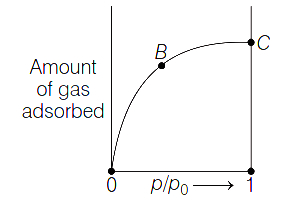
A
$\Delta H = T \Delta S, \Delta G = 0$
B
$\Delta H > T \Delta S, \Delta G = + \text{ve}$
C
$\Delta H < T \Delta S, \Delta G = - \text{ve}$
D
$\Delta H = T \Delta S = \Delta G = 0$
Solution
(A) At point $C$,the adsorption of the gas reaches saturation,meaning the amount of gas adsorbed remains constant regardless of any further increase in pressure.
This indicates that the system has reached a state of equilibrium.
For a system in equilibrium,the change in Gibbs free energy is zero,i.e.,$\Delta G = 0$.
Using the thermodynamic relation $\Delta G = \Delta H - T \Delta S$,we substitute $\Delta G = 0$:
$0 = \Delta H - T \Delta S$
$\therefore \Delta H = T \Delta S$.
This indicates that the system has reached a state of equilibrium.
For a system in equilibrium,the change in Gibbs free energy is zero,i.e.,$\Delta G = 0$.
Using the thermodynamic relation $\Delta G = \Delta H - T \Delta S$,we substitute $\Delta G = 0$:
$0 = \Delta H - T \Delta S$
$\therefore \Delta H = T \Delta S$.
0 likesView Solution
184
ChemistryEasyMCQAP EAMCET · 2021
Assertion $(A)$: The property of adsorption is shown to a greater extent by solids than liquids.
Reason $(R)$: Solids like charcoal and silica can act as good adsorbents.
Reason $(R)$: Solids like charcoal and silica can act as good adsorbents.
A
$A$ and $R$ are correct and $R$ is the correct explanation for $A$.
B
$A$ and $R$ are correct but $R$ is not the correct explanation for $A$.
C
$A$ is correct but $R$ is incorrect.
D
$A$ is incorrect but $R$ is correct.
Solution
(B) Both Assertion $(A)$ and Reason $(R)$ are true,but $R$ is not the correct explanation of $A$.
Adsorption is a surface phenomenon,and the extent of adsorption depends on the surface area of the adsorbent.
Solids,especially in finely divided states,possess a much larger surface area compared to liquids,which explains why solids are better adsorbents.
While it is true that charcoal and silica are good adsorbents due to their high surface area,this fact is an example supporting the property of adsorption in solids,rather than the fundamental reason why solids exhibit this property more than liquids.
Adsorption is a surface phenomenon,and the extent of adsorption depends on the surface area of the adsorbent.
Solids,especially in finely divided states,possess a much larger surface area compared to liquids,which explains why solids are better adsorbents.
While it is true that charcoal and silica are good adsorbents due to their high surface area,this fact is an example supporting the property of adsorption in solids,rather than the fundamental reason why solids exhibit this property more than liquids.
0 likesView Solution
185
ChemistryEasyMCQAP EAMCET · 2021
$A$ plot of $\log (x / m)$ versus $\log (P)$ for the adsorption of a gas on a solid gives a straight line with a slope of:
A
$-\log k$
B
$\log (1 / n)$
C
$1 / n$
D
$\text{antilog} (1 / n)$
Solution
(C) According to the Freundlich Adsorption Isotherm,the relationship is given by:
$\frac{x}{m} = k \cdot p^{1 / n}$
Taking the logarithm on both sides:
$\log \left( \frac{x}{m} \right) = \log k + \frac{1}{n} \log p$
Comparing this equation with the linear equation $y = mx + c$,where $y = \log (x / m)$,$x = \log p$,$m$ is the slope,and $c$ is the intercept:
$y = \left( \frac{1}{n} \right) x + \log k$
Thus,the slope of the straight line is $1 / n$.
$\frac{x}{m} = k \cdot p^{1 / n}$
Taking the logarithm on both sides:
$\log \left( \frac{x}{m} \right) = \log k + \frac{1}{n} \log p$
Comparing this equation with the linear equation $y = mx + c$,where $y = \log (x / m)$,$x = \log p$,$m$ is the slope,and $c$ is the intercept:
$y = \left( \frac{1}{n} \right) x + \log k$
Thus,the slope of the straight line is $1 / n$.
0 likesView Solution
186
ChemistryEasyMCQAP EAMCET · 2021
In an adsorption experiment,a graph between $\log (x/m)$ versus $\log P$ was found to be linear with a slope of $45^\circ$. The intercept on $\log (x/m)$ axis was found to be $0.3010$. The amount of gas adsorbed per gram of charcoal under a pressure of $0.5 \ atm$ is (in $g$)
A
$0.5$
B
$1.0$
C
$1.5$
D
$0.75$
Solution
(B) According to the Freundlich adsorption isotherm,$\frac{x}{m} = k \cdot p^{1/n}$.
Taking $\log$ on both sides,we get $\log (\frac{x}{m}) = \log k + \frac{1}{n} \log p$.
Comparing this with the equation of a straight line $y = mx + c$,the slope is $\frac{1}{n} = \tan 45^\circ = 1$,so $n = 1$.
The intercept is $\log k = 0.3010$. Since $\log 2 = 0.3010$,we have $k = 2$.
Substituting these values at $p = 0.5 \ atm$,we get $\frac{x}{m} = 2 \times (0.5)^1 = 1.0 \ g$.
Taking $\log$ on both sides,we get $\log (\frac{x}{m}) = \log k + \frac{1}{n} \log p$.
Comparing this with the equation of a straight line $y = mx + c$,the slope is $\frac{1}{n} = \tan 45^\circ = 1$,so $n = 1$.
The intercept is $\log k = 0.3010$. Since $\log 2 = 0.3010$,we have $k = 2$.
Substituting these values at $p = 0.5 \ atm$,we get $\frac{x}{m} = 2 \times (0.5)^1 = 1.0 \ g$.
0 likesView Solution
187
ChemistryEasyMCQAP EAMCET · 2021
During the action of enzyme "Zymase",glucose is converted into . . . . . . ,with the liberation of carbon dioxide gas.
A
Phenol
B
Ethanol
C
Methanol
D
Isopropyl alcohol
Solution
(B) Zymase is an enzyme complex that catalyzes the fermentation of glucose into ethanol and carbon dioxide.
This process occurs naturally in yeast.
The chemical reaction is as follows:
$C_6H_{12}O_6 \xrightarrow{\text{Zymase}} 2 C_2H_5OH + 2 CO_2$
Therefore,glucose is converted into ethanol.
This process occurs naturally in yeast.
The chemical reaction is as follows:
$C_6H_{12}O_6 \xrightarrow{\text{Zymase}} 2 C_2H_5OH + 2 CO_2$
Therefore,glucose is converted into ethanol.
0 likesView Solution
188
ChemistryEasyMCQAP EAMCET · 2021
$A$ catalyst is a substance which
A
changes the equilibrium concentration of the products
B
changes the energy of the reactants
C
shortens the time to reach equilibrium
D
changes the equilibrium constant
Solution
(C) catalyst provides an alternative reaction pathway with a lower activation energy.
This increases the rate of both the forward and backward reactions equally,thereby shortening the time required to reach chemical equilibrium without altering the equilibrium position or the equilibrium constant.
This increases the rate of both the forward and backward reactions equally,thereby shortening the time required to reach chemical equilibrium without altering the equilibrium position or the equilibrium constant.
0 likesView Solution
189
ChemistryEasyMCQAP EAMCET · 2021
The protective power of a lyophilic colloidal sol is expressed in terms of
A
Critical micelle concentration
B
Standard reduction potential
C
Gold number
D
Oxidation number
Solution
(C) The protective power of a lyophilic colloidal sol is expressed in terms of $Gold \ number$.
Gold number is defined as the minimum amount of protective colloid in milligrams that must be added to $10 \ mL$ of a standard red gold sol to prevent its coagulation when $1 \ mL$ of a $10\% \ NaCl$ solution is added to it.
Smaller the gold number,higher is the protective power of the colloid.
Gold number is defined as the minimum amount of protective colloid in milligrams that must be added to $10 \ mL$ of a standard red gold sol to prevent its coagulation when $1 \ mL$ of a $10\% \ NaCl$ solution is added to it.
Smaller the gold number,higher is the protective power of the colloid.
0 likesView Solution
190
ChemistryEasyMCQAP EAMCET · 2021
At high concentration of soap in water,soap behaves as a
A
multi-molecular colloid
B
associated colloid
C
macromolecular colloid
D
lyophilic colloid
Solution
(B) At high concentrations,soap molecules in water aggregate to form clusters known as micelles. These aggregates of particles are classified as $associated \ colloids$.
0 likesView Solution
191
ChemistryEasyMCQAP EAMCET · 2021
Colloids can be purified by
A
condensation
B
peptisation
C
coagulation
D
dialysis
Solution
(D) Colloidal solutions can be purified by $dialysis$.
It is a process of separating a crystalloid from a colloid by diffusion or filtration through a semi-permeable membrane.
The process of dialysis can be quickened by applying an electric field,which is known as electrodialysis.
It is a process of separating a crystalloid from a colloid by diffusion or filtration through a semi-permeable membrane.
The process of dialysis can be quickened by applying an electric field,which is known as electrodialysis.
0 likesView Solution
192
ChemistryEasyMCQAP EAMCET · 2021
In general,for soaps,the concentration of surfactant at $CMC$ is around $mol \ L^{-1}$.
A
$10^{-4}$ to $10^{-3}$
B
$10^{-4}$ to $10^{-1}$
C
$10^{-7}$ to $10^{-4}$
D
$10^{-4}$ to $10^{+2}$
Solution
(A) $CMC$ is defined as the concentration of surfactants above which micelles form and all additional surfactants added to the system will form micelles.
Concentration of surfactant is nearly $10^{-4}$ to $10^{-3} \ mol \ L^{-1}$ at $CMC$.
$CMC$ depends on temperature,pressure,and the concentration of other surface-active substances and electrolytes.
Concentration of surfactant is nearly $10^{-4}$ to $10^{-3} \ mol \ L^{-1}$ at $CMC$.
$CMC$ depends on temperature,pressure,and the concentration of other surface-active substances and electrolytes.
0 likesView Solution
193
ChemistryMediumMCQAP EAMCET · 2021
The major product in the following reaction is:
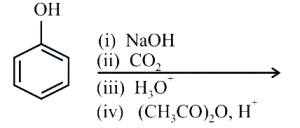
A
$4-$acetoxybenzoic acid
B
$2-$acetoxybenzoic acid
C
$4-$hydroxy$-3-$acetylbenzoic acid
D
$2-$hydroxybenzoic acid methyl ester
Solution
(B) The reaction sequence is as follows:
$1$. Phenol reacts with $NaOH$ to form sodium phenoxide.
$2$. Sodium phenoxide undergoes Kolbe's reaction with $CO_2$ followed by acidification $(H_3O^+)$ to produce salicylic acid ($2$-hydroxybenzoic acid).
$3$. Salicylic acid then reacts with acetic anhydride $((CH_3CO)_2O)$ in the presence of an acid catalyst $(H^+)$ to undergo acetylation of the phenolic $-OH$ group.
$4$. The final product is $2-$acetoxybenzoic acid,commonly known as aspirin.
$1$. Phenol reacts with $NaOH$ to form sodium phenoxide.
$2$. Sodium phenoxide undergoes Kolbe's reaction with $CO_2$ followed by acidification $(H_3O^+)$ to produce salicylic acid ($2$-hydroxybenzoic acid).
$3$. Salicylic acid then reacts with acetic anhydride $((CH_3CO)_2O)$ in the presence of an acid catalyst $(H^+)$ to undergo acetylation of the phenolic $-OH$ group.
$4$. The final product is $2-$acetoxybenzoic acid,commonly known as aspirin.
0 likesView Solution
194
ChemistryDifficultMCQAP EAMCET · 2021
The major product of the following reaction sequence is
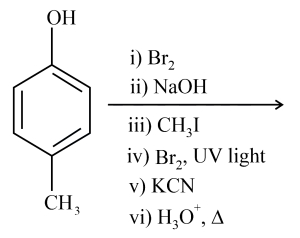
A
$2-$bromo$-4-$methoxyphenylacetic acid
B
$2-$bromo$-4-$methoxyphenylacetic acid (isomer)
C
$3-$bromo$-4-$methoxyphenylacetic acid
D
$2-$bromo$-4-$methoxyphenylacetic acid (isomer)
Solution
(C) The reaction sequence is as follows:
$1$. Electrophilic aromatic substitution of $p$-cresol with $Br_2$ gives $2$-bromo-$4$-methylphenol.
$2$. Treatment with $NaOH$ forms the sodium phenoxide salt.
$3$. Williamson's ether synthesis with $CH_3I$ yields $2$-bromo-$1$-methoxy-$4$-methylbenzene.
$4$. Free radical bromination of the methyl group with $Br_2/h\nu$ gives $2$-bromo-$1$-methoxy-$4$-(bromomethyl)benzene.
$5$. Nucleophilic substitution with $KCN$ replaces the benzylic bromine with a cyano group to form $2$-bromo-$1$-methoxy-$4$-(cyanomethyl)benzene.
$6$. Acidic hydrolysis of the cyanide group $(H_3O^+, \Delta)$ yields the final product,$2$-bromo-$4$-methoxyphenylacetic acid.
$1$. Electrophilic aromatic substitution of $p$-cresol with $Br_2$ gives $2$-bromo-$4$-methylphenol.
$2$. Treatment with $NaOH$ forms the sodium phenoxide salt.
$3$. Williamson's ether synthesis with $CH_3I$ yields $2$-bromo-$1$-methoxy-$4$-methylbenzene.
$4$. Free radical bromination of the methyl group with $Br_2/h\nu$ gives $2$-bromo-$1$-methoxy-$4$-(bromomethyl)benzene.
$5$. Nucleophilic substitution with $KCN$ replaces the benzylic bromine with a cyano group to form $2$-bromo-$1$-methoxy-$4$-(cyanomethyl)benzene.
$6$. Acidic hydrolysis of the cyanide group $(H_3O^+, \Delta)$ yields the final product,$2$-bromo-$4$-methoxyphenylacetic acid.
0 likesView Solution
195
ChemistryMediumMCQAP EAMCET · 2021
The major product formed in the following reaction is:
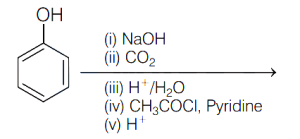
A
Aspirin (o-acetoxybenzoic acid)
B
Methyl salicylate
C
p-acetoxybenzoic acid
D
Methyl p-hydroxybenzoate
Solution
(A) The reaction sequence is as follows:
$1$. The reaction of phenol with $NaOH$ followed by $CO_2$ and then $H^+/H_2O$ is the Kolbe-Schmitt reaction,which yields salicylic acid ($2$-hydroxybenzoic acid).
$2$. The subsequent reaction with $CH_3COCl$ in the presence of pyridine is an acetylation reaction of the phenolic $-OH$ group.
$3$. This converts the $-OH$ group of salicylic acid into an acetoxy group $(-OCOCH_3)$,resulting in the formation of aspirin ($2$-acetoxybenzoic acid).
$1$. The reaction of phenol with $NaOH$ followed by $CO_2$ and then $H^+/H_2O$ is the Kolbe-Schmitt reaction,which yields salicylic acid ($2$-hydroxybenzoic acid).
$2$. The subsequent reaction with $CH_3COCl$ in the presence of pyridine is an acetylation reaction of the phenolic $-OH$ group.
$3$. This converts the $-OH$ group of salicylic acid into an acetoxy group $(-OCOCH_3)$,resulting in the formation of aspirin ($2$-acetoxybenzoic acid).
0 likesView Solution
196
ChemistryMediumMCQAP EAMCET · 2021
The major product formed in the following reaction is:
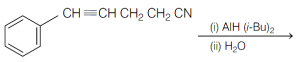
A
$Ph-CH_2-CH_2-CH_2-CH_2-CH_2-NH_2$
B
$Ph-CH_2-CH_2-CH_2-CH_2-CH_2-OH$
C
$Ph-CH=CH-CH_2-CH_2-CH_2-NH_2$
D
$Ph-CH=CH-CH_2-CH_2-CHO$
Solution
(D) The reagent $DIBAL-H$ (diisobutylaluminium hydride,$AlH(i-Bu)_2$) is a selective reducing agent. It reduces nitriles $(-CN)$ to aldehydes $(-CHO)$ after hydrolysis,while leaving other functional groups like carbon-carbon double bonds $(C=C)$ unaffected. Therefore,the reaction of $Ph-CH=CH-CH_2-CH_2-CN$ with $DIBAL-H$ followed by $H_2O$ yields $Ph-CH=CH-CH_2-CH_2-CHO$.
0 likesView Solution
197
ChemistryDifficultMCQAP EAMCET · 2021
The major product of the following reaction sequence is
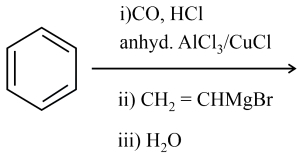
A
Benzophenone
B
Benzoic acid
C
Ethylbenzene
D
$1-$Phenylethenol
Solution
(D) The first step is the Gattermann-Koch reaction,where benzene reacts with $CO$ and $HCl$ in the presence of anhydrous $AlCl_3$ and $CuCl$ to form benzaldehyde $(C_6H_5CHO)$.
In the second step,the Grignard reagent $CH_2=CHMgBr$ (vinylmagnesium bromide) undergoes nucleophilic addition to the carbonyl group of benzaldehyde to form an alkoxide intermediate.
In the third step,hydrolysis with $H_2O$ converts the alkoxide into the final alcohol product,$1$-phenylethenol $(C_6H_5CH(OH)CH=CH_2)$.
In the second step,the Grignard reagent $CH_2=CHMgBr$ (vinylmagnesium bromide) undergoes nucleophilic addition to the carbonyl group of benzaldehyde to form an alkoxide intermediate.
In the third step,hydrolysis with $H_2O$ converts the alkoxide into the final alcohol product,$1$-phenylethenol $(C_6H_5CH(OH)CH=CH_2)$.
0 likesView Solution
198
ChemistryDifficultMCQAP EAMCET · 2021
The major product in the following reaction sequence is
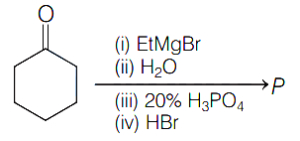
A
$1-$bromo$-1-$ethylcyclohexane
B
$1-$bromo$-2-$ethylcyclohexane
C
$1-$bromo$-1-$ethylcyclohexane (isomer)
D
$3-$bromo$-1-$ethylcyclohexane
Solution
(A) $Step \ 1$: Cyclohexanone reacts with $EtMgBr$ (Grignard reagent) followed by hydrolysis $(H_2O)$ to form $1$-ethylcyclohexanol.
$Step \ 2$: Dehydration of $1$-ethylcyclohexanol in the presence of $20\% \ H_3PO_4$ yields ethylidenecyclohexane as the major alkene product.
$Step \ 3$: Addition of $HBr$ to ethylidenecyclohexane follows Markovnikov's rule,where the proton adds to the terminal carbon of the double bond and the bromide ion adds to the more substituted carbon,resulting in $1$-bromo-$1$-ethylcyclohexane as the final product $(P)$.
$Step \ 2$: Dehydration of $1$-ethylcyclohexanol in the presence of $20\% \ H_3PO_4$ yields ethylidenecyclohexane as the major alkene product.
$Step \ 3$: Addition of $HBr$ to ethylidenecyclohexane follows Markovnikov's rule,where the proton adds to the terminal carbon of the double bond and the bromide ion adds to the more substituted carbon,resulting in $1$-bromo-$1$-ethylcyclohexane as the final product $(P)$.
0 likesView Solution
199
ChemistryDifficultMCQAP EAMCET · 2021
The major product of the following reaction sequence is:
Aniline $\xrightarrow[(i) NaNO_2, HCl, 273-278K]{(ii) H_2O, warm} \text{Product}$ $\xrightarrow[(iv) NaOH]{(iii) Br_2, (excess)} \text{Product}$ $\xrightarrow{(v) CH_3I} \text{Final Product}$
Aniline $\xrightarrow[(i) NaNO_2, HCl, 273-278K]{(ii) H_2O, warm} \text{Product}$ $\xrightarrow[(iv) NaOH]{(iii) Br_2, (excess)} \text{Product}$ $\xrightarrow{(v) CH_3I} \text{Final Product}$
A
$2,4-$Dibromoanisole
B
$3,5-$Dibromoanisole
C
$2,4,6-$Tribromoanisole
D
$2,3,4-$Tribromoanisole
Solution
(C) The reaction sequence proceeds as follows:
$1$. Aniline reacts with $NaNO_2/HCl$ at $273-278 \ K$ to form benzene diazonium chloride.
$2$. Hydrolysis with warm $H_2O$ converts the diazonium salt into phenol.
$3$. Phenol reacts with excess $Br_2$ (bromine water) to undergo electrophilic aromatic substitution,yielding $2,4,6$-tribromophenol.
$4$. Treatment with $NaOH$ converts the phenol into sodium phenoxide ($2,4,6$-tribromophenoxide).
$5$. Finally,reaction with $CH_3I$ (Williamson ether synthesis) yields $2,4,6$-tribromoanisole as the final product.
$1$. Aniline reacts with $NaNO_2/HCl$ at $273-278 \ K$ to form benzene diazonium chloride.
$2$. Hydrolysis with warm $H_2O$ converts the diazonium salt into phenol.
$3$. Phenol reacts with excess $Br_2$ (bromine water) to undergo electrophilic aromatic substitution,yielding $2,4,6$-tribromophenol.
$4$. Treatment with $NaOH$ converts the phenol into sodium phenoxide ($2,4,6$-tribromophenoxide).
$5$. Finally,reaction with $CH_3I$ (Williamson ether synthesis) yields $2,4,6$-tribromoanisole as the final product.
0 likesView Solution
200
ChemistryDifficultMCQAP EAMCET · 2021
The major product in the following reaction is:
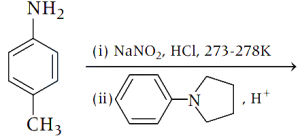
A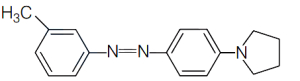
B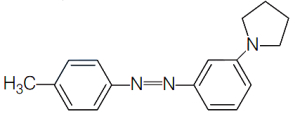
C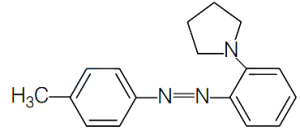
D
Solution
(D) In the given reaction,$p$-toluidine reacts with $NaNO_2$ and $HCl$ at $273-278 \ K$ to form a diazonium salt,which is $p$-methylbenzenediazonium chloride.
This diazonium salt then undergoes an electrophilic aromatic substitution (coupling reaction) with $N$-phenylpyrrolidine in the presence of $H^+$.
The coupling reaction occurs at the para-position of the $N$-phenylpyrrolidine ring because the pyrrolidinyl group is a strong ortho/para-directing group and the para-position is sterically less hindered.
Thus,the major product is the para-coupled azo dye as shown in option $D$.
This diazonium salt then undergoes an electrophilic aromatic substitution (coupling reaction) with $N$-phenylpyrrolidine in the presence of $H^+$.
The coupling reaction occurs at the para-position of the $N$-phenylpyrrolidine ring because the pyrrolidinyl group is a strong ortho/para-directing group and the para-position is sterically less hindered.
Thus,the major product is the para-coupled azo dye as shown in option $D$.
0 likesView Solution
Vedclass Products
For Students
Vedclass Test Series
Mock tests in real AP EAMCET style covering Chemistry with performance analysis. 5-day free trial.
Start Free TrialFor Teachers
Exam Paper Generator
Generate Set A/B/C/D Chemistry papers from 7.5L+ questions in 2 minutes. 3 chapters free.
Try FreeFor Institutes
Online Exam Module
Run live AP EAMCET mock exams with unlimited students, 360° analytics & white-label branding.
See DemoFrequently Asked Questions
How many Chemistry questions are in AP EAMCET 2021?
There are 502 Chemistry questions from the AP EAMCET 2021 paper on Vedclass, each with a detailed step-by-step solution in English.
Are AP EAMCET 2021 Chemistry solutions available in English?
Yes. All solutions on this page are in English. You can also switch to English or Hindi using the language buttons above the questions.
Can I practice AP EAMCET 2021 Chemistry as a timed test?
Yes. Use the Vedclass Test Series to attempt a full AP EAMCET mock test covering Chemistry with time limits and instant score analysis.
Can teachers create Chemistry papers from AP EAMCET previous year questions?
Yes. The Vedclass Exam Paper Generator lets teachers mix AP EAMCET Chemistry questions and generate Set A/B/C/D papers in minutes.
For Teachers & Institutes
Build a Custom Chemistry Paper
Pick AP EAMCET 2021 Chemistry questions, set difficulty, and generate Set A/B/C/D in 2 minutes.