
ChemistryQ251–300 of 502 questions
Page 6 of 7 · English
251
ChemistryMediumMCQAP EAMCET · 2021
When $20 \ g$ of $CaCO_3$ is treated with $20 \ g$ of $HCl$,the mass of $CO_2$ formed would be: (in $g$)
A
$10$
B
$8.8$
C
$22.2$
D
$20$
Solution
(B) The balanced chemical equation is: $CaCO_3 + 2HCl \rightarrow CaCl_2 + H_2O + CO_2$
Molar mass of $CaCO_3 = 100 \ g/mol$
Molar mass of $HCl = 36.5 \ g/mol$
Molar mass of $CO_2 = 44 \ g/mol$
Moles of $CaCO_3 = \frac{20}{100} = 0.2 \ mol$
Moles of $HCl = \frac{20}{36.5} = 0.548 \ mol$
According to the reaction,$1 \ mol$ of $CaCO_3$ requires $2 \ mol$ of $HCl$.
So,$0.2 \ mol$ of $CaCO_3$ requires $0.2 \times 2 = 0.4 \ mol$ of $HCl$.
Since we have $0.548 \ mol$ of $HCl$,$CaCO_3$ is the limiting reagent.
Mass of $CO_2$ formed = $0.2 \ mol \times 44 \ g/mol = 8.8 \ g$.
Molar mass of $CaCO_3 = 100 \ g/mol$
Molar mass of $HCl = 36.5 \ g/mol$
Molar mass of $CO_2 = 44 \ g/mol$
Moles of $CaCO_3 = \frac{20}{100} = 0.2 \ mol$
Moles of $HCl = \frac{20}{36.5} = 0.548 \ mol$
According to the reaction,$1 \ mol$ of $CaCO_3$ requires $2 \ mol$ of $HCl$.
So,$0.2 \ mol$ of $CaCO_3$ requires $0.2 \times 2 = 0.4 \ mol$ of $HCl$.
Since we have $0.548 \ mol$ of $HCl$,$CaCO_3$ is the limiting reagent.
Mass of $CO_2$ formed = $0.2 \ mol \times 44 \ g/mol = 8.8 \ g$.
0 likesView Solution
252
ChemistryEasyMCQAP EAMCET · 2021
If one atom of an element $X$ weighs $6.643 \times 10^{-23} \ g$,then find the number of moles of atoms in $50 \ kg$ of element $X$. (in $moles$)
A
$500$
B
$125$
C
$1250$
D
$50$
Solution
(C) Step $1$: Calculate the mass of one mole of element $X$ (molar mass).
Mass of one atom = $6.643 \times 10^{-23} \ g$.
Molar mass = Mass of one atom $\times$ Avogadro's number $(N_A)$.
Molar mass = $(6.643 \times 10^{-23} \ g) \times (6.022 \times 10^{23} \ mol^{-1}) \approx 40 \ g/mol$.
Step $2$: Calculate the number of moles in $50 \ kg$ $(50,000 \ g)$.
Number of moles = $\frac{\text{Given mass}}{\text{Molar mass}} = \frac{50,000 \ g}{40 \ g/mol} = 1250 \ moles$.
Mass of one atom = $6.643 \times 10^{-23} \ g$.
Molar mass = Mass of one atom $\times$ Avogadro's number $(N_A)$.
Molar mass = $(6.643 \times 10^{-23} \ g) \times (6.022 \times 10^{23} \ mol^{-1}) \approx 40 \ g/mol$.
Step $2$: Calculate the number of moles in $50 \ kg$ $(50,000 \ g)$.
Number of moles = $\frac{\text{Given mass}}{\text{Molar mass}} = \frac{50,000 \ g}{40 \ g/mol} = 1250 \ moles$.
0 likesView Solution
253
ChemistryMediumMCQAP EAMCET · 2021
What amount of conc. $H_2SO_4$ solution should be used to prepare $500 \ mL$ of $0.5 \ M \ H_2SO_4$ (in $g$)? (The concentration of $H_2SO_4$ solution being used is $90\%$ and molecular mass of $H_2SO_4 = 98.079 \ g \ mol^{-1}$)
A
$22.06$
B
$24.52$
C
$11.03$
D
$27.24$
Solution
(D) $1$. Calculate the mass of pure $H_2SO_4$ required:
$n = M \times V(L) = 0.5 \ mol \ L^{-1} \times 0.5 \ L = 0.25 \ mol$.
Mass of $H_2SO_4 = n \times \text{molar mass} = 0.25 \ mol \times 98.079 \ g \ mol^{-1} = 24.51975 \ g \approx 24.52 \ g$.
$2$. Calculate the mass of the $90\%$ solution required:
Since the solution is $90\%$ pure,$\text{Mass of solution} = \frac{\text{Mass of solute}}{\text{Percentage}} = \frac{24.51975 \ g}{0.90} = 27.244 \ g \approx 27.24 \ g$.
$n = M \times V(L) = 0.5 \ mol \ L^{-1} \times 0.5 \ L = 0.25 \ mol$.
Mass of $H_2SO_4 = n \times \text{molar mass} = 0.25 \ mol \times 98.079 \ g \ mol^{-1} = 24.51975 \ g \approx 24.52 \ g$.
$2$. Calculate the mass of the $90\%$ solution required:
Since the solution is $90\%$ pure,$\text{Mass of solution} = \frac{\text{Mass of solute}}{\text{Percentage}} = \frac{24.51975 \ g}{0.90} = 27.244 \ g \approx 27.24 \ g$.
0 likesView Solution
254
ChemistryEasyMCQAP EAMCET · 2021
For the formation of $3.40 \ g$ of ammonia gas,what volumes of hydrogen gas and nitrogen gas,respectively,are required at $NTP$ conditions?
A
$2.24 \ L$ and $2.24 \ L$
B
$2.24 \ L$ and $1.24 \ L$
C
$6.72 \ L$ and $2.24 \ L$
D
$6.72 \ L$ and $1.12 \ L$
Solution
(C) The balanced chemical equation for the formation of ammonia is:
$N_2(g) + 3H_2(g) \longrightarrow 2NH_3(g)$
According to the stoichiometry:
$1 \ mol$ of $N_2$ ($22.4 \ L$ at $NTP$) reacts with $3 \ mol$ of $H_2$ ($3 \times 22.4 \ L = 67.2 \ L$ at $NTP$) to produce $2 \ mol$ of $NH_3$ ($2 \times 22.4 \ L = 44.8 \ L$ at $NTP$).
The molar mass of $NH_3$ is $17 \ g/mol$. Therefore,$2 \ mol$ of $NH_3$ corresponds to $2 \times 17 = 34 \ g$.
For $34 \ g$ of $NH_3$,we require $67.2 \ L$ of $H_2$ and $22.4 \ L$ of $N_2$.
For $3.40 \ g$ of $NH_3$ (which is $0.1$ times $34 \ g$),the required volumes are:
Volume of $H_2 = 0.1 \times 67.2 \ L = 6.72 \ L$
Volume of $N_2 = 0.1 \times 22.4 \ L = 2.24 \ L$
Thus,the required volumes are $6.72 \ L$ of $H_2$ and $2.24 \ L$ of $N_2$.
$N_2(g) + 3H_2(g) \longrightarrow 2NH_3(g)$
According to the stoichiometry:
$1 \ mol$ of $N_2$ ($22.4 \ L$ at $NTP$) reacts with $3 \ mol$ of $H_2$ ($3 \times 22.4 \ L = 67.2 \ L$ at $NTP$) to produce $2 \ mol$ of $NH_3$ ($2 \times 22.4 \ L = 44.8 \ L$ at $NTP$).
The molar mass of $NH_3$ is $17 \ g/mol$. Therefore,$2 \ mol$ of $NH_3$ corresponds to $2 \times 17 = 34 \ g$.
For $34 \ g$ of $NH_3$,we require $67.2 \ L$ of $H_2$ and $22.4 \ L$ of $N_2$.
For $3.40 \ g$ of $NH_3$ (which is $0.1$ times $34 \ g$),the required volumes are:
Volume of $H_2 = 0.1 \times 67.2 \ L = 6.72 \ L$
Volume of $N_2 = 0.1 \times 22.4 \ L = 2.24 \ L$
Thus,the required volumes are $6.72 \ L$ of $H_2$ and $2.24 \ L$ of $N_2$.
0 likesView Solution
255
ChemistryEasyMCQAP EAMCET · 2021
Calculate the amount of hydrogen gas required to produce $100 \text{ g}$ of ammonia by the reaction of $N_{2(g)}$ and $H_{2(g)}$ gases. (in $\text{ g}$)
A
$35.29$
B
$17.65$
C
$28.11$
D
$34$
Solution
(B) The balanced chemical equation for the formation of ammonia is:
$N_{2(g)} + 3H_{2(g)} \rightarrow 2NH_{3(g)}$
From the stoichiometry of the reaction:
$2 \text{ moles}$ of $NH_3$ are produced from $3 \text{ moles}$ of $H_2$.
Molar mass of $NH_3 = 17 \text{ g/mol}$.
Molar mass of $H_2 = 2 \text{ g/mol}$.
Therefore,$2 \times 17 \text{ g} = 34 \text{ g}$ of $NH_3$ is produced from $3 \times 2 \text{ g} = 6 \text{ g}$ of $H_2$.
To produce $100 \text{ g}$ of $NH_3$,the mass of $H_2$ required is:
$\text{Mass of } H_2 = \frac{6 \text{ g}}{34 \text{ g}} \times 100 \text{ g} = 17.647 \text{ g} \approx 17.65 \text{ g}$.
$N_{2(g)} + 3H_{2(g)} \rightarrow 2NH_{3(g)}$
From the stoichiometry of the reaction:
$2 \text{ moles}$ of $NH_3$ are produced from $3 \text{ moles}$ of $H_2$.
Molar mass of $NH_3 = 17 \text{ g/mol}$.
Molar mass of $H_2 = 2 \text{ g/mol}$.
Therefore,$2 \times 17 \text{ g} = 34 \text{ g}$ of $NH_3$ is produced from $3 \times 2 \text{ g} = 6 \text{ g}$ of $H_2$.
To produce $100 \text{ g}$ of $NH_3$,the mass of $H_2$ required is:
$\text{Mass of } H_2 = \frac{6 \text{ g}}{34 \text{ g}} \times 100 \text{ g} = 17.647 \text{ g} \approx 17.65 \text{ g}$.
0 likesView Solution
256
ChemistryMediumMCQAP EAMCET · 2021
Gastric juice contains about $3.0 \ g$ of $HCl$ per liter. If a person produces about $2.6 \ liters$ of gastric juice per day,find the number of antacid tablets required to neutralize all the $HCl$ produced. Consider each antacid tablet contains $400 \ mg$ of $Al(OH)_3$. [Given,atomic masses: $Al=27, O=16, H=1, Cl=35.5$]
A
$8$
B
$20$
C
$14$
D
$10$
Solution
(C) The balanced chemical equation is: $Al(OH)_3 + 3HCl \longrightarrow AlCl_3 + 3H_2O$.
The molar mass of $Al(OH)_3 = 27 + 3 \times (16 + 1) = 78 \ g/mol$.
The molar mass of $HCl = 1 + 35.5 = 36.5 \ g/mol$.
Total mass of $HCl$ produced per day $= 3.0 \ g/L \times 2.6 \ L = 7.8 \ g$.
From the stoichiometry,$3 \times 36.5 = 109.5 \ g$ of $HCl$ is neutralized by $78 \ g$ of $Al(OH)_3$.
Therefore,$7.8 \ g$ of $HCl$ is neutralized by $\frac{78}{109.5} \times 7.8 = 5.556 \ g$ of $Al(OH)_3$.
Each tablet contains $400 \ mg = 0.4 \ g$ of $Al(OH)_3$.
Number of tablets required $= \frac{5.556 \ g}{0.4 \ g/tablet} = 13.89 \approx 14$ tablets.
The molar mass of $Al(OH)_3 = 27 + 3 \times (16 + 1) = 78 \ g/mol$.
The molar mass of $HCl = 1 + 35.5 = 36.5 \ g/mol$.
Total mass of $HCl$ produced per day $= 3.0 \ g/L \times 2.6 \ L = 7.8 \ g$.
From the stoichiometry,$3 \times 36.5 = 109.5 \ g$ of $HCl$ is neutralized by $78 \ g$ of $Al(OH)_3$.
Therefore,$7.8 \ g$ of $HCl$ is neutralized by $\frac{78}{109.5} \times 7.8 = 5.556 \ g$ of $Al(OH)_3$.
Each tablet contains $400 \ mg = 0.4 \ g$ of $Al(OH)_3$.
Number of tablets required $= \frac{5.556 \ g}{0.4 \ g/tablet} = 13.89 \approx 14$ tablets.
0 likesView Solution
257
ChemistryEasyMCQAP EAMCET · 2021
If $0.2 \ mol$ of sulphuric acid is poured into $250 \ mL$ of water,calculate the concentration of the solution?
A
$0.8 \ N$
B
$0.8 \ M$
C
$8 \ M$
D
$0.2 \ N$
Solution
(B) We know that concentration is dependent on the number of moles of solute and the volume of solution in $L$ and it is given by:
Molarity $= \frac{\text{number of moles of solute}}{\text{volume of solution in } L}$
Here,$n = 0.2 \ mol$,$V = 250 \ mL = 0.25 \ L$
Therefore,
Molarity $= \frac{0.2}{0.25} = 0.8 \ M$
Hence,the concentration of the solution containing $0.2 \ mol$ of sulphuric acid in $250 \ mL$ of water will be $0.8 \ M$.
Molarity $= \frac{\text{number of moles of solute}}{\text{volume of solution in } L}$
Here,$n = 0.2 \ mol$,$V = 250 \ mL = 0.25 \ L$
Therefore,
Molarity $= \frac{0.2}{0.25} = 0.8 \ M$
Hence,the concentration of the solution containing $0.2 \ mol$ of sulphuric acid in $250 \ mL$ of water will be $0.8 \ M$.
0 likesView Solution
258
ChemistryEasyMCQAP EAMCET · 2021
If $500 \ mL$ of $CaCl_2$ solution contains $3.01 \times 10^{22}$ chloride ions,the molarity of the solution will be: (in $M$)
A
$0.05$
B
$0.01$
C
$0.1$
D
$0.02$
Solution
(A) The dissociation of $CaCl_2$ is given by: $CaCl_2 \rightarrow Ca^{2+} + 2Cl^-$.
One mole of $CaCl_2$ produces $2$ moles of chloride ions $(Cl^-)$.
Number of moles of $Cl^-$ ions $= \frac{3.01 \times 10^{22}}{6.02 \times 10^{23}} = 0.05 \ mol$.
Since $2$ moles of $Cl^-$ come from $1$ mole of $CaCl_2$,the moles of $CaCl_2 = \frac{0.05}{2} = 0.025 \ mol$.
Molarity $(M) = \frac{\text{moles of solute}}{\text{volume of solution in } L} = \frac{0.025 \ mol}{0.5 \ L} = 0.05 \ M$.
Thus,the molarity of the solution is $0.05 \ M$.
One mole of $CaCl_2$ produces $2$ moles of chloride ions $(Cl^-)$.
Number of moles of $Cl^-$ ions $= \frac{3.01 \times 10^{22}}{6.02 \times 10^{23}} = 0.05 \ mol$.
Since $2$ moles of $Cl^-$ come from $1$ mole of $CaCl_2$,the moles of $CaCl_2 = \frac{0.05}{2} = 0.025 \ mol$.
Molarity $(M) = \frac{\text{moles of solute}}{\text{volume of solution in } L} = \frac{0.025 \ mol}{0.5 \ L} = 0.05 \ M$.
Thus,the molarity of the solution is $0.05 \ M$.
0 likesView Solution
259
ChemistryEasyMCQAP EAMCET · 2021
An alloy of metals $X$ and $Y$ weighs $12 \ g$ and contains atoms $X$ and $Y$ in the ratio of $2:5$. The percentage of metal $X$ in the alloy is $20$ by mass. If the atomic mass of $X$ is $40$,what is the atomic mass of metal $Y$ (in $amu$)?
A
$64$
B
$32$
C
$60$
D
$50$
Solution
(A) Mass of metal $X = 12 \ g \times 0.20 = 2.4 \ g$.
Mass of metal $Y = 12 \ g - 2.4 \ g = 9.6 \ g$.
Moles of $X = \frac{2.4 \ g}{40 \ g/mol} = 0.06 \ mol$.
Since the ratio of atoms $X:Y$ is $2:5$,the ratio of moles $n_X:n_Y$ is also $2:5$.
$n_Y = n_X \times \frac{5}{2} = 0.06 \times 2.5 = 0.15 \ mol$.
Atomic mass of $Y = \frac{\text{Mass of } Y}{n_Y} = \frac{9.6 \ g}{0.15 \ mol} = 64 \ g/mol$.
Thus,the atomic mass of $Y$ is $64 \ amu$.
Mass of metal $Y = 12 \ g - 2.4 \ g = 9.6 \ g$.
Moles of $X = \frac{2.4 \ g}{40 \ g/mol} = 0.06 \ mol$.
Since the ratio of atoms $X:Y$ is $2:5$,the ratio of moles $n_X:n_Y$ is also $2:5$.
$n_Y = n_X \times \frac{5}{2} = 0.06 \times 2.5 = 0.15 \ mol$.
Atomic mass of $Y = \frac{\text{Mass of } Y}{n_Y} = \frac{9.6 \ g}{0.15 \ mol} = 64 \ g/mol$.
Thus,the atomic mass of $Y$ is $64 \ amu$.
0 likesView Solution
260
ChemistryEasyMCQAP EAMCET · 2021
$0.63 \ g$ of oxalic acid is dissolved to obtain $250 \ cm^3$ of its solution. Find the normality of this solution. [Oxalic acid: $(COOH)_2 \cdot 2H_2O$] (in $N$)
A
$0.05$
B
$0.01$
C
$0.04$
D
$0.02$
Solution
(C) Molar mass of oxalic acid $(COOH)_2 \cdot 2H_2O = 126 \ g/mol$.
Equivalent mass of oxalic acid = $\frac{\text{Molar mass}}{n\text{-factor}} = \frac{126}{2} = 63 \ g/eq$.
Number of gram equivalents = $\frac{\text{Given mass}}{\text{Equivalent mass}} = \frac{0.63}{63} = 0.01 \ eq$.
Normality $(N) = \frac{\text{Number of gram equivalents}}{\text{Volume of solution in } L} = \frac{0.01}{250/1000} = \frac{0.01 \times 1000}{250} = 0.04 \ N$.
Therefore,the normality of the solution is $0.04 \ N$.
Equivalent mass of oxalic acid = $\frac{\text{Molar mass}}{n\text{-factor}} = \frac{126}{2} = 63 \ g/eq$.
Number of gram equivalents = $\frac{\text{Given mass}}{\text{Equivalent mass}} = \frac{0.63}{63} = 0.01 \ eq$.
Normality $(N) = \frac{\text{Number of gram equivalents}}{\text{Volume of solution in } L} = \frac{0.01}{250/1000} = \frac{0.01 \times 1000}{250} = 0.04 \ N$.
Therefore,the normality of the solution is $0.04 \ N$.
0 likesView Solution
261
ChemistryEasyMCQAP EAMCET · 2021
If the volume of $15.9 \ g$ of carbon tetrachloride is $10 \ mL$,calculate its density.
A
$31.8 \ g \cdot mL^{-1}$
B
$1.59 \ g \cdot mL^{-1}$
C
$0.159 \ g \cdot mL^{-1}$
D
$15.9 \ g \cdot mL^{-1}$
Solution
(B) Mass of the carbon tetrachloride $= 15.9 \ g$
Volume of carbon tetrachloride $= 10 \ mL$
Density of carbon tetrachloride $= \frac{\text{Mass}}{\text{Volume}}$
Density of carbon tetrachloride $= \frac{15.9 \ g}{10 \ mL} = 1.59 \ g \cdot mL^{-1}$
Hence,the density of carbon tetrachloride is $1.59 \ g \cdot mL^{-1}$.
Volume of carbon tetrachloride $= 10 \ mL$
Density of carbon tetrachloride $= \frac{\text{Mass}}{\text{Volume}}$
Density of carbon tetrachloride $= \frac{15.9 \ g}{10 \ mL} = 1.59 \ g \cdot mL^{-1}$
Hence,the density of carbon tetrachloride is $1.59 \ g \cdot mL^{-1}$.
0 likesView Solution
262
ChemistryEasyMCQAP EAMCET · 2021
The $\% \left(\frac{W}{V}\right)$ of $H_2O_2$ in $1.5 \ N$ solution is
A
$3.6$
B
$2.99$
C
$2.55$
D
$2.4$
Solution
(C) For $H_2O_2$,the relationship between Normality $(N)$ and Molarity $(M)$ is given by: $N = n \times M$,where $n$-factor for $H_2O_2$ is $2$.
$M = \frac{N}{2} = \frac{1.5}{2} = 0.75 \ M$.
$\% \left(\frac{W}{V}\right)$ is defined as the mass of solute in grams present in $100 \ mL$ of solution.
Mass of $H_2O_2$ in $1 \ L$ $(1000 \ mL)$ $= M \times \text{Molar Mass} = 0.75 \times 34 = 25.5 \ g/L$.
Therefore,in $100 \ mL$,the mass is $\frac{25.5}{1000} \times 100 = 2.55 \ g$.
Thus,the $\% \left(\frac{W}{V}\right)$ is $2.55$.
$M = \frac{N}{2} = \frac{1.5}{2} = 0.75 \ M$.
$\% \left(\frac{W}{V}\right)$ is defined as the mass of solute in grams present in $100 \ mL$ of solution.
Mass of $H_2O_2$ in $1 \ L$ $(1000 \ mL)$ $= M \times \text{Molar Mass} = 0.75 \times 34 = 25.5 \ g/L$.
Therefore,in $100 \ mL$,the mass is $\frac{25.5}{1000} \times 100 = 2.55 \ g$.
Thus,the $\% \left(\frac{W}{V}\right)$ is $2.55$.
0 likesView Solution
263
ChemistryEasyMCQAP EAMCET · 2021
In each molecule of carbon tetrachloride,the mass percent of carbon and chlorine respectively are
A
$76.86$ and $23.14$
B
$7.84$ and $92.80$
C
$23.14$ and $76.86$
D
$78.41$ and $9.25$
Solution
(B) The mass percentage of an element in a compound is calculated as: $\text{Mass } \% = \frac{\text{Total mass of the element}}{\text{Molar mass of the compound}} \times 100$.
In $CCl_4$,the molar mass is $12.01 + 4 \times 35.45 = 153.81 \approx 154 \ g/mol$.
Mass percentage of $C = \frac{12.01}{153.81} \times 100 \approx 7.81 \%$.
Mass percentage of $Cl = \frac{4 \times 35.45}{153.81} \times 100 \approx 92.19 \%$.
Given the options provided,the closest values are $7.84$ and $92.80$.
In $CCl_4$,the molar mass is $12.01 + 4 \times 35.45 = 153.81 \approx 154 \ g/mol$.
Mass percentage of $C = \frac{12.01}{153.81} \times 100 \approx 7.81 \%$.
Mass percentage of $Cl = \frac{4 \times 35.45}{153.81} \times 100 \approx 92.19 \%$.
Given the options provided,the closest values are $7.84$ and $92.80$.
0 likesView Solution
264
ChemistryEasyMCQAP EAMCET · 2021
The volume strength (in $L$) of $3$ $N$ $H_2O_2$ is approximately
A
$3$
B
$8$
C
$17$
D
$9$
Solution
(C) The normality $(N)$ of $H_2O_2$ is related to its molarity $(M)$ by the equation: $N = M \times n$-factor.
For $H_2O_2$,the $n$-factor is $2$,so $M = \frac{N}{2} = \frac{3}{2} = 1.5$ $M$.
The volume strength of $H_2O_2$ is given by the formula: $\text{Volume strength} = M \times 11.2$.
Therefore,$\text{Volume strength} = 1.5 \times 11.2 = 16.8$ $L$.
This is approximately $17$ $L$.
For $H_2O_2$,the $n$-factor is $2$,so $M = \frac{N}{2} = \frac{3}{2} = 1.5$ $M$.
The volume strength of $H_2O_2$ is given by the formula: $\text{Volume strength} = M \times 11.2$.
Therefore,$\text{Volume strength} = 1.5 \times 11.2 = 16.8$ $L$.
This is approximately $17$ $L$.
0 likesView Solution
265
ChemistryMediumMCQAP EAMCET · 2021
$0.765 \ g$ of an acid gives $0.535 \ g$ of $CO_2$ and $0.13 \ g$ of $H_2O$. The ratio of the percentage of $C$ and $H$ is:
A
$19 : 2$
B
$18 : 11$
C
$20 : 17$
D
$1 : 7$
Solution
(A) Given,mass of $CO_2 = 0.535 \ g$ and mass of $H_2O = 0.13 \ g$.
Mass of compound $= 0.765 \ g$.
Percentage of $C = \frac{12}{44} \times \frac{0.535}{0.765} \times 100 \approx 19.07 \%$.
Percentage of $H = \frac{2}{18} \times \frac{0.13}{0.765} \times 100 \approx 1.88 \% \approx 2.00 \%$.
Ratio of percentage of $C$ and $H = 19.07 : 1.88 \approx 19 : 2$.
Mass of compound $= 0.765 \ g$.
Percentage of $C = \frac{12}{44} \times \frac{0.535}{0.765} \times 100 \approx 19.07 \%$.
Percentage of $H = \frac{2}{18} \times \frac{0.13}{0.765} \times 100 \approx 1.88 \% \approx 2.00 \%$.
Ratio of percentage of $C$ and $H = 19.07 : 1.88 \approx 19 : 2$.
0 likesView Solution
266
ChemistryEasyMCQAP EAMCET · 2021
The density of an ideal gas can be given by where $P$,$V$,$M$,$T$ and $R$ respectively denote pressure,volume,molar mass,temperature and universal gas constant.
A
$\frac{PM}{RT}$
B
$\frac{PV}{RT}$
C
$\frac{RT}{PM}$
D
$\frac{RT}{PV}$
Solution
(A) According to the ideal gas equation,we have:
$PV = nRT$
Since the number of moles $n = \frac{m}{M}$,where $m$ is the mass and $M$ is the molar mass,we can substitute this into the equation:
$PV = \frac{m}{M} RT$
Rearranging the terms to solve for density $\rho = \frac{m}{V}$:
$P = \frac{m}{V} \times \frac{RT}{M}$
$P = \rho \times \frac{RT}{M}$
Therefore,the density $\rho$ is given by:
$\rho = \frac{PM}{RT}$
$PV = nRT$
Since the number of moles $n = \frac{m}{M}$,where $m$ is the mass and $M$ is the molar mass,we can substitute this into the equation:
$PV = \frac{m}{M} RT$
Rearranging the terms to solve for density $\rho = \frac{m}{V}$:
$P = \frac{m}{V} \times \frac{RT}{M}$
$P = \rho \times \frac{RT}{M}$
Therefore,the density $\rho$ is given by:
$\rho = \frac{PM}{RT}$
0 likesView Solution
267
ChemistryEasyMCQAP EAMCET · 2021
Which of the following graphs correctly represents Boyle's Law?
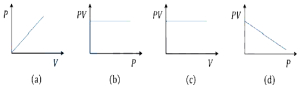
A
$a$,$b$ $\&$ $c$ only
B
$b$ $\&$ $c$ only
C
$c$ $\&$ $d$ only
D
$b$ $\&$ $d$ only
Solution
(B) According to Boyle's Law,for a fixed amount of gas at a constant temperature,the pressure $(P)$ is inversely proportional to the volume $(V)$ of the gas: $P \propto \frac{1}{V}$ or $PV = \text{constant}$.
$1$. Graph $(b)$: Represents $PV$ vs $P$. Since $PV$ is constant,the graph is a horizontal line parallel to the $P$-axis.
$2$. Graph $(c)$: Represents $PV$ vs $V$. Since $PV$ is constant,the graph is a horizontal line parallel to the $V$-axis.
Both graphs $(b)$ and $(c)$ correctly represent the constant product of $PV$ as dictated by Boyle's Law.
$1$. Graph $(b)$: Represents $PV$ vs $P$. Since $PV$ is constant,the graph is a horizontal line parallel to the $P$-axis.
$2$. Graph $(c)$: Represents $PV$ vs $V$. Since $PV$ is constant,the graph is a horizontal line parallel to the $V$-axis.
Both graphs $(b)$ and $(c)$ correctly represent the constant product of $PV$ as dictated by Boyle's Law.
0 likesView Solution
268
ChemistryEasyMCQAP EAMCET · 2021
$A$ person living in $Shimla$ observed that cooking food without using a pressure cooker takes more time. The reason is that at high altitude:
A
temperature decreases
B
pressure increases
C
pressure decreases
D
temperature increases
Solution
(C) At higher altitudes,the atmospheric pressure is lower than at sea level.
Because the boiling point of water is dependent on external pressure,a decrease in atmospheric pressure leads to a decrease in the boiling point of water.
Since the water boils at a lower temperature,it cannot provide enough heat to cook the food efficiently,thus taking more time.
Because the boiling point of water is dependent on external pressure,a decrease in atmospheric pressure leads to a decrease in the boiling point of water.
Since the water boils at a lower temperature,it cannot provide enough heat to cook the food efficiently,thus taking more time.
0 likesView Solution
269
ChemistryMediumMCQAP EAMCET · 2021
Three flasks of equal volumes contain $CH_4$,$CO_2$,and $Cl_2$ gases respectively. They will contain equal number of molecules if
A
The mass of all the gases is same
B
The mass of all the gases is same but Temperature is different
C
Temperature $\&$ Pressure of all the flasks are same
D
Temperature,Pressure $\&$ Masses same in the flasks
Solution
(C) According to the ideal gas equation,$PV = nRT$,where $n$ is the number of moles.
Since the number of molecules is directly proportional to the number of moles $(n = \frac{N}{N_A})$,the number of molecules will be equal if the number of moles is equal.
For equal volumes $(V)$ of different gases,the number of moles $(n)$ will be equal if the temperature $(T)$ and pressure $(P)$ of all the flasks are the same.
Therefore,the correct condition is that the temperature and pressure of all the flasks are the same.
Since the number of molecules is directly proportional to the number of moles $(n = \frac{N}{N_A})$,the number of molecules will be equal if the number of moles is equal.
For equal volumes $(V)$ of different gases,the number of moles $(n)$ will be equal if the temperature $(T)$ and pressure $(P)$ of all the flasks are the same.
Therefore,the correct condition is that the temperature and pressure of all the flasks are the same.
0 likesView Solution
270
ChemistryEasyMCQAP EAMCET · 2021
Pressure of $1 \ g$ ideal gas $X$ at $300 \ K$ is $2 \ atm$. When $2 \ g$ of another gas $Y$ is introduced in the same vessel at the same temperature,the total pressure becomes $3 \ atm$. The correct relationship between molar masses of $X$ and $Y$ is:
A
$M_Y = 2M_X$
B
$M_Y = 4M_X$
C
$M_X = 4M_Y$
D
$M_X = 5M_Y$
Solution
(B) For gas $X$: $P_X V = \frac{m_X}{M_X} RT \Rightarrow 2V = \frac{1}{M_X} RT$ ...$(i)$
For gas $Y$: $P_Y V = \frac{m_Y}{M_Y} RT$
Given total pressure $P_{total} = 3 \ atm$,so $P_Y = P_{total} - P_X = 3 - 2 = 1 \ atm$.
Substituting values for gas $Y$: $1 \cdot V = \frac{2}{M_Y} RT$ ...$(ii)$
Dividing equation $(i)$ by $(ii)$: $\frac{2}{1} = \frac{1/M_X}{2/M_Y} = \frac{M_Y}{2M_X}$
$4M_X = M_Y$ or $M_Y = 4M_X$.
For gas $Y$: $P_Y V = \frac{m_Y}{M_Y} RT$
Given total pressure $P_{total} = 3 \ atm$,so $P_Y = P_{total} - P_X = 3 - 2 = 1 \ atm$.
Substituting values for gas $Y$: $1 \cdot V = \frac{2}{M_Y} RT$ ...$(ii)$
Dividing equation $(i)$ by $(ii)$: $\frac{2}{1} = \frac{1/M_X}{2/M_Y} = \frac{M_Y}{2M_X}$
$4M_X = M_Y$ or $M_Y = 4M_X$.
0 likesView Solution
271
ChemistryEasyMCQAP EAMCET · 2021
$A$ cylinder contains a mixture of $5 \ g$ of $N_2$ and $6 \ g$ of $Ar$ gases. If the total pressure of the mixture of the gases in the cylinder is $30 \ bar$,then the partial pressure of $N_2$ gas is (in $bar$)
A
$16.36$
B
$0.545$
C
$30$
D
$0.180$
Solution
(A) The number of moles of $N_2$ is $n_{N_2} = \frac{5 \ g}{28 \ g/mol} \approx 0.1786 \ mol$.
The number of moles of $Ar$ is $n_{Ar} = \frac{6 \ g}{40 \ g/mol} = 0.15 \ mol$.
The mole fraction of $N_2$ is $\chi_{N_2} = \frac{n_{N_2}}{n_{N_2} + n_{Ar}} = \frac{0.1786}{0.1786 + 0.15} = \frac{0.1786}{0.3286} \approx 0.5435$.
The partial pressure of $N_2$ is $p_{N_2} = \chi_{N_2} \times p_{Total} = 0.5435 \times 30 \ bar \approx 16.305 \ bar$.
Rounding to the nearest provided option,the value is $16.36 \ bar$.
The number of moles of $Ar$ is $n_{Ar} = \frac{6 \ g}{40 \ g/mol} = 0.15 \ mol$.
The mole fraction of $N_2$ is $\chi_{N_2} = \frac{n_{N_2}}{n_{N_2} + n_{Ar}} = \frac{0.1786}{0.1786 + 0.15} = \frac{0.1786}{0.3286} \approx 0.5435$.
The partial pressure of $N_2$ is $p_{N_2} = \chi_{N_2} \times p_{Total} = 0.5435 \times 30 \ bar \approx 16.305 \ bar$.
Rounding to the nearest provided option,the value is $16.36 \ bar$.
0 likesView Solution
272
ChemistryEasyMCQAP EAMCET · 2021
If two molecules of $A$ and $B$ have molar masses of $100 \ g/mol$ and $64 \ g/mol$ respectively,and the rate of diffusion of $A$ is $12 \times 10^{-3} \ mol/s$,then the rate of diffusion of $B$ will be:
A
$15 \times 10^{-3}$
B
$64 \times 10^{-3}$
C
$36 \times 10^{-3}$
D
$10 \times 10^{-3}$
Solution
(A) According to Graham's law of diffusion,the rate of diffusion $r$ is inversely proportional to the square root of the molar mass $M$:
$\frac{r_A}{r_B} = \sqrt{\frac{M_B}{M_A}}$
Given:
$M_A = 100 \ g/mol$
$M_B = 64 \ g/mol$
$r_A = 12 \times 10^{-3} \ mol/s$
Substituting the values:
$\frac{12 \times 10^{-3}}{r_B} = \sqrt{\frac{64}{100}}$
$\frac{12 \times 10^{-3}}{r_B} = \frac{8}{10} = 0.8$
$r_B = \frac{12 \times 10^{-3}}{0.8} = 15 \times 10^{-3} \ mol/s$
$\frac{r_A}{r_B} = \sqrt{\frac{M_B}{M_A}}$
Given:
$M_A = 100 \ g/mol$
$M_B = 64 \ g/mol$
$r_A = 12 \times 10^{-3} \ mol/s$
Substituting the values:
$\frac{12 \times 10^{-3}}{r_B} = \sqrt{\frac{64}{100}}$
$\frac{12 \times 10^{-3}}{r_B} = \frac{8}{10} = 0.8$
$r_B = \frac{12 \times 10^{-3}}{0.8} = 15 \times 10^{-3} \ mol/s$
0 likesView Solution
273
ChemistryEasyMCQAP EAMCET · 2021
When the temperature of a gas is increased from $30^{\circ} C$ to $930^{\circ} C$,the root mean square speed of the gas would
A
get doubled
B
remain constant
C
gets halved
D
increase by $5.5$ times
Solution
(A) The root mean square speed $(u_{rms})$ is directly proportional to the square root of the absolute temperature $(T)$:
$u_{rms} = \sqrt{\frac{3RT}{M}}$
For the same gas,$u_{rms} \propto \sqrt{T}$.
Initial temperature $T_{1} = 30 + 273 = 303 \ K$.
Final temperature $T_{2} = 930 + 273 = 1203 \ K$.
Taking the ratio:
$\frac{u_{2}}{u_{1}} = \sqrt{\frac{T_{2}}{T_{1}}} = \sqrt{\frac{1203}{303}} = \sqrt{3.97} \approx \sqrt{4} = 2$.
Therefore,$u_{2} = 2u_{1}$.
Thus,the root mean square speed of the gas gets doubled.
$u_{rms} = \sqrt{\frac{3RT}{M}}$
For the same gas,$u_{rms} \propto \sqrt{T}$.
Initial temperature $T_{1} = 30 + 273 = 303 \ K$.
Final temperature $T_{2} = 930 + 273 = 1203 \ K$.
Taking the ratio:
$\frac{u_{2}}{u_{1}} = \sqrt{\frac{T_{2}}{T_{1}}} = \sqrt{\frac{1203}{303}} = \sqrt{3.97} \approx \sqrt{4} = 2$.
Therefore,$u_{2} = 2u_{1}$.
Thus,the root mean square speed of the gas gets doubled.
0 likesView Solution
274
ChemistryEasyMCQAP EAMCET · 2021
The kinetic energy of one mole of any gas depends upon
A
pressure of the gas
B
volume of the gas
C
nature of the gas
D
absolute temperature of the gas
Solution
(D) The kinetic energy $(KE)$ of an ideal gas is directly proportional to its absolute temperature $(T)$.
For one mole of an ideal gas,the kinetic energy is given by the formula:
$KE = \frac{3}{2} RT$
Since $R$ is the universal gas constant,$KE$ depends only on the absolute temperature $T$.
For one mole of an ideal gas,the kinetic energy is given by the formula:
$KE = \frac{3}{2} RT$
Since $R$ is the universal gas constant,$KE$ depends only on the absolute temperature $T$.
0 likesView Solution
275
ChemistryMediumMCQAP EAMCET · 2021
At what temperature will the total kinetic energy of $0.30 \ mol$ of $He$ be the same as the total kinetic energy of $0.40 \ mol$ of $Ar$ at $400 \ K$ (in $K$)?
A
$400$
B
$300$
C
$273$
D
$533$
Solution
(D) The total kinetic energy $(KE)$ of an ideal gas is given by the formula: $KE = \frac{3}{2} n R T$.
For the kinetic energies to be equal,we set the expressions for $He$ and $Ar$ equal to each other:
$\frac{3}{2} n_{He} R T_{He} = \frac{3}{2} n_{Ar} R T_{Ar}$.
Canceling the common terms $\frac{3}{2}$ and $R$,we get: $n_{He} \times T_{He} = n_{Ar} \times T_{Ar}$.
Given: $n_{He} = 0.30 \ mol$,$n_{Ar} = 0.40 \ mol$,and $T_{Ar} = 400 \ K$.
Substituting the values: $0.30 \times T_{He} = 0.40 \times 400$.
$T_{He} = \frac{0.40 \times 400}{0.30} = \frac{160}{0.30} = 533.33 \ K \approx 533 \ K$.
For the kinetic energies to be equal,we set the expressions for $He$ and $Ar$ equal to each other:
$\frac{3}{2} n_{He} R T_{He} = \frac{3}{2} n_{Ar} R T_{Ar}$.
Canceling the common terms $\frac{3}{2}$ and $R$,we get: $n_{He} \times T_{He} = n_{Ar} \times T_{Ar}$.
Given: $n_{He} = 0.30 \ mol$,$n_{Ar} = 0.40 \ mol$,and $T_{Ar} = 400 \ K$.
Substituting the values: $0.30 \times T_{He} = 0.40 \times 400$.
$T_{He} = \frac{0.40 \times 400}{0.30} = \frac{160}{0.30} = 533.33 \ K \approx 533 \ K$.
0 likesView Solution
276
ChemistryEasyMCQAP EAMCET · 2021
Among the following,identify the gas which has the greatest average speed of its molecules?
A
$0.5 \ mol$ of $O_2$ at $500 \ K$
B
$0.2 \ mol$ of $CO_2$ at $400 \ K$
C
$1.0 \ mol$ of $He$ at $200 \ K$
D
$0.4 \ mol$ of $NH_3$ at $300 \ K$
Solution
(C) The average molecular speed $(v_{avg})$ is given by the formula: $v_{avg} = \sqrt{\frac{8RT}{\pi M}}$.
This shows that $v_{avg} \propto \sqrt{\frac{T}{M}}$.
Comparing the ratios of $\frac{T}{M}$ for each gas:
$A: \frac{500}{32} = 15.625$
$B: \frac{400}{44} \approx 9.09$
$C: \frac{200}{4} = 50.0$
$D: \frac{300}{17} \approx 17.65$
Since the ratio $\frac{T}{M}$ is highest for $He$ $(50.0)$,it will have the greatest average speed.
This shows that $v_{avg} \propto \sqrt{\frac{T}{M}}$.
Comparing the ratios of $\frac{T}{M}$ for each gas:
$A: \frac{500}{32} = 15.625$
$B: \frac{400}{44} \approx 9.09$
$C: \frac{200}{4} = 50.0$
$D: \frac{300}{17} \approx 17.65$
Since the ratio $\frac{T}{M}$ is highest for $He$ $(50.0)$,it will have the greatest average speed.
0 likesView Solution
277
ChemistryMediumMCQAP EAMCET · 2021
Among the following,the maximum deviation from ideal gas behavior is expected from
A
$He_{(g)}$
B
$CH_{4(g)}$
C
$NH_{3(g)}$
D
$H_{2(g)}$
Solution
(C) The deviation from ideal gas behavior is primarily determined by the magnitude of intermolecular forces and the molecular size,represented by the van der Waals constants $a$ and $b$.
$NH_3$ molecules exhibit strong intermolecular forces due to hydrogen bonding,which is significantly stronger than the London dispersion forces present in $He$,$CH_4$,and $H_2$.
Because $NH_3$ has the highest attractive forces (highest $a$ value) among the given options,it deviates the most from ideal gas behavior under the same conditions of temperature and pressure.
$NH_3$ molecules exhibit strong intermolecular forces due to hydrogen bonding,which is significantly stronger than the London dispersion forces present in $He$,$CH_4$,and $H_2$.
Because $NH_3$ has the highest attractive forces (highest $a$ value) among the given options,it deviates the most from ideal gas behavior under the same conditions of temperature and pressure.
0 likesView Solution
278
ChemistryMediumMCQAP EAMCET · 2021
Which among the following statements is/are incorrect regarding real gases?
$(i)$ Their compressibility factor is never equal to unity $(Z \neq 1)$.
$(ii)$ The deviations from ideal behavior are less at low pressures and high temperatures.
$(iii)$ Intermolecular forces among gas molecules are equal to zero.
$(iv)$ They obey Van der Waals equation,$PV = nRT$.
$(i)$ Their compressibility factor is never equal to unity $(Z \neq 1)$.
$(ii)$ The deviations from ideal behavior are less at low pressures and high temperatures.
$(iii)$ Intermolecular forces among gas molecules are equal to zero.
$(iv)$ They obey Van der Waals equation,$PV = nRT$.
A
$(i), (ii), (iv)$ only
B
$(ii), (iv)$ only
C
$(ii)$ only
D
$(iii), (iv)$ only
Solution
(D) Statement $(i)$ is incorrect because for real gases,$Z$ can be equal to $1$ at specific conditions (Boyle temperature).
Statement $(ii)$ is correct because real gases behave ideally at low pressure and high temperature.
Statement $(iii)$ is incorrect because real gases possess intermolecular forces of attraction.
Statement $(iv)$ is incorrect because real gases obey the Van der Waals equation,$\left(P + \frac{an^2}{V^2}\right)(V - nb) = nRT$,not the ideal gas equation $PV = nRT$.
Therefore,statements $(i), (iii),$ and $(iv)$ are incorrect. However,based on the provided options,$(iii)$ and $(iv)$ are clearly incorrect.
Statement $(ii)$ is correct because real gases behave ideally at low pressure and high temperature.
Statement $(iii)$ is incorrect because real gases possess intermolecular forces of attraction.
Statement $(iv)$ is incorrect because real gases obey the Van der Waals equation,$\left(P + \frac{an^2}{V^2}\right)(V - nb) = nRT$,not the ideal gas equation $PV = nRT$.
Therefore,statements $(i), (iii),$ and $(iv)$ are incorrect. However,based on the provided options,$(iii)$ and $(iv)$ are clearly incorrect.
0 likesView Solution
279
ChemistryEasyMCQAP EAMCET · 2021
$A$ gas deviates most from ideal behavior when it is subjected to
A
low temperature and high pressure
B
high temperature and low pressure
C
high temperature and high pressure
D
low temperature and low pressure
Solution
(A) Real gases deviate from ideal behavior because of the intermolecular forces and the finite volume of gas molecules.
At $high$ $pressure$,the volume of gas molecules becomes significant compared to the total volume.
At $low$ $temperature$,the kinetic energy of molecules decreases,allowing intermolecular forces (van der Waals forces) to become significant.
Therefore,a gas deviates most from ideal behavior under conditions of $low$ $temperature$ and $high$ $pressure$.
At $high$ $pressure$,the volume of gas molecules becomes significant compared to the total volume.
At $low$ $temperature$,the kinetic energy of molecules decreases,allowing intermolecular forces (van der Waals forces) to become significant.
Therefore,a gas deviates most from ideal behavior under conditions of $low$ $temperature$ and $high$ $pressure$.
0 likesView Solution
280
ChemistryEasyMCQAP EAMCET · 2021
$A$ real gas would be most likely to obey the ideal gas laws at
A
low temperature and low pressure
B
high temperature and low pressure
C
high temperature and high pressure
D
low temperature and high pressure
Solution
(B) Real gases exhibit ideal gas behavior at high temperature and low pressure.
Under these conditions,the volume $V$ is very large,and the correction terms in the van der Waals equation,specifically $\frac{a}{V^2}$ and $b$,become negligible.
Consequently,the van der Waals equation,$(p + \frac{an^2}{V^2})(V - nb) = nRT$,simplifies to the ideal gas equation,$pV = nRT$.
Under these conditions,the volume $V$ is very large,and the correction terms in the van der Waals equation,specifically $\frac{a}{V^2}$ and $b$,become negligible.
Consequently,the van der Waals equation,$(p + \frac{an^2}{V^2})(V - nb) = nRT$,simplifies to the ideal gas equation,$pV = nRT$.
0 likesView Solution
281
ChemistryEasyMCQAP EAMCET · 2021
Which gas among the following is the easiest to liquify?
A
$SO_2$
B
$N_2$
C
$NH_3$
D
$CO_2$
Solution
(A) The ease of liquefaction of a gas depends on the magnitude of intermolecular forces of attraction,which is represented by the van der Waals' constant '$a$'.
Greater the value of '$a$',stronger are the intermolecular forces,and easier it is to liquefy the gas.
Among the given gases,$SO_2$ has the highest value of '$a$' due to its polar nature and strong dipole-dipole interactions.
Additionally,$SO_2$ has a high critical temperature,making it the easiest to liquefy under moderate conditions.
Greater the value of '$a$',stronger are the intermolecular forces,and easier it is to liquefy the gas.
Among the given gases,$SO_2$ has the highest value of '$a$' due to its polar nature and strong dipole-dipole interactions.
Additionally,$SO_2$ has a high critical temperature,making it the easiest to liquefy under moderate conditions.
0 likesView Solution
282
ChemistryEasyMCQAP EAMCET · 2021
Among the following,van der Waals' constant $a$ would be maximum for
A
$H_2$
B
$O_2$
C
$CH_4$
D
$NH_3$
Solution
(D) The van der Waals' constant $a$ represents the magnitude of intermolecular attractive forces in a gas.
Greater intermolecular attraction leads to a higher value of $a$.
Among the given options,$NH_3$ molecules exhibit strong hydrogen bonding in addition to dipole-dipole interactions.
$H_2$,$O_2$,and $CH_4$ only exhibit weaker London dispersion forces.
Therefore,$NH_3$ has the strongest intermolecular forces and the highest value of $a$.
Greater intermolecular attraction leads to a higher value of $a$.
Among the given options,$NH_3$ molecules exhibit strong hydrogen bonding in addition to dipole-dipole interactions.
$H_2$,$O_2$,and $CH_4$ only exhibit weaker London dispersion forces.
Therefore,$NH_3$ has the strongest intermolecular forces and the highest value of $a$.
0 likesView Solution
283
ChemistryEasyMCQAP EAMCET · 2021
The masses of an electron,a proton and a neutron respectively will be in the ratio
A
$1 : 1836.15 : 1838.68$
B
$1 : 1856.15 : 1858.68$
C
$1 : 1834.15 : 1836.68$
D
$1 : 1846.15 : 1848.68$
Solution
(A) The mass of an electron is $m_e = 9.109 \times 10^{-31} \ kg$.
The mass of a proton is $m_p = 1.672 \times 10^{-27} \ kg$.
The mass of a neutron is $m_n = 1.674 \times 10^{-27} \ kg$.
To find the ratio $m_e : m_p : m_n$,we divide each mass by the mass of the electron $(m_e)$:
Ratio $= 1 : \frac{1.672 \times 10^{-27}}{9.109 \times 10^{-31}} : \frac{1.674 \times 10^{-27}}{9.109 \times 10^{-31}}$
Ratio $\approx 1 : 1836.15 : 1838.68$.
The mass of a proton is $m_p = 1.672 \times 10^{-27} \ kg$.
The mass of a neutron is $m_n = 1.674 \times 10^{-27} \ kg$.
To find the ratio $m_e : m_p : m_n$,we divide each mass by the mass of the electron $(m_e)$:
Ratio $= 1 : \frac{1.672 \times 10^{-27}}{9.109 \times 10^{-31}} : \frac{1.674 \times 10^{-27}}{9.109 \times 10^{-31}}$
Ratio $\approx 1 : 1836.15 : 1838.68$.
0 likesView Solution
284
ChemistryEasyMCQAP EAMCET · 2021
The number of protons,neutrons and electrons in ${}^{13}_{6}C$ respectively are
A
$6, 7, 6$
B
$13, 6, 6$
C
$6, 7, 13$
D
$6, 6, 13$
Solution
(A) For a neutral atom,the number of protons and electrons is equal to the atomic number $(Z)$.
For ${}^{13}_{6}C$,the atomic number $Z = 6$,so the number of protons = $6$ and the number of electrons = $6$.
The number of neutrons is calculated by subtracting the atomic number from the mass number $(A)$:
Number of neutrons = $A - Z = 13 - 6 = 7$.
Therefore,the number of protons,neutrons,and electrons are $6, 7, 6$ respectively.
For ${}^{13}_{6}C$,the atomic number $Z = 6$,so the number of protons = $6$ and the number of electrons = $6$.
The number of neutrons is calculated by subtracting the atomic number from the mass number $(A)$:
Number of neutrons = $A - Z = 13 - 6 = 7$.
Therefore,the number of protons,neutrons,and electrons are $6, 7, 6$ respectively.
0 likesView Solution
285
ChemistryEasyMCQAP EAMCET · 2021
Which among the following isoelectronic species has the smallest size?
$O^{2-}, F^{-}, Ne, Na^{+}, Mg^{2+}, Al^{3+}, Si^{4+}$
$O^{2-}, F^{-}, Ne, Na^{+}, Mg^{2+}, Al^{3+}, Si^{4+}$
A
$F^{-}$
B
$Ne$
C
$Si^{4+}$
D
$Na^{+}$
Solution
(C) All the given species are isoelectronic,meaning they all contain $10$ electrons.
For isoelectronic species,the ionic radius decreases as the nuclear charge (atomic number) increases.
As the positive charge on the cation increases,the effective nuclear charge increases,which pulls the electrons closer to the nucleus,resulting in a smaller size.
Among the given species,$Si^{4+}$ has the highest atomic number $(Z = 14)$ and the highest positive charge,therefore it has the smallest size.
For isoelectronic species,the ionic radius decreases as the nuclear charge (atomic number) increases.
As the positive charge on the cation increases,the effective nuclear charge increases,which pulls the electrons closer to the nucleus,resulting in a smaller size.
Among the given species,$Si^{4+}$ has the highest atomic number $(Z = 14)$ and the highest positive charge,therefore it has the smallest size.
0 likesView Solution
286
ChemistryEasyMCQAP EAMCET · 2021
The ions $S^{2-}, Cl^{-}, K^{+}, Ca^{2+}$ are isoelectronic. Their ionic radii show
A
a decrease from $S^{2-}$ to $Cl^{-}$ and then increase from $K^{+}$ to $Ca^{2+}$
B
an increase from $S^{2-}$ to $Cl^{-}$ and then decrease from $K^{+}$ to $Ca^{2+}$
C
a significant decrease from $S^{2-}$ to $Ca^{2+}$
D
a significant increase from $S^{2-}$ to $Ca^{2+}$
Solution
(C) For isoelectronic species,the ionic radii decrease as the nuclear charge increases.
Since all these ions have the same number of electrons ($18$ electrons),the ionic radius depends on the effective nuclear charge $(Z_{eff})$.
As the atomic number $(Z)$ increases from $S$ $(16)$ to $Ca$ $(20)$,the nuclear charge increases,which pulls the electrons closer to the nucleus.
Therefore,the ionic radii show a significant decrease from $S^{2-}$ to $Ca^{2+}$.
Since all these ions have the same number of electrons ($18$ electrons),the ionic radius depends on the effective nuclear charge $(Z_{eff})$.
As the atomic number $(Z)$ increases from $S$ $(16)$ to $Ca$ $(20)$,the nuclear charge increases,which pulls the electrons closer to the nucleus.
Therefore,the ionic radii show a significant decrease from $S^{2-}$ to $Ca^{2+}$.
0 likesView Solution
287
ChemistryEasyMCQAP EAMCET · 2021
$3.011 \times 10^{22}$ atoms of an element weigh $1.15 \ g$. The atomic mass of the element is: (in $amu$)
A
$10$
B
$2.3$
C
$35.5$
D
$23$
Solution
(D) Given that $3.011 \times 10^{22}$ atoms of an element weigh $1.15 \ g$.
We know that $1 \ mol$ of an element contains $N_A$ atoms,where $N_A \approx 6.022 \times 10^{23} \ atoms/mol$.
Mass of $6.022 \times 10^{23}$ atoms (molar mass) $= \frac{1.15 \ g}{3.011 \times 10^{22} \ atoms} \times 6.022 \times 10^{23} \ atoms/mol$.
$= 1.15 \times 20 = 23 \ g/mol$.
Therefore,the atomic mass of the element is $23 \ amu$.
We know that $1 \ mol$ of an element contains $N_A$ atoms,where $N_A \approx 6.022 \times 10^{23} \ atoms/mol$.
Mass of $6.022 \times 10^{23}$ atoms (molar mass) $= \frac{1.15 \ g}{3.011 \times 10^{22} \ atoms} \times 6.022 \times 10^{23} \ atoms/mol$.
$= 1.15 \times 20 = 23 \ g/mol$.
Therefore,the atomic mass of the element is $23 \ amu$.
0 likesView Solution
288
ChemistryEasyMCQAP EAMCET · 2021
On the basis of Bohr's model,the radius of the $3^{rd}$ orbit is
A
Equal to the radius of $1^{st}$ orbit
B
$3$ times the radius of $1^{st}$ orbit
C
$5$ times the radius of $1^{st}$ orbit
D
$9$ times the radius of $1^{st}$ orbit
Solution
(D) According to Bohr's model,the radius of the $n^{th}$ orbit is given by the formula: $r_n = a_0 \frac{n^2}{Z}$,where $a_0$ is the Bohr radius,$n$ is the principal quantum number,and $Z$ is the atomic number.
For the $1^{st}$ orbit $(n=1)$,$r_1 = a_0 \frac{1^2}{Z} = \frac{a_0}{Z}$.
For the $3^{rd}$ orbit $(n=3)$,$r_3 = a_0 \frac{3^2}{Z} = 9 \times \frac{a_0}{Z}$.
Comparing the two,we find that $r_3 = 9 \times r_1$.
Therefore,the radius of the $3^{rd}$ orbit is $9$ times the radius of the $1^{st}$ orbit.
For the $1^{st}$ orbit $(n=1)$,$r_1 = a_0 \frac{1^2}{Z} = \frac{a_0}{Z}$.
For the $3^{rd}$ orbit $(n=3)$,$r_3 = a_0 \frac{3^2}{Z} = 9 \times \frac{a_0}{Z}$.
Comparing the two,we find that $r_3 = 9 \times r_1$.
Therefore,the radius of the $3^{rd}$ orbit is $9$ times the radius of the $1^{st}$ orbit.
0 likesView Solution
289
ChemistryMediumMCQAP EAMCET · 2021
The spectrum of Helium is expected to be similar to that of . . . . . .
A
$A. Li^{+}$
B
$B. H$
C
$C. Na$
D
$D. He^{+}$
Solution
(A) The spectrum of an atom or ion depends on the number of electrons present in it.
Helium $(He)$ has $2$ electrons.
Among the given options,$Li^{+}$ (Lithium ion) has an atomic number of $3$,so $Li^{+}$ has $3 - 1 = 2$ electrons.
Since both $He$ and $Li^{+}$ have the same number of electrons $(2)$,their spectra are expected to be similar.
Helium $(He)$ has $2$ electrons.
Among the given options,$Li^{+}$ (Lithium ion) has an atomic number of $3$,so $Li^{+}$ has $3 - 1 = 2$ electrons.
Since both $He$ and $Li^{+}$ have the same number of electrons $(2)$,their spectra are expected to be similar.
0 likesView Solution
290
ChemistryEasyMCQAP EAMCET · 2021
With increasing Principal Quantum number,the energy difference between adjacent energy levels in $H$ atom:
A
Decreases
B
Increases
C
Remains constant
D
Decreases at low level of $n$ and increases for higher value of $n$
Solution
(A) The energy of an electron in the $n^{th}$ orbit of a hydrogen-like atom is given by $E_n = -13.6 \frac{Z^2}{n^2} \ eV$.
For a hydrogen atom $(Z=1)$,the energy difference between two adjacent levels $n$ and $n+1$ is $\Delta E = E_{n+1} - E_n = 13.6 \left( \frac{1}{n^2} - \frac{1}{(n+1)^2} \right) \ eV$.
As $n$ increases,the term $\frac{1}{n^2}$ decreases rapidly,and the difference between $\frac{1}{n^2}$ and $\frac{1}{(n+1)^2}$ also decreases.
Therefore,the energy difference $\Delta E$ decreases as the Principal Quantum number $n$ increases.
For a hydrogen atom $(Z=1)$,the energy difference between two adjacent levels $n$ and $n+1$ is $\Delta E = E_{n+1} - E_n = 13.6 \left( \frac{1}{n^2} - \frac{1}{(n+1)^2} \right) \ eV$.
As $n$ increases,the term $\frac{1}{n^2}$ decreases rapidly,and the difference between $\frac{1}{n^2}$ and $\frac{1}{(n+1)^2}$ also decreases.
Therefore,the energy difference $\Delta E$ decreases as the Principal Quantum number $n$ increases.
0 likesView Solution
291
ChemistryMediumMCQAP EAMCET · 2021
Among the following,which transition in the hydrogen spectrum would have the same wavelength as the Balmer transition,$n=4$ to $n=2$ in the $He^{+}$ spectrum?
A
$n=3 \longrightarrow n=1$
B
$n=3 \longrightarrow n=2$
C
$n=4 \longrightarrow n=1$
D
$n=2 \longrightarrow n=1$
Solution
(D) The Rydberg formula for the wavelength of a transition is given by $\frac{1}{\lambda} = R_{H} Z^2 \left[ \frac{1}{n_1^2} - \frac{1}{n_2^2} \right]$.
For the $He^{+}$ ion,$Z=2$. The transition from $n_2=4$ to $n_1=2$ gives:
$\frac{1}{\lambda} = R_{H} (2)^2 \left[ \frac{1}{2^2} - \frac{1}{4^2} \right] = 4 R_{H} \left[ \frac{1}{4} - \frac{1}{16} \right] = 4 R_{H} \left( \frac{3}{16} \right) = \frac{3}{4} R_{H}$.
For the hydrogen atom $(H)$,$Z=1$. We check the transitions:
For option $(d)$,$n_2=2$ to $n_1=1$:
$\frac{1}{\lambda} = R_{H} (1)^2 \left[ \frac{1}{1^2} - \frac{1}{2^2} \right] = R_{H} \left( 1 - \frac{1}{4} \right) = \frac{3}{4} R_{H}$.
Since the values match,option $(d)$ is the correct answer.
For the $He^{+}$ ion,$Z=2$. The transition from $n_2=4$ to $n_1=2$ gives:
$\frac{1}{\lambda} = R_{H} (2)^2 \left[ \frac{1}{2^2} - \frac{1}{4^2} \right] = 4 R_{H} \left[ \frac{1}{4} - \frac{1}{16} \right] = 4 R_{H} \left( \frac{3}{16} \right) = \frac{3}{4} R_{H}$.
For the hydrogen atom $(H)$,$Z=1$. We check the transitions:
For option $(d)$,$n_2=2$ to $n_1=1$:
$\frac{1}{\lambda} = R_{H} (1)^2 \left[ \frac{1}{1^2} - \frac{1}{2^2} \right] = R_{H} \left( 1 - \frac{1}{4} \right) = \frac{3}{4} R_{H}$.
Since the values match,option $(d)$ is the correct answer.
0 likesView Solution
292
ChemistryMediumMCQAP EAMCET · 2021
The electron in a hydrogen atom,upon absorbing $12.75 \ eV$ of energy,will jump to the ....... orbit.
A
$3$
B
$2$
C
$5$
D
$4$
Solution
(D) The energy of an electron in the $n^{th}$ orbit of a hydrogen atom is given by $E_n = -\frac{13.6 \ eV}{n^2}$.
For the ground state $(n_1 = 1)$,the energy is $E_1 = -13.6 \ eV$.
When the electron absorbs energy $\Delta E = 12.75 \ eV$,it jumps to a higher orbit $n_2$.
The energy of the final state is $E_{n_2} = E_1 + \Delta E = -13.6 + 12.75 = -0.85 \ eV$.
Using the formula $E_{n_2} = -\frac{13.6}{n_2^2}$,we get:
$-0.85 = -\frac{13.6}{n_2^2}$
$n_2^2 = \frac{13.6}{0.85} = 16$
$n_2 = 4$.
Therefore,the electron jumps to the $4^{th}$ orbit.
For the ground state $(n_1 = 1)$,the energy is $E_1 = -13.6 \ eV$.
When the electron absorbs energy $\Delta E = 12.75 \ eV$,it jumps to a higher orbit $n_2$.
The energy of the final state is $E_{n_2} = E_1 + \Delta E = -13.6 + 12.75 = -0.85 \ eV$.
Using the formula $E_{n_2} = -\frac{13.6}{n_2^2}$,we get:
$-0.85 = -\frac{13.6}{n_2^2}$
$n_2^2 = \frac{13.6}{0.85} = 16$
$n_2 = 4$.
Therefore,the electron jumps to the $4^{th}$ orbit.
0 likesView Solution
293
ChemistryMediumMCQAP EAMCET · 2021
The shortest wavelength in the hydrogen spectrum is approximately (in $nm$)
A
$121$
B
$91.2$
C
$182$
D
$89.2$
Solution
(B) The spectral series in the hydrogen spectrum are Lyman $(n_1=1)$,Balmer $(n_1=2)$,Paschen $(n_1=3)$,Brackett $(n_1=4)$,and Pfund $(n_1=5)$.
For the shortest wavelength,the energy transition must be maximum,which occurs for the Lyman series $(n_1=1)$ with $n_2=\infty$.
Using the Rydberg formula: $\frac{1}{\lambda} = R_H \left[ \frac{1}{n_1^2} - \frac{1}{n_2^2} \right]$.
Substituting $n_1=1$ and $n_2=\infty$: $\frac{1}{\lambda} = R_H \left[ \frac{1}{1^2} - \frac{1}{\infty^2} \right] = R_H$.
Given $R_H \approx 1.097 \times 10^7 \ m^{-1}$,we get $\lambda = \frac{1}{R_H} \approx 9.117 \times 10^{-8} \ m = 91.2 \ nm$.
For the shortest wavelength,the energy transition must be maximum,which occurs for the Lyman series $(n_1=1)$ with $n_2=\infty$.
Using the Rydberg formula: $\frac{1}{\lambda} = R_H \left[ \frac{1}{n_1^2} - \frac{1}{n_2^2} \right]$.
Substituting $n_1=1$ and $n_2=\infty$: $\frac{1}{\lambda} = R_H \left[ \frac{1}{1^2} - \frac{1}{\infty^2} \right] = R_H$.
Given $R_H \approx 1.097 \times 10^7 \ m^{-1}$,we get $\lambda = \frac{1}{R_H} \approx 9.117 \times 10^{-8} \ m = 91.2 \ nm$.
0 likesView Solution
294
ChemistryMediumMCQAP EAMCET · 2021
If the wavelength of the first line in the Balmer series is $656 \ nm$,then the wavelength of its second line and limiting line respectively are
A
$485.9 \ nm$ and $434 \ nm$
B
$485.9 \ nm$ and $364.4 \ nm$
C
$715 \ nm$ and $434 \ nm$
D
$608 \ nm$ and $415.2 \ nm$
Solution
(B) According to the Rydberg formula for the hydrogen spectrum: $\frac{1}{\lambda} = R_H \left( \frac{1}{n_1^2} - \frac{1}{n_2^2} \right)$.
For the Balmer series,$n_1 = 2$.
For the first line,$n_2 = 3$. Given $\lambda_1 = 656 \ nm$,we have $\frac{1}{656} = R_H \left( \frac{1}{4} - \frac{1}{9} \right) = R_H \left( \frac{5}{36} \right) \dots (i)$.
For the second line,$n_2 = 4$. So,$\frac{1}{\lambda_2} = R_H \left( \frac{1}{4} - \frac{1}{16} \right) = R_H \left( \frac{3}{16} \right) \dots (ii)$.
Dividing $(i)$ by $(ii)$,we get $\frac{\lambda_2}{656} = \frac{5/36}{3/16} = \frac{5}{36} \times \frac{16}{3} = \frac{20}{27}$.
$\lambda_2 = 656 \times \frac{20}{27} \approx 485.9 \ nm$.
For the limiting line,$n_2 = \infty$. So,$\frac{1}{\lambda_{\infty}} = R_H \left( \frac{1}{4} - 0 \right) = \frac{R_H}{4}$.
From $(i)$,$R_H = \frac{36}{5 \times 656}$.
$\frac{1}{\lambda_{\infty}} = \frac{36}{5 \times 656 \times 4} = \frac{9}{5 \times 656} = \frac{9}{3280}$.
$\lambda_{\infty} = \frac{3280}{9} \approx 364.4 \ nm$.
For the Balmer series,$n_1 = 2$.
For the first line,$n_2 = 3$. Given $\lambda_1 = 656 \ nm$,we have $\frac{1}{656} = R_H \left( \frac{1}{4} - \frac{1}{9} \right) = R_H \left( \frac{5}{36} \right) \dots (i)$.
For the second line,$n_2 = 4$. So,$\frac{1}{\lambda_2} = R_H \left( \frac{1}{4} - \frac{1}{16} \right) = R_H \left( \frac{3}{16} \right) \dots (ii)$.
Dividing $(i)$ by $(ii)$,we get $\frac{\lambda_2}{656} = \frac{5/36}{3/16} = \frac{5}{36} \times \frac{16}{3} = \frac{20}{27}$.
$\lambda_2 = 656 \times \frac{20}{27} \approx 485.9 \ nm$.
For the limiting line,$n_2 = \infty$. So,$\frac{1}{\lambda_{\infty}} = R_H \left( \frac{1}{4} - 0 \right) = \frac{R_H}{4}$.
From $(i)$,$R_H = \frac{36}{5 \times 656}$.
$\frac{1}{\lambda_{\infty}} = \frac{36}{5 \times 656 \times 4} = \frac{9}{5 \times 656} = \frac{9}{3280}$.
$\lambda_{\infty} = \frac{3280}{9} \approx 364.4 \ nm$.
0 likesView Solution
295
ChemistryMediumMCQAP EAMCET · 2021
Which energy level transition among the following will have the least wavelength?
A
$n_4 \longrightarrow n_3$
B
$n_4 \longrightarrow n_2$
C
$n_4 \longrightarrow n_1$
D
$n_2 \longrightarrow n_1$
Solution
(C) According to the energy relation,$E = \frac{hc}{\lambda}$,which implies $E \propto \frac{1}{\lambda}$.
Since the energy of the emitted photon is inversely proportional to its wavelength,the transition with the largest energy difference will result in the shortest (least) wavelength.
The energy difference $\Delta E$ is given by $\Delta E = 13.6 \times Z^2 \left( \frac{1}{n_1^2} - \frac{1}{n_2^2} \right) \text{ eV}$.
Comparing the transitions:
$(A)$ $n_4 \longrightarrow n_3$: $\Delta E \propto (\frac{1}{9} - \frac{1}{16}) = \frac{7}{144} \approx 0.048$
$(B)$ $n_4 \longrightarrow n_2$: $\Delta E \propto (\frac{1}{4} - \frac{1}{16}) = \frac{3}{16} = 0.1875$
$(C)$ $n_4 \longrightarrow n_1$: $\Delta E \propto (\frac{1}{1} - \frac{1}{16}) = \frac{15}{16} = 0.9375$
$(D)$ $n_2 \longrightarrow n_1$: $\Delta E \propto (\frac{1}{1} - \frac{1}{4}) = \frac{3}{4} = 0.75$
The transition $n_4 \longrightarrow n_1$ has the largest energy difference,therefore it corresponds to the least wavelength.
Since the energy of the emitted photon is inversely proportional to its wavelength,the transition with the largest energy difference will result in the shortest (least) wavelength.
The energy difference $\Delta E$ is given by $\Delta E = 13.6 \times Z^2 \left( \frac{1}{n_1^2} - \frac{1}{n_2^2} \right) \text{ eV}$.
Comparing the transitions:
$(A)$ $n_4 \longrightarrow n_3$: $\Delta E \propto (\frac{1}{9} - \frac{1}{16}) = \frac{7}{144} \approx 0.048$
$(B)$ $n_4 \longrightarrow n_2$: $\Delta E \propto (\frac{1}{4} - \frac{1}{16}) = \frac{3}{16} = 0.1875$
$(C)$ $n_4 \longrightarrow n_1$: $\Delta E \propto (\frac{1}{1} - \frac{1}{16}) = \frac{15}{16} = 0.9375$
$(D)$ $n_2 \longrightarrow n_1$: $\Delta E \propto (\frac{1}{1} - \frac{1}{4}) = \frac{3}{4} = 0.75$
The transition $n_4 \longrightarrow n_1$ has the largest energy difference,therefore it corresponds to the least wavelength.
0 likesView Solution
296
ChemistryEasyMCQAP EAMCET · 2021
If two particles $A$ and $B$ are moving with the same velocity,but the wavelength of $A$ is found to be double that of $B$. Which of the following statements is correct?
A
Both $A$ and $B$ have the same mass
B
Mass of $A$ is half that of $B$
C
Mass of $B$ is half that of $A$
D
Mass of $B$ is one-fourth that of $A$
Solution
(B) According to the De Broglie relation,the wavelength $\lambda$ is given by $\lambda = \frac{h}{mv}$.
Given that both particles have the same velocity $(v_A = v_B = v)$,the wavelength is inversely proportional to the mass: $\lambda \propto \frac{1}{m}$.
We are given $\lambda_A = 2\lambda_B$.
Substituting the relation: $\frac{h}{m_A v} = 2 \times \frac{h}{m_B v}$.
Simplifying this,we get $\frac{1}{m_A} = \frac{2}{m_B}$,which implies $m_B = 2m_A$ or $m_A = \frac{1}{2}m_B$.
Therefore,the mass of particle $A$ is half that of particle $B$.
Given that both particles have the same velocity $(v_A = v_B = v)$,the wavelength is inversely proportional to the mass: $\lambda \propto \frac{1}{m}$.
We are given $\lambda_A = 2\lambda_B$.
Substituting the relation: $\frac{h}{m_A v} = 2 \times \frac{h}{m_B v}$.
Simplifying this,we get $\frac{1}{m_A} = \frac{2}{m_B}$,which implies $m_B = 2m_A$ or $m_A = \frac{1}{2}m_B$.
Therefore,the mass of particle $A$ is half that of particle $B$.
0 likesView Solution
297
ChemistryEasyMCQAP EAMCET · 2021
If the energies of two light radiations $E_1$ and $E_2$ are $25 \ eV$ and $100 \ eV$ respectively,then their respective wavelengths $\lambda_1$ and $\lambda_2$ would be in the ratio $\lambda_1: \lambda_2=$
A
$2:1$
B
$4:1$
C
$1:4$
D
$1:2$
Solution
(B) According to Planck's quantum theory,the energy of a photon is given by the relation:
$E = \frac{hc}{\lambda}$
This implies that energy is inversely proportional to wavelength:
$E \propto \frac{1}{\lambda} \Rightarrow \lambda \propto \frac{1}{E}$
Given the energies $E_1 = 25 \ eV$ and $E_2 = 100 \ eV$,the ratio of their wavelengths is:
$\frac{\lambda_1}{\lambda_2} = \frac{E_2}{E_1}$
Substituting the given values:
$\frac{\lambda_1}{\lambda_2} = \frac{100 \ eV}{25 \ eV} = \frac{4}{1}$
Therefore,the ratio $\lambda_1: \lambda_2$ is $4:1$.
$E = \frac{hc}{\lambda}$
This implies that energy is inversely proportional to wavelength:
$E \propto \frac{1}{\lambda} \Rightarrow \lambda \propto \frac{1}{E}$
Given the energies $E_1 = 25 \ eV$ and $E_2 = 100 \ eV$,the ratio of their wavelengths is:
$\frac{\lambda_1}{\lambda_2} = \frac{E_2}{E_1}$
Substituting the given values:
$\frac{\lambda_1}{\lambda_2} = \frac{100 \ eV}{25 \ eV} = \frac{4}{1}$
Therefore,the ratio $\lambda_1: \lambda_2$ is $4:1$.
0 likesView Solution
298
ChemistryEasyMCQAP EAMCET · 2021
Assuming that the incident radiation is capable of ejecting photoelectrons from all the given metals,the lowest kinetic energy of the ejected photoelectron is observed with which of the given metals?
A
$Na$
B
$Li$
C
$Ag$
D
$Cu$
Solution
(D) According to Einstein's photoelectric equation,the kinetic energy $(KE)$ of the ejected photoelectron is given by: $KE = h\nu - \varphi$,where $h\nu$ is the energy of incident radiation and $\varphi$ is the work function of the metal.
From this relation,it is clear that for a constant incident energy $(h\nu)$,the kinetic energy $(KE)$ is inversely proportional to the work function $(\varphi)$ of the metal.
Therefore,the metal with the highest work function will result in the lowest kinetic energy of the ejected photoelectrons.
The order of work functions for the given metals is: $Cu (4.70 \ eV) > Ag (4.26 \ eV) > Li (2.90 \ eV) > Na (2.75 \ eV)$.
Since $Cu$ has the highest work function,it will exhibit the lowest kinetic energy for the ejected photoelectrons.
From this relation,it is clear that for a constant incident energy $(h\nu)$,the kinetic energy $(KE)$ is inversely proportional to the work function $(\varphi)$ of the metal.
Therefore,the metal with the highest work function will result in the lowest kinetic energy of the ejected photoelectrons.
The order of work functions for the given metals is: $Cu (4.70 \ eV) > Ag (4.26 \ eV) > Li (2.90 \ eV) > Na (2.75 \ eV)$.
Since $Cu$ has the highest work function,it will exhibit the lowest kinetic energy for the ejected photoelectrons.
0 likesView Solution
299
ChemistryEasyMCQAP EAMCET · 2021
If the work function for the photoelectron emission of a metal is $3.75 \ eV$,then the threshold wavelength of the radiation needed for the ejection of the electron is approximately (in $nm$)
A
$315$
B
$280$
C
$330$
D
$290$
Solution
(C) The work function $\phi$ is given by $\phi = 3.75 \ eV$.
Converting to Joules: $\phi = 3.75 \times 1.602 \times 10^{-19} \ J \approx 6.0075 \times 10^{-19} \ J$.
The threshold wavelength $\lambda_0$ is calculated using the formula $\lambda_0 = \frac{hc}{\phi}$.
Using $h = 6.626 \times 10^{-34} \ J \cdot s$ and $c = 3 \times 10^8 \ m/s$:
$\lambda_0 = \frac{6.626 \times 10^{-34} \times 3 \times 10^8}{6.0075 \times 10^{-19}} \approx 3.308 \times 10^{-7} \ m$.
Converting to nanometers: $\lambda_0 \approx 330.8 \ nm$.
Thus,the approximate threshold wavelength is $330 \ nm$.
Converting to Joules: $\phi = 3.75 \times 1.602 \times 10^{-19} \ J \approx 6.0075 \times 10^{-19} \ J$.
The threshold wavelength $\lambda_0$ is calculated using the formula $\lambda_0 = \frac{hc}{\phi}$.
Using $h = 6.626 \times 10^{-34} \ J \cdot s$ and $c = 3 \times 10^8 \ m/s$:
$\lambda_0 = \frac{6.626 \times 10^{-34} \times 3 \times 10^8}{6.0075 \times 10^{-19}} \approx 3.308 \times 10^{-7} \ m$.
Converting to nanometers: $\lambda_0 \approx 330.8 \ nm$.
Thus,the approximate threshold wavelength is $330 \ nm$.
0 likesView Solution
300
ChemistryEasyMCQAP EAMCET · 2021
Two particles of masses $m$ and $2m$ have equal kinetic energies. The de-Broglie wavelengths are in the ratio of
A
$1: 1$
B
$1: 2$
C
$1: \sqrt{2}$
D
$\sqrt{2}: 1$
Solution
(D) The de-Broglie wavelength $\lambda$ is given by the formula $\lambda = \frac{h}{p}$,where $p$ is the momentum.
Since kinetic energy $E = \frac{p^2}{2m}$,we have $p = \sqrt{2mE}$.
Substituting this into the wavelength formula,we get $\lambda = \frac{h}{\sqrt{2mE}}$.
Given that $h$ and $E$ are constants for both particles,$\lambda \propto \frac{1}{\sqrt{m}}$.
For masses $m_1 = m$ and $m_2 = 2m$,the ratio of wavelengths is $\frac{\lambda_1}{\lambda_2} = \frac{\sqrt{m_2}}{\sqrt{m_1}} = \frac{\sqrt{2m}}{\sqrt{m}} = \frac{\sqrt{2}}{1}$.
Thus,the ratio is $\sqrt{2}: 1$.
Since kinetic energy $E = \frac{p^2}{2m}$,we have $p = \sqrt{2mE}$.
Substituting this into the wavelength formula,we get $\lambda = \frac{h}{\sqrt{2mE}}$.
Given that $h$ and $E$ are constants for both particles,$\lambda \propto \frac{1}{\sqrt{m}}$.
For masses $m_1 = m$ and $m_2 = 2m$,the ratio of wavelengths is $\frac{\lambda_1}{\lambda_2} = \frac{\sqrt{m_2}}{\sqrt{m_1}} = \frac{\sqrt{2m}}{\sqrt{m}} = \frac{\sqrt{2}}{1}$.
Thus,the ratio is $\sqrt{2}: 1$.
0 likesView Solution
Vedclass Products
For Students
Vedclass Test Series
Mock tests in real AP EAMCET style covering Chemistry with performance analysis. 5-day free trial.
Start Free TrialFor Teachers
Exam Paper Generator
Generate Set A/B/C/D Chemistry papers from 7.5L+ questions in 2 minutes. 3 chapters free.
Try FreeFor Institutes
Online Exam Module
Run live AP EAMCET mock exams with unlimited students, 360° analytics & white-label branding.
See DemoFrequently Asked Questions
How many Chemistry questions are in AP EAMCET 2021?
There are 502 Chemistry questions from the AP EAMCET 2021 paper on Vedclass, each with a detailed step-by-step solution in English.
Are AP EAMCET 2021 Chemistry solutions available in English?
Yes. All solutions on this page are in English. You can also switch to English or Hindi using the language buttons above the questions.
Can I practice AP EAMCET 2021 Chemistry as a timed test?
Yes. Use the Vedclass Test Series to attempt a full AP EAMCET mock test covering Chemistry with time limits and instant score analysis.
Can teachers create Chemistry papers from AP EAMCET previous year questions?
Yes. The Vedclass Exam Paper Generator lets teachers mix AP EAMCET Chemistry questions and generate Set A/B/C/D papers in minutes.
For Teachers & Institutes
Build a Custom Chemistry Paper
Pick AP EAMCET 2021 Chemistry questions, set difficulty, and generate Set A/B/C/D in 2 minutes.