
ChemistryQ301–341 of 502 questions
Page 7 of 7 · English
301
ChemistryEasyMCQAP EAMCET · 2021
With what velocity must an electron travel,so that its momentum is equal to that of a photon of wavelength $663 \ nm$ (in $m/s$)?
A
$1098$
B
$109.8$
C
$10.98$
D
$1.098$
Solution
(A) The momentum of a photon is given by $p = \frac{h}{\lambda}$.
For an electron,the momentum is $p = mv$.
Equating the two,we get $mv = \frac{h}{\lambda}$,which implies $v = \frac{h}{m \lambda}$.
Given:
$h = 6.63 \times 10^{-34} \ J \cdot s$
$m = 9.1 \times 10^{-31} \ kg$
$\lambda = 663 \ nm = 663 \times 10^{-9} \ m = 6.63 \times 10^{-7} \ m$
Substituting the values:
$v = \frac{6.63 \times 10^{-34}}{(9.1 \times 10^{-31}) \times (6.63 \times 10^{-7})}$
$v = \frac{10^{-34}}{9.1 \times 10^{-31} \times 10^{-7}} = \frac{10^{-34}}{9.1 \times 10^{-38}}$
$v = \frac{10^4}{9.1} \approx 1098.9 \ m/s$.
Thus,the velocity is approximately $1098 \ m/s$.
For an electron,the momentum is $p = mv$.
Equating the two,we get $mv = \frac{h}{\lambda}$,which implies $v = \frac{h}{m \lambda}$.
Given:
$h = 6.63 \times 10^{-34} \ J \cdot s$
$m = 9.1 \times 10^{-31} \ kg$
$\lambda = 663 \ nm = 663 \times 10^{-9} \ m = 6.63 \times 10^{-7} \ m$
Substituting the values:
$v = \frac{6.63 \times 10^{-34}}{(9.1 \times 10^{-31}) \times (6.63 \times 10^{-7})}$
$v = \frac{10^{-34}}{9.1 \times 10^{-31} \times 10^{-7}} = \frac{10^{-34}}{9.1 \times 10^{-38}}$
$v = \frac{10^4}{9.1} \approx 1098.9 \ m/s$.
Thus,the velocity is approximately $1098 \ m/s$.
0 likesView Solution
302
ChemistryMediumMCQAP EAMCET · 2021
Calculate the mass of an elementary particle,which is accelerated to twice the velocity of light with the precision $\pm 1 \%$,and has $1.05 \times 10^{-13} \ m$ uncertainty in position. $(h = 6.6 \times 10^{-34} \ kg \ m^2 \ s^{-1})$
A
$8.34 \times 10^{-27} \ kg$
B
$0.0083 \ kg$
C
$0.83 \times 10^{-27} \ kg$
D
$0.8 \times 10^{-28} \ kg$
Solution
(D) Given: Precision $= \pm 1 \%$,$\Delta x = 1.05 \times 10^{-13} \ m$,$h = 6.6 \times 10^{-34} \ kg \ m^2 \ s^{-1}$.
Velocity of light $c = 3 \times 10^8 \ m/s$.
Particle velocity $v = 2c = 6 \times 10^8 \ m/s$.
Uncertainty in velocity $\Delta v = 1 \% \text{ of } v = 0.01 \times 6 \times 10^8 = 6 \times 10^6 \ m/s$.
According to Heisenberg's Uncertainty Principle: $\Delta x \cdot m \cdot \Delta v \ge \frac{h}{4 \pi}$.
$m = \frac{h}{4 \pi \cdot \Delta x \cdot \Delta v}$.
$m = \frac{6.6 \times 10^{-34}}{4 \times 3.14 \times 1.05 \times 10^{-13} \times 6 \times 10^6}$.
$m = \frac{6.6 \times 10^{-34}}{79.128 \times 10^{-7}} \approx 0.0834 \times 10^{-27} \ kg = 0.834 \times 10^{-28} \ kg$.
Rounding to the nearest provided option,the correct value is $0.8 \times 10^{-28} \ kg$.
Velocity of light $c = 3 \times 10^8 \ m/s$.
Particle velocity $v = 2c = 6 \times 10^8 \ m/s$.
Uncertainty in velocity $\Delta v = 1 \% \text{ of } v = 0.01 \times 6 \times 10^8 = 6 \times 10^6 \ m/s$.
According to Heisenberg's Uncertainty Principle: $\Delta x \cdot m \cdot \Delta v \ge \frac{h}{4 \pi}$.
$m = \frac{h}{4 \pi \cdot \Delta x \cdot \Delta v}$.
$m = \frac{6.6 \times 10^{-34}}{4 \times 3.14 \times 1.05 \times 10^{-13} \times 6 \times 10^6}$.
$m = \frac{6.6 \times 10^{-34}}{79.128 \times 10^{-7}} \approx 0.0834 \times 10^{-27} \ kg = 0.834 \times 10^{-28} \ kg$.
Rounding to the nearest provided option,the correct value is $0.8 \times 10^{-28} \ kg$.
0 likesView Solution
303
ChemistryMediumMCQAP EAMCET · 2021
If the uncertainty in momentum and uncertainty in the position of a particle are equal,then the uncertainty in its velocity would be given by
A
$\Delta v \geq \sqrt{\frac{h}{2 \pi}}$
B
$\Delta v \geq \frac{1}{2 m} \sqrt{\frac{h}{\pi}}$
C
$\Delta v \geq \sqrt{\frac{h}{\pi}}$
D
$\Delta v \geq \frac{1}{m} \sqrt{\frac{h}{\pi}}$
Solution
(B) According to Heisenberg's uncertainty principle,$\Delta x \cdot \Delta P \geq \frac{h}{4 \pi}$.
Given that the uncertainty in momentum $(\Delta P)$ is equal to the uncertainty in position $(\Delta x)$,i.e.,$\Delta P = \Delta x$.
Substituting $\Delta x = \Delta P$ in the uncertainty principle equation:
$(\Delta P)^2 \geq \frac{h}{4 \pi}$.
Since $\Delta P = m \cdot \Delta v$,we have $(m \cdot \Delta v)^2 \geq \frac{h}{4 \pi}$.
$m^2 \cdot (\Delta v)^2 \geq \frac{h}{4 \pi}$.
$(\Delta v)^2 \geq \frac{h}{4 \pi m^2}$.
Taking the square root on both sides:
$\Delta v \geq \sqrt{\frac{h}{4 \pi m^2}} = \frac{1}{2 m} \sqrt{\frac{h}{\pi}}$.
Given that the uncertainty in momentum $(\Delta P)$ is equal to the uncertainty in position $(\Delta x)$,i.e.,$\Delta P = \Delta x$.
Substituting $\Delta x = \Delta P$ in the uncertainty principle equation:
$(\Delta P)^2 \geq \frac{h}{4 \pi}$.
Since $\Delta P = m \cdot \Delta v$,we have $(m \cdot \Delta v)^2 \geq \frac{h}{4 \pi}$.
$m^2 \cdot (\Delta v)^2 \geq \frac{h}{4 \pi}$.
$(\Delta v)^2 \geq \frac{h}{4 \pi m^2}$.
Taking the square root on both sides:
$\Delta v \geq \sqrt{\frac{h}{4 \pi m^2}} = \frac{1}{2 m} \sqrt{\frac{h}{\pi}}$.
0 likesView Solution
304
ChemistryMediumMCQAP EAMCET · 2021
Find the uncertainty in the position of an electron which is moving with a velocity of $2.99 \times 10^4 \ cm \ s^{-1}$,accurate up to $0.0016 \%$. (Given,$m_e = 9.1 \times 10^{-28} \ g, h = 6.626 \times 10^{-27} \ erg \cdot s$)
A
$1.211 \ mm$
B
$2.99 \times 10^{-10} \ mm$
C
$0.121 \ mm$
D
$12.11 \ mm$
Solution
(D) According to Heisenberg's uncertainty principle,$\Delta x \cdot \Delta p \geq \frac{h}{4 \pi}$,where $\Delta p = m \Delta v$.
Thus,$\Delta x \geq \frac{h}{4 \pi m \Delta v}$.
Given velocity $v = 2.99 \times 10^4 \ cm \ s^{-1}$ and accuracy $0.0016 \%$.
Uncertainty in velocity $\Delta v = v \times \frac{0.0016}{100} = 2.99 \times 10^4 \times 1.6 \times 10^{-5} = 0.4784 \ cm \ s^{-1}$.
Substituting the values:
$\Delta x = \frac{6.626 \times 10^{-27}}{4 \times 3.1416 \times 9.1 \times 10^{-28} \times 0.4784}$.
$\Delta x = \frac{6.626 \times 10^{-27}}{5.475 \times 10^{-27}} \approx 1.21 \ cm$.
Converting to $mm$: $1.21 \ cm = 12.1 \ mm$.
Thus,$\Delta x \geq \frac{h}{4 \pi m \Delta v}$.
Given velocity $v = 2.99 \times 10^4 \ cm \ s^{-1}$ and accuracy $0.0016 \%$.
Uncertainty in velocity $\Delta v = v \times \frac{0.0016}{100} = 2.99 \times 10^4 \times 1.6 \times 10^{-5} = 0.4784 \ cm \ s^{-1}$.
Substituting the values:
$\Delta x = \frac{6.626 \times 10^{-27}}{4 \times 3.1416 \times 9.1 \times 10^{-28} \times 0.4784}$.
$\Delta x = \frac{6.626 \times 10^{-27}}{5.475 \times 10^{-27}} \approx 1.21 \ cm$.
Converting to $mm$: $1.21 \ cm = 12.1 \ mm$.
0 likesView Solution
305
ChemistryMediumMCQAP EAMCET · 2021
If a proton is accelerated to a velocity of $3 \times 10^7 \text{ ms}^{-1}$ which is accurate up to $\pm 0.5 \%$,then the uncertainty in its position will be $\ldots \ldots \ldots$ [mass of proton $= 1.66 \times 10^{-27} \text{ kg}$,$h = 6.6 \times 10^{-34} \text{ Js}$]
A
$1.55 \times 10^{-12} \text{ m}$
B
$3.24 \times 10^{-13} \text{ m}$
C
$1.58 \times 10^{-13} \text{ m}$
D
$2.11 \times 10^{-13} \text{ m}$
Solution
(D) The uncertainty in velocity $\Delta v$ is given by $0.5 \%$ of $3 \times 10^7 \text{ ms}^{-1}$.
$\Delta v = \frac{0.5}{100} \times 3 \times 10^7 \text{ ms}^{-1} = 1.5 \times 10^5 \text{ ms}^{-1}$.
According to Heisenberg's uncertainty principle,$\Delta x \times \Delta p \ge \frac{h}{4 \pi}$.
Since $\Delta p = m \Delta v$,we have $\Delta x = \frac{h}{4 \pi m \Delta v}$.
Substituting the values: $\Delta x = \frac{6.6 \times 10^{-34}}{4 \times 3.14 \times 1.66 \times 10^{-27} \times 1.5 \times 10^5}$.
$\Delta x = \frac{6.6 \times 10^{-34}}{31.27 \times 10^{-22}} \approx 2.11 \times 10^{-13} \text{ m}$.
$\Delta v = \frac{0.5}{100} \times 3 \times 10^7 \text{ ms}^{-1} = 1.5 \times 10^5 \text{ ms}^{-1}$.
According to Heisenberg's uncertainty principle,$\Delta x \times \Delta p \ge \frac{h}{4 \pi}$.
Since $\Delta p = m \Delta v$,we have $\Delta x = \frac{h}{4 \pi m \Delta v}$.
Substituting the values: $\Delta x = \frac{6.6 \times 10^{-34}}{4 \times 3.14 \times 1.66 \times 10^{-27} \times 1.5 \times 10^5}$.
$\Delta x = \frac{6.6 \times 10^{-34}}{31.27 \times 10^{-22}} \approx 2.11 \times 10^{-13} \text{ m}$.
0 likesView Solution
306
ChemistryMediumMCQAP EAMCET · 2021
If the maximum kinetic energy of photoelectrons ejected from a metal surface when it is irradiated with a radiation of frequency $4 \times 10^{14} \ s^{-1}$ is $6.63 \times 10^{-20} \ J$,then the threshold frequency of the metal is
A
$2 \times 10^{14} \ s^{-1}$
B
$1 \times 10^{14} \ s^{-1}$
C
$3 \times 10^{14} \ s^{-1}$
D
$1 \times 10^{-14} \ s^{-1}$
Solution
(C) According to the photoelectric effect equation:
$h\nu = KE_{max} + h\nu_0$
Where $h$ is Planck's constant $(6.63 \times 10^{-34} \ J \cdot s)$,$\nu$ is the incident frequency,$KE_{max}$ is the maximum kinetic energy,and $\nu_0$ is the threshold frequency.
Rearranging for $\nu_0$:
$h\nu_0 = h\nu - KE_{max}$
$\nu_0 = \nu - \frac{KE_{max}}{h}$
Substituting the given values:
$\nu_0 = (4 \times 10^{14} \ s^{-1}) - \frac{6.63 \times 10^{-20} \ J}{6.63 \times 10^{-34} \ J \cdot s}$
$\nu_0 = 4 \times 10^{14} \ s^{-1} - 1 \times 10^{14} \ s^{-1}$
$\nu_0 = 3 \times 10^{14} \ s^{-1}$
$h\nu = KE_{max} + h\nu_0$
Where $h$ is Planck's constant $(6.63 \times 10^{-34} \ J \cdot s)$,$\nu$ is the incident frequency,$KE_{max}$ is the maximum kinetic energy,and $\nu_0$ is the threshold frequency.
Rearranging for $\nu_0$:
$h\nu_0 = h\nu - KE_{max}$
$\nu_0 = \nu - \frac{KE_{max}}{h}$
Substituting the given values:
$\nu_0 = (4 \times 10^{14} \ s^{-1}) - \frac{6.63 \times 10^{-20} \ J}{6.63 \times 10^{-34} \ J \cdot s}$
$\nu_0 = 4 \times 10^{14} \ s^{-1} - 1 \times 10^{14} \ s^{-1}$
$\nu_0 = 3 \times 10^{14} \ s^{-1}$
0 likesView Solution
307
ChemistryMediumMCQAP EAMCET · 2021
The ratio of de-Broglie wavelength of two particles $A$ and $B$ is $2: 1$. If the velocities of $A$ and $B$ are $0.05 \ ms^{-1}$ and $0.02 \ ms^{-1}$,respectively,then the ratio of their masses $m_A: m_B$ must be
A
$5: 1$
B
$10: 1$
C
$1: 5$
D
$1: 8$
Solution
(C) According to de-Broglie's wavelength,$\lambda = \frac{h}{mv}$.
For particle $A$,$\lambda_A = \frac{h}{m_A v_A}$.
For particle $B$,$\lambda_B = \frac{h}{m_B v_B}$.
The ratio of wavelengths is given as $\frac{\lambda_A}{\lambda_B} = \frac{2}{1}$.
Substituting the expressions,we get $\frac{\lambda_A}{\lambda_B} = \frac{m_B v_B}{m_A v_A} = 2$.
Given $v_A = 0.05 \ ms^{-1}$ and $v_B = 0.02 \ ms^{-1}$,we have $\frac{m_B \times 0.02}{m_A \times 0.05} = 2$.
$\frac{m_B}{m_A} \times \frac{2}{5} = 2$.
$\frac{m_B}{m_A} = 2 \times \frac{5}{2} = 5$.
Therefore,$\frac{m_A}{m_B} = \frac{1}{5}$,which is $1: 5$.
For particle $A$,$\lambda_A = \frac{h}{m_A v_A}$.
For particle $B$,$\lambda_B = \frac{h}{m_B v_B}$.
The ratio of wavelengths is given as $\frac{\lambda_A}{\lambda_B} = \frac{2}{1}$.
Substituting the expressions,we get $\frac{\lambda_A}{\lambda_B} = \frac{m_B v_B}{m_A v_A} = 2$.
Given $v_A = 0.05 \ ms^{-1}$ and $v_B = 0.02 \ ms^{-1}$,we have $\frac{m_B \times 0.02}{m_A \times 0.05} = 2$.
$\frac{m_B}{m_A} \times \frac{2}{5} = 2$.
$\frac{m_B}{m_A} = 2 \times \frac{5}{2} = 5$.
Therefore,$\frac{m_A}{m_B} = \frac{1}{5}$,which is $1: 5$.
0 likesView Solution
308
ChemistryMediumMCQAP EAMCET · 2021
Calculate the de-Broglie wavelength of an electron residing in the $2$nd Bohr orbit of a hydrogen atom. (Bohr radius,$a_0 = 0.529 \ \mathring{A}$)
A
$0.2116 \ nm$
B
$2.116 \pi \ \mathring{A}$
C
$21.16 \ m$
D
$2.116 \ \mu m$
Solution
(B) According to the de-Broglie hypothesis for a stationary orbit,the circumference of the orbit is an integral multiple of the wavelength:
$n \lambda = 2 \pi r$
$\lambda = \frac{2 \pi r}{n}$
For a hydrogen atom,the radius of the $n^{th}$ orbit is given by $r = a_0 \times n^2$.
Substituting this into the wavelength formula:
$\lambda = \frac{2 \pi (a_0 \times n^2)}{n} = 2 \pi a_0 n$
Given $n = 2$ and $a_0 = 0.529 \ \mathring{A}$:
$\lambda = 2 \times \pi \times 0.529 \times 2 \ \mathring{A}$
$\lambda = 2.116 \pi \ \mathring{A}$
$n \lambda = 2 \pi r$
$\lambda = \frac{2 \pi r}{n}$
For a hydrogen atom,the radius of the $n^{th}$ orbit is given by $r = a_0 \times n^2$.
Substituting this into the wavelength formula:
$\lambda = \frac{2 \pi (a_0 \times n^2)}{n} = 2 \pi a_0 n$
Given $n = 2$ and $a_0 = 0.529 \ \mathring{A}$:
$\lambda = 2 \times \pi \times 0.529 \times 2 \ \mathring{A}$
$\lambda = 2.116 \pi \ \mathring{A}$
0 likesView Solution
309
ChemistryEasyMCQAP EAMCET · 2021
$A$ subshell with $n=3$ and $l=2$ can accommodate a maximum of:
A
$10$ electrons
B
$6$ electrons
C
$18$ electrons
D
$16$ electrons
Solution
(A) The azimuthal quantum number $(l)$ determines the subshell type. For a given subshell,the number of orbitals is given by $(2l + 1)$.
Each orbital can hold a maximum of $2$ electrons.
Therefore,the maximum number of electrons in a subshell is $2 \times (2l + 1)$.
Given $n=3$ and $l=2$,this corresponds to the $3d$ subshell.
Substituting $l=2$ into the formula: $2 \times (2(2) + 1) = 2 \times (4 + 1) = 2 \times 5 = 10$ electrons.
Thus,the $3d$ subshell can accommodate a maximum of $10$ electrons.
Each orbital can hold a maximum of $2$ electrons.
Therefore,the maximum number of electrons in a subshell is $2 \times (2l + 1)$.
Given $n=3$ and $l=2$,this corresponds to the $3d$ subshell.
Substituting $l=2$ into the formula: $2 \times (2(2) + 1) = 2 \times (4 + 1) = 2 \times 5 = 10$ electrons.
Thus,the $3d$ subshell can accommodate a maximum of $10$ electrons.
0 likesView Solution
310
ChemistryMediumMCQAP EAMCET · 2021
Which orbital among the following has zero radial nodes and $2$ angular nodes?
A
$4s$
B
$3d$
C
$2p$
D
$5s$
Solution
(B) The number of angular nodes is given by the azimuthal quantum number $l$. For $d$-orbitals,$l = 2$,so they have $2$ angular nodes.
The number of radial nodes is calculated using the formula: $\text{Radial nodes} = n - l - 1$.
For the $3d$ orbital: $n = 3$ and $l = 2$.
$\text{Radial nodes} = 3 - 2 - 1 = 0$.
Thus,the $3d$ orbital has $0$ radial nodes and $2$ angular nodes.
The number of radial nodes is calculated using the formula: $\text{Radial nodes} = n - l - 1$.
For the $3d$ orbital: $n = 3$ and $l = 2$.
$\text{Radial nodes} = 3 - 2 - 1 = 0$.
Thus,the $3d$ orbital has $0$ radial nodes and $2$ angular nodes.
0 likesView Solution
311
ChemistryMediumMCQAP EAMCET · 2021
To which orbital among the following may an electron having zero angular momentum belong?
A
$3s$
B
$3p$
C
$3d$
D
$4f$
Solution
(A) The angular momentum of an electron in an orbital is given by the formula: $\text{Angular momentum} = \sqrt{l(l+1)} \frac{h}{2\pi}$.
If the angular momentum is $0$,then $\sqrt{l(l+1)} \frac{h}{2\pi} = 0$,which implies $l(l+1) = 0$.
This means the azimuthal quantum number $l$ must be equal to $0$.
The $s$-orbital corresponds to $l = 0$.
Therefore,the $3s$ orbital is the correct answer.
If the angular momentum is $0$,then $\sqrt{l(l+1)} \frac{h}{2\pi} = 0$,which implies $l(l+1) = 0$.
This means the azimuthal quantum number $l$ must be equal to $0$.
The $s$-orbital corresponds to $l = 0$.
Therefore,the $3s$ orbital is the correct answer.
0 likesView Solution
312
ChemistryEasyMCQAP EAMCET · 2021
Among the given configurations,identify the element which does not belong to the same family as the others?
A
$[ Ne ] 3 s^2 3 p^5$
B
$[ Ar ] 3 d^{10} 4 s^2$
C
$[ Kr ] 4 d^{10} 5 s^2$
D
$[ Xe ] 4 f^{14} 5 d^{10} 6 s^2$
Solution
(A) The electronic configurations given in options $B$,$C$,and $D$ are $[ Ar ] 3 d^{10} 4 s^2$,$[ Kr ] 4 d^{10} 5 s^2$,and $[ Xe ] 4 f^{14} 5 d^{10} 6 s^2$ respectively.
These configurations correspond to the general valence shell configuration of $(n-1)d^{10} ns^2$,which is characteristic of Group $12$ elements (Zinc,Cadmium,and Mercury).
Option $A$ has the configuration $[ Ne ] 3 s^2 3 p^5$,which corresponds to Chlorine (Group $17$,Halogen family).
Therefore,the element in option $A$ does not belong to the same family as the others.
These configurations correspond to the general valence shell configuration of $(n-1)d^{10} ns^2$,which is characteristic of Group $12$ elements (Zinc,Cadmium,and Mercury).
Option $A$ has the configuration $[ Ne ] 3 s^2 3 p^5$,which corresponds to Chlorine (Group $17$,Halogen family).
Therefore,the element in option $A$ does not belong to the same family as the others.
0 likesView Solution
313
ChemistryEasyMCQAP EAMCET · 2021
The element with outer electronic configuration $(n-1)d^2 ns^2$,where $n=4$,would belong to
A
$2^{\text{nd}}$ period,$2^{\text{nd}}$ group
B
$4^{\text{th}}$ period,$4^{\text{th}}$ group
C
$4^{\text{th}}$ period,$2^{\text{nd}}$ group
D
$2^{\text{nd}}$ period,$4^{\text{th}}$ group
Solution
(B) The given electronic configuration is $(n-1)d^2 ns^2$ with $n=4$.
Since the principal quantum number $n$ represents the period number,the element belongs to the $4^{\text{th}}$ period.
For $d$-block elements,the group number is calculated as the sum of electrons in the $(n-1)d$ subshell and the $ns$ subshell.
Group number = (Number of electrons in $(n-1)d$) + (Number of electrons in $ns$) = $2 + 2 = 4$.
Therefore,the element belongs to the $4^{\text{th}}$ period and $4^{\text{th}}$ group.
Since the principal quantum number $n$ represents the period number,the element belongs to the $4^{\text{th}}$ period.
For $d$-block elements,the group number is calculated as the sum of electrons in the $(n-1)d$ subshell and the $ns$ subshell.
Group number = (Number of electrons in $(n-1)d$) + (Number of electrons in $ns$) = $2 + 2 = 4$.
Therefore,the element belongs to the $4^{\text{th}}$ period and $4^{\text{th}}$ group.
0 likesView Solution
314
ChemistryEasyMCQAP EAMCET · 2021
Match the following species with the correct number of electrons present in them:
| Species | Number of Electrons |
|---|---|
| $(i) Be^{2+}$ | $(a) 0$ |
| $(ii) H^{+}$ | $(b) 10$ |
| $(iii) Na^{+}$ | $(c) 2$ |
| $(iv) Mg^{+}$ | $(d) 11$ |
A
$(i-d), (ii-c), (iii-b), (iv-a)$
B
$(i-a), (ii-b), (iii-c), (iv-d)$
C
$(i-e), (ii-d), (iii-a), (iv-c)$
D
$(i-c), (ii-a), (iii-b), (iv-d)$
Solution
(D) The number of electrons in a species is calculated by subtracting the charge from the atomic number of the neutral atom.
$1$. For $Be^{2+}$: Atomic number of $Be$ is $4$. Electrons = $4 - 2 = 2$. Thus,$(i-c)$.
$2$. For $H^{+}$: Atomic number of $H$ is $1$. Electrons = $1 - 1 = 0$. Thus,$(ii-a)$.
$3$. For $Na^{+}$: Atomic number of $Na$ is $11$. Electrons = $11 - 1 = 10$. Thus,$(iii-b)$.
$4$. For $Mg^{+}$: Atomic number of $Mg$ is $12$. Electrons = $12 - 1 = 11$. Thus,$(iv-d)$.
Therefore,the correct match is $(i-c), (ii-a), (iii-b), (iv-d)$.
$1$. For $Be^{2+}$: Atomic number of $Be$ is $4$. Electrons = $4 - 2 = 2$. Thus,$(i-c)$.
$2$. For $H^{+}$: Atomic number of $H$ is $1$. Electrons = $1 - 1 = 0$. Thus,$(ii-a)$.
$3$. For $Na^{+}$: Atomic number of $Na$ is $11$. Electrons = $11 - 1 = 10$. Thus,$(iii-b)$.
$4$. For $Mg^{+}$: Atomic number of $Mg$ is $12$. Electrons = $12 - 1 = 11$. Thus,$(iv-d)$.
Therefore,the correct match is $(i-c), (ii-a), (iii-b), (iv-d)$.
0 likesView Solution
315
ChemistryMediumMCQAP EAMCET · 2021
When $1:2$ equivalence ratio of the gases $X$ and $Y$ are heated to $573 \ K - 673 \ K$ at $200-300 \ atm$ in the presence of $ZnO-Cr_2O_3$ catalyst,methanol is formed. Here,the gases $X$ and $Y$ are $X$ and $Y$ respectively.
A
$CO_2$ and $H_2$
B
$CO$ and $H_2$
C
$CH_4$ and $O_2$
D
$CH_4$ and $H_2O_{(g)}$
Solution
(B) The industrial preparation of methanol involves the catalytic hydrogenation of carbon monoxide.
The chemical reaction is: $CO(g) + 2H_2(g) \xrightarrow[ZnO-Cr_2O_3]{573-673 \ K, 200-300 \ atm} CH_3OH(g)$.
Comparing this with the given ratio of $1:2$ for gases $X$ and $Y$,we identify $X = CO$ and $Y = H_2$.
The chemical reaction is: $CO(g) + 2H_2(g) \xrightarrow[ZnO-Cr_2O_3]{573-673 \ K, 200-300 \ atm} CH_3OH(g)$.
Comparing this with the given ratio of $1:2$ for gases $X$ and $Y$,we identify $X = CO$ and $Y = H_2$.
0 likesView Solution
316
ChemistryEasyMCQAP EAMCET · 2021
Out of molar entropy $(I)$,specific volume $(II)$,heat capacity $(III)$ and volume $(IV)$,which are extensive properties?
A
$I, II$
B
$I, II, IV$
C
$II, III$
D
$III, IV$
Solution
(D) Extensive properties are those that depend on the amount of matter or mass present in the system.
$I$. Molar entropy is an intensive property because it is defined per mole.
$II$. Specific volume is an intensive property because it is defined per unit mass.
$III$. Heat capacity is an extensive property as it depends on the total mass of the substance.
$IV$. Volume is an extensive property as it depends on the total amount of matter.
Therefore,$III$ and $IV$ are extensive properties.
$I$. Molar entropy is an intensive property because it is defined per mole.
$II$. Specific volume is an intensive property because it is defined per unit mass.
$III$. Heat capacity is an extensive property as it depends on the total mass of the substance.
$IV$. Volume is an extensive property as it depends on the total amount of matter.
Therefore,$III$ and $IV$ are extensive properties.
0 likesView Solution
317
ChemistryEasyMCQAP EAMCET · 2021
When the temperature of $2$ moles of an ideal gas is increased by $20^{\circ} C$ at constant pressure,find the work involved in the process. (in $R$)
A
$5$
B
$40$
C
$15$
D
$20$
Solution
(B) For an ideal gas,the equation of state is $PV = nRT$.
Since the pressure $P$ is constant,the change in volume $\Delta V$ due to a change in temperature $\Delta T$ is given by $P \Delta V = nR \Delta T$.
The work done $W$ in a process at constant pressure is defined as $W = P \Delta V$.
Substituting the expression for $P \Delta V$,we get $W = nR \Delta T$.
Given $n = 2$ moles and $\Delta T = 20 \ K$ (or $20^{\circ} C$),the work done is $W = 2 \times R \times 20 = 40R$.
Since the pressure $P$ is constant,the change in volume $\Delta V$ due to a change in temperature $\Delta T$ is given by $P \Delta V = nR \Delta T$.
The work done $W$ in a process at constant pressure is defined as $W = P \Delta V$.
Substituting the expression for $P \Delta V$,we get $W = nR \Delta T$.
Given $n = 2$ moles and $\Delta T = 20 \ K$ (or $20^{\circ} C$),the work done is $W = 2 \times R \times 20 = 40R$.
0 likesView Solution
318
ChemistryEasyMCQAP EAMCET · 2021
Two flasks $A$ and $B$ have equal volumes. $A$ is maintained at $300 \ K$ and $B$ at $600 \ K$. Equal masses of $H_2$ and $CO_2$ are taken in flasks $A$ and $B$ respectively. Find the ratio of total $K.E.$ of gases in flask $A$ to that of $B$.
A
$1:2$
B
$11:1$
C
$33:2$
D
$55:7$
Solution
(B) The total kinetic energy $(K.E.)$ of an ideal gas is given by the formula: $K.E. = \frac{3}{2} nRT$.
For flask $A$ containing $H_2$: $n_A = \frac{m}{M_{H_2}} = \frac{m}{2}$ and $T_A = 300 \ K$.
Thus,$(K.E.)_A = \frac{3}{2} \times \frac{m}{2} \times R \times 300$.
For flask $B$ containing $CO_2$: $n_B = \frac{m}{M_{CO_2}} = \frac{m}{44}$ and $T_B = 600 \ K$.
Thus,$(K.E.)_B = \frac{3}{2} \times \frac{m}{44} \times R \times 600$.
Taking the ratio: $\frac{(K.E.)_A}{(K.E.)_B} = \frac{\frac{m}{2} \times 300}{\frac{m}{44} \times 600} = \frac{300/2}{600/44} = \frac{150}{600/44} = \frac{150 \times 44}{600} = \frac{44}{4} = 11:1$.
For flask $A$ containing $H_2$: $n_A = \frac{m}{M_{H_2}} = \frac{m}{2}$ and $T_A = 300 \ K$.
Thus,$(K.E.)_A = \frac{3}{2} \times \frac{m}{2} \times R \times 300$.
For flask $B$ containing $CO_2$: $n_B = \frac{m}{M_{CO_2}} = \frac{m}{44}$ and $T_B = 600 \ K$.
Thus,$(K.E.)_B = \frac{3}{2} \times \frac{m}{44} \times R \times 600$.
Taking the ratio: $\frac{(K.E.)_A}{(K.E.)_B} = \frac{\frac{m}{2} \times 300}{\frac{m}{44} \times 600} = \frac{300/2}{600/44} = \frac{150}{600/44} = \frac{150 \times 44}{600} = \frac{44}{4} = 11:1$.
0 likesView Solution
319
ChemistryEasyMCQAP EAMCET · 2021
When an ideal gas expands isothermally from $5 \ m^3$ to $10 \ m^3$ at $25 \ ^{\circ}C$ against a constant pressure of $10^7 \ N \cdot m^{-2}$,then the work done on the gas is (in $MJ$)
A
$-100$
B
$-50$
C
$-0.5$
D
$-105$
Solution
(B) The pressure $P = 10^7 \ N \cdot m^{-2}$.
Initial volume $V_i = 5 \ m^3$.
Final volume $V_f = 10 \ m^3$.
Change in volume $\Delta V = V_f - V_i = 10 \ m^3 - 5 \ m^3 = 5 \ m^3$.
The work done on the gas during expansion against constant external pressure is given by $W = -P_{ext} \Delta V$.
Substituting the values: $W = -(10^7 \ N \cdot m^{-2}) \times (5 \ m^3) = -50 \times 10^6 \ J$.
Since $1 \ MJ = 10^6 \ J$,we get $W = -50 \ MJ$.
Initial volume $V_i = 5 \ m^3$.
Final volume $V_f = 10 \ m^3$.
Change in volume $\Delta V = V_f - V_i = 10 \ m^3 - 5 \ m^3 = 5 \ m^3$.
The work done on the gas during expansion against constant external pressure is given by $W = -P_{ext} \Delta V$.
Substituting the values: $W = -(10^7 \ N \cdot m^{-2}) \times (5 \ m^3) = -50 \times 10^6 \ J$.
Since $1 \ MJ = 10^6 \ J$,we get $W = -50 \ MJ$.
0 likesView Solution
320
ChemistryEasyMCQAP EAMCET · 2021
Which among the following are true for an irreversible isothermal expansion of an ideal gas?
$(i)$ $W = -Q$
$(ii)$ $\Delta U = 0$
$(iii)$ $\Delta H \neq 0$
$(iv)$ $\Delta T = 0$
$(i)$ $W = -Q$
$(ii)$ $\Delta U = 0$
$(iii)$ $\Delta H \neq 0$
$(iv)$ $\Delta T = 0$
A
$(i)$,$(ii)$ and $(iii)$
B
$(i)$,$(ii)$ and $(iv)$
C
$(ii)$,$(iii)$ and $(iv)$
D
$(i)$,$(ii)$,$(iii)$ and $(iv)$
Solution
(B) For an isothermal process,the temperature remains constant,so $\Delta T = 0$.
Since the internal energy $(U)$ and enthalpy $(H)$ of an ideal gas are functions of temperature only,$\Delta T = 0$ implies $\Delta U = 0$ and $\Delta H = 0$.
According to the first law of thermodynamics,$\Delta U = Q + W$.
Substituting $\Delta U = 0$,we get $0 = Q + W$,which means $W = -Q$.
Therefore,statements $(i)$,$(ii)$,and $(iv)$ are true,while $(iii)$ is false.
Since the internal energy $(U)$ and enthalpy $(H)$ of an ideal gas are functions of temperature only,$\Delta T = 0$ implies $\Delta U = 0$ and $\Delta H = 0$.
According to the first law of thermodynamics,$\Delta U = Q + W$.
Substituting $\Delta U = 0$,we get $0 = Q + W$,which means $W = -Q$.
Therefore,statements $(i)$,$(ii)$,and $(iv)$ are true,while $(iii)$ is false.
0 likesView Solution
321
ChemistryEasyMCQAP EAMCET · 2021
When equal volumes of helium and neon at same temperature and pressure are mixed,the ratio $C_p: C_V$ of the mixture equals
A
$3: 5$
B
$1: 2$
C
$5: 3$
D
$2: 1$
Solution
(C) Helium $(He)$ and Neon $(Ne)$ are both monoatomic gases.
For a monoatomic gas,the degree of freedom $(f)$ is $3$.
The ratio of molar specific heat capacities $\gamma = \frac{C_p}{C_V} = 1 + \frac{2}{f}$.
Since both gases are monoatomic,the mixture will also behave as a monoatomic gas with $f = 3$.
Therefore,$\frac{C_p}{C_V} = 1 + \frac{2}{3} = \frac{5}{3}$.
For a monoatomic gas,the degree of freedom $(f)$ is $3$.
The ratio of molar specific heat capacities $\gamma = \frac{C_p}{C_V} = 1 + \frac{2}{f}$.
Since both gases are monoatomic,the mixture will also behave as a monoatomic gas with $f = 3$.
Therefore,$\frac{C_p}{C_V} = 1 + \frac{2}{3} = \frac{5}{3}$.
0 likesView Solution
322
ChemistryEasyMCQAP EAMCET · 2021
An ideal gas expanded irreversibly against $10 \ bar$ pressure from $20 \ L$ to $30 \ L$. Calculate $Q$ if the process is isoenthalpic. $(1 \ L \ bar = 100 \ J)$
A
$0$
B
$100 \ J$
C
$-100 \ J$
D
$10 \ kJ$
Solution
(D) For an irreversible expansion of a gas against a constant external pressure,the work done is given by: $W = -p_{\text{ext}} \Delta V$.
Given $p_{\text{ext}} = 10 \ bar$,$V_1 = 20 \ L$,and $V_2 = 30 \ L$.
$W = -10 \ bar \times (30 \ L - 20 \ L) = -100 \ L \ bar$.
Since $1 \ L \ bar = 100 \ J$,$W = -100 \times 100 \ J = -10000 \ J = -10 \ kJ$.
For an isoenthalpic process,$\Delta H = 0$.
We know $\Delta H = \Delta U + \Delta(PV) = 0$.
From the first law of thermodynamics,$\Delta U = Q + W$,so $Q + W + \Delta(PV) = 0$.
For an ideal gas,$\Delta H = nC_p\Delta T = 0$,which implies $\Delta T = 0$.
Since $\Delta U = nC_v\Delta T$,$\Delta U = 0$.
Thus,$0 = Q + W$,which means $Q = -W$.
$Q = -(-10 \ kJ) = 10 \ kJ$.
Given $p_{\text{ext}} = 10 \ bar$,$V_1 = 20 \ L$,and $V_2 = 30 \ L$.
$W = -10 \ bar \times (30 \ L - 20 \ L) = -100 \ L \ bar$.
Since $1 \ L \ bar = 100 \ J$,$W = -100 \times 100 \ J = -10000 \ J = -10 \ kJ$.
For an isoenthalpic process,$\Delta H = 0$.
We know $\Delta H = \Delta U + \Delta(PV) = 0$.
From the first law of thermodynamics,$\Delta U = Q + W$,so $Q + W + \Delta(PV) = 0$.
For an ideal gas,$\Delta H = nC_p\Delta T = 0$,which implies $\Delta T = 0$.
Since $\Delta U = nC_v\Delta T$,$\Delta U = 0$.
Thus,$0 = Q + W$,which means $Q = -W$.
$Q = -(-10 \ kJ) = 10 \ kJ$.
0 likesView Solution
323
ChemistryEasyMCQAP EAMCET · 2021
The change in internal energy equals
A
isothermal work
B
isochoric work
C
isobaric work
D
adiabatic work
Solution
(D) According to the first law of thermodynamics,the change in internal energy $(\Delta U)$ of a system is given by the equation: $\Delta U = Q - W$,where $Q$ is the heat exchanged and $W$ is the work done by the system.
If the process is adiabatic,there is no exchange of heat,so $Q = 0$.
Substituting this into the equation gives $\Delta U = -W$.
This implies that the change in internal energy is equal to the work done on the system (or the negative of the work done by the system) during an adiabatic process.
Therefore,the change in internal energy equals adiabatic work.
If the process is adiabatic,there is no exchange of heat,so $Q = 0$.
Substituting this into the equation gives $\Delta U = -W$.
This implies that the change in internal energy is equal to the work done on the system (or the negative of the work done by the system) during an adiabatic process.
Therefore,the change in internal energy equals adiabatic work.
0 likesView Solution
324
ChemistryMediumMCQAP EAMCET · 2021
At $60^{\circ} C$,dinitrogen tetroxide is $50 \%$ dissociated. Find its standard free energy change at this temperature and $1 \ atm$. [ Given: $\log 1.33 = 0.1239 ]$
A
$-650 \ J \cdot mol^{-1}$
B
$-830 \ J \cdot mol^{-1}$
C
$-790 \ J \cdot mol^{-1}$
D
$-875 \ J \cdot mol^{-1}$
Solution
(C) The reaction for the dissociation is: $N_2O_{4(g)} \rightleftharpoons 2NO_{2(g)}$
At $t=0$,we have $1 \ mol$ of $N_2O_4$ and $0 \ mol$ of $NO_2$.
At equilibrium,with $50 \%$ dissociation,we have $1-0.5 = 0.5 \ mol$ of $N_2O_4$ and $2 \times 0.5 = 1 \ mol$ of $NO_2$.
The total number of moles is $0.5 + 1 = 1.5 \ mol$.
The partial pressures are:
$P_{N_2O_4} = \frac{0.5}{1.5} \times 1 \ atm = \frac{1}{3} \ atm$
$P_{NO_2} = \frac{1}{1.5} \times 1 \ atm = \frac{2}{3} \ atm$
The equilibrium constant $K_p$ is:
$K_p = \frac{(P_{NO_2})^2}{P_{N_2O_4}} = \frac{(2/3)^2}{1/3} = \frac{4/9}{1/3} = \frac{4}{3} \approx 1.33 \ atm$
The standard free energy change is given by:
$\Delta G^{\circ} = -RT \ln K_p = -2.303 \times RT \times \log_{10} K_p$
$\Delta G^{\circ} = -2.303 \times (8.314 \ J \cdot K^{-1} \cdot mol^{-1}) \times (333 \ K) \times \log_{10} 1.33$
$\Delta G^{\circ} = -2.303 \times 8.314 \times 333 \times 0.1239 \approx -790 \ J \cdot mol^{-1}$
At $t=0$,we have $1 \ mol$ of $N_2O_4$ and $0 \ mol$ of $NO_2$.
At equilibrium,with $50 \%$ dissociation,we have $1-0.5 = 0.5 \ mol$ of $N_2O_4$ and $2 \times 0.5 = 1 \ mol$ of $NO_2$.
The total number of moles is $0.5 + 1 = 1.5 \ mol$.
The partial pressures are:
$P_{N_2O_4} = \frac{0.5}{1.5} \times 1 \ atm = \frac{1}{3} \ atm$
$P_{NO_2} = \frac{1}{1.5} \times 1 \ atm = \frac{2}{3} \ atm$
The equilibrium constant $K_p$ is:
$K_p = \frac{(P_{NO_2})^2}{P_{N_2O_4}} = \frac{(2/3)^2}{1/3} = \frac{4/9}{1/3} = \frac{4}{3} \approx 1.33 \ atm$
The standard free energy change is given by:
$\Delta G^{\circ} = -RT \ln K_p = -2.303 \times RT \times \log_{10} K_p$
$\Delta G^{\circ} = -2.303 \times (8.314 \ J \cdot K^{-1} \cdot mol^{-1}) \times (333 \ K) \times \log_{10} 1.33$
$\Delta G^{\circ} = -2.303 \times 8.314 \times 333 \times 0.1239 \approx -790 \ J \cdot mol^{-1}$
0 likesView Solution
325
ChemistryMediumMCQAP EAMCET · 2021
Find the approximate value of $(\Delta H - \Delta U)$ in $J \cdot mol^{-1}$,for the formation of $CO$ from its elements at $298 \ K$. $(R = 8.314 \ J \cdot K^{-1} \ mol^{-1})$
A
$-1238$
B
$1238$
C
$2477$
D
$-2477$
Solution
(B) $C_{(s)} + \frac{1}{2} O_{2(g)} \rightarrow CO_{(g)}$
$\Delta n_{g} = \text{Number of gaseous products} - \text{number of gaseous reactants}$
$\Delta n_{g} = 1 - \frac{1}{2} = 0.5$
$R = 8.314 \ J \cdot K^{-1} \ mol^{-1}$
$T = 298 \ K$
$\Delta H = \Delta U + \Delta n_{g} RT$
$\Delta H - \Delta U = \Delta n_{g} RT$
$\Delta H - \Delta U = 0.5 \times 8.314 \times 298 = 1238.786 \ J \cdot mol^{-1}$
$\text{The approximate value is } 1238 \ J \cdot mol^{-1}$.
$\Delta n_{g} = \text{Number of gaseous products} - \text{number of gaseous reactants}$
$\Delta n_{g} = 1 - \frac{1}{2} = 0.5$
$R = 8.314 \ J \cdot K^{-1} \ mol^{-1}$
$T = 298 \ K$
$\Delta H = \Delta U + \Delta n_{g} RT$
$\Delta H - \Delta U = \Delta n_{g} RT$
$\Delta H - \Delta U = 0.5 \times 8.314 \times 298 = 1238.786 \ J \cdot mol^{-1}$
$\text{The approximate value is } 1238 \ J \cdot mol^{-1}$.
0 likesView Solution
326
ChemistryEasyMCQAP EAMCET · 2021
For strong acid and strong base neutralisation,the net chemical change is $H^{+} + OH^{-} \longrightarrow H_2O_{(l)}$; $\Delta_r H^{\circ} = -55.84 \ kJ \ mol^{-1}$. If the enthalpy of neutralisation of $CH_3COOH$ by $NaOH$ is $-49.86 \ kJ \ mol^{-1}$,then the enthalpy of ionisation of $CH_3COOH$ is:
A
$5.98 \ kJ \ mol^{-1}$
B
$-5.98 \ kJ \ mol^{-1}$
C
$105.7 \ kJ \ mol^{-1}$
D
$-59.8 \ kJ \ mol^{-1}$
Solution
(A) The enthalpy of neutralisation for a strong acid and strong base is given by: $H^{+} + OH^{-} \longrightarrow H_2O; \Delta_r H^{\circ} = -55.84 \ kJ \ mol^{-1}$.
For the weak acid $CH_3COOH$,the neutralisation reaction is: $CH_3COOH + OH^{-} \longrightarrow CH_3COO^{-} + H_2O; \Delta_r H = -49.86 \ kJ \ mol^{-1}$.
The enthalpy of ionisation $(\Delta H_i)$ is the energy required to dissociate the weak acid: $CH_3COOH \longrightarrow CH_3COO^{-} + H^{+}; \Delta H_i = ?$.
This can be calculated as: $\Delta H_i = \Delta H_{\text{neutralisation(weak)}} - \Delta H_{\text{neutralisation(strong)}}$.
$\Delta H_i = -49.86 - (-55.84) = 5.98 \ kJ \ mol^{-1}$.
For the weak acid $CH_3COOH$,the neutralisation reaction is: $CH_3COOH + OH^{-} \longrightarrow CH_3COO^{-} + H_2O; \Delta_r H = -49.86 \ kJ \ mol^{-1}$.
The enthalpy of ionisation $(\Delta H_i)$ is the energy required to dissociate the weak acid: $CH_3COOH \longrightarrow CH_3COO^{-} + H^{+}; \Delta H_i = ?$.
This can be calculated as: $\Delta H_i = \Delta H_{\text{neutralisation(weak)}} - \Delta H_{\text{neutralisation(strong)}}$.
$\Delta H_i = -49.86 - (-55.84) = 5.98 \ kJ \ mol^{-1}$.
0 likesView Solution
327
ChemistryMediumMCQAP EAMCET · 2021
The heat liberated when $1.89 \ g$ of benzoic acid is burnt in a bomb calorimeter at $25^{\circ} C$ increases the temperature of $18.94 \ kg$ of water by $0.632^{\circ} C$. If the specific heat of water at $25^{\circ} C$ is $0.998 \ cal / (g^{\circ} C)$,then find the heat of combustion of benzoic acid.
A
$2540 \ kJ \ mol^{-1}$
B
$1975 \ kJ \ mol^{-1}$
C
$3240 \ kJ \ mol^{-1}$
D
$2825 \ kJ \ mol^{-1}$
Solution
(C) Molar mass of benzoic acid $(C_6H_5COOH) = 122 \ g \ mol^{-1}$.
Heat gained by water $(Q) = m \times s \times \Delta T$.
$Q = 18.94 \times 10^3 \ g \times 0.998 \ cal \ g^{-1} \ ^{\circ}C^{-1} \times 0.632 \ ^{\circ}C$.
$Q = 11946.3 \ cal = 11.946 \ kcal = 49.98 \ kJ$.
Heat liberated by $1.89 \ g$ of benzoic acid $= 49.98 \ kJ$.
Heat of combustion for $1 \ mol$ $(122 \ g)$ $= \frac{49.98 \ kJ}{1.89 \ g} \times 122 \ g \ mol^{-1} \approx 3226 \ kJ \ mol^{-1}$.
The closest option is $3240 \ kJ \ mol^{-1}$.
Heat gained by water $(Q) = m \times s \times \Delta T$.
$Q = 18.94 \times 10^3 \ g \times 0.998 \ cal \ g^{-1} \ ^{\circ}C^{-1} \times 0.632 \ ^{\circ}C$.
$Q = 11946.3 \ cal = 11.946 \ kcal = 49.98 \ kJ$.
Heat liberated by $1.89 \ g$ of benzoic acid $= 49.98 \ kJ$.
Heat of combustion for $1 \ mol$ $(122 \ g)$ $= \frac{49.98 \ kJ}{1.89 \ g} \times 122 \ g \ mol^{-1} \approx 3226 \ kJ \ mol^{-1}$.
The closest option is $3240 \ kJ \ mol^{-1}$.
0 likesView Solution
328
ChemistryMediumMCQAP EAMCET · 2021
The boiling point of water at $1 \ atm$ is $100^{\circ} C$. Which among the following is true for vaporisation of water at $75^{\circ} C$?
A
$\Delta G_{\text{vap}}^{\circ} > 0$
B
$\Delta H_{\text{vap}}^{\circ} < 0$
C
$K_{\text{vap}} = 1$
D
$\Delta S_{\text{vap}}^{\circ} < 0$
Solution
(A) The process of vaporization is non-spontaneous below the boiling point at $1 \ atm$ pressure.
For any process,the spontaneity is determined by the Gibbs free energy change,$\Delta G = \Delta H - T \Delta S$.
At the boiling point $(T_{b} = 373 \ K)$,the system is at equilibrium,so $\Delta G = 0$,which implies $\Delta S = \Delta H / T_{b}$.
For vaporization,$\Delta H > 0$ and $\Delta S > 0$.
At $T = 75^{\circ} C = 348 \ K$,since $T < T_{b}$,the term $T \Delta S$ is less than $\Delta H$.
Therefore,$\Delta G = \Delta H - T \Delta S > 0$.
Since $\Delta G > 0$,the process is non-spontaneous at $75^{\circ} C$.
For any process,the spontaneity is determined by the Gibbs free energy change,$\Delta G = \Delta H - T \Delta S$.
At the boiling point $(T_{b} = 373 \ K)$,the system is at equilibrium,so $\Delta G = 0$,which implies $\Delta S = \Delta H / T_{b}$.
For vaporization,$\Delta H > 0$ and $\Delta S > 0$.
At $T = 75^{\circ} C = 348 \ K$,since $T < T_{b}$,the term $T \Delta S$ is less than $\Delta H$.
Therefore,$\Delta G = \Delta H - T \Delta S > 0$.
Since $\Delta G > 0$,the process is non-spontaneous at $75^{\circ} C$.
0 likesView Solution
329
ChemistryMediumMCQAP EAMCET · 2021
Standard entropies of $X_2$,$Y_2$ and $XY_3$ are $60$,$40$ and $50 \ J \ K^{-1} \ mol^{-1}$ respectively. For the reaction $\frac{1}{2} X_2 + \frac{3}{2} Y_2 \rightarrow XY_3$,the enthalpy change is $\Delta H = -30 \ kJ \ mol^{-1}$. At what temperature will the reaction be at equilibrium (in $K$)?
A
$500$
B
$750$
C
$1000$
D
$1250$
Solution
(B) The reaction is $\frac{1}{2} X_2 + \frac{3}{2} Y_2 \rightarrow XY_3$ with $\Delta H = -30 \ kJ \ mol^{-1} = -30000 \ J \ mol^{-1}$.
First,calculate the entropy change of the reaction $\Delta S^{\circ}$:
$\Delta S^{\circ} = S^{\circ}(XY_3) - [\frac{1}{2} S^{\circ}(X_2) + \frac{3}{2} S^{\circ}(Y_2)]$
$\Delta S^{\circ} = 50 - [\frac{1}{2} \times 60 + \frac{3}{2} \times 40]$
$\Delta S^{\circ} = 50 - [30 + 60] = 50 - 90 = -40 \ J \ K^{-1} \ mol^{-1}$.
At equilibrium,$\Delta G = 0$,so $\Delta H = T \Delta S$.
$T = \frac{\Delta H}{\Delta S} = \frac{-30000 \ J \ mol^{-1}}{-40 \ J \ K^{-1} \ mol^{-1}} = 750 \ K$.
First,calculate the entropy change of the reaction $\Delta S^{\circ}$:
$\Delta S^{\circ} = S^{\circ}(XY_3) - [\frac{1}{2} S^{\circ}(X_2) + \frac{3}{2} S^{\circ}(Y_2)]$
$\Delta S^{\circ} = 50 - [\frac{1}{2} \times 60 + \frac{3}{2} \times 40]$
$\Delta S^{\circ} = 50 - [30 + 60] = 50 - 90 = -40 \ J \ K^{-1} \ mol^{-1}$.
At equilibrium,$\Delta G = 0$,so $\Delta H = T \Delta S$.
$T = \frac{\Delta H}{\Delta S} = \frac{-30000 \ J \ mol^{-1}}{-40 \ J \ K^{-1} \ mol^{-1}} = 750 \ K$.
0 likesView Solution
330
ChemistryMediumMCQAP EAMCET · 2021
If a chemical reaction is known to be non-spontaneous at $298 \ K$ but spontaneous at $350 \ K$,then which among the following conditions is true for the reaction?
A
$\Delta G = -ve, \Delta H = -ve, \Delta S = +ve$
B
$\Delta G = +ve, \Delta H = +ve, \Delta S = +ve$
C
$\Delta G = -ve, \Delta H = +ve, \Delta S = +ve$
D
$\Delta G = +ve, \Delta H = +ve, \Delta S = -ve$
Solution
(C) The spontaneity of a reaction is determined by the Gibbs free energy equation: $\Delta G = \Delta H - T \Delta S$.
For a reaction to be spontaneous,$\Delta G < 0$.
For a reaction to be non-spontaneous,$\Delta G > 0$.
Given that the reaction is non-spontaneous at $298 \ K$ $(\Delta G > 0)$ and spontaneous at $350 \ K$ $(\Delta G < 0)$,the reaction must be endothermic $(\Delta H > 0)$ and have a positive entropy change $(\Delta S > 0)$.
At lower temperatures,the $T \Delta S$ term is smaller than $\Delta H$,making $\Delta G$ positive.
At higher temperatures,the $T \Delta S$ term exceeds $\Delta H$,making $\Delta G$ negative.
Thus,the conditions are $\Delta H > 0$ and $\Delta S > 0$.
For a reaction to be spontaneous,$\Delta G < 0$.
For a reaction to be non-spontaneous,$\Delta G > 0$.
Given that the reaction is non-spontaneous at $298 \ K$ $(\Delta G > 0)$ and spontaneous at $350 \ K$ $(\Delta G < 0)$,the reaction must be endothermic $(\Delta H > 0)$ and have a positive entropy change $(\Delta S > 0)$.
At lower temperatures,the $T \Delta S$ term is smaller than $\Delta H$,making $\Delta G$ positive.
At higher temperatures,the $T \Delta S$ term exceeds $\Delta H$,making $\Delta G$ negative.
Thus,the conditions are $\Delta H > 0$ and $\Delta S > 0$.
0 likesView Solution
331
ChemistryEasyMCQAP EAMCET · 2021
For the reaction $H_2O_{(l)} \longrightarrow H_2O_{(g)}$ at $T=100^{\circ} C$ and $P=1 \ atm$,choose the correct option:
A
$\Delta S_{\text{system}} > 0$ & $\Delta S_{\text{surroundings}} > 0$
B
$\Delta S_{\text{system}} > 0$ & $\Delta S_{\text{surroundings}} < 0$
C
$\Delta S_{\text{system}} < 0$ & $\Delta S_{\text{surroundings}} > 0$
D
$\Delta S_{\text{system}} < 0$ & $\Delta S_{\text{surroundings}} < 0$
Solution
(B) The given reaction is the vaporization of water at its boiling point: $H_2O_{(l)} \longrightarrow H_2O_{(g)}$.
This process occurs at equilibrium at $T=100^{\circ} C$ and $P=1 \ atm$.
For any process at equilibrium,the change in entropy of the universe is zero: $\Delta S_{\text{universe}} = \Delta S_{\text{system}} + \Delta S_{\text{surroundings}} = 0$.
Therefore,$\Delta S_{\text{system}} = -\Delta S_{\text{surroundings}}$.
Since vaporization involves a transition from a liquid to a gas,the disorder increases,so $\Delta S_{\text{system}} > 0$.
Consequently,$\Delta S_{\text{surroundings}}$ must be negative,i.e.,$\Delta S_{\text{surroundings}} < 0$.
This process occurs at equilibrium at $T=100^{\circ} C$ and $P=1 \ atm$.
For any process at equilibrium,the change in entropy of the universe is zero: $\Delta S_{\text{universe}} = \Delta S_{\text{system}} + \Delta S_{\text{surroundings}} = 0$.
Therefore,$\Delta S_{\text{system}} = -\Delta S_{\text{surroundings}}$.
Since vaporization involves a transition from a liquid to a gas,the disorder increases,so $\Delta S_{\text{system}} > 0$.
Consequently,$\Delta S_{\text{surroundings}}$ must be negative,i.e.,$\Delta S_{\text{surroundings}} < 0$.
0 likesView Solution
332
ChemistryMediumMCQAP EAMCET · 2021
When a reaction is carried out at standard states,then at equilibrium:
A
$\Delta H^{\circ} = 0$
B
$\Delta S^{\circ} = 0$
C
$\text{equilibrium constant } (K) = 0$
D
$\text{equilibrium constant } (K) = 1$
Solution
(D) The relationship between standard Gibbs free energy change and the equilibrium constant is given by the equation: $\Delta G^{\circ} = -RT \ln K$.
At standard states,the reaction quotient $Q$ is equal to $1$.
At equilibrium,$\Delta G = 0$.
However,the question specifies standard states,implying $\Delta G^{\circ} = -RT \ln K$.
For the reaction to be at equilibrium under standard conditions,$\Delta G^{\circ}$ must be $0$.
Therefore,$0 = -RT \ln K$,which implies $\ln K = 0$.
Thus,$K = e^0 = 1$.
At standard states,the reaction quotient $Q$ is equal to $1$.
At equilibrium,$\Delta G = 0$.
However,the question specifies standard states,implying $\Delta G^{\circ} = -RT \ln K$.
For the reaction to be at equilibrium under standard conditions,$\Delta G^{\circ}$ must be $0$.
Therefore,$0 = -RT \ln K$,which implies $\ln K = 0$.
Thus,$K = e^0 = 1$.
0 likesView Solution
333
ChemistryMCQAP EAMCET · 2021
The major product of the following reaction is
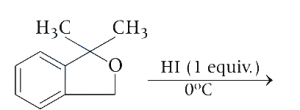
A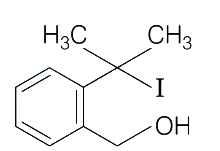
B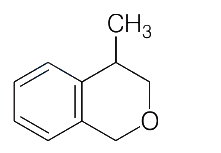
C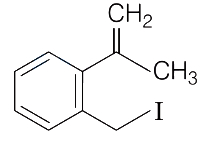
D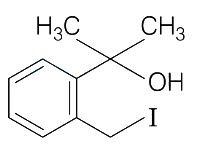
Solution
(A) The reaction is the acidic cleavage of a cyclic ether with $HI$. The ether oxygen gets protonated by $H^+$. The cleavage occurs at the bond that leads to the formation of a more stable carbocation. In this case,the bond between the oxygen and the tertiary carbon atom breaks to form a stable benzylic-tertiary carbocation. The iodide ion $(I^-)$ then attacks this carbocation to form the final product. The structure of the product is $2-(2-iodo-propan-2-yl)phenol$ or a related derivative where the ring is opened,specifically forming an alcohol and an alkyl iodide. The correct product is the one where the $I$ is attached to the tertiary carbon and the $OH$ is attached to the primary carbon of the side chain.
0 likesView Solution
334
ChemistryMCQAP EAMCET · 2021
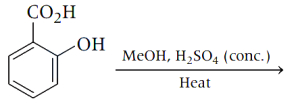
The major product in the following reaction is:
A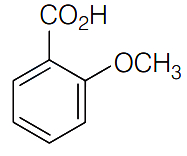
B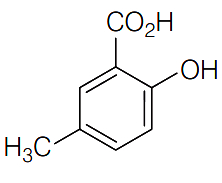
C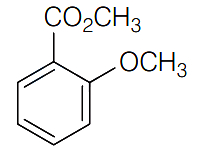
D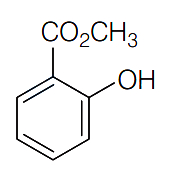
Solution
(D) The reaction is an esterification reaction between salicylic acid $(2-hydroxybenzoic acid)$ and methanol $(MeOH)$ in the presence of a concentrated acid catalyst $(H_2SO_4)$.
In this reaction,the carboxylic acid group $(-COOH)$ reacts with the alcohol $(-OH)$ to form an ester $(-COOCH_3)$.
The phenolic $-OH$ group is less reactive towards esterification under these conditions compared to the carboxylic acid group.
Therefore,the major product is methyl salicylate,where the carboxylic acid group is converted to a methyl ester.
In this reaction,the carboxylic acid group $(-COOH)$ reacts with the alcohol $(-OH)$ to form an ester $(-COOCH_3)$.
The phenolic $-OH$ group is less reactive towards esterification under these conditions compared to the carboxylic acid group.
Therefore,the major product is methyl salicylate,where the carboxylic acid group is converted to a methyl ester.
0 likesView Solution
335
ChemistryMCQAP EAMCET · 2021
........ of a reaction cannot be determined experimentally.
A
Order
B
Rate
C
Rate constant
D
Molecularity
Solution
(D) The correct answer is $D$.
Molecularity is a theoretical concept defined as the number of reacting species (atoms,ions,or molecules) taking part in an elementary reaction,which must collide simultaneously in order to bring about a chemical reaction.
It is determined by examining the balanced chemical equation of an elementary step.
In contrast,the order of a reaction is an experimental quantity determined from the rate law.
Molecularity is a theoretical concept defined as the number of reacting species (atoms,ions,or molecules) taking part in an elementary reaction,which must collide simultaneously in order to bring about a chemical reaction.
It is determined by examining the balanced chemical equation of an elementary step.
In contrast,the order of a reaction is an experimental quantity determined from the rate law.
0 likesView Solution
336
ChemistryMCQAP EAMCET · 2021
Which one of the following equations is correct for the reaction $N_{2(g)} + 3H_{2(g)} \longrightarrow 2NH_{3(g)}$?
A
$3 \frac{d[NH_3]}{dt} = 2 \frac{d[H_2]}{dt}$
B
$3 \frac{d[NH_3]}{dt} = 3 \frac{d[H_2]}{dt}$
C
$2 \frac{d[NH_3]}{dt} = -3 \frac{d[H_2]}{dt}$
D
$3 \frac{d[NH_3]}{dt} = -2 \frac{d[H_2]}{dt}$
Solution
(D) For the reaction $N_{2(g)} + 3H_{2(g)} \longrightarrow 2NH_{3(g)}$,the rate of reaction is expressed as:
$Rate = -\frac{d[N_2]}{dt} = -\frac{1}{3} \frac{d[H_2]}{dt} = \frac{1}{2} \frac{d[NH_3]}{dt}$
Equating the terms for $NH_3$ and $H_2$:
$-\frac{1}{3} \frac{d[H_2]}{dt} = \frac{1}{2} \frac{d[NH_3]}{dt}$
Multiplying both sides by $6$:
$-2 \frac{d[H_2]}{dt} = 3 \frac{d[NH_3]}{dt}$
Rearranging gives $3 \frac{d[NH_3]}{dt} = -2 \frac{d[H_2]}{dt}$.
$Rate = -\frac{d[N_2]}{dt} = -\frac{1}{3} \frac{d[H_2]}{dt} = \frac{1}{2} \frac{d[NH_3]}{dt}$
Equating the terms for $NH_3$ and $H_2$:
$-\frac{1}{3} \frac{d[H_2]}{dt} = \frac{1}{2} \frac{d[NH_3]}{dt}$
Multiplying both sides by $6$:
$-2 \frac{d[H_2]}{dt} = 3 \frac{d[NH_3]}{dt}$
Rearranging gives $3 \frac{d[NH_3]}{dt} = -2 \frac{d[H_2]}{dt}$.
0 likesView Solution
337
ChemistryMCQAP EAMCET · 2021
Consider the following reaction: $N_{2(g)} + 3H_{2(g)} \longrightarrow 2NH_{3(g)}$. The rate of this reaction in terms of $N_2$ at $T \ K$ is $-\frac{d[N_2]}{dt} = 0.02 \ mol \ L^{-1} \ s^{-1}$. What is the value of $-\frac{d[H_2]}{dt}$ (in units of $mol \ L^{-1} \ s^{-1}$) at the same temperature?
A
$0.02$
B
$50$
C
$0.06$
D
$0.04$
Solution
(C) For the reaction $N_{2(g)} + 3H_{2(g)} \longrightarrow 2NH_{3(g)}$,the rate of reaction is expressed as:
Rate $= -\frac{d[N_2]}{dt} = -\frac{1}{3} \frac{d[H_2]}{dt} = \frac{1}{2} \frac{d[NH_3]}{dt}$.
Given that $-\frac{d[N_2]}{dt} = 0.02 \ mol \ L^{-1} \ s^{-1}$.
Equating the terms for $N_2$ and $H_2$:
$-\frac{d[N_2]}{dt} = -\frac{1}{3} \frac{d[H_2]}{dt}$.
Therefore,$-\frac{d[H_2]}{dt} = 3 \times (-\frac{d[N_2]}{dt})$.
$-\frac{d[H_2]}{dt} = 3 \times 0.02 \ mol \ L^{-1} \ s^{-1} = 0.06 \ mol \ L^{-1} \ s^{-1}$.
Rate $= -\frac{d[N_2]}{dt} = -\frac{1}{3} \frac{d[H_2]}{dt} = \frac{1}{2} \frac{d[NH_3]}{dt}$.
Given that $-\frac{d[N_2]}{dt} = 0.02 \ mol \ L^{-1} \ s^{-1}$.
Equating the terms for $N_2$ and $H_2$:
$-\frac{d[N_2]}{dt} = -\frac{1}{3} \frac{d[H_2]}{dt}$.
Therefore,$-\frac{d[H_2]}{dt} = 3 \times (-\frac{d[N_2]}{dt})$.
$-\frac{d[H_2]}{dt} = 3 \times 0.02 \ mol \ L^{-1} \ s^{-1} = 0.06 \ mol \ L^{-1} \ s^{-1}$.
0 likesView Solution
338
ChemistryMCQAP EAMCET · 2021
If the lines $4x + 3y - 1 = 0$,$x - y + 5 = 0$,and $kx + 5y - 3 = 0$ are concurrent,then $k$ is equal to:
A
$4$
B
$5$
C
$6$
D
$7$
Solution
(C) Since the given three lines are concurrent,the determinant of their coefficients must be zero:
$\left|\begin{array}{rrr} 4 & 3 & -1 \\ 1 & -1 & 5 \\ k & 5 & -3 \end{array}\right| = 0$
Expanding the determinant along the first row:
$4((-1)(-3) - (5)(5)) - 3((1)(-3) - (5)(k)) - 1((1)(5) - (-1)(k)) = 0$
$4(3 - 25) - 3(-3 - 5k) - 1(5 + k) = 0$
$4(-22) + 9 + 15k - 5 - k = 0$
$-88 + 9 - 5 + 14k = 0$
$-84 + 14k = 0$
$14k = 84$
$k = 6$
$\left|\begin{array}{rrr} 4 & 3 & -1 \\ 1 & -1 & 5 \\ k & 5 & -3 \end{array}\right| = 0$
Expanding the determinant along the first row:
$4((-1)(-3) - (5)(5)) - 3((1)(-3) - (5)(k)) - 1((1)(5) - (-1)(k)) = 0$
$4(3 - 25) - 3(-3 - 5k) - 1(5 + k) = 0$
$4(-22) + 9 + 15k - 5 - k = 0$
$-88 + 9 - 5 + 14k = 0$
$-84 + 14k = 0$
$14k = 84$
$k = 6$
0 likesView Solution
339
ChemistryMCQAP EAMCET · 2021
If the lines $x^2+2xy-35y^2-4x+44y-12=0$ and $5x+\lambda y-8=0$ are concurrent,then the value of $\lambda$ is
A
$0$
B
$1$
C
$-1$
D
$2$
Solution
(D) The given equation of the pair of lines is $x^2+2xy-35y^2-4x+44y-12=0$.
Comparing this with the general form $ax^2+2hxy+by^2+2gx+2fy+c=0$,we get $a=1, h=1, b=-35, g=-2, f=22, c=-12$.
The point of intersection $(x_0, y_0)$ of the pair of lines is given by the formula:
$x_0 = \frac{hf-bg}{ab-h^2} = \frac{(1)(22)-(-35)(-2)}{(1)(-35)-(1)^2} = \frac{22-70}{-35-1} = \frac{-48}{-36} = \frac{4}{3}$
$y_0 = \frac{gh-af}{ab-h^2} = \frac{(-2)(1)-(1)(22)}{(1)(-35)-(1)^2} = \frac{-2-22}{-36} = \frac{-24}{-36} = \frac{2}{3}$
Since the lines are concurrent,the point $(\frac{4}{3}, \frac{2}{3})$ must satisfy the line $5x+\lambda y-8=0$.
$5(\frac{4}{3}) + \lambda(\frac{2}{3}) - 8 = 0$
$\frac{20}{3} + \frac{2\lambda}{3} - 8 = 0$
Multiply by $3$: $20 + 2\lambda - 24 = 0$
$2\lambda - 4 = 0$
$2\lambda = 4$
$\lambda = 2$
Comparing this with the general form $ax^2+2hxy+by^2+2gx+2fy+c=0$,we get $a=1, h=1, b=-35, g=-2, f=22, c=-12$.
The point of intersection $(x_0, y_0)$ of the pair of lines is given by the formula:
$x_0 = \frac{hf-bg}{ab-h^2} = \frac{(1)(22)-(-35)(-2)}{(1)(-35)-(1)^2} = \frac{22-70}{-35-1} = \frac{-48}{-36} = \frac{4}{3}$
$y_0 = \frac{gh-af}{ab-h^2} = \frac{(-2)(1)-(1)(22)}{(1)(-35)-(1)^2} = \frac{-2-22}{-36} = \frac{-24}{-36} = \frac{2}{3}$
Since the lines are concurrent,the point $(\frac{4}{3}, \frac{2}{3})$ must satisfy the line $5x+\lambda y-8=0$.
$5(\frac{4}{3}) + \lambda(\frac{2}{3}) - 8 = 0$
$\frac{20}{3} + \frac{2\lambda}{3} - 8 = 0$
Multiply by $3$: $20 + 2\lambda - 24 = 0$
$2\lambda - 4 = 0$
$2\lambda = 4$
$\lambda = 2$
0 likesView Solution
340
ChemistryMCQAP EAMCET · 2021
If $A$ is the areal velocity of a planet of mass $M$,its angular momentum is
A
$\frac{M}{A}$
B
$2MA$
C
$A^2 M$
D
$A M^2$
Solution
(B) The areal velocity $A$ is defined as the rate at which the area is swept by the position vector of the planet.
$A = \frac{dA}{dt} = \frac{1}{2} r^2 \omega$
Multiplying both sides by the mass $M$ of the planet:
$M A = \frac{1}{2} M r^2 \omega$
Since the moment of inertia $I = M r^2$,we can substitute this into the equation:
$M A = \frac{1}{2} I \omega$
We know that the angular momentum $L$ is given by $L = I \omega$.
Therefore,$M A = \frac{1}{2} L$.
Rearranging for $L$,we get:
$L = 2 M A$.
$A = \frac{dA}{dt} = \frac{1}{2} r^2 \omega$
Multiplying both sides by the mass $M$ of the planet:
$M A = \frac{1}{2} M r^2 \omega$
Since the moment of inertia $I = M r^2$,we can substitute this into the equation:
$M A = \frac{1}{2} I \omega$
We know that the angular momentum $L$ is given by $L = I \omega$.
Therefore,$M A = \frac{1}{2} L$.
Rearranging for $L$,we get:
$L = 2 M A$.
0 likesView Solution
341
ChemistryDifficultMCQAP EAMCET · 2021
The major product formed in the following reaction sequence is:
$C_6H_5-CHBr-CH_2Br$ $\xrightarrow[(ii) NaNH_2]{(i) alc. KOH}$ $\xrightarrow[(iii) \text{Red hot iron tube}, 873 K]{}$
$C_6H_5-CHBr-CH_2Br$ $\xrightarrow[(ii) NaNH_2]{(i) alc. KOH}$ $\xrightarrow[(iii) \text{Red hot iron tube}, 873 K]{}$
A
$1,2-$diphenylbenzene
B
$1,2,4-$triphenylbenzene
C
$1,3,5-$triphenylbenzene
D
$1,2,3-$triphenylbenzene
Solution
(C) Step $1$: Dehydrohalogenation of $C_6H_5-CHBr-CH_2Br$ with $alc. KOH$ followed by $NaNH_2$ leads to the formation of phenylacetylene $(C_6H_5-C \equiv CH)$.
Step $2$: The cyclic trimerization of phenylacetylene occurs when passed through a red hot iron tube at $873 \ K$.
Step $3$: The trimerization of $C_6H_5-C \equiv CH$ yields $1,3,5-triphenylbenzene$ as the major product due to steric hindrance,which favors the meta-substituted product.
Step $2$: The cyclic trimerization of phenylacetylene occurs when passed through a red hot iron tube at $873 \ K$.
Step $3$: The trimerization of $C_6H_5-C \equiv CH$ yields $1,3,5-triphenylbenzene$ as the major product due to steric hindrance,which favors the meta-substituted product.
0 likesView Solution
Vedclass Products
For Students
Vedclass Test Series
Mock tests in real AP EAMCET style covering Chemistry with performance analysis. 5-day free trial.
Start Free TrialFor Teachers
Exam Paper Generator
Generate Set A/B/C/D Chemistry papers from 7.5L+ questions in 2 minutes. 3 chapters free.
Try FreeFor Institutes
Online Exam Module
Run live AP EAMCET mock exams with unlimited students, 360° analytics & white-label branding.
See DemoFrequently Asked Questions
How many Chemistry questions are in AP EAMCET 2021?
There are 502 Chemistry questions from the AP EAMCET 2021 paper on Vedclass, each with a detailed step-by-step solution in English.
Are AP EAMCET 2021 Chemistry solutions available in English?
Yes. All solutions on this page are in English. You can also switch to English or Hindi using the language buttons above the questions.
Can I practice AP EAMCET 2021 Chemistry as a timed test?
Yes. Use the Vedclass Test Series to attempt a full AP EAMCET mock test covering Chemistry with time limits and instant score analysis.
Can teachers create Chemistry papers from AP EAMCET previous year questions?
Yes. The Vedclass Exam Paper Generator lets teachers mix AP EAMCET Chemistry questions and generate Set A/B/C/D papers in minutes.
For Teachers & Institutes
Build a Custom Chemistry Paper
Pick AP EAMCET 2021 Chemistry questions, set difficulty, and generate Set A/B/C/D in 2 minutes.