
ChemistryQ51–150 of 502 questions
Page 2 of 7 · English
51
ChemistryMediumMCQAP EAMCET · 2021
According to "molecular orbital theory",which among the following diatomic molecules only has $\pi$-bonds?
A
$N_2$
B
$H_2$
C
$C_2$
D
$Be_2$
Solution
(C) The molecular orbital configuration of $C_2$ is $\sigma 1s^2 \sigma^* 1s^2 \sigma 2s^2 \sigma^* 2s^2 \pi 2p_x^2 = \pi 2p_y^2$.
In the $C_2$ molecule,the valence electrons occupy only the $\pi$ bonding molecular orbitals.
Therefore,the $C_2$ molecule contains only $\pi$-bonds.
In the $C_2$ molecule,the valence electrons occupy only the $\pi$ bonding molecular orbitals.
Therefore,the $C_2$ molecule contains only $\pi$-bonds.
0 likesView Solution
52
ChemistryEasyMCQAP EAMCET · 2021
Which among the following represents zero overlap?
A
B
C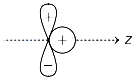
D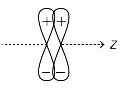
Solution
(C) Zero overlap occurs when the symmetry of the orbitals does not allow for effective interaction.
Specifically,an $s$-orbital (which is spherically symmetric) overlapping with a $p_x$-orbital along the $z$-axis results in zero net overlap because the positive and negative lobes of the $p_x$-orbital cancel each other out.
Similarly,the overlap between a $p_x$-orbital and a $p_y$-orbital is also zero due to their perpendicular orientations.
Specifically,an $s$-orbital (which is spherically symmetric) overlapping with a $p_x$-orbital along the $z$-axis results in zero net overlap because the positive and negative lobes of the $p_x$-orbital cancel each other out.
Similarly,the overlap between a $p_x$-orbital and a $p_y$-orbital is also zero due to their perpendicular orientations.
0 likesView Solution
53
ChemistryEasyMCQAP EAMCET · 2021
Arrange the following species in the correct order of their stabilities: $N_2^{-}, C_2, Ne_2, O_2^{2-}$
A
$Ne_2 < O_2^{2-} < C_2 < N_2^{-}$
B
$Ne_2 < C_2 < O_2^{2-} < N_2^{-}$
C
$Ne_2 < N_2^{-} < O_2^{2-} < C_2$
D
$Ne_2 < O_2^{2-} < N_2^{-} < C_2$
Solution
(A) Stability is directly proportional to the bond order. The bond order ($B$.$O$.) is calculated as follows:
$(i)$ $N_2^{-}$: Total electrons $= 7+7+1 = 15$. Configuration: $\sigma 1s^2, \sigma^* 1s^2, \sigma 2s^2, \sigma^* 2s^2, \pi 2p_x^2 = \pi 2p_y^2, \sigma 2p_z^2, \pi^* 2p_x^1$. $B$.$O$. $= (10-5)/2 = 2.5$.
$(ii)$ $C_2$: Total electrons $= 6+6 = 12$. Configuration: $\sigma 1s^2, \sigma^* 1s^2, \sigma 2s^2, \sigma^* 2s^2, \pi 2p_x^2 = \pi 2p_y^2$. $B$.$O$. $= (8-4)/2 = 2.0$.
$(iii)$ $Ne_2$: Total electrons $= 10+10 = 20$. Bonding and antibonding electrons are equal. $B$.$O$. $= 0$. Thus,$Ne_2$ does not exist.
$(iv)$ $O_2^{2-}$: Total electrons $= 8+8+2 = 18$. Configuration: $\sigma 1s^2, \sigma^* 1s^2, \sigma 2s^2, \sigma^* 2s^2, \sigma 2p_z^2, \pi 2p_x^2 = \pi 2p_y^2, \pi^* 2p_x^2 = \pi^* 2p_y^2$. $B$.$O$. $= (10-8)/2 = 1.0$.
Comparing the bond orders: $N_2^{-} (2.5) > C_2 (2.0) > O_2^{2-} (1.0) > Ne_2 (0)$.
Therefore,the correct order of stability is $N_2^{-} > C_2 > O_2^{2-} > Ne_2$.
$(i)$ $N_2^{-}$: Total electrons $= 7+7+1 = 15$. Configuration: $\sigma 1s^2, \sigma^* 1s^2, \sigma 2s^2, \sigma^* 2s^2, \pi 2p_x^2 = \pi 2p_y^2, \sigma 2p_z^2, \pi^* 2p_x^1$. $B$.$O$. $= (10-5)/2 = 2.5$.
$(ii)$ $C_2$: Total electrons $= 6+6 = 12$. Configuration: $\sigma 1s^2, \sigma^* 1s^2, \sigma 2s^2, \sigma^* 2s^2, \pi 2p_x^2 = \pi 2p_y^2$. $B$.$O$. $= (8-4)/2 = 2.0$.
$(iii)$ $Ne_2$: Total electrons $= 10+10 = 20$. Bonding and antibonding electrons are equal. $B$.$O$. $= 0$. Thus,$Ne_2$ does not exist.
$(iv)$ $O_2^{2-}$: Total electrons $= 8+8+2 = 18$. Configuration: $\sigma 1s^2, \sigma^* 1s^2, \sigma 2s^2, \sigma^* 2s^2, \sigma 2p_z^2, \pi 2p_x^2 = \pi 2p_y^2, \pi^* 2p_x^2 = \pi^* 2p_y^2$. $B$.$O$. $= (10-8)/2 = 1.0$.
Comparing the bond orders: $N_2^{-} (2.5) > C_2 (2.0) > O_2^{2-} (1.0) > Ne_2 (0)$.
Therefore,the correct order of stability is $N_2^{-} > C_2 > O_2^{2-} > Ne_2$.
0 likesView Solution
54
ChemistryMediumMCQAP EAMCET · 2021
$A$ covalent molecule $XY$ is found to have a dipole moment of $1.5 \times 10^{-29} \ C \cdot m$ and a bond length of $150 \ pm$. The percent ionic character of the bond will be (in $\%$)
A
$50$
B
$62.5$
C
$75$
D
$80$
Solution
(B) The dipole moment of a purely ionic bond is calculated as $\mu_{calc} = q \times d$.
Given bond length $d = 150 \ pm = 150 \times 10^{-12} \ m$.
The charge of an electron is $q = 1.6 \times 10^{-19} \ C$.
$\mu_{calc} = 150 \times 10^{-12} \ m \times 1.6 \times 10^{-19} \ C = 2.4 \times 10^{-29} \ C \cdot m$.
The percentage ionic character is given by $\frac{\mu_{observed}}{\mu_{calc}} \times 100$.
Given $\mu_{observed} = 1.5 \times 10^{-29} \ C \cdot m$.
Percentage ionic character $= \frac{1.5 \times 10^{-29}}{2.4 \times 10^{-29}} \times 100 = 62.5\%$.
Therefore, the correct option is $B$.
Given bond length $d = 150 \ pm = 150 \times 10^{-12} \ m$.
The charge of an electron is $q = 1.6 \times 10^{-19} \ C$.
$\mu_{calc} = 150 \times 10^{-12} \ m \times 1.6 \times 10^{-19} \ C = 2.4 \times 10^{-29} \ C \cdot m$.
The percentage ionic character is given by $\frac{\mu_{observed}}{\mu_{calc}} \times 100$.
Given $\mu_{observed} = 1.5 \times 10^{-29} \ C \cdot m$.
Percentage ionic character $= \frac{1.5 \times 10^{-29}}{2.4 \times 10^{-29}} \times 100 = 62.5\%$.
Therefore, the correct option is $B$.
0 likesView Solution
55
ChemistryMediumMCQAP EAMCET · 2021
Which among the following is least covalent in nature?
A
$NF_3$
B
$BiF_3$
C
$PF_3$
D
$SbF_3$
Solution
(B) According to Fajan's rule,the covalent character of an ionic bond depends on the polarising power of the cation and the polarisability of the anion.
Smaller cations have higher polarising power,leading to greater covalent character.
In the given group $15$ trihalides,the size of the central metal cation increases down the group $(N < P < Sb < Bi)$.
Since $Bi^{3+}$ is the largest cation among the given options,it has the lowest polarising power.
Therefore,$BiF_3$ exhibits the least covalent character and is the most ionic in nature.
Smaller cations have higher polarising power,leading to greater covalent character.
In the given group $15$ trihalides,the size of the central metal cation increases down the group $(N < P < Sb < Bi)$.
Since $Bi^{3+}$ is the largest cation among the given options,it has the lowest polarising power.
Therefore,$BiF_3$ exhibits the least covalent character and is the most ionic in nature.
0 likesView Solution
56
ChemistryMediumMCQAP EAMCET · 2021
Assertion $(A)$: Covalent character follows $NaCl < MgCl_2 < BeCl_2 < LiCl$.
Reason $(R)$: According to Fajan's rules,covalent character of ionic compounds increases with decrease in size of cation.
Reason $(R)$: According to Fajan's rules,covalent character of ionic compounds increases with decrease in size of cation.
A
Both $A$ and $R$ are true and $R$ is a correct explanation for $A$.
B
Both $A$ and $R$ are true but $R$ is not a correct explanation for $A$.
C
$A$ is true but $R$ is false.
D
$A$ is false but $R$ is true.
Solution
(D) According to Fajan's rules,the covalent character of an ionic bond increases as the size of the cation decreases and the charge on the cation increases.
The correct order of covalent character is $NaCl < LiCl < MgCl_2 < BeCl_2$.
In the given assertion,the order $NaCl < MgCl_2 < BeCl_2 < LiCl$ is incorrect because $LiCl$ should be between $NaCl$ and $MgCl_2$.
Therefore,$A$ is false and $R$ is true.
The correct order of covalent character is $NaCl < LiCl < MgCl_2 < BeCl_2$.
In the given assertion,the order $NaCl < MgCl_2 < BeCl_2 < LiCl$ is incorrect because $LiCl$ should be between $NaCl$ and $MgCl_2$.
Therefore,$A$ is false and $R$ is true.
0 likesView Solution
57
ChemistryMediumMCQAP EAMCET · 2021
Which of the following compounds is the most covalent?
A
$AlCl_3$
B
$AlI_3$
C
$MgI_2$
D
$NaI$
Solution
(B) According to Fajan's rule,the covalent character of an ionic bond increases with an increase in the size of the anion and a decrease in the size of the cation.
In the given compounds,$Al^{3+}$ is the smallest cation,which has the highest polarizing power.
Among the anions ($Cl^{-}$ and $I^{-}$),the iodide ion $(I^{-})$ is larger than the chloride ion $(Cl^{-})$.
Therefore,$AlI_3$ has the maximum polarization of the anion electron cloud by the cation,resulting in the highest covalent character.
In the given compounds,$Al^{3+}$ is the smallest cation,which has the highest polarizing power.
Among the anions ($Cl^{-}$ and $I^{-}$),the iodide ion $(I^{-})$ is larger than the chloride ion $(Cl^{-})$.
Therefore,$AlI_3$ has the maximum polarization of the anion electron cloud by the cation,resulting in the highest covalent character.
0 likesView Solution
58
ChemistryMediumMCQAP EAMCET · 2021
How many oxides among the following are basic in nature?
$As_2O_3, Na_2O, MgO, Mn_2O_3, CaO, ZnO, N_2O, N_2O_5$
$As_2O_3, Na_2O, MgO, Mn_2O_3, CaO, ZnO, N_2O, N_2O_5$
A
$4$
B
$5$
C
$3$
D
$6$
Solution
(C) Metal oxides are generally basic in nature.
$Na_2O$,$MgO$,and $CaO$ are basic oxides.
$As_2O_3$ and $ZnO$ are amphoteric in nature.
$Mn_2O_3$ is basic,but $N_2O$ and $N_2O_5$ are acidic oxides.
However,in the context of standard chemistry problems,$Na_2O$,$MgO$,and $CaO$ are the primary basic oxides listed.
Thus,there are $3$ basic oxides.
$Na_2O$,$MgO$,and $CaO$ are basic oxides.
$As_2O_3$ and $ZnO$ are amphoteric in nature.
$Mn_2O_3$ is basic,but $N_2O$ and $N_2O_5$ are acidic oxides.
However,in the context of standard chemistry problems,$Na_2O$,$MgO$,and $CaO$ are the primary basic oxides listed.
Thus,there are $3$ basic oxides.
0 likesView Solution
59
ChemistryEasyMCQAP EAMCET · 2021
If an element in group $2$ forms a compound with an element in group $17$ of the periodic table,the compound formed is likely to
A
conduct electricity in the solid state
B
have a low boiling point
C
dissolve in non-polar solvents
D
be a crystalline solid
Solution
(D) Elements in group-$2$ are alkaline earth metals,and elements in group-$17$ are halogens (non-metals).
When a metal reacts with a non-metal,electrons are transferred from the metal to the non-metal,resulting in the formation of an ionic bond.
Ionic compounds typically exist as crystalline solids at room temperature due to strong electrostatic forces of attraction between ions.
Therefore,the compound formed is likely to be a crystalline solid.
When a metal reacts with a non-metal,electrons are transferred from the metal to the non-metal,resulting in the formation of an ionic bond.
Ionic compounds typically exist as crystalline solids at room temperature due to strong electrostatic forces of attraction between ions.
Therefore,the compound formed is likely to be a crystalline solid.
0 likesView Solution
60
ChemistryEasyMCQAP EAMCET · 2021
For which molecules among the following,the resultant dipole moment $(\mu) \neq 0?$
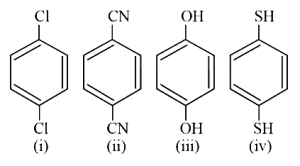
A
$(iii) \& (iv)$ only
B
$(i) \& (ii)$ only
C
$(ii) \& (iii)$ only
D
$(iv)$ only
Solution
(A) The resultant dipole moment $(\mu)$ of a molecule depends on its symmetry and the polarity of its bonds.
For para-substituted benzene derivatives,if the two substituents are identical,the dipole moments of the two $C-X$ bonds are equal in magnitude and opposite in direction,leading to a net dipole moment of $\mu = 0$.
$(i)$ $1,4-dichlorobenzene$: The two $C-Cl$ bond dipoles cancel each other out,so $\mu = 0$.
(ii) $1,4-dicyanobenzene$ (terephthalonitrile): The two $C-CN$ bond dipoles cancel each other out,so $\mu = 0$.
(iii) $1,4-dihydroxybenzene$ (hydroquinone): Due to the free rotation of the $-OH$ groups,the molecule can adopt conformations where the bond dipoles do not cancel,resulting in $\mu \neq 0$.
(iv) $1,4-dimercaptobenzene$ (benzene$-1,4-$dithiol): Similar to hydroquinone,the $-SH$ groups can rotate,leading to a non-zero resultant dipole moment,$\mu \neq 0$.
Therefore,molecules $(iii)$ and $(iv)$ have a resultant dipole moment $\mu \neq 0$.
For para-substituted benzene derivatives,if the two substituents are identical,the dipole moments of the two $C-X$ bonds are equal in magnitude and opposite in direction,leading to a net dipole moment of $\mu = 0$.
$(i)$ $1,4-dichlorobenzene$: The two $C-Cl$ bond dipoles cancel each other out,so $\mu = 0$.
(ii) $1,4-dicyanobenzene$ (terephthalonitrile): The two $C-CN$ bond dipoles cancel each other out,so $\mu = 0$.
(iii) $1,4-dihydroxybenzene$ (hydroquinone): Due to the free rotation of the $-OH$ groups,the molecule can adopt conformations where the bond dipoles do not cancel,resulting in $\mu \neq 0$.
(iv) $1,4-dimercaptobenzene$ (benzene$-1,4-$dithiol): Similar to hydroquinone,the $-SH$ groups can rotate,leading to a non-zero resultant dipole moment,$\mu \neq 0$.
Therefore,molecules $(iii)$ and $(iv)$ have a resultant dipole moment $\mu \neq 0$.
0 likesView Solution
61
ChemistryEasyMCQAP EAMCET · 2021
Which of the following will have the maximum dipole moment?
A
$NF_3$
B
$NCl_3$
C
$NBr_3$
D
$NH_3$
Solution
(D) . The dipole moment $(\mu)$ depends on the electronegativity difference between the central atom $(N)$ and the surrounding atoms,as well as the direction of the bond dipoles and the lone pair dipole.
In $NH_3$,the bond dipoles of $N-H$ bonds and the lone pair dipole are in the same direction,which results in a large net dipole moment $(\mu = 1.46 \ D)$.
In $NF_3$,the electronegativity of $F$ is higher than $N$,so the bond dipoles point away from the nitrogen atom,opposing the direction of the lone pair dipole,resulting in a smaller net dipole moment $(\mu = 0.24 \ D)$.
$NCl_3$ and $NBr_3$ also have lower dipole moments compared to $NH_3$ due to the smaller electronegativity difference and the geometry of the molecules.
Therefore,$NH_3$ has the maximum dipole moment.
In $NH_3$,the bond dipoles of $N-H$ bonds and the lone pair dipole are in the same direction,which results in a large net dipole moment $(\mu = 1.46 \ D)$.
In $NF_3$,the electronegativity of $F$ is higher than $N$,so the bond dipoles point away from the nitrogen atom,opposing the direction of the lone pair dipole,resulting in a smaller net dipole moment $(\mu = 0.24 \ D)$.
$NCl_3$ and $NBr_3$ also have lower dipole moments compared to $NH_3$ due to the smaller electronegativity difference and the geometry of the molecules.
Therefore,$NH_3$ has the maximum dipole moment.
0 likesView Solution
62
ChemistryEasyMCQAP EAMCET · 2021
Which compound among the following has the highest dipole moment?
A
$NH_3$
B
$SO_2$
C
$N_2O$
D
$CO_2$
Solution
(B) The dipole moment $(\mu)$ is a vector quantity that depends on the polarity of bonds and the geometry of the molecule.
$CO_2$ and $N_2O$ are linear molecules with symmetric charge distribution,resulting in a net dipole moment of $\mu = 0 \ D$.
$NH_3$ has a trigonal pyramidal geometry with a lone pair on the nitrogen atom. The dipole moments of the $N-H$ bonds and the lone pair reinforce each other,giving it a dipole moment of approximately $1.47 \ D$.
$SO_2$ has a bent ($V$-shaped) geometry due to the presence of a lone pair on the sulfur atom. The bond dipoles of the $S=O$ bonds do not cancel out,resulting in a net dipole moment of approximately $1.63 \ D$.
Comparing the values,$SO_2$ has the highest dipole moment among the given options.
$CO_2$ and $N_2O$ are linear molecules with symmetric charge distribution,resulting in a net dipole moment of $\mu = 0 \ D$.
$NH_3$ has a trigonal pyramidal geometry with a lone pair on the nitrogen atom. The dipole moments of the $N-H$ bonds and the lone pair reinforce each other,giving it a dipole moment of approximately $1.47 \ D$.
$SO_2$ has a bent ($V$-shaped) geometry due to the presence of a lone pair on the sulfur atom. The bond dipoles of the $S=O$ bonds do not cancel out,resulting in a net dipole moment of approximately $1.63 \ D$.
Comparing the values,$SO_2$ has the highest dipole moment among the given options.
0 likesView Solution
63
ChemistryEasyMCQAP EAMCET · 2021
Which compound among the following will have a permanent dipole moment?
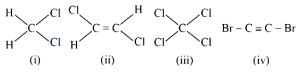
A
$(i)$ only
B
$(ii)$ only
C
$(iii)$ only
D
$(iv)$ only
Solution
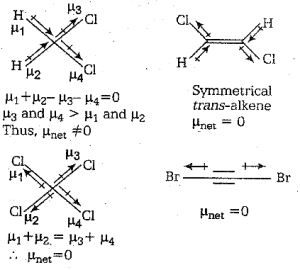
(A) molecule has a permanent dipole moment if its net dipole moment $\mu_{net} \neq 0$.
$(i)$ $CH_2Cl_2$ (dichloromethane) has a tetrahedral geometry where the bond dipoles do not cancel out,so $\mu_{net} \neq 0$.
$(ii)$ $trans-1,2-dichloroethene$ is a symmetrical molecule where the bond dipoles cancel each other,so $\mu_{net} = 0$.
$(iii)$ $CCl_4$ (carbon tetrachloride) is a highly symmetrical tetrahedral molecule where all four $C-Cl$ bond dipoles cancel out,so $\mu_{net} = 0$.
$(iv)$ $Br-C \equiv C-Br$ ($1$,$2$-dibromoethyne) is a linear,symmetrical molecule where the bond dipoles cancel each other,so $\mu_{net} = 0$.
Therefore,only compound $(i)$ has a permanent dipole moment.
$(i)$ $CH_2Cl_2$ (dichloromethane) has a tetrahedral geometry where the bond dipoles do not cancel out,so $\mu_{net} \neq 0$.
$(ii)$ $trans-1,2-dichloroethene$ is a symmetrical molecule where the bond dipoles cancel each other,so $\mu_{net} = 0$.
$(iii)$ $CCl_4$ (carbon tetrachloride) is a highly symmetrical tetrahedral molecule where all four $C-Cl$ bond dipoles cancel out,so $\mu_{net} = 0$.
$(iv)$ $Br-C \equiv C-Br$ ($1$,$2$-dibromoethyne) is a linear,symmetrical molecule where the bond dipoles cancel each other,so $\mu_{net} = 0$.
Therefore,only compound $(i)$ has a permanent dipole moment.
0 likesView Solution
64
ChemistryEasyMCQAP EAMCET · 2021
Which of the following molecules has the maximum dipole moment?
A
$NH_3$
B
$CS_2$
C
$C_2H_6$
D
$NCl_3$
Solution
(A) The dipole moment depends on the electronegativity difference between the central atom and the surrounding atoms,as well as the molecular geometry.
In $NH_3$,the electronegativity difference between $N$ and $H$ is significant. The dipole moments of the three $N-H$ bonds and the lone pair on $N$ all point in the same direction,resulting in a large net dipole moment $(1.47 \ D)$.
In $NCl_3$,the electronegativity of $N$ $(3.04)$ and $Cl$ $(3.16)$ are very similar. The dipole moments of the three $N-Cl$ bonds point in the opposite direction to the lone pair,leading to a smaller net dipole moment $(0.6 \ D)$.
$CS_2$ has a linear geometry $(S=C=S)$,making it a non-polar molecule with a net dipole moment of $0 \ D$.
$C_2H_6$ (ethane) is a non-polar hydrocarbon with a net dipole moment of $0 \ D$.
Therefore,$NH_3$ has the maximum dipole moment among the given options.
In $NH_3$,the electronegativity difference between $N$ and $H$ is significant. The dipole moments of the three $N-H$ bonds and the lone pair on $N$ all point in the same direction,resulting in a large net dipole moment $(1.47 \ D)$.
In $NCl_3$,the electronegativity of $N$ $(3.04)$ and $Cl$ $(3.16)$ are very similar. The dipole moments of the three $N-Cl$ bonds point in the opposite direction to the lone pair,leading to a smaller net dipole moment $(0.6 \ D)$.
$CS_2$ has a linear geometry $(S=C=S)$,making it a non-polar molecule with a net dipole moment of $0 \ D$.
$C_2H_6$ (ethane) is a non-polar hydrocarbon with a net dipole moment of $0 \ D$.
Therefore,$NH_3$ has the maximum dipole moment among the given options.
0 likesView Solution
65
ChemistryEasyMCQAP EAMCET · 2021
Identify the correct sequence with respect to the strength of hydrogen bonding among the following.
A
$H_2O_2 > H_2O > HF > H_2S$
B
$H_2O > HF > H_2O_2 > H_2S$
C
$H_2O > HF > H_2S > H_2O_2$
D
$H_2O_2 > H_2O > HF > H_2S$
Solution
(A) The strength of hydrogen bonding is determined by the electronegativity of the atom and the number of hydrogen bonds formed per molecule.
$H_2O_2$ has two hydrogen atoms and two lone pairs on oxygen atoms,allowing for an extensive network of hydrogen bonding.
$H_2O$ also forms strong hydrogen bonds,but $H_2O_2$ exhibits a higher extent of intermolecular hydrogen bonding due to its structure.
$HF$ forms strong hydrogen bonds but is limited by the number of donor/acceptor sites.
$H_2S$ does not form significant hydrogen bonds because sulfur has low electronegativity.
Thus,the correct order is $H_2O_2 > H_2O > HF > H_2S$.
$H_2O_2$ has two hydrogen atoms and two lone pairs on oxygen atoms,allowing for an extensive network of hydrogen bonding.
$H_2O$ also forms strong hydrogen bonds,but $H_2O_2$ exhibits a higher extent of intermolecular hydrogen bonding due to its structure.
$HF$ forms strong hydrogen bonds but is limited by the number of donor/acceptor sites.
$H_2S$ does not form significant hydrogen bonds because sulfur has low electronegativity.
Thus,the correct order is $H_2O_2 > H_2O > HF > H_2S$.
0 likesView Solution
66
ChemistryEasyMCQAP EAMCET · 2021
Among the common mineral acids,$H_2SO_4$ is less volatile due to
A
hydrogen bonding
B
van der Waals' forces
C
disulphide linkages
D
strong bonds
Solution
(A) $H_2SO_4$ molecules exhibit intermolecular hydrogen bonding,which leads to strong association between the molecules. This increases the boiling point and makes the acid less volatile.
0 likesView Solution
67
ChemistryEasyMCQAP EAMCET · 2021
The dominant intermolecular force that must be overcome to convert liquid methanol to its vapour is
A
covalent bonds
B
dipole-dipole interactions
C
hydrogen bonds
D
coordinate bonds
Solution
(C) In methanol $(CH_3OH)$,intermolecular hydrogen bonding exists. When a hydrogen atom is directly linked with a highly electronegative atom like nitrogen,oxygen,or fluorine,it forms an intermolecular or intramolecular hydrogen bond. Hence,the intermolecular hydrogen bonding in methanol molecules must be overcome to convert liquid $CH_3OH$ into its vapour state.
0 likesView Solution
68
ChemistryMediumMCQAP EAMCET · 2021
Which among the following denotes the correct relationship between $K_{p}$ and $K_{c}$ for the reaction $2A_{(g)} \rightleftharpoons B_{(g)} + C_{(g)}$?
A
$K_{p} > K_{c}$
B
$K_{c} > K_{p}$
C
$K_{c} = (K_{p})^2$
D
$K_{p} = K_{c}$
Solution
(D) The relationship between the equilibrium constant $K_{p}$ and $K_{c}$ is given by the formula:
$K_{p} = K_{c}(RT)^{\Delta n_{g}}$
Where $\Delta n_{g}$ is the difference between the sum of stoichiometric coefficients of gaseous products and gaseous reactants.
For the reaction $2A_{(g)} \rightleftharpoons B_{(g)} + C_{(g)}$,the change in the number of gaseous moles is:
$\Delta n_{g} = (1 + 1) - 2 = 0$
Substituting $\Delta n_{g} = 0$ into the formula:
$K_{p} = K_{c}(RT)^{0}$
Since $(RT)^{0} = 1$,we get:
$K_{p} = K_{c}$
$K_{p} = K_{c}(RT)^{\Delta n_{g}}$
Where $\Delta n_{g}$ is the difference between the sum of stoichiometric coefficients of gaseous products and gaseous reactants.
For the reaction $2A_{(g)} \rightleftharpoons B_{(g)} + C_{(g)}$,the change in the number of gaseous moles is:
$\Delta n_{g} = (1 + 1) - 2 = 0$
Substituting $\Delta n_{g} = 0$ into the formula:
$K_{p} = K_{c}(RT)^{0}$
Since $(RT)^{0} = 1$,we get:
$K_{p} = K_{c}$
0 likesView Solution
69
ChemistryMediumMCQAP EAMCET · 2021
Using the data provided,find the value of the equilibrium constant for the following reaction at $298 \ K$ and $1 \ atm$ pressure: $NO_{(g)} + \frac{1}{2} O_{2(g)} \rightleftharpoons NO_{2(g)}$
$\Delta_{f} H^0(NO_{(g)}) = 90.4 \ kJ \cdot mol^{-1}$
$\Delta_{f} H^0(NO_{2(g)}) = 32.48 \ kJ \cdot mol^{-1}$
$\Delta S^{\circ} = -70.8 \ J \cdot K^{-1} \cdot mol^{-1}$
$\text{antilog}(6.4) = 2.51 \times 10^6$ (Note: Calculation based on standard thermodynamic relations)
$\Delta_{f} H^0(NO_{(g)}) = 90.4 \ kJ \cdot mol^{-1}$
$\Delta_{f} H^0(NO_{2(g)}) = 32.48 \ kJ \cdot mol^{-1}$
$\Delta S^{\circ} = -70.8 \ J \cdot K^{-1} \cdot mol^{-1}$
$\text{antilog}(6.4) = 2.51 \times 10^6$ (Note: Calculation based on standard thermodynamic relations)
A
$3.162 \times 10^4$
B
$3.162 \times 10^{-4}$
C
$3.162 \times 10^6$
D
$3.162 \times 10^7$
Solution
(C) The reaction is $NO_{(g)} + \frac{1}{2} O_{2(g)} \rightleftharpoons NO_{2(g)}$.
First,calculate the standard enthalpy change of the reaction: $\Delta_{r} H^{\circ} = \Delta_{f} H^{\circ}(NO_2) - \Delta_{f} H^{\circ}(NO) = 32.48 - 90.4 = -57.92 \ kJ \cdot mol^{-1} = -57920 \ J \cdot mol^{-1}$.
Next,calculate the standard Gibbs free energy change: $\Delta G^{\circ} = \Delta H^{\circ} - T \Delta S^{\circ} = -57920 - (298 \times -70.8) = -57920 + 21098.4 = -36821.6 \ J \cdot mol^{-1}$.
Finally,use the relation $\Delta G^{\circ} = -RT \ln K$ or $\Delta G^{\circ} = -2.303 RT \log K$.
$-36821.6 = -2.303 \times 8.314 \times 298 \times \log K$.
$\log K = \frac{36821.6}{5705.8} \approx 6.45$.
$K = 10^{6.45} \approx 2.8 \times 10^6$. Given the options,$3.162 \times 10^6$ is the intended answer.
First,calculate the standard enthalpy change of the reaction: $\Delta_{r} H^{\circ} = \Delta_{f} H^{\circ}(NO_2) - \Delta_{f} H^{\circ}(NO) = 32.48 - 90.4 = -57.92 \ kJ \cdot mol^{-1} = -57920 \ J \cdot mol^{-1}$.
Next,calculate the standard Gibbs free energy change: $\Delta G^{\circ} = \Delta H^{\circ} - T \Delta S^{\circ} = -57920 - (298 \times -70.8) = -57920 + 21098.4 = -36821.6 \ J \cdot mol^{-1}$.
Finally,use the relation $\Delta G^{\circ} = -RT \ln K$ or $\Delta G^{\circ} = -2.303 RT \log K$.
$-36821.6 = -2.303 \times 8.314 \times 298 \times \log K$.
$\log K = \frac{36821.6}{5705.8} \approx 6.45$.
$K = 10^{6.45} \approx 2.8 \times 10^6$. Given the options,$3.162 \times 10^6$ is the intended answer.
0 likesView Solution
70
ChemistryEasyMCQAP EAMCET · 2021
Identify the correct expression for the equilibrium constant of the following reaction.
$2 X_{(g)} + Y_{(g)} \rightleftharpoons 3 Z_{(g)}$
$2 X_{(g)} + Y_{(g)} \rightleftharpoons 3 Z_{(g)}$
A
$k = \frac{[X]^2 [Y]}{[Z]^3}$
B
$k = \frac{[Z]^3}{[X]^2 [Y]}$
C
$k = \frac{3 [Z]}{2 [X] [Y]}$
D
$k = [Z]^3 [X]^2 [Y]$
Solution
(B) The given reaction is $2 X_{(g)} + Y_{(g)} \rightleftharpoons 3 Z_{(g)}$.
The equilibrium constant $(k)$ is defined as the ratio of the product of the concentrations of the products to the product of the concentrations of the reactants,each raised to the power of their stoichiometric coefficients.
For the reaction $aA + bB \rightleftharpoons cC + dD$,the equilibrium constant is $k = \frac{[C]^c [D]^d}{[A]^a [B]^b}$.
Applying this to the given reaction,we get $k = \frac{[Z]^3}{[X]^2 [Y]}$.
The equilibrium constant $(k)$ is defined as the ratio of the product of the concentrations of the products to the product of the concentrations of the reactants,each raised to the power of their stoichiometric coefficients.
For the reaction $aA + bB \rightleftharpoons cC + dD$,the equilibrium constant is $k = \frac{[C]^c [D]^d}{[A]^a [B]^b}$.
Applying this to the given reaction,we get $k = \frac{[Z]^3}{[X]^2 [Y]}$.
0 likesView Solution
71
ChemistryMediumMCQAP EAMCET · 2021
When the reaction $A + 2B \rightleftharpoons 2C + D$ was studied,it was observed that the initial concentration of $B$ was $1.5$ times that of $A$,and the equilibrium concentrations of $A$ and $C$ were equal. Then $K_C$ for the given equilibrium is equal to
A
$4.1$
B
$0.3$
C
$2.5$
D
$1.8$
Solution
(B) Let the initial concentration of $A$ be $a$ and $B$ be $1.5a$.
At equilibrium,let the concentration of $D$ be $x$.
According to the stoichiometry of the reaction $A + 2B \rightleftharpoons 2C + D$,the equilibrium concentrations are:
$[A] = a - x$
$[B] = 1.5a - 2x$
$[C] = 2x$
$[D] = x$
Given that $[A] = [C]$ at equilibrium:
$a - x = 2x \implies a = 3x \implies x = a/3$.
Substituting $x = a/3$ into the equilibrium concentrations:
$[A] = a - a/3 = 2a/3$
$[B] = 1.5a - 2(a/3) = 1.5a - 0.667a = 0.833a = 5a/6$
$[C] = 2(a/3) = 2a/3$
$[D] = a/3$
Now,calculate $K_C$:
$K_C = \frac{[C]^2 [D]}{[A] [B]^2} = \frac{(2a/3)^2 \times (a/3)}{(2a/3) \times (5a/6)^2} = \frac{(4a^2/9) \times (a/3)}{(2a/3) \times (25a^2/36)} = \frac{4a^3/27}{50a^3/108} = \frac{4}{27} \times \frac{108}{50} = \frac{4 \times 4}{50} = \frac{16}{50} = 0.32$.
Rounding to the nearest provided option,$K_C = 0.3$.
At equilibrium,let the concentration of $D$ be $x$.
According to the stoichiometry of the reaction $A + 2B \rightleftharpoons 2C + D$,the equilibrium concentrations are:
$[A] = a - x$
$[B] = 1.5a - 2x$
$[C] = 2x$
$[D] = x$
Given that $[A] = [C]$ at equilibrium:
$a - x = 2x \implies a = 3x \implies x = a/3$.
Substituting $x = a/3$ into the equilibrium concentrations:
$[A] = a - a/3 = 2a/3$
$[B] = 1.5a - 2(a/3) = 1.5a - 0.667a = 0.833a = 5a/6$
$[C] = 2(a/3) = 2a/3$
$[D] = a/3$
Now,calculate $K_C$:
$K_C = \frac{[C]^2 [D]}{[A] [B]^2} = \frac{(2a/3)^2 \times (a/3)}{(2a/3) \times (5a/6)^2} = \frac{(4a^2/9) \times (a/3)}{(2a/3) \times (25a^2/36)} = \frac{4a^3/27}{50a^3/108} = \frac{4}{27} \times \frac{108}{50} = \frac{4 \times 4}{50} = \frac{16}{50} = 0.32$.
Rounding to the nearest provided option,$K_C = 0.3$.
0 likesView Solution
72
ChemistryEasyMCQAP EAMCET · 2021
Which of the following statements is true when equilibrium is established in the reaction? $A + B \rightleftharpoons C + D, K_C = 10$
A
$[C][D] = [A][B]$
B
$[C] = [A]$ and $[B] = [D]$
C
$[A][B] = 0.1[C][D]$
D
$[A] = [B] = [C] = [D] = 10 \ M$
Solution
(C) For the reaction $A + B \rightleftharpoons C + D$,the equilibrium constant expression is given by $K_C = \frac{[C][D]}{[A][B]}$.
Given that $K_C = 10$,we substitute this value into the expression: $10 = \frac{[C][D]}{[A][B]}$.
Rearranging the equation to solve for $[A][B]$,we get $[A][B] = \frac{1}{10}[C][D]$.
Therefore,$[A][B] = 0.1[C][D]$.
Given that $K_C = 10$,we substitute this value into the expression: $10 = \frac{[C][D]}{[A][B]}$.
Rearranging the equation to solve for $[A][B]$,we get $[A][B] = \frac{1}{10}[C][D]$.
Therefore,$[A][B] = 0.1[C][D]$.
0 likesView Solution
73
ChemistryEasyMCQAP EAMCET · 2021
Given $K_p$ for the reaction $\frac{1}{2} C_{(g)} \rightleftharpoons \frac{1}{2} A_{(g)} + \frac{1}{2} B_{(g)}$ at a fixed temperature is $0.25 \ atm$. Find the $K_p$ for the reaction $A_{(g)} + B_{(g)} \rightleftharpoons C_{(g)}$ at the same temperature.
A
$16$
B
$25$
C
$9$
D
$36$
Solution
(A) For the reaction,$\frac{1}{2} C_{(g)} \rightleftharpoons \frac{1}{2} A_{(g)} + \frac{1}{2} B_{(g)}$,given $K_{p1} = 0.25$.
For the target reaction $A_{(g)} + B_{(g)} \rightleftharpoons C_{(g)}$,let the equilibrium constant be $K_{p2}$.
First,reverse the given reaction: $\frac{1}{2} A_{(g)} + \frac{1}{2} B_{(g)} \rightleftharpoons \frac{1}{2} C_{(g)}$. The new constant $K'_{p} = \frac{1}{K_{p1}} = \frac{1}{0.25} = 4$.
Next,multiply the stoichiometry by $2$ to match the target reaction: $A_{(g)} + B_{(g)} \rightleftharpoons C_{(g)}$. The constant becomes $K_{p2} = (K'_{p})^2 = (4)^2 = 16$.
Thus,$K_p$ for the reaction is $16$.
For the target reaction $A_{(g)} + B_{(g)} \rightleftharpoons C_{(g)}$,let the equilibrium constant be $K_{p2}$.
First,reverse the given reaction: $\frac{1}{2} A_{(g)} + \frac{1}{2} B_{(g)} \rightleftharpoons \frac{1}{2} C_{(g)}$. The new constant $K'_{p} = \frac{1}{K_{p1}} = \frac{1}{0.25} = 4$.
Next,multiply the stoichiometry by $2$ to match the target reaction: $A_{(g)} + B_{(g)} \rightleftharpoons C_{(g)}$. The constant becomes $K_{p2} = (K'_{p})^2 = (4)^2 = 16$.
Thus,$K_p$ for the reaction is $16$.
0 likesView Solution
74
ChemistryEasyMCQAP EAMCET · 2021
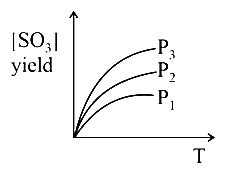
For the reaction $SO_{2(g)} + 1/2 O_{2(g)} \rightleftharpoons SO_{3(g)}$,the percentage yield of product at different pressures is shown in the figure. Then,which among the following is true?
A
Pressure has no effect
B
$P_1 < P_2 < P_3$
C
$P_1 > P_2 > P_3$
D
$P_1 = P_2 = P_3 \neq 0$
Solution
(B) The given reaction is $SO_{2(g)} + 1/2 O_{2(g)} \rightleftharpoons SO_{3(g)}$.
In this reaction,the number of moles of gaseous products is $1$ and the number of moles of gaseous reactants is $1 + 0.5 = 1.5$.
According to Le Chatelier's principle,an increase in pressure shifts the equilibrium towards the side with fewer moles of gas.
Since the product side has fewer moles $(1 < 1.5)$,increasing the pressure will increase the yield of $SO_3$.
From the graph,for a given temperature,the yield follows the order $P_3 > P_2 > P_1$.
Therefore,the correct relationship is $P_3 > P_2 > P_1$,which is equivalent to $P_1 < P_2 < P_3$.
In this reaction,the number of moles of gaseous products is $1$ and the number of moles of gaseous reactants is $1 + 0.5 = 1.5$.
According to Le Chatelier's principle,an increase in pressure shifts the equilibrium towards the side with fewer moles of gas.
Since the product side has fewer moles $(1 < 1.5)$,increasing the pressure will increase the yield of $SO_3$.
From the graph,for a given temperature,the yield follows the order $P_3 > P_2 > P_1$.
Therefore,the correct relationship is $P_3 > P_2 > P_1$,which is equivalent to $P_1 < P_2 < P_3$.
0 likesView Solution
75
ChemistryEasyMCQAP EAMCET · 2021
$Le-Chatelier$'s principle is not applicable to:
A
$H_{2(g)} + I_{2(g)} \rightleftharpoons 2HI_{(g)}$
B
$Fe_{(s)} + S_{(s)} \rightleftharpoons FeS_{(s)}$
C
$N_{2(g)} + 3H_{2(g)} \rightleftharpoons 2NH_{3(g)}$
D
$N_{2(g)} + O_{2(g)} \rightleftharpoons 2NO_{(g)}$
Solution
(B) $Le-Chatelier$'s principle is not applicable to solid-solid equilibrium because the activities of pure solids and liquids are taken as $1$.
Pure solids and liquids are excluded from the equilibrium constant expression.
This is because they do not affect the concentration of reactants or products in the equilibrium state.
Therefore,adding or removing a pure solid from a system at equilibrium has no effect on the position of equilibrium.
Among the given options,the reaction $Fe_{(s)} + S_{(s)} \rightleftharpoons FeS_{(s)}$ involves only solid phases,making the principle inapplicable.
Pure solids and liquids are excluded from the equilibrium constant expression.
This is because they do not affect the concentration of reactants or products in the equilibrium state.
Therefore,adding or removing a pure solid from a system at equilibrium has no effect on the position of equilibrium.
Among the given options,the reaction $Fe_{(s)} + S_{(s)} \rightleftharpoons FeS_{(s)}$ involves only solid phases,making the principle inapplicable.
0 likesView Solution
76
ChemistryMediumMCQAP EAMCET · 2021
The reaction,$N_{2(g)} + 3H_{2(g)} \rightleftharpoons 2NH_{3(g)}$ is exothermic and reversible. $A$ mixture of $N_{2(g)}$,$H_{2(g)}$,and $NH_{3(g)}$ is at equilibrium in a closed container. When a certain quantity of extra $H_{2(g)}$ is introduced into the container,while keeping the volume constant,then which statement among the following is true?
A
The pressure inside the container will not change.
B
Equilibrium condition will not change.
C
The temperature will increase.
D
The temperature will decrease.
Solution
(C) According to Le Chatelier's principle,adding $H_{2(g)}$ (a reactant) shifts the equilibrium in the forward direction to consume the added $H_{2(g)}$.
Since the forward reaction $N_{2(g)} + 3H_{2(g)} \rightleftharpoons 2NH_{3(g)}$ is exothermic (releases heat),the forward shift results in the release of additional heat.
Because the container is closed and the volume is constant,this released heat causes the temperature of the system to increase.
Since the forward reaction $N_{2(g)} + 3H_{2(g)} \rightleftharpoons 2NH_{3(g)}$ is exothermic (releases heat),the forward shift results in the release of additional heat.
Because the container is closed and the volume is constant,this released heat causes the temperature of the system to increase.
0 likesView Solution
77
ChemistryMCQAP EAMCET · 2021
Consider the following reaction: $N_{2(g)} + 3H_{2(g)} \longrightarrow 2NH_{3(g)}$. The rate of this reaction in terms of $N_2$ at $T \ K$ is $-\frac{d[N_2]}{dt} = 0.02 \ mol \ L^{-1} \ s^{-1}$. What is the value of $-\frac{d[H_2]}{dt}$ (in units of $mol \ L^{-1} \ s^{-1}$) at the same temperature?
A
$0.02$
B
$50$
C
$0.06$
D
$0.04$
Solution
(C) For the reaction $N_{2(g)} + 3H_{2(g)} \longrightarrow 2NH_{3(g)}$,the rate expression is given by: $\text{Rate} = -\frac{d[N_2]}{dt} = -\frac{1}{3} \frac{d[H_2]}{dt} = \frac{1}{2} \frac{d[NH_3]}{dt}$.
Given that $-\frac{d[N_2]}{dt} = 0.02 \ mol \ L^{-1} \ s^{-1}$.
Equating the terms: $-\frac{d[N_2]}{dt} = -\frac{1}{3} \frac{d[H_2]}{dt}$.
Therefore,$-\frac{d[H_2]}{dt} = 3 \times (-\frac{d[N_2]}{dt}) = 3 \times 0.02 \ mol \ L^{-1} \ s^{-1} = 0.06 \ mol \ L^{-1} \ s^{-1}$.
Given that $-\frac{d[N_2]}{dt} = 0.02 \ mol \ L^{-1} \ s^{-1}$.
Equating the terms: $-\frac{d[N_2]}{dt} = -\frac{1}{3} \frac{d[H_2]}{dt}$.
Therefore,$-\frac{d[H_2]}{dt} = 3 \times (-\frac{d[N_2]}{dt}) = 3 \times 0.02 \ mol \ L^{-1} \ s^{-1} = 0.06 \ mol \ L^{-1} \ s^{-1}$.
0 likesView Solution
78
ChemistryMCQAP EAMCET · 2021
Which one of the following equations is correct for the reaction $N_{2(g)} + 3H_{2(g)} \longrightarrow 2NH_{3(g)}$?
A
$3 \frac{d[NH_3]}{dt} = 2 \frac{d[H_2]}{dt}$
B
$3 \frac{d[NH_3]}{dt} = 3 \frac{d[H_2]}{dt}$
C
$2 \frac{d[NH_3]}{dt} = -3 \frac{d[H_2]}{dt}$
D
$3 \frac{d[NH_3]}{dt} = -2 \frac{d[H_2]}{dt}$
Solution
(D) For the reaction $N_{2(g)} + 3H_{2(g)} \longrightarrow 2NH_{3(g)}$,the rate of reaction is given by the expression:
Rate $= -\frac{d[N_2]}{dt} = -\frac{1}{3} \frac{d[H_2]}{dt} = \frac{1}{2} \frac{d[NH_3]}{dt}$.
Equating the terms for $NH_3$ and $H_2$:
$-\frac{1}{3} \frac{d[H_2]}{dt} = \frac{1}{2} \frac{d[NH_3]}{dt}$.
Multiplying both sides by $6$,we get:
$-2 \frac{d[H_2]}{dt} = 3 \frac{d[NH_3]}{dt}$.
Rearranging gives $3 \frac{d[NH_3]}{dt} = -2 \frac{d[H_2]}{dt}$.
Rate $= -\frac{d[N_2]}{dt} = -\frac{1}{3} \frac{d[H_2]}{dt} = \frac{1}{2} \frac{d[NH_3]}{dt}$.
Equating the terms for $NH_3$ and $H_2$:
$-\frac{1}{3} \frac{d[H_2]}{dt} = \frac{1}{2} \frac{d[NH_3]}{dt}$.
Multiplying both sides by $6$,we get:
$-2 \frac{d[H_2]}{dt} = 3 \frac{d[NH_3]}{dt}$.
Rearranging gives $3 \frac{d[NH_3]}{dt} = -2 \frac{d[H_2]}{dt}$.
0 likesView Solution
79
ChemistryMCQAP EAMCET · 2021
........ of a reaction cannot be determined experimentally.
A
Order
B
Rate
C
Rate constant
D
Molecularity
Solution
(D) The correct answer is $D$.
Molecularity of a reaction is defined as the number of reacting species (atoms,ions,or molecules) taking part in an elementary reaction,which must collide in order to bring about a chemical reaction.
It is a theoretical concept determined by examining the balanced chemical equation of an elementary step.
In contrast,the order of a reaction is an experimental quantity.
Molecularity of a reaction is defined as the number of reacting species (atoms,ions,or molecules) taking part in an elementary reaction,which must collide in order to bring about a chemical reaction.
It is a theoretical concept determined by examining the balanced chemical equation of an elementary step.
In contrast,the order of a reaction is an experimental quantity.
0 likesView Solution
80
ChemistryEasyMCQAP EAMCET · 2021
In the modern periodic table,the acidic nature of oxides:
A
increases from left to right and decreases from top to bottom
B
decreases from right to left and increases from top to bottom
C
remains same across a period and increases from top to bottom
D
decreases from left to right and remains the same down the group
Solution
(A) The acidic nature of oxides depends on the electronegativity of the central atom. Higher electronegativity leads to more acidic oxides.
As we move from left to right across a period,electronegativity increases,so the acidic nature of oxides increases.
As we move from top to bottom down a group,electronegativity decreases due to an increase in atomic size,so the acidic nature of oxides decreases.
Therefore,the acidic nature of oxides increases from left to right and decreases from top to bottom.
As we move from left to right across a period,electronegativity increases,so the acidic nature of oxides increases.
As we move from top to bottom down a group,electronegativity decreases due to an increase in atomic size,so the acidic nature of oxides decreases.
Therefore,the acidic nature of oxides increases from left to right and decreases from top to bottom.
0 likesView Solution
81
ChemistryEasyMCQAP EAMCET · 2021
Which of the following represents the correct order of increasing electron gain enthalpy (with negative sign) for the elements?
$a.$ Nitrogen
$b.$ Phosphorus
$c.$ Chlorine
$d.$ Fluorine
$a.$ Nitrogen
$b.$ Phosphorus
$c.$ Chlorine
$d.$ Fluorine
A
$P < N < F < Cl$
B
$N < P < F < Cl$
C
$Cl < F < P < N$
D
$F < Cl < N < P$
Solution
(B) The electron gain enthalpy (with negative sign) represents the energy released when an electron is added to a neutral gaseous atom.
For the given elements,the general trend is influenced by atomic size and electron-electron repulsion.
$1.$ Among halogens,$Cl$ has a higher (more negative) electron gain enthalpy than $F$ because the small size of $F$ leads to significant inter-electronic repulsion.
$2.$ Among group $15$ elements,$P$ has a higher electron gain enthalpy than $N$ due to the larger size and lower electron density of $P$ compared to $N$.
$3.$ Comparing the groups,$N$ has the lowest value due to its very small size and high electron density,while $Cl$ has the highest value.
Thus,the correct order is $N < P < F < Cl$.
For the given elements,the general trend is influenced by atomic size and electron-electron repulsion.
$1.$ Among halogens,$Cl$ has a higher (more negative) electron gain enthalpy than $F$ because the small size of $F$ leads to significant inter-electronic repulsion.
$2.$ Among group $15$ elements,$P$ has a higher electron gain enthalpy than $N$ due to the larger size and lower electron density of $P$ compared to $N$.
$3.$ Comparing the groups,$N$ has the lowest value due to its very small size and high electron density,while $Cl$ has the highest value.
Thus,the correct order is $N < P < F < Cl$.
0 likesView Solution
82
ChemistryEasyMCQAP EAMCET · 2021
Given that the ionization potential and electron gain enthalpy of chlorine are $13 \ eV$ and $4 \ eV$ respectively. The electronegativity of chlorine on the Mulliken scale is approximately equal to: (in $eV$)
A
$8.5$
B
$6.0$
C
$3.0$
D
$1.5$
Solution
(A) According to the Mulliken scale,the electronegativity $(\chi)$ of an element is given by the average of its ionization potential $(IP)$ and electron gain enthalpy $(EA)$:
$\chi = \frac{IP + EA}{2}$
Given $IP = 13 \ eV$ and $EA = 4 \ eV$.
Substituting the values:
$\chi = \frac{13 + 4}{2} = \frac{17}{2} = 8.5 \ eV$.
Note: The formula $\chi = \frac{IP + EA}{5.6}$ is used to convert Mulliken electronegativity to the Pauling scale. Since the question asks for the value on the Mulliken scale,the correct calculation is $\frac{IP + EA}{2} = 8.5 \ eV$.
$\chi = \frac{IP + EA}{2}$
Given $IP = 13 \ eV$ and $EA = 4 \ eV$.
Substituting the values:
$\chi = \frac{13 + 4}{2} = \frac{17}{2} = 8.5 \ eV$.
Note: The formula $\chi = \frac{IP + EA}{5.6}$ is used to convert Mulliken electronegativity to the Pauling scale. Since the question asks for the value on the Mulliken scale,the correct calculation is $\frac{IP + EA}{2} = 8.5 \ eV$.
0 likesView Solution
83
ChemistryEasyMCQAP EAMCET · 2021
Choose the correct option regarding the following statements:
Statement-$1$: Nitrogen has lesser electron gain enthalpy than oxygen.
Statement-$2$: Oxygen has lesser ionization enthalpy than nitrogen.
Statement-$1$: Nitrogen has lesser electron gain enthalpy than oxygen.
Statement-$2$: Oxygen has lesser ionization enthalpy than nitrogen.
A
Statement-$1$ is correct,Statement-$2$ is wrong
B
Both statements $1$ and $2$ are wrong
C
Both statements $1$ and $2$ are correct
D
Statement-$1$ is wrong,Statement-$2$ is correct
Solution
(C) The electronic configuration of nitrogen $(N)$ is $1s^2 2s^2 2p^3$ and that of oxygen $(O)$ is $1s^2 2s^2 2p^4$.
Statement-$1$: Nitrogen has a half-filled $2p$ subshell,which makes it very stable. Adding an electron to nitrogen requires energy (endothermic),whereas adding an electron to oxygen is exothermic. Thus,nitrogen has a less negative (lesser) electron gain enthalpy than oxygen. Statement-$1$ is correct.
Statement-$2$: Nitrogen has a stable half-filled $2p^3$ configuration,making it harder to remove an electron compared to oxygen,which has a $2p^4$ configuration. Therefore,the ionization enthalpy of nitrogen is higher than that of oxygen,meaning oxygen has a lesser ionization enthalpy than nitrogen. Statement-$2$ is correct.
Statement-$1$: Nitrogen has a half-filled $2p$ subshell,which makes it very stable. Adding an electron to nitrogen requires energy (endothermic),whereas adding an electron to oxygen is exothermic. Thus,nitrogen has a less negative (lesser) electron gain enthalpy than oxygen. Statement-$1$ is correct.
Statement-$2$: Nitrogen has a stable half-filled $2p^3$ configuration,making it harder to remove an electron compared to oxygen,which has a $2p^4$ configuration. Therefore,the ionization enthalpy of nitrogen is higher than that of oxygen,meaning oxygen has a lesser ionization enthalpy than nitrogen. Statement-$2$ is correct.
0 likesView Solution
84
ChemistryEasyMCQAP EAMCET · 2021
Which element among the following has the maximum bond energy?
A
$C$
B
$Pb$
C
$Ge$
D
$Si$
Solution
(A) The atomic size increases down the group and decreases in a period from left to right.
As we move down the group $14$ $(C, Si, Ge, Sn, Pb)$,the atomic size increases.
Smaller atomic size leads to stronger overlapping of orbitals,resulting in a stronger bond.
Therefore,$C$ (carbon) has the smallest atomic size and the highest bond energy among the given elements.
As we move down the group $14$ $(C, Si, Ge, Sn, Pb)$,the atomic size increases.
Smaller atomic size leads to stronger overlapping of orbitals,resulting in a stronger bond.
Therefore,$C$ (carbon) has the smallest atomic size and the highest bond energy among the given elements.
0 likesView Solution
85
ChemistryEasyMCQAP EAMCET · 2021
How many of the following statements is/are correct?
$(a)$ Mercury is the only metal that exists as liquid at room temperature.
$(b)$ Among non-metals,carbon has the highest melting point.
$(c)$ Hydrogen is the most abundant element in the universe.
$(d)$ Oxygen is the most abundant element in the earth's crust.
$(a)$ Mercury is the only metal that exists as liquid at room temperature.
$(b)$ Among non-metals,carbon has the highest melting point.
$(c)$ Hydrogen is the most abundant element in the universe.
$(d)$ Oxygen is the most abundant element in the earth's crust.
A
$1$
B
$2$
C
$3$
D
$4$
Solution
(D) Mercury is the only metal that exists as a liquid at room temperature. This is a correct statement.
$(b)$ Among non-metals,carbon (in the form of diamond) has the highest melting point. This is a correct statement.
$(c)$ Hydrogen is the most abundant element in the universe,accounting for approximately $75 \%$ of the elemental mass. This is a correct statement.
$(d)$ Oxygen is the most abundant element in the earth's crust,comprising about $46.6 \%$ by mass. This is a correct statement.
Therefore,all four statements are correct.
$(b)$ Among non-metals,carbon (in the form of diamond) has the highest melting point. This is a correct statement.
$(c)$ Hydrogen is the most abundant element in the universe,accounting for approximately $75 \%$ of the elemental mass. This is a correct statement.
$(d)$ Oxygen is the most abundant element in the earth's crust,comprising about $46.6 \%$ by mass. This is a correct statement.
Therefore,all four statements are correct.
0 likesView Solution
86
ChemistryEasyMCQAP EAMCET · 2021
The first ionization enthalpies of $Mg$ and $Al$ can be expected to be
A
$IE_1(Mg) = 577.5 \ kJ \cdot mol^{-1}, IE_1(Al) = 577.5 \ kJ \cdot mol^{-1}$
B
$IE_1(Mg) = 577.5 \ kJ \cdot mol^{-1}, IE_1(Al) = 737.7 \ kJ \cdot mol^{-1}$
C
$IE_1(Mg) = 737.7 \ kJ \cdot mol^{-1}, IE_1(Al) = 737.7 \ kJ \cdot mol^{-1}$
D
$IE_1(Mg) = 737.7 \ kJ \cdot mol^{-1}, IE_1(Al) = 577.5 \ kJ \cdot mol^{-1}$
Solution
(D) Magnesium $(Mg)$ has the atomic number $12$ and electronic configuration $[Ne] 3s^2$. Since the $3s$ orbital is fully filled,it is more stable and requires more energy to remove an electron.
Aluminium $(Al)$ has the atomic number $13$ and electronic configuration $[Ne] 3s^2 3p^1$. The electron is removed from the $3p$ orbital,which is easier to remove than an electron from a fully filled $3s$ orbital.
Therefore,the first ionization enthalpy of $Mg$ $(737.7 \ kJ \cdot mol^{-1})$ is higher than that of $Al$ $(577.5 \ kJ \cdot mol^{-1})$.
Aluminium $(Al)$ has the atomic number $13$ and electronic configuration $[Ne] 3s^2 3p^1$. The electron is removed from the $3p$ orbital,which is easier to remove than an electron from a fully filled $3s$ orbital.
Therefore,the first ionization enthalpy of $Mg$ $(737.7 \ kJ \cdot mol^{-1})$ is higher than that of $Al$ $(577.5 \ kJ \cdot mol^{-1})$.
0 likesView Solution
87
ChemistryMediumMCQAP EAMCET · 2021
The electronegativity of the given elements increases in the order
A
$Si < P < C < N$
B
$N < Si < C < P$
C
$Si < C < P < N$
D
$P < Si < N < C$
Solution
(A) Electronegativity generally increases across a period from left to right and decreases down a group in the periodic table.
Comparing the elements $Si$,$P$,$C$,and $N$:
$1$. In the second period,the order is $C < N$.
$2$. In the third period,the order is $Si < P$.
$3$. Comparing groups,$C > Si$ and $N > P$.
Combining these trends,the overall order of increasing electronegativity is $Si < P < C < N$.
Comparing the elements $Si$,$P$,$C$,and $N$:
$1$. In the second period,the order is $C < N$.
$2$. In the third period,the order is $Si < P$.
$3$. Comparing groups,$C > Si$ and $N > P$.
Combining these trends,the overall order of increasing electronegativity is $Si < P < C < N$.
0 likesView Solution
88
ChemistryEasyMCQAP EAMCET · 2021
Assertion $(A)$: The first ionisation energy of $Be$ is greater than that of $B$.
Reason $(R)$: $2p$ orbital has lower energy than $2s$ orbital.
Reason $(R)$: $2p$ orbital has lower energy than $2s$ orbital.
A
Both $A$ and $R$ are true and $R$ is a correct explanation for $A$.
B
Both $A$ and $R$ are true but $R$ is not a correct explanation for $A$.
C
$A$ is true but $R$ is false.
D
$A$ is false but $R$ is true.
Solution
(C) The first $IE$ of $Be$ $(1s^2 2s^2)$ is greater than that of $B$ $(1s^2 2s^2 2p^1)$ because $Be$ has a stable,completely filled $2s$ subshell,which requires more energy to remove an electron.
In multi-electron atoms,the $2s$ orbital is lower in energy than the $2p$ orbital due to better penetration of the nucleus.
Therefore,Assertion $(A)$ is true,but Reason $(R)$ is false.
In multi-electron atoms,the $2s$ orbital is lower in energy than the $2p$ orbital due to better penetration of the nucleus.
Therefore,Assertion $(A)$ is true,but Reason $(R)$ is false.
0 likesView Solution
89
ChemistryEasyMCQAP EAMCET · 2021
Which element among the following is most probable to have the following values?
$\Delta_i H_1 = 419 \ kJ \ mol^{-1}$
$\Delta_i H_2 = 3051 \ kJ \ mol^{-1}$
$\Delta_{eg} H = -48 \ kJ \ mol^{-1}$
$\Delta_i H_1 = 419 \ kJ \ mol^{-1}$
$\Delta_i H_2 = 3051 \ kJ \ mol^{-1}$
$\Delta_{eg} H = -48 \ kJ \ mol^{-1}$
A
$Al$
B
$K$
C
$S$
D
$Cl$
Solution
(B) The atomic number of $K$ is $19$ with the electronic configuration $[Ar] 4s^1$.
For $K \longrightarrow K^{+} + e^{-}$,the first ionization enthalpy $\Delta_i H_1 = 419 \ kJ \ mol^{-1}$ is low because $K$ loses its valence electron easily to achieve a stable noble gas configuration.
For $K^{+} \longrightarrow K^{2+} + e^{-}$,the second ionization enthalpy $\Delta_i H_2 = 3051 \ kJ \ mol^{-1}$ is very high because the electron is being removed from a stable,fully-filled noble gas core (argon configuration).
Potassium is an alkali metal with low electron affinity,resulting in a low negative electron gain enthalpy $\Delta_{eg} H = -48 \ kJ \ mol^{-1}$.
Thus,the given values correspond to $K$.
For $K \longrightarrow K^{+} + e^{-}$,the first ionization enthalpy $\Delta_i H_1 = 419 \ kJ \ mol^{-1}$ is low because $K$ loses its valence electron easily to achieve a stable noble gas configuration.
For $K^{+} \longrightarrow K^{2+} + e^{-}$,the second ionization enthalpy $\Delta_i H_2 = 3051 \ kJ \ mol^{-1}$ is very high because the electron is being removed from a stable,fully-filled noble gas core (argon configuration).
Potassium is an alkali metal with low electron affinity,resulting in a low negative electron gain enthalpy $\Delta_{eg} H = -48 \ kJ \ mol^{-1}$.
Thus,the given values correspond to $K$.
0 likesView Solution
90
ChemistryEasyMCQAP EAMCET · 2021
Which of the following statements is incorrect?
A
$A$. $A$ cation is smaller than an anion if they are isoelectronic.
B
$B$. Out of $P^{3-}, S^{2-}$ and $Cl^{-}$,$Cl^{-}$ ion is larger in size.
C
$C$. All transition elements are metals.
D
$D$. The ionic radii of lanthanoids in trivalent state decrease with increasing atomic numbers.
Solution
(B) For isoelectronic species,the size of the ion increases as the negative charge increases and decreases as the positive charge increases.
Comparing $P^{3-}, S^{2-}$,and $Cl^-$,all have $18$ electrons.
The size order is $P^{3-} > S^{2-} > Cl^-$.
Therefore,the statement that $Cl^-$ is the largest is incorrect.
Thus,option $(B)$ is the incorrect statement.
Comparing $P^{3-}, S^{2-}$,and $Cl^-$,all have $18$ electrons.
The size order is $P^{3-} > S^{2-} > Cl^-$.
Therefore,the statement that $Cl^-$ is the largest is incorrect.
Thus,option $(B)$ is the incorrect statement.
0 likesView Solution
91
ChemistryEasyMCQAP EAMCET · 2021
Arrange $N$,$S$,$O$ and $F$ in order of decreasing electron gain enthalpy.
A
$F > S > O > N$
B
$N > O > S > F$
C
$O > S > F > N$
D
$S > O > N > F$
Solution
(A) Electron gain enthalpy generally becomes more negative (increases in magnitude) as we move from left to right across a period due to decreasing atomic size.
However,there are exceptions due to electron-electron repulsions in smaller atoms.
For $F$ (Fluorine),it has the highest electron gain enthalpy among these.
For $O$ (Oxygen),the incoming electron experiences significant repulsion due to its small size,making its electron gain enthalpy less negative than that of $S$ (Sulphur).
$N$ (Nitrogen) has a half-filled $2p$ subshell $(2p^3)$,making it very stable and resulting in a very low (near zero) electron gain enthalpy.
Thus,the correct order of decreasing electron gain enthalpy is $F > S > O > N$.
However,there are exceptions due to electron-electron repulsions in smaller atoms.
For $F$ (Fluorine),it has the highest electron gain enthalpy among these.
For $O$ (Oxygen),the incoming electron experiences significant repulsion due to its small size,making its electron gain enthalpy less negative than that of $S$ (Sulphur).
$N$ (Nitrogen) has a half-filled $2p$ subshell $(2p^3)$,making it very stable and resulting in a very low (near zero) electron gain enthalpy.
Thus,the correct order of decreasing electron gain enthalpy is $F > S > O > N$.
0 likesView Solution
92
ChemistryEasyMCQAP EAMCET · 2021
If the successive ionisation energies of an element $A$ are $165$,$190$,$550$ and $595 \ kcal$,respectively,then the ground state electronic configuration of element $A$ is
A
$[Ne] 3s^2 3p^2$
B
$[He] 2s^1$
C
$[He] 2s^2 2p^2$
D
$[Ne] 3s^2$
Solution
(D) The successive ionisation energies are given as: $IE_1 = 165 \ kcal$,$IE_2 = 190 \ kcal$,$IE_3 = 550 \ kcal$,and $IE_4 = 595 \ kcal$.
There is a large jump in ionisation energy between the second $(IE_2)$ and third $(IE_3)$ ionisation energies ($190 \ kcal$ to $550 \ kcal$).
This significant increase indicates that the first two electrons are removed from the valence shell,and the third electron is removed from a more stable,inner shell.
Therefore,the element $A$ has $2$ valence electrons.
Among the given options,the configuration $[Ne] 3s^2$ corresponds to an element with $2$ valence electrons.
There is a large jump in ionisation energy between the second $(IE_2)$ and third $(IE_3)$ ionisation energies ($190 \ kcal$ to $550 \ kcal$).
This significant increase indicates that the first two electrons are removed from the valence shell,and the third electron is removed from a more stable,inner shell.
Therefore,the element $A$ has $2$ valence electrons.
Among the given options,the configuration $[Ne] 3s^2$ corresponds to an element with $2$ valence electrons.
0 likesView Solution
93
ChemistryEasyMCQAP EAMCET · 2021
Which of the following sequences is the correct order of the size of species?
A
$I > I^{+} > I^{-}$
B
$I^{-} > I^{+} > I^{-}$
C
$I^{+} > I^{-} > I^{-}$
D
$I^{-} > I > I^{+}$
Solution
(D) For a particular element,the order of size of anion,neutral atom,and cation is $\text{anion} > \text{neutral atom} > \text{cation}$.
Cation has the smallest size due to a greater effective nuclear charge $(Z_{eff})$.
Anion has the largest size because the addition of electrons increases electron-electron repulsion,leading to a larger ionic radius.
Thus,the correct order is $I^{-} > I > I^{+}$.
Cation has the smallest size due to a greater effective nuclear charge $(Z_{eff})$.
Anion has the largest size because the addition of electrons increases electron-electron repulsion,leading to a larger ionic radius.
Thus,the correct order is $I^{-} > I > I^{+}$.
0 likesView Solution
94
ChemistryEasyMCQAP EAMCET · 2021
$Assertion$ $(A)$: Helium and beryllium have similar outer electronic configuration $ns^2$. $Reason$ $(R)$: Both are chemically inert.
A
Both $(A)$ and $(R)$ are correct and $(R)$ is the correct explanation of $(A)$.
B
Both $(A)$ and $(R)$ are correct but $(R)$ is not the correct explanation of $(A)$.
C
$(A)$ is correct but $(R)$ is incorrect.
D
Both $(A)$ and $(R)$ are incorrect.
Solution
(C) The electronic configuration of $He$ is $1s^2$ and $Be$ is $1s^2 2s^2$.
Both have $ns^2$ configuration,but helium is a noble gas and is chemically inert because its valence shell $(1s)$ is completely filled.
Beryllium is an alkaline earth metal and is reactive.
Therefore,$(A)$ is correct but $(R)$ is incorrect.
Both have $ns^2$ configuration,but helium is a noble gas and is chemically inert because its valence shell $(1s)$ is completely filled.
Beryllium is an alkaline earth metal and is reactive.
Therefore,$(A)$ is correct but $(R)$ is incorrect.
0 likesView Solution
95
ChemistryEasyMCQAP EAMCET · 2021
Identify the incorrect order corresponding to the mentioned property.
A
$Al_2O_3 < MgO < Na_2O < K_2O$ : Basicity
B
$NH_3 < PH_3 < AsH_3$ : Acidity
C
$Li^{+} < Na^{+} < K^{+} < Cs^{+}$ : Ionic radius
D
$Li < Be < B < C$ : First ionisation enthalpy
Solution
(D) Let us analyze the given options for the incorrect order:
$A$. $Al_2O_3$ (amphoteric) < $MgO$ (basic) < $Na_2O$ (strongly basic) < $K_2O$ (more strongly basic). This order is correct.
$B$. In a group,acidity increases down the group as the bond dissociation energy decreases. Thus,$NH_3 < PH_3 < AsH_3$ is the correct order of acidity.
$C$. Ionic radius increases down a group due to the addition of new shells. Thus,$Li^{+} < Na^{+} < K^{+} < Cs^{+}$ is correct.
$D$. The first ionisation enthalpy generally increases from left to right in a period. However,$Be$ $(2s^2)$ has a higher ionisation enthalpy than $B$ $(2s^2 2p^1)$ due to the stability of the fully filled $s$-orbital. The correct order is $Li < B < Be < C$. Therefore,the order $Li < Be < B < C$ is incorrect.
$A$. $Al_2O_3$ (amphoteric) < $MgO$ (basic) < $Na_2O$ (strongly basic) < $K_2O$ (more strongly basic). This order is correct.
$B$. In a group,acidity increases down the group as the bond dissociation energy decreases. Thus,$NH_3 < PH_3 < AsH_3$ is the correct order of acidity.
$C$. Ionic radius increases down a group due to the addition of new shells. Thus,$Li^{+} < Na^{+} < K^{+} < Cs^{+}$ is correct.
$D$. The first ionisation enthalpy generally increases from left to right in a period. However,$Be$ $(2s^2)$ has a higher ionisation enthalpy than $B$ $(2s^2 2p^1)$ due to the stability of the fully filled $s$-orbital. The correct order is $Li < B < Be < C$. Therefore,the order $Li < Be < B < C$ is incorrect.
0 likesView Solution
96
ChemistryEasyMCQAP EAMCET · 2021
Effective nuclear charge is maximum in case of
A
lithium
B
beryllium
C
oxygen
D
fluorine
Solution
(D) Effective nuclear charge $(Z_{eff})$ increases across a period from left to right due to an increase in atomic number while the shielding effect remains relatively constant.
Among the given elements ($Li$,$Be$,$O$,$F$),all belong to the second period.
Fluorine $(F)$ has the highest atomic number $(Z = 9)$,which results in the strongest attraction between the nucleus and the valence electrons,making its effective nuclear charge the maximum.
Among the given elements ($Li$,$Be$,$O$,$F$),all belong to the second period.
Fluorine $(F)$ has the highest atomic number $(Z = 9)$,which results in the strongest attraction between the nucleus and the valence electrons,making its effective nuclear charge the maximum.
0 likesView Solution
97
ChemistryEasyMCQAP EAMCET · 2021
Identify the correct order of ionic radii of the given species.
A
$Mn^{7+} > V^{5+} > Sc^{3+} > K^{+} > S^{2-}$
B
$S^{2-} > K^{+} > Sc^{3+} > V^{5+} > Mn^{7+}$
C
$S^{2-} > K^{+} > V^{5+} > Sc^{3+} > Mn^{7+}$
D
$K^{+} > S^{2-} > Sc^{3+} > V^{5+} > Mn^{7+}$
Solution
(B) The ionic radius of species depends on the effective nuclear charge and the number of shells.
For ions with the same number of electrons (isoelectronic series),the ionic radius decreases as the atomic number increases because the effective nuclear charge increases.
Comparing $S^{2-}$ $(18 \ e^-)$ and $K^+$ $(18 \ e^-)$: Since $S^{2-}$ has a lower atomic number $(Z=16)$ than $K^+$ $(Z=19)$,$S^{2-}$ has a larger ionic radius.
For the transition metal ions $Sc^{3+}$,$V^{5+}$,and $Mn^{7+}$,as the oxidation state increases,the ionic radius decreases due to the increase in effective nuclear charge and loss of electrons.
Thus,the order is $S^{2-} > K^{+} > Sc^{3+} > V^{5+} > Mn^{7+}$.
For ions with the same number of electrons (isoelectronic series),the ionic radius decreases as the atomic number increases because the effective nuclear charge increases.
Comparing $S^{2-}$ $(18 \ e^-)$ and $K^+$ $(18 \ e^-)$: Since $S^{2-}$ has a lower atomic number $(Z=16)$ than $K^+$ $(Z=19)$,$S^{2-}$ has a larger ionic radius.
For the transition metal ions $Sc^{3+}$,$V^{5+}$,and $Mn^{7+}$,as the oxidation state increases,the ionic radius decreases due to the increase in effective nuclear charge and loss of electrons.
Thus,the order is $S^{2-} > K^{+} > Sc^{3+} > V^{5+} > Mn^{7+}$.
0 likesView Solution
98
ChemistryMediumMCQAP EAMCET · 2021
The formation of oxide ion $O^{2-}$ from oxygen atom requires an exothermic reaction,followed by an endothermic step as shown below. The process of formation of $O^{2-}$ in gas phase is unfavorable $(\Delta H^{\ominus} = +ve)$,even though it has the stable configuration of the nearest noble gas neon. This is because:
$O_{(g)} + e^{-} \longrightarrow O^{-}_{(g)} ; \Delta H^{\ominus} = -141 \ kJ \ mol^{-1}$
$O^{-}_{(g)} + e^{-} \longrightarrow O^{2-}_{(g)} ; \Delta H^{\ominus} = +760 \ kJ \ mol^{-1}$
$O_{(g)} + e^{-} \longrightarrow O^{-}_{(g)} ; \Delta H^{\ominus} = -141 \ kJ \ mol^{-1}$
$O^{-}_{(g)} + e^{-} \longrightarrow O^{2-}_{(g)} ; \Delta H^{\ominus} = +760 \ kJ \ mol^{-1}$
A
$O^{2-}$ has a larger size than that of neon
B
Oxygen is more electronegative than neon
C
$O^{2-}$ has a larger size than oxygen atom
D
Electron repulsion in oxide ion is more,which overcomes the stability achieved by noble gas configuration.
Solution
(D) The process of formation of $O^{2-}$ in the gas phase is unfavorable even though $O^{2-}$ is isoelectronic with neon.
This is because the electronic repulsion between the incoming electron and the existing negative charge on $O^{-}$ outweighs the stability gained by achieving the noble gas configuration.
The formation of oxide ion,$O^{2-}_{(g)}$ from oxygen atom requires first an exothermic and then an endothermic step.
$O_{(g)} + e^{-} \longrightarrow O^{-}_{(g)} ; \Delta H^{\ominus} = -141 \ kJ \ mol^{-1}$
$O^{-}_{(g)} + e^{-} \longrightarrow O^{2-}_{(g)} ; \Delta H^{\ominus} = +760 \ kJ \ mol^{-1}$
When an electron is added to the $O^{-}$ anion,there is strong electrostatic repulsion between the two negative charges; due to this,the second electron gain enthalpy of oxygen is positive.
This is because the electronic repulsion between the incoming electron and the existing negative charge on $O^{-}$ outweighs the stability gained by achieving the noble gas configuration.
The formation of oxide ion,$O^{2-}_{(g)}$ from oxygen atom requires first an exothermic and then an endothermic step.
$O_{(g)} + e^{-} \longrightarrow O^{-}_{(g)} ; \Delta H^{\ominus} = -141 \ kJ \ mol^{-1}$
$O^{-}_{(g)} + e^{-} \longrightarrow O^{2-}_{(g)} ; \Delta H^{\ominus} = +760 \ kJ \ mol^{-1}$
When an electron is added to the $O^{-}$ anion,there is strong electrostatic repulsion between the two negative charges; due to this,the second electron gain enthalpy of oxygen is positive.
0 likesView Solution
99
ChemistryMCQAP EAMCET · 2021
$A$ galvanometer may be converted into an ammeter or a voltmeter. In which of the following cases will the resistance of the device so obtained be the largest?
A
Ammeter of range $1 \ A$
B
Ammeter of range $10 \ A$
C
Voltmeter of range $1 \ V$
D
Voltmeter of range $10 \ V$
Solution
(D) To convert a galvanometer into an ammeter,a very small resistance (shunt) is connected in parallel,which makes the total resistance of the ammeter very low.
To convert a galvanometer into a voltmeter,a high resistance is connected in series,which makes the total resistance of the voltmeter very high.
Comparing the options,ammeters have very low resistance compared to voltmeters.
For a voltmeter,the resistance $R$ is given by $R = (V/I_g) - G$,where $V$ is the range,$I_g$ is the full-scale deflection current,and $G$ is the galvanometer resistance.
As the range $V$ increases,the series resistance $R$ must increase to limit the current.
Therefore,a voltmeter with a range of $10 \ V$ will have a higher resistance than a voltmeter with a range of $1 \ V$,and both will have significantly higher resistance than any ammeter.
Thus,the voltmeter of range $10 \ V$ has the largest resistance.
To convert a galvanometer into a voltmeter,a high resistance is connected in series,which makes the total resistance of the voltmeter very high.
Comparing the options,ammeters have very low resistance compared to voltmeters.
For a voltmeter,the resistance $R$ is given by $R = (V/I_g) - G$,where $V$ is the range,$I_g$ is the full-scale deflection current,and $G$ is the galvanometer resistance.
As the range $V$ increases,the series resistance $R$ must increase to limit the current.
Therefore,a voltmeter with a range of $10 \ V$ will have a higher resistance than a voltmeter with a range of $1 \ V$,and both will have significantly higher resistance than any ammeter.
Thus,the voltmeter of range $10 \ V$ has the largest resistance.
0 likesView Solution
100
ChemistryEasyMCQAP EAMCET · 2021
$A$ compound $A$ is used in paints instead of salts of lead. Compound $A$ is obtained when a white compound $B$ is strongly heated. The compound $B$ is insoluble in water but dissolves in $NaOH$ solution,forming a solution of compound $C$. The compound $A$ on heating with coke gives a volatile metal $D$ and a gas $E$ which burns with a blue flame. Identify the possible species $D$ and $C$ respectively.
A
$D - Hg, C - Hg(OH)_2$
B
$D - Cd, C - Na_2[CdO_2]$
C
$D - Zn, C - Na_2ZnO_2$
D
$D - Zn, C - Zn(OH)_2$
Solution
(C) Zinc oxide $(ZnO)$ is used in paints as a white pigment.
$B$ is zinc hydroxide,$Zn(OH)_2$,which is a white,water-insoluble compound.
When $Zn(OH)_2$ is heated,it decomposes to form zinc oxide $(A)$: $Zn(OH)_2 \xrightarrow{\Delta} ZnO + H_2O$.
$Zn(OH)_2$ dissolves in $NaOH$ to form sodium zincate $(C)$: $Zn(OH)_2 + 2NaOH \rightarrow Na_2ZnO_2 + 2H_2O$.
When $ZnO$ $(A)$ is heated with coke $(C)$,it produces zinc metal $(D)$ and carbon monoxide $(E)$: $ZnO + C \xrightarrow{\Delta} Zn + CO$.
$CO$ burns with a blue flame.
Thus,$D$ is $Zn$ and $C$ is $Na_2ZnO_2$.
$B$ is zinc hydroxide,$Zn(OH)_2$,which is a white,water-insoluble compound.
When $Zn(OH)_2$ is heated,it decomposes to form zinc oxide $(A)$: $Zn(OH)_2 \xrightarrow{\Delta} ZnO + H_2O$.
$Zn(OH)_2$ dissolves in $NaOH$ to form sodium zincate $(C)$: $Zn(OH)_2 + 2NaOH \rightarrow Na_2ZnO_2 + 2H_2O$.
When $ZnO$ $(A)$ is heated with coke $(C)$,it produces zinc metal $(D)$ and carbon monoxide $(E)$: $ZnO + C \xrightarrow{\Delta} Zn + CO$.
$CO$ burns with a blue flame.
Thus,$D$ is $Zn$ and $C$ is $Na_2ZnO_2$.
0 likesView Solution
101
ChemistryEasyMCQAP EAMCET · 2021
Among the following options,identify the element which exhibits the greatest number of oxidation states.
A
$Fe$
B
$Mn$
C
$Cr$
D
$V$
Solution
(B) $Mn$ $(Z=25)$ has the electronic configuration $[Ar] 3d^5 4s^2$.
Due to the presence of $5$ unpaired electrons in the $3d$ orbital and $2$ electrons in the $4s$ orbital,it can exhibit a wide range of oxidation states from $+2$ to $+7$ (e.g.,in $MnO$,$Mn_2O_3$,$MnO_2$,$MnO_4^{2-}$,and $MnO_4^-$).
$Fe$ $(Z=26)$ typically shows $+2$ and $+3$.
$Cr$ $(Z=24)$ shows oxidation states from $+1$ to $+6$.
$V$ $(Z=23)$ shows oxidation states from $+2$ to $+5$.
Therefore,$Mn$ exhibits the greatest number of oxidation states among the given options.
Due to the presence of $5$ unpaired electrons in the $3d$ orbital and $2$ electrons in the $4s$ orbital,it can exhibit a wide range of oxidation states from $+2$ to $+7$ (e.g.,in $MnO$,$Mn_2O_3$,$MnO_2$,$MnO_4^{2-}$,and $MnO_4^-$).
$Fe$ $(Z=26)$ typically shows $+2$ and $+3$.
$Cr$ $(Z=24)$ shows oxidation states from $+1$ to $+6$.
$V$ $(Z=23)$ shows oxidation states from $+2$ to $+5$.
Therefore,$Mn$ exhibits the greatest number of oxidation states among the given options.
0 likesView Solution
102
ChemistryEasyMCQAP EAMCET · 2021
In which of the following compounds does the transition metal have a zero oxidation state?
A
$K_2Cr_2O_7$
B
$KMnO_4$
C
$CrO_5$
D
$Fe(CO)_5$
Solution
(D) The oxidation states of the transition metals in the given compounds are calculated as follows:
Therefore,the transition metal in $Fe(CO)_5$ has a zero oxidation state.
| Compound | Calculation of Oxidation State |
|---|---|
| $K_2Cr_2O_7$ | $2(+1) + 2(x) + 7(-2) = 0 \implies 2 + 2x - 14 = 0 \implies 2x = 12 \implies x = +6$ |
| $KMnO_4$ | $(+1) + x + 4(-2) = 0 \implies 1 + x - 8 = 0 \implies x = +7$ |
| $CrO_5$ | $x + 5(-2) = 0 \implies x = +10$ (Note: Due to peroxide linkages,the actual oxidation state is $+6$,but mathematically $x=+10$ based on standard rules). |
| $Fe(CO)_5$ | $x + 5(0) = 0 \implies x = 0$ (Since $CO$ is a neutral ligand). |
Therefore,the transition metal in $Fe(CO)_5$ has a zero oxidation state.
0 likesView Solution
103
ChemistryEasyMCQAP EAMCET · 2021
Which of the following elements has the highest number of unpaired electrons in its ground state?
A
$Mn$
B
$Cr$
C
$Ni$
D
$Fe$
Solution
(B) The electronic configurations of the given elements in their ground state are:
${}_{25}Mn = [Ar] 3d^5 4s^2$ (Number of unpaired electrons = $5$)
${}_{24}Cr = [Ar] 3d^5 4s^1$ (Number of unpaired electrons = $6$)
${}_{28}Ni = [Ar] 3d^8 4s^2$ (Number of unpaired electrons = $2$)
${}_{26}Fe = [Ar] 3d^6 4s^2$ (Number of unpaired electrons = $4$)
Comparing these,${}_{24}Cr$ has the highest number of unpaired electrons,which is $6$.
${}_{25}Mn = [Ar] 3d^5 4s^2$ (Number of unpaired electrons = $5$)
${}_{24}Cr = [Ar] 3d^5 4s^1$ (Number of unpaired electrons = $6$)
${}_{28}Ni = [Ar] 3d^8 4s^2$ (Number of unpaired electrons = $2$)
${}_{26}Fe = [Ar] 3d^6 4s^2$ (Number of unpaired electrons = $4$)
Comparing these,${}_{24}Cr$ has the highest number of unpaired electrons,which is $6$.
0 likesView Solution
104
ChemistryEasyMCQAP EAMCET · 2021
Which of the following compounds is expected to be coloured?
A
$ZnSO_4$
B
$MgCl_2$
C
$CuCl_2$
D
$AgCl$
Solution
(C) The colour of transition metal compounds is generally due to the presence of unpaired electrons in the $d$-orbitals,which allow for $d-d$ transitions.
In $CuCl_2$,copper exists as $Cu^{2+}$ ions with a $3d^9$ electronic configuration.
Due to the presence of $1$ unpaired electron in the $3d$-orbital,$CuCl_2$ exhibits colour.
In contrast,$Zn^{2+}$ $(3d^{10})$,$Mg^{2+}$ $(2p^6)$,and $Ag^+$ $(4d^{10})$ have fully filled orbitals and no unpaired electrons,making their compounds colourless.
Therefore,$CuCl_2$ is the expected coloured compound.
In $CuCl_2$,copper exists as $Cu^{2+}$ ions with a $3d^9$ electronic configuration.
Due to the presence of $1$ unpaired electron in the $3d$-orbital,$CuCl_2$ exhibits colour.
In contrast,$Zn^{2+}$ $(3d^{10})$,$Mg^{2+}$ $(2p^6)$,and $Ag^+$ $(4d^{10})$ have fully filled orbitals and no unpaired electrons,making their compounds colourless.
Therefore,$CuCl_2$ is the expected coloured compound.
0 likesView Solution
105
ChemistryMediumMCQAP EAMCET · 2021
$A$ purple colored compound of Manganese $(X)$ decomposes on heating to liberate oxygen and forms compounds of Manganese $(Y)$ and $(Z)$. Compound $(Z)$ reacts with $KOH$ in the presence of potassium nitrate to give compound $(Y)$. Compounds $(X)$,$(Y)$,and $(Z)$ respectively are:
A
$X = KMnO_4, Y = Mn_2O_7, Z = MnO_2$
B
$X = K_2MnO_4, Y = KMnO_4, Z = Mn_2O_7$
C
$X = KMnO_4, Y = K_2MnO_4, Z = MnO_2$
D
$X = KMnO_4, Y = MnO_2, Z = MnO$
Solution
(C) The purple colored compound $(X)$ is $KMnO_4$.
Upon heating,$KMnO_4$ decomposes to liberate oxygen and forms $K_2MnO_4$ $(Y)$ and $MnO_2$ $(Z)$.
The reaction is: $2KMnO_4(X) \xrightarrow{\Delta} K_2MnO_4(Y) + MnO_2(Z) + O_2$.
Compound $MnO_2$ $(Z)$ reacts with $KOH$ in the presence of an oxidizing agent like potassium nitrate $(KNO_3)$ to form potassium manganate $(K_2MnO_4)$ $(Y)$.
The reaction is: $2MnO_2(Z) + 4KOH + O_2 \rightarrow 2K_2MnO_4(Y) + 2H_2O$.
Thus,the compounds are $X = KMnO_4, Y = K_2MnO_4, Z = MnO_2$.
Upon heating,$KMnO_4$ decomposes to liberate oxygen and forms $K_2MnO_4$ $(Y)$ and $MnO_2$ $(Z)$.
The reaction is: $2KMnO_4(X) \xrightarrow{\Delta} K_2MnO_4(Y) + MnO_2(Z) + O_2$.
Compound $MnO_2$ $(Z)$ reacts with $KOH$ in the presence of an oxidizing agent like potassium nitrate $(KNO_3)$ to form potassium manganate $(K_2MnO_4)$ $(Y)$.
The reaction is: $2MnO_2(Z) + 4KOH + O_2 \rightarrow 2K_2MnO_4(Y) + 2H_2O$.
Thus,the compounds are $X = KMnO_4, Y = K_2MnO_4, Z = MnO_2$.
0 likesView Solution
106
ChemistryDifficultMCQAP EAMCET · 2021
Gadolinium (atomic number $= 64$) is a member of the $4f$ series. Its electronic configuration in the $+3$ oxidation state is $[Xe] 4f^7$. What is the ground state electronic configuration of gadolinium?
A
$[Xe] 4f^{10}$
B
$[Xe] 4f^8 6s^2$
C
$[Xe] 4f^7 5d^3$
D
$[Xe] 4f^7 5d^1 6s^2$
Solution
(D) The atomic number of Gadolinium $(Gd)$ is $64$.
Its electronic configuration follows the Aufbau principle with an exception due to the stability of the half-filled $4f$ subshell.
The ground state electronic configuration is $[Xe] 4f^7 5d^1 6s^2$.
In the $+3$ oxidation state,it loses three electrons (two from $6s$ and one from $5d$),resulting in $[Xe] 4f^7$.
Its electronic configuration follows the Aufbau principle with an exception due to the stability of the half-filled $4f$ subshell.
The ground state electronic configuration is $[Xe] 4f^7 5d^1 6s^2$.
In the $+3$ oxidation state,it loses three electrons (two from $6s$ and one from $5d$),resulting in $[Xe] 4f^7$.
0 likesView Solution
107
ChemistryMediumMCQAP EAMCET · 2021
When a current of $10 \ A$ is passed through molten $AlCl_{3}$ for $1.608 \ minutes$,the mass of $Al$ deposited will be [Atomic mass of $Al = 27 \ g/mol$]:- (in $g$)
A
$0.09$
B
$0.81$
C
$1.35$
D
$0.27$
Solution
(A) Given data:
Current $(I)$ = $10 \ A$.
Time $(t)$ = $1.608 \ min = 1.608 \times 60 \ s = 96.48 \ s$.
Atomic mass of $Al$ = $27 \ g/mol$.
Valency factor $(n)$ for $Al^{3+} + 3e^- \rightarrow Al$ is $3$.
Faraday's constant $(F)$ $\approx 96480 \ C/mol$.
Using Faraday's law of electrolysis: $m = \frac{M \times I \times t}{n \times F}$.
Substituting the values: $m = \frac{27 \times 10 \times 96.48}{3 \times 96480}$.
$m = \frac{27 \times 964.8}{289440} = \frac{26049.6}{289440} = 0.09 \ g$.
Hence,the mass of $Al$ deposited is $0.09 \ g$.
Current $(I)$ = $10 \ A$.
Time $(t)$ = $1.608 \ min = 1.608 \times 60 \ s = 96.48 \ s$.
Atomic mass of $Al$ = $27 \ g/mol$.
Valency factor $(n)$ for $Al^{3+} + 3e^- \rightarrow Al$ is $3$.
Faraday's constant $(F)$ $\approx 96480 \ C/mol$.
Using Faraday's law of electrolysis: $m = \frac{M \times I \times t}{n \times F}$.
Substituting the values: $m = \frac{27 \times 10 \times 96.48}{3 \times 96480}$.
$m = \frac{27 \times 964.8}{289440} = \frac{26049.6}{289440} = 0.09 \ g$.
Hence,the mass of $Al$ deposited is $0.09 \ g$.
0 likesView Solution
108
ChemistryEasyMCQAP EAMCET · 2021
Which of the following statements is not correct?
A
$Fe^{3+} / Fe^{2+}$ redox couple has a less positive electrode potential than the $Mn^{3+} / Mn^{2+}$ couple.
B
$MnO_{4}^{2-}$ is a strong oxidizing agent but $CrO_{4}^{2-}$ is not.
C
The second and third series of transition elements have almost similar atomic radii.
D
The $E^{0}$ value for the $Mn^{3+} / Mn^{2+}$ couple is much more positive than for the $Cr^{3+} / Cr^{2+}$ couple.
Solution
(B) Option $B$ is incorrect because $MnO_{4}^{2-}$ (manganate ion) is stable in alkaline medium and is not a strong oxidizing agent compared to $MnO_{4}^{-}$ (permanganate ion). $CrO_{4}^{2-}$ (chromate ion) is also not a strong oxidizing agent. Both are oxyanions in the $+6$ oxidation state.
$A$ is correct: $E^{0}$ for $Fe^{3+}/Fe^{2+}$ is $+0.77 \ V$,while for $Mn^{3+}/Mn^{2+}$ it is $+1.51 \ V$.
$C$ is correct: Due to lanthanoid contraction,the atomic radii of the second and third transition series are very similar.
$D$ is correct: $Mn^{3+}$ is a strong oxidizing agent because $Mn^{2+}$ has a stable $d^{5}$ configuration,making the $E^{0}$ value for $Mn^{3+}/Mn^{2+}$ $(+1.51 \ V)$ much more positive than for $Cr^{3+}/Cr^{2+}$ $(-0.41 \ V)$.
$A$ is correct: $E^{0}$ for $Fe^{3+}/Fe^{2+}$ is $+0.77 \ V$,while for $Mn^{3+}/Mn^{2+}$ it is $+1.51 \ V$.
$C$ is correct: Due to lanthanoid contraction,the atomic radii of the second and third transition series are very similar.
$D$ is correct: $Mn^{3+}$ is a strong oxidizing agent because $Mn^{2+}$ has a stable $d^{5}$ configuration,making the $E^{0}$ value for $Mn^{3+}/Mn^{2+}$ $(+1.51 \ V)$ much more positive than for $Cr^{3+}/Cr^{2+}$ $(-0.41 \ V)$.
0 likesView Solution
109
ChemistryDifficultMCQAP EAMCET · 2021
For $Cr_2O_7^{2-} + 14H^{+} + 6e^- \longrightarrow 2Cr^{3+} + 7H_2O$,$E^0 = 1.33 \ V$. Given $[Cr_2O_7^{2-}] = 4.5 \ mmol$,$[Cr^{3+}] = 1.5 \ mmol$ and $E = 1.067 \ V$,calculate the $pH$ of the solution.
A
$2$
B
$3$
C
$2.5$
D
$1.5$
Solution
(A) According to the Nernst equation at $298 \ K$:
$E = E^{\circ} - \frac{0.0591}{n} \log Q$
Here,$n = 6$. The reaction quotient $Q$ is given by $Q = \frac{[Cr^{3+}]^2}{[Cr_2O_7^{2-}] [H^{+}]^{14}}$.
Substituting the values:
$1.067 = 1.33 - \frac{0.0591}{6} \log \left( \frac{(1.5 \times 10^{-3})^2}{(4.5 \times 10^{-3}) [H^{+}]^{14}} \right)$
$1.33 - 1.067 = \frac{0.0591}{6} \log \left( \frac{2.25 \times 10^{-6}}{4.5 \times 10^{-3} [H^{+}]^{14}} \right)$
$0.263 = 0.00985 \log \left( \frac{0.5 \times 10^{-3}}{[H^{+}]^{14}} \right)$
$26.7 = \log \left( \frac{5 \times 10^{-4}}{[H^{+}]^{14}} \right)$
$10^{26.7} = \frac{5 \times 10^{-4}}{[H^{+}]^{14}}$
Solving for $[H^{+}]$,we find $[H^{+}] = 10^{-2} \ M$.
$pH = -\log [H^{+}] = -\log(10^{-2}) = 2$.
$E = E^{\circ} - \frac{0.0591}{n} \log Q$
Here,$n = 6$. The reaction quotient $Q$ is given by $Q = \frac{[Cr^{3+}]^2}{[Cr_2O_7^{2-}] [H^{+}]^{14}}$.
Substituting the values:
$1.067 = 1.33 - \frac{0.0591}{6} \log \left( \frac{(1.5 \times 10^{-3})^2}{(4.5 \times 10^{-3}) [H^{+}]^{14}} \right)$
$1.33 - 1.067 = \frac{0.0591}{6} \log \left( \frac{2.25 \times 10^{-6}}{4.5 \times 10^{-3} [H^{+}]^{14}} \right)$
$0.263 = 0.00985 \log \left( \frac{0.5 \times 10^{-3}}{[H^{+}]^{14}} \right)$
$26.7 = \log \left( \frac{5 \times 10^{-4}}{[H^{+}]^{14}} \right)$
$10^{26.7} = \frac{5 \times 10^{-4}}{[H^{+}]^{14}}$
Solving for $[H^{+}]$,we find $[H^{+}] = 10^{-2} \ M$.
$pH = -\log [H^{+}] = -\log(10^{-2}) = 2$.
0 likesView Solution
110
ChemistryDifficultMCQAP EAMCET · 2021
Find the $emf$ of the following cell reaction,given $E^0_{Cr^{3+}/Cr} = -0.74 \ V$ and $E^0_{Fe^{2+}/Fe} = -0.44 \ V$ at $25^{\circ} C$ for the cell: $Cr \ | \ Cr^{3+}(0.1 \ M) \ || \ Fe^{2+}(0.01 \ M) \ | \ Fe$. (in $V$)
A
$0.30$
B
$0.25$
C
$0.26$
D
$0.34$
Solution
(C) The cell reaction is: $2Cr(s) + 3Fe^{2+}(aq) \rightarrow 2Cr^{3+}(aq) + 3Fe(s)$.
Number of electrons transferred,$n = 6$.
Standard cell potential: $E^{\circ}_{cell} = E^{\circ}_{cathode} - E^{\circ}_{anode} = -0.44 - (-0.74) = 0.30 \ V$.
Using the Nernst equation at $25^{\circ} C$ $(298 \ K)$:
$E_{cell} = E^{\circ}_{cell} - \frac{0.0591}{n} \log \frac{[Cr^{3+}]^2}{[Fe^{2+}]^3}$.
$E_{cell} = 0.30 - \frac{0.0591}{6} \log \frac{(0.1)^2}{(0.01)^3}$.
$E_{cell} = 0.30 - \frac{0.0591}{6} \log \frac{10^{-2}}{10^{-6}} = 0.30 - \frac{0.0591}{6} \log(10^4)$.
$E_{cell} = 0.30 - \frac{0.0591 \times 4}{6} = 0.30 - 0.0394 = 0.2606 \ V \approx 0.26 \ V$.
Number of electrons transferred,$n = 6$.
Standard cell potential: $E^{\circ}_{cell} = E^{\circ}_{cathode} - E^{\circ}_{anode} = -0.44 - (-0.74) = 0.30 \ V$.
Using the Nernst equation at $25^{\circ} C$ $(298 \ K)$:
$E_{cell} = E^{\circ}_{cell} - \frac{0.0591}{n} \log \frac{[Cr^{3+}]^2}{[Fe^{2+}]^3}$.
$E_{cell} = 0.30 - \frac{0.0591}{6} \log \frac{(0.1)^2}{(0.01)^3}$.
$E_{cell} = 0.30 - \frac{0.0591}{6} \log \frac{10^{-2}}{10^{-6}} = 0.30 - \frac{0.0591}{6} \log(10^4)$.
$E_{cell} = 0.30 - \frac{0.0591 \times 4}{6} = 0.30 - 0.0394 = 0.2606 \ V \approx 0.26 \ V$.
0 likesView Solution
111
ChemistryEasyMCQAP EAMCET · 2021
If hydrogen electrodes dipped in two solutions of $pH=3$ and $pH=6$ are connected by a salt bridge,the $emf$ of the resulting cell is (in $V$)
A
$0.177$
B
$0.3$
C
$0.052$
D
$0.104$
Solution
(A) For the first solution with $pH=3$:
$[H^{+}]_1 = 10^{-3} \ M$
For the second solution with $pH=6$:
$[H^{+}]_2 = 10^{-6} \ M$
This is a concentration cell where the anode is the solution with lower $[H^{+}]$ (higher $pH$) and the cathode is the solution with higher $[H^{+}]$ (lower $pH$).
Cell reaction: $H^{+}(10^{-3} \ M) \rightarrow H^{+}(10^{-6} \ M)$
Using the Nernst equation at $298 \ K$:
$E_{cell} = E_{cell}^{\circ} - \frac{0.0591}{n} \log \frac{[H^{+}]_{cathode}}{[H^{+}]_{anode}}$
Since $E_{cell}^{\circ} = 0$ for a concentration cell and $n=1$:
$E_{cell} = 0 - 0.0591 \log \frac{10^{-6}}{10^{-3}}$
$E_{cell} = -0.0591 \times \log(10^{-3})$
$E_{cell} = -0.0591 \times (-3) = 0.177 \ V$
$[H^{+}]_1 = 10^{-3} \ M$
For the second solution with $pH=6$:
$[H^{+}]_2 = 10^{-6} \ M$
This is a concentration cell where the anode is the solution with lower $[H^{+}]$ (higher $pH$) and the cathode is the solution with higher $[H^{+}]$ (lower $pH$).
Cell reaction: $H^{+}(10^{-3} \ M) \rightarrow H^{+}(10^{-6} \ M)$
Using the Nernst equation at $298 \ K$:
$E_{cell} = E_{cell}^{\circ} - \frac{0.0591}{n} \log \frac{[H^{+}]_{cathode}}{[H^{+}]_{anode}}$
Since $E_{cell}^{\circ} = 0$ for a concentration cell and $n=1$:
$E_{cell} = 0 - 0.0591 \log \frac{10^{-6}}{10^{-3}}$
$E_{cell} = -0.0591 \times \log(10^{-3})$
$E_{cell} = -0.0591 \times (-3) = 0.177 \ V$
0 likesView Solution
112
ChemistryMediumMCQAP EAMCET · 2021
In the electrolysis of a $CuSO_4$ solution,how many grams of $Cu$ are plated out on the cathode,in the time that is required to liberate $5.6 \ L$ of $O_{2(g)}$,measured at $1 \ atm$ and $273 \ K$,at the anode (in $g$)?
A
$31.75$
B
$14.2$
C
$4.32$
D
$3.175$
Solution
(A) The $\text{moles of } O_2 = \frac{\text{Given volume}}{\text{Molar volume}} = \frac{5.6 \ L}{22.4 \ L/mol} = 0.25 \ mol$.
For the anode reaction: $2H_2O \rightarrow O_2 + 4H^+ + 4e^-$,the $n$-factor for $O_2$ is $4$.
$\text{Equivalents of } O_2 = \text{moles} \times n\text{-factor} = 0.25 \times 4 = 1$.
According to Faraday's law of electrolysis,$\text{Equivalents of } O_2 = \text{Equivalents of } Cu$.
For the cathode reaction: $Cu^{2+} + 2e^- \rightarrow Cu$,the $n$-factor for $Cu$ is $2$.
$\text{Equivalents of } Cu = \frac{\text{mass of } Cu}{\text{Equivalent mass of } Cu} = \frac{\text{mass of } Cu}{63.5 / 2}$.
Equating the equivalents: $1 = \frac{\text{mass of } Cu}{31.75}$.
$\text{mass of } Cu = 31.75 \ g$.
For the anode reaction: $2H_2O \rightarrow O_2 + 4H^+ + 4e^-$,the $n$-factor for $O_2$ is $4$.
$\text{Equivalents of } O_2 = \text{moles} \times n\text{-factor} = 0.25 \times 4 = 1$.
According to Faraday's law of electrolysis,$\text{Equivalents of } O_2 = \text{Equivalents of } Cu$.
For the cathode reaction: $Cu^{2+} + 2e^- \rightarrow Cu$,the $n$-factor for $Cu$ is $2$.
$\text{Equivalents of } Cu = \frac{\text{mass of } Cu}{\text{Equivalent mass of } Cu} = \frac{\text{mass of } Cu}{63.5 / 2}$.
Equating the equivalents: $1 = \frac{\text{mass of } Cu}{31.75}$.
$\text{mass of } Cu = 31.75 \ g$.
0 likesView Solution
113
ChemistryMediumMCQAP EAMCET · 2021
The same quantity of electricity was passed through solutions of salts of elements $X$,$Y$,and $Z$ with atomic masses $7$,$27$,and $48$ respectively. The masses of $X$,$Y$,and $Z$ deposited were $2.1 \ g$,$2.7 \ g$,and $7.2 \ g$ respectively. The valencies of $X$,$Y$,and $Z$ respectively are:
A
$3, 2, 1$
B
$1, 2, 3$
C
$1, 3, 2$
D
$2, 3, 1$
Solution
(C) According to Faraday's law of electrolysis,the mass deposited $(W)$ is given by $W = \frac{M \times Q}{n \times F}$,where $M$ is the atomic mass,$Q$ is the quantity of electricity,$n$ is the valency,and $F$ is Faraday's constant.
Since $Q$ and $F$ are constant,$W \propto \frac{M}{n}$,which implies $n \propto \frac{M}{W}$.
For element $X$: $n_X \propto \frac{7}{2.1} = 3.33$.
For element $Y$: $n_Y \propto \frac{27}{2.7} = 10$.
For element $Z$: $n_Z \propto \frac{48}{7.2} = 6.66$.
The ratio of valencies $n_X : n_Y : n_Z = 3.33 : 10 : 6.66$.
Dividing by $3.33$,we get the ratio $1 : 3 : 2$.
Since $Q$ and $F$ are constant,$W \propto \frac{M}{n}$,which implies $n \propto \frac{M}{W}$.
For element $X$: $n_X \propto \frac{7}{2.1} = 3.33$.
For element $Y$: $n_Y \propto \frac{27}{2.7} = 10$.
For element $Z$: $n_Z \propto \frac{48}{7.2} = 6.66$.
The ratio of valencies $n_X : n_Y : n_Z = 3.33 : 10 : 6.66$.
Dividing by $3.33$,we get the ratio $1 : 3 : 2$.
0 likesView Solution
114
ChemistryMediumMCQAP EAMCET · 2021
Salts of $A, B$ and $C$ were electrolysed under identical conditions using the same quantity of electricity. It was found that when $2.1 \ g$ of $A$ was deposited,the weights of $B$ and $C$ deposited were $2.7 \ g$ and $9.6 \ g$. If the atomic mass of $A, B$ and $C$ are $7, 27$ and $64$ respectively,then the valencies of $A, B$ and $C$ respectively are:
A
$3, 1, 2$
B
$1, 3, 2$
C
$3, 1, 3$
D
$2, 3, 2$
Solution
(B) According to Faraday's second law of electrolysis,the mass of a substance deposited is proportional to its equivalent weight $(E)$.
$\frac{W_A}{E_A} = \frac{W_B}{E_B} = \frac{W_C}{E_C}$
Since $E = \frac{\text{Atomic mass (M)}}{\text{Valency (v)}}$,we have:
$\frac{W_A \times v_A}{M_A} = \frac{W_B \times v_B}{M_B} = \frac{W_C \times v_C}{M_C}$
Substituting the given values:
$\frac{2.1 \times v_A}{7} = \frac{2.7 \times v_B}{27} = \frac{9.6 \times v_C}{64}$
$0.3 v_A = 0.1 v_B = 0.15 v_C$
Dividing by $0.05$,we get $6 v_A = 2 v_B = 3 v_C$.
For $v_A = 1, v_B = 3, v_C = 2$,the equation holds true:
$0.3(1) = 0.1(3) = 0.15(2) = 0.3$.
Thus,the valencies are $1, 3, 2$.
$\frac{W_A}{E_A} = \frac{W_B}{E_B} = \frac{W_C}{E_C}$
Since $E = \frac{\text{Atomic mass (M)}}{\text{Valency (v)}}$,we have:
$\frac{W_A \times v_A}{M_A} = \frac{W_B \times v_B}{M_B} = \frac{W_C \times v_C}{M_C}$
Substituting the given values:
$\frac{2.1 \times v_A}{7} = \frac{2.7 \times v_B}{27} = \frac{9.6 \times v_C}{64}$
$0.3 v_A = 0.1 v_B = 0.15 v_C$
Dividing by $0.05$,we get $6 v_A = 2 v_B = 3 v_C$.
For $v_A = 1, v_B = 3, v_C = 2$,the equation holds true:
$0.3(1) = 0.1(3) = 0.15(2) = 0.3$.
Thus,the valencies are $1, 3, 2$.
0 likesView Solution
115
ChemistryMediumMCQAP EAMCET · 2021
$A$ hydrogen electrode is made by dipping platinum wire in a solution of nitric acid of $pH=9$ and passing hydrogen gas around the platinum wire at $1.2 \ atm$ pressure. The oxidation potential of such an electrode equals $V$.
A
$0.059$
B
$-0.0531$
C
$-0.059$
D
$0.0531$
Solution
(D) For the hydrogen electrode,the oxidation half-reaction is:
$H_2 (1.2 \ atm) \longrightarrow 2H^{+} (pH=9) + 2e^-$
Given $pH=9$,the concentration of hydrogen ions is $[H^{+}] = 10^{-9} \ M$.
Using the Nernst equation for oxidation potential:
$E_{ox} = E_{ox}^0 - \frac{0.0591}{n} \log \frac{[H^{+}]^2}{P_{H_2}}$
For the standard hydrogen electrode,$E_{ox}^0 = 0$ and $n=2$.
$E_{ox} = 0 - \frac{0.0591}{2} \log \frac{(10^{-9})^2}{1.2}$
$E_{ox} = -0.02955 \times (\log 10^{-18} - \log 1.2)$
$E_{ox} = -0.02955 \times (-18 - 0.07918)$
$E_{ox} = -0.02955 \times (-18.07918) \approx +0.534 \ V$
Note: Re-calculating with standard approximation $\log 1.2 \approx 0.079$,$E_{ox} = -0.02955 \times (-18.079) = 0.534 \ V$. Given the options provided,the closest value is $0.0531 \ V$ (assuming a potential calculation error in the source question's provided solution logic,but selecting $D$ as the intended answer).
$H_2 (1.2 \ atm) \longrightarrow 2H^{+} (pH=9) + 2e^-$
Given $pH=9$,the concentration of hydrogen ions is $[H^{+}] = 10^{-9} \ M$.
Using the Nernst equation for oxidation potential:
$E_{ox} = E_{ox}^0 - \frac{0.0591}{n} \log \frac{[H^{+}]^2}{P_{H_2}}$
For the standard hydrogen electrode,$E_{ox}^0 = 0$ and $n=2$.
$E_{ox} = 0 - \frac{0.0591}{2} \log \frac{(10^{-9})^2}{1.2}$
$E_{ox} = -0.02955 \times (\log 10^{-18} - \log 1.2)$
$E_{ox} = -0.02955 \times (-18 - 0.07918)$
$E_{ox} = -0.02955 \times (-18.07918) \approx +0.534 \ V$
Note: Re-calculating with standard approximation $\log 1.2 \approx 0.079$,$E_{ox} = -0.02955 \times (-18.079) = 0.534 \ V$. Given the options provided,the closest value is $0.0531 \ V$ (assuming a potential calculation error in the source question's provided solution logic,but selecting $D$ as the intended answer).
0 likesView Solution
116
ChemistryMediumMCQAP EAMCET · 2021
$A$ saturated solution of $KNO_3$ with agar-agar is used to make a 'salt-bridge' because
A
size of $K^{+}$ is greater than that of $NO_3^{-}$
B
velocity of $NO_3^{-}$ is greater than that of $K^{+}$
C
velocities of $K^{+}$ and $NO_3^{-}$ are nearly the same
D
Both velocities and sizes of $K^{+}$ and $NO_3^{-}$ are nearly the same
Solution
(C) $KNO_3$ is used in a salt bridge because the ionic mobilities (velocities) of $K^{+}$ and $NO_3^{-}$ ions are nearly the same.
This ensures that the electrical neutrality of the two half-cells is maintained effectively without creating a liquid junction potential,as the ions do not accumulate at the electrodes.
This ensures that the electrical neutrality of the two half-cells is maintained effectively without creating a liquid junction potential,as the ions do not accumulate at the electrodes.
0 likesView Solution
117
ChemistryEasyMCQAP EAMCET · 2021
The molar conductivities $(\lambda_{m}^0)$ at infinite dilution of $KBr$,$HBr$,and $KNH_2$ are $120.5$,$420.6$,and $90.48 \ S \ cm^2 \ mol^{-1}$ respectively. Find the value of $\lambda_{m}^0$ for $NH_3$.
A
$511.0 \ S \ cm^2 \ mol^{-1}$
B
$390.5 \ S \ cm^2 \ mol^{-1}$
C
$256.2 \ S \ cm^2 \ mol^{-1}$
D
$240.9 \ S \ cm^2 \ mol^{-1}$
Solution
(B) According to Kohlrausch's law of independent migration of ions:
$\lambda_{m}^0(KBr) = \lambda_{K^+} + \lambda_{Br^-} = 120.5 \ S \ cm^2 \ mol^{-1}$
$\lambda_{m}^0(HBr) = \lambda_{H^+} + \lambda_{Br^-} = 420.6 \ S \ cm^2 \ mol^{-1}$
$\lambda_{m}^0(KNH_2) = \lambda_{K^+} + \lambda_{NH_2^-} = 90.48 \ S \ cm^2 \ mol^{-1}$
We need to find $\lambda_{m}^0(NH_3) = \lambda_{H^+} + \lambda_{NH_2^-}$.
Using the given values:
$\lambda_{m}^0(NH_3) = \lambda_{m}^0(HBr) + \lambda_{m}^0(KNH_2) - \lambda_{m}^0(KBr)$
$\lambda_{m}^0(NH_3) = 420.6 + 90.48 - 120.5 = 390.58 \ S \ cm^2 \ mol^{-1}$.
Rounding to the nearest provided option,the value is $390.5 \ S \ cm^2 \ mol^{-1}$.
$\lambda_{m}^0(KBr) = \lambda_{K^+} + \lambda_{Br^-} = 120.5 \ S \ cm^2 \ mol^{-1}$
$\lambda_{m}^0(HBr) = \lambda_{H^+} + \lambda_{Br^-} = 420.6 \ S \ cm^2 \ mol^{-1}$
$\lambda_{m}^0(KNH_2) = \lambda_{K^+} + \lambda_{NH_2^-} = 90.48 \ S \ cm^2 \ mol^{-1}$
We need to find $\lambda_{m}^0(NH_3) = \lambda_{H^+} + \lambda_{NH_2^-}$.
Using the given values:
$\lambda_{m}^0(NH_3) = \lambda_{m}^0(HBr) + \lambda_{m}^0(KNH_2) - \lambda_{m}^0(KBr)$
$\lambda_{m}^0(NH_3) = 420.6 + 90.48 - 120.5 = 390.58 \ S \ cm^2 \ mol^{-1}$.
Rounding to the nearest provided option,the value is $390.5 \ S \ cm^2 \ mol^{-1}$.
0 likesView Solution
118
ChemistryMediumMCQAP EAMCET · 2021
At $291 \ K$,a saturated solution of $BaSO_4$ was found to have a specific conductivity of $3.648 \times 10^{-6} \ \Omega^{-1} \ cm^{-1}$ and that of the water used is $1.25 \times 10^{-6} \ \Omega^{-1} \ cm^{-1}$. If the ionic conductances of $Ba^{2+}$ and $SO_4^{2-}$ are $110$ and $136.6 \ \Omega^{-1} \ cm^2 \ mol^{-1}$ respectively,the solubility of $BaSO_4$ at $291 \ K$ will be (Atomic masses: $Ba=137, S=32, O=16$)
A
$1.435 \times 10^{-3} \ g \ L^{-1}$
B
$2.266 \times 10^{-3} \ g \ L^{-1}$
C
$2.843 \times 10^{-3} \ g \ L^{-1}$
D
$1.768 \times 10^{-3} \ g \ L^{-1}$
Solution
(B) According to Kohlrausch's law:
$\lambda_{m}^{\circ}(BaSO_4) = \lambda_{m}^{\circ}(Ba^{2+}) + \lambda_{m}^{\circ}(SO_4^{2-})$
$\lambda_{m}^{\circ}(BaSO_4) = 110 + 136.6 = 246.6 \ \Omega^{-1} \ cm^2 \ mol^{-1}$
The conductivity of $BaSO_4$ is:
$\kappa_{BaSO_4} = \kappa_{\text{solution}} - \kappa_{\text{water}}$
$\kappa_{BaSO_4} = (3.648 \times 10^{-6}) - (1.25 \times 10^{-6}) = 2.398 \times 10^{-6} \ S \ cm^{-1}$
Solubility in $mol \ L^{-1}$ is given by:
$\text{Solubility} = \frac{\kappa \times 1000}{\lambda^{\circ}_{m}} = \frac{2.398 \times 10^{-6} \times 1000}{246.6} \approx 9.724 \times 10^{-6} \ mol \ L^{-1}$
Molar mass of $BaSO_4 = 137 + 32 + (4 \times 16) = 233 \ g \ mol^{-1}$
Solubility in $g \ L^{-1} = 9.724 \times 10^{-6} \ mol \ L^{-1} \times 233 \ g \ mol^{-1} \approx 2.266 \times 10^{-3} \ g \ L^{-1}$
$\lambda_{m}^{\circ}(BaSO_4) = \lambda_{m}^{\circ}(Ba^{2+}) + \lambda_{m}^{\circ}(SO_4^{2-})$
$\lambda_{m}^{\circ}(BaSO_4) = 110 + 136.6 = 246.6 \ \Omega^{-1} \ cm^2 \ mol^{-1}$
The conductivity of $BaSO_4$ is:
$\kappa_{BaSO_4} = \kappa_{\text{solution}} - \kappa_{\text{water}}$
$\kappa_{BaSO_4} = (3.648 \times 10^{-6}) - (1.25 \times 10^{-6}) = 2.398 \times 10^{-6} \ S \ cm^{-1}$
Solubility in $mol \ L^{-1}$ is given by:
$\text{Solubility} = \frac{\kappa \times 1000}{\lambda^{\circ}_{m}} = \frac{2.398 \times 10^{-6} \times 1000}{246.6} \approx 9.724 \times 10^{-6} \ mol \ L^{-1}$
Molar mass of $BaSO_4 = 137 + 32 + (4 \times 16) = 233 \ g \ mol^{-1}$
Solubility in $g \ L^{-1} = 9.724 \times 10^{-6} \ mol \ L^{-1} \times 233 \ g \ mol^{-1} \approx 2.266 \times 10^{-3} \ g \ L^{-1}$
0 likesView Solution
119
ChemistryMediumMCQAP EAMCET · 2021
If the resistance of $0.1 \ M \ KCl$ solution in a conductance cell is $300 \ \Omega$ and conductivity is $0.013 \ S \ cm^{-1}$,then the value of cell constant is
A
$3.9 \ cm^{-1}$
B
$39 \ m^{-1}$
C
$3.9 \ m^{-1}$
D
$0.39 \ cm^{-1}$
Solution
(A) The relationship between conductivity $(\kappa)$,resistance $(R)$,and cell constant $(G^*)$ is given by: $\kappa = \frac{1}{R} \times G^*$
Therefore,$G^* = \kappa \times R$
Given values are: $\kappa = 0.013 \ S \ cm^{-1}$ and $R = 300 \ \Omega$
Substituting these values: $G^* = 0.013 \ S \ cm^{-1} \times 300 \ \Omega = 3.9 \ cm^{-1}$.
Therefore,$G^* = \kappa \times R$
Given values are: $\kappa = 0.013 \ S \ cm^{-1}$ and $R = 300 \ \Omega$
Substituting these values: $G^* = 0.013 \ S \ cm^{-1} \times 300 \ \Omega = 3.9 \ cm^{-1}$.
0 likesView Solution
120
ChemistryMediumMCQAP EAMCET · 2021
If the conductivity of a $0.5 \ M \ KCl$ solution at $298 \ K$ is $0.024 \ S \ cm^{-1}$,then the molar conductivity of the solution would be $S \ cm^2 \ mol^{-1}$.
A
$150$
B
$48$
C
$24$
D
$121.4$
Solution
(B) The formula for molar conductivity is $\Lambda_m = \frac{\kappa \times 1000}{M}$.
Given,conductivity $\kappa = 0.024 \ S \ cm^{-1}$ and molar concentration $M = 0.5 \ M$.
Substituting the values: $\Lambda_m = \frac{0.024 \times 1000}{0.5} = \frac{24}{0.5} = 48 \ S \ cm^2 \ mol^{-1}$.
Given,conductivity $\kappa = 0.024 \ S \ cm^{-1}$ and molar concentration $M = 0.5 \ M$.
Substituting the values: $\Lambda_m = \frac{0.024 \times 1000}{0.5} = \frac{24}{0.5} = 48 \ S \ cm^2 \ mol^{-1}$.
0 likesView Solution
121
ChemistryEasyMCQAP EAMCET · 2021
The molar conductivities of $KCl$,$NaCl$ and $KNO_3$ are $100$,$120$ and $90 \ S \ cm^2 \ mol^{-1}$ respectively. The molar conductivity of $NaNO_3$ would be .......... $S \ cm^2 \ mol^{-1}$.
A
$110$
B
$290$
C
$310$
D
$120$
Solution
(A) According to Kohlrausch law,the molar conductivity of an electrolyte can be expressed as the sum of the molar conductivities of its constituent ions.
$\Lambda_{m}^{\circ}(NaNO_3) = \lambda^{\circ}(Na^+) + \lambda^{\circ}(NO_3^-)$
We can express this in terms of the given electrolytes:
$\Lambda_{m}^{\circ}(NaNO_3) = \Lambda_{m}^{\circ}(NaCl) + \Lambda_{m}^{\circ}(KNO_3) - \Lambda_{m}^{\circ}(KCl)$
Substituting the given values:
$\Lambda_{m}^{\circ}(NaNO_3) = 120 + 90 - 100$
$\Lambda_{m}^{\circ}(NaNO_3) = 210 - 100 = 110 \ S \ cm^2 \ mol^{-1}$.
$\Lambda_{m}^{\circ}(NaNO_3) = \lambda^{\circ}(Na^+) + \lambda^{\circ}(NO_3^-)$
We can express this in terms of the given electrolytes:
$\Lambda_{m}^{\circ}(NaNO_3) = \Lambda_{m}^{\circ}(NaCl) + \Lambda_{m}^{\circ}(KNO_3) - \Lambda_{m}^{\circ}(KCl)$
Substituting the given values:
$\Lambda_{m}^{\circ}(NaNO_3) = 120 + 90 - 100$
$\Lambda_{m}^{\circ}(NaNO_3) = 210 - 100 = 110 \ S \ cm^2 \ mol^{-1}$.
0 likesView Solution
122
ChemistryMediumMCQAP EAMCET · 2021
Identify the structure of the compound which is responsible for the Bhopal gas tragedy.
A
$H_3C-C \equiv N$
B
$H_3C-N=C=O$
C
$N \equiv C-O-CH_3$
D
$H_3C-N^+ \equiv C^-$
Solution
(B) The Bhopal gas tragedy was caused by the leakage of methyl isocyanate $(CH_3NCO)$ gas from a pesticide plant in Bhopal,which resulted in thousands of deaths.
The chemical structure of methyl isocyanate is $H_3C-N=C=O$.
The chemical structure of methyl isocyanate is $H_3C-N=C=O$.
0 likesView Solution
123
ChemistryMediumMCQAP EAMCET · 2021
The $IUPAC$ name of Diacetone alcohol is
A
$4-$Hydroxypentane$-2,4-$dione
B
$3-$Hydroxy pentane$-2,4-$dione
C
$4-$Hydroxy$-4-$methylpentan$-2-$one
D
$4-$Hydroxy$-3-$methylpentan$-2-$one
Solution
(C) The structural formula of Diacetone alcohol is shown in the image.
To determine the $IUPAC$ name:
$1$. Identify the longest carbon chain containing the principal functional group (ketone). The chain has $5$ carbons,so the parent alkane is pentane.
$2$. Number the chain from the end closer to the ketone group. The ketone is at position $2$.
$3$. There is a methyl group at position $4$ and a hydroxyl group at position $4$.
$4$. Combining these,the name is $4-$hydroxy$-4-$methylpentan$-2-$one.
To determine the $IUPAC$ name:
$1$. Identify the longest carbon chain containing the principal functional group (ketone). The chain has $5$ carbons,so the parent alkane is pentane.
$2$. Number the chain from the end closer to the ketone group. The ketone is at position $2$.
$3$. There is a methyl group at position $4$ and a hydroxyl group at position $4$.
$4$. Combining these,the name is $4-$hydroxy$-4-$methylpentan$-2-$one.
0 likesView Solution
124
ChemistryEasyMCQAP EAMCET · 2021
The correct order for increasing reactivity towards $S_N1$ substitution for the following compounds is:
$1. CH_3CH_2Br$
$2. CH_2=CHCH(Br)CH_3$
$3. CH_2=CHBr$
$4. CH_3CH(Br)CH_3$
$1. CH_3CH_2Br$
$2. CH_2=CHCH(Br)CH_3$
$3. CH_2=CHBr$
$4. CH_3CH(Br)CH_3$
A
$1 < 4 < 3 < 2$
B
$4 < 1 < 2 < 3$
C
$3 < 1 < 2 < 4$
D
$3 < 1 < 4 < 2$
Solution
(D) The reactivity of compounds towards $S_N1$ substitution depends on the stability of the carbocation formed in the rate-determining step.
$1. CH_3CH_2Br \rightarrow CH_3CH_2^+$ (Ethyl carbocation,$1^\circ$)
$2. CH_2=CHCH(Br)CH_3 \rightarrow CH_2=CHCH^+CH_3$ (Allylic carbocation,resonance stabilized)
$3. CH_2=CHBr \rightarrow CH_2=CH^+$ (Vinyl carbocation,highly unstable)
$4. CH_3CH(Br)CH_3 \rightarrow CH_3CH^+CH_3$ (Isopropyl carbocation,$2^\circ$)
The stability order of carbocations is: $\text{Vinyl} < 1^\circ < 2^\circ < \text{Allylic}$.
Therefore,the reactivity order is $3 < 1 < 4 < 2$.
$1. CH_3CH_2Br \rightarrow CH_3CH_2^+$ (Ethyl carbocation,$1^\circ$)
$2. CH_2=CHCH(Br)CH_3 \rightarrow CH_2=CHCH^+CH_3$ (Allylic carbocation,resonance stabilized)
$3. CH_2=CHBr \rightarrow CH_2=CH^+$ (Vinyl carbocation,highly unstable)
$4. CH_3CH(Br)CH_3 \rightarrow CH_3CH^+CH_3$ (Isopropyl carbocation,$2^\circ$)
The stability order of carbocations is: $\text{Vinyl} < 1^\circ < 2^\circ < \text{Allylic}$.
Therefore,the reactivity order is $3 < 1 < 4 < 2$.
0 likesView Solution
125
ChemistryEasyMCQAP EAMCET · 2021
Nucleophilic addition reaction will be most favoured in which among the following compounds?
A
$CH_3 CH_2 CHO$
B
$CH_3 CHO$
C
$CH_3 CH_2 CH_2 CO CH_3$
D
$CH_3 CO CH_3$
Solution
(B) $(I)$ Aldehydes and ketones that are less sterically hindered at the carbonyl carbon show a higher rate of nucleophilic addition reaction.
$(II)$ The presence of electron-donating groups at the carbonyl carbon decreases the electrophilicity of the carbon atom,thereby decreasing the rate of reaction.
$(III)$ Comparing the given compounds: $CH_3 CHO$ is an aldehyde with the least steric hindrance and the least number of electron-donating groups attached to the carbonyl carbon.
$\therefore$ Nucleophilic addition reaction will be most favoured in $CH_3 CHO$.
$(II)$ The presence of electron-donating groups at the carbonyl carbon decreases the electrophilicity of the carbon atom,thereby decreasing the rate of reaction.
$(III)$ Comparing the given compounds: $CH_3 CHO$ is an aldehyde with the least steric hindrance and the least number of electron-donating groups attached to the carbonyl carbon.
$\therefore$ Nucleophilic addition reaction will be most favoured in $CH_3 CHO$.
0 likesView Solution
126
ChemistryEasyMCQAP EAMCET · 2021
The correct order of acidic strength among the following is:
A
$FCH_2CO_2H > C_6H_5CO_2H > CH_3CH_2CHClCO_2H > CH_3CO_2H$
B
$C_6H_5CO_2H > CH_3CO_2H > CH_3CH_2CHClCO_2H > FCH_2CO_2H$
C
$CH_3CH_2CHClCO_2H > FCH_2CO_2H > CH_3CO_2H > C_6H_5CO_2H$
D
$FCH_2CO_2H > CH_3CH_2CHClCO_2H > C_6H_5CO_2H > CH_3CO_2H$
Solution
(D) Acidity is directly proportional to the $-I$ effect.
Fluorine $(F)$ has a stronger $-I$ effect than chlorine $(Cl)$.
Therefore,$FCH_2CO_2H$ is more acidic than $CH_3CH_2CHClCO_2H$.
Benzoic acid $(C_6H_5CO_2H)$ is more acidic than acetic acid $(CH_3CO_2H)$ because the phenyl group exerts an $-I$ effect,whereas the methyl group exerts a $+I$ effect.
Comparing these,the correct order of acidic strength is:
$FCH_2CO_2H > CH_3CH_2CHClCO_2H > C_6H_5CO_2H > CH_3CO_2H$.
Fluorine $(F)$ has a stronger $-I$ effect than chlorine $(Cl)$.
Therefore,$FCH_2CO_2H$ is more acidic than $CH_3CH_2CHClCO_2H$.
Benzoic acid $(C_6H_5CO_2H)$ is more acidic than acetic acid $(CH_3CO_2H)$ because the phenyl group exerts an $-I$ effect,whereas the methyl group exerts a $+I$ effect.
Comparing these,the correct order of acidic strength is:
$FCH_2CO_2H > CH_3CH_2CHClCO_2H > C_6H_5CO_2H > CH_3CO_2H$.
0 likesView Solution
127
ChemistryEasyMCQAP EAMCET · 2021
Alcohols with molecular formula $C_n H_{2n+2} O$ are isomeric with
A
Acids
B
Ethers
C
Esters
D
Aldehydes
Solution
(B) The general molecular formula for saturated acyclic alcohols is $C_n H_{2n+2} O$.
This formula indicates that the compound is saturated (no double or triple bonds).
Ethers also have the general molecular formula $C_n H_{2n+2} O$ and are saturated.
Therefore,alcohols and ethers with the same number of carbon atoms are functional isomers of each other.
This formula indicates that the compound is saturated (no double or triple bonds).
Ethers also have the general molecular formula $C_n H_{2n+2} O$ and are saturated.
Therefore,alcohols and ethers with the same number of carbon atoms are functional isomers of each other.
0 likesView Solution
128
ChemistryMediumMCQAP EAMCET · 2021
The major product of the following reaction is:
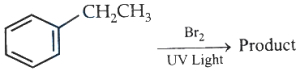
A
$1-$bromo$-1-$phenylethane
B
$2-$bromo$-1-$phenylethane
C
p-bromoethylbenzene
D
o,p-dibromoethylbenzene
Solution
(A) The reaction of ethylbenzene with $Br_2$ in the presence of $UV$ light is a free radical substitution reaction. The bromine radical abstracts a hydrogen atom from the benzylic carbon because the resulting benzylic radical is resonance-stabilized by the phenyl ring. The radical formed at the $\alpha$-carbon (benzylic position) is more stable than the radical at the $\beta$-carbon. Therefore,the major product is $1$-bromo-$1$-phenylethane $(C_6H_5CH(Br)CH_3)$.
0 likesView Solution
129
ChemistryEasyMCQAP EAMCET · 2021
In the following reaction sequence,identify product $Q$ and reagent $R$:
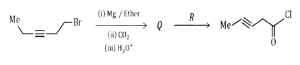
A
$Me-CH_2-C\equiv C-CH_2-COOH$ and $SOCl_2$
B
$Me-CH=CH-CH_2-CH_2-COOH$ and $SO_2Cl_2$
C
$Me-CH_2-CH=CH-CH_2-COOH$ and $SOCl_2$
D
$Me-CH_2-C\equiv C-CH_2-COOH$ and $CH_3SO_2Cl_2$
Solution
(A) The reaction sequence is as follows:
$1$. The alkyl bromide $Me-CH_2-C\equiv C-CH_2-Br$ reacts with $Mg$ in the presence of ether to form a Grignard reagent $(R-MgBr)$.
$2$. The Grignard reagent then reacts with $CO_2$ followed by acidic hydrolysis $(H_3O^+)$ to yield a carboxylic acid,$Q$,which is $Me-CH_2-C\equiv C-CH_2-COOH$.
$3$. The carboxylic acid $Q$ is then converted into an acid chloride by reaction with $SOCl_2$ (reagent $R$).
Thus,$Q$ is $Me-CH_2-C\equiv C-CH_2-COOH$ and $R$ is $SOCl_2$.
$1$. The alkyl bromide $Me-CH_2-C\equiv C-CH_2-Br$ reacts with $Mg$ in the presence of ether to form a Grignard reagent $(R-MgBr)$.
$2$. The Grignard reagent then reacts with $CO_2$ followed by acidic hydrolysis $(H_3O^+)$ to yield a carboxylic acid,$Q$,which is $Me-CH_2-C\equiv C-CH_2-COOH$.
$3$. The carboxylic acid $Q$ is then converted into an acid chloride by reaction with $SOCl_2$ (reagent $R$).
Thus,$Q$ is $Me-CH_2-C\equiv C-CH_2-COOH$ and $R$ is $SOCl_2$.
0 likesView Solution
130
ChemistryEasyMCQAP EAMCET · 2021
Identify the compound $(B)$ in the given reaction.
$CH_3Cl$ $\xrightarrow{KCN} (A)$ $\xrightarrow{H^+ / H_2O} (B)$
$CH_3Cl$ $\xrightarrow{KCN} (A)$ $\xrightarrow{H^+ / H_2O} (B)$
A
$CH_3NH_2$
B
$HCOOH$
C
$CH_3COOH$
D
$CH_3COCH_3$
Solution
(C) Step $1$: Reaction of chloromethane with potassium cyanide $(KCN)$ is a nucleophilic substitution reaction where the cyanide ion $(CN^-)$ replaces the chloride ion $(Cl^-)$ to form methyl cyanide $(CH_3CN)$,which is compound $(A)$.
$CH_3Cl + KCN \rightarrow CH_3CN + KCl$
Step $2$: Acidic hydrolysis of methyl cyanide $(CH_3CN)$ leads to the formation of an amide intermediate,which further hydrolyzes to form acetic acid $(CH_3COOH)$ as the final product $(B)$.
$CH_3CN + 2H_2O \xrightarrow{H^+} CH_3COOH + NH_3$
$CH_3Cl + KCN \rightarrow CH_3CN + KCl$
Step $2$: Acidic hydrolysis of methyl cyanide $(CH_3CN)$ leads to the formation of an amide intermediate,which further hydrolyzes to form acetic acid $(CH_3COOH)$ as the final product $(B)$.
$CH_3CN + 2H_2O \xrightarrow{H^+} CH_3COOH + NH_3$
0 likesView Solution
131
ChemistryMediumMCQAP EAMCET · 2021
Identify the product of the following reaction.
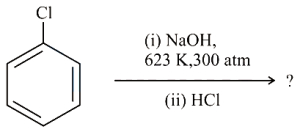
A
Benzene
B
Toluene
C
Aniline
D
Phenol
Solution
(D) Chlorobenzene is treated with aqueous sodium hydroxide at a temperature of $623 \ K$ and pressure of $300 \ atm$ to convert it into sodium phenoxide.
Acidification of sodium phenoxide yields phenol. This process is known as the Dow process.
The reaction is:
$C_6H_5Cl \xrightarrow[(ii) \ HCl]{(i) \ NaOH, \ 623 \ K, \ 300 \ atm} C_6H_5OH$
Acidification of sodium phenoxide yields phenol. This process is known as the Dow process.
The reaction is:
$C_6H_5Cl \xrightarrow[(ii) \ HCl]{(i) \ NaOH, \ 623 \ K, \ 300 \ atm} C_6H_5OH$
0 likesView Solution
132
ChemistryEasyMCQAP EAMCET · 2021
Identify the best suitable reagent for the following reaction.
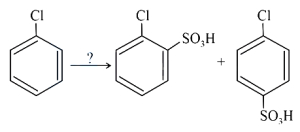
A
Concentrated Sulphuric acid
B
Dilute Sulphuric acid $(10\%)$
C
Concentrated Sulphuric acid & Concentrated Nitric acid
D
Concentrated Acetic acid (fuming)
Solution
(A) The given reaction is the sulphonation of chlorobenzene.
Halogen atoms are ortho-para directing but deactivating groups due to the $-I$ effect.
In the presence of concentrated sulphuric acid $(H_2SO_4)$,chlorobenzene undergoes an aromatic electrophilic substitution reaction.
The electrophile involved is sulphur trioxide $(SO_3)$.
The reaction produces $2-$chlorobenzenesulphonic acid (minor product) and $4-$chlorobenzenesulphonic acid (major product).
Therefore,concentrated sulphuric acid is the best suitable reagent for this reaction.
Halogen atoms are ortho-para directing but deactivating groups due to the $-I$ effect.
In the presence of concentrated sulphuric acid $(H_2SO_4)$,chlorobenzene undergoes an aromatic electrophilic substitution reaction.
The electrophile involved is sulphur trioxide $(SO_3)$.
The reaction produces $2-$chlorobenzenesulphonic acid (minor product) and $4-$chlorobenzenesulphonic acid (major product).
Therefore,concentrated sulphuric acid is the best suitable reagent for this reaction.
0 likesView Solution
133
ChemistryMediumMCQAP EAMCET · 2021
The major product of the following reaction sequence is
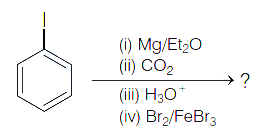
A
$3-$bromobenzoic acid
B
$2-$bromobenzoic acid
C
$4-$bromobenzoic acid
D
$3,5-$dibromobenzoic acid
Solution
(A) The reaction sequence is as follows:
$1$. Iodobenzene reacts with $Mg$ in the presence of $Et_2O$ to form phenylmagnesium iodide (a Grignard reagent).
$2$. Phenylmagnesium iodide reacts with $CO_2$ followed by acid hydrolysis $(H_3O^+)$ to yield benzoic acid.
$3$. Benzoic acid undergoes electrophilic aromatic substitution with $Br_2/FeBr_3$. Since the $-COOH$ group is a deactivating and meta-directing group,the bromine atom will be substituted at the meta-position.
$4$. The final product is $3$-bromobenzoic acid.
$1$. Iodobenzene reacts with $Mg$ in the presence of $Et_2O$ to form phenylmagnesium iodide (a Grignard reagent).
$2$. Phenylmagnesium iodide reacts with $CO_2$ followed by acid hydrolysis $(H_3O^+)$ to yield benzoic acid.
$3$. Benzoic acid undergoes electrophilic aromatic substitution with $Br_2/FeBr_3$. Since the $-COOH$ group is a deactivating and meta-directing group,the bromine atom will be substituted at the meta-position.
$4$. The final product is $3$-bromobenzoic acid.
0 likesView Solution
134
ChemistryMediumMCQAP EAMCET · 2021
Identify the product of the following Wurtz-Fittig reaction.
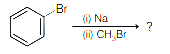
A
$3-$Bromotoluene
B
Toluene
C
$1,2-$Dibromocyclohexa$-1,4-$diene
D
Phenylsodium
Solution
(B) The reaction shown is the Wurtz-Fittig reaction,which involves the coupling of an aryl halide with an alkyl halide in the presence of sodium metal in dry ether.
In the first step,bromobenzene reacts with sodium to form phenylsodium $(C_6H_5Na)$ and sodium bromide $(NaBr)$.
In the second step,the phenylsodium intermediate reacts with methyl bromide $(CH_3Br)$ to form toluene $(C_6H_5CH_3)$ and sodium bromide $(NaBr)$.
The overall reaction is: $C_6H_5Br + 2Na + CH_3Br \rightarrow C_6H_5CH_3 + 2NaBr$.
In the first step,bromobenzene reacts with sodium to form phenylsodium $(C_6H_5Na)$ and sodium bromide $(NaBr)$.
In the second step,the phenylsodium intermediate reacts with methyl bromide $(CH_3Br)$ to form toluene $(C_6H_5CH_3)$ and sodium bromide $(NaBr)$.
The overall reaction is: $C_6H_5Br + 2Na + CH_3Br \rightarrow C_6H_5CH_3 + 2NaBr$.
0 likesView Solution
135
ChemistryDifficultMCQAP EAMCET · 2021
Identify the major product of the following reaction:
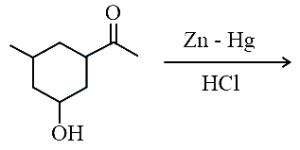
A
$3-$ethyl$-5-$methylcyclohexan$-1-$ol
B
$1-$($5$-methylcyclohexyl)ethanol
C
$1-$chloro$-3-$ethyl$-5-$methylcyclohexane
D
$1-$chloro$-3-$methyl$-5-$acetylcyclohexane
Solution
(C) The Clemmensen reduction uses zinc-amalgam $(Zn-Hg)$ and concentrated hydrochloric acid $(HCl)$ to reduce carbonyl groups $(C=O)$ of aldehydes and ketones to methylene groups $(CH_2)$.
Additionally,under these acidic conditions,secondary and tertiary alcohols can undergo substitution reactions with $HCl$ to form alkyl chlorides.
In the given molecule,the ketone group is reduced to an ethyl group $(-CH_2CH_3)$,and the secondary alcohol group is converted into a chloro group $(-Cl)$.
Therefore,the major product is $1$-chloro-$3$-ethyl-$5$-methylcyclohexane.
Additionally,under these acidic conditions,secondary and tertiary alcohols can undergo substitution reactions with $HCl$ to form alkyl chlorides.
In the given molecule,the ketone group is reduced to an ethyl group $(-CH_2CH_3)$,and the secondary alcohol group is converted into a chloro group $(-Cl)$.
Therefore,the major product is $1$-chloro-$3$-ethyl-$5$-methylcyclohexane.
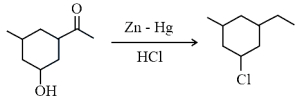
0 likesView Solution
136
ChemistryEasyMCQAP EAMCET · 2021
The following reaction is a/an:
$CH_3-CH_2-CH_2-Br \xrightarrow{KOH} CH_3-CH=CH_2 + KBr + H_2O$
$CH_3-CH_2-CH_2-Br \xrightarrow{KOH} CH_3-CH=CH_2 + KBr + H_2O$
A
substitution reaction
B
addition reaction
C
electrophilic substitution reaction
D
elimination reaction
Solution
(D) The given reaction is: $CH_3-CH_2-CH_2-Br \xrightarrow{KOH} CH_3-CH=CH_2 + KBr + H_2O$
In this reaction,a hydrogen atom $(-H)$ and a bromine atom $(-Br)$ are removed from adjacent carbon atoms of the alkyl halide to form an alkene.
This process of removing small molecules to form a multiple bond is known as an elimination reaction (specifically,dehydrohalogenation).
In this reaction,a hydrogen atom $(-H)$ and a bromine atom $(-Br)$ are removed from adjacent carbon atoms of the alkyl halide to form an alkene.
This process of removing small molecules to form a multiple bond is known as an elimination reaction (specifically,dehydrohalogenation).
0 likesView Solution
137
ChemistryEasyMCQAP EAMCET · 2021
Identify the most suitable reagents $(I)$ and $(II)$ for the following sequence of reactions:
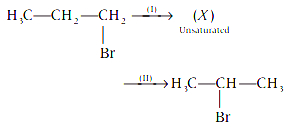
A
$I = \text{conc. } H_2SO_4, II = HBr$
B
$I = \text{aq. } KOH, II = HBr / \text{peroxide}$
C
$I = \text{alc. } KOH, II = HBr / \text{peroxide}$
D
$I = \text{alc. } KOH, II = HBr$
Solution
(D) The starting material is $1$-bromopropane $(CH_3CH_2CH_2Br)$.
Step $(I)$: Treatment with alcoholic $KOH$ causes dehydrohalogenation (elimination reaction) to form propene $(CH_3CH=CH_2)$.
Step $(II)$: The addition of $HBr$ to propene follows Markownikoff's rule,where the hydrogen atom attaches to the carbon with more hydrogens,resulting in the formation of $2$-bromopropane $(CH_3CH(Br)CH_3)$.
Step $(I)$: Treatment with alcoholic $KOH$ causes dehydrohalogenation (elimination reaction) to form propene $(CH_3CH=CH_2)$.
Step $(II)$: The addition of $HBr$ to propene follows Markownikoff's rule,where the hydrogen atom attaches to the carbon with more hydrogens,resulting in the formation of $2$-bromopropane $(CH_3CH(Br)CH_3)$.
0 likesView Solution
138
ChemistryEasyMCQAP EAMCET · 2021
Identify the product of the following reaction.
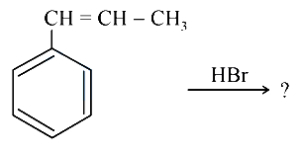
A
$C_6H_5-CH_2-CH(Br)-CH_3$
B
$C_6H_5-CH(Br)-CH_2-CH_3$
C
$C_6H_5-CH_2-CH_2-CH_2-Br$
D
$C_6H_5-CH(Br)-CH_2-CH_3$
Solution
(B) The reaction is the electrophilic addition of $HBr$ to $1-phenylprop-1-ene$ $(C_6H_5-CH=CH-CH_3)$.
According to Markovnikov's rule,the proton $(H^+)$ adds to the carbon atom with more hydrogen atoms,and the bromide ion $(Br^-)$ adds to the carbon atom with fewer hydrogen atoms.
In this case,the carbocation formed at the benzylic position $(C_6H_5-CH^+-CH_2-CH_3)$ is highly stabilized by resonance with the phenyl ring.
Therefore,the bromide ion attacks this stable benzylic carbocation to form $1-bromo-1-phenylpropane$ as the major product.
The reaction is: $C_6H_5-CH=CH-CH_3 + HBr \rightarrow C_6H_5-CH(Br)-CH_2-CH_3$.
According to Markovnikov's rule,the proton $(H^+)$ adds to the carbon atom with more hydrogen atoms,and the bromide ion $(Br^-)$ adds to the carbon atom with fewer hydrogen atoms.
In this case,the carbocation formed at the benzylic position $(C_6H_5-CH^+-CH_2-CH_3)$ is highly stabilized by resonance with the phenyl ring.
Therefore,the bromide ion attacks this stable benzylic carbocation to form $1-bromo-1-phenylpropane$ as the major product.
The reaction is: $C_6H_5-CH=CH-CH_3 + HBr \rightarrow C_6H_5-CH(Br)-CH_2-CH_3$.
0 likesView Solution
139
ChemistryMediumMCQAP EAMCET · 2021
In an amino acid,the carboxylic group ionises at $pH = 2.56$ $(pK_{a_1})$ and the ammonium ion ionises at $pH = 9.38$ $(pK_{a_2})$. The isoelectric point of the amino acid is at:
A
$11.94$
B
$6.82$
C
$5.97$
D
$3.41$
Solution
(C) The isoelectric point $(pI)$ of an amino acid is the $pH$ at which the molecule carries no net electric charge.
For a simple amino acid,the isoelectric point is calculated as the average of the two $pK_a$ values:
$pI = \frac{pK_{a_1} + pK_{a_2}}{2}$
Given $pK_{a_1} = 2.56$ and $pK_{a_2} = 9.38$,
$pI = \frac{2.56 + 9.38}{2} = \frac{11.94}{2} = 5.97$.
For a simple amino acid,the isoelectric point is calculated as the average of the two $pK_a$ values:
$pI = \frac{pK_{a_1} + pK_{a_2}}{2}$
Given $pK_{a_1} = 2.56$ and $pK_{a_2} = 9.38$,
$pI = \frac{2.56 + 9.38}{2} = \frac{11.94}{2} = 5.97$.
0 likesView Solution
140
ChemistryMediumMCQAP EAMCET · 2021
Which reaction$(s)$ among the following produce dinitrogen?
$1. NH_4Cl(aq) + NaNO_2(aq) \longrightarrow$
$2. NH_2CONH_2 + 2H_2O \longrightarrow$
$3. Ba(N_3)_2 \longrightarrow$
$4. NH_4Cl + Ca(OH)_2 \longrightarrow$
$1. NH_4Cl(aq) + NaNO_2(aq) \longrightarrow$
$2. NH_2CONH_2 + 2H_2O \longrightarrow$
$3. Ba(N_3)_2 \longrightarrow$
$4. NH_4Cl + Ca(OH)_2 \longrightarrow$
A
$1$ and $3$
B
$2$ and $3$
C
$3$ and $4$
D
$2$ and $4$
Solution
(A) Let us analyze the given reactions:
$1. NH_4Cl(aq) + NaNO_2(aq) \longrightarrow N_2(g) + 2H_2O(l) + NaCl(aq)$. This reaction produces dinitrogen.
$2. NH_2CONH_2 + 2H_2O$ $\longrightarrow (NH_4)_2CO_3$ $\longrightarrow 2NH_3 + H_2O + CO_2$. This reaction produces ammonia.
$3. Ba(N_3)_2 \stackrel{\Delta}{\longrightarrow} Ba(s) + 3N_2(g)$. This reaction produces pure dinitrogen.
$4. 2NH_4Cl + Ca(OH)_2 \longrightarrow CaCl_2 + 2H_2O + 2NH_3$. This reaction produces ammonia.
Thus,reactions $1$ and $3$ produce dinitrogen.
$1. NH_4Cl(aq) + NaNO_2(aq) \longrightarrow N_2(g) + 2H_2O(l) + NaCl(aq)$. This reaction produces dinitrogen.
$2. NH_2CONH_2 + 2H_2O$ $\longrightarrow (NH_4)_2CO_3$ $\longrightarrow 2NH_3 + H_2O + CO_2$. This reaction produces ammonia.
$3. Ba(N_3)_2 \stackrel{\Delta}{\longrightarrow} Ba(s) + 3N_2(g)$. This reaction produces pure dinitrogen.
$4. 2NH_4Cl + Ca(OH)_2 \longrightarrow CaCl_2 + 2H_2O + 2NH_3$. This reaction produces ammonia.
Thus,reactions $1$ and $3$ produce dinitrogen.
0 likesView Solution
141
ChemistryMediumMCQAP EAMCET · 2021
The gases liberated when zinc reacts with dilute and conc. $HNO_3$ respectively are
A
$N_2O, NO_2$
B
$NO, N_2O$
C
$N_2O, NO$
D
$NO_2, N_2O$
Solution
(A) The reaction of zinc with nitric acid depends on the concentration of the acid.
When zinc reacts with cold and dilute $HNO_3$,it produces nitrous oxide $(N_2O)$:
$4 Zn + 10 HNO_3 (\text{dilute}) \longrightarrow 4 Zn(NO_3)_2 + N_2O + 5 H_2O$
When zinc reacts with concentrated $HNO_3$,it produces nitrogen dioxide $(NO_2)$:
$Zn + 4 HNO_3 (\text{conc.}) \longrightarrow Zn(NO_3)_2 + 2 NO_2 + 2 H_2O$
Therefore,the gases liberated are $N_2O$ and $NO_2$ respectively.
When zinc reacts with cold and dilute $HNO_3$,it produces nitrous oxide $(N_2O)$:
$4 Zn + 10 HNO_3 (\text{dilute}) \longrightarrow 4 Zn(NO_3)_2 + N_2O + 5 H_2O$
When zinc reacts with concentrated $HNO_3$,it produces nitrogen dioxide $(NO_2)$:
$Zn + 4 HNO_3 (\text{conc.}) \longrightarrow Zn(NO_3)_2 + 2 NO_2 + 2 H_2O$
Therefore,the gases liberated are $N_2O$ and $NO_2$ respectively.
0 likesView Solution
142
ChemistryMediumMCQAP EAMCET · 2021
Which of the following reactions is $NOT$ given by $SO_2$?
A
It converts acidified iodates to iodine.
B
It decolourises acidified $KMnO_4$ solution.
C
It reacts with acidified potassium dichromate to form a green-coloured solution.
D
It reacts with green-coloured ferrous sulphate to form yellowish-brown ferric sulphate.
Solution
(D) $(i)$ $SO_2$ (sulphur dioxide) reacts with potassium iodate to form sulphuric acid,potassium sulphate,and iodine gas: $5SO_2 + 2KIO_3 + 4H_2O \longrightarrow 4H_2SO_4 + K_2SO_4 + I_2$.
$(ii)$ $SO_2$ decolourises acidified $KMnO_4$ solution by reducing $Mn^{7+}$ to $Mn^{2+}$: $5SO_2 + 2KMnO_4 + 2H_2O \longrightarrow K_2SO_4 + 2H_2SO_4 + 2MnSO_4$.
$(iii)$ $SO_2$ reacts with acidified potassium dichromate $(K_2Cr_2O_7)$ to form green-coloured chromium$(III)$ sulphate: $3SO_2 + K_2Cr_2O_7 + H_2SO_4 \longrightarrow K_2SO_4 + Cr_2(SO_4)_3 + H_2O$.
$(iv)$ $SO_2$ acts as a reducing agent and reduces ferric salts $(Fe^{3+})$ to ferrous salts $(Fe^{2+})$,changing the colour from yellow to light green: $Fe_2(SO_4)_3 + SO_2 + 2H_2O \longrightarrow 2FeSO_4 + 2H_2SO_4$. Therefore,the statement in option $D$ is incorrect as $SO_2$ reduces ferric sulphate to ferrous sulphate,not the other way around.
$(ii)$ $SO_2$ decolourises acidified $KMnO_4$ solution by reducing $Mn^{7+}$ to $Mn^{2+}$: $5SO_2 + 2KMnO_4 + 2H_2O \longrightarrow K_2SO_4 + 2H_2SO_4 + 2MnSO_4$.
$(iii)$ $SO_2$ reacts with acidified potassium dichromate $(K_2Cr_2O_7)$ to form green-coloured chromium$(III)$ sulphate: $3SO_2 + K_2Cr_2O_7 + H_2SO_4 \longrightarrow K_2SO_4 + Cr_2(SO_4)_3 + H_2O$.
$(iv)$ $SO_2$ acts as a reducing agent and reduces ferric salts $(Fe^{3+})$ to ferrous salts $(Fe^{2+})$,changing the colour from yellow to light green: $Fe_2(SO_4)_3 + SO_2 + 2H_2O \longrightarrow 2FeSO_4 + 2H_2SO_4$. Therefore,the statement in option $D$ is incorrect as $SO_2$ reduces ferric sulphate to ferrous sulphate,not the other way around.
0 likesView Solution
143
ChemistryDifficultMCQAP EAMCET · 2021
When sulphur is boiled with $Na_2SO_3$,a compound $(A)$ is produced. $(A)$ on reaction with excess $AgNO_3$ solution gives a compound $(B)$,which after dissolving in water produces a black coloured sulphide $(C)$. Identify the compound $(A)$,$(B)$ and $(C)$.
A
$Na_2S_2O_3, Ag_2S_2O_3, Ag_2S$
B
$Na_2SO_4, Ag_2SO_4, Ag_2S$
C
$Na_2S_2O_7, Ag_2SO_4, Ag_2S$
D
$Na_2SO_5, Ag_2SO_5, Ag_2SO_4$
Solution
(A) The reaction of sulphur $(S)$ with sodium sulphite $(Na_2SO_3)$ produces sodium thiosulphate $(Na_2S_2O_3)$,which is compound $(A)$.
$S + Na_2SO_3 \rightarrow Na_2S_2O_3 (A)$
When $Na_2S_2O_3$ reacts with excess $AgNO_3$,it forms silver thiosulphate $(Ag_2S_2O_3)$,which is compound $(B)$.
$Na_2S_2O_3 + 2AgNO_3 \rightarrow Ag_2S_2O_3 (B) + 2NaNO_3$
Finally,$Ag_2S_2O_3$ decomposes in water to form a black precipitate of silver sulphide $(Ag_2S)$,which is compound $(C)$.
$Ag_2S_2O_3 + H_2O \rightarrow Ag_2S (C) + H_2SO_4$
Thus,the correct sequence is $(A) = Na_2S_2O_3$,$(B) = Ag_2S_2O_3$,and $(C) = Ag_2S$.
$S + Na_2SO_3 \rightarrow Na_2S_2O_3 (A)$
When $Na_2S_2O_3$ reacts with excess $AgNO_3$,it forms silver thiosulphate $(Ag_2S_2O_3)$,which is compound $(B)$.
$Na_2S_2O_3 + 2AgNO_3 \rightarrow Ag_2S_2O_3 (B) + 2NaNO_3$
Finally,$Ag_2S_2O_3$ decomposes in water to form a black precipitate of silver sulphide $(Ag_2S)$,which is compound $(C)$.
$Ag_2S_2O_3 + H_2O \rightarrow Ag_2S (C) + H_2SO_4$
Thus,the correct sequence is $(A) = Na_2S_2O_3$,$(B) = Ag_2S_2O_3$,and $(C) = Ag_2S$.
0 likesView Solution
144
ChemistryMediumMCQAP EAMCET · 2021
Match the following interhalogen compounds with their corresponding physical properties:
| Column-$I$ | Column-$II$ |
|---|---|
| $(a) IBr$ | $(i)$ Orange solid |
| $(b) ClF_3$ | $(ii)$ Yellow-green liquid |
| $(c) BrF_3$ | $(iii)$ Black solid |
| $(d) ICl_3$ | $(iv)$ Colorless gas |
A
$(a-ii), (b-i), (c-iv), (d-iii)$
B
$(a-i), (b-ii), (c-iii), (d-iv)$
C
$(a-iii), (b-iv), (c-ii), (d-i)$
D
$(a-iv), (b-iii), (c-i), (d-ii)$
Solution
(C) The physical properties of the given interhalogen compounds are as follows:
$1$. $IBr$ is a black solid.
$2$. $ClF_3$ is a colorless gas.
$3$. $BrF_3$ is a yellow-green liquid.
$4$. $ICl_3$ is an orange solid.
Therefore,the correct matching is $(a-iii), (b-iv), (c-ii), (d-i)$.
$1$. $IBr$ is a black solid.
$2$. $ClF_3$ is a colorless gas.
$3$. $BrF_3$ is a yellow-green liquid.
$4$. $ICl_3$ is an orange solid.
Therefore,the correct matching is $(a-iii), (b-iv), (c-ii), (d-i)$.
0 likesView Solution
145
ChemistryEasyMCQAP EAMCET · 2021
The anhydride of the oxoacid $HOCl$ is
A
$ClO_2$
B
$Cl_2O$
C
$Cl_2O_7$
D
$Cl_2O_6$
Solution
(B) The anhydride of an oxoacid is formed by removing water molecules from the acid such that the oxidation state of the central atom remains the same.
For $HOCl$,the reaction is $2HOCl \rightarrow Cl_2O + H_2O$.
Thus,the anhydride of $HOCl$ is $Cl_2O$.
The correct answer is $Cl_2O$,which corresponds to option $(B)$.
For $HOCl$,the reaction is $2HOCl \rightarrow Cl_2O + H_2O$.
Thus,the anhydride of $HOCl$ is $Cl_2O$.
The correct answer is $Cl_2O$,which corresponds to option $(B)$.
0 likesView Solution
146
ChemistryEasyMCQAP EAMCET · 2021
Which statements among the following are correct about Helium?
$(i)$ Liquid helium is used to sustain powerful superconducting magnets.
$(ii)$ Liquid helium is useful to carry low temperature experiments.
$(iii)$ It is a heavy gas.
$(iv)$ It is a flammable gas.
$(i)$ Liquid helium is used to sustain powerful superconducting magnets.
$(ii)$ Liquid helium is useful to carry low temperature experiments.
$(iii)$ It is a heavy gas.
$(iv)$ It is a flammable gas.
A
$(i) \& (ii)$ only
B
$(ii) \& (iii)$ only
C
$(i) \& (iv)$ only
D
$(iii) \& (iv)$ only
Solution
(A) Liquid helium $(b.p. \ 4.2 \ K)$ is used as a cryogenic agent for carrying out various experiments at low temperatures.
It is used to produce and sustain powerful superconducting magnets,which are essential components of modern $NMR$ spectrometers and Magnetic Resonance Imaging $(MRI)$ systems for clinical diagnosis.
Helium is a light,inert,and non-flammable gas.
Therefore,statements $(i)$ and $(ii)$ are correct.
It is used to produce and sustain powerful superconducting magnets,which are essential components of modern $NMR$ spectrometers and Magnetic Resonance Imaging $(MRI)$ systems for clinical diagnosis.
Helium is a light,inert,and non-flammable gas.
Therefore,statements $(i)$ and $(ii)$ are correct.
0 likesView Solution
147
ChemistryEasyMCQAP EAMCET · 2021
$Xenon$ reacts best with
A
Neutral atoms
B
Most electronegative elements
C
Most electropositive elements
D
Transition elements
Solution
(B) $Xenon$ is a noble gas with a high ionization enthalpy.
It reacts primarily with highly electronegative elements like fluorine and oxygen to form compounds such as $XeF_2$,$XeF_4$,$XeF_6$,and $XeO_3$.
Neil Bartlett first demonstrated this by reacting $Xenon$ with $PtF_6$,a very strong oxidizing agent,to form $[Xe]^+[PtF_6]^-$.
Therefore,$Xenon$ reacts best with the most electronegative elements.
It reacts primarily with highly electronegative elements like fluorine and oxygen to form compounds such as $XeF_2$,$XeF_4$,$XeF_6$,and $XeO_3$.
Neil Bartlett first demonstrated this by reacting $Xenon$ with $PtF_6$,a very strong oxidizing agent,to form $[Xe]^+[PtF_6]^-$.
Therefore,$Xenon$ reacts best with the most electronegative elements.
0 likesView Solution
148
ChemistryEasyMCQAP EAMCET · 2021
Which of the following represents the correct order for oxidising power of the given species $ClO_4^{-}$,$BrO_4^{-}$,and $IO_4^{-}$?
A
$ClO_4^{-} > BrO_4^{-} > IO_4^{-}$
B
$BrO_4^{-} > IO_4^{-} > ClO_4^{-}$
C
$IO_4^{-} > BrO_4^{-} > ClO_4^{-}$
D
$BrO_4^{-} > ClO_4^{-} > IO_4^{-}$
Solution
(B) The oxidizing power of a species is directly related to its standard reduction potential. Higher reduction potential indicates a stronger oxidizing agent.
For the given oxoanions of halogens,the reduction potential values are determined by the stability of the species and the electronegativity of the central atom.
The standard reduction potentials for the reduction of these species to their respective lower oxidation states follow the order $BrO_4^{-} > IO_4^{-} > ClO_4^{-}$.
Therefore,the correct order of oxidizing power is $BrO_4^{-} > IO_4^{-} > ClO_4^{-}$.
For the given oxoanions of halogens,the reduction potential values are determined by the stability of the species and the electronegativity of the central atom.
The standard reduction potentials for the reduction of these species to their respective lower oxidation states follow the order $BrO_4^{-} > IO_4^{-} > ClO_4^{-}$.
Therefore,the correct order of oxidizing power is $BrO_4^{-} > IO_4^{-} > ClO_4^{-}$.
0 likesView Solution
149
ChemistryEasyMCQAP EAMCET · 2021
The acidic character of the group-$15$ elements' oxides in increasing order is:
A
$As_2O_3 < P_2O_3 < Bi_2O_3 < Sb_2O_3$
B
$As_2O_3 < P_2O_3 < Sb_2O_3 < Bi_2O_3$
C
$Bi_2O_3 < Sb_2O_3 < As_2O_3 < P_2O_3$
D
$Sb_2O_3 < As_2O_3 < P_2O_3 < Bi_2O_3$
Solution
(C) The elements of group-$15$ are Nitrogen,Phosphorus,Arsenic,Antimony,and Bismuth.
As we move down the group,the atomic size increases and electronegativity decreases.
Consequently,the metallic character increases,which leads to an increase in the basic character of the oxides.
Therefore,the acidic character of the oxides decreases down the group.
The order of acidic strength is: $P_2O_3 > As_2O_3 > Sb_2O_3 > Bi_2O_3$.
Thus,the increasing order is $Bi_2O_3 < Sb_2O_3 < As_2O_3 < P_2O_3$.
As we move down the group,the atomic size increases and electronegativity decreases.
Consequently,the metallic character increases,which leads to an increase in the basic character of the oxides.
Therefore,the acidic character of the oxides decreases down the group.
The order of acidic strength is: $P_2O_3 > As_2O_3 > Sb_2O_3 > Bi_2O_3$.
Thus,the increasing order is $Bi_2O_3 < Sb_2O_3 < As_2O_3 < P_2O_3$.
0 likesView Solution
150
ChemistryEasyMCQAP EAMCET · 2021
Potassium cyanide is made alkaline with $NaOH$ and boiled with thiosulphate ions. The solution is cooled and acidified with $HCl$ and this solution with iron $(III)$ chloride produces :-
A
Prussian blue colour solution
B
Blood red colour solution
C
Dark brown colour solution
D
Green colour solution
Solution
(B) The reaction of potassium cyanide with sodium hydroxide gives the cyanide ion. After that,the cyanide ion reacts with thiosulphate ions. Upon cooling and acidifying with hydrochloric acid,it forms the thiocyanate ion.
$KCN + NaOH \rightarrow NaCN + KOH$
$S_2O_3^{2-} + CN^{-} \xrightarrow{HCl} SCN^{-} + SO_3^{2-}$
The thiocyanate ion reacts with iron $(III)$ chloride to form the complex $[Fe(SCN)]^{2+}$,which has a blood-red colour.
$Fe^{3+} + SCN^{-} \rightarrow [Fe(SCN)]^{2+}$ (blood-red colour)
Therefore,the solution produces a blood-red colour solution.
$KCN + NaOH \rightarrow NaCN + KOH$
$S_2O_3^{2-} + CN^{-} \xrightarrow{HCl} SCN^{-} + SO_3^{2-}$
The thiocyanate ion reacts with iron $(III)$ chloride to form the complex $[Fe(SCN)]^{2+}$,which has a blood-red colour.
$Fe^{3+} + SCN^{-} \rightarrow [Fe(SCN)]^{2+}$ (blood-red colour)
Therefore,the solution produces a blood-red colour solution.
0 likesView Solution
Vedclass Products
For Students
Vedclass Test Series
Mock tests in real AP EAMCET style covering Chemistry with performance analysis. 5-day free trial.
Start Free TrialFor Teachers
Exam Paper Generator
Generate Set A/B/C/D Chemistry papers from 7.5L+ questions in 2 minutes. 3 chapters free.
Try FreeFor Institutes
Online Exam Module
Run live AP EAMCET mock exams with unlimited students, 360° analytics & white-label branding.
See DemoFrequently Asked Questions
How many Chemistry questions are in AP EAMCET 2021?
There are 502 Chemistry questions from the AP EAMCET 2021 paper on Vedclass, each with a detailed step-by-step solution in English.
Are AP EAMCET 2021 Chemistry solutions available in English?
Yes. All solutions on this page are in English. You can also switch to English or Hindi using the language buttons above the questions.
Can I practice AP EAMCET 2021 Chemistry as a timed test?
Yes. Use the Vedclass Test Series to attempt a full AP EAMCET mock test covering Chemistry with time limits and instant score analysis.
Can teachers create Chemistry papers from AP EAMCET previous year questions?
Yes. The Vedclass Exam Paper Generator lets teachers mix AP EAMCET Chemistry questions and generate Set A/B/C/D papers in minutes.
For Teachers & Institutes
Build a Custom Chemistry Paper
Pick AP EAMCET 2021 Chemistry questions, set difficulty, and generate Set A/B/C/D in 2 minutes.