
ChemistryQ151–211 of 502 questions
Page 4 of 7 · English
151
ChemistryMediumMCQAP EAMCET · 2021
The product formed when a hydrocarbon '$X$' of molecular formula $C_6H_{10}$ is reacted with sodamide is subjected to ozonolysis,followed by hydrolysis with $Zn / H_2O_2$,and upon further oxidation gave two carboxylic acids,of which one is optically active. The hydrocarbon '$X$' is
A
$Hex-1-yne$
B
$Hex-3-yne$
C
$3-Methylpent-1-yne$
D
$3,3-Dimethylbut-1-yne$
Solution
(C) The hydrocarbon '$X$' reacts with sodamide $(NaNH_2)$,which indicates that '$X$' is a terminal alkyne.
Ozonolysis of a terminal alkyne followed by oxidative workup ($O_3$ followed by $Zn/H_2O_2$ or $H_2O_2$) leads to the cleavage of the triple bond to form a carboxylic acid and formic acid $(HCOOH)$.
For one of the products to be optically active,the carboxylic acid formed from the alkyl group must contain a chiral center.
Starting with $3-Methylpent-1-yne$ $(CH_3CH_2CH(CH_3)C \equiv CH)$:
$CH_3CH_2CH(CH_3)C \equiv CH \xrightarrow{O_3, H_2O_2} CH_3CH_2CH(CH_3)COOH + HCOOH$.
$2-Methylbutanoic acid$ $(CH_3CH_2CH(CH_3)COOH)$ contains a chiral carbon at the $C-2$ position,making it optically active.
Ozonolysis of a terminal alkyne followed by oxidative workup ($O_3$ followed by $Zn/H_2O_2$ or $H_2O_2$) leads to the cleavage of the triple bond to form a carboxylic acid and formic acid $(HCOOH)$.
For one of the products to be optically active,the carboxylic acid formed from the alkyl group must contain a chiral center.
Starting with $3-Methylpent-1-yne$ $(CH_3CH_2CH(CH_3)C \equiv CH)$:
$CH_3CH_2CH(CH_3)C \equiv CH \xrightarrow{O_3, H_2O_2} CH_3CH_2CH(CH_3)COOH + HCOOH$.
$2-Methylbutanoic acid$ $(CH_3CH_2CH(CH_3)COOH)$ contains a chiral carbon at the $C-2$ position,making it optically active.
0 likesView Solution
152
ChemistryMediumMCQAP EAMCET · 2021
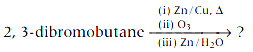
The major product$(s)$ formed in the following reaction sequence is (are):
A
$2 \ CH_3COOH$
B
$CH_3COCOCH_3$
C
$2 \ CH_3CHO$
D
$2 \ HCHO + CHO-CHO$
Solution
(C) Step $1$: $2, 3-$dibromobutane reacts with $Zn / Cu$ in the presence of heat to undergo debromination,forming $trans-$but$-2-$ene.
Step $2$: The $trans-$but$-2-$ene undergoes reductive ozonolysis with $O_3$ followed by $Zn / H_2O$.
Step $3$: The double bond breaks to form two molecules of acetaldehyde $(CH_3CHO)$.
Thus,the final product is $2 \ CH_3CHO$.
Step $2$: The $trans-$but$-2-$ene undergoes reductive ozonolysis with $O_3$ followed by $Zn / H_2O$.
Step $3$: The double bond breaks to form two molecules of acetaldehyde $(CH_3CHO)$.
Thus,the final product is $2 \ CH_3CHO$.
0 likesView Solution
153
ChemistryMediumMCQAP EAMCET · 2021
$7.8 \ g$ of a compound having molecular formula $C_6H_6$,on reacting with $CH_3COCl / AlCl_3$ gives $8.4 \ g$ of a product which has molecular formula $C_8H_8O$. Calculate the percentage yield of the product $C_8H_8O$. (Given atomic weights of $H$,$C$ and $O$ respectively are $1$,$12$ and $16$) (in $\%$)
A
$70$
B
$60$
C
$80$
D
$75$
Solution
(A) Molar mass of benzene $= 78 \ g/mol$.
Mole of benzene $= \frac{7.8 \ g}{78 \ g/mol} = 0.1 \ mol$.
The reaction is $C_6H_6 + CH_3COCl \xrightarrow{AlCl_3} C_8H_8O + HCl$.
According to the stoichiometry,$1 \ mol$ of benzene produces $1 \ mol$ of $C_8H_8O$.
Therefore,$0.1 \ mol$ of benzene should theoretically produce $0.1 \ mol$ of $C_8H_8O$.
Molar mass of $C_8H_8O = (8 \times 12) + (8 \times 1) + (1 \times 16) = 96 + 8 + 16 = 120 \ g/mol$.
Theoretical yield $= 0.1 \ mol \times 120 \ g/mol = 12 \ g$.
Percentage yield $= \frac{\text{Experimental yield}}{\text{Theoretical yield}} \times 100 = \frac{8.4 \ g}{12 \ g} \times 100 = 70\%$.
Mole of benzene $= \frac{7.8 \ g}{78 \ g/mol} = 0.1 \ mol$.
The reaction is $C_6H_6 + CH_3COCl \xrightarrow{AlCl_3} C_8H_8O + HCl$.
According to the stoichiometry,$1 \ mol$ of benzene produces $1 \ mol$ of $C_8H_8O$.
Therefore,$0.1 \ mol$ of benzene should theoretically produce $0.1 \ mol$ of $C_8H_8O$.
Molar mass of $C_8H_8O = (8 \times 12) + (8 \times 1) + (1 \times 16) = 96 + 8 + 16 = 120 \ g/mol$.
Theoretical yield $= 0.1 \ mol \times 120 \ g/mol = 12 \ g$.
Percentage yield $= \frac{\text{Experimental yield}}{\text{Theoretical yield}} \times 100 = \frac{8.4 \ g}{12 \ g} \times 100 = 70\%$.
0 likesView Solution
154
ChemistryMediumMCQAP EAMCET · 2021
The complete combustion of one mole of benzene produces how many grams of carbon dioxide?
A
$164$
B
$220$
C
$264$
D
$308$
Solution
(C) The molecular formula of benzene is $C_6H_6$.
The balanced chemical equation for the complete combustion of benzene is:
$C_6H_6(l) + \frac{15}{2} O_2(g) \rightarrow 6 CO_2(g) + 3 H_2O(l)$
From the stoichiometry of the reaction,$1 \text{ mole}$ of benzene produces $6 \text{ moles}$ of carbon dioxide $(CO_2)$.
The molar mass of $CO_2$ is $12 + (2 \times 16) = 44 \ g/mol$.
Therefore,the mass of $6 \text{ moles}$ of $CO_2$ is $6 \times 44 \ g = 264 \ g$.
Thus,the complete combustion of one mole of benzene produces $264 \ g$ of carbon dioxide.
The balanced chemical equation for the complete combustion of benzene is:
$C_6H_6(l) + \frac{15}{2} O_2(g) \rightarrow 6 CO_2(g) + 3 H_2O(l)$
From the stoichiometry of the reaction,$1 \text{ mole}$ of benzene produces $6 \text{ moles}$ of carbon dioxide $(CO_2)$.
The molar mass of $CO_2$ is $12 + (2 \times 16) = 44 \ g/mol$.
Therefore,the mass of $6 \text{ moles}$ of $CO_2$ is $6 \times 44 \ g = 264 \ g$.
Thus,the complete combustion of one mole of benzene produces $264 \ g$ of carbon dioxide.
0 likesView Solution
155
ChemistryMediumMCQAP EAMCET · 2021
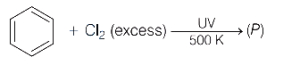
Identify the product $(P)$ formed from the following reaction.
A
$(P) : \text{Benzene hexachloride}$
B
$(P) : \text{Hexachlorobenzene}$
C
$(P) : \text{Cyclohexane}$
D
$(P) : \text{Chlorobenzene}$
Solution
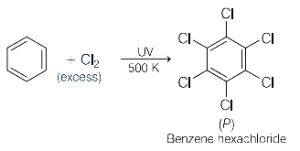
(A) When benzene reacts with excess chlorine in the presence of ultraviolet $(UV)$ light at $500 \ K$,addition reaction occurs.
The delocalized $\pi$-electron system of the benzene ring is broken,and one chlorine atom adds to each of the six carbon atoms.
This results in the formation of $1,2,3,4,5,6-\text{hexachlorocyclohexane}$,commonly known as benzene hexachloride $(BHC)$ or gammaxene.
Therefore,$(P) = \text{Benzene hexachloride}$.
The delocalized $\pi$-electron system of the benzene ring is broken,and one chlorine atom adds to each of the six carbon atoms.
This results in the formation of $1,2,3,4,5,6-\text{hexachlorocyclohexane}$,commonly known as benzene hexachloride $(BHC)$ or gammaxene.
Therefore,$(P) = \text{Benzene hexachloride}$.
0 likesView Solution
156
ChemistryMediumMCQAP EAMCET · 2021
The correct order of acidic character of the following is:
A
$H_2O > H_2S > H_2Se > H_2Te$
B
$H_2Se > H_2S > H_2O > H_2Te$
C
$H_2Te > H_2Se > H_2S > H_2O$
D
$H_2Te > H_2S > H_2Se > H_2O$
Solution
(C) The acidity is directly proportional to the tendency of the hydrogen donor.
It depends upon the bond dissociation enthalpy of the $H-X$ bond,where $X$ is $O, S, Se, Te$.
As we move down the group,the bond dissociation energy of hydrides decreases due to an increase in bond length,which makes the release of $H^+$ ions easier.
Therefore,the acidic strength increases down the group.
Hence,the correct order of acidic character of the given hydrides is $H_2Te > H_2Se > H_2S > H_2O$.
It depends upon the bond dissociation enthalpy of the $H-X$ bond,where $X$ is $O, S, Se, Te$.
As we move down the group,the bond dissociation energy of hydrides decreases due to an increase in bond length,which makes the release of $H^+$ ions easier.
Therefore,the acidic strength increases down the group.
Hence,the correct order of acidic character of the given hydrides is $H_2Te > H_2Se > H_2S > H_2O$.
0 likesView Solution
157
ChemistryDifficultMCQAP EAMCET · 2021
Which metal oxide among the following gives $H_2O_2$ on treatment with dilute acid?
A
$BaO_2$
B
$RbO_2$
C
$MnO_2$
D
$Al_2O_3$
Solution
(A) The metal oxide that yields $H_2O_2$ upon treatment with dilute acid is $BaO_2$ because it contains the peroxide ion $(O_2^{2-})$.
When barium peroxide reacts with dilute sulfuric acid,it produces barium sulfate and hydrogen peroxide:
$BaO_2 + H_2SO_4 \rightarrow BaSO_4 + H_2O_2$
When barium peroxide reacts with dilute sulfuric acid,it produces barium sulfate and hydrogen peroxide:
$BaO_2 + H_2SO_4 \rightarrow BaSO_4 + H_2O_2$
0 likesView Solution
158
ChemistryMediumMCQAP EAMCET · 2021
Which of the following solutions produces $H_2 O_2$ on electrolysis?
A
$0.2 \ N \ NaOH$
B
$50 \% \ H_2 SO_4$
C
$2 \% \ H_2 SO_4$
D
$5 \% \ NaCl$
Solution
(B) $H_2 O_2$ is obtained by the electrolysis of a cold $50 \%$ solution of $H_2 SO_4$.
The electrolysis of $HSO_4^-$ ions at high current density leads to the formation of peroxodisulphate $(H_2 S_2 O_8)$,which upon hydrolysis yields hydrogen peroxide.
The reaction is:
$2 HSO_4^- \xrightarrow{\text{Electrolysis}} HO_3 SOOSO_3 H + 2 e^-$.
$HO_3 SOOSO_3 H + 2 H_2 O \rightarrow 2 H_2 SO_4 + H_2 O_2$.
The electrolysis of $HSO_4^-$ ions at high current density leads to the formation of peroxodisulphate $(H_2 S_2 O_8)$,which upon hydrolysis yields hydrogen peroxide.
The reaction is:
$2 HSO_4^- \xrightarrow{\text{Electrolysis}} HO_3 SOOSO_3 H + 2 e^-$.
$HO_3 SOOSO_3 H + 2 H_2 O \rightarrow 2 H_2 SO_4 + H_2 O_2$.
0 likesView Solution
159
ChemistryEasyMCQAP EAMCET · 2021
Assertion $(A)$: The colour of old lead paintings can be restored by washing them with a dilute solution of $H_2O_2$.
Reason $(R)$: Hydrogen peroxide reduces $PbS$ to $Pb$.
Reason $(R)$: Hydrogen peroxide reduces $PbS$ to $Pb$.
A
Both $A$ and $R$ are true and $R$ is a correct explanation for $A$
B
Both $A$ and $R$ are true but $R$ is not a correct explanation for $A$
C
$A$ is true,$R$ is false
D
$A$ is false,$R$ is true
Solution
(C) Old lead paintings often turn black due to the formation of lead sulfide $(PbS)$ by the reaction of lead pigments with atmospheric $H_2S$.
The colour is restored by washing with $H_2O_2$,which oxidizes the black $PbS$ to white lead sulfate $(PbSO_4)$.
The reaction is: $PbS(s) + 4H_2O_2(aq) \rightarrow PbSO_4(s) + 4H_2O(l)$.
In this reaction,$H_2O_2$ acts as an oxidizing agent,not a reducing agent.
Therefore,Assertion $(A)$ is true,but Reason $(R)$ is false.
The colour is restored by washing with $H_2O_2$,which oxidizes the black $PbS$ to white lead sulfate $(PbSO_4)$.
The reaction is: $PbS(s) + 4H_2O_2(aq) \rightarrow PbSO_4(s) + 4H_2O(l)$.
In this reaction,$H_2O_2$ acts as an oxidizing agent,not a reducing agent.
Therefore,Assertion $(A)$ is true,but Reason $(R)$ is false.
0 likesView Solution
160
ChemistryEasyMCQAP EAMCET · 2021
Match the following species with their respective conjugate acids:
| Species | Conjugate acid |
|---|---|
| $ (a) NH_{3} $ | $ (i) H_{2}CO_{3} $ |
| $ (b) HCO_{3}^{-} $ | $ (ii) H_{3}O^{+} $ |
| $ (c) H_{2}O $ | $ (iii) NH_{4}^{+} $ |
| $ (d) HSO_{4}^{-} $ | $ (iv) H_{2}SO_{4} $ |
A
$(a$ $\rightarrow iii), (b$ $\rightarrow i), (c$ $\rightarrow ii), (d$ $\rightarrow iv)$
B
$(a$ $\rightarrow i), (b$ $\rightarrow iii), (c$ $\rightarrow ii), (d$ $\rightarrow iv)$
C
$(a$ $\rightarrow iii), (b$ $\rightarrow ii), (c$ $\rightarrow i), (d$ $\rightarrow iv)$
D
$(a$ $\rightarrow iii), (b$ $\rightarrow ii), (c$ $\rightarrow iv), (d$ $\rightarrow i)$
Solution
(A) conjugate acid is formed when a base accepts a proton $(H^{+})$.
$NH_{3} + H^{+} \rightarrow NH_{4}^{+}$
$HCO_{3}^{-} + H^{+} \rightarrow H_{2}CO_{3}$
$H_{2}O + H^{+} \rightarrow H_{3}O^{+}$
$HSO_{4}^{-} + H^{+} \rightarrow H_{2}SO_{4}$
Therefore,the correct matching is $(a$ $\rightarrow iii), (b$ $\rightarrow i), (c$ $\rightarrow ii), (d$ $\rightarrow iv)$.
$NH_{3} + H^{+} \rightarrow NH_{4}^{+}$
$HCO_{3}^{-} + H^{+} \rightarrow H_{2}CO_{3}$
$H_{2}O + H^{+} \rightarrow H_{3}O^{+}$
$HSO_{4}^{-} + H^{+} \rightarrow H_{2}SO_{4}$
Therefore,the correct matching is $(a$ $\rightarrow iii), (b$ $\rightarrow i), (c$ $\rightarrow ii), (d$ $\rightarrow iv)$.
0 likesView Solution
161
ChemistryEasyMCQAP EAMCET · 2021
The strongest conjugate base is:
A
$Cl^{-}$
B
$Br^{-}$
C
$I^{-}$
D
$F^{-}$
Solution
(D) An acid loses a proton to form an anion known as its conjugate base.
According to the Bronsted-Lowry theory,a strong acid forms a weak conjugate base,and a weak acid forms a strong conjugate base.
Among the given halide ions $(F^{-}, Cl^{-}, Br^{-}, I^{-})$,the corresponding acids are $HF, HCl, HBr,$ and $HI$.
$HI$ is the strongest acid and $HF$ is the weakest acid among these hydrohalic acids.
Since $HF$ is the weakest acid,its conjugate base $F^{-}$ is the strongest conjugate base.
According to the Bronsted-Lowry theory,a strong acid forms a weak conjugate base,and a weak acid forms a strong conjugate base.
Among the given halide ions $(F^{-}, Cl^{-}, Br^{-}, I^{-})$,the corresponding acids are $HF, HCl, HBr,$ and $HI$.
$HI$ is the strongest acid and $HF$ is the weakest acid among these hydrohalic acids.
Since $HF$ is the weakest acid,its conjugate base $F^{-}$ is the strongest conjugate base.
0 likesView Solution
162
ChemistryEasyMCQAP EAMCET · 2021
Which of the following species acts as both Bronsted acid and base?
A
$OH^{-}$
B
$NH_3$
C
$NaCl$
D
$HSO_4^{-}$
Solution
(D) Bronsted-Lowry acid is a proton ($H^{+}$ ion) donor,while a Bronsted-Lowry base is a proton ($H^{+}$ ion) acceptor.
$HSO_4^{-} + H_2O \rightleftharpoons H_2SO_4 + OH^{-}$ (acts as a Bronsted base)
$HSO_4^{-} + H_2O \rightleftharpoons SO_4^{2-} + H_3O^{+}$ (acts as a Bronsted acid)
Since $HSO_4^{-}$ can both donate a proton to form $SO_4^{2-}$ and accept a proton to form $H_2SO_4$,it acts as both a Bronsted acid and a Bronsted base.
$HSO_4^{-} + H_2O \rightleftharpoons H_2SO_4 + OH^{-}$ (acts as a Bronsted base)
$HSO_4^{-} + H_2O \rightleftharpoons SO_4^{2-} + H_3O^{+}$ (acts as a Bronsted acid)
Since $HSO_4^{-}$ can both donate a proton to form $SO_4^{2-}$ and accept a proton to form $H_2SO_4$,it acts as both a Bronsted acid and a Bronsted base.
0 likesView Solution
163
ChemistryEasyMCQAP EAMCET · 2021
Calculate the $pOH$ of $0.10 \ M \ HCl$ solution.
A
$13$
B
$1$
C
$7$
D
$14$
Solution
(A) For a strong acid like $HCl$,it dissociates completely in water: $HCl \rightarrow H^{+} + Cl^{-}$.
Given concentration of $HCl = 0.10 \ M$,so $[H^{+}] = 0.10 \ M = 10^{-1} \ M$.
The $pH$ of the solution is calculated as: $pH = -\log[H^{+}] = -\log(10^{-1}) = 1$.
Using the relation at $25^{\circ}C$: $pH + pOH = 14$.
Therefore,$pOH = 14 - pH = 14 - 1 = 13$.
Given concentration of $HCl = 0.10 \ M$,so $[H^{+}] = 0.10 \ M = 10^{-1} \ M$.
The $pH$ of the solution is calculated as: $pH = -\log[H^{+}] = -\log(10^{-1}) = 1$.
Using the relation at $25^{\circ}C$: $pH + pOH = 14$.
Therefore,$pOH = 14 - pH = 14 - 1 = 13$.
0 likesView Solution
164
ChemistryMediumMCQAP EAMCET · 2021
The $pH$ of a $0.1 \ M$ solution of acetic acid will be (degree of dissociation of acetic acid is $0.0132$).
A
$4.32$
B
$3.14$
C
$1.14$
D
$2.88$
Solution
(D) The dissociation reaction of acetic acid is: $CH_3COOH \rightleftharpoons CH_3COO^{-} + H^{+}$
Given concentration $c = 0.1 \ M$ and degree of dissociation $\alpha = 0.0132$.
The concentration of hydrogen ions is given by $[H^{+}] = c \times \alpha$.
$[H^{+}] = 0.1 \times 0.0132 = 0.00132 \ M$.
The $pH$ is calculated as $pH = -\log[H^{+}]$.
$pH = -\log(0.00132) = -\log(1.32 \times 10^{-3}) = 3 - \log(1.32) \approx 3 - 0.12 = 2.88$.
Thus,the $pH$ of the solution is $2.88$.
Given concentration $c = 0.1 \ M$ and degree of dissociation $\alpha = 0.0132$.
The concentration of hydrogen ions is given by $[H^{+}] = c \times \alpha$.
$[H^{+}] = 0.1 \times 0.0132 = 0.00132 \ M$.
The $pH$ is calculated as $pH = -\log[H^{+}]$.
$pH = -\log(0.00132) = -\log(1.32 \times 10^{-3}) = 3 - \log(1.32) \approx 3 - 0.12 = 2.88$.
Thus,the $pH$ of the solution is $2.88$.
0 likesView Solution
165
ChemistryMediumMCQAP EAMCET · 2021
Which of the following substances has the highest $pH$ at $25^{\circ} C$?
A
Distilled $H_2O$
B
$1 \ M$ $aq$ $NH_3$
C
$1 \ M$ $NaOH$
D
$1 \ M$ $HCl$
Solution
(C) The $pH$ scale ranges from $0$ to $14$. Substances with $pH > 7$ are basic,and higher $pH$ values indicate stronger basicity.
$1 \ M$ $HCl$ is a strong acid $(pH \approx 0)$.
Distilled $H_2O$ is neutral $(pH = 7)$.
$1 \ M$ $aq$ $NH_3$ is a weak base $(pH \approx 11.6)$.
$1 \ M$ $NaOH$ is a strong base $(pH = 14)$.
Therefore,$1 \ M$ $NaOH$ has the highest $pH$.
$1 \ M$ $HCl$ is a strong acid $(pH \approx 0)$.
Distilled $H_2O$ is neutral $(pH = 7)$.
$1 \ M$ $aq$ $NH_3$ is a weak base $(pH \approx 11.6)$.
$1 \ M$ $NaOH$ is a strong base $(pH = 14)$.
Therefore,$1 \ M$ $NaOH$ has the highest $pH$.
0 likesView Solution
166
ChemistryDifficultMCQAP EAMCET · 2021
Which among the following pairs is not an acidic buffer?
A
$HCOOH \& HCOOK$
B
$HClO_4 \& NaClO_4$
C
$C_6H_5COOH \& C_6H_5COONa$
D
$HCN \& KCN$
Solution
(B) An acidic buffer is a solution that resists changes in $pH$ and is prepared by mixing a weak acid with its salt of a strong base.
$HCOOH$ (weak acid) and $HCOOK$ (salt) form an acidic buffer.
$C_6H_5COOH$ (weak acid) and $C_6H_5COONa$ (salt) form an acidic buffer.
$HCN$ (weak acid) and $KCN$ (salt) form an acidic buffer.
$HClO_4$ is a strong acid,and $NaClO_4$ is its corresponding salt. $A$ mixture of a strong acid and its salt does not act as a buffer solution because a buffer requires a weak acid to maintain the equilibrium $HA \rightleftharpoons H^+ + A^-$. Therefore,$HClO_4 \& NaClO_4$ is not an acidic buffer.
$HCOOH$ (weak acid) and $HCOOK$ (salt) form an acidic buffer.
$C_6H_5COOH$ (weak acid) and $C_6H_5COONa$ (salt) form an acidic buffer.
$HCN$ (weak acid) and $KCN$ (salt) form an acidic buffer.
$HClO_4$ is a strong acid,and $NaClO_4$ is its corresponding salt. $A$ mixture of a strong acid and its salt does not act as a buffer solution because a buffer requires a weak acid to maintain the equilibrium $HA \rightleftharpoons H^+ + A^-$. Therefore,$HClO_4 \& NaClO_4$ is not an acidic buffer.
0 likesView Solution
167
ChemistryMediumMCQAP EAMCET · 2021
Which among the following pairs constitutes a buffer?
A
$LiOH$ and $LiCl$
B
$HNO_3$ and $NH_4NO_3$
C
$HNO_2$ and $NaNO_2$
D
$HBr$ and $KBr$
Solution
(C) buffer solution consists of a mixture of a weak acid and its salt with a strong base,or a weak base and its salt with a strong acid.
$LiOH$ is a strong base,while $HNO_3$ and $HBr$ are strong acids.
$HNO_2$ is a weak acid and $NaNO_2$ is its salt formed by the combination of the weak acid $(HNO_2)$ and a strong base $(NaOH)$.
Therefore,the pair $(HNO_2 + NaNO_2)$ constitutes an acidic buffer.
$LiOH$ is a strong base,while $HNO_3$ and $HBr$ are strong acids.
$HNO_2$ is a weak acid and $NaNO_2$ is its salt formed by the combination of the weak acid $(HNO_2)$ and a strong base $(NaOH)$.
Therefore,the pair $(HNO_2 + NaNO_2)$ constitutes an acidic buffer.
0 likesView Solution
168
ChemistryMediumMCQAP EAMCET · 2021
The solubility of $AgBr_{(s)}$,having solubility product $5 \times 10^{-10}$ in $0.2 \ M$ $NaBr$ solution,equals
A
$5 \times 10^{-10} \ M$
B
$25 \times 10^{-10} \ M$
C
$0.5 \ M$
D
$0.002 \ M$
Solution
(B) The solubility product $(K_{sp})$ of $AgBr$ is $5 \times 10^{-10}$.
For the dissociation reaction: $AgBr_{(s)} \rightleftharpoons Ag^{+}_{(aq)} + Br^{-}_{(aq)}$.
The expression for $K_{sp}$ is $K_{sp} = [Ag^{+}][Br^{-}]$.
In $0.2 \ M$ $NaBr$ solution,the concentration of $Br^{-}$ ions is $0.2 \ M$ due to the common ion effect.
Let the solubility of $AgBr$ be $s$.
Then $[Ag^{+}] = s$ and $[Br^{-}] = 0.2 + s \approx 0.2$ (since $s$ is very small).
$5 \times 10^{-10} = s \times 0.2$.
$s = \frac{5 \times 10^{-10}}{0.2} = 25 \times 10^{-10} \ M$.
For the dissociation reaction: $AgBr_{(s)} \rightleftharpoons Ag^{+}_{(aq)} + Br^{-}_{(aq)}$.
The expression for $K_{sp}$ is $K_{sp} = [Ag^{+}][Br^{-}]$.
In $0.2 \ M$ $NaBr$ solution,the concentration of $Br^{-}$ ions is $0.2 \ M$ due to the common ion effect.
Let the solubility of $AgBr$ be $s$.
Then $[Ag^{+}] = s$ and $[Br^{-}] = 0.2 + s \approx 0.2$ (since $s$ is very small).
$5 \times 10^{-10} = s \times 0.2$.
$s = \frac{5 \times 10^{-10}}{0.2} = 25 \times 10^{-10} \ M$.
0 likesView Solution
169
ChemistryMediumMCQAP EAMCET · 2021
If the concentration of $Ag^{+}$ ions in the saturated solution of $Ag_2CO_3$ is $1.20 \times 10^{-4} \ mol \ L^{-1}$,then find the solubility product of $Ag_2CO_3$.
A
$5.30 \times 10^{-12}$
B
$4.50 \times 10^{-11}$
C
$2.66 \times 10^{-12}$
D
$6.90 \times 10^{-12}$
Solution
(D) The dissociation of $Ag_2CO_3$ is given by: $Ag_2CO_3(s) \rightleftharpoons 2Ag^{+}(aq) + CO_3^{2-}(aq)$.
Given that $[Ag^{+}] = 1.20 \times 10^{-4} \ mol \ L^{-1}$.
From the stoichiometry of the reaction,$[CO_3^{2-}] = \frac{1}{2} [Ag^{+}] = \frac{1}{2} \times 1.20 \times 10^{-4} = 0.60 \times 10^{-4} \ mol \ L^{-1}$.
The solubility product expression is $K_{sp} = [Ag^{+}]^2 [CO_3^{2-}]$.
Substituting the values: $K_{sp} = (1.20 \times 10^{-4})^2 \times (0.60 \times 10^{-4})$.
$K_{sp} = (1.44 \times 10^{-8}) \times (0.60 \times 10^{-4}) = 0.864 \times 10^{-12} = 8.64 \times 10^{-13}$.
Wait,re-evaluating based on standard solubility $S$: If $[Ag^{+}] = 2S = 1.20 \times 10^{-4}$,then $S = 0.60 \times 10^{-4}$.
$K_{sp} = 4S^3 = 4 \times (0.60 \times 10^{-4})^3 = 4 \times 0.216 \times 10^{-12} = 0.864 \times 10^{-12} = 8.64 \times 10^{-13}$.
Given the options provided,there is a discrepancy. If we assume the question implies $[Ag^{+}] = 2S$ and the result matches option $D$ $(6.90 \times 10^{-12})$,it suggests $S = 1.20 \times 10^{-4}$ was intended as the solubility $S$ itself,not the concentration of $Ag^{+}$.
Assuming $S = 1.20 \times 10^{-4} \ mol \ L^{-1}$,then $K_{sp} = 4S^3 = 4 \times (1.20 \times 10^{-4})^3 = 4 \times 1.728 \times 10^{-12} = 6.912 \times 10^{-12} \approx 6.90 \times 10^{-12}$.
Given that $[Ag^{+}] = 1.20 \times 10^{-4} \ mol \ L^{-1}$.
From the stoichiometry of the reaction,$[CO_3^{2-}] = \frac{1}{2} [Ag^{+}] = \frac{1}{2} \times 1.20 \times 10^{-4} = 0.60 \times 10^{-4} \ mol \ L^{-1}$.
The solubility product expression is $K_{sp} = [Ag^{+}]^2 [CO_3^{2-}]$.
Substituting the values: $K_{sp} = (1.20 \times 10^{-4})^2 \times (0.60 \times 10^{-4})$.
$K_{sp} = (1.44 \times 10^{-8}) \times (0.60 \times 10^{-4}) = 0.864 \times 10^{-12} = 8.64 \times 10^{-13}$.
Wait,re-evaluating based on standard solubility $S$: If $[Ag^{+}] = 2S = 1.20 \times 10^{-4}$,then $S = 0.60 \times 10^{-4}$.
$K_{sp} = 4S^3 = 4 \times (0.60 \times 10^{-4})^3 = 4 \times 0.216 \times 10^{-12} = 0.864 \times 10^{-12} = 8.64 \times 10^{-13}$.
Given the options provided,there is a discrepancy. If we assume the question implies $[Ag^{+}] = 2S$ and the result matches option $D$ $(6.90 \times 10^{-12})$,it suggests $S = 1.20 \times 10^{-4}$ was intended as the solubility $S$ itself,not the concentration of $Ag^{+}$.
Assuming $S = 1.20 \times 10^{-4} \ mol \ L^{-1}$,then $K_{sp} = 4S^3 = 4 \times (1.20 \times 10^{-4})^3 = 4 \times 1.728 \times 10^{-12} = 6.912 \times 10^{-12} \approx 6.90 \times 10^{-12}$.
0 likesView Solution
170
ChemistryEasyMCQAP EAMCET · 2021
If the molar solubility (in $mol \cdot L^{-1}$) of a sparingly soluble salt $AB_4$ is $S$ and the corresponding solubility product is $K_{sp}$,then $S$ in terms of $K_{sp}$ is given by the relation:
A
$S = \left(\frac{K_{sp}}{128}\right)^{1/4}$
B
$S = \left(\frac{K_{sp}}{256}\right)^{1/5}$
C
$S = \left(256 K_{sp}\right)^{1/5}$
D
$S = \left(128 K_{sp}\right)^{1/4}$
Solution
(B) For the salt $AB_4$,the dissociation is:
$AB_{4(s)} \rightleftharpoons A^{4+}_{(aq)} + 4B^{-}_{(aq)}$
If $S$ is the molar solubility,then:
$[A^{4+}] = S$
$[B^{-}] = 4S$
The solubility product $K_{sp}$ is given by:
$K_{sp} = [A^{4+}][B^{-}]^4$
$K_{sp} = (S)(4S)^4$
$K_{sp} = S \cdot 256S^4$
$K_{sp} = 256S^5$
$S^5 = \frac{K_{sp}}{256}$
$S = \left(\frac{K_{sp}}{256}\right)^{1/5}$
$AB_{4(s)} \rightleftharpoons A^{4+}_{(aq)} + 4B^{-}_{(aq)}$
If $S$ is the molar solubility,then:
$[A^{4+}] = S$
$[B^{-}] = 4S$
The solubility product $K_{sp}$ is given by:
$K_{sp} = [A^{4+}][B^{-}]^4$
$K_{sp} = (S)(4S)^4$
$K_{sp} = S \cdot 256S^4$
$K_{sp} = 256S^5$
$S^5 = \frac{K_{sp}}{256}$
$S = \left(\frac{K_{sp}}{256}\right)^{1/5}$
0 likesView Solution
171
ChemistryMCQAP EAMCET · 2021
$A$ vessel has $6 \ g$ of oxygen at pressure $P$ and temperature $400 \ K$. $A$ small hole is made in it so that oxygen leaks out. How much oxygen leaks out if the final pressure is $\frac{P}{2}$ and temperature is $300 \ K$ (in $g$)?
A
$5$
B
$4$
C
$2$
D
$3$
Solution
(C) From the ideal gas equation,$PV = nRT$.
Since $n = \frac{m}{M}$,we have $PV = \frac{m}{M}RT$,where $m$ is the mass and $M$ is the molar mass.
This implies $m = \frac{PVM}{RT}$,so $m \propto \frac{P}{T}$.
Let $m_1 = 6 \ g$,$P_1 = P$,and $T_1 = 400 \ K$.
Let $m_2$ be the final mass,$P_2 = \frac{P}{2}$,and $T_2 = 300 \ K$.
Using the ratio $\frac{m_2}{m_1} = \frac{P_2}{P_1} \times \frac{T_1}{T_2}$,we get:
$\frac{m_2}{6} = \frac{P/2}{P} \times \frac{400}{300} = \frac{1}{2} \times \frac{4}{3} = \frac{2}{3}$.
Therefore,$m_2 = 6 \times \frac{2}{3} = 4 \ g$.
The mass of oxygen that leaked out is $\Delta m = m_1 - m_2 = 6 \ g - 4 \ g = 2 \ g$.
Since $n = \frac{m}{M}$,we have $PV = \frac{m}{M}RT$,where $m$ is the mass and $M$ is the molar mass.
This implies $m = \frac{PVM}{RT}$,so $m \propto \frac{P}{T}$.
Let $m_1 = 6 \ g$,$P_1 = P$,and $T_1 = 400 \ K$.
Let $m_2$ be the final mass,$P_2 = \frac{P}{2}$,and $T_2 = 300 \ K$.
Using the ratio $\frac{m_2}{m_1} = \frac{P_2}{P_1} \times \frac{T_1}{T_2}$,we get:
$\frac{m_2}{6} = \frac{P/2}{P} \times \frac{400}{300} = \frac{1}{2} \times \frac{4}{3} = \frac{2}{3}$.
Therefore,$m_2 = 6 \times \frac{2}{3} = 4 \ g$.
The mass of oxygen that leaked out is $\Delta m = m_1 - m_2 = 6 \ g - 4 \ g = 2 \ g$.
0 likesView Solution
172
ChemistryMCQAP EAMCET · 2021
$A$ $500 \ kg$ car takes a round turn of radius $50 \ m$ with a velocity of $36 \ km/h$. The centripetal force acting on the car is (in $N$)
A
$250$
B
$750$
C
$1000$
D
$1200$
Solution
(C) Given: Mass of the car $m = 500 \ kg$,radius of the turn $r = 50 \ m$,and velocity $v = 36 \ km/h$.
First,convert the velocity into $SI$ units $(m/s)$:
$v = 36 \times \frac{5}{18} = 10 \ m/s$.
The formula for centripetal force is $F = \frac{mv^2}{r}$.
Substituting the values into the formula:
$F = \frac{500 \times (10)^2}{50}$
$F = \frac{500 \times 100}{50}$
$F = 10 \times 100 = 1000 \ N$.
Therefore,the centripetal force acting on the car is $1000 \ N$.
First,convert the velocity into $SI$ units $(m/s)$:
$v = 36 \times \frac{5}{18} = 10 \ m/s$.
The formula for centripetal force is $F = \frac{mv^2}{r}$.
Substituting the values into the formula:
$F = \frac{500 \times (10)^2}{50}$
$F = \frac{500 \times 100}{50}$
$F = 10 \times 100 = 1000 \ N$.
Therefore,the centripetal force acting on the car is $1000 \ N$.
0 likesView Solution
173
ChemistryMCQAP EAMCET · 2021
In a co-axial,straight cable,the central conductor and the outer conductor carry equal currents in opposite directions. The magnetic field is zero:
A
outside the cable
B
inside the inner conductor
C
inside the outer conductor
D
in between the two conductors
Solution
(A) According to Ampere's Circuital Law,the magnetic field $\vec{B}$ at a distance $r$ from the axis is given by $\oint \vec{B} \cdot d\vec{l} = \mu_0 I_{\text{enclosed}}$.
For a point outside the cable $(r > R_{\text{outer}})$,the total current enclosed is $I_{\text{enclosed}} = I_{\text{inner}} + I_{\text{outer}}$.
Since the currents are equal and in opposite directions,$I_{\text{inner}} = I$ and $I_{\text{outer}} = -I$.
Therefore,$I_{\text{enclosed}} = I + (-I) = 0$.
Since the enclosed current is zero,the magnetic field $\vec{B}$ outside the cable is zero.
For a point outside the cable $(r > R_{\text{outer}})$,the total current enclosed is $I_{\text{enclosed}} = I_{\text{inner}} + I_{\text{outer}}$.
Since the currents are equal and in opposite directions,$I_{\text{inner}} = I$ and $I_{\text{outer}} = -I$.
Therefore,$I_{\text{enclosed}} = I + (-I) = 0$.
Since the enclosed current is zero,the magnetic field $\vec{B}$ outside the cable is zero.
0 likesView Solution
174
ChemistryMCQAP EAMCET · 2021
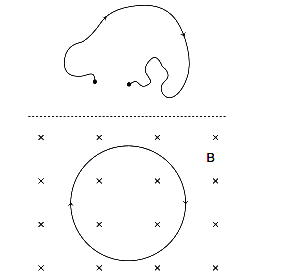
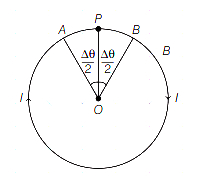
$A$ thin flexible wire of length $L$ is connected to two adjacent fixed points and carries a current $I$ in the clockwise direction as shown. When the system is placed in a uniform magnetic field of strength $B$ directed into the plane of the paper,the wire takes the shape of a circle. The tension in the wire after acquiring the circular shape is
A
$I B L$
B
$\frac{I B L}{\pi}$
C
$\frac{I B L}{2 \pi}$
D
$\frac{I B L}{4 \pi}$
Solution
(C) Given that,the length of the wire is $L$. The current passing through the wire is $I$. Let $R$ be the radius of the circular loop formed by the wire.
Then,the circumference $2 \pi R = L$,which gives $R = \frac{L}{2 \pi}$.
Consider a small element of the wire $AB$ of length $\Delta l$ which subtends an angle $\Delta \theta$ at the center $O$. Thus,$\Delta l = R \Delta \theta$.
The magnetic force acting on this small element $AB$ is $F = I B \Delta l = I B R \Delta \theta$,directed radially outward.
Let $T$ be the tension in the wire. The components of tension $T \cos(\Delta \theta / 2)$ at the ends of the element cancel each other out.
The radial component of the tension force is $2 T \sin(\Delta \theta / 2)$.
For equilibrium,the magnetic force must be balanced by the radial component of the tension:
$2 T \sin(\Delta \theta / 2) = F = I B R \Delta \theta$.
Since $\Delta \theta$ is very small,$\sin(\Delta \theta / 2) \approx \Delta \theta / 2$.
Therefore,$2 T (\Delta \theta / 2) = I B R \Delta \theta$,which simplifies to $T = I B R$.
Substituting $R = \frac{L}{2 \pi}$ into the expression for tension,we get $T = I B (\frac{L}{2 \pi}) = \frac{I B L}{2 \pi}$.
Then,the circumference $2 \pi R = L$,which gives $R = \frac{L}{2 \pi}$.
Consider a small element of the wire $AB$ of length $\Delta l$ which subtends an angle $\Delta \theta$ at the center $O$. Thus,$\Delta l = R \Delta \theta$.
The magnetic force acting on this small element $AB$ is $F = I B \Delta l = I B R \Delta \theta$,directed radially outward.
Let $T$ be the tension in the wire. The components of tension $T \cos(\Delta \theta / 2)$ at the ends of the element cancel each other out.
The radial component of the tension force is $2 T \sin(\Delta \theta / 2)$.
For equilibrium,the magnetic force must be balanced by the radial component of the tension:
$2 T \sin(\Delta \theta / 2) = F = I B R \Delta \theta$.
Since $\Delta \theta$ is very small,$\sin(\Delta \theta / 2) \approx \Delta \theta / 2$.
Therefore,$2 T (\Delta \theta / 2) = I B R \Delta \theta$,which simplifies to $T = I B R$.
Substituting $R = \frac{L}{2 \pi}$ into the expression for tension,we get $T = I B (\frac{L}{2 \pi}) = \frac{I B L}{2 \pi}$.
0 likesView Solution
175
ChemistryMCQAP EAMCET · 2021
When a body moves with a constant speed along a circle,
A
no acceleration is produced on the body
B
no work is done on it
C
its velocity remains constant
D
no force acts on the body
Solution
(B) When a body moves with a constant speed $v$ along a circle,it experiences a centripetal acceleration directed towards the center,although its linear speed remains constant.
Since the centripetal force $F$ acting on the body is always directed towards the center and the displacement $s$ is always along the tangent to the circle,the angle $\theta$ between the force and the displacement is $90^{\circ}$.
The work done $W$ is given by the formula:
$W = F \cdot s = F s \cos \theta$
Since $\theta = 90^{\circ}$,we have $\cos 90^{\circ} = 0$.
Therefore,$W = F s (0) = 0$.
Hence,no work is done on the body.
Since the centripetal force $F$ acting on the body is always directed towards the center and the displacement $s$ is always along the tangent to the circle,the angle $\theta$ between the force and the displacement is $90^{\circ}$.
The work done $W$ is given by the formula:
$W = F \cdot s = F s \cos \theta$
Since $\theta = 90^{\circ}$,we have $\cos 90^{\circ} = 0$.
Therefore,$W = F s (0) = 0$.
Hence,no work is done on the body.
0 likesView Solution
176
ChemistryMCQAP EAMCET · 2021
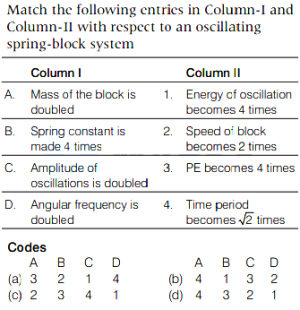
A
$ \begin{array}{llll} 3 & 2 & 1 & 4 \end{array} $
B
$ \begin{array}{llll} 4 & 1 & 3 & 2 \end{array} $
C
$ \begin{array}{llll} 2 & 3 & 4 & 1 \end{array} $
D
$ \begin{array}{llll} 4 & 3 & 2 & 1 \end{array} $
Solution
(A) Time-period in spring-block system is given by, $T = 2 \pi \sqrt{\frac{m}{k}} $
If mass is doubled, $T^{\prime} = 2 \pi \sqrt{\frac{2m}{k}} $ $ \Rightarrow \quad T^{\prime} = \sqrt{2} T $
Hence, time period becomes $ \sqrt{2} $ times, if the mass of the block is doubled.
$ (A \rightarrow 4) $
(B) For spring, $ \mathrm{PE} = \frac{1}{2} k x^2 $
If spring constant is increased 4 times, PE becomes 4 times.
$ (B \rightarrow 3) $
(C) Speed of the block, $ v = \omega A $
Hence, velocity of the block becomes twice when amplitude of the oscillation is doubled.
$ (C \rightarrow 2) $
(D) Energy of the oscillation, $ E = \frac{1}{2} m \omega^2 a^2 $
$ \begin{aligned} & & E^{\prime} = \frac{1}{2} m \omega^{\prime 2} a^2 \\ \Rightarrow & E^{\prime} & = \frac{1}{2} m(2 \omega)^2 a^2 = \frac{4}{2} m \omega^2 a^2 \quad \left( \because \omega^{\prime} = 2 \omega \right) \\ \Rightarrow & E^{\prime} & = 4 E \end{aligned} $
Energy of the oscillation becomes 4 times when angular frequency is doubled.
$ (D \rightarrow 1) $
If mass is doubled, $T^{\prime} = 2 \pi \sqrt{\frac{2m}{k}} $ $ \Rightarrow \quad T^{\prime} = \sqrt{2} T $
Hence, time period becomes $ \sqrt{2} $ times, if the mass of the block is doubled.
$ (A \rightarrow 4) $
(B) For spring, $ \mathrm{PE} = \frac{1}{2} k x^2 $
If spring constant is increased 4 times, PE becomes 4 times.
$ (B \rightarrow 3) $
(C) Speed of the block, $ v = \omega A $
Hence, velocity of the block becomes twice when amplitude of the oscillation is doubled.
$ (C \rightarrow 2) $
(D) Energy of the oscillation, $ E = \frac{1}{2} m \omega^2 a^2 $
$ \begin{aligned} & & E^{\prime} = \frac{1}{2} m \omega^{\prime 2} a^2 \\ \Rightarrow & E^{\prime} & = \frac{1}{2} m(2 \omega)^2 a^2 = \frac{4}{2} m \omega^2 a^2 \quad \left( \because \omega^{\prime} = 2 \omega \right) \\ \Rightarrow & E^{\prime} & = 4 E \end{aligned} $
Energy of the oscillation becomes 4 times when angular frequency is doubled.
$ (D \rightarrow 1) $
0 likesView Solution
177
ChemistryDifficultMCQAP EAMCET · 2021
When borax is dissolved in water,it gives an alkaline solution. The alkaline solution consists of the following products:
A
$NaOH \text{ and } H_3BO_3$
B
$Na_2B_4O_7 \text{ and } H_3BO_3$
C
$NaHCO_3 \text{ and } H_3BO_3$
D
$Na_2CO_3 \text{ and } H_3BO_3$
Solution
(A) When borax $(Na_2B_4O_7 \cdot 10H_2O)$ is dissolved in water,it undergoes hydrolysis to form orthoboric acid and sodium hydroxide.
The reaction is as follows:
$Na_2B_4O_7 + 7H_2O \rightarrow 2NaOH + 4H_3BO_3$
Since $NaOH$ is a strong base,the resulting solution is alkaline in nature.
The reaction is as follows:
$Na_2B_4O_7 + 7H_2O \rightarrow 2NaOH + 4H_3BO_3$
Since $NaOH$ is a strong base,the resulting solution is alkaline in nature.
0 likesView Solution
178
ChemistryMediumMCQAP EAMCET · 2021
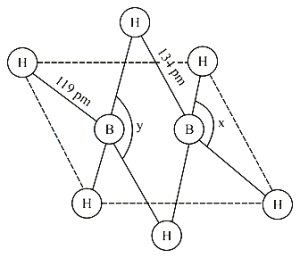
The structure of diborane $B_2H_6$ is given below. Identify the bond angles $x, y$. In diborane,which bonds are commonly known as banana-bonds?
A
$x = 120^{\circ}, y = 97^{\circ}$ and $3-$centered$-2-$electron bonds
B
$x = 101^{\circ}, y = 118^{\circ}$ and $2-$centered$-3-$electron bonds
C
$x = 118^{\circ}, y = 79^{\circ}$ and ionic bond between the two $B$'s
D
$x = 79^{\circ}, y = 118^{\circ}$ and ionic bond between the two $B$'s
Solution
(A) Diborane $(B_2H_6)$ is an electron-deficient molecule.
In its structure,the four terminal hydrogen atoms and two boron atoms lie in the same plane.
The two bridging hydrogen atoms lie above and below this plane.
The terminal $B-H$ bonds are normal $2-$centered$-2-$electron $(2c-2e)$ bonds with a bond angle of $120^{\circ}$ $(x)$.
The bridging $B-H-B$ bonds are $3-$centered$-2-$electron $(3c-2e)$ bonds,which are commonly known as banana-bonds or tau-bonds.
The bridging $H-B-H$ bond angle $(y)$ is $97^{\circ}$.
In its structure,the four terminal hydrogen atoms and two boron atoms lie in the same plane.
The two bridging hydrogen atoms lie above and below this plane.
The terminal $B-H$ bonds are normal $2-$centered$-2-$electron $(2c-2e)$ bonds with a bond angle of $120^{\circ}$ $(x)$.
The bridging $B-H-B$ bonds are $3-$centered$-2-$electron $(3c-2e)$ bonds,which are commonly known as banana-bonds or tau-bonds.
The bridging $H-B-H$ bond angle $(y)$ is $97^{\circ}$.
0 likesView Solution
179
ChemistryMediumMCQAP EAMCET · 2021
$H_3BO_3$ or $B(OH)_3$ is considered as an acid because its molecule
A
Combines with proton from water molecule
B
Accepts $OH^{-}$ from water,releasing a proton
C
Contains replaceable $H^{+}$ ion
D
Can donate proton easily
Solution
(B) $H_3BO_3$ is a weak monobasic Lewis acid. It does not dissociate to give $H^{+}$ ions directly in water.
Instead,it acts as a Lewis acid by accepting an $OH^{-}$ ion from the water molecule.
This process releases a proton $(H^{+})$ from the water molecule,thereby increasing the acidity of the solution.
The reaction is: $B(OH)_3 + 2H_2O \rightarrow [B(OH)_4]^{-} + H_3O^{+}$.
Therefore,$H_3BO_3$ is considered an acid because its molecule accepts $OH^{-}$ from water,releasing a proton.
Instead,it acts as a Lewis acid by accepting an $OH^{-}$ ion from the water molecule.
This process releases a proton $(H^{+})$ from the water molecule,thereby increasing the acidity of the solution.
The reaction is: $B(OH)_3 + 2H_2O \rightarrow [B(OH)_4]^{-} + H_3O^{+}$.
Therefore,$H_3BO_3$ is considered an acid because its molecule accepts $OH^{-}$ from water,releasing a proton.
0 likesView Solution
180
ChemistryDifficultMCQAP EAMCET · 2021
Consider the following reaction $BCl_3 + NH_3 \longrightarrow BCl_3 \cdot NH_3$. The geometries of $BCl_3$ and $BCl_3 \cdot NH_3$ respectively are
A
trigonal planar and tetrahedral
B
tetrahedral and square planar
C
tetrahedral and trigonal bipyramidal
D
square planar and trigonal pyramidal
Solution
(A) The molecular geometry of $BCl_3$ is trigonal planar because boron is $sp^2$ hybridized with three bond pairs and no lone pairs.
In the adduct $BCl_3 \cdot NH_3$,the boron atom forms a coordinate bond with the nitrogen atom of $NH_3$.
After the formation of the coordinate bond,the boron atom is surrounded by four atoms (three $Cl$ and one $N$),resulting in $sp^3$ hybridization.
Therefore,the geometry of $BCl_3 \cdot NH_3$ is tetrahedral.
In the adduct $BCl_3 \cdot NH_3$,the boron atom forms a coordinate bond with the nitrogen atom of $NH_3$.
After the formation of the coordinate bond,the boron atom is surrounded by four atoms (three $Cl$ and one $N$),resulting in $sp^3$ hybridization.
Therefore,the geometry of $BCl_3 \cdot NH_3$ is tetrahedral.
0 likesView Solution
181
ChemistryMediumMCQAP EAMCET · 2021
Boron compounds behave as Lewis acids because of their
A
electron rich nature
B
electron deficient nature
C
ionisation properties
D
proton donating nature
Solution
(B) Boron compounds are often employed as Lewis acids due to their strong electrophilic nature,which is caused by a vacant $p$-orbital that can accept electrons.
Boron behaves as a Lewis acid because it has only $3$ valence electrons,leaving its octet incomplete.
For example,$B_2H_6$ is an electron-deficient compound.
The electronic configuration of Boron is $B (Z=5) = [He] 2s^2 2p^1$.
This results in a total of $6$ electrons in the valence shell of the central atom in compounds like $BF_3$,which is less than the $8$ required for a complete octet.
Boron behaves as a Lewis acid because it has only $3$ valence electrons,leaving its octet incomplete.
For example,$B_2H_6$ is an electron-deficient compound.
The electronic configuration of Boron is $B (Z=5) = [He] 2s^2 2p^1$.
This results in a total of $6$ electrons in the valence shell of the central atom in compounds like $BF_3$,which is less than the $8$ required for a complete octet.
0 likesView Solution
182
ChemistryMediumMCQAP EAMCET · 2021
The product$(s)$ of the reaction $NaBH_4 + I_2 \longrightarrow$ 'Products' is/are
A
$B_2H_4I_2 + 2NaI$
B
$B_2H_6 + NaH + HI$
C
$B_2H_6 + 2NaI + H_2$
D
$2NaBH_4I$
Solution
(C) $NaBH_4$ is a mild reducing agent. When sodium borohydride reacts with iodine,it produces diborane,sodium iodide,and hydrogen gas. This reaction involves the oxidation of sodium borohydride with iodine in diglyme to yield diborane. This approach is common in the industrial production of $B_2H_6$.
The balanced chemical equation is:
$2NaBH_4 + I_2 \xrightarrow{\text{Diglyme}} B_2H_6 + 2NaI + H_2$
The balanced chemical equation is:
$2NaBH_4 + I_2 \xrightarrow{\text{Diglyme}} B_2H_6 + 2NaI + H_2$
0 likesView Solution
183
ChemistryMediumMCQAP EAMCET · 2021
$AlF_3$ is soluble in $HF$ only in the presence of $KF$ due to the formation of:
A
$AlH_3$
B
$[AlH_6]^{3-}$
C
$[AlF_6]^{3-}$
D
$K[AlF_3H]$
Solution
(C) $AlF_3$ is insoluble in anhydrous $HF$ because it lacks free $F^-$ ions to interact with the $Al^{3+}$ center.
In the presence of $KF$,$KF$ dissociates to provide $F^-$ ions,which react with $AlF_3$ to form a soluble complex.
The reaction is:
$AlF_3 + 3KF \rightarrow K_3[AlF_6]$
This complex dissociates into $3K^+$ and $[AlF_6]^{3-}$.
Therefore,the correct option is $[AlF_6]^{3-}$.
In the presence of $KF$,$KF$ dissociates to provide $F^-$ ions,which react with $AlF_3$ to form a soluble complex.
The reaction is:
$AlF_3 + 3KF \rightarrow K_3[AlF_6]$
This complex dissociates into $3K^+$ and $[AlF_6]^{3-}$.
Therefore,the correct option is $[AlF_6]^{3-}$.
0 likesView Solution
184
ChemistryMediumMCQAP EAMCET · 2021
In the preparation of baking soda,what is the ratio of $H_2O$ and $CO_2$ used to react with $Na_2CO_3$ to form $NaHCO_3$?
A
$3:1$
B
$1:2$
C
$2:1$
D
$1:1$
Solution
(D) The reaction for the formation of baking soda $(NaHCO_3)$ from sodium carbonate $(Na_2CO_3)$ is given by the equation:
$Na_2CO_3 + H_2O + CO_2 \rightarrow 2NaHCO_3$
From the balanced chemical equation,it is clear that $1 \text{ mole}$ of $H_2O$ reacts with $1 \text{ mole}$ of $CO_2$.
Therefore,the molar ratio of $H_2O : CO_2$ is $1:1$.
$Na_2CO_3 + H_2O + CO_2 \rightarrow 2NaHCO_3$
From the balanced chemical equation,it is clear that $1 \text{ mole}$ of $H_2O$ reacts with $1 \text{ mole}$ of $CO_2$.
Therefore,the molar ratio of $H_2O : CO_2$ is $1:1$.
0 likesView Solution
185
ChemistryEasyMCQAP EAMCET · 2021
Carbon and germanium belong to the $14^{th}$ group. The maximum coordination number of carbon is less than germanium,because of
A
larger size of germanium
B
electronegativity difference
C
availability of low-lying $d$-orbitals in germanium
D
electrical conductivity
Solution
(C) The coordination number of an element depends on the availability of vacant orbitals in the valence shell.
Carbon is in the $2^{nd}$ period with the electronic configuration $1s^2 2s^2 2p^2$. It lacks vacant $d$-orbitals,limiting its maximum covalency to $4$.
Germanium is in the $4^{th}$ period with the electronic configuration $[Ar] 3d^{10} 4s^2 4p^2$.
Due to the presence of vacant $d$-orbitals,germanium can expand its coordination number beyond $4$.
Carbon is in the $2^{nd}$ period with the electronic configuration $1s^2 2s^2 2p^2$. It lacks vacant $d$-orbitals,limiting its maximum covalency to $4$.
Germanium is in the $4^{th}$ period with the electronic configuration $[Ar] 3d^{10} 4s^2 4p^2$.
Due to the presence of vacant $d$-orbitals,germanium can expand its coordination number beyond $4$.
0 likesView Solution
186
ChemistryMediumMCQAP EAMCET · 2021
When graphite is subjected to an electric arc in the presence of an inert atmosphere,it gives:
A
$C_{70}$ as main product and $C_{80}$ in small quantities
B
$C_{60}$ as main product and $C_{70}$ in small quantities
C
$C_{50}$ as main product and $C_{60}$ in small quantities
D
equal amounts of $C_{60}$ and $C_{70}$
Solution
(B) Fullerenes are allotropes of carbon consisting of clusters of carbon atoms,such as $C_{60}$,$C_{70}$,$C_{76}$,and $C_{84}$.
Fullerenes are synthesized by heating graphite in an electric arc in the presence of an inert gas like helium or argon at low pressure.
During this process,the carbon vaporizes and condenses to form a soot containing various fullerenes.
$C_{60}$ (Buckminsterfullerene) is the most abundant product,while $C_{70}$ is obtained in smaller quantities.
Fullerenes are synthesized by heating graphite in an electric arc in the presence of an inert gas like helium or argon at low pressure.
During this process,the carbon vaporizes and condenses to form a soot containing various fullerenes.
$C_{60}$ (Buckminsterfullerene) is the most abundant product,while $C_{70}$ is obtained in smaller quantities.
0 likesView Solution
187
ChemistryMediumMCQAP EAMCET · 2021
What would be the major product of the following reaction: $SiCl_4 \xrightarrow{\text{Excess of } H_2O}$?
A
$SiCl_3(OH)$
B
$Si(OH)_4$
C
$SiCl_2(OH)_2$
D
$SiCl_4$ (no reaction)
Solution
(B) When silicon tetrachloride $(SiCl_4)$ reacts with an excess of water,it undergoes complete hydrolysis.
Silicon has vacant $d$-orbitals,which allow the water molecule to attack the silicon atom,leading to the substitution of chlorine atoms by hydroxyl groups.
The reaction proceeds as follows:
$SiCl_4 + 4H_2O \rightarrow Si(OH)_4 + 4HCl$
Therefore,the major product is silicic acid,$Si(OH)_4$.
Silicon has vacant $d$-orbitals,which allow the water molecule to attack the silicon atom,leading to the substitution of chlorine atoms by hydroxyl groups.
The reaction proceeds as follows:
$SiCl_4 + 4H_2O \rightarrow Si(OH)_4 + 4HCl$
Therefore,the major product is silicic acid,$Si(OH)_4$.
0 likesView Solution
188
ChemistryMediumMCQAP EAMCET · 2021
Identify the incorrect statement about $SiO_2$ (silica) from the following.
A
It is highly reactive due to low $Si-O$ bond enthalpy.
B
It is a covalent three-dimensional network solid.
C
Quartz,the crystalline form of silica,is used as a piezoelectric material.
D
An amorphous form of silica is used in filtration plants.
Solution
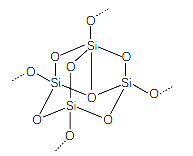
(A) $SiO_2$ is a covalent three-dimensional network solid.
Silica (commonly known as quartz) is $SiO_2$,which is usually used to manufacture glass,ceramics,and piezoelectric materials.
The most common use of silica is in water filtration; because of its uniform shape and size,it is an effective filtration bed that removes contaminants from water.
$SiO_2$ is less reactive due to high $Si-O$ bond enthalpy. Therefore,the statement that it is highly reactive is incorrect.
Silica (commonly known as quartz) is $SiO_2$,which is usually used to manufacture glass,ceramics,and piezoelectric materials.
The most common use of silica is in water filtration; because of its uniform shape and size,it is an effective filtration bed that removes contaminants from water.
$SiO_2$ is less reactive due to high $Si-O$ bond enthalpy. Therefore,the statement that it is highly reactive is incorrect.
0 likesView Solution
189
ChemistryEasyMCQAP EAMCET · 2021
An inorganic compound $(A)$ made of the two most abundant elements in the Earth's crust is used in building construction. When $(A)$ reacts with carbon,it forms a poisonous gas $(B)$,which is a very stable diatomic molecule. Identify compounds $(A)$ and $(B)$.
A
$SiO_2, CO_2$
B
$SiO_2, CO$
C
$SiO_2, N_2$
D
$CaO, CO_2$
Solution
(B) The two most abundant elements in the Earth's crust are oxygen and silicon. The compound $(A)$ formed by these elements is silicon dioxide $(SiO_2)$,which is widely used in building construction (e.g.,in sand and concrete).
When silicon dioxide $(SiO_2)$ reacts with carbon at high temperatures,it undergoes a reduction reaction:
$SiO_2 + 3C \xrightarrow{\Delta} SiC + 2CO$
Here,$(B)$ is carbon monoxide $(CO)$,which is a poisonous,stable diatomic gas.
When silicon dioxide $(SiO_2)$ reacts with carbon at high temperatures,it undergoes a reduction reaction:
$SiO_2 + 3C \xrightarrow{\Delta} SiC + 2CO$
Here,$(B)$ is carbon monoxide $(CO)$,which is a poisonous,stable diatomic gas.
0 likesView Solution
190
ChemistryMediumMCQAP EAMCET · 2021
Match the following and choose the correct code.
| Material | Application |
|---|---|
| $A$. Silicones | $i$. As a catalyst |
| $ii$. Greases | |
| $B$. Zeolites | $iii$. In surgical implants |
| $iv$. As ion exchangers |
A
$A-(ii, iii), B-(i, iv)$
B
$A-(i, iii), B-(ii, iv)$
C
$A-(ii, iv), B-(i, iii)$
D
$A-(i, iv), B-(ii, iii)$
Solution
(A) Silicones are used as greases (lubricants) and in surgical implants due to their inert nature and biocompatibility.
Zeolites are used as catalysts (e.g.,$ZSM-5$) and as ion exchangers in water softening.
Therefore,the correct matches are:
$A$ (Silicones) $\rightarrow$ $(ii)$ Greases,$(iii)$ In surgical implants.
$B$ (Zeolites) $\rightarrow$ $(i)$ As a catalyst,$(iv)$ As ion exchangers.
The correct code is $A-(ii, iii), B-(i, iv)$.
Zeolites are used as catalysts (e.g.,$ZSM-5$) and as ion exchangers in water softening.
Therefore,the correct matches are:
$A$ (Silicones) $\rightarrow$ $(ii)$ Greases,$(iii)$ In surgical implants.
$B$ (Zeolites) $\rightarrow$ $(i)$ As a catalyst,$(iv)$ As ion exchangers.
The correct code is $A-(ii, iii), B-(i, iv)$.
0 likesView Solution
191
ChemistryMediumMCQAP EAMCET · 2021
Which of the following metals produces hydrogen gas on reacting with cold dilute nitric acid?
A
$Al$
B
$Fe$
C
$Mg$
D
$Cu$
Solution
(C) Nitric acid $(HNO_3)$ is a strong oxidizing agent. It usually oxidizes the $H_2$ gas produced to water and itself gets reduced to nitrogen oxides.
However,magnesium $(Mg)$ and manganese $(Mn)$ react with very dilute nitric acid to evolve hydrogen gas.
$Mg + 2HNO_3 \text{ (very dilute)} \rightarrow Mg(NO_3)_2 + H_2 \uparrow$
However,magnesium $(Mg)$ and manganese $(Mn)$ react with very dilute nitric acid to evolve hydrogen gas.
$Mg + 2HNO_3 \text{ (very dilute)} \rightarrow Mg(NO_3)_2 + H_2 \uparrow$
0 likesView Solution
192
ChemistryEasyMCQAP EAMCET · 2021
The angular shape of the ozone molecule consists of
A
$1 \sigma$ and $1 \pi$ bonds with bond angle $109^{\circ}$
B
$2 \sigma$ and $1 \pi$ bonds with bond angle $117^{\circ}$
C
$2 \sigma$ and $2 \pi$ bonds with bond angle $120^{\circ}$
D
$1 \sigma$ and $2 \pi$ bonds with bond angle $60^{\circ}$
Solution
(B) The ozone molecule $(O_3)$ exhibits resonance between two canonical structures.
In each resonance structure,the central oxygen atom is bonded to the two terminal oxygen atoms by one single bond and one double bond.
$A$ single bond consists of $1 \sigma$ bond,and a double bond consists of $1 \sigma$ and $1 \pi$ bond.
Therefore,the total number of $\sigma$ bonds is $2$ and the total number of $\pi$ bonds is $1$.
The bond angle in the angular ozone molecule is approximately $117^{\circ}$.
In each resonance structure,the central oxygen atom is bonded to the two terminal oxygen atoms by one single bond and one double bond.
$A$ single bond consists of $1 \sigma$ bond,and a double bond consists of $1 \sigma$ and $1 \pi$ bond.
Therefore,the total number of $\sigma$ bonds is $2$ and the total number of $\pi$ bonds is $1$.
The bond angle in the angular ozone molecule is approximately $117^{\circ}$.
0 likesView Solution
193
ChemistryMediumMCQAP EAMCET · 2021
Which of the following pairs of reactions give $H_2$ gas as a product upon hydrolysis?
A
$i$. $Ba \xrightarrow{H_2 O}$ Products; $ii$. $BaO_2 \xrightarrow{H_2 O}$ Products
B
$i$. $Ca \xrightarrow{H_2 O}$ Products; $ii$. $CaH_2 \xrightarrow{H_2 O}$ Products
C
$i$. $K \xrightarrow{H_2 O}$ Products; $ii$. $K_2 O \xrightarrow{H_2 O}$ Products
D
$i$. $Na \xrightarrow{H_2 O}$ Products; $ii$. $Na_2 O_2 \xrightarrow{H_2 O}$ Products
Solution
(B) The reaction of calcium metal with water is: $Ca + 2H_2O \longrightarrow Ca(OH)_2 + H_2(g)$.
The reaction of calcium hydride with water is: $CaH_2 + 2H_2O \longrightarrow Ca(OH)_2 + 2H_2(g)$.
Both reactions produce $H_2$ gas as a product upon hydrolysis.
The reaction of calcium hydride with water is: $CaH_2 + 2H_2O \longrightarrow Ca(OH)_2 + 2H_2(g)$.
Both reactions produce $H_2$ gas as a product upon hydrolysis.
0 likesView Solution
194
ChemistryMediumMCQAP EAMCET · 2021
Which reaction among the following gives nascent oxygen?
A
$Na_2SO_3 + Cl_2 \xrightarrow{H_2O}$
B
$NaOH + Cl_2 \longrightarrow$
C
$Ca(OH)_2 + Cl_2 \longrightarrow$
D
$Cl_2 + H_2O \longrightarrow$
Solution
(D) The correct option is $(d)$. Chlorine reacts with water to form hypochlorous acid $(HOCl)$,which is unstable and decomposes to give nascent oxygen $([O])$.
$Cl_2 + H_2O \longrightarrow HCl + HOCl$
$HOCl \longrightarrow HCl + [O]$
This nascent oxygen is responsible for the bleaching and oxidizing properties of chlorine water.
$Cl_2 + H_2O \longrightarrow HCl + HOCl$
$HOCl \longrightarrow HCl + [O]$
This nascent oxygen is responsible for the bleaching and oxidizing properties of chlorine water.
0 likesView Solution
195
ChemistryDifficultMCQAP EAMCET · 2021
In the following reaction,$I_2 + 5Cl_2 + 6H_2O \longrightarrow X + Y$,the products $X$ and $Y$ respectively are:
A
$HClO_4, HI$
B
$I_2O_7, HCl$
C
$HIO_3, HCl$
D
$ICl_3, HCl$
Solution
(C) The reaction of iodine with chlorine in the presence of water is an oxidation reaction where iodine is oxidized to iodic acid $(HIO_3)$ and chlorine is reduced to hydrochloric acid $(HCl)$.
The balanced chemical equation is:
$I_2 + 5Cl_2 + 6H_2O \longrightarrow 2HIO_3 + 10HCl$
Comparing this with the given reaction $I_2 + 5Cl_2 + 6H_2O \longrightarrow X + Y$,we identify $X$ as $HIO_3$ and $Y$ as $HCl$.
The balanced chemical equation is:
$I_2 + 5Cl_2 + 6H_2O \longrightarrow 2HIO_3 + 10HCl$
Comparing this with the given reaction $I_2 + 5Cl_2 + 6H_2O \longrightarrow X + Y$,we identify $X$ as $HIO_3$ and $Y$ as $HCl$.
0 likesView Solution
196
ChemistryEasyMCQAP EAMCET · 2021
$HClO_4$ is a stronger acid than $H_2SO_4$ due to which of the following reasons?
$1$. Oxidation state of $Cl$ in $HClO_4$ is $+7$ and that of $S$ in $H_2SO_4$ is $+6$.
$2$. $Cl$ is more electronegative than $S$.
$3$. $HClO_4$ is monobasic,whereas $H_2SO_4$ is dibasic.
$4$. $ClO_3$ part of $HClO_4$ can break $O-H$ bond more easily to liberate a proton than $SO_3$ part in $H_2SO_4$.
$1$. Oxidation state of $Cl$ in $HClO_4$ is $+7$ and that of $S$ in $H_2SO_4$ is $+6$.
$2$. $Cl$ is more electronegative than $S$.
$3$. $HClO_4$ is monobasic,whereas $H_2SO_4$ is dibasic.
$4$. $ClO_3$ part of $HClO_4$ can break $O-H$ bond more easily to liberate a proton than $SO_3$ part in $H_2SO_4$.
A
$1$,$2$ and $3$
B
$1$,$2$ and $4$
C
$1$,$3$ and $4$
D
$2$,$3$ and $4$
Solution
(B) The acidity of oxoacids depends on the oxidation state and electronegativity of the central atom.
$1$. The oxidation state of $Cl$ in $HClO_4$ is $+7$,while that of $S$ in $H_2SO_4$ is $+6$. $A$ higher oxidation state leads to stronger electron-withdrawing effects,making the $O-H$ bond more polar and easier to break.
$2$. $Cl$ is more electronegative than $S$,which further increases the electron-withdrawing effect on the $O-H$ bond.
$4$. Due to the higher oxidation state and electronegativity of $Cl$,the $ClO_3$ group exerts a stronger inductive effect than the $SO_3$ group,facilitating the release of $H^+$.
Statement $3$ is a property of these acids but does not explain why $HClO_4$ is a stronger acid than $H_2SO_4$.
Therefore,statements $1$,$2$ and $4$ are the correct reasons.
$1$. The oxidation state of $Cl$ in $HClO_4$ is $+7$,while that of $S$ in $H_2SO_4$ is $+6$. $A$ higher oxidation state leads to stronger electron-withdrawing effects,making the $O-H$ bond more polar and easier to break.
$2$. $Cl$ is more electronegative than $S$,which further increases the electron-withdrawing effect on the $O-H$ bond.
$4$. Due to the higher oxidation state and electronegativity of $Cl$,the $ClO_3$ group exerts a stronger inductive effect than the $SO_3$ group,facilitating the release of $H^+$.
Statement $3$ is a property of these acids but does not explain why $HClO_4$ is a stronger acid than $H_2SO_4$.
Therefore,statements $1$,$2$ and $4$ are the correct reasons.
0 likesView Solution
197
ChemistryEasyMCQAP EAMCET · 2021
Molecular bromine on reaction with three moles of molecular fluorine produces an interhalogen compound. The total number of lone pairs at the central halogen atom is
A
$3$
B
$2$
C
$1$
D
$0$
Solution
(B) Molecular bromine $(Br_2)$ reacts with $3$ moles of molecular fluorine $(F_2)$ to produce $2$ moles of $BrF_3$.
$BrF_3$ is an interhalogen compound.
The chemical reaction is:
$Br_{2(g)} + 3F_{2(g)} \longrightarrow 2BrF_{3(g)}$
In $BrF_3$,the central bromine atom has $7$ valence electrons. It forms $3$ covalent bonds with $3$ fluorine atoms,using $3$ electrons.
Remaining electrons = $7 - 3 = 4$ electrons,which form $2$ lone pairs.
Thus,the total number of lone pairs at the central bromine atom is $2$.
$BrF_3$ is an interhalogen compound.
The chemical reaction is:
$Br_{2(g)} + 3F_{2(g)} \longrightarrow 2BrF_{3(g)}$
In $BrF_3$,the central bromine atom has $7$ valence electrons. It forms $3$ covalent bonds with $3$ fluorine atoms,using $3$ electrons.
Remaining electrons = $7 - 3 = 4$ electrons,which form $2$ lone pairs.
Thus,the total number of lone pairs at the central bromine atom is $2$.
0 likesView Solution
198
ChemistryMCQAP EAMCET · 2021
The number of ways in which $6$ men and $5$ women can dine at a round table,if no two women are to sit together,is:
A
$6! \times 5!$
B
$30$
C
$5! \times 4!$
D
$7! \times 5!$
Solution
(A) First,arrange the $6$ men around a round table. The number of ways to arrange $n$ objects in a circle is $(n-1)!$. So,$6$ men can be seated in $(6-1)! = 5!$ ways.
There are $6$ gaps created between the $6$ men where the $5$ women can be seated so that no two women sit together.
The number of ways to arrange $5$ women in these $6$ gaps is given by the permutation formula $P(6, 5) = \frac{6!}{(6-5)!} = 6!$.
Therefore,the total number of ways is $5! \times 6!$.
There are $6$ gaps created between the $6$ men where the $5$ women can be seated so that no two women sit together.
The number of ways to arrange $5$ women in these $6$ gaps is given by the permutation formula $P(6, 5) = \frac{6!}{(6-5)!} = 6!$.
Therefore,the total number of ways is $5! \times 6!$.
0 likesView Solution
199
ChemistryMCQAP EAMCET · 2021
Let $C$ be the centroid of the triangle with vertices $(3, -1)$,$(1, 3)$,and $(2, 4)$. Let $P$ be the point of intersection of the lines $x + 3y - 1 = 0$ and $3x - y + 1 = 0$. Then the line passing through the points $C$ and $P$ also passes through the point
A
$(-9, -7)$
B
$(-9, -6)$
C
$(7, 6)$
D
$(9, 7)$
Solution
(B) The centroid $C$ of a triangle with vertices $(x_1, y_1)$,$(x_2, y_2)$,and $(x_3, y_3)$ is given by $\left(\frac{x_1 + x_2 + x_3}{3}, \frac{y_1 + y_2 + y_3}{3}\right)$.
For vertices $(3, -1)$,$(1, 3)$,and $(2, 4)$,the centroid is $C = \left(\frac{3 + 1 + 2}{3}, \frac{-1 + 3 + 4}{3}\right) = (2, 2)$.
To find the intersection point $P$ of $x + 3y - 1 = 0$ and $3x - y + 1 = 0$,we solve the system:
$x + 3y = 1$ and $3x - y = -1$.
Multiplying the second equation by $3$: $9x - 3y = -3$.
Adding the two equations: $(x + 3y) + (9x - 3y) = 1 - 3$ $\Rightarrow 10x = -2$ $\Rightarrow x = -\frac{1}{5}$.
Substituting $x = -\frac{1}{5}$ into $x + 3y = 1$: $-\frac{1}{5} + 3y = 1$ $\Rightarrow 3y = \frac{6}{5}$ $\Rightarrow y = \frac{2}{5}$.
So,$P = \left(-\frac{1}{5}, \frac{2}{5}\right)$.
The slope $m$ of the line passing through $C(2, 2)$ and $P\left(-\frac{1}{5}, \frac{2}{5}\right)$ is $m = \frac{2 - 2/5}{2 - (-1/5)} = \frac{8/5}{11/5} = \frac{8}{11}$.
The equation of the line is $y - 2 = \frac{8}{11}(x - 2)$ $\Rightarrow 11y - 22 = 8x - 16$ $\Rightarrow 8x - 11y + 6 = 0$.
Checking the options,for $(-9, -6)$: $8(-9) - 11(-6) + 6 = -72 + 66 + 6 = 0$.
Thus,the line passes through $(-9, -6)$.
For vertices $(3, -1)$,$(1, 3)$,and $(2, 4)$,the centroid is $C = \left(\frac{3 + 1 + 2}{3}, \frac{-1 + 3 + 4}{3}\right) = (2, 2)$.
To find the intersection point $P$ of $x + 3y - 1 = 0$ and $3x - y + 1 = 0$,we solve the system:
$x + 3y = 1$ and $3x - y = -1$.
Multiplying the second equation by $3$: $9x - 3y = -3$.
Adding the two equations: $(x + 3y) + (9x - 3y) = 1 - 3$ $\Rightarrow 10x = -2$ $\Rightarrow x = -\frac{1}{5}$.
Substituting $x = -\frac{1}{5}$ into $x + 3y = 1$: $-\frac{1}{5} + 3y = 1$ $\Rightarrow 3y = \frac{6}{5}$ $\Rightarrow y = \frac{2}{5}$.
So,$P = \left(-\frac{1}{5}, \frac{2}{5}\right)$.
The slope $m$ of the line passing through $C(2, 2)$ and $P\left(-\frac{1}{5}, \frac{2}{5}\right)$ is $m = \frac{2 - 2/5}{2 - (-1/5)} = \frac{8/5}{11/5} = \frac{8}{11}$.
The equation of the line is $y - 2 = \frac{8}{11}(x - 2)$ $\Rightarrow 11y - 22 = 8x - 16$ $\Rightarrow 8x - 11y + 6 = 0$.
Checking the options,for $(-9, -6)$: $8(-9) - 11(-6) + 6 = -72 + 66 + 6 = 0$.
Thus,the line passes through $(-9, -6)$.
0 likesView Solution
200
ChemistryMCQAP EAMCET · 2021
The transformed equation of $3x^2 + 3y^2 + 2xy = 2$,when the coordinate axes are rotated through an angle of $45^{\circ}$,is
A
$x^2 + 2y^2 = 1$
B
$2x^2 + y^2 = 1$
C
$x^2 + y^2 = 1$
D
$x^2 + 3y^2 = 1$
Solution
(B) Since the axes are rotated through an angle $\theta = 45^{\circ}$,we replace $(x, y)$ by $(x \cos 45^{\circ} - y \sin 45^{\circ}, x \sin 45^{\circ} + y \cos 45^{\circ})$,which is $(\frac{x-y}{\sqrt{2}}, \frac{x+y}{\sqrt{2}})$. Substituting these into the equation $3x^2 + 3y^2 + 2xy = 2$:
$3(\frac{x-y}{\sqrt{2}})^2 + 3(\frac{x+y}{\sqrt{2}})^2 + 2(\frac{x-y}{\sqrt{2}})(\frac{x+y}{\sqrt{2}}) = 2$
$\frac{3}{2}(x^2 + y^2 - 2xy) + \frac{3}{2}(x^2 + y^2 + 2xy) + \frac{2}{2}(x^2 - y^2) = 2$
$\frac{3}{2}(2x^2 + 2y^2) + (x^2 - y^2) = 2$
$3x^2 + 3y^2 + x^2 - y^2 = 2$
$4x^2 + 2y^2 = 2$
Dividing by $2$,we get $2x^2 + y^2 = 1$.
$3(\frac{x-y}{\sqrt{2}})^2 + 3(\frac{x+y}{\sqrt{2}})^2 + 2(\frac{x-y}{\sqrt{2}})(\frac{x+y}{\sqrt{2}}) = 2$
$\frac{3}{2}(x^2 + y^2 - 2xy) + \frac{3}{2}(x^2 + y^2 + 2xy) + \frac{2}{2}(x^2 - y^2) = 2$
$\frac{3}{2}(2x^2 + 2y^2) + (x^2 - y^2) = 2$
$3x^2 + 3y^2 + x^2 - y^2 = 2$
$4x^2 + 2y^2 = 2$
Dividing by $2$,we get $2x^2 + y^2 = 1$.
0 likesView Solution
201
ChemistryDifficultMCQAP EAMCET · 2021
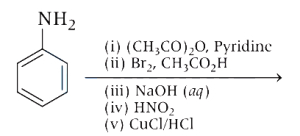
The major product in the following reaction sequence is:
A
$4-$bromo$-2-$chloroaniline
B
$1-$bromo$-4-$chlorobenzene
C
$3-$bromo-chlorobenzene
D
$1-$bromo$-2-$chlorobenzene
Solution
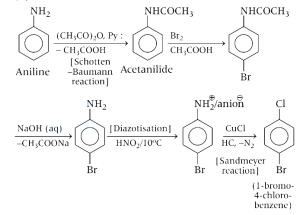
(B) The reaction sequence is as follows:
$1$. Acetylation of aniline with $(CH_3CO)_2O$ and pyridine protects the $-NH_2$ group,forming acetanilide.
$2$. Electrophilic aromatic substitution with $Br_2$ in $CH_3CO_2H$ occurs at the para-position due to the steric hindrance of the $-NHCOCH_3$ group,yielding $p$-bromoacetanilide.
$3$. Hydrolysis with $NaOH(aq)$ removes the acetyl group to regenerate $p$-bromoaniline.
$4$. Diazotization with $HNO_2$ at $0-5 \ ^\circ C$ converts the $-NH_2$ group into a diazonium salt,$-N_2^+Cl^-$.
$5$. The Sandmeyer reaction with $CuCl/HCl$ replaces the diazonium group with a chlorine atom,resulting in $1$-bromo-$4$-chlorobenzene.
$1$. Acetylation of aniline with $(CH_3CO)_2O$ and pyridine protects the $-NH_2$ group,forming acetanilide.
$2$. Electrophilic aromatic substitution with $Br_2$ in $CH_3CO_2H$ occurs at the para-position due to the steric hindrance of the $-NHCOCH_3$ group,yielding $p$-bromoacetanilide.
$3$. Hydrolysis with $NaOH(aq)$ removes the acetyl group to regenerate $p$-bromoaniline.
$4$. Diazotization with $HNO_2$ at $0-5 \ ^\circ C$ converts the $-NH_2$ group into a diazonium salt,$-N_2^+Cl^-$.
$5$. The Sandmeyer reaction with $CuCl/HCl$ replaces the diazonium group with a chlorine atom,resulting in $1$-bromo-$4$-chlorobenzene.
0 likesView Solution
202
ChemistryMediumMCQAP EAMCET · 2021
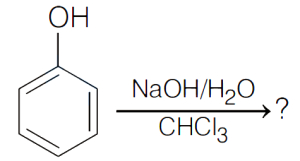
The major product of the following reaction is:
A
Sodium $2-$chlorophenolate
B
Sodium $2-$carboxyphenolate
C
Sodium $2-$formylphenolate
D
Sodium $2-$hydroxyphenolate
Solution
(C) The reaction of phenol with $CHCl_3$ in the presence of aqueous $NaOH$ is known as the $Reimer-Tiemann$ reaction.
In this reaction,$CHCl_3$ reacts with $NaOH$ to generate a dichlorocarbene intermediate $(:CCl_2)$.
This electrophilic carbene attacks the phenoxide ion at the ortho position.
The intermediate formed undergoes hydrolysis to yield salicylaldehyde ($2$-hydroxybenzaldehyde) in its salt form,which is sodium $2-$formylphenolate.
In this reaction,$CHCl_3$ reacts with $NaOH$ to generate a dichlorocarbene intermediate $(:CCl_2)$.
This electrophilic carbene attacks the phenoxide ion at the ortho position.
The intermediate formed undergoes hydrolysis to yield salicylaldehyde ($2$-hydroxybenzaldehyde) in its salt form,which is sodium $2-$formylphenolate.
0 likesView Solution
203
ChemistryMediumMCQAP EAMCET · 2021
The major product formed in the following reaction is
$C_6H_5CH=CH_2$ $\xrightarrow[(ii) H_3O^+]{(i) KMnO_4, KOH, \Delta}$ $\xrightarrow{(iii) Br_2/FeBr_3} \text{Product}$
$C_6H_5CH=CH_2$ $\xrightarrow[(ii) H_3O^+]{(i) KMnO_4, KOH, \Delta}$ $\xrightarrow{(iii) Br_2/FeBr_3} \text{Product}$
A
$p$-bromophenylacetic acid
B
$o$-bromobenzoic acid
C
$m$-bromoacetophenone
D
$m$-bromobenzoic acid
Solution
(D) Step $(i)$ and $(ii)$: The oxidation of styrene $(C_6H_5CH=CH_2)$ with alkaline $KMnO_4$ followed by acidic workup $(H_3O^+)$ results in the formation of benzoic acid $(C_6H_5COOH)$.
Step $(iii)$: Benzoic acid contains a $-COOH$ group,which is a deactivating and meta-directing group. Therefore,electrophilic aromatic substitution with $Br_2/FeBr_3$ will direct the bromine atom to the meta position.
The final product is $m$-bromobenzoic acid.
Step $(iii)$: Benzoic acid contains a $-COOH$ group,which is a deactivating and meta-directing group. Therefore,electrophilic aromatic substitution with $Br_2/FeBr_3$ will direct the bromine atom to the meta position.
The final product is $m$-bromobenzoic acid.
0 likesView Solution
204
ChemistryDifficultMCQAP EAMCET · 2021
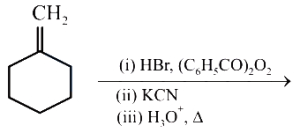
The major product in the following reaction is:
A
Cyclohexanecarboxylic acid with a methyl group at the alpha position.
B
$1-$methylcyclohexanecarboxylic acid.
C
Cyclohexylacetic acid.
D
$3-$cyclohexylpropanoic acid.
Solution
(C) The reaction proceeds as follows:
$1$. The first step is the anti-Markovnikov addition of $HBr$ to methylenecyclohexane in the presence of a peroxide,$(C_6H_5CO)_2O_2$. This yields (cyclohexylmethyl) bromide,$C_6H_{11}CH_2Br$.
$2$. The second step is a nucleophilic substitution reaction with $KCN$,where the bromide ion is replaced by a cyanide group,yielding cyclohexylacetonitrile,$C_6H_{11}CH_2CN$.
$3$. The third step is the acid-catalyzed hydrolysis of the nitrile group followed by heating,which converts the $-CN$ group into a carboxylic acid group,$-COOH$. The final product is cyclohexylacetic acid,$C_6H_{11}CH_2COOH$.
$1$. The first step is the anti-Markovnikov addition of $HBr$ to methylenecyclohexane in the presence of a peroxide,$(C_6H_5CO)_2O_2$. This yields (cyclohexylmethyl) bromide,$C_6H_{11}CH_2Br$.
$2$. The second step is a nucleophilic substitution reaction with $KCN$,where the bromide ion is replaced by a cyanide group,yielding cyclohexylacetonitrile,$C_6H_{11}CH_2CN$.
$3$. The third step is the acid-catalyzed hydrolysis of the nitrile group followed by heating,which converts the $-CN$ group into a carboxylic acid group,$-COOH$. The final product is cyclohexylacetic acid,$C_6H_{11}CH_2COOH$.
0 likesView Solution
205
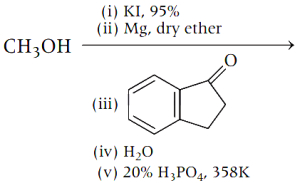
ChemistryDifficultMCQAP EAMCET · 2021
The major product formed in the following reaction is:
A
$1-$methyl-1H-indene
B
$1-$methylene$-2,3-$dihydro-1H-indene
C
$3-$methyl-1H-indene
D
$1-$methyl$-2,3-$dihydro-1H-inden$-1-$ol
Solution
(A) The reaction proceeds as follows:
$(i)$ $CH_3OH$ reacts with $KI$ to form $CH_3I$.
(ii) $CH_3I$ reacts with $Mg$ in dry ether to form the Grignard reagent $CH_3MgI$.
(iii) $CH_3MgI$ undergoes nucleophilic addition to the carbonyl group of $1-$indanone ($2$,$3$-dihydro-1H-inden$-1-$one).
(iv) Subsequent hydrolysis with $H_2O$ yields $1-$methyl$-2,3-$dihydro-1H-inden$-1-$ol.
$(v)$ Dehydration of the alcohol using $20\% H_3PO_4$ at $358 \ K$ results in the formation of the more stable conjugated alkene,$1$-methyl-1H-indene,as the major product.
$(i)$ $CH_3OH$ reacts with $KI$ to form $CH_3I$.
(ii) $CH_3I$ reacts with $Mg$ in dry ether to form the Grignard reagent $CH_3MgI$.
(iii) $CH_3MgI$ undergoes nucleophilic addition to the carbonyl group of $1-$indanone ($2$,$3$-dihydro-1H-inden$-1-$one).
(iv) Subsequent hydrolysis with $H_2O$ yields $1-$methyl$-2,3-$dihydro-1H-inden$-1-$ol.
$(v)$ Dehydration of the alcohol using $20\% H_3PO_4$ at $358 \ K$ results in the formation of the more stable conjugated alkene,$1$-methyl-1H-indene,as the major product.
0 likesView Solution
206
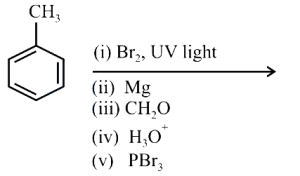
ChemistryDifficultMCQAP EAMCET · 2021
The major product in the following reaction sequence is:
A
$1-$bromo$-1-$phenylethane
B
o-bromomethyltoluene
C
($2$-bromoethyl)benzene
D
p-bromomethyltoluene
Solution
(C) The reaction sequence is as follows:
$1$. Toluene reacts with $Br_2$ in the presence of $UV$ light to undergo free-radical substitution at the benzylic position,forming benzyl bromide $(C_6H_5CH_2Br)$.
$2$. Benzyl bromide reacts with $Mg$ in dry ether to form the Grignard reagent,benzylmagnesium bromide $(C_6H_5CH_2MgBr)$.
$3$. The Grignard reagent reacts with formaldehyde $(CH_2O)$ followed by acidic hydrolysis $(H_3O^+)$ to form $2-$phenylethanol $(C_6H_5CH_2CH_2OH)$.
$4$. Finally,$2$-phenylethanol reacts with $PBr_3$ to replace the hydroxyl group with a bromine atom,yielding ($2$-bromoethyl)benzene $(C_6H_5CH_2CH_2Br)$.
$1$. Toluene reacts with $Br_2$ in the presence of $UV$ light to undergo free-radical substitution at the benzylic position,forming benzyl bromide $(C_6H_5CH_2Br)$.
$2$. Benzyl bromide reacts with $Mg$ in dry ether to form the Grignard reagent,benzylmagnesium bromide $(C_6H_5CH_2MgBr)$.
$3$. The Grignard reagent reacts with formaldehyde $(CH_2O)$ followed by acidic hydrolysis $(H_3O^+)$ to form $2-$phenylethanol $(C_6H_5CH_2CH_2OH)$.
$4$. Finally,$2$-phenylethanol reacts with $PBr_3$ to replace the hydroxyl group with a bromine atom,yielding ($2$-bromoethyl)benzene $(C_6H_5CH_2CH_2Br)$.
0 likesView Solution
207
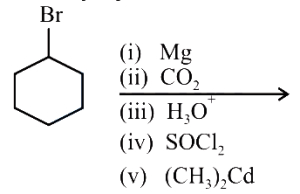
ChemistryDifficultMCQAP EAMCET · 2021
The major product in the following reaction is
A
Cyclohexyl ethanol
B
Cyclohexyl methyl ketone
C
$1-$Cyclohexyl ethanol
D
$2-$Cyclohexyl propan$-2-$ol
Solution
(B) The reaction proceeds as follows:
$1$. Bromocyclohexane reacts with $Mg$ in dry ether to form cyclohexylmagnesium bromide (a Grignard reagent).
$2$. The Grignard reagent reacts with $CO_2$ followed by acidic workup $(H_3O^+)$ to form cyclohexanecarboxylic acid.
$3$. Cyclohexanecarboxylic acid reacts with $SOCl_2$ to form cyclohexanecarbonyl chloride.
$4$. Finally,the reaction of cyclohexanecarbonyl chloride with dimethylcadmium,$(CH_3)_2Cd$,yields cyclohexyl methyl ketone as the major product. This is a standard method for the preparation of ketones from acid chlorides.
$1$. Bromocyclohexane reacts with $Mg$ in dry ether to form cyclohexylmagnesium bromide (a Grignard reagent).
$2$. The Grignard reagent reacts with $CO_2$ followed by acidic workup $(H_3O^+)$ to form cyclohexanecarboxylic acid.
$3$. Cyclohexanecarboxylic acid reacts with $SOCl_2$ to form cyclohexanecarbonyl chloride.
$4$. Finally,the reaction of cyclohexanecarbonyl chloride with dimethylcadmium,$(CH_3)_2Cd$,yields cyclohexyl methyl ketone as the major product. This is a standard method for the preparation of ketones from acid chlorides.
0 likesView Solution
208
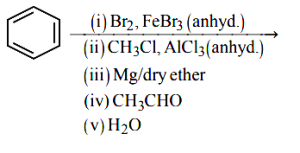
ChemistryDifficultMCQAP EAMCET · 2021
The major product of the following reaction is:
A
$1-$($4$-methylphenyl)propan$-2-$ol
B
$1-$($4$-methylphenyl)ethanol
C
$2-$($2$-methylphenyl)propan$-2-$ol
D
$1-$($2$-methylphenyl)ethanol
Solution
(B) Step $(i)$: Benzene reacts with $Br_2$ in the presence of anhydrous $FeBr_3$ to form bromobenzene via electrophilic aromatic substitution.
Step (ii): Bromobenzene undergoes Friedel-Crafts alkylation with $CH_3Cl$ and anhydrous $AlCl_3$. Since the $-Br$ group is ortho/para directing,the major product is $p$-bromotoluene.
Step (iii): $p$-Bromotoluene reacts with $Mg$ in dry ether to form the Grignard reagent,$p$-tolylmagnesium bromide $(CH_3-C_6H_4-MgBr)$.
Step (iv) and $(v)$: The Grignard reagent reacts with acetaldehyde $(CH_3CHO)$ followed by hydrolysis $(H_2O)$ to form a secondary alcohol. The nucleophilic carbon of the Grignard reagent attacks the carbonyl carbon of acetaldehyde,resulting in $1-(4-methylphenyl)ethanol$.
Step (ii): Bromobenzene undergoes Friedel-Crafts alkylation with $CH_3Cl$ and anhydrous $AlCl_3$. Since the $-Br$ group is ortho/para directing,the major product is $p$-bromotoluene.
Step (iii): $p$-Bromotoluene reacts with $Mg$ in dry ether to form the Grignard reagent,$p$-tolylmagnesium bromide $(CH_3-C_6H_4-MgBr)$.
Step (iv) and $(v)$: The Grignard reagent reacts with acetaldehyde $(CH_3CHO)$ followed by hydrolysis $(H_2O)$ to form a secondary alcohol. The nucleophilic carbon of the Grignard reagent attacks the carbonyl carbon of acetaldehyde,resulting in $1-(4-methylphenyl)ethanol$.
0 likesView Solution
209
ChemistryMediumMCQAP EAMCET · 2021
The major product of the following reaction is:
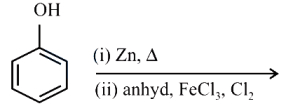
A
$4-$chlorophenol
B
$2-$chlorophenol
C
$2,4-$dichlorophenol
D
chlorobenzene
Solution
(D) Step $1$: Phenol reacts with zinc dust $(Zn)$ under heating $(\Delta)$ to undergo reduction,resulting in the formation of benzene.
$C_6H_5OH Zn \xrightarrow{\Delta} C_6H_6 ZnO$
Step $2$: Benzene then undergoes electrophilic aromatic substitution (chlorination) in the presence of anhydrous ferric chloride $(FeCl_3)$ and chlorine $(Cl_2)$ to form chlorobenzene.
$C_6H_6 Cl_2 \xrightarrow{\text{anhyd. } FeCl_3} C_6H_5Cl HCl$
Therefore,the major product is chlorobenzene.
$C_6H_5OH Zn \xrightarrow{\Delta} C_6H_6 ZnO$
Step $2$: Benzene then undergoes electrophilic aromatic substitution (chlorination) in the presence of anhydrous ferric chloride $(FeCl_3)$ and chlorine $(Cl_2)$ to form chlorobenzene.
$C_6H_6 Cl_2 \xrightarrow{\text{anhyd. } FeCl_3} C_6H_5Cl HCl$
Therefore,the major product is chlorobenzene.
0 likesView Solution
210
ChemistryDifficultMCQAP EAMCET · 2021
The major product in the following reaction sequence is:
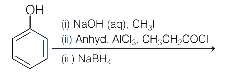
A
$1-$($4$-methoxyphenyl)propan$-1-$ol
B
$1-$($2$-methoxyphenyl)propan$-1-$ol
C
$1-$($4$-methoxyphenyl)propan$-2-$ol
D
$1-$($2$-methoxyphenyl)propan$-2-$ol
Solution
(A) The reaction proceeds as follows:
$(i)$ Phenol reacts with $NaOH$ and $CH_3I$ to form anisole (methoxybenzene) via Williamson ether synthesis.
(ii) Anisole undergoes Friedel-Crafts acylation with propionyl chloride $(CH_3CH_2COCl)$ in the presence of anhydrous $AlCl_3$. Since the $-OCH_3$ group is ortho/para-directing,and the para-position is sterically less hindered,the major product is $p$-methoxypropiophenone.
(iii) Reduction of the ketone group with $NaBH_4$ yields the corresponding secondary alcohol,$1$-($4$-methoxyphenyl)propan$-1-$ol.
Therefore,the correct option is $A$.
$(i)$ Phenol reacts with $NaOH$ and $CH_3I$ to form anisole (methoxybenzene) via Williamson ether synthesis.
(ii) Anisole undergoes Friedel-Crafts acylation with propionyl chloride $(CH_3CH_2COCl)$ in the presence of anhydrous $AlCl_3$. Since the $-OCH_3$ group is ortho/para-directing,and the para-position is sterically less hindered,the major product is $p$-methoxypropiophenone.
(iii) Reduction of the ketone group with $NaBH_4$ yields the corresponding secondary alcohol,$1$-($4$-methoxyphenyl)propan$-1-$ol.
Therefore,the correct option is $A$.
0 likesView Solution
211
ChemistryDifficultMCQAP EAMCET · 2021
The major product formed in the following reaction is:
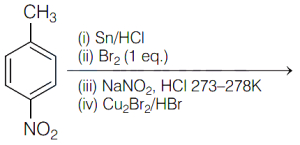
A
$1-$methyl$-3,5-$dibromobenzene
B
$1-$methyl$-2,6-$dibromobenzene
C
$1-$methyl$-3,4-$dibromobenzene
D
$1-$methyl$-2,4-$dibromobenzene
Solution
(C) The reaction proceeds as follows:
$(i)$ $Sn/HCl$ reduces the $-NO_2$ group to an $-NH_2$ group,forming $p$-toluidine.
(ii) $Br_2$ $(1 \ eq.)$ in the presence of the strongly activating $-NH_2$ group leads to ortho-bromination,yielding $2$-bromo-$4$-methylaniline.
(iii) $NaNO_2/HCl$ at $273-278 \ K$ converts the $-NH_2$ group into a diazonium salt,$-N_2^+Cl^-$.
(iv) $Cu_2Br_2/HBr$ (Sandmeyer reaction) replaces the diazonium group with a $-Br$ atom,resulting in $1,2$-dibromo-$4$-methylbenzene (also known as $3,4$-dibromotoluene).
$(i)$ $Sn/HCl$ reduces the $-NO_2$ group to an $-NH_2$ group,forming $p$-toluidine.
(ii) $Br_2$ $(1 \ eq.)$ in the presence of the strongly activating $-NH_2$ group leads to ortho-bromination,yielding $2$-bromo-$4$-methylaniline.
(iii) $NaNO_2/HCl$ at $273-278 \ K$ converts the $-NH_2$ group into a diazonium salt,$-N_2^+Cl^-$.
(iv) $Cu_2Br_2/HBr$ (Sandmeyer reaction) replaces the diazonium group with a $-Br$ atom,resulting in $1,2$-dibromo-$4$-methylbenzene (also known as $3,4$-dibromotoluene).
0 likesView Solution
Vedclass Products
For Students
Vedclass Test Series
Mock tests in real AP EAMCET style covering Chemistry with performance analysis. 5-day free trial.
Start Free TrialFor Teachers
Exam Paper Generator
Generate Set A/B/C/D Chemistry papers from 7.5L+ questions in 2 minutes. 3 chapters free.
Try FreeFor Institutes
Online Exam Module
Run live AP EAMCET mock exams with unlimited students, 360° analytics & white-label branding.
See DemoFrequently Asked Questions
How many Chemistry questions are in AP EAMCET 2021?
There are 502 Chemistry questions from the AP EAMCET 2021 paper on Vedclass, each with a detailed step-by-step solution in English.
Are AP EAMCET 2021 Chemistry solutions available in English?
Yes. All solutions on this page are in English. You can also switch to English or Hindi using the language buttons above the questions.
Can I practice AP EAMCET 2021 Chemistry as a timed test?
Yes. Use the Vedclass Test Series to attempt a full AP EAMCET mock test covering Chemistry with time limits and instant score analysis.
Can teachers create Chemistry papers from AP EAMCET previous year questions?
Yes. The Vedclass Exam Paper Generator lets teachers mix AP EAMCET Chemistry questions and generate Set A/B/C/D papers in minutes.
For Teachers & Institutes
Build a Custom Chemistry Paper
Pick AP EAMCET 2021 Chemistry questions, set difficulty, and generate Set A/B/C/D in 2 minutes.