
A English
Mix Examples - Number Systems Questions in English
Class 9 Mathematics · Number Systems · Mix Examples - Number Systems
260+
Questions
English
Language
100%
With Solutions
Showing 50 of 260 questions in English
1
MediumMCQ
Which of the following is not equal to $\left[\left(\frac{5}{6}\right)^{\frac{1}{5}}\right]^{-\frac{1}{6}}?$
A
$\left(\frac{5}{6}\right)^{\frac{1}{5}-\frac{1}{6}}$
B
$\frac{1}{\left[\left(\frac{5}{6}\right)^{\frac{1}{5}}\right]^{\frac{1}{6}}}$
C
$\left(\frac{6}{5}\right)^{\frac{1}{30}}$
D
$\left(\frac{5}{6}\right)^{-\frac{1}{30}}$
Solution
(A) Given expression is $\left[\left(\frac{5}{6}\right)^{\frac{1}{5}}\right]^{-\frac{1}{6}}$.
Using the power rule $(a^m)^n = a^{m \times n}$,we get:
$\left(\frac{5}{6}\right)^{\frac{1}{5} \times (-\frac{1}{6})} = \left(\frac{5}{6}\right)^{-\frac{1}{30}}$.
Now,let's evaluate the options:
$A$: $\left(\frac{5}{6}\right)^{\frac{1}{5}-\frac{1}{6}} = \left(\frac{5}{6}\right)^{\frac{6-5}{30}} = \left(\frac{5}{6}\right)^{\frac{1}{30}}$. This is not equal to $\left(\frac{5}{6}\right)^{-\frac{1}{30}}$.
$B$: $\frac{1}{\left[\left(\frac{5}{6}\right)^{\frac{1}{5}}\right]^{\frac{1}{6}}} = \frac{1}{\left(\frac{5}{6}\right)^{\frac{1}{30}}} = \left(\frac{5}{6}\right)^{-\frac{1}{30}}$. This is equal.
$C$: $\left(\frac{6}{5}\right)^{\frac{1}{30}} = \left(\left(\frac{5}{6}\right)^{-1}\right)^{\frac{1}{30}} = \left(\frac{5}{6}\right)^{-\frac{1}{30}}$. This is equal.
$D$: $\left(\frac{5}{6}\right)^{-\frac{1}{30}}$. This is equal.
Therefore,option $A$ is not equal to the given expression.
Using the power rule $(a^m)^n = a^{m \times n}$,we get:
$\left(\frac{5}{6}\right)^{\frac{1}{5} \times (-\frac{1}{6})} = \left(\frac{5}{6}\right)^{-\frac{1}{30}}$.
Now,let's evaluate the options:
$A$: $\left(\frac{5}{6}\right)^{\frac{1}{5}-\frac{1}{6}} = \left(\frac{5}{6}\right)^{\frac{6-5}{30}} = \left(\frac{5}{6}\right)^{\frac{1}{30}}$. This is not equal to $\left(\frac{5}{6}\right)^{-\frac{1}{30}}$.
$B$: $\frac{1}{\left[\left(\frac{5}{6}\right)^{\frac{1}{5}}\right]^{\frac{1}{6}}} = \frac{1}{\left(\frac{5}{6}\right)^{\frac{1}{30}}} = \left(\frac{5}{6}\right)^{-\frac{1}{30}}$. This is equal.
$C$: $\left(\frac{6}{5}\right)^{\frac{1}{30}} = \left(\left(\frac{5}{6}\right)^{-1}\right)^{\frac{1}{30}} = \left(\frac{5}{6}\right)^{-\frac{1}{30}}$. This is equal.
$D$: $\left(\frac{5}{6}\right)^{-\frac{1}{30}}$. This is equal.
Therefore,option $A$ is not equal to the given expression.
0 likes
View Solution2
EasyMCQ
Every rational number is
A
a natural number
B
a real number
C
an integer
D
a whole number
Solution
(B) We know that the set of real numbers consists of all rational and irrational numbers.
Since every rational number belongs to the set of real numbers,it follows that every rational number is a real number.
Since every rational number belongs to the set of real numbers,it follows that every rational number is a real number.
0 likes
View Solution3
EasyMCQ
Between two rational numbers,
A
there is no rational number.
B
there is exactly one rational number.
C
there are infinitely many rational numbers.
D
there are only rational numbers and no irrational numbers.
Solution
(C) Between any two distinct rational numbers,there exist infinitely many rational numbers. This property is known as the density property of rational numbers.
0 likes
View Solution4
EasyMCQ
The decimal representation of a rational number cannot be:
A
Terminating
B
Non-terminating repeating
C
There are infinitely many rational numbers
D
Non-terminating,non-repeating
Solution
(D) rational number is defined as a number that can be expressed in the form $p/q$,where $p$ and $q$ are integers and $q \neq 0$. The decimal expansion of a rational number is always either terminating or non-terminating repeating (recurring). $A$ non-terminating,non-repeating decimal expansion is a characteristic property of an irrational number. Therefore,the decimal representation of a rational number cannot be non-terminating,non-repeating.
1 likes
View Solution5
EasyMCQ
The product of any two irrational numbers is
A
sometimes rational,sometimes irrational
B
always an irrational number
C
always a rational number
D
always an integer
Solution
(A) The product of two irrational numbers can be either rational or irrational.
For example:
$1$. If we take $\sqrt{2} \times \sqrt{2} = 2$,which is a rational number.
$2$. If we take $\sqrt{2} \times \sqrt{3} = \sqrt{6}$,which is an irrational number.
Therefore,the product is sometimes rational and sometimes irrational.
For example:
$1$. If we take $\sqrt{2} \times \sqrt{2} = 2$,which is a rational number.
$2$. If we take $\sqrt{2} \times \sqrt{3} = \sqrt{6}$,which is an irrational number.
Therefore,the product is sometimes rational and sometimes irrational.
0 likes
View Solution6
EasyMCQ
The decimal expansion of the number $\sqrt{2}$ is
A
a finite decimal
B
non-terminating non-recurring
C
non-terminating recurring
D
$1.41421$
Solution
(B) The number $\sqrt{2}$ is an irrational number.
By definition,the decimal expansion of an irrational number is always non-terminating and non-recurring (non-repeating).
Therefore,the decimal expansion of $\sqrt{2}$ is $1.41421356...$,which does not end and does not repeat any pattern.
By definition,the decimal expansion of an irrational number is always non-terminating and non-recurring (non-repeating).
Therefore,the decimal expansion of $\sqrt{2}$ is $1.41421356...$,which does not end and does not repeat any pattern.
0 likes
View Solution7
EasyMCQ
Which of the following is irrational?
A
$\sqrt{\frac{4}{9}}$
B
$\frac{\sqrt{12}}{\sqrt{3}}$
C
$\sqrt{7}$
D
$\sqrt{81}$
Solution
(C) To determine which number is irrational,we simplify each option:
$(a)$ $\sqrt{\frac{4}{9}} = \frac{2}{3}$,which is a rational number because it can be expressed in the form $\frac{p}{q}$ where $p, q$ are integers and $q \neq 0$.
$(b)$ $\frac{\sqrt{12}}{\sqrt{3}} = \sqrt{\frac{12}{3}} = \sqrt{4} = 2$,which is a rational number.
$(c)$ $\sqrt{7}$ cannot be simplified into a fraction of integers. Since $7$ is not a perfect square,$\sqrt{7}$ is an irrational number.
$(d)$ $\sqrt{81} = 9$,which is a rational number.
Therefore,$\sqrt{7}$ is the irrational number. Hence,$(C)$ is the correct answer.
$(a)$ $\sqrt{\frac{4}{9}} = \frac{2}{3}$,which is a rational number because it can be expressed in the form $\frac{p}{q}$ where $p, q$ are integers and $q \neq 0$.
$(b)$ $\frac{\sqrt{12}}{\sqrt{3}} = \sqrt{\frac{12}{3}} = \sqrt{4} = 2$,which is a rational number.
$(c)$ $\sqrt{7}$ cannot be simplified into a fraction of integers. Since $7$ is not a perfect square,$\sqrt{7}$ is an irrational number.
$(d)$ $\sqrt{81} = 9$,which is a rational number.
Therefore,$\sqrt{7}$ is the irrational number. Hence,$(C)$ is the correct answer.
0 likes
View Solution8
EasyMCQ
Which of the following is irrational?
A
$0.14$
B
$0.14 \overline{16}$
C
$0. \overline{1416}$
D
$0.4014001400014 \ldots$
Solution
(D) number is irrational if and only if its decimal representation is non-terminating and non-recurring.
$(A)$ $0.14$ is a terminating decimal,so it is a rational number.
$(B)$ $0.14 \overline{16}$ is a non-terminating and recurring decimal,so it is a rational number.
$(C)$ $0. \overline{1416}$ is a non-terminating and recurring decimal,so it is a rational number.
$(D)$ $0.4014001400014 \ldots$ is a non-terminating and non-recurring decimal,which is the definition of an irrational number.
Hence,$(D)$ is the correct answer.
$(A)$ $0.14$ is a terminating decimal,so it is a rational number.
$(B)$ $0.14 \overline{16}$ is a non-terminating and recurring decimal,so it is a rational number.
$(C)$ $0. \overline{1416}$ is a non-terminating and recurring decimal,so it is a rational number.
$(D)$ $0.4014001400014 \ldots$ is a non-terminating and non-recurring decimal,which is the definition of an irrational number.
Hence,$(D)$ is the correct answer.
0 likes
View Solution9
EasyMCQ
$A$ rational number between $\sqrt{2}$ and $\sqrt{3}$ is
A
$1.5$
B
$\frac{\sqrt{2}+\sqrt{3}}{2}$
C
$\frac{\sqrt{2}-\sqrt{3}}{2}$
D
$1.8$
Solution
(A) We know that $\sqrt{2} \approx 1.414$ and $\sqrt{3} \approx 1.732$.
$A$ rational number is a number that can be expressed in the form $\frac{p}{q}$,where $p$ and $q$ are integers and $q \neq 0$.
Comparing the given options:
$1.5 = \frac{15}{10} = \frac{3}{2}$,which is a rational number.
Since $1.414 < 1.5 < 1.732$,the value $1.5$ lies between $\sqrt{2}$ and $\sqrt{3}$.
Option $B$ and $C$ involve irrational numbers,so they are not rational numbers.
Option $D$ $(1.8)$ is greater than $\sqrt{3} \approx 1.732$,so it does not lie between them.
Therefore,$1.5$ is the correct rational number.
$A$ rational number is a number that can be expressed in the form $\frac{p}{q}$,where $p$ and $q$ are integers and $q \neq 0$.
Comparing the given options:
$1.5 = \frac{15}{10} = \frac{3}{2}$,which is a rational number.
Since $1.414 < 1.5 < 1.732$,the value $1.5$ lies between $\sqrt{2}$ and $\sqrt{3}$.
Option $B$ and $C$ involve irrational numbers,so they are not rational numbers.
Option $D$ $(1.8)$ is greater than $\sqrt{3} \approx 1.732$,so it does not lie between them.
Therefore,$1.5$ is the correct rational number.
0 likes
View Solution10
MediumMCQ
The value of $1.999...$ in the form $\frac{p}{q},$ where $p$ and $q$ are integers and $q \neq 0,$ is
A
$\frac{19}{10}$
B
$2$
C
$\frac{1999}{1000}$
D
$\frac{1}{9}$
Solution
(B) Let $x = 1.999... = 1.\overline{9} \quad \dots(1)$
Multiply both sides by $10$:
$10x = 19.999... = 19.\overline{9} \quad \dots(2)$
Subtract equation $(1)$ from equation $(2)$:
$10x - x = 19.999... - 1.999...$
$9x = 18$
Divide by $9$:
$x = \frac{18}{9} = 2$
Since $2$ can be written as $\frac{2}{1},$ where $p=2$ and $q=1$ are integers and $q \neq 0,$ the value is $2.$
Hence,option $(b)$ is the correct answer.
Multiply both sides by $10$:
$10x = 19.999... = 19.\overline{9} \quad \dots(2)$
Subtract equation $(1)$ from equation $(2)$:
$10x - x = 19.999... - 1.999...$
$9x = 18$
Divide by $9$:
$x = \frac{18}{9} = 2$
Since $2$ can be written as $\frac{2}{1},$ where $p=2$ and $q=1$ are integers and $q \neq 0,$ the value is $2.$
Hence,option $(b)$ is the correct answer.
0 likes
View Solution11
EasyMCQ
$2 \sqrt{3} + \sqrt{3}$ is equal to
A
$2 \sqrt{6}$
B
$6$
C
$3 \sqrt{3}$
D
$4 \sqrt{6}$
Solution
(C) To add the given expressions,we treat $\sqrt{3}$ as a common variable or term.
Given expression: $2 \sqrt{3} + \sqrt{3}$.
This can be written as $(2 + 1) \sqrt{3}$.
Calculating the sum inside the parentheses: $3 \sqrt{3}$.
Therefore,the correct option is $(c)$.
Given expression: $2 \sqrt{3} + \sqrt{3}$.
This can be written as $(2 + 1) \sqrt{3}$.
Calculating the sum inside the parentheses: $3 \sqrt{3}$.
Therefore,the correct option is $(c)$.
0 likes
View Solution12
EasyMCQ
$\sqrt{10} \times \sqrt{15}$ is equal to
A
$6 \sqrt{5}$
B
$10 \sqrt{5}$
C
$\sqrt{25}$
D
$5 \sqrt{6}$
Solution
(D) Using the property of radicals $\sqrt{a} \times \sqrt{b} = \sqrt{a \times b}$,we have:
$\sqrt{10} \times \sqrt{15} = \sqrt{10 \times 15}$
$= \sqrt{150}$
$= \sqrt{25 \times 6}$
$= \sqrt{25} \times \sqrt{6}$
$= 5 \sqrt{6}$
Therefore,the correct option is $D$.
$\sqrt{10} \times \sqrt{15} = \sqrt{10 \times 15}$
$= \sqrt{150}$
$= \sqrt{25 \times 6}$
$= \sqrt{25} \times \sqrt{6}$
$= 5 \sqrt{6}$
Therefore,the correct option is $D$.
0 likes
View Solution13
EasyMCQ
The number obtained on rationalizing the denominator of $\frac{1}{7-\sqrt{2}}$ is
A
$\frac{7+\sqrt{2}}{47}$
B
$\frac{\sqrt{7}+2}{5}$
C
$\frac{\sqrt{7}-2}{3}$
D
$\frac{\sqrt{7}+2}{3}$
Solution
(A) To rationalize the denominator of $\frac{1}{7-\sqrt{2}}$,we multiply both the numerator and the denominator by the conjugate of the denominator,which is $(7+\sqrt{2})$.
$\frac{1}{7-\sqrt{2}} = \frac{1}{7-\sqrt{2}} \times \frac{7+\sqrt{2}}{7+\sqrt{2}}$
Using the identity $(a-b)(a+b) = a^2 - b^2$ in the denominator:
$= \frac{7+\sqrt{2}}{(7)^2 - (\sqrt{2})^2}$
$= \frac{7+\sqrt{2}}{49-2}$
$= \frac{7+\sqrt{2}}{47}$
Hence,option $A$ is the correct answer.
$\frac{1}{7-\sqrt{2}} = \frac{1}{7-\sqrt{2}} \times \frac{7+\sqrt{2}}{7+\sqrt{2}}$
Using the identity $(a-b)(a+b) = a^2 - b^2$ in the denominator:
$= \frac{7+\sqrt{2}}{(7)^2 - (\sqrt{2})^2}$
$= \frac{7+\sqrt{2}}{49-2}$
$= \frac{7+\sqrt{2}}{47}$
Hence,option $A$ is the correct answer.
0 likes
View Solution14
MediumMCQ
$\frac{1}{\sqrt{9}-\sqrt{8}}$ is equal to
A
$\frac{1}{2}(3-2 \sqrt{2})$
B
$3+2 \sqrt{2}$
C
$3-2 \sqrt{2}$
D
$\frac{1}{3+2 \sqrt{2}}$
Solution
(B) Given expression: $\frac{1}{\sqrt{9}-\sqrt{8}}$
Since $\sqrt{9} = 3$ and $\sqrt{8} = \sqrt{4 \times 2} = 2\sqrt{2}$,the expression becomes:
$\frac{1}{3-2\sqrt{2}}$
To rationalize the denominator,multiply the numerator and denominator by the conjugate $(3+2\sqrt{2})$:
$\frac{1}{3-2\sqrt{2}} \times \frac{3+2\sqrt{2}}{3+2\sqrt{2}} = \frac{3+2\sqrt{2}}{(3)^2 - (2\sqrt{2})^2}$
Simplify the denominator:
$(3)^2 - (2\sqrt{2})^2 = 9 - (4 \times 2) = 9 - 8 = 1$
Thus,the expression simplifies to:
$\frac{3+2\sqrt{2}}{1} = 3+2\sqrt{2}$
Hence,option $(B)$ is the correct answer.
Since $\sqrt{9} = 3$ and $\sqrt{8} = \sqrt{4 \times 2} = 2\sqrt{2}$,the expression becomes:
$\frac{1}{3-2\sqrt{2}}$
To rationalize the denominator,multiply the numerator and denominator by the conjugate $(3+2\sqrt{2})$:
$\frac{1}{3-2\sqrt{2}} \times \frac{3+2\sqrt{2}}{3+2\sqrt{2}} = \frac{3+2\sqrt{2}}{(3)^2 - (2\sqrt{2})^2}$
Simplify the denominator:
$(3)^2 - (2\sqrt{2})^2 = 9 - (4 \times 2) = 9 - 8 = 1$
Thus,the expression simplifies to:
$\frac{3+2\sqrt{2}}{1} = 3+2\sqrt{2}$
Hence,option $(B)$ is the correct answer.
0 likes
View Solution15
MediumMCQ
After rationalizing the denominator of $\frac{7}{3 \sqrt{3}-2 \sqrt{2}},$ we get the denominator as
A
$13$
B
$19$
C
$5$
D
$35$
Solution
(C) To rationalize the denominator of $\frac{7}{3 \sqrt{3}-2 \sqrt{2}},$ we multiply the numerator and the denominator by the conjugate of the denominator,which is $(3 \sqrt{3}+2 \sqrt{2}).$
$\frac{7}{3 \sqrt{3}-2 \sqrt{2}} \times \frac{3 \sqrt{3}+2 \sqrt{2}}{3 \sqrt{3}+2 \sqrt{2}} = \frac{7(3 \sqrt{3}+2 \sqrt{2})}{(3 \sqrt{3})^2 - (2 \sqrt{2})^2}$
$= \frac{7(3 \sqrt{3}+2 \sqrt{2})}{(9 \times 3) - (4 \times 2)} = \frac{7(3 \sqrt{3}+2 \sqrt{2})}{27 - 8}$
$= \frac{7(3 \sqrt{3}+2 \sqrt{2})}{19}$
Thus,the denominator is $19.$
Therefore,the correct option is $(C)$.
$\frac{7}{3 \sqrt{3}-2 \sqrt{2}} \times \frac{3 \sqrt{3}+2 \sqrt{2}}{3 \sqrt{3}+2 \sqrt{2}} = \frac{7(3 \sqrt{3}+2 \sqrt{2})}{(3 \sqrt{3})^2 - (2 \sqrt{2})^2}$
$= \frac{7(3 \sqrt{3}+2 \sqrt{2})}{(9 \times 3) - (4 \times 2)} = \frac{7(3 \sqrt{3}+2 \sqrt{2})}{27 - 8}$
$= \frac{7(3 \sqrt{3}+2 \sqrt{2})}{19}$
Thus,the denominator is $19.$
Therefore,the correct option is $(C)$.
0 likes
View Solution16
MediumMCQ
The value of $\frac{\sqrt{32}+\sqrt{48}}{\sqrt{8}+\sqrt{12}}$ is equal to
A
$8$
B
$\sqrt{2}$
C
$4$
D
$2$
Solution
(D) Given expression: $\frac{\sqrt{32}+\sqrt{48}}{\sqrt{8}+\sqrt{12}}$
Simplify the square roots in the numerator and denominator:
$\sqrt{32} = \sqrt{16 \times 2} = 4\sqrt{2}$
$\sqrt{48} = \sqrt{16 \times 3} = 4\sqrt{3}$
$\sqrt{8} = \sqrt{4 \times 2} = 2\sqrt{2}$
$\sqrt{12} = \sqrt{4 \times 3} = 2\sqrt{3}$
Substitute these values back into the expression:
$\frac{4\sqrt{2} + 4\sqrt{3}}{2\sqrt{2} + 2\sqrt{3}}$
Factor out the common terms:
$\frac{4(\sqrt{2} + \sqrt{3})}{2(\sqrt{2} + \sqrt{3})}$
Cancel the common term $(\sqrt{2} + \sqrt{3})$:
$\frac{4}{2} = 2$
Hence,the correct option is $(d)$.
Simplify the square roots in the numerator and denominator:
$\sqrt{32} = \sqrt{16 \times 2} = 4\sqrt{2}$
$\sqrt{48} = \sqrt{16 \times 3} = 4\sqrt{3}$
$\sqrt{8} = \sqrt{4 \times 2} = 2\sqrt{2}$
$\sqrt{12} = \sqrt{4 \times 3} = 2\sqrt{3}$
Substitute these values back into the expression:
$\frac{4\sqrt{2} + 4\sqrt{3}}{2\sqrt{2} + 2\sqrt{3}}$
Factor out the common terms:
$\frac{4(\sqrt{2} + \sqrt{3})}{2(\sqrt{2} + \sqrt{3})}$
Cancel the common term $(\sqrt{2} + \sqrt{3})$:
$\frac{4}{2} = 2$
Hence,the correct option is $(d)$.
0 likes
View Solution17
DifficultMCQ
If $\sqrt{2} = 1.4142$,then $\sqrt{\frac{\sqrt{2}-1}{\sqrt{2}+1}}$ is equal to
A
$0.4142$
B
$2.4142$
C
$5.8282$
D
$0.1718$
Solution
(A) To simplify the expression $\sqrt{\frac{\sqrt{2}-1}{\sqrt{2}+1}}$,we rationalize the denominator:
$\sqrt{\frac{\sqrt{2}-1}{\sqrt{2}+1}} = \sqrt{\frac{(\sqrt{2}-1) \times (\sqrt{2}-1)}{(\sqrt{2}+1) \times (\sqrt{2}-1)}}$
$= \sqrt{\frac{(\sqrt{2}-1)^2}{(\sqrt{2})^2 - 1^2}}$
$= \sqrt{\frac{(\sqrt{2}-1)^2}{2-1}}$
$= \sqrt{(\sqrt{2}-1)^2}$
$= \sqrt{2}-1$
Given $\sqrt{2} = 1.4142$,we have:
$1.4142 - 1 = 0.4142$
Hence,the correct option is $(A)$.
$\sqrt{\frac{\sqrt{2}-1}{\sqrt{2}+1}} = \sqrt{\frac{(\sqrt{2}-1) \times (\sqrt{2}-1)}{(\sqrt{2}+1) \times (\sqrt{2}-1)}}$
$= \sqrt{\frac{(\sqrt{2}-1)^2}{(\sqrt{2})^2 - 1^2}}$
$= \sqrt{\frac{(\sqrt{2}-1)^2}{2-1}}$
$= \sqrt{(\sqrt{2}-1)^2}$
$= \sqrt{2}-1$
Given $\sqrt{2} = 1.4142$,we have:
$1.4142 - 1 = 0.4142$
Hence,the correct option is $(A)$.
0 likes
View Solution18
MediumMCQ
$\sqrt[4]{\sqrt[3]{2^{2}}}$ equals
A
$2^{-\frac{1}{6}}$
B
$2^{\frac{1}{6}}$
C
$2^{-6}$
D
$2^{6}$
Solution
(B) To solve the expression $\sqrt[4]{\sqrt[3]{2^{2}}}$,we use the laws of exponents.
First,express the radicals as fractional exponents: $\sqrt[n]{x} = x^{\frac{1}{n}}$.
$\sqrt[4]{\sqrt[3]{2^{2}}} = \sqrt[4]{(2^{2})^{\frac{1}{3}}}$.
Using the power of a power rule $(a^{m})^{n} = a^{m \times n}$,we get $(2^{2})^{\frac{1}{3}} = 2^{\frac{2}{3}}$.
Now,apply the outer radical: $(2^{\frac{2}{3}})^{\frac{1}{4}} = 2^{\frac{2}{3} \times \frac{1}{4}}$.
Simplifying the exponent: $\frac{2}{3} \times \frac{1}{4} = \frac{2}{12} = \frac{1}{6}$.
Thus,the expression simplifies to $2^{\frac{1}{6}}$.
Hence,$(B)$ is the correct answer.
First,express the radicals as fractional exponents: $\sqrt[n]{x} = x^{\frac{1}{n}}$.
$\sqrt[4]{\sqrt[3]{2^{2}}} = \sqrt[4]{(2^{2})^{\frac{1}{3}}}$.
Using the power of a power rule $(a^{m})^{n} = a^{m \times n}$,we get $(2^{2})^{\frac{1}{3}} = 2^{\frac{2}{3}}$.
Now,apply the outer radical: $(2^{\frac{2}{3}})^{\frac{1}{4}} = 2^{\frac{2}{3} \times \frac{1}{4}}$.
Simplifying the exponent: $\frac{2}{3} \times \frac{1}{4} = \frac{2}{12} = \frac{1}{6}$.
Thus,the expression simplifies to $2^{\frac{1}{6}}$.
Hence,$(B)$ is the correct answer.
0 likes
View Solution19
DifficultMCQ
The product $\sqrt[3]{2} \cdot \sqrt[4]{2} \cdot \sqrt[12]{32}$ equals
A
$\sqrt[12]{2}$
B
$\sqrt{2}$
C
$2$
D
$\sqrt[12]{32}$
Solution
(C) We have,
$\sqrt[3]{2} \cdot \sqrt[4]{2} \cdot \sqrt[12]{32} = 2^{\frac{1}{3}} \cdot 2^{\frac{1}{4}} \cdot (2^5)^{\frac{1}{12}}$
$= 2^{\frac{1}{3}} \cdot 2^{\frac{1}{4}} \cdot 2^{\frac{5}{12}}$
Using the law of exponents $a^m \cdot a^n = a^{m+n}$,we get:
$= 2^{\frac{1}{3} + \frac{1}{4} + \frac{5}{12}}$
$= 2^{\frac{4+3+5}{12}}$
$= 2^{\frac{12}{12}}$
$= 2^1 = 2$
Hence,$(c)$ is the correct answer.
$\sqrt[3]{2} \cdot \sqrt[4]{2} \cdot \sqrt[12]{32} = 2^{\frac{1}{3}} \cdot 2^{\frac{1}{4}} \cdot (2^5)^{\frac{1}{12}}$
$= 2^{\frac{1}{3}} \cdot 2^{\frac{1}{4}} \cdot 2^{\frac{5}{12}}$
Using the law of exponents $a^m \cdot a^n = a^{m+n}$,we get:
$= 2^{\frac{1}{3} + \frac{1}{4} + \frac{5}{12}}$
$= 2^{\frac{4+3+5}{12}}$
$= 2^{\frac{12}{12}}$
$= 2^1 = 2$
Hence,$(c)$ is the correct answer.
0 likes
View Solution20
DifficultMCQ
Value of $\sqrt[4]{(81)^{-2}}$ is
A
$\frac{1}{3}$
B
$\frac{1}{81}$
C
$9$
D
$\frac{1}{9}$
Solution
(D) Given expression: $\sqrt[4]{(81)^{-2}}$
We know that $a^{-n} = \frac{1}{a^n}$,so $(81)^{-2} = \frac{1}{81^2}$.
Thus,$\sqrt[4]{(81)^{-2}} = \sqrt[4]{\frac{1}{81^2}} = \left(\frac{1}{81^2}\right)^{1/4}$.
Since $81 = 9^2$,we have $81^2 = (9^2)^2 = 9^4$.
Substituting this back,we get $\left(\frac{1}{9^4}\right)^{1/4} = \left(\frac{1}{9}\right)^{4 \times \frac{1}{4}} = \frac{1}{9}$.
Hence,$(d)$ is the correct answer.
We know that $a^{-n} = \frac{1}{a^n}$,so $(81)^{-2} = \frac{1}{81^2}$.
Thus,$\sqrt[4]{(81)^{-2}} = \sqrt[4]{\frac{1}{81^2}} = \left(\frac{1}{81^2}\right)^{1/4}$.
Since $81 = 9^2$,we have $81^2 = (9^2)^2 = 9^4$.
Substituting this back,we get $\left(\frac{1}{9^4}\right)^{1/4} = \left(\frac{1}{9}\right)^{4 \times \frac{1}{4}} = \frac{1}{9}$.
Hence,$(d)$ is the correct answer.
0 likes
View Solution21
DifficultMCQ
The value of $(256)^{0.16} \times (256)^{0.09}$ is
A
$4$
B
$16$
C
$64$
D
$256.25$
Solution
(A) Using the law of exponents,$a^m \times a^n = a^{m+n}$.
Given expression: $(256)^{0.16} \times (256)^{0.09} = (256)^{0.16 + 0.09}$.
Adding the exponents: $(256)^{0.25}$.
Since $0.25 = \frac{1}{4}$,we have $(256)^{\frac{1}{4}}$.
Expressing $256$ as a power of $4$: $256 = 4^4$.
Therefore,$(4^4)^{\frac{1}{4}} = 4^{4 \times \frac{1}{4}} = 4^1 = 4$.
Hence,the correct option is $A$.
Given expression: $(256)^{0.16} \times (256)^{0.09} = (256)^{0.16 + 0.09}$.
Adding the exponents: $(256)^{0.25}$.
Since $0.25 = \frac{1}{4}$,we have $(256)^{\frac{1}{4}}$.
Expressing $256$ as a power of $4$: $256 = 4^4$.
Therefore,$(4^4)^{\frac{1}{4}} = 4^{4 \times \frac{1}{4}} = 4^1 = 4$.
Hence,the correct option is $A$.
0 likes
View Solution22
DifficultMCQ
Which of the following is equal to $x$?
A
$x^{\frac{12}{7}} - x^{\frac{5}{7}}$
B
$\left(\sqrt{x^{3}}\right)^{\frac{2}{3}}$
C
$\sqrt[12]{\left(x^{4}\right)^{\frac{1}{3}}}$
D
$x^{\frac{12}{7}} \times x^{\frac{7}{12}}$
Solution
(B) We evaluate each option to see which simplifies to $x^1 = x$:
$(A)$ $x^{\frac{12}{7}} - x^{\frac{5}{7}}$ cannot be simplified to $x$.
$(B)$ $\left(\sqrt{x^{3}}\right)^{\frac{2}{3}} = \left((x^3)^{\frac{1}{2}}\right)^{\frac{2}{3}} = x^{3 \times \frac{1}{2} \times \frac{2}{3}} = x^1 = x$.
$(C)$ $\sqrt[12]{\left(x^{4}\right)^{\frac{1}{3}}} = \left(x^{4 \times \frac{1}{3}}\right)^{\frac{1}{12}} = x^{\frac{4}{3} \times \frac{1}{12}} = x^{\frac{1}{9}} \neq x$.
$(D)$ $x^{\frac{12}{7}} \times x^{\frac{7}{12}} = x^{\frac{12}{7} + \frac{7}{12}} = x^{\frac{144+49}{84}} = x^{\frac{193}{84}} \neq x$.
Thus,option $(B)$ is the correct answer.
$(A)$ $x^{\frac{12}{7}} - x^{\frac{5}{7}}$ cannot be simplified to $x$.
$(B)$ $\left(\sqrt{x^{3}}\right)^{\frac{2}{3}} = \left((x^3)^{\frac{1}{2}}\right)^{\frac{2}{3}} = x^{3 \times \frac{1}{2} \times \frac{2}{3}} = x^1 = x$.
$(C)$ $\sqrt[12]{\left(x^{4}\right)^{\frac{1}{3}}} = \left(x^{4 \times \frac{1}{3}}\right)^{\frac{1}{12}} = x^{\frac{4}{3} \times \frac{1}{12}} = x^{\frac{1}{9}} \neq x$.
$(D)$ $x^{\frac{12}{7}} \times x^{\frac{7}{12}} = x^{\frac{12}{7} + \frac{7}{12}} = x^{\frac{144+49}{84}} = x^{\frac{193}{84}} \neq x$.
Thus,option $(B)$ is the correct answer.
0 likes
View Solution23
Easy
Are there two irrational numbers whose sum and product both are rational? Justify.
Solution
(N/A) Yes,there exist such irrational numbers.
Consider two irrational numbers $a = 3 + \sqrt{2}$ and $b = 3 - \sqrt{2}$.
Sum: $(3 + \sqrt{2}) + (3 - \sqrt{2}) = 6$,which is a rational number.
Product: $(3 + \sqrt{2}) \times (3 - \sqrt{2}) = (3)^2 - (\sqrt{2})^2 = 9 - 2 = 7$,which is also a rational number.
Thus,$3 + \sqrt{2}$ and $3 - \sqrt{2}$ are two irrational numbers whose sum and product are both rational.
Consider two irrational numbers $a = 3 + \sqrt{2}$ and $b = 3 - \sqrt{2}$.
Sum: $(3 + \sqrt{2}) + (3 - \sqrt{2}) = 6$,which is a rational number.
Product: $(3 + \sqrt{2}) \times (3 - \sqrt{2}) = (3)^2 - (\sqrt{2})^2 = 9 - 2 = 7$,which is also a rational number.
Thus,$3 + \sqrt{2}$ and $3 - \sqrt{2}$ are two irrational numbers whose sum and product are both rational.
0 likes
View Solution24
Easy
State whether the following statement is true:
There is a number $x$ such that $x^{2}$ is irrational but $x^{4}$ is rational. Justify your answer by an example.
There is a number $x$ such that $x^{2}$ is irrational but $x^{4}$ is rational. Justify your answer by an example.
Solution
(TRUE) The statement is true.
Let us consider $x = \sqrt[4]{2}$.
Now,calculate $x^{2}$:
$x^{2} = (\sqrt[4]{2})^{2} = \sqrt{2}$. Since $\sqrt{2}$ cannot be expressed as a ratio of two integers,it is an irrational number.
Next,calculate $x^{4}$:
$x^{4} = (\sqrt[4]{2})^{4} = 2$. Since $2$ can be expressed as $\frac{2}{1}$,it is a rational number.
Thus,we have found a number $x = \sqrt[4]{2}$ such that $x^{2}$ is irrational and $x^{4}$ is rational.
Let us consider $x = \sqrt[4]{2}$.
Now,calculate $x^{2}$:
$x^{2} = (\sqrt[4]{2})^{2} = \sqrt{2}$. Since $\sqrt{2}$ cannot be expressed as a ratio of two integers,it is an irrational number.
Next,calculate $x^{4}$:
$x^{4} = (\sqrt[4]{2})^{4} = 2$. Since $2$ can be expressed as $\frac{2}{1}$,it is a rational number.
Thus,we have found a number $x = \sqrt[4]{2}$ such that $x^{2}$ is irrational and $x^{4}$ is rational.
0 likes
View Solution25
Easy
Let $x$ and $y$ be rational and irrational numbers,respectively. Is $x+y$ necessarily an irrational number? Give an example in support of your answer.
Solution
(A) Yes,$x+y$ is necessarily an irrational number.
Proof by contradiction:
Suppose $x+y = r$,where $r$ is a rational number.
Since $x$ is a rational number,we can write $y = r - x$.
Since the difference of two rational numbers ($r$ and $x$) is always a rational number,$y$ must be a rational number.
However,this contradicts the given information that $y$ is an irrational number.
Therefore,our assumption is wrong,and $x+y$ must be an irrational number.
Example:
Let $x = 5$ (rational) and $y = \sqrt{2}$ (irrational).
Then,$x+y = 5 + \sqrt{2} = 6.4142...$,which is a non-terminating and non-repeating decimal.
Hence,$x+y$ is an irrational number.
Proof by contradiction:
Suppose $x+y = r$,where $r$ is a rational number.
Since $x$ is a rational number,we can write $y = r - x$.
Since the difference of two rational numbers ($r$ and $x$) is always a rational number,$y$ must be a rational number.
However,this contradicts the given information that $y$ is an irrational number.
Therefore,our assumption is wrong,and $x+y$ must be an irrational number.
Example:
Let $x = 5$ (rational) and $y = \sqrt{2}$ (irrational).
Then,$x+y = 5 + \sqrt{2} = 6.4142...$,which is a non-terminating and non-repeating decimal.
Hence,$x+y$ is an irrational number.
0 likes
View Solution26
Easy
Let $x$ be a rational number and $y$ be an irrational number. Is $xy$ necessarily irrational? Justify your answer with an example.
Solution
(NO) Let $x = 0$ (a rational number) and $y = \sqrt{3}$ (an irrational number).
Then,the product $xy = 0 \times \sqrt{3} = 0$.
Since $0$ can be expressed as $\frac{0}{1}$,it is a rational number.
Therefore,$xy$ is not necessarily an irrational number.
Then,the product $xy = 0 \times \sqrt{3} = 0$.
Since $0$ can be expressed as $\frac{0}{1}$,it is a rational number.
Therefore,$xy$ is not necessarily an irrational number.
0 likes
View Solution27
Easy
State whether the following statements are true or false. Justify your answer.
$(i)$ $\frac{\sqrt{2}}{3}$ is a rational number.
$(ii)$ There are infinitely many integers between any two integers.
$(i)$ $\frac{\sqrt{2}}{3}$ is a rational number.
$(ii)$ There are infinitely many integers between any two integers.
Solution
(FALSE, FALSE) $(i)$ The given statement is false. $A$ rational number is defined as a number that can be expressed in the form $\frac{p}{q}$,where $p$ and $q$ are integers and $q \neq 0$. Here,$\frac{\sqrt{2}}{3}$ has $p = \sqrt{2}$,which is an irrational number,not an integer. Therefore,$\frac{\sqrt{2}}{3}$ is an irrational number.
$(ii)$ The given statement is false. By definition,integers are whole numbers (...,$-2, -1, 0, 1, 2, ...$). Between any two consecutive integers,such as $3$ and $4$,there are no other integers.
$(ii)$ The given statement is false. By definition,integers are whole numbers (...,$-2, -1, 0, 1, 2, ...$). Between any two consecutive integers,such as $3$ and $4$,there are no other integers.
0 likes
View Solution28
Easy
State whether the following statements are true or false. Justify your answer.
$(i)$ The number of rational numbers between $15$ and $18$ is finite.
$(ii)$ There are numbers which cannot be written in the form $\frac{p}{q}$,where $q \neq 0$ and $p, q$ are both integers.
$(i)$ The number of rational numbers between $15$ and $18$ is finite.
$(ii)$ There are numbers which cannot be written in the form $\frac{p}{q}$,where $q \neq 0$ and $p, q$ are both integers.
Solution
(N/A) $(i)$ The statement is false. There are infinitely many rational numbers between any two distinct rational numbers. Therefore,the number of rational numbers between $15$ and $18$ is infinite.
$(ii)$ The statement is true. Numbers that cannot be expressed in the form $\frac{p}{q}$ (where $p, q$ are integers and $q \neq 0$) are called irrational numbers. For example,$\sqrt{2}$,$\sqrt{3}$,and $\pi$ are such numbers.
$(ii)$ The statement is true. Numbers that cannot be expressed in the form $\frac{p}{q}$ (where $p, q$ are integers and $q \neq 0$) are called irrational numbers. For example,$\sqrt{2}$,$\sqrt{3}$,and $\pi$ are such numbers.
0 likes
View Solution29
Medium
State whether the following statements are true or false. Justify your answer.
$(i)$ The square of an irrational number is always rational.
$(ii)$ $\frac{\sqrt{12}}{\sqrt{3}}$ is not a rational number as $\sqrt{12}$ and $\sqrt{3}$ are not integers.
$(i)$ The square of an irrational number is always rational.
$(ii)$ $\frac{\sqrt{12}}{\sqrt{3}}$ is not a rational number as $\sqrt{12}$ and $\sqrt{3}$ are not integers.
Solution
(N/A) $(i)$ The statement is false. Consider the irrational number $\sqrt[4]{2}$. Its square is $(\sqrt[4]{2})^{2} = \sqrt{2}$,which is an irrational number.
$(ii)$ The statement is false. We can simplify the expression as $\frac{\sqrt{12}}{\sqrt{3}} = \sqrt{\frac{12}{3}} = \sqrt{4} = 2$. Since $2$ can be written as $\frac{2}{1}$,it is a rational number.
$(ii)$ The statement is false. We can simplify the expression as $\frac{\sqrt{12}}{\sqrt{3}} = \sqrt{\frac{12}{3}} = \sqrt{4} = 2$. Since $2$ can be written as $\frac{2}{1}$,it is a rational number.
0 likes
View Solution30
MediumMCQ
State whether the following statement is true or false. Justify your answer.
$\frac{\sqrt{15}}{\sqrt{3}}$ is written in the form $\frac{p}{q},$ where $q \neq 0,$ so it is a rational number.
$\frac{\sqrt{15}}{\sqrt{3}}$ is written in the form $\frac{p}{q},$ where $q \neq 0,$ so it is a rational number.
A
True
B
False
Solution
(B) The given statement is false.
To determine if the number is rational,we must simplify the expression first.
$\frac{\sqrt{15}}{\sqrt{3}} = \sqrt{\frac{15}{3}} = \sqrt{5}$.
Since $\sqrt{5}$ is not a perfect square,it is an irrational number.
$A$ rational number is defined as a number that can be expressed in the form $\frac{p}{q}$ where $p$ and $q$ are integers and $q \neq 0$.
In the expression $\frac{\sqrt{5}}{1}$,although it is in the form $\frac{p}{q}$,the numerator $p = \sqrt{5}$ is not an integer.
Therefore,$\frac{\sqrt{15}}{\sqrt{3}}$ is an irrational number.
To determine if the number is rational,we must simplify the expression first.
$\frac{\sqrt{15}}{\sqrt{3}} = \sqrt{\frac{15}{3}} = \sqrt{5}$.
Since $\sqrt{5}$ is not a perfect square,it is an irrational number.
$A$ rational number is defined as a number that can be expressed in the form $\frac{p}{q}$ where $p$ and $q$ are integers and $q \neq 0$.
In the expression $\frac{\sqrt{5}}{1}$,although it is in the form $\frac{p}{q}$,the numerator $p = \sqrt{5}$ is not an integer.
Therefore,$\frac{\sqrt{15}}{\sqrt{3}}$ is an irrational number.
0 likes
View Solution31
Medium
Classify the following numbers as rational or irrational with justification:
$(i)$ $\sqrt{196}$
$(ii)$ $3\sqrt{18}$
$(i)$ $\sqrt{196}$
$(ii)$ $3\sqrt{18}$
Solution
(N/A) $(i)$ $\sqrt{196} = 14$. Since $14$ can be expressed in the form $\frac{p}{q}$ where $p, q$ are integers and $q \neq 0$ (i.e.,$\frac{14}{1}$),it is a rational number.
$(ii)$ $3\sqrt{18} = 3\sqrt{9 \times 2} = 3 \times 3\sqrt{2} = 9\sqrt{2}$. Since $\sqrt{2}$ is an irrational number and the product of a non-zero rational number and an irrational number is always irrational,$9\sqrt{2}$ is an irrational number.
$(ii)$ $3\sqrt{18} = 3\sqrt{9 \times 2} = 3 \times 3\sqrt{2} = 9\sqrt{2}$. Since $\sqrt{2}$ is an irrational number and the product of a non-zero rational number and an irrational number is always irrational,$9\sqrt{2}$ is an irrational number.
0 likes
View Solution32
Medium
Classify the following numbers as rational or irrational with justification:
$(i)$ $\sqrt{\frac{9}{27}}$
$(ii)$ $\frac{\sqrt{28}}{\sqrt{343}}$
$(i)$ $\sqrt{\frac{9}{27}}$
$(ii)$ $\frac{\sqrt{28}}{\sqrt{343}}$
Solution
(N/A) $(i)$ $\sqrt{\frac{9}{27}} = \sqrt{\frac{1}{3}} = \frac{1}{\sqrt{3}}$. Since $\sqrt{3}$ is an irrational number,the quotient of a rational number $(1)$ and an irrational number $(\sqrt{3})$ is an irrational number.
$(ii)$ $\frac{\sqrt{28}}{\sqrt{343}} = \sqrt{\frac{28}{343}} = \sqrt{\frac{4 \times 7}{49 \times 7}} = \sqrt{\frac{4}{49}} = \frac{2}{7}$. Since $\frac{2}{7}$ is in the form $\frac{p}{q}$ where $p, q$ are integers and $q \neq 0$,it is a rational number.
$(ii)$ $\frac{\sqrt{28}}{\sqrt{343}} = \sqrt{\frac{28}{343}} = \sqrt{\frac{4 \times 7}{49 \times 7}} = \sqrt{\frac{4}{49}} = \frac{2}{7}$. Since $\frac{2}{7}$ is in the form $\frac{p}{q}$ where $p, q$ are integers and $q \neq 0$,it is a rational number.
0 likes
View Solution33
Medium
Classify the following numbers as rational or irrational with justification:
$(i)$ $-\sqrt{0.4}$
$(ii)$ $\frac{\sqrt{12}}{\sqrt{75}}$
$(i)$ $-\sqrt{0.4}$
$(ii)$ $\frac{\sqrt{12}}{\sqrt{75}}$
Solution
(N/A) $(i)$ $-\sqrt{0.4} = -\sqrt{\frac{4}{10}} = -\frac{2}{\sqrt{10}}$. Since $\sqrt{10}$ is an irrational number,the quotient of a rational number $(2)$ and an irrational number $(\sqrt{10})$ is irrational. Therefore,$-\sqrt{0.4}$ is an irrational number.
$(ii)$ $\frac{\sqrt{12}}{\sqrt{75}} = \sqrt{\frac{12}{75}} = \sqrt{\frac{4}{25}} = \frac{2}{5}$. Since $\frac{2}{5}$ is in the form $\frac{p}{q}$ where $p, q$ are integers and $q \neq 0$,it is a rational number.
$(ii)$ $\frac{\sqrt{12}}{\sqrt{75}} = \sqrt{\frac{12}{75}} = \sqrt{\frac{4}{25}} = \frac{2}{5}$. Since $\frac{2}{5}$ is in the form $\frac{p}{q}$ where $p, q$ are integers and $q \neq 0$,it is a rational number.
0 likes
View Solution34
Easy
Classify the following numbers as rational or irrational with justification:
$(i)$ $0.5918$
$(ii)$ $(1+\sqrt{5})-(4+\sqrt{5})$
$(i)$ $0.5918$
$(ii)$ $(1+\sqrt{5})-(4+\sqrt{5})$
Solution
(N/A) $(i)$ $0.5918$ is a terminating decimal expansion. Any number that can be expressed as a terminating decimal is a rational number because it can be written in the form $\frac{p}{q}$,where $p$ and $q$ are integers and $q \neq 0$. Here,$0.5918 = \frac{5918}{10000}$,which is rational.
$(ii)$ Simplify the expression: $(1+\sqrt{5})-(4+\sqrt{5}) = 1 + \sqrt{5} - 4 - \sqrt{5} = 1 - 4 = -3$. Since $-3$ can be written as $\frac{-3}{1}$,which is in the form $\frac{p}{q}$ where $p$ and $q$ are integers and $q \neq 0$,it is a rational number.
$(ii)$ Simplify the expression: $(1+\sqrt{5})-(4+\sqrt{5}) = 1 + \sqrt{5} - 4 - \sqrt{5} = 1 - 4 = -3$. Since $-3$ can be written as $\frac{-3}{1}$,which is in the form $\frac{p}{q}$ where $p$ and $q$ are integers and $q \neq 0$,it is a rational number.
0 likes
View Solution35
Easy
Classify the following numbers as rational or irrational with justification:
$(i)$ $10.124124 \ldots$
$(ii)$ $1.010010001 \ldots$
$(i)$ $10.124124 \ldots$
$(ii)$ $1.010010001 \ldots$
Solution
(N/A) $(i)$ $10.124124 \ldots$ is a decimal expansion which is non-terminating and recurring. Since a number with a non-terminating recurring decimal expansion can be expressed in the form $p/q$ where $p, q$ are integers and $q \neq 0$,it is a rational number.
$(ii)$ $1.010010001 \ldots$ is a decimal expansion which is non-terminating and non-recurring. Since it cannot be expressed in the form $p/q$ where $p, q$ are integers and $q \neq 0$,it is an irrational number.
$(ii)$ $1.010010001 \ldots$ is a decimal expansion which is non-terminating and non-recurring. Since it cannot be expressed in the form $p/q$ where $p, q$ are integers and $q \neq 0$,it is an irrational number.
0 likes
View Solution36
Medium
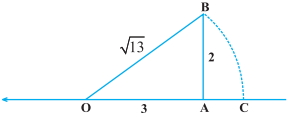
Locate $\sqrt{13}$ on the number line.
Solution
(N/A) We write $13$ as the sum of the squares of two natural numbers:
$13 = 9 + 4 = 3^{2} + 2^{2}$
On the number line,take $OA = 3$ units.
Draw $BA = 2$ units,perpendicular to $OA$. Join $OB$.
By Pythagoras theorem,$OB = \sqrt{OA^{2} + AB^{2}} = \sqrt{3^{2} + 2^{2}} = \sqrt{9 + 4} = \sqrt{13}$.
Using a compass with centre $O$ and radius $OB$,draw an arc which intersects the number line at the point $C$. Then,$C$ corresponds to $\sqrt{13}$.
$13 = 9 + 4 = 3^{2} + 2^{2}$
On the number line,take $OA = 3$ units.
Draw $BA = 2$ units,perpendicular to $OA$. Join $OB$.
By Pythagoras theorem,$OB = \sqrt{OA^{2} + AB^{2}} = \sqrt{3^{2} + 2^{2}} = \sqrt{9 + 4} = \sqrt{13}$.
Using a compass with centre $O$ and radius $OB$,draw an arc which intersects the number line at the point $C$. Then,$C$ corresponds to $\sqrt{13}$.
0 likes
View Solution37
MediumMCQ
Express $0.12 \overline{3}$ in the form $\frac{p}{q},$ where $p$ and $q$ are integers and $q \neq 0$.
A
$\frac{47}{300}$
B
$\frac{37}{300}$
C
$\frac{57}{300}$
D
$\frac{67}{300}$
Solution
(B) Let $x = 0.12333\ldots$ (Equation $1$)
Multiply by $10$ to shift the decimal point: $10x = 1.2333\ldots$ (Equation $2$)
Multiply Equation $1$ by $100$ to shift the decimal point past the non-repeating part: $100x = 12.333\ldots$ (Equation $3$)
Subtract Equation $2$ from Equation $3$:
$100x - 10x = 12.333\ldots - 1.2333\ldots$
$90x = 11.1$
$x = \frac{11.1}{90} = \frac{111}{900}$
Simplify the fraction by dividing both numerator and denominator by $3$:
$x = \frac{111 \div 3}{900 \div 3} = \frac{37}{300}$
Thus,$0.12 \overline{3} = \frac{37}{300}$.
Multiply by $10$ to shift the decimal point: $10x = 1.2333\ldots$ (Equation $2$)
Multiply Equation $1$ by $100$ to shift the decimal point past the non-repeating part: $100x = 12.333\ldots$ (Equation $3$)
Subtract Equation $2$ from Equation $3$:
$100x - 10x = 12.333\ldots - 1.2333\ldots$
$90x = 11.1$
$x = \frac{11.1}{90} = \frac{111}{900}$
Simplify the fraction by dividing both numerator and denominator by $3$:
$x = \frac{111 \div 3}{900 \div 3} = \frac{37}{300}$
Thus,$0.12 \overline{3} = \frac{37}{300}$.
0 likes
View Solution38
DifficultMCQ
Simplify: $(3 \sqrt{5}-5 \sqrt{2})(4 \sqrt{5}+3 \sqrt{2})$
A
$30-11 \sqrt{10}$
B
$30+11 \sqrt{10}$
C
$60-11 \sqrt{10}$
D
$60+11 \sqrt{10}$
Solution
(A) To simplify the expression $(3 \sqrt{5}-5 \sqrt{2})(4 \sqrt{5}+3 \sqrt{2})$,we use the distributive property ($FOIL$ method):
$= (3 \sqrt{5} \times 4 \sqrt{5}) + (3 \sqrt{5} \times 3 \sqrt{2}) - (5 \sqrt{2} \times 4 \sqrt{5}) - (5 \sqrt{2} \times 3 \sqrt{2})$
$= (12 \times 5) + (9 \sqrt{10}) - (20 \sqrt{10}) - (15 \times 2)$
$= 60 + 9 \sqrt{10} - 20 \sqrt{10} - 30$
$= (60 - 30) + (9 \sqrt{10} - 20 \sqrt{10})$
$= 30 - 11 \sqrt{10}$
$= (3 \sqrt{5} \times 4 \sqrt{5}) + (3 \sqrt{5} \times 3 \sqrt{2}) - (5 \sqrt{2} \times 4 \sqrt{5}) - (5 \sqrt{2} \times 3 \sqrt{2})$
$= (12 \times 5) + (9 \sqrt{10}) - (20 \sqrt{10}) - (15 \times 2)$
$= 60 + 9 \sqrt{10} - 20 \sqrt{10} - 30$
$= (60 - 30) + (9 \sqrt{10} - 20 \sqrt{10})$
$= 30 - 11 \sqrt{10}$
0 likes
View Solution39
DifficultMCQ
Find the value of $a$ in the following:
$\frac{6}{3 \sqrt{2}-2 \sqrt{3}}=3 \sqrt{2}-a \sqrt{3}$
$\frac{6}{3 \sqrt{2}-2 \sqrt{3}}=3 \sqrt{2}-a \sqrt{3}$
A
$2$
B
$-2$
C
$1$
D
$3$
Solution
(B) To solve $\frac{6}{3 \sqrt{2}-2 \sqrt{3}}$,we rationalize the denominator by multiplying the numerator and the denominator by the conjugate $(3 \sqrt{2}+2 \sqrt{3})$.
$\frac{6}{3 \sqrt{2}-2 \sqrt{3}} = \frac{6(3 \sqrt{2}+2 \sqrt{3})}{(3 \sqrt{2}-2 \sqrt{3})(3 \sqrt{2}+2 \sqrt{3})}$
Using the identity $(x-y)(x+y) = x^2 - y^2$,the denominator becomes $(3 \sqrt{2})^2 - (2 \sqrt{3})^2 = (9 \times 2) - (4 \times 3) = 18 - 12 = 6$.
So,the expression simplifies to $\frac{6(3 \sqrt{2}+2 \sqrt{3})}{6} = 3 \sqrt{2} + 2 \sqrt{3}$.
Comparing this with the given equation $3 \sqrt{2} - a \sqrt{3} = 3 \sqrt{2} + 2 \sqrt{3}$,we get $-a \sqrt{3} = 2 \sqrt{3}$.
Dividing both sides by $-\sqrt{3}$,we find $a = -2$.
$\frac{6}{3 \sqrt{2}-2 \sqrt{3}} = \frac{6(3 \sqrt{2}+2 \sqrt{3})}{(3 \sqrt{2}-2 \sqrt{3})(3 \sqrt{2}+2 \sqrt{3})}$
Using the identity $(x-y)(x+y) = x^2 - y^2$,the denominator becomes $(3 \sqrt{2})^2 - (2 \sqrt{3})^2 = (9 \times 2) - (4 \times 3) = 18 - 12 = 6$.
So,the expression simplifies to $\frac{6(3 \sqrt{2}+2 \sqrt{3})}{6} = 3 \sqrt{2} + 2 \sqrt{3}$.
Comparing this with the given equation $3 \sqrt{2} - a \sqrt{3} = 3 \sqrt{2} + 2 \sqrt{3}$,we get $-a \sqrt{3} = 2 \sqrt{3}$.
Dividing both sides by $-\sqrt{3}$,we find $a = -2$.
0 likes
View Solution40
DifficultMCQ
Simplify: $\left[5\left(8^{\frac{1}{3}}+27^{\frac{1}{3}}\right)^{3}\right]^{\frac{1}{4}}$
A
$-5$
B
$25$
C
$5$
D
$-125$
Solution
(C) Given expression: $\left[5\left(8^{\frac{1}{3}}+27^{\frac{1}{3}}\right)^{3}\right]^{\frac{1}{4}}$
First,simplify the terms inside the parentheses:
$8^{\frac{1}{3}} = (2^3)^{\frac{1}{3}} = 2$
$27^{\frac{1}{3}} = (3^3)^{\frac{1}{3}} = 3$
Substitute these values back into the expression:
$= \left[5(2+3)^{3}\right]^{\frac{1}{4}}$
$= \left[5(5)^{3}\right]^{\frac{1}{4}}$
$= \left[5^1 \cdot 5^3\right]^{\frac{1}{4}}$
$= \left[5^{1+3}\right]^{\frac{1}{4}}$
$= \left[5^4\right]^{\frac{1}{4}}$
$= 5^{4 \cdot \frac{1}{4}}$
$= 5^1 = 5$
First,simplify the terms inside the parentheses:
$8^{\frac{1}{3}} = (2^3)^{\frac{1}{3}} = 2$
$27^{\frac{1}{3}} = (3^3)^{\frac{1}{3}} = 3$
Substitute these values back into the expression:
$= \left[5(2+3)^{3}\right]^{\frac{1}{4}}$
$= \left[5(5)^{3}\right]^{\frac{1}{4}}$
$= \left[5^1 \cdot 5^3\right]^{\frac{1}{4}}$
$= \left[5^{1+3}\right]^{\frac{1}{4}}$
$= \left[5^4\right]^{\frac{1}{4}}$
$= 5^{4 \cdot \frac{1}{4}}$
$= 5^1 = 5$
0 likes
View Solution41
Medium
Find which of the variables $x, y, z$ and $u$ represent rational numbers and which irrational numbers:
$(i)$ $x^{2}=5$
$(ii)$ $y^{2}=9$
$(iii)$ $z^{2}=0.04$
$(iv)$ $u^{2}=\frac{17}{4}$
$(i)$ $x^{2}=5$
$(ii)$ $y^{2}=9$
$(iii)$ $z^{2}=0.04$
$(iv)$ $u^{2}=\frac{17}{4}$
Solution
(A) $(i)$ $x^{2}=5 \Rightarrow x=\sqrt{5},$ which is an irrational number because $\sqrt{5}$ cannot be expressed in the form $\frac{p}{q}$ where $p, q$ are integers and $q \neq 0$.
$(ii)$ $y^{2}=9 \Rightarrow y=\sqrt{9}=3,$ which is a rational number because it can be expressed as $\frac{3}{1}$.
$(iii)$ $z^{2}=0.04 \Rightarrow z=\sqrt{0.04}=0.2,$ which is a rational number because it is a terminating decimal and can be written as $\frac{2}{10} = \frac{1}{5}$.
$(iv)$ $u^{2}=\frac{17}{4} \Rightarrow u=\sqrt{\frac{17}{4}}=\frac{\sqrt{17}}{2}.$ Since $\sqrt{17}$ is not an integer,$u$ is an irrational number.
$(ii)$ $y^{2}=9 \Rightarrow y=\sqrt{9}=3,$ which is a rational number because it can be expressed as $\frac{3}{1}$.
$(iii)$ $z^{2}=0.04 \Rightarrow z=\sqrt{0.04}=0.2,$ which is a rational number because it is a terminating decimal and can be written as $\frac{2}{10} = \frac{1}{5}$.
$(iv)$ $u^{2}=\frac{17}{4} \Rightarrow u=\sqrt{\frac{17}{4}}=\frac{\sqrt{17}}{2}.$ Since $\sqrt{17}$ is not an integer,$u$ is an irrational number.
0 likes
View Solution42
Easy
Find three rational numbers between $-1$ and $-2$.
Solution
(N/A) To find rational numbers between $-1$ and $-2$,we can express them as fractions with a common denominator.
Let the numbers be $-1 = -10/10$ and $-2 = -20/10$.
Any three numbers between $-20/10$ and $-10/10$ are rational numbers.
For example,$-11/10, -12/10, -13/10$ are three rational numbers between $-1$ and $-2$.
Alternatively,these can be written as $-1.1, -1.2, -1.3$.
Let the numbers be $-1 = -10/10$ and $-2 = -20/10$.
Any three numbers between $-20/10$ and $-10/10$ are rational numbers.
For example,$-11/10, -12/10, -13/10$ are three rational numbers between $-1$ and $-2$.
Alternatively,these can be written as $-1.1, -1.2, -1.3$.
0 likes
View Solution43
EasyMCQ
Find three rational numbers between $0.1$ and $0.11$.
A
$0.101, 0.102, 0.103$
B
$0.111, 0.112, 0.113$
C
$0.011, 0.012, 0.013$
D
$0.12, 0.13, 0.14$
Solution
(A) To find rational numbers between $0.1$ and $0.11$,we can express them as decimals with more digits.
$0.1 = 0.100$
$0.11 = 0.110$
Now,we can easily identify numbers between $0.100$ and $0.110$.
Three such rational numbers are $0.101, 0.102,$ and $0.103$.
$0.1 = 0.100$
$0.11 = 0.110$
Now,we can easily identify numbers between $0.100$ and $0.110$.
Three such rational numbers are $0.101, 0.102,$ and $0.103$.
0 likes
View Solution44
EasyMCQ
Find three rational numbers between $\frac{5}{7}$ and $\frac{6}{7}$.
A
$\frac{51}{70}, \frac{52}{70}, \frac{53}{70}$
B
$\frac{5}{14}, \frac{6}{14}, \frac{7}{14}$
C
$\frac{11}{14}, \frac{12}{14}, \frac{13}{14}$
D
$\frac{51}{77}, \frac{52}{77}, \frac{53}{77}$
Solution
(A) To find three rational numbers between $\frac{5}{7}$ and $\frac{6}{7}$,we can multiply the numerator and denominator of both fractions by $(3+1) = 4$ or any larger number like $10$.
Multiplying by $10$:
$\frac{5}{7} = \frac{5 \times 10}{7 \times 10} = \frac{50}{70}$
$\frac{6}{7} = \frac{6 \times 10}{7 \times 10} = \frac{60}{70}$
Now,we can choose any three rational numbers between $\frac{50}{70}$ and $\frac{60}{70}$,such as $\frac{51}{70}, \frac{52}{70}, \text{ and } \frac{53}{70}$.
Thus,three rational numbers between $\frac{5}{7}$ and $\frac{6}{7}$ are $\frac{51}{70}, \frac{52}{70}, \text{ and } \frac{53}{70}$.
Multiplying by $10$:
$\frac{5}{7} = \frac{5 \times 10}{7 \times 10} = \frac{50}{70}$
$\frac{6}{7} = \frac{6 \times 10}{7 \times 10} = \frac{60}{70}$
Now,we can choose any three rational numbers between $\frac{50}{70}$ and $\frac{60}{70}$,such as $\frac{51}{70}, \frac{52}{70}, \text{ and } \frac{53}{70}$.
Thus,three rational numbers between $\frac{5}{7}$ and $\frac{6}{7}$ are $\frac{51}{70}, \frac{52}{70}, \text{ and } \frac{53}{70}$.
0 likes
View Solution45
EasyMCQ
Find three rational numbers between $\frac{1}{4}$ and $\frac{1}{5}$.
A
$\frac{9}{40}, \frac{17}{80}, \frac{18}{80}$
B
$\frac{9}{40}, \frac{19}{80}, \frac{18}{80}$
C
$\frac{21}{80}, \frac{22}{80}, \frac{23}{80}$
D
$\frac{15}{80}, \frac{16}{80}, \frac{17}{80}$
Solution
(B) To find rational numbers between $\frac{1}{4}$ and $\frac{1}{5}$,we first make their denominators equal.
Find the Least Common Multiple $(LCM)$ of $4$ and $5$,which is $20$.
$\frac{1}{4} = \frac{1 \times 5}{4 \times 5} = \frac{5}{20}$
$\frac{1}{5} = \frac{1 \times 4}{5 \times 4} = \frac{4}{20}$
To find three rational numbers,we multiply the numerator and denominator by $(3+1) = 4$.
$\frac{5}{20} = \frac{5 \times 4}{20 \times 4} = \frac{20}{80}$
$\frac{4}{20} = \frac{4 \times 4}{20 \times 4} = \frac{16}{80}$
The rational numbers between $\frac{16}{80}$ and $\frac{20}{80}$ are $\frac{17}{80}, \frac{18}{80}, \frac{19}{80}$.
Thus,three rational numbers between $\frac{1}{4}$ and $\frac{1}{5}$ are $\frac{17}{80}, \frac{18}{80}, \frac{19}{80}$ (or $\frac{9}{40}$).
Find the Least Common Multiple $(LCM)$ of $4$ and $5$,which is $20$.
$\frac{1}{4} = \frac{1 \times 5}{4 \times 5} = \frac{5}{20}$
$\frac{1}{5} = \frac{1 \times 4}{5 \times 4} = \frac{4}{20}$
To find three rational numbers,we multiply the numerator and denominator by $(3+1) = 4$.
$\frac{5}{20} = \frac{5 \times 4}{20 \times 4} = \frac{20}{80}$
$\frac{4}{20} = \frac{4 \times 4}{20 \times 4} = \frac{16}{80}$
The rational numbers between $\frac{16}{80}$ and $\frac{20}{80}$ are $\frac{17}{80}, \frac{18}{80}, \frac{19}{80}$.
Thus,three rational numbers between $\frac{1}{4}$ and $\frac{1}{5}$ are $\frac{17}{80}, \frac{18}{80}, \frac{19}{80}$ (or $\frac{9}{40}$).
0 likes
View Solution46
EasyMCQ
Insert a rational number and an irrational number between $2$ and $3$.
A
Rational: $2.5$,Irrational: $2.1010010001...$
B
Rational: $2.2$,Irrational: $2.5$
C
Rational: $2.5$,Irrational: $2.5$
D
Rational: $2.1010010001...$,Irrational: $2.5$
Solution
(A) rational number is a number that can be expressed in the form $\frac{p}{q}$,where $p$ and $q$ are integers and $q \neq 0$. The average of $2$ and $3$ is $\frac{2+3}{2} = 2.5$,which is a rational number.
An irrational number is a number that cannot be expressed in the form $\frac{p}{q}$ and has a non-terminating,non-recurring decimal expansion.
An example of an irrational number between $2$ and $3$ is $2.1010010001...$ (a non-terminating and non-recurring decimal).
An irrational number is a number that cannot be expressed in the form $\frac{p}{q}$ and has a non-terminating,non-recurring decimal expansion.
An example of an irrational number between $2$ and $3$ is $2.1010010001...$ (a non-terminating and non-recurring decimal).
0 likes
View Solution47
EasyMCQ
Insert a rational number and an irrational number between the following:
$0$ and $0.1$
$0$ and $0.1$
A
$0.05$ and $0.010110111...$
B
$0.04$ and $0.003000300003...$
C
$0.02$ and $0.001000100001...$
D
$0.06$ and $0.002000200002...$
Solution
(B) $0.04$ is a terminating decimal and it lies between $0$ and $0.1$. Hence,$0.04$ is a rational number which lies between $0$ and $0.1$.
Again,$0.003000300003...$ is a non-terminating and non-recurring decimal which lies between $0$ and $0.1$. Hence,$0.003000300003...$ is an irrational number between $0$ and $0.1$.
Again,$0.003000300003...$ is a non-terminating and non-recurring decimal which lies between $0$ and $0.1$. Hence,$0.003000300003...$ is an irrational number between $0$ and $0.1$.
0 likes
View Solution48
Easy
Insert a rational number and an irrational number between the following: $\frac{1}{3}$ and $\frac{1}{2}$
Solution
(N/A) To find a rational number between $\frac{1}{3}$ and $\frac{1}{2}$,we can express them with a common denominator:
$\frac{1}{3} = \frac{1 \times 4}{3 \times 4} = \frac{4}{12}$ and $\frac{1}{2} = \frac{1 \times 6}{2 \times 6} = \frac{6}{12}$.
Since $\frac{4}{12} < \frac{5}{12} < \frac{6}{12}$,the rational number $\frac{5}{12}$ lies between $\frac{1}{3}$ and $\frac{1}{2}$.
To find an irrational number,we convert the fractions to decimal form:
$\frac{1}{3} = 0.3333\ldots$ and $\frac{1}{2} = 0.5$.
An irrational number is a non-terminating and non-recurring decimal. We can choose a number like $0.414114111\ldots$,which is greater than $0.3333\ldots$ and less than $0.5$.
$\frac{1}{3} = \frac{1 \times 4}{3 \times 4} = \frac{4}{12}$ and $\frac{1}{2} = \frac{1 \times 6}{2 \times 6} = \frac{6}{12}$.
Since $\frac{4}{12} < \frac{5}{12} < \frac{6}{12}$,the rational number $\frac{5}{12}$ lies between $\frac{1}{3}$ and $\frac{1}{2}$.
To find an irrational number,we convert the fractions to decimal form:
$\frac{1}{3} = 0.3333\ldots$ and $\frac{1}{2} = 0.5$.
An irrational number is a non-terminating and non-recurring decimal. We can choose a number like $0.414114111\ldots$,which is greater than $0.3333\ldots$ and less than $0.5$.
0 likes
View Solution49
Easy
Insert a rational number and an irrational number between the following:
$\frac{-2}{5}$ and $\frac{1}{2}$
$\frac{-2}{5}$ and $\frac{1}{2}$
Solution
(N/A) First,convert the fractions to decimal form:
$\frac{-2}{5} = -0.4$ and $\frac{1}{2} = 0.5$
$1$. Rational number:
$A$ rational number is any number that can be expressed as $\frac{p}{q}$ where $p, q$ are integers and $q \neq 0$. Any terminating decimal is a rational number. We can choose $0$ (or $0.1$,$0.2$,etc.) as it lies between $-0.4$ and $0.5$.
Thus,$0$ is a rational number between $\frac{-2}{5}$ and $\frac{1}{2}$.
$2$. Irrational number:
An irrational number is a non-terminating and non-recurring decimal. We can construct one by following a pattern that does not repeat. For example,$0.1010010001...$ lies between $-0.4$ and $0.5$.
Thus,$0.1010010001...$ is an irrational number between $\frac{-2}{5}$ and $\frac{1}{2}$.
$\frac{-2}{5} = -0.4$ and $\frac{1}{2} = 0.5$
$1$. Rational number:
$A$ rational number is any number that can be expressed as $\frac{p}{q}$ where $p, q$ are integers and $q \neq 0$. Any terminating decimal is a rational number. We can choose $0$ (or $0.1$,$0.2$,etc.) as it lies between $-0.4$ and $0.5$.
Thus,$0$ is a rational number between $\frac{-2}{5}$ and $\frac{1}{2}$.
$2$. Irrational number:
An irrational number is a non-terminating and non-recurring decimal. We can construct one by following a pattern that does not repeat. For example,$0.1010010001...$ lies between $-0.4$ and $0.5$.
Thus,$0.1010010001...$ is an irrational number between $\frac{-2}{5}$ and $\frac{1}{2}$.
0 likes
View Solution50
Medium
Insert a rational number and an irrational number between the following:
$0.15$ and $0.16$
$0.15$ and $0.16$
Solution
(N/A) rational number is a number that can be expressed in the form $p/q$ where $p$ and $q$ are integers and $q \neq 0$. Any terminating decimal is a rational number.
$1.$ To find a rational number between $0.15$ and $0.16$,we can choose any terminating decimal such as $0.151$. Since $0.15 < 0.151 < 0.16$,$0.151$ is a rational number.
$2.$ An irrational number is a number whose decimal expansion is non-terminating and non-recurring. To find an irrational number between $0.15$ and $0.16$,we can construct a pattern that does not repeat.
$0.15101101110...$ is an irrational number because it is non-terminating and non-recurring,and it lies between $0.15$ and $0.16$.
$1.$ To find a rational number between $0.15$ and $0.16$,we can choose any terminating decimal such as $0.151$. Since $0.15 < 0.151 < 0.16$,$0.151$ is a rational number.
$2.$ An irrational number is a number whose decimal expansion is non-terminating and non-recurring. To find an irrational number between $0.15$ and $0.16$,we can construct a pattern that does not repeat.
$0.15101101110...$ is an irrational number because it is non-terminating and non-recurring,and it lies between $0.15$ and $0.16$.
0 likes
View SolutionNumber Systems — Mix Examples - Number Systems · Frequently Asked Questions
1Are these Number Systems questions useful for JEE and NEET?
Yes. All questions in this section are mapped to JEE Main and NEET exam patterns. Previous year questions from JEE Main, NEET, GUJCET and state-level exams are included with full solutions.
2Can I switch to Hindi or Gujarati for these questions?
Yes. Use the language tabs in the hero section or the sidebar to view the same questions and solutions in English, Hindi or Gujarati.
3How do I generate a question paper from this subtopic?
Use the Vedclass Exam Paper Generator — select the chapter and subtopic, set difficulty, and generate Sets A, B, C, D automatically. First 3 chapters of every subject are free.
Vedclass Products
For Students
Vedclass Test Series
Mock tests in real JEE/NEET style with performance analysis. 5-day free trial.
Start Free TrialFor Teachers
Exam Paper Generator
Generate Set A/B/C/D papers from this chapter in 2 minutes. 3 chapters free.
Try FreeFor Institutes
Online Exam Module
Live online exams with unlimited students, 360° analytics & white-label branding.
See DemoFor Teachers & Institutes
Generate a Number Systems Exam Paper in 2 Minutes
Select subtopic & difficulty — Sets A, B, C, D auto-generated with No Repeat logic.
First 3 chapters of every subject are free — no payment required.