
A English
Mix Examples - Number Systems Questions in English
Class 9 Mathematics · Number Systems · Mix Examples - Number Systems
260+
Questions
English
Language
100%
With Solutions
Showing 50 of 260 questions in English
51
Difficult
Insert a rational number and an irrational number between the following: $\sqrt{2}$ and $\sqrt{3}$
Solution
The decimal expansions are $\sqrt{2} \approx 1.4142135 \ldots$ and $\sqrt{3} \approx 1.7320508 \ldots$
$1$. Rational Number: $A$ terminating decimal like $1.5$ lies between $1.4142135 \ldots$ and $1.7320508 \ldots$. Since $1.5 = \frac{15}{10} = \frac{3}{2}$,it is a rational number.
$2$. Irrational Number: $A$ non-terminating and non-recurring decimal like $1.575575557 \ldots$ lies between $1.4142135 \ldots$ and $1.7320508 \ldots$. Thus,$1.575575557 \ldots$ is an irrational number.
$1$. Rational Number: $A$ terminating decimal like $1.5$ lies between $1.4142135 \ldots$ and $1.7320508 \ldots$. Since $1.5 = \frac{15}{10} = \frac{3}{2}$,it is a rational number.
$2$. Irrational Number: $A$ non-terminating and non-recurring decimal like $1.575575557 \ldots$ lies between $1.4142135 \ldots$ and $1.7320508 \ldots$. Thus,$1.575575557 \ldots$ is an irrational number.
0 likes
View Solution52
Difficult
Insert a rational number and an irrational number between the following:
$2.357$ and $3.121$
$2.357$ and $3.121$
Solution
(N/A) rational number is any number that can be expressed in the form $p/q$ where $p$ and $q$ are integers and $q \neq 0$. Since $2.357 < 3 < 3.121$,the integer $3$ is a rational number between $2.357$ and $3.121$.
An irrational number is a number whose decimal expansion is non-terminating and non-recurring. $A$ number like $3.101101110\dots$ satisfies $2.357 < 3.101101110\dots < 3.121$,therefore,it is an irrational number between the given values.
An irrational number is a number whose decimal expansion is non-terminating and non-recurring. $A$ number like $3.101101110\dots$ satisfies $2.357 < 3.101101110\dots < 3.121$,therefore,it is an irrational number between the given values.
0 likes
View Solution53
Medium
Insert a rational number and an irrational number between the following:
$0.0001$ and $0.001$
$0.0001$ and $0.001$
Solution
(N/A) rational number is a number that can be expressed in the form $p/q$,where $p$ and $q$ are integers and $q \neq 0$. $A$ terminating decimal is a rational number.
$1$. Rational number: We can choose $0.0005$. Since $0.0005 = 5/10000 = 1/2000$,it is a rational number lying between $0.0001$ and $0.001$.
$2$. Irrational number: An irrational number is a non-terminating and non-recurring decimal. We can construct one by following a pattern: $0.0001010010001...$ This number is clearly greater than $0.0001$ and less than $0.001$,and it does not terminate or repeat,making it an irrational number.
$1$. Rational number: We can choose $0.0005$. Since $0.0005 = 5/10000 = 1/2000$,it is a rational number lying between $0.0001$ and $0.001$.
$2$. Irrational number: An irrational number is a non-terminating and non-recurring decimal. We can construct one by following a pattern: $0.0001010010001...$ This number is clearly greater than $0.0001$ and less than $0.001$,and it does not terminate or repeat,making it an irrational number.
0 likes
View Solution54
Medium
Insert a rational number and an irrational number between the following:
$3.623623$ and $0.484848$
$3.623623$ and $0.484848$
Solution
(N/A) To find a rational number between $0.484848$ and $3.623623$,we can choose any terminating decimal or integer within this range. For example,$1$ is a rational number because it can be expressed as $\frac{1}{1}$.
To find an irrational number between $0.484848$ and $3.623623$,we need a non-terminating and non-recurring decimal. For example,$1.909009000\dots$ is an irrational number because its decimal expansion neither terminates nor repeats.
To find an irrational number between $0.484848$ and $3.623623$,we need a non-terminating and non-recurring decimal. For example,$1.909009000\dots$ is an irrational number because its decimal expansion neither terminates nor repeats.
0 likes
View Solution55
Medium
Insert a rational number and an irrational number between the following:
$6.375289$ and $6.375738$
$6.375289$ and $6.375738$
Solution
(N/A) $6.3753$ (a terminating decimal) is a rational number between $6.375289$ and $6.375738$.
$6.375414114111...$ (a non-terminating and non-recurring decimal) is an irrational number lying between $6.375289$ and $6.375738$.
$6.375414114111...$ (a non-terminating and non-recurring decimal) is an irrational number lying between $6.375289$ and $6.375738$.
0 likes
View Solution56
Medium
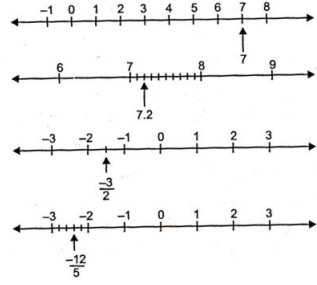
Represent the following numbers on the number line:
$7, 7.2, \frac{-3}{2}, \frac{-12}{5}$
$7, 7.2, \frac{-3}{2}, \frac{-12}{5}$
Solution
(N/A) To represent the given numbers on the number line:
$1$. $7$: This is a positive integer. Locate $7$ on the number line to the right of $0$.
$2$. $7.2$: This is $7 + 0.2$. Divide the segment between $7$ and $8$ into $10$ equal parts. The second mark after $7$ represents $7.2$.
$3$. $\frac{-3}{2} = -1.5$: This is a negative rational number. It lies exactly halfway between $-1$ and $-2$ on the left side of $0$.
$4$. $\frac{-12}{5} = -2.4$: This is a negative rational number. Divide the segment between $-2$ and $-3$ into $5$ equal parts. The fourth mark to the left of $-2$ represents $-2.4$.
$1$. $7$: This is a positive integer. Locate $7$ on the number line to the right of $0$.
$2$. $7.2$: This is $7 + 0.2$. Divide the segment between $7$ and $8$ into $10$ equal parts. The second mark after $7$ represents $7.2$.
$3$. $\frac{-3}{2} = -1.5$: This is a negative rational number. It lies exactly halfway between $-1$ and $-2$ on the left side of $0$.
$4$. $\frac{-12}{5} = -2.4$: This is a negative rational number. Divide the segment between $-2$ and $-3$ into $5$ equal parts. The fourth mark to the left of $-2$ represents $-2.4$.
0 likes
View Solution57
Medium
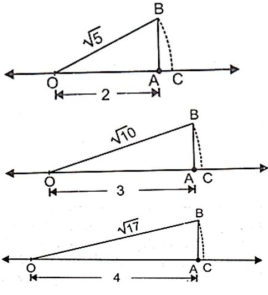
Locate $\sqrt{5}, \sqrt{10}$ and $\sqrt{17}$ on the number line.
Solution
(N/A) Presentation of $\sqrt{5}$ on the number line:
We write $5$ as the sum of the squares of two natural numbers:
$5 = 1 + 4 = 1^{2} + 2^{2}$
On the number line,take $OA = 2$ units.
Draw $BA = 1$ unit,perpendicular to $OA$. Join $OB$.
By Pythagoras theorem,$OB = \sqrt{2^{2} + 1^{2}} = \sqrt{5}$.
Using a compass with center $O$ and radius $OB$,draw an arc which intersects the number line at point $C$. Then,$C$ corresponds to $\sqrt{5}$.
Presentation of $\sqrt{10}$ on the number line:
We write $10$ as the sum of the squares of two natural numbers:
$10 = 1 + 9 = 1^{2} + 3^{2}$
On the number line,take $OA = 3$ units.
Draw $BA = 1$ unit,perpendicular to $OA$. Join $OB$.
By Pythagoras theorem,$OB = \sqrt{3^{2} + 1^{2}} = \sqrt{10}$.
Using a compass with center $O$ and radius $OB$,draw an arc which intersects the number line at point $C$. Then,$C$ corresponds to $\sqrt{10}$.
Presentation of $\sqrt{17}$ on the number line:
We write $17$ as the sum of the squares of two natural numbers:
$17 = 1 + 16 = 1^{2} + 4^{2}$
On the number line,take $OA = 4$ units.
Draw $BA = 1$ unit,perpendicular to $OA$. Join $OB$.
By Pythagoras theorem,$OB = \sqrt{4^{2} + 1^{2}} = \sqrt{17}$.
Using a compass with center $O$ and radius $OB$,draw an arc which intersects the number line at point $C$. Then,$C$ corresponds to $\sqrt{17}$.
We write $5$ as the sum of the squares of two natural numbers:
$5 = 1 + 4 = 1^{2} + 2^{2}$
On the number line,take $OA = 2$ units.
Draw $BA = 1$ unit,perpendicular to $OA$. Join $OB$.
By Pythagoras theorem,$OB = \sqrt{2^{2} + 1^{2}} = \sqrt{5}$.
Using a compass with center $O$ and radius $OB$,draw an arc which intersects the number line at point $C$. Then,$C$ corresponds to $\sqrt{5}$.
Presentation of $\sqrt{10}$ on the number line:
We write $10$ as the sum of the squares of two natural numbers:
$10 = 1 + 9 = 1^{2} + 3^{2}$
On the number line,take $OA = 3$ units.
Draw $BA = 1$ unit,perpendicular to $OA$. Join $OB$.
By Pythagoras theorem,$OB = \sqrt{3^{2} + 1^{2}} = \sqrt{10}$.
Using a compass with center $O$ and radius $OB$,draw an arc which intersects the number line at point $C$. Then,$C$ corresponds to $\sqrt{10}$.
Presentation of $\sqrt{17}$ on the number line:
We write $17$ as the sum of the squares of two natural numbers:
$17 = 1 + 16 = 1^{2} + 4^{2}$
On the number line,take $OA = 4$ units.
Draw $BA = 1$ unit,perpendicular to $OA$. Join $OB$.
By Pythagoras theorem,$OB = \sqrt{4^{2} + 1^{2}} = \sqrt{17}$.
Using a compass with center $O$ and radius $OB$,draw an arc which intersects the number line at point $C$. Then,$C$ corresponds to $\sqrt{17}$.
0 likes
View Solution58
Medium
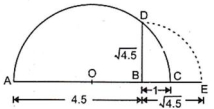
Represent $\sqrt{4.5}$ geometrically on the number line.
Solution
(N/A) $1$. Draw a line segment $AB = 4.5$ units on a number line.
$2$. From point $B$,mark a distance of $1$ unit and label the new point as $C$. Now,$AC = 4.5 + 1 = 5.5$ units.
$3$. Find the midpoint of $AC$ and label it as $O$.
$4$. Draw a semicircle with center $O$ and radius $OC$ (or $OA$).
$5$. Draw a line perpendicular to $AC$ at point $B$,which intersects the semicircle at point $D$. The length of $BD$ is $\sqrt{4.5}$.
$6$. With $B$ as the center and $BD$ as the radius,draw an arc that intersects the number line at point $E$. The point $E$ represents $\sqrt{4.5}$ on the number line.
$2$. From point $B$,mark a distance of $1$ unit and label the new point as $C$. Now,$AC = 4.5 + 1 = 5.5$ units.
$3$. Find the midpoint of $AC$ and label it as $O$.
$4$. Draw a semicircle with center $O$ and radius $OC$ (or $OA$).
$5$. Draw a line perpendicular to $AC$ at point $B$,which intersects the semicircle at point $D$. The length of $BD$ is $\sqrt{4.5}$.
$6$. With $B$ as the center and $BD$ as the radius,draw an arc that intersects the number line at point $E$. The point $E$ represents $\sqrt{4.5}$ on the number line.
0 likes
View Solution59
Medium
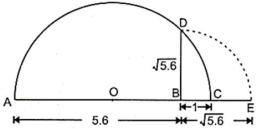
Represent the number $\sqrt{5.6}$ geometrically on the number line.
Solution
(N/A) To represent $\sqrt{5.6}$ on the number line,follow these steps:
$1$. Draw a line segment $AB = 5.6 \text{ units}$ on the number line.
$2$. From point $B$,mark a point $C$ such that $BC = 1 \text{ unit}$. Now,$AC = 5.6 + 1 = 6.6 \text{ units}$.
$3$. Find the midpoint $O$ of $AC$. The length $AO = OC = 6.6 / 2 = 3.3 \text{ units}$.
$4$. Draw a semicircle with center $O$ and radius $OA = 3.3 \text{ units}$.
$5$. Draw a perpendicular line at point $B$ to the line $AC$,which intersects the semicircle at point $D$.
$6$. The length $BD$ is equal to $\sqrt{5.6}$.
$7$. With $B$ as the center and $BD$ as the radius,draw an arc on the number line to intersect it at point $E$. The distance $BE$ represents $\sqrt{5.6}$ on the number line.
$1$. Draw a line segment $AB = 5.6 \text{ units}$ on the number line.
$2$. From point $B$,mark a point $C$ such that $BC = 1 \text{ unit}$. Now,$AC = 5.6 + 1 = 6.6 \text{ units}$.
$3$. Find the midpoint $O$ of $AC$. The length $AO = OC = 6.6 / 2 = 3.3 \text{ units}$.
$4$. Draw a semicircle with center $O$ and radius $OA = 3.3 \text{ units}$.
$5$. Draw a perpendicular line at point $B$ to the line $AC$,which intersects the semicircle at point $D$.
$6$. The length $BD$ is equal to $\sqrt{5.6}$.
$7$. With $B$ as the center and $BD$ as the radius,draw an arc on the number line to intersect it at point $E$. The distance $BE$ represents $\sqrt{5.6}$ on the number line.
0 likes
View Solution60
Medium
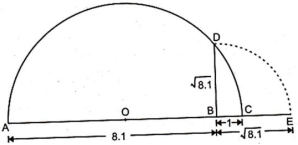
Represent $\sqrt{8.1}$ geometrically on the number line.
Solution
(N/A) $1$. Draw a line segment $AB = 8.1$ units on a number line.
$2$. From point $B$,mark a distance of $1$ unit and label the new point as $C$. Now,$AC = 8.1 + 1 = 9.1$ units.
$3$. Find the midpoint of $AC$ and label it as $O$.
$4$. Draw a semicircle with center $O$ and radius $OC$ (or $OA$).
$5$. Draw a line perpendicular to $AC$ at point $B$,which intersects the semicircle at point $D$. The length of $BD$ is $\sqrt{8.1}$.
$6$. With $B$ as the center and $BD$ as the radius,draw an arc that intersects the number line at point $E$. The distance $BE$ represents $\sqrt{8.1}$ on the number line.
$2$. From point $B$,mark a distance of $1$ unit and label the new point as $C$. Now,$AC = 8.1 + 1 = 9.1$ units.
$3$. Find the midpoint of $AC$ and label it as $O$.
$4$. Draw a semicircle with center $O$ and radius $OC$ (or $OA$).
$5$. Draw a line perpendicular to $AC$ at point $B$,which intersects the semicircle at point $D$. The length of $BD$ is $\sqrt{8.1}$.
$6$. With $B$ as the center and $BD$ as the radius,draw an arc that intersects the number line at point $E$. The distance $BE$ represents $\sqrt{8.1}$ on the number line.
0 likes
View Solution61
Medium
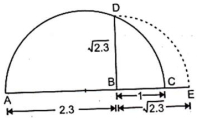
Represent $\sqrt{2.3}$ geometrically on the number line.
Solution
(N/A) $1$. Draw a line segment $AB = 2.3$ units on a line.
$2$. From $B$,mark a distance of $1$ unit and label the new point as $C$. Now,$AC = 2.3 + 1 = 3.3$ units.
$3$. Find the midpoint of $AC$ and mark it as $O$.
$4$. Draw a semicircle with center $O$ and radius $OC$.
$5$. Draw a line perpendicular to $AC$ passing through $B$ that intersects the semicircle at point $D$. The length $BD$ is equal to $\sqrt{2.3}$.
$6$. With $B$ as the center and $BD$ as the radius,draw an arc that intersects the number line at point $E$. The point $E$ represents $\sqrt{2.3}$ on the number line.
$2$. From $B$,mark a distance of $1$ unit and label the new point as $C$. Now,$AC = 2.3 + 1 = 3.3$ units.
$3$. Find the midpoint of $AC$ and mark it as $O$.
$4$. Draw a semicircle with center $O$ and radius $OC$.
$5$. Draw a line perpendicular to $AC$ passing through $B$ that intersects the semicircle at point $D$. The length $BD$ is equal to $\sqrt{2.3}$.
$6$. With $B$ as the center and $BD$ as the radius,draw an arc that intersects the number line at point $E$. The point $E$ represents $\sqrt{2.3}$ on the number line.
0 likes
View Solution62
MediumMCQ
Express the following in the form $\frac{p}{q},$ where $p$ and $q$ are integers and $q \neq 0$ :
$0.2$
$0.2$
A
$\frac{1}{6}$
B
$\frac{1}{5}$
C
$\frac{2}{5}$
D
$\frac{3}{5}$
Solution
(B) To express the decimal $0.2$ in the form $\frac{p}{q}$,we follow these steps:
$1$. Write the decimal as a fraction with a denominator of $10$ because there is one digit after the decimal point: $0.2 = \frac{2}{10}$.
$2$. Simplify the fraction by dividing both the numerator and the denominator by their greatest common divisor,which is $2$: $\frac{2 \div 2}{10 \div 2} = \frac{1}{5}$.
$3$. Thus,$0.2 = \frac{1}{5}$,where $p = 1$ and $q = 5$ are integers and $q \neq 0$.
$1$. Write the decimal as a fraction with a denominator of $10$ because there is one digit after the decimal point: $0.2 = \frac{2}{10}$.
$2$. Simplify the fraction by dividing both the numerator and the denominator by their greatest common divisor,which is $2$: $\frac{2 \div 2}{10 \div 2} = \frac{1}{5}$.
$3$. Thus,$0.2 = \frac{1}{5}$,where $p = 1$ and $q = 5$ are integers and $q \neq 0$.
0 likes
View Solution63
EasyMCQ
Express the following in the form $\frac{p}{q},$ where $p$ and $q$ are integers and $q \neq 0$ :
$0.888 \ldots$
$0.888 \ldots$
A
$\frac{8}{3}$
B
$\frac{5}{9}$
C
$\frac{8}{9}$
D
$\frac{8}{7}$
Solution
(C) Let $x = 0.888 \ldots = 0.\overline{8} \quad \dots(1)$
Multiplying both sides by $10$,we get:
$10x = 8.888 \ldots = 8.\overline{8} \quad \dots(2)$
Subtracting equation $(1)$ from equation $(2)$:
$10x - x = 8.\overline{8} - 0.\overline{8}$
$9x = 8$
Therefore,$x = \frac{8}{9}$.
Multiplying both sides by $10$,we get:
$10x = 8.888 \ldots = 8.\overline{8} \quad \dots(2)$
Subtracting equation $(1)$ from equation $(2)$:
$10x - x = 8.\overline{8} - 0.\overline{8}$
$9x = 8$
Therefore,$x = \frac{8}{9}$.
0 likes
View Solution64
MediumMCQ
Express the following in the form $\frac{p}{q},$ where $p$ and $q$ are integers and $q \neq 0$ :
$5. \overline{2}$
$5. \overline{2}$
A
$\frac{57}{2}$
B
$\frac{46}{9}$
C
$\frac{47}{3}$
D
$\frac{47}{9}$
Solution
(D) Let $x = 5. \overline{2} = 5.2222 \ldots \quad \dots(1)$
Multiplying both sides by $10,$ we get
$10x = 52.2222 \ldots = 52. \overline{2} \quad \dots(2)$
Subtracting equation $(1)$ from equation $(2)$:
$10x - x = 52.2222 \ldots - 5.2222 \ldots$
$9x = 47$
$x = \frac{47}{9}$
Hence,$5. \overline{2} = \frac{47}{9}$.
Multiplying both sides by $10,$ we get
$10x = 52.2222 \ldots = 52. \overline{2} \quad \dots(2)$
Subtracting equation $(1)$ from equation $(2)$:
$10x - x = 52.2222 \ldots - 5.2222 \ldots$
$9x = 47$
$x = \frac{47}{9}$
Hence,$5. \overline{2} = \frac{47}{9}$.
0 likes
View Solution65
EasyMCQ
Express the following in the form $\frac{p}{q},$ where $p$ and $q$ are integers and $q \neq 0$ :
$0 . \overline{001}$
$0 . \overline{001}$
A
$\frac{1}{999}$
B
$\frac{1}{9999}$
C
$\frac{-1}{999}$
D
$\frac{1}{990}$
Solution
(A) Let $x = 0.\overline{001} = 0.001001...$ $(1)$
Since there are three repeating digits,multiply both sides by $1000$:
$1000x = 1.001001...$ $(2)$
Subtracting equation $(1)$ from equation $(2)$:
$1000x - x = 1.001001... - 0.001001...$
$999x = 1$
$x = \frac{1}{999}$
Thus,the number $0.\overline{001}$ in the form $\frac{p}{q}$ is $\frac{1}{999}$.
Since there are three repeating digits,multiply both sides by $1000$:
$1000x = 1.001001...$ $(2)$
Subtracting equation $(1)$ from equation $(2)$:
$1000x - x = 1.001001... - 0.001001...$
$999x = 1$
$x = \frac{1}{999}$
Thus,the number $0.\overline{001}$ in the form $\frac{p}{q}$ is $\frac{1}{999}$.
0 likes
View Solution66
MediumMCQ
Express the following in the form $\frac{p}{q},$ where $p$ and $q$ are integers and $q \neq 0$ :
$0.2555 \ldots$
$0.2555 \ldots$
A
$\frac{33}{90}$
B
$\frac{23}{90}$
C
$\frac{44}{90}$
D
$\frac{23}{45}$
Solution
(B) Let $x = 0.2555 \ldots = 0.2\overline{5} \quad ....(1)$
Multiply both sides by $10$:
$10x = 2.555 \ldots = 2.\overline{5} \quad ....(2)$
Multiply both sides by $100$:
$100x = 25.555 \ldots = 25.\overline{5} \quad ....(3)$
Subtracting equation $(2)$ from equation $(3)$:
$100x - 10x = 25.\overline{5} - 2.\overline{5}$
$90x = 23$
Therefore,$x = \frac{23}{90}$.
Multiply both sides by $10$:
$10x = 2.555 \ldots = 2.\overline{5} \quad ....(2)$
Multiply both sides by $100$:
$100x = 25.555 \ldots = 25.\overline{5} \quad ....(3)$
Subtracting equation $(2)$ from equation $(3)$:
$100x - 10x = 25.\overline{5} - 2.\overline{5}$
$90x = 23$
Therefore,$x = \frac{23}{90}$.
0 likes
View Solution67
DifficultMCQ
Express the following in the form $\frac{p}{q},$ where $p$ and $q$ are integers and $q \neq 0$ :
$0.1\overline{34}$
$0.1\overline{34}$
A
$\frac{123}{880}$
B
$\frac{123}{990}$
C
$\frac{133}{990}$
D
$\frac{133}{999}$
Solution
(C) Let $x = 0.1\overline{34} = 0.1343434... \quad ....(1)$
Multiply both sides by $10$ to shift the non-repeating part:
$10x = 1.343434... \quad ....(2)$
Multiply equation $(2)$ by $100$ to shift the repeating part:
$1000x = 134.343434... \quad ....(3)$
Subtract equation $(2)$ from equation $(3)$:
$1000x - 10x = 134.343434... - 1.343434...$
$990x = 133$
Therefore,$x = \frac{133}{990}$.
Multiply both sides by $10$ to shift the non-repeating part:
$10x = 1.343434... \quad ....(2)$
Multiply equation $(2)$ by $100$ to shift the repeating part:
$1000x = 134.343434... \quad ....(3)$
Subtract equation $(2)$ from equation $(3)$:
$1000x - 10x = 134.343434... - 1.343434...$
$990x = 133$
Therefore,$x = \frac{133}{990}$.
0 likes
View Solution68
DifficultMCQ
Express the following in the form $\frac{p}{q},$ where $p$ and $q$ are integers and $q \neq 0$ :
$0.00323232 \ldots$
$0.00323232 \ldots$
A
$\frac{9}{2470}$
B
$\frac{5}{2455}$
C
$\frac{7}{2475}$
D
$\frac{8}{2475}$
Solution
(D) Let $x = 0.00323232 \ldots = 0.00\overline{32} \quad \dots(1)$
Multiply equation $(1)$ by $100$ to shift the decimal point:
$100x = 0.323232 \ldots = 0.\overline{32} \quad \dots(2)$
Multiply equation $(2)$ by $100$ again to shift the decimal point past the repeating part:
$10000x = 32.323232 \ldots = 32.\overline{32} \quad \dots(3)$
Subtracting equation $(2)$ from equation $(3)$:
$10000x - 100x = 32.\overline{32} - 0.\overline{32}$
$9900x = 32$
$x = \frac{32}{9900}$
Simplifying the fraction by dividing both numerator and denominator by $4$:
$x = \frac{32 \div 4}{9900 \div 4} = \frac{8}{2475}$
Multiply equation $(1)$ by $100$ to shift the decimal point:
$100x = 0.323232 \ldots = 0.\overline{32} \quad \dots(2)$
Multiply equation $(2)$ by $100$ again to shift the decimal point past the repeating part:
$10000x = 32.323232 \ldots = 32.\overline{32} \quad \dots(3)$
Subtracting equation $(2)$ from equation $(3)$:
$10000x - 100x = 32.\overline{32} - 0.\overline{32}$
$9900x = 32$
$x = \frac{32}{9900}$
Simplifying the fraction by dividing both numerator and denominator by $4$:
$x = \frac{32 \div 4}{9900 \div 4} = \frac{8}{2475}$
0 likes
View Solution69
MediumMCQ
Express the following in the form $\frac{p}{q},$ where $p$ and $q$ are integers and $q \neq 0$ :
$0.404040 \ldots$
$0.404040 \ldots$
A
$\frac{40}{99}$
B
$\frac{50}{99}$
C
$\frac{40}{90}$
D
$\frac{50}{90}$
Solution
(A) Let $x = 0.404040 \ldots = 0.\overline{40} \quad \dots(1)$
Since there are two repeating digits,multiply both sides by $100$:
$100x = 40.404040 \ldots = 40.\overline{40} \quad \dots(2)$
Subtracting equation $(1)$ from equation $(2)$:
$100x - x = 40.\overline{40} - 0.\overline{40}$
$99x = 40$
$x = \frac{40}{99}$
Thus,the number $0.404040 \ldots$ expressed in the form $\frac{p}{q}$ is $\frac{40}{99}$.
Since there are two repeating digits,multiply both sides by $100$:
$100x = 40.404040 \ldots = 40.\overline{40} \quad \dots(2)$
Subtracting equation $(1)$ from equation $(2)$:
$100x - x = 40.\overline{40} - 0.\overline{40}$
$99x = 40$
$x = \frac{40}{99}$
Thus,the number $0.404040 \ldots$ expressed in the form $\frac{p}{q}$ is $\frac{40}{99}$.
0 likes
View Solution70
Difficult
Show that $0.142857142857 \ldots = \frac{1}{7}$.
Solution
(N/A) Let $x = 0.142857142857 \ldots$ $(1)$
Since the repeating block has $6$ digits,multiply both sides by $1,000,000$:
$1,000,000 x = 142857.142857142857 \ldots$ $(2)$
Subtracting equation $(1)$ from equation $(2)$:
$1,000,000 x - x = 142857.142857 \ldots - 0.142857 \ldots$
$999,999 x = 142857$
Solving for $x$:
$x = \frac{142857}{999999}$
Dividing both numerator and denominator by $142857$:
$x = \frac{1}{7}$
Thus,$0.142857142857 \ldots = \frac{1}{7}$.
Since the repeating block has $6$ digits,multiply both sides by $1,000,000$:
$1,000,000 x = 142857.142857142857 \ldots$ $(2)$
Subtracting equation $(1)$ from equation $(2)$:
$1,000,000 x - x = 142857.142857 \ldots - 0.142857 \ldots$
$999,999 x = 142857$
Solving for $x$:
$x = \frac{142857}{999999}$
Dividing both numerator and denominator by $142857$:
$x = \frac{1}{7}$
Thus,$0.142857142857 \ldots = \frac{1}{7}$.
0 likes
View Solution71
MediumMCQ
Simplify the following:
$\sqrt{45}-3 \sqrt{20}+4 \sqrt{5}$
$\sqrt{45}-3 \sqrt{20}+4 \sqrt{5}$
A
$\sqrt{3}$
B
$\sqrt{7}$
C
$\sqrt{5}$
D
$\sqrt{11}$
Solution
(C) To simplify the expression $\sqrt{45}-3 \sqrt{20}+4 \sqrt{5}$,we first factor the numbers inside the square roots:
$\sqrt{45} = \sqrt{9 \times 5} = 3 \sqrt{5}$
$\sqrt{20} = \sqrt{4 \times 5} = 2 \sqrt{5}$
Now,substitute these values back into the expression:
$3 \sqrt{5} - 3(2 \sqrt{5}) + 4 \sqrt{5}$
$= 3 \sqrt{5} - 6 \sqrt{5} + 4 \sqrt{5}$
$= (3 - 6 + 4) \sqrt{5}$
$= 1 \sqrt{5} = \sqrt{5}$
$\sqrt{45} = \sqrt{9 \times 5} = 3 \sqrt{5}$
$\sqrt{20} = \sqrt{4 \times 5} = 2 \sqrt{5}$
Now,substitute these values back into the expression:
$3 \sqrt{5} - 3(2 \sqrt{5}) + 4 \sqrt{5}$
$= 3 \sqrt{5} - 6 \sqrt{5} + 4 \sqrt{5}$
$= (3 - 6 + 4) \sqrt{5}$
$= 1 \sqrt{5} = \sqrt{5}$
0 likes
View Solution72
MediumMCQ
Simplify the following:
$\frac{\sqrt{24}}{8} + \frac{\sqrt{54}}{9}$
$\frac{\sqrt{24}}{8} + \frac{\sqrt{54}}{9}$
A
$\frac{7 \sqrt{3}}{12}$
B
$\frac{5 \sqrt{6}}{12}$
C
$\frac{7 \sqrt{6}}{11}$
D
$\frac{7 \sqrt{6}}{12}$
Solution
(D) First,simplify the square roots:
$\sqrt{24} = \sqrt{4 \times 6} = 2 \sqrt{6}$
$\sqrt{54} = \sqrt{9 \times 6} = 3 \sqrt{6}$
Substitute these into the expression:
$\frac{2 \sqrt{6}}{8} + \frac{3 \sqrt{6}}{9} = \frac{\sqrt{6}}{4} + \frac{\sqrt{6}}{3}$
Find a common denominator,which is $12$:
$\frac{3 \sqrt{6}}{12} + \frac{4 \sqrt{6}}{12} = \frac{3 \sqrt{6} + 4 \sqrt{6}}{12} = \frac{7 \sqrt{6}}{12}$
$\sqrt{24} = \sqrt{4 \times 6} = 2 \sqrt{6}$
$\sqrt{54} = \sqrt{9 \times 6} = 3 \sqrt{6}$
Substitute these into the expression:
$\frac{2 \sqrt{6}}{8} + \frac{3 \sqrt{6}}{9} = \frac{\sqrt{6}}{4} + \frac{\sqrt{6}}{3}$
Find a common denominator,which is $12$:
$\frac{3 \sqrt{6}}{12} + \frac{4 \sqrt{6}}{12} = \frac{3 \sqrt{6} + 4 \sqrt{6}}{12} = \frac{7 \sqrt{6}}{12}$
0 likes
View Solution73
MediumMCQ
Simplify the following:
$4 \sqrt{12} \times 7 \sqrt{6}$
$4 \sqrt{12} \times 7 \sqrt{6}$
A
$168 \sqrt{2}$
B
$164 \sqrt{2}$
C
$158 \sqrt{5}$
D
$268 \sqrt{7}$
Solution
(A) To simplify the expression $4 \sqrt{12} \times 7 \sqrt{6}$,we first factorize the numbers inside the square roots:
$4 \sqrt{12} = 4 \sqrt{4 \times 3} = 4 \times 2 \sqrt{3} = 8 \sqrt{3}$
$7 \sqrt{6} = 7 \sqrt{2 \times 3}$
Now,multiply the two expressions:
$8 \sqrt{3} \times 7 \sqrt{2 \times 3} = (8 \times 7) \times (\sqrt{3} \times \sqrt{3}) \times \sqrt{2}$
$= 56 \times 3 \times \sqrt{2}$
$= 168 \sqrt{2}$
$4 \sqrt{12} = 4 \sqrt{4 \times 3} = 4 \times 2 \sqrt{3} = 8 \sqrt{3}$
$7 \sqrt{6} = 7 \sqrt{2 \times 3}$
Now,multiply the two expressions:
$8 \sqrt{3} \times 7 \sqrt{2 \times 3} = (8 \times 7) \times (\sqrt{3} \times \sqrt{3}) \times \sqrt{2}$
$= 56 \times 3 \times \sqrt{2}$
$= 168 \sqrt{2}$
0 likes
View Solution74
MediumMCQ
Simplify the following:
$4 \sqrt{28} \div 3 \sqrt{7}$
$4 \sqrt{28} \div 3 \sqrt{7}$
A
$\frac{7}{3}$
B
$\frac{8}{3}$
C
$\frac{8}{5}$
D
$\frac{7}{4}$
Solution
(B) To simplify the expression $4 \sqrt{28} \div 3 \sqrt{7}$,we first express the division as a fraction:
$\frac{4 \sqrt{28}}{3 \sqrt{7}}$
Next,we simplify the square root of $28$ by factoring it as $28 = 4 \times 7$:
$\sqrt{28} = \sqrt{4 \times 7} = 2 \sqrt{7}$
Now,substitute this back into the expression:
$\frac{4 \times (2 \sqrt{7})}{3 \sqrt{7}}$
Cancel the common term $\sqrt{7}$ from the numerator and the denominator:
$\frac{4 \times 2}{3} = \frac{8}{3}$
$\frac{4 \sqrt{28}}{3 \sqrt{7}}$
Next,we simplify the square root of $28$ by factoring it as $28 = 4 \times 7$:
$\sqrt{28} = \sqrt{4 \times 7} = 2 \sqrt{7}$
Now,substitute this back into the expression:
$\frac{4 \times (2 \sqrt{7})}{3 \sqrt{7}}$
Cancel the common term $\sqrt{7}$ from the numerator and the denominator:
$\frac{4 \times 2}{3} = \frac{8}{3}$
0 likes
View Solution75
MediumMCQ
Simplify the following:
$3 \sqrt{3}+2 \sqrt{27}+\frac{7}{\sqrt{3}}$
$3 \sqrt{3}+2 \sqrt{27}+\frac{7}{\sqrt{3}}$
A
$10 \sqrt{3}$
B
$\frac{34}{3} \sqrt{3}$
C
$12 \sqrt{3}$
D
$\frac{32}{3} \sqrt{3}$
Solution
(B) Given expression: $3 \sqrt{3}+2 \sqrt{27}+\frac{7}{\sqrt{3}}$
First,simplify $\sqrt{27}$:
$\sqrt{27} = \sqrt{9 \times 3} = 3 \sqrt{3}$
Substitute this into the expression:
$=3 \sqrt{3}+2(3 \sqrt{3})+\frac{7}{\sqrt{3}}$
$=3 \sqrt{3}+6 \sqrt{3}+\frac{7}{\sqrt{3}}$
Rationalize the denominator of the third term:
$\frac{7}{\sqrt{3}} = \frac{7 \times \sqrt{3}}{\sqrt{3} \times \sqrt{3}} = \frac{7 \sqrt{3}}{3}$
Now add the terms:
$=3 \sqrt{3}+6 \sqrt{3}+\frac{7 \sqrt{3}}{3}$
$=9 \sqrt{3}+\frac{7 \sqrt{3}}{3}$
$= \sqrt{3} \left(9+\frac{7}{3}\right)$
$= \sqrt{3} \left(\frac{27+7}{3}\right)$
$= \frac{34}{3} \sqrt{3}$
First,simplify $\sqrt{27}$:
$\sqrt{27} = \sqrt{9 \times 3} = 3 \sqrt{3}$
Substitute this into the expression:
$=3 \sqrt{3}+2(3 \sqrt{3})+\frac{7}{\sqrt{3}}$
$=3 \sqrt{3}+6 \sqrt{3}+\frac{7}{\sqrt{3}}$
Rationalize the denominator of the third term:
$\frac{7}{\sqrt{3}} = \frac{7 \times \sqrt{3}}{\sqrt{3} \times \sqrt{3}} = \frac{7 \sqrt{3}}{3}$
Now add the terms:
$=3 \sqrt{3}+6 \sqrt{3}+\frac{7 \sqrt{3}}{3}$
$=9 \sqrt{3}+\frac{7 \sqrt{3}}{3}$
$= \sqrt{3} \left(9+\frac{7}{3}\right)$
$= \sqrt{3} \left(\frac{27+7}{3}\right)$
$= \frac{34}{3} \sqrt{3}$
0 likes
View Solution76
MediumMCQ
Simplify the following:
$(\sqrt{3}-\sqrt{2})^{2}$
$(\sqrt{3}-\sqrt{2})^{2}$
A
$9-6\sqrt{8}$
B
$3-4\sqrt{6}$
C
$7-2\sqrt{3}$
D
$5-2\sqrt{6}$
Solution
(D) To simplify the expression $(\sqrt{3}-\sqrt{2})^{2}$,we use the algebraic identity $(a-b)^{2} = a^{2} + b^{2} - 2ab$.
Here,$a = \sqrt{3}$ and $b = \sqrt{2}$.
Substituting these values into the identity:
$(\sqrt{3}-\sqrt{2})^{2} = (\sqrt{3})^{2} + (\sqrt{2})^{2} - 2(\sqrt{3})(\sqrt{2})$
Since $(\sqrt{x})^{2} = x$ and $\sqrt{a} \times \sqrt{b} = \sqrt{ab}$:
$= 3 + 2 - 2\sqrt{3 \times 2}$
$= 5 - 2\sqrt{6}$
Here,$a = \sqrt{3}$ and $b = \sqrt{2}$.
Substituting these values into the identity:
$(\sqrt{3}-\sqrt{2})^{2} = (\sqrt{3})^{2} + (\sqrt{2})^{2} - 2(\sqrt{3})(\sqrt{2})$
Since $(\sqrt{x})^{2} = x$ and $\sqrt{a} \times \sqrt{b} = \sqrt{ab}$:
$= 3 + 2 - 2\sqrt{3 \times 2}$
$= 5 - 2\sqrt{6}$
0 likes
View Solution77
DifficultMCQ
Simplify the following:
$\sqrt[4]{81}-8 \sqrt[3]{216}+15 \sqrt[5]{32}+\sqrt{225}$
$\sqrt[4]{81}-8 \sqrt[3]{216}+15 \sqrt[5]{32}+\sqrt{225}$
A
$0$
B
$-1$
C
$1$
D
$3$
Solution
(A) To simplify the expression $\sqrt[4]{81}-8 \sqrt[3]{216}+15 \sqrt[5]{32}+\sqrt{225}$,we evaluate each radical term individually:
$1$. $\sqrt[4]{81} = \sqrt[4]{3^{4}} = 3$
$2$. $\sqrt[3]{216} = \sqrt[3]{6^{3}} = 6$,so $8 \sqrt[3]{216} = 8 \times 6 = 48$
$3$. $\sqrt[5]{32} = \sqrt[5]{2^{5}} = 2$,so $15 \sqrt[5]{32} = 15 \times 2 = 30$
$4$. $\sqrt{225} = \sqrt{15^{2}} = 15$
Substituting these values back into the original expression:
$3 - 48 + 30 + 15$
$= (3 + 30 + 15) - 48$
$= 48 - 48 = 0$
$1$. $\sqrt[4]{81} = \sqrt[4]{3^{4}} = 3$
$2$. $\sqrt[3]{216} = \sqrt[3]{6^{3}} = 6$,so $8 \sqrt[3]{216} = 8 \times 6 = 48$
$3$. $\sqrt[5]{32} = \sqrt[5]{2^{5}} = 2$,so $15 \sqrt[5]{32} = 15 \times 2 = 30$
$4$. $\sqrt{225} = \sqrt{15^{2}} = 15$
Substituting these values back into the original expression:
$3 - 48 + 30 + 15$
$= (3 + 30 + 15) - 48$
$= 48 - 48 = 0$
0 likes
View Solution78
DifficultMCQ
Simplify the following:
$\frac{3}{\sqrt{8}} + \frac{1}{\sqrt{2}}$
$\frac{3}{\sqrt{8}} + \frac{1}{\sqrt{2}}$
A
$\frac{4 \sqrt{3}}{4}$
B
$\frac{5 \sqrt{2}}{4}$
C
$\frac{5 \sqrt{2}}{8}$
D
$\frac{8 \sqrt{7}}{4}$
Solution
(B) Given expression: $\frac{3}{\sqrt{8}} + \frac{1}{\sqrt{2}}$
First,simplify $\sqrt{8}$ as $\sqrt{4 \times 2} = 2\sqrt{2}$.
Substitute this into the expression: $\frac{3}{2\sqrt{2}} + \frac{1}{\sqrt{2}}$.
To add these fractions,find a common denominator,which is $2\sqrt{2}$.
$\frac{3}{2\sqrt{2}} + \frac{1 \times 2}{\sqrt{2} \times 2} = \frac{3}{2\sqrt{2}} + \frac{2}{2\sqrt{2}}$.
$= \frac{3 + 2}{2\sqrt{2}} = \frac{5}{2\sqrt{2}}$.
Rationalize the denominator by multiplying the numerator and denominator by $\sqrt{2}$:
$= \frac{5 \times \sqrt{2}}{2\sqrt{2} \times \sqrt{2}} = \frac{5\sqrt{2}}{2 \times 2} = \frac{5\sqrt{2}}{4}$.
First,simplify $\sqrt{8}$ as $\sqrt{4 \times 2} = 2\sqrt{2}$.
Substitute this into the expression: $\frac{3}{2\sqrt{2}} + \frac{1}{\sqrt{2}}$.
To add these fractions,find a common denominator,which is $2\sqrt{2}$.
$\frac{3}{2\sqrt{2}} + \frac{1 \times 2}{\sqrt{2} \times 2} = \frac{3}{2\sqrt{2}} + \frac{2}{2\sqrt{2}}$.
$= \frac{3 + 2}{2\sqrt{2}} = \frac{5}{2\sqrt{2}}$.
Rationalize the denominator by multiplying the numerator and denominator by $\sqrt{2}$:
$= \frac{5 \times \sqrt{2}}{2\sqrt{2} \times \sqrt{2}} = \frac{5\sqrt{2}}{2 \times 2} = \frac{5\sqrt{2}}{4}$.
0 likes
View Solution79
DifficultMCQ
Simplify the following:
$\frac{2 \sqrt{3}}{3} - \frac{\sqrt{3}}{6}$
$\frac{2 \sqrt{3}}{3} - \frac{\sqrt{3}}{6}$
A
$\frac{\sqrt{3}}{4}$
B
$\frac{\sqrt{5}}{2}$
C
$\frac{\sqrt{3}}{2}$
D
$\frac{\sqrt{7}}{8}$
Solution
(C) To simplify the expression $\frac{2 \sqrt{3}}{3} - \frac{\sqrt{3}}{6}$,we first find a common denominator for the fractions,which is $6$.
$\frac{2 \sqrt{3}}{3} - \frac{\sqrt{3}}{6} = \frac{2 \sqrt{3} \times 2}{3 \times 2} - \frac{\sqrt{3}}{6}$
$= \frac{4 \sqrt{3}}{6} - \frac{\sqrt{3}}{6}$
$= \frac{4 \sqrt{3} - \sqrt{3}}{6}$
$= \frac{3 \sqrt{3}}{6}$
$= \frac{\sqrt{3}}{2}$
$\frac{2 \sqrt{3}}{3} - \frac{\sqrt{3}}{6} = \frac{2 \sqrt{3} \times 2}{3 \times 2} - \frac{\sqrt{3}}{6}$
$= \frac{4 \sqrt{3}}{6} - \frac{\sqrt{3}}{6}$
$= \frac{4 \sqrt{3} - \sqrt{3}}{6}$
$= \frac{3 \sqrt{3}}{6}$
$= \frac{\sqrt{3}}{2}$
0 likes
View Solution80
EasyMCQ
Rationalise the denominator of the following:
$\frac{2}{3 \sqrt{3}}$
$\frac{2}{3 \sqrt{3}}$
A
$\frac{2 \sqrt{5}}{7}$
B
$\frac{6 \sqrt{7}}{9}$
C
$\frac{5 \sqrt{3}}{9}$
D
$\frac{2 \sqrt{3}}{9}$
Solution
(D) To rationalise the denominator of $\frac{2}{3 \sqrt{3}}$,we multiply both the numerator and the denominator by $\sqrt{3}$:
$\frac{2}{3 \sqrt{3}} = \frac{2}{3 \sqrt{3}} \times \frac{\sqrt{3}}{\sqrt{3}}$
$= \frac{2 \sqrt{3}}{3 \times 3}$
$= \frac{2 \sqrt{3}}{9}$
$\frac{2}{3 \sqrt{3}} = \frac{2}{3 \sqrt{3}} \times \frac{\sqrt{3}}{\sqrt{3}}$
$= \frac{2 \sqrt{3}}{3 \times 3}$
$= \frac{2 \sqrt{3}}{9}$
0 likes
View Solution81
EasyMCQ
Rationalise the denominator of the following: $\frac{\sqrt{40}}{\sqrt{3}}$
A
$\frac{2 \sqrt{30}}{3}$
B
$\frac{2 \sqrt{15}}{3}$
C
$\frac{7 \sqrt{30}}{3}$
D
$\frac{3 \sqrt{20}}{8}$
Solution
(A) To rationalise the denominator of $\frac{\sqrt{40}}{\sqrt{3}}$,we multiply both the numerator and the denominator by $\sqrt{3}$.
$\frac{\sqrt{40}}{\sqrt{3}} = \frac{\sqrt{40} \times \sqrt{3}}{\sqrt{3} \times \sqrt{3}}$
Since $\sqrt{40} = \sqrt{4 \times 10} = 2\sqrt{10}$,we have:
$= \frac{2\sqrt{10} \times \sqrt{3}}{3}$
$= \frac{2\sqrt{30}}{3}$
$\frac{\sqrt{40}}{\sqrt{3}} = \frac{\sqrt{40} \times \sqrt{3}}{\sqrt{3} \times \sqrt{3}}$
Since $\sqrt{40} = \sqrt{4 \times 10} = 2\sqrt{10}$,we have:
$= \frac{2\sqrt{10} \times \sqrt{3}}{3}$
$= \frac{2\sqrt{30}}{3}$
0 likes
View Solution82
DifficultMCQ
Rationalise the denominator of the following:
$\frac{3+\sqrt{2}}{4 \sqrt{2}}$
$\frac{3+\sqrt{2}}{4 \sqrt{2}}$
A
$\frac{3 \sqrt{2}+2}{7}$
B
$\frac{3 \sqrt{2}+2}{8}$
C
$\frac{3 \sqrt{2}+2}{5}$
D
$\frac{3 \sqrt{7}+2}{3}$
Solution
(B) To rationalise the denominator of $\frac{3+\sqrt{2}}{4 \sqrt{2}}$,we multiply both the numerator and the denominator by $\sqrt{2}$:
$\frac{3+\sqrt{2}}{4 \sqrt{2}} = \frac{3+\sqrt{2}}{4 \sqrt{2}} \times \frac{\sqrt{2}}{\sqrt{2}}$
$= \frac{\sqrt{2}(3+\sqrt{2})}{4 \times (\sqrt{2} \times \sqrt{2})}$
$= \frac{3 \sqrt{2} + 2}{4 \times 2}$
$= \frac{3 \sqrt{2} + 2}{8}$
$\frac{3+\sqrt{2}}{4 \sqrt{2}} = \frac{3+\sqrt{2}}{4 \sqrt{2}} \times \frac{\sqrt{2}}{\sqrt{2}}$
$= \frac{\sqrt{2}(3+\sqrt{2})}{4 \times (\sqrt{2} \times \sqrt{2})}$
$= \frac{3 \sqrt{2} + 2}{4 \times 2}$
$= \frac{3 \sqrt{2} + 2}{8}$
0 likes
View Solution83
DifficultMCQ
Rationalise the denominator of the following:
$\frac{16}{\sqrt{41}-5}$
$\frac{16}{\sqrt{41}-5}$
A
$\sqrt{59}+1$
B
$\sqrt{41}+8$
C
$\sqrt{41}+5$
D
$\sqrt{51}+5$
Solution
(C) To rationalise the denominator,multiply the numerator and the denominator by the conjugate of the denominator,which is $(\sqrt{41}+5)$.
$\frac{16}{\sqrt{41}-5} = \frac{16}{\sqrt{41}-5} \times \frac{\sqrt{41}+5}{\sqrt{41}+5}$
Using the identity $(a-b)(a+b) = a^2 - b^2$ in the denominator:
$= \frac{16(\sqrt{41}+5)}{(\sqrt{41})^2 - (5)^2}$
$= \frac{16(\sqrt{41}+5)}{41 - 25}$
$= \frac{16(\sqrt{41}+5)}{16}$
$= \sqrt{41}+5$
$\frac{16}{\sqrt{41}-5} = \frac{16}{\sqrt{41}-5} \times \frac{\sqrt{41}+5}{\sqrt{41}+5}$
Using the identity $(a-b)(a+b) = a^2 - b^2$ in the denominator:
$= \frac{16(\sqrt{41}+5)}{(\sqrt{41})^2 - (5)^2}$
$= \frac{16(\sqrt{41}+5)}{41 - 25}$
$= \frac{16(\sqrt{41}+5)}{16}$
$= \sqrt{41}+5$
0 likes
View Solution84
MediumMCQ
Rationalise the denominator of the following:
$\frac{2+\sqrt{3}}{2-\sqrt{3}}$
$\frac{2+\sqrt{3}}{2-\sqrt{3}}$
A
$2+9\sqrt{2}$
B
$9+4\sqrt{3}$
C
$7+5\sqrt{3}$
D
$7+4\sqrt{3}$
Solution
(D) To rationalise the denominator,multiply the numerator and the denominator by the conjugate of the denominator,which is $(2+\sqrt{3})$.
$\frac{2+\sqrt{3}}{2-\sqrt{3}} = \frac{2+\sqrt{3}}{2-\sqrt{3}} \times \frac{2+\sqrt{3}}{2+\sqrt{3}}$
Using the identity $(a-b)(a+b) = a^2 - b^2$ in the denominator and $(a+b)^2 = a^2 + b^2 + 2ab$ in the numerator:
$= \frac{(2+\sqrt{3})^2}{2^2 - (\sqrt{3})^2}$
$= \frac{2^2 + (\sqrt{3})^2 + 2(2)(\sqrt{3})}{4 - 3}$
$= \frac{4 + 3 + 4\sqrt{3}}{1}$
$= 7 + 4\sqrt{3}$
$\frac{2+\sqrt{3}}{2-\sqrt{3}} = \frac{2+\sqrt{3}}{2-\sqrt{3}} \times \frac{2+\sqrt{3}}{2+\sqrt{3}}$
Using the identity $(a-b)(a+b) = a^2 - b^2$ in the denominator and $(a+b)^2 = a^2 + b^2 + 2ab$ in the numerator:
$= \frac{(2+\sqrt{3})^2}{2^2 - (\sqrt{3})^2}$
$= \frac{2^2 + (\sqrt{3})^2 + 2(2)(\sqrt{3})}{4 - 3}$
$= \frac{4 + 3 + 4\sqrt{3}}{1}$
$= 7 + 4\sqrt{3}$
0 likes
View Solution85
DifficultMCQ
Rationalise the denominator of the following:
$\frac{\sqrt{6}}{\sqrt{2}+\sqrt{3}}$
$\frac{\sqrt{6}}{\sqrt{2}+\sqrt{3}}$
A
$3 \sqrt{2}-2 \sqrt{3}$
B
$5 \sqrt{2}-7 \sqrt{3}$
C
$3 \sqrt{3}-8 \sqrt{3}$
D
$5 \sqrt{3}-2 \sqrt{5}$
Solution
(A) To rationalise the denominator,multiply the numerator and the denominator by the conjugate of the denominator,which is $(\sqrt{2}-\sqrt{3})$:
$\frac{\sqrt{6}}{\sqrt{2}+\sqrt{3}} = \frac{\sqrt{6}}{\sqrt{2}+\sqrt{3}} \times \frac{\sqrt{2}-\sqrt{3}}{\sqrt{2}-\sqrt{3}}$
Using the identity $(a+b)(a-b) = a^2 - b^2$ in the denominator:
$= \frac{\sqrt{6}(\sqrt{2}-\sqrt{3})}{(\sqrt{2})^2 - (\sqrt{3})^2}$
$= \frac{\sqrt{12} - \sqrt{18}}{2 - 3}$
$= \frac{\sqrt{12} - \sqrt{18}}{-1}$
$= \sqrt{18} - \sqrt{12}$
$= \sqrt{9 \times 2} - \sqrt{4 \times 3}$
$= 3\sqrt{2} - 2\sqrt{3}$
$\frac{\sqrt{6}}{\sqrt{2}+\sqrt{3}} = \frac{\sqrt{6}}{\sqrt{2}+\sqrt{3}} \times \frac{\sqrt{2}-\sqrt{3}}{\sqrt{2}-\sqrt{3}}$
Using the identity $(a+b)(a-b) = a^2 - b^2$ in the denominator:
$= \frac{\sqrt{6}(\sqrt{2}-\sqrt{3})}{(\sqrt{2})^2 - (\sqrt{3})^2}$
$= \frac{\sqrt{12} - \sqrt{18}}{2 - 3}$
$= \frac{\sqrt{12} - \sqrt{18}}{-1}$
$= \sqrt{18} - \sqrt{12}$
$= \sqrt{9 \times 2} - \sqrt{4 \times 3}$
$= 3\sqrt{2} - 2\sqrt{3}$
0 likes
View Solution86
MediumMCQ
Rationalise the denominator of the following:
$\frac{\sqrt{3}+\sqrt{2}}{\sqrt{3}-\sqrt{2}}$
$\frac{\sqrt{3}+\sqrt{2}}{\sqrt{3}-\sqrt{2}}$
A
$7+2 \sqrt{3}$
B
$5+2 \sqrt{6}$
C
$8+3 \sqrt{6}$
D
$2+2 \sqrt{5}$
Solution
(B) To rationalise the denominator,we multiply the numerator and the denominator by the conjugate of the denominator,which is $(\sqrt{3}+\sqrt{2})$.
$\frac{\sqrt{3}+\sqrt{2}}{\sqrt{3}-\sqrt{2}} = \frac{\sqrt{3}+\sqrt{2}}{\sqrt{3}-\sqrt{2}} \times \frac{\sqrt{3}+\sqrt{2}}{\sqrt{3}+\sqrt{2}}$
Using the identity $(a-b)(a+b) = a^2 - b^2$ in the denominator and $(a+b)^2 = a^2 + b^2 + 2ab$ in the numerator:
$= \frac{(\sqrt{3}+\sqrt{2})^2}{(\sqrt{3})^2 - (\sqrt{2})^2}$
$= \frac{3 + 2 + 2\sqrt{3} \times \sqrt{2}}{3 - 2}$
$= \frac{5 + 2\sqrt{6}}{1}$
$= 5 + 2\sqrt{6}$
$\frac{\sqrt{3}+\sqrt{2}}{\sqrt{3}-\sqrt{2}} = \frac{\sqrt{3}+\sqrt{2}}{\sqrt{3}-\sqrt{2}} \times \frac{\sqrt{3}+\sqrt{2}}{\sqrt{3}+\sqrt{2}}$
Using the identity $(a-b)(a+b) = a^2 - b^2$ in the denominator and $(a+b)^2 = a^2 + b^2 + 2ab$ in the numerator:
$= \frac{(\sqrt{3}+\sqrt{2})^2}{(\sqrt{3})^2 - (\sqrt{2})^2}$
$= \frac{3 + 2 + 2\sqrt{3} \times \sqrt{2}}{3 - 2}$
$= \frac{5 + 2\sqrt{6}}{1}$
$= 5 + 2\sqrt{6}$
0 likes
View Solution87
DifficultMCQ
Rationalise the denominator of the following:
$\frac{3 \sqrt{5}+\sqrt{3}}{\sqrt{5}-\sqrt{3}}$
$\frac{3 \sqrt{5}+\sqrt{3}}{\sqrt{5}-\sqrt{3}}$
A
$3+2 \sqrt{8}$
B
$5+3 \sqrt{11}$
C
$9+2 \sqrt{15}$
D
$15+2 \sqrt{15}$
Solution
(C) To rationalise the denominator,multiply the numerator and the denominator by the conjugate of the denominator,which is $(\sqrt{5}+\sqrt{3})$.
$\frac{3 \sqrt{5}+\sqrt{3}}{\sqrt{5}-\sqrt{3}} \times \frac{\sqrt{5}+\sqrt{3}}{\sqrt{5}+\sqrt{3}}$
$= \frac{3(\sqrt{5})^2 + 3\sqrt{15} + \sqrt{15} + (\sqrt{3})^2}{(\sqrt{5})^2 - (\sqrt{3})^2}$
$= \frac{3(5) + 4\sqrt{15} + 3}{5 - 3}$
$= \frac{15 + 4\sqrt{15} + 3}{2}$
$= \frac{18 + 4\sqrt{15}}{2}$
$= \frac{2(9 + 2\sqrt{15})}{2}$
$= 9 + 2\sqrt{15}$
$\frac{3 \sqrt{5}+\sqrt{3}}{\sqrt{5}-\sqrt{3}} \times \frac{\sqrt{5}+\sqrt{3}}{\sqrt{5}+\sqrt{3}}$
$= \frac{3(\sqrt{5})^2 + 3\sqrt{15} + \sqrt{15} + (\sqrt{3})^2}{(\sqrt{5})^2 - (\sqrt{3})^2}$
$= \frac{3(5) + 4\sqrt{15} + 3}{5 - 3}$
$= \frac{15 + 4\sqrt{15} + 3}{2}$
$= \frac{18 + 4\sqrt{15}}{2}$
$= \frac{2(9 + 2\sqrt{15})}{2}$
$= 9 + 2\sqrt{15}$
0 likes
View Solution88
DifficultMCQ
Rationalise the denominator of the following:
$\frac{4 \sqrt{3}+5 \sqrt{2}}{\sqrt{48}+\sqrt{18}}$
$\frac{4 \sqrt{3}+5 \sqrt{2}}{\sqrt{48}+\sqrt{18}}$
A
$\frac{8+3 \sqrt{6}}{15}$
B
$\frac{9+5 \sqrt{6}}{5}$
C
$\frac{6+4 \sqrt{6}}{11}$
D
$\frac{9+4 \sqrt{6}}{15}$
Solution
(D) Given expression: $\frac{4 \sqrt{3}+5 \sqrt{2}}{\sqrt{48}+\sqrt{18}}$
Simplify the denominator: $\sqrt{48} = \sqrt{16 \times 3} = 4 \sqrt{3}$ and $\sqrt{18} = \sqrt{9 \times 2} = 3 \sqrt{2}$.
So,the expression becomes: $\frac{4 \sqrt{3}+5 \sqrt{2}}{4 \sqrt{3}+3 \sqrt{2}}$.
To rationalise the denominator,multiply the numerator and denominator by the conjugate $(4 \sqrt{3}-3 \sqrt{2})$:
$= \frac{(4 \sqrt{3}+5 \sqrt{2})(4 \sqrt{3}-3 \sqrt{2})}{(4 \sqrt{3}+3 \sqrt{2})(4 \sqrt{3}-3 \sqrt{2})}$
$= \frac{(4 \sqrt{3})^2 - (4 \sqrt{3})(3 \sqrt{2}) + (5 \sqrt{2})(4 \sqrt{3}) - (5 \sqrt{2})(3 \sqrt{2})}{(4 \sqrt{3})^2 - (3 \sqrt{2})^2}$
$= \frac{48 - 12 \sqrt{6} + 20 \sqrt{6} - 30}{48 - 18}$
$= \frac{18 + 8 \sqrt{6}}{30}$
Divide numerator and denominator by $2$:
$= \frac{9 + 4 \sqrt{6}}{15}$
Simplify the denominator: $\sqrt{48} = \sqrt{16 \times 3} = 4 \sqrt{3}$ and $\sqrt{18} = \sqrt{9 \times 2} = 3 \sqrt{2}$.
So,the expression becomes: $\frac{4 \sqrt{3}+5 \sqrt{2}}{4 \sqrt{3}+3 \sqrt{2}}$.
To rationalise the denominator,multiply the numerator and denominator by the conjugate $(4 \sqrt{3}-3 \sqrt{2})$:
$= \frac{(4 \sqrt{3}+5 \sqrt{2})(4 \sqrt{3}-3 \sqrt{2})}{(4 \sqrt{3}+3 \sqrt{2})(4 \sqrt{3}-3 \sqrt{2})}$
$= \frac{(4 \sqrt{3})^2 - (4 \sqrt{3})(3 \sqrt{2}) + (5 \sqrt{2})(4 \sqrt{3}) - (5 \sqrt{2})(3 \sqrt{2})}{(4 \sqrt{3})^2 - (3 \sqrt{2})^2}$
$= \frac{48 - 12 \sqrt{6} + 20 \sqrt{6} - 30}{48 - 18}$
$= \frac{18 + 8 \sqrt{6}}{30}$
Divide numerator and denominator by $2$:
$= \frac{9 + 4 \sqrt{6}}{15}$
0 likes
View Solution89
DifficultMCQ
Find the value of $a$ :
$\frac{5+2 \sqrt{3}}{7+4 \sqrt{3}}=a-6 \sqrt{3}$
$\frac{5+2 \sqrt{3}}{7+4 \sqrt{3}}=a-6 \sqrt{3}$
A
$11$
B
$-11$
C
$12$
D
$13$
Solution
(A) To solve the expression,we rationalize the denominator by multiplying the numerator and denominator by the conjugate of the denominator,which is $(7-4 \sqrt{3})$.
$L.H.S. = \frac{5+2 \sqrt{3}}{7+4 \sqrt{3}} \times \frac{7-4 \sqrt{3}}{7-4 \sqrt{3}}$
$= \frac{(5+2 \sqrt{3})(7-4 \sqrt{3})}{(7)^2 - (4 \sqrt{3})^2}$
$= \frac{35 - 20 \sqrt{3} + 14 \sqrt{3} - 24}{49 - 48}$
$= \frac{11 - 6 \sqrt{3}}{1} = 11 - 6 \sqrt{3}$
Given that $11 - 6 \sqrt{3} = a - 6 \sqrt{3}$,by comparing both sides,we get $a = 11$.
$L.H.S. = \frac{5+2 \sqrt{3}}{7+4 \sqrt{3}} \times \frac{7-4 \sqrt{3}}{7-4 \sqrt{3}}$
$= \frac{(5+2 \sqrt{3})(7-4 \sqrt{3})}{(7)^2 - (4 \sqrt{3})^2}$
$= \frac{35 - 20 \sqrt{3} + 14 \sqrt{3} - 24}{49 - 48}$
$= \frac{11 - 6 \sqrt{3}}{1} = 11 - 6 \sqrt{3}$
Given that $11 - 6 \sqrt{3} = a - 6 \sqrt{3}$,by comparing both sides,we get $a = 11$.
0 likes
View Solution90
DifficultMCQ
Find the value of $a$ :
$\frac{3-\sqrt{5}}{3+2 \sqrt{5}}=a \sqrt{5}-\frac{19}{11}$
$\frac{3-\sqrt{5}}{3+2 \sqrt{5}}=a \sqrt{5}-\frac{19}{11}$
A
$\frac{5}{11}$
B
$\frac{9}{11}$
C
$\frac{25}{11}$
D
$\frac{\sqrt{5}}{11}$
Solution
(NONE) To solve the expression,we rationalize the denominator:
$L.H.S. = \frac{3-\sqrt{5}}{3+2 \sqrt{5}} \times \frac{3-2 \sqrt{5}}{3-2 \sqrt{5}}$
$= \frac{9 - 6\sqrt{5} - 3\sqrt{5} + 2(5)}{3^2 - (2\sqrt{5})^2}$
$= \frac{9 - 9\sqrt{5} + 10}{9 - 20} = \frac{19 - 9\sqrt{5}}{-11}$
$= -\frac{19}{11} + \frac{9}{11}\sqrt{5}$
Comparing this with $a\sqrt{5} - \frac{19}{11}$,we get:
$a\sqrt{5} - \frac{19}{11} = \frac{9}{11}\sqrt{5} - \frac{19}{11}$
Therefore,$a = \frac{9}{11}$.
$L.H.S. = \frac{3-\sqrt{5}}{3+2 \sqrt{5}} \times \frac{3-2 \sqrt{5}}{3-2 \sqrt{5}}$
$= \frac{9 - 6\sqrt{5} - 3\sqrt{5} + 2(5)}{3^2 - (2\sqrt{5})^2}$
$= \frac{9 - 9\sqrt{5} + 10}{9 - 20} = \frac{19 - 9\sqrt{5}}{-11}$
$= -\frac{19}{11} + \frac{9}{11}\sqrt{5}$
Comparing this with $a\sqrt{5} - \frac{19}{11}$,we get:
$a\sqrt{5} - \frac{19}{11} = \frac{9}{11}\sqrt{5} - \frac{19}{11}$
Therefore,$a = \frac{9}{11}$.
0 likes
View Solution91
DifficultMCQ
Find the value of $b$ :
$\frac{\sqrt{2}+\sqrt{3}}{3 \sqrt{2}-2 \sqrt{3}}=2-b \sqrt{6}$
$\frac{\sqrt{2}+\sqrt{3}}{3 \sqrt{2}-2 \sqrt{3}}=2-b \sqrt{6}$
A
$\frac{5}{6}$
B
$-\frac{2}{6}$
C
$-\frac{5}{6}$
D
$\frac{3}{6}$
Solution
(C) Given expression: $\frac{\sqrt{2}+\sqrt{3}}{3 \sqrt{2}-2 \sqrt{3}} = 2 - b\sqrt{6}$
Rationalize the denominator by multiplying the numerator and denominator by $(3\sqrt{2} + 2\sqrt{3})$:
$= \frac{(\sqrt{2}+\sqrt{3})(3\sqrt{2}+2\sqrt{3})}{(3\sqrt{2}-2\sqrt{3})(3\sqrt{2}+2\sqrt{3})}$
$= \frac{3(\sqrt{2})^2 + 2\sqrt{6} + 3\sqrt{6} + 2(\sqrt{3})^2}{(3\sqrt{2})^2 - (2\sqrt{3})^2}$
$= \frac{3(2) + 5\sqrt{6} + 2(3)}{18 - 12}$
$= \frac{6 + 5\sqrt{6} + 6}{6} = \frac{12 + 5\sqrt{6}}{6} = 2 + \frac{5}{6}\sqrt{6}$
Comparing $2 + \frac{5}{6}\sqrt{6}$ with $2 - b\sqrt{6}$:
$-b = \frac{5}{6} \Rightarrow b = -\frac{5}{6}$
Rationalize the denominator by multiplying the numerator and denominator by $(3\sqrt{2} + 2\sqrt{3})$:
$= \frac{(\sqrt{2}+\sqrt{3})(3\sqrt{2}+2\sqrt{3})}{(3\sqrt{2}-2\sqrt{3})(3\sqrt{2}+2\sqrt{3})}$
$= \frac{3(\sqrt{2})^2 + 2\sqrt{6} + 3\sqrt{6} + 2(\sqrt{3})^2}{(3\sqrt{2})^2 - (2\sqrt{3})^2}$
$= \frac{3(2) + 5\sqrt{6} + 2(3)}{18 - 12}$
$= \frac{6 + 5\sqrt{6} + 6}{6} = \frac{12 + 5\sqrt{6}}{6} = 2 + \frac{5}{6}\sqrt{6}$
Comparing $2 + \frac{5}{6}\sqrt{6}$ with $2 - b\sqrt{6}$:
$-b = \frac{5}{6} \Rightarrow b = -\frac{5}{6}$
0 likes
View Solution92
DifficultMCQ
Find the values of $a$ and $b$ in each of the following:
$\frac{7+\sqrt{5}}{7-\sqrt{5}}-\frac{7-\sqrt{5}}{7+\sqrt{5}}=a+\frac{7}{11} \sqrt{5} b$
$\frac{7+\sqrt{5}}{7-\sqrt{5}}-\frac{7-\sqrt{5}}{7+\sqrt{5}}=a+\frac{7}{11} \sqrt{5} b$
A
$0, -1$
B
$1, 0$
C
$-1, 0$
D
$0, 1$
Solution
(D) Given equation: $\frac{7+\sqrt{5}}{7-\sqrt{5}}-\frac{7-\sqrt{5}}{7+\sqrt{5}}=a+\frac{7}{11} \sqrt{5} b$
Rationalizing the denominators:
$\frac{(7+\sqrt{5})^2}{(7-\sqrt{5})(7+\sqrt{5})} - \frac{(7-\sqrt{5})^2}{(7+\sqrt{5})(7-\sqrt{5})} = a+\frac{7}{11} \sqrt{5} b$
Using $(a+b)^2 = a^2+b^2+2ab$ and $(a-b)^2 = a^2+b^2-2ab$:
$\frac{49+5+14\sqrt{5}}{49-5} - \frac{49+5-14\sqrt{5}}{49-5} = a+\frac{7}{11} \sqrt{5} b$
$\frac{54+14\sqrt{5}}{44} - \frac{54-14\sqrt{5}}{44} = a+\frac{7}{11} \sqrt{5} b$
$\frac{54+14\sqrt{5}-54+14\sqrt{5}}{44} = a+\frac{7}{11} \sqrt{5} b$
$\frac{28\sqrt{5}}{44} = a+\frac{7}{11} \sqrt{5} b$
Simplifying the fraction $\frac{28}{44}$ by dividing by $4$:
$\frac{7\sqrt{5}}{11} = a+\frac{7}{11} \sqrt{5} b$
Comparing both sides,we get $a=0$ and $b=1$.
Rationalizing the denominators:
$\frac{(7+\sqrt{5})^2}{(7-\sqrt{5})(7+\sqrt{5})} - \frac{(7-\sqrt{5})^2}{(7+\sqrt{5})(7-\sqrt{5})} = a+\frac{7}{11} \sqrt{5} b$
Using $(a+b)^2 = a^2+b^2+2ab$ and $(a-b)^2 = a^2+b^2-2ab$:
$\frac{49+5+14\sqrt{5}}{49-5} - \frac{49+5-14\sqrt{5}}{49-5} = a+\frac{7}{11} \sqrt{5} b$
$\frac{54+14\sqrt{5}}{44} - \frac{54-14\sqrt{5}}{44} = a+\frac{7}{11} \sqrt{5} b$
$\frac{54+14\sqrt{5}-54+14\sqrt{5}}{44} = a+\frac{7}{11} \sqrt{5} b$
$\frac{28\sqrt{5}}{44} = a+\frac{7}{11} \sqrt{5} b$
Simplifying the fraction $\frac{28}{44}$ by dividing by $4$:
$\frac{7\sqrt{5}}{11} = a+\frac{7}{11} \sqrt{5} b$
Comparing both sides,we get $a=0$ and $b=1$.
0 likes
View Solution93
MediumMCQ
If $a = 2 + \sqrt{3}$,then find the value of $a - \frac{1}{a}$.
A
$2 \sqrt{3}$
B
$2 \sqrt{5}$
C
$5 \sqrt{2}$
D
$7 \sqrt{8}$
Solution
(A) Given that $a = 2 + \sqrt{3}$.
First,we find the value of $\frac{1}{a}$ by rationalizing the denominator:
$\frac{1}{a} = \frac{1}{2 + \sqrt{3}}$
Multiply the numerator and denominator by the conjugate $(2 - \sqrt{3})$:
$\frac{1}{a} = \frac{1}{2 + \sqrt{3}} \times \frac{2 - \sqrt{3}}{2 - \sqrt{3}}$
Using the identity $(x + y)(x - y) = x^2 - y^2$ in the denominator:
$\frac{1}{a} = \frac{2 - \sqrt{3}}{2^2 - (\sqrt{3})^2}$
$\frac{1}{a} = \frac{2 - \sqrt{3}}{4 - 3} = \frac{2 - \sqrt{3}}{1} = 2 - \sqrt{3}$
Now,calculate $a - \frac{1}{a}$:
$a - \frac{1}{a} = (2 + \sqrt{3}) - (2 - \sqrt{3})$
$a - \frac{1}{a} = 2 + \sqrt{3} - 2 + \sqrt{3}$
$a - \frac{1}{a} = 2\sqrt{3}$
First,we find the value of $\frac{1}{a}$ by rationalizing the denominator:
$\frac{1}{a} = \frac{1}{2 + \sqrt{3}}$
Multiply the numerator and denominator by the conjugate $(2 - \sqrt{3})$:
$\frac{1}{a} = \frac{1}{2 + \sqrt{3}} \times \frac{2 - \sqrt{3}}{2 - \sqrt{3}}$
Using the identity $(x + y)(x - y) = x^2 - y^2$ in the denominator:
$\frac{1}{a} = \frac{2 - \sqrt{3}}{2^2 - (\sqrt{3})^2}$
$\frac{1}{a} = \frac{2 - \sqrt{3}}{4 - 3} = \frac{2 - \sqrt{3}}{1} = 2 - \sqrt{3}$
Now,calculate $a - \frac{1}{a}$:
$a - \frac{1}{a} = (2 + \sqrt{3}) - (2 - \sqrt{3})$
$a - \frac{1}{a} = 2 + \sqrt{3} - 2 + \sqrt{3}$
$a - \frac{1}{a} = 2\sqrt{3}$
0 likes
View Solution94
MediumMCQ
Rationalise the denominator of the following expression and evaluate it by taking $\sqrt{3} = 1.732$,up to three decimal places:
$\frac{4}{\sqrt{3}}$
$\frac{4}{\sqrt{3}}$
A
$3.309$
B
$2.309$
C
$6.908$
D
$9.928$
Solution
(B) To rationalise the denominator,multiply the numerator and the denominator by $\sqrt{3}$:
$\frac{4}{\sqrt{3}} = \frac{4}{\sqrt{3}} \times \frac{\sqrt{3}}{\sqrt{3}}$
$= \frac{4\sqrt{3}}{3}$
Substitute the value $\sqrt{3} = 1.732$:
$= \frac{4 \times 1.732}{3}$
$= \frac{6.928}{3}$
$= 2.309$
$\frac{4}{\sqrt{3}} = \frac{4}{\sqrt{3}} \times \frac{\sqrt{3}}{\sqrt{3}}$
$= \frac{4\sqrt{3}}{3}$
Substitute the value $\sqrt{3} = 1.732$:
$= \frac{4 \times 1.732}{3}$
$= \frac{6.928}{3}$
$= 2.309$
0 likes
View Solution95
DifficultMCQ
Rationalise the denominator in each of the following and hence evaluate by taking $\sqrt{2}=1.414, \sqrt{3}=1.732$ and $\sqrt{5}=2.236,$ up to three places of decimal.
$\frac{6}{\sqrt{6}}$
$\frac{6}{\sqrt{6}}$
A
$6.748$
B
$4.548$
C
$2.449$
D
$3.448$
Solution
(C) To rationalise the denominator of $\frac{6}{\sqrt{6}}$,we multiply the numerator and the denominator by $\sqrt{6}$:
$\frac{6}{\sqrt{6}} = \frac{6 \times \sqrt{6}}{\sqrt{6} \times \sqrt{6}} = \frac{6\sqrt{6}}{6} = \sqrt{6}$
We know that $\sqrt{6} = \sqrt{2 \times 3} = \sqrt{2} \times \sqrt{3}$.
Given $\sqrt{2} = 1.414$ and $\sqrt{3} = 1.732$,we have:
$\sqrt{6} = 1.414 \times 1.732 = 2.449048$
Rounding to three decimal places,we get $2.449$.
$\frac{6}{\sqrt{6}} = \frac{6 \times \sqrt{6}}{\sqrt{6} \times \sqrt{6}} = \frac{6\sqrt{6}}{6} = \sqrt{6}$
We know that $\sqrt{6} = \sqrt{2 \times 3} = \sqrt{2} \times \sqrt{3}$.
Given $\sqrt{2} = 1.414$ and $\sqrt{3} = 1.732$,we have:
$\sqrt{6} = 1.414 \times 1.732 = 2.449048$
Rounding to three decimal places,we get $2.449$.
0 likes
View Solution96
DifficultMCQ
Rationalise the denominator in each of the following and hence evaluate by taking $\sqrt{2}=1.414, \sqrt{3}=1.732$ and $\sqrt{5}=2.236,$ up to three decimal places.
$\frac{\sqrt{10}-\sqrt{5}}{2}$
$\frac{\sqrt{10}-\sqrt{5}}{2}$
A
$0.583$
B
$0.167$
C
$0.663$
D
$0.463$
Solution
(D) Given expression: $\frac{\sqrt{10}-\sqrt{5}}{2}$
Step $1$: Simplify the numerator by factoring out $\sqrt{5}$:
$\frac{\sqrt{5} \times \sqrt{2} - \sqrt{5}}{2} = \frac{\sqrt{5}(\sqrt{2}-1)}{2}$
Step $2$: Substitute the given values $\sqrt{5} = 2.236$ and $\sqrt{2} = 1.414$:
$= \frac{2.236(1.414 - 1)}{2}$
Step $3$: Perform the subtraction inside the parenthesis:
$= \frac{2.236(0.414)}{2}$
Step $4$: Divide $2.236$ by $2$:
$= 1.118 \times 0.414$
Step $5$: Multiply the values:
$= 0.462852$
Rounding to three decimal places,we get $0.463$.
Step $1$: Simplify the numerator by factoring out $\sqrt{5}$:
$\frac{\sqrt{5} \times \sqrt{2} - \sqrt{5}}{2} = \frac{\sqrt{5}(\sqrt{2}-1)}{2}$
Step $2$: Substitute the given values $\sqrt{5} = 2.236$ and $\sqrt{2} = 1.414$:
$= \frac{2.236(1.414 - 1)}{2}$
Step $3$: Perform the subtraction inside the parenthesis:
$= \frac{2.236(0.414)}{2}$
Step $4$: Divide $2.236$ by $2$:
$= 1.118 \times 0.414$
Step $5$: Multiply the values:
$= 0.462852$
Rounding to three decimal places,we get $0.463$.
0 likes
View Solution97
MediumMCQ
Rationalise the denominator of the following expression and evaluate it by taking $\sqrt{2}=1.414, \sqrt{3}=1.732$,and $\sqrt{5}=2.236$ up to three decimal places:
$\frac{\sqrt{2}}{2+\sqrt{2}}$
$\frac{\sqrt{2}}{2+\sqrt{2}}$
A
$0.414$
B
$0.594$
C
$0.784$
D
$0.124$
Solution
(A) To rationalise the denominator of $\frac{\sqrt{2}}{2+\sqrt{2}}$,we multiply the numerator and the denominator by the conjugate of the denominator,which is $(2-\sqrt{2})$.
$\frac{\sqrt{2}}{2+\sqrt{2}} = \frac{\sqrt{2}}{2+\sqrt{2}} \times \frac{2-\sqrt{2}}{2-\sqrt{2}}$
Using the identity $(a+b)(a-b) = a^2 - b^2$ in the denominator:
$= \frac{\sqrt{2}(2-\sqrt{2})}{(2)^2 - (\sqrt{2})^2}$
$= \frac{2\sqrt{2} - 2}{4 - 2}$
$= \frac{2\sqrt{2} - 2}{2}$
$= \frac{2(\sqrt{2} - 1)}{2}$
$= \sqrt{2} - 1$
Given $\sqrt{2} = 1.414$,we substitute the value:
$= 1.414 - 1 = 0.414$
$\frac{\sqrt{2}}{2+\sqrt{2}} = \frac{\sqrt{2}}{2+\sqrt{2}} \times \frac{2-\sqrt{2}}{2-\sqrt{2}}$
Using the identity $(a+b)(a-b) = a^2 - b^2$ in the denominator:
$= \frac{\sqrt{2}(2-\sqrt{2})}{(2)^2 - (\sqrt{2})^2}$
$= \frac{2\sqrt{2} - 2}{4 - 2}$
$= \frac{2\sqrt{2} - 2}{2}$
$= \frac{2(\sqrt{2} - 1)}{2}$
$= \sqrt{2} - 1$
Given $\sqrt{2} = 1.414$,we substitute the value:
$= 1.414 - 1 = 0.414$
0 likes
View Solution98
MediumMCQ
Rationalise the denominator in each of the following and hence evaluate by taking $\sqrt{2}=1.414, \sqrt{3}=1.732$ and $\sqrt{5}=2.236,$ up to three decimal places.
$\frac{1}{\sqrt{3}+\sqrt{2}}$
$\frac{1}{\sqrt{3}+\sqrt{2}}$
A
$0.678$
B
$0.318$
C
$0.918$
D
$0.568$
Solution
(B) To rationalise the denominator,multiply the numerator and the denominator by the conjugate of the denominator,which is $(\sqrt{3}-\sqrt{2})$.
$\frac{1}{\sqrt{3}+\sqrt{2}} = \frac{1}{\sqrt{3}+\sqrt{2}} \times \frac{\sqrt{3}-\sqrt{2}}{\sqrt{3}-\sqrt{2}}$
Using the identity $(a+b)(a-b) = a^2 - b^2$ in the denominator:
$= \frac{\sqrt{3}-\sqrt{2}}{(\sqrt{3})^2 - (\sqrt{2})^2}$
$= \frac{\sqrt{3}-\sqrt{2}}{3-2}$
$= \frac{\sqrt{3}-\sqrt{2}}{1} = \sqrt{3}-\sqrt{2}$
Now,substitute the given values $\sqrt{3} = 1.732$ and $\sqrt{2} = 1.414$:
$= 1.732 - 1.414$
$= 0.318$
$\frac{1}{\sqrt{3}+\sqrt{2}} = \frac{1}{\sqrt{3}+\sqrt{2}} \times \frac{\sqrt{3}-\sqrt{2}}{\sqrt{3}-\sqrt{2}}$
Using the identity $(a+b)(a-b) = a^2 - b^2$ in the denominator:
$= \frac{\sqrt{3}-\sqrt{2}}{(\sqrt{3})^2 - (\sqrt{2})^2}$
$= \frac{\sqrt{3}-\sqrt{2}}{3-2}$
$= \frac{\sqrt{3}-\sqrt{2}}{1} = \sqrt{3}-\sqrt{2}$
Now,substitute the given values $\sqrt{3} = 1.732$ and $\sqrt{2} = 1.414$:
$= 1.732 - 1.414$
$= 0.318$
0 likes
View Solution99
MediumMCQ
Simplify: $\left(1^{3}+2^{3}+3^{3}\right)^{\frac{1}{2}}$
A
$3$
B
$6$
C
$9$
D
$36$
Solution
(B) Step $1$: Calculate the cubes of the numbers inside the parentheses.
$1^{3} = 1 \times 1 \times 1 = 1$
$2^{3} = 2 \times 2 \times 2 = 8$
$3^{3} = 3 \times 3 \times 3 = 27$
Step $2$: Add the results together.
$1 + 8 + 27 = 36$
Step $3$: Apply the exponent $\frac{1}{2}$,which represents the square root.
$(36)^{\frac{1}{2}} = \sqrt{36} = 6$
Therefore,the simplified value is $6$.
$1^{3} = 1 \times 1 \times 1 = 1$
$2^{3} = 2 \times 2 \times 2 = 8$
$3^{3} = 3 \times 3 \times 3 = 27$
Step $2$: Add the results together.
$1 + 8 + 27 = 36$
Step $3$: Apply the exponent $\frac{1}{2}$,which represents the square root.
$(36)^{\frac{1}{2}} = \sqrt{36} = 6$
Therefore,the simplified value is $6$.
0 likes
View Solution100
Difficult
Simplify:
$(\frac{3}{5})^4 \times (\frac{3}{5})^{-12} \times (\frac{3}{5})^{6}$
$(\frac{3}{5})^4 \times (\frac{3}{5})^{-12} \times (\frac{3}{5})^{6}$
Solution
(25/9) To simplify the expression $(\frac{3}{5})^4 \times (\frac{3}{5})^{-12} \times (\frac{3}{5})^{6}$,we use the law of exponents: $a^m \times a^n \times a^p = a^{m+n+p}$.
Here,the base $a = \frac{3}{5}$,$m = 4$,$n = -12$,and $p = 6$.
Applying the rule: $(\frac{3}{5})^{4 + (-12) + 6}$.
Calculating the exponent: $4 - 12 + 6 = -2$.
So,the expression becomes $(\frac{3}{5})^{-2}$.
Using the rule $a^{-n} = (\frac{1}{a})^n$,we get $(\frac{5}{3})^2$.
Calculating the final value: $(\frac{5}{3})^2 = \frac{25}{9}$.
Here,the base $a = \frac{3}{5}$,$m = 4$,$n = -12$,and $p = 6$.
Applying the rule: $(\frac{3}{5})^{4 + (-12) + 6}$.
Calculating the exponent: $4 - 12 + 6 = -2$.
So,the expression becomes $(\frac{3}{5})^{-2}$.
Using the rule $a^{-n} = (\frac{1}{a})^n$,we get $(\frac{5}{3})^2$.
Calculating the final value: $(\frac{5}{3})^2 = \frac{25}{9}$.
0 likes
View SolutionNumber Systems — Mix Examples - Number Systems · Frequently Asked Questions
1Are these Number Systems questions useful for JEE and NEET?
Yes. All questions in this section are mapped to JEE Main and NEET exam patterns. Previous year questions from JEE Main, NEET, GUJCET and state-level exams are included with full solutions.
2Can I switch to Hindi or Gujarati for these questions?
Yes. Use the language tabs in the hero section or the sidebar to view the same questions and solutions in English, Hindi or Gujarati.
3How do I generate a question paper from this subtopic?
Use the Vedclass Exam Paper Generator — select the chapter and subtopic, set difficulty, and generate Sets A, B, C, D automatically. First 3 chapters of every subject are free.
Vedclass Products
For Students
Vedclass Test Series
Mock tests in real JEE/NEET style with performance analysis. 5-day free trial.
Start Free TrialFor Teachers
Exam Paper Generator
Generate Set A/B/C/D papers from this chapter in 2 minutes. 3 chapters free.
Try FreeFor Institutes
Online Exam Module
Live online exams with unlimited students, 360° analytics & white-label branding.
See DemoFor Teachers & Institutes
Generate a Number Systems Exam Paper in 2 Minutes
Select subtopic & difficulty — Sets A, B, C, D auto-generated with No Repeat logic.
First 3 chapters of every subject are free — no payment required.