
અ Gujarati
Motion of Centre of Mass Questions in Gujarati
Class 11 Physics · System of Particles and Rotational Motion · Motion of Centre of Mass
156+
Questions
Gujarati
Language
100%
With Solutions
Showing 6 of 156 questions in Gujarati
151
DifficultMCQ
$6 \,kg$ અને $4 \,kg$ દળ ધરાવતા બે પદાર્થોના વેગ અનુક્રમે $5 \hat{i}-2 \hat{j}+10 \hat{k}$ અને $10 \hat{i}-2 \hat{j}+5 \hat{k}$ છે. તો તેમના દ્રવ્યમાન કેન્દ્રનો વેગ શોધો.
A
$5 \hat{i}+2 \hat{j}-8 \hat{k}$
B
$7 \hat{i}+2 \hat{j}-8 \hat{k}$
C
$7 \hat{i}-2 \hat{j}+8 \hat{k}$
D
$5 \hat{i}-2 \hat{j}+8 \hat{k}$
Solution
(C) આપેલ છે,$m_1 = 6 \,kg, m_2 = 4 \,kg$ અને $\overrightarrow{v}_1 = 5 \hat{i}-2 \hat{j}+10 \hat{k}, \overrightarrow{v}_2 = 10 \hat{i}-2 \hat{j}+5 \hat{k}$.
દ્રવ્યમાન કેન્દ્રનો વેગ $\overrightarrow{v}_{cm}$ નીચેના સૂત્ર દ્વારા મળે છે:
$\overrightarrow{v}_{cm} = \frac{m_1 \overrightarrow{v}_1 + m_2 \overrightarrow{v}_2}{m_1 + m_2}$
કિંમતો મૂકતા:
$\overrightarrow{v}_{cm} = \frac{6(5 \hat{i}-2 \hat{j}+10 \hat{k}) + 4(10 \hat{i}-2 \hat{j}+5 \hat{k})}{6 + 4}$
$\overrightarrow{v}_{cm} = \frac{(30 \hat{i}-12 \hat{j}+60 \hat{k}) + (40 \hat{i}-8 \hat{j}+20 \hat{k})}{10}$
$\overrightarrow{v}_{cm} = \frac{70 \hat{i}-20 \hat{j}+80 \hat{k}}{10}$
$\overrightarrow{v}_{cm} = 7 \hat{i}-2 \hat{j}+8 \hat{k}$
દ્રવ્યમાન કેન્દ્રનો વેગ $\overrightarrow{v}_{cm}$ નીચેના સૂત્ર દ્વારા મળે છે:
$\overrightarrow{v}_{cm} = \frac{m_1 \overrightarrow{v}_1 + m_2 \overrightarrow{v}_2}{m_1 + m_2}$
કિંમતો મૂકતા:
$\overrightarrow{v}_{cm} = \frac{6(5 \hat{i}-2 \hat{j}+10 \hat{k}) + 4(10 \hat{i}-2 \hat{j}+5 \hat{k})}{6 + 4}$
$\overrightarrow{v}_{cm} = \frac{(30 \hat{i}-12 \hat{j}+60 \hat{k}) + (40 \hat{i}-8 \hat{j}+20 \hat{k})}{10}$
$\overrightarrow{v}_{cm} = \frac{70 \hat{i}-20 \hat{j}+80 \hat{k}}{10}$
$\overrightarrow{v}_{cm} = 7 \hat{i}-2 \hat{j}+8 \hat{k}$
0 likes
View Solution152
EasyMCQ
$2 \ m \ s^{-1}$ ની ઝડપથી ગતિ કરતા $M$ દળના દડા સાથે $1 \ m \ s^{-1}$ ની ઝડપથી સમાન દિશામાં ગતિ કરતા $1 \ kg$ દળના બીજા દડાની અથડામણ થાય છે. જો દ્રવ્યમાન કેન્દ્રની ગતિઊર્જા $4/3 \ J$ હોય,તો $M$ નું મૂલ્ય કેટલું હશે ($kg$ માં)?
A
$1$
B
$0.25$
C
$0.50$
D
$2$
Solution
(C) દ્રવ્યમાન કેન્દ્રનો વેગ $(v_{cm})$ આ મુજબ મળે છે: $v_{cm} = \frac{M \cdot v_1 + m \cdot v_2}{M + m} = \frac{M(2) + 1(1)}{M + 1} = \frac{2M + 1}{M + 1}$.
દ્રવ્યમાન કેન્દ્રની ગતિઊર્જાનું સૂત્ર: $K.E._{cm} = \frac{1}{2} (M + m) v_{cm}^2$.
આપેલ છે કે $K.E._{cm} = \frac{4}{3} \ J$,કિંમતો મૂકતા:
$\frac{4}{3} = \frac{1}{2} (M + 1) \left( \frac{2M + 1}{M + 1} \right)^2$.
$\frac{4}{3} = \frac{1}{2} \frac{(2M + 1)^2}{M + 1}$.
$8(M + 1) = 3(4M^2 + 4M + 1)$.
$8M + 8 = 12M^2 + 12M + 3$.
$12M^2 + 4M - 5 = 0$.
દ્વિઘાત સમીકરણ ઉકેલતા $M = \frac{-b \pm \sqrt{b^2 - 4ac}}{2a}$:
$M = \frac{-4 \pm \sqrt{16 - 4(12)(-5)}}{2(12)} = \frac{-4 \pm \sqrt{16 + 240}}{24} = \frac{-4 \pm 16}{24}$.
દળ ધન હોવું જોઈએ,તેથી $M = \frac{12}{24} = 0.5 \ kg$.
દ્રવ્યમાન કેન્દ્રની ગતિઊર્જાનું સૂત્ર: $K.E._{cm} = \frac{1}{2} (M + m) v_{cm}^2$.
આપેલ છે કે $K.E._{cm} = \frac{4}{3} \ J$,કિંમતો મૂકતા:
$\frac{4}{3} = \frac{1}{2} (M + 1) \left( \frac{2M + 1}{M + 1} \right)^2$.
$\frac{4}{3} = \frac{1}{2} \frac{(2M + 1)^2}{M + 1}$.
$8(M + 1) = 3(4M^2 + 4M + 1)$.
$8M + 8 = 12M^2 + 12M + 3$.
$12M^2 + 4M - 5 = 0$.
દ્વિઘાત સમીકરણ ઉકેલતા $M = \frac{-b \pm \sqrt{b^2 - 4ac}}{2a}$:
$M = \frac{-4 \pm \sqrt{16 - 4(12)(-5)}}{2(12)} = \frac{-4 \pm \sqrt{16 + 240}}{24} = \frac{-4 \pm 16}{24}$.
દળ ધન હોવું જોઈએ,તેથી $M = \frac{12}{24} = 0.5 \ kg$.
0 likes
View Solution153
EasyMCQ
$100 \ g$ દળનો એક દડો $t=0$ સમયે નીચે ફેંકવામાં આવે છે. $200 \ g$ દળનો બીજો દડો તે જ બિંદુથી $t=0.2 \ s$ સમયે નીચે ફેંકવામાં આવે છે. $t=0.4 \ s$ સમયે બંને દડાઓના દ્રવ્યમાન કેન્દ્ર અને મુક્તિ બિંદુ વચ્ચેનું અંતર કેટલું હશે ($m$ માં)? ($g=10 \ m \ s^{-2}$ લો)
A
$0.4$
B
$0.5$
C
$0.6$
D
$0.8$
Solution
(A) આપેલ છે: દડાઓના દળ $m_1 = 100 \ g = 0.1 \ kg$ અને $m_2 = 200 \ g = 0.2 \ kg$.
$t = 0.4 \ s$ સમયે,પ્રથમ દડા માટે પતનનો સમય $t_1 = 0.4 \ s$ છે.
પ્રથમ દડા દ્વારા કાપેલ અંતર $s_1 = \frac{1}{2} g t_1^2 = \frac{1}{2} \times 10 \times (0.4)^2 = 5 \times 0.16 = 0.8 \ m$.
$t = 0.4 \ s$ સમયે,બીજા દડા માટે પતનનો સમય $t_2 = 0.4 - 0.2 = 0.2 \ s$ છે.
બીજા દડા દ્વારા કાપેલ અંતર $s_2 = \frac{1}{2} g t_2^2 = \frac{1}{2} \times 10 \times (0.2)^2 = 5 \times 0.04 = 0.2 \ m$.
દ્રવ્યમાન કેન્દ્રનું મુક્તિ બિંદુથી અંતર $s_{cm} = \frac{m_1 s_1 + m_2 s_2}{m_1 + m_2}$ દ્વારા આપવામાં આવે છે.
કિંમતો મૂકતા: $s_{cm} = \frac{0.1 \times 0.8 + 0.2 \times 0.2}{0.1 + 0.2} = \frac{0.08 + 0.04}{0.3} = \frac{0.12}{0.3} = 0.4 \ m$.
$t = 0.4 \ s$ સમયે,પ્રથમ દડા માટે પતનનો સમય $t_1 = 0.4 \ s$ છે.
પ્રથમ દડા દ્વારા કાપેલ અંતર $s_1 = \frac{1}{2} g t_1^2 = \frac{1}{2} \times 10 \times (0.4)^2 = 5 \times 0.16 = 0.8 \ m$.
$t = 0.4 \ s$ સમયે,બીજા દડા માટે પતનનો સમય $t_2 = 0.4 - 0.2 = 0.2 \ s$ છે.
બીજા દડા દ્વારા કાપેલ અંતર $s_2 = \frac{1}{2} g t_2^2 = \frac{1}{2} \times 10 \times (0.2)^2 = 5 \times 0.04 = 0.2 \ m$.
દ્રવ્યમાન કેન્દ્રનું મુક્તિ બિંદુથી અંતર $s_{cm} = \frac{m_1 s_1 + m_2 s_2}{m_1 + m_2}$ દ્વારા આપવામાં આવે છે.
કિંમતો મૂકતા: $s_{cm} = \frac{0.1 \times 0.8 + 0.2 \times 0.2}{0.1 + 0.2} = \frac{0.08 + 0.04}{0.3} = \frac{0.12}{0.3} = 0.4 \ m$.
0 likes
View Solution154
MediumMCQ
બે કણો $A$ અને $B$ (બંને શરૂઆતમાં સ્થિર છે) પરસ્પર આકર્ષણ બળ હેઠળ એકબીજા તરફ ગતિ કરવાનું શરૂ કરે છે. જે ક્ષણે $A$ ની ઝડપ $v$ અને $B$ ની ઝડપ $2v$ હોય,ત્યારે દ્રવ્યમાન કેન્દ્રની ઝડપ કેટલી હશે?
A
શૂન્ય
B
$v$
C
$\frac{3v}{2}$
D
$-\frac{3v}{2}$
Solution
(A) તંત્રના દ્રવ્યમાન કેન્દ્રની ગતિ તેના પર લાગતા કુલ બાહ્ય બળ અનુસાર થાય છે,જે સમીકરણ $F_{ext} = M a_{cm}$ દ્વારા દર્શાવવામાં આવે છે.
અહીં કણો $A$ અને $B$ પરસ્પર આકર્ષણ બળ હેઠળ ગતિ કરી રહ્યા છે,તેથી તંત્ર પર કોઈ બાહ્ય બળ લાગતું નથી $(F_{ext} = 0)$.
શરૂઆતમાં,બંને કણો સ્થિર હોવાથી,દ્રવ્યમાન કેન્દ્રનો પ્રારંભિક વેગ $v_{cm, initial} = 0$ છે.
$F_{ext} = 0$ હોવાથી,દ્રવ્યમાન કેન્દ્રનો પ્રવેગ $a_{cm} = 0$ થશે,જેનો અર્થ છે કે દ્રવ્યમાન કેન્દ્રનો વેગ સમય સાથે અચળ રહે છે.
તેથી,કોઈપણ ક્ષણે દ્રવ્યમાન કેન્દ્રનો વેગ તેના પ્રારંભિક વેગ જેટલો જ એટલે કે $0$ રહેશે.
અહીં કણો $A$ અને $B$ પરસ્પર આકર્ષણ બળ હેઠળ ગતિ કરી રહ્યા છે,તેથી તંત્ર પર કોઈ બાહ્ય બળ લાગતું નથી $(F_{ext} = 0)$.
શરૂઆતમાં,બંને કણો સ્થિર હોવાથી,દ્રવ્યમાન કેન્દ્રનો પ્રારંભિક વેગ $v_{cm, initial} = 0$ છે.
$F_{ext} = 0$ હોવાથી,દ્રવ્યમાન કેન્દ્રનો પ્રવેગ $a_{cm} = 0$ થશે,જેનો અર્થ છે કે દ્રવ્યમાન કેન્દ્રનો વેગ સમય સાથે અચળ રહે છે.
તેથી,કોઈપણ ક્ષણે દ્રવ્યમાન કેન્દ્રનો વેગ તેના પ્રારંભિક વેગ જેટલો જ એટલે કે $0$ રહેશે.
0 likes
View Solution155
DifficultMCQ
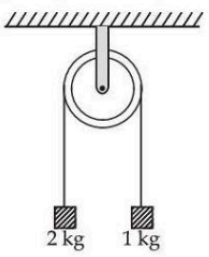
$2 \text{ kg}$ અને $1 \text{ kg}$ દળ ધરાવતા બે બ્લોકને એક દોરીના છેડે બાંધવામાં આવ્યા છે,જે નીચેની આકૃતિમાં દર્શાવ્યા મુજબ એક હલકી અને ઘર્ષણરહિત ગરગડી પરથી પસાર થાય છે. બ્લોક્સને સમાન સમક્ષિતિજ સ્તરે સ્થિર રાખવામાં આવે છે અને પછી મુક્ત કરવામાં આવે છે. $2 \text{ s}$ માં દ્રવ્યમાન કેન્દ્ર દ્વારા કાપેલું અંતર . . . . . . $\text{m}$ છે. ($g = 10 \text{ m/s}^2$ લો)
A
$3.33$
B
$3.12$
C
$2.22$
D
$1.42$
Solution
(C) ધારો કે દળ $m_1 = 2 \text{ kg}$ અને $m_2 = 1 \text{ kg}$ છે.
તંત્રનો પ્રવેગ $a = \frac{(m_1 - m_2)g}{m_1 + m_2} = \frac{(2 - 1) \times 10}{2 + 1} = \frac{10}{3} \text{ m/s}^2$ દ્વારા આપવામાં આવે છે.
$2 \text{ kg}$ નો બ્લોક $a_1 = 10/3 \text{ m/s}^2$ ના પ્રવેગ સાથે નીચેની તરફ ગતિ કરે છે અને $1 \text{ kg}$ નો બ્લોક $a_2 = 10/3 \text{ m/s}^2$ ના પ્રવેગ સાથે ઉપરની તરફ ગતિ કરે છે.
નીચેની દિશાને ધન લેતા,દ્રવ્યમાન કેન્દ્રનો પ્રવેગ $a_{cm} = \frac{m_1 a_1 - m_2 a_2}{m_1 + m_2} = \frac{2(10/3) - 1(10/3)}{2 + 1} = \frac{10/3}{3} = 10/9 \text{ m/s}^2$ થાય.
$t = 2 \text{ s}$ માં દ્રવ્યમાન કેન્દ્ર દ્વારા કાપેલું અંતર $d = \frac{1}{2} a_{cm} t^2 = \frac{1}{2} \times \frac{10}{9} \times (2)^2 = \frac{1}{2} \times \frac{10}{9} \times 4 = \frac{20}{9} \approx 2.22 \text{ m}$ થાય.
તંત્રનો પ્રવેગ $a = \frac{(m_1 - m_2)g}{m_1 + m_2} = \frac{(2 - 1) \times 10}{2 + 1} = \frac{10}{3} \text{ m/s}^2$ દ્વારા આપવામાં આવે છે.
$2 \text{ kg}$ નો બ્લોક $a_1 = 10/3 \text{ m/s}^2$ ના પ્રવેગ સાથે નીચેની તરફ ગતિ કરે છે અને $1 \text{ kg}$ નો બ્લોક $a_2 = 10/3 \text{ m/s}^2$ ના પ્રવેગ સાથે ઉપરની તરફ ગતિ કરે છે.
નીચેની દિશાને ધન લેતા,દ્રવ્યમાન કેન્દ્રનો પ્રવેગ $a_{cm} = \frac{m_1 a_1 - m_2 a_2}{m_1 + m_2} = \frac{2(10/3) - 1(10/3)}{2 + 1} = \frac{10/3}{3} = 10/9 \text{ m/s}^2$ થાય.
$t = 2 \text{ s}$ માં દ્રવ્યમાન કેન્દ્ર દ્વારા કાપેલું અંતર $d = \frac{1}{2} a_{cm} t^2 = \frac{1}{2} \times \frac{10}{9} \times (2)^2 = \frac{1}{2} \times \frac{10}{9} \times 4 = \frac{20}{9} \approx 2.22 \text{ m}$ થાય.
0 likes
View Solution156
DifficultMCQ
સમાન દળ ધરાવતા બે સમાન પદાર્થો $A$ અને $B$ ના પ્રારંભિક વેગ અનુક્રમે $v_1 = 4\hat{i} \text{ m/s}$ અને $v_2 = 4\hat{j} \text{ m/s}$ છે. પદાર્થ $A$ નો પ્રવેગ $a_1 = 6\hat{i} + 6\hat{j} \text{ m/s}^2$ છે,જ્યારે બીજા પદાર્થ $B$ નો પ્રવેગ શૂન્ય છે. બંને પદાર્થોનું દ્રવ્યમાન કેન્દ્ર . . . . . . માર્ગે ગતિ કરે છે.
A
વર્તુળાકાર
B
પરવલયાકાર
C
સુરેખ
D
લંબગોળ
Solution
(C) દ્રવ્યમાન કેન્દ્રનો પ્રવેગ $a_{cm} = \frac{m_A a_1 + m_B a_2}{m_A + m_B}$ દ્વારા આપવામાં આવે છે.
અહીં $m_A = m_B = m$ હોવાથી,$a_{cm} = \frac{m(6\hat{i} + 6\hat{j}) + m(0)}{2m} = 3\hat{i} + 3\hat{j} \text{ m/s}^2$ મળે.
દ્રવ્યમાન કેન્દ્રનો પ્રારંભિક વેગ $v_{cm} = \frac{m_A v_1 + m_B v_2}{m_A + m_B} = \frac{m(4\hat{i}) + m(4\hat{j})}{2m} = 2\hat{i} + 2\hat{j} \text{ m/s}$ થાય.
અહીં પ્રવેગ સદિશ $a_{cm} = 3\hat{i} + 3\hat{j}$ અને પ્રારંભિક વેગ સદિશ $v_{cm} = 2\hat{i} + 2\hat{j}$ એકબીજાને સમાંતર હોવાથી $(a_{cm} = 1.5 v_{cm})$,દ્રવ્યમાન કેન્દ્રની ગતિ સુરેખ માર્ગે થશે.
અહીં $m_A = m_B = m$ હોવાથી,$a_{cm} = \frac{m(6\hat{i} + 6\hat{j}) + m(0)}{2m} = 3\hat{i} + 3\hat{j} \text{ m/s}^2$ મળે.
દ્રવ્યમાન કેન્દ્રનો પ્રારંભિક વેગ $v_{cm} = \frac{m_A v_1 + m_B v_2}{m_A + m_B} = \frac{m(4\hat{i}) + m(4\hat{j})}{2m} = 2\hat{i} + 2\hat{j} \text{ m/s}$ થાય.
અહીં પ્રવેગ સદિશ $a_{cm} = 3\hat{i} + 3\hat{j}$ અને પ્રારંભિક વેગ સદિશ $v_{cm} = 2\hat{i} + 2\hat{j}$ એકબીજાને સમાંતર હોવાથી $(a_{cm} = 1.5 v_{cm})$,દ્રવ્યમાન કેન્દ્રની ગતિ સુરેખ માર્ગે થશે.
0 likes
View SolutionSystem of Particles and Rotational Motion — Motion of Centre of Mass · Frequently Asked Questions
1Are these System of Particles and Rotational Motion questions useful for JEE and NEET?
Yes. All questions in this section are mapped to JEE Main and NEET exam patterns. Previous year questions from JEE Main, NEET, GUJCET and state-level exams are included with full solutions.
2Can I switch to Hindi or Gujarati for these questions?
Yes. Use the language tabs in the hero section or the sidebar to view the same questions and solutions in English, Hindi or Gujarati.
3How do I generate a question paper from this subtopic?
Use the Vedclass Exam Paper Generator — select the chapter and subtopic, set difficulty, and generate Sets A, B, C, D automatically. First 3 chapters of every subject are free.
Vedclass Products
For Students
Vedclass Test Series
Mock tests in real JEE/NEET style with performance analysis. 5-day free trial.
Start Free TrialFor Teachers
Exam Paper Generator
Generate Set A/B/C/D papers from this chapter in 2 minutes. 3 chapters free.
Try FreeFor Institutes
Online Exam Module
Live online exams with unlimited students, 360° analytics & white-label branding.
See DemoFor Teachers & Institutes
Generate a System of Particles and Rotational Motion Exam Paper in 2 Minutes
Select subtopic & difficulty — Sets A, B, C, D auto-generated with No Repeat logic.
First 3 chapters of every subject are free — no payment required.