
A English
Motion of Centre of Mass Questions in English
Class 11 Physics · System of Particles and Rotational Motion · Motion of Centre of Mass
156+
Questions
English
Language
100%
With Solutions
Showing 48 of 156 questions in English
1
MediumMCQ
$A$ cart of mass $M$ is tied to one end of a massless rope of length $10\, m$. The other end of the rope is held by a man of mass $M$. The entire system is on a smooth horizontal surface. The man is at $x = 0$ and the cart is at $x = 10\, m$. If the man pulls the cart by the rope,the man and the cart will meet at the point:
A
$x = 0$
B
$x = 5\, m$
C
$x = 10\, m$
D
They will never meet
Solution
(B) Since there is no external horizontal force acting on the system,the position of the center of mass remains constant.
The center of mass $X_{cm}$ is given by the formula: $X_{cm} = \frac{M_1 x_1 + M_2 x_2}{M_1 + M_2}$.
Here,$M_1 = M$,$x_1 = 0$,$M_2 = M$,and $x_2 = 10\, m$.
$X_{cm} = \frac{M(0) + M(10)}{M + M} = \frac{10M}{2M} = 5\, m$.
As the man pulls the rope,both move towards each other and meet at the center of mass position,which is $x = 5\, m$.
The center of mass $X_{cm}$ is given by the formula: $X_{cm} = \frac{M_1 x_1 + M_2 x_2}{M_1 + M_2}$.
Here,$M_1 = M$,$x_1 = 0$,$M_2 = M$,and $x_2 = 10\, m$.
$X_{cm} = \frac{M(0) + M(10)}{M + M} = \frac{10M}{2M} = 5\, m$.
As the man pulls the rope,both move towards each other and meet at the center of mass position,which is $x = 5\, m$.
0 likes
View Solution2
DifficultMCQ
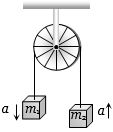
Two masses $m_1$ and $m_2$ $(m_1 > m_2)$ are connected by a massless,flexible,and inextensible string passed over a massless and frictionless pulley. The acceleration of the center of mass of the system is
A
${\left( {\frac{{{m_1} - {m_2}}}{{{m_1} + {m_2}}}} \right)^2}g$
B
$\frac{{{m_1} - {m_2}}}{{{m_1} + {m_2}}}g$
C
$\frac{{{m_1} + {m_2}}}{{{m_1} - {m_2}}}g$
D
Zero
Solution
(A) The magnitude of acceleration of each mass in an Atwood machine is given by $a = \left( {\frac{{{m_1} - {m_2}}}{{{m_1} + {m_2}}}} \right)g$.
Let the downward direction be positive for $m_1$ and upward for $m_2$. Then the acceleration vectors are $\vec{a_1} = a \hat{j}$ and $\vec{a_2} = -a \hat{j}$.
The acceleration of the center of mass $(A_{cm})$ is given by:
$A_{cm} = \frac{m_1 \vec{a_1} + m_2 \vec{a_2}}{m_1 + m_2}$
$A_{cm} = \frac{m_1 (a) - m_2 (a)}{m_1 + m_2} = \left( \frac{m_1 - m_2}{m_1 + m_2} \right) a$
Substituting the value of $a$:
$A_{cm} = \left( \frac{m_1 - m_2}{m_1 + m_2} \right) \times \left( \frac{m_1 - m_2}{m_1 + m_2} \right) g$
$A_{cm} = {\left( {\frac{{{m_1} - {m_2}}}{{{m_1} + {m_2}}}} \right)^2}g$
Let the downward direction be positive for $m_1$ and upward for $m_2$. Then the acceleration vectors are $\vec{a_1} = a \hat{j}$ and $\vec{a_2} = -a \hat{j}$.
The acceleration of the center of mass $(A_{cm})$ is given by:
$A_{cm} = \frac{m_1 \vec{a_1} + m_2 \vec{a_2}}{m_1 + m_2}$
$A_{cm} = \frac{m_1 (a) - m_2 (a)}{m_1 + m_2} = \left( \frac{m_1 - m_2}{m_1 + m_2} \right) a$
Substituting the value of $a$:
$A_{cm} = \left( \frac{m_1 - m_2}{m_1 + m_2} \right) \times \left( \frac{m_1 - m_2}{m_1 + m_2} \right) g$
$A_{cm} = {\left( {\frac{{{m_1} - {m_2}}}{{{m_1} + {m_2}}}} \right)^2}g$
0 likes
View Solution3
EasyMCQ
If a bomb is thrown at a certain angle with the horizontal and after exploding on the way the different fragments move in different directions,then the centre of mass
A
Would move along the same parabolic path
B
Would move along a horizontal path
C
Would move along a vertical line
D
None of these
Solution
(A) When a bomb is thrown,it follows a parabolic path due to gravity. When it explodes in mid-air,the fragments move in different directions due to internal forces generated by the explosion.
Since internal forces cannot change the motion of the centre of mass $(COM)$,the $COM$ continues to follow the original parabolic path as if the explosion had not occurred.
The motion of the $COM$ is determined solely by external forces,which in this case is only the gravitational force.
Since internal forces cannot change the motion of the centre of mass $(COM)$,the $COM$ continues to follow the original parabolic path as if the explosion had not occurred.
The motion of the $COM$ is determined solely by external forces,which in this case is only the gravitational force.
1 likes
View Solution4
MediumMCQ
Two particles of masses $1\ kg$ and $3\ kg$ move towards each other under their mutual force of attraction. No other force acts on them. When the relative velocity of approach of the two particles is $2\ m/s,$ their centre of mass has a velocity of $0.5\ m/s$. When the relative velocity of approach becomes $3\ m/s,$ the velocity of the centre of mass is ........ $m/s$.
A
$0$
B
$0.75$
C
$1.25$
D
$0.5$
Solution
(D) The system consists of two particles with no external forces acting on it.
According to the law of conservation of linear momentum,the velocity of the centre of mass $(v_{cm})$ of a system remains constant if the net external force acting on the system is zero.
Since the net external force is $0$,the velocity of the centre of mass remains unchanged regardless of the internal relative velocity of the particles.
Given that the initial velocity of the centre of mass is $0.5\ m/s$,it will remain $0.5\ m/s$ even when the relative velocity of approach changes to $3\ m/s$.
According to the law of conservation of linear momentum,the velocity of the centre of mass $(v_{cm})$ of a system remains constant if the net external force acting on the system is zero.
Since the net external force is $0$,the velocity of the centre of mass remains unchanged regardless of the internal relative velocity of the particles.
Given that the initial velocity of the centre of mass is $0.5\ m/s$,it will remain $0.5\ m/s$ even when the relative velocity of approach changes to $3\ m/s$.
0 likes
View Solution5
MediumMCQ
Two identical particles are moving with velocities $2v$ and $v$ respectively. Find the velocity of the center of mass.
A
$v$
B
$v/3$
C
$3v/2$
D
$v/2$
Solution
(C) Let the mass of each identical particle be $M$.
Let the velocity of the first particle be $v_1 = 2v$ and the velocity of the second particle be $v_2 = v$.
The velocity of the center of mass $(V_{COM})$ is given by the formula:
$V_{COM} = \frac{M_1 v_1 + M_2 v_2}{M_1 + M_2}$
Substituting the given values:
$V_{COM} = \frac{M(2v) + M(v)}{M + M}$
$V_{COM} = \frac{3Mv}{2M}$
$V_{COM} = \frac{3v}{2}$
Let the velocity of the first particle be $v_1 = 2v$ and the velocity of the second particle be $v_2 = v$.
The velocity of the center of mass $(V_{COM})$ is given by the formula:
$V_{COM} = \frac{M_1 v_1 + M_2 v_2}{M_1 + M_2}$
Substituting the given values:
$V_{COM} = \frac{M(2v) + M(v)}{M + M}$
$V_{COM} = \frac{3Mv}{2M}$
$V_{COM} = \frac{3v}{2}$
0 likes
View Solution6
MediumMCQ
$A$ body $A$ of mass $M$ falls vertically downwards under gravity. It breaks into two parts: a body $B$ of mass $1/3 M$ and a body $C$ of mass $2/3 M$. The center of mass of bodies $B$ and $C$ taken together shifts from the direction of $A$ by:
A
Depends on the height of breaking
B
Does not shift
C
Depends on the body
D
Depends on the height of the body
Solution
(B) The motion of the center of mass of a system is determined by the external forces acting on it.
In this case,the only external force acting on the system is gravity,which acts on the center of mass of the entire system.
Since the internal forces (the forces causing the body to break) do not affect the motion of the center of mass,the center of mass continues to follow the same trajectory as the original body $A$.
Therefore,the center of mass of the combined system of $B$ and $C$ does not shift relative to the path that $A$ would have followed.
In this case,the only external force acting on the system is gravity,which acts on the center of mass of the entire system.
Since the internal forces (the forces causing the body to break) do not affect the motion of the center of mass,the center of mass continues to follow the same trajectory as the original body $A$.
Therefore,the center of mass of the combined system of $B$ and $C$ does not shift relative to the path that $A$ would have followed.
0 likes
View Solution7
DifficultMCQ
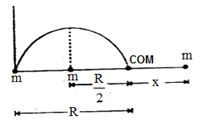
$A$ projectile of mass $3m$ explodes at its highest point into three equal fragments. One fragment returns to the point of projection. The second fragment comes to rest. The distance of the third fragment from the point of projection when it lands on the ground is ......... $m$. (The range of the projectile without explosion was $100 \ m$)
A
$100$
B
$150$
C
$250$
D
$300$
Solution
(C) The center of mass $(COM)$ of the projectile would have landed at the range $R = 100 \ m$.
Since the explosion is an internal force,the $COM$ continues to follow the original parabolic path.
Let the masses of the three fragments be $m_1 = m_2 = m_3 = m$.
Let their positions at the time of landing be $x_1, x_2, x_3$.
Given: $x_1 = 0$ (returns to projection point),$x_2 = R/2 = 50 \ m$ (comes to rest at the highest point,so it falls vertically down),and $x_{COM} = R = 100 \ m$.
The position of the center of mass is given by $x_{COM} = \frac{m_1x_1 + m_2x_2 + m_3x_3}{m_1 + m_2 + m_3}$.
Substituting the values: $100 = \frac{m(0) + m(50) + m(x_3)}{3m}$.
$300 = 50 + x_3$.
$x_3 = 300 - 50 = 250 \ m$.
Since the explosion is an internal force,the $COM$ continues to follow the original parabolic path.
Let the masses of the three fragments be $m_1 = m_2 = m_3 = m$.
Let their positions at the time of landing be $x_1, x_2, x_3$.
Given: $x_1 = 0$ (returns to projection point),$x_2 = R/2 = 50 \ m$ (comes to rest at the highest point,so it falls vertically down),and $x_{COM} = R = 100 \ m$.
The position of the center of mass is given by $x_{COM} = \frac{m_1x_1 + m_2x_2 + m_3x_3}{m_1 + m_2 + m_3}$.
Substituting the values: $100 = \frac{m(0) + m(50) + m(x_3)}{3m}$.
$300 = 50 + x_3$.
$x_3 = 300 - 50 = 250 \ m$.
0 likes
View Solution8
MediumMCQ
Two particles of masses $2 \ kg$ and $3 \ kg$ are moving along the $X$-axis with velocities $3 \ m/s$ and $2 \ m/s$ respectively. The velocity of the center of mass of this system is ........ $m/s$.
A
$5$
B
$1$
C
$0$
D
$2.4$
Solution
(D) The velocity of the center of mass $(V_{cm})$ for a system of particles is given by the formula:
$V_{cm} = \frac{m_1 v_1 + m_2 v_2}{m_1 + m_2}$
Given:
$m_1 = 2 \ kg$,$v_1 = 3 \ m/s$
$m_2 = 3 \ kg$,$v_2 = 2 \ m/s$
Substituting the values into the formula:
$V_{cm} = \frac{(2 \ kg)(3 \ m/s) + (3 \ kg)(2 \ m/s)}{2 \ kg + 3 \ kg}$
$V_{cm} = \frac{6 + 6}{5} = \frac{12}{5} = 2.4 \ m/s$
Therefore,the velocity of the center of mass is $2.4 \ m/s$.
$V_{cm} = \frac{m_1 v_1 + m_2 v_2}{m_1 + m_2}$
Given:
$m_1 = 2 \ kg$,$v_1 = 3 \ m/s$
$m_2 = 3 \ kg$,$v_2 = 2 \ m/s$
Substituting the values into the formula:
$V_{cm} = \frac{(2 \ kg)(3 \ m/s) + (3 \ kg)(2 \ m/s)}{2 \ kg + 3 \ kg}$
$V_{cm} = \frac{6 + 6}{5} = \frac{12}{5} = 2.4 \ m/s$
Therefore,the velocity of the center of mass is $2.4 \ m/s$.
0 likes
View Solution9
MediumMCQ
Two particles of masses $2 \ kg$ and $1 \ kg$ are moving along the same line with speeds of $2 \ m/s$ and $5 \ m/s$ respectively. If both particles are moving in the same direction,the speed of the centre of mass is $v_1$. If both particles are moving in opposite directions,the speed of the centre of mass is $v_2$. Find $v_1$ and $v_2$.
A
$3 \ m/s, \ 1/3 \ m/s$
B
$1/3 \ m/s, \ 3 \ m/s$
C
$2 \ m/s, \ 1/2 \ m/s$
D
$1/2 \ m/s, \ 2 \ m/s$
Solution
(A) Given: $m_1 = 2 \ kg$,$m_2 = 1 \ kg$,$u_1 = 2 \ m/s$,$u_2 = 5 \ m/s$.
Case $1$: Both particles move in the same direction.
The velocity of the centre of mass is $v_{cm} = \frac{m_1 u_1 + m_2 u_2}{m_1 + m_2} = \frac{2(2) + 1(5)}{2 + 1} = \frac{4 + 5}{3} = 3 \ m/s$. So,$v_1 = 3 \ m/s$.
Case $2$: Both particles move in opposite directions.
Let $u_1 = 2 \ m/s$ and $u_2 = -5 \ m/s$.
The velocity of the centre of mass is $v_{cm} = \frac{m_1 u_1 + m_2 u_2}{m_1 + m_2} = \frac{2(2) + 1(-5)}{2 + 1} = \frac{4 - 5}{3} = -1/3 \ m/s$.
The speed is the magnitude of velocity,so $v_2 = |-1/3| = 1/3 \ m/s$.
Case $1$: Both particles move in the same direction.
The velocity of the centre of mass is $v_{cm} = \frac{m_1 u_1 + m_2 u_2}{m_1 + m_2} = \frac{2(2) + 1(5)}{2 + 1} = \frac{4 + 5}{3} = 3 \ m/s$. So,$v_1 = 3 \ m/s$.
Case $2$: Both particles move in opposite directions.
Let $u_1 = 2 \ m/s$ and $u_2 = -5 \ m/s$.
The velocity of the centre of mass is $v_{cm} = \frac{m_1 u_1 + m_2 u_2}{m_1 + m_2} = \frac{2(2) + 1(-5)}{2 + 1} = \frac{4 - 5}{3} = -1/3 \ m/s$.
The speed is the magnitude of velocity,so $v_2 = |-1/3| = 1/3 \ m/s$.
0 likes
View Solution10
MediumMCQ
Two men of masses $55 \ kg$ and $65 \ kg$ are standing at the opposite ends of a boat. The length of the boat is $3.0 \ m$ and its mass is $100 \ kg$. The $55 \ kg$ man walks up to the $65 \ kg$ man and sits beside him. If the boat is in still water,the center of mass of the system will shift by ..... $m$.
A
$3.0$
B
$2.3$
C
$0$
D
$0.75$
Solution
(C) The system consists of the two men and the boat.
Since there is no external horizontal force acting on the system (the water resistance is neglected and the system is in still water),the position of the center of mass of the system remains unchanged.
Therefore,the shift in the center of mass of the system is $0 \ m$.
Since there is no external horizontal force acting on the system (the water resistance is neglected and the system is in still water),the position of the center of mass of the system remains unchanged.
Therefore,the shift in the center of mass of the system is $0 \ m$.
0 likes
View Solution11
EasyMCQ
Two particles of the same mass are moving towards each other with velocities $2v$ and $v$ respectively. The velocity of the centre of mass of the system is:
A
$v$
B
$\frac{v}{3}$
C
$\frac{v}{2}$
D
$0$
Solution
(C) The velocity of the centre of mass $(v_{cm})$ is given by the formula:
$v_{cm} = \frac{m_1 v_1 + m_2 v_2}{m_1 + m_2}$
Since the particles have the same mass,let $m_1 = m_2 = m$.
Taking the direction of the first particle as positive,the velocity of the first particle is $v_1 = 2v$ and the velocity of the second particle is $v_2 = -v$ (since they are moving towards each other).
Substituting these values into the formula:
$v_{cm} = \frac{m(2v) + m(-v)}{m + m}$
$v_{cm} = \frac{2mv - mv}{2m}$
$v_{cm} = \frac{mv}{2m} = \frac{v}{2}$
$v_{cm} = \frac{m_1 v_1 + m_2 v_2}{m_1 + m_2}$
Since the particles have the same mass,let $m_1 = m_2 = m$.
Taking the direction of the first particle as positive,the velocity of the first particle is $v_1 = 2v$ and the velocity of the second particle is $v_2 = -v$ (since they are moving towards each other).
Substituting these values into the formula:
$v_{cm} = \frac{m(2v) + m(-v)}{m + m}$
$v_{cm} = \frac{2mv - mv}{2m}$
$v_{cm} = \frac{mv}{2m} = \frac{v}{2}$
0 likes
View Solution12
MediumMCQ
$A$ body $A$ of mass $M$ while falling vertically downwards under gravity breaks into two parts; a body $B$ of mass $\frac{2}{3} M$ and a body $C$ of mass $\frac{1}{3} M$. The centre of mass of bodies $B$ and $C$ taken together shifts compared to that of body $A$ towards
A
body $C$
B
body $B$
C
depends on height of breaking
D
does not shift
Solution
(D) The motion of the centre of mass of a system depends only on the external forces acting on it.
In this case,the only external force acting on the body $A$ (and subsequently on the system of parts $B$ and $C$) is the gravitational force,which results in an acceleration equal to $g$ downwards.
Since the external force remains unchanged during the breaking process,the acceleration of the centre of mass remains $g$.
Therefore,the trajectory of the centre of mass of the system consisting of parts $B$ and $C$ follows the same path as the original body $A$.
Thus,the centre of mass does not shift relative to the path of the original body $A$.
In this case,the only external force acting on the body $A$ (and subsequently on the system of parts $B$ and $C$) is the gravitational force,which results in an acceleration equal to $g$ downwards.
Since the external force remains unchanged during the breaking process,the acceleration of the centre of mass remains $g$.
Therefore,the trajectory of the centre of mass of the system consisting of parts $B$ and $C$ follows the same path as the original body $A$.
Thus,the centre of mass does not shift relative to the path of the original body $A$.
0 likes
View Solution13
DifficultMCQ
Two particles have masses $m_1$ and $m_2$. If the first particle $(m_1)$ is moved by a distance $d$ towards the center of mass,by what distance should the second particle $(m_2)$ be moved so that the center of mass of the system remains at the same position?
A
$\frac{m_2}{m_1 + m_2} d$
B
$\frac{m_2}{m_1} d$
C
$\frac{m_1}{m_1 + m_2} d$
D
$\frac{m_1}{m_2} d$
Solution
(D) The position of the center of mass $R_{cm}$ is given by $R_{cm} = \frac{m_1 r_1 + m_2 r_2}{m_1 + m_2}$.
For the center of mass to remain at the same position,the change in the position of the center of mass must be zero,i.e.,$\Delta R_{cm} = 0$.
Therefore,$m_1 \Delta r_1 + m_2 \Delta r_2 = 0$.
Let the first particle $(m_1)$ be moved by a distance $d$ towards the center of mass,so $\Delta r_1 = d$.
Let the second particle $(m_2)$ be moved by a distance $x$ in the opposite direction,so $\Delta r_2 = -x$.
Substituting these values into the equation: $m_1 d + m_2 (-x) = 0$.
$m_1 d = m_2 x$.
Solving for $x$,we get $x = \frac{m_1}{m_2} d$.
For the center of mass to remain at the same position,the change in the position of the center of mass must be zero,i.e.,$\Delta R_{cm} = 0$.
Therefore,$m_1 \Delta r_1 + m_2 \Delta r_2 = 0$.
Let the first particle $(m_1)$ be moved by a distance $d$ towards the center of mass,so $\Delta r_1 = d$.
Let the second particle $(m_2)$ be moved by a distance $x$ in the opposite direction,so $\Delta r_2 = -x$.
Substituting these values into the equation: $m_1 d + m_2 (-x) = 0$.
$m_1 d = m_2 x$.
Solving for $x$,we get $x = \frac{m_1}{m_2} d$.
0 likes
View Solution14
DifficultMCQ
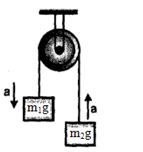
Two bodies of masses $m_1$ and $m_2$ are connected by a massless string passing over a massless,frictionless pulley as shown in the figure. Given $m_2 < m_1$. The acceleration of the center of mass of the system is:
A
$\frac{m_1 - m_2}{m_1 + m_2} g$
B
$\frac{m_1 - m_2}{m_1 + m_2} g$
C
$\frac{m_1 - m_2}{m_1 + m_2} g$
D
$\left( \frac{m_1 - m_2}{m_1 + m_2} \right)^2 g$
Solution
(D) The acceleration of each body in an Atwood machine is given by $a = \frac{m_1 - m_2}{m_1 + m_2} g$.
The acceleration of the center of mass is given by $\vec{a}_{cm} = \frac{m_1 \vec{a}_1 + m_2 \vec{a}_2}{m_1 + m_2}$.
Taking the downward direction as positive,the acceleration of mass $m_1$ is $\vec{a}_1 = a \hat{j}$ and the acceleration of mass $m_2$ is $\vec{a}_2 = -a \hat{j}$.
Substituting these values,we get $\vec{a}_{cm} = \frac{m_1 (a) + m_2 (-a)}{m_1 + m_2} = \frac{(m_1 - m_2) a}{m_1 + m_2}$.
Now,substitute the value of $a = \frac{m_1 - m_2}{m_1 + m_2} g$ into the equation:
$\vec{a}_{cm} = \left( \frac{m_1 - m_2}{m_1 + m_2} \right) \left( \frac{m_1 - m_2}{m_1 + m_2} g \right) = \left( \frac{m_1 - m_2}{m_1 + m_2} \right)^2 g$.
The acceleration of the center of mass is given by $\vec{a}_{cm} = \frac{m_1 \vec{a}_1 + m_2 \vec{a}_2}{m_1 + m_2}$.
Taking the downward direction as positive,the acceleration of mass $m_1$ is $\vec{a}_1 = a \hat{j}$ and the acceleration of mass $m_2$ is $\vec{a}_2 = -a \hat{j}$.
Substituting these values,we get $\vec{a}_{cm} = \frac{m_1 (a) + m_2 (-a)}{m_1 + m_2} = \frac{(m_1 - m_2) a}{m_1 + m_2}$.
Now,substitute the value of $a = \frac{m_1 - m_2}{m_1 + m_2} g$ into the equation:
$\vec{a}_{cm} = \left( \frac{m_1 - m_2}{m_1 + m_2} \right) \left( \frac{m_1 - m_2}{m_1 + m_2} g \right) = \left( \frac{m_1 - m_2}{m_1 + m_2} \right)^2 g$.
0 likes
View Solution15
DifficultMCQ
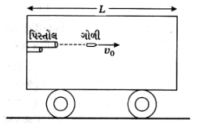
$A$ trolley of length $L$ has a pistol fixed on its wall as shown in the figure. The mass of the (trolley + pistol) is $M$. $A$ bullet of mass $m$ is fired from the pistol with a velocity $v_0$ and hits the opposite wall. What is the distance moved by the trolley during the time the bullet travels to hit the opposite wall?
A
$-\frac{m}{M} L$
B
$-\frac{m+M}{m} L$
C
$\frac{m}{m+M} L$
D
$\left( \frac{m-M}{m} \right) L$
Solution
(A) Since there is no external horizontal force acting on the system (trolley + pistol + bullet),the position of the center of mass of the system remains unchanged.
Let $\Delta x_1$ be the displacement of the trolley and $\Delta x_2$ be the displacement of the bullet relative to the ground.
The displacement of the center of mass is given by $\Delta x_{cm} = \frac{M \Delta x_1 + m \Delta x_2}{M + m} = 0$.
Here,the bullet travels a distance $L$ relative to the trolley. If the trolley moves by $\Delta x_1$ (to the left,so $\Delta x_1$ is negative),the bullet's displacement relative to the ground is $\Delta x_2 = L + \Delta x_1$.
Substituting this into the equation: $M \Delta x_1 + m(L + \Delta x_1) = 0$.
$M \Delta x_1 + mL + m \Delta x_1 = 0$.
$(M + m) \Delta x_1 = -mL$.
$\Delta x_1 = -\frac{m}{M+m} L$.
Note: The provided option $A$ is $-\frac{m}{M} L$,which is an approximation assuming $m \ll M$. However,based on the standard derivation,the correct expression is $-\frac{m}{M+m} L$. Given the options,$A$ is the intended answer under the assumption $M+m \approx M$.
Let $\Delta x_1$ be the displacement of the trolley and $\Delta x_2$ be the displacement of the bullet relative to the ground.
The displacement of the center of mass is given by $\Delta x_{cm} = \frac{M \Delta x_1 + m \Delta x_2}{M + m} = 0$.
Here,the bullet travels a distance $L$ relative to the trolley. If the trolley moves by $\Delta x_1$ (to the left,so $\Delta x_1$ is negative),the bullet's displacement relative to the ground is $\Delta x_2 = L + \Delta x_1$.
Substituting this into the equation: $M \Delta x_1 + m(L + \Delta x_1) = 0$.
$M \Delta x_1 + mL + m \Delta x_1 = 0$.
$(M + m) \Delta x_1 = -mL$.
$\Delta x_1 = -\frac{m}{M+m} L$.
Note: The provided option $A$ is $-\frac{m}{M} L$,which is an approximation assuming $m \ll M$. However,based on the standard derivation,the correct expression is $-\frac{m}{M+m} L$. Given the options,$A$ is the intended answer under the assumption $M+m \approx M$.
0 likes
View Solution16
EasyMCQ
Two particles which are initially at rest,move towards each other under the action of their internal attraction. If their speeds are $v$ and $2v$ at any instant,then the speed of centre of mass of the system will be
A
$0$
B
$v$
C
$1.5v$
D
$3v$
Solution
(A) The system consists of two particles moving under the influence of their mutual internal attraction.
According to the law of conservation of momentum,if the net external force acting on a system is zero,the velocity of the centre of mass remains constant.
Initially,both particles are at rest,which means the initial velocity of the centre of mass is $v_{CM, initial} = 0$.
Since there is no external force acting on the system,the velocity of the centre of mass remains constant at $0$ at any instant.
Therefore,the speed of the centre of mass of the system is $0$.
According to the law of conservation of momentum,if the net external force acting on a system is zero,the velocity of the centre of mass remains constant.
Initially,both particles are at rest,which means the initial velocity of the centre of mass is $v_{CM, initial} = 0$.
Since there is no external force acting on the system,the velocity of the centre of mass remains constant at $0$ at any instant.
Therefore,the speed of the centre of mass of the system is $0$.
0 likes
View Solution17
EasyMCQ
Two persons of masses $55\, kg$ and $65\, kg$ respectively,are at the opposite ends of a boat. The length of the boat is $3.0\, m$ and it weighs $100\, kg$. The $55\, kg$ man walks up to the $65\, kg$ man and sits with him. If the boat is in still water,the center of mass of the system shifts by ....... $m$.
A
$3$
B
$2.3$
C
$0$
D
$0.75$
Solution
(C) The system consists of the boat and the two persons.
Since the boat is in still water and there are no external horizontal forces acting on the system (the forces involved in the movement of the person are internal to the system),the net external force on the system is zero.
According to the property of the center of mass,if the net external force acting on a system is zero,the position of the center of mass of the system remains unchanged.
Therefore,the center of mass of the system does not shift.
Thus,the shift is $0\, m$.
Since the boat is in still water and there are no external horizontal forces acting on the system (the forces involved in the movement of the person are internal to the system),the net external force on the system is zero.
According to the property of the center of mass,if the net external force acting on a system is zero,the position of the center of mass of the system remains unchanged.
Therefore,the center of mass of the system does not shift.
Thus,the shift is $0\, m$.
0 likes
View Solution18
MediumMCQ
$A$ man of $50\, kg$ mass is standing in a gravity-free space at a height of $10\, m$ above the floor. He throws a stone of $0.5\, kg$ mass downwards with a speed of $2\, m/s$. When the stone reaches the floor,the distance of the man above the floor will be ...... $m$.
A
$9.9$
B
$10.1$
C
$10$
D
$20$
Solution
(B) Since the man is in a gravity-free space,the net external force on the man-stone system is zero. Therefore,the center of mass of the system remains at rest.
Let the man move upwards by a distance $x$ when the stone reaches the floor.
According to the principle of center of mass,the displacement of the center of mass is zero:
$M_{man} \cdot \Delta x_{man} + M_{stone} \cdot \Delta x_{stone} = 0$
Here,the stone moves downwards by $10\, m$ (so $\Delta x_{stone} = -10\, m$) and the man moves upwards by $x$ (so $\Delta x_{man} = x$).
$50 \cdot x + 0.5 \cdot (-10) = 0$
$50x = 5$
$x = \frac{5}{50} = 0.1\, m$
Therefore,the final height of the man above the floor is $10 + x = 10 + 0.1 = 10.1\, m$.
Let the man move upwards by a distance $x$ when the stone reaches the floor.
According to the principle of center of mass,the displacement of the center of mass is zero:
$M_{man} \cdot \Delta x_{man} + M_{stone} \cdot \Delta x_{stone} = 0$
Here,the stone moves downwards by $10\, m$ (so $\Delta x_{stone} = -10\, m$) and the man moves upwards by $x$ (so $\Delta x_{man} = x$).
$50 \cdot x + 0.5 \cdot (-10) = 0$
$50x = 5$
$x = \frac{5}{50} = 0.1\, m$
Therefore,the final height of the man above the floor is $10 + x = 10 + 0.1 = 10.1\, m$.
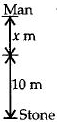
0 likes
View Solution19
DifficultMCQ
Two objects of masses $200 \ g$ and $500 \ g$ have velocities $10\hat{i} \ m/s$ and $3\hat{i} + 5\hat{j} \ m/s$ respectively. The velocity of their center of mass (in $m/s$) is:
A
$5\hat{i} - \frac{25}{7}\hat{j}$
B
$\frac{5}{7}\hat{i} - 25\hat{j}$
C
$5\hat{i} + \frac{25}{7}\hat{j}$
D
$25\hat{i} - \frac{5}{7}\hat{j}$
Solution
(C) The velocity of the center of mass $\vec{v}_{cm}$ is given by the formula: $\vec{v}_{cm} = \frac{m_1\vec{v}_1 + m_2\vec{v}_2}{m_1 + m_2}$.
Given: $m_1 = 200 \ g$,$\vec{v}_1 = 10\hat{i} \ m/s$,$m_2 = 500 \ g$,$\vec{v}_2 = 3\hat{i} + 5\hat{j} \ m/s$.
Substituting the values:
$\vec{v}_{cm} = \frac{200(10\hat{i}) + 500(3\hat{i} + 5\hat{j})}{200 + 500}$.
$\vec{v}_{cm} = \frac{2000\hat{i} + 1500\hat{i} + 2500\hat{j}}{700}$.
$\vec{v}_{cm} = \frac{3500\hat{i} + 2500\hat{j}}{700}$.
$\vec{v}_{cm} = 5\hat{i} + \frac{25}{7}\hat{j} \ m/s$.
Given: $m_1 = 200 \ g$,$\vec{v}_1 = 10\hat{i} \ m/s$,$m_2 = 500 \ g$,$\vec{v}_2 = 3\hat{i} + 5\hat{j} \ m/s$.
Substituting the values:
$\vec{v}_{cm} = \frac{200(10\hat{i}) + 500(3\hat{i} + 5\hat{j})}{200 + 500}$.
$\vec{v}_{cm} = \frac{2000\hat{i} + 1500\hat{i} + 2500\hat{j}}{700}$.
$\vec{v}_{cm} = \frac{3500\hat{i} + 2500\hat{j}}{700}$.
$\vec{v}_{cm} = 5\hat{i} + \frac{25}{7}\hat{j} \ m/s$.
0 likes
View Solution20
DifficultMCQ
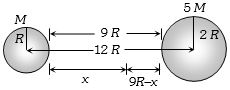
Two spherical objects have masses $M$ and $5M$ and radii $R$ and $2R$ respectively. They are released in free space with their centers at a distance of $12R$. If they attract each other only due to gravitational force,the distance traveled by the smaller object before collision is: (in $R$)
A
$1.5$
B
$2.5$
C
$4.5$
D
$7.5$
Solution
(D) The initial distance between the centers of the two spheres is $12R$.
Collision occurs when the distance between their centers becomes equal to the sum of their radii,which is $R + 2R = 3R$.
Therefore,the total distance covered by both objects to collide is $12R - 3R = 9R$.
Since the system is in free space and only internal gravitational forces act,the center of mass of the system remains stationary.
Let $x$ be the distance traveled by the smaller object (mass $M$) and $y$ be the distance traveled by the larger object (mass $5M$).
From the property of the center of mass,$M x = (5M) y$.
We also know that $x + y = 9R$,so $y = 9R - x$.
Substituting $y$ in the equation: $M x = 5M (9R - x)$.
$x = 45R - 5x$.
$6x = 45R$.
$x = 7.5R$.
Collision occurs when the distance between their centers becomes equal to the sum of their radii,which is $R + 2R = 3R$.
Therefore,the total distance covered by both objects to collide is $12R - 3R = 9R$.
Since the system is in free space and only internal gravitational forces act,the center of mass of the system remains stationary.
Let $x$ be the distance traveled by the smaller object (mass $M$) and $y$ be the distance traveled by the larger object (mass $5M$).
From the property of the center of mass,$M x = (5M) y$.
We also know that $x + y = 9R$,so $y = 9R - x$.
Substituting $y$ in the equation: $M x = 5M (9R - x)$.
$x = 45R - 5x$.
$6x = 45R$.
$x = 7.5R$.
0 likes
View Solution21
EasyMCQ
$A$ $2\ kg$ body and a $3\ kg$ body are moving along the $x-$ axis. At a particular instant,the $2\ kg$ body has a velocity of $3\ m/s$ and the $3\ kg$ body has a velocity of $2\ m/s$. The velocity of the centre of mass at that instant is
A
$5\ m/s$
B
$1\ m/s$
C
$0$
D
$2.4\ m/s$
Solution
(D) The velocity of the centre of mass is given by the formula: $\vec{v}_{cm} = \frac{m_1\vec{v}_1 + m_2\vec{v}_2}{m_1 + m_2}$.
Given: $m_1 = 2\ kg$,$v_1 = 3\ m/s$,$m_2 = 3\ kg$,$v_2 = 2\ m/s$.
Substituting the values: $\vec{v}_{cm} = \frac{2 \times 3 + 3 \times 2}{2 + 3}$.
$\vec{v}_{cm} = \frac{6 + 6}{5} = \frac{12}{5} = 2.4\ m/s$.
Given: $m_1 = 2\ kg$,$v_1 = 3\ m/s$,$m_2 = 3\ kg$,$v_2 = 2\ m/s$.
Substituting the values: $\vec{v}_{cm} = \frac{2 \times 3 + 3 \times 2}{2 + 3}$.
$\vec{v}_{cm} = \frac{6 + 6}{5} = \frac{12}{5} = 2.4\ m/s$.
0 likes
View Solution22
EasyMCQ
Two bodies of masses $2\ kg$ and $4\ kg$ are moving with velocities $2\ m/s$ and $10\ m/s$ respectively along the same direction. The velocity of their centre of mass will be ......... $m/s$.
A
$8.1$
B
$7.3$
C
$6.4$
D
$5.3$
Solution
(B) The velocity of the centre of mass for a system of two particles is given by the formula: $\vec{v}_{cm} = \frac{m_1 \vec{v}_1 + m_2 \vec{v}_2}{m_1 + m_2}$.
Given: $m_1 = 2\ kg$,$v_1 = 2\ m/s$,$m_2 = 4\ kg$,$v_2 = 10\ m/s$.
Since both bodies are moving in the same direction,we can treat their velocities as positive.
Substituting the values into the formula:
$\vec{v}_{cm} = \frac{(2 \times 2) + (4 \times 10)}{2 + 4} = \frac{4 + 40}{6} = \frac{44}{6} = 7.33\ m/s$.
Rounding to one decimal place,we get $7.3\ m/s$.
Given: $m_1 = 2\ kg$,$v_1 = 2\ m/s$,$m_2 = 4\ kg$,$v_2 = 10\ m/s$.
Since both bodies are moving in the same direction,we can treat their velocities as positive.
Substituting the values into the formula:
$\vec{v}_{cm} = \frac{(2 \times 2) + (4 \times 10)}{2 + 4} = \frac{4 + 40}{6} = \frac{44}{6} = 7.33\ m/s$.
Rounding to one decimal place,we get $7.3\ m/s$.
0 likes
View Solution23
EasyMCQ
Two bodies of masses $2 \ kg$ and $4 \ kg$ are moving with velocities $20 \ m/s$ and $10 \ m/s$ towards each other due to mutual gravitational attraction. What is the velocity of their centre of mass (in $m/s$)?
A
$5$
B
$6$
C
$8$
D
$0$
Solution
(D) The velocity of the centre of mass is given by the formula: $\vec{v}_{cm} = \frac{m_1 \vec{v}_1 + m_2 \vec{v}_2}{m_1 + m_2}$.
Given: $m_1 = 2 \ kg$,$m_2 = 4 \ kg$.
Let the velocity of the first body be $\vec{v}_1 = 20 \ m/s$ (taking it as positive).
Since the bodies are moving towards each other,the velocity of the second body is $\vec{v}_2 = -10 \ m/s$.
Substituting these values into the formula:
$\vec{v}_{cm} = \frac{(2 \times 20) + (4 \times -10)}{2 + 4} = \frac{40 - 40}{6} = \frac{0}{6} = 0 \ m/s$.
Since the only force acting on the system is the mutual gravitational attraction (an internal force),the net external force on the system is zero. Therefore,the velocity of the centre of mass remains constant. Since the initial momentum is zero,the velocity of the centre of mass is $0 \ m/s$.
Given: $m_1 = 2 \ kg$,$m_2 = 4 \ kg$.
Let the velocity of the first body be $\vec{v}_1 = 20 \ m/s$ (taking it as positive).
Since the bodies are moving towards each other,the velocity of the second body is $\vec{v}_2 = -10 \ m/s$.
Substituting these values into the formula:
$\vec{v}_{cm} = \frac{(2 \times 20) + (4 \times -10)}{2 + 4} = \frac{40 - 40}{6} = \frac{0}{6} = 0 \ m/s$.
Since the only force acting on the system is the mutual gravitational attraction (an internal force),the net external force on the system is zero. Therefore,the velocity of the centre of mass remains constant. Since the initial momentum is zero,the velocity of the centre of mass is $0 \ m/s$.
0 likes
View Solution24
EasyMCQ
Two particles of masses $m_1$ and $m_2$ initially at rest start moving towards each other under their mutual force of attraction. The speed of the centre of mass at any time $t$,when they are at a distance $r$ apart,is
A
zero
B
$\left( {G\frac{{{m_1}{m_2}}}{{{r^2}}} \cdot \frac{1}{{{m_1}}}} \right)\,t$
C
$\left( {G\frac{{{m_1}{m_2}}}{{{r^2}}} \cdot \frac{1}{{{m_2}}}} \right)\,t$
D
$\left( {G\frac{{{m_1}{m_2}}}{{{r^2}}} \cdot \frac{1}{{{m_1} + {m_2}}}} \right)\,t$
Solution
(A) The centre of mass of a system moves according to the net external force acting on it,given by the equation $F_{ext} = M_{total} \cdot a_{cm}$.
In this system,the particles are moving towards each other due to their mutual gravitational force,which is an internal force.
Since there is no external force acting on the system $(F_{ext} = 0)$,the acceleration of the centre of mass $(a_{cm})$ is zero.
Given that the particles were initially at rest,the initial velocity of the centre of mass $(v_{cm})$ was zero.
Since $a_{cm} = 0$,the velocity of the centre of mass remains constant at its initial value of zero for all time $t$.
In this system,the particles are moving towards each other due to their mutual gravitational force,which is an internal force.
Since there is no external force acting on the system $(F_{ext} = 0)$,the acceleration of the centre of mass $(a_{cm})$ is zero.
Given that the particles were initially at rest,the initial velocity of the centre of mass $(v_{cm})$ was zero.
Since $a_{cm} = 0$,the velocity of the centre of mass remains constant at its initial value of zero for all time $t$.
0 likes
View Solution25
EasyMCQ
$A$ body of mass $20 \ kg$ is moving with a velocity of $2v$ and another body of mass $10 \ kg$ is moving with velocity $v$ along the same direction. The velocity of their centre of mass is
A
$5v/3$
B
$2v/3$
C
$v$
D
$0$
Solution
(A) The velocity of the centre of mass is given by the formula:
$\vec{v}_{cm} = \frac{m_1 \vec{v}_1 + m_2 \vec{v}_2}{m_1 + m_2}$
Given:
$m_1 = 20 \ kg$,$\vec{v}_1 = 2v$
$m_2 = 10 \ kg$,$\vec{v}_2 = v$
Substituting the values:
$\vec{v}_{cm} = \frac{20 \times 2v + 10 \times v}{20 + 10}$
$\vec{v}_{cm} = \frac{40v + 10v}{30}$
$\vec{v}_{cm} = \frac{50v}{30} = \frac{5}{3}v$
$\vec{v}_{cm} = \frac{m_1 \vec{v}_1 + m_2 \vec{v}_2}{m_1 + m_2}$
Given:
$m_1 = 20 \ kg$,$\vec{v}_1 = 2v$
$m_2 = 10 \ kg$,$\vec{v}_2 = v$
Substituting the values:
$\vec{v}_{cm} = \frac{20 \times 2v + 10 \times v}{20 + 10}$
$\vec{v}_{cm} = \frac{40v + 10v}{30}$
$\vec{v}_{cm} = \frac{50v}{30} = \frac{5}{3}v$
0 likes
View Solution26
MediumMCQ
An object $A$ of mass $M$ is falling vertically downwards under the influence of gravity. It breaks into two parts: part $B$ of mass $\frac{1}{3}M$ and part $C$ of mass $\frac{2}{3}M$. The center of mass of the combined parts $B$ and $C$ will be displaced relative to object $A$ in which direction?
A
Towards $C$
B
Towards $B$
C
Depends on the height of breaking
D
Will not be displaced
Solution
(D) The object $A$ is falling under the influence of gravity,which is an external force acting on the system. However,the breaking of the object into two parts $B$ and $C$ is caused by internal forces.
According to the property of the center of mass,internal forces do not change the position or the motion of the center of mass of a system.
Since the external force (gravity) acts on the system as a whole,the center of mass of the combined parts $B$ and $C$ will continue to follow the same trajectory as the original object $A$.
Therefore,the center of mass will not be displaced relative to the path of the original object $A$.
According to the property of the center of mass,internal forces do not change the position or the motion of the center of mass of a system.
Since the external force (gravity) acts on the system as a whole,the center of mass of the combined parts $B$ and $C$ will continue to follow the same trajectory as the original object $A$.
Therefore,the center of mass will not be displaced relative to the path of the original object $A$.
0 likes
View Solution27
MediumMCQ
Two particles $X$ and $Y$,initially at rest,move towards each other under mutual attraction. If at any instant the velocity of particle $X$ is $V$ and the velocity of particle $Y$ is $2V$,then the velocity of their center of mass will be:
A
$0$
B
$V$
C
$2V$
D
$V/2$
Solution
(A) The velocity of the center of mass of a system is given by $v_{cm} = \frac{m_1v_1 + m_2v_2}{m_1 + m_2}$.
Since the particles are initially at rest,the initial momentum of the system is $P_{initial} = 0$.
According to the law of conservation of linear momentum,if the net external force acting on a system is zero,the total momentum of the system remains constant.
Here,the particles move due to mutual attraction (internal forces),so the net external force on the system is zero.
Therefore,the velocity of the center of mass remains constant and equal to its initial velocity.
Since the system started from rest,$v_{cm} = 0$ at all times.
Since the particles are initially at rest,the initial momentum of the system is $P_{initial} = 0$.
According to the law of conservation of linear momentum,if the net external force acting on a system is zero,the total momentum of the system remains constant.
Here,the particles move due to mutual attraction (internal forces),so the net external force on the system is zero.
Therefore,the velocity of the center of mass remains constant and equal to its initial velocity.
Since the system started from rest,$v_{cm} = 0$ at all times.
1 likes
View Solution28
DifficultMCQ
$M$ mass of a man stands at one end of a plank of length $L$ which lies at rest on a frictionless surface. The man walks to the other end of the plank. If the mass of the plank is $\frac{M}{3}$,then the distance that the man moves relative to the ground is:
A
$\frac{3L}{4}$
B
$\frac{L}{4}$
C
$\frac{4L}{5}$
D
$\frac{L}{3}$
Solution
(B) Let the mass of the man be $M$ and the mass of the plank be $m = \frac{M}{3}$.
Since there is no external horizontal force,the center of mass of the system remains stationary.
Let $x$ be the displacement of the plank relative to the ground in the opposite direction of the man's motion.
The displacement of the man relative to the ground is $(L - x)$.
Using the principle of conservation of the center of mass: $M(L - x) = m(x)$.
Substituting $m = \frac{M}{3}$:
$M(L - x) = \frac{M}{3} x$
$L - x = \frac{x}{3}$
$L = x + \frac{x}{3} = \frac{4x}{3}$
$x = \frac{3L}{4}$ (This is the displacement of the plank).
The displacement of the man relative to the ground is $L - x = L - \frac{3L}{4} = \frac{L}{4}$.
Since there is no external horizontal force,the center of mass of the system remains stationary.
Let $x$ be the displacement of the plank relative to the ground in the opposite direction of the man's motion.
The displacement of the man relative to the ground is $(L - x)$.
Using the principle of conservation of the center of mass: $M(L - x) = m(x)$.
Substituting $m = \frac{M}{3}$:
$M(L - x) = \frac{M}{3} x$
$L - x = \frac{x}{3}$
$L = x + \frac{x}{3} = \frac{4x}{3}$
$x = \frac{3L}{4}$ (This is the displacement of the plank).
The displacement of the man relative to the ground is $L - x = L - \frac{3L}{4} = \frac{L}{4}$.
0 likes
View Solution29
DifficultMCQ
Two particles of equal mass have velocities $2\,\hat{i}\,ms^{-1}$ and $2\,\hat{j}\,ms^{-1}$. The first particle has an acceleration $(3\,\hat{i} + 3\,\hat{j})\,ms^{-2}$ while the acceleration of the second particle is zero. The centre of mass of the two particles moves in
A
circle
B
parabola
C
ellipse
D
straight line
Solution
(D) Given,masses $m_1 = m_2 = m$.
Initial velocities are $\vec{v}_1 = 2\hat{i}\,ms^{-1}$ and $\vec{v}_2 = 2\hat{j}\,ms^{-1}$.
Accelerations are $\vec{a}_1 = (3\hat{i} + 3\hat{j})\,ms^{-2}$ and $\vec{a}_2 = 0$.
The velocity of the centre of mass is $\vec{v}_{CM} = \frac{m_1\vec{v}_1 + m_2\vec{v}_2}{m_1 + m_2} = \frac{m(2\hat{i} + 2\hat{j})}{2m} = (\hat{i} + \hat{j})\,ms^{-1}$.
The acceleration of the centre of mass is $\vec{a}_{CM} = \frac{m_1\vec{a}_1 + m_2\vec{a}_2}{m_1 + m_2} = \frac{m(3\hat{i} + 3\hat{j} + 0)}{2m} = \frac{3}{2}(\hat{i} + \hat{j})\,ms^{-2}$.
Since the initial velocity vector $\vec{v}_{CM} = (\hat{i} + \hat{j})$ and the acceleration vector $\vec{a}_{CM} = \frac{3}{2}(\hat{i} + \hat{j})$ are parallel (i.e.,$\vec{a}_{CM} = k\vec{v}_{CM}$ where $k = 1.5$),the centre of mass moves in a straight line.
Initial velocities are $\vec{v}_1 = 2\hat{i}\,ms^{-1}$ and $\vec{v}_2 = 2\hat{j}\,ms^{-1}$.
Accelerations are $\vec{a}_1 = (3\hat{i} + 3\hat{j})\,ms^{-2}$ and $\vec{a}_2 = 0$.
The velocity of the centre of mass is $\vec{v}_{CM} = \frac{m_1\vec{v}_1 + m_2\vec{v}_2}{m_1 + m_2} = \frac{m(2\hat{i} + 2\hat{j})}{2m} = (\hat{i} + \hat{j})\,ms^{-1}$.
The acceleration of the centre of mass is $\vec{a}_{CM} = \frac{m_1\vec{a}_1 + m_2\vec{a}_2}{m_1 + m_2} = \frac{m(3\hat{i} + 3\hat{j} + 0)}{2m} = \frac{3}{2}(\hat{i} + \hat{j})\,ms^{-2}$.
Since the initial velocity vector $\vec{v}_{CM} = (\hat{i} + \hat{j})$ and the acceleration vector $\vec{a}_{CM} = \frac{3}{2}(\hat{i} + \hat{j})$ are parallel (i.e.,$\vec{a}_{CM} = k\vec{v}_{CM}$ where $k = 1.5$),the centre of mass moves in a straight line.
0 likes
View Solution30
DifficultMCQ
$A$ particle of mass $3m$ is projected from the ground at some angle with the horizontal. The horizontal range is $R$. At the highest point of its path,it breaks into two pieces of mass $m$ and $2m$. The smaller mass comes to rest,and the larger mass finally falls at a distance $x$ from the point of projection. The value of $x$ is:
A
$\frac{3R}{4}$
B
$\frac{3R}{2}$
C
$\frac{5R}{4}$
D
$3R$
Solution
(C) The center of mass of the system follows the original parabolic trajectory because the explosion is caused by internal forces.
The horizontal range of the center of mass is $R$,so it lands at $x_{com} = R$.
The highest point of the trajectory is at a horizontal distance of $\frac{R}{2}$ from the point of projection.
Let the smaller mass $m$ come to rest,meaning its horizontal position is $x_1 = \frac{R}{2}$.
Let the larger mass $2m$ fall at a distance $x_2 = x$.
The center of mass position is given by $x_{com} = \frac{m_1 x_1 + m_2 x_2}{m_1 + m_2}$.
Substituting the values: $R = \frac{m \cdot \frac{R}{2} + 2m \cdot x}{m + 2m}$.
$3mR = \frac{mR}{2} + 2mx$.
$3mR - \frac{mR}{2} = 2mx$.
$\frac{5mR}{2} = 2mx$.
$x = \frac{5R}{4}$.
The horizontal range of the center of mass is $R$,so it lands at $x_{com} = R$.
The highest point of the trajectory is at a horizontal distance of $\frac{R}{2}$ from the point of projection.
Let the smaller mass $m$ come to rest,meaning its horizontal position is $x_1 = \frac{R}{2}$.
Let the larger mass $2m$ fall at a distance $x_2 = x$.
The center of mass position is given by $x_{com} = \frac{m_1 x_1 + m_2 x_2}{m_1 + m_2}$.
Substituting the values: $R = \frac{m \cdot \frac{R}{2} + 2m \cdot x}{m + 2m}$.
$3mR = \frac{mR}{2} + 2mx$.
$3mR - \frac{mR}{2} = 2mx$.
$\frac{5mR}{2} = 2mx$.
$x = \frac{5R}{4}$.
0 likes
View Solution31
DifficultMCQ
$A$ man weighing $80\, kg$ is standing at the centre of a flat boat and he is $20\, m$ from the shore. He walks $8\, m$ on the boat towards the shore and then halts. The boat weighs $200\, kg$. How far is he from the shore at the end of this time?
A
$11.2$
B
$13.8$
C
$14.3$
D
$15.4$
Solution
(C) Let $m_1 = 80\, kg$ (mass of the man) and $m_2 = 200\, kg$ (mass of the boat).
Since there is no external horizontal force on the system,the centre of mass remains stationary: $\Delta x_{cm} = 0$.
Let $x$ be the displacement of the boat away from the shore. The displacement of the man relative to the shore is $(8 - x)$.
Using the centre of mass formula: $m_1 \Delta x_1 + m_2 \Delta x_2 = 0$.
$80(8 - x) + 200(-x) = 0$.
$640 - 80x - 200x = 0$.
$280x = 640$.
$x = \frac{640}{280} \approx 2.286\, m$.
The man's initial distance from the shore was $20\, m$. After walking $8\, m$ towards the shore and the boat moving $x$ away from the shore,his new distance is $20 - 8 + x = 12 + 2.286 = 14.286\, m \approx 14.3\, m$.
Since there is no external horizontal force on the system,the centre of mass remains stationary: $\Delta x_{cm} = 0$.
Let $x$ be the displacement of the boat away from the shore. The displacement of the man relative to the shore is $(8 - x)$.
Using the centre of mass formula: $m_1 \Delta x_1 + m_2 \Delta x_2 = 0$.
$80(8 - x) + 200(-x) = 0$.
$640 - 80x - 200x = 0$.
$280x = 640$.
$x = \frac{640}{280} \approx 2.286\, m$.
The man's initial distance from the shore was $20\, m$. After walking $8\, m$ towards the shore and the boat moving $x$ away from the shore,his new distance is $20 - 8 + x = 12 + 2.286 = 14.286\, m \approx 14.3\, m$.
0 likes
View Solution32
DifficultMCQ
Two men,of masses $60 \, kg$ and $80 \, kg$,are sitting at the ends of a boat of mass $60 \, kg$ and length $4 \, m$. The boat is stationary. If the men now exchange their positions,then:
A
the centre of mass of the two men shifts by $2 \, m$
B
the boat moves by $0.4 \, m$
C
the centre of mass of the two men shifts by $4/7 \, m$
D
the boat moves by $0.6 \, m$
Solution
(B) Let the mass of the boat be $M = 60 \, kg$,length $L = 4 \, m$,and the masses of the two men be $m_1 = 60 \, kg$ and $m_2 = 80 \, kg$.
Since there is no external horizontal force acting on the system (boat + men),the centre of mass of the system remains stationary.
Let the displacement of the boat be $x$. When the men exchange positions,the displacement of the men relative to the ground is $(L - x)$ and $(-L - x)$ respectively.
Using the principle of conservation of the centre of mass: $M(x) + m_1(x - L) + m_2(x + L) = 0$.
Substituting the values: $60x + 60(x - 4) + 80(x + 4) = 0$.
$60x + 60x - 240 + 80x + 320 = 0$.
$200x + 80 = 0$.
$200x = -80$.
$x = -80 / 200 = -0.4 \, m$.
The negative sign indicates that the boat moves by $0.4 \, m$ in the opposite direction of the heavier man's movement.
Since there is no external horizontal force acting on the system (boat + men),the centre of mass of the system remains stationary.
Let the displacement of the boat be $x$. When the men exchange positions,the displacement of the men relative to the ground is $(L - x)$ and $(-L - x)$ respectively.
Using the principle of conservation of the centre of mass: $M(x) + m_1(x - L) + m_2(x + L) = 0$.
Substituting the values: $60x + 60(x - 4) + 80(x + 4) = 0$.
$60x + 60x - 240 + 80x + 320 = 0$.
$200x + 80 = 0$.
$200x = -80$.
$x = -80 / 200 = -0.4 \, m$.
The negative sign indicates that the boat moves by $0.4 \, m$ in the opposite direction of the heavier man's movement.
0 likes
View Solution33
DifficultMCQ
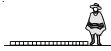
On a smooth horizontal plane,a uniform string of mass $M$ and length $L$ is lying in a state of rest. $A$ man of the same mass $M$ is standing next to one end of the string. Now,the man starts collecting the string. Finally,the man collects all the string and puts it in his pocket. What is the displacement of the man with respect to the Earth in the process of collection?
A
$L / 2$
B
$L / 4$
C
$L / 8$
D
None
Solution
(B) Let the mass of the man be $M_m = M$ and the mass of the string be $M_s = M$. The length of the string is $L$.
Since the plane is smooth,there is no external horizontal force acting on the system (man + string). Therefore,the position of the center of mass of the system remains unchanged.
Let the initial position of the man be $x_m = 0$ and the center of mass of the string be at $x_s = L/2$.
The initial position of the center of mass of the system is:
$X_{cm} = \frac{M_m x_m + M_s x_s}{M_m + M_s} = \frac{M(0) + M(L/2)}{M + M} = \frac{ML/2}{2M} = L/4$.
After the man collects the entire string,the man and the string become a single system of mass $2M$ located at the final position of the man,$x_f$.
The final position of the center of mass of the system is $X'_{cm} = x_f$.
Since the center of mass does not move,$X_{cm} = X'_{cm}$,so $x_f = L/4$.
The displacement of the man is $\Delta x = |x_f - x_m| = |L/4 - 0| = L/4$.
Since the plane is smooth,there is no external horizontal force acting on the system (man + string). Therefore,the position of the center of mass of the system remains unchanged.
Let the initial position of the man be $x_m = 0$ and the center of mass of the string be at $x_s = L/2$.
The initial position of the center of mass of the system is:
$X_{cm} = \frac{M_m x_m + M_s x_s}{M_m + M_s} = \frac{M(0) + M(L/2)}{M + M} = \frac{ML/2}{2M} = L/4$.
After the man collects the entire string,the man and the string become a single system of mass $2M$ located at the final position of the man,$x_f$.
The final position of the center of mass of the system is $X'_{cm} = x_f$.
Since the center of mass does not move,$X_{cm} = X'_{cm}$,so $x_f = L/4$.
The displacement of the man is $\Delta x = |x_f - x_m| = |L/4 - 0| = L/4$.
0 likes
View Solution34
MediumMCQ
There are some passengers inside a stationary railway compartment. The track is frictionless. The centre of mass of the compartment itself (without the passengers) is $C_1$,while the centre of mass of the 'compartment plus passengers' system is $C_2$. If the passengers move about inside the compartment along the track,then:
A
both $C_1$ and $C_2$ will move with respect to the ground
B
neither $C_1$ nor $C_2$ will move with respect to the ground
C
$C_1$ will move but $C_2$ will be stationary with respect to the ground
D
$C_2$ will move but $C_1$ will be stationary with respect to the ground
Solution
(C) For the compartment alone,the passengers exert internal forces that act as external forces on the compartment. Since the track is frictionless,the compartment can move due to these forces,so $C_1$ will move with respect to the ground.
For the 'compartment plus passengers' system,the forces exerted by the passengers on the compartment and vice versa are internal forces. Since there are no external horizontal forces acting on this combined system,the centre of mass $C_2$ of the system must remain stationary with respect to the ground.
For the 'compartment plus passengers' system,the forces exerted by the passengers on the compartment and vice versa are internal forces. Since there are no external horizontal forces acting on this combined system,the centre of mass $C_2$ of the system must remain stationary with respect to the ground.
0 likes
View Solution35
DifficultMCQ
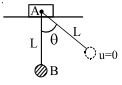
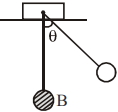
$A$ small ball $B$ of mass $m$ is suspended with a light inelastic string of length $L$ from a block $A$ of the same mass $m$,which can move on a smooth horizontal surface as shown in the figure. The ball is displaced by an angle $\theta$ from the equilibrium position and then released. The displacement of the block when the ball reaches the equilibrium position is
A
$\frac{L \sin \theta}{2}$
B
$L \sin \theta$
C
$L$
D
None of these
Solution
(A) Let the mass of the block $A$ be $m$ and the mass of the ball $B$ be $m$. Since the system (block + ball) is on a smooth horizontal surface,there is no external horizontal force acting on the system.
Therefore,the position of the centre of mass of the system remains unchanged in the horizontal direction.
Let $x$ be the displacement of the block $A$ to the left when the ball $B$ reaches the equilibrium position.
In this process,the ball $B$ moves a horizontal distance of $(L \sin \theta - x)$ to the right relative to the ground.
Using the principle of conservation of the centre of mass in the horizontal direction:
$m_A \Delta x_A + m_B \Delta x_B = 0$
Taking the left direction as negative and the right direction as positive:
$m(-x) + m(L \sin \theta - x) = 0$
$-mx + mL \sin \theta - mx = 0$
$2mx = mL \sin \theta$
$x = \frac{L \sin \theta}{2}$
Therefore,the position of the centre of mass of the system remains unchanged in the horizontal direction.
Let $x$ be the displacement of the block $A$ to the left when the ball $B$ reaches the equilibrium position.
In this process,the ball $B$ moves a horizontal distance of $(L \sin \theta - x)$ to the right relative to the ground.
Using the principle of conservation of the centre of mass in the horizontal direction:
$m_A \Delta x_A + m_B \Delta x_B = 0$
Taking the left direction as negative and the right direction as positive:
$m(-x) + m(L \sin \theta - x) = 0$
$-mx + mL \sin \theta - mx = 0$
$2mx = mL \sin \theta$
$x = \frac{L \sin \theta}{2}$
0 likes
View Solution36
DifficultMCQ
$A$ small ball $B$ of mass $m$ is suspended with a light inelastic string of length $L$ from a block $A$ of the same mass $m$,which can move on a smooth horizontal surface as shown in the figure. The ball is displaced by an angle $\theta$ from the equilibrium position and then released. The displacement of the centre of mass of the $A+B$ system until the string becomes vertical is
A
zero
B
$\frac{L}{2}(1 - \cos \theta )$
C
$\frac{L}{2}(1 - \sin \theta )$
D
none of these
Solution
(B) Let the horizontal surface be the reference line for the $x$-axis. Since there is no external horizontal force acting on the system,the centre of mass of the system does not shift in the horizontal direction.
Let $x_A$ and $x_B$ be the horizontal positions of block $A$ and ball $B$. The horizontal position of the centre of mass is $X_{cm} = \frac{m x_A + m x_B}{m + m} = \frac{x_A + x_B}{2}$.
Initially,let $x_A = 0$ and $x_B = L \sin \theta$. So,$X_{cm, initial} = \frac{0 + L \sin \theta}{2} = \frac{L \sin \theta}{2}$.
When the string becomes vertical,the block $A$ and ball $B$ will be at the same horizontal position $x'$. Thus,$X_{cm, final} = \frac{x' + x'}{2} = x'$.
Since the external horizontal force is zero,$X_{cm, initial} = X_{cm, final}$,so $x' = \frac{L \sin \theta}{2}$.
The displacement of the centre of mass in the horizontal direction is zero.
Now,consider the vertical direction. The vertical position of the centre of mass is $Y_{cm} = \frac{m y_A + m y_B}{m + m} = \frac{y_A + y_B}{2}$.
Initially,$y_A = 0$ and $y_B = -L \cos \theta$. So,$Y_{cm, initial} = \frac{0 - L \cos \theta}{2} = -\frac{L \cos \theta}{2}$.
Finally,$y_A = 0$ and $y_B = -L$. So,$Y_{cm, final} = \frac{0 - L}{2} = -\frac{L}{2}$.
The vertical displacement of the centre of mass is $\Delta Y_{cm} = Y_{cm, final} - Y_{cm, initial} = -\frac{L}{2} - (-\frac{L \cos \theta}{2}) = -\frac{L}{2}(1 - \cos \theta)$.
The magnitude of the vertical displacement is $\frac{L}{2}(1 - \cos \theta)$ in the downward direction.
Let $x_A$ and $x_B$ be the horizontal positions of block $A$ and ball $B$. The horizontal position of the centre of mass is $X_{cm} = \frac{m x_A + m x_B}{m + m} = \frac{x_A + x_B}{2}$.
Initially,let $x_A = 0$ and $x_B = L \sin \theta$. So,$X_{cm, initial} = \frac{0 + L \sin \theta}{2} = \frac{L \sin \theta}{2}$.
When the string becomes vertical,the block $A$ and ball $B$ will be at the same horizontal position $x'$. Thus,$X_{cm, final} = \frac{x' + x'}{2} = x'$.
Since the external horizontal force is zero,$X_{cm, initial} = X_{cm, final}$,so $x' = \frac{L \sin \theta}{2}$.
The displacement of the centre of mass in the horizontal direction is zero.
Now,consider the vertical direction. The vertical position of the centre of mass is $Y_{cm} = \frac{m y_A + m y_B}{m + m} = \frac{y_A + y_B}{2}$.
Initially,$y_A = 0$ and $y_B = -L \cos \theta$. So,$Y_{cm, initial} = \frac{0 - L \cos \theta}{2} = -\frac{L \cos \theta}{2}$.
Finally,$y_A = 0$ and $y_B = -L$. So,$Y_{cm, final} = \frac{0 - L}{2} = -\frac{L}{2}$.
The vertical displacement of the centre of mass is $\Delta Y_{cm} = Y_{cm, final} - Y_{cm, initial} = -\frac{L}{2} - (-\frac{L \cos \theta}{2}) = -\frac{L}{2}(1 - \cos \theta)$.
The magnitude of the vertical displacement is $\frac{L}{2}(1 - \cos \theta)$ in the downward direction.
0 likes
View Solution37
MediumMCQ
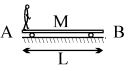
The figure shows a man of mass $m$ standing at the end $A$ of a trolley of mass $M$ placed at rest on a smooth horizontal surface. The man starts moving towards the end $B$ with a velocity $u_{rel}$ with respect to the trolley. The length of the trolley is $L$. As the man walks on the trolley,the centre of mass of the system (man $+$ trolley)
A
accelerates towards left
B
accelerates towards right
C
moves with $u_{rel}$
D
remains stationary
Solution
(D) The system consists of a man of mass $m$ and a trolley of mass $M$.
Since the trolley is placed on a smooth horizontal surface,there is no external horizontal force acting on the system (man $+$ trolley).
According to the property of the centre of mass,if the net external force on a system is zero,the acceleration of the centre of mass is zero $(a_{cm} = 0)$.
Initially,the system is at rest,so the initial velocity of the centre of mass is zero $(v_{cm} = 0)$.
Since the acceleration of the centre of mass is zero and its initial velocity is zero,the centre of mass of the system remains stationary throughout the motion.
Since the trolley is placed on a smooth horizontal surface,there is no external horizontal force acting on the system (man $+$ trolley).
According to the property of the centre of mass,if the net external force on a system is zero,the acceleration of the centre of mass is zero $(a_{cm} = 0)$.
Initially,the system is at rest,so the initial velocity of the centre of mass is zero $(v_{cm} = 0)$.
Since the acceleration of the centre of mass is zero and its initial velocity is zero,the centre of mass of the system remains stationary throughout the motion.
0 likes
View Solution38
MediumMCQ
The figure shows a man of mass $m$ standing at the end $A$ of a trolley of mass $M$ placed at rest on a smooth horizontal surface. The man starts moving towards the end $B$ with a velocity $u_{rel}$ with respect to the trolley. The length of the trolley is $L$. When the man reaches the end $B$,the distance moved by the trolley with respect to ground is
A
$\frac{mL}{m + M}$
B
$\frac{ML}{m + M}$
C
$\frac{m}{M}L$
D
$\frac{M}{m}L$
Solution
(A) Since the system (man + trolley) is on a smooth horizontal surface,there is no external horizontal force acting on the system.
Therefore,the position of the center of mass of the system remains unchanged.
Let $x_m$ be the displacement of the man and $x_t$ be the displacement of the trolley with respect to the ground.
Let the trolley move a distance $x$ towards the left,so $x_t = -x$.
The man moves a distance $L$ relative to the trolley towards the right.
So,the displacement of the man with respect to the ground is $x_m = L - x$.
Using the center of mass displacement formula: $m x_m + M x_t = 0$.
Substituting the values: $m(L - x) + M(-x) = 0$.
$mL - mx - Mx = 0$.
$mL = (m + M)x$.
$x = \frac{mL}{m + M}$.
Thus,the distance moved by the trolley with respect to the ground is $\frac{mL}{m + M}$.
Therefore,the position of the center of mass of the system remains unchanged.
Let $x_m$ be the displacement of the man and $x_t$ be the displacement of the trolley with respect to the ground.
Let the trolley move a distance $x$ towards the left,so $x_t = -x$.
The man moves a distance $L$ relative to the trolley towards the right.
So,the displacement of the man with respect to the ground is $x_m = L - x$.
Using the center of mass displacement formula: $m x_m + M x_t = 0$.
Substituting the values: $m(L - x) + M(-x) = 0$.
$mL - mx - Mx = 0$.
$mL = (m + M)x$.
$x = \frac{mL}{m + M}$.
Thus,the distance moved by the trolley with respect to the ground is $\frac{mL}{m + M}$.
0 likes
View Solution39
MediumMCQ
The figure shows a man of mass $m$ standing at the end $A$ of a trolley of mass $M$ placed at rest on a smooth horizontal surface. The man starts moving towards the end $B$ with a velocity $u_{rel}$ with respect to the trolley. The length of the trolley is $L$. The distance moved by the man with respect to ground is
A
$\frac{ML}{m + M}$
B
$\frac{mL}{m + M}$
C
$\frac{m}{M}L$
D
$\frac{M}{m}L$
Solution
(A) Since the system (man + trolley) is on a smooth horizontal surface,there is no external horizontal force acting on it. Therefore,the center of mass of the system remains at rest.
Let $x_m$ be the displacement of the man and $x_t$ be the displacement of the trolley with respect to the ground.
Since the center of mass does not move,we have $m x_m + M x_t = 0$. Taking the magnitude,$m |x_m| = M |x_t|$,so $|x_t| = \frac{m}{M} |x_m|$.
The relative displacement of the man with respect to the trolley is given as the length of the trolley,$L = |x_m| + |x_t|$.
Substituting $|x_t|$,we get $L = |x_m| + \frac{m}{M} |x_m| = |x_m| (1 + \frac{m}{M}) = |x_m| (\frac{M + m}{M})$.
Solving for $|x_m|$,we get $|x_m| = \frac{ML}{m + M}$.
Let $x_m$ be the displacement of the man and $x_t$ be the displacement of the trolley with respect to the ground.
Since the center of mass does not move,we have $m x_m + M x_t = 0$. Taking the magnitude,$m |x_m| = M |x_t|$,so $|x_t| = \frac{m}{M} |x_m|$.
The relative displacement of the man with respect to the trolley is given as the length of the trolley,$L = |x_m| + |x_t|$.
Substituting $|x_t|$,we get $L = |x_m| + \frac{m}{M} |x_m| = |x_m| (1 + \frac{m}{M}) = |x_m| (\frac{M + m}{M})$.
Solving for $|x_m|$,we get $|x_m| = \frac{ML}{m + M}$.
0 likes
View Solution40
MediumMCQ
The figure shows a man of mass $m$ standing at the end $A$ of a trolley of mass $M$ placed at rest on a smooth horizontal surface. The man starts moving towards the end $B$ with a velocity $u_{rel}$ with respect to the trolley. The length of the trolley is $L$. Choose the correct statement.
A
As the man starts moving the trolley must move backward.
B
The distance moved by the trolley is independent of the speed of the man.
C
The distance moved by the trolley can never exceed $L$.
D
All the above.
Solution
(D) Since the system (man + trolley) is on a smooth horizontal surface,there is no external horizontal force acting on it. Therefore,the center of mass of the system remains at rest.
Let $x_m$ and $x_t$ be the displacements of the man and the trolley with respect to the ground,respectively. Since the center of mass is stationary,$m x_m + M x_t = 0$.
The man moves a distance $L$ relative to the trolley,so $x_m - x_t = L$,or $x_m = L + x_t$.
Substituting this into the center of mass equation: $m(L + x_t) + M x_t = 0 \implies x_t(m + M) = -mL \implies x_t = -\frac{mL}{m+M}$.
The negative sign indicates the trolley moves backward (opposite to the man's motion),so option $A$ is correct.
The displacement of the trolley $x_t = \frac{mL}{m+M}$ depends only on the masses and the length $L$,not on the speed of the man,so option $B$ is correct.
Since $x_t = \frac{m}{m+M} L$,and $\frac{m}{m+M} < 1$,the distance moved by the trolley is always less than $L$,so option $C$ is correct.
Therefore,all the statements are correct.
Let $x_m$ and $x_t$ be the displacements of the man and the trolley with respect to the ground,respectively. Since the center of mass is stationary,$m x_m + M x_t = 0$.
The man moves a distance $L$ relative to the trolley,so $x_m - x_t = L$,or $x_m = L + x_t$.
Substituting this into the center of mass equation: $m(L + x_t) + M x_t = 0 \implies x_t(m + M) = -mL \implies x_t = -\frac{mL}{m+M}$.
The negative sign indicates the trolley moves backward (opposite to the man's motion),so option $A$ is correct.
The displacement of the trolley $x_t = \frac{mL}{m+M}$ depends only on the masses and the length $L$,not on the speed of the man,so option $B$ is correct.
Since $x_t = \frac{m}{m+M} L$,and $\frac{m}{m+M} < 1$,the distance moved by the trolley is always less than $L$,so option $C$ is correct.
Therefore,all the statements are correct.
0 likes
View Solution41
AdvancedMCQ
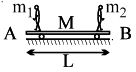
Two persons of mass $m_1$ and $m_2$ are standing at the two ends $A$ and $B$ respectively,of a trolley of mass $M$ as shown. Choose the incorrect statement,if $m_1 = m_2 = m$ and both the persons jump one by one,then
A
the centre of mass of the system remains stationary
B
the final velocity of the trolley is in the direction of the person who jumps first
C
the final velocity of the trolley is $\left( {\frac{{m{u_{rel}}}}{{M + m}} - \frac{{m{u_{rel}}}}{{M + 2m}}} \right)$
D
none of these
Solution
(B) The system consists of the trolley and two persons. Since there is no external horizontal force acting on the system,the momentum of the system is conserved.
Initially,the system is at rest,so the initial momentum is $0$.
When the first person (mass $m$) jumps with relative velocity $u_{rel}$ towards the left,the trolley (mass $M+m$) moves to the right with velocity $v_1 = \frac{m u_{rel}}{M+m}$.
When the second person (mass $m$) jumps with relative velocity $u_{rel}$ towards the right,the trolley (mass $M$) moves to the left with velocity $v_2 = \frac{m u_{rel}}{M}$.
The final velocity of the trolley is the vector sum of these velocities.
Option $A$ is correct because the external force is zero,so the centre of mass remains stationary.
Option $B$ is incorrect because the final velocity of the trolley depends on the masses and the direction of the jumps,and it is not necessarily in the direction of the first person.
Option $C$ is also incorrect as the expression for final velocity is not $\left( {\frac{{m{u_{rel}}}}{{M + m}} - \frac{{m{u_{rel}}}}{{M + 2m}}} \right)$.
Initially,the system is at rest,so the initial momentum is $0$.
When the first person (mass $m$) jumps with relative velocity $u_{rel}$ towards the left,the trolley (mass $M+m$) moves to the right with velocity $v_1 = \frac{m u_{rel}}{M+m}$.
When the second person (mass $m$) jumps with relative velocity $u_{rel}$ towards the right,the trolley (mass $M$) moves to the left with velocity $v_2 = \frac{m u_{rel}}{M}$.
The final velocity of the trolley is the vector sum of these velocities.
Option $A$ is correct because the external force is zero,so the centre of mass remains stationary.
Option $B$ is incorrect because the final velocity of the trolley depends on the masses and the direction of the jumps,and it is not necessarily in the direction of the first person.
Option $C$ is also incorrect as the expression for final velocity is not $\left( {\frac{{m{u_{rel}}}}{{M + m}} - \frac{{m{u_{rel}}}}{{M + 2m}}} \right)$.
0 likes
View Solution42
MediumMCQ
Two particles of mass $m$ each are fixed at the opposite ends of a massless rod of length $5 \ m$ which is oriented vertically on a smooth horizontal surface and released. Find the displacement of the lower mass on the ground when the rod makes an angle of $37^o$ with the vertical. (in $m$)
A
$1.5$
B
$2$
C
$2.5$
D
$3.5$
Solution
(A) Since there are no external horizontal forces acting on the system,the center of mass of the system remains at its initial horizontal position.
Let the length of the rod be $L = 5 \ m$. The center of mass of the two equal masses $m$ is at the midpoint of the rod,i.e.,at a distance $L/2 = 2.5 \ m$ from either end.
Initially,the rod is vertical,so the center of mass is at a horizontal distance of $0$ from the vertical axis passing through the midpoint.
When the rod makes an angle $\theta = 37^o$ with the vertical,the horizontal distance of the center of mass from the initial vertical axis remains $0$.
Let $x_1$ be the horizontal displacement of the lower mass and $x_2$ be the horizontal displacement of the upper mass from the initial vertical axis.
Due to the symmetry of the system,the center of mass is always at the midpoint. The horizontal position of the midpoint is $x_{cm} = (x_1 + x_2) / 2 = 0$.
This implies $x_1 = -x_2$. The distance between the two masses is $L = 5 \ m$. The horizontal projection of the rod is $L \sin(37^o) = 5 \cdot (3/5) = 3 \ m$.
Thus,$|x_1| + |x_2| = 3 \ m$. Since $|x_1| = |x_2|$,we have $2|x_1| = 3 \ m$,which gives $|x_1| = 1.5 \ m$.
Let the length of the rod be $L = 5 \ m$. The center of mass of the two equal masses $m$ is at the midpoint of the rod,i.e.,at a distance $L/2 = 2.5 \ m$ from either end.
Initially,the rod is vertical,so the center of mass is at a horizontal distance of $0$ from the vertical axis passing through the midpoint.
When the rod makes an angle $\theta = 37^o$ with the vertical,the horizontal distance of the center of mass from the initial vertical axis remains $0$.
Let $x_1$ be the horizontal displacement of the lower mass and $x_2$ be the horizontal displacement of the upper mass from the initial vertical axis.
Due to the symmetry of the system,the center of mass is always at the midpoint. The horizontal position of the midpoint is $x_{cm} = (x_1 + x_2) / 2 = 0$.
This implies $x_1 = -x_2$. The distance between the two masses is $L = 5 \ m$. The horizontal projection of the rod is $L \sin(37^o) = 5 \cdot (3/5) = 3 \ m$.
Thus,$|x_1| + |x_2| = 3 \ m$. Since $|x_1| = |x_2|$,we have $2|x_1| = 3 \ m$,which gives $|x_1| = 1.5 \ m$.
0 likes
View Solution43
DifficultMCQ
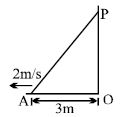
$A$ ladder $AP$ of length $5\, m$ is inclined to a vertical wall and is slipping over a horizontal surface with a velocity of $2\, m/s$. When the end $A$ is at a distance of $3\, m$ from the wall,what is the velocity of the center of mass $(C.M.)$ of the ladder at this moment (in $, m/s$)?
A
$1.25$
B
$0$
C
$1$
D
$2$
Solution
(A) Let the position of end $A$ be $(x, 0)$ and end $P$ be $(0, y)$. The length of the ladder is $L = 5\, m$,so $x^2 + y^2 = L^2 = 25$.
Given $x = 3\, m$,then $y = \sqrt{25 - 3^2} = 4\, m$.
Differentiating $x^2 + y^2 = 25$ with respect to time $t$,we get $2x(dx/dt) + 2y(dy/dt) = 0$.
Given $dx/dt = -2\, m/s$ (moving away from the wall),so $2(3)(-2) + 2(4)(dy/dt) = 0$,which gives $dy/dt = 1.5\, m/s$.
The coordinates of the center of mass are $x_{cm} = x/2$ and $y_{cm} = y/2$.
The velocity components of the center of mass are $v_{x,cm} = (1/2)(dx/dt) = (1/2)(-2) = -1\, m/s$ and $v_{y,cm} = (1/2)(dy/dt) = (1/2)(1.5) = 0.75\, m/s$.
The magnitude of the velocity of the center of mass is $V_{cm} = \sqrt{v_{x,cm}^2 + v_{y,cm}^2} = \sqrt{(-1)^2 + (0.75)^2} = \sqrt{1 + 0.5625} = \sqrt{1.5625} = 1.25\, m/s$.
Given $x = 3\, m$,then $y = \sqrt{25 - 3^2} = 4\, m$.
Differentiating $x^2 + y^2 = 25$ with respect to time $t$,we get $2x(dx/dt) + 2y(dy/dt) = 0$.
Given $dx/dt = -2\, m/s$ (moving away from the wall),so $2(3)(-2) + 2(4)(dy/dt) = 0$,which gives $dy/dt = 1.5\, m/s$.
The coordinates of the center of mass are $x_{cm} = x/2$ and $y_{cm} = y/2$.
The velocity components of the center of mass are $v_{x,cm} = (1/2)(dx/dt) = (1/2)(-2) = -1\, m/s$ and $v_{y,cm} = (1/2)(dy/dt) = (1/2)(1.5) = 0.75\, m/s$.
The magnitude of the velocity of the center of mass is $V_{cm} = \sqrt{v_{x,cm}^2 + v_{y,cm}^2} = \sqrt{(-1)^2 + (0.75)^2} = \sqrt{1 + 0.5625} = \sqrt{1.5625} = 1.25\, m/s$.
0 likes
View Solution44
MediumMCQ
$A$ ball of mass $1\, kg$ is thrown up with an initial speed of $4\, m/s$. $A$ second ball of mass $2\, kg$ is released from rest from some height as shown in the figure. Select the correct alternative.
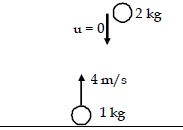
A
The centre of mass of the two balls comes down with acceleration $g/3$.
B
The centre of mass first moves up and then comes down.
C
The acceleration of the centre of mass is first $g$ downwards and then $g$ upwards.
D
The centre of mass of the two balls remains stationary.
Solution
(B) The initial velocity of the centre of mass $(V_{cm})$ is given by:
$V_{cm} = \frac{m_1 v_1 + m_2 v_2}{m_1 + m_2} = \frac{1 \times 4 + 2 \times 0}{1 + 2} = \frac{4}{3}\, m/s$ (upwards).
Since both balls are under the influence of gravity,the acceleration of each ball is $g$ downwards.
The acceleration of the centre of mass $(a_{cm})$ is given by:
$a_{cm} = \frac{m_1 a_1 + m_2 a_2}{m_1 + m_2} = \frac{1 \times (-g) + 2 \times (-g)}{1 + 2} = -g$ (downwards).
Since the centre of mass has an initial upward velocity and a constant downward acceleration,it will first move up,reach a maximum height,and then come down.
$V_{cm} = \frac{m_1 v_1 + m_2 v_2}{m_1 + m_2} = \frac{1 \times 4 + 2 \times 0}{1 + 2} = \frac{4}{3}\, m/s$ (upwards).
Since both balls are under the influence of gravity,the acceleration of each ball is $g$ downwards.
The acceleration of the centre of mass $(a_{cm})$ is given by:
$a_{cm} = \frac{m_1 a_1 + m_2 a_2}{m_1 + m_2} = \frac{1 \times (-g) + 2 \times (-g)}{1 + 2} = -g$ (downwards).
Since the centre of mass has an initial upward velocity and a constant downward acceleration,it will first move up,reach a maximum height,and then come down.
0 likes
View Solution45
MediumMCQ
$A$ boat of mass $90\ kg$ is floating in still water. $A$ boy of mass $30\ kg$ walks from the stern to the bow. The length of the boat is $3\ m$. The distance through which the boat moves is .......... $m$.
A
$0.5$
B
$0.75$
C
$0.25$
D
$1.0$
Solution
(B) Since there is no external horizontal force acting on the system (boat + boy),the center of mass of the system remains stationary.
Let $M = 90\ kg$ be the mass of the boat and $m = 30\ kg$ be the mass of the boy.
Let $L = 3\ m$ be the length of the boat.
Let $d$ be the distance the boat moves in the opposite direction to the boy.
When the boy moves a distance $L$ relative to the boat,his displacement relative to the water is $(L - d)$.
The displacement of the boat relative to the water is $-d$.
Using the center of mass conservation principle: $m(L - d) + M(-d) = 0$.
$30(3 - d) - 90d = 0$.
$90 - 30d - 90d = 0$.
$90 = 120d$.
$d = \frac{90}{120} = 0.75\ m$.
Let $M = 90\ kg$ be the mass of the boat and $m = 30\ kg$ be the mass of the boy.
Let $L = 3\ m$ be the length of the boat.
Let $d$ be the distance the boat moves in the opposite direction to the boy.
When the boy moves a distance $L$ relative to the boat,his displacement relative to the water is $(L - d)$.
The displacement of the boat relative to the water is $-d$.
Using the center of mass conservation principle: $m(L - d) + M(-d) = 0$.
$30(3 - d) - 90d = 0$.
$90 - 30d - 90d = 0$.
$90 = 120d$.
$d = \frac{90}{120} = 0.75\ m$.
0 likes
View Solution46
MediumMCQ
Two equal rods joined at one end are kept on a smooth surface as shown and released. The trajectory of the centre of mass of both rods is:
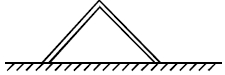
A
parabola
B
straight vertical line
C
straight inclined line
D
straight horizontal line
Solution
(B) The system consists of two equal rods joined at one end,placed on a smooth horizontal surface.
Since the surface is smooth,there is no external horizontal force acting on the system.
The only external forces acting on the system are the gravitational force (acting downwards) and the normal reaction from the surface (acting upwards).
Both these forces act in the vertical direction.
According to Newton's second law for the centre of mass,$F_{ext, x} = M a_{cm, x}$.
Since there is no external horizontal force $(F_{ext, x} = 0)$,the acceleration of the centre of mass in the horizontal direction is zero $(a_{cm, x} = 0)$.
Initially,the system is at rest,so the initial velocity of the centre of mass in the horizontal direction is zero $(v_{cm, x} = 0)$.
Since both the initial velocity and acceleration in the horizontal direction are zero,the centre of mass will not move horizontally.
Therefore,the centre of mass will move only in the vertical direction.
Thus,the trajectory of the centre of mass is a straight vertical line.
Since the surface is smooth,there is no external horizontal force acting on the system.
The only external forces acting on the system are the gravitational force (acting downwards) and the normal reaction from the surface (acting upwards).
Both these forces act in the vertical direction.
According to Newton's second law for the centre of mass,$F_{ext, x} = M a_{cm, x}$.
Since there is no external horizontal force $(F_{ext, x} = 0)$,the acceleration of the centre of mass in the horizontal direction is zero $(a_{cm, x} = 0)$.
Initially,the system is at rest,so the initial velocity of the centre of mass in the horizontal direction is zero $(v_{cm, x} = 0)$.
Since both the initial velocity and acceleration in the horizontal direction are zero,the centre of mass will not move horizontally.
Therefore,the centre of mass will move only in the vertical direction.
Thus,the trajectory of the centre of mass is a straight vertical line.
0 likes
View Solution47
DifficultMCQ
$A$ block of mass $M$ is tied to one end of a massless rope. The other end of the rope is in the hands of a man of mass $2M$ as shown in the figure. Initially,the block and the man are resting on a rough plank of mass $2M$ as shown in the figure. The whole system is resting on a smooth horizontal surface. The man pulls the rope. The pulley is massless and frictionless. What is the magnitude of the displacement of the plank when the block meets the pulley? (The man does not leave his position on the plank during the pull).
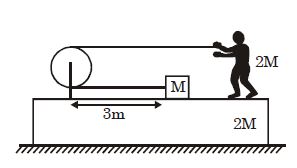
A
$0.5$
B
$0.6$
C
$1.5$
D
$2$
Solution
(B) Let the displacement of the plank relative to the ground be $x$ in the left direction. Since the system is on a smooth surface and there are no external horizontal forces,the position of the center of mass of the system remains unchanged.
Let the mass of the block be $m_1 = M$,the mass of the man be $m_2 = 2M$,and the mass of the plank be $m_3 = 2M$. The total mass of the system is $M_{total} = M + 2M + 2M = 5M$.
The displacement of the center of mass is zero: $\Delta X_{cm} = \frac{m_1 \Delta x_1 + m_2 \Delta x_2 + m_3 \Delta x_3}{M_{total}} = 0$.
Let the displacement of the plank be $x$ to the left $(-x)$.
The man is on the plank,so his displacement is also $-x$.
The block is initially $3 \ m$ away from the pulley. When it reaches the pulley,it has moved $3 \ m$ relative to the plank to the right. Its displacement relative to the ground is $\Delta x_1 = (3 - x)$ to the right.
Substituting these values: $M(3 - x) + 2M(-x) + 2M(-x) = 0$.
$3M - Mx - 2Mx - 2Mx = 0$.
$3M = 5Mx$.
$x = \frac{3}{5} = 0.6 \ m$.
Let the mass of the block be $m_1 = M$,the mass of the man be $m_2 = 2M$,and the mass of the plank be $m_3 = 2M$. The total mass of the system is $M_{total} = M + 2M + 2M = 5M$.
The displacement of the center of mass is zero: $\Delta X_{cm} = \frac{m_1 \Delta x_1 + m_2 \Delta x_2 + m_3 \Delta x_3}{M_{total}} = 0$.
Let the displacement of the plank be $x$ to the left $(-x)$.
The man is on the plank,so his displacement is also $-x$.
The block is initially $3 \ m$ away from the pulley. When it reaches the pulley,it has moved $3 \ m$ relative to the plank to the right. Its displacement relative to the ground is $\Delta x_1 = (3 - x)$ to the right.
Substituting these values: $M(3 - x) + 2M(-x) + 2M(-x) = 0$.
$3M - Mx - 2Mx - 2Mx = 0$.
$3M = 5Mx$.
$x = \frac{3}{5} = 0.6 \ m$.
0 likes
View Solution48
MediumMCQ
As shown in the figure,two blocks are connected with a light spring. When the spring is at its natural length,velocities are given to them as shown in the figure. Choose the wrong alternative.
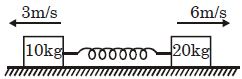
A
Velocity of the center of mass of the system is $3 \, m/s$ (towards right).
B
When the spring is at maximum compression,the velocity of the $20 \, kg$ block is $3 \, m/s$ (towards right).
C
When the spring is at maximum elongation,the velocity of the $10 \, kg$ block is $3 \, m/s$ (towards left).
D
Both $(A)$ and $(C)$ are wrong.
Solution
(C) The velocity of the center of mass $(v_{cm})$ is given by:
$v_{cm} = \frac{m_1 v_1 + m_2 v_2}{m_1 + m_2} = \frac{20 \times 6 + 10 \times (-3)}{20 + 10} = \frac{120 - 30}{30} = \frac{90}{30} = 3 \, m/s$ (towards right).
Thus,option $(A)$ is correct.
At the time of maximum elongation or maximum compression,the relative velocity of the blocks is zero,meaning both blocks move with the same velocity equal to the velocity of the center of mass ($v_{cm} = 3 \, m/s$ towards right).
Therefore,the velocity of both the $10 \, kg$ block and the $20 \, kg$ block at these instances is $3 \, m/s$ (towards right).
Comparing this with the given options:
Option $(B)$ states the velocity of the $20 \, kg$ block is $3 \, m/s$ (towards right),which is correct.
Option $(C)$ states the velocity of the $10 \, kg$ block is $3 \, m/s$ (towards left),which is incorrect.
Since the question asks to choose the wrong alternative,$(C)$ is the wrong statement.
$v_{cm} = \frac{m_1 v_1 + m_2 v_2}{m_1 + m_2} = \frac{20 \times 6 + 10 \times (-3)}{20 + 10} = \frac{120 - 30}{30} = \frac{90}{30} = 3 \, m/s$ (towards right).
Thus,option $(A)$ is correct.
At the time of maximum elongation or maximum compression,the relative velocity of the blocks is zero,meaning both blocks move with the same velocity equal to the velocity of the center of mass ($v_{cm} = 3 \, m/s$ towards right).
Therefore,the velocity of both the $10 \, kg$ block and the $20 \, kg$ block at these instances is $3 \, m/s$ (towards right).
Comparing this with the given options:
Option $(B)$ states the velocity of the $20 \, kg$ block is $3 \, m/s$ (towards right),which is correct.
Option $(C)$ states the velocity of the $10 \, kg$ block is $3 \, m/s$ (towards left),which is incorrect.
Since the question asks to choose the wrong alternative,$(C)$ is the wrong statement.
0 likes
View SolutionSystem of Particles and Rotational Motion — Motion of Centre of Mass · Frequently Asked Questions
1Are these System of Particles and Rotational Motion questions useful for JEE and NEET?
Yes. All questions in this section are mapped to JEE Main and NEET exam patterns. Previous year questions from JEE Main, NEET, GUJCET and state-level exams are included with full solutions.
2Can I switch to Hindi or Gujarati for these questions?
Yes. Use the language tabs in the hero section or the sidebar to view the same questions and solutions in English, Hindi or Gujarati.
3How do I generate a question paper from this subtopic?
Use the Vedclass Exam Paper Generator — select the chapter and subtopic, set difficulty, and generate Sets A, B, C, D automatically. First 3 chapters of every subject are free.
Vedclass Products
For Students
Vedclass Test Series
Mock tests in real JEE/NEET style with performance analysis. 5-day free trial.
Start Free TrialFor Teachers
Exam Paper Generator
Generate Set A/B/C/D papers from this chapter in 2 minutes. 3 chapters free.
Try FreeFor Institutes
Online Exam Module
Live online exams with unlimited students, 360° analytics & white-label branding.
See DemoFor Teachers & Institutes
Generate a System of Particles and Rotational Motion Exam Paper in 2 Minutes
Select subtopic & difficulty — Sets A, B, C, D auto-generated with No Repeat logic.
First 3 chapters of every subject are free — no payment required.