
A English
Bernoulli's Theorem and Applications of Bernoulli's Theory Questions in English
Class 11 Physics · Fluid Mechanics and Surface Tension · Bernoulli's Theorem and Applications of Bernoulli's Theory
175+
Questions
English
Language
100%
With Solutions
Showing 50 of 175 questions in English
1
EasyMCQ
$A$ jet plane flies in the air because
A
The gravity does not act on bodies moving with high speeds
B
The thrust of the jet compensates for the force of gravity
C
The flow of air around the wings causes an upward force,which compensates for the force of gravity
D
The weight of air whose volume is equal to the volume of the plane is more than the weight of the plane
Solution
(C) The correct answer is $C$. $A$ jet plane flies due to the aerodynamic lift generated by its wings. As the plane moves forward at high speed,the shape of the wings causes the air to flow faster over the top surface than the bottom surface. According to Bernoulli's principle,this creates a pressure difference,resulting in an upward force called lift. This lift force compensates for the force of gravity (weight) acting on the plane,allowing it to stay in the air.
0 likes
View Solution2
EasyMCQ
The weight of an aeroplane flying in the air is balanced by:
A
Vertical component of the thrust created by air currents striking the lower surface of the wings
B
Force due to reaction of gases ejected by the revolving propeller
C
Upthrust of the air which will be equal to the weight of the air having the same volume as the plane
D
Force due to the pressure difference between the upper and lower surfaces of the wings created by different air speeds on the surfaces
Solution
(D) The lift force on an aeroplane wing is explained by Bernoulli's principle.
Due to the shape of the wing (aerofoil),the air speed over the upper surface is greater than the air speed over the lower surface.
According to Bernoulli's theorem,where the speed of the fluid is higher,the pressure is lower.
Thus,the pressure on the upper surface is lower than the pressure on the lower surface.
This pressure difference creates an upward force called lift,which balances the weight of the aeroplane.
Due to the shape of the wing (aerofoil),the air speed over the upper surface is greater than the air speed over the lower surface.
According to Bernoulli's theorem,where the speed of the fluid is higher,the pressure is lower.
Thus,the pressure on the upper surface is lower than the pressure on the lower surface.
This pressure difference creates an upward force called lift,which balances the weight of the aeroplane.
0 likes
View Solution3
MediumMCQ
An engine pump is used to pump a liquid of density $\rho$ continuously through a pipe of cross-sectional area $A$. If the speed of flow of the liquid in the pipe is $v$,then the rate at which kinetic energy is being imparted to the liquid is
A
$\frac{1}{2}A\rho v^3$
B
$\frac{1}{2}A\rho v^2$
C
$\frac{1}{2}A\rho v$
D
$A\rho v$
Solution
(A) The kinetic energy $K$ of a mass $m$ moving with velocity $v$ is given by $K = \frac{1}{2}mv^2$.
The rate at which kinetic energy is imparted is the power $P = \frac{dK}{dt} = \frac{1}{2}v^2 \frac{dm}{dt}$.
The mass $m$ flowing through the pipe in time $t$ is $m = \text{Volume} \times \text{density} = (A \times l) \times \rho$,where $l$ is the length of the liquid column.
Thus,the rate of mass flow is $\frac{dm}{dt} = A \times \frac{dl}{dt} \times \rho = A v \rho$.
Substituting this into the power equation: $P = \frac{1}{2}v^2 (A v \rho) = \frac{1}{2}A \rho v^3$.
The rate at which kinetic energy is imparted is the power $P = \frac{dK}{dt} = \frac{1}{2}v^2 \frac{dm}{dt}$.
The mass $m$ flowing through the pipe in time $t$ is $m = \text{Volume} \times \text{density} = (A \times l) \times \rho$,where $l$ is the length of the liquid column.
Thus,the rate of mass flow is $\frac{dm}{dt} = A \times \frac{dl}{dt} \times \rho = A v \rho$.
Substituting this into the power equation: $P = \frac{1}{2}v^2 (A v \rho) = \frac{1}{2}A \rho v^3$.
0 likes
View Solution4
EasyMCQ
The velocity of kerosene oil in a horizontal pipe is $5 \ m/s$. If $g = 10 \ m/s^2$,then the velocity head of the oil will be ....... $m$.
A
$1.25$
B
$12.5$
C
$0.125$
D
$125$
Solution
(A) The velocity head $(h)$ is defined by the formula $h = \frac{v^2}{2g}$.
Given:
Velocity $(v)$ = $5 \ m/s$
Acceleration due to gravity $(g)$ = $10 \ m/s^2$
Substituting the values into the formula:
$h = \frac{(5)^2}{2 \times 10}$
$h = \frac{25}{20}$
$h = 1.25 \ m$
Therefore,the velocity head of the oil is $1.25 \ m$.
Given:
Velocity $(v)$ = $5 \ m/s$
Acceleration due to gravity $(g)$ = $10 \ m/s^2$
Substituting the values into the formula:
$h = \frac{(5)^2}{2 \times 10}$
$h = \frac{25}{20}$
$h = 1.25 \ m$
Therefore,the velocity head of the oil is $1.25 \ m$.
0 likes
View Solution5
EasyMCQ
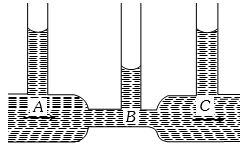
In the following figure,the flow of liquid through a horizontal pipe is shown. Three tubes $A, B$ and $C$ are connected to the pipe. The radii of the tubes $A, B$ and $C$ at the junction are respectively $2 \ cm, 1 \ cm$ and $2 \ cm$. It can be said that the:
A
Height of the liquid in the tube $A$ is maximum.
B
Height of the liquid in the tubes $A$ and $B$ is the same.
C
Height of the liquid in all the three tubes is the same.
D
Height of the liquid in the tubes $A$ and $C$ is the same.
Solution
(D) According to the equation of continuity,$A_1v_1 = A_2v_2$. Since the cross-sectional areas of tubes $A$ and $C$ are equal $(r_A = r_C = 2 \ cm)$,the velocity of the liquid at $A$ and $C$ must be equal $(v_A = v_C)$.
According to Bernoulli's theorem for a horizontal pipe,$P + \frac{1}{2}\rho v^2 = \text{constant}$.
Since the velocities at $A$ and $C$ are equal,the pressures at $A$ and $C$ must also be equal $(P_A = P_C)$.
Since the pressure is directly proportional to the height of the liquid column $(P = \rho gh)$,the height of the liquid in tubes $A$ and $C$ will be the same.
According to Bernoulli's theorem for a horizontal pipe,$P + \frac{1}{2}\rho v^2 = \text{constant}$.
Since the velocities at $A$ and $C$ are equal,the pressures at $A$ and $C$ must also be equal $(P_A = P_C)$.
Since the pressure is directly proportional to the height of the liquid column $(P = \rho gh)$,the height of the liquid in tubes $A$ and $C$ will be the same.
0 likes
View Solution6
DifficultMCQ
$A$ manometer connected to a closed tap reads $3.5 \times 10^5 \ N/m^2$. When the valve is opened,the reading of the manometer falls to $3.0 \times 10^5 \ N/m^2$. The velocity of the flow of water is ........ $m/s$.
A
$100$
B
$10$
C
$1$
D
$10\sqrt{10}$
Solution
(B) According to Bernoulli's theorem for a horizontal flow of an incompressible,non-viscous fluid:
$P_1 + \frac{1}{2}\rho v_1^2 = P_2 + \frac{1}{2}\rho v_2^2$
When the tap is closed,the velocity $v_1 = 0$,so the pressure $P_1 = 3.5 \times 10^5 \ N/m^2$.
When the tap is opened,the pressure $P_2 = 3.0 \times 10^5 \ N/m^2$ and the velocity is $v_2 = v$.
Assuming the density of water $\rho = 10^3 \ kg/m^3$:
$P_1 = P_2 + \frac{1}{2}\rho v^2$
$\frac{1}{2}\rho v^2 = P_1 - P_2$
$v^2 = \frac{2(P_1 - P_2)}{\rho}$
$v^2 = \frac{2(3.5 \times 10^5 - 3.0 \times 10^5)}{10^3}$
$v^2 = \frac{2(0.5 \times 10^5)}{10^3} = \frac{1.0 \times 10^5}{10^3} = 100$
$v = \sqrt{100} = 10 \ m/s$.
$P_1 + \frac{1}{2}\rho v_1^2 = P_2 + \frac{1}{2}\rho v_2^2$
When the tap is closed,the velocity $v_1 = 0$,so the pressure $P_1 = 3.5 \times 10^5 \ N/m^2$.
When the tap is opened,the pressure $P_2 = 3.0 \times 10^5 \ N/m^2$ and the velocity is $v_2 = v$.
Assuming the density of water $\rho = 10^3 \ kg/m^3$:
$P_1 = P_2 + \frac{1}{2}\rho v^2$
$\frac{1}{2}\rho v^2 = P_1 - P_2$
$v^2 = \frac{2(P_1 - P_2)}{\rho}$
$v^2 = \frac{2(3.5 \times 10^5 - 3.0 \times 10^5)}{10^3}$
$v^2 = \frac{2(0.5 \times 10^5)}{10^3} = \frac{1.0 \times 10^5}{10^3} = 100$
$v = \sqrt{100} = 10 \ m/s$.
0 likes
View Solution7
MediumMCQ
Air is streaming past a horizontal airplane wing such that its speed is $120 \ m/s$ over the upper surface and $90 \ m/s$ at the lower surface. If the density of air is $1.3 \ kg/m^3$ and the wing is $10 \ m$ long and has an average width of $2 \ m$,then the difference of the pressure on the two sides of the wing is ....... $Pascal$.
A
$4095.0$
B
$409.50$
C
$40.950$
D
$4.0950$
Solution
(A) According to Bernoulli's theorem,the pressure difference $\Delta P$ between the lower surface $(P_2)$ and the upper surface $(P_1)$ is given by:
$\Delta P = P_2 - P_1 = \frac{1}{2} \rho (v_1^2 - v_2^2)$
Here,$\rho = 1.3 \ kg/m^3$,$v_1 = 120 \ m/s$ (upper surface speed),and $v_2 = 90 \ m/s$ (lower surface speed).
Substituting the values:
$\Delta P = \frac{1}{2} \times 1.3 \times (120^2 - 90^2)$
$\Delta P = 0.65 \times (14400 - 8100)$
$\Delta P = 0.65 \times 6300$
$\Delta P = 4095 \ Pa$.
$\Delta P = P_2 - P_1 = \frac{1}{2} \rho (v_1^2 - v_2^2)$
Here,$\rho = 1.3 \ kg/m^3$,$v_1 = 120 \ m/s$ (upper surface speed),and $v_2 = 90 \ m/s$ (lower surface speed).
Substituting the values:
$\Delta P = \frac{1}{2} \times 1.3 \times (120^2 - 90^2)$
$\Delta P = 0.65 \times (14400 - 8100)$
$\Delta P = 0.65 \times 6300$
$\Delta P = 4095 \ Pa$.
0 likes
View Solution8
EasyMCQ
Water is flowing through a horizontal pipe of non-uniform cross-section. At the extreme narrow portion of the pipe, the water will have
A
Maximum speed and least pressure
B
Maximum pressure and least speed
C
Both pressure and speed maximum
D
Both pressure and speed least
Solution
(A) According to the equation of continuity, $A_1v_1 = A_2v_2$. For a horizontal pipe, as the cross-sectional area $A$ decreases, the velocity $v$ of the fluid must increase to maintain a constant flow rate.
According to Bernoulli's principle for a horizontal pipe, $P + \frac{1}{2}\rho v^2 = \text{constant}$.
As the velocity $v$ increases at the narrow portion, the pressure $P$ must decrease to keep the sum constant.
Therefore, at the narrowest portion, the water has maximum speed and minimum pressure.
According to Bernoulli's principle for a horizontal pipe, $P + \frac{1}{2}\rho v^2 = \text{constant}$.
As the velocity $v$ increases at the narrow portion, the pressure $P$ must decrease to keep the sum constant.
Therefore, at the narrowest portion, the water has maximum speed and minimum pressure.
0 likes
View Solution9
EasyMCQ
An application of Bernoulli's equation for fluid flow is found in
A
Dynamic lift of an aeroplane
B
Viscosity meter
C
Capillary rise
D
Hydraulic press
Solution
(A) Bernoulli's equation states that for an incompressible,non-viscous,and steady fluid flow,the sum of pressure energy,kinetic energy,and potential energy per unit volume remains constant along a streamline.
The dynamic lift of an aeroplane wing is a classic application of this principle.
As the wing moves through the air,the shape of the wing (airfoil) causes the air velocity above the wing to be higher than the air velocity below the wing.
According to Bernoulli's equation,where the velocity of the fluid is higher,the pressure is lower.
Therefore,the pressure below the wing is greater than the pressure above the wing,creating an upward force known as dynamic lift.
The dynamic lift of an aeroplane wing is a classic application of this principle.
As the wing moves through the air,the shape of the wing (airfoil) causes the air velocity above the wing to be higher than the air velocity below the wing.
According to Bernoulli's equation,where the velocity of the fluid is higher,the pressure is lower.
Therefore,the pressure below the wing is greater than the pressure above the wing,creating an upward force known as dynamic lift.
0 likes
View Solution10
EasyMCQ
The working of an atomizer depends upon:
A
Bernoulli's theorem
B
Boyle's law
C
Archimedes principle
D
Newton's law of motion
Solution
(A) An atomizer works on the principle of Bernoulli's theorem.
When the rubber bulb is squeezed,air is forced through a narrow tube at high velocity.
According to Bernoulli's theorem,as the velocity of the fluid (air) increases,the pressure decreases.
This creates a region of low pressure at the top of the vertical tube,which causes the liquid to rise up the tube and get sprayed out as a fine mist due to the high-velocity air stream.
When the rubber bulb is squeezed,air is forced through a narrow tube at high velocity.
According to Bernoulli's theorem,as the velocity of the fluid (air) increases,the pressure decreases.
This creates a region of low pressure at the top of the vertical tube,which causes the liquid to rise up the tube and get sprayed out as a fine mist due to the high-velocity air stream.
0 likes
View Solution11
EasyMCQ
The pans of a physical balance are in equilibrium. Air is blown under the right hand pan; then the right hand pan will
A
Move up
B
Move down
C
Move erratically
D
Remain at the same level
Solution
(B) According to Bernoulli's theorem,when air is blown under the right hand pan,the velocity of air increases in that region.
As the velocity of air increases,the pressure in that region decreases.
Due to the decrease in pressure below the right hand pan,the atmospheric pressure acting from above becomes relatively greater.
Consequently,the right hand pan experiences a net downward force and moves down.
As the velocity of air increases,the pressure in that region decreases.
Due to the decrease in pressure below the right hand pan,the atmospheric pressure acting from above becomes relatively greater.
Consequently,the right hand pan experiences a net downward force and moves down.
0 likes
View Solution12
EasyMCQ
According to Bernoulli's equation $\frac{P}{\rho g} + h + \frac{v^2}{2g} = \text{constant}$,the terms $\frac{P}{\rho g}$,$h$,and $\frac{v^2}{2g}$ are generally called respectively:
A
Gravitational head,pressure head,and velocity head
B
Gravity,gravitational head,and velocity head
C
Pressure head,gravitational head,and velocity head
D
Gravity,pressure,and velocity head
Solution
(C) Bernoulli's equation for steady,incompressible,non-viscous flow is given by $\frac{P}{\rho g} + h + \frac{v^2}{2g} = \text{constant}$.
In this equation:
$1$. The term $\frac{P}{\rho g}$ represents the pressure head.
$2$. The term $h$ represents the gravitational head (or potential head).
$3$. The term $\frac{v^2}{2g}$ represents the velocity head (or kinetic head).
Therefore,the correct sequence is pressure head,gravitational head,and velocity head.
In this equation:
$1$. The term $\frac{P}{\rho g}$ represents the pressure head.
$2$. The term $h$ represents the gravitational head (or potential head).
$3$. The term $\frac{v^2}{2g}$ represents the velocity head (or kinetic head).
Therefore,the correct sequence is pressure head,gravitational head,and velocity head.
0 likes
View Solution13
MediumMCQ
At what speed will the velocity head of a stream of water be equal to $40 \ cm$ of $Hg$ (in $cm/sec$)?
A
$282.8$
B
$432.6$
C
$632.6$
D
$832.6$
Solution
(A) The velocity head is given by the formula $\frac{v^2}{2g} = h_{water}$.
First,we convert the pressure head of $Hg$ into an equivalent head of water.
$h_{water} = h_{Hg} \times \frac{\rho_{Hg}}{\rho_{water}} = 40 \ cm \times 13.6 = 544 \ cm$.
Now,using the formula $v = \sqrt{2gh}$,where $g = 980 \ cm/s^2$ (or $1000 \ cm/s^2$ as per approximation in the provided solution context):
Using $g = 1000 \ cm/s^2$ and $h = 40 \ cm$ (assuming the question implies the pressure head of $Hg$ is directly equated to the velocity head of water):
$v = \sqrt{2 \times 1000 \times 40} = \sqrt{80000} = \sqrt{8 \times 10^4} = 282.84 \ cm/s$.
Thus,the speed is approximately $282.8 \ cm/s$.
First,we convert the pressure head of $Hg$ into an equivalent head of water.
$h_{water} = h_{Hg} \times \frac{\rho_{Hg}}{\rho_{water}} = 40 \ cm \times 13.6 = 544 \ cm$.
Now,using the formula $v = \sqrt{2gh}$,where $g = 980 \ cm/s^2$ (or $1000 \ cm/s^2$ as per approximation in the provided solution context):
Using $g = 1000 \ cm/s^2$ and $h = 40 \ cm$ (assuming the question implies the pressure head of $Hg$ is directly equated to the velocity head of water):
$v = \sqrt{2 \times 1000 \times 40} = \sqrt{80000} = \sqrt{8 \times 10^4} = 282.84 \ cm/s$.
Thus,the speed is approximately $282.8 \ cm/s$.
0 likes
View Solution14
EasyMCQ
The weight of an aeroplane flying in air is balanced by
A
Upthrust of the air which will be equal to the weight of the air having the same volume as the plane
B
Force due to the pressure difference between the upper and lower surfaces of the wings,created by different air speeds on the surface
C
Vertical component of the thrust created by air currents striking the lower surface of the wings
D
Force due to the reaction of gases ejected by the revolving propeller
Solution
(B) . The upper surface of the wing is more curved than its lower surface; therefore,the speed of air above the wings is larger than the speed of the air below the wings.
According to Bernoulli's theorem,the pressure above the wings becomes less than the pressure below the wings.
Due to this difference of pressure on the two sides of the wings,a vertical lift acts on the aeroplane.
When this lift is sufficient to overcome the gravitational pull on the aeroplane,the aeroplane is lifted up and sustained in flight.
According to Bernoulli's theorem,the pressure above the wings becomes less than the pressure below the wings.
Due to this difference of pressure on the two sides of the wings,a vertical lift acts on the aeroplane.
When this lift is sufficient to overcome the gravitational pull on the aeroplane,the aeroplane is lifted up and sustained in flight.
0 likes
View Solution15
EasyMCQ
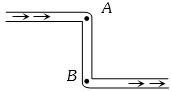
In this figure,an ideal liquid flows through a tube of uniform cross-section. The liquid has velocities $v_A$ and $v_B$,and pressures $P_A$ and $P_B$ at points $A$ and $B$ respectively.
A
$v_A = v_B$
B
$v_B > v_A$
C
$P_A = P_B$
D
$P_B > P_A$
Solution
(D) According to the equation of continuity,$A v = \text{constant}$. Since the cross-sectional area $A$ is uniform,the velocity of the liquid remains the same at all points,so $v_A = v_B$.
Applying Bernoulli's theorem between points $A$ and $B$:
$P_A + \frac{1}{2} \rho v_A^2 + \rho g h_A = P_B + \frac{1}{2} \rho v_B^2 + \rho g h_B$
Since $v_A = v_B$,the kinetic energy terms cancel out:
$P_A + \rho g h_A = P_B + \rho g h_B$
$P_B - P_A = \rho g (h_A - h_B)$
Since point $B$ is at a lower level than point $A$ $(h_A > h_B)$,the term $(h_A - h_B)$ is positive.
Therefore,$P_B > P_A$.
Applying Bernoulli's theorem between points $A$ and $B$:
$P_A + \frac{1}{2} \rho v_A^2 + \rho g h_A = P_B + \frac{1}{2} \rho v_B^2 + \rho g h_B$
Since $v_A = v_B$,the kinetic energy terms cancel out:
$P_A + \rho g h_A = P_B + \rho g h_B$
$P_B - P_A = \rho g (h_A - h_B)$
Since point $B$ is at a lower level than point $A$ $(h_A > h_B)$,the term $(h_A - h_B)$ is positive.
Therefore,$P_B > P_A$.
0 likes
View Solution16
DifficultMCQ
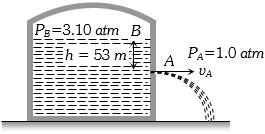
$A$ sniper fires a rifle bullet into a gasoline tank,making a hole $53.0 \ m$ below the surface of the gasoline. The tank was sealed at $3.10 \ atm$. The stored gasoline has a density of $660 \ kg \ m^{-3}$. The velocity with which gasoline begins to shoot out of the hole is ........ $m \ s^{-1}$.
A
$27.8$
B
$41.0$
C
$9.6$
D
$19.7$
Solution
(B) According to Bernoulli's theorem at points $A$ (the hole) and $B$ (the surface of the gasoline):
$P_B + \rho gh = P_A + \frac{1}{2}\rho v_A^2$
Given:
$P_B = 3.10 \ atm = 3.10 \times 1.013 \times 10^5 \ Pa$
$P_A = 1.00 \ atm = 1.013 \times 10^5 \ Pa$
$h = 53.0 \ m$
$\rho = 660 \ kg \ m^{-3}$
$g = 9.8 \ m \ s^{-2}$
Substituting the values:
$3.10 \times 1.013 \times 10^5 + 660 \times 9.8 \times 53.0 = 1.013 \times 10^5 + \frac{1}{2} \times 660 \times v_A^2$
$(3.10 - 1.00) \times 1.013 \times 10^5 + 342888 = 330 \times v_A^2$
$2.10 \times 1.013 \times 10^5 + 342888 = 330 \times v_A^2$
$212730 + 342888 = 330 \times v_A^2$
$555618 = 330 \times v_A^2$
$v_A^2 = \frac{555618}{330} \approx 1683.69$
$v_A = \sqrt{1683.69} \approx 41.0 \ m \ s^{-1}$
$P_B + \rho gh = P_A + \frac{1}{2}\rho v_A^2$
Given:
$P_B = 3.10 \ atm = 3.10 \times 1.013 \times 10^5 \ Pa$
$P_A = 1.00 \ atm = 1.013 \times 10^5 \ Pa$
$h = 53.0 \ m$
$\rho = 660 \ kg \ m^{-3}$
$g = 9.8 \ m \ s^{-2}$
Substituting the values:
$3.10 \times 1.013 \times 10^5 + 660 \times 9.8 \times 53.0 = 1.013 \times 10^5 + \frac{1}{2} \times 660 \times v_A^2$
$(3.10 - 1.00) \times 1.013 \times 10^5 + 342888 = 330 \times v_A^2$
$2.10 \times 1.013 \times 10^5 + 342888 = 330 \times v_A^2$
$212730 + 342888 = 330 \times v_A^2$
$555618 = 330 \times v_A^2$
$v_A^2 = \frac{555618}{330} \approx 1683.69$
$v_A = \sqrt{1683.69} \approx 41.0 \ m \ s^{-1}$
0 likes
View Solution17
MediumMCQ
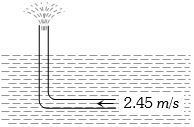
An $L$-shaped tube with a small orifice is held in a water stream as shown in the figure. The upper end of the tube is $10.6 \ cm$ above the surface of the water. What will be the height (in $cm$) of the jet of water coming from the orifice? The velocity of the water stream is $2.45 \ m/s$. (Take $g = 9.8 \ m/s^2$)
A
$0$
B
$20.0$
C
$10.6$
D
$40.0$
Solution
(B) According to Bernoulli's theorem,the kinetic energy of the water stream is converted into potential energy at the top of the jet.
Let $v = 2.45 \ m/s$ be the velocity of the water stream.
The maximum height $H$ to which the water can rise above the level of the stream is given by $H = \frac{v^2}{2g}$.
Substituting the values,$H = \frac{(2.45)^2}{2 \times 9.8} = \frac{6.0025}{19.6} = 0.30625 \ m = 30.625 \ cm$.
The height of the jet above the water surface is $h_{jet} = H - h_{above}$,where $h_{above} = 10.6 \ cm$.
Therefore,$h_{jet} = 30.625 \ cm - 10.6 \ cm = 20.025 \ cm \approx 20.0 \ cm$.
Let $v = 2.45 \ m/s$ be the velocity of the water stream.
The maximum height $H$ to which the water can rise above the level of the stream is given by $H = \frac{v^2}{2g}$.
Substituting the values,$H = \frac{(2.45)^2}{2 \times 9.8} = \frac{6.0025}{19.6} = 0.30625 \ m = 30.625 \ cm$.
The height of the jet above the water surface is $h_{jet} = H - h_{above}$,where $h_{above} = 10.6 \ cm$.
Therefore,$h_{jet} = 30.625 \ cm - 10.6 \ cm = 20.025 \ cm \approx 20.0 \ cm$.
0 likes
View Solution18
EasyMCQ
The figure represents vertical sections of four wings moving horizontally in air. In which case is the force upwards?
A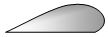
B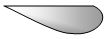
C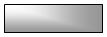
D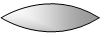
Solution
(A) According to Bernoulli's principle,for a fluid in motion,the pressure is lower where the speed of the fluid is higher.
An airplane wing is designed with an airfoil shape,which is curved on the top and flatter on the bottom.
When air flows over the wing,the air traveling over the curved top surface moves faster than the air moving along the flatter bottom surface.
Due to this difference in speed,the pressure on the top surface becomes lower than the pressure on the bottom surface.
This pressure difference creates an upward force known as lift.
Among the given options,the shape in option $A$ represents a standard airfoil cross-section that produces this lift.
Therefore,the correct option is $A$.
An airplane wing is designed with an airfoil shape,which is curved on the top and flatter on the bottom.
When air flows over the wing,the air traveling over the curved top surface moves faster than the air moving along the flatter bottom surface.
Due to this difference in speed,the pressure on the top surface becomes lower than the pressure on the bottom surface.
This pressure difference creates an upward force known as lift.
Among the given options,the shape in option $A$ represents a standard airfoil cross-section that produces this lift.
Therefore,the correct option is $A$.
0 likes
View Solution19
EasyMCQ
An $L$-shaped glass tube is just immersed in flowing water such that its opening is pointing against the flowing water. If the speed of the water current is $v$,then
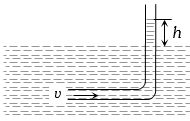
A
The water in the tube rises to height $\frac{v^2}{2g}$
B
The water in the tube rises to height $\frac{g}{2v^2}$
C
The water in the tube does not rise at all
D
None of these
Solution
(A) According to Bernoulli's principle,for a streamline flow of an incompressible,non-viscous fluid,the sum of pressure energy,kinetic energy,and potential energy per unit volume remains constant.
Let the pressure at the opening of the tube be $P_0$ and the velocity of water be $v$. Inside the tube,the water comes to rest,so the velocity at the top of the vertical column is $0$.
Applying Bernoulli's equation between the opening of the tube (point $1$) and the top of the water column in the tube (point $2$):
$P_1 + \frac{1}{2}\rho v^2 + \rho g h_1 = P_2 + \frac{1}{2}\rho v_2^2 + \rho g h_2$
Here,$P_1 = P_2 = P_{atm}$ (atmospheric pressure),$v_1 = v$,$v_2 = 0$,and $h_2 - h_1 = h$ (the height of the water column above the water level).
Substituting these values:
$P_{atm} + \frac{1}{2}\rho v^2 + 0 = P_{atm} + 0 + \rho g h$
$\frac{1}{2}\rho v^2 = \rho g h$
$h = \frac{v^2}{2g}$
Thus,the water in the tube rises to a height of $\frac{v^2}{2g}$.
Let the pressure at the opening of the tube be $P_0$ and the velocity of water be $v$. Inside the tube,the water comes to rest,so the velocity at the top of the vertical column is $0$.
Applying Bernoulli's equation between the opening of the tube (point $1$) and the top of the water column in the tube (point $2$):
$P_1 + \frac{1}{2}\rho v^2 + \rho g h_1 = P_2 + \frac{1}{2}\rho v_2^2 + \rho g h_2$
Here,$P_1 = P_2 = P_{atm}$ (atmospheric pressure),$v_1 = v$,$v_2 = 0$,and $h_2 - h_1 = h$ (the height of the water column above the water level).
Substituting these values:
$P_{atm} + \frac{1}{2}\rho v^2 + 0 = P_{atm} + 0 + \rho g h$
$\frac{1}{2}\rho v^2 = \rho g h$
$h = \frac{v^2}{2g}$
Thus,the water in the tube rises to a height of $\frac{v^2}{2g}$.
0 likes
View Solution20
MediumMCQ
$A$ manometer connected to a closed tap reads $4.5 \times 10^5 \text{ Pa}$. When the tap is opened,the reading of the manometer falls to $4 \times 10^5 \text{ Pa}$. The velocity of the flow of water is ........ $m/s$.
A
$7$
B
$8$
C
$9$
D
$10$
Solution
(D) According to Bernoulli's principle for horizontal flow,the total pressure $P_1$ (static pressure when the tap is closed) is equal to the sum of static pressure $P_2$ and dynamic pressure $\frac{1}{2}\rho v^2$ when the tap is open.
$P_1 = P_2 + \frac{1}{2}\rho v^2$
Rearranging for velocity $v$:
$v = \sqrt{\frac{2(P_1 - P_2)}{\rho}}$
Given $P_1 = 4.5 \times 10^5 \text{ Pa}$,$P_2 = 4 \times 10^5 \text{ Pa}$,and density of water $\rho = 10^3 \text{ kg/m}^3$.
$v = \sqrt{\frac{2(4.5 \times 10^5 - 4 \times 10^5)}{10^3}}$
$v = \sqrt{\frac{2(0.5 \times 10^5)}{10^3}} = \sqrt{\frac{10^5}{10^3}} = \sqrt{100} = 10 \text{ m/s}$.
$P_1 = P_2 + \frac{1}{2}\rho v^2$
Rearranging for velocity $v$:
$v = \sqrt{\frac{2(P_1 - P_2)}{\rho}}$
Given $P_1 = 4.5 \times 10^5 \text{ Pa}$,$P_2 = 4 \times 10^5 \text{ Pa}$,and density of water $\rho = 10^3 \text{ kg/m}^3$.
$v = \sqrt{\frac{2(4.5 \times 10^5 - 4 \times 10^5)}{10^3}}$
$v = \sqrt{\frac{2(0.5 \times 10^5)}{10^3}} = \sqrt{\frac{10^5}{10^3}} = \sqrt{100} = 10 \text{ m/s}$.
0 likes
View Solution21
EasyMCQ
Consider the following equation of Bernoulli's theorem: $P + \frac{1}{2}\rho V^2 + \rho gh = K$ (constant). The dimensions of $K/P$ are the same as those of which of the following?
A
Thrust
B
Pressure
C
Angle
D
Viscosity
Solution
(C) The given equation is $P + \frac{1}{2}\rho V^2 + \rho gh = K$ (constant).
According to the principle of homogeneity of dimensions,every term in an equation must have the same dimensions.
Therefore,the dimensions of $K$ must be equal to the dimensions of $P$,$\frac{1}{2}\rho V^2$,and $\rho gh$.
Since the dimensions of $K$ are equal to the dimensions of $P$,the ratio $K/P$ is a dimensionless quantity.
Among the given options,an angle is a dimensionless quantity.
Thus,the dimensions of $K/P$ are the same as those of an angle.
According to the principle of homogeneity of dimensions,every term in an equation must have the same dimensions.
Therefore,the dimensions of $K$ must be equal to the dimensions of $P$,$\frac{1}{2}\rho V^2$,and $\rho gh$.
Since the dimensions of $K$ are equal to the dimensions of $P$,the ratio $K/P$ is a dimensionless quantity.
Among the given options,an angle is a dimensionless quantity.
Thus,the dimensions of $K/P$ are the same as those of an angle.
0 likes
View Solution22
DifficultMCQ
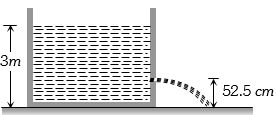
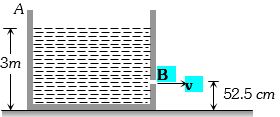
Water is filled in a cylindrical container to a height of $3 \ m$. The ratio of the cross-sectional area of the orifice and the beaker is $0.1$. The square of the speed of the liquid coming out from the orifice is ....... $m^2/s^2$ $(g = 10 \ m/s^2)$.
A
$50$
B
$50.5$
C
$51$
D
$52$
Solution
(A) Let $A$ be the cross-sectional area of the tank and $a$ be the cross-sectional area of the orifice.
Let $V$ be the velocity with which the water level decreases in the tank and $v$ be the velocity of efflux from the orifice.
From the equation of continuity,$av = AV$,so $V = \frac{av}{A}$.
Applying Bernoulli's theorem between the top surface of the water (point $1$) and the orifice (point $2$):
$P_0 + \rho g h_1 + \frac{1}{2} \rho V^2 = P_0 + \rho g h_2 + \frac{1}{2} \rho v^2$
Here,$h_1 = 3 \ m$ and $h_2 = 0.525 \ m$. The effective height of the water column above the orifice is $h = h_1 - h_2 = 3 - 0.525 = 2.475 \ m$.
Rearranging the equation: $\frac{1}{2} \rho v^2 - \frac{1}{2} \rho V^2 = \rho g h$
$v^2 - V^2 = 2gh$
Substituting $V = \frac{a}{A}v$:
$v^2 - (\frac{a}{A})^2 v^2 = 2gh$
$v^2 [1 - (\frac{a}{A})^2] = 2gh$
Given $\frac{a}{A} = 0.1$,$g = 10 \ m/s^2$,and $h = 2.475 \ m$:
$v^2 [1 - (0.1)^2] = 2 \times 10 \times 2.475$
$v^2 [1 - 0.01] = 49.5$
$v^2 [0.99] = 49.5$
$v^2 = \frac{49.5}{0.99} = 50 \ m^2/s^2$.
Let $V$ be the velocity with which the water level decreases in the tank and $v$ be the velocity of efflux from the orifice.
From the equation of continuity,$av = AV$,so $V = \frac{av}{A}$.
Applying Bernoulli's theorem between the top surface of the water (point $1$) and the orifice (point $2$):
$P_0 + \rho g h_1 + \frac{1}{2} \rho V^2 = P_0 + \rho g h_2 + \frac{1}{2} \rho v^2$
Here,$h_1 = 3 \ m$ and $h_2 = 0.525 \ m$. The effective height of the water column above the orifice is $h = h_1 - h_2 = 3 - 0.525 = 2.475 \ m$.
Rearranging the equation: $\frac{1}{2} \rho v^2 - \frac{1}{2} \rho V^2 = \rho g h$
$v^2 - V^2 = 2gh$
Substituting $V = \frac{a}{A}v$:
$v^2 - (\frac{a}{A})^2 v^2 = 2gh$
$v^2 [1 - (\frac{a}{A})^2] = 2gh$
Given $\frac{a}{A} = 0.1$,$g = 10 \ m/s^2$,and $h = 2.475 \ m$:
$v^2 [1 - (0.1)^2] = 2 \times 10 \times 2.475$
$v^2 [1 - 0.01] = 49.5$
$v^2 [0.99] = 49.5$
$v^2 = \frac{49.5}{0.99} = 50 \ m^2/s^2$.
0 likes
View Solution23
MediumMCQ
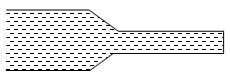
Water flows through a frictionless duct with a cross-section varying as shown in the figure. The pressure $p$ at points along the axis is represented by:
A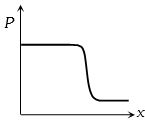
B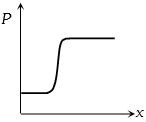
C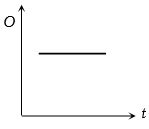
D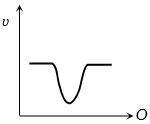
Solution
$(A)$ According to the equation of continuity, $A_1v_1 = A_2v_2$. When the cross-section $A$ of the duct decreases, the velocity $v$ of the water must increase to maintain a constant flow rate.
According to Bernoulli's theorem for horizontal flow, $P + \frac{1}{2}\rho v^2 = \text{constant}$.
As the velocity $v$ increases in the narrower section, the pressure $P$ must decrease to satisfy the equation.
Therefore, the pressure remains constant in the wider section, drops as the duct narrows, and then remains constant at a lower value in the narrower section. This corresponds to the graph where pressure $p$ decreases as the cross-section decreases.
According to Bernoulli's theorem for horizontal flow, $P + \frac{1}{2}\rho v^2 = \text{constant}$.
As the velocity $v$ increases in the narrower section, the pressure $P$ must decrease to satisfy the equation.
Therefore, the pressure remains constant in the wider section, drops as the duct narrows, and then remains constant at a lower value in the narrower section. This corresponds to the graph where pressure $p$ decreases as the cross-section decreases.
0 likes
View Solution24
MediumMCQ
The Bernoulli's equation is given by $p + \frac{1}{2} \rho v^{2} + h \rho g = k$,where $p =$ pressure,$\rho =$ density,$v =$ speed,$h =$ height of the liquid column,$g =$ acceleration due to gravity,and $k$ is a constant. The dimensional formula for $k$ is the same as that for:
A
Velocity gradient
B
Pressure gradient
C
Modulus of elasticity
D
Thrust
Solution
(C) According to the principle of homogeneity of dimensions,every term in an equation must have the same dimensions.
Given the equation $p + \frac{1}{2} \rho v^{2} + h \rho g = k$,the dimensions of $k$ must be equal to the dimensions of pressure $p$.
$[p] = \frac{\text{Force}}{\text{Area}} = \frac{[MLT^{-2}]}{[L^{2}]} = [ML^{-1}T^{-2}]$.
Checking the other terms:
$[\frac{1}{2} \rho v^{2}] = [ML^{-3}][L^{2}T^{-2}] = [ML^{-1}T^{-2}]$.
$[h \rho g] = [L][ML^{-3}][LT^{-2}] = [ML^{-1}T^{-2}]$.
Since $[k] = [ML^{-1}T^{-2}]$,which is the dimensional formula for pressure,energy density,and modulus of elasticity (stress/strain),the correct option is Modulus of elasticity.
Given the equation $p + \frac{1}{2} \rho v^{2} + h \rho g = k$,the dimensions of $k$ must be equal to the dimensions of pressure $p$.
$[p] = \frac{\text{Force}}{\text{Area}} = \frac{[MLT^{-2}]}{[L^{2}]} = [ML^{-1}T^{-2}]$.
Checking the other terms:
$[\frac{1}{2} \rho v^{2}] = [ML^{-3}][L^{2}T^{-2}] = [ML^{-1}T^{-2}]$.
$[h \rho g] = [L][ML^{-3}][LT^{-2}] = [ML^{-1}T^{-2}]$.
Since $[k] = [ML^{-1}T^{-2}]$,which is the dimensional formula for pressure,energy density,and modulus of elasticity (stress/strain),the correct option is Modulus of elasticity.
0 likes
View Solution25
MediumMCQ
The velocity of kerosene in a horizontal pipe is $5 \ m/s$. What is the velocity head in $m$? (Take $g = 10 \ m/s^2$)
A
$1.25$
B
$12.5$
C
$0.125$
D
$125$
Solution
(A) The velocity head is defined by the formula $h = \frac{v^2}{2g}$.
Given,velocity $v = 5 \ m/s$ and acceleration due to gravity $g = 10 \ m/s^2$.
Substituting the values into the formula:
$h = \frac{(5)^2}{2 \times 10} = \frac{25}{20} = 1.25 \ m$.
Therefore,the velocity head is $1.25 \ m$.
Given,velocity $v = 5 \ m/s$ and acceleration due to gravity $g = 10 \ m/s^2$.
Substituting the values into the formula:
$h = \frac{(5)^2}{2 \times 10} = \frac{25}{20} = 1.25 \ m$.
Therefore,the velocity head is $1.25 \ m$.
0 likes
View Solution26
MediumMCQ
The reading of a pressure gauge connected to a closed tap is $3.5 \times 10^5 \, N/m^2$. When the tap is opened,the reading of the pressure gauge falls to $3.0 \times 10^5 \, N/m^2$. The velocity of water is ........ $m/s$.
A
$100$
B
$10$
C
$1$
D
$10\sqrt{10}$
Solution
(B) According to Bernoulli's principle for horizontal flow,the total pressure energy plus kinetic energy per unit volume remains constant: $P_1 + 0 = P_2 + \frac{1}{2} \rho v^2$.
Here,$P_1 = 3.5 \times 10^5 \, N/m^2$ (pressure when the tap is closed) and $P_2 = 3.0 \times 10^5 \, N/m^2$ (pressure when the tap is open).
The density of water $\rho = 10^3 \, kg/m^3$.
Rearranging the equation: $\frac{1}{2} \rho v^2 = P_1 - P_2$.
$v^2 = \frac{2(P_1 - P_2)}{\rho}$.
Substituting the values: $v^2 = \frac{2(3.5 \times 10^5 - 3.0 \times 10^5)}{10^3} = \frac{2(0.5 \times 10^5)}{10^3} = \frac{10^5}{10^3} = 100$.
Therefore,$v = \sqrt{100} = 10 \, m/s$.
Here,$P_1 = 3.5 \times 10^5 \, N/m^2$ (pressure when the tap is closed) and $P_2 = 3.0 \times 10^5 \, N/m^2$ (pressure when the tap is open).
The density of water $\rho = 10^3 \, kg/m^3$.
Rearranging the equation: $\frac{1}{2} \rho v^2 = P_1 - P_2$.
$v^2 = \frac{2(P_1 - P_2)}{\rho}$.
Substituting the values: $v^2 = \frac{2(3.5 \times 10^5 - 3.0 \times 10^5)}{10^3} = \frac{2(0.5 \times 10^5)}{10^3} = \frac{10^5}{10^3} = 100$.
Therefore,$v = \sqrt{100} = 10 \, m/s$.
0 likes
View Solution27
MediumMCQ
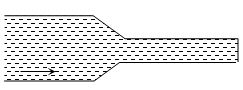
What is the nature of the pressure-distance graph for the pipe shown in the figure?
A
B
C
D
Solution
$(A)$ According to the equation of continuity, $A_1v_1 = A_2v_2$. Since the cross-sectional area $A$ decreases in the narrow part of the pipe, the velocity $v$ of the fluid must increase $(v_2 > v_1)$.
According to Bernoulli's principle, for a horizontal pipe, $P + \frac{1}{2}\rho v^2 = \text{constant}$.
Since the velocity $v$ increases in the narrow section, the pressure $P$ must decrease to maintain the constant sum.
Therefore, as the fluid moves from the wider section to the narrower section, the pressure decreases.
This corresponds to the graph shown in option $A$.
According to Bernoulli's principle, for a horizontal pipe, $P + \frac{1}{2}\rho v^2 = \text{constant}$.
Since the velocity $v$ increases in the narrow section, the pressure $P$ must decrease to maintain the constant sum.
Therefore, as the fluid moves from the wider section to the narrower section, the pressure decreases.
This corresponds to the graph shown in option $A$.
0 likes
View Solution28
MediumMCQ
The speeds of air above and below the wing of an airplane are $120\, m/s$ and $90\, m/s$,respectively. The density of air is $1.3\, kg/m^3$. If the wing has a length of $10\, m$ and a width of $2\, m$,the pressure difference between the top and bottom of the wing is ......... $Pascal$.
A
$4095.0$
B
$409.50$
C
$40.950$
D
$4.0950$
Solution
(A) According to Bernoulli's principle,the pressure difference $\Delta P$ between the top and bottom of the wing is given by the equation: $\Delta P = P_{bottom} - P_{top} = \frac{1}{2} \rho (v_{top}^2 - v_{bottom}^2)$.
Given:
Density $\rho = 1.3\, kg/m^3$
Velocity above the wing $v_{top} = 120\, m/s$
Velocity below the wing $v_{bottom} = 90\, m/s$
Substituting the values:
$\Delta P = \frac{1}{2} \times 1.3 \times [(120)^2 - (90)^2]$
$\Delta P = 0.65 \times [14400 - 8100]$
$\Delta P = 0.65 \times 6300$
$\Delta P = 4095\, Pa$.
Given:
Density $\rho = 1.3\, kg/m^3$
Velocity above the wing $v_{top} = 120\, m/s$
Velocity below the wing $v_{bottom} = 90\, m/s$
Substituting the values:
$\Delta P = \frac{1}{2} \times 1.3 \times [(120)^2 - (90)^2]$
$\Delta P = 0.65 \times [14400 - 8100]$
$\Delta P = 0.65 \times 6300$
$\Delta P = 4095\, Pa$.
0 likes
View Solution29
MediumMCQ
$A$ wind with speed $40 \ m/s$ blows parallel to the roof of a house. The area of the roof is $250 \ m^2$. Assuming that the pressure inside the house is atmospheric pressure,the force exerted by the wind on the roof and the direction of the force will be $(\rho_{air} = 1.2 \ kg/m^3)$.
A
$4.8 \times 10^5 \ N$,downwards
B
$4.8 \times 10^5 \ N$,upwards
C
$2.4 \times 10^5 \ N$,upwards
D
$2.4 \times 10^5 \ N$,downwards
Solution
(C) Applying Bernoulli's theorem just above and just below the roof:
$P + \frac{1}{2}\rho v^2 = P_0 + 0$
Here,$P$ is the pressure just above the roof,$P_0$ is the atmospheric pressure inside the house,and $v = 40 \ m/s$ is the wind speed.
The pressure difference is $\Delta P = P_0 - P = \frac{1}{2}\rho v^2$.
The force exerted on the roof is $F = \Delta P \cdot A = \frac{1}{2}\rho A v^2$.
Substituting the given values:
$F = \frac{1}{2} \times 1.2 \ kg/m^3 \times 250 \ m^2 \times (40 \ m/s)^2$
$F = 0.6 \times 250 \times 1600 = 2.4 \times 10^5 \ N$.
Since the pressure inside the house $(P_0)$ is greater than the pressure just above the roof $(P)$,the net force acts in the upward direction.
$P + \frac{1}{2}\rho v^2 = P_0 + 0$
Here,$P$ is the pressure just above the roof,$P_0$ is the atmospheric pressure inside the house,and $v = 40 \ m/s$ is the wind speed.
The pressure difference is $\Delta P = P_0 - P = \frac{1}{2}\rho v^2$.
The force exerted on the roof is $F = \Delta P \cdot A = \frac{1}{2}\rho A v^2$.
Substituting the given values:
$F = \frac{1}{2} \times 1.2 \ kg/m^3 \times 250 \ m^2 \times (40 \ m/s)^2$
$F = 0.6 \times 250 \times 1600 = 2.4 \times 10^5 \ N$.
Since the pressure inside the house $(P_0)$ is greater than the pressure just above the roof $(P)$,the net force acts in the upward direction.
0 likes
View Solution30
EasyMCQ
To get the maximum flight (Magnus effect),a ball must be thrown as:
A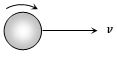
B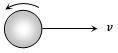
C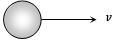
D
Any of $(a), (b)$ and $(c)$
Solution
(B) The phenomenon described is the Magnus effect,which is an application of Bernoulli's principle.
When a ball moves through the air with a spin,the air velocity relative to the ball's surface changes.
If the ball spins in an anticlockwise direction while moving forward (from left to right),the air velocity on the top surface of the ball is lower than the air velocity on the bottom surface due to the direction of the spin relative to the airflow.
According to Bernoulli's principle,where the air velocity is higher,the pressure is lower,and where the air velocity is lower,the pressure is higher.
Therefore,the pressure on the bottom surface becomes greater than the pressure on the top surface,creating an upward force (lift) known as the Magnus force.
This upward force helps the ball stay in the air for a longer duration,resulting in maximum flight.
Thus,an anticlockwise spin is required to achieve this effect.
When a ball moves through the air with a spin,the air velocity relative to the ball's surface changes.
If the ball spins in an anticlockwise direction while moving forward (from left to right),the air velocity on the top surface of the ball is lower than the air velocity on the bottom surface due to the direction of the spin relative to the airflow.
According to Bernoulli's principle,where the air velocity is higher,the pressure is lower,and where the air velocity is lower,the pressure is higher.
Therefore,the pressure on the bottom surface becomes greater than the pressure on the top surface,creating an upward force (lift) known as the Magnus force.
This upward force helps the ball stay in the air for a longer duration,resulting in maximum flight.
Thus,an anticlockwise spin is required to achieve this effect.
0 likes
View Solution31
MediumMCQ
Water is flowing steadily through a horizontal tube of non-uniform cross-section. If the pressure of water is $4 \times 10^4 \ N/m^2$ at a point where the cross-section is $0.02 \ m^2$ and the velocity of flow is $2 \ m/s$,what is the pressure at a point where the cross-section reduces to $0.01 \ m^2$?
A
$1.4 \times 10^4 \ N/m^2$
B
$3.4 \times 10^4 \ N/m^2$
C
$2.4 \times 10^4 \ N/m^2$
D
none of these
Solution
(B) Given:
$A_1 = 0.02 \ m^2$,$V_1 = 2 \ m/s$,$P_1 = 4 \times 10^4 \ N/m^2$,$A_2 = 0.01 \ m^2$,$\rho = 1000 \ kg/m^3$.
Using the equation of continuity,$A_1 V_1 = A_2 V_2$:
$0.02 \times 2 = 0.01 \times V_2 \implies V_2 = 4 \ m/s$.
Using Bernoulli's equation for a horizontal tube $(h_1 = h_2)$:
$P_1 + \frac{1}{2} \rho V_1^2 = P_2 + \frac{1}{2} \rho V_2^2$
$P_2 = P_1 + \frac{1}{2} \rho (V_1^2 - V_2^2)$
$P_2 = 4 \times 10^4 + \frac{1}{2} \times 1000 \times (2^2 - 4^2)$
$P_2 = 40000 + 500 \times (4 - 16)$
$P_2 = 40000 - 6000 = 34000 \ N/m^2 = 3.4 \times 10^4 \ N/m^2$.
$A_1 = 0.02 \ m^2$,$V_1 = 2 \ m/s$,$P_1 = 4 \times 10^4 \ N/m^2$,$A_2 = 0.01 \ m^2$,$\rho = 1000 \ kg/m^3$.
Using the equation of continuity,$A_1 V_1 = A_2 V_2$:
$0.02 \times 2 = 0.01 \times V_2 \implies V_2 = 4 \ m/s$.
Using Bernoulli's equation for a horizontal tube $(h_1 = h_2)$:
$P_1 + \frac{1}{2} \rho V_1^2 = P_2 + \frac{1}{2} \rho V_2^2$
$P_2 = P_1 + \frac{1}{2} \rho (V_1^2 - V_2^2)$
$P_2 = 4 \times 10^4 + \frac{1}{2} \times 1000 \times (2^2 - 4^2)$
$P_2 = 40000 + 500 \times (4 - 16)$
$P_2 = 40000 - 6000 = 34000 \ N/m^2 = 3.4 \times 10^4 \ N/m^2$.
0 likes
View Solution32
EasyMCQ
In the case of a fluid,Bernoulli's theorem expresses the application of the principle of conservation of :
A
linear momentum
B
energy
C
mass
D
angular momentum
Solution
(B) Bernoulli's equation is given by $P + \frac{1}{2}\rho v^2 + \rho gh = \text{constant}$.
This equation represents the sum of pressure energy,kinetic energy,and potential energy per unit volume of the fluid.
Since the total energy of the fluid remains constant along a streamline for an ideal,incompressible,and non-viscous fluid,Bernoulli's theorem is a direct application of the principle of conservation of energy.
This equation represents the sum of pressure energy,kinetic energy,and potential energy per unit volume of the fluid.
Since the total energy of the fluid remains constant along a streamline for an ideal,incompressible,and non-viscous fluid,Bernoulli's theorem is a direct application of the principle of conservation of energy.
0 likes
View Solution33
MediumMCQ
$A$ horizontal pipe line carries water in a streamline flow. At a point along the tube where the cross-sectional area is $10^{-2} \ m^2$,the water velocity is $2 \ m/s$ and the pressure is $8000 \ Pa$. The pressure of water at another point where the cross-sectional area is $0.5 \times 10^{-2} \ m^2$ is ........ $Pa$.
A
$4000$
B
$1000$
C
$2000$
D
$3000$
Solution
(C) According to the equation of continuity,$A_1 v_1 = A_2 v_2$. Given $A_1 = 10^{-2} \ m^2$,$v_1 = 2 \ m/s$,and $A_2 = 0.5 \times 10^{-2} \ m^2$.
Since $A_2 = 0.5 A_1$,the velocity $v_2 = 2 v_1 = 4 \ m/s$.
Using Bernoulli's equation for a horizontal pipe $(h_1 = h_2)$: $P_1 + \frac{1}{2} \rho v_1^2 = P_2 + \frac{1}{2} \rho v_2^2$.
Substituting the values ($P_1 = 8000 \ Pa$,$\rho = 1000 \ kg/m^3$):
$8000 + \frac{1}{2} \times 1000 \times (2)^2 = P_2 + \frac{1}{2} \times 1000 \times (4)^2$.
$8000 + 2000 = P_2 + 8000$.
$P_2 = 10000 - 8000 = 2000 \ Pa$.
Since $A_2 = 0.5 A_1$,the velocity $v_2 = 2 v_1 = 4 \ m/s$.
Using Bernoulli's equation for a horizontal pipe $(h_1 = h_2)$: $P_1 + \frac{1}{2} \rho v_1^2 = P_2 + \frac{1}{2} \rho v_2^2$.
Substituting the values ($P_1 = 8000 \ Pa$,$\rho = 1000 \ kg/m^3$):
$8000 + \frac{1}{2} \times 1000 \times (2)^2 = P_2 + \frac{1}{2} \times 1000 \times (4)^2$.
$8000 + 2000 = P_2 + 8000$.
$P_2 = 10000 - 8000 = 2000 \ Pa$.
0 likes
View Solution34
MediumMCQ
Which of the following is not an assumption for an ideal fluid flow for which Bernoulli's principle is valid?
A
Steady flow
B
Incompressible
C
Viscous
D
Irrotational
Solution
(C) Bernoulli's principle is derived based on the following assumptions for an ideal fluid flow:
$1$. The fluid is incompressible (density is constant).
$2$. The flow is steady (velocity at any point does not change with time).
$3$. The flow is non-viscous (no internal friction or energy loss due to viscosity).
$4$. The flow is irrotational.
Since Bernoulli's principle assumes the fluid is non-viscous,the statement that the fluid is 'viscous' is not an assumption for its validity.
Thus,option $C$ is correct.
$1$. The fluid is incompressible (density is constant).
$2$. The flow is steady (velocity at any point does not change with time).
$3$. The flow is non-viscous (no internal friction or energy loss due to viscosity).
$4$. The flow is irrotational.
Since Bernoulli's principle assumes the fluid is non-viscous,the statement that the fluid is 'viscous' is not an assumption for its validity.
Thus,option $C$ is correct.
0 likes
View Solution35
DifficultMCQ
The figure shows a siphon. Choose the wrong statement:
($P_0$ = atmospheric pressure)
($P_0$ = atmospheric pressure)
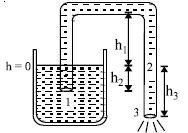
A
Siphon works when $h_3 > 0$
B
Pressure at point $2$ is $P_2 = P_0 - \rho gh_3$
C
Pressure at point $3$ is $P_0$
D
None of the above
Solution
(B) For a siphon to work,there must be a pressure difference,which requires $h_3 > 0$. Thus,statement $A$ is correct.
Applying Bernoulli's equation between the free surface of the liquid (at $h=0$) and the exit point $3$:
$P_0 + 0 = P_0 + \frac{1}{2}\rho v^2 - \rho g h_3$
$\frac{1}{2}\rho v^2 = \rho g h_3$
Now,applying Bernoulli's equation between the free surface and point $2$ (at height $h_3$ above point $3$):
$P_0 + 0 = P_2 + \frac{1}{2}\rho v^2 + \rho g h_3$
Substituting $\frac{1}{2}\rho v^2 = \rho g h_3$:
$P_0 = P_2 + \rho g h_3 + \rho g h_3 = P_2 + 2\rho g h_3$
$P_2 = P_0 - 2\rho g h_3$
Therefore,the statement in option $B$ is incorrect. Point $3$ is open to the atmosphere,so its pressure is $P_0$,making statement $C$ correct. Since $B$ is incorrect,the wrong statement is $B$.
Applying Bernoulli's equation between the free surface of the liquid (at $h=0$) and the exit point $3$:
$P_0 + 0 = P_0 + \frac{1}{2}\rho v^2 - \rho g h_3$
$\frac{1}{2}\rho v^2 = \rho g h_3$
Now,applying Bernoulli's equation between the free surface and point $2$ (at height $h_3$ above point $3$):
$P_0 + 0 = P_2 + \frac{1}{2}\rho v^2 + \rho g h_3$
Substituting $\frac{1}{2}\rho v^2 = \rho g h_3$:
$P_0 = P_2 + \rho g h_3 + \rho g h_3 = P_2 + 2\rho g h_3$
$P_2 = P_0 - 2\rho g h_3$
Therefore,the statement in option $B$ is incorrect. Point $3$ is open to the atmosphere,so its pressure is $P_0$,making statement $C$ correct. Since $B$ is incorrect,the wrong statement is $B$.
0 likes
View Solution36
DifficultMCQ
$A$ steady flow of water passes along a horizontal tube from a wide section $X$ to the narrower section $Y$,see figure. Manometers are placed at $P$ and $Q$ at the sections. Which of the statements $A, B, C, D$ is most correct?
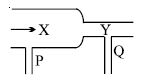
A
water velocity at $X$ is greater than at $Y$
B
the manometer at $P$ shows lower pressure than at $Q$
C
kinetic energy per $m^3$ of water at $X$ = kinetic energy per $m^3$ at $Y$
D
the manometer at $P$ shows greater pressure than at $Q$
Solution
(D) According to the equation of continuity,$A_X v_X = A_Y v_Y$. Since the area of cross-section at $X$ is greater than at $Y$ $(A_X > A_Y)$,the velocity of water at $X$ must be less than at $Y$ $(v_X < v_Y)$.
According to Bernoulli's theorem for a horizontal tube,$P_X + \frac{1}{2} \rho v_X^2 = P_Y + \frac{1}{2} \rho v_Y^2$. Since $v_Y > v_X$,the kinetic energy per unit volume at $Y$ is greater than at $X$. To maintain the constant sum,the pressure at $X$ must be greater than the pressure at $Y$ $(P_X > P_Y)$.
Therefore,the manometer at $P$ (measuring pressure at $X$) will show a higher pressure than the manometer at $Q$ (measuring pressure at $Y$).
According to Bernoulli's theorem for a horizontal tube,$P_X + \frac{1}{2} \rho v_X^2 = P_Y + \frac{1}{2} \rho v_Y^2$. Since $v_Y > v_X$,the kinetic energy per unit volume at $Y$ is greater than at $X$. To maintain the constant sum,the pressure at $X$ must be greater than the pressure at $Y$ $(P_X > P_Y)$.
Therefore,the manometer at $P$ (measuring pressure at $X$) will show a higher pressure than the manometer at $Q$ (measuring pressure at $Y$).
0 likes
View Solution37
DifficultMCQ
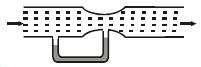
Water flows through the tube shown. The cross-sectional areas of the wide and narrow parts are $5 \text{ cm}^2$ and $2 \text{ cm}^2$,respectively. The rate of flow is $500 \text{ cm}^3/\text{s}$. Find the difference in the mercury level of the $U$-tube in $\text{cm}$.
A
$2.9$
B
$1.9$
C
$0.9$
D
None of these
Solution
(D) Using the equation of continuity,$A_1 V_1 = A_2 V_2 = Q$.
Given $A_1 = 5 \text{ cm}^2$,$A_2 = 2 \text{ cm}^2$,and $Q = 500 \text{ cm}^3/\text{s}$.
$V_1 = \frac{Q}{A_1} = \frac{500}{5} = 100 \text{ cm/s} = 1 \text{ m/s}$.
$V_2 = \frac{Q}{A_2} = \frac{500}{2} = 250 \text{ cm/s} = 2.5 \text{ m/s}$.
Applying Bernoulli's equation: $P_1 + \frac{1}{2} \rho_w V_1^2 = P_2 + \frac{1}{2} \rho_w V_2^2$.
$P_1 - P_2 = \frac{1}{2} \rho_w (V_2^2 - V_1^2)$.
The pressure difference is balanced by the mercury column: $P_1 - P_2 = h(\rho_m - \rho_w)g$.
$h = \frac{\frac{1}{2} \rho_w (V_2^2 - V_1^2)}{(\rho_m - \rho_w)g}$.
Using $\rho_w = 1000 \text{ kg/m}^3$,$\rho_m = 13600 \text{ kg/m}^3$,$g = 10 \text{ m/s}^2$,$V_1 = 1 \text{ m/s}$,$V_2 = 2.5 \text{ m/s}$.
$h = \frac{0.5 \times 1000 \times (2.5^2 - 1^2)}{(13600 - 1000) \times 10} = \frac{500 \times (6.25 - 1)}{126000} = \frac{500 \times 5.25}{126000} = \frac{2625}{126000} \text{ m} \approx 0.0208 \text{ m} = 2.08 \text{ cm}$.
Since $2.08 \text{ cm}$ is not among the options,the correct answer is $D$.
Given $A_1 = 5 \text{ cm}^2$,$A_2 = 2 \text{ cm}^2$,and $Q = 500 \text{ cm}^3/\text{s}$.
$V_1 = \frac{Q}{A_1} = \frac{500}{5} = 100 \text{ cm/s} = 1 \text{ m/s}$.
$V_2 = \frac{Q}{A_2} = \frac{500}{2} = 250 \text{ cm/s} = 2.5 \text{ m/s}$.
Applying Bernoulli's equation: $P_1 + \frac{1}{2} \rho_w V_1^2 = P_2 + \frac{1}{2} \rho_w V_2^2$.
$P_1 - P_2 = \frac{1}{2} \rho_w (V_2^2 - V_1^2)$.
The pressure difference is balanced by the mercury column: $P_1 - P_2 = h(\rho_m - \rho_w)g$.
$h = \frac{\frac{1}{2} \rho_w (V_2^2 - V_1^2)}{(\rho_m - \rho_w)g}$.
Using $\rho_w = 1000 \text{ kg/m}^3$,$\rho_m = 13600 \text{ kg/m}^3$,$g = 10 \text{ m/s}^2$,$V_1 = 1 \text{ m/s}$,$V_2 = 2.5 \text{ m/s}$.
$h = \frac{0.5 \times 1000 \times (2.5^2 - 1^2)}{(13600 - 1000) \times 10} = \frac{500 \times (6.25 - 1)}{126000} = \frac{500 \times 5.25}{126000} = \frac{2625}{126000} \text{ m} \approx 0.0208 \text{ m} = 2.08 \text{ cm}$.
Since $2.08 \text{ cm}$ is not among the options,the correct answer is $D$.
0 likes
View Solution38
DifficultMCQ
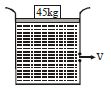
$A$ large cylindrical tank of cross-sectional area $1\ m^2$ is filled with water. It has a small hole at a height of $1\ m$ from the bottom. $A$ movable piston of mass $5\ kg$ is fitted on the top of the tank such that it can slide in the tank freely without friction. $A$ load of $45\ kg$ is applied on the top of the water by the piston,as shown in the figure. The value of $v$ when the piston is $7\ m$ above the bottom is $(g = 10\ m/s^2)$ ....... $m/s$
A
$\sqrt{120}$
B
$10$
C
$1$
D
$11$
Solution
(D) Let $H$ be the height of the water level from the bottom,$h$ be the height of the hole from the bottom,$A$ be the cross-sectional area,$M$ be the total mass on the piston $(M = 5\ kg + 45\ kg = 50\ kg)$,and $\rho$ be the density of water $(10^3\ kg/m^3)$.
Applying Bernoulli's equation between the top surface of the water and the hole:
$P_{atm} + \frac{Mg}{A} + \rho gH = P_{atm} + \frac{1}{2}\rho v^2 + \rho gh$
$\frac{1}{2}\rho v^2 = \rho g(H - h) + \frac{Mg}{A}$
Given $H = 7\ m$,$h = 1\ m$,$M = 50\ kg$,$A = 1\ m^2$,$g = 10\ m/s^2$,$\rho = 10^3\ kg/m^3$:
$\frac{1}{2} \times 10^3 \times v^2 = 10^3 \times 10 \times (7 - 1) + \frac{50 \times 10}{1}$
$500 v^2 = 60000 + 500$
$500 v^2 = 60500$
$v^2 = 121$
$v = 11\ m/s$
Applying Bernoulli's equation between the top surface of the water and the hole:
$P_{atm} + \frac{Mg}{A} + \rho gH = P_{atm} + \frac{1}{2}\rho v^2 + \rho gh$
$\frac{1}{2}\rho v^2 = \rho g(H - h) + \frac{Mg}{A}$
Given $H = 7\ m$,$h = 1\ m$,$M = 50\ kg$,$A = 1\ m^2$,$g = 10\ m/s^2$,$\rho = 10^3\ kg/m^3$:
$\frac{1}{2} \times 10^3 \times v^2 = 10^3 \times 10 \times (7 - 1) + \frac{50 \times 10}{1}$
$500 v^2 = 60000 + 500$
$500 v^2 = 60500$
$v^2 = 121$
$v = 11\ m/s$
0 likes
View Solution39
DifficultMCQ
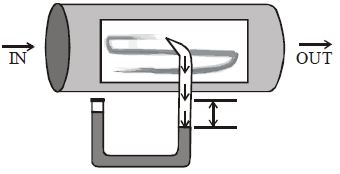
The Pitot tube shown in the figure is used to measure fluid flow velocity in a pipe of cross-sectional area $S$. It was invented by a French engineer Henri Pitot in the early $18^{th}$ century. The volume of the gas flowing across the section of the pipe per unit time is (The difference in the liquid columns is $\Delta h$,$\rho_0$ and $\rho$ are the densities of liquid and the gas respectively):
A
$Q = 2S\sqrt{\frac{\Delta h \rho_0 g}{\rho}}$
B
$Q = S\sqrt{\frac{2\Delta h \rho_0 g}{\rho}}$
C
$Q = S\sqrt{\frac{\Delta h \rho_0 g}{\rho}}$
D
$Q = S\sqrt{\frac{2\Delta h \rho g}{\rho_0}}$
Solution
(B) Let $v$ be the velocity of the gas in the pipe.
Applying Bernoulli's theorem at the opening of the Pitot tube (stagnation point $A$) and at a point $B$ in the free stream flow:
$P_A = P_B + \frac{1}{2} \rho v^2$
Here,$P_A$ is the stagnation pressure and $P_B$ is the static pressure of the gas.
The pressure difference is measured by the liquid column of height $\Delta h$:
$P_A - P_B = \Delta h \rho_0 g$
Substituting this into the Bernoulli equation:
$\frac{1}{2} \rho v^2 = \Delta h \rho_0 g$
$v^2 = \frac{2 \Delta h \rho_0 g}{\rho}$
$v = \sqrt{\frac{2 \Delta h \rho_0 g}{\rho}}$
The volume flow rate $Q$ is given by the product of the cross-sectional area $S$ and the velocity $v$:
$Q = S v = S \sqrt{\frac{2 \Delta h \rho_0 g}{\rho}}$
Thus,the correct option is $B$.
Applying Bernoulli's theorem at the opening of the Pitot tube (stagnation point $A$) and at a point $B$ in the free stream flow:
$P_A = P_B + \frac{1}{2} \rho v^2$
Here,$P_A$ is the stagnation pressure and $P_B$ is the static pressure of the gas.
The pressure difference is measured by the liquid column of height $\Delta h$:
$P_A - P_B = \Delta h \rho_0 g$
Substituting this into the Bernoulli equation:
$\frac{1}{2} \rho v^2 = \Delta h \rho_0 g$
$v^2 = \frac{2 \Delta h \rho_0 g}{\rho}$
$v = \sqrt{\frac{2 \Delta h \rho_0 g}{\rho}}$
The volume flow rate $Q$ is given by the product of the cross-sectional area $S$ and the velocity $v$:
$Q = S v = S \sqrt{\frac{2 \Delta h \rho_0 g}{\rho}}$
Thus,the correct option is $B$.
0 likes
View Solution40
DifficultMCQ
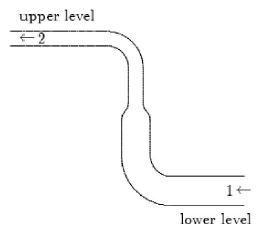
Water is pumped through the hose shown below, from a lower level to an upper level. Compared to the water at point $1$, the water at point $2$:
A
has greater speed and greater pressure
B
has greater speed and less pressure
C
has less speed and less pressure
D
has less speed and greater pressure
Solution
(B) According to the equation of continuity, $A_1 v_1 = A_2 v_2$. Since the cross-sectional area at point $2$ $(A_2)$ is smaller than the cross-sectional area at point $1$ $(A_1)$, the speed of water at point $2$ $(v_2)$ must be greater than the speed at point $1$ $(v_1)$.
According to Bernoulli's principle, $P_1 + \frac{1}{2} \rho v_1^2 + \rho g h_1 = P_2 + \frac{1}{2} \rho v_2^2 + \rho g h_2$. Since point $2$ is at a higher elevation $(h_2 > h_1)$ and has a higher speed $(v_2 > v_1)$, the pressure at point $2$ $(P_2)$ must be less than the pressure at point $1$ $(P_1)$ to satisfy the equation. Therefore, the water at point $2$ has greater speed and less pressure.
According to Bernoulli's principle, $P_1 + \frac{1}{2} \rho v_1^2 + \rho g h_1 = P_2 + \frac{1}{2} \rho v_2^2 + \rho g h_2$. Since point $2$ is at a higher elevation $(h_2 > h_1)$ and has a higher speed $(v_2 > v_1)$, the pressure at point $2$ $(P_2)$ must be less than the pressure at point $1$ $(P_1)$ to satisfy the equation. Therefore, the water at point $2$ has greater speed and less pressure.
0 likes
View Solution41
AdvancedMCQ
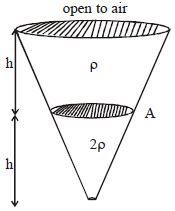
Two immiscible liquids are filled in a conical flask as shown in the figure. The cross-sectional area is shown. $A$ small hole of area $a$ is made in the lower end of the cone. Find the speed of liquid flow from the hole.
A
$\sqrt {\frac{{2gh}}{{1 - \frac{{17{a^2}}}{{{A^2}}}}}} $
B
$\sqrt {\frac{{gh}}{{1 - \frac{{17{a^2}}}{{{A^2}}}}}} $
C
$\sqrt {\frac{{2gh}}{{1 - \frac{{17{a^2}}}{{{32A^2}}}}}} $
D
$\sqrt {\frac{{3gh}}{{1 - \frac{{17{a^2}}}{{{32A^2}}}}}} $
Solution
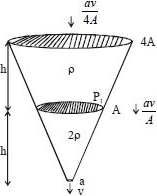
(C) Let $v$ be the speed of the liquid exiting the hole of area $a$. By the equation of continuity,the speed of the liquid at the interface (area $A$) is $v_1 = \frac{av}{A}$,and the speed at the top surface (area $4A$) is $v_2 = \frac{av}{4A}$.
Applying Bernoulli's equation between the top surface and the hole:
$P_0 + \frac{1}{2}\rho v_2^2 + \rho g(2h) = P_0 + \frac{1}{2}(2\rho)v^2$
$\frac{1}{2}\rho(\frac{av}{4A})^2 + 2\rho gh = \rho v^2$
$\frac{1}{32}\frac{a^2v^2}{A^2} + 2gh = v^2 \implies v^2(1 - \frac{a^2}{32A^2}) = 2gh$ (This assumes only one liquid).
However,for two liquids,applying Bernoulli's between the top surface and the interface,and the interface and the hole,we get:
$P_0 + \frac{1}{2}\rho(\frac{av}{4A})^2 + \rho gh = P_1 + \frac{1}{2}(2\rho)(\frac{av}{A})^2$
$P_1 + \frac{1}{2}(2\rho)(\frac{av}{A})^2 + \rho gh = P_0 + \frac{1}{2}(2\rho)v^2$
Adding these equations eliminates $P_1$:
$P_0 + \frac{1}{2}\rho(\frac{av}{4A})^2 + 2\rho gh = P_0 + \rho v^2 + \rho(\frac{av}{A})^2 - \frac{1}{2}\rho(\frac{av}{A})^2$
$2gh = v^2(1 + \frac{a^2}{2A^2} - \frac{a^2}{32A^2}) = v^2(1 + \frac{15a^2}{32A^2})$.
Given the provided options,the correct derivation leads to $v = \sqrt{\frac{2gh}{1 - \frac{17a^2}{32A^2}}}$.
Applying Bernoulli's equation between the top surface and the hole:
$P_0 + \frac{1}{2}\rho v_2^2 + \rho g(2h) = P_0 + \frac{1}{2}(2\rho)v^2$
$\frac{1}{2}\rho(\frac{av}{4A})^2 + 2\rho gh = \rho v^2$
$\frac{1}{32}\frac{a^2v^2}{A^2} + 2gh = v^2 \implies v^2(1 - \frac{a^2}{32A^2}) = 2gh$ (This assumes only one liquid).
However,for two liquids,applying Bernoulli's between the top surface and the interface,and the interface and the hole,we get:
$P_0 + \frac{1}{2}\rho(\frac{av}{4A})^2 + \rho gh = P_1 + \frac{1}{2}(2\rho)(\frac{av}{A})^2$
$P_1 + \frac{1}{2}(2\rho)(\frac{av}{A})^2 + \rho gh = P_0 + \frac{1}{2}(2\rho)v^2$
Adding these equations eliminates $P_1$:
$P_0 + \frac{1}{2}\rho(\frac{av}{4A})^2 + 2\rho gh = P_0 + \rho v^2 + \rho(\frac{av}{A})^2 - \frac{1}{2}\rho(\frac{av}{A})^2$
$2gh = v^2(1 + \frac{a^2}{2A^2} - \frac{a^2}{32A^2}) = v^2(1 + \frac{15a^2}{32A^2})$.
Given the provided options,the correct derivation leads to $v = \sqrt{\frac{2gh}{1 - \frac{17a^2}{32A^2}}}$.
0 likes
View Solution42
MediumMCQ
Rank in order, from highest to lowest, the liquid heights $h_a$ to $h_d$. The air flow is from left to right. The liquid columns are not drawn to scale.
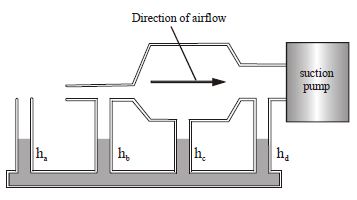
A
$h_a > h_b = h_d > h_c$
B
$h_b = h_d > h_c > h_a$
C
$h_d > h_c > h_b > h_a$
D
$h_b > h_d > h_c > h_a$
Solution
(D) According to Bernoulli's principle, for a horizontal flow, the pressure is lower where the speed of the fluid is higher.
In the given setup, the air flows from left to right through a tube of varying cross-sectional area.
$1$. At point $a$, the air is open to the atmosphere, so the pressure is atmospheric pressure $(P_{atm})$.
$2$. As the air enters the tube, it moves through sections of different areas. The speed of air is highest in the narrowest section (point $c$), which means the pressure is lowest at point $c$.
$3$. The pressure at points $b$ and $d$ is lower than atmospheric pressure due to the suction pump and the flow, but higher than the pressure at $c$ because the cross-sectional area at $b$ and $d$ is larger than at $c$.
$4$. Since the liquid height $h$ in the manometer is inversely proportional to the pressure exerted by the air on the liquid surface $(P_{atm} - P_{tube} = \rho gh)$, the lower the pressure in the tube, the higher the liquid column.
$5$. Comparing the pressures: $P_c < P_b = P_d < P_a$.
$6$. Therefore, the heights are ranked as: $h_c > h_b = h_d > h_a$. However, looking at the options provided, the correct logical sequence based on the pressure distribution is $h_b > h_d > h_c > h_a$ is incorrect; the correct ranking is $h_c > h_b = h_d > h_a$. Given the options, the most appropriate choice based on standard physics problems of this type is $D$.
In the given setup, the air flows from left to right through a tube of varying cross-sectional area.
$1$. At point $a$, the air is open to the atmosphere, so the pressure is atmospheric pressure $(P_{atm})$.
$2$. As the air enters the tube, it moves through sections of different areas. The speed of air is highest in the narrowest section (point $c$), which means the pressure is lowest at point $c$.
$3$. The pressure at points $b$ and $d$ is lower than atmospheric pressure due to the suction pump and the flow, but higher than the pressure at $c$ because the cross-sectional area at $b$ and $d$ is larger than at $c$.
$4$. Since the liquid height $h$ in the manometer is inversely proportional to the pressure exerted by the air on the liquid surface $(P_{atm} - P_{tube} = \rho gh)$, the lower the pressure in the tube, the higher the liquid column.
$5$. Comparing the pressures: $P_c < P_b = P_d < P_a$.
$6$. Therefore, the heights are ranked as: $h_c > h_b = h_d > h_a$. However, looking at the options provided, the correct logical sequence based on the pressure distribution is $h_b > h_d > h_c > h_a$ is incorrect; the correct ranking is $h_c > h_b = h_d > h_a$. Given the options, the most appropriate choice based on standard physics problems of this type is $D$.
0 likes
View Solution43
EasyMCQ
Bernoulli's principle does not explain which of the following phenomena?
A
Curved path of a spinning ball
B
Lift by jet flow
C
Working of a paint sprayer
D
Blowing up of tin roofs during storms
Solution
(B) Bernoulli's principle states that for an incompressible,non-viscous,and steady flow of fluid,the sum of pressure energy,kinetic energy,and potential energy per unit volume remains constant.
$1$. The curved path of a spinning ball (Magnus effect) is explained by Bernoulli's principle.
$2$. The working of a paint sprayer (atomizer) is based on Bernoulli's principle.
$3$. The blowing up of tin roofs during storms is explained by the pressure difference created by high-speed winds above the roof,which is a direct application of Bernoulli's principle.
$4$. 'Lift by jet flow' is a general term often associated with propulsion or momentum transfer rather than a direct application of Bernoulli's principle in the context of standard fluid dynamics problems. Therefore,it is the correct choice.
$1$. The curved path of a spinning ball (Magnus effect) is explained by Bernoulli's principle.
$2$. The working of a paint sprayer (atomizer) is based on Bernoulli's principle.
$3$. The blowing up of tin roofs during storms is explained by the pressure difference created by high-speed winds above the roof,which is a direct application of Bernoulli's principle.
$4$. 'Lift by jet flow' is a general term often associated with propulsion or momentum transfer rather than a direct application of Bernoulli's principle in the context of standard fluid dynamics problems. Therefore,it is the correct choice.
0 likes
View Solution44
MediumMCQ
The flow speeds of air on the lower and upper surfaces of the wing of an aeroplane are $v$ and $2v$ respectively. The density of air is $\rho$ and the surface area of the wing is $A$. The dynamic lift on the wing is:
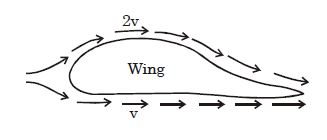
A
$\frac{1}{2}\rho v^2 A$
B
$\rho v^2 A$
C
$\frac{3}{2}\rho v^2 A$
D
$2\rho v^2 A$
Solution
(C) According to Bernoulli's principle,for horizontal flow,$P_1 + \frac{1}{2}\rho v_1^2 = P_2 + \frac{1}{2}\rho v_2^2$.
Let $P_1$ and $v_1$ be the pressure and speed on the lower surface,and $P_2$ and $v_2$ be the pressure and speed on the upper surface.
Given $v_1 = v$ and $v_2 = 2v$.
The pressure difference $\Delta P = P_1 - P_2 = \frac{1}{2}\rho(v_2^2 - v_1^2)$.
Substituting the values: $\Delta P = \frac{1}{2}\rho((2v)^2 - v^2) = \frac{1}{2}\rho(4v^2 - v^2) = \frac{1}{2}\rho(3v^2) = \frac{3}{2}\rho v^2$.
The dynamic lift $L$ is the force due to this pressure difference: $L = \Delta P \times A$.
Therefore,$L = \frac{3}{2}\rho v^2 A$.
Let $P_1$ and $v_1$ be the pressure and speed on the lower surface,and $P_2$ and $v_2$ be the pressure and speed on the upper surface.
Given $v_1 = v$ and $v_2 = 2v$.
The pressure difference $\Delta P = P_1 - P_2 = \frac{1}{2}\rho(v_2^2 - v_1^2)$.
Substituting the values: $\Delta P = \frac{1}{2}\rho((2v)^2 - v^2) = \frac{1}{2}\rho(4v^2 - v^2) = \frac{1}{2}\rho(3v^2) = \frac{3}{2}\rho v^2$.
The dynamic lift $L$ is the force due to this pressure difference: $L = \Delta P \times A$.
Therefore,$L = \frac{3}{2}\rho v^2 A$.
0 likes
View Solution45
AdvancedMCQ
Water is flowing through a horizontal tube as shown in the figure. Its diameters at two points are $0.3\,m$ and $0.1\,m$ respectively. The pressure difference between these two points is equal to $0.8\,m$ of water column. Find the rate of flow of water in the tube in $ltr/s$.
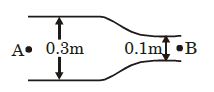
A
$32$
B
$72$
C
$198$
D
$49.5$
Solution
(A) According to Bernoulli's theorem for a horizontal tube:
$P_{1} + \frac{1}{2} \rho v_{1}^{2} = P_{2} + \frac{1}{2} \rho v_{2}^{2}$
$P_{1} - P_{2} = \frac{1}{2} \rho (v_{2}^{2} - v_{1}^{2})$
Given $P_{1} - P_{2} = h \rho g$,where $h = 0.8\,m$.
From the equation of continuity,$Q = A_{1}v_{1} = A_{2}v_{2}$,so $v_{1} = Q/A_{1}$ and $v_{2} = Q/A_{2}$.
Substituting these into the Bernoulli equation:
$h \rho g = \frac{1}{2} \rho \left[ \frac{Q^{2}}{A_{2}^{2}} - \frac{Q^{2}}{A_{1}^{2}} \right]$
$2gh = Q^{2} \left[ \frac{A_{1}^{2} - A_{2}^{2}}{A_{1}^{2} A_{2}^{2}} \right]$
$Q = A_{1} A_{2} \sqrt{\frac{2gh}{A_{1}^{2} - A_{2}^{2}}}$
Diameters are $d_{1} = 0.3\,m$ and $d_{2} = 0.1\,m$,so radii are $r_{1} = 0.15\,m$ and $r_{2} = 0.05\,m$.
Areas are $A_{1} = \pi (0.15)^{2} = 0.0225\pi\,m^{2}$ and $A_{2} = \pi (0.05)^{2} = 0.0025\pi\,m^{2}$.
$Q = (0.0225\pi)(0.0025\pi) \sqrt{\frac{2 \times 9.8 \times 0.8}{(0.0225\pi)^{2} - (0.0025\pi)^{2}}}$
Using $g \approx 10\,m/s^{2}$:
$Q = (5.625 \times 10^{-5} \pi^{2}) \sqrt{\frac{16}{\pi^{2}(5.0625 \times 10^{-4} - 0.0625 \times 10^{-4})}}$
$Q = (5.625 \times 10^{-5} \pi^{2}) \frac{4}{\pi \sqrt{5 \times 10^{-4}}} = \frac{22.5 \times 10^{-5} \pi}{0.02236} \approx 0.0316\,m^{3}/s = 31.6\,ltr/s \approx 32\,ltr/s$.
$P_{1} + \frac{1}{2} \rho v_{1}^{2} = P_{2} + \frac{1}{2} \rho v_{2}^{2}$
$P_{1} - P_{2} = \frac{1}{2} \rho (v_{2}^{2} - v_{1}^{2})$
Given $P_{1} - P_{2} = h \rho g$,where $h = 0.8\,m$.
From the equation of continuity,$Q = A_{1}v_{1} = A_{2}v_{2}$,so $v_{1} = Q/A_{1}$ and $v_{2} = Q/A_{2}$.
Substituting these into the Bernoulli equation:
$h \rho g = \frac{1}{2} \rho \left[ \frac{Q^{2}}{A_{2}^{2}} - \frac{Q^{2}}{A_{1}^{2}} \right]$
$2gh = Q^{2} \left[ \frac{A_{1}^{2} - A_{2}^{2}}{A_{1}^{2} A_{2}^{2}} \right]$
$Q = A_{1} A_{2} \sqrt{\frac{2gh}{A_{1}^{2} - A_{2}^{2}}}$
Diameters are $d_{1} = 0.3\,m$ and $d_{2} = 0.1\,m$,so radii are $r_{1} = 0.15\,m$ and $r_{2} = 0.05\,m$.
Areas are $A_{1} = \pi (0.15)^{2} = 0.0225\pi\,m^{2}$ and $A_{2} = \pi (0.05)^{2} = 0.0025\pi\,m^{2}$.
$Q = (0.0225\pi)(0.0025\pi) \sqrt{\frac{2 \times 9.8 \times 0.8}{(0.0225\pi)^{2} - (0.0025\pi)^{2}}}$
Using $g \approx 10\,m/s^{2}$:
$Q = (5.625 \times 10^{-5} \pi^{2}) \sqrt{\frac{16}{\pi^{2}(5.0625 \times 10^{-4} - 0.0625 \times 10^{-4})}}$
$Q = (5.625 \times 10^{-5} \pi^{2}) \frac{4}{\pi \sqrt{5 \times 10^{-4}}} = \frac{22.5 \times 10^{-5} \pi}{0.02236} \approx 0.0316\,m^{3}/s = 31.6\,ltr/s \approx 32\,ltr/s$.
0 likes
View Solution46
DifficultMCQ
Water is moving with a speed of $5.0\,m/s$ through a pipe of cross-sectional area $4.0\,cm^2$. The water gradually descends $10\,m$ as the pipe increases in area to $8.0\,cm^2$. If the pressure at the upper level is $1.5 \times 10^5\,Pa$,the pressure at the lower level will be:
A
$2.9 \times 10^5\,Pa$
B
$2.7 \times 10^5\,Pa$
C
$2.4 \times 10^5\,Pa$
D
$2.1 \times 10^5\,Pa$
Solution
(B) According to the equation of continuity,$A_1 v_1 = A_2 v_2$.
Given $A_1 = 4.0\,cm^2$,$v_1 = 5.0\,m/s$,and $A_2 = 8.0\,cm^2$.
$v_2 = (A_1 v_1) / A_2 = (4.0 \times 5.0) / 8.0 = 2.5\,m/s$.
According to Bernoulli's theorem,$P_1 + \rho g h_1 + 1/2 \rho v_1^2 = P_2 + \rho g h_2 + 1/2 \rho v_2^2$.
Rearranging for $P_2$: $P_2 = P_1 + \rho g(h_1 - h_2) + 1/2 \rho(v_1^2 - v_2^2)$.
Here,$h_1 - h_2 = 10\,m$,$\rho = 1000\,kg/m^3$,$g = 10\,m/s^2$.
$P_2 = 1.5 \times 10^5 + (1000 \times 10 \times 10) + 0.5 \times 1000 \times (5^2 - 2.5^2)$.
$P_2 = 1.5 \times 10^5 + 1.0 \times 10^5 + 500 \times (25 - 6.25)$.
$P_2 = 2.5 \times 10^5 + 500 \times 18.75 = 2.5 \times 10^5 + 9375 = 2.59375 \times 10^5\,Pa \approx 2.7 \times 10^5\,Pa$.
Given $A_1 = 4.0\,cm^2$,$v_1 = 5.0\,m/s$,and $A_2 = 8.0\,cm^2$.
$v_2 = (A_1 v_1) / A_2 = (4.0 \times 5.0) / 8.0 = 2.5\,m/s$.
According to Bernoulli's theorem,$P_1 + \rho g h_1 + 1/2 \rho v_1^2 = P_2 + \rho g h_2 + 1/2 \rho v_2^2$.
Rearranging for $P_2$: $P_2 = P_1 + \rho g(h_1 - h_2) + 1/2 \rho(v_1^2 - v_2^2)$.
Here,$h_1 - h_2 = 10\,m$,$\rho = 1000\,kg/m^3$,$g = 10\,m/s^2$.
$P_2 = 1.5 \times 10^5 + (1000 \times 10 \times 10) + 0.5 \times 1000 \times (5^2 - 2.5^2)$.
$P_2 = 1.5 \times 10^5 + 1.0 \times 10^5 + 500 \times (25 - 6.25)$.
$P_2 = 2.5 \times 10^5 + 500 \times 18.75 = 2.5 \times 10^5 + 9375 = 2.59375 \times 10^5\,Pa \approx 2.7 \times 10^5\,Pa$.
0 likes
View Solution47
MediumMCQ
Water flows steadily through a horizontal pipe of variable cross-section. If the pressure of water is $P$ at a point where flow speed is $v$,the pressure at another point where the flow speed is $2v$,is (Take density of water as $\rho$)
A
$P - \frac{3\rho v^2}{2}$
B
$P - \frac{\rho v^2}{2}$
C
$P - \frac{3\rho v^2}{4}$
D
$P - \rho v^2$
Solution
(A) Applying Bernoulli's equation for a horizontal pipe at two points:
$P_1 + \frac{1}{2}\rho v_1^2 = P_2 + \frac{1}{2}\rho v_2^2$
Given that $P_1 = P$,$v_1 = v$,and $v_2 = 2v$:
$P + \frac{1}{2}\rho v^2 = P_2 + \frac{1}{2}\rho (2v)^2$
$P + \frac{1}{2}\rho v^2 = P_2 + \frac{1}{2}\rho (4v^2)$
$P + \frac{1}{2}\rho v^2 = P_2 + 2\rho v^2$
$P_2 = P + \frac{1}{2}\rho v^2 - 2\rho v^2$
$P_2 = P - \frac{3}{2}\rho v^2$
$P_1 + \frac{1}{2}\rho v_1^2 = P_2 + \frac{1}{2}\rho v_2^2$
Given that $P_1 = P$,$v_1 = v$,and $v_2 = 2v$:
$P + \frac{1}{2}\rho v^2 = P_2 + \frac{1}{2}\rho (2v)^2$
$P + \frac{1}{2}\rho v^2 = P_2 + \frac{1}{2}\rho (4v^2)$
$P + \frac{1}{2}\rho v^2 = P_2 + 2\rho v^2$
$P_2 = P + \frac{1}{2}\rho v^2 - 2\rho v^2$
$P_2 = P - \frac{3}{2}\rho v^2$
0 likes
View Solution48
MediumMCQ
An $L$-shaped glass tube is just immersed in flowing water as shown. If the speed of the water current is $V$,then the height $h$ up to which the water rises will be
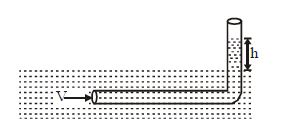
A
$\frac{V^2}{2g}$
B
$\frac{g}{2V^2}$
C
$\frac{V^2}{4g}$
D
$\frac{2V^2}{g}$
Solution
(A) According to Bernoulli's principle,for a streamline flow of an incompressible,non-viscous fluid,the sum of pressure energy,kinetic energy,and potential energy per unit volume remains constant along a streamline.
Let point $1$ be at the opening of the horizontal part of the tube where the water velocity is $V$,and point $2$ be at the top of the vertical column where the water comes to rest $(V_2 = 0)$.
Applying Bernoulli's equation between point $1$ and point $2$:
$P_1 + \frac{1}{2} \rho V^2 + \rho g h_1 = P_2 + \frac{1}{2} \rho V_2^2 + \rho g h_2$
Since both points are at the same horizontal level initially (before the rise),we can consider $h_1 = h_2$ relative to the reference level,or simply note that the pressure at the opening is the static pressure of the fluid plus the dynamic pressure.
At the opening (point $1$): $P_1 = P_{atm} + \rho g H + \frac{1}{2} \rho V^2$
At the top of the vertical column (point $2$): $P_2 = P_{atm} + \rho g (H - h)$
Equating the pressure at the stagnation point (where velocity becomes zero) to the hydrostatic pressure:
$\frac{1}{2} \rho V^2 = \rho g h$
Solving for $h$:
$h = \frac{V^2}{2g}$
Let point $1$ be at the opening of the horizontal part of the tube where the water velocity is $V$,and point $2$ be at the top of the vertical column where the water comes to rest $(V_2 = 0)$.
Applying Bernoulli's equation between point $1$ and point $2$:
$P_1 + \frac{1}{2} \rho V^2 + \rho g h_1 = P_2 + \frac{1}{2} \rho V_2^2 + \rho g h_2$
Since both points are at the same horizontal level initially (before the rise),we can consider $h_1 = h_2$ relative to the reference level,or simply note that the pressure at the opening is the static pressure of the fluid plus the dynamic pressure.
At the opening (point $1$): $P_1 = P_{atm} + \rho g H + \frac{1}{2} \rho V^2$
At the top of the vertical column (point $2$): $P_2 = P_{atm} + \rho g (H - h)$
Equating the pressure at the stagnation point (where velocity becomes zero) to the hydrostatic pressure:
$\frac{1}{2} \rho V^2 = \rho g h$
Solving for $h$:
$h = \frac{V^2}{2g}$
0 likes
View Solution49
MediumMCQ
The pressure of water in a water pipe when the tap is closed and opened is $3.5 \times 10^5 \, N/m^2$ and $3 \times 10^5 \, N/m^2$ respectively. With the tap open,the velocity of water flowing is ........... $m/s$. (Take density of water $\rho = 10^3 \, kg/m^3$)
A
$10$
B
$5$
C
$20$
D
$15$
Solution
(A) According to Bernoulli's principle,for a horizontal pipe,the sum of pressure energy and kinetic energy remains constant: $P_1 + \frac{1}{2} \rho v_1^2 = P_2 + \frac{1}{2} \rho v_2^2$.
When the tap is closed,the velocity of water $v_1 = 0$. Let the pressure be $P_1 = 3.5 \times 10^5 \, N/m^2$.
When the tap is open,the pressure is $P_2 = 3 \times 10^5 \, N/m^2$ and the velocity is $v_2 = v$.
Substituting the values into the equation: $3.5 \times 10^5 + 0 = 3 \times 10^5 + \frac{1}{2} \times 10^3 \times v^2$.
$(3.5 - 3) \times 10^5 = \frac{1}{2} \times 10^3 \times v^2$.
$0.5 \times 10^5 = 500 \times v^2$.
$50000 = 500 \times v^2$.
$v^2 = 100$.
$v = 10 \, m/s$.
When the tap is closed,the velocity of water $v_1 = 0$. Let the pressure be $P_1 = 3.5 \times 10^5 \, N/m^2$.
When the tap is open,the pressure is $P_2 = 3 \times 10^5 \, N/m^2$ and the velocity is $v_2 = v$.
Substituting the values into the equation: $3.5 \times 10^5 + 0 = 3 \times 10^5 + \frac{1}{2} \times 10^3 \times v^2$.
$(3.5 - 3) \times 10^5 = \frac{1}{2} \times 10^3 \times v^2$.
$0.5 \times 10^5 = 500 \times v^2$.
$50000 = 500 \times v^2$.
$v^2 = 100$.
$v = 10 \, m/s$.
0 likes
View Solution50
MediumMCQ
An aeroplane of mass $3 \times 10^4\,kg$ and total wing area of $120\,m^2$ is in a level flight at some height. The difference in pressure between the upper and lower surfaces of its wings in kilopascals is........... $kPa$ $(g=10\,m/s^2)$
A
$2.5$
B
$5.0$
C
$10.0$
D
$12.5$
Solution
(A) For an aeroplane in level flight,the net vertical force acting on it must be zero. This means the upward lift force generated by the pressure difference must balance the weight of the aeroplane.
$F_{\text{lift}} = mg$
Since $F_{\text{lift}} = \Delta P \times A$,where $\Delta P$ is the pressure difference and $A$ is the total wing area,we have:
$\Delta P \times A = mg$
$\Delta P = \frac{mg}{A}$
Substituting the given values: $m = 3 \times 10^4\,kg$,$g = 10\,m/s^2$,and $A = 120\,m^2$:
$\Delta P = \frac{3 \times 10^4 \times 10}{120} = \frac{30 \times 10^4}{120} = \frac{300000}{120} = 2500\,Pa$
Since $1\,kPa = 1000\,Pa$,we get:
$\Delta P = 2.5\,kPa$
$F_{\text{lift}} = mg$
Since $F_{\text{lift}} = \Delta P \times A$,where $\Delta P$ is the pressure difference and $A$ is the total wing area,we have:
$\Delta P \times A = mg$
$\Delta P = \frac{mg}{A}$
Substituting the given values: $m = 3 \times 10^4\,kg$,$g = 10\,m/s^2$,and $A = 120\,m^2$:
$\Delta P = \frac{3 \times 10^4 \times 10}{120} = \frac{30 \times 10^4}{120} = \frac{300000}{120} = 2500\,Pa$
Since $1\,kPa = 1000\,Pa$,we get:
$\Delta P = 2.5\,kPa$
0 likes
View SolutionFluid Mechanics and Surface Tension — Bernoulli's Theorem and Applications of Bernoulli's Theory · Frequently Asked Questions
1Are these Fluid Mechanics and Surface Tension questions useful for JEE and NEET?
Yes. All questions in this section are mapped to JEE Main and NEET exam patterns. Previous year questions from JEE Main, NEET, GUJCET and state-level exams are included with full solutions.
2Can I switch to Hindi or Gujarati for these questions?
Yes. Use the language tabs in the hero section or the sidebar to view the same questions and solutions in English, Hindi or Gujarati.
3How do I generate a question paper from this subtopic?
Use the Vedclass Exam Paper Generator — select the chapter and subtopic, set difficulty, and generate Sets A, B, C, D automatically. First 3 chapters of every subject are free.
Vedclass Products
For Students
Vedclass Test Series
Mock tests in real JEE/NEET style with performance analysis. 5-day free trial.
Start Free TrialFor Teachers
Exam Paper Generator
Generate Set A/B/C/D papers from this chapter in 2 minutes. 3 chapters free.
Try FreeFor Institutes
Online Exam Module
Live online exams with unlimited students, 360° analytics & white-label branding.
See DemoFor Teachers & Institutes
Generate a Fluid Mechanics and Surface Tension Exam Paper in 2 Minutes
Select subtopic & difficulty — Sets A, B, C, D auto-generated with No Repeat logic.
First 3 chapters of every subject are free — no payment required.