
A English
Pressure due to Liquid Column and Barometer Questions in English
Class 11 Physics · Fluid Mechanics and Surface Tension · Pressure due to Liquid Column and Barometer
84+
Questions
English
Language
100%
With Solutions
Showing 50 of 84 questions in English
1
DifficultMCQ
If the pressure at half the depth of a lake is equal to $2/3$ of the pressure at the bottom of the lake,then what is the depth of the lake in $m$? (Assume atmospheric pressure $P_0 = 10^5 \ Pa$,density of water $\rho = 10^3 \ kg/m^3$,and $g = 10 \ m/s^2$)
A
$10$
B
$20$
C
$60$
D
$30$
Solution
(B) Let the total depth of the lake be $h$. The pressure at the bottom of the lake is given by $P_{bottom} = P_0 + h\rho g$.
The pressure at half the depth $(h/2)$ is given by $P_{half} = P_0 + (h/2)\rho g$.
According to the problem,$P_{half} = \frac{2}{3} P_{bottom}$.
Substituting the expressions: $P_0 + \frac{h}{2}\rho g = \frac{2}{3}(P_0 + h\rho g)$.
Multiplying by $3$: $3P_0 + \frac{3}{2}h\rho g = 2P_0 + 2h\rho g$.
Rearranging the terms: $P_0 = 2h\rho g - 1.5h\rho g = 0.5h\rho g$.
Thus,$h = \frac{2P_0}{\rho g}$.
Substituting the values $P_0 = 10^5 \ Pa$,$\rho = 10^3 \ kg/m^3$,and $g = 10 \ m/s^2$:
$h = \frac{2 \times 10^5}{10^3 \times 10} = \frac{2 \times 10^5}{10^4} = 20 \ m$.
The pressure at half the depth $(h/2)$ is given by $P_{half} = P_0 + (h/2)\rho g$.
According to the problem,$P_{half} = \frac{2}{3} P_{bottom}$.
Substituting the expressions: $P_0 + \frac{h}{2}\rho g = \frac{2}{3}(P_0 + h\rho g)$.
Multiplying by $3$: $3P_0 + \frac{3}{2}h\rho g = 2P_0 + 2h\rho g$.
Rearranging the terms: $P_0 = 2h\rho g - 1.5h\rho g = 0.5h\rho g$.
Thus,$h = \frac{2P_0}{\rho g}$.
Substituting the values $P_0 = 10^5 \ Pa$,$\rho = 10^3 \ kg/m^3$,and $g = 10 \ m/s^2$:
$h = \frac{2 \times 10^5}{10^3 \times 10} = \frac{2 \times 10^5}{10^4} = 20 \ m$.
0 likes
View Solution2
DifficultMCQ
The height of a mercury barometer is $75 \ cm$ at sea level and $50 \ cm$ at the top of a hill. The ratio of the density of mercury to that of air is $10^4$. The height of the hill is ....... $km$.
A
$25$
B
$2.5$
C
$1.25$
D
$75$
Solution
(B) The difference in pressure between sea level and the top of the hill is given by the change in the mercury column height:
$\Delta P = (h_1 - h_2) \times \rho_{Hg} \times g = (75 - 50) \times 10^{-2} \ m \times \rho_{Hg} \times g$ ... $(i)$
The pressure difference is also equal to the weight of the air column of height $h$:
$\Delta P = h \times \rho_{air} \times g$ ... $(ii)$
Equating $(i)$ and $(ii)$:
$h \times \rho_{air} \times g = 25 \times 10^{-2} \times \rho_{Hg} \times g$
$h = 25 \times 10^{-2} \times \left( \frac{\rho_{Hg}}{\rho_{air}} \right)$
Given $\frac{\rho_{Hg}}{\rho_{air}} = 10^4$,we get:
$h = 25 \times 10^{-2} \times 10^4 = 2500 \ m$
Converting to kilometers,the height of the hill is $2.5 \ km$.
$\Delta P = (h_1 - h_2) \times \rho_{Hg} \times g = (75 - 50) \times 10^{-2} \ m \times \rho_{Hg} \times g$ ... $(i)$
The pressure difference is also equal to the weight of the air column of height $h$:
$\Delta P = h \times \rho_{air} \times g$ ... $(ii)$
Equating $(i)$ and $(ii)$:
$h \times \rho_{air} \times g = 25 \times 10^{-2} \times \rho_{Hg} \times g$
$h = 25 \times 10^{-2} \times \left( \frac{\rho_{Hg}}{\rho_{air}} \right)$
Given $\frac{\rho_{Hg}}{\rho_{air}} = 10^4$,we get:
$h = 25 \times 10^{-2} \times 10^4 = 2500 \ m$
Converting to kilometers,the height of the hill is $2.5 \ km$.
0 likes
View Solution3
EasyMCQ
The pressure at the bottom of a tank containing a liquid does not depend on
A
Acceleration due to gravity
B
Height of the liquid column
C
Area of the bottom surface
D
Nature of the liquid
Solution
(C) The pressure $P$ at a depth $h$ in a liquid of density $\rho$ is given by the formula $P = h\rho g$,where $g$ is the acceleration due to gravity.
From this formula,it is clear that the pressure depends on the height of the liquid column $(h)$,the density of the liquid $(\rho)$,and the acceleration due to gravity $(g)$.
It does not depend on the area of the bottom surface of the tank.
Therefore,the correct option is $C$.
From this formula,it is clear that the pressure depends on the height of the liquid column $(h)$,the density of the liquid $(\rho)$,and the acceleration due to gravity $(g)$.
It does not depend on the area of the bottom surface of the tank.
Therefore,the correct option is $C$.
0 likes
View Solution4
EasyMCQ
The value of $g$ at a place decreases by $2\%$. The barometric height of mercury:
A
Increases by $2\%$
B
Decreases by $2\%$
C
Remains unchanged
D
Sometimes increases and sometimes decreases
Solution
(A) The pressure $P$ exerted by the mercury column in a barometer is given by the formula $P = h \rho g$,where $h$ is the height of the mercury column,$\rho$ is the density of mercury,and $g$ is the acceleration due to gravity.
Since the atmospheric pressure $P$ remains constant and the density $\rho$ of mercury is constant,we have $h \propto \frac{1}{g}$.
Taking the logarithmic derivative,we get $\frac{\Delta h}{h} = -\frac{\Delta g}{g}$.
Given that $g$ decreases by $2\%$,we have $\frac{\Delta g}{g} = -0.02$.
Substituting this into the equation,$\frac{\Delta h}{h} = -(-0.02) = 0.02$.
Therefore,the height $h$ increases by $2\%$.
Since the atmospheric pressure $P$ remains constant and the density $\rho$ of mercury is constant,we have $h \propto \frac{1}{g}$.
Taking the logarithmic derivative,we get $\frac{\Delta h}{h} = -\frac{\Delta g}{g}$.
Given that $g$ decreases by $2\%$,we have $\frac{\Delta g}{g} = -0.02$.
Substituting this into the equation,$\frac{\Delta h}{h} = -(-0.02) = 0.02$.
Therefore,the height $h$ increases by $2\%$.
0 likes
View Solution5
EasyMCQ
$A$ barometer kept in a stationary elevator reads $76 \ cm$. If the elevator starts accelerating upwards,the reading will be:
A
Zero
B
Equal to $76 \ cm$
C
More than $76 \ cm$
D
Less than $76 \ cm$
Solution
(D) The pressure $P$ exerted by a liquid column of height $h$ is given by the formula $P = \rho g_{eff} h$,where $\rho$ is the density of the liquid and $g_{eff}$ is the effective acceleration due to gravity.
For a barometer,the atmospheric pressure $P_{atm}$ is balanced by the liquid column,so $P_{atm} = \rho g_{eff} h$,which implies $h = \frac{P_{atm}}{\rho g_{eff}}$.
When the elevator is stationary,$g_{eff} = g$.
When the elevator accelerates upwards with an acceleration $a$,the effective acceleration becomes $g_{eff} = g + a$.
Since $g_{eff}$ increases,the height $h$ of the mercury column must decrease to maintain the same atmospheric pressure $(h \propto \frac{1}{g_{eff}})$.
Therefore,the reading will be less than $76 \ cm$.
For a barometer,the atmospheric pressure $P_{atm}$ is balanced by the liquid column,so $P_{atm} = \rho g_{eff} h$,which implies $h = \frac{P_{atm}}{\rho g_{eff}}$.
When the elevator is stationary,$g_{eff} = g$.
When the elevator accelerates upwards with an acceleration $a$,the effective acceleration becomes $g_{eff} = g + a$.
Since $g_{eff}$ increases,the height $h$ of the mercury column must decrease to maintain the same atmospheric pressure $(h \propto \frac{1}{g_{eff}})$.
Therefore,the reading will be less than $76 \ cm$.
0 likes
View Solution6
DifficultMCQ
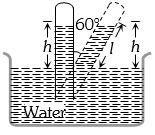
$A$ barometer tube reads $76 \ cm$ of mercury. If the tube is gradually inclined at an angle of $60^\circ$ with the vertical,keeping the open end immersed in the mercury reservoir,the length of the mercury column will be ........ $cm$.
A
$152$
B
$76$
C
$38$
D
$38\sqrt{3}$
Solution
(A) The vertical height $h$ of the mercury column in a barometer remains constant regardless of the inclination of the tube,as it is determined by the atmospheric pressure.
Given,the vertical height $h = 76 \ cm$.
When the tube is inclined at an angle $\theta = 60^\circ$ with the vertical,the length of the mercury column $l$ along the tube is related to the vertical height $h$ by the formula:
$h = l \cos \theta$
Substituting the given values:
$76 = l \cos 60^\circ$
$76 = l \times \frac{1}{2}$
$l = 76 \times 2 = 152 \ cm$.
Therefore,the length of the mercury column will be $152 \ cm$.
Given,the vertical height $h = 76 \ cm$.
When the tube is inclined at an angle $\theta = 60^\circ$ with the vertical,the length of the mercury column $l$ along the tube is related to the vertical height $h$ by the formula:
$h = l \cos \theta$
Substituting the given values:
$76 = l \cos 60^\circ$
$76 = l \times \frac{1}{2}$
$l = 76 \times 2 = 152 \ cm$.
Therefore,the length of the mercury column will be $152 \ cm$.
0 likes
View Solution7
MediumMCQ
The height to which a cylindrical vessel must be filled with a homogeneous liquid,such that the average force with which the liquid presses the side of the vessel is equal to the force exerted by the liquid on the bottom of the vessel,is equal to:
A
Half of the radius of the vessel
B
Radius of the vessel
C
One-fourth of the radius of the vessel
D
Three-fourth of the radius of the vessel
Solution
(B) Let the height of the liquid be $h$ and the radius of the cylindrical vessel be $r$. The density of the liquid is $\rho$.
$1$. The pressure at the bottom of the vessel is $P_{bottom} = h\rho g$. The force exerted on the bottom is $F_{bottom} = P_{bottom} \times A_{bottom} = (h\rho g)(\pi r^2)$.
$2$. The pressure varies linearly with depth along the vertical side. The average pressure on the side wall is $P_{avg} = \frac{0 + h\rho g}{2} = \frac{1}{2}h\rho g$. The area of the side wall is $A_{side} = 2\pi rh$. Thus,the force on the side wall is $F_{side} = P_{avg} \times A_{side} = (\frac{1}{2}h\rho g)(2\pi rh) = \pi \rho g r h^2$.
$3$. According to the problem,$F_{bottom} = F_{side}$.
Therefore,$h\rho g \pi r^2 = \pi \rho g r h^2$.
$4$. Simplifying the equation: $h r^2 = r h^2$,which gives $h = r$.
$1$. The pressure at the bottom of the vessel is $P_{bottom} = h\rho g$. The force exerted on the bottom is $F_{bottom} = P_{bottom} \times A_{bottom} = (h\rho g)(\pi r^2)$.
$2$. The pressure varies linearly with depth along the vertical side. The average pressure on the side wall is $P_{avg} = \frac{0 + h\rho g}{2} = \frac{1}{2}h\rho g$. The area of the side wall is $A_{side} = 2\pi rh$. Thus,the force on the side wall is $F_{side} = P_{avg} \times A_{side} = (\frac{1}{2}h\rho g)(2\pi rh) = \pi \rho g r h^2$.
$3$. According to the problem,$F_{bottom} = F_{side}$.
Therefore,$h\rho g \pi r^2 = \pi \rho g r h^2$.
$4$. Simplifying the equation: $h r^2 = r h^2$,which gives $h = r$.
0 likes
View Solution8
EasyMCQ
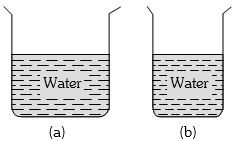
From the adjacent figure,the correct observation is:
A
The pressure on the bottom of tank $(a)$ is greater than at the bottom of $(b)$.
B
The pressure on the bottom of the tank $(a)$ is smaller than at the bottom of $(b)$.
C
The pressure depends on the shape of the container.
D
The pressure on the bottom of $(a)$ and $(b)$ is the same.
Solution
(D) The pressure exerted by a liquid column at a depth $h$ is given by the formula $P = h \rho g$,where $\rho$ is the density of the liquid and $g$ is the acceleration due to gravity.
This formula shows that the pressure at the bottom of a container is independent of the shape of the container or the surface area of the base.
It only depends on the vertical height $h$ of the liquid column.
In the given figure,both tanks $(a)$ and $(b)$ are filled with water to the same vertical height $h$.
Since $h$,$\rho$,and $g$ are identical for both tanks,the pressure at the bottom of both tanks must be the same.
This formula shows that the pressure at the bottom of a container is independent of the shape of the container or the surface area of the base.
It only depends on the vertical height $h$ of the liquid column.
In the given figure,both tanks $(a)$ and $(b)$ are filled with water to the same vertical height $h$.
Since $h$,$\rho$,and $g$ are identical for both tanks,the pressure at the bottom of both tanks must be the same.
0 likes
View Solution9
EasyMCQ
$A$ liquid boils when its vapour pressure equals
A
The atmospheric pressure
B
Pressure of $76.0 \,cm$ column of mercury
C
The critical pressure
D
The dew point of the surroundings
Solution
(A) liquid boils when its vapour pressure becomes equal to the external atmospheric pressure.
At this point,the bubbles of vapour can form throughout the bulk of the liquid and rise to the surface,allowing the liquid to transition into the gaseous phase.
Therefore,the correct option is $A$.
At this point,the bubbles of vapour can form throughout the bulk of the liquid and rise to the surface,allowing the liquid to transition into the gaseous phase.
Therefore,the correct option is $A$.
0 likes
View Solution10
DifficultMCQ
The pressure at half the depth of a lake is $2/3$ of the pressure at its bottom. What is the depth of the lake in $m$?
A
$10$
B
$20$
C
$60$
D
$30$
Solution
(B) Let the depth of the lake be $h$ and the atmospheric pressure be $P_0$. The density of water is $\rho = 10^3 \ kg/m^3$ and $g = 10 \ m/s^2$.
The pressure at depth $h/2$ is $P_1 = P_0 + (h/2)\rho g$.
The pressure at the bottom (depth $h$) is $P_2 = P_0 + h\rho g$.
According to the problem,$P_1 = (2/3)P_2$.
Substituting the values: $P_0 + (1/2)h\rho g = (2/3)(P_0 + h\rho g)$.
Multiplying by $6$ to clear denominators: $6P_0 + 3h\rho g = 4P_0 + 4h\rho g$.
Rearranging the terms: $2P_0 = h\rho g$.
Thus,$h = (2P_0) / (\rho g)$.
Using $P_0 = 10^5 \ Pa$,$\rho = 10^3 \ kg/m^3$,and $g = 10 \ m/s^2$:
$h = (2 \times 10^5) / (10^3 \times 10) = 2 \times 10^5 / 10^4 = 20 \ m$.
The pressure at depth $h/2$ is $P_1 = P_0 + (h/2)\rho g$.
The pressure at the bottom (depth $h$) is $P_2 = P_0 + h\rho g$.
According to the problem,$P_1 = (2/3)P_2$.
Substituting the values: $P_0 + (1/2)h\rho g = (2/3)(P_0 + h\rho g)$.
Multiplying by $6$ to clear denominators: $6P_0 + 3h\rho g = 4P_0 + 4h\rho g$.
Rearranging the terms: $2P_0 = h\rho g$.
Thus,$h = (2P_0) / (\rho g)$.
Using $P_0 = 10^5 \ Pa$,$\rho = 10^3 \ kg/m^3$,and $g = 10 \ m/s^2$:
$h = (2 \times 10^5) / (10^3 \times 10) = 2 \times 10^5 / 10^4 = 20 \ m$.
0 likes
View Solution11
DifficultMCQ
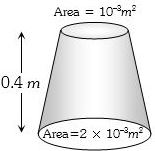
The density of the liquid filled in the container is $900 \ kg/m^{3}$. Calculate the force exerted on the bottom of the container. (Given: $g = 10 \ m/s^{2}$) (in $N$)
A
$3.6$
B
$7.2$
C
$9.0$
D
$14.4$
Solution
(B) The pressure $P$ at the bottom of the container due to a liquid column of height $h$ is given by $P = h \rho g$.
The force $F$ exerted on the bottom area $A$ is given by $F = P \times A$.
Substituting the values: $h = 0.4 \ m$,$\rho = 900 \ kg/m^{3}$,$g = 10 \ m/s^{2}$,and $A = 2 \times 10^{-3} \ m^{2}$.
$F = (h \rho g) \times A$
$F = 0.4 \times 900 \times 10 \times (2 \times 10^{-3})$
$F = 3600 \times 2 \times 10^{-3}$
$F = 7200 \times 10^{-3} = 7.2 \ N$.
The force $F$ exerted on the bottom area $A$ is given by $F = P \times A$.
Substituting the values: $h = 0.4 \ m$,$\rho = 900 \ kg/m^{3}$,$g = 10 \ m/s^{2}$,and $A = 2 \times 10^{-3} \ m^{2}$.
$F = (h \rho g) \times A$
$F = 0.4 \times 900 \times 10 \times (2 \times 10^{-3})$
$F = 3600 \times 2 \times 10^{-3}$
$F = 7200 \times 10^{-3} = 7.2 \ N$.
0 likes
View Solution12
MediumMCQ
The heights of mercury in a barometer at the base and at the top of a mountain are $75 \, cm$ and $50 \, cm$,respectively. If the ratio of the density of mercury to the density of air is $10^4$,what is the height of the mountain?
A
$250 \, m$
B
$2.5 \, km$
C
$1.25 \, km$
D
$750 \, m$
Solution
(B) The pressure difference between the base and the top of the mountain is equal to the weight of the air column of height $h$ and density $\rho_{air}$.
This pressure difference is also equal to the difference in pressure exerted by the mercury columns.
Let $h$ be the height of the mountain,$\rho_{Hg}$ be the density of mercury,and $\rho_{air}$ be the density of air.
The pressure difference is given by: $\Delta P = (h_1 - h_2) \rho_{Hg} g = h \rho_{air} g$.
Substituting the given values: $(75 \, cm - 50 \, cm) \times \rho_{Hg} = h \times \rho_{air}$.
$25 \times 10^{-2} \, m \times \rho_{Hg} = h \times \rho_{air}$.
$h = 25 \times 10^{-2} \times \left( \frac{\rho_{Hg}}{\rho_{air}} \right)$.
Given $\frac{\rho_{Hg}}{\rho_{air}} = 10^4$.
$h = 25 \times 10^{-2} \times 10^4 = 2500 \, m$.
Therefore,the height of the mountain is $2.5 \, km$.
This pressure difference is also equal to the difference in pressure exerted by the mercury columns.
Let $h$ be the height of the mountain,$\rho_{Hg}$ be the density of mercury,and $\rho_{air}$ be the density of air.
The pressure difference is given by: $\Delta P = (h_1 - h_2) \rho_{Hg} g = h \rho_{air} g$.
Substituting the given values: $(75 \, cm - 50 \, cm) \times \rho_{Hg} = h \times \rho_{air}$.
$25 \times 10^{-2} \, m \times \rho_{Hg} = h \times \rho_{air}$.
$h = 25 \times 10^{-2} \times \left( \frac{\rho_{Hg}}{\rho_{air}} \right)$.
Given $\frac{\rho_{Hg}}{\rho_{air}} = 10^4$.
$h = 25 \times 10^{-2} \times 10^4 = 2500 \, m$.
Therefore,the height of the mountain is $2.5 \, km$.
0 likes
View Solution13
MediumMCQ
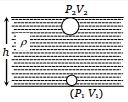
$A$ bubble of volume $V_0$ is released from a depth $h$ in a lake. If the atmospheric pressure is $P$ and the temperature is assumed to be constant,what is the new volume of the bubble when it reaches the surface? (Density of water is $\rho$)
A
$V_0$
B
$V_0(\rho gh/P)$
C
$\frac{V_0}{(1 + \frac{\rho gh}{P})}$
D
$V_0(1 + \frac{\rho gh}{P})$
Solution
(D) At depth $h$,the total pressure $P_1$ is given by $P_1 = P + \rho gh$,where $P$ is the atmospheric pressure,$\rho$ is the density of water,and $g$ is the acceleration due to gravity.
At the surface,the pressure $P_2$ is equal to the atmospheric pressure $P$.
Since the temperature is constant,we apply Boyle's Law: $P_1 V_1 = P_2 V_2$.
Here,$V_1 = V_0$ and $V_2 = V$ (the volume at the surface).
Substituting the values: $(P + \rho gh) V_0 = P V$.
Solving for $V$: $V = V_0 \frac{(P + \rho gh)}{P} = V_0 (1 + \frac{\rho gh}{P})$.
At the surface,the pressure $P_2$ is equal to the atmospheric pressure $P$.
Since the temperature is constant,we apply Boyle's Law: $P_1 V_1 = P_2 V_2$.
Here,$V_1 = V_0$ and $V_2 = V$ (the volume at the surface).
Substituting the values: $(P + \rho gh) V_0 = P V$.
Solving for $V$: $V = V_0 \frac{(P + \rho gh)}{P} = V_0 (1 + \frac{\rho gh}{P})$.
0 likes
View Solution14
MediumMCQ
$A$ barometer tube,containing mercury,is lowered in a vessel containing mercury until only $50 \, cm$ of the tube is above the level of mercury in the vessel. If the atmospheric pressure is $75 \, cm$ of mercury,what is the pressure at the top of the tube?
A
$33.3 \, kPa$
B
$66.7 \, kPa$
C
$3.33 \, MPa$
D
$6.67 \, MPa$
Solution
(A) The atmospheric pressure is $P_{atm} = 75 \, cm$ of $Hg$.
Since the tube is only $50 \, cm$ above the mercury level,the mercury column inside the tube is $50 \, cm$ high.
The pressure at the top of the tube $(P_{top})$ plus the pressure due to the $50 \, cm$ mercury column must equal the atmospheric pressure.
$P_{top} + 50 \, cm \, Hg = 75 \, cm \, Hg$.
$P_{top} = 75 \, cm - 50 \, cm = 25 \, cm$ of $Hg$.
To convert $25 \, cm$ of $Hg$ to $kPa$,we use the relation $76 \, cm \, Hg \approx 101.3 \, kPa$.
$P_{top} = (25 / 76) \times 101.3 \, kPa \approx 33.3 \, kPa$.
Since the tube is only $50 \, cm$ above the mercury level,the mercury column inside the tube is $50 \, cm$ high.
The pressure at the top of the tube $(P_{top})$ plus the pressure due to the $50 \, cm$ mercury column must equal the atmospheric pressure.
$P_{top} + 50 \, cm \, Hg = 75 \, cm \, Hg$.
$P_{top} = 75 \, cm - 50 \, cm = 25 \, cm$ of $Hg$.
To convert $25 \, cm$ of $Hg$ to $kPa$,we use the relation $76 \, cm \, Hg \approx 101.3 \, kPa$.
$P_{top} = (25 / 76) \times 101.3 \, kPa \approx 33.3 \, kPa$.
0 likes
View Solution15
DifficultMCQ
In a cylindrical container open to the atmosphere from the top,a liquid is filled up to a $10\, m$ depth. The density of the liquid varies with depth $h$ from the surface as $\rho(h) = 100 + 6h^2$,where $h$ is in meters and $\rho$ is in $kg/m^3$. The pressure at the bottom of the container will be: (Atmospheric pressure $P_0 = 10^5\, Pa$,$g = 10\, m/s^2$)
A
$1.7 \times 10^5\, Pa$
B
$1.4 \times 10^5\, Pa$
C
$1.6 \times 10^5\, Pa$
D
$1.3 \times 10^5\, Pa$
Solution
(D) The pressure at the bottom of a container containing a liquid of variable density is given by $P = P_0 + \int_{0}^{H} \rho(h) g \, dh$,where $H = 10\, m$ is the total depth.
Substituting the given values: $P = 10^5 + \int_{0}^{10} (100 + 6h^2) \times 10 \, dh$.
$P = 10^5 + 10 \times [100h + \frac{6h^3}{3}]_{0}^{10}$.
$P = 10^5 + 10 \times [100(10) + 2(10)^3]$.
$P = 10^5 + 10 \times [1000 + 2000]$.
$P = 10^5 + 10 \times 3000 = 10^5 + 30000 = 100000 + 30000 = 130000\, Pa$.
Thus,$P = 1.3 \times 10^5\, Pa$.
Substituting the given values: $P = 10^5 + \int_{0}^{10} (100 + 6h^2) \times 10 \, dh$.
$P = 10^5 + 10 \times [100h + \frac{6h^3}{3}]_{0}^{10}$.
$P = 10^5 + 10 \times [100(10) + 2(10)^3]$.
$P = 10^5 + 10 \times [1000 + 2000]$.
$P = 10^5 + 10 \times 3000 = 10^5 + 30000 = 100000 + 30000 = 130000\, Pa$.
Thus,$P = 1.3 \times 10^5\, Pa$.
0 likes
View Solution16
MediumMCQ
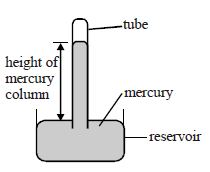
The diagram shows a simple mercury barometer. Which of the following does not cause the height of the mercury column to vary?
A
Changes in the atmospheric pressure
B
Changes in the value of $g$
C
Evaporation of mercury from the barometer reservoir
D
Leakage of air into the tube
Solution
(C) The pressure exerted by the mercury column is given by $P = \rho gh$,where $\rho$ is the density of mercury,$g$ is the acceleration due to gravity,and $h$ is the height of the mercury column. This pressure balances the atmospheric pressure $(P_{atm})$.
$1$. Changes in atmospheric pressure $(P_{atm})$ directly cause the height $h$ to change to maintain equilibrium $(P_{atm} = \rho gh)$.
$2$. Changes in the value of $g$ will cause the height $h$ to adjust to keep the pressure $\rho gh$ equal to $P_{atm}$.
$3$. Leakage of air into the tube introduces air pressure above the mercury column,which pushes the mercury down,thus changing the height $h$.
$4$. Evaporation of mercury from the reservoir does not change the atmospheric pressure acting on the surface of the reservoir,nor does it change the density or the gravitational acceleration. Therefore,it does not cause the height of the mercury column to vary.
$1$. Changes in atmospheric pressure $(P_{atm})$ directly cause the height $h$ to change to maintain equilibrium $(P_{atm} = \rho gh)$.
$2$. Changes in the value of $g$ will cause the height $h$ to adjust to keep the pressure $\rho gh$ equal to $P_{atm}$.
$3$. Leakage of air into the tube introduces air pressure above the mercury column,which pushes the mercury down,thus changing the height $h$.
$4$. Evaporation of mercury from the reservoir does not change the atmospheric pressure acting on the surface of the reservoir,nor does it change the density or the gravitational acceleration. Therefore,it does not cause the height of the mercury column to vary.
0 likes
View Solution17
MediumMCQ
An inverted tube barometer is kept on a lift moving downward with a deceleration $\alpha$. The density of mercury is $\rho$ and the acceleration due to gravity is $g$. If the atmospheric pressure is $P_0$,then:
A
Height of the mercury column in the lift will be $\frac{P_0}{\rho(g + \alpha)}$
B
Height of the mercury column in the lift will be $\frac{P_0}{\rho(g - \alpha)}$
C
Height of the mercury column in the lift will be $\frac{P_0}{\rho g}$
D
Height of the mercury column in the lift will be $\frac{P_0}{\rho \alpha}$
Solution
(A) The lift is moving downward with a deceleration $\alpha$. This means the net acceleration of the lift is directed upward.
The effective acceleration due to gravity $g_{eff}$ in the frame of the lift is given by $g_{eff} = g + a$,where $a$ is the magnitude of the deceleration.
In a barometer,the atmospheric pressure $P_0$ is balanced by the pressure exerted by the mercury column of height $h$,which is given by $P = \rho g_{eff} h$.
Equating the two,we get $P_0 = \rho (g + \alpha) h$.
Solving for $h$,we get $h = \frac{P_0}{\rho (g + \alpha)}$.
The effective acceleration due to gravity $g_{eff}$ in the frame of the lift is given by $g_{eff} = g + a$,where $a$ is the magnitude of the deceleration.
In a barometer,the atmospheric pressure $P_0$ is balanced by the pressure exerted by the mercury column of height $h$,which is given by $P = \rho g_{eff} h$.
Equating the two,we get $P_0 = \rho (g + \alpha) h$.
Solving for $h$,we get $h = \frac{P_0}{\rho (g + \alpha)}$.
0 likes
View Solution18
MediumMCQ
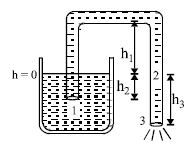
The figure shows a siphon. Choose the wrong statement: ($P_0 =$ atmospheric pressure)
A
Siphon works when $h_3 < 0$
B
Pressure at point $2$ is $P_2 = P_0 - \rho g h_3$
C
Pressure at point $3$ is $P_0$
D
Pressure at point $1$ is $P_0$
Solution
(A) $1$. Point $1$ is at the surface of the liquid in the container,which is exposed to the atmosphere. Therefore,the pressure at point $1$ is $P_1 = P_0$.
$2$. Point $3$ is the exit point of the siphon,which is also exposed to the atmosphere. Therefore,the pressure at point $3$ is $P_3 = P_0$.
$3$. $A$ siphon works based on the pressure difference between the two ends. For the liquid to flow out,the exit point must be lower than the liquid level in the container,meaning $h_3 > 0$. Thus,the statement 'Siphon works when $h_3 < 0$' is incorrect.
$4$. Point $2$ is at a height $h_3$ above the exit point $3$. Using the hydrostatic pressure formula $P_3 = P_2 + \rho g h_3$,we get $P_2 = P_3 - \rho g h_3 = P_0 - \rho g h_3$.
$2$. Point $3$ is the exit point of the siphon,which is also exposed to the atmosphere. Therefore,the pressure at point $3$ is $P_3 = P_0$.
$3$. $A$ siphon works based on the pressure difference between the two ends. For the liquid to flow out,the exit point must be lower than the liquid level in the container,meaning $h_3 > 0$. Thus,the statement 'Siphon works when $h_3 < 0$' is incorrect.
$4$. Point $2$ is at a height $h_3$ above the exit point $3$. Using the hydrostatic pressure formula $P_3 = P_2 + \rho g h_3$,we get $P_2 = P_3 - \rho g h_3 = P_0 - \rho g h_3$.
0 likes
View Solution19
EasyMCQ
If the atmospheric pressure is $P_a$,then the pressure $P$ at depth $h$ below the surface of a liquid of density $\rho$ open to the atmosphere is:
A
$P_a - \frac{\rho gh}{2}$
B
$P_a - \rho gh$
C
$P_a$
D
$P_a + \rho gh$
Solution
(D) The pressure at a depth $h$ below the surface of a liquid is given by the sum of the atmospheric pressure acting on the surface and the hydrostatic pressure exerted by the liquid column.
Mathematically,this is expressed as $P = P_a + h\rho g$,where $P_a$ is the atmospheric pressure,$\rho$ is the density of the liquid,$g$ is the acceleration due to gravity,and $h$ is the depth.
Mathematically,this is expressed as $P = P_a + h\rho g$,where $P_a$ is the atmospheric pressure,$\rho$ is the density of the liquid,$g$ is the acceleration due to gravity,and $h$ is the depth.
0 likes
View Solution20
EasyMCQ
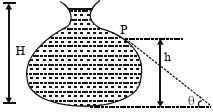
The figure shows the vertical cross-section of a vessel filled with a liquid of density $\rho$. The normal thrust per unit area on the walls of the vessel at the point $P$,as shown,will be
A
$h\rho g$
B
$(H - h)\rho g$
C
$H\rho g$
D
$(H - h)\rho g \cos \theta$
Solution
(B) The pressure at any point in a static fluid is given by $P = h'\rho g$,where $h'$ is the depth of the point below the free surface of the liquid.
In the given figure,the total height of the liquid column is $H$ and the height of point $P$ from the bottom is $h$. Therefore,the depth of point $P$ below the free surface is $H - h$.
The normal thrust per unit area is equivalent to the hydrostatic pressure at that point.
Thus,the normal thrust per unit area at point $P$ is $(H - h)\rho g$.
In the given figure,the total height of the liquid column is $H$ and the height of point $P$ from the bottom is $h$. Therefore,the depth of point $P$ below the free surface is $H - h$.
The normal thrust per unit area is equivalent to the hydrostatic pressure at that point.
Thus,the normal thrust per unit area at point $P$ is $(H - h)\rho g$.
0 likes
View Solution21
MediumMCQ
$A$ submarine experiences a pressure of $5.05 \times 10^6 \, Pa$ at a depth of $d_1$ in a sea. When it goes further to a depth of $d_2,$ it experiences a pressure of $8.08 \times 10^6 \, Pa.$ Then $d_2 - d_1$ is approximately ........ $m$ (density of water $= 10^3 \, kg/m^3$ and acceleration due to gravity $= 10 \, m/s^2$).
A
$400$
B
$500$
C
$600$
D
$303$
Solution
(D) The pressure at a depth $d$ in a fluid is given by $P = P_{atm} + \rho g d.$
For two different depths $d_1$ and $d_2,$ the pressure difference is given by $\Delta P = P_2 - P_1 = \rho g (d_2 - d_1).$
Given $P_1 = 5.05 \times 10^6 \, Pa$ and $P_2 = 8.08 \times 10^6 \, Pa.$
The difference in pressure is $\Delta P = (8.08 - 5.05) \times 10^6 \, Pa = 3.03 \times 10^6 \, Pa.$
Using the formula $\Delta P = \rho g (d_2 - d_1)$ where $\rho = 10^3 \, kg/m^3$ and $g = 10 \, m/s^2$:
$3.03 \times 10^6 = 10^3 \times 10 \times (d_2 - d_1)$
$3.03 \times 10^6 = 10^4 \times (d_2 - d_1)$
$d_2 - d_1 = \frac{3.03 \times 10^6}{10^4} = 3.03 \times 10^2 = 303 \, m.$
Therefore,the value of $d_2 - d_1$ is $303 \, m.$
For two different depths $d_1$ and $d_2,$ the pressure difference is given by $\Delta P = P_2 - P_1 = \rho g (d_2 - d_1).$
Given $P_1 = 5.05 \times 10^6 \, Pa$ and $P_2 = 8.08 \times 10^6 \, Pa.$
The difference in pressure is $\Delta P = (8.08 - 5.05) \times 10^6 \, Pa = 3.03 \times 10^6 \, Pa.$
Using the formula $\Delta P = \rho g (d_2 - d_1)$ where $\rho = 10^3 \, kg/m^3$ and $g = 10 \, m/s^2$:
$3.03 \times 10^6 = 10^3 \times 10 \times (d_2 - d_1)$
$3.03 \times 10^6 = 10^4 \times (d_2 - d_1)$
$d_2 - d_1 = \frac{3.03 \times 10^6}{10^4} = 3.03 \times 10^2 = 303 \, m.$
Therefore,the value of $d_2 - d_1$ is $303 \, m.$
0 likes
View Solution22
EasyMCQ
During a blood transfusion,a needle is inserted into a vein where the gauge pressure is $2000\,Pa$. At what height must the blood container be placed so that blood may just enter the vein (in $,m$)? (Density of blood $= 1.06 \times 10^3\,kg/m^3$ and take $g = 9.8\,m/s^2$).
A
$0.192$
B
$0.182$
C
$0.172$
D
$0.162$
Solution
(A) To allow the blood to enter the vein,the hydrostatic pressure exerted by the column of blood must be equal to the gauge pressure of the vein.
The formula for hydrostatic pressure is $P = h \rho g$,where:
$P = 2000\,Pa$ (gauge pressure),
$\rho = 1.06 \times 10^3\,kg/m^3$ (density of blood),
$g = 9.8\,m/s^2$ (acceleration due to gravity).
Rearranging the formula to solve for height $h$:
$h = \frac{P}{\rho g}$
Substituting the values:
$h = \frac{2000}{1.06 \times 10^3 \times 9.8}$
$h = \frac{2000}{10388}$
$h \approx 0.1925\,m$
Rounding to three decimal places,we get $h = 0.192\,m$.
The formula for hydrostatic pressure is $P = h \rho g$,where:
$P = 2000\,Pa$ (gauge pressure),
$\rho = 1.06 \times 10^3\,kg/m^3$ (density of blood),
$g = 9.8\,m/s^2$ (acceleration due to gravity).
Rearranging the formula to solve for height $h$:
$h = \frac{P}{\rho g}$
Substituting the values:
$h = \frac{2000}{1.06 \times 10^3 \times 9.8}$
$h = \frac{2000}{10388}$
$h \approx 0.1925\,m$
Rounding to three decimal places,we get $h = 0.192\,m$.
0 likes
View Solution23
MediumMCQ
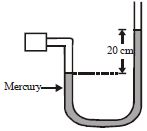
$A$ manometer reads the pressure of a gas in an enclosure as shown in the figure. The absolute and gauge pressure of the gas in $cm$ of mercury are (Take atmospheric pressure $= 76\,cm$ of mercury)
A
$76,\, 20$
B
$20,\, 76$
C
$96,\,20$
D
$20,\, 96$
Solution
(C) Atmospheric pressure,$P_{0} = 76\,cm$ of $Hg$.
The difference between the levels of mercury in the two limbs of the manometer gives the gauge pressure.
From the figure,the gauge pressure is $P_{g} = 20\,cm$ of $Hg$.
Absolute pressure is the sum of atmospheric pressure and gauge pressure.
$P_{abs} = P_{0} + P_{g} = 76\,cm + 20\,cm = 96\,cm$ of $Hg$.
Thus,the absolute pressure is $96\,cm$ of $Hg$ and the gauge pressure is $20\,cm$ of $Hg$.
The difference between the levels of mercury in the two limbs of the manometer gives the gauge pressure.
From the figure,the gauge pressure is $P_{g} = 20\,cm$ of $Hg$.
Absolute pressure is the sum of atmospheric pressure and gauge pressure.
$P_{abs} = P_{0} + P_{g} = 76\,cm + 20\,cm = 96\,cm$ of $Hg$.
Thus,the absolute pressure is $96\,cm$ of $Hg$ and the gauge pressure is $20\,cm$ of $Hg$.
0 likes
View Solution24
EasyMCQ
The atmospheric pressure and height of the barometer column are $10^5 \, Pa$ and $760 \, mm$ respectively on the Earth's surface. If the barometer is taken to the Moon,then the column height will be ........ $mm$.
A
$0$
B
$4560$
C
$126.6$
D
$760$
Solution
(A) The pressure exerted by a barometer column is given by $P = h \rho g$,where $h$ is the height of the column,$\rho$ is the density of the liquid,and $g$ is the acceleration due to gravity.
Since there is no atmosphere on the Moon,the atmospheric pressure on the Moon is $0 \, Pa$.
Therefore,the height of the mercury column $h$ must be $0 \, mm$ because there is no external pressure to support the column.
Since there is no atmosphere on the Moon,the atmospheric pressure on the Moon is $0 \, Pa$.
Therefore,the height of the mercury column $h$ must be $0 \, mm$ because there is no external pressure to support the column.
0 likes
View Solution25
EasyMCQ
The density of the atmosphere is $1.29 \ kg/m^3$. If the atmospheric pressure is $1.013 \times 10^5 \ Pa$,how high would the atmosphere extend if the density were uniform? $(g = 9.81 \ m/s^2)$
A
$8 \ km$
B
$1.2 \ km$
C
$10.3 \ km$
D
None of these
Solution
(A) The pressure exerted by a fluid column is given by the formula $P = \rho h g$,where $P$ is the pressure,$\rho$ is the density,$h$ is the height,and $g$ is the acceleration due to gravity.
Given:
$P = 1.013 \times 10^5 \ Pa$
$\rho = 1.29 \ kg/m^3$
$g = 9.81 \ m/s^2$
Substituting these values into the formula:
$1.013 \times 10^5 = 1.29 \times h \times 9.81$
$h = \frac{1.013 \times 10^5}{1.29 \times 9.81}$
$h \approx \frac{101300}{12.6549}$
$h \approx 8004.8 \ m$
Converting to kilometers,$h \approx 8 \ km$.
Given:
$P = 1.013 \times 10^5 \ Pa$
$\rho = 1.29 \ kg/m^3$
$g = 9.81 \ m/s^2$
Substituting these values into the formula:
$1.013 \times 10^5 = 1.29 \times h \times 9.81$
$h = \frac{1.013 \times 10^5}{1.29 \times 9.81}$
$h \approx \frac{101300}{12.6549}$
$h \approx 8004.8 \ m$
Converting to kilometers,$h \approx 8 \ km$.
0 likes
View Solution26
DifficultMCQ
$A$ beaker containing a liquid of density $\rho$ moves up with an acceleration $a$. The pressure due to the liquid at a depth $h$ below the free surface of the liquid is
A
$h\rho g$
B
$h\rho (g+a)$
C
$h\rho (g-a)$
D
$2h\rho g\left( \frac{g-a}{g+a} \right)$
Solution
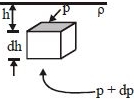
(B) Consider an element of the liquid of height $dh$ and area of cross-section $A$ at a depth $h$ below the surface of the liquid. Let $p$ and $p+dp$ be the liquid pressures at the upper and lower surfaces of the element, respectively.
The mass of the liquid in the element is $dm = A \cdot dh \cdot \rho$.
The net upward force on the element is given by $F_{net} = (p+dp)A - pA - dm \cdot g$.
Since the element moves upward with an acceleration $a$, by Newton's second law, $F_{net} = dm \cdot a$.
Therefore, $A \cdot dp - dm \cdot g = dm \cdot a$.
$A \cdot dp = dm(g+a)$.
Substituting $dm = A \cdot dh \cdot \rho$, we get $A \cdot dp = (A \cdot dh \cdot \rho)(g+a)$.
$dp = \rho(g+a) dh$.
Integrating both sides from the surface $(h=0, p=0)$ to depth $h$, we get $p = \int_0^h \rho(g+a) dh = \rho(g+a)h$.
The mass of the liquid in the element is $dm = A \cdot dh \cdot \rho$.
The net upward force on the element is given by $F_{net} = (p+dp)A - pA - dm \cdot g$.
Since the element moves upward with an acceleration $a$, by Newton's second law, $F_{net} = dm \cdot a$.
Therefore, $A \cdot dp - dm \cdot g = dm \cdot a$.
$A \cdot dp = dm(g+a)$.
Substituting $dm = A \cdot dh \cdot \rho$, we get $A \cdot dp = (A \cdot dh \cdot \rho)(g+a)$.
$dp = \rho(g+a) dh$.
Integrating both sides from the surface $(h=0, p=0)$ to depth $h$, we get $p = \int_0^h \rho(g+a) dh = \rho(g+a)h$.
0 likes
View Solution27
MediumMCQ
By sucking through a straw,a student can reduce the pressure in his lungs to $750\, mm$ of $Hg$ (density $= 13.6\, g/cm^3$). Using the straw,he can drink water from a glass up to a maximum depth of ....... $cm$.
A
$10$
B
$75$
C
$13.6$
D
$1.36$
Solution
(C) The atmospheric pressure is $P_{atm} = 760\, mm$ of $Hg$.
The pressure in the lungs is $P_{lungs} = 750\, mm$ of $Hg$.
The pressure difference created is $\Delta P = P_{atm} - P_{lungs} = 760\, mm - 750\, mm = 10\, mm$ of $Hg$.
This pressure difference supports a column of water of height $h$ in the straw.
Using the hydrostatic pressure formula $\Delta P = h_w \rho_w g = h_{Hg} \rho_{Hg} g$,we have:
$h_w \rho_w = h_{Hg} \rho_{Hg}$
Given $h_{Hg} = 10\, mm = 1\, cm$,$\rho_{Hg} = 13.6\, g/cm^3$,and $\rho_w = 1\, g/cm^3$:
$h_w \times 1\, g/cm^3 = 1\, cm \times 13.6\, g/cm^3$
$h_w = 13.6\, cm$.
The pressure in the lungs is $P_{lungs} = 750\, mm$ of $Hg$.
The pressure difference created is $\Delta P = P_{atm} - P_{lungs} = 760\, mm - 750\, mm = 10\, mm$ of $Hg$.
This pressure difference supports a column of water of height $h$ in the straw.
Using the hydrostatic pressure formula $\Delta P = h_w \rho_w g = h_{Hg} \rho_{Hg} g$,we have:
$h_w \rho_w = h_{Hg} \rho_{Hg}$
Given $h_{Hg} = 10\, mm = 1\, cm$,$\rho_{Hg} = 13.6\, g/cm^3$,and $\rho_w = 1\, g/cm^3$:
$h_w \times 1\, g/cm^3 = 1\, cm \times 13.6\, g/cm^3$
$h_w = 13.6\, cm$.
0 likes
View Solution28
EasyMCQ
What is the pressure in $atm$ on a swimmer $10\; m$ below the surface of a lake?
A
$1$
B
$2$
C
$3$
D
$4$
Solution
(B) The total pressure $P$ at a depth $h$ is given by the formula $P = P_{a} + \rho gh$,where $P_{a}$ is the atmospheric pressure,$\rho$ is the density of water,and $g$ is the acceleration due to gravity.
Given: $h = 10\; m$,$\rho = 1000\; kg/m^3$,$g = 10\; m/s^2$,and $P_{a} \approx 1.01 \times 10^5\; Pa$.
Substituting the values:
$P = 1.01 \times 10^5\; Pa + (1000\; kg/m^3 \times 10\; m/s^2 \times 10\; m)$
$P = 1.01 \times 10^5\; Pa + 1.00 \times 10^5\; Pa$
$P = 2.01 \times 10^5\; Pa$.
Since $1\; atm = 1.013 \times 10^5\; Pa$,the pressure is approximately $2\; atm$.
Given: $h = 10\; m$,$\rho = 1000\; kg/m^3$,$g = 10\; m/s^2$,and $P_{a} \approx 1.01 \times 10^5\; Pa$.
Substituting the values:
$P = 1.01 \times 10^5\; Pa + (1000\; kg/m^3 \times 10\; m/s^2 \times 10\; m)$
$P = 1.01 \times 10^5\; Pa + 1.00 \times 10^5\; Pa$
$P = 2.01 \times 10^5\; Pa$.
Since $1\; atm = 1.013 \times 10^5\; Pa$,the pressure is approximately $2\; atm$.
0 likes
View Solution29
EasyMCQ
Torricelli's barometer used mercury. Pascal duplicated it using French wine of density $984 \; kg \; m^{-3}$. Determine the height (in $m$) of the wine column for normal atmospheric pressure.
A
$10.5$
B
$8.4$
C
$12.6$
D
$15.8$
Solution
(A) The pressure exerted by a liquid column is given by $P = \rho gh$.
For normal atmospheric pressure,the pressure exerted by the mercury column must be equal to the pressure exerted by the French wine column.
Let $\rho_1$ and $h_1$ be the density and height of the mercury column,and $\rho_2$ and $h_2$ be the density and height of the French wine column.
Given: $\rho_1 = 13.6 \times 10^3 \; kg \; m^{-3}$,$h_1 = 0.76 \; m$,and $\rho_2 = 984 \; kg \; m^{-3}$.
Equating the pressures: $\rho_1 g h_1 = \rho_2 g h_2$.
Thus,$h_2 = \frac{\rho_1 h_1}{\rho_2}$.
Substituting the values: $h_2 = \frac{13.6 \times 10^3 \times 0.76}{984} \approx 10.5 \; m$.
Therefore,the height of the French wine column is $10.5 \; m$.
For normal atmospheric pressure,the pressure exerted by the mercury column must be equal to the pressure exerted by the French wine column.
Let $\rho_1$ and $h_1$ be the density and height of the mercury column,and $\rho_2$ and $h_2$ be the density and height of the French wine column.
Given: $\rho_1 = 13.6 \times 10^3 \; kg \; m^{-3}$,$h_1 = 0.76 \; m$,and $\rho_2 = 984 \; kg \; m^{-3}$.
Equating the pressures: $\rho_1 g h_1 = \rho_2 g h_2$.
Thus,$h_2 = \frac{\rho_1 h_1}{\rho_2}$.
Substituting the values: $h_2 = \frac{13.6 \times 10^3 \times 0.76}{984} \approx 10.5 \; m$.
Therefore,the height of the French wine column is $10.5 \; m$.
0 likes
View Solution30
EasyMCQ
$A$ vertical off-shore structure is built to withstand a maximum stress of $10^9 \; Pa$. Is the structure suitable for putting up on top of an oil well in the ocean? Take the depth of the ocean to be roughly $3 \; km$,and ignore ocean currents.
A
Yes
B
No
C
Cannot be determined
D
Depends on the material
Solution
(A) The maximum allowable stress for the structure is $P_{max} = 10^9 \; Pa$.
The depth of the ocean is $d = 3 \; km = 3 \times 10^3 \; m$.
The density of seawater is $\rho \approx 10^3 \; kg/m^3$.
The acceleration due to gravity is $g = 9.8 \; m/s^2$.
The pressure exerted by the seawater at depth $d$ is given by $P = \rho g d$.
Substituting the values: $P = (10^3 \; kg/m^3) \times (9.8 \; m/s^2) \times (3 \times 10^3 \; m) = 2.94 \times 10^7 \; Pa$.
Since the maximum allowable stress of the structure $(10^9 \; Pa)$ is significantly greater than the pressure exerted by the ocean $(2.94 \times 10^7 \; Pa)$,the structure is suitable for use.
The depth of the ocean is $d = 3 \; km = 3 \times 10^3 \; m$.
The density of seawater is $\rho \approx 10^3 \; kg/m^3$.
The acceleration due to gravity is $g = 9.8 \; m/s^2$.
The pressure exerted by the seawater at depth $d$ is given by $P = \rho g d$.
Substituting the values: $P = (10^3 \; kg/m^3) \times (9.8 \; m/s^2) \times (3 \times 10^3 \; m) = 2.94 \times 10^7 \; Pa$.
Since the maximum allowable stress of the structure $(10^9 \; Pa)$ is significantly greater than the pressure exerted by the ocean $(2.94 \times 10^7 \; Pa)$,the structure is suitable for use.
0 likes
View Solution31
Medium
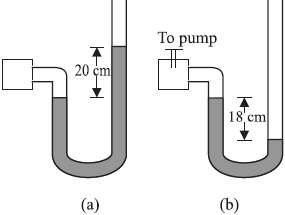
$A$ manometer reads the pressure of a gas in an enclosure as shown in Figure $(a)$. When a pump removes some of the gas,the manometer reads as in Figure $(b)$. The liquid used in the manometers is mercury and the atmospheric pressure is $76 \; cm$ of mercury.
$(a)$ Give the absolute and gauge pressure of the gas in the enclosure for cases $(a)$ and $(b)$,in units of $cm$ of mercury.
$(b)$ How would the levels change in case $(b)$ if $13.6 \; cm$ of water (immiscible with mercury) are poured into the right limb of the manometer? (Ignore the small change in the volume of the gas).
$(a)$ Give the absolute and gauge pressure of the gas in the enclosure for cases $(a)$ and $(b)$,in units of $cm$ of mercury.
$(b)$ How would the levels change in case $(b)$ if $13.6 \; cm$ of water (immiscible with mercury) are poured into the right limb of the manometer? (Ignore the small change in the volume of the gas).
Solution
(A) For figure $(a)$:
Atmospheric pressure,$P_{0} = 76 \; cm$ of $Hg$.
The difference between the levels of mercury in the two limbs gives the gauge pressure. Since the level in the right limb is higher,the gauge pressure is $20 \; cm$ of $Hg$.
Absolute pressure $= P_{0} + \text{Gauge pressure} = 76 + 20 = 96 \; cm$ of $Hg$.
For figure $(b)$:
The level in the right limb is lower than the left limb,so the gauge pressure is $-18 \; cm$ of $Hg$.
Absolute pressure $= P_{0} + \text{Gauge pressure} = 76 - 18 = 58 \; cm$ of $Hg$.
$(b)$ When $13.6 \; cm$ of water is poured into the right limb,it exerts an additional pressure. Since the relative density of mercury is $13.6$,a column of $13.6 \; cm$ of water is equivalent to $1 \; cm$ of $Hg$.
Let $h$ be the new difference between the levels of mercury in the two limbs.
The pressure in the right limb at the level of the mercury surface in the left limb is $P_{R} = P_{0} + 1 \; cm$ of $Hg = 76 + 1 = 77 \; cm$ of $Hg$.
The pressure in the left limb is $P_{L} = P_{\text{gas}} + h = 58 + h$.
Equating the pressures at the same horizontal level: $58 + h = 77 \implies h = 19 \; cm$.
Thus,the new difference between the levels of mercury in the two limbs will be $19 \; cm$.
Atmospheric pressure,$P_{0} = 76 \; cm$ of $Hg$.
The difference between the levels of mercury in the two limbs gives the gauge pressure. Since the level in the right limb is higher,the gauge pressure is $20 \; cm$ of $Hg$.
Absolute pressure $= P_{0} + \text{Gauge pressure} = 76 + 20 = 96 \; cm$ of $Hg$.
For figure $(b)$:
The level in the right limb is lower than the left limb,so the gauge pressure is $-18 \; cm$ of $Hg$.
Absolute pressure $= P_{0} + \text{Gauge pressure} = 76 - 18 = 58 \; cm$ of $Hg$.
$(b)$ When $13.6 \; cm$ of water is poured into the right limb,it exerts an additional pressure. Since the relative density of mercury is $13.6$,a column of $13.6 \; cm$ of water is equivalent to $1 \; cm$ of $Hg$.
Let $h$ be the new difference between the levels of mercury in the two limbs.
The pressure in the right limb at the level of the mercury surface in the left limb is $P_{R} = P_{0} + 1 \; cm$ of $Hg = 76 + 1 = 77 \; cm$ of $Hg$.
The pressure in the left limb is $P_{L} = P_{\text{gas}} + h = 58 + h$.
Equating the pressures at the same horizontal level: $58 + h = 77 \implies h = 19 \; cm$.
Thus,the new difference between the levels of mercury in the two limbs will be $19 \; cm$.
0 likes
View Solution32
EasyMCQ
During blood transfusion,the needle is inserted into a vein where the gauge pressure is $2000 \; Pa$. At what height (in $m$) must the blood container be placed so that blood may just enter the vein? (Density of whole blood,$\rho = 1.06 \times 10^{3} \; kg \; m^{-3}$,$g = 9.8 \; m \; s^{-2}$)
A
$0.1$
B
$0.3$
C
$0.2$
D
$0.4$
Solution
(C) Given: Gauge pressure in the vein,$P = 2000 \; Pa$. Density of blood,$\rho = 1.06 \times 10^{3} \; kg \; m^{-3}$. Acceleration due to gravity,$g = 9.8 \; m \; s^{-2}$.
For the blood to enter the vein,the hydrostatic pressure exerted by the blood column in the container must be at least equal to the gauge pressure in the vein.
The pressure exerted by the blood column is given by $P = h \rho g$,where $h$ is the height of the container.
Rearranging for $h$,we get $h = \frac{P}{\rho g}$.
Substituting the values: $h = \frac{2000}{1.06 \times 10^{3} \times 9.8}$.
$h = \frac{2000}{10388} \approx 0.1925 \; m$.
Rounding to the nearest significant value,the height must be approximately $0.2 \; m$.
For the blood to enter the vein,the hydrostatic pressure exerted by the blood column in the container must be at least equal to the gauge pressure in the vein.
The pressure exerted by the blood column is given by $P = h \rho g$,where $h$ is the height of the container.
Rearranging for $h$,we get $h = \frac{P}{\rho g}$.
Substituting the values: $h = \frac{2000}{1.06 \times 10^{3} \times 9.8}$.
$h = \frac{2000}{10388} \approx 0.1925 \; m$.
Rounding to the nearest significant value,the height must be approximately $0.2 \; m$.
0 likes
View Solution33
Easy
Show that the pressure produced due to a fluid column depends on the height of the fluid column and the density of the fluid.
Solution
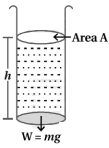
Consider a fluid at rest in a container. The density of the fluid is $\rho$ and the height of the fluid column is $h$,as shown in the figure.
The weight of the fluid in the cylinder is $W = mg \ldots(1)$
Since the mass of the fluid $m = \text{volume} \times \text{density} = Ah\rho$,
$\therefore W = (Ah\rho g) \ldots(2)$
The pressure produced at the bottom of the container due to this weight is
$P = \frac{\text{Weight } W}{\text{Area } A}$
$\therefore P = \frac{Ah\rho g}{A}$
$\therefore P = h\rho g \ldots(3)$
This equation shows that the pressure produced due to a fluid column depends on the height of the fluid column $h$ and the density of the fluid $\rho$.
The weight of the fluid in the cylinder is $W = mg \ldots(1)$
Since the mass of the fluid $m = \text{volume} \times \text{density} = Ah\rho$,
$\therefore W = (Ah\rho g) \ldots(2)$
The pressure produced at the bottom of the container due to this weight is
$P = \frac{\text{Weight } W}{\text{Area } A}$
$\therefore P = \frac{Ah\rho g}{A}$
$\therefore P = h\rho g \ldots(3)$
This equation shows that the pressure produced due to a fluid column depends on the height of the fluid column $h$ and the density of the fluid $\rho$.
0 likes
View Solution34
Medium
Discuss the variation of pressure with depth or pressure produced due to fluid depth $h$ and density of fluid $\rho$.
Solution
(N/A) Suppose a fluid of density $\rho$ is in static equilibrium in a container.
Consider a cylindrical element of fluid having area of base $A$ and height $h$. The pressure at points $1$ and $2$ are $P_{1}$ and $P_{2}$ respectively.
The forces acting on the liquid column are as follows:
$(1)$ The force at point $1$ is $F_{1} = P_{1} A$ (downward).
$(2)$ The force at point $2$ is $F_{2} = P_{2} A$ (upward).
$(3)$ The weight of the fluid column is $W = mg = A h \rho g$ (downward).
Since the fluid column is in equilibrium,the downward forces must equal the upward forces:
$F_{1} + W = F_{2}$
$P_{1} A + A h \rho g = P_{2} A$
Dividing by $A$ on both sides:
$P_{2} = P_{1} + h \rho g$
This equation shows that the pressure difference depends on the vertical distance $h$ between the points,the mass density of the fluid $\rho$,and the acceleration due to gravity $g$,but it does not depend on the area of the cross-section $A$.
If the effect of gravitation is neglected $(g = 0)$,then $P_{2} = P_{1}$,indicating that the pressure at every point in the fluid is the same.
Consider a cylindrical element of fluid having area of base $A$ and height $h$. The pressure at points $1$ and $2$ are $P_{1}$ and $P_{2}$ respectively.
The forces acting on the liquid column are as follows:
$(1)$ The force at point $1$ is $F_{1} = P_{1} A$ (downward).
$(2)$ The force at point $2$ is $F_{2} = P_{2} A$ (upward).
$(3)$ The weight of the fluid column is $W = mg = A h \rho g$ (downward).
Since the fluid column is in equilibrium,the downward forces must equal the upward forces:
$F_{1} + W = F_{2}$
$P_{1} A + A h \rho g = P_{2} A$
Dividing by $A$ on both sides:
$P_{2} = P_{1} + h \rho g$
This equation shows that the pressure difference depends on the vertical distance $h$ between the points,the mass density of the fluid $\rho$,and the acceleration due to gravity $g$,but it does not depend on the area of the cross-section $A$.
If the effect of gravitation is neglected $(g = 0)$,then $P_{2} = P_{1}$,indicating that the pressure at every point in the fluid is the same.
0 likes
View Solution35
Medium
Describe the mercury barometer for the measurement of atmospheric pressure.
Solution
(N/A) The Italian scientist Evangelista Torricelli devised the first method for measuring atmospheric pressure.
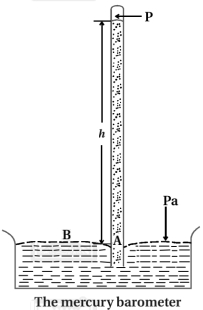
This device is shown in the figure.
$A$ long glass tube of $1 \text{ m}$,closed at one end and filled with mercury,is inverted into a trough of mercury. The thumb is kept on the open part of the tube.
If the thumb is removed from the tube,the level of the mercury column decreases slightly.
The space above the mercury column in the tube contains only mercury vapour,whose pressure $P$ is so small that it may be neglected. Thus,$P \approx 0$.
The pressure inside the column at point $A$ is equal to the pressure at point $B$,which is at the same horizontal level. The atmospheric pressure at point $A$ is given by:
$P_{a} = P + h \rho g$
Since $P \approx 0$,we have:
$P_{a} = 0 + h \rho g$
$\therefore P_{a} = h \rho g$
Where $\rho$ is the density of mercury and $h$ is the height of the mercury column.
In this device,the height of the mercury column at sea level is $76 \text{ cm}$,which is equivalent to one atmosphere.
This device is shown in the figure.
$A$ long glass tube of $1 \text{ m}$,closed at one end and filled with mercury,is inverted into a trough of mercury. The thumb is kept on the open part of the tube.
If the thumb is removed from the tube,the level of the mercury column decreases slightly.
The space above the mercury column in the tube contains only mercury vapour,whose pressure $P$ is so small that it may be neglected. Thus,$P \approx 0$.
The pressure inside the column at point $A$ is equal to the pressure at point $B$,which is at the same horizontal level. The atmospheric pressure at point $A$ is given by:
$P_{a} = P + h \rho g$
Since $P \approx 0$,we have:
$P_{a} = 0 + h \rho g$
$\therefore P_{a} = h \rho g$
Where $\rho$ is the density of mercury and $h$ is the height of the mercury column.
In this device,the height of the mercury column at sea level is $76 \text{ cm}$,which is equivalent to one atmosphere.
0 likes
View Solution36
Medium
Describe the Torricelli experiment for the measurement of atmospheric pressure.
Solution
(N/A) The Italian scientist Evangelista Torricelli devised the first method for measuring atmospheric pressure.
This device is shown in the figure.
$A$ long glass tube of $1 \,m$, closed at one end and filled with mercury, is inverted into a trough of mercury. The thumb is kept on the open part of the tube.
If the thumb is removed from the tube, the level of the mercury column decreases slightly.
The space above the mercury column in the tube contains only mercury vapour, whose pressure $P$ is so small that it may be neglected, i.e., $P = 0$.
The pressure inside the column at point $A$ is equal to the pressure at point $B$, which is at the same level. The atmospheric pressure at point $A$ is given by:
$P_{a} = P + h \rho g$
Since $P = 0$, we have:
$P_{a} = 0 + h \rho g$
$\therefore P_{a} = h \rho g$
Where $\rho$ is the density of mercury and $h$ is the height of the mercury column.
In this device, the height of the mercury column at sea level is $76 \,cm$, which is equivalent to one atmosphere.
This device is shown in the figure.
$A$ long glass tube of $1 \,m$, closed at one end and filled with mercury, is inverted into a trough of mercury. The thumb is kept on the open part of the tube.
If the thumb is removed from the tube, the level of the mercury column decreases slightly.
The space above the mercury column in the tube contains only mercury vapour, whose pressure $P$ is so small that it may be neglected, i.e., $P = 0$.
The pressure inside the column at point $A$ is equal to the pressure at point $B$, which is at the same level. The atmospheric pressure at point $A$ is given by:
$P_{a} = P + h \rho g$
Since $P = 0$, we have:
$P_{a} = 0 + h \rho g$
$\therefore P_{a} = h \rho g$
Where $\rho$ is the density of mercury and $h$ is the height of the mercury column.
In this device, the height of the mercury column at sea level is $76 \,cm$, which is equivalent to one atmosphere.
0 likes
View Solution37
Difficult
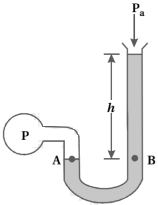
Explain how an open-ended tube manometer measures pressure.
Solution
(N/A) An open-tube manometer is a simple device used to measure the pressure of a gas contained in a closed vessel.
It consists of a $U$-shaped tube containing a suitable liquid (often mercury or water).
One end of the tube is open to the atmosphere,and the other end is connected to the system whose pressure $(P)$ is to be measured.
Consider a point $A$ in the limb connected to the gas container and a point $B$ at the same horizontal level in the open limb.
According to the laws of fluid statics,the pressure at points at the same horizontal level in a continuous static fluid is the same.
Therefore,the pressure at point $A$ is equal to the pressure at point $B$: $P = P_B$.
The pressure at point $B$ is the sum of the atmospheric pressure $(P_a)$ and the pressure due to the liquid column of height $h$: $P_B = P_a + h \rho g$.
Thus,the absolute pressure of the gas is given by: $P = P_a + h \rho g$.
Here,$P_a$ is the atmospheric pressure,$h$ is the height difference of the liquid levels,$\rho$ is the density of the liquid,and $g$ is the acceleration due to gravity.
The term $(P - P_a) = h \rho g$ is known as the gauge pressure,which is directly proportional to the height $h$ of the liquid column.
It consists of a $U$-shaped tube containing a suitable liquid (often mercury or water).
One end of the tube is open to the atmosphere,and the other end is connected to the system whose pressure $(P)$ is to be measured.
Consider a point $A$ in the limb connected to the gas container and a point $B$ at the same horizontal level in the open limb.
According to the laws of fluid statics,the pressure at points at the same horizontal level in a continuous static fluid is the same.
Therefore,the pressure at point $A$ is equal to the pressure at point $B$: $P = P_B$.
The pressure at point $B$ is the sum of the atmospheric pressure $(P_a)$ and the pressure due to the liquid column of height $h$: $P_B = P_a + h \rho g$.
Thus,the absolute pressure of the gas is given by: $P = P_a + h \rho g$.
Here,$P_a$ is the atmospheric pressure,$h$ is the height difference of the liquid levels,$\rho$ is the density of the liquid,and $g$ is the acceleration due to gravity.
The term $(P - P_a) = h \rho g$ is known as the gauge pressure,which is directly proportional to the height $h$ of the liquid column.
0 likes
View Solution38
EasyMCQ
As the depth increases in a vessel filled with liquid, the pressure ..........
A
increases
B
decreases
C
remains unchanged
D
becomes zero
Solution
(A) The pressure $P$ at a depth $h$ in a liquid of density $\rho$ is given by the formula $P = P_0 + \rho gh$, where $P_0$ is the atmospheric pressure, $\rho$ is the density of the liquid, $g$ is the acceleration due to gravity, and $h$ is the depth from the surface.
Since $P_0$, $\rho$, and $g$ are constant, the pressure $P$ is directly proportional to the depth $h$.
Therefore, as the depth $h$ increases, the pressure $P$ also increases.
Since $P_0$, $\rho$, and $g$ are constant, the pressure $P$ is directly proportional to the depth $h$.
Therefore, as the depth $h$ increases, the pressure $P$ also increases.
0 likes
View Solution39
Medium
Write the formula of pressure at depth $h$ in a liquid.
Solution
(N/A) The pressure $P$ at a depth $h$ below the surface of a liquid of density $\rho$ is given by the formula:
$P = P_a + \rho gh$
Where:
$P_a$ is the atmospheric pressure at the surface of the liquid.
$\rho$ is the density of the liquid.
$g$ is the acceleration due to gravity.
$h$ is the depth of the point from the liquid surface.
$P = P_a + \rho gh$
Where:
$P_a$ is the atmospheric pressure at the surface of the liquid.
$\rho$ is the density of the liquid.
$g$ is the acceleration due to gravity.
$h$ is the depth of the point from the liquid surface.
0 likes
View Solution40
Easy
Mention two instruments which measure the atmospheric pressure.
Solution
(N/A) The two common instruments used to measure atmospheric pressure are:
$1$. Mercury Barometer: It uses a column of mercury in a glass tube to balance the atmospheric pressure.
$2$. Aneroid Barometer: It uses a flexible metal box (aneroid cell) that expands or contracts with changes in atmospheric pressure,which is then indicated by a mechanical pointer.
$1$. Mercury Barometer: It uses a column of mercury in a glass tube to balance the atmospheric pressure.
$2$. Aneroid Barometer: It uses a flexible metal box (aneroid cell) that expands or contracts with changes in atmospheric pressure,which is then indicated by a mechanical pointer.
0 likes
View Solution41
EasyMCQ
Who devised for the first time,a method for measuring atmospheric pressure?
A
Blaise Pascal
B
Evangelista Torricelli
C
Isaac Newton
D
Daniel Bernoulli
Solution
(B) The first method to measure atmospheric pressure was devised by the Italian physicist and mathematician Evangelista Torricelli in $1643$. He used a long glass tube filled with mercury,inverted into a dish of mercury,to demonstrate that the height of the mercury column is supported by the pressure of the atmosphere. This apparatus is known as a mercury barometer.
0 likes
View Solution42
EasyMCQ
Why are two holes made to empty an oil tin?
A
To increase the flow rate of oil.
B
To maintain atmospheric pressure inside the tin.
C
To reduce the viscosity of the oil.
D
To prevent the oil from spilling.
Solution
(B) When oil is poured out from a tin with only one hole,the volume of oil inside decreases,creating a partial vacuum or a region of lower pressure inside the tin.
This internal pressure becomes less than the atmospheric pressure outside,which opposes the flow of oil and causes it to come out in spurts or stop flowing entirely.
When two holes are made,air enters through the second hole,which balances the pressure inside the tin with the atmospheric pressure.
This allows the oil to flow out smoothly and continuously under the influence of gravity.
This internal pressure becomes less than the atmospheric pressure outside,which opposes the flow of oil and causes it to come out in spurts or stop flowing entirely.
When two holes are made,air enters through the second hole,which balances the pressure inside the tin with the atmospheric pressure.
This allows the oil to flow out smoothly and continuously under the influence of gravity.
0 likes
View Solution43
Easy
On what factors does the pressure at any place depend? Explain.
Solution
(N/A) The pressure $P$ at any point in a fluid (like the atmosphere) is given by the formula $P = h \rho g$,where:
$(1)$ Height of the fluid column $(h)$: The pressure is directly proportional to the depth or height of the fluid column above the point. As the height increases,the weight of the fluid column increases,leading to higher pressure.
$(2)$ Density of the fluid $(\rho)$: The pressure is directly proportional to the density of the fluid. $A$ denser fluid exerts more pressure because its mass per unit volume is greater.
$(3)$ Acceleration due to gravity $(g)$: The pressure is directly proportional to the acceleration due to gravity. Since weight is the force exerted by gravity on a mass,a stronger gravitational field results in higher pressure.
$(1)$ Height of the fluid column $(h)$: The pressure is directly proportional to the depth or height of the fluid column above the point. As the height increases,the weight of the fluid column increases,leading to higher pressure.
$(2)$ Density of the fluid $(\rho)$: The pressure is directly proportional to the density of the fluid. $A$ denser fluid exerts more pressure because its mass per unit volume is greater.
$(3)$ Acceleration due to gravity $(g)$: The pressure is directly proportional to the acceleration due to gravity. Since weight is the force exerted by gravity on a mass,a stronger gravitational field results in higher pressure.
0 likes
View Solution44
Medium
Why does food cook faster in a pressure cooker?
Solution
(N/A) The pressure inside the pressure cooker is significantly higher than the atmospheric pressure. This increased pressure raises the boiling point of water above its normal value of $100^{\circ} C$. As a result,the water inside the cooker reaches a higher temperature,which allows the food to cook much faster.
0 likes
View Solution45
Easy
Explain why you cannot make a decent cup of tea on a mountain.
Solution
(N/A) The air on a mountain is thin,which means the atmospheric pressure is lower than at sea level.
According to the principles of fluid mechanics,the boiling point of a liquid decreases as the external pressure decreases.
At high altitudes,water boils at a temperature significantly lower than $100^{\circ} C$.
Because the water boils at this lower temperature,it does not provide enough heat to properly extract the flavor from the tea leaves,resulting in a poor-quality cup of tea.
According to the principles of fluid mechanics,the boiling point of a liquid decreases as the external pressure decreases.
At high altitudes,water boils at a temperature significantly lower than $100^{\circ} C$.
Because the water boils at this lower temperature,it does not provide enough heat to properly extract the flavor from the tea leaves,resulting in a poor-quality cup of tea.
0 likes
View Solution46
Medium
When an airplane flies at a higher altitude,it is not advisable to keep a fountain pen in one's pocket. Why?
Solution
(N/A) As the altitude increases,the atmospheric pressure decreases. The ink inside the fountain pen's reservoir is filled at ground-level atmospheric pressure. When the airplane flies at a high altitude,the external atmospheric pressure acting on the ink decreases,while the pressure inside the pen remains higher. This pressure difference causes the ink to leak out of the pen and onto the clothing. Therefore,it is not advisable to keep a fountain pen in a pocket while flying at high altitudes.
0 likes
View Solution47
Medium
Explain why water storage dam walls are thicker at the bottom.
Solution
(N/A) The pressure exerted by a liquid column of height $h$ is given by the formula $P = h \rho g$,where $\rho$ is the density of the liquid and $g$ is the acceleration due to gravity.
As the depth $h$ increases,the pressure $P$ increases linearly.
Therefore,the pressure is significantly higher at the bottom of the dam compared to the top.
To withstand this increased hydrostatic pressure and prevent structural failure,the walls of the dam are constructed to be thicker at the bottom.
As the depth $h$ increases,the pressure $P$ increases linearly.
Therefore,the pressure is significantly higher at the bottom of the dam compared to the top.
To withstand this increased hydrostatic pressure and prevent structural failure,the walls of the dam are constructed to be thicker at the bottom.
0 likes
View Solution48
Easy
Why does an air bubble formed in water grow in size as it rises from the bottom to the surface? Explain.
Solution
(N/A) The pressure exerted by the water column decreases as the bubble rises from the bottom towards the surface because the depth of the water column above the bubble decreases.
According to Boyle's law,for a given mass of gas at a constant temperature,the volume $V$ of the gas is inversely proportional to the pressure $P$ $(V \propto \frac{1}{P})$.
As the pressure $P$ decreases while the bubble rises,its volume $V$ must increase to satisfy the relationship.
Therefore,the air bubble grows in size as it moves towards the surface.
According to Boyle's law,for a given mass of gas at a constant temperature,the volume $V$ of the gas is inversely proportional to the pressure $P$ $(V \propto \frac{1}{P})$.
As the pressure $P$ decreases while the bubble rises,its volume $V$ must increase to satisfy the relationship.
Therefore,the air bubble grows in size as it moves towards the surface.
0 likes
View Solution49
Medium
Why is mercury used in a barometer?
Solution
(N/A) The reasons for using mercury in a barometer are as follows:
$(1)$ Mercury has a high density $(13.6 \times 10^3 \ kg/m^3)$,which allows for a reasonably small and manageable height of the barometer tube (approximately $76 \ cm$ at sea level).
$(2)$ Mercury has a very low vapor pressure at room temperature,meaning it does not evaporate significantly into the vacuum space above the column,ensuring accurate pressure readings.
$(3)$ Mercury does not wet or stick to the glass walls of the barometer tube,which allows for a clean meniscus and precise measurement of the column height.
$(1)$ Mercury has a high density $(13.6 \times 10^3 \ kg/m^3)$,which allows for a reasonably small and manageable height of the barometer tube (approximately $76 \ cm$ at sea level).
$(2)$ Mercury has a very low vapor pressure at room temperature,meaning it does not evaporate significantly into the vacuum space above the column,ensuring accurate pressure readings.
$(3)$ Mercury does not wet or stick to the glass walls of the barometer tube,which allows for a clean meniscus and precise measurement of the column height.
0 likes
View Solution50
Easy
What are the difficulties arising from using water in a barometer instead of mercury?
Solution
(N/A) The density of water is much lower than that of mercury. Since the atmospheric pressure $P = h \rho g$,the height $h$ of the liquid column required to balance atmospheric pressure is inversely proportional to its density $\rho$. For water,the required height would be approximately $10.3 \ m$ to $11 \ m$. $A$ barometer of this length is impractical to construct,handle,and transport,making mercury a more convenient choice.
0 likes
View SolutionFluid Mechanics and Surface Tension — Pressure due to Liquid Column and Barometer · Frequently Asked Questions
1Are these Fluid Mechanics and Surface Tension questions useful for JEE and NEET?
Yes. All questions in this section are mapped to JEE Main and NEET exam patterns. Previous year questions from JEE Main, NEET, GUJCET and state-level exams are included with full solutions.
2Can I switch to Hindi or Gujarati for these questions?
Yes. Use the language tabs in the hero section or the sidebar to view the same questions and solutions in English, Hindi or Gujarati.
3How do I generate a question paper from this subtopic?
Use the Vedclass Exam Paper Generator — select the chapter and subtopic, set difficulty, and generate Sets A, B, C, D automatically. First 3 chapters of every subject are free.
Vedclass Products
For Students
Vedclass Test Series
Mock tests in real JEE/NEET style with performance analysis. 5-day free trial.
Start Free TrialFor Teachers
Exam Paper Generator
Generate Set A/B/C/D papers from this chapter in 2 minutes. 3 chapters free.
Try FreeFor Institutes
Online Exam Module
Live online exams with unlimited students, 360° analytics & white-label branding.
See DemoFor Teachers & Institutes
Generate a Fluid Mechanics and Surface Tension Exam Paper in 2 Minutes
Select subtopic & difficulty — Sets A, B, C, D auto-generated with No Repeat logic.
First 3 chapters of every subject are free — no payment required.