
A English
Force due to Liquid in pipe Questions in English
Class 11 Physics · Fluid Mechanics and Surface Tension · Force due to Liquid in pipe
21+
Questions
English
Language
100%
With Solutions
Showing 20 of 21 questions in English
1
DifficultMCQ
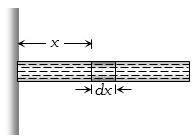
$A$ tube of length $L$ is filled completely with an incompressible liquid of mass $M$ and closed at both the ends. The tube is then rotated in a horizontal plane about one of its ends with a uniform angular velocity $\omega$. The force exerted by the liquid at the other end is
A
$\frac{ML\omega^2}{2}$
B
$ML\omega^2$
C
$\frac{M\omega L^2}{2}$
D
$\frac{ML^2\omega^2}{2}$
Solution
(A) Consider a small element of the liquid of length $dx$ at a distance $x$ from the axis of rotation. The mass of this element is $dM = (M/L)dx$.
The centripetal force required for this element to rotate in a circle of radius $x$ is $dF = (dM)\omega^2 x$.
Substituting $dM$,we get $dF = (M/L)dx \cdot \omega^2 x = (M\omega^2/L)x dx$.
The total force $F$ exerted by the liquid at the outer end is the integral of these centripetal forces from $x = 0$ to $x = L$:
$F = \int_0^L \frac{M\omega^2}{L} x dx = \frac{M\omega^2}{L} \left[ \frac{x^2}{2} \right]_0^L = \frac{M\omega^2}{L} \cdot \frac{L^2}{2} = \frac{1}{2}ML\omega^2$.
The centripetal force required for this element to rotate in a circle of radius $x$ is $dF = (dM)\omega^2 x$.
Substituting $dM$,we get $dF = (M/L)dx \cdot \omega^2 x = (M\omega^2/L)x dx$.
The total force $F$ exerted by the liquid at the outer end is the integral of these centripetal forces from $x = 0$ to $x = L$:
$F = \int_0^L \frac{M\omega^2}{L} x dx = \frac{M\omega^2}{L} \left[ \frac{x^2}{2} \right]_0^L = \frac{M\omega^2}{L} \cdot \frac{L^2}{2} = \frac{1}{2}ML\omega^2$.
0 likes
View Solution2
DifficultMCQ
$A$ gardener waters the plants using a pipe of diameter $1\,mm$. The water comes out at a rate of $10\,cm^3/s$. The reactionary force exerted on the hand of the gardener is:
A
$Zero$
B
$1.27 \times 10^{-2}\,N$
C
$1.27 \times 10^{-4}\,N$
D
$0.127\,N$
Solution
(D) The rate of flow of water is given by $\frac{dV}{dt} = 10\,cm^3/s = 10 \times 10^{-6}\,m^3/s$.
Density of water $\rho = 10^3\,kg/m^3$.
The cross-sectional area of the pipe is $A = \pi r^2 = \pi (0.5 \times 10^{-3}\,m)^2 = \pi \times 0.25 \times 10^{-6}\,m^2$.
The velocity of water $v = \frac{dV/dt}{A} = \frac{10 \times 10^{-6}}{\pi \times 0.25 \times 10^{-6}} = \frac{40}{\pi}\,m/s$.
The reactionary force $F$ is equal to the rate of change of momentum: $F = \frac{dm}{dt} v = (\rho \frac{dV}{dt}) v$.
Substituting the values: $F = (10^3) \times (10 \times 10^{-6}) \times \frac{40}{\pi} = 10^{-2} \times \frac{40}{3.14} \approx 0.127\,N$.
Density of water $\rho = 10^3\,kg/m^3$.
The cross-sectional area of the pipe is $A = \pi r^2 = \pi (0.5 \times 10^{-3}\,m)^2 = \pi \times 0.25 \times 10^{-6}\,m^2$.
The velocity of water $v = \frac{dV/dt}{A} = \frac{10 \times 10^{-6}}{\pi \times 0.25 \times 10^{-6}} = \frac{40}{\pi}\,m/s$.
The reactionary force $F$ is equal to the rate of change of momentum: $F = \frac{dm}{dt} v = (\rho \frac{dV}{dt}) v$.
Substituting the values: $F = (10^3) \times (10 \times 10^{-6}) \times \frac{40}{\pi} = 10^{-2} \times \frac{40}{3.14} \approx 0.127\,N$.
0 likes
View Solution3
EasyMCQ
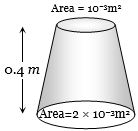
$A$ uniformly tapering vessel is filled with a liquid of density $900 \, kg/m^3$. The force that acts on the base of the vessel due to the liquid is ......... $N$. $(g = 10 \, m/s^2)$
A
$3.6$
B
$7.2$
C
$9.0$
D
$14.4$
Solution
(B) The pressure at the base of the vessel due to a liquid column of height $h$ is given by $P = h \rho g$.
Given:
Height $h = 0.4 \, m$
Density $\rho = 900 \, kg/m^3$
Acceleration due to gravity $g = 10 \, m/s^2$
Area of the base $A = 2 \times 10^{-3} \, m^2$
The force $F$ acting on the base is given by $F = P \times A$.
Substituting the values:
$F = (h \rho g) \times A$
$F = 0.4 \times 900 \times 10 \times (2 \times 10^{-3})$
$F = 3600 \times 2 \times 10^{-3}$
$F = 7200 \times 10^{-3} = 7.2 \, N$.
Therefore,the force acting on the base is $7.2 \, N$.
Given:
Height $h = 0.4 \, m$
Density $\rho = 900 \, kg/m^3$
Acceleration due to gravity $g = 10 \, m/s^2$
Area of the base $A = 2 \times 10^{-3} \, m^2$
The force $F$ acting on the base is given by $F = P \times A$.
Substituting the values:
$F = (h \rho g) \times A$
$F = 0.4 \times 900 \times 10 \times (2 \times 10^{-3})$
$F = 3600 \times 2 \times 10^{-3}$
$F = 7200 \times 10^{-3} = 7.2 \, N$.
Therefore,the force acting on the base is $7.2 \, N$.
0 likes
View Solution4
DifficultMCQ
Some liquid is filled in a cylindrical vessel of radius $R$. Let $F_1$ be the force applied by the liquid on the bottom of the cylinder. Now the same liquid is poured into a vessel of uniform square cross-section of side $R$. Let $F_2$ be the force applied by the liquid on the bottom of this new vessel. Then:
A
$F_1 = \pi F_2$
B
$F_1 = \frac{F_2}{\pi}$
C
$F_1 = \sqrt{\pi} F_2$
D
$F_1 = F_2$
Solution
(D) The force exerted by the liquid on the bottom of a vessel is equal to the weight of the liquid column if the walls of the vessel are vertical.
Since the same amount of liquid (same mass $m$) is poured into both vessels,the weight of the liquid $W = mg$ remains constant.
For a vessel with vertical walls,the force on the bottom is equal to the weight of the liquid,$F = mg$.
Therefore,$F_1 = mg$ and $F_2 = mg$.
Thus,$F_1 = F_2$.
Since the same amount of liquid (same mass $m$) is poured into both vessels,the weight of the liquid $W = mg$ remains constant.
For a vessel with vertical walls,the force on the bottom is equal to the weight of the liquid,$F = mg$.
Therefore,$F_1 = mg$ and $F_2 = mg$.
Thus,$F_1 = F_2$.
0 likes
View Solution5
MediumMCQ
$A$ jet of water with a cross-section of $6 \ cm^2$ strikes a wall at an angle of $60^{\circ}$ to the normal and rebounds elastically from the wall without losing energy. If the velocity of the water in the jet is $12 \ m/s$,the force acting on the wall is ....... $N$.
A
$0.864$
B
$86.4$
C
$72$
D
$7.2$
Solution
(B) The force exerted by the water jet on the wall is equal to the rate of change of momentum of the water.
Since the collision is elastic,the velocity component parallel to the wall remains unchanged,while the component perpendicular to the wall reverses direction.
The change in momentum per unit time is given by $F = \frac{\Delta p}{\Delta t} = \frac{2mv \cos \theta}{\Delta t}$.
Here,$\frac{m}{\Delta t} = \rho A v$,where $\rho = 10^3 \ kg/m^3$ is the density of water,$A = 6 \times 10^{-4} \ m^2$ is the cross-sectional area,and $v = 12 \ m/s$ is the velocity.
Substituting the values: $F = 2(\rho A v) v \cos 60^{\circ} = 2 \rho A v^2 \cos 60^{\circ}$.
$F = 2 \times 10^3 \times (6 \times 10^{-4}) \times (12)^2 \times \cos 60^{\circ}$.
$F = 2 \times 10^3 \times 6 \times 10^{-4} \times 144 \times 0.5$.
$F = 10^3 \times 6 \times 10^{-4} \times 144 = 6 \times 0.144 \times 100 = 86.4 \ N$.
Since the collision is elastic,the velocity component parallel to the wall remains unchanged,while the component perpendicular to the wall reverses direction.
The change in momentum per unit time is given by $F = \frac{\Delta p}{\Delta t} = \frac{2mv \cos \theta}{\Delta t}$.
Here,$\frac{m}{\Delta t} = \rho A v$,where $\rho = 10^3 \ kg/m^3$ is the density of water,$A = 6 \times 10^{-4} \ m^2$ is the cross-sectional area,and $v = 12 \ m/s$ is the velocity.
Substituting the values: $F = 2(\rho A v) v \cos 60^{\circ} = 2 \rho A v^2 \cos 60^{\circ}$.
$F = 2 \times 10^3 \times (6 \times 10^{-4}) \times (12)^2 \times \cos 60^{\circ}$.
$F = 2 \times 10^3 \times 6 \times 10^{-4} \times 144 \times 0.5$.
$F = 10^3 \times 6 \times 10^{-4} \times 144 = 6 \times 0.144 \times 100 = 86.4 \ N$.
0 likes
View Solution6
DifficultMCQ
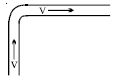
$A$ fire hydrant delivers water of density $\rho$ at a volume rate $L$. The water travels vertically upward through the hydrant and then makes a $90^{\circ}$ turn to emerge horizontally at speed $V$. The pipe and nozzle have a uniform cross-section throughout. The force exerted by the water on the corner of the hydrant is
A
$\rho VL$
B
zero
C
$2\rho VL$
D
$\sqrt{2} \rho VL$
Solution
(D) Let the mass of water flowing in time $t$ be $m = \rho L t$.
The initial momentum of the water in the vertical direction is $p_i = m V = \rho L t V$ (upward).
The final momentum of the water in the vertical direction is $p_f = 0$.
Change in momentum in the vertical direction: $\Delta p_y = p_f - p_i = -\rho L V t$.
The initial momentum of the water in the horizontal direction is $p_i = 0$.
The final momentum of the water in the horizontal direction is $p_f = m V = \rho L t V$ (horizontal).
Change in momentum in the horizontal direction: $\Delta p_x = p_f - p_i = \rho L V t$.
The net change in momentum in time $t$ is $\Delta p = \sqrt{(\Delta p_x)^2 + (\Delta p_y)^2} = \sqrt{(\rho L V t)^2 + (-\rho L V t)^2} = \sqrt{2} \rho L V t$.
The force exerted by the water on the corner is equal to the rate of change of momentum:
$F = \frac{\Delta p}{t} = \sqrt{2} \rho L V$.
The initial momentum of the water in the vertical direction is $p_i = m V = \rho L t V$ (upward).
The final momentum of the water in the vertical direction is $p_f = 0$.
Change in momentum in the vertical direction: $\Delta p_y = p_f - p_i = -\rho L V t$.
The initial momentum of the water in the horizontal direction is $p_i = 0$.
The final momentum of the water in the horizontal direction is $p_f = m V = \rho L t V$ (horizontal).
Change in momentum in the horizontal direction: $\Delta p_x = p_f - p_i = \rho L V t$.
The net change in momentum in time $t$ is $\Delta p = \sqrt{(\Delta p_x)^2 + (\Delta p_y)^2} = \sqrt{(\rho L V t)^2 + (-\rho L V t)^2} = \sqrt{2} \rho L V t$.
The force exerted by the water on the corner is equal to the rate of change of momentum:
$F = \frac{\Delta p}{t} = \sqrt{2} \rho L V$.
0 likes
View Solution7
MediumMCQ
$A$ horizontal right-angle pipe bend has a cross-sectional area of $10 \ cm^2$ and water flows through it at a speed of $20 \ m/s$. The force on the pipe bend due to the turning of water is ........ $N$.
A
$565.7$
B
$400$
C
$20$
D
$282.8$
Solution
(A) The mass flow rate $\dot{m}$ is given by $\rho A v$,where $\rho = 1000 \ kg/m^3$,$A = 10 \ cm^2 = 10^{-3} \ m^2$,and $v = 20 \ m/s$.
$\dot{m} = 1000 \times 10^{-3} \times 20 = 20 \ kg/s$.
The change in velocity vector $\Delta \vec{v}$ for a $90^{\circ}$ turn is $\sqrt{v^2 + v^2} = v\sqrt{2}$.
The magnitude of the force exerted by the water on the pipe is $F = \dot{m} \Delta v = \dot{m} v \sqrt{2}$.
$F = 20 \times 20 \times \sqrt{2} = 400 \times 1.4142 = 565.68 \ N \approx 565.7 \ N$.
$\dot{m} = 1000 \times 10^{-3} \times 20 = 20 \ kg/s$.
The change in velocity vector $\Delta \vec{v}$ for a $90^{\circ}$ turn is $\sqrt{v^2 + v^2} = v\sqrt{2}$.
The magnitude of the force exerted by the water on the pipe is $F = \dot{m} \Delta v = \dot{m} v \sqrt{2}$.
$F = 20 \times 20 \times \sqrt{2} = 400 \times 1.4142 = 565.68 \ N \approx 565.7 \ N$.
0 likes
View Solution8
DifficultMCQ
$A$ jet of water having velocity $v = 10 \ m/s$ and stream cross-section $A = 2 \ cm^2$ hits a flat plate perpendicularly,with the water splashing out parallel to the plate. The plate experiences a force of ....... $N$.
A
$40$
B
$20$
C
$8$
D
$10$
Solution
(B) The force exerted by a fluid jet on a flat plate is equal to the rate of change of linear momentum of the water.
$F = \frac{dp}{dt} = \frac{d(mv)}{dt} = v \frac{dm}{dt}$
Since the mass flow rate $\frac{dm}{dt} = \rho A v$,where $\rho$ is the density of water $(1000 \ kg/m^3)$,$A$ is the cross-sectional area,and $v$ is the velocity.
$F = (\rho A v) v = \rho A v^2$
Given:
$A = 2 \ cm^2 = 2 \times 10^{-4} \ m^2$
$v = 10 \ m/s$
$\rho = 1000 \ kg/m^3$
Substituting the values:
$F = 1000 \times (2 \times 10^{-4}) \times (10)^2$
$F = 1000 \times 2 \times 10^{-4} \times 100$
$F = 20 \ N$
$F = \frac{dp}{dt} = \frac{d(mv)}{dt} = v \frac{dm}{dt}$
Since the mass flow rate $\frac{dm}{dt} = \rho A v$,where $\rho$ is the density of water $(1000 \ kg/m^3)$,$A$ is the cross-sectional area,and $v$ is the velocity.
$F = (\rho A v) v = \rho A v^2$
Given:
$A = 2 \ cm^2 = 2 \times 10^{-4} \ m^2$
$v = 10 \ m/s$
$\rho = 1000 \ kg/m^3$
Substituting the values:
$F = 1000 \times (2 \times 10^{-4}) \times (10)^2$
$F = 1000 \times 2 \times 10^{-4} \times 100$
$F = 20 \ N$
0 likes
View Solution9
MediumMCQ
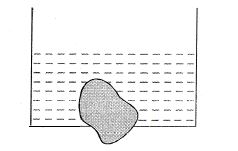
An object is fitted in a hole at the base of a container as shown in the figure. The force due to the liquid on the object is (Assume no leakage of water,the volume of the object inside the container is $V$,and the density of the liquid is $\rho$):
A
$= \rho Vg$
B
$> \rho Vg$
C
$< \rho Vg$
D
Can't be said
Solution
(A) The force exerted by the liquid on the object is the vertical component of the pressure force acting on its surface.
According to the principle of hydrostatics,the downward force exerted by the liquid on the object is equal to the weight of the liquid column that would have occupied the volume $V$ of the object inside the container.
This force is given by $F = \rho Vg$.
Since the object is fitted at the base,the liquid exerts a downward force on the top surface of the object.
Therefore,the net force due to the liquid on the object is equal to the weight of the displaced liquid,which is $\rho Vg$.
According to the principle of hydrostatics,the downward force exerted by the liquid on the object is equal to the weight of the liquid column that would have occupied the volume $V$ of the object inside the container.
This force is given by $F = \rho Vg$.
Since the object is fitted at the base,the liquid exerts a downward force on the top surface of the object.
Therefore,the net force due to the liquid on the object is equal to the weight of the displaced liquid,which is $\rho Vg$.
0 likes
View Solution10
MediumMCQ
Water is flowing at a speed of $1.5\, ms^{-1}$ through a horizontal tube of cross-sectional area $10^{-2}\, m^2$ and you are trying to stop the flow by your palm. Assuming that the water stops immediately after hitting the palm,the minimum force that you must exert should be ......... $N$ (density of water $= 10^3\, kgm^{-3}$)
A
$22.5$
B
$15$
C
$33.7$
D
$45$
Solution
(A) The force exerted by the water on the palm is equal to the rate of change of momentum of the water.
$F = \frac{dp}{dt} = v \frac{dm}{dt}$
Since the mass flow rate $\frac{dm}{dt} = A \rho v$,where $A$ is the cross-sectional area,$\rho$ is the density,and $v$ is the velocity.
Substituting this into the force equation:
$F = v(A \rho v) = A \rho v^2$
Given values: $v = 1.5\, ms^{-1}$,$A = 10^{-2}\, m^2$,$\rho = 10^3\, kgm^{-3}$.
$F = 10^{-2} \times 10^3 \times (1.5)^2$
$F = 10 \times 2.25 = 22.5\, N$.
$F = \frac{dp}{dt} = v \frac{dm}{dt}$
Since the mass flow rate $\frac{dm}{dt} = A \rho v$,where $A$ is the cross-sectional area,$\rho$ is the density,and $v$ is the velocity.
Substituting this into the force equation:
$F = v(A \rho v) = A \rho v^2$
Given values: $v = 1.5\, ms^{-1}$,$A = 10^{-2}\, m^2$,$\rho = 10^3\, kgm^{-3}$.
$F = 10^{-2} \times 10^3 \times (1.5)^2$
$F = 10 \times 2.25 = 22.5\, N$.
0 likes
View Solution11
MediumMCQ
$A$ jet of liquid of cross-sectional area $a$ strikes a wall making an angle $\theta$ with the wall. The liquid strikes the wall with velocity $v$ and rebounds elastically. If the density of the liquid is $\rho$,the normal force on the wall is:
A
$2av^2\rho \sin \theta$
B
$2av^2\rho \cos \theta$
C
$2av\rho \sin \theta$
D
$2av\rho \cos \theta$
Solution
(A) The mass of liquid striking the wall per unit time is given by $\frac{dm}{dt} = A \cdot v \cdot \rho$,where $A$ is the cross-sectional area,$v$ is the velocity,and $\rho$ is the density.
Since the jet makes an angle $\theta$ with the wall,the component of velocity normal to the wall is $v_n = v \sin \theta$.
The liquid rebounds elastically,meaning the normal component of velocity changes from $v \sin \theta$ to $-v \sin \theta$.
The change in momentum per unit time (force) exerted by the wall on the liquid is $F = \frac{dp}{dt} = \frac{dm}{dt} \cdot \Delta v_n$.
$F = (av\rho) \cdot (v \sin \theta - (-v \sin \theta)) = (av\rho) \cdot (2v \sin \theta) = 2av^2\rho \sin \theta$.
By Newton's third law,the force exerted by the liquid on the wall is equal in magnitude,so the normal force is $2av^2\rho \sin \theta$.
Since the jet makes an angle $\theta$ with the wall,the component of velocity normal to the wall is $v_n = v \sin \theta$.
The liquid rebounds elastically,meaning the normal component of velocity changes from $v \sin \theta$ to $-v \sin \theta$.
The change in momentum per unit time (force) exerted by the wall on the liquid is $F = \frac{dp}{dt} = \frac{dm}{dt} \cdot \Delta v_n$.
$F = (av\rho) \cdot (v \sin \theta - (-v \sin \theta)) = (av\rho) \cdot (2v \sin \theta) = 2av^2\rho \sin \theta$.
By Newton's third law,the force exerted by the liquid on the wall is equal in magnitude,so the normal force is $2av^2\rho \sin \theta$.
0 likes
View Solution12
MediumMCQ
$A$ stream of water flowing horizontally with a speed of $15\; m s^{-1}$ gushes out of a tube of cross-sectional area $10^{-2}\; m^2$,and hits a vertical wall nearby. What is the force in $N$ exerted on the wall by the impact of water,assuming it does not rebound?
A
$1500$
B
$1125$
C
$4500$
D
$2250$
Solution
(D) Speed of the water stream,$v = 15\; m s^{-1}$.
Cross-sectional area of the tube,$A = 10^{-2}\; m^2$.
Volume of water coming out from the pipe per second,$V = A \times v = 10^{-2} \times 15 = 0.15\; m^3 s^{-1}$.
Density of water,$\rho = 10^3\; kg m^{-3}$.
Mass of water flowing out through the pipe per second,$\frac{dm}{dt} = \rho \times V = 10^3 \times 0.15 = 150\; kg s^{-1}$.
The water strikes the wall and does not rebound. Therefore,the force exerted by the water on the wall is given by Newton's second law of motion as:
$F = \frac{dp}{dt} = \frac{d(mv)}{dt} = v \times \frac{dm}{dt}$.
$F = 15\; m s^{-1} \times 150\; kg s^{-1} = 2250\; N$.
Cross-sectional area of the tube,$A = 10^{-2}\; m^2$.
Volume of water coming out from the pipe per second,$V = A \times v = 10^{-2} \times 15 = 0.15\; m^3 s^{-1}$.
Density of water,$\rho = 10^3\; kg m^{-3}$.
Mass of water flowing out through the pipe per second,$\frac{dm}{dt} = \rho \times V = 10^3 \times 0.15 = 150\; kg s^{-1}$.
The water strikes the wall and does not rebound. Therefore,the force exerted by the water on the wall is given by Newton's second law of motion as:
$F = \frac{dp}{dt} = \frac{d(mv)}{dt} = v \times \frac{dm}{dt}$.
$F = 15\; m s^{-1} \times 150\; kg s^{-1} = 2250\; N$.
0 likes
View Solution13
MediumMCQ
$A$ pressure-pump has a horizontal tube of cross-sectional area $10 \, cm^{2}$ for the outflow of water at a speed of $20 \, m/s$. The force exerted on the vertical wall just in front of the tube,which stops the water horizontally flowing out of the tube,is $... N$ [Given: density of water $= 1000 \, kg/m^{3}$].
A
$300$
B
$500$
C
$250$
D
$400$
Solution
(D) The force exerted by a fluid jet hitting a wall and coming to rest is given by the rate of change of momentum.
$F = \frac{dp}{dt} = \frac{d(mv)}{dt} = v \frac{dm}{dt}$.
Since the mass flow rate $\frac{dm}{dt} = \rho A v$,the force is $F = \rho A v^{2}$.
Given:
Density $\rho = 1000 \, kg/m^{3}$
Area $A = 10 \, cm^{2} = 10 \times 10^{-4} \, m^{2} = 10^{-3} \, m^{2}$
Velocity $v = 20 \, m/s$
Substituting the values:
$F = 1000 \times 10^{-3} \times (20)^{2}$
$F = 1 \times 400 = 400 \, N$.
$F = \frac{dp}{dt} = \frac{d(mv)}{dt} = v \frac{dm}{dt}$.
Since the mass flow rate $\frac{dm}{dt} = \rho A v$,the force is $F = \rho A v^{2}$.
Given:
Density $\rho = 1000 \, kg/m^{3}$
Area $A = 10 \, cm^{2} = 10 \times 10^{-4} \, m^{2} = 10^{-3} \, m^{2}$
Velocity $v = 20 \, m/s$
Substituting the values:
$F = 1000 \times 10^{-3} \times (20)^{2}$
$F = 1 \times 400 = 400 \, N$.
0 likes
View Solution14
DifficultMCQ
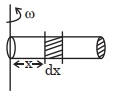
$A$ tube of length $50\,cm$ is filled completely with an incompressible liquid of mass $250\,g$ and closed at both ends. The tube is then rotated in a horizontal plane about one of its ends with a uniform angular velocity $\omega = x \sqrt{F} \text{ rad } s^{-1}$. If $F$ is the force exerted by the liquid at the other end,then the value of $x$ will be:
A
$2$
B
$3$
C
$1$
D
$4$
Solution
(D) Consider a small element of the liquid of length $dx$ at a distance $x$ from the axis of rotation. The mass of this element is $dm = (m/L) dx$.
The centrifugal force $dF$ acting on this element is $dF = (dm) \omega^2 x = (m/L) \omega^2 x dx$.
To find the total force $F$ exerted at the outer end,we integrate from $x = 0$ to $x = L$:
$F = \int_{0}^{L} \frac{m}{L} \omega^2 x dx = \frac{m \omega^2}{L} \left[ \frac{x^2}{2} \right]_{0}^{L} = \frac{m \omega^2 L}{2}$.
Given $m = 250\,g = 0.25\,kg$ and $L = 50\,cm = 0.5\,m$,we have:
$F = \frac{0.25 \times \omega^2 \times 0.5}{2} = \frac{0.125}{2} \omega^2 = 0.0625 \omega^2$.
Thus,$\omega^2 = F / 0.0625 = 16F$,which gives $\omega = 4 \sqrt{F}$.
Comparing this with $\omega = x \sqrt{F}$,we get $x = 4$.
The centrifugal force $dF$ acting on this element is $dF = (dm) \omega^2 x = (m/L) \omega^2 x dx$.
To find the total force $F$ exerted at the outer end,we integrate from $x = 0$ to $x = L$:
$F = \int_{0}^{L} \frac{m}{L} \omega^2 x dx = \frac{m \omega^2}{L} \left[ \frac{x^2}{2} \right]_{0}^{L} = \frac{m \omega^2 L}{2}$.
Given $m = 250\,g = 0.25\,kg$ and $L = 50\,cm = 0.5\,m$,we have:
$F = \frac{0.25 \times \omega^2 \times 0.5}{2} = \frac{0.125}{2} \omega^2 = 0.0625 \omega^2$.
Thus,$\omega^2 = F / 0.0625 = 16F$,which gives $\omega = 4 \sqrt{F}$.
Comparing this with $\omega = x \sqrt{F}$,we get $x = 4$.
0 likes
View Solution15
MediumMCQ
Water is filled to a height $H$ behind a dam of width $w$. The resultant force on the dam is ..............
A
$\rho g w H^2$
B
$\frac{1}{2} \rho g w H^2$
C
$2 \rho g w H^2$
D
$4 \rho g w H^2$
Solution
(B) The pressure at a depth $x$ below the surface of the water is given by $P = \rho g x$.
Consider a small horizontal strip of the dam at depth $x$ with thickness $dx$ and width $w$.
The area of this strip is $dA = w \cdot dx$.
The force $dF$ on this strip is $dF = P \cdot dA = (\rho g x)(w \cdot dx)$.
To find the total resultant force $F$ on the dam,we integrate this expression from $x = 0$ to $x = H$:
$F = \int_{0}^{H} \rho g w x \, dx$
$F = \rho g w \int_{0}^{H} x \, dx$
$F = \rho g w \left[ \frac{x^2}{2} \right]_{0}^{H}$
$F = \frac{1}{2} \rho g w H^2$.
Consider a small horizontal strip of the dam at depth $x$ with thickness $dx$ and width $w$.
The area of this strip is $dA = w \cdot dx$.
The force $dF$ on this strip is $dF = P \cdot dA = (\rho g x)(w \cdot dx)$.
To find the total resultant force $F$ on the dam,we integrate this expression from $x = 0$ to $x = H$:
$F = \int_{0}^{H} \rho g w x \, dx$
$F = \rho g w \int_{0}^{H} x \, dx$
$F = \rho g w \left[ \frac{x^2}{2} \right]_{0}^{H}$
$F = \frac{1}{2} \rho g w H^2$.
0 likes
View Solution16
EasyMCQ
$A$ large vessel of height $H$ is filled with a liquid of density $\rho$ up to the brim. $A$ small hole of radius $r$ is made at the side vertical face,close to the base. The horizontal force required to stop the gushing of liquid is ...........
A
$\rho g H \pi r^2$
B
$\rho g H$
C
$\rho g H \pi r$
D
$\rho g \pi r^2$
Solution
(A) The pressure $P$ at a depth $H$ from the free surface of the liquid is given by $P = \rho g H$.
To stop the liquid from gushing out,we must apply a force equal to the force exerted by the liquid on the hole.
The force $F$ exerted by the liquid on the hole is given by $F = P \times A$,where $A$ is the area of the hole.
The area of the hole of radius $r$ is $A = \pi r^2$.
Therefore,the required horizontal force is $F = (\rho g H) \times (\pi r^2) = \rho g H \pi r^2$.
To stop the liquid from gushing out,we must apply a force equal to the force exerted by the liquid on the hole.
The force $F$ exerted by the liquid on the hole is given by $F = P \times A$,where $A$ is the area of the hole.
The area of the hole of radius $r$ is $A = \pi r^2$.
Therefore,the required horizontal force is $F = (\rho g H) \times (\pi r^2) = \rho g H \pi r^2$.
0 likes
View Solution17
DifficultMCQ
Mercury is filled in a tube of radius $2 \,cm$ up to a height of $30 \,cm$. The force exerted by mercury on the bottom of the tube is . . . . . . $N$.
(Given: atmospheric pressure $P_0 = 10^5 \,N/m^2$,density of mercury $\rho = 1.36 \times 10^4 \,kg/m^3$,$g = 10 \,m/s^2$,$\pi = \frac{22}{7}$)
(Given: atmospheric pressure $P_0 = 10^5 \,N/m^2$,density of mercury $\rho = 1.36 \times 10^4 \,kg/m^3$,$g = 10 \,m/s^2$,$\pi = \frac{22}{7}$)
A
$176$
B
$177$
C
$178$
D
$179$
Solution
(B) The total force $F$ exerted on the bottom of the tube is the sum of the force due to atmospheric pressure and the force due to the weight of the mercury column.
$F = (P_0 + \rho gh) A$
Here,the area $A = \pi r^2 = \frac{22}{7} \times (2 \times 10^{-2} \,m)^2 = \frac{22}{7} \times 4 \times 10^{-4} \,m^2 \approx 1.257 \times 10^{-3} \,m^2$.
Force due to atmospheric pressure $F_{atm} = P_0 A = 10^5 \times 1.257 \times 10^{-3} = 125.7 \,N$.
Force due to mercury column $F_{Hg} = \rho gh A = (1.36 \times 10^4) \times 10 \times (30 \times 10^{-2}) \times (1.257 \times 10^{-3}) = 13600 \times 10 \times 0.3 \times 1.257 \times 10^{-3} \approx 51.3 \,N$.
Total force $F = 125.7 + 51.3 = 177 \,N$.
$F = (P_0 + \rho gh) A$
Here,the area $A = \pi r^2 = \frac{22}{7} \times (2 \times 10^{-2} \,m)^2 = \frac{22}{7} \times 4 \times 10^{-4} \,m^2 \approx 1.257 \times 10^{-3} \,m^2$.
Force due to atmospheric pressure $F_{atm} = P_0 A = 10^5 \times 1.257 \times 10^{-3} = 125.7 \,N$.
Force due to mercury column $F_{Hg} = \rho gh A = (1.36 \times 10^4) \times 10 \times (30 \times 10^{-2}) \times (1.257 \times 10^{-3}) = 13600 \times 10 \times 0.3 \times 1.257 \times 10^{-3} \approx 51.3 \,N$.
Total force $F = 125.7 + 51.3 = 177 \,N$.
0 likes
View Solution18
MediumMCQ
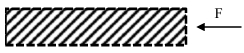
$A$ tube of length $L = 1 \ m$ is filled completely with an ideal liquid of mass $M_{total} = 2M$,and closed at both ends. The tube is rotated uniformly in a horizontal plane about one of its ends. If the force exerted by the liquid at the other end is $F$,then the angular velocity of the tube is $\sqrt{\frac{F}{\alpha M}}$ in $SI$ units. The value of $\alpha$ is . . . . . . .
A
$6$
B
$9$
C
$8$
D
$1$
Solution
(D) Consider a small element of the liquid of length $dx$ at a distance $x$ from the axis of rotation. The mass of this element is $dm = \frac{M_{total}}{L} dx = \frac{2M}{1} dx = 2M dx$.
The centrifugal force $dF$ acting on this element is $dF = (dm) \omega^2 x = (2M dx) \omega^2 x$.
The total force $F$ exerted by the liquid at the outer end is the integral of these forces from $x = 0$ to $x = L = 1 \ m$:
$F = \int_{0}^{L} 2M \omega^2 x dx = 2M \omega^2 \left[ \frac{x^2}{2} \right]_{0}^{1} = 2M \omega^2 \left( \frac{1}{2} \right) = M \omega^2$.
Given that the angular velocity is $\omega = \sqrt{\frac{F}{\alpha M}}$,we have $\omega^2 = \frac{F}{\alpha M}$.
Comparing $F = M \omega^2$ with $\omega^2 = \frac{F}{M}$,we get $\alpha = 1$.
The centrifugal force $dF$ acting on this element is $dF = (dm) \omega^2 x = (2M dx) \omega^2 x$.
The total force $F$ exerted by the liquid at the outer end is the integral of these forces from $x = 0$ to $x = L = 1 \ m$:
$F = \int_{0}^{L} 2M \omega^2 x dx = 2M \omega^2 \left[ \frac{x^2}{2} \right]_{0}^{1} = 2M \omega^2 \left( \frac{1}{2} \right) = M \omega^2$.
Given that the angular velocity is $\omega = \sqrt{\frac{F}{\alpha M}}$,we have $\omega^2 = \frac{F}{\alpha M}$.
Comparing $F = M \omega^2$ with $\omega^2 = \frac{F}{M}$,we get $\alpha = 1$.
0 likes
View Solution19
EasyMCQ
Water flowing through a pipe of area of cross-section $2 \times 10^{-3} \,m^2$ hits a vertical wall horizontally with a velocity of $12 \,m \,s^{-1}$. If the water does not rebound after hitting the wall, then the force acting on the wall due to water is (in $\,N$)
A
$24$
B
$144$
C
$288$
D
$72$
Solution
(C) The force exerted by the water on the wall is equal to the rate of change of momentum of the water.
Given:
Area of cross-section $A = 2 \times 10^{-3} \,m^2$
Velocity $v = 12 \,m \,s^{-1}$
Density of water $\rho = 1000 \,kg \,m^{-3}$
The mass of water hitting the wall per unit time is given by $\frac{dm}{dt} = \rho A v$.
Substituting the values:
$\frac{dm}{dt} = 1000 \times (2 \times 10^{-3}) \times 12 = 24 \,kg \,s^{-1}$.
The force $F$ is the rate of change of momentum: $F = \frac{dp}{dt} = \frac{dm}{dt} \times v$.
Since the water does not rebound, the final velocity is $0$.
$F = (24 \,kg \,s^{-1}) \times (12 \,m \,s^{-1}) = 288 \,N$.
Therefore, the force acting on the wall is $288 \,N$.
Given:
Area of cross-section $A = 2 \times 10^{-3} \,m^2$
Velocity $v = 12 \,m \,s^{-1}$
Density of water $\rho = 1000 \,kg \,m^{-3}$
The mass of water hitting the wall per unit time is given by $\frac{dm}{dt} = \rho A v$.
Substituting the values:
$\frac{dm}{dt} = 1000 \times (2 \times 10^{-3}) \times 12 = 24 \,kg \,s^{-1}$.
The force $F$ is the rate of change of momentum: $F = \frac{dp}{dt} = \frac{dm}{dt} \times v$.
Since the water does not rebound, the final velocity is $0$.
$F = (24 \,kg \,s^{-1}) \times (12 \,m \,s^{-1}) = 288 \,N$.
Therefore, the force acting on the wall is $288 \,N$.
0 likes
View Solution20
DifficultMCQ
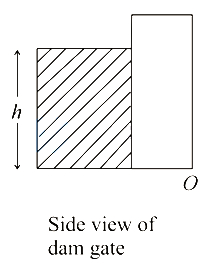
Water stands up to a height '$h$' behind the dam as shown in the figure. The density of water is '$\rho$' and the acceleration due to gravity is '$g$'. If the atmospheric pressure force is also considered,the point of application of the total force acting on the dam due to water above '$O$' is $........$
A
$\frac{h}{4}$
B
$\frac{h}{3}$
C
$h$
D
$\frac{h}{2}$
Solution
(B) The pressure at a depth '$y$' from the surface is given by $P(y) = P_{atm} + \rho gy$.
The total force '$F$' acting on the dam of width '$b$' is the integral of pressure over the area:
$F = \int_{0}^{h} (P_{atm} + \rho gy) b \, dy = (P_{atm} h + \frac{1}{2} \rho g h^2) b$.
The point of application '$y_{cp}$' (center of pressure) from the surface is given by the ratio of the moment of force to the total force:
$y_{cp} = \frac{\int_{0}^{h} y (P_{atm} + \rho gy) b \, dy}{F} = \frac{b [P_{atm} \frac{h^2}{2} + \rho g \frac{h^3}{3}]}{(P_{atm} h + \frac{1}{2} \rho g h^2) b}$.
If we consider the force due to water only (ignoring $P_{atm}$ or assuming it acts on both sides),the center of pressure is at a depth of $\frac{2h}{3}$ from the surface,which is $\frac{h}{3}$ from the base '$O$'.
Given the standard context of such problems where the net force due to water pressure distribution (triangular) is considered,the center of pressure is at $\frac{h}{3}$ from the base '$O$'.
The total force '$F$' acting on the dam of width '$b$' is the integral of pressure over the area:
$F = \int_{0}^{h} (P_{atm} + \rho gy) b \, dy = (P_{atm} h + \frac{1}{2} \rho g h^2) b$.
The point of application '$y_{cp}$' (center of pressure) from the surface is given by the ratio of the moment of force to the total force:
$y_{cp} = \frac{\int_{0}^{h} y (P_{atm} + \rho gy) b \, dy}{F} = \frac{b [P_{atm} \frac{h^2}{2} + \rho g \frac{h^3}{3}]}{(P_{atm} h + \frac{1}{2} \rho g h^2) b}$.
If we consider the force due to water only (ignoring $P_{atm}$ or assuming it acts on both sides),the center of pressure is at a depth of $\frac{2h}{3}$ from the surface,which is $\frac{h}{3}$ from the base '$O$'.
Given the standard context of such problems where the net force due to water pressure distribution (triangular) is considered,the center of pressure is at $\frac{h}{3}$ from the base '$O$'.
0 likes
View SolutionFluid Mechanics and Surface Tension — Force due to Liquid in pipe · Frequently Asked Questions
1Are these Fluid Mechanics and Surface Tension questions useful for JEE and NEET?
Yes. All questions in this section are mapped to JEE Main and NEET exam patterns. Previous year questions from JEE Main, NEET, GUJCET and state-level exams are included with full solutions.
2Can I switch to Hindi or Gujarati for these questions?
Yes. Use the language tabs in the hero section or the sidebar to view the same questions and solutions in English, Hindi or Gujarati.
3How do I generate a question paper from this subtopic?
Use the Vedclass Exam Paper Generator — select the chapter and subtopic, set difficulty, and generate Sets A, B, C, D automatically. First 3 chapters of every subject are free.
Vedclass Products
For Students
Vedclass Test Series
Mock tests in real JEE/NEET style with performance analysis. 5-day free trial.
Start Free TrialFor Teachers
Exam Paper Generator
Generate Set A/B/C/D papers from this chapter in 2 minutes. 3 chapters free.
Try FreeFor Institutes
Online Exam Module
Live online exams with unlimited students, 360° analytics & white-label branding.
See DemoFor Teachers & Institutes
Generate a Fluid Mechanics and Surface Tension Exam Paper in 2 Minutes
Select subtopic & difficulty — Sets A, B, C, D auto-generated with No Repeat logic.
First 3 chapters of every subject are free — no payment required.