
A English
Basic of Surface tenstion , Adhesive force and Cohesive force Questions in English
Class 11 Physics · Fluid Mechanics and Surface Tension · Basic of Surface tenstion , Adhesive force and Cohesive force
33+
Questions
English
Language
100%
With Solutions
Showing 33 of 33 questions in English
1
EasyMCQ
Surface tension is due to
A
Frictional forces between molecules
B
Cohesive forces between molecules
C
Adhesive forces between molecules
D
Gravitational forces
Solution
(B) Surface tension is a property of liquids arising from the intermolecular forces of attraction.
Specifically,it is caused by cohesive forces,which are the attractive forces between molecules of the same substance.
At the surface of a liquid,molecules experience a net inward pull because there are no liquid molecules above them to balance the cohesive forces from the molecules below and to the sides.
This inward pull results in the surface acting like a stretched elastic membrane,a phenomenon known as surface tension.
Therefore,the correct option is $B$.
Specifically,it is caused by cohesive forces,which are the attractive forces between molecules of the same substance.
At the surface of a liquid,molecules experience a net inward pull because there are no liquid molecules above them to balance the cohesive forces from the molecules below and to the sides.
This inward pull results in the surface acting like a stretched elastic membrane,a phenomenon known as surface tension.
Therefore,the correct option is $B$.
0 likes
View Solution2
EasyMCQ
Coatings used on raincoats are waterproof because
A
Water is absorbed by the coating
B
Cohesive force becomes greater
C
Water is not scattered away by the coating
D
Angle of contact decreases
Solution
(B) surface is considered waterproof if it prevents water from passing through it. Raincoats are designed to be impermeable to water.
Water wets a surface when the adhesive force between water molecules and the surface molecules is stronger than the cohesive force between the water molecules themselves.
Conversely,if the cohesive force between water molecules is significantly stronger than the adhesive force between water molecules and the surface material,the water will not wet the surface.
In the case of a raincoat,the coating material is chosen such that the adhesive force between the water and the coating is very weak. Because the cohesive force within the water molecules is much greater than this adhesive force,the water beads up and rolls off rather than spreading out and wetting the fabric. Therefore,the waterproof nature is due to the cohesive force being greater than the adhesive force.
Water wets a surface when the adhesive force between water molecules and the surface molecules is stronger than the cohesive force between the water molecules themselves.
Conversely,if the cohesive force between water molecules is significantly stronger than the adhesive force between water molecules and the surface material,the water will not wet the surface.
In the case of a raincoat,the coating material is chosen such that the adhesive force between the water and the coating is very weak. Because the cohesive force within the water molecules is much greater than this adhesive force,the water beads up and rolls off rather than spreading out and wetting the fabric. Therefore,the waterproof nature is due to the cohesive force being greater than the adhesive force.
0 likes
View Solution3
EasyMCQ
$A$ drop of oil is placed on the surface of water. Which of the following statements is correct?
A
It will remain on it as a sphere.
B
It will spread as a thin layer.
C
It will be partly as spherical droplets and partly as a thin film.
D
It will float as a distorted drop on the water surface.
Solution
(B) When a drop of oil is placed on the surface of water,it spreads as a thin layer.
This occurs because the force of adhesion between the water molecules and the oil molecules is greater than the force of cohesion between the oil molecules themselves.
Since the adhesive force dominates,the oil molecules are pulled across the surface of the water,resulting in the formation of a thin film.
This occurs because the force of adhesion between the water molecules and the oil molecules is greater than the force of cohesion between the oil molecules themselves.
Since the adhesive force dominates,the oil molecules are pulled across the surface of the water,resulting in the formation of a thin film.
0 likes
View Solution4
EasyMCQ
The spiders and insects move and run about on the surface of water without sinking because
A
An elastic membrane is formed on water due to the property of surface tension.
B
Spiders and insects are lighter.
C
Spiders and insects swim on water.
D
Spiders and insects experience upthrust.
Solution
(A) The surface of water acts like a stretched elastic membrane due to the property of surface tension. When a spider or insect walks on water,the weight of the insect is balanced by the vertical component of the surface tension force acting along the contact points of its legs. This prevents the insect from sinking.
0 likes
View Solution5
EasyMCQ
Water does not wet an oily glass because
A
Cohesive force of oil $>$ adhesive force between oil and glass
B
Cohesive force of oil $>$ cohesive force of water
C
Oil repels water
D
Cohesive force of water $>$ adhesive force between water and oil molecules
Solution
(D) The wetting of a surface by a liquid depends on the relative magnitudes of cohesive and adhesive forces.
Cohesive forces are the forces of attraction between molecules of the same substance,while adhesive forces are the forces of attraction between molecules of different substances.
For water to wet a surface,the adhesive force between water molecules and the surface molecules must be greater than the cohesive force between water molecules.
In the case of an oily glass,the adhesive force between water molecules and the oil-coated glass surface is significantly weaker than the cohesive force between the water molecules themselves.
Therefore,the water molecules prefer to stay together rather than spread over the oily surface,preventing wetting.
Thus,the correct condition is: Cohesive force of water $>$ adhesive force between water and oil molecules.
Cohesive forces are the forces of attraction between molecules of the same substance,while adhesive forces are the forces of attraction between molecules of different substances.
For water to wet a surface,the adhesive force between water molecules and the surface molecules must be greater than the cohesive force between water molecules.
In the case of an oily glass,the adhesive force between water molecules and the oil-coated glass surface is significantly weaker than the cohesive force between the water molecules themselves.
Therefore,the water molecules prefer to stay together rather than spread over the oily surface,preventing wetting.
Thus,the correct condition is: Cohesive force of water $>$ adhesive force between water and oil molecules.
0 likes
View Solution6
EasyMCQ
$A$ water drop takes the shape of a sphere in oil, while an oil drop spreads in water, because ($A.F.$ = adhesive force, $C.F.$ = cohesive force)
A
$C.F.$ for water > $A.F.$ for water and oil
B
$C.F.$ for oil > $A.F.$ for water and oil
C
$C.F.$ for oil < $A.F.$ for water and oil
D
None of the above
Solution
(A) The shape of a liquid drop is determined by the competition between cohesive forces $(C.F.)$ and adhesive forces $(A.F.)$.
When a water drop is placed in oil, it forms a sphere because the cohesive forces between water molecules are stronger than the adhesive forces between water and oil molecules $(C.F._{water} > A.F._{water-oil})$.
Conversely, when an oil drop is placed in water, it spreads because the adhesive forces between oil and water molecules are stronger than the cohesive forces between oil molecules $(A.F._{water-oil} > C.F._{oil})$.
Therefore, the primary reason for the water drop remaining spherical in oil is that the cohesive force of water is greater than the adhesive force between water and oil.
When a water drop is placed in oil, it forms a sphere because the cohesive forces between water molecules are stronger than the adhesive forces between water and oil molecules $(C.F._{water} > A.F._{water-oil})$.
Conversely, when an oil drop is placed in water, it spreads because the adhesive forces between oil and water molecules are stronger than the cohesive forces between oil molecules $(A.F._{water-oil} > C.F._{oil})$.
Therefore, the primary reason for the water drop remaining spherical in oil is that the cohesive force of water is greater than the adhesive force between water and oil.
0 likes
View Solution7
EasyMCQ
In a glass capillary tube,the shape of the surface of the liquid depends upon:
A
Only on the cohesive force of liquid molecules
B
Only on the adhesive force between the molecules of glass and liquid
C
Only on the relative cohesive and adhesive forces between the atoms
D
Neither on the cohesive nor on the adhesive force
Solution
(C) The shape of the liquid surface (meniscus) in a capillary tube is determined by the angle of contact.
The angle of contact is defined by the balance of forces at the point of contact between the liquid,the solid (glass),and the gas (air).
These forces are the cohesive force (force between liquid molecules) and the adhesive force (force between liquid molecules and glass molecules).
Therefore,the shape of the surface depends on the relative magnitude of the cohesive and adhesive forces.
If adhesive forces are stronger than cohesive forces,the liquid wets the glass (concave meniscus).
If cohesive forces are stronger than adhesive forces,the liquid does not wet the glass (convex meniscus).
Thus,the correct answer is $(c)$.
The angle of contact is defined by the balance of forces at the point of contact between the liquid,the solid (glass),and the gas (air).
These forces are the cohesive force (force between liquid molecules) and the adhesive force (force between liquid molecules and glass molecules).
Therefore,the shape of the surface depends on the relative magnitude of the cohesive and adhesive forces.
If adhesive forces are stronger than cohesive forces,the liquid wets the glass (concave meniscus).
If cohesive forces are stronger than adhesive forces,the liquid does not wet the glass (convex meniscus).
Thus,the correct answer is $(c)$.
0 likes
View Solution8
EasyMCQ
Consider a liquid contained in a vessel. The liquid-solid adhesive force is very weak compared to the cohesive force in the liquid. The shape of the liquid surface near the solid shall be
A
Horizontal
B
Almost vertical
C
Concave
D
Convex
Solution
(D) The shape of the liquid meniscus depends on the relative magnitudes of the cohesive force $(F_c)$ and the adhesive force $(F_a)$.
When the cohesive force between liquid molecules is much stronger than the adhesive force between the liquid and the solid surface $(F_c > F_a)$,the liquid molecules tend to pull away from the solid surface.
This results in a convex meniscus near the point of contact with the solid.
$A$ classic example of this behavior is mercury in a glass vessel.
When the cohesive force between liquid molecules is much stronger than the adhesive force between the liquid and the solid surface $(F_c > F_a)$,the liquid molecules tend to pull away from the solid surface.
This results in a convex meniscus near the point of contact with the solid.
$A$ classic example of this behavior is mercury in a glass vessel.
0 likes
View Solution9
EasyMCQ
If a glass rod is dipped in mercury and withdrawn out,the mercury does not wet the rod because
A
Angle of contact is acute
B
Cohesion force is more
C
Adhesion force is more
D
Density of mercury is more
Solution
(B) Cohesive force is the intermolecular attraction between like molecules,whereas adhesive force is the intermolecular force between unlike molecules.
In the given case,the cohesive force between mercury molecules is significantly greater than the adhesive force between mercury molecules and the glass rod.
Because the cohesive force dominates,the mercury molecules prefer to stay together rather than adhere to the glass surface,which is why the mercury does not wet the rod.
In the given case,the cohesive force between mercury molecules is significantly greater than the adhesive force between mercury molecules and the glass rod.
Because the cohesive force dominates,the mercury molecules prefer to stay together rather than adhere to the glass surface,which is why the mercury does not wet the rod.
0 likes
View Solution10
EasyMCQ
Mercury does not wet glass,wood,or iron because
A
Cohesive force is less than adhesive force
B
Cohesive force is greater than adhesive force
C
Angle of contact is less than $90^o$
D
Cohesive force is equal to adhesive force
Solution
(B) The wetting of a surface by a liquid depends on the relative magnitudes of the cohesive force (force between liquid molecules) and the adhesive force (force between liquid molecules and the solid surface molecules).
If the cohesive force is greater than the adhesive force,the liquid molecules prefer to stay together rather than stick to the solid surface.
In the case of mercury,the cohesive force between mercury atoms is significantly stronger than the adhesive force between mercury atoms and the molecules of glass,wood,or iron.
Consequently,mercury does not wet these surfaces and forms a convex meniscus,resulting in an obtuse angle of contact $(> 90^o)$.
If the cohesive force is greater than the adhesive force,the liquid molecules prefer to stay together rather than stick to the solid surface.
In the case of mercury,the cohesive force between mercury atoms is significantly stronger than the adhesive force between mercury atoms and the molecules of glass,wood,or iron.
Consequently,mercury does not wet these surfaces and forms a convex meniscus,resulting in an obtuse angle of contact $(> 90^o)$.
0 likes
View Solution11
EasyMCQ
Surface tension of a liquid is found to be influenced by
A
It increases with the increase of temperature
B
Nature of the liquid in contact
C
Presence of soap that increases it
D
Its variation with the concentration of the liquid
Solution
(D) Surface tension is a property of the liquid surface that depends on intermolecular forces.
$1$. Temperature: Surface tension generally decreases as temperature increases because the kinetic energy of molecules increases,weakening the cohesive forces.
$2$. Impurities: The presence of surface-active agents like soap or detergents significantly reduces the surface tension of water.
$3$. Concentration: The surface tension of a solution varies with the concentration of the solute dissolved in the liquid.
Therefore,the variation with the concentration of the liquid is a factor that influences surface tension.
$1$. Temperature: Surface tension generally decreases as temperature increases because the kinetic energy of molecules increases,weakening the cohesive forces.
$2$. Impurities: The presence of surface-active agents like soap or detergents significantly reduces the surface tension of water.
$3$. Concentration: The surface tension of a solution varies with the concentration of the solute dissolved in the liquid.
Therefore,the variation with the concentration of the liquid is a factor that influences surface tension.
0 likes
View Solution12
EasyMCQ
When a drop of water is dropped on an oil surface, then:
A
It will mix up with oil
B
It spreads in the form of a film
C
It will deform
D
It remains spherical
Solution
(D) The shape of a liquid drop on a surface is determined by the balance of surface tension forces.
When a water drop is placed on an oil surface, the surface tension of water $(\gamma_w \approx 72 \times 10^{-3} \text{ N/m})$ is significantly higher than the surface tension of oil $(\gamma_o \approx 20-30 \times 10^{-3} \text{ N/m})$.
Because the cohesive forces within the water drop are much stronger than the adhesive forces between the water and the oil, the water drop minimizes its surface area to maintain a spherical shape.
Therefore, the correct option is $D$.
When a water drop is placed on an oil surface, the surface tension of water $(\gamma_w \approx 72 \times 10^{-3} \text{ N/m})$ is significantly higher than the surface tension of oil $(\gamma_o \approx 20-30 \times 10^{-3} \text{ N/m})$.
Because the cohesive forces within the water drop are much stronger than the adhesive forces between the water and the oil, the water drop minimizes its surface area to maintain a spherical shape.
Therefore, the correct option is $D$.
0 likes
View Solution13
EasyMCQ
Cohesive force is experienced between
A
Magnetic substances
B
Molecules of different substances
C
Molecules of same substances
D
None of these
Solution
(C) The cohesive force is defined as the force of attraction acting between the molecules of the same substance.
This force is responsible for the property of cohesion,which allows substances to hold together.
This force is responsible for the property of cohesion,which allows substances to hold together.
0 likes
View Solution14
MediumMCQ
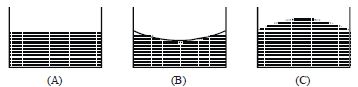
Three surfaces of liquid are shown here. Find the correct statements.
A
The surface tension of liquid $A$ is infinite and such a surface is not possible practically.
B
In case of liquid $B$,the resultant force on a molecule on the surface would be downward,and the surface is concave.
C
In case of liquid $C$,the resultant force due to surface tension is directed downwards.
D
The surfaces of all three liquids $A, B$ and $C$ are in equilibrium and so the net force due to surface tension is the same.
Solution
(B) For a liquid surface to be in equilibrium,the net force on a molecule at the surface must be perpendicular to the surface.
In case $A$,the surface is flat. The net force on a molecule at the surface is directed vertically downwards,which is perpendicular to the flat surface. This is a stable equilibrium.
In case $B$,the surface is concave. The resultant force on a molecule at the surface is directed downwards,which is perpendicular to the concave surface. This occurs when the adhesive force between liquid and container is greater than the cohesive force between liquid molecules.
In case $C$,the surface is convex. The resultant force on a molecule at the surface is directed downwards,which is perpendicular to the convex surface. This occurs when the cohesive force is greater than the adhesive force.
Therefore,statement $B$ is correct because for a concave surface,the resultant force on a surface molecule is directed into the liquid (downwards).
In case $A$,the surface is flat. The net force on a molecule at the surface is directed vertically downwards,which is perpendicular to the flat surface. This is a stable equilibrium.
In case $B$,the surface is concave. The resultant force on a molecule at the surface is directed downwards,which is perpendicular to the concave surface. This occurs when the adhesive force between liquid and container is greater than the cohesive force between liquid molecules.
In case $C$,the surface is convex. The resultant force on a molecule at the surface is directed downwards,which is perpendicular to the convex surface. This occurs when the cohesive force is greater than the adhesive force.
Therefore,statement $B$ is correct because for a concave surface,the resultant force on a surface molecule is directed into the liquid (downwards).
0 likes
View Solution15
Medium
Explain why:
$(a)$ The angle of contact of mercury with glass is obtuse,while that of water with glass is acute.
$(b)$ Water on a clean glass surface tends to spread out while mercury on the same surface tends to form drops. (Put differently,water wets glass while mercury does not.)
$(c)$ Surface tension of a liquid is independent of the area of the surface.
$(d)$ Water with detergent dissolved in it should have small angles of contact.
$(e)$ $A$ drop of liquid under no external forces is always spherical in shape.
$(a)$ The angle of contact of mercury with glass is obtuse,while that of water with glass is acute.
$(b)$ Water on a clean glass surface tends to spread out while mercury on the same surface tends to form drops. (Put differently,water wets glass while mercury does not.)
$(c)$ Surface tension of a liquid is independent of the area of the surface.
$(d)$ Water with detergent dissolved in it should have small angles of contact.
$(e)$ $A$ drop of liquid under no external forces is always spherical in shape.
Solution
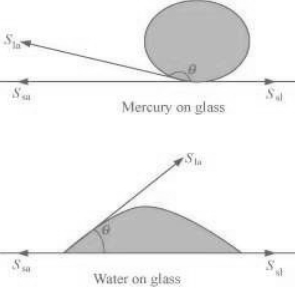
(N/A) The angle between the tangent to the liquid surface at the point of contact and the solid surface inside the liquid is called the angle of contact $(\theta)$,as shown in the figure.
$S_{la}$,$S_{sa}$,and $S_{sl}$ are the respective interfacial tensions between the liquid-air,solid-air,and solid-liquid interfaces. At the line of contact,the surface forces between the three media must be in equilibrium,i.e.,
$\cos \theta = \frac{S_{sa} - S_{sl}}{S_{la}}$
$(a)$ Mercury molecules have a strong cohesive force (attraction between themselves) and a weak adhesive force (attraction toward glass). Thus,$S_{sl} > S_{sa}$,making $\cos \theta$ negative,which results in an obtuse angle of contact.
$(b)$ Water molecules have a weak cohesive force and a strong adhesive force toward glass. Thus,$S_{sa} > S_{sl}$,making $\cos \theta$ positive,which results in an acute angle of contact. Consequently,water spreads to maximize contact area,while mercury forms drops to minimize it.
$(c)$ Surface tension is defined as the force acting per unit length at the interface. It is a property of the liquid-surface interface and is independent of the total surface area.
$(d)$ Detergents reduce the surface tension of water. $A$ smaller angle of contact $(\theta)$ facilitates better wetting and capillary action,allowing the detergent solution to penetrate deep into fabrics.
$(e)$ Due to surface tension,a liquid tends to minimize its surface area. For a given volume,a sphere has the minimum surface area. Therefore,in the absence of external forces,liquid drops are spherical.
$S_{la}$,$S_{sa}$,and $S_{sl}$ are the respective interfacial tensions between the liquid-air,solid-air,and solid-liquid interfaces. At the line of contact,the surface forces between the three media must be in equilibrium,i.e.,
$\cos \theta = \frac{S_{sa} - S_{sl}}{S_{la}}$
$(a)$ Mercury molecules have a strong cohesive force (attraction between themselves) and a weak adhesive force (attraction toward glass). Thus,$S_{sl} > S_{sa}$,making $\cos \theta$ negative,which results in an obtuse angle of contact.
$(b)$ Water molecules have a weak cohesive force and a strong adhesive force toward glass. Thus,$S_{sa} > S_{sl}$,making $\cos \theta$ positive,which results in an acute angle of contact. Consequently,water spreads to maximize contact area,while mercury forms drops to minimize it.
$(c)$ Surface tension is defined as the force acting per unit length at the interface. It is a property of the liquid-surface interface and is independent of the total surface area.
$(d)$ Detergents reduce the surface tension of water. $A$ smaller angle of contact $(\theta)$ facilitates better wetting and capillary action,allowing the detergent solution to penetrate deep into fabrics.
$(e)$ Due to surface tension,a liquid tends to minimize its surface area. For a given volume,a sphere has the minimum surface area. Therefore,in the absence of external forces,liquid drops are spherical.
0 likes
View Solution16
Easy
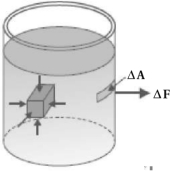
Show that the force exerted by a fluid at rest is perpendicular to its contact surface.
Solution
(N/A) Consider an object submerged in a fluid at rest. The fluid exerts a force on the surface of the object. This force must be normal (perpendicular) to the surface.
To prove this by contradiction,assume that the force exerted by the fluid has a component parallel to the surface. According to $Newton's$ third law,the object would exert an equal and opposite force on the fluid parallel to the surface.
Since the fluid is at rest,it cannot sustain a shear stress (a force parallel to the surface). If such a parallel force existed,it would cause the fluid particles to flow along the surface. However,since the fluid is in a state of rest,no such flow occurs.
Therefore,the force exerted by the fluid at rest must be strictly perpendicular to the surface in contact with it.
To prove this by contradiction,assume that the force exerted by the fluid has a component parallel to the surface. According to $Newton's$ third law,the object would exert an equal and opposite force on the fluid parallel to the surface.
Since the fluid is at rest,it cannot sustain a shear stress (a force parallel to the surface). If such a parallel force existed,it would cause the fluid particles to flow along the surface. However,since the fluid is in a state of rest,no such flow occurs.
Therefore,the force exerted by the fluid at rest must be strictly perpendicular to the surface in contact with it.
0 likes
View Solution17
Medium
Explain surface tension in the context of potential energy.
Solution
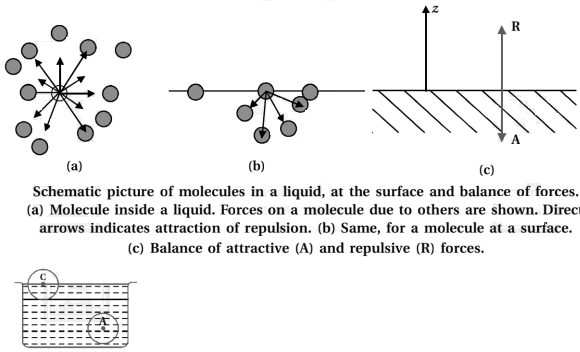
(N/A) The liquid stays together because of the attraction between molecules.
Consider a molecule $A$ well inside a liquid. The intermolecular distances are such that it is attracted to all the surrounding molecules. This attraction results in a negative potential energy for the molecule,which depends on the number and distribution of molecules around the chosen one. The average potential energy of all molecules in the bulk is the same.
Now,consider a molecule near the surface. Only the lower half side of it is surrounded by liquid molecules. There is some negative potential energy due to these,but it is less than that of a molecule in the bulk (approximately half of the latter).
Thus,molecules on a liquid surface have some extra potential energy in comparison to molecules in the interior. $A$ liquid thus tends to have the least surface area that external conditions permit,as this minimizes the total potential energy of the system. This property is known as surface tension.
Since a liquid consists of molecules moving about,there cannot be a perfectly sharp surface. The density of the liquid molecules drops rapidly to zero as we move along the direction perpendicular to the surface over a distance of the order of a few molecular sizes. $A$ layer of thickness $r_0$ below the free surface of the liquid is called the surface layer.
Consider a molecule $A$ well inside a liquid. The intermolecular distances are such that it is attracted to all the surrounding molecules. This attraction results in a negative potential energy for the molecule,which depends on the number and distribution of molecules around the chosen one. The average potential energy of all molecules in the bulk is the same.
Now,consider a molecule near the surface. Only the lower half side of it is surrounded by liquid molecules. There is some negative potential energy due to these,but it is less than that of a molecule in the bulk (approximately half of the latter).
Thus,molecules on a liquid surface have some extra potential energy in comparison to molecules in the interior. $A$ liquid thus tends to have the least surface area that external conditions permit,as this minimizes the total potential energy of the system. This property is known as surface tension.
Since a liquid consists of molecules moving about,there cannot be a perfectly sharp surface. The density of the liquid molecules drops rapidly to zero as we move along the direction perpendicular to the surface over a distance of the order of a few molecular sizes. $A$ layer of thickness $r_0$ below the free surface of the liquid is called the surface layer.
0 likes
View Solution18
Medium
What are cohesive forces?
Solution
(N/A) Cohesive forces are the intermolecular forces of attraction that act between molecules of the same substance.
These forces are responsible for the phenomenon of surface tension and the tendency of liquids to form droplets.
For example,the attraction between water molecules in a drop of water is due to cohesive forces.
These forces are responsible for the phenomenon of surface tension and the tendency of liquids to form droplets.
For example,the attraction between water molecules in a drop of water is due to cohesive forces.
0 likes
View Solution19
MediumMCQ
What is the necessary force for a water drop to stick to a glass surface?
A
Adhesive force
B
Cohesive force
C
Gravitational force
D
Centripetal force
Solution
(A) For a liquid drop to stick to a solid surface like glass,the force of attraction between the molecules of the liquid and the molecules of the solid surface must be greater than the force of attraction between the molecules of the liquid itself.
This force of attraction between different types of molecules is known as the adhesive force.
Therefore,the adhesive force must be sufficient to overcome the cohesive force and the gravitational force acting on the drop.
This force of attraction between different types of molecules is known as the adhesive force.
Therefore,the adhesive force must be sufficient to overcome the cohesive force and the gravitational force acting on the drop.
0 likes
View Solution20
MediumMCQ
What is the maximum distance up to which the molecules can exert an attractive force on each other?
A
Molecular range
B
Sphere of influence
C
Surface tension
D
Capillarity
Solution
(A) The maximum distance up to which a molecule can exert an attractive force on another molecule is known as the molecular range.
This distance is typically of the order of $10^{-9} \, m$ (or $10 \, \text{Å}$).
Within this range, the intermolecular forces are significant, which is a fundamental concept in understanding surface tension and capillary action.
This distance is typically of the order of $10^{-9} \, m$ (or $10 \, \text{Å}$).
Within this range, the intermolecular forces are significant, which is a fundamental concept in understanding surface tension and capillary action.
0 likes
View Solution21
Medium
What is the sphere of molecular action?
Solution
(N/A) The sphere of molecular action is defined as the imaginary sphere drawn around a molecule as the center,with a radius equal to the molecular range (approximately $10^{-9} \ m$).
Within this sphere,the molecule exerts a significant attractive force on other molecules.
Any molecule located outside this sphere does not experience any significant force of attraction from the central molecule because the intermolecular forces are short-range forces.
Within this sphere,the molecule exerts a significant attractive force on other molecules.
Any molecule located outside this sphere does not experience any significant force of attraction from the central molecule because the intermolecular forces are short-range forces.
0 likes
View Solution22
Medium
Define the surface of a liquid.
Solution
(N/A) The surface of a liquid is defined as the boundary layer between the liquid phase and the gas phase (or vacuum) or between two immiscible liquids.
It is a thin layer,typically a few molecular diameters thick,where the molecules experience a net inward force due to the imbalance of intermolecular forces.
This imbalance leads to the phenomenon of surface tension,where the surface acts like a stretched elastic membrane.
It is a thin layer,typically a few molecular diameters thick,where the molecules experience a net inward force due to the imbalance of intermolecular forces.
This imbalance leads to the phenomenon of surface tension,where the surface acts like a stretched elastic membrane.
0 likes
View Solution23
EasyMCQ
In what direction does the force act on a molecule at the surface of a liquid? Explain.
A
Downward
B
Upward
C
Horizontal
D
No force acts
Solution
(A) molecule at the surface of a liquid experiences an unbalanced cohesive force directed into the bulk of the liquid.
This is because the number of molecules in the liquid phase below the surface is much greater than the number of molecules in the vapor phase above the surface.
Consequently,the net force on a surface molecule is directed downward,perpendicular to the surface,pulling it into the liquid.
This is because the number of molecules in the liquid phase below the surface is much greater than the number of molecules in the vapor phase above the surface.
Consequently,the net force on a surface molecule is directed downward,perpendicular to the surface,pulling it into the liquid.
0 likes
View Solution24
MediumMCQ
Why does the surface of a liquid have a tendency to minimize its area?
A
Due to cohesive forces between molecules.
B
Due to adhesive forces between molecules.
C
Due to the gravitational force acting on the liquid.
D
Due to the viscosity of the liquid.
Solution
(A) The molecules at the surface of a liquid experience a net inward force because they are attracted only by the molecules below them,not by molecules above them (in the air or vapor).
This net inward force pulls the surface molecules into the bulk of the liquid,effectively reducing the number of molecules at the surface.
Since the potential energy of the system is proportional to the surface area,minimizing the surface area minimizes the potential energy,leading to a state of stable equilibrium.
This phenomenon is known as surface tension,which causes the liquid surface to behave like a stretched elastic membrane.
This net inward force pulls the surface molecules into the bulk of the liquid,effectively reducing the number of molecules at the surface.
Since the potential energy of the system is proportional to the surface area,minimizing the surface area minimizes the potential energy,leading to a state of stable equilibrium.
This phenomenon is known as surface tension,which causes the liquid surface to behave like a stretched elastic membrane.
0 likes
View Solution25
MediumMCQ
When the surface of one liquid is in contact with another liquid or the surface of a solid,on what does the surface tension depend?
A
Only on the nature of the liquid
B
Only on the nature of the other liquid or solid surface
C
On the nature of both the liquid and the surface in contact
D
It does not depend on the nature of the surfaces
Solution
(C) Surface tension is a property of the interface between two phases. When a liquid is in contact with another liquid or a solid,the intermolecular forces at the interface depend on the nature of both materials involved. Therefore,the surface tension (or interfacial tension) depends on the nature of both the liquid and the surface in contact.
0 likes
View Solution26
Difficult
Explain why water does not run out of a dropper unless its rubber bulb is pressed.
Solution
(N/A) The dropper works based on the principle of atmospheric pressure. When the rubber bulb is not pressed,the air pressure inside the dropper is equal to the atmospheric pressure outside. Since there is no pressure difference,the water remains inside due to surface tension and the balance of forces. When the rubber bulb is pressed,the volume of air inside decreases,which increases the air pressure inside the dropper. This increased pressure pushes the water out of the nozzle.
0 likes
View Solution27
Easy
Give reason why mercury does not wet glass.
Solution
(N/A) The cohesive forces among the molecules of mercury are much stronger than the adhesive forces between the molecules of mercury and glass.
Because the cohesive force dominates,the mercury atoms prefer to stay together rather than spreading out on the glass surface.
Consequently,mercury does not stick to or wet the glass surface.
Because the cohesive force dominates,the mercury atoms prefer to stay together rather than spreading out on the glass surface.
Consequently,mercury does not stick to or wet the glass surface.
0 likes
View Solution28
Easy
When drops of mercury are placed on a clean surface of glass,they merge and become a single drop. Explain.
Solution
(N/A) The adhesive force between mercury molecules and glass molecules is weak,while the cohesive force between the molecules of mercury is very strong.
Because the cohesive force is much greater than the adhesive force,the mercury atoms prefer to stay together rather than spread out on the glass surface.
As a result,the mercury drops do not wet the glass surface and tend to merge together to minimize their surface area,forming a single large drop.
Because the cohesive force is much greater than the adhesive force,the mercury atoms prefer to stay together rather than spread out on the glass surface.
As a result,the mercury drops do not wet the glass surface and tend to merge together to minimize their surface area,forming a single large drop.
0 likes
View Solution29
EasyMCQ
Force in Column-$I$ and its use in Column-$II$ are given. Match them appropriately.
| Column-$I$ | Column-$II$ |
| $(a)$ Cohesive force | $(i)$ Useful for writing by chalk on blackboard. |
| $(b)$ Adhesive force | $(ii)$ Useful in soldering. |
| $(iii)$ Useful for formation of spherical drops of liquid. |
A
$(a-iii), (b-i)$
B
$(a-ii), (b-i)$
C
$(a-iii), (b-ii)$
D
$(a-i), (b-iii)$
Solution
(A) Cohesive force is the force of attraction between molecules of the same substance. This force is responsible for the surface tension of liquids,which causes liquid drops to take a spherical shape to minimize surface area. Thus,$(a)$ matches with $(iii)$.
Adhesive force is the force of attraction between molecules of different substances. When writing with chalk on a blackboard,the chalk particles stick to the board due to adhesive forces. Thus,$(b)$ matches with $(i)$.
Therefore,the correct matching is $(a-iii), (b-i)$.
Adhesive force is the force of attraction between molecules of different substances. When writing with chalk on a blackboard,the chalk particles stick to the board due to adhesive forces. Thus,$(b)$ matches with $(i)$.
Therefore,the correct matching is $(a-iii), (b-i)$.
0 likes
View Solution30
MediumMCQ
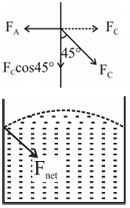
If for a liquid in a glass vessel,the force of cohesion $(F_C)$ is twice the force of adhesion $(F_A)$,then which of the following statements are correct?
$(A)$ The meniscus will be convex.
$(B)$ The liquid will wet the glass.
$(C)$ The angle of contact will be obtuse.
$(D)$ There will be capillary descent in a glass capillary dipped in the liquid.
Correct option$(s)$ is/are:
$(A)$ The meniscus will be convex.
$(B)$ The liquid will wet the glass.
$(C)$ The angle of contact will be obtuse.
$(D)$ There will be capillary descent in a glass capillary dipped in the liquid.
Correct option$(s)$ is/are:
A
Only $(B)$
B
All $(A), (B), (C), (D)$
C
Only $(A), (C)$
D
Only $(A), (C), (D)$
Solution
(D) The net force on a molecule at the surface of the liquid near the glass wall is given by the resultant of the cohesive force $(F_C)$ and the adhesive force $(F_A)$.
Given $F_C = 2F_A$.
The net force $F_{net}$ acts at an angle $\theta$ with the vertical,where $\tan \theta = \frac{F_A}{F_C} = \frac{F_A}{2F_A} = 0.5$.
Since the cohesive force is greater than the adhesive force $(F_C > F_A)$,the net force is directed into the liquid,making the meniscus convex.
Because the meniscus is convex,the angle of contact $\theta_c$ is obtuse $(> 90^{\circ})$.
Liquids with an obtuse angle of contact do not wet the glass surface.
The capillary rise or fall is given by $h = \frac{2T \cos \theta_c}{r \rho g}$. Since $\theta_c > 90^{\circ}$,$\cos \theta_c$ is negative,resulting in a negative value for $h$,which indicates capillary descent.
Therefore,statements $(A), (C),$ and $(D)$ are correct.
Given $F_C = 2F_A$.
The net force $F_{net}$ acts at an angle $\theta$ with the vertical,where $\tan \theta = \frac{F_A}{F_C} = \frac{F_A}{2F_A} = 0.5$.
Since the cohesive force is greater than the adhesive force $(F_C > F_A)$,the net force is directed into the liquid,making the meniscus convex.
Because the meniscus is convex,the angle of contact $\theta_c$ is obtuse $(> 90^{\circ})$.
Liquids with an obtuse angle of contact do not wet the glass surface.
The capillary rise or fall is given by $h = \frac{2T \cos \theta_c}{r \rho g}$. Since $\theta_c > 90^{\circ}$,$\cos \theta_c$ is negative,resulting in a negative value for $h$,which indicates capillary descent.
Therefore,statements $(A), (C),$ and $(D)$ are correct.
0 likes
View Solution31
EasyMCQ
In a sphere of influence,the liquid molecule at its centre is
A
attracted by other molecules in the sphere of influence.
B
repelled by other molecules lying outside the sphere of influence.
C
attracted by other molecules lying outside the sphere of influence.
D
repelled by other molecules in the sphere of influence.
Solution
(A) sphere of influence is defined as a sphere with a radius equal to the molecular range,centered at a specific molecule.
Within this sphere,the central molecule experiences attractive intermolecular forces from all other molecules present inside the sphere.
Since the sphere is centered on the molecule,the distribution of surrounding molecules is symmetric,resulting in a net force of zero on the central molecule.
However,the interaction itself is an attractive force exerted by the other molecules located within this sphere of influence.
Within this sphere,the central molecule experiences attractive intermolecular forces from all other molecules present inside the sphere.
Since the sphere is centered on the molecule,the distribution of surrounding molecules is symmetric,resulting in a net force of zero on the central molecule.
However,the interaction itself is an attractive force exerted by the other molecules located within this sphere of influence.
0 likes
View Solution32
MediumMCQ
$A$ molecule of water on the surface experiences:
A
Downward resultant unbalanced adhesive force
B
Upward resultant unbalanced cohesive force
C
Downward resultant unbalanced cohesive force
D
Upward resultant unbalanced adhesive force
Solution
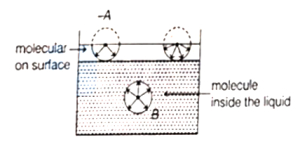
(C) molecule on the surface experiences a net force (cohesive force) in the downward direction because there are more molecules pulling it from below than from above (molecule $A$ as shown in the figure).
In contrast,a molecule well inside the liquid is equally pulled in all directions by the surrounding molecules (molecule $B$ as shown in the figure),resulting in a net force of zero.
In contrast,a molecule well inside the liquid is equally pulled in all directions by the surrounding molecules (molecule $B$ as shown in the figure),resulting in a net force of zero.
0 likes
View Solution33
MediumMCQ
Water does not wet an oily glass because
A
Cohesive force of oil is greater than adhesive force between oil and glass
B
Cohesive force of oil is greater than cohesive force of water
C
Oil repels water
D
Cohesive force of water is greater than adhesive force between water and oil molecules
Solution
(D) The force of attraction between the same molecules is called cohesive force,and the force of attraction between different molecules is called adhesive force.
When water comes into contact with an oily surface,it forms an obtuse angle of contact.
This indicates that the cohesive force between water molecules is significantly stronger than the adhesive force between water molecules and oil molecules.
Because the cohesive force dominates,the water molecules prefer to stick to each other rather than spreading over the oily surface,preventing the glass from getting wet.
Therefore,the correct reason is that the cohesive force of water is greater than the adhesive force between water and oil molecules.
When water comes into contact with an oily surface,it forms an obtuse angle of contact.
This indicates that the cohesive force between water molecules is significantly stronger than the adhesive force between water molecules and oil molecules.
Because the cohesive force dominates,the water molecules prefer to stick to each other rather than spreading over the oily surface,preventing the glass from getting wet.
Therefore,the correct reason is that the cohesive force of water is greater than the adhesive force between water and oil molecules.
0 likes
View SolutionFluid Mechanics and Surface Tension — Basic of Surface tenstion , Adhesive force and Cohesive force · Frequently Asked Questions
1Are these Fluid Mechanics and Surface Tension questions useful for JEE and NEET?
Yes. All questions in this section are mapped to JEE Main and NEET exam patterns. Previous year questions from JEE Main, NEET, GUJCET and state-level exams are included with full solutions.
2Can I switch to Hindi or Gujarati for these questions?
Yes. Use the language tabs in the hero section or the sidebar to view the same questions and solutions in English, Hindi or Gujarati.
3How do I generate a question paper from this subtopic?
Use the Vedclass Exam Paper Generator — select the chapter and subtopic, set difficulty, and generate Sets A, B, C, D automatically. First 3 chapters of every subject are free.
Vedclass Products
For Students
Vedclass Test Series
Mock tests in real JEE/NEET style with performance analysis. 5-day free trial.
Start Free TrialFor Teachers
Exam Paper Generator
Generate Set A/B/C/D papers from this chapter in 2 minutes. 3 chapters free.
Try FreeFor Institutes
Online Exam Module
Live online exams with unlimited students, 360° analytics & white-label branding.
See DemoFor Teachers & Institutes
Generate a Fluid Mechanics and Surface Tension Exam Paper in 2 Minutes
Select subtopic & difficulty — Sets A, B, C, D auto-generated with No Repeat logic.
First 3 chapters of every subject are free — no payment required.