
A English
Velocity of Efflux and Torricelli's law Questions in English
Class 11 Physics · Fluid Mechanics and Surface Tension · Velocity of Efflux and Torricelli's law
125+
Questions
English
Language
100%
With Solutions
Showing 50 of 125 questions in English
1
MediumMCQ
If in a stationary lift,a man is standing with a bucket full of water,having a hole at its bottom. The rate of flow of water through this hole is $R_0$. If the lift starts to move up and down with the same acceleration $a$,and the rates of flow of water are $R_u$ and $R_d$ respectively,then:
A
$R_0 > R_u > R_d$
B
$R_u > R_0 > R_d$
C
$R_d > R_0 > R_u$
D
$R_u > R_d > R_0$
Solution
(B) The rate of flow of water through a hole at the bottom of a bucket is given by Torricelli's Law,$v = \sqrt{2gh_{eff}}$,where $h_{eff}$ is the effective acceleration due to gravity.
In a stationary lift,the effective acceleration is $g_{eff} = g$. Thus,$R_0 \propto \sqrt{g}$.
When the lift moves upward with acceleration $a$,the effective gravity becomes $g_{eff} = g + a$. Since $g + a > g$,the rate of flow $R_u$ increases,so $R_u > R_0$.
When the lift moves downward with acceleration $a$,the effective gravity becomes $g_{eff} = g - a$. Since $g - a < g$,the rate of flow $R_d$ decreases,so $R_d < R_0$.
Combining these,we get $R_u > R_0 > R_d$.
In a stationary lift,the effective acceleration is $g_{eff} = g$. Thus,$R_0 \propto \sqrt{g}$.
When the lift moves upward with acceleration $a$,the effective gravity becomes $g_{eff} = g + a$. Since $g + a > g$,the rate of flow $R_u$ increases,so $R_u > R_0$.
When the lift moves downward with acceleration $a$,the effective gravity becomes $g_{eff} = g - a$. Since $g - a < g$,the rate of flow $R_d$ decreases,so $R_d < R_0$.
Combining these,we get $R_u > R_0 > R_d$.
0 likes
View Solution2
EasyMCQ
$A$ cylinder of height $20\;m$ is completely filled with water. The velocity of efflux of water (in $m/s$) through a small hole on the side wall of the cylinder near its bottom is ....... $m/s$.
A
$10$
B
$20$
C
$25.5$
D
$5$
Solution
(B) According to Torricelli's law,the velocity of efflux $v$ of a liquid from a small hole at a depth $h$ below the free surface is given by the formula:
$v = \sqrt{2gh}$
Given:
Height of the cylinder $h = 20\;m$
Acceleration due to gravity $g = 10\;m/s^2$
Substituting the values into the formula:
$v = \sqrt{2 \times 10 \times 20}$
$v = \sqrt{400}$
$v = 20\;m/s$
Therefore,the velocity of efflux is $20\;m/s$.
$v = \sqrt{2gh}$
Given:
Height of the cylinder $h = 20\;m$
Acceleration due to gravity $g = 10\;m/s^2$
Substituting the values into the formula:
$v = \sqrt{2 \times 10 \times 20}$
$v = \sqrt{400}$
$v = 20\;m/s$
Therefore,the velocity of efflux is $20\;m/s$.
0 likes
View Solution3
MediumMCQ
There is a hole in the bottom of a tank containing water. If the total pressure at the bottom is $3 \text{ atm}$ $(1 \text{ atm} = 10^5 \text{ N/m}^2)$,then the velocity of water flowing from the hole is:
A
$\sqrt{400} \text{ m/s}$
B
$\sqrt{600} \text{ m/s}$
C
$\sqrt{60} \text{ m/s}$
D
None of these
Solution
(A) The total pressure at the bottom of the tank is $P = P_{\text{atm}} + h\rho g = 3 \times 10^5 \text{ N/m}^2$.
Since the atmospheric pressure $P_{\text{atm}} = 1 \times 10^5 \text{ N/m}^2$,the gauge pressure (pressure due to the liquid column) is $P_l = h\rho g = P - P_{\text{atm}} = 3 \times 10^5 - 1 \times 10^5 = 2 \times 10^5 \text{ N/m}^2$.
The velocity of efflux is given by Torricelli's law: $v = \sqrt{2gh}$.
Since $P_l = h\rho g$,we have $h = \frac{P_l}{\rho g}$.
Substituting this into the velocity formula: $v = \sqrt{2g \left( \frac{P_l}{\rho g} \right)} = \sqrt{\frac{2P_l}{\rho}}$.
Given the density of water $\rho = 10^3 \text{ kg/m}^3$,we get $v = \sqrt{\frac{2 \times 2 \times 10^5}{10^3}} = \sqrt{4 \times 10^2} = \sqrt{400} \text{ m/s}$.
Since the atmospheric pressure $P_{\text{atm}} = 1 \times 10^5 \text{ N/m}^2$,the gauge pressure (pressure due to the liquid column) is $P_l = h\rho g = P - P_{\text{atm}} = 3 \times 10^5 - 1 \times 10^5 = 2 \times 10^5 \text{ N/m}^2$.
The velocity of efflux is given by Torricelli's law: $v = \sqrt{2gh}$.
Since $P_l = h\rho g$,we have $h = \frac{P_l}{\rho g}$.
Substituting this into the velocity formula: $v = \sqrt{2g \left( \frac{P_l}{\rho g} \right)} = \sqrt{\frac{2P_l}{\rho}}$.
Given the density of water $\rho = 10^3 \text{ kg/m}^3$,we get $v = \sqrt{\frac{2 \times 2 \times 10^5}{10^3}} = \sqrt{4 \times 10^2} = \sqrt{400} \text{ m/s}$.
0 likes
View Solution4
MediumMCQ
There is a hole of area $A_0$ at the bottom of a cylindrical vessel of cross-sectional area $A$. Water is filled up to a height $h$ and the water flows out in time $t$. If water is filled to a height $4h$,it will flow out in time equal to:
A
$t$
B
$4t$
C
$2t$
D
$t/4$
Solution
(C) The time $t$ required to empty a cylindrical vessel of cross-sectional area $A$ through a hole of area $A_0$ at the bottom,when filled to a height $H$,is given by the formula:
$t = \frac{A}{A_0} \sqrt{\frac{2H}{g}}$
From this relation,we can see that the time $t$ is directly proportional to the square root of the height $H$:
$t \propto \sqrt{H}$
Therefore,the ratio of the times $t_2$ and $t_1$ for heights $H_2 = 4h$ and $H_1 = h$ is:
$\frac{t_2}{t_1} = \sqrt{\frac{H_2}{H_1}} = \sqrt{\frac{4h}{h}} = \sqrt{4} = 2$
Thus,$t_2 = 2t_1 = 2t$.
$t = \frac{A}{A_0} \sqrt{\frac{2H}{g}}$
From this relation,we can see that the time $t$ is directly proportional to the square root of the height $H$:
$t \propto \sqrt{H}$
Therefore,the ratio of the times $t_2$ and $t_1$ for heights $H_2 = 4h$ and $H_1 = h$ is:
$\frac{t_2}{t_1} = \sqrt{\frac{H_2}{H_1}} = \sqrt{\frac{4h}{h}} = \sqrt{4} = 2$
Thus,$t_2 = 2t_1 = 2t$.
0 likes
View Solution5
DifficultMCQ
$A$ cylindrical tank has a hole of $1 \, cm^2$ in its bottom. If water is allowed to flow into the tank from a tube above it at the rate of $70 \, cm^3/sec$, then the maximum height up to which water can rise in the tank is .......... $cm$.
A
$2.5$
B
$5$
C
$10$
D
$0.25$
Solution
(A) The height of water in the tank becomes maximum when the volume of water flowing into the tank per second becomes equal to the volume of water flowing out per second.
Volume of water flowing out per second is given by $Q_{out} = A \sqrt{2gh}$, where $A = 1 \, cm^2$ is the area of the hole, $g = 980 \, cm/s^2$ is the acceleration due to gravity, and $h$ is the height of the water.
Volume of water flowing in per second is $Q_{in} = 70 \, cm^3/s$.
At maximum height, $Q_{in} = Q_{out}$.
$70 = 1 \times \sqrt{2 \times 980 \times h}$
$70 = \sqrt{1960 \times h}$
Squaring both sides: $4900 = 1960 \times h$
$h = \frac{4900}{1960} = 2.5 \, cm$.
Volume of water flowing out per second is given by $Q_{out} = A \sqrt{2gh}$, where $A = 1 \, cm^2$ is the area of the hole, $g = 980 \, cm/s^2$ is the acceleration due to gravity, and $h$ is the height of the water.
Volume of water flowing in per second is $Q_{in} = 70 \, cm^3/s$.
At maximum height, $Q_{in} = Q_{out}$.
$70 = 1 \times \sqrt{2 \times 980 \times h}$
$70 = \sqrt{1960 \times h}$
Squaring both sides: $4900 = 1960 \times h$
$h = \frac{4900}{1960} = 2.5 \, cm$.
0 likes
View Solution6
DifficultMCQ
$A$ tank is filled with water up to a height $H$. Water is allowed to come out of a hole in one of the walls at a depth $D$ below the surface of water. Express the horizontal distance $x$ in terms of $H$ and $D$.
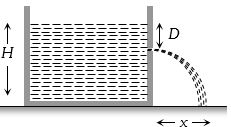
A
$x = \sqrt {D(H - D)} $
B
$x = \sqrt {\frac{{D(H - D)}}{2}} $
C
$x = 2\sqrt {D(H - D)} $
D
$x = 4\sqrt {D(H - D)} $
Solution
(C) The velocity of water coming out of the hole (velocity of efflux) is given by Torricelli's law as $v = \sqrt{2gD}$.
The height of the hole from the bottom of the tank is $(H - D)$.
The time $t$ taken by the water to reach the ground is calculated using the equation of motion for a freely falling body: $(H - D) = \frac{1}{2}gt^2$,which gives $t = \sqrt{\frac{2(H - D)}{g}}$.
The horizontal distance $x$ covered by the water is the product of the horizontal velocity and the time taken to reach the ground:
$x = v \times t$
$x = \sqrt{2gD} \times \sqrt{\frac{2(H - D)}{g}}$
$x = \sqrt{2gD \times \frac{2(H - D)}{g}}$
$x = \sqrt{4D(H - D)}$
$x = 2\sqrt{D(H - D)}$
The height of the hole from the bottom of the tank is $(H - D)$.
The time $t$ taken by the water to reach the ground is calculated using the equation of motion for a freely falling body: $(H - D) = \frac{1}{2}gt^2$,which gives $t = \sqrt{\frac{2(H - D)}{g}}$.
The horizontal distance $x$ covered by the water is the product of the horizontal velocity and the time taken to reach the ground:
$x = v \times t$
$x = \sqrt{2gD} \times \sqrt{\frac{2(H - D)}{g}}$
$x = \sqrt{2gD \times \frac{2(H - D)}{g}}$
$x = \sqrt{4D(H - D)}$
$x = 2\sqrt{D(H - D)}$
0 likes
View Solution7
MediumMCQ
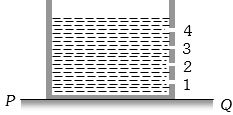
$A$ cylindrical vessel of $90 \ cm$ height is kept filled up to the brim. It has four holes $1, 2, 3, 4$ which are respectively at heights of $20 \ cm, 30 \ cm, 45 \ cm,$ and $50 \ cm$ from the horizontal floor $PQ.$ The water falling at the maximum horizontal distance from the vessel comes from:
A
Hole number $4$
B
Hole number $3$
C
Hole number $2$
D
Hole number $1$
Solution
(B) The horizontal range $R$ of water issuing from a small hole at a depth $y$ below the free surface of a liquid in a vessel of total height $H$ is given by $R = 2\sqrt{y(H-y)}$.
Here,the total height of the water column is $H = 90 \ cm$.
The holes are at heights $h_1 = 20 \ cm, h_2 = 30 \ cm, h_3 = 45 \ cm,$ and $h_4 = 50 \ cm$ from the floor.
The depth of each hole from the free surface is $y = H - h$.
For hole $1$: $y_1 = 90 - 20 = 70 \ cm$.
For hole $2$: $y_2 = 90 - 30 = 60 \ cm$.
For hole $3$: $y_3 = 90 - 45 = 45 \ cm$.
For hole $4$: $y_4 = 90 - 50 = 40 \ cm$.
The horizontal range is maximum when the depth $y$ is equal to half the total height,i.e.,$y = H/2 = 90/2 = 45 \ cm$.
Comparing the depths,hole $3$ is at a depth of $45 \ cm$ from the free surface.
Therefore,the water falling at the maximum horizontal distance comes from hole $3$.
Here,the total height of the water column is $H = 90 \ cm$.
The holes are at heights $h_1 = 20 \ cm, h_2 = 30 \ cm, h_3 = 45 \ cm,$ and $h_4 = 50 \ cm$ from the floor.
The depth of each hole from the free surface is $y = H - h$.
For hole $1$: $y_1 = 90 - 20 = 70 \ cm$.
For hole $2$: $y_2 = 90 - 30 = 60 \ cm$.
For hole $3$: $y_3 = 90 - 45 = 45 \ cm$.
For hole $4$: $y_4 = 90 - 50 = 40 \ cm$.
The horizontal range is maximum when the depth $y$ is equal to half the total height,i.e.,$y = H/2 = 90/2 = 45 \ cm$.
Comparing the depths,hole $3$ is at a depth of $45 \ cm$ from the free surface.
Therefore,the water falling at the maximum horizontal distance comes from hole $3$.
0 likes
View Solution8
MediumMCQ
$A$ rectangular vessel,when full of water,takes $10 \text{ minutes}$ to be emptied through an orifice in its bottom. How many minutes will it take to be emptied when half-filled with water?
A
$9$
B
$7$
C
$5$
D
$3$
Solution
(B) According to Torricelli's law,the velocity of efflux is $v = \sqrt{2gh}$.
The rate of flow is $\frac{dV}{dt} = A_0 v = A_0 \sqrt{2gh}$,where $A_0$ is the area of the orifice.
Since $V = Ah$ (where $A$ is the cross-sectional area of the vessel),we have $A \frac{dh}{dt} = -A_0 \sqrt{2gh}$.
Integrating this,the time $t$ taken to empty a vessel of height $H$ is $t = \int_{H}^{0} \frac{A}{-A_0 \sqrt{2g}} h^{-1/2} dh = \frac{A}{A_0} \sqrt{\frac{2H}{g}}$.
Thus,$t \propto \sqrt{H}$.
Given $t_1 = 10 \text{ minutes}$ for height $H$,for height $H/2$,the time $t_2$ is:
$t_2 = t_1 \sqrt{\frac{H/2}{H}} = \frac{t_1}{\sqrt{2}}$.
$t_2 = \frac{10}{\sqrt{2}} = 5\sqrt{2} \approx 5 \times 1.414 = 7.07 \text{ minutes}$.
Rounding to the nearest integer,the time is $7 \text{ minutes}$.
The rate of flow is $\frac{dV}{dt} = A_0 v = A_0 \sqrt{2gh}$,where $A_0$ is the area of the orifice.
Since $V = Ah$ (where $A$ is the cross-sectional area of the vessel),we have $A \frac{dh}{dt} = -A_0 \sqrt{2gh}$.
Integrating this,the time $t$ taken to empty a vessel of height $H$ is $t = \int_{H}^{0} \frac{A}{-A_0 \sqrt{2g}} h^{-1/2} dh = \frac{A}{A_0} \sqrt{\frac{2H}{g}}$.
Thus,$t \propto \sqrt{H}$.
Given $t_1 = 10 \text{ minutes}$ for height $H$,for height $H/2$,the time $t_2$ is:
$t_2 = t_1 \sqrt{\frac{H/2}{H}} = \frac{t_1}{\sqrt{2}}$.
$t_2 = \frac{10}{\sqrt{2}} = 5\sqrt{2} \approx 5 \times 1.414 = 7.07 \text{ minutes}$.
Rounding to the nearest integer,the time is $7 \text{ minutes}$.
0 likes
View Solution9
DifficultMCQ
$A$ cylinder containing water up to a height of $25 \ cm$ has a hole of cross-section $\frac{1}{4} \ cm^2$ in its bottom. It is counterpoised in a balance. What is the initial change in the balancing weight when water begins to flow out?
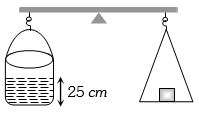
A
Increase of $12.5 \ gm-wt$
B
Increase of $6.25 \ gm-wt$
C
Decrease of $12.5 \ gm-wt$
D
Decrease of $6.25 \ gm-wt$
Solution
(C) Let $A$ be the area of cross-section of the hole,$v$ be the initial velocity of efflux,and $d$ be the density of water.
According to Torricelli's law,the velocity of efflux is $v = \sqrt{2gh}$.
The volume of water flowing out per second is $V = Av$.
The mass of water flowing out per second is $m = Avd$.
The rate of change of momentum (thrust force) is $F = \frac{dp}{dt} = (Avd)v = Adv^2$.
This thrust force acts upwards on the cylinder due to the reaction of the water jet.
Substituting $v^2 = 2gh$,the upward reaction force is $F = Ad(2gh) = 2Adgh$.
Given $A = \frac{1}{4} \ cm^2$,$d = 1 \ g/cm^3$,$g = 980 \ cm/s^2$,and $h = 25 \ cm$.
$F = 2 \times \frac{1}{4} \times 1 \times 980 \times 25 = 12250 \ dynes$.
Since $1 \ gm-wt = 980 \ dynes$,the force in $gm-wt$ is $F = \frac{12250}{980} = 12.5 \ gm-wt$.
As this force acts upwards,it causes a decrease in the effective weight of the cylinder on the balance.
According to Torricelli's law,the velocity of efflux is $v = \sqrt{2gh}$.
The volume of water flowing out per second is $V = Av$.
The mass of water flowing out per second is $m = Avd$.
The rate of change of momentum (thrust force) is $F = \frac{dp}{dt} = (Avd)v = Adv^2$.
This thrust force acts upwards on the cylinder due to the reaction of the water jet.
Substituting $v^2 = 2gh$,the upward reaction force is $F = Ad(2gh) = 2Adgh$.
Given $A = \frac{1}{4} \ cm^2$,$d = 1 \ g/cm^3$,$g = 980 \ cm/s^2$,and $h = 25 \ cm$.
$F = 2 \times \frac{1}{4} \times 1 \times 980 \times 25 = 12250 \ dynes$.
Since $1 \ gm-wt = 980 \ dynes$,the force in $gm-wt$ is $F = \frac{12250}{980} = 12.5 \ gm-wt$.
As this force acts upwards,it causes a decrease in the effective weight of the cylinder on the balance.
0 likes
View Solution10
DifficultMCQ
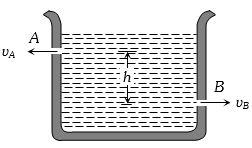
There are two identical small holes of cross-sectional area $a$ on the opposite sides of a tank containing a liquid of density $\rho$. The difference in height between the holes is $h$. The tank is resting on a smooth horizontal surface. The horizontal force that must be applied to the tank to keep it in equilibrium is
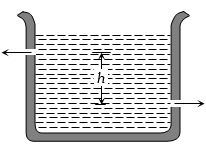
A
$gh\rho a$
B
$\frac{2gh}{\rho a}$
C
$2\rho agh$
D
$\frac{\rho gh}{a}$
Solution
(C) Let the velocities of the liquid exiting from the upper hole $A$ and the lower hole $B$ be $v_A$ and $v_B$ respectively.
According to the principle of conservation of momentum,the force exerted by the liquid jet is equal to the rate of change of momentum,$F = \frac{dp}{dt} = \rho a v^2$.
Since the holes are on opposite sides,the forces act in opposite directions. The net force $F$ required to keep the tank in equilibrium is:
$F = F_B - F_A = \rho a v_B^2 - \rho a v_A^2 = \rho a (v_B^2 - v_A^2)$
Applying Bernoulli's theorem between the two holes,where $h$ is the vertical distance between them:
$P_A + \frac{1}{2}\rho v_A^2 + \rho g h_A = P_B + \frac{1}{2}\rho v_B^2 + \rho g h_B$
Taking the pressure at both holes to be atmospheric pressure $(P_A = P_B = P_{atm})$,we get:
$\frac{1}{2}\rho v_A^2 + \rho g h = \frac{1}{2}\rho v_B^2 + 0$ (taking the lower hole as reference level $0$)
$v_B^2 - v_A^2 = 2gh$
Substituting this into the force equation:
$F = \rho a (2gh) = 2\rho agh$.
According to the principle of conservation of momentum,the force exerted by the liquid jet is equal to the rate of change of momentum,$F = \frac{dp}{dt} = \rho a v^2$.
Since the holes are on opposite sides,the forces act in opposite directions. The net force $F$ required to keep the tank in equilibrium is:
$F = F_B - F_A = \rho a v_B^2 - \rho a v_A^2 = \rho a (v_B^2 - v_A^2)$
Applying Bernoulli's theorem between the two holes,where $h$ is the vertical distance between them:
$P_A + \frac{1}{2}\rho v_A^2 + \rho g h_A = P_B + \frac{1}{2}\rho v_B^2 + \rho g h_B$
Taking the pressure at both holes to be atmospheric pressure $(P_A = P_B = P_{atm})$,we get:
$\frac{1}{2}\rho v_A^2 + \rho g h = \frac{1}{2}\rho v_B^2 + 0$ (taking the lower hole as reference level $0$)
$v_B^2 - v_A^2 = 2gh$
Substituting this into the force equation:
$F = \rho a (2gh) = 2\rho agh$.
0 likes
View Solution11
DifficultMCQ
$A$ vessel of area of cross-section $A$ has liquid to a height $H$. There is a hole at the bottom of the vessel having area of cross-section $a$. The time taken to decrease the level from $H_1$ to $H_2$ will be:
A
$\frac{A}{a}\sqrt {\frac{2}{g}} [\sqrt {{H_1}} - \sqrt {{H_2}} ]$
B
$\sqrt {2gH}$
C
$\sqrt {2g({H_1} - {H_2})}$
D
$\frac{A}{a}\sqrt {\frac{g}{2}} [\sqrt {{H_1}} - \sqrt {{H_2}} ]$
Solution
(A) According to Torricelli's law,the velocity of efflux at height $h$ is $v = \sqrt{2gh}$.
The rate of volume flow out of the hole is $dV/dt = a \cdot v = a \sqrt{2gh}$.
Since the volume of liquid in the vessel decreases as the level drops,we have $dV = -A \cdot dh$ (where $dh$ is the change in height).
Equating the two expressions for $dV/dt$: $-A \cdot dh = a \sqrt{2gh} \cdot dt$.
Rearranging for $dt$: $dt = -\frac{A}{a \sqrt{2g}} \cdot h^{-1/2} \cdot dh$.
Integrating from $H_1$ to $H_2$ to find the total time $t$: $t = \int_{0}^{t} dt = -\frac{A}{a \sqrt{2g}} \int_{H_1}^{H_2} h^{-1/2} \cdot dh$.
$t = \frac{A}{a \sqrt{2g}} \int_{H_2}^{H_1} h^{-1/2} \cdot dh = \frac{A}{a \sqrt{2g}} [2\sqrt{h}]_{H_2}^{H_1}$.
$t = \frac{A}{a} \sqrt{\frac{2}{g}} [\sqrt{H_1} - \sqrt{H_2}]$.
The rate of volume flow out of the hole is $dV/dt = a \cdot v = a \sqrt{2gh}$.
Since the volume of liquid in the vessel decreases as the level drops,we have $dV = -A \cdot dh$ (where $dh$ is the change in height).
Equating the two expressions for $dV/dt$: $-A \cdot dh = a \sqrt{2gh} \cdot dt$.
Rearranging for $dt$: $dt = -\frac{A}{a \sqrt{2g}} \cdot h^{-1/2} \cdot dh$.
Integrating from $H_1$ to $H_2$ to find the total time $t$: $t = \int_{0}^{t} dt = -\frac{A}{a \sqrt{2g}} \int_{H_1}^{H_2} h^{-1/2} \cdot dh$.
$t = \frac{A}{a \sqrt{2g}} \int_{H_2}^{H_1} h^{-1/2} \cdot dh = \frac{A}{a \sqrt{2g}} [2\sqrt{h}]_{H_2}^{H_1}$.
$t = \frac{A}{a} \sqrt{\frac{2}{g}} [\sqrt{H_1} - \sqrt{H_2}]$.
0 likes
View Solution12
DifficultMCQ
$A$ container is filled with water up to a height $h$. $A$ small hole is made at the bottom. What is the ratio of the time taken for the water level to fall from $h$ to $\frac{h}{2}$ to the time taken for it to fall from $\frac{h}{2}$ to $0$?
A
$\sqrt{2}$
B
$\frac{1}{\sqrt{2}}$
C
$\sqrt{2} - 1$
D
$\frac{1}{\sqrt{2} - 1}$
Solution
(C) The time $t$ taken for the water level to drop from height $H_1$ to $H_2$ is given by the formula: $t = \frac{A}{A_0} \sqrt{\frac{2}{g}} (\sqrt{H_1} - \sqrt{H_2})$,where $A$ is the cross-sectional area of the container and $A_0$ is the area of the hole.
For the first interval (from $h$ to $\frac{h}{2}$): $t_1 = \frac{A}{A_0} \sqrt{\frac{2}{g}} (\sqrt{h} - \sqrt{\frac{h}{2}})$.
For the second interval (from $\frac{h}{2}$ to $0$): $t_2 = \frac{A}{A_0} \sqrt{\frac{2}{g}} (\sqrt{\frac{h}{2}} - \sqrt{0})$.
Taking the ratio: $\frac{t_1}{t_2} = \frac{\sqrt{h} - \sqrt{\frac{h}{2}}}{\sqrt{\frac{h}{2}}} = \frac{1 - \frac{1}{\sqrt{2}}}{\frac{1}{\sqrt{2}}} = \sqrt{2} - 1$.
For the first interval (from $h$ to $\frac{h}{2}$): $t_1 = \frac{A}{A_0} \sqrt{\frac{2}{g}} (\sqrt{h} - \sqrt{\frac{h}{2}})$.
For the second interval (from $\frac{h}{2}$ to $0$): $t_2 = \frac{A}{A_0} \sqrt{\frac{2}{g}} (\sqrt{\frac{h}{2}} - \sqrt{0})$.
Taking the ratio: $\frac{t_1}{t_2} = \frac{\sqrt{h} - \sqrt{\frac{h}{2}}}{\sqrt{\frac{h}{2}}} = \frac{1 - \frac{1}{\sqrt{2}}}{\frac{1}{\sqrt{2}}} = \sqrt{2} - 1$.
0 likes
View Solution13
MediumMCQ
$A$ container is filled with water up to a height of $20 \ m$. If a hole is made at the bottom,what will be the velocity of the water coming out in $m/s$?
A
$10$
B
$20$
C
$25.5$
D
$5$
Solution
(B) According to Torricelli's Law,the velocity of efflux $v$ of a liquid from a hole at a depth $h$ below the free surface is given by the formula: $v = \sqrt{2gh}$.
Given:
Height $h = 20 \ m$
Acceleration due to gravity $g = 10 \ m/s^2$
Substituting the values into the formula:
$v = \sqrt{2 \times 10 \times 20}$
$v = \sqrt{400}$
$v = 20 \ m/s$.
Therefore,the velocity of the water coming out is $20 \ m/s$.
Given:
Height $h = 20 \ m$
Acceleration due to gravity $g = 10 \ m/s^2$
Substituting the values into the formula:
$v = \sqrt{2 \times 10 \times 20}$
$v = \sqrt{400}$
$v = 20 \ m/s$.
Therefore,the velocity of the water coming out is $20 \ m/s$.
0 likes
View Solution14
MediumMCQ
There is a hole at the bottom of a water tank. The total pressure at the bottom is $3 \, atm$ $(1 \, atm = 10^{5} \, N/m^{2})$. What is the velocity of the water coming out of the hole?
A
$\sqrt{400} \, m/s$
B
$\sqrt{600} \, m/s$
C
$\sqrt{60} \, m/s$
D
None of these
Solution
(B) The pressure at the bottom of the tank is given by $P = h \rho g = 3 \times 10^{5} \, N/m^{2}$.
According to Torricelli's law,the velocity of efflux is $v = \sqrt{2gh}$.
Since $P = h \rho g$,we can write $h = P / (\rho g)$.
Substituting this into the velocity formula: $v = \sqrt{2g(P / \rho g)} = \sqrt{2P / \rho}$.
Given density of water $\rho = 10^{3} \, kg/m^{3}$ and $P = 3 \times 10^{5} \, N/m^{2}$.
$v = \sqrt{(2 \times 3 \times 10^{5}) / 10^{3}} = \sqrt{6 \times 10^{2}} = \sqrt{600} \, m/s$.
According to Torricelli's law,the velocity of efflux is $v = \sqrt{2gh}$.
Since $P = h \rho g$,we can write $h = P / (\rho g)$.
Substituting this into the velocity formula: $v = \sqrt{2g(P / \rho g)} = \sqrt{2P / \rho}$.
Given density of water $\rho = 10^{3} \, kg/m^{3}$ and $P = 3 \times 10^{5} \, N/m^{2}$.
$v = \sqrt{(2 \times 3 \times 10^{5}) / 10^{3}} = \sqrt{6 \times 10^{2}} = \sqrt{600} \, m/s$.
0 likes
View Solution15
DifficultMCQ
$A$ vessel is filled with water up to a height $h$. When a hole is made at the bottom,all the water drains out in time $t$. If the vessel is filled with water up to a height $4h$,how long will it take for the water to drain out completely when a hole is made at the bottom?
A
$t$
B
$4t$
C
$2t$
D
$t/4$
Solution
(C) The time $t$ taken for a vessel of cross-sectional area $A$ to drain through an orifice of area $A_0$ from an initial height $H$ is given by the formula: $t = \frac{A}{A_0} \sqrt{\frac{2H}{g}}$.
From this relation,we can see that the time $t$ is directly proportional to the square root of the height,i.e.,$t \propto \sqrt{H}$.
Given the initial height $H_1 = h$ and time $t_1 = t$.
For the new height $H_2 = 4h$,let the time be $t_2$.
Using the ratio: $\frac{t_2}{t_1} = \sqrt{\frac{H_2}{H_1}} = \sqrt{\frac{4h}{h}} = \sqrt{4} = 2$.
Therefore,$t_2 = 2t$.
From this relation,we can see that the time $t$ is directly proportional to the square root of the height,i.e.,$t \propto \sqrt{H}$.
Given the initial height $H_1 = h$ and time $t_1 = t$.
For the new height $H_2 = 4h$,let the time be $t_2$.
Using the ratio: $\frac{t_2}{t_1} = \sqrt{\frac{H_2}{H_1}} = \sqrt{\frac{4h}{h}} = \sqrt{4} = 2$.
Therefore,$t_2 = 2t$.
0 likes
View Solution16
MediumMCQ
$A$ container has a hole of cross-sectional area $1 \, cm^2$ at its bottom. If water is poured into the container at a rate of $70 \, cm^3/s$, what is the maximum height (in $cm$) to which the water can be filled?
A
$2.5$
B
$5$
C
$10$
D
$0.25$
Solution
(A) The rate of flow of water out of the hole is given by Torricelli's law: $Q_{out} = A \cdot v = A \sqrt{2gh}$.
Given the rate of water being poured in is $Q_{in} = 70 \, cm^3/s$.
For the water level to be at a maximum height, the rate of water flowing in must equal the rate of water flowing out: $Q_{in} = Q_{out}$.
Substituting the values: $70 = 1 \times \sqrt{2 \times 980 \times h}$.
Squaring both sides: $70^2 = 2 \times 980 \times h$.
$4900 = 1960 \times h$.
$h = \frac{4900}{1960} = 2.5 \, cm$.
Given the rate of water being poured in is $Q_{in} = 70 \, cm^3/s$.
For the water level to be at a maximum height, the rate of water flowing in must equal the rate of water flowing out: $Q_{in} = Q_{out}$.
Substituting the values: $70 = 1 \times \sqrt{2 \times 980 \times h}$.
Squaring both sides: $70^2 = 2 \times 980 \times h$.
$4900 = 1960 \times h$.
$h = \frac{4900}{1960} = 2.5 \, cm$.
0 likes
View Solution17
DifficultMCQ
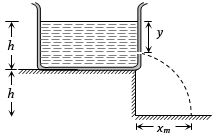
$A$ tank is filled up to a height $h$ with a liquid and is placed on a platform of height $h$ from the ground. To get the maximum range $x_m$,a small hole is punched at a distance of $y$ from the free surface of the liquid. Then:
A
$x_m = 2h$
B
$x_m = 1.5h$
C
$y = h$
D
$(a)$ or $(c)$ both
Solution
(D) The velocity of the liquid through the orifice is given by Torricelli's law: $v = \sqrt{2gy}$.
The height of the orifice from the ground is $(h - y) + h = 2h - y$. The time taken by the liquid to reach the ground is:
$t = \sqrt{\frac{2(2h - y)}{g}}$.
The horizontal range $x$ is given by the product of horizontal velocity and time:
$x = v \cdot t = \sqrt{2gy} \cdot \sqrt{\frac{2(2h - y)}{g}} = \sqrt{4y(2h - y)}$.
To find the maximum range,we maximize $x^2$ with respect to $y$:
$x^2 = 4y(2h - y) = 8hy - 4y^2$.
Differentiating with respect to $y$ and setting to zero:
$\frac{d(x^2)}{dy} = 8h - 8y = 0 \implies y = h$.
Substituting $y = h$ back into the expression for $x$:
$x_m = \sqrt{4h(2h - h)} = \sqrt{4h^2} = 2h$.
Since both $y = h$ and $x_m = 2h$ are correct,the correct option is $(d)$.
The height of the orifice from the ground is $(h - y) + h = 2h - y$. The time taken by the liquid to reach the ground is:
$t = \sqrt{\frac{2(2h - y)}{g}}$.
The horizontal range $x$ is given by the product of horizontal velocity and time:
$x = v \cdot t = \sqrt{2gy} \cdot \sqrt{\frac{2(2h - y)}{g}} = \sqrt{4y(2h - y)}$.
To find the maximum range,we maximize $x^2$ with respect to $y$:
$x^2 = 4y(2h - y) = 8hy - 4y^2$.
Differentiating with respect to $y$ and setting to zero:
$\frac{d(x^2)}{dy} = 8h - 8y = 0 \implies y = h$.
Substituting $y = h$ back into the expression for $x$:
$x_m = \sqrt{4h(2h - h)} = \sqrt{4h^2} = 2h$.
Since both $y = h$ and $x_m = 2h$ are correct,the correct option is $(d)$.
0 likes
View Solution18
DifficultMCQ
$A$ rectangular tank is placed on a horizontal ground and is filled with water to a height $H$ above the base. $A$ small hole is made on one vertical side at a depth $D$ below the level of the water in the tank. The distance $x$ from the bottom of the tank at which the water jet from the tank will hit the ground is
A
$2\sqrt{D(H-D)}$
B
$2\sqrt{DH}$
C
$2\sqrt{D(H+D)}$
D
$\frac{1}{2}\sqrt{DH}$
Solution
(A) The height of the water level above the hole is $D$. The height of the hole above the ground is $(H-D)$.
Using Torricelli's law,the velocity of the water jet emerging from the hole is $v = \sqrt{2gD}$.
The time $t$ taken by the water jet to reach the ground from the height $(H-D)$ is given by the equation of motion $S = ut + \frac{1}{2}at^2$,where $S = H-D$,$u = 0$,and $a = g$.
$H-D = 0 + \frac{1}{2}gt^2 \implies t = \sqrt{\frac{2(H-D)}{g}}$.
The horizontal distance $x$ (range) is the product of horizontal velocity and time:
$x = v \times t = \sqrt{2gD} \times \sqrt{\frac{2(H-D)}{g}}$.
$x = \sqrt{2gD \times \frac{2(H-D)}{g}} = \sqrt{4D(H-D)} = 2\sqrt{D(H-D)}$.
Using Torricelli's law,the velocity of the water jet emerging from the hole is $v = \sqrt{2gD}$.
The time $t$ taken by the water jet to reach the ground from the height $(H-D)$ is given by the equation of motion $S = ut + \frac{1}{2}at^2$,where $S = H-D$,$u = 0$,and $a = g$.
$H-D = 0 + \frac{1}{2}gt^2 \implies t = \sqrt{\frac{2(H-D)}{g}}$.
The horizontal distance $x$ (range) is the product of horizontal velocity and time:
$x = v \times t = \sqrt{2gD} \times \sqrt{\frac{2(H-D)}{g}}$.
$x = \sqrt{2gD \times \frac{2(H-D)}{g}} = \sqrt{4D(H-D)} = 2\sqrt{D(H-D)}$.
0 likes
View Solution19
AdvancedMCQ
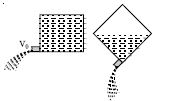
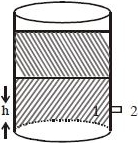
$A$ cubical box of wine has a small spout located in one of the bottom corners. When the box is full and placed on a level surface,opening the spout results in a flow of wine with an initial speed of $v_0$ (see figure). When the box is half empty,someone tilts it at $45^{\circ}$ so that the spout is at the lowest point (see figure). When the spout is opened,the wine will flow out with a speed of
A
$v_0$
B
$v_0/2$
C
$v_0/\sqrt{2}$
D
$\frac{v_0}{\sqrt[4]{2}}$
Solution
(D) According to Torricelli's Theorem,the velocity of efflux,i.e.,the velocity with which the liquid flows out of a hole,is equal to $\sqrt{2gh}$,where $h$ is the depth of the hole below the liquid surface.
Let the side of the cube be $a$. When the box is full,the depth of the spout below the liquid surface is $h = a$. Therefore,the initial speed is:
$v_0 = \sqrt{2ga}$
When the cubical box is half empty and tilted at $45^{\circ}$ such that the spout is at the lowest point,the liquid surface forms a plane passing through the diagonal of the cube. The height of the liquid surface above the spout is equal to the distance from the bottom corner to the diagonal plane,which is half the length of the face diagonal of the cube:
$h' = \frac{\sqrt{2}a}{2} = \frac{a}{\sqrt{2}}$
Now,the speed of the wine from the spout is:
$v' = \sqrt{2gh'} = \sqrt{2g \left( \frac{a}{\sqrt{2}} \right)} = \sqrt{\frac{2ga}{\sqrt{2}}} = \frac{\sqrt{2ga}}{\sqrt[4]{2}} = \frac{v_0}{\sqrt[4]{2}}$
Let the side of the cube be $a$. When the box is full,the depth of the spout below the liquid surface is $h = a$. Therefore,the initial speed is:
$v_0 = \sqrt{2ga}$
When the cubical box is half empty and tilted at $45^{\circ}$ such that the spout is at the lowest point,the liquid surface forms a plane passing through the diagonal of the cube. The height of the liquid surface above the spout is equal to the distance from the bottom corner to the diagonal plane,which is half the length of the face diagonal of the cube:
$h' = \frac{\sqrt{2}a}{2} = \frac{a}{\sqrt{2}}$
Now,the speed of the wine from the spout is:
$v' = \sqrt{2gh'} = \sqrt{2g \left( \frac{a}{\sqrt{2}} \right)} = \sqrt{\frac{2ga}{\sqrt{2}}} = \frac{\sqrt{2ga}}{\sqrt[4]{2}} = \frac{v_0}{\sqrt[4]{2}}$
0 likes
View Solution20
MediumMCQ
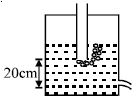
$A$ tube is attached as shown in a closed vessel containing water. The velocity of water coming out from a small hole is:
A
$\sqrt{2} \ m/s$
B
$2 \ m/s$
C
depends on pressure of air inside vessel
D
None of these
Solution
(B) According to the diagram,the tube is open to the atmosphere at the top and its lower end is submerged in water at a depth $h = 20 \ cm = 0.2 \ m$ above the hole.
Applying Bernoulli's theorem between the surface of the water in the tube (which is at atmospheric pressure $P_0$) and the hole (also at atmospheric pressure $P_0$):
$P_0 + \rho g h + 0 = P_0 + 0 + \frac{1}{2} \rho v^2$
Here,$h$ is the vertical distance between the water level in the tube and the hole.
$v^2 = 2gh$
$v = \sqrt{2gh}$
Given $g = 10 \ m/s^2$ and $h = 0.2 \ m$:
$v = \sqrt{2 \times 10 \times 0.2} = \sqrt{4} = 2 \ m/s$.
Applying Bernoulli's theorem between the surface of the water in the tube (which is at atmospheric pressure $P_0$) and the hole (also at atmospheric pressure $P_0$):
$P_0 + \rho g h + 0 = P_0 + 0 + \frac{1}{2} \rho v^2$
Here,$h$ is the vertical distance between the water level in the tube and the hole.
$v^2 = 2gh$
$v = \sqrt{2gh}$
Given $g = 10 \ m/s^2$ and $h = 0.2 \ m$:
$v = \sqrt{2 \times 10 \times 0.2} = \sqrt{4} = 2 \ m/s$.
0 likes
View Solution21
AdvancedMCQ
$A$ large tank is filled with water to a height $H$. $A$ small hole is made at the base of the tank. It takes $T_1$ time to decrease the height of water to $H/\eta$ (where $\eta > 1$),and it takes $T_2$ time to drain the rest of the water. If $T_1 = T_2$,then the value of $\eta$ is:
A
$2$
B
$3$
C
$4$
D
$2\sqrt{2}$
Solution
(C) The time taken to decrease the water level from $H_1$ to $H_2$ in a tank of cross-sectional area $A$ with an orifice of area $a$ is given by $t = \frac{A}{a} \sqrt{\frac{2}{g}} (\sqrt{H_1} - \sqrt{H_2})$.
For the first interval,the height decreases from $H$ to $H/\eta$. Thus,$T_1 = \frac{A}{a} \sqrt{\frac{2}{g}} (\sqrt{H} - \sqrt{H/\eta})$.
For the second interval,the height decreases from $H/\eta$ to $0$. Thus,$T_2 = \frac{A}{a} \sqrt{\frac{2}{g}} (\sqrt{H/\eta} - \sqrt{0}) = \frac{A}{a} \sqrt{\frac{2}{g}} \sqrt{H/\eta}$.
Given $T_1 = T_2$,we equate the expressions:
$\sqrt{H} - \sqrt{H/\eta} = \sqrt{H/\eta}$.
$\sqrt{H} = 2\sqrt{H/\eta}$.
Squaring both sides,$H = 4(H/\eta)$.
Therefore,$\eta = 4$.
For the first interval,the height decreases from $H$ to $H/\eta$. Thus,$T_1 = \frac{A}{a} \sqrt{\frac{2}{g}} (\sqrt{H} - \sqrt{H/\eta})$.
For the second interval,the height decreases from $H/\eta$ to $0$. Thus,$T_2 = \frac{A}{a} \sqrt{\frac{2}{g}} (\sqrt{H/\eta} - \sqrt{0}) = \frac{A}{a} \sqrt{\frac{2}{g}} \sqrt{H/\eta}$.
Given $T_1 = T_2$,we equate the expressions:
$\sqrt{H} - \sqrt{H/\eta} = \sqrt{H/\eta}$.
$\sqrt{H} = 2\sqrt{H/\eta}$.
Squaring both sides,$H = 4(H/\eta)$.
Therefore,$\eta = 4$.
0 likes
View Solution22
DifficultMCQ
$A$ cylindrical vessel filled with water up to the height $H$ becomes empty in time $t_0$ due to a small hole at the bottom of the vessel. If water is filled to a height $4H$,it will flow out in time:
A
$t_0$
B
$4t_0$
C
$8t_0$
D
$2t_0$
Solution
(D) According to Torricelli's Law,the velocity of efflux is $v = \sqrt{2gh}$.
The rate of change of volume of water in the vessel is given by $\frac{dV}{dt} = -A_h v$,where $A_h$ is the area of the hole and $A$ is the cross-sectional area of the vessel.
$A \frac{dh}{dt} = -A_h \sqrt{2gh}$
Integrating this expression from height $H$ to $0$ in time $t_0$:
$\int_{H}^{0} \frac{dh}{\sqrt{h}} = -\frac{A_h}{A} \sqrt{2g} \int_{0}^{t_0} dt$
$2\sqrt{H} = \frac{A_h}{A} \sqrt{2g} \cdot t_0$
This implies $t_0 \propto \sqrt{H}$.
For a new height $H' = 4H$,the new time $t'$ is:
$\frac{t'}{t_0} = \sqrt{\frac{H'}{H}} = \sqrt{\frac{4H}{H}} = 2$
Therefore,$t' = 2t_0$.
The rate of change of volume of water in the vessel is given by $\frac{dV}{dt} = -A_h v$,where $A_h$ is the area of the hole and $A$ is the cross-sectional area of the vessel.
$A \frac{dh}{dt} = -A_h \sqrt{2gh}$
Integrating this expression from height $H$ to $0$ in time $t_0$:
$\int_{H}^{0} \frac{dh}{\sqrt{h}} = -\frac{A_h}{A} \sqrt{2g} \int_{0}^{t_0} dt$
$2\sqrt{H} = \frac{A_h}{A} \sqrt{2g} \cdot t_0$
This implies $t_0 \propto \sqrt{H}$.
For a new height $H' = 4H$,the new time $t'$ is:
$\frac{t'}{t_0} = \sqrt{\frac{H'}{H}} = \sqrt{\frac{4H}{H}} = 2$
Therefore,$t' = 2t_0$.
0 likes
View Solution23
DifficultMCQ
$A$ vertical tank,open at the top,is filled with a liquid and rests on a smooth horizontal surface. $A$ small hole is opened at the centre of one side of the tank. The area of cross-section of the tank is $N$ times the area of the hole,where $N$ is a large number. Neglect the mass of the tank itself. The initial acceleration of the tank is:
A
$\frac{g}{2N}$
B
$\frac{g}{\sqrt{2}N}$
C
$\frac{g}{N}$
D
$\frac{g}{2\sqrt{N}}$
Solution
(C) Let $H$ be the height of the liquid in the tank and $A_h$ be the area of the hole. The area of cross-section of the tank is $A_t = N A_h$.
The velocity of efflux $v$ of the liquid from the hole at the center (at depth $h = H/2$) is given by Torricelli's law: $v = \sqrt{2gh} = \sqrt{2g(H/2)} = \sqrt{gH}$.
The force $F$ exerted on the tank due to the efflux of the liquid is given by $F = \rho A_h v^2$,where $\rho$ is the density of the liquid.
Substituting $v^2 = gH$,we get $F = \rho A_h (gH)$.
The mass of the liquid in the tank is $M = \rho V = \rho (A_t H) = \rho (N A_h H)$.
The initial acceleration $a$ of the tank is given by Newton's second law: $a = \frac{F}{M}$.
$a = \frac{\rho A_h g H}{\rho N A_h H} = \frac{g}{N}$.
The velocity of efflux $v$ of the liquid from the hole at the center (at depth $h = H/2$) is given by Torricelli's law: $v = \sqrt{2gh} = \sqrt{2g(H/2)} = \sqrt{gH}$.
The force $F$ exerted on the tank due to the efflux of the liquid is given by $F = \rho A_h v^2$,where $\rho$ is the density of the liquid.
Substituting $v^2 = gH$,we get $F = \rho A_h (gH)$.
The mass of the liquid in the tank is $M = \rho V = \rho (A_t H) = \rho (N A_h H)$.
The initial acceleration $a$ of the tank is given by Newton's second law: $a = \frac{F}{M}$.
$a = \frac{\rho A_h g H}{\rho N A_h H} = \frac{g}{N}$.
0 likes
View Solution24
DifficultMCQ
Water flows into a cylindrical vessel of large cross-sectional area at a rate of $10^{-4} \; m^3/s$. It flows out from a hole of area $10^{-4} \; m^2$, which has been punched through the base. How high does the water rise in the vessel (in $; m$)?
A
$0.075$
B
$0.051$
C
$0.031$
D
$0.025$
Solution
(B) The rate of inflow is given by $Q_{in} = 10^{-4} \; m^3/s$.
The rate of outflow through the hole is given by $Q_{out} = A_{hole} \times v$, where $v$ is the velocity of efflux.
According to Torricelli's law, the velocity of efflux is $v = \sqrt{2gh}$.
For the water level to remain constant (steady state), the rate of inflow must equal the rate of outflow: $Q_{in} = Q_{out}$.
$10^{-4} = (10^{-4}) \times \sqrt{2gh}$.
Dividing both sides by $10^{-4}$, we get $1 = \sqrt{2gh}$.
Squaring both sides, $1 = 2gh$.
Solving for $h$, $h = \frac{1}{2g}$.
Using $g = 9.8 \; m/s^2$, $h = \frac{1}{2 \times 9.8} = \frac{1}{19.6} \approx 0.051 \; m$.
The rate of outflow through the hole is given by $Q_{out} = A_{hole} \times v$, where $v$ is the velocity of efflux.
According to Torricelli's law, the velocity of efflux is $v = \sqrt{2gh}$.
For the water level to remain constant (steady state), the rate of inflow must equal the rate of outflow: $Q_{in} = Q_{out}$.
$10^{-4} = (10^{-4}) \times \sqrt{2gh}$.
Dividing both sides by $10^{-4}$, we get $1 = \sqrt{2gh}$.
Squaring both sides, $1 = 2gh$.
Solving for $h$, $h = \frac{1}{2g}$.
Using $g = 9.8 \; m/s^2$, $h = \frac{1}{2 \times 9.8} = \frac{1}{19.6} \approx 0.051 \; m$.
0 likes
View Solution25
MediumMCQ
$A$ tank is filled up to a height $2H$ with a liquid and is placed on a platform of height $H$ from the ground. The distance $x$ from the ground where a small hole is punched to get the maximum range $R$ is:
A
$H$
B
$1.25H$
C
$1.5H$
D
$2H$
Solution
(C) Let the total height of the liquid surface from the ground be $h_{total} = 2H + H = 3H$.
Let the hole be at a height $y$ from the ground. The depth of the hole from the liquid surface is $h = 3H - y$.
The velocity of efflux is $v = \sqrt{2gh} = \sqrt{2g(3H - y)}$.
The time taken for the liquid to reach the ground is $t = \sqrt{\frac{2y}{g}}$.
The horizontal range is $R = v \cdot t = \sqrt{2g(3H - y)} \cdot \sqrt{\frac{2y}{g}} = 2\sqrt{y(3H - y)} = 2\sqrt{3Hy - y^2}$.
For maximum range,the term inside the square root $f(y) = 3Hy - y^2$ must be maximum.
Taking the derivative with respect to $y$ and setting it to zero: $\frac{df}{dy} = 3H - 2y = 0$.
Thus,$y = 1.5H$.
Therefore,the distance from the ground is $1.5H$.
Let the hole be at a height $y$ from the ground. The depth of the hole from the liquid surface is $h = 3H - y$.
The velocity of efflux is $v = \sqrt{2gh} = \sqrt{2g(3H - y)}$.
The time taken for the liquid to reach the ground is $t = \sqrt{\frac{2y}{g}}$.
The horizontal range is $R = v \cdot t = \sqrt{2g(3H - y)} \cdot \sqrt{\frac{2y}{g}} = 2\sqrt{y(3H - y)} = 2\sqrt{3Hy - y^2}$.
For maximum range,the term inside the square root $f(y) = 3Hy - y^2$ must be maximum.
Taking the derivative with respect to $y$ and setting it to zero: $\frac{df}{dy} = 3H - 2y = 0$.
Thus,$y = 1.5H$.
Therefore,the distance from the ground is $1.5H$.
0 likes
View Solution26
DifficultMCQ
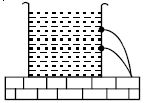
In a cylindrical vessel containing liquid of density $\rho$,there are two holes in the side walls at heights of $h_1$ and $h_2$ respectively,such that the range of efflux at the bottom of the vessel is the same. The height of a hole,for which the range of efflux would be maximum,is:
A
$h_2 - h_1$
B
$h_2 + h_1$
C
$\frac{h_2 - h_1}{2}$
D
$\frac{h_2 + h_1}{2}$
Solution
(D) The range of efflux $x$ for a hole at height $h$ from the bottom in a vessel filled with liquid to a total height $H$ is given by $x = 2 \sqrt{(H - h)h}$.
Given that the range of efflux is the same for two holes at heights $h_1$ and $h_2$,we have:
$2 \sqrt{(H - h_1)h_1} = 2 \sqrt{(H - h_2)h_2}$
$(H - h_1)h_1 = (H - h_2)h_2$
$Hh_1 - h_1^2 = Hh_2 - h_2^2$
$H(h_1 - h_2) = h_1^2 - h_2^2$
$H(h_1 - h_2) = (h_1 - h_2)(h_1 + h_2)$
$H = h_1 + h_2$
The range of efflux $x = 2 \sqrt{Hh - h^2}$ is maximum when the term inside the square root is maximum. Let $f(h) = Hh - h^2$. For maximum,$f'(h) = 0$.
$H - 2h = 0 \Rightarrow h = \frac{H}{2}$.
Substituting $H = h_1 + h_2$,we get the height for maximum range as $h = \frac{h_1 + h_2}{2}$.
Given that the range of efflux is the same for two holes at heights $h_1$ and $h_2$,we have:
$2 \sqrt{(H - h_1)h_1} = 2 \sqrt{(H - h_2)h_2}$
$(H - h_1)h_1 = (H - h_2)h_2$
$Hh_1 - h_1^2 = Hh_2 - h_2^2$
$H(h_1 - h_2) = h_1^2 - h_2^2$
$H(h_1 - h_2) = (h_1 - h_2)(h_1 + h_2)$
$H = h_1 + h_2$
The range of efflux $x = 2 \sqrt{Hh - h^2}$ is maximum when the term inside the square root is maximum. Let $f(h) = Hh - h^2$. For maximum,$f'(h) = 0$.
$H - 2h = 0 \Rightarrow h = \frac{H}{2}$.
Substituting $H = h_1 + h_2$,we get the height for maximum range as $h = \frac{h_1 + h_2}{2}$.
0 likes
View Solution27
DifficultMCQ
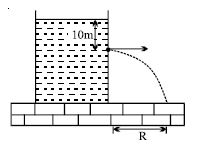
$A$ large tank is filled with water (density $= 10^3 \ kg/m^3$). $A$ small hole is made at a depth $10 \ m$ below the water surface. The range of water issuing out of the hole is $R$ on the ground. What extra pressure must be applied on the water surface so that the range becomes $2R$? (Take $1 \ atm = 10^5 \ Pa$ and $g = 10 \ m/s^2$)
A
$9$
B
$4$
C
$5$
D
$3$
Solution
(D) The range of water issuing from a hole at depth $h$ is given by $R = 2\sqrt{h(H-h)}$,where $H$ is the total height of the water column. Assuming the hole is at the bottom $(h=H)$,the range is $R = 2\sqrt{h^2} = 2h$.
For a hole at depth $h=10 \ m$,the velocity of efflux is $v = \sqrt{2gh}$. The range is $R = v \cdot t$,where $t = \sqrt{2(H-h)/g}$.
If we apply an extra pressure $P_{ext}$ on the surface,the effective pressure at the hole becomes $P_{eff} = P_{atm} + P_{ext} + \rho gh$. The velocity of efflux becomes $v' = \sqrt{2(P_{ext} + \rho gh)/\rho} = \sqrt{2gh + 2P_{ext}/\rho}$.
To make the range $2R$,the velocity of efflux must become $2v$ (since time of flight remains constant if the hole position is fixed).
Thus,$v' = 2v \implies v'^2 = 4v^2$.
$2gh + 2P_{ext}/\rho = 4(2gh) = 8gh$.
$2P_{ext}/\rho = 6gh \implies P_{ext} = 3\rho gh$.
Given $\rho = 10^3 \ kg/m^3$,$g = 10 \ m/s^2$,and $h = 10 \ m$:
$P_{ext} = 3 \times 10^3 \times 10 \times 10 = 3 \times 10^5 \ Pa$.
Since $1 \ atm = 10^5 \ Pa$,the extra pressure required is $3 \ atm$.
For a hole at depth $h=10 \ m$,the velocity of efflux is $v = \sqrt{2gh}$. The range is $R = v \cdot t$,where $t = \sqrt{2(H-h)/g}$.
If we apply an extra pressure $P_{ext}$ on the surface,the effective pressure at the hole becomes $P_{eff} = P_{atm} + P_{ext} + \rho gh$. The velocity of efflux becomes $v' = \sqrt{2(P_{ext} + \rho gh)/\rho} = \sqrt{2gh + 2P_{ext}/\rho}$.
To make the range $2R$,the velocity of efflux must become $2v$ (since time of flight remains constant if the hole position is fixed).
Thus,$v' = 2v \implies v'^2 = 4v^2$.
$2gh + 2P_{ext}/\rho = 4(2gh) = 8gh$.
$2P_{ext}/\rho = 6gh \implies P_{ext} = 3\rho gh$.
Given $\rho = 10^3 \ kg/m^3$,$g = 10 \ m/s^2$,and $h = 10 \ m$:
$P_{ext} = 3 \times 10^3 \times 10 \times 10 = 3 \times 10^5 \ Pa$.
Since $1 \ atm = 10^5 \ Pa$,the extra pressure required is $3 \ atm$.
0 likes
View Solution28
DifficultMCQ
$A$ water barrel stands on a table of height $h$. If a small hole is punched in the side of the barrel at its base,it is found that the resultant stream of water strikes the ground at a horizontal distance $R$ from the barrel. The depth of water in the barrel is
A
$\frac{R}{2}$
B
$\frac{R^2}{4h}$
C
$\frac{R^2}{h}$
D
$\frac{h}{2}$
Solution
(B) Let $d$ be the depth of water in the barrel.
According to Torricelli's law,the velocity of efflux $v$ at the base is $v = \sqrt{2gd}$.
The time $t$ taken by the water to reach the ground from the table of height $h$ is given by $h = \frac{1}{2}gt^2$,which implies $t = \sqrt{\frac{2h}{g}}$.
The horizontal distance $R$ covered by the water stream is $R = v \times t$.
Substituting the values,$R = \sqrt{2gd} \times \sqrt{\frac{2h}{g}} = \sqrt{4dh} = 2\sqrt{dh}$.
Squaring both sides,$R^2 = 4dh$.
Therefore,the depth of water $d = \frac{R^2}{4h}$.
According to Torricelli's law,the velocity of efflux $v$ at the base is $v = \sqrt{2gd}$.
The time $t$ taken by the water to reach the ground from the table of height $h$ is given by $h = \frac{1}{2}gt^2$,which implies $t = \sqrt{\frac{2h}{g}}$.
The horizontal distance $R$ covered by the water stream is $R = v \times t$.
Substituting the values,$R = \sqrt{2gd} \times \sqrt{\frac{2h}{g}} = \sqrt{4dh} = 2\sqrt{dh}$.
Squaring both sides,$R^2 = 4dh$.
Therefore,the depth of water $d = \frac{R^2}{4h}$.
0 likes
View Solution29
DifficultMCQ
$A$ cylindrical vessel of cross-sectional area $1000 \ cm^2$ is fitted with a frictionless piston of mass $10 \ kg$ and filled with water completely. $A$ small hole of cross-sectional area $10 \ mm^2$ is opened at a point $50 \ cm$ deep from the lower surface of the piston. The velocity of efflux from the hole will be ........... $m/s$.
A
$10.5$
B
$3.4$
C
$0.8$
D
$0.2$
Solution
(B) The pressure at the hole is due to the atmospheric pressure,the weight of the piston,and the height of the water column.
Let $A = 1000 \ cm^2 = 0.1 \ m^2$ be the area of the piston and $m = 10 \ kg$ be its mass.
The pressure exerted by the piston is $P_p = \dfrac{mg}{A} = \dfrac{10 \times 9.8}{0.1} = 980 \ Pa$.
The equivalent height of water column $h_p$ that produces this pressure is $h_p = \dfrac{P_p}{\rho g} = \dfrac{980}{1000 \times 9.8} = 0.1 \ m = 10 \ cm$.
The total effective height of the water column above the hole is $H_{eff} = h_p + h = 10 \ cm + 50 \ cm = 60 \ cm = 0.6 \ m$.
Using Torricelli's law,the velocity of efflux is $v = \sqrt{2gH_{eff}}$.
$v = \sqrt{2 \times 9.8 \times 0.6} = \sqrt{11.76} \approx 3.43 \ m/s$.
Thus,the velocity is approximately $3.4 \ m/s$.
Let $A = 1000 \ cm^2 = 0.1 \ m^2$ be the area of the piston and $m = 10 \ kg$ be its mass.
The pressure exerted by the piston is $P_p = \dfrac{mg}{A} = \dfrac{10 \times 9.8}{0.1} = 980 \ Pa$.
The equivalent height of water column $h_p$ that produces this pressure is $h_p = \dfrac{P_p}{\rho g} = \dfrac{980}{1000 \times 9.8} = 0.1 \ m = 10 \ cm$.
The total effective height of the water column above the hole is $H_{eff} = h_p + h = 10 \ cm + 50 \ cm = 60 \ cm = 0.6 \ m$.
Using Torricelli's law,the velocity of efflux is $v = \sqrt{2gH_{eff}}$.
$v = \sqrt{2 \times 9.8 \times 0.6} = \sqrt{11.76} \approx 3.43 \ m/s$.
Thus,the velocity is approximately $3.4 \ m/s$.
0 likes
View Solution30
DifficultMCQ
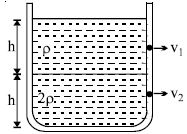
Equal volumes of two immiscible liquids of densities $\rho$ and $2\rho$ are filled in a vessel as shown in the figure. Two small holes are punched at depths $h/2$ and $3h/2$ from the surface of the lighter liquid. If $v_1$ and $v_2$ are the velocities of efflux at these two holes,then $v_1/v_2$ is:
A
$\frac{1}{2\sqrt{2}}$
B
$\frac{1}{2}$
C
$\frac{1}{4}$
D
$\frac{1}{\sqrt{2}}$
Solution
(D) For the first hole at depth $h/2$ in the liquid of density $\rho$:
Using Torricelli's law,$v_1 = \sqrt{2g(h/2)} = \sqrt{gh}$.
For the second hole at depth $3h/2$ from the surface,it is at a depth $h/2$ within the liquid of density $2\rho$:
Applying Bernoulli's theorem between the top surface and the second hole:
$P_0 + \rho gh + 2\rho g(h/2) = P_0 + \frac{1}{2}(2\rho)v_2^2$
$\rho gh + \rho gh = \rho v_2^2$
$2\rho gh = \rho v_2^2$
$v_2 = \sqrt{2gh}$.
Now,calculating the ratio:
$\frac{v_1}{v_2} = \frac{\sqrt{gh}}{\sqrt{2gh}} = \frac{1}{\sqrt{2}}$.
Using Torricelli's law,$v_1 = \sqrt{2g(h/2)} = \sqrt{gh}$.
For the second hole at depth $3h/2$ from the surface,it is at a depth $h/2$ within the liquid of density $2\rho$:
Applying Bernoulli's theorem between the top surface and the second hole:
$P_0 + \rho gh + 2\rho g(h/2) = P_0 + \frac{1}{2}(2\rho)v_2^2$
$\rho gh + \rho gh = \rho v_2^2$
$2\rho gh = \rho v_2^2$
$v_2 = \sqrt{2gh}$.
Now,calculating the ratio:
$\frac{v_1}{v_2} = \frac{\sqrt{gh}}{\sqrt{2gh}} = \frac{1}{\sqrt{2}}$.
0 likes
View Solution31
MediumMCQ
$A$ cylindrical vessel open at the top is $20 \ cm$ high and $10 \ cm$ in diameter. $A$ circular hole whose cross-sectional area is $1 \ cm^2$ is cut at the centre of the bottom of the vessel. Water flows from a tube above it into the vessel at the rate of $100 \ cm^3 s^{-1}$. The height of water in the vessel under steady state is ....... $cm$ (Take $g = 1000 \ cm s^{-2}$)
A
$20$
B
$15$
C
$10$
D
$5$
Solution
(D) In steady state,the volume flow rate of water entering the vessel must be equal to the volume flow rate of water leaving the vessel through the hole.
Let $Q$ be the rate of inflow,$a$ be the area of the hole,and $h$ be the height of the water level.
The rate of outflow is given by Torricelli's law: $Q_{out} = a v = a \sqrt{2gh}$.
Equating inflow and outflow: $Q = a \sqrt{2gh}$.
Rearranging for $h$: $h = \frac{Q^2}{2 g a^2}$.
Given $Q = 100 \ cm^3 s^{-1}$,$a = 1 \ cm^2$,and $g = 1000 \ cm s^{-2}$.
Substituting the values: $h = \frac{(100)^2}{2 \times 1000 \times (1)^2} = \frac{10000}{2000} = 5 \ cm$.
Let $Q$ be the rate of inflow,$a$ be the area of the hole,and $h$ be the height of the water level.
The rate of outflow is given by Torricelli's law: $Q_{out} = a v = a \sqrt{2gh}$.
Equating inflow and outflow: $Q = a \sqrt{2gh}$.
Rearranging for $h$: $h = \frac{Q^2}{2 g a^2}$.
Given $Q = 100 \ cm^3 s^{-1}$,$a = 1 \ cm^2$,and $g = 1000 \ cm s^{-2}$.
Substituting the values: $h = \frac{(100)^2}{2 \times 1000 \times (1)^2} = \frac{10000}{2000} = 5 \ cm$.
0 likes
View Solution32
MediumMCQ
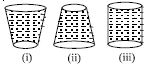
The three water-filled tanks shown have the same volume and height. If small identical holes are punched near their bottoms,which one will be the first to get empty?
A
All will take the same time
B
$(ii)$
C
$(iii)$
D
$(i)$
Solution
(A) According to Torricelli's law,the velocity of efflux $v$ from a small hole at a depth $h$ below the free surface is given by $v = \sqrt{2gh}$.
The rate of volume flow out of the hole is $\frac{dV}{dt} = a \cdot v = a \sqrt{2gh}$,where $a$ is the area of the hole.
Since the tanks have the same height $h$ and the holes are identical (same area $a$),the velocity of efflux and the initial rate of flow are the same for all three tanks.
However,the time taken to empty depends on the volume $V$ and the rate of flow. Since the total volume $V$ is the same for all tanks and the rate of flow is determined by the height $h$ (which is also the same),the time required to empty the tanks is independent of the shape of the container.
Therefore,all three tanks will take the same amount of time to empty.
The rate of volume flow out of the hole is $\frac{dV}{dt} = a \cdot v = a \sqrt{2gh}$,where $a$ is the area of the hole.
Since the tanks have the same height $h$ and the holes are identical (same area $a$),the velocity of efflux and the initial rate of flow are the same for all three tanks.
However,the time taken to empty depends on the volume $V$ and the rate of flow. Since the total volume $V$ is the same for all tanks and the rate of flow is determined by the height $h$ (which is also the same),the time required to empty the tanks is independent of the shape of the container.
Therefore,all three tanks will take the same amount of time to empty.
0 likes
View Solution33
DifficultMCQ
$A$ cylindrical vessel filled with water up to a height of $H$ stands on a horizontal plane. The side wall of the vessel has a plugged circular hole touching the bottom. The coefficient of friction between the bottom of the vessel and the plane is $\mu$ and the total mass of the water plus the vessel is $M$. What should be the minimum diameter of the hole so that the vessel begins to move on the floor if the plug is removed? (Here,the density of water is $\rho$)
A
$\sqrt{\frac{2\mu M}{\pi \rho H}}$
B
$\sqrt{\frac{\mu M}{2\pi \rho H}}$
C
$\sqrt{\frac{\mu M}{\rho H}}$
D
none
Solution
(A) The force exerted by the water jet exiting the hole is given by $F = \rho A v^2$,where $A$ is the area of the hole and $v$ is the velocity of the water.
Using Torricelli's Law,the velocity of the water at the bottom is $v = \sqrt{2gH}$.
Thus,the force is $F = \rho A (2gH)$.
For the vessel to begin moving,this force must overcome the limiting friction force,$f_s = \mu Mg$.
Equating the two: $\rho A (2gH) = \mu Mg$.
Substituting $A = \frac{\pi D^2}{4}$,we get $\rho \left( \frac{\pi D^2}{4} \right) (2gH) = \mu Mg$.
Simplifying the equation: $\frac{\rho \pi D^2 g H}{2} = \mu Mg$.
Solving for $D$: $D^2 = \frac{2\mu M}{\pi \rho H}$.
Therefore,$D = \sqrt{\frac{2\mu M}{\pi \rho H}}$.
Using Torricelli's Law,the velocity of the water at the bottom is $v = \sqrt{2gH}$.
Thus,the force is $F = \rho A (2gH)$.
For the vessel to begin moving,this force must overcome the limiting friction force,$f_s = \mu Mg$.
Equating the two: $\rho A (2gH) = \mu Mg$.
Substituting $A = \frac{\pi D^2}{4}$,we get $\rho \left( \frac{\pi D^2}{4} \right) (2gH) = \mu Mg$.
Simplifying the equation: $\frac{\rho \pi D^2 g H}{2} = \mu Mg$.
Solving for $D$: $D^2 = \frac{2\mu M}{\pi \rho H}$.
Therefore,$D = \sqrt{\frac{2\mu M}{\pi \rho H}}$.
0 likes
View Solution34
DifficultMCQ
$A$ cylindrical vessel is filled with a liquid up to height $H$. $A$ small hole is made in the vessel at a distance $y$ below the liquid surface as shown in the figure. The liquid emerging from the hole strikes the ground at a distance $x$.
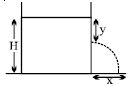
A
If $y$ is increased from zero to $H$,$x$ will decrease and then increase.
B
$x$ is maximum for $y = \frac{H}{2}$.
C
The maximum value of $x$ is $\frac{H}{2}$.
D
The maximum value of $x$ increases with the increase in the density of the liquid.
Solution
(B) According to Torricelli's law,the velocity of efflux $v$ is given by $v = \sqrt{2gy}$.
The time taken for the liquid to reach the ground from a height $(H-y)$ is $t = \sqrt{\frac{2(H-y)}{g}}$.
The horizontal range $x$ is given by $x = v \cdot t = \sqrt{2gy} \cdot \sqrt{\frac{2(H-y)}{g}} = 2\sqrt{y(H-y)}$.
To find the maximum range,we differentiate $x^2 = 4(Hy - y^2)$ with respect to $y$ and set it to zero:
$\frac{d}{dy}(4Hy - 4y^2) = 4H - 8y = 0 \implies y = \frac{H}{2}$.
Substituting $y = \frac{H}{2}$ into the expression for $x$,we get $x_{max} = 2\sqrt{\frac{H}{2}(H - \frac{H}{2})} = 2\sqrt{\frac{H^2}{4}} = H$.
Therefore,$x$ is maximum at $y = \frac{H}{2}$ and the maximum value is $H$.
Thus,option $B$ is the correct answer.
The time taken for the liquid to reach the ground from a height $(H-y)$ is $t = \sqrt{\frac{2(H-y)}{g}}$.
The horizontal range $x$ is given by $x = v \cdot t = \sqrt{2gy} \cdot \sqrt{\frac{2(H-y)}{g}} = 2\sqrt{y(H-y)}$.
To find the maximum range,we differentiate $x^2 = 4(Hy - y^2)$ with respect to $y$ and set it to zero:
$\frac{d}{dy}(4Hy - 4y^2) = 4H - 8y = 0 \implies y = \frac{H}{2}$.
Substituting $y = \frac{H}{2}$ into the expression for $x$,we get $x_{max} = 2\sqrt{\frac{H}{2}(H - \frac{H}{2})} = 2\sqrt{\frac{H^2}{4}} = H$.
Therefore,$x$ is maximum at $y = \frac{H}{2}$ and the maximum value is $H$.
Thus,option $B$ is the correct answer.
0 likes
View Solution35
MediumMCQ
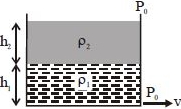
$A$ wide vessel with a small hole at the bottom is filled with two liquids. The density and height of one liquid are $\rho_1$ and $h_1$ and that of the other are $\rho_2$ and $h_2$ $(\rho_1 > \rho_2)$. The velocity of the liquid coming out of the hole is:
A
$v = \sqrt{2g(h_1 + h_2)}$
B
$v = \sqrt{2g(h_1\rho_1 + h_2\rho_2) / (\rho_1 + \rho_2)}$
C
$v = \sqrt{2g(h_1 + \frac{h_2\rho_2}{\rho_1})}$
D
$v = \sqrt{2g(\frac{h_1\rho_1}{\rho_2} + h_2)}$
Solution
(C) Applying Bernoulli's principle at the top surface of the liquid and at the hole:
$P_0 + h_1\rho_1g + h_2\rho_2g = P_0 + \frac{1}{2}\rho_1v^2$
Here,$P_0$ is the atmospheric pressure,and we assume the velocity of the top surface is negligible compared to the velocity $v$ at the hole.
Subtracting $P_0$ from both sides:
$h_1\rho_1g + h_2\rho_2g = \frac{1}{2}\rho_1v^2$
Dividing by $\rho_1$:
$h_1g + \frac{h_2\rho_2g}{\rho_1} = \frac{1}{2}v^2$
$v^2 = 2g(h_1 + \frac{h_2\rho_2}{\rho_1})$
$v = \sqrt{2g(h_1 + \frac{h_2\rho_2}{\rho_1})}$
$P_0 + h_1\rho_1g + h_2\rho_2g = P_0 + \frac{1}{2}\rho_1v^2$
Here,$P_0$ is the atmospheric pressure,and we assume the velocity of the top surface is negligible compared to the velocity $v$ at the hole.
Subtracting $P_0$ from both sides:
$h_1\rho_1g + h_2\rho_2g = \frac{1}{2}\rho_1v^2$
Dividing by $\rho_1$:
$h_1g + \frac{h_2\rho_2g}{\rho_1} = \frac{1}{2}v^2$
$v^2 = 2g(h_1 + \frac{h_2\rho_2}{\rho_1})$
$v = \sqrt{2g(h_1 + \frac{h_2\rho_2}{\rho_1})}$
0 likes
View Solution36
MediumMCQ
$A$ closed vessel has a small hole in one face near the bottom,as shown in the figure. The velocity of water coming out from the hole at the given instant is ....... $m/s$. (Given: $P_{0} = 10^{5} \text{ N/m}^{2}$,$h = 9/4 \text{ m}$,density of water $\rho = 10^{3} \text{ kg/m}^{3}$,$g = 10 \text{ m/s}^{2}$)
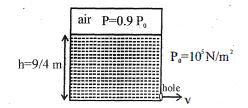
A
$5$
B
$2$
C
$3$
D
$3\sqrt{5}$
Solution
(A) According to Bernoulli's principle for the top surface of the water and the hole:
$P_{top} + \rho gh + \frac{1}{2}\rho v_{top}^{2} = P_{atm} + \frac{1}{2}\rho v^{2}$
Since the vessel is closed and the top pressure is $0.9 P_{0}$,and assuming $v_{top} \approx 0$:
$0.9 P_{0} + \rho gh = P_{0} + \frac{1}{2} \rho v^{2}$
$\rho gh - 0.1 P_{0} = \frac{1}{2} \rho v^{2}$
Substituting the values: $10^{3} \times 10 \times (9/4) - 0.1 \times 10^{5} = \frac{1}{2} \times 10^{3} \times v^{2}$
$22500 - 10000 = 500 v^{2}$
$12500 = 500 v^{2}$
$v^{2} = 25$
$v = 5 \text{ m/s}$
$P_{top} + \rho gh + \frac{1}{2}\rho v_{top}^{2} = P_{atm} + \frac{1}{2}\rho v^{2}$
Since the vessel is closed and the top pressure is $0.9 P_{0}$,and assuming $v_{top} \approx 0$:
$0.9 P_{0} + \rho gh = P_{0} + \frac{1}{2} \rho v^{2}$
$\rho gh - 0.1 P_{0} = \frac{1}{2} \rho v^{2}$
Substituting the values: $10^{3} \times 10 \times (9/4) - 0.1 \times 10^{5} = \frac{1}{2} \times 10^{3} \times v^{2}$
$22500 - 10000 = 500 v^{2}$
$12500 = 500 v^{2}$
$v^{2} = 25$
$v = 5 \text{ m/s}$
0 likes
View Solution37
MediumMCQ
$A$ tank is filled with water up to a height of $1 \, m$. $A$ hole is made at a distance of $20 \, cm$ from the top. Find the horizontal distance from the base of the tank where the water strikes the ground in $cm$.
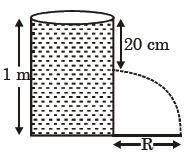
A
$60$
B
$80$
C
$100$
D
$40$
Solution
(B) The total height of the water in the tank is $H = 1 \, m = 100 \, cm$.
The depth of the hole from the top surface is $h = 20 \, cm$.
The height of the hole from the bottom of the tank is $y = H - h = 100 - 20 = 80 \, cm$.
The velocity of efflux is $v = \sqrt{2gh}$.
The time taken for the water to reach the ground is $t = \sqrt{\frac{2y}{g}} = \sqrt{\frac{2(H-h)}{g}}$.
The horizontal range $R$ is given by $R = v \times t = \sqrt{2gh} \times \sqrt{\frac{2(H-h)}{g}} = 2 \sqrt{h(H-h)}$.
Substituting the values: $R = 2 \sqrt{20 \times (100 - 20)} = 2 \sqrt{20 \times 80} = 2 \sqrt{1600} = 2 \times 40 = 80 \, cm$.
The depth of the hole from the top surface is $h = 20 \, cm$.
The height of the hole from the bottom of the tank is $y = H - h = 100 - 20 = 80 \, cm$.
The velocity of efflux is $v = \sqrt{2gh}$.
The time taken for the water to reach the ground is $t = \sqrt{\frac{2y}{g}} = \sqrt{\frac{2(H-h)}{g}}$.
The horizontal range $R$ is given by $R = v \times t = \sqrt{2gh} \times \sqrt{\frac{2(H-h)}{g}} = 2 \sqrt{h(H-h)}$.
Substituting the values: $R = 2 \sqrt{20 \times (100 - 20)} = 2 \sqrt{20 \times 80} = 2 \sqrt{1600} = 2 \times 40 = 80 \, cm$.
0 likes
View Solution38
MediumMCQ
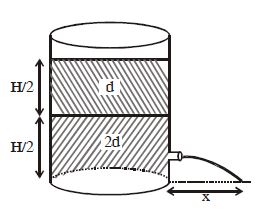
$A$ container of large uniform cross-sectional area $A$ is resting on a horizontal surface and holds two immiscible,non-viscous,and incompressible liquids of densities $d$ and $2d$,each of height $\frac{H}{2}$,as shown. The upper surface of the liquid with lower density is open to the atmosphere. $A$ small hole is made on the wall of the container at height $h$ $(h < \frac{H}{2})$. The initial speed of efflux of the liquid at the hole is:
A
$\left( {3H - 4h} \right)g$
B
$\frac{{\left( {3H - 4h} \right)g}}{2}$
C
$\sqrt {\left( {3H - 4h} \right)g} $
D
$\sqrt {\frac{{\left( {3H - 4h} \right)g}}{2}} $
Solution
(D) Let the top surface of the liquid be point $1$ and the hole be point $2$. Applying Bernoulli's theorem between the top surface (point $1$) and the hole (point $2$):
$P_0 + \rho_1 g \left( \frac{H}{2} \right) + \rho_2 g \left( \frac{H}{2} - h \right) = P_0 + \frac{1}{2} \rho_2 v^2$
Here,$\rho_1 = d$,$\rho_2 = 2d$,and $P_0$ is the atmospheric pressure.
Substituting the values:
$d g \left( \frac{H}{2} \right) + 2d g \left( \frac{H}{2} - h \right) = \frac{1}{2} (2d) v^2$
$g \left( \frac{H}{2} + H - 2h \right) = v^2$
$g \left( \frac{3H}{2} - 2h \right) = v^2$
$v^2 = g \left( \frac{3H - 4h}{2} \right)$
$v = \sqrt{\frac{(3H - 4h)g}{2}}$
$P_0 + \rho_1 g \left( \frac{H}{2} \right) + \rho_2 g \left( \frac{H}{2} - h \right) = P_0 + \frac{1}{2} \rho_2 v^2$
Here,$\rho_1 = d$,$\rho_2 = 2d$,and $P_0$ is the atmospheric pressure.
Substituting the values:
$d g \left( \frac{H}{2} \right) + 2d g \left( \frac{H}{2} - h \right) = \frac{1}{2} (2d) v^2$
$g \left( \frac{H}{2} + H - 2h \right) = v^2$
$g \left( \frac{3H}{2} - 2h \right) = v^2$
$v^2 = g \left( \frac{3H - 4h}{2} \right)$
$v = \sqrt{\frac{(3H - 4h)g}{2}}$
0 likes
View Solution39
DifficultMCQ
$A$ cylindrical tank of height $0.4\,m$ is open at the top and has a diameter $0.16\,m$. Water is filled in it up to a height of $0.16\,m$. How long will it take to empty the tank through a hole of radius $5 \times 10^{-3}\,m$ in its bottom? (in seconds)
A
$46.26$
B
$4.6$
C
$462.6$
D
$0.46$
Solution
(A) The area of the tank $A = \pi R^2$,where $R = 0.08\,m$.
The area of the hole $a = \pi r^2$,where $r = 5 \times 10^{-3}\,m$.
According to the equation of continuity and Torricelli's law,the rate of change of volume is $A \frac{dh}{dt} = -a \sqrt{2gh}$.
Rearranging for time $t$: $dt = -\frac{A}{a \sqrt{2g}} h^{-1/2} dh$.
Integrating from $h = 0.16\,m$ to $h = 0$:
$t = \frac{A}{a \sqrt{2g}} \int_{0}^{0.16} h^{-1/2} dh = \frac{A}{a \sqrt{2g}} [2\sqrt{h}]_{0}^{0.16}$.
$t = \frac{\pi (0.08)^2}{\pi (5 \times 10^{-3})^2 \sqrt{2 \times 9.8}} \times 2 \times \sqrt{0.16}$.
$t = \frac{0.0064}{25 \times 10^{-6} \times 4.427} \times 0.8 \approx 46.26\,s$.
The area of the hole $a = \pi r^2$,where $r = 5 \times 10^{-3}\,m$.
According to the equation of continuity and Torricelli's law,the rate of change of volume is $A \frac{dh}{dt} = -a \sqrt{2gh}$.
Rearranging for time $t$: $dt = -\frac{A}{a \sqrt{2g}} h^{-1/2} dh$.
Integrating from $h = 0.16\,m$ to $h = 0$:
$t = \frac{A}{a \sqrt{2g}} \int_{0}^{0.16} h^{-1/2} dh = \frac{A}{a \sqrt{2g}} [2\sqrt{h}]_{0}^{0.16}$.
$t = \frac{\pi (0.08)^2}{\pi (5 \times 10^{-3})^2 \sqrt{2 \times 9.8}} \times 2 \times \sqrt{0.16}$.
$t = \frac{0.0064}{25 \times 10^{-6} \times 4.427} \times 0.8 \approx 46.26\,s$.
0 likes
View Solution40
DifficultMCQ
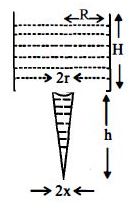
Consider a water jar of radius $R$ that has water filled up to height $H$ and is kept on a stand of height $h$ (see figure). Through a hole of radius $r$ $(r << R)$ at its bottom,the water leaks out and the stream of water coming down towards the ground has a shape like a funnel as shown in the figure. If the radius of the cross-section of water stream when it hits the ground is $x$,then:
A
$x = r\left( \frac{H}{H + h} \right)^{\frac{1}{4}}$
B
$x = r\left( \frac{H}{H + h} \right)$
C
$x = r\left( \frac{H}{H + h} \right)^2$
D
$x = r\left( \frac{H}{H + h} \right)^{\frac{1}{2}}$
Solution
(A) Let $v_1$ be the velocity of water at the hole (exit velocity) and $v_2$ be the velocity of water when it hits the ground.
Using Torricelli's Law,the velocity at the hole is $v_1 = \sqrt{2gH}$.
Using the equation of motion for a freely falling body,the velocity at the ground is $v_2 = \sqrt{v_1^2 + 2gh} = \sqrt{2gH + 2gh} = \sqrt{2g(H + h)}$.
According to the equation of continuity,the volume flow rate remains constant:
$A_1 v_1 = A_2 v_2$
$\pi r^2 v_1 = \pi x^2 v_2$
$r^2 \sqrt{2gH} = x^2 \sqrt{2g(H + h)}$
Squaring both sides:
$r^4 (2gH) = x^4 (2g(H + h))$
$x^4 = r^4 \frac{H}{H + h}$
$x = r \left( \frac{H}{H + h} \right)^{\frac{1}{4}}$
Using Torricelli's Law,the velocity at the hole is $v_1 = \sqrt{2gH}$.
Using the equation of motion for a freely falling body,the velocity at the ground is $v_2 = \sqrt{v_1^2 + 2gh} = \sqrt{2gH + 2gh} = \sqrt{2g(H + h)}$.
According to the equation of continuity,the volume flow rate remains constant:
$A_1 v_1 = A_2 v_2$
$\pi r^2 v_1 = \pi x^2 v_2$
$r^2 \sqrt{2gH} = x^2 \sqrt{2g(H + h)}$
Squaring both sides:
$r^4 (2gH) = x^4 (2g(H + h))$
$x^4 = r^4 \frac{H}{H + h}$
$x = r \left( \frac{H}{H + h} \right)^{\frac{1}{4}}$
0 likes
View Solution41
MediumMCQ
$A$ tank with a small hole at the bottom has been filled with water and kerosene (specific gravity $0.8$). The height of water is $3\,m$ and that of kerosene $2\,m$. When the hole is opened,the velocity of fluid coming out from it is nearly ........ $ms^{-1}$. (Take $g = 10\,ms^{-2}$ and density of water $= 10^3\,kg\,m^{-3}$)
A
$10.7$
B
$9.6$
C
$8.5$
D
$7.6$
Solution
(B) According to Bernoulli's principle,the pressure at the bottom of the tank is equal to the sum of the hydrostatic pressures of the two liquids.
$P = h_w \rho_w g + h_k \rho_k g$
Here,$h_w = 3\,m$,$\rho_w = 1000\,kg/m^3$,$h_k = 2\,m$,and $\rho_k = 0.8 \times 1000 = 800\,kg/m^3$.
$P = (3 \times 1000 \times 10) + (2 \times 800 \times 10) = 30000 + 16000 = 46000\,Pa$.
Using Torricelli's law for the exit velocity $v$ at the bottom,where the pressure energy is converted into kinetic energy:
$P = \frac{1}{2} \rho_w v^2$
$46000 = \frac{1}{2} \times 1000 \times v^2$
$v^2 = \frac{46000 \times 2}{1000} = 92$
$v = \sqrt{92} \approx 9.6\,ms^{-1}$.
$P = h_w \rho_w g + h_k \rho_k g$
Here,$h_w = 3\,m$,$\rho_w = 1000\,kg/m^3$,$h_k = 2\,m$,and $\rho_k = 0.8 \times 1000 = 800\,kg/m^3$.
$P = (3 \times 1000 \times 10) + (2 \times 800 \times 10) = 30000 + 16000 = 46000\,Pa$.
Using Torricelli's law for the exit velocity $v$ at the bottom,where the pressure energy is converted into kinetic energy:
$P = \frac{1}{2} \rho_w v^2$
$46000 = \frac{1}{2} \times 1000 \times v^2$
$v^2 = \frac{46000 \times 2}{1000} = 92$
$v = \sqrt{92} \approx 9.6\,ms^{-1}$.
0 likes
View Solution42
DifficultMCQ
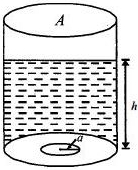
$A$ cylindrical vessel of cross-section $A$ contains water to a height $h$. There is a hole in the bottom of radius $a$. The time in which it will be emptied is
A
$\frac{2A}{\pi a^2}\sqrt{\frac{h}{g}}$
B
$\frac{\sqrt{2}A}{\pi a^2}\sqrt{\frac{h}{g}}$
C
$\frac{2\sqrt{2}A}{\pi a^2}\sqrt{\frac{h}{g}}$
D
$\frac{A}{\sqrt{2}\pi a^2}\sqrt{\frac{h}{g}}$
Solution
(B) Let the rate of fall of the water level be $-\frac{dh}{dt}$.
According to the equation of continuity,the volume of water leaving the hole per unit time is equal to the volume of water lost by the vessel per unit time.
$A \left( -\frac{dh}{dt} \right) = a_{hole} \cdot v$
Where $a_{hole} = \pi a^2$ is the area of the hole and $v = \sqrt{2gh}$ is the velocity of efflux (Torricelli's Law).
So,$A \left( -\frac{dh}{dt} \right) = \pi a^2 \sqrt{2gh}$.
Rearranging the terms to integrate:
$dt = -\frac{A}{\pi a^2 \sqrt{2g}} h^{-1/2} dh$.
Integrating from $t = 0$ to $T$ (total time) and $h = h$ to $0$:
$\int_0^T dt = -\frac{A}{\pi a^2 \sqrt{2g}} \int_h^0 h^{-1/2} dh$.
$T = -\frac{A}{\pi a^2 \sqrt{2g}} \left[ \frac{h^{1/2}}{1/2} \right]_h^0$.
$T = -\frac{A}{\pi a^2 \sqrt{2g}} \cdot 2 [0 - \sqrt{h}] = \frac{2A}{\pi a^2 \sqrt{2g}} \sqrt{h}$.
$T = \frac{2A}{\pi a^2} \sqrt{\frac{h}{2g}} = \frac{\sqrt{2}A}{\pi a^2} \sqrt{\frac{h}{g}}$.
According to the equation of continuity,the volume of water leaving the hole per unit time is equal to the volume of water lost by the vessel per unit time.
$A \left( -\frac{dh}{dt} \right) = a_{hole} \cdot v$
Where $a_{hole} = \pi a^2$ is the area of the hole and $v = \sqrt{2gh}$ is the velocity of efflux (Torricelli's Law).
So,$A \left( -\frac{dh}{dt} \right) = \pi a^2 \sqrt{2gh}$.
Rearranging the terms to integrate:
$dt = -\frac{A}{\pi a^2 \sqrt{2g}} h^{-1/2} dh$.
Integrating from $t = 0$ to $T$ (total time) and $h = h$ to $0$:
$\int_0^T dt = -\frac{A}{\pi a^2 \sqrt{2g}} \int_h^0 h^{-1/2} dh$.
$T = -\frac{A}{\pi a^2 \sqrt{2g}} \left[ \frac{h^{1/2}}{1/2} \right]_h^0$.
$T = -\frac{A}{\pi a^2 \sqrt{2g}} \cdot 2 [0 - \sqrt{h}] = \frac{2A}{\pi a^2 \sqrt{2g}} \sqrt{h}$.
$T = \frac{2A}{\pi a^2} \sqrt{\frac{h}{2g}} = \frac{\sqrt{2}A}{\pi a^2} \sqrt{\frac{h}{g}}$.
0 likes
View Solution43
DifficultMCQ
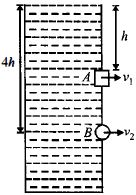
$A$ square hole of side length $l$ is made at a depth of $h$ and a circular hole of radius $r$ is made at a depth of $4h$ from the surface of water in a water tank kept on a horizontal surface. If $l << h$ and $r << h$,and the rate of water flow from the holes is the same,then $r$ is equal to:
A
$\frac{l}{\sqrt{2\pi}}$
B
$\frac{l}{\sqrt{3\pi}}$
C
$\frac{l}{3\pi}$
D
$\frac{l}{2\pi}$
Solution
(A) The rate of flow of water (volume flow rate) is given by $Q = A \times v$,where $A$ is the area of the hole and $v$ is the velocity of efflux.
According to Torricelli's law,the velocity of efflux at a depth $d$ is $v = \sqrt{2gd}$.
For the square hole at depth $h$: Area $A_1 = l^2$,velocity $v_1 = \sqrt{2gh}$. Thus,$Q_1 = l^2 \sqrt{2gh}$.
For the circular hole at depth $4h$: Area $A_2 = \pi r^2$,velocity $v_2 = \sqrt{2g(4h)} = 2\sqrt{2gh}$. Thus,$Q_2 = \pi r^2 (2\sqrt{2gh})$.
Given that the rates of flow are equal,$Q_1 = Q_2$:
$l^2 \sqrt{2gh} = 2\pi r^2 \sqrt{2gh}$
$l^2 = 2\pi r^2$
$r^2 = \frac{l^2}{2\pi}$
$r = \frac{l}{\sqrt{2\pi}}$
According to Torricelli's law,the velocity of efflux at a depth $d$ is $v = \sqrt{2gd}$.
For the square hole at depth $h$: Area $A_1 = l^2$,velocity $v_1 = \sqrt{2gh}$. Thus,$Q_1 = l^2 \sqrt{2gh}$.
For the circular hole at depth $4h$: Area $A_2 = \pi r^2$,velocity $v_2 = \sqrt{2g(4h)} = 2\sqrt{2gh}$. Thus,$Q_2 = \pi r^2 (2\sqrt{2gh})$.
Given that the rates of flow are equal,$Q_1 = Q_2$:
$l^2 \sqrt{2gh} = 2\pi r^2 \sqrt{2gh}$
$l^2 = 2\pi r^2$
$r^2 = \frac{l^2}{2\pi}$
$r = \frac{l}{\sqrt{2\pi}}$
0 likes
View Solution44
DifficultMCQ
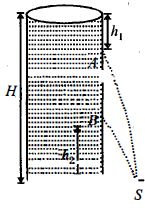
In a cylindrical water tank,there are two small holes $A$ and $B$ on the wall. Hole $A$ is at a depth of $h_1$ from the water surface,and hole $B$ is at a height of $h_2$ from the bottom of the tank. The total height of the water surface from the bottom of the tank is $H$. Water coming out from both holes strikes the ground at the same point $S$. Find the ratio of $h_1$ and $h_2$.
A
Depends on $H$
B
$1:1$
C
$2:2$
D
$1:2$
Solution
(A) The horizontal range $R$ of water issuing from a hole at depth $y$ from the surface in a tank of total height $H$ is given by $R = 2\sqrt{y(H-y)}$.
For hole $A$,the depth from the surface is $h_1$,so the range is $R_A = 2\sqrt{h_1(H - h_1)}$.
For hole $B$,the height from the bottom is $h_2$,so the depth from the surface is $(H - h_2)$. The range is $R_B = 2\sqrt{(H - h_2)h_2}$.
Since the ranges are equal,$R_A = R_B$:
$2\sqrt{h_1(H - h_1)} = 2\sqrt{(H - h_2)h_2}$
Squaring both sides:
$h_1(H - h_1) = h_2(H - h_2)$
$Hh_1 - h_1^2 = Hh_2 - h_2^2$
$H(h_1 - h_2) = h_1^2 - h_2^2$
$H(h_1 - h_2) = (h_1 - h_2)(h_1 + h_2)$
Assuming $h_1 \neq h_2$,we get $H = h_1 + h_2$.
This implies that the ratio $h_1/h_2$ is not a fixed constant but depends on the specific values of $h_1, h_2$ and $H$ such that their sum is $H$. Thus,the ratio depends on $H$.
For hole $A$,the depth from the surface is $h_1$,so the range is $R_A = 2\sqrt{h_1(H - h_1)}$.
For hole $B$,the height from the bottom is $h_2$,so the depth from the surface is $(H - h_2)$. The range is $R_B = 2\sqrt{(H - h_2)h_2}$.
Since the ranges are equal,$R_A = R_B$:
$2\sqrt{h_1(H - h_1)} = 2\sqrt{(H - h_2)h_2}$
Squaring both sides:
$h_1(H - h_1) = h_2(H - h_2)$
$Hh_1 - h_1^2 = Hh_2 - h_2^2$
$H(h_1 - h_2) = h_1^2 - h_2^2$
$H(h_1 - h_2) = (h_1 - h_2)(h_1 + h_2)$
Assuming $h_1 \neq h_2$,we get $H = h_1 + h_2$.
This implies that the ratio $h_1/h_2$ is not a fixed constant but depends on the specific values of $h_1, h_2$ and $H$ such that their sum is $H$. Thus,the ratio depends on $H$.
0 likes
View Solution45
MediumMCQ
The top of a water tank is open to air and its water level is maintained. It is discharging $0.74\,m^3$ of water per minute through a circular opening of $2\,cm$ radius in its wall. The depth of the centre of the opening from the level of water in the tank is close to........ $m$
A
$6.0$
B
$4.8$
C
$9.6$
D
$2.9$
Solution
(B) The volume flow rate is given by $Q = A \cdot v$,where $v = \sqrt{2gh}$ is the velocity of efflux.
Given: $Q = 0.74\,m^3/min = \frac{0.74}{60}\,m^3/s$,radius $r = 2\,cm = 0.02\,m$,and $g = 9.8\,m/s^2$.
The area of the opening is $A = \pi r^2 = 3.14 \times (0.02)^2 = 3.14 \times 4 \times 10^{-4}\,m^2$.
Substituting these into the equation $Q = A\sqrt{2gh}$:
$\frac{0.74}{60} = (3.14 \times 4 \times 10^{-4}) \sqrt{2 \times 9.8 \times h}$.
$\frac{0.01233}{1.256 \times 10^{-3}} = \sqrt{19.6h}$.
$9.816 = \sqrt{19.6h}$.
Squaring both sides: $96.36 = 19.6h$.
$h = \frac{96.36}{19.6} \approx 4.92\,m$.
Thus,the depth is close to $4.8\,m$.
Given: $Q = 0.74\,m^3/min = \frac{0.74}{60}\,m^3/s$,radius $r = 2\,cm = 0.02\,m$,and $g = 9.8\,m/s^2$.
The area of the opening is $A = \pi r^2 = 3.14 \times (0.02)^2 = 3.14 \times 4 \times 10^{-4}\,m^2$.
Substituting these into the equation $Q = A\sqrt{2gh}$:
$\frac{0.74}{60} = (3.14 \times 4 \times 10^{-4}) \sqrt{2 \times 9.8 \times h}$.
$\frac{0.01233}{1.256 \times 10^{-3}} = \sqrt{19.6h}$.
$9.816 = \sqrt{19.6h}$.
Squaring both sides: $96.36 = 19.6h$.
$h = \frac{96.36}{19.6} \approx 4.92\,m$.
Thus,the depth is close to $4.8\,m$.
0 likes
View Solution46
MediumMCQ
Water flows into a large tank with a flat bottom at the rate of $10^{-4} \, m^3 s^{-1}$. Water is also leaking out of a hole of area $1 \, cm^2$ at its bottom. If the height of the water in the tank remains steady, then this height is ........ $cm$.
A
$5.1$
B
$1.7$
C
$4$
D
$2.9$
Solution
(A) The rate of change of volume of water in the tank is given by the difference between the inflow rate and the outflow rate.
$\frac{dV}{dt} = Q_{in} - Q_{out} = 0$ (since the height remains steady).
$Q_{in} = 10^{-4} \, m^3 s^{-1}$.
The outflow rate is given by Torricelli's law: $Q_{out} = a \sqrt{2gh}$, where $a = 1 \, cm^2 = 10^{-4} \, m^2$ and $g = 9.8 \, m s^{-2}$.
Equating inflow and outflow: $10^{-4} = 10^{-4} \sqrt{2 \times 9.8 \times h}$.
$1 = \sqrt{19.6 \times h}$.
Squaring both sides: $1 = 19.6 \times h$.
$h = \frac{1}{19.6} \approx 0.051 \, m$.
Converting to centimeters: $h = 0.051 \times 100 = 5.1 \, cm$.
$\frac{dV}{dt} = Q_{in} - Q_{out} = 0$ (since the height remains steady).
$Q_{in} = 10^{-4} \, m^3 s^{-1}$.
The outflow rate is given by Torricelli's law: $Q_{out} = a \sqrt{2gh}$, where $a = 1 \, cm^2 = 10^{-4} \, m^2$ and $g = 9.8 \, m s^{-2}$.
Equating inflow and outflow: $10^{-4} = 10^{-4} \sqrt{2 \times 9.8 \times h}$.
$1 = \sqrt{19.6 \times h}$.
Squaring both sides: $1 = 19.6 \times h$.
$h = \frac{1}{19.6} \approx 0.051 \, m$.
Converting to centimeters: $h = 0.051 \times 100 = 5.1 \, cm$.
0 likes
View Solution47
MediumMCQ
Water flows out of a hole on the side of a bucket and follows a parabolic path. If the bucket falls freely under gravity, ignoring air resistance, the water flow
A
follows a straight line path relative to the falling bucket
B
follows a parabolic path relative to the falling bucket
C
decreases but continues to flow
D
stops flowing
Solution
(D) When a bucket is in free fall, it experiences an acceleration of $g$ downwards. The water inside the bucket also experiences the same acceleration $g$ downwards. Therefore, the effective gravitational force acting on the water relative to the bucket becomes zero. Since the pressure at any depth $h$ in a fluid is given by $P = P_{atm} + \rho g_{eff} h$, and here $g_{eff} = 0$, the pressure at the hole becomes equal to the atmospheric pressure. Consequently, there is no pressure difference to drive the water out of the hole, and the water stops flowing.
0 likes
View Solution48
EasyMCQ
$A$ tank filled with fresh water has a hole in its bottom and water is flowing out of it. If the size of the hole is increased,then
A
the volume of water flowing out per second will decrease
B
the velocity of outflow of water remains unchanged
C
the volume of water flowing out per second remains zero
D
Both $(B)$ and $(C)$
Solution
(B) According to Torricelli's law,the velocity of efflux is given by $v = \sqrt{2gh}$,where $h$ is the height of the water level above the hole.
Since $v$ depends only on the height $h$ and the acceleration due to gravity $g$,the velocity of outflow remains unchanged when the size of the hole is increased.
The volume of water flowing out per second (rate of flow) is given by $Q = A \times v$,where $A$ is the area of the hole.
Since the size (area $A$) of the hole increases,the volume of water flowing out per second will increase.
Since $v$ depends only on the height $h$ and the acceleration due to gravity $g$,the velocity of outflow remains unchanged when the size of the hole is increased.
The volume of water flowing out per second (rate of flow) is given by $Q = A \times v$,where $A$ is the area of the hole.
Since the size (area $A$) of the hole increases,the volume of water flowing out per second will increase.
0 likes
View Solution49
DifficultMCQ
$A$ tank is filled with water of density $1 \, g/cm^3$ and oil of density $0.9 \, g/cm^3$. The height of the water layer is $100 \, cm$ and the height of the oil layer is $400 \, cm$. If $g = 980 \, cm/s^2$,then the velocity of efflux from an opening in the bottom of the tank is
A
$\sqrt{900 \times 980} \, cm/s$
B
$\sqrt{1000 \times 980} \, cm/s$
C
$\sqrt{920 \times 980} \, cm/s$
D
$\sqrt{950 \times 980} \, cm/s$
Solution
(C) Let $d_w$ and $d_o$ be the densities of water and oil respectively. The pressure at the bottom of the tank is given by $P = h_w d_w g + h_o d_o g$.
We can find the equivalent height $h$ of a water column that exerts the same pressure at the bottom: $h d_w g = h_w d_w g + h_o d_o g$.
Substituting the given values: $h = h_w + \frac{h_o d_o}{d_w} = 100 + \frac{400 \times 0.9}{1} = 100 + 360 = 460 \, cm$.
According to Torricelli's theorem,the velocity of efflux $v$ is given by $v = \sqrt{2gh}$.
Substituting the values: $v = \sqrt{2 \times 980 \times 460} = \sqrt{920 \times 980} \, cm/s$.
We can find the equivalent height $h$ of a water column that exerts the same pressure at the bottom: $h d_w g = h_w d_w g + h_o d_o g$.
Substituting the given values: $h = h_w + \frac{h_o d_o}{d_w} = 100 + \frac{400 \times 0.9}{1} = 100 + 360 = 460 \, cm$.
According to Torricelli's theorem,the velocity of efflux $v$ is given by $v = \sqrt{2gh}$.
Substituting the values: $v = \sqrt{2 \times 980 \times 460} = \sqrt{920 \times 980} \, cm/s$.
0 likes
View Solution50
MediumMCQ
$A$ tank of height $5\, m$ is full of water. There is a hole of cross-sectional area $1\, cm^2$ in its bottom. The initial volume of water that will come out from this hole per second is
A
$10^{-3}\, m^3/s$
B
$10^{-4}\, m^3/s$
C
$10\, m^3/s$
D
$10^{-2}\, m^3/s$
Solution
(A) The velocity of efflux $(v)$ of water from a hole at depth $h$ is given by Torricelli's law: $v = \sqrt{2gh}$.
Given: $h = 5\, m$,$g = 10\, m/s^2$,and area $A = 1\, cm^2 = 10^{-4}\, m^2$.
Calculating velocity: $v = \sqrt{2 \times 10 \times 5} = \sqrt{100} = 10\, m/s$.
The volume flow rate $(Q)$ is given by $Q = A \times v$.
Substituting the values: $Q = 10^{-4}\, m^2 \times 10\, m/s = 10^{-3}\, m^3/s$.
Given: $h = 5\, m$,$g = 10\, m/s^2$,and area $A = 1\, cm^2 = 10^{-4}\, m^2$.
Calculating velocity: $v = \sqrt{2 \times 10 \times 5} = \sqrt{100} = 10\, m/s$.
The volume flow rate $(Q)$ is given by $Q = A \times v$.
Substituting the values: $Q = 10^{-4}\, m^2 \times 10\, m/s = 10^{-3}\, m^3/s$.
0 likes
View SolutionFluid Mechanics and Surface Tension — Velocity of Efflux and Torricelli's law · Frequently Asked Questions
1Are these Fluid Mechanics and Surface Tension questions useful for JEE and NEET?
Yes. All questions in this section are mapped to JEE Main and NEET exam patterns. Previous year questions from JEE Main, NEET, GUJCET and state-level exams are included with full solutions.
2Can I switch to Hindi or Gujarati for these questions?
Yes. Use the language tabs in the hero section or the sidebar to view the same questions and solutions in English, Hindi or Gujarati.
3How do I generate a question paper from this subtopic?
Use the Vedclass Exam Paper Generator — select the chapter and subtopic, set difficulty, and generate Sets A, B, C, D automatically. First 3 chapters of every subject are free.
Vedclass Products
For Students
Vedclass Test Series
Mock tests in real JEE/NEET style with performance analysis. 5-day free trial.
Start Free TrialFor Teachers
Exam Paper Generator
Generate Set A/B/C/D papers from this chapter in 2 minutes. 3 chapters free.
Try FreeFor Institutes
Online Exam Module
Live online exams with unlimited students, 360° analytics & white-label branding.
See DemoFor Teachers & Institutes
Generate a Fluid Mechanics and Surface Tension Exam Paper in 2 Minutes
Select subtopic & difficulty — Sets A, B, C, D auto-generated with No Repeat logic.
First 3 chapters of every subject are free — no payment required.