
Class 11PhysicsFluid Mechanics and Surface TensionBernoulli's Theorem and Applications of Bernoulli's Theory
EasyTo get the maximum flight (Magnus effect),a ball must be thrown as:
- A
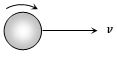
- B
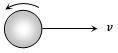
- C
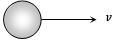
- DAny of $(a), (b)$ and $(c)$
Explore More
Similar Questions
Water is flowing through a horizontal tube having cross-sectional areas of its two ends as $A$ and $A'$ such that the ratio $A/A'$ is $5$. If the pressure difference of water between the two ends is $3 \times 10^5 \, N \, m^{-2}$,the velocity of water with which it enters the tube will be ......... $m \, s^{-1}$ (neglect gravity effects).
DifficultAIEEE 2012
View SolutionAir of density $1.2 \, kg \, m^{-3}$ is blowing across the horizontal wings of an aeroplane in such a way that its speeds above and below the wings are $150 \, m \, s^{-1}$ and $100 \, m \, s^{-1}$,respectively. The pressure difference between the upper and lower sides of the wings is ........ $N \, m^{-2}$.
Water from a tap emerges vertically downwards with an initial speed of $1.0\,ms^{-1}.$ The cross-sectional area of the tap is $10^{-4}\,m^2.$ Assume that the pressure is constant throughout the stream of water and that flow is streamlined. The cross-sectional area of the stream,$0.15\,m$ below the tap would be: (take $g = 10\,ms^{-2}$ )
Write the limitations of Bernoulli's equation.
Medium
View SolutionIn a horizontal tube,the water pressure changes by $1500 \text{ N m}^{-2}$ between points $A$ and $B$ as shown in the figure below. The cross-sectional areas at $A$ and $B$ of the tube are $40 \text{ cm}^2$ and $20 \text{ cm}^2$,respectively. Find the rate of flow of water through the tube.
DifficultTS EAMCET 2021
View SolutionVedclass Products
For Students
Vedclass Test Series
Mock tests in real JEE/NEET style with performance analysis. 5-day free trial.
Start Free TrialFor Teachers
Exam Paper Generator
Generate Set A/B/C/D exam papers from 7.5L+ questions in 2 minutes. 3 chapters free.
Try FreeFor Institutes
Online Exam Module
Live online exams with unlimited students, 360° analytics & white-label branding.
See Demo