
A English
Bernoulli's Theorem and Applications of Bernoulli's Theory Questions in English
Class 11 Physics · Fluid Mechanics and Surface Tension · Bernoulli's Theorem and Applications of Bernoulli's Theory
175+
Questions
English
Language
100%
With Solutions
Showing 48 of 175 questions in English
51
EasyMCQ
Pressure head in Bernoulli's equation is
A
$\frac{P\rho}{g}$
B
$\frac{P}{\rho g}$
C
$\rho g$
D
$P\rho g$
Solution
(B) Bernoulli's equation is a statement of the conservation of energy for a flowing fluid,relating pressure,velocity,and gravitational potential at a point.
The equation is given by:
$\frac{P}{\rho g} + h + \frac{v^2}{2g} = \text{constant}$
In this equation:
$1$. $\frac{P}{\rho g}$ is known as the pressure head.
$2$. $h$ is the potential head (or elevation head).
$3$. $\frac{v^2}{2g}$ is the velocity head.
Therefore,the pressure head is $\frac{P}{\rho g}$.
The equation is given by:
$\frac{P}{\rho g} + h + \frac{v^2}{2g} = \text{constant}$
In this equation:
$1$. $\frac{P}{\rho g}$ is known as the pressure head.
$2$. $h$ is the potential head (or elevation head).
$3$. $\frac{v^2}{2g}$ is the velocity head.
Therefore,the pressure head is $\frac{P}{\rho g}$.
0 likes
View Solution52
DifficultMCQ
In the diagram shown,the difference in the height of the liquid columns in the two tubes of the manometer is $5\, cm$. The cross-sectional areas of the tube at $A$ and $B$ are $6\, mm^2$ and $10\, mm^2$ respectively. The rate at which water flows through the tube is ........ $cc/s$ $(g = 10\, m/s^2)$.
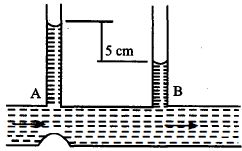
A
$7.5$
B
$8.0$
C
$10.0$
D
$12.5$
Solution
(A) According to Bernoulli's theorem for horizontal flow:
$P_A + \frac{1}{2}\rho v_A^2 = P_B + \frac{1}{2}\rho v_B^2$
$P_A - P_B = \frac{1}{2}\rho (v_B^2 - v_A^2)$
Since the pressure difference is measured by the manometer height $h = 5\, cm$,we have $P_A - P_B = \rho gh$.
Thus,$\frac{1}{2}\rho (v_B^2 - v_A^2) = \rho gh \implies v_B^2 - v_A^2 = 2gh$.
Given $g = 10\, m/s^2 = 1000\, cm/s^2$ and $h = 5\, cm$,we have $v_B^2 - v_A^2 = 2 \times 1000 \times 5 = 10000\, cm^2/s^2$.
From the equation of continuity,$A_A v_A = A_B v_B$.
Given $A_A = 6\, mm^2$ and $A_B = 10\, mm^2$,we have $6 v_A = 10 v_B \implies v_B = 0.6 v_A$.
Substituting $v_B$ into the Bernoulli equation:
$(0.6 v_A)^2 - v_A^2 = 10000$
$0.36 v_A^2 - v_A^2 = 10000$ (Note: The pressure at $A$ is higher due to smaller area,so $v_A > v_B$. Correcting the sign: $v_A^2 - v_B^2 = 2gh$)
$v_A^2 - (0.6 v_A)^2 = 10000$
$v_A^2 (1 - 0.36) = 10000$
$0.64 v_A^2 = 10000 \implies v_A^2 = \frac{10000}{0.64} = 15625$
$v_A = \sqrt{15625} = 125\, cm/s$.
The flow rate $Q = A_A v_A = 6\, mm^2 \times 125\, cm/s = 0.06\, cm^2 \times 125\, cm/s = 7.5\, cc/s$.
$P_A + \frac{1}{2}\rho v_A^2 = P_B + \frac{1}{2}\rho v_B^2$
$P_A - P_B = \frac{1}{2}\rho (v_B^2 - v_A^2)$
Since the pressure difference is measured by the manometer height $h = 5\, cm$,we have $P_A - P_B = \rho gh$.
Thus,$\frac{1}{2}\rho (v_B^2 - v_A^2) = \rho gh \implies v_B^2 - v_A^2 = 2gh$.
Given $g = 10\, m/s^2 = 1000\, cm/s^2$ and $h = 5\, cm$,we have $v_B^2 - v_A^2 = 2 \times 1000 \times 5 = 10000\, cm^2/s^2$.
From the equation of continuity,$A_A v_A = A_B v_B$.
Given $A_A = 6\, mm^2$ and $A_B = 10\, mm^2$,we have $6 v_A = 10 v_B \implies v_B = 0.6 v_A$.
Substituting $v_B$ into the Bernoulli equation:
$(0.6 v_A)^2 - v_A^2 = 10000$
$0.36 v_A^2 - v_A^2 = 10000$ (Note: The pressure at $A$ is higher due to smaller area,so $v_A > v_B$. Correcting the sign: $v_A^2 - v_B^2 = 2gh$)
$v_A^2 - (0.6 v_A)^2 = 10000$
$v_A^2 (1 - 0.36) = 10000$
$0.64 v_A^2 = 10000 \implies v_A^2 = \frac{10000}{0.64} = 15625$
$v_A = \sqrt{15625} = 125\, cm/s$.
The flow rate $Q = A_A v_A = 6\, mm^2 \times 125\, cm/s = 0.06\, cm^2 \times 125\, cm/s = 7.5\, cc/s$.
0 likes
View Solution53
MediumMCQ
Air of density $1.2 \, kg \, m^{-3}$ is blowing across the horizontal wings of an aeroplane in such a way that its speeds above and below the wings are $150 \, m \, s^{-1}$ and $100 \, m \, s^{-1}$,respectively. The pressure difference between the upper and lower sides of the wings is ........ $N \, m^{-2}$.
A
$60$
B
$180$
C
$7500$
D
$12500$
Solution
(C) According to Bernoulli's principle,for horizontal flow,the pressure difference $\Delta P$ is given by the equation:
$\Delta P = P_{lower} - P_{upper} = \frac{1}{2} \rho (v_{upper}^2 - v_{lower}^2)$
Given:
Density $\rho = 1.2 \, kg \, m^{-3}$
Velocity above the wing $v_{upper} = 150 \, m \, s^{-1}$
Velocity below the wing $v_{lower} = 100 \, m \, s^{-1}$
Substituting the values:
$\Delta P = \frac{1}{2} \times 1.2 \times (150^2 - 100^2)$
$\Delta P = 0.6 \times (22500 - 10000)$
$\Delta P = 0.6 \times 12500$
$\Delta P = 7500 \, N \, m^{-2}$
$\Delta P = P_{lower} - P_{upper} = \frac{1}{2} \rho (v_{upper}^2 - v_{lower}^2)$
Given:
Density $\rho = 1.2 \, kg \, m^{-3}$
Velocity above the wing $v_{upper} = 150 \, m \, s^{-1}$
Velocity below the wing $v_{lower} = 100 \, m \, s^{-1}$
Substituting the values:
$\Delta P = \frac{1}{2} \times 1.2 \times (150^2 - 100^2)$
$\Delta P = 0.6 \times (22500 - 10000)$
$\Delta P = 0.6 \times 12500$
$\Delta P = 7500 \, N \, m^{-2}$
0 likes
View Solution54
DifficultMCQ
Water is flowing through a horizontal tube having cross-sectional areas of its two ends as $A$ and $A'$ such that the ratio $A/A'$ is $5$. If the pressure difference of water between the two ends is $3 \times 10^5 \, N \, m^{-2}$,the velocity of water with which it enters the tube will be ......... $m \, s^{-1}$ (neglect gravity effects).
A
$5$
B
$10$
C
$25$
D
$50\sqrt{10}$
Solution
(A) According to $Bernoulli's$ theorem for horizontal flow:
${P_1} + \frac{1}{2}\rho v_1^2 = {P_2} + \frac{1}{2}\rho v_2^2$
${P_1} - {P_2} = \frac{1}{2}\rho (v_2^2 - v_1^2) \, ... (i)$
Given: ${P_1} - {P_2} = 3 \times 10^5 \, N \, m^{-2}$,$\rho = 1000 \, kg \, m^{-3}$,and $\frac{A}{A'} = 5$.
From the equation of continuity,$A v_1 = A' v_2$,so $\frac{v_2}{v_1} = \frac{A}{A'} = 5$,which means $v_2 = 5v_1$.
Substituting $v_2 = 5v_1$ into equation $(i)$:
$3 \times 10^5 = \frac{1}{2} \times 1000 \times ((5v_1)^2 - v_1^2)$
$3 \times 10^5 = 500 \times (25v_1^2 - v_1^2)$
$3 \times 10^5 = 500 \times 24v_1^2$
$3000 = 120v_1^2$
$v_1^2 = \frac{3000}{120} = 25$
$v_1 = 5 \, m \, s^{-1}$.
${P_1} + \frac{1}{2}\rho v_1^2 = {P_2} + \frac{1}{2}\rho v_2^2$
${P_1} - {P_2} = \frac{1}{2}\rho (v_2^2 - v_1^2) \, ... (i)$
Given: ${P_1} - {P_2} = 3 \times 10^5 \, N \, m^{-2}$,$\rho = 1000 \, kg \, m^{-3}$,and $\frac{A}{A'} = 5$.
From the equation of continuity,$A v_1 = A' v_2$,so $\frac{v_2}{v_1} = \frac{A}{A'} = 5$,which means $v_2 = 5v_1$.
Substituting $v_2 = 5v_1$ into equation $(i)$:
$3 \times 10^5 = \frac{1}{2} \times 1000 \times ((5v_1)^2 - v_1^2)$
$3 \times 10^5 = 500 \times (25v_1^2 - v_1^2)$
$3 \times 10^5 = 500 \times 24v_1^2$
$3000 = 120v_1^2$
$v_1^2 = \frac{3000}{120} = 25$
$v_1 = 5 \, m \, s^{-1}$.
0 likes
View Solution55
MediumMCQ
Water from a tap emerges vertically downwards with an initial speed of $1.0\,ms^{-1}.$ The cross-sectional area of the tap is $10^{-4}\,m^2.$ Assume that the pressure is constant throughout the stream of water and that flow is streamlined. The cross-sectional area of the stream,$0.15\,m$ below the tap would be: (take $g = 10\,ms^{-2}$ )
A
$5\times 10^{-4}\,m^2$
B
$5\times 10^{-5}\,m^2$
C
$1\times 10^{-5}\,m^2$
D
$2\times 10^{-5}\,m^2$
Solution
(B) According to the equation of continuity,$A_1 v_1 = A_2 v_2$,where $A_1 = 10^{-4}\,m^2$ and $v_1 = 1.0\,ms^{-1}$.
Thus,$A_2 v_2 = A_1 v_1 = 10^{-4} \times 1 = 10^{-4}\,m^3s^{-1} \dots (1)$.
Using Bernoulli's equation for a streamline flow under constant pressure: $P + \frac{1}{2}\rho v_1^2 + \rho gh_1 = P + \frac{1}{2}\rho v_2^2 + \rho gh_2$.
Since the pressure is constant,we have $\frac{1}{2}\rho v_1^2 + \rho gh_1 = \frac{1}{2}\rho v_2^2 + \rho gh_2$.
Rearranging gives $v_2^2 - v_1^2 = 2g(h_1 - h_2) = 2gh$,where $h = 0.15\,m$.
$v_2 = \sqrt{v_1^2 + 2gh} = \sqrt{1^2 + 2 \times 10 \times 0.15} = \sqrt{1 + 3} = \sqrt{4} = 2\,ms^{-1}$.
Substituting $v_2$ into equation $(1)$: $A_2 \times 2 = 10^{-4}$.
Therefore,$A_2 = \frac{10^{-4}}{2} = 0.5 \times 10^{-4} = 5 \times 10^{-5}\,m^2$.
Thus,$A_2 v_2 = A_1 v_1 = 10^{-4} \times 1 = 10^{-4}\,m^3s^{-1} \dots (1)$.
Using Bernoulli's equation for a streamline flow under constant pressure: $P + \frac{1}{2}\rho v_1^2 + \rho gh_1 = P + \frac{1}{2}\rho v_2^2 + \rho gh_2$.
Since the pressure is constant,we have $\frac{1}{2}\rho v_1^2 + \rho gh_1 = \frac{1}{2}\rho v_2^2 + \rho gh_2$.
Rearranging gives $v_2^2 - v_1^2 = 2g(h_1 - h_2) = 2gh$,where $h = 0.15\,m$.
$v_2 = \sqrt{v_1^2 + 2gh} = \sqrt{1^2 + 2 \times 10 \times 0.15} = \sqrt{1 + 3} = \sqrt{4} = 2\,ms^{-1}$.
Substituting $v_2$ into equation $(1)$: $A_2 \times 2 = 10^{-4}$.
Therefore,$A_2 = \frac{10^{-4}}{2} = 0.5 \times 10^{-4} = 5 \times 10^{-5}\,m^2$.
0 likes
View Solution56
MediumMCQ
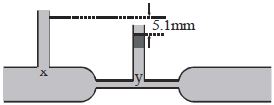
The diagram shows a venturimeter through which water is flowing. The speed of water at $X$ is $2 \, cm/s$. The speed of water at $Y$ (taking $g = 1000 \, cm/s^2$) is ........ $cm/s$.
A
$23$
B
$32$
C
$101$
D
$1024$
Solution
(B) According to Bernoulli's principle for horizontal flow,the pressure difference between two points is related to the change in velocity. The height difference $h$ between the water levels in the two vertical tubes is $5.1 \, mm = 0.51 \, cm$.
Using the equation $V_Y^2 = V_X^2 + 2gh$:
Given $V_X = 2 \, cm/s$,$g = 1000 \, cm/s^2$,and $h = 0.51 \, cm$.
$V_Y^2 = (2)^2 + 2 \times 1000 \times 0.51$
$V_Y^2 = 4 + 1020 = 1024$
$V_Y = \sqrt{1024} = 32 \, cm/s$.
Using the equation $V_Y^2 = V_X^2 + 2gh$:
Given $V_X = 2 \, cm/s$,$g = 1000 \, cm/s^2$,and $h = 0.51 \, cm$.
$V_Y^2 = (2)^2 + 2 \times 1000 \times 0.51$
$V_Y^2 = 4 + 1020 = 1024$
$V_Y = \sqrt{1024} = 32 \, cm/s$.
0 likes
View Solution57
DifficultMCQ
Air is blowing across the horizontal wings of an aeroplane in such a way that its speeds below and above the wings are $90\, m/s$ and $120\, m/s$ respectively. If the density of air is $1.3\, kg/m^3$,then the pressure difference between the lower and upper sides of the wings will be ........ $N/m^2$.
A
$4819$
B
$481.90$
C
$409.5$
D
$4095$
Solution
(D) According to Bernoulli's theorem,the pressure difference $\Delta P$ between the lower and upper surfaces of the wing is given by:
$\Delta P = P_{lower} - P_{upper} = \frac{1}{2} \rho (v_{upper}^2 - v_{lower}^2)$
Given:
Density of air $\rho = 1.3\, kg/m^3$
Speed below the wing $v_{lower} = 90\, m/s$
Speed above the wing $v_{upper} = 120\, m/s$
Substituting the values:
$\Delta P = \frac{1}{2} \times 1.3 \times (120^2 - 90^2)$
$\Delta P = 0.65 \times (14400 - 8100)$
$\Delta P = 0.65 \times 6300$
$\Delta P = 4095\, N/m^2$
Thus,the pressure difference is $4095\, N/m^2$.
$\Delta P = P_{lower} - P_{upper} = \frac{1}{2} \rho (v_{upper}^2 - v_{lower}^2)$
Given:
Density of air $\rho = 1.3\, kg/m^3$
Speed below the wing $v_{lower} = 90\, m/s$
Speed above the wing $v_{upper} = 120\, m/s$
Substituting the values:
$\Delta P = \frac{1}{2} \times 1.3 \times (120^2 - 90^2)$
$\Delta P = 0.65 \times (14400 - 8100)$
$\Delta P = 0.65 \times 6300$
$\Delta P = 4095\, N/m^2$
Thus,the pressure difference is $4095\, N/m^2$.
0 likes
View Solution58
MediumMCQ
Application of Bernoulli's theorem can be seen in
A
Dynamic lift to aeroplane
B
Hydraulic press
C
Speed Boat
D
None of these
Solution
(A) Bernoulli's theorem states that for an incompressible,non-viscous,and steady flow of fluid,the sum of pressure energy,kinetic energy,and potential energy per unit volume remains constant.
In the case of an aeroplane wing,the shape is designed such that the air velocity above the wing is higher than the air velocity below the wing.
According to Bernoulli's principle,higher velocity leads to lower pressure.
This pressure difference creates an upward force known as dynamic lift,which helps the aeroplane to fly.
In the case of an aeroplane wing,the shape is designed such that the air velocity above the wing is higher than the air velocity below the wing.
According to Bernoulli's principle,higher velocity leads to lower pressure.
This pressure difference creates an upward force known as dynamic lift,which helps the aeroplane to fly.
0 likes
View Solution59
DifficultMCQ
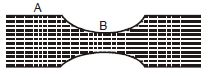
Water flows in a horizontal tube as shown in the figure. The pressure of water changes by $600\, N/m^2$ between $A$ and $B$ where the cross-sectional areas are $30\, cm^2$ and $15\, cm^2$ respectively. Find the rate of flow of water through the tube.
A
$\frac{1}{\sqrt{10}} \times 10^{-3}\, m^3/s$
B
$\frac{6}{\sqrt{10}} \times 10^{-3}\, m^3/s$
C
$2\, m^3/s$
D
$5\, m^3/s$
Solution
(B) Given: $A_1 = 30\, cm^2 = 30 \times 10^{-4}\, m^2$,$A_2 = 15\, cm^2 = 15 \times 10^{-4}\, m^2$,$\Delta P = P_1 - P_2 = 600\, N/m^2$,$\rho = 1000\, kg/m^3$.
From the equation of continuity,$A_1 v_1 = A_2 v_2$,so $v_2 = (A_1/A_2) v_1 = (30/15) v_1 = 2 v_1$.
Using Bernoulli's equation for horizontal flow: $P_1 + \frac{1}{2} \rho v_1^2 = P_2 + \frac{1}{2} \rho v_2^2$.
$P_1 - P_2 = \frac{1}{2} \rho (v_2^2 - v_1^2) = \frac{1}{2} \rho ((2v_1)^2 - v_1^2) = \frac{1}{2} \rho (3v_1^2)$.
$600 = \frac{1}{2} \times 1000 \times 3 v_1^2 = 1500 v_1^2$.
$v_1^2 = 600 / 1500 = 6/15 = 0.4 = 4/10$.
$v_1 = \sqrt{4/10} = 2/\sqrt{10}\, m/s$.
The rate of flow $Q = A_1 v_1 = (30 \times 10^{-4}) \times (2/\sqrt{10}) = 60 \times 10^{-4} / \sqrt{10} = \frac{6}{\sqrt{10}} \times 10^{-3}\, m^3/s$.
From the equation of continuity,$A_1 v_1 = A_2 v_2$,so $v_2 = (A_1/A_2) v_1 = (30/15) v_1 = 2 v_1$.
Using Bernoulli's equation for horizontal flow: $P_1 + \frac{1}{2} \rho v_1^2 = P_2 + \frac{1}{2} \rho v_2^2$.
$P_1 - P_2 = \frac{1}{2} \rho (v_2^2 - v_1^2) = \frac{1}{2} \rho ((2v_1)^2 - v_1^2) = \frac{1}{2} \rho (3v_1^2)$.
$600 = \frac{1}{2} \times 1000 \times 3 v_1^2 = 1500 v_1^2$.
$v_1^2 = 600 / 1500 = 6/15 = 0.4 = 4/10$.
$v_1 = \sqrt{4/10} = 2/\sqrt{10}\, m/s$.
The rate of flow $Q = A_1 v_1 = (30 \times 10^{-4}) \times (2/\sqrt{10}) = 60 \times 10^{-4} / \sqrt{10} = \frac{6}{\sqrt{10}} \times 10^{-3}\, m^3/s$.
0 likes
View Solution60
EasyMCQ
An aeroplane of mass $3 \times 10^4 \, kg$ and total wing area of $120 \, m^2$ is in a level flight at some height. The difference in pressure between the upper and lower surfaces of its wings in kilopascals is $(g = 10 \, m/s^2)$.
A
$2.5$
B
$5.0$
C
$10.0$
D
$12.5$
Solution
(A) For an aeroplane in level flight,the lift force $F$ must balance the weight of the aeroplane $W = mg$.
Thus,$F = mg = (3 \times 10^4 \, kg) \times (10 \, m/s^2) = 3 \times 10^5 \, N$.
The pressure difference $\Delta P$ between the upper and lower surfaces of the wings is given by the lift force divided by the wing area $A$.
$\Delta P = \frac{F}{A} = \frac{3 \times 10^5 \, N}{120 \, m^2}$.
$\Delta P = \frac{300000}{120} \, Pa = 2500 \, Pa$.
Since $1 \, kPa = 1000 \, Pa$,we have $\Delta P = 2.5 \, kPa$.
Thus,$F = mg = (3 \times 10^4 \, kg) \times (10 \, m/s^2) = 3 \times 10^5 \, N$.
The pressure difference $\Delta P$ between the upper and lower surfaces of the wings is given by the lift force divided by the wing area $A$.
$\Delta P = \frac{F}{A} = \frac{3 \times 10^5 \, N}{120 \, m^2}$.
$\Delta P = \frac{300000}{120} \, Pa = 2500 \, Pa$.
Since $1 \, kPa = 1000 \, Pa$,we have $\Delta P = 2.5 \, kPa$.
0 likes
View Solution61
MediumMCQ
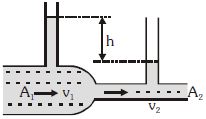
$A$ liquid flows through a horizontal tube. The velocities of the liquid in the two sections which have areas of cross-section $A_1$ and $A_2$ are $v_1$ and $v_2$ respectively. The difference in the levels of the liquid in the two vertical tubes is $h$. The incorrect statement is
A
The volume of the liquid flowing through the tube in unit time is $A_1v_1$
B
${v_2} - {v_1} = \sqrt {2gh} $
C
${v_2^2} - {v_1^2} = {2gh} $
D
The energy per unit mass of the liquid is the same in both sections of the tube
Solution
(B) According to the equation of continuity,the volume flow rate is constant: $A_1v_1 = A_2v_2$. Thus,option $(A)$ is correct.
Applying Bernoulli's principle for a horizontal tube $(h_1 = h_2)$:
$P_1 + \frac{1}{2}\rho v_1^2 = P_2 + \frac{1}{2}\rho v_2^2$
$P_1 - P_2 = \frac{1}{2}\rho(v_2^2 - v_1^2)$
Since the pressure difference is given by the height difference $h$ in the manometers,$P_1 - P_2 = \rho gh$.
Therefore,$\rho gh = \frac{1}{2}\rho(v_2^2 - v_1^2)$,which simplifies to $v_2^2 - v_1^2 = 2gh$. Thus,option $(C)$ is correct.
Option $(B)$ states $v_2 - v_1 = \sqrt{2gh}$,which is mathematically incorrect because $\sqrt{v_2^2 - v_1^2} \neq v_2 - v_1$.
Option $(D)$ is incorrect because,in a real fluid flow,energy is dissipated due to viscosity,and even in an ideal fluid,the total energy per unit mass (Bernoulli's constant) is conserved,but the distribution between pressure energy and kinetic energy changes. However,in the context of this specific question,option $(B)$ is the most explicitly incorrect mathematical statement.
Applying Bernoulli's principle for a horizontal tube $(h_1 = h_2)$:
$P_1 + \frac{1}{2}\rho v_1^2 = P_2 + \frac{1}{2}\rho v_2^2$
$P_1 - P_2 = \frac{1}{2}\rho(v_2^2 - v_1^2)$
Since the pressure difference is given by the height difference $h$ in the manometers,$P_1 - P_2 = \rho gh$.
Therefore,$\rho gh = \frac{1}{2}\rho(v_2^2 - v_1^2)$,which simplifies to $v_2^2 - v_1^2 = 2gh$. Thus,option $(C)$ is correct.
Option $(B)$ states $v_2 - v_1 = \sqrt{2gh}$,which is mathematically incorrect because $\sqrt{v_2^2 - v_1^2} \neq v_2 - v_1$.
Option $(D)$ is incorrect because,in a real fluid flow,energy is dissipated due to viscosity,and even in an ideal fluid,the total energy per unit mass (Bernoulli's constant) is conserved,but the distribution between pressure energy and kinetic energy changes. However,in the context of this specific question,option $(B)$ is the most explicitly incorrect mathematical statement.
0 likes
View Solution62
DifficultMCQ
Air is streaming past a horizontal aeroplane wing such that its speed is $120\, m/s$ over the upper surface and $90\, m/s$ at the lower surface. If the density of air is $1.3\, kg/m^3$ and the wing is $10\, m$ long and has an average width of $2\, m$,then the difference of the pressure on the two sides of the wing is ........ $N/m^2$.
A
$40.95$
B
$409.5$
C
$4095$
D
$40950$
Solution
(C) Using Bernoulli's theorem:
$P_{1} + \frac{1}{2} \rho v_{1}^{2} + \rho gh_{1} = P_{2} + \frac{1}{2} \rho v_{2}^{2} + \rho gh_{2}$
Since the wing is horizontal,$h_{1} = h_{2}$,the equation simplifies to:
$P_{1} + \frac{1}{2} \rho v_{1}^{2} = P_{2} + \frac{1}{2} \rho v_{2}^{2}$
Rearranging to find the pressure difference $\Delta P = P_{2} - P_{1}$:
$\Delta P = \frac{1}{2} \rho (v_{1}^{2} - v_{2}^{2})$
Given $\rho = 1.3\, kg/m^3$,$v_{1} = 120\, m/s$ (upper surface),and $v_{2} = 90\, m/s$ (lower surface):
$\Delta P = \frac{1}{2} \times 1.3 \times (120^{2} - 90^{2})$
$\Delta P = 0.65 \times (14400 - 8100)$
$\Delta P = 0.65 \times 6300 = 4095\, N/m^2$.
$P_{1} + \frac{1}{2} \rho v_{1}^{2} + \rho gh_{1} = P_{2} + \frac{1}{2} \rho v_{2}^{2} + \rho gh_{2}$
Since the wing is horizontal,$h_{1} = h_{2}$,the equation simplifies to:
$P_{1} + \frac{1}{2} \rho v_{1}^{2} = P_{2} + \frac{1}{2} \rho v_{2}^{2}$
Rearranging to find the pressure difference $\Delta P = P_{2} - P_{1}$:
$\Delta P = \frac{1}{2} \rho (v_{1}^{2} - v_{2}^{2})$
Given $\rho = 1.3\, kg/m^3$,$v_{1} = 120\, m/s$ (upper surface),and $v_{2} = 90\, m/s$ (lower surface):
$\Delta P = \frac{1}{2} \times 1.3 \times (120^{2} - 90^{2})$
$\Delta P = 0.65 \times (14400 - 8100)$
$\Delta P = 0.65 \times 6300 = 4095\, N/m^2$.
0 likes
View Solution63
EasyMCQ
Bernoulli's principle is based on the law of conservation of
A
mass
B
energy
C
angular momentum
D
linear momentum
Solution
(B) Bernoulli's principle is derived from the work-energy theorem for a flowing fluid.
It states that for an incompressible,non-viscous,and steady flow of a fluid,the sum of pressure energy,kinetic energy,and potential energy per unit volume remains constant along a streamline.
Therefore,it is based on the law of conservation of energy.
It states that for an incompressible,non-viscous,and steady flow of a fluid,the sum of pressure energy,kinetic energy,and potential energy per unit volume remains constant along a streamline.
Therefore,it is based on the law of conservation of energy.
0 likes
View Solution64
EasyMCQ
$A$ scent sprayer is based on
A
Bernoulli's theorem
B
Archimedes' principle
C
Charles's law
D
Boyle's law
Solution
(A) Bernoulli's theorem states that for an incompressible,non-viscous fluid in steady flow,an increase in the speed of the fluid occurs simultaneously with a decrease in pressure or a decrease in the fluid's potential energy.
In a scent sprayer,when air is pumped through the nozzle at high velocity,it creates a region of low pressure according to Bernoulli's principle.
Due to this pressure difference between the container and the nozzle,the liquid scent is pushed upward through the tube and sprayed out with the air stream.
In a scent sprayer,when air is pumped through the nozzle at high velocity,it creates a region of low pressure according to Bernoulli's principle.
Due to this pressure difference between the container and the nozzle,the liquid scent is pushed upward through the tube and sprayed out with the air stream.
0 likes
View Solution65
EasyMCQ
In old age,arteries carrying blood in the human body become narrow,resulting in an increase in blood pressure. This follows from:
A
Pascal's law
B
Stoke's law
C
Bernoulli's principle
D
Archimedes principle
Solution
(C) According to Bernoulli's principle,for an incompressible,non-viscous fluid in steady flow,the sum of pressure energy,kinetic energy,and potential energy per unit volume remains constant along a streamline $(P + \frac{1}{2}\rho v^2 + \rho gh = \text{constant})$.
In the human circulatory system,as arteries become narrow due to aging or plaque buildup,the blood flow velocity $(v)$ changes. While the relationship is complex due to the viscosity of blood,Bernoulli's principle explains that a decrease in the cross-sectional area of a vessel leads to changes in pressure. Specifically,the narrowing of arteries increases the resistance to flow,and the pressure dynamics within the vessel are governed by the principles of fluid mechanics,primarily Bernoulli's principle,which relates pressure and velocity in fluid flow.
In the human circulatory system,as arteries become narrow due to aging or plaque buildup,the blood flow velocity $(v)$ changes. While the relationship is complex due to the viscosity of blood,Bernoulli's principle explains that a decrease in the cross-sectional area of a vessel leads to changes in pressure. Specifically,the narrowing of arteries increases the resistance to flow,and the pressure dynamics within the vessel are governed by the principles of fluid mechanics,primarily Bernoulli's principle,which relates pressure and velocity in fluid flow.
0 likes
View Solution66
EasyMCQ
The lift of an airplane is based on
A
Torricelli's theorem
B
Bernoulli's theorem
C
Law of gravitation
D
Conservation of linear momentum
Solution
(B) The lift of an airplane wing is based on Bernoulli's principle.
An airplane wing is designed with a special shape called an airfoil.
Due to this shape,the air velocity above the wing is higher than the air velocity below the wing.
According to Bernoulli's theorem,where the velocity of a fluid is higher,the pressure is lower.
Therefore,the pressure below the wing is greater than the pressure above the wing,which creates an upward force known as lift.
An airplane wing is designed with a special shape called an airfoil.
Due to this shape,the air velocity above the wing is higher than the air velocity below the wing.
According to Bernoulli's theorem,where the velocity of a fluid is higher,the pressure is lower.
Therefore,the pressure below the wing is greater than the pressure above the wing,which creates an upward force known as lift.
0 likes
View Solution67
EasyMCQ
$Assertion :$ The velocity of flow of a liquid is smaller when pressure is larger and vice-versa.
$Reason :$ According to Bernoulli's theorem,for the stream line flow of an ideal liquid,the total energy per unit mass remains constant.
$Reason :$ According to Bernoulli's theorem,for the stream line flow of an ideal liquid,the total energy per unit mass remains constant.
A
If both the Assertion and Reason are incorrect.
B
If both Assertion and Reason are correct but Reason is not a correct explanation of the Assertion.
C
If the Assertion is correct but Reason is incorrect.
D
If both Assertion and Reason are correct and the Reason is a correct explanation of the Assertion.
Solution
(D) According to Bernoulli's theorem,for the streamline flow of an ideal liquid,the sum of pressure energy,kinetic energy,and potential energy per unit volume remains constant along a streamline.
The equation is $P + \frac{1}{2}\rho v^2 + \rho gh = \text{constant}$.
If we consider horizontal flow $(h = \text{constant})$,then $P + \frac{1}{2}\rho v^2 = \text{constant}$.
This implies that if the pressure $P$ increases,the velocity $v$ must decrease to keep the sum constant,and vice-versa. Thus,the Assertion is correct.
The Reason states that the total energy per unit mass remains constant. Bernoulli's theorem states that the total energy per unit volume (or mass) is constant for an ideal fluid. Therefore,the Reason is also correct and provides the physical basis for the Assertion.
The equation is $P + \frac{1}{2}\rho v^2 + \rho gh = \text{constant}$.
If we consider horizontal flow $(h = \text{constant})$,then $P + \frac{1}{2}\rho v^2 = \text{constant}$.
This implies that if the pressure $P$ increases,the velocity $v$ must decrease to keep the sum constant,and vice-versa. Thus,the Assertion is correct.
The Reason states that the total energy per unit mass remains constant. Bernoulli's theorem states that the total energy per unit volume (or mass) is constant for an ideal fluid. Therefore,the Reason is also correct and provides the physical basis for the Assertion.
0 likes
View Solution68
EasyMCQ
$Assertion :$ The pressure of water increases when it flows from a narrow pipe to a wider pipe.
$Reason :$ According to the equation of continuity,$A_1v_1 = A_2v_2$,and by Bernoulli's principle,where velocity is high,pressure is low.
$Reason :$ According to the equation of continuity,$A_1v_1 = A_2v_2$,and by Bernoulli's principle,where velocity is high,pressure is low.
A
If both Assertion and Reason are correct and the Reason is a correct explanation of the Assertion.
B
If both Assertion and Reason are correct but Reason is not a correct explanation of the Assertion.
C
If the Assertion is correct but Reason is incorrect.
D
If both the Assertion and Reason are incorrect.
Solution
(A) According to the equation of continuity,$A_1v_1 = A_2v_2$. When water flows from a narrow pipe (small area $A_1$) to a wider pipe (large area $A_2$),the velocity $v$ decreases because $v \propto 1/A$.
According to Bernoulli's principle,$P + \frac{1}{2}\rho v^2 + \rho gh = \text{constant}$.
For a horizontal pipe $(h = \text{constant})$,as the velocity $v$ decreases,the pressure $P$ must increase to keep the sum constant.
Therefore,the pressure increases when water flows from a narrow pipe to a wider pipe.
Both the Assertion and the Reason are correct,and the Reason correctly explains the Assertion.
According to Bernoulli's principle,$P + \frac{1}{2}\rho v^2 + \rho gh = \text{constant}$.
For a horizontal pipe $(h = \text{constant})$,as the velocity $v$ decreases,the pressure $P$ must increase to keep the sum constant.
Therefore,the pressure increases when water flows from a narrow pipe to a wider pipe.
Both the Assertion and the Reason are correct,and the Reason correctly explains the Assertion.
0 likes
View Solution69
DifficultMCQ
Water flows in a horizontal tube (see figure). The pressure of water changes by $700 \; Nm^{-2}$ between $A$ and $B$ where the area of cross-section are $40 \; cm^{2}$ and $20 \; cm^{2},$ respectively. Find the rate of flow of water through the tube in $cm^{3} / s$. (Density of water $= 1000 \; kgm^{-3}$)
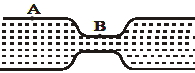
A
$1810$
B
$3020$
C
$2720$
D
$2420$
Solution
(C) The rate of flow of water is constant,so $A_{A} V_{A} = A_{B} V_{B}$.
Given $A_{A} = 40 \; cm^{2}$ and $A_{B} = 20 \; cm^{2}$,we have $40 V_{A} = 20 V_{B}$,which implies $V_{B} = 2 V_{A}$.
Using Bernoulli's theorem for a horizontal tube: $P_{A} + \frac{1}{2} \rho V_{A}^{2} = P_{B} + \frac{1}{2} \rho V_{B}^{2}$.
Rearranging gives $P_{A} - P_{B} = \frac{1}{2} \rho (V_{B}^{2} - V_{A}^{2})$.
Substituting the given values ($P_{A} - P_{B} = 700 \; Pa$,$\rho = 1000 \; kg/m^{3}$):
$700 = \frac{1}{2} \times 1000 \times ((2 V_{A})^{2} - V_{A}^{2})$
$700 = 500 \times (4 V_{A}^{2} - V_{A}^{2})$
$700 = 500 \times 3 V_{A}^{2}$
$V_{A}^{2} = \frac{700}{1500} = \frac{7}{15} \; m^{2}/s^{2}$
$V_{A} = \sqrt{\frac{7}{15}} \approx 0.683 \; m/s = 68.3 \; cm/s$.
The rate of flow $Q = A_{A} V_{A} = 40 \; cm^{2} \times 68.3 \; cm/s \approx 2732 \; cm^{3}/s$. Given the options,the closest value is $2720 \; cm^{3}/s$.
Given $A_{A} = 40 \; cm^{2}$ and $A_{B} = 20 \; cm^{2}$,we have $40 V_{A} = 20 V_{B}$,which implies $V_{B} = 2 V_{A}$.
Using Bernoulli's theorem for a horizontal tube: $P_{A} + \frac{1}{2} \rho V_{A}^{2} = P_{B} + \frac{1}{2} \rho V_{B}^{2}$.
Rearranging gives $P_{A} - P_{B} = \frac{1}{2} \rho (V_{B}^{2} - V_{A}^{2})$.
Substituting the given values ($P_{A} - P_{B} = 700 \; Pa$,$\rho = 1000 \; kg/m^{3}$):
$700 = \frac{1}{2} \times 1000 \times ((2 V_{A})^{2} - V_{A}^{2})$
$700 = 500 \times (4 V_{A}^{2} - V_{A}^{2})$
$700 = 500 \times 3 V_{A}^{2}$
$V_{A}^{2} = \frac{700}{1500} = \frac{7}{15} \; m^{2}/s^{2}$
$V_{A} = \sqrt{\frac{7}{15}} \approx 0.683 \; m/s = 68.3 \; cm/s$.
The rate of flow $Q = A_{A} V_{A} = 40 \; cm^{2} \times 68.3 \; cm/s \approx 2732 \; cm^{3}/s$. Given the options,the closest value is $2720 \; cm^{3}/s$.
0 likes
View Solution70
EasyMCQ
Blood velocity: The flow of blood in a large artery of an anesthetised dog is diverted through a Venturi meter. The wider part of the meter has a cross-sectional area equal to that of the artery,$A = 8 \; mm^2$. The narrower part has an area $a = 4 \; mm^2$. The pressure drop in the artery is $24 \; Pa$. What is the speed (in $m/s$) of the blood in the artery?
A
$0.657$
B
$2.56$
C
$0.123$
D
$1.26$
Solution
(C) Using Bernoulli's equation for a horizontal Venturi meter: $P_1 - P_2 = \frac{1}{2} \rho v_1^2 \left[ \left( \frac{A}{a} \right)^2 - 1 \right]$.
Given: Pressure drop $\Delta P = 24 \; Pa$,density of blood $\rho = 1.06 \times 10^3 \; kg/m^3$,$A = 8 \; mm^2$,$a = 4 \; mm^2$.
The ratio of areas is $\frac{A}{a} = \frac{8}{4} = 2$.
Substituting the values into the equation:
$24 = \frac{1}{2} \times 1060 \times v_1^2 \times (2^2 - 1)$
$24 = 530 \times v_1^2 \times 3$
$24 = 1590 \times v_1^2$
$v_1^2 = \frac{24}{1590} \approx 0.01509$
$v_1 = \sqrt{0.01509} \approx 0.123 \; m/s$.
Given: Pressure drop $\Delta P = 24 \; Pa$,density of blood $\rho = 1.06 \times 10^3 \; kg/m^3$,$A = 8 \; mm^2$,$a = 4 \; mm^2$.
The ratio of areas is $\frac{A}{a} = \frac{8}{4} = 2$.
Substituting the values into the equation:
$24 = \frac{1}{2} \times 1060 \times v_1^2 \times (2^2 - 1)$
$24 = 530 \times v_1^2 \times 3$
$24 = 1590 \times v_1^2$
$v_1^2 = \frac{24}{1590} \approx 0.01509$
$v_1 = \sqrt{0.01509} \approx 0.123 \; m/s$.
0 likes
View Solution71
Medium
$A$ fully loaded Boeing aircraft has a mass of $3.3 \times 10^{5} \; kg$. Its total wing area is $500 \; m^{2}$. It is in level flight with a speed of $960 \; km/h$.
$(a)$ Estimate the pressure difference between the lower and upper surfaces of the wings.
$(b)$ Estimate the fractional increase in the speed of the air on the upper surface of the wing relative to the lower surface. [The density of air is $\rho = 1.2 \; kg/m^{3}$]
$(a)$ Estimate the pressure difference between the lower and upper surfaces of the wings.
$(b)$ Estimate the fractional increase in the speed of the air on the upper surface of the wing relative to the lower surface. [The density of air is $\rho = 1.2 \; kg/m^{3}$]
Solution
(N/A) The weight of the Boeing aircraft is balanced by the upward force due to the pressure difference.
$\Delta P \times A = m \times g$
$\Delta P = \frac{3.3 \times 10^{5} \; kg \times 9.8 \; m/s^{2}}{500 \; m^{2}} = 6.468 \times 10^{3} \; N/m^{2} \approx 6.5 \times 10^{3} \; N/m^{2}$.
$(b)$ Ignoring the small height difference,Bernoulli's principle gives the pressure difference as:
$\Delta P = \frac{\rho}{2} (v_{2}^{2} - v_{1}^{2}) = \frac{\rho}{2} (v_{2} - v_{1})(v_{2} + v_{1})$
Given $v_{av} = \frac{v_{1} + v_{2}}{2} = 960 \; km/h = 266.7 \; m/s$.
$\frac{v_{2} - v_{1}}{v_{av}} = \frac{\Delta P}{\rho \cdot v_{av}^{2}} = \frac{6.5 \times 10^{3}}{1.2 \times (266.7)^{2}} \approx 0.076 \approx 0.08$.
The speed above the wing needs to be approximately $8\%$ higher than that below.
$\Delta P \times A = m \times g$
$\Delta P = \frac{3.3 \times 10^{5} \; kg \times 9.8 \; m/s^{2}}{500 \; m^{2}} = 6.468 \times 10^{3} \; N/m^{2} \approx 6.5 \times 10^{3} \; N/m^{2}$.
$(b)$ Ignoring the small height difference,Bernoulli's principle gives the pressure difference as:
$\Delta P = \frac{\rho}{2} (v_{2}^{2} - v_{1}^{2}) = \frac{\rho}{2} (v_{2} - v_{1})(v_{2} + v_{1})$
Given $v_{av} = \frac{v_{1} + v_{2}}{2} = 960 \; km/h = 266.7 \; m/s$.
$\frac{v_{2} - v_{1}}{v_{av}} = \frac{\Delta P}{\rho \cdot v_{av}^{2}} = \frac{6.5 \times 10^{3}}{1.2 \times (266.7)^{2}} \approx 0.076 \approx 0.08$.
The speed above the wing needs to be approximately $8\%$ higher than that below.
0 likes
View Solution72
Easy
Can Bernoulli's equation be used to describe the flow of water through a rapid in a river? Explain.
Solution
(N/A) No.
Bernoulli's equation cannot be used to describe the flow of water through a rapid in a river because the flow is turbulent. Bernoulli's principle is derived based on the assumption of steady,incompressible,and non-viscous flow along a streamline. In a river rapid,the water flow is highly irregular,chaotic,and turbulent,which violates these fundamental assumptions.
Bernoulli's equation cannot be used to describe the flow of water through a rapid in a river because the flow is turbulent. Bernoulli's principle is derived based on the assumption of steady,incompressible,and non-viscous flow along a streamline. In a river rapid,the water flow is highly irregular,chaotic,and turbulent,which violates these fundamental assumptions.
0 likes
View Solution73
Medium
Does it matter if one uses gauge instead of absolute pressures in applying Bernoulli's equation? Explain.
Solution
(N/A) No,it does not matter if one uses gauge pressure instead of absolute pressure while applying Bernoulli's equation. Bernoulli's equation is given by $P_1 + \frac{1}{2}\rho v_1^2 + \rho gh_1 = P_2 + \frac{1}{2}\rho v_2^2 + \rho gh_2$. If we use gauge pressure,we replace $P$ with $P_{gauge} = P_{abs} - P_{atm}$. Substituting this into the equation,the atmospheric pressure $P_{atm}$ appears on both sides of the equation and cancels out. Therefore,the choice of pressure scale does not affect the result,provided that the atmospheric pressure is the same at both points.
0 likes
View Solution74
MediumMCQ
In a test experiment on a model aeroplane in a wind tunnel,the flow speeds on the upper and lower surfaces of the wing are $70 \; m s^{-1}$ and $63 \; m s^{-1}$ respectively. What is the lift on the wing if its area is $2.5 \; m^{2}$? Take the density of air to be $1.3 \; kg m^{-3}$.
A
$1.51 \times 10^{3} \; N$
B
$3.64 \times 10^{4} \; N$
C
$2.67 \times 10^{5} \; N$
D
$8.60 \times 10^{2} \; N$
Solution
(A) Given:
Speed of wind on the upper surface of the wing,$V_{1} = 70 \; m s^{-1}$
Speed of wind on the lower surface of the wing,$V_{2} = 63 \; m s^{-1}$
Area of the wing,$A = 2.5 \; m^{2}$
Density of air,$\rho = 1.3 \; kg m^{-3}$
According to Bernoulli's theorem,the pressure difference between the lower and upper surfaces is given by:
$P_{2} - P_{1} = \frac{1}{2} \rho (V_{1}^{2} - V_{2}^{2})$
The lift on the wing is the force due to this pressure difference:
$Lift = (P_{2} - P_{1}) \times A$
$Lift = \frac{1}{2} \rho (V_{1}^{2} - V_{2}^{2}) A$
Substituting the values:
$Lift = \frac{1}{2} \times 1.3 \times (70^{2} - 63^{2}) \times 2.5$
$Lift = 0.65 \times (4900 - 3969) \times 2.5$
$Lift = 0.65 \times 931 \times 2.5$
$Lift = 1512.875 \; N$
Rounding to two significant figures,the lift is approximately $1.51 \times 10^{3} \; N$.
Speed of wind on the upper surface of the wing,$V_{1} = 70 \; m s^{-1}$
Speed of wind on the lower surface of the wing,$V_{2} = 63 \; m s^{-1}$
Area of the wing,$A = 2.5 \; m^{2}$
Density of air,$\rho = 1.3 \; kg m^{-3}$
According to Bernoulli's theorem,the pressure difference between the lower and upper surfaces is given by:
$P_{2} - P_{1} = \frac{1}{2} \rho (V_{1}^{2} - V_{2}^{2})$
The lift on the wing is the force due to this pressure difference:
$Lift = (P_{2} - P_{1}) \times A$
$Lift = \frac{1}{2} \rho (V_{1}^{2} - V_{2}^{2}) A$
Substituting the values:
$Lift = \frac{1}{2} \times 1.3 \times (70^{2} - 63^{2}) \times 2.5$
$Lift = 0.65 \times (4900 - 3969) \times 2.5$
$Lift = 0.65 \times 931 \times 2.5$
$Lift = 1512.875 \; N$
Rounding to two significant figures,the lift is approximately $1.51 \times 10^{3} \; N$.
0 likes
View Solution75
Medium
Figures $(a)$ and $(b)$ refer to the steady flow of a non-viscous liquid. Which of the two figures is incorrect? Why?
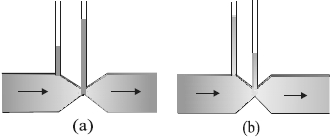
Solution
(A) According to the equation of continuity, $A_1 V_1 = A_2 V_2$, where $A$ is the cross-sectional area and $V$ is the velocity of the fluid.
In the narrow part of the pipe (venturimeter), the cross-sectional area $A_2$ is smaller than the area $A_1$ of the wider part.
Therefore, the velocity of the fluid $V_2$ in the narrow part must be greater than the velocity $V_1$ in the wider part $(V_2 > V_1)$.
According to Bernoulli's principle, for a horizontal flow of an incompressible, non-viscous fluid, the sum of pressure energy and kinetic energy per unit volume remains constant. This implies that where the velocity of the fluid is higher, the pressure must be lower.
Since $V_2 > V_1$, the pressure $P_2$ at the narrow section must be less than the pressure $P_1$ at the wider section $(P_2 < P_1)$.
Pressure is related to the height of the liquid column $(h)$ in the vertical tubes by the relation $P = \rho gh$. Thus, a lower pressure corresponds to a lower liquid level.
Consequently, the liquid level in the tube connected to the narrow part must be lower than the level in the tube connected to the wider part.
Comparing this with the figures, figure $(a)$ shows a higher level in the narrow part, which contradicts Bernoulli's principle. Therefore, figure $(a)$ is incorrect.
In the narrow part of the pipe (venturimeter), the cross-sectional area $A_2$ is smaller than the area $A_1$ of the wider part.
Therefore, the velocity of the fluid $V_2$ in the narrow part must be greater than the velocity $V_1$ in the wider part $(V_2 > V_1)$.
According to Bernoulli's principle, for a horizontal flow of an incompressible, non-viscous fluid, the sum of pressure energy and kinetic energy per unit volume remains constant. This implies that where the velocity of the fluid is higher, the pressure must be lower.
Since $V_2 > V_1$, the pressure $P_2$ at the narrow section must be less than the pressure $P_1$ at the wider section $(P_2 < P_1)$.
Pressure is related to the height of the liquid column $(h)$ in the vertical tubes by the relation $P = \rho gh$. Thus, a lower pressure corresponds to a lower liquid level.
Consequently, the liquid level in the tube connected to the narrow part must be lower than the level in the tube connected to the wider part.
Comparing this with the figures, figure $(a)$ shows a higher level in the narrow part, which contradicts Bernoulli's principle. Therefore, figure $(a)$ is incorrect.
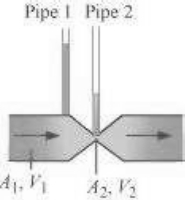
0 likes
View Solution76
MediumMCQ
$A$ plane is in level flight at constant speed and each of its two wings has an area of $25 \; m^{2}$. If the speed of the air is $180 \; km/h$ over the lower wing and $234 \; km/h$ over the upper wing surface,determine the plane's mass in $kg$. (Take air density to be $1 \; kg \; m^{-3}$ and $g = 9.8 \; m/s^{2}$).
A
$3600$
B
$4000$
C
$5600$
D
$4400$
Solution
(D) The total area of the wings of the plane,$A = 2 \times 25 = 50 \; m^{2}$.
Speed of air over the lower wing,$V_{1} = 180 \; km/h = 180 \times \frac{5}{18} = 50 \; m/s$.
Speed of air over the upper wing,$V_{2} = 234 \; km/h = 234 \times \frac{5}{18} = 65 \; m/s$.
Density of air,$\rho = 1 \; kg \; m^{-3}$.
Using Bernoulli's equation,the pressure difference $(P_{1} - P_{2})$ between the lower and upper surfaces is:
$P_{1} - P_{2} = \frac{1}{2} \rho (V_{2}^{2} - V_{1}^{2})$.
The upward lift force $F$ is given by $(P_{1} - P_{2}) A$:
$F = \frac{1}{2} \rho (V_{2}^{2} - V_{1}^{2}) A$.
Substituting the values:
$F = \frac{1}{2} \times 1 \times (65^{2} - 50^{2}) \times 50$.
$F = 25 \times (4225 - 2500) = 25 \times 1725 = 43125 \; N$.
Since the plane is in level flight,the lift force balances the weight of the plane:
$F = mg \implies m = \frac{F}{g}$.
$m = \frac{43125}{9.8} \approx 4400.51 \; kg$.
Rounding to the nearest value,the mass of the plane is $4400 \; kg$.
Speed of air over the lower wing,$V_{1} = 180 \; km/h = 180 \times \frac{5}{18} = 50 \; m/s$.
Speed of air over the upper wing,$V_{2} = 234 \; km/h = 234 \times \frac{5}{18} = 65 \; m/s$.
Density of air,$\rho = 1 \; kg \; m^{-3}$.
Using Bernoulli's equation,the pressure difference $(P_{1} - P_{2})$ between the lower and upper surfaces is:
$P_{1} - P_{2} = \frac{1}{2} \rho (V_{2}^{2} - V_{1}^{2})$.
The upward lift force $F$ is given by $(P_{1} - P_{2}) A$:
$F = \frac{1}{2} \rho (V_{2}^{2} - V_{1}^{2}) A$.
Substituting the values:
$F = \frac{1}{2} \times 1 \times (65^{2} - 50^{2}) \times 50$.
$F = 25 \times (4225 - 2500) = 25 \times 1725 = 43125 \; N$.
Since the plane is in level flight,the lift force balances the weight of the plane:
$F = mg \implies m = \frac{F}{g}$.
$m = \frac{43125}{9.8} \approx 4400.51 \; kg$.
Rounding to the nearest value,the mass of the plane is $4400 \; kg$.
0 likes
View Solution77
MediumMCQ
At a hydroelectric power plant,the water pressure head is at a height of $300\; m$ and the water flow available is $100\; m^{3} s^{-1}.$ If the turbine generator efficiency is $60\%,$ estimate the electric power available from the plant (in $MW$) $\left(g=9.8\; m s^{-2}\right).$
A
$146.7$
B
$212.6$
C
$176.4$
D
$196.5$
Solution
(C) The potential energy of the water per unit time is the power input to the turbine.
Power input $P_{in} = \frac{mgh}{t} = \rho V g h$,where $\rho$ is the density of water $(10^{3}\; kg/m^{3})$,$V$ is the volume flow rate $(100\; m^{3}/s)$,$g$ is the acceleration due to gravity $(9.8\; m/s^{2})$,and $h$ is the height $(300\; m)$.
$P_{in} = 10^{3} \times 100 \times 9.8 \times 300 = 294 \times 10^{6}\; W = 294\; MW$.
The electric power available is the output power,which is the product of efficiency and input power.
$P_{out} = \eta \times P_{in} = 0.60 \times 294\; MW$.
$P_{out} = 176.4\; MW$.
Power input $P_{in} = \frac{mgh}{t} = \rho V g h$,where $\rho$ is the density of water $(10^{3}\; kg/m^{3})$,$V$ is the volume flow rate $(100\; m^{3}/s)$,$g$ is the acceleration due to gravity $(9.8\; m/s^{2})$,and $h$ is the height $(300\; m)$.
$P_{in} = 10^{3} \times 100 \times 9.8 \times 300 = 294 \times 10^{6}\; W = 294\; MW$.
The electric power available is the output power,which is the product of efficiency and input power.
$P_{out} = \eta \times P_{in} = 0.60 \times 294\; MW$.
$P_{out} = 176.4\; MW$.
0 likes
View Solution78
Medium
Prove Bernoulli's Principle.
Solution
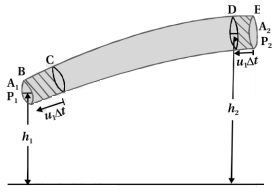
(N/A) Consider an incompressible,non-viscous fluid flowing through a pipe of varying cross-section and height.
At the inlet (point $B$):
- Cross-sectional area $= A_1$
- Fluid speed $= v_1$
- Pressure $= P_1$
At the outlet (point $D$):
- Cross-sectional area $= A_2$
- Fluid speed $= v_2$
- Pressure $= P_2$
In a small time interval $\Delta t$,the fluid at the inlet moves a distance $v_1 \Delta t$. The volume of fluid entering is $\Delta V = A_1 v_1 \Delta t$. The work done by the pressure force at the inlet is $W_1 = F_1 \times (v_1 \Delta t) = P_1 A_1 v_1 \Delta t = P_1 \Delta V$.
Similarly,at the outlet,the work done by the fluid against the pressure is $W_2 = P_2 A_2 v_2 \Delta t = P_2 \Delta V$. The net work done by pressure is $W = W_1 - W_2 = (P_1 - P_2) \Delta V$.
According to the work-energy theorem,this net work equals the change in kinetic energy plus the change in potential energy of the fluid mass $\Delta m = \rho \Delta V$ moving from the inlet to the outlet:
$W = \Delta K + \Delta U$
$(P_1 - P_2) \Delta V = \frac{1}{2} \Delta m (v_2^2 - v_1^2) + \Delta m g (h_2 - h_1)$
Dividing by $\Delta V$ and substituting $\Delta m / \Delta V = \rho$:
$P_1 - P_2 = \frac{1}{2} \rho (v_2^2 - v_1^2) + \rho g (h_2 - h_1)$
Rearranging gives Bernoulli's equation:
$P_1 + \frac{1}{2} \rho v_1^2 + \rho g h_1 = P_2 + \frac{1}{2} \rho v_2^2 + \rho g h_2$
Thus,$P + \frac{1}{2} \rho v^2 + \rho g h = \text{constant}$.
At the inlet (point $B$):
- Cross-sectional area $= A_1$
- Fluid speed $= v_1$
- Pressure $= P_1$
At the outlet (point $D$):
- Cross-sectional area $= A_2$
- Fluid speed $= v_2$
- Pressure $= P_2$
In a small time interval $\Delta t$,the fluid at the inlet moves a distance $v_1 \Delta t$. The volume of fluid entering is $\Delta V = A_1 v_1 \Delta t$. The work done by the pressure force at the inlet is $W_1 = F_1 \times (v_1 \Delta t) = P_1 A_1 v_1 \Delta t = P_1 \Delta V$.
Similarly,at the outlet,the work done by the fluid against the pressure is $W_2 = P_2 A_2 v_2 \Delta t = P_2 \Delta V$. The net work done by pressure is $W = W_1 - W_2 = (P_1 - P_2) \Delta V$.
According to the work-energy theorem,this net work equals the change in kinetic energy plus the change in potential energy of the fluid mass $\Delta m = \rho \Delta V$ moving from the inlet to the outlet:
$W = \Delta K + \Delta U$
$(P_1 - P_2) \Delta V = \frac{1}{2} \Delta m (v_2^2 - v_1^2) + \Delta m g (h_2 - h_1)$
Dividing by $\Delta V$ and substituting $\Delta m / \Delta V = \rho$:
$P_1 - P_2 = \frac{1}{2} \rho (v_2^2 - v_1^2) + \rho g (h_2 - h_1)$
Rearranging gives Bernoulli's equation:
$P_1 + \frac{1}{2} \rho v_1^2 + \rho g h_1 = P_2 + \frac{1}{2} \rho v_2^2 + \rho g h_2$
Thus,$P + \frac{1}{2} \rho v^2 + \rho g h = \text{constant}$.
0 likes
View Solution79
Difficult
Derive Bernoulli's equation for a steady,incompressible,and non-viscous (ideal) fluid flow.
Solution
(N/A) Bernoulli's principle is based on the law of conservation of energy for a flowing fluid.
Consider a fluid flowing through a pipe of varying cross-section and height.
Let $P_1, A_1, v_1, h_1$ be the pressure,area,velocity,and height at the inlet,and $P_2, A_2, v_2, h_2$ be the corresponding values at the outlet.
According to the equation of continuity,the volume of fluid entering at one end in time $\Delta t$ is equal to the volume leaving at the other end: $\Delta V = A_1 v_1 \Delta t = A_2 v_2 \Delta t$.
Work done by pressure at the inlet: $W_1 = F_1 \Delta x_1 = P_1 A_1 (v_1 \Delta t) = P_1 \Delta V$.
Work done by pressure at the outlet: $W_2 = -F_2 \Delta x_2 = -P_2 A_2 (v_2 \Delta t) = -P_2 \Delta V$ (negative because it opposes flow).
Net work done by pressure: $W = (P_1 - P_2) \Delta V$.
Change in kinetic energy: $\Delta K = \frac{1}{2} m (v_2^2 - v_1^2) = \frac{1}{2} (\rho \Delta V) (v_2^2 - v_1^2)$.
Change in potential energy: $\Delta U = mg(h_2 - h_1) = (\rho \Delta V) g (h_2 - h_1)$.
By the work-energy theorem,$W = \Delta K + \Delta U$.
$(P_1 - P_2) \Delta V = \frac{1}{2} \rho \Delta V (v_2^2 - v_1^2) + \rho \Delta V g (h_2 - h_1)$.
Dividing by $\Delta V$ and rearranging terms:
$P_1 + \frac{1}{2} \rho v_1^2 + \rho g h_1 = P_2 + \frac{1}{2} \rho v_2^2 + \rho g h_2$.
Thus,$P + \frac{1}{2} \rho v^2 + \rho g h = \text{constant}$.
Consider a fluid flowing through a pipe of varying cross-section and height.
Let $P_1, A_1, v_1, h_1$ be the pressure,area,velocity,and height at the inlet,and $P_2, A_2, v_2, h_2$ be the corresponding values at the outlet.
According to the equation of continuity,the volume of fluid entering at one end in time $\Delta t$ is equal to the volume leaving at the other end: $\Delta V = A_1 v_1 \Delta t = A_2 v_2 \Delta t$.
Work done by pressure at the inlet: $W_1 = F_1 \Delta x_1 = P_1 A_1 (v_1 \Delta t) = P_1 \Delta V$.
Work done by pressure at the outlet: $W_2 = -F_2 \Delta x_2 = -P_2 A_2 (v_2 \Delta t) = -P_2 \Delta V$ (negative because it opposes flow).
Net work done by pressure: $W = (P_1 - P_2) \Delta V$.
Change in kinetic energy: $\Delta K = \frac{1}{2} m (v_2^2 - v_1^2) = \frac{1}{2} (\rho \Delta V) (v_2^2 - v_1^2)$.
Change in potential energy: $\Delta U = mg(h_2 - h_1) = (\rho \Delta V) g (h_2 - h_1)$.
By the work-energy theorem,$W = \Delta K + \Delta U$.
$(P_1 - P_2) \Delta V = \frac{1}{2} \rho \Delta V (v_2^2 - v_1^2) + \rho \Delta V g (h_2 - h_1)$.
Dividing by $\Delta V$ and rearranging terms:
$P_1 + \frac{1}{2} \rho v_1^2 + \rho g h_1 = P_2 + \frac{1}{2} \rho v_2^2 + \rho g h_2$.
Thus,$P + \frac{1}{2} \rho v^2 + \rho g h = \text{constant}$.
0 likes
View Solution80
Difficult
Write the limitations of Bernoulli's theorem.
Solution
(N/A) $(i)$ Bernoulli's theorem is derived based on the principle of conservation of energy,assuming that no energy is lost due to friction. However,in reality,when fluids flow,energy is lost due to internal friction (viscosity). Viscous forces acting between different layers of the fluid result in a loss of energy.
$(ii)$ The theorem assumes the fluid is incompressible. In practice,the elastic energy of the fluid is not taken into consideration,which limits the theorem's applicability to compressible fluids.
$(iii)$ The theorem assumes steady,streamline flow. It does not account for turbulent flow,where velocity and pressure at a point change randomly with time.
$(ii)$ The theorem assumes the fluid is incompressible. In practice,the elastic energy of the fluid is not taken into consideration,which limits the theorem's applicability to compressible fluids.
$(iii)$ The theorem assumes steady,streamline flow. It does not account for turbulent flow,where velocity and pressure at a point change randomly with time.
0 likes
View Solution81
Medium
Obtain Bernoulli's equation for a fluid at rest.
Solution
(N/A) Bernoulli's equation is given by:
$P_{1} + \frac{1}{2} \rho v_{1}^{2} + \rho g h_{1} = P_{2} + \frac{1}{2} \rho v_{2}^{2} + \rho g h_{2}$
When a fluid is at rest,its velocity at every point is zero. Therefore,we substitute $v_{1} = 0$ and $v_{2} = 0$ into the equation:
$P_{1} + \rho g h_{1} = P_{2} + \rho g h_{2}$
Rearranging the terms,we get:
$P_{1} - P_{2} = \rho g(h_{2} - h_{1})$
This represents the hydrostatic pressure variation in a fluid at rest.
$P_{1} + \frac{1}{2} \rho v_{1}^{2} + \rho g h_{1} = P_{2} + \frac{1}{2} \rho v_{2}^{2} + \rho g h_{2}$
When a fluid is at rest,its velocity at every point is zero. Therefore,we substitute $v_{1} = 0$ and $v_{2} = 0$ into the equation:
$P_{1} + \rho g h_{1} = P_{2} + \rho g h_{2}$
Rearranging the terms,we get:
$P_{1} - P_{2} = \rho g(h_{2} - h_{1})$
This represents the hydrostatic pressure variation in a fluid at rest.
0 likes
View Solution82
Medium
Is Bernoulli's equation unsteady? Explain.
Solution
(N/A) No,Bernoulli's equation is not unsteady. It is derived specifically for steady,incompressible,non-viscous,and irrotational flow of a fluid.
$1$. Steady Flow: The velocity,pressure,and density at any point in the fluid remain constant with respect to time.
$2$. Incompressible: The density of the fluid is constant.
$3$. Non-viscous: There is no internal friction or viscosity in the fluid.
$4$. Irrotational: The fluid particles do not rotate about their own axes.
Since the derivation assumes that the flow parameters do not change over time,the equation is applicable only to steady flow conditions.
$1$. Steady Flow: The velocity,pressure,and density at any point in the fluid remain constant with respect to time.
$2$. Incompressible: The density of the fluid is constant.
$3$. Non-viscous: There is no internal friction or viscosity in the fluid.
$4$. Irrotational: The fluid particles do not rotate about their own axes.
Since the derivation assumes that the flow parameters do not change over time,the equation is applicable only to steady flow conditions.
0 likes
View Solution83
Easy
Why is Bernoulli's equation not applicable to turbulent flow? Explain.
Solution
(N/A) Bernoulli's equation is based on the assumption of steady,streamline flow where the velocity and pressure at any point remain constant over time. In turbulent flow,the velocity $(v)$ and pressure $(P)$ at any given point fluctuate randomly and change continuously with time. Therefore,the conditions required for the derivation of Bernoulli's equation are not satisfied in turbulent flow.
0 likes
View Solution84
Difficult
Write the limitations and uses of Bernoulli's equation.
Solution
(N/A) Bernoulli's equation is based on the assumption of an ideal fluid. Its limitations are as follows:
$1$. It is valid only for incompressible,non-viscous,and steady (streamline) flow of fluids.
$2$. It does not account for energy loss due to viscosity or friction between fluid layers.
$3$. It ignores the energy dissipated as heat during fluid flow.
The uses of Bernoulli's equation include:
$1$. It is used to calculate the velocity of efflux (Torricelli's Law).
$2$. It explains the working principle of a Venturi meter,which is used to measure the flow rate of a fluid.
$3$. It explains the aerodynamic lift on an airplane wing.
$4$. It is used in the design of atomizers and Bunsen burners.
$1$. It is valid only for incompressible,non-viscous,and steady (streamline) flow of fluids.
$2$. It does not account for energy loss due to viscosity or friction between fluid layers.
$3$. It ignores the energy dissipated as heat during fluid flow.
The uses of Bernoulli's equation include:
$1$. It is used to calculate the velocity of efflux (Torricelli's Law).
$2$. It explains the working principle of a Venturi meter,which is used to measure the flow rate of a fluid.
$3$. It explains the aerodynamic lift on an airplane wing.
$4$. It is used in the design of atomizers and Bunsen burners.
0 likes
View Solution85
Medium
What is a venturi-meter? Explain its construction and working.
Solution
(N/A) venturi-meter is a device used to measure the flow speed of an incompressible fluid.
Construction:
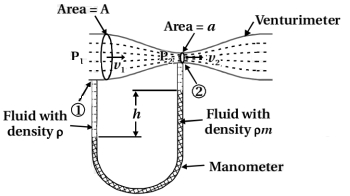
It consists of a tube with a broad diameter and a small contraction at the middle,known as the throat,as shown in the figure. $A$ manometer in the form of a $U$-tube is attached to it,with one arm at the broad section of the tube and the other at the throat.
Working:
The manometer contains a liquid of density $\rho_{m}$. Let the density of the flowing fluid be $\rho$.
At point $1$,the cross-sectional area is $A$ and the velocity of the liquid is $v_{1}$. At point $2$ (the throat),the cross-sectional area is $a$ and the velocity of the liquid is $v_{2}$.
According to the equation of continuity:
$A v_{1} = a v_{2}$
$\therefore v_{2} = \frac{A v_{1}}{a}$
Applying Bernoulli's equation at points $1$ and $2$ (assuming horizontal flow,$h_{1} = h_{2}$):
$P_{1} + \frac{1}{2} \rho v_{1}^{2} = P_{2} + \frac{1}{2} \rho v_{2}^{2}$
$\therefore P_{1} - P_{2} = \frac{1}{2} \rho (v_{2}^{2} - v_{1}^{2})$
From the manometer reading,the pressure difference is given by:
$P_{1} - P_{2} = \rho_{m} g h$
Equating the two expressions for pressure difference:
$\rho_{m} g h = \frac{1}{2} \rho (v_{2}^{2} - v_{1}^{2})$
Substituting $v_{2} = \frac{A v_{1}}{a}$ allows for the calculation of the flow velocity $v_{1}$.
Construction:
It consists of a tube with a broad diameter and a small contraction at the middle,known as the throat,as shown in the figure. $A$ manometer in the form of a $U$-tube is attached to it,with one arm at the broad section of the tube and the other at the throat.
Working:
The manometer contains a liquid of density $\rho_{m}$. Let the density of the flowing fluid be $\rho$.
At point $1$,the cross-sectional area is $A$ and the velocity of the liquid is $v_{1}$. At point $2$ (the throat),the cross-sectional area is $a$ and the velocity of the liquid is $v_{2}$.
According to the equation of continuity:
$A v_{1} = a v_{2}$
$\therefore v_{2} = \frac{A v_{1}}{a}$
Applying Bernoulli's equation at points $1$ and $2$ (assuming horizontal flow,$h_{1} = h_{2}$):
$P_{1} + \frac{1}{2} \rho v_{1}^{2} = P_{2} + \frac{1}{2} \rho v_{2}^{2}$
$\therefore P_{1} - P_{2} = \frac{1}{2} \rho (v_{2}^{2} - v_{1}^{2})$
From the manometer reading,the pressure difference is given by:
$P_{1} - P_{2} = \rho_{m} g h$
Equating the two expressions for pressure difference:
$\rho_{m} g h = \frac{1}{2} \rho (v_{2}^{2} - v_{1}^{2})$
Substituting $v_{2} = \frac{A v_{1}}{a}$ allows for the calculation of the flow velocity $v_{1}$.
0 likes
View Solution86
Medium
Using the principle of a venturi-meter,explain the working of a carburetor and a spray pump.
Solution
(N/A) The carburetor of an automobile uses a venturi channel (nozzle) through which air flows at a high speed.
According to Bernoulli's principle,as the speed of air increases in the narrow neck of the venturi,the pressure decreases.
This low pressure at the narrow neck sucks petrol from the fuel chamber into the air stream,creating the correct air-fuel mixture necessary for combustion in the engine.
Devices like Bunsen burners,atomizers,perfume sprayers,and insecticide sprayers operate on the same principle.
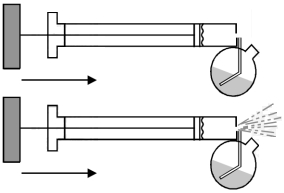
In a spray pump,a piston forces air at high speed over the open end of a tube connected to a liquid container. This creates a region of low pressure at the top of the tube,causing the liquid to rise and be sprayed out along with the air stream.
According to Bernoulli's principle,as the speed of air increases in the narrow neck of the venturi,the pressure decreases.
This low pressure at the narrow neck sucks petrol from the fuel chamber into the air stream,creating the correct air-fuel mixture necessary for combustion in the engine.
Devices like Bunsen burners,atomizers,perfume sprayers,and insecticide sprayers operate on the same principle.
In a spray pump,a piston forces air at high speed over the open end of a tube connected to a liquid container. This creates a region of low pressure at the top of the tube,causing the liquid to rise and be sprayed out along with the air stream.
0 likes
View Solution87
Medium
Explain blood flow and heart attack with the help of Bernoulli's principle.
Solution
(N/A) Bernoulli's principle states that for an incompressible, non-viscous, and steady flow, the sum of pressure energy, kinetic energy, and potential energy per unit volume remains constant.
In the human circulatory system, arteries can become constricted due to the accumulation of plaque (atherosclerosis) on their inner walls.
According to the equation of continuity $(A_1v_1 = A_2v_2)$, when the cross-sectional area $(A)$ of the artery decreases, the velocity $(v)$ of the blood flow must increase.
Applying Bernoulli's principle $(P + \frac{1}{2}\rho v^2 + \rho gh = \text{constant})$, as the velocity of blood increases in the constricted region, the internal fluid pressure $(P)$ decreases.
If the internal pressure drops significantly, the external pressure from the surrounding tissues may cause the artery to collapse.
The heart then exerts additional pressure to force blood through the constriction. As the blood rushes through the narrowed opening, the pressure drops again due to the high velocity.
This cycle of constriction and pressure drop can lead to the complete blockage of the artery, resulting in a heart attack.
In the human circulatory system, arteries can become constricted due to the accumulation of plaque (atherosclerosis) on their inner walls.
According to the equation of continuity $(A_1v_1 = A_2v_2)$, when the cross-sectional area $(A)$ of the artery decreases, the velocity $(v)$ of the blood flow must increase.
Applying Bernoulli's principle $(P + \frac{1}{2}\rho v^2 + \rho gh = \text{constant})$, as the velocity of blood increases in the constricted region, the internal fluid pressure $(P)$ decreases.
If the internal pressure drops significantly, the external pressure from the surrounding tissues may cause the artery to collapse.
The heart then exerts additional pressure to force blood through the constriction. As the blood rushes through the narrowed opening, the pressure drops again due to the high velocity.
This cycle of constriction and pressure drop can lead to the complete blockage of the artery, resulting in a heart attack.
0 likes
View Solution88
Difficult
Explain with the help of Bernoulli's principle why a spinning ball follows a curved path during flight.
Solution
(N/A) $(i)$ Ball moving without spin:
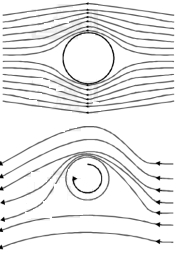
When a ball moves through a fluid without spinning,the streamlines of the fluid are symmetric above and below the ball. The velocity of the fluid at corresponding points above and below the ball is the same,which results in zero pressure difference according to Bernoulli's principle. Therefore,the air exerts no net upward or downward force on the ball.
$(ii)$ Ball moving with spin:
When a ball spins,it drags the air along with its surface due to viscosity. If the surface is rough,more air is dragged.
Consider a ball spinning clockwise as it moves through the air. On the side where the rotation is in the same direction as the airflow,the velocity of the air increases. On the opposite side,where the rotation opposes the airflow,the velocity of the air decreases.
According to Bernoulli's principle,regions of higher fluid velocity correspond to lower pressure,and regions of lower fluid velocity correspond to higher pressure.
Consequently,the crowding of streamlines above the ball indicates higher velocity and lower pressure,while the sparse streamlines below the ball indicate lower velocity and higher pressure. This pressure difference creates a net upward force on the ball,causing it to deviate from its straight path. This phenomenon is known as the Magnus effect.
When a ball moves through a fluid without spinning,the streamlines of the fluid are symmetric above and below the ball. The velocity of the fluid at corresponding points above and below the ball is the same,which results in zero pressure difference according to Bernoulli's principle. Therefore,the air exerts no net upward or downward force on the ball.
$(ii)$ Ball moving with spin:
When a ball spins,it drags the air along with its surface due to viscosity. If the surface is rough,more air is dragged.
Consider a ball spinning clockwise as it moves through the air. On the side where the rotation is in the same direction as the airflow,the velocity of the air increases. On the opposite side,where the rotation opposes the airflow,the velocity of the air decreases.
According to Bernoulli's principle,regions of higher fluid velocity correspond to lower pressure,and regions of lower fluid velocity correspond to higher pressure.
Consequently,the crowding of streamlines above the ball indicates higher velocity and lower pressure,while the sparse streamlines below the ball indicate lower velocity and higher pressure. This pressure difference creates a net upward force on the ball,causing it to deviate from its straight path. This phenomenon is known as the Magnus effect.
0 likes
View Solution89
Difficult
What is an aerofoil? Explain.
Solution
(N/A) An aerofoil is a specially shaped solid body designed to generate an upward dynamic lift when it moves horizontally through a fluid like air.
The cross-section of an aeroplane wing is shaped like an aerofoil,which influences the streamlines of the air flowing around it.
When the aerofoil moves against the wind,its orientation relative to the flow direction causes the streamlines to crowd together more densely above the wing than below it.
According to Bernoulli's principle,since the streamlines are closer together above the wing,the flow speed on the top surface is higher than the flow speed on the bottom surface.
This difference in flow speed creates a pressure difference (higher pressure below and lower pressure above),which generates an upward force called dynamic lift that helps balance the weight of the aeroplane.
The cross-section of an aeroplane wing is shaped like an aerofoil,which influences the streamlines of the air flowing around it.
When the aerofoil moves against the wind,its orientation relative to the flow direction causes the streamlines to crowd together more densely above the wing than below it.
According to Bernoulli's principle,since the streamlines are closer together above the wing,the flow speed on the top surface is higher than the flow speed on the bottom surface.
This difference in flow speed creates a pressure difference (higher pressure below and lower pressure above),which generates an upward force called dynamic lift that helps balance the weight of the aeroplane.
0 likes
View Solution90
Difficult
Explain the upward force (dynamic lift) acting on an airplane wing.
Solution
(N/A) An airfoil is a solid object with a specific shape. Due to its horizontal motion through the air,an upward force acts on it.
The cross-section of an airplane wing resembles an airfoil. The streamlines around it are shown in the figure.
When the airfoil moves against the wind,the orientation of the wing relative to the flow makes the streamlines above the wing more crowded than those below. Therefore,the speed of air above the wing is greater than the speed of flow below it.
According to Bernoulli's principle,as the speed of air increases,the pressure decreases. Consequently,the air pressure below the airfoil becomes greater than the air pressure above it.
This pressure difference results in an upward force acting on the wings,known as dynamic lift,which balances the weight of the airplane.
The cross-section of an airplane wing resembles an airfoil. The streamlines around it are shown in the figure.
When the airfoil moves against the wind,the orientation of the wing relative to the flow makes the streamlines above the wing more crowded than those below. Therefore,the speed of air above the wing is greater than the speed of flow below it.
According to Bernoulli's principle,as the speed of air increases,the pressure decreases. Consequently,the air pressure below the airfoil becomes greater than the air pressure above it.
This pressure difference results in an upward force acting on the wings,known as dynamic lift,which balances the weight of the airplane.
0 likes
View Solution91
Medium
State Bernoulli's equation in words and write its mathematical formula.
Solution
(N/A) Bernoulli's principle states that for an incompressible,non-viscous,and steady flow of a fluid,the sum of pressure energy,kinetic energy per unit volume,and potential energy per unit volume remains constant along a streamline.
The mathematical formula is:
$P + \frac{1}{2} \rho v^2 + \rho gh = \text{constant}$
Where:
$P$ = Pressure of the fluid
$\rho$ = Density of the fluid
$v$ = Velocity of the fluid
$g$ = Acceleration due to gravity
$h$ = Height of the fluid above a reference level
The mathematical formula is:
$P + \frac{1}{2} \rho v^2 + \rho gh = \text{constant}$
Where:
$P$ = Pressure of the fluid
$\rho$ = Density of the fluid
$v$ = Velocity of the fluid
$g$ = Acceleration due to gravity
$h$ = Height of the fluid above a reference level
0 likes
View Solution92
EasyMCQ
What type of fluid can be applied in Bernoulli's equation?
A
Compressible and viscous
B
Incompressible and non-viscous
C
Compressible and non-viscous
D
Incompressible and viscous
Solution
(B) Bernoulli's equation is derived based on several key assumptions regarding the nature of the fluid flow.
$1$. The fluid must be incompressible,meaning its density remains constant throughout the flow.
$2$. The fluid must be non-viscous (ideal),meaning there is no internal friction or energy loss due to viscosity.
$3$. The flow must be steady,meaning the velocity at any given point does not change with time.
$4$. The flow must be irrotational.
Therefore,Bernoulli's equation is applicable to an incompressible and non-viscous fluid.
$1$. The fluid must be incompressible,meaning its density remains constant throughout the flow.
$2$. The fluid must be non-viscous (ideal),meaning there is no internal friction or energy loss due to viscosity.
$3$. The flow must be steady,meaning the velocity at any given point does not change with time.
$4$. The flow must be irrotational.
Therefore,Bernoulli's equation is applicable to an incompressible and non-viscous fluid.
0 likes
View Solution93
Medium
Write the limitations of Bernoulli's equation.
Solution
(N/A) The limitations of Bernoulli's equation are as follows:
$(i)$ The fluid must be non-viscous (i.e.,internal friction is negligible).
$(ii)$ The fluid must be incompressible (i.e.,the density of the fluid remains constant).
$(iii)$ The flow of the fluid must be steady and streamline,not turbulent.
$(iv)$ The flow of the fluid must be irrotational (i.e.,there is no net angular velocity of fluid particles about their centers).
$(i)$ The fluid must be non-viscous (i.e.,internal friction is negligible).
$(ii)$ The fluid must be incompressible (i.e.,the density of the fluid remains constant).
$(iii)$ The flow of the fluid must be steady and streamline,not turbulent.
$(iv)$ The flow of the fluid must be irrotational (i.e.,there is no net angular velocity of fluid particles about their centers).
0 likes
View Solution94
Medium
Write the limitations of Bernoulli's equation.
Solution
(N/A) The limitations of Bernoulli's equation are as follows:
$1$. The equation is valid only for incompressible fluids,meaning the density of the fluid remains constant.
$2$. It assumes the flow is steady,which means the velocity,pressure,and density at any point do not change with time.
$3$. It is applicable only to non-viscous (ideal) fluids,where internal friction or viscosity is neglected.
$4$. It assumes the flow is irrotational,meaning there is no net angular velocity of the fluid particles.
$5$. It does not account for energy loss due to friction or turbulence during the flow.
$1$. The equation is valid only for incompressible fluids,meaning the density of the fluid remains constant.
$2$. It assumes the flow is steady,which means the velocity,pressure,and density at any point do not change with time.
$3$. It is applicable only to non-viscous (ideal) fluids,where internal friction or viscosity is neglected.
$4$. It assumes the flow is irrotational,meaning there is no net angular velocity of the fluid particles.
$5$. It does not account for energy loss due to friction or turbulence during the flow.
0 likes
View Solution95
Medium
What is a venturi meter?
Solution
(N/A) venturi meter is a device used to measure the rate of flow of an incompressible fluid through a pipe.
It operates on the principle of Bernoulli's theorem.
It consists of a constriction or a 'throat' in the pipe,which causes a pressure difference between the wide part of the pipe and the narrow throat.
By measuring this pressure difference using a manometer,the velocity and the volume flow rate of the fluid can be calculated.
It operates on the principle of Bernoulli's theorem.
It consists of a constriction or a 'throat' in the pipe,which causes a pressure difference between the wide part of the pipe and the narrow throat.
By measuring this pressure difference using a manometer,the velocity and the volume flow rate of the fluid can be calculated.
0 likes
View Solution96
MediumMCQ
Give the formula for the measurement of the velocity of a fluid in the broader part of a venturi-meter.
A
$v_1 = a_2 \sqrt{\frac{2gh}{A_1^2 - a_2^2}}$
B
$v_1 = a_2 \sqrt{\frac{2gh}{A_1^2 - a_2^2}} \times A_1$
C
$v_1 = \frac{a_2}{A_1} \sqrt{\frac{2gh}{1 - (a_2/A_1)^2}}$
D
$v_1 = \sqrt{\frac{2gh}{A_1^2 - a_2^2}}$
Solution
(A) In a venturi-meter, let $A_1$ be the area of the broader part and $a_2$ be the area of the narrow part (throat). Let $v_1$ be the velocity of the fluid in the broader part and $v_2$ be the velocity in the throat.
By the equation of continuity, $A_1 v_1 = a_2 v_2$, which implies $v_2 = \frac{A_1}{a_2} v_1$.
Applying Bernoulli's equation at both sections: $P_1 + \frac{1}{2} \rho v_1^2 = P_2 + \frac{1}{2} \rho v_2^2$.
The pressure difference is given by $P_1 - P_2 = \rho gh$, where $h$ is the difference in height of the liquid column in the manometer.
Substituting $v_2$: $P_1 - P_2 = \frac{1}{2} \rho (v_2^2 - v_1^2) = \frac{1}{2} \rho [(\frac{A_1}{a_2} v_1)^2 - v_1^2]$.
Solving for $v_1$: $2gh = v_1^2 [(\frac{A_1}{a_2})^2 - 1] = v_1^2 [\frac{A_1^2 - a_2^2}{a_2^2}]$.
Thus, $v_1 = \frac{a_2}{\sqrt{A_1^2 - a_2^2}} \sqrt{2gh}$.
By the equation of continuity, $A_1 v_1 = a_2 v_2$, which implies $v_2 = \frac{A_1}{a_2} v_1$.
Applying Bernoulli's equation at both sections: $P_1 + \frac{1}{2} \rho v_1^2 = P_2 + \frac{1}{2} \rho v_2^2$.
The pressure difference is given by $P_1 - P_2 = \rho gh$, where $h$ is the difference in height of the liquid column in the manometer.
Substituting $v_2$: $P_1 - P_2 = \frac{1}{2} \rho (v_2^2 - v_1^2) = \frac{1}{2} \rho [(\frac{A_1}{a_2} v_1)^2 - v_1^2]$.
Solving for $v_1$: $2gh = v_1^2 [(\frac{A_1}{a_2})^2 - 1] = v_1^2 [\frac{A_1^2 - a_2^2}{a_2^2}]$.
Thus, $v_1 = \frac{a_2}{\sqrt{A_1^2 - a_2^2}} \sqrt{2gh}$.
0 likes
View Solution97
MediumMCQ
Which types of energies are present in the streamline flow of an ideal fluid?
A
Kinetic energy only
B
Potential energy only
C
Pressure energy only
D
Kinetic,potential,and pressure energies
Solution
(D) In the streamline flow of an ideal fluid,the total energy per unit mass (or per unit volume) is conserved according to Bernoulli's principle.
The three types of energies present are:
$(1)$ Kinetic energy: Due to the motion of the fluid particles.
$(2)$ Potential energy: Due to the height or position of the fluid in the gravitational field.
$(3)$ Pressure energy: Due to the work done by pressure forces in moving the fluid.
The three types of energies present are:
$(1)$ Kinetic energy: Due to the motion of the fluid particles.
$(2)$ Potential energy: Due to the height or position of the fluid in the gravitational field.
$(3)$ Pressure energy: Due to the work done by pressure forces in moving the fluid.
0 likes
View Solution98
EasyMCQ
Which fundamental law forms the basis of Bernoulli's equation?
A
Conservation of mass
B
Conservation of energy
C
Conservation of momentum
D
Conservation of angular momentum
Solution
(B) Bernoulli's equation is derived from the work-energy theorem for fluid flow.
It states that for an incompressible,non-viscous,and steady flow of fluid,the sum of pressure energy,kinetic energy,and potential energy per unit volume remains constant along a streamline.
Therefore,it is based on the principle of the conservation of energy.
It states that for an incompressible,non-viscous,and steady flow of fluid,the sum of pressure energy,kinetic energy,and potential energy per unit volume remains constant along a streamline.
Therefore,it is based on the principle of the conservation of energy.
0 likes
View SolutionFluid Mechanics and Surface Tension — Bernoulli's Theorem and Applications of Bernoulli's Theory · Frequently Asked Questions
1Are these Fluid Mechanics and Surface Tension questions useful for JEE and NEET?
Yes. All questions in this section are mapped to JEE Main and NEET exam patterns. Previous year questions from JEE Main, NEET, GUJCET and state-level exams are included with full solutions.
2Can I switch to Hindi or Gujarati for these questions?
Yes. Use the language tabs in the hero section or the sidebar to view the same questions and solutions in English, Hindi or Gujarati.
3How do I generate a question paper from this subtopic?
Use the Vedclass Exam Paper Generator — select the chapter and subtopic, set difficulty, and generate Sets A, B, C, D automatically. First 3 chapters of every subject are free.
Vedclass Products
For Students
Vedclass Test Series
Mock tests in real JEE/NEET style with performance analysis. 5-day free trial.
Start Free TrialFor Teachers
Exam Paper Generator
Generate Set A/B/C/D papers from this chapter in 2 minutes. 3 chapters free.
Try FreeFor Institutes
Online Exam Module
Live online exams with unlimited students, 360° analytics & white-label branding.
See DemoFor Teachers & Institutes
Generate a Fluid Mechanics and Surface Tension Exam Paper in 2 Minutes
Select subtopic & difficulty — Sets A, B, C, D auto-generated with No Repeat logic.
First 3 chapters of every subject are free — no payment required.