
A English
Buoyancy, Archimedes' Principle and Laws of Floatation Questions in English
Class 11 Physics · Fluid Mechanics and Surface Tension · Buoyancy, Archimedes' Principle and Laws of Floatation
257+
Questions
English
Language
100%
With Solutions
Showing 49 of 257 questions in English
1
MediumMCQ
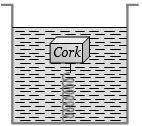
$A$ cork is submerged in water by a spring attached to the bottom of a pail. When the pail is kept in an elevator moving with an acceleration downwards,the spring length
A
Increases
B
Decreases
C
Remains unchanged
D
Data insufficient
Solution
(B) Let the density of the cork be $d$ and the density of water be $\rho$. The volume of the cork is $V$.
The forces acting on the cork are the buoyant force $F_B = V \rho g$ (upwards),the weight of the cork $W = V d g$ (downwards),and the spring force $F_s$ (downwards).
In the stationary frame,the equilibrium condition is $F_B = W + F_s$,so $F_s = V \rho g - V d g = V(\rho - d)g$.
When the elevator moves downwards with acceleration $a$,the effective acceleration due to gravity becomes $g_{eff} = (g - a)$.
The new spring force is $F_s' = V(\rho - d)(g - a)$.
Since $(g - a) < g$,the new spring force $F_s'$ is less than the original spring force $F_s$. Therefore,the elongation of the spring decreases,and the spring length decreases.
The forces acting on the cork are the buoyant force $F_B = V \rho g$ (upwards),the weight of the cork $W = V d g$ (downwards),and the spring force $F_s$ (downwards).
In the stationary frame,the equilibrium condition is $F_B = W + F_s$,so $F_s = V \rho g - V d g = V(\rho - d)g$.
When the elevator moves downwards with acceleration $a$,the effective acceleration due to gravity becomes $g_{eff} = (g - a)$.
The new spring force is $F_s' = V(\rho - d)(g - a)$.
Since $(g - a) < g$,the new spring force $F_s'$ is less than the original spring force $F_s$. Therefore,the elongation of the spring decreases,and the spring length decreases.
0 likes
View Solution2
MediumMCQ
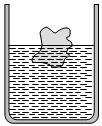
$A$ body floats in a liquid contained in a beaker. If the whole system as shown in the figure falls freely under gravity, then the upthrust on the body due to the liquid is
A
Zero
B
Equal to the weight of liquid displaced
C
Equal to the weight of the body in air
D
None of these
Solution
(A) The upthrust (buoyant force) on a body submerged in a liquid is given by the formula $F_B = V \rho g$, where $V$ is the volume of the displaced liquid, $\rho$ is the density of the liquid, and $g$ is the acceleration due to gravity.
When the entire system (beaker and liquid) falls freely under gravity, it experiences an acceleration equal to $g$ downwards. In the frame of reference of the falling beaker, the effective acceleration due to gravity $(g_{eff})$ becomes $g - g = 0$.
Since the upthrust depends on the effective gravitational field, and $g_{eff} = 0$, the upthrust on the body becomes zero.
When the entire system (beaker and liquid) falls freely under gravity, it experiences an acceleration equal to $g$ downwards. In the frame of reference of the falling beaker, the effective acceleration due to gravity $(g_{eff})$ becomes $g - g = 0$.
Since the upthrust depends on the effective gravitational field, and $g_{eff} = 0$, the upthrust on the body becomes zero.
0 likes
View Solution3
EasyMCQ
$A$ man is carrying a block of a certain substance (of density $1000 \,kg/m^3$) weighing $1 \,kg$ in his left hand and a bucket filled with water and weighing $10 \,kg$ in his right hand. He drops the block into the bucket. How much load does he carry in his right hand now (in $,kg$)?
A
$9$
B
$10$
C
$11$
D
$12$
Solution
(C) Initially,the man holds a $1 \,kg$ block in his left hand and a $10 \,kg$ bucket in his right hand.
When the block is dropped into the bucket,the total mass supported by the right hand becomes the sum of the mass of the bucket (with water) and the mass of the block.
Total mass $= 10 \,kg + 1 \,kg = 11 \,kg$.
Therefore,the man carries a load of $11 \,kg$ in his right hand.
When the block is dropped into the bucket,the total mass supported by the right hand becomes the sum of the mass of the bucket (with water) and the mass of the block.
Total mass $= 10 \,kg + 1 \,kg = 11 \,kg$.
Therefore,the man carries a load of $11 \,kg$ in his right hand.
0 likes
View Solution4
MediumMCQ
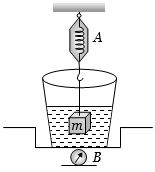
The spring balance $A$ reads $2 \, kg$ with a block $m$ suspended from it. $A$ balance $B$ reads $5 \, kg$ when a beaker filled with liquid is put on the pan of the balance. The two balances are now arranged such that the hanging mass is inside the liquid as shown in the figure. In this situation:
A
The balance $A$ will read more than $2 \, kg$.
B
The balance $B$ will read more than $5 \, kg$.
C
The balance $A$ will read less than $2 \, kg$ and $B$ will read more than $5 \, kg$.
D
Both $(b)$ and $(c)$.
Solution
(D) When the block $m$ is immersed in the liquid,it experiences an upward buoyant force (upthrust) $F_B$ according to Archimedes' principle.
For balance $A$,the reading is the tension $T$ in the string. Initially,$T = mg = 2 \, kg \cdot g$. When immersed,$T = mg - F_B$. Since $F_B > 0$,the reading of balance $A$ will be less than $2 \, kg$.
For balance $B$,it measures the normal force exerted by the beaker on the pan. Initially,it reads the weight of the beaker plus the liquid. When the block is immersed,the liquid exerts an upward force $F_B$ on the block. By Newton's third law,the block exerts an equal and opposite downward force $F_B$ on the liquid. Thus,the total downward force on the balance $B$ increases by $F_B$. Therefore,the reading of balance $B$ will be more than $5 \, kg$.
Since both statements $(b)$ and $(c)$ are correct,the correct option is $(d)$.
For balance $A$,the reading is the tension $T$ in the string. Initially,$T = mg = 2 \, kg \cdot g$. When immersed,$T = mg - F_B$. Since $F_B > 0$,the reading of balance $A$ will be less than $2 \, kg$.
For balance $B$,it measures the normal force exerted by the beaker on the pan. Initially,it reads the weight of the beaker plus the liquid. When the block is immersed,the liquid exerts an upward force $F_B$ on the block. By Newton's third law,the block exerts an equal and opposite downward force $F_B$ on the liquid. Thus,the total downward force on the balance $B$ increases by $F_B$. Therefore,the reading of balance $B$ will be more than $5 \, kg$.
Since both statements $(b)$ and $(c)$ are correct,the correct option is $(d)$.
0 likes
View Solution5
EasyMCQ
In which case does the potential energy decrease?
A
On compressing a spring
B
On stretching a spring
C
On moving a body against gravitational force
D
On the rising of an air bubble in water
Solution
(D) In the compression or extension of a spring,work is done against the restoring force,which increases the elastic potential energy of the spring.
In moving a body against gravity,work is done against the gravitational force of attraction,which increases the gravitational potential energy of the system.
Therefore,in cases $A$,$B$,and $C$,the potential energy of the system increases.
When an air bubble rises in water,it moves in the direction of the buoyant force (upthrust). Since the system performs work in this direction,the potential energy of the system decreases.
In moving a body against gravity,work is done against the gravitational force of attraction,which increases the gravitational potential energy of the system.
Therefore,in cases $A$,$B$,and $C$,the potential energy of the system increases.
When an air bubble rises in water,it moves in the direction of the buoyant force (upthrust). Since the system performs work in this direction,the potential energy of the system decreases.
0 likes
View Solution6
EasyMCQ
If there were a smaller gravitational effect,which of the following forces do you think would alter in some respect?
A
Viscous forces
B
Archimedes uplift
C
Electrostatic force
D
None of the above
Solution
(B) The correct answer is $B$. Archimedes' principle states that the buoyant force (uplift) acting on an object submerged in a fluid is equal to the weight of the fluid displaced by the object. The weight of the displaced fluid is given by $W = m \cdot g$,where $m$ is the mass of the displaced fluid and $g$ is the acceleration due to gravity. If the gravitational effect $(g)$ decreases,the weight of the displaced fluid decreases,thereby reducing the Archimedes uplift force. Viscous forces and electrostatic forces are independent of the gravitational field strength.
0 likes
View Solution7
DifficultMCQ
Two bodies are in equilibrium when suspended in water from the arms of a balance. The mass of one body is $36 \ g$ and its density is $9 \ g/cm^3$. If the mass of the other is $48 \ g$,its density in $g/cm^3$ is:
A
$4/3$
B
$3/2$
C
$3$
D
$5$
Solution
(C) The apparent weight of a body submerged in a fluid is given by $W_{app} = V(\rho - \sigma)g = \frac{m}{\rho}(\rho - \sigma)g$,where $m$ is the mass of the body,$\rho$ is the density of the body,and $\sigma$ is the density of the fluid (water,$\sigma = 1 \ g/cm^3$).
Since the two bodies are in equilibrium,their apparent weights must be equal:
$\frac{m_1}{\rho_1}(\rho_1 - \sigma) = \frac{m_2}{\rho_2}(\rho_2 - \sigma)$
Given $m_1 = 36 \ g$,$\rho_1 = 9 \ g/cm^3$,$m_2 = 48 \ g$,and $\sigma = 1 \ g/cm^3$:
$\frac{36}{9}(9 - 1) = \frac{48}{\rho_2}(\rho_2 - 1)$
$4(8) = \frac{48}{\rho_2}(\rho_2 - 1)$
$32 = \frac{48(\rho_2 - 1)}{\rho_2}$
$32\rho_2 = 48\rho_2 - 48$
$16\rho_2 = 48$
$\rho_2 = 3 \ g/cm^3$.
Since the two bodies are in equilibrium,their apparent weights must be equal:
$\frac{m_1}{\rho_1}(\rho_1 - \sigma) = \frac{m_2}{\rho_2}(\rho_2 - \sigma)$
Given $m_1 = 36 \ g$,$\rho_1 = 9 \ g/cm^3$,$m_2 = 48 \ g$,and $\sigma = 1 \ g/cm^3$:
$\frac{36}{9}(9 - 1) = \frac{48}{\rho_2}(\rho_2 - 1)$
$4(8) = \frac{48}{\rho_2}(\rho_2 - 1)$
$32 = \frac{48(\rho_2 - 1)}{\rho_2}$
$32\rho_2 = 48\rho_2 - 48$
$16\rho_2 = 48$
$\rho_2 = 3 \ g/cm^3$.
0 likes
View Solution8
MediumMCQ
$A$ body of density $d_1$ is counterpoised by $M$ of weights of density $d_2$ in air of density $d$. Then the true mass of the body is
A
$M$
B
$M(1 - d/d_2)$
C
$M(1 - d/d_1)$
D
$\frac{M(1 - d/d_2)}{(1 - d/d_1)}$
Solution
(D) Let $M_0$ be the true mass of the body in vacuum.
When the body is weighed in air,the apparent weight of the body is equal to the apparent weight of the standard weights.
The apparent weight is given by the actual weight minus the upthrust (buoyant force) due to the displaced air.
For the body: Apparent weight $= M_0 g - V_1 d g = M_0 g - (M_0/d_1) d g = M_0 g (1 - d/d_1)$.
For the weights: Apparent weight $= M g - V_2 d g = M g - (M/d_2) d g = M g (1 - d/d_2)$.
Equating the two: $M_0 g (1 - d/d_1) = M g (1 - d/d_2)$.
Therefore,the true mass $M_0 = \frac{M(1 - d/d_2)}{(1 - d/d_1)}$.
When the body is weighed in air,the apparent weight of the body is equal to the apparent weight of the standard weights.
The apparent weight is given by the actual weight minus the upthrust (buoyant force) due to the displaced air.
For the body: Apparent weight $= M_0 g - V_1 d g = M_0 g - (M_0/d_1) d g = M_0 g (1 - d/d_1)$.
For the weights: Apparent weight $= M g - V_2 d g = M g - (M/d_2) d g = M g (1 - d/d_2)$.
Equating the two: $M_0 g (1 - d/d_1) = M g (1 - d/d_2)$.
Therefore,the true mass $M_0 = \frac{M(1 - d/d_2)}{(1 - d/d_1)}$.
0 likes
View Solution9
DifficultMCQ
An iceberg of density $900 \ kg/m^3$ is floating in water of density $1000 \ kg/m^3$. The percentage of the volume of the iceberg outside the water is ...... $\%$
A
$20$
B
$35$
C
$10$
D
$25$
Solution
(C) Let the total volume of the iceberg be $V$ and its density be $\rho = 900 \ kg/m^3$. The density of water is $\sigma = 1000 \ kg/m^3$.
According to the law of floatation, the weight of the iceberg equals the weight of the water displaced by the submerged part $(V_{in})$.
$V \rho g = V_{in} \sigma g$
$V_{in} = \left( \frac{\rho}{\sigma} \right) V = \left( \frac{900}{1000} \right) V = 0.9 V$
The volume of the iceberg outside the water is $V_{out} = V - V_{in} = V - 0.9 V = 0.1 V$.
The percentage of volume outside the water is $\left( \frac{V_{out}}{V} \right) \times 100 = 0.1 \times 100 = 10\%$.
According to the law of floatation, the weight of the iceberg equals the weight of the water displaced by the submerged part $(V_{in})$.
$V \rho g = V_{in} \sigma g$
$V_{in} = \left( \frac{\rho}{\sigma} \right) V = \left( \frac{900}{1000} \right) V = 0.9 V$
The volume of the iceberg outside the water is $V_{out} = V - V_{in} = V - 0.9 V = 0.1 V$.
The percentage of volume outside the water is $\left( \frac{V_{out}}{V} \right) \times 100 = 0.1 \times 100 = 10\%$.
0 likes
View Solution10
DifficultMCQ
$A$ log of wood of mass $120 \ kg$ floats in water. The mass that can be put on the raft to make it just sink should be ....... $kg$ (density of wood = $600 \ kg/m^3$,density of water = $1000 \ kg/m^3$).
A
$80$
B
$50$
C
$60$
D
$30$
Solution
(A) The volume of the log of wood is given by $V = \frac{\text{mass}}{\text{density}} = \frac{120}{600} = 0.2 \ m^3$.
Let $x$ be the mass that can be placed on the log of wood to make it just sink.
For the log to just sink,the total weight of the log and the added mass must be equal to the buoyant force (weight of the displaced water).
The total weight is $(120 + x)g$.
The buoyant force is $V \rho_{\text{water}} g = 0.2 \times 1000 \times g$.
Equating the two: $(120 + x)g = 0.2 \times 1000 \times g$.
$120 + x = 200$.
$x = 200 - 120 = 80 \ kg$.
Let $x$ be the mass that can be placed on the log of wood to make it just sink.
For the log to just sink,the total weight of the log and the added mass must be equal to the buoyant force (weight of the displaced water).
The total weight is $(120 + x)g$.
The buoyant force is $V \rho_{\text{water}} g = 0.2 \times 1000 \times g$.
Equating the two: $(120 + x)g = 0.2 \times 1000 \times g$.
$120 + x = 200$.
$x = 200 - 120 = 80 \ kg$.
0 likes
View Solution11
DifficultMCQ
$A$ hemispherical bowl just floats without sinking in a liquid of density $1.2 \times 10^3 \ kg/m^3$. If the outer diameter and the density of the bowl are $1 \ m$ and $2 \times 10^4 \ kg/m^3$ respectively,then the inner diameter of the bowl will be........ $m$.
A
$0.94$
B
$0.97$
C
$0.98$
D
$0.99$
Solution
(C) The weight of the hemispherical bowl is given by $W = mg = V_{material} \rho g$,where $V_{material} = \frac{2}{3} \pi [ (D/2)^3 - (d/2)^3 ]$ is the volume of the material of the bowl.
Here,$D = 1 \ m$ is the outer diameter and $d$ is the inner diameter. The density of the bowl is $\rho = 2 \times 10^4 \ kg/m^3$.
According to the principle of flotation,the weight of the bowl equals the weight of the liquid displaced by the submerged part of the bowl. Since the bowl is hemispherical and just floats,the volume of the liquid displaced is the volume of the outer hemisphere,$V_{displaced} = \frac{2}{3} \pi (D/2)^3$.
The weight of the displaced liquid is $W_{liquid} = V_{displaced} \sigma g$,where $\sigma = 1.2 \times 10^3 \ kg/m^3$ is the density of the liquid.
Equating the two weights: $\frac{2}{3} \pi (D/2)^3 \sigma g = \frac{2}{3} \pi [ (D/2)^3 - (d/2)^3 ] \rho g$.
Canceling common terms: $(D/2)^3 \sigma = [ (D/2)^3 - (d/2)^3 ] \rho$.
Substituting the values: $(0.5)^3 \times 1.2 \times 10^3 = [ (0.5)^3 - (d/2)^3 ] \times 2 \times 10^4$.
$0.125 \times 1.2 \times 10^3 = [ 0.125 - (d/2)^3 ] \times 20 \times 10^3$.
$0.15 = [ 0.125 - (d/2)^3 ] \times 20$.
$0.0075 = 0.125 - (d/2)^3$.
$(d/2)^3 = 0.125 - 0.0075 = 0.1175$.
$d/2 = (0.1175)^{1/3} \approx 0.49$.
$d = 2 \times 0.49 = 0.98 \ m$.
Here,$D = 1 \ m$ is the outer diameter and $d$ is the inner diameter. The density of the bowl is $\rho = 2 \times 10^4 \ kg/m^3$.
According to the principle of flotation,the weight of the bowl equals the weight of the liquid displaced by the submerged part of the bowl. Since the bowl is hemispherical and just floats,the volume of the liquid displaced is the volume of the outer hemisphere,$V_{displaced} = \frac{2}{3} \pi (D/2)^3$.
The weight of the displaced liquid is $W_{liquid} = V_{displaced} \sigma g$,where $\sigma = 1.2 \times 10^3 \ kg/m^3$ is the density of the liquid.
Equating the two weights: $\frac{2}{3} \pi (D/2)^3 \sigma g = \frac{2}{3} \pi [ (D/2)^3 - (d/2)^3 ] \rho g$.
Canceling common terms: $(D/2)^3 \sigma = [ (D/2)^3 - (d/2)^3 ] \rho$.
Substituting the values: $(0.5)^3 \times 1.2 \times 10^3 = [ (0.5)^3 - (d/2)^3 ] \times 2 \times 10^4$.
$0.125 \times 1.2 \times 10^3 = [ 0.125 - (d/2)^3 ] \times 20 \times 10^3$.
$0.15 = [ 0.125 - (d/2)^3 ] \times 20$.
$0.0075 = 0.125 - (d/2)^3$.
$(d/2)^3 = 0.125 - 0.0075 = 0.1175$.
$d/2 = (0.1175)^{1/3} \approx 0.49$.
$d = 2 \times 0.49 = 0.98 \ m$.
0 likes
View Solution12
DifficultMCQ
$A$ concrete sphere of radius $R$ has a cavity of radius $r$ which is packed with sawdust. The specific gravities of concrete and sawdust are $2.4$ and $0.3$ respectively. For this sphere to float with its entire volume submerged under water,the ratio of the mass of concrete to the mass of sawdust will be:
A
$8$
B
$4$
C
$3$
D
$0$
Solution
(B) Let the specific gravities of concrete and sawdust be $\rho_1 = 2.4$ and $\rho_2 = 0.3$ respectively.
According to the principle of floatation,the weight of the whole sphere equals the upthrust (buoyant force) on the sphere.
Weight of sphere = Weight of water displaced
$\frac{4}{3}\pi (R^3 - r^3)\rho_1 g + \frac{4}{3}\pi r^3 \rho_2 g = \frac{4}{3}\pi R^3 \times 1 \times g$
Dividing by $\frac{4}{3}\pi g$,we get:
$(R^3 - r^3)\rho_1 + r^3 \rho_2 = R^3$
$R^3 \rho_1 - r^3 \rho_1 + r^3 \rho_2 = R^3$
$R^3(\rho_1 - 1) = r^3(\rho_1 - \rho_2)$
$\frac{R^3}{r^3} = \frac{\rho_1 - \rho_2}{\rho_1 - 1} = \frac{2.4 - 0.3}{2.4 - 1} = \frac{2.1}{1.4} = 1.5$
Now,the ratio of the mass of concrete $(M_c)$ to the mass of sawdust $(M_s)$ is:
$\frac{M_c}{M_s} = \frac{\frac{4}{3}\pi (R^3 - r^3)\rho_1}{\frac{4}{3}\pi r^3 \rho_2} = \left( \frac{R^3}{r^3} - 1 \right) \frac{\rho_1}{\rho_2}$
Substituting the values:
$\frac{M_c}{M_s} = (1.5 - 1) \times \frac{2.4}{0.3} = 0.5 \times 8 = 4$.
According to the principle of floatation,the weight of the whole sphere equals the upthrust (buoyant force) on the sphere.
Weight of sphere = Weight of water displaced
$\frac{4}{3}\pi (R^3 - r^3)\rho_1 g + \frac{4}{3}\pi r^3 \rho_2 g = \frac{4}{3}\pi R^3 \times 1 \times g$
Dividing by $\frac{4}{3}\pi g$,we get:
$(R^3 - r^3)\rho_1 + r^3 \rho_2 = R^3$
$R^3 \rho_1 - r^3 \rho_1 + r^3 \rho_2 = R^3$
$R^3(\rho_1 - 1) = r^3(\rho_1 - \rho_2)$
$\frac{R^3}{r^3} = \frac{\rho_1 - \rho_2}{\rho_1 - 1} = \frac{2.4 - 0.3}{2.4 - 1} = \frac{2.1}{1.4} = 1.5$
Now,the ratio of the mass of concrete $(M_c)$ to the mass of sawdust $(M_s)$ is:
$\frac{M_c}{M_s} = \frac{\frac{4}{3}\pi (R^3 - r^3)\rho_1}{\frac{4}{3}\pi r^3 \rho_2} = \left( \frac{R^3}{r^3} - 1 \right) \frac{\rho_1}{\rho_2}$
Substituting the values:
$\frac{M_c}{M_s} = (1.5 - 1) \times \frac{2.4}{0.3} = 0.5 \times 8 = 4$.
0 likes
View Solution13
MediumMCQ
$A$ metallic block of density $5 \, g \, cm^{-3}$ and having dimensions $5 \, cm \times 5 \, cm \times 5 \, cm$ is weighed in water. Its apparent weight will be
A
$5 \times 5 \times 5 \times 5 \, gf$
B
$4 \times 4 \times 4 \times 4 \, gf$
C
$5 \times 4 \times 4 \times 4 \, gf$
D
$4 \times 5 \times 5 \times 5 \, gf$
Solution
(D) The volume of the block $V = 5 \, cm \times 5 \, cm \times 5 \, cm = 125 \, cm^3$.
The density of the block $\rho = 5 \, g \, cm^{-3}$.
The density of water $\sigma = 1 \, g \, cm^{-3}$.
The apparent weight $W_{app}$ is given by the formula $W_{app} = V(\rho - \sigma)g$.
Substituting the values,$W_{app} = 125 \times (5 - 1) \times g$ (in units of force).
Since $1 \, g$ mass corresponds to $1 \, gf$ weight,the apparent weight in $gf$ is $V(\rho - \sigma) = 125 \times 4 = 500 \, gf$.
Comparing this with the given options,$500 = 4 \times 5 \times 5 \times 5 \, gf$.
The density of the block $\rho = 5 \, g \, cm^{-3}$.
The density of water $\sigma = 1 \, g \, cm^{-3}$.
The apparent weight $W_{app}$ is given by the formula $W_{app} = V(\rho - \sigma)g$.
Substituting the values,$W_{app} = 125 \times (5 - 1) \times g$ (in units of force).
Since $1 \, g$ mass corresponds to $1 \, gf$ weight,the apparent weight in $gf$ is $V(\rho - \sigma) = 125 \times 4 = 500 \, gf$.
Comparing this with the given options,$500 = 4 \times 5 \times 5 \times 5 \, gf$.
0 likes
View Solution14
MediumMCQ
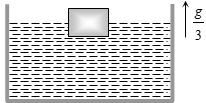
$A$ cubical block is floating in a liquid with half of its volume immersed in the liquid. When the whole system accelerates upwards with an acceleration of $g/3$, the fraction of volume immersed in the liquid will be
A
$0.5$
B
$\frac{3}{8}$
C
$\frac{2}{3}$
D
$0.75$
Solution
(A) Let the volume of the block be $V$, the density of the block be $\rho$, and the density of the liquid be $\sigma$.
Initially, the block is in equilibrium, so the weight of the block equals the buoyant force:
$V \rho g = V_{in} \sigma g$
Given that half the volume is immersed, $V_{in} = V/2$, so:
$V \rho g = (V/2) \sigma g \implies \rho = \sigma/2$.
When the system accelerates upwards with acceleration $a = g/3$, the effective gravity becomes $g' = g + a = g + g/3 = 4g/3$.
The new equilibrium condition is:
$V \rho g' = V'_{in} \sigma g'$
$V \rho (4g/3) = V'_{in} \sigma (4g/3)$
$V \rho = V'_{in} \sigma$
Since $\rho = \sigma/2$, we have $V(\sigma/2) = V'_{in} \sigma$, which gives $V'_{in} = V/2$.
The fraction of volume immersed remains $V'_{in}/V = 0.5$. Thus, the fraction of volume immersed does not change with acceleration.
Initially, the block is in equilibrium, so the weight of the block equals the buoyant force:
$V \rho g = V_{in} \sigma g$
Given that half the volume is immersed, $V_{in} = V/2$, so:
$V \rho g = (V/2) \sigma g \implies \rho = \sigma/2$.
When the system accelerates upwards with acceleration $a = g/3$, the effective gravity becomes $g' = g + a = g + g/3 = 4g/3$.
The new equilibrium condition is:
$V \rho g' = V'_{in} \sigma g'$
$V \rho (4g/3) = V'_{in} \sigma (4g/3)$
$V \rho = V'_{in} \sigma$
Since $\rho = \sigma/2$, we have $V(\sigma/2) = V'_{in} \sigma$, which gives $V'_{in} = V/2$.
The fraction of volume immersed remains $V'_{in}/V = 0.5$. Thus, the fraction of volume immersed does not change with acceleration.
0 likes
View Solution15
MediumMCQ
$A$ silver ingot weighing $2.1 \ kg$ is held by a string so as to be completely immersed in a liquid of relative density $0.8$. The relative density of silver is $10.5$. The tension in the string in $kg-wt$ is
A
$1.6$
B
$1.94$
C
$3.1$
D
$5.25$
Solution
(B) The apparent weight of an object immersed in a liquid is given by the formula: $W_{app} = V(\rho_s - \rho_l)g$,where $V$ is the volume of the object,$\rho_s$ is the density of the object,and $\rho_l$ is the density of the liquid.
Since the mass $M = V \rho_s$,we can write $V = M / \rho_s$.
Substituting this into the formula: $W_{app} = \frac{M}{\rho_s}(\rho_s - \rho_l)g = M(1 - \frac{\rho_l}{\rho_s})g$.
Given $M = 2.1 \ kg$,$\rho_s = 10.5$,and $\rho_l = 0.8$.
The tension $T$ in the string is equal to the apparent weight in $kg-wt$:
$T = 2.1 \times (1 - \frac{0.8}{10.5}) \ kg-wt$.
$T = 2.1 \times (\frac{10.5 - 0.8}{10.5}) \ kg-wt$.
$T = 2.1 \times (\frac{9.7}{10.5}) \ kg-wt$.
$T = 2.1 \times 0.9238 \approx 1.94 \ kg-wt$.
Since the mass $M = V \rho_s$,we can write $V = M / \rho_s$.
Substituting this into the formula: $W_{app} = \frac{M}{\rho_s}(\rho_s - \rho_l)g = M(1 - \frac{\rho_l}{\rho_s})g$.
Given $M = 2.1 \ kg$,$\rho_s = 10.5$,and $\rho_l = 0.8$.
The tension $T$ in the string is equal to the apparent weight in $kg-wt$:
$T = 2.1 \times (1 - \frac{0.8}{10.5}) \ kg-wt$.
$T = 2.1 \times (\frac{10.5 - 0.8}{10.5}) \ kg-wt$.
$T = 2.1 \times (\frac{9.7}{10.5}) \ kg-wt$.
$T = 2.1 \times 0.9238 \approx 1.94 \ kg-wt$.
0 likes
View Solution16
DifficultMCQ
$A$ sample of metal weighs $210 \ g$ in air,$180 \ g$ in water,and $120 \ g$ in a liquid. Then,the relative density $(RD)$ of:
A
Metal is $3$
B
Metal is $7$
C
Liquid is $3$
D
Both $(b)$ and $(c)$
Solution
(D) Let the density of the metal be $\rho$ and the density of the liquid be $\sigma$. Let $V$ be the volume of the sample.
According to Archimedes' principle,the apparent weight is the actual weight minus the buoyant force.
In air: $W_{air} = V \rho g = 210 \ g$ (taking $g$ as a unit factor for weight in grams) ... $(i)$
In water: $W_{water} = V(\rho - 1)g = 180 \ g$ ... (ii)
In liquid: $W_{liquid} = V(\rho - \sigma)g = 120 \ g$ ... (iii)
From $(i)$ and (ii): $V \rho g - V(1)g = 180 \implies 210 - Vg = 180 \implies Vg = 30$.
Since $V \rho g = 210$,we have $30 \rho = 210 \implies \rho = 7$.
From $(i)$ and (iii): $V \rho g - V \sigma g = 120 \implies 210 - V \sigma g = 120 \implies V \sigma g = 90$.
Substituting $Vg = 30$: $30 \sigma = 90 \implies \sigma = 3$.
Thus,the relative density of the metal is $7$ and the relative density of the liquid is $3$.
According to Archimedes' principle,the apparent weight is the actual weight minus the buoyant force.
In air: $W_{air} = V \rho g = 210 \ g$ (taking $g$ as a unit factor for weight in grams) ... $(i)$
In water: $W_{water} = V(\rho - 1)g = 180 \ g$ ... (ii)
In liquid: $W_{liquid} = V(\rho - \sigma)g = 120 \ g$ ... (iii)
From $(i)$ and (ii): $V \rho g - V(1)g = 180 \implies 210 - Vg = 180 \implies Vg = 30$.
Since $V \rho g = 210$,we have $30 \rho = 210 \implies \rho = 7$.
From $(i)$ and (iii): $V \rho g - V \sigma g = 120 \implies 210 - V \sigma g = 120 \implies V \sigma g = 90$.
Substituting $Vg = 30$: $30 \sigma = 90 \implies \sigma = 3$.
Thus,the relative density of the metal is $7$ and the relative density of the liquid is $3$.
0 likes
View Solution17
EasyMCQ
Two solids $A$ and $B$ float in water. It is observed that $A$ floats with half its volume immersed and $B$ floats with $2/3$ of its volume immersed. Compare the densities of $A$ and $B$.
A
$4:3$
B
$2:3$
C
$3:4$
D
$1:3$
Solution
(C) For a body floating in a liquid,the weight of the body is equal to the buoyant force (Archimedes' Principle).
Let $\rho_A$ and $\rho_B$ be the densities of solids $A$ and $B$,and $\rho_w$ be the density of water.
For solid $A$: $V_A \rho_A g = (V_A/2) \rho_w g \implies \rho_A = \frac{1}{2} \rho_w$.
For solid $B$: $V_B \rho_B g = (2/3 V_B) \rho_w g \implies \rho_B = \frac{2}{3} \rho_w$.
Taking the ratio of the densities: $\frac{\rho_A}{\rho_B} = \frac{(1/2) \rho_w}{(2/3) \rho_w} = \frac{1}{2} \times \frac{3}{2} = \frac{3}{4}$.
Thus,the ratio of the densities of $A$ and $B$ is $3:4$.
Let $\rho_A$ and $\rho_B$ be the densities of solids $A$ and $B$,and $\rho_w$ be the density of water.
For solid $A$: $V_A \rho_A g = (V_A/2) \rho_w g \implies \rho_A = \frac{1}{2} \rho_w$.
For solid $B$: $V_B \rho_B g = (2/3 V_B) \rho_w g \implies \rho_B = \frac{2}{3} \rho_w$.
Taking the ratio of the densities: $\frac{\rho_A}{\rho_B} = \frac{(1/2) \rho_w}{(2/3) \rho_w} = \frac{1}{2} \times \frac{3}{2} = \frac{3}{4}$.
Thus,the ratio of the densities of $A$ and $B$ is $3:4$.
0 likes
View Solution18
MediumMCQ
The fraction of a floating object of volume $V_0$ and density $d_0$ above the surface of a liquid of density $d$ will be
A
$\frac{d_0}{d}$
B
$\frac{d d_0}{d + d_0}$
C
$\frac{d - d_0}{d}$
D
$\frac{d d_0}{d - d_0}$
Solution
(C) For an object floating in a liquid, the weight of the object is equal to the buoyant force (Archimedes' Principle).
Weight of the object = $V_0 d_0 g$.
Buoyant force = $V_{in} d g$, where $V_{in}$ is the volume of the object submerged in the liquid.
Equating the two: $V_0 d_0 g = V_{in} d g$.
This gives the submerged volume: $V_{in} = V_0 \frac{d_0}{d}$.
The volume of the object above the surface is $V_{out} = V_0 - V_{in}$.
Substituting $V_{in}$: $V_{out} = V_0 - V_0 \frac{d_0}{d} = V_0 \left( \frac{d - d_0}{d} \right)$.
The fraction of the object above the surface is $\frac{V_{out}}{V_0} = \frac{d - d_0}{d}$.
Weight of the object = $V_0 d_0 g$.
Buoyant force = $V_{in} d g$, where $V_{in}$ is the volume of the object submerged in the liquid.
Equating the two: $V_0 d_0 g = V_{in} d g$.
This gives the submerged volume: $V_{in} = V_0 \frac{d_0}{d}$.
The volume of the object above the surface is $V_{out} = V_0 - V_{in}$.
Substituting $V_{in}$: $V_{out} = V_0 - V_0 \frac{d_0}{d} = V_0 \left( \frac{d - d_0}{d} \right)$.
The fraction of the object above the surface is $\frac{V_{out}}{V_0} = \frac{d - d_0}{d}$.
0 likes
View Solution19
EasyMCQ
$A$ block of steel of size $5 \text{ cm} \times 5 \text{ cm} \times 5 \text{ cm}$ is weighed in water. If the relative density of steel is $7$,its apparent weight is:
A
$6 \times 5 \times 5 \times 5 \text{ gf}$
B
$4 \times 4 \times 4 \times 7 \text{ gf}$
C
$5 \times 5 \times 5 \times 7 \text{ gf}$
D
$4 \times 4 \times 4 \times 6 \text{ gf}$
Solution
(A) The volume of the steel block is $V = 5 \text{ cm} \times 5 \text{ cm} \times 5 \text{ cm} = 125 \text{ cm}^3$.
Given the relative density of steel is $\rho_r = 7$,the density of steel is $\rho = 7 \text{ g/cm}^3$.
The density of water is $\sigma = 1 \text{ g/cm}^3$.
The apparent weight of an object submerged in a liquid is given by $W_{app} = V(\rho - \sigma)g$.
Since we are calculating the weight in $\text{gf}$ (gram-force),we use the formula $W_{app} = V(\rho - \sigma) \text{ gf/cm}^3$.
Substituting the values: $W_{app} = (5 \times 5 \times 5) \times (7 - 1) \text{ gf}$.
$W_{app} = 125 \times 6 \text{ gf} = 6 \times 5 \times 5 \times 5 \text{ gf}$.
Given the relative density of steel is $\rho_r = 7$,the density of steel is $\rho = 7 \text{ g/cm}^3$.
The density of water is $\sigma = 1 \text{ g/cm}^3$.
The apparent weight of an object submerged in a liquid is given by $W_{app} = V(\rho - \sigma)g$.
Since we are calculating the weight in $\text{gf}$ (gram-force),we use the formula $W_{app} = V(\rho - \sigma) \text{ gf/cm}^3$.
Substituting the values: $W_{app} = (5 \times 5 \times 5) \times (7 - 1) \text{ gf}$.
$W_{app} = 125 \times 6 \text{ gf} = 6 \times 5 \times 5 \times 5 \text{ gf}$.
0 likes
View Solution20
EasyMCQ
$A$ body is just floating on the surface of a liquid. The density of the body is the same as that of the liquid. The body is slightly pushed down. What will happen to the body?
A
It will slowly come back to its earlier position.
B
It will remain submerged,where it is left.
C
It will sink.
D
It will come out violently.
Solution
(B) When a body is floating in a liquid such that its density is equal to the density of the liquid,it is in a state of neutral equilibrium.
If the body is pushed down slightly,the buoyant force and the weight of the body remain equal because the density of the liquid is uniform.
Since the net force on the body remains zero at any depth,the body will remain submerged at the position where it is left.
If the body is pushed down slightly,the buoyant force and the weight of the body remain equal because the density of the liquid is uniform.
Since the net force on the body remains zero at any depth,the body will remain submerged at the position where it is left.
0 likes
View Solution21
MediumMCQ
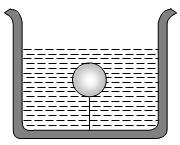
$A$ solid sphere of density $\rho_s$ which is $\eta$ $( > 1)$ times lighter than water (density $\rho_w$) is suspended in a water tank by a string tied to its base as shown in the figure. If the mass of the sphere is $m$,then the tension in the string is given by:
A
$\left( \frac{\eta - 1}{\eta} \right) mg$
B
$\eta mg$
C
$\frac{mg}{\eta - 1}$
D
$(\eta - 1) mg$
Solution
(D) Let $V$ be the volume of the sphere,$\rho_s$ be the density of the sphere,and $\rho_w$ be the density of water.
Given that the sphere is $\eta$ times lighter than water,we have $\rho_w = \eta \rho_s$.
The mass of the sphere is $m = V \rho_s$,so $V = \frac{m}{\rho_s}$.
The forces acting on the sphere are:
$1$. Weight of the sphere $(mg)$ acting downwards.
$2$. Tension in the string $(T)$ acting downwards.
$3$. Buoyant force $(F_B)$ acting upwards,where $F_B = V \rho_w g$.
For equilibrium,the net force is zero: $F_B = T + mg$.
Therefore,$T = F_B - mg = V \rho_w g - V \rho_s g$.
Substituting $\rho_w = \eta \rho_s$ and $V \rho_s = m$:
$T = V (\eta \rho_s) g - m g = \eta (V \rho_s) g - mg = \eta mg - mg = (\eta - 1) mg$.
Given that the sphere is $\eta$ times lighter than water,we have $\rho_w = \eta \rho_s$.
The mass of the sphere is $m = V \rho_s$,so $V = \frac{m}{\rho_s}$.
The forces acting on the sphere are:
$1$. Weight of the sphere $(mg)$ acting downwards.
$2$. Tension in the string $(T)$ acting downwards.
$3$. Buoyant force $(F_B)$ acting upwards,where $F_B = V \rho_w g$.
For equilibrium,the net force is zero: $F_B = T + mg$.
Therefore,$T = F_B - mg = V \rho_w g - V \rho_s g$.
Substituting $\rho_w = \eta \rho_s$ and $V \rho_s = m$:
$T = V (\eta \rho_s) g - m g = \eta (V \rho_s) g - mg = \eta mg - mg = (\eta - 1) mg$.
1 likes
View Solution22
DifficultMCQ
$A$ hollow sphere of volume $V$ is floating on the water surface with half immersed in it. What should be the minimum volume of water poured inside the sphere so that the sphere now sinks into the water?
A
$V/2$
B
$V/3$
C
$V/4$
D
$V$
Solution
(A) Let $\rho$ be the density of the material of the sphere and $\rho_w$ be the density of water.
When the sphere is floating half-immersed,the weight of the sphere is balanced by the buoyant force:
$W_{sphere} = F_{buoyant}$
$V \cdot \rho \cdot g = (V/2) \cdot \rho_w \cdot g$
$\rho = \rho_w / 2$
Now,let $V'$ be the volume of water poured inside the sphere so that it just sinks. For the sphere to sink,the total weight (sphere + water) must equal the buoyant force when the sphere is fully submerged:
$W_{total} = F_{buoyant, total}$
$(V \cdot \rho \cdot g) + (V' \cdot \rho_w \cdot g) = V \cdot \rho_w \cdot g$
Substitute $\rho = \rho_w / 2$:
$V \cdot (\rho_w / 2) \cdot g + V' \cdot \rho_w \cdot g = V \cdot \rho_w \cdot g$
Divide by $\rho_w \cdot g$:
$V/2 + V' = V$
$V' = V - V/2 = V/2$
Therefore,the minimum volume of water to be poured is $V/2$.
When the sphere is floating half-immersed,the weight of the sphere is balanced by the buoyant force:
$W_{sphere} = F_{buoyant}$
$V \cdot \rho \cdot g = (V/2) \cdot \rho_w \cdot g$
$\rho = \rho_w / 2$
Now,let $V'$ be the volume of water poured inside the sphere so that it just sinks. For the sphere to sink,the total weight (sphere + water) must equal the buoyant force when the sphere is fully submerged:
$W_{total} = F_{buoyant, total}$
$(V \cdot \rho \cdot g) + (V' \cdot \rho_w \cdot g) = V \cdot \rho_w \cdot g$
Substitute $\rho = \rho_w / 2$:
$V \cdot (\rho_w / 2) \cdot g + V' \cdot \rho_w \cdot g = V \cdot \rho_w \cdot g$
Divide by $\rho_w \cdot g$:
$V/2 + V' = V$
$V' = V - V/2 = V/2$
Therefore,the minimum volume of water to be poured is $V/2$.
0 likes
View Solution23
EasyMCQ
$A$ rectangular block is $5 \ cm \times 5 \ cm \times 10 \ cm$ in size. The block is floating in water with the $5 \ cm$ side vertical. If it floats with the $10 \ cm$ side vertical,what change will occur in the level of water?
A
No change
B
It will rise
C
It will fall
D
It may rise or fall depending on the density of the block
Solution
(A) According to the Law of Floatation,a floating object displaces a weight of liquid equal to its own weight.
Since the weight of the block remains constant,the weight of the displaced water must also remain constant.
Because the weight of the displaced water is equal to the product of the volume of displaced water,the density of water,and the acceleration due to gravity $(W = V_{disp} \cdot \rho_{water} \cdot g)$,and both the density of water and gravity are constant,the volume of displaced water $(V_{disp})$ must remain constant.
Since the volume of displaced water does not change,the level of water in the container remains unchanged.
Since the weight of the block remains constant,the weight of the displaced water must also remain constant.
Because the weight of the displaced water is equal to the product of the volume of displaced water,the density of water,and the acceleration due to gravity $(W = V_{disp} \cdot \rho_{water} \cdot g)$,and both the density of water and gravity are constant,the volume of displaced water $(V_{disp})$ must remain constant.
Since the volume of displaced water does not change,the level of water in the container remains unchanged.
1 likes
View Solution24
DifficultMCQ
$A$ ball whose density is $0.4 \times 10^3 \ kg/m^3$ falls into water from a height of $9 \ cm$. To what depth does the ball sink in $cm$?
A
$9$
B
$6$
C
$4.5$
D
$2.25$
Solution
(B) Let the density of the ball be $\rho = 0.4 \times 10^3 \ kg/m^3$ and the density of water be $\sigma = 1.0 \times 10^3 \ kg/m^3$.
When the ball falls from a height $h_0 = 9 \ cm$,its velocity $v$ just before entering the water is given by $v^2 = 2gh_0$.
Inside the water,the ball experiences an upward buoyant force $F_B = V\sigma g$ and a downward gravitational force $W = V\rho g$. The net force is $F_{net} = W - F_B = V(\rho - \sigma)g$.
The retardation $a$ inside the water is $a = \frac{F_{net}}{m} = \frac{V(\rho - \sigma)g}{V\rho} = \left( \frac{\rho - \sigma}{\rho} \right)g$.
Substituting the values: $a = \left( \frac{0.4 - 1.0}{0.4} \right)g = -\frac{0.6}{0.4}g = -1.5g$.
The ball sinks to a depth $h$ where its final velocity becomes zero. Using $v_f^2 - v_i^2 = 2ah$:
$0 - (2gh_0) = 2(-1.5g)h$.
$2gh_0 = 3gh$.
$h = \frac{2}{3}h_0 = \frac{2}{3} \times 9 \ cm = 6 \ cm$.
When the ball falls from a height $h_0 = 9 \ cm$,its velocity $v$ just before entering the water is given by $v^2 = 2gh_0$.
Inside the water,the ball experiences an upward buoyant force $F_B = V\sigma g$ and a downward gravitational force $W = V\rho g$. The net force is $F_{net} = W - F_B = V(\rho - \sigma)g$.
The retardation $a$ inside the water is $a = \frac{F_{net}}{m} = \frac{V(\rho - \sigma)g}{V\rho} = \left( \frac{\rho - \sigma}{\rho} \right)g$.
Substituting the values: $a = \left( \frac{0.4 - 1.0}{0.4} \right)g = -\frac{0.6}{0.4}g = -1.5g$.
The ball sinks to a depth $h$ where its final velocity becomes zero. Using $v_f^2 - v_i^2 = 2ah$:
$0 - (2gh_0) = 2(-1.5g)h$.
$2gh_0 = 3gh$.
$h = \frac{2}{3}h_0 = \frac{2}{3} \times 9 \ cm = 6 \ cm$.
0 likes
View Solution25
MediumMCQ
Two solids $A$ and $B$ float in water. It is observed that $A$ floats with $\frac{1}{2}$ of its body immersed in water and $B$ floats with $\frac{1}{4}$ of its volume above the water level. The ratio of the density of $A$ to that of $B$ is
A
$4:3$
B
$2:3$
C
$3:4$
D
$1:2$
Solution
(B) According to the law of floatation,the weight of the body is equal to the weight of the water displaced by the immersed part of the body.
Let $\rho_A$ and $\rho_B$ be the densities of solids $A$ and $B$,respectively,and $\rho_W$ be the density of water.
For solid $A$,the volume immersed is $\frac{1}{2} V_A$. Thus,$\frac{1}{2} V_A \rho_W g = V_A \rho_A g$,which gives $\rho_A = \frac{1}{2} \rho_W$.
For solid $B$,the volume above water is $\frac{1}{4} V_B$,so the volume immersed is $V_B - \frac{1}{4} V_B = \frac{3}{4} V_B$. Thus,$\frac{3}{4} V_B \rho_W g = V_B \rho_B g$,which gives $\rho_B = \frac{3}{4} \rho_W$.
The ratio of the density of $A$ to that of $B$ is $\frac{\rho_A}{\rho_B} = \frac{\frac{1}{2} \rho_W}{\frac{3}{4} \rho_W} = \frac{1}{2} \times \frac{4}{3} = \frac{2}{3}$.
Let $\rho_A$ and $\rho_B$ be the densities of solids $A$ and $B$,respectively,and $\rho_W$ be the density of water.
For solid $A$,the volume immersed is $\frac{1}{2} V_A$. Thus,$\frac{1}{2} V_A \rho_W g = V_A \rho_A g$,which gives $\rho_A = \frac{1}{2} \rho_W$.
For solid $B$,the volume above water is $\frac{1}{4} V_B$,so the volume immersed is $V_B - \frac{1}{4} V_B = \frac{3}{4} V_B$. Thus,$\frac{3}{4} V_B \rho_W g = V_B \rho_B g$,which gives $\rho_B = \frac{3}{4} \rho_W$.
The ratio of the density of $A$ to that of $B$ is $\frac{\rho_A}{\rho_B} = \frac{\frac{1}{2} \rho_W}{\frac{3}{4} \rho_W} = \frac{1}{2} \times \frac{4}{3} = \frac{2}{3}$.
0 likes
View Solution26
EasyMCQ
$A$ boat carrying steel balls is floating on the surface of water in a tank. If the balls are thrown into the tank one by one,how will it affect the level of water?
A
It will remain unchanged
B
It will rise
C
It will fall
D
First it will rise and then fall
Solution
(C) Let $M$ be the mass of the boat and $m$ be the total mass of the steel balls. Let $\rho_{\omega}$ be the density of water and $\sigma_{s}$ be the density of steel.
When the balls are in the boat,the boat floats. According to the law of floatation,the weight of the displaced water is equal to the total weight of the boat and the balls: $W = (M + m)g$.
The volume of water displaced is $V_{1} = \frac{M + m}{\rho_{\omega}}$.
When the steel balls are thrown into the water,they sink because $\sigma_{s} > \rho_{\omega}$.
The boat now only displaces water equal to its own weight: $V_{boat} = \frac{M}{\rho_{\omega}}$.
The steel balls displace water equal to their own volume: $V_{balls} = \frac{m}{\sigma_{s}}$.
The total volume of water displaced is $V_{2} = \frac{M}{\rho_{\omega}} + \frac{m}{\sigma_{s}}$.
Since $\sigma_{s} > \rho_{\omega}$,it follows that $\frac{m}{\sigma_{s}} < \frac{m}{\rho_{\omega}}$.
Therefore,$V_{2} < V_{1}$.
As the volume of displaced water decreases,the level of water in the tank will fall.
When the balls are in the boat,the boat floats. According to the law of floatation,the weight of the displaced water is equal to the total weight of the boat and the balls: $W = (M + m)g$.
The volume of water displaced is $V_{1} = \frac{M + m}{\rho_{\omega}}$.
When the steel balls are thrown into the water,they sink because $\sigma_{s} > \rho_{\omega}$.
The boat now only displaces water equal to its own weight: $V_{boat} = \frac{M}{\rho_{\omega}}$.
The steel balls displace water equal to their own volume: $V_{balls} = \frac{m}{\sigma_{s}}$.
The total volume of water displaced is $V_{2} = \frac{M}{\rho_{\omega}} + \frac{m}{\sigma_{s}}$.
Since $\sigma_{s} > \rho_{\omega}$,it follows that $\frac{m}{\sigma_{s}} < \frac{m}{\rho_{\omega}}$.
Therefore,$V_{2} < V_{1}$.
As the volume of displaced water decreases,the level of water in the tank will fall.
0 likes
View Solution27
EasyMCQ
Two pieces of metal when immersed in a liquid have equal upthrust on them; then
A
Both pieces must have equal weights
B
Both pieces must have equal densities
C
Both pieces must have equal volumes
D
Both are floating to the same depth
Solution
(C) According to Archimedes' principle,the upthrust (buoyant force) acting on an object immersed in a fluid is given by the formula: $F = V \rho g$,where $V$ is the volume of the displaced fluid (which equals the volume of the submerged part of the object),$\rho$ is the density of the liquid,and $g$ is the acceleration due to gravity.
Since the upthrust $F$ is equal for both pieces and they are immersed in the same liquid (same $\rho$ and $g$),it follows that $V$ must be equal for both pieces.
Therefore,both pieces must have equal volumes.
Since the upthrust $F$ is equal for both pieces and they are immersed in the same liquid (same $\rho$ and $g$),it follows that $V$ must be equal for both pieces.
Therefore,both pieces must have equal volumes.
0 likes
View Solution28
EasyMCQ
$A$ wooden cylinder floats vertically in water with half of its length immersed. The density of wood is
A
Equal to that of water
B
Half the density of water
C
Double the density of water
D
The question is incomplete
Solution
(B) For a floating object,the weight of the object is equal to the weight of the displaced fluid (Archimedes' Principle).
Let $V$ be the total volume of the cylinder,$\rho$ be the density of the wood,and $\sigma$ be the density of water.
The weight of the cylinder is $W = V \rho g$.
The volume of water displaced is $V_{disp} = \frac{V}{2}$.
The buoyant force is $F_B = V_{disp} \sigma g = \frac{V}{2} \sigma g$.
Since the cylinder is floating,$W = F_B$.
$V \rho g = \frac{V}{2} \sigma g$.
Therefore,$\rho = \frac{\sigma}{2}$.
This means the density of wood is half the density of water.
Let $V$ be the total volume of the cylinder,$\rho$ be the density of the wood,and $\sigma$ be the density of water.
The weight of the cylinder is $W = V \rho g$.
The volume of water displaced is $V_{disp} = \frac{V}{2}$.
The buoyant force is $F_B = V_{disp} \sigma g = \frac{V}{2} \sigma g$.
Since the cylinder is floating,$W = F_B$.
$V \rho g = \frac{V}{2} \sigma g$.
Therefore,$\rho = \frac{\sigma}{2}$.
This means the density of wood is half the density of water.
0 likes
View Solution29
MediumMCQ
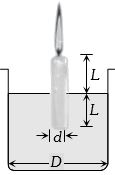
$A$ candle of diameter $d$ is floating on a liquid in a cylindrical container of diameter $D$ $(D >> d)$ as shown in the figure. If it is burning at the rate of $2 \text{ cm/hour}$,then the top of the candle will:
A
Remain at the same height
B
Fall at the rate of $1 \text{ cm/hour}$
C
Fall at the rate of $2 \text{ cm/hour}$
D
Go up at the rate of $1 \text{ cm/hour}$
Solution
(B) Let the density of the candle be $\rho_c$ and the density of the liquid be $\rho_l$. Let the total length of the candle be $L_0$ and the submerged length be $L_s$. According to the principle of floatation,the weight of the candle equals the weight of the displaced liquid:
$\rho_c \cdot A \cdot L_0 = \rho_l \cdot A \cdot L_s$
where $A$ is the cross-sectional area of the candle.
This implies $L_s = (\rho_c / \rho_l) L_0$. Let $k = \rho_c / \rho_l$. Then $L_s = k L_0$.
The height of the top of the candle above the liquid surface is $h = L_0 - L_s = L_0(1 - k)$.
As the candle burns,its total length $L_0$ decreases at a rate $v = dL_0/dt = 2 \text{ cm/hour}$.
The rate of change of the height of the top of the candle is $dh/dt = (dL_0/dt)(1 - k)$.
Assuming the candle is half-submerged (as suggested by the figure),$k = 0.5$.
Therefore,$dh/dt = 2 \text{ cm/hour} \times (1 - 0.5) = 1 \text{ cm/hour}$.
Since $dh/dt$ is positive,the top of the candle falls at a rate of $1 \text{ cm/hour}$.
$\rho_c \cdot A \cdot L_0 = \rho_l \cdot A \cdot L_s$
where $A$ is the cross-sectional area of the candle.
This implies $L_s = (\rho_c / \rho_l) L_0$. Let $k = \rho_c / \rho_l$. Then $L_s = k L_0$.
The height of the top of the candle above the liquid surface is $h = L_0 - L_s = L_0(1 - k)$.
As the candle burns,its total length $L_0$ decreases at a rate $v = dL_0/dt = 2 \text{ cm/hour}$.
The rate of change of the height of the top of the candle is $dh/dt = (dL_0/dt)(1 - k)$.
Assuming the candle is half-submerged (as suggested by the figure),$k = 0.5$.
Therefore,$dh/dt = 2 \text{ cm/hour} \times (1 - 0.5) = 1 \text{ cm/hour}$.
Since $dh/dt$ is positive,the top of the candle falls at a rate of $1 \text{ cm/hour}$.
0 likes
View Solution30
EasyMCQ
An ice block contains a glass ball. When the ice melts within a vessel containing water,the level of the water
A
Rises
B
Falls
C
Unchanged
D
First rises and then falls
Solution
(B) Let the mass of the ice be $M_i$ and the mass of the glass ball be $M_g$.
Initially,the ice block with the glass ball floats in water. According to the law of floatation,the total weight of the system is equal to the weight of the displaced water.
Total weight $W = (M_i + M_g)g$.
The volume of water displaced initially is $V_1 = \frac{M_i + M_g}{\rho_w}$,where $\rho_w$ is the density of water.
When the ice melts,the ice turns into water with volume $V_{iw} = \frac{M_i}{\rho_w}$. The glass ball sinks to the bottom.
The volume of water displaced by the glass ball is $V_g = \frac{M_g}{\rho_g}$,where $\rho_g$ is the density of the glass ball.
Since the glass ball is denser than water $(\rho_g > \rho_w)$,the volume of water displaced by the submerged glass ball is $V_g = \frac{M_g}{\rho_g} < \frac{M_g}{\rho_w}$.
The final volume of the water level corresponds to $V_2 = V_{iw} + V_g = \frac{M_i}{\rho_w} + \frac{M_g}{\rho_g}$.
Comparing $V_1$ and $V_2$,since $\frac{M_g}{\rho_g} < \frac{M_g}{\rho_w}$,it follows that $V_2 < V_1$.
Therefore,the level of water falls.
Initially,the ice block with the glass ball floats in water. According to the law of floatation,the total weight of the system is equal to the weight of the displaced water.
Total weight $W = (M_i + M_g)g$.
The volume of water displaced initially is $V_1 = \frac{M_i + M_g}{\rho_w}$,where $\rho_w$ is the density of water.
When the ice melts,the ice turns into water with volume $V_{iw} = \frac{M_i}{\rho_w}$. The glass ball sinks to the bottom.
The volume of water displaced by the glass ball is $V_g = \frac{M_g}{\rho_g}$,where $\rho_g$ is the density of the glass ball.
Since the glass ball is denser than water $(\rho_g > \rho_w)$,the volume of water displaced by the submerged glass ball is $V_g = \frac{M_g}{\rho_g} < \frac{M_g}{\rho_w}$.
The final volume of the water level corresponds to $V_2 = V_{iw} + V_g = \frac{M_i}{\rho_w} + \frac{M_g}{\rho_g}$.
Comparing $V_1$ and $V_2$,since $\frac{M_g}{\rho_g} < \frac{M_g}{\rho_w}$,it follows that $V_2 < V_1$.
Therefore,the level of water falls.
0 likes
View Solution31
EasyMCQ
$A$ large ship can float but a steel needle sinks because of
A
Viscosity
B
Surface tension
C
Density
D
None of these
Solution
(D) The correct answer is $None$ of these. The floating of a ship and the sinking of a needle are governed by the principle of flotation and the concept of density.
According to the law of flotation,a body floats if the weight of the fluid displaced by the submerged part of the body is equal to the weight of the body itself.
$A$ ship is designed such that its average density is less than the density of water,allowing it to displace a weight of water equal to its own weight even when only a small portion is submerged.
Conversely,the density of steel is much greater than the density of water. $A$ needle,being solid steel,has an average density greater than water. Therefore,the weight of the water displaced by the needle is less than the weight of the needle,causing it to sink.
This phenomenon is fundamentally explained by the relationship between the weight of the object and the buoyant force (Archimedes' principle),which depends on the object's density relative to the fluid.
According to the law of flotation,a body floats if the weight of the fluid displaced by the submerged part of the body is equal to the weight of the body itself.
$A$ ship is designed such that its average density is less than the density of water,allowing it to displace a weight of water equal to its own weight even when only a small portion is submerged.
Conversely,the density of steel is much greater than the density of water. $A$ needle,being solid steel,has an average density greater than water. Therefore,the weight of the water displaced by the needle is less than the weight of the needle,causing it to sink.
This phenomenon is fundamentally explained by the relationship between the weight of the object and the buoyant force (Archimedes' principle),which depends on the object's density relative to the fluid.
0 likes
View Solution32
EasyMCQ
Construction of submarines is based on
A
Archimedes' principle
B
Bernoulli's theorem
C
Pascal's law
D
Newton's laws
Solution
(A) The construction and operation of a submarine are based on Archimedes' principle.
According to this principle,any object,wholly or partially immersed in a fluid,is buoyed up by a force equal to the weight of the fluid displaced by the object.
$A$ submarine has ballast tanks that can be filled with water or air to change its overall density.
By adjusting the amount of water in these tanks,the submarine can control its buoyancy to submerge,surface,or maintain a constant depth.
According to this principle,any object,wholly or partially immersed in a fluid,is buoyed up by a force equal to the weight of the fluid displaced by the object.
$A$ submarine has ballast tanks that can be filled with water or air to change its overall density.
By adjusting the amount of water in these tanks,the submarine can control its buoyancy to submerge,surface,or maintain a constant depth.
0 likes
View Solution33
MediumMCQ
$A$ streamlined body falls through air from a height $h$ on the surface of a liquid. If $d$ and $D$ $(D > d)$ represent the densities of the material of the body and the liquid respectively,then the time after which the body will be instantaneously at rest is:
A
$\sqrt{\frac{2h}{g}}$
B
$\sqrt{\frac{2h}{g} \cdot \frac{D}{d}}$
C
$\sqrt{\frac{2h}{g} \cdot \frac{d}{D}}$
D
$\sqrt{\frac{2h}{g}} \left( \frac{d}{D - d} \right)$
Solution
(D) Let $V$ be the volume of the body. The velocity of the body just before entering the liquid is $v = \sqrt{2gh}$.
When the body enters the liquid,the forces acting on it are its weight $W = Vdg$ (downwards) and the buoyant force $F_B = VDg$ (upwards).
The net force $F_{net}$ acting on the body inside the liquid is $F_B - W = VDg - Vdg = V(D - d)g$.
The retardation $a$ of the body is given by $a = \frac{F_{net}}{m} = \frac{V(D - d)g}{Vd} = \left( \frac{D - d}{d} \right)g$.
The body comes to rest when its velocity becomes zero. Using $v = at$,we get $t = \frac{v}{a}$.
Substituting the values,$t = \frac{\sqrt{2gh}}{\left( \frac{D - d}{d} \right)g} = \frac{\sqrt{2gh}}{g} \cdot \frac{d}{D - d} = \sqrt{\frac{2h}{g}} \cdot \frac{d}{D - d}$.
When the body enters the liquid,the forces acting on it are its weight $W = Vdg$ (downwards) and the buoyant force $F_B = VDg$ (upwards).
The net force $F_{net}$ acting on the body inside the liquid is $F_B - W = VDg - Vdg = V(D - d)g$.
The retardation $a$ of the body is given by $a = \frac{F_{net}}{m} = \frac{V(D - d)g}{Vd} = \left( \frac{D - d}{d} \right)g$.
The body comes to rest when its velocity becomes zero. Using $v = at$,we get $t = \frac{v}{a}$.
Substituting the values,$t = \frac{\sqrt{2gh}}{\left( \frac{D - d}{d} \right)g} = \frac{\sqrt{2gh}}{g} \cdot \frac{d}{D - d} = \sqrt{\frac{2h}{g}} \cdot \frac{d}{D - d}$.
0 likes
View Solution34
DifficultMCQ
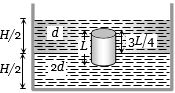
$A$ homogeneous solid cylinder of length $L$ $(L < H/2)$ and cross-sectional area $A/5$ is immersed such that it floats with its axis vertical at the liquid-liquid interface with length $L/4$ in the denser liquid as shown in the figure. The lower density liquid is open to the atmosphere having pressure $P_0$. Then,the density $D$ of the solid is given by:
A
$\frac{5}{4}d$
B
$\frac{4}{5}d$
C
$d$
D
$\frac{d}{5}$
Solution
(A) For the cylinder to float in equilibrium,its weight must be equal to the total upthrust (buoyant force) exerted by the two liquids.
Weight of the cylinder = $V \times D \times g = (A/5) \times L \times D \times g$.
Upthrust due to the upper liquid (density $d$): $F_1 = (A/5) \times (3L/4) \times d \times g$.
Upthrust due to the lower liquid (density $2d$): $F_2 = (A/5) \times (L/4) \times 2d \times g$.
Equating weight to total upthrust:
$(A/5) \times L \times D \times g = (A/5) \times (3L/4) \times d \times g + (A/5) \times (L/4) \times 2d \times g$.
Dividing both sides by $(A/5) \times L \times g$:
$D = (3/4)d + (1/4) \times 2d = (3/4)d + (2/4)d = (5/4)d$.
Therefore,the density of the solid is $D = \frac{5}{4}d$.
Weight of the cylinder = $V \times D \times g = (A/5) \times L \times D \times g$.
Upthrust due to the upper liquid (density $d$): $F_1 = (A/5) \times (3L/4) \times d \times g$.
Upthrust due to the lower liquid (density $2d$): $F_2 = (A/5) \times (L/4) \times 2d \times g$.
Equating weight to total upthrust:
$(A/5) \times L \times D \times g = (A/5) \times (3L/4) \times d \times g + (A/5) \times (L/4) \times 2d \times g$.
Dividing both sides by $(A/5) \times L \times g$:
$D = (3/4)d + (1/4) \times 2d = (3/4)d + (2/4)d = (5/4)d$.
Therefore,the density of the solid is $D = \frac{5}{4}d$.
0 likes
View Solution35
MediumMCQ
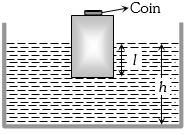
$A$ wooden block,with a coin placed on its top,floats in water as shown in the figure. The distances $l$ and $h$ are shown. After some time,the coin falls into the water. Then:
A
$l$ decreases and $h$ increases
B
$l$ increases and $h$ decreases
C
Both $l$ and $h$ increase
D
Both $l$ and $h$ decrease
Solution
(D) Initially,the block floats with the coin. According to the law of floatation,the total weight of the block and the coin is balanced by the buoyant force,which is equal to the weight of the water displaced by the submerged part of the block. Let $M$ be the mass of the block and $m$ be the mass of the coin. The total weight is $(M+m)g$. The volume of water displaced is $V_{disp} = (M+m)/\rho_w$,where $\rho_w$ is the density of water.
When the coin falls into the water,it sinks (assuming its density is greater than water). The block now only needs to support its own weight $Mg$. The new volume of water displaced by the block is $V'_{disp} = M/\rho_w$. Since $V'_{disp} < V_{disp}$,the submerged depth $l$ of the block decreases.
Regarding $h$,the total volume of water displaced initially was $V_{disp} = (M+m)/\rho_w$. After the coin falls,the block displaces $M/\rho_w$ and the coin displaces its own volume $V_c = m/\rho_c$. The new total volume of water displaced is $V'_{total} = M/\rho_w + m/\rho_c$. Since the density of the coin $\rho_c > \rho_w$,it follows that $m/\rho_c < m/\rho_w$. Therefore,$V'_{total} < V_{disp}$. As the total volume of water displaced decreases,the water level $h$ also decreases. Thus,both $l$ and $h$ decrease.
When the coin falls into the water,it sinks (assuming its density is greater than water). The block now only needs to support its own weight $Mg$. The new volume of water displaced by the block is $V'_{disp} = M/\rho_w$. Since $V'_{disp} < V_{disp}$,the submerged depth $l$ of the block decreases.
Regarding $h$,the total volume of water displaced initially was $V_{disp} = (M+m)/\rho_w$. After the coin falls,the block displaces $M/\rho_w$ and the coin displaces its own volume $V_c = m/\rho_c$. The new total volume of water displaced is $V'_{total} = M/\rho_w + m/\rho_c$. Since the density of the coin $\rho_c > \rho_w$,it follows that $m/\rho_c < m/\rho_w$. Therefore,$V'_{total} < V_{disp}$. As the total volume of water displaced decreases,the water level $h$ also decreases. Thus,both $l$ and $h$ decrease.
0 likes
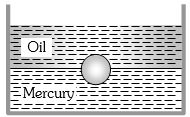
View Solution36
DifficultMCQ
$A$ vessel contains oil (density = $0.8 \; g/cm^3$) over mercury (density = $13.6 \; g/cm^3$). $A$ homogeneous sphere floats with half of its volume immersed in mercury and the other half in oil. The density of the material of the sphere in $g/cm^3$ is:
A
$3.3$
B
$6.4$
C
$7.2$
D
$12.8$
Solution
(C) As the sphere floats in the liquid,its weight is equal to the total upthrust force acting on it.
Let $V$ be the total volume of the sphere and $\rho$ be its density.
Weight of the sphere = $V \rho g$
Upthrust due to oil = (Volume in oil) $\times$ (Density of oil) $\times g = (V/2) \times 0.8 \times g = 0.4 Vg$
Upthrust due to mercury = (Volume in mercury) $\times$ (Density of mercury) $\times g = (V/2) \times 13.6 \times g = 6.8 Vg$
Total upthrust = $0.4 Vg + 6.8 Vg = 7.2 Vg$
Equating weight and total upthrust:
$V \rho g = 7.2 Vg$
$\rho = 7.2 \; g/cm^3$
Let $V$ be the total volume of the sphere and $\rho$ be its density.
Weight of the sphere = $V \rho g$
Upthrust due to oil = (Volume in oil) $\times$ (Density of oil) $\times g = (V/2) \times 0.8 \times g = 0.4 Vg$
Upthrust due to mercury = (Volume in mercury) $\times$ (Density of mercury) $\times g = (V/2) \times 13.6 \times g = 6.8 Vg$
Total upthrust = $0.4 Vg + 6.8 Vg = 7.2 Vg$
Equating weight and total upthrust:
$V \rho g = 7.2 Vg$
$\rho = 7.2 \; g/cm^3$
0 likes
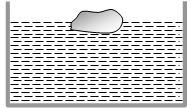
View Solution37
MediumMCQ
$A$ body floats in a liquid contained in a beaker. The whole system,as shown,falls freely under gravity. The upthrust on the body due to the liquid is
A
Zero
B
Equal to the weight of the liquid displaced
C
Equal to the weight of the body in air
D
Equal to the weight of the immersed portion of the body
Solution
(A) The upthrust (buoyant force) on a body submerged in a liquid is given by the formula:
$F_B = V \rho_{\text{liquid}} (g - a)$
where $V$ is the volume of the liquid displaced,$\rho_{\text{liquid}}$ is the density of the liquid,$g$ is the acceleration due to gravity,and $a$ is the downward acceleration of the system.
In the case of free fall,the entire system (beaker and liquid) accelerates downwards with an acceleration equal to the acceleration due to gravity,i.e.,$a = g$.
Substituting $a = g$ into the formula:
$F_B = V \rho_{\text{liquid}} (g - g) = V \rho_{\text{liquid}} (0) = 0$.
Therefore,the upthrust on the body is zero.
$F_B = V \rho_{\text{liquid}} (g - a)$
where $V$ is the volume of the liquid displaced,$\rho_{\text{liquid}}$ is the density of the liquid,$g$ is the acceleration due to gravity,and $a$ is the downward acceleration of the system.
In the case of free fall,the entire system (beaker and liquid) accelerates downwards with an acceleration equal to the acceleration due to gravity,i.e.,$a = g$.
Substituting $a = g$ into the formula:
$F_B = V \rho_{\text{liquid}} (g - g) = V \rho_{\text{liquid}} (0) = 0$.
Therefore,the upthrust on the body is zero.
0 likes
View Solution38
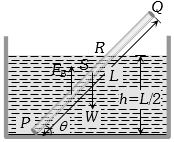
DifficultMCQ
$A$ uniform rod of density $\rho$ is placed in a wide tank containing a liquid of density $\rho_0$ $(\rho_0 > \rho)$. The depth of the liquid in the tank is half the length of the rod. The rod is in equilibrium,with its lower end resting on the bottom of the tank. In this position,the rod makes an angle $\theta$ with the horizontal.
A
$\sin \theta = \frac{1}{2}\sqrt{\frac{\rho_0}{\rho}}$
B
$\sin \theta = \frac{1}{2} \cdot \frac{\rho_0}{\rho}$
C
$\sin \theta = \sqrt{\frac{\rho}{\rho_0}}$
D
$\sin \theta = \frac{\rho_0}{\rho}$
Solution
(A) Let $L$ be the total length of the rod. The rod is uniform,so its weight $W = A L \rho g$ acts at its center of mass,which is at a distance $L/2$ from the bottom end $P$.
Let $l$ be the length of the rod submerged in the liquid. The depth of the liquid is $h = L/2$. From the geometry,$\sin \theta = h/l = (L/2)/l = L/(2l)$,which implies $l = L/(2 \sin \theta)$.
The buoyant force $F_B = A l \rho_0 g$ acts at the center of the submerged portion,which is at a distance $l/2$ from the bottom end $P$.
For rotational equilibrium about the bottom end $P$,the torque due to weight must balance the torque due to the buoyant force:
$W \cdot (L/2) \cos \theta = F_B \cdot (l/2) \cos \theta$
$(A L \rho g) \cdot (L/2) \cos \theta = (A l \rho_0 g) \cdot (l/2) \cos \theta$
$L^2 \rho = l^2 \rho_0$
$(l/L)^2 = \rho / \rho_0$
Substituting $l = L/(2 \sin \theta)$:
$(1 / (2 \sin \theta))^2 = \rho / \rho_0$
$1 / (4 \sin^2 \theta) = \rho / \rho_0$
$\sin^2 \theta = \frac{1}{4} \cdot \frac{\rho_0}{\rho}$
$\sin \theta = \frac{1}{2} \sqrt{\frac{\rho_0}{\rho}}$
Let $l$ be the length of the rod submerged in the liquid. The depth of the liquid is $h = L/2$. From the geometry,$\sin \theta = h/l = (L/2)/l = L/(2l)$,which implies $l = L/(2 \sin \theta)$.
The buoyant force $F_B = A l \rho_0 g$ acts at the center of the submerged portion,which is at a distance $l/2$ from the bottom end $P$.
For rotational equilibrium about the bottom end $P$,the torque due to weight must balance the torque due to the buoyant force:
$W \cdot (L/2) \cos \theta = F_B \cdot (l/2) \cos \theta$
$(A L \rho g) \cdot (L/2) \cos \theta = (A l \rho_0 g) \cdot (l/2) \cos \theta$
$L^2 \rho = l^2 \rho_0$
$(l/L)^2 = \rho / \rho_0$
Substituting $l = L/(2 \sin \theta)$:
$(1 / (2 \sin \theta))^2 = \rho / \rho_0$
$1 / (4 \sin^2 \theta) = \rho / \rho_0$
$\sin^2 \theta = \frac{1}{4} \cdot \frac{\rho_0}{\rho}$
$\sin \theta = \frac{1}{2} \sqrt{\frac{\rho_0}{\rho}}$
0 likes
View Solution39
MediumMCQ
$A$ block of ice floats on a liquid of density $1.2 \ g/cm^3$ in a beaker. What happens to the level of the liquid when the ice completely melts?
A
Remains same
B
Rises
C
Lowers
D
$(a), (b)$ or $(c)$
Solution
(B) Let $M$ be the mass of the ice block.
According to the principle of floatation,the weight of the ice equals the weight of the liquid displaced.
Thus,$M \cdot g = V_D \cdot \sigma_L \cdot g$,where $V_D$ is the volume of liquid displaced and $\sigma_L$ is the density of the liquid.
Therefore,$V_D = \frac{M}{\sigma_L}$.
When the ice melts,it forms water of mass $M$. The volume of this water is $V_F = \frac{M}{\sigma_W}$,where $\sigma_W$ is the density of water $(1 \ g/cm^3)$.
Given $\sigma_L = 1.2 \ g/cm^3$ and $\sigma_W = 1 \ g/cm^3$,we have $\sigma_L > \sigma_W$.
Comparing the volumes: Since $\sigma_L > \sigma_W$,it follows that $\frac{M}{\sigma_L} < \frac{M}{\sigma_W}$,which means $V_D < V_F$.
Since the volume of the water formed $(V_F)$ is greater than the volume of the liquid displaced by the floating ice $(V_D)$,the level of the liquid in the beaker will rise.
According to the principle of floatation,the weight of the ice equals the weight of the liquid displaced.
Thus,$M \cdot g = V_D \cdot \sigma_L \cdot g$,where $V_D$ is the volume of liquid displaced and $\sigma_L$ is the density of the liquid.
Therefore,$V_D = \frac{M}{\sigma_L}$.
When the ice melts,it forms water of mass $M$. The volume of this water is $V_F = \frac{M}{\sigma_W}$,where $\sigma_W$ is the density of water $(1 \ g/cm^3)$.
Given $\sigma_L = 1.2 \ g/cm^3$ and $\sigma_W = 1 \ g/cm^3$,we have $\sigma_L > \sigma_W$.
Comparing the volumes: Since $\sigma_L > \sigma_W$,it follows that $\frac{M}{\sigma_L} < \frac{M}{\sigma_W}$,which means $V_D < V_F$.
Since the volume of the water formed $(V_F)$ is greater than the volume of the liquid displaced by the floating ice $(V_D)$,the level of the liquid in the beaker will rise.
1 likes
View Solution40
EasyMCQ
Two rods of the same material and length have their electric resistance in the ratio $1:2$. When both rods are dipped in water,the correct statement will be:
A
$A$ has more loss of weight
B
$B$ has more loss of weight
C
Both have same loss of weight
D
Loss of weight will be in the ratio $1:2$
Solution
(A) The resistance of a rod is given by $R = \rho \frac{L}{A}$. Since the material $(\rho)$ and length $(L)$ are constant,$R \propto \frac{1}{A}$.
Given $\frac{R_1}{R_2} = \frac{1}{2}$,we have $\frac{A_1}{A_2} = \frac{R_2}{R_1} = 2$,which means $A_1 = 2A_2$.
When a body is dipped in water,the loss of weight is equal to the buoyant force,given by $F_B = V \sigma_L g = A L \sigma_L g$,where $V$ is the volume,$\sigma_L$ is the density of the liquid,and $g$ is the acceleration due to gravity.
Since $L$,$\sigma_L$,and $g$ are the same for both rods,the loss of weight is directly proportional to the cross-sectional area $A$.
Therefore,$\frac{\text{Loss of weight}_1}{\text{Loss of weight}_2} = \frac{A_1}{A_2} = 2$.
Since the ratio is $2$,rod $A$ (the first rod) experiences a greater loss of weight.
Given $\frac{R_1}{R_2} = \frac{1}{2}$,we have $\frac{A_1}{A_2} = \frac{R_2}{R_1} = 2$,which means $A_1 = 2A_2$.
When a body is dipped in water,the loss of weight is equal to the buoyant force,given by $F_B = V \sigma_L g = A L \sigma_L g$,where $V$ is the volume,$\sigma_L$ is the density of the liquid,and $g$ is the acceleration due to gravity.
Since $L$,$\sigma_L$,and $g$ are the same for both rods,the loss of weight is directly proportional to the cross-sectional area $A$.
Therefore,$\frac{\text{Loss of weight}_1}{\text{Loss of weight}_2} = \frac{A_1}{A_2} = 2$.
Since the ratio is $2$,rod $A$ (the first rod) experiences a greater loss of weight.
0 likes
View Solution41
DifficultMCQ
Two rods $A$ and $B$ of the same length are made of the same material. The ratio of their resistances is $1 : 2$. If the rods are immersed in water,the loss in their weight will be:
A
More in $A$
B
More in $B$
C
Equal in $A$ and $B$
D
In the ratio $1 : 2$
Solution
(A) The resistance of a rod is given by $R = \rho \frac{l}{A}$.
Since the volume $V = A \cdot l$,we can write $A = \frac{V}{l}$.
Substituting this,$R = \rho \frac{l^2}{V}$.
Since density $\sigma = \frac{m}{V}$,we have $V = \frac{m}{\sigma}$.
Thus,$R = \rho \frac{l^2 \sigma}{m}$.
Given that the length $l$ and material (density $\sigma$ and resistivity $\rho$) are the same for both rods,we have $R \propto \frac{1}{m}$.
Given $R_A : R_B = 1 : 2$,it follows that $m_A : m_B = 2 : 1$,which means $m_A > m_B$.
The loss in weight when immersed in water is equal to the weight of the displaced water,which is $W_{loss} = V_{rod} \cdot \sigma_{water} \cdot g = \frac{m}{\sigma_{rod}} \cdot \sigma_{water} \cdot g$.
Since $m_A > m_B$,the loss in weight in rod $A$ will be more than in rod $B$.
Since the volume $V = A \cdot l$,we can write $A = \frac{V}{l}$.
Substituting this,$R = \rho \frac{l^2}{V}$.
Since density $\sigma = \frac{m}{V}$,we have $V = \frac{m}{\sigma}$.
Thus,$R = \rho \frac{l^2 \sigma}{m}$.
Given that the length $l$ and material (density $\sigma$ and resistivity $\rho$) are the same for both rods,we have $R \propto \frac{1}{m}$.
Given $R_A : R_B = 1 : 2$,it follows that $m_A : m_B = 2 : 1$,which means $m_A > m_B$.
The loss in weight when immersed in water is equal to the weight of the displaced water,which is $W_{loss} = V_{rod} \cdot \sigma_{water} \cdot g = \frac{m}{\sigma_{rod}} \cdot \sigma_{water} \cdot g$.
Since $m_A > m_B$,the loss in weight in rod $A$ will be more than in rod $B$.
0 likes
View Solution42
DifficultMCQ
Two bodies placed on a balance are in equilibrium when immersed in water. If the mass of the first body is $36 \, g$ and its density is $9 \, g/cm^{3}$,and the mass of the second body is $48 \, g$,what is the density of the second body in $g/cm^{3}$?
A
$1.33$
B
$1.5$
C
$3$
D
$5$
Solution
(C) The apparent weight of a body immersed in a liquid is given by $W_{app} = V(\rho - \sigma)g$,where $V$ is the volume,$\rho$ is the density of the body,and $\sigma$ is the density of the liquid.
Since $V = m/\rho$,the apparent weight is $W_{app} = \frac{m}{\rho}(\rho - \sigma)g = m(1 - \frac{\sigma}{\rho})g$.
Given that the two bodies are in equilibrium in water,their apparent weights must be equal:
$m_1(1 - \frac{\sigma}{\rho_1}) = m_2(1 - \frac{\sigma}{\rho_2})$
Given: $m_1 = 36 \, g$,$\rho_1 = 9 \, g/cm^{3}$,$m_2 = 48 \, g$,and $\sigma = 1 \, g/cm^{3}$ (density of water).
Substituting the values:
$36(1 - \frac{1}{9}) = 48(1 - \frac{1}{\rho_2})$
$36(\frac{8}{9}) = 48(\frac{\rho_2 - 1}{\rho_2})$
$32 = 48(\frac{\rho_2 - 1}{\rho_2})$
$\frac{32}{48} = \frac{\rho_2 - 1}{\rho_2}$
$\frac{2}{3} = 1 - \frac{1}{\rho_2}$
$\frac{1}{\rho_2} = 1 - \frac{2}{3} = \frac{1}{3}$
$\rho_2 = 3 \, g/cm^{3}$.
Since $V = m/\rho$,the apparent weight is $W_{app} = \frac{m}{\rho}(\rho - \sigma)g = m(1 - \frac{\sigma}{\rho})g$.
Given that the two bodies are in equilibrium in water,their apparent weights must be equal:
$m_1(1 - \frac{\sigma}{\rho_1}) = m_2(1 - \frac{\sigma}{\rho_2})$
Given: $m_1 = 36 \, g$,$\rho_1 = 9 \, g/cm^{3}$,$m_2 = 48 \, g$,and $\sigma = 1 \, g/cm^{3}$ (density of water).
Substituting the values:
$36(1 - \frac{1}{9}) = 48(1 - \frac{1}{\rho_2})$
$36(\frac{8}{9}) = 48(\frac{\rho_2 - 1}{\rho_2})$
$32 = 48(\frac{\rho_2 - 1}{\rho_2})$
$\frac{32}{48} = \frac{\rho_2 - 1}{\rho_2}$
$\frac{2}{3} = 1 - \frac{1}{\rho_2}$
$\frac{1}{\rho_2} = 1 - \frac{2}{3} = \frac{1}{3}$
$\rho_2 = 3 \, g/cm^{3}$.
0 likes
View Solution43
DifficultMCQ
As shown in the figure,a container is filled with a liquid of density $2d$ up to a height of $H/2$ and a liquid of density $d$ above it up to a height of $H/2$. $A$ solid cylinder of cross-sectional area $A/5$ and length $L$ $(L < H/2)$ is placed vertically in this container. The cylinder floats vertically such that its lower end is at a distance of $L/4$ from the interface of the two liquids. Find the density $D$ of the cylinder. (The atmospheric pressure at the surface of the upper liquid is $P_0$.)
A
$5/4 d$
B
$4/5 d$
C
$Ad$
D
$d/5$
Solution
(A) For the cylinder to float in equilibrium,the weight of the cylinder must be equal to the total buoyant force exerted by the two liquids.
Let $A_c = A/5$ be the cross-sectional area of the cylinder.
The length of the cylinder submerged in the upper liquid (density $d$) is $3L/4$.
The length of the cylinder submerged in the lower liquid (density $2d$) is $L/4$.
Weight of the cylinder = $V_{total} \times D \times g = (A_c \times L) \times D \times g = (A/5) \times L \times D \times g$.
Buoyant force = (Weight of upper liquid displaced) + (Weight of lower liquid displaced)
Buoyant force = $(A_c \times 3L/4) \times d \times g + (A_c \times L/4) \times 2d \times g$
Buoyant force = $(A/5) \times (3L/4) \times d \times g + (A/5) \times (L/4) \times 2d \times g$
Equating weight and buoyant force:
$(A/5) \times L \times D \times g = (A/5) \times g \times [ (3L/4) \times d + (L/4) \times 2d ]$
$L \times D = (3L/4) \times d + (2L/4) \times d$
$L \times D = (5L/4) \times d$
$D = 5/4 d$
Let $A_c = A/5$ be the cross-sectional area of the cylinder.
The length of the cylinder submerged in the upper liquid (density $d$) is $3L/4$.
The length of the cylinder submerged in the lower liquid (density $2d$) is $L/4$.
Weight of the cylinder = $V_{total} \times D \times g = (A_c \times L) \times D \times g = (A/5) \times L \times D \times g$.
Buoyant force = (Weight of upper liquid displaced) + (Weight of lower liquid displaced)
Buoyant force = $(A_c \times 3L/4) \times d \times g + (A_c \times L/4) \times 2d \times g$
Buoyant force = $(A/5) \times (3L/4) \times d \times g + (A/5) \times (L/4) \times 2d \times g$
Equating weight and buoyant force:
$(A/5) \times L \times D \times g = (A/5) \times g \times [ (3L/4) \times d + (L/4) \times 2d ]$
$L \times D = (3L/4) \times d + (2L/4) \times d$
$L \times D = (5L/4) \times d$
$D = 5/4 d$
0 likes
View Solution44
DifficultMCQ
$A$ container contains mercury $(\rho = 13.6 \text{ g/cm}^3)$ and oil $(\rho = 0.8 \text{ g/cm}^3)$. $A$ sphere floats such that half of its volume is in mercury and half of its volume is in oil. What is the density of the material of the sphere in $\text{g/cm}^3$?
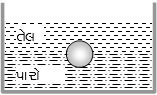
A
$3.3$
B
$6.4$
C
$7.2$
D
$12.8$
Solution
(C) Let $V$ be the total volume of the sphere and $\rho$ be the density of the sphere.
According to the principle of flotation,the weight of the sphere is equal to the total buoyant force exerted by the two liquids.
Weight of the sphere = $V \rho g$
Buoyant force due to oil = $(\frac{V}{2}) \rho_{\text{oil}} g$
Buoyant force due to mercury = $(\frac{V}{2}) \rho_{\text{Hg}} g$
Equating the forces: $V \rho g = \frac{V}{2} \rho_{\text{oil}} g + \frac{V}{2} \rho_{\text{Hg}} g$
Dividing by $Vg$: $\rho = \frac{\rho_{\text{oil}} + \rho_{\text{Hg}}}{2}$
Substituting the values: $\rho = \frac{0.8 + 13.6}{2} = \frac{14.4}{2} = 7.2 \text{ g/cm}^3$.
According to the principle of flotation,the weight of the sphere is equal to the total buoyant force exerted by the two liquids.
Weight of the sphere = $V \rho g$
Buoyant force due to oil = $(\frac{V}{2}) \rho_{\text{oil}} g$
Buoyant force due to mercury = $(\frac{V}{2}) \rho_{\text{Hg}} g$
Equating the forces: $V \rho g = \frac{V}{2} \rho_{\text{oil}} g + \frac{V}{2} \rho_{\text{Hg}} g$
Dividing by $Vg$: $\rho = \frac{\rho_{\text{oil}} + \rho_{\text{Hg}}}{2}$
Substituting the values: $\rho = \frac{0.8 + 13.6}{2} = \frac{14.4}{2} = 7.2 \text{ g/cm}^3$.
0 likes
View Solution45
MediumMCQ
An object of volume $V_0$ and density $d_0$ is placed in a liquid of density $d$. What fraction of its volume remains outside the liquid?
A
$\frac{d_0}{d}$
B
$\frac{d d_0}{d + d_0}$
C
$\frac{d - d_0}{d}$
D
$\frac{d d_0}{d - d_0}$
Solution
(C) According to the principle of flotation, the weight of the object is equal to the weight of the liquid displaced by the submerged part of the object.
Let $V_{in}$ be the volume of the object submerged in the liquid.
Weight of the object = $V_0 d_0 g$.
Weight of the displaced liquid = $V_{in} d g$.
Equating the two: $V_0 d_0 g = V_{in} d g$.
This gives $V_{in} = V_0 \frac{d_0}{d}$.
The volume of the object outside the liquid is $V_{out} = V_0 - V_{in}$.
Substituting $V_{in}$: $V_{out} = V_0 - V_0 \frac{d_0}{d} = V_0 \left( 1 - \frac{d_0}{d} \right) = V_0 \left( \frac{d - d_0}{d} \right)$.
The fraction of the volume outside the liquid is $\frac{V_{out}}{V_0} = \frac{d - d_0}{d}$.
Let $V_{in}$ be the volume of the object submerged in the liquid.
Weight of the object = $V_0 d_0 g$.
Weight of the displaced liquid = $V_{in} d g$.
Equating the two: $V_0 d_0 g = V_{in} d g$.
This gives $V_{in} = V_0 \frac{d_0}{d}$.
The volume of the object outside the liquid is $V_{out} = V_0 - V_{in}$.
Substituting $V_{in}$: $V_{out} = V_0 - V_0 \frac{d_0}{d} = V_0 \left( 1 - \frac{d_0}{d} \right) = V_0 \left( \frac{d - d_0}{d} \right)$.
The fraction of the volume outside the liquid is $\frac{V_{out}}{V_0} = \frac{d - d_0}{d}$.
0 likes
View Solution46
DifficultMCQ
Two non-mixing liquids of densities $\rho$ and $n\rho$ $(n > 1)$ are put in a container. The height of each liquid is $h$. $A$ solid cylinder of length $L$ and density $d$ is placed in this container. The cylinder floats with its axis vertical and a length $pL$ $(p < 1)$ submerged in the denser liquid. The density $d$ is equal to:
A
$[2+(n+1)p]\rho$
B
$[2+(n-1)p]\rho$
C
$[1+(n-1)p]\rho$
D
$[1+(n+1)p]\rho$
Solution
(C) Let $d$ be the density of the cylinder and $A$ be the area of the cross-section of the cylinder.
According to the law of floatation,the weight of the cylinder is equal to the total upthrust exerted by the two liquids.
Weight of cylinder = $L \times A \times d \times g$
Upthrust by denser liquid (density $n\rho$) = $(pL \times A) \times n\rho \times g$
Upthrust by lighter liquid (density $\rho$) = $((L - pL) \times A) \times \rho \times g$
Equating weight to total upthrust:
$L \times A \times d \times g = (pL \times A) \times n\rho \times g + ((L - pL) \times A) \times \rho \times g$
Dividing both sides by $A \times L \times g$:
$d = p \times n\rho + (1 - p) \times \rho$
$d = np\rho + \rho - p\rho$
$d = [1 + (n - 1)p]\rho$
According to the law of floatation,the weight of the cylinder is equal to the total upthrust exerted by the two liquids.
Weight of cylinder = $L \times A \times d \times g$
Upthrust by denser liquid (density $n\rho$) = $(pL \times A) \times n\rho \times g$
Upthrust by lighter liquid (density $\rho$) = $((L - pL) \times A) \times \rho \times g$
Equating weight to total upthrust:
$L \times A \times d \times g = (pL \times A) \times n\rho \times g + ((L - pL) \times A) \times \rho \times g$
Dividing both sides by $A \times L \times g$:
$d = p \times n\rho + (1 - p) \times \rho$
$d = np\rho + \rho - p\rho$
$d = [1 + (n - 1)p]\rho$
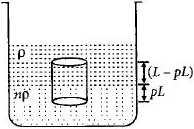
0 likes
View Solution47
MediumMCQ
At a given place where acceleration due to gravity is $g \ m/s^2$,a sphere of lead of density $d \ kg/m^3$ is gently released in a column of liquid of density $\rho \ kg/m^3$. If $d > \rho$,the sphere will:
A
Fall vertically with an acceleration $g \ m/s^2$
B
Fall vertically with no acceleration
C
Fall vertically with an acceleration $g \left( \frac{d - \rho}{d} \right)$
D
Fall vertically with an acceleration $g \left( \frac{\rho}{d} \right)$
Solution
(C) The forces acting on the sphere are its weight $(W = Vdg)$ acting downwards and the buoyant force $(F_B = V\rho g)$ acting upwards,where $V$ is the volume of the sphere.
According to Newton's second law,the net force $F_{net} = ma = Vda$.
$Vda = Vdg - V\rho g$
Dividing both sides by $Vd$,we get:
$a = g - \frac{\rho g}{d} = g \left( 1 - \frac{\rho}{d} \right) = g \left( \frac{d - \rho}{d} \right)$.
Thus,the sphere falls vertically with an acceleration of $g \left( \frac{d - \rho}{d} \right)$.
According to Newton's second law,the net force $F_{net} = ma = Vda$.
$Vda = Vdg - V\rho g$
Dividing both sides by $Vd$,we get:
$a = g - \frac{\rho g}{d} = g \left( 1 - \frac{\rho}{d} \right) = g \left( \frac{d - \rho}{d} \right)$.
Thus,the sphere falls vertically with an acceleration of $g \left( \frac{d - \rho}{d} \right)$.
0 likes
View Solution48
MediumMCQ
$A$ wooden block of volume $1000\, cm^3$ is suspended from a spring balance. It weighs $12\, N$ in air. It is suspended in water such that half of the block is below the surface of water. The reading of the spring balance is ...... $N$.
A
$10$
B
$9$
C
$8$
D
$7$
Solution
(D) The reading of the spring balance corresponds to the apparent weight of the block when submerged.
Apparent weight = Actual weight - Upthrust (Buoyant force).
The actual weight of the block in air is $W = 12\, N$.
The upthrust is given by $F_B = V_{sub} \cdot \rho_w \cdot g$,where $V_{sub}$ is the submerged volume,$\rho_w$ is the density of water $(1000\, kg/m^3)$,and $g$ is the acceleration due to gravity $(10\, m/s^2)$.
Given $V = 1000\, cm^3 = 10^{-3}\, m^3$,and half of the block is submerged,$V_{sub} = 0.5 \times 10^{-3}\, m^3 = 500 \times 10^{-6}\, m^3$.
$F_B = (500 \times 10^{-6}\, m^3) \times (10^3\, kg/m^3) \times (10\, m/s^2) = 5\, N$.
Apparent weight = $12\, N - 5\, N = 7\, N$.
Apparent weight = Actual weight - Upthrust (Buoyant force).
The actual weight of the block in air is $W = 12\, N$.
The upthrust is given by $F_B = V_{sub} \cdot \rho_w \cdot g$,where $V_{sub}$ is the submerged volume,$\rho_w$ is the density of water $(1000\, kg/m^3)$,and $g$ is the acceleration due to gravity $(10\, m/s^2)$.
Given $V = 1000\, cm^3 = 10^{-3}\, m^3$,and half of the block is submerged,$V_{sub} = 0.5 \times 10^{-3}\, m^3 = 500 \times 10^{-6}\, m^3$.
$F_B = (500 \times 10^{-6}\, m^3) \times (10^3\, kg/m^3) \times (10\, m/s^2) = 5\, N$.
Apparent weight = $12\, N - 5\, N = 7\, N$.
0 likes
View Solution49
DifficultMCQ
$A$ spherical ball of radius $r$ and relative density $0.5$ is floating in equilibrium in water with half of it immersed in water. The work done in pushing the ball down so that the whole of it is just immersed in water is: (where $\rho$ is the density of water)
A
$\frac{5}{12}\pi r^4 \rho g$
B
$0.5\rho rg$
C
$\frac{4}{3}\pi r^3 \rho g$
D
$\frac{2}{3}\pi r^4 \rho g$
Solution
(A) The volume of the ball is $V = \frac{4}{3}\pi r^3$. The density of the ball is $\sigma = 0.5\rho$.
Initially,the ball floats with half its volume submerged. The buoyant force $F_B = V_{submerged} \rho g = (V/2)\rho g = (2/3)\pi r^3 \rho g$. Since it is in equilibrium,the weight of the ball $W = V \sigma g = V(0.5\rho)g = (2/3)\pi r^3 \rho g$. Thus,$F_B = W$.
To push the ball down until it is fully submerged,we must apply an external force to overcome the net buoyant force. The work done is equal to the change in potential energy of the system.
When the ball is pushed down by a distance $x$,the additional volume submerged is $A(x)dx$. The work done $W = \int_{0}^{r} F_{ext} dx$. The net force required at any depth $y$ (where $y$ is the depth of the center below the equilibrium position) is $F_{ext} = F_{buoyant} - Weight = (V_{submerged}(y) - V_{submerged, initial})\rho g$.
Integrating the force over the displacement,the work done is $W = \frac{5}{12}\pi r^4 \rho g$.
Initially,the ball floats with half its volume submerged. The buoyant force $F_B = V_{submerged} \rho g = (V/2)\rho g = (2/3)\pi r^3 \rho g$. Since it is in equilibrium,the weight of the ball $W = V \sigma g = V(0.5\rho)g = (2/3)\pi r^3 \rho g$. Thus,$F_B = W$.
To push the ball down until it is fully submerged,we must apply an external force to overcome the net buoyant force. The work done is equal to the change in potential energy of the system.
When the ball is pushed down by a distance $x$,the additional volume submerged is $A(x)dx$. The work done $W = \int_{0}^{r} F_{ext} dx$. The net force required at any depth $y$ (where $y$ is the depth of the center below the equilibrium position) is $F_{ext} = F_{buoyant} - Weight = (V_{submerged}(y) - V_{submerged, initial})\rho g$.
Integrating the force over the displacement,the work done is $W = \frac{5}{12}\pi r^4 \rho g$.
0 likes
View SolutionFluid Mechanics and Surface Tension — Buoyancy, Archimedes' Principle and Laws of Floatation · Frequently Asked Questions
1Are these Fluid Mechanics and Surface Tension questions useful for JEE and NEET?
Yes. All questions in this section are mapped to JEE Main and NEET exam patterns. Previous year questions from JEE Main, NEET, GUJCET and state-level exams are included with full solutions.
2Can I switch to Hindi or Gujarati for these questions?
Yes. Use the language tabs in the hero section or the sidebar to view the same questions and solutions in English, Hindi or Gujarati.
3How do I generate a question paper from this subtopic?
Use the Vedclass Exam Paper Generator — select the chapter and subtopic, set difficulty, and generate Sets A, B, C, D automatically. First 3 chapters of every subject are free.
Vedclass Products
For Students
Vedclass Test Series
Mock tests in real JEE/NEET style with performance analysis. 5-day free trial.
Start Free TrialFor Teachers
Exam Paper Generator
Generate Set A/B/C/D papers from this chapter in 2 minutes. 3 chapters free.
Try FreeFor Institutes
Online Exam Module
Live online exams with unlimited students, 360° analytics & white-label branding.
See DemoFor Teachers & Institutes
Generate a Fluid Mechanics and Surface Tension Exam Paper in 2 Minutes
Select subtopic & difficulty — Sets A, B, C, D auto-generated with No Repeat logic.
First 3 chapters of every subject are free — no payment required.