
A English
Viscosity and Stoke's Law and Terminal Velocity Questions in English
Class 11 Physics · Fluid Mechanics and Surface Tension · Viscosity and Stoke's Law and Terminal Velocity
197+
Questions
English
Language
100%
With Solutions
Showing 47 of 197 questions in English
1
MediumMCQ
The unit of the coefficient of viscosity in the $S.I.$ system is
A
$m/(kg \cdot s)$
B
$(m \cdot s)/kg^2$
C
$kg/(m \cdot s^2)$
D
$kg/(m \cdot s)$
Solution
(D) The coefficient of viscosity $\eta$ is defined by the formula $F = \eta A \frac{dv}{dx}$,where $F$ is force,$A$ is area,and $\frac{dv}{dx}$ is the velocity gradient.
Rearranging for $\eta$,we get $\eta = \frac{F}{A (dv/dx)}$.
The dimensional formula for force $F$ is $[MLT^{-2}]$,for area $A$ is $[L^2]$,and for velocity gradient $dv/dx$ is $[T^{-1}]$.
Substituting these into the formula: $[\eta] = \frac{[MLT^{-2}]}{[L^2][T^{-1}]} = [ML^{-1}T^{-1}]$.
In the $S.I.$ system,the units are $kg$ for mass,$m$ for length,and $s$ for time.
Therefore,the unit of the coefficient of viscosity is $kg \cdot m^{-1} \cdot s^{-1}$ or $kg/(m \cdot s)$.
Rearranging for $\eta$,we get $\eta = \frac{F}{A (dv/dx)}$.
The dimensional formula for force $F$ is $[MLT^{-2}]$,for area $A$ is $[L^2]$,and for velocity gradient $dv/dx$ is $[T^{-1}]$.
Substituting these into the formula: $[\eta] = \frac{[MLT^{-2}]}{[L^2][T^{-1}]} = [ML^{-1}T^{-1}]$.
In the $S.I.$ system,the units are $kg$ for mass,$m$ for length,and $s$ for time.
Therefore,the unit of the coefficient of viscosity is $kg \cdot m^{-1} \cdot s^{-1}$ or $kg/(m \cdot s)$.
0 likes
View Solution2
MediumMCQ
$A$ spherical body of mass $m$ and radius $r$ is allowed to fall in a medium of viscosity $\eta$. The time in which the velocity of the body increases from zero to $0.63$ times the terminal velocity $(v_t)$ is called the time constant $(\tau)$. Dimensionally,$\tau$ can be represented by:
A
$\frac{m}{6\pi \eta r}$
B
$\sqrt{\frac{6\pi mr\eta}{g^2}}$
C
$\frac{m}{6\pi \eta rv_t}$
D
None of the above
Solution
(A) The equation of motion for a sphere falling in a viscous medium is given by $m \frac{dv}{dt} = mg - 6\pi \eta rv$.
At terminal velocity $v_t$,the acceleration is zero,so $mg = 6\pi \eta rv_t$.
Substituting this,we get $m \frac{dv}{dt} = 6\pi \eta r (v_t - v)$.
Rearranging,$\frac{dv}{v_t - v} = \frac{6\pi \eta r}{m} dt$.
Integrating from $v=0$ to $v=0.63v_t$,we find the time constant $\tau = \frac{m}{6\pi \eta r}$.
Checking dimensions: $[\tau] = [T]$.
Dimension of $\frac{m}{6\pi \eta r} = \frac{[M]}{[ML^{-1}T^{-1}][L]} = \frac{[M]}{[MT^{-1}]} = [T]$.
Thus,option $(a)$ is dimensionally correct.
At terminal velocity $v_t$,the acceleration is zero,so $mg = 6\pi \eta rv_t$.
Substituting this,we get $m \frac{dv}{dt} = 6\pi \eta r (v_t - v)$.
Rearranging,$\frac{dv}{v_t - v} = \frac{6\pi \eta r}{m} dt$.
Integrating from $v=0$ to $v=0.63v_t$,we find the time constant $\tau = \frac{m}{6\pi \eta r}$.
Checking dimensions: $[\tau] = [T]$.
Dimension of $\frac{m}{6\pi \eta r} = \frac{[M]}{[ML^{-1}T^{-1}][L]} = \frac{[M]}{[MT^{-1}]} = [T]$.
Thus,option $(a)$ is dimensionally correct.
0 likes
View Solution3
EasyMCQ
Spherical balls of radius $r$ are falling in a viscous fluid of viscosity $\eta$ with a velocity $v$. The retarding viscous force acting on the spherical ball is
A
Inversely proportional to $r$ but directly proportional to velocity $v$
B
Directly proportional to both radius $r$ and velocity $v$
C
Inversely proportional to both radius $r$ and velocity $v$
D
Directly proportional to $r$ but inversely proportional to $v$
Solution
(B) According to Stoke's Law,the viscous drag force $F$ acting on a spherical object of radius $r$ moving with a velocity $v$ through a fluid of viscosity $\eta$ is given by the formula:
$F = 6\,\pi \eta \,rv$
From this expression,it is clear that the force $F$ is directly proportional to the radius $r$ and the velocity $v$ of the spherical ball.
Therefore,the correct option is $B$.
$F = 6\,\pi \eta \,rv$
From this expression,it is clear that the force $F$ is directly proportional to the radius $r$ and the velocity $v$ of the spherical ball.
Therefore,the correct option is $B$.
0 likes
View Solution4
EasyMCQ
$A$ small sphere of mass $m$ is dropped from a great height. After it has fallen $100 \; m$,it has attained its terminal velocity and continues to fall at that speed. The work done by air friction against the sphere during the first $100 \; m$ of fall is
A
Greater than the work done by air friction in the second $100 \; m$
B
Less than the work done by air friction in the second $100 \; m$
C
Equal to $100 \; mg$
D
Greater than $100 \; mg$
Solution
(B) During the first $100 \; m$,the sphere starts from rest and its velocity increases continuously until it reaches the terminal velocity $(v_T)$ at the $100 \; m$ mark.
Since the air friction (viscous force) is proportional to the velocity of the sphere,the force is lower at the beginning and increases as the velocity increases.
Work done is defined as the integral of force over distance $(W = \int F \cdot dx)$.
Since the velocity is lower on average during the first $100 \; m$ compared to the subsequent $100 \; m$ (where the velocity remains constant at $v_T$),the work done against air friction in the first $100 \; m$ is less than the work done in the second $100 \; m$.
Since the air friction (viscous force) is proportional to the velocity of the sphere,the force is lower at the beginning and increases as the velocity increases.
Work done is defined as the integral of force over distance $(W = \int F \cdot dx)$.
Since the velocity is lower on average during the first $100 \; m$ compared to the subsequent $100 \; m$ (where the velocity remains constant at $v_T$),the work done against air friction in the first $100 \; m$ is less than the work done in the second $100 \; m$.
0 likes
View Solution5
DifficultMCQ
Two drops of the same radius are falling through air with a steady velocity of $5 \text{ cm/s}$. If the two drops coalesce,the terminal velocity would be
A
$10 \text{ cm/s}$
B
$2.5 \text{ cm/s}$
C
$5 \times (4)^{1/3} \text{ cm/s}$
D
$5 \times \sqrt{2} \text{ cm/s}$
Solution
(C) Let the radius of each small drop be $r$ and the terminal velocity be $v_1 = 5 \text{ cm/s}$.
When two drops coalesce to form a larger drop of radius $R$,the volume remains conserved:
$\frac{4}{3}\pi R^3 = 2 \times \frac{4}{3}\pi r^3 \Rightarrow R^3 = 2r^3 \Rightarrow R = 2^{1/3}r$.
Terminal velocity $v$ of a drop is given by $v = \frac{2}{9} \frac{r^2(\rho - \sigma)g}{\eta}$,which implies $v \propto r^2$.
Therefore,the new terminal velocity $v_2$ is given by:
$\frac{v_2}{v_1} = \left(\frac{R}{r}\right)^2 = (2^{1/3})^2 = 2^{2/3} = (2^2)^{1/3} = 4^{1/3}$.
Thus,$v_2 = v_1 \times 4^{1/3} = 5 \times 4^{1/3} \text{ cm/s}$.
When two drops coalesce to form a larger drop of radius $R$,the volume remains conserved:
$\frac{4}{3}\pi R^3 = 2 \times \frac{4}{3}\pi r^3 \Rightarrow R^3 = 2r^3 \Rightarrow R = 2^{1/3}r$.
Terminal velocity $v$ of a drop is given by $v = \frac{2}{9} \frac{r^2(\rho - \sigma)g}{\eta}$,which implies $v \propto r^2$.
Therefore,the new terminal velocity $v_2$ is given by:
$\frac{v_2}{v_1} = \left(\frac{R}{r}\right)^2 = (2^{1/3})^2 = 2^{2/3} = (2^2)^{1/3} = 4^{1/3}$.
Thus,$v_2 = v_1 \times 4^{1/3} = 5 \times 4^{1/3} \text{ cm/s}$.
0 likes
View Solution6
DifficultMCQ
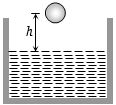
$A$ ball of radius $r$ and density $\rho$ falls freely under gravity through a distance $h$ before entering water. The velocity of the ball does not change even on entering the water. If the viscosity of water is $\eta$ and the density of water is $\sigma$ (assumed to be $1$ unit for calculation),the value of $h$ is given by:
A
$\frac{2}{9}{r^2}\left( {\frac{{1 - \rho }}{\eta }} \right)\,g$
B
$\frac{2}{{81}}{r^2}\left( {\frac{{\rho - 1}}{\eta }} \right)\,g$
C
$\frac{2}{{81}}{r^4}{\left( {\frac{{\rho - 1}}{\eta }} \right)^2}g$
D
$\frac{2}{9}{r^4}{\left( {\frac{{\rho - 1}}{\eta }} \right)^2}g$
Solution
(C) The velocity of the ball when it strikes the water surface is given by $v = \sqrt{2gh}$ ... $(i)$
The terminal velocity of a ball inside a viscous liquid is given by $v = \frac{2}{9}r^2 g \frac{(\rho - \sigma)}{\eta}$. Assuming the density of water $\sigma = 1$,we have $v = \frac{2}{9}r^2 g \frac{(\rho - 1)}{\eta}$ ... (ii)
Since the velocity does not change upon entering the water,we equate $(i)$ and (ii):
$\sqrt{2gh} = \frac{2}{9} \frac{r^2 g}{\eta} (\rho - 1)$
Squaring both sides:
$2gh = \left( \frac{2}{9} \right)^2 \frac{r^4 g^2}{\eta^2} (\rho - 1)^2$
Solving for $h$:
$h = \frac{1}{2g} \cdot \frac{4}{81} \cdot \frac{r^4 g^2}{\eta^2} (\rho - 1)^2$
$h = \frac{2}{81} r^4 \left( \frac{\rho - 1}{\eta} \right)^2 g$
The terminal velocity of a ball inside a viscous liquid is given by $v = \frac{2}{9}r^2 g \frac{(\rho - \sigma)}{\eta}$. Assuming the density of water $\sigma = 1$,we have $v = \frac{2}{9}r^2 g \frac{(\rho - 1)}{\eta}$ ... (ii)
Since the velocity does not change upon entering the water,we equate $(i)$ and (ii):
$\sqrt{2gh} = \frac{2}{9} \frac{r^2 g}{\eta} (\rho - 1)$
Squaring both sides:
$2gh = \left( \frac{2}{9} \right)^2 \frac{r^4 g^2}{\eta^2} (\rho - 1)^2$
Solving for $h$:
$h = \frac{1}{2g} \cdot \frac{4}{81} \cdot \frac{r^4 g^2}{\eta^2} (\rho - 1)^2$
$h = \frac{2}{81} r^4 \left( \frac{\rho - 1}{\eta} \right)^2 g$
0 likes
View Solution7
EasyMCQ
We have three beakers $A, B$,and $C$ containing glycerine,water,and kerosene respectively. They are stirred vigorously and placed on a table. The liquid which comes to rest at the earliest is
A
Glycerine
B
Water
C
Kerosene
D
All of them at the same time
Solution
(A) The rate at which a liquid comes to rest after being stirred depends on its viscosity. Viscosity is the measure of a fluid's resistance to flow.
Among the given liquids,glycerine has the highest coefficient of viscosity.
Because glycerine is more viscous than water and kerosene,the internal frictional forces (viscous drag) between its layers are much stronger.
These strong viscous forces oppose the relative motion of the liquid layers more effectively,causing the kinetic energy of the liquid to dissipate faster.
Therefore,glycerine comes to rest earlier than water and kerosene.
Among the given liquids,glycerine has the highest coefficient of viscosity.
Because glycerine is more viscous than water and kerosene,the internal frictional forces (viscous drag) between its layers are much stronger.
These strong viscous forces oppose the relative motion of the liquid layers more effectively,causing the kinetic energy of the liquid to dissipate faster.
Therefore,glycerine comes to rest earlier than water and kerosene.
0 likes
View Solution8
EasyMCQ
$A$ small drop of water falls from rest through a large height $h$ in air; the final velocity is
A
$\propto \sqrt{h}$
B
$\propto h$
C
$\propto (1/h)$
D
Almost independent of $h$
Solution
(D) When a small drop of water falls through air,it experiences a viscous drag force $F_v = 6\pi \eta r v$ and a buoyant force in addition to gravity.
As the velocity $v$ increases,the viscous drag force increases.
Eventually,the net force becomes zero when the weight of the drop is balanced by the sum of the buoyant force and the viscous drag force.
At this point,the drop attains a constant velocity known as the terminal velocity,given by $v_t = \frac{2r^2(\rho - \sigma)g}{9\eta}$.
Since this terminal velocity depends only on the properties of the fluid and the drop (radius,density,viscosity),it is independent of the height $h$ from which the drop falls,provided the height is sufficient for the terminal velocity to be reached.
As the velocity $v$ increases,the viscous drag force increases.
Eventually,the net force becomes zero when the weight of the drop is balanced by the sum of the buoyant force and the viscous drag force.
At this point,the drop attains a constant velocity known as the terminal velocity,given by $v_t = \frac{2r^2(\rho - \sigma)g}{9\eta}$.
Since this terminal velocity depends only on the properties of the fluid and the drop (radius,density,viscosity),it is independent of the height $h$ from which the drop falls,provided the height is sufficient for the terminal velocity to be reached.
0 likes
View Solution9
EasyMCQ
$A$ viscous fluid is flowing through a cylindrical tube. The velocity distribution of the fluid is best represented by the diagram
A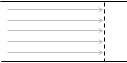
B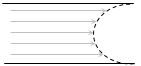
C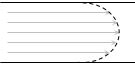
D
None of these
Solution
(C) When a viscous fluid flows through a cylindrical tube in a streamline manner (laminar flow),the velocity of the fluid layers is maximum at the center of the tube and zero at the walls due to the no-slip condition.
This results in a parabolic velocity profile,where the velocity $v$ at a distance $r$ from the axis is given by $v = v_{max} (1 - r^2/R^2)$,where $R$ is the radius of the tube.
Diagram $C$ correctly represents this parabolic distribution,showing the highest velocity at the center and zero velocity at the boundaries.
This results in a parabolic velocity profile,where the velocity $v$ at a distance $r$ from the axis is given by $v = v_{max} (1 - r^2/R^2)$,where $R$ is the radius of the tube.
Diagram $C$ correctly represents this parabolic distribution,showing the highest velocity at the center and zero velocity at the boundaries.
0 likes
View Solution10
MediumMCQ
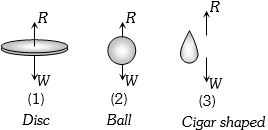
When a body falls in air,the resistance of air depends to a great extent on the shape of the body. $3$ different shapes are given in the figure: $(1)$ Disc,$(2)$ Ball,and $(3)$ Cigar-shaped. Identify the combination of air resistances $(R_1, R_2, R_3)$ which truly represents the physical situation. (The cross-sectional areas are the same).
A
$R_1 < R_2 < R_3$
B
$R_2 < R_3 < R_1$
C
$R_3 < R_2 < R_1$
D
$R_3 < R_1 < R_2$
Solution
(C) The air resistance experienced by a falling body depends on its shape. $A$ streamlined body (like the cigar-shaped object) experiences the minimum air resistance because it allows the air to flow smoothly around it,minimizing turbulence and pressure drag.
Conversely,a flat object (like the disc) experiences the maximum air resistance because it creates a large wake and significant pressure difference across its surface.
Therefore,the order of air resistance is: $R_3$ (cigar-shaped) $< R_2$ (ball) $< R_1$ (disc).
Thus,the correct relation is $R_3 < R_2 < R_1$.
Conversely,a flat object (like the disc) experiences the maximum air resistance because it creates a large wake and significant pressure difference across its surface.
Therefore,the order of air resistance is: $R_3$ (cigar-shaped) $< R_2$ (ball) $< R_1$ (disc).
Thus,the correct relation is $R_3 < R_2 < R_1$.
0 likes
View Solution11
DifficultMCQ
What is the velocity $v$ of a metallic ball of radius $r$ falling in a tank of liquid at the instant when its acceleration is one-half that of a freely falling body? (The densities of metal and of liquid are $\rho$ and $\sigma$ respectively,and the viscosity of the liquid is $\eta$).
A
$\frac{r^2 g}{9\eta}(\rho - 2\sigma)$
B
$\frac{r^2 g}{9\eta}(2\rho - \sigma)$
C
$\frac{r^2 g}{9\eta}(\rho - \sigma)$
D
$\frac{2r^2 g}{9\eta}(\rho - \sigma)$
Solution
(A) The forces acting on the metallic ball are:
$1$. Weight $W = V\rho g = \frac{4}{3}\pi r^3 \rho g$ (downwards)
$2$. Buoyant force $F_B = V\sigma g = \frac{4}{3}\pi r^3 \sigma g$ (upwards)
$3$. Viscous drag force $F_v = 6\pi \eta r v$ (upwards)
According to Newton's second law,$F_{net} = ma = V\rho a$.
$V\rho g - V\sigma g - 6\pi \eta r v = V\rho a$.
Given that the acceleration $a = g/2$,we substitute this into the equation:
$V\rho g - V\sigma g - 6\pi \eta r v = V\rho (g/2)$.
$V\rho g - V\sigma g - V\rho g/2 = 6\pi \eta r v$.
$V\rho g/2 - V\sigma g = 6\pi \eta r v$.
Substituting $V = \frac{4}{3}\pi r^3$:
$\frac{4}{3}\pi r^3 g (\frac{\rho}{2} - \sigma) = 6\pi \eta r v$.
$\frac{4}{3}\pi r^3 g (\frac{\rho - 2\sigma}{2}) = 6\pi \eta r v$.
$\frac{2}{3}\pi r^3 g (\rho - 2\sigma) = 6\pi \eta r v$.
$v = \frac{2\pi r^3 g (\rho - 2\sigma)}{3 \cdot 6\pi \eta r} = \frac{r^2 g}{9\eta}(\rho - 2\sigma)$.
Thus,the correct option is $A$.
$1$. Weight $W = V\rho g = \frac{4}{3}\pi r^3 \rho g$ (downwards)
$2$. Buoyant force $F_B = V\sigma g = \frac{4}{3}\pi r^3 \sigma g$ (upwards)
$3$. Viscous drag force $F_v = 6\pi \eta r v$ (upwards)
According to Newton's second law,$F_{net} = ma = V\rho a$.
$V\rho g - V\sigma g - 6\pi \eta r v = V\rho a$.
Given that the acceleration $a = g/2$,we substitute this into the equation:
$V\rho g - V\sigma g - 6\pi \eta r v = V\rho (g/2)$.
$V\rho g - V\sigma g - V\rho g/2 = 6\pi \eta r v$.
$V\rho g/2 - V\sigma g = 6\pi \eta r v$.
Substituting $V = \frac{4}{3}\pi r^3$:
$\frac{4}{3}\pi r^3 g (\frac{\rho}{2} - \sigma) = 6\pi \eta r v$.
$\frac{4}{3}\pi r^3 g (\frac{\rho - 2\sigma}{2}) = 6\pi \eta r v$.
$\frac{2}{3}\pi r^3 g (\rho - 2\sigma) = 6\pi \eta r v$.
$v = \frac{2\pi r^3 g (\rho - 2\sigma)}{3 \cdot 6\pi \eta r} = \frac{r^2 g}{9\eta}(\rho - 2\sigma)$.
Thus,the correct option is $A$.
0 likes
View Solution12
MediumMCQ
$A$ lead shot of $1 \, mm$ diameter falls through a long column of glycerine. The variation of its velocity $v$ with distance covered is represented by:
A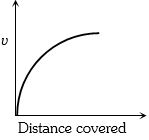
B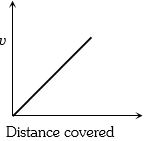
C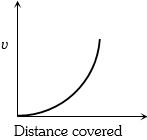
D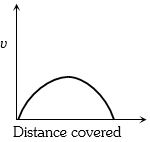
Solution
(A) When a lead shot falls through a viscous liquid like glycerine, it is acted upon by three forces: gravity $(mg)$ acting downwards, and both buoyancy $(F_B)$ and viscous drag $(F_v = 6\pi \eta rv)$ acting upwards. The net force is $F_{net} = mg - F_B - 6\pi \eta rv$. Initially, the velocity $v$ is zero, so the viscous drag is zero, and the acceleration is maximum. As the velocity increases, the viscous drag increases, causing the acceleration to decrease. Eventually, the net force becomes zero when the viscous drag balances the effective weight, and the lead shot attains a constant terminal velocity $(v_t)$. The velocity-distance graph starts from the origin, increases at a decreasing rate, and asymptotically approaches the terminal velocity value. This behavior is correctly represented by plot $(a)$.
0 likes
View Solution13
EasyMCQ
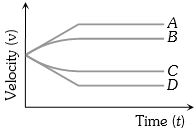
$A$ small spherical solid ball is dropped from a great height in a viscous liquid. Its journey in the liquid is best described in the diagram given below by the
A
Curve $A$
B
Curve $B$
C
Curve $C$
D
Curve $D$
Solution
(B) When a small spherical ball is dropped into a viscous liquid,it initially accelerates due to gravity.
As its velocity increases,the viscous drag force (which is proportional to velocity) also increases.
According to Stokes' Law,the net force acting on the ball is $F_{net} = mg - F_v - F_b$,where $mg$ is the weight,$F_v$ is the viscous drag,and $F_b$ is the buoyant force.
As the velocity increases,the viscous drag $F_v$ increases until the net force becomes zero $(F_{net} = 0)$.
At this point,the ball attains a constant velocity known as the terminal velocity.
The velocity-time graph should show an initial increase in velocity followed by a gradual approach to a constant value.
Curve $B$ represents this behavior,where the slope decreases as the velocity approaches the terminal velocity.
As its velocity increases,the viscous drag force (which is proportional to velocity) also increases.
According to Stokes' Law,the net force acting on the ball is $F_{net} = mg - F_v - F_b$,where $mg$ is the weight,$F_v$ is the viscous drag,and $F_b$ is the buoyant force.
As the velocity increases,the viscous drag $F_v$ increases until the net force becomes zero $(F_{net} = 0)$.
At this point,the ball attains a constant velocity known as the terminal velocity.
The velocity-time graph should show an initial increase in velocity followed by a gradual approach to a constant value.
Curve $B$ represents this behavior,where the slope decreases as the velocity approaches the terminal velocity.
1 likes
View Solution14
EasyMCQ
From amongst the following curves, which one shows the variation of the velocity $v$ with time $t$ for a small-sized spherical body falling vertically in a long column of a viscous liquid?
A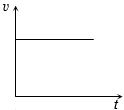
B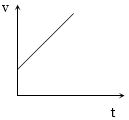
C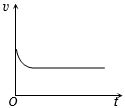
D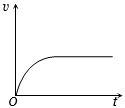
Solution
(D) When a small spherical body falls through a viscous liquid, it is acted upon by three forces: gravity $(mg)$ acting downwards, buoyancy $(F_B)$ acting upwards, and viscous drag $(F_v = 6\pi\eta rv)$ acting upwards.
Initially, the velocity $v$ is zero, so the viscous drag is zero. The net force is downward, causing the body to accelerate.
As the velocity $v$ increases, the viscous drag $F_v$ increases. The net force $(mg - F_B - F_v)$ decreases, so the acceleration decreases.
Eventually, the viscous drag becomes large enough such that the net force becomes zero $(mg - F_B - F_v = 0)$. At this point, the body stops accelerating and moves with a constant velocity known as the terminal velocity.
The graph that represents this behavior, where velocity starts from zero and increases at a decreasing rate until it becomes constant, is shown in option $D$.
Initially, the velocity $v$ is zero, so the viscous drag is zero. The net force is downward, causing the body to accelerate.
As the velocity $v$ increases, the viscous drag $F_v$ increases. The net force $(mg - F_B - F_v)$ decreases, so the acceleration decreases.
Eventually, the viscous drag becomes large enough such that the net force becomes zero $(mg - F_B - F_v = 0)$. At this point, the body stops accelerating and moves with a constant velocity known as the terminal velocity.
The graph that represents this behavior, where velocity starts from zero and increases at a decreasing rate until it becomes constant, is shown in option $D$.
0 likes
View Solution15
EasyMCQ
Which of the following laws is used in Millikan's oil drop experiment for the determination of the charge of an electron?
A
Ampere's law
B
Stoke's law
C
Fleming's left-hand rule
D
Fleming's right-hand rule
Solution
(B) In Millikan's oil drop experiment,the charge of an electron is determined by balancing the forces acting on a charged oil droplet.
When the oil droplet falls through the air,it experiences a viscous drag force.
According to $Stoke's$ law,the viscous drag force $F$ acting on a spherical object of radius $r$ moving with velocity $v$ through a fluid of viscosity $\eta$ is given by $F = 6\pi\eta rv$.
This law is essential for calculating the radius and mass of the oil droplet,which allows for the determination of the charge $q$ on the droplet.
Therefore,the correct option is $B$.
When the oil droplet falls through the air,it experiences a viscous drag force.
According to $Stoke's$ law,the viscous drag force $F$ acting on a spherical object of radius $r$ moving with velocity $v$ through a fluid of viscosity $\eta$ is given by $F = 6\pi\eta rv$.
This law is essential for calculating the radius and mass of the oil droplet,which allows for the determination of the charge $q$ on the droplet.
Therefore,the correct option is $B$.
0 likes
View Solution16
DifficultMCQ
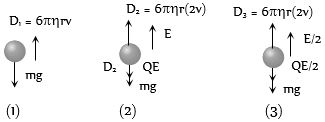
In Millikan's oil drop experiment, a charged drop falls with terminal velocity $V$. If an electric field $E$ is applied in a vertically upward direction, then it starts moving in an upward direction with terminal velocity $2V$. If the magnitude of the electric field is decreased to $E/2$, then the terminal velocity will become
A
$V/2$
B
$V$
C
$3V/2$
D
$2V$
Solution
(A) Let $mg$ be the weight of the drop and $F_v = 6\pi \eta rv$ be the viscous drag force.
$1$. When the drop falls with terminal velocity $V$ in the absence of an electric field, the forces are balanced:
$mg = 6\pi \eta rV$ --- $(i)$
$2$. When an electric field $E$ is applied upward, the drop moves upward with terminal velocity $2V$. The electric force $QE$ acts upward, while gravity $mg$ and viscous drag $6\pi \eta r(2V)$ act downward:
$QE = mg + 6\pi \eta r(2V)$
Substituting $mg = 6\pi \eta rV$ from $(i)$:
$QE = 6\pi \eta rV + 12\pi \eta rV = 18\pi \eta rV$ --- $(ii)$
$3$. When the electric field is reduced to $E/2$, let the new terminal velocity be $V'$. Since $QE/2 = (18\pi \eta rV)/2 = 9\pi \eta rV$, the electric force is now $9\pi \eta rV$.
If the drop moves upward, the force balance is:
$QE/2 = mg + 6\pi \eta rV'$
$9\pi \eta rV = 6\pi \eta rV + 6\pi \eta rV'$
$3\pi \eta rV = 6\pi \eta rV'$
$V' = V/2$
Since $V'$ is positive, the drop moves upward with terminal velocity $V/2$.
$1$. When the drop falls with terminal velocity $V$ in the absence of an electric field, the forces are balanced:
$mg = 6\pi \eta rV$ --- $(i)$
$2$. When an electric field $E$ is applied upward, the drop moves upward with terminal velocity $2V$. The electric force $QE$ acts upward, while gravity $mg$ and viscous drag $6\pi \eta r(2V)$ act downward:
$QE = mg + 6\pi \eta r(2V)$
Substituting $mg = 6\pi \eta rV$ from $(i)$:
$QE = 6\pi \eta rV + 12\pi \eta rV = 18\pi \eta rV$ --- $(ii)$
$3$. When the electric field is reduced to $E/2$, let the new terminal velocity be $V'$. Since $QE/2 = (18\pi \eta rV)/2 = 9\pi \eta rV$, the electric force is now $9\pi \eta rV$.
If the drop moves upward, the force balance is:
$QE/2 = mg + 6\pi \eta rV'$
$9\pi \eta rV = 6\pi \eta rV + 6\pi \eta rV'$
$3\pi \eta rV = 6\pi \eta rV'$
$V' = V/2$
Since $V'$ is positive, the drop moves upward with terminal velocity $V/2$.
0 likes
View Solution17
MediumMCQ
If a ball of steel (density $\rho = 7.8 \; g \cdot cm^{-3}$) attains a terminal velocity of $10 \; cm \cdot s^{-1}$ when falling in a tank of water (coefficient of viscosity $\eta_{\text{water}} = 8.5 \times 10^{-4} \; Pa \cdot s$),then its terminal velocity in glycerine (density $\rho_{\text{gly}} = 1.2 \; g \cdot cm^{-3}$,coefficient of viscosity $\eta_{\text{gly}} = 13.2 \; Pa \cdot s$) would be nearly:
A
$1.6 \times 10^{-5} \; cm \cdot s^{-1}$
B
$6.25 \times 10^{-4} \; cm \cdot s^{-1}$
C
$6.45 \times 10^{-4} \; cm \cdot s^{-1}$
D
$1.5 \times 10^{-5} \; cm \cdot s^{-1}$
Solution
(B) The terminal velocity $v$ of a sphere falling through a viscous fluid is given by the formula:
$v = \frac{2r^2(\rho - \rho_0)g}{9\eta}$
where $\rho$ is the density of the sphere,$\rho_0$ is the density of the fluid,and $\eta$ is the coefficient of viscosity.
From this,we see that $v \propto \frac{(\rho - \rho_0)}{\eta}$.
Let $v_1$ and $\eta_w$ be the terminal velocity and viscosity in water,and $v_2$ and $\eta_g$ be the terminal velocity and viscosity in glycerine.
$\frac{v_2}{v_1} = \frac{(\rho - \rho_g)}{\eta_g} \times \frac{\eta_w}{(\rho - \rho_w)}$
Given: $\rho = 7.8 \; g \cdot cm^{-3}$,$\rho_w = 1.0 \; g \cdot cm^{-3}$,$\rho_g = 1.2 \; g \cdot cm^{-3}$,$v_1 = 10 \; cm \cdot s^{-1}$,$\eta_w = 8.5 \times 10^{-4} \; Pa \cdot s$,$\eta_g = 13.2 \; Pa \cdot s$.
$\frac{v_2}{10} = \frac{(7.8 - 1.2)}{13.2} \times \frac{8.5 \times 10^{-4}}{(7.8 - 1.0)}$
$\frac{v_2}{10} = \frac{6.6}{13.2} \times \frac{8.5 \times 10^{-4}}{6.8} = 0.5 \times 1.25 \times 10^{-4} = 0.625 \times 10^{-4}$
$v_2 = 10 \times 0.625 \times 10^{-4} = 6.25 \times 10^{-4} \; cm \cdot s^{-1}$.
$v = \frac{2r^2(\rho - \rho_0)g}{9\eta}$
where $\rho$ is the density of the sphere,$\rho_0$ is the density of the fluid,and $\eta$ is the coefficient of viscosity.
From this,we see that $v \propto \frac{(\rho - \rho_0)}{\eta}$.
Let $v_1$ and $\eta_w$ be the terminal velocity and viscosity in water,and $v_2$ and $\eta_g$ be the terminal velocity and viscosity in glycerine.
$\frac{v_2}{v_1} = \frac{(\rho - \rho_g)}{\eta_g} \times \frac{\eta_w}{(\rho - \rho_w)}$
Given: $\rho = 7.8 \; g \cdot cm^{-3}$,$\rho_w = 1.0 \; g \cdot cm^{-3}$,$\rho_g = 1.2 \; g \cdot cm^{-3}$,$v_1 = 10 \; cm \cdot s^{-1}$,$\eta_w = 8.5 \times 10^{-4} \; Pa \cdot s$,$\eta_g = 13.2 \; Pa \cdot s$.
$\frac{v_2}{10} = \frac{(7.8 - 1.2)}{13.2} \times \frac{8.5 \times 10^{-4}}{(7.8 - 1.0)}$
$\frac{v_2}{10} = \frac{6.6}{13.2} \times \frac{8.5 \times 10^{-4}}{6.8} = 0.5 \times 1.25 \times 10^{-4} = 0.625 \times 10^{-4}$
$v_2 = 10 \times 0.625 \times 10^{-4} = 6.25 \times 10^{-4} \; cm \cdot s^{-1}$.
0 likes
View Solution18
DifficultMCQ
Two drops of equal radius are falling with a terminal velocity of $5 \, cm/s$. If they coalesce to form a single larger drop,what will be the terminal velocity of the new drop?
A
$10 \, cm/s$
B
$2.5 \, cm/s$
C
$5 \times (4)^{1/3} \, cm/s$
D
$5 \times \sqrt{2} \, cm/s$
Solution
(C) Let the radius of each small drop be $r$ and the terminal velocity be $v_1 = 5 \, cm/s$.
When two drops coalesce,the volume is conserved: $\frac{4}{3}\pi R^3 = 2 \times \frac{4}{3}\pi r^3$,where $R$ is the radius of the new drop.
Thus,$R^3 = 2r^3$,which gives $R = 2^{1/3}r$.
The terminal velocity $v$ of a drop is given by Stokes' Law: $v = \frac{2}{9} \frac{r^2(\rho - \sigma)g}{\eta}$,which implies $v \propto r^2$.
Therefore,the ratio of the terminal velocities is $\frac{v_2}{v_1} = \left(\frac{R}{r}\right)^2$.
Substituting $R = 2^{1/3}r$,we get $\frac{v_2}{v_1} = (2^{1/3})^2 = 2^{2/3} = (4)^{1/3}$.
So,$v_2 = v_1 \times (4)^{1/3} = 5 \times (4)^{1/3} \, cm/s$.
When two drops coalesce,the volume is conserved: $\frac{4}{3}\pi R^3 = 2 \times \frac{4}{3}\pi r^3$,where $R$ is the radius of the new drop.
Thus,$R^3 = 2r^3$,which gives $R = 2^{1/3}r$.
The terminal velocity $v$ of a drop is given by Stokes' Law: $v = \frac{2}{9} \frac{r^2(\rho - \sigma)g}{\eta}$,which implies $v \propto r^2$.
Therefore,the ratio of the terminal velocities is $\frac{v_2}{v_1} = \left(\frac{R}{r}\right)^2$.
Substituting $R = 2^{1/3}r$,we get $\frac{v_2}{v_1} = (2^{1/3})^2 = 2^{2/3} = (4)^{1/3}$.
So,$v_2 = v_1 \times (4)^{1/3} = 5 \times (4)^{1/3} \, cm/s$.
0 likes
View Solution19
DifficultMCQ
$A$ sphere of radius $r$ and density $\rho$ is dropped from a height $h$. When it falls into water,it attains a terminal velocity. If the coefficient of viscosity of water is $\eta$,then $h =$
A
$\frac{2}{9}{r^2}\left( {\frac{{1 - \rho }}{\eta }} \right)\,g$
B
$\frac{2}{{81}}{r^2}\left( {\frac{{\rho - 1}}{\eta }} \right)\,g$
C
$\frac{2}{{81}}{r^4}{\left( {\frac{{\rho - 1}}{\eta }} \right)^2}g$
D
$\frac{2}{9}{r^4}{\left( {\frac{{\rho - 1}}{\eta }} \right)^2}g$
Solution
(C) When the sphere is dropped from height $h$,its velocity $v$ just before entering the water is given by the equation of motion: $v = \sqrt{2gh}$ $(i)$
The terminal velocity $v_t$ of a sphere of radius $r$ and density $\rho$ falling through a liquid of density $\sigma$ and viscosity $\eta$ is given by Stokes' Law: $v_t = \frac{2}{9}r^2 g \frac{(\rho - \sigma)}{\eta}$. Assuming the density of water $\sigma = 1$,we have: $v = \frac{2}{9}r^2 g \frac{(\rho - 1)}{\eta}$ (ii)
Equating the velocity from $(i)$ and (ii): $\sqrt{2gh} = \frac{2}{9}r^2 g \frac{(\rho - 1)}{\eta}$
Squaring both sides: $2gh = \left( \frac{2}{9} \right)^2 r^4 g^2 \frac{(\rho - 1)^2}{\eta^2}$
$2gh = \frac{4}{81} r^4 g^2 \frac{(\rho - 1)^2}{\eta^2}$
$h = \frac{2}{81} r^4 g \left( \frac{\rho - 1}{\eta} \right)^2$
The terminal velocity $v_t$ of a sphere of radius $r$ and density $\rho$ falling through a liquid of density $\sigma$ and viscosity $\eta$ is given by Stokes' Law: $v_t = \frac{2}{9}r^2 g \frac{(\rho - \sigma)}{\eta}$. Assuming the density of water $\sigma = 1$,we have: $v = \frac{2}{9}r^2 g \frac{(\rho - 1)}{\eta}$ (ii)
Equating the velocity from $(i)$ and (ii): $\sqrt{2gh} = \frac{2}{9}r^2 g \frac{(\rho - 1)}{\eta}$
Squaring both sides: $2gh = \left( \frac{2}{9} \right)^2 r^4 g^2 \frac{(\rho - 1)^2}{\eta^2}$
$2gh = \frac{4}{81} r^4 g^2 \frac{(\rho - 1)^2}{\eta^2}$
$h = \frac{2}{81} r^4 g \left( \frac{\rho - 1}{\eta} \right)^2$
0 likes
View Solution20
DifficultMCQ
$A$ small sphere of radius $r$ falls from rest in a viscous liquid. As a result,heat is produced due to viscous force. The rate of production of heat when the sphere attains its terminal velocity,is proportional to
A
$r^3$
B
$r^2$
C
$r^4$
D
$r^5$
Solution
(D) The viscous drag force is given by Stokes' Law: $F = 6\pi \eta rv$,where $v$ is the terminal velocity.
The rate of production of heat is equal to the power dissipated by the viscous force:
$P = F \cdot v = (6\pi \eta rv) \cdot v = 6\pi \eta r v^2$.
The terminal velocity $v$ of a sphere falling in a viscous liquid is given by:
$v = \frac{2r^2(\rho - \sigma)g}{9\eta}$,which implies $v \propto r^2$.
Substituting $v \propto r^2$ into the power equation:
$P \propto r \cdot (r^2)^2 = r \cdot r^4 = r^5$.
Therefore,the rate of production of heat is proportional to $r^5$.
The rate of production of heat is equal to the power dissipated by the viscous force:
$P = F \cdot v = (6\pi \eta rv) \cdot v = 6\pi \eta r v^2$.
The terminal velocity $v$ of a sphere falling in a viscous liquid is given by:
$v = \frac{2r^2(\rho - \sigma)g}{9\eta}$,which implies $v \propto r^2$.
Substituting $v \propto r^2$ into the power equation:
$P \propto r \cdot (r^2)^2 = r \cdot r^4 = r^5$.
Therefore,the rate of production of heat is proportional to $r^5$.
0 likes
View Solution21
DifficultMCQ
$A$ solid metallic sphere of radius $r$ is allowed to fall freely through air. If the frictional resistance due to air is proportional to the cross-sectional area and to the square of the velocity,then the terminal velocity of the sphere is proportional to which of the following?
A
$r^2$
B
$r$
C
$r^{3/2}$
D
$r^{1/2}$
Solution
(D) The frictional resistance $f_{r}$ is given as:
$f_{r} \propto A$ and $f_{r} \propto v^{2}$
$f_{r} = k A v^{2}$ (where $k$ is a constant).
The downward force (weight) is given as: $W = mg = \frac{4}{3} \pi r^{3} \rho g$.
At terminal velocity,the downward force is balanced by the frictional resistance (ignoring buoyancy for simplicity as it is usually negligible in air):
$mg = f_{r}$
$\frac{4}{3} \pi r^{3} \rho g = k (\pi r^{2}) v^{2}$
Simplifying the equation:
$\frac{4}{3} r \rho g = k v^{2}$
Since $\rho$,$g$,and $k$ are constants,we have:
$r \propto v^{2}$
$v \propto r^{1/2}$
$f_{r} \propto A$ and $f_{r} \propto v^{2}$
$f_{r} = k A v^{2}$ (where $k$ is a constant).
The downward force (weight) is given as: $W = mg = \frac{4}{3} \pi r^{3} \rho g$.
At terminal velocity,the downward force is balanced by the frictional resistance (ignoring buoyancy for simplicity as it is usually negligible in air):
$mg = f_{r}$
$\frac{4}{3} \pi r^{3} \rho g = k (\pi r^{2}) v^{2}$
Simplifying the equation:
$\frac{4}{3} r \rho g = k v^{2}$
Since $\rho$,$g$,and $k$ are constants,we have:
$r \propto v^{2}$
$v \propto r^{1/2}$
0 likes
View Solution22
DifficultMCQ
Two drops of same radius are falling through air with steady velocity of $v \ cm/s$. If the two drops coalesce,what would be the terminal velocity?
A
$4v$
B
$(4)^{1/3}v$
C
$2v$
D
$64v$
Solution
(B) When two drops of radius $r$ coalesce to form a single drop of radius $R$,the volume remains conserved.
$2 \times (\frac{4}{3} \pi r^3) = \frac{4}{3} \pi R^3$
$R^3 = 2r^3 \implies R = 2^{1/3}r$
The terminal velocity $v_t$ of a spherical drop is given by Stokes' Law: $v_t = \frac{2r^2g(\rho - \sigma)}{9\eta}$,which implies $v_t \propto r^2$.
Let $v$ be the terminal velocity of the individual drop and $v'$ be the terminal velocity of the coalesced drop.
$\frac{v'}{v} = \frac{R^2}{r^2} = \frac{(2^{1/3}r)^2}{r^2} = (2^{1/3})^2 = 2^{2/3} = (2^2)^{1/3} = 4^{1/3}$.
Therefore,the new terminal velocity is $v' = 4^{1/3}v$.
$2 \times (\frac{4}{3} \pi r^3) = \frac{4}{3} \pi R^3$
$R^3 = 2r^3 \implies R = 2^{1/3}r$
The terminal velocity $v_t$ of a spherical drop is given by Stokes' Law: $v_t = \frac{2r^2g(\rho - \sigma)}{9\eta}$,which implies $v_t \propto r^2$.
Let $v$ be the terminal velocity of the individual drop and $v'$ be the terminal velocity of the coalesced drop.
$\frac{v'}{v} = \frac{R^2}{r^2} = \frac{(2^{1/3}r)^2}{r^2} = (2^{1/3})^2 = 2^{2/3} = (2^2)^{1/3} = 4^{1/3}$.
Therefore,the new terminal velocity is $v' = 4^{1/3}v$.
0 likes
View Solution23
MediumMCQ
Which of the following graphs best represents the motion of a raindrop?
A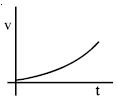
B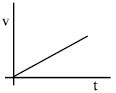
C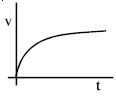
D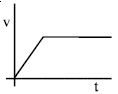
Solution
(C) When a raindrop falls through the air,it is subjected to gravity,buoyancy,and a viscous drag force.
Initially,the velocity of the raindrop increases due to gravity.
As the velocity increases,the viscous drag force (which is proportional to velocity) also increases.
Eventually,the net force on the raindrop becomes zero when the viscous drag force and buoyancy balance the gravitational force.
At this point,the raindrop attains a constant velocity known as the terminal velocity.
The graph of velocity $(v)$ versus time $(t)$ shows an initial increase in velocity followed by a leveling off to a constant value.
Graph $C$ correctly represents this behavior,where the slope decreases as the velocity approaches the terminal velocity.
Initially,the velocity of the raindrop increases due to gravity.
As the velocity increases,the viscous drag force (which is proportional to velocity) also increases.
Eventually,the net force on the raindrop becomes zero when the viscous drag force and buoyancy balance the gravitational force.
At this point,the raindrop attains a constant velocity known as the terminal velocity.
The graph of velocity $(v)$ versus time $(t)$ shows an initial increase in velocity followed by a leveling off to a constant value.
Graph $C$ correctly represents this behavior,where the slope decreases as the velocity approaches the terminal velocity.
0 likes
View Solution24
DifficultMCQ
$A$ spherical ball of density $\rho$ and radius $0.003 \ m$ is dropped into a tube containing a viscous fluid filled up to the $0 \ cm$ mark as shown in the figure. The viscosity of the fluid $\eta = 1.260 \ N \cdot s \cdot m^{-2}$ and its density $\rho_L = \rho/2 = 1260 \ kg \cdot m^{-3}$. Assume the ball reaches a terminal speed by the $10 \ cm$ mark. The time taken by the ball to traverse the distance between the $10 \ cm$ and $20 \ cm$ mark is $(g = 10 \ m \cdot s^{-2})$

A
$500 \ \mu s$
B
$50 \ ms$
C
$0.5 \ s$
D
$5 \ s$
Solution
(D) The formula for terminal velocity $v_T$ is given by Stokes' Law: $v_T = \frac{2}{9} \frac{r^2(\rho - \rho_L)g}{\eta}$.
Given: $r = 0.003 \ m$,$\rho_L = 1260 \ kg \cdot m^{-3}$,$\rho = 2 \times \rho_L = 2520 \ kg \cdot m^{-3}$,$\eta = 1.260 \ N \cdot s \cdot m^{-2}$,and $g = 10 \ m \cdot s^{-2}$.
Substituting the values:
$v_T = \frac{2}{9} \times \frac{(0.003)^2 \times (2520 - 1260) \times 10}{1.260}$
$v_T = \frac{2}{9} \times \frac{9 \times 10^{-6} \times 1260 \times 10}{1.260}$
$v_T = 2 \times 10^{-6} \times 1000 \times 10 = 0.02 \ m \cdot s^{-1}$.
The distance $d$ between the $10 \ cm$ and $20 \ cm$ marks is $10 \ cm = 0.1 \ m$.
Since the ball has reached terminal velocity,the time $t$ taken is:
$t = \frac{d}{v_T} = \frac{0.1 \ m}{0.02 \ m \cdot s^{-1}} = 5 \ s$.
Given: $r = 0.003 \ m$,$\rho_L = 1260 \ kg \cdot m^{-3}$,$\rho = 2 \times \rho_L = 2520 \ kg \cdot m^{-3}$,$\eta = 1.260 \ N \cdot s \cdot m^{-2}$,and $g = 10 \ m \cdot s^{-2}$.
Substituting the values:
$v_T = \frac{2}{9} \times \frac{(0.003)^2 \times (2520 - 1260) \times 10}{1.260}$
$v_T = \frac{2}{9} \times \frac{9 \times 10^{-6} \times 1260 \times 10}{1.260}$
$v_T = 2 \times 10^{-6} \times 1000 \times 10 = 0.02 \ m \cdot s^{-1}$.
The distance $d$ between the $10 \ cm$ and $20 \ cm$ marks is $10 \ cm = 0.1 \ m$.
Since the ball has reached terminal velocity,the time $t$ taken is:
$t = \frac{d}{v_T} = \frac{0.1 \ m}{0.02 \ m \cdot s^{-1}} = 5 \ s$.
0 likes
View Solution25
AdvancedMCQ
$A$ sphere is dropped under gravity through a fluid of viscosity $\eta$. If the average acceleration is half of the initial acceleration,the time to attain the terminal velocity is ($\rho$ = density of sphere; $r$ = radius).
A
$\frac{4\rho r^2}{9\eta}$
B
$\frac{9\rho r^2}{4\eta}$
C
$\frac{4\rho r}{9\eta}$
D
$\frac{9\rho r}{4\eta}$
Solution
(A) Let $r$ be the radius of the sphere and $\rho$ be its density. Let $\rho_0$ be the density of the fluid.
Initial acceleration $a$ is given by:
$a = \frac{\text{Net Force}}{\text{Mass}} = \frac{\frac{4}{3}\pi r^3(\rho - \rho_0)g}{\frac{4}{3}\pi r^3\rho} = \left(\frac{\rho - \rho_0}{\rho}\right)g$
Terminal velocity $v_t$ is given by Stokes' Law:
$v_t = \frac{2r^2(\rho - \rho_0)g}{9\eta}$
Given that the average acceleration $a_{avg} = \frac{a}{2}$,and using the kinematic relation $v_t = u + a_{avg}t$ with $u=0$:
$v_t = \left(\frac{a}{2}\right)t$
Substituting the values:
$\frac{2r^2(\rho - \rho_0)g}{9\eta} = \frac{1}{2} \left(\frac{\rho - \rho_0}{\rho}\right)g \cdot t$
Solving for $t$:
$t = \frac{2r^2(\rho - \rho_0)g}{9\eta} \cdot \frac{2\rho}{(\rho - \rho_0)g} = \frac{4\rho r^2}{9\eta}$
Initial acceleration $a$ is given by:
$a = \frac{\text{Net Force}}{\text{Mass}} = \frac{\frac{4}{3}\pi r^3(\rho - \rho_0)g}{\frac{4}{3}\pi r^3\rho} = \left(\frac{\rho - \rho_0}{\rho}\right)g$
Terminal velocity $v_t$ is given by Stokes' Law:
$v_t = \frac{2r^2(\rho - \rho_0)g}{9\eta}$
Given that the average acceleration $a_{avg} = \frac{a}{2}$,and using the kinematic relation $v_t = u + a_{avg}t$ with $u=0$:
$v_t = \left(\frac{a}{2}\right)t$
Substituting the values:
$\frac{2r^2(\rho - \rho_0)g}{9\eta} = \frac{1}{2} \left(\frac{\rho - \rho_0}{\rho}\right)g \cdot t$
Solving for $t$:
$t = \frac{2r^2(\rho - \rho_0)g}{9\eta} \cdot \frac{2\rho}{(\rho - \rho_0)g} = \frac{4\rho r^2}{9\eta}$
0 likes
View Solution26
MediumMCQ
$A$ ball of mass $m$ and radius $r$ is gently released in a viscous liquid. The mass of the liquid displaced by it is $m'$ such that $m > m'$. The terminal velocity is proportional to
A
$\frac{m - m'}{r}$
B
$\frac{m + m'}{r}$
C
$\frac{m + m'}{r^2}$
D
$(m - m') r^2$
Solution
(A) The terminal velocity $v_t$ of a sphere of radius $r$ and density $\rho$ falling through a viscous liquid of density $\sigma$ and viscosity $\eta$ is given by Stokes' Law:
$v_t = \frac{2}{9} r^2 g \frac{(\rho - \sigma)}{\eta}$
The mass of the ball is $m = \frac{4}{3} \pi r^3 \rho$,so $\rho = \frac{3m}{4 \pi r^3}$.
The mass of the displaced liquid is $m' = \frac{4}{3} \pi r^3 \sigma$,so $\sigma = \frac{3m'}{4 \pi r^3}$.
Substituting these into the terminal velocity formula:
$v_t = \frac{2}{9} r^2 g \frac{1}{\eta} \left( \frac{3m}{4 \pi r^3} - \frac{3m'}{4 \pi r^3} \right)$
$v_t = \frac{2}{9} r^2 g \frac{1}{\eta} \left( \frac{3(m - m')}{4 \pi r^3} \right)$
$v_t = \frac{6 g (m - m')}{36 \pi \eta r} = \frac{g (m - m')}{6 \pi \eta r}$
Since $g$,$\pi$,and $\eta$ are constants,we have $v_t \propto \frac{m - m'}{r}$.
$v_t = \frac{2}{9} r^2 g \frac{(\rho - \sigma)}{\eta}$
The mass of the ball is $m = \frac{4}{3} \pi r^3 \rho$,so $\rho = \frac{3m}{4 \pi r^3}$.
The mass of the displaced liquid is $m' = \frac{4}{3} \pi r^3 \sigma$,so $\sigma = \frac{3m'}{4 \pi r^3}$.
Substituting these into the terminal velocity formula:
$v_t = \frac{2}{9} r^2 g \frac{1}{\eta} \left( \frac{3m}{4 \pi r^3} - \frac{3m'}{4 \pi r^3} \right)$
$v_t = \frac{2}{9} r^2 g \frac{1}{\eta} \left( \frac{3(m - m')}{4 \pi r^3} \right)$
$v_t = \frac{6 g (m - m')}{36 \pi \eta r} = \frac{g (m - m')}{6 \pi \eta r}$
Since $g$,$\pi$,and $\eta$ are constants,we have $v_t \propto \frac{m - m'}{r}$.
0 likes
View Solution27
DifficultMCQ
Which of the following is the incorrect graph for a sphere falling in a viscous liquid? (Given at $t = 0$,velocity $v = 0$ and displacement $x = 0$.)
A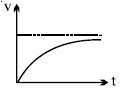
B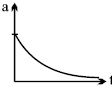
C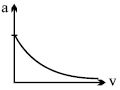
D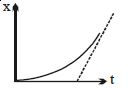
Solution
(C) When a sphere falls in a viscous liquid,it experiences three forces: gravitational force $(mg)$ downwards,buoyant force $(F_B)$ upwards,and viscous drag force $(F_v = 6 \pi \eta R v)$ upwards.
The net force $F_{net} = mg - F_B - 6 \pi \eta R v = ma$.
Since $m, g, F_B, \eta, R$ are constants,we can write $ma = C_1 - C_2 v$,where $C_1 = mg - F_B$ and $C_2 = 6 \pi \eta R$.
This shows that acceleration $a$ is a linear function of velocity $v$ $(a = \frac{C_1}{m} - \frac{C_2}{m} v)$. Therefore,the graph of $a$ versus $v$ should be a straight line with a negative slope,not a curve.
Graph $C$ shows $a$ versus $v$ as a non-linear curve,which is incorrect. Thus,option $C$ is the incorrect graph.
The net force $F_{net} = mg - F_B - 6 \pi \eta R v = ma$.
Since $m, g, F_B, \eta, R$ are constants,we can write $ma = C_1 - C_2 v$,where $C_1 = mg - F_B$ and $C_2 = 6 \pi \eta R$.
This shows that acceleration $a$ is a linear function of velocity $v$ $(a = \frac{C_1}{m} - \frac{C_2}{m} v)$. Therefore,the graph of $a$ versus $v$ should be a straight line with a negative slope,not a curve.
Graph $C$ shows $a$ versus $v$ as a non-linear curve,which is incorrect. Thus,option $C$ is the incorrect graph.
0 likes
View Solution28
MediumMCQ
The displacement of a ball falling from rest in a viscous medium is plotted against time. Choose a possible option.
A
B
C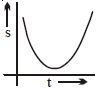
D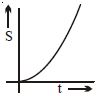
Solution
(A) When a ball falls from rest in a viscous medium,it initially accelerates due to gravity. As its velocity increases,the viscous drag force increases until the net force becomes zero.
At this point,the ball attains a constant terminal velocity.
The displacement $s$ is related to time $t$ by the equation $s = vt$ for constant velocity.
Therefore,the displacement-time graph should show an initial curve representing acceleration,followed by a straight line with a constant slope representing the terminal velocity.
Graph $A$ shows a curve that becomes linear over time,which correctly represents the motion of a ball reaching terminal velocity in a viscous medium.
At this point,the ball attains a constant terminal velocity.
The displacement $s$ is related to time $t$ by the equation $s = vt$ for constant velocity.
Therefore,the displacement-time graph should show an initial curve representing acceleration,followed by a straight line with a constant slope representing the terminal velocity.
Graph $A$ shows a curve that becomes linear over time,which correctly represents the motion of a ball reaching terminal velocity in a viscous medium.
0 likes
View Solution29
MediumMCQ
If the terminal speed of a sphere of gold (density $= 19.5 \times 10^3 \ kg/m^3$) is $0.2 \ m/s$ in a viscous liquid (density $= 1.5 \times 10^3 \ kg/m^3$), find the terminal speed (in $m/s$) of a sphere of silver (density $= 10.5 \times 10^3 \ kg/m^3$) of the same size in the same liquid.
A
$0.2$
B
$0.4$
C
$0.133$
D
$0.1$
Solution
(D) The terminal velocity $v_T$ of a sphere of radius $r$ and density $\rho$ falling through a liquid of density $\sigma$ and viscosity $\eta$ is given by the formula: $v_T = \frac{2r^2(\rho - \sigma)g}{9\eta}$.
Since the radius $r$, the liquid density $\sigma$, the viscosity $\eta$, and the acceleration due to gravity $g$ are constant for both spheres, we have $v_T \propto (\rho - \sigma)$.
Therefore, $\frac{v_{T, \text{silver}}}{v_{T, \text{gold}}} = \frac{\rho_{\text{silver}} - \sigma}{\rho_{\text{gold}} - \sigma}$.
Given $\rho_{\text{gold}} = 19.5 \times 10^3 \ kg/m^3$, $\rho_{\text{silver}} = 10.5 \times 10^3 \ kg/m^3$, $\sigma = 1.5 \times 10^3 \ kg/m^3$, and $v_{T, \text{gold}} = 0.2 \ m/s$.
Substituting the values: $\frac{v_{T, \text{silver}}}{0.2} = \frac{10.5 - 1.5}{19.5 - 1.5} = \frac{9}{18} = 0.5$.
Thus, $v_{T, \text{silver}} = 0.2 \times 0.5 = 0.1 \ m/s$.
Since the radius $r$, the liquid density $\sigma$, the viscosity $\eta$, and the acceleration due to gravity $g$ are constant for both spheres, we have $v_T \propto (\rho - \sigma)$.
Therefore, $\frac{v_{T, \text{silver}}}{v_{T, \text{gold}}} = \frac{\rho_{\text{silver}} - \sigma}{\rho_{\text{gold}} - \sigma}$.
Given $\rho_{\text{gold}} = 19.5 \times 10^3 \ kg/m^3$, $\rho_{\text{silver}} = 10.5 \times 10^3 \ kg/m^3$, $\sigma = 1.5 \times 10^3 \ kg/m^3$, and $v_{T, \text{gold}} = 0.2 \ m/s$.
Substituting the values: $\frac{v_{T, \text{silver}}}{0.2} = \frac{10.5 - 1.5}{19.5 - 1.5} = \frac{9}{18} = 0.5$.
Thus, $v_{T, \text{silver}} = 0.2 \times 0.5 = 0.1 \ m/s$.
0 likes
View Solution30
DifficultMCQ
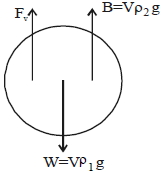
$A$ spherical solid ball of volume $V$ is made of a material of density $\rho_1$. It is falling through a liquid of density $\rho_2$ $(\rho_2 < \rho_1)$. Assume that the liquid applies a viscous force on the ball that is proportional to the square of its speed $v$,i.e.,$F_{viscous} = -kv^2$ $(k > 0)$. The terminal speed of the ball is:
A
$\frac{Vg(\rho_1 - \rho_2)}{k}$
B
$\sqrt{\frac{Vg(\rho_1 - \rho_2)}{k}}$
C
$\frac{Vg\rho_1}{k}$
D
$\sqrt{\frac{Vg\rho_1}{k}}$
Solution
(B) At terminal speed $(v_t)$,the net force on the ball is zero.
Therefore,the downward weight of the ball is balanced by the upward buoyant force and the viscous force.
$Weight = \text{Buoyant force} + \text{Viscous force}$
$V\rho_1 g = V\rho_2 g + kv_t^2$
$kv_t^2 = Vg(\rho_1 - \rho_2)$
$v_t^2 = \frac{Vg(\rho_1 - \rho_2)}{k}$
$v_t = \sqrt{\frac{Vg(\rho_1 - \rho_2)}{k}}$
Therefore,the downward weight of the ball is balanced by the upward buoyant force and the viscous force.
$Weight = \text{Buoyant force} + \text{Viscous force}$
$V\rho_1 g = V\rho_2 g + kv_t^2$
$kv_t^2 = Vg(\rho_1 - \rho_2)$
$v_t^2 = \frac{Vg(\rho_1 - \rho_2)}{k}$
$v_t = \sqrt{\frac{Vg(\rho_1 - \rho_2)}{k}}$
0 likes
View Solution31
DifficultMCQ
If the terminal speed of a sphere of gold (density $\rho_g = 19.5 \times 10^3 \ kg/m^3$) is $0.2 \ m/s$ in a viscous liquid (density $\rho_L = 1.5 \times 10^3 \ kg/m^3$),find the terminal speed of a sphere of silver (density $\rho_s = 10.5 \times 10^3 \ kg/m^3$) of the same size in the same liquid. (in $m/s$)
A
$0.4$
B
$0.133$
C
$0.1$
D
$0.2$
Solution
(C) The terminal velocity $v_T$ of a sphere of radius $r$ and density $\rho$ falling through a liquid of density $\rho_L$ and viscosity $\eta$ is given by the formula:
$v_T = \frac{2}{9} \frac{r^2 g}{\eta} (\rho - \rho_L)$
Since the size of the spheres and the liquid are the same,$r$,$g$,and $\eta$ are constant.
Therefore,$v_T \propto (\rho - \rho_L)$.
For gold: $v_{Tg} = 0.2 \ m/s$,$\rho_g = 19.5 \times 10^3 \ kg/m^3$,$\rho_L = 1.5 \times 10^3 \ kg/m^3$.
$v_{Tg} \propto (19.5 - 1.5) \times 10^3 = 18 \times 10^3$.
For silver: $v_{Ts} = ?, \rho_s = 10.5 \times 10^3 \ kg/m^3$.
$v_{Ts} \propto (10.5 - 1.5) \times 10^3 = 9 \times 10^3$.
Taking the ratio:
$\frac{v_{Ts}}{v_{Tg}} = \frac{9 \times 10^3}{18 \times 10^3} = \frac{1}{2}$.
$v_{Ts} = 0.2 \times \frac{1}{2} = 0.1 \ m/s$.
$v_T = \frac{2}{9} \frac{r^2 g}{\eta} (\rho - \rho_L)$
Since the size of the spheres and the liquid are the same,$r$,$g$,and $\eta$ are constant.
Therefore,$v_T \propto (\rho - \rho_L)$.
For gold: $v_{Tg} = 0.2 \ m/s$,$\rho_g = 19.5 \times 10^3 \ kg/m^3$,$\rho_L = 1.5 \times 10^3 \ kg/m^3$.
$v_{Tg} \propto (19.5 - 1.5) \times 10^3 = 18 \times 10^3$.
For silver: $v_{Ts} = ?, \rho_s = 10.5 \times 10^3 \ kg/m^3$.
$v_{Ts} \propto (10.5 - 1.5) \times 10^3 = 9 \times 10^3$.
Taking the ratio:
$\frac{v_{Ts}}{v_{Tg}} = \frac{9 \times 10^3}{18 \times 10^3} = \frac{1}{2}$.
$v_{Ts} = 0.2 \times \frac{1}{2} = 0.1 \ m/s$.
0 likes
View Solution32
MediumMCQ
$A$ small steel sphere of mass $m$ is falling vertically through a viscous liquid with a constant speed $v$. Which row in the table correctly describes the changes with time in the kinetic energy and gravitational potential energy of the sphere?
A
constant and equal to $\frac{1}{2} mv^2$ || decreases at a rate of $mgv$
B
constant and equal to $\frac{1}{2} mv^2$ || decreases at a rate of $(mgv - \frac{1}{2} mv^2)$
C
increases at a rate of $mgv$ || decreases at a rate of $mgv$
D
increases at a rate of $mgv$ || decreases at a rate of $(\frac{1}{2} mv^2 - mgv)$
Solution
(A) Since the sphere is falling with a constant speed $v$,the kinetic energy $KE = \frac{1}{2} mv^2$ remains constant over time. Therefore,the rate of change of kinetic energy is $0$.
The gravitational potential energy $PE$ is given by $PE = mgh$. As the sphere falls,its height $h$ decreases with time. The rate of change of potential energy is $\frac{d(PE)}{dt} = mg \frac{dh}{dt}$.
Since the sphere is moving downwards with a constant speed $v$,the rate of change of height is $\frac{dh}{dt} = -v$. Thus,the rate of change of potential energy is $-mgv$. This indicates that the gravitational potential energy decreases at a rate of $mgv$.
The gravitational potential energy $PE$ is given by $PE = mgh$. As the sphere falls,its height $h$ decreases with time. The rate of change of potential energy is $\frac{d(PE)}{dt} = mg \frac{dh}{dt}$.
Since the sphere is moving downwards with a constant speed $v$,the rate of change of height is $\frac{dh}{dt} = -v$. Thus,the rate of change of potential energy is $-mgv$. This indicates that the gravitational potential energy decreases at a rate of $mgv$.
0 likes
View Solution33
MediumMCQ
The graph between terminal velocity $(v_t)$ (along $y$-axis) and the square of the radius $(r^2)$ (along $x$-axis) of a spherical body of density $\rho$ falling through a fluid of density $\sigma$ is:
A
Straight line with positive slope
B
Straight line with negative slope
C
Straight line perpendicular to $x$-axis
D
Straight line perpendicular to $y$-axis
Solution
(A) The terminal velocity $v_t$ of a spherical body of radius $r$ and density $\rho$ falling through a fluid of density $\sigma$ and viscosity $\eta$ is given by the formula:
$v_t = \frac{2}{9} \frac{r^2 g (\rho - \sigma)}{\eta}$
Here,$g$ is the acceleration due to gravity,$\rho$ is the density of the sphere,$\sigma$ is the density of the fluid,and $\eta$ is the coefficient of viscosity.
Since $g, \rho, \sigma,$ and $\eta$ are constants for a given system,we can write:
$v_t = K r^2$,where $K = \frac{2g(\rho - \sigma)}{9\eta}$ is a constant.
This equation is of the form $y = mx$,which represents a straight line passing through the origin with a positive slope $K$ when $v_t$ is plotted against $r^2$.
$v_t = \frac{2}{9} \frac{r^2 g (\rho - \sigma)}{\eta}$
Here,$g$ is the acceleration due to gravity,$\rho$ is the density of the sphere,$\sigma$ is the density of the fluid,and $\eta$ is the coefficient of viscosity.
Since $g, \rho, \sigma,$ and $\eta$ are constants for a given system,we can write:
$v_t = K r^2$,where $K = \frac{2g(\rho - \sigma)}{9\eta}$ is a constant.
This equation is of the form $y = mx$,which represents a straight line passing through the origin with a positive slope $K$ when $v_t$ is plotted against $r^2$.
0 likes
View Solution34
EasyMCQ
An air bubble of radius $r$ rises steadily through a liquid of density $\rho$ with velocity $v$. The coefficient of viscosity of the liquid is:
A
$\frac{2}{9} \frac{r^2 \rho g}{v}$
B
$\frac{2}{9} \frac{r^2 g}{v \rho}$
C
$\frac{2}{9} \frac{v \rho g}{r^2}$
D
$\frac{2}{9} \frac{\rho g}{v r^2}$
Solution
(A) For an air bubble rising steadily,the net force acting on it is zero $(a = 0)$.
The forces acting on the bubble are the viscous drag force $(F_v)$ acting downwards,the buoyant force $(F_B)$ acting upwards,and the weight of the bubble $(mg)$. Since the density of air is negligible compared to the liquid,the weight is neglected.
Equating the forces: $F_v = F_B$
Using Stokes' Law for viscous force: $F_v = 6 \pi \eta r v$
Using Archimedes' principle for buoyant force: $F_B = \text{Volume} \times \text{density} \times g = (\frac{4}{3} \pi r^3) \rho g$
Equating them: $6 \pi \eta r v = \frac{4}{3} \pi r^3 \rho g$
Solving for $\eta$: $\eta = \frac{4 \pi r^3 \rho g}{3 \times 6 \pi r v} = \frac{2}{9} \frac{r^2 \rho g}{v}$.
The forces acting on the bubble are the viscous drag force $(F_v)$ acting downwards,the buoyant force $(F_B)$ acting upwards,and the weight of the bubble $(mg)$. Since the density of air is negligible compared to the liquid,the weight is neglected.
Equating the forces: $F_v = F_B$
Using Stokes' Law for viscous force: $F_v = 6 \pi \eta r v$
Using Archimedes' principle for buoyant force: $F_B = \text{Volume} \times \text{density} \times g = (\frac{4}{3} \pi r^3) \rho g$
Equating them: $6 \pi \eta r v = \frac{4}{3} \pi r^3 \rho g$
Solving for $\eta$: $\eta = \frac{4 \pi r^3 \rho g}{3 \times 6 \pi r v} = \frac{2}{9} \frac{r^2 \rho g}{v}$.
0 likes
View Solution35
EasyMCQ
$A$ solid sphere falls with a terminal velocity of $10 \, cm/s$ in the Earth's gravitational field. If it is allowed to fall freely in a region outside the gravitational field of the Earth,the terminal velocity will be:
A
equal to $10 \, cm/s$
B
more than $10 \, cm/s$
C
less than $10 \, cm/s$
D
zero
Solution
(D) Terminal velocity is reached when the net force acting on a body moving through a viscous fluid is zero. The forces involved are the gravitational force (weight),the buoyant force,and the viscous drag force.
In the Earth's gravitational field,the weight $W = mg$ acts downwards,providing the driving force for the sphere to move through the fluid.
In a region outside the Earth's gravitational field,the gravitational force (weight) acting on the sphere is zero $(g = 0)$.
Since there is no driving force to overcome the viscous drag,the sphere will not move through the fluid.
Therefore,the terminal velocity will be zero.
In the Earth's gravitational field,the weight $W = mg$ acts downwards,providing the driving force for the sphere to move through the fluid.
In a region outside the Earth's gravitational field,the gravitational force (weight) acting on the sphere is zero $(g = 0)$.
Since there is no driving force to overcome the viscous drag,the sphere will not move through the fluid.
Therefore,the terminal velocity will be zero.
0 likes
View Solution36
MediumMCQ
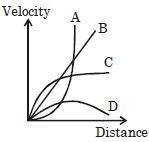
$A$ small spherical solid ball is dropped in a viscous liquid. Its journey in the liquid is best described by which curve in the figure?
A
Curve $A$
B
Curve $B$
C
Curve $C$
D
Curve $D$
Solution
(C) When a small spherical ball is dropped into a viscous liquid,it initially accelerates due to gravity.
As its velocity increases,the viscous drag force (which is proportional to velocity) also increases.
Eventually,the net force becomes zero when the viscous drag and buoyant force balance the weight of the ball.
At this point,the ball attains a constant velocity known as the terminal velocity.
In the given graph,the $y$-axis represents velocity and the $x$-axis represents distance.
As the ball falls,its velocity increases initially and then levels off to a constant value as it approaches terminal velocity.
Curve $C$ shows the velocity increasing and then becoming constant with respect to distance,which correctly represents the motion of the ball in a viscous liquid.
As its velocity increases,the viscous drag force (which is proportional to velocity) also increases.
Eventually,the net force becomes zero when the viscous drag and buoyant force balance the weight of the ball.
At this point,the ball attains a constant velocity known as the terminal velocity.
In the given graph,the $y$-axis represents velocity and the $x$-axis represents distance.
As the ball falls,its velocity increases initially and then levels off to a constant value as it approaches terminal velocity.
Curve $C$ shows the velocity increasing and then becoming constant with respect to distance,which correctly represents the motion of the ball in a viscous liquid.
0 likes
View Solution37
MediumMCQ
The graph between terminal velocity (along $y-$ axis) and square of radius (along $x-$ axis) of a spherical body of density $\rho$ allowed to fall through a fluid of density $\sigma$ is a
A
Straight line with positive slope
B
Straight line with negative slope
C
Straight line perpendicular to $x-$ axis
D
Straight line perpendicular to $y-$ axis
Solution
(A) The terminal velocity $v$ of a spherical body of radius $r$ and density $\rho$ falling through a fluid of density $\sigma$ and viscosity $\eta$ is given by Stokes' Law:
$v = \frac{2}{9} \frac{r^2 g (\rho - \sigma)}{\eta}$
Here,$g$ is the acceleration due to gravity and $\eta$ is the coefficient of viscosity.
We are plotting $v$ (on the $y-$ axis) against $r^2$ (on the $x-$ axis).
Let $y = v$ and $x = r^2$.
The equation becomes $y = \left( \frac{2g(\rho - \sigma)}{9\eta} \right) x$.
This is of the form $y = mx$,which represents a straight line passing through the origin with a positive slope $m = \frac{2g(\rho - \sigma)}{9\eta}$ (assuming $\rho > \sigma$ for the body to fall).
Therefore,the graph is a straight line with a positive slope.
$v = \frac{2}{9} \frac{r^2 g (\rho - \sigma)}{\eta}$
Here,$g$ is the acceleration due to gravity and $\eta$ is the coefficient of viscosity.
We are plotting $v$ (on the $y-$ axis) against $r^2$ (on the $x-$ axis).
Let $y = v$ and $x = r^2$.
The equation becomes $y = \left( \frac{2g(\rho - \sigma)}{9\eta} \right) x$.
This is of the form $y = mx$,which represents a straight line passing through the origin with a positive slope $m = \frac{2g(\rho - \sigma)}{9\eta}$ (assuming $\rho > \sigma$ for the body to fall).
Therefore,the graph is a straight line with a positive slope.
0 likes
View Solution38
MediumMCQ
The velocity of a small ball of mass $m$ and density $\rho$ when dropped in a container filled with glycerine of density $\sigma$ becomes constant after some time. The viscous force acting on the ball in the final stage is
A
$mg\left( \frac{\sigma}{\rho} \right)$
B
$mg\left( 1 + \frac{\sigma}{\rho} \right)$
C
$mg\left( 1 - \frac{\sigma}{\rho} \right)$
D
$mg$
Solution
(C) When the ball reaches a constant velocity (terminal velocity),the net force acting on it is zero.
The forces acting on the ball are:
$1$. Gravitational force $(mg)$ acting downwards.
$2$. Buoyant force $(F_B)$ acting upwards.
$3$. Viscous force $(F_v)$ acting upwards.
At terminal velocity,the equilibrium condition is:
$mg = F_B + F_v$
$F_v = mg - F_B$
The buoyant force $F_B$ is equal to the weight of the displaced liquid:
$F_B = V \sigma g$,where $V$ is the volume of the ball.
Since $m = V \rho$,we have $V = \frac{m}{\rho}$.
Substituting $V$ into the buoyant force equation:
$F_B = \left( \frac{m}{\rho} \right) \sigma g = mg \left( \frac{\sigma}{\rho} \right)$.
Now,substitute $F_B$ into the equilibrium equation:
$F_v = mg - mg \left( \frac{\sigma}{\rho} \right)$
$F_v = mg \left( 1 - \frac{\sigma}{\rho} \right)$.
The forces acting on the ball are:
$1$. Gravitational force $(mg)$ acting downwards.
$2$. Buoyant force $(F_B)$ acting upwards.
$3$. Viscous force $(F_v)$ acting upwards.
At terminal velocity,the equilibrium condition is:
$mg = F_B + F_v$
$F_v = mg - F_B$
The buoyant force $F_B$ is equal to the weight of the displaced liquid:
$F_B = V \sigma g$,where $V$ is the volume of the ball.
Since $m = V \rho$,we have $V = \frac{m}{\rho}$.
Substituting $V$ into the buoyant force equation:
$F_B = \left( \frac{m}{\rho} \right) \sigma g = mg \left( \frac{\sigma}{\rho} \right)$.
Now,substitute $F_B$ into the equilibrium equation:
$F_v = mg - mg \left( \frac{\sigma}{\rho} \right)$
$F_v = mg \left( 1 - \frac{\sigma}{\rho} \right)$.
0 likes
View Solution39
MediumMCQ
$A$ ball of density $\rho$ is released from deep inside a viscous liquid of density $2\rho$. It will move up:
A
with an increasing acceleration
B
with a decreasing acceleration
C
with constant acceleration
D
with zero acceleration
Solution
(B) Let the volume of the ball be $V$. The forces acting on the ball as it moves upward are:
$1$. Buoyant force $F_B = (2\rho)Vg$ (upward).
$2$. Weight of the ball $W = \rho Vg$ (downward).
$3$. Viscous drag force $F_v = 6\pi \eta r v$ (downward,opposing motion).
The net force $F_{net}$ on the ball is $F_B - W - F_v = (2\rho Vg) - (\rho Vg) - F_v = \rho Vg - F_v$.
As the ball moves up,its velocity $v$ increases,which causes the viscous force $F_v$ to increase.
Since $F_{net} = \rho Vg - F_v$,as $F_v$ increases,the net force $F_{net}$ decreases.
According to Newton's second law,$F_{net} = ma$,so the acceleration $a = F_{net}/m$ must decrease as the ball moves upward.
$1$. Buoyant force $F_B = (2\rho)Vg$ (upward).
$2$. Weight of the ball $W = \rho Vg$ (downward).
$3$. Viscous drag force $F_v = 6\pi \eta r v$ (downward,opposing motion).
The net force $F_{net}$ on the ball is $F_B - W - F_v = (2\rho Vg) - (\rho Vg) - F_v = \rho Vg - F_v$.
As the ball moves up,its velocity $v$ increases,which causes the viscous force $F_v$ to increase.
Since $F_{net} = \rho Vg - F_v$,as $F_v$ increases,the net force $F_{net}$ decreases.
According to Newton's second law,$F_{net} = ma$,so the acceleration $a = F_{net}/m$ must decrease as the ball moves upward.
0 likes
View Solution40
EasyMCQ
$A$ liquid disturbed by stirring comes to rest after some time due to its property of
A
surface tension
B
viscosity
C
molecular attraction
D
gravity
Solution
(B) When a liquid is stirred,internal friction between its layers arises due to the property of viscosity. The layer of liquid in contact with the container wall remains at rest,and this layer exerts a retarding force on the adjacent moving layer. This process continues throughout the liquid,gradually dissipating the kinetic energy until the entire liquid comes to rest.
0 likes
View Solution41
MediumMCQ
Sixty-four spherical rain drops of equal size are falling vertically through air with a terminal velocity of $1.5 \ m/s$. All of the drops coalesce to form a single big spherical drop. The terminal velocity of the big drop is ........... $m/s$.
A
$8$
B
$16$
C
$24$
D
$32$
Solution
(C) Let $r$ be the radius of each small drop and $R$ be the radius of the big drop.
Since the volume is conserved,the volume of $64$ small drops equals the volume of the big drop: $64 \times (\frac{4}{3} \pi r^3) = \frac{4}{3} \pi R^3$.
This simplifies to $R^3 = 64 r^3$,so $R = 4r$.
The terminal velocity $V_T$ of a spherical drop is given by $V_T = \frac{2}{9} \frac{r^2 g (\rho - \sigma)}{\eta}$,which implies $V_T \propto r^2$.
Let $V_{T1} = 1.5 \ m/s$ be the terminal velocity of the small drop and $V_{T2}$ be the terminal velocity of the big drop.
Then,$\frac{V_{T2}}{V_{T1}} = \frac{R^2}{r^2} = \frac{(4r)^2}{r^2} = 16$.
Therefore,$V_{T2} = 16 \times V_{T1} = 16 \times 1.5 \ m/s = 24 \ m/s$.
Since the volume is conserved,the volume of $64$ small drops equals the volume of the big drop: $64 \times (\frac{4}{3} \pi r^3) = \frac{4}{3} \pi R^3$.
This simplifies to $R^3 = 64 r^3$,so $R = 4r$.
The terminal velocity $V_T$ of a spherical drop is given by $V_T = \frac{2}{9} \frac{r^2 g (\rho - \sigma)}{\eta}$,which implies $V_T \propto r^2$.
Let $V_{T1} = 1.5 \ m/s$ be the terminal velocity of the small drop and $V_{T2}$ be the terminal velocity of the big drop.
Then,$\frac{V_{T2}}{V_{T1}} = \frac{R^2}{r^2} = \frac{(4r)^2}{r^2} = 16$.
Therefore,$V_{T2} = 16 \times V_{T1} = 16 \times 1.5 \ m/s = 24 \ m/s$.
0 likes
View Solution42
DifficultMCQ
The velocity of a small ball of mass $M$ and density $d_1$ when dropped in a container filled with glycerine becomes constant after some time. If the density of glycerine is $d_2,$ the viscous force acting on the ball will be
A
$Mg\left(1 - \frac{d_1}{d_2}\right)$
B
$Mg\left(1 - \frac{d_2}{d_1}\right)$
C
$Mg\,d_1$
D
$Mg\,d_2$
Solution
(B) When the velocity of the ball becomes constant,it is known as the terminal velocity. At this state,the net force acting on the ball is zero.
The forces acting on the ball are:
$1$. Weight of the ball $(W = Mg)$ acting downwards.
$2$. Buoyant force $(F_B = V d_2 g)$ acting upwards.
$3$. Viscous force $(F_v)$ acting upwards.
At equilibrium: $F_v + F_B = W$
$F_v = W - F_B$
$F_v = Mg - V d_2 g$
Since the volume of the ball $V = \frac{M}{d_1}$,we substitute this into the equation:
$F_v = Mg - \left(\frac{M}{d_1}\right) d_2 g$
$F_v = Mg \left(1 - \frac{d_2}{d_1}\right)$
The forces acting on the ball are:
$1$. Weight of the ball $(W = Mg)$ acting downwards.
$2$. Buoyant force $(F_B = V d_2 g)$ acting upwards.
$3$. Viscous force $(F_v)$ acting upwards.
At equilibrium: $F_v + F_B = W$
$F_v = W - F_B$
$F_v = Mg - V d_2 g$
Since the volume of the ball $V = \frac{M}{d_1}$,we substitute this into the equation:
$F_v = Mg - \left(\frac{M}{d_1}\right) d_2 g$
$F_v = Mg \left(1 - \frac{d_2}{d_1}\right)$
0 likes
View Solution43
MediumMCQ
Two uniform solid balls of same density and of radii $r$ and $2r$ are dropped in air and fall vertically downwards. The terminal velocity of the ball with radius $r$ is $1 \, cm \, s^{-1}$. Find the terminal velocity of the ball of radius $2r$ (neglect buoyant force on the balls). ........... $cm \, s^{-1}$
A
$0.5$
B
$4$
C
$1$
D
$2$
Solution
(B) The terminal velocity $v$ of a sphere of radius $r$ falling through a viscous medium is given by Stokes' Law: $F_v = 6 \pi \eta r v$.
At terminal velocity,the gravitational force equals the viscous drag force (neglecting buoyancy): $mg = 6 \pi \eta r v$.
Since $m = \rho \cdot \frac{4}{3} \pi r^3$,we have $\rho \cdot \frac{4}{3} \pi r^3 g = 6 \pi \eta r v$.
This simplifies to $v \propto r^2$.
Given $v_r = 1 \, cm \, s^{-1}$ for radius $r$,we find $v_{2r}$ for radius $2r$ as:
$\frac{v_{2r}}{v_r} = \frac{(2r)^2}{r^2} = 4$.
Therefore,$v_{2r} = 4 \times v_r = 4 \times 1 = 4 \, cm \, s^{-1}$.
At terminal velocity,the gravitational force equals the viscous drag force (neglecting buoyancy): $mg = 6 \pi \eta r v$.
Since $m = \rho \cdot \frac{4}{3} \pi r^3$,we have $\rho \cdot \frac{4}{3} \pi r^3 g = 6 \pi \eta r v$.
This simplifies to $v \propto r^2$.
Given $v_r = 1 \, cm \, s^{-1}$ for radius $r$,we find $v_{2r}$ for radius $2r$ as:
$\frac{v_{2r}}{v_r} = \frac{(2r)^2}{r^2} = 4$.
Therefore,$v_{2r} = 4 \times v_r = 4 \times 1 = 4 \, cm \, s^{-1}$.
0 likes
View Solution44
MediumMCQ
The average mass of rain drops is $3.0 \times 10^{-5} \, kg$ and their average terminal velocity is $9 \, m/s$. Calculate the energy transferred by rain to each square metre of the surface at a place which receives $100 \, cm$ of rain in a year.
A
$3.5 \times 10^5 \, J$
B
$4.05 \times 10^4 \, J$
C
$3.0 \times 10^5 \, J$
D
$9.0 \times 10^4 \, J$
Solution
(B) The volume of rain received per square metre in a year is $V = \text{Area} \times \text{height} = 1 \, m^2 \times 1 \, m = 1 \, m^3$.
Given the density of water $d = 10^3 \, kg/m^3$, the total mass $M$ of this water is $M = d \times V = 10^3 \, kg/m^3 \times 1 \, m^3 = 10^3 \, kg$.
The kinetic energy transferred by the rain is given by the formula $E = \frac{1}{2} M v^2$, where $v$ is the terminal velocity.
Substituting the values: $E = \frac{1}{2} \times 10^3 \, kg \times (9 \, m/s)^2$.
$E = 0.5 \times 10^3 \times 81 = 40.5 \times 10^3 \, J = 4.05 \times 10^4 \, J$.
Given the density of water $d = 10^3 \, kg/m^3$, the total mass $M$ of this water is $M = d \times V = 10^3 \, kg/m^3 \times 1 \, m^3 = 10^3 \, kg$.
The kinetic energy transferred by the rain is given by the formula $E = \frac{1}{2} M v^2$, where $v$ is the terminal velocity.
Substituting the values: $E = \frac{1}{2} \times 10^3 \, kg \times (9 \, m/s)^2$.
$E = 0.5 \times 10^3 \times 81 = 40.5 \times 10^3 \, J = 4.05 \times 10^4 \, J$.
0 likes
View Solution45
DifficultMCQ
In an experiment,a small steel ball falls through a liquid at a constant speed of $10\, cm/s$. If the steel ball is pulled upward with a force equal to twice its effective weight,how fast will it move upward? ......... $cm/s$
A
$5$
B
$0$
C
$10$
D
$20$
Solution
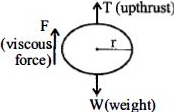
(C) Let $W$ be the weight of the ball,$T$ be the upthrust,and $F$ be the viscous force.
When the ball falls at a constant terminal velocity $v_1 = 10\, cm/s$,the net force is zero:
$W - T - F_1 = 0 \implies F_1 = W - T = W_{eff}$,where $W_{eff}$ is the effective weight.
Since $F_1 = 6\pi\eta r v_1$,we have $W_{eff} = 6\pi\eta r v_1$.
Now,the ball is pulled upward with an external force $F_{ext} = 2 W_{eff}$.
Let the new upward velocity be $v_2$. The forces acting on the ball are the upward force $F_{ext}$,the upthrust $T$ (upward),the weight $W$ (downward),and the new viscous force $F_2$ (downward,as the ball moves up).
For constant upward velocity $v_2$,the net force is zero:
$F_{ext} + T - W - F_2 = 0$
$F_{ext} - (W - T) = F_2$
$2 W_{eff} - W_{eff} = F_2$
$F_2 = W_{eff}$
Since $F_2 = 6\pi\eta r v_2$,we have $6\pi\eta r v_2 = 6\pi\eta r v_1$.
Therefore,$v_2 = v_1 = 10\, cm/s$.
When the ball falls at a constant terminal velocity $v_1 = 10\, cm/s$,the net force is zero:
$W - T - F_1 = 0 \implies F_1 = W - T = W_{eff}$,where $W_{eff}$ is the effective weight.
Since $F_1 = 6\pi\eta r v_1$,we have $W_{eff} = 6\pi\eta r v_1$.
Now,the ball is pulled upward with an external force $F_{ext} = 2 W_{eff}$.
Let the new upward velocity be $v_2$. The forces acting on the ball are the upward force $F_{ext}$,the upthrust $T$ (upward),the weight $W$ (downward),and the new viscous force $F_2$ (downward,as the ball moves up).
For constant upward velocity $v_2$,the net force is zero:
$F_{ext} + T - W - F_2 = 0$
$F_{ext} - (W - T) = F_2$
$2 W_{eff} - W_{eff} = F_2$
$F_2 = W_{eff}$
Since $F_2 = 6\pi\eta r v_2$,we have $6\pi\eta r v_2 = 6\pi\eta r v_1$.
Therefore,$v_2 = v_1 = 10\, cm/s$.
0 likes
View Solution46
EasyMCQ
The terminal velocity of a small sphere of radius $a$ in a viscous liquid is proportional to
A
$a^2$
B
$a^3$
C
$a$
D
$a^{-1}$
Solution
(A) According to Stokes' Law,when a small sphere of radius $a$ falls through a viscous liquid,it attains a constant velocity known as terminal velocity $(V_T)$.
The formula for terminal velocity is given by:
$V_T = \frac{2a^2(\rho - \sigma)g}{9\eta}$
Where:
$a$ = radius of the sphere
$\rho$ = density of the sphere
$\sigma$ = density of the liquid
$g$ = acceleration due to gravity
$\eta$ = coefficient of viscosity of the liquid
From the formula,it is clear that $V_T \propto a^2$.
Therefore,the terminal velocity is proportional to the square of the radius of the sphere.
The formula for terminal velocity is given by:
$V_T = \frac{2a^2(\rho - \sigma)g}{9\eta}$
Where:
$a$ = radius of the sphere
$\rho$ = density of the sphere
$\sigma$ = density of the liquid
$g$ = acceleration due to gravity
$\eta$ = coefficient of viscosity of the liquid
From the formula,it is clear that $V_T \propto a^2$.
Therefore,the terminal velocity is proportional to the square of the radius of the sphere.
0 likes
View Solution47
DifficultMCQ
$A$ solid sphere of radius $R$ acquires a terminal velocity $\nu_1$ when falling (due to gravity) through a viscous fluid having a coefficient of viscosity $\eta$. The sphere is broken into $27$ identical solid spheres. If each of these spheres acquires a terminal velocity $\nu_2$ when falling through the same fluid,the ratio $(\nu_1/\nu_2)$ equals:
A
$27$
B
$1/27$
C
$9$
D
$1/9$
Solution
(C) The terminal velocity of a sphere of radius $r$ falling through a viscous fluid is given by Stokes' Law: $v_T = \frac{2}{9} \frac{r^2 (\rho - \sigma) g}{\eta}$,where $\rho$ is the density of the sphere and $\sigma$ is the density of the fluid.
From this formula,we see that $v_T \propto r^2$.
Let the radius of the large sphere be $R$ and the radius of each small sphere be $r$. Since the volume remains constant when the sphere is broken into $27$ smaller identical spheres:
$\frac{4}{3} \pi R^3 = 27 \times \frac{4}{3} \pi r^3$
$R^3 = 27 r^3 \Rightarrow R = 3r \Rightarrow r = R/3$.
Now,the ratio of terminal velocities is:
$\frac{\nu_1}{\nu_2} = \frac{R^2}{r^2} = \frac{R^2}{(R/3)^2} = \frac{R^2}{R^2/9} = 9$.
Thus,the ratio $(\nu_1/\nu_2)$ is $9$.
From this formula,we see that $v_T \propto r^2$.
Let the radius of the large sphere be $R$ and the radius of each small sphere be $r$. Since the volume remains constant when the sphere is broken into $27$ smaller identical spheres:
$\frac{4}{3} \pi R^3 = 27 \times \frac{4}{3} \pi r^3$
$R^3 = 27 r^3 \Rightarrow R = 3r \Rightarrow r = R/3$.
Now,the ratio of terminal velocities is:
$\frac{\nu_1}{\nu_2} = \frac{R^2}{r^2} = \frac{R^2}{(R/3)^2} = \frac{R^2}{R^2/9} = 9$.
Thus,the ratio $(\nu_1/\nu_2)$ is $9$.
1 likes
View SolutionFluid Mechanics and Surface Tension — Viscosity and Stoke's Law and Terminal Velocity · Frequently Asked Questions
1Are these Fluid Mechanics and Surface Tension questions useful for JEE and NEET?
Yes. All questions in this section are mapped to JEE Main and NEET exam patterns. Previous year questions from JEE Main, NEET, GUJCET and state-level exams are included with full solutions.
2Can I switch to Hindi or Gujarati for these questions?
Yes. Use the language tabs in the hero section or the sidebar to view the same questions and solutions in English, Hindi or Gujarati.
3How do I generate a question paper from this subtopic?
Use the Vedclass Exam Paper Generator — select the chapter and subtopic, set difficulty, and generate Sets A, B, C, D automatically. First 3 chapters of every subject are free.
Vedclass Products
For Students
Vedclass Test Series
Mock tests in real JEE/NEET style with performance analysis. 5-day free trial.
Start Free TrialFor Teachers
Exam Paper Generator
Generate Set A/B/C/D papers from this chapter in 2 minutes. 3 chapters free.
Try FreeFor Institutes
Online Exam Module
Live online exams with unlimited students, 360° analytics & white-label branding.
See DemoFor Teachers & Institutes
Generate a Fluid Mechanics and Surface Tension Exam Paper in 2 Minutes
Select subtopic & difficulty — Sets A, B, C, D auto-generated with No Repeat logic.
First 3 chapters of every subject are free — no payment required.