
A English
Types of Flow, Equation of Continuity and Flow Rate Questions in English
Class 11 Physics · Fluid Mechanics and Surface Tension · Types of Flow, Equation of Continuity and Flow Rate
85+
Questions
English
Language
100%
With Solutions
Showing 50 of 85 questions in English
1
MediumMCQ
Two water pipes of diameters $2 \text{ cm}$ and $4 \text{ cm}$ are connected with the main supply line. The velocity of flow of water in the pipe of $2 \text{ cm}$ diameter is
A
$4$ times that in the other pipe
B
$\frac{1}{4}$ times that in the other pipe
C
$2$ times that in the other pipe
D
$\frac{1}{2}$ times that in the other pipe
Solution
(A) Given: Diameter of first pipe $d_A = 2 \text{ cm}$,so radius $r_A = 1 \text{ cm}$.
Diameter of second pipe $d_B = 4 \text{ cm}$,so radius $r_B = 2 \text{ cm}$.
According to the equation of continuity,the product of the cross-sectional area and the velocity of flow is constant $(A_1v_1 = A_2v_2)$.
Therefore,$\frac{v_A}{v_B} = \frac{A_B}{A_A} = \frac{\pi (r_B)^2}{\pi (r_A)^2}$.
Substituting the values: $\frac{v_A}{v_B} = \left( \frac{2}{1} \right)^2 = 4$.
Thus,$v_A = 4v_B$. The velocity in the $2 \text{ cm}$ pipe is $4$ times the velocity in the $4 \text{ cm}$ pipe.
Diameter of second pipe $d_B = 4 \text{ cm}$,so radius $r_B = 2 \text{ cm}$.
According to the equation of continuity,the product of the cross-sectional area and the velocity of flow is constant $(A_1v_1 = A_2v_2)$.
Therefore,$\frac{v_A}{v_B} = \frac{A_B}{A_A} = \frac{\pi (r_B)^2}{\pi (r_A)^2}$.
Substituting the values: $\frac{v_A}{v_B} = \left( \frac{2}{1} \right)^2 = 4$.
Thus,$v_A = 4v_B$. The velocity in the $2 \text{ cm}$ pipe is $4$ times the velocity in the $4 \text{ cm}$ pipe.
0 likes
View Solution2
MediumMCQ
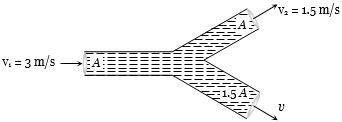
An incompressible liquid flows through a horizontal tube as shown in the following figure. Then the velocity $v$ of the fluid is ....... $m/s$.
A
$3$
B
$1.5$
C
$1$
D
$2.25$
Solution
(C) For an incompressible liquid, the volume flow rate entering the junction must equal the volume flow rate leaving the junction (Equation of Continuity).
$A_{in} v_{in} = A_1 v_1 + A_2 v_2$
From the figure, the inlet area is $A$ with velocity $v_1 = 3 \ m/s$. The outlet areas are $A$ and $1.5A$ with velocities $v_2 = 1.5 \ m/s$ and $v$ respectively.
$A \times 3 = A \times 1.5 + 1.5A \times v$
Dividing both sides by $A$:
$3 = 1.5 + 1.5v$
$1.5 = 1.5v$
$v = 1 \ m/s$.
$A_{in} v_{in} = A_1 v_1 + A_2 v_2$
From the figure, the inlet area is $A$ with velocity $v_1 = 3 \ m/s$. The outlet areas are $A$ and $1.5A$ with velocities $v_2 = 1.5 \ m/s$ and $v$ respectively.
$A \times 3 = A \times 1.5 + 1.5A \times v$
Dividing both sides by $A$:
$3 = 1.5 + 1.5v$
$1.5 = 1.5v$
$v = 1 \ m/s$.
0 likes
View Solution3
MediumMCQ
Water enters through end $A$ with speed $v_1$ and leaves through end $B$ with speed $v_2$ of a cylindrical tube $AB$. The tube is always completely filled with water. In case $I$,the tube is horizontal; in case $II$,it is vertical with end $A$ upwards; and in case $III$,it is vertical with end $B$ upwards. We have $v_1 = v_2$ for:
A
Case $I$
B
Case $II$
C
Case $III$
D
Each case
Solution
(D) According to the equation of continuity for an incompressible fluid,the product of the cross-sectional area $A$ and the velocity $v$ of the fluid remains constant at all points along the tube,i.e.,$A_1 v_1 = A_2 v_2$.
Since the tube is cylindrical,the cross-sectional area is uniform throughout,meaning $A_1 = A_2$.
Therefore,$v_1 = v_2$ must hold true regardless of the orientation of the tube (horizontal or vertical).
This principle is based on the conservation of mass,which applies to all three cases.
Since the tube is cylindrical,the cross-sectional area is uniform throughout,meaning $A_1 = A_2$.
Therefore,$v_1 = v_2$ must hold true regardless of the orientation of the tube (horizontal or vertical).
This principle is based on the conservation of mass,which applies to all three cases.
0 likes
View Solution4
MediumMCQ
Water is moving with a speed of $5.18 \; ms^{-1}$ through a pipe with a cross-sectional area of $4.20 \; cm^2$. The water gradually descends $9.66 \; m$ as the pipe increases in area to $7.60 \; cm^2$. The speed of flow at the lower level is ....... $ms^{-1}$.
A
$3.0$
B
$5.7$
C
$3.82$
D
$2.86$
Solution
(D) According to the equation of continuity for an incompressible fluid,the product of the cross-sectional area and the velocity of flow remains constant at any point along the pipe.
$A_1 V_1 = A_2 V_2$
Given:
$A_1 = 4.20 \; cm^2$
$V_1 = 5.18 \; ms^{-1}$
$A_2 = 7.60 \; cm^2$
Substituting the values into the equation:
$4.20 \times 5.18 = 7.60 \times V_2$
$V_2 = \frac{4.20 \times 5.18}{7.60}$
$V_2 = \frac{21.756}{7.60}$
$V_2 \approx 2.86 \; ms^{-1}$
Therefore,the speed of flow at the lower level is $2.86 \; ms^{-1}$.
$A_1 V_1 = A_2 V_2$
Given:
$A_1 = 4.20 \; cm^2$
$V_1 = 5.18 \; ms^{-1}$
$A_2 = 7.60 \; cm^2$
Substituting the values into the equation:
$4.20 \times 5.18 = 7.60 \times V_2$
$V_2 = \frac{4.20 \times 5.18}{7.60}$
$V_2 = \frac{21.756}{7.60}$
$V_2 \approx 2.86 \; ms^{-1}$
Therefore,the speed of flow at the lower level is $2.86 \; ms^{-1}$.
0 likes
View Solution5
MediumMCQ
Water is flowing through a tube of non-uniform cross-section. The ratio of the radius at the entry and exit end of the pipe is $3:2$. Then the ratio of velocities at the entry and exit of the liquid is:
A
$4:9$
B
$9:4$
C
$8:27$
D
$1:1$
Solution
(A) According to the equation of continuity for an incompressible fluid,the product of the cross-sectional area and the velocity of the fluid remains constant at all points along the pipe.
$A_1 v_1 = A_2 v_2$
Here,$A_1$ and $A_2$ are the cross-sectional areas at the entry and exit,and $v_1$ and $v_2$ are the velocities at the entry and exit,respectively.
Since the cross-section is circular,$A = \pi r^2$,where $r$ is the radius.
Therefore,$\pi r_1^2 v_1 = \pi r_2^2 v_2$.
This simplifies to $\frac{v_1}{v_2} = \frac{r_2^2}{r_1^2} = \left( \frac{r_2}{r_1} \right)^2$.
Given the ratio of radii at entry and exit is $r_1 : r_2 = 3 : 2$,we have $\frac{r_2}{r_1} = \frac{2}{3}$.
Substituting this value: $\frac{v_1}{v_2} = \left( \frac{2}{3} \right)^2 = \frac{4}{9}$.
Thus,the ratio of velocities at the entry and exit is $4:9$.
$A_1 v_1 = A_2 v_2$
Here,$A_1$ and $A_2$ are the cross-sectional areas at the entry and exit,and $v_1$ and $v_2$ are the velocities at the entry and exit,respectively.
Since the cross-section is circular,$A = \pi r^2$,where $r$ is the radius.
Therefore,$\pi r_1^2 v_1 = \pi r_2^2 v_2$.
This simplifies to $\frac{v_1}{v_2} = \frac{r_2^2}{r_1^2} = \left( \frac{r_2}{r_1} \right)^2$.
Given the ratio of radii at entry and exit is $r_1 : r_2 = 3 : 2$,we have $\frac{r_2}{r_1} = \frac{2}{3}$.
Substituting this value: $\frac{v_1}{v_2} = \left( \frac{2}{3} \right)^2 = \frac{4}{9}$.
Thus,the ratio of velocities at the entry and exit is $4:9$.
0 likes
View Solution6
MediumMCQ
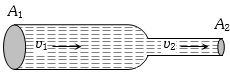
$A$ liquid flows in a tube from left to right as shown in the figure. $A_1$ and $A_2$ are the cross-sections of the portions of the tube as shown. Then the ratio of speeds $v_1/v_2$ will be
A
$A_1/A_2$
B
$A_2/A_1$
C
$\sqrt{A_2}/\sqrt{A_1}$
D
$\sqrt{A_1}/\sqrt{A_2}$
Solution
(B) According to the equation of continuity for an incompressible,non-viscous fluid in steady flow,the mass flow rate remains constant throughout the tube.
The volume flow rate (or discharge) is given by the product of the cross-sectional area and the velocity of the fluid.
Therefore,$A_1 v_1 = A_2 v_2$.
To find the ratio of the speeds $v_1/v_2$,we rearrange the equation:
$v_1/v_2 = A_2/A_1$.
Thus,the correct option is $B$.
The volume flow rate (or discharge) is given by the product of the cross-sectional area and the velocity of the fluid.
Therefore,$A_1 v_1 = A_2 v_2$.
To find the ratio of the speeds $v_1/v_2$,we rearrange the equation:
$v_1/v_2 = A_2/A_1$.
Thus,the correct option is $B$.
0 likes
View Solution7
EasyMCQ
In a streamline flow,
A
The speed of a particle always remains same
B
The velocity of a particle always remains same
C
The kinetic energies of all the particles arriving at a given point are the same
D
The moments of all the particles arriving at a given point are the same
Solution
(C) In a streamline flow,the velocity of a fluid particle at any given point is constant over time.
This means that every particle that passes through a specific point $P$ will have the same velocity (both magnitude and direction) as the previous particle that passed through that same point $P$.
Since kinetic energy $K = \frac{1}{2}mv^2$ depends on the speed $v$ of the particle,and all particles passing through point $P$ have the same velocity,they must also have the same kinetic energy.
Therefore,option $C$ is the correct statement.
This means that every particle that passes through a specific point $P$ will have the same velocity (both magnitude and direction) as the previous particle that passed through that same point $P$.
Since kinetic energy $K = \frac{1}{2}mv^2$ depends on the speed $v$ of the particle,and all particles passing through point $P$ have the same velocity,they must also have the same kinetic energy.
Therefore,option $C$ is the correct statement.
0 likes
View Solution8
MediumMCQ
Water is flowing in a pipe of diameter $4 \text{ cm}$ with a velocity $3 \text{ m/s}$. The water then enters into a tube of diameter $2 \text{ cm}$. The velocity of water in the other pipe is .......... $\text{m/s}$.
A
$3$
B
$6$
C
$12$
D
$8$
Solution
(C) According to the equation of continuity,the product of the cross-sectional area and the velocity of an incompressible fluid remains constant throughout the flow: $A_1 v_1 = A_2 v_2$.
Here,$A = \pi r^2 = \pi (d/2)^2 = \frac{\pi d^2}{4}$.
Substituting this into the equation: $\frac{\pi d_1^2}{4} v_1 = \frac{\pi d_2^2}{4} v_2$.
This simplifies to: $d_1^2 v_1 = d_2^2 v_2$.
Given $d_1 = 4 \text{ cm}$,$v_1 = 3 \text{ m/s}$,and $d_2 = 2 \text{ cm}$.
Substituting the values: $(4)^2 \times 3 = (2)^2 \times v_2$.
$16 \times 3 = 4 \times v_2$.
$48 = 4 v_2$.
$v_2 = 12 \text{ m/s}$.
Here,$A = \pi r^2 = \pi (d/2)^2 = \frac{\pi d^2}{4}$.
Substituting this into the equation: $\frac{\pi d_1^2}{4} v_1 = \frac{\pi d_2^2}{4} v_2$.
This simplifies to: $d_1^2 v_1 = d_2^2 v_2$.
Given $d_1 = 4 \text{ cm}$,$v_1 = 3 \text{ m/s}$,and $d_2 = 2 \text{ cm}$.
Substituting the values: $(4)^2 \times 3 = (2)^2 \times v_2$.
$16 \times 3 = 4 \times v_2$.
$48 = 4 v_2$.
$v_2 = 12 \text{ m/s}$.
0 likes
View Solution9
EasyMCQ
Water falls from a tap,down the streamline. What happens to the cross-sectional area of the water stream?
A
Area decreases
B
Area increases
C
Velocity remains same
D
Area remains same
Solution
(A) When water falls from a tap,it accelerates due to gravity as it moves downwards.
According to the equation of continuity,$A_{1} v_{1} = A_{2} v_{2}$,where $A$ is the cross-sectional area and $v$ is the velocity of the liquid.
Since the velocity $v$ increases as the water falls,the cross-sectional area $A$ must decrease to keep the flow rate constant.
Therefore,the area of the water stream decreases.
According to the equation of continuity,$A_{1} v_{1} = A_{2} v_{2}$,where $A$ is the cross-sectional area and $v$ is the velocity of the liquid.
Since the velocity $v$ increases as the water falls,the cross-sectional area $A$ must decrease to keep the flow rate constant.
Therefore,the area of the water stream decreases.
0 likes
View Solution10
MediumMCQ
An incompressible fluid flows steadily through a cylindrical pipe which has radius $2r$ at point $A$ and radius $r$ at point $B$ further along the flow direction. If the velocity at point $A$ is $v$,what is its velocity at point $B$?
A
$2v$
B
$v$
C
$v/2$
D
$4v$
Solution
(D) According to the equation of continuity for an incompressible fluid,the volume flow rate remains constant at all points in the pipe.
Therefore,the volume of fluid entering per second at point $A$ must equal the volume of fluid exiting per second at point $B$.
Let $v_A$ be the velocity at point $A$ and $v_B$ be the velocity at point $B$.
The area of cross-section at $A$ is $A_A = \pi(2r)^2 = 4\pi r^2$.
The area of cross-section at $B$ is $A_B = \pi(r)^2 = \pi r^2$.
Using the equation of continuity: $A_A v_A = A_B v_B$.
Substituting the given values: $(4\pi r^2) v = (\pi r^2) v_B$.
Solving for $v_B$: $v_B = \frac{4\pi r^2 v}{\pi r^2} = 4v$.
Therefore,the volume of fluid entering per second at point $A$ must equal the volume of fluid exiting per second at point $B$.
Let $v_A$ be the velocity at point $A$ and $v_B$ be the velocity at point $B$.
The area of cross-section at $A$ is $A_A = \pi(2r)^2 = 4\pi r^2$.
The area of cross-section at $B$ is $A_B = \pi(r)^2 = \pi r^2$.
Using the equation of continuity: $A_A v_A = A_B v_B$.
Substituting the given values: $(4\pi r^2) v = (\pi r^2) v_B$.
Solving for $v_B$: $v_B = \frac{4\pi r^2 v}{\pi r^2} = 4v$.
0 likes
View Solution11
DifficultMCQ
An engine pump ejects a liquid of density $\rho$ through a pipe of cross-sectional area $A$. If the velocity of the liquid coming out of the pipe is $v$,find the rate at which kinetic energy is imparted to the liquid.
A
$\frac{1}{2}A\rho v^3$
B
$\frac{1}{2}A\rho v^2$
C
$\frac{1}{2}A\rho v$
D
$A\rho v$
Solution
(A) The mass of the liquid flowing out per unit time is given by $\frac{dm}{dt} = \rho A v$.
The kinetic energy $K$ of the liquid is $K = \frac{1}{2} m v^2$.
The rate at which kinetic energy is imparted is the power $P = \frac{dK}{dt} = \frac{1}{2} \left( \frac{dm}{dt} \right) v^2$.
Substituting the value of $\frac{dm}{dt}$:
$P = \frac{1}{2} (\rho A v) v^2 = \frac{1}{2} A \rho v^3$.
The kinetic energy $K$ of the liquid is $K = \frac{1}{2} m v^2$.
The rate at which kinetic energy is imparted is the power $P = \frac{dK}{dt} = \frac{1}{2} \left( \frac{dm}{dt} \right) v^2$.
Substituting the value of $\frac{dm}{dt}$:
$P = \frac{1}{2} (\rho A v) v^2 = \frac{1}{2} A \rho v^3$.
0 likes
View Solution12
DifficultMCQ
An engine pumps a liquid of density $d$ continuously through a pipe of cross-sectional area $A$. If the speed of the liquid passing through the pipe is $V$,what is the kinetic energy per unit time imparted to the liquid?
A
$\frac{1}{2} AdV^3$
B
$\frac{1}{2} AdV^2$
C
$\frac{1}{2} AdV$
D
$AdV^2$
Solution
(A) The mass of the liquid passing through the pipe per unit time is given by the rate of mass flow: $\frac{dm}{dt} = \rho A V$,where $\rho = d$ is the density.
Thus,$\frac{dm}{dt} = dAV$.
The kinetic energy $K$ of a mass $m$ moving with speed $V$ is $K = \frac{1}{2} m V^2$.
The kinetic energy imparted per unit time is $\frac{dK}{dt} = \frac{1}{2} V^2 \frac{dm}{dt}$.
Substituting the value of $\frac{dm}{dt}$,we get $\frac{dK}{dt} = \frac{1}{2} V^2 (dAV) = \frac{1}{2} AdV^3$.
Thus,$\frac{dm}{dt} = dAV$.
The kinetic energy $K$ of a mass $m$ moving with speed $V$ is $K = \frac{1}{2} m V^2$.
The kinetic energy imparted per unit time is $\frac{dK}{dt} = \frac{1}{2} V^2 \frac{dm}{dt}$.
Substituting the value of $\frac{dm}{dt}$,we get $\frac{dK}{dt} = \frac{1}{2} V^2 (dAV) = \frac{1}{2} AdV^3$.
0 likes
View Solution13
MediumMCQ
Two pipes of radii $2 \, cm$ and $4 \, cm$ are connected in series. What is the ratio of the flow velocities of the fluid in these pipes?
A
$4$
B
$1/4$
C
$2$
D
$1/2$
Solution
(A) According to the equation of continuity,the product of the cross-sectional area $(A)$ and the velocity of the fluid $(v)$ remains constant for an incompressible fluid in steady flow: $A_1 v_1 = A_2 v_2$.
Given radii $r_1 = 2 \, cm$ and $r_2 = 4 \, cm$.
The area is given by $A = \pi r^2$.
Therefore,$\pi (r_1)^2 v_1 = \pi (r_2)^2 v_2$.
The ratio of velocities is $\frac{v_1}{v_2} = \frac{(r_2)^2}{(r_1)^2} = \left( \frac{4}{2} \right)^2 = (2)^2 = 4$.
Thus,the ratio of the flow velocities is $4:1$.
Given radii $r_1 = 2 \, cm$ and $r_2 = 4 \, cm$.
The area is given by $A = \pi r^2$.
Therefore,$\pi (r_1)^2 v_1 = \pi (r_2)^2 v_2$.
The ratio of velocities is $\frac{v_1}{v_2} = \frac{(r_2)^2}{(r_1)^2} = \left( \frac{4}{2} \right)^2 = (2)^2 = 4$.
Thus,the ratio of the flow velocities is $4:1$.
0 likes
View Solution14
DifficultMCQ
In the given figure,the velocity of the fluid $v = $ . . . . . . $m/s$.
A
$3$
B
$1.5$
C
$1$
D
$2.25$
Solution
(C) According to the equation of continuity for an incompressible fluid,the total mass flow rate entering the junction must equal the total mass flow rate leaving the junction.
Since the fluid is incompressible,the volume flow rate is conserved:
$A_1 v_1 = A_2 v_2 + A_3 v_3$
From the figure,the inlet area is $A$ with velocity $v_1 = 3 \ m/s$.
The outlet areas are $A$ with velocity $v_2 = 1.5 \ m/s$ and $1.5A$ with velocity $v$.
Substituting these values into the equation:
$A \times 3 = A \times 1.5 + 1.5A \times v$
Dividing both sides by $A$:
$3 = 1.5 + 1.5v$
$1.5 = 1.5v$
$v = 1 \ m/s$
Since the fluid is incompressible,the volume flow rate is conserved:
$A_1 v_1 = A_2 v_2 + A_3 v_3$
From the figure,the inlet area is $A$ with velocity $v_1 = 3 \ m/s$.
The outlet areas are $A$ with velocity $v_2 = 1.5 \ m/s$ and $1.5A$ with velocity $v$.
Substituting these values into the equation:
$A \times 3 = A \times 1.5 + 1.5A \times v$
Dividing both sides by $A$:
$3 = 1.5 + 1.5v$
$1.5 = 1.5v$
$v = 1 \ m/s$
0 likes
View Solution15
MediumMCQ
The cylindrical tube of a spray pump has radius $R,$ one end of which has $n$ fine holes,each of radius $r.$ If the speed of the liquid in the tube is $v,$ the speed of the ejection of the liquid through the holes is
A
$\frac{v^2 R}{n r}$
B
$\frac{v R^2}{n^2 r^2}$
C
$\frac{v R^2}{n r^2}$
D
$\frac{v R^2}{n^3 r^2}$
Solution
(C) According to the equation of continuity,the volume flow rate of the liquid remains constant throughout the tube.
The volume flow rate inside the cylindrical tube is given by $A_1 v_1 = \pi R^2 v$.
The total volume flow rate through the $n$ fine holes is given by $A_2 v_2 = n (\pi r^2) v_{ejection}$.
Equating the two flow rates:
$\pi R^2 v = n \pi r^2 v_{ejection}$.
Solving for the speed of ejection $(v_{ejection})$:
$v_{ejection} = \frac{\pi R^2 v}{n \pi r^2} = \frac{v R^2}{n r^2}$.
The volume flow rate inside the cylindrical tube is given by $A_1 v_1 = \pi R^2 v$.
The total volume flow rate through the $n$ fine holes is given by $A_2 v_2 = n (\pi r^2) v_{ejection}$.
Equating the two flow rates:
$\pi R^2 v = n \pi r^2 v_{ejection}$.
Solving for the speed of ejection $(v_{ejection})$:
$v_{ejection} = \frac{\pi R^2 v}{n \pi r^2} = \frac{v R^2}{n r^2}$.
0 likes
View Solution16
EasyMCQ
Which of the following is not a characteristic of turbulent flow?
A
Velocity more than the critical velocity
B
Velocity less than the critical velocity
C
Irregular flow
D
Molecules crossing from one layer to another
Solution
(B) Turbulent flow is characterized by high velocity,specifically when the velocity of the fluid exceeds the critical velocity $(v_c)$. In this state,the flow becomes irregular or chaotic,and fluid particles move across layers,causing mixing. Conversely,when the velocity is less than the critical velocity,the flow is laminar (streamline),which is smooth and orderly. Therefore,having a velocity less than the critical velocity is a characteristic of laminar flow,not turbulent flow. The correct option is $B$.
0 likes
View Solution17
MediumMCQ
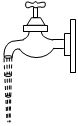
Water coming out of the mouth of a tap and falling vertically in streamline flow forms a tapering column,i.e.,the area of cross-section of the liquid column decreases as it moves down. Which of the following is the most accurate explanation for this?
A
As the water moves down,its speed increases and hence its pressure decreases. It is then compressed by the atmosphere.
B
Falling water tries to reach a terminal velocity and hence reduces the area of cross-section to balance upward and downward forces.
C
The mass of water flowing past any cross-section must remain constant. Also,water is almost incompressible. Hence,the rate of volume flow must remain constant. As this is equal to velocity $\times$ area,the area decreases as velocity increases.
D
The surface tension causes the exposed surface area of the liquid to decrease continuously.
Solution
(C) The correct explanation is based on the equation of continuity. For an incompressible fluid in streamline flow,the volume flow rate remains constant at every cross-section of the flow.
According to the equation of continuity: $A_1 V_1 = A_2 V_2 = \text{constant}$,where $A$ is the cross-sectional area and $V$ is the velocity of the fluid.
As the water falls vertically under gravity,its velocity $V$ increases as it moves downwards $(V = \sqrt{2gh})$.
Since the product $A \times V$ must remain constant,if the velocity $V$ increases,the cross-sectional area $A$ must decrease to maintain the constant flow rate. Therefore,the water column tapers as it falls.
According to the equation of continuity: $A_1 V_1 = A_2 V_2 = \text{constant}$,where $A$ is the cross-sectional area and $V$ is the velocity of the fluid.
As the water falls vertically under gravity,its velocity $V$ increases as it moves downwards $(V = \sqrt{2gh})$.
Since the product $A \times V$ must remain constant,if the velocity $V$ increases,the cross-sectional area $A$ must decrease to maintain the constant flow rate. Therefore,the water column tapers as it falls.
0 likes
View Solution18
MediumMCQ
Fountains usually seen in gardens are generated by a wide pipe with an enclosure at one end having many small holes. Consider one such fountain which is produced by a pipe of internal diameter $2 \ cm$ in which water flows at a rate $3 \ ms^{-1}$. The enclosure has $100$ holes each of diameter $0.05 \ cm$. The velocity of water coming out of the holes is (in $ms^{-1}$):
A
$0.48$
B
$96$
C
$24$
D
$48$
Solution
(D) According to the equation of continuity,the volume flow rate of water remains constant.
Let $A_1$ be the cross-sectional area of the pipe and $v_1$ be the velocity of water in the pipe.
Let $A_2$ be the total cross-sectional area of the $100$ holes and $v_2$ be the velocity of water coming out of the holes.
$A_1 v_1 = 100 \times A_{hole} \times v_2$
Given:
Diameter of pipe $D_1 = 2 \ cm = 2 \times 10^{-2} \ m$,so radius $r_1 = 1 \times 10^{-2} \ m$.
Velocity $v_1 = 3 \ ms^{-1}$.
Diameter of each hole $d = 0.05 \ cm = 0.05 \times 10^{-2} \ m$,so radius $r = 0.025 \times 10^{-2} \ m$.
Substituting the values:
$\pi (1 \times 10^{-2})^2 \times 3 = 100 \times \pi (0.025 \times 10^{-2})^2 \times v_2$
$10^{-4} \times 3 = 100 \times (2.5 \times 10^{-4})^2 \times v_2$
$3 \times 10^{-4} = 100 \times 6.25 \times 10^{-8} \times v_2$
$3 \times 10^{-4} = 6.25 \times 10^{-6} \times v_2$
$v_2 = \frac{3 \times 10^{-4}}{6.25 \times 10^{-6}} = \frac{300}{6.25} = 48 \ ms^{-1}$.
Let $A_1$ be the cross-sectional area of the pipe and $v_1$ be the velocity of water in the pipe.
Let $A_2$ be the total cross-sectional area of the $100$ holes and $v_2$ be the velocity of water coming out of the holes.
$A_1 v_1 = 100 \times A_{hole} \times v_2$
Given:
Diameter of pipe $D_1 = 2 \ cm = 2 \times 10^{-2} \ m$,so radius $r_1 = 1 \times 10^{-2} \ m$.
Velocity $v_1 = 3 \ ms^{-1}$.
Diameter of each hole $d = 0.05 \ cm = 0.05 \times 10^{-2} \ m$,so radius $r = 0.025 \times 10^{-2} \ m$.
Substituting the values:
$\pi (1 \times 10^{-2})^2 \times 3 = 100 \times \pi (0.025 \times 10^{-2})^2 \times v_2$
$10^{-4} \times 3 = 100 \times (2.5 \times 10^{-4})^2 \times v_2$
$3 \times 10^{-4} = 100 \times 6.25 \times 10^{-8} \times v_2$
$3 \times 10^{-4} = 6.25 \times 10^{-6} \times v_2$
$v_2 = \frac{3 \times 10^{-4}}{6.25 \times 10^{-6}} = \frac{300}{6.25} = 48 \ ms^{-1}$.
0 likes
View Solution19
MediumMCQ
Two water pipes $P$ and $Q$ having diameters $2 \times 10^{-2} \ m$ and $4 \times 10^{-2} \ m$,respectively,are joined in series with the main supply line of water. The velocity of water flowing in pipe $P$ is
A
$4$ times that of $Q$
B
$2$ times that of $Q$
C
$1/2$ times that of $Q$
D
$1/4$ times that of $Q$
Solution
(A) Given: Diameter of pipe $P$,$d_{p} = 2 \times 10^{-2} \ m$,so radius $r_{p} = 10^{-2} \ m$.
Diameter of pipe $Q$,$d_{q} = 4 \times 10^{-2} \ m$,so radius $r_{q} = 2 \times 10^{-2} \ m$.
According to the equation of continuity,the product of cross-sectional area and velocity is constant for an incompressible fluid: $A_{p}v_{p} = A_{q}v_{q}$.
Therefore,the velocity is inversely proportional to the cross-sectional area: $\frac{v_{p}}{v_{q}} = \frac{A_{q}}{A_{p}}$.
Since $A = \pi r^{2}$,we have $\frac{v_{p}}{v_{q}} = \frac{\pi r_{q}^{2}}{\pi r_{p}^{2}} = \left(\frac{r_{q}}{r_{p}}\right)^{2}$.
Substituting the values: $\frac{v_{p}}{v_{q}} = \left(\frac{2 \times 10^{-2}}{10^{-2}}\right)^{2} = (2)^{2} = 4$.
Thus,$v_{p} = 4v_{q}$. The velocity of water in pipe $P$ is $4$ times that of $Q$.
Diameter of pipe $Q$,$d_{q} = 4 \times 10^{-2} \ m$,so radius $r_{q} = 2 \times 10^{-2} \ m$.
According to the equation of continuity,the product of cross-sectional area and velocity is constant for an incompressible fluid: $A_{p}v_{p} = A_{q}v_{q}$.
Therefore,the velocity is inversely proportional to the cross-sectional area: $\frac{v_{p}}{v_{q}} = \frac{A_{q}}{A_{p}}$.
Since $A = \pi r^{2}$,we have $\frac{v_{p}}{v_{q}} = \frac{\pi r_{q}^{2}}{\pi r_{p}^{2}} = \left(\frac{r_{q}}{r_{p}}\right)^{2}$.
Substituting the values: $\frac{v_{p}}{v_{q}} = \left(\frac{2 \times 10^{-2}}{10^{-2}}\right)^{2} = (2)^{2} = 4$.
Thus,$v_{p} = 4v_{q}$. The velocity of water in pipe $P$ is $4$ times that of $Q$.
0 likes
View Solution20
DifficultMCQ
$A$ laminar stream is flowing vertically down from a tap of cross-section area $1 \ cm^2$. At a distance $10 \ cm$ below the tap,the cross-section area of the stream has reduced to $0.5 \ cm^2$. The volumetric flow rate of water from the tap is about ........ $litre/min$.
A
$2.2$
B
$4.9$
C
$0.5$
D
$7.6$
Solution
(B) Let $A_1 = 1 \ cm^2$ and $A_2 = 0.5 \ cm^2$ be the cross-sectional areas at the tap and at a distance $h = 10 \ cm$ below it,respectively.
From the equation of continuity,$A_1 v_1 = A_2 v_2$,we have $1 \cdot v_1 = 0.5 \cdot v_2$,which implies $v_2 = 2v_1$.
Using Bernoulli's equation between the two points: $P_0 + \frac{1}{2}\rho v_1^2 + \rho gh = P_0 + \frac{1}{2}\rho v_2^2$.
Substituting $v_2 = 2v_1$: $gh + \frac{1}{2}v_1^2 = \frac{1}{2}(2v_1)^2 = 2v_1^2$.
Thus,$gh = \frac{3}{2}v_1^2$,so $v_1 = \sqrt{\frac{2gh}{3}}$.
Given $g = 980 \ cm/s^2$ and $h = 10 \ cm$,$v_1 = \sqrt{\frac{2 \cdot 980 \cdot 10}{3}} = \sqrt{\frac{19600}{3}} \approx 80.83 \ cm/s$.
Volumetric flow rate $Q = A_1 v_1 = 1 \ cm^2 \cdot 80.83 \ cm/s = 80.83 \ cm^3/s$.
Converting to $litre/min$: $Q = 80.83 \times 10^{-3} \ litre/s = 80.83 \times 10^{-3} \times 60 \ litre/min \approx 4.85 \ litre/min$.
Rounding to the nearest option,we get $4.9 \ litre/min$.
From the equation of continuity,$A_1 v_1 = A_2 v_2$,we have $1 \cdot v_1 = 0.5 \cdot v_2$,which implies $v_2 = 2v_1$.
Using Bernoulli's equation between the two points: $P_0 + \frac{1}{2}\rho v_1^2 + \rho gh = P_0 + \frac{1}{2}\rho v_2^2$.
Substituting $v_2 = 2v_1$: $gh + \frac{1}{2}v_1^2 = \frac{1}{2}(2v_1)^2 = 2v_1^2$.
Thus,$gh = \frac{3}{2}v_1^2$,so $v_1 = \sqrt{\frac{2gh}{3}}$.
Given $g = 980 \ cm/s^2$ and $h = 10 \ cm$,$v_1 = \sqrt{\frac{2 \cdot 980 \cdot 10}{3}} = \sqrt{\frac{19600}{3}} \approx 80.83 \ cm/s$.
Volumetric flow rate $Q = A_1 v_1 = 1 \ cm^2 \cdot 80.83 \ cm/s = 80.83 \ cm^3/s$.
Converting to $litre/min$: $Q = 80.83 \times 10^{-3} \ litre/s = 80.83 \times 10^{-3} \times 60 \ litre/min \approx 4.85 \ litre/min$.
Rounding to the nearest option,we get $4.9 \ litre/min$.
0 likes
View Solution21
DifficultMCQ
Water is flowing continuously from a tap having an internal diameter $8 \times 10^{-3} \ m$. The water velocity as it leaves the tap is $0.4 \ m/s$. The diameter of the water stream at a distance $2 \times 10^{-1} \ m$ below the tap is close to .......$\times 10^{-3} \ m$.
A
$7.5$
B
$9.6$
C
$3.6$
D
$5.0$
Solution
(C) Let the velocity at the tap be $v_1 = 0.4 \ m/s$ and the diameter be $D_1 = 8 \times 10^{-3} \ m$.
Let the velocity at a distance $h = 0.2 \ m$ below the tap be $v_2$ and the diameter be $D_2$.
Using the equation of motion $v_2^2 = v_1^2 + 2gh$,we get:
$v_2 = \sqrt{(0.4)^2 + 2 \times 10 \times 0.2} = \sqrt{0.16 + 4} = \sqrt{4.16} \approx 2.04 \ m/s$.
From the equation of continuity,$A_1 v_1 = A_2 v_2$,where $A = \frac{\pi D^2}{4}$.
Thus,$D_1^2 v_1 = D_2^2 v_2$.
$D_2 = D_1 \sqrt{\frac{v_1}{v_2}} = (8 \times 10^{-3}) \sqrt{\frac{0.4}{2.04}} \approx (8 \times 10^{-3}) \sqrt{0.196} \approx (8 \times 10^{-3}) \times 0.443 \approx 3.54 \times 10^{-3} \ m$.
Rounding to the nearest provided option,the value is close to $3.6 \times 10^{-3} \ m$.
Let the velocity at a distance $h = 0.2 \ m$ below the tap be $v_2$ and the diameter be $D_2$.
Using the equation of motion $v_2^2 = v_1^2 + 2gh$,we get:
$v_2 = \sqrt{(0.4)^2 + 2 \times 10 \times 0.2} = \sqrt{0.16 + 4} = \sqrt{4.16} \approx 2.04 \ m/s$.
From the equation of continuity,$A_1 v_1 = A_2 v_2$,where $A = \frac{\pi D^2}{4}$.
Thus,$D_1^2 v_1 = D_2^2 v_2$.
$D_2 = D_1 \sqrt{\frac{v_1}{v_2}} = (8 \times 10^{-3}) \sqrt{\frac{0.4}{2.04}} \approx (8 \times 10^{-3}) \sqrt{0.196} \approx (8 \times 10^{-3}) \times 0.443 \approx 3.54 \times 10^{-3} \ m$.
Rounding to the nearest provided option,the value is close to $3.6 \times 10^{-3} \ m$.
0 likes
View Solution22
EasyMCQ
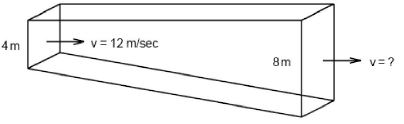
$A$ river gradually deepens from a depth of $4 \ m$ to a depth of $8 \ m$ as shown. The width,$W$,of the river does not change. At the depth of $4 \ m$,the river's speed is $12 \ m/s$. Its velocity at the $8 \ m$ depth is ......... $m/s$.
A
$12$
B
$24$
C
$6$
D
$8$
Solution
(C) According to the equation of continuity for an incompressible fluid,the product of the cross-sectional area and the velocity remains constant,i.e.,$A_{1}v_{1} = A_{2}v_{2}$.
Here,the cross-sectional area $A$ is given by the product of width $W$ and depth $d$. Since the width $W$ is constant,we have:
$A_{1} = W \times 4 \ m$
$A_{2} = W \times 8 \ m$
Given $v_{1} = 12 \ m/s$,we substitute these values into the continuity equation:
$(W \times 4) \times 12 = (W \times 8) \times v_{2}$
Dividing both sides by $W$ (since $W \neq 0$):
$4 \times 12 = 8 \times v_{2}$
$48 = 8 \times v_{2}$
$v_{2} = \frac{48}{8} = 6 \ m/s$.
Thus,the velocity at the $8 \ m$ depth is $6 \ m/s$.
Here,the cross-sectional area $A$ is given by the product of width $W$ and depth $d$. Since the width $W$ is constant,we have:
$A_{1} = W \times 4 \ m$
$A_{2} = W \times 8 \ m$
Given $v_{1} = 12 \ m/s$,we substitute these values into the continuity equation:
$(W \times 4) \times 12 = (W \times 8) \times v_{2}$
Dividing both sides by $W$ (since $W \neq 0$):
$4 \times 12 = 8 \times v_{2}$
$48 = 8 \times v_{2}$
$v_{2} = \frac{48}{8} = 6 \ m/s$.
Thus,the velocity at the $8 \ m$ depth is $6 \ m/s$.
0 likes
View Solution23
EasyMCQ
The total area of cross-section is $0.25\,m^2$. If the blood is flowing at the rate of $100\,cm^3/s$,then the average velocity of flow of blood through the capillaries is ........ $mm/s$.
A
$0.4$
B
$4$
C
$25$
D
$400$
Solution
(A) The rate of flow (volume flow rate) is given by the equation $Q = A \times v$,where $A$ is the cross-sectional area and $v$ is the average velocity.
Given:
$A = 0.25\,m^2$
$Q = 100\,cm^3/s = 100 \times 10^{-6}\,m^3/s = 10^{-4}\,m^3/s$
Rearranging the formula for velocity:
$v = \frac{Q}{A} = \frac{10^{-4}}{0.25} = 4 \times 10^{-4}\,m/s$
To convert the velocity from $m/s$ to $mm/s$,multiply by $1000$:
$v = 4 \times 10^{-4} \times 10^3\,mm/s = 0.4\,mm/s$.
Given:
$A = 0.25\,m^2$
$Q = 100\,cm^3/s = 100 \times 10^{-6}\,m^3/s = 10^{-4}\,m^3/s$
Rearranging the formula for velocity:
$v = \frac{Q}{A} = \frac{10^{-4}}{0.25} = 4 \times 10^{-4}\,m/s$
To convert the velocity from $m/s$ to $mm/s$,multiply by $1000$:
$v = 4 \times 10^{-4} \times 10^3\,mm/s = 0.4\,mm/s$.
0 likes
View Solution24
EasyMCQ
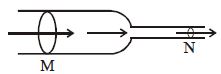
$A$ horizontal tube of non-uniform cross-section has radii of $0.1\,m$ and $0.05\,m$ respectively at $M$ and $N$. For a streamline flow of liquid, the rate of liquid flow is:
A
Continuously changes with time
B
Greater at $M$ than at $N$
C
Greater at $N$ than at $M$
D
Same at $M$ and $N$
Solution
(D) According to the principle of continuity, for a streamline flow of an incompressible, non-viscous fluid through a tube of non-uniform cross-section, the volume rate of flow (also known as the discharge rate, $Q$) remains constant at every cross-section of the tube.
The equation of continuity is given by $A_1 v_1 = A_2 v_2 = \text{constant}$, where $A$ is the cross-sectional area and $v$ is the velocity of the fluid.
Since the fluid is incompressible and the flow is steady (streamline), the amount of fluid entering any section of the tube in a given time must equal the amount of fluid leaving that section.
Therefore, the rate of flow of the liquid is the same at both points $M$ and $N$.
The equation of continuity is given by $A_1 v_1 = A_2 v_2 = \text{constant}$, where $A$ is the cross-sectional area and $v$ is the velocity of the fluid.
Since the fluid is incompressible and the flow is steady (streamline), the amount of fluid entering any section of the tube in a given time must equal the amount of fluid leaving that section.
Therefore, the rate of flow of the liquid is the same at both points $M$ and $N$.
0 likes
View Solution25
MediumMCQ
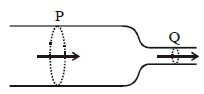
$A$ horizontal tube of non-uniform cross-section has radii of $0.2\,m$ and $0.1\,m$ at points $P$ and $Q$ respectively. For the streamline flow of an incompressible liquid,the rate of liquid flow is:
A
greater at $P$ than $Q$
B
greater at $Q$ than $P$
C
changing continuously with time
D
same at $P$ and $Q$
Solution
(D) According to the equation of continuity for an incompressible fluid in streamline flow,the volume flow rate (or discharge) $Q_v = A \cdot v$ remains constant throughout the tube.
This means that the volume of liquid entering any cross-section per unit time must equal the volume of liquid leaving any other cross-section per unit time.
Therefore,the rate of liquid flow is the same at all points in the tube,including points $P$ and $Q$.
This means that the volume of liquid entering any cross-section per unit time must equal the volume of liquid leaving any other cross-section per unit time.
Therefore,the rate of liquid flow is the same at all points in the tube,including points $P$ and $Q$.
0 likes
View Solution26
EasyMCQ
The blades of a windmill sweep out a circle of area $A$. If the wind flows at a velocity $v$ perpendicular to the circle,then the mass of the air of density $\rho$ passing through it in time $t$ is
A
$Av\rho t$
B
$2Av\rho t$
C
$Av^2\rho t$
D
$\frac{1}{2}Av\rho t$
Solution
(A) The volume of air passing through the area $A$ in time $t$ is given by the product of the area,velocity,and time: $V = A \times v \times t$.
Since the density of the air is $\rho$,the mass $m$ of the air is given by the product of density and volume: $m = \rho \times V$.
Substituting the expression for volume,we get: $m = \rho \times (A \times v \times t) = Av\rho t$.
Since the density of the air is $\rho$,the mass $m$ of the air is given by the product of density and volume: $m = \rho \times V$.
Substituting the expression for volume,we get: $m = \rho \times (A \times v \times t) = Av\rho t$.
0 likes
View Solution27
EasyMCQ
Water falls from a tap,down the streamline.
A
Area decreases
B
Area increases
C
Velocity same
D
Area remains same
Solution
(A) When water falls from a tap,it accelerates due to gravity as it moves downward.
According to the equation of continuity,$A_1 v_1 = A_2 v_2$,where $A$ is the cross-sectional area and $v$ is the velocity.
Since the velocity $v$ increases as the water falls,the cross-sectional area $A$ must decrease to keep the flow rate constant.
Therefore,the area of the water stream decreases.
According to the equation of continuity,$A_1 v_1 = A_2 v_2$,where $A$ is the cross-sectional area and $v$ is the velocity.
Since the velocity $v$ increases as the water falls,the cross-sectional area $A$ must decrease to keep the flow rate constant.
Therefore,the area of the water stream decreases.
0 likes
View Solution28
MediumMCQ
Select the correct statement regarding streamline flow.
A
The momenta of all particles arriving at a point are same.
B
The momenta of all particles are same throughout the tube.
C
The kinetic energy of all particles passing through a point are same.
D
Both $(A)$ and $(C)$.
Solution
(D) In streamline flow,the velocity of a fluid particle at any given point is constant over time.
Since the velocity $v$ at a specific point is constant,the momentum $p = mv$ of any particle arriving at that point will be the same,assuming the particles have the same mass $m$.
Similarly,the kinetic energy $K = \frac{1}{2}mv^2$ of any particle passing through that specific point will also be the same.
Therefore,both statements $(A)$ and $(C)$ are correct.
Since the velocity $v$ at a specific point is constant,the momentum $p = mv$ of any particle arriving at that point will be the same,assuming the particles have the same mass $m$.
Similarly,the kinetic energy $K = \frac{1}{2}mv^2$ of any particle passing through that specific point will also be the same.
Therefore,both statements $(A)$ and $(C)$ are correct.
0 likes
View Solution29
EasyMCQ
Select the incorrect statement regarding turbulent flow.
A
It dissipates kinetic energy in the form of heat.
B
It promotes the mixing of fluids.
C
It increases the rate of transfer of momentum and energy.
D
It decreases the rate of transfer of momentum and energy.
Solution
(D) Turbulent flow is characterized by chaotic,irregular fluid motion.
In turbulent flow,the fluid particles move in random paths,which significantly enhances the mixing of different layers of the fluid.
This increased mixing leads to a higher rate of transfer of momentum and energy between fluid layers compared to laminar flow.
Additionally,the internal friction caused by these chaotic motions dissipates kinetic energy into heat.
Therefore,the statement that turbulent flow decreases the rate of transfer of momentum and energy is incorrect.
In turbulent flow,the fluid particles move in random paths,which significantly enhances the mixing of different layers of the fluid.
This increased mixing leads to a higher rate of transfer of momentum and energy between fluid layers compared to laminar flow.
Additionally,the internal friction caused by these chaotic motions dissipates kinetic energy into heat.
Therefore,the statement that turbulent flow decreases the rate of transfer of momentum and energy is incorrect.
0 likes
View Solution30
DifficultMCQ
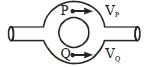
In the figure shown,a liquid is flowing through a tube at the rate of $0.1\, m^3/sec$. The tube is branched into two semicircular tubes of cross-sectional area $A/3$ and $2A/3$. The velocity of liquid at $Q$ is ......... $m/sec$. (The cross-section of the main tube $= A = 10^{-2}\, m^2$ and $v_p = 20\, m/sec$)
A
$5$
B
$30$
C
$35$
D
none of these
Solution
(A) According to the equation of continuity,the total flow rate $Q_{total}$ is equal to the sum of the flow rates in the two branches.
$Q_{total} = A_1 v_p + A_2 v_Q$
Given:
$Q_{total} = 0.1\, m^3/sec$
$A_1 = A/3 = 10^{-2}/3\, m^2$
$A_2 = 2A/3 = 2 \times 10^{-2}/3\, m^2$
$v_p = 20\, m/sec$
Substituting the values:
$0.1 = (A/3) \times 20 + (2A/3) \times v_Q$
Multiply by $3/A$:
$0.1 \times (3/A) = 20 + 2 v_Q$
$0.3 / 10^{-2} = 20 + 2 v_Q$
$30 = 20 + 2 v_Q$
$10 = 2 v_Q$
$v_Q = 5\, m/sec$
$Q_{total} = A_1 v_p + A_2 v_Q$
Given:
$Q_{total} = 0.1\, m^3/sec$
$A_1 = A/3 = 10^{-2}/3\, m^2$
$A_2 = 2A/3 = 2 \times 10^{-2}/3\, m^2$
$v_p = 20\, m/sec$
Substituting the values:
$0.1 = (A/3) \times 20 + (2A/3) \times v_Q$
Multiply by $3/A$:
$0.1 \times (3/A) = 20 + 2 v_Q$
$0.3 / 10^{-2} = 20 + 2 v_Q$
$30 = 20 + 2 v_Q$
$10 = 2 v_Q$
$v_Q = 5\, m/sec$
0 likes
View Solution31
DifficultMCQ
Water is flowing through two horizontal pipes of different diameters which are connected together. The diameters of the two pipes are $3\, cm$ and $6\, cm$ respectively. If the speed of water in the narrower pipe is $4\, m/s$ and the pressure is $2.0 \times 10^4\, Pa$,then the speed of water in the wider pipe is ........ $m/s$.
A
$4$
B
$2$
C
$1$
D
$16$
Solution
(C) According to the equation of continuity for an incompressible fluid,the product of the cross-sectional area and the velocity of flow remains constant: $A_1 V_1 = A_2 V_2$.
Here,$d_1 = 3\, cm$ (radius $r_1 = 1.5\, cm$) and $d_2 = 6\, cm$ (radius $r_2 = 3.0\, cm$).
The velocity in the narrower pipe is $V_1 = 4\, m/s$.
Substituting the values into the equation: $\pi (r_1)^2 V_1 = \pi (r_2)^2 V_2$.
$\pi (1.5)^2 \times 4 = \pi (3.0)^2 \times V_2$.
$2.25 \times 4 = 9 \times V_2$.
$9 = 9 \times V_2$.
Therefore,$V_2 = 1\, m/s$.
Here,$d_1 = 3\, cm$ (radius $r_1 = 1.5\, cm$) and $d_2 = 6\, cm$ (radius $r_2 = 3.0\, cm$).
The velocity in the narrower pipe is $V_1 = 4\, m/s$.
Substituting the values into the equation: $\pi (r_1)^2 V_1 = \pi (r_2)^2 V_2$.
$\pi (1.5)^2 \times 4 = \pi (3.0)^2 \times V_2$.
$2.25 \times 4 = 9 \times V_2$.
$9 = 9 \times V_2$.
Therefore,$V_2 = 1\, m/s$.
0 likes
View Solution32
MediumMCQ
When water falls from a tap,what happens to the cross-sectional area of the water stream as it moves downwards?
A
Area decreases
B
Area increases
C
Velocity remains constant
D
Velocity decreases
Solution
(A) As water falls from a tap,it accelerates due to gravity,so its velocity $v$ increases as it moves downwards.
According to the equation of continuity for an incompressible fluid,the product of the cross-sectional area $A$ and the velocity $v$ remains constant: $A \cdot v = \text{constant}$.
Since $v$ increases as the water falls,the cross-sectional area $A$ must decrease to keep the product $A \cdot v$ constant.
Therefore,the area of the water stream decreases.
According to the equation of continuity for an incompressible fluid,the product of the cross-sectional area $A$ and the velocity $v$ remains constant: $A \cdot v = \text{constant}$.
Since $v$ increases as the water falls,the cross-sectional area $A$ must decrease to keep the product $A \cdot v$ constant.
Therefore,the area of the water stream decreases.
0 likes
View Solution33
DifficultMCQ
Water is flowing continuously from a tap having an internal diameter $8 \times 10^{-3}\, m$. The water velocity as it leaves the tap is $0.04\, ms^{-1}$. The diameter of the water stream at a distance $8 \times 10^{-1}\, m$ below the tap is close to
A
$9.6 \times 10^{-3}\, m$
B
$3.6 \times 10^{-3}\, m$
C
$0.8 \times 10^{-3}\, m$
D
$6.4 \times 10^{-3}\, m$
Solution
(C) Using the equation of motion $v_2^2 = v_1^2 + 2gh$,where $v_1 = 0.04\, ms^{-1}$,$g = 10\, ms^{-2}$,and $h = 8 \times 10^{-1}\, m$:
$v_2^2 = (0.04)^2 + 2 \times 10 \times 0.8 = 0.0016 + 16 = 16.0016 \approx 16\, m^2s^{-2}$.
Thus,$v_2 \approx 4\, ms^{-1}$.
Using the equation of continuity $A_1v_1 = A_2v_2$,where $A = \pi (D/2)^2$:
$D_1^2 v_1 = D_2^2 v_2$
$(8 \times 10^{-3})^2 \times 0.04 = D_2^2 \times 4$
$64 \times 10^{-6} \times 0.04 = D_2^2 \times 4$
$D_2^2 = 16 \times 10^{-6} \times 0.04 = 0.64 \times 10^{-6}$
$D_2 = \sqrt{0.64 \times 10^{-6}} = 0.8 \times 10^{-3}\, m$.
$v_2^2 = (0.04)^2 + 2 \times 10 \times 0.8 = 0.0016 + 16 = 16.0016 \approx 16\, m^2s^{-2}$.
Thus,$v_2 \approx 4\, ms^{-1}$.
Using the equation of continuity $A_1v_1 = A_2v_2$,where $A = \pi (D/2)^2$:
$D_1^2 v_1 = D_2^2 v_2$
$(8 \times 10^{-3})^2 \times 0.04 = D_2^2 \times 4$
$64 \times 10^{-6} \times 0.04 = D_2^2 \times 4$
$D_2^2 = 16 \times 10^{-6} \times 0.04 = 0.64 \times 10^{-6}$
$D_2 = \sqrt{0.64 \times 10^{-6}} = 0.8 \times 10^{-3}\, m$.
0 likes
View Solution34
MediumMCQ
An ideal fluid flows (laminar flow) through a pipe of non-uniform diameter. The maximum and minimum diameters of the pipe are $6.4 \; cm$ and $4.8 \; cm,$ respectively. The ratio of the minimum and the maximum velocities of the fluid in this pipe is:
A
$\frac{\sqrt{3}}{2}$
B
$\frac{3}{4}$
C
$\frac{81}{256}$
D
$\frac{9}{16}$
Solution
(D) According to the equation of continuity for an ideal fluid,the product of the cross-sectional area and the velocity of the fluid remains constant: $A_1 v_1 = A_2 v_2$.
This implies that the velocity is inversely proportional to the area: $v \propto \frac{1}{A}$.
Since the area $A = \pi r^2 = \pi (d/2)^2$,we have $A \propto d^2$,where $d$ is the diameter.
Therefore,the ratio of the minimum velocity to the maximum velocity is given by the ratio of the minimum area to the maximum area:
$\frac{v_{\min}}{v_{\max}} = \frac{A_{\min}}{A_{\max}} = \left( \frac{d_{\min}}{d_{\max}} \right)^2$.
Substituting the given values $d_{\min} = 4.8 \; cm$ and $d_{\max} = 6.4 \; cm$:
$\frac{v_{\min}}{v_{\max}} = \left( \frac{4.8}{6.4} \right)^2 = \left( \frac{3}{4} \right)^2 = \frac{9}{16}$.
This implies that the velocity is inversely proportional to the area: $v \propto \frac{1}{A}$.
Since the area $A = \pi r^2 = \pi (d/2)^2$,we have $A \propto d^2$,where $d$ is the diameter.
Therefore,the ratio of the minimum velocity to the maximum velocity is given by the ratio of the minimum area to the maximum area:
$\frac{v_{\min}}{v_{\max}} = \frac{A_{\min}}{A_{\max}} = \left( \frac{d_{\min}}{d_{\max}} \right)^2$.
Substituting the given values $d_{\min} = 4.8 \; cm$ and $d_{\max} = 6.4 \; cm$:
$\frac{v_{\min}}{v_{\max}} = \left( \frac{4.8}{6.4} \right)^2 = \left( \frac{3}{4} \right)^2 = \frac{9}{16}$.
1 likes
View Solution35
MediumMCQ
The cylindrical tube of a spray pump has a cross-section of $8.0 \; cm^{2}$,one end of which has $40$ fine holes each of diameter $1.0 \; mm$. If the liquid flow speed inside the tube is $1.5 \; m \, min^{-1}$,what is the speed (in $m/s$) of ejection of the liquid through the holes?
A
$0.025$
B
$1.23$
C
$0.63$
D
$0.33$
Solution
(C) Area of cross-section of the spray pump,$A_{1} = 8 \; cm^{2} = 8 \times 10^{-4} \; m^{2}$.
Number of holes,$n = 40$. Diameter of each hole,$d = 1 \; mm = 1 \times 10^{-3} \; m$.
Radius of each hole,$r = d/2 = 0.5 \times 10^{-3} \; m$.
Area of cross-section of each hole,$a = \pi r^{2} = \pi (0.5 \times 10^{-3})^{2} \; m^{2}$.
Total area of $40$ holes,$A_{2} = n \times a = 40 \times \pi (0.5 \times 10^{-3})^{2} \; m^{2} \approx 31.416 \times 10^{-6} \; m^{2}$.
Speed of flow of liquid inside the tube,$V_{1} = 1.5 \; m/min = 1.5/60 \; m/s = 0.025 \; m/s$.
According to the equation of continuity,$A_{1} V_{1} = A_{2} V_{2}$.
$V_{2} = (A_{1} V_{1}) / A_{2} = (8 \times 10^{-4} \times 0.025) / (31.416 \times 10^{-6}) \approx 0.636 \; m/s$.
Rounding to the nearest option,the speed of ejection is $0.63 \; m/s$.
Number of holes,$n = 40$. Diameter of each hole,$d = 1 \; mm = 1 \times 10^{-3} \; m$.
Radius of each hole,$r = d/2 = 0.5 \times 10^{-3} \; m$.
Area of cross-section of each hole,$a = \pi r^{2} = \pi (0.5 \times 10^{-3})^{2} \; m^{2}$.
Total area of $40$ holes,$A_{2} = n \times a = 40 \times \pi (0.5 \times 10^{-3})^{2} \; m^{2} \approx 31.416 \times 10^{-6} \; m^{2}$.
Speed of flow of liquid inside the tube,$V_{1} = 1.5 \; m/min = 1.5/60 \; m/s = 0.025 \; m/s$.
According to the equation of continuity,$A_{1} V_{1} = A_{2} V_{2}$.
$V_{2} = (A_{1} V_{1}) / A_{2} = (8 \times 10^{-4} \times 0.025) / (31.416 \times 10^{-6}) \approx 0.636 \; m/s$.
Rounding to the nearest option,the speed of ejection is $0.63 \; m/s$.
1 likes
View Solution36
Medium
Explain steady flow.
Solution
(N/A) The flow of a fluid is said to be steady if,at any given point,the velocity of each passing fluid particle remains constant in time.
This means that the velocity of any particle of the fluid remains the same while passing through a given point.
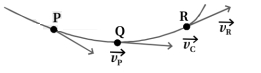
For example,let the velocity of each particle passing through point $P$ be $\overrightarrow{v_{P}}$,the velocity of each particle passing through point $Q$ be $\overrightarrow{v_{Q}}$,and the velocity of each particle passing through point $R$ be $\overrightarrow{v_{R}}$.
It is not necessary that $\overrightarrow{v_{P}} = \overrightarrow{v_{Q}} = \overrightarrow{v_{R}}$.
When a particle passes from one point to another,its velocity can change.
Steady flow is typically observed in low-velocity fluid motion. For example,the very slow motion of a water stream or slow-flowing wind.
This means that the velocity of any particle of the fluid remains the same while passing through a given point.
For example,let the velocity of each particle passing through point $P$ be $\overrightarrow{v_{P}}$,the velocity of each particle passing through point $Q$ be $\overrightarrow{v_{Q}}$,and the velocity of each particle passing through point $R$ be $\overrightarrow{v_{R}}$.
It is not necessary that $\overrightarrow{v_{P}} = \overrightarrow{v_{Q}} = \overrightarrow{v_{R}}$.
When a particle passes from one point to another,its velocity can change.
Steady flow is typically observed in low-velocity fluid motion. For example,the very slow motion of a water stream or slow-flowing wind.
0 likes
View Solution37
Medium
Explain streamlines and streamline flow.
Solution
(N/A) The path of motion of a fluid particle is called a line of flow.
$A$ streamline is defined as a curve whose tangent at any point is in the direction of the fluid velocity at that point.
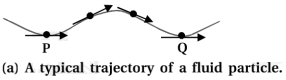
In a steady flow,the path taken by a fluid particle is a streamline. Figure $(a)$ shows a typical trajectory of a fluid particle,which represents a streamline. The velocity of the particle at any point is in the direction of the tangent drawn at that point.
Streamline flow is defined as a flow in which streamlines can be clearly defined. This occurs when the velocity of the fluid at any given point remains constant over time.
In unsteady flow,the velocity at a point changes with time,so while the path of a particle (line of flow) can be defined,a fixed streamline cannot be defined.
$A$ streamline is defined as a curve whose tangent at any point is in the direction of the fluid velocity at that point.
In a steady flow,the path taken by a fluid particle is a streamline. Figure $(a)$ shows a typical trajectory of a fluid particle,which represents a streamline. The velocity of the particle at any point is in the direction of the tangent drawn at that point.
Streamline flow is defined as a flow in which streamlines can be clearly defined. This occurs when the velocity of the fluid at any given point remains constant over time.
In unsteady flow,the velocity at a point changes with time,so while the path of a particle (line of flow) can be defined,a fixed streamline cannot be defined.
0 likes
View Solution38
Easy
Explain the concept of a tube of flow.
Solution
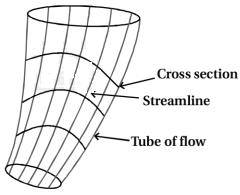
$A$ tube of flow is defined as a bundle of streamlines that form a tubular region in a fluid flow.
Key characteristics of a tube of flow include:
$1$. Since the boundary of the tube of flow is formed by streamlines,no fluid can cross the boundary of the tube. The fluid enters at one end and leaves at the other.
$2$. The velocity of all fluid particles passing through any cross-section perpendicular to the direction of flow within the tube is considered to be uniform at a given instant.
$3$. When fluid flows through a physical pipe or tube at a very low speed (laminar flow),the entire pipe can be considered a single tube of flow.
Key characteristics of a tube of flow include:
$1$. Since the boundary of the tube of flow is formed by streamlines,no fluid can cross the boundary of the tube. The fluid enters at one end and leaves at the other.
$2$. The velocity of all fluid particles passing through any cross-section perpendicular to the direction of flow within the tube is considered to be uniform at a given instant.
$3$. When fluid flows through a physical pipe or tube at a very low speed (laminar flow),the entire pipe can be considered a single tube of flow.
0 likes
View Solution39
Medium
Explain the characteristics of streamlines.
Solution
(N/A) Characteristics of streamlines:
$(i)$ In a steady flow,streamlines can never intersect each other.
$(ii)$ The tangent drawn at any point on a streamline indicates the direction of the velocity of the fluid particle at that point.
$(iii)$ The velocity of each fluid particle passing through a specific point on a streamline is constant over time,but it may vary from point to point along the streamline.
$(iv)$ Widely spaced streamlines indicate a region of low speed,while closely spaced streamlines indicate a region of high speed.
$(i)$ In a steady flow,streamlines can never intersect each other.
$(ii)$ The tangent drawn at any point on a streamline indicates the direction of the velocity of the fluid particle at that point.
$(iii)$ The velocity of each fluid particle passing through a specific point on a streamline is constant over time,but it may vary from point to point along the streamline.
$(iv)$ Widely spaced streamlines indicate a region of low speed,while closely spaced streamlines indicate a region of high speed.
0 likes
View Solution40
Medium
Explain streamline and streamline flow.
Solution
(N/A) The path taken by a fluid particle in a flowing fluid is called its line of flow.
In a moving fluid,the velocity and direction of particles generally change over time. Therefore,particles passing through a single point may not follow the same path.
However,in steady flow,the velocity of any particle passing through a specific point remains constant over time.
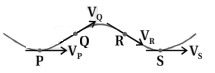
Suppose the velocity of a particle passing through point $P$ is $\overrightarrow{V}_{P}$,and the velocities of particles passing through points $Q, R$,and $S$ are $\overrightarrow{V}_{Q}, \overrightarrow{V}_{R}$,and $\overrightarrow{V}_{S}$ respectively.
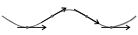
In steady flow,the path of a particle passing through point $P$ is shown in the figure. This steady path is known as a streamline.
In steady flow,the line of flow and the streamline coincide.
Streamline: $A$ streamline is a curve such that the tangent at any point on it gives the direction of the velocity of the fluid particle passing through that point.
Streamline flow: $A$ flow in which streamlines can be defined is called streamline flow.
In unsteady flow,a line of flow can be defined for a specific particle,but a streamline cannot be defined because the velocity at a point changes with time.
In a moving fluid,the velocity and direction of particles generally change over time. Therefore,particles passing through a single point may not follow the same path.
However,in steady flow,the velocity of any particle passing through a specific point remains constant over time.
Suppose the velocity of a particle passing through point $P$ is $\overrightarrow{V}_{P}$,and the velocities of particles passing through points $Q, R$,and $S$ are $\overrightarrow{V}_{Q}, \overrightarrow{V}_{R}$,and $\overrightarrow{V}_{S}$ respectively.
In steady flow,the path of a particle passing through point $P$ is shown in the figure. This steady path is known as a streamline.
In steady flow,the line of flow and the streamline coincide.
Streamline: $A$ streamline is a curve such that the tangent at any point on it gives the direction of the velocity of the fluid particle passing through that point.
Streamline flow: $A$ flow in which streamlines can be defined is called streamline flow.
In unsteady flow,a line of flow can be defined for a specific particle,but a streamline cannot be defined because the velocity at a point changes with time.
0 likes
View Solution41
Medium
Derive the equation of continuity for the steady flow of an incompressible fluid.
Solution
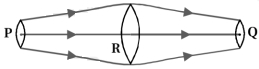
(N/A) In a steady flow,if we draw streamlines for every particle,they form a tube-like structure known as a tube of flow. No fluid particle enters or leaves this tube through its sides.
The figure shows a tube of flow with points $P$,$R$,and $Q$.
Let $v_{P}$,$v_{Q}$,and $v_{R}$ be the velocities of the fluid particles at points $P$,$Q$,and $R$ respectively,and let $A_{P}$,$A_{Q}$,and $A_{R}$ be the corresponding cross-sectional areas.
Since the flow is steady,the mass of fluid passing through any cross-section in a given time interval $\Delta t$ must be constant.
The mass of fluid $m_{P}$ passing through cross-section $A_{P}$ with velocity $v_{P}$ in time $\Delta t$ is given by:
$m_{P} = A_{P} v_{P} \Delta t \rho$,where $\rho$ is the density of the incompressible fluid.
Similarly,the masses of fluid passing through $Q$ and $R$ in the same time interval $\Delta t$ are:
$m_{Q} = A_{Q} v_{Q} \Delta t \rho$ and $m_{R} = A_{R} v_{R} \Delta t \rho$.
Since the fluid is incompressible and the flow is steady,the mass entering the tube must equal the mass leaving it. Therefore:
$m_{P} = m_{R} = m_{Q}$
Substituting the expressions:
$A_{P} v_{P} \Delta t \rho = A_{R} v_{R} \Delta t \rho = A_{Q} v_{Q} \Delta t \rho$
Canceling common terms $\Delta t$ and $\rho$:
$A_{P} v_{P} = A_{R} v_{R} = A_{Q} v_{Q}$
This is the equation of continuity for steady flow,which represents the law of conservation of mass for an incompressible fluid.
In general,$A v = \text{constant}$,which implies $v \propto \frac{1}{A}$.
The product $Av$ represents the volume flux or flow rate,which remains constant throughout the tube of flow. At narrower portions,the streamlines are closely spaced,indicating higher velocity,while at wider portions,the streamlines are widely spaced,indicating lower velocity.
The figure shows a tube of flow with points $P$,$R$,and $Q$.
Let $v_{P}$,$v_{Q}$,and $v_{R}$ be the velocities of the fluid particles at points $P$,$Q$,and $R$ respectively,and let $A_{P}$,$A_{Q}$,and $A_{R}$ be the corresponding cross-sectional areas.
Since the flow is steady,the mass of fluid passing through any cross-section in a given time interval $\Delta t$ must be constant.
The mass of fluid $m_{P}$ passing through cross-section $A_{P}$ with velocity $v_{P}$ in time $\Delta t$ is given by:
$m_{P} = A_{P} v_{P} \Delta t \rho$,where $\rho$ is the density of the incompressible fluid.
Similarly,the masses of fluid passing through $Q$ and $R$ in the same time interval $\Delta t$ are:
$m_{Q} = A_{Q} v_{Q} \Delta t \rho$ and $m_{R} = A_{R} v_{R} \Delta t \rho$.
Since the fluid is incompressible and the flow is steady,the mass entering the tube must equal the mass leaving it. Therefore:
$m_{P} = m_{R} = m_{Q}$
Substituting the expressions:
$A_{P} v_{P} \Delta t \rho = A_{R} v_{R} \Delta t \rho = A_{Q} v_{Q} \Delta t \rho$
Canceling common terms $\Delta t$ and $\rho$:
$A_{P} v_{P} = A_{R} v_{R} = A_{Q} v_{Q}$
This is the equation of continuity for steady flow,which represents the law of conservation of mass for an incompressible fluid.
In general,$A v = \text{constant}$,which implies $v \propto \frac{1}{A}$.
The product $Av$ represents the volume flux or flow rate,which remains constant throughout the tube of flow. At narrower portions,the streamlines are closely spaced,indicating higher velocity,while at wider portions,the streamlines are widely spaced,indicating lower velocity.
0 likes
View Solution42
Difficult
Explain critical speed,white water rapids,and turbulent flow.
Solution
(N/A) Critical speed: Steady flow is achieved at low flow speeds up to a limiting value,called critical speed.
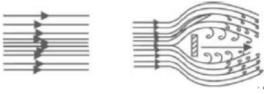
Turbulent flow: In a fluid flow,if the velocity of the fluid changes erratically from point to point as well as from time to time,the flow is known as a turbulent flow. If the speed of the fluid becomes greater than the critical speed,the flow loses steadiness and becomes turbulent.
White water rapids: When a fast-flowing stream encounters rocks,small foamy whirlpool-like regions called 'white water rapids' are formed.
Turbulent flow: In a fluid flow,if the velocity of the fluid changes erratically from point to point as well as from time to time,the flow is known as a turbulent flow. If the speed of the fluid becomes greater than the critical speed,the flow loses steadiness and becomes turbulent.
White water rapids: When a fast-flowing stream encounters rocks,small foamy whirlpool-like regions called 'white water rapids' are formed.
0 likes
View Solution43
Easy
What is steady flow?
Solution
(N/A) Steady flow is defined as a type of fluid motion in which the velocity of the fluid particles at any given point in space remains constant with respect to time.
In other words,at any fixed point in the path of the fluid,the velocity vector does not change as time passes.
Mathematically,for a steady flow,the velocity $v$ at a point $(x, y, z)$ satisfies the condition $\frac{\partial v}{\partial t} = 0$.
In other words,at any fixed point in the path of the fluid,the velocity vector does not change as time passes.
Mathematically,for a steady flow,the velocity $v$ at a point $(x, y, z)$ satisfies the condition $\frac{\partial v}{\partial t} = 0$.
0 likes
View Solution44
Medium
Define line of flow and streamline.
Solution
(N/A) $1$. Line of Flow: $A$ line of flow is a curve whose tangent at any point is in the direction of the fluid velocity at that point. It represents the path taken by a fluid particle as it moves through space.
$2$. Streamline: $A$ streamline is a specific type of line of flow in a steady flow,where the velocity vector at every point along the line is tangent to the streamline. In steady flow,the pattern of streamlines remains constant over time,meaning fluid particles follow the same path.
$2$. Streamline: $A$ streamline is a specific type of line of flow in a steady flow,where the velocity vector at every point along the line is tangent to the streamline. In steady flow,the pattern of streamlines remains constant over time,meaning fluid particles follow the same path.
0 likes
View Solution45
EasyMCQ
In which direction is the velocity of a fluid particle at a point on a streamline directed?
A
Perpendicular to the streamline
B
Tangent to the streamline at that point
C
At an angle of $45^{\circ}$ to the streamline
D
Always towards the center of curvature
Solution
(B) streamline is defined as a curve whose tangent at any point is in the direction of the velocity vector of the fluid particle at that point.
Therefore,the velocity of a fluid particle at any point on a streamline is always directed along the tangent to the streamline at that point.
This implies that no fluid particle can cross a streamline,as the velocity vector is always tangential to the path.
Therefore,the velocity of a fluid particle at any point on a streamline is always directed along the tangent to the streamline at that point.
This implies that no fluid particle can cross a streamline,as the velocity vector is always tangential to the path.
0 likes
View Solution46
EasyMCQ
Can two streamlines cross each other? Why?
A
Yes,they can cross at high speeds.
B
No,because at the point of intersection,the fluid particle would have two different directions of velocity simultaneously.
C
Yes,they can cross in turbulent flow.
D
No,because the pressure at the intersection point would be infinite.
Solution
(B) No,two streamlines cannot cross each other.
If two streamlines were to intersect,a fluid particle arriving at the point of intersection would have two possible directions of motion simultaneously.
This would imply that the velocity vector of the fluid particle is not uniquely defined at that point.
Since the velocity of a fluid particle in a steady flow is uniquely determined by the flow field,such an intersection is physically impossible.
If two streamlines were to intersect,a fluid particle arriving at the point of intersection would have two possible directions of motion simultaneously.
This would imply that the velocity vector of the fluid particle is not uniquely defined at that point.
Since the velocity of a fluid particle in a steady flow is uniquely determined by the flow field,such an intersection is physically impossible.
0 likes
View Solution47
MediumMCQ
What is a tube of flow?
A
$A$ pipe through which fluid flows.
B
$A$ bundle of streamlines having a finite cross-section.
C
The path followed by a single fluid particle.
D
The region where fluid velocity is constant.
Solution
(B) tube of flow is defined as a bundle of streamlines that enclose a finite region of space through which a fluid flows.
Since streamlines cannot cross each other,the fluid particles inside a tube of flow remain inside it throughout their motion.
The boundary of the tube of flow is formed by the streamlines passing through the perimeter of a closed curve.
Therefore,the correct answer is $B$.
Since streamlines cannot cross each other,the fluid particles inside a tube of flow remain inside it throughout their motion.
The boundary of the tube of flow is formed by the streamlines passing through the perimeter of a closed curve.
Therefore,the correct answer is $B$.
0 likes
View Solution48
MediumMCQ
What is the effect on the velocity of a fluid if streamlines are closely spaced?
A
Velocity increases
B
Velocity decreases
C
Velocity remains constant
D
Velocity becomes zero
Solution
(A) According to the properties of streamlines in fluid dynamics,the spacing between streamlines is inversely proportional to the velocity of the fluid.
When streamlines are closely spaced,it indicates that the fluid is passing through a narrower region.
By the equation of continuity,$A_1v_1 = A_2v_2$,where $A$ is the cross-sectional area and $v$ is the velocity.
As the area $A$ decreases,the velocity $v$ must increase to maintain a constant flow rate.
Therefore,closely spaced streamlines represent regions of higher fluid velocity.
When streamlines are closely spaced,it indicates that the fluid is passing through a narrower region.
By the equation of continuity,$A_1v_1 = A_2v_2$,where $A$ is the cross-sectional area and $v$ is the velocity.
As the area $A$ decreases,the velocity $v$ must increase to maintain a constant flow rate.
Therefore,closely spaced streamlines represent regions of higher fluid velocity.
0 likes
View Solution49
EasyMCQ
What is the effect on the velocity of fluid if streamlines are widely spaced?
A
Velocity increases
B
Velocity decreases
C
Velocity remains constant
D
Velocity becomes zero
Solution
(B) According to the properties of streamlines,the spacing between streamlines is inversely proportional to the velocity of the fluid.
When streamlines are widely spaced,it indicates that the fluid is moving through a larger cross-sectional area,which results in a lower velocity.
Conversely,when streamlines are closely spaced,the fluid velocity is higher.
Therefore,if streamlines are widely spaced,the velocity of the fluid decreases.
When streamlines are widely spaced,it indicates that the fluid is moving through a larger cross-sectional area,which results in a lower velocity.
Conversely,when streamlines are closely spaced,the fluid velocity is higher.
Therefore,if streamlines are widely spaced,the velocity of the fluid decreases.
0 likes
View Solution50
Easy
Define laminar flow.
Solution
(N/A) Laminar flow, also known as streamline flow, is a type of fluid flow in which the fluid particles move in smooth, well-defined paths or layers (streamlines) that do not cross each other.
In this type of flow, the velocity of the fluid at any given point remains constant over time.
Laminar flow typically occurs at low velocities and is characterized by a low Reynolds number $(Re < 2000)$.
In this type of flow, the velocity of the fluid at any given point remains constant over time.
Laminar flow typically occurs at low velocities and is characterized by a low Reynolds number $(Re < 2000)$.
0 likes
View SolutionFluid Mechanics and Surface Tension — Types of Flow, Equation of Continuity and Flow Rate · Frequently Asked Questions
1Are these Fluid Mechanics and Surface Tension questions useful for JEE and NEET?
Yes. All questions in this section are mapped to JEE Main and NEET exam patterns. Previous year questions from JEE Main, NEET, GUJCET and state-level exams are included with full solutions.
2Can I switch to Hindi or Gujarati for these questions?
Yes. Use the language tabs in the hero section or the sidebar to view the same questions and solutions in English, Hindi or Gujarati.
3How do I generate a question paper from this subtopic?
Use the Vedclass Exam Paper Generator — select the chapter and subtopic, set difficulty, and generate Sets A, B, C, D automatically. First 3 chapters of every subject are free.
Vedclass Products
For Students
Vedclass Test Series
Mock tests in real JEE/NEET style with performance analysis. 5-day free trial.
Start Free TrialFor Teachers
Exam Paper Generator
Generate Set A/B/C/D papers from this chapter in 2 minutes. 3 chapters free.
Try FreeFor Institutes
Online Exam Module
Live online exams with unlimited students, 360° analytics & white-label branding.
See DemoFor Teachers & Institutes
Generate a Fluid Mechanics and Surface Tension Exam Paper in 2 Minutes
Select subtopic & difficulty — Sets A, B, C, D auto-generated with No Repeat logic.
First 3 chapters of every subject are free — no payment required.