
A English
Newton's Law of Viscosity Questions in English
Class 11 Physics · Fluid Mechanics and Surface Tension · Newton's Law of Viscosity
60+
Questions
English
Language
100%
With Solutions
Showing 50 of 60 questions in English
1
MediumMCQ
$A$ square plate of $0.1 \; m$ side moves parallel to a second plate with a velocity of $0.1 \; m/s$, both plates being immersed in water. If the viscous force is $0.002 \; N$ and the coefficient of viscosity is $0.01 \; \text{poise}$, the distance between the plates in $m$ is:
A
$0.1$
B
$0.05$
C
$0.005$
D
$0.0005$
Solution
(D) The viscous force $F$ is given by Newton's law of viscosity: $F = \eta A \frac{dv}{dx}$.
Here, the area of the square plate $A = (0.1 \; m)^2 = 0.01 \; m^2$.
The coefficient of viscosity $\eta = 0.01 \; \text{poise} = 0.001 \; \text{Pa} \cdot s$ (since $1 \; \text{poise} = 0.1 \; \text{Pa} \cdot s$).
The velocity gradient is $\frac{dv}{dx} = \frac{v}{dx}$, where $v = 0.1 \; m/s$ and $dx$ is the distance between the plates.
Substituting the values into the formula: $0.002 = 0.001 \times 0.01 \times \frac{0.1}{dx}$.
Rearranging for $dx$: $dx = \frac{0.001 \times 0.01 \times 0.1}{0.002} = \frac{0.000001}{0.002} = 0.0005 \; m$.
Here, the area of the square plate $A = (0.1 \; m)^2 = 0.01 \; m^2$.
The coefficient of viscosity $\eta = 0.01 \; \text{poise} = 0.001 \; \text{Pa} \cdot s$ (since $1 \; \text{poise} = 0.1 \; \text{Pa} \cdot s$).
The velocity gradient is $\frac{dv}{dx} = \frac{v}{dx}$, where $v = 0.1 \; m/s$ and $dx$ is the distance between the plates.
Substituting the values into the formula: $0.002 = 0.001 \times 0.01 \times \frac{0.1}{dx}$.
Rearranging for $dx$: $dx = \frac{0.001 \times 0.01 \times 0.1}{0.002} = \frac{0.000001}{0.002} = 0.0005 \; m$.
0 likes
View Solution2
EasyMCQ
In a laminar flow,the velocity of the liquid in contact with the walls of the tube is:
A
Zero
B
Maximum
C
In between zero and maximum
D
Equal to critical velocity
Solution
(A) In a laminar flow of a viscous liquid through a pipe,the fluid adheres to the walls of the pipe due to the no-slip condition.
As a result,the velocity of the liquid layer in direct contact with the stationary walls is $0$.
The velocity profile is parabolic,increasing from $0$ at the walls to a maximum value along the central axis of the tube.
Therefore,the velocity at the walls is $0$.
As a result,the velocity of the liquid layer in direct contact with the stationary walls is $0$.
The velocity profile is parabolic,increasing from $0$ at the walls to a maximum value along the central axis of the tube.
Therefore,the velocity at the walls is $0$.
0 likes
View Solution3
EasyMCQ
The velocity of water in a river is:
A
Same everywhere
B
More in the middle and less near its banks
C
Less in the middle and more near its banks
D
Increasing from one bank to the other bank
Solution
(B) Water flowing in a river experiences viscous drag due to the interaction with the river banks and the riverbed.
Near the banks,the water molecules experience significant friction with the stationary surface,which significantly reduces their velocity.
In the middle of the river,the water molecules are surrounded by other water molecules moving at similar speeds,resulting in minimal viscous resistance.
Therefore,the velocity of water is maximum in the middle and minimum near the banks.
Near the banks,the water molecules experience significant friction with the stationary surface,which significantly reduces their velocity.
In the middle of the river,the water molecules are surrounded by other water molecules moving at similar speeds,resulting in minimal viscous resistance.
Therefore,the velocity of water is maximum in the middle and minimum near the banks.
0 likes
View Solution4
EasyMCQ
As the temperature of water increases,its viscosity
A
Remains unchanged
B
Decreases
C
Increases
D
Increases or decreases depending on the external pressure
Solution
(B) The viscosity of a liquid is a measure of its resistance to flow,which arises due to the cohesive forces between its molecules.
In liquids,as the temperature increases,the kinetic energy of the molecules increases.
This increased kinetic energy allows the molecules to overcome the cohesive forces more easily,thereby reducing the internal friction between the layers of the liquid.
Consequently,the viscosity of water (and most liquids) decreases as the temperature increases.
Therefore,the correct option is $B$.
In liquids,as the temperature increases,the kinetic energy of the molecules increases.
This increased kinetic energy allows the molecules to overcome the cohesive forces more easily,thereby reducing the internal friction between the layers of the liquid.
Consequently,the viscosity of water (and most liquids) decreases as the temperature increases.
Therefore,the correct option is $B$.
0 likes
View Solution5
EasyMCQ
The coefficient of viscosity for hot air is
A
Greater than the coefficient of viscosity for cold air
B
Smaller than the coefficient of viscosity for cold air
C
Same as the coefficient of viscosity for cold air
D
Increases or decreases depending on the external pressure
Solution
(A) The viscosity of gases is primarily due to the transfer of momentum between layers of gas molecules moving at different velocities.
According to the kinetic theory of gases,the coefficient of viscosity $\eta$ is given by $\eta = \frac{1}{3} \rho v_{avg} \lambda$,where $\rho$ is the density,$v_{avg}$ is the average speed of molecules,and $\lambda$ is the mean free path.
As temperature increases,the average speed of gas molecules $(v_{avg} \propto \sqrt{T})$ increases.
Although the mean free path $\lambda$ may change,the increase in the average speed of molecules dominates,leading to an increase in the coefficient of viscosity with temperature.
Therefore,the coefficient of viscosity for hot air is greater than that for cold air.
According to the kinetic theory of gases,the coefficient of viscosity $\eta$ is given by $\eta = \frac{1}{3} \rho v_{avg} \lambda$,where $\rho$ is the density,$v_{avg}$ is the average speed of molecules,and $\lambda$ is the mean free path.
As temperature increases,the average speed of gas molecules $(v_{avg} \propto \sqrt{T})$ increases.
Although the mean free path $\lambda$ may change,the increase in the average speed of molecules dominates,leading to an increase in the coefficient of viscosity with temperature.
Therefore,the coefficient of viscosity for hot air is greater than that for cold air.
0 likes
View Solution6
EasyMCQ
$A$ good lubricant should have
A
High viscosity
B
Low viscosity
C
Moderate viscosity
D
High density
Solution
(A) good lubricant must have high viscosity so that machine parts can operate efficiently.
Higher viscosity of the lubricant increases its ability to provide boundary lubrication,which creates a protective film between moving parts to reduce friction and wear.
Higher viscosity of the lubricant increases its ability to provide boundary lubrication,which creates a protective film between moving parts to reduce friction and wear.
0 likes
View Solution7
DifficultMCQ
$A$ square plate of side $0.1 \, m$ moves over another plate with a velocity of $0.1 \, m/s$ in a liquid of viscosity $0.01 \, poise$. If the viscous force acting is $0.002 \, N$,what is the distance between the two plates (in $, m$)?
A
$0.1$
B
$0.05$
C
$0.005$
D
$0.0005$
Solution
(D) Given: Side of the square plate $L = 0.1 \, m$,Velocity $dv = 0.1 \, m/s$,Viscosity $\eta = 0.01 \, poise = 0.001 \, N \cdot s/m^2$ ($SI$ unit),Viscous force $F = 0.002 \, N$.
Area of the plate $A = L^2 = (0.1)^2 = 0.01 \, m^2$.
According to Newton's law of viscosity,the viscous force is given by $F = \eta A \frac{dv}{dx}$,where $dx$ is the distance between the plates.
Rearranging the formula for $dx$: $dx = \frac{\eta A dv}{F}$.
Substituting the values: $dx = \frac{0.001 \times 0.01 \times 0.1}{0.002} = \frac{0.000001}{0.002} = 0.0005 \, m$.
Area of the plate $A = L^2 = (0.1)^2 = 0.01 \, m^2$.
According to Newton's law of viscosity,the viscous force is given by $F = \eta A \frac{dv}{dx}$,where $dx$ is the distance between the plates.
Rearranging the formula for $dx$: $dx = \frac{\eta A dv}{F}$.
Substituting the values: $dx = \frac{0.001 \times 0.01 \times 0.1}{0.002} = \frac{0.000001}{0.002} = 0.0005 \, m$.
0 likes
View Solution8
MediumMCQ
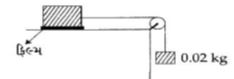
$A$ metal block of base area $0.2\; m^{2}$ is connected to a $0.02\; kg$ mass via a string that passes over an ideal pulley as shown in the figure. $A$ liquid film of thickness $0.6\; mm$ is placed between the block and the table. When released,the block moves to the right with a constant speed of $0.17\; m/s$. The coefficient of viscosity of the liquid is:
A
$3.45 \times 10^{-2} \; Pa \cdot s$
B
$3.45 \times 10^{-3} \; Pa \cdot s$
C
$3.45 \times 10^{2} \; Pa \cdot s$
D
$3.45 \times 10^{3} \; Pa \cdot s$
Solution
(B) Given: Area $A = 0.2\; m^{2}$,mass $m = 0.02\; kg$,thickness $l = 0.6\; mm = 0.6 \times 10^{-3}\; m$,velocity $v = 0.17\; m/s$,$g = 10\; m/s^{2}$.
The block moves with a constant speed,so the net force on it is zero. The tension $T$ in the string is equal to the weight of the hanging mass:
$T = m \cdot g = 0.02\; kg \times 10\; m/s^{2} = 0.2\; N$.
This tension is balanced by the viscous force $F$ acting on the block:
$F = \eta A \frac{v}{l} \implies T = \eta A \frac{v}{l}$.
Rearranging for the coefficient of viscosity $\eta$:
$\eta = \frac{T \cdot l}{A \cdot v} = \frac{0.2 \times 0.6 \times 10^{-3}}{0.2 \times 0.17}$.
$\eta = \frac{0.6 \times 10^{-3}}{0.17} \approx 3.53 \times 10^{-3} \; Pa \cdot s$.
Comparing with the given options,the closest value is $3.45 \times 10^{-3} \; Pa \cdot s$.
The block moves with a constant speed,so the net force on it is zero. The tension $T$ in the string is equal to the weight of the hanging mass:
$T = m \cdot g = 0.02\; kg \times 10\; m/s^{2} = 0.2\; N$.
This tension is balanced by the viscous force $F$ acting on the block:
$F = \eta A \frac{v}{l} \implies T = \eta A \frac{v}{l}$.
Rearranging for the coefficient of viscosity $\eta$:
$\eta = \frac{T \cdot l}{A \cdot v} = \frac{0.2 \times 0.6 \times 10^{-3}}{0.2 \times 0.17}$.
$\eta = \frac{0.6 \times 10^{-3}}{0.17} \approx 3.53 \times 10^{-3} \; Pa \cdot s$.
Comparing with the given options,the closest value is $3.45 \times 10^{-3} \; Pa \cdot s$.
1 likes
View Solution9
EasyMCQ
The relative velocity of two consecutive layers is $8 \ cm/s$. If the perpendicular distance between the layers is $0.1 \ cm$,then the velocity gradient will be ......... $s^{-1}$.
A
$8$
B
$80$
C
$0.8$
D
$0.08$
Solution
(B) The velocity gradient is defined as the rate of change of velocity with respect to the perpendicular distance between the layers,given by the formula: $\frac{dv}{dx}$.
Given:
Relative velocity $(dv)$ = $8 \ cm/s$
Perpendicular distance $(dx)$ = $0.1 \ cm$
Velocity gradient = $\frac{dv}{dx} = \frac{8 \ cm/s}{0.1 \ cm} = 80 \ s^{-1}$.
Therefore,the correct option is $B$.
Given:
Relative velocity $(dv)$ = $8 \ cm/s$
Perpendicular distance $(dx)$ = $0.1 \ cm$
Velocity gradient = $\frac{dv}{dx} = \frac{8 \ cm/s}{0.1 \ cm} = 80 \ s^{-1}$.
Therefore,the correct option is $B$.
0 likes
View Solution10
DifficultMCQ
$A$ Newtonian fluid fills the clearance between a shaft and a sleeve. When a force of $800$ $N$ is applied to the shaft,parallel to the sleeve,the shaft attains a speed of $1.5$ $cm/s$. If a force of $2.4$ $kN$ is applied instead,the shaft would move with a speed of ......... $cm/s$.
A
$1.5$
B
$13.5$
C
$4.5$
D
None
Solution
(C) According to Newton's law of viscosity,the shear stress $\tau$ is proportional to the velocity gradient $\frac{du}{dy}$.
$\tau = \mu \frac{du}{dy}$
Since $\tau = \frac{F}{A}$,where $F$ is the applied force and $A$ is the surface area,we have $\frac{F}{A} = \mu \frac{u}{y}$.
This implies $F = \left( \frac{A \mu}{y} \right) u$,which means $F \propto u$.
Therefore,$\frac{F_1}{u_1} = \frac{F_2}{u_2}$.
Given $F_1 = 800$ $N$,$u_1 = 1.5$ $cm/s$,and $F_2 = 2.4$ $kN = 2400$ $N$.
Substituting these values: $\frac{800}{1.5} = \frac{2400}{u_2}$.
Solving for $u_2$: $u_2 = \frac{2400 \times 1.5}{800} = 3 \times 1.5 = 4.5$ $cm/s$.
$\tau = \mu \frac{du}{dy}$
Since $\tau = \frac{F}{A}$,where $F$ is the applied force and $A$ is the surface area,we have $\frac{F}{A} = \mu \frac{u}{y}$.
This implies $F = \left( \frac{A \mu}{y} \right) u$,which means $F \propto u$.
Therefore,$\frac{F_1}{u_1} = \frac{F_2}{u_2}$.
Given $F_1 = 800$ $N$,$u_1 = 1.5$ $cm/s$,and $F_2 = 2.4$ $kN = 2400$ $N$.
Substituting these values: $\frac{800}{1.5} = \frac{2400}{u_2}$.
Solving for $u_2$: $u_2 = \frac{2400 \times 1.5}{800} = 3 \times 1.5 = 4.5$ $cm/s$.
0 likes
View Solution11
DifficultMCQ
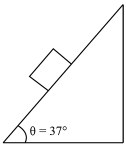
$A$ cubical block of side $a$ and density $\rho$ slides over a fixed inclined plane with constant velocity $v$. There is a thin film of viscous fluid of thickness $t$ between the plane and the block. If the angle of inclination is $37^{\circ}$,then the coefficient of viscosity of the thin film will be:
A
$\frac{3\rho a g t}{5v}$
B
$\frac{4\rho a g t}{5v}$
C
$\frac{\rho a g t}{v}$
D
None of these
Solution
(A) The block moves with a constant velocity $v$,which implies that the net force acting on the block along the inclined plane is zero.
The component of the gravitational force acting down the incline is $F_g = mg \sin \theta$.
The viscous drag force acting up the incline is given by Newton's law of viscosity: $F_v = \eta A \frac{v}{t}$,where $A = a^2$ is the contact area.
Equating the forces: $F_v = F_g$
$\eta (a^2) \frac{v}{t} = mg \sin 37^{\circ}$
Given that the mass $m = \text{density} \times \text{volume} = \rho a^3$ and $\sin 37^{\circ} = \frac{3}{5}$:
$\eta (a^2) \frac{v}{t} = (\rho a^3) g \left(\frac{3}{5}\right)$
Solving for $\eta$:
$\eta = \frac{\rho a^3 g \cdot 3}{5 \cdot a^2 \cdot v / t} = \frac{3 \rho a g t}{5 v}$
The component of the gravitational force acting down the incline is $F_g = mg \sin \theta$.
The viscous drag force acting up the incline is given by Newton's law of viscosity: $F_v = \eta A \frac{v}{t}$,where $A = a^2$ is the contact area.
Equating the forces: $F_v = F_g$
$\eta (a^2) \frac{v}{t} = mg \sin 37^{\circ}$
Given that the mass $m = \text{density} \times \text{volume} = \rho a^3$ and $\sin 37^{\circ} = \frac{3}{5}$:
$\eta (a^2) \frac{v}{t} = (\rho a^3) g \left(\frac{3}{5}\right)$
Solving for $\eta$:
$\eta = \frac{\rho a^3 g \cdot 3}{5 \cdot a^2 \cdot v / t} = \frac{3 \rho a g t}{5 v}$
0 likes
View Solution12
EasyMCQ
There is a $1$ $mm$ thick layer of glycerine between a flat plate of area $100$ $cm^2$ and a big fixed plate. If the coefficient of viscosity of glycerine is $1.0$ $kg/(m \cdot s)$,then what force in $N$ is required to move the plate with a velocity of $7$ $cm/s$?
A
$3.5$
B
$0.7$
C
$1.4$
D
None
Solution
(B) The force required to move the plate is given by Newton's law of viscosity: $F = \eta A \frac{dv}{dy}$.
Given values:
Area $A = 100 \text{ cm}^2 = 100 \times 10^{-4} \text{ m}^2 = 10^{-2} \text{ m}^2$.
Gap $dy = 1 \text{ mm} = 10^{-3} \text{ m}$.
Velocity $v = 7 \text{ cm/s} = 0.07 \text{ m/s}$.
Coefficient of viscosity $\eta = 1.0 \text{ kg/(m} \cdot \text{s)}$.
Substituting these values into the formula:
$F = 1.0 \times 10^{-2} \times \frac{0.07}{10^{-3}}$
$F = 1.0 \times 10^{-2} \times 70$
$F = 0.7 \text{ N}$.
Therefore,the required force is $0.7 \text{ N}$.
Given values:
Area $A = 100 \text{ cm}^2 = 100 \times 10^{-4} \text{ m}^2 = 10^{-2} \text{ m}^2$.
Gap $dy = 1 \text{ mm} = 10^{-3} \text{ m}$.
Velocity $v = 7 \text{ cm/s} = 0.07 \text{ m/s}$.
Coefficient of viscosity $\eta = 1.0 \text{ kg/(m} \cdot \text{s)}$.
Substituting these values into the formula:
$F = 1.0 \times 10^{-2} \times \frac{0.07}{10^{-3}}$
$F = 1.0 \times 10^{-2} \times 70$
$F = 0.7 \text{ N}$.
Therefore,the required force is $0.7 \text{ N}$.
0 likes
View Solution13
DifficultMCQ
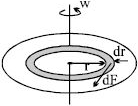
$A$ plastic circular disc of radius $R$ is placed on a thin oil film,spread over a flat horizontal surface. The torque required to spin the disc about its central vertical axis with a constant angular velocity is proportional to
A
$R^2$
B
$R^3$
C
$R^4$
D
$R^6$
Solution
(C) Let $\eta$ be the coefficient of viscosity and $x$ be the thickness of the oil film.
Consider an elemental ring of radius $r$ and width $dr$ on the disc.
The velocity of the disc at radius $r$ is $v = \omega r$.
The velocity gradient across the film is $\frac{dv}{dx} = \frac{\omega r - 0}{x} = \frac{\omega r}{x}$.
The viscous force $dF$ acting on this elemental ring is given by $dF = \eta A \frac{dv}{dx}$,where $A = 2\pi r dr$.
$dF = \eta (2\pi r dr) \frac{\omega r}{x} = \frac{2\pi \eta \omega}{x} r^2 dr$.
The torque $d\tau$ required to overcome this viscous force is $d\tau = (dF) r$.
$d\tau = \left( \frac{2\pi \eta \omega}{x} r^2 dr \right) r = \frac{2\pi \eta \omega}{x} r^3 dr$.
Integrating from $r = 0$ to $r = R$ to find the total torque $\tau$:
$\tau = \int_{0}^{R} \frac{2\pi \eta \omega}{x} r^3 dr = \frac{2\pi \eta \omega}{x} \left[ \frac{r^4}{4} \right]_{0}^{R} = \frac{\pi \eta \omega}{2x} R^4$.
Thus,the torque $\tau$ is proportional to $R^4$.
Consider an elemental ring of radius $r$ and width $dr$ on the disc.
The velocity of the disc at radius $r$ is $v = \omega r$.
The velocity gradient across the film is $\frac{dv}{dx} = \frac{\omega r - 0}{x} = \frac{\omega r}{x}$.
The viscous force $dF$ acting on this elemental ring is given by $dF = \eta A \frac{dv}{dx}$,where $A = 2\pi r dr$.
$dF = \eta (2\pi r dr) \frac{\omega r}{x} = \frac{2\pi \eta \omega}{x} r^2 dr$.
The torque $d\tau$ required to overcome this viscous force is $d\tau = (dF) r$.
$d\tau = \left( \frac{2\pi \eta \omega}{x} r^2 dr \right) r = \frac{2\pi \eta \omega}{x} r^3 dr$.
Integrating from $r = 0$ to $r = R$ to find the total torque $\tau$:
$\tau = \int_{0}^{R} \frac{2\pi \eta \omega}{x} r^3 dr = \frac{2\pi \eta \omega}{x} \left[ \frac{r^4}{4} \right]_{0}^{R} = \frac{\pi \eta \omega}{2x} R^4$.
Thus,the torque $\tau$ is proportional to $R^4$.
0 likes
View Solution14
AdvancedMCQ
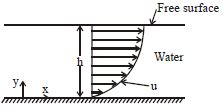
For the situation shown in the figure,water flows on the surface of a fixed plate. The velocity of water as a function of distance $y$ is given as: $u = \alpha \left[ \frac{y}{h} - 2\left( \frac{y}{h} \right)^2 \right]$. Determine the magnitude of the shear stress that the water applies at the base of the plate. The coefficient of viscosity is $\eta$.
A
$\frac{3\alpha \eta}{h}$
B
$\frac{2\alpha \eta}{h}$
C
$\frac{4\alpha \eta}{h}$
D
$\frac{\alpha \eta}{h}$
Solution
(D) According to Newton's law of viscosity,the shear stress $\tau$ is given by $\tau = \eta \frac{du}{dy}$.
Given the velocity profile $u = \alpha \left[ \frac{y}{h} - 2\left( \frac{y}{h} \right)^2 \right]$.
Differentiating $u$ with respect to $y$:
$\frac{du}{dy} = \alpha \left[ \frac{1}{h} - 2 \cdot 2 \left( \frac{y}{h} \right) \cdot \frac{1}{h} \right] = \alpha \left[ \frac{1}{h} - \frac{4y}{h^2} \right]$.
At the base of the plate,$y = 0$.
Therefore,the velocity gradient at the base is $\left( \frac{du}{dy} \right)_{y=0} = \alpha \left[ \frac{1}{h} - 0 \right] = \frac{\alpha}{h}$.
The magnitude of the shear stress at the base is $\tau = \eta \left| \frac{du}{dy} \right|_{y=0} = \eta \left( \frac{\alpha}{h} \right) = \frac{\alpha \eta}{h}$.
Given the velocity profile $u = \alpha \left[ \frac{y}{h} - 2\left( \frac{y}{h} \right)^2 \right]$.
Differentiating $u$ with respect to $y$:
$\frac{du}{dy} = \alpha \left[ \frac{1}{h} - 2 \cdot 2 \left( \frac{y}{h} \right) \cdot \frac{1}{h} \right] = \alpha \left[ \frac{1}{h} - \frac{4y}{h^2} \right]$.
At the base of the plate,$y = 0$.
Therefore,the velocity gradient at the base is $\left( \frac{du}{dy} \right)_{y=0} = \alpha \left[ \frac{1}{h} - 0 \right] = \frac{\alpha}{h}$.
The magnitude of the shear stress at the base is $\tau = \eta \left| \frac{du}{dy} \right|_{y=0} = \eta \left( \frac{\alpha}{h} \right) = \frac{\alpha \eta}{h}$.
0 likes
View Solution15
AdvancedMCQ
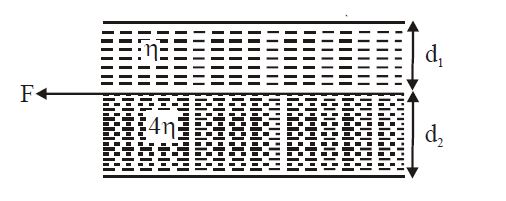
$A$ thin plate is placed between two fixed plates,separating two liquids with coefficients of viscosity $\eta$ and $4\eta$,as shown in the figure. If the plate is to be pulled by applying the minimum force,then the ratio $\frac{d_2}{d_1}$ is:
A
$1$
B
$2$
C
$3$
D
$4$
Solution
(B) Let the velocity of the thin plate be $v$ and its area be $A$. The force required to pull the plate is the sum of the viscous forces from both liquids:
$F = F_1 + F_2 = \eta A \frac{v}{d_1} + 4\eta A \frac{v}{d_2}$
Given that $d_1 + d_2 = d$ (constant total distance),we can write $d_2 = d - d_1$. Substituting this:
$F = \eta A v \left( \frac{1}{d_1} + \frac{4}{d - d_1} \right)$
To find the minimum force,we differentiate $F$ with respect to $d_1$ and set it to zero:
$\frac{dF}{dd_1} = \eta A v \left( -\frac{1}{d_1^2} + \frac{4}{(d - d_1)^2} \right) = 0$
$\frac{1}{d_1^2} = \frac{4}{(d - d_1)^2}$
Taking the square root on both sides:
$\frac{1}{d_1} = \frac{2}{d - d_1}$
$d - d_1 = 2d_1$
$d = 3d_1 \Rightarrow d_1 = \frac{d}{3}$
Then $d_2 = d - \frac{d}{3} = \frac{2d}{3}$.
Therefore,the ratio $\frac{d_2}{d_1} = \frac{2d/3}{d/3} = 2$.
$F = F_1 + F_2 = \eta A \frac{v}{d_1} + 4\eta A \frac{v}{d_2}$
Given that $d_1 + d_2 = d$ (constant total distance),we can write $d_2 = d - d_1$. Substituting this:
$F = \eta A v \left( \frac{1}{d_1} + \frac{4}{d - d_1} \right)$
To find the minimum force,we differentiate $F$ with respect to $d_1$ and set it to zero:
$\frac{dF}{dd_1} = \eta A v \left( -\frac{1}{d_1^2} + \frac{4}{(d - d_1)^2} \right) = 0$
$\frac{1}{d_1^2} = \frac{4}{(d - d_1)^2}$
Taking the square root on both sides:
$\frac{1}{d_1} = \frac{2}{d - d_1}$
$d - d_1 = 2d_1$
$d = 3d_1 \Rightarrow d_1 = \frac{d}{3}$
Then $d_2 = d - \frac{d}{3} = \frac{2d}{3}$.
Therefore,the ratio $\frac{d_2}{d_1} = \frac{2d/3}{d/3} = 2$.
0 likes
View Solution16
DifficultMCQ
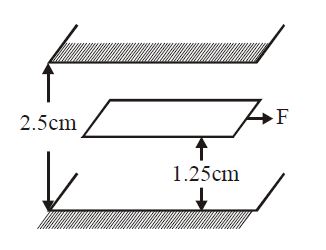
$A$ space $2.5\ cm$ wide between two large plane surfaces is filled with oil. The force required to drag a very thin plate of area $0.5\ m^2$ just midway between the surfaces at a speed of $0.5\ m/s$ is $1\ N$. The coefficient of viscosity in $kg/(m \cdot s)$ is:
A
$5 \times 10^{-2}$
B
$2.5 \times 10^{-2}$
C
$1 \times 10^{-2}$
D
$7.5 \times 10^{-2}$
Solution
(B) Given: Distance between surfaces $d = 2.5\ cm = 2.5 \times 10^{-2}\ m$. The plate is at the midway,so the distance from each surface is $dz = d/2 = 1.25 \times 10^{-2}\ m$.
Area of the plate $A = 0.5\ m^2$.
Velocity of the plate $v = 0.5\ m/s$.
Force applied $F = 1\ N$.
According to Newton's law of viscosity,the viscous force on one side of the plate is $F_{viscous} = \eta A \frac{dv}{dz}$.
Since the plate is dragged between two surfaces,the total viscous force is the sum of the forces from both sides: $F = 2 \times \eta A \frac{v}{dz}$.
Substituting the values: $1 = 2 \times \eta \times 0.5 \times \frac{0.5}{1.25 \times 10^{-2}}$.
$1 = \eta \times \frac{0.5}{1.25 \times 10^{-2}}$.
$\eta = \frac{1.25 \times 10^{-2}}{0.5} = 2.5 \times 10^{-2}\ kg/(m \cdot s)$.
Area of the plate $A = 0.5\ m^2$.
Velocity of the plate $v = 0.5\ m/s$.
Force applied $F = 1\ N$.
According to Newton's law of viscosity,the viscous force on one side of the plate is $F_{viscous} = \eta A \frac{dv}{dz}$.
Since the plate is dragged between two surfaces,the total viscous force is the sum of the forces from both sides: $F = 2 \times \eta A \frac{v}{dz}$.
Substituting the values: $1 = 2 \times \eta \times 0.5 \times \frac{0.5}{1.25 \times 10^{-2}}$.
$1 = \eta \times \frac{0.5}{1.25 \times 10^{-2}}$.
$\eta = \frac{1.25 \times 10^{-2}}{0.5} = 2.5 \times 10^{-2}\ kg/(m \cdot s)$.
0 likes
View Solution17
AdvancedMCQ
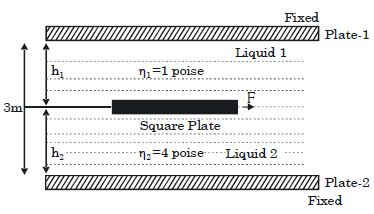
$A$ thin square plate of side $2\ m$ is moving at the interface of two very viscous liquids of viscosities $\eta_1 = 1 \text{ poise}$ and $\eta_2 = 4 \text{ poise}$ respectively, as shown in the figure. Assume a linear velocity distribution in each fluid. The liquids are contained between two fixed plates. $h_1 + h_2 = 3\ m$. $A$ force $F$ is required to move the square plate with a uniform velocity $10\ m/s$ horizontally. The value of the minimum applied force will be ........ $N$.
A
$6$
B
$12$
C
$24$
D
$40$
Solution
(B) The viscous force $F$ required to move the plate is the sum of the viscous drag forces from both liquids. The formula for viscous force is $F = \eta A \frac{dv}{dx}$.
Given: side of square plate $L = 2\ m$, so area $A = L^2 = 4\ m^2$. Velocity $v = 10\ m/s$. Viscosities in $SI$ units: $\eta_1 = 1 \text{ poise} = 0.1 \text{ Pa} \cdot \text{s}$ and $\eta_2 = 4 \text{ poise} = 0.4 \text{ Pa} \cdot \text{s}$.
Total force $F = F_1 + F_2 = \eta_1 A \frac{v}{h_1} + \eta_2 A \frac{v}{h_2}$.
Substituting the values: $F = 0.1 \times 4 \times \frac{10}{h_1} + 0.4 \times 4 \times \frac{10}{h_2} = \frac{4}{h_1} + \frac{16}{h_2}$.
Since $h_1 + h_2 = 3$, we have $h_1 = 3 - h_2$. Thus, $F(h_2) = \frac{4}{3 - h_2} + \frac{16}{h_2}$.
To find the minimum force, set $\frac{dF}{dh_2} = 0$:
$\frac{d}{dh_2} [4(3 - h_2)^{-1} + 16(h_2)^{-1}] = 4(3 - h_2)^{-2} - 16(h_2)^{-2} = 0$.
$\frac{4}{(3 - h_2)^2} = \frac{16}{h_2^2} \implies \frac{1}{(3 - h_2)^2} = \frac{4}{h_2^2}$.
Taking the square root: $\frac{1}{3 - h_2} = \frac{2}{h_2} \implies h_2 = 6 - 2h_2 \implies 3h_2 = 6 \implies h_2 = 2\ m$.
Then $h_1 = 3 - 2 = 1\ m$.
Substituting back: $F_{\min} = \frac{4}{1} + \frac{16}{2} = 4 + 8 = 12\ N$.
Given: side of square plate $L = 2\ m$, so area $A = L^2 = 4\ m^2$. Velocity $v = 10\ m/s$. Viscosities in $SI$ units: $\eta_1 = 1 \text{ poise} = 0.1 \text{ Pa} \cdot \text{s}$ and $\eta_2 = 4 \text{ poise} = 0.4 \text{ Pa} \cdot \text{s}$.
Total force $F = F_1 + F_2 = \eta_1 A \frac{v}{h_1} + \eta_2 A \frac{v}{h_2}$.
Substituting the values: $F = 0.1 \times 4 \times \frac{10}{h_1} + 0.4 \times 4 \times \frac{10}{h_2} = \frac{4}{h_1} + \frac{16}{h_2}$.
Since $h_1 + h_2 = 3$, we have $h_1 = 3 - h_2$. Thus, $F(h_2) = \frac{4}{3 - h_2} + \frac{16}{h_2}$.
To find the minimum force, set $\frac{dF}{dh_2} = 0$:
$\frac{d}{dh_2} [4(3 - h_2)^{-1} + 16(h_2)^{-1}] = 4(3 - h_2)^{-2} - 16(h_2)^{-2} = 0$.
$\frac{4}{(3 - h_2)^2} = \frac{16}{h_2^2} \implies \frac{1}{(3 - h_2)^2} = \frac{4}{h_2^2}$.
Taking the square root: $\frac{1}{3 - h_2} = \frac{2}{h_2} \implies h_2 = 6 - 2h_2 \implies 3h_2 = 6 \implies h_2 = 2\ m$.
Then $h_1 = 3 - 2 = 1\ m$.
Substituting back: $F_{\min} = \frac{4}{1} + \frac{16}{2} = 4 + 8 = 12\ N$.
0 likes
View Solution18
EasyMCQ
$A$ flat plate of area $10 \, cm^2$ is separated from a large plate by a layer of glycerine $1 \, mm$ thick. If the coefficient of viscosity of glycerine is $20 \, \text{poise}$, the force required to keep the plate moving with a velocity of $1 \, cm/s$ is .......... $dyne$.
A
$80$
B
$200$
C
$800$
D
$2000$
Solution
(D) According to Newton's law of viscosity, the viscous force $F$ is given by $F = \eta A \frac{dv}{dy}$.
Here, area $A = 10 \, cm^2$, velocity gradient $\frac{dv}{dy} = \frac{v}{y} = \frac{1 \, cm/s}{1 \, mm} = \frac{1 \, cm/s}{0.1 \, cm} = 10 \, s^{-1}$.
The coefficient of viscosity $\eta = 20 \, \text{poise} = 20 \, dyne \cdot s/cm^2$.
Substituting the values: $F = 20 \times 10 \times 10 = 2000 \, dyne$.
Here, area $A = 10 \, cm^2$, velocity gradient $\frac{dv}{dy} = \frac{v}{y} = \frac{1 \, cm/s}{1 \, mm} = \frac{1 \, cm/s}{0.1 \, cm} = 10 \, s^{-1}$.
The coefficient of viscosity $\eta = 20 \, \text{poise} = 20 \, dyne \cdot s/cm^2$.
Substituting the values: $F = 20 \times 10 \times 10 = 2000 \, dyne$.
0 likes
View Solution19
MediumMCQ
The velocity of water in a river is $18\, km/h$ near the surface. If the river is $5\, m$ deep,find the shearing stress between the horizontal layers of water. The coefficient of viscosity of water is $\eta = 10^{-2}\, \text{poise}$.
A
$10^{-1}\, N/m^2$
B
$10^{-2}\, N/m^2$
C
$10^{-3}\, N/m^2$
D
$10^{-4}\, N/m^2$
Solution
(C) Given:
Velocity $v = 18\, km/h = 18 \times \frac{5}{18} = 5\, m/s$.
Depth $l = 5\, m$.
Coefficient of viscosity $\eta = 10^{-2}\, \text{poise} = 10^{-2} \times 0.1\, N\cdot s/m^2 = 10^{-3}\, N\cdot s/m^2$.
The velocity gradient (strain rate) is given by $\frac{dv}{dx} = \frac{v}{l} = \frac{5\, m/s}{5\, m} = 1\, s^{-1}$.
According to Newton's law of viscosity,the shearing stress $\tau$ is given by:
$\tau = \eta \times \frac{dv}{dx}$.
Substituting the values:
$\tau = 10^{-3}\, N\cdot s/m^2 \times 1\, s^{-1} = 10^{-3}\, N/m^2$.
Therefore,the correct option is $C$.
Velocity $v = 18\, km/h = 18 \times \frac{5}{18} = 5\, m/s$.
Depth $l = 5\, m$.
Coefficient of viscosity $\eta = 10^{-2}\, \text{poise} = 10^{-2} \times 0.1\, N\cdot s/m^2 = 10^{-3}\, N\cdot s/m^2$.
The velocity gradient (strain rate) is given by $\frac{dv}{dx} = \frac{v}{l} = \frac{5\, m/s}{5\, m} = 1\, s^{-1}$.
According to Newton's law of viscosity,the shearing stress $\tau$ is given by:
$\tau = \eta \times \frac{dv}{dx}$.
Substituting the values:
$\tau = 10^{-3}\, N\cdot s/m^2 \times 1\, s^{-1} = 10^{-3}\, N/m^2$.
Therefore,the correct option is $C$.
0 likes
View Solution20
MediumMCQ
$A$ river $10\,m$ deep is flowing at $5\,m/s$. The shearing stress between horizontal layers of the river is :- $(\eta = 10^{-3}\,SI\,unit)$
A
$10^{-3}\,N/m^2$
B
$0.8\times 10^{-3}\,N/m^2$
C
$0.5\times 10^{-3}\,N/m^2$
D
$1\,N/m^2$
Solution
(C) The shearing stress $\tau$ is given by the formula: $\tau = \eta \frac{dv}{dy}$.
Here,$\eta = 10^{-3}\,SI\,unit$ is the coefficient of viscosity.
The velocity gradient $\frac{dv}{dy}$ can be approximated as $\frac{v}{h}$,where $v = 5\,m/s$ is the velocity and $h = 10\,m$ is the depth of the river.
Substituting the values:
$\tau = 10^{-3} \times \frac{5}{10}$
$\tau = 10^{-3} \times 0.5$
$\tau = 0.5 \times 10^{-3}\,N/m^2$.
Here,$\eta = 10^{-3}\,SI\,unit$ is the coefficient of viscosity.
The velocity gradient $\frac{dv}{dy}$ can be approximated as $\frac{v}{h}$,where $v = 5\,m/s$ is the velocity and $h = 10\,m$ is the depth of the river.
Substituting the values:
$\tau = 10^{-3} \times \frac{5}{10}$
$\tau = 10^{-3} \times 0.5$
$\tau = 0.5 \times 10^{-3}\,N/m^2$.
0 likes
View Solution21
MediumMCQ
There is a $1\, mm$ thick layer of glycerine between a flat plate of area $100\, cm^2$ and a big plate. If the coefficient of viscosity of glycerine is $1.0\, kg/(m\cdot s)$,then the force required to move the plate with a velocity of $7\, cm/s$ is $.......\, N$.
A
$0.7$
B
$0.1$
C
$0.2$
D
$0.6$
Solution
(A) To move the plate with a constant velocity,the applied force must be equal to the viscous drag force.
The formula for viscous force is $F = \eta A \frac{\Delta v}{\Delta z}$.
Given values:
Coefficient of viscosity $\eta = 1.0\, kg/(m\cdot s)$.
Area $A = 100\, cm^2 = 100 \times 10^{-4}\, m^2 = 10^{-2}\, m^2$.
Velocity gradient $\frac{\Delta v}{\Delta z} = \frac{7\, cm/s}{1\, mm} = \frac{7 \times 10^{-2}\, m/s}{10^{-3}\, m} = 70\, s^{-1}$.
Substituting these values into the formula:
$F = 1.0 \times 10^{-2} \times 70 = 0.7\, N$.
Therefore,the force required is $0.7\, N$.
The formula for viscous force is $F = \eta A \frac{\Delta v}{\Delta z}$.
Given values:
Coefficient of viscosity $\eta = 1.0\, kg/(m\cdot s)$.
Area $A = 100\, cm^2 = 100 \times 10^{-4}\, m^2 = 10^{-2}\, m^2$.
Velocity gradient $\frac{\Delta v}{\Delta z} = \frac{7\, cm/s}{1\, mm} = \frac{7 \times 10^{-2}\, m/s}{10^{-3}\, m} = 70\, s^{-1}$.
Substituting these values into the formula:
$F = 1.0 \times 10^{-2} \times 70 = 0.7\, N$.
Therefore,the force required is $0.7\, N$.
0 likes
View Solution22
DifficultMCQ
$A$ cubical block of side $a$ and density $\rho$ slides over a fixed inclined plane with constant velocity $v$. There is a thin film of viscous fluid of thickness $t$ between the plane and the block. Then the coefficient of viscosity of the thin film will be

A
$\frac{\rho agt \sin \theta}{v}$
B
$\frac{\rho agt \cos \theta}{v}$
C
$\frac{v}{\rho agt \sin \theta}$
D
None of these
Solution
(A) Since the block moves with constant velocity,the net force acting on it is zero.
The component of the gravitational force acting down the incline is $F = mg \sin \theta$.
Here,$m = \rho V = \rho a^3$,so $F = \rho a^3 g \sin \theta$.
According to Newton's law of viscosity,the viscous force is $F = \eta A \left(\frac{dv}{dx}\right)$,where $A = a^2$ is the contact area and $\frac{dv}{dx} = \frac{v}{t}$ is the velocity gradient.
Equating the forces: $\rho a^3 g \sin \theta = \eta a^2 \left(\frac{v}{t}\right)$.
Solving for the coefficient of viscosity $\eta$: $\eta = \frac{\rho a^3 g \sin \theta \cdot t}{a^2 v} = \frac{\rho agt \sin \theta}{v}$.
The component of the gravitational force acting down the incline is $F = mg \sin \theta$.
Here,$m = \rho V = \rho a^3$,so $F = \rho a^3 g \sin \theta$.
According to Newton's law of viscosity,the viscous force is $F = \eta A \left(\frac{dv}{dx}\right)$,where $A = a^2$ is the contact area and $\frac{dv}{dx} = \frac{v}{t}$ is the velocity gradient.
Equating the forces: $\rho a^3 g \sin \theta = \eta a^2 \left(\frac{v}{t}\right)$.
Solving for the coefficient of viscosity $\eta$: $\eta = \frac{\rho a^3 g \sin \theta \cdot t}{a^2 v} = \frac{\rho agt \sin \theta}{v}$.
0 likes
View Solution23
EasyMCQ
$Assertion :$ Machine parts are jammed in winter.
$Reason :$ The viscosity of lubricant used in machine parts increases at low temperatures.
$Reason :$ The viscosity of lubricant used in machine parts increases at low temperatures.
A
If both Assertion and Reason are correct and the Reason is a correct explanation of the Assertion.
B
If both Assertion and Reason are correct but Reason is not a correct explanation of the Assertion.
C
If the Assertion is correct but Reason is incorrect.
D
If both the Assertion and Reason are incorrect.
Solution
(A) The viscosity of a liquid is inversely proportional to its temperature. As the temperature decreases,the viscosity of the lubricant increases.
According to Newton's law of viscosity,the viscous drag force is given by $F = -\eta A \frac{dv}{dx}$,where $\eta$ is the coefficient of viscosity.
Since the viscosity $\eta$ increases at low temperatures (in winter),the viscous drag force increases significantly.
This increased resistance makes it difficult for the machine parts to move,causing them to jam.
Therefore,both the Assertion and the Reason are correct,and the Reason is the correct explanation of the Assertion.
According to Newton's law of viscosity,the viscous drag force is given by $F = -\eta A \frac{dv}{dx}$,where $\eta$ is the coefficient of viscosity.
Since the viscosity $\eta$ increases at low temperatures (in winter),the viscous drag force increases significantly.
This increased resistance makes it difficult for the machine parts to move,causing them to jam.
Therefore,both the Assertion and the Reason are correct,and the Reason is the correct explanation of the Assertion.
0 likes
View Solution24
MediumMCQ
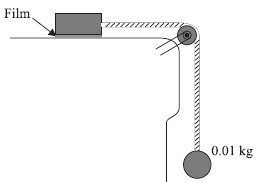
$A$ metal block of area $0.10 \; m^2$ is connected to a $0.010 \; kg$ mass via a string that passes over an ideal pulley (considered massless and frictionless),as shown in the figure. $A$ liquid with a film thickness of $0.30 \; mm$ is placed between the block and the table. When released,the block moves to the right with a constant speed of $0.085 \; m s^{-1}$. Find the coefficient of viscosity of the liquid.
A
$3.46 \times 10^{-3} \; Pa \; s$
B
$4.67 \times 10^{-2} \; Pa \; s$
C
$2.76 \times 10^{-4} \; Pa \; s$
D
$9.45 \times 10^{-2} \; Pa \; s$
Solution
(A) The metal block moves to the right due to the tension in the string. Since the block moves at a constant speed,the net force on it is zero. The tension $T$ in the string is equal to the weight of the suspended mass $m$.
$T = m g = 0.010 \; kg \times 9.8 \; m s^{-2} = 0.098 \; N$
This tension is balanced by the viscous drag force $F$ acting on the block.
$F = \eta A \frac{dv}{dx}$
Where $\eta$ is the coefficient of viscosity,$A = 0.10 \; m^2$ is the area,$v = 0.085 \; m s^{-1}$ is the velocity,and $dx = 0.30 \; mm = 0.30 \times 10^{-3} \; m$ is the film thickness.
Rearranging for $\eta$:
$\eta = \frac{F \cdot dx}{A \cdot v}$
$\eta = \frac{(0.098 \; N) \times (0.30 \times 10^{-3} \; m)}{(0.10 \; m^2) \times (0.085 \; m s^{-1})}$
$\eta = \frac{0.0294 \times 10^{-3}}{0.0085} \; Pa \; s$
$\eta \approx 3.46 \times 10^{-3} \; Pa \; s$
$T = m g = 0.010 \; kg \times 9.8 \; m s^{-2} = 0.098 \; N$
This tension is balanced by the viscous drag force $F$ acting on the block.
$F = \eta A \frac{dv}{dx}$
Where $\eta$ is the coefficient of viscosity,$A = 0.10 \; m^2$ is the area,$v = 0.085 \; m s^{-1}$ is the velocity,and $dx = 0.30 \; mm = 0.30 \times 10^{-3} \; m$ is the film thickness.
Rearranging for $\eta$:
$\eta = \frac{F \cdot dx}{A \cdot v}$
$\eta = \frac{(0.098 \; N) \times (0.30 \times 10^{-3} \; m)}{(0.10 \; m^2) \times (0.085 \; m s^{-1})}$
$\eta = \frac{0.0294 \times 10^{-3}}{0.0085} \; Pa \; s$
$\eta \approx 3.46 \times 10^{-3} \; Pa \; s$
0 likes
View Solution25
EasyMCQ
How many times is the shearing stress of a fluid compared to the shearing stress of a solid when subjected to the same deformation?
A
Zero
B
Infinite
C
Equal
D
Half
Solution
(A) solid can sustain a shearing stress by undergoing a small,finite deformation (shear strain).
However,a fluid at rest cannot sustain any shearing stress.
If a fluid is subjected to a shearing stress,it will continue to deform (flow) as long as the stress is applied.
Therefore,the shearing stress of a fluid at rest is $0$.
However,a fluid at rest cannot sustain any shearing stress.
If a fluid is subjected to a shearing stress,it will continue to deform (flow) as long as the stress is applied.
Therefore,the shearing stress of a fluid at rest is $0$.
0 likes
View Solution26
EasyMCQ
What is the value of the shear modulus of sulfuric acid?
A
Infinity
B
Zero
C
Positive
D
Negative
Solution
(B) The shear modulus (also known as the modulus of rigidity) is defined only for solids because it measures the resistance of a material to shear deformation. Fluids,such as liquids (like sulfuric acid) and gases,cannot sustain a shear stress because they flow when subjected to it. Therefore,the shear modulus for any fluid is $0$.
0 likes
View Solution27
Medium
What is viscosity? What is the cause of it?
Solution
(N/A) Viscosity is the property of a fluid by virtue of which it opposes the relative motion between its adjacent layers.
Cause of Viscosity:
In a laminar flow,any two consecutive layers of a fluid have a relative velocity between them. Due to this relative motion,a resistive force is produced tangentially at the surface of the layers in contact. This internal frictional force is known as the viscous force.
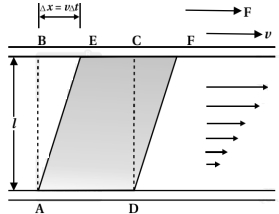
Consider a fluid (like oil) enclosed between two parallel glass plates. The bottom plate is fixed,while the top plate is moved with a constant velocity $v$ relative to the fixed plate.
The fluid layer in contact with a surface has the same velocity as that surface. Thus,the layer of liquid in contact with the top plate moves with velocity $v$,and the layer in contact with the bottom (stationary) plate has zero velocity.
The velocities of different layers increase uniformly from the bottom to the top (from $0$ to $v$).
For any layer of liquid,the upper layer pulls it forward,while the lower layer pulls it backward. This interaction results in a resistive force between the layers,which is the cause of viscosity.
Cause of Viscosity:
In a laminar flow,any two consecutive layers of a fluid have a relative velocity between them. Due to this relative motion,a resistive force is produced tangentially at the surface of the layers in contact. This internal frictional force is known as the viscous force.
Consider a fluid (like oil) enclosed between two parallel glass plates. The bottom plate is fixed,while the top plate is moved with a constant velocity $v$ relative to the fixed plate.
The fluid layer in contact with a surface has the same velocity as that surface. Thus,the layer of liquid in contact with the top plate moves with velocity $v$,and the layer in contact with the bottom (stationary) plate has zero velocity.
The velocities of different layers increase uniformly from the bottom to the top (from $0$ to $v$).
For any layer of liquid,the upper layer pulls it forward,while the lower layer pulls it backward. This interaction results in a resistive force between the layers,which is the cause of viscosity.
0 likes
View Solution28
Difficult
Explain velocity gradient and coefficient of viscosity and give their units.
Solution
(N/A) $1$. Velocity Gradient: When a fluid flows over a fixed surface,the velocity of the fluid layers increases with distance from the surface. The rate of change of velocity $(v)$ with respect to the perpendicular distance $(z)$ from the fixed surface is called the velocity gradient. It is given by $\frac{dv}{dz}$. Its $SI$ unit is $s^{-1}$.
$2$. Coefficient of Viscosity: According to Newton's law of viscosity,the viscous force $(F)$ acting between two layers of a fluid is directly proportional to the area of contact $(A)$ and the velocity gradient $(\frac{dv}{dz})$. Thus,$F = \eta A \frac{dv}{dz}$,where $\eta$ is the coefficient of viscosity. It is defined as the tangential force per unit area required to maintain a unit velocity gradient between two parallel layers of fluid. Its $SI$ unit is $Pa \cdot s$ or $N \cdot s/m^2$ (also known as Poiseuille).
$2$. Coefficient of Viscosity: According to Newton's law of viscosity,the viscous force $(F)$ acting between two layers of a fluid is directly proportional to the area of contact $(A)$ and the velocity gradient $(\frac{dv}{dz})$. Thus,$F = \eta A \frac{dv}{dz}$,where $\eta$ is the coefficient of viscosity. It is defined as the tangential force per unit area required to maintain a unit velocity gradient between two parallel layers of fluid. Its $SI$ unit is $Pa \cdot s$ or $N \cdot s/m^2$ (also known as Poiseuille).
0 likes
View Solution29
Easy
Explain the velocity gradient and the coefficient of viscosity,and provide their units.
Solution
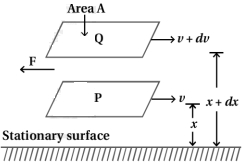
(N/A) Consider a laminar flow over a horizontal surface as shown in the figure.
Suppose two layers $P$ and $Q$ are at distances $x$ and $x+dx$ from the stationary surface.
The velocity difference between these two layers separated by a distance $dx$ is $dv$.
The ratio $\frac{dv}{dx}$ is known as the velocity gradient.
Velocity Gradient: The rate of change of velocity with respect to distance perpendicular to the direction of flow is called the velocity gradient. Its $SI$ unit is $s^{-1}$.
The viscous force $F$ between two layers depends on the following factors:
$(1)$ It is directly proportional to the area $A$ of the contact surface: $F \propto A$.
$(2)$ It is directly proportional to the velocity gradient: $F \propto \frac{dv}{dx}$.
Combining these,we get $F \propto A \frac{dv}{dx}$,which leads to $F = -\eta A \frac{dv}{dx}$.
Here,$\eta$ is the coefficient of viscosity. The negative sign indicates that the viscous force acts in the direction opposite to the relative motion of the layers.
The $SI$ unit of $\eta$ is $N \cdot s \cdot m^{-2}$ or $Pa \cdot s$ (Pascal-second).
Suppose two layers $P$ and $Q$ are at distances $x$ and $x+dx$ from the stationary surface.
The velocity difference between these two layers separated by a distance $dx$ is $dv$.
The ratio $\frac{dv}{dx}$ is known as the velocity gradient.
Velocity Gradient: The rate of change of velocity with respect to distance perpendicular to the direction of flow is called the velocity gradient. Its $SI$ unit is $s^{-1}$.
The viscous force $F$ between two layers depends on the following factors:
$(1)$ It is directly proportional to the area $A$ of the contact surface: $F \propto A$.
$(2)$ It is directly proportional to the velocity gradient: $F \propto \frac{dv}{dx}$.
Combining these,we get $F \propto A \frac{dv}{dx}$,which leads to $F = -\eta A \frac{dv}{dx}$.
Here,$\eta$ is the coefficient of viscosity. The negative sign indicates that the viscous force acts in the direction opposite to the relative motion of the layers.
The $SI$ unit of $\eta$ is $N \cdot s \cdot m^{-2}$ or $Pa \cdot s$ (Pascal-second).
0 likes
View Solution30
Medium
Discuss the coefficient of viscosity in terms of stress and strain.
Solution
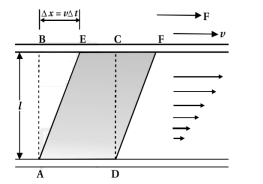
(N/A) The figure shows the laminar flow of a fluid between two parallel plates.
The fluid is placed between two glass plates. The bottom plate is stationary,so the fluid layer in contact with it is also at rest.
The top plate moves with a velocity $v$,causing the fluid layer in contact with it to move with the same velocity $v$.
Due to this motion,the fluid initially in the shape $ABCD$ takes the shape $AEFD$ after a small time interval $\Delta t$.
During this process,the shear strain produced is $\frac{\Delta x}{l}$. As the top plate continues to move,this strain increases continuously with time.
In this case,the stress depends not on the strain itself,but on the rate of change of strain,which is $\frac{(\Delta x / l)}{\Delta t} = \frac{\Delta x}{l \Delta t} = \frac{v}{l}$ (where $\frac{\Delta x}{\Delta t} = v$ is the velocity).
Here,the shear stress is $\frac{F}{A}$,where $A$ is the area of the contact surface and $F$ is the tangential viscous force.
For a fluid,the coefficient of viscosity $\eta$ is defined as:
$\eta = \frac{\text{Shear Stress}}{\text{Rate of Shear Strain}}$
$\therefore \eta = \frac{(F / A)}{(v / l)} = \frac{Fl}{vA}$
Or,$F = \eta A \left(\frac{v}{l}\right)$.
The fluid is placed between two glass plates. The bottom plate is stationary,so the fluid layer in contact with it is also at rest.
The top plate moves with a velocity $v$,causing the fluid layer in contact with it to move with the same velocity $v$.
Due to this motion,the fluid initially in the shape $ABCD$ takes the shape $AEFD$ after a small time interval $\Delta t$.
During this process,the shear strain produced is $\frac{\Delta x}{l}$. As the top plate continues to move,this strain increases continuously with time.
In this case,the stress depends not on the strain itself,but on the rate of change of strain,which is $\frac{(\Delta x / l)}{\Delta t} = \frac{\Delta x}{l \Delta t} = \frac{v}{l}$ (where $\frac{\Delta x}{\Delta t} = v$ is the velocity).
Here,the shear stress is $\frac{F}{A}$,where $A$ is the area of the contact surface and $F$ is the tangential viscous force.
For a fluid,the coefficient of viscosity $\eta$ is defined as:
$\eta = \frac{\text{Shear Stress}}{\text{Rate of Shear Strain}}$
$\therefore \eta = \frac{(F / A)}{(v / l)} = \frac{Fl}{vA}$
Or,$F = \eta A \left(\frac{v}{l}\right)$.
0 likes
View Solution31
Medium
What is viscous force? On what factors does viscous force depend?
Solution
(N/A) Viscous force is the internal frictional force that acts between the layers of a fluid in motion,opposing the relative motion between them.
According to Newton's law of viscosity,the viscous force $F$ between two layers of a fluid is given by $F = -\eta A \frac{dv}{dx}$,where:
$1$. $\eta$ is the coefficient of viscosity of the fluid.
$2$. $A$ is the area of contact between the layers.
$3$. $\frac{dv}{dx}$ is the velocity gradient,which represents the change in velocity with respect to the distance perpendicular to the flow.
Thus,the viscous force depends on the nature of the fluid (viscosity),the surface area of the layers,and the velocity gradient.
According to Newton's law of viscosity,the viscous force $F$ between two layers of a fluid is given by $F = -\eta A \frac{dv}{dx}$,where:
$1$. $\eta$ is the coefficient of viscosity of the fluid.
$2$. $A$ is the area of contact between the layers.
$3$. $\frac{dv}{dx}$ is the velocity gradient,which represents the change in velocity with respect to the distance perpendicular to the flow.
Thus,the viscous force depends on the nature of the fluid (viscosity),the surface area of the layers,and the velocity gradient.
0 likes
View Solution32
EasyMCQ
When stirring with a spoon is stopped in milk,it comes to rest after some time. Why?
A
Due to the inertia of the milk.
B
Due to the viscosity of the milk.
C
Due to the surface tension of the milk.
D
Due to the density of the milk.
Solution
(B) When milk is stirred,the different layers of the liquid move with different velocities,creating a velocity gradient between them.
According to the property of viscosity,a fluid exerts an internal frictional force that opposes the relative motion between adjacent layers.
This viscous drag force acts in the direction opposite to the flow,gradually dissipating the kinetic energy of the liquid into heat.
Consequently,the milk eventually comes to rest.
According to the property of viscosity,a fluid exerts an internal frictional force that opposes the relative motion between adjacent layers.
This viscous drag force acts in the direction opposite to the flow,gradually dissipating the kinetic energy of the liquid into heat.
Consequently,the milk eventually comes to rest.
0 likes
View Solution33
Medium
Define velocity gradient and give its unit. Also,write the dimensional formula of the velocity gradient.
Solution
(N/A) The velocity gradient is defined as the rate of change of velocity with respect to the distance perpendicular to the direction of flow.
Mathematically,it is expressed as $\frac{dv}{dx}$,where $dv$ is the change in velocity and $dx$ is the change in distance.
The $SI$ unit of velocity gradient is $\text{per second}$ $(s^{-1})$.
The dimensional formula is calculated as: $\frac{[LT^{-1}]}{[L]} = [M^0L^0T^{-1}]$.
Mathematically,it is expressed as $\frac{dv}{dx}$,where $dv$ is the change in velocity and $dx$ is the change in distance.
The $SI$ unit of velocity gradient is $\text{per second}$ $(s^{-1})$.
The dimensional formula is calculated as: $\frac{[LT^{-1}]}{[L]} = [M^0L^0T^{-1}]$.
0 likes
View Solution34
Medium
How does the coefficient of viscosity of a liquid and a gas depend on temperature?
Solution
(N/A) The coefficient of viscosity of a liquid decreases,while that of a gas increases,with an increase in temperature.
This difference arises because the mechanism of viscosity in gases is based on molecular momentum exchange,whereas in liquids,it is based on cohesive forces.
$\Rightarrow$ In gases,an increase in temperature leads to higher molecular kinetic energy and increased molecular momentum exchange,which results in an increase in viscosity.
$\Rightarrow$ In liquids,an increase in temperature weakens the intermolecular cohesive forces,which leads to a decrease in viscosity.
This difference arises because the mechanism of viscosity in gases is based on molecular momentum exchange,whereas in liquids,it is based on cohesive forces.
$\Rightarrow$ In gases,an increase in temperature leads to higher molecular kinetic energy and increased molecular momentum exchange,which results in an increase in viscosity.
$\Rightarrow$ In liquids,an increase in temperature weakens the intermolecular cohesive forces,which leads to a decrease in viscosity.
0 likes
View Solution35
Medium
Define the coefficient of viscosity.
Solution
(N/A) The coefficient of viscosity,denoted by the Greek letter $\eta$ (eta),is a measure of a fluid's resistance to flow or deformation under shear stress.
According to Newton's law of viscosity,the viscous force $F$ acting between two layers of a fluid is given by $F = \eta A \frac{dv}{dx}$,where $A$ is the area of contact,and $\frac{dv}{dx}$ is the velocity gradient.
Rearranging the formula,we get $\eta = \frac{F}{A(dv/dx)}$.
Thus,the coefficient of viscosity is defined as the tangential force per unit area required to maintain a unit velocity gradient between two parallel layers of a fluid.
The $SI$ unit of the coefficient of viscosity is $\text{Pa} \cdot \text{s}$ or $\text{N} \cdot \text{s/m}^2$ (also known as Poiseuille,$\text{Pl}$).
According to Newton's law of viscosity,the viscous force $F$ acting between two layers of a fluid is given by $F = \eta A \frac{dv}{dx}$,where $A$ is the area of contact,and $\frac{dv}{dx}$ is the velocity gradient.
Rearranging the formula,we get $\eta = \frac{F}{A(dv/dx)}$.
Thus,the coefficient of viscosity is defined as the tangential force per unit area required to maintain a unit velocity gradient between two parallel layers of a fluid.
The $SI$ unit of the coefficient of viscosity is $\text{Pa} \cdot \text{s}$ or $\text{N} \cdot \text{s/m}^2$ (also known as Poiseuille,$\text{Pl}$).
0 likes
View Solution36
Medium
Write $SI$ and $CGS$ unit of coefficient of viscosity.
Solution
(N/A) The coefficient of viscosity $\eta$ is defined by the relation $F = \eta A \frac{dv}{dx}$,where $F$ is the viscous force,$A$ is the area,and $\frac{dv}{dx}$ is the velocity gradient.
Rearranging for $\eta$,we get $\eta = \frac{F}{A (dv/dx)}$.
In $SI$ units,the unit of force is $N$,area is $m^2$,and velocity gradient is $s^{-1}$. Thus,the $SI$ unit is $\frac{N}{m^2 \cdot s^{-1}} = N \cdot s \cdot m^{-2} = Pa \cdot s$ (Pascal-second) or $kg \cdot m^{-1} \cdot s^{-1}$.
In $CGS$ units,the unit of force is $dyne$,area is $cm^2$,and velocity gradient is $s^{-1}$. Thus,the $CGS$ unit is $\frac{dyne}{cm^2 \cdot s^{-1}} = dyne \cdot s \cdot cm^{-2}$,which is also known as $Poise$ $(P)$.
Conversion: $1 \text{ } Pa \cdot s = 10 \text{ } Poise$.
Rearranging for $\eta$,we get $\eta = \frac{F}{A (dv/dx)}$.
In $SI$ units,the unit of force is $N$,area is $m^2$,and velocity gradient is $s^{-1}$. Thus,the $SI$ unit is $\frac{N}{m^2 \cdot s^{-1}} = N \cdot s \cdot m^{-2} = Pa \cdot s$ (Pascal-second) or $kg \cdot m^{-1} \cdot s^{-1}$.
In $CGS$ units,the unit of force is $dyne$,area is $cm^2$,and velocity gradient is $s^{-1}$. Thus,the $CGS$ unit is $\frac{dyne}{cm^2 \cdot s^{-1}} = dyne \cdot s \cdot cm^{-2}$,which is also known as $Poise$ $(P)$.
Conversion: $1 \text{ } Pa \cdot s = 10 \text{ } Poise$.
0 likes
View Solution37
Medium
Write one practical use of viscosity.
Solution
(N/A) One practical use of viscosity is in the lubrication of machinery. Lubricating oils with appropriate viscosity are used in engines and machines to reduce friction between moving parts,thereby preventing wear and tear and improving efficiency.
0 likes
View Solution38
Medium
Hot liquids flow more easily than cold liquids. Give the reason.
Solution
(N/A) The viscosity of a liquid is defined by its coefficient of viscosity,denoted by $\eta$.
As the temperature of a liquid increases,the intermolecular forces of attraction decrease.
Consequently,the coefficient of viscosity $\eta$ decreases for hot liquids.
Since the viscous drag force between consecutive layers is given by $F = -\eta A \frac{dv}{dx}$,a lower value of $\eta$ results in a smaller viscous force.
Therefore,hot liquids experience less internal resistance and flow more easily than cold liquids.
As the temperature of a liquid increases,the intermolecular forces of attraction decrease.
Consequently,the coefficient of viscosity $\eta$ decreases for hot liquids.
Since the viscous drag force between consecutive layers is given by $F = -\eta A \frac{dv}{dx}$,a lower value of $\eta$ results in a smaller viscous force.
Therefore,hot liquids experience less internal resistance and flow more easily than cold liquids.
0 likes
View Solution39
Medium
Why do machine parts become sticky in winter?
Solution
(N/A) In winter,the ambient temperature decreases. As the temperature of the lubricating oil drops,its viscosity increases significantly. This increase in viscosity makes the oil thicker and more resistant to flow,which creates greater internal friction between the moving surfaces of the machine. Consequently,the machine parts do not move easily and appear to become sticky.
0 likes
View Solution40
Medium
The flow of water in a river at the banks is slower than at the middle of the river. Explain.
Solution
(N/A) The flow of water in a river is governed by the property of viscosity.
$1$. Near the banks,the water molecules experience adhesive forces between the water and the solid surface of the river bank.
$2$. These adhesive forces create a resistive force (viscous drag) that opposes the motion of the water,causing the velocity to decrease significantly near the banks.
$3$. In the middle of the river,the water molecules are far from the banks,so the effect of adhesive forces is minimal.
$4$. Consequently,the velocity of the water flow is higher in the middle compared to the banks.
$1$. Near the banks,the water molecules experience adhesive forces between the water and the solid surface of the river bank.
$2$. These adhesive forces create a resistive force (viscous drag) that opposes the motion of the water,causing the velocity to decrease significantly near the banks.
$3$. In the middle of the river,the water molecules are far from the banks,so the effect of adhesive forces is minimal.
$4$. Consequently,the velocity of the water flow is higher in the middle compared to the banks.
0 likes
View Solution41
EasyMCQ
Is viscosity a vector or a scalar?
A
Vector
B
Scalar
C
Tensor
D
None of these
Solution
(B) Viscosity is a physical property of a fluid that characterizes its resistance to flow.
Since it does not have a specific direction associated with it,it is a scalar quantity.
Since it does not have a specific direction associated with it,it is a scalar quantity.
0 likes
View Solution42
MediumMCQ
The velocity of the upper layer of water in a river is $36 \, km/h$. The shearing stress between horizontal layers of water is $10^{-3} \, N/m^2$. The depth of the river is $h$. (The coefficient of viscosity of water is $10^{-2} \, Pa \cdot s$). Find the value of $h$ in meters.
A
$500$
B
$107$
C
$700$
D
$100$
Solution
(D) According to Newton's law of viscosity,the shearing stress $\tau$ is given by $\tau = \eta \frac{dv}{dy}$.
Here,$\tau = 10^{-3} \, N/m^2$,$\eta = 10^{-2} \, Pa \cdot s$,and the velocity gradient $\frac{dv}{dy} = \frac{v}{h}$,where $v$ is the velocity of the upper layer and $h$ is the depth of the river.
First,convert the velocity $v$ into $SI$ units: $v = 36 \, km/h = 36 \times \frac{5}{18} \, m/s = 10 \, m/s$.
Substituting the values into the formula: $10^{-3} = 10^{-2} \times \frac{10}{h}$.
Rearranging for $h$: $h = \frac{10^{-2} \times 10}{10^{-3}} = \frac{10^{-1}}{10^{-3}} = 10^2 = 100 \, m$.
Thus,the depth of the river is $100 \, m$.
Here,$\tau = 10^{-3} \, N/m^2$,$\eta = 10^{-2} \, Pa \cdot s$,and the velocity gradient $\frac{dv}{dy} = \frac{v}{h}$,where $v$ is the velocity of the upper layer and $h$ is the depth of the river.
First,convert the velocity $v$ into $SI$ units: $v = 36 \, km/h = 36 \times \frac{5}{18} \, m/s = 10 \, m/s$.
Substituting the values into the formula: $10^{-3} = 10^{-2} \times \frac{10}{h}$.
Rearranging for $h$: $h = \frac{10^{-2} \times 10}{10^{-3}} = \frac{10^{-1}}{10^{-3}} = 10^2 = 100 \, m$.
Thus,the depth of the river is $100 \, m$.
0 likes
View Solution43
EasyMCQ
The property of a liquid by which it opposes the flow of itself is called ..........
A
Surface tension
B
Bulk modulus
C
Elasticity
D
Viscosity
Solution
(D) The correct answer is $D$.
The property of a fluid (liquid or gas) by which it opposes the relative motion between its adjacent layers is known as viscosity.
This internal frictional force acts to resist the flow of the fluid.
The property of a fluid (liquid or gas) by which it opposes the relative motion between its adjacent layers is known as viscosity.
This internal frictional force acts to resist the flow of the fluid.
0 likes
View Solution44
EasyMCQ
$A$ liquid having a coefficient of viscosity $0.02 \, \text{decapoise}$ is filled in a container of cross-sectional area $20 \, m^2$. If the viscous drag between two adjacent layers in flowing is $1 \, N$, then the velocity gradient is ........ $s^{-1}$.
A
$2.0$
B
$2.5$
C
$3.0$
D
$3.5$
Solution
(B) Given:
Viscous drag force, $F = 1 \, N$
Coefficient of viscosity, $\eta = 0.02 \, \text{decapoise} = 0.02 \, N \cdot s/m^2$
Cross-sectional area, $A = 20 \, m^2$
According to Newton's law of viscosity, the viscous drag force is given by:
$F = \eta A \frac{dv}{dx}$
Rearranging the formula to find the velocity gradient $\frac{dv}{dx}$:
$\frac{dv}{dx} = \frac{F}{\eta A}$
Substituting the given values:
$\frac{dv}{dx} = \frac{1}{0.02 \times 20}$
$\frac{dv}{dx} = \frac{1}{0.4}$
$\frac{dv}{dx} = 2.5 \, s^{-1}$
Thus, the velocity gradient is $2.5 \, s^{-1}$.
Viscous drag force, $F = 1 \, N$
Coefficient of viscosity, $\eta = 0.02 \, \text{decapoise} = 0.02 \, N \cdot s/m^2$
Cross-sectional area, $A = 20 \, m^2$
According to Newton's law of viscosity, the viscous drag force is given by:
$F = \eta A \frac{dv}{dx}$
Rearranging the formula to find the velocity gradient $\frac{dv}{dx}$:
$\frac{dv}{dx} = \frac{F}{\eta A}$
Substituting the given values:
$\frac{dv}{dx} = \frac{1}{0.02 \times 20}$
$\frac{dv}{dx} = \frac{1}{0.4}$
$\frac{dv}{dx} = 2.5 \, s^{-1}$
Thus, the velocity gradient is $2.5 \, s^{-1}$.
0 likes
View Solution45
EasyMCQ
$A$ flat plate of area $0.1 \,m^2$ is placed on a flat surface and is separated from it by a film of oil $10^{-5} \,m$ thick whose coefficient of viscosity is $1.5 \,N \cdot s \cdot m^{-2}$. The force required to cause the plate to slide on the surface at a constant speed of $1 \,mm \cdot s^{-1}$ is ............ $N$.
A
$10$
B
$15$
C
$20$
D
$25$
Solution
(B) According to Newton's law of viscosity,the viscous force $F$ is given by the formula: $F = \eta A \frac{dv}{dx}$.
Here,$\eta = 1.5 \,N \cdot s \cdot m^{-2}$ is the coefficient of viscosity,$A = 0.1 \,m^2$ is the area of the plate,$v = 1 \,mm \cdot s^{-1} = 10^{-3} \,m \cdot s^{-1}$ is the velocity,and $dx = 10^{-5} \,m$ is the thickness of the oil film.
Substituting these values into the formula:
$F = 1.5 \times 0.1 \times \frac{10^{-3}}{10^{-5}}$
$F = 0.15 \times 10^2$
$F = 0.15 \times 100 = 15 \,N$.
Therefore,the force required is $15 \,N$.
Here,$\eta = 1.5 \,N \cdot s \cdot m^{-2}$ is the coefficient of viscosity,$A = 0.1 \,m^2$ is the area of the plate,$v = 1 \,mm \cdot s^{-1} = 10^{-3} \,m \cdot s^{-1}$ is the velocity,and $dx = 10^{-5} \,m$ is the thickness of the oil film.
Substituting these values into the formula:
$F = 1.5 \times 0.1 \times \frac{10^{-3}}{10^{-5}}$
$F = 0.15 \times 10^2$
$F = 0.15 \times 100 = 15 \,N$.
Therefore,the force required is $15 \,N$.
0 likes
View Solution46
EasyMCQ
Viscous drag force depends on ...........
A
Size of body
B
Velocity with which it moves
C
Viscosity of fluid
D
All of these
Solution
(D) The viscous drag force $F$ acting on a body moving through a fluid is given by Newton's law of viscosity,which can be expressed as $F = \eta A \frac{dv}{dx}$.
Here:
$1$. $\eta$ is the coefficient of viscosity of the fluid.
$2$. $A$ is the surface area of the body,which relates to the size of the body.
$3$. $v$ is the velocity with which the body moves through the fluid.
Since the force $F$ depends on the viscosity $(\eta)$,the area $(A)$,and the velocity $(v)$,it depends on all of the given factors.
Therefore,the correct option is $(d)$.
Here:
$1$. $\eta$ is the coefficient of viscosity of the fluid.
$2$. $A$ is the surface area of the body,which relates to the size of the body.
$3$. $v$ is the velocity with which the body moves through the fluid.
Since the force $F$ depends on the viscosity $(\eta)$,the area $(A)$,and the velocity $(v)$,it depends on all of the given factors.
Therefore,the correct option is $(d)$.
0 likes
View Solution47
MediumMCQ
Water is flowing on a horizontal fixed surface,such that its flow velocity varies with $y$ (vertical direction) as $v = k \left( \frac{2y^2}{a^2} - \frac{y^3}{a^3} \right)$. If the coefficient of viscosity for water is $\eta$,what will be the shear stress between the layers of water at $y = a$?
A
$\frac{\eta k}{a}$
B
$\frac{\eta}{ka}$
C
$\frac{\eta a}{k}$
D
None of these
Solution
(A) According to Newton's law of viscosity,the shear stress $\tau$ is given by $\tau = \eta \frac{dv}{dy}$.
Given the velocity profile $v = k \left( \frac{2y^2}{a^2} - \frac{y^3}{a^3} \right)$.
Differentiating with respect to $y$,we get $\frac{dv}{dy} = k \left( \frac{4y}{a^2} - \frac{3y^2}{a^3} \right)$.
Substituting this into the stress formula,$\tau = \eta k \left( \frac{4y}{a^2} - \frac{3y^2}{a^3} \right)$.
At $y = a$,the shear stress is $\tau = \eta k \left( \frac{4a}{a^2} - \frac{3a^2}{a^3} \right) = \eta k \left( \frac{4}{a} - \frac{3}{a} \right) = \frac{\eta k}{a}$.
Given the velocity profile $v = k \left( \frac{2y^2}{a^2} - \frac{y^3}{a^3} \right)$.
Differentiating with respect to $y$,we get $\frac{dv}{dy} = k \left( \frac{4y}{a^2} - \frac{3y^2}{a^3} \right)$.
Substituting this into the stress formula,$\tau = \eta k \left( \frac{4y}{a^2} - \frac{3y^2}{a^3} \right)$.
At $y = a$,the shear stress is $\tau = \eta k \left( \frac{4a}{a^2} - \frac{3a^2}{a^3} \right) = \eta k \left( \frac{4}{a} - \frac{3}{a} \right) = \frac{\eta k}{a}$.
0 likes
View Solution48
EasyMCQ
Viscosity is the property of a liquid due to which it :
A
occupies minimum surface area
B
opposes relative motion between its adjacent layers
C
becomes spherical in shape
D
tends to regain its deformed position
Solution
(B) Viscosity is defined as the internal friction of a fluid. It is the property of a fluid (liquid or gas) by virtue of which it opposes the relative motion between its adjacent layers. When a fluid flows,the layers moving at different velocities exert a tangential force on each other,which acts to retard the flow. This internal resistance is known as viscosity.
0 likes
View Solution49
MediumMCQ
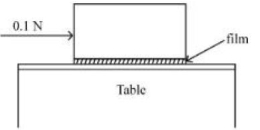
$A$ metal block of base area $0.20\,m^2$ is placed on a table,as shown in the figure. $A$ liquid film of thickness $0.25\,mm$ is inserted between the block and the table. The block is pushed by a horizontal force of $0.1\,N$ and moves with a constant speed. If the viscosity of the liquid is $5.0 \times 10^{-3} \,Pa-s$,the speed of the block is $.........\times 10^{-3}\,m/s$.
A
$12$
B
$25$
C
$30$
D
$40$
Solution
(B) According to Newton's law of viscosity,the viscous force $F$ is given by:
$F = \eta A \frac{dv}{dx}$
Where:
$F = 0.1 \,N$ (applied force)
$\eta = 5.0 \times 10^{-3} \,Pa-s$ (viscosity)
$A = 0.20 \,m^2$ (base area)
$dx = 0.25 \,mm = 0.25 \times 10^{-3} \,m$ (thickness of the film)
Since the block moves with a constant speed,the applied force equals the viscous force:
$0.1 = (5.0 \times 10^{-3}) \times 0.20 \times \frac{v}{0.25 \times 10^{-3}}$
$0.1 = \frac{1.0 \times 10^{-3} \times v}{0.25 \times 10^{-3}}$
$0.1 = 4v$
$v = \frac{0.1}{4} = 0.025 \,m/s$
$v = 25 \times 10^{-3} \,m/s$
Thus,the speed of the block is $25 \times 10^{-3} \,m/s$.
$F = \eta A \frac{dv}{dx}$
Where:
$F = 0.1 \,N$ (applied force)
$\eta = 5.0 \times 10^{-3} \,Pa-s$ (viscosity)
$A = 0.20 \,m^2$ (base area)
$dx = 0.25 \,mm = 0.25 \times 10^{-3} \,m$ (thickness of the film)
Since the block moves with a constant speed,the applied force equals the viscous force:
$0.1 = (5.0 \times 10^{-3}) \times 0.20 \times \frac{v}{0.25 \times 10^{-3}}$
$0.1 = \frac{1.0 \times 10^{-3} \times v}{0.25 \times 10^{-3}}$
$0.1 = 4v$
$v = \frac{0.1}{4} = 0.025 \,m/s$
$v = 25 \times 10^{-3} \,m/s$
Thus,the speed of the block is $25 \times 10^{-3} \,m/s$.
0 likes
View Solution50
MediumMCQ
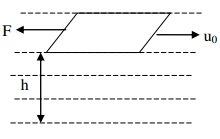
Consider a thin square plate floating on a viscous liquid in a large tank. The height $h$ of the liquid in the tank is much less than the width of the tank. The floating plate is pulled horizontally with a constant velocity $u_0$. Which of the following statements is (are) true?
$(A)$ The resistive force of liquid on the plate is inversely proportional to $h$
$(B)$ The resistive force of liquid on the plate is independent of the area of the plate
$(C)$ The tangential (shear) stress on the floor of the tank increases with $u_0$
$(D)$ The tangential (shear) stress on the plate varies linearly with the viscosity $\eta$ of the liquid
$(A)$ The resistive force of liquid on the plate is inversely proportional to $h$
$(B)$ The resistive force of liquid on the plate is independent of the area of the plate
$(C)$ The tangential (shear) stress on the floor of the tank increases with $u_0$
$(D)$ The tangential (shear) stress on the plate varies linearly with the viscosity $\eta$ of the liquid
A
$A, B, C$
B
$A, B$
C
$A, C, D$
D
$A, C$
Solution
(C) According to Newton's law of viscosity,the viscous force $F$ acting on a plate of area $A$ moving with velocity $u_0$ over a liquid layer of thickness $h$ is given by:
$F = \eta A \frac{dv}{dx} = \eta A \frac{u_0}{h}$
From this expression:
$1$. The resistive force $F$ is inversely proportional to $h$ $(F \propto 1/h)$. Thus,statement $(A)$ is true.
$2$. The resistive force $F$ is directly proportional to the area $A$ $(F \propto A)$. Thus,statement $(B)$ is false.
$3$. The tangential (shear) stress $\tau$ is defined as $\tau = F/A = \eta \frac{u_0}{h}$.
$4$. Since $\tau = \eta \frac{u_0}{h}$,the shear stress on the floor (or plate) is directly proportional to $u_0$. Thus,statement $(C)$ is true.
$5$. Since $\tau = \eta \frac{u_0}{h}$,the shear stress is directly proportional to the viscosity $\eta$. Thus,statement $(D)$ is true.
Therefore,statements $(A), (C),$ and $(D)$ are true.
$F = \eta A \frac{dv}{dx} = \eta A \frac{u_0}{h}$
From this expression:
$1$. The resistive force $F$ is inversely proportional to $h$ $(F \propto 1/h)$. Thus,statement $(A)$ is true.
$2$. The resistive force $F$ is directly proportional to the area $A$ $(F \propto A)$. Thus,statement $(B)$ is false.
$3$. The tangential (shear) stress $\tau$ is defined as $\tau = F/A = \eta \frac{u_0}{h}$.
$4$. Since $\tau = \eta \frac{u_0}{h}$,the shear stress on the floor (or plate) is directly proportional to $u_0$. Thus,statement $(C)$ is true.
$5$. Since $\tau = \eta \frac{u_0}{h}$,the shear stress is directly proportional to the viscosity $\eta$. Thus,statement $(D)$ is true.
Therefore,statements $(A), (C),$ and $(D)$ are true.
0 likes
View SolutionFluid Mechanics and Surface Tension — Newton's Law of Viscosity · Frequently Asked Questions
1Are these Fluid Mechanics and Surface Tension questions useful for JEE and NEET?
Yes. All questions in this section are mapped to JEE Main and NEET exam patterns. Previous year questions from JEE Main, NEET, GUJCET and state-level exams are included with full solutions.
2Can I switch to Hindi or Gujarati for these questions?
Yes. Use the language tabs in the hero section or the sidebar to view the same questions and solutions in English, Hindi or Gujarati.
3How do I generate a question paper from this subtopic?
Use the Vedclass Exam Paper Generator — select the chapter and subtopic, set difficulty, and generate Sets A, B, C, D automatically. First 3 chapters of every subject are free.
Vedclass Products
For Students
Vedclass Test Series
Mock tests in real JEE/NEET style with performance analysis. 5-day free trial.
Start Free TrialFor Teachers
Exam Paper Generator
Generate Set A/B/C/D papers from this chapter in 2 minutes. 3 chapters free.
Try FreeFor Institutes
Online Exam Module
Live online exams with unlimited students, 360° analytics & white-label branding.
See DemoFor Teachers & Institutes
Generate a Fluid Mechanics and Surface Tension Exam Paper in 2 Minutes
Select subtopic & difficulty — Sets A, B, C, D auto-generated with No Repeat logic.
First 3 chapters of every subject are free — no payment required.