
A English
Pascal's Law Questions in English
Class 11 Physics · Fluid Mechanics and Surface Tension · Pascal's Law
41+
Questions
English
Language
100%
With Solutions
Showing 41 of 41 questions in English
1
EasyMCQ
Air is blown through a hole on a closed pipe containing liquid. Then the pressure will
A
Increase on sides
B
Increase downwards
C
Increase in all directions
D
Never increases
Solution
(C) According to Pascal's law,which was stated by Blaise Pascal in $1652$,a change in pressure applied to an enclosed incompressible fluid is transmitted undiminished to every portion of the fluid and to the walls of its container.
This pressure change is independent of the orientation or height within the fluid.
Therefore,when air is blown into a closed pipe containing liquid,the increase in pressure is transmitted equally throughout the fluid,meaning the pressure will increase in all directions.
This pressure change is independent of the orientation or height within the fluid.
Therefore,when air is blown into a closed pipe containing liquid,the increase in pressure is transmitted equally throughout the fluid,meaning the pressure will increase in all directions.
0 likes
View Solution2
EasyMCQ
Pressure applied to an enclosed fluid is transmitted undiminished to every portion of the fluid and the walls of the containing vessel. This law was first formulated by
A
Bernoulli
B
Archimedes
C
Boyle
D
Pascal
Solution
(D) The statement describes $Pascal's$ $Law$.
$Pascal's$ $Law$ states that a change in pressure applied to an enclosed fluid is transmitted undiminished to every portion of the fluid and to the walls of the containing vessel.
Therefore,the correct option is $D$.
$Pascal's$ $Law$ states that a change in pressure applied to an enclosed fluid is transmitted undiminished to every portion of the fluid and to the walls of the containing vessel.
Therefore,the correct option is $D$.
0 likes
View Solution3
EasyMCQ
Which law states that the effect of pressure is the same for all portions of a confined fluid?
A
Pascal's law
B
Gay-Lussac's law
C
Dalton's law
D
None of these
Solution
(A) Pascal's law states that the external static pressure applied on a confined fluid is distributed or transmitted equally throughout the fluid in all directions.
0 likes
View Solution4
MediumMCQ
$A$ piston of cross-section area $100 \, cm^2$ is used in a hydraulic press to exert a force of $10^7 \, dynes$ on the water. The cross-sectional area of the other piston which supports an object having a mass $2000 \, kg$ is:
A
$100 \, cm^2$
B
$10^9 \, cm^2$
C
$2 \times 10^4 \, cm^2$
D
$2 \times 10^{10} \, cm^2$
Solution
(C) According to Pascal's Law,the pressure exerted on the fluid is transmitted equally in all directions. Therefore,$P_1 = P_2$.
This implies $\frac{F_1}{A_1} = \frac{F_2}{A_2}$.
Given: $A_1 = 100 \, cm^2 = 10^2 \, cm^2$,$F_1 = 10^7 \, dynes$,$m = 2000 \, kg = 2 \times 10^6 \, g$,and $g \approx 980 \, cm/s^2 \approx 10^3 \, cm/s^2$.
Force $F_2 = m \times g = 2000 \times 10^3 \times 10^3 \, dynes = 2 \times 10^9 \, dynes$.
Substituting the values: $\frac{10^7}{10^2} = \frac{2 \times 10^9}{A_2}$.
$10^5 = \frac{2 \times 10^9}{A_2}$.
$A_2 = \frac{2 \times 10^9}{10^5} = 2 \times 10^4 \, cm^2$.
This implies $\frac{F_1}{A_1} = \frac{F_2}{A_2}$.
Given: $A_1 = 100 \, cm^2 = 10^2 \, cm^2$,$F_1 = 10^7 \, dynes$,$m = 2000 \, kg = 2 \times 10^6 \, g$,and $g \approx 980 \, cm/s^2 \approx 10^3 \, cm/s^2$.
Force $F_2 = m \times g = 2000 \times 10^3 \times 10^3 \, dynes = 2 \times 10^9 \, dynes$.
Substituting the values: $\frac{10^7}{10^2} = \frac{2 \times 10^9}{A_2}$.
$10^5 = \frac{2 \times 10^9}{A_2}$.
$A_2 = \frac{2 \times 10^9}{10^5} = 2 \times 10^4 \, cm^2$.
0 likes
View Solution5
DifficultMCQ
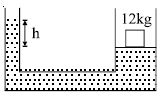
The area of cross-section of the wider tube shown in the figure is $800 \ cm^2$. If a mass of $12 \ kg$ is placed on the massless piston,the difference in heights $h$ in the level of water in the two tubes is ........ $cm$.
A
$10$
B
$6$
C
$15$
D
$2$
Solution
(C) The pressure exerted by the mass on the piston is balanced by the hydrostatic pressure due to the height difference $h$ of the water column.
Pressure $P = \frac{F}{A} = \frac{mg}{A}$.
Given: $m = 12 \ kg$,$g = 10 \ m/s^2$,$A = 800 \ cm^2 = 800 \times 10^{-4} \ m^2 = 0.08 \ m^2$.
Pressure due to mass = $\frac{12 \times 10}{0.08} = \frac{120}{0.08} = 1500 \ Pa$.
Hydrostatic pressure $P = \rho g h$,where $\rho = 1000 \ kg/m^3$ for water.
$1500 = 1000 \times 10 \times h$.
$1500 = 10000 \times h$.
$h = \frac{1500}{10000} = 0.15 \ m$.
Converting to centimeters: $h = 0.15 \times 100 = 15 \ cm$.
Pressure $P = \frac{F}{A} = \frac{mg}{A}$.
Given: $m = 12 \ kg$,$g = 10 \ m/s^2$,$A = 800 \ cm^2 = 800 \times 10^{-4} \ m^2 = 0.08 \ m^2$.
Pressure due to mass = $\frac{12 \times 10}{0.08} = \frac{120}{0.08} = 1500 \ Pa$.
Hydrostatic pressure $P = \rho g h$,where $\rho = 1000 \ kg/m^3$ for water.
$1500 = 1000 \times 10 \times h$.
$1500 = 10000 \times h$.
$h = \frac{1500}{10000} = 0.15 \ m$.
Converting to centimeters: $h = 0.15 \times 100 = 15 \ cm$.
0 likes
View Solution6
MediumMCQ
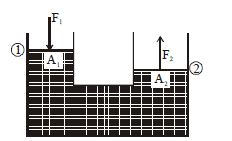
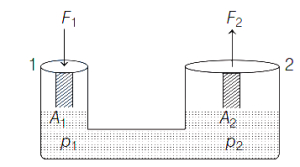
The diagram below shows a hydraulic lift. $A$ force is applied at side $1$ and an output force is generated at side $2$. Which of the following is true?
A
The force at side $1$ is greater than the force at side $2$
B
The force at side $1$ is less than the force at side $2$
C
The pressure at side $1$ is greater than the pressure at side $2$
D
The pressure at side $1$ is less than the pressure at side $2$
Solution
(B) According to Pascal's law,the pressure applied to an enclosed fluid is transmitted undiminished to every portion of the fluid and to the walls of the containing vessel.
For a hydraulic lift,the pressure at both sides must be equal:
$P_1 = P_2$
Since pressure $P = \frac{F}{A}$,we have:
$\frac{F_1}{A_1} = \frac{F_2}{A_2}$
From the diagram,it is clear that the area at side $1$ $(A_1)$ is smaller than the area at side $2$ $(A_2)$,i.e.,$A_1 < A_2$.
Rearranging the equation for force $F_2$:
$F_2 = F_1 \times \frac{A_2}{A_1}$
Since $\frac{A_2}{A_1} > 1$,it follows that $F_2 > F_1$,or $F_1 < F_2$.
Therefore,the force at side $1$ is less than the force at side $2$.
For a hydraulic lift,the pressure at both sides must be equal:
$P_1 = P_2$
Since pressure $P = \frac{F}{A}$,we have:
$\frac{F_1}{A_1} = \frac{F_2}{A_2}$
From the diagram,it is clear that the area at side $1$ $(A_1)$ is smaller than the area at side $2$ $(A_2)$,i.e.,$A_1 < A_2$.
Rearranging the equation for force $F_2$:
$F_2 = F_1 \times \frac{A_2}{A_1}$
Since $\frac{A_2}{A_1} > 1$,it follows that $F_2 > F_1$,or $F_1 < F_2$.
Therefore,the force at side $1$ is less than the force at side $2$.
0 likes
View Solution7
MediumMCQ
The diameters of two pistons of a hydraulic press are $0.1\, m$ and $0.6\, m$ respectively. What is the mechanical advantage of the hydraulic press,assuming the effort is applied directly on the pump plunger?
A
$6$
B
$36$
C
$1/6$
D
$1/36$
Solution
(B) The mechanical advantage $(MA)$ of a hydraulic press is defined as the ratio of the area of the larger piston $(A_1)$ to the area of the smaller piston $(A_2)$.
$MA = \frac{A_1}{A_2} = \frac{\pi (D_1/2)^2}{\pi (D_2/2)^2} = \frac{D_1^2}{D_2^2}$
Given the diameters $D_1 = 0.6\, m$ and $D_2 = 0.1\, m$:
$MA = \frac{(0.6)^2}{(0.1)^2} = \frac{0.36}{0.01} = 36$
Therefore,the mechanical advantage is $36$.
$MA = \frac{A_1}{A_2} = \frac{\pi (D_1/2)^2}{\pi (D_2/2)^2} = \frac{D_1^2}{D_2^2}$
Given the diameters $D_1 = 0.6\, m$ and $D_2 = 0.1\, m$:
$MA = \frac{(0.6)^2}{(0.1)^2} = \frac{0.36}{0.01} = 36$
Therefore,the mechanical advantage is $36$.
0 likes
View Solution8
DifficultMCQ
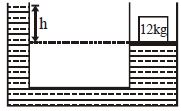
The area of cross-section of the wider tube shown in the figure is $800\,cm^2$. If a mass of $12\,kg$ is placed on the massless piston,the difference in the heights $h$ in the level of water in the two tubes is ........ $m$.
A
$0.15$
B
$0.06$
C
$0.10$
D
$0.02$
Solution
(A) The pressure exerted by the mass on the piston is given by $P = \frac{mg}{A}$.
This pressure is balanced by the hydrostatic pressure of the water column of height $h$,which is $P = \rho gh$.
Equating the two,we get $\frac{mg}{A} = \rho gh$.
Therefore,$h = \frac{m}{\rho A}$.
Given: $m = 12\,kg$,$A = 800\,cm^2 = 800 \times 10^{-4}\,m^2 = 0.08\,m^2$,and density of water $\rho = 1000\,kg/m^3$.
Substituting the values: $h = \frac{12}{1000 \times 0.08} = \frac{12}{80} = 0.15\,m$.
This pressure is balanced by the hydrostatic pressure of the water column of height $h$,which is $P = \rho gh$.
Equating the two,we get $\frac{mg}{A} = \rho gh$.
Therefore,$h = \frac{m}{\rho A}$.
Given: $m = 12\,kg$,$A = 800\,cm^2 = 800 \times 10^{-4}\,m^2 = 0.08\,m^2$,and density of water $\rho = 1000\,kg/m^3$.
Substituting the values: $h = \frac{12}{1000 \times 0.08} = \frac{12}{80} = 0.15\,m$.
0 likes
View Solution9
Medium
Two syringes of different cross-sections (without needles) filled with water are connected with a tightly fitted rubber tube filled with water. Diameters of the smaller piston and larger piston are $1.0 \; cm$ and $3.0 \; cm$ respectively.
$(a)$ Find the force exerted on the larger piston when a force of $10 \; N$ is applied to the smaller piston.
$(b)$ If the smaller piston is pushed in through $6.0 \; cm$,how much does the larger piston move out?
$(a)$ Find the force exerted on the larger piston when a force of $10 \; N$ is applied to the smaller piston.
$(b)$ If the smaller piston is pushed in through $6.0 \; cm$,how much does the larger piston move out?
Solution
(A) According to Pascal's Law,pressure applied to an enclosed fluid is transmitted undiminished to every portion of the fluid and the walls of the containing vessel.
$(a)$ Let $F_1 = 10 \; N$ be the force on the smaller piston with diameter $d_1 = 1.0 \; cm$ and $F_2$ be the force on the larger piston with diameter $d_2 = 3.0 \; cm$.
The areas are $A_1 = \pi (d_1/2)^2$ and $A_2 = \pi (d_2/2)^2$.
Since pressure $P = F_1/A_1 = F_2/A_2$,we have $F_2 = F_1 \times (A_2/A_1) = F_1 \times (d_2/d_1)^2$.
$F_2 = 10 \; N \times (3.0 \; cm / 1.0 \; cm)^2 = 10 \times 9 = 90 \; N$.
$(b)$ Since water is incompressible,the volume of water displaced by the smaller piston must equal the volume displaced by the larger piston.
$V = A_1 L_1 = A_2 L_2$,where $L_1 = 6.0 \; cm$ is the displacement of the smaller piston.
$L_2 = L_1 \times (A_1/A_2) = L_1 \times (d_1/d_2)^2$.
$L_2 = 6.0 \; cm \times (1.0 \; cm / 3.0 \; cm)^2 = 6.0 \times (1/9) = 0.67 \; cm$.
$(a)$ Let $F_1 = 10 \; N$ be the force on the smaller piston with diameter $d_1 = 1.0 \; cm$ and $F_2$ be the force on the larger piston with diameter $d_2 = 3.0 \; cm$.
The areas are $A_1 = \pi (d_1/2)^2$ and $A_2 = \pi (d_2/2)^2$.
Since pressure $P = F_1/A_1 = F_2/A_2$,we have $F_2 = F_1 \times (A_2/A_1) = F_1 \times (d_2/d_1)^2$.
$F_2 = 10 \; N \times (3.0 \; cm / 1.0 \; cm)^2 = 10 \times 9 = 90 \; N$.
$(b)$ Since water is incompressible,the volume of water displaced by the smaller piston must equal the volume displaced by the larger piston.
$V = A_1 L_1 = A_2 L_2$,where $L_1 = 6.0 \; cm$ is the displacement of the smaller piston.
$L_2 = L_1 \times (A_1/A_2) = L_1 \times (d_1/d_2)^2$.
$L_2 = 6.0 \; cm \times (1.0 \; cm / 3.0 \; cm)^2 = 6.0 \times (1/9) = 0.67 \; cm$.
0 likes
View Solution10
Medium
In a car lift,compressed air exerts a force $F_{1}$ on a small piston having a radius of $5.0 \; cm$. This pressure is transmitted to a second piston of radius $15 \; cm$. If the mass of the car to be lifted is $1350 \; kg$,calculate $F_{1}$. What is the pressure necessary to accomplish this task? $(g = 9.8 \; m s^{-2})$
Solution
(N/A) According to Pascal's Law,pressure applied to an enclosed fluid is transmitted undiminished to every portion of the fluid and the walls of the containing vessel.
Given:
Radius of small piston,$r_{1} = 5.0 \; cm = 5.0 \times 10^{-2} \; m$
Radius of large piston,$r_{2} = 15 \; cm = 15 \times 10^{-2} \; m$
Mass of the car,$m = 1350 \; kg$
Acceleration due to gravity,$g = 9.8 \; m s^{-2}$
The force exerted by the car on the large piston is $F_{2} = m \times g = 1350 \times 9.8 = 13230 \; N$.
Using the principle of hydraulic lift,$\frac{F_{1}}{A_{1}} = \frac{F_{2}}{A_{2}}$,where $A_{1} = \pi r_{1}^{2}$ and $A_{2} = \pi r_{2}^{2}$.
$F_{1} = F_{2} \times \frac{A_{1}}{A_{2}} = F_{2} \times \left(\frac{r_{1}}{r_{2}}\right)^{2}$
$F_{1} = 13230 \times \left(\frac{5}{15}\right)^{2} = 13230 \times \left(\frac{1}{3}\right)^{2} = 13230 \times \frac{1}{9} = 1470 \; N$.
Rounding to two significant figures,$F_{1} \approx 1.5 \times 10^{3} \; N$.
The pressure $P$ required is $P = \frac{F_{1}}{A_{1}} = \frac{1470}{\pi \times (5.0 \times 10^{-2})^{2}} = \frac{1470}{3.14159 \times 25 \times 10^{-4}} \approx 1.87 \times 10^{5} \; Pa \approx 1.9 \times 10^{5} \; Pa$.
Given:
Radius of small piston,$r_{1} = 5.0 \; cm = 5.0 \times 10^{-2} \; m$
Radius of large piston,$r_{2} = 15 \; cm = 15 \times 10^{-2} \; m$
Mass of the car,$m = 1350 \; kg$
Acceleration due to gravity,$g = 9.8 \; m s^{-2}$
The force exerted by the car on the large piston is $F_{2} = m \times g = 1350 \times 9.8 = 13230 \; N$.
Using the principle of hydraulic lift,$\frac{F_{1}}{A_{1}} = \frac{F_{2}}{A_{2}}$,where $A_{1} = \pi r_{1}^{2}$ and $A_{2} = \pi r_{2}^{2}$.
$F_{1} = F_{2} \times \frac{A_{1}}{A_{2}} = F_{2} \times \left(\frac{r_{1}}{r_{2}}\right)^{2}$
$F_{1} = 13230 \times \left(\frac{5}{15}\right)^{2} = 13230 \times \left(\frac{1}{3}\right)^{2} = 13230 \times \frac{1}{9} = 1470 \; N$.
Rounding to two significant figures,$F_{1} \approx 1.5 \times 10^{3} \; N$.
The pressure $P$ required is $P = \frac{F_{1}}{A_{1}} = \frac{1470}{\pi \times (5.0 \times 10^{-2})^{2}} = \frac{1470}{3.14159 \times 25 \times 10^{-4}} \approx 1.87 \times 10^{5} \; Pa \approx 1.9 \times 10^{5} \; Pa$.
0 likes
View Solution11
EasyMCQ
$A$ hydraulic automobile lift is designed to lift cars with a maximum mass of $3000 \; kg$. The area of cross-section of the piston carrying the load is $425 \; cm^{2}$. What maximum pressure would the smaller piston have to bear?
A
$7.642 \times 10^{7} \; Pa$
B
$9.64 \times 10^{4} \; Pa$
C
$6.917 \times 10^{5} \; Pa$
D
$5.97 \times 10^{6} \; Pa$
Solution
(C) The maximum mass of the car to be lifted is $m = 3000 \; kg$.
The area of the cross-section of the load-carrying piston is $A = 425 \; cm^{2} = 425 \times 10^{-4} \; m^{2}$.
The maximum force exerted by the load is $F = mg = 3000 \times 9.8 = 29400 \; N$.
The pressure exerted on the load-carrying piston is $P = \frac{F}{A}$.
Substituting the values,$P = \frac{29400}{425 \times 10^{-4}} = 6.917 \times 10^{5} \; Pa$.
According to Pascal's Law,pressure is transmitted equally in all directions in an enclosed fluid. Therefore,the maximum pressure that the smaller piston must bear is $6.917 \times 10^{5} \; Pa$.
The area of the cross-section of the load-carrying piston is $A = 425 \; cm^{2} = 425 \times 10^{-4} \; m^{2}$.
The maximum force exerted by the load is $F = mg = 3000 \times 9.8 = 29400 \; N$.
The pressure exerted on the load-carrying piston is $P = \frac{F}{A}$.
Substituting the values,$P = \frac{29400}{425 \times 10^{-4}} = 6.917 \times 10^{5} \; Pa$.
According to Pascal's Law,pressure is transmitted equally in all directions in an enclosed fluid. Therefore,the maximum pressure that the smaller piston must bear is $6.917 \times 10^{5} \; Pa$.
0 likes
View Solution12
EasyMCQ
How does a fluid exert force on each point of the surface of a vessel?
A
The force is always perpendicular to the surface.
B
The force is always parallel to the surface.
C
The force is always at an angle of $45^{\circ}$ to the surface.
D
The force is always directed towards the center of the vessel.
Solution
(A) fluid at rest exerts a force on the surface of a vessel in contact with it.
According to Pascal's law and the properties of static fluids,this force is always directed perpendicular to the surface of the vessel at every point.
If the force had a component parallel to the surface,the fluid would experience a tangential stress,causing it to flow along the surface.
Since the fluid is in a state of rest (static),there can be no tangential component of the force.
Therefore,the force exerted by the fluid is always normal (perpendicular) to the surface.
According to Pascal's law and the properties of static fluids,this force is always directed perpendicular to the surface of the vessel at every point.
If the force had a component parallel to the surface,the fluid would experience a tangential stress,causing it to flow along the surface.
Since the fluid is in a state of rest (static),there can be no tangential component of the force.
Therefore,the force exerted by the fluid is always normal (perpendicular) to the surface.
0 likes
View Solution13
Medium
State and prove Pascal's law.
Solution
(N/A) Law: "The pressure in a fluid at rest is the same at all points in all directions if gravity is neglected."
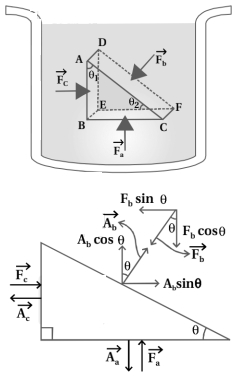
Proof: Consider a small element $ABC-DEF$ in the interior of a fluid at rest, in the form of a right-angled prism. Since the element is very small, the effect of gravity can be neglected.
Let the areas of the surfaces be $A_a$ (bottom surface $BEFC$), $A_c$ (vertical surface $ABED$), and $A_b$ (inclined surface $ADFC$).
Let the forces acting perpendicular to these surfaces be $F_a$, $F_c$, and $F_b$ respectively.
From the geometry of the prism:
$A_a = A_b \cos \theta$
$A_c = A_b \sin \theta$
For the element to be in equilibrium, the net force in any direction must be zero:
Horizontal direction: $F_c = F_b \sin \theta$
Vertical direction: $F_a = F_b \cos \theta$
Since pressure $P = F/A$, we have:
$P_c = F_c / A_c = (F_b \sin \theta) / (A_b \sin \theta) = F_b / A_b = P_b$
$P_a = F_a / A_a = (F_b \cos \theta) / (A_b \cos \theta) = F_b / A_b = P_b$
Thus, $P_a = P_c = P_b$. This proves that the pressure at all points in a fluid at rest is the same.
Proof: Consider a small element $ABC-DEF$ in the interior of a fluid at rest, in the form of a right-angled prism. Since the element is very small, the effect of gravity can be neglected.
Let the areas of the surfaces be $A_a$ (bottom surface $BEFC$), $A_c$ (vertical surface $ABED$), and $A_b$ (inclined surface $ADFC$).
Let the forces acting perpendicular to these surfaces be $F_a$, $F_c$, and $F_b$ respectively.
From the geometry of the prism:
$A_a = A_b \cos \theta$
$A_c = A_b \sin \theta$
For the element to be in equilibrium, the net force in any direction must be zero:
Horizontal direction: $F_c = F_b \sin \theta$
Vertical direction: $F_a = F_b \cos \theta$
Since pressure $P = F/A$, we have:
$P_c = F_c / A_c = (F_b \sin \theta) / (A_b \sin \theta) = F_b / A_b = P_b$
$P_a = F_a / A_a = (F_b \cos \theta) / (A_b \cos \theta) = F_b / A_b = P_b$
Thus, $P_a = P_c = P_b$. This proves that the pressure at all points in a fluid at rest is the same.
0 likes
View Solution14
Medium
Explain Pascal's law of pressure transmission.
Solution
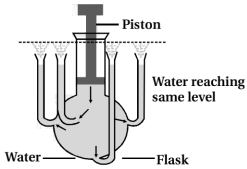
(N/A) Pascal's law of pressure transmission states: "The pressure in a fluid at rest is the same at all points which are at the same height. $A$ change in pressure applied to an enclosed fluid is transmitted undiminished to every point of the fluid and the walls of the containing vessel."
Consider a vessel with a piston and several vertical tubes at different points. The pressure in the vessel is indicated by the height of the liquid column in the vertical tubes.
When the piston is pushed, the fluid level rises in all the tubes, reaching the same level in each of them.
This indicates that when the pressure on the fluid was increased, it was distributed uniformly throughout the entire volume.
Many devices are based on this law, such as door closers, hydraulic brakes, hydraulic lifts, and shock absorbers in vehicles.
Consider a vessel with a piston and several vertical tubes at different points. The pressure in the vessel is indicated by the height of the liquid column in the vertical tubes.
When the piston is pushed, the fluid level rises in all the tubes, reaching the same level in each of them.
This indicates that when the pressure on the fluid was increased, it was distributed uniformly throughout the entire volume.
Many devices are based on this law, such as door closers, hydraulic brakes, hydraulic lifts, and shock absorbers in vehicles.
0 likes
View Solution15
Difficult
State Pascal's law. Explain its application in a hydraulic lift.
Solution
(N/A) Pascal's Law: "$A$ change in pressure applied to an enclosed fluid is transmitted undiminished to every point of the fluid and the walls of the containing vessel."
$A$ hydraulic lift is based on this principle.
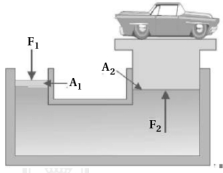
As shown in the figure, consider two cylinders with cross-sectional areas $A_{1}$ and $A_{2}$, where $A_{1} < < A_{2}$.
$A$ liquid is filled in this vessel.
$A$ piston of small cross-section $A_{1}$ is used to exert a force $F_{1}$ directly on the liquid. The pressure $P_{1} = \frac{F_{1}}{A_{1}}$ is transmitted throughout the liquid to the large cylinder attached with a larger piston of area $A_{2}$.
According to Pascal's law, the pressure is transmitted undiminished, so $P_{1} = P_{2}$.
Therefore, $\frac{F_{1}}{A_{1}} = \frac{F_{2}}{A_{2}}$, which implies $F_{2} = F_{1} \left( \frac{A_{2}}{A_{1}} \right)$.
Since $A_{2} > > A_{1}$, the force $F_{2}$ exerted on the large piston is much larger than the applied force $F_{1}$, allowing the lift to support heavy loads like a car.
$A$ hydraulic lift is based on this principle.
As shown in the figure, consider two cylinders with cross-sectional areas $A_{1}$ and $A_{2}$, where $A_{1} < < A_{2}$.
$A$ liquid is filled in this vessel.
$A$ piston of small cross-section $A_{1}$ is used to exert a force $F_{1}$ directly on the liquid. The pressure $P_{1} = \frac{F_{1}}{A_{1}}$ is transmitted throughout the liquid to the large cylinder attached with a larger piston of area $A_{2}$.
According to Pascal's law, the pressure is transmitted undiminished, so $P_{1} = P_{2}$.
Therefore, $\frac{F_{1}}{A_{1}} = \frac{F_{2}}{A_{2}}$, which implies $F_{2} = F_{1} \left( \frac{A_{2}}{A_{1}} \right)$.
Since $A_{2} > > A_{1}$, the force $F_{2}$ exerted on the large piston is much larger than the applied force $F_{1}$, allowing the lift to support heavy loads like a car.
1 likes
View Solution16
Medium
Write a short note on hydraulic brakes.
Solution
(N/A) Hydraulic brakes operate on the principle of Pascal's law.
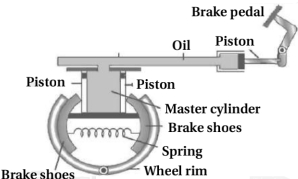
When a driver applies a force $F_1$ on the brake pedal,the master piston,which has a small cross-sectional area $A_1$,moves into the master cylinder. This action pushes the brake oil through the tubes into the wheel cylinder.
The wheel cylinder contains two pistons with a much larger cross-sectional area $A_2$. According to Pascal's law,the pressure applied is transmitted equally throughout the fluid. Since $A_2 \gg A_1$,a much larger force $F_2$ is exerted on the wheel pistons,where $F_2 = F_1 \times (A_2 / A_1)$.
This large force $F_2$ pushes the brake shoes outward,bringing them into contact with the rotating wheel rim,thereby applying the brakes.
When the driver releases the brake pedal,a restoring spring pulls the brake shoes back to their original position,releasing the wheel rim. The brake oil flows back into the master cylinder as the pistons return to their initial positions.
When a driver applies a force $F_1$ on the brake pedal,the master piston,which has a small cross-sectional area $A_1$,moves into the master cylinder. This action pushes the brake oil through the tubes into the wheel cylinder.
The wheel cylinder contains two pistons with a much larger cross-sectional area $A_2$. According to Pascal's law,the pressure applied is transmitted equally throughout the fluid. Since $A_2 \gg A_1$,a much larger force $F_2$ is exerted on the wheel pistons,where $F_2 = F_1 \times (A_2 / A_1)$.
This large force $F_2$ pushes the brake shoes outward,bringing them into contact with the rotating wheel rim,thereby applying the brakes.
When the driver releases the brake pedal,a restoring spring pulls the brake shoes back to their original position,releasing the wheel rim. The brake oil flows back into the master cylinder as the pistons return to their initial positions.
0 likes
View Solution17
Medium
State Pascal's law.
Solution
(N/A) Pascal's law states that the pressure applied to an enclosed fluid is transmitted undiminished to every portion of the fluid and to the walls of the container.
Mathematically,if an external pressure $P_{ext}$ is applied to a confined fluid,the change in pressure $\Delta P$ at any point within the fluid is equal to the applied pressure,i.e.,$\Delta P = P_{ext}$.
Mathematically,if an external pressure $P_{ext}$ is applied to a confined fluid,the change in pressure $\Delta P$ at any point within the fluid is equal to the applied pressure,i.e.,$\Delta P = P_{ext}$.
0 likes
View Solution18
Medium
State Pascal's law for pressure transmission and explain its significance.
Solution
(N/A) Pascal's law states that a change in pressure applied to an enclosed fluid is transmitted undiminished to every portion of the fluid and to the walls of the containing vessel.
Significance:
$1$. It forms the fundamental principle behind hydraulic systems,such as hydraulic lifts,hydraulic brakes,and hydraulic jacks.
$2$. It allows for the multiplication of force,where a small input force applied to a small area can result in a much larger output force on a larger area,as defined by the relation $F_2 = F_1 \times (A_2 / A_1)$.
Significance:
$1$. It forms the fundamental principle behind hydraulic systems,such as hydraulic lifts,hydraulic brakes,and hydraulic jacks.
$2$. It allows for the multiplication of force,where a small input force applied to a small area can result in a much larger output force on a larger area,as defined by the relation $F_2 = F_1 \times (A_2 / A_1)$.
0 likes
View Solution19
Easy
Name two devices working on Pascal's law.
Solution
(N/A) Pascal's law states that a change in pressure applied to an enclosed fluid is transmitted undiminished to every portion of the fluid and to the walls of the container.
Two common devices that operate on this principle are:
$1$. Hydraulic lift: Used to lift heavy objects like cars in service stations.
$2$. Hydraulic brakes: Used in automobiles to stop or slow down the vehicle by applying pressure to the brake fluid.
Two common devices that operate on this principle are:
$1$. Hydraulic lift: Used to lift heavy objects like cars in service stations.
$2$. Hydraulic brakes: Used in automobiles to stop or slow down the vehicle by applying pressure to the brake fluid.
0 likes
View Solution20
Easy
Why does the bottom of a bottle filled with liquid break when the cork is hit?
Solution
(N/A) When the cork of area $a$ is hit with a force $F$,it exerts a pressure $P = \frac{F}{a}$ on the liquid. According to Pascal's law,this pressure is transmitted equally and undiminished throughout the entire liquid. Since the area of the bottom of the bottle $A$ is much larger than the area of the cork $a$,the force exerted on the bottom is $F_{bottom} = P \times A$. Because $A \gg a$,the resulting force $F_{bottom}$ is significantly large,which causes the bottom of the bottle to break.
0 likes
View Solution21
Medium
Give two uses of Pascal's law.
Solution
(N/A) The devices working on the principle of Pascal's law are:
$(1)$ Hydraulic lift: It is used to lift heavy objects like cars by applying a small force.
$(2)$ Hydraulic brakes: It is used in vehicles to stop or slow down the motion by transmitting pressure through a fluid.
$(1)$ Hydraulic lift: It is used to lift heavy objects like cars by applying a small force.
$(2)$ Hydraulic brakes: It is used in vehicles to stop or slow down the motion by transmitting pressure through a fluid.
0 likes
View Solution22
MediumMCQ
$A$ hydraulic automobile lift is designed to lift cars with a maximum mass of $3000 \, kg$. The area of cross-section of the piston carrying the load is $425 \, cm^{2}$. What is the maximum pressure the smaller piston would have to bear?
A
$15.82 \times 10^{5} \, Pa$
B
$1.12 \times 10^{5} \, Pa$
C
$2.63 \times 10^{5} \, Pa$
D
$6.92 \times 10^{5} \, Pa$
Solution
(D) According to Pascal's Law,the pressure applied to an enclosed fluid is transmitted undiminished to every portion of the fluid and the walls of the containing vessel.
The force acting on the bigger piston due to the weight of the car is:
$F = m \times g$
$F = 3000 \, kg \times 9.8 \, m/s^{2} = 29400 \, N$
The area of the bigger piston is:
$A = 425 \, cm^{2} = 425 \times 10^{-4} \, m^{2} = 0.0425 \, m^{2}$
The pressure exerted on the bigger piston is:
$P = \frac{F}{A}$
$P = \frac{29400 \, N}{0.0425 \, m^{2}}$
$P \approx 6.92 \times 10^{5} \, Pa$
Since the pressure is transmitted equally throughout the fluid,the smaller piston must bear the same pressure of $6.92 \times 10^{5} \, Pa$.
The force acting on the bigger piston due to the weight of the car is:
$F = m \times g$
$F = 3000 \, kg \times 9.8 \, m/s^{2} = 29400 \, N$
The area of the bigger piston is:
$A = 425 \, cm^{2} = 425 \times 10^{-4} \, m^{2} = 0.0425 \, m^{2}$
The pressure exerted on the bigger piston is:
$P = \frac{F}{A}$
$P = \frac{29400 \, N}{0.0425 \, m^{2}}$
$P \approx 6.92 \times 10^{5} \, Pa$
Since the pressure is transmitted equally throughout the fluid,the smaller piston must bear the same pressure of $6.92 \times 10^{5} \, Pa$.
0 likes
View Solution23
DifficultMCQ
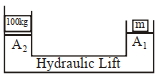
$A$ hydraulic press can lift $100\, kg$ when a mass $'m'$ is placed on the smaller piston. It can lift ......... $kg$ when the diameter of the larger piston is increased by $4$ times and that of the smaller piston is decreased by $4$ times,keeping the same mass $'m'$ on the smaller piston.
A
$22500$
B
$25600$
C
$28900$
D
$27225$
Solution
(B) According to Pascal's law,the pressure applied to an enclosed fluid is transmitted undiminished to every portion of the fluid and the walls of the containing vessel. For a hydraulic lift,the pressure at both pistons is equal:
$\frac{F_1}{A_1} = \frac{F_2}{A_2}$
In the first case,let $A_1$ be the area of the smaller piston and $A_2$ be the area of the larger piston. The force on the smaller piston is $mg$ and on the larger piston is $100g$:
$\frac{mg}{A_1} = \frac{100g}{A_2} \implies \frac{100}{m} = \frac{A_2}{A_1} \quad .......(1)$
Since $A = \frac{\pi d^2}{4}$,the ratio of areas is proportional to the square of the ratio of diameters: $\frac{A_2}{A_1} = \left(\frac{d_2}{d_1}\right)^2$.
In the second case,the new diameter of the larger piston is $d_2' = 4d_2$ and the new diameter of the smaller piston is $d_1' = \frac{d_1}{4}$.
Let the new mass lifted be $M_0$. The new areas are $A_2' = (4)^2 A_2 = 16A_2$ and $A_1' = (\frac{1}{4})^2 A_1 = \frac{A_1}{16}$.
Applying Pascal's law again:
$\frac{mg}{A_1'} = \frac{M_0g}{A_2'} \implies \frac{M_0}{m} = \frac{A_2'}{A_1'} = \frac{16A_2}{A_1/16} = 256 \left(\frac{A_2}{A_1}\right)$
Substituting $\frac{A_2}{A_1} = \frac{100}{m}$ from equation $(1)$:
$\frac{M_0}{m} = 256 \left(\frac{100}{m}\right)$
$M_0 = 256 \times 100 = 25600 \, kg$.
$\frac{F_1}{A_1} = \frac{F_2}{A_2}$
In the first case,let $A_1$ be the area of the smaller piston and $A_2$ be the area of the larger piston. The force on the smaller piston is $mg$ and on the larger piston is $100g$:
$\frac{mg}{A_1} = \frac{100g}{A_2} \implies \frac{100}{m} = \frac{A_2}{A_1} \quad .......(1)$
Since $A = \frac{\pi d^2}{4}$,the ratio of areas is proportional to the square of the ratio of diameters: $\frac{A_2}{A_1} = \left(\frac{d_2}{d_1}\right)^2$.
In the second case,the new diameter of the larger piston is $d_2' = 4d_2$ and the new diameter of the smaller piston is $d_1' = \frac{d_1}{4}$.
Let the new mass lifted be $M_0$. The new areas are $A_2' = (4)^2 A_2 = 16A_2$ and $A_1' = (\frac{1}{4})^2 A_1 = \frac{A_1}{16}$.
Applying Pascal's law again:
$\frac{mg}{A_1'} = \frac{M_0g}{A_2'} \implies \frac{M_0}{m} = \frac{A_2'}{A_1'} = \frac{16A_2}{A_1/16} = 256 \left(\frac{A_2}{A_1}\right)$
Substituting $\frac{A_2}{A_1} = \frac{100}{m}$ from equation $(1)$:
$\frac{M_0}{m} = 256 \left(\frac{100}{m}\right)$
$M_0 = 256 \times 100 = 25600 \, kg$.
0 likes
View Solution24
DifficultMCQ
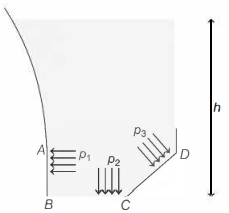
$A$ tall tank filled with water has an irregular shape as shown. The wall $CD$ makes an angle of $45^{\circ}$ with the horizontal,the wall $AB$ is normal to the base $BC$. The lengths $AB$ and $CD$ are much smaller than the height $h$ of water (figure not to scale). Let $p_1, p_2$ and $p_3$ be the pressures exerted by the water on the wall $AB$,base $BC$ and the wall $CD$ respectively. Density of water is $\rho$ and $g$ is acceleration due to gravity. Then,approximately
A
$p_1=p_2=p_3$
B
$p_1=0, p_3=\frac{1}{\sqrt{2}} p_2$
C
$p_1=p_3=\frac{1}{\sqrt{2}} p_2$
D
$p_1=p_3=0, p_2=h \rho g$
Solution
(A) According to Pascal's Law,the pressure at any point in a static fluid depends only on the depth $h$ of that point below the free surface of the fluid. The pressure is given by $p = h \rho g$.
Since the lengths $AB$ and $CD$ are very small compared to the total height $h$ of the water column,the depth of all points on the surfaces $AB$,$BC$,and $CD$ is approximately equal to $h$.
Pressure is a scalar quantity,which means it acts equally in all directions at a given depth. Therefore,the magnitude of the pressure exerted by the water on any surface at a depth $h$ is independent of the orientation of the surface.
Thus,$p_1 = p_2 = p_3 = h \rho g$.
Since the lengths $AB$ and $CD$ are very small compared to the total height $h$ of the water column,the depth of all points on the surfaces $AB$,$BC$,and $CD$ is approximately equal to $h$.
Pressure is a scalar quantity,which means it acts equally in all directions at a given depth. Therefore,the magnitude of the pressure exerted by the water on any surface at a depth $h$ is independent of the orientation of the surface.
Thus,$p_1 = p_2 = p_3 = h \rho g$.
0 likes
View Solution25
EasyMCQ
Increase in pressure at one point of the enclosed liquid in equilibrium of rest is transmitted equally to all other points of liquid. This is as per ...........
A
Buoyancy
B
Pascal's law
C
Conservation of momentum
D
Impulse
Solution
(B) The correct option is $B$.
Pascal's law states that whenever external pressure is applied to any part of a confined fluid at rest,the pressure is transmitted undiminished to every portion of the fluid and to the walls of the container.
Pascal's law states that whenever external pressure is applied to any part of a confined fluid at rest,the pressure is transmitted undiminished to every portion of the fluid and to the walls of the container.
0 likes
View Solution26
EasyMCQ
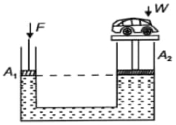
In a hydraulic jack as shown,the mass of the car is $W = 800 \, kg$,$A_1 = 10 \, cm^2$,and $A_2 = 10 \, m^2$. The minimum force $F$ required to lift the car is ........... $N$.
A
$1$
B
$0.8$
C
$8$
D
$16$
Solution
(B) According to Pascal's Law,the pressure applied to an enclosed fluid is transmitted undiminished to every portion of the fluid and the walls of the containing vessel. Therefore,the pressure at both pistons must be equal.
$\frac{F_1}{A_1} = \frac{F_2}{A_2}$
Given:
$F_1 = F$
$A_1 = 10 \, cm^2 = 10 \times 10^{-4} \, m^2$
$A_2 = 10 \, m^2$
$F_2 = W \times g = 800 \, kg \times 10 \, m/s^2 = 8000 \, N$
Substituting the values into the equation:
$\frac{F}{10 \times 10^{-4}} = \frac{8000}{10}$
$F = 800 \times 10 \times 10^{-4}$
$F = 8000 \times 10^{-4}$
$F = 0.8 \, N$
$\frac{F_1}{A_1} = \frac{F_2}{A_2}$
Given:
$F_1 = F$
$A_1 = 10 \, cm^2 = 10 \times 10^{-4} \, m^2$
$A_2 = 10 \, m^2$
$F_2 = W \times g = 800 \, kg \times 10 \, m/s^2 = 8000 \, N$
Substituting the values into the equation:
$\frac{F}{10 \times 10^{-4}} = \frac{8000}{10}$
$F = 800 \times 10 \times 10^{-4}$
$F = 8000 \times 10^{-4}$
$F = 0.8 \, N$
0 likes
View Solution27
MediumMCQ
Given below are two statements: one is labelled as Assertion $A$ and the other is labelled as Reason $R$.
Assertion $A:$ When you squeeze one end of a tube to get toothpaste out from the other end,Pascal's principle is observed.
Reason $R:$ $A$ change in the pressure applied to an enclosed incompressible fluid is transmitted undiminished to every portion of the fluid and to the walls of its container.
In the light of the above statements,choose the most appropriate answer from the options given below:
Assertion $A:$ When you squeeze one end of a tube to get toothpaste out from the other end,Pascal's principle is observed.
Reason $R:$ $A$ change in the pressure applied to an enclosed incompressible fluid is transmitted undiminished to every portion of the fluid and to the walls of its container.
In the light of the above statements,choose the most appropriate answer from the options given below:
A
$A$ is not correct but $R$ is correct.
B
$A$ is correct but $R$ is not correct.
C
Both $A$ and $R$ are correct and $R$ is the correct explanation of $A$.
D
Both $A$ and $R$ are correct but $R$ is $NOT$ the correct explanation of $A$.
Solution
(C) Assertion $A$ is correct because squeezing a tube of toothpaste is a practical application of Pascal's principle,where pressure applied at one point is transmitted through the fluid to the opening.
Reason $R$ is the formal definition of Pascal's principle,which states that a change in pressure applied to an enclosed incompressible fluid is transmitted undiminished to every portion of the fluid and to the walls of the container.
Since the phenomenon described in $A$ occurs precisely because of the physical law described in $R$,$R$ is the correct explanation of $A$.
Reason $R$ is the formal definition of Pascal's principle,which states that a change in pressure applied to an enclosed incompressible fluid is transmitted undiminished to every portion of the fluid and to the walls of the container.
Since the phenomenon described in $A$ occurs precisely because of the physical law described in $R$,$R$ is the correct explanation of $A$.
0 likes
View Solution28
EasyMCQ
$A$ hydraulic automobile lift is designed to lift vehicles of mass $5000\,kg$. The area of cross-section of the cylinder carrying the load is $250\,cm^2$. The maximum pressure the smaller piston would have to bear is [Assume $g = 10\,m/s^2$].
A
$200 \times 10^6\,Pa$
B
$20 \times 10^6\,Pa$
C
$2 \times 10^6\,Pa$
D
$2 \times 10^5\,Pa$
Solution
(C) The force exerted by the load is given by $F = mg$.
Given $m = 5000\,kg$ and $g = 10\,m/s^2$,we have $F = 5000 \times 10 = 50000\,N$.
The area of the cross-section is $A = 250\,cm^2 = 250 \times 10^{-4}\,m^2 = 2.5 \times 10^{-2}\,m^2$.
According to Pascal's Law,the pressure applied to the fluid is transmitted equally throughout. The pressure $P$ exerted by the load is $P = \frac{F}{A}$.
$P = \frac{50000}{250 \times 10^{-4}} = \frac{5 \times 10^4}{2.5 \times 10^{-2}} = 2 \times 10^6\,Pa$.
Given $m = 5000\,kg$ and $g = 10\,m/s^2$,we have $F = 5000 \times 10 = 50000\,N$.
The area of the cross-section is $A = 250\,cm^2 = 250 \times 10^{-4}\,m^2 = 2.5 \times 10^{-2}\,m^2$.
According to Pascal's Law,the pressure applied to the fluid is transmitted equally throughout. The pressure $P$ exerted by the load is $P = \frac{F}{A}$.
$P = \frac{50000}{250 \times 10^{-4}} = \frac{5 \times 10^4}{2.5 \times 10^{-2}} = 2 \times 10^6\,Pa$.
0 likes
View Solution29
MediumMCQ
Given below are two statements:
Statement $I :$ Pressure in a reservoir of water is same at all points at the same level of water.
Statement $II :$ The pressure applied to enclosed water is transmitted in all directions equally.
In the light of the above statements,choose the correct answer from the options given below:
Statement $I :$ Pressure in a reservoir of water is same at all points at the same level of water.
Statement $II :$ The pressure applied to enclosed water is transmitted in all directions equally.
In the light of the above statements,choose the correct answer from the options given below:
A
Statement $I$ is false but Statement $II$ is true
B
Both Statement $I$ and Statement $II$ are true
C
Statement $I$ is true but Statement $II$ is false
D
Both Statement $I$ and Statement $II$ are false
Solution
(B) For a static fluid,the pressure at any point at the same horizontal depth $h$ is given by $P = P_{atm} + \rho gh$. Since $P_{atm}$,$\rho$,$g$,and $h$ are constant for a given horizontal level,the pressure is the same at all points at the same level. Thus,Statement $I$ is true.
According to Pascal's Law,a change in pressure applied to an enclosed incompressible fluid is transmitted undiminished to every portion of the fluid and to the walls of the containing vessel. Thus,Statement $II$ is true.
According to Pascal's Law,a change in pressure applied to an enclosed incompressible fluid is transmitted undiminished to every portion of the fluid and to the walls of the containing vessel. Thus,Statement $II$ is true.
0 likes
View Solution30
DifficultMCQ
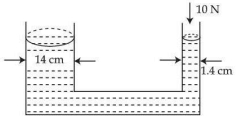
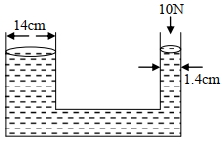
$A$ hydraulic press containing water has two arms with diameters as shown in the figure. $A$ force of $10 \,N$ is applied on the surface of water in the thinner arm. The force required to be applied on the surface of water in the thicker arm to maintain equilibrium of water is . . . . . . $N$.
A
$900$
B
$1000$
C
$1001$
D
$1005$
Solution
(B) According to Pascal's Law, the pressure applied to an enclosed fluid is transmitted undiminished to every portion of the fluid and the walls of the containing vessel.
Therefore, the pressure at both arms must be equal for equilibrium:
$\frac{F_1}{A_1} = \frac{F_2}{A_2}$
Here, $F_1$ is the force on the thicker arm, $A_1$ is the area of the thicker arm, $F_2 = 10 \,N$ is the force on the thinner arm, and $A_2$ is the area of the thinner arm.
The diameter of the thicker arm is $D_1 = 14 \,cm$, so its radius is $r_1 = 7 \,cm$.
The diameter of the thinner arm is $D_2 = 1.4 \,cm$, so its radius is $r_2 = 0.7 \,cm$.
Substituting the areas $A = \pi r^2$:
$\frac{F_1}{\pi (7)^2} = \frac{10}{\pi (0.7)^2}$
$F_1 = 10 \times \frac{49}{0.49}$
$F_1 = 10 \times 100 = 1000 \,N$.
Therefore, the pressure at both arms must be equal for equilibrium:
$\frac{F_1}{A_1} = \frac{F_2}{A_2}$
Here, $F_1$ is the force on the thicker arm, $A_1$ is the area of the thicker arm, $F_2 = 10 \,N$ is the force on the thinner arm, and $A_2$ is the area of the thinner arm.
The diameter of the thicker arm is $D_1 = 14 \,cm$, so its radius is $r_1 = 7 \,cm$.
The diameter of the thinner arm is $D_2 = 1.4 \,cm$, so its radius is $r_2 = 0.7 \,cm$.
Substituting the areas $A = \pi r^2$:
$\frac{F_1}{\pi (7)^2} = \frac{10}{\pi (0.7)^2}$
$F_1 = 10 \times \frac{49}{0.49}$
$F_1 = 10 \times 100 = 1000 \,N$.
0 likes
View Solution31
DifficultMCQ
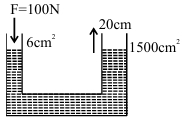
In a hydraulic lift,the surface area of the input piston is $6 \ cm^2$ and that of the output piston is $1500 \ cm^2$. If $100 \ N$ force is applied to the input piston to raise the output piston by $20 \ cm$,then the work done is . . . . . . $kJ$.
A
$25$
B
$15$
C
$4$
D
$5$
Solution
(D) According to Pascal's law,the pressure applied at the input piston is transmitted equally to the output piston.
$P_1 = P_2 \implies \frac{F_1}{A_1} = \frac{F_2}{A_2}$
Given: $F_1 = 100 \ N$,$A_1 = 6 \ cm^2$,$A_2 = 1500 \ cm^2$.
$F_2 = F_1 \times \frac{A_2}{A_1} = 100 \times \frac{1500}{6} = 100 \times 250 = 25000 \ N$.
The work done on the output piston is $W = F_2 \times d_2$,where $d_2 = 20 \ cm = 0.2 \ m$.
$W = 25000 \ N \times 0.2 \ m = 5000 \ J$.
Since $1 \ kJ = 1000 \ J$,the work done is $5 \ kJ$.
$P_1 = P_2 \implies \frac{F_1}{A_1} = \frac{F_2}{A_2}$
Given: $F_1 = 100 \ N$,$A_1 = 6 \ cm^2$,$A_2 = 1500 \ cm^2$.
$F_2 = F_1 \times \frac{A_2}{A_1} = 100 \times \frac{1500}{6} = 100 \times 250 = 25000 \ N$.
The work done on the output piston is $W = F_2 \times d_2$,where $d_2 = 20 \ cm = 0.2 \ m$.
$W = 25000 \ N \times 0.2 \ m = 5000 \ J$.
Since $1 \ kJ = 1000 \ J$,the work done is $5 \ kJ$.
0 likes
View Solution32
EasyMCQ
'Hydraulic lift' works on the basis of
A
Stoke's law
B
Toricelli's law
C
Pascal's Law
D
Bernoulli's Law
Solution
(C) The 'Hydraulic lift' operates on the principle of Pascal's Law.
Pascal's Law states that a change in pressure applied to an enclosed fluid is transmitted undiminished to every portion of the fluid and to the walls of the container.
$A$ hydraulic lift uses this principle by applying a small force on a small piston to create pressure, which is then transmitted through the fluid to a larger piston, resulting in a larger force capable of lifting heavy objects.
Mathematically, $Pressure = \frac{Force}{Area}$. Since the pressure is constant throughout the system, $P = \frac{F_1}{A_1} = \frac{F_2}{A_2}$, which allows a small input force to generate a large output force.
Pascal's Law states that a change in pressure applied to an enclosed fluid is transmitted undiminished to every portion of the fluid and to the walls of the container.
$A$ hydraulic lift uses this principle by applying a small force on a small piston to create pressure, which is then transmitted through the fluid to a larger piston, resulting in a larger force capable of lifting heavy objects.
Mathematically, $Pressure = \frac{Force}{Area}$. Since the pressure is constant throughout the system, $P = \frac{F_1}{A_1} = \frac{F_2}{A_2}$, which allows a small input force to generate a large output force.
0 likes
View Solution33
EasyMCQ
In a hydraulic lift,if the radius of the smaller piston is $5 \ cm$,and the radius of the larger piston is $50 \ cm$,then the weight that the larger piston can support when a force of $250 \ N$ is applied to the smaller piston is (in $kN$)
A
$50$
B
$100$
C
$40$
D
$25$
Solution
(D) According to Pascal's Law,the pressure applied to an enclosed fluid is transmitted undiminished to every portion of the fluid and the walls of the containing vessel.
For a hydraulic lift,the pressure on both pistons is equal: $P_1 = P_2$.
This implies $\frac{F_1}{A_1} = \frac{F_2}{A_2}$,where $F_1$ is the force on the smaller piston,$A_1$ is its area,$F_2$ is the force (weight) on the larger piston,and $A_2$ is its area.
The area of a circular piston is given by $A = \pi r^2$.
Thus,$\frac{F_1}{\pi r_1^2} = \frac{F_2}{\pi r_2^2}$,which simplifies to $F_2 = F_1 \times (\frac{r_2}{r_1})^2$.
Given $F_1 = 250 \ N$,$r_1 = 5 \ cm$,and $r_2 = 50 \ cm$.
Substituting the values: $F_2 = 250 \times (\frac{50}{5})^2 = 250 \times (10)^2 = 250 \times 100 = 25,000 \ N$.
Converting to kiloNewtons: $F_2 = 25 \ kN$.
For a hydraulic lift,the pressure on both pistons is equal: $P_1 = P_2$.
This implies $\frac{F_1}{A_1} = \frac{F_2}{A_2}$,where $F_1$ is the force on the smaller piston,$A_1$ is its area,$F_2$ is the force (weight) on the larger piston,and $A_2$ is its area.
The area of a circular piston is given by $A = \pi r^2$.
Thus,$\frac{F_1}{\pi r_1^2} = \frac{F_2}{\pi r_2^2}$,which simplifies to $F_2 = F_1 \times (\frac{r_2}{r_1})^2$.
Given $F_1 = 250 \ N$,$r_1 = 5 \ cm$,and $r_2 = 50 \ cm$.
Substituting the values: $F_2 = 250 \times (\frac{50}{5})^2 = 250 \times (10)^2 = 250 \times 100 = 25,000 \ N$.
Converting to kiloNewtons: $F_2 = 25 \ kN$.
0 likes
View Solution34
EasyMCQ
In a hydraulic lift,compressed air exerts a force $F$ on a small piston of radius $3 \ cm$. Due to this pressure,the second piston of radius $5 \ cm$ lifts a load of $1875 \ kg$. The value of $F$ is (Acceleration due to gravity $= 10 \ m \ s^{-2}$) (in $N$)
A
$1250$
B
$125$
C
$6750$
D
$675$
Solution
(C) The principle of a hydraulic lift is based on Pascal's law,which states that pressure applied to an enclosed fluid is transmitted undiminished to every portion of the fluid and the walls of the containing vessel.
Pressure on the small piston $(P_1)$ = Pressure on the large piston $(P_2)$.
$\frac{F_1}{A_1} = \frac{F_2}{A_2}$
Here,$F_1 = F$,$r_1 = 3 \ cm = 3 \times 10^{-2} \ m$,$r_2 = 5 \ cm = 5 \times 10^{-2} \ m$,and $F_2 = mg = 1875 \times 10 = 18750 \ N$.
Substituting the values:
$\frac{F}{\pi (3 \times 10^{-2})^2} = \frac{18750}{\pi (5 \times 10^{-2})^2}$
$\frac{F}{9 \times 10^{-4}} = \frac{18750}{25 \times 10^{-4}}$
$F = \frac{18750 \times 9}{25}$
$F = 750 \times 9 = 6750 \ N$.
Pressure on the small piston $(P_1)$ = Pressure on the large piston $(P_2)$.
$\frac{F_1}{A_1} = \frac{F_2}{A_2}$
Here,$F_1 = F$,$r_1 = 3 \ cm = 3 \times 10^{-2} \ m$,$r_2 = 5 \ cm = 5 \times 10^{-2} \ m$,and $F_2 = mg = 1875 \times 10 = 18750 \ N$.
Substituting the values:
$\frac{F}{\pi (3 \times 10^{-2})^2} = \frac{18750}{\pi (5 \times 10^{-2})^2}$
$\frac{F}{9 \times 10^{-4}} = \frac{18750}{25 \times 10^{-4}}$
$F = \frac{18750 \times 9}{25}$
$F = 750 \times 9 = 6750 \ N$.
0 likes
View Solution35
EasyMCQ
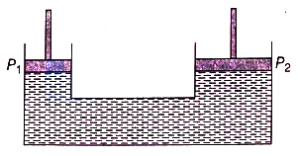
$A$ hydraulic lift is shown in the figure. The radii of the movable pistons $P_1$ and $P_2$ are $2 \,m$ and $8 \,m$ respectively. If a body of mass $2 \,kg$ is placed on piston $P_1$, then the force on piston $P_2$ is (Ignore atmospheric pressure, acceleration due to gravity $= 10 \,ms^{-2}$) (in $\,N$)
A
$320$
B
$80$
C
$1280$
D
$20$
Solution
(A) In a hydraulic machine, the pressure at both pistons is the same according to Pascal's Law.
Pressure at piston $P_1 = $ Pressure at piston $P_2$
$\Rightarrow \frac{F_1}{A_1} = \frac{F_2}{A_2}$
Where $F_1 = mg = 2 \,kg \times 10 \,ms^{-2} = 20 \,N$.
$A_1 = \pi R_1^2 = \pi (2)^2 = 4\pi \,m^2$.
$A_2 = \pi R_2^2 = \pi (8)^2 = 64\pi \,m^2$.
Now, $F_2 = F_1 \times \frac{A_2}{A_1} = 20 \times \frac{64\pi}{4\pi} = 20 \times 16 = 320 \,N$.
Pressure at piston $P_1 = $ Pressure at piston $P_2$
$\Rightarrow \frac{F_1}{A_1} = \frac{F_2}{A_2}$
Where $F_1 = mg = 2 \,kg \times 10 \,ms^{-2} = 20 \,N$.
$A_1 = \pi R_1^2 = \pi (2)^2 = 4\pi \,m^2$.
$A_2 = \pi R_2^2 = \pi (8)^2 = 64\pi \,m^2$.
Now, $F_2 = F_1 \times \frac{A_2}{A_1} = 20 \times \frac{64\pi}{4\pi} = 20 \times 16 = 320 \,N$.
0 likes
View Solution36
EasyMCQ
Which of the following works on Pascal's law?
A
Aneroid barometer
B
Hydraulic lift
C
Sprayer
D
Venturimeter
Solution
(B) Pascal's law states that a change in pressure applied to an enclosed fluid is transmitted undiminished to every portion of the fluid and to the walls of the containing vessel.
$A$ hydraulic lift is a practical application of Pascal's law. In a hydraulic lift,a small force $F_1$ applied to a small area $A_1$ creates a pressure $p_1 = F_1 / A_1$. This pressure is transmitted through the fluid to a larger area $A_2$,where it exerts a larger force $F_2 = p_2 \times A_2$. Since $p_1 = p_2$,we have:
$\frac{F_1}{A_1} = \frac{F_2}{A_2}$
Thus,the hydraulic lift works on the principle of Pascal's law.
$A$ hydraulic lift is a practical application of Pascal's law. In a hydraulic lift,a small force $F_1$ applied to a small area $A_1$ creates a pressure $p_1 = F_1 / A_1$. This pressure is transmitted through the fluid to a larger area $A_2$,where it exerts a larger force $F_2 = p_2 \times A_2$. Since $p_1 = p_2$,we have:
$\frac{F_1}{A_1} = \frac{F_2}{A_2}$
Thus,the hydraulic lift works on the principle of Pascal's law.
0 likes
View Solution37
MediumMCQ
In a vehicle lifter, the enclosed gas exerts a force $F$ on a small piston of $8 \text{ cm}$ diameter. The pressure is transmitted to a second piston of diameter $24 \text{ cm}$. If the mass of the vehicle to be lifted is $1400 \text{ kg}$, then $F$ must at least be $(g=10 \text{ ms}^{-2})$. (in $\text{ N}$)
A
$1600$
B
$1200$
C
$1800$
D
$700$
Solution
(A) According to Pascal's law, the pressure applied to an enclosed fluid is transmitted undiminished to every portion of the fluid and the walls of the containing vessel.
Given:
Diameter of small piston, $d_1 = 8 \text{ cm}$
Diameter of large piston, $d_2 = 24 \text{ cm}$
Mass of the vehicle, $M = 1400 \text{ kg}$
Acceleration due to gravity, $g = 10 \text{ ms}^{-2}$
Force on large piston, $F_2 = M \times g = 1400 \times 10 = 14000 \text{ N}$
Pressure on small piston = Pressure on large piston
$\frac{F_1}{A_1} = \frac{F_2}{A_2}$
Since $A = \frac{\pi d^2}{4}$, we have:
$\frac{F_1}{d_1^2} = \frac{F_2}{d_2^2}$
$F_1 = F_2 \times \left(\frac{d_1}{d_2}\right)^2$
$F_1 = 14000 \times \left(\frac{8}{24}\right)^2$
$F_1 = 14000 \times \left(\frac{1}{3}\right)^2 = \frac{14000}{9} \approx 1555.55 \text{ N}$
Rounding to the nearest option, $F \approx 1600 \text{ N}$.
Given:
Diameter of small piston, $d_1 = 8 \text{ cm}$
Diameter of large piston, $d_2 = 24 \text{ cm}$
Mass of the vehicle, $M = 1400 \text{ kg}$
Acceleration due to gravity, $g = 10 \text{ ms}^{-2}$
Force on large piston, $F_2 = M \times g = 1400 \times 10 = 14000 \text{ N}$
Pressure on small piston = Pressure on large piston
$\frac{F_1}{A_1} = \frac{F_2}{A_2}$
Since $A = \frac{\pi d^2}{4}$, we have:
$\frac{F_1}{d_1^2} = \frac{F_2}{d_2^2}$
$F_1 = F_2 \times \left(\frac{d_1}{d_2}\right)^2$
$F_1 = 14000 \times \left(\frac{8}{24}\right)^2$
$F_1 = 14000 \times \left(\frac{1}{3}\right)^2 = \frac{14000}{9} \approx 1555.55 \text{ N}$
Rounding to the nearest option, $F \approx 1600 \text{ N}$.
0 likes
View Solution38
MediumMCQ
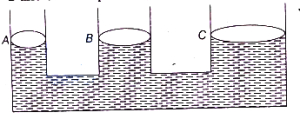
$A$ hydraulic lift is shown in the figure. The movable pistons $A, B$ and $C$ have radii of $10 \,cm, 100 \,cm$ and $5 \,cm$ respectively. If a body of mass $2 \,kg$ is placed on piston $A$, what are the maximum masses that can be lifted by pistons $B$ and $C$ respectively?
A
$200 \,kg$ and $500 \,kg$
B
$20 \,kg$ and $50 \,kg$
C
$200 \,kg$ and $5000 \,kg$
D
None of the above
Solution
(D) Given radii: $r_A = 10 \,cm = 0.1 \,m$, $r_B = 100 \,cm = 1 \,m$, $r_C = 5 \,cm = 0.05 \,m$.
Weight placed on piston $A$ is $F_A = m_A g = 2g$.
According to Pascal's law, the pressure is transmitted equally throughout the fluid: $\frac{F_A}{A_A} = \frac{F_B}{A_B} = \frac{F_C}{A_C}$.
Since $A = \pi r^2$, we have $\frac{F_A}{r_A^2} = \frac{F_B}{r_B^2} = \frac{F_C}{r_C^2}$.
For piston $B$: $F_B = F_A \times \left(\frac{r_B}{r_A}\right)^2 = 2g \times \left(\frac{1}{0.1}\right)^2 = 2g \times 100 = 200g$.
Thus, the mass that can be lifted by $B$ is $m_B = 200 \,kg$.
For piston $C$: $F_C = F_A \times \left(\frac{r_C}{r_A}\right)^2 = 2g \times \left(\frac{0.05}{0.1}\right)^2 = 2g \times (0.5)^2 = 2g \times 0.25 = 0.5g$.
Thus, the mass that can be lifted by $C$ is $m_C = 0.5 \,kg$.
The calculated masses are $200 \,kg$ and $0.5 \,kg$. Since this does not match any of the given options, the correct choice is $D$.
Weight placed on piston $A$ is $F_A = m_A g = 2g$.
According to Pascal's law, the pressure is transmitted equally throughout the fluid: $\frac{F_A}{A_A} = \frac{F_B}{A_B} = \frac{F_C}{A_C}$.
Since $A = \pi r^2$, we have $\frac{F_A}{r_A^2} = \frac{F_B}{r_B^2} = \frac{F_C}{r_C^2}$.
For piston $B$: $F_B = F_A \times \left(\frac{r_B}{r_A}\right)^2 = 2g \times \left(\frac{1}{0.1}\right)^2 = 2g \times 100 = 200g$.
Thus, the mass that can be lifted by $B$ is $m_B = 200 \,kg$.
For piston $C$: $F_C = F_A \times \left(\frac{r_C}{r_A}\right)^2 = 2g \times \left(\frac{0.05}{0.1}\right)^2 = 2g \times (0.5)^2 = 2g \times 0.25 = 0.5g$.
Thus, the mass that can be lifted by $C$ is $m_C = 0.5 \,kg$.
The calculated masses are $200 \,kg$ and $0.5 \,kg$. Since this does not match any of the given options, the correct choice is $D$.
0 likes
View Solution39
EasyMCQ
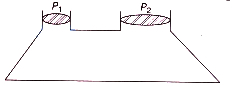
$A$ hydraulic lift is shown in the figure. The radii of the movable pistons $P_1$ and $P_2$ are $2 \ m$ and $5 \ m$ respectively. If a block of mass $x$ is placed on $P_2$,then the minimum mass that should be kept on $P_1$ to lift the block on $P_2$ is (in $x$)
A
$0.4$
B
$0.16$
C
$0.8$
D
$0.25$
Solution
(B) Given radii of pistons are $r_1 = 2 \ m$ and $r_2 = 5 \ m$. Let $m_1$ be the mass placed on piston $P_1$ and $m_2 = x$ be the mass placed on piston $P_2$.
According to Pascal's law,the pressure at the same horizontal level in a continuous static fluid is the same.
$p_1 = p_2$
$\frac{F_1}{A_1} = \frac{F_2}{A_2}$
Since $F = mg$ and $A = \pi r^2$,we have:
$\frac{m_1 g}{\pi r_1^2} = \frac{m_2 g}{\pi r_2^2}$
$\frac{m_1}{r_1^2} = \frac{m_2}{r_2^2}$
Substituting the given values:
$\frac{m_1}{2^2} = \frac{x}{5^2}$
$\frac{m_1}{4} = \frac{x}{25}$
$m_1 = \frac{4}{25} x = 0.16 x$
Thus,the minimum mass that should be kept on $P_1$ is $0.16 x$.
According to Pascal's law,the pressure at the same horizontal level in a continuous static fluid is the same.
$p_1 = p_2$
$\frac{F_1}{A_1} = \frac{F_2}{A_2}$
Since $F = mg$ and $A = \pi r^2$,we have:
$\frac{m_1 g}{\pi r_1^2} = \frac{m_2 g}{\pi r_2^2}$
$\frac{m_1}{r_1^2} = \frac{m_2}{r_2^2}$
Substituting the given values:
$\frac{m_1}{2^2} = \frac{x}{5^2}$
$\frac{m_1}{4} = \frac{x}{25}$
$m_1 = \frac{4}{25} x = 0.16 x$
Thus,the minimum mass that should be kept on $P_1$ is $0.16 x$.
0 likes
View Solution40
EasyMCQ
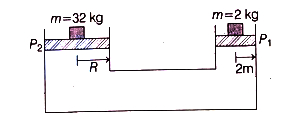
The movable cylindrical pistons $P_1$ and $P_2$ of a hydraulic lift are of radii $2 \,m$ and $R$ respectively. $A$ body of mass $32 \,kg$ on piston $P_2$ is supported by a body of mass $2 \,kg$ placed on piston $P_1$. The value of $R$ is (in $\,m$)
A
$8$
B
$32$
C
$2$
D
$16$
Solution
(A) According to Pascal's law, the pressure applied to an enclosed fluid is transmitted undiminished to every portion of the fluid and to the walls of the containing vessel. Therefore, the pressure at both pistons $P_1$ and $P_2$ must be equal.
Let $F_1$ and $F_2$ be the forces applied on pistons $P_1$ and $P_2$ respectively, and $A_1$ and $A_2$ be their respective areas.
$F_1 = m_1 g = 2g$
$F_2 = m_2 g = 32g$
$A_1 = \pi (2)^2 = 4\pi$
$A_2 = \pi R^2$
Equating the pressures: $\frac{F_1}{A_1} = \frac{F_2}{A_2}$
$\frac{2g}{4\pi} = \frac{32g}{\pi R^2}$
$\frac{1}{2} = \frac{32}{R^2}$
$R^2 = 64$
$R = 8 \,m$
Let $F_1$ and $F_2$ be the forces applied on pistons $P_1$ and $P_2$ respectively, and $A_1$ and $A_2$ be their respective areas.
$F_1 = m_1 g = 2g$
$F_2 = m_2 g = 32g$
$A_1 = \pi (2)^2 = 4\pi$
$A_2 = \pi R^2$
Equating the pressures: $\frac{F_1}{A_1} = \frac{F_2}{A_2}$
$\frac{2g}{4\pi} = \frac{32g}{\pi R^2}$
$\frac{1}{2} = \frac{32}{R^2}$
$R^2 = 64$
$R = 8 \,m$
0 likes
View Solution41
EasyMCQ
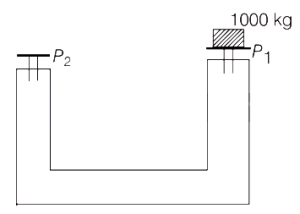
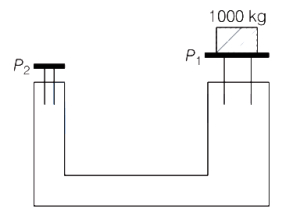
$A$ hydraulic lift as shown in the figure is used to lift a mass of $1000 \ kg$,which is placed on a piston $(P_1)$ of area $1 \ m^2$. If the cross-section area of the piston $(P_2)$ at the other end is $0.01 \ m^2$,then how much mass needs to be put on it to lift the $1000 \ kg$ (in $kg$)?
A
$1$
B
$10$
C
$50$
D
$100$
Solution
(B) According to Pascal's law,the pressure applied at both pistons must be equal for equilibrium.
$P_1 = P_2$
$\frac{F_1}{A_1} = \frac{F_2}{A_2}$
Here,$F_1 = M_1 g = 1000 \times g$ and $F_2 = M_2 g$.
Given $A_1 = 1 \ m^2$ and $A_2 = 0.01 \ m^2$.
Substituting the values:
$\frac{1000 \times g}{1} = \frac{M_2 \times g}{0.01}$
$1000 = \frac{M_2}{0.01}$
$M_2 = 1000 \times 0.01 = 10 \ kg$.
Thus,a mass of $10 \ kg$ needs to be placed on piston $(P_2)$ to lift the $1000 \ kg$ mass.
$P_1 = P_2$
$\frac{F_1}{A_1} = \frac{F_2}{A_2}$
Here,$F_1 = M_1 g = 1000 \times g$ and $F_2 = M_2 g$.
Given $A_1 = 1 \ m^2$ and $A_2 = 0.01 \ m^2$.
Substituting the values:
$\frac{1000 \times g}{1} = \frac{M_2 \times g}{0.01}$
$1000 = \frac{M_2}{0.01}$
$M_2 = 1000 \times 0.01 = 10 \ kg$.
Thus,a mass of $10 \ kg$ needs to be placed on piston $(P_2)$ to lift the $1000 \ kg$ mass.
0 likes
View SolutionFluid Mechanics and Surface Tension — Pascal's Law · Frequently Asked Questions
1Are these Fluid Mechanics and Surface Tension questions useful for JEE and NEET?
Yes. All questions in this section are mapped to JEE Main and NEET exam patterns. Previous year questions from JEE Main, NEET, GUJCET and state-level exams are included with full solutions.
2Can I switch to Hindi or Gujarati for these questions?
Yes. Use the language tabs in the hero section or the sidebar to view the same questions and solutions in English, Hindi or Gujarati.
3How do I generate a question paper from this subtopic?
Use the Vedclass Exam Paper Generator — select the chapter and subtopic, set difficulty, and generate Sets A, B, C, D automatically. First 3 chapters of every subject are free.
Vedclass Products
For Students
Vedclass Test Series
Mock tests in real JEE/NEET style with performance analysis. 5-day free trial.
Start Free TrialFor Teachers
Exam Paper Generator
Generate Set A/B/C/D papers from this chapter in 2 minutes. 3 chapters free.
Try FreeFor Institutes
Online Exam Module
Live online exams with unlimited students, 360° analytics & white-label branding.
See DemoFor Teachers & Institutes
Generate a Fluid Mechanics and Surface Tension Exam Paper in 2 Minutes
Select subtopic & difficulty — Sets A, B, C, D auto-generated with No Repeat logic.
First 3 chapters of every subject are free — no payment required.