
A English
Angle of Contact Questions in English
Class 11 Physics · Fluid Mechanics and Surface Tension · Angle of Contact
45+
Questions
English
Language
100%
With Solutions
Showing 44 of 45 questions in English
1
EasyMCQ
$A$ liquid does not wet the sides of a solid,if the angle of contact is
A
Zero
B
Obtuse (More than $90^{\circ}$)
C
Acute (Less than $90^{\circ}$)
D
$90^{\circ}$
Solution
(B) liquid does not wet the solid surface if the angle of contact is obtuse,i.e.,greater than $90^{\circ}$.
In this case,the cohesive forces between the liquid molecules are greater than the adhesive forces between the liquid and the solid surface.
Consequently,the liquid does not spread over the surface and does not wet it.
In this case,the cohesive forces between the liquid molecules are greater than the adhesive forces between the liquid and the solid surface.
Consequently,the liquid does not spread over the surface and does not wet it.
0 likes
View Solution2
EasyMCQ
The meniscus of mercury in the capillary tube is
A
Convex
B
Concave
C
Plane
D
Uncertain
Solution
(A) The correct answer is $A$ (Convex).
The shape of the meniscus is determined by the relative strengths of cohesive forces (forces between liquid molecules) and adhesive forces (forces between liquid molecules and the container surface).
For mercury,the cohesive forces between mercury atoms are significantly stronger than the adhesive forces between mercury atoms and the glass surface of the capillary tube.
Because the cohesive forces dominate,the mercury atoms tend to pull away from the glass walls and towards each other,resulting in a convex meniscus shape.
The shape of the meniscus is determined by the relative strengths of cohesive forces (forces between liquid molecules) and adhesive forces (forces between liquid molecules and the container surface).
For mercury,the cohesive forces between mercury atoms are significantly stronger than the adhesive forces between mercury atoms and the glass surface of the capillary tube.
Because the cohesive forces dominate,the mercury atoms tend to pull away from the glass walls and towards each other,resulting in a convex meniscus shape.
0 likes
View Solution3
EasyMCQ
When the temperature is increased,the angle of contact of a liquid:
A
Increases
B
Decreases
C
Remains the same
D
First increases and then decreases
Solution
(B) The angle of contact $\theta$ is determined by the balance of surface tension forces at the interface of liquid,solid,and gas.
As the temperature increases,the cohesive forces between the liquid molecules decrease more rapidly than the adhesive forces between the liquid and the solid surface.
Since the angle of contact is inversely related to the strength of the adhesive forces relative to the cohesive forces,a reduction in cohesive force leads to a decrease in the angle of contact.
Therefore,the correct option is $(b)$.
As the temperature increases,the cohesive forces between the liquid molecules decrease more rapidly than the adhesive forces between the liquid and the solid surface.
Since the angle of contact is inversely related to the strength of the adhesive forces relative to the cohesive forces,a reduction in cohesive force leads to a decrease in the angle of contact.
Therefore,the correct option is $(b)$.
0 likes
View Solution4
EasyMCQ
The angle of contact between glass and mercury is......... $^o$
A
$0$
B
$30$
C
$90$
D
$135$
Solution
(D) The angle of contact is defined as the angle between the tangent to the liquid surface at the point of contact and the solid surface inside the liquid.
For liquids that do not wet the solid surface,such as mercury in contact with glass,the angle of contact is obtuse.
The angle of contact for the glass-mercury interface is approximately $135^o$ to $140^o$.
Among the given options,$135^o$ is the correct value.
Therefore,the correct option is $D$.
For liquids that do not wet the solid surface,such as mercury in contact with glass,the angle of contact is obtuse.
The angle of contact for the glass-mercury interface is approximately $135^o$ to $140^o$.
Among the given options,$135^o$ is the correct value.
Therefore,the correct option is $D$.
0 likes
View Solution5
EasyMCQ
$A$ mercury drop does not spread on a glass plate because the angle of contact between glass and mercury is
A
Acute
B
Obtuse
C
Zero
D
$90^\circ$
Solution
(B) The angle of contact is the angle between the tangent to the liquid surface at the point of contact and the solid surface inside the liquid.
For a liquid that does not wet the solid surface,the cohesive forces between liquid molecules are stronger than the adhesive forces between the liquid and solid molecules.
In the case of mercury and glass,the angle of contact is approximately $135^\circ$ to $140^\circ$,which is an obtuse angle.
Because the angle of contact is obtuse,the mercury drop tends to minimize its contact area with the glass,causing it to remain as a drop rather than spreading.
For a liquid that does not wet the solid surface,the cohesive forces between liquid molecules are stronger than the adhesive forces between the liquid and solid molecules.
In the case of mercury and glass,the angle of contact is approximately $135^\circ$ to $140^\circ$,which is an obtuse angle.
Because the angle of contact is obtuse,the mercury drop tends to minimize its contact area with the glass,causing it to remain as a drop rather than spreading.
0 likes
View Solution6
EasyMCQ
The parts of motor cars are polished by chromium because the angle of contact between water and chromium is
A
$0^\circ$
B
$90^\circ$
C
Less than $90^\circ$
D
Greater than $90^\circ$
Solution
(D) The angle of contact between a liquid and a solid surface determines whether the liquid will wet the surface or not.
If the angle of contact is less than $90^\circ$,the liquid wets the surface.
If the angle of contact is greater than $90^\circ$,the liquid does not wet the surface.
Chromium is used for polishing motor car parts because it is water-repellent,meaning it prevents water from sticking to the surface and causing corrosion.
Therefore,the angle of contact between water and chromium must be greater than $90^\circ$.
If the angle of contact is less than $90^\circ$,the liquid wets the surface.
If the angle of contact is greater than $90^\circ$,the liquid does not wet the surface.
Chromium is used for polishing motor car parts because it is water-repellent,meaning it prevents water from sticking to the surface and causing corrosion.
Therefore,the angle of contact between water and chromium must be greater than $90^\circ$.
0 likes
View Solution7
EasyMCQ
$A$ glass plate is partly dipped vertically in mercury and the angle of contact is measured. If the plate is inclined,then the angle of contact will
A
Increase
B
Remain unchanged
C
Increase or decrease
D
Decrease
Solution
(B) The angle of contact is a characteristic property of the pair of materials in contact (in this case,glass and mercury) and the surrounding medium.
It depends on the nature of the liquid and the solid surface,as well as the temperature.
It does not depend on the orientation or the inclination of the solid surface relative to the liquid surface.
Therefore,if the glass plate is inclined,the angle of contact will remain unchanged.
It depends on the nature of the liquid and the solid surface,as well as the temperature.
It does not depend on the orientation or the inclination of the solid surface relative to the liquid surface.
Therefore,if the glass plate is inclined,the angle of contact will remain unchanged.
0 likes
View Solution8
EasyMCQ
The liquid meniscus in a capillary tube will be convex,if the angle of contact is
A
Greater than $90^{\circ}$
B
Less than $90^{\circ}$
C
Equal to $90^{\circ}$
D
Equal to $0^{\circ}$
Solution
(A) convex meniscus occurs when the cohesive forces between liquid molecules are stronger than the adhesive forces between the liquid and the container wall.
This typically happens when mercury is placed in a glass capillary tube.
In a convex meniscus,the angle of contact $\theta$ is defined as the angle between the tangent to the liquid surface and the solid surface,measured inside the liquid.
For a convex meniscus,this angle of contact is always greater than $90^{\circ}$.
This typically happens when mercury is placed in a glass capillary tube.
In a convex meniscus,the angle of contact $\theta$ is defined as the angle between the tangent to the liquid surface and the solid surface,measured inside the liquid.
For a convex meniscus,this angle of contact is always greater than $90^{\circ}$.
0 likes
View Solution9
MediumMCQ
If a water drop is kept between two glass plates,then its shape is
A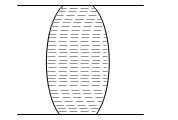
B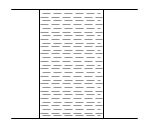
C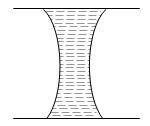
D
None of these
Solution
(C) When a water drop is placed between two glass plates,the water wets the glass surface because the angle of contact between water and glass is acute (less than $90^{\circ}$).
Due to surface tension,the liquid surface tends to minimize its area.
For a liquid that wets the surface (acute angle of contact),the meniscus becomes concave towards the air.
This results in the liquid spreading out and forming a concave shape between the two plates,as shown in image $52-$c10.
Due to surface tension,the liquid surface tends to minimize its area.
For a liquid that wets the surface (acute angle of contact),the meniscus becomes concave towards the air.
This results in the liquid spreading out and forming a concave shape between the two plates,as shown in image $52-$c10.
0 likes
View Solution10
EasyMCQ
The value of the contact angle for kerosene with a solid surface is ........ $^o$.
A
$0$
B
$90$
C
$45$
D
$33$
Solution
(A) The contact angle is defined as the angle between the tangent to the liquid surface at the point of contact and the solid surface inside the liquid.
For liquids that wet the solid surface,the contact angle is acute $(< 90^{\circ})$.
Kerosene is a liquid that wets most solid surfaces easily.
Experimental observations show that the contact angle for kerosene with a clean solid surface is $0^{\circ}$.
For liquids that wet the solid surface,the contact angle is acute $(< 90^{\circ})$.
Kerosene is a liquid that wets most solid surfaces easily.
Experimental observations show that the contact angle for kerosene with a clean solid surface is $0^{\circ}$.
0 likes
View Solution11
EasyMCQ
What is the nature of the meniscus for a liquid with an angle of contact of $0^{\circ}$?
A
Plane
B
Parabolic
C
Semi-spherical
D
Cylindrical
Solution
(C) The shape of the meniscus is determined by the angle of contact $\theta$ between the liquid and the solid surface.
For a liquid with an angle of contact $\theta = 0^{\circ}$,the adhesive forces between the liquid and the solid are very strong compared to the cohesive forces within the liquid.
This results in the liquid wetting the surface completely,causing the meniscus to curve into a semi-spherical shape.
Therefore,the correct answer is semi-spherical.
For a liquid with an angle of contact $\theta = 0^{\circ}$,the adhesive forces between the liquid and the solid are very strong compared to the cohesive forces within the liquid.
This results in the liquid wetting the surface completely,causing the meniscus to curve into a semi-spherical shape.
Therefore,the correct answer is semi-spherical.
0 likes
View Solution12
EasyMCQ
$A$ liquid wets a solid completely. The meniscus of the liquid in a sufficiently long tube is
A
Flat
B
Concave
C
Convex
D
Cylindrical
Solution
(B) When a liquid wets a solid completely,the adhesive forces between the liquid and solid molecules are stronger than the cohesive forces between the liquid molecules themselves.
This results in an angle of contact $\theta$ that is less than $90^{\circ}$.
For any liquid where the angle of contact $\theta < 90^{\circ}$,the shape of the meniscus in a capillary tube is concave.
This results in an angle of contact $\theta$ that is less than $90^{\circ}$.
For any liquid where the angle of contact $\theta < 90^{\circ}$,the shape of the meniscus in a capillary tube is concave.
0 likes
View Solution13
EasyMCQ
What is the shape of the meniscus when a non-wetting liquid is placed in a capillary tube?
A
Concave upward
B
Convex upward
C
Concave downward
D
Convex downward
Solution
(B) For a non-wetting liquid,the angle of contact $\theta$ is obtuse $(\theta > 90^{\circ})$.
Due to the cohesive forces being stronger than the adhesive forces,the liquid surface curves to form a convex meniscus.
Therefore,the shape of the meniscus is convex upward.
Due to the cohesive forces being stronger than the adhesive forces,the liquid surface curves to form a convex meniscus.
Therefore,the shape of the meniscus is convex upward.
0 likes
View Solution14
EasyMCQ
For which of the two pairs,the angle of contact is the same?
A
Water and glass; glass and mercury
B
Pure water and glass; glass and alcohol
C
Silver and water; mercury and glass
D
Silver and chromium; water and chromium
Solution
(B) The angle of contact depends on the nature of the liquid and the solid surface in contact.
Pure water and glass,as well as alcohol and glass,are both pairs where the liquid wets the solid surface.
In both cases,the adhesive force between the liquid and solid molecules is greater than the cohesive force between the liquid molecules.
Consequently,both pairs exhibit an acute angle of contact,making them the correct choice.
Pure water and glass,as well as alcohol and glass,are both pairs where the liquid wets the solid surface.
In both cases,the adhesive force between the liquid and solid molecules is greater than the cohesive force between the liquid molecules.
Consequently,both pairs exhibit an acute angle of contact,making them the correct choice.
0 likes
View Solution15
EasyMCQ
If the surface of a liquid is plane,then the angle of contact of the liquid with the walls of the container is
A
Acute angle
B
Obtuse angle
C
$90^\circ$
D
$0^\circ$
Solution
(D) The angle of contact is defined as the angle between the tangent to the liquid surface at the point of contact and the solid surface inside the liquid.
For a plane liquid surface,the tangent to the liquid surface at the point of contact is parallel to the wall of the container.
Therefore,the angle between the tangent and the wall is $0^\circ$.
For a plane liquid surface,the tangent to the liquid surface at the point of contact is parallel to the wall of the container.
Therefore,the angle between the tangent and the wall is $0^\circ$.
0 likes
View Solution16
EasyMCQ
Due to capillary action,a liquid will rise in a tube,if the angle of contact is
A
Acute
B
Obtuse
C
$90^{\circ}$
D
Zero
Solution
(A) The height of the liquid column in a capillary tube is given by the formula $h = \frac{2T \cos \theta}{rdg}$,where $T$ is the surface tension,$\theta$ is the angle of contact,$r$ is the radius of the tube,$d$ is the density of the liquid,and $g$ is the acceleration due to gravity.
For the liquid to rise in the tube,the height $h$ must be positive.
Since $T, r, d,$ and $g$ are always positive,the sign of $h$ depends on $\cos \theta$.
If the angle of contact $\theta$ is acute (i.e.,$0^{\circ} \le \theta < 90^{\circ}$),then $\cos \theta$ is positive,making $h$ positive,which indicates a rise in the liquid level.
Therefore,the correct option is $A$.
For the liquid to rise in the tube,the height $h$ must be positive.
Since $T, r, d,$ and $g$ are always positive,the sign of $h$ depends on $\cos \theta$.
If the angle of contact $\theta$ is acute (i.e.,$0^{\circ} \le \theta < 90^{\circ}$),then $\cos \theta$ is positive,making $h$ positive,which indicates a rise in the liquid level.
Therefore,the correct option is $A$.
0 likes
View Solution17
EasyMCQ
The wettability of a surface by a liquid depends primarily on
A
surface tension
B
density
C
angle of contact between the surface and the liquid
D
viscosity
Solution
(C) The wettability of a surface by a liquid is determined by the angle of contact $\theta$ between the liquid and the solid surface.
If the angle of contact $\theta$ is acute $(\theta < 90^{\circ})$,the liquid wets the surface.
If the angle of contact $\theta$ is obtuse $(\theta > 90^{\circ})$,the liquid does not wet the surface.
Therefore,the primary factor determining wettability is the angle of contact.
If the angle of contact $\theta$ is acute $(\theta < 90^{\circ})$,the liquid wets the surface.
If the angle of contact $\theta$ is obtuse $(\theta > 90^{\circ})$,the liquid does not wet the surface.
Therefore,the primary factor determining wettability is the angle of contact.
0 likes
View Solution18
MediumMCQ
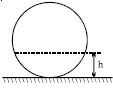
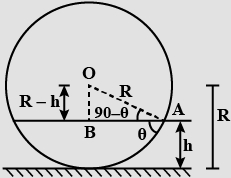
$A$ liquid is filled in a spherical container of radius $R$ up to a height $h$. At this position,the liquid surface at the edges is horizontal. The contact angle is:
A
$0$
B
$\cos^{-1} \left( \frac{R - h}{R} \right)$
C
$\cos^{-1} \left( \frac{h - R}{R} \right)$
D
$\sin^{-1} \left( \frac{R - h}{R} \right)$
Solution
(B) Let the contact angle be $\theta$. Consider the center of the sphere $O$ and the point of contact $A$ at the edge of the liquid surface. Let $B$ be the point on the vertical axis at the same level as the liquid surface.
In the right-angled triangle $\Delta OBA$,the hypotenuse $OA = R$ (radius of the sphere).
The vertical distance from the center $O$ to the liquid surface is $R - h$.
Thus,$OB = R - h$.
The angle between the radius $OA$ and the vertical line $OB$ is $(90^{\circ} - \theta)$,where $\theta$ is the contact angle.
In $\Delta OBA$,we have:
$\cos(90^{\circ} - \theta) = \frac{OB}{OA} = \frac{R - h}{R}$
Since $\cos(90^{\circ} - \theta) = \sin \theta$,we have $\sin \theta = \frac{R - h}{R}$.
However,looking at the geometry,the angle between the tangent to the surface at $A$ and the radius $OA$ is $90^{\circ}$. The angle between the horizontal liquid surface and the radius $OA$ is $\theta$.
Therefore,$\cos \theta = \frac{OB}{OA} = \frac{R - h}{R}$.
Thus,$\theta = \cos^{-1} \left( \frac{R - h}{R} \right)$.
In the right-angled triangle $\Delta OBA$,the hypotenuse $OA = R$ (radius of the sphere).
The vertical distance from the center $O$ to the liquid surface is $R - h$.
Thus,$OB = R - h$.
The angle between the radius $OA$ and the vertical line $OB$ is $(90^{\circ} - \theta)$,where $\theta$ is the contact angle.
In $\Delta OBA$,we have:
$\cos(90^{\circ} - \theta) = \frac{OB}{OA} = \frac{R - h}{R}$
Since $\cos(90^{\circ} - \theta) = \sin \theta$,we have $\sin \theta = \frac{R - h}{R}$.
However,looking at the geometry,the angle between the tangent to the surface at $A$ and the radius $OA$ is $90^{\circ}$. The angle between the horizontal liquid surface and the radius $OA$ is $\theta$.
Therefore,$\cos \theta = \frac{OB}{OA} = \frac{R - h}{R}$.
Thus,$\theta = \cos^{-1} \left( \frac{R - h}{R} \right)$.
0 likes
View Solution19
MediumMCQ
The grease deposited on a glass plate can be easily removed by cleaning the glass with hot water containing detergent powder,because the detergent powder
A
Reduces the angle of contact between the solution and glass
B
Increases the temperature of the solution
C
Decrease the density of the solution
D
Makes the angle of contact between solution and the glass to an obtuse angle
Solution
(A) Detergents are surfactants that lower the surface tension of water.
When detergent is added to water,it reduces the angle of contact between the cleaning solution and the glass surface.
$A$ smaller angle of contact allows the solution to spread more effectively over the surface and penetrate the grease,facilitating its removal.
Therefore,the correct reason is that it reduces the angle of contact.
When detergent is added to water,it reduces the angle of contact between the cleaning solution and the glass surface.
$A$ smaller angle of contact allows the solution to spread more effectively over the surface and penetrate the grease,facilitating its removal.
Therefore,the correct reason is that it reduces the angle of contact.
0 likes
View Solution20
MediumMCQ
Consider a spherical body,one third of its volume is filled with a liquid which has a contact angle of zero with the surface of the sphere. If this sphere (along with the liquid) is taken to gravity-free space,then the shape of the liquid inside the sphere will look like:
A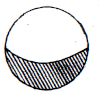
B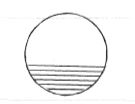
C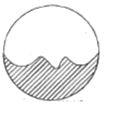
D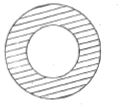
Solution
(D) In a gravity-free environment,the shape of the liquid is determined by the minimization of surface energy. The total surface energy is the sum of the liquid-solid surface energy and the liquid-air surface energy. Since the contact angle is zero,the liquid perfectly wets the inner surface of the sphere. To minimize the total surface energy,the liquid will spread to cover the entire inner surface of the sphere,forming a spherical shell of liquid. This configuration maximizes the liquid-solid contact area (which is energetically favorable due to the zero contact angle) and minimizes the liquid-air surface area for a given volume. Therefore,the liquid will coat the inner surface of the sphere.
0 likes
View Solution21
EasyMCQ
If a capillary tube is dipped into a liquid and the levels of the liquid inside and outside are the same,then the angle of contact is ...... $^o$.
A
$0$
B
$90$
C
$45$
D
$30$
Solution
(B) The height of liquid rise in a capillary tube is given by the formula:
$h = \frac{2T \cos \theta}{r \rho g}$
Where $T$ is surface tension,$\theta$ is the angle of contact,$r$ is the radius of the tube,$\rho$ is the density of the liquid,and $g$ is the acceleration due to gravity.
When the level of the liquid inside and outside the capillary tube is the same,the height of the rise $h$ is $0$.
Substituting $h = 0$ into the formula:
$0 = \frac{2T \cos \theta}{r \rho g}$
Since $T$,$r$,$\rho$,and $g$ are non-zero constants,we must have:
$\cos \theta = 0$
This implies that $\theta = 90^{\circ}$.
$h = \frac{2T \cos \theta}{r \rho g}$
Where $T$ is surface tension,$\theta$ is the angle of contact,$r$ is the radius of the tube,$\rho$ is the density of the liquid,and $g$ is the acceleration due to gravity.
When the level of the liquid inside and outside the capillary tube is the same,the height of the rise $h$ is $0$.
Substituting $h = 0$ into the formula:
$0 = \frac{2T \cos \theta}{r \rho g}$
Since $T$,$r$,$\rho$,and $g$ are non-zero constants,we must have:
$\cos \theta = 0$
This implies that $\theta = 90^{\circ}$.
0 likes
View Solution22
MediumMCQ
$A$ capillary tube is dipped vertically in a liquid. If the liquid surface is hemispherical,then the angle of contact $\theta$ is
A
$\theta = 90^o$
B
$\theta = 0^o$
C
$\theta > 90^o$
D
$0 < \theta < 90^o$
Solution
(B) The shape of the meniscus in a capillary tube is determined by the angle of contact $\theta$ between the liquid and the solid surface.
If the liquid surface (meniscus) is hemispherical,it implies that the liquid perfectly wets the surface of the capillary tube.
For a hemispherical meniscus,the tangent to the liquid surface at the point of contact is vertical,which means the angle of contact $\theta$ is $0^o$.
Therefore,the correct option is $B$.
If the liquid surface (meniscus) is hemispherical,it implies that the liquid perfectly wets the surface of the capillary tube.
For a hemispherical meniscus,the tangent to the liquid surface at the point of contact is vertical,which means the angle of contact $\theta$ is $0^o$.
Therefore,the correct option is $B$.
0 likes
View Solution23
Difficult
Explain the angle of contact in the context of intermolecular forces.
Solution
(N/A) The surface of a liquid near the plane of contact with another medium is curved.
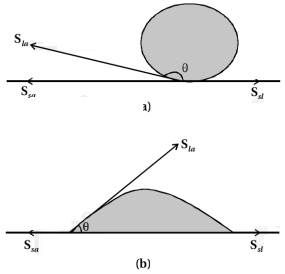
Angle of contact: The angle between the tangent to the liquid surface at the point of contact and the solid surface inside the liquid is known as the angle of contact. It is denoted by $\theta$.
It varies for different pairs of liquids and solids.
In the figure,$(a)$ shows a water droplet on a lotus leaf,and $(b)$ shows water spreading over a clean plastic plate.
Let the surface tensions be:
$S_{la} = \text{surface tension of liquid-air interface}$
$S_{sa} = \text{surface tension of solid-air interface}$
$S_{sl} = \text{surface tension of solid-liquid interface}$
At the line of contact,the surface forces between the three media must be in equilibrium.
For figure $(a)$:
$S_{sa} = S_{sl} + S_{la} \cos \theta$
$\cos \theta = \frac{S_{sa} - S_{sl}}{S_{la}}$
If the cohesive forces between liquid molecules are stronger than the adhesive forces between liquid and solid molecules,then $S_{sl} > S_{sa}$,resulting in $\cos \theta < 0$,which means $\theta$ is obtuse. In this case,the liquid does not wet the solid surface,and the meniscus is convex.
If the adhesive forces are stronger than the cohesive forces,then $S_{sa} > S_{sl}$,resulting in $\cos \theta > 0$,which means $\theta$ is acute. In this case,the liquid wets the solid surface,and the meniscus is concave.
Angle of contact: The angle between the tangent to the liquid surface at the point of contact and the solid surface inside the liquid is known as the angle of contact. It is denoted by $\theta$.
It varies for different pairs of liquids and solids.
In the figure,$(a)$ shows a water droplet on a lotus leaf,and $(b)$ shows water spreading over a clean plastic plate.
Let the surface tensions be:
$S_{la} = \text{surface tension of liquid-air interface}$
$S_{sa} = \text{surface tension of solid-air interface}$
$S_{sl} = \text{surface tension of solid-liquid interface}$
At the line of contact,the surface forces between the three media must be in equilibrium.
For figure $(a)$:
$S_{sa} = S_{sl} + S_{la} \cos \theta$
$\cos \theta = \frac{S_{sa} - S_{sl}}{S_{la}}$
If the cohesive forces between liquid molecules are stronger than the adhesive forces between liquid and solid molecules,then $S_{sl} > S_{sa}$,resulting in $\cos \theta < 0$,which means $\theta$ is obtuse. In this case,the liquid does not wet the solid surface,and the meniscus is convex.
If the adhesive forces are stronger than the cohesive forces,then $S_{sa} > S_{sl}$,resulting in $\cos \theta > 0$,which means $\theta$ is acute. In this case,the liquid wets the solid surface,and the meniscus is concave.
0 likes
View Solution24
Medium
Define the angle of contact.
Solution
(N/A) The angle of contact is defined as the angle between the tangent to the liquid surface at the point of contact and the solid surface inside the liquid.
It is measured through the liquid.
For a liquid that wets the solid surface (e.g.,water and glass),the angle of contact is acute $(< 90^{\circ})$.
For a liquid that does not wet the solid surface (e.g.,mercury and glass),the angle of contact is obtuse $(> 90^{\circ})$.
It is measured through the liquid.
For a liquid that wets the solid surface (e.g.,water and glass),the angle of contact is acute $(< 90^{\circ})$.
For a liquid that does not wet the solid surface (e.g.,mercury and glass),the angle of contact is obtuse $(> 90^{\circ})$.
0 likes
View Solution25
MediumMCQ
Give reason: The wing of a duck does not get wet in water.
A
Due to high surface tension of water.
B
Due to the presence of an oily secretion on the feathers.
C
Due to the low density of the feathers.
D
Due to the shape of the wings.
Solution
(B) The wings of a duck are coated with a special oily secretion produced by glands in their body.
This oil makes the feathers hydrophobic,meaning they repel water.
In terms of surface tension,the angle of contact between the water and the oily surface of the feathers is obtuse $(> 90^{\circ})$.
Because the angle of contact is obtuse,the water does not spread over the feathers and instead forms droplets that roll off,preventing the wings from getting wet.
This oil makes the feathers hydrophobic,meaning they repel water.
In terms of surface tension,the angle of contact between the water and the oily surface of the feathers is obtuse $(> 90^{\circ})$.
Because the angle of contact is obtuse,the water does not spread over the feathers and instead forms droplets that roll off,preventing the wings from getting wet.
0 likes
View Solution26
Easy
Fill in the blanks:
$(i)$ If a liquid sticks to the glass,the angle of contact for the liquid-glass interface will be ....... (acute / obtuse).
$(ii)$ The angle of contact between mercury and glass is .......... (acute / obtuse).
$(i)$ If a liquid sticks to the glass,the angle of contact for the liquid-glass interface will be ....... (acute / obtuse).
$(ii)$ The angle of contact between mercury and glass is .......... (acute / obtuse).
Solution
(A) $(i)$ When a liquid wets a solid surface (sticks to it),the adhesive forces between the liquid and solid molecules are stronger than the cohesive forces between the liquid molecules. This results in a concave meniscus,which corresponds to an acute angle of contact (less than $90^{\circ}$).
$(ii)$ Mercury does not wet glass because the cohesive forces between mercury atoms are much stronger than the adhesive forces between mercury and glass. This results in a convex meniscus,which corresponds to an obtuse angle of contact (greater than $90^{\circ}$,typically around $135^{\circ}-140^{\circ}$).
$(ii)$ Mercury does not wet glass because the cohesive forces between mercury atoms are much stronger than the adhesive forces between mercury and glass. This results in a convex meniscus,which corresponds to an obtuse angle of contact (greater than $90^{\circ}$,typically around $135^{\circ}-140^{\circ}$).
0 likes
View Solution27
MediumMCQ
If a liquid wets a surface,is its angle of contact acute or obtuse?
A
Acute
B
Obtuse
C
Right angle
D
Zero
Solution
(A) When a liquid wets a solid surface,the adhesive forces between the liquid molecules and the solid surface are stronger than the cohesive forces between the liquid molecules themselves.
This results in the liquid spreading over the surface,causing the angle of contact to be acute (less than $90^{\circ}$).
This results in the liquid spreading over the surface,causing the angle of contact to be acute (less than $90^{\circ}$).
0 likes
View Solution28
MediumMCQ
If a liquid does not wet the surface,its angle of contact is acute or obtuse?
A
Acute
B
Obtuse
C
Right angle
D
Zero
Solution
(B) When a liquid does not wet the surface,the cohesive forces between the liquid molecules are stronger than the adhesive forces between the liquid and the solid surface.
This results in the liquid forming a convex meniscus.
For a convex meniscus,the angle of contact $\theta$ is always greater than $90^{\circ}$.
Therefore,the angle of contact is obtuse.
This results in the liquid forming a convex meniscus.
For a convex meniscus,the angle of contact $\theta$ is always greater than $90^{\circ}$.
Therefore,the angle of contact is obtuse.
0 likes
View Solution29
Medium
On what factors does the value of the angle of contact depend?
Solution
(N/A) The angle of contact depends on the following factors:
$(1)$ The nature of the liquid and the solid in contact.
$(2)$ The cleanliness of the contact surface of the solid.
$(3)$ The medium (e.g.,air or vapor) that exists above the free surface of the liquid.
$(4)$ The temperature of the liquid.
$(1)$ The nature of the liquid and the solid in contact.
$(2)$ The cleanliness of the contact surface of the solid.
$(3)$ The medium (e.g.,air or vapor) that exists above the free surface of the liquid.
$(4)$ The temperature of the liquid.
0 likes
View Solution30
MediumMCQ
How does the angle of contact depend on temperature?
A
It increases with temperature.
B
It decreases with temperature.
C
It remains constant with temperature.
D
It first increases then decreases with temperature.
Solution
(A) The angle of contact $\theta$ depends on the surface tension of the liquid-solid interface,the liquid-air interface,and the solid-air interface. As the temperature of a liquid increases,its surface tension decreases. This change in surface tension affects the balance of forces at the point of contact,leading to an increase in the angle of contact $\theta$.
0 likes
View Solution31
Medium
Why is Teflon coated on non-stick frying pans? Explain.
Solution
(N/A) Teflon is a polymer known as polytetrafluoroethylene $(PTFE)$.
It has a very low surface energy,which results in a high angle of contact between the surface of the pan and liquids like oil or water.
Because the angle of contact is obtuse $(> 90^{\circ})$,the adhesive forces between the liquid and the Teflon surface are much weaker than the cohesive forces within the liquid.
Consequently,the liquid does not wet or stick to the surface,making the pan non-stick.
It has a very low surface energy,which results in a high angle of contact between the surface of the pan and liquids like oil or water.
Because the angle of contact is obtuse $(> 90^{\circ})$,the adhesive forces between the liquid and the Teflon surface are much weaker than the cohesive forces within the liquid.
Consequently,the liquid does not wet or stick to the surface,making the pan non-stick.
0 likes
View Solution32
Medium
Why does a raincoat not get wet in the rain?
Solution
(N/A) The angle of contact between water and the material of the raincoat is obtuse. Because the angle of contact is greater than $90^{\circ}$,the cohesive forces between water molecules are stronger than the adhesive forces between water and the raincoat material. Consequently,the water does not spread over the surface and instead forms droplets,preventing the raincoat from getting wet.
0 likes
View Solution33
EasyMCQ
$A$ liquid does not wet the solid surface if the angle of contact is
A
$0^{\circ}$
B
equal to $45^{\circ}$
C
equal to $60^{\circ}$
D
greater than $90^{\circ}$
Solution
(D) The angle of contact $\theta$ determines the wetting behavior of a liquid on a solid surface.
If $\theta < 90^{\circ},$ the liquid wets the surface (e.g.,water on glass).
If $\theta > 90^{\circ},$ the cohesive forces between liquid molecules are stronger than the adhesive forces between the liquid and the solid surface.
Consequently,the liquid does not wet the solid surface (e.g.,mercury on glass).
Therefore,the correct condition for a liquid not to wet a solid surface is that the angle of contact is greater than $90^{\circ}.$
If $\theta < 90^{\circ},$ the liquid wets the surface (e.g.,water on glass).
If $\theta > 90^{\circ},$ the cohesive forces between liquid molecules are stronger than the adhesive forces between the liquid and the solid surface.
Consequently,the liquid does not wet the solid surface (e.g.,mercury on glass).
Therefore,the correct condition for a liquid not to wet a solid surface is that the angle of contact is greater than $90^{\circ}.$
0 likes
View Solution34
MediumMCQ
Given below are two statements: One is labelled as Assertion $(A)$ and the other is labelled as Reason $(R)$.
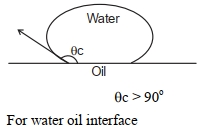
Assertion $(A)$: Clothes containing oil or grease stains cannot be cleaned by water wash.
Reason $(R)$: Because the angle of contact between the oil/grease and water is obtuse.
In the light of the above statements,choose the correct answer from the options given below.
Assertion $(A)$: Clothes containing oil or grease stains cannot be cleaned by water wash.
Reason $(R)$: Because the angle of contact between the oil/grease and water is obtuse.
In the light of the above statements,choose the correct answer from the options given below.
A
Both $(A)$ and $(R)$ are true and $(R)$ is the correct explanation of $(A)$.
B
Both $(A)$ and $(R)$ are true but $(R)$ is not the correct explanation of $(A)$.
C
$(A)$ is true but $(R)$ is false.
D
$(A)$ is false but $(R)$ is true.
Solution
(A) Assertion $(A)$ is true: Water does not wet clothes containing oil or grease stains because water does not spread over the oil/grease surface. Thus,they cannot be cleaned by water alone.
Reason $(R)$ is true: The angle of contact $(\theta_c)$ between water and oil/grease is obtuse $(\theta_c > 90^{\circ})$. This indicates that water does not wet the surface,which is why detergents are needed to reduce the surface tension and change the angle of contact to make it acute,allowing the water to remove the stain.
Since the obtuse angle of contact is the physical reason why water fails to wet the oil/grease,$(R)$ is the correct explanation of $(A)$.
Reason $(R)$ is true: The angle of contact $(\theta_c)$ between water and oil/grease is obtuse $(\theta_c > 90^{\circ})$. This indicates that water does not wet the surface,which is why detergents are needed to reduce the surface tension and change the angle of contact to make it acute,allowing the water to remove the stain.
Since the obtuse angle of contact is the physical reason why water fails to wet the oil/grease,$(R)$ is the correct explanation of $(A)$.
0 likes
View Solution35
EasyMCQ
The raincoats are made waterproof by coating them with a material,which ............
A
Absorb water
B
Increase surface tension of water
C
Increase the angle of contact
D
Decreases the density of water
Solution
(C) The correct option is $C$.
Raincoats are coated with a hydrophobic material that increases the angle of contact between the water droplets and the fabric surface.
When the angle of contact is obtuse (greater than $90^{\circ}$),the liquid does not wet the surface.
This prevents the water from penetrating the fabric,thereby making the raincoat waterproof.
Raincoats are coated with a hydrophobic material that increases the angle of contact between the water droplets and the fabric surface.
When the angle of contact is obtuse (greater than $90^{\circ}$),the liquid does not wet the surface.
This prevents the water from penetrating the fabric,thereby making the raincoat waterproof.
0 likes
View Solution36
DifficultMCQ
Given below are two statements:
Statement-$I$: When a capillary tube is dipped into a liquid,the liquid neither rises nor falls in the capillary. The contact angle may be $0^{\circ}$.
Statement-$II$: The contact angle between a solid and a liquid is a property of the material of the solid and liquid as well.
In the light of the above statements,choose the correct answer from the options given below.
Statement-$I$: When a capillary tube is dipped into a liquid,the liquid neither rises nor falls in the capillary. The contact angle may be $0^{\circ}$.
Statement-$II$: The contact angle between a solid and a liquid is a property of the material of the solid and liquid as well.
In the light of the above statements,choose the correct answer from the options given below.
A
Statement-$I$ is false but Statement-$II$ is true.
B
Both Statement-$I$ and Statement-$II$ are true.
C
Both Statement-$I$ and Statement-$II$ are false.
D
Statement-$I$ is true and Statement-$II$ is false.
Solution
(A) The height of the liquid rise or fall in a capillary tube is given by $h = \frac{2T \cos \theta}{\rho gr}$.
If the contact angle $\theta = 0^{\circ}$,then $\cos 0^{\circ} = 1$,which results in a non-zero height $h = \frac{2T}{\rho gr}$. Thus,the liquid must rise in the capillary. Therefore,Statement-$I$ is false.
The contact angle $\theta$ depends on the nature of the solid surface,the liquid,and the surrounding medium (gas/vapor). Thus,it is a property of the materials involved. Therefore,Statement-$II$ is true.
Conclusion: Statement-$I$ is false and Statement-$II$ is true.
If the contact angle $\theta = 0^{\circ}$,then $\cos 0^{\circ} = 1$,which results in a non-zero height $h = \frac{2T}{\rho gr}$. Thus,the liquid must rise in the capillary. Therefore,Statement-$I$ is false.
The contact angle $\theta$ depends on the nature of the solid surface,the liquid,and the surrounding medium (gas/vapor). Thus,it is a property of the materials involved. Therefore,Statement-$II$ is true.
Conclusion: Statement-$I$ is false and Statement-$II$ is true.
0 likes
View Solution37
DifficultMCQ
Two liquids $A$ and $B$ have $\theta_{A}$ and $\theta_{B}$ as contact angles in a capillary tube. If $K = \cos \theta_{A} / \cos \theta_{B}$,then identify the correct statement:
A
$K$ is negative,then liquid $A$ and liquid $B$ have convex meniscus.
B
$K$ is negative,then liquid $A$ and liquid $B$ have concave meniscus.
C
$K$ is negative,then liquid $A$ has concave meniscus and liquid $B$ has convex meniscus.
D
$K$ is zero,then liquid $A$ has convex meniscus and liquid $B$ has concave meniscus.
Solution
(C) The ratio is given by $K = \frac{\cos \theta_{A}}{\cos \theta_{B}}$.
For $K$ to be negative,$\cos \theta_{A}$ and $\cos \theta_{B}$ must have opposite signs.
If $\theta < 90^{\circ}$,$\cos \theta > 0$ (concave meniscus).
If $\theta > 90^{\circ}$,$\cos \theta < 0$ (convex meniscus).
Therefore,if $K < 0$,one liquid must have a concave meniscus $(\theta < 90^{\circ})$ and the other must have a convex meniscus $(\theta > 90^{\circ})$.
For $K$ to be negative,$\cos \theta_{A}$ and $\cos \theta_{B}$ must have opposite signs.
If $\theta < 90^{\circ}$,$\cos \theta > 0$ (concave meniscus).
If $\theta > 90^{\circ}$,$\cos \theta < 0$ (convex meniscus).
Therefore,if $K < 0$,one liquid must have a concave meniscus $(\theta < 90^{\circ})$ and the other must have a convex meniscus $(\theta > 90^{\circ})$.
0 likes
View Solution38
EasyMCQ
The liquid (mercury) meniscus in a capillary tube will be convex if the angle of contact is
A
greater than $90^{\circ}$
B
less than $90^{\circ}$
C
equal to $90^{\circ}$
D
equal to $0^{\circ}$
Solution
(A) The shape of the liquid meniscus in a capillary tube is determined by the angle of contact $\theta$ between the liquid and the solid surface.
If the angle of contact $\theta$ is acute $(\theta < 90^{\circ})$,the liquid wets the surface,and the meniscus is concave (e.g.,water in glass).
If the angle of contact $\theta$ is obtuse $(\theta > 90^{\circ})$,the liquid does not wet the surface,and the meniscus is convex (e.g.,mercury in glass).
Therefore,for the meniscus to be convex,the angle of contact must be greater than $90^{\circ}$.
If the angle of contact $\theta$ is acute $(\theta < 90^{\circ})$,the liquid wets the surface,and the meniscus is concave (e.g.,water in glass).
If the angle of contact $\theta$ is obtuse $(\theta > 90^{\circ})$,the liquid does not wet the surface,and the meniscus is convex (e.g.,mercury in glass).
Therefore,for the meniscus to be convex,the angle of contact must be greater than $90^{\circ}$.
0 likes
View Solution39
EasyMCQ
Which one of the following statements is '$NOT$' true about the angle of contact of a liquid?
A
Any increase in the temperature of the liquid does not decrease its angle of contact.
B
If an impurity is added to the liquid,then its angle of contact changes.
C
The angle of contact depends upon the nature of the liquid and solid in contact.
D
At a given temperature,the angle of contact is constant for a solid-liquid surface.
Solution
(A) The correct option is $A$.
Concept: The angle of contact generally decreases with an increase in temperature.
Addition of impurities significantly affects the surface tension of a liquid,which in turn alters the angle of contact.
The angle of contact is a property that depends on the nature of the liquid and the solid surface in contact.
For a specific solid-liquid pair at a constant temperature,the angle of contact remains constant.
Therefore,statement $A$ is the only statement that is '$NOT$' true,as an increase in temperature typically decreases the angle of contact.
Concept: The angle of contact generally decreases with an increase in temperature.
Addition of impurities significantly affects the surface tension of a liquid,which in turn alters the angle of contact.
The angle of contact is a property that depends on the nature of the liquid and the solid surface in contact.
For a specific solid-liquid pair at a constant temperature,the angle of contact remains constant.
Therefore,statement $A$ is the only statement that is '$NOT$' true,as an increase in temperature typically decreases the angle of contact.
0 likes
View Solution40
EasyMCQ
By adding soluble impurity in a liquid,the angle of contact
A
decreases
B
increases
C
remains unchanged
D
first increases and then decreases
Solution
(A) The angle of contact $\theta$ depends on the surface tension of the liquid,the surface tension of the solid-liquid interface,and the surface tension of the solid-air interface,as given by Young's equation: $\cos \theta = \frac{T_{sa} - T_{sl}}{T_{la}}$.
When a soluble impurity is added to a liquid,it generally decreases the surface tension of the liquid $(T_{la})$.
For most liquids that wet the surface (where $\theta < 90^{\circ}$),the addition of soluble impurities (like detergents or soaps) further reduces the surface tension,which leads to a decrease in the angle of contact $\theta$.
Therefore,adding soluble impurities typically decreases the angle of contact.
When a soluble impurity is added to a liquid,it generally decreases the surface tension of the liquid $(T_{la})$.
For most liquids that wet the surface (where $\theta < 90^{\circ}$),the addition of soluble impurities (like detergents or soaps) further reduces the surface tension,which leads to a decrease in the angle of contact $\theta$.
Therefore,adding soluble impurities typically decreases the angle of contact.
0 likes
View Solution41
EasyMCQ
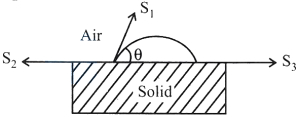
If $S_1, S_2$ and $S_3$ are the tensions at the liquid-air,solid-air,and solid-liquid interfaces respectively,and $\theta$ is the angle of contact at the solid-liquid interface,then:
A
$S_1 \cos \theta + S_2 \sin \theta = S_3$
B
$S_1 \cos \theta + S_3 = S_2$
C
$S_2 \cos \theta + S_3 = S_1$
D
$S_3 \cos \theta + S_1 = S_2$
Solution
(B) At the point of contact,the forces due to surface tension must be in equilibrium along the surface of the solid.
Let $S_2$ be the surface tension at the solid-air interface,$S_3$ be the surface tension at the solid-liquid interface,and $S_1$ be the surface tension at the liquid-air interface.
The force $S_1$ acts at an angle $\theta$ with the solid surface.
Resolving $S_1$ into horizontal and vertical components,the horizontal component $S_1 \cos \theta$ acts in the same direction as $S_3$.
For equilibrium along the horizontal direction of the solid surface,the forces must balance:
$S_2 = S_3 + S_1 \cos \theta$
Thus,the correct relation is $S_1 \cos \theta + S_3 = S_2$.
Let $S_2$ be the surface tension at the solid-air interface,$S_3$ be the surface tension at the solid-liquid interface,and $S_1$ be the surface tension at the liquid-air interface.
The force $S_1$ acts at an angle $\theta$ with the solid surface.
Resolving $S_1$ into horizontal and vertical components,the horizontal component $S_1 \cos \theta$ acts in the same direction as $S_3$.
For equilibrium along the horizontal direction of the solid surface,the forces must balance:
$S_2 = S_3 + S_1 \cos \theta$
Thus,the correct relation is $S_1 \cos \theta + S_3 = S_2$.
0 likes
View Solution42
MediumMCQ
The angle of contact is $120^{\circ}$ when a cylindrical rod is vertically placed in a liquid. If the same rod is placed horizontally in the liquid,then the angle of contact is (in $^{\circ}$)
A
$60$
B
$30$
C
$90$
D
$120$
Solution
(D) The angle of contact is a characteristic property of the pair of materials (liquid and solid) and the surrounding medium.
It depends on the nature of the liquid and the solid surface,as well as the temperature.
It does not depend on the orientation or inclination of the solid object in the liquid.
Therefore,if the rod is placed horizontally,the angle of contact remains $120^{\circ}$.
It depends on the nature of the liquid and the solid surface,as well as the temperature.
It does not depend on the orientation or inclination of the solid object in the liquid.
Therefore,if the rod is placed horizontally,the angle of contact remains $120^{\circ}$.
0 likes
View Solution43
EasyMCQ
$A$ hydrophilic surface is characterised by the contact angle at the water-solid interface. The value of the contact angle should be:
A
$ > 90^{\circ}$
B
$ < 90^{\circ}$
C
$ = 90^{\circ}$
D
$ = 180^{\circ}$
Solution
(B) For a hydrophilic surface, the contact angle at the water-solid interface is less than $90^{\circ}$, i.e., $ < 90^{\circ}$.
This occurs because the adhesive force between the liquid molecules and the hydrophilic surface is significantly stronger than the cohesive forces within the liquid.
As a result, the liquid tends to spread over the surface, leading to a contact angle of less than $90^{\circ}$.
This occurs because the adhesive force between the liquid molecules and the hydrophilic surface is significantly stronger than the cohesive forces within the liquid.
As a result, the liquid tends to spread over the surface, leading to a contact angle of less than $90^{\circ}$.
0 likes
View Solution44
MediumMCQ
$A$ liquid does not wet the solid surface if the angle of contact is
A
zero
B
equal to $45^{\circ}$
C
equal to $90^{\circ}$
D
greater than $90^{\circ}$
Solution
(D) liquid does not wet a solid surface if the angle of contact is obtuse,i.e.,greater than $90^{\circ}$.
In this condition,the cohesive forces between the liquid molecules are stronger than the adhesive forces between the liquid and the solid surface.
Consequently,the liquid tends to minimize contact with the surface,resulting in the liquid not wetting the solid.
In this condition,the cohesive forces between the liquid molecules are stronger than the adhesive forces between the liquid and the solid surface.
Consequently,the liquid tends to minimize contact with the surface,resulting in the liquid not wetting the solid.
0 likes
View SolutionFluid Mechanics and Surface Tension — Angle of Contact · Frequently Asked Questions
1Are these Fluid Mechanics and Surface Tension questions useful for JEE and NEET?
Yes. All questions in this section are mapped to JEE Main and NEET exam patterns. Previous year questions from JEE Main, NEET, GUJCET and state-level exams are included with full solutions.
2Can I switch to Hindi or Gujarati for these questions?
Yes. Use the language tabs in the hero section or the sidebar to view the same questions and solutions in English, Hindi or Gujarati.
3How do I generate a question paper from this subtopic?
Use the Vedclass Exam Paper Generator — select the chapter and subtopic, set difficulty, and generate Sets A, B, C, D automatically. First 3 chapters of every subject are free.
Vedclass Products
For Students
Vedclass Test Series
Mock tests in real JEE/NEET style with performance analysis. 5-day free trial.
Start Free TrialFor Teachers
Exam Paper Generator
Generate Set A/B/C/D papers from this chapter in 2 minutes. 3 chapters free.
Try FreeFor Institutes
Online Exam Module
Live online exams with unlimited students, 360° analytics & white-label branding.
See DemoFor Teachers & Institutes
Generate a Fluid Mechanics and Surface Tension Exam Paper in 2 Minutes
Select subtopic & difficulty — Sets A, B, C, D auto-generated with No Repeat logic.
First 3 chapters of every subject are free — no payment required.