
A English
Mathematical logic Questions in English
Class 11 Mathematics · Mathematical Reasoning · Mathematical logic
584+
Questions
English
Language
100%
With Solutions
Showing 50 of 584 questions in English
301
MediumMCQ
The negation of the Boolean expression $x \leftrightarrow \sim y$ is equivalent to
A
$(\sim x \wedge y) \vee (\sim x \wedge \sim y)$
B
$(x \wedge \sim y) \vee (\sim x \wedge y)$
C
$(x \wedge y) \vee (\sim x \wedge \sim y)$
D
$(x \wedge y) \wedge (\sim x \vee \sim y)$
Solution
(C) The given expression is $x \leftrightarrow \sim y$.
We know that $p \leftrightarrow q \equiv (p$ $\rightarrow q) \wedge (q$ $\rightarrow p)$.
So,$x \leftrightarrow \sim y \equiv (x$ $\rightarrow \sim y) \wedge (\sim y$ $\rightarrow x)$.
Using the identity $p \rightarrow q \equiv \sim p \vee q$,we get:
$x \leftrightarrow \sim y \equiv (\sim x \vee \sim y) \wedge (y \vee x)$.
Now,we find the negation:
$\sim(x \leftrightarrow \sim y) \equiv \sim((\sim x \vee \sim y) \wedge (x \vee y))$.
By De Morgan's Law,$\sim(A \wedge B) \equiv \sim A \vee \sim B$:
$\sim(x \leftrightarrow \sim y) \equiv \sim(\sim x \vee \sim y) \vee \sim(x \vee y)$.
Applying De Morgan's Law again:
$\sim(x \leftrightarrow \sim y) \equiv (x \wedge y) \vee (\sim x \wedge \sim y)$.
We know that $p \leftrightarrow q \equiv (p$ $\rightarrow q) \wedge (q$ $\rightarrow p)$.
So,$x \leftrightarrow \sim y \equiv (x$ $\rightarrow \sim y) \wedge (\sim y$ $\rightarrow x)$.
Using the identity $p \rightarrow q \equiv \sim p \vee q$,we get:
$x \leftrightarrow \sim y \equiv (\sim x \vee \sim y) \wedge (y \vee x)$.
Now,we find the negation:
$\sim(x \leftrightarrow \sim y) \equiv \sim((\sim x \vee \sim y) \wedge (x \vee y))$.
By De Morgan's Law,$\sim(A \wedge B) \equiv \sim A \vee \sim B$:
$\sim(x \leftrightarrow \sim y) \equiv \sim(\sim x \vee \sim y) \vee \sim(x \vee y)$.
Applying De Morgan's Law again:
$\sim(x \leftrightarrow \sim y) \equiv (x \wedge y) \vee (\sim x \wedge \sim y)$.
0 likes
View Solution302
MediumMCQ
Consider the statement: "For an integer $n$,if $n^{3}-1$ is even,then $n$ is odd." The contrapositive statement of this statement is
A
For an integer $n$,if $n^{3}-1$ is not even,then $n$ is not odd.
B
For an integer $n$,if $n$ is even,then $n^{3}-1$ is odd.
C
For an integer $n$,if $n$ is odd,then $n^{3}-1$ is even.
D
For an integer $n$,if $n$ is even,then $n^{3}-1$ is even.
Solution
(B) The contrapositive of a conditional statement $(p \rightarrow q)$ is defined as $(\sim q \rightarrow \sim p)$.
Here,$p$ is the statement "$n^{3}-1$ is even" and $q$ is the statement "$n$ is odd".
The negation $\sim q$ is "$n$ is not odd",which means "$n$ is even".
The negation $\sim p$ is "$n^{3}-1$ is not even",which means "$n^{3}-1$ is odd".
Therefore,the contrapositive statement is: "For an integer $n$,if $n$ is even,then $n^{3}-1$ is odd."
Here,$p$ is the statement "$n^{3}-1$ is even" and $q$ is the statement "$n$ is odd".
The negation $\sim q$ is "$n$ is not odd",which means "$n$ is even".
The negation $\sim p$ is "$n^{3}-1$ is not even",which means "$n^{3}-1$ is odd".
Therefore,the contrapositive statement is: "For an integer $n$,if $n$ is even,then $n^{3}-1$ is odd."
0 likes
View Solution303
MediumMCQ
The negation of the Boolean expression $p \vee (\sim p \wedge q)$ is equivalent to
A
$\sim p \vee \sim q$
B
$\sim p \vee q$
C
$\sim p \wedge \sim q$
D
$p \wedge \sim q$
Solution
(C) Given expression: $p \vee (\sim p \wedge q)$
Using the distributive law: $p \vee (\sim p \wedge q) = (p \vee \sim p) \wedge (p \vee q)$
Since $(p \vee \sim p) = T$ (Tautology):
$= T \wedge (p \vee q) = p \vee q$
Now,we need to find the negation of $(p \vee q)$:
$\sim (p \vee q) = \sim p \wedge \sim q$
Therefore,the correct option is $C$.
Using the distributive law: $p \vee (\sim p \wedge q) = (p \vee \sim p) \wedge (p \vee q)$
Since $(p \vee \sim p) = T$ (Tautology):
$= T \wedge (p \vee q) = p \vee q$
Now,we need to find the negation of $(p \vee q)$:
$\sim (p \vee q) = \sim p \wedge \sim q$
Therefore,the correct option is $C$.
0 likes
View Solution304
MediumMCQ
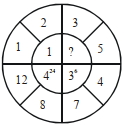
The missing value in the following figure is
A
$2$
B
$9$
C
$4$
D
$6$
Solution
(C) Let the outer numbers in each quadrant be $(a, b)$ and the inner number be $k$. The pattern is $k = (a - b)^{n!}$,where $n$ is the number of digits or a specific index related to the quadrant.
For the first quadrant: $(2 - 1)^{1!} = 1^{1} = 1$.
For the second quadrant: $(12 - 8)^{4!} = 4^{24}$.
For the third quadrant: $(7 - 4)^{3!} = 3^{6}$.
For the fourth quadrant: $(5 - 3)^{2!} = 2^{2} = 4$.
Thus,the missing value is $4$.
For the first quadrant: $(2 - 1)^{1!} = 1^{1} = 1$.
For the second quadrant: $(12 - 8)^{4!} = 4^{24}$.
For the third quadrant: $(7 - 4)^{3!} = 3^{6}$.
For the fourth quadrant: $(5 - 3)^{2!} = 2^{2} = 4$.
Thus,the missing value is $4$.
0 likes
View Solution305
MediumMCQ
If the Boolean expression $(p \wedge q) \circledast (p \otimes q)$ is a tautology,then $\circledast$ and $\otimes$ are respectively given by
A
$\rightarrow,$ $\rightarrow$
B
$\wedge, \vee$
C
$\vee, \rightarrow$
D
$\wedge, \rightarrow$
Solution
(A) We test the options to see which expression results in a tautology $(t)$:
Option $A$: $(p \wedge q)$ $\rightarrow (p$ $\rightarrow q)$
$= \sim(p \wedge q) \vee (\sim p \vee q)$
$= (\sim p \vee \sim q) \vee (\sim p \vee q)$
$= \sim p \vee (\sim q \vee q)$
$= \sim p \vee t$
$= t$ (This is a tautology).
Option $B$: $(p \wedge q) \wedge (p \vee q) = (p \wedge q)$ (Not a tautology).
Option $C$: $(p \wedge q) \vee (p \rightarrow q) = (p \wedge q) \vee (\sim p \vee q) = \sim p \vee q$ (Not a tautology).
Option $D$: $(p \wedge q) \wedge (p \rightarrow q) = (p \wedge q) \wedge (\sim p \vee q) = p \wedge q$ (Not a tautology).
Thus,the correct option is $A$.
Option $A$: $(p \wedge q)$ $\rightarrow (p$ $\rightarrow q)$
$= \sim(p \wedge q) \vee (\sim p \vee q)$
$= (\sim p \vee \sim q) \vee (\sim p \vee q)$
$= \sim p \vee (\sim q \vee q)$
$= \sim p \vee t$
$= t$ (This is a tautology).
Option $B$: $(p \wedge q) \wedge (p \vee q) = (p \wedge q)$ (Not a tautology).
Option $C$: $(p \wedge q) \vee (p \rightarrow q) = (p \wedge q) \vee (\sim p \vee q) = \sim p \vee q$ (Not a tautology).
Option $D$: $(p \wedge q) \wedge (p \rightarrow q) = (p \wedge q) \wedge (\sim p \vee q) = p \wedge q$ (Not a tautology).
Thus,the correct option is $A$.
0 likes
View Solution306
MediumMCQ
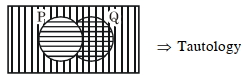
If $P$ and $Q$ are two statements,then which of the following compound statements is a tautology?
A
$(( P$ $\Rightarrow Q ) \wedge \sim Q )$ $\Rightarrow Q$
B
$(( P$ $\Rightarrow Q ) \wedge \sim Q )$ $\Rightarrow \sim P$
C
$(( P$ $\Rightarrow Q ) \wedge \sim Q )$ $\Rightarrow P$
D
$(( P$ $\Rightarrow Q ) \wedge \sim Q )$ $\Rightarrow ( P \wedge Q )$
Solution
(B) Let us simplify the antecedent $((P \Rightarrow Q) \wedge \sim Q)$ for all options:
$((P \Rightarrow Q) \wedge \sim Q) \equiv ((\sim P \vee Q) \wedge \sim Q)$
Using the distributive law: $(\sim P \wedge \sim Q) \vee (Q \wedge \sim Q)$
Since $(Q \wedge \sim Q) \equiv F$,we have $(\sim P \wedge \sim Q) \vee F \equiv \sim P \wedge \sim Q$.
Now,check each option:
$(A) (\sim P \wedge \sim Q)$ $\Rightarrow Q \equiv \sim(\sim P \wedge \sim Q) \vee Q \equiv (P \vee Q) \vee Q \equiv P \vee Q$ (Not a tautology)
$(B) (\sim P \wedge \sim Q)$ $\Rightarrow \sim P \equiv \sim(\sim P \wedge \sim Q) \vee \sim P \equiv (P \vee Q) \vee \sim P \equiv (P \vee \sim P) \vee Q \equiv T \vee Q \equiv T$ (Tautology)
$(C) (\sim P \wedge \sim Q)$ $\Rightarrow P \equiv \sim(\sim P \wedge \sim Q) \vee P \equiv (P \vee Q) \vee P \equiv P \vee Q$ (Not a tautology)
$(D) (\sim P \wedge \sim Q) \Rightarrow (P \wedge Q) \equiv (P \vee Q) \vee (P \wedge Q) \equiv P \vee Q$ (Not a tautology)
Therefore,the correct option is $B$.
$((P \Rightarrow Q) \wedge \sim Q) \equiv ((\sim P \vee Q) \wedge \sim Q)$
Using the distributive law: $(\sim P \wedge \sim Q) \vee (Q \wedge \sim Q)$
Since $(Q \wedge \sim Q) \equiv F$,we have $(\sim P \wedge \sim Q) \vee F \equiv \sim P \wedge \sim Q$.
Now,check each option:
$(A) (\sim P \wedge \sim Q)$ $\Rightarrow Q \equiv \sim(\sim P \wedge \sim Q) \vee Q \equiv (P \vee Q) \vee Q \equiv P \vee Q$ (Not a tautology)
$(B) (\sim P \wedge \sim Q)$ $\Rightarrow \sim P \equiv \sim(\sim P \wedge \sim Q) \vee \sim P \equiv (P \vee Q) \vee \sim P \equiv (P \vee \sim P) \vee Q \equiv T \vee Q \equiv T$ (Tautology)
$(C) (\sim P \wedge \sim Q)$ $\Rightarrow P \equiv \sim(\sim P \wedge \sim Q) \vee P \equiv (P \vee Q) \vee P \equiv P \vee Q$ (Not a tautology)
$(D) (\sim P \wedge \sim Q) \Rightarrow (P \wedge Q) \equiv (P \vee Q) \vee (P \wedge Q) \equiv P \vee Q$ (Not a tautology)
Therefore,the correct option is $B$.
0 likes
View Solution307
MediumMCQ
The statement among the following that is a tautology is
A
$A \vee (A \wedge B)$
B
$A \wedge (A \vee B)$
C
$B$ $\rightarrow [A \wedge (A$ $\rightarrow B)]$
D
$[A \wedge (A$ $\rightarrow B)]$ $\rightarrow B$
Solution
(D) To check if the statement $[A \wedge (A$ $\rightarrow B)]$ $\rightarrow B$ is a tautology,we simplify it using logical laws:
$[A \wedge (A$ $\rightarrow B)]$ $\rightarrow B$
$= [A \wedge (\sim A \vee B)] \rightarrow B$
$= [(A \wedge \sim A) \vee (A \wedge B)] \rightarrow B$
$= [F \vee (A \wedge B)] \rightarrow B$
$= (A \wedge B) \rightarrow B$
$= \sim (A \wedge B) \vee B$
$= (\sim A \vee \sim B) \vee B$
$= \sim A \vee (\sim B \vee B)$
$= \sim A \vee T$
$= T$
Since the final result is $T$ (a tautology),the statement $[A \wedge (A$ $\rightarrow B)]$ $\rightarrow B$ is a tautology.
$[A \wedge (A$ $\rightarrow B)]$ $\rightarrow B$
$= [A \wedge (\sim A \vee B)] \rightarrow B$
$= [(A \wedge \sim A) \vee (A \wedge B)] \rightarrow B$
$= [F \vee (A \wedge B)] \rightarrow B$
$= (A \wedge B) \rightarrow B$
$= \sim (A \wedge B) \vee B$
$= (\sim A \vee \sim B) \vee B$
$= \sim A \vee (\sim B \vee B)$
$= \sim A \vee T$
$= T$
Since the final result is $T$ (a tautology),the statement $[A \wedge (A$ $\rightarrow B)]$ $\rightarrow B$ is a tautology.
0 likes
View Solution308
MediumMCQ
The statement $A$ $\rightarrow (B$ $\rightarrow A)$ is equivalent to
A
$A \rightarrow (A \wedge B)$
B
$A$ $\rightarrow (A$ $\rightarrow B)$
C
$A \rightarrow (A \leftrightarrow B)$
D
$A \rightarrow (A \vee B)$
Solution
(D) The given statement is $A$ $\rightarrow (B$ $\rightarrow A)$.
Using the implication law $p \rightarrow q \equiv \sim p \vee q$,we get:
$A$ $\rightarrow (B$ $\rightarrow A) \equiv \sim A \vee (\sim B \vee A)$
By the associative and commutative laws:
$\equiv (\sim A \vee A) \vee \sim B$
$\equiv T \vee \sim B \equiv T$ (Tautology).
Now,check the options for a tautology or equivalent form:
Option $D$ is $A \rightarrow (A \vee B) \equiv \sim A \vee (A \vee B) \equiv (\sim A \vee A) \vee B \equiv T \vee B \equiv T$.
Since both the original expression and option $D$ are tautologies,they are equivalent.
Using the implication law $p \rightarrow q \equiv \sim p \vee q$,we get:
$A$ $\rightarrow (B$ $\rightarrow A) \equiv \sim A \vee (\sim B \vee A)$
By the associative and commutative laws:
$\equiv (\sim A \vee A) \vee \sim B$
$\equiv T \vee \sim B \equiv T$ (Tautology).
Now,check the options for a tautology or equivalent form:
Option $D$ is $A \rightarrow (A \vee B) \equiv \sim A \vee (A \vee B) \equiv (\sim A \vee A) \vee B \equiv T \vee B \equiv T$.
Since both the original expression and option $D$ are tautologies,they are equivalent.
0 likes
View Solution309
MediumMCQ
For the statements $p$ and $q$,consider the following compound statements :
$(a)$ $(\sim q \wedge (p$ $\rightarrow q))$ $\rightarrow \sim p$
$(b)$ $((p \vee q) \wedge \sim p) \rightarrow q$
Then which of the following statements is correct?
$(a)$ $(\sim q \wedge (p$ $\rightarrow q))$ $\rightarrow \sim p$
$(b)$ $((p \vee q) \wedge \sim p) \rightarrow q$
Then which of the following statements is correct?
A
$(a)$ and $(b)$ both are not tautologies.
B
$(a)$ and $(b)$ both are tautologies.
C
$(a)$ is a tautology but not $(b).$
D
$(b)$ is a tautology but not $(a).$
Solution
(B) To determine if a statement is a tautology,we construct a truth table for each.
For statement $(a)$: $(\sim q \wedge (p$ $\rightarrow q))$ $\rightarrow \sim p$
Since all values in the final column are $T$,$(a)$ is a tautology.
For statement $(b)$: $((p \vee q) \wedge \sim p) \rightarrow q$
Since all values in the final column are $T$,$(b)$ is also a tautology.
Therefore,both $(a)$ and $(b)$ are tautologies.
For statement $(a)$: $(\sim q \wedge (p$ $\rightarrow q))$ $\rightarrow \sim p$
| $p, q$ | $\sim q$ | $p \rightarrow q$ | $\sim q \wedge (p \rightarrow q)$ | $\sim p$ | $(a)$ |
| $T, T$ | $F$ | $T$ | $F$ | $F$ | $T$ |
| $T, F$ | $T$ | $F$ | $F$ | $F$ | $T$ |
| $F, T$ | $F$ | $T$ | $F$ | $T$ | $T$ |
| $F, F$ | $T$ | $T$ | $T$ | $T$ | $T$ |
Since all values in the final column are $T$,$(a)$ is a tautology.
For statement $(b)$: $((p \vee q) \wedge \sim p) \rightarrow q$
| $p, q$ | $p \vee q$ | $\sim p$ | $(p \vee q) \wedge \sim p$ | $(b)$ |
| $T, T$ | $T$ | $F$ | $F$ | $T$ |
| $T, F$ | $T$ | $F$ | $F$ | $T$ |
| $F, T$ | $T$ | $T$ | $T$ | $T$ |
| $F, F$ | $F$ | $T$ | $F$ | $T$ |
Since all values in the final column are $T$,$(b)$ is also a tautology.
Therefore,both $(a)$ and $(b)$ are tautologies.
0 likes
View Solution310
EasyMCQ
The negative of the statement $\sim p \wedge (p \vee q)$ is
A
$\sim p \vee q$
B
$p \vee \sim q$
C
$\sim p \wedge q$
D
$p \wedge \sim q$
Solution
(B) We want to find the negation of the statement $\sim p \wedge (p \vee q)$.
Applying De Morgan's Law: $\sim (\sim p \wedge (p \vee q)) \equiv \sim (\sim p) \vee \sim (p \vee q)$.
Using the law of double negation and De Morgan's Law: $p \vee (\sim p \wedge \sim q)$.
Applying the Distributive Law: $(p \vee \sim p) \wedge (p \vee \sim q)$.
Since $(p \vee \sim p) \equiv T$ (Tautology),we have $T \wedge (p \vee \sim q)$.
Therefore,the result is $p \vee \sim q$.
Applying De Morgan's Law: $\sim (\sim p \wedge (p \vee q)) \equiv \sim (\sim p) \vee \sim (p \vee q)$.
Using the law of double negation and De Morgan's Law: $p \vee (\sim p \wedge \sim q)$.
Applying the Distributive Law: $(p \vee \sim p) \wedge (p \vee \sim q)$.
Since $(p \vee \sim p) \equiv T$ (Tautology),we have $T \wedge (p \vee \sim q)$.
Therefore,the result is $p \vee \sim q$.
0 likes
View Solution311
EasyMCQ
The contrapositive of the statement "If you will work,you will earn money" is ..... .
A
You will earn money,if you will not work
B
If you will earn money,you will work
C
If you will not earn money,you will not work
D
To earn money,you need to work
Solution
(C) The contrapositive of a conditional statement $p \rightarrow q$ is defined as $\sim q \rightarrow \sim p$.
Here,the statement $p$ is "You will work" and $q$ is "You will earn money".
Therefore,the contrapositive $\sim q \rightarrow \sim p$ is "If you will not earn money,you will not work".
Here,the statement $p$ is "You will work" and $q$ is "You will earn money".
Therefore,the contrapositive $\sim q \rightarrow \sim p$ is "If you will not earn money,you will not work".
0 likes
View Solution312
MediumMCQ
Let $F_{1}(A, B, C) = (A \wedge \sim B) \vee [\sim C \wedge (A \vee B)] \vee \sim A$ and $F_{2}(A, B) = (A \vee B) \vee (B \rightarrow \sim A)$ be two logical expressions. Then ...... .
A
$F_{1}$ and $F_{2}$ both are tautologies
B
$F_{1}$ is a tautology but $F_{2}$ is not a tautology
C
$F_{1}$ is not a tautology but $F_{2}$ is a tautology
D
Both $F_{1}$ and $F_{2}$ are not tautologies
Solution
(C) For $F_{1}(A, B, C) = (A \wedge \sim B) \vee [\sim C \wedge (A \vee B)] \vee \sim A$:
Using the distributive law:
$F_{1} = [(A \wedge \sim B) \vee \sim A] \vee [\sim C \wedge (A \vee B)]$
$F_{1} = [(A \vee \sim A) \wedge (\sim B \vee \sim A)] \vee [\sim C \wedge (A \vee B)]$
Since $(A \vee \sim A) = t$ (tautology):
$F_{1} = [t \wedge (\sim A \vee \sim B)] \vee [\sim C \wedge (A \vee B)]$
$F_{1} = (\sim A \vee \sim B) \vee [\sim C \wedge (A \vee B)]$.
This expression depends on the values of $A, B, C$,so it is not a tautology.
For $F_{2}(A, B) = (A \vee B) \vee (B \rightarrow \sim A)$:
Using the implication rule $(P \rightarrow Q) = (\sim P \vee Q)$:
$F_{2} = (A \vee B) \vee (\sim B \vee \sim A)$
By commutative and associative laws:
$F_{2} = (A \vee \sim A) \vee (B \vee \sim B)$
$F_{2} = t \vee t = t$.
Thus,$F_{2}$ is a tautology.
Using the distributive law:
$F_{1} = [(A \wedge \sim B) \vee \sim A] \vee [\sim C \wedge (A \vee B)]$
$F_{1} = [(A \vee \sim A) \wedge (\sim B \vee \sim A)] \vee [\sim C \wedge (A \vee B)]$
Since $(A \vee \sim A) = t$ (tautology):
$F_{1} = [t \wedge (\sim A \vee \sim B)] \vee [\sim C \wedge (A \vee B)]$
$F_{1} = (\sim A \vee \sim B) \vee [\sim C \wedge (A \vee B)]$.
This expression depends on the values of $A, B, C$,so it is not a tautology.
For $F_{2}(A, B) = (A \vee B) \vee (B \rightarrow \sim A)$:
Using the implication rule $(P \rightarrow Q) = (\sim P \vee Q)$:
$F_{2} = (A \vee B) \vee (\sim B \vee \sim A)$
By commutative and associative laws:
$F_{2} = (A \vee \sim A) \vee (B \vee \sim B)$
$F_{2} = t \vee t = t$.
Thus,$F_{2}$ is a tautology.
0 likes
View Solution313
MediumMCQ
If the truth value of the Boolean expression $((p \vee q) \wedge (q$ $\rightarrow r) \wedge (\sim r))$ $\rightarrow (p \wedge q)$ is false,then the truth values of the statements $p, q, r$ respectively can be:
A
$T, F, T$
B
$F, F, T$
C
$T, F, F$
D
$F, T, F$
Solution
(C) The implication $A \rightarrow B$ is false if and only if $A$ is true and $B$ is false.
Here,$A = (p \vee q) \wedge (q \rightarrow r) \wedge (\sim r)$ and $B = (p \wedge q)$.
For $B = (p \wedge q)$ to be false,at least one of $p$ or $q$ must be false.
For $A$ to be true,all components $(p \vee q)$,$(q \rightarrow r)$,and $(\sim r)$ must be true.
Since $(\sim r)$ is true,$r$ must be false.
Since $(q \rightarrow r)$ is true and $r$ is false,$q$ must be false.
Since $(p \vee q)$ is true and $q$ is false,$p$ must be true.
Thus,the truth values are $p=T, q=F, r=F$.
Checking option $C$: $p=T, q=F, r=F$ gives $A = (T \vee F) \wedge (F \rightarrow F) \wedge (\sim F) = T \wedge T \wedge T = T$ and $B = (T \wedge F) = F$.
Since $T \rightarrow F$ is false,option $C$ is correct.
Here,$A = (p \vee q) \wedge (q \rightarrow r) \wedge (\sim r)$ and $B = (p \wedge q)$.
For $B = (p \wedge q)$ to be false,at least one of $p$ or $q$ must be false.
For $A$ to be true,all components $(p \vee q)$,$(q \rightarrow r)$,and $(\sim r)$ must be true.
Since $(\sim r)$ is true,$r$ must be false.
Since $(q \rightarrow r)$ is true and $r$ is false,$q$ must be false.
Since $(p \vee q)$ is true and $q$ is false,$p$ must be true.
Thus,the truth values are $p=T, q=F, r=F$.
Checking option $C$: $p=T, q=F, r=F$ gives $A = (T \vee F) \wedge (F \rightarrow F) \wedge (\sim F) = T \wedge T \wedge T = T$ and $B = (T \wedge F) = F$.
Since $T \rightarrow F$ is false,option $C$ is correct.
0 likes
View Solution314
MediumMCQ
Consider the two statements:
$(S1): (p$ $\rightarrow q) \vee (\sim q$ $\rightarrow p)$ is a tautology.
$(S2): (p \wedge \sim q) \wedge (\sim p \vee q)$ is a fallacy.
Then:
$(S1): (p$ $\rightarrow q) \vee (\sim q$ $\rightarrow p)$ is a tautology.
$(S2): (p \wedge \sim q) \wedge (\sim p \vee q)$ is a fallacy.
Then:
A
Only $(S1)$ is true.
B
Both $(S1)$ and $(S2)$ are false.
C
Both $(S1)$ and $(S2)$ are true.
D
Only $(S2)$ is true.
Solution
(C) For $(S1): (p$ $\rightarrow q) \vee (\sim q$ $\rightarrow p)$
Using the implication law $(a \rightarrow b \equiv \sim a \vee b)$,we get:
$(\sim p \vee q) \vee (q \vee p)$
$= (q \vee \sim p) \vee (q \vee p) = q \vee (\sim p \vee p) = q \vee t = t$.
Thus,$(S1)$ is a tautology.
For $(S2): (p \wedge \sim q) \wedge (\sim p \vee q)$
Using De Morgan's Law,$(\sim p \vee q) \equiv \sim (p \wedge \sim q)$.
So,$(S2) = (p \wedge \sim q) \wedge \sim (p \wedge \sim q) = C$ (Contradiction/Fallacy).
Thus,both $(S1)$ and $(S2)$ are true.
Using the implication law $(a \rightarrow b \equiv \sim a \vee b)$,we get:
$(\sim p \vee q) \vee (q \vee p)$
$= (q \vee \sim p) \vee (q \vee p) = q \vee (\sim p \vee p) = q \vee t = t$.
Thus,$(S1)$ is a tautology.
For $(S2): (p \wedge \sim q) \wedge (\sim p \vee q)$
Using De Morgan's Law,$(\sim p \vee q) \equiv \sim (p \wedge \sim q)$.
So,$(S2) = (p \wedge \sim q) \wedge \sim (p \wedge \sim q) = C$ (Contradiction/Fallacy).
Thus,both $(S1)$ and $(S2)$ are true.
0 likes
View Solution315
MediumMCQ
The statement $(p \wedge (p$ $\rightarrow q) \wedge (q$ $\rightarrow r))$ $\rightarrow r$ is :
A
a tautology
B
equivalent to $p \rightarrow \sim r$
C
a fallacy
D
equivalent to $q \rightarrow \sim r$
Solution
(A) Let the statement be $S = (p \wedge (p$ $\rightarrow q) \wedge (q$ $\rightarrow r))$ $\rightarrow r$.
Using the implication law $a \rightarrow b \equiv \sim a \vee b$,we have:
$S \equiv \sim (p \wedge (p$ $\rightarrow q) \wedge (q$ $\rightarrow r)) \vee r$
Using De Morgan's law $\sim (A \wedge B \wedge C) \equiv \sim A \vee \sim B \vee \sim C$:
$S \equiv \sim p \vee \sim (p$ $\rightarrow q) \vee \sim (q$ $\rightarrow r) \vee r$
Since $\sim (a \rightarrow b) \equiv a \wedge \sim b$:
$S \equiv \sim p \vee (p \wedge \sim q) \vee (q \wedge \sim r) \vee r$
Using distributive law $\sim p \vee (p \wedge \sim q) \equiv (\sim p \vee p) \wedge (\sim p \vee \sim q) \equiv T \wedge (\sim p \vee \sim q) \equiv \sim p \vee \sim q$:
$S \equiv (\sim p \vee \sim q) \vee (q \wedge \sim r) \vee r$
Using associative and distributive laws:
$S \equiv \sim p \vee \sim q \vee (q \vee r) \wedge (\sim r \vee r)$
$S \equiv \sim p \vee \sim q \vee (q \vee r) \wedge T$
$S \equiv \sim p \vee (\sim q \vee q) \vee r$
$S \equiv \sim p \vee T \vee r \equiv T$
Since the result is always true,the statement is a tautology.
Using the implication law $a \rightarrow b \equiv \sim a \vee b$,we have:
$S \equiv \sim (p \wedge (p$ $\rightarrow q) \wedge (q$ $\rightarrow r)) \vee r$
Using De Morgan's law $\sim (A \wedge B \wedge C) \equiv \sim A \vee \sim B \vee \sim C$:
$S \equiv \sim p \vee \sim (p$ $\rightarrow q) \vee \sim (q$ $\rightarrow r) \vee r$
Since $\sim (a \rightarrow b) \equiv a \wedge \sim b$:
$S \equiv \sim p \vee (p \wedge \sim q) \vee (q \wedge \sim r) \vee r$
Using distributive law $\sim p \vee (p \wedge \sim q) \equiv (\sim p \vee p) \wedge (\sim p \vee \sim q) \equiv T \wedge (\sim p \vee \sim q) \equiv \sim p \vee \sim q$:
$S \equiv (\sim p \vee \sim q) \vee (q \wedge \sim r) \vee r$
Using associative and distributive laws:
$S \equiv \sim p \vee \sim q \vee (q \vee r) \wedge (\sim r \vee r)$
$S \equiv \sim p \vee \sim q \vee (q \vee r) \wedge T$
$S \equiv \sim p \vee (\sim q \vee q) \vee r$
$S \equiv \sim p \vee T \vee r \equiv T$
Since the result is always true,the statement is a tautology.
0 likes
View Solution316
MediumMCQ
The Boolean expression $(p \wedge q) \Rightarrow ((r \wedge q) \wedge p)$ is equivalent to:
A
$(p \wedge q) \Rightarrow (r \wedge p)$
B
$(q \wedge r) \Rightarrow (p \wedge q)$
C
$(p \wedge q) \Rightarrow (r \vee q)$
D
$(p \wedge r) \Rightarrow (p \wedge q)$
Solution
(A) Given expression: $(p \wedge q) \Rightarrow ((r \wedge q) \wedge p)$
Using the implication law $A \Rightarrow B \equiv \sim A \vee B$:
$\sim(p \wedge q) \vee ((r \wedge q) \wedge p)$
Using the associative and commutative properties:
$\sim(p \wedge q) \vee ((r \wedge p) \wedge (p \wedge q))$
Using the distributive law $X \vee (Y \wedge Z) \equiv (X \vee Y) \wedge (X \vee Z)$:
$(\sim(p \wedge q) \vee (r \wedge p)) \wedge (\sim(p \wedge q) \vee (p \wedge q))$
Since $\sim A \vee A \equiv t$ (tautology):
$(\sim(p \wedge q) \vee (r \wedge p)) \wedge t$
$\equiv \sim(p \wedge q) \vee (r \wedge p)$
Converting back to implication form:
$(p \wedge q) \Rightarrow (r \wedge p)$
Using the implication law $A \Rightarrow B \equiv \sim A \vee B$:
$\sim(p \wedge q) \vee ((r \wedge q) \wedge p)$
Using the associative and commutative properties:
$\sim(p \wedge q) \vee ((r \wedge p) \wedge (p \wedge q))$
Using the distributive law $X \vee (Y \wedge Z) \equiv (X \vee Y) \wedge (X \vee Z)$:
$(\sim(p \wedge q) \vee (r \wedge p)) \wedge (\sim(p \wedge q) \vee (p \wedge q))$
Since $\sim A \vee A \equiv t$ (tautology):
$(\sim(p \wedge q) \vee (r \wedge p)) \wedge t$
$\equiv \sim(p \wedge q) \vee (r \wedge p)$
Converting back to implication form:
$(p \wedge q) \Rightarrow (r \wedge p)$
0 likes
View Solution317
MediumMCQ
Let $*, \square \in \{\wedge, \vee\}$ be such that the Boolean expression $(p * \sim q) \Rightarrow (p \square q)$ is a tautology. Then :
A
$* = \vee, \square = \vee$
B
$* = \wedge, \square = \wedge$
C
$* = \wedge, \square = \vee$
D
$* = \vee, \square = \wedge$
Solution
(C) We test the expression $(p \wedge \sim q) \Rightarrow (p \vee q)$ using a truth table:
Since all values in the final column are $T$,the expression is a tautology when $* = \wedge$ and $\square = \vee$.
| $p, q$ | $p \wedge \sim q$ | $p \vee q$ | $(p \wedge \sim q) \Rightarrow (p \vee q)$ |
| $T, T$ | $F$ | $T$ | $T$ |
| $T, F$ | $T$ | $T$ | $T$ |
| $F, T$ | $F$ | $T$ | $T$ |
| $F, F$ | $F$ | $F$ | $T$ |
Since all values in the final column are $T$,the expression is a tautology when $* = \wedge$ and $\square = \vee$.
0 likes
View Solution318
EasyMCQ
Negation of the statement $(p \vee r) \Rightarrow (q \vee r)$ is :
A
$(p \wedge \sim q) \wedge \sim r$
B
$(\sim p \wedge q) \wedge \sim r$
C
$(\sim p \wedge q) \wedge r$
D
$p \wedge q \wedge r$
Solution
(A) The negation of an implication $A \Rightarrow B$ is given by $A \wedge \sim B$.
Therefore,$\sim((p \vee r) \Rightarrow (q \vee r)) = (p \vee r) \wedge \sim(q \vee r)$.
Using De Morgan's Law,$\sim(q \vee r) = (\sim q \wedge \sim r)$.
So,the expression becomes $(p \vee r) \wedge (\sim q \wedge \sim r)$.
By the distributive law,this is $((p \vee r) \wedge \sim r) \wedge \sim q$.
Since $(p \vee r) \wedge \sim r = (p \wedge \sim r) \vee (r \wedge \sim r) = (p \wedge \sim r) \vee F = p \wedge \sim r$.
Thus,the final expression is $(p \wedge \sim r) \wedge \sim q$,which is $p \wedge \sim q \wedge \sim r$.
Therefore,$\sim((p \vee r) \Rightarrow (q \vee r)) = (p \vee r) \wedge \sim(q \vee r)$.
Using De Morgan's Law,$\sim(q \vee r) = (\sim q \wedge \sim r)$.
So,the expression becomes $(p \vee r) \wedge (\sim q \wedge \sim r)$.
By the distributive law,this is $((p \vee r) \wedge \sim r) \wedge \sim q$.
Since $(p \vee r) \wedge \sim r = (p \wedge \sim r) \vee (r \wedge \sim r) = (p \wedge \sim r) \vee F = p \wedge \sim r$.
Thus,the final expression is $(p \wedge \sim r) \wedge \sim q$,which is $p \wedge \sim q \wedge \sim r$.
0 likes
View Solution319
MediumMCQ
Which of the following is equivalent to the Boolean expression $p \wedge \sim q$?
A
$\sim(q \rightarrow p)$
B
$\sim p \rightarrow \sim q$
C
$\sim(p \rightarrow \sim q)$
D
$\sim(p \rightarrow q)$
Solution
(D) We know that the implication $p \rightarrow q$ is logically equivalent to $\sim p \vee q$.
Therefore,the negation of the implication is:
$\sim(p \rightarrow q) \equiv \sim(\sim p \vee q)$
Using De Morgan's Law,$\sim(\sim p \vee q) \equiv \sim(\sim p) \wedge \sim q \equiv p \wedge \sim q$.
Thus,$p \wedge \sim q$ is equivalent to $\sim(p \rightarrow q)$.
Therefore,the negation of the implication is:
$\sim(p \rightarrow q) \equiv \sim(\sim p \vee q)$
Using De Morgan's Law,$\sim(\sim p \vee q) \equiv \sim(\sim p) \wedge \sim q \equiv p \wedge \sim q$.
Thus,$p \wedge \sim q$ is equivalent to $\sim(p \rightarrow q)$.
0 likes
View Solution320
MediumMCQ
The Boolean expression $(p \wedge \sim q) \Rightarrow (q \vee \sim p)$ is equivalent to:
A
$p \Rightarrow q$
B
$q \Rightarrow p$
C
$p \Rightarrow \sim q$
D
$\sim q \Rightarrow p$
Solution
(A) To find the equivalent expression,we simplify the given Boolean expression using logical laws:
Given expression: $(p \wedge \sim q) \Rightarrow (q \vee \sim p)$
Using the implication law $A \Rightarrow B \equiv \sim A \vee B$:
$\equiv \sim (p \wedge \sim q) \vee (q \vee \sim p)$
Apply De Morgan's Law $\sim (p \wedge \sim q) \equiv \sim p \vee q$:
$\equiv (\sim p \vee q) \vee (q \vee \sim p)$
By Associative and Commutative laws:
$\equiv (\sim p \vee \sim p) \vee (q \vee q)$
$\equiv \sim p \vee q$
Since $\sim p \vee q \equiv p \Rightarrow q$,the expression is equivalent to $p \Rightarrow q$.
Given expression: $(p \wedge \sim q) \Rightarrow (q \vee \sim p)$
Using the implication law $A \Rightarrow B \equiv \sim A \vee B$:
$\equiv \sim (p \wedge \sim q) \vee (q \vee \sim p)$
Apply De Morgan's Law $\sim (p \wedge \sim q) \equiv \sim p \vee q$:
$\equiv (\sim p \vee q) \vee (q \vee \sim p)$
By Associative and Commutative laws:
$\equiv (\sim p \vee \sim p) \vee (q \vee q)$
$\equiv \sim p \vee q$
Since $\sim p \vee q \equiv p \Rightarrow q$,the expression is equivalent to $p \Rightarrow q$.
0 likes
View Solution321
EasyMCQ
Consider the following three statements:
$(A)$ If $3+3=7$ then $4+3=8$.
$(B)$ If $5+3=8$ then earth is flat.
$(C)$ If both $(A)$ and $(B)$ are true then $5+6=17$.
Which of the following statements is correct?
$(A)$ If $3+3=7$ then $4+3=8$.
$(B)$ If $5+3=8$ then earth is flat.
$(C)$ If both $(A)$ and $(B)$ are true then $5+6=17$.
Which of the following statements is correct?
A
$(A)$ and $(C)$ are true while $(B)$ is false
B
$(A)$ is true while $(B)$ and $(C)$ are false
C
$(A)$ is false,but $(B)$ and $(C)$ are true
D
$(A)$ and $(B)$ are false while $(C)$ is true
Solution
(A) In logic,a conditional statement $P \rightarrow Q$ is false only when $P$ is true and $Q$ is false. Otherwise,it is true.
Statement $(A)$: $P: 3+3=7$ (False),$Q: 4+3=8$ (False). Since $P$ is false,$P \rightarrow Q$ is True.
Statement $(B)$: $P: 5+3=8$ (True),$Q: \text{earth is flat}$ (False). Since $P$ is true and $Q$ is false,$P \rightarrow Q$ is False.
Statement $(C)$: $P: (A) \text{ is true and } (B) \text{ is true}$ (False,because $(B)$ is false),$Q: 5+6=17$ (False). Since $P$ is false,$P \rightarrow Q$ is True.
Thus,$(A)$ is true,$(B)$ is false,and $(C)$ is true.
Statement $(A)$: $P: 3+3=7$ (False),$Q: 4+3=8$ (False). Since $P$ is false,$P \rightarrow Q$ is True.
Statement $(B)$: $P: 5+3=8$ (True),$Q: \text{earth is flat}$ (False). Since $P$ is true and $Q$ is false,$P \rightarrow Q$ is False.
Statement $(C)$: $P: (A) \text{ is true and } (B) \text{ is true}$ (False,because $(B)$ is false),$Q: 5+6=17$ (False). Since $P$ is false,$P \rightarrow Q$ is True.
Thus,$(A)$ is true,$(B)$ is false,and $(C)$ is true.
0 likes
View Solution322
MediumMCQ
Which of the following Boolean expressions is not a tautology?
A
$(\sim p$ $\Rightarrow q) \vee (\sim q$ $\Rightarrow p)$
B
$(q$ $\Rightarrow p) \vee (\sim q$ $\Rightarrow p)$
C
$(p$ $\Rightarrow q) \vee (\sim q$ $\Rightarrow p)$
D
$(p$ $\Rightarrow \sim q) \vee (\sim q$ $\Rightarrow p)$
Solution
(A) We evaluate each expression using the identity $A \Rightarrow B \equiv \sim A \vee B$:
$A) (\sim p$ $\Rightarrow q) \vee (\sim q$ $\Rightarrow p) \equiv (p \vee q) \vee (q \vee p) \equiv p \vee q$. This is not a tautology as it depends on the truth values of $p$ and $q$.
$B) (q$ $\Rightarrow p) \vee (\sim q$ $\Rightarrow p) \equiv (\sim q \vee p) \vee (q \vee p) \equiv (\sim q \vee q) \vee p \equiv T \vee p \equiv T$. This is a tautology.
$C) (p$ $\Rightarrow q) \vee (\sim q$ $\Rightarrow p) \equiv (\sim p \vee q) \vee (q \vee p) \equiv (\sim p \vee p) \vee q \equiv T \vee q \equiv T$. This is a tautology.
$D) (p$ $\Rightarrow \sim q) \vee (\sim q$ $\Rightarrow p) \equiv (\sim p \vee \sim q) \vee (q \vee p) \equiv (\sim p \vee p) \vee (\sim q \vee q) \equiv T \vee T \equiv T$. This is a tautology.
Thus,the expression in option $A$ is not a tautology.
$A) (\sim p$ $\Rightarrow q) \vee (\sim q$ $\Rightarrow p) \equiv (p \vee q) \vee (q \vee p) \equiv p \vee q$. This is not a tautology as it depends on the truth values of $p$ and $q$.
$B) (q$ $\Rightarrow p) \vee (\sim q$ $\Rightarrow p) \equiv (\sim q \vee p) \vee (q \vee p) \equiv (\sim q \vee q) \vee p \equiv T \vee p \equiv T$. This is a tautology.
$C) (p$ $\Rightarrow q) \vee (\sim q$ $\Rightarrow p) \equiv (\sim p \vee q) \vee (q \vee p) \equiv (\sim p \vee p) \vee q \equiv T \vee q \equiv T$. This is a tautology.
$D) (p$ $\Rightarrow \sim q) \vee (\sim q$ $\Rightarrow p) \equiv (\sim p \vee \sim q) \vee (q \vee p) \equiv (\sim p \vee p) \vee (\sim q \vee q) \equiv T \vee T \equiv T$. This is a tautology.
Thus,the expression in option $A$ is not a tautology.
0 likes
View Solution323
EasyMCQ
The Boolean expression $(p$ $\Rightarrow q) \wedge (q$ $\Rightarrow \sim p)$ is equivalent to:
A
$q$
B
$\sim q$
C
$p$
D
$\sim p$
Solution
(D) We are given the expression $(p$ $\Rightarrow q) \wedge (q$ $\Rightarrow \sim p)$.
Using the logical equivalence $(A \Rightarrow B) \equiv (\sim A \vee B)$,we rewrite the expression:
$(\sim p \vee q) \wedge (\sim q \vee \sim p)$
Using the commutative property,we rearrange the terms:
$(\sim p \vee q) \wedge (\sim p \vee \sim q)$
Applying the distributive property,we factor out $(\sim p \vee)$:
$\sim p \vee (q \wedge \sim q)$
Since $(q \wedge \sim q)$ is a contradiction (always false),the expression becomes:
$\sim p \vee F \equiv \sim p$
Therefore,the expression is equivalent to $\sim p$.
Using the logical equivalence $(A \Rightarrow B) \equiv (\sim A \vee B)$,we rewrite the expression:
$(\sim p \vee q) \wedge (\sim q \vee \sim p)$
Using the commutative property,we rearrange the terms:
$(\sim p \vee q) \wedge (\sim p \vee \sim q)$
Applying the distributive property,we factor out $(\sim p \vee)$:
$\sim p \vee (q \wedge \sim q)$
Since $(q \wedge \sim q)$ is a contradiction (always false),the expression becomes:
$\sim p \vee F \equiv \sim p$
Therefore,the expression is equivalent to $\sim p$.
0 likes
View Solution324
EasyMCQ
Consider the statement "The match will be played only if the weather is good and the ground is not wet". Select the correct negation from the following:
A
The match will not be played and the weather is not good and the ground is wet.
B
If the match will not be played,then either the weather is not good or the ground is wet.
C
The match will not be played or the weather is good and the ground is not wet.
D
The match will be played and the weather is not good or the ground is wet.
Solution
(D) Let $p$ be the statement "The weather is good".
Let $q$ be the statement "The ground is not wet".
Let $r$ be the statement "The match will be played".
The given statement is $r \implies (p \wedge q)$.
The negation of $r \implies (p \wedge q)$ is $\sim(r \implies (p \wedge q)) \equiv r \wedge \sim(p \wedge q)$.
Using De Morgan's Law,$\sim(p \wedge q) \equiv \sim p \vee \sim q$.
Thus,the negation is "The match will be played and (the weather is not good or the ground is wet)".
Let $q$ be the statement "The ground is not wet".
Let $r$ be the statement "The match will be played".
The given statement is $r \implies (p \wedge q)$.
The negation of $r \implies (p \wedge q)$ is $\sim(r \implies (p \wedge q)) \equiv r \wedge \sim(p \wedge q)$.
Using De Morgan's Law,$\sim(p \wedge q) \equiv \sim p \vee \sim q$.
Thus,the negation is "The match will be played and (the weather is not good or the ground is wet)".
0 likes
View Solution325
EasyMCQ
The compound statement $(P \vee Q) \wedge (\sim P) \Rightarrow Q$ is equivalent to:
A
$P \vee Q$
B
$\sim(P \Rightarrow Q) \Leftrightarrow P \wedge \sim Q$
C
$P \wedge \sim Q$
D
$\sim(P \Rightarrow Q)$
Solution
(B) To determine the equivalence,we construct the truth table for the expression $(P \vee Q) \wedge (\sim P) \Rightarrow Q$.
The final column shows that the statement is a tautology (always $T$).
Checking the options,option $B$ is $\sim(P \Rightarrow Q) \Leftrightarrow P \wedge \sim Q$. Since $\sim(P \Rightarrow Q) \equiv P \wedge \sim Q$,the biconditional $\sim(P \Rightarrow Q) \Leftrightarrow P \wedge \sim Q$ is also a tautology.
Thus,the statement is equivalent to option $B$.
| $P$ | $Q$ | $P \vee Q$ | $\sim P$ | $(P \vee Q) \wedge (\sim P)$ | $(P \vee Q) \wedge (\sim P) \Rightarrow Q$ |
| $T$ | $T$ | $T$ | $F$ | $F$ | $T$ |
| $T$ | $F$ | $T$ | $F$ | $F$ | $T$ |
| $F$ | $T$ | $T$ | $T$ | $T$ | $T$ |
| $F$ | $F$ | $F$ | $T$ | $F$ | $T$ |
The final column shows that the statement is a tautology (always $T$).
Checking the options,option $B$ is $\sim(P \Rightarrow Q) \Leftrightarrow P \wedge \sim Q$. Since $\sim(P \Rightarrow Q) \equiv P \wedge \sim Q$,the biconditional $\sim(P \Rightarrow Q) \Leftrightarrow P \wedge \sim Q$ is also a tautology.
Thus,the statement is equivalent to option $B$.
0 likes
View Solution326
EasyMCQ
Which of the following is the negation of the statement "for all $M > 0$,there exists $x \in S$ such that $x \geq M$"?
A
there exists $M > 0$,such that $x \geq M$ for all $x \in S$
B
there exists $M > 0$,there exists $x \in S$ such that $x \geq M$
C
there exists $M > 0$,such that $x < M$ for all $x \in S$
D
there exists $M > 0$,there exists $x \in S$ such that $x < M$
Solution
(C) Let the statement $P$ be: "For all $M > 0$,there exists $x \in S$ such that $x \geq M$."
The negation of a statement involving quantifiers follows these rules:
$1$. The negation of "for all" $(\forall)$ is "there exists" $(\exists)$.
$2$. The negation of "there exists" $(\exists)$ is "for all" $(\forall)$.
$3$. The negation of $x \geq M$ is $x < M$.
Applying these rules to $P$:
$\sim P$: "There exists $M > 0$ such that for all $x \in S$,$x < M$."
Thus,the correct option is $C$.
The negation of a statement involving quantifiers follows these rules:
$1$. The negation of "for all" $(\forall)$ is "there exists" $(\exists)$.
$2$. The negation of "there exists" $(\exists)$ is "for all" $(\forall)$.
$3$. The negation of $x \geq M$ is $x < M$.
Applying these rules to $P$:
$\sim P$: "There exists $M > 0$ such that for all $x \in S$,$x < M$."
Thus,the correct option is $C$.
0 likes
View Solution327
MediumMCQ
Consider the following statements:
$A$ : Rishi is a judge.
$B$ : Rishi is honest.
$C$ : Rishi is not arrogant.
The negation of the statement "if Rishi is a judge and he is not arrogant,then he is honest" is
$A$ : Rishi is a judge.
$B$ : Rishi is honest.
$C$ : Rishi is not arrogant.
The negation of the statement "if Rishi is a judge and he is not arrogant,then he is honest" is
A
$(A \wedge C) \wedge (\sim B)$
B
$(\sim B) \wedge (A \wedge C)$
C
$B \rightarrow ((\sim A) \vee (\sim C))$
D
$B \rightarrow (A \wedge C)$
Solution
(A) Let the given statement be $P \rightarrow B$,where $P = (A \wedge C)$.
The statement is $(A \wedge C) \rightarrow B$.
The negation of an implication $P \rightarrow Q$ is $P \wedge (\sim Q)$.
Here,$P = (A \wedge C)$ and $Q = B$.
Therefore,the negation is $(A \wedge C) \wedge (\sim B)$.
The statement is $(A \wedge C) \rightarrow B$.
The negation of an implication $P \rightarrow Q$ is $P \wedge (\sim Q)$.
Here,$P = (A \wedge C)$ and $Q = B$.
Therefore,the negation is $(A \wedge C) \wedge (\sim B)$.
0 likes
View Solution328
MediumMCQ
The number of choices of $\Delta \in \{\wedge, \vee, \Rightarrow, \Leftrightarrow\}$,such that $(p \Delta q) \Rightarrow ((p \Delta \sim q) \vee ((\sim p) \Delta q))$ is a tautology,is
A
$1$
B
$2$
C
$3$
D
$4$
Solution
(B) Let $S$ be the statement $(p \Delta q) \Rightarrow ((p \Delta \sim q) \vee ((\sim p) \Delta q))$.
We test each operator for $\Delta$:
$1$. If $\Delta = \wedge$: $(p \wedge q) \Rightarrow ((p \wedge \sim q) \vee (\sim p \wedge q))$. This is not a tautology (e.g.,if $p=T, q=T$,then $T \Rightarrow (F \vee F) = F$).
$2$. If $\Delta = \vee$: $(p \vee q) \Rightarrow ((p \vee \sim q) \vee (\sim p \vee q))$. This simplifies to $(p \vee q) \Rightarrow (T) = T$,which is a tautology.
$3$. If $\Delta = \Rightarrow$: $(p$ $\Rightarrow q)$ $\Rightarrow ((p$ $\Rightarrow \sim q) \vee (\sim p$ $\Rightarrow q))$. If $p=T, q=T$,then $(T$ $\Rightarrow T)$ $\Rightarrow ((T$ $\Rightarrow F) \vee (F$ $\Rightarrow T)) = T$ $\Rightarrow (F \vee T) = T$ $\Rightarrow T = T$. If $p=T, q=F$,then $(T$ $\Rightarrow F)$ $\Rightarrow ((T$ $\Rightarrow T) \vee (F$ $\Rightarrow F)) = F$ $\Rightarrow (T \vee T) = T$. If $p=F, q=T$,then $(F$ $\Rightarrow T)$ $\Rightarrow ((F$ $\Rightarrow F) \vee (T$ $\Rightarrow T)) = T$ $\Rightarrow (T \vee T) = T$. If $p=F, q=F$,then $(F$ $\Rightarrow F)$ $\Rightarrow ((F$ $\Rightarrow T) \vee (T$ $\Rightarrow F)) = T$ $\Rightarrow (T \vee F) = T$. Thus,it is a tautology.
$4$. If $\Delta = \Leftrightarrow$: $(p \Leftrightarrow q) \Rightarrow ((p \Leftrightarrow \sim q) \vee (\sim p \Leftrightarrow q))$. If $p=T, q=T$,then $(T \Leftrightarrow T)$ $\Rightarrow ((T \Leftrightarrow F) \vee (F \Leftrightarrow T)) = T$ $\Rightarrow (F \vee F) = F$. Not a tautology.
Therefore,there are $2$ choices: $\vee$ and $\Rightarrow$.
We test each operator for $\Delta$:
$1$. If $\Delta = \wedge$: $(p \wedge q) \Rightarrow ((p \wedge \sim q) \vee (\sim p \wedge q))$. This is not a tautology (e.g.,if $p=T, q=T$,then $T \Rightarrow (F \vee F) = F$).
$2$. If $\Delta = \vee$: $(p \vee q) \Rightarrow ((p \vee \sim q) \vee (\sim p \vee q))$. This simplifies to $(p \vee q) \Rightarrow (T) = T$,which is a tautology.
$3$. If $\Delta = \Rightarrow$: $(p$ $\Rightarrow q)$ $\Rightarrow ((p$ $\Rightarrow \sim q) \vee (\sim p$ $\Rightarrow q))$. If $p=T, q=T$,then $(T$ $\Rightarrow T)$ $\Rightarrow ((T$ $\Rightarrow F) \vee (F$ $\Rightarrow T)) = T$ $\Rightarrow (F \vee T) = T$ $\Rightarrow T = T$. If $p=T, q=F$,then $(T$ $\Rightarrow F)$ $\Rightarrow ((T$ $\Rightarrow T) \vee (F$ $\Rightarrow F)) = F$ $\Rightarrow (T \vee T) = T$. If $p=F, q=T$,then $(F$ $\Rightarrow T)$ $\Rightarrow ((F$ $\Rightarrow F) \vee (T$ $\Rightarrow T)) = T$ $\Rightarrow (T \vee T) = T$. If $p=F, q=F$,then $(F$ $\Rightarrow F)$ $\Rightarrow ((F$ $\Rightarrow T) \vee (T$ $\Rightarrow F)) = T$ $\Rightarrow (T \vee F) = T$. Thus,it is a tautology.
$4$. If $\Delta = \Leftrightarrow$: $(p \Leftrightarrow q) \Rightarrow ((p \Leftrightarrow \sim q) \vee (\sim p \Leftrightarrow q))$. If $p=T, q=T$,then $(T \Leftrightarrow T)$ $\Rightarrow ((T \Leftrightarrow F) \vee (F \Leftrightarrow T)) = T$ $\Rightarrow (F \vee F) = F$. Not a tautology.
Therefore,there are $2$ choices: $\vee$ and $\Rightarrow$.
0 likes
View Solution329
MediumMCQ
The negation of the Boolean expression $((\sim q) \wedge p) \Rightarrow ((\sim p) \vee q)$ is logically equivalent to
A
$p \Rightarrow q$
B
$q \Rightarrow p$
C
$\sim(p \Rightarrow q)$
D
$\sim(q \Rightarrow p)$
Solution
(C) Let the given expression be $S = ((\sim q) \wedge p) \Rightarrow ((\sim p) \vee q)$.
Using the implication rule $A \Rightarrow B \equiv \sim A \vee B$,we have:
$S \equiv \sim((\sim q) \wedge p) \vee ((\sim p) \vee q)$.
Applying De Morgan's law: $\sim((\sim q) \wedge p) \equiv q \vee (\sim p)$.
So,$S \equiv (q \vee \sim p) \vee (\sim p \vee q) \equiv \sim p \vee q$.
We know that $\sim p \vee q \equiv p \Rightarrow q$.
Therefore,the negation of the expression is $\sim(p \Rightarrow q)$.
Using the implication rule $A \Rightarrow B \equiv \sim A \vee B$,we have:
$S \equiv \sim((\sim q) \wedge p) \vee ((\sim p) \vee q)$.
Applying De Morgan's law: $\sim((\sim q) \wedge p) \equiv q \vee (\sim p)$.
So,$S \equiv (q \vee \sim p) \vee (\sim p \vee q) \equiv \sim p \vee q$.
We know that $\sim p \vee q \equiv p \Rightarrow q$.
Therefore,the negation of the expression is $\sim(p \Rightarrow q)$.
0 likes
View Solution330
MediumMCQ
Consider the following two propositions:
$P_1: \sim( p \rightarrow \sim q )$
$P_2: ( p \wedge \sim q ) \wedge ((\sim p ) \vee q )$
If the proposition $p \rightarrow ((\sim p ) \vee q )$ is evaluated as $FALSE$,then
$P_1: \sim( p \rightarrow \sim q )$
$P_2: ( p \wedge \sim q ) \wedge ((\sim p ) \vee q )$
If the proposition $p \rightarrow ((\sim p ) \vee q )$ is evaluated as $FALSE$,then
A
$P_1$ is $TRUE$ and $P_2$ is $FALSE$
B
$P_1$ is $FALSE$ and $P_2$ is $TRUE$
C
Both $P_1$ and $P_2$ are $FALSE$
D
Both $P_1$ and $P_2$ are $TRUE$
Solution
(C) Given the proposition $p \rightarrow ((\sim p) \vee q)$ is $FALSE$.
An implication $A \rightarrow B$ is $FALSE$ only when $A$ is $TRUE$ and $B$ is $FALSE$.
Therefore,$p$ must be $TRUE$ and $((\sim p) \vee q)$ must be $FALSE$.
Since $p$ is $TRUE$,$\sim p$ is $FALSE$.
For $(\sim p \vee q)$ to be $FALSE$,both $\sim p$ and $q$ must be $FALSE$. Thus,$q$ is $FALSE$.
Now,evaluate $P_1$ and $P_2$ for $p = TRUE, q = FALSE$:
$P_1 = \sim(p$ $\rightarrow \sim q) = \sim(T$ $\rightarrow \sim F) = \sim(T$ $\rightarrow T) = \sim(T) = FALSE$.
$P_2 = (p \wedge \sim q) \wedge ((\sim p) \vee q) = (T \wedge \sim F) \wedge ((\sim T) \vee F) = (T \wedge T) \wedge (F \vee F) = T \wedge F = FALSE$.
Thus,both $P_1$ and $P_2$ are $FALSE$.
An implication $A \rightarrow B$ is $FALSE$ only when $A$ is $TRUE$ and $B$ is $FALSE$.
Therefore,$p$ must be $TRUE$ and $((\sim p) \vee q)$ must be $FALSE$.
Since $p$ is $TRUE$,$\sim p$ is $FALSE$.
For $(\sim p \vee q)$ to be $FALSE$,both $\sim p$ and $q$ must be $FALSE$. Thus,$q$ is $FALSE$.
Now,evaluate $P_1$ and $P_2$ for $p = TRUE, q = FALSE$:
$P_1 = \sim(p$ $\rightarrow \sim q) = \sim(T$ $\rightarrow \sim F) = \sim(T$ $\rightarrow T) = \sim(T) = FALSE$.
$P_2 = (p \wedge \sim q) \wedge ((\sim p) \vee q) = (T \wedge \sim F) \wedge ((\sim T) \vee F) = (T \wedge T) \wedge (F \vee F) = T \wedge F = FALSE$.
Thus,both $P_1$ and $P_2$ are $FALSE$.
0 likes
View Solution331
DifficultMCQ
Let $r \in \{p, q, \sim p, \sim q\}$ be such that the logical statement $r \vee (\sim p) \Rightarrow (p \wedge q) \vee r$ is a tautology. Then $r$ is equal to
A
$p$
B
$q$
C
$\sim p$
D
$\sim q$
Solution
(C) To determine which $r$ makes the statement $r \vee (\sim p) \Rightarrow (p \wedge q) \vee r$ a tautology,we test each option using a truth table.
For $r = \sim p$:
The statement becomes $(\sim p \vee \sim p) \Rightarrow (p \wedge q) \vee \sim p$.
This simplifies to $\sim p \Rightarrow (p \wedge q) \vee \sim p$.
Using the law of absorption,$(p \wedge q) \vee \sim p$ is equivalent to $(\sim p \vee p) \wedge (\sim p \vee q)$,which is $T \wedge (\sim p \vee q) = \sim p \vee q$.
So the statement is $\sim p \Rightarrow (\sim p \vee q)$.
Since $\sim p \Rightarrow (\sim p \vee q)$ is equivalent to $\neg(\sim p) \vee (\sim p \vee q) = p \vee \sim p \vee q = T \vee q = T$,the statement is a tautology.
Thus,$r = \sim p$ is the correct option.
For $r = \sim p$:
The statement becomes $(\sim p \vee \sim p) \Rightarrow (p \wedge q) \vee \sim p$.
This simplifies to $\sim p \Rightarrow (p \wedge q) \vee \sim p$.
Using the law of absorption,$(p \wedge q) \vee \sim p$ is equivalent to $(\sim p \vee p) \wedge (\sim p \vee q)$,which is $T \wedge (\sim p \vee q) = \sim p \vee q$.
So the statement is $\sim p \Rightarrow (\sim p \vee q)$.
Since $\sim p \Rightarrow (\sim p \vee q)$ is equivalent to $\neg(\sim p) \vee (\sim p \vee q) = p \vee \sim p \vee q = T \vee q = T$,the statement is a tautology.
Thus,$r = \sim p$ is the correct option.
0 likes
View Solution332
DifficultMCQ
Let $\Delta, \nabla \in \{\wedge, \vee\}$ be such that $(p \nabla q) \Rightarrow ((p \nabla q) \nabla r)$ is a tautology. Then $(p \nabla q) \Delta r$ is logically equivalent to
A
$(p \Delta r) \vee q$
B
$(p \Delta r) \wedge q$
C
$(p \wedge r) \Delta q$
D
$(p \nabla r) \wedge q$
Solution
(A) Given the expression $(p \nabla q) \Rightarrow ((p \nabla q) \nabla r)$ is a tautology.
$Case-I$: If $\nabla \equiv \wedge$,then $(p \wedge q) \Rightarrow ((p \wedge q) \wedge r)$. This is not a tautology because if $p=T, q=T, r=F$,the expression becomes $T \Rightarrow F$,which is $F$.
$Case-II$: If $\nabla \equiv \vee$,then $(p \vee q) \Rightarrow ((p \vee q) \vee r)$. This is a tautology because if the antecedent $(p \vee q)$ is $T$,then the consequent $((p \vee q) \vee r)$ is also $T$.
Since $\nabla \equiv \vee$,we need to evaluate $(p \nabla q) \Delta r$,which is $(p \vee q) \Delta r$.
If $\Delta \equiv \vee$,then $(p \vee q) \vee r \equiv (p \vee r) \vee q$,which matches option $(A)$ as $(p \Delta r) \vee q$.
If $\Delta \equiv \wedge$,then $(p \vee q) \wedge r$,which does not match the options.
Thus,the expression is logically equivalent to $(p \Delta r) \vee q$.
$Case-I$: If $\nabla \equiv \wedge$,then $(p \wedge q) \Rightarrow ((p \wedge q) \wedge r)$. This is not a tautology because if $p=T, q=T, r=F$,the expression becomes $T \Rightarrow F$,which is $F$.
$Case-II$: If $\nabla \equiv \vee$,then $(p \vee q) \Rightarrow ((p \vee q) \vee r)$. This is a tautology because if the antecedent $(p \vee q)$ is $T$,then the consequent $((p \vee q) \vee r)$ is also $T$.
Since $\nabla \equiv \vee$,we need to evaluate $(p \nabla q) \Delta r$,which is $(p \vee q) \Delta r$.
If $\Delta \equiv \vee$,then $(p \vee q) \vee r \equiv (p \vee r) \vee q$,which matches option $(A)$ as $(p \Delta r) \vee q$.
If $\Delta \equiv \wedge$,then $(p \vee q) \wedge r$,which does not match the options.
Thus,the expression is logically equivalent to $(p \Delta r) \vee q$.
0 likes
View Solution333
MediumMCQ
The Boolean expression $(\sim(p \wedge q)) \vee q$ is equivalent to
A
$q \rightarrow (p \wedge q)$
B
$p \rightarrow q$
C
$p \rightarrow (p \vee q)$
D
$p$ $\rightarrow (p$ $\rightarrow q)$
Solution
(C) Given expression: $(\sim(p \wedge q)) \vee q$
Using De Morgan's Law: $(\sim p \vee \sim q) \vee q$
Using Associative Law: $\sim p \vee (\sim q \vee q)$
Since $(\sim q \vee q) = t$ (tautology),the expression becomes $\sim p \vee t = t$.
Thus,the expression is a tautology.
Now,check the options:
$A. q$ $\rightarrow (p \wedge q) \equiv \sim q \vee (p \wedge q) \equiv (\sim q \vee p) \wedge (\sim q \vee q) \equiv \sim q \vee p$ (Not a tautology)
$B. p \rightarrow q \equiv \sim p \vee q$ (Not a tautology)
$C. p \rightarrow (p \vee q) \equiv \sim p \vee (p \vee q) \equiv (\sim p \vee p) \vee q \equiv t \vee q \equiv t$ (Tautology)
$D. p$ $\rightarrow (p$ $\rightarrow q) \equiv \sim p \vee (\sim p \vee q) \equiv \sim p \vee q$ (Not a tautology)
Therefore,the expression is equivalent to $p \rightarrow (p \vee q)$.
Using De Morgan's Law: $(\sim p \vee \sim q) \vee q$
Using Associative Law: $\sim p \vee (\sim q \vee q)$
Since $(\sim q \vee q) = t$ (tautology),the expression becomes $\sim p \vee t = t$.
Thus,the expression is a tautology.
Now,check the options:
$A. q$ $\rightarrow (p \wedge q) \equiv \sim q \vee (p \wedge q) \equiv (\sim q \vee p) \wedge (\sim q \vee q) \equiv \sim q \vee p$ (Not a tautology)
$B. p \rightarrow q \equiv \sim p \vee q$ (Not a tautology)
$C. p \rightarrow (p \vee q) \equiv \sim p \vee (p \vee q) \equiv (\sim p \vee p) \vee q \equiv t \vee q \equiv t$ (Tautology)
$D. p$ $\rightarrow (p$ $\rightarrow q) \equiv \sim p \vee (\sim p \vee q) \equiv \sim p \vee q$ (Not a tautology)
Therefore,the expression is equivalent to $p \rightarrow (p \vee q)$.
0 likes
View Solution334
DifficultMCQ
The maximum number of compound propositions,out of $p \vee r \vee s$,$p \vee \sim r \vee \sim s$,$p \vee \sim q \vee s$,$\sim p \vee \sim r \vee s$,$\sim p \vee \sim r \vee \sim s$,$\sim p \vee q \vee \sim s$,$q \vee r \vee \sim s$,$q \vee \sim r \vee \sim s$,$\sim p \vee \sim q \vee \sim s$ that can be made simultaneously true by an assignment of the truth values to $p, q, r$ and $s$,is equal to
A
$9$
B
$6$
C
$4$
D
$3$
Solution
(A) Let the given propositions be $C_1, C_2, \dots, C_9$. We test the truth values for $p, q, r, s$ to maximize the number of true propositions.
If we assign $p=F, q=F, r=T, s=F$:
$C_1: F \vee T \vee F = T$
$C_2: F \vee F \vee T = T$
$C_3: F \vee T \vee F = T$
$C_4: T \vee F \vee F = T$
$C_5: T \vee F \vee T = T$
$C_6: T \vee F \vee T = T$
$C_7: F \vee T \vee T = T$
$C_8: F \vee F \vee T = T$
$C_9: T \vee T \vee T = T$
All $9$ propositions are true for this assignment.
If we assign $p=F, q=F, r=T, s=F$:
$C_1: F \vee T \vee F = T$
$C_2: F \vee F \vee T = T$
$C_3: F \vee T \vee F = T$
$C_4: T \vee F \vee F = T$
$C_5: T \vee F \vee T = T$
$C_6: T \vee F \vee T = T$
$C_7: F \vee T \vee T = T$
$C_8: F \vee F \vee T = T$
$C_9: T \vee T \vee T = T$
All $9$ propositions are true for this assignment.
0 likes
View Solution335
MediumMCQ
Let $p, q, r$ be three logical statements. Consider the compound statements $S_{1}: ((\sim p) \vee q) \vee ((\sim p) \vee r)$ and $S_{2}: p \rightarrow (q \vee r)$. Then,which of the following is $NOT$ true?
A
If $S_{2}$ is True,then $S_{1}$ is True
B
If $S_{2}$ is False,then $S_{1}$ is False
C
If $S_{2}$ is False,then $S_{1}$ is True
D
If $S_{1}$ is False,then $S_{2}$ is False
Solution
(C) Given $S_{1}: ((\sim p) \vee q) \vee ((\sim p) \vee r)$.
Using the associative and idempotent laws,we have $S_{1} \equiv (\sim p \vee \sim p) \vee (q \vee r) \equiv \sim p \vee (q \vee r)$.
Given $S_{2}: p \rightarrow (q \vee r)$.
Using the conditional law $p \rightarrow x \equiv \sim p \vee x$,we have $S_{2} \equiv \sim p \vee (q \vee r)$.
Since $S_{1} \equiv S_{2}$,they always have the same truth value.
Therefore,if $S_{2}$ is False,$S_{1}$ must also be False.
Thus,the statement 'If $S_{2}$ is False,then $S_{1}$ is True' is $NOT$ true.
Using the associative and idempotent laws,we have $S_{1} \equiv (\sim p \vee \sim p) \vee (q \vee r) \equiv \sim p \vee (q \vee r)$.
Given $S_{2}: p \rightarrow (q \vee r)$.
Using the conditional law $p \rightarrow x \equiv \sim p \vee x$,we have $S_{2} \equiv \sim p \vee (q \vee r)$.
Since $S_{1} \equiv S_{2}$,they always have the same truth value.
Therefore,if $S_{2}$ is False,$S_{1}$ must also be False.
Thus,the statement 'If $S_{2}$ is False,then $S_{1}$ is True' is $NOT$ true.
0 likes
View Solution336
MediumMCQ
Negation of the Boolean statement $(p \vee q) \Rightarrow ((\sim r) \vee p)$ is equivalent to
A
$p \wedge (\sim q) \wedge r$
B
$(\sim p) \wedge (\sim q) \wedge r$
C
$(\sim p) \wedge q \wedge r$
D
$p \wedge q \wedge (\sim r)$
Solution
(C) Let the statement be $S = (p \vee q) \Rightarrow ((\sim r) \vee p)$.
Using the implication rule $A \Rightarrow B \equiv \sim A \vee B$,we get:
$S \equiv \sim (p \vee q) \vee ((\sim r) \vee p)$
$S \equiv (\sim p \wedge \sim q) \vee (\sim r \vee p)$
Using the distributive law $(A \wedge B) \vee C \equiv (A \vee C) \wedge (B \vee C)$:
$S \equiv (\sim p \vee \sim r \vee p) \wedge (\sim q \vee \sim r \vee p)$
Since $(\sim p \vee p) \equiv T$ (Tautology),we have:
$S \equiv (T \vee \sim r) \wedge (\sim q \vee \sim r \vee p)$
$S \equiv T \wedge (\sim q \vee \sim r \vee p) \equiv \sim q \vee \sim r \vee p$
Now,the negation of $S$ is $\sim (\sim q \vee \sim r \vee p)$.
Applying De Morgan's Law,$\sim (A \vee B \vee C) \equiv \sim A \wedge \sim B \wedge \sim C$:
$\sim S \equiv q \wedge r \wedge \sim p$
Rearranging,we get $(\sim p) \wedge q \wedge r$.
Using the implication rule $A \Rightarrow B \equiv \sim A \vee B$,we get:
$S \equiv \sim (p \vee q) \vee ((\sim r) \vee p)$
$S \equiv (\sim p \wedge \sim q) \vee (\sim r \vee p)$
Using the distributive law $(A \wedge B) \vee C \equiv (A \vee C) \wedge (B \vee C)$:
$S \equiv (\sim p \vee \sim r \vee p) \wedge (\sim q \vee \sim r \vee p)$
Since $(\sim p \vee p) \equiv T$ (Tautology),we have:
$S \equiv (T \vee \sim r) \wedge (\sim q \vee \sim r \vee p)$
$S \equiv T \wedge (\sim q \vee \sim r \vee p) \equiv \sim q \vee \sim r \vee p$
Now,the negation of $S$ is $\sim (\sim q \vee \sim r \vee p)$.
Applying De Morgan's Law,$\sim (A \vee B \vee C) \equiv \sim A \wedge \sim B \wedge \sim C$:
$\sim S \equiv q \wedge r \wedge \sim p$
Rearranging,we get $(\sim p) \wedge q \wedge r$.
0 likes
View Solution337
MediumMCQ
Let $\Delta \in \{\wedge, \vee, \Rightarrow, \Leftrightarrow\}$ be such that $(p \wedge q) \Delta ((p \vee q) \Rightarrow q)$ is a tautology. Then $\Delta$ is equal to
A
$\wedge$
B
$\vee$
C
$\Rightarrow$
D
$\Leftrightarrow$
Solution
(C) First,simplify the expression $(p \vee q) \Rightarrow q$:
$(p \vee q) \Rightarrow q \equiv \sim(p \vee q) \vee q$
$\equiv (\sim p \wedge \sim q) \vee q$
$\equiv (\sim p \vee q) \wedge (\sim q \vee q)$
$\equiv (\sim p \vee q) \wedge t \equiv \sim p \vee q$.
Now,we test the options for $(p \wedge q) \Delta (\sim p \vee q)$.
For option $C$ $(\Rightarrow)$:
$(p \wedge q) \Rightarrow (\sim p \vee q) \equiv \sim(p \wedge q) \vee (\sim p \vee q)$
$\equiv (\sim p \vee \sim q) \vee (\sim p \vee q)$
$\equiv \sim p \vee (\sim q \vee q)$
$\equiv \sim p \vee t \equiv t$.
Since the result is a tautology,$\Delta$ is $\Rightarrow$.
$(p \vee q) \Rightarrow q \equiv \sim(p \vee q) \vee q$
$\equiv (\sim p \wedge \sim q) \vee q$
$\equiv (\sim p \vee q) \wedge (\sim q \vee q)$
$\equiv (\sim p \vee q) \wedge t \equiv \sim p \vee q$.
Now,we test the options for $(p \wedge q) \Delta (\sim p \vee q)$.
For option $C$ $(\Rightarrow)$:
$(p \wedge q) \Rightarrow (\sim p \vee q) \equiv \sim(p \wedge q) \vee (\sim p \vee q)$
$\equiv (\sim p \vee \sim q) \vee (\sim p \vee q)$
$\equiv \sim p \vee (\sim q \vee q)$
$\equiv \sim p \vee t \equiv t$.
Since the result is a tautology,$\Delta$ is $\Rightarrow$.
0 likes
View Solution338
MediumMCQ
Consider the following statements:
$P :$ Ramu is intelligent
$Q :$ Ramu is rich
$R :$ Ramu is not honest
The negation of the statement "Ramu is intelligent and honest if and only if Ramu is not rich" can be expressed as:
$P :$ Ramu is intelligent
$Q :$ Ramu is rich
$R :$ Ramu is not honest
The negation of the statement "Ramu is intelligent and honest if and only if Ramu is not rich" can be expressed as:
A
$((P \wedge (\sim R)) \wedge Q) \wedge ((\sim Q) \wedge ((\sim P) \vee R))$
B
$((P \wedge R) \wedge Q) \vee ((\sim Q) \wedge ((\sim P) \vee (\sim R)))$
C
$((P \wedge R) \wedge Q) \wedge ((\sim Q) \wedge ((\sim P) \vee (\sim R)))$
D
$((P \wedge (\sim R)) \wedge Q) \vee ((\sim Q) \wedge ((\sim P) \vee R))$
Solution
(D) Given statements:
$P$: Ramu is intelligent
$Q$: Ramu is rich
$R$: Ramu is not honest
The statement "Ramu is intelligent and honest if and only if Ramu is not rich" is represented as $(P \wedge \sim R) \Leftrightarrow \sim Q$.
The negation of the statement is $\sim[(P \wedge \sim R) \Leftrightarrow \sim Q]$.
Using the identity $\sim(A \Leftrightarrow B) \equiv (A \wedge \sim B) \vee (B \wedge \sim A)$,where $A = (P \wedge \sim R)$ and $B = \sim Q$:
$= ((P \wedge \sim R) \wedge \sim(\sim Q)) \vee (\sim Q \wedge \sim(P \wedge \sim R))$
$= ((P \wedge \sim R) \wedge Q) \vee (\sim Q \wedge (\sim P \vee \sim(\sim R)))$
$= ((P \wedge \sim R) \wedge Q) \vee (\sim Q \wedge (\sim P \vee R))$
Thus,the correct option is $D$.
$P$: Ramu is intelligent
$Q$: Ramu is rich
$R$: Ramu is not honest
The statement "Ramu is intelligent and honest if and only if Ramu is not rich" is represented as $(P \wedge \sim R) \Leftrightarrow \sim Q$.
The negation of the statement is $\sim[(P \wedge \sim R) \Leftrightarrow \sim Q]$.
Using the identity $\sim(A \Leftrightarrow B) \equiv (A \wedge \sim B) \vee (B \wedge \sim A)$,where $A = (P \wedge \sim R)$ and $B = \sim Q$:
$= ((P \wedge \sim R) \wedge \sim(\sim Q)) \vee (\sim Q \wedge \sim(P \wedge \sim R))$
$= ((P \wedge \sim R) \wedge Q) \vee (\sim Q \wedge (\sim P \vee \sim(\sim R)))$
$= ((P \wedge \sim R) \wedge Q) \vee (\sim Q \wedge (\sim P \vee R))$
Thus,the correct option is $D$.
0 likes
View Solution339
MediumMCQ
Which of the following statements is a tautology?
A
$((\sim p) \vee q) \Rightarrow p$
B
$p \Rightarrow ((\sim p) \vee q)$
C
$((\sim p) \vee q) \Rightarrow q$
D
$q \Rightarrow ((\sim p) \vee q)$
Solution
(D) statement is a tautology if its truth value is $T$ for all possible truth values of its components.
Let us evaluate option $B$: $p \Rightarrow ((\sim p) \vee q)$.
This is equivalent to $(\sim p) \vee ((\sim p) \vee q)$ by the implication law $A \Rightarrow B \equiv (\sim A) \vee B$.
Using the associative law,this becomes $(\sim p \vee \sim p) \vee q$,which simplifies to $(\sim p) \vee q$.
Since this is not always $T$ (e.g.,if $p=T, q=F$,then $\sim p \vee q = F$),let us re-examine the options.
Actually,option $D$ is $q \Rightarrow ((\sim p) \vee q)$.
This is equivalent to $(\sim q) \vee ((\sim p) \vee q) = (\sim q \vee q) \vee (\sim p) = T \vee (\sim p) = T$.
Since the result is always $T$,option $D$ is a tautology.
Let us evaluate option $B$: $p \Rightarrow ((\sim p) \vee q)$.
This is equivalent to $(\sim p) \vee ((\sim p) \vee q)$ by the implication law $A \Rightarrow B \equiv (\sim A) \vee B$.
Using the associative law,this becomes $(\sim p \vee \sim p) \vee q$,which simplifies to $(\sim p) \vee q$.
Since this is not always $T$ (e.g.,if $p=T, q=F$,then $\sim p \vee q = F$),let us re-examine the options.
Actually,option $D$ is $q \Rightarrow ((\sim p) \vee q)$.
This is equivalent to $(\sim q) \vee ((\sim p) \vee q) = (\sim q \vee q) \vee (\sim p) = T \vee (\sim p) = T$.
Since the result is always $T$,option $D$ is a tautology.
0 likes
View Solution340
DifficultMCQ
Negation of the Boolean expression $p \Leftrightarrow (q \Rightarrow p)$ is:
A
$(\sim p) \wedge q$
B
$p \wedge (\sim q)$
C
$(\sim p) \vee (\sim q)$
D
$(\sim p) \wedge (\sim q)$
Solution
(D) We want to find the negation of the expression $p \Leftrightarrow (q \Rightarrow p)$.
Let $S = p \Leftrightarrow (q \Rightarrow p)$.
Using the property $\sim(A \Leftrightarrow B) = (A \wedge \sim B) \vee (B \wedge \sim A)$,we have:
$\sim S = (p \wedge \sim(q$ $\Rightarrow p)) \vee ((q$ $\Rightarrow p) \wedge \sim p)$.
Now,simplify the first part: $p \wedge \sim(q \Rightarrow p) = p \wedge (q \wedge \sim p) = (p \wedge \sim p) \wedge q = F \wedge q = F$ (where $F$ is a contradiction).
Simplify the second part: $(q$ $\Rightarrow p) \wedge \sim p = (\sim q \vee p) \wedge \sim p = (\sim q \wedge \sim p) \vee (p \wedge \sim p) = (\sim p \wedge \sim q) \vee F = \sim p \wedge \sim q$.
Combining these,$\sim S = F \vee (\sim p \wedge \sim q) = \sim p \wedge \sim q$.
Let $S = p \Leftrightarrow (q \Rightarrow p)$.
Using the property $\sim(A \Leftrightarrow B) = (A \wedge \sim B) \vee (B \wedge \sim A)$,we have:
$\sim S = (p \wedge \sim(q$ $\Rightarrow p)) \vee ((q$ $\Rightarrow p) \wedge \sim p)$.
Now,simplify the first part: $p \wedge \sim(q \Rightarrow p) = p \wedge (q \wedge \sim p) = (p \wedge \sim p) \wedge q = F \wedge q = F$ (where $F$ is a contradiction).
Simplify the second part: $(q$ $\Rightarrow p) \wedge \sim p = (\sim q \vee p) \wedge \sim p = (\sim q \wedge \sim p) \vee (p \wedge \sim p) = (\sim p \wedge \sim q) \vee F = \sim p \wedge \sim q$.
Combining these,$\sim S = F \vee (\sim p \wedge \sim q) = \sim p \wedge \sim q$.
0 likes
View Solution341
MediumMCQ
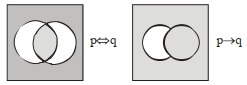
The statement $(\sim( p \Leftrightarrow \sim q )) \wedge q$ is :
A
a tautology
B
a contradiction
C
equivalent to $( p \Rightarrow q ) \wedge q$
D
equivalent to $( p \Rightarrow q ) \wedge p$
Solution
(C) We are given the expression $(\sim( p \Leftrightarrow \sim q )) \wedge q$.
First,recall that $\sim( p \Leftrightarrow \sim q )$ is equivalent to $p \Leftrightarrow q$ because $\sim( p \Leftrightarrow \sim q ) \equiv p \Leftrightarrow \sim(\sim q) \equiv p \Leftrightarrow q$.
Now,the expression becomes $( p \Leftrightarrow q ) \wedge q$.
We know that $p \Leftrightarrow q$ is $( p$ $\Rightarrow q ) \wedge ( q$ $\Rightarrow p )$.
So,$( p \Leftrightarrow q ) \wedge q \equiv ( p$ $\Rightarrow q ) \wedge ( q$ $\Rightarrow p ) \wedge q$.
Since $( q \Rightarrow p ) \wedge q \equiv q \wedge p$,the expression simplifies to $( p \Rightarrow q ) \wedge ( p \wedge q ) \equiv p \wedge q$.
Alternatively,checking the truth table for $( p \Leftrightarrow q ) \wedge q$:
If $p=T, q=T$,then $(T \Leftrightarrow T) \wedge T = T \wedge T = T$.
If $p=F, q=T$,then $(F \Leftrightarrow T) \wedge T = F \wedge T = F$.
If $p=T, q=F$,then $(T \Leftrightarrow F) \wedge F = F \wedge F = F$.
If $p=F, q=F$,then $(F \Leftrightarrow F) \wedge F = T \wedge F = F$.
Comparing this with option $(C)$: $( p \Rightarrow q ) \wedge q$.
If $p=T, q=T$,then $(T \Rightarrow T) \wedge T = T \wedge T = T$.
If $p=F, q=T$,then $(F \Rightarrow T) \wedge T = T \wedge T = T$.
This does not match.
Wait,let's re-evaluate the original expression: $(\sim( p \Leftrightarrow \sim q )) \wedge q$.
Since $\sim( p \Leftrightarrow \sim q ) \equiv p \Leftrightarrow q$,the expression is $( p \Leftrightarrow q ) \wedge q$.
This is equivalent to $p \wedge q$.
Looking at the options,none of the provided options are $p \wedge q$. Let us re-check the logic.
Actually,$( p \Rightarrow q ) \wedge q$ is equivalent to $q \wedge p$ if $p$ is true,but generally $( p \Rightarrow q ) \wedge q \equiv q \wedge p$ is not true. Wait,$( p \Rightarrow q ) \wedge q \equiv (\sim p \vee q) \wedge q \equiv q$.
Let's re-examine the expression: $(\sim( p \Leftrightarrow \sim q )) \wedge q \equiv (p \Leftrightarrow q) \wedge q$. This is $p \wedge q$.
Given the options,there might be a typo in the question or options. However,based on standard logic,$(p \Leftrightarrow q) \wedge q \equiv p \wedge q$.
First,recall that $\sim( p \Leftrightarrow \sim q )$ is equivalent to $p \Leftrightarrow q$ because $\sim( p \Leftrightarrow \sim q ) \equiv p \Leftrightarrow \sim(\sim q) \equiv p \Leftrightarrow q$.
Now,the expression becomes $( p \Leftrightarrow q ) \wedge q$.
We know that $p \Leftrightarrow q$ is $( p$ $\Rightarrow q ) \wedge ( q$ $\Rightarrow p )$.
So,$( p \Leftrightarrow q ) \wedge q \equiv ( p$ $\Rightarrow q ) \wedge ( q$ $\Rightarrow p ) \wedge q$.
Since $( q \Rightarrow p ) \wedge q \equiv q \wedge p$,the expression simplifies to $( p \Rightarrow q ) \wedge ( p \wedge q ) \equiv p \wedge q$.
Alternatively,checking the truth table for $( p \Leftrightarrow q ) \wedge q$:
If $p=T, q=T$,then $(T \Leftrightarrow T) \wedge T = T \wedge T = T$.
If $p=F, q=T$,then $(F \Leftrightarrow T) \wedge T = F \wedge T = F$.
If $p=T, q=F$,then $(T \Leftrightarrow F) \wedge F = F \wedge F = F$.
If $p=F, q=F$,then $(F \Leftrightarrow F) \wedge F = T \wedge F = F$.
Comparing this with option $(C)$: $( p \Rightarrow q ) \wedge q$.
If $p=T, q=T$,then $(T \Rightarrow T) \wedge T = T \wedge T = T$.
If $p=F, q=T$,then $(F \Rightarrow T) \wedge T = T \wedge T = T$.
This does not match.
Wait,let's re-evaluate the original expression: $(\sim( p \Leftrightarrow \sim q )) \wedge q$.
Since $\sim( p \Leftrightarrow \sim q ) \equiv p \Leftrightarrow q$,the expression is $( p \Leftrightarrow q ) \wedge q$.
This is equivalent to $p \wedge q$.
Looking at the options,none of the provided options are $p \wedge q$. Let us re-check the logic.
Actually,$( p \Rightarrow q ) \wedge q$ is equivalent to $q \wedge p$ if $p$ is true,but generally $( p \Rightarrow q ) \wedge q \equiv q \wedge p$ is not true. Wait,$( p \Rightarrow q ) \wedge q \equiv (\sim p \vee q) \wedge q \equiv q$.
Let's re-examine the expression: $(\sim( p \Leftrightarrow \sim q )) \wedge q \equiv (p \Leftrightarrow q) \wedge q$. This is $p \wedge q$.
Given the options,there might be a typo in the question or options. However,based on standard logic,$(p \Leftrightarrow q) \wedge q \equiv p \wedge q$.
0 likes
View Solution342
MediumMCQ
If the truth value of the statement $(P \wedge (\sim R)) \rightarrow ((\sim R) \wedge Q)$ is $F$,then the truth value of which of the following is $F$?
A
$P \vee Q \rightarrow \sim R$
B
$R \vee Q \rightarrow \sim P$
C
$\sim(P \vee Q) \rightarrow \sim R$
D
$\sim(R \vee Q) \rightarrow \sim P$
Solution
(D) The implication $X \rightarrow Y$ is $F$ if and only if $X$ is $T$ and $Y$ is $F$.
Given $(P \wedge (\sim R)) \rightarrow ((\sim R) \wedge Q)$ is $F$,we have:
$P \wedge (\sim R) = T \implies P = T$ and $\sim R = T \implies R = F$.
$(\sim R) \wedge Q = F$. Since $\sim R = T$,we must have $Q = F$.
So,the truth values are $P = T, Q = F, R = F$.
Now,check the options:
$(A) P \vee Q$ $\rightarrow \sim R = (T \vee F)$ $\rightarrow T = T$ $\rightarrow T = T$.
$(B) R \vee Q$ $\rightarrow \sim P = (F \vee F)$ $\rightarrow F = F$ $\rightarrow F = T$.
$(C) \sim(P \vee Q)$ $\rightarrow \sim R = \sim(T \vee F)$ $\rightarrow T = \sim T$ $\rightarrow T = F$ $\rightarrow T = T$.
$(D) \sim(R \vee Q)$ $\rightarrow \sim P = \sim(F \vee F)$ $\rightarrow F = \sim F$ $\rightarrow F = T$ $\rightarrow F = F$.
Thus,the statement in option $(D)$ is $F$.
Given $(P \wedge (\sim R)) \rightarrow ((\sim R) \wedge Q)$ is $F$,we have:
$P \wedge (\sim R) = T \implies P = T$ and $\sim R = T \implies R = F$.
$(\sim R) \wedge Q = F$. Since $\sim R = T$,we must have $Q = F$.
So,the truth values are $P = T, Q = F, R = F$.
Now,check the options:
$(A) P \vee Q$ $\rightarrow \sim R = (T \vee F)$ $\rightarrow T = T$ $\rightarrow T = T$.
$(B) R \vee Q$ $\rightarrow \sim P = (F \vee F)$ $\rightarrow F = F$ $\rightarrow F = T$.
$(C) \sim(P \vee Q)$ $\rightarrow \sim R = \sim(T \vee F)$ $\rightarrow T = \sim T$ $\rightarrow T = F$ $\rightarrow T = T$.
$(D) \sim(R \vee Q)$ $\rightarrow \sim P = \sim(F \vee F)$ $\rightarrow F = \sim F$ $\rightarrow F = T$ $\rightarrow F = F$.
Thus,the statement in option $(D)$ is $F$.
0 likes
View Solution343
MediumMCQ
$(p \wedge r) \Leftrightarrow (p \wedge (\sim q))$ is equivalent to $(\sim p)$ when $r$ is.
A
$p$
B
$\sim p$
C
$q$
D
$\sim q$
Solution
(C) We are given the logical equivalence: $(p \wedge r) \Leftrightarrow (p \wedge (\sim q)) \equiv (\sim p)$.
Let us test the options by substituting $r = \sim q$:
$(p \wedge (\sim q)) \Leftrightarrow (p \wedge (\sim q)) \equiv T$ (Tautology),which is not $(\sim p)$.
Let us test $r = q$:
$(p \wedge q) \Leftrightarrow (p \wedge (\sim q))$.
If $p = T$,then $(T \wedge q) \Leftrightarrow (T \wedge (\sim q)) \equiv q \Leftrightarrow (\sim q)$,which is $F$.
If $p = F$,then $(F \wedge q) \Leftrightarrow (F \wedge (\sim q)) \equiv F \Leftrightarrow F$,which is $T$.
This matches the truth table for $(\sim p)$.
Thus,$r = q$ is the correct choice.
Let us test the options by substituting $r = \sim q$:
$(p \wedge (\sim q)) \Leftrightarrow (p \wedge (\sim q)) \equiv T$ (Tautology),which is not $(\sim p)$.
Let us test $r = q$:
$(p \wedge q) \Leftrightarrow (p \wedge (\sim q))$.
If $p = T$,then $(T \wedge q) \Leftrightarrow (T \wedge (\sim q)) \equiv q \Leftrightarrow (\sim q)$,which is $F$.
If $p = F$,then $(F \wedge q) \Leftrightarrow (F \wedge (\sim q)) \equiv F \Leftrightarrow F$,which is $T$.
This matches the truth table for $(\sim p)$.
Thus,$r = q$ is the correct choice.
0 likes
View Solution344
MediumMCQ
Let,$p$: Ramesh listens to music.
$q$: Ramesh is out of his village.
$r$: It is Sunday.
$s$: It is Saturday.
Then the statement "Ramesh listens to music only if he is in his village and it is Sunday or Saturday" can be expressed as:
$q$: Ramesh is out of his village.
$r$: It is Sunday.
$s$: It is Saturday.
Then the statement "Ramesh listens to music only if he is in his village and it is Sunday or Saturday" can be expressed as:
A
$(\sim q) \wedge (r \vee s) \Rightarrow p$
B
$(q \wedge (r \vee s)) \Rightarrow p$
C
$p \Rightarrow (q \wedge (r \vee s))$
D
$p \Rightarrow ((\sim q) \wedge (r \vee s))$
Solution
(D) Given statements are:
$p$: Ramesh listens to music.
$q$: Ramesh is out of his village.
$r$: It is Sunday.
$s$: It is Saturday.
We need to translate the statement: "Ramesh listens to music only if he is in his village and it is Sunday or Saturday".
$1$. "Ramesh is in his village" is the negation of "Ramesh is out of his village",which is $\sim q$.
$2$. "It is Sunday or Saturday" is $r \vee s$.
$3$. The phrase "$p$ only if $A$" is logically equivalent to $p \Rightarrow A$.
Therefore,the statement becomes $p \Rightarrow ((\sim q) \wedge (r \vee s))$.
$p$: Ramesh listens to music.
$q$: Ramesh is out of his village.
$r$: It is Sunday.
$s$: It is Saturday.
We need to translate the statement: "Ramesh listens to music only if he is in his village and it is Sunday or Saturday".
$1$. "Ramesh is in his village" is the negation of "Ramesh is out of his village",which is $\sim q$.
$2$. "It is Sunday or Saturday" is $r \vee s$.
$3$. The phrase "$p$ only if $A$" is logically equivalent to $p \Rightarrow A$.
Therefore,the statement becomes $p \Rightarrow ((\sim q) \wedge (r \vee s))$.
0 likes
View Solution345
MediumMCQ
Let the operations $*, \odot \in \{\wedge, \vee\}$. If $(p * q) \odot (p \odot \sim q)$ is a tautology,then the ordered pair $(*, \odot)$ is:
A
$(\vee, \wedge)$
B
$(\vee, \vee)$
C
$(\wedge, \wedge)$
D
$(\wedge, \vee)$
Solution
(B) We check each option by evaluating the expression $(p * q) \odot (p \odot \sim q)$.
For option $A$: $* = \vee, \odot = \wedge$.
The expression becomes $(p \vee q) \wedge (p \wedge \sim q)$.
Using the distributive law: $p \vee (q \wedge \sim q) \wedge (p \wedge \sim q)$ is not correct. Let's re-evaluate: $(p \vee q) \wedge (p \wedge \sim q) \equiv (p \wedge p \wedge \sim q) \vee (q \wedge p \wedge \sim q) \equiv (p \wedge \sim q) \vee (F) \equiv p \wedge \sim q$,which is not a tautology.
For option $B$: $* = \vee, \odot = \vee$.
The expression becomes $(p \vee q) \vee (p \vee \sim q)$.
By associativity and commutativity: $p \vee p \vee (q \vee \sim q) \equiv p \vee T \equiv T$.
Since the result is $T$ (a tautology),option $B$ is correct.
For option $A$: $* = \vee, \odot = \wedge$.
The expression becomes $(p \vee q) \wedge (p \wedge \sim q)$.
Using the distributive law: $p \vee (q \wedge \sim q) \wedge (p \wedge \sim q)$ is not correct. Let's re-evaluate: $(p \vee q) \wedge (p \wedge \sim q) \equiv (p \wedge p \wedge \sim q) \vee (q \wedge p \wedge \sim q) \equiv (p \wedge \sim q) \vee (F) \equiv p \wedge \sim q$,which is not a tautology.
For option $B$: $* = \vee, \odot = \vee$.
The expression becomes $(p \vee q) \vee (p \vee \sim q)$.
By associativity and commutativity: $p \vee p \vee (q \vee \sim q) \equiv p \vee T \equiv T$.
Since the result is $T$ (a tautology),option $B$ is correct.
0 likes
View Solution346
MediumMCQ
The statement $(p$ $\Rightarrow q) \vee (p$ $\Rightarrow r)$ is $NOT$ equivalent to:
A
$(p \wedge (\sim r)) \Rightarrow q$
B
$(\sim q) \Rightarrow ((\sim r) \vee p)$
C
$p \Rightarrow (q \vee r)$
D
$(p \wedge (\sim q)) \Rightarrow r$
Solution
(B) Given statement: $(p$ $\Rightarrow q) \vee (p$ $\Rightarrow r)$
Using the identity $(p \Rightarrow q) \equiv (\sim p \vee q)$:
$= (\sim p \vee q) \vee (\sim p \vee r)$
$= \sim p \vee (q \vee r)$
$= p \Rightarrow (q \vee r)$
This matches option $(C)$.
Now check other options:
Option $(A): (p \wedge \sim r)$ $\Rightarrow q
\equiv \sim(p \wedge \sim r) \vee q
\equiv (\sim p \vee r) \vee q
\equiv \sim p \vee (q \vee r)
\equiv p$ $\Rightarrow (q \vee r)$. (Equivalent)
Option $(D): (p \wedge \sim q)$ $\Rightarrow r
\equiv \sim(p \wedge \sim q) \vee r
\equiv (\sim p \vee q) \vee r
\equiv \sim p \vee (q \vee r)
\equiv p$ $\Rightarrow (q \vee r)$. (Equivalent)
Option $(B): (\sim q)$ $\Rightarrow ((\sim r) \vee p)
\equiv \sim(\sim q) \vee (\sim r \vee p)
\equiv q \vee \sim r \vee p
\equiv p \vee q \vee \sim r$. (Not equivalent to $p \Rightarrow (q \vee r)$).
Using the identity $(p \Rightarrow q) \equiv (\sim p \vee q)$:
$= (\sim p \vee q) \vee (\sim p \vee r)$
$= \sim p \vee (q \vee r)$
$= p \Rightarrow (q \vee r)$
This matches option $(C)$.
Now check other options:
Option $(A): (p \wedge \sim r)$ $\Rightarrow q
\equiv \sim(p \wedge \sim r) \vee q
\equiv (\sim p \vee r) \vee q
\equiv \sim p \vee (q \vee r)
\equiv p$ $\Rightarrow (q \vee r)$. (Equivalent)
Option $(D): (p \wedge \sim q)$ $\Rightarrow r
\equiv \sim(p \wedge \sim q) \vee r
\equiv (\sim p \vee q) \vee r
\equiv \sim p \vee (q \vee r)
\equiv p$ $\Rightarrow (q \vee r)$. (Equivalent)
Option $(B): (\sim q)$ $\Rightarrow ((\sim r) \vee p)
\equiv \sim(\sim q) \vee (\sim r \vee p)
\equiv q \vee \sim r \vee p
\equiv p \vee q \vee \sim r$. (Not equivalent to $p \Rightarrow (q \vee r)$).
0 likes
View Solution347
MediumMCQ
The statement $(p \wedge q) \Rightarrow (p \wedge r)$ is equivalent to:
A
$q \Rightarrow (p \wedge r)$
B
$p \Rightarrow (p \wedge r)$
C
$(p \wedge r) \Rightarrow (p \wedge q)$
D
$(p \wedge q) \Rightarrow r$
Solution
(D) Given statement: $(p \wedge q) \Rightarrow (p \wedge r)$
Using the logical equivalence $A \Rightarrow B \equiv \sim A \vee B$:
$\sim(p \wedge q) \vee (p \wedge r)$
Apply De Morgan's Law:
$(\sim p \vee \sim q) \vee (p \wedge r)$
Using the distributive law $(\sim p \vee \sim q) \vee (p \wedge r) \equiv ((\sim p \vee \sim q) \vee p) \wedge ((\sim p \vee \sim q) \vee r)$:
$((\sim p \vee p) \vee \sim q) \wedge (\sim p \vee \sim q \vee r)$
Since $(\sim p \vee p) \equiv T$ (Tautology):
$(T \vee \sim q) \wedge (\sim p \vee \sim q \vee r)$
$T \wedge (\sim p \vee \sim q \vee r) \equiv \sim p \vee \sim q \vee r$
Rearranging the terms:
$(\sim p \vee \sim q) \vee r$
Using De Morgan's Law again:
$\sim(p \wedge q) \vee r$
Converting back to implication:
$(p \wedge q) \Rightarrow r$
Using the logical equivalence $A \Rightarrow B \equiv \sim A \vee B$:
$\sim(p \wedge q) \vee (p \wedge r)$
Apply De Morgan's Law:
$(\sim p \vee \sim q) \vee (p \wedge r)$
Using the distributive law $(\sim p \vee \sim q) \vee (p \wedge r) \equiv ((\sim p \vee \sim q) \vee p) \wedge ((\sim p \vee \sim q) \vee r)$:
$((\sim p \vee p) \vee \sim q) \wedge (\sim p \vee \sim q \vee r)$
Since $(\sim p \vee p) \equiv T$ (Tautology):
$(T \vee \sim q) \wedge (\sim p \vee \sim q \vee r)$
$T \wedge (\sim p \vee \sim q \vee r) \equiv \sim p \vee \sim q \vee r$
Rearranging the terms:
$(\sim p \vee \sim q) \vee r$
Using De Morgan's Law again:
$\sim(p \wedge q) \vee r$
Converting back to implication:
$(p \wedge q) \Rightarrow r$
0 likes
View Solution348
DifficultMCQ
The compound statement $(\sim(P \wedge Q)) \vee ((\sim P) \wedge Q) \Rightarrow ((\sim P) \wedge (\sim Q))$ is equivalent to
A
$((\sim P) \vee Q) \wedge ((\sim Q) \vee P)$
B
$(\sim Q) \vee P$
C
$((\sim P) \vee Q) \wedge (\sim Q)$
D
$(\sim P) \vee Q$
Solution
(B) Let the given statement be $r \Rightarrow s$,where $r = (\sim(P \wedge Q)) \vee ((\sim P) \wedge Q)$ and $s = ((\sim P) \wedge (\sim Q))$.
We construct the truth table for the statement:
| $P$ | $Q$ | $\sim(P \wedge Q)$ | $(\sim P) \wedge Q$ | $r$ | $s$ | $r \Rightarrow s$ |
|---|---|---|---|---|---|---|
| $T$ | $T$ | $F$ | $F$ | $F$ | $F$ | $T$ |
| $T$ | $F$ | $T$ | $F$ | $T$ | $F$ | $F$ |
| $F$ | $T$ | $T$ | $T$ | $T$ | $F$ | $F$ |
| $F$ | $F$ | $T$ | $F$ | $T$ | $T$ | $T$ |
Comparing the truth values of $r \Rightarrow s$ with the options:
For option $(B)$,$(\sim Q) \vee P$:
- If $P=T, Q=T$,$(\sim T) \vee T = F \vee T = T$.
- If $P=T, Q=F$,$(\sim F) \vee T = T \vee T = T$.
- If $P=F, Q=T$,$(\sim T) \vee F = F \vee F = F$.
- If $P=F, Q=F$,$(\sim F) \vee F = T \vee F = T$.
This does not match. Let's re-evaluate $r \Rightarrow s$:
$r = (\sim P \vee \sim Q) \vee (\sim P \wedge Q) = \sim P \vee (\sim Q \vee (\sim P \wedge Q)) = \sim P \vee (\sim Q \vee \sim P) \wedge (\sim Q \vee Q) = \sim P \vee \sim Q = \sim(P \wedge Q)$.
$s = \sim P \wedge \sim Q = \sim(P \vee Q)$.
So,$r \Rightarrow s$ is $\sim(P \wedge Q) \Rightarrow \sim(P \vee Q)$.
This is equivalent to $\sim(\sim(P \vee Q)) \Rightarrow \sim(\sim(P \wedge Q))$,which is $(P \vee Q) \Rightarrow (P \wedge Q)$.
This is only true when $P$ and $Q$ have the same truth value,i.e.,$P \Leftrightarrow Q$.
We construct the truth table for the statement:
| $P$ | $Q$ | $\sim(P \wedge Q)$ | $(\sim P) \wedge Q$ | $r$ | $s$ | $r \Rightarrow s$ |
|---|---|---|---|---|---|---|
| $T$ | $T$ | $F$ | $F$ | $F$ | $F$ | $T$ |
| $T$ | $F$ | $T$ | $F$ | $T$ | $F$ | $F$ |
| $F$ | $T$ | $T$ | $T$ | $T$ | $F$ | $F$ |
| $F$ | $F$ | $T$ | $F$ | $T$ | $T$ | $T$ |
Comparing the truth values of $r \Rightarrow s$ with the options:
For option $(B)$,$(\sim Q) \vee P$:
- If $P=T, Q=T$,$(\sim T) \vee T = F \vee T = T$.
- If $P=T, Q=F$,$(\sim F) \vee T = T \vee T = T$.
- If $P=F, Q=T$,$(\sim T) \vee F = F \vee F = F$.
- If $P=F, Q=F$,$(\sim F) \vee F = T \vee F = T$.
This does not match. Let's re-evaluate $r \Rightarrow s$:
$r = (\sim P \vee \sim Q) \vee (\sim P \wedge Q) = \sim P \vee (\sim Q \vee (\sim P \wedge Q)) = \sim P \vee (\sim Q \vee \sim P) \wedge (\sim Q \vee Q) = \sim P \vee \sim Q = \sim(P \wedge Q)$.
$s = \sim P \wedge \sim Q = \sim(P \vee Q)$.
So,$r \Rightarrow s$ is $\sim(P \wedge Q) \Rightarrow \sim(P \vee Q)$.
This is equivalent to $\sim(\sim(P \vee Q)) \Rightarrow \sim(\sim(P \wedge Q))$,which is $(P \vee Q) \Rightarrow (P \wedge Q)$.
This is only true when $P$ and $Q$ have the same truth value,i.e.,$P \Leftrightarrow Q$.
0 likes
View Solution349
DifficultMCQ
Let $p$ and $q$ be two statements. Then $\sim(p \wedge (p \Rightarrow \sim q))$ is equivalent to:
A
$p \vee (p \wedge (\sim q))$
B
$p \vee ((\sim p) \wedge q)$
C
$(\sim p) \vee q$
D
$p \vee (p \wedge q)$
Solution
(C) We are given the expression $\sim(p \wedge (p \rightarrow \sim q))$.
Using De Morgan's Law,$\sim(A \wedge B) \equiv \sim A \vee \sim B$:
$\sim(p \wedge (p$ $\rightarrow \sim q)) \equiv \sim p \vee \sim(p$ $\rightarrow \sim q)$.
Since $p \rightarrow q \equiv \sim p \vee q$,we have $p \rightarrow \sim q \equiv \sim p \vee \sim q$.
Substituting this into the expression:
$\equiv \sim p \vee \sim(\sim p \vee \sim q)$.
Applying De Morgan's Law again:
$\equiv \sim p \vee (p \wedge q)$.
Using the Distributive Law,$A \vee (B \wedge C) \equiv (A \vee B) \wedge (A \vee C)$:
$\equiv (\sim p \vee p) \wedge (\sim p \vee q)$.
Since $\sim p \vee p \equiv t$ (tautology):
$\equiv t \wedge (\sim p \vee q)$.
$\equiv \sim p \vee q$.
Using De Morgan's Law,$\sim(A \wedge B) \equiv \sim A \vee \sim B$:
$\sim(p \wedge (p$ $\rightarrow \sim q)) \equiv \sim p \vee \sim(p$ $\rightarrow \sim q)$.
Since $p \rightarrow q \equiv \sim p \vee q$,we have $p \rightarrow \sim q \equiv \sim p \vee \sim q$.
Substituting this into the expression:
$\equiv \sim p \vee \sim(\sim p \vee \sim q)$.
Applying De Morgan's Law again:
$\equiv \sim p \vee (p \wedge q)$.
Using the Distributive Law,$A \vee (B \wedge C) \equiv (A \vee B) \wedge (A \vee C)$:
$\equiv (\sim p \vee p) \wedge (\sim p \vee q)$.
Since $\sim p \vee p \equiv t$ (tautology):
$\equiv t \wedge (\sim p \vee q)$.
$\equiv \sim p \vee q$.
0 likes
View Solution350
DifficultMCQ
The statement $(p \wedge (\sim q))$ $\Rightarrow (p$ $\Rightarrow (\sim q))$ is
A
equivalent to $(\sim p) \vee (\sim q)$
B
a tautology
C
equivalent to $p \vee q$
D
a contradiction
Solution
(B) Let the given statement be $S = (p \wedge \sim q)$ $\Rightarrow (p$ $\Rightarrow \sim q)$.
Using the implication law $A \Rightarrow B \equiv \sim A \vee B$,we get:
$S \equiv \sim (p \wedge \sim q) \vee (p \Rightarrow \sim q)$
$S \equiv (\sim p \vee \sim (\sim q)) \vee (\sim p \vee \sim q)$
$S \equiv (\sim p \vee q) \vee (\sim p \vee \sim q)$
Using the associative and commutative laws:
$S \equiv \sim p \vee (q \vee \sim q)$
Since $(q \vee \sim q)$ is a tautology $(t)$:
$S \equiv \sim p \vee t$
$S \equiv t$
Therefore,the statement is a tautology.
Using the implication law $A \Rightarrow B \equiv \sim A \vee B$,we get:
$S \equiv \sim (p \wedge \sim q) \vee (p \Rightarrow \sim q)$
$S \equiv (\sim p \vee \sim (\sim q)) \vee (\sim p \vee \sim q)$
$S \equiv (\sim p \vee q) \vee (\sim p \vee \sim q)$
Using the associative and commutative laws:
$S \equiv \sim p \vee (q \vee \sim q)$
Since $(q \vee \sim q)$ is a tautology $(t)$:
$S \equiv \sim p \vee t$
$S \equiv t$
Therefore,the statement is a tautology.
0 likes
View SolutionMathematical Reasoning — Mathematical logic · Frequently Asked Questions
1Are these Mathematical Reasoning questions useful for JEE and NEET?
Yes. All questions in this section are mapped to JEE Main and NEET exam patterns. Previous year questions from JEE Main, NEET, GUJCET and state-level exams are included with full solutions.
2Can I switch to Hindi or Gujarati for these questions?
Yes. Use the language tabs in the hero section or the sidebar to view the same questions and solutions in English, Hindi or Gujarati.
3How do I generate a question paper from this subtopic?
Use the Vedclass Exam Paper Generator — select the chapter and subtopic, set difficulty, and generate Sets A, B, C, D automatically. First 3 chapters of every subject are free.
Vedclass Products
For Students
Vedclass Test Series
Mock tests in real JEE/NEET style with performance analysis. 5-day free trial.
Start Free TrialFor Teachers
Exam Paper Generator
Generate Set A/B/C/D papers from this chapter in 2 minutes. 3 chapters free.
Try FreeFor Institutes
Online Exam Module
Live online exams with unlimited students, 360° analytics & white-label branding.
See DemoFor Teachers & Institutes
Generate a Mathematical Reasoning Exam Paper in 2 Minutes
Select subtopic & difficulty — Sets A, B, C, D auto-generated with No Repeat logic.
First 3 chapters of every subject are free — no payment required.