
A English
Mathematical logic Questions in English
Class 11 Mathematics · Mathematical Reasoning · Mathematical logic
584+
Questions
English
Language
100%
With Solutions
Showing 50 of 584 questions in English
1
EasyMCQ
Which of the following is a statement?
A
Open the door
B
Do your homework
C
Switch on the fan
D
Two plus two is four
Solution
(D) statement is a declarative sentence that is either true or false,but not both.
$(a)$,$(b)$,and $(c)$ are imperative sentences (commands),which are not statements.
$(d)$ $2 + 2 = 4$ is a declarative sentence that is true,hence it is a statement.
$(a)$,$(b)$,and $(c)$ are imperative sentences (commands),which are not statements.
$(d)$ $2 + 2 = 4$ is a declarative sentence that is true,hence it is a statement.
0 likes
View Solution2
EasyMCQ
Which of the following is a statement?
A
May you live long!
B
May God bless you!
C
The sun is a star.
D
Hurrah! We have won the match.
Solution
(C) statement in logic is a declarative sentence that is either true or false,but not both.
$(a)$ $May \text{ you live long!}$ is an optative sentence.
$(b)$ $May \text{ God bless you!}$ is an optative sentence.
$(c)$ $The \text{ sun is a star.}$ is a declarative sentence that is true,hence it is a statement.
$(d)$ $Hurrah! \text{ We have won the match.}$ is an exclamatory sentence.
Therefore,the correct option is $C$.
$(a)$ $May \text{ you live long!}$ is an optative sentence.
$(b)$ $May \text{ God bless you!}$ is an optative sentence.
$(c)$ $The \text{ sun is a star.}$ is a declarative sentence that is true,hence it is a statement.
$(d)$ $Hurrah! \text{ We have won the match.}$ is an exclamatory sentence.
Therefore,the correct option is $C$.
0 likes
View Solution3
EasyMCQ
Which of the following is not a statement?
A
Roses are red
B
New Delhi is in India
C
Every square is a rectangle
D
Alas! $I$ have failed
Solution
(D) statement in logic is a declarative sentence that is either true or false,but not both.
$(a)$ $Roses \text{ are red}$ is a declarative sentence (true).
$(b)$ $New \text{ Delhi is in India}$ is a declarative sentence (true).
$(c)$ $Every \text{ square is a rectangle}$ is a declarative sentence (true).
$(d)$ $Alas! I have failed$ is an exclamatory sentence,which expresses strong emotion and cannot be classified as true or false. Therefore,it is not a statement.
$(a)$ $Roses \text{ are red}$ is a declarative sentence (true).
$(b)$ $New \text{ Delhi is in India}$ is a declarative sentence (true).
$(c)$ $Every \text{ square is a rectangle}$ is a declarative sentence (true).
$(d)$ $Alas! I have failed$ is an exclamatory sentence,which expresses strong emotion and cannot be classified as true or false. Therefore,it is not a statement.
0 likes
View Solution4
EasyMCQ
Which of the following is not a statement?
A
Every set is a finite set
B
$8$ is less than $6$
C
Where are you going?
D
The sum of interior angles of a triangle is $180^{\circ}$
Solution
(C) statement is a declarative sentence that is either true or false,but not both.
$(a)$ "Every set is a finite set" is a false statement.
$(b)$ "$8$ is less than $6$" is a false statement.
$(c)$ "Where are you going?" is an interrogative sentence,not a declarative one,so it is not a statement.
$(d)$ "The sum of interior angles of a triangle is $180^{\circ}$" is a true statement.
Therefore,the correct option is $C$.
$(a)$ "Every set is a finite set" is a false statement.
$(b)$ "$8$ is less than $6$" is a false statement.
$(c)$ "Where are you going?" is an interrogative sentence,not a declarative one,so it is not a statement.
$(d)$ "The sum of interior angles of a triangle is $180^{\circ}$" is a true statement.
Therefore,the correct option is $C$.
0 likes
View Solution5
EasyMCQ
Which of the following is not a statement?
A
Please do me a favour
B
$2$ is an even integer
C
$2 + 1 = 3$
D
The number $17$ is prime
Solution
(A) statement in logic is a declarative sentence that is either true or false,but not both.
$(A)$ "Please do me a favour" is an imperative sentence (a request),which cannot be classified as true or false. Therefore,it is not a statement.
$(B)$ "$2$ is an even integer" is a true statement.
$(C)$ "$2 + 1 = 3$" is a true statement.
$(D)$ "The number $17$ is prime" is a true statement.
Thus,the correct option is $A$.
$(A)$ "Please do me a favour" is an imperative sentence (a request),which cannot be classified as true or false. Therefore,it is not a statement.
$(B)$ "$2$ is an even integer" is a true statement.
$(C)$ "$2 + 1 = 3$" is a true statement.
$(D)$ "The number $17$ is prime" is a true statement.
Thus,the correct option is $A$.
0 likes
View Solution6
EasyMCQ
Which of the following is not a statement?
A
Give me a glass of water
B
Asia is a continent
C
The earth revolves round the sun
D
The number $6$ has two prime factors $2, 3$
Solution
(A) statement in logic is a declarative sentence that is either true or false,but not both.
$(A)$ "Give me a glass of water" is an imperative sentence (a request),not a declarative sentence,so it is not a statement.
$(B)$ "Asia is a continent" is a declarative sentence that is true.
$(C)$ "The earth revolves round the sun" is a declarative sentence that is true.
$(D)$ "The number $6$ has two prime factors $2, 3$" is a declarative sentence that is true.
Therefore,the correct option is $A$.
$(A)$ "Give me a glass of water" is an imperative sentence (a request),not a declarative sentence,so it is not a statement.
$(B)$ "Asia is a continent" is a declarative sentence that is true.
$(C)$ "The earth revolves round the sun" is a declarative sentence that is true.
$(D)$ "The number $6$ has two prime factors $2, 3$" is a declarative sentence that is true.
Therefore,the correct option is $A$.
0 likes
View Solution7
EasyMCQ
Which of the following is an open statement?
A
$x$ is a natural number
B
Give me a glass of water
C
Wish you best of luck
D
Good morning to all
Solution
(A) An open statement is a declarative sentence containing one or more variables such that it becomes a true or false statement depending on the values assigned to the variables.
$(a)$ "$x$ is a natural number" is an open statement because its truth value depends on the value of $x$.
$(b)$,$(c)$,and $(d)$ are imperative or exclamatory sentences,which are not considered statements in mathematical logic.
$(a)$ "$x$ is a natural number" is an open statement because its truth value depends on the value of $x$.
$(b)$,$(c)$,and $(d)$ are imperative or exclamatory sentences,which are not considered statements in mathematical logic.
0 likes
View Solution8
EasyMCQ
Negation of "Paris is in France and London is in England" is
A
Paris is in England and London is in France
B
Paris is not in France or London is not in England
C
Paris is in England or London is in France
D
None of these
Solution
(B) Let $p$ : Paris is in France.
Let $q$ : London is in England.
The given statement is $p \wedge q$.
The negation of a conjunction is given by De Morgan's Law: $\sim (p \wedge q) = \sim p \vee \sim q$.
Here,$\sim p$ is "Paris is not in France" and $\sim q$ is "London is not in England".
Therefore,the negation is "Paris is not in France or London is not in England".
Let $q$ : London is in England.
The given statement is $p \wedge q$.
The negation of a conjunction is given by De Morgan's Law: $\sim (p \wedge q) = \sim p \vee \sim q$.
Here,$\sim p$ is "Paris is not in France" and $\sim q$ is "London is not in England".
Therefore,the negation is "Paris is not in France or London is not in England".
0 likes
View Solution9
EasyMCQ
The negation of the statement "$2 + 3 = 5$ and $8 < 10$" is:
A
$2 + 3 \neq 5$ and $8 < 10$
B
$2 + 3 = 5$ and $8 \nless 10$
C
$2 + 3 \neq 5$ or $8 \nless 10$
D
None of these
Solution
(C) Let $p$ be the statement "$2 + 3 = 5$" and $q$ be the statement "$8 < 10$".
The given compound statement is $p \wedge q$.
The negation of a conjunction is given by De Morgan's Law: $\sim(p \wedge q) = \sim p \vee \sim q$.
Here,$\sim p$ is "$2 + 3 \neq 5$" and $\sim q$ is "$8 \nless 10$".
Therefore,the negation is "$2 + 3 \neq 5$ or $8 \nless 10$".
The given compound statement is $p \wedge q$.
The negation of a conjunction is given by De Morgan's Law: $\sim(p \wedge q) = \sim p \vee \sim q$.
Here,$\sim p$ is "$2 + 3 \neq 5$" and $\sim q$ is "$8 \nless 10$".
Therefore,the negation is "$2 + 3 \neq 5$ or $8 \nless 10$".
0 likes
View Solution10
EasyMCQ
Negation of "Ram is in Class $X$ or Rashmi is in Class $XII$" is
A
Ram is not in Class $X$ and Rashmi is not in Class $XII$
B
Ram is not in Class $X$ or Rashmi is not in Class $XII$
C
Ram is in Class $X$ and Rashmi is not in Class $XII$
D
None of these
Solution
(D) Let $p$: Ram is in Class $X$.
Let $q$: Rashmi is in Class $XII$.
The given statement is $p \vee q$.
The negation of a disjunction is given by De Morgan's Law: $\sim (p \vee q) = \sim p \wedge \sim q$.
Thus,the negation is: "Ram is not in Class $X$ $AND$ Rashmi is not in Class $XII$".
Comparing this with the given options,none of the options $A$,$B$,or $C$ match this result.
Therefore,the correct option is $D$.
Let $q$: Rashmi is in Class $XII$.
The given statement is $p \vee q$.
The negation of a disjunction is given by De Morgan's Law: $\sim (p \vee q) = \sim p \wedge \sim q$.
Thus,the negation is: "Ram is not in Class $X$ $AND$ Rashmi is not in Class $XII$".
Comparing this with the given options,none of the options $A$,$B$,or $C$ match this result.
Therefore,the correct option is $D$.
0 likes
View Solution11
MediumMCQ
The conditional statement $(p \wedge q) \implies p$ is:
A
$A$ tautology
B
$A$ fallacy (i.e.,contradiction)
C
Neither a tautology nor a fallacy
D
None of these
Solution
(A) To determine if the statement $(p \wedge q) \implies p$ is a tautology,we construct a truth table:
Since the final column contains only $T$ (True) values for all possible combinations of truth values of $p$ and $q$,the statement is a tautology.
| $p$ | $q$ | $p \wedge q$ | $(p \wedge q) \implies p$ |
|---|---|---|---|
| $T$ | $T$ | $T$ | $T$ |
| $T$ | $F$ | $F$ | $T$ |
| $F$ | $T$ | $F$ | $T$ |
| $F$ | $F$ | $F$ | $T$ |
Since the final column contains only $T$ (True) values for all possible combinations of truth values of $p$ and $q$,the statement is a tautology.
0 likes
View Solution12
MediumMCQ
Which of the following is a contradiction?
A
$(p \wedge q) \wedge \sim (p \vee q)$
B
$p \vee (\sim p \wedge q)$
C
$(p \Rightarrow q) \Rightarrow p$
D
None of these
Solution
(A) statement is a contradiction if its truth value is $F$ (False) for all possible truth values of its components.
Let us construct the truth table for $(p \wedge q) \wedge \sim (p \vee q)$:
Since the final column contains only $F$,the expression $(p \wedge q) \wedge \sim (p \vee q)$ is a contradiction.
Let us construct the truth table for $(p \wedge q) \wedge \sim (p \vee q)$:
| $p, q$ | $(p \wedge q) \wedge \sim (p \vee q)$ |
| $T, T$ | $F$ |
| $T, F$ | $F$ |
| $F, T$ | $F$ |
| $F, F$ | $F$ |
Since the final column contains only $F$,the expression $(p \wedge q) \wedge \sim (p \vee q)$ is a contradiction.
0 likes
View Solution13
EasyMCQ
$\sim (p \wedge q)$ is equal to .....
A
$\sim p \vee \sim q$
B
$\sim p \wedge \sim q$
C
$\sim p \wedge q$
D
$p \wedge \sim q$
Solution
(A) According to De Morgan's Law in mathematical logic,the negation of a conjunction is the disjunction of the negations.
Therefore,$\sim (p \wedge q) \equiv \sim p \vee \sim q$.
Therefore,$\sim (p \wedge q) \equiv \sim p \vee \sim q$.
0 likes
View Solution14
EasyMCQ
$(\sim (\sim p)) \wedge q$ is equal to .........
A
$\sim p \wedge q$
B
$p \wedge q$
C
$p \wedge \sim q$
D
$\sim p \wedge \sim q$
Solution
(B) By the Law of Double Negation,we know that $\sim (\sim p) \equiv p$.
Therefore,the given expression $(\sim (\sim p)) \wedge q$ simplifies to $p \wedge q$.
Therefore,the given expression $(\sim (\sim p)) \wedge q$ simplifies to $p \wedge q$.
0 likes
View Solution15
EasyMCQ
$\sim (p \vee (\sim q))$ is equal to .......
A
$\sim p \vee q$
B
$(\sim p) \wedge q$
C
$\sim p \vee \sim p$
D
$\sim p \wedge \sim q$
Solution
(B) Using De Morgan's Law,$\sim (p \vee r) \equiv \sim p \wedge \sim r$.
Applying this to the given expression:
$\sim (p \vee (\sim q)) \equiv \sim p \wedge \sim (\sim q)$.
Since $\sim (\sim q) \equiv q$,the expression simplifies to:
$\sim p \wedge q$.
Applying this to the given expression:
$\sim (p \vee (\sim q)) \equiv \sim p \wedge \sim (\sim q)$.
Since $\sim (\sim q) \equiv q$,the expression simplifies to:
$\sim p \wedge q$.
0 likes
View Solution16
EasyMCQ
$\sim ((\sim p) \wedge q)$ is equivalent to
A
$p \vee (\sim q)$
B
$p \vee q$
C
$p \wedge (\sim q)$
D
$\sim p \wedge \sim q$
Solution
(A) Using De Morgan's Law,$\sim (A \wedge B) \equiv (\sim A) \vee (\sim B)$.
Applying this to the given expression:
$\sim ((\sim p) \wedge q) \equiv \sim (\sim p) \vee (\sim q)$.
Since $\sim (\sim p) \equiv p$,the expression simplifies to:
$p \vee (\sim q)$.
Applying this to the given expression:
$\sim ((\sim p) \wedge q) \equiv \sim (\sim p) \vee (\sim q)$.
Since $\sim (\sim p) \equiv p$,the expression simplifies to:
$p \vee (\sim q)$.
0 likes
View Solution17
EasyMCQ
$\sim (p \Leftrightarrow q)$ is
A
$\sim p \wedge \sim q$
B
$\sim p \vee \sim q$
C
$(p \wedge \sim q) \vee (\sim p \wedge q)$
D
None of these
Solution
(C) The biconditional statement $p \Leftrightarrow q$ is defined as $(p$ $\Rightarrow q) \wedge (q$ $\Rightarrow p)$.
Since $p \Rightarrow q \equiv \sim p \vee q$,we have $p \Leftrightarrow q \equiv (\sim p \vee q) \wedge (\sim q \vee p)$.
Taking the negation: $\sim (p \Leftrightarrow q) \equiv \sim ((\sim p \vee q) \wedge (\sim q \vee p))$.
Using De Morgan's law: $\sim (p \Leftrightarrow q) \equiv \sim (\sim p \vee q) \vee \sim (\sim q \vee p)$.
This simplifies to $(p \wedge \sim q) \vee (q \wedge \sim p)$.
Since $p \Rightarrow q \equiv \sim p \vee q$,we have $p \Leftrightarrow q \equiv (\sim p \vee q) \wedge (\sim q \vee p)$.
Taking the negation: $\sim (p \Leftrightarrow q) \equiv \sim ((\sim p \vee q) \wedge (\sim q \vee p))$.
Using De Morgan's law: $\sim (p \Leftrightarrow q) \equiv \sim (\sim p \vee q) \vee \sim (\sim q \vee p)$.
This simplifies to $(p \wedge \sim q) \vee (q \wedge \sim p)$.
0 likes
View Solution18
EasyMCQ
$p \Rightarrow q$ can also be written as
A
$p \Rightarrow \sim q$
B
$\sim p \vee q$
C
$\sim q \Rightarrow \sim p$
D
None of these
Solution
(B) The logical implication $p \Rightarrow q$ is equivalent to the disjunction $\sim p \vee q$.
This is a standard logical equivalence where the conditional statement is false only when $p$ is true and $q$ is false,which matches the truth table for $\sim p \vee q$.
This is a standard logical equivalence where the conditional statement is false only when $p$ is true and $q$ is false,which matches the truth table for $\sim p \vee q$.
0 likes
View Solution19
EasyMCQ
If $p, q, r$ are simple propositions with truth values $T, F, T$ respectively,then the truth value of $(\sim p \vee q) \wedge \sim r \Rightarrow p$ is
A
True
B
False
C
True if $r$ is false
D
True if $q$ is true
Solution
(A) Given the truth values: $p = T, q = F, r = T$.
First,evaluate $\sim p$: $\sim T = F$.
Next,evaluate $\sim r$: $\sim T = F$.
Now,evaluate $(\sim p \vee q)$: $F \vee F = F$.
Then,evaluate $(\sim p \vee q) \wedge \sim r$: $F \wedge F = F$.
Finally,evaluate the implication $[(\sim p \vee q) \wedge \sim r] \Rightarrow p$: $F \Rightarrow T$.
Since the implication $F \Rightarrow T$ is $True$,the final truth value is $True$.
First,evaluate $\sim p$: $\sim T = F$.
Next,evaluate $\sim r$: $\sim T = F$.
Now,evaluate $(\sim p \vee q)$: $F \vee F = F$.
Then,evaluate $(\sim p \vee q) \wedge \sim r$: $F \wedge F = F$.
Finally,evaluate the implication $[(\sim p \vee q) \wedge \sim r] \Rightarrow p$: $F \Rightarrow T$.
Since the implication $F \Rightarrow T$ is $True$,the final truth value is $True$.
0 likes
View Solution20
EasyMCQ
If $(p \wedge \sim r) \Rightarrow (q \vee r)$ is false and $q$ and $r$ are both false,then $p$ is
A
true
B
false
C
May be true or false
D
Data insufficient
Solution
(A) The implication $(p \wedge \sim r) \Rightarrow (q \vee r)$ is false only when the antecedent $(p \wedge \sim r)$ is true and the consequent $(q \vee r)$ is false.
Given that $q$ and $r$ are both false,the consequent $(q \vee r)$ becomes $(F \vee F) = F$,which is consistent with the implication being false.
For the antecedent $(p \wedge \sim r)$ to be true,both $p$ and $\sim r$ must be true.
Since $r$ is false,$\sim r$ is true.
Therefore,$p \wedge T = T$ implies that $p$ must be true.
Given that $q$ and $r$ are both false,the consequent $(q \vee r)$ becomes $(F \vee F) = F$,which is consistent with the implication being false.
For the antecedent $(p \wedge \sim r)$ to be true,both $p$ and $\sim r$ must be true.
Since $r$ is false,$\sim r$ is true.
Therefore,$p \wedge T = T$ implies that $p$ must be true.
0 likes
View Solution21
EasyMCQ
If $p, q, r$ are simple propositions,then $(p \wedge q) \wedge (q \wedge r)$ is true,then:
A
$p, q, r$ are all false
B
$p, q, r$ are all true
C
$p, q$ are true and $r$ is false
D
$p$ is true and $q$ and $r$ are false
Solution
(B) The given logical expression is $(p \wedge q) \wedge (q \wedge r) = T$.
For the conjunction of two statements to be true,both components must be true.
Therefore,$(p \wedge q) = T$ and $(q \wedge r) = T$.
For $(p \wedge q) = T$,both $p$ and $q$ must be true.
For $(q \wedge r) = T$,both $q$ and $r$ must be true.
Since $q$ is true in both cases,and $p$ and $r$ must also be true,it follows that $p, q, r$ are all true.
For the conjunction of two statements to be true,both components must be true.
Therefore,$(p \wedge q) = T$ and $(q \wedge r) = T$.
For $(p \wedge q) = T$,both $p$ and $q$ must be true.
For $(q \wedge r) = T$,both $q$ and $r$ must be true.
Since $q$ is true in both cases,and $p$ and $r$ must also be true,it follows that $p, q, r$ are all true.
0 likes
View Solution22
MediumMCQ
$\sim (p \Rightarrow q) \Leftrightarrow \sim p \vee \sim q$ is
A
$A$ tautology
B
$A$ contradiction
C
Neither a tautology nor a contradiction
D
Cannot come to any conclusion
Solution
(C) The given statement is $\sim (p \Rightarrow q) \Leftrightarrow \sim p \vee \sim q$.
By the laws of logic,$\sim (p \Rightarrow q) \equiv p \wedge \sim q$.
Thus,the expression becomes $(p \wedge \sim q) \Leftrightarrow (\sim p \vee \sim q)$.
Constructing the truth table for the expression:
Since the final column contains both $T$ and $F$,the statement is neither a tautology nor a contradiction. Therefore,the correct option is $C$.
By the laws of logic,$\sim (p \Rightarrow q) \equiv p \wedge \sim q$.
Thus,the expression becomes $(p \wedge \sim q) \Leftrightarrow (\sim p \vee \sim q)$.
Constructing the truth table for the expression:
| $p$ | $q$ | $p \Rightarrow q$ | $\sim (p \Rightarrow q)$ | $\sim p$ | $\sim q$ | $\sim p \vee \sim q$ | $\sim (p \Rightarrow q) \Leftrightarrow (\sim p \vee \sim q)$ |
|---|---|---|---|---|---|---|---|
| $T$ | $T$ | $T$ | $F$ | $F$ | $F$ | $F$ | $T$ |
| $T$ | $F$ | $F$ | $T$ | $F$ | $T$ | $T$ | $T$ |
| $F$ | $T$ | $T$ | $F$ | $T$ | $F$ | $T$ | $F$ |
| $F$ | $F$ | $T$ | $F$ | $T$ | $T$ | $T$ | $F$ |
Since the final column contains both $T$ and $F$,the statement is neither a tautology nor a contradiction. Therefore,the correct option is $C$.
0 likes
View Solution23
MediumMCQ
$(p \wedge \sim q) \wedge (\sim p \vee q)$ is
A
$A$ contradiction
B
$A$ tautology
C
Either $(a)$ or $(b)$
D
Neither $(a)$ nor $(b)$
Solution
(A) The given expression is $(p \wedge \sim q) \wedge (\sim p \vee q)$.
We construct the truth table to evaluate the expression:
Since the final column contains only $F$ (False) for all possible truth values of $p$ and $q$,the statement is a contradiction.
We construct the truth table to evaluate the expression:
| $p$ | $q$ | $\sim p$ | $\sim q$ | $p \wedge \sim q$ | $\sim p \vee q$ | $(p \wedge \sim q) \wedge (\sim p \vee q)$ |
|---|---|---|---|---|---|---|
| $T$ | $T$ | $F$ | $F$ | $F$ | $T$ | $F$ |
| $T$ | $F$ | $F$ | $T$ | $T$ | $F$ | $F$ |
| $F$ | $T$ | $T$ | $F$ | $F$ | $T$ | $F$ |
| $F$ | $F$ | $T$ | $T$ | $F$ | $T$ | $F$ |
Since the final column contains only $F$ (False) for all possible truth values of $p$ and $q$,the statement is a contradiction.
0 likes
View Solution24
EasyMCQ
Which of the following is not logically equivalent to the proposition: "$A$ real number is either rational or irrational"?
A
If a number is neither rational nor irrational,then it is not real.
B
If a number is not rational or not irrational,then it is not real.
C
If a number is not real,then it is neither rational nor irrational.
D
If a number is real,then it is rational or irrational.
Solution
(B) Let $P$ be the statement "$A$ number is real" and $Q$ be the statement "$A$ number is rational or irrational".
The given proposition is $P \implies Q$.
The contrapositive of $P \implies Q$ is $\neg Q \implies \neg P$.
Here,$\neg Q$ is "$A$ number is neither rational nor irrational" and $\neg P$ is "$A$ number is not real".
Thus,the contrapositive is: "If a number is neither rational nor irrational,then it is not real".
Option $D$ is the original statement $P \implies Q$.
Option $C$ is the contrapositive $\neg Q \implies \neg P$.
Option $A$ is also equivalent to the contrapositive.
Option $B$ states: "If a number is not rational or not irrational,then it is not real". This is logically incorrect because a number can be irrational (not rational) and still be real,or rational (not irrational) and still be real. Thus,$B$ is not logically equivalent.
The given proposition is $P \implies Q$.
The contrapositive of $P \implies Q$ is $\neg Q \implies \neg P$.
Here,$\neg Q$ is "$A$ number is neither rational nor irrational" and $\neg P$ is "$A$ number is not real".
Thus,the contrapositive is: "If a number is neither rational nor irrational,then it is not real".
Option $D$ is the original statement $P \implies Q$.
Option $C$ is the contrapositive $\neg Q \implies \neg P$.
Option $A$ is also equivalent to the contrapositive.
Option $B$ states: "If a number is not rational or not irrational,then it is not real". This is logically incorrect because a number can be irrational (not rational) and still be real,or rational (not irrational) and still be real. Thus,$B$ is not logically equivalent.
0 likes
View Solution25
MediumMCQ
If $p$: It rains today,$q$: $I$ go to school,$r$: $I$ shall meet my friend,and $s$: $I$ shall go for a movie,then which of the following represents the proposition: "If it does not rain or if $I$ do not go to school,then $I$ shall meet my friend and go for a movie"?
A
$\sim (p \wedge q) \Rightarrow (r \wedge s)$
B
$\sim (p \wedge \sim q) \Rightarrow (r \wedge s)$
C
$\sim (p \wedge q) \Rightarrow (r \vee s)$
D
None of these
Solution
(A) Given propositions are:
$p$: It rains today
$q$: $I$ go to school
$r$: $I$ shall meet my friend
$s$: $I$ shall go for a movie
The statement is: "If it does not rain or if $I$ do not go to school,then $I$ shall meet my friend and go for a movie."
"It does not rain" is $\sim p$.
"$I$ do not go to school" is $\sim q$.
"It does not rain or if $I$ do not go to school" is $(\sim p \vee \sim q)$.
By De Morgan's Law,$(\sim p \vee \sim q) \equiv \sim (p \wedge q)$.
"$I$ shall meet my friend and go for a movie" is $(r \wedge s)$.
Thus,the proposition is $\sim (p \wedge q) \Rightarrow (r \wedge s)$.
Therefore,the correct option is $A$.
$p$: It rains today
$q$: $I$ go to school
$r$: $I$ shall meet my friend
$s$: $I$ shall go for a movie
The statement is: "If it does not rain or if $I$ do not go to school,then $I$ shall meet my friend and go for a movie."
"It does not rain" is $\sim p$.
"$I$ do not go to school" is $\sim q$.
"It does not rain or if $I$ do not go to school" is $(\sim p \vee \sim q)$.
By De Morgan's Law,$(\sim p \vee \sim q) \equiv \sim (p \wedge q)$.
"$I$ shall meet my friend and go for a movie" is $(r \wedge s)$.
Thus,the proposition is $\sim (p \wedge q) \Rightarrow (r \wedge s)$.
Therefore,the correct option is $A$.
0 likes
View Solution26
EasyMCQ
The negation of the compound proposition $p \vee (\sim p \vee q)$ is
A
$(p \wedge \sim q) \wedge \sim p$
B
$(p \wedge \sim q) \vee \sim p$
C
$(p \vee \sim q) \vee \sim p$
D
None of these
Solution
(D) The given proposition is $S = p \vee (\sim p \vee q)$.
We need to find the negation $\sim S = \sim [p \vee (\sim p \vee q)]$.
Using De Morgan's Law,$\sim (A \vee B) \equiv \sim A \wedge \sim B$,we get:
$\sim S \equiv \sim p \wedge \sim (\sim p \vee q)$.
Applying De Morgan's Law again to the second part,$\sim (\sim p \vee q) \equiv \sim (\sim p) \wedge \sim q \equiv p \wedge \sim q$.
Therefore,$\sim S \equiv \sim p \wedge (p \wedge \sim q)$.
Since the conjunction is associative,this is equivalent to $(\sim p \wedge p) \wedge \sim q$.
Since $\sim p \wedge p$ is a contradiction $(F)$,the expression simplifies to $F \wedge \sim q$,which is $F$ (False).
Looking at the options,none of the expressions provided are logically equivalent to $F$. Thus,the correct option is $D$.
We need to find the negation $\sim S = \sim [p \vee (\sim p \vee q)]$.
Using De Morgan's Law,$\sim (A \vee B) \equiv \sim A \wedge \sim B$,we get:
$\sim S \equiv \sim p \wedge \sim (\sim p \vee q)$.
Applying De Morgan's Law again to the second part,$\sim (\sim p \vee q) \equiv \sim (\sim p) \wedge \sim q \equiv p \wedge \sim q$.
Therefore,$\sim S \equiv \sim p \wedge (p \wedge \sim q)$.
Since the conjunction is associative,this is equivalent to $(\sim p \wedge p) \wedge \sim q$.
Since $\sim p \wedge p$ is a contradiction $(F)$,the expression simplifies to $F \wedge \sim q$,which is $F$ (False).
Looking at the options,none of the expressions provided are logically equivalent to $F$. Thus,the correct option is $D$.
0 likes
View Solution27
DifficultMCQ
Which of the following logical equivalences is true?
A
$p$ $\Rightarrow q \equiv \sim p$ $\Rightarrow \sim q$
B
$\sim (p \Rightarrow \sim q) \equiv \sim p \wedge q$
C
$\sim (\sim p \Rightarrow \sim q) \equiv \sim p \wedge q$
D
$\sim (p \Leftrightarrow q) \equiv [\sim (p$ $\Rightarrow q) \wedge \sim (q$ $\Rightarrow p)]$
Solution
(C) We know that the negation of an implication is given by $\sim (p \Rightarrow q) \equiv p \wedge \sim q$.
Applying this to the expression in option $C$:
$\sim (\sim p \Rightarrow \sim q) \equiv (\sim p) \wedge \sim (\sim q)$
$\equiv \sim p \wedge q$.
Therefore,the statement in option $C$ is true.
Applying this to the expression in option $C$:
$\sim (\sim p \Rightarrow \sim q) \equiv (\sim p) \wedge \sim (\sim q)$
$\equiv \sim p \wedge q$.
Therefore,the statement in option $C$ is true.
0 likes
View Solution28
EasyMCQ
$\sim (p \vee q) \vee (\sim p \wedge q)$ is logically equivalent to
A
$\sim p$
B
$p$
C
$q$
D
$\sim q$
Solution
(A) Using De Morgan's Law,$\sim (p \vee q) \equiv (\sim p \wedge \sim q)$.
Therefore,the expression becomes $(\sim p \wedge \sim q) \vee (\sim p \wedge q)$.
By the Distributive Law,we can factor out $\sim p$:
$\sim p \wedge (\sim q \vee q)$.
Since $(\sim q \vee q) \equiv T$ (a tautology),
$\sim p \wedge T \equiv \sim p$.
Therefore,the expression becomes $(\sim p \wedge \sim q) \vee (\sim p \wedge q)$.
By the Distributive Law,we can factor out $\sim p$:
$\sim p \wedge (\sim q \vee q)$.
Since $(\sim q \vee q) \equiv T$ (a tautology),
$\sim p \wedge T \equiv \sim p$.
0 likes
View Solution29
EasyMCQ
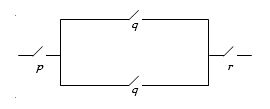
When does the current flow through the following circuit?
A
$p, q, r$ should be closed
B
$p, q, r$ should be open
C
Always
D
None of these
Solution
(A) In the given circuit,switch $p$ is in series with a parallel combination of two switches labeled $q$,and this whole combination is in series with switch $r$.
For the current to flow,the circuit must be complete.
This requires switch $p$ to be closed,at least one of the switches $q$ to be closed,and switch $r$ to be closed.
Therefore,the condition for current to flow is $p \land (q \lor q) \land r$,which simplifies to $p \land q \land r$.
Thus,$p, q,$ and $r$ must all be closed.
For the current to flow,the circuit must be complete.
This requires switch $p$ to be closed,at least one of the switches $q$ to be closed,and switch $r$ to be closed.
Therefore,the condition for current to flow is $p \land (q \lor q) \land r$,which simplifies to $p \land q \land r$.
Thus,$p, q,$ and $r$ must all be closed.
0 likes
View Solution30
EasyMCQ
The negation of $q \vee \sim (p \wedge r)$ is
A
$\sim q \wedge \sim(p \wedge r)$
B
$\sim q \wedge (p \wedge r)$
C
$\sim q \vee (p \wedge r)$
D
None of these
Solution
(B) To find the negation of the statement $q \vee \sim (p \wedge r)$,we apply De Morgan's Law: $\sim (A \vee B) = \sim A \wedge \sim B$.
Applying this,we get: $\sim (q \vee \sim (p \wedge r)) = \sim q \wedge \sim (\sim (p \wedge r))$.
Using the law of double negation $\sim (\sim P) = P$,we simplify the expression: $\sim q \wedge (p \wedge r)$.
Thus,the correct option is $B$.
Applying this,we get: $\sim (q \vee \sim (p \wedge r)) = \sim q \wedge \sim (\sim (p \wedge r))$.
Using the law of double negation $\sim (\sim P) = P$,we simplify the expression: $\sim q \wedge (p \wedge r)$.
Thus,the correct option is $B$.
0 likes
View Solution31
EasyMCQ
Which of the following logical equivalences is always true?
A
$(p$ $\Rightarrow q) \equiv (\sim q$ $\Rightarrow \sim p)$
B
$\sim (p \vee q) \equiv (\sim p \vee \sim q)$
C
$\sim (p \Rightarrow q) \equiv (p \wedge \sim q)$
D
$\sim (p \vee q) \equiv (\sim p \wedge \sim q)$
Solution
(C) The logical equivalence $(p \Rightarrow q) \equiv (\sim p \vee q)$ is a standard identity.
Applying the negation operator to both sides:
$\sim (p \Rightarrow q) \equiv \sim (\sim p \vee q)$
Using De Morgan's Law,$\sim (A \vee B) \equiv (\sim A \wedge \sim B)$:
$\sim (p \Rightarrow q) \equiv (\sim (\sim p) \wedge \sim q)$
Since $\sim (\sim p) \equiv p$,we get:
$\sim (p \Rightarrow q) \equiv (p \wedge \sim q)$
Both options $A$,$C$,and $D$ are logically valid identities. However,in standard logic textbooks,these are all tautologies. Given the structure,$C$ is a fundamental definition of the negation of a conditional statement.
Applying the negation operator to both sides:
$\sim (p \Rightarrow q) \equiv \sim (\sim p \vee q)$
Using De Morgan's Law,$\sim (A \vee B) \equiv (\sim A \wedge \sim B)$:
$\sim (p \Rightarrow q) \equiv (\sim (\sim p) \wedge \sim q)$
Since $\sim (\sim p) \equiv p$,we get:
$\sim (p \Rightarrow q) \equiv (p \wedge \sim q)$
Both options $A$,$C$,and $D$ are logically valid identities. However,in standard logic textbooks,these are all tautologies. Given the structure,$C$ is a fundamental definition of the negation of a conditional statement.
0 likes
View Solution32
EasyMCQ
The contrapositive of $(p \vee q) \Rightarrow r$ is
A
$r \Rightarrow (p \vee q)$
B
$\sim r \Rightarrow (p \vee q)$
C
$\sim r \Rightarrow (\sim p \wedge \sim q)$
D
$p \Rightarrow (q \vee r)$
Solution
(C) The contrapositive of an implication $P \Rightarrow Q$ is defined as $\sim Q \Rightarrow \sim P$.
Given the implication $(p \vee q) \Rightarrow r$,we identify $P = (p \vee q)$ and $Q = r$.
Applying the rule,the contrapositive is $\sim r \Rightarrow \sim (p \vee q)$.
Using De Morgan's Law,$\sim (p \vee q)$ is equivalent to $(\sim p \wedge \sim q)$.
Therefore,the contrapositive is $\sim r \Rightarrow (\sim p \wedge \sim q)$.
Given the implication $(p \vee q) \Rightarrow r$,we identify $P = (p \vee q)$ and $Q = r$.
Applying the rule,the contrapositive is $\sim r \Rightarrow \sim (p \vee q)$.
Using De Morgan's Law,$\sim (p \vee q)$ is equivalent to $(\sim p \wedge \sim q)$.
Therefore,the contrapositive is $\sim r \Rightarrow (\sim p \wedge \sim q)$.
0 likes
View Solution33
MediumMCQ
The false statement in the following is
A
$p \wedge (\sim p)$ is a contradiction
B
$(p$ $\Rightarrow q) \Leftrightarrow (\sim q$ $\Rightarrow \;\sim p)$ is a contradiction
C
$\sim (\sim p) \Leftrightarrow p$ is a tautology
D
$p \vee (\sim p)$ is a tautology
Solution
(B) The statement $(p$ $\Rightarrow q) \Leftrightarrow (\sim q$ $\Rightarrow \;\sim p)$ is a tautology because $p \Rightarrow q$ is logically equivalent to its contrapositive $\sim q \Rightarrow \;\sim p$.
Since it is a tautology,it cannot be a contradiction.
Therefore,the statement in option $B$ is false.
Since it is a tautology,it cannot be a contradiction.
Therefore,the statement in option $B$ is false.
0 likes
View Solution34
EasyMCQ
If $p \Rightarrow (\sim p \vee q)$ is false,the truth values of $p$ and $q$ are respectively
A
$F, T$
B
$F, F$
C
$T, T$
D
$T, F$
Solution
(D) The implication $p \Rightarrow (\sim p \vee q)$ is false only when the antecedent $p$ is true and the consequent $(\sim p \vee q)$ is false.
For $(\sim p \vee q)$ to be false,both $\sim p$ and $q$ must be false.
Since $\sim p$ is false,$p$ must be true.
Since $q$ is false,the truth values are $p = T$ and $q = F$.
For $(\sim p \vee q)$ to be false,both $\sim p$ and $q$ must be false.
Since $\sim p$ is false,$p$ must be true.
Since $q$ is false,the truth values are $p = T$ and $q = F$.
0 likes
View Solution35
MediumMCQ
Which of the following is not a statement?
A
$\sqrt{3}$ is a prime number
B
$\sqrt{2}$ is an irrational number
C
Mathematics is interesting
D
$5$ is an even integer
Solution
(C) statement is a declarative sentence that is either true or false,but not both.
Option $(A)$ is a false statement.
Option $(B)$ is a true statement.
Option $(D)$ is a false statement.
Option $(C)$ 'Mathematics is interesting' is not a statement because it is subjective; it may be interesting for some people and not for others. Therefore,it cannot be classified as strictly true or false.
Option $(A)$ is a false statement.
Option $(B)$ is a true statement.
Option $(D)$ is a false statement.
Option $(C)$ 'Mathematics is interesting' is not a statement because it is subjective; it may be interesting for some people and not for others. Therefore,it cannot be classified as strictly true or false.
0 likes
View Solution36
MediumMCQ
$(p \wedge \sim q) \wedge (\sim p \wedge q)$ is
A
$A$ tautology
B
$A$ contradiction
C
Both a tautology and a contradiction
D
Neither a tautology nor a contradiction
Solution
(B) Given expression: $(p \wedge \sim q) \wedge (\sim p \wedge q)$
By using the associative and commutative laws of logic,we can rearrange the terms:
$= (p \wedge \sim p) \wedge (\sim q \wedge q)$
We know that for any proposition $p$,$(p \wedge \sim p) = F$ (a contradiction).
$= F \wedge F = F$
Since the final truth value is always $F$ (False),the statement is a contradiction.
By using the associative and commutative laws of logic,we can rearrange the terms:
$= (p \wedge \sim p) \wedge (\sim q \wedge q)$
We know that for any proposition $p$,$(p \wedge \sim p) = F$ (a contradiction).
$= F \wedge F = F$
Since the final truth value is always $F$ (False),the statement is a contradiction.
0 likes
View Solution37
EasyMCQ
$\sim p \wedge q$ is logically equivalent to
A
$p \to q$
B
$q \to p$
C
$\sim (p \to q)$
D
$\sim (q \to p)$
Solution
(D) The logical implication $q \to p$ is equivalent to $\sim q \vee p$.
Taking the negation of both sides,we get $\sim (q \to p) \equiv \sim (\sim q \vee p)$.
By De Morgan's Law,$\sim (\sim q \vee p) \equiv (\sim \sim q) \wedge (\sim p)$.
This simplifies to $q \wedge \sim p$,which is equivalent to $\sim p \wedge q$.
Therefore,$\sim p \wedge q \equiv \sim (q \to p)$.
Taking the negation of both sides,we get $\sim (q \to p) \equiv \sim (\sim q \vee p)$.
By De Morgan's Law,$\sim (\sim q \vee p) \equiv (\sim \sim q) \wedge (\sim p)$.
This simplifies to $q \wedge \sim p$,which is equivalent to $\sim p \wedge q$.
Therefore,$\sim p \wedge q \equiv \sim (q \to p)$.
0 likes
View Solution38
EasyMCQ
Which of the following is the inverse of the proposition: "If a number is a prime then it is odd."
A
If a number is not a prime then it is odd.
B
If a number is not a prime then it is not odd.
C
If a number is not odd then it is not a prime.
D
If a number is not odd then it is a prime.
Solution
(B) Let $p$ be the statement: "$A$ number is a prime."
Let $q$ be the statement: "It is odd."
The given proposition is $p \Rightarrow q$.
The inverse of a conditional statement $p \Rightarrow q$ is defined as $\sim p \Rightarrow \sim q$.
Here,$\sim p$ is: "$A$ number is not a prime."
$\sim q$ is: "It is not odd."
Therefore,the inverse is: "If a number is not a prime then it is not odd."
Thus,the correct option is $B$.
Let $q$ be the statement: "It is odd."
The given proposition is $p \Rightarrow q$.
The inverse of a conditional statement $p \Rightarrow q$ is defined as $\sim p \Rightarrow \sim q$.
Here,$\sim p$ is: "$A$ number is not a prime."
$\sim q$ is: "It is not odd."
Therefore,the inverse is: "If a number is not a prime then it is not odd."
Thus,the correct option is $B$.
0 likes
View Solution39
EasyMCQ
The negation of the statement "If a number is divisible by $15$,then it is divisible by $5$ and $3$" is:
A
If a number is divisible by $15$,then it is not divisible by $5$ and $3$.
B
$A$ number is divisible by $15$ and it is not divisible by $5$ or $3$.
C
$A$ number is divisible by $15$ or it is not divisible by $5$ and $3$.
D
$A$ number is divisible by $15$ and it is not divisible by $5$ and $3$.
Solution
(D) Let $p$,$q$,and $r$ be the following statements:
$p$: $A$ number is divisible by $15$.
$q$: $A$ number is divisible by $5$.
$r$: $A$ number is divisible by $3$.
The given statement is of the form $p \rightarrow (q \wedge r)$.
The negation of an implication $p \rightarrow S$ is $p \wedge (\sim S)$.
Therefore,the negation is $p \wedge \sim(q \wedge r)$.
Using De Morgan's Law,$\sim(q \wedge r) \equiv (\sim q \vee \sim r)$.
Thus,the negation is $p \wedge (\sim q \vee \sim r)$,which means: "$A$ number is divisible by $15$ and it is not divisible by $5$ or it is not divisible by $3$."
However,looking at the logical structure provided in the options,the standard negation of "If $p$ then $q$ and $r$" is "$p$ and not ($q$ and $r$)",which is "$p$ and (not $q$ or not $r$)".
Given the options provided,option $D$ is the intended answer representing the logical negation $p \wedge \sim(q \wedge r)$.
$p$: $A$ number is divisible by $15$.
$q$: $A$ number is divisible by $5$.
$r$: $A$ number is divisible by $3$.
The given statement is of the form $p \rightarrow (q \wedge r)$.
The negation of an implication $p \rightarrow S$ is $p \wedge (\sim S)$.
Therefore,the negation is $p \wedge \sim(q \wedge r)$.
Using De Morgan's Law,$\sim(q \wedge r) \equiv (\sim q \vee \sim r)$.
Thus,the negation is $p \wedge (\sim q \vee \sim r)$,which means: "$A$ number is divisible by $15$ and it is not divisible by $5$ or it is not divisible by $3$."
However,looking at the logical structure provided in the options,the standard negation of "If $p$ then $q$ and $r$" is "$p$ and not ($q$ and $r$)",which is "$p$ and (not $q$ or not $r$)".
Given the options provided,option $D$ is the intended answer representing the logical negation $p \wedge \sim(q \wedge r)$.
0 likes
View Solution40
DifficultMCQ
The statement $p$ $\rightarrow (q$ $\rightarrow p)$ is equivalent to which of the following?
A
$p$ $\rightarrow (p$ $\rightarrow q)$
B
$p \rightarrow (p \vee q)$
C
$p \rightarrow (p \wedge q)$
D
$p \rightarrow (p \Leftrightarrow q)$
Solution
(B) The statement $p$ $\rightarrow (q$ $\rightarrow p)$ is a tautology because it is only false if $p$ is true and $(q \rightarrow p)$ is false,which is impossible since $p$ is true.
Now,let us evaluate $p \rightarrow (p \vee q)$.
This statement is false only if $p$ is true and $(p \vee q)$ is false.
If $p$ is true,then $(p \vee q)$ must be true (by the definition of disjunction).
Thus,$p \rightarrow (p \vee q)$ is also a tautology.
Since both statements are tautologies,they are logically equivalent.
Therefore,$p$ $\rightarrow (q$ $\rightarrow p) \equiv p$ $\rightarrow (p \vee q)$.
Now,let us evaluate $p \rightarrow (p \vee q)$.
This statement is false only if $p$ is true and $(p \vee q)$ is false.
If $p$ is true,then $(p \vee q)$ must be true (by the definition of disjunction).
Thus,$p \rightarrow (p \vee q)$ is also a tautology.
Since both statements are tautologies,they are logically equivalent.
Therefore,$p$ $\rightarrow (q$ $\rightarrow p) \equiv p$ $\rightarrow (p \vee q)$.
0 likes
View Solution41
EasyMCQ
Determine which of the following is not a statement.
A
Ahmedabad is situated on the banks of the Sabarmati river.
B
Tomorrow is a holiday.
C
For non-zero numbers $x$ and $y$,$x^2 + y^2 \neq 0$.
D
Pythagoras was a mathematician.
Solution
(B) statement in mathematical logic is a declarative sentence that is either true or false,but not both.
$(A)$ 'Ahmedabad is situated on the banks of the Sabarmati river' is a true statement.
$(B)$ 'Tomorrow is a holiday' is not a statement because its truth value depends on the context of 'tomorrow',which is ambiguous.
$(C)$ 'For non-zero numbers $x$ and $y$,$x^2 + y^2 \neq 0$' is a true statement.
$(D)$ 'Pythagoras was a mathematician' is a true statement.
Therefore,option $B$ is not a statement.
$(A)$ 'Ahmedabad is situated on the banks of the Sabarmati river' is a true statement.
$(B)$ 'Tomorrow is a holiday' is not a statement because its truth value depends on the context of 'tomorrow',which is ambiguous.
$(C)$ 'For non-zero numbers $x$ and $y$,$x^2 + y^2 \neq 0$' is a true statement.
$(D)$ 'Pythagoras was a mathematician' is a true statement.
Therefore,option $B$ is not a statement.
0 likes
View Solution42
DifficultMCQ
Which of the following is true?
A
$(\sim p \vee \sim q) \equiv (p \wedge q)$
B
$(p$ $\rightarrow q) \equiv (\sim q$ $\rightarrow \sim p)$
C
$\sim (p \rightarrow \sim q) \equiv (p \wedge \sim q)$
D
$\sim (p \Leftrightarrow q) \equiv (p$ $\rightarrow q) \vee (q$ $\rightarrow p)$
Solution
(B) The statement $(p$ $\rightarrow q) \equiv (\sim q$ $\rightarrow \sim p)$ is the contrapositive of the implication,which is logically equivalent.
Using the definition of implication $p \rightarrow q \equiv \sim p \vee q$:
For the contrapositive: $\sim q \rightarrow \sim p \equiv \sim (\sim q) \vee \sim p$
$\equiv q \vee \sim p$
$\equiv \sim p \vee q$
$\equiv p \rightarrow q$
Thus,$(p$ $\rightarrow q) \equiv (\sim q$ $\rightarrow \sim p)$ is true.
Using the definition of implication $p \rightarrow q \equiv \sim p \vee q$:
For the contrapositive: $\sim q \rightarrow \sim p \equiv \sim (\sim q) \vee \sim p$
$\equiv q \vee \sim p$
$\equiv \sim p \vee q$
$\equiv p \rightarrow q$
Thus,$(p$ $\rightarrow q) \equiv (\sim q$ $\rightarrow \sim p)$ is true.
0 likes
View Solution43
DifficultMCQ
Statement-$I$: $(p \wedge \sim q) \wedge (\sim p \wedge q)$ is a contradiction.
Statement-$II$: $(p$ $\rightarrow q) \Leftrightarrow (\sim q$ $\rightarrow \sim p)$ is a tautology.
Statement-$II$: $(p$ $\rightarrow q) \Leftrightarrow (\sim q$ $\rightarrow \sim p)$ is a tautology.
A
Statement-$I$ is true,Statement-$II$ is true. Statement-$II$ is a correct explanation for Statement-$I$.
B
Statement-$I$ is true,Statement-$II$ is true. Statement-$II$ is not a correct explanation for Statement-$I$.
C
Statement-$I$ is true. Statement-$II$ is false.
D
Statement-$I$ is false. Statement-$II$ is true.
Solution
(B) For Statement-$I$: $(p \wedge \sim q) \wedge (\sim p \wedge q) = p \wedge (\sim q \wedge \sim p) \wedge q = (p \wedge \sim p) \wedge (\sim q \wedge q) = F \wedge F = F$. Since the result is always false,it is a contradiction. Thus,Statement-$I$ is true.
For Statement-$II$: The expression $(p$ $\rightarrow q) \Leftrightarrow (\sim q$ $\rightarrow \sim p)$ represents the equivalence between a conditional statement and its contrapositive. Since a conditional statement is always logically equivalent to its contrapositive,this is a tautology. Thus,Statement-$II$ is true.
Since Statement-$II$ does not explain why Statement-$I$ is a contradiction,option $B$ is correct.
For Statement-$II$: The expression $(p$ $\rightarrow q) \Leftrightarrow (\sim q$ $\rightarrow \sim p)$ represents the equivalence between a conditional statement and its contrapositive. Since a conditional statement is always logically equivalent to its contrapositive,this is a tautology. Thus,Statement-$II$ is true.
Since Statement-$II$ does not explain why Statement-$I$ is a contradiction,option $B$ is correct.
0 likes
View Solution44
MediumMCQ
Let $p$ be the statement '$x$ is an irrational number',$q$ be the statement '$y$ is a transcendental number',and $r$ be the statement '$x$ is a rational number or $y$ is a transcendental number'.
Statement-$1$: $r$ is equivalent to $q \lor p$.
Statement-$2$: $r$ is equivalent to $(p \Leftrightarrow \sim q)$.
Statement-$1$: $r$ is equivalent to $q \lor p$.
Statement-$2$: $r$ is equivalent to $(p \Leftrightarrow \sim q)$.
A
Statement-$1$ is false. Statement-$2$ is true.
B
Statement-$1$ is true. Statement-$2$ is false.
C
Statement-$1$ is true,Statement-$2$ is true. Statement-$2$ is the correct explanation for Statement-$1$.
D
Statement-$1$ is true,Statement-$2$ is true. Statement-$2$ is not the correct explanation for Statement-$1$.
Solution
(A) Given $p$: $x$ is irrational,so $\sim p$: $x$ is rational.
Given $q$: $y$ is transcendental.
Statement $r$ is '$x$ is rational or $y$ is transcendental',which is $\sim p \lor q$.
Let's evaluate the truth tables for the given statements:
Comparing the columns:
$r$ is $(\sim p \lor q)$.
Statement-$1$: $r \equiv q \lor p$. From the table,$r$ and $q \lor p$ are not equivalent. So,Statement-$1$ is false.
Statement-$2$: $r \equiv (p \Leftrightarrow \sim q)$. From the table,$r$ and $(p \Leftrightarrow \sim q)$ are not equivalent. So,Statement-$2$ is false.
Wait,re-evaluating the logic: $r$ is $\sim p \lor q$.
$q \lor p$ is not $\sim p \lor q$.
$(p \Leftrightarrow \sim q)$ is true when $p$ and $\sim q$ have the same truth value,i.e.,$p$ and $q$ have opposite truth values.
Thus,both statements are false.
Given $q$: $y$ is transcendental.
Statement $r$ is '$x$ is rational or $y$ is transcendental',which is $\sim p \lor q$.
Let's evaluate the truth tables for the given statements:
| $p$ | $q$ | $\sim p$ | $\sim q$ | $r = (\sim p \lor q)$ | $q \lor p$ | $(p \Leftrightarrow \sim q)$ |
| $T$ | $T$ | $F$ | $F$ | $T$ | $T$ | $F$ |
| $T$ | $F$ | $F$ | $T$ | $F$ | $T$ | $T$ |
| $F$ | $T$ | $T$ | $F$ | $T$ | $T$ | $T$ |
| $F$ | $F$ | $T$ | $T$ | $T$ | $F$ | $F$ |
Comparing the columns:
$r$ is $(\sim p \lor q)$.
Statement-$1$: $r \equiv q \lor p$. From the table,$r$ and $q \lor p$ are not equivalent. So,Statement-$1$ is false.
Statement-$2$: $r \equiv (p \Leftrightarrow \sim q)$. From the table,$r$ and $(p \Leftrightarrow \sim q)$ are not equivalent. So,Statement-$2$ is false.
Wait,re-evaluating the logic: $r$ is $\sim p \lor q$.
$q \lor p$ is not $\sim p \lor q$.
$(p \Leftrightarrow \sim q)$ is true when $p$ and $\sim q$ have the same truth value,i.e.,$p$ and $q$ have opposite truth values.
Thus,both statements are false.
0 likes
View Solution45
EasyMCQ
The biconditional statement $p \Leftrightarrow q$ is equivalent to:
A
Disjunction of $p \Rightarrow q$ and $q \Rightarrow p$
B
Converse of $q \Rightarrow p$
C
Contrapositive of $p \Rightarrow q$
D
Conjunction of $p \Rightarrow q$ and $q \Rightarrow p$
Solution
(D) By definition,the biconditional statement $p \Leftrightarrow q$ is defined as the conjunction of the conditional statements $p \Rightarrow q$ and $q \Rightarrow p$.
Thus,$p \Leftrightarrow q \equiv (p$ $\Rightarrow q) \wedge (q$ $\Rightarrow p)$.
Thus,$p \Leftrightarrow q \equiv (p$ $\Rightarrow q) \wedge (q$ $\Rightarrow p)$.
0 likes
View Solution46
EasyMCQ
If $ab = 0$,write the contrapositive of the statement $(a = 0 \text{ or } b = 0)$.
A
If $(a \neq 0 \text{ or } b \neq 0)$,then $ab \neq 0$
B
If $ab \neq 0$,then $(a \neq 0 \text{ or } b \neq 0)$
C
If $(a \neq 0 \text{ and } b \neq 0)$,then $ab \neq 0$
D
If $(a = 0 \text{ and } b = 0)$,then $ab \neq 0$
Solution
(C) Let $p : ab = 0$,$q : a = 0$,and $r : b = 0$.
The given statement is $p \Rightarrow (q \lor r)$.
The contrapositive of $p \Rightarrow (q \lor r)$ is $\sim (q \lor r) \Rightarrow \sim p$.
Using De Morgan's Law,$\sim (q \lor r) \equiv (\sim q \land \sim r)$.
Thus,the contrapositive is $(\sim q \land \sim r) \Rightarrow \sim p$.
Substituting the values,we get: If $(a \neq 0 \text{ and } b \neq 0)$,then $ab \neq 0$.
The given statement is $p \Rightarrow (q \lor r)$.
The contrapositive of $p \Rightarrow (q \lor r)$ is $\sim (q \lor r) \Rightarrow \sim p$.
Using De Morgan's Law,$\sim (q \lor r) \equiv (\sim q \land \sim r)$.
Thus,the contrapositive is $(\sim q \land \sim r) \Rightarrow \sim p$.
Substituting the values,we get: If $(a \neq 0 \text{ and } b \neq 0)$,then $ab \neq 0$.
0 likes
View Solution47
EasyMCQ
If $x = 5$ and $y = -2$,then what is the contrapositive of the statement $x - 2y = 9$?
A
If $x - 2y \neq 9$,then $x \neq 5$ or $y \neq -2$
B
If $x - 2y \neq 9$,then $x \neq 5$ and $y \neq -2$
C
If $x - 2y = 9$,then $x = 5$ and $y = -2$
D
None of these
Solution
(A) Let $p, q, r$ be the statements such that $p: x = 5$,$q: y = -2$,and $r: x - 2y = 9$.
The given statement is $(p \wedge q) \rightarrow r$.
The contrapositive of a conditional statement $A \rightarrow B$ is $\sim B \rightarrow \sim A$.
Here,the contrapositive is $\sim r \rightarrow \sim (p \wedge q)$.
By De Morgan's Law,$\sim (p \wedge q) \equiv \sim p \vee \sim q$.
Thus,the contrapositive is $\sim r \rightarrow (\sim p \vee \sim q)$,which translates to: If $x - 2y \neq 9$,then $x \neq 5$ or $y \neq -2$.
The given statement is $(p \wedge q) \rightarrow r$.
The contrapositive of a conditional statement $A \rightarrow B$ is $\sim B \rightarrow \sim A$.
Here,the contrapositive is $\sim r \rightarrow \sim (p \wedge q)$.
By De Morgan's Law,$\sim (p \wedge q) \equiv \sim p \vee \sim q$.
Thus,the contrapositive is $\sim r \rightarrow (\sim p \vee \sim q)$,which translates to: If $x - 2y \neq 9$,then $x \neq 5$ or $y \neq -2$.
0 likes
View Solution48
MediumMCQ
Which of the following is false?
A
$p \rightarrow q$ is logically equivalent to $\sim p \vee q$.
B
If $(p \vee q) \wedge (q \vee r)$ is true,then the truth values of $p, q, r$ are $T, F, T$ respectively.
C
$\sim (p \wedge (q \vee r)) \equiv (\sim p \vee \sim q) \wedge (\sim p \vee \sim r)$.
D
The truth value of $p \wedge \sim (p \vee q)$ is always $T$.
Solution
(D) $1$. $p \rightarrow q \equiv \sim p \vee q$ is a standard logical equivalence.
$2$. For $(p \vee q) \wedge (q \vee r)$ to be true,both $(p \vee q)$ and $(q \vee r)$ must be true. If $p=T, q=F, r=T$,then $(T \vee F) \wedge (F \vee T) = T \wedge T = T$. This is correct.
$3$. By De Morgan's Law,$\sim (p \wedge (q \vee r)) \equiv \sim p \vee \sim (q \vee r) \equiv \sim p \vee (\sim q \wedge \sim r) \equiv (\sim p \vee \sim q) \wedge (\sim p \vee \sim r)$. This is correct.
$4$. For $p \wedge \sim (p \vee q)$,we have $p \wedge (\sim p \wedge \sim q) \equiv (p \wedge \sim p) \wedge \sim q \equiv F \wedge \sim q \equiv F$. Thus,the statement that it is always $T$ is false.
$2$. For $(p \vee q) \wedge (q \vee r)$ to be true,both $(p \vee q)$ and $(q \vee r)$ must be true. If $p=T, q=F, r=T$,then $(T \vee F) \wedge (F \vee T) = T \wedge T = T$. This is correct.
$3$. By De Morgan's Law,$\sim (p \wedge (q \vee r)) \equiv \sim p \vee \sim (q \vee r) \equiv \sim p \vee (\sim q \wedge \sim r) \equiv (\sim p \vee \sim q) \wedge (\sim p \vee \sim r)$. This is correct.
$4$. For $p \wedge \sim (p \vee q)$,we have $p \wedge (\sim p \wedge \sim q) \equiv (p \wedge \sim p) \wedge \sim q \equiv F \wedge \sim q \equiv F$. Thus,the statement that it is always $T$ is false.
0 likes
View Solution49
MediumMCQ
Which of the following is false?
A
$p \vee \sim p$ is a tautology.
B
$\sim (\sim p) \Leftrightarrow p$ is a tautology.
C
$p \wedge \sim p$ is a contradiction.
D
$((p \wedge p)$ $\rightarrow q)$ $\rightarrow p$ is a tautology.
Solution
(D) We evaluate the statement $((p \wedge p)$ $\rightarrow q)$ $\rightarrow p$.
Since $p \wedge p \equiv p$,the expression simplifies to $(p$ $\rightarrow q)$ $\rightarrow p$.
If $p$ is $F$ (False) and $q$ is $T$ (True) or $F$ (False),then $(p \rightarrow q)$ is $T$.
Then $(p$ $\rightarrow q)$ $\rightarrow p$ becomes $T \rightarrow F$,which is $F$.
Since the statement can be false,it is not a tautology.
Therefore,option $D$ is false.
Since $p \wedge p \equiv p$,the expression simplifies to $(p$ $\rightarrow q)$ $\rightarrow p$.
If $p$ is $F$ (False) and $q$ is $T$ (True) or $F$ (False),then $(p \rightarrow q)$ is $T$.
Then $(p$ $\rightarrow q)$ $\rightarrow p$ becomes $T \rightarrow F$,which is $F$.
Since the statement can be false,it is not a tautology.
Therefore,option $D$ is false.
0 likes
View Solution50
MediumMCQ
If $p :$ It is raining today.
$q :$ $I$ go to school.
$r :$ $I$ will meet my friends.
$s :$ $I$ will go to watch a movie.
Then write the statement: 'If it does not rain today or $I$ do not go to school,then $I$ will meet my friends and go to watch a movie' in symbolic form.
$q :$ $I$ go to school.
$r :$ $I$ will meet my friends.
$s :$ $I$ will go to watch a movie.
Then write the statement: 'If it does not rain today or $I$ do not go to school,then $I$ will meet my friends and go to watch a movie' in symbolic form.
A
$(\sim p \vee \sim q) \Rightarrow (r \wedge s)$
B
$\sim (p \vee q) \Rightarrow r \vee s$
C
None of these
D
$\sim (p \wedge q) \Rightarrow r \wedge s$
Solution
(D) Given statements:
$p :$ It is raining today.
$q :$ $I$ go to school.
$r :$ $I$ will meet my friends.
$s :$ $I$ will go to watch a movie.
Negations:
$\sim p :$ It does not rain today.
$\sim q :$ $I$ do not go to school.
The statement is: 'If it does not rain today or $I$ do not go to school,then $I$ will meet my friends and go to watch a movie'.
This can be written as: $(\sim p \vee \sim q) \Rightarrow (r \wedge s)$.
Since $(\sim p \vee \sim q)$ is equivalent to $\sim (p \wedge q)$ by De Morgan's Law,the statement can also be represented as $\sim (p \wedge q) \Rightarrow (r \wedge s)$.
$p :$ It is raining today.
$q :$ $I$ go to school.
$r :$ $I$ will meet my friends.
$s :$ $I$ will go to watch a movie.
Negations:
$\sim p :$ It does not rain today.
$\sim q :$ $I$ do not go to school.
The statement is: 'If it does not rain today or $I$ do not go to school,then $I$ will meet my friends and go to watch a movie'.
This can be written as: $(\sim p \vee \sim q) \Rightarrow (r \wedge s)$.
Since $(\sim p \vee \sim q)$ is equivalent to $\sim (p \wedge q)$ by De Morgan's Law,the statement can also be represented as $\sim (p \wedge q) \Rightarrow (r \wedge s)$.
0 likes
View SolutionMathematical Reasoning — Mathematical logic · Frequently Asked Questions
1Are these Mathematical Reasoning questions useful for JEE and NEET?
Yes. All questions in this section are mapped to JEE Main and NEET exam patterns. Previous year questions from JEE Main, NEET, GUJCET and state-level exams are included with full solutions.
2Can I switch to Hindi or Gujarati for these questions?
Yes. Use the language tabs in the hero section or the sidebar to view the same questions and solutions in English, Hindi or Gujarati.
3How do I generate a question paper from this subtopic?
Use the Vedclass Exam Paper Generator — select the chapter and subtopic, set difficulty, and generate Sets A, B, C, D automatically. First 3 chapters of every subject are free.
Vedclass Products
For Students
Vedclass Test Series
Mock tests in real JEE/NEET style with performance analysis. 5-day free trial.
Start Free TrialFor Teachers
Exam Paper Generator
Generate Set A/B/C/D papers from this chapter in 2 minutes. 3 chapters free.
Try FreeFor Institutes
Online Exam Module
Live online exams with unlimited students, 360° analytics & white-label branding.
See DemoFor Teachers & Institutes
Generate a Mathematical Reasoning Exam Paper in 2 Minutes
Select subtopic & difficulty — Sets A, B, C, D auto-generated with No Repeat logic.
First 3 chapters of every subject are free — no payment required.