
A English
Mathematical logic Questions in English
Class 11 Mathematics · Mathematical Reasoning · Mathematical logic
584+
Questions
English
Language
100%
With Solutions
Showing 43 of 584 questions in English
401
MediumMCQ
If the truth value of the expression $[(p \vee q) \wedge (q$ $\rightarrow r) \wedge (\sim r)]$ $\rightarrow (p \wedge q)$ is False,then the truth values of $p, q, r$ are respectively:
A
$T, T, T$
B
$T, F, F$
C
$F, F, F$
D
$F, T, T$
Solution
(B) The implication $A \rightarrow B$ is False if and only if $A$ is True and $B$ is False.
Here,$A = [(p \vee q) \wedge (q \rightarrow r) \wedge (\sim r)]$ and $B = (p \wedge q)$.
For $B = (p \wedge q)$ to be False,at least one of $p$ or $q$ must be False.
For $A$ to be True,all components $(p \vee q)$,$(q \rightarrow r)$,and $(\sim r)$ must be True.
From $(\sim r) = T$,we get $r = F$.
Substituting $r = F$ into $(q \rightarrow r) = T$,we get $(q \rightarrow F) = T$,which implies $q = F$.
Now,substitute $q = F$ into $(p \vee q) = T$,we get $(p \vee F) = T$,which implies $p = T$.
Checking $B = (p \wedge q) = (T \wedge F) = F$,which satisfies the condition.
Thus,the truth values are $p = T, q = F, r = F$.
Here,$A = [(p \vee q) \wedge (q \rightarrow r) \wedge (\sim r)]$ and $B = (p \wedge q)$.
For $B = (p \wedge q)$ to be False,at least one of $p$ or $q$ must be False.
For $A$ to be True,all components $(p \vee q)$,$(q \rightarrow r)$,and $(\sim r)$ must be True.
From $(\sim r) = T$,we get $r = F$.
Substituting $r = F$ into $(q \rightarrow r) = T$,we get $(q \rightarrow F) = T$,which implies $q = F$.
Now,substitute $q = F$ into $(p \vee q) = T$,we get $(p \vee F) = T$,which implies $p = T$.
Checking $B = (p \wedge q) = (T \wedge F) = F$,which satisfies the condition.
Thus,the truth values are $p = T, q = F, r = F$.
0 likes
View Solution402
MediumMCQ
If $p, q, r, s$ are statements,where:
$p: A^2-B^2=(A-B)(A+B)$ where $A, B$ are matrices and $AB \neq BA$
$q: 5 \leqslant 5$
$r: { }^8 C_1+{ }^8 C_2+{ }^8 C_3+\ldots+{ }^8 C_8=256$
$s: \text{Maximum value of } { }^8 C_r \text{ is } 70$
Which of the following statements has a truth value of true?
$p: A^2-B^2=(A-B)(A+B)$ where $A, B$ are matrices and $AB \neq BA$
$q: 5 \leqslant 5$
$r: { }^8 C_1+{ }^8 C_2+{ }^8 C_3+\ldots+{ }^8 C_8=256$
$s: \text{Maximum value of } { }^8 C_r \text{ is } 70$
Which of the following statements has a truth value of true?
A
$(p \wedge \sim r) \vee (\sim q \wedge \sim s)$
B
$(p \vee \sim q) \leftrightarrow (\sim r \rightarrow s)$
C
$(p \leftrightarrow q) \wedge (\sim p \vee \sim q)$
D
$(s \vee \sim p) \leftrightarrow (\sim p \wedge \sim r)$
Solution
(D) $1$. Evaluate the truth value of each statement:
- $p$: For matrices $A$ and $B$,$(A-B)(A+B) = A^2 + AB - BA - B^2$. Since $AB \neq BA$,$A^2 - B^2 \neq (A-B)(A+B)$. Thus,$p$ is False $(F)$.
- $q$: $5 \leqslant 5$ is true. Thus,$q$ is True $(T)$.
- $r$: We know $\sum_{k=0}^{n} { }^n C_k = 2^n$. Here,${ }^8 C_0 + { }^8 C_1 + \ldots + { }^8 C_8 = 2^8 = 256$. Since ${ }^8 C_0 = 1$,the sum ${ }^8 C_1 + \ldots + { }^8 C_8 = 256 - 1 = 255$. Thus,$r$ is False $(F)$.
- $s$: The maximum value of ${ }^n C_r$ is ${ }^n C_{n/2}$ for even $n$. For $n=8$,it is ${ }^8 C_4 = \frac{8 \times 7 \times 6 \times 5}{4 \times 3 \times 2 \times 1} = 70$. Thus,$s$ is True $(T)$.
$2$. Truth values: $p=F, q=T, r=F, s=T$.
$3$. Check options:
- $A: (F \wedge \sim F) \vee (\sim T \wedge \sim T) = (F \wedge T) \vee (F \wedge F) = F \vee F = F$.
- $B: (F \vee \sim T) \leftrightarrow (\sim F$ $\rightarrow T) = (F \vee F) \leftrightarrow (T$ $\rightarrow T) = F \leftrightarrow T = F$.
- $C: (F \leftrightarrow T) \wedge (\sim F \vee \sim T) = F \wedge (T \vee F) = F \wedge T = F$.
- $D: (T \vee \sim F) \leftrightarrow (\sim F \wedge \sim F) = (T \vee T) \leftrightarrow (T \wedge T) = T \leftrightarrow T = T$.
Therefore,option $D$ is true.
- $p$: For matrices $A$ and $B$,$(A-B)(A+B) = A^2 + AB - BA - B^2$. Since $AB \neq BA$,$A^2 - B^2 \neq (A-B)(A+B)$. Thus,$p$ is False $(F)$.
- $q$: $5 \leqslant 5$ is true. Thus,$q$ is True $(T)$.
- $r$: We know $\sum_{k=0}^{n} { }^n C_k = 2^n$. Here,${ }^8 C_0 + { }^8 C_1 + \ldots + { }^8 C_8 = 2^8 = 256$. Since ${ }^8 C_0 = 1$,the sum ${ }^8 C_1 + \ldots + { }^8 C_8 = 256 - 1 = 255$. Thus,$r$ is False $(F)$.
- $s$: The maximum value of ${ }^n C_r$ is ${ }^n C_{n/2}$ for even $n$. For $n=8$,it is ${ }^8 C_4 = \frac{8 \times 7 \times 6 \times 5}{4 \times 3 \times 2 \times 1} = 70$. Thus,$s$ is True $(T)$.
$2$. Truth values: $p=F, q=T, r=F, s=T$.
$3$. Check options:
- $A: (F \wedge \sim F) \vee (\sim T \wedge \sim T) = (F \wedge T) \vee (F \wedge F) = F \vee F = F$.
- $B: (F \vee \sim T) \leftrightarrow (\sim F$ $\rightarrow T) = (F \vee F) \leftrightarrow (T$ $\rightarrow T) = F \leftrightarrow T = F$.
- $C: (F \leftrightarrow T) \wedge (\sim F \vee \sim T) = F \wedge (T \vee F) = F \wedge T = F$.
- $D: (T \vee \sim F) \leftrightarrow (\sim F \wedge \sim F) = (T \vee T) \leftrightarrow (T \wedge T) = T \leftrightarrow T = T$.
Therefore,option $D$ is true.
0 likes
View Solution403
EasyMCQ
Which of the following statements is a tautology?
A
$(\sim q \wedge p) \wedge (p \wedge \sim p)$
B
$(p \wedge q) \wedge (\sim p \wedge q)$
C
$[(\sim q) \wedge p] \wedge q$
D
$(\sim q \wedge p) \vee (p \vee \sim p)$
Solution
(D) tautology is a statement that is always true for all possible truth values of its components.
We evaluate option $D$: $(\sim q \wedge p) \vee (p \vee \sim p)$.
We know that $(p \vee \sim p)$ is a tautology (always true,denoted as $T$).
Thus,the expression becomes $(\sim q \wedge p) \vee T$.
Since any statement $X \vee T$ is always $T$,the entire expression is a tautology.
Therefore,the correct option is $D$.
We evaluate option $D$: $(\sim q \wedge p) \vee (p \vee \sim p)$.
We know that $(p \vee \sim p)$ is a tautology (always true,denoted as $T$).
Thus,the expression becomes $(\sim q \wedge p) \vee T$.
Since any statement $X \vee T$ is always $T$,the entire expression is a tautology.
Therefore,the correct option is $D$.
0 likes
View Solution404
MediumMCQ
Consider the following statements:
$p: 2$ is an even prime number.
$q: \text{If } z_1 = 2 - i, z_2 = -2 + i \text{ where } i = \sqrt{-1}, \text{ then } \operatorname{Im}\left[\frac{1}{z_1 \bar{z}_2}\right] = -\frac{1}{5}$.
$r: \tan(-945^{\circ}) = -1$.
Which of the following has a truth value of True?
$p: 2$ is an even prime number.
$q: \text{If } z_1 = 2 - i, z_2 = -2 + i \text{ where } i = \sqrt{-1}, \text{ then } \operatorname{Im}\left[\frac{1}{z_1 \bar{z}_2}\right] = -\frac{1}{5}$.
$r: \tan(-945^{\circ}) = -1$.
Which of the following has a truth value of True?
A
$(p \rightarrow q) \leftrightarrow (q \wedge r)$
B
$q \leftrightarrow r$
C
$p \rightarrow q$
D
$(p \rightarrow r) \leftrightarrow q$
Solution
(A) Step $1$: Evaluate statement $p$.
$2$ is indeed an even prime number. So,$p$ is True $(T)$.
Step $2$: Evaluate statement $q$.
Given $z_1 = 2 - i$ and $z_2 = -2 + i$,then $\bar{z}_2 = -2 - i$.
$z_1 \bar{z}_2 = (2 - i)(-2 - i) = -4 - 2i + 2i + i^2 = -4 - 1 = -5$.
Then $\frac{1}{z_1 \bar{z}_2} = \frac{1}{-5} = -\frac{1}{5} + 0i$.
The imaginary part $\operatorname{Im}\left[\frac{1}{z_1 \bar{z}_2}\right] = 0$.
Since $0 \neq -\frac{1}{5}$,statement $q$ is False $(F)$.
Step $3$: Evaluate statement $r$.
$\tan(-945^{\circ}) = -\tan(945^{\circ}) = -\tan(2 \times 360^{\circ} + 225^{\circ}) = -\tan(225^{\circ}) = -\tan(180^{\circ} + 45^{\circ}) = -\tan(45^{\circ}) = -1$.
So,$r$ is True $(T)$.
Step $4$: Check the options.
$p = T, q = F, r = T$.
$(A)$ $(T$ $\rightarrow F) \leftrightarrow (F \wedge T)$ $\Rightarrow F \leftrightarrow F = T$.
$(B)$ $F \leftrightarrow T = F$.
$(C)$ $T \rightarrow F = F$.
$(D)$ $(T$ $\rightarrow T) \leftrightarrow F$ $\Rightarrow T \leftrightarrow F = F$.
Thus,the correct option is $(A)$.
$2$ is indeed an even prime number. So,$p$ is True $(T)$.
Step $2$: Evaluate statement $q$.
Given $z_1 = 2 - i$ and $z_2 = -2 + i$,then $\bar{z}_2 = -2 - i$.
$z_1 \bar{z}_2 = (2 - i)(-2 - i) = -4 - 2i + 2i + i^2 = -4 - 1 = -5$.
Then $\frac{1}{z_1 \bar{z}_2} = \frac{1}{-5} = -\frac{1}{5} + 0i$.
The imaginary part $\operatorname{Im}\left[\frac{1}{z_1 \bar{z}_2}\right] = 0$.
Since $0 \neq -\frac{1}{5}$,statement $q$ is False $(F)$.
Step $3$: Evaluate statement $r$.
$\tan(-945^{\circ}) = -\tan(945^{\circ}) = -\tan(2 \times 360^{\circ} + 225^{\circ}) = -\tan(225^{\circ}) = -\tan(180^{\circ} + 45^{\circ}) = -\tan(45^{\circ}) = -1$.
So,$r$ is True $(T)$.
Step $4$: Check the options.
$p = T, q = F, r = T$.
$(A)$ $(T$ $\rightarrow F) \leftrightarrow (F \wedge T)$ $\Rightarrow F \leftrightarrow F = T$.
$(B)$ $F \leftrightarrow T = F$.
$(C)$ $T \rightarrow F = F$.
$(D)$ $(T$ $\rightarrow T) \leftrightarrow F$ $\Rightarrow T \leftrightarrow F = F$.
Thus,the correct option is $(A)$.
0 likes
View Solution405
EasyMCQ
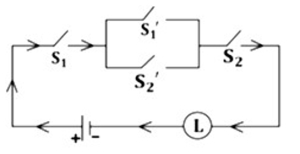
If $p$: switch $s_1$ is closed,$q$: switch $s_2$ is closed,then the correct interpretation of the following circuit is:
A
The lamp is always on
B
The lamp is always off
C
Symbolic form is $p \wedge (\sim p \vee \sim q) \wedge q$
D
The circuit is equivalent to a lamp that is always off
Solution
(B) The circuit consists of switch $s_1$ in series with a parallel combination of $s_1'$ and $s_2'$,which is then in series with $s_2$.
Symbolically,this is represented as $p \wedge (\sim p \vee \sim q) \wedge q$.
Using the distributive law: $p \wedge ((\sim p \vee \sim q) \wedge q) = p \wedge ((\sim p \wedge q) \vee (\sim q \wedge q))$.
Since $(\sim q \wedge q)$ is a contradiction $(F)$,we have $p \wedge ((\sim p \wedge q) \vee F) = p \wedge (\sim p \wedge q)$.
By associative law: $(p \wedge \sim p) \wedge q = F \wedge q = F$.
Since the symbolic form simplifies to a contradiction $(F)$,the lamp is always off.
Symbolically,this is represented as $p \wedge (\sim p \vee \sim q) \wedge q$.
Using the distributive law: $p \wedge ((\sim p \vee \sim q) \wedge q) = p \wedge ((\sim p \wedge q) \vee (\sim q \wedge q))$.
Since $(\sim q \wedge q)$ is a contradiction $(F)$,we have $p \wedge ((\sim p \wedge q) \vee F) = p \wedge (\sim p \wedge q)$.
By associative law: $(p \wedge \sim p) \wedge q = F \wedge q = F$.
Since the symbolic form simplifies to a contradiction $(F)$,the lamp is always off.
0 likes
View Solution406
MediumMCQ
The negation of the statement pattern $(p \wedge \sim q) \rightarrow (p \vee \sim q)$ is
A
a tautology
B
a contingency
C
a contradiction
D
equivalent to $p \vee q$
Solution
(C) Let the given statement be $S = (p \wedge \sim q) \rightarrow (p \vee \sim q)$.
Recall that the negation of an implication $A \rightarrow B$ is $A \wedge \sim B$.
Here,$A = (p \wedge \sim q)$ and $B = (p \vee \sim q)$.
So,$\sim S = (p \wedge \sim q) \wedge \sim (p \vee \sim q)$.
Using De Morgan's Law,$\sim (p \vee \sim q) = (\sim p \wedge \sim (\sim q)) = (\sim p \wedge q)$.
Thus,$\sim S = (p \wedge \sim q) \wedge (\sim p \wedge q)$.
By the associative and commutative properties,$\sim S = (p \wedge \sim p) \wedge (\sim q \wedge q)$.
Since $(p \wedge \sim p) = F$ (a contradiction) and $(\sim q \wedge q) = F$,we have $\sim S = F \wedge F = F$.
$A$ statement that is always false is called a contradiction.
Recall that the negation of an implication $A \rightarrow B$ is $A \wedge \sim B$.
Here,$A = (p \wedge \sim q)$ and $B = (p \vee \sim q)$.
So,$\sim S = (p \wedge \sim q) \wedge \sim (p \vee \sim q)$.
Using De Morgan's Law,$\sim (p \vee \sim q) = (\sim p \wedge \sim (\sim q)) = (\sim p \wedge q)$.
Thus,$\sim S = (p \wedge \sim q) \wedge (\sim p \wedge q)$.
By the associative and commutative properties,$\sim S = (p \wedge \sim p) \wedge (\sim q \wedge q)$.
Since $(p \wedge \sim p) = F$ (a contradiction) and $(\sim q \wedge q) = F$,we have $\sim S = F \wedge F = F$.
$A$ statement that is always false is called a contradiction.
0 likes
View Solution407
EasyMCQ
If $Statement-I$: If the work is not finished on time,the contractor is in trouble. $Statement-II$: Either the work is finished on time or the contractor is in trouble. Then:
A
$Statement-II$ is the negation of $Statement-I$.
B
$Statement-II$ is the converse of $Statement-I$.
C
$Statement-II$ and $Statement-I$ are equivalent.
D
$Statement-II$ is the inverse of $Statement-I$.
Solution
(C) Let $p$: The work is finished on time.
Let $q$: The contractor is in trouble.
$Statement-I$ is $\sim p \rightarrow q$.
Using the logical equivalence $\sim p \rightarrow q \equiv p \vee q$,we get:
$Statement-I \equiv p \vee q$.
$Statement-II$ is given as: Either the work is finished on time or the contractor is in trouble,which is $p \vee q$.
Since $Statement-I \equiv p \vee q$ and $Statement-II \equiv p \vee q$,both statements are equivalent.
Let $q$: The contractor is in trouble.
$Statement-I$ is $\sim p \rightarrow q$.
Using the logical equivalence $\sim p \rightarrow q \equiv p \vee q$,we get:
$Statement-I \equiv p \vee q$.
$Statement-II$ is given as: Either the work is finished on time or the contractor is in trouble,which is $p \vee q$.
Since $Statement-I \equiv p \vee q$ and $Statement-II \equiv p \vee q$,both statements are equivalent.
0 likes
View Solution408
EasyMCQ
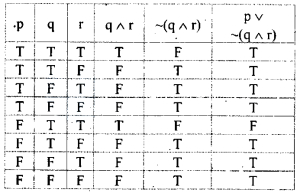
If the statement $p \vee \sim(q \wedge r)$ is false,then the truth values of $p, q$ and $r$ are respectively:
A
$F, T, F$
B
$T, F, F$
C
$F, T, T$
D
$F, F, T$
Solution
(C) The statement $p \vee \sim(q \wedge r)$ is false if and only if both components of the disjunction are false.
Therefore,$p = F$ and $\sim(q \wedge r) = F$.
Since $\sim(q \wedge r) = F$,it implies $(q \wedge r) = T$.
For the conjunction $(q \wedge r)$ to be true,both $q$ and $r$ must be true.
Thus,$q = T$ and $r = T$.
So,the truth values are $p = F, q = T, r = T$.
Therefore,$p = F$ and $\sim(q \wedge r) = F$.
Since $\sim(q \wedge r) = F$,it implies $(q \wedge r) = T$.
For the conjunction $(q \wedge r)$ to be true,both $q$ and $r$ must be true.
Thus,$q = T$ and $r = T$.
So,the truth values are $p = F, q = T, r = T$.
0 likes
View Solution409
EasyMCQ
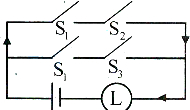
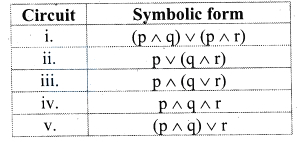
Which one of the following is the pair of equivalent circuits?
$i. (p \land q) \lor (p \land r)$
$ii. p \lor (q \land r)$
$iii. p \land (q \lor r)$
$iv. p \land q \land r$
$v. (p \land q) \lor r$
$i. (p \land q) \lor (p \land r)$
$ii. p \lor (q \land r)$
$iii. p \land (q \lor r)$
$iv. p \land q \land r$
$v. (p \land q) \lor r$
A
$(i)$ and $(ii)$
B
$(ii)$ and $(iv)$
C
$(iii)$ and $(v)$
D
$(i)$ and $(iii)$
Solution
(D) The symbolic form of the given circuit is $(p \land q) \lor (p \land r)$.
By the distributive law of logic,$(p \land q) \lor (p \land r) \equiv p \land (q \lor r)$.
Comparing this with the given options:
Circuit $(i)$ is $(p \land q) \lor (p \land r)$.
Circuit $(iii)$ is $p \land (q \lor r)$.
Since $(p \land q) \lor (p \land r) \equiv p \land (q \lor r)$,the circuits $(i)$ and $(iii)$ are equivalent.
By the distributive law of logic,$(p \land q) \lor (p \land r) \equiv p \land (q \lor r)$.
Comparing this with the given options:
Circuit $(i)$ is $(p \land q) \lor (p \land r)$.
Circuit $(iii)$ is $p \land (q \lor r)$.
Since $(p \land q) \lor (p \land r) \equiv p \land (q \lor r)$,the circuits $(i)$ and $(iii)$ are equivalent.
0 likes
View Solution410
EasyMCQ
The negation of the contrapositive of the statement $p \rightarrow (\sim q \wedge r)$ is
A
$(\sim q \vee \sim r) \wedge \sim p$
B
$(q \vee \sim r) \wedge p$
C
$(q \wedge \sim r) \vee p$
D
$(\sim q \wedge \sim r) \vee \sim p$
Solution
(B) The contrapositive of the statement $p \rightarrow (\sim q \wedge r)$ is $\sim (\sim q \wedge r) \rightarrow \sim p$.
By De Morgan's law,this is equivalent to $(q \vee \sim r) \rightarrow \sim p$.
The negation of the contrapositive is $\sim [(q \vee \sim r) \rightarrow \sim p]$.
Using the logical equivalence $\sim (A \rightarrow B) \equiv A \wedge \sim B$,we get $(q \vee \sim r) \wedge \sim (\sim p)$.
This simplifies to $(q \vee \sim r) \wedge p$.
By De Morgan's law,this is equivalent to $(q \vee \sim r) \rightarrow \sim p$.
The negation of the contrapositive is $\sim [(q \vee \sim r) \rightarrow \sim p]$.
Using the logical equivalence $\sim (A \rightarrow B) \equiv A \wedge \sim B$,we get $(q \vee \sim r) \wedge \sim (\sim p)$.
This simplifies to $(q \vee \sim r) \wedge p$.
0 likes
View Solution411
EasyMCQ
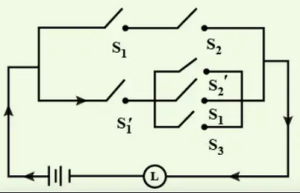
Consider the following statements:
$p$: the switch $S_1$ is closed.
$q$: the switch $S_2$ is closed.
$r$: the switch $S_3$ is closed.
Then the switching circuit represented by the statement $(p \wedge q) \vee (\sim p \wedge (\sim q \vee p \vee r))$ is
$p$: the switch $S_1$ is closed.
$q$: the switch $S_2$ is closed.
$r$: the switch $S_3$ is closed.
Then the switching circuit represented by the statement $(p \wedge q) \vee (\sim p \wedge (\sim q \vee p \vee r))$ is
A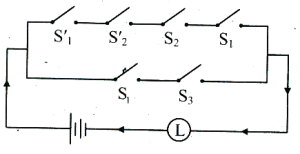
B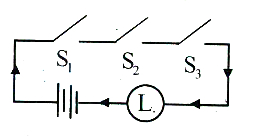
C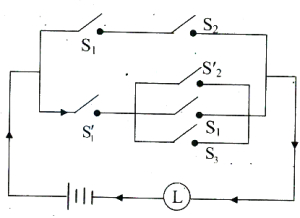
D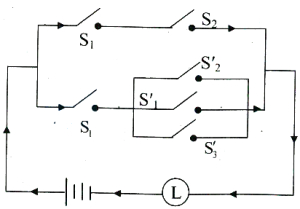
Solution
(C) Let $p$ be the switch $S_1$ is closed,$q$ be the switch $S_2$ is closed,and $r$ be the switch $S_3$ is closed.
Then $\sim p$ represents the switch $S_1'$ is closed,$\sim q$ represents the switch $S_2'$ is closed,and $\sim r$ represents the switch $S_3'$ is closed.
The given statement is $(p \wedge q) \vee (\sim p \wedge (\sim q \vee p \vee r))$.
This represents two main branches connected in parallel:
$1$. The first branch is $(p \wedge q)$,which corresponds to switches $S_1$ and $S_2$ in series.
$2$. The second branch is $(\sim p \wedge (\sim q \vee p \vee r))$,which corresponds to switch $S_1'$ in series with a parallel combination of switches $S_2'$,$S_1$,and $S_3$.
Comparing this with the given options,the circuit diagram in option $C$ matches this description.
Then $\sim p$ represents the switch $S_1'$ is closed,$\sim q$ represents the switch $S_2'$ is closed,and $\sim r$ represents the switch $S_3'$ is closed.
The given statement is $(p \wedge q) \vee (\sim p \wedge (\sim q \vee p \vee r))$.
This represents two main branches connected in parallel:
$1$. The first branch is $(p \wedge q)$,which corresponds to switches $S_1$ and $S_2$ in series.
$2$. The second branch is $(\sim p \wedge (\sim q \vee p \vee r))$,which corresponds to switch $S_1'$ in series with a parallel combination of switches $S_2'$,$S_1$,and $S_3$.
Comparing this with the given options,the circuit diagram in option $C$ matches this description.
0 likes
View Solution412
EasyMCQ
If $p$ and $q$ are statements,then $\qquad$ is a contingency.
A
$p \wedge \sim p$
B
$p \vee \sim p$
C
$p \vee q$
D
$(p \wedge (p$ $\rightarrow q))$ $\rightarrow q$
Solution
(C) Step $1$: Identify the definitions: $A$ contradiction is always false,a tautology is always true,and a contingency can be either true or false depending on the truth values of its components.
Step $2$: Evaluate option $(A)$: $p \wedge \sim p$ is always false (contradiction).
Step $3$: Evaluate option $(B)$: $p \vee \sim p$ is always true (tautology).
Step $4$: Evaluate option $(C)$: $p \vee q$ can be true or false depending on the truth values of $p$ and $q$. For example,if $p = F$ and $q = F$,then $p \vee q = F$. If $p = T$ and $q = F$,then $p \vee q = T$. Thus,it is a contingency.
Step $5$: Evaluate option $(D)$: $(p \wedge (p$ $\rightarrow q))$ $\rightarrow q$ is a tautology (Modus Ponens).
Final Answer: $C$)
Step $2$: Evaluate option $(A)$: $p \wedge \sim p$ is always false (contradiction).
Step $3$: Evaluate option $(B)$: $p \vee \sim p$ is always true (tautology).
Step $4$: Evaluate option $(C)$: $p \vee q$ can be true or false depending on the truth values of $p$ and $q$. For example,if $p = F$ and $q = F$,then $p \vee q = F$. If $p = T$ and $q = F$,then $p \vee q = T$. Thus,it is a contingency.
Step $5$: Evaluate option $(D)$: $(p \wedge (p$ $\rightarrow q))$ $\rightarrow q$ is a tautology (Modus Ponens).
Final Answer: $C$)
0 likes
View Solution413
EasyMCQ
$\sim[(p \vee \sim q) \rightarrow (p \wedge \sim q)] \equiv$
A
$(p \wedge \sim q) \wedge (\sim p \vee q)$
B
$(p \wedge \sim q) \wedge (\sim p \wedge q)$
C
$(p \vee \sim q) \wedge (\sim p \vee q)$
D
$(p \vee \sim q) \vee (\sim p \vee q)$
Solution
(C) We use the logical equivalence $A \rightarrow B \equiv \sim A \vee B$ and De Morgan's Laws.
Given expression: $\sim[(p \vee \sim q) \rightarrow (p \wedge \sim q)]$
Applying the conditional law: $\sim[\sim(p \vee \sim q) \vee (p \wedge \sim q)]$
Applying De Morgan's law: $(p \vee \sim q) \wedge \sim(p \wedge \sim q)$
Applying De Morgan's law again: $(p \vee \sim q) \wedge (\sim p \vee q)$
Thus,the correct option is $C$.
Given expression: $\sim[(p \vee \sim q) \rightarrow (p \wedge \sim q)]$
Applying the conditional law: $\sim[\sim(p \vee \sim q) \vee (p \wedge \sim q)]$
Applying De Morgan's law: $(p \vee \sim q) \wedge \sim(p \wedge \sim q)$
Applying De Morgan's law again: $(p \vee \sim q) \wedge (\sim p \vee q)$
Thus,the correct option is $C$.
0 likes
View Solution414
EasyMCQ
If $(p \wedge \sim q) \wedge (p \wedge r) \rightarrow \sim p \vee q$ is false,then the truth values of $p, q$ and $r$ are respectively
A
$T, T, T$
B
$F, F, F$
C
$T, F, T$
D
$F, T, F$
Solution
(C) The implication $A \rightarrow B$ is false only when $A$ is true and $B$ is false.
Given $(p \wedge \sim q) \wedge (p \wedge r) \rightarrow \sim p \vee q \equiv F$.
This implies $(p \wedge \sim q) \wedge (p \wedge r) \equiv T$ and $\sim p \vee q \equiv F$.
From $\sim p \vee q \equiv F$,we get $\sim p \equiv F$ and $q \equiv F$,which means $p \equiv T$ and $q \equiv F$.
Now substitute these into the first part: $(T \wedge \sim F) \wedge (T \wedge r) \equiv T$.
$(T \wedge T) \wedge (T \wedge r) \equiv T$.
$T \wedge (T \wedge r) \equiv T$.
This requires $T \wedge r \equiv T$,which implies $r \equiv T$.
Thus,the truth values are $p = T, q = F, r = T$.
Given $(p \wedge \sim q) \wedge (p \wedge r) \rightarrow \sim p \vee q \equiv F$.
This implies $(p \wedge \sim q) \wedge (p \wedge r) \equiv T$ and $\sim p \vee q \equiv F$.
From $\sim p \vee q \equiv F$,we get $\sim p \equiv F$ and $q \equiv F$,which means $p \equiv T$ and $q \equiv F$.
Now substitute these into the first part: $(T \wedge \sim F) \wedge (T \wedge r) \equiv T$.
$(T \wedge T) \wedge (T \wedge r) \equiv T$.
$T \wedge (T \wedge r) \equiv T$.
This requires $T \wedge r \equiv T$,which implies $r \equiv T$.
Thus,the truth values are $p = T, q = F, r = T$.
0 likes
View Solution415
MediumMCQ
The statement pattern $[p \wedge (q \vee r)] \vee [\sim r \wedge \sim q \wedge p]$ is equivalent to
A
$q \vee r$
B
$p \vee r$
C
$q$
D
$p$
Solution
(D) Given expression: $[p \wedge (q \vee r)] \vee [\sim r \wedge \sim q \wedge p]$
$\equiv [p \wedge (q \vee r)] \vee [p \wedge (\sim r \wedge \sim q)]$ (Commutative Law)
$\equiv [p \wedge (q \vee r)] \vee [p \wedge \sim (r \vee q)]$ (De Morgan's Law)
$\equiv p \wedge [(q \vee r) \vee \sim (q \vee r)]$ (Distributive Law)
$\equiv p \wedge T$ (Complement Law)
$\equiv p$ (Identity Law)
$\equiv [p \wedge (q \vee r)] \vee [p \wedge (\sim r \wedge \sim q)]$ (Commutative Law)
$\equiv [p \wedge (q \vee r)] \vee [p \wedge \sim (r \vee q)]$ (De Morgan's Law)
$\equiv p \wedge [(q \vee r) \vee \sim (q \vee r)]$ (Distributive Law)
$\equiv p \wedge T$ (Complement Law)
$\equiv p$ (Identity Law)
0 likes
View Solution416
EasyMCQ
If the statements $p, q$ and $r$ have the truth values $F, T, F$ respectively,then the truth values of the statement patterns $(p \wedge \sim q) \rightarrow r$ and $(p \vee q) \rightarrow r$ are respectively
A
$T, T$
B
$T, F$
C
$F, T$
D
$F, F$
Solution
(B) Given truth values: $p = F, q = T, r = F$.
For the first statement pattern $(p \wedge \sim q) \rightarrow r$:
$(F \wedge \sim T) \rightarrow F$
$= (F \wedge F) \rightarrow F$
$= F \rightarrow F$
$= T$.
For the second statement pattern $(p \vee q) \rightarrow r$:
$(F \vee T) \rightarrow F$
$= T \rightarrow F$
$= F$.
Thus,the truth values are $T$ and $F$ respectively.
For the first statement pattern $(p \wedge \sim q) \rightarrow r$:
$(F \wedge \sim T) \rightarrow F$
$= (F \wedge F) \rightarrow F$
$= F \rightarrow F$
$= T$.
For the second statement pattern $(p \vee q) \rightarrow r$:
$(F \vee T) \rightarrow F$
$= T \rightarrow F$
$= F$.
Thus,the truth values are $T$ and $F$ respectively.
0 likes
View Solution417
EasyMCQ
The converse of $[p \wedge (\sim q)] \rightarrow r$ is
A
$\sim r \rightarrow (\sim p \vee q)$
B
$r \rightarrow (\sim p \wedge \sim q)$
C
$(\sim p \vee q) \rightarrow \sim r$
D
$r \rightarrow (p \wedge \sim q)$
Solution
(D) The converse of a conditional statement $A \rightarrow B$ is defined as $B \rightarrow A$.
Given the statement $[p \wedge (\sim q)] \rightarrow r$,the converse is $r \rightarrow [p \wedge (\sim q)]$.
However,looking at the provided options,there seems to be a misunderstanding in the original problem's solution logic.
If we consider the contrapositive of the converse,or if the question intended to ask for the inverse,the options provided do not match the standard definition of a converse.
Given the structure of option $D$,$r \rightarrow (p \wedge \sim q)$ is the correct converse.
Given the statement $[p \wedge (\sim q)] \rightarrow r$,the converse is $r \rightarrow [p \wedge (\sim q)]$.
However,looking at the provided options,there seems to be a misunderstanding in the original problem's solution logic.
If we consider the contrapositive of the converse,or if the question intended to ask for the inverse,the options provided do not match the standard definition of a converse.
Given the structure of option $D$,$r \rightarrow (p \wedge \sim q)$ is the correct converse.
0 likes
View Solution418
EasyMCQ
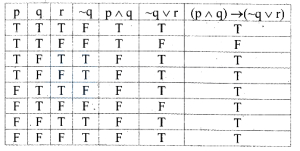
Let $p, q, r$ be three statements such that the truth value of $(p \wedge q) \rightarrow (\sim q \vee r)$ is $F$. Then the truth values of $p, q, r$ are respectively:
A
$T, F, T$
B
$T, T, T$
C
$F, T, F$
D
$T, T, F$
Solution
(D) The implication $(p \wedge q) \rightarrow (\sim q \vee r)$ is false $(F)$ only when the antecedent $(p \wedge q)$ is true $(T)$ and the consequent $(\sim q \vee r)$ is false $(F)$.
For $(p \wedge q)$ to be true,both $p$ and $q$ must be true $(T)$.
For $(\sim q \vee r)$ to be false,both $\sim q$ and $r$ must be false $(F)$.
Since $q$ is true,$\sim q$ is false. For $r$ to be false,$r$ must be $F$.
Thus,the truth values are $p = T, q = T, r = F$.
For $(p \wedge q)$ to be true,both $p$ and $q$ must be true $(T)$.
For $(\sim q \vee r)$ to be false,both $\sim q$ and $r$ must be false $(F)$.
Since $q$ is true,$\sim q$ is false. For $r$ to be false,$r$ must be $F$.
Thus,the truth values are $p = T, q = T, r = F$.
0 likes
View Solution419
MediumMCQ
Consider the following statements:
$(A)$ If $3+3=7$,then $4+3=8$.
$(B)$ If $5+3=8$,then the earth is flat.
$(C)$ If both $(A)$ and $(B)$ are true,then $5+6=17$.
Which of the following statements is correct?
$(A)$ If $3+3=7$,then $4+3=8$.
$(B)$ If $5+3=8$,then the earth is flat.
$(C)$ If both $(A)$ and $(B)$ are true,then $5+6=17$.
Which of the following statements is correct?
A
$(A)$ is true while $(B)$ and $(C)$ are false.
B
$(A)$ and $(C)$ are true while $(B)$ is false.
C
$(A)$ and $(B)$ are false,while $(C)$ is true.
D
$(A)$ is false but $(B)$ and $(C)$ are true.
Solution
(B) In logic,an implication $p \rightarrow q$ is false only when $p$ is true and $q$ is false. Otherwise,it is true.
$(A)$ Let $p: 3+3=7$ (False) and $q: 4+3=8$ (False). Since $p$ is false,$p \rightarrow q$ is true.
$(B)$ Let $p: 5+3=8$ (True) and $q: \text{the earth is flat}$ (False). Since $p$ is true and $q$ is false,$p \rightarrow q$ is false.
$(C)$ Let $p: \text{Both } (A) \text{ and } (B) \text{ are true}$ (False,because $B$ is false) and $q: 5+6=17$ (False). Since $p$ is false,$p \rightarrow q$ is true.
Therefore,$(A)$ and $(C)$ are true,while $(B)$ is false.
$(A)$ Let $p: 3+3=7$ (False) and $q: 4+3=8$ (False). Since $p$ is false,$p \rightarrow q$ is true.
$(B)$ Let $p: 5+3=8$ (True) and $q: \text{the earth is flat}$ (False). Since $p$ is true and $q$ is false,$p \rightarrow q$ is false.
$(C)$ Let $p: \text{Both } (A) \text{ and } (B) \text{ are true}$ (False,because $B$ is false) and $q: 5+6=17$ (False). Since $p$ is false,$p \rightarrow q$ is true.
Therefore,$(A)$ and $(C)$ are true,while $(B)$ is false.
0 likes
View Solution420
EasyMCQ
The negation of the statement 'Horses have wings if and only if crows have tails' is:
A
Horses have wings but crows do not have tails,or crows have tails but horses do not have wings.
B
Horses do not have wings if and only if crows do not have tails.
C
Horses do not have wings and crows have tails,or horses have wings and crows do not have tails.
D
Horses do not have wings and crows do not have tails.
Solution
(A) Let $p$: Horses have wings.
Let $q$: Crows have tails.
The given statement is $p \leftrightarrow q$.
The negation of a biconditional statement is $\sim(p \leftrightarrow q) \equiv (p \wedge \sim q) \vee (q \wedge \sim p)$.
This translates to: 'Horses have wings and crows do not have tails,or crows have tails and horses do not have wings.'
Comparing this with the given options,option $A$ represents this logical equivalence.
Let $q$: Crows have tails.
The given statement is $p \leftrightarrow q$.
The negation of a biconditional statement is $\sim(p \leftrightarrow q) \equiv (p \wedge \sim q) \vee (q \wedge \sim p)$.
This translates to: 'Horses have wings and crows do not have tails,or crows have tails and horses do not have wings.'
Comparing this with the given options,option $A$ represents this logical equivalence.
0 likes
View Solution421
DifficultMCQ
The inverse of $p$ $\rightarrow (q$ $\rightarrow r)$ is logically equivalent to
A
$p$ $\rightarrow (q$ $\rightarrow r)$
B
$(q$ $\rightarrow r)$ $\rightarrow \sim p$
C
$(p \vee q) \rightarrow r$
D
$(q$ $\rightarrow r)$ $\rightarrow p$
Solution
(D) The inverse of a conditional statement $A \rightarrow B$ is defined as $\sim A \rightarrow \sim B$.
For the statement $p$ $\rightarrow (q$ $\rightarrow r)$,the inverse is $\sim p$ $\rightarrow \sim (q$ $\rightarrow r)$.
Using the property that $\sim (q \rightarrow r) \equiv q \wedge \sim r$,this does not immediately match the options.
However,let us re-examine the logical equivalence.
Given $p$ $\rightarrow (q$ $\rightarrow r)$,the inverse is $\sim p$ $\rightarrow \sim (q$ $\rightarrow r)$.
Using the contrapositive rule,$\sim A$ $\rightarrow \sim B \equiv B$ $\rightarrow A$.
Let $A = p$ and $B = (q \rightarrow r)$.
Then $\sim p$ $\rightarrow \sim (q$ $\rightarrow r) \equiv (q$ $\rightarrow r)$ $\rightarrow p$.
Thus,the inverse is logically equivalent to $(q$ $\rightarrow r)$ $\rightarrow p$.
For the statement $p$ $\rightarrow (q$ $\rightarrow r)$,the inverse is $\sim p$ $\rightarrow \sim (q$ $\rightarrow r)$.
Using the property that $\sim (q \rightarrow r) \equiv q \wedge \sim r$,this does not immediately match the options.
However,let us re-examine the logical equivalence.
Given $p$ $\rightarrow (q$ $\rightarrow r)$,the inverse is $\sim p$ $\rightarrow \sim (q$ $\rightarrow r)$.
Using the contrapositive rule,$\sim A$ $\rightarrow \sim B \equiv B$ $\rightarrow A$.
Let $A = p$ and $B = (q \rightarrow r)$.
Then $\sim p$ $\rightarrow \sim (q$ $\rightarrow r) \equiv (q$ $\rightarrow r)$ $\rightarrow p$.
Thus,the inverse is logically equivalent to $(q$ $\rightarrow r)$ $\rightarrow p$.
0 likes
View Solution422
EasyMCQ
Negation of the statement "The payment will be made if and only if the work is finished in time." is
A
The work is finished in time and the payment is not made.
B
The payment is made and the work is not finished in time.
C
The work is finished in time and the payment is not made,or the payment is made and the work is finished in time.
D
Either the work is finished in time and the payment is not made,or the payment is made and the work is not finished in time.
Solution
(D) Let $p$ : The payment will be made.
Let $q$ : The work is finished in time.
The given statement is a biconditional statement: $p \leftrightarrow q$,which is equivalent to $(p \rightarrow q) \wedge (q \rightarrow p)$.
The negation of $(p \leftrightarrow q)$ is $\sim(p \leftrightarrow q)$,which is equivalent to $(p \wedge \sim q) \vee (q \wedge \sim p)$.
This translates to: "The payment is made and the work is not finished in time,or the work is finished in time and the payment is not made."
Therefore,Option $(D)$ is correct.
Let $q$ : The work is finished in time.
The given statement is a biconditional statement: $p \leftrightarrow q$,which is equivalent to $(p \rightarrow q) \wedge (q \rightarrow p)$.
The negation of $(p \leftrightarrow q)$ is $\sim(p \leftrightarrow q)$,which is equivalent to $(p \wedge \sim q) \vee (q \wedge \sim p)$.
This translates to: "The payment is made and the work is not finished in time,or the work is finished in time and the payment is not made."
Therefore,Option $(D)$ is correct.
0 likes
View Solution423
EasyMCQ
If $(p \wedge \sim r) \rightarrow (\sim p \vee q)$ has a truth value of $False$,then the truth values of $p, q, r$ are respectively:
A
$F, F, T$
B
$F, T, F$
C
$T, F, F$
D
$T, T, F$
Solution
(C) The implication $A \rightarrow B$ is $False$ only when $A$ is $True$ and $B$ is $False$.
Given $(p \wedge \sim r) \rightarrow (\sim p \vee q) \equiv F$.
This implies $(p \wedge \sim r) \equiv T$ and $(\sim p \vee q) \equiv F$.
From $(\sim p \vee q) \equiv F$,we get $\sim p \equiv F$ and $q \equiv F$,which means $p \equiv T$ and $q \equiv F$.
Substituting $p \equiv T$ into $(p \wedge \sim r) \equiv T$,we get $(T \wedge \sim r) \equiv T$,which implies $\sim r \equiv T$,so $r \equiv F$.
Thus,the truth values are $p=T, q=F, r=F$.
Therefore,Option $(C)$ is correct.
Given $(p \wedge \sim r) \rightarrow (\sim p \vee q) \equiv F$.
This implies $(p \wedge \sim r) \equiv T$ and $(\sim p \vee q) \equiv F$.
From $(\sim p \vee q) \equiv F$,we get $\sim p \equiv F$ and $q \equiv F$,which means $p \equiv T$ and $q \equiv F$.
Substituting $p \equiv T$ into $(p \wedge \sim r) \equiv T$,we get $(T \wedge \sim r) \equiv T$,which implies $\sim r \equiv T$,so $r \equiv F$.
Thus,the truth values are $p=T, q=F, r=F$.
Therefore,Option $(C)$ is correct.
0 likes
View Solution424
EasyMCQ
The converse of "If $3$ is a prime number,then $3$ is odd." is
A
If $3$ is odd then it is a prime number.
B
If $3$ is not a prime number then $3$ is even.
C
If $3$ is a prime number then $3$ is even.
D
If $3$ is not a prime number then $3$ is not odd.
Solution
(A) Let $p: 3$ is a prime number.
Let $q: 3$ is odd.
The given statement is $p \rightarrow q$.
The converse of a conditional statement $p \rightarrow q$ is $q \rightarrow p$.
Therefore,the converse is: "If $3$ is odd,then $3$ is a prime number."
Let $q: 3$ is odd.
The given statement is $p \rightarrow q$.
The converse of a conditional statement $p \rightarrow q$ is $q \rightarrow p$.
Therefore,the converse is: "If $3$ is odd,then $3$ is a prime number."
0 likes
View Solution425
MediumMCQ
The expression $((p \wedge q) \vee (p \vee \sim q)) \wedge (\sim p \wedge \sim q)$ is equivalent to
A
$p \wedge q$
B
$p \vee \sim q$
C
$p \wedge \sim q$
D
$(\sim p) \wedge (\sim q)$
Solution
(D) First,simplify the expression $((p \wedge q) \vee (p \vee \sim q))$.
Using the Associative and Commutative laws,we have $(p \wedge q) \vee (p \vee \sim q) \equiv p \vee (q \vee \sim q) \equiv p \vee T \equiv T$.
Now,substitute this back into the original expression:
$T \wedge (\sim p \wedge \sim q) \equiv \sim p \wedge \sim q$.
Thus,the expression is equivalent to $\sim p \wedge \sim q$.
Using the Associative and Commutative laws,we have $(p \wedge q) \vee (p \vee \sim q) \equiv p \vee (q \vee \sim q) \equiv p \vee T \equiv T$.
Now,substitute this back into the original expression:
$T \wedge (\sim p \wedge \sim q) \equiv \sim p \wedge \sim q$.
Thus,the expression is equivalent to $\sim p \wedge \sim q$.
0 likes
View Solution426
EasyMCQ
Let $p$: $A$ man is a judge.
$q$: He is honest.
The inverse of $p \rightarrow q$ is
$q$: He is honest.
The inverse of $p \rightarrow q$ is
A
If a man is a judge,then he is honest.
B
If a man is not a judge,then he is not honest.
C
If a man is honest,then he is a judge.
D
If a man is not honest,then he is not a judge.
Solution
(B) The inverse of a conditional statement $p \rightarrow q$ is defined as $\sim p \rightarrow \sim q$.
Given $p$: $A$ man is a judge,then $\sim p$: $A$ man is not a judge.
Given $q$: He is honest,then $\sim q$: He is not honest.
Therefore,the inverse is: If a man is not a judge,then he is not honest.
Given $p$: $A$ man is a judge,then $\sim p$: $A$ man is not a judge.
Given $q$: He is honest,then $\sim q$: He is not honest.
Therefore,the inverse is: If a man is not a judge,then he is not honest.
0 likes
View Solution427
EasyMCQ
Let $p, q$ and $r$ be the statements:
$p$: $X$ is an equilateral triangle
$q$: $X$ is an isosceles triangle
$r: q \vee \sim p$
Then the equivalent statement of $r$ is:
$p$: $X$ is an equilateral triangle
$q$: $X$ is an isosceles triangle
$r: q \vee \sim p$
Then the equivalent statement of $r$ is:
A
If $X$ is not an equilateral triangle,then $X$ is not an isosceles triangle
B
$X$ is neither isosceles nor equilateral triangle
C
$X$ is isosceles but not an equilateral triangle
D
If $X$ is not an isosceles triangle,then $X$ is not an equilateral triangle.
Solution
(D) Given $r: q \vee \sim p$.
Using the logical equivalence $p \rightarrow q \equiv \sim p \vee q$,we can rewrite the expression:
$q \vee \sim p \equiv \sim p \vee q$.
By the contrapositive rule,$\sim p \vee q \equiv \sim q \rightarrow \sim p$.
Translating this back into words:
$\sim q$: $X$ is not an isosceles triangle.
$\sim p$: $X$ is not an equilateral triangle.
Thus,$\sim q \rightarrow \sim p$ means: "If $X$ is not an isosceles triangle,then $X$ is not an equilateral triangle."
Therefore,Option $(D)$ is correct.
Using the logical equivalence $p \rightarrow q \equiv \sim p \vee q$,we can rewrite the expression:
$q \vee \sim p \equiv \sim p \vee q$.
By the contrapositive rule,$\sim p \vee q \equiv \sim q \rightarrow \sim p$.
Translating this back into words:
$\sim q$: $X$ is not an isosceles triangle.
$\sim p$: $X$ is not an equilateral triangle.
Thus,$\sim q \rightarrow \sim p$ means: "If $X$ is not an isosceles triangle,then $X$ is not an equilateral triangle."
Therefore,Option $(D)$ is correct.
0 likes
View Solution428
MediumMCQ
The statement $(p$ $\rightarrow q)$ $\rightarrow ((\sim p$ $\rightarrow q)$ $\rightarrow q)$ is
A
a fallacy.
B
equivalent to $(\sim p) \rightarrow q$.
C
equivalent to $p \rightarrow (\sim q)$.
D
a tautology.
Solution
(D) We evaluate the logical expression using the laws of logic:
$(p$ $\rightarrow q)$ $\rightarrow ((\sim p$ $\rightarrow q)$ $\rightarrow q)$
$\equiv (p$ $\rightarrow q)$ $\rightarrow ((p \vee q)$ $\rightarrow q)$
$\equiv (p$ $\rightarrow q)$ $\rightarrow (\sim(p \vee q) \vee q)$
$\equiv (p$ $\rightarrow q)$ $\rightarrow ((\sim p \wedge \sim q) \vee q)$
$\equiv (p$ $\rightarrow q)$ $\rightarrow ((\sim p \vee q) \wedge (\sim q \vee q))$
$\equiv (p$ $\rightarrow q)$ $\rightarrow ((\sim p \vee q) \wedge T)$
$\equiv (p$ $\rightarrow q)$ $\rightarrow (\sim p \vee q)$
$\equiv (p$ $\rightarrow q)$ $\rightarrow (p$ $\rightarrow q)$
$\equiv T$
Since the result is always true,the statement is a tautology.
$(p$ $\rightarrow q)$ $\rightarrow ((\sim p$ $\rightarrow q)$ $\rightarrow q)$
$\equiv (p$ $\rightarrow q)$ $\rightarrow ((p \vee q)$ $\rightarrow q)$
$\equiv (p$ $\rightarrow q)$ $\rightarrow (\sim(p \vee q) \vee q)$
$\equiv (p$ $\rightarrow q)$ $\rightarrow ((\sim p \wedge \sim q) \vee q)$
$\equiv (p$ $\rightarrow q)$ $\rightarrow ((\sim p \vee q) \wedge (\sim q \vee q))$
$\equiv (p$ $\rightarrow q)$ $\rightarrow ((\sim p \vee q) \wedge T)$
$\equiv (p$ $\rightarrow q)$ $\rightarrow (\sim p \vee q)$
$\equiv (p$ $\rightarrow q)$ $\rightarrow (p$ $\rightarrow q)$
$\equiv T$
Since the result is always true,the statement is a tautology.
0 likes
View Solution429
EasyMCQ
The contrapositive of the statement 'If two numbers are not equal,then their squares are not equal' is:
A
If the squares of two numbers are not equal,then the numbers are equal.
B
If the squares of two numbers are equal,then the numbers are not equal.
C
If the squares of two numbers are equal,then the numbers are equal.
D
If the squares of two numbers are not equal,then the numbers are not equal.
Solution
(C) Let $p$ be the statement: 'Two numbers are not equal'.
Let $q$ be the statement: 'Their squares are not equal'.
The given statement is $p \rightarrow q$.
The contrapositive of $p \rightarrow q$ is defined as $\sim q \rightarrow \sim p$.
Here,$\sim q$ is: 'The squares of two numbers are equal'.
And $\sim p$ is: 'The numbers are equal'.
Therefore,the contrapositive is: 'If the squares of two numbers are equal,then the numbers are equal'.
Let $q$ be the statement: 'Their squares are not equal'.
The given statement is $p \rightarrow q$.
The contrapositive of $p \rightarrow q$ is defined as $\sim q \rightarrow \sim p$.
Here,$\sim q$ is: 'The squares of two numbers are equal'.
And $\sim p$ is: 'The numbers are equal'.
Therefore,the contrapositive is: 'If the squares of two numbers are equal,then the numbers are equal'.
0 likes
View Solution430
EasyMCQ
The contrapositive of the statement: 'If two numbers are equal,then their squares are equal' is
A
If the squares of two numbers are equal,then the numbers are not equal.
B
If the squares of two numbers are not equal,then the numbers are equal.
C
If the squares of two numbers are not equal,then the numbers are not equal.
D
If the squares of two numbers are equal,then the numbers are equal.
Solution
(C) The contrapositive of a conditional statement $p \rightarrow q$ is defined as $\sim q \rightarrow \sim p$.
Given statement $p$: 'Two numbers are equal' and $q$: 'Their squares are equal'.
Therefore,the contrapositive $\sim q \rightarrow \sim p$ is: 'If the squares of two numbers are not equal,then the numbers are not equal'.
Given statement $p$: 'Two numbers are equal' and $q$: 'Their squares are equal'.
Therefore,the contrapositive $\sim q \rightarrow \sim p$ is: 'If the squares of two numbers are not equal,then the numbers are not equal'.
0 likes
View Solution431
EasyMCQ
If $p$: The total prime numbers between $2$ to $100$ are $26$.
$q$: Zero is a complex number.
$r$: Least common multiple ($L$.$C$.$M$.) of $6$ and $7$ is $6$.
Then which of the following is correct?
$q$: Zero is a complex number.
$r$: Least common multiple ($L$.$C$.$M$.) of $6$ and $7$ is $6$.
Then which of the following is correct?
A
$(p \wedge q) \rightarrow r$ has truth value False.
B
$(p$ $\rightarrow q)$ $\rightarrow r$ has truth value True.
C
$(p \vee q) \leftrightarrow r$ has truth value False.
D
$(p$ $\rightarrow q)$ $\rightarrow (q$ $\rightarrow p)$ has truth value True.
Solution
(C) First,determine the truth values of the statements:
$p$: The prime numbers between $2$ and $100$ are $25$,not $26$. So,$p$ is $F$.
$q$: Zero $(0)$ can be written as $0 + 0i$,which is a complex number. So,$q$ is $T$.
$r$: The $L$.$C$.$M$. of $6$ and $7$ is $42$,not $6$. So,$r$ is $F$.
Now evaluate the options:
$(A)$ $(p \wedge q)$ $\rightarrow r \equiv (F \wedge T)$ $\rightarrow F \equiv F$ $\rightarrow F \equiv T$.
$(B)$ $(p$ $\rightarrow q)$ $\rightarrow r \equiv (F$ $\rightarrow T)$ $\rightarrow F \equiv T$ $\rightarrow F \equiv F$.
$(C)$ $(p \vee q) \leftrightarrow r \equiv (F \vee T) \leftrightarrow F \equiv T \leftrightarrow F \equiv F$.
$(D)$ $(p$ $\rightarrow q)$ $\rightarrow (q$ $\rightarrow p) \equiv (F$ $\rightarrow T)$ $\rightarrow (T$ $\rightarrow F) \equiv T$ $\rightarrow F \equiv F$.
Thus,option $(C)$ is correct.
$p$: The prime numbers between $2$ and $100$ are $25$,not $26$. So,$p$ is $F$.
$q$: Zero $(0)$ can be written as $0 + 0i$,which is a complex number. So,$q$ is $T$.
$r$: The $L$.$C$.$M$. of $6$ and $7$ is $42$,not $6$. So,$r$ is $F$.
Now evaluate the options:
$(A)$ $(p \wedge q)$ $\rightarrow r \equiv (F \wedge T)$ $\rightarrow F \equiv F$ $\rightarrow F \equiv T$.
$(B)$ $(p$ $\rightarrow q)$ $\rightarrow r \equiv (F$ $\rightarrow T)$ $\rightarrow F \equiv T$ $\rightarrow F \equiv F$.
$(C)$ $(p \vee q) \leftrightarrow r \equiv (F \vee T) \leftrightarrow F \equiv T \leftrightarrow F \equiv F$.
$(D)$ $(p$ $\rightarrow q)$ $\rightarrow (q$ $\rightarrow p) \equiv (F$ $\rightarrow T)$ $\rightarrow (T$ $\rightarrow F) \equiv T$ $\rightarrow F \equiv F$.
Thus,option $(C)$ is correct.
0 likes
View Solution432
EasyMCQ
The contrapositive of the inverse of $p$ $\rightarrow (p$ $\rightarrow q)$ is
A
$(\sim p \wedge q) \rightarrow p$
B
$(\sim p \vee q) \rightarrow p$
C
$p \rightarrow (\sim p \vee q)$
D
$(p \vee q) \rightarrow p$
Solution
(B) The inverse of a conditional statement $A \rightarrow B$ is $\sim A \rightarrow \sim B$.
For the statement $p$ $\rightarrow (p$ $\rightarrow q)$,the inverse is $\sim p$ $\rightarrow \sim (p$ $\rightarrow q)$.
The contrapositive of a conditional statement $A \rightarrow B$ is $\sim B \rightarrow \sim A$.
Applying this to the inverse $\sim p$ $\rightarrow \sim (p$ $\rightarrow q)$,we get:
$\sim [\sim (p$ $\rightarrow q)]$ $\rightarrow \sim (\sim p)$
$= (p$ $\rightarrow q)$ $\rightarrow p$
Since $p \rightarrow q \equiv \sim p \vee q$,the expression becomes $(\sim p \vee q) \rightarrow p$.
For the statement $p$ $\rightarrow (p$ $\rightarrow q)$,the inverse is $\sim p$ $\rightarrow \sim (p$ $\rightarrow q)$.
The contrapositive of a conditional statement $A \rightarrow B$ is $\sim B \rightarrow \sim A$.
Applying this to the inverse $\sim p$ $\rightarrow \sim (p$ $\rightarrow q)$,we get:
$\sim [\sim (p$ $\rightarrow q)]$ $\rightarrow \sim (\sim p)$
$= (p$ $\rightarrow q)$ $\rightarrow p$
Since $p \rightarrow q \equiv \sim p \vee q$,the expression becomes $(\sim p \vee q) \rightarrow p$.
0 likes
View Solution433
EasyMCQ
The proposition $(\sim p) \vee (p \wedge \sim q)$ is equivalent to
A
$p \wedge (\sim q)$
B
$p \rightarrow (\sim q)$
C
$p \vee q$
D
$q \rightarrow p$
Solution
(B) Using the distributive law: $(\sim p) \vee (p \wedge \sim q) \equiv (\sim p \vee p) \wedge (\sim p \vee \sim q)$.
Since $(\sim p \vee p) \equiv T$ (Tautology),the expression becomes $T \wedge (\sim p \vee \sim q)$.
By the identity law,$T \wedge (\sim p \vee \sim q) \equiv \sim p \vee \sim q$.
Using the logical equivalence $p \rightarrow q \equiv \sim p \vee q$,we can rewrite $\sim p \vee \sim q$ as $p \rightarrow (\sim q)$.
Since $(\sim p \vee p) \equiv T$ (Tautology),the expression becomes $T \wedge (\sim p \vee \sim q)$.
By the identity law,$T \wedge (\sim p \vee \sim q) \equiv \sim p \vee \sim q$.
Using the logical equivalence $p \rightarrow q \equiv \sim p \vee q$,we can rewrite $\sim p \vee \sim q$ as $p \rightarrow (\sim q)$.
0 likes
View Solution434
EasyMCQ
The statement $\sim(p \leftrightarrow \sim q)$ is
A
equivalent to $p \leftrightarrow q$
B
a fallacy
C
a tautology
D
equivalent to $\sim p \leftrightarrow q$
Solution
(A) To determine the nature of the statement $\sim(p \leftrightarrow \sim q)$,we construct a truth table:
| $p$ | $q$ | $\sim q$ | $p \leftrightarrow \sim q$ | $\sim(p \leftrightarrow \sim q)$ | $p \leftrightarrow q$ |
| :--- | :--- | :--- | :--- | :--- | :--- |
| $T$ | $T$ | $F$ | $F$ | $T$ | $T$ |
| $T$ | $F$ | $T$ | $T$ | $F$ | $F$ |
| $F$ | $T$ | $F$ | $T$ | $F$ | $F$ |
| $F$ | $F$ | $T$ | $F$ | $T$ | $T$ |
Comparing column $5$ and column $6$,we observe that the truth values are identical for all combinations of $p$ and $q$.
Therefore,$\sim(p \leftrightarrow \sim q) \equiv p \leftrightarrow q$.
| $p$ | $q$ | $\sim q$ | $p \leftrightarrow \sim q$ | $\sim(p \leftrightarrow \sim q)$ | $p \leftrightarrow q$ |
| :--- | :--- | :--- | :--- | :--- | :--- |
| $T$ | $T$ | $F$ | $F$ | $T$ | $T$ |
| $T$ | $F$ | $T$ | $T$ | $F$ | $F$ |
| $F$ | $T$ | $F$ | $T$ | $F$ | $F$ |
| $F$ | $F$ | $T$ | $F$ | $T$ | $T$ |
Comparing column $5$ and column $6$,we observe that the truth values are identical for all combinations of $p$ and $q$.
Therefore,$\sim(p \leftrightarrow \sim q) \equiv p \leftrightarrow q$.
0 likes
View Solution435
EasyMCQ
The truth values of $p \rightarrow r$ is $F$ and $p \leftrightarrow q$ is $F$. Then the truth values of $(\sim p \vee q) \rightarrow (p \vee \sim q)$ and $(p \wedge \sim q) \rightarrow (\sim p \wedge q)$ are respectively:
A
$T, F$
B
$F, T$
C
$T, T$
D
$F, F$
Solution
(A) Given that the truth value of $p \rightarrow r$ is $F$,we must have $p \equiv T$ and $r \equiv F$.
Given that the truth value of $p \leftrightarrow q$ is $F$,and we know $p \equiv T$,it follows that $q \equiv F$.
Now,evaluate the first expression: $(\sim p \vee q) \rightarrow (p \vee \sim q)$
$= (\sim T \vee F) \rightarrow (T \vee \sim F)$
$= (F \vee F) \rightarrow (T \vee T)$
$= F \rightarrow T \equiv T$.
Now,evaluate the second expression: $(p \wedge \sim q) \rightarrow (\sim p \wedge q)$
$= (T \wedge \sim F) \rightarrow (\sim T \wedge F)$
$= (T \wedge T) \rightarrow (F \wedge F)$
$= T \rightarrow F \equiv F$.
Thus,the truth values are $T, F$.
Given that the truth value of $p \leftrightarrow q$ is $F$,and we know $p \equiv T$,it follows that $q \equiv F$.
Now,evaluate the first expression: $(\sim p \vee q) \rightarrow (p \vee \sim q)$
$= (\sim T \vee F) \rightarrow (T \vee \sim F)$
$= (F \vee F) \rightarrow (T \vee T)$
$= F \rightarrow T \equiv T$.
Now,evaluate the second expression: $(p \wedge \sim q) \rightarrow (\sim p \wedge q)$
$= (T \wedge \sim F) \rightarrow (\sim T \wedge F)$
$= (T \wedge T) \rightarrow (F \wedge F)$
$= T \rightarrow F \equiv F$.
Thus,the truth values are $T, F$.
0 likes
View Solution436
EasyMCQ
The negation of the statement $(p \wedge q) \rightarrow (\sim p \vee r)$ is
A
$(p \wedge q) \wedge (\sim p \wedge \sim r)$
B
$(p \wedge q) \wedge (p \wedge \sim r)$
C
$p \wedge q \wedge \sim r$
D
$\sim p \vee \sim q \vee \sim r$
Solution
(C) To find the negation of the statement $(p \wedge q) \rightarrow (\sim p \vee r)$,we use the logical equivalence $\sim(A \rightarrow B) \equiv A \wedge \sim B$.
Let $A = (p \wedge q)$ and $B = (\sim p \vee r)$.
Then,$\sim(A \rightarrow B) \equiv (p \wedge q) \wedge \sim(\sim p \vee r)$.
Applying De Morgan's Law,$\sim(\sim p \vee r) \equiv \sim(\sim p) \wedge \sim r \equiv p \wedge \sim r$.
So,the expression becomes $(p \wedge q) \wedge (p \wedge \sim r)$.
By the Associative and Idempotent Laws,$(p \wedge q) \wedge p \wedge \sim r \equiv p \wedge q \wedge \sim r$.
Let $A = (p \wedge q)$ and $B = (\sim p \vee r)$.
Then,$\sim(A \rightarrow B) \equiv (p \wedge q) \wedge \sim(\sim p \vee r)$.
Applying De Morgan's Law,$\sim(\sim p \vee r) \equiv \sim(\sim p) \wedge \sim r \equiv p \wedge \sim r$.
So,the expression becomes $(p \wedge q) \wedge (p \wedge \sim r)$.
By the Associative and Idempotent Laws,$(p \wedge q) \wedge p \wedge \sim r \equiv p \wedge q \wedge \sim r$.
0 likes
View Solution437
MediumMCQ
If truth values of statements $p, q$ are true,and $r, s$ are false,then the truth values of the following statement patterns are respectively:
$a: \sim(p \wedge \sim r) \vee(\sim q \vee s)$
$b: (\sim q \wedge \sim r) \leftrightarrow(p \vee s)$
$c: (\sim p \vee q) \rightarrow(r \wedge \sim s)$
$a: \sim(p \wedge \sim r) \vee(\sim q \vee s)$
$b: (\sim q \wedge \sim r) \leftrightarrow(p \vee s)$
$c: (\sim p \vee q) \rightarrow(r \wedge \sim s)$
A
$T, F, F$
B
$F, F, F$
C
$F, T, T$
D
$T, F, T$
Solution
(B) Given: $p = T, q = T, r = F, s = F$.
$a: \sim(p \wedge \sim r) \vee(\sim q \vee s)$
$\equiv \sim(T \wedge \sim F) \vee(\sim T \vee F)$
$\equiv \sim(T \wedge T) \vee(F \vee F)$
$\equiv \sim(T) \vee(F)$
$\equiv F \vee F \equiv F$
$b: (\sim q \wedge \sim r) \leftrightarrow(p \vee s)$
$\equiv (\sim T \wedge \sim F) \leftrightarrow(T \vee F)$
$\equiv (F \wedge T) \leftrightarrow(T)$
$\equiv F \leftrightarrow T \equiv F$
$c: (\sim p \vee q) \rightarrow(r \wedge \sim s)$
$\equiv (\sim T \vee T) \rightarrow(F \wedge \sim F)$
$\equiv (F \vee T) \rightarrow(F \wedge T)$
$\equiv T \rightarrow F \equiv F$
Thus,the truth values are $F, F, F$.
$a: \sim(p \wedge \sim r) \vee(\sim q \vee s)$
$\equiv \sim(T \wedge \sim F) \vee(\sim T \vee F)$
$\equiv \sim(T \wedge T) \vee(F \vee F)$
$\equiv \sim(T) \vee(F)$
$\equiv F \vee F \equiv F$
$b: (\sim q \wedge \sim r) \leftrightarrow(p \vee s)$
$\equiv (\sim T \wedge \sim F) \leftrightarrow(T \vee F)$
$\equiv (F \wedge T) \leftrightarrow(T)$
$\equiv F \leftrightarrow T \equiv F$
$c: (\sim p \vee q) \rightarrow(r \wedge \sim s)$
$\equiv (\sim T \vee T) \rightarrow(F \wedge \sim F)$
$\equiv (F \vee T) \rightarrow(F \wedge T)$
$\equiv T \rightarrow F \equiv F$
Thus,the truth values are $F, F, F$.
0 likes
View Solution438
EasyMCQ
Let $p, q, r$ be three statements,then $[p$ $\rightarrow (q$ $\rightarrow r)] \leftrightarrow [(p \wedge q)$ $\rightarrow r]$ is
A
equivalent to $p \leftrightarrow q$.
B
a contingency.
C
a tautology.
D
a contradiction.
Solution
(C) We analyze the logical expression $[p$ $\rightarrow (q$ $\rightarrow r)] \leftrightarrow [(p \wedge q)$ $\rightarrow r]$.
First,consider the left side: $p$ $\rightarrow (q$ $\rightarrow r)$.
Using the implication law $A \rightarrow B \equiv \neg A \vee B$,we get:
$p$ $\rightarrow (q$ $\rightarrow r) \equiv \neg p \vee (\neg q \vee r)$.
By the associative law,this is equivalent to $(\neg p \vee \neg q) \vee r$.
By De Morgan's law,$\neg p \vee \neg q \equiv \neg (p \wedge q)$.
Thus,$p$ $\rightarrow (q$ $\rightarrow r) \equiv \neg (p \wedge q) \vee r$.
Again,using the implication law,$\neg (p \wedge q) \vee r \equiv (p \wedge q) \rightarrow r$.
Since both sides of the biconditional are logically equivalent,the expression $[p$ $\rightarrow (q$ $\rightarrow r)] \leftrightarrow [(p \wedge q)$ $\rightarrow r]$ is always true.
Therefore,it is a tautology.
First,consider the left side: $p$ $\rightarrow (q$ $\rightarrow r)$.
Using the implication law $A \rightarrow B \equiv \neg A \vee B$,we get:
$p$ $\rightarrow (q$ $\rightarrow r) \equiv \neg p \vee (\neg q \vee r)$.
By the associative law,this is equivalent to $(\neg p \vee \neg q) \vee r$.
By De Morgan's law,$\neg p \vee \neg q \equiv \neg (p \wedge q)$.
Thus,$p$ $\rightarrow (q$ $\rightarrow r) \equiv \neg (p \wedge q) \vee r$.
Again,using the implication law,$\neg (p \wedge q) \vee r \equiv (p \wedge q) \rightarrow r$.
Since both sides of the biconditional are logically equivalent,the expression $[p$ $\rightarrow (q$ $\rightarrow r)] \leftrightarrow [(p \wedge q)$ $\rightarrow r]$ is always true.
Therefore,it is a tautology.
0 likes
View Solution439
EasyMCQ
The negation of the statement pattern $\sim s \vee (\sim r \wedge s)$ is equivalent to
A
$s \wedge r$
B
$s \wedge (r \wedge \sim s)$
C
$s \wedge \sim r$
D
$s \vee (r \vee \sim s)$
Solution
(A) We need to find the negation of the statement $\sim s \vee (\sim r \wedge s)$.
Applying the negation operator:
$\sim (\sim s \vee (\sim r \wedge s))$
Using De Morgan's law,$\sim (p \vee q) \equiv \sim p \wedge \sim q$:
$\equiv s \wedge \sim (\sim r \wedge s)$
Using De Morgan's law again,$\sim (p \wedge q) \equiv \sim p \vee \sim q$:
$\equiv s \wedge (r \vee \sim s)$
Using the Distributive law,$p \wedge (q \vee r) \equiv (p \wedge q) \vee (p \wedge r)$:
$\equiv (s \wedge r) \vee (s \wedge \sim s)$
Using the Complement law,$s \wedge \sim s \equiv F$:
$\equiv (s \wedge r) \vee F$
Using the Identity law,$p \vee F \equiv p$:
$\equiv s \wedge r$
Applying the negation operator:
$\sim (\sim s \vee (\sim r \wedge s))$
Using De Morgan's law,$\sim (p \vee q) \equiv \sim p \wedge \sim q$:
$\equiv s \wedge \sim (\sim r \wedge s)$
Using De Morgan's law again,$\sim (p \wedge q) \equiv \sim p \vee \sim q$:
$\equiv s \wedge (r \vee \sim s)$
Using the Distributive law,$p \wedge (q \vee r) \equiv (p \wedge q) \vee (p \wedge r)$:
$\equiv (s \wedge r) \vee (s \wedge \sim s)$
Using the Complement law,$s \wedge \sim s \equiv F$:
$\equiv (s \wedge r) \vee F$
Using the Identity law,$p \vee F \equiv p$:
$\equiv s \wedge r$
0 likes
View Solution440
MediumMCQ
If $p$ and $q$ are true statements and $r$ and $s$ are false statements,then the truth values of the statement patterns $(p \wedge q) \vee r$ and $(p \vee s) \leftrightarrow(q \wedge r)$ are respectively
A
$F, T$
B
$T, T$
C
$F, F$
D
$T, F$
Solution
(D) Given that $p = T$,$q = T$,$r = F$,and $s = F$.
For the first statement pattern $(p \wedge q) \vee r$:
$(T \wedge T) \vee F \equiv T \vee F \equiv T$.
For the second statement pattern $(p \vee s) \leftrightarrow (q \wedge r)$:
$(T \vee F) \leftrightarrow (T \wedge F) \equiv T \leftrightarrow F \equiv F$.
Thus,the truth values are $T$ and $F$ respectively.
For the first statement pattern $(p \wedge q) \vee r$:
$(T \wedge T) \vee F \equiv T \vee F \equiv T$.
For the second statement pattern $(p \vee s) \leftrightarrow (q \wedge r)$:
$(T \vee F) \leftrightarrow (T \wedge F) \equiv T \leftrightarrow F \equiv F$.
Thus,the truth values are $T$ and $F$ respectively.
0 likes
View Solution441
EasyMCQ
The statement pattern $p \rightarrow \sim(p \wedge \sim q)$ is equivalent to
A
$q$
B
$(\sim p) \vee q$
C
$(\sim p) \wedge q$
D
$(\sim p) \vee (\sim q)$
Solution
(B) We use the logical equivalence $p \rightarrow q \equiv \sim p \vee q$.
$p \rightarrow \sim(p \wedge \sim q)$
$\equiv \sim p \vee \sim(p \wedge \sim q)$
$\equiv \sim p \vee (\sim p \vee \sim(\sim q))$
$\equiv \sim p \vee (\sim p \vee q)$
$\equiv (\sim p \vee \sim p) \vee q$
$\equiv \sim p \vee q$
$p \rightarrow \sim(p \wedge \sim q)$
$\equiv \sim p \vee \sim(p \wedge \sim q)$
$\equiv \sim p \vee (\sim p \vee \sim(\sim q))$
$\equiv \sim p \vee (\sim p \vee q)$
$\equiv (\sim p \vee \sim p) \vee q$
$\equiv \sim p \vee q$
0 likes
View Solution442
EasyMCQ
If the truth value of the logical statement $(p \leftrightarrow \sim q) \rightarrow (\sim p \wedge q)$ is false,then the truth values of $p$ and $q$ are respectively:
A
$F, T$
B
$T, T$
C
$T, F$
D
$F, F$
Solution
(C) The implication $(p \leftrightarrow \sim q) \rightarrow (\sim p \wedge q)$ is false only when the antecedent is true and the consequent is false.
So,$(p \leftrightarrow \sim q) \equiv T$ and $(\sim p \wedge q) \equiv F$.
From $(\sim p \wedge q) \equiv F$,we know that the conjunction is false.
Now,consider the antecedent $(p \leftrightarrow \sim q) \equiv T$. This means $p$ and $\sim q$ must have the same truth value.
If we test option $C$ $(p=T, q=F)$:
$\sim q = \sim F = T$.
Then $(p \leftrightarrow \sim q) = (T \leftrightarrow T) = T$.
And $(\sim p \wedge q) = (\sim T \wedge F) = (F \wedge F) = F$.
Since the antecedent is $T$ and the consequent is $F$,the implication is $T \rightarrow F = F$.
Thus,the truth values are $p=T$ and $q=F$.
So,$(p \leftrightarrow \sim q) \equiv T$ and $(\sim p \wedge q) \equiv F$.
From $(\sim p \wedge q) \equiv F$,we know that the conjunction is false.
Now,consider the antecedent $(p \leftrightarrow \sim q) \equiv T$. This means $p$ and $\sim q$ must have the same truth value.
If we test option $C$ $(p=T, q=F)$:
$\sim q = \sim F = T$.
Then $(p \leftrightarrow \sim q) = (T \leftrightarrow T) = T$.
And $(\sim p \wedge q) = (\sim T \wedge F) = (F \wedge F) = F$.
Since the antecedent is $T$ and the consequent is $F$,the implication is $T \rightarrow F = F$.
Thus,the truth values are $p=T$ and $q=F$.
0 likes
View Solution443
EasyMCQ
The contrapositive of "If $x$ and $y$ are integers such that $x y$ is odd,then both $x$ and $y$ are odd" is
A
If both $x$ and $y$ are odd integers,then $x y$ is odd.
B
If both $x$ and $y$ are even integers,then $x y$ is even.
C
If $x$ or $y$ is an odd integer,then $x y$ is odd.
D
If $x$ and $y$ are not both odd,then $x y$ is not odd.
Solution
(D) Let $p$ be the statement: "$x$ and $y$ are integers such that $x y$ is odd".
Let $q$ be the statement: "both $x$ and $y$ are odd".
The given statement is $p \rightarrow q$.
The contrapositive of $p \rightarrow q$ is $\sim q \rightarrow \sim p$.
Here,$\sim q$ is "it is not the case that both $x$ and $y$ are odd",which means "$x$ and $y$ are not both odd".
$\sim p$ is "$x y$ is not odd".
Therefore,the contrapositive is "If $x$ and $y$ are not both odd,then $x y$ is not odd".
Thus,option $D$ is correct.
Let $q$ be the statement: "both $x$ and $y$ are odd".
The given statement is $p \rightarrow q$.
The contrapositive of $p \rightarrow q$ is $\sim q \rightarrow \sim p$.
Here,$\sim q$ is "it is not the case that both $x$ and $y$ are odd",which means "$x$ and $y$ are not both odd".
$\sim p$ is "$x y$ is not odd".
Therefore,the contrapositive is "If $x$ and $y$ are not both odd,then $x y$ is not odd".
Thus,option $D$ is correct.
0 likes
View SolutionMathematical Reasoning — Mathematical logic · Frequently Asked Questions
1Are these Mathematical Reasoning questions useful for JEE and NEET?
Yes. All questions in this section are mapped to JEE Main and NEET exam patterns. Previous year questions from JEE Main, NEET, GUJCET and state-level exams are included with full solutions.
2Can I switch to Hindi or Gujarati for these questions?
Yes. Use the language tabs in the hero section or the sidebar to view the same questions and solutions in English, Hindi or Gujarati.
3How do I generate a question paper from this subtopic?
Use the Vedclass Exam Paper Generator — select the chapter and subtopic, set difficulty, and generate Sets A, B, C, D automatically. First 3 chapters of every subject are free.
Vedclass Products
For Students
Vedclass Test Series
Mock tests in real JEE/NEET style with performance analysis. 5-day free trial.
Start Free TrialFor Teachers
Exam Paper Generator
Generate Set A/B/C/D papers from this chapter in 2 minutes. 3 chapters free.
Try FreeFor Institutes
Online Exam Module
Live online exams with unlimited students, 360° analytics & white-label branding.
See DemoFor Teachers & Institutes
Generate a Mathematical Reasoning Exam Paper in 2 Minutes
Select subtopic & difficulty — Sets A, B, C, D auto-generated with No Repeat logic.
First 3 chapters of every subject are free — no payment required.