
PhysicsQ1–35 of 35 questions
Page 1 of 1 · English
1
PhysicsDifficultMCQWBJEE · 2025
The minimum force required to start pushing a body up a rough (frictional coefficient $\mu$) inclined plane is $F_{1}$,while the minimum force needed to prevent it from sliding down is $F_{2}$. If the inclined plane makes an angle $\theta$ with the horizontal such that $\tan \theta = 2\mu$,then the ratio $\frac{F_{1}}{F_{2}}$ is:
A
$4$
B
$1$
C
$2$
D
$3$
Solution
(D) The force $F_{1}$ required to push the body up the incline is given by $F_{1} = mg(\sin \theta + \mu \cos \theta)$.
The force $F_{2}$ required to prevent the body from sliding down the incline is given by $F_{2} = mg(\sin \theta - \mu \cos \theta)$.
Taking the ratio of the two forces:
$\frac{F_{1}}{F_{2}} = \frac{mg(\sin \theta + \mu \cos \theta)}{mg(\sin \theta - \mu \cos \theta)} = \frac{\sin \theta + \mu \cos \theta}{\sin \theta - \mu \cos \theta}$.
Dividing the numerator and denominator by $\cos \theta$:
$\frac{F_{1}}{F_{2}} = \frac{\tan \theta + \mu}{\tan \theta - \mu}$.
Given that $\tan \theta = 2\mu$,substitute this value into the equation:
$\frac{F_{1}}{F_{2}} = \frac{2\mu + \mu}{2\mu - \mu} = \frac{3\mu}{\mu} = 3$.
The force $F_{2}$ required to prevent the body from sliding down the incline is given by $F_{2} = mg(\sin \theta - \mu \cos \theta)$.
Taking the ratio of the two forces:
$\frac{F_{1}}{F_{2}} = \frac{mg(\sin \theta + \mu \cos \theta)}{mg(\sin \theta - \mu \cos \theta)} = \frac{\sin \theta + \mu \cos \theta}{\sin \theta - \mu \cos \theta}$.
Dividing the numerator and denominator by $\cos \theta$:
$\frac{F_{1}}{F_{2}} = \frac{\tan \theta + \mu}{\tan \theta - \mu}$.
Given that $\tan \theta = 2\mu$,substitute this value into the equation:
$\frac{F_{1}}{F_{2}} = \frac{2\mu + \mu}{2\mu - \mu} = \frac{3\mu}{\mu} = 3$.
0 likesView Solution
2
PhysicsMediumMCQWBJEE · 2025
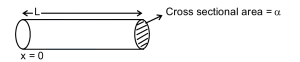
The variation of density of a solid cylindrical rod of cross-sectional area $\alpha$ and length $L$ is given by $\rho = \rho_0 \frac{x^2}{L^2}$,where $x$ is the distance from one end of the rod. The position of its centre of mass from that end $(x=0)$ is:
A
$2L/3$
B
$L/2$
C
$L/3$
D
$3L/4$
Solution
(D) The density of the rod varies as $\rho = \rho_0 \frac{x^2}{L^2}$.
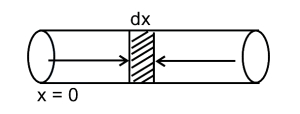
Consider a small elemental disc of thickness $dx$ at a distance $x$ from the end $x=0$.
The mass of this element is $dm = \rho \cdot dV = \rho \cdot (\alpha dx) = \left( \rho_0 \frac{x^2}{L^2} \right) \alpha dx$.
The position of the centre of mass $X_{cm}$ is given by the formula:
$X_{cm} = \frac{\int x dm}{\int dm}$
Substituting the values:
$X_{cm} = \frac{\int_0^L x \left( \rho_0 \frac{x^2}{L^2} \alpha dx \right)}{\int_0^L \left( \rho_0 \frac{x^2}{L^2} \alpha dx \right)}$
$X_{cm} = \frac{\frac{\rho_0 \alpha}{L^2} \int_0^L x^3 dx}{\frac{\rho_0 \alpha}{L^2} \int_0^L x^2 dx}$
$X_{cm} = \frac{[x^4/4]_0^L}{[x^3/3]_0^L} = \frac{L^4/4}{L^3/3} = \frac{3}{4} L$.
Consider a small elemental disc of thickness $dx$ at a distance $x$ from the end $x=0$.
The mass of this element is $dm = \rho \cdot dV = \rho \cdot (\alpha dx) = \left( \rho_0 \frac{x^2}{L^2} \right) \alpha dx$.
The position of the centre of mass $X_{cm}$ is given by the formula:
$X_{cm} = \frac{\int x dm}{\int dm}$
Substituting the values:
$X_{cm} = \frac{\int_0^L x \left( \rho_0 \frac{x^2}{L^2} \alpha dx \right)}{\int_0^L \left( \rho_0 \frac{x^2}{L^2} \alpha dx \right)}$
$X_{cm} = \frac{\frac{\rho_0 \alpha}{L^2} \int_0^L x^3 dx}{\frac{\rho_0 \alpha}{L^2} \int_0^L x^2 dx}$
$X_{cm} = \frac{[x^4/4]_0^L}{[x^3/3]_0^L} = \frac{L^4/4}{L^3/3} = \frac{3}{4} L$.
0 likesView Solution
3
PhysicsMediumMCQWBJEE · 2025
$A$ ball falls from a height $h$ upon a fixed horizontal floor. The coefficient of restitution for the collision between the ball and the floor is $e$. The total distance covered by the ball before coming to rest is [neglect the air resistance].
A
$h \frac{1+e^2}{1-e^2}$
B
$h \frac{1-e^2}{1+e^2}$
C
$h \frac{1+e^2}{1-e^2}$
D
$h \frac{1-e^2}{1+e^2}$
Solution
(A) The ball falls from height $h$ and hits the floor. The velocity just before the first impact is $v_0 = \sqrt{2gh}$.
After the first impact,the velocity becomes $v_1 = e v_0$. The ball rises to a height $h_1 = \frac{v_1^2}{2g} = e^2 h$.
It then falls from $h_1$ and hits the floor again. The distance covered in the first bounce (up and down) is $2h_1 = 2e^2 h$.
After the second impact,it rises to $h_2 = e^2 h_1 = e^4 h$. The distance covered in the second bounce is $2h_2 = 2e^4 h$.
The total distance $D$ is the sum of the initial fall and all subsequent bounces:
$D = h + 2h_1 + 2h_2 + 2h_3 + ...$
$D = h + 2e^2 h + 2e^4 h + 2e^6 h + ...$
$D = h + 2e^2 h (1 + e^2 + e^4 + ...)$
Using the sum of an infinite geometric series $S = \frac{a}{1-r}$ where $a=1$ and $r=e^2$:
$D = h + 2e^2 h \left( \frac{1}{1-e^2} \right)$
$D = h \left( 1 + \frac{2e^2}{1-e^2} \right) = h \left( \frac{1-e^2+2e^2}{1-e^2} \right) = h \left( \frac{1+e^2}{1-e^2} \right)$.
After the first impact,the velocity becomes $v_1 = e v_0$. The ball rises to a height $h_1 = \frac{v_1^2}{2g} = e^2 h$.
It then falls from $h_1$ and hits the floor again. The distance covered in the first bounce (up and down) is $2h_1 = 2e^2 h$.
After the second impact,it rises to $h_2 = e^2 h_1 = e^4 h$. The distance covered in the second bounce is $2h_2 = 2e^4 h$.
The total distance $D$ is the sum of the initial fall and all subsequent bounces:
$D = h + 2h_1 + 2h_2 + 2h_3 + ...$
$D = h + 2e^2 h + 2e^4 h + 2e^6 h + ...$
$D = h + 2e^2 h (1 + e^2 + e^4 + ...)$
Using the sum of an infinite geometric series $S = \frac{a}{1-r}$ where $a=1$ and $r=e^2$:
$D = h + 2e^2 h \left( \frac{1}{1-e^2} \right)$
$D = h \left( 1 + \frac{2e^2}{1-e^2} \right) = h \left( \frac{1-e^2+2e^2}{1-e^2} \right) = h \left( \frac{1+e^2}{1-e^2} \right)$.
0 likesView Solution
4
PhysicsMediumMCQWBJEE · 2025
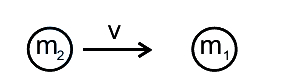
Two spheres $S_1$ and $S_2$ of masses $m_1$ and $m_2$ respectively collide with each other. Initially,$S_1$ is at rest and $S_2$ is moving with velocity $v$ along the $x$-axis. After the collision,$S_2$ has a velocity $\frac{v}{2}$ in a direction perpendicular to the original direction. The sphere $S_1$ moves after the collision:
A
with a velocity of magnitude $\frac{m_2}{m_1} v \frac{\sqrt{5}}{2}$
B
with a velocity in the direction $\theta = \tan^{-1}\left(-\frac{1}{3}\right)$ to the $x$-axis
C
with a velocity whose direction makes an angle $\theta$ with the $x$-axis such that $\theta = \tan^{-1}\left(\frac{1}{2}\right)$ or $\theta = \tan^{-1}\left(-\frac{1}{2}\right)$
D
with a velocity of magnitude $\frac{m_1}{2m_2} v \sqrt{5}$
Solution
(C) Let the initial velocity of $S_2$ be $\vec{u}_2 = v \hat{i}$ and $S_1$ be $\vec{u}_1 = 0$. After the collision,$S_2$ moves with velocity $\vec{v}_2 = \frac{v}{2} \hat{j}$ (assuming it moves in the positive $y$-direction). Let the velocity of $S_1$ be $\vec{v}_1 = v_{1x} \hat{i} + v_{1y} \hat{j}$.
By conservation of linear momentum along the $x$-axis:
$m_2 v = m_1 v_{1x} + m_2(0) \implies v_{1x} = \frac{m_2}{m_1} v$
By conservation of linear momentum along the $y$-axis:
$0 = m_1 v_{1y} + m_2 \left(\frac{v}{2}\right) \implies v_{1y} = -\frac{m_2 v}{2m_1}$
The magnitude of velocity of $S_1$ is $v_1 = \sqrt{v_{1x}^2 + v_{1y}^2} = \sqrt{\left(\frac{m_2 v}{m_1}\right)^2 + \left(-\frac{m_2 v}{2m_1}\right)^2} = \frac{m_2 v}{m_1} \sqrt{1 + \frac{1}{4}} = \frac{m_2 v}{m_1} \frac{\sqrt{5}}{2}$.
The direction $\theta$ of $S_1$ with the $x$-axis is given by $\tan \theta = \frac{v_{1y}}{v_{1x}} = \frac{-m_2 v / 2m_1}{m_2 v / m_1} = -\frac{1}{2}$.
If $S_2$ had moved in the negative $y$-direction,$\tan \theta = \frac{1}{2}$.
Thus,$\theta = \tan^{-1}\left(\frac{1}{2}\right)$ or $\theta = \tan^{-1}\left(-\frac{1}{2}\right)$.
By conservation of linear momentum along the $x$-axis:
$m_2 v = m_1 v_{1x} + m_2(0) \implies v_{1x} = \frac{m_2}{m_1} v$
By conservation of linear momentum along the $y$-axis:
$0 = m_1 v_{1y} + m_2 \left(\frac{v}{2}\right) \implies v_{1y} = -\frac{m_2 v}{2m_1}$
The magnitude of velocity of $S_1$ is $v_1 = \sqrt{v_{1x}^2 + v_{1y}^2} = \sqrt{\left(\frac{m_2 v}{m_1}\right)^2 + \left(-\frac{m_2 v}{2m_1}\right)^2} = \frac{m_2 v}{m_1} \sqrt{1 + \frac{1}{4}} = \frac{m_2 v}{m_1} \frac{\sqrt{5}}{2}$.
The direction $\theta$ of $S_1$ with the $x$-axis is given by $\tan \theta = \frac{v_{1y}}{v_{1x}} = \frac{-m_2 v / 2m_1}{m_2 v / m_1} = -\frac{1}{2}$.
If $S_2$ had moved in the negative $y$-direction,$\tan \theta = \frac{1}{2}$.
Thus,$\theta = \tan^{-1}\left(\frac{1}{2}\right)$ or $\theta = \tan^{-1}\left(-\frac{1}{2}\right)$.
0 likesView Solution
5
PhysicsMediumMCQWBJEE · 2025
Let $\overline{V}$,$V_{\text{rms}}$,and $V_{p}$ denote the mean speed,root mean square speed,and most probable speed of the molecules each of mass $m$ in an ideal monoatomic gas at absolute temperature $T$ Kelvin. Which statement$(s)$ is/are correct?
A
No molecules can have speed greater than $\sqrt{2} V_{\text{rms}}$
B
No molecules can have speed less than $V_{p} / \sqrt{2}$
C
$V_{p} < \overline{V} < V_{\text{rms}}$
D
Average kinetic energy of a molecule is $\frac{3}{4} m V_{p}^{2}$
Solution
(C, D) The expressions for the speeds are:
$V_{\text{rms}} = \sqrt{\frac{3RT}{M}}$
$\overline{V} = \sqrt{\frac{8RT}{\pi M}}$
$V_{p} = \sqrt{\frac{2RT}{M}}$
Comparing these values,we find $V_{p} < \overline{V} < V_{\text{rms}}$. Thus,option $C$ is correct.
For the average kinetic energy of a molecule:
$K.E. = \frac{1}{2} m V_{\text{rms}}^{2} = \frac{1}{2} m \left( \frac{3RT}{M} \right)$.
Since $V_{p}^{2} = \frac{2RT}{M}$,we have $\frac{RT}{M} = \frac{V_{p}^{2}}{2}$.
Substituting this,$K.E. = \frac{1}{2} m \cdot 3 \cdot \left( \frac{V_{p}^{2}}{2} \right) = \frac{3}{4} m V_{p}^{2}$.
Thus,option $D$ is also correct.
$V_{\text{rms}} = \sqrt{\frac{3RT}{M}}$
$\overline{V} = \sqrt{\frac{8RT}{\pi M}}$
$V_{p} = \sqrt{\frac{2RT}{M}}$
Comparing these values,we find $V_{p} < \overline{V} < V_{\text{rms}}$. Thus,option $C$ is correct.
For the average kinetic energy of a molecule:
$K.E. = \frac{1}{2} m V_{\text{rms}}^{2} = \frac{1}{2} m \left( \frac{3RT}{M} \right)$.
Since $V_{p}^{2} = \frac{2RT}{M}$,we have $\frac{RT}{M} = \frac{V_{p}^{2}}{2}$.
Substituting this,$K.E. = \frac{1}{2} m \cdot 3 \cdot \left( \frac{V_{p}^{2}}{2} \right) = \frac{3}{4} m V_{p}^{2}$.
Thus,option $D$ is also correct.
0 likesView Solution
6
PhysicsMediumMCQWBJEE · 2025
$A$ force $\vec{F} = a \hat{i} + b \hat{j} + c \hat{k}$ is acting on a body of mass $m$. The body was initially at rest at the origin. The coordinates of the body after time $t$ will be:
A
$\frac{at^2}{2m}, \frac{bt^2}{2m}, \frac{ct^2}{2m}$
B
$\frac{at^2}{2m}, \frac{bt^2}{m}, \frac{ct^2}{2m}$
C
$\frac{at^2}{m}, \frac{bt^2}{2m}, \frac{ct^2}{2m}$
D
$\frac{at^2}{2m}, \frac{bt^2}{2m}, \frac{ct^2}{m}$
Solution
(A) Given force $\vec{F} = a \hat{i} + b \hat{j} + c \hat{k}$.
Using Newton's second law,the acceleration $\vec{a}_{acc} = \frac{\vec{F}}{m} = \frac{a}{m} \hat{i} + \frac{b}{m} \hat{j} + \frac{c}{m} \hat{k}$.
Since the body starts from rest at the origin,the initial velocity $\vec{u} = 0$ and initial position $\vec{r}_0 = 0$.
Using the kinematic equation $\vec{s} = \vec{u}t + \frac{1}{2} \vec{a}_{acc} t^2$,we get $\vec{r} = \frac{1}{2} \vec{a}_{acc} t^2$.
Substituting the components:
$x = \frac{1}{2} (\frac{a}{m}) t^2 = \frac{at^2}{2m}$
$y = \frac{1}{2} (\frac{b}{m}) t^2 = \frac{bt^2}{2m}$
$z = \frac{1}{2} (\frac{c}{m}) t^2 = \frac{ct^2}{2m}$
Thus,the coordinates are $(\frac{at^2}{2m}, \frac{bt^2}{2m}, \frac{ct^2}{2m})$.
Using Newton's second law,the acceleration $\vec{a}_{acc} = \frac{\vec{F}}{m} = \frac{a}{m} \hat{i} + \frac{b}{m} \hat{j} + \frac{c}{m} \hat{k}$.
Since the body starts from rest at the origin,the initial velocity $\vec{u} = 0$ and initial position $\vec{r}_0 = 0$.
Using the kinematic equation $\vec{s} = \vec{u}t + \frac{1}{2} \vec{a}_{acc} t^2$,we get $\vec{r} = \frac{1}{2} \vec{a}_{acc} t^2$.
Substituting the components:
$x = \frac{1}{2} (\frac{a}{m}) t^2 = \frac{at^2}{2m}$
$y = \frac{1}{2} (\frac{b}{m}) t^2 = \frac{bt^2}{2m}$
$z = \frac{1}{2} (\frac{c}{m}) t^2 = \frac{ct^2}{2m}$
Thus,the coordinates are $(\frac{at^2}{2m}, \frac{bt^2}{2m}, \frac{ct^2}{2m})$.
0 likesView Solution
7
PhysicsMediumMCQWBJEE · 2025
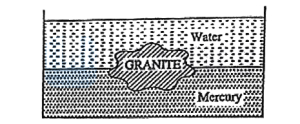
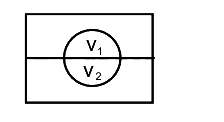
$A$ piece of granite floats at the interface of mercury and water contained in a beaker as shown in the figure. If the densities of granite,water,and mercury are $\rho, \rho_1$,and $\rho_2$ respectively,the ratio of the volume of granite in water to the volume of granite in mercury is:
A
$\frac{\rho_2-\rho}{\rho-\rho_1}$
B
$\frac{\rho_2+\rho}{\rho_1+\rho}$
C
$\frac{\rho_1 \rho_2}{\rho}$
D
$\frac{\rho_1}{\rho_2}$
Solution
(A) Let $V_1$ be the volume of granite in water and $V_2$ be the volume of granite in mercury.
According to the principle of floatation,the total buoyant force acting on the granite must be equal to its weight.
The buoyant force from water is $F_{B1} = V_1 \rho_1 g$.
The buoyant force from mercury is $F_{B2} = V_2 \rho_2 g$.
The weight of the granite is $W = (V_1 + V_2) \rho g$.
Equating the forces: $V_1 \rho_1 g + V_2 \rho_2 g = (V_1 + V_2) \rho g$.
Dividing by $g$: $V_1 \rho_1 + V_2 \rho_2 = V_1 \rho + V_2 \rho$.
Rearranging the terms to group $V_1$ and $V_2$: $V_1 \rho_1 - V_1 \rho = V_2 \rho - V_2 \rho_2$.
$V_1(\rho_1 - \rho) = V_2(\rho - \rho_2)$.
Therefore,the ratio of the volume of granite in water $(V_1)$ to the volume of granite in mercury $(V_2)$ is:
$\frac{V_1}{V_2} = \frac{\rho - \rho_2}{\rho_1 - \rho} = \frac{\rho_2 - \rho}{\rho - \rho_1}$.
According to the principle of floatation,the total buoyant force acting on the granite must be equal to its weight.
The buoyant force from water is $F_{B1} = V_1 \rho_1 g$.
The buoyant force from mercury is $F_{B2} = V_2 \rho_2 g$.
The weight of the granite is $W = (V_1 + V_2) \rho g$.
Equating the forces: $V_1 \rho_1 g + V_2 \rho_2 g = (V_1 + V_2) \rho g$.
Dividing by $g$: $V_1 \rho_1 + V_2 \rho_2 = V_1 \rho + V_2 \rho$.
Rearranging the terms to group $V_1$ and $V_2$: $V_1 \rho_1 - V_1 \rho = V_2 \rho - V_2 \rho_2$.
$V_1(\rho_1 - \rho) = V_2(\rho - \rho_2)$.
Therefore,the ratio of the volume of granite in water $(V_1)$ to the volume of granite in mercury $(V_2)$ is:
$\frac{V_1}{V_2} = \frac{\rho - \rho_2}{\rho_1 - \rho} = \frac{\rho_2 - \rho}{\rho - \rho_1}$.
0 likesView Solution
8
PhysicsMediumMCQWBJEE · 2025
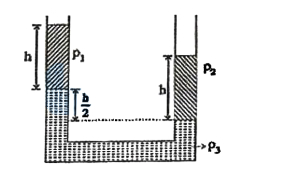
Three different liquids are filled in a $U$-tube as shown in the figure. Their densities are $\rho_1, \rho_2$ and $\rho_3$ respectively. From the figure,we may conclude that:
A
$\rho_3=4(\rho_2-\rho_1)$
B
$\rho_3=4(\rho_1-\rho_2)$
C
$\rho_3=2(\rho_2-\rho_1)$
D
$\rho_3=\frac{\rho_1+\rho_2}{2}$
Solution
(C) Consider the horizontal level at the bottom of the liquid with density $\rho_3$ in the left arm. The pressure at this level in both arms must be equal.
In the left arm,the pressure is due to the liquid of density $\rho_1$ (height $h$) and the liquid of density $\rho_3$ (height $h/2$).
$P_{left} = P_{atm} + \rho_1 gh + \rho_3 g(h/2)$
In the right arm,the pressure at the same horizontal level is due to the liquid of density $\rho_2$ (height $h$).
$P_{right} = P_{atm} + \rho_2 gh$
Equating the pressures: $P_{atm} + \rho_1 gh + \rho_3 g(h/2) = P_{atm} + \rho_2 gh$
Dividing by $gh$: $\rho_1 + \frac{\rho_3}{2} = \rho_2$
Rearranging for $\rho_3$: $\frac{\rho_3}{2} = \rho_2 - \rho_1 \implies \rho_3 = 2(\rho_2 - \rho_1)$
In the left arm,the pressure is due to the liquid of density $\rho_1$ (height $h$) and the liquid of density $\rho_3$ (height $h/2$).
$P_{left} = P_{atm} + \rho_1 gh + \rho_3 g(h/2)$
In the right arm,the pressure at the same horizontal level is due to the liquid of density $\rho_2$ (height $h$).
$P_{right} = P_{atm} + \rho_2 gh$
Equating the pressures: $P_{atm} + \rho_1 gh + \rho_3 g(h/2) = P_{atm} + \rho_2 gh$
Dividing by $gh$: $\rho_1 + \frac{\rho_3}{2} = \rho_2$
Rearranging for $\rho_3$: $\frac{\rho_3}{2} = \rho_2 - \rho_1 \implies \rho_3 = 2(\rho_2 - \rho_1)$
0 likesView Solution
9
PhysicsMediumMCQWBJEE · 2025
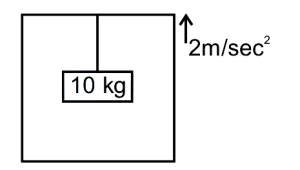
One end of a steel wire is fixed to the ceiling of an elevator moving up with an acceleration $2 \ m/s^2$ and a load of $10 \ kg$ hangs from the other end. If the cross-section of the wire is $2 \ cm^2$,then the longitudinal strain in the wire will be ($g = 10 \ m/s^2$ and $Y = 2.0 \times 10^{11} \ N/m^2$).
A
$4 \times 10^{-6}$
B
$3 \times 10^{-6}$
C
$8 \times 10^{-6}$
D
$2 \times 10^{-6}$
Solution
(B) The tension $T$ in the wire when the elevator moves upward with acceleration $a$ is given by $T = m(g + a)$.
Given $m = 10 \ kg$,$g = 10 \ m/s^2$,and $a = 2 \ m/s^2$,we have $T = 10(10 + 2) = 120 \ N$.
The longitudinal strain is defined as $\text{Strain} = \frac{\Delta \ell}{L} = \frac{\text{Stress}}{Y} = \frac{T}{AY}$.
Given cross-sectional area $A = 2 \ cm^2 = 2 \times 10^{-4} \ m^2$ and Young's modulus $Y = 2.0 \times 10^{11} \ N/m^2$.
Substituting the values: $\text{Strain} = \frac{120}{(2 \times 10^{-4}) \times (2.0 \times 10^{11})} = \frac{120}{4 \times 10^7} = 30 \times 10^{-7} = 3 \times 10^{-6}$.
Given $m = 10 \ kg$,$g = 10 \ m/s^2$,and $a = 2 \ m/s^2$,we have $T = 10(10 + 2) = 120 \ N$.
The longitudinal strain is defined as $\text{Strain} = \frac{\Delta \ell}{L} = \frac{\text{Stress}}{Y} = \frac{T}{AY}$.
Given cross-sectional area $A = 2 \ cm^2 = 2 \times 10^{-4} \ m^2$ and Young's modulus $Y = 2.0 \times 10^{11} \ N/m^2$.
Substituting the values: $\text{Strain} = \frac{120}{(2 \times 10^{-4}) \times (2.0 \times 10^{11})} = \frac{120}{4 \times 10^7} = 30 \times 10^{-7} = 3 \times 10^{-6}$.
0 likesView Solution
10
PhysicsMediumMCQWBJEE · 2025
$A$ simple pendulum is taken to a place where its distance from the Earth's surface is equal to the radius of the Earth. Calculate the time period of small oscillations if the length of the string is $4.0 \ m$. (Take $g = \pi^2 \ m/s^2$ at the surface of the Earth.) (in $s$)
A
$4$
B
$6$
C
$8$
D
$2$
Solution
(C) The time period of a simple pendulum is given by $T = 2\pi \sqrt{\frac{\ell}{g'}}$.
At a height $h = R$ (where $R$ is the radius of the Earth),the acceleration due to gravity $g'$ is given by $g' = g \left( \frac{R}{R+h} \right)^2 = g \left( \frac{R}{R+R} \right)^2 = \frac{g}{4}$.
Given $g = \pi^2 \ m/s^2$ at the surface,the effective gravity at height $h$ is $g' = \frac{\pi^2}{4} \ m/s^2$.
Substituting the values $\ell = 4.0 \ m$ and $g' = \frac{\pi^2}{4} \ m/s^2$ into the time period formula:
$T = 2\pi \sqrt{\frac{4}{\pi^2 / 4}} = 2\pi \sqrt{\frac{16}{\pi^2}} = 2\pi \times \frac{4}{\pi} = 8 \ s$.
At a height $h = R$ (where $R$ is the radius of the Earth),the acceleration due to gravity $g'$ is given by $g' = g \left( \frac{R}{R+h} \right)^2 = g \left( \frac{R}{R+R} \right)^2 = \frac{g}{4}$.
Given $g = \pi^2 \ m/s^2$ at the surface,the effective gravity at height $h$ is $g' = \frac{\pi^2}{4} \ m/s^2$.
Substituting the values $\ell = 4.0 \ m$ and $g' = \frac{\pi^2}{4} \ m/s^2$ into the time period formula:
$T = 2\pi \sqrt{\frac{4}{\pi^2 / 4}} = 2\pi \sqrt{\frac{16}{\pi^2}} = 2\pi \times \frac{4}{\pi} = 8 \ s$.
0 likesView Solution
11
PhysicsEasyMCQWBJEE · 2025
The variation of displacement with time of a simple harmonic motion $(SHM)$ for a particle of mass $m$ is represented by $y = 2 \sin \left(\frac{\pi t}{2} + \phi\right) \text{ cm}$. The maximum acceleration of the particle is
A
$\frac{\pi}{2} \text{ cm/s}^2$
B
$\frac{\pi}{2m} \text{ cm/s}^2$
C
$\frac{\pi^2}{2m} \text{ cm/s}^2$
D
$\frac{\pi^2}{2} \text{ cm/s}^2$
Solution
(D) The given displacement equation for $SHM$ is $y = 2 \sin \left(\frac{\pi t}{2} + \phi\right) \text{ cm}$.
Comparing this with the standard $SHM$ equation $y = A \sin(\omega t + \phi)$,we get the amplitude $A = 2 \text{ cm}$ and angular frequency $\omega = \frac{\pi}{2} \text{ rad/s}$.
The formula for maximum acceleration in $SHM$ is $a_{\max} = \omega^2 A$.
Substituting the values,we get $a_{\max} = \left(\frac{\pi}{2}\right)^2 \times 2$.
$a_{\max} = \frac{\pi^2}{4} \times 2 = \frac{\pi^2}{2} \text{ cm/s}^2$.
Comparing this with the standard $SHM$ equation $y = A \sin(\omega t + \phi)$,we get the amplitude $A = 2 \text{ cm}$ and angular frequency $\omega = \frac{\pi}{2} \text{ rad/s}$.
The formula for maximum acceleration in $SHM$ is $a_{\max} = \omega^2 A$.
Substituting the values,we get $a_{\max} = \left(\frac{\pi}{2}\right)^2 \times 2$.
$a_{\max} = \frac{\pi^2}{4} \times 2 = \frac{\pi^2}{2} \text{ cm/s}^2$.
0 likesView Solution
12
PhysicsEasyMCQWBJEE · 2025
The temperature of a body $\theta$ is slightly more than the temperature of the surrounding $\theta_0$. Its rate of cooling $(R)$ versus the temperature of the body $(\theta)$ is plotted. Its shape would be:
A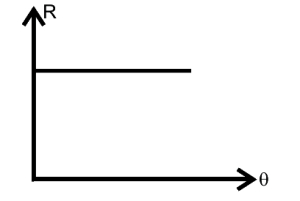
B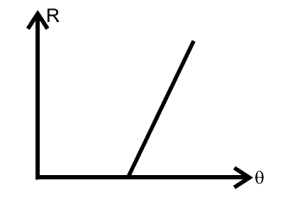
C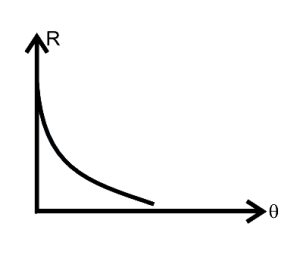
D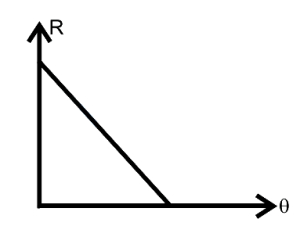
Solution
(B) According to Newton's law of cooling,the rate of cooling $R$ is directly proportional to the temperature difference between the body and its surroundings,provided the difference is small.
Mathematically,$R = -\frac{d\theta}{dt} = k(\theta - \theta_0)$,where $k$ is a positive constant.
This equation is of the form $y = mx + c$,where $y = R$,$x = \theta$,$m = k$ (slope),and $c = -k\theta_0$ (y-intercept).
Since $k > 0$,the slope is positive.
When $\theta = \theta_0$,$R = 0$.
Therefore,the graph is a straight line passing through the point $(\theta_0, 0)$ with a positive slope,which matches the shape shown in option $B$.
Mathematically,$R = -\frac{d\theta}{dt} = k(\theta - \theta_0)$,where $k$ is a positive constant.
This equation is of the form $y = mx + c$,where $y = R$,$x = \theta$,$m = k$ (slope),and $c = -k\theta_0$ (y-intercept).
Since $k > 0$,the slope is positive.
When $\theta = \theta_0$,$R = 0$.
Therefore,the graph is a straight line passing through the point $(\theta_0, 0)$ with a positive slope,which matches the shape shown in option $B$.
0 likesView Solution
13
PhysicsMediumMCQWBJEE · 2025
The apparent coefficient of expansion of a liquid,when heated in a copper vessel is $C$ and when heated in a silver vessel is $S$. If $A$ is the linear coefficient of expansion of copper,then the linear coefficient of expansion of silver is:
A
$\frac{C-S-3A}{3}$
B
$\frac{C+3A-S}{3}$
C
$\frac{S+3A-C}{3}$
D
$\frac{C+S+3A}{3}$
Solution
(B) Let $\gamma_L$ be the real coefficient of volume expansion of the liquid.
Let $\gamma_C$ and $\gamma_S$ be the coefficients of volume expansion of copper and silver,respectively.
We know that the coefficient of volume expansion $\gamma = 3 \times \text{linear coefficient of expansion } \alpha$.
Given $\gamma_C = 3A$.
The apparent expansion coefficient is given by $\gamma_{app} = \gamma_L - \gamma_{vessel}$.
For copper: $C = \gamma_L - 3A \implies \gamma_L = C + 3A$.
For silver: $S = \gamma_L - \gamma_S \implies \gamma_S = \gamma_L - S$.
Substituting $\gamma_L = C + 3A$ into the equation for silver: $\gamma_S = C + 3A - S$.
Since $\gamma_S = 3 \alpha_S$,where $\alpha_S$ is the linear coefficient of expansion of silver:
$3 \alpha_S = C + 3A - S \implies \alpha_S = \frac{C + 3A - S}{3}$.
Let $\gamma_C$ and $\gamma_S$ be the coefficients of volume expansion of copper and silver,respectively.
We know that the coefficient of volume expansion $\gamma = 3 \times \text{linear coefficient of expansion } \alpha$.
Given $\gamma_C = 3A$.
The apparent expansion coefficient is given by $\gamma_{app} = \gamma_L - \gamma_{vessel}$.
For copper: $C = \gamma_L - 3A \implies \gamma_L = C + 3A$.
For silver: $S = \gamma_L - \gamma_S \implies \gamma_S = \gamma_L - S$.
Substituting $\gamma_L = C + 3A$ into the equation for silver: $\gamma_S = C + 3A - S$.
Since $\gamma_S = 3 \alpha_S$,where $\alpha_S$ is the linear coefficient of expansion of silver:
$3 \alpha_S = C + 3A - S \implies \alpha_S = \frac{C + 3A - S}{3}$.
0 likesView Solution
14
PhysicsMediumMCQWBJEE · 2025
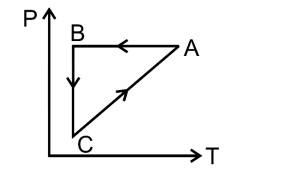
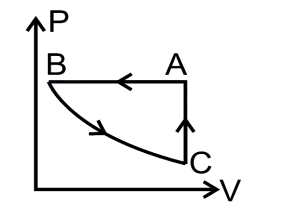
For an ideal gas,a cyclic process $ABCA$ as shown in the $P-T$ diagram,when presented in a $P-V$ plot,would be:
A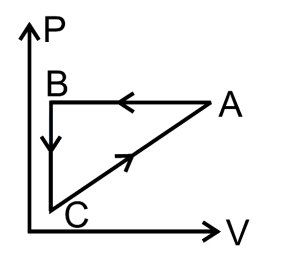
B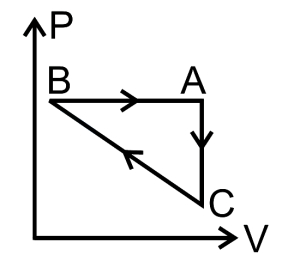
C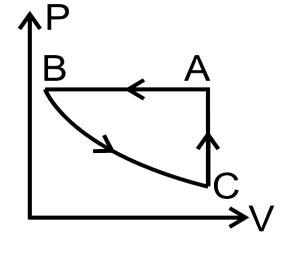
D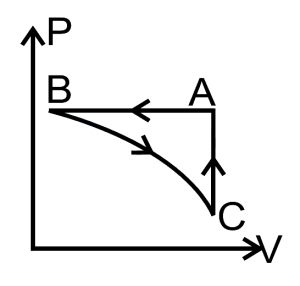
Solution
(D) In the given $P-T$ diagram:
$AB$: The pressure $P$ is constant,and temperature $T$ decreases. Since $PV = nRT$,if $P$ is constant and $T$ decreases,volume $V$ must decrease. Thus,$AB$ is an isobaric compression.
$BC$: The process is a vertical line,meaning temperature $T$ is constant. Since $P$ decreases,$V$ must increase to keep $PV$ constant. Thus,$BC$ is an isothermal expansion.
$CA$: The process is a line passing through the origin in a $P-T$ diagram,meaning $P \propto T$. Since $PV = nRT$,$P/T = nR/V$,so $V$ must be constant. Thus,$CA$ is an isochoric process.
Comparing these characteristics with the given options,the correct $P-V$ diagram is represented by option $D$.
$AB$: The pressure $P$ is constant,and temperature $T$ decreases. Since $PV = nRT$,if $P$ is constant and $T$ decreases,volume $V$ must decrease. Thus,$AB$ is an isobaric compression.
$BC$: The process is a vertical line,meaning temperature $T$ is constant. Since $P$ decreases,$V$ must increase to keep $PV$ constant. Thus,$BC$ is an isothermal expansion.
$CA$: The process is a line passing through the origin in a $P-T$ diagram,meaning $P \propto T$. Since $PV = nRT$,$P/T = nR/V$,so $V$ must be constant. Thus,$CA$ is an isochoric process.
Comparing these characteristics with the given options,the correct $P-V$ diagram is represented by option $D$.
0 likesView Solution
15
PhysicsEasyMCQWBJEE · 2025
The equation of a stationary wave along a stretched string is given by $y = 5 \sin \left( \frac{\pi x}{3} \right) \cos (40 \pi t)$. Here $x$ and $y$ are in $cm$ and $t$ is in seconds. The separation between two adjacent nodes is: (in $cm$)
A
$1.5$
B
$3$
C
$6$
D
$14$
Solution
(B) The standard equation for a stationary wave is $y = A \sin(kx) \cos(\omega t)$.
Comparing this with the given equation $y = 5 \sin \left( \frac{\pi x}{3} \right) \cos(40 \pi t)$,we identify the wave number $k = \frac{\pi}{3} \ cm^{-1}$.
The relationship between the wave number $k$ and the wavelength $\lambda$ is $k = \frac{2\pi}{\lambda}$.
Substituting the value of $k$: $\frac{\pi}{3} = \frac{2\pi}{\lambda}$,which gives $\lambda = 6 \ cm$.
The separation between two adjacent nodes in a stationary wave is given by $\frac{\lambda}{2}$.
Therefore,the separation $= \frac{6 \ cm}{2} = 3 \ cm$.
Comparing this with the given equation $y = 5 \sin \left( \frac{\pi x}{3} \right) \cos(40 \pi t)$,we identify the wave number $k = \frac{\pi}{3} \ cm^{-1}$.
The relationship between the wave number $k$ and the wavelength $\lambda$ is $k = \frac{2\pi}{\lambda}$.
Substituting the value of $k$: $\frac{\pi}{3} = \frac{2\pi}{\lambda}$,which gives $\lambda = 6 \ cm$.
The separation between two adjacent nodes in a stationary wave is given by $\frac{\lambda}{2}$.
Therefore,the separation $= \frac{6 \ cm}{2} = 3 \ cm$.
0 likesView Solution
16
PhysicsMediumMCQWBJEE · 2025
$A$ wave disturbance in a medium is described by $y(x, t) = 0.02 \cos(50 \pi t + \frac{\pi}{2}) \cos(10 \pi x)$,where $x$ and $y$ are in meters and $t$ is in seconds. Which statement$(s)$ is/are correct?
A
$A$ node occurs at $x = 0.15 \ m$
B
An antinode occurs at $x = 0.3 \ m$
C
The speed of the wave is $4 \ m/s$
D
The wavelength of the wave is $0.2 \ m$
Solution
(A, B, D) The given equation is $y(x, t) = 0.02 \cos(50 \pi t + \frac{\pi}{2}) \cos(10 \pi x)$.
Nodes occur where the spatial part $\cos(10 \pi x) = 0$.
$10 \pi x = (n + \frac{1}{2}) \pi \implies x = \frac{n + 0.5}{10} = 0.05, 0.15, 0.25, \dots \ m$. Thus,a node occurs at $x = 0.15 \ m$.
Antinodes occur where $|\cos(10 \pi x)| = 1$.
$10 \pi x = n \pi \implies x = \frac{n}{10} = 0, 0.1, 0.2, 0.3, \dots \ m$. Thus,an antinode occurs at $x = 0.3 \ m$.
Comparing with the standard stationary wave equation $y = A \cos(\omega t + \phi) \cos(kx)$,we get $k = 10 \pi$ and $\omega = 50 \pi$.
Wavelength $\lambda = \frac{2 \pi}{k} = \frac{2 \pi}{10 \pi} = 0.2 \ m$.
Wave speed $v = \frac{\omega}{k} = \frac{50 \pi}{10 \pi} = 5 \ m/s$.
Nodes occur where the spatial part $\cos(10 \pi x) = 0$.
$10 \pi x = (n + \frac{1}{2}) \pi \implies x = \frac{n + 0.5}{10} = 0.05, 0.15, 0.25, \dots \ m$. Thus,a node occurs at $x = 0.15 \ m$.
Antinodes occur where $|\cos(10 \pi x)| = 1$.
$10 \pi x = n \pi \implies x = \frac{n}{10} = 0, 0.1, 0.2, 0.3, \dots \ m$. Thus,an antinode occurs at $x = 0.3 \ m$.
Comparing with the standard stationary wave equation $y = A \cos(\omega t + \phi) \cos(kx)$,we get $k = 10 \pi$ and $\omega = 50 \pi$.
Wavelength $\lambda = \frac{2 \pi}{k} = \frac{2 \pi}{10 \pi} = 0.2 \ m$.
Wave speed $v = \frac{\omega}{k} = \frac{50 \pi}{10 \pi} = 5 \ m/s$.
0 likesView Solution
17
PhysicsMediumMCQWBJEE · 2025
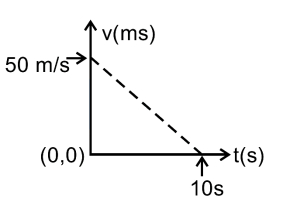
The velocity-time graph for a body of mass $10 \ kg$ is shown in the figure. The work done on the body in the first two seconds of motion is:
A
-$9300$ $J$
B
$12000$ $J$
C
-$4500$ $J$
D
-$1200$ $J$
Solution
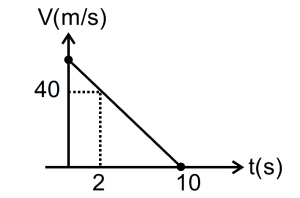
(C) From the given velocity-time graph,the initial velocity at $t = 0 \ s$ is $u = 50 \ m/s$. The velocity becomes $0 \ m/s$ at $t = 10 \ s$.
The acceleration $a$ is the slope of the graph: $a = \frac{v_f - v_i}{t_f - t_i} = \frac{0 - 50}{10 - 0} = -5 \ m/s^2$.
The velocity at $t = 2 \ s$ is given by $v = u + at = 50 + (-5)(2) = 40 \ m/s$.
According to the work-energy theorem,the work done $W$ is equal to the change in kinetic energy:
$W = \Delta K = K_f - K_i = \frac{1}{2} m v^2 - \frac{1}{2} m u^2$
$W = \frac{1}{2} \times 10 \ kg \times ((40 \ m/s)^2 - (50 \ m/s)^2)$
$W = 5 \times (1600 - 2500) = 5 \times (-900) = -4500 \ J$.
The acceleration $a$ is the slope of the graph: $a = \frac{v_f - v_i}{t_f - t_i} = \frac{0 - 50}{10 - 0} = -5 \ m/s^2$.
The velocity at $t = 2 \ s$ is given by $v = u + at = 50 + (-5)(2) = 40 \ m/s$.
According to the work-energy theorem,the work done $W$ is equal to the change in kinetic energy:
$W = \Delta K = K_f - K_i = \frac{1}{2} m v^2 - \frac{1}{2} m u^2$
$W = \frac{1}{2} \times 10 \ kg \times ((40 \ m/s)^2 - (50 \ m/s)^2)$
$W = 5 \times (1600 - 2500) = 5 \times (-900) = -4500 \ J$.
0 likesView Solution
18
PhysicsEasyMCQWBJEE · 2025
For a domestic $AC$ supply of $220 \ V$ at $50 \ \text{cycles per sec}$, the potential difference between the terminals of a two-pin electric outlet in a room is given by
A
$V(t) = 220 \sqrt{2} \cos(100 \pi t)$
B
$V(t) = 220 \sin(50 t)$
C
$V(t) = 220 \cos(100 \pi t)$
D
$V(t) = 220 \sqrt{2} \cos(50 t)$
Solution
(A) The root mean square voltage is given as $V_{rms} = 220 \ V$.
The peak voltage $V_0$ is related to $V_{rms}$ by the formula $V_0 = V_{rms} \sqrt{2}$.
Therefore, $V_0 = 220 \sqrt{2} \ V$.
The angular frequency $\omega$ is given by $\omega = 2 \pi f$, where $f = 50 \ \text{Hz}$.
Thus, $\omega = 2 \pi \times 50 = 100 \pi \ \text{rad/s}$.
The instantaneous potential difference is given by $V(t) = V_0 \cos(\omega t)$.
Substituting the values, we get $V(t) = 220 \sqrt{2} \cos(100 \pi t)$.
The peak voltage $V_0$ is related to $V_{rms}$ by the formula $V_0 = V_{rms} \sqrt{2}$.
Therefore, $V_0 = 220 \sqrt{2} \ V$.
The angular frequency $\omega$ is given by $\omega = 2 \pi f$, where $f = 50 \ \text{Hz}$.
Thus, $\omega = 2 \pi \times 50 = 100 \pi \ \text{rad/s}$.
The instantaneous potential difference is given by $V(t) = V_0 \cos(\omega t)$.
Substituting the values, we get $V(t) = 220 \sqrt{2} \cos(100 \pi t)$.
0 likesView Solution
19
PhysicsMediumMCQWBJEE · 2025
The minimum wavelength of Lyman series lines is $P$. What is the maximum wavelength of these lines?
A
$\frac{4 P}{3}$
B
$2 P$
C
$\frac{2 P}{3}$
D
$\infty$
Solution
(A) For the Lyman series,the wavelength $\lambda$ is given by the Rydberg formula: $\frac{1}{\lambda} = R \left( \frac{1}{1^2} - \frac{1}{n^2} \right)$,where $n = 2, 3, 4, \dots$
$1$. The minimum wavelength $(\lambda_{\min})$ occurs for the transition from $n = \infty$ to $n = 1$:
$\frac{1}{\lambda_{\min}} = R \left( \frac{1}{1^2} - \frac{1}{\infty^2} \right) = R$
Given $\lambda_{\min} = P$,we have $P = \frac{1}{R}$.
$2$. The maximum wavelength $(\lambda_{\max})$ occurs for the transition from $n = 2$ to $n = 1$:
$\frac{1}{\lambda_{\max}} = R \left( \frac{1}{1^2} - \frac{1}{2^2} \right) = R \left( 1 - \frac{1}{4} \right) = R \left( \frac{3}{4} \right)$
$3$. Substituting $R = \frac{1}{P}$ into the equation:
$\frac{1}{\lambda_{\max}} = \frac{1}{P} \cdot \frac{3}{4}$
$\lambda_{\max} = \frac{4 P}{3}$.
$1$. The minimum wavelength $(\lambda_{\min})$ occurs for the transition from $n = \infty$ to $n = 1$:
$\frac{1}{\lambda_{\min}} = R \left( \frac{1}{1^2} - \frac{1}{\infty^2} \right) = R$
Given $\lambda_{\min} = P$,we have $P = \frac{1}{R}$.
$2$. The maximum wavelength $(\lambda_{\max})$ occurs for the transition from $n = 2$ to $n = 1$:
$\frac{1}{\lambda_{\max}} = R \left( \frac{1}{1^2} - \frac{1}{2^2} \right) = R \left( 1 - \frac{1}{4} \right) = R \left( \frac{3}{4} \right)$
$3$. Substituting $R = \frac{1}{P}$ into the equation:
$\frac{1}{\lambda_{\max}} = \frac{1}{P} \cdot \frac{3}{4}$
$\lambda_{\max} = \frac{4 P}{3}$.
0 likesView Solution
20
PhysicsMediumMCQWBJEE · 2025
An electron in a Hydrogen atom jumps from the second Bohr orbit to the ground state,and the difference between the energies of the two states is radiated in the form of a photon. This photon strikes a material. If the work function of the material is $4.2 \ eV$,then the stopping potential is (Energy of electron in $n$-th orbit $= -\frac{13.6}{n^2} \ eV$). (in $V$)
A
$2$
B
$4$
C
$6$
D
$8$
Solution
(C) The energy of the photon emitted during the transition from $n=2$ to $n=1$ is given by:
$E = E_2 - E_1 = -\frac{13.6}{2^2} - (-\frac{13.6}{1^2}) = -3.4 + 13.6 = 10.2 \ eV$.
According to Einstein's photoelectric equation:
$E = \phi + K_{max}$,where $\phi$ is the work function and $K_{max} = eV_s$ is the maximum kinetic energy.
$10.2 \ eV = 4.2 \ eV + eV_s$.
$eV_s = 10.2 \ eV - 4.2 \ eV = 6.0 \ eV$.
Therefore,the stopping potential $V_s = 6 \ V$.
$E = E_2 - E_1 = -\frac{13.6}{2^2} - (-\frac{13.6}{1^2}) = -3.4 + 13.6 = 10.2 \ eV$.
According to Einstein's photoelectric equation:
$E = \phi + K_{max}$,where $\phi$ is the work function and $K_{max} = eV_s$ is the maximum kinetic energy.
$10.2 \ eV = 4.2 \ eV + eV_s$.
$eV_s = 10.2 \ eV - 4.2 \ eV = 6.0 \ eV$.
Therefore,the stopping potential $V_s = 6 \ V$.
0 likesView Solution
21
PhysicsMediumMCQWBJEE · 2025
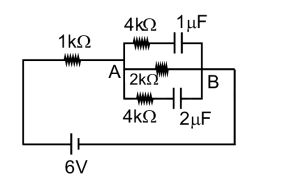
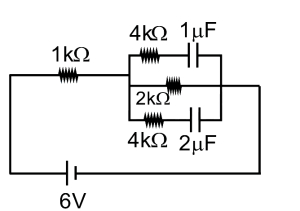
What are the charges stored in the $1 \mu F$ and $2 \mu F$ capacitors in the circuit as shown in the figure once the current $(I)$ becomes steady?
A
$8 \mu C$ and $4 \mu C$
B
$4 \mu C$ and $8 \mu C$
C
$3 \mu C$ and $6 \mu C$
D
$6 \mu C$ and $3 \mu C$
Solution
(B) In a steady state, the capacitors act as open circuits, so no current flows through the branches containing the capacitors.
Therefore, the current $(I)$ flows only through the $1 \text{ k}\Omega$ resistor and the $2 \text{ k}\Omega$ resistor in series.
The total resistance of the circuit is $R_{eq} = 1 \text{ k}\Omega + 2 \text{ k}\Omega = 3 \text{ k}\Omega = 3000 \Omega$.
The current in the circuit is $I = \frac{V}{R_{eq}} = \frac{6 \text{ V}}{3000 \Omega} = 2 \times 10^{-3} \text{ A} = 2 \text{ mA}$.
The potential difference across the $2 \text{ k}\Omega$ resistor is $V_{AB} = I \times R = (2 \times 10^{-3} \text{ A}) \times (2000 \Omega) = 4 \text{ V}$.
Since the capacitors are in parallel with the $2 \text{ k}\Omega$ resistor, the potential difference across both capacitors is $4 \text{ V}$.
The charge on the $1 \mu F$ capacitor is $q_1 = C_1 \times V = (1 \mu F) \times (4 \text{ V}) = 4 \mu C$.
The charge on the $2 \mu F$ capacitor is $q_2 = C_2 \times V = (2 \mu F) \times (4 \text{ V}) = 8 \mu C$.
Therefore, the current $(I)$ flows only through the $1 \text{ k}\Omega$ resistor and the $2 \text{ k}\Omega$ resistor in series.
The total resistance of the circuit is $R_{eq} = 1 \text{ k}\Omega + 2 \text{ k}\Omega = 3 \text{ k}\Omega = 3000 \Omega$.
The current in the circuit is $I = \frac{V}{R_{eq}} = \frac{6 \text{ V}}{3000 \Omega} = 2 \times 10^{-3} \text{ A} = 2 \text{ mA}$.
The potential difference across the $2 \text{ k}\Omega$ resistor is $V_{AB} = I \times R = (2 \times 10^{-3} \text{ A}) \times (2000 \Omega) = 4 \text{ V}$.
Since the capacitors are in parallel with the $2 \text{ k}\Omega$ resistor, the potential difference across both capacitors is $4 \text{ V}$.
The charge on the $1 \mu F$ capacitor is $q_1 = C_1 \times V = (1 \mu F) \times (4 \text{ V}) = 4 \mu C$.
The charge on the $2 \mu F$ capacitor is $q_2 = C_2 \times V = (2 \mu F) \times (4 \text{ V}) = 8 \mu C$.
0 likesView Solution
22
PhysicsMediumMCQWBJEE · 2025
$A$ quantity $X$ is given by $\varepsilon_0 L \frac{\Delta V}{\Delta t}$,where $\varepsilon_0$ is the permittivity of free space,$L$ is the length,$\Delta V$ is a potential difference,and $\Delta t$ is a time interval. The dimension of $X$ is the same as that of
A
Resistance
B
Charge
C
Voltage
D
Current
Solution
(D) The expression is $X = \varepsilon_0 L \frac{\Delta V}{\Delta t}$.
We know that the electric flux $\phi_E = E \cdot A$,where $E = \frac{V}{L}$ and $A = L^2$.
Thus,$\phi_E = \frac{V}{L} \cdot L^2 = V \cdot L$.
Substituting this into the expression for $X$,we get $X = \varepsilon_0 \frac{\Delta \phi_E}{\Delta t}$.
According to the definition of displacement current $i_d = \varepsilon_0 \frac{d\phi_E}{dt}$,the quantity $X$ represents the displacement current.
Therefore,the dimension of $X$ is the same as that of current.
We know that the electric flux $\phi_E = E \cdot A$,where $E = \frac{V}{L}$ and $A = L^2$.
Thus,$\phi_E = \frac{V}{L} \cdot L^2 = V \cdot L$.
Substituting this into the expression for $X$,we get $X = \varepsilon_0 \frac{\Delta \phi_E}{\Delta t}$.
According to the definition of displacement current $i_d = \varepsilon_0 \frac{d\phi_E}{dt}$,the quantity $X$ represents the displacement current.
Therefore,the dimension of $X$ is the same as that of current.
0 likesView Solution
23
PhysicsMediumMCQWBJEE · 2025
The de-Broglie wavelength of a moving bus with speed $v$ is $\lambda$. Some passengers left the bus at a stoppage. Now,when the bus moves with twice its initial speed,its kinetic energy is found to be twice its initial value. What is the de-Broglie wavelength of the bus now?
A
$\lambda$
B
$2 \lambda$
C
$\frac{\lambda}{2}$
D
$\frac{\lambda}{4}$
Solution
(A) The de-Broglie wavelength is given by $\lambda = \frac{h}{p} = \frac{h}{\sqrt{2mE}}$.
Initially,let the mass be $m$,speed be $v$,and kinetic energy be $E = \frac{1}{2}mv^2$. Thus,$\lambda = \frac{h}{\sqrt{2mE}}$.
After some passengers leave,let the new mass be $m'$,new speed be $v' = 2v$,and new kinetic energy be $E' = 2E$.
Using the kinetic energy formula: $E' = \frac{1}{2}m'(v')^2$.
Substituting the values: $2E = \frac{1}{2}m'(2v)^2 = \frac{1}{2}m'(4v^2) = 2m'v^2$.
Since $E = \frac{1}{2}mv^2$,we have $2(\frac{1}{2}mv^2) = 2m'v^2$,which implies $m' = \frac{m}{2}$.
Now,the new de-Broglie wavelength $\lambda'$ is:
$\lambda' = \frac{h}{\sqrt{2m'E'}} = \frac{h}{\sqrt{2(\frac{m}{2})(2E)}} = \frac{h}{\sqrt{2mE}} = \lambda$.
Therefore,the new de-Broglie wavelength remains $\lambda$.
Initially,let the mass be $m$,speed be $v$,and kinetic energy be $E = \frac{1}{2}mv^2$. Thus,$\lambda = \frac{h}{\sqrt{2mE}}$.
After some passengers leave,let the new mass be $m'$,new speed be $v' = 2v$,and new kinetic energy be $E' = 2E$.
Using the kinetic energy formula: $E' = \frac{1}{2}m'(v')^2$.
Substituting the values: $2E = \frac{1}{2}m'(2v)^2 = \frac{1}{2}m'(4v^2) = 2m'v^2$.
Since $E = \frac{1}{2}mv^2$,we have $2(\frac{1}{2}mv^2) = 2m'v^2$,which implies $m' = \frac{m}{2}$.
Now,the new de-Broglie wavelength $\lambda'$ is:
$\lambda' = \frac{h}{\sqrt{2m'E'}} = \frac{h}{\sqrt{2(\frac{m}{2})(2E)}} = \frac{h}{\sqrt{2mE}} = \lambda$.
Therefore,the new de-Broglie wavelength remains $\lambda$.
0 likesView Solution
24
PhysicsMediumMCQWBJEE · 2025
$10^{20}$ photons of wavelength $660 \ nm$ are emitted per second from a lamp. The wattage of the lamp is (Planck's constant $h = 6.6 \times 10^{-34} \ J \cdot s$). (in $W$)
A
$30$
B
$60$
C
$100$
D
$500$
Solution
(A) The power $P$ of the lamp is given by the total energy emitted per second,which is the product of the number of photons emitted per second $N$ and the energy of a single photon $E = \frac{hc}{\lambda}$.
Given: $N = 10^{20} \ s^{-1}$,$\lambda = 660 \ nm = 660 \times 10^{-9} \ m$,$h = 6.6 \times 10^{-34} \ J \cdot s$,and $c = 3 \times 10^8 \ m/s$.
$P = N \times \frac{hc}{\lambda}$
$P = 10^{20} \times \frac{6.6 \times 10^{-34} \times 3 \times 10^8}{660 \times 10^{-9}}$
$P = 10^{20} \times \frac{19.8 \times 10^{-26}}{660 \times 10^{-9}}$
$P = 10^{20} \times 0.03 \times 10^{-17}$
$P = 30 \ W$.
Given: $N = 10^{20} \ s^{-1}$,$\lambda = 660 \ nm = 660 \times 10^{-9} \ m$,$h = 6.6 \times 10^{-34} \ J \cdot s$,and $c = 3 \times 10^8 \ m/s$.
$P = N \times \frac{hc}{\lambda}$
$P = 10^{20} \times \frac{6.6 \times 10^{-34} \times 3 \times 10^8}{660 \times 10^{-9}}$
$P = 10^{20} \times \frac{19.8 \times 10^{-26}}{660 \times 10^{-9}}$
$P = 10^{20} \times 0.03 \times 10^{-17}$
$P = 30 \ W$.
0 likesView Solution
25
PhysicsMediumMCQWBJEE · 2025
Consider a particle of mass $1 \text{ g}$ and charge $1.0 \text{ C}$ is at rest. Now the particle is subjected to an electric field $E(t) = E_0 \sin(\omega t)$ in the $x$-direction,where $E_0 = 2 \text{ N/C}$ and $\omega = 1000 \text{ rad/s}$. The maximum speed attained by the particle is: (in $\text{ m/s}$)
A
$2$
B
$4$
C
$6$
D
$8$
Solution
(B) The force on the particle is $F = qE = qE_0 \sin(\omega t)$.
Using Newton's second law,$ma = qE_0 \sin(\omega t)$,so $a = \frac{qE_0}{m} \sin(\omega t)$.
The velocity $v(t)$ is the integral of acceleration: $v(t) = \int a \, dt = \int \frac{qE_0}{m} \sin(\omega t) \, dt = -\frac{qE_0}{m\omega} \cos(\omega t) + C$.
Since the particle starts from rest at $t = 0$,$v(0) = 0$,which gives $C = \frac{qE_0}{m\omega}$.
Thus,$v(t) = \frac{qE_0}{m\omega} (1 - \cos(\omega t))$.
The maximum speed occurs when $\cos(\omega t) = -1$,so $v_{\max} = \frac{2qE_0}{m\omega}$.
Substituting the values: $q = 1 \text{ C}$,$E_0 = 2 \text{ N/C}$,$m = 1 \text{ g} = 10^{-3} \text{ kg}$,and $\omega = 1000 \text{ rad/s}$.
$v_{\max} = \frac{2 \times 1 \times 2}{10^{-3} \times 1000} = \frac{4}{1} = 4 \text{ m/s}$.
Using Newton's second law,$ma = qE_0 \sin(\omega t)$,so $a = \frac{qE_0}{m} \sin(\omega t)$.
The velocity $v(t)$ is the integral of acceleration: $v(t) = \int a \, dt = \int \frac{qE_0}{m} \sin(\omega t) \, dt = -\frac{qE_0}{m\omega} \cos(\omega t) + C$.
Since the particle starts from rest at $t = 0$,$v(0) = 0$,which gives $C = \frac{qE_0}{m\omega}$.
Thus,$v(t) = \frac{qE_0}{m\omega} (1 - \cos(\omega t))$.
The maximum speed occurs when $\cos(\omega t) = -1$,so $v_{\max} = \frac{2qE_0}{m\omega}$.
Substituting the values: $q = 1 \text{ C}$,$E_0 = 2 \text{ N/C}$,$m = 1 \text{ g} = 10^{-3} \text{ kg}$,and $\omega = 1000 \text{ rad/s}$.
$v_{\max} = \frac{2 \times 1 \times 2}{10^{-3} \times 1000} = \frac{4}{1} = 4 \text{ m/s}$.
0 likesView Solution
26
PhysicsMediumMCQWBJEE · 2025
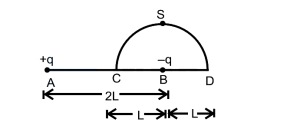
Two charges $+q$ and $-q$ are placed at points $A$ and $B$ respectively, which are at a distance $2L$ apart. $C$ is the midpoint of $A$ and $B$. The work done in moving a charge $+Q$ along the semicircle $CSD$ $(W_1)$ and along the line $CBD$ $(W_2)$ are:
A
$\frac{-Qq}{6 \pi \epsilon_0 L}, \frac{-Qq}{6 \pi \epsilon_0 L}$
B
$\frac{qQ}{4 \pi \epsilon_0 L}, \frac{qQ}{4 \pi \epsilon_0 L}$
C
$\frac{-Qq}{6 \pi \epsilon_0 L}, \frac{-Qq}{12 \pi \epsilon_0 L}$
D
$\frac{qQ}{4 \pi \epsilon_0 L}, 0$
Solution
(A) The work done in moving a charge $Q$ in an electrostatic field is path-independent and depends only on the initial and final positions.
Work done $W = Q(V_{final} - V_{initial})$.
Here, the initial point is $C$ and the final point is $D$.
Distance $AC = L$, $CB = L$, $BD = L$.
Potential at $C$ $(V_C)$: $V_C = \frac{1}{4 \pi \epsilon_0} [\frac{q}{AC} + \frac{-q}{CB}] = \frac{1}{4 \pi \epsilon_0} [\frac{q}{L} - \frac{q}{L}] = 0$.
Potential at $D$ $(V_D)$: $V_D = \frac{1}{4 \pi \epsilon_0} [\frac{q}{AD} + \frac{-q}{BD}] = \frac{1}{4 \pi \epsilon_0} [\frac{q}{3L} - \frac{q}{L}] = \frac{1}{4 \pi \epsilon_0} [\frac{q - 3q}{3L}] = \frac{-2q}{12 \pi \epsilon_0 L} = \frac{-q}{6 \pi \epsilon_0 L}$.
Since the electrostatic force is conservative, the work done along any path from $C$ to $D$ is the same:
$W_1 = W_2 = Q(V_D - V_C) = Q(\frac{-q}{6 \pi \epsilon_0 L} - 0) = \frac{-Qq}{6 \pi \epsilon_0 L}$.
Thus, $W_1 = W_2 = \frac{-Qq}{6 \pi \epsilon_0 L}$.
Work done $W = Q(V_{final} - V_{initial})$.
Here, the initial point is $C$ and the final point is $D$.
Distance $AC = L$, $CB = L$, $BD = L$.
Potential at $C$ $(V_C)$: $V_C = \frac{1}{4 \pi \epsilon_0} [\frac{q}{AC} + \frac{-q}{CB}] = \frac{1}{4 \pi \epsilon_0} [\frac{q}{L} - \frac{q}{L}] = 0$.
Potential at $D$ $(V_D)$: $V_D = \frac{1}{4 \pi \epsilon_0} [\frac{q}{AD} + \frac{-q}{BD}] = \frac{1}{4 \pi \epsilon_0} [\frac{q}{3L} - \frac{q}{L}] = \frac{1}{4 \pi \epsilon_0} [\frac{q - 3q}{3L}] = \frac{-2q}{12 \pi \epsilon_0 L} = \frac{-q}{6 \pi \epsilon_0 L}$.
Since the electrostatic force is conservative, the work done along any path from $C$ to $D$ is the same:
$W_1 = W_2 = Q(V_D - V_C) = Q(\frac{-q}{6 \pi \epsilon_0 L} - 0) = \frac{-Qq}{6 \pi \epsilon_0 L}$.
Thus, $W_1 = W_2 = \frac{-Qq}{6 \pi \epsilon_0 L}$.
0 likesView Solution
27
PhysicsMediumMCQWBJEE · 2025
$A$ particle of charge '$q$' and mass '$m$' moves in a circular orbit of radius '$r$' with angular speed '$\omega$'. The ratio of the magnitude of its magnetic moment to that of its angular momentum depends on
A
$\omega$ and $q$
B
$\omega, q$ and $m$
C
$q$ and $m$
D
$\omega$ and $m$
Solution
(C) The magnetic moment $M$ of a particle of charge $q$ moving in a circular orbit is given by $M = IA$,where $I$ is the current and $A$ is the area of the orbit.
The current $I = \frac{q}{T} = \frac{q\omega}{2\pi}$.
The area $A = \pi r^2$.
Thus,$M = \left(\frac{q\omega}{2\pi}\right)(\pi r^2) = \frac{q\omega r^2}{2}$.
The angular momentum $L$ of the particle is $L = mvr = m(\omega r)r = m\omega r^2$.
The ratio of the magnetic moment to the angular momentum is $\frac{M}{L} = \frac{q\omega r^2 / 2}{m\omega r^2} = \frac{q}{2m}$.
This ratio is known as the gyromagnetic ratio and depends only on the charge '$q$' and mass '$m$' of the particle.
The current $I = \frac{q}{T} = \frac{q\omega}{2\pi}$.
The area $A = \pi r^2$.
Thus,$M = \left(\frac{q\omega}{2\pi}\right)(\pi r^2) = \frac{q\omega r^2}{2}$.
The angular momentum $L$ of the particle is $L = mvr = m(\omega r)r = m\omega r^2$.
The ratio of the magnetic moment to the angular momentum is $\frac{M}{L} = \frac{q\omega r^2 / 2}{m\omega r^2} = \frac{q}{2m}$.
This ratio is known as the gyromagnetic ratio and depends only on the charge '$q$' and mass '$m$' of the particle.
0 likesView Solution
28
PhysicsMediumMCQWBJEE · 2025
Let the binding energy per nucleon of a nucleus be denoted by $E_{bn}$ and the radius of the nucleus be denoted by $r$. If the mass numbers of nuclei $A$ and $B$ are $64$ and $125$ respectively,then:
A
$r_A < r_B$
B
$r_A > r_B$
C
$E_{bnA} > E_{bnB}$
D
$E_{bnA} < E_{bnB}$
Solution
(A, C) The radius of a nucleus is given by the formula $r = R_0 A^{1/3}$,where $R_0$ is a constant and $A$ is the mass number.
Since $A_A = 64$ and $A_B = 125$,we have $r_A = R_0 (64)^{1/3} = 4R_0$ and $r_B = R_0 (125)^{1/3} = 5R_0$.
Thus,$r_A < r_B$.
Regarding binding energy per nucleon $(E_{bn})$,the value of $E_{bn}$ increases with mass number for light nuclei and reaches a maximum near $A = 56$ (Iron). For nuclei with $A > 60$,$E_{bn}$ gradually decreases.
Since $A_A = 64$ is closer to $56$ than $A_B = 125$,the binding energy per nucleon for nucleus $A$ is greater than that for nucleus $B$,i.e.,$E_{bnA} > E_{bnB}$.
Therefore,both options $A$ and $C$ are correct.
Since $A_A = 64$ and $A_B = 125$,we have $r_A = R_0 (64)^{1/3} = 4R_0$ and $r_B = R_0 (125)^{1/3} = 5R_0$.
Thus,$r_A < r_B$.
Regarding binding energy per nucleon $(E_{bn})$,the value of $E_{bn}$ increases with mass number for light nuclei and reaches a maximum near $A = 56$ (Iron). For nuclei with $A > 60$,$E_{bn}$ gradually decreases.
Since $A_A = 64$ is closer to $56$ than $A_B = 125$,the binding energy per nucleon for nucleus $A$ is greater than that for nucleus $B$,i.e.,$E_{bnA} > E_{bnB}$.
Therefore,both options $A$ and $C$ are correct.
0 likesView Solution
29
PhysicsEasyMCQWBJEE · 2025
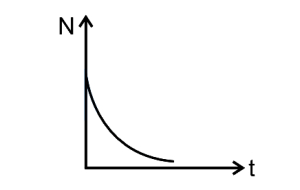
The number of undecayed nuclei $N$ in a sample of radioactive material as a function of time $t$ is shown in the figure. Which of the following graphs correctly shows the relationship between $N$ and the activity $A$?
A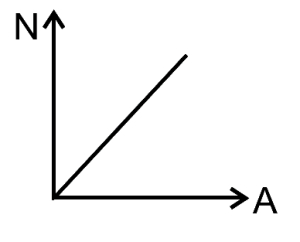
B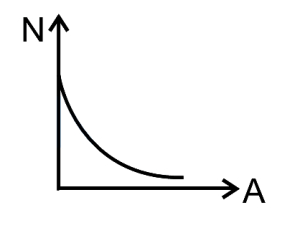
C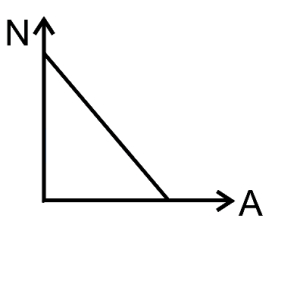
D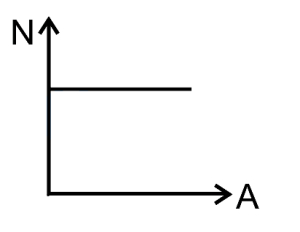
Solution
(A) The law of radioactive decay is given by $N = N_0 e^{-\lambda t}$.
Activity $A$ is defined as the rate of decay of nuclei,given by $A = -\frac{dN}{dt}$.
Differentiating $N$ with respect to $t$,we get:
$\frac{dN}{dt} = -\lambda N_0 e^{-\lambda t} = -\lambda N$.
Therefore,the magnitude of activity is $A = |-\frac{dN}{dt}| = \lambda N$.
This equation $A = \lambda N$ represents a linear relationship between $N$ and $A$,where $\lambda$ is the decay constant.
Since $A$ is directly proportional to $N$ $(A \propto N)$,the graph of $N$ versus $A$ will be a straight line passing through the origin. Thus,option $A$ is correct.
Activity $A$ is defined as the rate of decay of nuclei,given by $A = -\frac{dN}{dt}$.
Differentiating $N$ with respect to $t$,we get:
$\frac{dN}{dt} = -\lambda N_0 e^{-\lambda t} = -\lambda N$.
Therefore,the magnitude of activity is $A = |-\frac{dN}{dt}| = \lambda N$.
This equation $A = \lambda N$ represents a linear relationship between $N$ and $A$,where $\lambda$ is the decay constant.
Since $A$ is directly proportional to $N$ $(A \propto N)$,the graph of $N$ versus $A$ will be a straight line passing through the origin. Thus,option $A$ is correct.
0 likesView Solution
30
PhysicsMediumMCQWBJEE · 2025
$A$ radioactive nucleus decays as follows:
$X \xrightarrow{\alpha} X_1 \xrightarrow{\beta} X_2 \xrightarrow{\alpha} X_3 \xrightarrow{\gamma} X_4$
If the mass number and atomic number of $X_4$ are $172$ and $69$ respectively,then the atomic number and mass number of $X$ are:
$X \xrightarrow{\alpha} X_1 \xrightarrow{\beta} X_2 \xrightarrow{\alpha} X_3 \xrightarrow{\gamma} X_4$
If the mass number and atomic number of $X_4$ are $172$ and $69$ respectively,then the atomic number and mass number of $X$ are:
A
$72, 180$
B
$69, 170$
C
$68, 172$
D
$70, 172$
Solution
(A) Let the initial nucleus be represented as $_Z X^A$.
$1$. An $\alpha$-decay reduces the mass number by $4$ and atomic number by $2$.
$2$. $A$ $\beta$-decay increases the atomic number by $1$ and keeps the mass number unchanged.
$3$. $A$ $\gamma$-decay does not change the mass number or atomic number.
Given the decay chain:
$X(Z, A) \xrightarrow{\alpha} X_1(Z-2, A-4) \xrightarrow{\beta} X_2(Z-1, A-4) \xrightarrow{\alpha} X_3(Z-3, A-8) \xrightarrow{\gamma} X_4(Z-3, A-8)$
Given $X_4$ has atomic number $69$ and mass number $172$:
$Z - 3 = 69 \implies Z = 72$
$A - 8 = 172 \implies A = 180$
Thus,the atomic number and mass number of $X$ are $72$ and $180$ respectively.
$1$. An $\alpha$-decay reduces the mass number by $4$ and atomic number by $2$.
$2$. $A$ $\beta$-decay increases the atomic number by $1$ and keeps the mass number unchanged.
$3$. $A$ $\gamma$-decay does not change the mass number or atomic number.
Given the decay chain:
$X(Z, A) \xrightarrow{\alpha} X_1(Z-2, A-4) \xrightarrow{\beta} X_2(Z-1, A-4) \xrightarrow{\alpha} X_3(Z-3, A-8) \xrightarrow{\gamma} X_4(Z-3, A-8)$
Given $X_4$ has atomic number $69$ and mass number $172$:
$Z - 3 = 69 \implies Z = 72$
$A - 8 = 172 \implies A = 180$
Thus,the atomic number and mass number of $X$ are $72$ and $180$ respectively.
0 likesView Solution
31
PhysicsMediumMCQWBJEE · 2025
The figure shows the graph of the angle of deviation $\delta$ versus the angle of incidence $i$ for a light ray striking a prism. The prism angle $A$ is: (in $^{\circ}$)
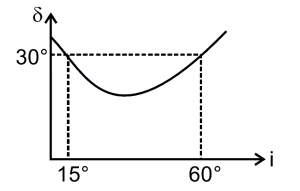
A
$30$
B
$45$
C
$60$
D
$75$
Solution
(B) For a prism,the angle of deviation $\delta$ is given by the formula: $\delta = i + e - A$,where $i$ is the angle of incidence,$e$ is the angle of emergence,and $A$ is the prism angle.
From the graph,we observe that for a deviation $\delta = 30^{\circ}$,there are two possible angles of incidence: $i_1 = 15^{\circ}$ and $i_2 = 60^{\circ}$.
By the principle of reversibility of light,if $i = 15^{\circ}$,then $e = 60^{\circ}$,and if $i = 60^{\circ}$,then $e = 15^{\circ}$.
Substituting these values into the formula: $A = i + e - \delta$.
$A = 15^{\circ} + 60^{\circ} - 30^{\circ}$.
$A = 75^{\circ} - 30^{\circ} = 45^{\circ}$.
Therefore,the prism angle is $45^{\circ}$.
From the graph,we observe that for a deviation $\delta = 30^{\circ}$,there are two possible angles of incidence: $i_1 = 15^{\circ}$ and $i_2 = 60^{\circ}$.
By the principle of reversibility of light,if $i = 15^{\circ}$,then $e = 60^{\circ}$,and if $i = 60^{\circ}$,then $e = 15^{\circ}$.
Substituting these values into the formula: $A = i + e - \delta$.
$A = 15^{\circ} + 60^{\circ} - 30^{\circ}$.
$A = 75^{\circ} - 30^{\circ} = 45^{\circ}$.
Therefore,the prism angle is $45^{\circ}$.
0 likesView Solution
32
PhysicsMediumMCQWBJEE · 2025
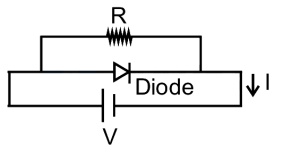
$A$ diode is connected in parallel with a resistance $R$ as shown in the figure. The most probable current $(I)$ - voltage $(V)$ characteristic is:
A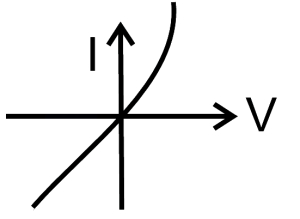
B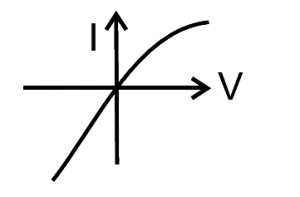
C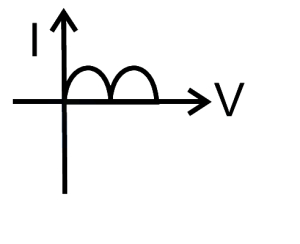
D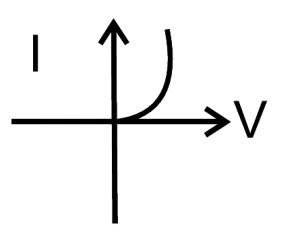
Solution
(A) In the circuit,the diode is in parallel with the resistance $R$.
For $V < 0$ (reverse bias),the diode acts as an open circuit (assuming an ideal diode),so the current flows only through the resistance $R$. According to Ohm's law,$I = V/R$,which is a linear relationship passing through the origin with a negative slope in the third quadrant.
For $V > 0$ (forward bias),the diode conducts after the knee voltage. Before the knee voltage,the current flows through the resistor. After the knee voltage,the diode offers very low resistance,so the total current increases rapidly.
Combining these,the graph shows a linear relationship for $V < 0$ and a non-linear,rapidly increasing current for $V > 0$. Option $A$ correctly represents this behavior.
For $V < 0$ (reverse bias),the diode acts as an open circuit (assuming an ideal diode),so the current flows only through the resistance $R$. According to Ohm's law,$I = V/R$,which is a linear relationship passing through the origin with a negative slope in the third quadrant.
For $V > 0$ (forward bias),the diode conducts after the knee voltage. Before the knee voltage,the current flows through the resistor. After the knee voltage,the diode offers very low resistance,so the total current increases rapidly.
Combining these,the graph shows a linear relationship for $V < 0$ and a non-linear,rapidly increasing current for $V > 0$. Option $A$ correctly represents this behavior.
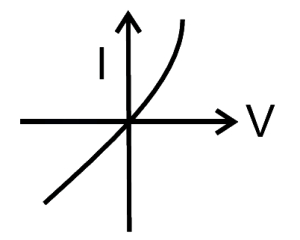
0 likesView Solution
33
PhysicsMediumMCQWBJEE · 2025
Manufacturers supply a zener diode with zener voltage $V_{z}=5.6 \, V$ and maximum power dissipation $P_{z \max }=\frac{1}{4} \, W$. This zener diode is used in the following circuit. Calculate the minimum value of the resistance $R_s$ in the circuit so that the zener diode will not burn when the input voltage is $V_{in}=10 \, V$. (in $\Omega$)
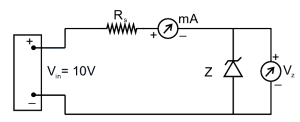
A
$98.56$
B
$170.52$
C
$306.21$
D
$412.37$
Solution
(A) Given:
Zener voltage $V_z = 5.6 \, V$
Maximum power dissipation $P_{z \max} = \frac{1}{4} \, W = 0.25 \, W$
Input voltage $V_{in} = 10 \, V$
The maximum current $I_z$ that the zener diode can handle is given by:
$P_{z \max} = V_z \times I_z$
$0.25 = 5.6 \times I_z$
$I_z = \frac{0.25}{5.6} \, A$
In the circuit, the current through the series resistance $R_s$ is $I_s = I_z$. The voltage drop across the resistance $R_s$ is:
$V_{R_s} = V_{in} - V_z = 10 \, V - 5.6 \, V = 4.4 \, V$
Using Ohm's law for the resistance $R_s$:
$R_s = \frac{V_{R_s}}{I_s} = \frac{4.4}{I_z} = \frac{4.4}{(0.25 / 5.6)}$
$R_s = \frac{4.4 \times 5.6}{0.25} = 4.4 \times 5.6 \times 4 = 98.56 \, \Omega$
Thus, the minimum value of the resistance $R_s$ is $98.56 \, \Omega$.
Zener voltage $V_z = 5.6 \, V$
Maximum power dissipation $P_{z \max} = \frac{1}{4} \, W = 0.25 \, W$
Input voltage $V_{in} = 10 \, V$
The maximum current $I_z$ that the zener diode can handle is given by:
$P_{z \max} = V_z \times I_z$
$0.25 = 5.6 \times I_z$
$I_z = \frac{0.25}{5.6} \, A$
In the circuit, the current through the series resistance $R_s$ is $I_s = I_z$. The voltage drop across the resistance $R_s$ is:
$V_{R_s} = V_{in} - V_z = 10 \, V - 5.6 \, V = 4.4 \, V$
Using Ohm's law for the resistance $R_s$:
$R_s = \frac{V_{R_s}}{I_s} = \frac{4.4}{I_z} = \frac{4.4}{(0.25 / 5.6)}$
$R_s = \frac{4.4 \times 5.6}{0.25} = 4.4 \times 5.6 \times 4 = 98.56 \, \Omega$
Thus, the minimum value of the resistance $R_s$ is $98.56 \, \Omega$.
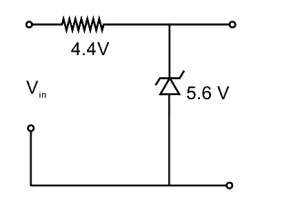
0 likesView Solution
34
PhysicsEasyMCQWBJEE · 2025
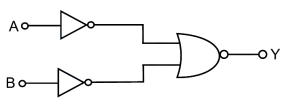
Which logic gate is represented by the following combination of logic gates?
A
$NAND$
B
$AND$
C
$NOR$
D
$OR$
Solution
(B) The given circuit consists of two $NOT$ gates connected to the inputs $A$ and $B$,followed by a $NOR$ gate.
$1$. The outputs of the two $NOT$ gates are $\overline{A}$ and $\overline{B}$.
$2$. These are fed as inputs to a $NOR$ gate.
$3$. The output $Y$ of the $NOR$ gate is given by $Y = \overline{\overline{A} + \overline{B}}$.
$4$. Using De Morgan's theorem,$\overline{\overline{A} + \overline{B}} = \overline{\overline{A}} \cdot \overline{\overline{B}} = A \cdot B$.
$5$. The expression $A \cdot B$ represents the operation of an $AND$ gate.
Therefore,the combination represents an $AND$ gate.
$1$. The outputs of the two $NOT$ gates are $\overline{A}$ and $\overline{B}$.
$2$. These are fed as inputs to a $NOR$ gate.
$3$. The output $Y$ of the $NOR$ gate is given by $Y = \overline{\overline{A} + \overline{B}}$.
$4$. Using De Morgan's theorem,$\overline{\overline{A} + \overline{B}} = \overline{\overline{A}} \cdot \overline{\overline{B}} = A \cdot B$.
$5$. The expression $A \cdot B$ represents the operation of an $AND$ gate.
Therefore,the combination represents an $AND$ gate.
0 likesView Solution
35
PhysicsEasyMCQWBJEE · 2025
$A$ single slit diffraction pattern is obtained using a beam of red light. If the red light is replaced by blue light,then:
A
the diffraction pattern will disappear
B
fringes will become narrower and crowded together
C
fringes will become broader and will be further apart
D
there is no change in the diffraction pattern
Solution
(B) The angular width of the central maximum in a single slit diffraction pattern is given by $\theta = \frac{2\lambda}{a}$,where $\lambda$ is the wavelength of light and $a$ is the slit width.
Since the wavelength of blue light $(\lambda_{blue})$ is smaller than the wavelength of red light $(\lambda_{red})$,the angular width of the diffraction fringes decreases.
Therefore,the fringes become narrower and more crowded together.
Since the wavelength of blue light $(\lambda_{blue})$ is smaller than the wavelength of red light $(\lambda_{red})$,the angular width of the diffraction fringes decreases.
Therefore,the fringes become narrower and more crowded together.
0 likesView Solution
Vedclass Products
For Students
Vedclass Test Series
Mock tests in real WBJEE style covering Physics with performance analysis. 5-day free trial.
Start Free TrialFor Teachers
Exam Paper Generator
Generate Set A/B/C/D Physics papers from 7.5L+ questions in 2 minutes. 3 chapters free.
Try FreeFor Institutes
Online Exam Module
Run live WBJEE mock exams with unlimited students, 360° analytics & white-label branding.
See DemoFrequently Asked Questions
How many Physics questions are in WBJEE 2025?
There are 35 Physics questions from the WBJEE 2025 paper on Vedclass, each with a detailed step-by-step solution in English.
Are WBJEE 2025 Physics solutions available in English?
Yes. All solutions on this page are in English. You can also switch to English or Hindi using the language buttons above the questions.
Can I practice WBJEE 2025 Physics as a timed test?
Yes. Use the Vedclass Test Series to attempt a full WBJEE mock test covering Physics with time limits and instant score analysis.
Can teachers create Physics papers from WBJEE previous year questions?
Yes. The Vedclass Exam Paper Generator lets teachers mix WBJEE Physics questions and generate Set A/B/C/D papers in minutes.
For Teachers & Institutes
Build a Custom Physics Paper
Pick WBJEE 2025 Physics questions, set difficulty, and generate Set A/B/C/D in 2 minutes.