
PhysicsQ1–38 of 38 questions
Page 1 of 1 · English
1
PhysicsEasyMCQWBJEE · 2020
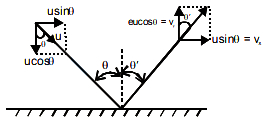
$A$ tennis ball hits the floor with a speed $v$ at an angle $\theta$ with the normal to the floor. If the collision is inelastic and the coefficient of restitution is $\varepsilon$,what will be the angle of reflection?
A
$\tan ^{-1}\left(\frac{\tan \theta}{\varepsilon}\right)$
B
$\sin ^{-1}\left(\frac{\sin \theta}{\varepsilon}\right)$
C
$\theta \varepsilon$
D
$\theta \frac{2 \varepsilon}{\varepsilon+1}$
Solution
(A) Let the velocity of the ball before collision be $v$. The velocity components are $v_x = v \sin \theta$ (parallel to the floor) and $v_y = v \cos \theta$ (perpendicular to the floor).
Since the floor is smooth,there is no impulsive force parallel to the floor,so the tangential component of velocity remains unchanged: $v'_x = v \sin \theta$.
For the normal component,the coefficient of restitution $\varepsilon$ is defined as the ratio of the velocity of separation to the velocity of approach along the normal: $\varepsilon = \frac{v'_y}{v_y}$.
Thus,$v'_y = \varepsilon v_y = \varepsilon v \cos \theta$.
Let $\theta'$ be the angle of reflection with the normal. Then,$\tan \theta' = \frac{v'_x}{v'_y} = \frac{v \sin \theta}{\varepsilon v \cos \theta} = \frac{\tan \theta}{\varepsilon}$.
Therefore,$\theta' = \tan ^{-1}\left(\frac{\tan \theta}{\varepsilon}\right)$.
Since the floor is smooth,there is no impulsive force parallel to the floor,so the tangential component of velocity remains unchanged: $v'_x = v \sin \theta$.
For the normal component,the coefficient of restitution $\varepsilon$ is defined as the ratio of the velocity of separation to the velocity of approach along the normal: $\varepsilon = \frac{v'_y}{v_y}$.
Thus,$v'_y = \varepsilon v_y = \varepsilon v \cos \theta$.
Let $\theta'$ be the angle of reflection with the normal. Then,$\tan \theta' = \frac{v'_x}{v'_y} = \frac{v \sin \theta}{\varepsilon v \cos \theta} = \frac{\tan \theta}{\varepsilon}$.
Therefore,$\theta' = \tan ^{-1}\left(\frac{\tan \theta}{\varepsilon}\right)$.
0 likesView Solution
2
PhysicsDifficultMCQWBJEE · 2020
$A$ metallic block of mass $20 \ kg$ is dragged with a uniform velocity of $0.5 \ ms^{-1}$ on a horizontal table for $2.1 \ s$. The coefficient of kinetic friction between the block and the table is $0.10$. What will be the maximum possible rise in temperature of the metal block if the specific heat of the block is $0.1 \ cal \ g^{-1} \ ^{\circ}C^{-1}$ (in $^{\circ} C$)? Assume $g = 10 \ ms^{-2}$ and a uniform rise in temperature throughout the whole block. [Ignore absorption of heat by the table]
A
$0.0025$
B
$0.025$
C
$0.001$
D
$0.05$
Solution
(A) The work done against friction is converted into heat energy,which raises the temperature of the block.
Given: Mass $m = 20 \ kg = 20000 \ g$,velocity $v = 0.5 \ ms^{-1}$,time $t = 2.1 \ s$,coefficient of friction $\mu = 0.1$,specific heat $c = 0.1 \ cal \ g^{-1} \ ^{\circ}C^{-1} = 0.1 \times 4.2 \ J \ g^{-1} \ ^{\circ}C^{-1} = 0.42 \ J \ g^{-1} \ ^{\circ}C^{-1}$.
Frictional force $f = \mu mg = 0.1 \times 20 \times 10 = 20 \ N$.
Work done against friction $W = f \times d = f \times (v \times t) = 20 \times 0.5 \times 2.1 = 21 \ J$.
Heat energy $Q = mc \Delta T$.
Since $W = Q$,we have $21 = 20000 \times 0.42 \times \Delta T$.
$\Delta T = \frac{21}{20000 \times 0.42} = \frac{21}{8400} = 0.0025^{\circ} C$.
Given: Mass $m = 20 \ kg = 20000 \ g$,velocity $v = 0.5 \ ms^{-1}$,time $t = 2.1 \ s$,coefficient of friction $\mu = 0.1$,specific heat $c = 0.1 \ cal \ g^{-1} \ ^{\circ}C^{-1} = 0.1 \times 4.2 \ J \ g^{-1} \ ^{\circ}C^{-1} = 0.42 \ J \ g^{-1} \ ^{\circ}C^{-1}$.
Frictional force $f = \mu mg = 0.1 \times 20 \times 10 = 20 \ N$.
Work done against friction $W = f \times d = f \times (v \times t) = 20 \times 0.5 \times 2.1 = 21 \ J$.
Heat energy $Q = mc \Delta T$.
Since $W = Q$,we have $21 = 20000 \times 0.42 \times \Delta T$.
$\Delta T = \frac{21}{20000 \times 0.42} = \frac{21}{8400} = 0.0025^{\circ} C$.
0 likesView Solution
3
PhysicsDifficultMCQWBJEE · 2020
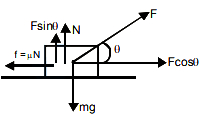
$A$ block of mass $m$ rests on a horizontal table with a coefficient of static friction $\mu$. What minimum force must be applied on the block to drag it on the table?
A
$\frac{\mu}{\sqrt{1+\mu^{2}}} mg$
B
$\frac{\mu-1}{\mu+1} mg$
C
$\frac{\mu}{\sqrt{1-\mu^{2}}} mg$
D
$\mu mg$
Solution
(A) Let a force $F$ be applied at an angle $\theta$ with the horizontal.
Resolving the forces,the vertical equilibrium gives: $N + F \sin \theta = mg$,so $N = mg - F \sin \theta$.
The horizontal force required to overcome friction is: $F \cos \theta = f_s = \mu N$.
Substituting $N$: $F \cos \theta = \mu (mg - F \sin \theta)$.
Rearranging for $F$: $F (\cos \theta + \mu \sin \theta) = \mu mg$,which gives $F = \frac{\mu mg}{\cos \theta + \mu \sin \theta}$.
To find the minimum force $F$,we maximize the denominator $D = \cos \theta + \mu \sin \theta$.
Setting the derivative with respect to $\theta$ to zero: $\frac{dD}{d\theta} = -\sin \theta + \mu \cos \theta = 0$.
This implies $\tan \theta = \mu$.
Using the identity $\cos \theta + \mu \sin \theta = \sqrt{1+\mu^2} \sin(\theta + \alpha)$ where $\tan \alpha = 1/\mu$,or simply substituting $\sin \theta = \frac{\mu}{\sqrt{1+\mu^2}}$ and $\cos \theta = \frac{1}{\sqrt{1+\mu^2}}$ into the expression for $F$:
$F_{\min} = \frac{\mu mg}{\frac{1}{\sqrt{1+\mu^2}} + \mu \frac{\mu}{\sqrt{1+\mu^2}}} = \frac{\mu mg}{\frac{1+\mu^2}{\sqrt{1+\mu^2}}} = \frac{\mu mg}{\sqrt{1+\mu^2}}$.
Resolving the forces,the vertical equilibrium gives: $N + F \sin \theta = mg$,so $N = mg - F \sin \theta$.
The horizontal force required to overcome friction is: $F \cos \theta = f_s = \mu N$.
Substituting $N$: $F \cos \theta = \mu (mg - F \sin \theta)$.
Rearranging for $F$: $F (\cos \theta + \mu \sin \theta) = \mu mg$,which gives $F = \frac{\mu mg}{\cos \theta + \mu \sin \theta}$.
To find the minimum force $F$,we maximize the denominator $D = \cos \theta + \mu \sin \theta$.
Setting the derivative with respect to $\theta$ to zero: $\frac{dD}{d\theta} = -\sin \theta + \mu \cos \theta = 0$.
This implies $\tan \theta = \mu$.
Using the identity $\cos \theta + \mu \sin \theta = \sqrt{1+\mu^2} \sin(\theta + \alpha)$ where $\tan \alpha = 1/\mu$,or simply substituting $\sin \theta = \frac{\mu}{\sqrt{1+\mu^2}}$ and $\cos \theta = \frac{1}{\sqrt{1+\mu^2}}$ into the expression for $F$:
$F_{\min} = \frac{\mu mg}{\frac{1}{\sqrt{1+\mu^2}} + \mu \frac{\mu}{\sqrt{1+\mu^2}}} = \frac{\mu mg}{\frac{1+\mu^2}{\sqrt{1+\mu^2}}} = \frac{\mu mg}{\sqrt{1+\mu^2}}$.
0 likesView Solution
4
PhysicsEasyMCQWBJEE · 2020
Which of the following diagrams correctly shows the relation between the terminal velocity $v_{T}$ of a spherical body falling in a liquid and viscosity $\eta$ of the liquid?
A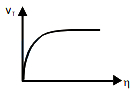
B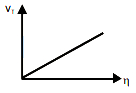
C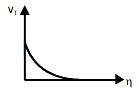
D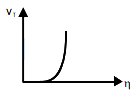
Solution
(C) The terminal velocity $v_{T}$ of a spherical body of radius $r$ and density $\rho_{s}$ falling through a liquid of density $\rho_{L}$ and viscosity $\eta$ is given by the formula:
$v_{T} = \frac{2r^{2}(\rho_{s} - \rho_{L})g}{9\eta}$
Assuming all other factors $(r, \rho_{s}, \rho_{L}, g)$ are constant,the relation between terminal velocity and viscosity is:
$v_{T} \propto \frac{1}{\eta}$
This represents a rectangular hyperbola,where $v_{T}$ decreases as $\eta$ increases. Therefore,the correct graph is the one showing an inverse relationship.
$v_{T} = \frac{2r^{2}(\rho_{s} - \rho_{L})g}{9\eta}$
Assuming all other factors $(r, \rho_{s}, \rho_{L}, g)$ are constant,the relation between terminal velocity and viscosity is:
$v_{T} \propto \frac{1}{\eta}$
This represents a rectangular hyperbola,where $v_{T}$ decreases as $\eta$ increases. Therefore,the correct graph is the one showing an inverse relationship.
0 likesView Solution
5
PhysicsMediumMCQWBJEE · 2020
$A$ fighter plane,flying horizontally with a speed of $360 \text{ km/h}$ at an altitude of $500 \text{ m}$,drops a bomb for a target straight ahead of it on the ground. At what approximate distance ahead of the target should the bomb be dropped? Assume that acceleration due to gravity $g = 10 \text{ m/s}^2$. Neglect air drag.
A
$1000 \text{ m}$
B
$50 \sqrt{5} \text{ m}$
C
$500 \sqrt{5} \text{ m}$
D
$866 \text{ m}$
Solution
(A) Given:
Horizontal velocity of the plane,$u = 360 \text{ km/h} = 360 \times \frac{5}{18} \text{ m/s} = 100 \text{ m/s}$.
Altitude (vertical height),$h = 500 \text{ m}$.
Acceleration due to gravity,$g = 10 \text{ m/s}^2$.
When the bomb is dropped,it follows a projectile path. The time taken to reach the ground is given by $t = \sqrt{\frac{2h}{g}}$.
$t = \sqrt{\frac{2 \times 500}{10}} = \sqrt{100} = 10 \text{ s}$.
The horizontal distance covered by the bomb during this time is $R = u \times t$.
$R = 100 \text{ m/s} \times 10 \text{ s} = 1000 \text{ m}$.
Therefore,the bomb should be dropped at a distance of $1000 \text{ m}$ ahead of the target.
Horizontal velocity of the plane,$u = 360 \text{ km/h} = 360 \times \frac{5}{18} \text{ m/s} = 100 \text{ m/s}$.
Altitude (vertical height),$h = 500 \text{ m}$.
Acceleration due to gravity,$g = 10 \text{ m/s}^2$.
When the bomb is dropped,it follows a projectile path. The time taken to reach the ground is given by $t = \sqrt{\frac{2h}{g}}$.
$t = \sqrt{\frac{2 \times 500}{10}} = \sqrt{100} = 10 \text{ s}$.
The horizontal distance covered by the bomb during this time is $R = u \times t$.
$R = 100 \text{ m/s} \times 10 \text{ s} = 1000 \text{ m}$.
Therefore,the bomb should be dropped at a distance of $1000 \text{ m}$ ahead of the target.
0 likesView Solution
6
PhysicsMediumMCQWBJEE · 2020
Two metallic spheres of equal outer radii are found to have the same moment of inertia about their respective diameters. Which of the following statement$(s)$ is/are true?
A
The two spheres have equal masses.
B
The ratio of their masses is nearly $1.67: 1$.
C
The spheres are made of different materials.
D
Their rotational kinetic energies will be equal when rotated with equal uniform angular speed about their respective diameters.
Solution
(D) The moment of inertia $(I)$ of a sphere about its diameter is given by $I = \frac{2}{5}MR^2$,where $M$ is the mass and $R$ is the radius.
Since the spheres have equal outer radii $(R_1 = R_2 = R)$ and equal moments of inertia $(I_1 = I_2)$,it follows that $\frac{2}{5}M_1R^2 = \frac{2}{5}M_2R^2$,which implies $M_1 = M_2$.
However,if the spheres are hollow or have different internal structures,they could have the same moment of inertia despite different masses if their mass distributions differ.
Given the problem states they have the same moment of inertia,the rotational kinetic energy $(K_r)$ is defined as $K_r = \frac{1}{2}I\omega^2$.
Since $I_1 = I_2$ and both are rotated with the same angular speed $(\omega_1 = \omega_2 = \omega)$,their rotational kinetic energies must be equal $(K_{r1} = K_{r2} = \frac{1}{2}I\omega^2)$.
Thus,option $(D)$ is the correct statement.
Since the spheres have equal outer radii $(R_1 = R_2 = R)$ and equal moments of inertia $(I_1 = I_2)$,it follows that $\frac{2}{5}M_1R^2 = \frac{2}{5}M_2R^2$,which implies $M_1 = M_2$.
However,if the spheres are hollow or have different internal structures,they could have the same moment of inertia despite different masses if their mass distributions differ.
Given the problem states they have the same moment of inertia,the rotational kinetic energy $(K_r)$ is defined as $K_r = \frac{1}{2}I\omega^2$.
Since $I_1 = I_2$ and both are rotated with the same angular speed $(\omega_1 = \omega_2 = \omega)$,their rotational kinetic energies must be equal $(K_{r1} = K_{r2} = \frac{1}{2}I\omega^2)$.
Thus,option $(D)$ is the correct statement.
0 likesView Solution
7
PhysicsMediumMCQWBJEE · 2020
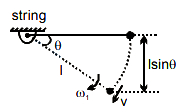
$A$ simple pendulum of length $\ell$ is displaced so that its taut string is horizontal and then released. $A$ uniform bar of length $L$ pivoted at one end is simultaneously released from its horizontal position. If their motions are synchronous (i.e.,they have the same angular velocity at any angle $\theta$ below the horizontal),what is the length $L$ of the bar?
A
$\frac{3 \ell}{2}$
B
$\ell$
C
$2 \ell$
D
$\frac{2 \ell}{3}$
Solution
(A) For a simple pendulum of length $\ell$,the angular velocity $\omega_1$ at an angle $\theta$ below the horizontal is derived from energy conservation: $mg(\ell \sin \theta) = \frac{1}{2} m v^2 = \frac{1}{2} m (\omega_1 \ell)^2$. Thus,$\omega_1 = \sqrt{\frac{2g \sin \theta}{\ell}}$.
For a uniform bar of length $L$ pivoted at one end,the moment of inertia is $I = \frac{1}{3} m L^2$. The potential energy lost when it rotates by angle $\theta$ is $mg(\frac{L}{2} \sin \theta)$. By energy conservation: $mg(\frac{L}{2} \sin \theta) = \frac{1}{2} I \omega_2^2 = \frac{1}{2} (\frac{1}{3} m L^2) \omega_2^2$. Simplifying gives $\omega_2 = \sqrt{\frac{3g \sin \theta}{L}}$.
Since the motions are synchronous,$\omega_1 = \omega_2$,so $\frac{2}{\ell} = \frac{3}{L}$.
Therefore,$L = \frac{3}{2} \ell$.
For a uniform bar of length $L$ pivoted at one end,the moment of inertia is $I = \frac{1}{3} m L^2$. The potential energy lost when it rotates by angle $\theta$ is $mg(\frac{L}{2} \sin \theta)$. By energy conservation: $mg(\frac{L}{2} \sin \theta) = \frac{1}{2} I \omega_2^2 = \frac{1}{2} (\frac{1}{3} m L^2) \omega_2^2$. Simplifying gives $\omega_2 = \sqrt{\frac{3g \sin \theta}{L}}$.
Since the motions are synchronous,$\omega_1 = \omega_2$,so $\frac{2}{\ell} = \frac{3}{L}$.
Therefore,$L = \frac{3}{2} \ell$.
0 likesView Solution
8
PhysicsMediumMCQWBJEE · 2020
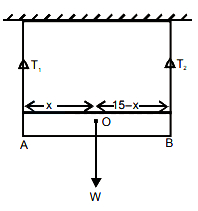
$A$ steel and a brass wire, each of length $50 \,cm$ and cross-sectional area $0.005 \,cm^{2}$, hang from a ceiling and are $15 \,cm$ apart. Lower ends of the wires are attached to a light horizontal bar. $A$ suitable downward load is applied to the bar so that each of the wires extends in length by $0.1 \,cm$. At what distance from the steel wire must the load be applied (in $\,cm$)? [Young's modulus of steel is $2 \times 10^{12} \,dynes/cm^{2}$ and that of brass is $1 \times 10^{12} \,dynes/cm^{2}$]
A
$7.5$
B
$5$
C
$10$
D
$3$
Solution
(B) Let $Y_s$ and $Y_b$ be the Young's modulus of steel and brass respectively. Given $Y_s = 2 \times 10^{12} \,dynes/cm^{2}$ and $Y_b = 1 \times 10^{12} \,dynes/cm^{2}$.
Let $L = 50 \,cm$ be the length, $A = 0.005 \,cm^{2}$ be the cross-sectional area, and $\Delta L = 0.1 \,cm$ be the extension for both wires.
The tension $T$ in a wire is given by $T = \frac{Y A \Delta L}{L}$.
Since $A, \Delta L,$ and $L$ are the same for both wires, the tension $T$ is directly proportional to the Young's modulus $Y$ $(T \propto Y)$.
Let $T_s$ be the tension in the steel wire and $T_b$ be the tension in the brass wire.
$T_s = \frac{Y_s A \Delta L}{L}$ and $T_b = \frac{Y_b A \Delta L}{L}$.
Taking torque about the point where the load $W$ is applied at a distance $x$ from the steel wire:
$T_s \cdot x = T_b \cdot (15 - x)$.
Substituting the proportionality $T_s \propto Y_s$ and $T_b \propto Y_b$:
$Y_s \cdot x = Y_b \cdot (15 - x)$.
$(2 \times 10^{12}) \cdot x = (1 \times 10^{12}) \cdot (15 - x)$.
$2x = 15 - x$.
$3x = 15$.
$x = 5 \,cm$.
Let $L = 50 \,cm$ be the length, $A = 0.005 \,cm^{2}$ be the cross-sectional area, and $\Delta L = 0.1 \,cm$ be the extension for both wires.
The tension $T$ in a wire is given by $T = \frac{Y A \Delta L}{L}$.
Since $A, \Delta L,$ and $L$ are the same for both wires, the tension $T$ is directly proportional to the Young's modulus $Y$ $(T \propto Y)$.
Let $T_s$ be the tension in the steel wire and $T_b$ be the tension in the brass wire.
$T_s = \frac{Y_s A \Delta L}{L}$ and $T_b = \frac{Y_b A \Delta L}{L}$.
Taking torque about the point where the load $W$ is applied at a distance $x$ from the steel wire:
$T_s \cdot x = T_b \cdot (15 - x)$.
Substituting the proportionality $T_s \propto Y_s$ and $T_b \propto Y_b$:
$Y_s \cdot x = Y_b \cdot (15 - x)$.
$(2 \times 10^{12}) \cdot x = (1 \times 10^{12}) \cdot (15 - x)$.
$2x = 15 - x$.
$3x = 15$.
$x = 5 \,cm$.
0 likesView Solution
9
PhysicsMediumMCQWBJEE · 2020
When $100 \ g$ of boiling water at $100^{\circ} C$ is added into a calorimeter containing $300 \ g$ of cold water at $10^{\circ} C$,the temperature of the mixture becomes $20^{\circ} C$. Then,a metallic block of mass $1 \ kg$ at $10^{\circ} C$ is dipped into the mixture in the calorimeter. After reaching thermal equilibrium,the final temperature becomes $19^{\circ} C$. What is the specific heat of the metal in $C$.$G$.$S$. units?
A
$0.01$
B
$0.3$
C
$0.09$
D
$0.1$
Solution
(D) Let $W$ be the water equivalent of the calorimeter in $g$.
Step $1$: Heat lost by hot water = Heat gained by cold water + Heat gained by calorimeter.
$100 \times 1 \times (100 - 20) = 300 \times 1 \times (20 - 10) + W \times 1 \times (20 - 10)$
$8000 = 3000 + 10W$
$10W = 5000 \implies W = 500 \ g$.
Step $2$: Heat lost by mixture = Heat gained by metallic block.
Mass of mixture = $100 \ g + 300 \ g = 400 \ g$.
Heat lost by mixture and calorimeter = $(400 \times 1 + 500) \times (20 - 19) = 900 \times 1 = 900 \ cal$.
Heat gained by metallic block = $m \times S_b \times \Delta T = 1000 \ g \times S_b \times (19 - 10) = 9000 \times S_b$.
Equating the two: $9000 \times S_b = 900$.
$S_b = 0.1 \ cal/g^{\circ} C$.
Step $1$: Heat lost by hot water = Heat gained by cold water + Heat gained by calorimeter.
$100 \times 1 \times (100 - 20) = 300 \times 1 \times (20 - 10) + W \times 1 \times (20 - 10)$
$8000 = 3000 + 10W$
$10W = 5000 \implies W = 500 \ g$.
Step $2$: Heat lost by mixture = Heat gained by metallic block.
Mass of mixture = $100 \ g + 300 \ g = 400 \ g$.
Heat lost by mixture and calorimeter = $(400 \times 1 + 500) \times (20 - 19) = 900 \times 1 = 900 \ cal$.
Heat gained by metallic block = $m \times S_b \times \Delta T = 1000 \ g \times S_b \times (19 - 10) = 9000 \times S_b$.
Equating the two: $9000 \times S_b = 900$.
$S_b = 0.1 \ cal/g^{\circ} C$.
0 likesView Solution
10
PhysicsMediumMCQWBJEE · 2020
Consider an engine that absorbs $130 \text{ cal}$ of heat from a hot reservoir and delivers $30 \text{ cal}$ of heat to a cold reservoir in each cycle. The engine also consumes $2 \text{ J}$ of energy in each cycle to overcome friction. If the engine works at $90 \text{ cycles per minute}$, what will be the maximum power delivered to the load (in $\text{ W}$)? [Assume the thermal equivalent of heat is $4.2 \text{ J/cal}$]
A
$816$
B
$819$
C
$627$
D
$630$
Solution
(C) The heat absorbed per cycle is $Q_H = 130 \text{ cal}$.
The heat rejected per cycle is $Q_C = 30 \text{ cal}$.
The net heat converted to work per cycle is $W_{\text{net}} = (Q_H - Q_C) \times 4.2 \text{ J/cal} = (130 - 30) \times 4.2 = 100 \times 4.2 = 420 \text{ J}$.
The energy consumed to overcome friction per cycle is $W_f = 2 \text{ J}$.
The useful work delivered to the load per cycle is $W_{\text{load}} = W_{\text{net}} - W_f = 420 \text{ J} - 2 \text{ J} = 418 \text{ J}$.
The engine operates at $90 \text{ cycles per minute}$, which is $90/60 = 1.5 \text{ cycles per second}$.
The power delivered to the load is $P = W_{\text{load}} \times \text{frequency} = 418 \text{ J} \times 1.5 \text{ s}^{-1} = 627 \text{ W}$.
The heat rejected per cycle is $Q_C = 30 \text{ cal}$.
The net heat converted to work per cycle is $W_{\text{net}} = (Q_H - Q_C) \times 4.2 \text{ J/cal} = (130 - 30) \times 4.2 = 100 \times 4.2 = 420 \text{ J}$.
The energy consumed to overcome friction per cycle is $W_f = 2 \text{ J}$.
The useful work delivered to the load per cycle is $W_{\text{load}} = W_{\text{net}} - W_f = 420 \text{ J} - 2 \text{ J} = 418 \text{ J}$.
The engine operates at $90 \text{ cycles per minute}$, which is $90/60 = 1.5 \text{ cycles per second}$.
The power delivered to the load is $P = W_{\text{load}} \times \text{frequency} = 418 \text{ J} \times 1.5 \text{ s}^{-1} = 627 \text{ W}$.
0 likesView Solution
11
PhysicsMediumMCQWBJEE · 2020
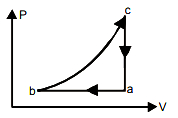
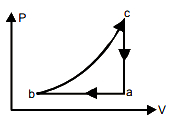
An ideal gas undergoes the cyclic process $abca$ as shown in the given $P-V$ diagram. It rejects $50 \,J$ of heat during $ab$ and absorbs $80 \,J$ of heat during $ca$. During $bc$, there is no transfer of heat and $40 \,J$ of work is done by the gas. What should be the area of the closed curve $abca$ (in $\,J$)?
A
$30$
B
$40$
C
$10$
D
$90$
Solution
(A) For a cyclic process, the change in internal energy $\Delta U$ over the complete cycle is zero.
According to the first law of thermodynamics, $\Delta Q = \Delta U + W$.
For the complete cycle $abca$, $\Delta U_{net} = 0$, so $\Delta Q_{net} = W_{net}$.
The net heat exchanged is $\Delta Q_{net} = \Delta Q_{ab} + \Delta Q_{bc} + \Delta Q_{ca}$.
Given:
$\Delta Q_{ab} = -50 \,J$ (heat rejected)
$\Delta Q_{bc} = 0 \,J$ (adiabatic process)
$\Delta Q_{ca} = 80 \,J$ (heat absorbed)
Thus, $\Delta Q_{net} = -50 + 0 + 80 = 30 \,J$.
Since $\Delta Q_{net} = W_{net}$, the net work done by the gas in the cycle is $30 \,J$.
The area enclosed by the $P-V$ diagram represents the net work done in the cycle.
Therefore, the area of the closed curve $abca$ is $30 \,J$.
According to the first law of thermodynamics, $\Delta Q = \Delta U + W$.
For the complete cycle $abca$, $\Delta U_{net} = 0$, so $\Delta Q_{net} = W_{net}$.
The net heat exchanged is $\Delta Q_{net} = \Delta Q_{ab} + \Delta Q_{bc} + \Delta Q_{ca}$.
Given:
$\Delta Q_{ab} = -50 \,J$ (heat rejected)
$\Delta Q_{bc} = 0 \,J$ (adiabatic process)
$\Delta Q_{ca} = 80 \,J$ (heat absorbed)
Thus, $\Delta Q_{net} = -50 + 0 + 80 = 30 \,J$.
Since $\Delta Q_{net} = W_{net}$, the net work done by the gas in the cycle is $30 \,J$.
The area enclosed by the $P-V$ diagram represents the net work done in the cycle.
Therefore, the area of the closed curve $abca$ is $30 \,J$.
0 likesView Solution
12
PhysicsMediumMCQWBJEE · 2020
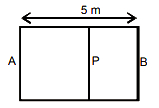
$A$ container $AB$ in the shape of a rectangular parallelepiped of length $5 \,m$ is divided internally by a movable partition $P$ as shown in the figure. The left compartment is filled with a given mass $m$ of an ideal gas of molar mass $M_1 = 32$ while the right compartment is filled with an equal mass $m$ of another ideal gas of molar mass $M_2 = 18$ at the same temperature. What will be the distance of $P$ from the left wall $A$ when equilibrium is established (in $\,m$)?
A
$2.5$
B
$1.8$
C
$3.2$
D
$2.1$
Solution
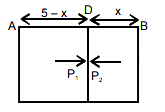
(B) At equilibrium, the pressure $P_1$ and $P_2$ on both sides of the partition must be equal $(P_1 = P_2)$, and the temperature $T$ is the same for both gases.
Let $A$ be the cross-sectional area of the container. Let $x$ be the distance of the partition $P$ from the right wall $B$. Then the distance from the left wall $A$ is $(5 - x)$.
The volume of the left compartment is $V_1 = A(5 - x)$ and the volume of the right compartment is $V_2 = Ax$.
Using the ideal gas equation $PV = nRT = (m/M)RT$, where $m$ is the mass and $M$ is the molar mass:
For the left side: $P_1 V_1 = (m/32)RT$
For the right side: $P_2 V_2 = (m/18)RT$
Since $P_1 = P_2$ and $T$ is constant, we have $\frac{V_1}{V_2} = \frac{m/32}{m/18} = \frac{18}{32} = \frac{9}{16}$.
Substituting the volumes: $\frac{A(5 - x)}{Ax} = \frac{9}{16} \implies \frac{5 - x}{x} = \frac{9}{16}$.
$16(5 - x) = 9x \implies 80 - 16x = 9x \implies 25x = 80 \implies x = 3.2 \,m$.
The distance from the left wall $A$ is $5 - x = 5 - 3.2 = 1.8 \,m$.
Let $A$ be the cross-sectional area of the container. Let $x$ be the distance of the partition $P$ from the right wall $B$. Then the distance from the left wall $A$ is $(5 - x)$.
The volume of the left compartment is $V_1 = A(5 - x)$ and the volume of the right compartment is $V_2 = Ax$.
Using the ideal gas equation $PV = nRT = (m/M)RT$, where $m$ is the mass and $M$ is the molar mass:
For the left side: $P_1 V_1 = (m/32)RT$
For the right side: $P_2 V_2 = (m/18)RT$
Since $P_1 = P_2$ and $T$ is constant, we have $\frac{V_1}{V_2} = \frac{m/32}{m/18} = \frac{18}{32} = \frac{9}{16}$.
Substituting the volumes: $\frac{A(5 - x)}{Ax} = \frac{9}{16} \implies \frac{5 - x}{x} = \frac{9}{16}$.
$16(5 - x) = 9x \implies 80 - 16x = 9x \implies 25x = 80 \implies x = 3.2 \,m$.
The distance from the left wall $A$ is $5 - x = 5 - 3.2 = 1.8 \,m$.
0 likesView Solution
13
PhysicsMediumMCQWBJEE · 2020
The bob of a swinging seconds pendulum (one whose time period is $2 \,s$) has a small speed $v_{0}$ at its lowest point. Its height from this lowest point $2.25 \,s$ after passing through it is given by
A
$\frac{v_{0}^{2}}{2 \,g}$
B
$\frac{v_{0}^{2}}{g}$
C
$\frac{v_{0}^{2}}{4 g}$
D
$\frac{9 v_{0}^{2}}{4 g}$
Solution
(C) The time period of the pendulum is $T = 2 \,s$. The angular frequency is $\omega = \frac{2 \pi}{T} = \pi \,rad/s$.
At the lowest point,the displacement is $x = 0$,so the equation of motion is $x(t) = A \sin(\omega t)$,where $A$ is the amplitude.
The velocity at any time $t$ is $v(t) = \frac{dx}{dt} = A \omega \cos(\omega t)$.
At $t = 0$,$v(0) = v_{0} = A \omega$,so $A = \frac{v_{0}}{\omega}$.
We need the height $h$ at $t = 2.25 \,s$. Since $T = 2 \,s$,$t = 2.25 \,s = T + 0.25 \,s = T + \frac{T}{8}$.
At $t = \frac{T}{8} = 0.25 \,s$,the velocity is $v = v_{0} \cos(\omega \cdot \frac{T}{8}) = v_{0} \cos(\frac{2 \pi}{T} \cdot \frac{T}{8}) = v_{0} \cos(\frac{\pi}{4}) = \frac{v_{0}}{\sqrt{2}}$.
Using the principle of conservation of mechanical energy: $\frac{1}{2} m v_{0}^{2} = \frac{1}{2} m v^{2} + mgh$.
Substituting $v = \frac{v_{0}}{\sqrt{2}}$,we get $\frac{1}{2} v_{0}^{2} = \frac{1}{2} (\frac{v_{0}}{\sqrt{2}})^{2} + gh$.
$\frac{1}{2} v_{0}^{2} = \frac{1}{4} v_{0}^{2} + gh$.
$gh = \frac{1}{4} v_{0}^{2} \implies h = \frac{v_{0}^{2}}{4g}$.
At the lowest point,the displacement is $x = 0$,so the equation of motion is $x(t) = A \sin(\omega t)$,where $A$ is the amplitude.
The velocity at any time $t$ is $v(t) = \frac{dx}{dt} = A \omega \cos(\omega t)$.
At $t = 0$,$v(0) = v_{0} = A \omega$,so $A = \frac{v_{0}}{\omega}$.
We need the height $h$ at $t = 2.25 \,s$. Since $T = 2 \,s$,$t = 2.25 \,s = T + 0.25 \,s = T + \frac{T}{8}$.
At $t = \frac{T}{8} = 0.25 \,s$,the velocity is $v = v_{0} \cos(\omega \cdot \frac{T}{8}) = v_{0} \cos(\frac{2 \pi}{T} \cdot \frac{T}{8}) = v_{0} \cos(\frac{\pi}{4}) = \frac{v_{0}}{\sqrt{2}}$.
Using the principle of conservation of mechanical energy: $\frac{1}{2} m v_{0}^{2} = \frac{1}{2} m v^{2} + mgh$.
Substituting $v = \frac{v_{0}}{\sqrt{2}}$,we get $\frac{1}{2} v_{0}^{2} = \frac{1}{2} (\frac{v_{0}}{\sqrt{2}})^{2} + gh$.
$\frac{1}{2} v_{0}^{2} = \frac{1}{4} v_{0}^{2} + gh$.
$gh = \frac{1}{4} v_{0}^{2} \implies h = \frac{v_{0}^{2}}{4g}$.
0 likesView Solution
14
PhysicsDifficultMCQWBJEE · 2020
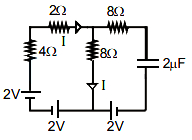
Consider the circuit shown. If all the cells have negligible internal resistance,what will be the current through the $2 \Omega$ resistor when steady state is reached (in $A$)?
A
$0.66$
B
$0.29$
C
$0$
D
$0.14$
Solution
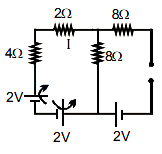
(B) In a steady state,the capacitor acts as an open circuit,meaning no current flows through the branch containing the capacitor.
Let the current in the left loop be $I$. The circuit simplifies to a single loop consisting of the $2 \ V$ cell,the $2 \ V$ cell,the $4 \ \Omega$ resistor,the $2 \ \Omega$ resistor,and the $8 \ \Omega$ resistor in series.
Applying Kirchhoff's Voltage Law $(KVL)$ to the loop:
$2 \ V + 2 \ V - I(4 \ \Omega + 2 \ \Omega + 8 \ \Omega) = 0$
$4 \ V = I(14 \ \Omega)$
$I = \frac{4 \ V}{14 \ \Omega} = \frac{2}{7} \ A \approx 0.2857 \ A \approx 0.29 \ A$.
Thus,the current through the $2 \ \Omega$ resistor is approximately $0.29 \ A$.
Let the current in the left loop be $I$. The circuit simplifies to a single loop consisting of the $2 \ V$ cell,the $2 \ V$ cell,the $4 \ \Omega$ resistor,the $2 \ \Omega$ resistor,and the $8 \ \Omega$ resistor in series.
Applying Kirchhoff's Voltage Law $(KVL)$ to the loop:
$2 \ V + 2 \ V - I(4 \ \Omega + 2 \ \Omega + 8 \ \Omega) = 0$
$4 \ V = I(14 \ \Omega)$
$I = \frac{4 \ V}{14 \ \Omega} = \frac{2}{7} \ A \approx 0.2857 \ A \approx 0.29 \ A$.
Thus,the current through the $2 \ \Omega$ resistor is approximately $0.29 \ A$.
0 likesView Solution
15
PhysicsMediumMCQWBJEE · 2020
If $R$ is the Rydberg constant in $cm^{-1}$,then the hydrogen atom does not emit any radiation of wavelength in the range of
A
$\frac{1}{R}$ to $\frac{4}{3R} \ cm$
B
$\frac{7}{5R}$ to $\frac{19}{5R} \ cm$
C
$\frac{4}{R}$ to $\frac{36}{5R} \ cm$
D
$\frac{9}{R}$ to $\frac{144}{7R} \ cm$
Solution
(B) The wavelength $\lambda$ of radiation emitted by a hydrogen atom is given by the Rydberg formula: $\frac{1}{\lambda} = R \left[ \frac{1}{n_f^2} - \frac{1}{n_i^2} \right]$.
For each spectral series,the range of wavelengths is determined by the transition from $n_i = n_f + 1$ to $n_i = \infty$.
$1$. Lyman series $(n_f = 1)$: $\lambda$ ranges from $\frac{1}{R}$ to $\frac{4}{3R}$.
$2$. Balmer series $(n_f = 2)$: $\lambda$ ranges from $\frac{4}{R}$ to $\frac{36}{5R}$.
$3$. Paschen series $(n_f = 3)$: $\lambda$ ranges from $\frac{9}{R}$ to $\frac{144}{7R}$.
Comparing the given options,the range $\frac{7}{5R}$ to $\frac{19}{5R}$ does not correspond to any of the spectral series of the hydrogen atom.
For each spectral series,the range of wavelengths is determined by the transition from $n_i = n_f + 1$ to $n_i = \infty$.
$1$. Lyman series $(n_f = 1)$: $\lambda$ ranges from $\frac{1}{R}$ to $\frac{4}{3R}$.
$2$. Balmer series $(n_f = 2)$: $\lambda$ ranges from $\frac{4}{R}$ to $\frac{36}{5R}$.
$3$. Paschen series $(n_f = 3)$: $\lambda$ ranges from $\frac{9}{R}$ to $\frac{144}{7R}$.
Comparing the given options,the range $\frac{7}{5R}$ to $\frac{19}{5R}$ does not correspond to any of the spectral series of the hydrogen atom.
0 likesView Solution
16
PhysicsDifficultMCQWBJEE · 2020
$A$ $400 \Omega$ resistor,a $250 \text{ mH}$ inductor,and a $2.5 \mu \text{F}$ capacitor are connected in series with an $AC$ source of peak voltage $5 \text{ V}$ and angular frequency $\omega = 2000 \text{ rad/s}$. What is the peak value of the electrostatic energy of the capacitor (in $\mu \text{J}$)?
A
$2$
B
$2.5$
C
$3.33$
D
$5$
Solution
(D) Given: $R = 400 \Omega$,$L = 250 \text{ mH} = 0.25 \text{ H}$,$C = 2.5 \mu \text{F} = 2.5 \times 10^{-6} \text{ F}$,$V_0 = 5 \text{ V}$,$\omega = 2000 \text{ rad/s}$.
First,calculate the inductive reactance: $X_L = \omega L = 2000 \times 0.25 = 500 \Omega$.
Next,calculate the capacitive reactance: $X_C = \frac{1}{\omega C} = \frac{1}{2000 \times 2.5 \times 10^{-6}} = \frac{1}{0.005} = 200 \Omega$.
The impedance of the circuit is $Z = \sqrt{R^2 + (X_L - X_C)^2} = \sqrt{400^2 + (500 - 200)^2} = \sqrt{400^2 + 300^2} = 500 \Omega$.
The peak current in the circuit is $I_0 = \frac{V_0}{Z} = \frac{5}{500} = 0.01 \text{ A}$.
The peak voltage across the capacitor is $(V_C)_0 = I_0 X_C = 0.01 \times 200 = 2 \text{ V}$.
The peak electrostatic energy stored in the capacitor is $(U_C)_{\max} = \frac{1}{2} C (V_C)_0^2 = \frac{1}{2} \times 2.5 \times 10^{-6} \times (2)^2 = 5 \times 10^{-6} \text{ J} = 5 \mu \text{J}$.
First,calculate the inductive reactance: $X_L = \omega L = 2000 \times 0.25 = 500 \Omega$.
Next,calculate the capacitive reactance: $X_C = \frac{1}{\omega C} = \frac{1}{2000 \times 2.5 \times 10^{-6}} = \frac{1}{0.005} = 200 \Omega$.
The impedance of the circuit is $Z = \sqrt{R^2 + (X_L - X_C)^2} = \sqrt{400^2 + (500 - 200)^2} = \sqrt{400^2 + 300^2} = 500 \Omega$.
The peak current in the circuit is $I_0 = \frac{V_0}{Z} = \frac{5}{500} = 0.01 \text{ A}$.
The peak voltage across the capacitor is $(V_C)_0 = I_0 X_C = 0.01 \times 200 = 2 \text{ V}$.
The peak electrostatic energy stored in the capacitor is $(U_C)_{\max} = \frac{1}{2} C (V_C)_0^2 = \frac{1}{2} \times 2.5 \times 10^{-6} \times (2)^2 = 5 \times 10^{-6} \text{ J} = 5 \mu \text{J}$.
0 likesView Solution
17
PhysicsDifficultMCQWBJEE · 2020
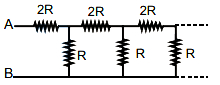
What will be the equivalent resistance between the terminals $A$ and $B$ of the infinite resistive network shown in the figure?
A
$\frac{(\sqrt{3}+1) R}{2}$
B
$\frac{(\sqrt{3}-1) R}{2}$
C
$3 \frac{R}{2}$
D
$(\sqrt{3}+1) R$
Solution
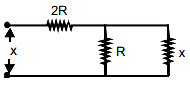
(D) Let the equivalent resistance of the infinite network be $x$. Since the network is infinite,adding one more section to the front will not change the equivalent resistance. Thus,the circuit can be represented as a resistor $2R$ in series with the parallel combination of $R$ and $x$.
The equivalent resistance $x$ is given by:
$x = 2R + \frac{R \cdot x}{R + x}$
Multiplying both sides by $(R + x)$:
$x(R + x) = 2R(R + x) + Rx$
$x^2 + Rx = 2R^2 + 2Rx + Rx$
$x^2 - 2Rx - 2R^2 = 0$
Using the quadratic formula $x = \frac{-b \pm \sqrt{b^2 - 4ac}}{2a}$:
$x = \frac{2R \pm \sqrt{(-2R)^2 - 4(1)(-2R^2)}}{2(1)}$
$x = \frac{2R \pm \sqrt{4R^2 + 8R^2}}{2}$
$x = \frac{2R \pm \sqrt{12R^2}}{2}$
$x = \frac{2R \pm 2R\sqrt{3}}{2}$
$x = R(1 \pm \sqrt{3})$
Since resistance cannot be negative,we take the positive root:
$x = (1 + \sqrt{3})R$
The equivalent resistance $x$ is given by:
$x = 2R + \frac{R \cdot x}{R + x}$
Multiplying both sides by $(R + x)$:
$x(R + x) = 2R(R + x) + Rx$
$x^2 + Rx = 2R^2 + 2Rx + Rx$
$x^2 - 2Rx - 2R^2 = 0$
Using the quadratic formula $x = \frac{-b \pm \sqrt{b^2 - 4ac}}{2a}$:
$x = \frac{2R \pm \sqrt{(-2R)^2 - 4(1)(-2R^2)}}{2(1)}$
$x = \frac{2R \pm \sqrt{4R^2 + 8R^2}}{2}$
$x = \frac{2R \pm \sqrt{12R^2}}{2}$
$x = \frac{2R \pm 2R\sqrt{3}}{2}$
$x = R(1 \pm \sqrt{3})$
Since resistance cannot be negative,we take the positive root:
$x = (1 + \sqrt{3})R$
0 likesView Solution
18
PhysicsMediumMCQWBJEE · 2020
$A$ galvanometer can be converted to a voltmeter of full-scale deflection $V_{0}$ by connecting a series resistance $R_{1}$ and can be converted to an ammeter of full-scale deflection $I_{0}$ by connecting a shunt resistance $R_{2}$. What is the current flowing through the galvanometer at its full-scale deflection?
A
$\frac{V_{0}-I_{0} R_{2}}{R_{1}-R_{2}}$
B
$\frac{V_{0}+I_{0} R_{2}}{R_{1}+R_{2}}$
C
$\frac{V_{0}-I_{0} R_{2}}{R_{2}-R_{1}}$
D
$\frac{V_{0}+I_{0} R_{1}}{R_{1}+R_{2}}$
Solution
(A) Let $G$ be the resistance of the galvanometer and $I_{g}$ be the current at full-scale deflection.
For the voltmeter conversion:
$V_{0} = I_{g}(G + R_{1})$
$G + R_{1} = \frac{V_{0}}{I_{g}}$
$G = \frac{V_{0}}{I_{g}} - R_{1} \dots (1)$
For the ammeter conversion:
$I_{g} G = (I_{0} - I_{g}) R_{2}$
$G = \frac{(I_{0} - I_{g}) R_{2}}{I_{g}} \dots (2)$
Equating $(1)$ and $(2)$:
$\frac{V_{0}}{I_{g}} - R_{1} = \frac{I_{0} R_{2}}{I_{g}} - R_{2}$
$\frac{V_{0} - I_{0} R_{2}}{I_{g}} = R_{1} - R_{2}$
$I_{g} = \frac{V_{0} - I_{0} R_{2}}{R_{1} - R_{2}}$
For the voltmeter conversion:
$V_{0} = I_{g}(G + R_{1})$
$G + R_{1} = \frac{V_{0}}{I_{g}}$
$G = \frac{V_{0}}{I_{g}} - R_{1} \dots (1)$
For the ammeter conversion:
$I_{g} G = (I_{0} - I_{g}) R_{2}$
$G = \frac{(I_{0} - I_{g}) R_{2}}{I_{g}} \dots (2)$
Equating $(1)$ and $(2)$:
$\frac{V_{0}}{I_{g}} - R_{1} = \frac{I_{0} R_{2}}{I_{g}} - R_{2}$
$\frac{V_{0} - I_{0} R_{2}}{I_{g}} = R_{1} - R_{2}$
$I_{g} = \frac{V_{0} - I_{0} R_{2}}{R_{1} - R_{2}}$
0 likesView Solution
19
PhysicsMediumMCQWBJEE · 2020
$A$ point source of light is used in an experiment of photoelectric effect. If the distance between the source and the photoelectric surface is doubled,which of the following may result?
A
Stopping potential will be halved
B
Photoelectric current will decrease
C
Maximum kinetic energy of photoelectrons will decrease
D
Stopping potential will increase slightly
Solution
(B) The intensity $I$ of light from a point source follows the inverse square law,$I \propto \frac{1}{d^2}$,where $d$ is the distance from the source.
When the distance $d$ is doubled,the intensity $I$ becomes $\frac{1}{4}$ of its original value.
The photoelectric current is directly proportional to the intensity of incident light.
Since the intensity decreases,the number of photons hitting the surface per unit time decreases,resulting in a decrease in the photoelectric current.
Stopping potential and maximum kinetic energy depend on the frequency of the incident light,not on its intensity.
Therefore,the correct result is that the photoelectric current will decrease.
When the distance $d$ is doubled,the intensity $I$ becomes $\frac{1}{4}$ of its original value.
The photoelectric current is directly proportional to the intensity of incident light.
Since the intensity decreases,the number of photons hitting the surface per unit time decreases,resulting in a decrease in the photoelectric current.
Stopping potential and maximum kinetic energy depend on the frequency of the incident light,not on its intensity.
Therefore,the correct result is that the photoelectric current will decrease.
0 likesView Solution
20
PhysicsEasyMCQWBJEE · 2020
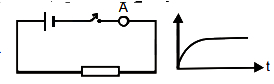
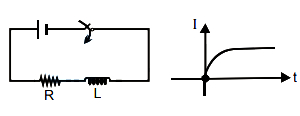
When a $DC$ voltage is applied at the two ends of a circuit kept in a closed box,it is observed that the current gradually increases from zero to a certain value and then remains constant. What do you think the circuit contains?
A
$A$ resistor alone
B
$A$ capacitor alone
C
$A$ resistor and an inductor in series
D
$A$ resistor and a capacitor in series
Solution
(C) In an $LR$ circuit,when a $DC$ voltage $V$ is applied,the current $I$ at any time $t$ is given by the equation $I(t) = \frac{V}{R}(1 - e^{-Rt/L})$.
Initially,at $t = 0$,the current is $I = 0$ because the inductor opposes the change in current.
As time $t$ increases,the current gradually rises and approaches a steady-state value of $I_{max} = \frac{V}{R}$ as $t \to \infty$.
This behavior matches the description provided in the question.
Therefore,the circuit contains a resistor and an inductor in series.
Initially,at $t = 0$,the current is $I = 0$ because the inductor opposes the change in current.
As time $t$ increases,the current gradually rises and approaches a steady-state value of $I_{max} = \frac{V}{R}$ as $t \to \infty$.
This behavior matches the description provided in the question.
Therefore,the circuit contains a resistor and an inductor in series.
0 likesView Solution
21
PhysicsDifficultMCQWBJEE · 2020
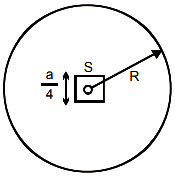
Consider a conducting wire of length $L$ bent in the form of a circle of radius $R$ and another conductor of length $a$ $(a \ll R)$ is bent in the form of a square. The two loops are then placed in the same plane such that the square loop is exactly at the centre of the circular loop. What will be the mutual inductance between the two loops?
A
$\mu_{0} \frac{\pi a^{2}}{L}$
B
$\mu_{0} \frac{\pi a^{2}}{16 L}$
C
$\mu_{0} \frac{\pi a^{2}}{4 L}$
D
$\mu_{0} \frac{a^{2}}{4 \pi L}$
Solution
(B) $1$. For the circular loop: The circumference is $2 \pi R = L$, so $R = \frac{L}{2 \pi}$.
$2$. For the square loop: The perimeter is $4s = a$, where $s$ is the side length of the square. Thus, $s = \frac{a}{4}$.
$3$. The magnetic field $B$ at the centre of the circular loop due to a current $I$ flowing through it is $B = \frac{\mu_{0} I}{2R}$.
$4$. Since $a \ll R$, the magnetic field $B$ is approximately uniform over the area of the square loop. The magnetic flux $\phi$ linked with the square loop is $\phi = B \times \text{Area of square} = B \times s^2$.
$5$. Substituting the values: $\phi = \left( \frac{\mu_{0} I}{2R} \right) \times s^2 = \left( \frac{\mu_{0} I}{2(L / 2 \pi)} \right) \times \left( \frac{a}{4} \right)^2 = \left( \frac{\mu_{0} I \pi}{L} \right) \times \frac{a^2}{16} = \frac{\mu_{0} \pi a^2}{16 L} I$.
$6$. The mutual inductance $M$ is given by $M = \frac{\phi}{I} = \frac{\mu_{0} \pi a^2}{16 L}$.
$2$. For the square loop: The perimeter is $4s = a$, where $s$ is the side length of the square. Thus, $s = \frac{a}{4}$.
$3$. The magnetic field $B$ at the centre of the circular loop due to a current $I$ flowing through it is $B = \frac{\mu_{0} I}{2R}$.
$4$. Since $a \ll R$, the magnetic field $B$ is approximately uniform over the area of the square loop. The magnetic flux $\phi$ linked with the square loop is $\phi = B \times \text{Area of square} = B \times s^2$.
$5$. Substituting the values: $\phi = \left( \frac{\mu_{0} I}{2R} \right) \times s^2 = \left( \frac{\mu_{0} I}{2(L / 2 \pi)} \right) \times \left( \frac{a}{4} \right)^2 = \left( \frac{\mu_{0} I \pi}{L} \right) \times \frac{a^2}{16} = \frac{\mu_{0} \pi a^2}{16 L} I$.
$6$. The mutual inductance $M$ is given by $M = \frac{\phi}{I} = \frac{\mu_{0} \pi a^2}{16 L}$.
0 likesView Solution
22
PhysicsEasyMCQWBJEE · 2020
$A$ charged particle moves with constant velocity in a region where no effect of gravity is felt,but an electrostatic field $\vec{E}$ together with a magnetic field $\vec{B}$ may be present. Which of the following cases are possible?
A
$\vec{E} \neq 0, \vec{B} \neq 0$
B
$\vec{E} \neq 0, \vec{B} = 0$
C
$\vec{E} = 0, \vec{B} = 0$
D
$\vec{E} = 0, \vec{B} \neq 0$
Solution
(A, C, D) The net force on a charged particle moving with velocity $\vec{v}$ in the presence of electric field $\vec{E}$ and magnetic field $\vec{B}$ is given by the Lorentz force: $\vec{F} = q(\vec{E} + \vec{v} \times \vec{B})$.
For the velocity to remain constant,the net force must be zero $(\vec{F} = 0)$.
Case $(i)$: If $\vec{E} = 0$ and $\vec{B} = 0$,then $\vec{F} = 0$. The particle moves with constant velocity.
Case (ii): If $\vec{E} \neq 0$ and $\vec{B} \neq 0$,the forces can cancel each other if $\vec{E} = -(\vec{v} \times \vec{B})$. This is possible.
Case (iii): If $\vec{E} = 0$ and $\vec{B} \neq 0$,the force is $\vec{F} = q(\vec{v} \times \vec{B})$. If $\vec{v}$ is parallel or anti-parallel to $\vec{B}$,then $\vec{v} \times \vec{B} = 0$,so $\vec{F} = 0$. The particle moves with constant velocity.
Case (iv): If $\vec{E} \neq 0$ and $\vec{B} = 0$,the force is $\vec{F} = q\vec{E}$. For $\vec{F} = 0$,$\vec{E}$ must be zero,which contradicts the assumption. Thus,this case is not possible.
Therefore,cases $(A)$,$(C)$,and $(D)$ are possible.
For the velocity to remain constant,the net force must be zero $(\vec{F} = 0)$.
Case $(i)$: If $\vec{E} = 0$ and $\vec{B} = 0$,then $\vec{F} = 0$. The particle moves with constant velocity.
Case (ii): If $\vec{E} \neq 0$ and $\vec{B} \neq 0$,the forces can cancel each other if $\vec{E} = -(\vec{v} \times \vec{B})$. This is possible.
Case (iii): If $\vec{E} = 0$ and $\vec{B} \neq 0$,the force is $\vec{F} = q(\vec{v} \times \vec{B})$. If $\vec{v}$ is parallel or anti-parallel to $\vec{B}$,then $\vec{v} \times \vec{B} = 0$,so $\vec{F} = 0$. The particle moves with constant velocity.
Case (iv): If $\vec{E} \neq 0$ and $\vec{B} = 0$,the force is $\vec{F} = q\vec{E}$. For $\vec{F} = 0$,$\vec{E}$ must be zero,which contradicts the assumption. Thus,this case is not possible.
Therefore,cases $(A)$,$(C)$,and $(D)$ are possible.
0 likesView Solution
23
PhysicsMediumMCQWBJEE · 2020
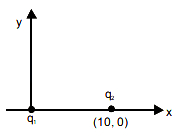
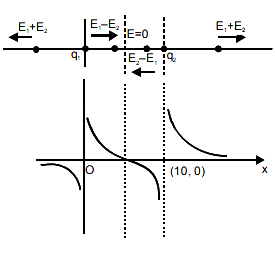
As shown in the figure,a point charge $q_{1} = +1 \times 10^{-8} \ C$ is placed at the origin in the $x-y$ plane and another point charge $q_{2} = +3 \times 10^{-6} \ C$ is placed at the coordinate $(10, 0)$. In that case,which of the following graph$(s)$ shows most correctly the electric field vector $E_{x}$ in the $x$-direction?
A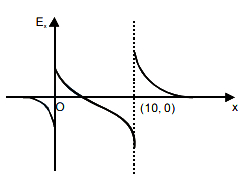
B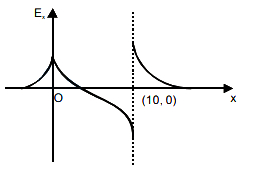
C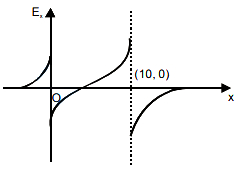
D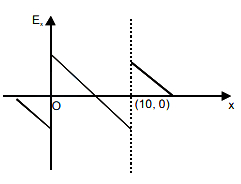
Solution
(A) The electric field $E_{x}$ due to two positive point charges $q_{1}$ and $q_{2}$ on the $x$-axis is given by the superposition principle: $E_{x} = \frac{k q_{1}}{x^{2}} + \frac{k q_{2}}{(x-10)^{2}}$ for $x < 0$,$E_{x} = \frac{k q_{1}}{x^{2}} - \frac{k q_{2}}{(x-10)^{2}}$ for $0 < x < 10$,and $E_{x} = -\frac{k q_{1}}{x^{2}} - \frac{k q_{2}}{(x-10)^{2}}$ for $x > 10$.
$1$. For $x < 0$: Both charges contribute to a negative electric field in the $x$-direction,so $E_{x} < 0$. As $x \to 0^{-}$,$E_{x} \to -\infty$.
$2$. For $0 < x < 10$: The field due to $q_{1}$ is positive and the field due to $q_{2}$ is negative. There is a point between the charges where $E_{x} = 0$. As $x \to 0^{+}$,$E_{x} \to +\infty$. As $x \to 10^{-}$,$E_{x} \to -\infty$.
$3$. For $x > 10$: Both charges contribute to a positive electric field in the $x$-direction,so $E_{x} > 0$. As $x \to 10^{+}$,$E_{x} \to +\infty$. As $x \to \infty$,$E_{x} \to 0$.
Comparing these characteristics with the given options,the graph in option $A$ correctly represents these behaviors.
$1$. For $x < 0$: Both charges contribute to a negative electric field in the $x$-direction,so $E_{x} < 0$. As $x \to 0^{-}$,$E_{x} \to -\infty$.
$2$. For $0 < x < 10$: The field due to $q_{1}$ is positive and the field due to $q_{2}$ is negative. There is a point between the charges where $E_{x} = 0$. As $x \to 0^{+}$,$E_{x} \to +\infty$. As $x \to 10^{-}$,$E_{x} \to -\infty$.
$3$. For $x > 10$: Both charges contribute to a positive electric field in the $x$-direction,so $E_{x} > 0$. As $x \to 10^{+}$,$E_{x} \to +\infty$. As $x \to \infty$,$E_{x} \to 0$.
Comparing these characteristics with the given options,the graph in option $A$ correctly represents these behaviors.
0 likesView Solution
24
PhysicsDifficultMCQWBJEE · 2020
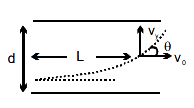
$A$ pair of parallel metal plates are kept with a separation $d$. One plate is at a potential $+V$ and the other is at ground potential. $A$ narrow beam of electrons enters the space between the plates with a velocity $v_{0}$ and in a direction parallel to the plates. What will be the angle of the beam with the plates after it travels an axial distance $L$?
A
$\tan ^{-1}\left(\frac{eVL}{mdv_{0}}\right)$
B
$\tan ^{-1}\left(\frac{eVL}{mdv_{0}^{2}}\right)$
C
$\sin ^{-1}\left(\frac{eVL}{mdv_{0}}\right)$
D
$\cos ^{-1}\left(\frac{eVL}{mdv_{0}^{2}}\right)$
Solution
(B) The electric field between the plates is $E = \frac{V}{d}$.
The force on an electron of charge $e$ is $F = eE = \frac{eV}{d}$.
The acceleration of the electron in the transverse direction ($y$-axis) is $a_y = \frac{F}{m} = \frac{eV}{md}$.
The time taken to travel an axial distance $L$ with constant horizontal velocity $v_0$ is $t = \frac{L}{v_0}$.
The transverse velocity $v_y$ acquired after time $t$ is $v_y = a_y t = \left(\frac{eV}{md}\right) \left(\frac{L}{v_0}\right) = \frac{eVL}{mdv_0}$.
The horizontal velocity remains constant at $v_x = v_0$.
The angle $\theta$ that the beam makes with the plates is given by $\tan \theta = \frac{v_y}{v_x}$.
Substituting the values,$\tan \theta = \frac{eVL / mdv_0}{v_0} = \frac{eVL}{mdv_0^2}$.
Therefore,$\theta = \tan ^{-1}\left(\frac{eVL}{mdv_0^2}\right)$.
The force on an electron of charge $e$ is $F = eE = \frac{eV}{d}$.
The acceleration of the electron in the transverse direction ($y$-axis) is $a_y = \frac{F}{m} = \frac{eV}{md}$.
The time taken to travel an axial distance $L$ with constant horizontal velocity $v_0$ is $t = \frac{L}{v_0}$.
The transverse velocity $v_y$ acquired after time $t$ is $v_y = a_y t = \left(\frac{eV}{md}\right) \left(\frac{L}{v_0}\right) = \frac{eVL}{mdv_0}$.
The horizontal velocity remains constant at $v_x = v_0$.
The angle $\theta$ that the beam makes with the plates is given by $\tan \theta = \frac{v_y}{v_x}$.
Substituting the values,$\tan \theta = \frac{eVL / mdv_0}{v_0} = \frac{eVL}{mdv_0^2}$.
Therefore,$\theta = \tan ^{-1}\left(\frac{eVL}{mdv_0^2}\right)$.
0 likesView Solution
25
PhysicsDifficultMCQWBJEE · 2020
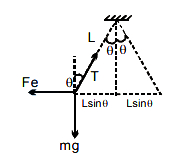
Two pith balls,each carrying charge $+q$,are hung from a hook by two strings of length $L$. It is found that when each charge is tripled,the angle between the strings doubles. What was the initial angle between the strings (in $^{\circ}$)?
A
$30$
B
$60$
C
$45$
D
$90$
Solution
(B) Let the initial angle between the strings be $2\theta$. The angle each string makes with the vertical is $\theta$.
For a pith ball of mass $m$ and charge $q$,the forces acting are tension $T$,gravitational force $mg$,and electrostatic force $F_e = \frac{kq^2}{(2L \sin \theta)^2}$.
Equating forces in equilibrium:
$T \sin \theta = F_e = \frac{kq^2}{4L^2 \sin^2 \theta}$
$T \cos \theta = mg$
Dividing the two equations:
$\tan \theta = \frac{kq^2}{4mgL^2 \sin^2 \theta} \implies \tan \theta \sin^2 \theta = \frac{kq^2}{4mgL^2} = C$ (constant).
When charge becomes $3q$,the angle between strings becomes $2(2\theta) = 4\theta$,so the angle with vertical becomes $2\theta$.
Thus,$\tan \theta \sin^2 \theta = \tan(2\theta) \sin^2(2\theta)$.
Using $\sin(2\theta) = 2 \sin \theta \cos \theta$ and $\tan(2\theta) = \frac{2 \tan \theta}{1 - \tan^2 \theta}$:
$\tan \theta \sin^2 \theta = \frac{2 \tan \theta}{1 - \tan^2 \theta} \cdot (2 \sin \theta \cos \theta)^2$
$\tan \theta \sin^2 \theta = \frac{2 \tan \theta}{1 - \tan^2 \theta} \cdot 4 \sin^2 \theta \cos^2 \theta$
$1 = \frac{8 \cos^2 \theta}{1 - \tan^2 \theta} = \frac{8 \cos^2 \theta}{1 - \frac{\sin^2 \theta}{\cos^2 \theta}} = \frac{8 \cos^4 \theta}{\cos^2 \theta - \sin^2 \theta} = \frac{8 \cos^4 \theta}{\cos(2\theta)}$.
Alternatively,using the ratio method:
$\frac{\tan 2\theta}{\tan \theta} = \frac{q'^2}{q^2} \cdot \frac{\sin^2 \theta}{\sin^2 2\theta} = 9 \cdot \frac{\sin^2 \theta}{4 \sin^2 \theta \cos^2 \theta} = \frac{9}{4 \cos^2 \theta} = \frac{9}{4} \sec^2 \theta$.
$\frac{2 \tan \theta}{1 - \tan^2 \theta} \cdot \frac{1}{\tan \theta} = \frac{9}{4} (1 + \tan^2 \theta) \implies \frac{2}{1 - \tan^2 \theta} = \frac{9}{4} (1 + \tan^2 \theta)$.
Let $x = \tan^2 \theta$: $\frac{2}{1-x} = \frac{9}{4}(1+x) \implies 8 = 9(1-x^2) \implies 9x^2 = 1 \implies x = 1/3$.
$\tan^2 \theta = 1/3 \implies \tan \theta = 1/\sqrt{3} \implies \theta = 30^{\circ}$.
The initial angle between the strings is $2\theta = 60^{\circ}$.
For a pith ball of mass $m$ and charge $q$,the forces acting are tension $T$,gravitational force $mg$,and electrostatic force $F_e = \frac{kq^2}{(2L \sin \theta)^2}$.
Equating forces in equilibrium:
$T \sin \theta = F_e = \frac{kq^2}{4L^2 \sin^2 \theta}$
$T \cos \theta = mg$
Dividing the two equations:
$\tan \theta = \frac{kq^2}{4mgL^2 \sin^2 \theta} \implies \tan \theta \sin^2 \theta = \frac{kq^2}{4mgL^2} = C$ (constant).
When charge becomes $3q$,the angle between strings becomes $2(2\theta) = 4\theta$,so the angle with vertical becomes $2\theta$.
Thus,$\tan \theta \sin^2 \theta = \tan(2\theta) \sin^2(2\theta)$.
Using $\sin(2\theta) = 2 \sin \theta \cos \theta$ and $\tan(2\theta) = \frac{2 \tan \theta}{1 - \tan^2 \theta}$:
$\tan \theta \sin^2 \theta = \frac{2 \tan \theta}{1 - \tan^2 \theta} \cdot (2 \sin \theta \cos \theta)^2$
$\tan \theta \sin^2 \theta = \frac{2 \tan \theta}{1 - \tan^2 \theta} \cdot 4 \sin^2 \theta \cos^2 \theta$
$1 = \frac{8 \cos^2 \theta}{1 - \tan^2 \theta} = \frac{8 \cos^2 \theta}{1 - \frac{\sin^2 \theta}{\cos^2 \theta}} = \frac{8 \cos^4 \theta}{\cos^2 \theta - \sin^2 \theta} = \frac{8 \cos^4 \theta}{\cos(2\theta)}$.
Alternatively,using the ratio method:
$\frac{\tan 2\theta}{\tan \theta} = \frac{q'^2}{q^2} \cdot \frac{\sin^2 \theta}{\sin^2 2\theta} = 9 \cdot \frac{\sin^2 \theta}{4 \sin^2 \theta \cos^2 \theta} = \frac{9}{4 \cos^2 \theta} = \frac{9}{4} \sec^2 \theta$.
$\frac{2 \tan \theta}{1 - \tan^2 \theta} \cdot \frac{1}{\tan \theta} = \frac{9}{4} (1 + \tan^2 \theta) \implies \frac{2}{1 - \tan^2 \theta} = \frac{9}{4} (1 + \tan^2 \theta)$.
Let $x = \tan^2 \theta$: $\frac{2}{1-x} = \frac{9}{4}(1+x) \implies 8 = 9(1-x^2) \implies 9x^2 = 1 \implies x = 1/3$.
$\tan^2 \theta = 1/3 \implies \tan \theta = 1/\sqrt{3} \implies \theta = 30^{\circ}$.
The initial angle between the strings is $2\theta = 60^{\circ}$.
0 likesView Solution
26
PhysicsDifficultMCQWBJEE · 2020
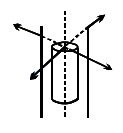
$A$ very long charged solid cylinder of radius 'a' contains a uniform charge density $\rho$. The dielectric constant of the material of the cylinder is $k$. What will be the magnitude of the electric field at a radial distance '$x$' $(x < a)$ from the axis of the cylinder?
A
$\rho \frac{x}{\varepsilon_{0}}$
B
$\rho \frac{x}{2 k \varepsilon_{0}}$
C
$\rho \frac{x^{2}}{2 a \varepsilon_{0}}$
D
$\rho \frac{x^{2}}{2 k}$
Solution
(B) To find the electric field inside a charged solid cylinder,we use Gauss's Law.
Consider a Gaussian surface in the form of a cylinder of radius '$x$' and length '$\ell$' coaxial with the given cylinder.
The total charge enclosed by this Gaussian surface is $q_{enc} = \rho \times V = \rho (\pi x^{2} \ell)$.
According to Gauss's Law,the electric flux through the Gaussian surface is $\oint \vec{E} \cdot d\vec{A} = \frac{q_{enc}}{k \varepsilon_{0}}$.
Since the electric field is radial and uniform on the curved surface of the Gaussian cylinder,the flux is $E(2 \pi x \ell)$.
Equating the two expressions: $E(2 \pi x \ell) = \frac{\rho \pi x^{2} \ell}{k \varepsilon_{0}}$.
Solving for $E$,we get $E = \frac{\rho x}{2 k \varepsilon_{0}}$.
Consider a Gaussian surface in the form of a cylinder of radius '$x$' and length '$\ell$' coaxial with the given cylinder.
The total charge enclosed by this Gaussian surface is $q_{enc} = \rho \times V = \rho (\pi x^{2} \ell)$.
According to Gauss's Law,the electric flux through the Gaussian surface is $\oint \vec{E} \cdot d\vec{A} = \frac{q_{enc}}{k \varepsilon_{0}}$.
Since the electric field is radial and uniform on the curved surface of the Gaussian cylinder,the flux is $E(2 \pi x \ell)$.
Equating the two expressions: $E(2 \pi x \ell) = \frac{\rho \pi x^{2} \ell}{k \varepsilon_{0}}$.
Solving for $E$,we get $E = \frac{\rho x}{2 k \varepsilon_{0}}$.
0 likesView Solution
27
PhysicsMediumMCQWBJEE · 2020
Four identical point masses,each of mass $m$ and carrying charge $+q$,are placed at the corners of a square of side $a$ on a frictionless horizontal surface. If the particles are released simultaneously,the kinetic energy of the system when they are infinitely far apart is
A
$\frac{q^{2}}{a}(2 \sqrt{2}+1) k$
B
$\frac{q^{2}}{a}(\sqrt{2}+2) k$
C
$\frac{q^{2}}{a}(4+\sqrt{2}) k$
D
$\frac{q^{2}}{a}(\sqrt{2}+1) k$
Solution
(C) According to the principle of conservation of energy,the initial total energy of the system must equal the final total energy.
Since the particles are released from rest,the initial kinetic energy $KE_i = 0$.
The initial potential energy $PE_i$ is the sum of the electrostatic potential energies of all pairs of charges.
In a square of side $a$,there are $4$ pairs of charges at distance $a$ (sides) and $2$ pairs of charges at distance $\sqrt{2}a$ (diagonals).
$PE_i = 4 \times \frac{kq^2}{a} + 2 \times \frac{kq^2}{\sqrt{2}a} = \frac{kq^2}{a} (4 + \sqrt{2})$.
When the particles are infinitely far apart,the final potential energy $PE_f = 0$.
Thus,$KE_f = PE_i = \frac{kq^2}{a} (4 + \sqrt{2})$.
Since the particles are released from rest,the initial kinetic energy $KE_i = 0$.
The initial potential energy $PE_i$ is the sum of the electrostatic potential energies of all pairs of charges.
In a square of side $a$,there are $4$ pairs of charges at distance $a$ (sides) and $2$ pairs of charges at distance $\sqrt{2}a$ (diagonals).
$PE_i = 4 \times \frac{kq^2}{a} + 2 \times \frac{kq^2}{\sqrt{2}a} = \frac{kq^2}{a} (4 + \sqrt{2})$.
When the particles are infinitely far apart,the final potential energy $PE_f = 0$.
Thus,$KE_f = PE_i = \frac{kq^2}{a} (4 + \sqrt{2})$.
0 likesView Solution
28
PhysicsEasyMCQWBJEE · 2020
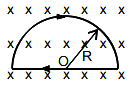
As shown in the figure,a wire is bent to form a $D$-shaped loop carrying current $I$,where the curved part is a semi-circle of radius $R$. The loop is placed in a uniform magnetic field $\overrightarrow{B}$,which is directed into the plane of the paper. The net magnetic force on the closed loop is:
A
$0$
B
$IRB$
C
$2 IRB$
D
$\frac{1}{2} IRB$
Solution
(A) The magnetic force on a current-carrying conductor in a uniform magnetic field is given by $\overrightarrow{F} = I(\overrightarrow{L} \times \overrightarrow{B})$,where $\overrightarrow{L}$ is the displacement vector from the starting point to the end point of the conductor.
For any closed loop,the starting point and the end point are the same,which means the total displacement vector $\overrightarrow{L}$ is zero.
Therefore,the net magnetic force $\overrightarrow{F}$ on any closed current loop placed in a uniform magnetic field is always zero.
For any closed loop,the starting point and the end point are the same,which means the total displacement vector $\overrightarrow{L}$ is zero.
Therefore,the net magnetic force $\overrightarrow{F}$ on any closed current loop placed in a uniform magnetic field is always zero.
0 likesView Solution
29
PhysicsMediumMCQWBJEE · 2020
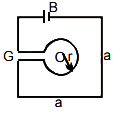
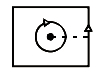
As shown in the figure,a single conducting wire is bent to form a loop in the form of a circle of radius '$r$' concentrically inside a square of side '$a$',where $a: r = 8: \pi$. $A$ battery $B$ drives a current $I$ through the wire. If the battery $B$ and the gap $G$ are of negligible sizes,determine the strength of the magnetic field at the common centre $O$.
A
$\frac{\mu_{0} I}{2 \pi a} \sqrt{2}(\sqrt{2}-1)$
B
$\frac{\mu_{0} I}{2 \pi a}(\sqrt{2}+1)$
C
$\frac{\mu_{0} I}{\pi a} 2 \sqrt{2}(\sqrt{2}+1)$
D
$\frac{\mu_{0} I}{\pi a} 2 \sqrt{2}(\sqrt{2}-1)$
Solution
(D) The magnetic field at the center $O$ due to the circular loop of radius $r$ is $B_{loop} = \frac{\mu_{0} I}{2r}$ (directed outwards).
The magnetic field at the center $O$ due to the square loop of side $a$ is $B_{square} = 4 \times \frac{\mu_{0} I}{4 \pi (a/2)} (\sin 45^{\circ} + \sin 45^{\circ}) = \frac{4 \mu_{0} I}{\pi a} \times \frac{2}{\sqrt{2}} = \frac{4 \sqrt{2} \mu_{0} I}{\pi a}$ (directed inwards).
Given $a/r = 8/\pi$,so $r = \frac{\pi a}{8}$.
Substituting $r$ in $B_{loop}$,we get $B_{loop} = \frac{\mu_{0} I}{2(\pi a / 8)} = \frac{4 \mu_{0} I}{\pi a}$.
The net magnetic field $B_{net} = B_{square} - B_{loop} = \frac{4 \sqrt{2} \mu_{0} I}{\pi a} - \frac{4 \mu_{0} I}{\pi a} = \frac{4 \mu_{0} I}{\pi a} (\sqrt{2} - 1)$.
This can be rewritten as $\frac{2 \mu_{0} I}{\pi a} \times 2(\sqrt{2} - 1)$,which matches option $D$.
The magnetic field at the center $O$ due to the square loop of side $a$ is $B_{square} = 4 \times \frac{\mu_{0} I}{4 \pi (a/2)} (\sin 45^{\circ} + \sin 45^{\circ}) = \frac{4 \mu_{0} I}{\pi a} \times \frac{2}{\sqrt{2}} = \frac{4 \sqrt{2} \mu_{0} I}{\pi a}$ (directed inwards).
Given $a/r = 8/\pi$,so $r = \frac{\pi a}{8}$.
Substituting $r$ in $B_{loop}$,we get $B_{loop} = \frac{\mu_{0} I}{2(\pi a / 8)} = \frac{4 \mu_{0} I}{\pi a}$.
The net magnetic field $B_{net} = B_{square} - B_{loop} = \frac{4 \sqrt{2} \mu_{0} I}{\pi a} - \frac{4 \mu_{0} I}{\pi a} = \frac{4 \mu_{0} I}{\pi a} (\sqrt{2} - 1)$.
This can be rewritten as $\frac{2 \mu_{0} I}{\pi a} \times 2(\sqrt{2} - 1)$,which matches option $D$.
0 likesView Solution
30
PhysicsMediumMCQWBJEE · 2020
$A$ conducting circular loop of resistance $20 \Omega$ and cross-sectional area $20 \times 10^{-2} \,m^{2}$ is placed perpendicular to a spatially uniform magnetic field $B$, which varies with time $t$ as $B = 2 \sin(50 \pi t) \,T$. Find the net charge flowing through the loop in $20 \,ms$ starting from $t = 0$. (in $\,C$)
A
$0.5$
B
$0.2$
C
$0$
D
$0.14$
Solution
(C) The magnetic flux $\phi$ through the loop is given by $\phi = B \cdot A = 20 \times 10^{-2} \times 2 \sin(50 \pi t) = 0.4 \sin(50 \pi t) \,Wb$.
The induced current is $I = \frac{e}{R} = -\frac{1}{R} \frac{d\phi}{dt}$.
The charge flowing through the loop is $\Delta q = \int_{0}^{t} I \,dt = -\frac{1}{R} \int_{\phi_1}^{\phi_2} d\phi = -\frac{\phi_2 - \phi_1}{R}$.
At $t = 0$, $\phi_1 = 0.4 \sin(0) = 0 \,Wb$.
At $t = 20 \,ms = 0.02 \,s$, $\phi_2 = 0.4 \sin(50 \pi \times 0.02) = 0.4 \sin(\pi) = 0 \,Wb$.
Thus, the net charge $\Delta q = -\frac{0 - 0}{20} = 0 \,C$.
The induced current is $I = \frac{e}{R} = -\frac{1}{R} \frac{d\phi}{dt}$.
The charge flowing through the loop is $\Delta q = \int_{0}^{t} I \,dt = -\frac{1}{R} \int_{\phi_1}^{\phi_2} d\phi = -\frac{\phi_2 - \phi_1}{R}$.
At $t = 0$, $\phi_1 = 0.4 \sin(0) = 0 \,Wb$.
At $t = 20 \,ms = 0.02 \,s$, $\phi_2 = 0.4 \sin(50 \pi \times 0.02) = 0.4 \sin(\pi) = 0 \,Wb$.
Thus, the net charge $\Delta q = -\frac{0 - 0}{20} = 0 \,C$.
0 likesView Solution
31
PhysicsMediumMCQWBJEE · 2020
For nuclei with mass number close to $119$ and $238$, the binding energies per nucleon are approximately $7.6 \text{ MeV}$ and $8.6 \text{ MeV}$ respectively. If a nucleus of mass number $238$ breaks into two nuclei of nearly equal masses, what will be the approximate amount of energy released in the process of fission (in $\text{ MeV}$)?
A
$214$
B
$119$
C
$2047$
D
$1142$
Solution
(A) The binding energy per nucleon $(BE/A)$ for a nucleus of mass number $A = 238$ is $7.6 \text{ MeV}$, and for a nucleus of mass number $A = 119$, it is $8.6 \text{ MeV}$.
Total binding energy of the parent nucleus $(A = 238)$ is $E_1 = 238 \times 7.6 \text{ MeV} = 1808.8 \text{ MeV}$.
When the nucleus splits into two fragments of mass number $119$ each, the total binding energy of the product nuclei is $E_2 = 2 \times (119 \times 8.6 \text{ MeV}) = 238 \times 8.6 \text{ MeV} = 2046.8 \text{ MeV}$.
The energy released in the fission process is $\Delta E = E_2 - E_1 = 2046.8 \text{ MeV} - 1808.8 \text{ MeV} = 238 \text{ MeV}$.
Among the given options, $214 \text{ MeV}$ is the closest approximate value.
Total binding energy of the parent nucleus $(A = 238)$ is $E_1 = 238 \times 7.6 \text{ MeV} = 1808.8 \text{ MeV}$.
When the nucleus splits into two fragments of mass number $119$ each, the total binding energy of the product nuclei is $E_2 = 2 \times (119 \times 8.6 \text{ MeV}) = 238 \times 8.6 \text{ MeV} = 2046.8 \text{ MeV}$.
The energy released in the fission process is $\Delta E = E_2 - E_1 = 2046.8 \text{ MeV} - 1808.8 \text{ MeV} = 238 \text{ MeV}$.
Among the given options, $214 \text{ MeV}$ is the closest approximate value.
0 likesView Solution
32
PhysicsEasyMCQWBJEE · 2020
$A$ nucleus $X$ emits a beta particle to produce a nucleus $Y$. If their atomic masses are $M_{x}$ and $M_{y}$ respectively,the maximum energy of the beta particle emitted is (where $m_{e}$ is the mass of an electron and $c$ is the velocity of light):
A
$(M_{x} - M_{y} - m_{e}) c^{2}$
B
$(M_{x} - M_{y} + m_{e}) c^{2}$
C
$(M_{x} - M_{y}) c^{2}$
D
$(M_{x} - M_{y} - 2m_{e}) c^{2}$
Solution
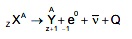
(C) The nuclear reaction for beta-minus decay is given by: $_{Z}X^{A} \rightarrow _{Z+1}Y^{A} + _{-1}e^{0} + \bar{\nu} + Q$.
The $Q$-value of the reaction is the energy released,which is given by the mass defect multiplied by $c^{2}$.
The atomic mass $M_{x}$ of nucleus $X$ is related to its nuclear mass $m_{x}$ by $M_{x} = m_{x} + Zm_{e}$. Thus,$m_{x} = M_{x} - Zm_{e}$.
The atomic mass $M_{y}$ of nucleus $Y$ is related to its nuclear mass $m_{y}$ by $M_{y} = m_{y} + (Z+1)m_{e}$. Thus,$m_{y} = M_{y} - (Z+1)m_{e}$.
The energy released $Q$ is given by $Q = (m_{x} - m_{y} - m_{e})c^{2}$.
Substituting the expressions for nuclear masses:
$Q = [(M_{x} - Zm_{e}) - (M_{y} - (Z+1)m_{e}) - m_{e}]c^{2}$
$Q = [M_{x} - Zm_{e} - M_{y} + Zm_{e} + m_{e} - m_{e}]c^{2}$
$Q = (M_{x} - M_{y})c^{2}$.
Therefore,the maximum energy of the emitted beta particle is $(M_{x} - M_{y})c^{2}$.
The $Q$-value of the reaction is the energy released,which is given by the mass defect multiplied by $c^{2}$.
The atomic mass $M_{x}$ of nucleus $X$ is related to its nuclear mass $m_{x}$ by $M_{x} = m_{x} + Zm_{e}$. Thus,$m_{x} = M_{x} - Zm_{e}$.
The atomic mass $M_{y}$ of nucleus $Y$ is related to its nuclear mass $m_{y}$ by $M_{y} = m_{y} + (Z+1)m_{e}$. Thus,$m_{y} = M_{y} - (Z+1)m_{e}$.
The energy released $Q$ is given by $Q = (m_{x} - m_{y} - m_{e})c^{2}$.
Substituting the expressions for nuclear masses:
$Q = [(M_{x} - Zm_{e}) - (M_{y} - (Z+1)m_{e}) - m_{e}]c^{2}$
$Q = [M_{x} - Zm_{e} - M_{y} + Zm_{e} + m_{e} - m_{e}]c^{2}$
$Q = (M_{x} - M_{y})c^{2}$.
Therefore,the maximum energy of the emitted beta particle is $(M_{x} - M_{y})c^{2}$.
0 likesView Solution
33
PhysicsMediumMCQWBJEE · 2020
An object is placed $60 \ cm$ in front of a convex mirror of focal length $30 \ cm$. $A$ plane mirror is now placed facing the object in between the object and the convex mirror such that it covers the lower half of the convex mirror. What should be the distance of the plane mirror from the object so that there will be no parallax between the images formed by the two mirrors (in $cm$)?
A
$40$
B
$30$
C
$20$
D
$15$
Solution
(A) For the convex mirror,the object distance $u = -60 \ cm$ and focal length $f = +30 \ cm$.
Using the mirror formula $\frac{1}{v} + \frac{1}{u} = \frac{1}{f}$:
$\frac{1}{v} + \frac{1}{-60} = \frac{1}{30}$
$\frac{1}{v} = \frac{1}{30} + \frac{1}{60} = \frac{2+1}{60} = \frac{3}{60} = \frac{1}{20}$
So,$v = +20 \ cm$ (behind the mirror).
The image formed by the convex mirror is at a distance of $20 \ cm$ behind the mirror.
The total distance of this image from the object is $60 \ cm + 20 \ cm = 80 \ cm$.
Let the plane mirror be placed at a distance $x$ from the object. The image formed by the plane mirror will be at a distance $x$ behind the plane mirror.
For no parallax,the image formed by the plane mirror must coincide with the image formed by the convex mirror.
The distance of the plane mirror's image from the object is $2x$.
Equating the distances: $2x = 80 \ cm$,which gives $x = 40 \ cm$.
Using the mirror formula $\frac{1}{v} + \frac{1}{u} = \frac{1}{f}$:
$\frac{1}{v} + \frac{1}{-60} = \frac{1}{30}$
$\frac{1}{v} = \frac{1}{30} + \frac{1}{60} = \frac{2+1}{60} = \frac{3}{60} = \frac{1}{20}$
So,$v = +20 \ cm$ (behind the mirror).
The image formed by the convex mirror is at a distance of $20 \ cm$ behind the mirror.
The total distance of this image from the object is $60 \ cm + 20 \ cm = 80 \ cm$.
Let the plane mirror be placed at a distance $x$ from the object. The image formed by the plane mirror will be at a distance $x$ behind the plane mirror.
For no parallax,the image formed by the plane mirror must coincide with the image formed by the convex mirror.
The distance of the plane mirror's image from the object is $2x$.
Equating the distances: $2x = 80 \ cm$,which gives $x = 40 \ cm$.
0 likesView Solution
34
PhysicsMediumMCQWBJEE · 2020
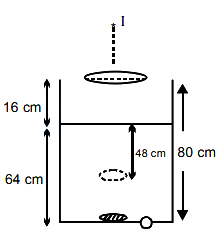
$A$ thin convex lens is placed just above an empty vessel of depth $80 \,cm$. The image of a coin kept at the bottom of the vessel is thus formed $20 \,cm$ above the lens. If now water is poured in the vessel up to a height of $64 \,cm$, what will be the approximate new position of the image? Assume that the refractive index of water is $4/3$.
A
$21.33 \,cm$ above the lens
B
$6.67 \,cm$ below the lens
C
$33.67 \,cm$ above the lens
D
$24 \,cm$ above the lens
Solution
(A) Step $1$: Find the focal length of the lens using the empty vessel condition.
For an empty vessel, the object distance $u = -80 \,cm$ and the image distance $v = +20 \,cm$.
Using the lens formula $\frac{1}{f} = \frac{1}{v} - \frac{1}{u}$:
$\frac{1}{f} = \frac{1}{20} - \frac{1}{-80} = \frac{1}{20} + \frac{1}{80} = \frac{4+1}{80} = \frac{5}{80} = \frac{1}{16} \,cm^{-1}$.
So, the focal length $f = 16 \,cm$.
Step $2$: Find the new object distance after pouring water.
When water of height $h = 64 \,cm$ is poured, the apparent depth of the coin is $d' = \frac{h}{\mu} = \frac{64}{4/3} = 64 \times \frac{3}{4} = 48 \,cm$.
The distance of the coin from the lens is $80 \,cm$. The distance of the apparent image from the bottom is $64 - 48 = 16 \,cm$. Thus, the new object distance $u'$ from the lens is $80 - 16 = 64 \,cm$ (or $16 \,cm$ air + $48 \,cm$ apparent depth).
So, $u' = -64 \,cm$.
Step $3$: Find the new image position $v'$.
Using the lens formula $\frac{1}{f} = \frac{1}{v'} - \frac{1}{u'}$:
$\frac{1}{16} = \frac{1}{v'} - \frac{1}{-64} \implies \frac{1}{v'} = \frac{1}{16} - \frac{1}{64} = \frac{4-1}{64} = \frac{3}{64}$.
$v' = \frac{64}{3} \approx 21.33 \,cm$.
Therefore, the image is formed $21.33 \,cm$ above the lens.
For an empty vessel, the object distance $u = -80 \,cm$ and the image distance $v = +20 \,cm$.
Using the lens formula $\frac{1}{f} = \frac{1}{v} - \frac{1}{u}$:
$\frac{1}{f} = \frac{1}{20} - \frac{1}{-80} = \frac{1}{20} + \frac{1}{80} = \frac{4+1}{80} = \frac{5}{80} = \frac{1}{16} \,cm^{-1}$.
So, the focal length $f = 16 \,cm$.
Step $2$: Find the new object distance after pouring water.
When water of height $h = 64 \,cm$ is poured, the apparent depth of the coin is $d' = \frac{h}{\mu} = \frac{64}{4/3} = 64 \times \frac{3}{4} = 48 \,cm$.
The distance of the coin from the lens is $80 \,cm$. The distance of the apparent image from the bottom is $64 - 48 = 16 \,cm$. Thus, the new object distance $u'$ from the lens is $80 - 16 = 64 \,cm$ (or $16 \,cm$ air + $48 \,cm$ apparent depth).
So, $u' = -64 \,cm$.
Step $3$: Find the new image position $v'$.
Using the lens formula $\frac{1}{f} = \frac{1}{v'} - \frac{1}{u'}$:
$\frac{1}{16} = \frac{1}{v'} - \frac{1}{-64} \implies \frac{1}{v'} = \frac{1}{16} - \frac{1}{64} = \frac{4-1}{64} = \frac{3}{64}$.
$v' = \frac{64}{3} \approx 21.33 \,cm$.
Therefore, the image is formed $21.33 \,cm$ above the lens.
0 likesView Solution
35
PhysicsEasyMCQWBJEE · 2020
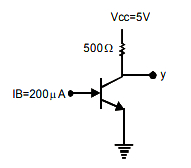
In the circuit shown,the value of $\beta$ of the transistor is $48$. If the base current supplied is $200 \mu A$,what is the voltage at the terminal $Y$ (in $V$)?
A
$0.2$
B
$0.5$
C
$4$
D
$4.8$
Solution
(A) Given:
$\beta = 48$
$I_{B} = 200 \mu A = 200 \times 10^{-6} \ A$
$R_{C} = 500 \ \Omega$
$V_{CC} = 5 \ V$
Step $1$: Calculate the collector current $I_{C}$.
$I_{C} = \beta I_{B} = 48 \times 200 \times 10^{-6} \ A = 9600 \times 10^{-6} \ A = 9.6 \times 10^{-3} \ A = 9.6 \ mA$.
Step $2$: Apply Kirchhoff's voltage law to the output loop.
$V_{CC} = I_{C} R_{C} + V_{CE}$
$V_{Y} = V_{CE} = V_{CC} - I_{C} R_{C}$
$V_{Y} = 5 \ V - (9.6 \times 10^{-3} \ A) \times (500 \ \Omega)$
$V_{Y} = 5 \ V - 4.8 \ V = 0.2 \ V$.
Thus,the voltage at terminal $Y$ is $0.2 \ V$.
$\beta = 48$
$I_{B} = 200 \mu A = 200 \times 10^{-6} \ A$
$R_{C} = 500 \ \Omega$
$V_{CC} = 5 \ V$
Step $1$: Calculate the collector current $I_{C}$.
$I_{C} = \beta I_{B} = 48 \times 200 \times 10^{-6} \ A = 9600 \times 10^{-6} \ A = 9.6 \times 10^{-3} \ A = 9.6 \ mA$.
Step $2$: Apply Kirchhoff's voltage law to the output loop.
$V_{CC} = I_{C} R_{C} + V_{CE}$
$V_{Y} = V_{CE} = V_{CC} - I_{C} R_{C}$
$V_{Y} = 5 \ V - (9.6 \times 10^{-3} \ A) \times (500 \ \Omega)$
$V_{Y} = 5 \ V - 4.8 \ V = 0.2 \ V$.
Thus,the voltage at terminal $Y$ is $0.2 \ V$.
0 likesView Solution
36
PhysicsMediumMCQWBJEE · 2020
$A$ common emitter transistor amplifier is connected with a load resistance of $6 k\Omega$. When a small a.c. signal of $15 mV$ is added to the base-emitter voltage, the alternating base current is $20 \mu A$ and the alternating collector current is $1.8 mA$. What is the voltage gain of the amplifier?
A
$90$
B
$640$
C
$900$
D
$720$
Solution
(D) The voltage gain $A_v$ of a common emitter amplifier is defined as the ratio of the change in output voltage to the change in input voltage.
$A_v = \frac{\Delta V_{out}}{\Delta V_{in}} = \frac{\Delta I_C \times R_L}{\Delta V_{BE}}$
Given:
Load resistance $R_L = 6 k\Omega = 6000 \Omega$
Input signal voltage $\Delta V_{BE} = 15 mV = 15 \times 10^{-3} V$
Change in collector current $\Delta I_C = 1.8 mA = 1.8 \times 10^{-3} A$
Substituting the values into the formula:
$A_v = \frac{1.8 \times 10^{-3} A \times 6000 \Omega}{15 \times 10^{-3} V}$
$A_v = \frac{1.8 \times 6000}{15} = \frac{10800}{15} = 720$
Thus, the voltage gain of the amplifier is $720$.
$A_v = \frac{\Delta V_{out}}{\Delta V_{in}} = \frac{\Delta I_C \times R_L}{\Delta V_{BE}}$
Given:
Load resistance $R_L = 6 k\Omega = 6000 \Omega$
Input signal voltage $\Delta V_{BE} = 15 mV = 15 \times 10^{-3} V$
Change in collector current $\Delta I_C = 1.8 mA = 1.8 \times 10^{-3} A$
Substituting the values into the formula:
$A_v = \frac{1.8 \times 10^{-3} A \times 6000 \Omega}{15 \times 10^{-3} V}$
$A_v = \frac{1.8 \times 6000}{15} = \frac{10800}{15} = 720$
Thus, the voltage gain of the amplifier is $720$.
0 likesView Solution
37
PhysicsMediumMCQWBJEE · 2020
In a Fraunhofer diffraction experiment,a single slit of width $0.5 ~mm$ is illuminated by a monochromatic light of wavelength $600 ~nm$. The diffraction pattern is observed on a screen at a distance of $50 ~cm$ from the slit. What will be the linear separation of the first order minima (in $~mm$)?
A
$1.0$
B
$1.1$
C
$0.6$
D
$1.2$
Solution
(D) The condition for the $n^{th}$ order minima in a single slit diffraction is given by $a \sin \theta = n \lambda$. For small angles,$\sin \theta \approx \theta = \frac{y}{D}$.
Thus,the position of the $n^{th}$ minima is $y_n = \frac{n \lambda D}{a}$.
The linear separation between the first order minima on either side of the central maxima is the width of the central maxima,which is given by $w = y_1 - (-y_1) = 2y_1 = \frac{2 \lambda D}{a}$.
Given: $a = 0.5 ~mm = 0.5 \times 10^{-3} ~m$,$\lambda = 600 ~nm = 600 \times 10^{-9} ~m$,and $D = 50 ~cm = 0.5 ~m$.
Substituting the values: $w = \frac{2 \times 600 \times 10^{-9} \times 0.5}{0.5 \times 10^{-3}} = 1200 \times 10^{-6} ~m = 1.2 ~mm$.
Thus,the position of the $n^{th}$ minima is $y_n = \frac{n \lambda D}{a}$.
The linear separation between the first order minima on either side of the central maxima is the width of the central maxima,which is given by $w = y_1 - (-y_1) = 2y_1 = \frac{2 \lambda D}{a}$.
Given: $a = 0.5 ~mm = 0.5 \times 10^{-3} ~m$,$\lambda = 600 ~nm = 600 \times 10^{-9} ~m$,and $D = 50 ~cm = 0.5 ~m$.
Substituting the values: $w = \frac{2 \times 600 \times 10^{-9} \times 0.5}{0.5 \times 10^{-3}} = 1200 \times 10^{-6} ~m = 1.2 ~mm$.
0 likesView Solution
38
PhysicsEasyMCQWBJEE · 2020
The intensity of light emerging from one of the slits in a Young's double-slit experiment is found to be $1.5$ times the intensity of light emerging from the other slit. What will be the approximate ratio of the intensity of an interference maximum to that of an interference minimum?
A
$2.25$
B
$98$
C
$5$
D
$9.9$
Solution
(B) Let the intensities of light from the two slits be $I_1$ and $I_2$. Given that $I_1 = 1.5 I_2$,we have the ratio $\frac{I_1}{I_2} = 1.5 = \frac{3}{2}$.
The ratio of maximum intensity to minimum intensity in an interference pattern is given by the formula:
$\frac{I_{\max}}{I_{\min}} = \left( \frac{\sqrt{I_1} + \sqrt{I_2}}{\sqrt{I_1} - \sqrt{I_2}} \right)^2$.
Dividing the numerator and denominator by $\sqrt{I_2}$,we get:
$\frac{I_{\max}}{I_{\min}} = \left( \frac{\sqrt{I_1/I_2} + 1}{\sqrt{I_1/I_2} - 1} \right)^2$.
Substituting $\frac{I_1}{I_2} = \frac{3}{2} = 1.5$:
$\frac{I_{\max}}{I_{\min}} = \left( \frac{\sqrt{1.5} + 1}{\sqrt{1.5} - 1} \right)^2 \approx \left( \frac{1.225 + 1}{1.225 - 1} \right)^2 = \left( \frac{2.225}{0.225} \right)^2 \approx (9.88)^2 \approx 97.7 \approx 98$.
The ratio of maximum intensity to minimum intensity in an interference pattern is given by the formula:
$\frac{I_{\max}}{I_{\min}} = \left( \frac{\sqrt{I_1} + \sqrt{I_2}}{\sqrt{I_1} - \sqrt{I_2}} \right)^2$.
Dividing the numerator and denominator by $\sqrt{I_2}$,we get:
$\frac{I_{\max}}{I_{\min}} = \left( \frac{\sqrt{I_1/I_2} + 1}{\sqrt{I_1/I_2} - 1} \right)^2$.
Substituting $\frac{I_1}{I_2} = \frac{3}{2} = 1.5$:
$\frac{I_{\max}}{I_{\min}} = \left( \frac{\sqrt{1.5} + 1}{\sqrt{1.5} - 1} \right)^2 \approx \left( \frac{1.225 + 1}{1.225 - 1} \right)^2 = \left( \frac{2.225}{0.225} \right)^2 \approx (9.88)^2 \approx 97.7 \approx 98$.
0 likesView Solution
Vedclass Products
For Students
Vedclass Test Series
Mock tests in real WBJEE style covering Physics with performance analysis. 5-day free trial.
Start Free TrialFor Teachers
Exam Paper Generator
Generate Set A/B/C/D Physics papers from 7.5L+ questions in 2 minutes. 3 chapters free.
Try FreeFor Institutes
Online Exam Module
Run live WBJEE mock exams with unlimited students, 360° analytics & white-label branding.
See DemoFrequently Asked Questions
How many Physics questions are in WBJEE 2020?
There are 38 Physics questions from the WBJEE 2020 paper on Vedclass, each with a detailed step-by-step solution in English.
Are WBJEE 2020 Physics solutions available in English?
Yes. All solutions on this page are in English. You can also switch to English or Hindi using the language buttons above the questions.
Can I practice WBJEE 2020 Physics as a timed test?
Yes. Use the Vedclass Test Series to attempt a full WBJEE mock test covering Physics with time limits and instant score analysis.
Can teachers create Physics papers from WBJEE previous year questions?
Yes. The Vedclass Exam Paper Generator lets teachers mix WBJEE Physics questions and generate Set A/B/C/D papers in minutes.
For Teachers & Institutes
Build a Custom Physics Paper
Pick WBJEE 2020 Physics questions, set difficulty, and generate Set A/B/C/D in 2 minutes.