
PhysicsQ1–37 of 37 questions
Page 1 of 1 · English
1
PhysicsMediumMCQWBJEE · 2019
Two identical blocks of ice move in opposite directions with equal speed and collide with each other. What will be the minimum speed required to make both the blocks melt completely,if the initial temperatures of the blocks were $-8^{\circ} C$ each (in $ms^{-1}$)? (Specific heat of ice is $2100 \ Jkg^{-1} K^{-1}$ and latent heat of fusion of ice is $3.36 \times 10^{5} \ Jkg^{-1}$)
A
$840$
B
$420$
C
$84$
D
$42$
Solution
(A) The total kinetic energy of the two blocks before the collision is $K.E. = \frac{1}{2}mv^2 + \frac{1}{2}mv^2 = mv^2$.
Since the collision is perfectly inelastic (the blocks melt),the maximum loss in kinetic energy is equal to the total initial kinetic energy,which is $mv^2$.
This energy is used to raise the temperature of the ice from $-8^{\circ}C$ to $0^{\circ}C$ and then to melt it.
The energy required for one block is $Q = ms\Delta\theta + mL$.
For two blocks,the total energy required is $2(ms\Delta\theta + mL)$.
Equating the energy loss to the heat required: $mv^2 = 2m(s\Delta\theta + L)$.
Canceling $m$ from both sides: $v^2 = 2(s\Delta\theta + L)$.
Given: $s = 2100 \ Jkg^{-1}K^{-1}$,$\Delta\theta = 8^{\circ}C$,$L = 3.36 \times 10^5 \ Jkg^{-1}$.
$v^2 = 2(2100 \times 8 + 3.36 \times 10^5) = 2(16800 + 336000) = 2(352800) = 705600$.
$v = \sqrt{705600} = 840 \ ms^{-1}$.
Since the collision is perfectly inelastic (the blocks melt),the maximum loss in kinetic energy is equal to the total initial kinetic energy,which is $mv^2$.
This energy is used to raise the temperature of the ice from $-8^{\circ}C$ to $0^{\circ}C$ and then to melt it.
The energy required for one block is $Q = ms\Delta\theta + mL$.
For two blocks,the total energy required is $2(ms\Delta\theta + mL)$.
Equating the energy loss to the heat required: $mv^2 = 2m(s\Delta\theta + L)$.
Canceling $m$ from both sides: $v^2 = 2(s\Delta\theta + L)$.
Given: $s = 2100 \ Jkg^{-1}K^{-1}$,$\Delta\theta = 8^{\circ}C$,$L = 3.36 \times 10^5 \ Jkg^{-1}$.
$v^2 = 2(2100 \times 8 + 3.36 \times 10^5) = 2(16800 + 336000) = 2(352800) = 705600$.
$v = \sqrt{705600} = 840 \ ms^{-1}$.
0 likesView Solution
2
PhysicsMediumMCQWBJEE · 2019
Assume that the earth moves around the sun in a circular orbit of radius $R$ and there exists a planet which also moves around the sun in a circular orbit with an angular speed twice as large as that of the earth. The radius of the orbit of the planet is
A
$2^{-2 / 3} R$
B
$2^{2 / 3} R$
C
$2^{-1 / 3} R$
D
$\frac{R}{\sqrt{2}}$
Solution
(A) According to Kepler's third law of planetary motion,the square of the time period $T$ is proportional to the cube of the orbital radius $r$:
$T^2 \propto r^3$
Since angular speed $\omega = \frac{2\pi}{T}$,we have $T = \frac{2\pi}{\omega}$. Substituting this into the law:
$(\frac{2\pi}{\omega})^2 \propto r^3 \Rightarrow \frac{1}{\omega^2} \propto r^3 \Rightarrow r^3 \omega^2 = \text{constant}$.
For the earth $(E)$ and the planet $(P)$:
$r_E^3 \omega_E^2 = r_P^3 \omega_P^2$
Given $r_E = R$ and $\omega_P = 2\omega_E$:
$R^3 \omega_E^2 = r_P^3 (2\omega_E)^2$
$R^3 \omega_E^2 = r_P^3 (4\omega_E^2)$
$R^3 = 4 r_P^3$
$r_P^3 = \frac{R^3}{4} = \frac{R^3}{2^2}$
Taking the cube root on both sides:
$r_P = \frac{R}{2^{2/3}} = 2^{-2/3} R$.
$T^2 \propto r^3$
Since angular speed $\omega = \frac{2\pi}{T}$,we have $T = \frac{2\pi}{\omega}$. Substituting this into the law:
$(\frac{2\pi}{\omega})^2 \propto r^3 \Rightarrow \frac{1}{\omega^2} \propto r^3 \Rightarrow r^3 \omega^2 = \text{constant}$.
For the earth $(E)$ and the planet $(P)$:
$r_E^3 \omega_E^2 = r_P^3 \omega_P^2$
Given $r_E = R$ and $\omega_P = 2\omega_E$:
$R^3 \omega_E^2 = r_P^3 (2\omega_E)^2$
$R^3 \omega_E^2 = r_P^3 (4\omega_E^2)$
$R^3 = 4 r_P^3$
$r_P^3 = \frac{R^3}{4} = \frac{R^3}{2^2}$
Taking the cube root on both sides:
$r_P = \frac{R}{2^{2/3}} = 2^{-2/3} R$.
0 likesView Solution
3
PhysicsEasyMCQWBJEE · 2019
What will be the molar specific heat at constant volume of an ideal gas consisting of rigid diatomic molecules?
A
$\frac{3}{2} R$
B
$\frac{5}{2} R$
C
$R$
D
$3 R$
Solution
(B) For a gas at temperature $T$,the internal energy is given by:
$U = \frac{f}{2} \mu R T$
where $f$ is the degree of freedom.
The change in internal energy is:
$\Delta U = \frac{f}{2} \mu R \Delta T$
For a process at constant volume,the heat supplied is equal to the change in internal energy:
$\Delta Q_V = \mu C_V \Delta T = \Delta U$
Equating the two expressions for $\Delta U$:
$\mu C_V \Delta T = \frac{f}{2} \mu R \Delta T$
$C_V = \frac{f}{2} R$
For rigid diatomic molecules,the degree of freedom $f = 5$ ($3$ translational + $2$ rotational).
Substituting $f = 5$ into the formula:
$C_V = \frac{5}{2} R$
$U = \frac{f}{2} \mu R T$
where $f$ is the degree of freedom.
The change in internal energy is:
$\Delta U = \frac{f}{2} \mu R \Delta T$
For a process at constant volume,the heat supplied is equal to the change in internal energy:
$\Delta Q_V = \mu C_V \Delta T = \Delta U$
Equating the two expressions for $\Delta U$:
$\mu C_V \Delta T = \frac{f}{2} \mu R \Delta T$
$C_V = \frac{f}{2} R$
For rigid diatomic molecules,the degree of freedom $f = 5$ ($3$ translational + $2$ rotational).
Substituting $f = 5$ into the formula:
$C_V = \frac{5}{2} R$
0 likesView Solution
4
PhysicsMediumMCQWBJEE · 2019
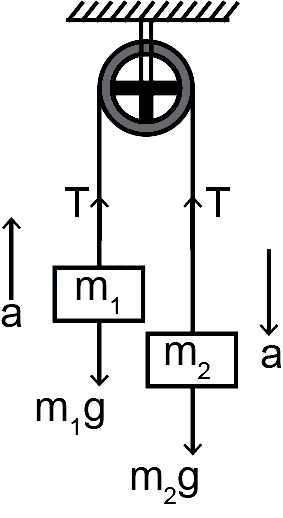
Two weights of mass $m_{1}$ and $m_{2} (> m_{1})$ are joined by an inextensible string of negligible mass passing over a fixed frictionless pulley. The magnitude of the acceleration of the loads is
A
$g$
B
$\frac{m_{2}-m_{1}}{m_{2}} g$
C
$\frac{m_{1}}{m_{2}+m_{1}} g$
D
$\frac{m_{2}-m_{1}}{m_{2}+m_{1}} g$
Solution
(D) Let $T$ be the tension in the string and $a$ be the magnitude of the acceleration of the masses.
Since $m_{2} > m_{1}$,the mass $m_{2}$ moves downwards with acceleration $a$,and the mass $m_{1}$ moves upwards with acceleration $a$.
For mass $m_{1}$ (moving upwards): $T - m_{1}g = m_{1}a$ ....$(i)$
For mass $m_{2}$ (moving downwards): $m_{2}g - T = m_{2}a$ ....(ii)
Adding equations $(i)$ and (ii),we get:
$(T - m_{1}g) + (m_{2}g - T) = m_{1}a + m_{2}a$
$(m_{2} - m_{1})g = (m_{1} + m_{2})a$
$a = \frac{m_{2} - m_{1}}{m_{1} + m_{2}} g$
Since $m_{2} > m_{1}$,the mass $m_{2}$ moves downwards with acceleration $a$,and the mass $m_{1}$ moves upwards with acceleration $a$.
For mass $m_{1}$ (moving upwards): $T - m_{1}g = m_{1}a$ ....$(i)$
For mass $m_{2}$ (moving downwards): $m_{2}g - T = m_{2}a$ ....(ii)
Adding equations $(i)$ and (ii),we get:
$(T - m_{1}g) + (m_{2}g - T) = m_{1}a + m_{2}a$
$(m_{2} - m_{1})g = (m_{1} + m_{2})a$
$a = \frac{m_{2} - m_{1}}{m_{1} + m_{2}} g$
0 likesView Solution
5
PhysicsEasyMCQWBJEE · 2019
$A$ small spherical body of radius $r$ and density $\rho$ moves with the terminal velocity $v$ in a fluid of coefficient of viscosity $\eta$ and density $\sigma$. What will be the net force on the body?
A
$\frac{4}{3} \pi r^{3}(\rho-\sigma) g$
B
$6 \pi \eta rv$
C
Zero
D
Infinity
Solution
(C) When a small spherical body falls through a viscous fluid,it experiences three forces: gravitational force (weight) acting downwards,buoyant force acting upwards,and viscous drag force acting upwards.
At terminal velocity $v$,the body moves with a constant velocity,which implies that the net acceleration of the body is zero.
According to Newton's second law of motion,$F_{\text{net}} = ma$. Since the acceleration $a = 0$,the net force $F_{\text{net}}$ acting on the body is $0$.
Therefore,the weight of the body is exactly balanced by the sum of the buoyant force and the viscous drag force.
At terminal velocity $v$,the body moves with a constant velocity,which implies that the net acceleration of the body is zero.
According to Newton's second law of motion,$F_{\text{net}} = ma$. Since the acceleration $a = 0$,the net force $F_{\text{net}}$ acting on the body is $0$.
Therefore,the weight of the body is exactly balanced by the sum of the buoyant force and the viscous drag force.
0 likesView Solution
6
PhysicsMediumMCQWBJEE · 2019
A compressive force is applied to a uniform rod of rectangular cross-section so that its length decreases by $1 \%$. If the Poisson's ratio for the material of the rod is $0.2,$ which of the following statements is correct? "The volume approximately ..........."
A
decreases by $1 \%$
B
decreases by $0.8 \%$
C
decreases by $0.6 \%$
D
increases by $0.2 \%$
Solution
(C) Given: The fractional change in length is $\frac{\Delta l}{l} = -0.01$ (since it decreases by $1 \%$).
Poisson's ratio, $\sigma = 0.2$.
For a rod, the volume $V = A \times l$, where $A$ is the cross-sectional area.
The fractional change in volume is given by $\frac{\Delta V}{V} = \frac{\Delta A}{A} + \frac{\Delta l}{l}$.
Since $A = w \times t$ (width $\times$ thickness), $\frac{\Delta A}{A} = \frac{\Delta w}{w} + \frac{\Delta t}{t}$.
By definition of Poisson's ratio, $\sigma = -\frac{\Delta w / w}{\Delta l / l} = -\frac{\Delta t / t}{\Delta l / l}$.
Thus, $\frac{\Delta w}{w} = -\sigma \frac{\Delta l}{l}$ and $\frac{\Delta t}{t} = -\sigma \frac{\Delta l}{l}$.
Substituting these into the volume equation:
$\frac{\Delta V}{V} = -\sigma \frac{\Delta l}{l} - \sigma \frac{\Delta l}{l} + \frac{\Delta l}{l} = \frac{\Delta l}{l} (1 - 2\sigma)$.
Substituting the values: $\frac{\Delta V}{V} = -0.01 \times (1 - 2 \times 0.2) = -0.01 \times (1 - 0.4) = -0.01 \times 0.6 = -0.006$.
Therefore, the volume decreases by $0.6 \%$.
Poisson's ratio, $\sigma = 0.2$.
For a rod, the volume $V = A \times l$, where $A$ is the cross-sectional area.
The fractional change in volume is given by $\frac{\Delta V}{V} = \frac{\Delta A}{A} + \frac{\Delta l}{l}$.
Since $A = w \times t$ (width $\times$ thickness), $\frac{\Delta A}{A} = \frac{\Delta w}{w} + \frac{\Delta t}{t}$.
By definition of Poisson's ratio, $\sigma = -\frac{\Delta w / w}{\Delta l / l} = -\frac{\Delta t / t}{\Delta l / l}$.
Thus, $\frac{\Delta w}{w} = -\sigma \frac{\Delta l}{l}$ and $\frac{\Delta t}{t} = -\sigma \frac{\Delta l}{l}$.
Substituting these into the volume equation:
$\frac{\Delta V}{V} = -\sigma \frac{\Delta l}{l} - \sigma \frac{\Delta l}{l} + \frac{\Delta l}{l} = \frac{\Delta l}{l} (1 - 2\sigma)$.
Substituting the values: $\frac{\Delta V}{V} = -0.01 \times (1 - 2 \times 0.2) = -0.01 \times (1 - 0.4) = -0.01 \times 0.6 = -0.006$.
Therefore, the volume decreases by $0.6 \%$.
0 likesView Solution
7
PhysicsEasyMCQWBJEE · 2019
$A$ projectile is thrown with an initial velocity of $10 \ m/s$ at an angle $\alpha$ with the horizontal. It has a range of $5 \ m$. Taking $g = 10 \ m/s^2$ and neglecting air resistance,what will be the estimated value of $\alpha$ (in $^{\circ}$)?
A
$15$
B
$30$
C
$45$
D
$75$
Solution
(A) Given,initial velocity $u = 10 \ m/s$.
Range $R = 5 \ m$.
Acceleration due to gravity $g = 10 \ m/s^2$.
The formula for the range of a projectile is $R = \frac{u^2 \sin(2\alpha)}{g}$.
Substituting the given values:
$5 = \frac{(10)^2 \sin(2\alpha)}{10}$
$5 = \frac{100 \sin(2\alpha)}{10}$
$5 = 10 \sin(2\alpha)$
$\sin(2\alpha) = \frac{5}{10} = 0.5$.
Since $\sin(30^{\circ}) = 0.5$,we have $2\alpha = 30^{\circ}$ or $2\alpha = 150^{\circ}$.
Therefore,$\alpha = 15^{\circ}$ or $\alpha = 75^{\circ}$.
Comparing with the given options,the correct value is $15^{\circ}$.
Range $R = 5 \ m$.
Acceleration due to gravity $g = 10 \ m/s^2$.
The formula for the range of a projectile is $R = \frac{u^2 \sin(2\alpha)}{g}$.
Substituting the given values:
$5 = \frac{(10)^2 \sin(2\alpha)}{10}$
$5 = \frac{100 \sin(2\alpha)}{10}$
$5 = 10 \sin(2\alpha)$
$\sin(2\alpha) = \frac{5}{10} = 0.5$.
Since $\sin(30^{\circ}) = 0.5$,we have $2\alpha = 30^{\circ}$ or $2\alpha = 150^{\circ}$.
Therefore,$\alpha = 15^{\circ}$ or $\alpha = 75^{\circ}$.
Comparing with the given options,the correct value is $15^{\circ}$.
0 likesView Solution
8
PhysicsMediumMCQWBJEE · 2019
$A$ horizontal fire hose with a nozzle of cross-sectional area $\frac{5}{\sqrt{21}} \times 10^{-3} \text{ m}^2$ delivers a cubic metre of water in $10 \text{ s}$. What will be the maximum possible increase in the temperature of water while it hits a rigid wall (neglecting the effect of gravity) (in $^{\circ} \text{C}$)?
A
$1$
B
$0.1$
C
$10$
D
$0.01$
Solution
(A) Given,cross-sectional area of the nozzle $A = \frac{5}{\sqrt{21}} \times 10^{-3} \text{ m}^2$.
Volume flow rate $Q = \frac{1 \text{ m}^3}{10 \text{ s}} = 0.1 \text{ m}^3/\text{s}$.
The velocity of water $v$ is given by $v = \frac{Q}{A} = \frac{0.1}{\frac{5}{\sqrt{21}} \times 10^{-3}} = \frac{10^{-1} \times \sqrt{21}}{5 \times 10^{-3}} = 20\sqrt{21} \text{ m/s}$.
When the water hits a rigid wall,its kinetic energy is converted into heat energy. The maximum possible increase in temperature $\Delta T$ is given by the energy balance equation: $\frac{1}{2}mv^2 = ms\Delta T$.
Here,$s$ is the specific heat capacity of water $= 4.2 \times 10^3 \text{ J/(kg} \cdot ^{\circ}\text{C)}$.
Thus,$\Delta T = \frac{v^2}{2s} = \frac{(20\sqrt{21})^2}{2 \times 4.2 \times 10^3}$.
$\Delta T = \frac{400 \times 21}{8.4 \times 10^3} = \frac{8400}{8400} = 1^{\circ} \text{C}$.
Volume flow rate $Q = \frac{1 \text{ m}^3}{10 \text{ s}} = 0.1 \text{ m}^3/\text{s}$.
The velocity of water $v$ is given by $v = \frac{Q}{A} = \frac{0.1}{\frac{5}{\sqrt{21}} \times 10^{-3}} = \frac{10^{-1} \times \sqrt{21}}{5 \times 10^{-3}} = 20\sqrt{21} \text{ m/s}$.
When the water hits a rigid wall,its kinetic energy is converted into heat energy. The maximum possible increase in temperature $\Delta T$ is given by the energy balance equation: $\frac{1}{2}mv^2 = ms\Delta T$.
Here,$s$ is the specific heat capacity of water $= 4.2 \times 10^3 \text{ J/(kg} \cdot ^{\circ}\text{C)}$.
Thus,$\Delta T = \frac{v^2}{2s} = \frac{(20\sqrt{21})^2}{2 \times 4.2 \times 10^3}$.
$\Delta T = \frac{400 \times 21}{8.4 \times 10^3} = \frac{8400}{8400} = 1^{\circ} \text{C}$.
0 likesView Solution
9
PhysicsMediumMCQWBJEE · 2019
Two black bodies $A$ and $B$ have equal surface areas and are maintained at temperatures $27^{\circ} C$ and $177^{\circ} C$ respectively. What will be the ratio of the thermal energy radiated per second by $A$ to that by $B$?
A
$4: 9$
B
$2: 3$
C
$16: 81$
D
$27: 177$
Solution
(C) According to the Stefan-Boltzmann law,the thermal energy radiated per second $(Q)$ by a black body is given by $Q = \sigma A T^4$,where $\sigma$ is the Stefan-Boltzmann constant,$A$ is the surface area,and $T$ is the absolute temperature in Kelvin.
Given that the surface areas of both bodies $A$ and $B$ are equal $(A_A = A_B = A)$,the ratio of the energy radiated is:
$\frac{Q_A}{Q_B} = \frac{\sigma A T_A^4}{\sigma A T_B^4} = \left(\frac{T_A}{T_B}\right)^4$
Convert the temperatures from Celsius to Kelvin:
$T_A = 27^{\circ} C = 27 + 273 = 300 \ K$
$T_B = 177^{\circ} C = 177 + 273 = 450 \ K$
Substitute the values into the ratio:
$\frac{Q_A}{Q_B} = \left(\frac{300}{450}\right)^4 = \left(\frac{2}{3}\right)^4$
$\frac{Q_A}{Q_B} = \frac{16}{81}$
Thus,the ratio of the thermal energy radiated per second by $A$ to that by $B$ is $16: 81$.
Given that the surface areas of both bodies $A$ and $B$ are equal $(A_A = A_B = A)$,the ratio of the energy radiated is:
$\frac{Q_A}{Q_B} = \frac{\sigma A T_A^4}{\sigma A T_B^4} = \left(\frac{T_A}{T_B}\right)^4$
Convert the temperatures from Celsius to Kelvin:
$T_A = 27^{\circ} C = 27 + 273 = 300 \ K$
$T_B = 177^{\circ} C = 177 + 273 = 450 \ K$
Substitute the values into the ratio:
$\frac{Q_A}{Q_B} = \left(\frac{300}{450}\right)^4 = \left(\frac{2}{3}\right)^4$
$\frac{Q_A}{Q_B} = \frac{16}{81}$
Thus,the ratio of the thermal energy radiated per second by $A$ to that by $B$ is $16: 81$.
0 likesView Solution
10
PhysicsMediumMCQWBJEE · 2019
The initial pressure and volume of a given mass of an ideal gas (with $\frac{C_{p}}{C_{V}}=\gamma$),taken in a cylinder fitted with a piston,are $p_{0}$ and $V_{0}$ respectively. At this stage,the gas has the same temperature as that of the surrounding medium,which is $T_{0}$. It is adiabatically compressed to a volume equal to $\frac{V_{0}}{2}$. Subsequently,the gas is allowed to come to thermal equilibrium with the surroundings. What is the heat released to the surrounding?
A
$0$
B
$(2^{\gamma-1}-1) \frac{p_{0} V_{0}}{\gamma-1}$
C
$\gamma p_{0} V_{0} \ln 2$
D
$\frac{p_{0} V_{0}}{2(\gamma-1)}$
Solution
(B) For an adiabatic process,the relationship between temperature and volume is given by $T V^{\gamma-1} = \text{constant}$.
Let the temperature after adiabatic compression be $T$. Then,$T_{0} V_{0}^{\gamma-1} = T \left(\frac{V_{0}}{2}\right)^{\gamma-1}$.
Solving for $T$,we get $T = T_{0} 2^{\gamma-1}$.
When the gas is allowed to come to thermal equilibrium with the surroundings at constant volume $\frac{V_{0}}{2}$,the heat released $\Delta Q$ is equal to the change in internal energy: $\Delta Q = n C_{V} \Delta T$.
Using $C_{V} = \frac{R}{\gamma-1}$ and the ideal gas law $n R T_{0} = p_{0} V_{0}$,we have:
$\Delta Q = n \left(\frac{R}{\gamma-1}\right) (T - T_{0}) = \frac{n R T_{0}}{\gamma-1} (2^{\gamma-1} - 1)$.
Substituting $n R T_{0} = p_{0} V_{0}$,the heat released is $\frac{p_{0} V_{0}}{\gamma-1} (2^{\gamma-1} - 1)$.
Let the temperature after adiabatic compression be $T$. Then,$T_{0} V_{0}^{\gamma-1} = T \left(\frac{V_{0}}{2}\right)^{\gamma-1}$.
Solving for $T$,we get $T = T_{0} 2^{\gamma-1}$.
When the gas is allowed to come to thermal equilibrium with the surroundings at constant volume $\frac{V_{0}}{2}$,the heat released $\Delta Q$ is equal to the change in internal energy: $\Delta Q = n C_{V} \Delta T$.
Using $C_{V} = \frac{R}{\gamma-1}$ and the ideal gas law $n R T_{0} = p_{0} V_{0}$,we have:
$\Delta Q = n \left(\frac{R}{\gamma-1}\right) (T - T_{0}) = \frac{n R T_{0}}{\gamma-1} (2^{\gamma-1} - 1)$.
Substituting $n R T_{0} = p_{0} V_{0}$,the heat released is $\frac{p_{0} V_{0}}{\gamma-1} (2^{\gamma-1} - 1)$.
0 likesView Solution
11
PhysicsEasyMCQWBJEE · 2019
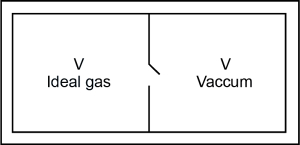
Consider the given diagram. An ideal gas is contained in a chamber (left) of volume $V$ and is at an absolute temperature $T$. It is allowed to rush freely into the right chamber of volume $V$ which is initially vacuum. The whole system is thermally isolated. What will be the final temperature once the equilibrium has been attained?
A
$T$
B
$\frac{T}{2}$
C
$2T$
D
$\frac{T}{4}$
Solution
(A) This process is known as free expansion of an ideal gas.
Since the system is thermally isolated,there is no heat exchange with the surroundings,so $Q = 0$.
Since the gas expands into a vacuum,there is no external pressure against which the gas does work,so the work done $W = 0$.
According to the first law of thermodynamics,$\Delta U = Q - W$.
Since $Q = 0$ and $W = 0$,the change in internal energy $\Delta U = 0$.
For an ideal gas,the internal energy depends only on its temperature $(U \propto T)$.
Since $\Delta U = 0$,the temperature of the ideal gas remains constant.
Therefore,the final temperature attained at equilibrium will be $T$.
Since the system is thermally isolated,there is no heat exchange with the surroundings,so $Q = 0$.
Since the gas expands into a vacuum,there is no external pressure against which the gas does work,so the work done $W = 0$.
According to the first law of thermodynamics,$\Delta U = Q - W$.
Since $Q = 0$ and $W = 0$,the change in internal energy $\Delta U = 0$.
For an ideal gas,the internal energy depends only on its temperature $(U \propto T)$.
Since $\Delta U = 0$,the temperature of the ideal gas remains constant.
Therefore,the final temperature attained at equilibrium will be $T$.
0 likesView Solution
12
PhysicsMediumMCQWBJEE · 2019
$A$ body starts from rest,under the action of an engine working at a constant power and moves along a straight line. The displacement $s$ is given as a function of time $t$ as:
A
$s=a t+b t^{2}, a$ and $b$ are constants
B
$s=b t^{2}, b$ is a constant
C
$s=a t^{3 / 2}, a$ is a constant
D
$s=a t, a$ is a constant
Solution
(C) Given,Power $(P) =$ constant.
Kinetic Energy $(KE) = \frac{1}{2} m v^{2}$.
We know that,$P = \frac{d(KE)}{dt} = \frac{d}{dt} (\frac{1}{2} m v^{2}) = m v \frac{dv}{dt}$.
Since $P$ is constant,$m v \frac{dv}{dt} = P$.
Integrating both sides with respect to time $t$:
$\int m v dv = \int P dt \Rightarrow \frac{1}{2} m v^{2} = P t$ (assuming initial velocity is $0$ at $t=0$).
$v^{2} = \frac{2 P}{m} t \Rightarrow v = \sqrt{\frac{2 P}{m}} t^{1/2}$.
Since $v = \frac{ds}{dt}$,we have $\frac{ds}{dt} = \sqrt{\frac{2 P}{m}} t^{1/2}$.
Integrating with respect to $t$:
$s = \int \sqrt{\frac{2 P}{m}} t^{1/2} dt = \sqrt{\frac{2 P}{m}} \cdot \frac{t^{3/2}}{3/2} = \frac{2}{3} \sqrt{\frac{2 P}{m}} t^{3/2}$.
Thus,$s \propto t^{3/2}$,which means $s = a t^{3/2}$ where $a$ is a constant.
Kinetic Energy $(KE) = \frac{1}{2} m v^{2}$.
We know that,$P = \frac{d(KE)}{dt} = \frac{d}{dt} (\frac{1}{2} m v^{2}) = m v \frac{dv}{dt}$.
Since $P$ is constant,$m v \frac{dv}{dt} = P$.
Integrating both sides with respect to time $t$:
$\int m v dv = \int P dt \Rightarrow \frac{1}{2} m v^{2} = P t$ (assuming initial velocity is $0$ at $t=0$).
$v^{2} = \frac{2 P}{m} t \Rightarrow v = \sqrt{\frac{2 P}{m}} t^{1/2}$.
Since $v = \frac{ds}{dt}$,we have $\frac{ds}{dt} = \sqrt{\frac{2 P}{m}} t^{1/2}$.
Integrating with respect to $t$:
$s = \int \sqrt{\frac{2 P}{m}} t^{1/2} dt = \sqrt{\frac{2 P}{m}} \cdot \frac{t^{3/2}}{3/2} = \frac{2}{3} \sqrt{\frac{2 P}{m}} t^{3/2}$.
Thus,$s \propto t^{3/2}$,which means $s = a t^{3/2}$ where $a$ is a constant.
0 likesView Solution
13
PhysicsMediumMCQWBJEE · 2019
$A$ parallel plate capacitor in series with a resistance of $100 \Omega$,an inductor of $20 \text{ mH}$,and an $AC$ voltage source of variable frequency shows resonance at a frequency of $\frac{1250}{\pi} \text{ Hz}$. If this capacitor is charged by a $DC$ voltage source to a voltage of $25 \text{ V}$,what amount of charge will be stored in each plate of the capacitor?
A
$0.2 \mu\text{C}$
B
$2 \text{ mC}$
C
$0.2 \text{ mC}$
D
$0.2 \text{ C}$
Solution
(C) In a series $R-L-C$ circuit,the resonance frequency is given by $f_0 = \frac{1}{2\pi\sqrt{LC}}$.
Given: $R = 100 \Omega$,$L = 20 \text{ mH} = 20 \times 10^{-3} \text{ H}$,$f_0 = \frac{1250}{\pi} \text{ Hz}$.
Substituting the values into the resonance formula:
$\frac{1250}{\pi} = \frac{1}{2\pi\sqrt{20 \times 10^{-3} \times C}}$
$1250 = \frac{1}{2\sqrt{0.02 \times C}}$
$2500 = \frac{1}{\sqrt{0.02 \times C}}$
Squaring both sides:
$6.25 \times 10^6 = \frac{1}{0.02 \times C}$
$C = \frac{1}{0.02 \times 6.25 \times 10^6} = \frac{1}{0.125 \times 10^6} = 8 \times 10^{-6} \text{ F} = 8 \mu\text{F}$.
When charged by a $DC$ source of $V = 25 \text{ V}$,the charge $Q$ stored is:
$Q = C \times V = 8 \times 10^{-6} \text{ F} \times 25 \text{ V} = 200 \times 10^{-6} \text{ C} = 0.2 \times 10^{-3} \text{ C} = 0.2 \text{ mC}$.
Given: $R = 100 \Omega$,$L = 20 \text{ mH} = 20 \times 10^{-3} \text{ H}$,$f_0 = \frac{1250}{\pi} \text{ Hz}$.
Substituting the values into the resonance formula:
$\frac{1250}{\pi} = \frac{1}{2\pi\sqrt{20 \times 10^{-3} \times C}}$
$1250 = \frac{1}{2\sqrt{0.02 \times C}}$
$2500 = \frac{1}{\sqrt{0.02 \times C}}$
Squaring both sides:
$6.25 \times 10^6 = \frac{1}{0.02 \times C}$
$C = \frac{1}{0.02 \times 6.25 \times 10^6} = \frac{1}{0.125 \times 10^6} = 8 \times 10^{-6} \text{ F} = 8 \mu\text{F}$.
When charged by a $DC$ source of $V = 25 \text{ V}$,the charge $Q$ stored is:
$Q = C \times V = 8 \times 10^{-6} \text{ F} \times 25 \text{ V} = 200 \times 10^{-6} \text{ C} = 0.2 \times 10^{-3} \text{ C} = 0.2 \text{ mC}$.
0 likesView Solution
14
PhysicsMediumMCQWBJEE · 2019
When a $60 \text{ mH}$ inductor and a resistor are connected in series with an $AC$ voltage source,the voltage leads the current by $60^{\circ}$. If the inductor is replaced by a $0.5 \text{ } \mu\text{F}$ capacitor,the voltage lags behind the current by $30^{\circ}$. What is the frequency of the $AC$ supply?
A
$\frac{1}{2 \pi} \times 10^{4} \text{ Hz}$
B
$\frac{1}{\pi} \times 10^{4} \text{ Hz}$
C
$\frac{3}{2 \pi} \times 10^{4} \text{ Hz}$
D
$\frac{1}{2 \pi} \times 10^{8} \text{ Hz}$
Solution
(A) Given,inductance $L = 60 \text{ mH} = 60 \times 10^{-3} \text{ H}$.
Phase difference in $L-R$ circuit,$\theta_{1} = 60^{\circ}$.
Capacitance $C = 0.5 \text{ } \mu\text{F} = 0.5 \times 10^{-6} \text{ F}$.
Phase difference in $R-C$ circuit,$\theta_{2} = 30^{\circ}$.
For $L-R$ circuit,$\tan \theta_{1} = \frac{X_{L}}{R} = \frac{\omega L}{R} \quad \dots(i)$.
For $R-C$ circuit,$\tan \theta_{2} = \frac{X_{C}}{R} = \frac{1}{\omega CR} \quad \dots(ii)$.
Dividing $(i)$ by (ii): $\frac{\tan \theta_{1}}{\tan \theta_{2}} = \frac{\omega L / R}{1 / (\omega CR)} = \omega^{2} LC$.
Substituting values: $\frac{\tan 60^{\circ}}{\tan 30^{\circ}} = \frac{\sqrt{3}}{1/\sqrt{3}} = 3 = \omega^{2} LC$.
$\omega^{2} = \frac{3}{LC} = \frac{3}{60 \times 10^{-3} \times 0.5 \times 10^{-6}} = \frac{3}{30 \times 10^{-9}} = 10^{8}$.
$\omega = \sqrt{10^{8}} = 10^{4} \text{ rad/s}$.
Since $\omega = 2 \pi f$,then $f = \frac{\omega}{2 \pi} = \frac{10^{4}}{2 \pi} \text{ Hz}$.
Phase difference in $L-R$ circuit,$\theta_{1} = 60^{\circ}$.
Capacitance $C = 0.5 \text{ } \mu\text{F} = 0.5 \times 10^{-6} \text{ F}$.
Phase difference in $R-C$ circuit,$\theta_{2} = 30^{\circ}$.
For $L-R$ circuit,$\tan \theta_{1} = \frac{X_{L}}{R} = \frac{\omega L}{R} \quad \dots(i)$.
For $R-C$ circuit,$\tan \theta_{2} = \frac{X_{C}}{R} = \frac{1}{\omega CR} \quad \dots(ii)$.
Dividing $(i)$ by (ii): $\frac{\tan \theta_{1}}{\tan \theta_{2}} = \frac{\omega L / R}{1 / (\omega CR)} = \omega^{2} LC$.
Substituting values: $\frac{\tan 60^{\circ}}{\tan 30^{\circ}} = \frac{\sqrt{3}}{1/\sqrt{3}} = 3 = \omega^{2} LC$.
$\omega^{2} = \frac{3}{LC} = \frac{3}{60 \times 10^{-3} \times 0.5 \times 10^{-6}} = \frac{3}{30 \times 10^{-9}} = 10^{8}$.
$\omega = \sqrt{10^{8}} = 10^{4} \text{ rad/s}$.
Since $\omega = 2 \pi f$,then $f = \frac{\omega}{2 \pi} = \frac{10^{4}}{2 \pi} \text{ Hz}$.
0 likesView Solution
15
PhysicsEasyMCQWBJEE · 2019
To which of the following is the angular velocity of the electron in the $n$-th Bohr orbit proportional?
A
$n^{2}$
B
$\frac{1}{n^{2}}$
C
$\frac{1}{n^{3/2}}$
D
$\frac{1}{n^{3}}$
Solution
(D) According to the Bohr's atomic model,the angular momentum $L$ is given by:
$L = mvr = \frac{nh}{2\pi} \dots (i)$
Since angular velocity $\omega = \frac{v}{r}$,we have $v = r\omega$.
Substituting $v = r\omega$ into equation $(i)$:
$m(r\omega)r = \frac{nh}{2\pi} \Rightarrow m\omega r^2 = \frac{nh}{2\pi} \Rightarrow \omega = \frac{nh}{2\pi mr^2} \dots (ii)$
The radius of the electron in the $n$-th orbit is given by:
$r = \frac{n^2 h^2 \epsilon_0}{\pi m Z e^2} \dots (iii)$
Substituting the expression for $r$ from equation $(iii)$ into equation $(ii)$:
$\omega = \frac{nh}{2\pi m} \left( \frac{\pi m Z e^2}{n^2 h^2 \epsilon_0} \right)^2$
$\omega = \frac{nh}{2\pi m} \cdot \frac{\pi^2 m^2 Z^2 e^4}{n^4 h^4 \epsilon_0^2}$
$\omega = \frac{\pi m Z^2 e^4}{2 h^3 \epsilon_0^2} \cdot \frac{1}{n^3}$
Therefore,$\omega \propto \frac{1}{n^3}$.
$L = mvr = \frac{nh}{2\pi} \dots (i)$
Since angular velocity $\omega = \frac{v}{r}$,we have $v = r\omega$.
Substituting $v = r\omega$ into equation $(i)$:
$m(r\omega)r = \frac{nh}{2\pi} \Rightarrow m\omega r^2 = \frac{nh}{2\pi} \Rightarrow \omega = \frac{nh}{2\pi mr^2} \dots (ii)$
The radius of the electron in the $n$-th orbit is given by:
$r = \frac{n^2 h^2 \epsilon_0}{\pi m Z e^2} \dots (iii)$
Substituting the expression for $r$ from equation $(iii)$ into equation $(ii)$:
$\omega = \frac{nh}{2\pi m} \left( \frac{\pi m Z e^2}{n^2 h^2 \epsilon_0} \right)^2$
$\omega = \frac{nh}{2\pi m} \cdot \frac{\pi^2 m^2 Z^2 e^4}{n^4 h^4 \epsilon_0^2}$
$\omega = \frac{\pi m Z^2 e^4}{2 h^3 \epsilon_0^2} \cdot \frac{1}{n^3}$
Therefore,$\omega \propto \frac{1}{n^3}$.
0 likesView Solution
16
PhysicsEasyMCQWBJEE · 2019
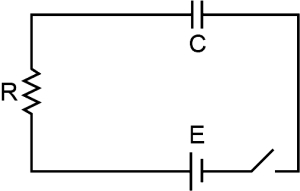
$A$ capacitor of capacitance $C$ is connected in series with a resistance $R$ and a $DC$ source of $emf$ $E$ through a key. The capacitor starts charging when the key is closed. By the time the capacitor has been fully charged,what amount of energy is dissipated in the resistance $R$?
A
$\frac{1}{2} C E^{2}$
B
$0$
C
$C E^{2}$
D
$\frac{E^{2}}{R}$
Solution
(A) When the capacitor is fully charged,the charge on it is $q = CE$.
The total work done by the $DC$ source (battery) is $W = qE = (CE)E = CE^2$.
The energy stored in the capacitor is $U = \frac{1}{2} CE^2$.
According to the law of conservation of energy,the work done by the battery is equal to the sum of the energy stored in the capacitor and the energy dissipated as heat in the resistor $R$.
Therefore,the energy dissipated in the resistance $R$ is given by:
$H = W - U$
$H = CE^2 - \frac{1}{2} CE^2$
$H = \frac{1}{2} CE^2$.
The total work done by the $DC$ source (battery) is $W = qE = (CE)E = CE^2$.
The energy stored in the capacitor is $U = \frac{1}{2} CE^2$.
According to the law of conservation of energy,the work done by the battery is equal to the sum of the energy stored in the capacitor and the energy dissipated as heat in the resistor $R$.
Therefore,the energy dissipated in the resistance $R$ is given by:
$H = W - U$
$H = CE^2 - \frac{1}{2} CE^2$
$H = \frac{1}{2} CE^2$.
0 likesView Solution
17
PhysicsMediumMCQWBJEE · 2019
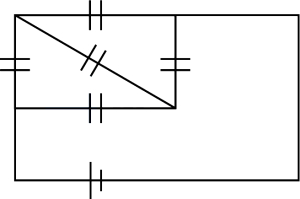
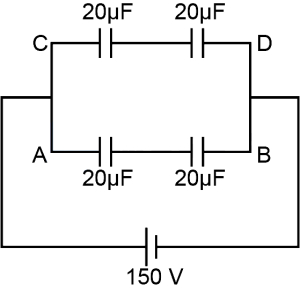
Five identical capacitors,each of capacitance $20 \mu F$,are connected to a battery of $150 V$ in the combination shown in the diagram. What is the total amount of charge stored?
A
$15 \times 10^{-3} C$
B
$12 \times 10^{-3} C$
C
$10 \times 10^{-3} C$
D
$3 \times 10^{-3} C$
Solution
(D) The given circuit consists of two parallel branches connected across a $150 V$ battery.
Branch $1$ (top) contains two $20 \mu F$ capacitors in series. The equivalent capacitance $C_1$ is given by:
$\frac{1}{C_1} = \frac{1}{20} + \frac{1}{20} = \frac{2}{20} = \frac{1}{10} \implies C_1 = 10 \mu F$.
Branch $2$ (bottom) also contains two $20 \mu F$ capacitors in series. The equivalent capacitance $C_2$ is:
$\frac{1}{C_2} = \frac{1}{20} + \frac{1}{20} = \frac{1}{10} \implies C_2 = 10 \mu F$.
Since these two branches are in parallel,the total equivalent capacitance $C_{eq}$ is:
$C_{eq} = C_1 + C_2 = 10 \mu F + 10 \mu F = 20 \mu F$.
The total charge $Q$ stored is given by $Q = C_{eq} V$:
$Q = 20 \times 10^{-6} F \times 150 V = 3000 \times 10^{-6} C = 3 \times 10^{-3} C$.
Branch $1$ (top) contains two $20 \mu F$ capacitors in series. The equivalent capacitance $C_1$ is given by:
$\frac{1}{C_1} = \frac{1}{20} + \frac{1}{20} = \frac{2}{20} = \frac{1}{10} \implies C_1 = 10 \mu F$.
Branch $2$ (bottom) also contains two $20 \mu F$ capacitors in series. The equivalent capacitance $C_2$ is:
$\frac{1}{C_2} = \frac{1}{20} + \frac{1}{20} = \frac{1}{10} \implies C_2 = 10 \mu F$.
Since these two branches are in parallel,the total equivalent capacitance $C_{eq}$ is:
$C_{eq} = C_1 + C_2 = 10 \mu F + 10 \mu F = 20 \mu F$.
The total charge $Q$ stored is given by $Q = C_{eq} V$:
$Q = 20 \times 10^{-6} F \times 150 V = 3000 \times 10^{-6} C = 3 \times 10^{-3} C$.
0 likesView Solution
18
PhysicsDifficultMCQWBJEE · 2019
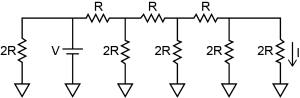
What is the current $I$ shown in the given circuit?
A
$\frac{V}{2 R}$
B
$\frac{V}{R}$
C
$\frac{V}{16 R}$
D
$\frac{V}{8 R}$
Solution
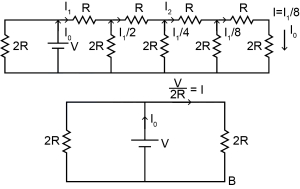
(C) In the given ladder network,let the current flowing through the first series resistor $R$ be $I_1$.
At each node,the current splits between the shunt resistor $2R$ and the next series resistor $R$.
By analyzing the circuit from right to left,we observe that the current halves at each stage due to the symmetry of the ladder network.
Specifically,if $I_1$ is the current entering the first series resistor,the current flowing through the subsequent shunt resistors will be $I_1/2, I_1/4, I_1/8$,and so on.
The current $I$ in the final branch is given by $I = I_1/8$.
Since the voltage across the first shunt resistor $2R$ is $V$,the current $I_1$ flowing through the first series resistor is $I_1 = V / (2R)$.
Substituting this value into the expression for $I$,we get:
$I = \frac{1}{8} \times \frac{V}{2R} = \frac{V}{16R}$.
At each node,the current splits between the shunt resistor $2R$ and the next series resistor $R$.
By analyzing the circuit from right to left,we observe that the current halves at each stage due to the symmetry of the ladder network.
Specifically,if $I_1$ is the current entering the first series resistor,the current flowing through the subsequent shunt resistors will be $I_1/2, I_1/4, I_1/8$,and so on.
The current $I$ in the final branch is given by $I = I_1/8$.
Since the voltage across the first shunt resistor $2R$ is $V$,the current $I_1$ flowing through the first series resistor is $I_1 = V / (2R)$.
Substituting this value into the expression for $I$,we get:
$I = \frac{1}{8} \times \frac{V}{2R} = \frac{V}{16R}$.
0 likesView Solution
19
PhysicsMediumMCQWBJEE · 2019
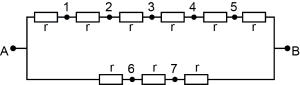
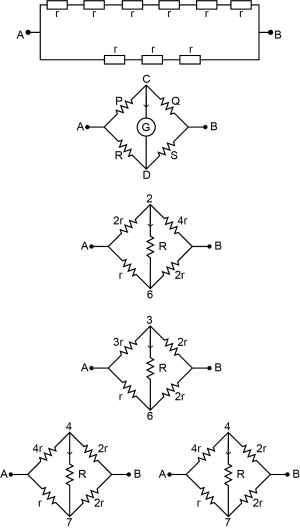
In the circuit shown in the figure,all the resistances are identical and each has the value $r \ \Omega$. The equivalent resistance of the combination between the points $A$ and $B$ will remain unchanged even when the following pairs of points marked in the figure are connected through a resistance $R$.
A
$2$ and $6$
B
$3$ and $6$
C
$4$ and $7$
D
$4$ and $6$
Solution
(A, C) The equivalent resistance between points $A$ and $B$ remains unchanged when a resistance $R$ is connected between two points if the potential difference between those two points is zero. This is equivalent to the balanced condition of a Wheatstone bridge,where $\frac{P}{Q} = \frac{R}{S}$.
For option $(a)$: Connecting points $2$ and $6$ creates a bridge with arms of resistances $(2r, r)$ and $(4r, 2r)$. Since $\frac{2r}{4r} = \frac{r}{2r} = \frac{1}{2}$,the bridge is balanced.
For option $(b)$: Connecting points $3$ and $6$ creates a bridge with arms of resistances $(3r, r)$ and $(3r, 2r)$. Since $\frac{3r}{3r} \neq \frac{r}{2r}$,the bridge is not balanced.
For option $(c)$: Connecting points $4$ and $7$ creates a bridge with arms of resistances $(4r, 2r)$ and $(2r, r)$. Since $\frac{4r}{2r} = \frac{2r}{r} = 2$,the bridge is balanced.
For option $(d)$: Connecting points $4$ and $6$ creates a bridge with arms of resistances $(4r, r)$ and $(2r, 2r)$. Since $\frac{4r}{2r} \neq \frac{r}{2r}$,the bridge is not balanced.
Thus,the equivalent resistance remains unchanged for options $(a)$ and $(c)$.
For option $(a)$: Connecting points $2$ and $6$ creates a bridge with arms of resistances $(2r, r)$ and $(4r, 2r)$. Since $\frac{2r}{4r} = \frac{r}{2r} = \frac{1}{2}$,the bridge is balanced.
For option $(b)$: Connecting points $3$ and $6$ creates a bridge with arms of resistances $(3r, r)$ and $(3r, 2r)$. Since $\frac{3r}{3r} \neq \frac{r}{2r}$,the bridge is not balanced.
For option $(c)$: Connecting points $4$ and $7$ creates a bridge with arms of resistances $(4r, 2r)$ and $(2r, r)$. Since $\frac{4r}{2r} = \frac{2r}{r} = 2$,the bridge is balanced.
For option $(d)$: Connecting points $4$ and $6$ creates a bridge with arms of resistances $(4r, r)$ and $(2r, 2r)$. Since $\frac{4r}{2r} \neq \frac{r}{2r}$,the bridge is not balanced.
Thus,the equivalent resistance remains unchanged for options $(a)$ and $(c)$.
0 likesView Solution
20
PhysicsMediumMCQWBJEE · 2019
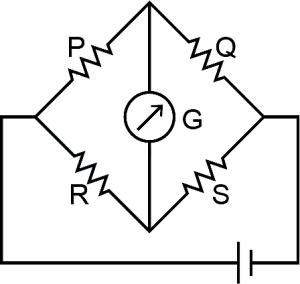
When the value of $R$ in the balanced Wheatstone bridge,shown in the figure,is increased from $5 \Omega$ to $7 \Omega$,the value of $S$ has to be increased by $3 \Omega$ in order to maintain the balance. What is the initial value of $S$ (in $Omega$)?
A
$2.5$
B
$3$
C
$5$
D
$7.5$
Solution
(D) According to the balanced condition of a Wheatstone bridge,the ratio of resistances in opposite arms is equal: $\frac{P}{Q} = \frac{R}{S}$.
In the first case:
$\frac{P}{Q} = \frac{5}{S} \quad \dots(i)$
In the second case,$R$ is increased to $7 \Omega$ and $S$ is increased by $3 \Omega$ (i.e.,$S + 3 \Omega$):
$\frac{P}{Q} = \frac{7}{S + 3} \quad \dots(ii)$
Equating $(i)$ and $(ii)$:
$\frac{5}{S} = \frac{7}{S + 3}$
$5(S + 3) = 7S$
$5S + 15 = 7S$
$2S = 15$
$S = 7.5 \Omega$
Thus,the initial value of $S$ is $7.5 \Omega$.
In the first case:
$\frac{P}{Q} = \frac{5}{S} \quad \dots(i)$
In the second case,$R$ is increased to $7 \Omega$ and $S$ is increased by $3 \Omega$ (i.e.,$S + 3 \Omega$):
$\frac{P}{Q} = \frac{7}{S + 3} \quad \dots(ii)$
Equating $(i)$ and $(ii)$:
$\frac{5}{S} = \frac{7}{S + 3}$
$5(S + 3) = 7S$
$5S + 15 = 7S$
$2S = 15$
$S = 7.5 \Omega$
Thus,the initial value of $S$ is $7.5 \Omega$.
0 likesView Solution
21
PhysicsMediumMCQWBJEE · 2019
$A$ proton and an electron initially at rest are accelerated by the same potential difference. Assuming that a proton is $2000$ times heavier than an electron,what will be the relation between the de Broglie wavelength of the proton $(\lambda_{p})$ and that of the electron $(\lambda_{e})$?
A
$\lambda_{p} = 2000 \lambda_{e}$
B
$\lambda_{p} = \frac{\lambda_{e}}{2000}$
C
$\lambda_{p} = 20 \sqrt{5} \lambda_{e}$
D
$\lambda_{p} = \frac{\lambda_{e}}{20 \sqrt{5}}$
Solution
(D) The de Broglie wavelength is given by $\lambda = \frac{h}{p} = \frac{h}{\sqrt{2m(KE)}}$.
Since the particles are accelerated by the same potential difference $V$,the kinetic energy $KE = qV$.
Thus,$\lambda = \frac{h}{\sqrt{2mqV}}$.
Since $h$,$q$,and $V$ are constants for both particles,we have $\lambda \propto \frac{1}{\sqrt{m}}$.
Therefore,$\frac{\lambda_{p}}{\lambda_{e}} = \sqrt{\frac{m_{e}}{m_{p}}}$.
Given $m_{p} = 2000 m_{e}$,we substitute this into the ratio:
$\frac{\lambda_{p}}{\lambda_{e}} = \sqrt{\frac{m_{e}}{2000 m_{e}}} = \sqrt{\frac{1}{2000}} = \frac{1}{\sqrt{400 \times 5}} = \frac{1}{20 \sqrt{5}}$.
Hence,$\lambda_{p} = \frac{\lambda_{e}}{20 \sqrt{5}}$.
Since the particles are accelerated by the same potential difference $V$,the kinetic energy $KE = qV$.
Thus,$\lambda = \frac{h}{\sqrt{2mqV}}$.
Since $h$,$q$,and $V$ are constants for both particles,we have $\lambda \propto \frac{1}{\sqrt{m}}$.
Therefore,$\frac{\lambda_{p}}{\lambda_{e}} = \sqrt{\frac{m_{e}}{m_{p}}}$.
Given $m_{p} = 2000 m_{e}$,we substitute this into the ratio:
$\frac{\lambda_{p}}{\lambda_{e}} = \sqrt{\frac{m_{e}}{2000 m_{e}}} = \sqrt{\frac{1}{2000}} = \frac{1}{\sqrt{400 \times 5}} = \frac{1}{20 \sqrt{5}}$.
Hence,$\lambda_{p} = \frac{\lambda_{e}}{20 \sqrt{5}}$.
0 likesView Solution
22
PhysicsEasyMCQWBJEE · 2019
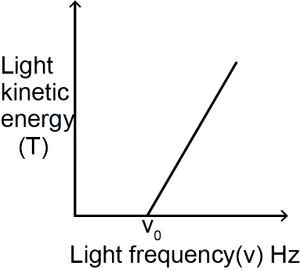
Electrons are emitted with kinetic energy $T$ from a metal plate by an irradiation of light of intensity $J$ and frequency $v$. Then,which of the following will be true?
A
$T \propto J$
B
$T$ linearly increases with $v$
C
$T \propto \text{time of irradiation}$
D
Number of electrons emitted $\propto J$
Solution
(D) According to Einstein's photoelectric equation,the maximum kinetic energy $T$ of the emitted photoelectrons is given by $T = hv - \phi$,where $h$ is Planck's constant,$v$ is the frequency of incident light,and $\phi$ is the work function of the metal.
From this equation,it is clear that $T$ increases linearly with the frequency $v$ of the incident light.
Additionally,the number of photoelectrons emitted per second is directly proportional to the intensity $J$ of the incident light,provided the frequency $v$ is greater than the threshold frequency $v_{0}$.
Since both statements $(B)$ and $(D)$ are physically correct,in the context of standard multiple-choice questions where only one answer is expected,$(D)$ is often cited as a fundamental observation regarding intensity,while $(B)$ describes the energy dependence. Given the options,$(D)$ is a standard result of the photoelectric effect.
From this equation,it is clear that $T$ increases linearly with the frequency $v$ of the incident light.
Additionally,the number of photoelectrons emitted per second is directly proportional to the intensity $J$ of the incident light,provided the frequency $v$ is greater than the threshold frequency $v_{0}$.
Since both statements $(B)$ and $(D)$ are physically correct,in the context of standard multiple-choice questions where only one answer is expected,$(D)$ is often cited as a fundamental observation regarding intensity,while $(B)$ describes the energy dependence. Given the options,$(D)$ is a standard result of the photoelectric effect.
0 likesView Solution
23
PhysicsEasyMCQWBJEE · 2019
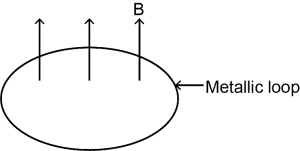
$A$ metallic loop is placed in a uniform magnetic field $B$ with the plane of the loop perpendicular to $B$. Under which condition will an electromotive force (emf) be induced in the loop? "If the loop is ....."
A
moved along the direction of $B$
B
squeezed to a smaller area
C
rotated about its axis
D
rotated about one of its diameters
Solution
(B, D) According to Faraday's law of electromagnetic induction, an emf is induced in a loop when the magnetic flux $\Phi = B \cdot A \cos \theta$ linked with the loop changes with time.
$1$. If the loop is moved along the direction of $B$, the magnetic field $B$, area $A$, and the angle $\theta$ remain constant. Thus, the flux remains constant, and no emf is induced.
$2$. If the loop is squeezed to a smaller area, the area $A$ changes with time. Therefore, the magnetic flux $\Phi$ changes, and an emf is induced.
$3$. If the loop is rotated about its axis, the orientation of the area vector relative to the magnetic field remains constant $(\theta = 0^\circ)$. Thus, the flux remains constant, and no emf is induced.
$4$. If the loop is rotated about one of its diameters, the angle $\theta$ between the magnetic field $B$ and the area vector changes with time. Therefore, the magnetic flux $\Phi$ changes, and an emf is induced.
Since both $(b)$ and $(d)$ result in a change in magnetic flux, both conditions will induce an emf.
$1$. If the loop is moved along the direction of $B$, the magnetic field $B$, area $A$, and the angle $\theta$ remain constant. Thus, the flux remains constant, and no emf is induced.
$2$. If the loop is squeezed to a smaller area, the area $A$ changes with time. Therefore, the magnetic flux $\Phi$ changes, and an emf is induced.
$3$. If the loop is rotated about its axis, the orientation of the area vector relative to the magnetic field remains constant $(\theta = 0^\circ)$. Thus, the flux remains constant, and no emf is induced.
$4$. If the loop is rotated about one of its diameters, the angle $\theta$ between the magnetic field $B$ and the area vector changes with time. Therefore, the magnetic flux $\Phi$ changes, and an emf is induced.
Since both $(b)$ and $(d)$ result in a change in magnetic flux, both conditions will induce an emf.
0 likesView Solution
24
PhysicsMediumMCQWBJEE · 2019
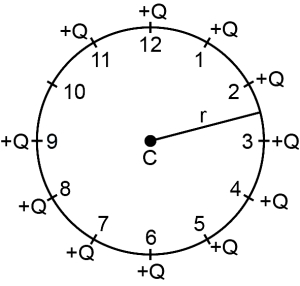
Eleven equal point charges,each of magnitude $+Q$,are placed at all the hour positions of a circular clock of radius $r$,except at the $10$ o'clock position. What is the electric field strength at the centre of the clock?
A
$\frac{Q}{4 \pi \varepsilon_{0} r^{2}}$ from the centre towards the mark $10$
B
$\frac{Q}{4 \pi \varepsilon_{0} r^{2}}$ from the mark $10$ towards the centre
C
$\frac{Q}{4 \pi \varepsilon_{0} r^{2}}$ from the centre towards the mark $6$
D
Zero.
Solution
(A) If there were $12$ equal charges $+Q$ at all hour positions,the electric field at the centre would be zero due to symmetry,as each charge would be cancelled by an equal and opposite charge at the diametrically opposite position.
Let $\vec{E}_{10}$ be the electric field at the centre due to a charge $+Q$ at the $10$ o'clock position. The net electric field $\vec{E}_{net}$ with the charge at $10$ missing is given by:
$\vec{E}_{total} = \vec{E}_{net} + \vec{E}_{10} = 0$
Therefore,$\vec{E}_{net} = -\vec{E}_{10}$.
The magnitude of the electric field due to a single charge $+Q$ at distance $r$ is $E = \frac{Q}{4 \pi \varepsilon_{0} r^{2}}$.
The direction of $\vec{E}_{10}$ is from the $10$ o'clock position towards the centre.
Thus,$-\vec{E}_{10}$ is a vector of magnitude $\frac{Q}{4 \pi \varepsilon_{0} r^{2}}$ directed from the centre towards the $10$ o'clock position.
Let $\vec{E}_{10}$ be the electric field at the centre due to a charge $+Q$ at the $10$ o'clock position. The net electric field $\vec{E}_{net}$ with the charge at $10$ missing is given by:
$\vec{E}_{total} = \vec{E}_{net} + \vec{E}_{10} = 0$
Therefore,$\vec{E}_{net} = -\vec{E}_{10}$.
The magnitude of the electric field due to a single charge $+Q$ at distance $r$ is $E = \frac{Q}{4 \pi \varepsilon_{0} r^{2}}$.
The direction of $\vec{E}_{10}$ is from the $10$ o'clock position towards the centre.
Thus,$-\vec{E}_{10}$ is a vector of magnitude $\frac{Q}{4 \pi \varepsilon_{0} r^{2}}$ directed from the centre towards the $10$ o'clock position.
0 likesView Solution
25
PhysicsEasyMCQWBJEE · 2019
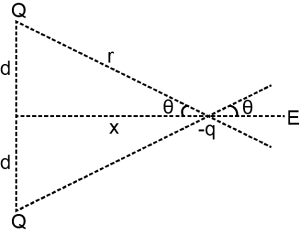
$A$ negative charge $-q$ is placed at the midpoint between two fixed equal positive charges $Q$,separated by a distance $2d$. If the negative charge is given a small displacement $x$ $(x \ll d)$ perpendicular to the line joining the positive charges,how will the net force $(F)$ acting on it approximately depend on $x$?
A
$F \propto x$
B
$F \propto \frac{1}{x}$
C
$F \propto x^{2}$
D
$F \propto \frac{1}{x^{2}}$
Solution
(A) Let the two positive charges $Q$ be located at $(0, d)$ and $(0, -d)$. The negative charge $-q$ is displaced to $(x, 0)$.
The distance $r$ between each positive charge $Q$ and the negative charge $-q$ is $r = \sqrt{x^2 + d^2}$.
The magnitude of the electrostatic force exerted by each positive charge on the negative charge is $F_e = \frac{kQq}{r^2}$.
The components of these forces along the $y$-axis cancel out due to symmetry. The components along the $x$-axis add up:
$F = -2 F_e \cos \theta$,where $\cos \theta = \frac{x}{r}$.
Substituting the expressions:
$F = -2 \left( \frac{kQq}{r^2} \right) \left( \frac{x}{r} \right) = -\frac{2kQqx}{r^3}$.
Since $r = (x^2 + d^2)^{1/2}$,we have:
$F = -\frac{2kQqx}{(x^2 + d^2)^{3/2}}$.
Given the condition $x \ll d$,we can approximate $x^2 + d^2 \approx d^2$ in the denominator:
$F \approx -\frac{2kQqx}{(d^2)^{3/2}} = -\frac{2kQqx}{d^3}$.
Thus,the magnitude of the force $F$ is directly proportional to the displacement $x$,i.e.,$F \propto x$.
The distance $r$ between each positive charge $Q$ and the negative charge $-q$ is $r = \sqrt{x^2 + d^2}$.
The magnitude of the electrostatic force exerted by each positive charge on the negative charge is $F_e = \frac{kQq}{r^2}$.
The components of these forces along the $y$-axis cancel out due to symmetry. The components along the $x$-axis add up:
$F = -2 F_e \cos \theta$,where $\cos \theta = \frac{x}{r}$.
Substituting the expressions:
$F = -2 \left( \frac{kQq}{r^2} \right) \left( \frac{x}{r} \right) = -\frac{2kQqx}{r^3}$.
Since $r = (x^2 + d^2)^{1/2}$,we have:
$F = -\frac{2kQqx}{(x^2 + d^2)^{3/2}}$.
Given the condition $x \ll d$,we can approximate $x^2 + d^2 \approx d^2$ in the denominator:
$F \approx -\frac{2kQqx}{(d^2)^{3/2}} = -\frac{2kQqx}{d^3}$.
Thus,the magnitude of the force $F$ is directly proportional to the displacement $x$,i.e.,$F \propto x$.
0 likesView Solution
26
PhysicsMediumMCQWBJEE · 2019
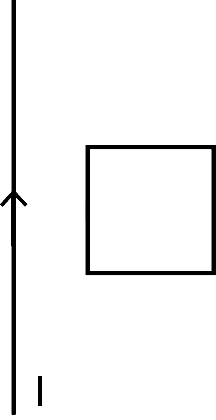
$A$ square conducting loop is placed near an infinitely long current-carrying wire with one edge parallel to the wire as shown in the figure. If the current in the straight wire is suddenly halved, which of the following statements will be true? "The loop will .......".
A
stay stationary
B
move towards the wire
C
move away from the wire
D
move parallel to the wire
Solution
(B) The magnetic field $B$ at a distance $x$ from an infinitely long wire carrying current $I$ is given by $B = \frac{\mu_0 I}{2 \pi x}$.
As the current $I$ in the wire is suddenly halved, the magnetic flux $\phi$ linked with the square loop decreases.
According to Lenz's law, the induced current in the loop will flow in such a direction as to oppose this decrease in magnetic flux. This means the induced current will create a magnetic field in the same direction as the original magnetic field.
For this to happen, the induced current in the loop must flow in the clockwise direction.
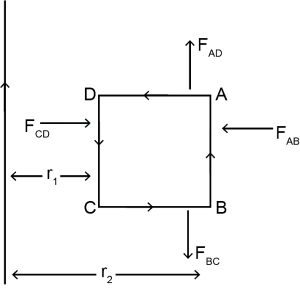
Now, consider the forces on the sides of the loop:
$1$. The side of the loop closer to the wire (let's call it $CD$) carries current in the same direction as the main wire. Thus, it experiences an attractive force $F_{CD}$ towards the wire.
$2$. The side of the loop farther from the wire (let's call it $AB$) carries current in the opposite direction to the main wire. Thus, it experiences a repulsive force $F_{AB}$ away from the wire.
Since the magnetic field is stronger closer to the wire, the attractive force on the closer side is greater than the repulsive force on the farther side $(F_{CD} > F_{AB})$.
Therefore, the net force on the loop is directed towards the wire, and the loop will move towards the wire.
As the current $I$ in the wire is suddenly halved, the magnetic flux $\phi$ linked with the square loop decreases.
According to Lenz's law, the induced current in the loop will flow in such a direction as to oppose this decrease in magnetic flux. This means the induced current will create a magnetic field in the same direction as the original magnetic field.
For this to happen, the induced current in the loop must flow in the clockwise direction.
Now, consider the forces on the sides of the loop:
$1$. The side of the loop closer to the wire (let's call it $CD$) carries current in the same direction as the main wire. Thus, it experiences an attractive force $F_{CD}$ towards the wire.
$2$. The side of the loop farther from the wire (let's call it $AB$) carries current in the opposite direction to the main wire. Thus, it experiences a repulsive force $F_{AB}$ away from the wire.
Since the magnetic field is stronger closer to the wire, the attractive force on the closer side is greater than the repulsive force on the farther side $(F_{CD} > F_{AB})$.
Therefore, the net force on the loop is directed towards the wire, and the loop will move towards the wire.
0 likesView Solution
27
PhysicsMediumMCQWBJEE · 2019
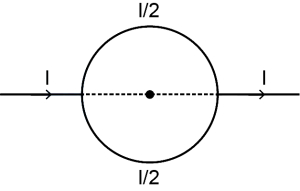
An electric current $I$ enters and leaves a uniform circular wire of radius $r$ through diametrically opposite points. $A$ particle carrying a charge $q$ moves along the axis of the circular wire with speed $v$. What is the magnetic force experienced by the particle when it passes through the centre of the circle?
A
$q v \frac{\mu_{0} I}{r}$
B
$q v \frac{\mu_{0} I}{2 r}$
C
$q v \frac{\mu_{0} I}{2 \pi r}$
D
Zero
Solution
(D) The current $I$ enters at one point and leaves at the diametrically opposite point of the circular wire. This divides the wire into two semicircular arcs,each carrying a current of $I/2$.
For each semicircular arc,the magnetic field produced at the center of the circle can be calculated using the Biot-Savart law. The magnetic field due to a semicircular arc at its center is $B = \frac{\mu_{0} I_{arc}}{4r}$.
Since the two semicircular arcs carry current in opposite directions relative to the center,the magnetic fields produced by them at the center are equal in magnitude but opposite in direction.
Specifically,if one arc produces a magnetic field $B$ pointing into the page,the other arc produces a magnetic field $B$ pointing out of the page.
Therefore,the net magnetic field $B_{net}$ at the center of the circle is $B - B = 0$.
The magnetic force $F$ on a charge $q$ moving with velocity $v$ in a magnetic field $B$ is given by $F = q(v \times B)$.
Since the net magnetic field $B_{net}$ at the center is $0$,the magnetic force experienced by the particle is $F = q(v \times 0) = 0$.
For each semicircular arc,the magnetic field produced at the center of the circle can be calculated using the Biot-Savart law. The magnetic field due to a semicircular arc at its center is $B = \frac{\mu_{0} I_{arc}}{4r}$.
Since the two semicircular arcs carry current in opposite directions relative to the center,the magnetic fields produced by them at the center are equal in magnitude but opposite in direction.
Specifically,if one arc produces a magnetic field $B$ pointing into the page,the other arc produces a magnetic field $B$ pointing out of the page.
Therefore,the net magnetic field $B_{net}$ at the center of the circle is $B - B = 0$.
The magnetic force $F$ on a charge $q$ moving with velocity $v$ in a magnetic field $B$ is given by $F = q(v \times B)$.
Since the net magnetic field $B_{net}$ at the center is $0$,the magnetic force experienced by the particle is $F = q(v \times 0) = 0$.
0 likesView Solution
28
PhysicsMediumMCQWBJEE · 2019
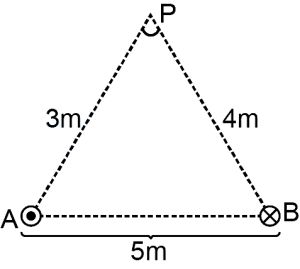
$A$ current $I$ is flowing along an infinite,straight wire in the positive $Z$-direction,and the same current $I$ is flowing along a similar parallel wire $5 \ m$ apart in the negative $Z$-direction. $A$ point $P$ is at a perpendicular distance of $3 \ m$ from the first wire and $4 \ m$ from the second. What is the magnitude of the magnetic field $B$ at point $P$?
A
$\frac{5}{12} \left( \frac{\mu_0 I}{\pi} \right)$
B
$\frac{7}{24} \left( \frac{\mu_0 I}{\pi} \right)$
C
$\frac{5}{24} \left( \frac{\mu_0 I}{\pi} \right)$
D
$\frac{25}{288} \left( \frac{\mu_0 I}{\pi} \right)$
Solution
(C) The distances from the wires to point $P$ are $r_1 = 3 \ m$ and $r_2 = 4 \ m$. The distance between the wires is $5 \ m$. Since $3^2 + 4^2 = 5^2$,the triangle formed by the two wires and point $P$ is a right-angled triangle with the right angle at $P$.
The magnetic field due to the first wire at $P$ is $B_1 = \frac{\mu_0 I}{2 \pi r_1} = \frac{\mu_0 I}{2 \pi (3)} = \frac{\mu_0 I}{6 \pi}$.
The magnetic field due to the second wire at $P$ is $B_2 = \frac{\mu_0 I}{2 \pi r_2} = \frac{\mu_0 I}{2 \pi (4)} = \frac{\mu_0 I}{8 \pi}$.
Since the currents are in opposite directions,the magnetic field vectors $\vec{B}_1$ and $\vec{B}_2$ are perpendicular to each other at point $P$ because the triangle is right-angled at $P$. Thus,the net magnetic field is $B = \sqrt{B_1^2 + B_2^2}$.
$B = \sqrt{\left( \frac{\mu_0 I}{6 \pi} \right)^2 + \left( \frac{\mu_0 I}{8 \pi} \right)^2} = \frac{\mu_0 I}{\pi} \sqrt{\frac{1}{36} + \frac{1}{64}} = \frac{\mu_0 I}{\pi} \sqrt{\frac{16 + 9}{576}} = \frac{\mu_0 I}{\pi} \sqrt{\frac{25}{576}} = \frac{5}{24} \left( \frac{\mu_0 I}{\pi} \right)$.
The magnetic field due to the first wire at $P$ is $B_1 = \frac{\mu_0 I}{2 \pi r_1} = \frac{\mu_0 I}{2 \pi (3)} = \frac{\mu_0 I}{6 \pi}$.
The magnetic field due to the second wire at $P$ is $B_2 = \frac{\mu_0 I}{2 \pi r_2} = \frac{\mu_0 I}{2 \pi (4)} = \frac{\mu_0 I}{8 \pi}$.
Since the currents are in opposite directions,the magnetic field vectors $\vec{B}_1$ and $\vec{B}_2$ are perpendicular to each other at point $P$ because the triangle is right-angled at $P$. Thus,the net magnetic field is $B = \sqrt{B_1^2 + B_2^2}$.
$B = \sqrt{\left( \frac{\mu_0 I}{6 \pi} \right)^2 + \left( \frac{\mu_0 I}{8 \pi} \right)^2} = \frac{\mu_0 I}{\pi} \sqrt{\frac{1}{36} + \frac{1}{64}} = \frac{\mu_0 I}{\pi} \sqrt{\frac{16 + 9}{576}} = \frac{\mu_0 I}{\pi} \sqrt{\frac{25}{576}} = \frac{5}{24} \left( \frac{\mu_0 I}{\pi} \right)$.
0 likesView Solution
29
PhysicsMediumMCQWBJEE · 2019
To which of the following quantities,the radius of the circular path of a charged particle moving at right angles to a uniform magnetic field is directly proportional?
A
energy of the particle
B
magnetic field
C
charge of the particle
D
momentum of the particle
Solution
(D) When a charged particle moves with velocity $v$ perpendicular to a uniform magnetic field $B$ (i.e.,$\theta = 90^{\circ}$),it experiences a magnetic Lorentz force $F = qvB$.
This force acts perpendicular to the velocity,providing the necessary centripetal force for circular motion:
$qvB = \frac{mv^2}{r}$
Solving for the radius $r$:
$r = \frac{mv}{qB}$
Since the momentum of the particle is $p = mv$,we can write:
$r = \frac{p}{qB}$
From this expression,it is clear that the radius $r$ is directly proportional to the momentum $p$ of the particle.
Therefore,option $(D)$ is correct.
This force acts perpendicular to the velocity,providing the necessary centripetal force for circular motion:
$qvB = \frac{mv^2}{r}$
Solving for the radius $r$:
$r = \frac{mv}{qB}$
Since the momentum of the particle is $p = mv$,we can write:
$r = \frac{p}{qB}$
From this expression,it is clear that the radius $r$ is directly proportional to the momentum $p$ of the particle.
Therefore,option $(D)$ is correct.
0 likesView Solution
30
PhysicsEasyMCQWBJEE · 2019
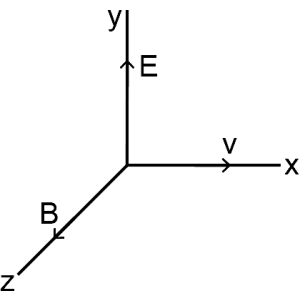
$A$ particle with charge $q$ moves with a velocity $v$ in a direction perpendicular to the directions of uniform electric and magnetic fields,$E$ and $B$ respectively,which are mutually perpendicular to each other. Which one of the following gives the condition for which the particle moves undeflected in its original trajectory?
A
$v=\frac{E}{B}$
B
$v=\frac{B}{E}$
C
$v=\sqrt{\frac{E}{B}}$
D
$v=q \frac{B}{E}$
Solution
(A) According to the question,the charge on the particle is $q$ and its velocity is $v$.
Due to the uniform electric field,the electric force on the particle is $F_{\text{electric}} = qE$.
Due to the uniform magnetic field,the magnetic force on the particle is given by $F_{\text{magnetic}} = q(v \times B)$.
For the particle to move undeflected,the net Lorentz force must be zero,which means the electric force and magnetic force must be equal in magnitude and opposite in direction: $F_{\text{electric}} = F_{\text{magnetic}}$.
Substituting the magnitudes,we get $qE = qvB$.
Solving for velocity,we find $v = \frac{E}{B}$.
Thus,the condition for the particle to move undeflected is $v = \frac{E}{B}$.
Due to the uniform electric field,the electric force on the particle is $F_{\text{electric}} = qE$.
Due to the uniform magnetic field,the magnetic force on the particle is given by $F_{\text{magnetic}} = q(v \times B)$.
For the particle to move undeflected,the net Lorentz force must be zero,which means the electric force and magnetic force must be equal in magnitude and opposite in direction: $F_{\text{electric}} = F_{\text{magnetic}}$.
Substituting the magnitudes,we get $qE = qvB$.
Solving for velocity,we find $v = \frac{E}{B}$.
Thus,the condition for the particle to move undeflected is $v = \frac{E}{B}$.
0 likesView Solution
31
PhysicsMediumMCQWBJEE · 2019
$A$ parent nucleus $X$ undergoes $\alpha$-decay with a half-life of $75000 \text{ yrs}$. The daughter nucleus $Y$ undergoes $\beta$-decay with a half-life of $9 \text{ months}$. In a particular sample,it is found that the rate of emission of $\beta$-particles is nearly constant (over several months) at $10^{7} / \text{h}$. What will be the number of $\alpha$-particles emitted in an hour?
A
$10^{2}$
B
$10^{7}$
C
$10^{12}$
D
$10^{14}$
Solution
(B) The decay process is $X \xrightarrow{\alpha} Y \xrightarrow{\beta} Z$.
Let $N_X$ and $N_Y$ be the number of nuclei of $X$ and $Y$ present at any time $t$.
The rate of change of the number of daughter nuclei $Y$ is given by: $\frac{dN_Y}{dt} = \lambda_X N_X - \lambda_Y N_Y$.
Since the rate of emission of $\beta$-particles $(\lambda_Y N_Y)$ is constant over several months,we have $\frac{dN_Y}{dt} \approx 0$.
This implies $\lambda_X N_X = \lambda_Y N_Y$.
The rate of emission of $\alpha$-particles is $\lambda_X N_X$,and the rate of emission of $\beta$-particles is $\lambda_Y N_Y$.
Given that the rate of $\beta$-emission is $10^{7} / \text{h}$,the rate of $\alpha$-emission must also be $10^{7} / \text{h}$.
Therefore,the number of $\alpha$-particles emitted in one hour is $10^{7}$.
Let $N_X$ and $N_Y$ be the number of nuclei of $X$ and $Y$ present at any time $t$.
The rate of change of the number of daughter nuclei $Y$ is given by: $\frac{dN_Y}{dt} = \lambda_X N_X - \lambda_Y N_Y$.
Since the rate of emission of $\beta$-particles $(\lambda_Y N_Y)$ is constant over several months,we have $\frac{dN_Y}{dt} \approx 0$.
This implies $\lambda_X N_X = \lambda_Y N_Y$.
The rate of emission of $\alpha$-particles is $\lambda_X N_X$,and the rate of emission of $\beta$-particles is $\lambda_Y N_Y$.
Given that the rate of $\beta$-emission is $10^{7} / \text{h}$,the rate of $\alpha$-emission must also be $10^{7} / \text{h}$.
Therefore,the number of $\alpha$-particles emitted in one hour is $10^{7}$.
0 likesView Solution
32
PhysicsDifficultMCQWBJEE · 2019
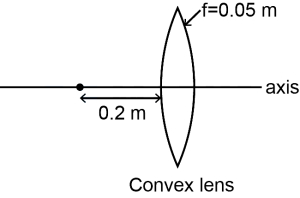
$A$ point object is placed on the axis of a thin convex lens of focal length $0.05 \ m$ at a distance of $0.2 \ m$ from the lens and its image is formed on the axis. If the object is now made to oscillate along the axis with a small amplitude of $A \ cm,$ then what is the amplitude of oscillation of the image? [You may assume $\frac{1}{1+x} \approx 1-x,$ where $x << 1$]
A
$\frac{4 A}{9} \times 10^{-2} \ m$
B
$\frac{5 A}{9} \times 10^{-2} \ m$
C
$\frac{A}{3} \times 10^{-2} \ m$
D
$\frac{A}{9} \times 10^{-2} \ m$
Solution
(D) Given: Focal length $f = 0.05 \ m$,object distance $u = -0.2 \ m$.
Using the lens formula: $\frac{1}{v} - \frac{1}{u} = \frac{1}{f}$.
Substituting the values: $\frac{1}{v} = \frac{1}{f} + \frac{1}{u} = \frac{1}{0.05} - \frac{1}{0.2} = 20 - 5 = 15 \ m^{-1}$.
Thus,$v = \frac{1}{15} \ m$.
Differentiating the lens formula $\frac{1}{v} - \frac{1}{u} = \frac{1}{f}$ with respect to time,we get: $-\frac{dv}{v^2} + \frac{du}{u^2} = 0$.
This implies $dv = \left( \frac{v^2}{u^2} \right) du$.
The amplitude of the image oscillation $A_{image} = |dv|$ is given by $A_{image} = \left( \frac{v}{u} \right)^2 A_{object}$.
Given $A_{object} = A \ cm = A \times 10^{-2} \ m$.
$A_{image} = \left( \frac{1/15}{0.2} \right)^2 \times A \times 10^{-2} \ m = \left( \frac{1}{15 \times 0.2} \right)^2 \times A \times 10^{-2} \ m = \left( \frac{1}{3} \right)^2 \times A \times 10^{-2} \ m = \frac{A}{9} \times 10^{-2} \ m$.
Using the lens formula: $\frac{1}{v} - \frac{1}{u} = \frac{1}{f}$.
Substituting the values: $\frac{1}{v} = \frac{1}{f} + \frac{1}{u} = \frac{1}{0.05} - \frac{1}{0.2} = 20 - 5 = 15 \ m^{-1}$.
Thus,$v = \frac{1}{15} \ m$.
Differentiating the lens formula $\frac{1}{v} - \frac{1}{u} = \frac{1}{f}$ with respect to time,we get: $-\frac{dv}{v^2} + \frac{du}{u^2} = 0$.
This implies $dv = \left( \frac{v^2}{u^2} \right) du$.
The amplitude of the image oscillation $A_{image} = |dv|$ is given by $A_{image} = \left( \frac{v}{u} \right)^2 A_{object}$.
Given $A_{object} = A \ cm = A \times 10^{-2} \ m$.
$A_{image} = \left( \frac{1/15}{0.2} \right)^2 \times A \times 10^{-2} \ m = \left( \frac{1}{15 \times 0.2} \right)^2 \times A \times 10^{-2} \ m = \left( \frac{1}{3} \right)^2 \times A \times 10^{-2} \ m = \frac{A}{9} \times 10^{-2} \ m$.
0 likesView Solution
33
PhysicsMediumMCQWBJEE · 2019
$A$ ray of light is reflected by a plane mirror. $\hat{e}_0$,$\hat{e}$ and $\hat{n}$ be the unit vectors along the incident ray,reflected ray and the normal to the reflecting surface respectively. Which of the following gives an expression for $\hat{e}$?
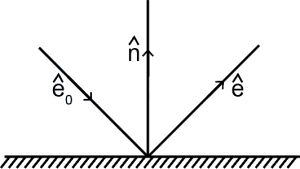
A
$\hat{e}_0 + 2 ( \hat{e}_0 \cdot \hat{n} ) \hat{n}$
B
$\hat{e}_0 - 2 ( \hat{e}_0 \cdot \hat{n} ) \hat{n}$
C
$\hat{e}_0 - ( \hat{e}_0 \cdot \hat{n} ) \hat{n}$
D
$\hat{e}_0 + ( \hat{e}_0 \cdot \hat{n} ) \hat{n}$
Solution
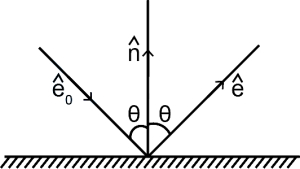
(B) The incident ray vector is $\hat{e}_0$ and the reflected ray vector is $\hat{e}$. The normal vector is $\hat{n}$.
From the law of reflection,the angle of incidence equals the angle of reflection,and all three vectors lie in the same plane.
Let $\theta$ be the angle between the incident ray and the normal. Since $\hat{e}_0$ is directed towards the mirror,the angle between $\hat{e}_0$ and $\hat{n}$ is $(180^\circ - \theta)$.
Thus,$\hat{e}_0 \cdot \hat{n} = |\hat{e}_0| |\hat{n}| \cos(180^\circ - \theta) = -\cos \theta$.
We can resolve the incident ray $\hat{e}_0$ into components parallel and perpendicular to the normal $\hat{n}$:
$\hat{e}_0 = \hat{e}_{0\perp} + \hat{e}_{0\parallel} = (\hat{e}_0 \cdot \hat{n}) \hat{n} + (\hat{e}_0 - (\hat{e}_0 \cdot \hat{n}) \hat{n})$.
The reflected ray $\hat{e}$ has the same component parallel to the mirror surface but the component along the normal is reversed:
$\hat{e} = -(\hat{e}_0 \cdot \hat{n}) \hat{n} + (\hat{e}_0 - (\hat{e}_0 \cdot \hat{n}) \hat{n})$.
$\hat{e} = \hat{e}_0 - 2(\hat{e}_0 \cdot \hat{n}) \hat{n}$.
Therefore,the correct option is $(B)$.
From the law of reflection,the angle of incidence equals the angle of reflection,and all three vectors lie in the same plane.
Let $\theta$ be the angle between the incident ray and the normal. Since $\hat{e}_0$ is directed towards the mirror,the angle between $\hat{e}_0$ and $\hat{n}$ is $(180^\circ - \theta)$.
Thus,$\hat{e}_0 \cdot \hat{n} = |\hat{e}_0| |\hat{n}| \cos(180^\circ - \theta) = -\cos \theta$.
We can resolve the incident ray $\hat{e}_0$ into components parallel and perpendicular to the normal $\hat{n}$:
$\hat{e}_0 = \hat{e}_{0\perp} + \hat{e}_{0\parallel} = (\hat{e}_0 \cdot \hat{n}) \hat{n} + (\hat{e}_0 - (\hat{e}_0 \cdot \hat{n}) \hat{n})$.
The reflected ray $\hat{e}$ has the same component parallel to the mirror surface but the component along the normal is reversed:
$\hat{e} = -(\hat{e}_0 \cdot \hat{n}) \hat{n} + (\hat{e}_0 - (\hat{e}_0 \cdot \hat{n}) \hat{n})$.
$\hat{e} = \hat{e}_0 - 2(\hat{e}_0 \cdot \hat{n}) \hat{n}$.
Therefore,the correct option is $(B)$.
0 likesView Solution
34
PhysicsEasyMCQWBJEE · 2019
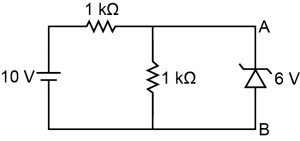
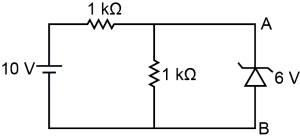
In the circuit shown, what will be the current through the $6 V$ zener diode?
A
$6 mA$, from $A$ to $B$
B
$2 mA$, from $A$ to $B$
C
$2 mA$, from $B$ to $A$
D
Zero
Solution
(D) To determine if the Zener diode is in breakdown, we first calculate the voltage across the parallel combination of the $1 k\Omega$ resistor and the Zener diode without the Zener diode connected.
Using the voltage divider rule, the voltage $V_{AB}$ across the $1 k\Omega$ resistor is:
$V_{AB} = V_s \times \frac{R_{parallel}}{R_s + R_{parallel}} = 10 V \times \frac{1 k\Omega}{1 k\Omega + 1 k\Omega} = 10 V \times \frac{1}{2} = 5 V$.
Since the voltage across the terminals $A$ and $B$ is $5 V$, which is less than the Zener breakdown voltage of $6 V$, the Zener diode does not conduct.
Therefore, the current through the Zener diode is $0 A$ (Zero).
Using the voltage divider rule, the voltage $V_{AB}$ across the $1 k\Omega$ resistor is:
$V_{AB} = V_s \times \frac{R_{parallel}}{R_s + R_{parallel}} = 10 V \times \frac{1 k\Omega}{1 k\Omega + 1 k\Omega} = 10 V \times \frac{1}{2} = 5 V$.
Since the voltage across the terminals $A$ and $B$ is $5 V$, which is less than the Zener breakdown voltage of $6 V$, the Zener diode does not conduct.
Therefore, the current through the Zener diode is $0 A$ (Zero).
0 likesView Solution
35
PhysicsEasyMCQWBJEE · 2019
Each of the two inputs $A$ and $B$ can assume values either $0$ or $1$. Then which of the following will be equal to $\bar{A} \cdot \bar{B}$?
A
$A+B$
B
$\overline{A+B}$
C
$\overline{A \cdot B}$
D
$\bar{A}+\bar{B}$
Solution
(B) According to De Morgan's first law,the complement of the sum of two variables is equal to the product of their individual complements.
Mathematically,this is expressed as: $\overline{A+B} = \bar{A} \cdot \bar{B}$.
Therefore,the expression $\bar{A} \cdot \bar{B}$ is equivalent to $\overline{A+B}$.
Mathematically,this is expressed as: $\overline{A+B} = \bar{A} \cdot \bar{B}$.
Therefore,the expression $\bar{A} \cdot \bar{B}$ is equivalent to $\overline{A+B}$.
0 likesView Solution
36
PhysicsMediumMCQWBJEE · 2019
In Young's experiment for the interference of light,the separation between the slits is $d$ and the distance of the screen from the slits is $D$. If $D$ is increased by $0.5 \%$ and $d$ is decreased by $0.3 \%$,then for the light of a given wavelength,which one of the following is true? The fringe width.........
A
increases by $0.8 \%$
B
decreases by $0.8 \%$
C
increases by $0.2 \%$
D
decreases by $0.2 \%$
Solution
(A) The formula for fringe width in Young's double slit experiment is $\beta = \frac{\lambda D}{d}$.
Taking the logarithmic differentiation,we get the relative error formula: $\frac{\Delta \beta}{\beta} = \frac{\Delta D}{D} - \frac{\Delta d}{d}$.
Given that $D$ is increased by $0.5 \%$,so $\frac{\Delta D}{D} \times 100 = 0.5 \%$.
Given that $d$ is decreased by $0.3 \%$,so $\frac{\Delta d}{d} \times 100 = -0.3 \%$.
Substituting these values into the error formula:
$\frac{\Delta \beta}{\beta} \times 100 = 0.5 \% - (-0.3 \%) = 0.5 \% + 0.3 \% = 0.8 \%$.
Therefore,the fringe width increases by $0.8 \%$.
Taking the logarithmic differentiation,we get the relative error formula: $\frac{\Delta \beta}{\beta} = \frac{\Delta D}{D} - \frac{\Delta d}{d}$.
Given that $D$ is increased by $0.5 \%$,so $\frac{\Delta D}{D} \times 100 = 0.5 \%$.
Given that $d$ is decreased by $0.3 \%$,so $\frac{\Delta d}{d} \times 100 = -0.3 \%$.
Substituting these values into the error formula:
$\frac{\Delta \beta}{\beta} \times 100 = 0.5 \% - (-0.3 \%) = 0.5 \% + 0.3 \% = 0.8 \%$.
Therefore,the fringe width increases by $0.8 \%$.
0 likesView Solution
37
PhysicsMediumMCQWBJEE · 2019
When the frequency of the light used is changed from $4 \times 10^{14} \ s^{-1}$ to $5 \times 10^{14} \ s^{-1}$,the angular width of the principal (central) maximum in a single slit Fraunhofer diffraction pattern changes by $0.6 \ \text{radian}$. What is the width of the slit? (Assume that the experiment is performed in vacuum.)
A
$1.5 \times 10^{-7} \ m$
B
$3 \times 10^{-7} \ m$
C
$5 \times 10^{-7} \ m$
D
$6 \times 10^{-7} \ m$
Solution
(C) The angular width of the central maximum in a single slit diffraction pattern is given by $\theta = \frac{2\lambda}{d}$,where $\lambda$ is the wavelength and $d$ is the slit width.
The change in angular width is $\Delta\theta = \frac{2\Delta\lambda}{d}$,where $\Delta\lambda = |\lambda_1 - \lambda_2|$.
Given frequencies $f_1 = 4 \times 10^{14} \ s^{-1}$ and $f_2 = 5 \times 10^{14} \ s^{-1}$.
Using $\lambda = \frac{c}{f}$,where $c = 3 \times 10^8 \ m/s$:
$\lambda_1 = \frac{3 \times 10^8}{4 \times 10^{14}} = 0.75 \times 10^{-6} \ m = 7.5 \times 10^{-7} \ m$.
$\lambda_2 = \frac{3 \times 10^8}{5 \times 10^{14}} = 0.60 \times 10^{-6} \ m = 6.0 \times 10^{-7} \ m$.
$\Delta\lambda = |7.5 \times 10^{-7} - 6.0 \times 10^{-7}| = 1.5 \times 10^{-7} \ m$.
Given $\Delta\theta = 0.6 \ \text{radian}$.
From $d = \frac{2\Delta\lambda}{\Delta\theta}$:
$d = \frac{2 \times 1.5 \times 10^{-7}}{0.6} = \frac{3.0 \times 10^{-7}}{0.6} = 5 \times 10^{-7} \ m$.
The change in angular width is $\Delta\theta = \frac{2\Delta\lambda}{d}$,where $\Delta\lambda = |\lambda_1 - \lambda_2|$.
Given frequencies $f_1 = 4 \times 10^{14} \ s^{-1}$ and $f_2 = 5 \times 10^{14} \ s^{-1}$.
Using $\lambda = \frac{c}{f}$,where $c = 3 \times 10^8 \ m/s$:
$\lambda_1 = \frac{3 \times 10^8}{4 \times 10^{14}} = 0.75 \times 10^{-6} \ m = 7.5 \times 10^{-7} \ m$.
$\lambda_2 = \frac{3 \times 10^8}{5 \times 10^{14}} = 0.60 \times 10^{-6} \ m = 6.0 \times 10^{-7} \ m$.
$\Delta\lambda = |7.5 \times 10^{-7} - 6.0 \times 10^{-7}| = 1.5 \times 10^{-7} \ m$.
Given $\Delta\theta = 0.6 \ \text{radian}$.
From $d = \frac{2\Delta\lambda}{\Delta\theta}$:
$d = \frac{2 \times 1.5 \times 10^{-7}}{0.6} = \frac{3.0 \times 10^{-7}}{0.6} = 5 \times 10^{-7} \ m$.
0 likesView Solution
Vedclass Products
For Students
Vedclass Test Series
Mock tests in real WBJEE style covering Physics with performance analysis. 5-day free trial.
Start Free TrialFor Teachers
Exam Paper Generator
Generate Set A/B/C/D Physics papers from 7.5L+ questions in 2 minutes. 3 chapters free.
Try FreeFor Institutes
Online Exam Module
Run live WBJEE mock exams with unlimited students, 360° analytics & white-label branding.
See DemoFrequently Asked Questions
How many Physics questions are in WBJEE 2019?
There are 37 Physics questions from the WBJEE 2019 paper on Vedclass, each with a detailed step-by-step solution in English.
Are WBJEE 2019 Physics solutions available in English?
Yes. All solutions on this page are in English. You can also switch to English or Hindi using the language buttons above the questions.
Can I practice WBJEE 2019 Physics as a timed test?
Yes. Use the Vedclass Test Series to attempt a full WBJEE mock test covering Physics with time limits and instant score analysis.
Can teachers create Physics papers from WBJEE previous year questions?
Yes. The Vedclass Exam Paper Generator lets teachers mix WBJEE Physics questions and generate Set A/B/C/D papers in minutes.
For Teachers & Institutes
Build a Custom Physics Paper
Pick WBJEE 2019 Physics questions, set difficulty, and generate Set A/B/C/D in 2 minutes.