
PhysicsQ1–38 of 38 questions
Page 1 of 1 · English
1
PhysicsMediumMCQWBJEE · 2017
$A$ small steel ball bounces on a steel plate held horizontally. On each bounce,the speed of the ball arriving at the plate is reduced by a factor $e$ (coefficient of restitution) in the rebound,so that $V_{\text{upward}} = e V_{\text{downward}}$. If the ball is initially dropped from a height of $0.4 \text{ m}$ above the plate and if $10 \text{ s}$ later the bouncing ceases,the value of $e$ is:
A
$\sqrt{\frac{2}{7}}$
B
$\frac{3}{4}$
C
$\frac{13}{18}$
D
$\frac{17}{18}$
Solution
(D) The time taken for the first fall is $t_0 = \sqrt{\frac{2h}{g}}$.
After the first impact,the ball rises to height $h_1 = e^2 h$ and falls back,taking time $t_1 = 2 \sqrt{\frac{2h_1}{g}} = 2e \sqrt{\frac{2h}{g}}$.
Similarly,for subsequent bounces,the time taken is $t_n = 2e^n \sqrt{\frac{2h}{g}}$.
The total time $T$ is the sum of the initial fall and all subsequent bounces:
$T = \sqrt{\frac{2h}{g}} + 2e \sqrt{\frac{2h}{g}} + 2e^2 \sqrt{\frac{2h}{g}} + \dots = \sqrt{\frac{2h}{g}} \left( 1 + 2e + 2e^2 + \dots \right)$.
Using the sum of a geometric series for $e < 1$,$T = \sqrt{\frac{2h}{g}} \left( 1 + 2e \frac{1}{1-e} \right) = \sqrt{\frac{2h}{g}} \left( \frac{1+e}{1-e} \right)$.
Given $h = 0.4 \text{ m}$,$g = 10 \text{ m/s}^2$,and $T = 10 \text{ s}$:
$10 = \sqrt{\frac{2 \times 0.4}{10}} \left( \frac{1+e}{1-e} \right) = \sqrt{0.08} \left( \frac{1+e}{1-e} \right) = 0.2828 \left( \frac{1+e}{1-e} \right)$.
Actually,using $g = 9.8 \text{ m/s}^2$ or simplifying the expression: $10 = \sqrt{0.08} \frac{1+e}{1-e} \implies \frac{10}{0.2828} = \frac{1+e}{1-e} \approx 35.35$.
Solving for $e$ yields $e \approx 0.944$,which corresponds to $\frac{17}{18} \approx 0.944$.
After the first impact,the ball rises to height $h_1 = e^2 h$ and falls back,taking time $t_1 = 2 \sqrt{\frac{2h_1}{g}} = 2e \sqrt{\frac{2h}{g}}$.
Similarly,for subsequent bounces,the time taken is $t_n = 2e^n \sqrt{\frac{2h}{g}}$.
The total time $T$ is the sum of the initial fall and all subsequent bounces:
$T = \sqrt{\frac{2h}{g}} + 2e \sqrt{\frac{2h}{g}} + 2e^2 \sqrt{\frac{2h}{g}} + \dots = \sqrt{\frac{2h}{g}} \left( 1 + 2e + 2e^2 + \dots \right)$.
Using the sum of a geometric series for $e < 1$,$T = \sqrt{\frac{2h}{g}} \left( 1 + 2e \frac{1}{1-e} \right) = \sqrt{\frac{2h}{g}} \left( \frac{1+e}{1-e} \right)$.
Given $h = 0.4 \text{ m}$,$g = 10 \text{ m/s}^2$,and $T = 10 \text{ s}$:
$10 = \sqrt{\frac{2 \times 0.4}{10}} \left( \frac{1+e}{1-e} \right) = \sqrt{0.08} \left( \frac{1+e}{1-e} \right) = 0.2828 \left( \frac{1+e}{1-e} \right)$.
Actually,using $g = 9.8 \text{ m/s}^2$ or simplifying the expression: $10 = \sqrt{0.08} \frac{1+e}{1-e} \implies \frac{10}{0.2828} = \frac{1+e}{1-e} \approx 35.35$.
Solving for $e$ yields $e \approx 0.944$,which corresponds to $\frac{17}{18} \approx 0.944$.
0 likesView Solution
2
PhysicsMediumMCQWBJEE · 2017
$A$ bullet of mass $4.2 \times 10^{-2} \text{ kg}$, moving at a speed of $300 \text{ m/s}$, gets stuck into a block with a mass $9$ times that of the bullet. If the block is free to move without any kind of friction, the heat generated in the process will be (in $\text{ cal}$)
A
$45$
B
$405$
C
$450$
D
$1701$
Solution
(B) Let the mass of the bullet be $m = 4.2 \times 10^{-2} \text{ kg}$.
Mass of the block $M = 9m = 9 \times 4.2 \times 10^{-2} \text{ kg}$.
Initial velocity of the bullet $v = 300 \text{ m/s}$.
By the law of conservation of linear momentum, the momentum before collision equals the momentum after collision:
$mv = (m + M)V$
$m(300) = (m + 9m)V$
$300m = 10mV$
$V = 30 \text{ m/s}$.
Heat generated is equal to the loss in kinetic energy:
$\Delta K = K_i - K_f = \frac{1}{2}mv^2 - \frac{1}{2}(m + M)V^2$
$\Delta K = \frac{1}{2} \times (4.2 \times 10^{-2}) \times (300)^2 - \frac{1}{2} \times (10 \times 4.2 \times 10^{-2}) \times (30)^2$
$\Delta K = \frac{1}{2} \times 4.2 \times 10^{-2} \times (90000 - 10 \times 900)$
$\Delta K = 2.1 \times 10^{-2} \times (90000 - 9000) = 2.1 \times 10^{-2} \times 81000 = 1701 \text{ J}$.
Since $1 \text{ cal} = 4.2 \text{ J}$, the heat in calories is:
$\text{Heat} = \frac{1701}{4.2} = 405 \text{ cal}$.
Mass of the block $M = 9m = 9 \times 4.2 \times 10^{-2} \text{ kg}$.
Initial velocity of the bullet $v = 300 \text{ m/s}$.
By the law of conservation of linear momentum, the momentum before collision equals the momentum after collision:
$mv = (m + M)V$
$m(300) = (m + 9m)V$
$300m = 10mV$
$V = 30 \text{ m/s}$.
Heat generated is equal to the loss in kinetic energy:
$\Delta K = K_i - K_f = \frac{1}{2}mv^2 - \frac{1}{2}(m + M)V^2$
$\Delta K = \frac{1}{2} \times (4.2 \times 10^{-2}) \times (300)^2 - \frac{1}{2} \times (10 \times 4.2 \times 10^{-2}) \times (30)^2$
$\Delta K = \frac{1}{2} \times 4.2 \times 10^{-2} \times (90000 - 10 \times 900)$
$\Delta K = 2.1 \times 10^{-2} \times (90000 - 9000) = 2.1 \times 10^{-2} \times 81000 = 1701 \text{ J}$.
Since $1 \text{ cal} = 4.2 \text{ J}$, the heat in calories is:
$\text{Heat} = \frac{1701}{4.2} = 405 \text{ cal}$.
0 likesView Solution
3
PhysicsMediumMCQWBJEE · 2017
Two particles $A$ and $B$ (both initially at rest) start moving towards each other under a mutual force of attraction. At the instant,when the speed of $A$ is $v$ and the speed of $B$ is $2v$,the speed of the centre of mass is
A
zero
B
$v$
C
$\frac{3v}{2}$
D
$-\frac{3v}{2}$
Solution
(A) The centre of mass of a system moves according to the net external force acting on it,as given by the equation $F_{ext} = M a_{cm}$.
Since the particles $A$ and $B$ are moving under a mutual force of attraction,there is no external force acting on the system $(F_{ext} = 0)$.
Initially,both particles are at rest,so the initial velocity of the centre of mass is $v_{cm, initial} = 0$.
Since $F_{ext} = 0$,the acceleration of the centre of mass is $a_{cm} = 0$,which implies that the velocity of the centre of mass remains constant over time.
Therefore,the velocity of the centre of mass at any instant remains equal to its initial velocity,which is $0$.
Since the particles $A$ and $B$ are moving under a mutual force of attraction,there is no external force acting on the system $(F_{ext} = 0)$.
Initially,both particles are at rest,so the initial velocity of the centre of mass is $v_{cm, initial} = 0$.
Since $F_{ext} = 0$,the acceleration of the centre of mass is $a_{cm} = 0$,which implies that the velocity of the centre of mass remains constant over time.
Therefore,the velocity of the centre of mass at any instant remains equal to its initial velocity,which is $0$.
0 likesView Solution
4
PhysicsDifficultMCQWBJEE · 2017
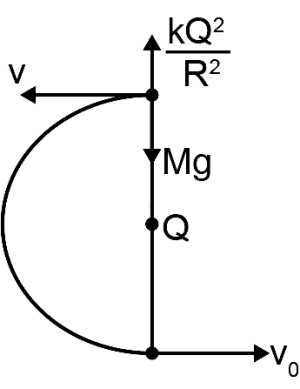
$A$ particle with charge $Q$ coulomb,tied at the end of an inextensible string of length $R$ metre,revolves in a vertical plane. At the centre of the circular trajectory,there is a fixed charge of magnitude $Q$ coulomb. The mass of the moving charge $M$ is such that $Mg = \frac{Q^2}{4 \pi \epsilon_0 R^2}$. If at the highest position of the particle,the tension of the string just vanishes,the horizontal velocity at the lowest point has to be
A
$0$
B
$2 \sqrt{g R}$
C
$\sqrt{2 g R}$
D
$\sqrt{5 g R}$
Solution
(B) Let $v$ be the velocity at the highest point. The forces acting on the particle at the highest point are the gravitational force $Mg$ (downwards),the electrostatic repulsive force $F_e = \frac{1}{4 \pi \epsilon_0} \frac{Q^2}{R^2}$ (upwards),and the tension $T$ (downwards).
Given $Mg = \frac{Q^2}{4 \pi \epsilon_0 R^2}$,the net force towards the center is $F_{net} = Mg - F_e + T = \frac{M v^2}{R}$.
At the highest point,$T = 0$,so $Mg - \frac{Q^2}{4 \pi \epsilon_0 R^2} = \frac{M v^2}{R}$.
Since $Mg = \frac{Q^2}{4 \pi \epsilon_0 R^2}$,we have $0 = \frac{M v^2}{R}$,which implies $v = 0$.
Now,applying the law of conservation of energy between the lowest point (velocity $v_0$) and the highest point (velocity $v = 0$):
Total energy at lowest point = Total energy at highest point.
$\frac{1}{2} M v_0^2 + U_{lowest} = \frac{1}{2} M v^2 + U_{highest}$.
The potential energy includes both gravitational and electrostatic components.
$U_{grav} = Mgh$,$U_{elec} = \frac{1}{4 \pi \epsilon_0} \frac{Q^2}{r}$.
Change in energy: $\frac{1}{2} M v_0^2 = Mg(2R) + \Delta U_{elec}$.
Since the distance $R$ from the center is constant,the electrostatic potential energy remains constant throughout the circular path.
Thus,$\frac{1}{2} M v_0^2 = Mg(2R)$.
$v_0^2 = 4gR$.
$v_0 = 2 \sqrt{gR}$.
Given $Mg = \frac{Q^2}{4 \pi \epsilon_0 R^2}$,the net force towards the center is $F_{net} = Mg - F_e + T = \frac{M v^2}{R}$.
At the highest point,$T = 0$,so $Mg - \frac{Q^2}{4 \pi \epsilon_0 R^2} = \frac{M v^2}{R}$.
Since $Mg = \frac{Q^2}{4 \pi \epsilon_0 R^2}$,we have $0 = \frac{M v^2}{R}$,which implies $v = 0$.
Now,applying the law of conservation of energy between the lowest point (velocity $v_0$) and the highest point (velocity $v = 0$):
Total energy at lowest point = Total energy at highest point.
$\frac{1}{2} M v_0^2 + U_{lowest} = \frac{1}{2} M v^2 + U_{highest}$.
The potential energy includes both gravitational and electrostatic components.
$U_{grav} = Mgh$,$U_{elec} = \frac{1}{4 \pi \epsilon_0} \frac{Q^2}{r}$.
Change in energy: $\frac{1}{2} M v_0^2 = Mg(2R) + \Delta U_{elec}$.
Since the distance $R$ from the center is constant,the electrostatic potential energy remains constant throughout the circular path.
Thus,$\frac{1}{2} M v_0^2 = Mg(2R)$.
$v_0^2 = 4gR$.
$v_0 = 2 \sqrt{gR}$.
0 likesView Solution
5
PhysicsEasyMCQWBJEE · 2017
Temperature of an ideal gas,initially at $27^{\circ} C$,is raised by $6^{\circ} C$. The rms velocity of the gas molecules will
A
increase by nearly $2 \%$
B
decrease by nearly $2 \%$
C
increase by nearly $1 \%$
D
decrease by nearly $1 \%$
Solution
(C) The initial temperature of the ideal gas is $T_{1} = 273 + 27 = 300 \ K$.
When the temperature is raised by $6^{\circ} C$,the final temperature is $T_{2} = 300 + 6 = 306 \ K$.
The root mean square (rms) velocity is given by $v_{rms} = \sqrt{\frac{3RT}{M}}$,which implies $v_{rms} \propto \sqrt{T}$.
Therefore,the ratio of the velocities is $\frac{v_{rms_{2}}}{v_{rms_{1}}} = \sqrt{\frac{T_{2}}{T_{1}}} = \sqrt{\frac{306}{300}} = \sqrt{1.02}$.
Using the binomial approximation $(1+x)^{n} \approx 1+nx$ for small $x$,we get $\sqrt{1.02} = (1 + 0.02)^{1/2} \approx 1 + \frac{1}{2}(0.02) = 1.01$.
Thus,$v_{rms_{2}} \approx 1.01 \ v_{rms_{1}}$,which represents an increase of $1 \%$.
When the temperature is raised by $6^{\circ} C$,the final temperature is $T_{2} = 300 + 6 = 306 \ K$.
The root mean square (rms) velocity is given by $v_{rms} = \sqrt{\frac{3RT}{M}}$,which implies $v_{rms} \propto \sqrt{T}$.
Therefore,the ratio of the velocities is $\frac{v_{rms_{2}}}{v_{rms_{1}}} = \sqrt{\frac{T_{2}}{T_{1}}} = \sqrt{\frac{306}{300}} = \sqrt{1.02}$.
Using the binomial approximation $(1+x)^{n} \approx 1+nx$ for small $x$,we get $\sqrt{1.02} = (1 + 0.02)^{1/2} \approx 1 + \frac{1}{2}(0.02) = 1.01$.
Thus,$v_{rms_{2}} \approx 1.01 \ v_{rms_{1}}$,which represents an increase of $1 \%$.
0 likesView Solution
6
PhysicsDifficultMCQWBJEE · 2017
$A$ block of mass $1 \ kg$ starts from rest at $x=0$ and moves along the $X$-axis under the action of a force $F=kt$, where $t$ is time and $k=1 \ Ns^{-1}$. The distance the block will travel in $6 \ seconds$ is: (in $m$)
A
$36$
B
$72$
C
$108$
D
$18$
Solution
(A) Given: Mass $m = 1 \ kg$, Force $F = kt$, where $k = 1 \ Ns^{-1}$.
According to Newton's second law, $F = ma$.
Since $a = \frac{dv}{dt}$, we have $m \frac{dv}{dt} = kt$.
Substituting $m = 1$ and $k = 1$, we get $\frac{dv}{dt} = t$.
Integrating with respect to time $t$ (starting from rest, $v=0$ at $t=0$):
$v = \int t \ dt = \frac{t^2}{2}$.
Since $v = \frac{dx}{dt}$, we have $\frac{dx}{dt} = \frac{t^2}{2}$.
Integrating again to find the displacement $x$ at $t = 6 \ s$:
$x = \int_{0}^{6} \frac{t^2}{2} \ dt = \left[ \frac{t^3}{6} \right]_{0}^{6}$.
$x = \frac{6^3}{6} = \frac{216}{6} = 36 \ m$.
According to Newton's second law, $F = ma$.
Since $a = \frac{dv}{dt}$, we have $m \frac{dv}{dt} = kt$.
Substituting $m = 1$ and $k = 1$, we get $\frac{dv}{dt} = t$.
Integrating with respect to time $t$ (starting from rest, $v=0$ at $t=0$):
$v = \int t \ dt = \frac{t^2}{2}$.
Since $v = \frac{dx}{dt}$, we have $\frac{dx}{dt} = \frac{t^2}{2}$.
Integrating again to find the displacement $x$ at $t = 6 \ s$:
$x = \int_{0}^{6} \frac{t^2}{2} \ dt = \left[ \frac{t^3}{6} \right]_{0}^{6}$.
$x = \frac{6^3}{6} = \frac{216}{6} = 36 \ m$.
0 likesView Solution
7
PhysicsMediumMCQWBJEE · 2017
$A$ uniform capillary tube of length $l$ and inner radius $r$ with its upper end sealed is submerged vertically into water. The outside pressure is $p_{0}$ and surface tension of water is $\gamma$. When a length $x$ of the capillary is submerged into water,it is found that water levels inside and outside the capillary coincide. The value of $x$ is
A
$\frac{l}{\left(1+\frac{p_{0} r}{4 \gamma}\right)}$
B
$l\left(1-\frac{p_{0} r}{4 \gamma}\right)$
C
$l\left(1-\frac{p_{0} r}{2 \gamma}\right)$
D
$\frac{l}{\left(1+\frac{p_{0} r}{2 \gamma}\right)}$
Solution
(D) Let $A$ be the cross-sectional area of the capillary tube.
Initially,the tube is filled with air at pressure $p_{0}$ and volume $V = lA$.
When the tube is submerged by a length $x$,the air is compressed into a length $(l-x)$. Let the new pressure be $p^{\prime}$.
Using Boyle's Law: $p_{0}(lA) = p^{\prime}(l-x)A$,which gives $p^{\prime} = \frac{p_{0}l}{l-x}$.
Since the water levels inside and outside coincide,the pressure difference across the meniscus is given by the Young-Laplace equation: $p^{\prime} - p_{0} = \frac{2\gamma}{r}$.
Substituting $p^{\prime}$: $\frac{p_{0}l}{l-x} - p_{0} = \frac{2\gamma}{r}$.
$p_{0} \left( \frac{l}{l-x} - 1 \right) = \frac{2\gamma}{r} \implies p_{0} \left( \frac{l - l + x}{l-x} \right) = \frac{2\gamma}{r}$.
$\frac{p_{0}x}{l-x} = \frac{2\gamma}{r} \implies p_{0}xr = 2\gamma l - 2\gamma x$.
$x(p_{0}r + 2\gamma) = 2\gamma l$.
$x = \frac{2\gamma l}{p_{0}r + 2\gamma} = \frac{l}{\frac{p_{0}r}{2\gamma} + 1} = \frac{l}{1 + \frac{p_{0}r}{2\gamma}}$.
Initially,the tube is filled with air at pressure $p_{0}$ and volume $V = lA$.
When the tube is submerged by a length $x$,the air is compressed into a length $(l-x)$. Let the new pressure be $p^{\prime}$.
Using Boyle's Law: $p_{0}(lA) = p^{\prime}(l-x)A$,which gives $p^{\prime} = \frac{p_{0}l}{l-x}$.
Since the water levels inside and outside coincide,the pressure difference across the meniscus is given by the Young-Laplace equation: $p^{\prime} - p_{0} = \frac{2\gamma}{r}$.
Substituting $p^{\prime}$: $\frac{p_{0}l}{l-x} - p_{0} = \frac{2\gamma}{r}$.
$p_{0} \left( \frac{l}{l-x} - 1 \right) = \frac{2\gamma}{r} \implies p_{0} \left( \frac{l - l + x}{l-x} \right) = \frac{2\gamma}{r}$.
$\frac{p_{0}x}{l-x} = \frac{2\gamma}{r} \implies p_{0}xr = 2\gamma l - 2\gamma x$.
$x(p_{0}r + 2\gamma) = 2\gamma l$.
$x = \frac{2\gamma l}{p_{0}r + 2\gamma} = \frac{l}{\frac{p_{0}r}{2\gamma} + 1} = \frac{l}{1 + \frac{p_{0}r}{2\gamma}}$.
0 likesView Solution
8
PhysicsEasyMCQWBJEE · 2017
$A$ liquid of bulk modulus $k$ is compressed by applying an external pressure such that its density increases by $0.01 \%$. The pressure applied on the liquid is
A
$\frac{k}{10000}$
B
$\frac{k}{1000}$
C
$1000 k$
D
$0.01 k$
Solution
(A) The bulk modulus $k$ is defined as $k = -\frac{p}{\Delta V / V}$.
Since density $\rho = \frac{m}{V}$,we have $\frac{\Delta \rho}{\rho} = -\frac{\Delta V}{V}$.
Given that the density increases by $0.01 \%$,we have $\frac{\Delta \rho}{\rho} = 0.01 \% = \frac{0.01}{100} = 10^{-4}$.
Therefore,$-\frac{\Delta V}{V} = 10^{-4}$.
Substituting this into the bulk modulus formula: $p = k \times \left( -\frac{\Delta V}{V} \right)$.
$p = k \times 10^{-4} = \frac{k}{10000}$.
Since density $\rho = \frac{m}{V}$,we have $\frac{\Delta \rho}{\rho} = -\frac{\Delta V}{V}$.
Given that the density increases by $0.01 \%$,we have $\frac{\Delta \rho}{\rho} = 0.01 \% = \frac{0.01}{100} = 10^{-4}$.
Therefore,$-\frac{\Delta V}{V} = 10^{-4}$.
Substituting this into the bulk modulus formula: $p = k \times \left( -\frac{\Delta V}{V} \right)$.
$p = k \times 10^{-4} = \frac{k}{10000}$.
0 likesView Solution
9
PhysicsMediumMCQWBJEE · 2017
The velocity of a particle executing a simple harmonic motion is $13 \ m/s$,when its distance from the equilibrium position $(Q)$ is $3 \ m$ and its velocity is $12 \ m/s$,when it is $5 \ m$ away from $Q$. The frequency of the simple harmonic motion is
A
$\frac{5 \pi}{8}$
B
$\frac{5}{8 \pi}$
C
$\frac{8 \pi}{5}$
D
$\frac{8}{5 \pi}$
Solution
(B) The speed of a particle executing simple harmonic motion is given by $v = \omega \sqrt{a^2 - x^2}$,where $a$ is the amplitude,$\omega$ is the angular frequency,and $x$ is the displacement from the equilibrium position.
Squaring both sides,we get $v^2 = \omega^2 (a^2 - x^2)$.
For the two given cases:
$v_1^2 = \omega^2 (a^2 - x_1^2) \implies 13^2 = \omega^2 (a^2 - 3^2) \implies 169 = \omega^2 (a^2 - 9) \quad (1)$
$v_2^2 = \omega^2 (a^2 - x_2^2) \implies 12^2 = \omega^2 (a^2 - 5^2) \implies 144 = \omega^2 (a^2 - 25) \quad (2)$
Subtracting equation $(2)$ from $(1)$:
$169 - 144 = \omega^2 (a^2 - 9 - a^2 + 25)$
$25 = \omega^2 (16)$
$\omega^2 = \frac{25}{16} \implies \omega = \frac{5}{4} \ rad/s$.
The frequency $f$ is related to angular frequency by $\omega = 2 \pi f$.
Therefore,$f = \frac{\omega}{2 \pi} = \frac{5/4}{2 \pi} = \frac{5}{8 \pi} \ Hz$.
Squaring both sides,we get $v^2 = \omega^2 (a^2 - x^2)$.
For the two given cases:
$v_1^2 = \omega^2 (a^2 - x_1^2) \implies 13^2 = \omega^2 (a^2 - 3^2) \implies 169 = \omega^2 (a^2 - 9) \quad (1)$
$v_2^2 = \omega^2 (a^2 - x_2^2) \implies 12^2 = \omega^2 (a^2 - 5^2) \implies 144 = \omega^2 (a^2 - 25) \quad (2)$
Subtracting equation $(2)$ from $(1)$:
$169 - 144 = \omega^2 (a^2 - 9 - a^2 + 25)$
$25 = \omega^2 (16)$
$\omega^2 = \frac{25}{16} \implies \omega = \frac{5}{4} \ rad/s$.
The frequency $f$ is related to angular frequency by $\omega = 2 \pi f$.
Therefore,$f = \frac{\omega}{2 \pi} = \frac{5/4}{2 \pi} = \frac{5}{8 \pi} \ Hz$.
0 likesView Solution
10
PhysicsMediumMCQWBJEE · 2017
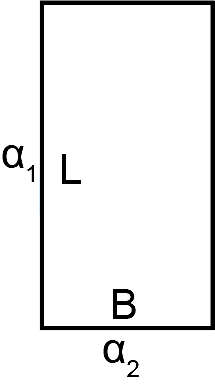
$A$ solid rectangular sheet has two different coefficients of linear expansion $\alpha_{1}$ and $\alpha_{2}$ along its length and breadth respectively. The coefficient of surface expansion is (for $\alpha_{1} \Delta t \ll 1, \alpha_{2} \Delta t \ll 1$):
A
$\frac{\alpha_{1}+\alpha_{2}}{2}$
B
$2(\alpha_{1}+\alpha_{2})$
C
$\frac{4 \alpha_{1} \alpha_{2}}{\alpha_{1}+\alpha_{2}}$
D
$\alpha_{1}+\alpha_{2}$
Solution
(D) Let the initial length be $L_{0}$ and initial breadth be $B_{0}$. The initial area is $S_{0} = L_{0} B_{0}$.
When the temperature increases by $\Delta t$,the new length $L_{t}$ and new breadth $B_{t}$ are given by:
$L_{t} = L_{0}(1 + \alpha_{1} \Delta t)$
$B_{t} = B_{0}(1 + \alpha_{2} \Delta t)$
The new area $S_{t}$ is:
$S_{t} = L_{t} \times B_{t} = L_{0}(1 + \alpha_{1} \Delta t) \times B_{0}(1 + \alpha_{2} \Delta t)$
$S_{t} = L_{0} B_{0} (1 + \alpha_{1} \Delta t + \alpha_{2} \Delta t + \alpha_{1} \alpha_{2} (\Delta t)^{2})$
Since $\alpha_{1} \Delta t \ll 1$ and $\alpha_{2} \Delta t \ll 1$,the term $\alpha_{1} \alpha_{2} (\Delta t)^{2}$ is negligible.
$S_{t} \approx S_{0} (1 + (\alpha_{1} + \alpha_{2}) \Delta t)$
Comparing this with the standard formula for surface expansion $S_{t} = S_{0} (1 + \beta \Delta t)$,where $\beta$ is the coefficient of surface expansion:
$\beta = \alpha_{1} + \alpha_{2}$
When the temperature increases by $\Delta t$,the new length $L_{t}$ and new breadth $B_{t}$ are given by:
$L_{t} = L_{0}(1 + \alpha_{1} \Delta t)$
$B_{t} = B_{0}(1 + \alpha_{2} \Delta t)$
The new area $S_{t}$ is:
$S_{t} = L_{t} \times B_{t} = L_{0}(1 + \alpha_{1} \Delta t) \times B_{0}(1 + \alpha_{2} \Delta t)$
$S_{t} = L_{0} B_{0} (1 + \alpha_{1} \Delta t + \alpha_{2} \Delta t + \alpha_{1} \alpha_{2} (\Delta t)^{2})$
Since $\alpha_{1} \Delta t \ll 1$ and $\alpha_{2} \Delta t \ll 1$,the term $\alpha_{1} \alpha_{2} (\Delta t)^{2}$ is negligible.
$S_{t} \approx S_{0} (1 + (\alpha_{1} + \alpha_{2}) \Delta t)$
Comparing this with the standard formula for surface expansion $S_{t} = S_{0} (1 + \beta \Delta t)$,where $\beta$ is the coefficient of surface expansion:
$\beta = \alpha_{1} + \alpha_{2}$
0 likesView Solution
11
PhysicsMediumMCQWBJEE · 2017
$2$ moles of an ideal monoatomic gas is carried from a state $(p_{0}, V_{0})$ to state $(2 p_{0}, 2 V_{0})$ along a straight line path in a $p-V$ diagram. The amount of heat absorbed by the gas in the process is given by
A
$3 p_{0} V_{0}$
B
$\frac{9}{2} p_{0} V_{0}$
C
$6 p_{0} V_{0}$
D
$\frac{3}{2} p_{0} V_{0}$
Solution
(C) For a monoatomic gas,the molar heat capacity at constant volume is $C_{v} = \frac{3}{2}R$. The change in internal energy is given by $\Delta U = n C_{v} \Delta T = n \left(\frac{3}{2}R\right) \Delta T$.
Using the ideal gas law $pV = nRT$,we have $\Delta T = \frac{p_f V_f - p_i V_i}{nR}$.
Substituting the values: $\Delta U = \frac{3}{2} (p_f V_f - p_i V_i) = \frac{3}{2} (4 p_{0} V_{0} - p_{0} V_{0}) = \frac{3}{2} (3 p_{0} V_{0}) = \frac{9}{2} p_{0} V_{0}$.
The work done $W$ is the area under the $p-V$ graph,which is a trapezoid: $W = \frac{1}{2} (p_i + p_f) (V_f - V_i) = \frac{1}{2} (p_{0} + 2 p_{0}) (2 V_{0} - V_{0}) = \frac{1}{2} (3 p_{0}) (V_{0}) = \frac{3}{2} p_{0} V_{0}$.
According to the first law of thermodynamics,$\Delta Q = \Delta U + W$.
$\Delta Q = \frac{9}{2} p_{0} V_{0} + \frac{3}{2} p_{0} V_{0} = \frac{12}{2} p_{0} V_{0} = 6 p_{0} V_{0}$.
Using the ideal gas law $pV = nRT$,we have $\Delta T = \frac{p_f V_f - p_i V_i}{nR}$.
Substituting the values: $\Delta U = \frac{3}{2} (p_f V_f - p_i V_i) = \frac{3}{2} (4 p_{0} V_{0} - p_{0} V_{0}) = \frac{3}{2} (3 p_{0} V_{0}) = \frac{9}{2} p_{0} V_{0}$.
The work done $W$ is the area under the $p-V$ graph,which is a trapezoid: $W = \frac{1}{2} (p_i + p_f) (V_f - V_i) = \frac{1}{2} (p_{0} + 2 p_{0}) (2 V_{0} - V_{0}) = \frac{1}{2} (3 p_{0}) (V_{0}) = \frac{3}{2} p_{0} V_{0}$.
According to the first law of thermodynamics,$\Delta Q = \Delta U + W$.
$\Delta Q = \frac{9}{2} p_{0} V_{0} + \frac{3}{2} p_{0} V_{0} = \frac{12}{2} p_{0} V_{0} = 6 p_{0} V_{0}$.
0 likesView Solution
12
PhysicsEasyMCQWBJEE · 2017
If the pressure,temperature,and density of an ideal gas are denoted by $p, T$ and $\rho$,respectively,the velocity of sound in the gas is
A
proportional to $\sqrt{p}$,when $T$ is constant.
B
proportional to $\sqrt{T}$
C
proportional to $\sqrt{p}$,when $\rho$ is constant.
D
proportional to $T$.
Solution
(C) The velocity of sound in an ideal gas is given by the formula $v = \sqrt{\frac{\gamma R T}{M}} = \sqrt{\frac{\gamma p}{\rho}}$.
$(i)$ From the relation $v = \sqrt{\frac{\gamma R T}{M}}$,it is clear that the velocity of sound is proportional to the square root of the absolute temperature,i.e.,$v \propto \sqrt{T}$.
(ii) From the relation $v = \sqrt{\frac{\gamma p}{\rho}}$,if the density $\rho$ is kept constant,the velocity of sound is proportional to the square root of the pressure $p$,i.e.,$v \propto \sqrt{p}$.
Comparing these with the given options,both $B$ and $C$ are physically correct statements based on the derived relations.
$(i)$ From the relation $v = \sqrt{\frac{\gamma R T}{M}}$,it is clear that the velocity of sound is proportional to the square root of the absolute temperature,i.e.,$v \propto \sqrt{T}$.
(ii) From the relation $v = \sqrt{\frac{\gamma p}{\rho}}$,if the density $\rho$ is kept constant,the velocity of sound is proportional to the square root of the pressure $p$,i.e.,$v \propto \sqrt{p}$.
Comparing these with the given options,both $B$ and $C$ are physically correct statements based on the derived relations.
0 likesView Solution
13
PhysicsEasyMCQWBJEE · 2017
$A$ uniform string of length $L$ and mass $M$ is fixed at both ends while it is subject to a tension $T$. It can vibrate at frequencies $(v)$ given by the formula (where $n=1, 2, 3, \ldots$):
A
$v=\frac{n}{2} \sqrt{\frac{T}{M L}}$
B
$v=\frac{n}{2 L} \sqrt{\frac{T}{M}}$
C
$v=\frac{1}{2 n} \sqrt{\frac{T}{M L}}$
D
$v=\frac{n}{2} \sqrt{\frac{T L}{M}}$
Solution
(A) The fundamental frequency of a string fixed at both ends is given by $v = \frac{n}{2L} \sqrt{\frac{T}{\mu}}$,where $n$ is the harmonic number,$L$ is the length,$T$ is the tension,and $\mu$ is the linear mass density.
Linear mass density $\mu = \frac{M}{L}$.
Substituting $\mu$ into the formula:
$v = \frac{n}{2L} \sqrt{\frac{T}{M/L}} = \frac{n}{2L} \sqrt{\frac{TL}{M}}$.
Wait,let us re-evaluate: $v = \frac{n}{2L} \sqrt{\frac{T}{M/L}} = \frac{n}{2} \sqrt{\frac{T}{M/L \cdot L^2}} = \frac{n}{2} \sqrt{\frac{T}{ML}}$.
Thus,the correct formula is $v = \frac{n}{2} \sqrt{\frac{T}{ML}}$.
Linear mass density $\mu = \frac{M}{L}$.
Substituting $\mu$ into the formula:
$v = \frac{n}{2L} \sqrt{\frac{T}{M/L}} = \frac{n}{2L} \sqrt{\frac{TL}{M}}$.
Wait,let us re-evaluate: $v = \frac{n}{2L} \sqrt{\frac{T}{M/L}} = \frac{n}{2} \sqrt{\frac{T}{M/L \cdot L^2}} = \frac{n}{2} \sqrt{\frac{T}{ML}}$.
Thus,the correct formula is $v = \frac{n}{2} \sqrt{\frac{T}{ML}}$.
0 likesView Solution
14
PhysicsMediumMCQWBJEE · 2017
When the frequency of the $AC$ voltage applied to a series $LCR$ circuit is gradually increased from a low value,the impedance of the circuit
A
monotonically increases
B
first increases and then decreases
C
first decreases and then increases
D
monotonically decreases
Solution
(C) The impedance $Z$ of a series $LCR$ circuit is given by the formula: $Z = \sqrt{R^2 + (X_L - X_C)^2} = \sqrt{R^2 + (\omega L - \frac{1}{\omega C})^2}$.
At very low frequencies $(\omega \to 0)$,the capacitive reactance $X_C = \frac{1}{\omega C}$ is very large,making the impedance $Z$ very high.
As the frequency $\omega$ increases,the term $(\omega L - \frac{1}{\omega C})^2$ decreases until it reaches zero at the resonance frequency $\omega_0 = \frac{1}{\sqrt{LC}}$. At this point,$Z = R$,which is the minimum value.
As the frequency increases further beyond $\omega_0$,the inductive reactance $X_L = \omega L$ becomes dominant,and the term $(\omega L - \frac{1}{\omega C})^2$ increases again,causing the impedance $Z$ to increase.
Therefore,the impedance first decreases and then increases.
At very low frequencies $(\omega \to 0)$,the capacitive reactance $X_C = \frac{1}{\omega C}$ is very large,making the impedance $Z$ very high.
As the frequency $\omega$ increases,the term $(\omega L - \frac{1}{\omega C})^2$ decreases until it reaches zero at the resonance frequency $\omega_0 = \frac{1}{\sqrt{LC}}$. At this point,$Z = R$,which is the minimum value.
As the frequency increases further beyond $\omega_0$,the inductive reactance $X_L = \omega L$ becomes dominant,and the term $(\omega L - \frac{1}{\omega C})^2$ increases again,causing the impedance $Z$ to increase.
Therefore,the impedance first decreases and then increases.
0 likesView Solution
15
PhysicsMediumMCQWBJEE · 2017
Let $v_{n}$ and $E_{n}$ be the respective speed and energy of an electron in the $n$th orbit of radius $r_{n}$,in a hydrogen atom,as predicted by Bohr's model. Then:
A
plot of $\frac{E_{n} r_{n}}{E_{1} r_{1}}$ as a function of $n$ is a straight line of slope $0$
B
plot of $\frac{r_{n} v_{n}}{r_{1} v_{1}}$ as a function of $n$ is a straight line of slope $1$
C
plot of $\ln \left(\frac{r_{n}}{r_{1}}\right)$ as a function of $\ln (n)$ is a straight line of slope $2$
D
plot of $\ln \left(\frac{r_{n} E_{1}}{E_{n} r_{1}}\right)$ as a function of $\ln (n)$ is a straight line of slope $4$
Solution
(A-D) According to Bohr's model for a hydrogen atom:
$v_{n} \propto \frac{1}{n}$
$E_{n} \propto \frac{1}{n^{2}}$
$r_{n} \propto n^{2}$
For option $A$: $\frac{E_{n} r_{n}}{E_{1} r_{1}} \propto \frac{(1/n^{2}) \cdot n^{2}}{1} = 1$. This is a constant,so the slope is $0$.
For option $B$: $\frac{r_{n} v_{n}}{r_{1} v_{1}} \propto \frac{n^{2} \cdot (1/n)}{1} = n$. This is a straight line with slope $1$.
For option $C$: $\frac{r_{n}}{r_{1}} = n^{2}$. Taking natural log on both sides: $\ln \left(\frac{r_{n}}{r_{1}}\right) = 2 \ln(n)$. This is a straight line with slope $2$.
For option $D$: $\frac{r_{n}}{E_{n}} \propto \frac{n^{2}}{1/n^{2}} = n^{4}$. Thus,$\frac{r_{n} E_{1}}{E_{n} r_{1}} = n^{4}$. Taking natural log: $\ln \left(\frac{r_{n} E_{1}}{E_{n} r_{1}}\right) = 4 \ln(n)$. This is a straight line with slope $4$.
All options $A, B, C,$ and $D$ are mathematically correct based on Bohr's model.
$v_{n} \propto \frac{1}{n}$
$E_{n} \propto \frac{1}{n^{2}}$
$r_{n} \propto n^{2}$
For option $A$: $\frac{E_{n} r_{n}}{E_{1} r_{1}} \propto \frac{(1/n^{2}) \cdot n^{2}}{1} = 1$. This is a constant,so the slope is $0$.
For option $B$: $\frac{r_{n} v_{n}}{r_{1} v_{1}} \propto \frac{n^{2} \cdot (1/n)}{1} = n$. This is a straight line with slope $1$.
For option $C$: $\frac{r_{n}}{r_{1}} = n^{2}$. Taking natural log on both sides: $\ln \left(\frac{r_{n}}{r_{1}}\right) = 2 \ln(n)$. This is a straight line with slope $2$.
For option $D$: $\frac{r_{n}}{E_{n}} \propto \frac{n^{2}}{1/n^{2}} = n^{4}$. Thus,$\frac{r_{n} E_{1}}{E_{n} r_{1}} = n^{4}$. Taking natural log: $\ln \left(\frac{r_{n} E_{1}}{E_{n} r_{1}}\right) = 4 \ln(n)$. This is a straight line with slope $4$.
All options $A, B, C,$ and $D$ are mathematically correct based on Bohr's model.
0 likesView Solution
16
PhysicsMediumMCQWBJEE · 2017
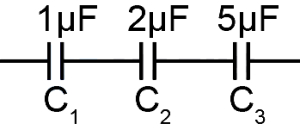
Three capacitors of capacitance $1.0 \mu F$,$2.0 \mu F$,and $5.0 \mu F$ are connected in series to a $10 \ V$ source. The potential difference across the $2.0 \mu F$ capacitor is
A
$\frac{100}{17} \ V$
B
$\frac{20}{17} \ V$
C
$\frac{50}{17} \ V$
D
$10 \ V$
Solution
(C) When capacitors are connected in series,the equivalent capacitance $C_{eq}$ is given by:
$\frac{1}{C_{eq}} = \frac{1}{C_1} + \frac{1}{C_2} + \frac{1}{C_3}$
$\frac{1}{C_{eq}} = \frac{1}{1} + \frac{1}{2} + \frac{1}{5} = \frac{10 + 5 + 2}{10} = \frac{17}{10} \ \mu F^{-1}$
$C_{eq} = \frac{10}{17} \ \mu F$
The charge $Q$ on each capacitor in a series combination is the same:
$Q = C_{eq} \times V = \left( \frac{10}{17} \ \mu F \right) \times 10 \ V = \frac{100}{17} \ \mu C$
The potential difference $V_2$ across the $2.0 \ \mu F$ capacitor is:
$V_2 = \frac{Q}{C_2} = \frac{100/17 \ \mu C}{2 \ \mu F} = \frac{50}{17} \ V$
$\frac{1}{C_{eq}} = \frac{1}{C_1} + \frac{1}{C_2} + \frac{1}{C_3}$
$\frac{1}{C_{eq}} = \frac{1}{1} + \frac{1}{2} + \frac{1}{5} = \frac{10 + 5 + 2}{10} = \frac{17}{10} \ \mu F^{-1}$
$C_{eq} = \frac{10}{17} \ \mu F$
The charge $Q$ on each capacitor in a series combination is the same:
$Q = C_{eq} \times V = \left( \frac{10}{17} \ \mu F \right) \times 10 \ V = \frac{100}{17} \ \mu C$
The potential difference $V_2$ across the $2.0 \ \mu F$ capacitor is:
$V_2 = \frac{Q}{C_2} = \frac{100/17 \ \mu C}{2 \ \mu F} = \frac{50}{17} \ V$
0 likesView Solution
17
PhysicsDifficultMCQWBJEE · 2017
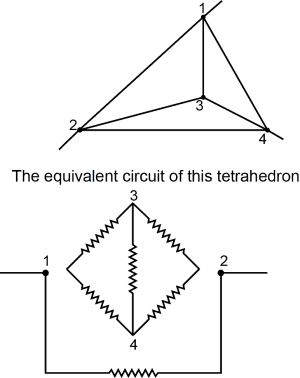
Six wires,each of resistance $r$,are connected so as to form a tetrahedron. The equivalent resistance of the combination when current enters through one corner and leaves through some other corner is
A
$r$
B
$2 r$
C
$\frac{r}{3}$
D
$\frac{r}{2}$
Solution
(D) tetrahedron has $4$ vertices and $6$ edges. Let the current enter at vertex $1$ and leave at vertex $2$.
There is a direct wire between $1$ and $2$ with resistance $r$.
There are two paths from $1$ to $2$ through the other two vertices ($3$ and $4$):
Path $1$: $1 \rightarrow 3 \rightarrow 2$ (two resistors in series,total $2r$)
Path $2$: $1 \rightarrow 4 \rightarrow 2$ (two resistors in series,total $2r$)
These two paths are in parallel with each other,so their equivalent resistance $R_p$ is given by $\frac{1}{R_p} = \frac{1}{2r} + \frac{1}{2r} = \frac{2}{2r} = \frac{1}{r}$,which means $R_p = r$.
Finally,this $R_p$ is in parallel with the direct wire between $1$ and $2$ (which also has resistance $r$).
Therefore,the total equivalent resistance $R_{eq}$ is $\frac{1}{R_{eq}} = \frac{1}{R_p} + \frac{1}{r} = \frac{1}{r} + \frac{1}{r} = \frac{2}{r}$.
Thus,$R_{eq} = \frac{r}{2}$.
There is a direct wire between $1$ and $2$ with resistance $r$.
There are two paths from $1$ to $2$ through the other two vertices ($3$ and $4$):
Path $1$: $1 \rightarrow 3 \rightarrow 2$ (two resistors in series,total $2r$)
Path $2$: $1 \rightarrow 4 \rightarrow 2$ (two resistors in series,total $2r$)
These two paths are in parallel with each other,so their equivalent resistance $R_p$ is given by $\frac{1}{R_p} = \frac{1}{2r} + \frac{1}{2r} = \frac{2}{2r} = \frac{1}{r}$,which means $R_p = r$.
Finally,this $R_p$ is in parallel with the direct wire between $1$ and $2$ (which also has resistance $r$).
Therefore,the total equivalent resistance $R_{eq}$ is $\frac{1}{R_{eq}} = \frac{1}{R_p} + \frac{1}{r} = \frac{1}{r} + \frac{1}{r} = \frac{2}{r}$.
Thus,$R_{eq} = \frac{r}{2}$.
0 likesView Solution
18
PhysicsMediumMCQWBJEE · 2017
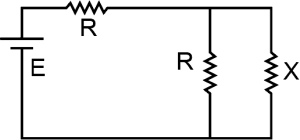
Consider the circuit shown in the figure. The value of the resistance $X$ for which the thermal power generated in it is independent of small variations of its resistance is
A
$X=R$
B
$X=\frac{R}{3}$
C
$X=\frac{R}{2}$
D
$X=2 R$
Solution
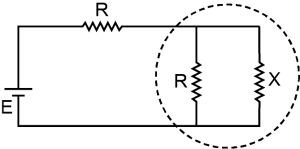
(C) For the given circuit,the equivalent resistance $R^{\prime}$ of the parallel combination of $R$ and $X$ is given by:
$\frac{1}{R^{\prime}} = \frac{1}{R} + \frac{1}{X} = \frac{R+X}{RX} \implies R^{\prime} = \frac{RX}{R+X}$
The total current $i$ in the circuit is:
$i = \frac{E}{R + R^{\prime}} = \frac{E}{R + \frac{RX}{R+X}} = \frac{E(R+X)}{R^2 + RX + RX} = \frac{E(R+X)}{R^2 + 2RX}$
The voltage $V_X$ across the resistance $X$ is equal to the voltage across $R^{\prime}$:
$V_X = i R^{\prime} = \left( \frac{E(R+X)}{R^2 + 2RX} \right) \left( \frac{RX}{R+X} \right) = \frac{ERX}{R^2 + 2RX} = \frac{EX}{R + 2X}$
The power $P_X$ dissipated in resistance $X$ is:
$P_X = \frac{V_X^2}{X} = \frac{(EX)^2}{X(R+2X)^2} = \frac{E^2 X}{(R+2X)^2}$
For $P_X$ to be independent of small variations in $X$,we set $\frac{dP_X}{dX} = 0$:
$\frac{dP_X}{dX} = E^2 \left[ \frac{(R+2X)^2(1) - X(2)(R+2X)(2)}{(R+2X)^4} \right] = 0$
$(R+2X) - 4X = 0$
$R - 2X = 0 \implies X = \frac{R}{2}$
$\frac{1}{R^{\prime}} = \frac{1}{R} + \frac{1}{X} = \frac{R+X}{RX} \implies R^{\prime} = \frac{RX}{R+X}$
The total current $i$ in the circuit is:
$i = \frac{E}{R + R^{\prime}} = \frac{E}{R + \frac{RX}{R+X}} = \frac{E(R+X)}{R^2 + RX + RX} = \frac{E(R+X)}{R^2 + 2RX}$
The voltage $V_X$ across the resistance $X$ is equal to the voltage across $R^{\prime}$:
$V_X = i R^{\prime} = \left( \frac{E(R+X)}{R^2 + 2RX} \right) \left( \frac{RX}{R+X} \right) = \frac{ERX}{R^2 + 2RX} = \frac{EX}{R + 2X}$
The power $P_X$ dissipated in resistance $X$ is:
$P_X = \frac{V_X^2}{X} = \frac{(EX)^2}{X(R+2X)^2} = \frac{E^2 X}{(R+2X)^2}$
For $P_X$ to be independent of small variations in $X$,we set $\frac{dP_X}{dX} = 0$:
$\frac{dP_X}{dX} = E^2 \left[ \frac{(R+2X)^2(1) - X(2)(R+2X)(2)}{(R+2X)^4} \right] = 0$
$(R+2X) - 4X = 0$
$R - 2X = 0 \implies X = \frac{R}{2}$
0 likesView Solution
19
PhysicsMediumMCQWBJEE · 2017
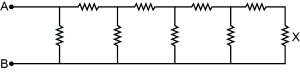
Consider the circuit shown in the figure where all the resistances are of magnitude $1 k \Omega$. If the current in the extreme right resistance $X$ is $1 mA$,the potential difference between $A$ and $B$ is: (in $V$)
A
$34$
B
$21$
C
$68$
D
$55$
Solution
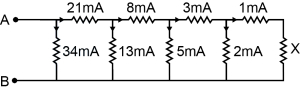
(A) Let the resistance of each resistor be $R = 1 k\Omega = 1000 \Omega$. The circuit is a ladder network. Let the current in the rightmost vertical resistor $X$ be $I_4 = 1 mA$. The current in the horizontal resistor connected to it is also $1 mA$.
Applying Kirchhoff's Current Law $(KCL)$ at the node above $X$,the current in the vertical resistor to the left of $X$ is $I_v = 1 mA + 1 mA = 2 mA$.
Moving left,the current in the next horizontal resistor is $I_h = 1 mA + 2 mA = 3 mA$.
The current in the next vertical resistor is $I_v = 3 mA + 2 mA = 5 mA$.
Continuing this process:
- Current in the next horizontal resistor: $I_h = 3 mA + 5 mA = 8 mA$.
- Current in the next vertical resistor: $I_v = 8 mA + 5 mA = 13 mA$.
- Current in the first horizontal resistor: $I_h = 8 mA + 13 mA = 21 mA$.
- Current in the first vertical resistor: $I_v = 21 mA + 13 mA = 34 mA$.
The potential difference between $A$ and $B$ is the voltage across the first vertical resistor: $V_{AB} = I_{v1} \times R = 34 mA \times 1 k\Omega = 34 V$.
Applying Kirchhoff's Current Law $(KCL)$ at the node above $X$,the current in the vertical resistor to the left of $X$ is $I_v = 1 mA + 1 mA = 2 mA$.
Moving left,the current in the next horizontal resistor is $I_h = 1 mA + 2 mA = 3 mA$.
The current in the next vertical resistor is $I_v = 3 mA + 2 mA = 5 mA$.
Continuing this process:
- Current in the next horizontal resistor: $I_h = 3 mA + 5 mA = 8 mA$.
- Current in the next vertical resistor: $I_v = 8 mA + 5 mA = 13 mA$.
- Current in the first horizontal resistor: $I_h = 8 mA + 13 mA = 21 mA$.
- Current in the first vertical resistor: $I_v = 21 mA + 13 mA = 34 mA$.
The potential difference between $A$ and $B$ is the voltage across the first vertical resistor: $V_{AB} = I_{v1} \times R = 34 mA \times 1 k\Omega = 34 V$.
0 likesView Solution
20
PhysicsMediumMCQWBJEE · 2017
The magnets of two suspended coil galvanometers are of the same strength so that they produce identical uniform magnetic fields in the region of the coils. The coil of the first one is in the shape of a square of side $a$ and that of the second one is circular of radius $\frac{a}{\sqrt{\pi}}.$ When the same current is passed through the coils,the ratio of the torque experienced by the first coil to that experienced by the second one is
A
$1: \frac{1}{\sqrt{\pi}}$
B
$1: 1$
C
$\pi: 1$
D
$1: \pi$
Solution
(B) The torque $\tau$ experienced by a current-carrying coil in a magnetic field is given by $\tau = N I A B \sin \theta$,where $N$ is the number of turns,$I$ is the current,$A$ is the area of the coil,$B$ is the magnetic field,and $\theta$ is the angle between the normal to the coil and the magnetic field.
Since the current $I$,magnetic field $B$,and number of turns $N$ are the same for both galvanometers,the ratio of the torques depends only on the ratio of the areas of the coils.
For the first coil (square of side $a$): $A_1 = a^2$.
For the second coil (circular of radius $r = \frac{a}{\sqrt{\pi}}$): $A_2 = \pi r^2 = \pi \left( \frac{a}{\sqrt{\pi}} \right)^2 = \pi \left( \frac{a^2}{\pi} \right) = a^2$.
Since $A_1 = A_2$,the torque experienced by both coils is the same.
Therefore,the ratio of the torque experienced by the first coil to that experienced by the second one is $1: 1$.
Since the current $I$,magnetic field $B$,and number of turns $N$ are the same for both galvanometers,the ratio of the torques depends only on the ratio of the areas of the coils.
For the first coil (square of side $a$): $A_1 = a^2$.
For the second coil (circular of radius $r = \frac{a}{\sqrt{\pi}}$): $A_2 = \pi r^2 = \pi \left( \frac{a}{\sqrt{\pi}} \right)^2 = \pi \left( \frac{a^2}{\pi} \right) = a^2$.
Since $A_1 = A_2$,the torque experienced by both coils is the same.
Therefore,the ratio of the torque experienced by the first coil to that experienced by the second one is $1: 1$.
0 likesView Solution
21
PhysicsDifficultMCQWBJEE · 2017
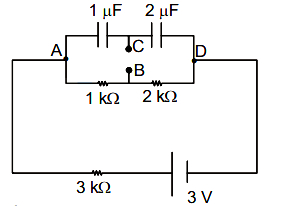
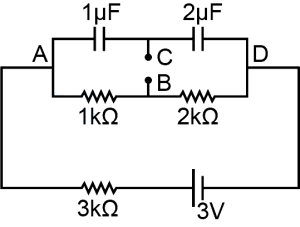
Consider the circuit given here. The potential difference $V_{BC}$ between the points $B$ and $C$ is (in $V$)
A
$1$
B
$0.5$
C
$0$
D
$-1$
Solution
(B) $1$. First,calculate the total resistance of the circuit. The resistors $1 \text{ k}\Omega$ and $2 \text{ k}\Omega$ are in series with the $3 \text{ k}\Omega$ resistor. Total resistance $R_{eq} = 1 \text{ k}\Omega + 2 \text{ k}\Omega + 3 \text{ k}\Omega = 6 \text{ k}\Omega = 6000 \ \Omega$.
$2$. The current $I$ flowing through the circuit is $I = \frac{E}{R_{eq}} = \frac{3 \text{ V}}{6000 \ \Omega} = 0.5 \times 10^{-3} \text{ A} = 0.5 \text{ mA}$.
$3$. The potential at point $B$ relative to $A$ is $V_{AB} = I \times R_{1k} = 0.5 \text{ mA} \times 1 \text{ k}\Omega = 0.5 \text{ V}$. Thus,$V_A - V_B = 0.5 \text{ V}$.
$4$. The potential at point $C$ relative to $A$ is determined by the voltage divider rule for the capacitors. Since the capacitors are in series and no $DC$ current flows through them,the potential $V_C$ is determined by the ratio of their capacitances. $V_A - V_C = V_{AD} \times \frac{C_2}{C_1 + C_2}$,where $V_{AD} = I \times (1 \text{ k}\Omega + 2 \text{ k}\Omega) = 0.5 \text{ mA} \times 3 \text{ k}\Omega = 1.5 \text{ V}$.
$5$. $V_A - V_C = 1.5 \text{ V} \times \frac{2 \mu\text{F}}{1 \mu\text{F} + 2 \mu\text{F}} = 1.5 \times \frac{2}{3} = 1.0 \text{ V}$.
$6$. Now,$V_{BC} = V_B - V_C = (V_A - V_C) - (V_A - V_B) = 1.0 \text{ V} - 0.5 \text{ V} = 0.5 \text{ V}$.
$2$. The current $I$ flowing through the circuit is $I = \frac{E}{R_{eq}} = \frac{3 \text{ V}}{6000 \ \Omega} = 0.5 \times 10^{-3} \text{ A} = 0.5 \text{ mA}$.
$3$. The potential at point $B$ relative to $A$ is $V_{AB} = I \times R_{1k} = 0.5 \text{ mA} \times 1 \text{ k}\Omega = 0.5 \text{ V}$. Thus,$V_A - V_B = 0.5 \text{ V}$.
$4$. The potential at point $C$ relative to $A$ is determined by the voltage divider rule for the capacitors. Since the capacitors are in series and no $DC$ current flows through them,the potential $V_C$ is determined by the ratio of their capacitances. $V_A - V_C = V_{AD} \times \frac{C_2}{C_1 + C_2}$,where $V_{AD} = I \times (1 \text{ k}\Omega + 2 \text{ k}\Omega) = 0.5 \text{ mA} \times 3 \text{ k}\Omega = 1.5 \text{ V}$.
$5$. $V_A - V_C = 1.5 \text{ V} \times \frac{2 \mu\text{F}}{1 \mu\text{F} + 2 \mu\text{F}} = 1.5 \times \frac{2}{3} = 1.0 \text{ V}$.
$6$. Now,$V_{BC} = V_B - V_C = (V_A - V_C) - (V_A - V_B) = 1.0 \text{ V} - 0.5 \text{ V} = 0.5 \text{ V}$.
0 likesView Solution
22
PhysicsMediumMCQWBJEE · 2017
The de-Broglie wavelength of an electron is $0.4 \times 10^{-10} \ m$ when its kinetic energy is $1.0 \ keV$. Its wavelength will be $1.0 \times 10^{-10} \ m$ when its kinetic energy is: (in $keV$)
A
$0.2$
B
$0.8$
C
$0.63$
D
$0.16$
Solution
(D) The de-Broglie wavelength $\lambda$ is related to kinetic energy $E$ by the formula: $\lambda = \frac{h}{\sqrt{2mE}}$.
From this,we can see that $\lambda \propto \frac{1}{\sqrt{E}}$,which implies $\frac{\lambda_1}{\lambda_2} = \sqrt{\frac{E_2}{E_1}}$.
Given:
$\lambda_1 = 0.4 \times 10^{-10} \ m$
$E_1 = 1.0 \ keV$
$\lambda_2 = 1.0 \times 10^{-10} \ m$
Substituting these values into the ratio:
$\frac{0.4 \times 10^{-10}}{1.0 \times 10^{-10}} = \sqrt{\frac{E_2}{1.0 \ keV}}$
$0.4 = \sqrt{E_2}$
Squaring both sides:
$E_2 = (0.4)^2 = 0.16 \ keV$.
From this,we can see that $\lambda \propto \frac{1}{\sqrt{E}}$,which implies $\frac{\lambda_1}{\lambda_2} = \sqrt{\frac{E_2}{E_1}}$.
Given:
$\lambda_1 = 0.4 \times 10^{-10} \ m$
$E_1 = 1.0 \ keV$
$\lambda_2 = 1.0 \times 10^{-10} \ m$
Substituting these values into the ratio:
$\frac{0.4 \times 10^{-10}}{1.0 \times 10^{-10}} = \sqrt{\frac{E_2}{1.0 \ keV}}$
$0.4 = \sqrt{E_2}$
Squaring both sides:
$E_2 = (0.4)^2 = 0.16 \ keV$.
0 likesView Solution
23
PhysicsMediumMCQWBJEE · 2017
When light of frequency $v_{1}$ is incident on a metal with work function $W$ (where $h v_{1} > W$),then the photocurrent falls to zero at a stopping potential of $V_{1}$. If the frequency of light is increased to $v_{2}$,the stopping potential changes to $V_{2}$. Therefore,the charge of an electron $e$ is given by:
A
$\frac{W(v_{2}+v_{1})}{v_{1} V_{2}+v_{2} V_{1}}$
B
$\frac{W(v_{2}+v_{1})}{v_{1} V_{1}+v_{2} V_{2}}$
C
$\frac{W(v_{2}-v_{1})}{v_{1} V_{2}-v_{2} V_{1}}$
D
$\frac{W(v_{2}-v_{1})}{v_{2} V_{2}-v_{1} V_{1}}$
Solution
(C) From Einstein's photoelectric equation,$h v = W + e V$,where $W$ is the work function,$v$ is the frequency of incident light,and $V$ is the stopping potential.
For frequency $v_{1}$,we have: $h v_{1} = W + e V_{1}$ --- $(i)$
For frequency $v_{2}$,we have: $h v_{2} = W + e V_{2}$ --- (ii)
Subtracting equation $(i)$ from equation (ii):
$h(v_{2} - v_{1}) = e(V_{2} - V_{1})$
$e = \frac{h(v_{2} - v_{1})}{V_{2} - V_{1}}$
However,we need to express $e$ in terms of $W$. From $(i)$,$h = \frac{W + e V_{1}}{v_{1}}$. Substituting this into (ii):
$(\frac{W + e V_{1}}{v_{1}}) v_{2} = W + e V_{2}$
$W v_{2} + e V_{1} v_{2} = W v_{1} + e V_{2} v_{1}$
$e(V_{1} v_{2} - V_{2} v_{1}) = W v_{1} - W v_{2}$
$e(V_{1} v_{2} - V_{2} v_{1}) = -W(v_{2} - v_{1})$
$e = \frac{W(v_{2} - v_{1})}{V_{2} v_{1} - V_{1} v_{2}}$
This matches option $C$.
For frequency $v_{1}$,we have: $h v_{1} = W + e V_{1}$ --- $(i)$
For frequency $v_{2}$,we have: $h v_{2} = W + e V_{2}$ --- (ii)
Subtracting equation $(i)$ from equation (ii):
$h(v_{2} - v_{1}) = e(V_{2} - V_{1})$
$e = \frac{h(v_{2} - v_{1})}{V_{2} - V_{1}}$
However,we need to express $e$ in terms of $W$. From $(i)$,$h = \frac{W + e V_{1}}{v_{1}}$. Substituting this into (ii):
$(\frac{W + e V_{1}}{v_{1}}) v_{2} = W + e V_{2}$
$W v_{2} + e V_{1} v_{2} = W v_{1} + e V_{2} v_{1}$
$e(V_{1} v_{2} - V_{2} v_{1}) = W v_{1} - W v_{2}$
$e(V_{1} v_{2} - V_{2} v_{1}) = -W(v_{2} - v_{1})$
$e = \frac{W(v_{2} - v_{1})}{V_{2} v_{1} - V_{1} v_{2}}$
This matches option $C$.
0 likesView Solution
24
PhysicsMediumMCQWBJEE · 2017
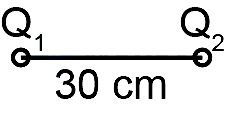
$A$ charge of $0.8 \text{ C}$ is divided into two charges $Q_{1}$ and $Q_{2}$. These are kept at a separation of $30 \text{ cm}$. The force on $Q_{1}$ is maximum when
A
$Q_{1} = Q_{2} = 0.4 \text{ C}$
B
$Q_{1} = 0.8 \text{ C}, Q_{2}$ is negligible
C
$Q_{1}$ is negligible,$Q_{2} = 0.8 \text{ C}$
D
$Q_{1} = 0.2 \text{ C}, Q_{2} = 0.6 \text{ C}$
Solution
(A) Let the total charge be $Q = 0.8 \text{ C}$.
Let $Q_{1} = q$,then $Q_{2} = Q - q = (0.8 - q)$.
The electrostatic force between the two charges is given by Coulomb's Law:
$F = \frac{k Q_{1} Q_{2}}{r^{2}} = \frac{k q (0.8 - q)}{r^{2}}$
For the force $F$ to be maximum,the derivative of $F$ with respect to $q$ must be zero:
$\frac{dF}{dq} = \frac{k}{r^{2}} \frac{d}{dq} (0.8q - q^{2}) = 0$
$0.8 - 2q = 0$
$2q = 0.8$
$q = 0.4 \text{ C}$
Thus,$Q_{1} = 0.4 \text{ C}$ and $Q_{2} = 0.8 - 0.4 = 0.4 \text{ C}$.
Therefore,the force is maximum when $Q_{1} = Q_{2} = 0.4 \text{ C}$.
Let $Q_{1} = q$,then $Q_{2} = Q - q = (0.8 - q)$.
The electrostatic force between the two charges is given by Coulomb's Law:
$F = \frac{k Q_{1} Q_{2}}{r^{2}} = \frac{k q (0.8 - q)}{r^{2}}$
For the force $F$ to be maximum,the derivative of $F$ with respect to $q$ must be zero:
$\frac{dF}{dq} = \frac{k}{r^{2}} \frac{d}{dq} (0.8q - q^{2}) = 0$
$0.8 - 2q = 0$
$2q = 0.8$
$q = 0.4 \text{ C}$
Thus,$Q_{1} = 0.4 \text{ C}$ and $Q_{2} = 0.8 - 0.4 = 0.4 \text{ C}$.
Therefore,the force is maximum when $Q_{1} = Q_{2} = 0.4 \text{ C}$.
0 likesView Solution
25
PhysicsMediumMCQWBJEE · 2017
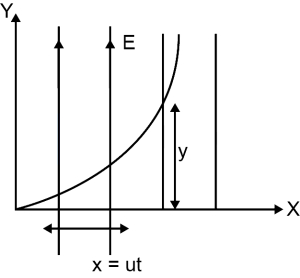
$A$ particle with charge $e$ and mass $m$, moving along the $X$-axis with a uniform speed $u$, enters a region where a uniform electric field $E$ is acting along the $Y$-axis. The particle starts to move in a parabola. Its focal length (neglecting any effect of gravity) is
A
$\frac{2 m u^{2}}{e E}$
B
$\frac{e E}{2 m u^{2}}$
C
$\frac{m u}{2 e E}$
D
$\frac{m u^{2}}{2 e E}$
Solution
(D) The particle moves with constant velocity $u$ along the $X$-axis, so $x = ut$, which implies $t = x/u$.
Along the $Y$-axis, the force on the particle is $F = eE$, so the acceleration is $a_y = \frac{eE}{m}$.
The displacement along the $Y$-axis is $y = \frac{1}{2} a_y t^2 = \frac{1}{2} \left( \frac{eE}{m} \right) \left( \frac{x}{u} \right)^2 = \left( \frac{eE}{2mu^2} \right) x^2$.
This is the equation of a parabola of the form $x^2 = 4ay$.
Rearranging the equation: $x^2 = \left( \frac{2mu^2}{eE} \right) y$.
Comparing this with the standard form $x^2 = 4ay$, we get $4a = \frac{2mu^2}{eE}$.
Therefore, the focal length $a = \frac{2mu^2}{4eE} = \frac{mu^2}{2eE}$.
Along the $Y$-axis, the force on the particle is $F = eE$, so the acceleration is $a_y = \frac{eE}{m}$.
The displacement along the $Y$-axis is $y = \frac{1}{2} a_y t^2 = \frac{1}{2} \left( \frac{eE}{m} \right) \left( \frac{x}{u} \right)^2 = \left( \frac{eE}{2mu^2} \right) x^2$.
This is the equation of a parabola of the form $x^2 = 4ay$.
Rearranging the equation: $x^2 = \left( \frac{2mu^2}{eE} \right) y$.
Comparing this with the standard form $x^2 = 4ay$, we get $4a = \frac{2mu^2}{eE}$.
Therefore, the focal length $a = \frac{2mu^2}{4eE} = \frac{mu^2}{2eE}$.
0 likesView Solution
26
PhysicsEasyMCQWBJEE · 2017
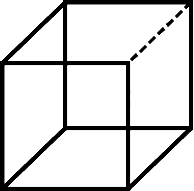
$A$ positive charge $Q$ is situated at the centre of a cube. The electric flux through any face of the cube is (in $SI$ units)
A
$\frac{Q}{6 \varepsilon_{0}}$
B
$4 \pi Q$
C
$\frac{Q}{4 \pi \varepsilon_{0}}$
D
$\frac{Q}{6 \pi \varepsilon_{0}}$
Solution
(A) According to Gauss's law,the total electric flux $\phi_{total}$ through any closed surface is given by $\phi_{total} = \frac{Q}{\varepsilon_{0}}$,where $Q$ is the net charge enclosed by the surface.
Since the charge $Q$ is placed at the centre of the cube,the electric flux is symmetrically distributed through all $6$ faces of the cube.
Therefore,the electric flux $\phi_{face}$ through any one face of the cube is $\phi_{face} = \frac{\phi_{total}}{6} = \frac{Q}{6 \varepsilon_{0}}$.
Since the charge $Q$ is placed at the centre of the cube,the electric flux is symmetrically distributed through all $6$ faces of the cube.
Therefore,the electric flux $\phi_{face}$ through any one face of the cube is $\phi_{face} = \frac{\phi_{total}}{6} = \frac{Q}{6 \varepsilon_{0}}$.
0 likesView Solution
27
PhysicsEasyMCQWBJEE · 2017
The magnetic field due to a current in a straight wire segment of length $L$ at a point on its perpendicular bisector at a distance $r$ $(r >> L)$ is:
A
decreases as $\frac{1}{r}$
B
decreases as $\frac{1}{r^{2}}$
C
decreases as $\frac{1}{r^{3}}$
D
approaches a finite limit as $r \rightarrow \infty$
Solution
(B) For a finite wire segment of length $L$ carrying current $I$,the magnetic field $B$ at a distance $r$ on its perpendicular bisector is given by the Biot-Savart law integration:
$B = \frac{\mu_{0} I}{4 \pi r} (\sin \theta_{1} + \sin \theta_{2})$
For a segment of length $L$,$\sin \theta_{1} = \sin \theta_{2} = \frac{L/2}{\sqrt{r^{2} + (L/2)^{2}}}$.
Substituting this,we get $B = \frac{\mu_{0} I}{4 \pi r} \cdot \frac{L}{\sqrt{r^{2} + (L/2)^{2}}}$.
Since $r >> L$,the denominator $\sqrt{r^{2} + (L/2)^{2}} \approx r$.
Thus,$B \approx \frac{\mu_{0} I L}{4 \pi r^{2}}$.
Therefore,the magnetic field decreases as $\frac{1}{r^{2}}$.
$B = \frac{\mu_{0} I}{4 \pi r} (\sin \theta_{1} + \sin \theta_{2})$
For a segment of length $L$,$\sin \theta_{1} = \sin \theta_{2} = \frac{L/2}{\sqrt{r^{2} + (L/2)^{2}}}$.
Substituting this,we get $B = \frac{\mu_{0} I}{4 \pi r} \cdot \frac{L}{\sqrt{r^{2} + (L/2)^{2}}}$.
Since $r >> L$,the denominator $\sqrt{r^{2} + (L/2)^{2}} \approx r$.
Thus,$B \approx \frac{\mu_{0} I L}{4 \pi r^{2}}$.
Therefore,the magnetic field decreases as $\frac{1}{r^{2}}$.
0 likesView Solution
28
PhysicsMediumMCQWBJEE · 2017
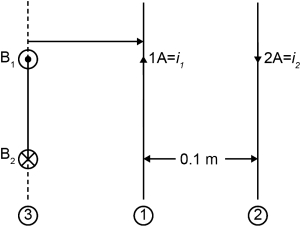
Two long parallel wires separated by $0.1 \ m$ carry currents of $1 \ A$ and $2 \ A$,respectively,in opposite directions. $A$ third current-carrying wire parallel to both of them is placed in the same plane such that it feels no net magnetic force. It is placed at a distance of
A
$0.5 \ m$ from the $1^{st}$ wire,towards the $2^{nd}$ wire
B
$0.2 \ m$ from the $1^{st}$ wire,towards the $2^{nd}$ wire
C
$0.1 \ m$ from the $1^{st}$ wire,away from the $2^{nd}$ wire
D
$0.2 \ m$ from the $1^{st}$ wire,away from the $2^{nd}$ wire
Solution
(C) For the third wire to experience no net magnetic force,the magnetic fields produced by the first and second wires at the position of the third wire must be equal in magnitude and opposite in direction.
The magnetic field $B$ due to a long straight wire at a distance $r$ is given by $B = \frac{\mu_0 I}{2 \pi r}$.
Since the currents in the first and second wires are in opposite directions,the magnetic fields produced by them will be in the same direction in the region between them and in opposite directions in the regions outside them.
Let the third wire be placed at a distance $x$ from the first wire. If it is placed outside the region between the two wires (on the side of the smaller current,i.e.,the $1 \ A$ wire),the fields will be in opposite directions.
Equating the magnitudes of the magnetic fields:
$B_1 = B_2$
$\frac{\mu_0 I_1}{2 \pi x} = \frac{\mu_0 I_2}{2 \pi (0.1 + x)}$
Substituting the given values $I_1 = 1 \ A$ and $I_2 = 2 \ A$:
$\frac{1}{x} = \frac{2}{0.1 + x}$
$0.1 + x = 2x$
$x = 0.1 \ m$
Thus,the third wire is placed at a distance of $0.1 \ m$ from the first wire,away from the second wire.
The magnetic field $B$ due to a long straight wire at a distance $r$ is given by $B = \frac{\mu_0 I}{2 \pi r}$.
Since the currents in the first and second wires are in opposite directions,the magnetic fields produced by them will be in the same direction in the region between them and in opposite directions in the regions outside them.
Let the third wire be placed at a distance $x$ from the first wire. If it is placed outside the region between the two wires (on the side of the smaller current,i.e.,the $1 \ A$ wire),the fields will be in opposite directions.
Equating the magnitudes of the magnetic fields:
$B_1 = B_2$
$\frac{\mu_0 I_1}{2 \pi x} = \frac{\mu_0 I_2}{2 \pi (0.1 + x)}$
Substituting the given values $I_1 = 1 \ A$ and $I_2 = 2 \ A$:
$\frac{1}{x} = \frac{2}{0.1 + x}$
$0.1 + x = 2x$
$x = 0.1 \ m$
Thus,the third wire is placed at a distance of $0.1 \ m$ from the first wire,away from the second wire.
0 likesView Solution
29
PhysicsMediumMCQWBJEE · 2017
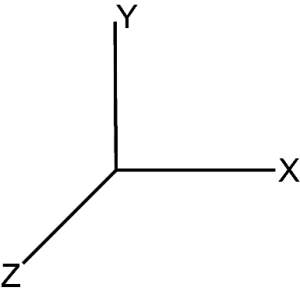
$A$ proton is moving with a uniform velocity of $10^{6} \ m/s$ along the $Y$-axis,under the joint action of a magnetic field along the $Z$-axis and an electric field of magnitude $2 \times 10^{4} \ V/m$ along the negative $X$-axis. If the electric field is switched off,the proton starts moving in a circle. The radius of the circle is nearly: (Given: $\frac{e}{m}$ ratio for proton $= 10^{8} \ C/kg$) (in $m$)
A
$0.5$
B
$0.2$
C
$0.1$
D
$0.05$
Solution
(A) Given:
Velocity of proton $v = 10^{6} \ m/s$ along the $Y$-axis.
Electric field $E = 2 \times 10^{4} \ V/m$ along the negative $X$-axis.
Specific charge $\frac{e}{m} = 10^{8} \ C/kg$.
Since the proton moves with a uniform velocity,the net force on it is zero. Thus,the magnetic force balances the electric force:
$qE = qvB$
$B = \frac{E}{v} = \frac{2 \times 10^{4}}{10^{6}} = 2 \times 10^{-2} \ T$
When the electric field is switched off,the proton moves in a circular path due to the magnetic force acting as the centripetal force:
$R = \frac{mv}{qB} = \frac{v}{(e/m)B}$
$R = \frac{10^{6}}{10^{8} \times 2 \times 10^{-2}}$
$R = \frac{10^{6}}{2 \times 10^{6}} = 0.5 \ m$
Therefore,the radius of the circle is $0.5 \ m$.
Velocity of proton $v = 10^{6} \ m/s$ along the $Y$-axis.
Electric field $E = 2 \times 10^{4} \ V/m$ along the negative $X$-axis.
Specific charge $\frac{e}{m} = 10^{8} \ C/kg$.
Since the proton moves with a uniform velocity,the net force on it is zero. Thus,the magnetic force balances the electric force:
$qE = qvB$
$B = \frac{E}{v} = \frac{2 \times 10^{4}}{10^{6}} = 2 \times 10^{-2} \ T$
When the electric field is switched off,the proton moves in a circular path due to the magnetic force acting as the centripetal force:
$R = \frac{mv}{qB} = \frac{v}{(e/m)B}$
$R = \frac{10^{6}}{10^{8} \times 2 \times 10^{-2}}$
$R = \frac{10^{6}}{2 \times 10^{6}} = 0.5 \ m$
Therefore,the radius of the circle is $0.5 \ m$.
0 likesView Solution
30
PhysicsEasyMCQWBJEE · 2017
If $\chi$ stands for the magnetic susceptibility of a substance,$\mu$ for its magnetic permeability,and $\mu_0$ for the permeability of free space,then which of the following is correct?
A
For a paramagnetic substance: $\chi < 0, \mu > 0$
B
For a paramagnetic substance: $\chi > 0, \mu > \mu_0$
C
For a diamagnetic substance: $\chi > 0, \mu < 0$
D
For a ferromagnetic substance: $\chi \gg 1, \mu \gg \mu_0$
Solution
(B) The relationship between magnetic susceptibility $\chi$ and relative permeability $\mu_r$ is given by $\chi = \mu_r - 1$.
Also,the absolute permeability $\mu$ is related to relative permeability by $\mu = \mu_r \mu_0$.
For a paramagnetic substance,$\chi$ is small and positive $(\chi > 0)$,which implies $\mu_r > 1$,and therefore $\mu > \mu_0$.
For a diamagnetic substance,$\chi$ is small and negative $(\chi < 0)$,which implies $\mu_r < 1$,and therefore $\mu < \mu_0$.
For a ferromagnetic substance,$\chi$ is very large and positive $(\chi \gg 1)$,which implies $\mu_r \gg 1$,and therefore $\mu \gg \mu_0$.
Comparing these with the given options,both $(b)$ and $(d)$ are scientifically correct statements.
Also,the absolute permeability $\mu$ is related to relative permeability by $\mu = \mu_r \mu_0$.
For a paramagnetic substance,$\chi$ is small and positive $(\chi > 0)$,which implies $\mu_r > 1$,and therefore $\mu > \mu_0$.
For a diamagnetic substance,$\chi$ is small and negative $(\chi < 0)$,which implies $\mu_r < 1$,and therefore $\mu < \mu_0$.
For a ferromagnetic substance,$\chi$ is very large and positive $(\chi \gg 1)$,which implies $\mu_r \gg 1$,and therefore $\mu \gg \mu_0$.
Comparing these with the given options,both $(b)$ and $(d)$ are scientifically correct statements.
0 likesView Solution
31
PhysicsEasyMCQWBJEE · 2017
Radon-$222$ has a half-life of $3.8$ days. If one starts with $0.064 \ kg$ of radon-$222$,the quantity of radon-$222$ left after $19$ days will be (in $kg$)
A
$0.002$
B
$0.062$
C
$0.032$
D
$0.024$
Solution
(A) The half-life of Radon-$222$ is $T_{1/2} = 3.8 \text{ days}$.
Total time elapsed is $t = 19 \text{ days}$.
The number of half-lives $n$ is given by $n = \frac{t}{T_{1/2}} = \frac{19}{3.8} = 5$.
The remaining quantity $N$ is given by the formula $N = N_0 \left(\frac{1}{2}\right)^n$,where $N_0$ is the initial amount.
Given $N_0 = 0.064 \ kg$ and $n = 5$,we have:
$N = 0.064 \times \left(\frac{1}{2}\right)^5$
$N = 0.064 \times \frac{1}{32}$
$N = 0.002 \ kg$.
Thus,the quantity of Radon-$222$ left after $19$ days is $0.002 \ kg$.
Total time elapsed is $t = 19 \text{ days}$.
The number of half-lives $n$ is given by $n = \frac{t}{T_{1/2}} = \frac{19}{3.8} = 5$.
The remaining quantity $N$ is given by the formula $N = N_0 \left(\frac{1}{2}\right)^n$,where $N_0$ is the initial amount.
Given $N_0 = 0.064 \ kg$ and $n = 5$,we have:
$N = 0.064 \times \left(\frac{1}{2}\right)^5$
$N = 0.064 \times \frac{1}{32}$
$N = 0.002 \ kg$.
Thus,the quantity of Radon-$222$ left after $19$ days is $0.002 \ kg$.
0 likesView Solution
32
PhysicsMediumMCQWBJEE · 2017
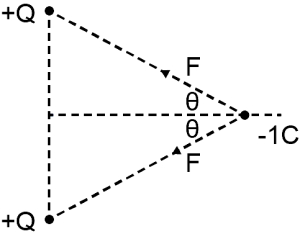
$A$ unit negative charge with mass $M$ resides at the mid-point of the straight line of length $2a$ connecting two fixed charges of magnitude $+Q$ each. If it is given a very small displacement $x$ $(x \ll a)$ in a direction perpendicular to the straight line,it will:
A
come back to its original position and stay there
B
execute oscillations with frequency $\frac{1}{2 \pi} \sqrt{\frac{Q}{2 \pi \varepsilon_{0} M a^{3}}}$
C
None of the above
D
execute oscillations with frequency $\frac{1}{2 \pi} \sqrt{\frac{Q}{4 \pi \varepsilon_{0} M a^{3}}}$
Solution
(C) Let the unit negative charge be at a distance $x$ from the midpoint along the perpendicular bisector. The distance of this charge from each fixed charge $+Q$ is $r = \sqrt{x^2 + a^2}$.
The electrostatic force exerted by each $+Q$ charge on the unit negative charge is $F = \frac{1}{4 \pi \varepsilon_0} \frac{Q \cdot 1}{r^2} = \frac{Q}{4 \pi \varepsilon_0 (x^2 + a^2)}$.
The components of these forces perpendicular to the line connecting the charges cancel out,while the components along the perpendicular bisector add up.
The net restoring force is $F_{\text{net}} = -2F \cos \theta$,where $\cos \theta = \frac{x}{r} = \frac{x}{\sqrt{x^2 + a^2}}$.
$F_{\text{net}} = -2 \left( \frac{Q}{4 \pi \varepsilon_0 (x^2 + a^2)} \right) \left( \frac{x}{\sqrt{x^2 + a^2}} \right) = -\frac{2Qx}{4 \pi \varepsilon_0 (x^2 + a^2)^{3/2}}$.
Since $x \ll a$,we can approximate $(x^2 + a^2)^{3/2} \approx (a^2)^{3/2} = a^3$.
Thus,$F_{\text{net}} \approx -\left( \frac{2Q}{4 \pi \varepsilon_0 a^3} \right) x = -\left( \frac{Q}{2 \pi \varepsilon_0 a^3} \right) x$.
This is the equation of simple harmonic motion $F = -kx_{eff}$,where $k_{eff} = \frac{Q}{2 \pi \varepsilon_0 a^3}$.
The frequency of oscillation is $f = \frac{1}{2 \pi} \sqrt{\frac{k_{eff}}{M}} = \frac{1}{2 \pi} \sqrt{\frac{Q}{2 \pi \varepsilon_0 M a^3}}$.
Comparing this with the given options,none of the options match the calculated frequency.
The electrostatic force exerted by each $+Q$ charge on the unit negative charge is $F = \frac{1}{4 \pi \varepsilon_0} \frac{Q \cdot 1}{r^2} = \frac{Q}{4 \pi \varepsilon_0 (x^2 + a^2)}$.
The components of these forces perpendicular to the line connecting the charges cancel out,while the components along the perpendicular bisector add up.
The net restoring force is $F_{\text{net}} = -2F \cos \theta$,where $\cos \theta = \frac{x}{r} = \frac{x}{\sqrt{x^2 + a^2}}$.
$F_{\text{net}} = -2 \left( \frac{Q}{4 \pi \varepsilon_0 (x^2 + a^2)} \right) \left( \frac{x}{\sqrt{x^2 + a^2}} \right) = -\frac{2Qx}{4 \pi \varepsilon_0 (x^2 + a^2)^{3/2}}$.
Since $x \ll a$,we can approximate $(x^2 + a^2)^{3/2} \approx (a^2)^{3/2} = a^3$.
Thus,$F_{\text{net}} \approx -\left( \frac{2Q}{4 \pi \varepsilon_0 a^3} \right) x = -\left( \frac{Q}{2 \pi \varepsilon_0 a^3} \right) x$.
This is the equation of simple harmonic motion $F = -kx_{eff}$,where $k_{eff} = \frac{Q}{2 \pi \varepsilon_0 a^3}$.
The frequency of oscillation is $f = \frac{1}{2 \pi} \sqrt{\frac{k_{eff}}{M}} = \frac{1}{2 \pi} \sqrt{\frac{Q}{2 \pi \varepsilon_0 M a^3}}$.
Comparing this with the given options,none of the options match the calculated frequency.
0 likesView Solution
33
PhysicsMediumMCQWBJEE · 2017
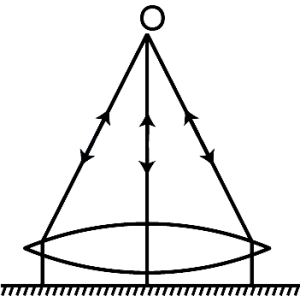
$A$ point object is held above a thin equiconvex lens at its focus. The focal length is $0.1 \ m$ and the lens rests on a horizontal thin plane mirror. The final image will be formed at
A
infinite distance above the lens
B
$0.1 \ m$ above the center of the lens
C
infinite distance below the lens
D
$0.1 \ m$ below the center of the lens
Solution
(B) The point object is placed at the focus of the equiconvex lens.
When light rays from an object at the focus pass through the lens,they become parallel to the principal axis.
These parallel rays then strike the plane mirror placed horizontally below the lens.
The plane mirror reflects these rays back along the same path.
These reflected rays,being parallel,pass through the lens again and converge at the focal point of the lens.
Therefore,the final image is formed at the same position as the object,which is $0.1 \ m$ above the center of the lens.
When light rays from an object at the focus pass through the lens,they become parallel to the principal axis.
These parallel rays then strike the plane mirror placed horizontally below the lens.
The plane mirror reflects these rays back along the same path.
These reflected rays,being parallel,pass through the lens again and converge at the focal point of the lens.
Therefore,the final image is formed at the same position as the object,which is $0.1 \ m$ above the center of the lens.
0 likesView Solution
34
PhysicsMediumMCQWBJEE · 2017
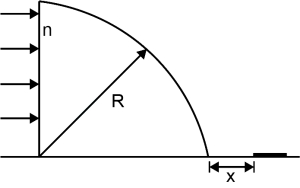
$A$ parallel beam of light is incident on a glass prism in the shape of a quarter cylinder of radius $R=0.05 \ m$ and refractive index $n=1.5$,placed on a horizontal table as shown in the figure. Beyond the cylinder,a patch of light is found whose nearest distance $x$ from the cylinder is
A
$(3 \sqrt{3}-4) \times 10^{-2} \ m$
B
$(2 \sqrt{3}-2) \times 10^{-2} \ m$
C
$(3 \sqrt{5}-5) \times 10^{-2} \ m$
D
$(3 \sqrt{2}-3) \times 10^{-2} \ m$
Solution
(C) Given,radius $R=0.05 \ m = 5 \times 10^{-2} \ m$.
Refractive index $n=1.5$.
The critical angle $c$ is given by $\sin c = \frac{1}{n} = \frac{1}{1.5} = \frac{2}{3}$.
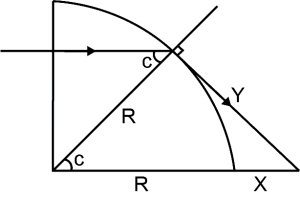
From the geometry of the problem,the ray that strikes the curved surface at the critical angle $c$ will emerge tangent to the surface and hit the table at a distance $x$ from the edge of the cylinder.
In the right-angled triangle formed by the radius $R$ and the distance $(R+x)$,the angle at the center is $c$.
Thus,$\cos c = \frac{R}{R+x}$.
Since $\sin c = \frac{2}{3}$,we have $\cos c = \sqrt{1 - \sin^2 c} = \sqrt{1 - \frac{4}{9}} = \sqrt{\frac{5}{9}} = \frac{\sqrt{5}}{3}$.
Equating the two expressions for $\cos c$:
$\frac{\sqrt{5}}{3} = \frac{R}{R+x}$.
$\sqrt{5}(R+x) = 3R$.
$\sqrt{5}x = 3R - \sqrt{5}R = R(3 - \sqrt{5})$.
$x = R \frac{3 - \sqrt{5}}{\sqrt{5}} = R \left( \frac{3}{\sqrt{5}} - 1 \right) = R \left( \frac{3\sqrt{5}}{5} - 1 \right)$.
Wait,re-evaluating the geometry: The distance from the center to the point where the ray hits the table is $d = \frac{R}{\cos c}$.
So,$R+x = \frac{R}{\cos c} = \frac{R}{\sqrt{5}/3} = \frac{3R}{\sqrt{5}} = \frac{3\sqrt{5}R}{5}$.
$x = \frac{3\sqrt{5}R}{5} - R = R \left( \frac{3\sqrt{5}-5}{5} \right)$.
Given $R = 5 \times 10^{-2} \ m$,we get $x = 5 \times 10^{-2} \left( \frac{3\sqrt{5}-5}{5} \right) = (3\sqrt{5}-5) \times 10^{-2} \ m$.
Refractive index $n=1.5$.
The critical angle $c$ is given by $\sin c = \frac{1}{n} = \frac{1}{1.5} = \frac{2}{3}$.
From the geometry of the problem,the ray that strikes the curved surface at the critical angle $c$ will emerge tangent to the surface and hit the table at a distance $x$ from the edge of the cylinder.
In the right-angled triangle formed by the radius $R$ and the distance $(R+x)$,the angle at the center is $c$.
Thus,$\cos c = \frac{R}{R+x}$.
Since $\sin c = \frac{2}{3}$,we have $\cos c = \sqrt{1 - \sin^2 c} = \sqrt{1 - \frac{4}{9}} = \sqrt{\frac{5}{9}} = \frac{\sqrt{5}}{3}$.
Equating the two expressions for $\cos c$:
$\frac{\sqrt{5}}{3} = \frac{R}{R+x}$.
$\sqrt{5}(R+x) = 3R$.
$\sqrt{5}x = 3R - \sqrt{5}R = R(3 - \sqrt{5})$.
$x = R \frac{3 - \sqrt{5}}{\sqrt{5}} = R \left( \frac{3}{\sqrt{5}} - 1 \right) = R \left( \frac{3\sqrt{5}}{5} - 1 \right)$.
Wait,re-evaluating the geometry: The distance from the center to the point where the ray hits the table is $d = \frac{R}{\cos c}$.
So,$R+x = \frac{R}{\cos c} = \frac{R}{\sqrt{5}/3} = \frac{3R}{\sqrt{5}} = \frac{3\sqrt{5}R}{5}$.
$x = \frac{3\sqrt{5}R}{5} - R = R \left( \frac{3\sqrt{5}-5}{5} \right)$.
Given $R = 5 \times 10^{-2} \ m$,we get $x = 5 \times 10^{-2} \left( \frac{3\sqrt{5}-5}{5} \right) = (3\sqrt{5}-5) \times 10^{-2} \ m$.
0 likesView Solution
35
PhysicsMediumMCQWBJEE · 2017
The ratio of the diameter of the sun to the distance between the earth and the sun is approximately $0.009$. The approximate diameter of the image of the sun formed by a concave spherical mirror of radius of curvature $0.4 \ m$ is
A
$4.5 \times 10^{-6} \ m$
B
$4.0 \times 10^{-6} \ m$
C
$3.6 \times 10^{-3} \ m$
D
$1.8 \times 10^{-3} \ m$
Solution
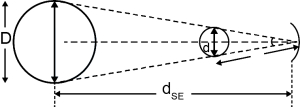
(D) The angle $\theta$ subtended by the sun at the mirror is given by the ratio of the diameter of the sun $(D)$ to the distance between the earth and the sun $(d_{SE})$.
Since the sun is at a very large distance,its image is formed at the focus of the concave mirror.
The angular size $\theta$ is given by $\theta = \frac{D}{d_{SE}} = 0.009 \ rad$.
The diameter of the image $(d)$ formed at the focal plane is given by $d = f \times \theta$,where $f$ is the focal length of the mirror.
The focal length $f$ is half of the radius of curvature $R = 0.4 \ m$,so $f = \frac{R}{2} = \frac{0.4}{2} = 0.2 \ m$.
Substituting the values,we get $d = 0.2 \ m \times 0.009 = 0.0018 \ m$.
Therefore,$d = 1.8 \times 10^{-3} \ m$.
Since the sun is at a very large distance,its image is formed at the focus of the concave mirror.
The angular size $\theta$ is given by $\theta = \frac{D}{d_{SE}} = 0.009 \ rad$.
The diameter of the image $(d)$ formed at the focal plane is given by $d = f \times \theta$,where $f$ is the focal length of the mirror.
The focal length $f$ is half of the radius of curvature $R = 0.4 \ m$,so $f = \frac{R}{2} = \frac{0.4}{2} = 0.2 \ m$.
Substituting the values,we get $d = 0.2 \ m \times 0.009 = 0.0018 \ m$.
Therefore,$d = 1.8 \times 10^{-3} \ m$.
0 likesView Solution
36
PhysicsEasyMCQWBJEE · 2017
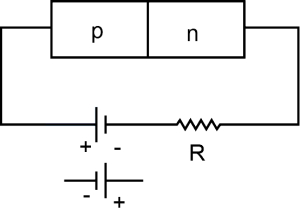
When a semiconducting device is connected in series with a battery and a resistance,a current is found to flow in the circuit. If,however,the polarity of the battery is reversed,practically no current flows in the circuit. The device may be
A
a $p$-type semiconductor
B
a $n$-type semiconductor
C
an intrinsic semiconductor
D
a $p-n$ junction
Solution
(D) $p-n$ junction diode acts as a rectifier,which allows current to flow in only one direction.
When the $p$-region is connected to the positive terminal of the battery and the $n$-region to the negative terminal,the diode is in forward bias,and current flows through the circuit.
When the polarity of the battery is reversed,the $p$-region is connected to the negative terminal and the $n$-region to the positive terminal. This is reverse bias,where the depletion region widens,and practically no current flows through the circuit.
When the $p$-region is connected to the positive terminal of the battery and the $n$-region to the negative terminal,the diode is in forward bias,and current flows through the circuit.
When the polarity of the battery is reversed,the $p$-region is connected to the negative terminal and the $n$-region to the positive terminal. This is reverse bias,where the depletion region widens,and practically no current flows through the circuit.
0 likesView Solution
37
PhysicsEasyMCQWBJEE · 2017
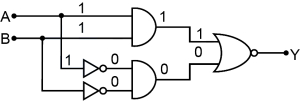
In the given circuit, the binary inputs at $A$ and $B$ are both $1$ in one case and both $0$ in the next case. The respective outputs at $Y$ in these two cases will be
A
$1, 1$
B
$0, 0$
C
$0, 1$
D
$1, 0$
Solution
(B) The circuit consists of two $AND$ gates, two $NOT$ gates, and one $NOR$ gate. The Boolean expression for the output $Y$ is $Y = \overline{(A \cdot B) + (\overline{A} \cdot \overline{B})}$.
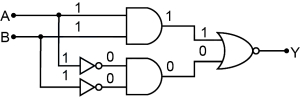
Case $1$: When $A = 1$ and $B = 1$, the output of the top $AND$ gate is $1 \cdot 1 = 1$. The output of the bottom $AND$ gate is $\overline{1} \cdot \overline{1} = 0 \cdot 0 = 0$. The $NOR$ gate receives inputs $1$ and $0$, so $Y = \overline{1 + 0} = \overline{1} = 0$.
Case $2$: When $A = 0$ and $B = 0$, the output of the top $AND$ gate is $0 \cdot 0 = 0$. The output of the bottom $AND$ gate is $\overline{0} \cdot \overline{0} = 1 \cdot 1 = 1$. The $NOR$ gate receives inputs $0$ and $1$, so $Y = \overline{0 + 1} = \overline{1} = 0$.
Thus, the outputs are $0$ and $0$.
Case $1$: When $A = 1$ and $B = 1$, the output of the top $AND$ gate is $1 \cdot 1 = 1$. The output of the bottom $AND$ gate is $\overline{1} \cdot \overline{1} = 0 \cdot 0 = 0$. The $NOR$ gate receives inputs $1$ and $0$, so $Y = \overline{1 + 0} = \overline{1} = 0$.
Case $2$: When $A = 0$ and $B = 0$, the output of the top $AND$ gate is $0 \cdot 0 = 0$. The output of the bottom $AND$ gate is $\overline{0} \cdot \overline{0} = 1 \cdot 1 = 1$. The $NOR$ gate receives inputs $0$ and $1$, so $Y = \overline{0 + 1} = \overline{1} = 0$.
Thus, the outputs are $0$ and $0$.
0 likesView Solution
38
PhysicsEasyMCQWBJEE · 2017
Two monochromatic coherent light beams $A$ and $B$ have intensities $L$ and $\frac{L}{4},$ respectively. If these beams are superposed,the maximum and minimum intensities will be
A
$\frac{9 L}{4}, \frac{L}{4}$
B
$\frac{5 L}{4}, 0$
C
$\frac{5 L}{2}, 0$
D
$2 L, \frac{L}{2}$
Solution
(A) The resultant intensity $I$ of two superposed coherent light beams is given by $I = I_1 + I_2 + 2\sqrt{I_1 I_2} \cos \phi$,where $\phi$ is the phase difference between the beams.
For maximum intensity,$\cos \phi = 1$ (constructive interference):
$I_{\max} = I_1 + I_2 + 2\sqrt{I_1 I_2} = (\sqrt{I_1} + \sqrt{I_2})^2$
Given $I_1 = L$ and $I_2 = \frac{L}{4}$:
$I_{\max} = (\sqrt{L} + \sqrt{\frac{L}{4}})^2 = (\sqrt{L} + \frac{\sqrt{L}}{2})^2 = (\frac{3\sqrt{L}}{2})^2 = \frac{9L}{4}$
For minimum intensity,$\cos \phi = -1$ (destructive interference):
$I_{\min} = I_1 + I_2 - 2\sqrt{I_1 I_2} = (\sqrt{I_1} - \sqrt{I_2})^2$
$I_{\min} = (\sqrt{L} - \frac{\sqrt{L}}{2})^2 = (\frac{\sqrt{L}}{2})^2 = \frac{L}{4}$
Thus,the maximum and minimum intensities are $\frac{9L}{4}$ and $\frac{L}{4}$ respectively.
For maximum intensity,$\cos \phi = 1$ (constructive interference):
$I_{\max} = I_1 + I_2 + 2\sqrt{I_1 I_2} = (\sqrt{I_1} + \sqrt{I_2})^2$
Given $I_1 = L$ and $I_2 = \frac{L}{4}$:
$I_{\max} = (\sqrt{L} + \sqrt{\frac{L}{4}})^2 = (\sqrt{L} + \frac{\sqrt{L}}{2})^2 = (\frac{3\sqrt{L}}{2})^2 = \frac{9L}{4}$
For minimum intensity,$\cos \phi = -1$ (destructive interference):
$I_{\min} = I_1 + I_2 - 2\sqrt{I_1 I_2} = (\sqrt{I_1} - \sqrt{I_2})^2$
$I_{\min} = (\sqrt{L} - \frac{\sqrt{L}}{2})^2 = (\frac{\sqrt{L}}{2})^2 = \frac{L}{4}$
Thus,the maximum and minimum intensities are $\frac{9L}{4}$ and $\frac{L}{4}$ respectively.
0 likesView Solution
Vedclass Products
For Students
Vedclass Test Series
Mock tests in real WBJEE style covering Physics with performance analysis. 5-day free trial.
Start Free TrialFor Teachers
Exam Paper Generator
Generate Set A/B/C/D Physics papers from 7.5L+ questions in 2 minutes. 3 chapters free.
Try FreeFor Institutes
Online Exam Module
Run live WBJEE mock exams with unlimited students, 360° analytics & white-label branding.
See DemoFrequently Asked Questions
How many Physics questions are in WBJEE 2017?
There are 38 Physics questions from the WBJEE 2017 paper on Vedclass, each with a detailed step-by-step solution in English.
Are WBJEE 2017 Physics solutions available in English?
Yes. All solutions on this page are in English. You can also switch to English or Hindi using the language buttons above the questions.
Can I practice WBJEE 2017 Physics as a timed test?
Yes. Use the Vedclass Test Series to attempt a full WBJEE mock test covering Physics with time limits and instant score analysis.
Can teachers create Physics papers from WBJEE previous year questions?
Yes. The Vedclass Exam Paper Generator lets teachers mix WBJEE Physics questions and generate Set A/B/C/D papers in minutes.
For Teachers & Institutes
Build a Custom Physics Paper
Pick WBJEE 2017 Physics questions, set difficulty, and generate Set A/B/C/D in 2 minutes.