
PhysicsQ1–38 of 38 questions
Page 1 of 1 · English
1
PhysicsMediumMCQWBJEE · 2023
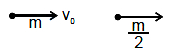
There are $n$ elastic balls placed on a smooth horizontal plane. The masses of the balls are $m, \frac{m}{2}, \frac{m}{2^2}, \ldots, \frac{m}{2^{n-1}}$ respectively. If the first ball hits the second ball with velocity $v_0$,then the velocity of the $n^{\text{th}}$ ball will be,
A
$\frac{4}{3} v_0$
B
$\left(\frac{4}{3}\right)^n v_0$
C
$\left(\frac{4}{3}\right)^{n-1} v_0$
D
$v_0$
Solution
(C) For a one-dimensional elastic collision between two masses $m_1$ and $m_2$,where $m_2$ is initially at rest,the velocity $v_2$ of the second mass after the collision is given by $v_2 = \frac{2m_1}{m_1 + m_2} v_1$.
1st collision: Mass $m_1 = m$ hits $m_2 = \frac{m}{2}$ with velocity $v_0$. The velocity of the second ball $v_1$ is:
$v_1 = \frac{2m}{m + \frac{m}{2}} v_0 = \frac{2m}{\frac{3m}{2}} v_0 = \frac{4}{3} v_0$.
2nd collision: Mass $m_2 = \frac{m}{2}$ hits $m_3 = \frac{m}{4}$ with velocity $v_1 = \frac{4}{3} v_0$. The velocity of the third ball $v_2$ is:
$v_2 = \frac{2(\frac{m}{2})}{\frac{m}{2} + \frac{m}{4}} v_1 = \frac{m}{\frac{3m}{4}} v_1 = \frac{4}{3} v_1 = \left(\frac{4}{3}\right)^2 v_0$.
Following this pattern,for the $n^{\text{th}}$ ball,the velocity $v_{n-1}$ after $(n-1)$ collisions will be:
$v_{n-1} = \left(\frac{4}{3}\right)^{n-1} v_0$.
1st collision: Mass $m_1 = m$ hits $m_2 = \frac{m}{2}$ with velocity $v_0$. The velocity of the second ball $v_1$ is:
$v_1 = \frac{2m}{m + \frac{m}{2}} v_0 = \frac{2m}{\frac{3m}{2}} v_0 = \frac{4}{3} v_0$.
2nd collision: Mass $m_2 = \frac{m}{2}$ hits $m_3 = \frac{m}{4}$ with velocity $v_1 = \frac{4}{3} v_0$. The velocity of the third ball $v_2$ is:
$v_2 = \frac{2(\frac{m}{2})}{\frac{m}{2} + \frac{m}{4}} v_1 = \frac{m}{\frac{3m}{4}} v_1 = \frac{4}{3} v_1 = \left(\frac{4}{3}\right)^2 v_0$.
Following this pattern,for the $n^{\text{th}}$ ball,the velocity $v_{n-1}$ after $(n-1)$ collisions will be:
$v_{n-1} = \left(\frac{4}{3}\right)^{n-1} v_0$.
0 likesView Solution
2
PhysicsMediumMCQWBJEE · 2023
$A$ mouse of mass $m$ jumps on the outside edge of a rotating ceiling fan of moment of inertia $I$ and radius $R$. The fractional loss of angular velocity of the fan as a result is
A
$\frac{m R^2}{I+m R^2}$
B
$\frac{I}{I+m R^2}$
C
$\frac{I-m R^2}{I}$
D
$\frac{I-m R^2}{I+m R^2}$
Solution
(A) According to the principle of conservation of angular momentum,since no external torque acts on the system,the initial angular momentum equals the final angular momentum.
Initial angular momentum $L_i = I \omega_0$,where $\omega_0$ is the initial angular velocity.
When the mouse of mass $m$ lands on the edge at radius $R$,the new moment of inertia of the system becomes $I' = I + m R^2$.
Let the new angular velocity be $\omega$. Then,$L_f = (I + m R^2) \omega$.
Equating $L_i = L_f$,we get $I \omega_0 = (I + m R^2) \omega$.
Thus,$\omega = \frac{I \omega_0}{I + m R^2}$.
The fractional loss of angular velocity is given by $\frac{\omega_0 - \omega}{\omega_0} = 1 - \frac{\omega}{\omega_0}$.
Substituting the value of $\omega$,we get $1 - \frac{I}{I + m R^2} = \frac{I + m R^2 - I}{I + m R^2} = \frac{m R^2}{I + m R^2}$.
Initial angular momentum $L_i = I \omega_0$,where $\omega_0$ is the initial angular velocity.
When the mouse of mass $m$ lands on the edge at radius $R$,the new moment of inertia of the system becomes $I' = I + m R^2$.
Let the new angular velocity be $\omega$. Then,$L_f = (I + m R^2) \omega$.
Equating $L_i = L_f$,we get $I \omega_0 = (I + m R^2) \omega$.
Thus,$\omega = \frac{I \omega_0}{I + m R^2}$.
The fractional loss of angular velocity is given by $\frac{\omega_0 - \omega}{\omega_0} = 1 - \frac{\omega}{\omega_0}$.
Substituting the value of $\omega$,we get $1 - \frac{I}{I + m R^2} = \frac{I + m R^2 - I}{I + m R^2} = \frac{m R^2}{I + m R^2}$.
0 likesView Solution
3
PhysicsMediumMCQWBJEE · 2023
$A$ modified gravitational potential is given by $V = -\frac{GM}{r} + \frac{A}{r^2}$. If the constant $A$ is expressed in terms of gravitational constant $G$,mass $M$,and velocity of light $c$,then from dimensional analysis,$A$ is:
A
$\frac{G^2 M^2}{c^2}$
B
$\frac{GM}{c^2}$
C
$\frac{1}{c^2}$
D
Dimensionless
Solution
(A) The given equation is $V = -\frac{GM}{r} + \frac{A}{r^2}$.
According to the principle of homogeneity of dimensions,the dimensions of each term on both sides must be the same.
Therefore,the dimension of $\frac{A}{r^2}$ must be equal to the dimension of $\frac{GM}{r}$.
$[V] = [\frac{GM}{r}] = [\frac{A}{r^2}]$
From this,we get $[A] = [\frac{GM}{r}] \times [r^2] = [GM] \times [r]$.
We know that the gravitational potential $V$ has the dimensions of energy per unit mass,which is $[L^2 T^{-2}]$.
Also,$\frac{GM}{r}$ represents the gravitational potential,so $[\frac{GM}{r}] = [L^2 T^{-2}]$.
Since the velocity of light $c$ has dimensions $[L T^{-1}]$,then $c^2$ has dimensions $[L^2 T^{-2}]$.
Thus,$[\frac{GM}{r}] = [c^2]$.
Substituting $[r] = \frac{[GM]}{[c^2]}$ into the expression for $[A]$:
$[A] = [GM] \times \frac{[GM]}{[c^2]} = \frac{G^2 M^2}{c^2}$.
According to the principle of homogeneity of dimensions,the dimensions of each term on both sides must be the same.
Therefore,the dimension of $\frac{A}{r^2}$ must be equal to the dimension of $\frac{GM}{r}$.
$[V] = [\frac{GM}{r}] = [\frac{A}{r^2}]$
From this,we get $[A] = [\frac{GM}{r}] \times [r^2] = [GM] \times [r]$.
We know that the gravitational potential $V$ has the dimensions of energy per unit mass,which is $[L^2 T^{-2}]$.
Also,$\frac{GM}{r}$ represents the gravitational potential,so $[\frac{GM}{r}] = [L^2 T^{-2}]$.
Since the velocity of light $c$ has dimensions $[L T^{-1}]$,then $c^2$ has dimensions $[L^2 T^{-2}]$.
Thus,$[\frac{GM}{r}] = [c^2]$.
Substituting $[r] = \frac{[GM]}{[c^2]}$ into the expression for $[A]$:
$[A] = [GM] \times \frac{[GM]}{[c^2]} = \frac{G^2 M^2}{c^2}$.
0 likesView Solution
4
PhysicsDifficultMCQWBJEE · 2023
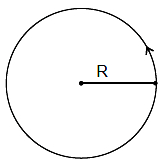
An earth's satellite near the surface of the earth takes about $90$ min per revolution. $A$ satellite orbiting the moon also takes about $90$ min per revolution. Then which of the following is true?
A
$\rho_m < \rho_e$
B
$\rho_m > \rho_e$
C
$\rho_m = \rho_e$
D
No conclusion can be made about the densities
Solution
(C) For a satellite orbiting near the surface of a planet of radius $R$ and density $\rho$,the gravitational force provides the necessary centripetal force.
$m g = m \omega^2 R$
Since $g = \frac{G M}{R^2}$ and $M = \rho \cdot \frac{4}{3} \pi R^3$,we have $g = \frac{G \rho \frac{4}{3} \pi R^3}{R^2} = \frac{4}{3} \pi G \rho R$.
Substituting this into the force equation:
$m (\frac{4}{3} \pi G \rho R) = m \omega^2 R$
$\omega^2 = \frac{4}{3} \pi G \rho$
Since $\omega = \frac{2 \pi}{T}$,we get $(\frac{2 \pi}{T})^2 = \frac{4}{3} \pi G \rho$,which simplifies to $T^2 = \frac{3 \pi}{G \rho}$.
Thus,$T \propto \frac{1}{\sqrt{\rho}}$.
Since both satellites have the same time period $T$,their densities must be equal,i.e.,$\rho_m = \rho_e$.
$m g = m \omega^2 R$
Since $g = \frac{G M}{R^2}$ and $M = \rho \cdot \frac{4}{3} \pi R^3$,we have $g = \frac{G \rho \frac{4}{3} \pi R^3}{R^2} = \frac{4}{3} \pi G \rho R$.
Substituting this into the force equation:
$m (\frac{4}{3} \pi G \rho R) = m \omega^2 R$
$\omega^2 = \frac{4}{3} \pi G \rho$
Since $\omega = \frac{2 \pi}{T}$,we get $(\frac{2 \pi}{T})^2 = \frac{4}{3} \pi G \rho$,which simplifies to $T^2 = \frac{3 \pi}{G \rho}$.
Thus,$T \propto \frac{1}{\sqrt{\rho}}$.
Since both satellites have the same time period $T$,their densities must be equal,i.e.,$\rho_m = \rho_e$.
0 likesView Solution
5
PhysicsMediumMCQWBJEE · 2023
Six molecules of an ideal gas have velocities $1, 3, 5, 5, 6$ and $5 \,m/s$ respectively. At any given temperature,if $\overline{V}$ and $V_{rms}$ represent average and rms speed of the molecules,then
A
$\overline{V} = 5 \,m/s$
B
$V_{rms} > \overline{V}$
C
$V_{rms}^2 < \overline{V}^2$
D
$V_{rms} = \overline{V}$
Solution
(B) The average speed $\overline{V}$ is calculated as the arithmetic mean of the velocities: $\overline{V} = \frac{1 + 3 + 5 + 5 + 6 + 5}{6} = \frac{25}{6} \approx 4.16 \,m/s$.
The root mean square speed $V_{rms}$ is calculated as the square root of the mean of the squares of the velocities: $V_{rms} = \sqrt{\frac{1^2 + 3^2 + 5^2 + 5^2 + 6^2 + 5^2}{6}} = \sqrt{\frac{1 + 9 + 25 + 25 + 36 + 25}{6}} = \sqrt{\frac{121}{6}} = \frac{11}{\sqrt{6}} \approx 4.49 \,m/s$.
Comparing the two values,we find that $4.49 > 4.16$,therefore $V_{rms} > \overline{V}$.
The root mean square speed $V_{rms}$ is calculated as the square root of the mean of the squares of the velocities: $V_{rms} = \sqrt{\frac{1^2 + 3^2 + 5^2 + 5^2 + 6^2 + 5^2}{6}} = \sqrt{\frac{1 + 9 + 25 + 25 + 36 + 25}{6}} = \sqrt{\frac{121}{6}} = \frac{11}{\sqrt{6}} \approx 4.49 \,m/s$.
Comparing the two values,we find that $4.49 > 4.16$,therefore $V_{rms} > \overline{V}$.
0 likesView Solution
6
PhysicsEasyMCQWBJEE · 2023
$A$ body of mass $2 \,kg$ moves in a horizontal circular path of radius $5 \,m$. At an instant, its speed is $2 \sqrt{5} \,m/s$ and is increasing at the rate of $3 \,m/s^2$. The magnitude of the net force acting on the body at that instant is: (in $\,N$)
A
$6$
B
$8$
C
$14$
D
$10$
Solution
(D) The body experiences two components of acceleration: centripetal acceleration $(a_c)$ and tangential acceleration $(a_T)$.
Centripetal acceleration is given by $a_c = \frac{v^2}{r} = \frac{(2\sqrt{5})^2}{5} = \frac{20}{5} = 4 \,m/s^2$.
Tangential acceleration is given as $a_T = 3 \,m/s^2$.
The net acceleration is $a = \sqrt{a_c^2 + a_T^2} = \sqrt{4^2 + 3^2} = \sqrt{16 + 9} = \sqrt{25} = 5 \,m/s^2$.
The magnitude of the net force is $F = m \times a = 2 \,kg \times 5 \,m/s^2 = 10 \,N$.
Centripetal acceleration is given by $a_c = \frac{v^2}{r} = \frac{(2\sqrt{5})^2}{5} = \frac{20}{5} = 4 \,m/s^2$.
Tangential acceleration is given as $a_T = 3 \,m/s^2$.
The net acceleration is $a = \sqrt{a_c^2 + a_T^2} = \sqrt{4^2 + 3^2} = \sqrt{16 + 9} = \sqrt{25} = 5 \,m/s^2$.
The magnitude of the net force is $F = m \times a = 2 \,kg \times 5 \,m/s^2 = 10 \,N$.
0 likesView Solution
7
PhysicsDifficultMCQWBJEE · 2023
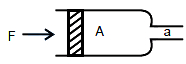
As shown in the figure, a pump is designed as a horizontal cylinder with a piston having area $A$ and an outlet orifice having an area $a$. The piston moves with a constant velocity under the action of force $F$. If the density of the liquid is $\rho$, then the speed of the liquid emerging from the orifice is (assume $A \gg a$):
A
$\sqrt{\frac{F}{\rho A}}$
B
$\frac{a}{A} \sqrt{\frac{F}{\rho A}}$
C
$\sqrt{\frac{2 F}{\rho A}}$
D
$\frac{A}{a} \sqrt{\frac{2 F}{\rho A}}$
Solution
(C) According to the equation of continuity, the volume flow rate is constant:
$AV = av \implies V = \frac{a}{A}v$
where $V$ is the velocity of the piston and $v$ is the velocity of the liquid emerging from the orifice.
Applying Bernoulli's principle between the inside of the cylinder (near the piston) and the orifice:
$P_{in} + \frac{1}{2} \rho V^2 = P_{out} + \frac{1}{2} \rho v^2$
The pressure inside the cylinder is $P_{in} = P_0 + \frac{F}{A}$, where $P_0$ is the atmospheric pressure. The pressure at the orifice is $P_{out} = P_0$.
Substituting these into the Bernoulli equation:
$(P_0 + \frac{F}{A}) + \frac{1}{2} \rho V^2 = P_0 + \frac{1}{2} \rho v^2$
$\frac{F}{A} = \frac{1}{2} \rho (v^2 - V^2)$
Substituting $V = \frac{a}{A}v$:
$\frac{F}{A} = \frac{1}{2} \rho (v^2 - (\frac{a}{A}v)^2) = \frac{1}{2} \rho v^2 (1 - \frac{a^2}{A^2})$
Since $A \gg a$, we have $\frac{a^2}{A^2} \approx 0$, so:
$\frac{F}{A} = \frac{1}{2} \rho v^2 \implies v = \sqrt{\frac{2F}{\rho A}}$
$AV = av \implies V = \frac{a}{A}v$
where $V$ is the velocity of the piston and $v$ is the velocity of the liquid emerging from the orifice.
Applying Bernoulli's principle between the inside of the cylinder (near the piston) and the orifice:
$P_{in} + \frac{1}{2} \rho V^2 = P_{out} + \frac{1}{2} \rho v^2$
The pressure inside the cylinder is $P_{in} = P_0 + \frac{F}{A}$, where $P_0$ is the atmospheric pressure. The pressure at the orifice is $P_{out} = P_0$.
Substituting these into the Bernoulli equation:
$(P_0 + \frac{F}{A}) + \frac{1}{2} \rho V^2 = P_0 + \frac{1}{2} \rho v^2$
$\frac{F}{A} = \frac{1}{2} \rho (v^2 - V^2)$
Substituting $V = \frac{a}{A}v$:
$\frac{F}{A} = \frac{1}{2} \rho (v^2 - (\frac{a}{A}v)^2) = \frac{1}{2} \rho v^2 (1 - \frac{a^2}{A^2})$
Since $A \gg a$, we have $\frac{a^2}{A^2} \approx 0$, so:
$\frac{F}{A} = \frac{1}{2} \rho v^2 \implies v = \sqrt{\frac{2F}{\rho A}}$
0 likesView Solution
8
PhysicsDifficultMCQWBJEE · 2023
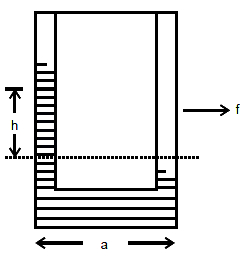
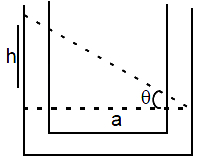
As shown in the figure,a liquid is at the same level in both arms of a $U$-tube of uniform cross-section when at rest. If the $U$-tube moves with an acceleration '$f$' towards the right,the difference between the liquid heights in the two arms of the $U$-tube will be (acceleration due to gravity $= g$):
A
$\frac{f}{g} a$
B
$\frac{g}{f} a$
C
$a$
D
$\frac{f a}{g}$
Solution
(D) When the $U$-tube is accelerated with acceleration '$f$' towards the right,a pseudo-force acts on the liquid in the opposite direction.
Let the angle of the liquid surface with the horizontal be $\theta$.
The effective acceleration acting on the liquid is the vector sum of the gravitational acceleration '$g$' (downwards) and the pseudo-acceleration '$f$' (towards the left).
The tangent of the angle $\theta$ is given by the ratio of the horizontal acceleration to the vertical acceleration:
$\tan \theta = \frac{f}{g}$
From the geometry of the $U$-tube,where '$h$' is the height difference and '$a$' is the horizontal distance between the two arms:
$\tan \theta = \frac{h}{a}$
Equating the two expressions for $\tan \theta$:
$\frac{h}{a} = \frac{f}{g}$
Therefore,the height difference is:
$h = \frac{f a}{g}$
Let the angle of the liquid surface with the horizontal be $\theta$.
The effective acceleration acting on the liquid is the vector sum of the gravitational acceleration '$g$' (downwards) and the pseudo-acceleration '$f$' (towards the left).
The tangent of the angle $\theta$ is given by the ratio of the horizontal acceleration to the vertical acceleration:
$\tan \theta = \frac{f}{g}$
From the geometry of the $U$-tube,where '$h$' is the height difference and '$a$' is the horizontal distance between the two arms:
$\tan \theta = \frac{h}{a}$
Equating the two expressions for $\tan \theta$:
$\frac{h}{a} = \frac{f}{g}$
Therefore,the height difference is:
$h = \frac{f a}{g}$
0 likesView Solution
9
PhysicsEasyMCQWBJEE · 2023
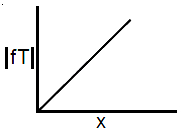
In a simple harmonic motion,let $f$ be the acceleration and $T$ be the time period. If $x$ denotes the displacement,then the $|fT|$ vs. $x$ graph will look like,
A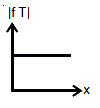
B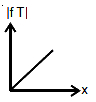
C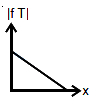
D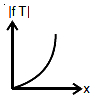
Solution
(A) In simple harmonic motion,the acceleration $f$ is given by $f = -\omega^2 x$,where $\omega$ is the angular frequency and $x$ is the displacement.
Taking the magnitude,we have $|f| = \omega^2 |x|$.
The time period $T$ is given by $T = \frac{2\pi}{\omega}$.
Therefore,the product $|fT|$ is:
$|fT| = |f| \cdot T = (\omega^2 |x|) \cdot \left(\frac{2\pi}{\omega}\right) = 2\pi\omega |x|$.
Since $2\pi\omega$ is a constant,the relationship $|fT| = (2\pi\omega) |x|$ represents a linear equation of the form $y = mx$,where $y = |fT|$ and $x$ is the displacement.
Thus,the graph of $|fT|$ versus $x$ is a straight line passing through the origin.
Taking the magnitude,we have $|f| = \omega^2 |x|$.
The time period $T$ is given by $T = \frac{2\pi}{\omega}$.
Therefore,the product $|fT|$ is:
$|fT| = |f| \cdot T = (\omega^2 |x|) \cdot \left(\frac{2\pi}{\omega}\right) = 2\pi\omega |x|$.
Since $2\pi\omega$ is a constant,the relationship $|fT| = (2\pi\omega) |x|$ represents a linear equation of the form $y = mx$,where $y = |fT|$ and $x$ is the displacement.
Thus,the graph of $|fT|$ versus $x$ is a straight line passing through the origin.
0 likesView Solution
10
PhysicsMediumMCQWBJEE · 2023
$A$ particle of mass $m$ is projected at a velocity $u$,making an angle $\theta$ with the horizontal ($x$-axis). If the angle of projection $\theta$ is varied keeping all other parameters same,then the magnitude of angular momentum $(L)$ at its maximum height about the point of projection varies with $\theta$ as,
A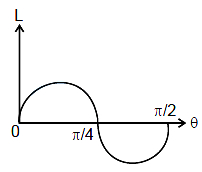
B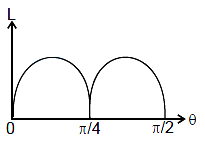
C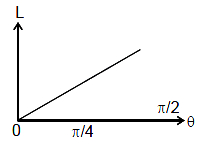
D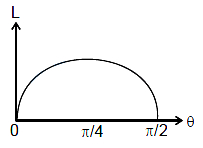
Solution
(D) The angular momentum $L$ of a particle about the point of projection is given by $L = \vec{r} \times \vec{p} = m(\vec{r} \times \vec{v})$.
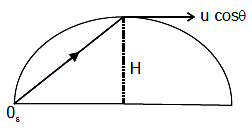
At the maximum height,the velocity of the particle is purely horizontal,given by $v_x = u \cos \theta$.
The position vector at maximum height has a vertical component equal to the maximum height $H = \frac{u^2 \sin^2 \theta}{2g}$.
The magnitude of angular momentum at maximum height is $L = m v_x H = m (u \cos \theta) \left( \frac{u^2 \sin^2 \theta}{2g} \right)$.
Simplifying this,we get $L = \frac{m u^3}{2g} \sin^2 \theta \cos \theta$.
For $\theta = 0^{\circ}$,$L = 0$. For $\theta = 90^{\circ}$ (or $\frac{\pi}{2}$),$L = 0$.
Between $0$ and $\frac{\pi}{2}$,the function $f(\theta) = \sin^2 \theta \cos \theta$ is positive and reaches a maximum value. This corresponds to the shape shown in graph $D$.
At the maximum height,the velocity of the particle is purely horizontal,given by $v_x = u \cos \theta$.
The position vector at maximum height has a vertical component equal to the maximum height $H = \frac{u^2 \sin^2 \theta}{2g}$.
The magnitude of angular momentum at maximum height is $L = m v_x H = m (u \cos \theta) \left( \frac{u^2 \sin^2 \theta}{2g} \right)$.
Simplifying this,we get $L = \frac{m u^3}{2g} \sin^2 \theta \cos \theta$.
For $\theta = 0^{\circ}$,$L = 0$. For $\theta = 90^{\circ}$ (or $\frac{\pi}{2}$),$L = 0$.
Between $0$ and $\frac{\pi}{2}$,the function $f(\theta) = \sin^2 \theta \cos \theta$ is positive and reaches a maximum value. This corresponds to the shape shown in graph $D$.
0 likesView Solution
11
PhysicsEasyMCQWBJEE · 2023
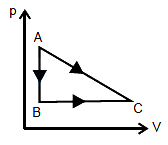
$A$ given quantity of gas is taken from $A$ to $C$ in two ways: $a$) directly from $A \rightarrow C$ along a straight line,and $b$) in two steps,from $A \rightarrow B$ and then from $B \rightarrow C$. The work done and heat absorbed along the direct path $A \rightarrow C$ are $200 \ J$ and $280 \ J$ respectively. If the work done along the path $A \rightarrow B \rightarrow C$ is $80 \ J$,find the heat absorbed along this path.
A
$80 \ J$
B
$0$
C
$160 \ J$
D
$120 \ J$
Solution
(C) According to the First Law of Thermodynamics,$\Delta Q = \Delta U + \Delta W$,where $\Delta U$ is the change in internal energy.
Since internal energy is a state function,$\Delta U$ is the same for any path between the same two states $A$ and $C$.
For the direct path $A \rightarrow C$:
$\Delta W_{AC} = 200 \ J$
$\Delta Q_{AC} = 280 \ J$
$\Delta U = \Delta Q_{AC} - \Delta W_{AC} = 280 \ J - 200 \ J = 80 \ J$.
For the path $A \rightarrow B \rightarrow C$:
$\Delta W_{ABC} = 80 \ J$
Since $\Delta U$ is a state function,$\Delta U = 80 \ J$ for this path as well.
Therefore,the heat absorbed $\Delta Q_{ABC} = \Delta U + \Delta W_{ABC} = 80 \ J + 80 \ J = 160 \ J$.
Since internal energy is a state function,$\Delta U$ is the same for any path between the same two states $A$ and $C$.
For the direct path $A \rightarrow C$:
$\Delta W_{AC} = 200 \ J$
$\Delta Q_{AC} = 280 \ J$
$\Delta U = \Delta Q_{AC} - \Delta W_{AC} = 280 \ J - 200 \ J = 80 \ J$.
For the path $A \rightarrow B \rightarrow C$:
$\Delta W_{ABC} = 80 \ J$
Since $\Delta U$ is a state function,$\Delta U = 80 \ J$ for this path as well.
Therefore,the heat absorbed $\Delta Q_{ABC} = \Delta U + \Delta W_{ABC} = 80 \ J + 80 \ J = 160 \ J$.
0 likesView Solution
12
PhysicsMediumMCQWBJEE · 2023
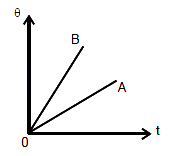
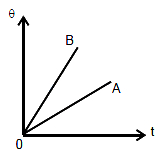
Two substances $A$ and $B$ of the same mass are heated at a constant rate. The variation of temperature $\theta$ of the substances with time $t$ is shown in the figure. Choose the correct statement.
A
Specific heat of $A$ is greater than that of $B$
B
Specific heat of $B$ is greater than that of $A$
C
Both have same specific heat
D
None of the above is true
Solution
(A) The heat supplied at a constant rate is given by $\Delta H = mC \Delta \theta$.
Since the rate of heat supply $\frac{dH}{dt}$ is constant,we can write:
$\frac{dH}{dt} = mC \frac{d\theta}{dt}$.
This implies $\frac{d\theta}{dt} = \frac{1}{mC} \left( \frac{dH}{dt} \right)$.
Since $m$ and $\frac{dH}{dt}$ are constant,the slope of the $\theta-t$ graph is inversely proportional to the specific heat $C$ (i.e.,$\text{slope} \propto \frac{1}{C}$).
From the figure,the slope of line $B$ is greater than the slope of line $A$ (i.e.,$\text{slope}_B > \text{slope}_A$).
Therefore,$C_B < C_A$,which means the specific heat of $A$ is greater than that of $B$.
Since the rate of heat supply $\frac{dH}{dt}$ is constant,we can write:
$\frac{dH}{dt} = mC \frac{d\theta}{dt}$.
This implies $\frac{d\theta}{dt} = \frac{1}{mC} \left( \frac{dH}{dt} \right)$.
Since $m$ and $\frac{dH}{dt}$ are constant,the slope of the $\theta-t$ graph is inversely proportional to the specific heat $C$ (i.e.,$\text{slope} \propto \frac{1}{C}$).
From the figure,the slope of line $B$ is greater than the slope of line $A$ (i.e.,$\text{slope}_B > \text{slope}_A$).
Therefore,$C_B < C_A$,which means the specific heat of $A$ is greater than that of $B$.
0 likesView Solution
13
PhysicsEasyMCQWBJEE · 2023
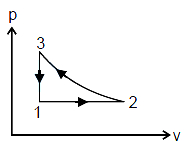
$A$ cyclic process is shown in the $p-v$ diagram. Which of the following statement$(s)$ is/are true?
A
$1 \rightarrow 2$: Isobaric,$2 \rightarrow 3$: Isothermal
B
$3 \rightarrow 1$: Isochoric,$2 \rightarrow 3$: Adiabatic
C
Work done by the system in the complete cyclic process is non-zero
D
The heat absorbed by the system in the complete cyclic process is non-zero
Solution
(A, B, C, D) In a $p-v$ diagram:
$1$. The process $1 \rightarrow 2$ is a horizontal line,meaning pressure $p$ is constant. Thus,it is an isobaric process.
$2$. The process $3 \rightarrow 1$ is a vertical line,meaning volume $v$ is constant. Thus,it is an isochoric process.
$3$. The process $2 \rightarrow 3$ is a curve,which represents an adiabatic process in this cycle.
$4$. For any complete cyclic process,the change in internal energy $\Delta U = 0$. According to the first law of thermodynamics,$Q = \Delta U + W$. Since $\Delta U = 0$,$Q = W$. The work done $W$ in a cyclic process is equal to the area enclosed by the cycle,which is non-zero. Therefore,both work done and heat absorbed are non-zero.
Thus,statements $A$,$B$,$C$,and $D$ are all correct.
$1$. The process $1 \rightarrow 2$ is a horizontal line,meaning pressure $p$ is constant. Thus,it is an isobaric process.
$2$. The process $3 \rightarrow 1$ is a vertical line,meaning volume $v$ is constant. Thus,it is an isochoric process.
$3$. The process $2 \rightarrow 3$ is a curve,which represents an adiabatic process in this cycle.
$4$. For any complete cyclic process,the change in internal energy $\Delta U = 0$. According to the first law of thermodynamics,$Q = \Delta U + W$. Since $\Delta U = 0$,$Q = W$. The work done $W$ in a cyclic process is equal to the area enclosed by the cycle,which is non-zero. Therefore,both work done and heat absorbed are non-zero.
Thus,statements $A$,$B$,$C$,and $D$ are all correct.
0 likesView Solution
14
PhysicsEasyMCQWBJEE · 2023
The displacement of a plane progressive wave in a medium,travelling towards the positive $x$-axis with a velocity of $4 \ m/s$,at $t=0$ is given by $y=3 \sin 2 \pi (-x/3)$. The expression for the displacement at a later time $t=4 \ s$ will be:
A
$y=3 \sin 2 \pi \left(-\frac{x-16}{3}\right)$
B
$y=3 \sin 2 \pi \left(\frac{-x-16}{3}\right)$
C
$y=3 \sin 2 \pi \left(\frac{-x-1}{3}\right)$
D
$y=3 \sin 2 \pi \left(\frac{-x+16}{3}\right)$
Solution
(A) The general equation for a wave travelling in the positive $x$-direction is $y = A \sin(\omega t - kx + \phi)$.
At $t=0$,the equation is $y = 3 \sin(-2\pi x / 3)$,which implies $k = 2\pi / 3$.
Given the wave velocity $v = 4 \ m/s$,we use the relation $v = \omega / k$.
Thus,$\omega = v \cdot k = 4 \times (2\pi / 3) = 8\pi / 3$.
The general wave equation is $y = 3 \sin \left(\frac{8\pi}{3}t - \frac{2\pi}{3}x\right)$.
At $t=4 \ s$,substituting the value of $t$:
$y = 3 \sin \left(\frac{8\pi}{3}(4) - \frac{2\pi}{3}x\right)$
$y = 3 \sin \left(\frac{32\pi}{3} - \frac{2\pi}{3}x\right)$
Factoring out $2\pi$:
$y = 3 \sin 2\pi \left(\frac{16}{3} - \frac{x}{3}\right) = 3 \sin 2\pi \left(-\frac{x-16}{3}\right)$.
At $t=0$,the equation is $y = 3 \sin(-2\pi x / 3)$,which implies $k = 2\pi / 3$.
Given the wave velocity $v = 4 \ m/s$,we use the relation $v = \omega / k$.
Thus,$\omega = v \cdot k = 4 \times (2\pi / 3) = 8\pi / 3$.
The general wave equation is $y = 3 \sin \left(\frac{8\pi}{3}t - \frac{2\pi}{3}x\right)$.
At $t=4 \ s$,substituting the value of $t$:
$y = 3 \sin \left(\frac{8\pi}{3}(4) - \frac{2\pi}{3}x\right)$
$y = 3 \sin \left(\frac{32\pi}{3} - \frac{2\pi}{3}x\right)$
Factoring out $2\pi$:
$y = 3 \sin 2\pi \left(\frac{16}{3} - \frac{x}{3}\right) = 3 \sin 2\pi \left(-\frac{x-16}{3}\right)$.
0 likesView Solution
15
PhysicsEasyMCQWBJEE · 2023
$A$ uniform rope of length $4 \,m$ and mass $0.4 \,kg$ is held on a frictionless table in such a way that $0.6 \,m$ of the rope is hanging over the edge. The work done to pull the hanging part of the rope onto the table is,(Assume $g = 10 \,m/s^2$) (in $\,J$)
A
$0.36$
B
$0.24$
C
$0.12$
D
$0.18$
Solution
(D) The mass per unit length of the rope is $\lambda = \frac{M}{L} = \frac{0.4 \,kg}{4 \,m} = 0.1 \,kg/m$.
The length of the hanging part is $l = 0.6 \,m$.
The mass of the hanging part is $m = \lambda \times l = 0.1 \,kg/m \times 0.6 \,m = 0.06 \,kg$.
The center of mass of the hanging part is at a distance $h = \frac{l}{2} = \frac{0.6 \,m}{2} = 0.3 \,m$ below the table edge.
The work done to pull the rope onto the table is equal to the change in potential energy of the hanging part,which is $W = mgh$.
Substituting the values: $W = 0.06 \,kg \times 10 \,m/s^2 \times 0.3 \,m = 0.18 \,J$.
The length of the hanging part is $l = 0.6 \,m$.
The mass of the hanging part is $m = \lambda \times l = 0.1 \,kg/m \times 0.6 \,m = 0.06 \,kg$.
The center of mass of the hanging part is at a distance $h = \frac{l}{2} = \frac{0.6 \,m}{2} = 0.3 \,m$ below the table edge.
The work done to pull the rope onto the table is equal to the change in potential energy of the hanging part,which is $W = mgh$.
Substituting the values: $W = 0.06 \,kg \times 10 \,m/s^2 \times 0.3 \,m = 0.18 \,J$.
0 likesView Solution
16
PhysicsMediumMCQWBJEE · 2023
$A$ train is moving along the tracks at a constant speed $u$. $A$ girl on the train throws a ball of mass $m$ straight ahead along the direction of motion of the train with speed $v$ with respect to herself. Then
A
Kinetic energy of the ball as measured by the girl on the train is $mv^2 / 2$
B
Work done by the girl in throwing the ball is $mv^2 / 2$
C
Work done by the train is $mvu$
D
The gain in kinetic energy of the ball as measured by a person standing by the rail track is $mv^2 / 2$
Solution
(A, B, C) $1$. With respect to the girl, the initial velocity of the ball is $0$ and final velocity is $v$. The kinetic energy is $E_k = \frac{1}{2}mv^2$. Thus, the work done by the girl is $W = \Delta E_k = \frac{1}{2}mv^2$. So, option $A$ and $B$ are correct.
$2$. With respect to the ground, the initial velocity of the ball is $u$ and the final velocity is $v+u$. The work done by the train is the change in kinetic energy of the ball as seen from the ground minus the work done by the girl: $W_{\text{train}} = \Delta E_{k, \text{ground}} - W_{\text{girl}} = [\frac{1}{2}m(v+u)^2 - \frac{1}{2}mu^2] - \frac{1}{2}mv^2 = \frac{1}{2}m(v^2 + u^2 + 2vu - u^2) - \frac{1}{2}mv^2 = mvu$. So, option $C$ is correct.
$3$. The gain in kinetic energy as measured by a person on the ground is $\Delta E_{k, \text{ground}} = \frac{1}{2}m(v+u)^2 - \frac{1}{2}mu^2 = \frac{1}{2}mv^2 + mvu$. Thus, option $D$ is incorrect.
$2$. With respect to the ground, the initial velocity of the ball is $u$ and the final velocity is $v+u$. The work done by the train is the change in kinetic energy of the ball as seen from the ground minus the work done by the girl: $W_{\text{train}} = \Delta E_{k, \text{ground}} - W_{\text{girl}} = [\frac{1}{2}m(v+u)^2 - \frac{1}{2}mu^2] - \frac{1}{2}mv^2 = \frac{1}{2}m(v^2 + u^2 + 2vu - u^2) - \frac{1}{2}mv^2 = mvu$. So, option $C$ is correct.
$3$. The gain in kinetic energy as measured by a person on the ground is $\Delta E_{k, \text{ground}} = \frac{1}{2}m(v+u)^2 - \frac{1}{2}mu^2 = \frac{1}{2}mv^2 + mvu$. Thus, option $D$ is incorrect.
0 likesView Solution
17
PhysicsMediumMCQWBJEE · 2023
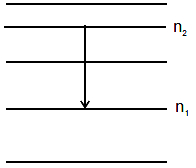
If the potential energy of a hydrogen atom in the first excited state is assumed to be zero,then the total energy of the $n = \infty$ state is,
A
$3.4 eV$
B
$6.8 eV$
C
$0$
D
$\infty$
Solution
(B) The potential energy $U$ of an electron in a hydrogen atom at a state $n$ is given by $U_n = -27.2 / n^2 \ eV$.
For the first excited state $(n = 2)$,the potential energy is $U_2 = -27.2 / 2^2 = -6.8 \ eV$.
According to the problem,we assume $U_2 = 0$. This implies we are adding a constant $C = 6.8 \ eV$ to the potential energy scale.
The total energy $E_n$ of a hydrogen atom is given by $E_n = -13.6 / n^2 \ eV$.
For $n = \infty$,the standard total energy is $E_{\infty} = 0 \ eV$.
Since we shifted the potential energy scale by adding $6.8 \ eV$,the new total energy $E'_{\infty}$ will be $E_{\infty} + 6.8 \ eV = 0 + 6.8 \ eV = 6.8 \ eV$.
For the first excited state $(n = 2)$,the potential energy is $U_2 = -27.2 / 2^2 = -6.8 \ eV$.
According to the problem,we assume $U_2 = 0$. This implies we are adding a constant $C = 6.8 \ eV$ to the potential energy scale.
The total energy $E_n$ of a hydrogen atom is given by $E_n = -13.6 / n^2 \ eV$.
For $n = \infty$,the standard total energy is $E_{\infty} = 0 \ eV$.
Since we shifted the potential energy scale by adding $6.8 \ eV$,the new total energy $E'_{\infty}$ will be $E_{\infty} + 6.8 \ eV = 0 + 6.8 \ eV = 6.8 \ eV$.
0 likesView Solution
18
PhysicsEasyMCQWBJEE · 2023
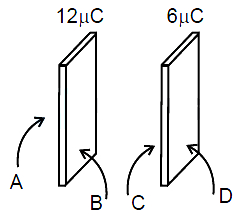
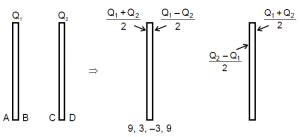
$12 \mu C$ and $6 \mu C$ charges are given to two conducting plates having the same cross-sectional area and placed face to face close to each other as shown in the figure. The resulting charge distribution in $\mu C$ on surfaces $A, B, C$ and $D$ are respectively,
A
$9, 3, -3, 9$
B
$3, 9, -9, 3$
C
$6, 6, -6, 12$
D
$6, 6, 3, 3$
Solution
(A) Let the charges on the two plates be $Q_1 = 12 \mu C$ and $Q_2 = 6 \mu C$.
When two large conducting plates are placed parallel to each other,the charge on the outer surfaces is equal to $\frac{Q_1 + Q_2}{2}$ and the charge on the inner surfaces is equal to $\frac{Q_1 - Q_2}{2}$ and $\frac{Q_2 - Q_1}{2}$ respectively.
For surface $A$ (outer surface of first plate): $q_A = \frac{Q_1 + Q_2}{2} = \frac{12 + 6}{2} = \frac{18}{2} = 9 \mu C$.
For surface $B$ (inner surface of first plate): $q_B = \frac{Q_1 - Q_2}{2} = \frac{12 - 6}{2} = \frac{6}{2} = 3 \mu C$.
For surface $C$ (inner surface of second plate): $q_C = \frac{Q_2 - Q_1}{2} = \frac{6 - 12}{2} = \frac{-6}{2} = -3 \mu C$.
For surface $D$ (outer surface of second plate): $q_D = \frac{Q_1 + Q_2}{2} = \frac{12 + 6}{2} = \frac{18}{2} = 9 \mu C$.
Thus,the charge distribution on surfaces $A, B, C$ and $D$ is $9 \mu C, 3 \mu C, -3 \mu C$ and $9 \mu C$ respectively.
When two large conducting plates are placed parallel to each other,the charge on the outer surfaces is equal to $\frac{Q_1 + Q_2}{2}$ and the charge on the inner surfaces is equal to $\frac{Q_1 - Q_2}{2}$ and $\frac{Q_2 - Q_1}{2}$ respectively.
For surface $A$ (outer surface of first plate): $q_A = \frac{Q_1 + Q_2}{2} = \frac{12 + 6}{2} = \frac{18}{2} = 9 \mu C$.
For surface $B$ (inner surface of first plate): $q_B = \frac{Q_1 - Q_2}{2} = \frac{12 - 6}{2} = \frac{6}{2} = 3 \mu C$.
For surface $C$ (inner surface of second plate): $q_C = \frac{Q_2 - Q_1}{2} = \frac{6 - 12}{2} = \frac{-6}{2} = -3 \mu C$.
For surface $D$ (outer surface of second plate): $q_D = \frac{Q_1 + Q_2}{2} = \frac{12 + 6}{2} = \frac{18}{2} = 9 \mu C$.
Thus,the charge distribution on surfaces $A, B, C$ and $D$ is $9 \mu C, 3 \mu C, -3 \mu C$ and $9 \mu C$ respectively.
0 likesView Solution
19
PhysicsMediumMCQWBJEE · 2023
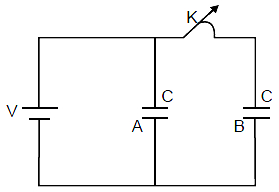
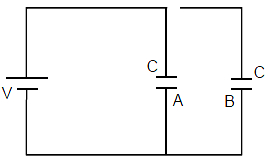
The figure shows two identical parallel plate capacitors $A$ and $B$ of capacitances $C$ connected to a battery. The key $K$ is initially closed. The switch is now opened and the free spaces between the plates of the capacitors are filled with a dielectric of dielectric constant $K=3$. Then which of the following statement$(s)$ is/are true?
A
When the switch is closed,total energy stored in the two capacitors is $CV^2$
B
When the switch is opened,no charge is stored in the capacitor $B$
C
When the switch is opened,energy stored in the capacitor $B$ is $\frac{1}{6} CV^2$
D
When the switch is opened,total energy stored in two capacitors is $\frac{5}{3} CV^2$
Solution
(A, C, D) Initially,when the switch $K$ is closed,both capacitors $A$ and $B$ are in parallel with the battery of voltage $V$. The total energy stored is $U = \frac{1}{2}CV^2 + \frac{1}{2}CV^2 = CV^2$.
When the switch $K$ is opened,capacitor $A$ remains connected to the battery,while capacitor $B$ is isolated. The charge on $B$ remains constant at $q_B = CV$.
After inserting the dielectric $(K=3)$:
For capacitor $A$: The new capacitance is $C_A' = KC = 3C$. The voltage remains $V$. The energy stored is $U_A = \frac{1}{2}C_A'V^2 = \frac{1}{2}(3C)V^2 = \frac{3}{2}CV^2$.
For capacitor $B$: The charge $q_B = CV$ remains constant. The new capacitance is $C_B' = KC = 3C$. The energy stored is $U_B = \frac{q_B^2}{2C_B'} = \frac{(CV)^2}{2(3C)} = \frac{C^2V^2}{6C} = \frac{1}{6}CV^2$.
The total energy stored is $U_{total} = U_A + U_B = \frac{3}{2}CV^2 + \frac{1}{6}CV^2 = \frac{9+1}{6}CV^2 = \frac{10}{6}CV^2 = \frac{5}{3}CV^2$.
Thus,statements $A$,$C$,and $D$ are correct.
When the switch $K$ is opened,capacitor $A$ remains connected to the battery,while capacitor $B$ is isolated. The charge on $B$ remains constant at $q_B = CV$.
After inserting the dielectric $(K=3)$:
For capacitor $A$: The new capacitance is $C_A' = KC = 3C$. The voltage remains $V$. The energy stored is $U_A = \frac{1}{2}C_A'V^2 = \frac{1}{2}(3C)V^2 = \frac{3}{2}CV^2$.
For capacitor $B$: The charge $q_B = CV$ remains constant. The new capacitance is $C_B' = KC = 3C$. The energy stored is $U_B = \frac{q_B^2}{2C_B'} = \frac{(CV)^2}{2(3C)} = \frac{C^2V^2}{6C} = \frac{1}{6}CV^2$.
The total energy stored is $U_{total} = U_A + U_B = \frac{3}{2}CV^2 + \frac{1}{6}CV^2 = \frac{9+1}{6}CV^2 = \frac{10}{6}CV^2 = \frac{5}{3}CV^2$.
Thus,statements $A$,$C$,and $D$ are correct.
0 likesView Solution
20
PhysicsEasyMCQWBJEE · 2023
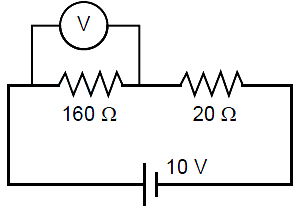
In an experiment on a circuit as shown in the figure, the voltmeter shows $8 \,V$ reading. The resistance of the voltmeter is,
A
$20 \Omega$
B
$320 \Omega$
C
$160 \Omega$
D
$1.44 k \Omega$
Solution
(C) Let the resistance of the voltmeter be $R_v$. The voltmeter is connected in parallel with the $160 \Omega$ resistor. The equivalent resistance of this parallel combination is $R_p = \frac{160 R_v}{160 + R_v}$.
The total resistance of the circuit is $R_{eq} = R_p + 20 = \frac{160 R_v}{160 + R_v} + 20$.
The total current in the circuit is $I = \frac{V}{R_{eq}} = \frac{10}{\frac{160 R_v}{160 + R_v} + 20}$.
The voltage across the parallel combination (voltmeter reading) is $V_p = I \times R_p = 8 \,V$.
Substituting $I$ and $R_p$: $\frac{10}{\frac{160 R_v}{160 + R_v} + 20} \times \frac{160 R_v}{160 + R_v} = 8$.
Let $x = \frac{160 R_v}{160 + R_v}$. Then $\frac{10x}{x + 20} = 8 \implies 10x = 8x + 160 \implies 2x = 160 \implies x = 80 \Omega$.
Now, $\frac{160 R_v}{160 + R_v} = 80 \implies 160 R_v = 80(160 + R_v) \implies 160 R_v = 12800 + 80 R_v \implies 80 R_v = 12800 \implies R_v = 160 \Omega$.
The total resistance of the circuit is $R_{eq} = R_p + 20 = \frac{160 R_v}{160 + R_v} + 20$.
The total current in the circuit is $I = \frac{V}{R_{eq}} = \frac{10}{\frac{160 R_v}{160 + R_v} + 20}$.
The voltage across the parallel combination (voltmeter reading) is $V_p = I \times R_p = 8 \,V$.
Substituting $I$ and $R_p$: $\frac{10}{\frac{160 R_v}{160 + R_v} + 20} \times \frac{160 R_v}{160 + R_v} = 8$.
Let $x = \frac{160 R_v}{160 + R_v}$. Then $\frac{10x}{x + 20} = 8 \implies 10x = 8x + 160 \implies 2x = 160 \implies x = 80 \Omega$.
Now, $\frac{160 R_v}{160 + R_v} = 80 \implies 160 R_v = 80(160 + R_v) \implies 160 R_v = 12800 + 80 R_v \implies 80 R_v = 12800 \implies R_v = 160 \Omega$.
0 likesView Solution
21
PhysicsMediumMCQWBJEE · 2023
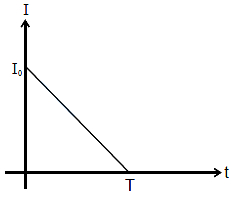
An amount of charge $Q$ passes through a coil of resistance $R$. If the current in the coil decreases to zero at a uniform rate during time $T$,then the amount of heat generated in the coil will be,
A
$\frac{4 Q^2 R}{3 T}$
B
$\frac{2 Q^2 R}{3 T}$
C
$\frac{Q^2 R}{4 T}$
D
$Q^2 R T$
Solution
(A) The total charge $Q$ passing through the coil is equal to the area under the current-time graph. Since the current decreases uniformly from $I_0$ to $0$ in time $T$,the graph is a triangle with base $T$ and height $I_0$.
$Q = \frac{1}{2} I_0 T \Rightarrow I_0 = \frac{2 Q}{T}$
The current as a function of time is given by $I(t) = I_0 \left(1 - \frac{t}{T}\right) = \frac{2 Q}{T} \left(1 - \frac{t}{T}\right)$.
The heat generated $H$ in the coil is given by $H = \int_0^T I^2 R \, dt$.
$H = R \int_0^T \left[ \frac{2 Q}{T} \left(1 - \frac{t}{T}\right) \right]^2 \, dt = \frac{4 Q^2 R}{T^2} \int_0^T \left(1 - \frac{t}{T}\right)^2 \, dt$.
Let $u = 1 - \frac{t}{T}$,then $du = -\frac{1}{T} dt$,so $dt = -T du$.
When $t=0, u=1$; when $t=T, u=0$.
$H = \frac{4 Q^2 R}{T^2} \int_1^0 u^2 (-T \, du) = \frac{4 Q^2 R}{T} \int_0^1 u^2 \, du$.
$H = \frac{4 Q^2 R}{T} \left[ \frac{u^3}{3} \right]_0^1 = \frac{4 Q^2 R}{3 T}$.
$Q = \frac{1}{2} I_0 T \Rightarrow I_0 = \frac{2 Q}{T}$
The current as a function of time is given by $I(t) = I_0 \left(1 - \frac{t}{T}\right) = \frac{2 Q}{T} \left(1 - \frac{t}{T}\right)$.
The heat generated $H$ in the coil is given by $H = \int_0^T I^2 R \, dt$.
$H = R \int_0^T \left[ \frac{2 Q}{T} \left(1 - \frac{t}{T}\right) \right]^2 \, dt = \frac{4 Q^2 R}{T^2} \int_0^T \left(1 - \frac{t}{T}\right)^2 \, dt$.
Let $u = 1 - \frac{t}{T}$,then $du = -\frac{1}{T} dt$,so $dt = -T du$.
When $t=0, u=1$; when $t=T, u=0$.
$H = \frac{4 Q^2 R}{T^2} \int_1^0 u^2 (-T \, du) = \frac{4 Q^2 R}{T} \int_0^1 u^2 \, du$.
$H = \frac{4 Q^2 R}{T} \left[ \frac{u^3}{3} \right]_0^1 = \frac{4 Q^2 R}{3 T}$.
0 likesView Solution
22
PhysicsEasyMCQWBJEE · 2023
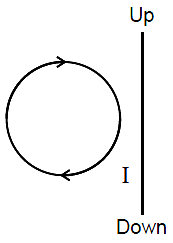
$A$ circular coil is placed near a current-carrying conductor,both lying on the plane of the paper. The current is flowing through the conductor in such a way that the induced current in the loop is clockwise,as shown in the figure. The current in the wire is,
A
time-dependent and downward.
B
steady and upward.
C
an alternating current.
D
None of these
Solution
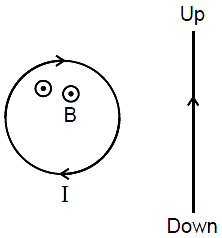
(D) According to the right-hand thumb rule,if the current in the wire flows upward,the magnetic field lines in the region of the coil are directed into the plane of the paper.
If the current in the wire flows downward,the magnetic field lines in the region of the coil are directed out of the plane of the paper.
For a clockwise induced current in the loop,the induced magnetic field must be directed into the plane of the paper (by the right-hand grip rule).
According to Lenz's law,the induced current opposes the change in magnetic flux.
Case $1$: If the current is flowing upward and increasing,the magnetic field into the plane increases,so the induced current will be counter-clockwise to oppose it. This does not match.
Case $2$: If the current is flowing upward and decreasing,the magnetic field into the plane decreases,so the induced current will be clockwise to support it.
Case $3$: If the current is flowing downward and increasing,the magnetic field out of the plane increases,so the induced current will be counter-clockwise to oppose it.
Case $4$: If the current is flowing downward and decreasing,the magnetic field out of the plane decreases,so the induced current will be clockwise to support it.
Since the current must be time-dependent to induce a current,and both decreasing upward current and decreasing downward current can produce a clockwise induced current,the most appropriate general description is that the current is time-dependent.
If the current in the wire flows downward,the magnetic field lines in the region of the coil are directed out of the plane of the paper.
For a clockwise induced current in the loop,the induced magnetic field must be directed into the plane of the paper (by the right-hand grip rule).
According to Lenz's law,the induced current opposes the change in magnetic flux.
Case $1$: If the current is flowing upward and increasing,the magnetic field into the plane increases,so the induced current will be counter-clockwise to oppose it. This does not match.
Case $2$: If the current is flowing upward and decreasing,the magnetic field into the plane decreases,so the induced current will be clockwise to support it.
Case $3$: If the current is flowing downward and increasing,the magnetic field out of the plane increases,so the induced current will be counter-clockwise to oppose it.
Case $4$: If the current is flowing downward and decreasing,the magnetic field out of the plane decreases,so the induced current will be clockwise to support it.
Since the current must be time-dependent to induce a current,and both decreasing upward current and decreasing downward current can produce a clockwise induced current,the most appropriate general description is that the current is time-dependent.
0 likesView Solution
23
PhysicsMediumMCQWBJEE · 2023
$A$ bar magnet falls from rest under gravity through the centre of a horizontal ring of conducting wire as shown in figure. Which of the following graph best represents the speed $(v)$ vs. time $(t)$ graph of the bar magnet?
A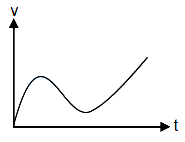
B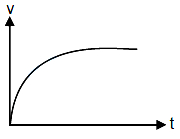
C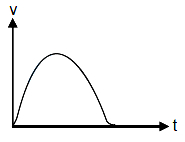
D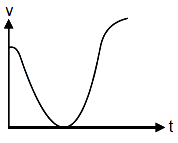
Solution
(A) When the bar magnet falls through the conducting ring,the magnetic flux linked with the ring changes. According to Lenz's law,an induced current is produced in the ring that opposes the motion of the magnet.
As the magnet approaches the ring,the induced current creates a magnetic field that repels the magnet,causing its acceleration to be less than $g$ (acceleration due to gravity).
As the magnet passes through the center of the ring,the magnetic flux linked with the ring starts decreasing. The induced current now creates a magnetic field that attracts the magnet,again opposing its downward motion.
Throughout the process,the net force on the magnet is $F_{net} = mg - F_{mag}$,where $F_{mag}$ is the magnetic force. The speed of the magnet increases continuously,but its acceleration decreases when it is near the ring due to the opposing magnetic force. The graph in option $A$ correctly shows this behavior,where the slope (acceleration) decreases as the magnet passes through the ring and then increases again.
As the magnet approaches the ring,the induced current creates a magnetic field that repels the magnet,causing its acceleration to be less than $g$ (acceleration due to gravity).
As the magnet passes through the center of the ring,the magnetic flux linked with the ring starts decreasing. The induced current now creates a magnetic field that attracts the magnet,again opposing its downward motion.
Throughout the process,the net force on the magnet is $F_{net} = mg - F_{mag}$,where $F_{mag}$ is the magnetic force. The speed of the magnet increases continuously,but its acceleration decreases when it is near the ring due to the opposing magnetic force. The graph in option $A$ correctly shows this behavior,where the slope (acceleration) decreases as the magnet passes through the ring and then increases again.
0 likesView Solution
24
PhysicsEasyMCQWBJEE · 2023
The electric field of a plane electromagnetic wave of wave number $k$ and angular frequency $\omega$ is given by $\vec{E} = E_0(\hat{i} + \hat{j}) \sin(kz - \omega t)$. Which of the following gives the direction of the associated magnetic field $\vec{B}$?
A
$\hat{k}$
B
$-\hat{i} + \hat{j}$
C
$-\hat{i} - \hat{j}$
D
$\hat{i} - \hat{k}$
Solution
(B) For an electromagnetic wave,the direction of propagation is given by the vector $\vec{k}_{dir} = \hat{k}$ (since the phase is $kz - \omega t$).
The electric field vector is $\vec{E} = E_0(\hat{i} + \hat{j})$.
The magnetic field $\vec{B}$ is perpendicular to both the direction of propagation and the electric field $\vec{E}$.
The direction of $\vec{B}$ is given by the cross product $\vec{k}_{dir} \times \vec{E}$.
$\vec{B}_{dir} = \hat{k} \times (\hat{i} + \hat{j}) = (\hat{k} \times \hat{i}) + (\hat{k} \times \hat{j}) = \hat{j} - \hat{i} = -\hat{i} + \hat{j}$.
Thus,the direction of the magnetic field is $-\hat{i} + \hat{j}$.
The electric field vector is $\vec{E} = E_0(\hat{i} + \hat{j})$.
The magnetic field $\vec{B}$ is perpendicular to both the direction of propagation and the electric field $\vec{E}$.
The direction of $\vec{B}$ is given by the cross product $\vec{k}_{dir} \times \vec{E}$.
$\vec{B}_{dir} = \hat{k} \times (\hat{i} + \hat{j}) = (\hat{k} \times \hat{i}) + (\hat{k} \times \hat{j}) = \hat{j} - \hat{i} = -\hat{i} + \hat{j}$.
Thus,the direction of the magnetic field is $-\hat{i} + \hat{j}$.
0 likesView Solution
25
PhysicsDifficultMCQWBJEE · 2023
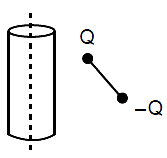
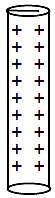
Consider a positively charged infinite cylinder with uniform volume charge density. An electric dipole consisting of $+Q$ and $-Q$ charges attached to opposite ends of a massless rod is oriented as shown in the figure. At the instant as shown in the figure,the dipole will experience,
A
a force to the left and no torque
B
a force to the right and a clockwise torque
C
a force to the right and a counter clockwise torque
D
no force but only a clockwise torque
Solution
(B) The electric field $E$ due to an infinite charged cylinder at a distance $r$ from its axis is given by $E \propto \frac{1}{r}$.
Since the $+Q$ charge is closer to the cylinder than the $-Q$ charge,the electric field at the position of $+Q$ $(E_1)$ is stronger than the electric field at the position of $-Q$ $(E_2)$,i.e.,$E_1 > E_2$.
The force on the $+Q$ charge is $F_1 = Q E_1$ (directed away from the cylinder,i.e.,to the right).
The force on the $-Q$ charge is $F_2 = Q E_2$ (directed towards the cylinder,i.e.,to the left).
Since $E_1 > E_2$,the net force $F_{\text{net}} = F_1 - F_2$ is directed to the right.
Regarding torque,the force $F_1$ acts at a greater distance from the center of the rod and is larger,while $F_2$ acts at a smaller distance. The combination of these forces creates a clockwise torque about the center of the rod.
Since the $+Q$ charge is closer to the cylinder than the $-Q$ charge,the electric field at the position of $+Q$ $(E_1)$ is stronger than the electric field at the position of $-Q$ $(E_2)$,i.e.,$E_1 > E_2$.
The force on the $+Q$ charge is $F_1 = Q E_1$ (directed away from the cylinder,i.e.,to the right).
The force on the $-Q$ charge is $F_2 = Q E_2$ (directed towards the cylinder,i.e.,to the left).
Since $E_1 > E_2$,the net force $F_{\text{net}} = F_1 - F_2$ is directed to the right.
Regarding torque,the force $F_1$ acts at a greater distance from the center of the rod and is larger,while $F_2$ acts at a smaller distance. The combination of these forces creates a clockwise torque about the center of the rod.
0 likesView Solution
26
PhysicsDifficultMCQWBJEE · 2023
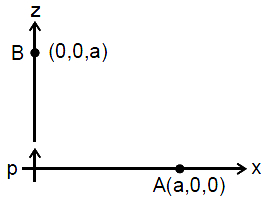
An electric dipole of dipole moment $\vec{p}$ is placed at the origin of the coordinate system along the $z$-axis. The amount of work required to move a charge $q$ from the point $A(a, 0, 0)$ to the point $B(0, 0, a)$ is,
A
$\frac{p q}{4 \pi \varepsilon_0 a}$
B
$0$
C
$\frac{-p q}{4 \pi \varepsilon_0 a^2}$
D
$\frac{p q}{4 \pi \varepsilon_0 a^2}$
Solution
(D) The electric potential $V$ due to an electric dipole at a point $(r, \theta)$ is given by $V = \frac{p \cos \theta}{4 \pi \varepsilon_0 r^2}$.
Point $A(a, 0, 0)$ lies on the equatorial plane of the dipole (which is along the $z$-axis),so the angle $\theta_A = 90^{\circ}$. Thus,the potential at $A$ is $V_A = \frac{p \cos 90^{\circ}}{4 \pi \varepsilon_0 a^2} = 0$.
Point $B(0, 0, a)$ lies on the axial line of the dipole,so the angle $\theta_B = 0^{\circ}$. Thus,the potential at $B$ is $V_B = \frac{p \cos 0^{\circ}}{4 \pi \varepsilon_0 a^2} = \frac{p}{4 \pi \varepsilon_0 a^2}$.
The work done $W$ to move a charge $q$ from $A$ to $B$ is $W = q(V_B - V_A)$.
Substituting the values,$W = q \left( \frac{p}{4 \pi \varepsilon_0 a^2} - 0 \right) = \frac{p q}{4 \pi \varepsilon_0 a^2}$.
Point $A(a, 0, 0)$ lies on the equatorial plane of the dipole (which is along the $z$-axis),so the angle $\theta_A = 90^{\circ}$. Thus,the potential at $A$ is $V_A = \frac{p \cos 90^{\circ}}{4 \pi \varepsilon_0 a^2} = 0$.
Point $B(0, 0, a)$ lies on the axial line of the dipole,so the angle $\theta_B = 0^{\circ}$. Thus,the potential at $B$ is $V_B = \frac{p \cos 0^{\circ}}{4 \pi \varepsilon_0 a^2} = \frac{p}{4 \pi \varepsilon_0 a^2}$.
The work done $W$ to move a charge $q$ from $A$ to $B$ is $W = q(V_B - V_A)$.
Substituting the values,$W = q \left( \frac{p}{4 \pi \varepsilon_0 a^2} - 0 \right) = \frac{p q}{4 \pi \varepsilon_0 a^2}$.
0 likesView Solution
27
PhysicsEasyMCQWBJEE · 2023
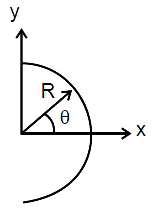
$A$ thin glass rod is bent in a semicircle of radius $R$. $A$ charge is non-uniformly distributed along the rod with a linear charge density $\lambda = \lambda_0 \sin \theta$ (where $\lambda_0$ is a positive constant and $\theta$ is the angle with the $x$-axis). The electric field at the centre $P$ of the semicircle is,
A
$-\frac{\lambda_0}{4 \pi \varepsilon_0 R} \hat{j}$
B
$\frac{\lambda_0}{4 \pi \varepsilon_0 R} \hat{j}$
C
$\frac{\lambda_0}{4 \pi \varepsilon_0 R} \hat{i}$
D
None of these
Solution
(D) The linear charge density is given by $\lambda = \lambda_0 \sin \theta$. Consider a small element of the rod subtending an angle $d\theta$ at the centre. The charge on this element is $dq = \lambda (R d\theta) = \lambda_0 R \sin \theta d\theta$.
The electric field $dE$ at the centre due to this element is $dE = \frac{k dq}{R^2} = \frac{1}{4 \pi \varepsilon_0} \frac{\lambda_0 R \sin \theta d\theta}{R^2} = \frac{\lambda_0}{4 \pi \varepsilon_0 R} \sin \theta d\theta$.
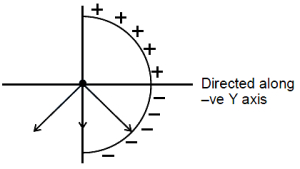
Due to symmetry,the $x$-components of the electric field cancel out. The $y$-component is $dE_y = -dE \sin \theta = -\frac{\lambda_0}{4 \pi \varepsilon_0 R} \sin^2 \theta d\theta$.
Integrating from $\theta = 0$ to $\pi$:
$E_y = -\frac{\lambda_0}{4 \pi \varepsilon_0 R} \int_0^{\pi} \sin^2 \theta d\theta = -\frac{\lambda_0}{4 \pi \varepsilon_0 R} \int_0^{\pi} \frac{1 - \cos 2\theta}{2} d\theta = -\frac{\lambda_0}{8 \pi \varepsilon_0 R} [\theta - \frac{\sin 2\theta}{2}]_0^{\pi} = -\frac{\lambda_0}{8 \pi \varepsilon_0 R} (\pi) = -\frac{\lambda_0}{8 \varepsilon_0 R}$.
Thus,$\vec{E} = -\frac{\lambda_0}{8 \varepsilon_0 R} \hat{j}$. Since this is not among the options,the correct answer is $D$.
The electric field $dE$ at the centre due to this element is $dE = \frac{k dq}{R^2} = \frac{1}{4 \pi \varepsilon_0} \frac{\lambda_0 R \sin \theta d\theta}{R^2} = \frac{\lambda_0}{4 \pi \varepsilon_0 R} \sin \theta d\theta$.
Due to symmetry,the $x$-components of the electric field cancel out. The $y$-component is $dE_y = -dE \sin \theta = -\frac{\lambda_0}{4 \pi \varepsilon_0 R} \sin^2 \theta d\theta$.
Integrating from $\theta = 0$ to $\pi$:
$E_y = -\frac{\lambda_0}{4 \pi \varepsilon_0 R} \int_0^{\pi} \sin^2 \theta d\theta = -\frac{\lambda_0}{4 \pi \varepsilon_0 R} \int_0^{\pi} \frac{1 - \cos 2\theta}{2} d\theta = -\frac{\lambda_0}{8 \pi \varepsilon_0 R} [\theta - \frac{\sin 2\theta}{2}]_0^{\pi} = -\frac{\lambda_0}{8 \pi \varepsilon_0 R} (\pi) = -\frac{\lambda_0}{8 \varepsilon_0 R}$.
Thus,$\vec{E} = -\frac{\lambda_0}{8 \varepsilon_0 R} \hat{j}$. Since this is not among the options,the correct answer is $D$.
0 likesView Solution
28
PhysicsEasyMCQWBJEE · 2023
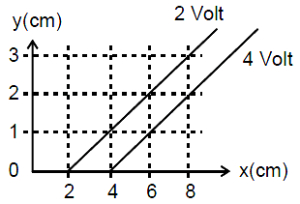
The figure represents two equipotential lines in the $x-y$ plane for an electric field. The $x$-component $E_{x}$ of the electric field in the space between these equipotential lines is, (in $V/m$)
A
$100$
B
$-100$
C
$200$
D
$-200$
Solution
(B) The electric field component $E_{x}$ is given by the negative gradient of the potential with respect to $x$,i.e.,$E_{x} = -\frac{dV}{dx}$.
From the graph,the potential difference $\Delta V = V_{2} - V_{1} = 4 \ V - 2 \ V = 2 \ V$.
The distance along the $x$-axis between these two equipotential lines is $\Delta x = 4 \ cm - 2 \ cm = 2 \ cm = 0.02 \ m$.
Therefore,the magnitude of the $x$-component of the electric field is $E_{x} = -\frac{\Delta V}{\Delta x} = -\frac{2 \ V}{0.02 \ m} = -100 \ V/m$.
Thus,the correct option is $B$.
From the graph,the potential difference $\Delta V = V_{2} - V_{1} = 4 \ V - 2 \ V = 2 \ V$.
The distance along the $x$-axis between these two equipotential lines is $\Delta x = 4 \ cm - 2 \ cm = 2 \ cm = 0.02 \ m$.
Therefore,the magnitude of the $x$-component of the electric field is $E_{x} = -\frac{\Delta V}{\Delta x} = -\frac{2 \ V}{0.02 \ m} = -100 \ V/m$.
Thus,the correct option is $B$.
0 likesView Solution
29
PhysicsMediumMCQWBJEE · 2023
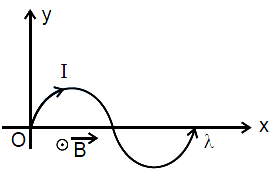
$A$ wire carrying a steady current $I$ is kept in the $x$-$y$ plane along the curve $y=A \sin \left(\frac{2 \pi}{\lambda} x\right)$. $A$ magnetic field $B$ exists in the $z$-direction. The magnitude of the magnetic force on the portion of the wire between $x=0$ and $x=\lambda$ is
A
$0$
B
$2 I \lambda B$
C
$I \lambda B$
D
$I \lambda B / 2$
Solution
(C) The magnetic force on a current-carrying wire in a uniform magnetic field is given by $\vec{F} = I (\vec{L}_{eff} \times \vec{B})$,where $\vec{L}_{eff}$ is the effective displacement vector from the starting point to the end point of the wire.
For the given curve $y = A \sin \left(\frac{2 \pi}{\lambda} x\right)$,the starting point is at $x=0$,which gives $y=0$. The end point is at $x=\lambda$,which gives $y = A \sin(2\pi) = 0$.
Thus,the effective displacement vector $\vec{L}_{eff}$ is the vector from $(0, 0)$ to $(\lambda, 0)$,which is $\vec{L}_{eff} = \lambda \hat{i}$.
The magnetic field is in the $z$-direction,so $\vec{B} = B \hat{k}$.
The magnetic force is $\vec{F} = I (\lambda \hat{i} \times B \hat{k}) = I \lambda B (\hat{i} \times \hat{k}) = -I \lambda B \hat{j}$.
The magnitude of the magnetic force is $|\vec{F}| = I \lambda B$.
For the given curve $y = A \sin \left(\frac{2 \pi}{\lambda} x\right)$,the starting point is at $x=0$,which gives $y=0$. The end point is at $x=\lambda$,which gives $y = A \sin(2\pi) = 0$.
Thus,the effective displacement vector $\vec{L}_{eff}$ is the vector from $(0, 0)$ to $(\lambda, 0)$,which is $\vec{L}_{eff} = \lambda \hat{i}$.
The magnetic field is in the $z$-direction,so $\vec{B} = B \hat{k}$.
The magnetic force is $\vec{F} = I (\lambda \hat{i} \times B \hat{k}) = I \lambda B (\hat{i} \times \hat{k}) = -I \lambda B \hat{j}$.
The magnitude of the magnetic force is $|\vec{F}| = I \lambda B$.
0 likesView Solution
30
PhysicsMediumMCQWBJEE · 2023
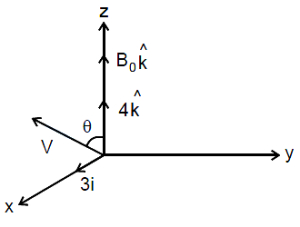
$A$ charged particle in a uniform magnetic field $B = B_0 \hat{k}$ starts moving from the origin with velocity $v = 3 \hat{i} + 4 \hat{k} \text{ m/s}$. The trajectory of the particle and the time $t$ at which it reaches $2 \text{ m}$ above the $x-y$ plane are,
A
Circular path,$\frac{1}{2} \text{ s}$.
B
Helical path,$\frac{1}{2} \text{ s}$.
C
Circular path,$\frac{2}{3} \text{ s}$.
D
Helical path,$\frac{2}{3} \text{ s}$.
Solution
(B) The magnetic field is directed along the $z$-axis $(B = B_0 \hat{k})$.
The velocity of the particle is $v = 3 \hat{i} + 4 \hat{k} \text{ m/s}$.
The velocity component perpendicular to the magnetic field is $v_{\perp} = 3 \hat{i} \text{ m/s}$,which causes circular motion in the $x-y$ plane.
The velocity component parallel to the magnetic field is $v_{\parallel} = 4 \hat{k} \text{ m/s}$,which remains constant as there is no force acting in this direction.
Since the particle has both perpendicular and parallel velocity components,the trajectory is a helical path.
The distance to be covered along the $z$-axis is $s = 2 \text{ m}$.
Using the formula $s = v_{\parallel} \times t$,we get $t = \frac{s}{v_{\parallel}} = \frac{2}{4} = \frac{1}{2} \text{ s}$.
The velocity of the particle is $v = 3 \hat{i} + 4 \hat{k} \text{ m/s}$.
The velocity component perpendicular to the magnetic field is $v_{\perp} = 3 \hat{i} \text{ m/s}$,which causes circular motion in the $x-y$ plane.
The velocity component parallel to the magnetic field is $v_{\parallel} = 4 \hat{k} \text{ m/s}$,which remains constant as there is no force acting in this direction.
Since the particle has both perpendicular and parallel velocity components,the trajectory is a helical path.
The distance to be covered along the $z$-axis is $s = 2 \text{ m}$.
Using the formula $s = v_{\parallel} \times t$,we get $t = \frac{s}{v_{\parallel}} = \frac{2}{4} = \frac{1}{2} \text{ s}$.
0 likesView Solution
31
PhysicsDifficultMCQWBJEE · 2023
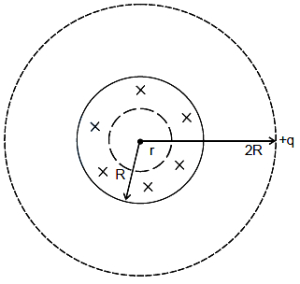
$A$ charged particle of charge $q$ and mass $m$ is placed at a distance $2R$ from the centre of a vertical cylindrical region of radius $R$ where the magnetic field varies as $\vec{B} = (4t^2 - 2t + 6) \hat{k}$,where $t$ is time. Then which of the following statement$(s)$ is/are true?
A
Induced electric field lines form closed loops
B
Electric field varies linearly with $r$ if $r < R$,where $r$ is the radial distance from the centerline of the cylinder
C
The charged particle will move in a clockwise direction when viewed from the top
D
Acceleration of the charged particle is $\frac{7qR}{2m}$ when $t = 2 \text{ s}$
Solution
(A, B, C, D) For $r < R$,using Faraday's law of induction: $\oint \vec{E} \cdot d\vec{l} = -\frac{d\phi_B}{dt}$.
$E(2\pi r) = \frac{d}{dt}[(4t^2 - 2t + 6) \pi r^2] = (8t - 2) \pi r^2$.
Thus,$E = \frac{(8t - 2)r}{2} = (4t - 1)r$. Since $E \propto r$,the electric field varies linearly with $r$ for $r < R$.
For $r > R$,the magnetic flux is confined to the region $r \le R$: $\oint \vec{E} \cdot d\vec{l} = -\frac{d}{dt}[B \cdot \pi R^2]$.
$E(2\pi r) = (8t - 2) \pi R^2 \implies E = \frac{(8t - 2)R^2}{2r}$.
At $r = 2R$ and $t = 2 \text{ s}$:
$E = \frac{(8(2) - 2)R^2}{2(2R)} = \frac{14R^2}{4R} = \frac{7R}{2}$.
The acceleration $a = \frac{Eq}{m} = \frac{7qR}{2m}$.
Induced electric fields are non-conservative and form closed loops. By Lenz's law,since $\vec{B}$ is increasing for $t > 0.25 \text{ s}$,the induced field opposes the change,resulting in a clockwise direction for a positive charge.
$E(2\pi r) = \frac{d}{dt}[(4t^2 - 2t + 6) \pi r^2] = (8t - 2) \pi r^2$.
Thus,$E = \frac{(8t - 2)r}{2} = (4t - 1)r$. Since $E \propto r$,the electric field varies linearly with $r$ for $r < R$.
For $r > R$,the magnetic flux is confined to the region $r \le R$: $\oint \vec{E} \cdot d\vec{l} = -\frac{d}{dt}[B \cdot \pi R^2]$.
$E(2\pi r) = (8t - 2) \pi R^2 \implies E = \frac{(8t - 2)R^2}{2r}$.
At $r = 2R$ and $t = 2 \text{ s}$:
$E = \frac{(8(2) - 2)R^2}{2(2R)} = \frac{14R^2}{4R} = \frac{7R}{2}$.
The acceleration $a = \frac{Eq}{m} = \frac{7qR}{2m}$.
Induced electric fields are non-conservative and form closed loops. By Lenz's law,since $\vec{B}$ is increasing for $t > 0.25 \text{ s}$,the induced field opposes the change,resulting in a clockwise direction for a positive charge.
0 likesView Solution
32
PhysicsDifficultMCQWBJEE · 2023
$A$ uniform magnetic field $B$ exists in a region. An electron of charge $q$ and mass $m$ moving with velocity $v$ enters the region in a direction perpendicular to the magnetic field. Considering Bohr angular momentum quantization,which of the following statement$(s)$ is/are true?
A
The radius of $n^{\text{th}}$ orbit $r_n \propto \sqrt{n}$
B
The velocity of the electron in the $n^{\text{th}}$ orbit is $v_n = \sqrt{\frac{n q B \hbar}{m^2}}$
C
Energy of the $n^{\text{th}}$ level $E_n \propto n$
D
Transition frequency $\omega$ between two successive levels is independent of $n$
Solution
(A, B, C, D) For a charged particle in a magnetic field,the radius of the circular path is given by $r = \frac{mv}{qB}$.
Applying Bohr's quantization condition for angular momentum: $mvr = \frac{nh}{2\pi} = n\hbar$.
Substituting $v = \frac{qBr}{m}$ into the quantization condition: $m \left( \frac{qBr}{m} \right) r = n\hbar \implies qBr^2 = n\hbar \implies r_n = \sqrt{\frac{n\hbar}{qB}}$. Thus,$r_n \propto \sqrt{n}$. (Statement $A$ is true).
Now,$v_n = \frac{qBr_n}{m} = \frac{qB}{m} \sqrt{\frac{n\hbar}{qB}} = \sqrt{\frac{n q B \hbar}{m^2}}$. (Statement $B$ is true).
The energy of the $n^{\text{th}}$ level is $E_n = \frac{1}{2}mv_n^2 = \frac{1}{2}m \left( \frac{n q B \hbar}{m^2} \right) = n \left( \frac{q B \hbar}{2m} \right)$. Thus,$E_n \propto n$. (Statement $C$ is true).
The transition frequency $\omega$ is given by $\Delta E = \hbar \omega$. For successive levels,$\Delta E = E_{n+1} - E_n = \frac{q B \hbar}{2m}$. Therefore,$\omega = \frac{\Delta E}{\hbar} = \frac{qB}{2m}$,which is independent of $n$. (Statement $D$ is true).
Applying Bohr's quantization condition for angular momentum: $mvr = \frac{nh}{2\pi} = n\hbar$.
Substituting $v = \frac{qBr}{m}$ into the quantization condition: $m \left( \frac{qBr}{m} \right) r = n\hbar \implies qBr^2 = n\hbar \implies r_n = \sqrt{\frac{n\hbar}{qB}}$. Thus,$r_n \propto \sqrt{n}$. (Statement $A$ is true).
Now,$v_n = \frac{qBr_n}{m} = \frac{qB}{m} \sqrt{\frac{n\hbar}{qB}} = \sqrt{\frac{n q B \hbar}{m^2}}$. (Statement $B$ is true).
The energy of the $n^{\text{th}}$ level is $E_n = \frac{1}{2}mv_n^2 = \frac{1}{2}m \left( \frac{n q B \hbar}{m^2} \right) = n \left( \frac{q B \hbar}{2m} \right)$. Thus,$E_n \propto n$. (Statement $C$ is true).
The transition frequency $\omega$ is given by $\Delta E = \hbar \omega$. For successive levels,$\Delta E = E_{n+1} - E_n = \frac{q B \hbar}{2m}$. Therefore,$\omega = \frac{\Delta E}{\hbar} = \frac{qB}{2m}$,which is independent of $n$. (Statement $D$ is true).
0 likesView Solution
33
PhysicsDifficultMCQWBJEE · 2023
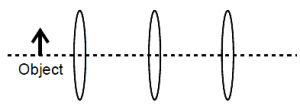
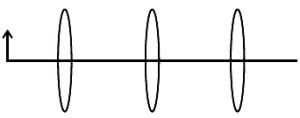
Three identical convex lenses each of focal length $f$ are placed in a straight line separated by a distance $f$ from each other. An object is located at $f/2$ in front of the leftmost lens. Then,
A
Final image will be at $f/2$ behind the rightmost lens and its magnification will be $-1$.
B
Final image will be at $f/2$ behind the rightmost lens and its magnification will be $+1$.
C
Final image will be at $f$ behind the rightmost lens and its magnification will be $-1$.
D
Final image will be at $f$ behind the rightmost lens and its magnification will be $+1$.
Solution
(A) For the first lens:
$u_1 = -f/2$,$f_1 = f$
Using the lens formula $\frac{1}{v_1} - \frac{1}{u_1} = \frac{1}{f_1}$:
$\frac{1}{v_1} - \frac{1}{-f/2} = \frac{1}{f} \Rightarrow \frac{1}{v_1} + \frac{2}{f} = \frac{1}{f} \Rightarrow \frac{1}{v_1} = -\frac{1}{f} \Rightarrow v_1 = -f$.
Magnification $m_1 = \frac{v_1}{u_1} = \frac{-f}{-f/2} = 2$.
For the second lens:
The image from the first lens acts as an object for the second lens. The distance between the lenses is $f$. So,$u_2 = -(f + |v_1|) = -(f + f) = -2f$.
Using the lens formula $\frac{1}{v_2} - \frac{1}{u_2} = \frac{1}{f_2}$:
$\frac{1}{v_2} - \frac{1}{-2f} = \frac{1}{f} \Rightarrow \frac{1}{v_2} + \frac{1}{2f} = \frac{1}{f} \Rightarrow \frac{1}{v_2} = \frac{1}{2f} \Rightarrow v_2 = 2f$.
Magnification $m_2 = \frac{v_2}{u_2} = \frac{2f}{-2f} = -1$.
For the third lens:
The image from the second lens acts as an object for the third lens. The distance between the second and third lens is $f$. The image $v_2 = 2f$ is formed behind the second lens. The object distance for the third lens is $u_3 = -(f - v_2) = -(f - 2f) = f$.
Using the lens formula $\frac{1}{v_3} - \frac{1}{u_3} = \frac{1}{f_3}$:
$\frac{1}{v_3} - \frac{1}{f} = \frac{1}{f} \Rightarrow \frac{1}{v_3} = \frac{2}{f} \Rightarrow v_3 = f/2$.
Magnification $m_3 = \frac{v_3}{u_3} = \frac{f/2}{f} = 1/2$.
Total magnification $M = m_1 \times m_2 \times m_3 = 2 \times (-1) \times (1/2) = -1$.
The final image is at $f/2$ behind the rightmost lens.
$u_1 = -f/2$,$f_1 = f$
Using the lens formula $\frac{1}{v_1} - \frac{1}{u_1} = \frac{1}{f_1}$:
$\frac{1}{v_1} - \frac{1}{-f/2} = \frac{1}{f} \Rightarrow \frac{1}{v_1} + \frac{2}{f} = \frac{1}{f} \Rightarrow \frac{1}{v_1} = -\frac{1}{f} \Rightarrow v_1 = -f$.
Magnification $m_1 = \frac{v_1}{u_1} = \frac{-f}{-f/2} = 2$.
For the second lens:
The image from the first lens acts as an object for the second lens. The distance between the lenses is $f$. So,$u_2 = -(f + |v_1|) = -(f + f) = -2f$.
Using the lens formula $\frac{1}{v_2} - \frac{1}{u_2} = \frac{1}{f_2}$:
$\frac{1}{v_2} - \frac{1}{-2f} = \frac{1}{f} \Rightarrow \frac{1}{v_2} + \frac{1}{2f} = \frac{1}{f} \Rightarrow \frac{1}{v_2} = \frac{1}{2f} \Rightarrow v_2 = 2f$.
Magnification $m_2 = \frac{v_2}{u_2} = \frac{2f}{-2f} = -1$.
For the third lens:
The image from the second lens acts as an object for the third lens. The distance between the second and third lens is $f$. The image $v_2 = 2f$ is formed behind the second lens. The object distance for the third lens is $u_3 = -(f - v_2) = -(f - 2f) = f$.
Using the lens formula $\frac{1}{v_3} - \frac{1}{u_3} = \frac{1}{f_3}$:
$\frac{1}{v_3} - \frac{1}{f} = \frac{1}{f} \Rightarrow \frac{1}{v_3} = \frac{2}{f} \Rightarrow v_3 = f/2$.
Magnification $m_3 = \frac{v_3}{u_3} = \frac{f/2}{f} = 1/2$.
Total magnification $M = m_1 \times m_2 \times m_3 = 2 \times (-1) \times (1/2) = -1$.
The final image is at $f/2$ behind the rightmost lens.
0 likesView Solution
34
PhysicsDifficultMCQWBJEE · 2023
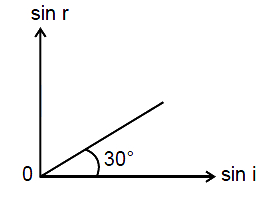
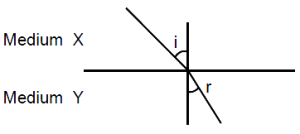
$A$ ray of monochromatic light is incident on the plane surface of separation between two media $X$ and $Y$ with angle of incidence $i$ in medium $X$ and angle of refraction $r$ in medium $Y$. The given graph shows the relation between $\sin i$ and $\sin r$. If $V_X$ and $V_Y$ are the velocities of the ray in media $X$ and $Y$ respectively,then which of the following is true?
A
$V_X = \frac{1}{\sqrt{3}} V_Y$
B
$V_X = \sqrt{3} V_Y$
C
Total internal reflection can happen when the light is incident in medium $X$.
D
$v_X = \sqrt{3} v_Y$,where $v_X$ and $v_Y$ are frequencies of the light in medium $X$ and $Y$ respectively.
Solution
(B) From Snell's law,we have $\mu_X \sin i = \mu_Y \sin r$.
Since $\mu = \frac{c}{V}$,we can write $\frac{c}{V_X} \sin i = \frac{c}{V_Y} \sin r$,which simplifies to $\frac{\sin i}{\sin r} = \frac{V_X}{V_Y}$.
From the given graph,the slope of the line is $\tan 30^{\circ} = \frac{\sin r}{\sin i} = \frac{1}{\sqrt{3}}$.
Therefore,$\frac{\sin i}{\sin r} = \sqrt{3}$.
Substituting this into the velocity ratio,we get $\frac{V_X}{V_Y} = \sqrt{3}$,which implies $V_X = \sqrt{3} V_Y$.
Since the light travels from a rarer medium $(X)$ to a denser medium $(Y)$ (as $r < i$),total internal reflection cannot occur when light is incident from medium $X$ to $Y$. Frequency remains constant during refraction.
Since $\mu = \frac{c}{V}$,we can write $\frac{c}{V_X} \sin i = \frac{c}{V_Y} \sin r$,which simplifies to $\frac{\sin i}{\sin r} = \frac{V_X}{V_Y}$.
From the given graph,the slope of the line is $\tan 30^{\circ} = \frac{\sin r}{\sin i} = \frac{1}{\sqrt{3}}$.
Therefore,$\frac{\sin i}{\sin r} = \sqrt{3}$.
Substituting this into the velocity ratio,we get $\frac{V_X}{V_Y} = \sqrt{3}$,which implies $V_X = \sqrt{3} V_Y$.
Since the light travels from a rarer medium $(X)$ to a denser medium $(Y)$ (as $r < i$),total internal reflection cannot occur when light is incident from medium $X$ to $Y$. Frequency remains constant during refraction.
0 likesView Solution
35
PhysicsEasyMCQWBJEE · 2023
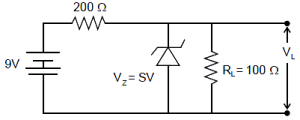
In the given circuit, find the voltage drop $V_L$ across the load resistance $R_L$. (in $V$)
A
$5$
B
$3$
C
$9$
D
$6$
Solution
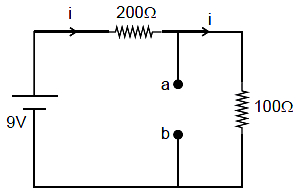
(B) To determine if the Zener diode is conducting, we first calculate the voltage across the load resistance $R_L$ assuming the diode is open-circuited.
Using the voltage divider rule, the voltage $V_{ab}$ across the load resistance $R_L = 100 \, \Omega$ is given by:
$V_{ab} = V_{source} \times \frac{R_L}{R + R_L}$
$V_{ab} = 9 \, V \times \frac{100 \, \Omega}{200 \, \Omega + 100 \, \Omega} = 9 \, V \times \frac{100}{300} = 3 \, V$
Since the calculated voltage $V_{ab} = 3 \, V$ is less than the Zener breakdown voltage $V_Z = 5 \, V$, the Zener diode does not enter the breakdown region and remains in the non-conducting $(OFF)$ state.
Therefore, the circuit behaves as a simple series circuit, and the voltage drop across the load resistance $R_L$ is $V_L = 3 \, V$.
Using the voltage divider rule, the voltage $V_{ab}$ across the load resistance $R_L = 100 \, \Omega$ is given by:
$V_{ab} = V_{source} \times \frac{R_L}{R + R_L}$
$V_{ab} = 9 \, V \times \frac{100 \, \Omega}{200 \, \Omega + 100 \, \Omega} = 9 \, V \times \frac{100}{300} = 3 \, V$
Since the calculated voltage $V_{ab} = 3 \, V$ is less than the Zener breakdown voltage $V_Z = 5 \, V$, the Zener diode does not enter the breakdown region and remains in the non-conducting $(OFF)$ state.
Therefore, the circuit behaves as a simple series circuit, and the voltage drop across the load resistance $R_L$ is $V_L = 3 \, V$.
0 likesView Solution
36
PhysicsEasyMCQWBJEE · 2023
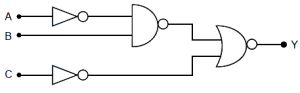
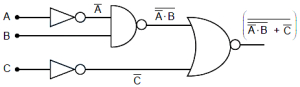
Consider the logic circuit with inputs $A, B, C$ and output $Y$. How many combinations of $A, B$ and $C$ give the output $Y=0$?
A
$8$
B
$5$
C
$7$
D
$1$
Solution
(C) The output $Y$ of the given logic circuit is determined as follows:
$1$. The input $A$ passes through a $NOT$ gate to become $\overline{A}$.
$2$. The inputs $\overline{A}$ and $B$ are fed into a $NAND$ gate,producing $\overline{\overline{A} \cdot B}$.
$3$. The input $C$ passes through a $NOT$ gate to become $\overline{C}$.
$4$. The outputs $\overline{\overline{A} \cdot B}$ and $\overline{C}$ are fed into a $NOR$ gate,resulting in $Y = \overline{(\overline{\overline{A} \cdot B}) + \overline{C}}$.
$5$. Using De Morgan's theorem,$Y = \overline{(\overline{\overline{A} \cdot B})} \cdot \overline{(\overline{C})} = (\overline{A} \cdot B) \cdot C = \overline{A} \cdot B \cdot C$.
$6$. The output $Y=1$ only when $\overline{A}=1, B=1, C=1$,which means $A=0, B=1, C=1$.
$7$. There are $2^3 = 8$ total possible combinations for inputs $A, B, C$.
$8$. Since $Y=1$ for only $1$ combination,the number of combinations for which $Y=0$ is $8 - 1 = 7$.
$1$. The input $A$ passes through a $NOT$ gate to become $\overline{A}$.
$2$. The inputs $\overline{A}$ and $B$ are fed into a $NAND$ gate,producing $\overline{\overline{A} \cdot B}$.
$3$. The input $C$ passes through a $NOT$ gate to become $\overline{C}$.
$4$. The outputs $\overline{\overline{A} \cdot B}$ and $\overline{C}$ are fed into a $NOR$ gate,resulting in $Y = \overline{(\overline{\overline{A} \cdot B}) + \overline{C}}$.
$5$. Using De Morgan's theorem,$Y = \overline{(\overline{\overline{A} \cdot B})} \cdot \overline{(\overline{C})} = (\overline{A} \cdot B) \cdot C = \overline{A} \cdot B \cdot C$.
$6$. The output $Y=1$ only when $\overline{A}=1, B=1, C=1$,which means $A=0, B=1, C=1$.
$7$. There are $2^3 = 8$ total possible combinations for inputs $A, B, C$.
$8$. Since $Y=1$ for only $1$ combination,the number of combinations for which $Y=0$ is $8 - 1 = 7$.
0 likesView Solution
37
PhysicsEasyMCQWBJEE · 2023
An interference pattern is obtained with two coherent sources of intensity ratio $n:1$. The ratio $\frac{I_{\text{Max}}-I_{\text{Min}}}{I_{\text{Max}}+I_{\text{Min}}}$ will be maximum if
A
$n=1$
B
$n=2$
C
$n=3$
D
$n=4$
Solution
(A) Given the intensity ratio $\frac{I_1}{I_2} = n$,so $I_1 = nI_2$.
$I_{\text{Max}} = (\sqrt{I_1} + \sqrt{I_2})^2 = (\sqrt{nI_2} + \sqrt{I_2})^2 = (\sqrt{n} + 1)^2 I_2$.
$I_{\text{Min}} = (\sqrt{I_1} - \sqrt{I_2})^2 = (\sqrt{nI_2} - \sqrt{I_2})^2 = (\sqrt{n} - 1)^2 I_2$.
Now,the ratio is:
$\frac{I_{\text{Max}} - I_{\text{Min}}}{I_{\text{Max}} + I_{\text{Min}}} = \frac{(\sqrt{n} + 1)^2 I_2 - (\sqrt{n} - 1)^2 I_2}{(\sqrt{n} + 1)^2 I_2 + (\sqrt{n} - 1)^2 I_2} = \frac{(\sqrt{n} + 1)^2 - (\sqrt{n} - 1)^2}{(\sqrt{n} + 1)^2 + (\sqrt{n} - 1)^2}$.
Expanding the terms:
$= \frac{(n + 1 + 2\sqrt{n}) - (n + 1 - 2\sqrt{n})}{(n + 1 + 2\sqrt{n}) + (n + 1 - 2\sqrt{n})} = \frac{4\sqrt{n}}{2(n + 1)} = \frac{2\sqrt{n}}{n + 1}$.
Let $f(n) = \frac{2\sqrt{n}}{n + 1}$. To find the maximum,we differentiate with respect to $n$ or observe that for $n=1$,$f(1) = \frac{2(1)}{1+1} = 1$,which is the maximum possible value for this expression since $(\sqrt{n}-1)^2 \ge 0$ implies $n+1 \ge 2\sqrt{n}$.
$I_{\text{Max}} = (\sqrt{I_1} + \sqrt{I_2})^2 = (\sqrt{nI_2} + \sqrt{I_2})^2 = (\sqrt{n} + 1)^2 I_2$.
$I_{\text{Min}} = (\sqrt{I_1} - \sqrt{I_2})^2 = (\sqrt{nI_2} - \sqrt{I_2})^2 = (\sqrt{n} - 1)^2 I_2$.
Now,the ratio is:
$\frac{I_{\text{Max}} - I_{\text{Min}}}{I_{\text{Max}} + I_{\text{Min}}} = \frac{(\sqrt{n} + 1)^2 I_2 - (\sqrt{n} - 1)^2 I_2}{(\sqrt{n} + 1)^2 I_2 + (\sqrt{n} - 1)^2 I_2} = \frac{(\sqrt{n} + 1)^2 - (\sqrt{n} - 1)^2}{(\sqrt{n} + 1)^2 + (\sqrt{n} - 1)^2}$.
Expanding the terms:
$= \frac{(n + 1 + 2\sqrt{n}) - (n + 1 - 2\sqrt{n})}{(n + 1 + 2\sqrt{n}) + (n + 1 - 2\sqrt{n})} = \frac{4\sqrt{n}}{2(n + 1)} = \frac{2\sqrt{n}}{n + 1}$.
Let $f(n) = \frac{2\sqrt{n}}{n + 1}$. To find the maximum,we differentiate with respect to $n$ or observe that for $n=1$,$f(1) = \frac{2(1)}{1+1} = 1$,which is the maximum possible value for this expression since $(\sqrt{n}-1)^2 \ge 0$ implies $n+1 \ge 2\sqrt{n}$.
0 likesView Solution
38
PhysicsEasyMCQWBJEE · 2023
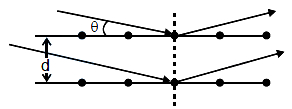
$X$-rays of wavelength $\lambda$ are reflected from parallel planes of atoms in a crystal with spacing $d$ between two planes,as shown in the figure. If the two reflected beams interfere constructively,then the condition for maxima will be (where $n$ is the order of the interference fringe):
A
$d \tan \theta = n \lambda$
B
$d \sin \theta = n \lambda$
C
$2 d \cos \theta = n \lambda$
D
$2 d \sin \theta = n \lambda$
Solution
(D) When $X$-rays are incident on parallel atomic planes with spacing $d$ at a glancing angle $\theta$,the path difference between the rays reflected from successive planes is given by $\Delta x = 2 d \sin \theta$.
For constructive interference (maxima),the path difference must be an integer multiple of the wavelength $\lambda$.
Therefore,the condition for maxima is $2 d \sin \theta = n \lambda$,where $n = 1, 2, 3, \dots$ is the order of the interference fringe. This is known as Bragg's Law.
For constructive interference (maxima),the path difference must be an integer multiple of the wavelength $\lambda$.
Therefore,the condition for maxima is $2 d \sin \theta = n \lambda$,where $n = 1, 2, 3, \dots$ is the order of the interference fringe. This is known as Bragg's Law.
0 likesView Solution
Vedclass Products
For Students
Vedclass Test Series
Mock tests in real WBJEE style covering Physics with performance analysis. 5-day free trial.
Start Free TrialFor Teachers
Exam Paper Generator
Generate Set A/B/C/D Physics papers from 7.5L+ questions in 2 minutes. 3 chapters free.
Try FreeFor Institutes
Online Exam Module
Run live WBJEE mock exams with unlimited students, 360° analytics & white-label branding.
See DemoFrequently Asked Questions
How many Physics questions are in WBJEE 2023?
There are 38 Physics questions from the WBJEE 2023 paper on Vedclass, each with a detailed step-by-step solution in English.
Are WBJEE 2023 Physics solutions available in English?
Yes. All solutions on this page are in English. You can also switch to English or Hindi using the language buttons above the questions.
Can I practice WBJEE 2023 Physics as a timed test?
Yes. Use the Vedclass Test Series to attempt a full WBJEE mock test covering Physics with time limits and instant score analysis.
Can teachers create Physics papers from WBJEE previous year questions?
Yes. The Vedclass Exam Paper Generator lets teachers mix WBJEE Physics questions and generate Set A/B/C/D papers in minutes.
For Teachers & Institutes
Build a Custom Physics Paper
Pick WBJEE 2023 Physics questions, set difficulty, and generate Set A/B/C/D in 2 minutes.