
PhysicsQ1–34 of 34 questions
Page 1 of 1 · English
1
PhysicsMediumMCQWBJEE · 2024
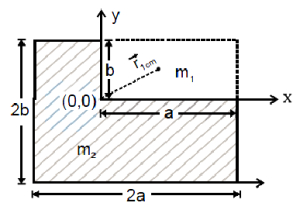
The position of the centre of mass of the uniform plate as shown in the figure is
A
$\left(-\frac{a}{2},-\frac{b}{2}\right)$
B
$\left(\frac{a}{8}, \frac{b}{8}\right)$
C
$\left(-\frac{b}{6},-\frac{a}{6}\right)$
D
$\left(-\frac{a}{6},-\frac{b}{6}\right)$
Solution
(D) Let the uniform plate be considered as a large rectangle of sides $2a$ and $2b$ with a smaller rectangle of sides $a$ and $b$ removed from it.
Let the mass of the removed rectangle be $m_1$ and the mass of the remaining shaded plate be $m_2$.
The area of the removed rectangle is $A_1 = a \times b$. Thus,$m_1 = \sigma ab$.
The area of the full rectangle is $A = 2a \times 2b = 4ab$. The area of the remaining plate is $A_2 = 4ab - ab = 3ab$. Thus,$m_2 = 3\sigma ab = 3m_1$.
The centre of mass of the full rectangle is at $(-a/2, -b/2)$ relative to the origin $(0,0)$.
The centre of mass of the removed rectangle is at $(a/2, b/2)$.
Using the principle of superposition for the centre of mass: $X_{cm} = \frac{m_2 x_2 + m_1 x_1}{m_2 + m_1} = 0$ (since the full rectangle's $CM$ is at the origin if we shift coordinates,but here we use the formula for a cavity).
For a cavity,the position of the centre of mass of the remaining part is given by $\vec{R} = \frac{M\vec{R}_{full} - m_1\vec{r}_1}{M - m_1}$.
Here,the full rectangle has its centre at $(-a/2, -b/2)$. Its mass is $M = 4m_1$.
The removed part has its centre at $(a/2, b/2)$.
$X_{cm} = \frac{4m_1(-a/2) - m_1(a/2)}{3m_1} = \frac{-2m_1a - 0.5m_1a}{3m_1} = \frac{-2.5a}{3} = -\frac{5a}{6}$.
Wait,re-evaluating based on the coordinate system provided: The origin $(0,0)$ is at the corner of the cavity.
The full rectangle (if it were complete) would span from $x = -a$ to $x = a$ and $y = -b$ to $y = b$. Its $CM$ is at $(0,0)$.
The removed rectangle spans $x = 0$ to $a$ and $y = 0$ to $b$. Its $CM$ is at $(a/2, b/2)$.
$X_{cm} = \frac{M(0) - m_1(a/2)}{3m_1} = -a/6$.
$Y_{cm} = \frac{M(0) - m_1(b/2)}{3m_1} = -b/6$.
Thus,the position is $(-\frac{a}{6}, -\frac{b}{6})$.
Let the mass of the removed rectangle be $m_1$ and the mass of the remaining shaded plate be $m_2$.
The area of the removed rectangle is $A_1 = a \times b$. Thus,$m_1 = \sigma ab$.
The area of the full rectangle is $A = 2a \times 2b = 4ab$. The area of the remaining plate is $A_2 = 4ab - ab = 3ab$. Thus,$m_2 = 3\sigma ab = 3m_1$.
The centre of mass of the full rectangle is at $(-a/2, -b/2)$ relative to the origin $(0,0)$.
The centre of mass of the removed rectangle is at $(a/2, b/2)$.
Using the principle of superposition for the centre of mass: $X_{cm} = \frac{m_2 x_2 + m_1 x_1}{m_2 + m_1} = 0$ (since the full rectangle's $CM$ is at the origin if we shift coordinates,but here we use the formula for a cavity).
For a cavity,the position of the centre of mass of the remaining part is given by $\vec{R} = \frac{M\vec{R}_{full} - m_1\vec{r}_1}{M - m_1}$.
Here,the full rectangle has its centre at $(-a/2, -b/2)$. Its mass is $M = 4m_1$.
The removed part has its centre at $(a/2, b/2)$.
$X_{cm} = \frac{4m_1(-a/2) - m_1(a/2)}{3m_1} = \frac{-2m_1a - 0.5m_1a}{3m_1} = \frac{-2.5a}{3} = -\frac{5a}{6}$.
Wait,re-evaluating based on the coordinate system provided: The origin $(0,0)$ is at the corner of the cavity.
The full rectangle (if it were complete) would span from $x = -a$ to $x = a$ and $y = -b$ to $y = b$. Its $CM$ is at $(0,0)$.
The removed rectangle spans $x = 0$ to $a$ and $y = 0$ to $b$. Its $CM$ is at $(a/2, b/2)$.
$X_{cm} = \frac{M(0) - m_1(a/2)}{3m_1} = -a/6$.
$Y_{cm} = \frac{M(0) - m_1(b/2)}{3m_1} = -b/6$.
Thus,the position is $(-\frac{a}{6}, -\frac{b}{6})$.
0 likesView Solution
2
PhysicsEasyMCQWBJEE · 2024
$A$ satellite of mass $m$ rotates around the Earth in a circular orbit of radius $R$. If the angular momentum of the satellite is $J$,then its kinetic energy $(K)$ and the total energy $(E)$ of the satellite are:
A
$K=\frac{J^2}{m R^2}, E=-\frac{J^2}{2 m R^2}$
B
$K=\frac{J^2}{2 m R^2}, E=-\frac{J^2}{2 m R^2}$
C
$K=\frac{J^2}{2 m R^2}, E=-\frac{J^2}{m R^2}$
D
$K=\frac{J^2}{2 m R^2}, E=\frac{J^2}{m R^2}$
Solution
(B) The moment of inertia of a satellite of mass $m$ at a distance $R$ from the center of the Earth is $I = m R^2$.
The kinetic energy $(K)$ of the satellite in terms of angular momentum $(J)$ is given by $K = \frac{J^2}{2 I}$.
Substituting $I = m R^2$,we get $K = \frac{J^2}{2 m R^2}$.
For a satellite in a circular orbit,the total energy $(E)$ is related to the kinetic energy $(K)$ by the relation $E = -K$.
Therefore,$E = -\frac{J^2}{2 m R^2}$.
Thus,the correct option is $B$.
The kinetic energy $(K)$ of the satellite in terms of angular momentum $(J)$ is given by $K = \frac{J^2}{2 I}$.
Substituting $I = m R^2$,we get $K = \frac{J^2}{2 m R^2}$.
For a satellite in a circular orbit,the total energy $(E)$ is related to the kinetic energy $(K)$ by the relation $E = -K$.
Therefore,$E = -\frac{J^2}{2 m R^2}$.
Thus,the correct option is $B$.
0 likesView Solution
3
PhysicsEasyMCQWBJEE · 2024
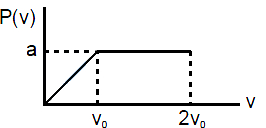
The speed distribution for a sample of $N$ gas particles is shown below. $P(v) = 0$ for $v > 2 v_0$. How many particles have speeds between $1.2 v_0$ and $1.8 v_0$ (in $N$)?
A
$0.2$
B
$0.4$
C
$0.6$
D
$0.8$
Solution
(B) The total area under the $P(v)$ versus $v$ curve represents the total number of particles $N$.
From the graph,the area is a triangle from $0$ to $v_0$ and a rectangle from $v_0$ to $2 v_0$.
Area $= \frac{1}{2} \times v_0 \times a + (2 v_0 - v_0) \times a = \frac{1}{2} v_0 a + v_0 a = \frac{3}{2} v_0 a$.
Since the total area equals $N$,we have $\frac{3}{2} v_0 a = N$,which implies $v_0 a = \frac{2}{3} N$.
We need to find the number of particles with speeds between $1.2 v_0$ and $1.8 v_0$. This corresponds to the area under the curve between these limits.
Since $P(v) = a$ for $v > v_0$,the area is a rectangle with width $(1.8 v_0 - 1.2 v_0) = 0.6 v_0$ and height $a$.
Number of particles $= 0.6 v_0 \times a = 0.6 (v_0 a) = 0.6 \times (\frac{2}{3} N) = 0.4 N$.
From the graph,the area is a triangle from $0$ to $v_0$ and a rectangle from $v_0$ to $2 v_0$.
Area $= \frac{1}{2} \times v_0 \times a + (2 v_0 - v_0) \times a = \frac{1}{2} v_0 a + v_0 a = \frac{3}{2} v_0 a$.
Since the total area equals $N$,we have $\frac{3}{2} v_0 a = N$,which implies $v_0 a = \frac{2}{3} N$.
We need to find the number of particles with speeds between $1.2 v_0$ and $1.8 v_0$. This corresponds to the area under the curve between these limits.
Since $P(v) = a$ for $v > v_0$,the area is a rectangle with width $(1.8 v_0 - 1.2 v_0) = 0.6 v_0$ and height $a$.
Number of particles $= 0.6 v_0 \times a = 0.6 (v_0 a) = 0.6 \times (\frac{2}{3} N) = 0.4 N$.
0 likesView Solution
4
PhysicsDifficultMCQWBJEE · 2024
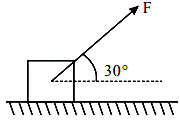
As shown in the figure,a block of mass $10 \ kg$ lying on a horizontal surface is pulled by a force $F$ acting at an angle $30^{\circ}$ with the horizontal. For $\mu_{s} = 0.25$,the block will just start to move for the value of $F$: [Given $g = 10 \ ms^{-2}$] (in $N$)
A
$25.2$
B
$20$
C
$33.3$
D
$33.7$
Solution
(A) For the block to just start moving,the horizontal component of the applied force $F$ must be equal to the limiting friction force.
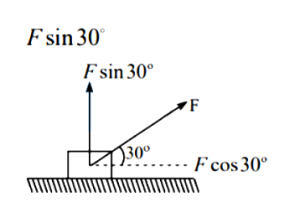
$1$. Resolve the force $F$ into components:
Horizontal component: $F_{x} = F \cos 30^{\circ}$
Vertical component: $F_{y} = F \sin 30^{\circ}$
$2$. Determine the normal reaction $N$:
The vertical forces acting on the block are the weight $mg$ downwards,the normal reaction $N$ upwards,and the vertical component of the applied force $F \sin 30^{\circ}$ upwards.
$N + F \sin 30^{\circ} = mg$
$N = mg - F \sin 30^{\circ}$
Given $m = 10 \ kg$ and $g = 10 \ ms^{-2}$,so $mg = 100 \ N$.
$N = 100 - F \sin 30^{\circ} = 100 - 0.5F$
$3$. Apply the condition for motion:
The limiting friction is $f_{L} = \mu_{s} N$.
The block starts to move when $F \cos 30^{\circ} = \mu_{s} N$.
$F \cos 30^{\circ} = 0.25(100 - 0.5F)$
$F \frac{\sqrt{3}}{2} = 25 - 0.125F$
$F(0.866 + 0.125) = 25$
$F(0.991) = 25$
$F = \frac{25}{0.991} \approx 25.22 \ N$
Thus,the block will just start to move for $F \approx 25.2 \ N$.
$1$. Resolve the force $F$ into components:
Horizontal component: $F_{x} = F \cos 30^{\circ}$
Vertical component: $F_{y} = F \sin 30^{\circ}$
$2$. Determine the normal reaction $N$:
The vertical forces acting on the block are the weight $mg$ downwards,the normal reaction $N$ upwards,and the vertical component of the applied force $F \sin 30^{\circ}$ upwards.
$N + F \sin 30^{\circ} = mg$
$N = mg - F \sin 30^{\circ}$
Given $m = 10 \ kg$ and $g = 10 \ ms^{-2}$,so $mg = 100 \ N$.
$N = 100 - F \sin 30^{\circ} = 100 - 0.5F$
$3$. Apply the condition for motion:
The limiting friction is $f_{L} = \mu_{s} N$.
The block starts to move when $F \cos 30^{\circ} = \mu_{s} N$.
$F \cos 30^{\circ} = 0.25(100 - 0.5F)$
$F \frac{\sqrt{3}}{2} = 25 - 0.125F$
$F(0.866 + 0.125) = 25$
$F(0.991) = 25$
$F = \frac{25}{0.991} \approx 25.22 \ N$
Thus,the block will just start to move for $F \approx 25.2 \ N$.
0 likesView Solution
5
PhysicsMediumMCQWBJEE · 2024
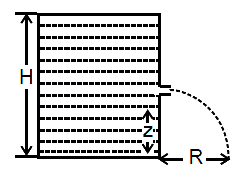
Water is filled in a cylindrical vessel of height $H$. $A$ hole is made at height $z$ from the bottom,as shown in the figure. The value of $z$ for which the range $(R)$ of the emerging water through the hole will be maximum is:
A
$z=\frac{H}{4}$
B
$z=\frac{H}{2}$
C
$z=\frac{H}{8}$
D
$z=\frac{H}{3}$
Solution
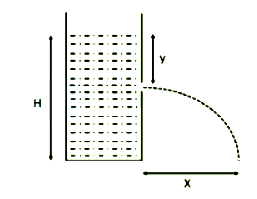
(B) Let the height of the water level above the hole be $h = H - z$. The velocity of efflux is $v = \sqrt{2gh}$.
The time taken for the water to reach the ground is $t = \sqrt{\frac{2z}{g}}$.
The horizontal range $R$ is given by $R = v \cdot t = \sqrt{2g(H-z)} \cdot \sqrt{\frac{2z}{g}} = 2\sqrt{z(H-z)}$.
To maximize $R$,we maximize $R^2 = 4(zH - z^2)$.
Differentiating with respect to $z$ and setting to zero:
$\frac{d}{dz}(4zH - 4z^2) = 4H - 8z = 0$.
$8z = 4H \Rightarrow z = \frac{H}{2}$.
Thus,the range is maximum when the hole is at half the height of the vessel.
The time taken for the water to reach the ground is $t = \sqrt{\frac{2z}{g}}$.
The horizontal range $R$ is given by $R = v \cdot t = \sqrt{2g(H-z)} \cdot \sqrt{\frac{2z}{g}} = 2\sqrt{z(H-z)}$.
To maximize $R$,we maximize $R^2 = 4(zH - z^2)$.
Differentiating with respect to $z$ and setting to zero:
$\frac{d}{dz}(4zH - 4z^2) = 4H - 8z = 0$.
$8z = 4H \Rightarrow z = \frac{H}{2}$.
Thus,the range is maximum when the hole is at half the height of the vessel.
0 likesView Solution
6
PhysicsMediumMCQWBJEE · 2024
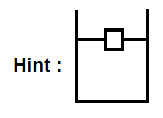
$A$ body floats with $\frac{1}{n}$ of its volume outside of water. If the body is pushed to a depth $h$ inside the water and released,it will come to the surface after time $t$. Then:
A
$t \propto \sqrt{n}$
B
$t \propto n$
C
$t \propto \sqrt{n+1}$
D
$t \propto \sqrt{n-1}$
Solution
(D) Let $V$ be the total volume of the body,$d$ be its density,and $\sigma$ be the density of water.
For a floating body,the weight equals the buoyant force: $Vdg = V(1 - \frac{1}{n})\sigma g$.
Thus,$d = (\frac{n-1}{n})\sigma$.
When the body is submerged,the net upward force $F_{net}$ is $F_B - mg = V\sigma g - Vdg = V\sigma g - V(\frac{n-1}{n})\sigma g = V\sigma g (1 - \frac{n-1}{n}) = V\sigma g (\frac{1}{n})$.
The acceleration $a$ is given by $a = \frac{F_{net}}{m} = \frac{V\sigma g / n}{Vd} = \frac{\sigma g / n}{(\frac{n-1}{n})\sigma} = \frac{g}{n-1}$.
Using the kinematic equation $h = \frac{1}{2}at^2$,we have $h = \frac{1}{2} (\frac{g}{n-1}) t^2$.
Solving for $t$,we get $t = \sqrt{\frac{2h(n-1)}{g}}$.
Therefore,$t \propto \sqrt{n-1}$.
For a floating body,the weight equals the buoyant force: $Vdg = V(1 - \frac{1}{n})\sigma g$.
Thus,$d = (\frac{n-1}{n})\sigma$.
When the body is submerged,the net upward force $F_{net}$ is $F_B - mg = V\sigma g - Vdg = V\sigma g - V(\frac{n-1}{n})\sigma g = V\sigma g (1 - \frac{n-1}{n}) = V\sigma g (\frac{1}{n})$.
The acceleration $a$ is given by $a = \frac{F_{net}}{m} = \frac{V\sigma g / n}{Vd} = \frac{\sigma g / n}{(\frac{n-1}{n})\sigma} = \frac{g}{n-1}$.
Using the kinematic equation $h = \frac{1}{2}at^2$,we have $h = \frac{1}{2} (\frac{g}{n-1}) t^2$.
Solving for $t$,we get $t = \sqrt{\frac{2h(n-1)}{g}}$.
Therefore,$t \propto \sqrt{n-1}$.
0 likesView Solution
7
PhysicsMediumMCQWBJEE · 2024
$A$ metal plate of area $10^{-2} \,m^2$ rests on a layer of castor oil,$2 \times 10^{-3} \,m$ thick,whose coefficient of viscosity is $1.55 \,Ns\, m^{-2}$. The approximate horizontal force required to move the plate with a uniform speed of $3 \times 10^{-2} \,ms^{-1}$ is (in $N$)
A
$0.6718$
B
$0.2325$
C
$0.2022$
D
$0.6615$
Solution
(B) The viscous force $F$ acting on the plate is given by Newton's law of viscosity: $F = \eta A \frac{dv}{dx}$.
Here,$\eta = 1.55 \,Ns\, m^{-2}$ is the coefficient of viscosity,$A = 10^{-2} \,m^2$ is the area of the plate,$v = 3 \times 10^{-2} \,ms^{-1}$ is the velocity,and $h = dx = 2 \times 10^{-3} \,m$ is the thickness of the oil layer.
Substituting the values: $F = 1.55 \times 10^{-2} \times \frac{3 \times 10^{-2}}{2 \times 10^{-3}}$.
$F = 1.55 \times 10^{-2} \times 1.5 \times 10^1$.
$F = 1.55 \times 1.5 \times 10^{-1} = 2.325 \times 10^{-1} = 0.2325 \,N$.
Here,$\eta = 1.55 \,Ns\, m^{-2}$ is the coefficient of viscosity,$A = 10^{-2} \,m^2$ is the area of the plate,$v = 3 \times 10^{-2} \,ms^{-1}$ is the velocity,and $h = dx = 2 \times 10^{-3} \,m$ is the thickness of the oil layer.
Substituting the values: $F = 1.55 \times 10^{-2} \times \frac{3 \times 10^{-2}}{2 \times 10^{-3}}$.
$F = 1.55 \times 10^{-2} \times 1.5 \times 10^1$.
$F = 1.55 \times 1.5 \times 10^{-1} = 2.325 \times 10^{-1} = 0.2325 \,N$.
0 likesView Solution
8
PhysicsEasyMCQWBJEE · 2024
The elastic potential energy of a strained body is
A
$\frac{1}{2} \times \text{stress} \times \text{strain}$
B
$\frac{1}{2} \times \text{stress} \times \text{strain} \times \text{volume of the body}$
C
$\frac{1}{2} \times \text{stress} \times \text{strain} \times \text{area of the body}$
D
$\text{stress} \times \text{strain} \times \text{volume of the body}$
Solution
(B) The elastic potential energy stored in a strained body is defined as the work done in deforming the body.
For a material obeying Hooke's Law,the energy density (energy per unit volume) is given by $u = \frac{1}{2} \times \text{stress} \times \text{strain}$.
To find the total elastic potential energy $(U)$,we multiply the energy density by the total volume $(V)$ of the body.
Therefore,$U = u \times V = \frac{1}{2} \times \text{stress} \times \text{strain} \times V$.
For a material obeying Hooke's Law,the energy density (energy per unit volume) is given by $u = \frac{1}{2} \times \text{stress} \times \text{strain}$.
To find the total elastic potential energy $(U)$,we multiply the energy density by the total volume $(V)$ of the body.
Therefore,$U = u \times V = \frac{1}{2} \times \text{stress} \times \text{strain} \times V$.
0 likesView Solution
9
PhysicsDifficultMCQWBJEE · 2024
The position vector of a particle of mass $m$ moving with a constant velocity $\vec{v} = v \hat{i}$ is given by $\vec{r} = x(t) \hat{i} + b \hat{j}$,where $b$ is a constant. At an instant,$\vec{r}$ makes an angle $\theta$ with the $x$-axis. The variation of the magnitude of the angular momentum $|\vec{L}|$ of the particle about the origin with $\theta$ will be:
A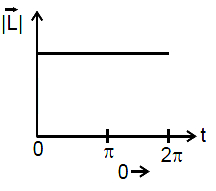
$A$
B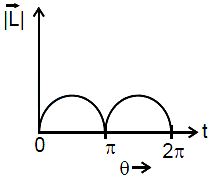
$B$
C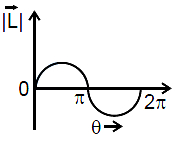
$C$
D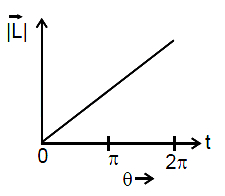
$D$
Solution
(A) The angular momentum $\vec{L}$ of a particle about the origin is given by $\vec{L} = \vec{r} \times \vec{p} = \vec{r} \times (m\vec{v})$.
Given $\vec{r} = x(t) \hat{i} + b \hat{j}$ and $\vec{v} = v \hat{i}$.
$\vec{L} = (x(t) \hat{i} + b \hat{j}) \times (m v \hat{i}) = x(t) m v (\hat{i} \times \hat{i}) + b m v (\hat{j} \times \hat{i})$.
Since $\hat{i} \times \hat{i} = 0$ and $\hat{j} \times \hat{i} = -\hat{k}$,we get $\vec{L} = -b m v \hat{k}$.
The magnitude of the angular momentum is $|\vec{L}| = | -b m v | = b m v$.
Since $b$,$m$,and $v$ are all constants,the magnitude of the angular momentum $|\vec{L}|$ is constant and independent of the angle $\theta$.
Therefore,the graph of $|\vec{L}|$ versus $\theta$ is a horizontal straight line.
Given $\vec{r} = x(t) \hat{i} + b \hat{j}$ and $\vec{v} = v \hat{i}$.
$\vec{L} = (x(t) \hat{i} + b \hat{j}) \times (m v \hat{i}) = x(t) m v (\hat{i} \times \hat{i}) + b m v (\hat{j} \times \hat{i})$.
Since $\hat{i} \times \hat{i} = 0$ and $\hat{j} \times \hat{i} = -\hat{k}$,we get $\vec{L} = -b m v \hat{k}$.
The magnitude of the angular momentum is $|\vec{L}| = | -b m v | = b m v$.
Since $b$,$m$,and $v$ are all constants,the magnitude of the angular momentum $|\vec{L}|$ is constant and independent of the angle $\theta$.
Therefore,the graph of $|\vec{L}|$ versus $\theta$ is a horizontal straight line.
0 likesView Solution
10
PhysicsMediumMCQWBJEE · 2024
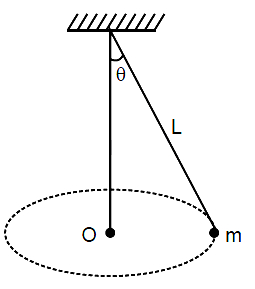
$A$ small ball of mass $m$ is suspended from the ceiling by a string of length $L$. The ball moves along a horizontal circle with constant angular velocity $\omega$,as shown in the figure. The torque about the centre $(O)$ of the horizontal circle is
A
$m g L \sin \theta$
B
$m g L$
C
$0$
D
$m g L \cos \theta$
Solution
(C) The forces acting on the ball are the tension $T$ in the string and the gravitational force $mg$ acting downwards.
Let the centre of the horizontal circle be $O$. The position vector $\vec{r}$ of the ball relative to $O$ lies in the horizontal plane.
The gravitational force $\vec{F}_g = m\vec{g}$ acts vertically downwards through the ball.
The torque $\vec{\tau}$ about point $O$ is given by $\vec{\tau} = \vec{r} \times \vec{F}$.
Since the force of gravity $\vec{F}_g$ is parallel to the vertical axis passing through $O$,and the position vector $\vec{r}$ is horizontal,the torque due to gravity is $\vec{\tau}_g = \vec{r} \times (m\vec{g})$. The magnitude is $mgr \sin(90^\circ) = mgr$,but the direction is tangential to the circle.
However,the tension force $\vec{T}$ acts along the string towards the point of suspension. The line of action of the tension force passes through the point of suspension,but not through $O$.
Crucially,for a particle moving in a horizontal circle with constant angular velocity,the net torque about the centre $O$ must be zero because the angular momentum $\vec{L} = \vec{r} \times \vec{p}$ is constant in magnitude and direction (the vector $\vec{L}$ points along the vertical axis). Since $\frac{d\vec{L}}{dt} = \vec{\tau}_{net} = 0$,the net torque about $O$ is zero.
Let the centre of the horizontal circle be $O$. The position vector $\vec{r}$ of the ball relative to $O$ lies in the horizontal plane.
The gravitational force $\vec{F}_g = m\vec{g}$ acts vertically downwards through the ball.
The torque $\vec{\tau}$ about point $O$ is given by $\vec{\tau} = \vec{r} \times \vec{F}$.
Since the force of gravity $\vec{F}_g$ is parallel to the vertical axis passing through $O$,and the position vector $\vec{r}$ is horizontal,the torque due to gravity is $\vec{\tau}_g = \vec{r} \times (m\vec{g})$. The magnitude is $mgr \sin(90^\circ) = mgr$,but the direction is tangential to the circle.
However,the tension force $\vec{T}$ acts along the string towards the point of suspension. The line of action of the tension force passes through the point of suspension,but not through $O$.
Crucially,for a particle moving in a horizontal circle with constant angular velocity,the net torque about the centre $O$ must be zero because the angular momentum $\vec{L} = \vec{r} \times \vec{p}$ is constant in magnitude and direction (the vector $\vec{L}$ points along the vertical axis). Since $\frac{d\vec{L}}{dt} = \vec{\tau}_{net} = 0$,the net torque about $O$ is zero.
0 likesView Solution
11
PhysicsEasyMCQWBJEE · 2024
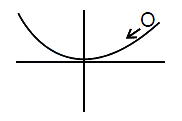
$A$ small sphere of mass $m$ and radius $r$ slides down the smooth surface of a large hemispherical bowl of radius $R$. If the sphere starts sliding from rest,the total kinetic energy of the sphere at the lowest point $A$ of the bowl will be [given,moment of inertia of sphere $= \frac{2}{5} mr^2$].
A
$mg(R-r)$
B
$\frac{7}{10} mg(R-r)$
C
$\frac{2}{7} mg(R-r)$
D
$\frac{10}{7} mg(R-r)$
Solution
(A) Since the surface of the bowl is smooth,there is no friction to cause the sphere to roll. The sphere will simply slide down the surface.
By the law of conservation of mechanical energy,the loss in potential energy is equal to the gain in kinetic energy.
The change in height of the center of mass of the sphere is $h = R - r$.
Potential energy lost = $mgh = mg(R - r)$.
Since the sphere is sliding (not rolling),its total kinetic energy is purely translational: $K = \frac{1}{2} mv^2$.
Therefore,the total kinetic energy at the lowest point is $K = mg(R - r)$.
By the law of conservation of mechanical energy,the loss in potential energy is equal to the gain in kinetic energy.
The change in height of the center of mass of the sphere is $h = R - r$.
Potential energy lost = $mgh = mg(R - r)$.
Since the sphere is sliding (not rolling),its total kinetic energy is purely translational: $K = \frac{1}{2} mv^2$.
Therefore,the total kinetic energy at the lowest point is $K = mg(R - r)$.
0 likesView Solution
12
PhysicsMediumMCQWBJEE · 2024
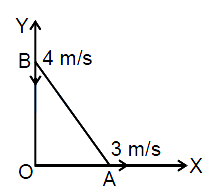
$A$ uniform rod $AB$ of length $1 \ m$ and mass $4 \ kg$ is sliding along two mutually perpendicular frictionless walls $OX$ and $OY$. The velocity of the two ends of the rod $A$ and $B$ are $3 \ m/s$ and $4 \ m/s$ respectively,as shown in the figure. Which of the following statement$(s)$ is/are correct?
A
The velocity of the centre of mass of the rod is $2.5 \ m/s$.
B
Rotational kinetic energy of the rod is $\frac{25}{6} \ J$.
C
The angular velocity of the rod is $5 \ rad/s$ clockwise.
D
The angular velocity of the rod is $5 \ rad/s$ anticlockwise.
Solution
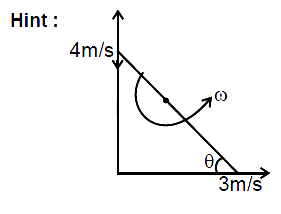
(B, C) Let the rod make an angle $\theta$ with the $OX$ axis. The velocity of end $A$ is $v_A = 3 \ m/s$ along $OX$ and the velocity of end $B$ is $v_B = 4 \ m/s$ along $OY$ (downwards).
Using the condition that the length of the rod is constant,the component of velocity along the rod must be the same for both ends:
$v_A \cos \theta = v_B \sin \theta \implies 3 \cos \theta = 4 \sin \theta \implies \tan \theta = \frac{3}{4}$.
Thus,$\sin \theta = \frac{3}{5}$ and $\cos \theta = \frac{4}{5}$.
The angular velocity $\omega$ is given by $\omega = \frac{v_A \sin \theta + v_B \cos \theta}{\ell} = \frac{3(3/5) + 4(4/5)}{1} = \frac{9/5 + 16/5}{1} = \frac{25}{5} = 5 \ rad/s$.
Since the rod is rotating such that $A$ moves right and $B$ moves down,the rotation is clockwise.
The rotational kinetic energy is $(KE)_{rot} = \frac{1}{2} I \omega^2 = \frac{1}{2} (\frac{1}{12} m \ell^2) \omega^2 = \frac{1}{2} \times \frac{1}{12} \times 4 \times (1)^2 \times (5)^2 = \frac{1}{24} \times 4 \times 25 = \frac{25}{6} \ J$.
Both statements $B$ and $C$ are correct.
Using the condition that the length of the rod is constant,the component of velocity along the rod must be the same for both ends:
$v_A \cos \theta = v_B \sin \theta \implies 3 \cos \theta = 4 \sin \theta \implies \tan \theta = \frac{3}{4}$.
Thus,$\sin \theta = \frac{3}{5}$ and $\cos \theta = \frac{4}{5}$.
The angular velocity $\omega$ is given by $\omega = \frac{v_A \sin \theta + v_B \cos \theta}{\ell} = \frac{3(3/5) + 4(4/5)}{1} = \frac{9/5 + 16/5}{1} = \frac{25}{5} = 5 \ rad/s$.
Since the rod is rotating such that $A$ moves right and $B$ moves down,the rotation is clockwise.
The rotational kinetic energy is $(KE)_{rot} = \frac{1}{2} I \omega^2 = \frac{1}{2} (\frac{1}{12} m \ell^2) \omega^2 = \frac{1}{2} \times \frac{1}{12} \times 4 \times (1)^2 \times (5)^2 = \frac{1}{24} \times 4 \times 25 = \frac{25}{6} \ J$.
Both statements $B$ and $C$ are correct.
0 likesView Solution
13
PhysicsEasyMCQWBJEE · 2024
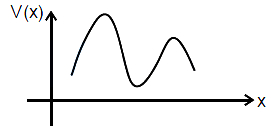
The following figure shows the variation of potential energy $V(x)$ of a particle with distance $x$. The particle has
A
Two equilibrium points,one stable another unstable
B
Two equilibrium points,both stable
C
Three equilibrium points,one stable two unstable
D
Three equilibrium points,two stable one unstable
Solution
(C) Equilibrium points occur where the force $F = -\frac{dV}{dx} = 0$,which corresponds to the points where the slope of the $V(x)$ versus $x$ graph is zero (i.e.,the peaks and valleys of the curve).
Looking at the graph,there are three such points: two local maxima (peaks) and one local minimum (valley).
$1$. At a local minimum,the potential energy is at a minimum,so $\frac{d^2V}{dx^2} > 0$. This represents a stable equilibrium point.
$2$. At a local maximum,the potential energy is at a maximum,so $\frac{d^2V}{dx^2} < 0$. This represents an unstable equilibrium point.
Since there are two peaks (unstable) and one valley (stable),there are three equilibrium points in total: one stable and two unstable.
Looking at the graph,there are three such points: two local maxima (peaks) and one local minimum (valley).
$1$. At a local minimum,the potential energy is at a minimum,so $\frac{d^2V}{dx^2} > 0$. This represents a stable equilibrium point.
$2$. At a local maximum,the potential energy is at a maximum,so $\frac{d^2V}{dx^2} < 0$. This represents an unstable equilibrium point.
Since there are two peaks (unstable) and one valley (stable),there are three equilibrium points in total: one stable and two unstable.
0 likesView Solution
14
PhysicsEasyMCQWBJEE · 2024
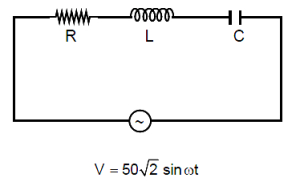
In a series $LCR$ circuit,the $rms$ voltage across the resistor and the capacitor are $30 \ V$ and $90 \ V$ respectively. If the applied voltage is $V = 50 \sqrt{2} \sin \omega t$,then the peak voltage across the inductor is
A
$70 \ V$
B
$50 \ V$
C
$70 \sqrt{2} \ V$
D
$50 \sqrt{2} \ V$
Solution
(D) The applied voltage is given by $V = 50 \sqrt{2} \sin \omega t$. The peak voltage is $V_0 = 50 \sqrt{2} \ V$,so the $rms$ voltage is $V_{rms} = \frac{V_0}{\sqrt{2}} = 50 \ V$.
In a series $LCR$ circuit,the relationship between the $rms$ voltages is given by $V_{rms}^2 = V_R^2 + (V_L - V_C)^2$.
Given: $V_R = 30 \ V$,$V_C = 90 \ V$,and $V_{rms} = 50 \ V$.
Substituting the values: $50^2 = 30^2 + (V_L - 90)^2$.
$2500 = 900 + (V_L - 90)^2$.
$(V_L - 90)^2 = 1600$.
$V_L - 90 = \pm 40$.
Case $1$: $V_L = 90 + 40 = 130 \ V$.
Case $2$: $V_L = 90 - 40 = 50 \ V$.
Assuming the standard case where the inductor voltage is the peak value asked,we look for the peak voltage across the inductor. The $rms$ voltage $V_L$ is $50 \ V$ or $130 \ V$. The peak voltage is $(V_L)_{peak} = V_L \sqrt{2}$.
For $V_L = 50 \ V$,$(V_L)_{peak} = 50 \sqrt{2} \ V$.
In a series $LCR$ circuit,the relationship between the $rms$ voltages is given by $V_{rms}^2 = V_R^2 + (V_L - V_C)^2$.
Given: $V_R = 30 \ V$,$V_C = 90 \ V$,and $V_{rms} = 50 \ V$.
Substituting the values: $50^2 = 30^2 + (V_L - 90)^2$.
$2500 = 900 + (V_L - 90)^2$.
$(V_L - 90)^2 = 1600$.
$V_L - 90 = \pm 40$.
Case $1$: $V_L = 90 + 40 = 130 \ V$.
Case $2$: $V_L = 90 - 40 = 50 \ V$.
Assuming the standard case where the inductor voltage is the peak value asked,we look for the peak voltage across the inductor. The $rms$ voltage $V_L$ is $50 \ V$ or $130 \ V$. The peak voltage is $(V_L)_{peak} = V_L \sqrt{2}$.
For $V_L = 50 \ V$,$(V_L)_{peak} = 50 \sqrt{2} \ V$.
0 likesView Solution
15
PhysicsDifficultMCQWBJEE · 2024
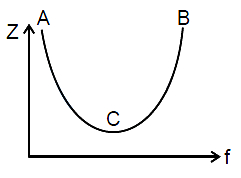
The variation of impedance $Z$ of a series $\text{LCR}$ circuit with the frequency $f$ of the source is shown in the figure. Which of the following statement$(s)$ is/are true?
A
The impedance $Z$ is inductive in the portion $AC$.
B
The impedance $Z$ is capacitive in the portion $BC$.
C
The impedance $Z$ is inductive in the portion $BC$.
D
The impedance $Z$ is capacitive in the portion $AC$.
Solution
(C, D) In a series $\text{LCR}$ circuit,the impedance $Z$ is given by $Z = \sqrt{R^2 + (X_L - X_C)^2}$.
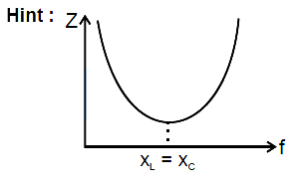
At resonance (point $C$),$X_L = X_C$,so $Z$ is minimum.
For frequencies lower than the resonant frequency (portion $AC$),$X_C > X_L$,which means the circuit is capacitive.
For frequencies higher than the resonant frequency (portion $BC$),$X_L > X_C$,which means the circuit is inductive.
Therefore,the impedance $Z$ is capacitive in the portion $AC$ and inductive in the portion $BC$.
At resonance (point $C$),$X_L = X_C$,so $Z$ is minimum.
For frequencies lower than the resonant frequency (portion $AC$),$X_C > X_L$,which means the circuit is capacitive.
For frequencies higher than the resonant frequency (portion $BC$),$X_L > X_C$,which means the circuit is inductive.
Therefore,the impedance $Z$ is capacitive in the portion $AC$ and inductive in the portion $BC$.
0 likesView Solution
16
PhysicsEasyMCQWBJEE · 2024
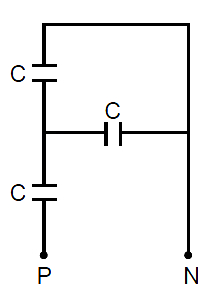
The equivalent capacitance of the combination of capacitors shown in the figure between the points $P$ and $N$ is:
A
$3 C$
B
$\frac{2 C}{3}$
C
$\frac{4 C}{5}$
D
$\frac{3}{2} C$
Solution
(D) In the given circuit,the two capacitors on the left are connected in series. Let their equivalent capacitance be $C_s$.
$C_s = \frac{C \times C}{C + C} = \frac{C^2}{2C} = \frac{C}{2}$.
Now,this equivalent capacitor $C_s$ is in parallel with the third capacitor $C$ connected between the middle junction and point $N$.
Therefore,the total equivalent capacitance $C_{eq}$ between points $P$ and $N$ is:
$C_{eq} = C_s + C = \frac{C}{2} + C = \frac{3C}{2}$.
$C_s = \frac{C \times C}{C + C} = \frac{C^2}{2C} = \frac{C}{2}$.
Now,this equivalent capacitor $C_s$ is in parallel with the third capacitor $C$ connected between the middle junction and point $N$.
Therefore,the total equivalent capacitance $C_{eq}$ between points $P$ and $N$ is:
$C_{eq} = C_s + C = \frac{C}{2} + C = \frac{3C}{2}$.
0 likesView Solution
17
PhysicsMediumMCQWBJEE · 2024
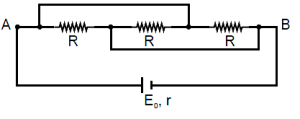
Consider a circuit where a cell of emf $E_0$ and internal resistance $r$ is connected across the terminals $A$ and $B$ as shown in the figure. The value of $R$ for which the power generated in the circuit is maximum is given by
A
$R = r$
B
$R = 2r$
C
$R = 3r$
D
$R = \frac{r}{3}$
Solution
(C) According to the maximum power transfer theorem,the power delivered to an external circuit is maximum when the external resistance $R_{\text{ext}}$ is equal to the internal resistance $r$ of the cell,i.e.,$R_{\text{ext}} = r$.
First,we determine the equivalent external resistance $R_{\text{ext}}$ between terminals $A$ and $B$. The circuit consists of three resistors of resistance $R$ connected in parallel.
For three resistors $R$ in parallel,the equivalent resistance $R_{\text{ext}}$ is given by:
$\frac{1}{R_{\text{ext}}} = \frac{1}{R} + \frac{1}{R} + \frac{1}{R} = \frac{3}{R}$
Therefore,$R_{\text{ext}} = \frac{R}{3}$.
Setting $R_{\text{ext}} = r$ for maximum power transfer:
$\frac{R}{3} = r$
$R = 3r$
Thus,the value of $R$ for which the power is maximum is $3r$.
First,we determine the equivalent external resistance $R_{\text{ext}}$ between terminals $A$ and $B$. The circuit consists of three resistors of resistance $R$ connected in parallel.
For three resistors $R$ in parallel,the equivalent resistance $R_{\text{ext}}$ is given by:
$\frac{1}{R_{\text{ext}}} = \frac{1}{R} + \frac{1}{R} + \frac{1}{R} = \frac{3}{R}$
Therefore,$R_{\text{ext}} = \frac{R}{3}$.
Setting $R_{\text{ext}} = r$ for maximum power transfer:
$\frac{R}{3} = r$
$R = 3r$
Thus,the value of $R$ for which the power is maximum is $3r$.
0 likesView Solution
18
PhysicsDifficultMCQWBJEE · 2024
$A$ beam of light of wavelength $\lambda$ falls on a metal having work function $\phi$ placed in a magnetic field $B$. The most energetic electrons,moving perpendicular to the field,are bent in circular arcs of radius $R$. If the experiment is performed for different values of $\lambda$,then the $B^2$ vs. $\frac{1}{\lambda}$ graph will look like (keeping all other quantities constant):
A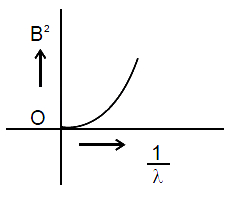
B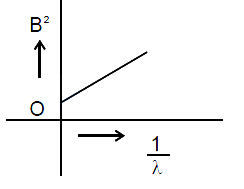
C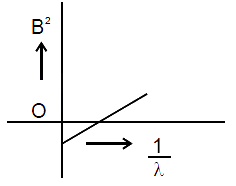
D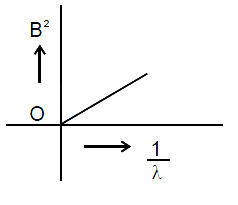
Solution
(C) According to Einstein's photoelectric equation,the maximum kinetic energy $K$ of the emitted electrons is given by:
$K = \frac{hc}{\lambda} - \phi$
When an electron of charge $q$ and mass $m$ moves perpendicular to a magnetic field $B$,it follows a circular path of radius $R$ given by:
$R = \frac{mv}{qB} = \frac{\sqrt{2mK}}{qB}$
Squaring both sides,we get:
$R^2 = \frac{2mK}{q^2 B^2}$
Rearranging for $B^2$:
$B^2 = \frac{2mK}{q^2 R^2}$
Substituting the expression for $K$:
$B^2 = \frac{2m}{q^2 R^2} \left( \frac{hc}{\lambda} - \phi \right)$
$B^2 = \left( \frac{2mhc}{q^2 R^2} \right) \frac{1}{\lambda} - \left( \frac{2m\phi}{q^2 R^2} \right)$
This is an equation of a straight line of the form $y = mx + c$,where $y = B^2$,$x = \frac{1}{\lambda}$,slope $m = \frac{2mhc}{q^2 R^2}$ (positive),and intercept $c = -\frac{2m\phi}{q^2 R^2}$ (negative).
Thus,the graph is a straight line with a positive slope and a negative y-intercept. This corresponds to Graph $C$.
$K = \frac{hc}{\lambda} - \phi$
When an electron of charge $q$ and mass $m$ moves perpendicular to a magnetic field $B$,it follows a circular path of radius $R$ given by:
$R = \frac{mv}{qB} = \frac{\sqrt{2mK}}{qB}$
Squaring both sides,we get:
$R^2 = \frac{2mK}{q^2 B^2}$
Rearranging for $B^2$:
$B^2 = \frac{2mK}{q^2 R^2}$
Substituting the expression for $K$:
$B^2 = \frac{2m}{q^2 R^2} \left( \frac{hc}{\lambda} - \phi \right)$
$B^2 = \left( \frac{2mhc}{q^2 R^2} \right) \frac{1}{\lambda} - \left( \frac{2m\phi}{q^2 R^2} \right)$
This is an equation of a straight line of the form $y = mx + c$,where $y = B^2$,$x = \frac{1}{\lambda}$,slope $m = \frac{2mhc}{q^2 R^2}$ (positive),and intercept $c = -\frac{2m\phi}{q^2 R^2}$ (negative).
Thus,the graph is a straight line with a positive slope and a negative y-intercept. This corresponds to Graph $C$.
0 likesView Solution
19
PhysicsEasyMCQWBJEE · 2024
Monochromatic light of wavelength $\lambda = 4770 \ \mathring{A}$ is incident separately on the surface of four different metals $A, B, C$ and $D$. The work functions of $A, B, C$ and $D$ are $4.2 \ \text{eV}, 3.7 \ \text{eV}, 3.2 \ \text{eV}$ and $2.3 \ \text{eV}$,respectively. From which of these metals will electrons be emitted?
A
$A, B, C$ and $D$
B
$B, C$ and $D$
C
$C$ and $D$
D
$D$ only
Solution
(D) The energy of the incident photon is given by $E = \frac{hc}{\lambda}$.
Using $hc \approx 12400 \ \text{eV} \cdot \mathring{A}$,we get $E = \frac{12400}{4770} \ \text{eV} \approx 2.6 \ \text{eV}$.
For photoelectric emission to occur,the energy of the incident photon must be greater than or equal to the work function $(\phi)$ of the metal $(E \ge \phi)$.
Comparing $E = 2.6 \ \text{eV}$ with the work functions:
For metal $A$: $2.6 \ \text{eV} < 4.2 \ \text{eV}$ (No emission)
For metal $B$: $2.6 \ \text{eV} < 3.7 \ \text{eV}$ (No emission)
For metal $C$: $2.6 \ \text{eV} < 3.2 \ \text{eV}$ (No emission)
For metal $D$: $2.6 \ \text{eV} > 2.3 \ \text{eV}$ (Emission occurs)
Therefore,electrons will be emitted only from metal $D$.
Using $hc \approx 12400 \ \text{eV} \cdot \mathring{A}$,we get $E = \frac{12400}{4770} \ \text{eV} \approx 2.6 \ \text{eV}$.
For photoelectric emission to occur,the energy of the incident photon must be greater than or equal to the work function $(\phi)$ of the metal $(E \ge \phi)$.
Comparing $E = 2.6 \ \text{eV}$ with the work functions:
For metal $A$: $2.6 \ \text{eV} < 4.2 \ \text{eV}$ (No emission)
For metal $B$: $2.6 \ \text{eV} < 3.7 \ \text{eV}$ (No emission)
For metal $C$: $2.6 \ \text{eV} < 3.2 \ \text{eV}$ (No emission)
For metal $D$: $2.6 \ \text{eV} > 2.3 \ \text{eV}$ (Emission occurs)
Therefore,electrons will be emitted only from metal $D$.
0 likesView Solution
20
PhysicsEasyMCQWBJEE · 2024
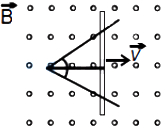
Two straight conducting plates form an angle $\theta$ where their ends are joined. $A$ conducting bar in contact with the plates and forming an isosceles triangle with them starts at the vertex at time $t=0$ and moves with constant velocity $\vec{v}$ to the right as shown in the figure. $A$ magnetic field $\vec{B}$ points out of the page. The magnitude of the emf induced at $t=1 \text{ s}$ will be
A
$Bv \tan \frac{\theta}{2}$
B
$Bv^2 \tan \frac{\theta}{2}$
C
$2 Bv^2 \tan \frac{\theta}{2}$
D
$2 Bv^2 \sin \frac{\theta}{2}$
Solution
(C) Let the distance of the bar from the vertex at time $t$ be $x = vt$.
In the isosceles triangle formed by the plates and the bar,the length of the bar $\ell$ can be calculated using trigonometry.
Considering the right-angled triangle formed by the bisector of the angle $\theta$,we have:
$\frac{\ell/2}{x} = \tan \frac{\theta}{2}$
$\ell = 2x \tan \frac{\theta}{2} = 2vt \tan \frac{\theta}{2}$.
The motional emf induced in a conductor of length $\ell$ moving with velocity $v$ in a magnetic field $B$ is given by $\varepsilon = B \ell v$.
Substituting the value of $\ell$ at $t = 1 \text{ s}$:
$\ell = 2v(1) \tan \frac{\theta}{2} = 2v \tan \frac{\theta}{2}$.
Therefore,the induced emf is:
$\varepsilon = B(2v \tan \frac{\theta}{2})v = 2Bv^2 \tan \frac{\theta}{2}$.
In the isosceles triangle formed by the plates and the bar,the length of the bar $\ell$ can be calculated using trigonometry.
Considering the right-angled triangle formed by the bisector of the angle $\theta$,we have:
$\frac{\ell/2}{x} = \tan \frac{\theta}{2}$
$\ell = 2x \tan \frac{\theta}{2} = 2vt \tan \frac{\theta}{2}$.
The motional emf induced in a conductor of length $\ell$ moving with velocity $v$ in a magnetic field $B$ is given by $\varepsilon = B \ell v$.
Substituting the value of $\ell$ at $t = 1 \text{ s}$:
$\ell = 2v(1) \tan \frac{\theta}{2} = 2v \tan \frac{\theta}{2}$.
Therefore,the induced emf is:
$\varepsilon = B(2v \tan \frac{\theta}{2})v = 2Bv^2 \tan \frac{\theta}{2}$.
0 likesView Solution
21
PhysicsEasyMCQWBJEE · 2024
Longitudinal waves cannot
A
have a unique wave length
B
have a unique wave velocity
C
transmit energy
D
be polarized
Solution
(D) Longitudinal waves cannot be polarized. Polarization is a property that applies only to transverse waves,where the oscillations occur perpendicular to the direction of wave propagation. In longitudinal waves,the oscillations occur parallel to the direction of wave propagation. Since there is no asymmetry in the direction of oscillation relative to the direction of propagation,longitudinal waves cannot be restricted to a single plane of vibration.
0 likesView Solution
22
PhysicsEasyMCQWBJEE · 2024
The electric field of a plane electromagnetic wave in a medium is given by $\vec{E}(x, y, z, t) = E_0 \hat{n} e^{i k_0[(x+y+z)-ct]}$,where $c$ is the speed of light in free space. The $\vec{E}$ field is polarized in the $x-z$ plane. If the speed of the wave in the medium is $v$,then:
A
$\hat{n} = \hat{i} - \hat{k}; v = c$
B
$\hat{n} = \frac{\hat{i} - \hat{k}}{\sqrt{2}}; v = \frac{c}{\sqrt{3}}$
C
The refractive index of the medium is $\sqrt{3}$
D
$\hat{n} = \frac{\hat{i} + \hat{k}}{\sqrt{2}}; v = \frac{c}{\sqrt{2}}$
Solution
(B) The given electric field is $\vec{E} = E_0 \hat{n} e^{i k_0[(x+y+z) - ct]}$.
Comparing this with the standard form $\vec{E} = E_0 \hat{n} e^{i(\vec{k} \cdot \vec{r} - \omega t)}$,we identify the wave vector $\vec{k} = k_0(\hat{i} + \hat{j} + \hat{k})$.
The magnitude of the wave vector is $k = |k_0(\hat{i} + \hat{j} + \hat{k})| = k_0 \sqrt{1^2 + 1^2 + 1^2} = k_0 \sqrt{3}$.
The speed of the wave in the medium is $v = \frac{\omega}{k} = \frac{k_0 c}{k_0 \sqrt{3}} = \frac{c}{\sqrt{3}}$.
The refractive index $n = \frac{c}{v} = \sqrt{3}$.
Since the wave is transverse,$\vec{E} \cdot \vec{k} = 0$,which implies $\hat{n} \cdot (\hat{i} + \hat{j} + \hat{k}) = 0$.
Given that $\vec{E}$ is polarized in the $x-z$ plane,$\hat{n}$ must be in the $x-z$ plane,so $\hat{n} = a\hat{i} + b\hat{k}$.
From $\hat{n} \cdot (\hat{i} + \hat{j} + \hat{k}) = 0$,we get $a + b = 0$,so $a = -b$.
Normalizing $\hat{n}$,we get $\hat{n} = \frac{\hat{i} - \hat{k}}{\sqrt{2}}$.
Thus,both options $B$ and $C$ are correct.
Comparing this with the standard form $\vec{E} = E_0 \hat{n} e^{i(\vec{k} \cdot \vec{r} - \omega t)}$,we identify the wave vector $\vec{k} = k_0(\hat{i} + \hat{j} + \hat{k})$.
The magnitude of the wave vector is $k = |k_0(\hat{i} + \hat{j} + \hat{k})| = k_0 \sqrt{1^2 + 1^2 + 1^2} = k_0 \sqrt{3}$.
The speed of the wave in the medium is $v = \frac{\omega}{k} = \frac{k_0 c}{k_0 \sqrt{3}} = \frac{c}{\sqrt{3}}$.
The refractive index $n = \frac{c}{v} = \sqrt{3}$.
Since the wave is transverse,$\vec{E} \cdot \vec{k} = 0$,which implies $\hat{n} \cdot (\hat{i} + \hat{j} + \hat{k}) = 0$.
Given that $\vec{E}$ is polarized in the $x-z$ plane,$\hat{n}$ must be in the $x-z$ plane,so $\hat{n} = a\hat{i} + b\hat{k}$.
From $\hat{n} \cdot (\hat{i} + \hat{j} + \hat{k}) = 0$,we get $a + b = 0$,so $a = -b$.
Normalizing $\hat{n}$,we get $\hat{n} = \frac{\hat{i} - \hat{k}}{\sqrt{2}}$.
Thus,both options $B$ and $C$ are correct.
0 likesView Solution
23
PhysicsMediumMCQWBJEE · 2024
Three point charges $q, -2q$ and $q$ are placed along the $x$-axis at $x = -a, 0$ and $a$ respectively. As $a \rightarrow 0$ and $q \rightarrow \infty$ while $qa^2 = Q$ remains finite,the electric field at a point $P$,at a distance $x$ $(x \gg a)$ from $x = 0$ is $E = \frac{\alpha Q}{4 \pi \epsilon_0 x^\beta} \hat{i}$. Then:
A
$\alpha = \beta$
B
$\alpha = 2\beta$
C
$\alpha = \frac{2}{3}\beta$
D
$\alpha = \frac{3}{2}\beta$
Solution
(A) The electric field at point $P$ at distance $x$ due to the three charges is:
$E = \frac{1}{4 \pi \epsilon_0} \left[ \frac{q}{(x-a)^2} - \frac{2q}{x^2} + \frac{q}{(x+a)^2} \right]$
$E = \frac{q}{4 \pi \epsilon_0} \left[ \frac{(x+a)^2 - 2(x^2-a^2) + (x-a)^2}{x^2(x^2-a^2)} \right]$
$E = \frac{q}{4 \pi \epsilon_0} \left[ \frac{x^2 + 2ax + a^2 - 2x^2 + 2a^2 + x^2 - 2ax + a^2}{x^2(x^2-a^2)} \right]$
$E = \frac{q}{4 \pi \epsilon_0} \left[ \frac{4a^2}{x^2(x^2-a^2)} \right]$
Since $x \gg a$,we can approximate $x^2 - a^2 \approx x^2$:
$E = \frac{q}{4 \pi \epsilon_0} \left[ \frac{4a^2}{x^2(x^2)} \right] = \frac{4qa^2}{4 \pi \epsilon_0 x^4}$
Given $qa^2 = Q$,we have $E = \frac{4Q}{4 \pi \epsilon_0 x^4}$.
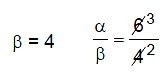
Comparing this with $E = \frac{\alpha Q}{4 \pi \epsilon_0 x^\beta}$,we get $\alpha = 4$ and $\beta = 4$.
Therefore,$\alpha = \beta$.
$E = \frac{1}{4 \pi \epsilon_0} \left[ \frac{q}{(x-a)^2} - \frac{2q}{x^2} + \frac{q}{(x+a)^2} \right]$
$E = \frac{q}{4 \pi \epsilon_0} \left[ \frac{(x+a)^2 - 2(x^2-a^2) + (x-a)^2}{x^2(x^2-a^2)} \right]$
$E = \frac{q}{4 \pi \epsilon_0} \left[ \frac{x^2 + 2ax + a^2 - 2x^2 + 2a^2 + x^2 - 2ax + a^2}{x^2(x^2-a^2)} \right]$
$E = \frac{q}{4 \pi \epsilon_0} \left[ \frac{4a^2}{x^2(x^2-a^2)} \right]$
Since $x \gg a$,we can approximate $x^2 - a^2 \approx x^2$:
$E = \frac{q}{4 \pi \epsilon_0} \left[ \frac{4a^2}{x^2(x^2)} \right] = \frac{4qa^2}{4 \pi \epsilon_0 x^4}$
Given $qa^2 = Q$,we have $E = \frac{4Q}{4 \pi \epsilon_0 x^4}$.
Comparing this with $E = \frac{\alpha Q}{4 \pi \epsilon_0 x^\beta}$,we get $\alpha = 4$ and $\beta = 4$.
Therefore,$\alpha = \beta$.
0 likesView Solution
24
PhysicsEasyMCQWBJEE · 2024
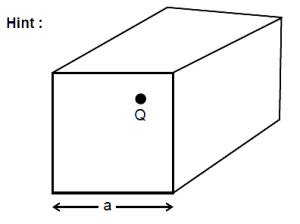
$A$ charge $Q$ is placed at the centre of a cube of side $a$. The total flux of electric field through the six surfaces of the cube is
A
$\frac{6 Q a^2}{\epsilon_0}$
B
$\frac{Q a^2}{6 \epsilon_0}$
C
$Q / \epsilon_0$
D
$Q a^2 / \epsilon_0$
Solution
(C) According to Gauss's Law,the total electric flux $\phi$ through any closed surface is equal to the net charge $Q_{\text{enclosed}}$ inside the surface divided by the permittivity of free space $\epsilon_0$.
Mathematically,$\phi = \frac{Q_{\text{enclosed}}}{\epsilon_0}$.
Since the charge $Q$ is placed at the centre of the cube,the entire charge is enclosed by the cube.
Therefore,the total flux through the six surfaces of the cube is $\phi = \frac{Q}{\epsilon_0}$.
Mathematically,$\phi = \frac{Q_{\text{enclosed}}}{\epsilon_0}$.
Since the charge $Q$ is placed at the centre of the cube,the entire charge is enclosed by the cube.
Therefore,the total flux through the six surfaces of the cube is $\phi = \frac{Q}{\epsilon_0}$.
0 likesView Solution
25
PhysicsMediumMCQWBJEE · 2024
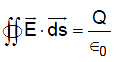
Consider the integral form of the Gaussian law in electrostatics: $\oint \vec{E} \cdot d\vec{s} = \frac{Q}{\epsilon_0}$. Which of the following statements are correct?
A
It contains the law of Coulomb.
B
It contains the superposition principle.
C
An elementary patch on the enclosing surface is a polar vector.
D
An elementary patch on the enclosing surface is a pseudo-vector.
Solution
(A, B, D) $1$. Gauss's Law is derived from Coulomb's Law and the superposition principle. Therefore,it inherently contains both of these fundamental principles of electrostatics.
$2$. The area element $d\vec{s}$ (or $d\vec{A}$) is defined as a vector pointing outward,normal to the surface. Since it is defined as the cross product of two displacement vectors (e.g.,$d\vec{l}_1 \times d\vec{l}_2$),it behaves as a pseudo-vector (or axial vector) because its direction depends on the orientation of the surface coordinate system,not just the position.
$2$. The area element $d\vec{s}$ (or $d\vec{A}$) is defined as a vector pointing outward,normal to the surface. Since it is defined as the cross product of two displacement vectors (e.g.,$d\vec{l}_1 \times d\vec{l}_2$),it behaves as a pseudo-vector (or axial vector) because its direction depends on the orientation of the surface coordinate system,not just the position.
0 likesView Solution
26
PhysicsEasyMCQWBJEE · 2024
$A$ charged particle moving with a velocity $\vec{v} = v_1 \hat{i} + v_2 \hat{j}$ in a magnetic field $\vec{B}$ experiences a force $\vec{F} = F_1 \hat{i} + F_2 \hat{j}$. Here $v_1, v_2, F_1, F_2$ are all constants. Then $\vec{B}$ can be
A
$\vec{B} = B_1 \hat{i} + B_2 \hat{j}$ with $\frac{v_1}{v_2} = \frac{B_1}{B_2}$
B
$\vec{B} = B_1 \hat{i} + B_2 \hat{j} + B_3 \hat{k}$ with $\frac{v_1}{v_2} = \frac{B_1}{B_2}$
C
$\vec{B} = B_3 \hat{j}$ with $B_1 = B_2 = 0$
D
$\vec{B} = B_1 \hat{j} + B_2 \hat{k}$ with $\frac{B_1}{B_2} = \frac{v_1}{v_2}$
Solution
(B) The magnetic force is given by $\vec{F} = q(\vec{v} \times \vec{B})$.
Since $\vec{F}$ is perpendicular to $\vec{v}$,their dot product must be zero: $\vec{F} \cdot \vec{v} = 0$.
$(F_1 \hat{i} + F_2 \hat{j}) \cdot (v_1 \hat{i} + v_2 \hat{j}) = F_1 v_1 + F_2 v_2 = 0 \Rightarrow \frac{F_1}{F_2} = -\frac{v_2}{v_1} \quad (I)$.
Also,$\vec{F}$ is perpendicular to $\vec{B}$,so $\vec{F} \cdot \vec{B} = 0$.
Let $\vec{B} = B_1 \hat{i} + B_2 \hat{j} + B_3 \hat{k}$. Then $(F_1 \hat{i} + F_2 \hat{j}) \cdot (B_1 \hat{i} + B_2 \hat{j} + B_3 \hat{k}) = F_1 B_1 + F_2 B_2 = 0 \Rightarrow \frac{F_1}{F_2} = -\frac{B_2}{B_1} \quad (II)$.
Comparing $(I)$ and $(II)$,we get $\frac{v_2}{v_1} = \frac{B_2}{B_1}$,which implies $\frac{v_1}{v_2} = \frac{B_1}{B_2}$.
Thus,$\vec{B} = B_1 \hat{i} + B_2 \hat{j} + B_3 \hat{k}$ satisfies the condition $\frac{v_1}{v_2} = \frac{B_1}{B_2}$.
Since $\vec{F}$ is perpendicular to $\vec{v}$,their dot product must be zero: $\vec{F} \cdot \vec{v} = 0$.
$(F_1 \hat{i} + F_2 \hat{j}) \cdot (v_1 \hat{i} + v_2 \hat{j}) = F_1 v_1 + F_2 v_2 = 0 \Rightarrow \frac{F_1}{F_2} = -\frac{v_2}{v_1} \quad (I)$.
Also,$\vec{F}$ is perpendicular to $\vec{B}$,so $\vec{F} \cdot \vec{B} = 0$.
Let $\vec{B} = B_1 \hat{i} + B_2 \hat{j} + B_3 \hat{k}$. Then $(F_1 \hat{i} + F_2 \hat{j}) \cdot (B_1 \hat{i} + B_2 \hat{j} + B_3 \hat{k}) = F_1 B_1 + F_2 B_2 = 0 \Rightarrow \frac{F_1}{F_2} = -\frac{B_2}{B_1} \quad (II)$.
Comparing $(I)$ and $(II)$,we get $\frac{v_2}{v_1} = \frac{B_2}{B_1}$,which implies $\frac{v_1}{v_2} = \frac{B_1}{B_2}$.
Thus,$\vec{B} = B_1 \hat{i} + B_2 \hat{j} + B_3 \hat{k}$ satisfies the condition $\frac{v_1}{v_2} = \frac{B_1}{B_2}$.
0 likesView Solution
27
PhysicsEasyMCQWBJEE · 2024
Which of the following statement$(s)$ is/are true in respect of nuclear binding energy?
$(i)$ The mass energy of a nucleus is larger than the total mass energy of its individual protons and neutrons.
(ii) If a nucleus could be separated into its nucleons,an energy equal to the binding energy would have to be transferred to the particles during the separating process.
(iii) The binding energy is a measure of how well the nucleons in a nucleus are held together.
(iv) The nuclear fission is somehow related to acquiring higher binding energy.
$(i)$ The mass energy of a nucleus is larger than the total mass energy of its individual protons and neutrons.
(ii) If a nucleus could be separated into its nucleons,an energy equal to the binding energy would have to be transferred to the particles during the separating process.
(iii) The binding energy is a measure of how well the nucleons in a nucleus are held together.
(iv) The nuclear fission is somehow related to acquiring higher binding energy.
A
Statements $(i)$,$(ii)$ and $(iii)$ are true
B
Statements $(ii)$,$(iii)$ and $(iv)$ are true
C
Statements $(ii)$ and $(iii)$ are true
D
All the four statements are true
Solution
(B) Statement $(i)$ is false because the mass of a nucleus is always less than the sum of the masses of its individual nucleons. This mass difference,known as the mass defect,corresponds to the binding energy released when the nucleus is formed. Therefore,the mass energy of a nucleus is less than the total mass energy of its individual protons and neutrons.
Statement $(ii)$ is true. To separate a nucleus into its constituent nucleons,work must be done against the strong nuclear force,which requires an energy input equal to the binding energy.
Statement $(iii)$ is true. Binding energy per nucleon is a standard measure of nuclear stability; higher values indicate that nucleons are more tightly bound.
Statement $(iv)$ is true. In nuclear fission,a heavy nucleus splits into lighter nuclei with higher binding energy per nucleon,resulting in the release of energy.
Thus,statements $(ii)$,$(iii)$,and $(iv)$ are correct.
Statement $(ii)$ is true. To separate a nucleus into its constituent nucleons,work must be done against the strong nuclear force,which requires an energy input equal to the binding energy.
Statement $(iii)$ is true. Binding energy per nucleon is a standard measure of nuclear stability; higher values indicate that nucleons are more tightly bound.
Statement $(iv)$ is true. In nuclear fission,a heavy nucleus splits into lighter nuclei with higher binding energy per nucleon,resulting in the release of energy.
Thus,statements $(ii)$,$(iii)$,and $(iv)$ are correct.
0 likesView Solution
28
PhysicsMediumMCQWBJEE · 2024
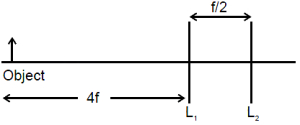
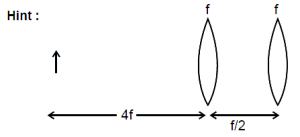
Two convex lenses ($L_1$ and $L_2$) of equal focal length $f$ are placed at a distance $\frac{f}{2}$ apart. An object is placed at a distance $4f$ to the left of $L_1$ as shown in the figure. The final image is at:
A
$\frac{5f}{11}$ to the right of $L_2$
B
$\frac{5f}{11}$ to the left of $L_2$
C
$5f$ to the right of $L_2$
D
$5f$ to the left of $L_2$
Solution
(D) For the first lens $L_1$,the object distance $u_1 = -4f$ and focal length $f_1 = f$. Using the lens formula $\frac{1}{v_1} - \frac{1}{u_1} = \frac{1}{f_1}$:
$\frac{1}{v_1} - \frac{1}{-4f} = \frac{1}{f} \Rightarrow \frac{1}{v_1} = \frac{1}{f} - \frac{1}{4f} = \frac{3}{4f} \Rightarrow v_1 = \frac{4f}{3}$.
This image acts as an object for the second lens $L_2$. The distance between the lenses is $d = \frac{f}{2}$.
The object distance for the second lens is $u_2 = v_1 - d = \frac{4f}{3} - \frac{f}{2} = \frac{8f - 3f}{6} = \frac{5f}{6}$.
Since the object is to the left of $L_2$,$u_2 = -\frac{5f}{6}$.
Using the lens formula for $L_2$ with $f_2 = f$:
$\frac{1}{v_2} - \frac{1}{u_2} = \frac{1}{f_2} \Rightarrow \frac{1}{v_2} - \frac{1}{-5f/6} = \frac{1}{f} \Rightarrow \frac{1}{v_2} + \frac{6}{5f} = \frac{1}{f}$.
$\frac{1}{v_2} = \frac{1}{f} - \frac{6}{5f} = \frac{5 - 6}{5f} = -\frac{1}{5f} \Rightarrow v_2 = -5f$.
The negative sign indicates that the final image is formed at a distance $5f$ to the left of $L_2$.
$\frac{1}{v_1} - \frac{1}{-4f} = \frac{1}{f} \Rightarrow \frac{1}{v_1} = \frac{1}{f} - \frac{1}{4f} = \frac{3}{4f} \Rightarrow v_1 = \frac{4f}{3}$.
This image acts as an object for the second lens $L_2$. The distance between the lenses is $d = \frac{f}{2}$.
The object distance for the second lens is $u_2 = v_1 - d = \frac{4f}{3} - \frac{f}{2} = \frac{8f - 3f}{6} = \frac{5f}{6}$.
Since the object is to the left of $L_2$,$u_2 = -\frac{5f}{6}$.
Using the lens formula for $L_2$ with $f_2 = f$:
$\frac{1}{v_2} - \frac{1}{u_2} = \frac{1}{f_2} \Rightarrow \frac{1}{v_2} - \frac{1}{-5f/6} = \frac{1}{f} \Rightarrow \frac{1}{v_2} + \frac{6}{5f} = \frac{1}{f}$.
$\frac{1}{v_2} = \frac{1}{f} - \frac{6}{5f} = \frac{5 - 6}{5f} = -\frac{1}{5f} \Rightarrow v_2 = -5f$.
The negative sign indicates that the final image is formed at a distance $5f$ to the left of $L_2$.
0 likesView Solution
29
PhysicsDifficultMCQWBJEE · 2024
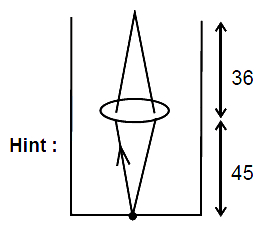
When a convex lens is placed above an empty tank,the image of a mark at the bottom of the tank,which is $45 \ cm$ from the lens,is formed $36 \ cm$ above the lens. When a liquid is poured in the tank to a depth of $40 \ cm$,the distance of the image of the mark above the lens is $48 \ cm$. The refractive index of the liquid is
A
$1.358$
B
$1.544$
C
$1.472$
D
$1.366$
Solution
(D) Initially,with the empty tank,the object distance $u = -45 \ cm$ and the image distance $v = +36 \ cm$. Using the lens formula $\frac{1}{f} = \frac{1}{v} - \frac{1}{u}$:
$\frac{1}{f} = \frac{1}{36} - \frac{1}{-45} = \frac{1}{36} + \frac{1}{45} = \frac{5+4}{180} = \frac{9}{180} = \frac{1}{20} \Rightarrow f = 20 \ cm$.
When the liquid is poured to a depth of $40 \ cm$,the apparent depth of the mark is $d' = \frac{40}{\mu}$. The remaining distance from the lens to the liquid surface is $45 - 40 = 5 \ cm$. Thus,the new object distance is $u' = -(\frac{40}{\mu} + 5) \ cm$. The new image distance is $v' = +48 \ cm$.
Using the lens formula again: $\frac{1}{f} = \frac{1}{v'} - \frac{1}{u'}$
$\frac{1}{20} = \frac{1}{48} - \frac{1}{-(\frac{40}{\mu} + 5)} = \frac{1}{48} + \frac{1}{\frac{40}{\mu} + 5}$
$\frac{1}{\frac{40}{\mu} + 5} = \frac{1}{20} - \frac{1}{48} = \frac{12 - 5}{240} = \frac{7}{240}$
$\frac{40}{\mu} + 5 = \frac{240}{7} \approx 34.286$
$\frac{40}{\mu} = 34.286 - 5 = 29.286$
$\mu = \frac{40}{29.286} \approx 1.366$.
$\frac{1}{f} = \frac{1}{36} - \frac{1}{-45} = \frac{1}{36} + \frac{1}{45} = \frac{5+4}{180} = \frac{9}{180} = \frac{1}{20} \Rightarrow f = 20 \ cm$.
When the liquid is poured to a depth of $40 \ cm$,the apparent depth of the mark is $d' = \frac{40}{\mu}$. The remaining distance from the lens to the liquid surface is $45 - 40 = 5 \ cm$. Thus,the new object distance is $u' = -(\frac{40}{\mu} + 5) \ cm$. The new image distance is $v' = +48 \ cm$.
Using the lens formula again: $\frac{1}{f} = \frac{1}{v'} - \frac{1}{u'}$
$\frac{1}{20} = \frac{1}{48} - \frac{1}{-(\frac{40}{\mu} + 5)} = \frac{1}{48} + \frac{1}{\frac{40}{\mu} + 5}$
$\frac{1}{\frac{40}{\mu} + 5} = \frac{1}{20} - \frac{1}{48} = \frac{12 - 5}{240} = \frac{7}{240}$
$\frac{40}{\mu} + 5 = \frac{240}{7} \approx 34.286$
$\frac{40}{\mu} = 34.286 - 5 = 29.286$
$\mu = \frac{40}{29.286} \approx 1.366$.
0 likesView Solution
30
PhysicsEasyMCQWBJEE · 2024
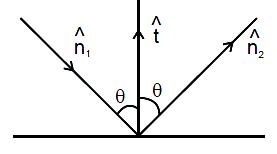
If $\hat{n}_1, \hat{n}_2$ and $\hat{t}$ represent unit vectors along the incident ray,reflected ray,and normal to the surface respectively,then:
A
$\hat{n}_2=\hat{n}_1-2(\hat{n}_1 \cdot \hat{t}) \hat{t}$
B
$\hat{n}_2=\hat{n}_1+2(\hat{n}_1 \cdot \hat{t}) \hat{t}$
C
$\hat{n}_2=-\hat{n}_1$
D
$\hat{n}_2=2 \hat{n}_1-(\hat{n}_1 \times \hat{t}) \cdot \hat{n}_1$
Solution
(A) Let $\hat{t}$ be the unit vector along the normal to the surface.
Let $\hat{n}_1$ be the unit vector along the incident ray and $\hat{n}_2$ be the unit vector along the reflected ray.
From the geometry of reflection,the angle of incidence equals the angle of reflection,$\theta$.
We can resolve $\hat{n}_1$ and $\hat{n}_2$ into components parallel and perpendicular to the normal $\hat{t}$.
$\hat{n}_1 = -\cos \theta \hat{t} + \sin \theta \hat{u}$,where $\hat{u}$ is a unit vector parallel to the surface.
$\hat{n}_2 = \cos \theta \hat{t} + \sin \theta \hat{u}$.
Subtracting the two equations: $\hat{n}_2 - \hat{n}_1 = 2 \cos \theta \hat{t}$.
Since $\hat{n}_1 \cdot \hat{t} = \cos(180^\circ - \theta) = -\cos \theta$,we have $\cos \theta = -(\hat{n}_1 \cdot \hat{t})$.
Substituting this into the subtraction equation: $\hat{n}_2 - \hat{n}_1 = -2(\hat{n}_1 \cdot \hat{t}) \hat{t}$.
Therefore,$\hat{n}_2 = \hat{n}_1 - 2(\hat{n}_1 \cdot \hat{t}) \hat{t}$.
Let $\hat{n}_1$ be the unit vector along the incident ray and $\hat{n}_2$ be the unit vector along the reflected ray.
From the geometry of reflection,the angle of incidence equals the angle of reflection,$\theta$.
We can resolve $\hat{n}_1$ and $\hat{n}_2$ into components parallel and perpendicular to the normal $\hat{t}$.
$\hat{n}_1 = -\cos \theta \hat{t} + \sin \theta \hat{u}$,where $\hat{u}$ is a unit vector parallel to the surface.
$\hat{n}_2 = \cos \theta \hat{t} + \sin \theta \hat{u}$.
Subtracting the two equations: $\hat{n}_2 - \hat{n}_1 = 2 \cos \theta \hat{t}$.
Since $\hat{n}_1 \cdot \hat{t} = \cos(180^\circ - \theta) = -\cos \theta$,we have $\cos \theta = -(\hat{n}_1 \cdot \hat{t})$.
Substituting this into the subtraction equation: $\hat{n}_2 - \hat{n}_1 = -2(\hat{n}_1 \cdot \hat{t}) \hat{t}$.
Therefore,$\hat{n}_2 = \hat{n}_1 - 2(\hat{n}_1 \cdot \hat{t}) \hat{t}$.
0 likesView Solution
31
PhysicsEasyMCQWBJEE · 2024
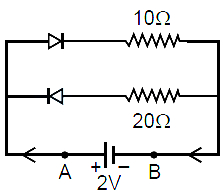
$A$ $2 \ V$ cell is connected across points $A$ and $B$ as shown in the figure. Assume that the resistance of each diode is zero in forward bias and infinity in reverse bias. The current supplied by the cell is (in $A$)
A
$0.5$
B
$0.2$
C
$0.1$
D
$0.25$
Solution
(B) In the given circuit,the top diode is in forward bias because its p-side is connected to the positive terminal of the battery. The bottom diode is in reverse bias because its n-side is connected to the positive terminal of the battery.
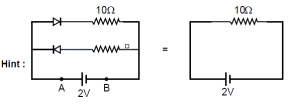
For the diode in forward bias,the resistance is $0 \ \Omega$. Thus,the current flows only through the top branch containing the $10 \ \Omega$ resistor.
For the diode in reverse bias,the resistance is $\infty$,so no current flows through the bottom branch.
Using Ohm's law,the current $I$ supplied by the cell is:
$I = \frac{V}{R} = \frac{2 \ V}{10 \ \Omega} = 0.2 \ A$.
For the diode in forward bias,the resistance is $0 \ \Omega$. Thus,the current flows only through the top branch containing the $10 \ \Omega$ resistor.
For the diode in reverse bias,the resistance is $\infty$,so no current flows through the bottom branch.
Using Ohm's law,the current $I$ supplied by the cell is:
$I = \frac{V}{R} = \frac{2 \ V}{10 \ \Omega} = 0.2 \ A$.
0 likesView Solution
32
PhysicsEasyMCQWBJEE · 2024
In the given network of $AND$ and $OR$ gates,the output $Q$ can be written as (assuming $n$ is even):

A
$X_0 X_1+X_2 X_3+\ldots X_{n-1} X_n$
B
$X_0 X_1 \ldots X_n+X_1 X_2 \ldots X_n+X_2 X_3 \ldots X_n+X_n$
C
$X_0 X_1 \ldots X_{n-1}+X_{n-2}+X_{n-2} X_{n-1}+X_n$
D
$X_0 X_1 \ldots X_{n-1}+X_2 X_3 X_5 \ldots X_{n-1}+X_{n-2} X_{n-1}+X_n$
Solution
(D) Let us trace the output of the logic gates step by step.
Step $1$: The first $AND$ gate takes inputs $X_0$ and $X_1$,giving output $Y_1 = X_0 X_1$.
Step $2$: The first $OR$ gate takes $Y_1$ and $X_2$,giving output $Y_2 = X_0 X_1 + X_2$.
Step $3$: The next $AND$ gate takes $Y_2$ and $X_3$,giving output $Y_3 = (X_0 X_1 + X_2) X_3 = X_0 X_1 X_3 + X_2 X_3$.
Step $4$: The next $OR$ gate takes $Y_3$ and $X_4$,giving output $Y_4 = X_0 X_1 X_3 + X_2 X_3 + X_4$.
Continuing this pattern,for an even $n$,the final output $Q$ will be of the form: $Q = X_0 X_1 X_3 X_5 \ldots X_{n-1} + X_2 X_3 X_5 \ldots X_{n-1} + X_4 X_5 \ldots X_{n-1} + \ldots + X_{n-2} X_{n-1} + X_n$.
Step $1$: The first $AND$ gate takes inputs $X_0$ and $X_1$,giving output $Y_1 = X_0 X_1$.
Step $2$: The first $OR$ gate takes $Y_1$ and $X_2$,giving output $Y_2 = X_0 X_1 + X_2$.
Step $3$: The next $AND$ gate takes $Y_2$ and $X_3$,giving output $Y_3 = (X_0 X_1 + X_2) X_3 = X_0 X_1 X_3 + X_2 X_3$.
Step $4$: The next $OR$ gate takes $Y_3$ and $X_4$,giving output $Y_4 = X_0 X_1 X_3 + X_2 X_3 + X_4$.
Continuing this pattern,for an even $n$,the final output $Q$ will be of the form: $Q = X_0 X_1 X_3 X_5 \ldots X_{n-1} + X_2 X_3 X_5 \ldots X_{n-1} + X_4 X_5 \ldots X_{n-1} + \ldots + X_{n-2} X_{n-1} + X_n$.
0 likesView Solution
33
PhysicsEasyMCQWBJEE · 2024
In a single-slit diffraction experiment,the slit is illuminated by light of two wavelengths $\lambda_1$ and $\lambda_2$. It is observed that the $2^{nd}$ order diffraction minimum for $\lambda_1$ coincides with the $3^{rd}$ diffraction minimum for $\lambda_2$. Then:
A
$\frac{\lambda_1}{\lambda_2} = \frac{2}{3}$
B
$\frac{\lambda_1}{\lambda_2} = \frac{5}{7}$
C
$\frac{\lambda_1}{\lambda_2} = \frac{3}{2}$
D
$\frac{\lambda_1}{\lambda_2} = \frac{7}{5}$
Solution
(C) The condition for the $n^{th}$ order diffraction minimum in a single-slit experiment is given by $a \sin \theta = n \lambda$,where $a$ is the slit width and $\theta$ is the angle of diffraction.
For the $2^{nd}$ order minimum of $\lambda_1$,we have $a \sin \theta_1 = 2 \lambda_1$.
For the $3^{rd}$ order minimum of $\lambda_2$,we have $a \sin \theta_2 = 3 \lambda_2$.
Since the minima coincide,the angles of diffraction are equal,i.e.,$\theta_1 = \theta_2 = \theta$.
Therefore,$2 \lambda_1 = 3 \lambda_2$.
Rearranging the terms,we get $\frac{\lambda_1}{\lambda_2} = \frac{3}{2}$.
For the $2^{nd}$ order minimum of $\lambda_1$,we have $a \sin \theta_1 = 2 \lambda_1$.
For the $3^{rd}$ order minimum of $\lambda_2$,we have $a \sin \theta_2 = 3 \lambda_2$.
Since the minima coincide,the angles of diffraction are equal,i.e.,$\theta_1 = \theta_2 = \theta$.
Therefore,$2 \lambda_1 = 3 \lambda_2$.
Rearranging the terms,we get $\frac{\lambda_1}{\lambda_2} = \frac{3}{2}$.
0 likesView Solution
34
PhysicsMediumMCQWBJEE · 2024
Light of wavelength $6000 \text{ Å}$ is incident on a thin glass plate of refractive index $\mu = 1.5$ such that the angle of refraction into the plate is $60^{\circ}$. Calculate the smallest thickness of the plate which will make a dark fringe by reflected beam interference.
A
$1.5 \times 10^{-7} \text{ m}$
B
$2 \times 10^{-7} \text{ m}$
C
$3.5 \times 10^{-7} \text{ m}$
D
$4 \times 10^{-7} \text{ m}$
Solution
(D) For reflected light,the condition for destructive interference (dark fringe) is given by:
$2 \mu t \cos r = n \lambda$
where $\mu$ is the refractive index,$t$ is the thickness,$r$ is the angle of refraction,and $n$ is an integer $(n = 1, 2, 3, ...)$.
For the smallest thickness,we take $n = 1$:
$2 \mu t \cos r = \lambda$
Given values:
$\lambda = 6000 \text{ Å} = 6000 \times 10^{-10} \text{ m} = 6 \times 10^{-7} \text{ m}$
$\mu = 1.5$
$r = 60^{\circ} \Rightarrow \cos 60^{\circ} = 0.5$
Substituting these values into the equation:
$2 \times 1.5 \times t \times 0.5 = 6 \times 10^{-7}$
$1.5 \times t = 6 \times 10^{-7}$
$t = \frac{6 \times 10^{-7}}{1.5} = 4 \times 10^{-7} \text{ m}$
$2 \mu t \cos r = n \lambda$
where $\mu$ is the refractive index,$t$ is the thickness,$r$ is the angle of refraction,and $n$ is an integer $(n = 1, 2, 3, ...)$.
For the smallest thickness,we take $n = 1$:
$2 \mu t \cos r = \lambda$
Given values:
$\lambda = 6000 \text{ Å} = 6000 \times 10^{-10} \text{ m} = 6 \times 10^{-7} \text{ m}$
$\mu = 1.5$
$r = 60^{\circ} \Rightarrow \cos 60^{\circ} = 0.5$
Substituting these values into the equation:
$2 \times 1.5 \times t \times 0.5 = 6 \times 10^{-7}$
$1.5 \times t = 6 \times 10^{-7}$
$t = \frac{6 \times 10^{-7}}{1.5} = 4 \times 10^{-7} \text{ m}$
0 likesView Solution
Vedclass Products
For Students
Vedclass Test Series
Mock tests in real WBJEE style covering Physics with performance analysis. 5-day free trial.
Start Free TrialFor Teachers
Exam Paper Generator
Generate Set A/B/C/D Physics papers from 7.5L+ questions in 2 minutes. 3 chapters free.
Try FreeFor Institutes
Online Exam Module
Run live WBJEE mock exams with unlimited students, 360° analytics & white-label branding.
See DemoFrequently Asked Questions
How many Physics questions are in WBJEE 2024?
There are 34 Physics questions from the WBJEE 2024 paper on Vedclass, each with a detailed step-by-step solution in English.
Are WBJEE 2024 Physics solutions available in English?
Yes. All solutions on this page are in English. You can also switch to English or Hindi using the language buttons above the questions.
Can I practice WBJEE 2024 Physics as a timed test?
Yes. Use the Vedclass Test Series to attempt a full WBJEE mock test covering Physics with time limits and instant score analysis.
Can teachers create Physics papers from WBJEE previous year questions?
Yes. The Vedclass Exam Paper Generator lets teachers mix WBJEE Physics questions and generate Set A/B/C/D papers in minutes.
For Teachers & Institutes
Build a Custom Physics Paper
Pick WBJEE 2024 Physics questions, set difficulty, and generate Set A/B/C/D in 2 minutes.