
PhysicsQ1–37 of 37 questions
Page 1 of 1 · English
1
PhysicsEasyMCQWBJEE · 2022
$A$ body of mass $m$ is thrown vertically upward with speed $\sqrt{3} v_e$,where $v_e$ is the escape velocity of a body from the Earth's surface. The final velocity of the body is
A
$0$
B
$2 v_e$
C
$\sqrt{3} v_e$
D
$\sqrt{2} v_e$
Solution
(D) According to the law of conservation of energy,the total energy at the surface of the Earth is equal to the total energy at infinity (or a very large distance where the potential energy is zero).
Total energy at the surface: $E_i = K_i + U_i = \frac{1}{2} m(\sqrt{3} v_e)^2 - \frac{GMm}{R}$.
We know that the escape velocity $v_e = \sqrt{\frac{2GM}{R}}$,so $v_e^2 = \frac{2GM}{R}$,which implies $\frac{GM}{R} = \frac{v_e^2}{2}$.
Substituting this into the energy equation: $E_i = \frac{1}{2} m(3 v_e^2) - m(\frac{v_e^2}{2}) = \frac{3}{2} m v_e^2 - \frac{1}{2} m v_e^2 = m v_e^2$.
At a very large distance,the potential energy is $0$,so the final energy is $E_f = \frac{1}{2} m v^2$.
Equating $E_i = E_f$: $m v_e^2 = \frac{1}{2} m v^2$.
$v^2 = 2 v_e^2 \implies v = \sqrt{2} v_e$.
Total energy at the surface: $E_i = K_i + U_i = \frac{1}{2} m(\sqrt{3} v_e)^2 - \frac{GMm}{R}$.
We know that the escape velocity $v_e = \sqrt{\frac{2GM}{R}}$,so $v_e^2 = \frac{2GM}{R}$,which implies $\frac{GM}{R} = \frac{v_e^2}{2}$.
Substituting this into the energy equation: $E_i = \frac{1}{2} m(3 v_e^2) - m(\frac{v_e^2}{2}) = \frac{3}{2} m v_e^2 - \frac{1}{2} m v_e^2 = m v_e^2$.
At a very large distance,the potential energy is $0$,so the final energy is $E_f = \frac{1}{2} m v^2$.
Equating $E_i = E_f$: $m v_e^2 = \frac{1}{2} m v^2$.
$v^2 = 2 v_e^2 \implies v = \sqrt{2} v_e$.
0 likesView Solution
2
PhysicsDifficultMCQWBJEE · 2022
If a string,suspended from the ceiling,is given a downward force $F_1$,its length becomes $L_1$. Its length becomes $L_2$ if the downward force is $F_2$. What is its actual length?
A
$\frac{L_1+L_2}{2}$
B
$\sqrt{L_1 L_2}$
C
$\frac{F_2 L_1+F_1 L_2}{F_2+F_1}$
D
$\frac{F_2 L_1-F_1 L_2}{F_2-F_1}$
Solution
(D) Let the actual length of the string be $L$ and the force constant be $k = \frac{AY}{L_0}$.
According to Hooke's Law,the extension is proportional to the applied force: $F = k \Delta L$.
For the first case: $F_1 = k(L_1 - L)$.
For the second case: $F_2 = k(L_2 - L)$.
Dividing the two equations: $\frac{F_1}{F_2} = \frac{L_1 - L}{L_2 - L}$.
Cross-multiplying gives: $F_1(L_2 - L) = F_2(L_1 - L)$.
$F_1 L_2 - F_1 L = F_2 L_1 - F_2 L$.
Rearranging to solve for $L$: $F_2 L - F_1 L = F_2 L_1 - F_1 L_2$.
$L(F_2 - F_1) = F_2 L_1 - F_1 L_2$.
Therefore,$L = \frac{F_2 L_1 - F_1 L_2}{F_2 - F_1}$.
According to Hooke's Law,the extension is proportional to the applied force: $F = k \Delta L$.
For the first case: $F_1 = k(L_1 - L)$.
For the second case: $F_2 = k(L_2 - L)$.
Dividing the two equations: $\frac{F_1}{F_2} = \frac{L_1 - L}{L_2 - L}$.
Cross-multiplying gives: $F_1(L_2 - L) = F_2(L_1 - L)$.
$F_1 L_2 - F_1 L = F_2 L_1 - F_2 L$.
Rearranging to solve for $L$: $F_2 L - F_1 L = F_2 L_1 - F_1 L_2$.
$L(F_2 - F_1) = F_2 L_1 - F_1 L_2$.
Therefore,$L = \frac{F_2 L_1 - F_1 L_2}{F_2 - F_1}$.
0 likesView Solution
3
PhysicsMediumMCQWBJEE · 2022
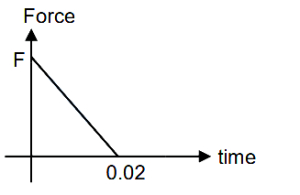
$A$ golf ball of mass $50 \text{ g}$ placed on a tee is struck by a golf club. The speed of the golf ball as it leaves the tee is $100 \text{ m/s}$, and the time of contact with the ball is $0.02 \text{ s}$. If the force decreases to zero linearly with time, then the force at the beginning of the contact is (in $\text{ N}$)
A
$100$
B
$200$
C
$250$
D
$500$
Solution
(D) The impulse imparted to the ball is equal to the change in its linear momentum.
Impulse $= \int F \, dt = \text{Area under the } F-t \text{ graph}$.
Given that the force decreases linearly from $F$ to $0$ in time $t = 0.02 \text{ s}$, the area is a triangle with base $0.02 \text{ s}$ and height $F$.
$\text{Area} = \frac{1}{2} \times \text{base} \times \text{height} = \frac{1}{2} \times 0.02 \times F = 0.01F$.
The change in momentum is $\Delta p = m(v_f - v_i) = \frac{50}{1000} \text{ kg} \times (100 \text{ m/s} - 0) = 0.05 \times 100 = 5 \text{ kg m/s}$.
Equating impulse and change in momentum: $0.01F = 5$.
$F = \frac{5}{0.01} = 500 \text{ N}$.
Impulse $= \int F \, dt = \text{Area under the } F-t \text{ graph}$.
Given that the force decreases linearly from $F$ to $0$ in time $t = 0.02 \text{ s}$, the area is a triangle with base $0.02 \text{ s}$ and height $F$.
$\text{Area} = \frac{1}{2} \times \text{base} \times \text{height} = \frac{1}{2} \times 0.02 \times F = 0.01F$.
The change in momentum is $\Delta p = m(v_f - v_i) = \frac{50}{1000} \text{ kg} \times (100 \text{ m/s} - 0) = 0.05 \times 100 = 5 \text{ kg m/s}$.
Equating impulse and change in momentum: $0.01F = 5$.
$F = \frac{5}{0.01} = 500 \text{ N}$.
0 likesView Solution
4
PhysicsMediumMCQWBJEE · 2022
$27$ drops of mercury coalesce to form a bigger drop. What is the relative increase in surface energy?
A
$\frac{3}{2}$
B
$\frac{2}{3}$
C
$-\frac{2}{3}$
D
$8$
Solution
(C) Let the radius of each small drop be $r$ and the radius of the big drop be $R$.
Since the volume remains conserved,$V_{big} = 27 \times V_{small}$.
$\frac{4}{3} \pi R^3 = 27 \times \frac{4}{3} \pi r^3 \Rightarrow R^3 = 27r^3 \Rightarrow R = 3r$.
The initial surface energy is $U_i = 27 \times (S \times 4 \pi r^2) = 108 \pi r^2 S$.
The final surface energy is $U_f = S \times 4 \pi R^2 = S \times 4 \pi (3r)^2 = 36 \pi r^2 S$.
The relative increase in surface energy is given by $\frac{\Delta U}{U_i} = \frac{U_f - U_i}{U_i} = \frac{36 \pi r^2 S - 108 \pi r^2 S}{108 \pi r^2 S}$.
$\frac{\Delta U}{U_i} = \frac{-72 \pi r^2 S}{108 \pi r^2 S} = -\frac{72}{108} = -\frac{2}{3}$.
Since the volume remains conserved,$V_{big} = 27 \times V_{small}$.
$\frac{4}{3} \pi R^3 = 27 \times \frac{4}{3} \pi r^3 \Rightarrow R^3 = 27r^3 \Rightarrow R = 3r$.
The initial surface energy is $U_i = 27 \times (S \times 4 \pi r^2) = 108 \pi r^2 S$.
The final surface energy is $U_f = S \times 4 \pi R^2 = S \times 4 \pi (3r)^2 = 36 \pi r^2 S$.
The relative increase in surface energy is given by $\frac{\Delta U}{U_i} = \frac{U_f - U_i}{U_i} = \frac{36 \pi r^2 S - 108 \pi r^2 S}{108 \pi r^2 S}$.
$\frac{\Delta U}{U_i} = \frac{-72 \pi r^2 S}{108 \pi r^2 S} = -\frac{72}{108} = -\frac{2}{3}$.
0 likesView Solution
5
PhysicsMediumMCQWBJEE · 2022
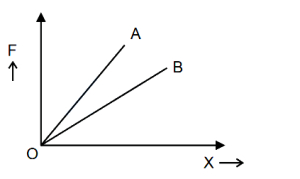
Two wires $A$ and $B$ of the same length are made of the same material. The load $(F)$ vs. elongation $(x)$ graph for these two wires is shown in the figure. Which of the following statement$(s)$ is/are true?
A
The cross-sectional area of $A$ is greater than that of $B$.
B
Young's modulus of $A$ is greater than Young's modulus of $B$.
C
The cross-sectional area of $B$ is greater than that of $A$.
D
Young's modulus of both $A$ and $B$ are the same.
Solution
(A, D) Since both wires are made of the same material,their Young's modulus $(Y)$ is identical.
Young's modulus is given by $Y = \frac{F L}{A x}$,where $F$ is the load,$L$ is the length,$A$ is the cross-sectional area,and $x$ is the elongation.
Rearranging for the load,we get $F = (\frac{Y A}{L}) x$.
Since $Y$ and $L$ are the same for both wires,the slope of the $F-x$ graph is proportional to the cross-sectional area $A$ (i.e.,$\text{slope} = \frac{Y A}{L} \propto A$).
From the graph,the slope of line $A$ is greater than the slope of line $B$,which implies that the cross-sectional area of $A$ is greater than that of $B$ $(A_A > A_B)$.
Therefore,statement $A$ is true and statement $D$ is true.
Young's modulus is given by $Y = \frac{F L}{A x}$,where $F$ is the load,$L$ is the length,$A$ is the cross-sectional area,and $x$ is the elongation.
Rearranging for the load,we get $F = (\frac{Y A}{L}) x$.
Since $Y$ and $L$ are the same for both wires,the slope of the $F-x$ graph is proportional to the cross-sectional area $A$ (i.e.,$\text{slope} = \frac{Y A}{L} \propto A$).
From the graph,the slope of line $A$ is greater than the slope of line $B$,which implies that the cross-sectional area of $A$ is greater than that of $B$ $(A_A > A_B)$.
Therefore,statement $A$ is true and statement $D$ is true.
0 likesView Solution
6
PhysicsMediumMCQWBJEE · 2022
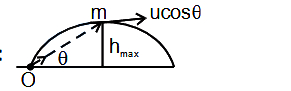
$A$ body of mass $m$ is thrown with velocity $u$ from the origin of a coordinate system at an angle $\theta$ with the horizontal. The magnitude of the angular momentum of the particle about the origin at the time $t$ when it is at the maximum height of the trajectory is proportional to
A
$u$
B
$u^2$
C
$u^3$
D
independent of $u$
Solution
(C) The angular momentum $\vec{L}$ of a particle about the origin is given by $\vec{L} = \vec{r} \times \vec{p}$.
At the maximum height,the velocity of the particle is purely horizontal,given by $v_x = u \cos \theta$.
The position vector of the particle at maximum height is $\vec{r} = x \hat{i} + h_{\max} \hat{j}$,where $h_{\max} = \frac{u^2 \sin^2 \theta}{2g}$.
The momentum is $\vec{p} = m v_x \hat{i} = m u \cos \theta \hat{i}$.
The angular momentum is $\vec{L} = (x \hat{i} + h_{\max} \hat{j}) \times (m u \cos \theta \hat{i}) = -m u \cos \theta h_{\max} \hat{k}$.
The magnitude is $L = m u \cos \theta \left( \frac{u^2 \sin^2 \theta}{2g} \right) = \frac{m u^3 \sin^2 \theta \cos \theta}{2g}$.
Thus,$L \propto u^3$.
At the maximum height,the velocity of the particle is purely horizontal,given by $v_x = u \cos \theta$.
The position vector of the particle at maximum height is $\vec{r} = x \hat{i} + h_{\max} \hat{j}$,where $h_{\max} = \frac{u^2 \sin^2 \theta}{2g}$.
The momentum is $\vec{p} = m v_x \hat{i} = m u \cos \theta \hat{i}$.
The angular momentum is $\vec{L} = (x \hat{i} + h_{\max} \hat{j}) \times (m u \cos \theta \hat{i}) = -m u \cos \theta h_{\max} \hat{k}$.
The magnitude is $L = m u \cos \theta \left( \frac{u^2 \sin^2 \theta}{2g} \right) = \frac{m u^3 \sin^2 \theta \cos \theta}{2g}$.
Thus,$L \propto u^3$.
0 likesView Solution
7
PhysicsMediumMCQWBJEE · 2022
$A$ particle is moving in $x-y$ plane according to $\vec{r} = b \cos \omega t \hat{i} + b \sin \omega t \hat{j}$,where $\omega$ is a constant. Which of the following statement$(s)$ is/are true?
A
$\frac{E}{\omega}$ is a constant,where $E$ is the total energy of the particle.
B
The trajectory of the particle in $x-y$ plane is a circle.
C
In $a_x-a_y$ plane,the trajectory of the particle is an ellipse ($a_x, a_y$ denote the components of acceleration).
D
$\vec{a} = \omega^2 \vec{v}$
Solution
(A, B) Given position vector: $\vec{r} = b \cos \omega t \hat{i} + b \sin \omega t \hat{j}$.
Velocity vector: $\vec{v} = \frac{d\vec{r}}{dt} = -b \omega \sin \omega t \hat{i} + b \omega \cos \omega t \hat{j}$.
Magnitude of velocity: $v = |\vec{v}| = \sqrt{(-b \omega \sin \omega t)^2 + (b \omega \cos \omega t)^2} = b \omega$.
Since $v$ is constant,kinetic energy $E = \frac{1}{2}mv^2 = \frac{1}{2}mb^2\omega^2$ is constant. Thus,$\frac{E}{\omega} = \frac{1}{2}mb^2\omega$ is constant. Statement $(A)$ is true.
Trajectory: $x = b \cos \omega t$ and $y = b \sin \omega t$. Squaring and adding: $x^2 + y^2 = b^2(\cos^2 \omega t + \sin^2 \omega t) = b^2$. This is a circle. Statement $(B)$ is true.
Acceleration: $\vec{a} = \frac{d\vec{v}}{dt} = -b \omega^2 \cos \omega t \hat{i} - b \omega^2 \sin \omega t \hat{j} = -\omega^2 \vec{r}$.
Components: $a_x = -b \omega^2 \cos \omega t$ and $a_y = -b \omega^2 \sin \omega t$. Thus,$a_x^2 + a_y^2 = (b \omega^2)^2$,which is a circle in the $a_x-a_y$ plane. Statement $(C)$ is false.
Since $\vec{a} = -\omega^2 \vec{r}$ and $\vec{v} \perp \vec{r}$,$\vec{a}$ is not parallel to $\vec{v}$. Statement $(D)$ is false.
Velocity vector: $\vec{v} = \frac{d\vec{r}}{dt} = -b \omega \sin \omega t \hat{i} + b \omega \cos \omega t \hat{j}$.
Magnitude of velocity: $v = |\vec{v}| = \sqrt{(-b \omega \sin \omega t)^2 + (b \omega \cos \omega t)^2} = b \omega$.
Since $v$ is constant,kinetic energy $E = \frac{1}{2}mv^2 = \frac{1}{2}mb^2\omega^2$ is constant. Thus,$\frac{E}{\omega} = \frac{1}{2}mb^2\omega$ is constant. Statement $(A)$ is true.
Trajectory: $x = b \cos \omega t$ and $y = b \sin \omega t$. Squaring and adding: $x^2 + y^2 = b^2(\cos^2 \omega t + \sin^2 \omega t) = b^2$. This is a circle. Statement $(B)$ is true.
Acceleration: $\vec{a} = \frac{d\vec{v}}{dt} = -b \omega^2 \cos \omega t \hat{i} - b \omega^2 \sin \omega t \hat{j} = -\omega^2 \vec{r}$.
Components: $a_x = -b \omega^2 \cos \omega t$ and $a_y = -b \omega^2 \sin \omega t$. Thus,$a_x^2 + a_y^2 = (b \omega^2)^2$,which is a circle in the $a_x-a_y$ plane. Statement $(C)$ is false.
Since $\vec{a} = -\omega^2 \vec{r}$ and $\vec{v} \perp \vec{r}$,$\vec{a}$ is not parallel to $\vec{v}$. Statement $(D)$ is false.
0 likesView Solution
8
PhysicsDifficultMCQWBJEE · 2022
$A$ particle is subjected to two simple harmonic motions in the same direction having equal amplitudes and equal frequency. If the resultant amplitude is equal to the amplitude of the individual motion,the phase difference $(\delta)$ between the two motions is
A
$\delta=\frac{\pi}{3}$
B
$\delta=\frac{2 \pi}{3}$
C
$\delta=\pi$
D
$\delta=\frac{\pi}{2}$
Solution
(B) The resultant amplitude $A_{\text{res}}$ of two simple harmonic motions with amplitudes $A_1$ and $A_2$ and phase difference $\delta$ is given by the formula: $A_{\text{res}}^2 = A_1^2 + A_2^2 + 2A_1A_2 \cos \delta$.
Given that $A_1 = A_2 = A$ and the resultant amplitude $A_{\text{res}} = A$,we substitute these values into the equation:
$A^2 = A^2 + A^2 + 2A^2 \cos \delta$.
$A^2 = 2A^2 + 2A^2 \cos \delta$.
$A^2 - 2A^2 = 2A^2 \cos \delta$.
$-A^2 = 2A^2 \cos \delta$.
$\cos \delta = -\frac{1}{2}$.
Since $\cos \delta = -\frac{1}{2}$,the phase difference $\delta = 120^{\circ}$ or $\delta = \frac{2\pi}{3}$ radians.
Given that $A_1 = A_2 = A$ and the resultant amplitude $A_{\text{res}} = A$,we substitute these values into the equation:
$A^2 = A^2 + A^2 + 2A^2 \cos \delta$.
$A^2 = 2A^2 + 2A^2 \cos \delta$.
$A^2 - 2A^2 = 2A^2 \cos \delta$.
$-A^2 = 2A^2 \cos \delta$.
$\cos \delta = -\frac{1}{2}$.
Since $\cos \delta = -\frac{1}{2}$,the phase difference $\delta = 120^{\circ}$ or $\delta = \frac{2\pi}{3}$ radians.
0 likesView Solution
9
PhysicsDifficultMCQWBJEE · 2022
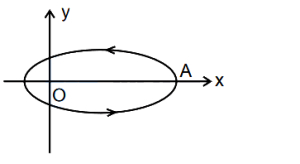
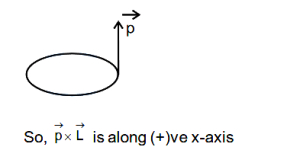
$A$ particle is moving in an elliptical orbit as shown in the figure. If $\vec{p}$,$\vec{L}$,and $\vec{r}$ denote the linear momentum,angular momentum,and position vector of the particle (from focus $O$) respectively at point $A$,then the direction of $\vec{\alpha} = \vec{p} \times \vec{L}$ is along
A
+ ve $x$ axis
B
- ve $x$ axis
C
+ ve $y$ axis
D
- ve $y$ axis
Solution
(A) The angular momentum $\vec{L}$ is defined as $\vec{L} = \vec{r} \times \vec{p}$. Since the particle moves in the $xy$-plane,$\vec{L}$ is directed along the $z$-axis (perpendicular to the plane of motion).
At point $A$,the particle is moving along the $y$-direction (tangent to the ellipse at the extreme right point),so the linear momentum $\vec{p}$ is along the $+y$ direction.
We need to find the direction of $\vec{\alpha} = \vec{p} \times \vec{L}$.
Using the right-hand rule for the cross product:
$\vec{p}$ is in the $+y$ direction $(\hat{j})$.
$\vec{L}$ is in the $+z$ direction $(\hat{k})$.
Therefore,$\vec{\alpha} = \vec{p} \times \vec{L} = (p\hat{j}) \times (L\hat{k}) = pL(\hat{j} \times \hat{k}) = pL\hat{i}$.
This corresponds to the $+x$ axis.
At point $A$,the particle is moving along the $y$-direction (tangent to the ellipse at the extreme right point),so the linear momentum $\vec{p}$ is along the $+y$ direction.
We need to find the direction of $\vec{\alpha} = \vec{p} \times \vec{L}$.
Using the right-hand rule for the cross product:
$\vec{p}$ is in the $+y$ direction $(\hat{j})$.
$\vec{L}$ is in the $+z$ direction $(\hat{k})$.
Therefore,$\vec{\alpha} = \vec{p} \times \vec{L} = (p\hat{j}) \times (L\hat{k}) = pL(\hat{j} \times \hat{k}) = pL\hat{i}$.
This corresponds to the $+x$ axis.
0 likesView Solution
10
PhysicsDifficultMCQWBJEE · 2022
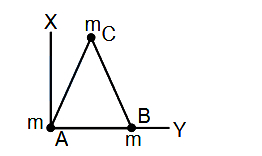
Three particles,each of mass '$m$' grams,are situated at the vertices of an equilateral $\triangle ABC$ of side '$a$' $cm$ (as shown in the figure). The moment of inertia of the system about a line $AX$ perpendicular to $AB$ and in the plane of $ABC$ in $g-cm^2$ units will be:
A
$2 ma^2$
B
$\frac{3}{2} ma^2$
C
$\frac{3}{4} ma^2$
D
$\frac{5}{4} ma^2$
Solution
(D) Let the axis of rotation be the $AX$ line,which passes through vertex $A$ and is perpendicular to $AB$.
The moment of inertia $I$ of the system is the sum of the moments of inertia of individual particles about the axis $AX$.
$I = \sum m_i r_i^2$,where $r_i$ is the perpendicular distance of the $i$-th particle from the axis $AX$.
$1$. For the particle at vertex $A$: The distance $r_A = 0$,so $I_A = m(0)^2 = 0$.
$2$. For the particle at vertex $B$: The distance $r_B = a$,so $I_B = m(a)^2 = ma^2$.
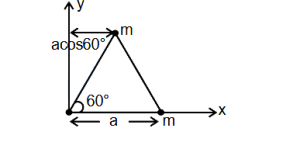
$3$. For the particle at vertex $C$: The perpendicular distance from $AX$ is $r_C = a \cos 60^{\circ} = a \times \frac{1}{2} = \frac{a}{2}$.
So,$I_C = m(\frac{a}{2})^2 = \frac{ma^2}{4}$.
The total moment of inertia $I = I_A + I_B + I_C = 0 + ma^2 + \frac{ma^2}{4} = \frac{5ma^2}{4} \text{ } g-cm^2$.
The moment of inertia $I$ of the system is the sum of the moments of inertia of individual particles about the axis $AX$.
$I = \sum m_i r_i^2$,where $r_i$ is the perpendicular distance of the $i$-th particle from the axis $AX$.
$1$. For the particle at vertex $A$: The distance $r_A = 0$,so $I_A = m(0)^2 = 0$.
$2$. For the particle at vertex $B$: The distance $r_B = a$,so $I_B = m(a)^2 = ma^2$.
$3$. For the particle at vertex $C$: The perpendicular distance from $AX$ is $r_C = a \cos 60^{\circ} = a \times \frac{1}{2} = \frac{a}{2}$.
So,$I_C = m(\frac{a}{2})^2 = \frac{ma^2}{4}$.
The total moment of inertia $I = I_A + I_B + I_C = 0 + ma^2 + \frac{ma^2}{4} = \frac{5ma^2}{4} \text{ } g-cm^2$.
0 likesView Solution
11
PhysicsMediumMCQWBJEE · 2022
Consider a thermodynamic process where internal energy $U = A P^2 V$ $(A = \text{constant})$. If the process is performed adiabatically, then:
A
$A P^2(V+1) = \text{constant}$
B
$(A P+1)^2 V = \text{constant}$
C
$(A P+1) V^2 = \text{constant}$
D
$\frac{V}{(A P+1)^2} = \text{constant}$
Solution
(B) Given the internal energy $U = A P^2 V$.
For an adiabatic process, the first law of thermodynamics states $dQ = dU + dW = 0$, which implies $dU = -dW = -P dV$.
Thus, $dU = -P dV$.
Taking the differential of $U$ with respect to $V$: $dU = A P^2 dV + 2 A P V dP$.
Equating the two expressions for $dU$: $-P dV = A P^2 dV + 2 A P V dP$.
Dividing by $P$ (assuming $P \neq 0$): $-dV = A P dV + 2 A V dP$.
Rearranging the terms: $-dV - A P dV = 2 A V dP \Rightarrow -(1 + A P) dV = 2 A V dP$.
Separating the variables: $-\frac{dV}{V} = \frac{2 A dP}{1 + A P}$.
Integrating both sides: $-\int \frac{dV}{V} = \int \frac{2 A dP}{1 + A P}$.
$-\ln V = 2 \ln(1 + A P) + C$.
This simplifies to $\ln V + \ln(1 + A P)^2 = \text{constant}$.
Therefore, $V(1 + A P)^2 = \text{constant}$.
For an adiabatic process, the first law of thermodynamics states $dQ = dU + dW = 0$, which implies $dU = -dW = -P dV$.
Thus, $dU = -P dV$.
Taking the differential of $U$ with respect to $V$: $dU = A P^2 dV + 2 A P V dP$.
Equating the two expressions for $dU$: $-P dV = A P^2 dV + 2 A P V dP$.
Dividing by $P$ (assuming $P \neq 0$): $-dV = A P dV + 2 A V dP$.
Rearranging the terms: $-dV - A P dV = 2 A V dP \Rightarrow -(1 + A P) dV = 2 A V dP$.
Separating the variables: $-\frac{dV}{V} = \frac{2 A dP}{1 + A P}$.
Integrating both sides: $-\int \frac{dV}{V} = \int \frac{2 A dP}{1 + A P}$.
$-\ln V = 2 \ln(1 + A P) + C$.
This simplifies to $\ln V + \ln(1 + A P)^2 = \text{constant}$.
Therefore, $V(1 + A P)^2 = \text{constant}$.
0 likesView Solution
12
PhysicsDifficultMCQWBJEE · 2022
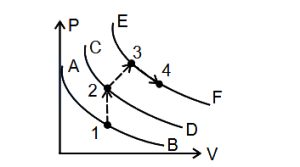
$A$ certain amount of an ideal gas is taken from its initial state $1$ to final state $4$ through the path $1 \rightarrow 2 \rightarrow 3 \rightarrow 4$ as shown in the figure. $AB, CD, EF$ are all isotherms. If $v_p$ is the most probable speed of the molecules,then:
A
$v_p$ at $3 = v_p$ at $4 > v_p$ at $2 > v_p$ at $1$
B
$v_p$ at $3 > v_p$ at $1 > v_p$ at $2 > v_p$ at $4$
C
$v_p$ at $3 > v_p$ at $2 > v_p$ at $4 > v_p$ at $1$
D
$v_p$ at $2 = v_p$ at $3 > v_p$ at $1 > v_p$ at $4$
Solution
(A) The most probable speed of gas molecules is given by $v_p = \sqrt{\frac{2RT}{M}}$,which implies $v_p \propto \sqrt{T}$.
Isotherms represent lines of constant temperature. In a $P-V$ diagram,isotherms further from the origin correspond to higher temperatures.
From the figure,the isotherm $EF$ is the furthest from the origin,followed by $CD$,and then $AB$ is the closest.
Points $3$ and $4$ lie on the isotherm $EF$,so $T_3 = T_4$. Thus,$v_p$ at $3 = v_p$ at $4$.
Point $2$ lies on the isotherm $CD$,so $T_2$ is the temperature of $CD$.
Point $1$ lies on the isotherm $AB$,so $T_1$ is the temperature of $AB$.
Since the order of temperatures is $T_3 = T_4 > T_2 > T_1$,the order of most probable speeds is $v_p$ at $3 = v_p$ at $4 > v_p$ at $2 > v_p$ at $1$.
Isotherms represent lines of constant temperature. In a $P-V$ diagram,isotherms further from the origin correspond to higher temperatures.
From the figure,the isotherm $EF$ is the furthest from the origin,followed by $CD$,and then $AB$ is the closest.
Points $3$ and $4$ lie on the isotherm $EF$,so $T_3 = T_4$. Thus,$v_p$ at $3 = v_p$ at $4$.
Point $2$ lies on the isotherm $CD$,so $T_2$ is the temperature of $CD$.
Point $1$ lies on the isotherm $AB$,so $T_1$ is the temperature of $AB$.
Since the order of temperatures is $T_3 = T_4 > T_2 > T_1$,the order of most probable speeds is $v_p$ at $3 = v_p$ at $4 > v_p$ at $2 > v_p$ at $1$.
0 likesView Solution
13
PhysicsDifficultMCQWBJEE · 2022
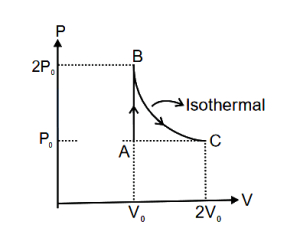
One mole of a diatomic ideal gas undergoes a process shown in $P-V$ diagram. The total heat given to the gas $(\ln 2 = 0.7)$ is (in $P_0 V_0$)
A
$2.5$
B
$3.9$
C
$1.1$
D
$1.4$
Solution
(B) For a diatomic gas,the total heat given is $\Delta Q_{total} = \Delta Q_{AB} + \Delta Q_{BC}$.
$1$. For process $AB$ (Isochoric process):
$\Delta Q_{AB} = n C_V \Delta T = n \left( \frac{R}{\gamma - 1} \right) \Delta T = \frac{P_f V_f - P_i V_i}{\gamma - 1}$
Given $n = 1$ mole,diatomic gas $\gamma = 1.4 = 7/5$.
$\Delta Q_{AB} = \frac{2 P_0 V_0 - P_0 V_0}{7/5 - 1} = \frac{P_0 V_0}{2/5} = 2.5 P_0 V_0$.
$2$. For process $BC$ (Isothermal process):
$\Delta Q_{BC} = W_{BC} = n R T \ln \left( \frac{V_f}{V_i} \right) = P_B V_B \ln \left( \frac{V_C}{V_B} \right)$
Since $P_B V_B = 2 P_0 V_0$ and $V_C = 2 V_0, V_B = V_0$:
$\Delta Q_{BC} = 2 P_0 V_0 \ln \left( \frac{2 V_0}{V_0} \right) = 2 P_0 V_0 \ln 2 = 2 P_0 V_0 (0.7) = 1.4 P_0 V_0$.
Total heat $\Delta Q_{total} = 2.5 P_0 V_0 + 1.4 P_0 V_0 = 3.9 P_0 V_0$.
$1$. For process $AB$ (Isochoric process):
$\Delta Q_{AB} = n C_V \Delta T = n \left( \frac{R}{\gamma - 1} \right) \Delta T = \frac{P_f V_f - P_i V_i}{\gamma - 1}$
Given $n = 1$ mole,diatomic gas $\gamma = 1.4 = 7/5$.
$\Delta Q_{AB} = \frac{2 P_0 V_0 - P_0 V_0}{7/5 - 1} = \frac{P_0 V_0}{2/5} = 2.5 P_0 V_0$.
$2$. For process $BC$ (Isothermal process):
$\Delta Q_{BC} = W_{BC} = n R T \ln \left( \frac{V_f}{V_i} \right) = P_B V_B \ln \left( \frac{V_C}{V_B} \right)$
Since $P_B V_B = 2 P_0 V_0$ and $V_C = 2 V_0, V_B = V_0$:
$\Delta Q_{BC} = 2 P_0 V_0 \ln \left( \frac{2 V_0}{V_0} \right) = 2 P_0 V_0 \ln 2 = 2 P_0 V_0 (0.7) = 1.4 P_0 V_0$.
Total heat $\Delta Q_{total} = 2.5 P_0 V_0 + 1.4 P_0 V_0 = 3.9 P_0 V_0$.
0 likesView Solution
14
PhysicsDifficultMCQWBJEE · 2022
One mole of an ideal monoatomic gas expands along the polytropic process $PV^3 = \text{constant}$ from volume $V_1$ to $V_2$. The molar specific heat capacity for this process is given by $C = C_V + \frac{R}{1-n}$. The total heat absorbed during the process can be expressed as:
A
$P_1 V_1 \left( \frac{V_1^2}{V_2^2} + 1 \right)$
B
$P_1 V_1 \left( \frac{V_1^2}{V_2^2} - 1 \right)$
C
$P_1 V_1 \left( \frac{V_1^3}{V_2^2} - 1 \right)$
D
$P_1 V_1 \left( \frac{V_1}{V_2^2} - 1 \right)$
Solution
(B) For a polytropic process $PV^n = \text{constant}$, the molar heat capacity is $C = C_V + \frac{R}{1-n}$.
Given $n = 3$ and $C_V = \frac{3R}{2}$ for a monoatomic gas.
Thus, $C = \frac{3R}{2} + \frac{R}{1-3} = \frac{3R}{2} - \frac{R}{2} = R$.
From the ideal gas law $PV = RT$ (for $1$ mole), we have $T = \frac{PV}{R}$.
Initial state: $T_1 = \frac{P_1 V_1}{R}$.
Final state: Since $P_1 V_1^3 = P_2 V_2^3$, we have $P_2 = P_1 \left( \frac{V_1}{V_2} \right)^3$.
$T_2 = \frac{P_2 V_2}{R} = \frac{P_1 V_1^3}{R V_2^2}$.
The heat absorbed is $Q = n C \Delta T = 1 \cdot R \cdot (T_2 - T_1)$.
$Q = R \left( \frac{P_1 V_1^3}{R V_2^2} - \frac{P_1 V_1}{R} \right) = P_1 V_1 \left( \frac{V_1^2}{V_2^2} - 1 \right)$.
Given $n = 3$ and $C_V = \frac{3R}{2}$ for a monoatomic gas.
Thus, $C = \frac{3R}{2} + \frac{R}{1-3} = \frac{3R}{2} - \frac{R}{2} = R$.
From the ideal gas law $PV = RT$ (for $1$ mole), we have $T = \frac{PV}{R}$.
Initial state: $T_1 = \frac{P_1 V_1}{R}$.
Final state: Since $P_1 V_1^3 = P_2 V_2^3$, we have $P_2 = P_1 \left( \frac{V_1}{V_2} \right)^3$.
$T_2 = \frac{P_2 V_2}{R} = \frac{P_1 V_1^3}{R V_2^2}$.
The heat absorbed is $Q = n C \Delta T = 1 \cdot R \cdot (T_2 - T_1)$.
$Q = R \left( \frac{P_1 V_1^3}{R V_2^2} - \frac{P_1 V_1}{R} \right) = P_1 V_1 \left( \frac{V_1^2}{V_2^2} - 1 \right)$.
0 likesView Solution
15
PhysicsEasyMCQWBJEE · 2022
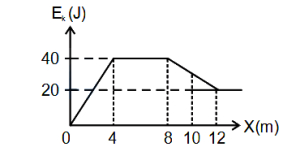
The kinetic energy $(E_k)$ of a particle moving along the $X$-axis varies with its position $(X)$ as shown in the figure. The force acting on the particle at $X = 10 \ m$ is
A
$5 \hat{i} \ N$
B
$0 \ N$
C
$97.5 \hat{i} \ N$
D
$-5 \hat{i} \ N$
Solution
(D) According to the work-energy theorem,the work done by the net force is equal to the change in kinetic energy: $W = \Delta E_k$.
For an infinitesimal displacement $dx$,the work done is $dW = F \cdot dx$.
Therefore,$F = \frac{dE_k}{dx}$.
This means the force acting on the particle is equal to the slope of the $E_k$ versus $X$ graph.
We need to find the force at $X = 10 \ m$. This point lies on the line segment between $X = 8 \ m$ and $X = 12 \ m$.
The coordinates of the endpoints of this segment are $(8, 40)$ and $(12, 20)$.
The slope of this line is $m = \frac{y_2 - y_1}{x_2 - x_1} = \frac{20 - 40}{12 - 8} = \frac{-20}{4} = -5 \ N$.
Since the slope is constant between $X = 8 \ m$ and $X = 12 \ m$,the force at $X = 10 \ m$ is $-5 \hat{i} \ N$.
For an infinitesimal displacement $dx$,the work done is $dW = F \cdot dx$.
Therefore,$F = \frac{dE_k}{dx}$.
This means the force acting on the particle is equal to the slope of the $E_k$ versus $X$ graph.
We need to find the force at $X = 10 \ m$. This point lies on the line segment between $X = 8 \ m$ and $X = 12 \ m$.
The coordinates of the endpoints of this segment are $(8, 40)$ and $(12, 20)$.
The slope of this line is $m = \frac{y_2 - y_1}{x_2 - x_1} = \frac{20 - 40}{12 - 8} = \frac{-20}{4} = -5 \ N$.
Since the slope is constant between $X = 8 \ m$ and $X = 12 \ m$,the force at $X = 10 \ m$ is $-5 \hat{i} \ N$.
0 likesView Solution
16
PhysicsEasyMCQWBJEE · 2022
In a closed circuit,there is only a coil of inductance $L$ and resistance $100 \Omega$. The coil is situated in a uniform magnetic field. Suddenly,the magnetic flux linked with the circuit changes by $5 \text{ Wb}$. What amount of charge will flow in the circuit as a result?
A
$500 \text{ C}$
B
$0.05 \text{ C}$
C
$20 \text{ C}$
D
Value of $L$ is required to find the charge flown
Solution
(B) According to Faraday's Law of electromagnetic induction,the induced electromotive force (Emf) is given by: $\epsilon = -\frac{d\phi}{dt}$.
Since the circuit has a resistance $R$,the induced current $i$ is: $i = \frac{\epsilon}{R} = -\frac{1}{R} \frac{d\phi}{dt}$.
We know that current $i = \frac{dq}{dt}$,where $dq$ is the small amount of charge flowing in time $dt$.
Substituting this,we get: $\frac{dq}{dt} = -\frac{1}{R} \frac{d\phi}{dt}$.
Integrating both sides,we find the total charge $q$ that flows:
$q = \int dq = -\frac{1}{R} \int d\phi = \frac{\Delta\phi}{R}$.
Given $\Delta\phi = 5 \text{ Wb}$ and $R = 100 \Omega$,the charge $q$ is:
$q = \frac{5}{100} = 0.05 \text{ C}$.
Since the circuit has a resistance $R$,the induced current $i$ is: $i = \frac{\epsilon}{R} = -\frac{1}{R} \frac{d\phi}{dt}$.
We know that current $i = \frac{dq}{dt}$,where $dq$ is the small amount of charge flowing in time $dt$.
Substituting this,we get: $\frac{dq}{dt} = -\frac{1}{R} \frac{d\phi}{dt}$.
Integrating both sides,we find the total charge $q$ that flows:
$q = \int dq = -\frac{1}{R} \int d\phi = \frac{\Delta\phi}{R}$.
Given $\Delta\phi = 5 \text{ Wb}$ and $R = 100 \Omega$,the charge $q$ is:
$q = \frac{5}{100} = 0.05 \text{ C}$.
0 likesView Solution
17
PhysicsEasyMCQWBJEE · 2022
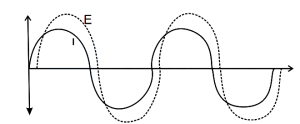
When an $AC$ source of emf $E$ with angular frequency $\omega = 100 \text{ rad/s}$ is connected across a circuit,the phase difference between $E$ and current $I$ in the circuit is observed to be $\frac{\pi}{4}$ as shown in the figure. If the circuit consists of only $RC$ or $RL$ in series,then:
A
$R=1 \text{ k}\Omega, C=5 \mu\text{F}$
B
$R=1 \text{ k}\Omega, L=10 \text{ H}$
C
$R=1 \text{ k}\Omega, L=1 \text{ H}$
D
$R=1 \text{ k}\Omega, C=10 \mu\text{F}$
Solution
(D) From the figure,the current $I$ leads the emf $E$ by a phase angle $\phi = \frac{\pi}{4}$. This indicates that the circuit is a capacitive circuit ($RC$ series circuit).
In an $RC$ series circuit,the phase angle $\phi$ is given by $\tan \phi = \frac{X_C}{R}$.
Given $\phi = \frac{\pi}{4}$,we have $\tan(\frac{\pi}{4}) = 1$,so $X_C = R$.
We know $X_C = \frac{1}{\omega C}$.
Given $\omega = 100 \text{ rad/s}$ and $R = 1 \text{ k}\Omega = 1000 \text{ }\Omega$.
Substituting these values: $1000 = \frac{1}{100 \times C}$.
$C = \frac{1}{100 \times 1000} = \frac{1}{10^5} = 10 \times 10^{-6} \text{ F} = 10 \mu\text{F}$.
Thus,$R = 1 \text{ k}\Omega$ and $C = 10 \mu\text{F}$.
In an $RC$ series circuit,the phase angle $\phi$ is given by $\tan \phi = \frac{X_C}{R}$.
Given $\phi = \frac{\pi}{4}$,we have $\tan(\frac{\pi}{4}) = 1$,so $X_C = R$.
We know $X_C = \frac{1}{\omega C}$.
Given $\omega = 100 \text{ rad/s}$ and $R = 1 \text{ k}\Omega = 1000 \text{ }\Omega$.
Substituting these values: $1000 = \frac{1}{100 \times C}$.
$C = \frac{1}{100 \times 1000} = \frac{1}{10^5} = 10 \times 10^{-6} \text{ F} = 10 \mu\text{F}$.
Thus,$R = 1 \text{ k}\Omega$ and $C = 10 \mu\text{F}$.
0 likesView Solution
18
PhysicsMediumMCQWBJEE · 2022
Suppose in a hypothetical world,the angular momentum is quantized to be even integral multiples of $\frac{h}{2 \pi}$. According to Bohr's model,what will be the largest possible wavelength emitted by hydrogen atoms in the visible range in this world (in $text{ nm}$)? (Consider $hc = 1242 \text{ eV-nm}$)
A
$153$
B
$409$
C
$121$
D
$487$
Solution
(D) In the given hypothetical world,the angular momentum is $L = 2n' \frac{h}{2\pi} = n' \frac{h}{\pi}$,where $n' = 1, 2, 3, \dots$.
Comparing this with the standard Bohr quantization $L = n \frac{h}{2\pi}$,we see that the allowed orbits correspond to $n = 2n'$.
The energy of an orbit is $E_n = -\frac{13.6}{n^2} \text{ eV}$. Substituting $n = 2n'$,we get $E_{n'} = -\frac{13.6}{(2n')^2} = -\frac{13.6}{4n'^2} = -\frac{3.4}{n'^2} \text{ eV}$.
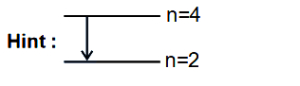
For the visible range,the transition must end at the first excited state of this system. The ground state is $n'=1$ $(n=2)$,and the first excited state is $n'=2$ $(n=4)$.
The transition for the largest wavelength (smallest energy) in the visible range is from $n'=2$ to $n'=1$.
The energy difference is $\Delta E = E_2 - E_1 = -\frac{3.4}{2^2} - (-\frac{3.4}{1^2}) = -0.85 + 3.4 = 2.55 \text{ eV}$.
The wavelength is $\lambda = \frac{hc}{\Delta E} = \frac{1242 \text{ eV-nm}}{2.55 \text{ eV}} \approx 487 \text{ nm}$.
Comparing this with the standard Bohr quantization $L = n \frac{h}{2\pi}$,we see that the allowed orbits correspond to $n = 2n'$.
The energy of an orbit is $E_n = -\frac{13.6}{n^2} \text{ eV}$. Substituting $n = 2n'$,we get $E_{n'} = -\frac{13.6}{(2n')^2} = -\frac{13.6}{4n'^2} = -\frac{3.4}{n'^2} \text{ eV}$.
For the visible range,the transition must end at the first excited state of this system. The ground state is $n'=1$ $(n=2)$,and the first excited state is $n'=2$ $(n=4)$.
The transition for the largest wavelength (smallest energy) in the visible range is from $n'=2$ to $n'=1$.
The energy difference is $\Delta E = E_2 - E_1 = -\frac{3.4}{2^2} - (-\frac{3.4}{1^2}) = -0.85 + 3.4 = 2.55 \text{ eV}$.
The wavelength is $\lambda = \frac{hc}{\Delta E} = \frac{1242 \text{ eV-nm}}{2.55 \text{ eV}} \approx 487 \text{ nm}$.
0 likesView Solution
19
PhysicsDifficultMCQWBJEE · 2022
$A$ sample of hydrogen atoms in its ground state is radiated with photons of $10.2 eV$ energy. The radiation emitted from the sample is absorbed by excited ionized $He^{+}$ ions. Which of the following statement$(s)$ is/are true?
A
$He^{+}$ electron moves from $n=2$ to $n=4$
B
In the $He^{+}$ emission spectra,there will be $6$ lines
C
Smallest wavelength of $He^{+}$ spectrum is obtained when transition takes place from $n=4$ to $n=3$
D
$He^{+}$ electron moves from $n=2$ to $n=3$
Solution
(A, B) The energy required for a transition in $He^{+}$ is given by $E = 13.6 \times Z^2 \left( \frac{1}{n_1^2} - \frac{1}{n_2^2} \right)$. For $He^{+}$,$Z=2$,so $E = 13.6 \times 4 \left( \frac{1}{n_1^2} - \frac{1}{n_2^2} \right) = 54.4 \left( \frac{1}{n_1^2} - \frac{1}{n_2^2} \right) eV$.
For a transition from $n=2$ to $n=4$,$E = 54.4 \left( \frac{1}{4} - \frac{1}{16} \right) = 54.4 \left( \frac{3}{16} \right) = 10.2 eV$.
Since the incident photon energy is $10.2 eV$,the $He^{+}$ electron can be excited from $n=2$ to $n=4$.
Once in the $n=4$ state,the number of spectral lines emitted is given by $\frac{n(n-1)}{2} = \frac{4(4-1)}{2} = 6$.
Therefore,statements $A$ and $B$ are correct.
For a transition from $n=2$ to $n=4$,$E = 54.4 \left( \frac{1}{4} - \frac{1}{16} \right) = 54.4 \left( \frac{3}{16} \right) = 10.2 eV$.
Since the incident photon energy is $10.2 eV$,the $He^{+}$ electron can be excited from $n=2$ to $n=4$.
Once in the $n=4$ state,the number of spectral lines emitted is given by $\frac{n(n-1)}{2} = \frac{4(4-1)}{2} = 6$.
Therefore,statements $A$ and $B$ are correct.
0 likesView Solution
20
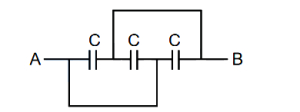
PhysicsEasyMCQWBJEE · 2022
Find the equivalent capacitance between $A$ and $B$ of the following arrangement:
A
$C$
B
$3C$
C
$\frac{2C}{3}$
D
$\frac{3C}{2}$
Solution
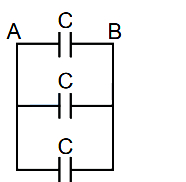
(B) By analyzing the circuit diagram,we can see that all three capacitors are connected in parallel between points $A$ and $B$.
In a parallel combination,the equivalent capacitance $C_{eq}$ is given by the sum of individual capacitances:
$C_{eq} = C_1 + C_2 + C_3$
Since all capacitors have capacitance $C$,we have:
$C_{eq} = C + C + C = 3C$
Therefore,the equivalent capacitance between $A$ and $B$ is $3C$.
In a parallel combination,the equivalent capacitance $C_{eq}$ is given by the sum of individual capacitances:
$C_{eq} = C_1 + C_2 + C_3$
Since all capacitors have capacitance $C$,we have:
$C_{eq} = C + C + C = 3C$
Therefore,the equivalent capacitance between $A$ and $B$ is $3C$.
0 likesView Solution
21
PhysicsEasyMCQWBJEE · 2022
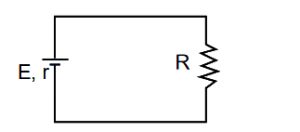
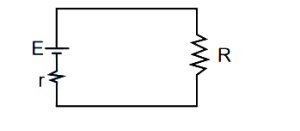
$A$ battery of emf $E$ and internal resistance $r$ is connected with an external resistance $R$ as shown in the figure. The battery will act as a constant voltage source if
A
$r << R$
B
$r >> R$
C
$r = R$
D
It will never act as a constant voltage source
Solution
(A) The terminal voltage $V_R$ across the external resistance $R$ is given by the formula:
$V_R = \frac{E}{(R + r)} \times R$
Dividing the numerator and denominator by $R$,we get:
$V_R = \frac{E}{(1 + r/R)}$
For the battery to act as a constant voltage source,the terminal voltage $V_R$ should be approximately equal to the emf $E$,regardless of the variations in the external load $R$.
This condition is satisfied when $r/R$ is very small,which implies $r << R$.
$V_R = \frac{E}{(R + r)} \times R$
Dividing the numerator and denominator by $R$,we get:
$V_R = \frac{E}{(1 + r/R)}$
For the battery to act as a constant voltage source,the terminal voltage $V_R$ should be approximately equal to the emf $E$,regardless of the variations in the external load $R$.
This condition is satisfied when $r/R$ is very small,which implies $r << R$.
0 likesView Solution
22
PhysicsEasyMCQWBJEE · 2022
If the kinetic energies of an electron,an alpha particle,and a proton having the same de-Broglie wavelength are $\varepsilon_1, \varepsilon_2$,and $\varepsilon_3$ respectively,then:
A
$\varepsilon_1 > \varepsilon_3 > \varepsilon_2$
B
$\varepsilon_1 = \varepsilon_2 = \varepsilon_3$
C
$\varepsilon_1 < \varepsilon_3 < \varepsilon_2$
D
$\varepsilon_1 > \varepsilon_2 > \varepsilon_3$
Solution
(A) The de-Broglie wavelength $\lambda$ is given by the formula $\lambda = \frac{h}{p} = \frac{h}{\sqrt{2mK}}$,where $h$ is Planck's constant,$m$ is the mass of the particle,and $K$ is the kinetic energy.
Since the de-Broglie wavelength $\lambda$ is the same for all three particles,we have $\sqrt{2mK} = \text{constant}$,which implies $mK = \text{constant}$ or $K \propto \frac{1}{m}$.
The masses of the particles are $m_e$ (electron),$m_p$ (proton),and $m_{\alpha}$ (alpha particle). We know that $m_e < m_p < m_{\alpha}$.
Since $K$ is inversely proportional to mass,we have $\varepsilon_1 > \varepsilon_3 > \varepsilon_2$ (where $\varepsilon_1$ corresponds to the electron,$\varepsilon_3$ to the proton,and $\varepsilon_2$ to the alpha particle).
Since the de-Broglie wavelength $\lambda$ is the same for all three particles,we have $\sqrt{2mK} = \text{constant}$,which implies $mK = \text{constant}$ or $K \propto \frac{1}{m}$.
The masses of the particles are $m_e$ (electron),$m_p$ (proton),and $m_{\alpha}$ (alpha particle). We know that $m_e < m_p < m_{\alpha}$.
Since $K$ is inversely proportional to mass,we have $\varepsilon_1 > \varepsilon_3 > \varepsilon_2$ (where $\varepsilon_1$ corresponds to the electron,$\varepsilon_3$ to the proton,and $\varepsilon_2$ to the alpha particle).
0 likesView Solution
23
PhysicsEasyMCQWBJEE · 2022
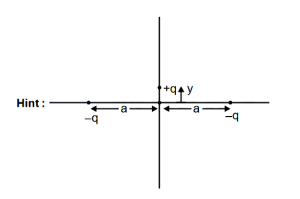
Two charges,each equal to $-q$,are kept at $(-a, 0)$ and $(a, 0)$. $A$ charge $q$ is placed at the origin. If $q$ is given a small displacement $y$ along the $y$-direction,the force acting on $q$ is proportional to:
A
$y$
B
$-y$
C
$\frac{1}{y}$
D
$-\frac{1}{y}$
Solution
(B) Let the charge $q$ be displaced by a small distance $y$ along the $y$-axis. The position of the charge becomes $(0, y)$.
The distance $r$ of this charge from each of the charges $-q$ located at $(-a, 0)$ and $(a, 0)$ is $r = \sqrt{a^2 + y^2}$.
The force exerted by each charge $-q$ on $q$ is $F' = \frac{kq^2}{r^2} = \frac{kq^2}{a^2 + y^2}$.
The components of these forces along the $x$-axis cancel out due to symmetry.
The components along the $y$-axis are both directed towards the origin (negative $y$-direction).
The net force is $F = -2 F' \sin \theta$,where $\sin \theta = \frac{y}{r} = \frac{y}{\sqrt{a^2 + y^2}}$.
$F = -2 \left( \frac{kq^2}{a^2 + y^2} \right) \left( \frac{y}{\sqrt{a^2 + y^2}} \right) = -\frac{2kq^2 y}{(a^2 + y^2)^{3/2}}$.
Since the displacement $y$ is very small $(y \ll a)$,we can approximate $(a^2 + y^2)^{3/2} \approx (a^2)^{3/2} = a^3$.
Thus,$F \approx -\frac{2kq^2}{a^3} y$.
Therefore,$F \propto -y$.
The distance $r$ of this charge from each of the charges $-q$ located at $(-a, 0)$ and $(a, 0)$ is $r = \sqrt{a^2 + y^2}$.
The force exerted by each charge $-q$ on $q$ is $F' = \frac{kq^2}{r^2} = \frac{kq^2}{a^2 + y^2}$.
The components of these forces along the $x$-axis cancel out due to symmetry.
The components along the $y$-axis are both directed towards the origin (negative $y$-direction).
The net force is $F = -2 F' \sin \theta$,where $\sin \theta = \frac{y}{r} = \frac{y}{\sqrt{a^2 + y^2}}$.
$F = -2 \left( \frac{kq^2}{a^2 + y^2} \right) \left( \frac{y}{\sqrt{a^2 + y^2}} \right) = -\frac{2kq^2 y}{(a^2 + y^2)^{3/2}}$.
Since the displacement $y$ is very small $(y \ll a)$,we can approximate $(a^2 + y^2)^{3/2} \approx (a^2)^{3/2} = a^3$.
Thus,$F \approx -\frac{2kq^2}{a^3} y$.
Therefore,$F \propto -y$.
0 likesView Solution
24
PhysicsEasyMCQWBJEE · 2022
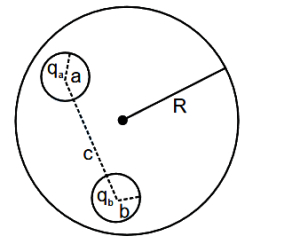
$A$ neutral conducting solid sphere of radius $R$ has two spherical cavities of radius $a$ and $b$ as shown in the figure. The centre-to-centre distance between the two cavities is $c$. Charges $q_a$ and $q_b$ are placed at the centres of the cavities,respectively. The force between $q_a$ and $q_b$ is:
A
$\frac{1}{4 \pi \varepsilon_0} \frac{q_{a} q_{b}}{c^2}$
B
$\frac{1}{4 \pi \varepsilon_0} q_a q_b\left(\frac{1}{a^2}+\frac{1}{b^2}\right)$
C
zero
D
insufficient data
Solution
(C) When a charge $q_a$ is placed inside a cavity of a conducting sphere,it induces a charge $-q_a$ on the inner surface of the cavity and a charge $+q_a$ on the outer surface of the conducting sphere.
Similarly,placing $q_b$ in the other cavity induces $-q_b$ on its inner surface and $+q_b$ on the outer surface of the conducting sphere.
The total charge on the outer surface of the conducting sphere becomes $q_a + q_b$. Since the sphere is conducting,the electric field inside the bulk of the conductor is zero.
The charge $q_a$ experiences a force due to the field produced by the induced charge $-q_b$ on the inner surface of the second cavity and the field produced by the charge distribution on the outer surface of the sphere.
However,due to the electrostatic shielding property of the conductor,the electric field produced by the charges outside the cavity (including the outer surface charge and the other cavity's induced charge) is zero inside the cavity containing $q_a$.
Therefore,the charge $q_a$ only experiences the field produced by the charge $-q_b$ induced on the inner surface of its own cavity,which is zero at its center due to symmetry.
Thus,the net force on $q_a$ due to $q_b$ and the induced charges is zero.
Similarly,placing $q_b$ in the other cavity induces $-q_b$ on its inner surface and $+q_b$ on the outer surface of the conducting sphere.
The total charge on the outer surface of the conducting sphere becomes $q_a + q_b$. Since the sphere is conducting,the electric field inside the bulk of the conductor is zero.
The charge $q_a$ experiences a force due to the field produced by the induced charge $-q_b$ on the inner surface of the second cavity and the field produced by the charge distribution on the outer surface of the sphere.
However,due to the electrostatic shielding property of the conductor,the electric field produced by the charges outside the cavity (including the outer surface charge and the other cavity's induced charge) is zero inside the cavity containing $q_a$.
Therefore,the charge $q_a$ only experiences the field produced by the charge $-q_b$ induced on the inner surface of its own cavity,which is zero at its center due to symmetry.
Thus,the net force on $q_a$ due to $q_b$ and the induced charges is zero.
0 likesView Solution
25
PhysicsDifficultMCQWBJEE · 2022
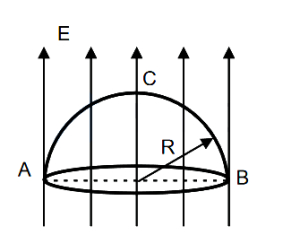
$A$ hemisphere of radius $R$ is placed in a uniform electric field $E$ so that its axis is parallel to the field. Which of the following statement$(s)$ is/are true?
A
Flux through the curved surface of hemisphere is $\pi R^2 E$.
B
Flux through the circular surface of hemisphere is $\pi R^2 E$.
C
Total flux enclosed is zero.
D
Work done in moving a point charge $q$ from $A$ to $B$ via the path $ACB$ depends upon $R$.
Solution
(A, C) According to Gauss's Law,the total electric flux $\phi_{\text{total}}$ through any closed surface in a region with no enclosed charge is zero,i.e.,$\phi_{\text{total}} = 0$.
For the hemisphere,$\phi_{\text{total}} = \phi_{\text{curved}} + \phi_{\text{flat}} = 0$.
The flux through the flat circular surface is $\phi_{\text{flat}} = -E \cdot A = -E(\pi R^2)$ (since the field lines enter the surface).
Therefore,$\phi_{\text{curved}} = -\phi_{\text{flat}} = E \pi R^2$.
Thus,statement $(A)$ is correct and $(C)$ is correct.
Regarding the work done,for a uniform electric field,the potential difference $\Delta V = -\vec{E} \cdot \Delta \vec{r}$.
Since points $A$ and $B$ lie on the same equipotential plane perpendicular to the electric field $\vec{E}$,the potential difference between $A$ and $B$ is $\Delta V = 0$.
Therefore,the work done $W = q \Delta V = 0$,which is independent of the path and the radius $R$.
For the hemisphere,$\phi_{\text{total}} = \phi_{\text{curved}} + \phi_{\text{flat}} = 0$.
The flux through the flat circular surface is $\phi_{\text{flat}} = -E \cdot A = -E(\pi R^2)$ (since the field lines enter the surface).
Therefore,$\phi_{\text{curved}} = -\phi_{\text{flat}} = E \pi R^2$.
Thus,statement $(A)$ is correct and $(C)$ is correct.
Regarding the work done,for a uniform electric field,the potential difference $\Delta V = -\vec{E} \cdot \Delta \vec{r}$.
Since points $A$ and $B$ lie on the same equipotential plane perpendicular to the electric field $\vec{E}$,the potential difference between $A$ and $B$ is $\Delta V = 0$.
Therefore,the work done $W = q \Delta V = 0$,which is independent of the path and the radius $R$.
0 likesView Solution
26
PhysicsEasyMCQWBJEE · 2022
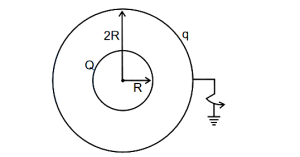
Consider two concentric conducting spheres of radii $R$ and $2R$ respectively. The inner sphere is given a charge $+Q$. The outer sphere is grounded. The potential at $r = \frac{3R}{2}$ is
A
$\frac{1}{4 \pi \varepsilon_0} \frac{Q}{6R}$
B
$0$
C
$\frac{1}{4 \pi \varepsilon_0} \frac{2Q}{3R}$
D
$\frac{1}{4 \pi \varepsilon_0} \frac{Q}{R}$
Solution
(A) Let $q$ be the charge appearing on the outer shell of radius $2R$ after earthing.
Since the outer shell is grounded,its potential must be zero.
The potential at the outer shell is the sum of potentials due to the inner charge $Q$ and the outer charge $q$:
$V_{\text{outer}} = \frac{KQ}{2R} + \frac{Kq}{2R} = 0$
Solving for $q$,we get $q = -Q$.
Now,we calculate the potential at a distance $r = \frac{3R}{2}$ from the center.
Since $R < r < 2R$,the point lies outside the inner sphere and inside the outer sphere.
The potential at this point is the sum of the potential due to the inner sphere (as a point charge) and the potential due to the outer shell (constant inside):
$V(r) = \frac{KQ}{r} + \frac{Kq}{2R}$
Substituting $r = \frac{3R}{2}$ and $q = -Q$:
$V = \frac{KQ}{3R/2} + \frac{K(-Q)}{2R} = \frac{2KQ}{3R} - \frac{KQ}{2R} = \frac{4KQ - 3KQ}{6R} = \frac{KQ}{6R} = \frac{1}{4 \pi \varepsilon_0} \frac{Q}{6R}$
Since the outer shell is grounded,its potential must be zero.
The potential at the outer shell is the sum of potentials due to the inner charge $Q$ and the outer charge $q$:
$V_{\text{outer}} = \frac{KQ}{2R} + \frac{Kq}{2R} = 0$
Solving for $q$,we get $q = -Q$.
Now,we calculate the potential at a distance $r = \frac{3R}{2}$ from the center.
Since $R < r < 2R$,the point lies outside the inner sphere and inside the outer sphere.
The potential at this point is the sum of the potential due to the inner sphere (as a point charge) and the potential due to the outer shell (constant inside):
$V(r) = \frac{KQ}{r} + \frac{Kq}{2R}$
Substituting $r = \frac{3R}{2}$ and $q = -Q$:
$V = \frac{KQ}{3R/2} + \frac{K(-Q)}{2R} = \frac{2KQ}{3R} - \frac{KQ}{2R} = \frac{4KQ - 3KQ}{6R} = \frac{KQ}{6R} = \frac{1}{4 \pi \varepsilon_0} \frac{Q}{6R}$
0 likesView Solution
27
PhysicsMediumMCQWBJEE · 2022
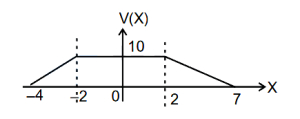
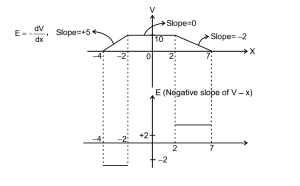
The electric potential for an electric field directed parallel to $X$-axis is shown in the figure. Choose the correct plot of electric field strength.
A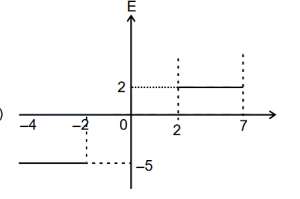
B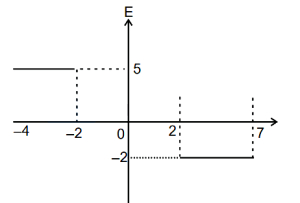
C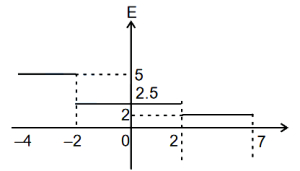
D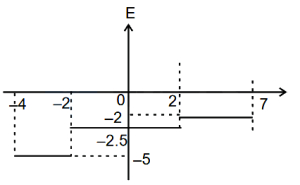
Solution
(A) The relation between electric field $E$ and electric potential $V$ is given by $E = -\frac{dV}{dx}$.
This means the electric field is the negative of the slope of the $V-X$ graph.
$1$. For the interval $X \in [-4, -2]$: The slope is $\frac{10 - 0}{-2 - (-4)} = \frac{10}{2} = 5$. Thus,$E = -5$.
$2$. For the interval $X \in [-2, 2]$: The potential is constant $(V = 10)$,so the slope is $0$. Thus,$E = 0$.
$3$. For the interval $X \in [2, 7]$: The slope is $\frac{0 - 10}{7 - 2} = \frac{-10}{5} = -2$. Thus,$E = -(-2) = 2$.
Comparing these values with the given options,option $A$ represents $E = -5$ for $X \in [-4, -2]$,$E = 0$ for $X \in [-2, 2]$,and $E = 2$ for $X \in [2, 7]$.
This means the electric field is the negative of the slope of the $V-X$ graph.
$1$. For the interval $X \in [-4, -2]$: The slope is $\frac{10 - 0}{-2 - (-4)} = \frac{10}{2} = 5$. Thus,$E = -5$.
$2$. For the interval $X \in [-2, 2]$: The potential is constant $(V = 10)$,so the slope is $0$. Thus,$E = 0$.
$3$. For the interval $X \in [2, 7]$: The slope is $\frac{0 - 10}{7 - 2} = \frac{-10}{5} = -2$. Thus,$E = -(-2) = 2$.
Comparing these values with the given options,option $A$ represents $E = -5$ for $X \in [-4, -2]$,$E = 0$ for $X \in [-2, 2]$,and $E = 2$ for $X \in [2, 7]$.
0 likesView Solution
28
PhysicsDifficultMCQWBJEE · 2022
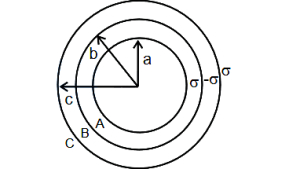
Three concentric metallic shells $A, B$ and $C$ of radii $a, b$ and $c$ $(a < b < c)$ have surface charge densities $+\sigma, -\sigma$ and $+\sigma$ respectively. The potential of shell $B$ is
A
$\quad(a+b+c) \frac{\sigma}{\varepsilon_0}$
B
$\frac{\sigma c}{\varepsilon_0}$
C
$\left(\frac{a^2}{c}-\frac{b^2}{c}+c\right) \frac{\sigma}{\varepsilon_0}$
D
$\left(\frac{a^2}{b}-b+c\right) \frac{\sigma}{\varepsilon_0}$
Solution
(D) The potential at the surface of shell $B$ is the sum of potentials due to all three shells $A, B$ and $C$.
$V_B = V_{A,B} + V_{B,B} + V_{C,B}$
Since the potential inside a shell is constant and equal to the potential at its surface,we have:
$V_{A,B} = \frac{k Q_A}{b} = \frac{1}{4\pi\varepsilon_0} \frac{\sigma(4\pi a^2)}{b} = \frac{\sigma a^2}{\varepsilon_0 b}$
$V_{B,B} = \frac{k Q_B}{b} = \frac{1}{4\pi\varepsilon_0} \frac{-\sigma(4\pi b^2)}{b} = -\frac{\sigma b}{\varepsilon_0}$
$V_{C,B} = \frac{k Q_C}{c} = \frac{1}{4\pi\varepsilon_0} \frac{\sigma(4\pi c^2)}{c} = \frac{\sigma c}{\varepsilon_0}$
Adding these,we get:
$V_B = \frac{\sigma a^2}{\varepsilon_0 b} - \frac{\sigma b}{\varepsilon_0} + \frac{\sigma c}{\varepsilon_0} = \frac{\sigma}{\varepsilon_0} \left( \frac{a^2}{b} - b + c \right)$
$V_B = V_{A,B} + V_{B,B} + V_{C,B}$
Since the potential inside a shell is constant and equal to the potential at its surface,we have:
$V_{A,B} = \frac{k Q_A}{b} = \frac{1}{4\pi\varepsilon_0} \frac{\sigma(4\pi a^2)}{b} = \frac{\sigma a^2}{\varepsilon_0 b}$
$V_{B,B} = \frac{k Q_B}{b} = \frac{1}{4\pi\varepsilon_0} \frac{-\sigma(4\pi b^2)}{b} = -\frac{\sigma b}{\varepsilon_0}$
$V_{C,B} = \frac{k Q_C}{c} = \frac{1}{4\pi\varepsilon_0} \frac{\sigma(4\pi c^2)}{c} = \frac{\sigma c}{\varepsilon_0}$
Adding these,we get:
$V_B = \frac{\sigma a^2}{\varepsilon_0 b} - \frac{\sigma b}{\varepsilon_0} + \frac{\sigma c}{\varepsilon_0} = \frac{\sigma}{\varepsilon_0} \left( \frac{a^2}{b} - b + c \right)$
0 likesView Solution
29
PhysicsMediumMCQWBJEE · 2022
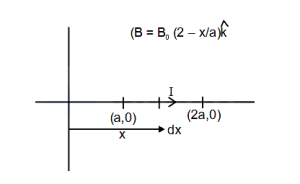
$A$ straight wire is placed in a magnetic field that varies with distance $x$ from the origin as $\vec{B} = B_0 \left( 2 - \frac{x}{a} \right) \hat{k}$. The ends of the wire are at $(a, 0)$ and $(2a, 0)$ and it carries a current $I$ in the positive $x$-direction. If the force on the wire is $\vec{F} = IB_0 \left( \frac{ka}{2} \right) \hat{j}$,then the value of $k$ is:
A
$1$
B
$5$
C
$-1$
D
$\frac{1}{2}$
Solution
(C) The magnetic force on a small current element $I d\vec{l}$ is given by $d\vec{F} = I (d\vec{l} \times \vec{B})$.
Here,the current element is $d\vec{l} = dx \hat{i}$ and the magnetic field is $\vec{B} = B_0 \left( 2 - \frac{x}{a} \right) \hat{k}$.
Thus,$d\vec{F} = I (dx \hat{i}) \times B_0 \left( 2 - \frac{x}{a} \right) \hat{k} = I B_0 \left( 2 - \frac{x}{a} \right) dx (\hat{i} \times \hat{k}) = I B_0 \left( 2 - \frac{x}{a} \right) dx (-\hat{j})$.
To find the total force,we integrate from $x = a$ to $x = 2a$:
$\vec{F} = \int_{a}^{2a} I B_0 \left( 2 - \frac{x}{a} \right) dx (-\hat{j})$
$\vec{F} = -I B_0 \hat{j} \int_{a}^{2a} \left( 2 - \frac{x}{a} \right) dx$
$\vec{F} = -I B_0 \hat{j} \left[ 2x - \frac{x^2}{2a} \right]_{a}^{2a}$
$\vec{F} = -I B_0 \hat{j} \left[ \left( 2(2a) - \frac{(2a)^2}{2a} \right) - \left( 2(a) - \frac{a^2}{2a} \right) \right]$
$\vec{F} = -I B_0 \hat{j} \left[ (4a - 2a) - (2a - 0.5a) \right]$
$\vec{F} = -I B_0 \hat{j} [ 2a - 1.5a ] = -I B_0 \left( \frac{a}{2} \right) \hat{j}$.
Comparing this with the given force $\vec{F} = I B_0 \left( \frac{ka}{2} \right) \hat{j}$,we get $k = -1$.
Here,the current element is $d\vec{l} = dx \hat{i}$ and the magnetic field is $\vec{B} = B_0 \left( 2 - \frac{x}{a} \right) \hat{k}$.
Thus,$d\vec{F} = I (dx \hat{i}) \times B_0 \left( 2 - \frac{x}{a} \right) \hat{k} = I B_0 \left( 2 - \frac{x}{a} \right) dx (\hat{i} \times \hat{k}) = I B_0 \left( 2 - \frac{x}{a} \right) dx (-\hat{j})$.
To find the total force,we integrate from $x = a$ to $x = 2a$:
$\vec{F} = \int_{a}^{2a} I B_0 \left( 2 - \frac{x}{a} \right) dx (-\hat{j})$
$\vec{F} = -I B_0 \hat{j} \int_{a}^{2a} \left( 2 - \frac{x}{a} \right) dx$
$\vec{F} = -I B_0 \hat{j} \left[ 2x - \frac{x^2}{2a} \right]_{a}^{2a}$
$\vec{F} = -I B_0 \hat{j} \left[ \left( 2(2a) - \frac{(2a)^2}{2a} \right) - \left( 2(a) - \frac{a^2}{2a} \right) \right]$
$\vec{F} = -I B_0 \hat{j} \left[ (4a - 2a) - (2a - 0.5a) \right]$
$\vec{F} = -I B_0 \hat{j} [ 2a - 1.5a ] = -I B_0 \left( \frac{a}{2} \right) \hat{j}$.
Comparing this with the given force $\vec{F} = I B_0 \left( \frac{ka}{2} \right) \hat{j}$,we get $k = -1$.
0 likesView Solution
30
PhysicsMediumMCQWBJEE · 2022
$A$ horizontal semi-circular wire of radius $r$ is connected to a battery through two similar springs $X$ and $Y$. The battery sends a current $I$ through the wire. $A$ uniform magnetic field $B$ is applied perpendicular to the plane of the wire,as shown in the figure. What is the force acting on each spring?
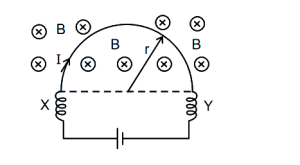
A
$2 \pi rBI$
B
$\frac{1}{2} \pi rBI$
C
$BIr$
D
$2 BIr$
Solution
(C) The magnetic force $F_B$ acting on a current-carrying wire in a magnetic field is given by $F_B = I \vec{L}_{eff} \times \vec{B}$.
For a semi-circular wire of radius $r$,the effective length $\vec{L}_{eff}$ is the straight-line distance between the two ends,which is the diameter $2r$.
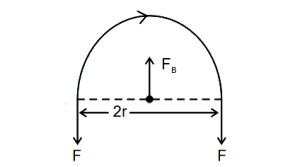
Therefore,the magnitude of the magnetic force is $F_B = I(2r)B = 2IrB$.
This total upward magnetic force is shared equally by the two identical springs $X$ and $Y$ attached to the ends of the wire.
Let $F$ be the force acting on each spring. Then,$2F = F_B$.
Substituting the value of $F_B$,we get $2F = 2IrB$.
Thus,the force on each spring is $F = I r B$.
For a semi-circular wire of radius $r$,the effective length $\vec{L}_{eff}$ is the straight-line distance between the two ends,which is the diameter $2r$.
Therefore,the magnitude of the magnetic force is $F_B = I(2r)B = 2IrB$.
This total upward magnetic force is shared equally by the two identical springs $X$ and $Y$ attached to the ends of the wire.
Let $F$ be the force acting on each spring. Then,$2F = F_B$.
Substituting the value of $F_B$,we get $2F = 2IrB$.
Thus,the force on each spring is $F = I r B$.
0 likesView Solution
31
PhysicsDifficultMCQWBJEE · 2022
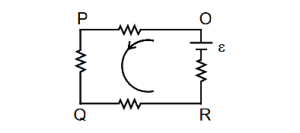
As shown in the figure,a rectangular loop of length 'a' and width 'b',made of a conducting material of uniform cross-section,is kept in a horizontal plane where a uniform magnetic field of intensity $B$ is acting vertically downward. The resistance per unit length of the loop is $\lambda \Omega/m$. If the loop is pulled with a uniform velocity 'v' in the horizontal direction,which of the following statements is/are true?
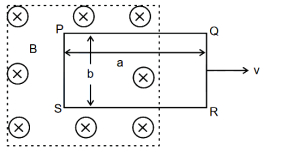
A
Current in the loop $I = \frac{Bbv}{\lambda(2b + 2a)}$
B
Current will be in the clockwise direction,looking from the top.
C
$V_P - V_S = V_Q - V_R$,where $V$ is the potential.
D
There cannot be any induction in part $SR$.
Solution
(A, B, D) The motional electromotive force $(EMF)$ induced in the loop is $\varepsilon = B \times b \times v$,acting only across the segment $PS$ which is moving through the magnetic field.
The total resistance of the loop is $R_{\text{total}} = \lambda(2b + 2a)$.
The induced current is $I = \frac{\varepsilon}{R_{\text{total}}} = \frac{Bbv}{\lambda(2b + 2a)}$.
Using Lenz's Law,the magnetic flux into the page is decreasing as the loop moves out,so the induced current will be in the clockwise direction to oppose this change.
For part $SR$,the length vector $\vec{\ell}$ is parallel to the velocity vector $\vec{v}$,so the induced $EMF$ $\varepsilon = \vec{v} \times \vec{B} \cdot \vec{\ell} = 0$. Thus,no induction occurs in part $SR$.
Therefore,statements $A$,$B$,and $D$ are correct.
The total resistance of the loop is $R_{\text{total}} = \lambda(2b + 2a)$.
The induced current is $I = \frac{\varepsilon}{R_{\text{total}}} = \frac{Bbv}{\lambda(2b + 2a)}$.
Using Lenz's Law,the magnetic flux into the page is decreasing as the loop moves out,so the induced current will be in the clockwise direction to oppose this change.
For part $SR$,the length vector $\vec{\ell}$ is parallel to the velocity vector $\vec{v}$,so the induced $EMF$ $\varepsilon = \vec{v} \times \vec{B} \cdot \vec{\ell} = 0$. Thus,no induction occurs in part $SR$.
Therefore,statements $A$,$B$,and $D$ are correct.
0 likesView Solution
32
PhysicsMediumMCQWBJEE · 2022
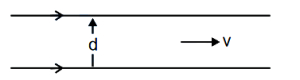
Two infinite line-charges parallel to each other are moving with a constant velocity $v$ in the same direction as shown in the figure. The separation between two line-charges is $d$. The magnetic attraction balances the electric repulsion when,[$c$ = speed of light in free space]
A
$v=\sqrt{2} c$
B
$v=\frac{c}{\sqrt{2}}$
C
$v=c$
D
$v=\frac{c}{2}$
Solution
(C) Consider a segment of length $\ell$ on both line charges with linear charge densities $\lambda_1$ and $\lambda_2$.
The electric force $F_E$ per unit length between the two line charges is given by Coulomb's law for infinite lines: $F_E = \frac{2 k \lambda_1 \lambda_2 \ell}{d} = \frac{2 \lambda_1 \lambda_2 \ell}{4 \pi \varepsilon_0 d} = \frac{\lambda_1 \lambda_2 \ell}{2 \pi \varepsilon_0 d}$.
The moving charges constitute currents $I_1 = \lambda_1 v$ and $I_2 = \lambda_2 v$.
The magnetic force $F_B$ per unit length between two parallel current-carrying wires is given by: $F_B = \frac{\mu_0 I_1 I_2 \ell}{2 \pi d} = \frac{\mu_0 (\lambda_1 v) (\lambda_2 v) \ell}{2 \pi d} = \frac{\mu_0 \lambda_1 \lambda_2 v^2 \ell}{2 \pi d}$.
For the magnetic attraction to balance the electric repulsion,we set $F_E = F_B$:
$\frac{\lambda_1 \lambda_2 \ell}{2 \pi \varepsilon_0 d} = \frac{\mu_0 \lambda_1 \lambda_2 v^2 \ell}{2 \pi d}$.
Simplifying the equation,we get: $\frac{1}{\varepsilon_0} = \mu_0 v^2$.
Since the speed of light $c = \frac{1}{\sqrt{\mu_0 \varepsilon_0}}$,it follows that $c^2 = \frac{1}{\mu_0 \varepsilon_0}$,which implies $v^2 = c^2$ or $v = c$.
The electric force $F_E$ per unit length between the two line charges is given by Coulomb's law for infinite lines: $F_E = \frac{2 k \lambda_1 \lambda_2 \ell}{d} = \frac{2 \lambda_1 \lambda_2 \ell}{4 \pi \varepsilon_0 d} = \frac{\lambda_1 \lambda_2 \ell}{2 \pi \varepsilon_0 d}$.
The moving charges constitute currents $I_1 = \lambda_1 v$ and $I_2 = \lambda_2 v$.
The magnetic force $F_B$ per unit length between two parallel current-carrying wires is given by: $F_B = \frac{\mu_0 I_1 I_2 \ell}{2 \pi d} = \frac{\mu_0 (\lambda_1 v) (\lambda_2 v) \ell}{2 \pi d} = \frac{\mu_0 \lambda_1 \lambda_2 v^2 \ell}{2 \pi d}$.
For the magnetic attraction to balance the electric repulsion,we set $F_E = F_B$:
$\frac{\lambda_1 \lambda_2 \ell}{2 \pi \varepsilon_0 d} = \frac{\mu_0 \lambda_1 \lambda_2 v^2 \ell}{2 \pi d}$.
Simplifying the equation,we get: $\frac{1}{\varepsilon_0} = \mu_0 v^2$.
Since the speed of light $c = \frac{1}{\sqrt{\mu_0 \varepsilon_0}}$,it follows that $c^2 = \frac{1}{\mu_0 \varepsilon_0}$,which implies $v^2 = c^2$ or $v = c$.
0 likesView Solution
33
PhysicsMediumMCQWBJEE · 2022
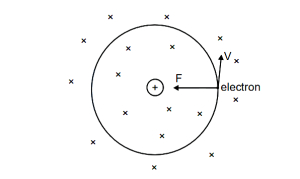
An electron revolves around the nucleus in a circular path with angular momentum $\vec{L}$. $A$ uniform magnetic field $\vec{B}$ is applied perpendicular to the plane of its orbit. If the electron experiences a torque $\vec{\tau}$,then
A
$\vec{\tau} \parallel \vec{L}$
B
$\vec{\tau}$ is anti-parallel to $\vec{L}$
C
$\vec{\tau} \cdot \vec{L} = 0$
D
Angle between $\vec{\tau}$ and $\vec{L}$ is $45^{\circ}$
Solution
(C) The magnetic force on a moving charge is given by $\vec{F} = q(\vec{v} \times \vec{B})$.
Since the magnetic field $\vec{B}$ is perpendicular to the plane of the orbit,the force $\vec{F}$ acts towards the center of the circular path (centripetal force).
The torque $\vec{\tau}$ about the nucleus is given by $\vec{\tau} = \vec{r} \times \vec{F}$.
Since the force $\vec{F}$ is directed towards the center,the position vector $\vec{r}$ and the force vector $\vec{F}$ are collinear (anti-parallel).
Therefore,$\vec{\tau} = \vec{r} \times \vec{F} = 0$.
Since the torque is zero,the dot product of the torque vector with any vector,including the angular momentum vector $\vec{L}$,must be zero: $\vec{\tau} \cdot \vec{L} = 0$.
Since the magnetic field $\vec{B}$ is perpendicular to the plane of the orbit,the force $\vec{F}$ acts towards the center of the circular path (centripetal force).
The torque $\vec{\tau}$ about the nucleus is given by $\vec{\tau} = \vec{r} \times \vec{F}$.
Since the force $\vec{F}$ is directed towards the center,the position vector $\vec{r}$ and the force vector $\vec{F}$ are collinear (anti-parallel).
Therefore,$\vec{\tau} = \vec{r} \times \vec{F} = 0$.
Since the torque is zero,the dot product of the torque vector with any vector,including the angular momentum vector $\vec{L}$,must be zero: $\vec{\tau} \cdot \vec{L} = 0$.
0 likesView Solution
34
PhysicsMediumMCQWBJEE · 2022
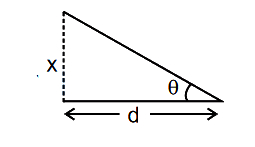
The human eye has an approximate angular resolution of $\theta = 5.8 \times 10^{-4} \text{ rad}$ and a typical photo printer prints a minimum of $300 \text{ dpi}$ (dots per inch, $1 \text{ inch} = 2.54 \text{ cm}$). At what minimal distance $d$ should a printed page be held so that one does not see the individual dots (in $\text{ cm}$)?
A
$20.32$
B
$29.50$
C
$14.59$
D
$6.85$
Solution
(C) The angular resolution $\theta$ is given by the ratio of the distance between two dots $x$ to the distance $d$ from the eye, i.e., $\theta = \frac{x}{d}$.
Given that the printer prints $300 \text{ dots per inch}$, the distance between two adjacent dots $x$ is $x = \frac{1 \text{ inch}}{300} = \frac{2.54 \text{ cm}}{300}$.
Substituting the values into the formula: $5.8 \times 10^{-4} = \frac{2.54 \text{ cm} / 300}{d}$.
Rearranging for $d$: $d = \frac{2.54}{300 \times 5.8 \times 10^{-4}} \text{ cm}$.
$d = \frac{2.54}{0.174} \text{ cm} \approx 14.597 \text{ cm}$.
Thus, the minimal distance is approximately $14.59 \text{ cm}$.
Given that the printer prints $300 \text{ dots per inch}$, the distance between two adjacent dots $x$ is $x = \frac{1 \text{ inch}}{300} = \frac{2.54 \text{ cm}}{300}$.
Substituting the values into the formula: $5.8 \times 10^{-4} = \frac{2.54 \text{ cm} / 300}{d}$.
Rearranging for $d$: $d = \frac{2.54}{300 \times 5.8 \times 10^{-4}} \text{ cm}$.
$d = \frac{2.54}{0.174} \text{ cm} \approx 14.597 \text{ cm}$.
Thus, the minimal distance is approximately $14.59 \text{ cm}$.
0 likesView Solution
35
PhysicsEasyMCQWBJEE · 2022
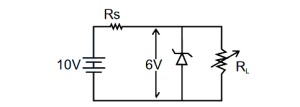
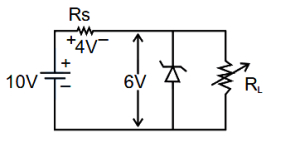
$A$ Zener diode having breakdown voltage $V_z = 6 \, V$ is used in a voltage regulator circuit as shown in the figure. The minimum current required to pass through the Zener to act as a voltage regulator is $10 \, mA$ and the maximum allowed current through the Zener is $40 \, mA$. The maximum value of $R_s$ for the Zener to act as a voltage regulator is (in $\Omega$)
A
$100$
B
$400$
C
$0.4$
D
$950$
Solution
(B) The voltage across the series resistor $R_s$ is given by $V_{R_s} = V_{in} - V_z = 10 \, V - 6 \, V = 4 \, V$.
For the Zener diode to act as a voltage regulator, it must maintain a minimum current $I_{z,min} = 10 \, mA$ even when the load current $I_L$ is zero.
The total current $I$ flowing through $R_s$ is $I = I_z + I_L$.
To find the maximum value of $R_s$, we consider the condition where the load current $I_L$ is minimum (i.e., $I_L = 0$).
Thus, $I = I_{z,min} = 10 \, mA$.
Using Ohm's law, $R_s = \frac{V_{R_s}}{I} = \frac{4 \, V}{10 \, mA} = \frac{4 \, V}{10 \times 10^{-3} \, A} = 400 \, \Omega$.
Therefore, the maximum value of $R_s$ is $400 \, \Omega$.
For the Zener diode to act as a voltage regulator, it must maintain a minimum current $I_{z,min} = 10 \, mA$ even when the load current $I_L$ is zero.
The total current $I$ flowing through $R_s$ is $I = I_z + I_L$.
To find the maximum value of $R_s$, we consider the condition where the load current $I_L$ is minimum (i.e., $I_L = 0$).
Thus, $I = I_{z,min} = 10 \, mA$.
Using Ohm's law, $R_s = \frac{V_{R_s}}{I} = \frac{4 \, V}{10 \, mA} = \frac{4 \, V}{10 \times 10^{-3} \, A} = 400 \, \Omega$.
Therefore, the maximum value of $R_s$ is $400 \, \Omega$.
0 likesView Solution
36
PhysicsMediumMCQWBJEE · 2022
In a Young's double slit experiment,the intensity of light at a point on the screen where the path difference between the interfering waves is $\lambda$ ($\lambda$ being the wavelength of light used) is $I$. The intensity at a point where the path difference is $\frac{\lambda}{4}$ will be (assume two waves have same amplitude).
A
zero
B
$I$
C
$0.5I$
D
$0.25I$
Solution
(C) The intensity of light in an interference pattern is given by $I_{res} = 4I_0 \cos^2(\frac{\phi}{2})$,where $I_0$ is the intensity of each individual wave and $\phi$ is the phase difference.
At a path difference of $\Delta x = \lambda$,the phase difference is $\phi = \frac{2\pi}{\lambda} \cdot \lambda = 2\pi$.
The intensity is $I = 4I_0 \cos^2(\frac{2\pi}{2}) = 4I_0 \cos^2(\pi) = 4I_0(1)^2 = 4I_0$.
Now,for a path difference of $\Delta x = \frac{\lambda}{4}$,the phase difference is $\phi' = \frac{2\pi}{\lambda} \cdot \frac{\lambda}{4} = \frac{\pi}{2}$.
The new intensity $I'$ is $4I_0 \cos^2(\frac{\pi/2}{2}) = 4I_0 \cos^2(\frac{\pi}{4})$.
Since $\cos(\frac{\pi}{4}) = \frac{1}{\sqrt{2}}$,we have $I' = 4I_0 (\frac{1}{\sqrt{2}})^2 = 4I_0 \cdot \frac{1}{2} = 2I_0$.
Since $I = 4I_0$,then $I_0 = \frac{I}{4}$.
Substituting this into the expression for $I'$,we get $I' = 2(\frac{I}{4}) = 0.5I$.
At a path difference of $\Delta x = \lambda$,the phase difference is $\phi = \frac{2\pi}{\lambda} \cdot \lambda = 2\pi$.
The intensity is $I = 4I_0 \cos^2(\frac{2\pi}{2}) = 4I_0 \cos^2(\pi) = 4I_0(1)^2 = 4I_0$.
Now,for a path difference of $\Delta x = \frac{\lambda}{4}$,the phase difference is $\phi' = \frac{2\pi}{\lambda} \cdot \frac{\lambda}{4} = \frac{\pi}{2}$.
The new intensity $I'$ is $4I_0 \cos^2(\frac{\pi/2}{2}) = 4I_0 \cos^2(\frac{\pi}{4})$.
Since $\cos(\frac{\pi}{4}) = \frac{1}{\sqrt{2}}$,we have $I' = 4I_0 (\frac{1}{\sqrt{2}})^2 = 4I_0 \cdot \frac{1}{2} = 2I_0$.
Since $I = 4I_0$,then $I_0 = \frac{I}{4}$.
Substituting this into the expression for $I'$,we get $I' = 2(\frac{I}{4}) = 0.5I$.
0 likesView Solution
37
PhysicsMediumMCQWBJEE · 2022
In Young's double-slit experiment with monochromatic light,the maximum intensity is $4$ times the minimum intensity in the interference pattern. What is the ratio of the intensities of the two interfering waves?
A
$1/9$
B
$1/3$
C
$1/16$
D
$1/2$
Solution
(A) The maximum intensity $I_{max}$ and minimum intensity $I_{min}$ in an interference pattern are given by $I_{max} = (\sqrt{I_1} + \sqrt{I_2})^2$ and $I_{min} = (\sqrt{I_1} - \sqrt{I_2})^2$.
Given that $I_{max} = 4 I_{min}$,we have $(\sqrt{I_1} + \sqrt{I_2})^2 = 4(\sqrt{I_1} - \sqrt{I_2})^2$.
Taking the square root on both sides: $\sqrt{I_1} + \sqrt{I_2} = 2(\sqrt{I_1} - \sqrt{I_2})$.
Rearranging the terms: $\sqrt{I_1} + \sqrt{I_2} = 2\sqrt{I_1} - 2\sqrt{I_2}$.
This simplifies to $3\sqrt{I_2} = \sqrt{I_1}$.
Squaring both sides gives $9I_2 = I_1$,so the ratio $\frac{I_1}{I_2} = 9/1$.
The ratio of the intensities of the two waves is $I_2/I_1 = 1/9$.
Given that $I_{max} = 4 I_{min}$,we have $(\sqrt{I_1} + \sqrt{I_2})^2 = 4(\sqrt{I_1} - \sqrt{I_2})^2$.
Taking the square root on both sides: $\sqrt{I_1} + \sqrt{I_2} = 2(\sqrt{I_1} - \sqrt{I_2})$.
Rearranging the terms: $\sqrt{I_1} + \sqrt{I_2} = 2\sqrt{I_1} - 2\sqrt{I_2}$.
This simplifies to $3\sqrt{I_2} = \sqrt{I_1}$.
Squaring both sides gives $9I_2 = I_1$,so the ratio $\frac{I_1}{I_2} = 9/1$.
The ratio of the intensities of the two waves is $I_2/I_1 = 1/9$.
0 likesView Solution
Vedclass Products
For Students
Vedclass Test Series
Mock tests in real WBJEE style covering Physics with performance analysis. 5-day free trial.
Start Free TrialFor Teachers
Exam Paper Generator
Generate Set A/B/C/D Physics papers from 7.5L+ questions in 2 minutes. 3 chapters free.
Try FreeFor Institutes
Online Exam Module
Run live WBJEE mock exams with unlimited students, 360° analytics & white-label branding.
See DemoFrequently Asked Questions
How many Physics questions are in WBJEE 2022?
There are 37 Physics questions from the WBJEE 2022 paper on Vedclass, each with a detailed step-by-step solution in English.
Are WBJEE 2022 Physics solutions available in English?
Yes. All solutions on this page are in English. You can also switch to English or Hindi using the language buttons above the questions.
Can I practice WBJEE 2022 Physics as a timed test?
Yes. Use the Vedclass Test Series to attempt a full WBJEE mock test covering Physics with time limits and instant score analysis.
Can teachers create Physics papers from WBJEE previous year questions?
Yes. The Vedclass Exam Paper Generator lets teachers mix WBJEE Physics questions and generate Set A/B/C/D papers in minutes.
For Teachers & Institutes
Build a Custom Physics Paper
Pick WBJEE 2022 Physics questions, set difficulty, and generate Set A/B/C/D in 2 minutes.