
For an ideal gas,a cyclic process $ABCA$ as shown in the $P-T$ diagram,when presented in a $P-V$ plot,would be:
- A
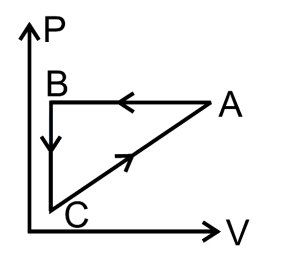
- B
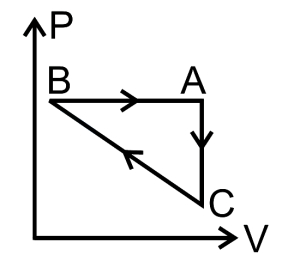
- C
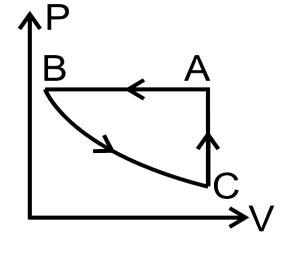
- D
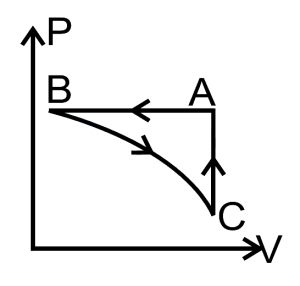
Explore More
Similar Questions
In thermodynamic processes,which of the following statements is not true?
Starting at temperature $300 \; K,$ one mole of an ideal diatomic gas $(\gamma=1.4)$ is first compressed adiabatically from volume $V_{1}$ to $V_{2}=\frac{V_{1}}{16}.$ It is then allowed to expand isobarically to volume $2V_{2}.$ If all the processes are quasi-static,then the final temperature of the gas (in $K$) is (to the nearest integer):
DifficultJEE MAIN 2020
View SolutionTwo moles of monoatomic gas is expanded from $(P_0, V_0)$ to $(P_0, 2V_0)$ under isobaric condition. Let $\Delta Q_1$,$\Delta W_1$,and $\Delta U_1$ be the heat given to the gas,the work done by the gas,and the change in internal energy,respectively. Now,the monoatomic gas is replaced by a diatomic gas,with other conditions remaining the same. The corresponding values in this case are $\Delta Q_2$,$\Delta W_2$,and $\Delta U_2$. Then:
$A$ gas of mass '$m$' and molecular weight '$M$' is flowing in an insulated tube with a velocity '$2V$'. If the flow of the gas is suddenly stopped and all the kinetic energy is utilized to compress the gas,the increase in the temperature of the gas is ($\gamma$ is the ratio of specific heats,$R$ is the universal gas constant).
DifficultAP EAMCET 2023
View SolutionAn ideal gas follows a process $PT = \text{constant}$. The correct graph between pressure $P$ and volume $V$ is:
Difficult
View SolutionVedclass Products
For Students
Vedclass Test Series
Mock tests in real JEE/NEET style with performance analysis. 5-day free trial.
Start Free TrialFor Teachers
Exam Paper Generator
Generate Set A/B/C/D exam papers from 7.5L+ questions in 2 minutes. 3 chapters free.
Try FreeFor Institutes
Online Exam Module
Live online exams with unlimited students, 360° analytics & white-label branding.
See Demo