
PhysicsQ1–38 of 38 questions
Page 1 of 1 · English
1
PhysicsMediumMCQWBJEE · 2018
The ratio of accelerations due to gravity $g_{1}:g_{2}$ on the surfaces of two planets is $5:2$ and the ratio of their respective average densities $\rho_{1}:\rho_{2}$ is $2:1$. What is the ratio of respective escape velocities $v_{1}:v_{2}$ from the surface of the planets?
A
$5:2$
B
$\sqrt{5}:\sqrt{2}$
C
$5:2\sqrt{2}$
D
$25:4$
Solution
(C) The escape velocity $v_{e}$ from the surface of a planet is given by $v_{e} = \sqrt{\frac{2GM}{R}}$.
Since $g = \frac{GM}{R^{2}}$,we have $v_{e} = \sqrt{2gR}$.
The acceleration due to gravity is $g = \frac{GM}{R^{2}} = \frac{G}{R^{2}} \cdot \frac{4}{3}\pi R^{3}\rho = \frac{4}{3}G\pi R\rho$.
Thus,the radius $R$ is proportional to $\frac{g}{\rho}$,i.e.,$R \propto \frac{g}{\rho}$.
Substituting this into the expression for $v_{e}$:
$v_{e} = \sqrt{2g \cdot \left(\frac{3g}{4\pi G\rho}\right)} = \sqrt{\frac{3g^{2}}{2\pi G\rho}} \propto \frac{g}{\sqrt{\rho}}$.
Given $\frac{g_{1}}{g_{2}} = \frac{5}{2}$ and $\frac{\rho_{1}}{\rho_{2}} = \frac{2}{1}$,the ratio of escape velocities is:
$\frac{v_{1}}{v_{2}} = \frac{g_{1}}{g_{2}} \cdot \sqrt{\frac{\rho_{2}}{\rho_{1}}} = \frac{5}{2} \cdot \sqrt{\frac{1}{2}} = \frac{5}{2\sqrt{2}}$.
Therefore,the ratio is $5:2\sqrt{2}$.
Since $g = \frac{GM}{R^{2}}$,we have $v_{e} = \sqrt{2gR}$.
The acceleration due to gravity is $g = \frac{GM}{R^{2}} = \frac{G}{R^{2}} \cdot \frac{4}{3}\pi R^{3}\rho = \frac{4}{3}G\pi R\rho$.
Thus,the radius $R$ is proportional to $\frac{g}{\rho}$,i.e.,$R \propto \frac{g}{\rho}$.
Substituting this into the expression for $v_{e}$:
$v_{e} = \sqrt{2g \cdot \left(\frac{3g}{4\pi G\rho}\right)} = \sqrt{\frac{3g^{2}}{2\pi G\rho}} \propto \frac{g}{\sqrt{\rho}}$.
Given $\frac{g_{1}}{g_{2}} = \frac{5}{2}$ and $\frac{\rho_{1}}{\rho_{2}} = \frac{2}{1}$,the ratio of escape velocities is:
$\frac{v_{1}}{v_{2}} = \frac{g_{1}}{g_{2}} \cdot \sqrt{\frac{\rho_{2}}{\rho_{1}}} = \frac{5}{2} \cdot \sqrt{\frac{1}{2}} = \frac{5}{2\sqrt{2}}$.
Therefore,the ratio is $5:2\sqrt{2}$.
0 likesView Solution
2
PhysicsMediumMCQWBJEE · 2018
One mole of a monoatomic ideal gas undergoes a quasistatic process,which is depicted by a straight line joining points $(V_{0}, T_{0})$ and $(2 V_{0}, 3 T_{0})$ in a $V-T$ diagram. What is the value of the heat capacity of the gas at the point $(V_{0}, T_{0})$?
A
$R$
B
$\frac{3}{2} R$
C
$2 R$
D
$0$
Solution
(C) For a process,the molar heat capacity is given by $C = C_{V} + \frac{P}{n} \frac{dV}{dT}$.
For a monoatomic gas,$C_{V} = \frac{3}{2} R$.
The process is a straight line in the $V-T$ diagram passing through $(V_{0}, T_{0})$ and $(2V_{0}, 3T_{0})$.
The equation of the line is $V - V_{0} = \frac{2V_{0} - V_{0}}{3T_{0} - T_{0}} (T - T_{0}) = \frac{V_{0}}{2T_{0}} (T - T_{0})$.
Thus,$\frac{dV}{dT} = \frac{V_{0}}{2T_{0}}$.
Using the ideal gas law $PV = nRT$,we have $P = \frac{nRT}{V}$.
At the point $(V_{0}, T_{0})$,$P = \frac{nRT_{0}}{V_{0}}$.
Substituting these into the heat capacity formula:
$C = \frac{3}{2} R + \left( \frac{nRT_{0}}{V_{0}} \right) \frac{1}{n} \left( \frac{V_{0}}{2T_{0}} \right) = \frac{3}{2} R + \frac{R}{2} = 2R$.
For a monoatomic gas,$C_{V} = \frac{3}{2} R$.
The process is a straight line in the $V-T$ diagram passing through $(V_{0}, T_{0})$ and $(2V_{0}, 3T_{0})$.
The equation of the line is $V - V_{0} = \frac{2V_{0} - V_{0}}{3T_{0} - T_{0}} (T - T_{0}) = \frac{V_{0}}{2T_{0}} (T - T_{0})$.
Thus,$\frac{dV}{dT} = \frac{V_{0}}{2T_{0}}$.
Using the ideal gas law $PV = nRT$,we have $P = \frac{nRT}{V}$.
At the point $(V_{0}, T_{0})$,$P = \frac{nRT_{0}}{V_{0}}$.
Substituting these into the heat capacity formula:
$C = \frac{3}{2} R + \left( \frac{nRT_{0}}{V_{0}} \right) \frac{1}{n} \left( \frac{V_{0}}{2T_{0}} \right) = \frac{3}{2} R + \frac{R}{2} = 2R$.
0 likesView Solution
3
PhysicsMediumMCQWBJEE · 2018
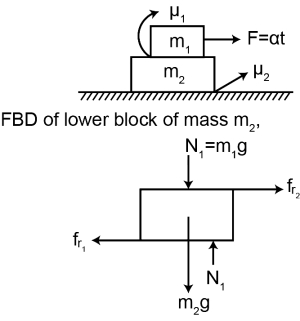
$A$ block of mass $m_{2}$ is placed on a horizontal table and another block of mass $m_{1}$ is placed on top of it. An increasing horizontal force $F=\alpha t$ is exerted on the upper block,but the lower block never moves as a result. If the coefficient of friction between the blocks is $\mu_{1}$ and that between the lower block and the table is $\mu_{2}$,then what is the maximum possible value of $\mu_{1} / \mu_{2}$?
A
$\frac{m_{2}}{m_{1}}$
B
$1+\frac{m_{2}}{m_{1}}$
C
$\frac{m_{1}}{m_{2}}$
D
$1+\frac{m_{1}}{m_{2}}$
Solution
(B) Let $N_{1}$ be the normal force between the two blocks and $N_{2}$ be the normal force between the lower block and the table.
For the upper block of mass $m_{1}$,the normal force is $N_{1} = m_{1}g$.
For the lower block of mass $m_{2}$,the total downward force is $N_{2} = m_{2}g + N_{1} = (m_{1} + m_{2})g$.
The horizontal force $F$ on the upper block creates a frictional force $f_{1}$ on the lower block,where $f_{1} \leq \mu_{1}N_{1} = \mu_{1}m_{1}g$.
For the lower block to never move,the maximum static frictional force from the table must be greater than or equal to the maximum possible frictional force exerted by the upper block on the lower block.
Thus,$\mu_{2}N_{2} \geq \mu_{1}N_{1}$.
Substituting the values,$\mu_{2}(m_{1} + m_{2})g \geq \mu_{1}m_{1}g$.
Dividing both sides by $\mu_{2}m_{1}g$,we get $\frac{m_{1} + m_{2}}{m_{1}} \geq \frac{\mu_{1}}{\mu_{2}}$.
Therefore,$\frac{\mu_{1}}{\mu_{2}} \leq 1 + \frac{m_{2}}{m_{1}}$.
The maximum possible value is $1 + \frac{m_{2}}{m_{1}}$.
For the upper block of mass $m_{1}$,the normal force is $N_{1} = m_{1}g$.
For the lower block of mass $m_{2}$,the total downward force is $N_{2} = m_{2}g + N_{1} = (m_{1} + m_{2})g$.
The horizontal force $F$ on the upper block creates a frictional force $f_{1}$ on the lower block,where $f_{1} \leq \mu_{1}N_{1} = \mu_{1}m_{1}g$.
For the lower block to never move,the maximum static frictional force from the table must be greater than or equal to the maximum possible frictional force exerted by the upper block on the lower block.
Thus,$\mu_{2}N_{2} \geq \mu_{1}N_{1}$.
Substituting the values,$\mu_{2}(m_{1} + m_{2})g \geq \mu_{1}m_{1}g$.
Dividing both sides by $\mu_{2}m_{1}g$,we get $\frac{m_{1} + m_{2}}{m_{1}} \geq \frac{\mu_{1}}{\mu_{2}}$.
Therefore,$\frac{\mu_{1}}{\mu_{2}} \leq 1 + \frac{m_{2}}{m_{1}}$.
The maximum possible value is $1 + \frac{m_{2}}{m_{1}}$.
0 likesView Solution
4
PhysicsMediumMCQWBJEE · 2018
The velocity $(v)$ of a particle (under a force $F$) depends on its distance $(x)$ from the origin (with $x > 0$) as $v \propto \frac{1}{\sqrt{x}}$. Find how the magnitude of the force $(F)$ on the particle depends on $x$.
A
$F \propto \frac{1}{x^{3/2}}$
B
$F \propto \frac{1}{x}$
C
$F \propto \frac{1}{x^2}$
D
$F \propto \frac{1}{x^3}$
Solution
(C) Given,$v = \frac{k}{\sqrt{x}} = k x^{-1/2}$,where $k$ is a constant.
Acceleration $a = \frac{dv}{dt} = \frac{dv}{dx} \cdot \frac{dx}{dt} = v \frac{dv}{dx}$.
First,find $\frac{dv}{dx}$:
$\frac{dv}{dx} = k \cdot (-\frac{1}{2}) x^{-3/2} = -\frac{k}{2x^{3/2}}$.
Now,substitute $v$ and $\frac{dv}{dx}$ into the acceleration formula:
$a = (k x^{-1/2}) \cdot (-\frac{k}{2x^{3/2}}) = -\frac{k^2}{2x^2}$.
According to Newton's second law,$F = ma$.
The magnitude of the force is $F = |ma| = m \cdot \frac{k^2}{2x^2}$.
Since $m$ and $k$ are constants,$F \propto \frac{1}{x^2}$.
Acceleration $a = \frac{dv}{dt} = \frac{dv}{dx} \cdot \frac{dx}{dt} = v \frac{dv}{dx}$.
First,find $\frac{dv}{dx}$:
$\frac{dv}{dx} = k \cdot (-\frac{1}{2}) x^{-3/2} = -\frac{k}{2x^{3/2}}$.
Now,substitute $v$ and $\frac{dv}{dx}$ into the acceleration formula:
$a = (k x^{-1/2}) \cdot (-\frac{k}{2x^{3/2}}) = -\frac{k^2}{2x^2}$.
According to Newton's second law,$F = ma$.
The magnitude of the force is $F = |ma| = m \cdot \frac{k^2}{2x^2}$.
Since $m$ and $k$ are constants,$F \propto \frac{1}{x^2}$.
0 likesView Solution
5
PhysicsEasyMCQWBJEE · 2018
What will be the approximate terminal velocity of a rain drop of diameter $1.8 \times 10^{-3} \ m$,when density of rain water $\approx 10^{3} \ kg \ m^{-3}$ and the coefficient of viscosity of air $\approx 1.8 \times 10^{-5} \ N \ s \ m^{-2}$ (in $m \ s^{-1}$)? (Neglect buoyancy of air)
A
$49$
B
$98$
C
$392$
D
$980$
Solution
(B) The formula for terminal velocity $v$ is given by $v = \frac{2}{9} r^{2} \frac{(\rho - \sigma)}{\eta} g$.
Since we neglect the buoyancy of air,we take $\sigma \approx 0$.
The formula simplifies to $v = \frac{2}{9} \frac{\rho}{\eta} r^{2} g$.
Given: diameter $d = 1.8 \times 10^{-3} \ m$,so radius $r = 0.9 \times 10^{-3} \ m$.
Density $\rho = 10^{3} \ kg \ m^{-3}$,viscosity $\eta = 1.8 \times 10^{-5} \ N \ s \ m^{-2}$,and $g = 9.8 \ m \ s^{-2}$.
Substituting the values: $v = \frac{2}{9} \times \frac{10^{3}}{1.8 \times 10^{-5}} \times (0.9 \times 10^{-3})^{2} \times 9.8$.
$v = \frac{2}{9} \times \frac{10^{3}}{1.8 \times 10^{-5}} \times (0.81 \times 10^{-6}) \times 9.8$.
$v = \frac{2}{9} \times \frac{10^{3} \times 0.81 \times 10^{-6} \times 9.8}{1.8 \times 10^{-5}} = \frac{2}{9} \times \frac{0.81 \times 10^{-3} \times 9.8}{1.8 \times 10^{-5}} = \frac{2}{9} \times 0.45 \times 10^{2} \times 9.8 = 0.1 \times 100 \times 9.8 = 98 \ m \ s^{-1}$.
Since we neglect the buoyancy of air,we take $\sigma \approx 0$.
The formula simplifies to $v = \frac{2}{9} \frac{\rho}{\eta} r^{2} g$.
Given: diameter $d = 1.8 \times 10^{-3} \ m$,so radius $r = 0.9 \times 10^{-3} \ m$.
Density $\rho = 10^{3} \ kg \ m^{-3}$,viscosity $\eta = 1.8 \times 10^{-5} \ N \ s \ m^{-2}$,and $g = 9.8 \ m \ s^{-2}$.
Substituting the values: $v = \frac{2}{9} \times \frac{10^{3}}{1.8 \times 10^{-5}} \times (0.9 \times 10^{-3})^{2} \times 9.8$.
$v = \frac{2}{9} \times \frac{10^{3}}{1.8 \times 10^{-5}} \times (0.81 \times 10^{-6}) \times 9.8$.
$v = \frac{2}{9} \times \frac{10^{3} \times 0.81 \times 10^{-6} \times 9.8}{1.8 \times 10^{-5}} = \frac{2}{9} \times \frac{0.81 \times 10^{-3} \times 9.8}{1.8 \times 10^{-5}} = \frac{2}{9} \times 0.45 \times 10^{2} \times 9.8 = 0.1 \times 100 \times 9.8 = 98 \ m \ s^{-1}$.
0 likesView Solution
6
PhysicsMediumMCQWBJEE · 2018
The stress along the length of a rod (with rectangular cross-section) is $1 \%$ of the Young's modulus of its material. What is the approximate percentage of change of its volume (in $\%$)? (Poisson's ratio of the material of the rod is $0.3$.)
A
$3$
B
$1$
C
$0.7$
D
$0.4$
Solution
(D) Given that stress $\sigma_{s} = \frac{1}{100} Y$,where $Y$ is the Young's modulus.
We know that $Y = \frac{\text{stress}}{\text{longitudinal strain}} = \frac{\sigma_{s}}{\Delta l / l}$.
Substituting the value of stress: $Y = \frac{Y / 100}{\Delta l / l} \implies \frac{\Delta l}{l} = \frac{1}{100} = 0.01$.
Poisson's ratio $\nu = -\frac{\Delta w / w}{\Delta l / l} = -\frac{\Delta t / t}{\Delta l / l} = 0.3$.
Thus,the lateral strain $\frac{\Delta w}{w} = \frac{\Delta t}{t} = -\nu \left( \frac{\Delta l}{l} \right) = -0.3 \times 0.01 = -0.003$.
The volume of a rectangular rod is $V = l \times w \times t$.
The fractional change in volume is $\frac{\Delta V}{V} \approx \frac{\Delta l}{l} + \frac{\Delta w}{w} + \frac{\Delta t}{t}$.
Substituting the values: $\frac{\Delta V}{V} = 0.01 + (-0.003) + (-0.003) = 0.01 - 0.006 = 0.004$.
Therefore,the percentage change in volume is $0.004 \times 100 \% = 0.4 \%$.
We know that $Y = \frac{\text{stress}}{\text{longitudinal strain}} = \frac{\sigma_{s}}{\Delta l / l}$.
Substituting the value of stress: $Y = \frac{Y / 100}{\Delta l / l} \implies \frac{\Delta l}{l} = \frac{1}{100} = 0.01$.
Poisson's ratio $\nu = -\frac{\Delta w / w}{\Delta l / l} = -\frac{\Delta t / t}{\Delta l / l} = 0.3$.
Thus,the lateral strain $\frac{\Delta w}{w} = \frac{\Delta t}{t} = -\nu \left( \frac{\Delta l}{l} \right) = -0.3 \times 0.01 = -0.003$.
The volume of a rectangular rod is $V = l \times w \times t$.
The fractional change in volume is $\frac{\Delta V}{V} \approx \frac{\Delta l}{l} + \frac{\Delta w}{w} + \frac{\Delta t}{t}$.
Substituting the values: $\frac{\Delta V}{V} = 0.01 + (-0.003) + (-0.003) = 0.01 - 0.006 = 0.004$.
Therefore,the percentage change in volume is $0.004 \times 100 \% = 0.4 \%$.
0 likesView Solution
7
PhysicsMediumMCQWBJEE · 2018
In case of a simple harmonic motion,if the velocity is plotted along the $X$-axis and the displacement (from the equilibrium position) is plotted along the $Y$-axis,the resultant curve is an ellipse with the ratio:
Major axis (along $X$) $= 20 \pi \times$ Minor axis (along $Y$).
What is the frequency of the simple harmonic motion?
Major axis (along $X$) $= 20 \pi \times$ Minor axis (along $Y$).
What is the frequency of the simple harmonic motion?
A
$100 \ Hz$
B
$20 \ Hz$
C
$10 \ Hz$
D
$\frac{1}{10} \ Hz$
Solution
(C) For a simple harmonic motion,the displacement is given by $y = A \sin(\omega t)$ and velocity is $v = \frac{dy}{dt} = A \omega \cos(\omega t)$.
Rearranging these,we get $\frac{y}{A} = \sin(\omega t)$ and $\frac{v}{A \omega} = \cos(\omega t)$.
Squaring and adding,we get $\frac{v^2}{(A \omega)^2} + \frac{y^2}{A^2} = 1$,which represents an ellipse.
The major axis along the $X$-axis (velocity) is $2A \omega$ and the minor axis along the $Y$-axis (displacement) is $2A$.
The ratio of the major axis to the minor axis is $\frac{2A \omega}{2A} = \omega$.
Given that the ratio is $20 \pi$,we have $\omega = 20 \pi$.
Since $\omega = 2 \pi f$,we have $2 \pi f = 20 \pi$.
Therefore,$f = 10 \ Hz$.
Rearranging these,we get $\frac{y}{A} = \sin(\omega t)$ and $\frac{v}{A \omega} = \cos(\omega t)$.
Squaring and adding,we get $\frac{v^2}{(A \omega)^2} + \frac{y^2}{A^2} = 1$,which represents an ellipse.
The major axis along the $X$-axis (velocity) is $2A \omega$ and the minor axis along the $Y$-axis (displacement) is $2A$.
The ratio of the major axis to the minor axis is $\frac{2A \omega}{2A} = \omega$.
Given that the ratio is $20 \pi$,we have $\omega = 20 \pi$.
Since $\omega = 2 \pi f$,we have $2 \pi f = 20 \pi$.
Therefore,$f = 10 \ Hz$.
0 likesView Solution
8
PhysicsDifficultMCQWBJEE · 2018
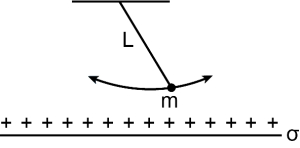
The bob of a pendulum of mass $m$,suspended by an inextensible string of length $L$ as shown in the figure,carries a small charge $q$. An infinite horizontal plane conductor with uniform surface charge density $\sigma$ is placed below it. What will be the time period of the pendulum for small amplitude oscillations?
A
$2 \pi \sqrt{\frac{L}{g-\frac{q \sigma}{\varepsilon_{0} m}}}$
B
$2 \pi \sqrt{\frac{L}{g+\frac{q \sigma}{\varepsilon_{0} m}}}$
C
$2 \pi \sqrt{\frac{L}{g-\frac{q \sigma}{2 \varepsilon_{0} m}}}$
D
$2 \pi \sqrt{\frac{L}{g+\frac{q \sigma}{2 \varepsilon_{0} m}}}$
Solution
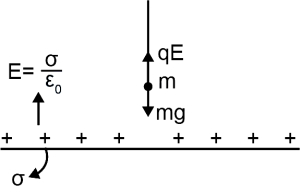
(C) The electric field $E$ produced by an infinite plane sheet of charge with surface charge density $\sigma$ is given by $E = \frac{\sigma}{2 \varepsilon_{0}}$.
Since the bob carries a charge $q$,it experiences an upward electrostatic force $F_e = qE = \frac{q \sigma}{2 \varepsilon_{0}}$.
The effective acceleration due to gravity $g_{\text{eff}}$ acting on the bob is given by $m g_{\text{eff}} = mg - F_e = mg - \frac{q \sigma}{2 \varepsilon_{0}}$.
Thus,$g_{\text{eff}} = g - \frac{q \sigma}{2 \varepsilon_{0} m}$.
The time period $T$ of a simple pendulum is given by $T = 2 \pi \sqrt{\frac{L}{g_{\text{eff}}}}$.
Substituting the value of $g_{\text{eff}}$,we get $T = 2 \pi \sqrt{\frac{L}{g - \frac{q \sigma}{2 \varepsilon_{0} m}}}$.
Since the bob carries a charge $q$,it experiences an upward electrostatic force $F_e = qE = \frac{q \sigma}{2 \varepsilon_{0}}$.
The effective acceleration due to gravity $g_{\text{eff}}$ acting on the bob is given by $m g_{\text{eff}} = mg - F_e = mg - \frac{q \sigma}{2 \varepsilon_{0}}$.
Thus,$g_{\text{eff}} = g - \frac{q \sigma}{2 \varepsilon_{0} m}$.
The time period $T$ of a simple pendulum is given by $T = 2 \pi \sqrt{\frac{L}{g_{\text{eff}}}}$.
Substituting the value of $g_{\text{eff}}$,we get $T = 2 \pi \sqrt{\frac{L}{g - \frac{q \sigma}{2 \varepsilon_{0} m}}}$.
0 likesView Solution
9
PhysicsDifficultMCQWBJEE · 2018
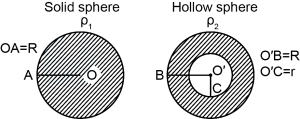
$A$ solid spherical ball of density $\rho_{1}$ and a hollow spherical ball of density $\rho_{2}$ have the same outer radius $R$ and the same mass $M$. What is the ratio of the moment of inertia of the hollow sphere to that of the solid sphere about an axis passing through their centers?
A
$\frac{\rho_{2}}{\rho_{1}}\left(1-\frac{\rho_{2}}{\rho_{1}}\right)^{\frac{5}{3}}$
B
$\frac{\rho_{2}}{\rho_{1}}\left[1-\left(1-\frac{\rho_{2}}{\rho_{1}}\right)^{\frac{5}{3}}\right]$
C
$\frac{\rho_{2}}{\rho_{1}}\left(1-\frac{\rho_{1}}{\rho_{2}}\right)^{\frac{5}{3}}$
D
$\frac{\rho_{2}}{\rho_{1}}\left[1-\left(1-\frac{\rho_{1}}{\rho_{2}}\right)^{\frac{5}{3}}\right]$
Solution
(D) Let $M$ be the mass of both spheres. For the solid sphere: $M = \rho_{1} \frac{4}{3} \pi R^{3}$.
For the hollow sphere with inner radius $r$: $M = \rho_{2} \frac{4}{3} \pi (R^{3} - r^{3})$.
Equating the masses: $\rho_{1} R^{3} = \rho_{2} (R^{3} - r^{3})$.
This gives $\frac{\rho_{1}}{\rho_{2}} = 1 - \frac{r^{3}}{R^{3}}$,so $\frac{r^{3}}{R^{3}} = 1 - \frac{\rho_{1}}{\rho_{2}}$,which implies $\frac{r}{R} = (1 - \frac{\rho_{1}}{\rho_{2}})^{1/3}$.
The moment of inertia of the solid sphere is $I_{S} = \frac{2}{5} M R^{2}$.
The moment of inertia of the hollow sphere is $I_{H} = \frac{2}{5} M \frac{R^{5} - r^{5}}{R^{3} - r^{3}}$.
Using $M = \rho_{2} \frac{4}{3} \pi (R^{3} - r^{3})$,we get $I_{H} = \frac{2}{5} (\rho_{2} \frac{4}{3} \pi (R^{3} - r^{3})) \frac{R^{5} - r^{5}}{R^{3} - r^{3}} = \frac{2}{5} \rho_{2} \frac{4}{3} \pi (R^{5} - r^{5})$.
Since $M = \rho_{1} \frac{4}{3} \pi R^{3}$,we have $I_{S} = \frac{2}{5} (\rho_{1} \frac{4}{3} \pi R^{3}) R^{2} = \frac{2}{5} \rho_{1} \frac{4}{3} \pi R^{5}$.
Therefore,$\frac{I_{H}}{I_{S}} = \frac{\rho_{2} (R^{5} - r^{5})}{\rho_{1} R^{5}} = \frac{\rho_{2}}{\rho_{1}} [1 - (\frac{r}{R})^{5}]$.
Substituting $\frac{r}{R} = (1 - \frac{\rho_{1}}{\rho_{2}})^{1/3}$,we get $\frac{I_{H}}{I_{S}} = \frac{\rho_{2}}{\rho_{1}} [1 - (1 - \frac{\rho_{1}}{\rho_{2}})^{5/3}]$.
For the hollow sphere with inner radius $r$: $M = \rho_{2} \frac{4}{3} \pi (R^{3} - r^{3})$.
Equating the masses: $\rho_{1} R^{3} = \rho_{2} (R^{3} - r^{3})$.
This gives $\frac{\rho_{1}}{\rho_{2}} = 1 - \frac{r^{3}}{R^{3}}$,so $\frac{r^{3}}{R^{3}} = 1 - \frac{\rho_{1}}{\rho_{2}}$,which implies $\frac{r}{R} = (1 - \frac{\rho_{1}}{\rho_{2}})^{1/3}$.
The moment of inertia of the solid sphere is $I_{S} = \frac{2}{5} M R^{2}$.
The moment of inertia of the hollow sphere is $I_{H} = \frac{2}{5} M \frac{R^{5} - r^{5}}{R^{3} - r^{3}}$.
Using $M = \rho_{2} \frac{4}{3} \pi (R^{3} - r^{3})$,we get $I_{H} = \frac{2}{5} (\rho_{2} \frac{4}{3} \pi (R^{3} - r^{3})) \frac{R^{5} - r^{5}}{R^{3} - r^{3}} = \frac{2}{5} \rho_{2} \frac{4}{3} \pi (R^{5} - r^{5})$.
Since $M = \rho_{1} \frac{4}{3} \pi R^{3}$,we have $I_{S} = \frac{2}{5} (\rho_{1} \frac{4}{3} \pi R^{3}) R^{2} = \frac{2}{5} \rho_{1} \frac{4}{3} \pi R^{5}$.
Therefore,$\frac{I_{H}}{I_{S}} = \frac{\rho_{2} (R^{5} - r^{5})}{\rho_{1} R^{5}} = \frac{\rho_{2}}{\rho_{1}} [1 - (\frac{r}{R})^{5}]$.
Substituting $\frac{r}{R} = (1 - \frac{\rho_{1}}{\rho_{2}})^{1/3}$,we get $\frac{I_{H}}{I_{S}} = \frac{\rho_{2}}{\rho_{1}} [1 - (1 - \frac{\rho_{1}}{\rho_{2}})^{5/3}]$.
0 likesView Solution
10
PhysicsMediumMCQWBJEE · 2018
The water equivalent of a calorimeter is $10 \ g$ and it contains $50 \ g$ of water at $15^{\circ} C$. Some amount of ice,initially at $-10^{\circ} C$,is dropped in it and half of the ice melts till equilibrium is reached. What was the initial amount of ice that was dropped (given specific heat of ice $= 0.5 \ cal \ g^{-1} {}^{\circ} C^{-1}$,specific heat of water $= 1.0 \ cal \ g^{-1} {}^{\circ} C^{-1}$ and latent heat of melting of ice $= 80 \ cal \ g^{-1}$) (in $g$)?
A
$10$
B
$18$
C
$20$
D
$30$
Solution
(C) Let the initial mass of ice be $m \ g$.
According to the principle of calorimetry,heat lost by the system (calorimeter + water) = heat gained by the ice.
The system cools down to $0^{\circ} C$ because only half of the ice melts,implying the final equilibrium temperature is $0^{\circ} C$.
Heat lost by water and calorimeter: $Q_{lost} = (m_{water} + m_{cal}) \cdot s_{water} \cdot \Delta T = (50 + 10) \cdot 1.0 \cdot (15 - 0) = 60 \cdot 15 = 900 \ cal$.
Heat gained by ice: The ice warms from $-10^{\circ} C$ to $0^{\circ} C$ and then half of it melts.
$Q_{gained} = m \cdot s_{ice} \cdot \Delta T_{ice} + (m/2) \cdot L_f = m \cdot 0.5 \cdot (0 - (-10)) + (m/2) \cdot 80$.
$Q_{gained} = m \cdot 0.5 \cdot 10 + 40m = 5m + 40m = 45m$.
Equating heat lost and gained: $900 = 45m$.
$m = 900 / 45 = 20 \ g$.
According to the principle of calorimetry,heat lost by the system (calorimeter + water) = heat gained by the ice.
The system cools down to $0^{\circ} C$ because only half of the ice melts,implying the final equilibrium temperature is $0^{\circ} C$.
Heat lost by water and calorimeter: $Q_{lost} = (m_{water} + m_{cal}) \cdot s_{water} \cdot \Delta T = (50 + 10) \cdot 1.0 \cdot (15 - 0) = 60 \cdot 15 = 900 \ cal$.
Heat gained by ice: The ice warms from $-10^{\circ} C$ to $0^{\circ} C$ and then half of it melts.
$Q_{gained} = m \cdot s_{ice} \cdot \Delta T_{ice} + (m/2) \cdot L_f = m \cdot 0.5 \cdot (0 - (-10)) + (m/2) \cdot 80$.
$Q_{gained} = m \cdot 0.5 \cdot 10 + 40m = 5m + 40m = 45m$.
Equating heat lost and gained: $900 = 45m$.
$m = 900 / 45 = 20 \ g$.
0 likesView Solution
11
PhysicsEasyMCQWBJEE · 2018
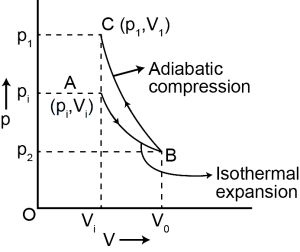
For an ideal gas with initial pressure and volume $p_{i}$ and $V_{i}$ respectively, a reversible isothermal expansion occurs until its volume becomes $V_{0}$. Then, it is compressed to its original volume $V_{i}$ by a reversible adiabatic process. If the final pressure is $p_{f}$, then which of the following statement(s) is/are true?
A
$p_{f}=p_{i}$
B
$p_{f} > p_{i}$
C
$p_{f} < p_{i}$
D
$\frac{p_{f}}{V_{0}}=\frac{p_{i}}{V_{i}}$
Solution
(B) In a $p-V$ diagram, the slope of an adiabatic curve at any point is steeper than that of an isothermal curve at that same point.
Let the initial state be $A(p_{i}, V_{i})$.
During the reversible isothermal expansion to volume $V_{0}$, the gas moves along the isothermal curve to state $B(p_{2}, V_{0})$, where $p_{2} < p_{i}$.
During the subsequent reversible adiabatic compression from volume $V_{0}$ back to $V_{i}$, the gas moves along an adiabatic curve from state $B(p_{2}, V_{0})$ to state $C(p_{f}, V_{i})$.
Since the adiabatic curve is steeper than the isothermal curve, the path from $B$ to $C$ lies above the path from $A$ to $B$ in the $p-V$ plane.
Therefore, the final pressure $p_{f}$ at volume $V_{i}$ must be greater than the initial pressure $p_{i}$.
Thus, $p_{f} > p_{i}$.
Let the initial state be $A(p_{i}, V_{i})$.
During the reversible isothermal expansion to volume $V_{0}$, the gas moves along the isothermal curve to state $B(p_{2}, V_{0})$, where $p_{2} < p_{i}$.
During the subsequent reversible adiabatic compression from volume $V_{0}$ back to $V_{i}$, the gas moves along an adiabatic curve from state $B(p_{2}, V_{0})$ to state $C(p_{f}, V_{i})$.
Since the adiabatic curve is steeper than the isothermal curve, the path from $B$ to $C$ lies above the path from $A$ to $B$ in the $p-V$ plane.
Therefore, the final pressure $p_{f}$ at volume $V_{i}$ must be greater than the initial pressure $p_{i}$.
Thus, $p_{f} > p_{i}$.
0 likesView Solution
12
PhysicsEasyMCQWBJEE · 2018
Which of the following statement$(s)$ is/are true? "Internal energy of an ideal gas ..........."
A
decreases in an isothermal process.
B
remains constant in an isothermal process.
C
increases in an isobaric process.
D
decreases in an isobaric expansion.
Solution
(B, C) The internal energy $(U)$ of an ideal gas is a function of temperature $(T)$ only, given by $U = f(T)$.
In an isothermal process, the temperature of the gas remains constant $(\Delta T = 0)$.
Since the internal energy depends only on temperature, it remains constant in an isothermal process.
In an isobaric process, if the gas expands, the temperature increases (from $PV = nRT$, if $P$ is constant and $V$ increases, $T$ must increase), leading to an increase in internal energy.
Therefore, both statement $(B)$ and statement $(C)$ are true.
In an isothermal process, the temperature of the gas remains constant $(\Delta T = 0)$.
Since the internal energy depends only on temperature, it remains constant in an isothermal process.
In an isobaric process, if the gas expands, the temperature increases (from $PV = nRT$, if $P$ is constant and $V$ increases, $T$ must increase), leading to an increase in internal energy.
Therefore, both statement $(B)$ and statement $(C)$ are true.
0 likesView Solution
13
PhysicsEasyMCQWBJEE · 2018
The intensity of a sound appears to an observer to be periodic. Which of the following can be the cause of it?
A
The intensity of the source is periodic
B
The source is moving towards the observer
C
The observer is moving away from the source
D
The source is producing a sound composed of two nearby frequencies
Solution
(D) The phenomenon where the intensity of sound varies periodically in time is known as $beats$.
$Beats$ occur when two sound waves of slightly different frequencies,$f_1$ and $f_2$,interfere with each other.
The resulting intensity varies with a frequency equal to the difference of the two frequencies,$|f_1 - f_2|$.
Additionally,if the source intensity itself is modulated periodically,the observer will perceive a periodic change in intensity.
Comparing this with the given options,option $D$ describes the physical condition for $beats$,which is a standard cause for periodic intensity variation.
$Beats$ occur when two sound waves of slightly different frequencies,$f_1$ and $f_2$,interfere with each other.
The resulting intensity varies with a frequency equal to the difference of the two frequencies,$|f_1 - f_2|$.
Additionally,if the source intensity itself is modulated periodically,the observer will perceive a periodic change in intensity.
Comparing this with the given options,option $D$ describes the physical condition for $beats$,which is a standard cause for periodic intensity variation.
0 likesView Solution
14
PhysicsEasyMCQWBJEE · 2018
An alternating current is flowing through a series $L-C-R$ circuit. It is found that the current reaches a value of $1 \ mA$ at both $200 \ Hz$ and $800 \ Hz$ frequency. What is the resonance frequency of the circuit (in $Hz$)?
A
$600$
B
$300$
C
$500$
D
$400$
Solution
(D) In a series $L-C-R$ circuit,the current is the same at two different frequencies $f_1$ and $f_2$ if these frequencies are equidistant from the resonance frequency $f_0$ in a geometric sense.
The resonance frequency $f_0$ is given by the geometric mean of the two frequencies at which the current is equal:
$f_0 = \sqrt{f_1 \times f_2}$
Given:
$f_1 = 200 \ Hz$
$f_2 = 800 \ Hz$
Substituting the values:
$f_0 = \sqrt{200 \times 800}$
$f_0 = \sqrt{160000}$
$f_0 = 400 \ Hz$
Thus,the resonance frequency of the circuit is $400 \ Hz$.
The resonance frequency $f_0$ is given by the geometric mean of the two frequencies at which the current is equal:
$f_0 = \sqrt{f_1 \times f_2}$
Given:
$f_1 = 200 \ Hz$
$f_2 = 800 \ Hz$
Substituting the values:
$f_0 = \sqrt{200 \times 800}$
$f_0 = \sqrt{160000}$
$f_0 = 400 \ Hz$
Thus,the resonance frequency of the circuit is $400 \ Hz$.
0 likesView Solution
15
PhysicsEasyMCQWBJEE · 2018
How is the linear velocity $v$ of an electron in a $Bohr$ orbit related to its principal quantum number $n$?
A
$v \propto \frac{1}{n}$
B
$v \propto \frac{1}{n^{2}}$
C
$v \propto \frac{1}{\sqrt{n}}$
D
$v \propto n$
Solution
(A) The linear velocity $v$ of an electron in the $n^{th}$ orbit of a hydrogen-like atom is given by the formula:
$v = \frac{Z e^2}{2 \epsilon_0 n h}$
Where $Z$ is the atomic number,$e$ is the charge of the electron,$\epsilon_0$ is the permittivity of free space,$n$ is the principal quantum number,and $h$ is Planck's constant.
From this expression,it is clear that all terms except $n$ are constants for a given atom.
Therefore,the relationship is $v \propto \frac{1}{n}$.
$v = \frac{Z e^2}{2 \epsilon_0 n h}$
Where $Z$ is the atomic number,$e$ is the charge of the electron,$\epsilon_0$ is the permittivity of free space,$n$ is the principal quantum number,and $h$ is Planck's constant.
From this expression,it is clear that all terms except $n$ are constants for a given atom.
Therefore,the relationship is $v \propto \frac{1}{n}$.
0 likesView Solution
16
PhysicsEasyMCQWBJEE · 2018
An electric bulb,a capacitor,a battery,and a switch are all connected in series in a circuit. How does the intensity of light vary when the switch is turned on?
A
Continues to increase gradually
B
Gradually increases for sometime and then becomes steady
C
Sharply rises initially and then gradually decreases
D
Gradually increases for sometime and then gradually decreases
Solution
(C) When the switch is turned on,the capacitor begins to charge. Initially,the charge on the capacitor is $0$,so the potential difference across it is $0 \ V$. Consequently,the entire battery voltage appears across the bulb,causing it to glow with maximum intensity.
As the capacitor charges,the potential difference across it $(V_c = q/C)$ increases over time. According to Kirchhoff's voltage law,the voltage across the bulb $(V_b)$ is given by $V_b = V_{battery} - V_c$. As $V_c$ increases,$V_b$ decreases.
Therefore,the intensity of the light,which depends on the power dissipated by the bulb $(P = V_b^2 / R)$,will be maximum at the start and will gradually decrease as the capacitor becomes fully charged.
As the capacitor charges,the potential difference across it $(V_c = q/C)$ increases over time. According to Kirchhoff's voltage law,the voltage across the bulb $(V_b)$ is given by $V_b = V_{battery} - V_c$. As $V_c$ increases,$V_b$ decreases.
Therefore,the intensity of the light,which depends on the power dissipated by the bulb $(P = V_b^2 / R)$,will be maximum at the start and will gradually decrease as the capacitor becomes fully charged.
0 likesView Solution
17
PhysicsMediumMCQWBJEE · 2018
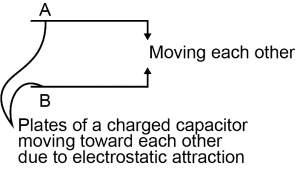
The insulated plates of a charged parallel plate capacitor (with small separation between the plates) are approaching each other due to electrostatic attraction. Assuming no other force to be operative and no radiation taking place,which of the following graphs approximately shows the variation with time $(t)$ of the potential difference $(V)$ between the plates?
A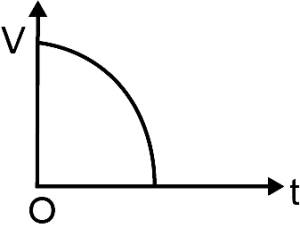
B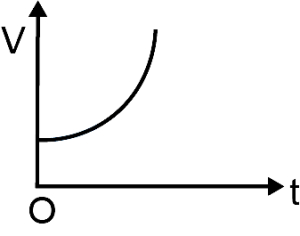
C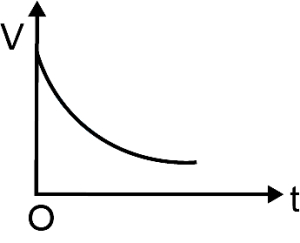
D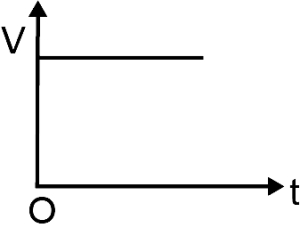
Solution
(A) For an isolated charged parallel plate capacitor,the charge $q$ on the plates remains constant.
The electric field $E$ between the plates is given by $E = \frac{\sigma}{\varepsilon_{0}} = \frac{q}{A \varepsilon_{0}}$,which is constant since $q$,$A$,and $\varepsilon_{0}$ are constant.
The electrostatic force of attraction between the plates is $F = qE = \frac{q^2}{2A \varepsilon_{0}}$.
Since the force is constant,the acceleration $a$ of the plates is constant $(a = F/m)$.
The separation $d$ between the plates at time $t$ is given by $d(t) = d_{0} - \frac{1}{2} a t^2$,where $d_{0}$ is the initial separation.
The potential difference $V$ is given by $V = E \cdot d(t) = E (d_{0} - \frac{1}{2} a t^2)$.
This equation $V(t) = E d_{0} - (\frac{E a}{2}) t^2$ represents a downward-opening parabola,which corresponds to Graph $A$.
The electric field $E$ between the plates is given by $E = \frac{\sigma}{\varepsilon_{0}} = \frac{q}{A \varepsilon_{0}}$,which is constant since $q$,$A$,and $\varepsilon_{0}$ are constant.
The electrostatic force of attraction between the plates is $F = qE = \frac{q^2}{2A \varepsilon_{0}}$.
Since the force is constant,the acceleration $a$ of the plates is constant $(a = F/m)$.
The separation $d$ between the plates at time $t$ is given by $d(t) = d_{0} - \frac{1}{2} a t^2$,where $d_{0}$ is the initial separation.
The potential difference $V$ is given by $V = E \cdot d(t) = E (d_{0} - \frac{1}{2} a t^2)$.
This equation $V(t) = E d_{0} - (\frac{E a}{2}) t^2$ represents a downward-opening parabola,which corresponds to Graph $A$.
0 likesView Solution
18
PhysicsMediumMCQWBJEE · 2018
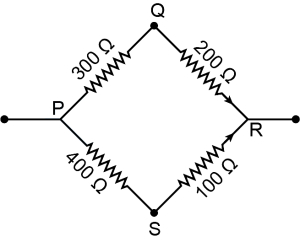
Four resistors,$100 \Omega, 200 \Omega, 300 \Omega$ and $400 \Omega$ are connected to form four sides of a square. The resistors can be connected in any order. What is the maximum possible equivalent resistance across the diagonal of the square (in $Omega$)?
A
$210$
B
$240$
C
$300$
D
$250$
Solution
(D) To maximize the equivalent resistance across a diagonal,we must group the resistors such that the two parallel branches have the largest possible sum of resistances. Let the four resistors be $R_1, R_2, R_3, R_4$. When connected across a diagonal,they form two parallel branches,each containing two resistors in series. Let the branches be $(R_a + R_b)$ and $(R_c + R_d)$. The equivalent resistance is $R_{eq} = \frac{(R_a + R_b)(R_c + R_d)}{(R_a + R_b) + (R_c + R_d)}$. To maximize this,we should make the sums of the two branches as close to each other as possible. The total sum is $100 + 200 + 300 + 400 = 1000 \Omega$. Thus,we aim for each branch to be $500 \Omega$. We can pair them as $(400 + 100) = 500 \Omega$ and $(300 + 200) = 500 \Omega$. The equivalent resistance is then $\frac{500 \times 500}{500 + 500} = \frac{250000}{1000} = 250 \Omega$.
0 likesView Solution
19
PhysicsMediumMCQWBJEE · 2018
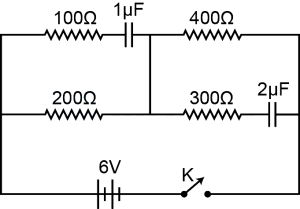
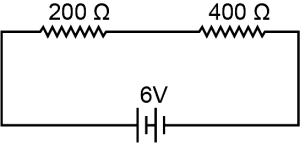
What will be the current through the $200 \Omega$ resistor in the given circuit,a long time after the switch $K$ is closed?
A
Zero
B
$100 mA$
C
$10 mA$
D
$1 mA$
Solution
(C) In a steady state,a capacitor acts as an open circuit,meaning no direct current flows through the branches containing capacitors.
Therefore,we can neglect the branches with the $1 \mu F$ and $2 \mu F$ capacitors.
The circuit simplifies to a single series loop containing the $6 V$ battery,the $200 \Omega$ resistor,and the $400 \Omega$ resistor.
The total resistance of the circuit is $R_{\text{net}} = 200 \Omega + 400 \Omega = 600 \Omega$.
Using Ohm's law,the current $I$ in the circuit is:
$I = \frac{V}{R_{\text{net}}} = \frac{6 V}{600 \Omega} = 0.01 A$.
Converting to milliamperes,$I = 0.01 \times 1000 mA = 10 mA$.
Therefore,we can neglect the branches with the $1 \mu F$ and $2 \mu F$ capacitors.
The circuit simplifies to a single series loop containing the $6 V$ battery,the $200 \Omega$ resistor,and the $400 \Omega$ resistor.
The total resistance of the circuit is $R_{\text{net}} = 200 \Omega + 400 \Omega = 600 \Omega$.
Using Ohm's law,the current $I$ in the circuit is:
$I = \frac{V}{R_{\text{net}}} = \frac{6 V}{600 \Omega} = 0.01 A$.
Converting to milliamperes,$I = 0.01 \times 1000 mA = 10 mA$.
0 likesView Solution
20
PhysicsDifficultMCQWBJEE · 2018
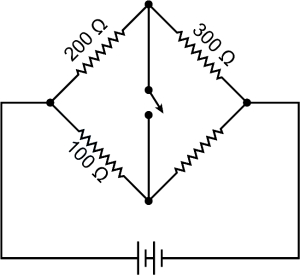
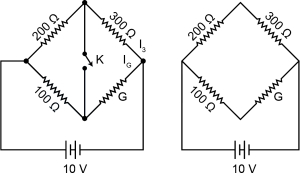
$A$ non-zero current passes through the galvanometer $G$ shown in the circuit when the key $K$ is closed and its value does not change when the key is opened. Then,which of the following statement$(s)$ is/are true?
A
The galvanometer resistance is infinite.
B
The current through the galvanometer is $40 \ mA$.
C
After the key is closed,the current through the $200 \ \Omega$ resistor is same as the current through the $300 \ \Omega$ resistor.
D
The galvanometer resistance is $150 \ \Omega$.
Solution
(B, D) Let the battery voltage be $V = 10 \ V$. When the key $K$ is open,the circuit is a series-parallel combination. The equivalent resistance is $R_{eq} = (200 + 300) \parallel (100 + G) = \frac{500(100+G)}{600+G}$. The current through the galvanometer branch is $I_{G, open} = \frac{V}{100+G}$.
When the key $K$ is closed,the circuit becomes a Wheatstone bridge. The condition that the current through the galvanometer does not change means the bridge is balanced,i.e.,$\frac{200}{100} = \frac{300}{G}$.
Solving for $G$: $G = \frac{300 \times 100}{200} = 150 \ \Omega$. Thus,option $D$ is correct.
With $G = 150 \ \Omega$,the current through the galvanometer when the key is closed is $I_{G, closed} = \frac{V}{R_{eq}'}$. Since the bridge is balanced,the potential at the two ends of the galvanometer is the same,and the current is determined by the potential divider: $I_G = \frac{10}{100+150} = \frac{10}{250} = 0.04 \ A = 40 \ mA$. Thus,option $B$ is correct.
Since the bridge is balanced,the ratio of resistances in the arms is equal,so the currents in the upper and lower branches are independent of the galvanometer connection,but the current through $200 \ \Omega$ is not necessarily equal to the current through $300 \ \Omega$ unless the resistances are equal. Here $200 \ \Omega \neq 300 \ \Omega$,so option $C$ is incorrect.
When the key $K$ is closed,the circuit becomes a Wheatstone bridge. The condition that the current through the galvanometer does not change means the bridge is balanced,i.e.,$\frac{200}{100} = \frac{300}{G}$.
Solving for $G$: $G = \frac{300 \times 100}{200} = 150 \ \Omega$. Thus,option $D$ is correct.
With $G = 150 \ \Omega$,the current through the galvanometer when the key is closed is $I_{G, closed} = \frac{V}{R_{eq}'}$. Since the bridge is balanced,the potential at the two ends of the galvanometer is the same,and the current is determined by the potential divider: $I_G = \frac{10}{100+150} = \frac{10}{250} = 0.04 \ A = 40 \ mA$. Thus,option $B$ is correct.
Since the bridge is balanced,the ratio of resistances in the arms is equal,so the currents in the upper and lower branches are independent of the galvanometer connection,but the current through $200 \ \Omega$ is not necessarily equal to the current through $300 \ \Omega$ unless the resistances are equal. Here $200 \ \Omega \neq 300 \ \Omega$,so option $C$ is incorrect.
0 likesView Solution
21
PhysicsMediumMCQWBJEE · 2018
An electron accelerated through a potential of $10000 \ V$ from rest has a de-Broglie wavelength $\lambda$. What should be the accelerating potential,so that the wavelength is doubled (in $V$)?
A
$20000$
B
$40000$
C
$5000$
D
$2500$
Solution
(D) The de-Broglie wavelength $\lambda$ of an electron accelerated through a potential $V$ is given by the formula: $\lambda = \frac{h}{\sqrt{2 m_e e V}}$.
From this relation,we can see that $\lambda \propto \frac{1}{\sqrt{V}}$.
Therefore,$\frac{\lambda_1}{\lambda_2} = \sqrt{\frac{V_2}{V_1}}$.
Given that $\lambda_1 = \lambda$ and $\lambda_2 = 2\lambda$,we have $\frac{\lambda}{2\lambda} = \sqrt{\frac{V_2}{10000}}$.
Squaring both sides,we get $\frac{1}{4} = \frac{V_2}{10000}$.
Thus,$V_2 = \frac{10000}{4} = 2500 \ V$.
From this relation,we can see that $\lambda \propto \frac{1}{\sqrt{V}}$.
Therefore,$\frac{\lambda_1}{\lambda_2} = \sqrt{\frac{V_2}{V_1}}$.
Given that $\lambda_1 = \lambda$ and $\lambda_2 = 2\lambda$,we have $\frac{\lambda}{2\lambda} = \sqrt{\frac{V_2}{10000}}$.
Squaring both sides,we get $\frac{1}{4} = \frac{V_2}{10000}$.
Thus,$V_2 = \frac{10000}{4} = 2500 \ V$.
0 likesView Solution
22
PhysicsMediumMCQWBJEE · 2018
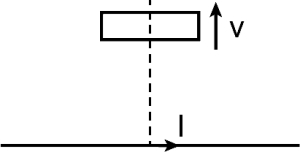
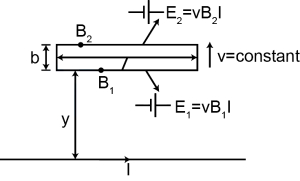
As shown in the figure,a rectangular loop of a conducting wire is moving away with a constant velocity $v$ in a perpendicular direction from a very long straight conductor carrying a steady current $I$. When the breadth of the rectangular loop is very small compared to its distance from the straight conductor,how does the emf $E$ induced in the loop vary with time $t$?
A
$E \propto \frac{1}{t^{2}}$
B
$E \propto \frac{1}{t}$
C
$E \propto -\ln(t)$
D
$E \propto \frac{1}{t^{3}}$
Solution
(A) The magnetic field $B$ at a distance $y$ from a long straight wire carrying current $I$ is given by $B = \frac{\mu_{0} I}{2 \pi y}$.
Let the loop have length $l$ and breadth $b$. The loop moves with velocity $v$ away from the wire. Let $y$ be the distance of the inner edge of the loop from the wire at $t=0$. At time $t$,the distance is $y(t) = y_0 + vt$.
Since the breadth $b$ is very small $(b \ll y)$,the magnetic field across the loop can be approximated as uniform,and the induced emf $E$ is given by the difference in motional emf across the two sides of length $l$:
$E = E_1 - E_2 = v l (B_1 - B_2) = v l \left( \frac{\mu_{0} I}{2 \pi y} - \frac{\mu_{0} I}{2 \pi (y+b)} \right)$
$E = \frac{\mu_{0} I v l}{2 \pi} \left( \frac{y+b-y}{y(y+b)} \right) = \frac{\mu_{0} I v l b}{2 \pi y(y+b)}$
Since $b \ll y$,we have $y+b \approx y$,so $E \approx \frac{\mu_{0} I v l b}{2 \pi y^2}$.
Since $y = y_0 + vt$,for large $t$,$y \approx vt$. Thus,$E \propto \frac{1}{(vt)^2} \propto \frac{1}{t^2}$.
Let the loop have length $l$ and breadth $b$. The loop moves with velocity $v$ away from the wire. Let $y$ be the distance of the inner edge of the loop from the wire at $t=0$. At time $t$,the distance is $y(t) = y_0 + vt$.
Since the breadth $b$ is very small $(b \ll y)$,the magnetic field across the loop can be approximated as uniform,and the induced emf $E$ is given by the difference in motional emf across the two sides of length $l$:
$E = E_1 - E_2 = v l (B_1 - B_2) = v l \left( \frac{\mu_{0} I}{2 \pi y} - \frac{\mu_{0} I}{2 \pi (y+b)} \right)$
$E = \frac{\mu_{0} I v l}{2 \pi} \left( \frac{y+b-y}{y(y+b)} \right) = \frac{\mu_{0} I v l b}{2 \pi y(y+b)}$
Since $b \ll y$,we have $y+b \approx y$,so $E \approx \frac{\mu_{0} I v l b}{2 \pi y^2}$.
Since $y = y_0 + vt$,for large $t$,$y \approx vt$. Thus,$E \propto \frac{1}{(vt)^2} \propto \frac{1}{t^2}$.
0 likesView Solution
23
PhysicsMediumMCQWBJEE · 2018
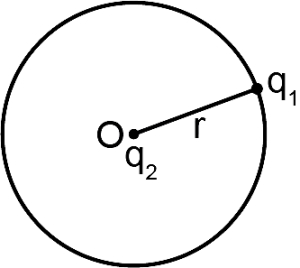
$A$ light charged particle is revolving in a circle of radius $r$ due to the electrostatic attraction of a static heavy particle with an opposite charge. How does the magnetic field $B$ at the centre of the circle,produced by the moving charge,depend on $r$?
A
$B \propto \frac{1}{r}$
B
$B \propto \frac{1}{r^{2}}$
C
$B \propto \frac{1}{r^{\frac{3}{2}}}$
D
$B \propto \frac{1}{r^{\frac{5}{2}}}$
Solution
(D) The centripetal force required for circular motion is provided by the electrostatic force of attraction:
$F_{\text{centripetal}} = m r \omega^{2} = \frac{1}{4 \pi \varepsilon_{0}} \cdot \frac{q_{1} q_{2}}{r^{2}}$
From this,we find the angular velocity $\omega$:
$\omega^{2} = \frac{q_{1} q_{2}}{4 \pi \varepsilon_{0} m r^{3}} \implies \omega \propto \frac{1}{r^{3/2}}$
The moving charge $q_{1}$ constitutes a current $i$ given by:
$i = \frac{q_{1}}{T} = \frac{q_{1} \omega}{2 \pi}$
The magnetic field $B$ at the center of a circular current loop is:
$B = \frac{\mu_{0} i}{2 r} = \frac{\mu_{0}}{2 r} \left( \frac{q_{1} \omega}{2 \pi} \right) = \frac{\mu_{0} q_{1} \omega}{4 \pi r}$
Since $\omega \propto r^{-3/2}$,we have:
$B \propto \frac{\omega}{r} \propto \frac{r^{-3/2}}{r} = r^{-5/2}$
Thus,$B \propto \frac{1}{r^{5/2}}$.
$F_{\text{centripetal}} = m r \omega^{2} = \frac{1}{4 \pi \varepsilon_{0}} \cdot \frac{q_{1} q_{2}}{r^{2}}$
From this,we find the angular velocity $\omega$:
$\omega^{2} = \frac{q_{1} q_{2}}{4 \pi \varepsilon_{0} m r^{3}} \implies \omega \propto \frac{1}{r^{3/2}}$
The moving charge $q_{1}$ constitutes a current $i$ given by:
$i = \frac{q_{1}}{T} = \frac{q_{1} \omega}{2 \pi}$
The magnetic field $B$ at the center of a circular current loop is:
$B = \frac{\mu_{0} i}{2 r} = \frac{\mu_{0}}{2 r} \left( \frac{q_{1} \omega}{2 \pi} \right) = \frac{\mu_{0} q_{1} \omega}{4 \pi r}$
Since $\omega \propto r^{-3/2}$,we have:
$B \propto \frac{\omega}{r} \propto \frac{r^{-3/2}}{r} = r^{-5/2}$
Thus,$B \propto \frac{1}{r^{5/2}}$.
0 likesView Solution
24
PhysicsMediumMCQWBJEE · 2018
Four equal charges of value $+Q$ are placed at four vertices of a regular hexagon of side $a$. By suitably choosing the vertices,what can be the maximum possible magnitude of the electric field at the centre of the hexagon?
A
$\frac{Q}{4 \pi \epsilon _{0} a^{2}}$
B
$\sqrt{2} \frac{Q}{4 \pi \epsilon _{0} a^{2}}$
C
$\frac{\sqrt{3}Q}{4 \pi \epsilon _{0} a^{2}}$
D
$\frac{2Q}{4 \pi \epsilon _{0} a^{2}}$
Solution
(C) In a regular hexagon,the distance from the centre $O$ to any vertex is equal to the side length $a$.
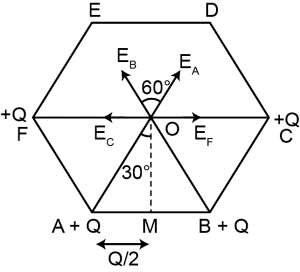
To maximize the electric field at the centre,we place the four charges at vertices $A, B, C,$ and $F$ as shown in the figure.
The electric field due to charges at $F$ and $C$ are equal in magnitude and opposite in direction,so they cancel each other out $(E_F + E_C = 0)$.
The net electric field at the centre $O$ is due to the charges at $A$ and $B$.
The magnitude of the electric field due to each charge is $E = \frac{1}{4 \pi \epsilon_0} \frac{Q}{a^2}$.
The angle between the electric field vectors $E_A$ and $E_B$ is $60^{\circ}$.
The resultant electric field $E_{\text{net}}$ is given by:
$E_{\text{net}} = \sqrt{E_A^2 + E_B^2 + 2 E_A E_B \cos 60^{\circ}}$
Since $E_A = E_B = E$,we have:
$E_{\text{net}} = \sqrt{E^2 + E^2 + 2 E^2 (1/2)} = \sqrt{3E^2} = E\sqrt{3}$
Substituting the value of $E$:
$E_{\text{net}} = \frac{\sqrt{3}Q}{4 \pi \epsilon_0 a^2}$
To maximize the electric field at the centre,we place the four charges at vertices $A, B, C,$ and $F$ as shown in the figure.
The electric field due to charges at $F$ and $C$ are equal in magnitude and opposite in direction,so they cancel each other out $(E_F + E_C = 0)$.
The net electric field at the centre $O$ is due to the charges at $A$ and $B$.
The magnitude of the electric field due to each charge is $E = \frac{1}{4 \pi \epsilon_0} \frac{Q}{a^2}$.
The angle between the electric field vectors $E_A$ and $E_B$ is $60^{\circ}$.
The resultant electric field $E_{\text{net}}$ is given by:
$E_{\text{net}} = \sqrt{E_A^2 + E_B^2 + 2 E_A E_B \cos 60^{\circ}}$
Since $E_A = E_B = E$,we have:
$E_{\text{net}} = \sqrt{E^2 + E^2 + 2 E^2 (1/2)} = \sqrt{3E^2} = E\sqrt{3}$
Substituting the value of $E$:
$E_{\text{net}} = \frac{\sqrt{3}Q}{4 \pi \epsilon_0 a^2}$
0 likesView Solution
25
PhysicsEasyMCQWBJEE · 2018
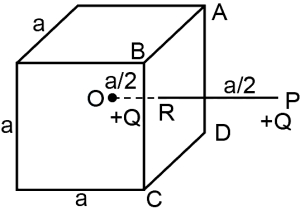
Consider a region in free space bounded by the surfaces of an imaginary cube having sides of length $a$ as shown in the figure. $A$ charge $+Q$ is placed at the centre $O$ of the cube. $P$ is a point outside the cube such that the line $OP$ perpendicularly intersects the surface $ABCD$ at $R$,and $OR = RP = a/2$. $A$ charge $+Q$ is also placed at point $P$. What is the total electric flux through the five faces of the cube other than $ABCD$?
A
$\frac{Q}{\varepsilon_{0}}$
B
$\frac{5Q}{6\varepsilon_{0}}$
C
$\frac{10Q}{6\varepsilon_{0}}$
D
zero
Solution
(C) $1$. The charge $+Q$ at the center $O$ contributes a total flux of $\frac{Q}{\varepsilon_{0}}$ through the entire cube. By symmetry,the flux through each of the $6$ faces is $\frac{Q}{6\varepsilon_{0}}$.
$2$. The charge $+Q$ at point $P$ is located at a distance $a/2$ from the center of the face $ABCD$. This charge creates an electric field. The flux due to charge $+Q$ at $P$ through the face $ABCD$ is $\frac{Q}{2\varepsilon_{0}}$ (since the charge is at a distance $a/2$ from the center of the face,it subtends a solid angle of $2\pi$ steradians at the face,or by considering an identical cube placed adjacent to the first one).
$3$. The net flux through face $ABCD$ due to both charges is $\phi_{ABCD} = \phi_{O, ABCD} + \phi_{P, ABCD} = \frac{Q}{6\varepsilon_{0}} - \frac{Q}{2\varepsilon_{0}} = -\frac{Q}{3\varepsilon_{0}}$ (the flux from $P$ enters the cube,hence negative).
$4$. Total flux through the cube due to both charges is $\phi_{total} = \frac{Q_{enclosed}}{\varepsilon_{0}} = \frac{Q}{\varepsilon_{0}}$.
$5$. The flux through the remaining $5$ faces is $\phi_{5} = \phi_{total} - \phi_{ABCD} = \frac{Q}{\varepsilon_{0}} - (-\frac{Q}{3\varepsilon_{0}}) = \frac{4Q}{3\varepsilon_{0}} = \frac{8Q}{6\varepsilon_{0}}$.
$2$. The charge $+Q$ at point $P$ is located at a distance $a/2$ from the center of the face $ABCD$. This charge creates an electric field. The flux due to charge $+Q$ at $P$ through the face $ABCD$ is $\frac{Q}{2\varepsilon_{0}}$ (since the charge is at a distance $a/2$ from the center of the face,it subtends a solid angle of $2\pi$ steradians at the face,or by considering an identical cube placed adjacent to the first one).
$3$. The net flux through face $ABCD$ due to both charges is $\phi_{ABCD} = \phi_{O, ABCD} + \phi_{P, ABCD} = \frac{Q}{6\varepsilon_{0}} - \frac{Q}{2\varepsilon_{0}} = -\frac{Q}{3\varepsilon_{0}}$ (the flux from $P$ enters the cube,hence negative).
$4$. Total flux through the cube due to both charges is $\phi_{total} = \frac{Q_{enclosed}}{\varepsilon_{0}} = \frac{Q}{\varepsilon_{0}}$.
$5$. The flux through the remaining $5$ faces is $\phi_{5} = \phi_{total} - \phi_{ABCD} = \frac{Q}{\varepsilon_{0}} - (-\frac{Q}{3\varepsilon_{0}}) = \frac{4Q}{3\varepsilon_{0}} = \frac{8Q}{6\varepsilon_{0}}$.
0 likesView Solution
26
PhysicsDifficultMCQWBJEE · 2018
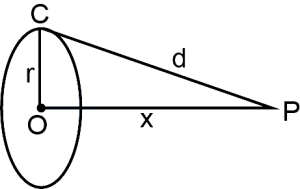
$A$ point charge $-q$ is carried from a point $A$ to another point $B$ on the axis of a charged ring of radius $r$ carrying a charge $+q$. If the point $A$ is at a distance $\frac{4}{3} r$ from the centre of the ring and the point $B$ is $\frac{3}{4} r$ from the centre but on the opposite side,what is the net work that needs to be done for this?
A
$-\frac{7}{5} \cdot \frac{q^{2}}{4 \pi \varepsilon_{0} r}$
B
$-\frac{1}{5} \cdot \frac{q^{2}}{4 \pi \varepsilon_{0} r}$
C
$\frac{7}{5} \cdot \frac{q^{2}}{4 \pi \varepsilon_{0} r}$
D
$\frac{1}{5} \cdot \frac{q^{2}}{4 \pi \varepsilon_{0} r}$
Solution
(B) The potential $V$ at a distance $x$ from the center of a ring of radius $r$ carrying charge $q$ is given by $V = \frac{1}{4 \pi \varepsilon_{0}} \cdot \frac{q}{\sqrt{x^{2} + r^{2}}}$.
For point $A$ at distance $x_A = \frac{4}{3}r$,the distance from the ring circumference is $d_A = \sqrt{(\frac{4}{3}r)^2 + r^2} = \sqrt{\frac{16}{9}r^2 + r^2} = \sqrt{\frac{25}{9}r^2} = \frac{5}{3}r$.
Thus,$V_A = \frac{1}{4 \pi \varepsilon_{0}} \cdot \frac{q}{5r/3} = \frac{1}{4 \pi \varepsilon_{0}} \cdot \frac{3q}{5r}$.
For point $B$ at distance $x_B = \frac{3}{4}r$ on the opposite side,the distance from the ring circumference is $d_B = \sqrt{(\frac{3}{4}r)^2 + r^2} = \sqrt{\frac{9}{16}r^2 + r^2} = \sqrt{\frac{25}{16}r^2} = \frac{5}{4}r$.
Thus,$V_B = \frac{1}{4 \pi \varepsilon_{0}} \cdot \frac{q}{5r/4} = \frac{1}{4 \pi \varepsilon_{0}} \cdot \frac{4q}{5r}$.
The work done $W$ in moving a charge $-q$ from $A$ to $B$ is $W = (-q)(V_B - V_A)$.
$W = -q \left( \frac{1}{4 \pi \varepsilon_{0}} \cdot \frac{4q}{5r} - \frac{1}{4 \pi \varepsilon_{0}} \cdot \frac{3q}{5r} \right) = -q \left( \frac{1}{4 \pi \varepsilon_{0}} \cdot \frac{q}{5r} \right) = -\frac{1}{5} \cdot \frac{q^2}{4 \pi \varepsilon_{0} r}$.
For point $A$ at distance $x_A = \frac{4}{3}r$,the distance from the ring circumference is $d_A = \sqrt{(\frac{4}{3}r)^2 + r^2} = \sqrt{\frac{16}{9}r^2 + r^2} = \sqrt{\frac{25}{9}r^2} = \frac{5}{3}r$.
Thus,$V_A = \frac{1}{4 \pi \varepsilon_{0}} \cdot \frac{q}{5r/3} = \frac{1}{4 \pi \varepsilon_{0}} \cdot \frac{3q}{5r}$.
For point $B$ at distance $x_B = \frac{3}{4}r$ on the opposite side,the distance from the ring circumference is $d_B = \sqrt{(\frac{3}{4}r)^2 + r^2} = \sqrt{\frac{9}{16}r^2 + r^2} = \sqrt{\frac{25}{16}r^2} = \frac{5}{4}r$.
Thus,$V_B = \frac{1}{4 \pi \varepsilon_{0}} \cdot \frac{q}{5r/4} = \frac{1}{4 \pi \varepsilon_{0}} \cdot \frac{4q}{5r}$.
The work done $W$ in moving a charge $-q$ from $A$ to $B$ is $W = (-q)(V_B - V_A)$.
$W = -q \left( \frac{1}{4 \pi \varepsilon_{0}} \cdot \frac{4q}{5r} - \frac{1}{4 \pi \varepsilon_{0}} \cdot \frac{3q}{5r} \right) = -q \left( \frac{1}{4 \pi \varepsilon_{0}} \cdot \frac{q}{5r} \right) = -\frac{1}{5} \cdot \frac{q^2}{4 \pi \varepsilon_{0} r}$.
0 likesView Solution
27
PhysicsMediumMCQWBJEE · 2018
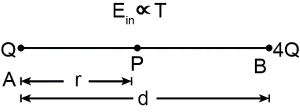
Two positive charges $Q$ and $4Q$ are placed at points $A$ and $B$ respectively,where $B$ is at a distance $d$ units to the right of $A$. The total electric potential due to these charges is minimum at point $P$ on the line segment joining $A$ and $B$. What is the distance of $P$ from $A$?
A
$\frac{d}{3}$ units to the right of $A$
B
$\frac{d}{3}$ units to the left of $A$
C
$\frac{d}{5}$ units to the right of $A$
D
$d$ units to the left of $A$
Solution
(A) The total electric potential $V$ at a point $P$ between the charges is given by $V = \frac{1}{4\pi\varepsilon_0} \left( \frac{Q}{r} + \frac{4Q}{d-r} \right)$,where $r$ is the distance of $P$ from $A$.
For the potential to be minimum,we set $\frac{dV}{dr} = 0$.
$\frac{dV}{dr} = \frac{1}{4\pi\varepsilon_0} \left( -\frac{Q}{r^2} + \frac{4Q}{(d-r)^2} \right) = 0$.
This implies $\frac{Q}{r^2} = \frac{4Q}{(d-r)^2}$,which is equivalent to the condition where the net electric field $E = 0$.
Taking the square root on both sides: $\frac{1}{r} = \frac{2}{d-r}$.
Solving for $r$: $d - r = 2r \Rightarrow 3r = d \Rightarrow r = \frac{d}{3}$.
Thus,the potential is minimum at a distance of $\frac{d}{3}$ units to the right of $A$.
For the potential to be minimum,we set $\frac{dV}{dr} = 0$.
$\frac{dV}{dr} = \frac{1}{4\pi\varepsilon_0} \left( -\frac{Q}{r^2} + \frac{4Q}{(d-r)^2} \right) = 0$.
This implies $\frac{Q}{r^2} = \frac{4Q}{(d-r)^2}$,which is equivalent to the condition where the net electric field $E = 0$.
Taking the square root on both sides: $\frac{1}{r} = \frac{2}{d-r}$.
Solving for $r$: $d - r = 2r \Rightarrow 3r = d \Rightarrow r = \frac{d}{3}$.
Thus,the potential is minimum at a distance of $\frac{d}{3}$ units to the right of $A$.
0 likesView Solution
28
PhysicsEasyMCQWBJEE · 2018
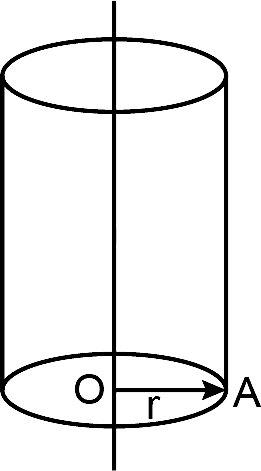
$A$ uniform current is flowing along the length of an infinite,straight,thin,hollow cylinder of radius $R$. The magnetic field $B$ produced at a perpendicular distance $d$ from the axis of the cylinder is plotted in a graph. Which of the following figures looks like the plot?
A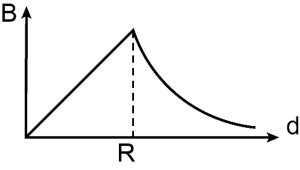
B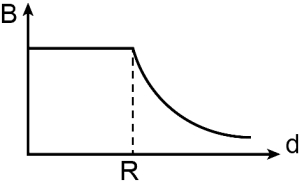
C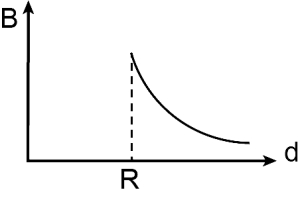
D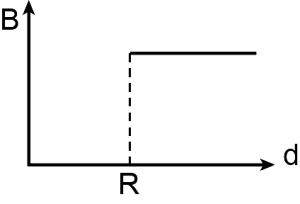
Solution
(C) For a thin hollow cylinder of radius $R$ carrying a uniform current $i$ along its length:
$1$. Inside the cylinder $(d < R)$,the magnetic field $B$ is zero because the enclosed current is zero.
$2$. Outside the cylinder $(d \geq R)$,the magnetic field $B$ is given by Ampere's Law as $B = \frac{\mu_{0} i}{2 \pi d}$. This shows that $B \propto \frac{1}{d}$.
Therefore,the graph of $B$ versus $d$ will show $B = 0$ for $d < R$ and a hyperbolic decay for $d \geq R$. This corresponds to the plot shown in figure $C$.
$1$. Inside the cylinder $(d < R)$,the magnetic field $B$ is zero because the enclosed current is zero.
$2$. Outside the cylinder $(d \geq R)$,the magnetic field $B$ is given by Ampere's Law as $B = \frac{\mu_{0} i}{2 \pi d}$. This shows that $B \propto \frac{1}{d}$.
Therefore,the graph of $B$ versus $d$ will show $B = 0$ for $d < R$ and a hyperbolic decay for $d \geq R$. This corresponds to the plot shown in figure $C$.
0 likesView Solution
29
PhysicsMediumMCQWBJEE · 2018
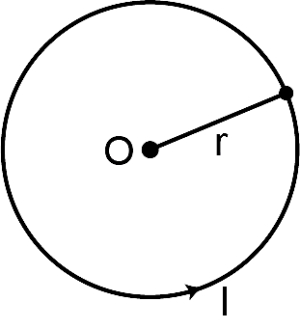
$A$ circular loop of radius $r$ of conducting wire connected with a voltage source of zero internal resistance produces a magnetic field $B$ at its centre. If instead,a circular loop of radius $2r$,made of the same material and having the same cross-section,is connected to the same voltage source,what will be the magnetic field at its centre?
A
$\frac{B}{2}$
B
$\frac{B}{4}$
C
$2B$
D
$B$
Solution
(B) The magnetic field at the centre of a circular loop of radius $r$ carrying current $I$ is given by $B = \frac{\mu_0 I}{2r}$.
Case $(I)$: For a loop of radius $r$,the length is $l_1 = 2\pi r$. The resistance is $R_1 = \rho \frac{l_1}{A} = \rho \frac{2\pi r}{A}$. The current is $I_1 = \frac{V}{R_1}$. The magnetic field is $B_1 = \frac{\mu_0 I_1}{2r}$.
Case $(II)$: For a loop of radius $2r$,the length is $l_2 = 2\pi(2r) = 2l_1$. The resistance is $R_2 = \rho \frac{l_2}{A} = 2R_1$. The current is $I_2 = \frac{V}{R_2} = \frac{V}{2R_1} = \frac{I_1}{2}$.
The new magnetic field is $B_2 = \frac{\mu_0 I_2}{2(2r)} = \frac{\mu_0 (I_1/2)}{4r} = \frac{1}{4} \left( \frac{\mu_0 I_1}{2r} \right) = \frac{B_1}{4}$.
Case $(I)$: For a loop of radius $r$,the length is $l_1 = 2\pi r$. The resistance is $R_1 = \rho \frac{l_1}{A} = \rho \frac{2\pi r}{A}$. The current is $I_1 = \frac{V}{R_1}$. The magnetic field is $B_1 = \frac{\mu_0 I_1}{2r}$.
Case $(II)$: For a loop of radius $2r$,the length is $l_2 = 2\pi(2r) = 2l_1$. The resistance is $R_2 = \rho \frac{l_2}{A} = 2R_1$. The current is $I_2 = \frac{V}{R_2} = \frac{V}{2R_1} = \frac{I_1}{2}$.
The new magnetic field is $B_2 = \frac{\mu_0 I_2}{2(2r)} = \frac{\mu_0 (I_1/2)}{4r} = \frac{1}{4} \left( \frac{\mu_0 I_1}{2r} \right) = \frac{B_1}{4}$.
0 likesView Solution
30
PhysicsEasyMCQWBJEE · 2018
$A$ proton of mass $m$ moving with a speed $v$ ($v << c$,where $c$ is the velocity of light in vacuum) completes a circular orbit in time $T$ in a uniform magnetic field. If the speed of the proton is increased to $\sqrt{2}v$,what will be the time needed to complete the circular orbit?
A
$\sqrt{T}$
B
$T$
C
$\frac{T}{\sqrt{2}}$
D
$\frac{T}{2}$
Solution
(B) The time period $T$ of a charged particle moving in a circular path in a uniform magnetic field is given by the formula: $T = \frac{2\pi m}{qB}$.
This formula shows that the time period $T$ depends only on the mass $m$,the charge $q$,and the magnetic field strength $B$.
Since $m$,$q$,and $B$ remain constant,the time period $T$ is independent of the speed $v$ of the proton.
Therefore,even if the speed is increased to $\sqrt{2}v$,the time period will remain $T$.
This formula shows that the time period $T$ depends only on the mass $m$,the charge $q$,and the magnetic field strength $B$.
Since $m$,$q$,and $B$ remain constant,the time period $T$ is independent of the speed $v$ of the proton.
Therefore,even if the speed is increased to $\sqrt{2}v$,the time period will remain $T$.
0 likesView Solution
31
PhysicsMediumMCQWBJEE · 2018
If the half-life of a radioactive nucleus is $3$ days,nearly what fraction of the initial number of nuclei will decay on the third day? (Given,$\sqrt[3]{0.25} \approx 0.63$)
A
$0.63$
B
$0.5$
C
$0.37$
D
$0.13$
Solution
(D) Given,half-life $t_{1/2} = 3$ days.
Number of active nuclei remaining after time $t$ is given by $N(t) = N_0 (1/2)^{t/t_{1/2}}$.
At the start of the third day ($t = 2$ days),the number of nuclei remaining is $N_1 = N_0 (1/2)^{2/3} = N_0 / (2^{2/3}) = N_0 / (4^{1/3})$.
Given $\sqrt[3]{0.25} \approx 0.63$,we have $N_1 = N_0 \times 0.63$.
At the end of the third day ($t = 3$ days),the number of nuclei remaining is $N_2 = N_0 (1/2)^{3/3} = 0.5 N_0$.
The number of nuclei that decay during the third day is the difference between the nuclei present at the start and end of the day:
$\Delta N = N_1 - N_2 = 0.63 N_0 - 0.5 N_0 = 0.13 N_0$.
Thus,the fraction of the initial nuclei that decay on the third day is $0.13$.
Number of active nuclei remaining after time $t$ is given by $N(t) = N_0 (1/2)^{t/t_{1/2}}$.
At the start of the third day ($t = 2$ days),the number of nuclei remaining is $N_1 = N_0 (1/2)^{2/3} = N_0 / (2^{2/3}) = N_0 / (4^{1/3})$.
Given $\sqrt[3]{0.25} \approx 0.63$,we have $N_1 = N_0 \times 0.63$.
At the end of the third day ($t = 3$ days),the number of nuclei remaining is $N_2 = N_0 (1/2)^{3/3} = 0.5 N_0$.
The number of nuclei that decay during the third day is the difference between the nuclei present at the start and end of the day:
$\Delta N = N_1 - N_2 = 0.63 N_0 - 0.5 N_0 = 0.13 N_0$.
Thus,the fraction of the initial nuclei that decay on the third day is $0.13$.
0 likesView Solution
32
PhysicsMediumMCQWBJEE · 2018
$A$ ray of light is incident on a right-angled isosceles prism parallel to its base as shown in the figure. The refractive index of the material of the prism is $\sqrt{2}$. Which of the following statement$(s)$ is/are true?
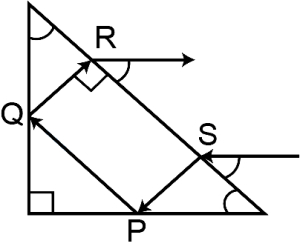
A
The reflection at $P$ is total internal.
B
The reflection at $Q$ is total internal.
C
The ray emerging at $R$ is parallel to the ray incident at $S$.
D
Total deviation of the ray is $150^{\circ}$.
Solution
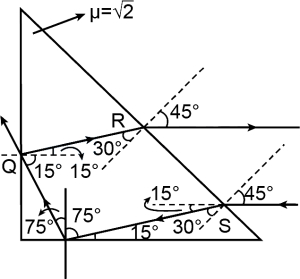
(A, C) The critical angle $\theta_{C} = \sin^{-1}\left(\frac{1}{\sqrt{2}}\right) = 45^{\circ}$.
Applying Snell's law at the incident surface $S$ $(n_{1} \sin \theta_{1} = n_{2} \sin \theta_{2})$:
$1 \cdot \sin 45^{\circ} = \sqrt{2} \cdot \sin \theta \implies \sin \theta = \frac{1}{2} \implies \theta = 30^{\circ}$.
At point $P$,the angle of incidence is $90^{\circ} - 15^{\circ} = 75^{\circ}$. Since $75^{\circ} > 45^{\circ}$,total internal reflection $(TIR)$ occurs at $P$.
At point $Q$,the angle of incidence is $15^{\circ}$. Since $15^{\circ} < 45^{\circ}$,partial reflection and refraction occur at $Q$.
The ray emerging at $R$ is parallel to the incident ray at $S$ because the geometry of the prism and the path of the ray result in a net deviation of $0^{\circ}$ (or $360^{\circ}$),meaning they are parallel. Thus,statement $A$ and $C$ are correct.
Applying Snell's law at the incident surface $S$ $(n_{1} \sin \theta_{1} = n_{2} \sin \theta_{2})$:
$1 \cdot \sin 45^{\circ} = \sqrt{2} \cdot \sin \theta \implies \sin \theta = \frac{1}{2} \implies \theta = 30^{\circ}$.
At point $P$,the angle of incidence is $90^{\circ} - 15^{\circ} = 75^{\circ}$. Since $75^{\circ} > 45^{\circ}$,total internal reflection $(TIR)$ occurs at $P$.
At point $Q$,the angle of incidence is $15^{\circ}$. Since $15^{\circ} < 45^{\circ}$,partial reflection and refraction occur at $Q$.
The ray emerging at $R$ is parallel to the incident ray at $S$ because the geometry of the prism and the path of the ray result in a net deviation of $0^{\circ}$ (or $360^{\circ}$),meaning they are parallel. Thus,statement $A$ and $C$ are correct.
0 likesView Solution
33
PhysicsMediumMCQWBJEE · 2018
Two identical equiconvex lenses,each of focal length $f$,are placed side by side in contact with each other with a layer of water in between them as shown in the figure. If the refractive index of the material of the lenses is greater than that of water,how is the combined focal length $F$ related to $f$?
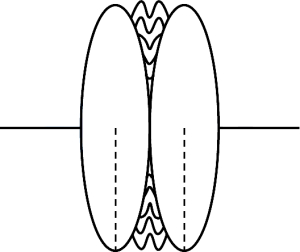
A
$F > f$
B
$\frac{f}{2} < F < f$
C
$F < \frac{f}{2}$
D
$F = f$
Solution
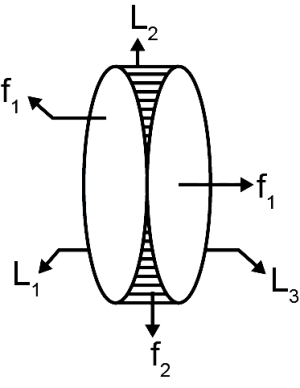
(B) The given combination consists of three lenses in contact: two identical equiconvex glass lenses ($L_1$ and $L_3$) and one water lens $(L_2)$ formed in the space between them.
Let $f_1$ be the focal length of each glass lens and $f_2$ be the focal length of the water lens.
The combination of lenses is in contact,so the equivalent focal length $F$ is given by:
$\frac{1}{F} = \frac{1}{f_1} + \frac{1}{f_2} + \frac{1}{f_3}$
Since $L_1$ and $L_3$ are identical,$f_1 = f_3 = f$. The water lens $L_2$ is a biconcave lens,so its focal length $f_2$ is negative.
Thus,$\frac{1}{F} = \frac{1}{f} + \frac{1}{f_2} + \frac{1}{f} = \frac{2}{f} + \frac{1}{f_2}$.
Let $R$ be the radius of curvature. For the glass lenses,$\frac{1}{f} = (\mu_g - 1)(\frac{2}{R})$. For the water lens,$\frac{1}{f_2} = -(\mu_w - 1)(\frac{2}{R})$.
Since $\mu_g > \mu_w$,the magnitude of the power of the glass lens is greater than that of the water lens,meaning $|\frac{1}{f}| > |\frac{1}{f_2}|$.
Therefore,$\frac{1}{F} = \frac{2}{f} - |\frac{1}{f_2}|$. Since $|\frac{1}{f_2}| > 0$,$\frac{1}{F} < \frac{2}{f}$,which implies $F > \frac{f}{2}$.
Also,since $\frac{1}{F} = \frac{2}{f} - |\frac{1}{f_2}|$,it is clear that $\frac{1}{F} > \frac{1}{f}$ (because we are subtracting a positive value from $\frac{2}{f}$ but the net power is still positive and less than $\frac{2}{f}$),thus $F < f$.
Combining these,we get $\frac{f}{2} < F < f$.
Let $f_1$ be the focal length of each glass lens and $f_2$ be the focal length of the water lens.
The combination of lenses is in contact,so the equivalent focal length $F$ is given by:
$\frac{1}{F} = \frac{1}{f_1} + \frac{1}{f_2} + \frac{1}{f_3}$
Since $L_1$ and $L_3$ are identical,$f_1 = f_3 = f$. The water lens $L_2$ is a biconcave lens,so its focal length $f_2$ is negative.
Thus,$\frac{1}{F} = \frac{1}{f} + \frac{1}{f_2} + \frac{1}{f} = \frac{2}{f} + \frac{1}{f_2}$.
Let $R$ be the radius of curvature. For the glass lenses,$\frac{1}{f} = (\mu_g - 1)(\frac{2}{R})$. For the water lens,$\frac{1}{f_2} = -(\mu_w - 1)(\frac{2}{R})$.
Since $\mu_g > \mu_w$,the magnitude of the power of the glass lens is greater than that of the water lens,meaning $|\frac{1}{f}| > |\frac{1}{f_2}|$.
Therefore,$\frac{1}{F} = \frac{2}{f} - |\frac{1}{f_2}|$. Since $|\frac{1}{f_2}| > 0$,$\frac{1}{F} < \frac{2}{f}$,which implies $F > \frac{f}{2}$.
Also,since $\frac{1}{F} = \frac{2}{f} - |\frac{1}{f_2}|$,it is clear that $\frac{1}{F} > \frac{1}{f}$ (because we are subtracting a positive value from $\frac{2}{f}$ but the net power is still positive and less than $\frac{2}{f}$),thus $F < f$.
Combining these,we get $\frac{f}{2} < F < f$.
0 likesView Solution
34
PhysicsEasyMCQWBJEE · 2018
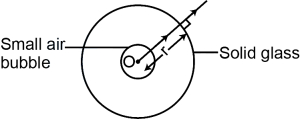
There is a small air bubble at the centre of a solid glass sphere of radius $r$ and refractive index $\mu$. What will be the apparent distance of the bubble from the centre of the sphere,when viewed from outside?
A
$r$
B
$\frac{r}{\mu}$
C
$r(1 - \frac{1}{\mu})$
D
Zero
Solution
(D) The air bubble is located at the centre $O$ of the solid glass sphere.
When light rays originating from the air bubble travel towards the surface of the sphere,they move along the radius of the sphere.
Since the radius is always perpendicular to the surface of the sphere,the light rays strike the surface at an angle of incidence $i = 0^\circ$.
According to Snell's law,when light is incident normally on a surface,it does not undergo any refraction or deviation.
Therefore,the light rays continue to travel in a straight line without bending.
As a result,the observer looking from outside sees the image of the bubble at the same position as the object.
Thus,the apparent distance of the bubble from the centre of the sphere is zero.
When light rays originating from the air bubble travel towards the surface of the sphere,they move along the radius of the sphere.
Since the radius is always perpendicular to the surface of the sphere,the light rays strike the surface at an angle of incidence $i = 0^\circ$.
According to Snell's law,when light is incident normally on a surface,it does not undergo any refraction or deviation.
Therefore,the light rays continue to travel in a straight line without bending.
As a result,the observer looking from outside sees the image of the bubble at the same position as the object.
Thus,the apparent distance of the bubble from the centre of the sphere is zero.
0 likesView Solution
35
PhysicsEasyMCQWBJEE · 2018
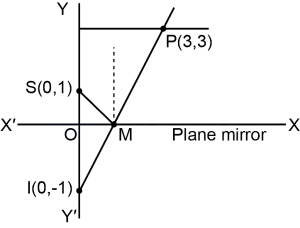
$A$ point source is placed at coordinates $(0,1)$ in the $xy$-plane. $A$ ray of light from the source is reflected on a plane mirror placed along the $X$-axis and perpendicular to the $xy$-plane. The reflected ray passes through the point $(3,3)$. What is the path length of the ray from $(0,1)$ to $(3,3)$?
A
$5$
B
$\sqrt{13}$
C
$2\sqrt{3}$
D
$1+2\sqrt{3}$
Solution
(A) Let the source be at $S(0,1)$ and the point on the mirror be $M$. The reflected ray passes through $P(3,3)$.
Since the mirror is along the $X$-axis,the image of the source $S(0,1)$ formed by the mirror is $I(0,-1)$.
The path length of the reflected ray is $SM + MP$.
By the law of reflection,$SM = IM$.
Therefore,the total path length is $IM + MP = IP$.
The distance $IP$ is the distance between points $I(0,-1)$ and $P(3,3)$.
Using the distance formula: $IP = \sqrt{(3-0)^2 + (3 - (-1))^2} = \sqrt{3^2 + 4^2} = \sqrt{9 + 16} = \sqrt{25} = 5$.
Since the mirror is along the $X$-axis,the image of the source $S(0,1)$ formed by the mirror is $I(0,-1)$.
The path length of the reflected ray is $SM + MP$.
By the law of reflection,$SM = IM$.
Therefore,the total path length is $IM + MP = IP$.
The distance $IP$ is the distance between points $I(0,-1)$ and $P(3,3)$.
Using the distance formula: $IP = \sqrt{(3-0)^2 + (3 - (-1))^2} = \sqrt{3^2 + 4^2} = \sqrt{9 + 16} = \sqrt{25} = 5$.
0 likesView Solution
36
PhysicsEasyMCQWBJEE · 2018
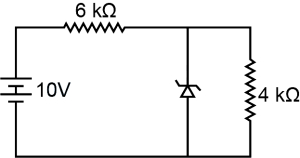
What will be the current flowing through the $6 \text{ k}\Omega$ resistor in the circuit shown,where the breakdown voltage of the Zener diode is $6 \text{ V}$?
A
$\frac{2}{3} \text{ mA}$
B
$1 \text{ mA}$
C
$10 \text{ mA}$
D
$\frac{3}{2} \text{ mA}$
Solution
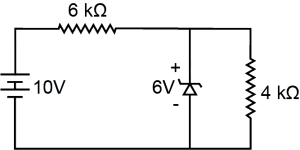
(A) In the given circuit,the Zener diode is connected in parallel with the $4 \text{ k}\Omega$ resistor. Since the Zener diode is operating in its breakdown region,the voltage across it is constant at $6 \text{ V}$.
Because the Zener diode and the $4 \text{ k}\Omega$ resistor are in parallel,the voltage across the $4 \text{ k}\Omega$ resistor is also $6 \text{ V}$.
The total voltage in the circuit is $10 \text{ V}$. The voltage drop across the $6 \text{ k}\Omega$ series resistor is the difference between the source voltage and the Zener breakdown voltage:
$V_{6\text{k}\Omega} = 10 \text{ V} - 6 \text{ V} = 4 \text{ V}$.
The current flowing through the $6 \text{ k}\Omega$ resistor is given by Ohm's law:
$I = \frac{V_{6\text{k}\Omega}}{R} = \frac{4 \text{ V}}{6 \text{ k}\Omega} = \frac{4}{6} \text{ mA} = \frac{2}{3} \text{ mA}$.
Because the Zener diode and the $4 \text{ k}\Omega$ resistor are in parallel,the voltage across the $4 \text{ k}\Omega$ resistor is also $6 \text{ V}$.
The total voltage in the circuit is $10 \text{ V}$. The voltage drop across the $6 \text{ k}\Omega$ series resistor is the difference between the source voltage and the Zener breakdown voltage:
$V_{6\text{k}\Omega} = 10 \text{ V} - 6 \text{ V} = 4 \text{ V}$.
The current flowing through the $6 \text{ k}\Omega$ resistor is given by Ohm's law:
$I = \frac{V_{6\text{k}\Omega}}{R} = \frac{4 \text{ V}}{6 \text{ k}\Omega} = \frac{4}{6} \text{ mA} = \frac{2}{3} \text{ mA}$.
0 likesView Solution
37
PhysicsEasyMCQWBJEE · 2018
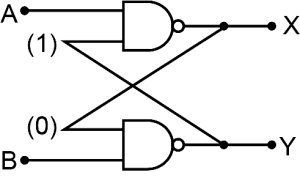
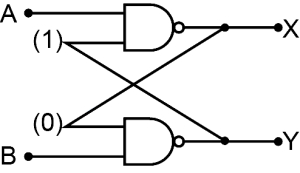
In the circuit shown, inputs $A$ and $B$ are in states $1$ and $0$ respectively. What is the only possible stable state of the outputs $X$ and $Y$?
A
$X=1, Y=1$
B
$X=1, Y=0$
C
$X=0, Y=1$
D
$X=0, Y=0$
Solution
(C) The circuit consists of two cross-coupled $NAND$ gates, which form an $S-R$ latch.
Given $A=1$ and $B=0$.
The output $Y$ of the bottom $NAND$ gate is $Y = \overline{B \cdot X} = \overline{0 \cdot X} = \overline{0} = 1$.
Now, using this value of $Y$ in the top $NAND$ gate, the output $X$ is $X = \overline{A \cdot Y} = \overline{1 \cdot 1} = \overline{1} = 0$.
Thus, the stable state is $X=0$ and $Y=1$.
Given $A=1$ and $B=0$.
The output $Y$ of the bottom $NAND$ gate is $Y = \overline{B \cdot X} = \overline{0 \cdot X} = \overline{0} = 1$.
Now, using this value of $Y$ in the top $NAND$ gate, the output $X$ is $X = \overline{A \cdot Y} = \overline{1 \cdot 1} = \overline{1} = 0$.
Thus, the stable state is $X=0$ and $Y=1$.
0 likesView Solution
38
PhysicsEasyMCQWBJEE · 2018
If Young's double slit experiment is performed with white light,which of the following statements will be true?
A
All the bright fringes will be coloured.
B
All the bright fringes will be white.
C
The central fringe will be white.
D
No stable interference pattern will be visible.
Solution
(C) In Young's double slit experiment,white light consists of wavelengths ranging from $4000 \ Å$ to $7000 \ Å$.
At the central position on the screen,the path difference for all wavelengths is zero.
Since the path difference is zero,all wavelengths interfere constructively at the center,resulting in a white fringe.
As we move away from the center,the path difference increases,causing different wavelengths to interfere constructively at different positions,resulting in coloured fringes.
At the central position on the screen,the path difference for all wavelengths is zero.
Since the path difference is zero,all wavelengths interfere constructively at the center,resulting in a white fringe.
As we move away from the center,the path difference increases,causing different wavelengths to interfere constructively at different positions,resulting in coloured fringes.
0 likesView Solution
Vedclass Products
For Students
Vedclass Test Series
Mock tests in real WBJEE style covering Physics with performance analysis. 5-day free trial.
Start Free TrialFor Teachers
Exam Paper Generator
Generate Set A/B/C/D Physics papers from 7.5L+ questions in 2 minutes. 3 chapters free.
Try FreeFor Institutes
Online Exam Module
Run live WBJEE mock exams with unlimited students, 360° analytics & white-label branding.
See DemoFrequently Asked Questions
How many Physics questions are in WBJEE 2018?
There are 38 Physics questions from the WBJEE 2018 paper on Vedclass, each with a detailed step-by-step solution in English.
Are WBJEE 2018 Physics solutions available in English?
Yes. All solutions on this page are in English. You can also switch to English or Hindi using the language buttons above the questions.
Can I practice WBJEE 2018 Physics as a timed test?
Yes. Use the Vedclass Test Series to attempt a full WBJEE mock test covering Physics with time limits and instant score analysis.
Can teachers create Physics papers from WBJEE previous year questions?
Yes. The Vedclass Exam Paper Generator lets teachers mix WBJEE Physics questions and generate Set A/B/C/D papers in minutes.
For Teachers & Institutes
Build a Custom Physics Paper
Pick WBJEE 2018 Physics questions, set difficulty, and generate Set A/B/C/D in 2 minutes.