
ChemistryQ1–50 of 50 questions
Page 1 of 1 · English
1
ChemistryMCQWBJEE · 2025
The apparent coefficient of expansion of a liquid when heated in a copper vessel is $C$ and when heated in a silver vessel is $S$. If $A$ is the linear coefficient of expansion of copper,then the linear coefficient of expansion of silver is
A
$\frac{C + S - 3A}{3}$
B
$\frac{C + 3A - S}{3}$
C
$\frac{S + 3A - C}{3}$
D
$\frac{C + S + 3A}{3}$
Solution
(B) The relationship between the real coefficient of expansion $(\gamma_r)$,apparent coefficient of expansion $(\gamma_a)$,and the volume coefficient of expansion of the vessel $(\gamma_v)$ is given by: $\gamma_r = \gamma_a + \gamma_v$.
Since the volume coefficient of expansion $\gamma_v = 3\alpha$,where $\alpha$ is the linear coefficient of expansion,we have $\gamma_r = \gamma_a + 3\alpha$.
For the copper vessel: $\gamma_r = C + 3A$.
For the silver vessel: $\gamma_r = S + 3\alpha_{Ag}$,where $\alpha_{Ag}$ is the linear coefficient of expansion of silver.
Since the real coefficient of expansion of the liquid is constant,we equate the two expressions: $C + 3A = S + 3\alpha_{Ag}$.
Rearranging for $\alpha_{Ag}$: $3\alpha_{Ag} = C + 3A - S$.
Therefore,$\alpha_{Ag} = \frac{C + 3A - S}{3}$.
Since the volume coefficient of expansion $\gamma_v = 3\alpha$,where $\alpha$ is the linear coefficient of expansion,we have $\gamma_r = \gamma_a + 3\alpha$.
For the copper vessel: $\gamma_r = C + 3A$.
For the silver vessel: $\gamma_r = S + 3\alpha_{Ag}$,where $\alpha_{Ag}$ is the linear coefficient of expansion of silver.
Since the real coefficient of expansion of the liquid is constant,we equate the two expressions: $C + 3A = S + 3\alpha_{Ag}$.
Rearranging for $\alpha_{Ag}$: $3\alpha_{Ag} = C + 3A - S$.
Therefore,$\alpha_{Ag} = \frac{C + 3A - S}{3}$.
0 likesView Solution
2
ChemistryMCQWBJEE · 2025
The number of common tangents to the circles ${x^2 + y^2 - 4x - 6y - 12 = 0}$ and ${x^2 + y^2 + 6x + 18y + 26 = 0}$ is
A
$1$
B
$2$
C
$3$
D
$4$
Solution
(C) The equation of the first circle is ${x^2 + y^2 - 4x - 6y - 12 = 0}$. Its centre ${C_1}$ is $(2, 3)$ and radius ${r_1} = \sqrt{2^2 + 3^2 - (-12)} = \sqrt{4 + 9 + 12} = \sqrt{25} = 5$.
The equation of the second circle is ${x^2 + y^2 + 6x + 18y + 26 = 0}$. Its centre ${C_2}$ is $(-3, -9)$ and radius ${r_2} = \sqrt{(-3)^2 + (-9)^2 - 26} = \sqrt{9 + 81 - 26} = \sqrt{64} = 8$.
The distance between the centres ${C_1}$ and ${C_2}$ is ${d = \sqrt{(2 - (-3))^2 + (3 - (-9))^2} = \sqrt{5^2 + 12^2} = \sqrt{25 + 144} = \sqrt{169} = 13}$.
Since ${r_1 + r_2 = 5 + 8 = 13}$,which is equal to the distance between the centres ${d}$,the circles touch each other externally.
For two circles touching each other externally,the number of common tangents is $3$.
The equation of the second circle is ${x^2 + y^2 + 6x + 18y + 26 = 0}$. Its centre ${C_2}$ is $(-3, -9)$ and radius ${r_2} = \sqrt{(-3)^2 + (-9)^2 - 26} = \sqrt{9 + 81 - 26} = \sqrt{64} = 8$.
The distance between the centres ${C_1}$ and ${C_2}$ is ${d = \sqrt{(2 - (-3))^2 + (3 - (-9))^2} = \sqrt{5^2 + 12^2} = \sqrt{25 + 144} = \sqrt{169} = 13}$.
Since ${r_1 + r_2 = 5 + 8 = 13}$,which is equal to the distance between the centres ${d}$,the circles touch each other externally.
For two circles touching each other externally,the number of common tangents is $3$.
0 likesView Solution
3
ChemistryMCQWBJEE · 2025
The sum of the first four terms of an arithmetic progression is $56$ and the sum of its last four terms is $112$. If the first term is $11$,what is the number of terms in the progression?
A
$10$
B
$11$
C
$12$
D
None of these
Solution
(B) Let the arithmetic progression be $a, a+d, a+2d, \dots, a+(n-1)d$. Given $a = 11$.
Sum of the first four terms: $a + (a+d) + (a+2d) + (a+3d) = 56$.
$4a + 6d = 56 \implies 4(11) + 6d = 56 \implies 44 + 6d = 56 \implies 6d = 12 \implies d = 2$.
Sum of the last four terms: $(a+(n-1)d) + (a+(n-2)d) + (a+(n-3)d) + (a+(n-4)d) = 112$.
$4a + (4n - 10)d = 112$.
Substitute $a = 11$ and $d = 2$: $4(11) + (4n - 10)(2) = 112$.
$44 + 8n - 20 = 112 \implies 8n + 24 = 112 \implies 8n = 88 \implies n = 11$.
Sum of the first four terms: $a + (a+d) + (a+2d) + (a+3d) = 56$.
$4a + 6d = 56 \implies 4(11) + 6d = 56 \implies 44 + 6d = 56 \implies 6d = 12 \implies d = 2$.
Sum of the last four terms: $(a+(n-1)d) + (a+(n-2)d) + (a+(n-3)d) + (a+(n-4)d) = 112$.
$4a + (4n - 10)d = 112$.
Substitute $a = 11$ and $d = 2$: $4(11) + (4n - 10)(2) = 112$.
$44 + 8n - 20 = 112 \implies 8n + 24 = 112 \implies 8n = 88 \implies n = 11$.
0 likesView Solution
4
ChemistryMCQWBJEE · 2025
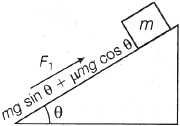
The minimum force required to start pushing a body up a rough (frictional coefficient $\mu$) inclined plane is $F_1$,while the minimum force needed to prevent it from sliding down is $F_2$. If the inclined plane makes an angle $\theta$ with the horizontal such that $\tan \theta = 2 \mu$,then the ratio $\frac{F_1}{F_2}$ is:
A
$4$
B
$1$
C
$2$
D
$3$
Solution
(D) For pushing the body up the inclined plane,the minimum force $F_1$ must overcome both the component of gravity acting down the plane $(mg \sin \theta)$ and the maximum static friction force acting down the plane $(\mu mg \cos \theta)$. Thus,$F_1 = mg \sin \theta + \mu mg \cos \theta = mg(\sin \theta + \mu \cos \theta)$.
For preventing the body from sliding down the inclined plane,the minimum force $F_2$ acts up the plane. The component of gravity acts down the plane $(mg \sin \theta)$,and the maximum static friction force acts up the plane $(\mu mg \cos \theta)$. Thus,$F_2 = mg \sin \theta - \mu mg \cos \theta = mg(\sin \theta - \mu \cos \theta)$.
The ratio is given by $\frac{F_1}{F_2} = \frac{mg(\sin \theta + \mu \cos \theta)}{mg(\sin \theta - \mu \cos \theta)} = \frac{\sin \theta + \mu \cos \theta}{\sin \theta - \mu \cos \theta}$.
Dividing the numerator and denominator by $\cos \theta$,we get $\frac{F_1}{F_2} = \frac{\tan \theta + \mu}{\tan \theta - \mu}$.
Given $\tan \theta = 2 \mu$,substituting this value gives $\frac{F_1}{F_2} = \frac{2 \mu + \mu}{2 \mu - \mu} = \frac{3 \mu}{\mu} = 3$.
For preventing the body from sliding down the inclined plane,the minimum force $F_2$ acts up the plane. The component of gravity acts down the plane $(mg \sin \theta)$,and the maximum static friction force acts up the plane $(\mu mg \cos \theta)$. Thus,$F_2 = mg \sin \theta - \mu mg \cos \theta = mg(\sin \theta - \mu \cos \theta)$.
The ratio is given by $\frac{F_1}{F_2} = \frac{mg(\sin \theta + \mu \cos \theta)}{mg(\sin \theta - \mu \cos \theta)} = \frac{\sin \theta + \mu \cos \theta}{\sin \theta - \mu \cos \theta}$.
Dividing the numerator and denominator by $\cos \theta$,we get $\frac{F_1}{F_2} = \frac{\tan \theta + \mu}{\tan \theta - \mu}$.
Given $\tan \theta = 2 \mu$,substituting this value gives $\frac{F_1}{F_2} = \frac{2 \mu + \mu}{2 \mu - \mu} = \frac{3 \mu}{\mu} = 3$.
0 likesView Solution
5
ChemistryMCQWBJEE · 2025
The number of common tangents to the circles $x^2+y^2-4x-6y-12=0$ and $x^2+y^2+6x+18y+26=0$ is:
A
$1$
B
$2$
C
$3$
D
$4$
Solution
(C) For the circle $x^2+y^2-4x-6y-12=0$,the center $C_1 = (2, 3)$ and radius $r_1 = \sqrt{2^2+3^2-(-12)} = \sqrt{4+9+12} = \sqrt{25} = 5$.
For the circle $x^2+y^2+6x+18y+26=0$,the center $C_2 = (-3, -9)$ and radius $r_2 = \sqrt{(-3)^2+(-9)^2-26} = \sqrt{9+81-26} = \sqrt{64} = 8$.
The distance between the centers $d = C_1C_2 = \sqrt{(2-(-3))^2 + (3-(-9))^2} = \sqrt{5^2 + 12^2} = \sqrt{25+144} = \sqrt{169} = 13$.
Since $r_1 + r_2 = 5 + 8 = 13$,we have $d = r_1 + r_2$.
Because the distance between the centers is equal to the sum of the radii,the two circles touch each other externally.
When two circles touch each other externally,there are exactly $3$ common tangents.
For the circle $x^2+y^2+6x+18y+26=0$,the center $C_2 = (-3, -9)$ and radius $r_2 = \sqrt{(-3)^2+(-9)^2-26} = \sqrt{9+81-26} = \sqrt{64} = 8$.
The distance between the centers $d = C_1C_2 = \sqrt{(2-(-3))^2 + (3-(-9))^2} = \sqrt{5^2 + 12^2} = \sqrt{25+144} = \sqrt{169} = 13$.
Since $r_1 + r_2 = 5 + 8 = 13$,we have $d = r_1 + r_2$.
Because the distance between the centers is equal to the sum of the radii,the two circles touch each other externally.
When two circles touch each other externally,there are exactly $3$ common tangents.
0 likesView Solution
6
ChemistryEasyMCQWBJEE · 2025
The bond order of $HeH^{+}$ is
A
$1$
B
$2$
C
$3$
D
$4$
Solution
(A) The total number of electrons in $HeH^{+}$ is $2 + 1 - 1 = 2$.
The molecular orbital electronic configuration is $\sigma_{1s}^2$.
Bond Order $= \frac{1}{2} [N_b - N_a] = \frac{1}{2} [2 - 0] = 1$.
The molecular orbital electronic configuration is $\sigma_{1s}^2$.
Bond Order $= \frac{1}{2} [N_b - N_a] = \frac{1}{2} [2 - 0] = 1$.
0 likesView Solution
7
ChemistryEasyMCQWBJEE · 2025
Which of the following hydrogen bonds is likely to be the weakest?
A
$C-H \cdots O$
B
$N-H \cdots O$
C
$O-H \cdots O$
D
$O-H \cdots F$
Solution
(A) The strength of a hydrogen bond $X-H \cdots Y$ depends on the electronegativity difference between $X$ and $H$.
As the electronegativity of $X$ decreases,the polarity of the $X-H$ bond decreases,resulting in a smaller partial positive charge $(\delta+)$ on the hydrogen atom.
This leads to a weaker electrostatic attraction between the hydrogen atom and the electronegative atom $Y$.
The electronegativity values are $C (2.5) < N (3.0) < O (3.5)$.
Therefore,the $C-H \cdots O$ hydrogen bond is the weakest among the given options.
As the electronegativity of $X$ decreases,the polarity of the $X-H$ bond decreases,resulting in a smaller partial positive charge $(\delta+)$ on the hydrogen atom.
This leads to a weaker electrostatic attraction between the hydrogen atom and the electronegative atom $Y$.
The electronegativity values are $C (2.5) < N (3.0) < O (3.5)$.
Therefore,the $C-H \cdots O$ hydrogen bond is the weakest among the given options.
0 likesView Solution
8
ChemistryMediumMCQWBJEE · 2025
Consider the following gas phase dissociation,$PCl_{5(g)} \rightleftharpoons PCl_{3(g)} + Cl_{2(g)}$ with equilibrium constant $K_P$ at a particular temperature and at pressure $P$. The degree of dissociation $(\alpha)$ for $PCl_{5(g)}$ is
A
$\alpha = \left( \frac{K_P}{K_P + P} \right)^{1/3}$
B
$\alpha = \left( \frac{K_P}{K_P + P} \right)$
C
$\alpha = \left( \frac{K_P}{K_P + P} \right)^{1/2}$
D
$\alpha = \left( \frac{K_P}{K_P + P} \right)^2$
Solution
(C)
Total moles at equilibrium = $(1 - \alpha) + \alpha + \alpha = 1 + \alpha$.
Partial pressures: $P_{PCl_5} = \frac{1 - \alpha}{1 + \alpha} P$,$P_{PCl_3} = \frac{\alpha}{1 + \alpha} P$,$P_{Cl_2} = \frac{\alpha}{1 + \alpha} P$.
Equilibrium constant $K_P = \frac{P_{PCl_3} \cdot P_{Cl_2}}{P_{PCl_5}} = \frac{(\frac{\alpha}{1 + \alpha} P)(\frac{\alpha}{1 + \alpha} P)}{(\frac{1 - \alpha}{1 + \alpha} P)} = \frac{\alpha^2 P}{1 - \alpha^2}$.
Rearranging: $K_P(1 - \alpha^2) = \alpha^2 P \implies K_P = \alpha^2(P + K_P) \implies \alpha^2 = \frac{K_P}{K_P + P}$.
Therefore,$\alpha = \left( \frac{K_P}{K_P + P} \right)^{1/2}$.
| Species | $PCl_{5(g)}$ | $PCl_{3(g)}$ | $Cl_{2(g)}$ |
|---|---|---|---|
| Initial moles | $1$ | $0$ | $0$ |
| Equilibrium moles | $1 - \alpha$ | $\alpha$ | $\alpha$ |
Total moles at equilibrium = $(1 - \alpha) + \alpha + \alpha = 1 + \alpha$.
Partial pressures: $P_{PCl_5} = \frac{1 - \alpha}{1 + \alpha} P$,$P_{PCl_3} = \frac{\alpha}{1 + \alpha} P$,$P_{Cl_2} = \frac{\alpha}{1 + \alpha} P$.
Equilibrium constant $K_P = \frac{P_{PCl_3} \cdot P_{Cl_2}}{P_{PCl_5}} = \frac{(\frac{\alpha}{1 + \alpha} P)(\frac{\alpha}{1 + \alpha} P)}{(\frac{1 - \alpha}{1 + \alpha} P)} = \frac{\alpha^2 P}{1 - \alpha^2}$.
Rearranging: $K_P(1 - \alpha^2) = \alpha^2 P \implies K_P = \alpha^2(P + K_P) \implies \alpha^2 = \frac{K_P}{K_P + P}$.
Therefore,$\alpha = \left( \frac{K_P}{K_P + P} \right)^{1/2}$.
0 likesView Solution
9
ChemistryMediumMCQWBJEE · 2025
The compound$(s)$ showing optical activity is/are:
A
Glycine $(H_2N-CH_2-COOH)$
B
Lactic acid $(CH_3-CH(OH)-COOH)$
C
Glyceraldehyde $(HOCH_2-CH(OH)-CHO)$
D
Tartaric acid $(HOOC-CH(OH)-CH(OH)-COOH)$
Solution
(B, C) compound is optically active if it possesses at least one chiral center and lacks a plane of symmetry or center of symmetry.
$(A)$ Glycine $(H_2N-CH_2-COOH)$ has no chiral center.
$(B)$ Lactic acid $(CH_3-CH(OH)-COOH)$ has one chiral center at the central carbon atom,making it optically active.
$(C)$ Glyceraldehyde $(HOCH_2-CH(OH)-CHO)$ has one chiral center at the central carbon atom,making it optically active.
$(D)$ Tartaric acid $(HOOC-CH(OH)-CH(OH)-COOH)$ has two chiral centers,but the meso form has a plane of symmetry and is optically inactive. However,the chiral isomers of tartaric acid are optically active.
Given the options provided,$(B)$ and $(C)$ are clearly optically active.
$(A)$ Glycine $(H_2N-CH_2-COOH)$ has no chiral center.
$(B)$ Lactic acid $(CH_3-CH(OH)-COOH)$ has one chiral center at the central carbon atom,making it optically active.
$(C)$ Glyceraldehyde $(HOCH_2-CH(OH)-CHO)$ has one chiral center at the central carbon atom,making it optically active.
$(D)$ Tartaric acid $(HOOC-CH(OH)-CH(OH)-COOH)$ has two chiral centers,but the meso form has a plane of symmetry and is optically inactive. However,the chiral isomers of tartaric acid are optically active.
Given the options provided,$(B)$ and $(C)$ are clearly optically active.
0 likesView Solution
10
ChemistryMediumMCQWBJEE · 2025
Kjeldahl's method cannot be used for the estimation of nitrogen in which compound?
A
$C_6H_5NHCOCH_3$
B
$NH_2CH_2COOH$
C
$C_6H_5-N=N-C_6H_5$
D
$CH_3CH(NH_2)COOH$
Solution
(C) Kjeldahl's method is not applicable to compounds containing nitrogen in nitro groups $(-NO_2)$,azo groups $(-N=N-)$,or nitrogen present in the ring (like pyridine) because these nitrogen atoms cannot be converted into ammonium sulfate under the conditions of the Kjeldahl method.
In the given options,$C_6H_5-N=N-C_6H_5$ is an azo compound (azobenzene),which does not respond to Kjeldahl's method.
In the given options,$C_6H_5-N=N-C_6H_5$ is an azo compound (azobenzene),which does not respond to Kjeldahl's method.
0 likesView Solution
11
ChemistryMediumMCQWBJEE · 2025
An optically active alkene having molecular formula $C_8H_{16}$ gives acetone as one of the products on ozonolysis. The structure of the alkene is:
A
$2,3-$dimethylhex$-2-$ene
B
$3,4-$dimethylhex$-2-$ene
C
$3,4-$dimethylhex$-3-$ene
D
$2,3-$dimethylhex$-3-$ene
Solution
(B) $1$. Ozonolysis of an alkene involves the cleavage of the $C=C$ double bond to form carbonyl compounds.
$2$. The formation of acetone $(CH_3)_2C=O$ indicates that the alkene must have a $(CH_3)_2C=$ group.
$3$. The molecular formula is $C_8H_{16}$. If one part is acetone $(C_3H_6O)$,the other part must be a $C_5$ aldehyde or ketone.
$4$. For the alkene to be optically active,it must contain a chiral center. In the structure $2,3$-dimethylhex-$2$-ene,the molecule is achiral. In $3,4$-dimethylhex-$2$-ene,the carbon at position $3$ is chiral because it is bonded to four different groups: $-H$,$-CH_3$,$-CH_2CH_3$,and $-C(CH_3)=C(CH_3)_2$.
$5$. The structure shown in option $B$ corresponds to $3,4$-dimethylhex-$2$-ene,which contains a chiral center (marked with an asterisk) and produces acetone upon ozonolysis.
$2$. The formation of acetone $(CH_3)_2C=O$ indicates that the alkene must have a $(CH_3)_2C=$ group.
$3$. The molecular formula is $C_8H_{16}$. If one part is acetone $(C_3H_6O)$,the other part must be a $C_5$ aldehyde or ketone.
$4$. For the alkene to be optically active,it must contain a chiral center. In the structure $2,3$-dimethylhex-$2$-ene,the molecule is achiral. In $3,4$-dimethylhex-$2$-ene,the carbon at position $3$ is chiral because it is bonded to four different groups: $-H$,$-CH_3$,$-CH_2CH_3$,and $-C(CH_3)=C(CH_3)_2$.
$5$. The structure shown in option $B$ corresponds to $3,4$-dimethylhex-$2$-ene,which contains a chiral center (marked with an asterisk) and produces acetone upon ozonolysis.
0 likesView Solution
12
ChemistryMediumMCQWBJEE · 2025
Which of the following hydrocarbons reacts easily with $MeMgBr$ to give methane?
A
Cyclopropene
B
Cyclopentadiene
C
Benzene
D
Cycloheptatriene
Solution
(B) The reaction of $MeMgBr$ (a Grignard reagent) with hydrocarbons occurs if the hydrocarbon has an acidic hydrogen atom. $MeMgBr$ acts as a base and abstracts the most acidic proton to form methane $(CH_4)$.
Among the given options,$1,3$-cyclopentadiene contains a methylene group $(-CH_2-)$ between two double bonds. The hydrogen atoms on this carbon are significantly more acidic than those in other hydrocarbons because the resulting cyclopentadienyl anion is aromatic ($6\pi$ electrons,$H$ückel's rule),which provides high stability.
Therefore,$1,3$-cyclopentadiene reacts readily with $MeMgBr$ to form methane and the cyclopentadienyl Grignard reagent.
Among the given options,$1,3$-cyclopentadiene contains a methylene group $(-CH_2-)$ between two double bonds. The hydrogen atoms on this carbon are significantly more acidic than those in other hydrocarbons because the resulting cyclopentadienyl anion is aromatic ($6\pi$ electrons,$H$ückel's rule),which provides high stability.
Therefore,$1,3$-cyclopentadiene reacts readily with $MeMgBr$ to form methane and the cyclopentadienyl Grignard reagent.
0 likesView Solution
13
ChemistryMediumMCQWBJEE · 2025
Equal volumes of two solutions $A$ and $B$ of a strong acid having $pH=6.0$ and $pH=4.0$ respectively are mixed together to form a new solution. The $pH$ of the new solution will be in the range
A
between $5$ and $6$
B
between $6$ and $7$
C
between $4$ and $5$
D
between $3$ and $4$
Solution
(C) For solution $A$: $pH=6.0$,so $[H^{+}]_A = 10^{-6} \ M$.
For solution $B$: $pH=4.0$,so $[H^{+}]_B = 10^{-4} \ M$.
Let the volume of each solution be $1 \ L$.
Total moles of $H^{+}$ = $(1 \ L \times 10^{-6} \ M) + (1 \ L \times 10^{-4} \ M) = 10^{-6} + 10^{-4} = 1.01 \times 10^{-4} \ \text{moles}$.
Total volume of the mixture = $1 \ L + 1 \ L = 2 \ L$.
Resultant $[H^{+}] = \frac{1.01 \times 10^{-4} \ \text{moles}}{2 \ L} = 5.05 \times 10^{-5} \ M$.
$pH = -\log(5.05 \times 10^{-5}) = 5 - \log(5.05) \approx 5 - 0.703 = 4.297$.
Since $4.297$ lies between $4$ and $5$,the correct range is between $4$ and $5$.
For solution $B$: $pH=4.0$,so $[H^{+}]_B = 10^{-4} \ M$.
Let the volume of each solution be $1 \ L$.
Total moles of $H^{+}$ = $(1 \ L \times 10^{-6} \ M) + (1 \ L \times 10^{-4} \ M) = 10^{-6} + 10^{-4} = 1.01 \times 10^{-4} \ \text{moles}$.
Total volume of the mixture = $1 \ L + 1 \ L = 2 \ L$.
Resultant $[H^{+}] = \frac{1.01 \times 10^{-4} \ \text{moles}}{2 \ L} = 5.05 \times 10^{-5} \ M$.
$pH = -\log(5.05 \times 10^{-5}) = 5 - \log(5.05) \approx 5 - 0.703 = 4.297$.
Since $4.297$ lies between $4$ and $5$,the correct range is between $4$ and $5$.
0 likesView Solution
14
ChemistryMediumMCQWBJEE · 2025
Increasing order of solubility of $AgCl$ in $(i) H_2O$,$(ii) 1 \ M \ NaCl \ (aq.)$,$(iii) 1 \ M \ CaCl_2 \ (aq.)$ and $(iv) 1 \ M \ NaNO_3 \ (aq.)$ solution.
A
$CaCl_2 < NaCl < H_2O < NaNO_3$
B
$CaCl_2 > H_2O > NaCl > NaNO_3$
C
$CaCl_2 > NaCl > H_2O > NaNO_3$
D
$CaCl_2 < NaNO_3 < NaCl < H_2O$
Solution
(A) The solubility of a sparingly soluble salt like $AgCl$ is affected by the common ion effect and the salt effect.
$1$. In $H_2O$,the solubility is $S = \sqrt{K_{sp}}$.
$2$. In $1 \ M \ NaCl$ and $1 \ M \ CaCl_2$,the common ion $Cl^-$ is present. Since $CaCl_2$ provides $2 \ M \ Cl^-$ ions and $NaCl$ provides $1 \ M \ Cl^-$ ions,the solubility is lowest in $CaCl_2$ due to the strongest common ion effect.
$3$. In $1 \ M \ NaNO_3$,the solubility is slightly higher than in pure water due to the salt effect (or diverse ion effect),which increases the ionic strength of the solution.
$4$. Therefore,the order of increasing solubility is: $CaCl_2 < NaCl < H_2O < NaNO_3$.
$1$. In $H_2O$,the solubility is $S = \sqrt{K_{sp}}$.
$2$. In $1 \ M \ NaCl$ and $1 \ M \ CaCl_2$,the common ion $Cl^-$ is present. Since $CaCl_2$ provides $2 \ M \ Cl^-$ ions and $NaCl$ provides $1 \ M \ Cl^-$ ions,the solubility is lowest in $CaCl_2$ due to the strongest common ion effect.
$3$. In $1 \ M \ NaNO_3$,the solubility is slightly higher than in pure water due to the salt effect (or diverse ion effect),which increases the ionic strength of the solution.
$4$. Therefore,the order of increasing solubility is: $CaCl_2 < NaCl < H_2O < NaNO_3$.
0 likesView Solution
15
ChemistryMCQWBJEE · 2025
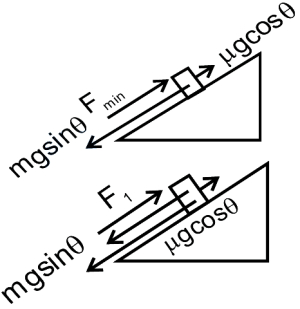
The minimum force required to start pushing a body up a rough (having coefficient of friction $\mu$) inclined plane is $F_1$,while the minimum force needed to prevent it from sliding down is $F_2$. If the inclined plane makes an angle $\theta$ with the horizontal such that $\tan \theta = 2\mu$,then the ratio $F_1 / F_2$ is
A
$4$
B
$1$
C
$2$
D
$3$
Solution
(D) To push the body up the inclined plane,the applied force $F_1$ must overcome both the component of gravitational force $mg \sin \theta$ and the maximum static friction force $f_{max} = \mu mg \cos \theta$ acting downwards. Thus,$F_1 = mg \sin \theta + \mu mg \cos \theta$.
To prevent the body from sliding down the inclined plane,the applied force $F_2$ acts upwards along with the maximum static friction force $f_{max} = \mu mg \cos \theta$ to balance the gravitational component $mg \sin \theta$ acting downwards. Thus,$F_2 = mg \sin \theta - \mu mg \cos \theta$.
Given $\tan \theta = 2\mu$,we can write $\sin \theta = 2\mu \cos \theta$. Substituting this into the expressions for $F_1$ and $F_2$:
$F_1 = mg(2\mu \cos \theta) + \mu mg \cos \theta = 3\mu mg \cos \theta$
$F_2 = mg(2\mu \cos \theta) - \mu mg \cos \theta = \mu mg \cos \theta$
Therefore,the ratio is:
$\frac{F_1}{F_2} = \frac{3\mu mg \cos \theta}{\mu mg \cos \theta} = 3$.
To prevent the body from sliding down the inclined plane,the applied force $F_2$ acts upwards along with the maximum static friction force $f_{max} = \mu mg \cos \theta$ to balance the gravitational component $mg \sin \theta$ acting downwards. Thus,$F_2 = mg \sin \theta - \mu mg \cos \theta$.
Given $\tan \theta = 2\mu$,we can write $\sin \theta = 2\mu \cos \theta$. Substituting this into the expressions for $F_1$ and $F_2$:
$F_1 = mg(2\mu \cos \theta) + \mu mg \cos \theta = 3\mu mg \cos \theta$
$F_2 = mg(2\mu \cos \theta) - \mu mg \cos \theta = \mu mg \cos \theta$
Therefore,the ratio is:
$\frac{F_1}{F_2} = \frac{3\mu mg \cos \theta}{\mu mg \cos \theta} = 3$.
0 likesView Solution
16
ChemistryEasyMCQWBJEE · 2025
The number of terminal and bridging hydrogens in $B_2H_6$ are respectively
A
$4$ and $2$
B
$2$ and $4$
C
$2$ and $2$
D
$4$ and $4$
Solution
(A) In the structure of diborane $(B_2H_6)$,there are two boron atoms.
Each boron atom is bonded to two terminal hydrogen atoms via normal covalent bonds ($2 \times 2 = 4$ terminal hydrogens).
The two boron atoms are linked by two bridging hydrogen atoms,which form $3c-2e$ (three-center two-electron) bonds.
Therefore,there are $4$ terminal hydrogens and $2$ bridging hydrogens.
Each boron atom is bonded to two terminal hydrogen atoms via normal covalent bonds ($2 \times 2 = 4$ terminal hydrogens).
The two boron atoms are linked by two bridging hydrogen atoms,which form $3c-2e$ (three-center two-electron) bonds.
Therefore,there are $4$ terminal hydrogens and $2$ bridging hydrogens.
0 likesView Solution
17
ChemistryEasyMCQWBJEE · 2025
How many electrons are needed to reduce $N_2$ to $NH_3$?
A
$3$
B
$4$
C
$5$
D
$6$
Solution
(D) The reduction of nitrogen gas $(N_2)$ to ammonia $(NH_3)$ involves the following balanced half-reaction:
$N_2 + 6e^{-} + 6H^{+} \rightarrow 2NH_3$
In this reaction,the oxidation state of nitrogen changes from $0$ in $N_2$ to $-3$ in $NH_3$.
Since there are two nitrogen atoms,the total change in oxidation state is $2 \times 3 = 6$.
Therefore,$6$ electrons are required for the reduction process.
$N_2 + 6e^{-} + 6H^{+} \rightarrow 2NH_3$
In this reaction,the oxidation state of nitrogen changes from $0$ in $N_2$ to $-3$ in $NH_3$.
Since there are two nitrogen atoms,the total change in oxidation state is $2 \times 3 = 6$.
Therefore,$6$ electrons are required for the reduction process.
0 likesView Solution
18
ChemistryEasyMCQWBJEE · 2025
The number of lone pairs of electrons and the hybridization of Xenon $(Xe)$ in $XeOF_2$ are
A
$1, sp^3$
B
$1, dsp^2$
C
$3, dsp^3$
D
$2, sp^3d$
Solution
(D) To determine the hybridization and number of lone pairs for $XeOF_2$:
$1$. The central atom is Xenon $(Xe)$,which has $8$ valence electrons.
$2$. In $XeOF_2$,$Xe$ forms two single bonds with two Fluorine $(F)$ atoms and one double bond with one Oxygen $(O)$ atom.
$3$. The number of bonding electron pairs = $2$ (from $F$) + $2$ (from $O$) = $4$ electron pairs involved in bonding.
$4$. The number of lone pairs on $Xe$ = (Total valence electrons - electrons used in bonding) / $2$ = $(8 - 6) / 2 = 1$ lone pair.
$5$. The steric number = (Number of sigma bonds) + (Number of lone pairs) = $3$ (sigma bonds) + $1$ (lone pair) = $4$. Wait,let us re-evaluate: $Xe$ is bonded to $2$ $F$ atoms and $1$ $O$ atom. Total sigma bonds = $3$. Total lone pairs = $2$. Steric number = $3 + 2 = 5$.
$6$. $A$ steric number of $5$ corresponds to $sp^3d$ hybridization.
$7$. Thus,$XeOF_2$ has $2$ lone pairs and $sp^3d$ hybridization.
$1$. The central atom is Xenon $(Xe)$,which has $8$ valence electrons.
$2$. In $XeOF_2$,$Xe$ forms two single bonds with two Fluorine $(F)$ atoms and one double bond with one Oxygen $(O)$ atom.
$3$. The number of bonding electron pairs = $2$ (from $F$) + $2$ (from $O$) = $4$ electron pairs involved in bonding.
$4$. The number of lone pairs on $Xe$ = (Total valence electrons - electrons used in bonding) / $2$ = $(8 - 6) / 2 = 1$ lone pair.
$5$. The steric number = (Number of sigma bonds) + (Number of lone pairs) = $3$ (sigma bonds) + $1$ (lone pair) = $4$. Wait,let us re-evaluate: $Xe$ is bonded to $2$ $F$ atoms and $1$ $O$ atom. Total sigma bonds = $3$. Total lone pairs = $2$. Steric number = $3 + 2 = 5$.
$6$. $A$ steric number of $5$ corresponds to $sp^3d$ hybridization.
$7$. Thus,$XeOF_2$ has $2$ lone pairs and $sp^3d$ hybridization.
0 likesView Solution
19
ChemistryEasyMCQWBJEE · 2025
What is the four-electron reduced form of $O_2$?
A
Superoxide
B
Peroxide
C
Oxide
D
Ozone
Solution
(C) The reduction of $O_2$ by four electrons is represented by the equation: $O_2 + 4e^- \rightarrow 2O^{2-}$.
Each oxygen atom gains $2e^-$ to form an oxide ion $(O^{2-})$.
Each oxygen atom gains $2e^-$ to form an oxide ion $(O^{2-})$.
0 likesView Solution
20
ChemistryMediumMCQWBJEE · 2025
As per the following equation,$0.217 \ g$ of $HgO$ (molecular mass $= 217 \ g \ mol^{-1}$) reacts with excess iodide. On titration of the resulting solution,how many $mL$ of $0.01 \ M$ $HCl$ is required to reach the equivalence point (in $mL$)?
$HgO + 4 I^{-} + H_2O \longrightarrow HgI_4^{2-} + 2 OH^{-}$
$HgO + 4 I^{-} + H_2O \longrightarrow HgI_4^{2-} + 2 OH^{-}$
A
$50$
B
$200$
C
$10$
D
$5$
Solution
(B) The balanced chemical equation is: $HgO + 4 I^{-} + H_2O \rightarrow HgI_4^{2-} + 2 OH^{-}$.
From the stoichiometry,$1 \ mol$ of $HgO$ produces $2 \ mol$ of $OH^{-}$.
Number of moles of $HgO = \frac{0.217 \ g}{217 \ g \ mol^{-1}} = 0.001 \ mol$.
Therefore,moles of $OH^{-}$ produced $= 2 \times 0.001 = 0.002 \ mol$.
For neutralization,$n_{H^{+}} = n_{OH^{-}}$,so $n_{HCl} = 0.002 \ mol$.
Using the formula $n = M \times V(L)$,we have $0.002 = 0.01 \times V(L)$.
$V(L) = \frac{0.002}{0.01} = 0.2 \ L = 200 \ mL$.
From the stoichiometry,$1 \ mol$ of $HgO$ produces $2 \ mol$ of $OH^{-}$.
Number of moles of $HgO = \frac{0.217 \ g}{217 \ g \ mol^{-1}} = 0.001 \ mol$.
Therefore,moles of $OH^{-}$ produced $= 2 \times 0.001 = 0.002 \ mol$.
For neutralization,$n_{H^{+}} = n_{OH^{-}}$,so $n_{HCl} = 0.002 \ mol$.
Using the formula $n = M \times V(L)$,we have $0.002 = 0.01 \times V(L)$.
$V(L) = \frac{0.002}{0.01} = 0.2 \ L = 200 \ mL$.
0 likesView Solution
21
ChemistryMediumMCQWBJEE · 2025
How many oxygen atoms are present in $0.36 \ g$ of a drop of water?
A
$6.023 \times 10^{22}$
B
$1.205 \times 10^{22}$
C
$6.023 \times 10^{23}$
D
$1.205 \times 10^{23}$
Solution
(B) The molar mass of water $(H_2O)$ is $18 \ g/mol$.
Number of moles of water $= \frac{0.36 \ g}{18 \ g/mol} = 0.02 \ mol$.
Number of water molecules $= 0.02 \times 6.023 \times 10^{23} = 1.205 \times 10^{22}$ molecules.
Since each molecule of water $(H_2O)$ contains $1$ oxygen atom,the number of oxygen atoms is equal to the number of water molecules.
Therefore,the number of oxygen atoms $= 1.205 \times 10^{22}$.
Number of moles of water $= \frac{0.36 \ g}{18 \ g/mol} = 0.02 \ mol$.
Number of water molecules $= 0.02 \times 6.023 \times 10^{23} = 1.205 \times 10^{22}$ molecules.
Since each molecule of water $(H_2O)$ contains $1$ oxygen atom,the number of oxygen atoms is equal to the number of water molecules.
Therefore,the number of oxygen atoms $= 1.205 \times 10^{22}$.
0 likesView Solution
22
ChemistryMediumMCQWBJEE · 2025
An $LPG$ (Liquefied Petroleum Gas) cylinder weighs $15.0 \ kg$ when empty. When full,it weighs $30.0 \ kg$ and shows a pressure of $3.0 \ atm$. In the course of usage at $27^{\circ}C$,the mass of the full cylinder is reduced to $24.2 \ kg$. The volume of the used gas in cubic metre at the normal usage condition ($1 \ atm$ and $27^{\circ}C$) is (assume $LPG$ to be normal butane and it behaves ideally). (in $m^3$)
A
$24.6$
B
$246$
C
$0.246$
D
$2.46$
Solution
(D) Mass of gas initially $= 30.0 \ kg - 15.0 \ kg = 15.0 \ kg$.
Mass of gas remaining $= 24.2 \ kg - 15.0 \ kg = 9.2 \ kg$.
Mass of gas used $= 15.0 \ kg - 9.2 \ kg = 5.8 \ kg = 5800 \ g$.
Molar mass of butane $(C_4H_{10})$ $= 4 \times 12 + 10 \times 1 = 58 \ g/mol$.
Number of moles of gas used $(n)$ $= \frac{5800 \ g}{58 \ g/mol} = 100 \ mol$.
Using the ideal gas equation $PV = nRT$ at $1 \ atm$ and $27^{\circ}C$ $(300 \ K)$:
$V = \frac{nRT}{P} = \frac{100 \ mol \times 0.0821 \ L \cdot atm \cdot K^{-1} \cdot mol^{-1} \times 300 \ K}{1 \ atm} = 2463 \ L$.
Since $1 \ m^3 = 1000 \ L$,the volume in cubic metres is $\frac{2463}{1000} \ m^3 = 2.463 \ m^3$.
Mass of gas remaining $= 24.2 \ kg - 15.0 \ kg = 9.2 \ kg$.
Mass of gas used $= 15.0 \ kg - 9.2 \ kg = 5.8 \ kg = 5800 \ g$.
Molar mass of butane $(C_4H_{10})$ $= 4 \times 12 + 10 \times 1 = 58 \ g/mol$.
Number of moles of gas used $(n)$ $= \frac{5800 \ g}{58 \ g/mol} = 100 \ mol$.
Using the ideal gas equation $PV = nRT$ at $1 \ atm$ and $27^{\circ}C$ $(300 \ K)$:
$V = \frac{nRT}{P} = \frac{100 \ mol \times 0.0821 \ L \cdot atm \cdot K^{-1} \cdot mol^{-1} \times 300 \ K}{1 \ atm} = 2463 \ L$.
Since $1 \ m^3 = 1000 \ L$,the volume in cubic metres is $\frac{2463}{1000} \ m^3 = 2.463 \ m^3$.
0 likesView Solution
23
ChemistryMediumMCQWBJEE · 2025
$360 \ cm^3$ of a hydrocarbon diffuses in $30$ minutes,while under the same conditions $360 \ cm^3$ of $SO_2$ gas diffuses in one hour. The molecular formula of the hydrocarbon is
A
$CH_4$
B
$C_2H_6$
C
$C_2H_4$
D
$C_2H_2$
Solution
(A) According to Graham's Law of diffusion: $\frac{r_1}{r_2} = \sqrt{\frac{M_2}{M_1}}$
Here,$r_1 = \frac{360}{30} = 12 \ cm^3/min$ (for hydrocarbon) and $r_2 = \frac{360}{60} = 6 \ cm^3/min$ (for $SO_2$).
$M_2$ (molecular weight of $SO_2$) = $64 \ g/mol$.
Substituting the values: $\frac{12}{6} = \sqrt{\frac{64}{M_1}}$
$2 = \sqrt{\frac{64}{M_1}}$
Squaring both sides: $4 = \frac{64}{M_1}$
$M_1 = \frac{64}{4} = 16 \ g/mol$.
The hydrocarbon with a molecular weight of $16 \ g/mol$ is $CH_4$.
Here,$r_1 = \frac{360}{30} = 12 \ cm^3/min$ (for hydrocarbon) and $r_2 = \frac{360}{60} = 6 \ cm^3/min$ (for $SO_2$).
$M_2$ (molecular weight of $SO_2$) = $64 \ g/mol$.
Substituting the values: $\frac{12}{6} = \sqrt{\frac{64}{M_1}}$
$2 = \sqrt{\frac{64}{M_1}}$
Squaring both sides: $4 = \frac{64}{M_1}$
$M_1 = \frac{64}{4} = 16 \ g/mol$.
The hydrocarbon with a molecular weight of $16 \ g/mol$ is $CH_4$.
0 likesView Solution
24
ChemistryMCQWBJEE · 2025
The number of common tangents to the circles $x^2+y^2-4x-6y-12=0$ and $x^2+y^2+6x+18y+26=0$ is
A
$2$
B
$3$
C
$4$
D
$1$
Solution
(B) For the first circle $x^2+y^2-4x-6y-12=0$:
Center $C_1 = (2, 3)$,Radius $r_1 = \sqrt{2^2+3^2-(-12)} = \sqrt{4+9+12} = \sqrt{25} = 5$.
For the second circle $x^2+y^2+6x+18y+26=0$:
Center $C_2 = (-3, -9)$,Radius $r_2 = \sqrt{(-3)^2+(-9)^2-26} = \sqrt{9+81-26} = \sqrt{64} = 8$.
The distance between centers $C_1C_2 = \sqrt{(2 - (-3))^2 + (3 - (-9))^2} = \sqrt{5^2 + 12^2} = \sqrt{25 + 144} = \sqrt{169} = 13$.
Since $r_1 + r_2 = 5 + 8 = 13$,we have $C_1C_2 = r_1 + r_2$.
This implies that the two circles touch each other externally.
When two circles touch each other externally,the number of common tangents is $3$.
Center $C_1 = (2, 3)$,Radius $r_1 = \sqrt{2^2+3^2-(-12)} = \sqrt{4+9+12} = \sqrt{25} = 5$.
For the second circle $x^2+y^2+6x+18y+26=0$:
Center $C_2 = (-3, -9)$,Radius $r_2 = \sqrt{(-3)^2+(-9)^2-26} = \sqrt{9+81-26} = \sqrt{64} = 8$.
The distance between centers $C_1C_2 = \sqrt{(2 - (-3))^2 + (3 - (-9))^2} = \sqrt{5^2 + 12^2} = \sqrt{25 + 144} = \sqrt{169} = 13$.
Since $r_1 + r_2 = 5 + 8 = 13$,we have $C_1C_2 = r_1 + r_2$.
This implies that the two circles touch each other externally.
When two circles touch each other externally,the number of common tangents is $3$.
0 likesView Solution
25
ChemistryMediumMCQWBJEE · 2025
$X$ is an extensive property and $x$ is an intensive property of a thermodynamic system. Which of the following statement$(s)$ is (are) correct?
A
$xX$ is extensive
B
$\frac{x}{X}$ is intensive
C
$\frac{X}{x}$ is extensive
D
$\frac{dX}{dx}$ is intensive
Solution
(A, B, C) An extensive property depends on the amount of matter,while an intensive property is independent of the amount of matter.
$1$. The product of an intensive property $(x)$ and an extensive property $(X)$ is extensive ($xX$ is extensive).
$2$. The ratio of an intensive property $(x)$ to an extensive property $(X)$ is intensive ($\frac{x}{X}$ is intensive).
$3$. The ratio of an extensive property $(X)$ to an intensive property $(x)$ is extensive ($\frac{X}{x}$ is extensive).
$4$. The ratio of the change in an extensive property $(dX)$ to the change in an intensive property $(dx)$ is extensive ($\frac{dX}{dx}$ is extensive).
Therefore,statements $A$,$B$,and $C$ are correct.
$1$. The product of an intensive property $(x)$ and an extensive property $(X)$ is extensive ($xX$ is extensive).
$2$. The ratio of an intensive property $(x)$ to an extensive property $(X)$ is intensive ($\frac{x}{X}$ is intensive).
$3$. The ratio of an extensive property $(X)$ to an intensive property $(x)$ is extensive ($\frac{X}{x}$ is extensive).
$4$. The ratio of the change in an extensive property $(dX)$ to the change in an intensive property $(dx)$ is extensive ($\frac{dX}{dx}$ is extensive).
Therefore,statements $A$,$B$,and $C$ are correct.
0 likesView Solution
26
ChemistryEasyMCQWBJEE · 2025
Adiabatic free expansion of an ideal gas must be
A
Isobaric
B
Isochoric
C
Isothermal
D
Isoentropic
Solution
(C) According to the first law of thermodynamics,$Q = \Delta U + W$.
In an adiabatic process,$Q = 0$.
In free expansion,the external pressure $P_{ext} = 0$,so the work done $W = P_{ext} \Delta V = 0$.
Substituting these values into the first law: $0 = \Delta U + 0$,which implies $\Delta U = 0$.
For an ideal gas,internal energy $U$ is a function of temperature only $(U = f(T))$.
Since $\Delta U = 0$,the change in temperature $\Delta T = 0$,meaning the temperature remains constant.
Therefore,the process is isothermal.
In an adiabatic process,$Q = 0$.
In free expansion,the external pressure $P_{ext} = 0$,so the work done $W = P_{ext} \Delta V = 0$.
Substituting these values into the first law: $0 = \Delta U + 0$,which implies $\Delta U = 0$.
For an ideal gas,internal energy $U$ is a function of temperature only $(U = f(T))$.
Since $\Delta U = 0$,the change in temperature $\Delta T = 0$,meaning the temperature remains constant.
Therefore,the process is isothermal.
0 likesView Solution
27
ChemistryMCQWBJEE · 2025
If $x=-1$ and $x=2$ are extreme points of $f(x)=\alpha \log |x|+\beta x^2+x, (x \neq 0)$,then
A
$\alpha=-6, \beta=\frac{1}{2}$
B
$\alpha=-6, \beta=-\frac{1}{2}$
C
$\alpha=2, \beta=-\frac{1}{2}$
D
$\alpha=2, \beta=\frac{1}{2}$
Solution
(C) Given $f(x) = \alpha \log |x| + \beta x^2 + x$.
The derivative is $f'(x) = \frac{\alpha}{x} + 2\beta x + 1$.
Since $x = -1$ and $x = 2$ are extreme points,$f'(-1) = 0$ and $f'(2) = 0$.
For $x = -1$: $f'(-1) = \frac{\alpha}{-1} + 2\beta(-1) + 1 = 0 \Rightarrow -\alpha - 2\beta + 1 = 0 \Rightarrow \alpha + 2\beta = 1$ ...$(i)$
For $x = 2$: $f'(2) = \frac{\alpha}{2} + 2\beta(2) + 1 = 0 \Rightarrow \frac{\alpha}{2} + 4\beta + 1 = 0 \Rightarrow \alpha + 8\beta = -2$ ...(ii)
Subtracting $(i)$ from (ii): $(\alpha + 8\beta) - (\alpha + 2\beta) = -2 - 1 \Rightarrow 6\beta = -3 \Rightarrow \beta = -\frac{1}{2}$.
Substituting $\beta = -\frac{1}{2}$ into $(i)$: $\alpha + 2(-\frac{1}{2}) = 1 \Rightarrow \alpha - 1 = 1 \Rightarrow \alpha = 2$.
The derivative is $f'(x) = \frac{\alpha}{x} + 2\beta x + 1$.
Since $x = -1$ and $x = 2$ are extreme points,$f'(-1) = 0$ and $f'(2) = 0$.
For $x = -1$: $f'(-1) = \frac{\alpha}{-1} + 2\beta(-1) + 1 = 0 \Rightarrow -\alpha - 2\beta + 1 = 0 \Rightarrow \alpha + 2\beta = 1$ ...$(i)$
For $x = 2$: $f'(2) = \frac{\alpha}{2} + 2\beta(2) + 1 = 0 \Rightarrow \frac{\alpha}{2} + 4\beta + 1 = 0 \Rightarrow \alpha + 8\beta = -2$ ...(ii)
Subtracting $(i)$ from (ii): $(\alpha + 8\beta) - (\alpha + 2\beta) = -2 - 1 \Rightarrow 6\beta = -3 \Rightarrow \beta = -\frac{1}{2}$.
Substituting $\beta = -\frac{1}{2}$ into $(i)$: $\alpha + 2(-\frac{1}{2}) = 1 \Rightarrow \alpha - 1 = 1 \Rightarrow \alpha = 2$.
0 likesView Solution
28
ChemistryMCQWBJEE · 2025
The population $p(t)$ at time $t$ of a certain mouse species follows the differential equation $\frac{d p(t)}{d t}=0.5 p(t)-450$. If $p(0)=850$,then the time at which the population becomes zero is
A
$\log 9$
B
$\frac{1}{2} \log 18$
C
$\log 18$
D
$2 \log 18$
Solution
(D) Given the differential equation: $\frac{d p}{d t} = 0.5 p - 450 = 0.5(p - 900)$.
Separating the variables,we get: $\frac{d p}{p - 900} = 0.5 dt$.
Integrating both sides from $t=0$ to $t=T$ where $p(0)=850$ and $p(T)=0$:
$\int_{850}^{0} \frac{d p}{p - 900} = \int_{0}^{T} 0.5 dt$.
$[\ln |p - 900|]_{850}^{0} = 0.5 T$.
$\ln |0 - 900| - \ln |850 - 900| = 0.5 T$.
$\ln(900) - \ln(50) = 0.5 T$.
$\ln(\frac{900}{50}) = 0.5 T$.
$\ln(18) = 0.5 T$.
$T = 2 \ln(18)$.
Separating the variables,we get: $\frac{d p}{p - 900} = 0.5 dt$.
Integrating both sides from $t=0$ to $t=T$ where $p(0)=850$ and $p(T)=0$:
$\int_{850}^{0} \frac{d p}{p - 900} = \int_{0}^{T} 0.5 dt$.
$[\ln |p - 900|]_{850}^{0} = 0.5 T$.
$\ln |0 - 900| - \ln |850 - 900| = 0.5 T$.
$\ln(900) - \ln(50) = 0.5 T$.
$\ln(\frac{900}{50}) = 0.5 T$.
$\ln(18) = 0.5 T$.
$T = 2 \ln(18)$.
0 likesView Solution
29
ChemistryMCQWBJEE · 2025
If $\vec{a}, \vec{b}, \vec{c}$ are non-coplanar vectors and $\lambda$ is a real number,then the vectors $\vec{a}+2 \vec{b}+3 \vec{c}$,$\lambda \vec{b}+4 \vec{c}$,and $(2 \lambda-1) \vec{c}$ are non-coplanar for:
A
no value of $\lambda$
B
all except one value of $\lambda$
C
all except two values of $\lambda$
D
all values of $\lambda$
Solution
(C) Three vectors $\vec{u}, \vec{v}, \vec{w}$ are coplanar if their scalar triple product $[\vec{u}, \vec{v}, \vec{w}] = 0$.
Given vectors are $\vec{u} = \vec{a}+2 \vec{b}+3 \vec{c}$,$\vec{v} = 0\vec{a} + \lambda \vec{b}+4 \vec{c}$,and $\vec{w} = 0\vec{a} + 0\vec{b} + (2 \lambda-1) \vec{c}$.
The scalar triple product is given by the determinant of the coefficients of $\vec{a}, \vec{b}, \vec{c}$:
$\left|\begin{array}{ccc} 1 & 2 & 3 \\ 0 & \lambda & 4 \\ 0 & 0 & 2 \lambda-1 \end{array}\right| = 0$.
Expanding along the first column:
$1 \times [\lambda(2 \lambda-1) - 0] = 0$.
$\lambda(2 \lambda-1) = 0$.
This gives $\lambda = 0$ or $\lambda = \frac{1}{2}$.
Since the vectors are non-coplanar when the determinant is non-zero,the vectors are non-coplanar for all real values of $\lambda$ except $\lambda = 0$ and $\lambda = \frac{1}{2}$.
Given vectors are $\vec{u} = \vec{a}+2 \vec{b}+3 \vec{c}$,$\vec{v} = 0\vec{a} + \lambda \vec{b}+4 \vec{c}$,and $\vec{w} = 0\vec{a} + 0\vec{b} + (2 \lambda-1) \vec{c}$.
The scalar triple product is given by the determinant of the coefficients of $\vec{a}, \vec{b}, \vec{c}$:
$\left|\begin{array}{ccc} 1 & 2 & 3 \\ 0 & \lambda & 4 \\ 0 & 0 & 2 \lambda-1 \end{array}\right| = 0$.
Expanding along the first column:
$1 \times [\lambda(2 \lambda-1) - 0] = 0$.
$\lambda(2 \lambda-1) = 0$.
This gives $\lambda = 0$ or $\lambda = \frac{1}{2}$.
Since the vectors are non-coplanar when the determinant is non-zero,the vectors are non-coplanar for all real values of $\lambda$ except $\lambda = 0$ and $\lambda = \frac{1}{2}$.
0 likesView Solution
30
ChemistryMediumMCQWBJEE · 2025
Which one among the following compounds will most readily be dehydrated under acidic condition?
A
$5-$hydroxyhexan$-3-$one
B
$4-$hydroxyhexan$-3-$one
C
$3-$hydroxyhexan$-2-$one
D
$4-$hydroxyhexan$-2-$one
Solution
(D) The ease of dehydration of alcohols under acidic conditions depends on the stability of the carbocation formed after the loss of the water molecule.
In the given options,the dehydration of $4$-hydroxyhexan-$2$-one (Option $D$) leads to the formation of a carbocation that is stabilized by hyperconjugation with $5$ $\alpha$-hydrogen atoms.
Additionally,the resulting alkene product is conjugated with the carbonyl group,which provides extra stability through resonance.
Therefore,$4$-hydroxyhexan-$2$-one undergoes dehydration most readily.
In the given options,the dehydration of $4$-hydroxyhexan-$2$-one (Option $D$) leads to the formation of a carbocation that is stabilized by hyperconjugation with $5$ $\alpha$-hydrogen atoms.
Additionally,the resulting alkene product is conjugated with the carbonyl group,which provides extra stability through resonance.
Therefore,$4$-hydroxyhexan-$2$-one undergoes dehydration most readily.
0 likesView Solution
31
ChemistryMediumMCQWBJEE · 2025
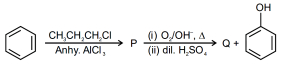
The major product '$P$' and '$Q$' in the above reactions are
A
Isopropylbenzene and propanal
B
Isopropylbenzene and acetone
C
Isopropylbenzene and acetone
D
Isopropylbenzene and propanal
Solution
(C) $1$. The reaction of benzene with $CH_3CH_2CH_2Cl$ in the presence of anhydrous $AlCl_3$ is a Friedel-Crafts alkylation. The primary carbocation formed $(CH_3CH_2CH_2^+)$ undergoes a $1,2-H^-$ shift to form a more stable secondary carbocation $(CH_3CH^+CH_3)$.
$2$. This secondary carbocation attacks the benzene ring to form isopropylbenzene (cumene) as the major product '$P$'.
$3$. Cumene undergoes oxidation with $O_2/OH^-, \Delta$ to form cumene hydroperoxide,which upon treatment with dilute $H_2SO_4$ yields phenol and acetone $(CH_3COCH_3)$ as the major product '$Q$'.
$4$. Thus,'$P$' is isopropylbenzene and '$Q$' is acetone.
$2$. This secondary carbocation attacks the benzene ring to form isopropylbenzene (cumene) as the major product '$P$'.
$3$. Cumene undergoes oxidation with $O_2/OH^-, \Delta$ to form cumene hydroperoxide,which upon treatment with dilute $H_2SO_4$ yields phenol and acetone $(CH_3COCH_3)$ as the major product '$Q$'.
$4$. Thus,'$P$' is isopropylbenzene and '$Q$' is acetone.
0 likesView Solution
32
ChemistryMediumMCQWBJEE · 2025
Which of the following compounds will produce effervescence when mixed with an aqueous sodium bicarbonate $(NaHCO_3)$ solution?
A
$2,4,6-$Trinitrophenol
B
$CH_3COCH_3$
C
$CH_3CH_2OH$
D
$CH_3CH_2OCH_2CH_3$
Solution
(A) Compounds that are stronger acids than carbonic acid $(H_2CO_3)$ react with sodium bicarbonate $(NaHCO_3)$ to release carbon dioxide $(CO_2)$ gas,which causes effervescence.
$2,4,6-$Trinitrophenol (also known as picric acid) is a strong acid due to the electron-withdrawing effect of three nitro $(-NO_2)$ groups,which stabilize the phenoxide ion.
Since the $pK_a$ of picric acid is lower than the $pK_a$ of $H_2CO_3$,it reacts with $NaHCO_3$ to produce effervescence.
Other options like acetone,ethanol,and diethyl ether are not acidic enough to react with $NaHCO_3$.
$2,4,6-$Trinitrophenol (also known as picric acid) is a strong acid due to the electron-withdrawing effect of three nitro $(-NO_2)$ groups,which stabilize the phenoxide ion.
Since the $pK_a$ of picric acid is lower than the $pK_a$ of $H_2CO_3$,it reacts with $NaHCO_3$ to produce effervescence.
Other options like acetone,ethanol,and diethyl ether are not acidic enough to react with $NaHCO_3$.
0 likesView Solution
33
ChemistryMediumMCQWBJEE · 2025
Which of the following statement$(s)$ is/are correct about the given compound?
$CH_3COCH_2COOC_2H_5$
$CH_3COCH_2COOC_2H_5$
A
It exhibits tautomerism
B
It does not react with metallic sodium
C
It gives reddish-violet coloration with $FeCl_3$ solution
D
It gives precipitate with $2,4-$dinitrophenyl hydrazine solution
Solution
(A, C, D) The given compound is ethyl acetoacetate $(CH_3COCH_2COOC_2H_5)$.
$(A)$ It contains active methylene group,so it exhibits keto-enol tautomerism.
$(B)$ The enol form has an acidic hydroxyl group,so it reacts with metallic sodium to release $H_2$ gas.
$(C)$ The enol form gives a characteristic reddish-violet coloration with neutral $FeCl_3$ solution.
$(D)$ It contains a keto group,so it reacts with $2,4-$dinitrophenyl hydrazine $(2,4-DNP)$ to form a precipitate.
Therefore,statements $(A)$,$(C)$,and $(D)$ are correct.
$(A)$ It contains active methylene group,so it exhibits keto-enol tautomerism.
$(B)$ The enol form has an acidic hydroxyl group,so it reacts with metallic sodium to release $H_2$ gas.
$(C)$ The enol form gives a characteristic reddish-violet coloration with neutral $FeCl_3$ solution.
$(D)$ It contains a keto group,so it reacts with $2,4-$dinitrophenyl hydrazine $(2,4-DNP)$ to form a precipitate.
Therefore,statements $(A)$,$(C)$,and $(D)$ are correct.
0 likesView Solution
34
ChemistryMediumMCQWBJEE · 2025
Arrange the following compounds in order of their increasing acid strength:
$I: HO_2C(CH_2)_4CO_2H$
$II: CH_3CH(COOH)_2$
$III: HOOC-COOH$
$IV: HO_2C(CH_2)_3CO_2H$
$I: HO_2C(CH_2)_4CO_2H$
$II: CH_3CH(COOH)_2$
$III: HOOC-COOH$
$IV: HO_2C(CH_2)_3CO_2H$
A
$I < IV < II < III$
B
$IV < III < II < I$
C
$I < II < III < IV$
D
$II < I < III < IV$
Solution
(A) The acidic strength of dicarboxylic acids depends on the distance between the two carboxyl groups. As the distance between the two $-COOH$ groups decreases,the inductive effect ($-I$ effect) of one carboxyl group on the other increases,which stabilizes the conjugate base and increases the acidity.
Comparing the structures:
$I$: Adipic acid,$HOOC-(CH_2)_4-COOH$ (longest chain between groups)
$IV$: Glutaric acid,$HOOC-(CH_2)_3-COOH$
$II$: Methylmalonic acid,$CH_3-CH(COOH)_2$ (groups are on adjacent carbons)
$III$: Oxalic acid,$HOOC-COOH$ (groups are directly attached)
Ordering by increasing distance between carboxyl groups: $III < II < IV < I$.
Therefore,the order of increasing acid strength is $I < IV < II < III$.
Comparing the structures:
$I$: Adipic acid,$HOOC-(CH_2)_4-COOH$ (longest chain between groups)
$IV$: Glutaric acid,$HOOC-(CH_2)_3-COOH$
$II$: Methylmalonic acid,$CH_3-CH(COOH)_2$ (groups are on adjacent carbons)
$III$: Oxalic acid,$HOOC-COOH$ (groups are directly attached)
Ordering by increasing distance between carboxyl groups: $III < II < IV < I$.
Therefore,the order of increasing acid strength is $I < IV < II < III$.
0 likesView Solution
35
ChemistryMediumMCQWBJEE · 2025
Which of the following oxides is paramagnetic?
A
$SO_2$
B
$NO_2$
C
$SiO_2$
D
$CO_2$
Solution
(B) The nitrogen dioxide molecule $(NO_2)$ has a total of $17$ valence electrons (odd number of electrons).
Due to the presence of an unpaired electron on the nitrogen atom,$NO_2$ exhibits paramagnetic behavior.
Other oxides like $SO_2$,$SiO_2$,and $CO_2$ have all electrons paired,making them diamagnetic.
Due to the presence of an unpaired electron on the nitrogen atom,$NO_2$ exhibits paramagnetic behavior.
Other oxides like $SO_2$,$SiO_2$,and $CO_2$ have all electrons paired,making them diamagnetic.
0 likesView Solution
36
ChemistryMediumMCQWBJEE · 2025
For a chemical reaction,half-life period $(t_{1/2})$ is $10 \ minutes$. How much reactant will be left after $20 \ minutes$ if one starts with $100 \ moles$ of reactant and the order of the reaction is $(i)$ zero,$(ii)$ one,and $(iii)$ two?
A
$0, 25, 33.33$
B
$25, 0, 33.33$
C
$33.33, 25, 0$
D
$25, 33.33, 0$
Solution
(A) For zero order reaction: $t_{1/2} = \frac{a}{2k}$ $\Rightarrow 10 = \frac{100}{2k}$ $\Rightarrow k = 5 \ mol \ L^{-1} \ min^{-1}$. After $t = 20 \ min$,amount reacted $x = kt = 5 \times 20 = 100 \ mol$. Remaining reactant $(a-x) = 100 - 100 = 0 \ mol$.
For first order reaction: Number of half-lives $n = \frac{20}{10} = 2$. Remaining reactant $(a-x) = \frac{a}{2^n} = \frac{100}{2^2} = 25 \ mol$.
For second order reaction: $t_{1/2} = \frac{1}{ak}$ $\Rightarrow 10 = \frac{1}{100k}$ $\Rightarrow k = 10^{-3} \ L \ mol^{-1} \ min^{-1}$. Using integrated rate law $\frac{1}{[A]_t} - \frac{1}{[A]_0} = kt$,we get $\frac{1}{[A]_t} = \frac{1}{100} + (10^{-3} \times 20) = 0.01 + 0.02 = 0.03$. Thus,$[A]_t = \frac{1}{0.03} = 33.33 \ mol$.
For first order reaction: Number of half-lives $n = \frac{20}{10} = 2$. Remaining reactant $(a-x) = \frac{a}{2^n} = \frac{100}{2^2} = 25 \ mol$.
For second order reaction: $t_{1/2} = \frac{1}{ak}$ $\Rightarrow 10 = \frac{1}{100k}$ $\Rightarrow k = 10^{-3} \ L \ mol^{-1} \ min^{-1}$. Using integrated rate law $\frac{1}{[A]_t} - \frac{1}{[A]_0} = kt$,we get $\frac{1}{[A]_t} = \frac{1}{100} + (10^{-3} \times 20) = 0.01 + 0.02 = 0.03$. Thus,$[A]_t = \frac{1}{0.03} = 33.33 \ mol$.
0 likesView Solution
37
ChemistryMediumMCQWBJEE · 2025
An egg takes $4.0 \text{ minutes}$ to boil at sea level where the boiling point of water is $T_1 \text{ K}$,whereas it takes $8.0 \text{ minutes}$ to boil on a mountain top where the boiling point of water is $T_2 \text{ K}$. The activation energy for the reaction that takes place during the boiling of an egg is:
A
$0.693 \frac{T_1-T_2}{T_1 T_2}$
B
$0.693 \frac{T_2-T_1}{T_1 T_2}$
C
$0.693 R \frac{T_1 T_2}{T_2-T_1}$
D
$0.693 R \frac{T_1 T_2}{T_1-T_2}$
Solution
(C) The rate of reaction $k$ is inversely proportional to the time taken $t$,so $k \propto 1/t$.
Using the Arrhenius equation: $\ln \left(\frac{k_2}{k_1}\right) = \frac{E_a}{R} \left[\frac{T_1 - T_2}{T_1 T_2}\right]$.
Given $t_1 = 4.0 \text{ min}$ at $T_1$ and $t_2 = 8.0 \text{ min}$ at $T_2$,we have $k_1 = 1/4$ and $k_2 = 1/8$.
Substituting these values: $\ln \left(\frac{1/8}{1/4}\right) = \frac{E_a}{R} \left[\frac{T_1 - T_2}{T_1 T_2}\right]$.
$\ln(0.5) = \frac{E_a}{R} \left[\frac{T_1 - T_2}{T_1 T_2}\right]$.
Since $\ln(0.5) = -\ln(2) \approx -0.693$,we get $-0.693 = \frac{E_a}{R} \left[\frac{T_1 - T_2}{T_1 T_2}\right]$.
Rearranging for $E_a$: $E_a = -0.693 R \left[\frac{T_1 T_2}{T_1 - T_2}\right] = 0.693 R \left[\frac{T_1 T_2}{T_2 - T_1}\right]$.
Note: The provided options suggest a specific sign convention; based on the derivation,the correct expression is $0.693 R \frac{T_1 T_2}{T_2 - T_1}$.
Using the Arrhenius equation: $\ln \left(\frac{k_2}{k_1}\right) = \frac{E_a}{R} \left[\frac{T_1 - T_2}{T_1 T_2}\right]$.
Given $t_1 = 4.0 \text{ min}$ at $T_1$ and $t_2 = 8.0 \text{ min}$ at $T_2$,we have $k_1 = 1/4$ and $k_2 = 1/8$.
Substituting these values: $\ln \left(\frac{1/8}{1/4}\right) = \frac{E_a}{R} \left[\frac{T_1 - T_2}{T_1 T_2}\right]$.
$\ln(0.5) = \frac{E_a}{R} \left[\frac{T_1 - T_2}{T_1 T_2}\right]$.
Since $\ln(0.5) = -\ln(2) \approx -0.693$,we get $-0.693 = \frac{E_a}{R} \left[\frac{T_1 - T_2}{T_1 T_2}\right]$.
Rearranging for $E_a$: $E_a = -0.693 R \left[\frac{T_1 T_2}{T_1 - T_2}\right] = 0.693 R \left[\frac{T_1 T_2}{T_2 - T_1}\right]$.
Note: The provided options suggest a specific sign convention; based on the derivation,the correct expression is $0.693 R \frac{T_1 T_2}{T_2 - T_1}$.
0 likesView Solution
38
ChemistryMediumMCQWBJEE · 2025
Identify '$P$' and '$Q$' in the following reaction sequence:
$[Cd(NH_3)_4](NO_3)_2 + KCN + H_2O \rightarrow P + KNO_3 + NH_4OH$
$P \xrightarrow{H_2S} Q$
$[Cd(NH_3)_4](NO_3)_2 + KCN + H_2O \rightarrow P + KNO_3 + NH_4OH$
$P \xrightarrow{H_2S} Q$
A
$P=K_2[Cd(CN)_4], Q=CdS$
B
$P=CdS, Q=K_2[Cd(CN)_4]$
C
$P=Cd(NO_3)_2, Q=CdSO_4$
D
$P=[Cd(OH_2)_4](NO_3)_2, Q=[Cd(NO_3)_4](NO_3)_2$
Solution
(A) The reaction of $[Cd(NH_3)_4](NO_3)_2$ with $KCN$ leads to the formation of the stable cyano-complex $K_2[Cd(CN)_4]$.
Thus,$P = K_2[Cd(CN)_4]$.
When $K_2[Cd(CN)_4]$ reacts with $H_2S$,it forms the yellow precipitate of cadmium sulfide $(CdS)$.
Thus,$Q = CdS$.
The correct option is $A$.
Thus,$P = K_2[Cd(CN)_4]$.
When $K_2[Cd(CN)_4]$ reacts with $H_2S$,it forms the yellow precipitate of cadmium sulfide $(CdS)$.
Thus,$Q = CdS$.
The correct option is $A$.
0 likesView Solution
39
ChemistryEasyMCQWBJEE · 2025
The common stable oxidation states of $Eu$ and $Gd$ are respectively
A
$+3$ and $+3$
B
$+3$ and $+2$
C
$+2$ and $+3$
D
$+2$ and $+2$
Solution
(C) The electronic configuration of $Eu$ $(Z=63)$ is $[Xe] 4f^7 6s^2$. It can lose two electrons to form $Eu^{2+}$ $([Xe] 4f^7)$,which is stable due to the half-filled $f$-orbital. It also exhibits a $+3$ oxidation state.
The electronic configuration of $Gd$ $(Z=64)$ is $[Xe] 4f^7 5d^1 6s^2$. It loses three electrons to form $Gd^{3+}$ $([Xe] 4f^7)$,which is highly stable due to the half-filled $f$-orbital. Thus,the common stable oxidation states are $+2$ for $Eu$ and $+3$ for $Gd$.
The electronic configuration of $Gd$ $(Z=64)$ is $[Xe] 4f^7 5d^1 6s^2$. It loses three electrons to form $Gd^{3+}$ $([Xe] 4f^7)$,which is highly stable due to the half-filled $f$-orbital. Thus,the common stable oxidation states are $+2$ for $Eu$ and $+3$ for $Gd$.
0 likesView Solution
40
ChemistryMediumMCQWBJEE · 2025
Which pair of ions among the following can be separated by the precipitation method?
A
$Eu(II)$ and $Dy(III)$
B
$Gd(III)$ and $Dy(III)$
C
$Eu(II)$ and $Yb(II)$
D
$Eu(II)$ and $Gd(III)$
Solution
(A) The separation of lanthanoids is difficult due to their similar chemical properties. However,$Eu(II)$ shows similarity with alkaline earth metals like $Sr(II)$.
$Eu(II)$ can be precipitated as $EuSO_4$ in the presence of sulfate ions,similar to $SrSO_4$,while other trivalent lanthanoid ions like $Dy(III)$ or $Gd(III)$ remain in the solution.
Therefore,the pair $Eu(II)$ and $Dy(III)$ (or any other trivalent lanthanoid) can be separated by the precipitation method.
$Eu(II)$ can be precipitated as $EuSO_4$ in the presence of sulfate ions,similar to $SrSO_4$,while other trivalent lanthanoid ions like $Dy(III)$ or $Gd(III)$ remain in the solution.
Therefore,the pair $Eu(II)$ and $Dy(III)$ (or any other trivalent lanthanoid) can be separated by the precipitation method.
0 likesView Solution
41
ChemistryMediumMCQWBJEE · 2025
The molar conductances of $Ba(OH)_2$,$BaCl_2$ and $NH_4Cl$ at infinite dilution are $523.28$,$280.0$ and $129.8 \ S \ cm^2 \ mol^{-1}$ respectively. The molar conductance of $NH_4OH$ at infinite dilution will be:
A
$125.72 \ S \ cm^2 \ mol^{-1}$
B
$251.44 \ S \ cm^2 \ mol^{-1}$
C
$502.88 \ S \ cm^2 \ mol^{-1}$
D
$754.32 \ S \ cm^2 \ mol^{-1}$
Solution
(B) According to Kohlrausch's law of independent migration of ions:
$\lambda_{m(NH_4OH)}^{\infty} = \lambda_{m(NH_4Cl)}^{\infty} + \lambda_{m(Ba(OH)_2)}^{\infty} / 2 - \lambda_{m(BaCl_2)}^{\infty} / 2$
$\lambda_{m(NH_4OH)}^{\infty} = 129.8 + 523.28 / 2 - 280.0 / 2$
$\lambda_{m(NH_4OH)}^{\infty} = 129.8 + 261.64 - 140.0$
$\lambda_{m(NH_4OH)}^{\infty} = 251.44 \ S \ cm^2 \ mol^{-1}$
$\lambda_{m(NH_4OH)}^{\infty} = \lambda_{m(NH_4Cl)}^{\infty} + \lambda_{m(Ba(OH)_2)}^{\infty} / 2 - \lambda_{m(BaCl_2)}^{\infty} / 2$
$\lambda_{m(NH_4OH)}^{\infty} = 129.8 + 523.28 / 2 - 280.0 / 2$
$\lambda_{m(NH_4OH)}^{\infty} = 129.8 + 261.64 - 140.0$
$\lambda_{m(NH_4OH)}^{\infty} = 251.44 \ S \ cm^2 \ mol^{-1}$
0 likesView Solution
42
ChemistryMediumMCQWBJEE · 2025
Which of the following compounds is most reactive in $S_N 1$ reaction?
A
$3-$bromocyclopent$-1,4-$diene
B
$3-$bromocyclopent$-1-$ene
C
$3-$bromoprop$-1-$ene
D
$3-$bromo$-2-$methylprop$-1-$ene
Solution
(A) The reactivity of $S_N 1$ reaction is directly proportional to the stability of the carbocation intermediate formed after the departure of the leaving group $(Br^-)$.
In option $A$,the carbocation formed is the cyclopentadienyl cation,which is aromatic ($6 \pi$ electrons,planar,cyclic,conjugated). Aromatic compounds are exceptionally stable.
In option $B$,the carbocation is allylic,which is resonance-stabilized but not aromatic.
In option $C$,the carbocation is also allylic but less substituted than $B$.
In option $D$,the carbocation is also allylic but with different substitution.
Since the cyclopentadienyl cation is aromatic,it is the most stable carbocation among the choices,making the corresponding alkyl bromide the most reactive in an $S_N 1$ reaction.
In option $A$,the carbocation formed is the cyclopentadienyl cation,which is aromatic ($6 \pi$ electrons,planar,cyclic,conjugated). Aromatic compounds are exceptionally stable.
In option $B$,the carbocation is allylic,which is resonance-stabilized but not aromatic.
In option $C$,the carbocation is also allylic but less substituted than $B$.
In option $D$,the carbocation is also allylic but with different substitution.
Since the cyclopentadienyl cation is aromatic,it is the most stable carbocation among the choices,making the corresponding alkyl bromide the most reactive in an $S_N 1$ reaction.
0 likesView Solution
43
ChemistryMediumMCQWBJEE · 2025
The increasing order of the rate of nucleophilic substitution reaction for the following compounds is:

A
$I < III < II < IV$
B
$II < I < III < IV$
C
$II < III < I < IV$
D
$IV < III < II < I$
Solution
(B) The rate of nucleophilic aromatic substitution is increased by the presence of electron-withdrawing groups $(EWG)$ on the benzene ring,as they stabilize the intermediate carbanion (Meisenheimer complex).
$II$ has a $-OCH_3$ group,which is an electron-donating group $(EDG)$ via resonance,thus it decreases the rate of nucleophilic substitution compared to chlorobenzene $(I)$.
$III$ has one $-NO_2$ group (a strong $EWG$),which increases the rate compared to $I$.
$IV$ has two $-NO_2$ groups,which further increase the rate compared to $III$.
Therefore,the increasing order of reactivity is: $II < I < III < IV$.
$II$ has a $-OCH_3$ group,which is an electron-donating group $(EDG)$ via resonance,thus it decreases the rate of nucleophilic substitution compared to chlorobenzene $(I)$.
$III$ has one $-NO_2$ group (a strong $EWG$),which increases the rate compared to $I$.
$IV$ has two $-NO_2$ groups,which further increase the rate compared to $III$.
Therefore,the increasing order of reactivity is: $II < I < III < IV$.
0 likesView Solution
44
ChemistryMediumMCQWBJEE · 2025
The major product $(F)$ in the following reaction is:
$3$-chloroanisole $\xrightarrow{NaNH_2 \text{ in liquid } NH_3} F$
$3$-chloroanisole $\xrightarrow{NaNH_2 \text{ in liquid } NH_3} F$
A
$o-$Anisidine
B
$m-$Anisidine
C
$p-$Anisidine
D
$p-$Chloro aniline
Solution
(B) The reaction of $3$-chloroanisole with $NaNH_2$ in liquid $NH_3$ proceeds via the benzyne mechanism.
$1$. The amide ion $(NH_2^-)$ abstracts a proton from the ortho position relative to the chlorine atom,leading to the formation of a benzyne intermediate.
$2$. The nucleophilic attack by $NH_2^-$ on the benzyne intermediate can occur at two positions.
$3$. Attack at the meta position relative to the $-OCH_3$ group leads to a carbanion that is stabilized by the inductive effect $(-I)$ of the methoxy group.
$4$. Attack at the ortho position leads to a less stable carbanion due to steric hindrance and electronic factors.
$5$. Therefore,the major product formed is $m-$anisidine ($3$-methoxyaniline).
$1$. The amide ion $(NH_2^-)$ abstracts a proton from the ortho position relative to the chlorine atom,leading to the formation of a benzyne intermediate.
$2$. The nucleophilic attack by $NH_2^-$ on the benzyne intermediate can occur at two positions.
$3$. Attack at the meta position relative to the $-OCH_3$ group leads to a carbanion that is stabilized by the inductive effect $(-I)$ of the methoxy group.
$4$. Attack at the ortho position leads to a less stable carbanion due to steric hindrance and electronic factors.
$5$. Therefore,the major product formed is $m-$anisidine ($3$-methoxyaniline).
0 likesView Solution
45
ChemistryMediumMCQWBJEE · 2025
In the following reaction,the major product $(H)$ is

A
$2-$methylenetetrahydrofuran
B
hexan$-2-$one
C
$2,2-$dimethyltetrahydrofuran
D
$2-$vinyltetrahydrofuran
Solution
(C) The reaction proceeds in two steps:
$1$. The Grignard reagent $CH_3MgBr$ acts as a nucleophile and attacks the carbonyl carbon of $5-chloropentan-2-one$. This forms an alkoxide intermediate.
$2$. Upon workup with $H_3O^+$,the alkoxide oxygen is protonated to form an alcohol. However,in the presence of the internal chloride group,the alkoxide oxygen performs an intramolecular nucleophilic substitution $(S_N2)$ reaction,displacing the chloride ion to form a five-membered cyclic ether,$2,2-dimethyltetrahydrofuran$.
$1$. The Grignard reagent $CH_3MgBr$ acts as a nucleophile and attacks the carbonyl carbon of $5-chloropentan-2-one$. This forms an alkoxide intermediate.
$2$. Upon workup with $H_3O^+$,the alkoxide oxygen is protonated to form an alcohol. However,in the presence of the internal chloride group,the alkoxide oxygen performs an intramolecular nucleophilic substitution $(S_N2)$ reaction,displacing the chloride ion to form a five-membered cyclic ether,$2,2-dimethyltetrahydrofuran$.
0 likesView Solution
46
ChemistryMediumMCQWBJEE · 2025
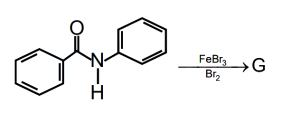
Identify the major product $(G)$ in the following reaction:
A
$N$-($3$-bromophenyl)benzamide
B
$N$-bromobenzamide
C
$N$-($4$-bromophenyl)benzamide
D
$N$-phenyl$-2-$bromobenzamide
Solution
(C) The reaction is an electrophilic aromatic substitution (bromination) of $N$-phenylbenzamide using $Br_2$ and $FeBr_3$.
$N$-phenylbenzamide consists of two phenyl rings attached to an amide group.
The nitrogen atom of the amide group is directly attached to one of the phenyl rings. The lone pair on the nitrogen atom is delocalized into this ring,making it an activated ring towards electrophilic substitution.
Conversely,the other phenyl ring is attached to the carbonyl group $(C=O)$,which is an electron-withdrawing group,making that ring deactivated.
Therefore,the electrophilic substitution occurs on the activated ring at the ortho and para positions. Due to steric hindrance,the para-substituted product is the major product.
Thus,the major product is $N$-($4$-bromophenyl)benzamide.
$N$-phenylbenzamide consists of two phenyl rings attached to an amide group.
The nitrogen atom of the amide group is directly attached to one of the phenyl rings. The lone pair on the nitrogen atom is delocalized into this ring,making it an activated ring towards electrophilic substitution.
Conversely,the other phenyl ring is attached to the carbonyl group $(C=O)$,which is an electron-withdrawing group,making that ring deactivated.
Therefore,the electrophilic substitution occurs on the activated ring at the ortho and para positions. Due to steric hindrance,the para-substituted product is the major product.
Thus,the major product is $N$-($4$-bromophenyl)benzamide.
0 likesView Solution
47
ChemistryEasyMCQWBJEE · 2025
If three elements $A, B, C$ crystallize in a cubic solid lattice with $B$ atoms at the cubic centers,$C$ atoms at the center of edges,and $A$ atoms at the corners,then the formula of the compound is
A
$AB_3C$
B
$A_3BC$
C
$ABC_3$
D
$ABC$
Solution
(C) Number of $A$ atoms at corners $= 8 \times \frac{1}{8} = 1$.
Number of $B$ atoms at body center $= 1 \times 1 = 1$.
Number of $C$ atoms at edge centers $= 12 \times \frac{1}{4} = 3$.
Therefore,the ratio of $A:B:C$ is $1:1:3$.
Hence,the formula of the compound is $ABC_3$.
Number of $B$ atoms at body center $= 1 \times 1 = 1$.
Number of $C$ atoms at edge centers $= 12 \times \frac{1}{4} = 3$.
Therefore,the ratio of $A:B:C$ is $1:1:3$.
Hence,the formula of the compound is $ABC_3$.
0 likesView Solution
48
ChemistryDifficultMCQWBJEE · 2025
$P$ and $Q$ combine to form two compounds $PQ_2$ and $PQ_3$. If $1 \ g$ of $PQ_2$ is dissolved in $51 \ g$ of benzene,the depression of freezing point is $0.8^{\circ} C$. If $1 \ g$ of $PQ_3$ is dissolved in $51 \ g$ of benzene,the depression of freezing point is $0.625^{\circ} C$. Given $K_f$ of benzene $= 5.1 \ K \ kg \ mol^{-1}$,calculate the atomic masses of $P$ and $Q$.
A
$35, 55$
B
$45, 45$
C
$55, 45$
D
$55, 35$
Solution
(D) The formula for depression in freezing point is $\Delta T_f = K_f \times m$,where $m$ is molality.
For $PQ_2$: $0.8 = \frac{5.1 \times 1000 \times 1}{51 \times M_{PQ_2}}$ $\Rightarrow M_{PQ_2} = \frac{5100}{51 \times 0.8} = 125 \ g/mol$.
For $PQ_3$: $0.625 = \frac{5.1 \times 1000 \times 1}{51 \times M_{PQ_3}}$ $\Rightarrow M_{PQ_3} = \frac{5100}{51 \times 0.625} = 160 \ g/mol$.
Let atomic masses be $P$ and $Q$.
$P + 2Q = 125$ $(i)$
$P + 3Q = 160$ (ii)
Subtracting $(i)$ from (ii): $Q = 35$.
Substituting $Q$ in $(i)$: $P + 2(35) = 125 \Rightarrow P = 125 - 70 = 55$.
Thus,atomic mass of $P = 55$ and $Q = 35$.
For $PQ_2$: $0.8 = \frac{5.1 \times 1000 \times 1}{51 \times M_{PQ_2}}$ $\Rightarrow M_{PQ_2} = \frac{5100}{51 \times 0.8} = 125 \ g/mol$.
For $PQ_3$: $0.625 = \frac{5.1 \times 1000 \times 1}{51 \times M_{PQ_3}}$ $\Rightarrow M_{PQ_3} = \frac{5100}{51 \times 0.625} = 160 \ g/mol$.
Let atomic masses be $P$ and $Q$.
$P + 2Q = 125$ $(i)$
$P + 3Q = 160$ (ii)
Subtracting $(i)$ from (ii): $Q = 35$.
Substituting $Q$ in $(i)$: $P + 2(35) = 125 \Rightarrow P = 125 - 70 = 55$.
Thus,atomic mass of $P = 55$ and $Q = 35$.
0 likesView Solution
49
ChemistryEasyMCQWBJEE · 2025
$_{5}B^{10} + _{2}He^{4} \rightarrow X + _{0}n^{1}$
In the above nuclear reaction '$X$' will be
In the above nuclear reaction '$X$' will be
A
$_{7}N^{14}$
B
$_{7}N^{13}$
C
$_{6}C^{12}$
D
$_{7}N^{15}$
Solution
(B) The given nuclear reaction is: $_{5}B^{10} + _{2}He^{4} \rightarrow _{b}^{a}X + _{0}n^{1}$
By balancing the atomic numbers (sum of protons):
$5 + 2 = b + 0$
$b = 7$
By balancing the mass numbers (sum of protons and neutrons):
$10 + 4 = a + 1$
$14 = a + 1$
$a = 13$
Therefore,the product $X$ is $_{7}N^{13}$.
By balancing the atomic numbers (sum of protons):
$5 + 2 = b + 0$
$b = 7$
By balancing the mass numbers (sum of protons and neutrons):
$10 + 4 = a + 1$
$14 = a + 1$
$a = 13$
Therefore,the product $X$ is $_{7}N^{13}$.
0 likesView Solution
50
ChemistryEasyMCQWBJEE · 2025
The coagulating power of electrolytes having ions $Na^{+}$,$Al^{3+}$,and $Ba^{2+}$ for $As_{2}S_{3}$ sol increases in the order
A
$Al^{3+} < Ba^{2+} < Na^{+}$
B
$Na^{+} < Ba^{2+} < Al^{3+}$
C
$Ba^{2+} < Na^{+} < Al^{3+}$
D
$Al^{3+} < Na^{+} < Ba^{2+}$
Solution
(B) $As_{2}S_{3}$ is a negatively charged sol. According to the Hardy-Schulze rule,the coagulating power of an electrolyte depends on the valency of the active ion (the ion carrying a charge opposite to that of the colloidal particles).
For a negatively charged sol,the coagulating power increases with the increase in the magnitude of the positive charge on the cation.
The charges on the given ions are: $Na^{+}$ $(+1)$,$Ba^{2+}$ $(+2)$,and $Al^{3+}$ $(+3)$.
Therefore,the order of coagulating power is $Na^{+} < Ba^{2+} < Al^{3+}$.
For a negatively charged sol,the coagulating power increases with the increase in the magnitude of the positive charge on the cation.
The charges on the given ions are: $Na^{+}$ $(+1)$,$Ba^{2+}$ $(+2)$,and $Al^{3+}$ $(+3)$.
Therefore,the order of coagulating power is $Na^{+} < Ba^{2+} < Al^{3+}$.
0 likesView Solution
Vedclass Products
For Students
Vedclass Test Series
Mock tests in real WBJEE style covering Chemistry with performance analysis. 5-day free trial.
Start Free TrialFor Teachers
Exam Paper Generator
Generate Set A/B/C/D Chemistry papers from 7.5L+ questions in 2 minutes. 3 chapters free.
Try FreeFor Institutes
Online Exam Module
Run live WBJEE mock exams with unlimited students, 360° analytics & white-label branding.
See DemoFrequently Asked Questions
How many Chemistry questions are in WBJEE 2025?
There are 50 Chemistry questions from the WBJEE 2025 paper on Vedclass, each with a detailed step-by-step solution in English.
Are WBJEE 2025 Chemistry solutions available in English?
Yes. All solutions on this page are in English. You can also switch to English or Hindi using the language buttons above the questions.
Can I practice WBJEE 2025 Chemistry as a timed test?
Yes. Use the Vedclass Test Series to attempt a full WBJEE mock test covering Chemistry with time limits and instant score analysis.
Can teachers create Chemistry papers from WBJEE previous year questions?
Yes. The Vedclass Exam Paper Generator lets teachers mix WBJEE Chemistry questions and generate Set A/B/C/D papers in minutes.
For Teachers & Institutes
Build a Custom Chemistry Paper
Pick WBJEE 2025 Chemistry questions, set difficulty, and generate Set A/B/C/D in 2 minutes.