
ChemistryQ1–61 of 61 questions
Page 1 of 1 · English
1
ChemistryMCQWBJEE · 2013
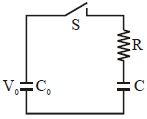
$A$ capacitor of capacitance $C_0$ is charged to a potential $V_0$ and is connected with another capacitor of capacitance $C$ as shown. After closing the switch $S$,the common potential across the two capacitors becomes $V$. The capacitance $C$ is given by
A
$\frac{C_0(V_0 - V)}{V_0}$
B
$\frac{C_0(V - V_0)}{V_0}$
C
$\frac{C_0(V + V_0)}{V}$
D
$\frac{C_0(V_0 - V)}{V}$
Solution
(D) Initially,the charge on the capacitor $C_0$ is $Q_{initial} = C_0 V_0$.
When the switch $S$ is closed,the charge redistributes between the two capacitors until they reach a common potential $V$.
According to the law of conservation of charge,the total charge remains constant:
$Q_{initial} = Q_{final}$
$C_0 V_0 = C_0 V + C V$
Rearranging the equation to solve for $C$:
$C_0 V_0 - C_0 V = C V$
$C_0(V_0 - V) = C V$
$C = \frac{C_0(V_0 - V)}{V}$
When the switch $S$ is closed,the charge redistributes between the two capacitors until they reach a common potential $V$.
According to the law of conservation of charge,the total charge remains constant:
$Q_{initial} = Q_{final}$
$C_0 V_0 = C_0 V + C V$
Rearranging the equation to solve for $C$:
$C_0 V_0 - C_0 V = C V$
$C_0(V_0 - V) = C V$
$C = \frac{C_0(V_0 - V)}{V}$
0 likesView Solution
2
ChemistryMediumMCQWBJEE · 2013
In the following species,the one which is likely to be the intermediate during benzoin condensation of benzaldehyde is
A
$Ph-C\equiv O^+$
B
$Ph-C^+(OH)(CN)$
C
$Ph-C^-(OH)(CN)$
D
$Ph-C^-=O$
Solution
(C) The benzoin condensation involves the reaction of two molecules of benzaldehyde in the presence of a cyanide ion $(CN^-)$ catalyst to form benzoin.
The mechanism begins with the nucleophilic attack of $CN^-$ on the carbonyl carbon of benzaldehyde.
This is followed by a proton transfer (tautomerization) to form a carbanion intermediate,which is stabilized by the electron-withdrawing $CN$ group and the phenyl ring.
The structure of this key intermediate is $Ph-C^-(OH)(CN)$.
This carbanion then attacks another molecule of benzaldehyde to continue the reaction,eventually leading to the formation of benzoin after the elimination of the $CN^-$ catalyst.
The mechanism begins with the nucleophilic attack of $CN^-$ on the carbonyl carbon of benzaldehyde.
This is followed by a proton transfer (tautomerization) to form a carbanion intermediate,which is stabilized by the electron-withdrawing $CN$ group and the phenyl ring.
The structure of this key intermediate is $Ph-C^-(OH)(CN)$.
This carbanion then attacks another molecule of benzaldehyde to continue the reaction,eventually leading to the formation of benzoin after the elimination of the $CN^-$ catalyst.
0 likesView Solution
3
ChemistryEasyMCQWBJEE · 2013
In $O_{2}$ and $H_{2}O_{2}$,the $O-O$ bond lengths are $1.21 \mathring{A}$ and $1.48 \mathring{A}$ respectively. In ozone $(O_{3})$,the average $O-O$ bond length is
A
$1.28 \mathring{A}$
B
$1.18 \mathring{A}$
C
$1.44 \mathring{A}$
D
$1.52 \mathring{A}$
Solution
(A) Ozone $(O_{3})$ exhibits resonance,where the two $O-O$ bonds are equivalent due to the delocalization of $\pi$ electrons.
The actual structure is a resonance hybrid of two canonical forms.
The experimental value for the average $O-O$ bond length in ozone is $1.28 \mathring{A}$,which is intermediate between the single bond length $(1.48 \mathring{A})$ and the double bond length $(1.21 \mathring{A})$.
The actual structure is a resonance hybrid of two canonical forms.
The experimental value for the average $O-O$ bond length in ozone is $1.28 \mathring{A}$,which is intermediate between the single bond length $(1.48 \mathring{A})$ and the double bond length $(1.21 \mathring{A})$.
0 likesView Solution
4
ChemistryEasyMCQWBJEE · 2013
In $SOCl_{2}$,the $Cl-S-Cl$ and $Cl-S-O$ bond angles are
A
$130^{\circ}$ and $115^{\circ}$
B
$106^{\circ}$ and $96^{\circ}$
C
$107^{\circ}$ and $108^{\circ}$
D
$96^{\circ}$ and $106^{\circ}$
Solution
(D) The molecule $SOCl_{2}$ (thionyl chloride) has a trigonal pyramidal geometry due to the presence of a lone pair on the sulfur atom.
According to $VSEPR$ theory,the lone pair-bond pair repulsion is greater than the bond pair-bond pair repulsion.
In $SOCl_{2}$,the $Cl-S-Cl$ bond angle is approximately $96^{\circ}$ and the $Cl-S-O$ bond angle is approximately $106^{\circ}$.
According to $VSEPR$ theory,the lone pair-bond pair repulsion is greater than the bond pair-bond pair repulsion.
In $SOCl_{2}$,the $Cl-S-Cl$ bond angle is approximately $96^{\circ}$ and the $Cl-S-O$ bond angle is approximately $106^{\circ}$.
0 likesView Solution
5
ChemistryEasyMCQWBJEE · 2013
The increasing order of $O-N-O$ bond angle in the species $NO_2$,$NO_2^+$ and $NO_2^-$ is
A
$NO_2^+ < NO_2 < NO_2^-$
B
$NO_2 < NO_2^- < NO_2^+$
C
$NO_2^+ < NO_2^- < NO_2$
D
None of these
Solution
(D) The bond angles for the given species are as follows:
$1.$ $NO_2^+$: It has $sp$ hybridization and a linear geometry,resulting in a bond angle of $180^\circ$.
$2.$ $NO_2$: It has $sp^2$ hybridization with one unpaired electron,resulting in a bond angle of approximately $134^\circ$.
$3.$ $NO_2^-$: It has $sp^2$ hybridization with one lone pair,resulting in a bond angle of approximately $115^\circ$.
Comparing these values,the increasing order of the bond angle is $NO_2^- < NO_2 < NO_2^+$.
Since this specific order is not listed in options $A$,$B$,or $C$,the correct answer is $D$.
$1.$ $NO_2^+$: It has $sp$ hybridization and a linear geometry,resulting in a bond angle of $180^\circ$.
$2.$ $NO_2$: It has $sp^2$ hybridization with one unpaired electron,resulting in a bond angle of approximately $134^\circ$.
$3.$ $NO_2^-$: It has $sp^2$ hybridization with one lone pair,resulting in a bond angle of approximately $115^\circ$.
Comparing these values,the increasing order of the bond angle is $NO_2^- < NO_2 < NO_2^+$.
Since this specific order is not listed in options $A$,$B$,or $C$,the correct answer is $D$.
0 likesView Solution
6
ChemistryMediumMCQWBJEE · 2013
The ground state electronic configuration of $CO$ molecule is
A
$1 \sigma^{2} 2 \sigma^{2} 1 \pi^{4} 3 \sigma^{2}$
B
$1 \sigma^{2} 2 \sigma^{2} 3 \sigma^{2} 1 \pi^{2} 2 \pi^{2}$
C
$1 \sigma^{2} 2 \sigma^{2} 1 \pi^{2} 3 \sigma^{2} 2 \pi^{2}$
D
$1 \sigma^{2} 1 \pi^{2} 2 \sigma^{2} 2 \sigma^{2}$
Solution
(A) The $CO$ molecule has a total of $14$ electrons ($6$ from $C$ and $8$ from $O$).
According to Molecular Orbital Theory,for molecules with $14$ or fewer electrons,the energy order of molecular orbitals is $\sigma 1s < \sigma^* 1s < \sigma 2s < \sigma^* 2s < \pi 2p_x = \pi 2p_y < \sigma 2p_z < \pi^* 2p_x = \pi^* 2p_y < \sigma^* 2p_z$.
Filling the $14$ electrons into these orbitals:
$1\sigma^2, 2\sigma^2, 3\sigma^2, 4\sigma^2, 1\pi^4, 5\sigma^2$.
In many textbooks,the notation is simplified as $1\sigma^2 2\sigma^2 1\pi^4 3\sigma^2$ where $1\sigma$ is $\sigma 1s$,$2\sigma$ is $\sigma^* 1s$,$3\sigma$ is $\sigma 2s$,$4\sigma$ is $\sigma^* 2s$,$1\pi$ is $\pi 2p$,and $5\sigma$ is $\sigma 2p_z$.
Thus,the correct configuration is $1\sigma^2 2\sigma^2 3\sigma^2 4\sigma^2 1\pi^4 5\sigma^2$,which corresponds to option $A$ when simplified.
According to Molecular Orbital Theory,for molecules with $14$ or fewer electrons,the energy order of molecular orbitals is $\sigma 1s < \sigma^* 1s < \sigma 2s < \sigma^* 2s < \pi 2p_x = \pi 2p_y < \sigma 2p_z < \pi^* 2p_x = \pi^* 2p_y < \sigma^* 2p_z$.
Filling the $14$ electrons into these orbitals:
$1\sigma^2, 2\sigma^2, 3\sigma^2, 4\sigma^2, 1\pi^4, 5\sigma^2$.
In many textbooks,the notation is simplified as $1\sigma^2 2\sigma^2 1\pi^4 3\sigma^2$ where $1\sigma$ is $\sigma 1s$,$2\sigma$ is $\sigma^* 1s$,$3\sigma$ is $\sigma 2s$,$4\sigma$ is $\sigma^* 2s$,$1\pi$ is $\pi 2p$,and $5\sigma$ is $\sigma 2p_z$.
Thus,the correct configuration is $1\sigma^2 2\sigma^2 3\sigma^2 4\sigma^2 1\pi^4 5\sigma^2$,which corresponds to option $A$ when simplified.
0 likesView Solution
7
ChemistryEasyMCQWBJEE · 2013
For $BCl_{3}$,$AlCl_{3}$ and $GaCl_{3}$,the increasing order of ionic character is:
A
$BCl_{3} < AlCl_{3} < GaCl_{3}$
B
$GaCl_{3} < AlCl_{3} < BCl_{3}$
C
$BCl_{3} < GaCl_{3} < AlCl_{3}$
D
$AlCl_{3} < BCl_{3} < GaCl_{3}$
Solution
(A) According to $Fajan's$ rule,the ionic character is inversely proportional to the polarising power of the cation.
Polarising power depends on the charge density of the cation.
As the size of the cation increases $(B^{3+} < Al^{3+} < Ga^{3+})$,the polarising power decreases.
Therefore,the ionic character increases as the size of the cation increases.
The correct order of ionic character is $BCl_{3} < AlCl_{3} < GaCl_{3}$.
Polarising power depends on the charge density of the cation.
As the size of the cation increases $(B^{3+} < Al^{3+} < Ga^{3+})$,the polarising power decreases.
Therefore,the ionic character increases as the size of the cation increases.
The correct order of ionic character is $BCl_{3} < AlCl_{3} < GaCl_{3}$.
0 likesView Solution
8
ChemistryEasyMCQWBJEE · 2013
Baeyer's reagent is
A
alkaline potassium permanganate
B
acidified potassium permanganate
C
neutral potassium permanganate
D
alkaline potassium manganate
Solution
(A) Baeyer's reagent is $1 \%$ cold dilute alkaline potassium permanganate $(KMnO_4)$.
It is used to identify unsaturation in organic compounds.
When added to unsaturated compounds,the purple colour of the reagent disappears.
It is used to identify unsaturation in organic compounds.
When added to unsaturated compounds,the purple colour of the reagent disappears.
0 likesView Solution
9
ChemistryEasyMCQWBJEE · 2013
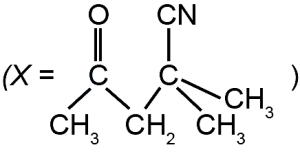
The $IUPAC$ name of the compound $X$ is:
A
$4-$cyano$-4-$methyl$-4-$oxopentane
B
$2-$cyano$-2-$methyl$-4-$oxopentane
C
$2,2-$dimethyl$-4-$oxopentanenitrile
D
$4-$cyano$-4-$methyl$-2-$pentanone
Solution
(C) $1$. Identify the principal functional group. The nitrile group $(-CN)$ has higher priority than the ketone group $(=O)$. Thus,the parent chain is a nitrile.
$2$. Number the chain starting from the carbon of the $-CN$ group as $C-1$.
$3$. The chain is $CH_3-C(CH_3)_2-CH_2-C(=O)-CH_3$. Numbering gives: $C-1$ (nitrile carbon),$C-2$ (quaternary carbon with two methyl groups),$C-3$ (methylene group),$C-4$ (ketone carbonyl),$C-5$ (terminal methyl).
$4$. The substituents are two methyl groups at $C-2$ and an oxo group at $C-4$.
$5$. Combining these,the $IUPAC$ name is $2,2-$dimethyl$-4-$oxopentanenitrile.
$2$. Number the chain starting from the carbon of the $-CN$ group as $C-1$.
$3$. The chain is $CH_3-C(CH_3)_2-CH_2-C(=O)-CH_3$. Numbering gives: $C-1$ (nitrile carbon),$C-2$ (quaternary carbon with two methyl groups),$C-3$ (methylene group),$C-4$ (ketone carbonyl),$C-5$ (terminal methyl).
$4$. The substituents are two methyl groups at $C-2$ and an oxo group at $C-4$.
$5$. Combining these,the $IUPAC$ name is $2,2-$dimethyl$-4-$oxopentanenitrile.
0 likesView Solution
10
ChemistryDifficultMCQWBJEE · 2013
The optically active molecule is
A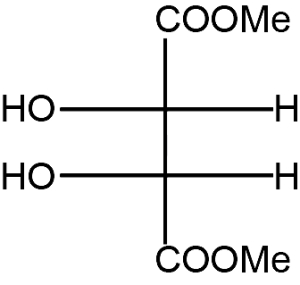
B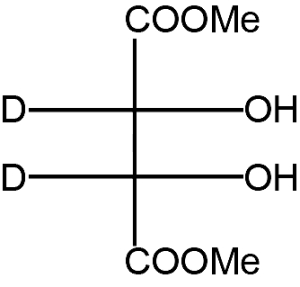
C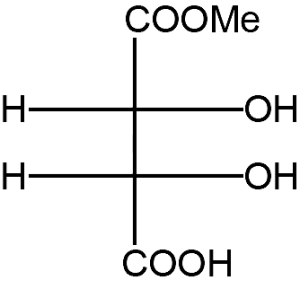
D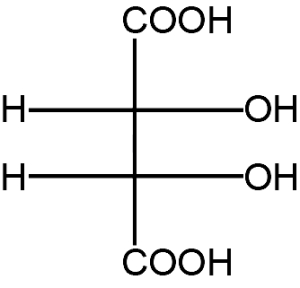
Solution
(C) An optically active molecule must lack a plane of symmetry or a center of inversion.
In option $(A)$,the molecule has a plane of symmetry,making it a meso compound.
In option $(B)$,the molecule has a plane of symmetry,making it a meso compound.
In option $(C)$,the molecule has different functional groups at the ends ($COOMe$ and $COOH$),which prevents the existence of a plane of symmetry,thus making it optically active.
In option $(D)$,the molecule has a plane of symmetry,making it a meso compound.
Therefore,only molecule $(C)$ is optically active.
In option $(A)$,the molecule has a plane of symmetry,making it a meso compound.
In option $(B)$,the molecule has a plane of symmetry,making it a meso compound.
In option $(C)$,the molecule has different functional groups at the ends ($COOMe$ and $COOH$),which prevents the existence of a plane of symmetry,thus making it optically active.
In option $(D)$,the molecule has a plane of symmetry,making it a meso compound.
Therefore,only molecule $(C)$ is optically active.
0 likesView Solution
11
ChemistryMediumMCQWBJEE · 2013
Amongst the following,the one which can exist in free state as a stable compound is
A
$C_7H_9O$
B
$C_8H_{12}O$
C
$C_6H_{12}O$
D
$C_{10}H_{17}O$
Solution
(C) Molecules having an integer value for the degree of unsaturation $(DU)$ can exist in a free state as stable compounds.
$DU = \frac{\sum n(v-2)}{2} + 1$,where $n$ is the number of atoms and $v$ is the valency of the atom.
For $C_7H_9O$: $DU = \frac{7(4-2) + 9(1-2) + 1(2-2)}{2} + 1 = \frac{14-9+0}{2} + 1 = 3.5$.
For $C_8H_{12}O$: $DU = \frac{8(4-2) + 12(1-2) + 1(2-2)}{2} + 1 = \frac{16-12+0}{2} + 1 = 3.0$.
For $C_6H_{12}O$: $DU = \frac{6(4-2) + 12(1-2) + 1(2-2)}{2} + 1 = \frac{12-12+0}{2} + 1 = 1.0$.
For $C_{10}H_{17}O$: $DU = \frac{10(4-2) + 17(1-2) + 1(2-2)}{2} + 1 = \frac{20-17+0}{2} + 1 = 2.5$.
Since $C_8H_{12}O$ and $C_6H_{12}O$ have integer values,$C_6H_{12}O$ is a stable compound.
$DU = \frac{\sum n(v-2)}{2} + 1$,where $n$ is the number of atoms and $v$ is the valency of the atom.
For $C_7H_9O$: $DU = \frac{7(4-2) + 9(1-2) + 1(2-2)}{2} + 1 = \frac{14-9+0}{2} + 1 = 3.5$.
For $C_8H_{12}O$: $DU = \frac{8(4-2) + 12(1-2) + 1(2-2)}{2} + 1 = \frac{16-12+0}{2} + 1 = 3.0$.
For $C_6H_{12}O$: $DU = \frac{6(4-2) + 12(1-2) + 1(2-2)}{2} + 1 = \frac{12-12+0}{2} + 1 = 1.0$.
For $C_{10}H_{17}O$: $DU = \frac{10(4-2) + 17(1-2) + 1(2-2)}{2} + 1 = \frac{20-17+0}{2} + 1 = 2.5$.
Since $C_8H_{12}O$ and $C_6H_{12}O$ have integer values,$C_6H_{12}O$ is a stable compound.
0 likesView Solution
12
ChemistryEasyMCQWBJEE · 2013
Tautomerism is exhibited by
A
$(Me_3CCO)_3CH$
B
Cyclohex$-2-$ene$-1,4-$dione
C
Cyclohexa$-2,5-$diene$-1,4-$dione
D
Cyclohexane$-1,2-$dione
Solution
(B) Tautomerism requires the presence of at least one $\alpha$-hydrogen atom adjacent to a carbonyl group $(C=O)$.
$A$. $(Me_3CCO)_3CH$ has an $\alpha$-hydrogen atom on the central carbon,which is flanked by three carbonyl groups,making it highly acidic and capable of tautomerism.
$B$. Cyclohex$-2-$ene$-1,4-$dione has $\alpha$-hydrogen atoms at the $C-5$ and $C-6$ positions,allowing it to exhibit keto-enol tautomerism.
$C$. Cyclohexa$-2,5-$diene$-1,4-$dione (p-benzoquinone) has no $\alpha$-hydrogen atoms,so it cannot exhibit tautomerism.
$D$. Cyclohexane$-1,2-$dione has $\alpha$-hydrogen atoms at the $C-3$ and $C-6$ positions,allowing it to exhibit keto-enol tautomerism.
Given the options provided in the image,compounds $(a)$,$(b)$,and $(d)$ all possess $\alpha$-hydrogens and can exhibit tautomerism. However,in many standard contexts for this specific question,$(b)$ is often highlighted for its specific structural features.
$A$. $(Me_3CCO)_3CH$ has an $\alpha$-hydrogen atom on the central carbon,which is flanked by three carbonyl groups,making it highly acidic and capable of tautomerism.
$B$. Cyclohex$-2-$ene$-1,4-$dione has $\alpha$-hydrogen atoms at the $C-5$ and $C-6$ positions,allowing it to exhibit keto-enol tautomerism.
$C$. Cyclohexa$-2,5-$diene$-1,4-$dione (p-benzoquinone) has no $\alpha$-hydrogen atoms,so it cannot exhibit tautomerism.
$D$. Cyclohexane$-1,2-$dione has $\alpha$-hydrogen atoms at the $C-3$ and $C-6$ positions,allowing it to exhibit keto-enol tautomerism.
Given the options provided in the image,compounds $(a)$,$(b)$,and $(d)$ all possess $\alpha$-hydrogens and can exhibit tautomerism. However,in many standard contexts for this specific question,$(b)$ is often highlighted for its specific structural features.
0 likesView Solution
13
ChemistryMediumMCQWBJEE · 2013
The correct pair of compounds which gives a blue colouration/precipitate and a white precipitate,respectively,when their Lassaigne's test is separately performed is:
A
$N$-methylaniline and $2$-chlorobenzoic acid
B
$NH_2CSNH_2$ and $PhCH_2Cl$
C
$NH_2NH_2$ and $NH_2CONH_2$
D
$NH_2NH_2$ and $HCl$
Solution
(A) Lassaigne's test is used to detect elements like $N, S,$ and halogens in organic compounds.
$1$. $A$ blue colouration or precipitate (Prussian blue,$Fe_4[Fe(CN)_6]_3$) is formed when the compound contains both $C$ and $N$,which react with molten $Na$ to form $NaCN$.
$2$. $A$ white precipitate $(AgCl)$ is formed when the compound contains chlorine,which reacts with molten $Na$ to form $NaCl$,which then reacts with $AgNO_3$.
$3$. $N$-methylaniline $(C_6H_5NHCH_3)$ contains $C$ and $N$,thus it gives a blue colouration.
$4$. $2$-chlorobenzoic acid contains $Cl$,thus it gives a white precipitate with $AgNO_3$.
Therefore,the correct pair is $N$-methylaniline and $2$-chlorobenzoic acid.
$1$. $A$ blue colouration or precipitate (Prussian blue,$Fe_4[Fe(CN)_6]_3$) is formed when the compound contains both $C$ and $N$,which react with molten $Na$ to form $NaCN$.
$2$. $A$ white precipitate $(AgCl)$ is formed when the compound contains chlorine,which reacts with molten $Na$ to form $NaCl$,which then reacts with $AgNO_3$.
$3$. $N$-methylaniline $(C_6H_5NHCH_3)$ contains $C$ and $N$,thus it gives a blue colouration.
$4$. $2$-chlorobenzoic acid contains $Cl$,thus it gives a white precipitate with $AgNO_3$.
Therefore,the correct pair is $N$-methylaniline and $2$-chlorobenzoic acid.
0 likesView Solution
14
ChemistryEasyMCQWBJEE · 2013
$2-$methylpropane on monochlorination under photochemical conditions gives:
A
$2-$chloro$-2-$methylpropane as major product
B
$1:1$ mixture of $1-$chloro$-2-$methylpropane and $2-$chloro$-2-$methylpropane
C
$1-$chloro$-2-$methylpropane as a major product
D
$1:9$ mixture of $1-$chloro$-2-$methylpropane and $2-$chloro$-2-$methylpropane
Solution
(C) In $2-$methylpropane,there are $9$ primary hydrogens and $1$ tertiary hydrogen.
The relative reactivity of tertiary hydrogen towards chlorination is about $5.0$ to $5.5$ times that of primary hydrogen.
However,the number of primary hydrogens $(9)$ is much greater than the number of tertiary hydrogens $(1)$.
Therefore,the statistical factor $(9 \times 1 = 9)$ outweighs the reactivity factor $(1 \times 5.5 = 5.5)$.
As a result,$1-$chloro$-2-$methylpropane is formed as the major product.
The relative reactivity of tertiary hydrogen towards chlorination is about $5.0$ to $5.5$ times that of primary hydrogen.
However,the number of primary hydrogens $(9)$ is much greater than the number of tertiary hydrogens $(1)$.
Therefore,the statistical factor $(9 \times 1 = 9)$ outweighs the reactivity factor $(1 \times 5.5 = 5.5)$.
As a result,$1-$chloro$-2-$methylpropane is formed as the major product.
0 likesView Solution
15
ChemistryEasyMCQWBJEE · 2013
The best method for the preparation of $2, 2-$dimethylbutane is via the reaction of
A
$Me_3CBr$ and $MeCH_2Br$ in $Na$/ether
B
$(Me_3C)_2CuLi$ and $MeCH_2Br$
C
$(MeCH_2)_2CuLi$ and $Me_3CBr$
D
$Me_3CMgI$ and $MeCH_2I$
Solution
(B) $2, 2-$dimethylbutane is prepared using the Corey-House synthesis,which involves the reaction of a lithium dialkylcuprate with an alkyl halide.
To prepare $2, 2-$dimethylbutane $(CH_3-C(CH_3)_2-CH_2-CH_3)$,we need a tert-butyl group and an ethyl group.
The Corey-House reaction follows an $S_N2$ mechanism,which works best with primary alkyl halides.
Therefore,the reaction between $(Me_3C)_2CuLi$ and $MeCH_2Br$ is the most efficient route.
The reaction is: $(Me_3C)_2CuLi + MeCH_2Br \rightarrow Me_3C-CH_2CH_3 + Me_3CCu + LiBr$.
To prepare $2, 2-$dimethylbutane $(CH_3-C(CH_3)_2-CH_2-CH_3)$,we need a tert-butyl group and an ethyl group.
The Corey-House reaction follows an $S_N2$ mechanism,which works best with primary alkyl halides.
Therefore,the reaction between $(Me_3C)_2CuLi$ and $MeCH_2Br$ is the most efficient route.
The reaction is: $(Me_3C)_2CuLi + MeCH_2Br \rightarrow Me_3C-CH_2CH_3 + Me_3CCu + LiBr$.
0 likesView Solution
16
ChemistryEasyMCQWBJEE · 2013
An optically active compound having molecular formula $C_8H_{16}$ on ozonolysis gives acetone as one of the products. The structure of the compound is
A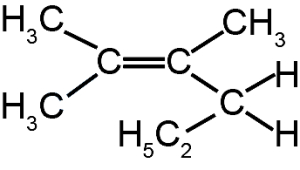
B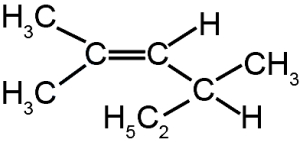
C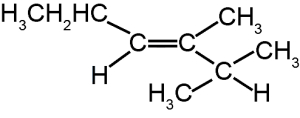
D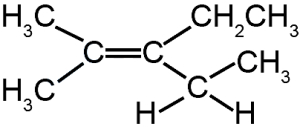
Solution
(B) $1$. The molecular formula $C_8H_{16}$ corresponds to the general formula $C_nH_{2n}$,which indicates an alkene.
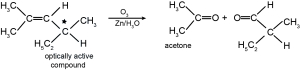
$2$. Ozonolysis of an alkene involves the cleavage of the $C=C$ double bond to form carbonyl compounds.
$3$. The problem states that one of the products is acetone,which is $CH_3COCH_3$. This implies the original alkene must contain a $(CH_3)_2C=$ group.
$4$. The compound must also be optically active,meaning it must contain a chiral center (a carbon atom bonded to four different groups).
$5$. Analyzing the options,the structure in option $B$ is $3,4$-dimethylhex-$2$-ene,but specifically,the structure shown is $2,3$-dimethylhex-$2$-ene. Let's re-examine the structure: the compound $2,3$-dimethylhex-$2$-ene has a chiral center at the $C_3$ position,which is bonded to a methyl group,an ethyl group,a hydrogen atom,and the $C=C$ group. Thus,it is optically active.
$6$. Ozonolysis of $2,3$-dimethylhex-$2$-ene yields acetone and $2$-methylbutanal. Therefore,the correct structure is the one shown in option $B$.
$2$. Ozonolysis of an alkene involves the cleavage of the $C=C$ double bond to form carbonyl compounds.
$3$. The problem states that one of the products is acetone,which is $CH_3COCH_3$. This implies the original alkene must contain a $(CH_3)_2C=$ group.
$4$. The compound must also be optically active,meaning it must contain a chiral center (a carbon atom bonded to four different groups).
$5$. Analyzing the options,the structure in option $B$ is $3,4$-dimethylhex-$2$-ene,but specifically,the structure shown is $2,3$-dimethylhex-$2$-ene. Let's re-examine the structure: the compound $2,3$-dimethylhex-$2$-ene has a chiral center at the $C_3$ position,which is bonded to a methyl group,an ethyl group,a hydrogen atom,and the $C=C$ group. Thus,it is optically active.
$6$. Ozonolysis of $2,3$-dimethylhex-$2$-ene yields acetone and $2$-methylbutanal. Therefore,the correct structure is the one shown in option $B$.
0 likesView Solution
17
ChemistryEasyMCQWBJEE · 2013
The different colours of litmus in acidic,neutral and basic solutions are,respectively.
A
red,orange and blue
B
blue,violet and red
C
red,colourless and blue
D
red,violet and blue
Solution
(D)
Litmus is a natural indicator extracted from lichens. In an acidic solution,it turns red. In a neutral solution,it retains its original purple/violet colour. In a basic solution,it turns blue.
| Medium | Colour of Litmus |
|---|---|
| Acidic | Red |
| Neutral | Violet |
| Basic | Blue |
Litmus is a natural indicator extracted from lichens. In an acidic solution,it turns red. In a neutral solution,it retains its original purple/violet colour. In a basic solution,it turns blue.
0 likesView Solution
18
ChemistryMediumMCQWBJEE · 2013
At $25^{\circ} C$,$pH$ of a $10^{-8} \ M$ aqueous $KOH$ solution will be
A
$6$
B
$7.02$
C
$8.02$
D
$9.02$
Solution
(B) For a very dilute solution of a strong base,the contribution of $OH^{-}$ ions from the dissociation of water cannot be neglected.
$KOH \longrightarrow K^{+} + OH^{-}$
$[OH^{-}]_{KOH} = 10^{-8} \ M$
$[OH^{-}]_{water} = 10^{-7} \ M$
Total $[OH^{-}] = 10^{-8} + 10^{-7} = 10^{-7}(0.1 + 1) = 1.1 \times 10^{-7} \ M$
$pOH = -\log(1.1 \times 10^{-7}) = 7 - \log(1.1) \approx 7 - 0.0414 = 6.9586$
Since $pH + pOH = 14$ at $25^{\circ} C$,
$pH = 14 - 6.9586 = 7.0414 \approx 7.04$.
Given the options,the closest value is $7.02$.
$KOH \longrightarrow K^{+} + OH^{-}$
$[OH^{-}]_{KOH} = 10^{-8} \ M$
$[OH^{-}]_{water} = 10^{-7} \ M$
Total $[OH^{-}] = 10^{-8} + 10^{-7} = 10^{-7}(0.1 + 1) = 1.1 \times 10^{-7} \ M$
$pOH = -\log(1.1 \times 10^{-7}) = 7 - \log(1.1) \approx 7 - 0.0414 = 6.9586$
Since $pH + pOH = 14$ at $25^{\circ} C$,
$pH = 14 - 6.9586 = 7.0414 \approx 7.04$.
Given the options,the closest value is $7.02$.
0 likesView Solution
19
ChemistryDifficultMCQWBJEE · 2013
$1 \times 10^{-3} \ \text{mole}$ of $HCl$ is added to a buffer solution made up of $0.01 \ \text{M}$ acetic acid and $0.01 \ \text{M}$ sodium acetate. The final $pH$ of the buffer will be (given,$pK_{a}$ of acetic acid is $4.75$ at $25^{\circ} \text{C}$)
A
$4.6$
B
$4.66$
C
$4.75$
D
$4.8$
Solution
(B) The initial moles of acetic acid and sodium acetate in $1 \ \text{L}$ of solution are $0.01 \ \text{mole}$ each.
When $1 \times 10^{-3} \ \text{mole}$ of $HCl$ is added,it reacts with the salt (sodium acetate) to form acetic acid:
$CH_{3}COO^{-} + H^{+} \longrightarrow CH_{3}COOH$
New moles of salt = $0.01 - 0.001 = 0.009 \ \text{mole}$.
New moles of acid = $0.01 + 0.001 = 0.011 \ \text{mole}$.
Using the Henderson-Hasselbalch equation:
$pH = pK_{a} + \log \frac{[\text{salt}]}{[\text{acid}]} = 4.75 + \log \frac{0.009}{0.011} = 4.75 + \log(0.818) \approx 4.75 - 0.087 = 4.663$
Thus,the final $pH$ is approximately $4.66$.
When $1 \times 10^{-3} \ \text{mole}$ of $HCl$ is added,it reacts with the salt (sodium acetate) to form acetic acid:
$CH_{3}COO^{-} + H^{+} \longrightarrow CH_{3}COOH$
New moles of salt = $0.01 - 0.001 = 0.009 \ \text{mole}$.
New moles of acid = $0.01 + 0.001 = 0.011 \ \text{mole}$.
Using the Henderson-Hasselbalch equation:
$pH = pK_{a} + \log \frac{[\text{salt}]}{[\text{acid}]} = 4.75 + \log \frac{0.009}{0.011} = 4.75 + \log(0.818) \approx 4.75 - 0.087 = 4.663$
Thus,the final $pH$ is approximately $4.66$.
0 likesView Solution
20
ChemistryMediumMCQWBJEE · 2013
At $25^{\circ} C$,the solubility product of a salt of $MX_{2}$ type is $3.2 \times 10^{-8}$ in water. The solubility (in $mol / L$) of $MX_{2}$ in water at the same temperature will be:
A
$1.2 \times 10^{-3}$
B
$2 \times 10^{-3}$
C
$3.2 \times 10^{-3}$
D
$1.75 \times 10^{-3}$
Solution
(B) For a salt of $MX_{2}$ type,the dissociation is given by: $MX_{2} \rightleftharpoons M^{2+} + 2X^-$.
If $s$ is the solubility in $mol / L$,then $[M^{2+}] = s$ and $[X^-] = 2s$.
The solubility product $K_{sp}$ is given by: $K_{sp} = [M^{2+}][X^-]^2 = (s)(2s)^2 = 4s^3$.
Given $K_{sp} = 3.2 \times 10^{-8}$.
So,$4s^3 = 3.2 \times 10^{-8}$.
$s^3 = \frac{3.2 \times 10^{-8}}{4} = 0.8 \times 10^{-8} = 8 \times 10^{-9}$.
Taking the cube root,$s = \sqrt[3]{8 \times 10^{-9}} = 2 \times 10^{-3} \ mol / L$.
If $s$ is the solubility in $mol / L$,then $[M^{2+}] = s$ and $[X^-] = 2s$.
The solubility product $K_{sp}$ is given by: $K_{sp} = [M^{2+}][X^-]^2 = (s)(2s)^2 = 4s^3$.
Given $K_{sp} = 3.2 \times 10^{-8}$.
So,$4s^3 = 3.2 \times 10^{-8}$.
$s^3 = \frac{3.2 \times 10^{-8}}{4} = 0.8 \times 10^{-8} = 8 \times 10^{-9}$.
Taking the cube root,$s = \sqrt[3]{8 \times 10^{-9}} = 2 \times 10^{-3} \ mol / L$.
0 likesView Solution
21
ChemistryEasyMCQWBJEE · 2013
In diborane $(B_2H_6)$,the number of electrons that accounts for bonding in the bridges is
A
six
B
two
C
eight
D
four
Solution
(D) Diborane $(B_2H_6)$ has a bridged structure where two $BH_2$ units are linked by two bridging hydrogen atoms.
Each bridge consists of a $3$-center-$2$-electron $(3c-2e)$ bond.
Since there are two such bridges,the total number of electrons involved in the bridging bonds is $2 \times 2 = 4$ electrons.
These are often referred to as banana bonds.
Each bridge consists of a $3$-center-$2$-electron $(3c-2e)$ bond.
Since there are two such bridges,the total number of electrons involved in the bridging bonds is $2 \times 2 = 4$ electrons.
These are often referred to as banana bonds.
0 likesView Solution
22
ChemistryEasyMCQWBJEE · 2013
In borax,the number of $B-O-B$ links and $B-OH$ bonds present are,respectively:
A
$5$ and $4$
B
$4$ and $5$
C
$3$ and $4$
D
$5$ and $5$
Solution
(A) The chemical formula of the borate anion in borax is $[B_4O_5(OH)_4]^{2-}$.
By examining the structure of the $[B_4O_5(OH)_4]^{2-}$ ion:
$1$. There are $5$ $B-O-B$ linkages forming the cyclic structure.
$2$. There are $4$ $B-OH$ bonds attached to the boron atoms.
Therefore,the number of $B-O-B$ links is $5$ and the number of $B-OH$ bonds is $4$.
By examining the structure of the $[B_4O_5(OH)_4]^{2-}$ ion:
$1$. There are $5$ $B-O-B$ linkages forming the cyclic structure.
$2$. There are $4$ $B-OH$ bonds attached to the boron atoms.
Therefore,the number of $B-O-B$ links is $5$ and the number of $B-OH$ bonds is $4$.
0 likesView Solution
23
ChemistryEasyMCQWBJEE · 2013
Silicon oil is obtained from the hydrolysis and polymerisation of
A
$trimethylchlorosilane$ and $dimethyldichlorosilane$
B
$trimethylchlorosilane$ and $methyldichlorosilane$
C
$methyltrichlorosilane$ and $dimethyldichlorosilane$
D
$triethylchlorosilane$ and $dimethyldichlorosilane$
Solution
(A) Silicones are synthetic polymers containing $R_2SiO$ repeating units.
Silicon oil is prepared by the hydrolysis and subsequent polymerisation of a mixture of $trimethylchlorosilane$ $( (CH_3)_3SiCl )$ and $dimethyldichlorosilane$ $( (CH_3)_2SiCl_2 )$.
The $trimethylchlorosilane$ acts as a chain terminator,controlling the chain length of the resulting silicone polymer,which determines its viscosity (forming oil).
These are widely used as lubricants and antifoaming agents.
Silicon oil is prepared by the hydrolysis and subsequent polymerisation of a mixture of $trimethylchlorosilane$ $( (CH_3)_3SiCl )$ and $dimethyldichlorosilane$ $( (CH_3)_2SiCl_2 )$.
The $trimethylchlorosilane$ acts as a chain terminator,controlling the chain length of the resulting silicone polymer,which determines its viscosity (forming oil).
These are widely used as lubricants and antifoaming agents.
0 likesView Solution
24
ChemistryDifficultMCQWBJEE · 2013
Number of hydrogen ions present in $10$ millionth part of $1.33 \ cm^{3}$ of pure water at $25^{\circ} C$ is
A
$6.023$ million
B
$60$ million
C
$8.01$ million
D
$80.23$ million
Solution
(C) The $10$ millionth part is equivalent to $10^{-7}$.
$\therefore$ The volume of the part is $1.33 \ cm^{3} \times 10^{-7} = 1.33 \times 10^{-7} \ mL$.
For pure water at $25^{\circ} C$,$[H^{+}] = 10^{-7} \ mol/L$.
Since $1 \ L = 1000 \ mL$,$1 \ mL$ of water contains $10^{-7} / 1000 = 10^{-10} \ mol$ of $H^{+}$ ions.
Therefore,the number of moles of $H^{+}$ in $1.33 \times 10^{-7} \ mL$ is $1.33 \times 10^{-7} \times 10^{-10} = 1.33 \times 10^{-17} \ mol$.
Number of $H^{+}$ ions $= \text{moles} \times N_{A} = 1.33 \times 10^{-17} \times 6.022 \times 10^{23}$.
$= 8.009 \times 10^{6} \approx 8.01 \times 10^{6}$ or $8.01$ million.
$\therefore$ The volume of the part is $1.33 \ cm^{3} \times 10^{-7} = 1.33 \times 10^{-7} \ mL$.
For pure water at $25^{\circ} C$,$[H^{+}] = 10^{-7} \ mol/L$.
Since $1 \ L = 1000 \ mL$,$1 \ mL$ of water contains $10^{-7} / 1000 = 10^{-10} \ mol$ of $H^{+}$ ions.
Therefore,the number of moles of $H^{+}$ in $1.33 \times 10^{-7} \ mL$ is $1.33 \times 10^{-7} \times 10^{-10} = 1.33 \times 10^{-17} \ mol$.
Number of $H^{+}$ ions $= \text{moles} \times N_{A} = 1.33 \times 10^{-17} \times 6.022 \times 10^{23}$.
$= 8.009 \times 10^{6} \approx 8.01 \times 10^{6}$ or $8.01$ million.
0 likesView Solution
25
ChemistryEasyMCQWBJEE · 2013
$A$ van der Waals' gas may behave ideally when
A
the volume is very low
B
the temperature is very high
C
the pressure is very low
D
the temperature,pressure and volume all are very high
Solution
(C) The van der Waals' equation for $n$ moles of a gas is $(P + \frac{an^2}{V^2})(V - nb) = nRT$.
At very low pressure,the volume $V$ is very large,making the term $\frac{a}{V^2}$ negligible.
Also,the volume $V$ is much larger than the excluded volume $b$,so $(V - b) \approx V$.
Thus,the equation reduces to $PV = RT$,which is the ideal gas equation.
Therefore,a van der Waals' gas behaves ideally at very low pressure.
At very low pressure,the volume $V$ is very large,making the term $\frac{a}{V^2}$ negligible.
Also,the volume $V$ is much larger than the excluded volume $b$,so $(V - b) \approx V$.
Thus,the equation reduces to $PV = RT$,which is the ideal gas equation.
Therefore,a van der Waals' gas behaves ideally at very low pressure.
0 likesView Solution
26
ChemistryMCQWBJEE · 2013
$A$ line passing through the point of intersection of $x+y=4$ and $x-y=2$ makes an angle $\tan ^{-1}\left(\frac{3}{4}\right)$ with the $x$-axis. It intersects the parabola $y^{2}=4(x-3)$ at points $(x_{1}, y_{1})$ and $(x_{2}, y_{2})$ respectively. Then,$|x_{1}-x_{2}|$ is equal to
A
$\frac{16}{9}$
B
$\frac{32}{9}$
C
$\frac{40}{9}$
D
$\frac{80}{9}$
Solution
(B) The given lines are $x+y=4$ and $x-y=2$.
Solving these equations,we add them to get $2x=6$,so $x=3$. Substituting $x=3$ into $x+y=4$,we get $y=1$.
The point of intersection is $(3, 1)$.
The slope of the line is $m = \tan(\tan^{-1}(3/4)) = 3/4$.
The equation of the line passing through $(3, 1)$ with slope $3/4$ is $(y-1) = \frac{3}{4}(x-3)$,which simplifies to $4y-4 = 3x-9$,or $3x-4y=5$.
Thus,$y = \frac{3x-5}{4}$.
Substituting this into the parabola equation $y^{2}=4(x-3)$,we get $\left(\frac{3x-5}{4}\right)^{2} = 4(x-3)$.
$\frac{9x^{2}-30x+25}{16} = 4x-12$.
$9x^{2}-30x+25 = 64x-192$.
$9x^{2}-94x+217 = 0$.
Using the quadratic formula $x = \frac{-b \pm \sqrt{b^{2}-4ac}}{2a}$,we have $x = \frac{94 \pm \sqrt{8836 - 7812}}{18} = \frac{94 \pm \sqrt{1024}}{18} = \frac{94 \pm 32}{18}$.
So,$x_{1} = \frac{126}{18} = 7$ and $x_{2} = \frac{62}{18} = \frac{31}{9}$.
Therefore,$|x_{1}-x_{2}| = |7 - \frac{31}{9}| = |\frac{63-31}{9}| = \frac{32}{9}$.
Solving these equations,we add them to get $2x=6$,so $x=3$. Substituting $x=3$ into $x+y=4$,we get $y=1$.
The point of intersection is $(3, 1)$.
The slope of the line is $m = \tan(\tan^{-1}(3/4)) = 3/4$.
The equation of the line passing through $(3, 1)$ with slope $3/4$ is $(y-1) = \frac{3}{4}(x-3)$,which simplifies to $4y-4 = 3x-9$,or $3x-4y=5$.
Thus,$y = \frac{3x-5}{4}$.
Substituting this into the parabola equation $y^{2}=4(x-3)$,we get $\left(\frac{3x-5}{4}\right)^{2} = 4(x-3)$.
$\frac{9x^{2}-30x+25}{16} = 4x-12$.
$9x^{2}-30x+25 = 64x-192$.
$9x^{2}-94x+217 = 0$.
Using the quadratic formula $x = \frac{-b \pm \sqrt{b^{2}-4ac}}{2a}$,we have $x = \frac{94 \pm \sqrt{8836 - 7812}}{18} = \frac{94 \pm \sqrt{1024}}{18} = \frac{94 \pm 32}{18}$.
So,$x_{1} = \frac{126}{18} = 7$ and $x_{2} = \frac{62}{18} = \frac{31}{9}$.
Therefore,$|x_{1}-x_{2}| = |7 - \frac{31}{9}| = |\frac{63-31}{9}| = \frac{32}{9}$.
0 likesView Solution
27
ChemistryEasyMCQWBJEE · 2013
Identify the correct statement.
A
Quantum numbers $(n, l, m, s)$ are arbitrary.
B
All the quantum numbers $(n, l, m, s)$ for any pair of electrons in an atom can be identical under special circumstances.
C
All the quantum numbers $(n, l, m, s)$ may not be required to describe an electron of an atom completely.
D
All the quantum numbers $(n, l, m, s)$ are required to describe an electron of an atom completely.
Solution
(D) According to the Pauli Exclusion Principle,no two electrons in an atom can have the same set of all four quantum numbers $(n, l, m, s)$.
Therefore,all four quantum numbers are necessary to uniquely identify and describe the state of an electron in an atom.
$n$ (Principal quantum number) defines the shell and energy.
$l$ (Azimuthal quantum number) defines the subshell and orbital shape.
$m$ (Magnetic quantum number) defines the spatial orientation.
$s$ (Spin quantum number) defines the electron spin direction.
Therefore,all four quantum numbers are necessary to uniquely identify and describe the state of an electron in an atom.
$n$ (Principal quantum number) defines the shell and energy.
$l$ (Azimuthal quantum number) defines the subshell and orbital shape.
$m$ (Magnetic quantum number) defines the spatial orientation.
$s$ (Spin quantum number) defines the electron spin direction.
0 likesView Solution
28
ChemistryMediumMCQWBJEE · 2013
Pressure-volume $(pV)$ work done by an ideal gaseous system at constant volume is (where $E$ is internal energy of the system):
A
$-\Delta p / p$
B
zero
C
$-V \Delta p$
D
$-\Delta E$
Solution
(B) The work done $(W)$ in a pressure-volume system is defined as $W = -P \Delta V$.
At constant volume,the change in volume $(\Delta V)$ is $0$.
Therefore,$W = -P \times 0 = 0$.
At constant volume,the change in volume $(\Delta V)$ is $0$.
Therefore,$W = -P \times 0 = 0$.
0 likesView Solution
29
ChemistryMediumMCQWBJEE · 2013
For isothermal expansion of an ideal gas,the correct combination of the thermodynamic parameters will be
A
$\Delta U=0, Q=0, W \neq 0$ and $\Delta H \neq 0$
B
$\Delta U \neq 0, Q \neq 0, W \neq 0$ and $\Delta H=0$
C
$\Delta U=0, Q \neq 0, W=0$ and $\Delta H \neq 0$
D
$\Delta U=0, Q \neq 0, W \neq 0$ and $\Delta H=0$
Solution
(D) For an ideal gas,internal energy $(U)$ and enthalpy $(H)$ are functions of temperature only.
In an isothermal process,$\Delta T = 0$,which implies $\Delta U = 0$ and $\Delta H = 0$.
From the first law of thermodynamics,$\Delta U = Q + W$. Since $\Delta U = 0$,$Q = -W$.
For expansion,work is done,so $W \neq 0$,which means $Q \neq 0$.
Therefore,the correct combination is $\Delta U=0, Q \neq 0, W \neq 0$ and $\Delta H=0$.
In an isothermal process,$\Delta T = 0$,which implies $\Delta U = 0$ and $\Delta H = 0$.
From the first law of thermodynamics,$\Delta U = Q + W$. Since $\Delta U = 0$,$Q = -W$.
For expansion,work is done,so $W \neq 0$,which means $Q \neq 0$.
Therefore,the correct combination is $\Delta U=0, Q \neq 0, W \neq 0$ and $\Delta H=0$.
0 likesView Solution
30
ChemistryEasyMCQWBJEE · 2013
The change of entropy $(dS)$ is defined as
A
$dS = \frac{\delta q}{T}$
B
$dS = \frac{dH}{T}$
C
$dS = \frac{\delta q_{rev}}{T}$
D
$dS = \frac{dH - dG}{T}$
Solution
(C) Entropy is a state function that measures the degree of randomness or disorder in a system.
For a reversible process,the change in entropy $(dS)$ is defined as the ratio of the heat exchanged reversibly $(\delta q_{rev})$ to the absolute temperature $(T)$ at which the exchange occurs.
Thus,the mathematical expression is $dS = \frac{\delta q_{rev}}{T}$.
For a reversible process,the change in entropy $(dS)$ is defined as the ratio of the heat exchanged reversibly $(\delta q_{rev})$ to the absolute temperature $(T)$ at which the exchange occurs.
Thus,the mathematical expression is $dS = \frac{\delta q_{rev}}{T}$.
0 likesView Solution
31
ChemistryEasyMCQWBJEE · 2013
Mixing of two different ideal gases under isothermal reversible conditions will lead to:
A
increase of Gibbs free energy of the system
B
no change of entropy of the system
C
increase of entropy of the system
D
increase of enthalpy of the system
Solution
(C) When two different ideal gases are mixed under isothermal reversible conditions,the process is spontaneous and leads to an increase in the randomness of the system.
The entropy of mixing,$\Delta S_{mix}$,is given by the formula $\Delta S_{mix} = -n R \sum x_i \ln x_i$,where $x_i$ is the mole fraction of each gas.
Since $x_i < 1$,$\ln x_i$ is negative,making $\Delta S_{mix}$ always positive.
Therefore,the entropy of the system increases.
The entropy of mixing,$\Delta S_{mix}$,is given by the formula $\Delta S_{mix} = -n R \sum x_i \ln x_i$,where $x_i$ is the mole fraction of each gas.
Since $x_i < 1$,$\ln x_i$ is negative,making $\Delta S_{mix}$ always positive.
Therefore,the entropy of the system increases.
0 likesView Solution
32
ChemistryEasyMCQWBJEE · 2013
The condition of spontaneity of a process is
A
lowering of entropy at constant temperature and pressure
B
lowering of Gibbs free energy of system at constant temperature and pressure
C
increase of entropy of system at constant temperature and pressure
D
increase of Gibbs free energy of the universe at constant temperature and pressure
Solution
(B) From the Gibbs-Helmholtz equation,$\Delta G = \Delta H - T \Delta S$.
For a process to be spontaneous at constant temperature and pressure,the change in Gibbs free energy of the system must be negative,i.e.,$\Delta G < 0$.
This implies a decrease or lowering of the Gibbs free energy of the system.
For a process to be spontaneous at constant temperature and pressure,the change in Gibbs free energy of the system must be negative,i.e.,$\Delta G < 0$.
This implies a decrease or lowering of the Gibbs free energy of the system.
0 likesView Solution
33
ChemistryMediumMCQWBJEE · 2013
The standard Gibbs free energy change $\Delta G^{\circ}$ at $25^{\circ} C$ for the dissociation of $N_2O_{4(g)}$ to $NO_{2(g)}$ is (given,equilibrium constant $K_{eq} = 0.15, R = 8.314 \ J \ K^{-1} \ mol^{-1}$) (in $kJ$)
A
$1.1$
B
$4.7$
C
$8.1$
D
$38.2$
Solution
(B) The relationship between standard Gibbs free energy change and the equilibrium constant is given by the equation: $\Delta G^{\circ} = -RT \ln K_{eq}$.
Given: $T = 25^{\circ} C = 298 \ K$,$R = 8.314 \ J \ K^{-1} \ mol^{-1}$,and $K_{eq} = 0.15$.
Substituting the values: $\Delta G^{\circ} = -8.314 \times 298 \times \ln(0.15)$.
Using $\ln(0.15) \approx -1.897$:
$\Delta G^{\circ} = -8.314 \times 298 \times (-1.897) \approx 4703 \ J \approx 4.7 \ kJ$.
Alternatively,using $\log_{10}$:
$\Delta G^{\circ} = -2.303 \times 8.314 \times 298 \times \log_{10}(0.15) \approx -5705.8 \times (-0.8239) \approx 4701 \ J \approx 4.7 \ kJ$.
Given: $T = 25^{\circ} C = 298 \ K$,$R = 8.314 \ J \ K^{-1} \ mol^{-1}$,and $K_{eq} = 0.15$.
Substituting the values: $\Delta G^{\circ} = -8.314 \times 298 \times \ln(0.15)$.
Using $\ln(0.15) \approx -1.897$:
$\Delta G^{\circ} = -8.314 \times 298 \times (-1.897) \approx 4703 \ J \approx 4.7 \ kJ$.
Alternatively,using $\log_{10}$:
$\Delta G^{\circ} = -2.303 \times 8.314 \times 298 \times \log_{10}(0.15) \approx -5705.8 \times (-0.8239) \approx 4701 \ J \approx 4.7 \ kJ$.
0 likesView Solution
34
ChemistryMediumMCQWBJEE · 2013
The reaction of $2,6-$dideutero-fluorobenzene with $NaNH_2$ in liquid $NH_3$ gives:
A
Aniline
B
$2,6-$dideuteroaniline
C
$2-$deuteroaniline and $3-$deuteroaniline
D
$2-$fluorobenzene
Solution
(C) The reaction of $2,6-$dideutero-fluorobenzene with $NaNH_2$ in liquid $NH_3$ proceeds via the benzyne mechanism.
$1$. The amide ion $(NH_2^-)$ abstracts a proton from the ortho position relative to the fluorine atom.
$2$. This leads to the elimination of $F^-$ and the formation of a benzyne intermediate,specifically $3-$deuterobenzyne.
$3$. The nucleophilic attack of $NH_2^-$ on the benzyne intermediate can occur at two non-equivalent positions due to the presence of the deuterium atom.
$4$. This results in a mixture of $2-$deuteroaniline and $3-$deuteroaniline as the final products.
$1$. The amide ion $(NH_2^-)$ abstracts a proton from the ortho position relative to the fluorine atom.
$2$. This leads to the elimination of $F^-$ and the formation of a benzyne intermediate,specifically $3-$deuterobenzyne.
$3$. The nucleophilic attack of $NH_2^-$ on the benzyne intermediate can occur at two non-equivalent positions due to the presence of the deuterium atom.
$4$. This results in a mixture of $2-$deuteroaniline and $3-$deuteroaniline as the final products.
0 likesView Solution
35
ChemistryMediumMCQWBJEE · 2013
When aniline is nitrated with nitrating mixture in ice-cold condition,the major product obtained is
A
$p$-nitroaniline
B
$2,4$-dinitroaniline
C
$o$-nitroaniline
D
$m$-nitroaniline
Solution
(D) Direct nitration of aniline with concentrated $HNO_3$ and $H_2SO_4$ (nitrating mixture) leads to the formation of a significant amount of $m$-nitroaniline due to the protonation of the $-NH_2$ group to form the $-NH_3^+$ ion,which is meta-directing.
In acidic medium,aniline exists as anilinium ion $(C_6H_5NH_3^+)$,which is strongly deactivating and meta-directing.
Therefore,the major product obtained under these conditions is $m$-nitroaniline.
In acidic medium,aniline exists as anilinium ion $(C_6H_5NH_3^+)$,which is strongly deactivating and meta-directing.
Therefore,the major product obtained under these conditions is $m$-nitroaniline.
0 likesView Solution
36
ChemistryMediumMCQWBJEE · 2013
Ribose and $2$-deoxyribose can be differentiated by
A
Fehling's reagent
B
Tollen's reagent
C
Barfoed's reagent
D
Osazone formation
Solution
(D) Ribose is an aldopentose that reacts with phenylhydrazine $(Ph-NH-NH_2)$ to form a characteristic osazone derivative.
In $2$-deoxyribose,the $-OH$ group at the $C-2$ position is replaced by a hydrogen atom.
The formation of an osazone requires the presence of an $\alpha$-hydroxy carbonyl group (or a group that can be oxidized to it).
Since $2$-deoxyribose lacks the $-OH$ group at the $C-2$ position,it cannot form the stable osazone structure under standard conditions,allowing it to be differentiated from ribose.
In $2$-deoxyribose,the $-OH$ group at the $C-2$ position is replaced by a hydrogen atom.
The formation of an osazone requires the presence of an $\alpha$-hydroxy carbonyl group (or a group that can be oxidized to it).
Since $2$-deoxyribose lacks the $-OH$ group at the $C-2$ position,it cannot form the stable osazone structure under standard conditions,allowing it to be differentiated from ribose.
0 likesView Solution
37
ChemistryEasyMCQWBJEE · 2013
The correct structure of the dipeptide gly-ala is
A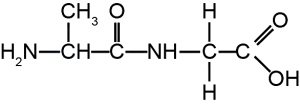
B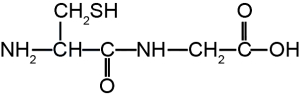
C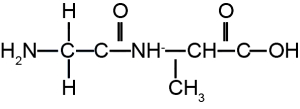
D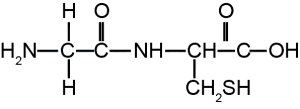
Solution
(C) dipeptide is formed by the condensation of two amino acids,where the carboxyl group $(-COOH)$ of one amino acid reacts with the amino group $(-NH_2)$ of another to form a peptide bond $(-CO-NH-)$.
For the dipeptide gly-ala (Glycine-Alanine):
$1$. Glycine $(NH_2-CH_2-COOH)$ is the $N$-terminal amino acid.
$2$. Alanine $(NH_2-CH(CH_3)-COOH)$ is the $C$-terminal amino acid.
$3$. The peptide bond is formed between the $-COOH$ of Glycine and the $-NH_2$ of Alanine.
$4$. The resulting structure is $NH_2-CH_2-CO-NH-CH(CH_3)-COOH$.
For the dipeptide gly-ala (Glycine-Alanine):
$1$. Glycine $(NH_2-CH_2-COOH)$ is the $N$-terminal amino acid.
$2$. Alanine $(NH_2-CH(CH_3)-COOH)$ is the $C$-terminal amino acid.
$3$. The peptide bond is formed between the $-COOH$ of Glycine and the $-NH_2$ of Alanine.
$4$. The resulting structure is $NH_2-CH_2-CO-NH-CH(CH_3)-COOH$.
0 likesView Solution
38
ChemistryEasyMCQWBJEE · 2013
The best method for the preparation of $Me_{3}CCN$ is
A
to react $Me_{3}COH$ with $HCN$
B
to react $Me_{3}CBr$ with $NaCN$
C
to react $Me_{3}CMgBr$ with $ClCN$
D
to react $Me_{3}CCl$ with $NH_{2}CN$
Solution
(C) The preparation of $Me_{3}CCN$ (pivalonitrile) from $Me_{3}CBr$ via $S_{N}2$ reaction with $NaCN$ is not feasible because $Me_{3}CBr$ is a tertiary alkyl halide,which undergoes elimination rather than substitution.
The reaction of $Me_{3}CMgBr$ (a Grignard reagent) with $ClCN$ (cyanogen chloride) is the most effective method for introducing a cyano group to a tertiary carbon atom.
The reaction is as follows:
$Me_{3}CMgBr + ClCN \rightarrow Me_{3}CCN + Mg(Cl)Br$
The reaction of $Me_{3}CMgBr$ (a Grignard reagent) with $ClCN$ (cyanogen chloride) is the most effective method for introducing a cyano group to a tertiary carbon atom.
The reaction is as follows:
$Me_{3}CMgBr + ClCN \rightarrow Me_{3}CCN + Mg(Cl)Br$
0 likesView Solution
39
ChemistryMediumMCQWBJEE · 2013
Consider the following reaction: $2 NO_{2(g)} + F_{2(g)} \longrightarrow 2 NO_2F_{(g)}$. The expression for the rate of reaction in terms of the rate of change of partial pressure of reactant and product is/are:
A
rate $= -\frac{1}{2} \left[ \frac{dp(NO_2)}{dt} \right]$
B
rate $= \frac{1}{2} \left[ \frac{dp(NO_2)}{dt} \right]$
C
rate $= -\frac{1}{2} \left[ \frac{dp(NO_2F)}{dt} \right]$
D
rate $= \frac{1}{2} \left[ \frac{dp(NO_2F)}{dt} \right]$
Solution
(D) For the reaction $2 NO_{2(g)} + F_{2(g)} \longrightarrow 2 NO_2F_{(g)}$,the rate of reaction is expressed in terms of the rate of change of partial pressure as:
Rate $= -\frac{1}{2} \left[ \frac{dp(NO_2)}{dt} \right] = -\left[ \frac{dp(F_2)}{dt} \right] = +\frac{1}{2} \left[ \frac{dp(NO_2F)}{dt} \right]$.
Comparing this with the given options,option $D$ is correct.
Rate $= -\frac{1}{2} \left[ \frac{dp(NO_2)}{dt} \right] = -\left[ \frac{dp(F_2)}{dt} \right] = +\frac{1}{2} \left[ \frac{dp(NO_2F)}{dt} \right]$.
Comparing this with the given options,option $D$ is correct.
0 likesView Solution
40
ChemistryEasyMCQWBJEE · 2013
Acid catalysed hydrolysis of ethyl acetate follows a pseudo-first order kinetics with respect to ester. If the reaction is carried out with large excess of ester,the order with respect to ester will be
A
$1.5$
B
$0$
C
$0.5$
D
$1$
Solution
(B) The reaction is $CH_{3}COOC_{2}H_{5} + H_{2}O \xrightarrow{H^+} CH_{3}COOH + C_{2}H_{5}OH$.
In a standard pseudo-first order reaction,water is in excess,making the order with respect to ester $1$.
However,if the reaction is carried out with a large excess of ester,the concentration of the ester remains effectively constant throughout the reaction.
Therefore,the rate of reaction becomes independent of the concentration of the ester,resulting in a zero-order reaction with respect to the ester.
In a standard pseudo-first order reaction,water is in excess,making the order with respect to ester $1$.
However,if the reaction is carried out with a large excess of ester,the concentration of the ester remains effectively constant throughout the reaction.
Therefore,the rate of reaction becomes independent of the concentration of the ester,resulting in a zero-order reaction with respect to the ester.
0 likesView Solution
41
ChemistryDifficultMCQWBJEE · 2013
The half-life for decay of ${}^{14}C$ by $\beta$-emission is $5730 \ yr$. The fraction of ${}^{14}C$ that decays in a sample that is $22920 \ yr$ old would be
A
$\frac{1}{8}$
B
$\frac{1}{16}$
C
$\frac{7}{8}$
D
$\frac{15}{16}$
Solution
(D) The number of half-lives $n$ is calculated as: $n = \frac{t}{t_{1/2}} = \frac{22920}{5730} = 4$.
The amount of ${}^{14}C$ remaining after $n$ half-lives is given by: $N = N_0 (\frac{1}{2})^n = N_0 (\frac{1}{2})^4 = \frac{N_0}{16}$.
The fraction of ${}^{14}C$ that has decayed is: $\text{Decayed fraction} = \frac{N_0 - N}{N_0} = 1 - \frac{N}{N_0} = 1 - \frac{1}{16} = \frac{15}{16}$.
The amount of ${}^{14}C$ remaining after $n$ half-lives is given by: $N = N_0 (\frac{1}{2})^n = N_0 (\frac{1}{2})^4 = \frac{N_0}{16}$.
The fraction of ${}^{14}C$ that has decayed is: $\text{Decayed fraction} = \frac{N_0 - N}{N_0} = 1 - \frac{N}{N_0} = 1 - \frac{1}{16} = \frac{15}{16}$.
0 likesView Solution
42
ChemistryMediumMCQWBJEE · 2013
For a chemical reaction at $27^{\circ} C$,the activation energy is $600 R$. The ratio of the rate constants at $327^{\circ} C$ to that of at $27^{\circ} C$ will be
A
$2$
B
$40$
C
$e$
D
$e^{2}$
Solution
(C) From the Arrhenius equation:
$\ln \frac{k_{2}}{k_{1}} = \frac{E_{a}}{R} \left[ \frac{1}{T_{1}} - \frac{1}{T_{2}} \right]$
Given $T_{1} = 27 + 273 = 300 \ K$,$T_{2} = 327 + 273 = 600 \ K$,and $E_{a} = 600 R$.
Substituting the values:
$\ln \frac{k_{2}}{k_{1}} = \frac{600 R}{R} \left[ \frac{1}{300} - \frac{1}{600} \right]$
$\ln \frac{k_{2}}{k_{1}} = 600 \left[ \frac{2 - 1}{600} \right]$
$\ln \frac{k_{2}}{k_{1}} = 600 \times \frac{1}{600} = 1$
Therefore,$\frac{k_{2}}{k_{1}} = e^{1} = e$.
$\ln \frac{k_{2}}{k_{1}} = \frac{E_{a}}{R} \left[ \frac{1}{T_{1}} - \frac{1}{T_{2}} \right]$
Given $T_{1} = 27 + 273 = 300 \ K$,$T_{2} = 327 + 273 = 600 \ K$,and $E_{a} = 600 R$.
Substituting the values:
$\ln \frac{k_{2}}{k_{1}} = \frac{600 R}{R} \left[ \frac{1}{300} - \frac{1}{600} \right]$
$\ln \frac{k_{2}}{k_{1}} = 600 \left[ \frac{2 - 1}{600} \right]$
$\ln \frac{k_{2}}{k_{1}} = 600 \times \frac{1}{600} = 1$
Therefore,$\frac{k_{2}}{k_{1}} = e^{1} = e$.
0 likesView Solution
43
ChemistryMediumMCQWBJEE · 2013
In basic medium,the amount of $Ni^{2+}$ in a solution can be estimated with the dimethylglyoxime reagent. The correct statement$(s)$ about the reaction and the product is (are):
A
In an ammoniacal solution,$Ni^{2+}$ salts give a cherry-red precipitate of nickel$(II)$ dimethylglyoximate.
B
Two dimethylglyoximate units are bound to one $Ni^{2+}$.
C
In the complex,two dimethylglyoximate units are hydrogen bonded to each other.
D
Each dimethylglyoximate unit forms a five-membered chelate ring with $Ni^{2+}$.
Solution
(A, B, C) The reaction of $Ni^{2+}$ with dimethylglyoxime $(DMG)$ in an ammoniacal (basic) medium produces a cherry-red precipitate of nickel$(II)$ dimethylglyoximate,$[Ni(DMG)_2]$.
In this complex,two dimethylglyoximate units are bound to one $Ni^{2+}$ ion.
The two dimethylglyoximate units are held together by strong intramolecular hydrogen bonding.
Each dimethylglyoximate unit forms a five-membered chelate ring with the $Ni^{2+}$ ion through the nitrogen atoms of the oxime groups.
Therefore,statements $A$,$B$,and $C$ are correct,while $D$ is incorrect because the chelate ring formed is five-membered,not six-membered.
In this complex,two dimethylglyoximate units are bound to one $Ni^{2+}$ ion.
The two dimethylglyoximate units are held together by strong intramolecular hydrogen bonding.
Each dimethylglyoximate unit forms a five-membered chelate ring with the $Ni^{2+}$ ion through the nitrogen atoms of the oxime groups.
Therefore,statements $A$,$B$,and $C$ are correct,while $D$ is incorrect because the chelate ring formed is five-membered,not six-membered.
0 likesView Solution
44
ChemistryMediumMCQWBJEE · 2013
Addition of excess potassium iodide solution to a solution of mercuric chloride gives the halide complex
A
tetrahedral $K_{2}[HgI_{4}]$
B
trigonal $K[HgI_{3}]$
C
linear $Hg_{2}I_{2}$
D
square planar $K_{2}[HgCl_{2}I_{2}]$
Solution
(A) When excess potassium iodide $(KI)$ is added to mercuric chloride $(HgCl_{2})$,the reaction is as follows:
$HgCl_{2} + 4KI \longrightarrow K_{2}[HgI_{4}] + 2KCl$
In the complex $[HgI_{4}]^{2-}$,the central metal ion is $Hg^{2+}$.
The electronic configuration of $Hg$ $(Z=80)$ is $[Xe] 4f^{14} 5d^{10} 6s^{2}$.
For $Hg^{2+}$,the configuration is $[Xe] 4f^{14} 5d^{10} 6s^{0}$.
The four $I^-$ ligands donate electron pairs to the $6s$ and $6p$ orbitals of $Hg^{2+}$,resulting in $sp^{3}$ hybridization.
This leads to a tetrahedral geometry for the complex $K_{2}[HgI_{4}]$.
$HgCl_{2} + 4KI \longrightarrow K_{2}[HgI_{4}] + 2KCl$
In the complex $[HgI_{4}]^{2-}$,the central metal ion is $Hg^{2+}$.
The electronic configuration of $Hg$ $(Z=80)$ is $[Xe] 4f^{14} 5d^{10} 6s^{2}$.
For $Hg^{2+}$,the configuration is $[Xe] 4f^{14} 5d^{10} 6s^{0}$.
The four $I^-$ ligands donate electron pairs to the $6s$ and $6p$ orbitals of $Hg^{2+}$,resulting in $sp^{3}$ hybridization.
This leads to a tetrahedral geometry for the complex $K_{2}[HgI_{4}]$.
0 likesView Solution
45
ChemistryMediumMCQWBJEE · 2013
Amongst $[Ni(H_{2}O)_{6}]^{2+}$,$[Ni(PPh_{3})_{2}Cl_{2}]$,$[Ni(CO)_{4}]$ and $[Ni(CN)_{4}]^{2-}$,the paramagnetic species are
A
$[Ni(H_{2}O)_{6}]^{2+}$ and $[Ni(PPh_{3})_{2}Cl_{2}]$
B
$[Ni(CO)_{4}]$ and $[Ni(CN)_{4}]^{2-}$
C
$[Ni(H_{2}O)_{6}]^{2+}$ and $[Ni(CN)_{4}]^{2-}$
D
$[Ni(PPh_{3})_{2}Cl_{2}]$ and $[Ni(CO)_{4}]$
Solution
(A) Species having unpaired electrons are paramagnetic.
$Ni$ has atomic number $28$,electronic configuration $[Ar] 3d^{8} 4s^{2}$.
$1$. $[Ni(H_{2}O)_{6}]^{2+}$: $Ni$ is in $+2$ oxidation state $(3d^{8})$. $H_{2}O$ is a weak field ligand,so no pairing occurs. It has $2$ unpaired electrons (Paramagnetic).
$2$. $[Ni(PPh_{3})_{2}Cl_{2}]$: $Ni$ is in $+2$ oxidation state $(3d^{8})$. It is a tetrahedral complex. Due to the presence of $Cl^{-}$ ligands,it remains high spin with $2$ unpaired electrons (Paramagnetic).
$3$. $[Ni(CO)_{4}]$: $Ni$ is in $0$ oxidation state $(3d^{8} 4s^{2})$. $CO$ is a strong field ligand,causing pairing of all electrons. It has $0$ unpaired electrons (Diamagnetic).
$4$. $[Ni(CN)_{4}]^{2-}$: $Ni$ is in $+2$ oxidation state $(3d^{8})$. $CN^{-}$ is a strong field ligand,causing pairing of electrons. It has $0$ unpaired electrons (Diamagnetic).
Thus,$[Ni(H_{2}O)_{6}]^{2+}$ and $[Ni(PPh_{3})_{2}Cl_{2}]$ are paramagnetic.
$Ni$ has atomic number $28$,electronic configuration $[Ar] 3d^{8} 4s^{2}$.
$1$. $[Ni(H_{2}O)_{6}]^{2+}$: $Ni$ is in $+2$ oxidation state $(3d^{8})$. $H_{2}O$ is a weak field ligand,so no pairing occurs. It has $2$ unpaired electrons (Paramagnetic).
$2$. $[Ni(PPh_{3})_{2}Cl_{2}]$: $Ni$ is in $+2$ oxidation state $(3d^{8})$. It is a tetrahedral complex. Due to the presence of $Cl^{-}$ ligands,it remains high spin with $2$ unpaired electrons (Paramagnetic).
$3$. $[Ni(CO)_{4}]$: $Ni$ is in $0$ oxidation state $(3d^{8} 4s^{2})$. $CO$ is a strong field ligand,causing pairing of all electrons. It has $0$ unpaired electrons (Diamagnetic).
$4$. $[Ni(CN)_{4}]^{2-}$: $Ni$ is in $+2$ oxidation state $(3d^{8})$. $CN^{-}$ is a strong field ligand,causing pairing of electrons. It has $0$ unpaired electrons (Diamagnetic).
Thus,$[Ni(H_{2}O)_{6}]^{2+}$ and $[Ni(PPh_{3})_{2}Cl_{2}]$ are paramagnetic.
0 likesView Solution
46
ChemistryEasyMCQWBJEE · 2013
The orange solid on heating gives a colourless gas and a green solid which can be reduced to metal by aluminium powder. The orange and the green solids are,respectively
A
$NH_{4}Cr_{2}O_{7}$ and $Cr_{2}O_{3}$
B
$(NH_{4})_{2}Cr_{2}O_{7}$ and $Cr_{2}O_{3}$
C
$K_{2}Cr_{2}O_{7}$ and $CrO_{3}$
D
$(NH_{4})_{2}CrO_{4}$ and $CrO_{3}$
Solution
(B) The orange solid is ammonium dichromate,$(NH_{4})_{2}Cr_{2}O_{7}$.
Upon heating,it undergoes thermal decomposition to produce nitrogen gas (colourless),chromium$(III)$ oxide (green solid),and water vapor:
$(NH_{4})_{2}Cr_{2}O_{7} \xrightarrow{\Delta} N_{2} \uparrow + Cr_{2}O_{3} + 4H_{2}O$
The green solid,$Cr_{2}O_{3}$,can be reduced to metallic chromium by aluminium powder in a thermite reaction:
$Cr_{2}O_{3} + 2Al \longrightarrow 2Cr + Al_{2}O_{3}$
Upon heating,it undergoes thermal decomposition to produce nitrogen gas (colourless),chromium$(III)$ oxide (green solid),and water vapor:
$(NH_{4})_{2}Cr_{2}O_{7} \xrightarrow{\Delta} N_{2} \uparrow + Cr_{2}O_{3} + 4H_{2}O$
The green solid,$Cr_{2}O_{3}$,can be reduced to metallic chromium by aluminium powder in a thermite reaction:
$Cr_{2}O_{3} + 2Al \longrightarrow 2Cr + Al_{2}O_{3}$
0 likesView Solution
47
ChemistryEasyMCQWBJEE · 2013
The correct order of equivalent conductances at infinite dilution in water at room temperature for $H^{+}$,$K^{+}$,$CH_{3}COO^{-}$ and $HO^{-}$ ions is
A
$HO^{-} > H^{+} > K^{+} > CH_{3}COO^{-}$
B
$H^{+} > HO^{-} > K^{+} > CH_{3}COO^{-}$
C
$H^{+} > K^{+} > HO^{-} > CH_{3}COO^{-}$
D
$H^{+} > K^{+} > CH_{3}COO^{-} > HO^{-}$
Solution
(B) The equivalent conductance $(\Lambda_{eq})$ at infinite dilution depends on the ionic mobility of the ions in the solvent.
In water,$H^{+}$ and $HO^{-}$ ions exhibit exceptionally high ionic mobilities due to the Grotthuss mechanism (proton hopping).
Among the given ions,$H^{+}$ has the highest mobility,followed by $HO^{-}$.
$K^{+}$ is a simple hydrated cation with moderate mobility,while $CH_{3}COO^{-}$ is a large polyatomic anion with relatively lower mobility.
Therefore,the correct order of equivalent conductances at infinite dilution is $H^{+} > HO^{-} > K^{+} > CH_{3}COO^{-}$.
In water,$H^{+}$ and $HO^{-}$ ions exhibit exceptionally high ionic mobilities due to the Grotthuss mechanism (proton hopping).
Among the given ions,$H^{+}$ has the highest mobility,followed by $HO^{-}$.
$K^{+}$ is a simple hydrated cation with moderate mobility,while $CH_{3}COO^{-}$ is a large polyatomic anion with relatively lower mobility.
Therefore,the correct order of equivalent conductances at infinite dilution is $H^{+} > HO^{-} > K^{+} > CH_{3}COO^{-}$.
0 likesView Solution
48
ChemistryMediumMCQWBJEE · 2013
$A$ conductivity cell has been calibrated with $0.01 \ M$ $1:1$ electrolyte solution (specific conductance,$k = 1.25 \times 10^{-3} \ S \ cm^{-1}$) in the cell and the measured resistance was $800 \ \Omega$ at $25^{\circ}C$. The cell constant will be (in $cm^{-1}$)
A
$1.02$
B
$0.102$
C
$1.00$
D
$0.5$
Solution
(C) Given,specific conductance $k = 1.25 \times 10^{-3} \ S \ cm^{-1}$.
Resistance $R = 800 \ \Omega$.
The relationship between specific conductance $(k)$,resistance $(R)$,and cell constant $(G^*)$ is given by the formula: $k = (1/R) \times G^*$.
Rearranging the formula to solve for the cell constant: $G^* = k \times R$.
Substituting the given values: $G^* = (1.25 \times 10^{-3} \ S \ cm^{-1}) \times (800 \ \Omega)$.
$G^* = 1.00 \ cm^{-1}$.
Resistance $R = 800 \ \Omega$.
The relationship between specific conductance $(k)$,resistance $(R)$,and cell constant $(G^*)$ is given by the formula: $k = (1/R) \times G^*$.
Rearranging the formula to solve for the cell constant: $G^* = k \times R$.
Substituting the given values: $G^* = (1.25 \times 10^{-3} \ S \ cm^{-1}) \times (800 \ \Omega)$.
$G^* = 1.00 \ cm^{-1}$.
0 likesView Solution
49
ChemistryMediumMCQWBJEE · 2013
Equivalent conductivity at infinite dilution for sodium potassium oxalate $[(COO^{-})_{2} Na^{+} K^{+}]$ will be (given molar conductivities of oxalate,$K^{+}$ and $Na^{+}$ ions at infinite dilution are $148.2$,$50.1$,and $73.5 \ S \ cm^{2} \ mol^{-1}$ respectively).
A
$135.9 \ S \ cm^{2} \ eq^{-1}$
B
$67.95 \ S \ cm^{2} \ eq^{-1}$
C
$543.6 \ S \ cm^{2} \ eq^{-1}$
D
$271.8 \ S \ cm^{2} \ eq^{-1}$
Solution
(A) The molar conductivity at infinite dilution for the salt $[(COO^{-})_{2} Na^{+} K^{+}]$ is the sum of the molar conductivities of its constituent ions: $\lambda_{m}^{\infty} = \lambda_{m}^{\infty} (oxalate^{2-}) + \lambda_{m}^{\infty} (Na^{+}) + \lambda_{m}^{\infty} (K^{+})$.
Substituting the given values: $\lambda_{m}^{\infty} = 148.2 + 73.5 + 50.1 = 271.8 \ S \ cm^{2} \ mol^{-1}$.
The $n$-factor for the salt $[(COO^{-})_{2} Na^{+} K^{+}]$ is $2$ because the oxalate ion has a charge of $-2$.
Therefore,the equivalent conductivity at infinite dilution is $\lambda_{eq}^{\infty} = \frac{\lambda_{m}^{\infty}}{n-factor} = \frac{271.8}{2} = 135.9 \ S \ cm^{2} \ eq^{-1}$.
Substituting the given values: $\lambda_{m}^{\infty} = 148.2 + 73.5 + 50.1 = 271.8 \ S \ cm^{2} \ mol^{-1}$.
The $n$-factor for the salt $[(COO^{-})_{2} Na^{+} K^{+}]$ is $2$ because the oxalate ion has a charge of $-2$.
Therefore,the equivalent conductivity at infinite dilution is $\lambda_{eq}^{\infty} = \frac{\lambda_{m}^{\infty}}{n-factor} = \frac{271.8}{2} = 135.9 \ S \ cm^{2} \ eq^{-1}$.
0 likesView Solution
50
ChemistryEasyMCQWBJEE · 2013
$(+)-2-$chloro$-2-$phenylethane in toluene racemises slowly in the presence of small amount of $SbCl_5$,due to the formation of
A
carbanion
B
carbene
C
free-radical
D
carbocation
Solution
(D) The $SbCl_5$ acts as a Lewis acid and abstracts the chloride ion $(Cl^-)$ from the substrate,$(+)-2-$chloro$-2-$phenylethane.
This results in the formation of a planar,$sp^2$ hybridized carbocation intermediate.
Because the carbocation is planar,the chloride ion can attack from either the top or the bottom face with equal probability.
This leads to the formation of both enantiomers,resulting in a racemic mixture.
This results in the formation of a planar,$sp^2$ hybridized carbocation intermediate.
Because the carbocation is planar,the chloride ion can attack from either the top or the bottom face with equal probability.
This leads to the formation of both enantiomers,resulting in a racemic mixture.
0 likesView Solution
51
ChemistryMediumMCQWBJEE · 2013
The correct order of acid strength of the following substituted phenols in water at $28^{\circ} C$ is:
A
$p$-nitrophenol $ < $ $p$-fluorophenol $ < $ $p$-chlorophenol
B
$p$-chlorophenol $ < $ $p$-fluorophenol $ < $ $p$-nitrophenol
C
$p$-fluorophenol $ < $ $p$-chlorophenol $ < $ $p$-nitrophenol
D
$p$-fluorophenol $ < $ $p$-nitrophenol $ < $ $p$-chlorophenol
Solution
(C) The acidic strength of substituted phenols depends on the electron-withdrawing effect ($-I$ and $-M$ effects) of the substituent group attached to the benzene ring.
Stronger electron-withdrawing groups stabilize the phenoxide ion more effectively,thereby increasing the acidic strength.
The electron-withdrawing tendency of the given substituents follows the order: $-F < -Cl < -NO_2$.
Therefore,the correct order of acidic strength is $p$-fluorophenol $ < $ $p$-chlorophenol $ < $ $p$-nitrophenol.
Stronger electron-withdrawing groups stabilize the phenoxide ion more effectively,thereby increasing the acidic strength.
The electron-withdrawing tendency of the given substituents follows the order: $-F < -Cl < -NO_2$.
Therefore,the correct order of acidic strength is $p$-fluorophenol $ < $ $p$-chlorophenol $ < $ $p$-nitrophenol.
0 likesView Solution
52
ChemistryMediumMCQWBJEE · 2013
The reaction of nitroprusside anion with sulphide ion gives purple colouration due to the formation of
A
the tetranionic complex of iron $(II)$ coordinating to one $NOS^{4-}$ ion
B
the dianionic complex of iron $(II)$ coordinating to one $NCS^{-}$ ion
C
the trianionic complex of iron $(III)$ coordinating to one $NOS^{-}$ ion
D
the tetranionic complex of iron $(III)$ coordinating to one $NCS^{-}$ ion
Solution
(A) The reaction between sodium nitroprusside $(Na_2[Fe(CN)_5NO])$ and sulphide ion $(S^{2-})$ is a standard test for the detection of sulphur.
The reaction is as follows:
$Na_2S + Na_2[Fe(CN)_5NO] \rightarrow Na_4[Fe(CN)_5NOS]$
This complex dissociates in solution as:
$Na_4[Fe(CN)_5NOS] \rightleftharpoons 4Na^+ + [Fe(CN)_5NOS]^{4-}$
The resulting complex $[Fe(CN)_5NOS]^{4-}$ is a tetranionic complex of iron $(II)$ where the $NO^+$ ligand is replaced by $NOS^{3-}$ (or effectively coordinates as $NOS^{3-}$ to the $Fe^{2+}$ center),resulting in a deep purple colouration.
The reaction is as follows:
$Na_2S + Na_2[Fe(CN)_5NO] \rightarrow Na_4[Fe(CN)_5NOS]$
This complex dissociates in solution as:
$Na_4[Fe(CN)_5NOS] \rightleftharpoons 4Na^+ + [Fe(CN)_5NOS]^{4-}$
The resulting complex $[Fe(CN)_5NOS]^{4-}$ is a tetranionic complex of iron $(II)$ where the $NO^+$ ligand is replaced by $NOS^{3-}$ (or effectively coordinates as $NOS^{3-}$ to the $Fe^{2+}$ center),resulting in a deep purple colouration.
0 likesView Solution
53
ChemistryEasyMCQWBJEE · 2013
The ore chromite is
A
$FeCr_{2}O_{4}$
B
$CoCr_{2}O_{3}$
C
$CrFe_{2}O_{4}$
D
$FeCr_{2}O_{3}$
Solution
(A) The chemical formula for the ore chromite is $FeCr_{2}O_{4}$.
It is an oxide mineral belonging to the spinel group.
It is an oxide mineral belonging to the spinel group.
0 likesView Solution
54
ChemistryEasyMCQWBJEE · 2013
The important advantage$(s)$ of Lintz and Donawitz $(L.D.)$ process for the manufacture of steel is (are):
A
The process is very quick
B
Operating costs are low
C
Better quality steel is obtained
D
Scrap iron can be used
Solution
(A, B, C, D) The Lintz and Donawitz $(L.D.)$ process is a highly efficient method for steel manufacturing.
Key advantages include:
$1$. The process is very quick due to the high-pressure oxygen blast.
$2$. It produces better quality steel by effectively removing impurities like $C$,$Si$,and $Mn$ as slag.
$3$. Scrap iron can be used as a raw material along with molten iron.
$4$. Operating costs are relatively low compared to older methods.
Since all the given options are valid advantages of the $L.D.$ process,the question implies selecting all that apply.
Key advantages include:
$1$. The process is very quick due to the high-pressure oxygen blast.
$2$. It produces better quality steel by effectively removing impurities like $C$,$Si$,and $Mn$ as slag.
$3$. Scrap iron can be used as a raw material along with molten iron.
$4$. Operating costs are relatively low compared to older methods.
Since all the given options are valid advantages of the $L.D.$ process,the question implies selecting all that apply.
0 likesView Solution
55
ChemistryEasyMCQWBJEE · 2013
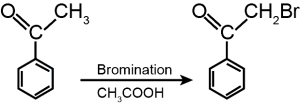
Bromination of $PhCOMe$ in acetic medium produces mainly
A
$2$-bromoacetophenone (ortho-substituted)
B
$4$-bromoacetophenone (para-substituted)
C
$2,2,2$-tribromoacetophenone
D
$2$-bromo$-1-$phenylethan$-1-$one (phenacyl bromide)
Solution
0 likesView Solution
56
ChemistryEasyMCQWBJEE · 2013
Correct statement$(s)$ in cases of $n-$butanol and $t-$butanol is (are)
A
both are having equal solubility in water
B
$t-$butanol is more soluble in water than $n-$butanol
C
boiling point of $t-$butanol is lower than $n-$butanol
D
boiling point of $n-$butanol is lower than $t-$butanol
Solution
(B, C) $n-$butanol is a straight-chain alcohol,while $t-$butanol is a branched-chain alcohol.
Branching decreases the surface area of the molecule,which reduces the strength of intermolecular van der Waals forces,leading to a lower boiling point for $t-$butanol compared to $n-$butanol.
Additionally,branching increases the solubility of alcohols in water because it reduces the hydrophobic character of the alkyl group.
Therefore,$t-$butanol is more soluble in water and has a lower boiling point than $n-$butanol.
Thus,both statements $B$ and $C$ are correct.
Branching decreases the surface area of the molecule,which reduces the strength of intermolecular van der Waals forces,leading to a lower boiling point for $t-$butanol compared to $n-$butanol.
Additionally,branching increases the solubility of alcohols in water because it reduces the hydrophobic character of the alkyl group.
Therefore,$t-$butanol is more soluble in water and has a lower boiling point than $n-$butanol.
Thus,both statements $B$ and $C$ are correct.
0 likesView Solution
57
ChemistryEasyMCQWBJEE · 2013
Nitric acid can be obtained from ammonia via the formation of the intermediate compounds:
A
nitric oxide and nitrogen dioxide
B
nitrogen and nitric oxide
C
nitric oxide and dinitrogen pentoxide
D
nitrogen and nitrous oxide
Solution
(A) The industrial manufacture of nitric acid is carried out by the $Ostwald$ process. The steps are as follows:
$1$. Catalytic oxidation of ammonia: $4 NH_{3} + 5 O_{2} \xrightarrow[800-900^{\circ} C]{Pt \text{ gauge}} 4 NO + 6 H_{2} O$
$2$. Oxidation of nitric oxide to nitrogen dioxide: $2 NO + O_{2} \longrightarrow 2 NO_{2}$
$3$. Absorption of nitrogen dioxide in water: $4 NO_{2} + 2 H_{2} O + O_{2} \longrightarrow 4 HNO_{3}$
Thus,the intermediate compounds formed are nitric oxide $(NO)$ and nitrogen dioxide $(NO_{2})$.
$1$. Catalytic oxidation of ammonia: $4 NH_{3} + 5 O_{2} \xrightarrow[800-900^{\circ} C]{Pt \text{ gauge}} 4 NO + 6 H_{2} O$
$2$. Oxidation of nitric oxide to nitrogen dioxide: $2 NO + O_{2} \longrightarrow 2 NO_{2}$
$3$. Absorption of nitrogen dioxide in water: $4 NO_{2} + 2 H_{2} O + O_{2} \longrightarrow 4 HNO_{3}$
Thus,the intermediate compounds formed are nitric oxide $(NO)$ and nitrogen dioxide $(NO_{2})$.
0 likesView Solution
58
ChemistryEasyMCQWBJEE · 2013
$Oleum$ (also known as $Sulphan$) is
A
a mixture of $SO_{3}$ and $H_{2}SO_{3}$
B
$100\%$ conc. $H_{2}SO_{4}$
C
a mixture of gypsum and conc. $H_{2}SO_{4}$
D
$100\%$ oleum (a mixture of $SO_{3}$ in $H_{2}SO_{4}$)
Solution
(D) $H_{2}SO_{4}$ saturated with $SO_{3}$ is called $Oleum$ or $Sulphan$.
The chemical reaction is: $H_{2}SO_{4} + SO_{3} \longrightarrow H_{2}S_{2}O_{7}$.
The chemical reaction is: $H_{2}SO_{4} + SO_{3} \longrightarrow H_{2}S_{2}O_{7}$.
0 likesView Solution
59
ChemistryEasyMCQWBJEE · 2013
Chlorine gas reacts with red hot calcium oxide to give
A
bleaching powder and dichlorine monoxide
B
bleaching powder and water
C
calcium chloride and chlorine dioxide
D
calcium chloride and oxygen
Solution
(D) The reaction of chlorine gas with red hot calcium oxide is given by the following chemical equation:
$2 CaO + 2 Cl_2 \xrightarrow{\text{Red hot}} 2 CaCl_2 + O_2 \uparrow$
Thus,the products formed are calcium chloride and oxygen.
$2 CaO + 2 Cl_2 \xrightarrow{\text{Red hot}} 2 CaCl_2 + O_2 \uparrow$
Thus,the products formed are calcium chloride and oxygen.
0 likesView Solution
60
ChemistryEasyMCQWBJEE · 2013
On heating,chloric acid $(HClO_{3})$ decomposes to:
A
$HClO_{4}, Cl_{2}, O_{2}$ and $H_{2}O$
B
$HClO_{2}, Cl_{2}, O_{2}$ and $H_{2}O$
C
$HClO, Cl_{2}O$ and $H_{2}O_{2}$
D
$HCl, HClO, Cl_{2}O$ and $H_{2}O$
Solution
(A) The thermal decomposition of chloric acid $(HClO_{3})$ is given by the following reaction:
$3 HClO_{3} \stackrel{\Delta}{\longrightarrow} HClO_{4} + Cl_{2} + 2 O_{2} + H_{2}O$
Thus,the products formed are perchloric acid $(HClO_{4})$,chlorine $(Cl_{2})$,oxygen $(O_{2})$,and water $(H_{2}O)$.
$3 HClO_{3} \stackrel{\Delta}{\longrightarrow} HClO_{4} + Cl_{2} + 2 O_{2} + H_{2}O$
Thus,the products formed are perchloric acid $(HClO_{4})$,chlorine $(Cl_{2})$,oxygen $(O_{2})$,and water $(H_{2}O)$.
0 likesView Solution
61
ChemistryMediumMCQWBJEE · 2013
The measured freezing point depression for a $0.1 \ m$ aqueous $CH_{3}COOH$ solution is $0.19^{\circ} C$. The acid dissociation constant $K_{a}$ at this concentration will be (Given,$K_{f}$ the molal cryoscopic constant $= 1.86 \ K \ kg \ mol^{-1}$)
A
$4.76 \times 10^{-5}$
B
$4 \times 10^{-5}$
C
$8 \times 10^{-5}$
D
$2 \times 10^{-5}$
Solution
(B) $\Delta T_{f} = i \times K_{f} \times m$
$\therefore i = \frac{\Delta T_{f}}{K_{f} \times m} = \frac{0.19}{1.86 \times 0.1} = 1.0215 \approx 1.02$
Again from,$\alpha = \frac{i-1}{n-1} = \frac{1.02-1}{2-1} = 0.02$
For $CH_{3}COOH \rightleftharpoons CH_{3}COO^{-} + H^{+}$
$K_{a} = C \alpha^{2}$
$= 0.1 \times (0.02)^{2} = 0.1 \times 4 \times 10^{-4} = 4 \times 10^{-5}$
$\therefore i = \frac{\Delta T_{f}}{K_{f} \times m} = \frac{0.19}{1.86 \times 0.1} = 1.0215 \approx 1.02$
Again from,$\alpha = \frac{i-1}{n-1} = \frac{1.02-1}{2-1} = 0.02$
For $CH_{3}COOH \rightleftharpoons CH_{3}COO^{-} + H^{+}$
$K_{a} = C \alpha^{2}$
$= 0.1 \times (0.02)^{2} = 0.1 \times 4 \times 10^{-4} = 4 \times 10^{-5}$
0 likesView Solution
Vedclass Products
For Students
Vedclass Test Series
Mock tests in real WBJEE style covering Chemistry with performance analysis. 5-day free trial.
Start Free TrialFor Teachers
Exam Paper Generator
Generate Set A/B/C/D Chemistry papers from 7.5L+ questions in 2 minutes. 3 chapters free.
Try FreeFor Institutes
Online Exam Module
Run live WBJEE mock exams with unlimited students, 360° analytics & white-label branding.
See DemoFrequently Asked Questions
How many Chemistry questions are in WBJEE 2013?
There are 61 Chemistry questions from the WBJEE 2013 paper on Vedclass, each with a detailed step-by-step solution in English.
Are WBJEE 2013 Chemistry solutions available in English?
Yes. All solutions on this page are in English. You can also switch to English or Hindi using the language buttons above the questions.
Can I practice WBJEE 2013 Chemistry as a timed test?
Yes. Use the Vedclass Test Series to attempt a full WBJEE mock test covering Chemistry with time limits and instant score analysis.
Can teachers create Chemistry papers from WBJEE previous year questions?
Yes. The Vedclass Exam Paper Generator lets teachers mix WBJEE Chemistry questions and generate Set A/B/C/D papers in minutes.
For Teachers & Institutes
Build a Custom Chemistry Paper
Pick WBJEE 2013 Chemistry questions, set difficulty, and generate Set A/B/C/D in 2 minutes.