
ChemistryQ1–42 of 42 questions
Page 1 of 1 · English
1
ChemistryMCQWBJEE · 2019
For the hyperbola $\frac{x^2}{\cos^2 \alpha} - \frac{y^2}{\sin^2 \alpha} = 1$,which of the following remains constant as $\alpha$ varies?
A
Vertices
B
Foci
C
Eccentricity
D
Directrices
Solution
(B) The given equation of the hyperbola is $\frac{x^2}{\cos^2 \alpha} - \frac{y^2}{\sin^2 \alpha} = 1$.
Comparing this with the standard equation $\frac{x^2}{a^2} - \frac{y^2}{b^2} = 1$,we have $a^2 = \cos^2 \alpha$ and $b^2 = \sin^2 \alpha$.
The coordinates of the foci are given by $(\pm ae, 0)$,where $ae = \sqrt{a^2 + b^2}$.
Substituting the values,$ae = \sqrt{\cos^2 \alpha + \sin^2 \alpha} = \sqrt{1} = 1$.
Thus,the foci are $(\pm 1, 0)$,which are independent of $\alpha$.
Therefore,the foci remain constant as $\alpha$ varies.
Comparing this with the standard equation $\frac{x^2}{a^2} - \frac{y^2}{b^2} = 1$,we have $a^2 = \cos^2 \alpha$ and $b^2 = \sin^2 \alpha$.
The coordinates of the foci are given by $(\pm ae, 0)$,where $ae = \sqrt{a^2 + b^2}$.
Substituting the values,$ae = \sqrt{\cos^2 \alpha + \sin^2 \alpha} = \sqrt{1} = 1$.
Thus,the foci are $(\pm 1, 0)$,which are independent of $\alpha$.
Therefore,the foci remain constant as $\alpha$ varies.
0 likesView Solution
2
ChemistryEasyMCQWBJEE · 2019
The $H-N-H$ angle in ammonia is $107.6^{\circ}$ while the $H-P-H$ angle in phosphine is $93.5^{\circ}.$ Relative to phosphine,the $p$-character of the lone-pair on ammonia is expected to be
A
Less
B
More
C
Same
D
Cannot be predicted
Solution
(A) Key point: As the percentage of $s$-character in a bond increases,the bond angle also increases.
According to Bent's Rule,the lone pair occupies an orbital with more $s$-character as the electronegativity of the central atom increases.
In $NH_3$,the $N$ atom is more electronegative than $P$ in $PH_3$.
Since the bond angle in $NH_3$ $(107.6^{\circ})$ is greater than in $PH_3$ $(93.5^{\circ})$,the bonding orbitals in $NH_3$ have more $s$-character.
Consequently,the lone pair orbital in $NH_3$ has more $s$-character and less $p$-character compared to the lone pair in $PH_3$.
Thus,the $p$-character of the lone pair on ammonia is less than that of phosphine.
Hence,option $(A)$ is the correct answer.
According to Bent's Rule,the lone pair occupies an orbital with more $s$-character as the electronegativity of the central atom increases.
In $NH_3$,the $N$ atom is more electronegative than $P$ in $PH_3$.
Since the bond angle in $NH_3$ $(107.6^{\circ})$ is greater than in $PH_3$ $(93.5^{\circ})$,the bonding orbitals in $NH_3$ have more $s$-character.
Consequently,the lone pair orbital in $NH_3$ has more $s$-character and less $p$-character compared to the lone pair in $PH_3$.
Thus,the $p$-character of the lone pair on ammonia is less than that of phosphine.
Hence,option $(A)$ is the correct answer.
0 likesView Solution
3
ChemistryEasyMCQWBJEE · 2019
In the equilibrium,$H_{2} + I_{2} \rightleftharpoons 2 HI$,if at a given temperature the concentrations of the reactants are increased,the value of the equilibrium constant,$K_{C}$,will
A
increase
B
decrease
C
remain the same
D
cannot be predicted with certainty
Solution
(C) In the equilibrium $H_{2} + I_{2} \rightleftharpoons 2 HI$,if at a given temperature,the concentrations of the reactants are increased,the value of the equilibrium constant $K_{C}$ will remain the same.
This is because the equilibrium constant $K_{C}$ is a function of temperature only and does not depend on the initial molar concentrations of the reactants or products.
The correct option is $C$.
This is because the equilibrium constant $K_{C}$ is a function of temperature only and does not depend on the initial molar concentrations of the reactants or products.
The correct option is $C$.
0 likesView Solution
4
ChemistryEasyMCQWBJEE · 2019
The first electron affinity of $C, N$ and $O$ will be of the order
A
$C < N < O$
B
$N < C < O$
C
$C < O < N$
D
$O < N < C$
Solution
(B) Key Point:
$(i)$ Half-filled or fully-filled configurations have low electron affinity (i.e.,positive or less negative electron gain enthalpy).
$(ii)$ Smaller the size,generally the more negative the electron gain enthalpy.
On moving across a period,the size of atoms decreases due to an increase in nuclear charge.
$(i)$ Electronic configurations of the elements are:
$C (Z=6) = 1s^{2} 2s^{2} 2p^{2}$
$N (Z=7) = 1s^{2} 2s^{2} 2p^{3}$
$O (Z=8) = 1s^{2} 2s^{2} 2p^{4}$
$(ii)$ Due to the stable half-filled electronic configuration of nitrogen $(2p^{3})$,it has a very low electron affinity (positive electron gain enthalpy value of $30.9 \ kJ/mol$).
$(iii)$ As the size of $O$ is smaller than that of $C$,$O$ has a more negative electron gain enthalpy $(-141.1 \ kJ/mol)$ compared to $C$ $(-122.3 \ kJ/mol)$.
Thus,the correct order of electron affinity is $N < C < O$.
$(i)$ Half-filled or fully-filled configurations have low electron affinity (i.e.,positive or less negative electron gain enthalpy).
$(ii)$ Smaller the size,generally the more negative the electron gain enthalpy.
On moving across a period,the size of atoms decreases due to an increase in nuclear charge.
$(i)$ Electronic configurations of the elements are:
$C (Z=6) = 1s^{2} 2s^{2} 2p^{2}$
$N (Z=7) = 1s^{2} 2s^{2} 2p^{3}$
$O (Z=8) = 1s^{2} 2s^{2} 2p^{4}$
$(ii)$ Due to the stable half-filled electronic configuration of nitrogen $(2p^{3})$,it has a very low electron affinity (positive electron gain enthalpy value of $30.9 \ kJ/mol$).
$(iii)$ As the size of $O$ is smaller than that of $C$,$O$ has a more negative electron gain enthalpy $(-141.1 \ kJ/mol)$ compared to $C$ $(-122.3 \ kJ/mol)$.
Thus,the correct order of electron affinity is $N < C < O$.
0 likesView Solution
5
ChemistryMediumMCQWBJEE · 2019
The melting points of $(i)$ $BeCl_2$,$(ii)$ $CaCl_2$,and $(iii)$ $HgCl_2$ follow the order:
A
$i < ii < iii$
B
$iii < i < ii$
C
$i < iii < ii$
D
$ii < i < iii$
Solution
(B) Key Point: $A$ compound with more ionic character has a higher melting point.
$Be$ and $Ca$ belong to the same group $(2)$,and ionic character increases down the group due to the decrease in polarizing power of the cation.
Thus,$BeCl_2$ is more covalent (less ionic) than $CaCl_2$,so $CaCl_2$ has a higher melting point than $BeCl_2$.
$HgCl_2$ is highly covalent due to the pseudo-noble gas configuration of $Hg^{2+}$ ($18$ electrons in the outer shell),which exerts a high polarizing power on the chloride ion.
Therefore,the order of melting points is $CaCl_2 > BeCl_2 > HgCl_2$,which corresponds to $(ii) > (i) > (iii)$.
This is equivalent to $iii < i < ii$.
$Be$ and $Ca$ belong to the same group $(2)$,and ionic character increases down the group due to the decrease in polarizing power of the cation.
Thus,$BeCl_2$ is more covalent (less ionic) than $CaCl_2$,so $CaCl_2$ has a higher melting point than $BeCl_2$.
$HgCl_2$ is highly covalent due to the pseudo-noble gas configuration of $Hg^{2+}$ ($18$ electrons in the outer shell),which exerts a high polarizing power on the chloride ion.
Therefore,the order of melting points is $CaCl_2 > BeCl_2 > HgCl_2$,which corresponds to $(ii) > (i) > (iii)$.
This is equivalent to $iii < i < ii$.
0 likesView Solution
6
ChemistryMediumMCQWBJEE · 2019
The charge carried by $1 \text{ millimole}$ of $M^{n+}$ ions is $193 \text{ C}$. The value of $n$ is
A
$1$
B
$2$
C
$3$
D
$4$
Solution
(B) The charge on $1 \text{ mole}$ of electrons is $F = 96500 \text{ C/mol}$.
Given,$1 \text{ millimole} = 1 \times 10^{-3} \text{ mol}$ of $M^{n+}$ ions.
The total charge $Q = n \times \text{moles} \times F$.
$193 = n \times (1 \times 10^{-3}) \times 96500$.
$193 = n \times 96.5$.
$n = \frac{193}{96.5} = 2$.
Thus,the value of $n$ is $2$.
Given,$1 \text{ millimole} = 1 \times 10^{-3} \text{ mol}$ of $M^{n+}$ ions.
The total charge $Q = n \times \text{moles} \times F$.
$193 = n \times (1 \times 10^{-3}) \times 96500$.
$193 = n \times 96.5$.
$n = \frac{193}{96.5} = 2$.
Thus,the value of $n$ is $2$.
0 likesView Solution
7
ChemistryMediumMCQWBJEE · 2019
Which of the following molecule$(s)$ has/have delocalised lone pair$(s)$ of electrons?
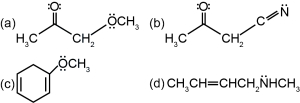
A
$ CH_3COCH_2OCH_3$
B
$CH_3COCH_2CN$
C
$C_6H_7OCH_3$
D
$CH_3CH=CHCH_2NHCH_3$
Solution
(C) lone pair of electrons is considered delocalised if it is in conjugation with a $\pi$-bond (i.e.,separated by one single bond).
In option $(a)$,the oxygen lone pair is separated from the carbonyl group by a $-CH_2-$ group,so it is localised.
In option $(b)$,the nitrogen lone pair is separated from the carbonyl group by a $-CH_2-$ group,so it is localised.
In option $(c)$,the oxygen atom is directly attached to the double bond of the ring. The lone pair on oxygen is in conjugation with the $\pi$-electrons of the double bond,making it delocalised.
In option $(d)$,the nitrogen lone pair is separated from the double bond by a $-CH_2-$ group,so it is localised.
Therefore,only the molecule in option $(c)$ has a delocalised lone pair.
In option $(a)$,the oxygen lone pair is separated from the carbonyl group by a $-CH_2-$ group,so it is localised.
In option $(b)$,the nitrogen lone pair is separated from the carbonyl group by a $-CH_2-$ group,so it is localised.
In option $(c)$,the oxygen atom is directly attached to the double bond of the ring. The lone pair on oxygen is in conjugation with the $\pi$-electrons of the double bond,making it delocalised.
In option $(d)$,the nitrogen lone pair is separated from the double bond by a $-CH_2-$ group,so it is localised.
Therefore,only the molecule in option $(c)$ has a delocalised lone pair.
0 likesView Solution
8
ChemistryEasyMCQWBJEE · 2019
The indicated atom is not a nucleophilic site in
A
$BH_{4}^{-}$ (atom = $B$)
B
$CH_{3}MgBr$ (atom = $C$)
C
$CH_{3}OH$ (atom = $O$)
D
$CH_{3}NH_{2}$ (atom = $N$)
Solution
(A) nucleophile is a species that can donate an electron pair to form a chemical bond.
In $BH_{4}^{-}$,the boron $(B)$ atom has a formal negative charge but it has no lone pair of electrons available for donation.
In $CH_{3}MgBr$,the carbon $(C)$ atom is nucleophilic due to the $C-Mg$ bond polarity.
In $CH_{3}OH$,the oxygen $(O)$ atom has two lone pairs.
In $CH_{3}NH_{2}$,the nitrogen $(N)$ atom has one lone pair.
Therefore,the $B$ atom in $BH_{4}^{-}$ is not a nucleophilic site.
Hence,the correct option is $A$.
In $BH_{4}^{-}$,the boron $(B)$ atom has a formal negative charge but it has no lone pair of electrons available for donation.
In $CH_{3}MgBr$,the carbon $(C)$ atom is nucleophilic due to the $C-Mg$ bond polarity.
In $CH_{3}OH$,the oxygen $(O)$ atom has two lone pairs.
In $CH_{3}NH_{2}$,the nitrogen $(N)$ atom has one lone pair.
Therefore,the $B$ atom in $BH_{4}^{-}$ is not a nucleophilic site.
Hence,the correct option is $A$.
0 likesView Solution
9
ChemistryDifficultMCQWBJEE · 2019
The conformations of $n$-butane,commonly known as eclipsed,gauche,and anti-conformations,can be interconverted by:
A
rotation around $C-H$ bond of a methyl group
B
rotation around $C-H$ bond of a methylene group
C
rotation around $C1-C2$ linkage
D
rotation around $C2-C3$ linkage
Solution
(D) The conformations of $n$-butane (eclipsed,gauche,and anti) are generated by the rotation around the $C2-C3$ sigma bond. This rotation changes the dihedral angle between the two methyl groups attached to the $C2$ and $C3$ carbons,leading to different energy states.
Hence,the correct option is $(d)$.
Hence,the correct option is $(d)$.
0 likesView Solution
10
ChemistryMediumMCQWBJEE · 2019
The compound$(s)$,capable of producing an achiral compound on heating at $100^{\circ} C$ is/are:
A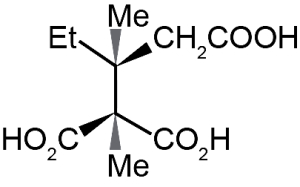
B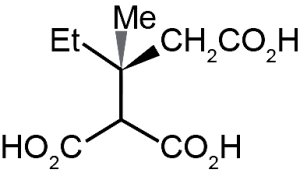
C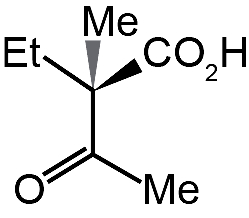
D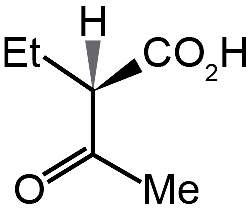
Solution
(D) Heating $\beta$-keto acids or substituted malonic acids leads to decarboxylation (loss of $CO_2$).
For a compound to become achiral after decarboxylation,the resulting product must have a plane of symmetry,a center of symmetry,or be a molecule where the chiral center is destroyed (i.e.,the carbon atom becomes bonded to two identical groups).
In option $(D)$,the starting material is $2$-ethyl-$3$-oxobutanoic acid derivative. Upon heating,it undergoes decarboxylation to form $2$-butanone (or a similar derivative depending on the specific structure). Specifically,the structure in $(D)$ is $2$-ethyl-$3$-oxobutanoic acid. Upon decarboxylation,the chiral center at the $\alpha$-carbon (which has $H$,$Et$,$CO_2H$,and $COCH_3$ groups) loses the $CO_2H$ group and gains an $H$ atom. If the resulting product has two identical groups attached to the central carbon (e.g.,two $H$ atoms or two $Et$ groups),it becomes achiral.
Looking at the provided solution image,the transformation in $(d)$ results in a molecule where the central carbon is bonded to $H$,$Et$,$Me$,and $H$ (if the $CO_2H$ is replaced by $H$). Wait,the image shows the product of $(d)$ as having $H$,$Et$,$Me$,and $H$ attached to the central carbon,making it achiral because it has two identical $H$ atoms.
For a compound to become achiral after decarboxylation,the resulting product must have a plane of symmetry,a center of symmetry,or be a molecule where the chiral center is destroyed (i.e.,the carbon atom becomes bonded to two identical groups).
In option $(D)$,the starting material is $2$-ethyl-$3$-oxobutanoic acid derivative. Upon heating,it undergoes decarboxylation to form $2$-butanone (or a similar derivative depending on the specific structure). Specifically,the structure in $(D)$ is $2$-ethyl-$3$-oxobutanoic acid. Upon decarboxylation,the chiral center at the $\alpha$-carbon (which has $H$,$Et$,$CO_2H$,and $COCH_3$ groups) loses the $CO_2H$ group and gains an $H$ atom. If the resulting product has two identical groups attached to the central carbon (e.g.,two $H$ atoms or two $Et$ groups),it becomes achiral.
Looking at the provided solution image,the transformation in $(d)$ results in a molecule where the central carbon is bonded to $H$,$Et$,$Me$,and $H$ (if the $CO_2H$ is replaced by $H$). Wait,the image shows the product of $(d)$ as having $H$,$Et$,$Me$,and $H$ attached to the central carbon,making it achiral because it has two identical $H$ atoms.
0 likesView Solution
11
ChemistryDifficultMCQWBJEE · 2019
Which of the following mixtures will have the lowest $pH$ at $298 \ K$?
A
$10 \ mL$ $0.05 \ N$ $CH_{3}COOH + 5 \ mL$ $0.1 \ N$ $NH_{4}OH$
B
$5 \ mL$ $0.2 \ N$ $NH_{4}Cl + 5 \ mL$ $0.2 \ N$ $NH_{4}OH$
C
$5 \ mL$ $0.1 \ N$ $CH_{3}COOH + 10 \ mL$ $0.05 \ N$ $CH_{3}COONa$
D
$5 \ mL$ $0.1 \ N$ $CH_{3}COOH + 5 \ mL$ $0.1 \ N$ $NaOH$
Solution
(C) To determine the lowest $pH$,we analyze the nature of each mixture:
$(A)$ $10 \ mL$ $0.05 \ N$ $CH_{3}COOH$ $(0.5 \ mmol)$ + $5 \ mL$ $0.1 \ N$ $NH_{4}OH$ $(0.5 \ mmol)$ forms a salt of weak acid and weak base $(CH_{3}COONH_{4})$,which is nearly neutral.
$(B)$ $5 \ mL$ $0.2 \ N$ $NH_{4}Cl$ + $5 \ mL$ $0.2 \ N$ $NH_{4}OH$ forms a basic buffer $(pH > 7)$.
$(C)$ $5 \ mL$ $0.1 \ N$ $CH_{3}COOH$ $(0.5 \ mmol)$ + $10 \ mL$ $0.05 \ N$ $CH_{3}COONa$ $(0.5 \ mmol)$ forms an acidic buffer where $pH = pK_{a} + \log(\frac{[Salt]}{[Acid]})$. Since $[Salt] = [Acid]$,$pH = pK_{a} \approx 4.76$.
$(D)$ $5 \ mL$ $0.1 \ N$ $CH_{3}COOH$ + $5 \ mL$ $0.1 \ N$ $NaOH$ forms $CH_{3}COONa$,which undergoes anionic hydrolysis,resulting in a basic solution $(pH > 7)$.
Comparing these,the acidic buffer in option $(C)$ has the lowest $pH$.
$(A)$ $10 \ mL$ $0.05 \ N$ $CH_{3}COOH$ $(0.5 \ mmol)$ + $5 \ mL$ $0.1 \ N$ $NH_{4}OH$ $(0.5 \ mmol)$ forms a salt of weak acid and weak base $(CH_{3}COONH_{4})$,which is nearly neutral.
$(B)$ $5 \ mL$ $0.2 \ N$ $NH_{4}Cl$ + $5 \ mL$ $0.2 \ N$ $NH_{4}OH$ forms a basic buffer $(pH > 7)$.
$(C)$ $5 \ mL$ $0.1 \ N$ $CH_{3}COOH$ $(0.5 \ mmol)$ + $10 \ mL$ $0.05 \ N$ $CH_{3}COONa$ $(0.5 \ mmol)$ forms an acidic buffer where $pH = pK_{a} + \log(\frac{[Salt]}{[Acid]})$. Since $[Salt] = [Acid]$,$pH = pK_{a} \approx 4.76$.
$(D)$ $5 \ mL$ $0.1 \ N$ $CH_{3}COOH$ + $5 \ mL$ $0.1 \ N$ $NaOH$ forms $CH_{3}COONa$,which undergoes anionic hydrolysis,resulting in a basic solution $(pH > 7)$.
Comparing these,the acidic buffer in option $(C)$ has the lowest $pH$.
0 likesView Solution
12
ChemistryEasyMCQWBJEE · 2019
The correct order of the addition reaction rates of halogen acids with ethylene is
A
$HCl > HBr > HI$
B
$HI > HBr > HCl$
C
$HBr > HCl > HI$
D
$HI > HCl > HBr$
Solution
(B) In halogen acids,as the size of the halogen atom increases,the bond strength between the halogen and hydrogen atom decreases.
This makes the $H-X$ bond easier to break,facilitating the electrophilic addition reaction.
The bond dissociation energy follows the order: $HCl > HBr > HI$.
Therefore,the reactivity order for the addition reaction with ethylene is $HI > HBr > HCl$.
Thus,the correct option is $(B)$.
This makes the $H-X$ bond easier to break,facilitating the electrophilic addition reaction.
The bond dissociation energy follows the order: $HCl > HBr > HI$.
Therefore,the reactivity order for the addition reaction with ethylene is $HI > HBr > HCl$.
Thus,the correct option is $(B)$.
0 likesView Solution
13
ChemistryMediumMCQWBJEE · 2019
In the crystalline solid $MSO_{4} \cdot nH_{2}O$ of molar mass $250 \ g \ mol^{-1}$,the percentage of anhydrous salt is $64$ by weight. The value of $n$ is
A
$2$
B
$3$
C
$5$
D
$7$
Solution
(C) The molar mass of the crystalline solid $MSO_{4} \cdot nH_{2}O$ is $250 \ g \ mol^{-1}$.
Given that the percentage of anhydrous salt $(MSO_{4})$ is $64\%$,the percentage of water $(H_{2}O)$ is $100\% - 64\% = 36\%$.
Mass of $H_{2}O = \frac{36}{100} \times 250 = 90 \ g$.
Moles of $H_{2}O = \frac{90 \ g}{18 \ g \ mol^{-1}} = 5 \ mol$.
Since the formula is $MSO_{4} \cdot nH_{2}O$,the value of $n$ corresponds to the number of moles of water,which is $5$.
Hence,option $(C)$ is the correct answer.
Given that the percentage of anhydrous salt $(MSO_{4})$ is $64\%$,the percentage of water $(H_{2}O)$ is $100\% - 64\% = 36\%$.
Mass of $H_{2}O = \frac{36}{100} \times 250 = 90 \ g$.
Moles of $H_{2}O = \frac{90 \ g}{18 \ g \ mol^{-1}} = 5 \ mol$.
Since the formula is $MSO_{4} \cdot nH_{2}O$,the value of $n$ corresponds to the number of moles of water,which is $5$.
Hence,option $(C)$ is the correct answer.
0 likesView Solution
14
ChemistryDifficultMCQWBJEE · 2019
At $S.T.P.$,the volume of $7.5 \ g$ of a gas is $5.6 \ L$. The gas is
A
$NO$
B
$N_{2}O$
C
$CO$
D
$CO_{2}$
Solution
(A) Given,mass of gas $(W) = 7.5 \ g$.
Volume of gas at $STP$ $(V) = 5.6 \ L$.
Since,moles of gas at $STP = \frac{V(L)}{22.4 \ L} = \frac{W}{M}$,where $M$ is the molar mass of the gas.
Therefore,$M = \frac{W \times 22.4}{V}$.
$M = \frac{7.5 \times 22.4}{5.6} = 30.00 \ g \ mol^{-1}$.
Among the given options,the molar mass $(M)$ of:
$(A) \ NO = 14 + 16 = 30.00 \ g \ mol^{-1}$.
$(B) \ N_{2}O = 28 + 16 = 44.00 \ g \ mol^{-1}$.
$(C) \ CO = 12 + 16 = 28.00 \ g \ mol^{-1}$.
$(D) \ CO_{2} = 12 + 32 = 44.00 \ g \ mol^{-1}$.
Since the molar mass of $NO$ is $30 \ g \ mol^{-1}$,the given gas is $NO$.
Hence,$A$ is the correct option.
Volume of gas at $STP$ $(V) = 5.6 \ L$.
Since,moles of gas at $STP = \frac{V(L)}{22.4 \ L} = \frac{W}{M}$,where $M$ is the molar mass of the gas.
Therefore,$M = \frac{W \times 22.4}{V}$.
$M = \frac{7.5 \times 22.4}{5.6} = 30.00 \ g \ mol^{-1}$.
Among the given options,the molar mass $(M)$ of:
$(A) \ NO = 14 + 16 = 30.00 \ g \ mol^{-1}$.
$(B) \ N_{2}O = 28 + 16 = 44.00 \ g \ mol^{-1}$.
$(C) \ CO = 12 + 16 = 28.00 \ g \ mol^{-1}$.
$(D) \ CO_{2} = 12 + 32 = 44.00 \ g \ mol^{-1}$.
Since the molar mass of $NO$ is $30 \ g \ mol^{-1}$,the given gas is $NO$.
Hence,$A$ is the correct option.
0 likesView Solution
15
ChemistryMediumMCQWBJEE · 2019
The quantity $h \nu / K_{B}$ corresponds to
A
wavelength
B
velocity
C
temperature
D
angular momentum
Solution
(C) The quantity $h \nu / K_{B}$ is related to the characteristic temperature of a system.
According to the kinetic theory of gases,the average kinetic energy of a gas molecule is given by $\frac{3}{2} K_{B} T$.
Equating the energy of a photon or quantum of energy $h \nu$ to the thermal energy $K_{B} T$,we get $h \nu = K_{B} T$.
Thus,$\frac{h \nu}{K_{B}} = T$.
Therefore,the quantity $\frac{h \nu}{K_{B}}$ has the dimensions of temperature.
Hence,option $C$ is correct.
According to the kinetic theory of gases,the average kinetic energy of a gas molecule is given by $\frac{3}{2} K_{B} T$.
Equating the energy of a photon or quantum of energy $h \nu$ to the thermal energy $K_{B} T$,we get $h \nu = K_{B} T$.
Thus,$\frac{h \nu}{K_{B}} = T$.
Therefore,the quantity $\frac{h \nu}{K_{B}}$ has the dimensions of temperature.
Hence,option $C$ is correct.
0 likesView Solution
16
ChemistryMediumMCQWBJEE · 2019
For a van der Waals' gas,the term $\left(\frac{a b}{V^{2}}\right)$ represents some
A
pressure
B
energy
C
critical density
D
molar mass
Solution
(B) The dimensions of the term $\left(\frac{a b}{V^{2}}\right)$ can be analyzed as follows:
In the van der Waals' equation,the term $\left(\frac{a}{V^{2}}\right)$ has the dimensions of pressure $(P)$.
Therefore,$\left(\frac{a}{V^{2}}\right) \times b = \text{Pressure} \times \text{Volume}$.
Since $\text{Pressure} = \frac{\text{Force}}{\text{Area}}$,we have $\text{Pressure} \times \text{Volume} = \frac{\text{Force}}{\text{Area}} \times \text{Volume} = \frac{MLT^{-2}}{L^{2}} \times L^{3} = ML^{2} T^{-2}$.
This dimension $(ML^{2} T^{-2})$ corresponds to energy (joule).
Thus,the term $\left(\frac{a b}{V^{2}}\right)$ represents energy.
In the van der Waals' equation,the term $\left(\frac{a}{V^{2}}\right)$ has the dimensions of pressure $(P)$.
Therefore,$\left(\frac{a}{V^{2}}\right) \times b = \text{Pressure} \times \text{Volume}$.
Since $\text{Pressure} = \frac{\text{Force}}{\text{Area}}$,we have $\text{Pressure} \times \text{Volume} = \frac{\text{Force}}{\text{Area}} \times \text{Volume} = \frac{MLT^{-2}}{L^{2}} \times L^{3} = ML^{2} T^{-2}$.
This dimension $(ML^{2} T^{-2})$ corresponds to energy (joule).
Thus,the term $\left(\frac{a b}{V^{2}}\right)$ represents energy.
0 likesView Solution
17
ChemistryMCQWBJEE · 2019
$A$ variable circle passes through the fixed point $A(p, q)$ and touches the $X$-axis. The locus of the other end of the diameter through $A$ is
A
$(x-p)^{2}=4 q y$
B
$(x-q)^{2}=4 p y$
C
$(y-p)^{2}=4 q x$
D
$(y-q)^{2}=4 p x$
Solution
(A) Let the coordinates of the fixed point $A$ be $(p, q)$ and the coordinates of the other end of the diameter $B$ be $(x, y)$.
Since $AB$ is the diameter,the center of the circle is the midpoint of $AB$,which is $(\frac{x+p}{2}, \frac{y+q}{2})$.
The radius of the circle is the distance from the center to $A$,which is $\sqrt{(\frac{x+p}{2}-p)^{2} + (\frac{y+q}{2}-q)^{2}} = \sqrt{(\frac{x-p}{2})^{2} + (\frac{y-q}{2})^{2}}$.
Since the circle touches the $X$-axis,the radius is equal to the absolute value of the $y$-coordinate of the center,so $r = |\frac{y+q}{2}|$.
Squaring both sides,we get $(\frac{x-p}{2})^{2} + (\frac{y-q}{2})^{2} = (\frac{y+q}{2})^{2}$.
Multiplying by $4$,we get $(x-p)^{2} + (y-q)^{2} = (y+q)^{2}$.
$(x-p)^{2} + y^{2} - 2qy + q^{2} = y^{2} + 2qy + q^{2}$.
$(x-p)^{2} = 4qy$.
Since $AB$ is the diameter,the center of the circle is the midpoint of $AB$,which is $(\frac{x+p}{2}, \frac{y+q}{2})$.
The radius of the circle is the distance from the center to $A$,which is $\sqrt{(\frac{x+p}{2}-p)^{2} + (\frac{y+q}{2}-q)^{2}} = \sqrt{(\frac{x-p}{2})^{2} + (\frac{y-q}{2})^{2}}$.
Since the circle touches the $X$-axis,the radius is equal to the absolute value of the $y$-coordinate of the center,so $r = |\frac{y+q}{2}|$.
Squaring both sides,we get $(\frac{x-p}{2})^{2} + (\frac{y-q}{2})^{2} = (\frac{y+q}{2})^{2}$.
Multiplying by $4$,we get $(x-p)^{2} + (y-q)^{2} = (y+q)^{2}$.
$(x-p)^{2} + y^{2} - 2qy + q^{2} = y^{2} + 2qy + q^{2}$.
$(x-p)^{2} = 4qy$.
0 likesView Solution
18
ChemistryMediumMCQWBJEE · 2019
Which of these species will have a non-zero magnetic moment?
A
$Na^{+}$
B
$Mg$
C
$F^{-}$
D
$Ar^{+}$
Solution
(D) Key point: Species with one or more unpaired electrons exhibit a non-zero magnetic moment.
Electronic configurations:
$Na^{+} (Z=11) = 1s^{2} 2s^{2} 2p^{6}$ (All electrons paired)
$Mg (Z=12) = 1s^{2} 2s^{2} 2p^{6} 3s^{2}$ (All electrons paired)
$F^{-} (Z=9) = 1s^{2} 2s^{2} 2p^{6}$ (All electrons paired)
$Ar^{+} (Z=18) = 1s^{2} 2s^{2} 2p^{6} 3s^{2} 3p^{5}$ (One unpaired electron in $3p$ orbital)
Since $Ar^{+}$ has an unpaired electron,it possesses a non-zero magnetic moment. Therefore,$(d)$ is the correct option.
Electronic configurations:
$Na^{+} (Z=11) = 1s^{2} 2s^{2} 2p^{6}$ (All electrons paired)
$Mg (Z=12) = 1s^{2} 2s^{2} 2p^{6} 3s^{2}$ (All electrons paired)
$F^{-} (Z=9) = 1s^{2} 2s^{2} 2p^{6}$ (All electrons paired)
$Ar^{+} (Z=18) = 1s^{2} 2s^{2} 2p^{6} 3s^{2} 3p^{5}$ (One unpaired electron in $3p$ orbital)
Since $Ar^{+}$ has an unpaired electron,it possesses a non-zero magnetic moment. Therefore,$(d)$ is the correct option.
0 likesView Solution
19
ChemistryMediumMCQWBJEE · 2019
Which one of the following electronic arrangements is absurd?
A
$n=3, l=1, m=-1$
B
$n=3, l=0, m=0$
C
$n=2, l=0, m=-1$
D
$n=2, l=1, m=0$
Solution
(C) For a given value of azimuthal quantum number $l$,the magnetic quantum number $m$ can have values ranging from $-l$ to $+l$ (including zero).
If $l=0$,then $m$ must be $0$.
In option $(c)$,$l=0$ but $m=-1$,which violates the rule $-l \leq m \leq l$.
Therefore,the arrangement $n=2, l=0, m=-1$ is impossible and absurd.
If $l=0$,then $m$ must be $0$.
In option $(c)$,$l=0$ but $m=-1$,which violates the rule $-l \leq m \leq l$.
Therefore,the arrangement $n=2, l=0, m=-1$ is impossible and absurd.
0 likesView Solution
20
ChemistryDifficultMCQWBJEE · 2019
At constant pressure,the heat of formation of a compound is not dependent on temperature,when
A
$ \Delta C_{p} = 0 $
B
$ \Delta C_{v} = 0 $
C
$ \Delta C_{p} > 0 $
D
$ \Delta C_{p} < 0 $
Solution
(A) According to Kirchhoff's equation,the variation of enthalpy of reaction with temperature is given by:
$ \Delta H_{T_2} = \Delta H_{T_1} + \int_{T_1}^{T_2} \Delta C_{p} \, dT $
If $ \Delta C_{p} = 0 $,then the integral term becomes zero.
This implies that $ \Delta H_{T_2} = \Delta H_{T_1} $,meaning the heat of formation is independent of temperature.
Therefore,the correct condition is $ \Delta C_{p} = 0 $.
Hence,option $(A)$ is the correct answer.
$ \Delta H_{T_2} = \Delta H_{T_1} + \int_{T_1}^{T_2} \Delta C_{p} \, dT $
If $ \Delta C_{p} = 0 $,then the integral term becomes zero.
This implies that $ \Delta H_{T_2} = \Delta H_{T_1} $,meaning the heat of formation is independent of temperature.
Therefore,the correct condition is $ \Delta C_{p} = 0 $.
Hence,option $(A)$ is the correct answer.
0 likesView Solution
21
ChemistryDifficultMCQWBJEE · 2019
Identify the correct statement$(s)$:
A
The oxidation number of $Cr$ in $CrO_{5}$ is $+6$.
B
$\Delta H > \Delta U$ for the reaction $N_{2}O_{4(g)} \rightarrow 2NO_{2(g)}$ provided both gases behave ideally.
C
$pH$ of $0.1 \ N \ H_{2}SO_{4}$ is less than that of $0.1 \ N \ HCl$ at $25^{\circ} C$.
D
$\left(\frac{RT}{F}\right) = 0.0591 \ V$ at $25^{\circ} C$.
Solution
(A, B) Statement $(a)$ is correct: In $CrO_{5}$ (butterfly structure),the oxidation number of $Cr$ is $+6$.
Statement $(b)$ is correct: For the reaction $N_{2}O_{4(g)} \rightarrow 2NO_{2(g)}$,$\Delta n_{g} = 2 - 1 = 1$. Since $\Delta H = \Delta U + \Delta n_{g}RT$,and $\Delta n_{g} > 0$,we have $\Delta H > \Delta U$.
Statement $(c)$ is incorrect: For $0.1 \ N \ H_{2}SO_{4}$,$[H^{+}] = 0.1 \ M$,so $pH = -\log(0.1) = 1$. For $0.1 \ N \ HCl$,$[H^{+}] = 0.1 \ M$,so $pH = -\log(0.1) = 1$. Thus,$pH$ values are equal.
Statement $(d)$ is incorrect: At $25^{\circ} C$,$\frac{RT}{F} \approx 0.0257 \ V$. The value $0.0591 \ V$ corresponds to $\frac{2.303RT}{F}$.
Therefore,the correct statements are $(a)$ and $(b)$.
Statement $(b)$ is correct: For the reaction $N_{2}O_{4(g)} \rightarrow 2NO_{2(g)}$,$\Delta n_{g} = 2 - 1 = 1$. Since $\Delta H = \Delta U + \Delta n_{g}RT$,and $\Delta n_{g} > 0$,we have $\Delta H > \Delta U$.
Statement $(c)$ is incorrect: For $0.1 \ N \ H_{2}SO_{4}$,$[H^{+}] = 0.1 \ M$,so $pH = -\log(0.1) = 1$. For $0.1 \ N \ HCl$,$[H^{+}] = 0.1 \ M$,so $pH = -\log(0.1) = 1$. Thus,$pH$ values are equal.
Statement $(d)$ is incorrect: At $25^{\circ} C$,$\frac{RT}{F} \approx 0.0257 \ V$. The value $0.0591 \ V$ corresponds to $\frac{2.303RT}{F}$.
Therefore,the correct statements are $(a)$ and $(b)$.
0 likesView Solution
22
ChemistryEasyMCQWBJEE · 2019
For the equilibrium,$H_{2}O_{(l)} \rightleftharpoons H_{2}O_{(g)},$ which of the following is correct?
A
$\Delta G=0, \Delta H < 0, \Delta S < 0$
B
$\Delta G < 0, \Delta H > 0, \Delta S > 0$
C
$\Delta G > 0, \Delta H = 0, \Delta S > 0$
D
$\Delta G = 0, \Delta H > 0, \Delta S > 0$
Solution
(D) For the given equilibrium $H_{2}O_{(l)} \rightleftharpoons H_{2}O_{(g)}:$
$(I)$ At equilibrium,the Gibbs free energy change is $\Delta G = 0$.
$(II)$ Entropy change,$\Delta S$,measures the randomness of the system. Since the vapor state is more disordered than the liquid state,the entropy increases,meaning $\Delta S > 0$.
$(III)$ The conversion of liquid $H_{2}O$ to vapor $H_{2}O$ is an endothermic process,which requires the absorption of heat energy. Therefore,the enthalpy change is $\Delta H > 0$.
Thus,the correct set of conditions is $\Delta G = 0, \Delta H > 0, \text{ and } \Delta S > 0$.
Therefore,option $(D)$ is the correct answer.
$(I)$ At equilibrium,the Gibbs free energy change is $\Delta G = 0$.
$(II)$ Entropy change,$\Delta S$,measures the randomness of the system. Since the vapor state is more disordered than the liquid state,the entropy increases,meaning $\Delta S > 0$.
$(III)$ The conversion of liquid $H_{2}O$ to vapor $H_{2}O$ is an endothermic process,which requires the absorption of heat energy. Therefore,the enthalpy change is $\Delta H > 0$.
Thus,the correct set of conditions is $\Delta G = 0, \Delta H > 0, \text{ and } \Delta S > 0$.
Therefore,option $(D)$ is the correct answer.
0 likesView Solution
23
ChemistryEasyMCQWBJEE · 2019
Cyclopentanol on reaction with $NaH$ followed by $CS_{2}$ and $CH_{3}I$ produces a/an
A
ketone
B
alkene
C
ether
D
xanthate
Solution
(D) The reaction of cyclopentanol with $NaH$ forms a sodium alkoxide intermediate.
This alkoxide then reacts with $CS_{2}$ to form a sodium xanthate salt.
Finally,the reaction with $CH_{3}I$ (methyl iodide) results in the formation of a methyl xanthate ester.
This sequence is known as the Chugaev elimination precursor synthesis.
Therefore,the product is a xanthate.
Thus,option $(d)$ is the correct answer.
This alkoxide then reacts with $CS_{2}$ to form a sodium xanthate salt.
Finally,the reaction with $CH_{3}I$ (methyl iodide) results in the formation of a methyl xanthate ester.
This sequence is known as the Chugaev elimination precursor synthesis.
Therefore,the product is a xanthate.
Thus,option $(d)$ is the correct answer.
0 likesView Solution
24
ChemistryEasyMCQWBJEE · 2019
Oxidation of allyl alcohol with a peracid gives a compound of molecular formula $C_3H_6O_2$,which contains an asymmetric carbon atom. The structure of the compound is
A
$CH_2(OH)-CH(OH)-CH_3$
B
$CH_2(OH)-CH_2-CHO$
C
$CH_2(O)CH-CH_2OH$ (glycidol)
D
$CH_3-CH(OH)-CHO$
Solution
(C) The oxidation of allyl alcohol $(CH_2=CH-CH_2OH)$ with a peracid $(RCO_3H)$ is an epoxidation reaction.
This reaction yields glycidol,which has the molecular formula $C_3H_6O_2$.
The structure of glycidol is $CH_2(O)CH-CH_2OH$ (or $2,3-$epoxypropan$-1-$ol).
In this molecule,the carbon atom at the $C-2$ position is bonded to four different groups ($-H$,$-CH_2OH$,and the two carbons of the epoxide ring),making it an asymmetric (chiral) carbon atom.
Therefore,the correct structure is $CH_2(O)CH-CH_2OH$.
This reaction yields glycidol,which has the molecular formula $C_3H_6O_2$.
The structure of glycidol is $CH_2(O)CH-CH_2OH$ (or $2,3-$epoxypropan$-1-$ol).
In this molecule,the carbon atom at the $C-2$ position is bonded to four different groups ($-H$,$-CH_2OH$,and the two carbons of the epoxide ring),making it an asymmetric (chiral) carbon atom.
Therefore,the correct structure is $CH_2(O)CH-CH_2OH$.
0 likesView Solution
25
ChemistryEasyMCQWBJEE · 2019
One of the products of the following reaction is $P$. Structure of $P$ is
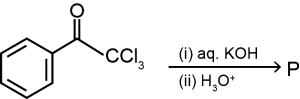
A
Phenylglyoxylic acid
B
Benzaldehyde
C
Benzoic acid
D
$2,2-$dichloro$-2-$hydroxyacetophenone
Solution
(C) $2,2,2-$trichloroacetophenone reacts with aqueous $KOH$ via a haloform-like cleavage reaction. The hydroxide ion attacks the carbonyl carbon,followed by the departure of the stable $CHCl_3$ (chloroform) leaving group to form the potassium salt of benzoic acid. Subsequent acidification with $H_3O^+$ yields benzoic acid as the final product $P$.
Thus,option $(c)$ is the correct answer.
Thus,option $(c)$ is the correct answer.
0 likesView Solution
26
ChemistryEasyMCQWBJEE · 2019
For the reaction below,the product is $Q$.
The compound $Q$ is
The compound $Q$ is

A
$4-$acetoxybenzoic acid
B
Methyl $4-$hydroxybenzoate
C
$3-$acetyl$-4-$hydroxybenzoic acid
D
$4-$hydroxy$-3-$acetylbenzoic acid
Solution
(A) The reaction of $4$-hydroxybenzoic acid with acetic anhydride in the presence of conc. $H_{2}SO_{4}$ and heat is an acetylation reaction.
The phenolic $-OH$ group acts as a nucleophile and attacks the carbonyl carbon of the acetic anhydride,leading to the formation of an ester group $(-OCOCH_{3})$.
The product $Q$ is $4$-acetoxybenzoic acid,which has the molecular formula $C_{9}H_{8}O_{4}$.
Thus,option $(A)$ is the correct answer.
The phenolic $-OH$ group acts as a nucleophile and attacks the carbonyl carbon of the acetic anhydride,leading to the formation of an ester group $(-OCOCH_{3})$.
The product $Q$ is $4$-acetoxybenzoic acid,which has the molecular formula $C_{9}H_{8}O_{4}$.
Thus,option $(A)$ is the correct answer.
0 likesView Solution
27
ChemistryEasyMCQWBJEE · 2019
The compound,which evolves carbon dioxide on treatment with an aqueous solution of sodium bicarbonate at $25^{\circ} C$,is
A
$C_6H_5OH$
B
$CH_3COCl$
C
$CH_3CONH_2$
D
$CH_3COOC_2H_5$
Solution
(B) $CH_3COCl$ (acetyl chloride) is highly reactive and hydrolyzes to form $CH_3COOH$ (acetic acid) even at $25^{\circ} C$.
Acetic acid is a stronger acid than carbonic acid $(H_2CO_3)$,so it reacts with $NaHCO_3$ to evolve $CO_2$ gas.
The reaction is:
$CH_3COCl + H_2O \longrightarrow CH_3COOH + HCl$
$CH_3COOH + NaHCO_3 \longrightarrow CH_3COONa + H_2O + CO_2 \uparrow$
Thus,option $(B)$ is the correct answer.
Acetic acid is a stronger acid than carbonic acid $(H_2CO_3)$,so it reacts with $NaHCO_3$ to evolve $CO_2$ gas.
The reaction is:
$CH_3COCl + H_2O \longrightarrow CH_3COOH + HCl$
$CH_3COOH + NaHCO_3 \longrightarrow CH_3COONa + H_2O + CO_2 \uparrow$
Thus,option $(B)$ is the correct answer.
0 likesView Solution
28
ChemistryMediumMCQWBJEE · 2019
The kinetic study of a reaction like $vA \rightarrow P$ at $300 \ K$ provides the following curve,where concentration is taken in $mol \ dm^{-3}$ and time in $min$. Identify the correct order $(n)$ and rate constant $(k)$.
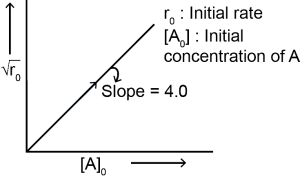
A
$n=0, k=4.0 \ mol \ dm^{-3} \ min^{-1}$
B
$n=1/2, k=2.0 \ mol^{1/2} \ dm^{-3/2} \ min^{-1}$
C
$n=1, k=80 \ min^{-1}$
D
$n=2, k=16.0 \ dm^3 \ mol^{-1} \ min^{-1}$
Solution
(D) The rate law for the reaction is given by $r = k[A]^n$.
Taking the square root on both sides,we get $\sqrt{r} = \sqrt{k} \times [A]^{n/2}$.
The given graph is a plot of $\sqrt{r_0}$ versus $[A]_0$,which is a straight line passing through the origin.
Comparing this with the equation $y = mx$,we have $y = \sqrt{r_0}$,$x = [A]_0$,and slope $m = \sqrt{k}$.
From the graph,the slope is $4.0$.
Therefore,$\sqrt{k} = 4.0$,which implies $k = (4.0)^2 = 16.0$.
Also,comparing the powers of $[A]$,we have $n/2 = 1$,which gives $n = 2$.
Thus,the order of the reaction is $n = 2$ and the rate constant is $k = 16.0 \ dm^3 \ mol^{-1} \ min^{-1}$.
Hence,option $(d)$ is the correct answer.
Taking the square root on both sides,we get $\sqrt{r} = \sqrt{k} \times [A]^{n/2}$.
The given graph is a plot of $\sqrt{r_0}$ versus $[A]_0$,which is a straight line passing through the origin.
Comparing this with the equation $y = mx$,we have $y = \sqrt{r_0}$,$x = [A]_0$,and slope $m = \sqrt{k}$.
From the graph,the slope is $4.0$.
Therefore,$\sqrt{k} = 4.0$,which implies $k = (4.0)^2 = 16.0$.
Also,comparing the powers of $[A]$,we have $n/2 = 1$,which gives $n = 2$.
Thus,the order of the reaction is $n = 2$ and the rate constant is $k = 16.0 \ dm^3 \ mol^{-1} \ min^{-1}$.
Hence,option $(d)$ is the correct answer.
0 likesView Solution
29
ChemistryMediumMCQWBJEE · 2019
Consider the following two first order reactions occurring at $298 \ K$ with same initial concentration of $A$: $(1)$ $A \rightarrow B$; rate constant,$k=0.693 \ min^{-1}$ $(2)$ $A \rightarrow C$; half-life,$t_{1/2}=0.693 \ min$. Choose the correct option.
A
Reaction $(1)$ is faster than reaction $(2)$.
B
Reaction $(1)$ is slower than reaction $(2)$.
C
Both reactions proceed at the same rate.
D
Since two different products are formed,rates cannot be compared.
Solution
(B) For a first order reaction,the relationship between half-life $(t_{1/2})$ and rate constant $(k)$ is given by $t_{1/2} = \frac{0.693}{k}$.
For reaction $(1)$: $A \rightarrow B$,$k = 0.693 \ min^{-1}$. Therefore,$t_{1/2} = \frac{0.693}{0.693} = 1.0 \ min$.
For reaction $(2)$: $A \rightarrow C$,$t_{1/2} = 0.693 \ min$. Therefore,$k = \frac{0.693}{0.693} = 1.0 \ min^{-1}$.
Comparing the rate constants,for reaction $(1)$,$k = 0.693 \ min^{-1}$ and for reaction $(2)$,$k = 1.0 \ min^{-1}$.
Since the rate of a first order reaction is $Rate = k[A]$,and the initial concentration of $A$ is the same for both,the reaction with the higher rate constant is faster.
Since $1.0 > 0.693$,reaction $(2)$ is faster than reaction $(1)$,meaning reaction $(1)$ is slower than reaction $(2)$.
For reaction $(1)$: $A \rightarrow B$,$k = 0.693 \ min^{-1}$. Therefore,$t_{1/2} = \frac{0.693}{0.693} = 1.0 \ min$.
For reaction $(2)$: $A \rightarrow C$,$t_{1/2} = 0.693 \ min$. Therefore,$k = \frac{0.693}{0.693} = 1.0 \ min^{-1}$.
Comparing the rate constants,for reaction $(1)$,$k = 0.693 \ min^{-1}$ and for reaction $(2)$,$k = 1.0 \ min^{-1}$.
Since the rate of a first order reaction is $Rate = k[A]$,and the initial concentration of $A$ is the same for both,the reaction with the higher rate constant is faster.
Since $1.0 > 0.693$,reaction $(2)$ is faster than reaction $(1)$,meaning reaction $(1)$ is slower than reaction $(2)$.
0 likesView Solution
30
ChemistryMediumMCQWBJEE · 2019
The half-life period of ${}_{53}I^{125}$ is $60$ days. The radioactivity after $180$ days will be (in $\%$)
A
$25$
B
$12.5$
C
$33.3$
D
$3.0$
Solution
(B) Let the initial radioactivity be $N_0 = 100 \%$.
Given,half-life period $(t_{1/2}) = 60$ days.
Total time $(T) = 180$ days.
The number of half-lives $(n)$ is calculated as:
$n = \frac{T}{t_{1/2}} = \frac{180}{60} = 3$.
The remaining radioactivity $(N)$ after $n$ half-lives is given by the formula:
$N = N_0 \times (\frac{1}{2})^n$.
Substituting the values:
$N = 100 \% \times (\frac{1}{2})^3 = 100 \% \times \frac{1}{8} = 12.5 \%$.
Therefore,the radioactivity after $180$ days will be $12.5 \%$.
Given,half-life period $(t_{1/2}) = 60$ days.
Total time $(T) = 180$ days.
The number of half-lives $(n)$ is calculated as:
$n = \frac{T}{t_{1/2}} = \frac{180}{60} = 3$.
The remaining radioactivity $(N)$ after $n$ half-lives is given by the formula:
$N = N_0 \times (\frac{1}{2})^n$.
Substituting the values:
$N = 100 \% \times (\frac{1}{2})^3 = 100 \% \times \frac{1}{8} = 12.5 \%$.
Therefore,the radioactivity after $180$ days will be $12.5 \%$.
0 likesView Solution
31
ChemistryEasyMCQWBJEE · 2019
Consider the radioactive disintegration ${}_{82}A^{210}$ $\rightarrow B$ $\rightarrow C$ $\rightarrow {}_{82}D^{206}$. The sequence of emission can be
A
$\beta, \beta, \beta$
B
$\alpha, \alpha, \beta$
C
$\beta, \beta, \gamma$
D
$\beta, \beta, \alpha$
Solution
(D) The initial nucleus is ${}_{82}A^{210}$ and the final nucleus is ${}_{82}D^{206}$.
The change in mass number is $210 - 206 = 4$ units,and the change in atomic number is $82 - 82 = 0$.
Emission of one $\alpha$-particle decreases the mass number by $4$ and the atomic number by $2$.
Emission of one $\beta$-particle keeps the mass number constant and increases the atomic number by $1$.
To keep the atomic number constant while decreasing the mass number by $4$,we need one $\alpha$-particle ($-2$ in atomic number) and two $\beta$-particles ($+2$ in atomic number).
The sequence is ${}_{82}A^{210}$ $\xrightarrow{-\beta} {}_{83}B^{210}$ $\xrightarrow{-\beta} {}_{84}C^{210}$ $\xrightarrow{-\alpha} {}_{82}D^{206}$.
Thus,the sequence of emission is $\beta, \beta, \alpha$.
The change in mass number is $210 - 206 = 4$ units,and the change in atomic number is $82 - 82 = 0$.
Emission of one $\alpha$-particle decreases the mass number by $4$ and the atomic number by $2$.
Emission of one $\beta$-particle keeps the mass number constant and increases the atomic number by $1$.
To keep the atomic number constant while decreasing the mass number by $4$,we need one $\alpha$-particle ($-2$ in atomic number) and two $\beta$-particles ($+2$ in atomic number).
The sequence is ${}_{82}A^{210}$ $\xrightarrow{-\beta} {}_{83}B^{210}$ $\xrightarrow{-\beta} {}_{84}C^{210}$ $\xrightarrow{-\alpha} {}_{82}D^{206}$.
Thus,the sequence of emission is $\beta, \beta, \alpha$.
0 likesView Solution
32
ChemistryDifficultMCQWBJEE · 2019
The conductivity measurement of a coordination compound of cobalt$(III)$ shows that it dissociates into $3$ ions in solution. The compound is
A
hexaamminecobalt$(III)$ chloride
B
pentaamminesulphatocobalt$(III)$ chloride
C
pentaamminechloridocobalt$(III)$ sulphate
D
pentaamminechloridocobalt$(III)$ chloride
Solution
(D) coordination compound of $Co(III)$ that dissociates into $3$ ions in solution must have two ionizable ions outside the coordination sphere,given the oxidation state of cobalt is $+3$.
$(A)$ $[Co(NH_{3})_{6}]Cl_{3} \rightarrow [Co(NH_{3})_{6}]^{3+} + 3Cl^{-}$ ($4$ ions)
$(B)$ $[Co(NH_{3})_{5}(SO_{4})]Cl \rightarrow [Co(NH_{3})_{5}(SO_{4})]^{+} + Cl^{-}$ ($2$ ions)
$(C)$ $[Co(NH_{3})_{5}Cl]SO_{4} \rightarrow [Co(NH_{3})_{5}Cl]^{2+} + SO_{4}^{2-}$ ($2$ ions)
$(D)$ $[Co(NH_{3})_{5}Cl]Cl_{2} \rightarrow [Co(NH_{3})_{5}Cl]^{2+} + 2Cl^{-}$ ($3$ ions)
Thus,the compound that dissociates into $3$ ions is $[Co(NH_{3})_{5}Cl]Cl_{2}$.
Hence,option $(D)$ is the correct answer.
$(A)$ $[Co(NH_{3})_{6}]Cl_{3} \rightarrow [Co(NH_{3})_{6}]^{3+} + 3Cl^{-}$ ($4$ ions)
$(B)$ $[Co(NH_{3})_{5}(SO_{4})]Cl \rightarrow [Co(NH_{3})_{5}(SO_{4})]^{+} + Cl^{-}$ ($2$ ions)
$(C)$ $[Co(NH_{3})_{5}Cl]SO_{4} \rightarrow [Co(NH_{3})_{5}Cl]^{2+} + SO_{4}^{2-}$ ($2$ ions)
$(D)$ $[Co(NH_{3})_{5}Cl]Cl_{2} \rightarrow [Co(NH_{3})_{5}Cl]^{2+} + 2Cl^{-}$ ($3$ ions)
Thus,the compound that dissociates into $3$ ions is $[Co(NH_{3})_{5}Cl]Cl_{2}$.
Hence,option $(D)$ is the correct answer.
0 likesView Solution
33
ChemistryMediumMCQWBJEE · 2019
Compounds with spin-only magnetic moment equivalent to five unpaired electrons are
A
$K_{4}[Mn(CN)_{6}]$
B
$[Fe(H_{2}O)_{6}]Cl_{3}$
C
$K_{3}[FeF_{6}]$
D
$K_{4}[MnF_{6}]$
Solution
(B, C, D) The spin-only magnetic moment is given by $\mu = \sqrt{n(n+2)} \text{ BM}$,where $n$ is the number of unpaired electrons. For $n=5$,$\mu = \sqrt{5(5+2)} = \sqrt{35} \approx 5.92 \text{ BM}$.
$(A)$ In $K_{4}[Mn(CN)_{6}]$,$Mn$ is in $+2$ oxidation state $(3d^{5})$. $CN^{-}$ is a strong field ligand,causing pairing of electrons. Thus,$n=1$.
$(B)$ In $[Fe(H_{2}O)_{6}]Cl_{3}$,$Fe$ is in $+3$ oxidation state $(3d^{5})$. $H_{2}O$ is a weak field ligand,so no pairing occurs. Thus,$n=5$.
$(C)$ In $K_{3}[FeF_{6}]$,$Fe$ is in $+3$ oxidation state $(3d^{5})$. $F^{-}$ is a weak field ligand,so no pairing occurs. Thus,$n=5$.
$(D)$ In $K_{4}[MnF_{6}]$,$Mn$ is in $+2$ oxidation state $(3d^{5})$. $F^{-}$ is a weak field ligand,so no pairing occurs. Thus,$n=5$.
Therefore,the compounds with five unpaired electrons are $(B)$,$(C)$,and $(D)$.
$(A)$ In $K_{4}[Mn(CN)_{6}]$,$Mn$ is in $+2$ oxidation state $(3d^{5})$. $CN^{-}$ is a strong field ligand,causing pairing of electrons. Thus,$n=1$.
$(B)$ In $[Fe(H_{2}O)_{6}]Cl_{3}$,$Fe$ is in $+3$ oxidation state $(3d^{5})$. $H_{2}O$ is a weak field ligand,so no pairing occurs. Thus,$n=5$.
$(C)$ In $K_{3}[FeF_{6}]$,$Fe$ is in $+3$ oxidation state $(3d^{5})$. $F^{-}$ is a weak field ligand,so no pairing occurs. Thus,$n=5$.
$(D)$ In $K_{4}[MnF_{6}]$,$Mn$ is in $+2$ oxidation state $(3d^{5})$. $F^{-}$ is a weak field ligand,so no pairing occurs. Thus,$n=5$.
Therefore,the compounds with five unpaired electrons are $(B)$,$(C)$,and $(D)$.
0 likesView Solution
34
ChemistryEasyMCQWBJEE · 2019
$A$ copper coin was electroplated with $Zn$ and then heated at high temperature until there is a change in colour. What will be the resulting colour?
A
white
B
black
C
silver
D
golden
Solution
(D) copper coin is electroplated with zinc $(Zn)$ and then heated at high temperature.
During heating,zinc atoms diffuse into the copper lattice to form an alloy.
The resulting alloy is brass,which has a characteristic golden colour.
This occurs because the zinc migrates through the copper to form the $\alpha$-form of brass alloy (where the percentage of $Cu > 65 \%$ and $Zn < 35 \%$).
$Zn + Cu \xrightarrow{\Delta} \text{Brass (Golden colour)}$.
Thus,the correct option is $(D)$.
During heating,zinc atoms diffuse into the copper lattice to form an alloy.
The resulting alloy is brass,which has a characteristic golden colour.
This occurs because the zinc migrates through the copper to form the $\alpha$-form of brass alloy (where the percentage of $Cu > 65 \%$ and $Zn < 35 \%$).
$Zn + Cu \xrightarrow{\Delta} \text{Brass (Golden colour)}$.
Thus,the correct option is $(D)$.
0 likesView Solution
35
ChemistryMediumMCQWBJEE · 2019
The second ionisation energy of the following elements follows the order
A
$Zn > Cd < Hg$
B
$Zn > Cd > Hg$
C
$Cd > Hg < Zn$
D
$Zn < Cd < Hg$
Solution
(A) Key Point: For elements with similar electronic configuration of the outermost shell,atomic size determines the value of ionisation energy. Larger size leads to lower ionisation energy.
Electronic configuration for $II^{nd}$ $I.E$:
$Zn^{+}$ ion $(Z=30) = [Ar] 3d^{10} 4s^{1} - (1734 \ kJ/mol)$
$Cd^{+}$ ion $(Z=48) = [Kr] 4d^{10} 5s^{1} - (1631 \ kJ/mol)$
$Hg^{+}$ ion $(Z=80) = [Xe] 4f^{14} 5d^{10} 6s^{1} - (1809 \ kJ/mol)$
Since the size of $Cd^{+} > Zn^{+}$,it has lower $II^{nd}$ ionisation energy. Due to the lanthanoid contraction (i.e.,poor screening by $4f$ and $5d$ electrons),$Hg^{+}$ has a higher $II^{nd}$ ionisation energy.
Hence,the correct order is $Zn > Cd < Hg$,and option $(A)$ is the correct answer.
Electronic configuration for $II^{nd}$ $I.E$:
$Zn^{+}$ ion $(Z=30) = [Ar] 3d^{10} 4s^{1} - (1734 \ kJ/mol)$
$Cd^{+}$ ion $(Z=48) = [Kr] 4d^{10} 5s^{1} - (1631 \ kJ/mol)$
$Hg^{+}$ ion $(Z=80) = [Xe] 4f^{14} 5d^{10} 6s^{1} - (1809 \ kJ/mol)$
Since the size of $Cd^{+} > Zn^{+}$,it has lower $II^{nd}$ ionisation energy. Due to the lanthanoid contraction (i.e.,poor screening by $4f$ and $5d$ electrons),$Hg^{+}$ has a higher $II^{nd}$ ionisation energy.
Hence,the correct order is $Zn > Cd < Hg$,and option $(A)$ is the correct answer.
0 likesView Solution
36
ChemistryEasyMCQWBJEE · 2019
Which atomic species cannot be used as a nuclear fuel?
A
$_{92}^{233}U$
B
$_{92}^{235}U$
C
$_{94}^{239}Pu$
D
$_{92}^{238}U$
Solution
(D) Among the given options,$_{92}^{238}U$ is an isotope of uranium but cannot be used as a nuclear fuel.
$_{92}^{238}U$ is non-fissile,meaning it does not undergo fission by thermal neutrons.
The energy released when $_{92}^{238}U$ absorbs a neutron is insufficient to carry out nuclear fission.
Hence,$(d)$ is the correct option.
$_{92}^{238}U$ is non-fissile,meaning it does not undergo fission by thermal neutrons.
The energy released when $_{92}^{238}U$ absorbs a neutron is insufficient to carry out nuclear fission.
Hence,$(d)$ is the correct option.
0 likesView Solution
37
ChemistryEasyMCQWBJEE · 2019
If electrolysis of aqueous $CuSO_4$ solution is carried out using $Cu$ electrodes,the reaction taking place at the anode is:
A
$H^{+} + e^{-} \rightarrow H$
B
$Cu^{2+}_{(aq)} + 2e^{-} \rightarrow Cu_{(s)}$
C
$S{O_{4}}^{2-}_{(aq)} - 2e^{-} \rightarrow SO_{4}$
D
$Cu_{(s)} - 2e^{-} \rightarrow Cu^{2+}_{(aq)}$
Solution
(D) During the electrolysis of aqueous $CuSO_4$ solution using $Cu$ electrodes,the following ions are present in the solution: $Cu^{2+}$,$H^{+}$,$SO_{4}^{2-}$,and $OH^{-}$.
At the cathode,$Cu^{2+}$ ions are reduced: $Cu^{2+}_{(aq)} + 2e^{-} \rightarrow Cu_{(s)}$.
At the anode,the $Cu$ electrode itself undergoes oxidation because it is an active electrode: $Cu_{(s)} - 2e^{-} \rightarrow Cu^{2+}_{(aq)}$.
Therefore,the correct option is $D$.
At the cathode,$Cu^{2+}$ ions are reduced: $Cu^{2+}_{(aq)} + 2e^{-} \rightarrow Cu_{(s)}$.
At the anode,the $Cu$ electrode itself undergoes oxidation because it is an active electrode: $Cu_{(s)} - 2e^{-} \rightarrow Cu^{2+}_{(aq)}$.
Therefore,the correct option is $D$.
0 likesView Solution
38
ChemistryDifficultMCQWBJEE · 2019
The total number of isomeric linear dipeptides which can be synthesised from racemic alanine is
A
$1$
B
$2$
C
$3$
D
$4$
Solution
(D) Alanine is a chiral amino acid with one chiral center. $A$ racemic mixture contains both $(R)$ and $(S)$ enantiomers.
When two alanine molecules combine to form a linear dipeptide,the resulting molecule has two chiral centers (one from each alanine residue).
Each chiral center can exist in either $(R)$ or $(S)$ configuration.
The possible combinations for the two chiral centers in the dipeptide are $(R, R)$,$(R, S)$,$(S, R)$,and $(S, S)$.
Since all these combinations represent distinct stereoisomers,there are $2^2 = 4$ possible isomeric linear dipeptides.
Therefore,the total number of isomeric linear dipeptides is $4$,and the correct option is $(d)$.
When two alanine molecules combine to form a linear dipeptide,the resulting molecule has two chiral centers (one from each alanine residue).
Each chiral center can exist in either $(R)$ or $(S)$ configuration.
The possible combinations for the two chiral centers in the dipeptide are $(R, R)$,$(R, S)$,$(S, R)$,and $(S, S)$.
Since all these combinations represent distinct stereoisomers,there are $2^2 = 4$ possible isomeric linear dipeptides.
Therefore,the total number of isomeric linear dipeptides is $4$,and the correct option is $(d)$.
0 likesView Solution
39
ChemistryEasyMCQWBJEE · 2019
In the Bayer's process,the leaching of alumina is done by using
A
$Na_{2}CO_{3}$
B
$NaOH$
C
$SiO_{2}$
D
$CaO$
Solution
(B) In the Bayer's process,the leaching of alumina is done by using $NaOH$.
$Al_{2}O_{3(s)} + 2 NaOH_{(aq)} \stackrel{150^{\circ}C, 35 \ atm}{\longrightarrow} 2 Na[Al(OH)_{4}] + 3 H_{2}O$
$2 Na[Al(OH)_{4}] + CO_{2} \rightarrow Al_{2}O_{3} \cdot x H_{2}O + 2 NaHCO_{3}$
$Al_{2}O_{3} \cdot x H_{2}O_{(s)} \xrightarrow{1470 \ K} Al_{2}O_{3(s)} + x H_{2}O_{(g)}$
So,the option $(b)$ is the correct answer.
$Al_{2}O_{3(s)} + 2 NaOH_{(aq)} \stackrel{150^{\circ}C, 35 \ atm}{\longrightarrow} 2 Na[Al(OH)_{4}] + 3 H_{2}O$
$2 Na[Al(OH)_{4}] + CO_{2} \rightarrow Al_{2}O_{3} \cdot x H_{2}O + 2 NaHCO_{3}$
$Al_{2}O_{3} \cdot x H_{2}O_{(s)} \xrightarrow{1470 \ K} Al_{2}O_{3(s)} + x H_{2}O_{(g)}$
So,the option $(b)$ is the correct answer.
0 likesView Solution
40
ChemistryMediumMCQWBJEE · 2019
Which of the following compounds will respond to the haloform reaction with $I_{2}$ and $KOH$?
A
$ICH_{2}COCH_{2}Ph$
B
$PhCOCH(OH)CH_{3}$
C
$CH_{3}CH=CH-C(OH)(CH_{3})Ph$
D
$PhCH_{2}NHCOCH_{3}$
Solution
(A, B) The haloform reaction is given by compounds containing the $CH_{3}CO-$ group or compounds that can be oxidized to this group (like $CH_{3}CH(OH)-$ derivatives).
$1$. $ICH_{2}COCH_{2}Ph$: This compound contains an $\alpha$-hydrogen at the $ICH_{2}$ position. Under basic conditions with $I_{2}$,the $ICH_{2}$ group can be further iodinated to $CI_{3}CO-$,which then undergoes cleavage to form iodoform $(CHI_{3})$.
$2$. $PhCOCH(OH)CH_{3}$: This is a secondary alcohol with a $CH_{3}CH(OH)-$ group. It is oxidized by $I_{2}/KOH$ to the corresponding ketone $PhCOCOCH_{3}$,which contains the $CH_{3}CO-$ group and thus gives the haloform reaction.
Therefore,both compounds $(a)$ and $(b)$ respond to the haloform reaction.
$1$. $ICH_{2}COCH_{2}Ph$: This compound contains an $\alpha$-hydrogen at the $ICH_{2}$ position. Under basic conditions with $I_{2}$,the $ICH_{2}$ group can be further iodinated to $CI_{3}CO-$,which then undergoes cleavage to form iodoform $(CHI_{3})$.
$2$. $PhCOCH(OH)CH_{3}$: This is a secondary alcohol with a $CH_{3}CH(OH)-$ group. It is oxidized by $I_{2}/KOH$ to the corresponding ketone $PhCOCOCH_{3}$,which contains the $CH_{3}CO-$ group and thus gives the haloform reaction.
Therefore,both compounds $(a)$ and $(b)$ respond to the haloform reaction.
0 likesView Solution
41
ChemistryEasyMCQWBJEE · 2019
The reactive species in chlorine bleach is
A
$Cl_{2}O$
B
$OCl^{-}$
C
$ClO_{2}$
D
$HCl$
Solution
(B) Chlorine bleach is $NaOCl$. The hypochlorite ion in chlorine bleach dissociates to give nascent oxygen as shown below.
$OCl^{-} \longrightarrow [O] + Cl^{-}$
Therefore,the reactive species in chlorine bleach is $OCl^{-}$.
So,the option $(B)$ is correct.
$OCl^{-} \longrightarrow [O] + Cl^{-}$
Therefore,the reactive species in chlorine bleach is $OCl^{-}$.
So,the option $(B)$ is correct.
0 likesView Solution
42
ChemistryEasyMCQWBJEE · 2019
Which of the following chemicals may be used to identify three unlabelled beakers containing conc. $NaOH$,conc. $H_{2}SO_{4}$ and water?
A
$NH_{4}NO_{3}$
B
$NaCl$
C
$(NH_{4})_{2}CO_{3}$
D
$HCOONa$
Solution
(A, C) $NH_{4}NO_{3}$ reacts with conc. $NaOH$ to evolve pungent $NH_{3}$ gas.
It reacts with conc. $H_{2}SO_{4}$ to produce brown fumes of $NO_{2}$ (due to decomposition/redox).
It shows no visible reaction with water.
Similarly,$(NH_{4})_{2}CO_{3}$ reacts with conc. $NaOH$ to evolve pungent $NH_{3}$ gas.
It reacts with conc. $H_{2}SO_{4}$ to produce effervescence of $CO_{2}$ gas.
It shows no visible reaction with water.
Both $(a)$ and $(c)$ can distinguish the three beakers.
It reacts with conc. $H_{2}SO_{4}$ to produce brown fumes of $NO_{2}$ (due to decomposition/redox).
It shows no visible reaction with water.
Similarly,$(NH_{4})_{2}CO_{3}$ reacts with conc. $NaOH$ to evolve pungent $NH_{3}$ gas.
It reacts with conc. $H_{2}SO_{4}$ to produce effervescence of $CO_{2}$ gas.
It shows no visible reaction with water.
Both $(a)$ and $(c)$ can distinguish the three beakers.
0 likesView Solution
Vedclass Products
For Students
Vedclass Test Series
Mock tests in real WBJEE style covering Chemistry with performance analysis. 5-day free trial.
Start Free TrialFor Teachers
Exam Paper Generator
Generate Set A/B/C/D Chemistry papers from 7.5L+ questions in 2 minutes. 3 chapters free.
Try FreeFor Institutes
Online Exam Module
Run live WBJEE mock exams with unlimited students, 360° analytics & white-label branding.
See DemoFrequently Asked Questions
How many Chemistry questions are in WBJEE 2019?
There are 42 Chemistry questions from the WBJEE 2019 paper on Vedclass, each with a detailed step-by-step solution in English.
Are WBJEE 2019 Chemistry solutions available in English?
Yes. All solutions on this page are in English. You can also switch to English or Hindi using the language buttons above the questions.
Can I practice WBJEE 2019 Chemistry as a timed test?
Yes. Use the Vedclass Test Series to attempt a full WBJEE mock test covering Chemistry with time limits and instant score analysis.
Can teachers create Chemistry papers from WBJEE previous year questions?
Yes. The Vedclass Exam Paper Generator lets teachers mix WBJEE Chemistry questions and generate Set A/B/C/D papers in minutes.
For Teachers & Institutes
Build a Custom Chemistry Paper
Pick WBJEE 2019 Chemistry questions, set difficulty, and generate Set A/B/C/D in 2 minutes.