
PhysicsQ1–56 of 56 questions
Page 1 of 1 · English
1
PhysicsEasyMCQWBJEE · 2013
$A$ shell of mass $5 M$,acted upon by no external force and initially at rest,bursts into three fragments of masses $M, 2 M$,and $2 M$ respectively. The first two fragments move in opposite directions with velocities of magnitudes $2 v$ and $v$ respectively. The third fragment will
A
move with a velocity $v$ in a direction perpendicular to the other two
B
move with a velocity $2 v$ in the direction of velocity of the first fragment
C
be at rest
D
move with velocity $v$ in the direction of velocity of the second fragment
Solution
(C) Let the velocity of the third fragment be $v'$.
According to the law of conservation of linear momentum,since no external force acts on the system,the total initial momentum is equal to the total final momentum.
Initial momentum $P_i = 5 M \times 0 = 0$.
Let the velocity of the first fragment $(M)$ be $\vec{v}_1 = 2v \hat{i}$ and the velocity of the second fragment $(2M)$ be $\vec{v}_2 = -v \hat{i}$ (since they move in opposite directions).
Final momentum $P_f = M(2v \hat{i}) + 2M(-v \hat{i}) + 2M(\vec{v}') = 0$.
$2Mv \hat{i} - 2Mv \hat{i} + 2M(\vec{v}') = 0$.
$0 + 2M(\vec{v}') = 0$.
Therefore,$\vec{v}' = 0$.
The third fragment will be at rest.
According to the law of conservation of linear momentum,since no external force acts on the system,the total initial momentum is equal to the total final momentum.
Initial momentum $P_i = 5 M \times 0 = 0$.
Let the velocity of the first fragment $(M)$ be $\vec{v}_1 = 2v \hat{i}$ and the velocity of the second fragment $(2M)$ be $\vec{v}_2 = -v \hat{i}$ (since they move in opposite directions).
Final momentum $P_f = M(2v \hat{i}) + 2M(-v \hat{i}) + 2M(\vec{v}') = 0$.
$2Mv \hat{i} - 2Mv \hat{i} + 2M(\vec{v}') = 0$.
$0 + 2M(\vec{v}') = 0$.
Therefore,$\vec{v}' = 0$.
The third fragment will be at rest.
0 likesView Solution
2
PhysicsMediumMCQWBJEE · 2013
$A$ mass $M$ at rest is broken into two pieces having masses $m$ and $(M-m)$. The two masses are then separated by a distance $r$. The gravitational force between them will be maximum when the ratio of the masses $[m : (M-m)]$ of the two parts is:
A
$1$: $1$
B
$1$: $2$
C
$1$: $3$
D
$1$: $4$
Solution
(A) The gravitational force $F$ between two masses $m_1$ and $m_2$ separated by a distance $r$ is given by $F = \frac{G m_1 m_2}{r^2}$.
Here,$m_1 = m$ and $m_2 = (M - m)$.
Substituting these values,we get $F = \frac{G m(M - m)}{r^2} = \frac{G}{r^2} (Mm - m^2)$.
For the force to be maximum,the derivative of $F$ with respect to $m$ must be zero,i.e.,$\frac{dF}{dm} = 0$.
$\frac{d}{dm} [\frac{G}{r^2} (Mm - m^2)] = 0$.
$\frac{G}{r^2} (M - 2m) = 0$.
Since $\frac{G}{r^2} \neq 0$,we have $M - 2m = 0$,which implies $m = \frac{M}{2}$.
Thus,the mass of the second piece is $(M - m) = M - \frac{M}{2} = \frac{M}{2}$.
The ratio of the masses is $\frac{m}{M-m} = \frac{M/2}{M/2} = \frac{1}{1}$.
Here,$m_1 = m$ and $m_2 = (M - m)$.
Substituting these values,we get $F = \frac{G m(M - m)}{r^2} = \frac{G}{r^2} (Mm - m^2)$.
For the force to be maximum,the derivative of $F$ with respect to $m$ must be zero,i.e.,$\frac{dF}{dm} = 0$.
$\frac{d}{dm} [\frac{G}{r^2} (Mm - m^2)] = 0$.
$\frac{G}{r^2} (M - 2m) = 0$.
Since $\frac{G}{r^2} \neq 0$,we have $M - 2m = 0$,which implies $m = \frac{M}{2}$.
Thus,the mass of the second piece is $(M - m) = M - \frac{M}{2} = \frac{M}{2}$.
The ratio of the masses is $\frac{m}{M-m} = \frac{M/2}{M/2} = \frac{1}{1}$.
0 likesView Solution
3
PhysicsEasyMCQWBJEE · 2013
$3$ moles of mono-atomic gas $(\gamma = 5/3)$ is mixed with $1$ mole of a diatomic gas $(\gamma = 7/5)$. The value of $\gamma$ for the mixture will be
A
$9/11$
B
$11/7$
C
$12/7$
D
$15/7$
Solution
(B) For a mono-atomic gas,the degree of freedom $f_1 = 3$. For a diatomic gas,the degree of freedom $f_2 = 5$.
The number of moles are $n_1 = 3$ and $n_2 = 1$.
The degree of freedom for the mixture is given by:
$f_{\text{mix}} = \frac{n_1 f_1 + n_2 f_2}{n_1 + n_2} = \frac{3 \times 3 + 1 \times 5}{3 + 1} = \frac{9 + 5}{4} = \frac{14}{4} = 3.5$.
The adiabatic index $\gamma$ for the mixture is given by:
$\gamma_{\text{mix}} = 1 + \frac{2}{f_{\text{mix}}} = 1 + \frac{2}{3.5} = 1 + \frac{2}{7/2} = 1 + \frac{4}{7} = \frac{11}{7}$.
The number of moles are $n_1 = 3$ and $n_2 = 1$.
The degree of freedom for the mixture is given by:
$f_{\text{mix}} = \frac{n_1 f_1 + n_2 f_2}{n_1 + n_2} = \frac{3 \times 3 + 1 \times 5}{3 + 1} = \frac{9 + 5}{4} = \frac{14}{4} = 3.5$.
The adiabatic index $\gamma$ for the mixture is given by:
$\gamma_{\text{mix}} = 1 + \frac{2}{f_{\text{mix}}} = 1 + \frac{2}{3.5} = 1 + \frac{2}{7/2} = 1 + \frac{4}{7} = \frac{11}{7}$.
0 likesView Solution
4
PhysicsEasyMCQWBJEE · 2013
The r.m.s. speed of the molecules of a gas at $100^{\circ} C$ is $v$. The temperature at which the r.m.s. speed will be $\sqrt{3} v$ is: (in $^{\circ} C$)
A
$546$
B
$646$
C
$746$
D
$846$
Solution
(D) The formula for the r.m.s. speed of gas molecules is $v_{\text{rms}} = \sqrt{\frac{3RT}{M}}$.
Given the initial temperature $T_1 = 100^{\circ} C = 373 \text{ K}$.
Thus,$v = \sqrt{\frac{3R(373)}{M}}$.
We want to find the temperature $T_2$ such that the new speed $v' = \sqrt{3}v$.
Since $v_{\text{rms}} \propto \sqrt{T}$,we have $\frac{v'}{v} = \sqrt{\frac{T_2}{T_1}}$.
Substituting the values,$\sqrt{3} = \sqrt{\frac{T_2}{373}}$.
Squaring both sides,$3 = \frac{T_2}{373}$.
$T_2 = 3 \times 373 = 1119 \text{ K}$.
Converting back to Celsius,$T_2 = 1119 - 273 = 846^{\circ} C$.
Given the initial temperature $T_1 = 100^{\circ} C = 373 \text{ K}$.
Thus,$v = \sqrt{\frac{3R(373)}{M}}$.
We want to find the temperature $T_2$ such that the new speed $v' = \sqrt{3}v$.
Since $v_{\text{rms}} \propto \sqrt{T}$,we have $\frac{v'}{v} = \sqrt{\frac{T_2}{T_1}}$.
Substituting the values,$\sqrt{3} = \sqrt{\frac{T_2}{373}}$.
Squaring both sides,$3 = \frac{T_2}{373}$.
$T_2 = 3 \times 373 = 1119 \text{ K}$.
Converting back to Celsius,$T_2 = 1119 - 273 = 846^{\circ} C$.
0 likesView Solution
5
PhysicsMediumMCQWBJEE · 2013
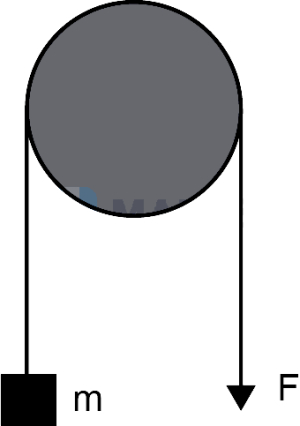
$A$ block of mass $m(=0.1 \ kg)$ is hanging over a frictionless light fixed pulley by an inextensible string of negligible mass. The other end of the string is pulled by a constant force $F$ in the vertically downward direction. The linear momentum of the block increases by $2 \ kg \ m/s$ in $1 \ s$ after the block starts from rest. Then,(given $g=10 \ m/s^2$):
A
The tension in the string is $F$
B
The tension in the string is $3 \ N$
C
The work done by the tension on the block is $20 \ J$ during this $1 \ s$
D
The work done against the force of gravity is $1 \ J$
Solution
(B) Given: mass $m = 0.1 \ kg$,change in momentum $\Delta p = 2 \ kg \ m/s$,time $t = 1 \ s$,$g = 10 \ m/s^2$.
Since $\Delta p = F_{net} \times t$,we have $F_{net} = \frac{\Delta p}{t} = \frac{2}{1} = 2 \ N$.
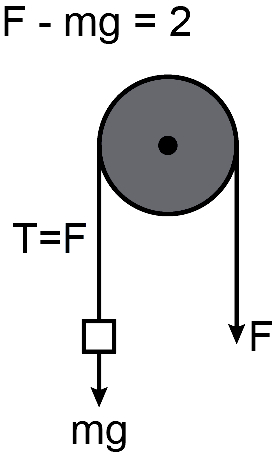
For the block,the net force is $T - mg = F_{net}$,where $T$ is the tension in the string. Since the string is massless and the pulley is frictionless,$T = F$.
Thus,$F - mg = 2 \ N \Rightarrow F - (0.1 \times 10) = 2 \Rightarrow F - 1 = 2 \Rightarrow F = 3 \ N$.
So,the tension in the string is $T = F = 3 \ N$.
Acceleration $a = \frac{F_{net}}{m} = \frac{2}{0.1} = 20 \ m/s^2$.
Displacement $S = \frac{1}{2}at^2 = \frac{1}{2} \times 20 \times (1)^2 = 10 \ m$.
Work done by tension $W_T = T \times S = 3 \times 10 = 30 \ J$.
Work done against gravity $W_g = mg \times S = (0.1 \times 10) \times 10 = 10 \ J$.
Since $\Delta p = F_{net} \times t$,we have $F_{net} = \frac{\Delta p}{t} = \frac{2}{1} = 2 \ N$.
For the block,the net force is $T - mg = F_{net}$,where $T$ is the tension in the string. Since the string is massless and the pulley is frictionless,$T = F$.
Thus,$F - mg = 2 \ N \Rightarrow F - (0.1 \times 10) = 2 \Rightarrow F - 1 = 2 \Rightarrow F = 3 \ N$.
So,the tension in the string is $T = F = 3 \ N$.
Acceleration $a = \frac{F_{net}}{m} = \frac{2}{0.1} = 20 \ m/s^2$.
Displacement $S = \frac{1}{2}at^2 = \frac{1}{2} \times 20 \times (1)^2 = 10 \ m$.
Work done by tension $W_T = T \times S = 3 \times 10 = 30 \ J$.
Work done against gravity $W_g = mg \times S = (0.1 \times 10) \times 10 = 10 \ J$.
0 likesView Solution
6
PhysicsMediumMCQWBJEE · 2013
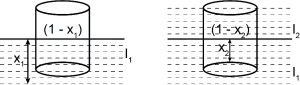
$A$ cylindrical block floats vertically in a liquid of density $\rho_{1}$ kept in a container such that the fraction of volume of the cylinder inside the liquid is $x_{1}$. Then some amount of another immiscible liquid of density $\rho_{2} (\rho_{2} < \rho_{1})$ is added to the liquid in the container so that the cylinder now floats just fully immersed in the liquids with $x_{2}$ being the fraction of volume of the cylinder inside the liquid of density $\rho_{1}$. The ratio $\rho_{1} / \rho_{2}$ will be
A
$\frac{1-x_{2}}{x_{1}-x_{2}}$
B
$\frac{1-x_{1}}{x_{1}+x_{2}}$
C
$\frac{x_{1}-x_{2}}{x_{1}+x_{2}}$
D
$\frac{x_{2}}{x_{1}}-1$
Solution
(A) Let $V$ be the total volume of the cylindrical block and $\rho$ be its density.
In the first case,the block floats in a liquid of density $\rho_{1}$. According to the law of floatation,the weight of the block equals the buoyant force:
$V \rho g = V x_{1} \rho_{1} g$
$\Rightarrow \rho = x_{1} \rho_{1} \quad ... (1)$
In the second case,the block is fully immersed in two immiscible liquids of densities $\rho_{1}$ and $\rho_{2}$. The volume fraction $x_{2}$ is in liquid $\rho_{1}$ and the remaining fraction $(1 - x_{2})$ is in liquid $\rho_{2}$. The total buoyant force equals the weight of the block:
$V \rho g = V x_{2} \rho_{1} g + V (1 - x_{2}) \rho_{2} g$
$\Rightarrow \rho = x_{2} \rho_{1} + (1 - x_{2}) \rho_{2} \quad ... (2)$
Equating $(1)$ and $(2)$:
$x_{1} \rho_{1} = x_{2} \rho_{1} + (1 - x_{2}) \rho_{2}$
$x_{1} \rho_{1} - x_{2} \rho_{1} = (1 - x_{2}) \rho_{2}$
$\rho_{1} (x_{1} - x_{2}) = \rho_{2} (1 - x_{2})$
$\frac{\rho_{1}}{\rho_{2}} = \frac{1 - x_{2}}{x_{1} - x_{2}}$
In the first case,the block floats in a liquid of density $\rho_{1}$. According to the law of floatation,the weight of the block equals the buoyant force:
$V \rho g = V x_{1} \rho_{1} g$
$\Rightarrow \rho = x_{1} \rho_{1} \quad ... (1)$
In the second case,the block is fully immersed in two immiscible liquids of densities $\rho_{1}$ and $\rho_{2}$. The volume fraction $x_{2}$ is in liquid $\rho_{1}$ and the remaining fraction $(1 - x_{2})$ is in liquid $\rho_{2}$. The total buoyant force equals the weight of the block:
$V \rho g = V x_{2} \rho_{1} g + V (1 - x_{2}) \rho_{2} g$
$\Rightarrow \rho = x_{2} \rho_{1} + (1 - x_{2}) \rho_{2} \quad ... (2)$
Equating $(1)$ and $(2)$:
$x_{1} \rho_{1} = x_{2} \rho_{1} + (1 - x_{2}) \rho_{2}$
$x_{1} \rho_{1} - x_{2} \rho_{1} = (1 - x_{2}) \rho_{2}$
$\rho_{1} (x_{1} - x_{2}) = \rho_{2} (1 - x_{2})$
$\frac{\rho_{1}}{\rho_{2}} = \frac{1 - x_{2}}{x_{1} - x_{2}}$
0 likesView Solution
7
PhysicsMediumMCQWBJEE · 2013
Water is flowing in streamline motion through a horizontal tube. The pressure at a point in the tube is $p$ where the velocity of flow is $v$. At another point, where the pressure is $p/2$, the velocity of flow is (density of water $= \rho$)
A
$\sqrt{v^{2}+\frac{p}{\rho}}$
B
$\sqrt{v^{2}-\frac{p}{\rho}}$
C
$\sqrt{v^{2}+\frac{2p}{\rho}}$
D
$\sqrt{v^{2}-\frac{2p}{\rho}}$
Solution
(A) According to Bernoulli's principle for streamline flow in a horizontal tube, the sum of static pressure and dynamic pressure remains constant at all points along a streamline.
$p + \frac{1}{2} \rho v^{2} = p_{1} + \frac{1}{2} \rho v_{1}^{2}$
Given that at the second point, $p_{1} = p/2$.
Substituting this into the equation:
$p + \frac{1}{2} \rho v^{2} = \frac{p}{2} + \frac{1}{2} \rho v_{1}^{2}$
Rearranging the terms to solve for $v_{1}^{2}$:
$\frac{1}{2} \rho v_{1}^{2} = p - \frac{p}{2} + \frac{1}{2} \rho v^{2}$
$\frac{1}{2} \rho v_{1}^{2} = \frac{p}{2} + \frac{1}{2} \rho v^{2}$
Multiplying both sides by $2/\rho$:
$v_{1}^{2} = \frac{p}{\rho} + v^{2}$
$v_{1} = \sqrt{v^{2} + \frac{p}{\rho}}$
$p + \frac{1}{2} \rho v^{2} = p_{1} + \frac{1}{2} \rho v_{1}^{2}$
Given that at the second point, $p_{1} = p/2$.
Substituting this into the equation:
$p + \frac{1}{2} \rho v^{2} = \frac{p}{2} + \frac{1}{2} \rho v_{1}^{2}$
Rearranging the terms to solve for $v_{1}^{2}$:
$\frac{1}{2} \rho v_{1}^{2} = p - \frac{p}{2} + \frac{1}{2} \rho v^{2}$
$\frac{1}{2} \rho v_{1}^{2} = \frac{p}{2} + \frac{1}{2} \rho v^{2}$
Multiplying both sides by $2/\rho$:
$v_{1}^{2} = \frac{p}{\rho} + v^{2}$
$v_{1} = \sqrt{v^{2} + \frac{p}{\rho}}$
0 likesView Solution
8
PhysicsMediumMCQWBJEE · 2013
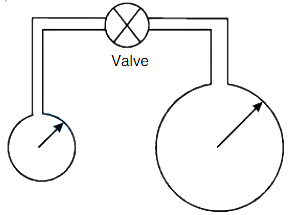
Two soap bubbles of radii $r$ and $2r$ are arranged as shown in the diagram. The valve is now opened. Which one of the following will result?
A
The radii of the bubbles will remain unchanged
B
The bubbles will have equal radii
C
The radius of the smaller bubble will decrease and that of the bigger bubble will decrease
D
The radius of the smaller bubble will decrease and that of the bigger bubble will increase
Solution
(D) The excess pressure inside a soap bubble of radius $R$ is given by $\Delta P = \frac{4T}{R}$,where $T$ is the surface tension of the soap solution.
For the smaller bubble of radius $r$,the pressure inside is $P_1 = P_{atm} + \frac{4T}{r}$.
For the bigger bubble of radius $2r$,the pressure inside is $P_2 = P_{atm} + \frac{4T}{2r} = P_{atm} + \frac{2T}{r}$.
Since $P_1 > P_2$,when the valve is opened,air flows from the region of higher pressure (smaller bubble) to the region of lower pressure (bigger bubble).
Consequently,the radius of the smaller bubble decreases and the radius of the bigger bubble increases.
For the smaller bubble of radius $r$,the pressure inside is $P_1 = P_{atm} + \frac{4T}{r}$.
For the bigger bubble of radius $2r$,the pressure inside is $P_2 = P_{atm} + \frac{4T}{2r} = P_{atm} + \frac{2T}{r}$.
Since $P_1 > P_2$,when the valve is opened,air flows from the region of higher pressure (smaller bubble) to the region of lower pressure (bigger bubble).
Consequently,the radius of the smaller bubble decreases and the radius of the bigger bubble increases.
0 likesView Solution
9
PhysicsEasyMCQWBJEE · 2013
Two spheres of the same material,but of radii $R$ and $3R$ are allowed to fall vertically downwards through a liquid of density $\rho$. The ratio of their terminal velocities is
A
$1:3$
B
$1:6$
C
$1:9$
D
$1:1$
Solution
(C) The terminal velocity $v$ of a sphere falling through a viscous liquid is given by the formula: $v = \frac{2r^2(\rho - \sigma)g}{9\eta}$
Where $r$ is the radius of the sphere,$\rho$ is the density of the sphere,$\sigma$ is the density of the liquid,$g$ is the acceleration due to gravity,and $\eta$ is the coefficient of viscosity.
Since the spheres are made of the same material and fall through the same liquid,the parameters $\rho, \sigma, g,$ and $\eta$ are constant.
Therefore,the terminal velocity is proportional to the square of the radius: $v \propto r^2$.
For radii $R$ and $3R$,the ratio of terminal velocities is: $\frac{v_1}{v_2} = \frac{R^2}{(3R)^2} = \frac{R^2}{9R^2} = \frac{1}{9}$.
Thus,the ratio is $1:9$.
Where $r$ is the radius of the sphere,$\rho$ is the density of the sphere,$\sigma$ is the density of the liquid,$g$ is the acceleration due to gravity,and $\eta$ is the coefficient of viscosity.
Since the spheres are made of the same material and fall through the same liquid,the parameters $\rho, \sigma, g,$ and $\eta$ are constant.
Therefore,the terminal velocity is proportional to the square of the radius: $v \propto r^2$.
For radii $R$ and $3R$,the ratio of terminal velocities is: $\frac{v_1}{v_2} = \frac{R^2}{(3R)^2} = \frac{R^2}{9R^2} = \frac{1}{9}$.
Thus,the ratio is $1:9$.
0 likesView Solution
10
PhysicsEasyMCQWBJEE · 2013
$A$ wire of initial length $L$ and radius $r$ is stretched by a length $l$. Another wire of same material but with initial length $2L$ and radius $2r$ is stretched by a length $2l$. The ratio of stored elastic energy per unit volume in the first and second wire is
A
$1: 4$
B
$1: 2$
C
$2: 1$
D
$1: 1$
Solution
(D) The elastic potential energy per unit volume $(u)$ of a stretched wire is given by the formula: $u = \frac{1}{2} \times Y \times (\text{strain})^2$,where $Y$ is Young's modulus and $\text{strain} = \frac{\Delta L}{L}$.
For the first wire: $\text{strain}_1 = \frac{l}{L}$.
Thus,$u_1 = \frac{1}{2} Y (\frac{l}{L})^2$.
For the second wire: $\text{strain}_2 = \frac{2l}{2L} = \frac{l}{L}$.
Thus,$u_2 = \frac{1}{2} Y (\frac{l}{L})^2$.
Since both wires are made of the same material,their Young's modulus $Y$ is the same.
The ratio of the stored elastic energy per unit volume is $\frac{u_1}{u_2} = \frac{\frac{1}{2} Y (l/L)^2}{\frac{1}{2} Y (l/L)^2} = 1:1$.
For the first wire: $\text{strain}_1 = \frac{l}{L}$.
Thus,$u_1 = \frac{1}{2} Y (\frac{l}{L})^2$.
For the second wire: $\text{strain}_2 = \frac{2l}{2L} = \frac{l}{L}$.
Thus,$u_2 = \frac{1}{2} Y (\frac{l}{L})^2$.
Since both wires are made of the same material,their Young's modulus $Y$ is the same.
The ratio of the stored elastic energy per unit volume is $\frac{u_1}{u_2} = \frac{\frac{1}{2} Y (l/L)^2}{\frac{1}{2} Y (l/L)^2} = 1:1$.
0 likesView Solution
11
PhysicsEasyMCQWBJEE · 2013
$A$ body is projected from the ground with a velocity $v = (3 \hat{i} + 10 \hat{j}) \text{ m/s}$. The maximum height attained and the range of the body respectively are (given $g = 10 \text{ m/s}^2$):
A
$5 \text{ m}$ and $6 \text{ m}$
B
$3 \text{ m}$ and $10 \text{ m}$
C
$6 \text{ m}$ and $5 \text{ m}$
D
$3 \text{ m}$ and $5 \text{ m}$
Solution
(A) Given,initial velocity vector $v = (3 \hat{i} + 10 \hat{j}) \text{ m/s}$.
Comparing with $v = v_x \hat{i} + v_y \hat{j}$,we get $v_x = 3 \text{ m/s}$ and $v_y = 10 \text{ m/s}$.
The maximum height $H$ attained by a projectile is given by the formula $H = \frac{v_y^2}{2g}$.
Substituting the values: $H = \frac{10^2}{2 \times 10} = \frac{100}{20} = 5 \text{ m}$.
The horizontal range $R$ is given by the formula $R = v_x \times T$,where $T = \frac{2v_y}{g}$ is the time of flight.
Calculating time of flight: $T = \frac{2 \times 10}{10} = 2 \text{ s}$.
Calculating range: $R = 3 \times 2 = 6 \text{ m}$.
Thus,the maximum height is $5 \text{ m}$ and the range is $6 \text{ m}$.
Comparing with $v = v_x \hat{i} + v_y \hat{j}$,we get $v_x = 3 \text{ m/s}$ and $v_y = 10 \text{ m/s}$.
The maximum height $H$ attained by a projectile is given by the formula $H = \frac{v_y^2}{2g}$.
Substituting the values: $H = \frac{10^2}{2 \times 10} = \frac{100}{20} = 5 \text{ m}$.
The horizontal range $R$ is given by the formula $R = v_x \times T$,where $T = \frac{2v_y}{g}$ is the time of flight.
Calculating time of flight: $T = \frac{2 \times 10}{10} = 2 \text{ s}$.
Calculating range: $R = 3 \times 2 = 6 \text{ m}$.
Thus,the maximum height is $5 \text{ m}$ and the range is $6 \text{ m}$.
0 likesView Solution
12
PhysicsDifficultMCQWBJEE · 2013
$A$ small mass $m$,attached to one end of a spring with a negligible mass and an unstretched length $L$,executes vertical oscillations with angular frequency $\omega_{0}$. When the mass is rotated with an angular speed $\omega$ by holding the other end of the spring at a fixed point,the mass moves uniformly in a circular path in a horizontal plane. Then the increase in length of the spring during the rotation is
A
$\frac{\omega^{2} L}{\omega_{0}^{2}-\omega^{2}}$
B
$\frac{\omega_{0}^{2} L}{\omega^{2}-\omega_{0}^{2}}$
C
$\frac{\omega^{2} L}{\omega_{0}^{2}}$
D
$\frac{\omega_{0}^{2} L}{\omega^{2}}$
Solution
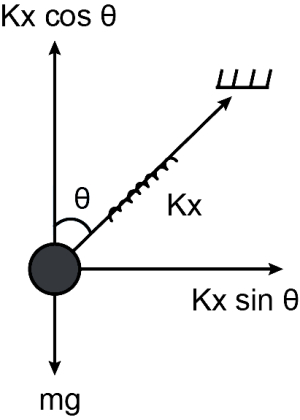
(A) Let the extension in the spring be $x$. The total length of the spring becomes $L+x$.
When the mass rotates in a horizontal circle,the centripetal force is provided by the horizontal component of the spring force.
The spring force is $F = Kx$,where $K$ is the spring constant.
The horizontal component of the spring force is $Kx \sin \theta = m \omega^{2} r$,where $r = (L+x) \sin \theta$ is the radius of the circular path.
Thus,$Kx \sin \theta = m \omega^{2} (L+x) \sin \theta$.
Canceling $\sin \theta$ from both sides,we get $Kx = m \omega^{2} (L+x)$.
We know that the angular frequency of vertical oscillations is $\omega_{0} = \sqrt{\frac{K}{m}}$,which implies $K = m \omega_{0}^{2}$.
Substituting $K$ in the equation: $m \omega_{0}^{2} x = m \omega^{2} (L+x)$.
Dividing by $m$: $\omega_{0}^{2} x = \omega^{2} L + \omega^{2} x$.
Rearranging terms to solve for $x$: $x(\omega_{0}^{2} - \omega^{2}) = \omega^{2} L$.
Therefore,$x = \frac{\omega^{2} L}{\omega_{0}^{2} - \omega^{2}}$.
When the mass rotates in a horizontal circle,the centripetal force is provided by the horizontal component of the spring force.
The spring force is $F = Kx$,where $K$ is the spring constant.
The horizontal component of the spring force is $Kx \sin \theta = m \omega^{2} r$,where $r = (L+x) \sin \theta$ is the radius of the circular path.
Thus,$Kx \sin \theta = m \omega^{2} (L+x) \sin \theta$.
Canceling $\sin \theta$ from both sides,we get $Kx = m \omega^{2} (L+x)$.
We know that the angular frequency of vertical oscillations is $\omega_{0} = \sqrt{\frac{K}{m}}$,which implies $K = m \omega_{0}^{2}$.
Substituting $K$ in the equation: $m \omega_{0}^{2} x = m \omega^{2} (L+x)$.
Dividing by $m$: $\omega_{0}^{2} x = \omega^{2} L + \omega^{2} x$.
Rearranging terms to solve for $x$: $x(\omega_{0}^{2} - \omega^{2}) = \omega^{2} L$.
Therefore,$x = \frac{\omega^{2} L}{\omega_{0}^{2} - \omega^{2}}$.
0 likesView Solution
13
PhysicsEasyMCQWBJEE · 2013
Two simple harmonic motions are given by $x_{1} = a \sin \omega t + a \cos \omega t$ and $x_{2} = a \sin \omega t + \frac{a}{\sqrt{3}} \cos \omega t$. The ratio of the amplitudes of the first and second motion and the phase difference between them are respectively:
A
$\sqrt{\frac{3}{2}}$ and $\frac{\pi}{12}$
B
$\frac{\sqrt{3}}{2}$ and $\frac{\pi}{12}$
C
$\frac{2}{\sqrt{3}}$ and $\frac{\pi}{12}$
D
$\sqrt{\frac{3}{2}}$ and $\frac{\pi}{6}$
Solution
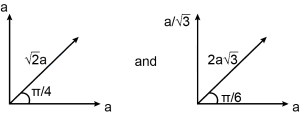
(A) For the first $SHM$: $x_{1} = a \sin \omega t + a \cos \omega t = \sqrt{2} a \sin(\omega t + \frac{\pi}{4})$.
Amplitude $A_{1} = \sqrt{2} a$ and phase $\phi_{1} = \frac{\pi}{4}$.
For the second $SHM$: $x_{2} = a \sin \omega t + \frac{a}{\sqrt{3}} \cos \omega t$.
Amplitude $A_{2} = \sqrt{a^{2} + (\frac{a}{\sqrt{3}})^{2}} = \sqrt{a^{2} + \frac{a^{2}}{3}} = \sqrt{\frac{4a^{2}}{3}} = \frac{2a}{\sqrt{3}}$.
Phase $\phi_{2} = \tan^{-1}(\frac{a/\sqrt{3}}{a}) = \tan^{-1}(\frac{1}{\sqrt{3}}) = \frac{\pi}{6}$.
Ratio of amplitudes $\frac{A_{1}}{A_{2}} = \frac{\sqrt{2} a}{2a/\sqrt{3}} = \frac{\sqrt{2} \cdot \sqrt{3}}{2} = \frac{\sqrt{6}}{2} = \sqrt{\frac{6}{4}} = \sqrt{\frac{3}{2}}$.
Phase difference $\Delta \phi = \phi_{1} - \phi_{2} = \frac{\pi}{4} - \frac{\pi}{6} = \frac{3\pi - 2\pi}{12} = \frac{\pi}{12}$.
Amplitude $A_{1} = \sqrt{2} a$ and phase $\phi_{1} = \frac{\pi}{4}$.
For the second $SHM$: $x_{2} = a \sin \omega t + \frac{a}{\sqrt{3}} \cos \omega t$.
Amplitude $A_{2} = \sqrt{a^{2} + (\frac{a}{\sqrt{3}})^{2}} = \sqrt{a^{2} + \frac{a^{2}}{3}} = \sqrt{\frac{4a^{2}}{3}} = \frac{2a}{\sqrt{3}}$.
Phase $\phi_{2} = \tan^{-1}(\frac{a/\sqrt{3}}{a}) = \tan^{-1}(\frac{1}{\sqrt{3}}) = \frac{\pi}{6}$.
Ratio of amplitudes $\frac{A_{1}}{A_{2}} = \frac{\sqrt{2} a}{2a/\sqrt{3}} = \frac{\sqrt{2} \cdot \sqrt{3}}{2} = \frac{\sqrt{6}}{2} = \sqrt{\frac{6}{4}} = \sqrt{\frac{3}{2}}$.
Phase difference $\Delta \phi = \phi_{1} - \phi_{2} = \frac{\pi}{4} - \frac{\pi}{6} = \frac{3\pi - 2\pi}{12} = \frac{\pi}{12}$.
0 likesView Solution
14
PhysicsMediumMCQWBJEE · 2013
$A$ planet moves around the sun in an elliptical orbit with the sun at one of its foci. The physical quantity associated with the motion of the planet that remains constant with time is
A
velocity
B
centripetal force
C
linear momentum
D
angular momentum
Solution
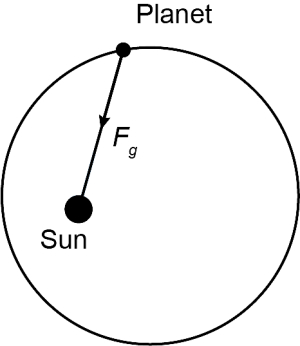
(D) planet revolves around the sun in an elliptical orbit under the influence of the gravitational force exerted by the sun.
Since the gravitational force $F$ always acts along the line joining the planet and the sun (the position vector $r$),the torque $\tau$ acting on the planet about the sun is given by $\tau = r \times F = rF \sin(180^{\circ}) = 0$.
According to the relation between torque and angular momentum,$\tau = \frac{dL}{dt}$.
Since $\tau = 0$,it follows that $\frac{dL}{dt} = 0$,which implies that the angular momentum $L$ is a constant with respect to time.
Therefore,the angular momentum of the planet remains constant.
Since the gravitational force $F$ always acts along the line joining the planet and the sun (the position vector $r$),the torque $\tau$ acting on the planet about the sun is given by $\tau = r \times F = rF \sin(180^{\circ}) = 0$.
According to the relation between torque and angular momentum,$\tau = \frac{dL}{dt}$.
Since $\tau = 0$,it follows that $\frac{dL}{dt} = 0$,which implies that the angular momentum $L$ is a constant with respect to time.
Therefore,the angular momentum of the planet remains constant.
0 likesView Solution
15
PhysicsMediumMCQWBJEE · 2013
Four small objects,each of mass $m$,are fixed at the corners of a rectangular wire-frame of negligible mass with sides $a$ and $b$ $(a > b)$. If the wire frame is now rotated about an axis passing along the side of length $b$,then the moment of inertia of the system for this axis of rotation is:
A
$2 ma^{2}$
B
$4 ma^{2}$
C
$2 m(a^{2} + b^{2})$
D
$2 m(a^{2} - b^{2})$
Solution
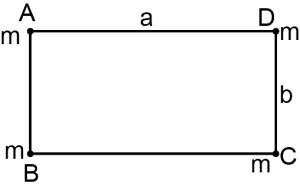
(A) Let the rectangular frame have corners $A, B, C,$ and $D$ such that side $AD = BC = a$ and side $AB = CD = b$. The masses $m$ are placed at each corner.
The axis of rotation passes along the side of length $b$ (let this be side $CD$).
The moment of inertia $I$ of a system of particles is given by $I = \sum m_i r_i^2$,where $r_i$ is the perpendicular distance of the $i$-th mass from the axis of rotation.
$1$. The masses at $C$ and $D$ lie on the axis of rotation,so their perpendicular distances are $r_C = 0$ and $r_D = 0$. Thus,their contribution to the moment of inertia is $m(0)^2 + m(0)^2 = 0$.
$2$. The masses at $A$ and $B$ are at a perpendicular distance $a$ from the axis $CD$. Thus,their contribution is $m(a)^2 + m(a)^2 = 2ma^2$.
Therefore,the total moment of inertia of the system about the axis $CD$ is $I = 0 + 2ma^2 = 2ma^2$.
The axis of rotation passes along the side of length $b$ (let this be side $CD$).
The moment of inertia $I$ of a system of particles is given by $I = \sum m_i r_i^2$,where $r_i$ is the perpendicular distance of the $i$-th mass from the axis of rotation.
$1$. The masses at $C$ and $D$ lie on the axis of rotation,so their perpendicular distances are $r_C = 0$ and $r_D = 0$. Thus,their contribution to the moment of inertia is $m(0)^2 + m(0)^2 = 0$.
$2$. The masses at $A$ and $B$ are at a perpendicular distance $a$ from the axis $CD$. Thus,their contribution is $m(a)^2 + m(a)^2 = 2ma^2$.
Therefore,the total moment of inertia of the system about the axis $CD$ is $I = 0 + 2ma^2 = 2ma^2$.
0 likesView Solution
16
PhysicsMediumMCQWBJEE · 2013
The velocity of a car travelling on a straight road is $3.6 \ km/h$ at an instant of time. Now,travelling with uniform acceleration for $10 \ s$,the velocity becomes exactly double. If the wheel radius of the car is $25 \ cm$,then which of the following is the closest to the number of revolutions that the wheel makes during this $10 \ s$?
A
$84$
B
$95$
C
$126$
D
$135$
Solution
(B) Initial velocity $u = 3.6 \ km/h = 3.6 \times \frac{5}{18} \ m/s = 1 \ m/s$.
Final velocity $v = 2 \times u = 2 \ m/s$.
Time $t = 10 \ s$.
Acceleration $a = \frac{v - u}{t} = \frac{2 - 1}{10} = 0.1 \ m/s^2$.
Distance covered $s = ut + \frac{1}{2}at^2 = (1)(10) + \frac{1}{2}(0.1)(10)^2 = 10 + 5 = 15 \ m$.
Circumference of the wheel $C = 2 \pi r = 2 \pi (0.25) = 0.5 \pi \ m$.
Number of revolutions $n = \frac{s}{C} = \frac{15}{0.5 \pi} = \frac{30}{\pi} \approx \frac{30}{3.14159} \approx 9.54$.
Wait,checking the calculation: $n = 9.54$ revolutions. Re-evaluating the question context: If the question implies angular displacement $\theta$ in radians,$\theta = \frac{s}{r} = \frac{15}{0.25} = 60 \ rad$. Number of revolutions $n = \frac{\theta}{2 \pi} = \frac{60}{2 \pi} = \frac{30}{\pi} \approx 9.55$. Given the options,there might be a unit or scale factor discrepancy in the problem statement,but based on standard kinematics,the value is approximately $9.5$. If the intended answer is $95$,it implies a factor of $10$ difference.
Final velocity $v = 2 \times u = 2 \ m/s$.
Time $t = 10 \ s$.
Acceleration $a = \frac{v - u}{t} = \frac{2 - 1}{10} = 0.1 \ m/s^2$.
Distance covered $s = ut + \frac{1}{2}at^2 = (1)(10) + \frac{1}{2}(0.1)(10)^2 = 10 + 5 = 15 \ m$.
Circumference of the wheel $C = 2 \pi r = 2 \pi (0.25) = 0.5 \pi \ m$.
Number of revolutions $n = \frac{s}{C} = \frac{15}{0.5 \pi} = \frac{30}{\pi} \approx \frac{30}{3.14159} \approx 9.54$.
Wait,checking the calculation: $n = 9.54$ revolutions. Re-evaluating the question context: If the question implies angular displacement $\theta$ in radians,$\theta = \frac{s}{r} = \frac{15}{0.25} = 60 \ rad$. Number of revolutions $n = \frac{\theta}{2 \pi} = \frac{60}{2 \pi} = \frac{30}{\pi} \approx 9.55$. Given the options,there might be a unit or scale factor discrepancy in the problem statement,but based on standard kinematics,the value is approximately $9.5$. If the intended answer is $95$,it implies a factor of $10$ difference.
0 likesView Solution
17
PhysicsMediumMCQWBJEE · 2013
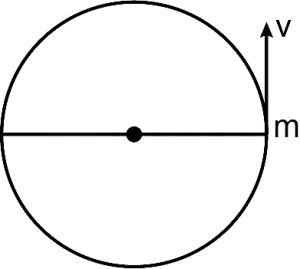
$A$ bar of length $L$ carrying a small mass $m$ at one of its ends rotates with a uniform angular speed $\omega$ in a vertical plane about the midpoint of the bar. During the rotation,at some instant of time when the bar is horizontal,the mass is detached from the bar but the bar continues to rotate with the same $\omega$. The mass moves vertically up,comes back,and reaches the bar at the same point. At that place,the acceleration due to gravity is $g$.
A
This is possible if the quantity $\frac{\omega^{2} L}{2 \pi g}$ is an integer.
B
The total time of flight of the mass is proportional to $\omega^{2}$.
C
The total distance travelled by the mass in air is proportional to $\omega^{2}$.
D
The total distance travelled by the mass in air and its total time of flight are both independent of its mass.
Solution
(A) The radius of the circular path of the mass is $R = L/2$. The linear velocity of the mass at the moment of detachment is $v = \omega R = \frac{\omega L}{2}$.
Since the mass is moving vertically upwards,the time of flight $T$ is given by $T = \frac{2v}{g} = \frac{\omega L}{g}$.
For the mass to reach the bar at the same point,the bar must complete an integer number of rotations $n$ in time $T$. The time for $n$ rotations is $T = n \cdot \frac{2\pi}{\omega}$.
Equating the two expressions for $T$: $\frac{\omega L}{g} = n \frac{2\pi}{\omega} \implies n = \frac{\omega^{2} L}{2\pi g}$. Thus,$n$ must be an integer.
For option $C$,the distance travelled by the mass in air is $2h = 2 \cdot \frac{v^2}{2g} = \frac{v^2}{g} = \frac{(\omega L/2)^2}{g} = \frac{\omega^2 L^2}{4g}$,which is proportional to $\omega^2$.
Since the mass is moving vertically upwards,the time of flight $T$ is given by $T = \frac{2v}{g} = \frac{\omega L}{g}$.
For the mass to reach the bar at the same point,the bar must complete an integer number of rotations $n$ in time $T$. The time for $n$ rotations is $T = n \cdot \frac{2\pi}{\omega}$.
Equating the two expressions for $T$: $\frac{\omega L}{g} = n \frac{2\pi}{\omega} \implies n = \frac{\omega^{2} L}{2\pi g}$. Thus,$n$ must be an integer.
For option $C$,the distance travelled by the mass in air is $2h = 2 \cdot \frac{v^2}{2g} = \frac{v^2}{g} = \frac{(\omega L/2)^2}{g} = \frac{\omega^2 L^2}{4g}$,which is proportional to $\omega^2$.
0 likesView Solution
18
PhysicsMediumMCQWBJEE · 2013
The specific heat $C$ of a solid at low temperature shows temperature dependence according to the relation $C = D T^{3}$,where $D$ is a constant and $T$ is the temperature in Kelvin. $A$ piece of this solid of mass $m \ kg$ is taken and its temperature is raised from $20 \ K$ to $30 \ K$. The amount of heat required in the process in energy units is
A
$5 \times 10^{4} D m$
B
$(33 / 4) \times 10^{4} D m$
C
$(65 / 4) \times 10^{4} D m$
D
$(5 / 4) \times 10^{4} D m$
Solution
(C) The amount of heat $Q$ required to raise the temperature of a substance is given by $Q = \int m C \ dT$.
Given the specific heat $C = D T^{3}$.
Substituting this into the integral,we get $Q = \int_{20}^{30} m (D T^{3}) \ dT$.
Taking the constants $m$ and $D$ outside the integral: $Q = m D \int_{20}^{30} T^{3} \ dT$.
Evaluating the integral: $Q = m D \left[ \frac{T^{4}}{4} \right]_{20}^{30}$.
$Q = \frac{m D}{4} [ (30)^{4} - (20)^{4} ]$.
$Q = \frac{m D}{4} [ 810000 - 160000 ]$.
$Q = \frac{m D}{4} [ 650000 ]$.
$Q = \frac{650000}{4} m D = \frac{65}{4} \times 10^{4} m D$.
Given the specific heat $C = D T^{3}$.
Substituting this into the integral,we get $Q = \int_{20}^{30} m (D T^{3}) \ dT$.
Taking the constants $m$ and $D$ outside the integral: $Q = m D \int_{20}^{30} T^{3} \ dT$.
Evaluating the integral: $Q = m D \left[ \frac{T^{4}}{4} \right]_{20}^{30}$.
$Q = \frac{m D}{4} [ (30)^{4} - (20)^{4} ]$.
$Q = \frac{m D}{4} [ 810000 - 160000 ]$.
$Q = \frac{m D}{4} [ 650000 ]$.
$Q = \frac{650000}{4} m D = \frac{65}{4} \times 10^{4} m D$.
0 likesView Solution
19
PhysicsMediumMCQWBJEE · 2013
$A$ frictionless piston-cylinder based enclosure contains some amount of gas at a pressure of $400 \text{ kPa}$. Heat is transferred to the gas at constant pressure in a quasi-static process. The piston moves up slowly through a height of $10 \text{ cm}$. If the piston has a cross-sectional area of $0.3 \text{ m}^2$, the work done by the gas in this process is: (in $\text{ kJ}$)
A
$6$
B
$12$
C
$7.5$
D
$24$
Solution
(B) The work done by a gas during a constant pressure (isobaric) process is given by the formula: $W = P \Delta V$.
Here, $P = 400 \text{ kPa} = 400 \times 10^3 \text{ Pa}$.
The change in volume $\Delta V$ is equal to the cross-sectional area $A$ multiplied by the displacement $h$.
Given $A = 0.3 \text{ m}^2$ and $h = 10 \text{ cm} = 0.1 \text{ m}$.
Therefore, $\Delta V = A \times h = 0.3 \text{ m}^2 \times 0.1 \text{ m} = 0.03 \text{ m}^3$.
Now, substitute the values into the work formula:
$W = (400 \times 10^3 \text{ Pa}) \times (0.03 \text{ m}^3)$
$W = 400,000 \times 0.03 = 12,000 \text{ J}$.
Converting to kilojoules: $W = 12 \text{ kJ}$.
Here, $P = 400 \text{ kPa} = 400 \times 10^3 \text{ Pa}$.
The change in volume $\Delta V$ is equal to the cross-sectional area $A$ multiplied by the displacement $h$.
Given $A = 0.3 \text{ m}^2$ and $h = 10 \text{ cm} = 0.1 \text{ m}$.
Therefore, $\Delta V = A \times h = 0.3 \text{ m}^2 \times 0.1 \text{ m} = 0.03 \text{ m}^3$.
Now, substitute the values into the work formula:
$W = (400 \times 10^3 \text{ Pa}) \times (0.03 \text{ m}^3)$
$W = 400,000 \times 0.03 = 12,000 \text{ J}$.
Converting to kilojoules: $W = 12 \text{ kJ}$.
0 likesView Solution
20
PhysicsMediumMCQWBJEE · 2013
An ideal mono-atomic gas of given mass is heated at constant pressure. In this process,the fraction of supplied heat energy used for the increase of the internal energy of the gas is
A
$3/8$
B
$3/5$
C
$3/4$
D
$2/5$
Solution
(B) The heat supplied at constant pressure is given by $\Delta Q = n C_p \Delta T$.
The increase in internal energy is given by $\Delta U = n C_v \Delta T$.
The fraction of heat energy used to increase internal energy is $f = \frac{\Delta U}{\Delta Q} = \frac{n C_v \Delta T}{n C_p \Delta T} = \frac{C_v}{C_p}$.
We know that the ratio of specific heats is $\gamma = \frac{C_p}{C_v}$,so $\frac{C_v}{C_p} = \frac{1}{\gamma}$.
For a mono-atomic gas,the adiabatic index is $\gamma = 5/3$.
Therefore,the fraction is $f = \frac{1}{5/3} = 3/5$.
The increase in internal energy is given by $\Delta U = n C_v \Delta T$.
The fraction of heat energy used to increase internal energy is $f = \frac{\Delta U}{\Delta Q} = \frac{n C_v \Delta T}{n C_p \Delta T} = \frac{C_v}{C_p}$.
We know that the ratio of specific heats is $\gamma = \frac{C_p}{C_v}$,so $\frac{C_v}{C_p} = \frac{1}{\gamma}$.
For a mono-atomic gas,the adiabatic index is $\gamma = 5/3$.
Therefore,the fraction is $f = \frac{1}{5/3} = 3/5$.
0 likesView Solution
21
PhysicsMediumMCQWBJEE · 2013
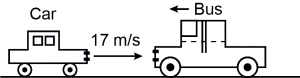
$A$ car is moving at a velocity of $17 \ m/s$ towards an approaching bus that blows a horn at a frequency of $640 \ Hz$ on a straight track. The frequency of this horn appears to be $680 \ Hz$ to the car driver. If the velocity of sound in air is $340 \ m/s$,then the velocity of the approaching bus is: (in $m/s$)
A
$2$
B
$4$
C
$8$
D
$10$
Solution
(B) Given:
Velocity of sound,$v = 340 \ m/s$
Velocity of listener (car),$v_L = 17 \ m/s$
Velocity of source (bus),$v_S = ?$
Frequency of horn emitted,$f = 640 \ Hz$
Apparent frequency,$f' = 680 \ Hz$
According to the Doppler effect,the apparent frequency $f'$ is given by:
$f' = f \left( \frac{v + v_L}{v - v_S} \right)$
Substituting the given values:
$680 = 640 \left( \frac{340 + 17}{340 - v_S} \right)$
Dividing both sides by $40$:
$17 = 16 \left( \frac{357}{340 - v_S} \right)$
$17(340 - v_S) = 16 \times 357$
$5780 - 17v_S = 5712$
$17v_S = 5780 - 5712$
$17v_S = 68$
$v_S = 4 \ m/s$
Velocity of sound,$v = 340 \ m/s$
Velocity of listener (car),$v_L = 17 \ m/s$
Velocity of source (bus),$v_S = ?$
Frequency of horn emitted,$f = 640 \ Hz$
Apparent frequency,$f' = 680 \ Hz$
According to the Doppler effect,the apparent frequency $f'$ is given by:
$f' = f \left( \frac{v + v_L}{v - v_S} \right)$
Substituting the given values:
$680 = 640 \left( \frac{340 + 17}{340 - v_S} \right)$
Dividing both sides by $40$:
$17 = 16 \left( \frac{357}{340 - v_S} \right)$
$17(340 - v_S) = 16 \times 357$
$5780 - 17v_S = 5712$
$17v_S = 5780 - 5712$
$17v_S = 68$
$v_S = 4 \ m/s$
0 likesView Solution
22
PhysicsEasyMCQWBJEE · 2013
The fundamental frequency of a closed pipe is equal to the frequency of the second harmonic of an open pipe. The ratio of their lengths is
A
$1: 2$
B
$1: 4$
C
$1: 8$
D
$1: 16$
Solution
(B) Let the length of the closed pipe be $L_{1}$ and the length of the open pipe be $L_{2}$.
The fundamental frequency of a closed pipe is given by $v_{1} = \frac{v}{4 L_{1}}$.
The frequency of the second harmonic of an open pipe is given by $v_{2} = 2 \times \frac{v}{2 L_{2}} = \frac{v}{L_{2}}$.
According to the problem,the fundamental frequency of the closed pipe is equal to the frequency of the second harmonic of the open pipe,so $v_{1} = v_{2}$.
Substituting the expressions,we get $\frac{v}{4 L_{1}} = \frac{v}{L_{2}}$.
Rearranging the terms,we find $\frac{L_{1}}{L_{2}} = \frac{1}{4}$.
Thus,the ratio of their lengths is $1: 4$.
The fundamental frequency of a closed pipe is given by $v_{1} = \frac{v}{4 L_{1}}$.
The frequency of the second harmonic of an open pipe is given by $v_{2} = 2 \times \frac{v}{2 L_{2}} = \frac{v}{L_{2}}$.
According to the problem,the fundamental frequency of the closed pipe is equal to the frequency of the second harmonic of the open pipe,so $v_{1} = v_{2}$.
Substituting the expressions,we get $\frac{v}{4 L_{1}} = \frac{v}{L_{2}}$.
Rearranging the terms,we find $\frac{L_{1}}{L_{2}} = \frac{1}{4}$.
Thus,the ratio of their lengths is $1: 4$.
0 likesView Solution
23
PhysicsEasyMCQWBJEE · 2013
$A$ travelling acoustic wave of frequency $500 Hz$ is moving along the positive $x$-direction with a velocity of $300 ms^{-1}$. The phase difference between two points $x_{1}$ and $x_{2}$ is $60^{\circ}$. The minimum separation between the two points is:
A
$1 mm$
B
$1 cm$
C
$10 cm$
D
$10 mm$
Solution
(C) The frequency of the wave is $f = 500 Hz$ and the velocity is $v = 300 ms^{-1}$.
First,we calculate the wavelength $\lambda$ using the relation $v = f \lambda$:
$\lambda = \frac{v}{f} = \frac{300}{500} = 0.6 m = 60 cm$.
The phase difference $\Delta \phi$ is given as $60^{\circ}$,which is $\frac{\pi}{3}$ radians.
The relationship between phase difference $\Delta \phi$ and path difference $\Delta x$ is given by $\Delta \phi = \frac{2 \pi}{\lambda} \Delta x$.
Substituting the values: $\frac{\pi}{3} = \frac{2 \pi}{60 cm} \Delta x$.
Solving for $\Delta x$: $\Delta x = \frac{\pi}{3} \times \frac{60 cm}{2 \pi} = \frac{60}{6} cm = 10 cm$.
First,we calculate the wavelength $\lambda$ using the relation $v = f \lambda$:
$\lambda = \frac{v}{f} = \frac{300}{500} = 0.6 m = 60 cm$.
The phase difference $\Delta \phi$ is given as $60^{\circ}$,which is $\frac{\pi}{3}$ radians.
The relationship between phase difference $\Delta \phi$ and path difference $\Delta x$ is given by $\Delta \phi = \frac{2 \pi}{\lambda} \Delta x$.
Substituting the values: $\frac{\pi}{3} = \frac{2 \pi}{60 cm} \Delta x$.
Solving for $\Delta x$: $\Delta x = \frac{\pi}{3} \times \frac{60 cm}{2 \pi} = \frac{60}{6} cm = 10 cm$.
0 likesView Solution
24
PhysicsEasyMCQWBJEE · 2013
$A$ bullet of mass $m$ travelling with a speed $v$ hits a block of mass $M$ initially at rest and gets embedded in it. The combined system is free to move and there is no other force acting on the system. The heat generated in the process will be
A
Zero
B
$\frac{m v^{2}}{2}$
C
$\frac{M m v^{2}}{2(M-m)}$
D
$\frac{m M v^{2}}{2(M+m)}$
Solution
(D) Mass of bullet $= m$,Initial speed of bullet $= v$.
Mass of block $= M$,Initial speed of block $= 0$.
Let the common velocity of the system after collision be $V$.
According to the law of conservation of linear momentum:
$m v + M(0) = (m + M)V$
$V = \frac{m v}{m + M}$
Heat generated is equal to the loss in kinetic energy $(KE)$.
$\Delta KE = KE_{initial} - KE_{final}$
$\Delta KE = \frac{1}{2} m v^{2} - \frac{1}{2} (m + M) V^{2}$
Substituting the value of $V$:
$\Delta KE = \frac{1}{2} m v^{2} - \frac{1}{2} (m + M) \left( \frac{m v}{m + M} \right)^{2}$
$\Delta KE = \frac{1}{2} m v^{2} - \frac{1}{2} (m + M) \frac{m^{2} v^{2}}{(m + M)^{2}}$
$\Delta KE = \frac{1}{2} m v^{2} \left( 1 - \frac{m}{m + M} \right)$
$\Delta KE = \frac{1}{2} m v^{2} \left( \frac{m + M - m}{m + M} \right)$
$\Delta KE = \frac{1}{2} \frac{m M v^{2}}{m + M}$
Mass of block $= M$,Initial speed of block $= 0$.
Let the common velocity of the system after collision be $V$.
According to the law of conservation of linear momentum:
$m v + M(0) = (m + M)V$
$V = \frac{m v}{m + M}$
Heat generated is equal to the loss in kinetic energy $(KE)$.
$\Delta KE = KE_{initial} - KE_{final}$
$\Delta KE = \frac{1}{2} m v^{2} - \frac{1}{2} (m + M) V^{2}$
Substituting the value of $V$:
$\Delta KE = \frac{1}{2} m v^{2} - \frac{1}{2} (m + M) \left( \frac{m v}{m + M} \right)^{2}$
$\Delta KE = \frac{1}{2} m v^{2} - \frac{1}{2} (m + M) \frac{m^{2} v^{2}}{(m + M)^{2}}$
$\Delta KE = \frac{1}{2} m v^{2} \left( 1 - \frac{m}{m + M} \right)$
$\Delta KE = \frac{1}{2} m v^{2} \left( \frac{m + M - m}{m + M} \right)$
$\Delta KE = \frac{1}{2} \frac{m M v^{2}}{m + M}$
0 likesView Solution
25
PhysicsEasyMCQWBJEE · 2013
$A$ particle is acted upon by a constant power. Then,which of the following physical quantity remains constant?
A
Speed
B
Rate of change of acceleration
C
Kinetic energy
D
Rate of change of kinetic energy
Solution
(D) Power is defined as the rate of doing work,which is equal to the rate of change of kinetic energy $(KE)$ of the particle.
$P = \frac{dW}{dt} = \frac{d(KE)}{dt}$.
Since the power $(P)$ is given as a constant,the rate of change of kinetic energy,$\frac{d(KE)}{dt}$,must also be constant.
Therefore,the rate of change of kinetic energy remains constant.
$P = \frac{dW}{dt} = \frac{d(KE)}{dt}$.
Since the power $(P)$ is given as a constant,the rate of change of kinetic energy,$\frac{d(KE)}{dt}$,must also be constant.
Therefore,the rate of change of kinetic energy remains constant.
0 likesView Solution
26
PhysicsEasyMCQWBJEE · 2013
An alternating current in a circuit is given by $I = 20 \sin (100 \pi t + 0.05 \pi) \ A$. The r.m.s. value and the frequency of the current respectively are:
A
$10 \ A$ and $100 \ Hz$
B
$10 \ A$ and $50 \ Hz$
C
$10 \sqrt{2} \ A$ and $50 \ Hz$
D
$10 \sqrt{2} \ A$ and $100 \ Hz$
Solution
(C) The given equation for alternating current is $I = I_0 \sin(\omega t + \phi)$,where $I_0 = 20 \ A$ and $\omega = 100 \pi \ rad/s$.
The root mean square (r.m.s.) value of the current is given by $I_{rms} = \frac{I_0}{\sqrt{2}}$.
Substituting the value of $I_0$: $I_{rms} = \frac{20}{\sqrt{2}} = 10 \sqrt{2} \ A$.
The angular frequency is $\omega = 2 \pi f = 100 \pi$.
Solving for frequency $f$: $f = \frac{100 \pi}{2 \pi} = 50 \ Hz$.
Therefore,the r.m.s. value is $10 \sqrt{2} \ A$ and the frequency is $50 \ Hz$.
The root mean square (r.m.s.) value of the current is given by $I_{rms} = \frac{I_0}{\sqrt{2}}$.
Substituting the value of $I_0$: $I_{rms} = \frac{20}{\sqrt{2}} = 10 \sqrt{2} \ A$.
The angular frequency is $\omega = 2 \pi f = 100 \pi$.
Solving for frequency $f$: $f = \frac{100 \pi}{2 \pi} = 50 \ Hz$.
Therefore,the r.m.s. value is $10 \sqrt{2} \ A$ and the frequency is $50 \ Hz$.
0 likesView Solution
27
PhysicsEasyMCQWBJEE · 2013
The ionization energy of the hydrogen atom is $13.6 \ eV$. The potential energy of the electron in $n=2$ state of the hydrogen atom is
A
$+3.4 \ eV$
B
$-3.4 \ eV$
C
$+6.8 \ eV$
D
$-6.8 \ eV$
Solution
(D) The total energy of an electron in the $n^{\text{th}}$ orbit of a hydrogen atom is given by $E_n = -\frac{13.6 \ eV}{n^2}$.
For the $n=2$ state,the total energy is $E_2 = -\frac{13.6}{2^2} = -\frac{13.6}{4} = -3.4 \ eV$.
The relationship between potential energy $(PE)$ and total energy $(E)$ is $PE = 2E$.
Therefore,the potential energy in the $n=2$ state is $PE = 2 \times (-3.4 \ eV) = -6.8 \ eV$.
For the $n=2$ state,the total energy is $E_2 = -\frac{13.6}{2^2} = -\frac{13.6}{4} = -3.4 \ eV$.
The relationship between potential energy $(PE)$ and total energy $(E)$ is $PE = 2E$.
Therefore,the potential energy in the $n=2$ state is $PE = 2 \times (-3.4 \ eV) = -6.8 \ eV$.
0 likesView Solution
28
PhysicsMediumMCQWBJEE · 2013
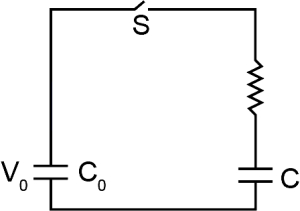
$A$ capacitor of capacitance $C_{0}$ is charged to a potential $V_{0}$ and is connected with another capacitor of capacitance $C$ as shown. After closing the switch $S,$ the common potential across the two capacitors becomes $V$. The capacitance $C$ is given by
A
$\frac{C_{0}(V_{0}-V)}{V_{0}}$
B
$\frac{C_{0}(V-V_{0})}{V_{0}}$
C
$\frac{C_{0}(V+V_{0})}{V}$
D
$\frac{C_{0}(V_{0}-V)}{V}$
Solution
(D) Initially,the capacitor $C_{0}$ is charged to potential $V_{0}$. The total charge stored in the capacitor is $Q = C_{0}V_{0}$.
When the switch $S$ is closed,the two capacitors $C_{0}$ and $C$ are connected in parallel. The total charge $Q$ is now distributed across both capacitors,and they reach a common potential $V$.
According to the principle of conservation of charge,the total charge remains constant:
$Q = (C_{0} + C)V$
Substituting $Q = C_{0}V_{0}$:
$C_{0}V_{0} = (C_{0} + C)V$
$C_{0}V_{0} = C_{0}V + CV$
$CV = C_{0}V_{0} - C_{0}V$
$CV = C_{0}(V_{0} - V)$
$C = \frac{C_{0}(V_{0} - V)}{V}$
When the switch $S$ is closed,the two capacitors $C_{0}$ and $C$ are connected in parallel. The total charge $Q$ is now distributed across both capacitors,and they reach a common potential $V$.
According to the principle of conservation of charge,the total charge remains constant:
$Q = (C_{0} + C)V$
Substituting $Q = C_{0}V_{0}$:
$C_{0}V_{0} = (C_{0} + C)V$
$C_{0}V_{0} = C_{0}V + CV$
$CV = C_{0}V_{0} - C_{0}V$
$CV = C_{0}(V_{0} - V)$
$C = \frac{C_{0}(V_{0} - V)}{V}$
0 likesView Solution
29
PhysicsDifficultMCQWBJEE · 2013
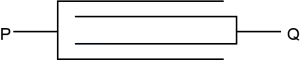
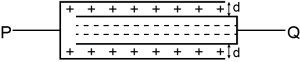
Four identical plates each of area $a$ are separated by a distance $d$. The connection is shown below. What is the capacitance between $P$ and $Q$?
A
$2 a \varepsilon_{0} / d$
B
$a \varepsilon_{0} /(2 d)$
C
$a \varepsilon_{0} / d$
D
$4 a \varepsilon_{0} / d$
Solution
(A) The given arrangement consists of four plates. Let the plates connected to $P$ be the positive plates and the plates connected to $Q$ be the negative plates.
From the figure,we can see that there are two capacitors formed between the plates.
Each capacitor is formed by two adjacent plates separated by a distance $d$ with an area $a$.
The capacitance of a single parallel plate capacitor is given by $C = \frac{\varepsilon_{0} a}{d}$.
Since the two capacitors are connected in parallel,the equivalent capacitance $C_{eq}$ is the sum of the individual capacitances.
$C_{eq} = C_{1} + C_{2} = \frac{\varepsilon_{0} a}{d} + \frac{\varepsilon_{0} a}{d} = \frac{2 \varepsilon_{0} a}{d}$.
From the figure,we can see that there are two capacitors formed between the plates.
Each capacitor is formed by two adjacent plates separated by a distance $d$ with an area $a$.
The capacitance of a single parallel plate capacitor is given by $C = \frac{\varepsilon_{0} a}{d}$.
Since the two capacitors are connected in parallel,the equivalent capacitance $C_{eq}$ is the sum of the individual capacitances.
$C_{eq} = C_{1} + C_{2} = \frac{\varepsilon_{0} a}{d} + \frac{\varepsilon_{0} a}{d} = \frac{2 \varepsilon_{0} a}{d}$.
0 likesView Solution
30
PhysicsDifficultMCQWBJEE · 2013
$A$ cell of emf $E$ is connected to a resistance $R_{1}$ for time $t$ and the amount of heat generated in it is $H$. If the resistance $R_{1}$ is replaced by another resistance $R_{2}$ and is connected to the cell for the same time $t$,the amount of heat generated in $R_{2}$ is $4H$. Then the internal resistance $r$ of the cell is:
A
$\frac{2 R_{1}+R_{2}}{2}$
B
$\sqrt{R_{1} R_{2}} \frac{2 \sqrt{R_{2}}-\sqrt{R_{1}}}{\sqrt{R_{2}}-2 \sqrt{R_{1}}}$
C
$\sqrt{R_{1} R_{2}} \frac{\sqrt{R_{2}}-2 \sqrt{R_{1}}}{2 \sqrt{R_{2}}-\sqrt{R_{1}}}$
D
$\sqrt{R_{1} R_{2}} \frac{\sqrt{R_{2}}-\sqrt{R_{1}}}{\sqrt{R_{2}}+\sqrt{R_{1}}}$
Solution
(B) The heat generated in a resistance $R$ connected to a cell of emf $E$ and internal resistance $r$ is given by $H = I^2 R t = \left( \frac{E}{R+r} \right)^2 R t$.
Given $H_1 = H$ for $R_1$ and $H_2 = 4H$ for $R_2$ in the same time $t$,we have:
$H = \frac{E^2 R_1}{(R_1+r)^2} t$ and $4H = \frac{E^2 R_2}{(R_2+r)^2} t$.
Dividing the two equations: $\frac{4H}{H} = \frac{R_2 (R_1+r)^2}{R_1 (R_2+r)^2} \Rightarrow 4 = \frac{R_2 (R_1+r)^2}{R_1 (R_2+r)^2}$.
Taking the square root on both sides: $2 = \frac{\sqrt{R_2} (R_1+r)}{\sqrt{R_1} (R_2+r)}$.
$2 \sqrt{R_1} (R_2+r) = \sqrt{R_2} (R_1+r) \Rightarrow 2 \sqrt{R_1} R_2 + 2 \sqrt{R_1} r = \sqrt{R_2} R_1 + \sqrt{R_2} r$.
Rearranging for $r$: $r (2 \sqrt{R_1} - \sqrt{R_2}) = \sqrt{R_2} R_1 - 2 \sqrt{R_1} R_2$.
$r = \frac{\sqrt{R_1 R_2} (\sqrt{R_1} - 2 \sqrt{R_2})}{2 \sqrt{R_1} - \sqrt{R_2}}$.
Multiplying numerator and denominator by $-1$: $r = \sqrt{R_1 R_2} \frac{2 \sqrt{R_2} - \sqrt{R_1}}{\sqrt{R_2} - 2 \sqrt{R_1}}$.
Given $H_1 = H$ for $R_1$ and $H_2 = 4H$ for $R_2$ in the same time $t$,we have:
$H = \frac{E^2 R_1}{(R_1+r)^2} t$ and $4H = \frac{E^2 R_2}{(R_2+r)^2} t$.
Dividing the two equations: $\frac{4H}{H} = \frac{R_2 (R_1+r)^2}{R_1 (R_2+r)^2} \Rightarrow 4 = \frac{R_2 (R_1+r)^2}{R_1 (R_2+r)^2}$.
Taking the square root on both sides: $2 = \frac{\sqrt{R_2} (R_1+r)}{\sqrt{R_1} (R_2+r)}$.
$2 \sqrt{R_1} (R_2+r) = \sqrt{R_2} (R_1+r) \Rightarrow 2 \sqrt{R_1} R_2 + 2 \sqrt{R_1} r = \sqrt{R_2} R_1 + \sqrt{R_2} r$.
Rearranging for $r$: $r (2 \sqrt{R_1} - \sqrt{R_2}) = \sqrt{R_2} R_1 - 2 \sqrt{R_1} R_2$.
$r = \frac{\sqrt{R_1 R_2} (\sqrt{R_1} - 2 \sqrt{R_2})}{2 \sqrt{R_1} - \sqrt{R_2}}$.
Multiplying numerator and denominator by $-1$: $r = \sqrt{R_1 R_2} \frac{2 \sqrt{R_2} - \sqrt{R_1}}{\sqrt{R_2} - 2 \sqrt{R_1}}$.
0 likesView Solution
31
PhysicsMediumMCQWBJEE · 2013
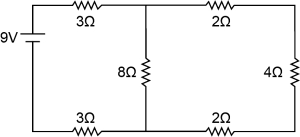
In the electrical circuit shown in the figure,the current through the $4 \Omega$ resistor is: (in $A$)
A
$1$
B
$0.5$
C
$0.25$
D
$0.1$
Solution
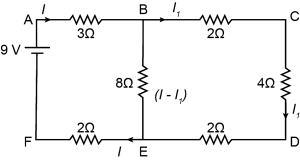
(B) Let the total current from the battery be $I$ and the current through the right loop be $I_1$. Applying Kirchhoff's voltage law to the right loop (loop $BCDEB$):
$2 I_1 + 4 I_1 + 2 I_1 - 8(I - I_1) = 0$
$8 I_1 - 8 I + 8 I_1 = 0$
$16 I_1 = 8 I \Rightarrow I_1 = 0.5 I$.
Now,applying Kirchhoff's voltage law to the left loop (loop $ABEF$):
$9 - 3 I - 8(I - I_1) - 2 I = 0$
$9 - 5 I - 8(I - 0.5 I) = 0$
$9 - 5 I - 8(0.5 I) = 0$
$9 - 5 I - 4 I = 0$
$9 I = 9 \Rightarrow I = 1 A$.
Therefore,the current through the $4 \Omega$ resistor is $I_1 = 0.5 \times 1 A = 0.5 A$.
$2 I_1 + 4 I_1 + 2 I_1 - 8(I - I_1) = 0$
$8 I_1 - 8 I + 8 I_1 = 0$
$16 I_1 = 8 I \Rightarrow I_1 = 0.5 I$.
Now,applying Kirchhoff's voltage law to the left loop (loop $ABEF$):
$9 - 3 I - 8(I - I_1) - 2 I = 0$
$9 - 5 I - 8(I - 0.5 I) = 0$
$9 - 5 I - 8(0.5 I) = 0$
$9 - 5 I - 4 I = 0$
$9 I = 9 \Rightarrow I = 1 A$.
Therefore,the current through the $4 \Omega$ resistor is $I_1 = 0.5 \times 1 A = 0.5 A$.
0 likesView Solution
32
PhysicsEasyMCQWBJEE · 2013
An electric cell of emf $E$ is connected across a copper wire of diameter $d$ and length $l$. The drift velocity of electrons in the wire is $v_{d}$. If the length of the wire is changed to $2l$,the new drift velocity of electrons in the copper wire will be
A
$v_{d}$
B
$2v_{d}$
C
$v_{d}/2$
D
$v_{d}/4$
Solution
(C) The drift velocity $v_{d}$ is given by the formula $v_{d} = \frac{I}{neA}$,where $I$ is the current,$n$ is the electron density,$e$ is the charge of an electron,and $A$ is the cross-sectional area.
Since $I = \frac{E}{R}$ and $R = \rho \frac{l}{A}$,we have $I = \frac{E A}{\rho l}$.
Substituting this into the drift velocity formula:
$v_{d} = \frac{E A}{\rho l n e A} = \frac{E}{\rho l n e}$.
From this expression,we see that $v_{d} \propto \frac{1}{l}$.
If the length is changed to $l' = 2l$,the new drift velocity $v_{d}'$ is:
$v_{d}' = \frac{E}{\rho (2l) n e} = \frac{1}{2} \left( \frac{E}{\rho l n e} \right) = \frac{v_{d}}{2}$.
Since $I = \frac{E}{R}$ and $R = \rho \frac{l}{A}$,we have $I = \frac{E A}{\rho l}$.
Substituting this into the drift velocity formula:
$v_{d} = \frac{E A}{\rho l n e A} = \frac{E}{\rho l n e}$.
From this expression,we see that $v_{d} \propto \frac{1}{l}$.
If the length is changed to $l' = 2l$,the new drift velocity $v_{d}'$ is:
$v_{d}' = \frac{E}{\rho (2l) n e} = \frac{1}{2} \left( \frac{E}{\rho l n e} \right) = \frac{v_{d}}{2}$.
0 likesView Solution
33
PhysicsEasyMCQWBJEE · 2013
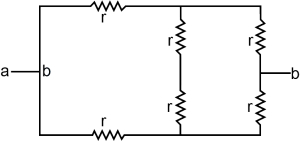
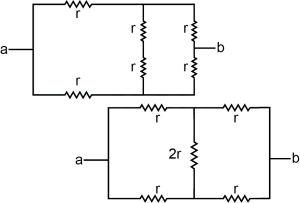
The equivalent resistance between the points $a$ and $b$ of the electrical network shown in the figure is:
A
$6 r$
B
$4 r$
C
$2 r$
D
$r$
Solution
(C) The given circuit can be simplified by observing the symmetry.
Let the points be labeled. The circuit consists of two loops in series.
Each loop has two resistors of resistance $r$ in series,which are in parallel with another branch of two resistors of resistance $r$ in series.
For the first part (left side),the two branches are in parallel,each having a resistance of $r + r = 2r$. The equivalent resistance of this part is $R_1 = \frac{2r \times 2r}{2r + 2r} = \frac{4r^2}{4r} = r$.
Similarly,for the second part (right side),the two branches are in parallel,each having a resistance of $r + r = 2r$. The equivalent resistance of this part is $R_2 = \frac{2r \times 2r}{2r + 2r} = r$.
Since these two parts are connected in series between points $a$ and $b$,the total equivalent resistance is $R_{eq} = R_1 + R_2 = r + r = 2r$.
Let the points be labeled. The circuit consists of two loops in series.
Each loop has two resistors of resistance $r$ in series,which are in parallel with another branch of two resistors of resistance $r$ in series.
For the first part (left side),the two branches are in parallel,each having a resistance of $r + r = 2r$. The equivalent resistance of this part is $R_1 = \frac{2r \times 2r}{2r + 2r} = \frac{4r^2}{4r} = r$.
Similarly,for the second part (right side),the two branches are in parallel,each having a resistance of $r + r = 2r$. The equivalent resistance of this part is $R_2 = \frac{2r \times 2r}{2r + 2r} = r$.
Since these two parts are connected in series between points $a$ and $b$,the total equivalent resistance is $R_{eq} = R_1 + R_2 = r + r = 2r$.
0 likesView Solution
34
PhysicsMediumMCQWBJEE · 2013
The de-Broglie wavelength of an electron (mass $= 1 \times 10^{-30} \ kg$,charge $= 1.6 \times 10^{-19} \ C$) with a kinetic energy of $200 \ eV$ is (Planck's constant $= 6.6 \times 10^{-34} \ J \cdot s$):
A
$9.60 \times 10^{-11} \ m$
B
$8.25 \times 10^{-11} \ m$
C
$6.25 \times 10^{-11} \ m$
D
$5.00 \times 10^{-11} \ m$
Solution
(B) The de-Broglie wavelength is given by the formula: $\lambda = \frac{h}{\sqrt{2mK}}$.
Given values are:
$h = 6.6 \times 10^{-34} \ J \cdot s$
$m = 1 \times 10^{-30} \ kg$
$K = 200 \ eV = 200 \times 1.6 \times 10^{-19} \ J = 3.2 \times 10^{-17} \ J$.
Substituting these values into the formula:
$\lambda = \frac{6.6 \times 10^{-34}}{\sqrt{2 \times (1 \times 10^{-30}) \times (3.2 \times 10^{-17})}}$
$\lambda = \frac{6.6 \times 10^{-34}}{\sqrt{6.4 \times 10^{-47}}}$
$\lambda = \frac{6.6 \times 10^{-34}}{8 \times 10^{-23.5}}$
Using the calculation $\sqrt{64 \times 10^{-48}} = 8 \times 10^{-24}$,we get:
$\lambda = \frac{6.6 \times 10^{-34}}{8 \times 10^{-24}} = 0.825 \times 10^{-10} \ m = 8.25 \times 10^{-11} \ m$.
Given values are:
$h = 6.6 \times 10^{-34} \ J \cdot s$
$m = 1 \times 10^{-30} \ kg$
$K = 200 \ eV = 200 \times 1.6 \times 10^{-19} \ J = 3.2 \times 10^{-17} \ J$.
Substituting these values into the formula:
$\lambda = \frac{6.6 \times 10^{-34}}{\sqrt{2 \times (1 \times 10^{-30}) \times (3.2 \times 10^{-17})}}$
$\lambda = \frac{6.6 \times 10^{-34}}{\sqrt{6.4 \times 10^{-47}}}$
$\lambda = \frac{6.6 \times 10^{-34}}{8 \times 10^{-23.5}}$
Using the calculation $\sqrt{64 \times 10^{-48}} = 8 \times 10^{-24}$,we get:
$\lambda = \frac{6.6 \times 10^{-34}}{8 \times 10^{-24}} = 0.825 \times 10^{-10} \ m = 8.25 \times 10^{-11} \ m$.
0 likesView Solution
35
PhysicsEasyMCQWBJEE · 2013
The stopping potential for photoelectrons from a metal surface is $V_{1}$ when monochromatic light of frequency $v_{1}$ is incident on it. The stopping potential becomes $V_{2}$ when monochromatic light of another frequency is incident on the same metal surface. If $h$ is the Planck's constant and $e$ is the charge of an electron,then the frequency of light in the second case is
A
$v_{1}-\frac{e}{h}(V_{2}+V_{1})$
B
$v_{1}+\frac{e}{h}(V_{2}+V_{1})$
C
$v_{1}-\frac{e}{h}(V_{2}-V_{1})$
D
$v_{1}+\frac{e}{h}(V_{2}-V_{1})$
Solution
(D) According to Einstein's photoelectric equation,the maximum kinetic energy of photoelectrons is given by $K_{max} = h v - \phi_{0}$,where $\phi_{0}$ is the work function of the metal.
Since $K_{max} = e V_{s}$,where $V_{s}$ is the stopping potential,we have $e V_{s} = h v - \phi_{0}$.
For the first case: $e V_{1} = h v_{1} - \phi_{0}$ ---$(i)$
For the second case: $e V_{2} = h v_{2} - \phi_{0}$ ---(ii)
Subtracting equation $(i)$ from equation (ii):
$e V_{2} - e V_{1} = (h v_{2} - \phi_{0}) - (h v_{1} - \phi_{0})$
$e(V_{2} - V_{1}) = h(v_{2} - v_{1})$
$v_{2} - v_{1} = \frac{e}{h}(V_{2} - V_{1})$
$v_{2} = v_{1} + \frac{e}{h}(V_{2} - V_{1})$
Since $K_{max} = e V_{s}$,where $V_{s}$ is the stopping potential,we have $e V_{s} = h v - \phi_{0}$.
For the first case: $e V_{1} = h v_{1} - \phi_{0}$ ---$(i)$
For the second case: $e V_{2} = h v_{2} - \phi_{0}$ ---(ii)
Subtracting equation $(i)$ from equation (ii):
$e V_{2} - e V_{1} = (h v_{2} - \phi_{0}) - (h v_{1} - \phi_{0})$
$e(V_{2} - V_{1}) = h(v_{2} - v_{1})$
$v_{2} - v_{1} = \frac{e}{h}(V_{2} - V_{1})$
$v_{2} = v_{1} + \frac{e}{h}(V_{2} - V_{1})$
0 likesView Solution
36
PhysicsMediumMCQWBJEE · 2013
$A$ magnetic field $B = 2t + 4t^{2}$ (where $t$ is time) is applied perpendicular to the plane of a circular wire of radius $r$ and resistance $R$. If all units are in $SI$,the electric charge that flows through the circular wire during $t = 0 \ s$ to $t = 2 \ s$ is:
A
$\frac{6 \pi r^{2}}{R}$
B
$\frac{20 \pi r^{2}}{R}$
C
$\frac{32 \pi r^{2}}{R}$
D
$\frac{48 \pi r^{2}}{R}$
Solution
(B) Given,$B = 2t + 4t^{2}$.
At $t = 0 \ s$,$B_{1} = 2(0) + 4(0)^{2} = 0 \ T$.
At $t = 2 \ s$,$B_{2} = 2(2) + 4(2)^{2} = 4 + 16 = 20 \ T$.
The magnetic flux is $\phi = B \cdot A = B \cdot \pi r^{2}$.
The change in magnetic flux is $\Delta \phi = \phi_{2} - \phi_{1} = \pi r^{2} (B_{2} - B_{1})$.
Substituting the values,$\Delta \phi = \pi r^{2} (20 - 0) = 20 \pi r^{2} \ Wb$.
The induced charge $Q$ is given by $Q = \frac{\Delta \phi}{R}$.
Therefore,$Q = \frac{20 \pi r^{2}}{R} \ C$.
At $t = 0 \ s$,$B_{1} = 2(0) + 4(0)^{2} = 0 \ T$.
At $t = 2 \ s$,$B_{2} = 2(2) + 4(2)^{2} = 4 + 16 = 20 \ T$.
The magnetic flux is $\phi = B \cdot A = B \cdot \pi r^{2}$.
The change in magnetic flux is $\Delta \phi = \phi_{2} - \phi_{1} = \pi r^{2} (B_{2} - B_{1})$.
Substituting the values,$\Delta \phi = \pi r^{2} (20 - 0) = 20 \pi r^{2} \ Wb$.
The induced charge $Q$ is given by $Q = \frac{\Delta \phi}{R}$.
Therefore,$Q = \frac{20 \pi r^{2}}{R} \ C$.
0 likesView Solution
37
PhysicsDifficultMCQWBJEE · 2013
$A$ sphere of radius $R$ has a volume charge density $\rho = k r$,where $r$ is the distance from the center of the sphere and $k$ is a constant. The magnitude of the electric field at the surface of the sphere is given by ($\varepsilon_{0} =$ permittivity of free space):
A
$\frac{4 \pi k R^{4}}{3 \varepsilon_{0}}$
B
$\frac{k R^{2}}{4 \varepsilon_{0}}$
C
$\frac{k R^{2}}{\varepsilon_{0}}$
D
$\frac{k R^{2}}{2 \varepsilon_{0}}$
Solution
(B) According to Gauss's Law,the electric flux through a spherical surface of radius $R$ is given by $\oint \vec{E} \cdot d\vec{A} = \frac{q_{enclosed}}{\varepsilon_{0}}$.
For a sphere of radius $R$,the electric field $E$ at the surface is uniform,so $E(4 \pi R^{2}) = \frac{q_{enclosed}}{\varepsilon_{0}}$.
The total charge $q_{enclosed}$ is calculated by integrating the volume charge density $\rho = k r$ over the volume of the sphere:
$q_{enclosed} = \int_{0}^{R} \rho (4 \pi r^{2}) dr = \int_{0}^{R} (k r) (4 \pi r^{2}) dr = 4 \pi k \int_{0}^{R} r^{3} dr = 4 \pi k \left[ \frac{r^{4}}{4} \right]_{0}^{R} = \pi k R^{4}$.
Substituting this into Gauss's Law:
$E(4 \pi R^{2}) = \frac{\pi k R^{4}}{\varepsilon_{0}}$.
Solving for $E$:
$E = \frac{\pi k R^{4}}{4 \pi R^{2} \varepsilon_{0}} = \frac{k R^{2}}{4 \varepsilon_{0}}$.
For a sphere of radius $R$,the electric field $E$ at the surface is uniform,so $E(4 \pi R^{2}) = \frac{q_{enclosed}}{\varepsilon_{0}}$.
The total charge $q_{enclosed}$ is calculated by integrating the volume charge density $\rho = k r$ over the volume of the sphere:
$q_{enclosed} = \int_{0}^{R} \rho (4 \pi r^{2}) dr = \int_{0}^{R} (k r) (4 \pi r^{2}) dr = 4 \pi k \int_{0}^{R} r^{3} dr = 4 \pi k \left[ \frac{r^{4}}{4} \right]_{0}^{R} = \pi k R^{4}$.
Substituting this into Gauss's Law:
$E(4 \pi R^{2}) = \frac{\pi k R^{4}}{\varepsilon_{0}}$.
Solving for $E$:
$E = \frac{\pi k R^{4}}{4 \pi R^{2} \varepsilon_{0}} = \frac{k R^{2}}{4 \varepsilon_{0}}$.
0 likesView Solution
38
PhysicsEasyMCQWBJEE · 2013
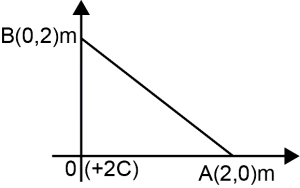
As shown in the figure below,a charge $+2 \text{ C}$ is situated at the origin $O$ and another charge $+5 \text{ C}$ is on the $x$-axis at point $A(2, 0) \text{ m}$. The charge at point $A$ is then moved to point $B(0, 2) \text{ m}$ on the $y$-axis. Calculate the work done. (Given $\frac{1}{4 \pi \varepsilon_{0}} = 9 \times 10^{9} \text{ N m}^2/\text{C}^2$)
A
$45 \times 10^{9} \text{ J}$
B
$90 \times 10^{9} \text{ J}$
C
zero
D
$-45 \times 10^{9} \text{ J}$
Solution
(C) The work done in moving a charge in an electrostatic field is equal to the change in the electrostatic potential energy of the system.
$W = U_{f} - U_{i}$
$U = \frac{1}{4 \pi \varepsilon_{0}} \frac{q_{1} q_{2}}{r}$
Initial potential energy $U_{i}$ when the charge $+5 \text{ C}$ is at $A(2, 0) \text{ m}$:
$U_{i} = \frac{1}{4 \pi \varepsilon_{0}} \frac{(2)(5)}{2} = \frac{1}{4 \pi \varepsilon_{0}} (5)$
Final potential energy $U_{f}$ when the charge $+5 \text{ C}$ is at $B(0, 2) \text{ m}$:
$U_{f} = \frac{1}{4 \pi \varepsilon_{0}} \frac{(2)(5)}{2} = \frac{1}{4 \pi \varepsilon_{0}} (5)$
Since the distance $r$ from the origin $O$ to point $A$ is $2 \text{ m}$ and from the origin $O$ to point $B$ is also $2 \text{ m}$,the potential energy remains the same.
$W = U_{f} - U_{i} = 0 \text{ J}$.
$W = U_{f} - U_{i}$
$U = \frac{1}{4 \pi \varepsilon_{0}} \frac{q_{1} q_{2}}{r}$
Initial potential energy $U_{i}$ when the charge $+5 \text{ C}$ is at $A(2, 0) \text{ m}$:
$U_{i} = \frac{1}{4 \pi \varepsilon_{0}} \frac{(2)(5)}{2} = \frac{1}{4 \pi \varepsilon_{0}} (5)$
Final potential energy $U_{f}$ when the charge $+5 \text{ C}$ is at $B(0, 2) \text{ m}$:
$U_{f} = \frac{1}{4 \pi \varepsilon_{0}} \frac{(2)(5)}{2} = \frac{1}{4 \pi \varepsilon_{0}} (5)$
Since the distance $r$ from the origin $O$ to point $A$ is $2 \text{ m}$ and from the origin $O$ to point $B$ is also $2 \text{ m}$,the potential energy remains the same.
$W = U_{f} - U_{i} = 0 \text{ J}$.
0 likesView Solution
39
PhysicsEasyMCQWBJEE · 2013
$A$ current of $1 \ A$ is flowing along the positive $x$-axis through a straight wire of length $0.5 \ m$ placed in a region of a magnetic field given by $\vec{B} = (2\hat{i} + 4\hat{j}) \ T$. The magnitude and the direction of the force experienced by the wire are,respectively:
A
$\sqrt{18} \ N$,along positive $z$-axis
B
$\sqrt{20} \ N$,along positive $x$-axis
C
$2 \ N$,along positive $z$-axis
D
$4 \ N$,along positive $y$-axis
Solution
(C) The force $\vec{F}$ on a current-carrying wire is given by $\vec{F} = I(\vec{L} \times \vec{B})$.
Here,$I = 1 \ A$,$\vec{L} = 0.5 \hat{i} \ m$,and $\vec{B} = (2\hat{i} + 4\hat{j}) \ T$.
Substituting the values:
$\vec{F} = 1 \times (0.5 \hat{i} \times (2\hat{i} + 4\hat{j}))$
$\vec{F} = 0.5 \times 2(\hat{i} \times \hat{i}) + 0.5 \times 4(\hat{i} \times \hat{j})$
Since $\hat{i} \times \hat{i} = 0$ and $\hat{i} \times \hat{j} = \hat{k}$:
$\vec{F} = 0 + 2\hat{k} = 2\hat{k} \ N$.
The magnitude of the force is $|\vec{F}| = 2 \ N$,and the direction is along the positive $z$-axis.
Here,$I = 1 \ A$,$\vec{L} = 0.5 \hat{i} \ m$,and $\vec{B} = (2\hat{i} + 4\hat{j}) \ T$.
Substituting the values:
$\vec{F} = 1 \times (0.5 \hat{i} \times (2\hat{i} + 4\hat{j}))$
$\vec{F} = 0.5 \times 2(\hat{i} \times \hat{i}) + 0.5 \times 4(\hat{i} \times \hat{j})$
Since $\hat{i} \times \hat{i} = 0$ and $\hat{i} \times \hat{j} = \hat{k}$:
$\vec{F} = 0 + 2\hat{k} = 2\hat{k} \ N$.
The magnitude of the force is $|\vec{F}| = 2 \ N$,and the direction is along the positive $z$-axis.
0 likesView Solution
40
PhysicsEasyMCQWBJEE · 2013
$A$ bar magnet has a magnetic moment of $200 \text{ A m}^2$. The magnet is suspended in a magnetic field of $0.30 \text{ N A}^{-1} \text{ m}^{-1}$. The torque required to rotate the magnet from its equilibrium position through an angle of $30^{\circ}$ will be:
A
$30 \text{ N m}$
B
$30 \sqrt{3} \text{ N m}$
C
$60 \text{ N m}$
D
$60 \sqrt{3} \text{ N m}$
Solution
(A) Given,magnetic moment $M = 200 \text{ A m}^2$.
Magnetic field $B = 0.30 \text{ N A}^{-1} \text{ m}^{-1}$.
Angle $\theta = 30^{\circ}$.
We know that the torque $\tau$ acting on a magnetic dipole in a magnetic field is given by the formula:
$\tau = M B \sin \theta$.
Substituting the given values:
$\tau = 200 \times 0.30 \times \sin(30^{\circ})$.
Since $\sin(30^{\circ}) = \frac{1}{2}$,
$\tau = 200 \times 0.30 \times \frac{1}{2} = 100 \times 0.30 = 30 \text{ N m}$.
Thus,the torque required is $30 \text{ N m}$.
Magnetic field $B = 0.30 \text{ N A}^{-1} \text{ m}^{-1}$.
Angle $\theta = 30^{\circ}$.
We know that the torque $\tau$ acting on a magnetic dipole in a magnetic field is given by the formula:
$\tau = M B \sin \theta$.
Substituting the given values:
$\tau = 200 \times 0.30 \times \sin(30^{\circ})$.
Since $\sin(30^{\circ}) = \frac{1}{2}$,
$\tau = 200 \times 0.30 \times \frac{1}{2} = 100 \times 0.30 = 30 \text{ N m}$.
Thus,the torque required is $30 \text{ N m}$.
0 likesView Solution
41
PhysicsEasyMCQWBJEE · 2013
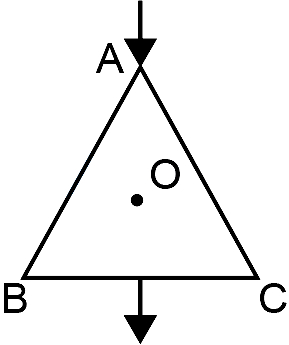
An equilateral triangle is made by uniform wires $AB, BC, CA$. A current $I$ enters at $A$ and leaves from the midpoint of $BC$. If the length of each side of the triangle is $L$, the magnetic field $B$ at the centroid $O$ of the triangle is:
A
$\frac{\mu_{0}}{4 \pi}\left(\frac{4 L}{L}\right)$
B
$\frac{\mu_{0}}{2 \pi}\left(\frac{4 L}{L}\right)$
C
$\frac{\mu_{0}}{4 \pi}\left(\frac{2 L}{L}\right)$
D
zero
Solution
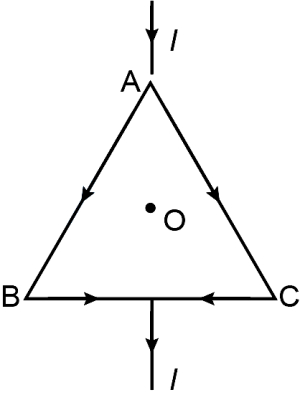
(D) The current $I$ enters at $A$ and splits into two paths: one through $AB$ and the other through $AC$. Since the wires are uniform, the resistance of path $AB$ is $R$ and the resistance of path $AC$ is $R$.
At the midpoint of $BC$ (let's call it $M$), the current from $B$ to $M$ and $C$ to $M$ recombines to exit.
Due to the symmetry of the equilateral triangle and the current distribution, the magnetic field produced by the current in segment $AB$ and $BM$ at the centroid $O$ is equal and opposite to the magnetic field produced by the current in segment $AC$ and $CM$ at the centroid $O$.
Specifically, the magnetic field at the centroid $O$ due to the current flowing through the left half of the triangle $(A-B-M)$ is equal in magnitude but opposite in direction to the magnetic field due to the current flowing through the right half of the triangle $(A-C-M)$.
Therefore, the net magnetic field at the centroid $O$ is $B_{net} = B_{left} + B_{right} = 0$.
At the midpoint of $BC$ (let's call it $M$), the current from $B$ to $M$ and $C$ to $M$ recombines to exit.
Due to the symmetry of the equilateral triangle and the current distribution, the magnetic field produced by the current in segment $AB$ and $BM$ at the centroid $O$ is equal and opposite to the magnetic field produced by the current in segment $AC$ and $CM$ at the centroid $O$.
Specifically, the magnetic field at the centroid $O$ due to the current flowing through the left half of the triangle $(A-B-M)$ is equal in magnitude but opposite in direction to the magnetic field due to the current flowing through the right half of the triangle $(A-C-M)$.
Therefore, the net magnetic field at the centroid $O$ is $B_{net} = B_{left} + B_{right} = 0$.
0 likesView Solution
42
PhysicsEasyMCQWBJEE · 2013
If $E$ and $B$ are the magnitudes of electric and magnetic fields respectively in some region of space,then the possibilities for which a charged particle may move in that space with a uniform velocity of magnitude $v$ are
A
$E=v B$
B
$E \neq 0, B=0$
C
$E=0, B \neq 0$
D
$E \neq 0, B \neq 0$
Solution
(A) The force on a charged particle moving with velocity $\vec{v}$ in an electric field $\vec{E}$ and magnetic field $\vec{B}$ is given by the Lorentz force equation: $\vec{F} = q(\vec{E} + \vec{v} \times \vec{B})$.
For the particle to move with a uniform velocity,the net force must be zero,i.e.,$\vec{F} = 0$.
Case $1$: If $E=0$ and $B=0$,the particle moves with uniform velocity (Newton's first law).
Case $2$: If $E=0$ and $B \neq 0$,the particle moves with uniform velocity if it moves parallel or anti-parallel to the magnetic field $(\vec{v} \times \vec{B} = 0)$.
Case $3$: If $E \neq 0$ and $B \neq 0$,the particle moves with uniform velocity if the electric force and magnetic force cancel each other,which occurs when $\vec{E} = -(\vec{v} \times \vec{B})$. In terms of magnitudes,this implies $E = vB$ (where $\vec{v} \perp \vec{B}$ and $\vec{E} \perp \vec{v}$).
Thus,the condition $E=vB$ is a valid possibility for uniform velocity.
For the particle to move with a uniform velocity,the net force must be zero,i.e.,$\vec{F} = 0$.
Case $1$: If $E=0$ and $B=0$,the particle moves with uniform velocity (Newton's first law).
Case $2$: If $E=0$ and $B \neq 0$,the particle moves with uniform velocity if it moves parallel or anti-parallel to the magnetic field $(\vec{v} \times \vec{B} = 0)$.
Case $3$: If $E \neq 0$ and $B \neq 0$,the particle moves with uniform velocity if the electric force and magnetic force cancel each other,which occurs when $\vec{E} = -(\vec{v} \times \vec{B})$. In terms of magnitudes,this implies $E = vB$ (where $\vec{v} \perp \vec{B}$ and $\vec{E} \perp \vec{v}$).
Thus,the condition $E=vB$ is a valid possibility for uniform velocity.
0 likesView Solution
43
PhysicsEasyMCQWBJEE · 2013
At two different places,the angles of dip are respectively $30^{\circ}$ and $45^{\circ}$. At these two places,the ratio of the horizontal component of Earth's magnetic field is:
A
$\sqrt{3} : \sqrt{2}$
B
$1 : \sqrt{2}$
C
$1 : 2$
D
$1 : \sqrt{3}$
Solution
(A) The horizontal component of Earth's magnetic field is given by $H = B \cos \delta$,where $B$ is the total magnetic field and $\delta$ is the angle of dip.
Assuming the total magnetic field $B$ is the same at both locations:
$H_1 = B \cos 30^{\circ}$ and $H_2 = B \cos 45^{\circ}$.
Taking the ratio:
$\frac{H_1}{H_2} = \frac{B \cos 30^{\circ}}{B \cos 45^{\circ}} = \frac{\sqrt{3}/2}{1/\sqrt{2}} = \frac{\sqrt{3}}{2} \times \sqrt{2} = \frac{\sqrt{3}}{\sqrt{2}}$.
Thus,the ratio is $\sqrt{3} : \sqrt{2}$.
Assuming the total magnetic field $B$ is the same at both locations:
$H_1 = B \cos 30^{\circ}$ and $H_2 = B \cos 45^{\circ}$.
Taking the ratio:
$\frac{H_1}{H_2} = \frac{B \cos 30^{\circ}}{B \cos 45^{\circ}} = \frac{\sqrt{3}/2}{1/\sqrt{2}} = \frac{\sqrt{3}}{2} \times \sqrt{2} = \frac{\sqrt{3}}{\sqrt{2}}$.
Thus,the ratio is $\sqrt{3} : \sqrt{2}$.
0 likesView Solution
44
PhysicsMediumMCQWBJEE · 2013
An alpha particle $\left({ }^{4} He\right)$ has a mass of $4.00300 \ amu$. $A$ proton has a mass of $1.00783 \ amu$ and a neutron has a mass of $1.00867 \ amu$. The binding energy of an alpha particle estimated from these data is closest to: (in $MeV$)
A
$27.9$
B
$22.3$
C
$35.0$
D
$20.4$
Solution
(A) The alpha particle $\left({ }^{4} He\right)$ consists of $2$ protons and $2$ neutrons.
The mass of the constituents is $m_{c} = 2(m_{p} + m_{n}) = 2(1.00783 + 1.00867) = 2(2.01650) = 4.03300 \ amu$.
The mass defect $\Delta m$ is given by $\Delta m = m_{c} - m_{He} = 4.03300 - 4.00300 = 0.0300 \ amu$.
The binding energy $E$ is calculated using the conversion factor $1 \ amu = 931 \ MeV$.
$E = \Delta m \times 931 \ MeV/amu = 0.0300 \times 931 = 27.93 \ MeV$.
Thus,the binding energy is approximately $27.9 \ MeV$.
The mass of the constituents is $m_{c} = 2(m_{p} + m_{n}) = 2(1.00783 + 1.00867) = 2(2.01650) = 4.03300 \ amu$.
The mass defect $\Delta m$ is given by $\Delta m = m_{c} - m_{He} = 4.03300 - 4.00300 = 0.0300 \ amu$.
The binding energy $E$ is calculated using the conversion factor $1 \ amu = 931 \ MeV$.
$E = \Delta m \times 931 \ MeV/amu = 0.0300 \times 931 = 27.93 \ MeV$.
Thus,the binding energy is approximately $27.9 \ MeV$.
0 likesView Solution
45
PhysicsMediumMCQWBJEE · 2013
The number of atoms of a radioactive substance of half-life $T$ is $N_{0}$ at $t=0$. The time necessary to decay from $N_{0} / 2$ atoms to $N_{0} / 10$ atoms will be
A
$T \frac{\log 5}{\log 2}$
B
$T \log 5$
C
$T \log \left[\frac{5}{2}\right]$
D
$\frac{T}{2} \log 5$
Solution
(A) The radioactive decay law is given by $N(t) = N_{0} e^{-\lambda t}$,where $\lambda = \frac{\ln 2}{T}$.
Let $t_{1}$ be the time when the number of atoms is $N_{0}/2$ and $t_{2}$ be the time when the number of atoms is $N_{0}/10$.
For $N(t_{1}) = N_{0}/2$,we have $\frac{N_{0}}{2} = N_{0} e^{-\lambda t_{1}} \Rightarrow e^{\lambda t_{1}} = 2 \Rightarrow \lambda t_{1} = \ln 2$.
For $N(t_{2}) = N_{0}/10$,we have $\frac{N_{0}}{10} = N_{0} e^{-\lambda t_{2}} \Rightarrow e^{\lambda t_{2}} = 10 \Rightarrow \lambda t_{2} = \ln 10$.
The time interval required is $\Delta t = t_{2} - t_{1} = \frac{\ln 10 - \ln 2}{\lambda} = \frac{\ln(10/2)}{\lambda} = \frac{\ln 5}{\lambda}$.
Since $\lambda = \frac{\ln 2}{T}$,we substitute $\lambda$ to get $\Delta t = \frac{\ln 5}{(\ln 2 / T)} = T \frac{\ln 5}{\ln 2} = T \log_{2} 5$.
Let $t_{1}$ be the time when the number of atoms is $N_{0}/2$ and $t_{2}$ be the time when the number of atoms is $N_{0}/10$.
For $N(t_{1}) = N_{0}/2$,we have $\frac{N_{0}}{2} = N_{0} e^{-\lambda t_{1}} \Rightarrow e^{\lambda t_{1}} = 2 \Rightarrow \lambda t_{1} = \ln 2$.
For $N(t_{2}) = N_{0}/10$,we have $\frac{N_{0}}{10} = N_{0} e^{-\lambda t_{2}} \Rightarrow e^{\lambda t_{2}} = 10 \Rightarrow \lambda t_{2} = \ln 10$.
The time interval required is $\Delta t = t_{2} - t_{1} = \frac{\ln 10 - \ln 2}{\lambda} = \frac{\ln(10/2)}{\lambda} = \frac{\ln 5}{\lambda}$.
Since $\lambda = \frac{\ln 2}{T}$,we substitute $\lambda$ to get $\Delta t = \frac{\ln 5}{(\ln 2 / T)} = T \frac{\ln 5}{\ln 2} = T \log_{2} 5$.
0 likesView Solution
46
PhysicsDifficultMCQWBJEE · 2013
$A$ particle of mass $M$ and charge $q$ is placed at the midpoint between two fixed charges each of magnitude $Q$,separated by a distance $2d$. The system is collinear as shown in the figure. If the particle is displaced by a small distance $x$ $(x \ll d)$ along the line joining the two charges and released,it will oscillate about the mean position with a time period $T$. ($\varepsilon_{0}$ is the permittivity of free space)
A
$2 \sqrt{\frac{\pi^{3} M \varepsilon_{0} d}{Q q}}$
B
$2 \sqrt{\frac{\pi^{2} M \varepsilon_{0} d^{3}}{Q q}}$
C
$2 \sqrt{\frac{\pi^{3} M \varepsilon_{0} d^{3}}{Q q}}$
D
$2 \sqrt{\frac{\pi^{3} M \varepsilon_{0}}{Q q d^{3}}}$
Solution
(C) Let the two fixed charges $Q$ be located at positions $-d$ and $+d$.
When the charge $q$ is displaced by a distance $x$ from the origin,the net force acting on it is:
$F = F_{left} - F_{right} = \frac{1}{4\pi\varepsilon_{0}} \frac{Qq}{(d-x)^{2}} - \frac{1}{4\pi\varepsilon_{0}} \frac{Qq}{(d+x)^{2}}$
$F = \frac{Qq}{4\pi\varepsilon_{0}} \left[ \frac{(d+x)^{2} - (d-x)^{2}}{(d^{2}-x^{2})^{2}} \right] = \frac{Qq}{4\pi\varepsilon_{0}} \left[ \frac{4dx}{(d^{2}-x^{2})^{2}} \right]$
Since $x \ll d$,we can approximate $(d^{2}-x^{2})^{2} \approx d^{4}$:
$F \approx \frac{Qq}{4\pi\varepsilon_{0}} \cdot \frac{4dx}{d^{4}} = \frac{Qqx}{\pi\varepsilon_{0}d^{3}}$
Since the force is directed towards the mean position,$F = -kx$,where $k = \frac{Qq}{\pi\varepsilon_{0}d^{3}}$.
The time period $T$ is given by:
$T = 2\pi \sqrt{\frac{M}{k}} = 2\pi \sqrt{\frac{M \pi \varepsilon_{0} d^{3}}{Qq}} = 2 \sqrt{\frac{\pi^{3} M \varepsilon_{0} d^{3}}{Qq}}$
When the charge $q$ is displaced by a distance $x$ from the origin,the net force acting on it is:
$F = F_{left} - F_{right} = \frac{1}{4\pi\varepsilon_{0}} \frac{Qq}{(d-x)^{2}} - \frac{1}{4\pi\varepsilon_{0}} \frac{Qq}{(d+x)^{2}}$
$F = \frac{Qq}{4\pi\varepsilon_{0}} \left[ \frac{(d+x)^{2} - (d-x)^{2}}{(d^{2}-x^{2})^{2}} \right] = \frac{Qq}{4\pi\varepsilon_{0}} \left[ \frac{4dx}{(d^{2}-x^{2})^{2}} \right]$
Since $x \ll d$,we can approximate $(d^{2}-x^{2})^{2} \approx d^{4}$:
$F \approx \frac{Qq}{4\pi\varepsilon_{0}} \cdot \frac{4dx}{d^{4}} = \frac{Qqx}{\pi\varepsilon_{0}d^{3}}$
Since the force is directed towards the mean position,$F = -kx$,where $k = \frac{Qq}{\pi\varepsilon_{0}d^{3}}$.
The time period $T$ is given by:
$T = 2\pi \sqrt{\frac{M}{k}} = 2\pi \sqrt{\frac{M \pi \varepsilon_{0} d^{3}}{Qq}} = 2 \sqrt{\frac{\pi^{3} M \varepsilon_{0} d^{3}}{Qq}}$
0 likesView Solution
47
PhysicsMediumMCQWBJEE · 2013
The least distance of distinct vision of a long-sighted person is $60 \ cm$. By using a spectacle lens,this distance is reduced to $12 \ cm$. The power of the lens is
A
$+5.0 \ D$
B
$+20/3 \ D$
C
$-10/3 \ D$
D
$+2.0 \ D$
Solution
(B) For a long-sighted person (hypermetropia),the person cannot see objects clearly at the normal near point $(u = -25 \ cm)$. However,the problem states the person's current near point is $v = -60 \ cm$. We want to bring the near point to $u = -12 \ cm$ using a lens.
Using the lens formula: $\frac{1}{f} = \frac{1}{v} - \frac{1}{u}$
Here,$v = -60 \ cm$ (image formed at the person's actual near point) and $u = -12 \ cm$ (object placed at the desired near point).
$\frac{1}{f} = \frac{1}{-60} - \frac{1}{-12} = \frac{-1 + 5}{60} = \frac{4}{60} = \frac{1}{15} \ cm^{-1}$.
Since $f$ is in $cm$,$f = 15 \ cm = 0.15 \ m$.
The power of the lens $P = \frac{1}{f(m)} = \frac{1}{0.15} = \frac{100}{15} = +\frac{20}{3} \ D$.
Using the lens formula: $\frac{1}{f} = \frac{1}{v} - \frac{1}{u}$
Here,$v = -60 \ cm$ (image formed at the person's actual near point) and $u = -12 \ cm$ (object placed at the desired near point).
$\frac{1}{f} = \frac{1}{-60} - \frac{1}{-12} = \frac{-1 + 5}{60} = \frac{4}{60} = \frac{1}{15} \ cm^{-1}$.
Since $f$ is in $cm$,$f = 15 \ cm = 0.15 \ m$.
The power of the lens $P = \frac{1}{f(m)} = \frac{1}{0.15} = \frac{100}{15} = +\frac{20}{3} \ D$.
0 likesView Solution
48
PhysicsDifficultMCQWBJEE · 2013
An object placed at a distance of $16 \ cm$ from a convex lens produces an image of magnification $m$ $(m > 1)$. If the object is moved towards the lens by $8 \ cm$,then again an image of magnification $m$ is obtained. The numerical value of the focal length of the lens is (in $cm$)
A
$12$
B
$14$
C
$18$
D
$20$
Solution
(A) For a convex lens,the magnification $m$ is given by $m = \frac{f}{f+u}$,where $u$ is the object distance (using sign convention,$u$ is negative).
Given that the magnification $m$ is the same for two different object positions,this is only possible if one image is real and the other is virtual.
For the first case,$u_1 = -16 \ cm$. The magnification is $m = \frac{f}{f-16}$. Since $m > 1$,this must be a virtual image,so $m = \frac{f}{f-16}$.
When the object is moved towards the lens by $8 \ cm$,the new object distance is $u_2 = -(16 - 8) = -8 \ cm$. The magnification is $m' = \frac{f}{f-8}$. Since the magnitude of magnification is the same,we have $|\frac{f}{f-16}| = |\frac{f}{f-8}|$.
Since $m > 1$,one must be positive and one negative: $\frac{f}{f-16} = -\frac{f}{f-8}$.
Dividing by $f$ (as $f \neq 0$): $\frac{1}{f-16} = -\frac{1}{f-8}$.
$\Rightarrow f - 8 = -(f - 16) = -f + 16$.
$\Rightarrow 2f = 24$.
$\Rightarrow f = 12 \ cm$.
Given that the magnification $m$ is the same for two different object positions,this is only possible if one image is real and the other is virtual.
For the first case,$u_1 = -16 \ cm$. The magnification is $m = \frac{f}{f-16}$. Since $m > 1$,this must be a virtual image,so $m = \frac{f}{f-16}$.
When the object is moved towards the lens by $8 \ cm$,the new object distance is $u_2 = -(16 - 8) = -8 \ cm$. The magnification is $m' = \frac{f}{f-8}$. Since the magnitude of magnification is the same,we have $|\frac{f}{f-16}| = |\frac{f}{f-8}|$.
Since $m > 1$,one must be positive and one negative: $\frac{f}{f-16} = -\frac{f}{f-8}$.
Dividing by $f$ (as $f \neq 0$): $\frac{1}{f-16} = -\frac{1}{f-8}$.
$\Rightarrow f - 8 = -(f - 16) = -f + 16$.
$\Rightarrow 2f = 24$.
$\Rightarrow f = 12 \ cm$.
0 likesView Solution
49
PhysicsEasyMCQWBJEE · 2013
$A$ biconvex lens of focal length $f$ and radii of curvature of both surfaces $R$ is made of a material of refractive index $n_{1}$. This lens is placed in a liquid of refractive index $n_{2}$. How will this lens behave?
A
Either as a convex or as a concave lens depending solely on $R$
B
$A$ convex lens depending on $n_{1}$ and $n_{2}$
C
$A$ concave lens depending on $n_{1}$ and $n_{2}$
D
$A$ convex lens of same focal length irrespective of $R, n_{1}$ and $n_{2}$
Solution
(A) According to the Lens Maker's Formula,the focal length $f'$ of a lens in a medium is given by $\frac{1}{f'} = (\frac{n_{1}}{n_{2}} - 1)(\frac{1}{R_{1}} - \frac{1}{R_{2}})$.
For a biconvex lens,$R_{1} = R$ and $R_{2} = -R$,so $(\frac{1}{R_{1}} - \frac{1}{R_{2}}) = \frac{2}{R}$.
Thus,$\frac{1}{f'} = (\frac{n_{1}}{n_{2}} - 1)(\frac{2}{R})$.
If $n_{1} > n_{2}$,then $(\frac{n_{1}}{n_{2}} - 1) > 0$,so $f' > 0$,and the lens behaves as a convex (converging) lens.
If $n_{1} < n_{2}$,then $(\frac{n_{1}}{n_{2}} - 1) < 0$,so $f' < 0$,and the lens behaves as a concave (diverging) lens.
Therefore,the behavior of the lens depends on the relative values of $n_{1}$ and $n_{2}$.
For a biconvex lens,$R_{1} = R$ and $R_{2} = -R$,so $(\frac{1}{R_{1}} - \frac{1}{R_{2}}) = \frac{2}{R}$.
Thus,$\frac{1}{f'} = (\frac{n_{1}}{n_{2}} - 1)(\frac{2}{R})$.
If $n_{1} > n_{2}$,then $(\frac{n_{1}}{n_{2}} - 1) > 0$,so $f' > 0$,and the lens behaves as a convex (converging) lens.
If $n_{1} < n_{2}$,then $(\frac{n_{1}}{n_{2}} - 1) < 0$,so $f' < 0$,and the lens behaves as a concave (diverging) lens.
Therefore,the behavior of the lens depends on the relative values of $n_{1}$ and $n_{2}$.
0 likesView Solution
50
PhysicsDifficultMCQWBJEE · 2013
The glass prisms $P_{1}$ and $P_{2}$ are to be combined together to produce dispersion without deviation. The angles of the prisms $P_{1}$ and $P_{2}$ are selected as $4^{\circ}$ and $3^{\circ}$ respectively. If the refractive index of prism $P_{1}$ is $1.54,$ then that of $P_{2}$ will be
A
$1.48$
B
$1.58$
C
$1.62$
D
$1.72$
Solution
(D) For dispersion without deviation,the net deviation produced by the combination of two prisms must be zero.
Let the refractive indices of prisms $P_{1}$ and $P_{2}$ be $\mu$ and $\mu^{\prime}$ and their refracting angles be $A$ and $A^{\prime}$ respectively.
The condition for no deviation is given by $\delta + \delta^{\prime} = 0$,which implies $(\mu - 1)A = (\mu^{\prime} - 1)A^{\prime}$.
Given values are $\mu = 1.54$,$A = 4^{\circ}$,and $A^{\prime} = 3^{\circ}$.
Substituting these values into the equation: $(1.54 - 1) \times 4^{\circ} = (\mu^{\prime} - 1) \times 3^{\circ}$.
$0.54 \times 4 = (\mu^{\prime} - 1) \times 3$.
$2.16 = (\mu^{\prime} - 1) \times 3$.
$\mu^{\prime} - 1 = \frac{2.16}{3} = 0.72$.
$\mu^{\prime} = 0.72 + 1 = 1.72$.
Let the refractive indices of prisms $P_{1}$ and $P_{2}$ be $\mu$ and $\mu^{\prime}$ and their refracting angles be $A$ and $A^{\prime}$ respectively.
The condition for no deviation is given by $\delta + \delta^{\prime} = 0$,which implies $(\mu - 1)A = (\mu^{\prime} - 1)A^{\prime}$.
Given values are $\mu = 1.54$,$A = 4^{\circ}$,and $A^{\prime} = 3^{\circ}$.
Substituting these values into the equation: $(1.54 - 1) \times 4^{\circ} = (\mu^{\prime} - 1) \times 3^{\circ}$.
$0.54 \times 4 = (\mu^{\prime} - 1) \times 3$.
$2.16 = (\mu^{\prime} - 1) \times 3$.
$\mu^{\prime} - 1 = \frac{2.16}{3} = 0.72$.
$\mu^{\prime} = 0.72 + 1 = 1.72$.
0 likesView Solution
51
PhysicsEasyMCQWBJEE · 2013
An electron of charge $e$ and mass $m$ is moving in a circular path of radius $r$ with a uniform angular speed $\omega$. Which of the following statements are correct?
A
The equivalent current flowing in the circular path is proportional to $r^{2}$.
B
The magnetic moment due to the circular current loop is independent of $m$.
C
The magnetic moment due to the circular current loop is equal to $e / (2m)$ times the angular momentum of the electron.
D
The angular momentum of the particle is proportional to the areal velocity of the electron.
Solution
(C) The current $I$ is given by $I = \frac{e}{T} = \frac{e \omega}{2 \pi}$. This is independent of $r$.
The magnetic moment $\mu = I A = \left( \frac{e \omega}{2 \pi} \right) (\pi r^2) = \frac{e \omega r^2}{2}$.
The angular momentum $L = m v r = m (\omega r) r = m \omega r^2$.
Comparing $\mu$ and $L$,we get $\mu = \frac{e}{2m} L$.
Thus,the magnetic moment is proportional to the angular momentum,and the ratio $\mu / L = e / (2m)$ is known as the gyromagnetic ratio. Statement $C$ is correct as it relates $\mu$ and $L$ via the factor $e / (2m)$.
The magnetic moment $\mu = I A = \left( \frac{e \omega}{2 \pi} \right) (\pi r^2) = \frac{e \omega r^2}{2}$.
The angular momentum $L = m v r = m (\omega r) r = m \omega r^2$.
Comparing $\mu$ and $L$,we get $\mu = \frac{e}{2m} L$.
Thus,the magnetic moment is proportional to the angular momentum,and the ratio $\mu / L = e / (2m)$ is known as the gyromagnetic ratio. Statement $C$ is correct as it relates $\mu$ and $L$ via the factor $e / (2m)$.
0 likesView Solution
52
PhysicsEasyMCQWBJEE · 2013
In an $n-p-n$ transistor,
A
the emitter has higher degree of doping compared to that of the collector
B
the collector has higher degree of doping compared to that of the emitter
C
both the emitter and collector have same degree of doping
D
the base region is most heavily doped
Solution
(A) In an $n-p-n$ or $p-n-p$ transistor,the emitter is heavily doped to provide a large number of majority charge carriers. The base is very thin and lightly doped to minimize recombination. The collector is moderately doped and is physically larger than the emitter to handle the power dissipation. Therefore,the emitter has a higher degree of doping compared to the collector.
0 likesView Solution
53
PhysicsEasyMCQWBJEE · 2013
$A$ $NOR$ gate and a $NAND$ gate are connected as shown in the figure. Two different sets of inputs are given to this setup. In the first case,the inputs to the gates are $A=0, B=0, C=0$. In the second case,the inputs are $A=1, B=0, C=1$. The output $D$ in the first case and second case respectively are

A
$0$ and $0$
B
$0$ and $1$
C
$1$ and $0$
D
$1$ and $1$
Solution
(D) Let the output of the $NOR$ gate be $Y$. The $NOR$ gate performs the operation $Y = \overline{A+B}$. The $NAND$ gate then takes $Y$ and $C$ as inputs to produce output $D = \overline{Y \cdot C}$.
Case $1$: $A=0, B=0, C=0$
$Y = \overline{0+0} = \overline{0} = 1$
$D = \overline{Y \cdot C} = \overline{1 \cdot 0} = \overline{0} = 1$
Case $2$: $A=1, B=0, C=1$
$Y = \overline{1+0} = \overline{1} = 0$
$D = \overline{Y \cdot C} = \overline{0 \cdot 1} = \overline{0} = 1$
Thus,the outputs are $1$ and $1$ respectively.
Case $1$: $A=0, B=0, C=0$
$Y = \overline{0+0} = \overline{0} = 1$
$D = \overline{Y \cdot C} = \overline{1 \cdot 0} = \overline{0} = 1$
Case $2$: $A=1, B=0, C=1$
$Y = \overline{1+0} = \overline{1} = 0$
$D = \overline{Y \cdot C} = \overline{0 \cdot 1} = \overline{0} = 1$
Thus,the outputs are $1$ and $1$ respectively.
0 likesView Solution
54
PhysicsMediumMCQWBJEE · 2013
$S_{1}$ and $S_{2}$ are coherent point sources of light located in the $xy$-plane at points $(0,0)$ and $(0,3\lambda)$ respectively. Here $\lambda$ is the wavelength of light. At which one of the following points (given as coordinates) will the intensity of interference be maximum?
A
$(3\lambda, 0)$
B
$(4\lambda, 0)$
C
$(5\lambda/4, 0)$
D
$(2\lambda/3, 0)$
Solution
(B) For constructive interference,the path difference $\Delta x$ between the two waves must be an integral multiple of the wavelength,i.e.,$\Delta x = n\lambda$,where $n = 0, 1, 2, \dots$.
Let the point be $P(x, 0)$ on the $x$-axis.
The distance from $S_{1}(0,0)$ to $P(x,0)$ is $r_{1} = \sqrt{(x-0)^{2} + (0-0)^{2}} = x$.
The distance from $S_{2}(0,3\lambda)$ to $P(x,0)$ is $r_{2} = \sqrt{(x-0)^{2} + (0-3\lambda)^{2}} = \sqrt{x^{2} + 9\lambda^{2}}$.
The path difference is $\Delta x = |r_{2} - r_{1}| = |\sqrt{x^{2} + 9\lambda^{2}} - x|$.
Testing option $(B)$ $(4\lambda, 0)$:
$r_{1} = 4\lambda$.
$r_{2} = \sqrt{(4\lambda)^{2} + (3\lambda)^{2}} = \sqrt{16\lambda^{2} + 9\lambda^{2}} = \sqrt{25\lambda^{2}} = 5\lambda$.
Path difference $\Delta x = |5\lambda - 4\lambda| = \lambda$.
Since $\Delta x = 1\lambda$,which is an integral multiple of $\lambda$,constructive interference occurs at $(4\lambda, 0)$.
Let the point be $P(x, 0)$ on the $x$-axis.
The distance from $S_{1}(0,0)$ to $P(x,0)$ is $r_{1} = \sqrt{(x-0)^{2} + (0-0)^{2}} = x$.
The distance from $S_{2}(0,3\lambda)$ to $P(x,0)$ is $r_{2} = \sqrt{(x-0)^{2} + (0-3\lambda)^{2}} = \sqrt{x^{2} + 9\lambda^{2}}$.
The path difference is $\Delta x = |r_{2} - r_{1}| = |\sqrt{x^{2} + 9\lambda^{2}} - x|$.
Testing option $(B)$ $(4\lambda, 0)$:
$r_{1} = 4\lambda$.
$r_{2} = \sqrt{(4\lambda)^{2} + (3\lambda)^{2}} = \sqrt{16\lambda^{2} + 9\lambda^{2}} = \sqrt{25\lambda^{2}} = 5\lambda$.
Path difference $\Delta x = |5\lambda - 4\lambda| = \lambda$.
Since $\Delta x = 1\lambda$,which is an integral multiple of $\lambda$,constructive interference occurs at $(4\lambda, 0)$.
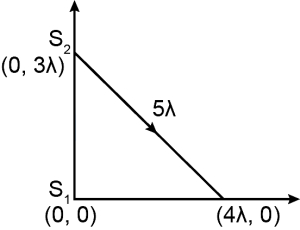
0 likesView Solution
55
PhysicsMediumMCQWBJEE · 2013
$A$ particle of mass $M$ and charge $q$ is released from rest in a region of uniform electric field of magnitude $E$. After a time $t$,the distance travelled by the charge is $S$ and the kinetic energy attained by the particle is $T$. Then,the ratio $T/S$:
A
remains constant with time $t$
B
varies linearly with the mass $M$ of the particle
C
is independent of the charge $q$
D
is independent of the magnitude of the electric field $E$
Solution
(A) Given: Mass of the particle $= M$,Charge $= q$,Electric field $= E$,Initial velocity $u = 0$.
Acceleration $a = F/M = qE/M$.
Distance travelled $S = ut + (1/2)at^2 = (1/2)(qE/M)t^2$.
Final velocity $v = u + at = (qE/M)t$.
Kinetic energy $T = (1/2)Mv^2 = (1/2)M(qEt/M)^2 = (1/2)(q^2E^2t^2/M)$.
Now,the ratio $T/S = [(1/2)(q^2E^2t^2/M)] / [(1/2)(qE/M)t^2] = qE$.
Since $q$ and $E$ are constants,the ratio $T/S = qE$ is independent of time $t$ and remains constant.
Acceleration $a = F/M = qE/M$.
Distance travelled $S = ut + (1/2)at^2 = (1/2)(qE/M)t^2$.
Final velocity $v = u + at = (qE/M)t$.
Kinetic energy $T = (1/2)Mv^2 = (1/2)M(qEt/M)^2 = (1/2)(q^2E^2t^2/M)$.
Now,the ratio $T/S = [(1/2)(q^2E^2t^2/M)] / [(1/2)(qE/M)t^2] = qE$.
Since $q$ and $E$ are constants,the ratio $T/S = qE$ is independent of time $t$ and remains constant.
0 likesView Solution
56
PhysicsMediumMCQWBJEE · 2013
$A$ particle of mass $M$ and charge $q$,initially at rest,is accelerated by a uniform electric field $E$ through a distance $D$ and is then allowed to approach a fixed static charge $Q$ of the same sign. The distance of the closest approach of the charge $q$ will then be
A
$\frac{q Q}{4 \pi \varepsilon_{0} D}$
B
$\frac{Q}{4 \pi \varepsilon_{0} E D}$
C
$\frac{q Q}{2 \pi \varepsilon_{0} D^{2}}$
D
$\frac{Q}{4 \pi \varepsilon_{0} E}$
Solution
(B) The particle is accelerated by a uniform electric field $E$ over a distance $D$. The work done by the electric field is equal to the kinetic energy $(KE)$ gained by the particle.
$KE = W = q E D$
At the point of closest approach $(r_0)$,the entire kinetic energy of the particle is converted into electrostatic potential energy $(PE)$ due to the interaction with the fixed charge $Q$.
$PE = \frac{1}{4 \pi \varepsilon_0} \frac{q Q}{r_0}$
Equating $KE$ and $PE$ at the point of closest approach:
$q E D = \frac{1}{4 \pi \varepsilon_0} \frac{q Q}{r_0}$
Solving for $r_0$:
$r_0 = \frac{Q}{4 \pi \varepsilon_0 E D}$
$KE = W = q E D$
At the point of closest approach $(r_0)$,the entire kinetic energy of the particle is converted into electrostatic potential energy $(PE)$ due to the interaction with the fixed charge $Q$.
$PE = \frac{1}{4 \pi \varepsilon_0} \frac{q Q}{r_0}$
Equating $KE$ and $PE$ at the point of closest approach:
$q E D = \frac{1}{4 \pi \varepsilon_0} \frac{q Q}{r_0}$
Solving for $r_0$:
$r_0 = \frac{Q}{4 \pi \varepsilon_0 E D}$
0 likesView Solution
Vedclass Products
For Students
Vedclass Test Series
Mock tests in real WBJEE style covering Physics with performance analysis. 5-day free trial.
Start Free TrialFor Teachers
Exam Paper Generator
Generate Set A/B/C/D Physics papers from 7.5L+ questions in 2 minutes. 3 chapters free.
Try FreeFor Institutes
Online Exam Module
Run live WBJEE mock exams with unlimited students, 360° analytics & white-label branding.
See DemoFrequently Asked Questions
How many Physics questions are in WBJEE 2013?
There are 56 Physics questions from the WBJEE 2013 paper on Vedclass, each with a detailed step-by-step solution in English.
Are WBJEE 2013 Physics solutions available in English?
Yes. All solutions on this page are in English. You can also switch to English or Hindi using the language buttons above the questions.
Can I practice WBJEE 2013 Physics as a timed test?
Yes. Use the Vedclass Test Series to attempt a full WBJEE mock test covering Physics with time limits and instant score analysis.
Can teachers create Physics papers from WBJEE previous year questions?
Yes. The Vedclass Exam Paper Generator lets teachers mix WBJEE Physics questions and generate Set A/B/C/D papers in minutes.
For Teachers & Institutes
Build a Custom Physics Paper
Pick WBJEE 2013 Physics questions, set difficulty, and generate Set A/B/C/D in 2 minutes.