
ChemistryQ1–42 of 42 questions
Page 1 of 1 · English
1
ChemistryMCQWBJEE · 2018
Which of the following is present in maximum amount in acid rain?
A
$HNO_3$
B
$H_2SO_4$
C
$H_2CO_3$
D
$HCl$
Solution
(B) Acid rain is primarily caused by the presence of oxides of sulphur and nitrogen in the atmosphere.
Among these,the oxides of sulphur ($SO_2$ and $SO_3$) are the major contributors,accounting for approximately $60-70\%$ of the acidity.
These oxides react with atmospheric water to form sulphuric acid $(H_2SO_4)$,which is the most abundant acid in acid rain.
Among these,the oxides of sulphur ($SO_2$ and $SO_3$) are the major contributors,accounting for approximately $60-70\%$ of the acidity.
These oxides react with atmospheric water to form sulphuric acid $(H_2SO_4)$,which is the most abundant acid in acid rain.
0 likesView Solution
2
ChemistryEasyMCQWBJEE · 2018
The number of possible organobromine compounds which can be obtained in the allylic bromination of $but-1-ene$ with $N-bromosuccinimide$ $(NBS)$ is
A
$1$
B
$2$
C
$3$
D
$4$
Solution
(D) $NBS$ $(N-bromosuccinimide)$ performs allylic bromination via a free radical mechanism.
For $but-1-ene$ $(CH_3-CH_2-CH=CH_2)$,the allylic hydrogen is at the $C-3$ position.
Abstraction of this hydrogen generates an allylic radical: $CH_3-\dot{C}H-CH=CH_2 \leftrightarrow CH_3-CH=CH-\dot{C}H_2$.
Reaction of this resonance-stabilized radical with $Br \cdot$ leads to two constitutional isomers:
$1$. $3-bromobut-1-ene$ $(CH_3-CH(Br)-CH=CH_2)$,which contains a chiral center and thus exists as a pair of enantiomers ($d$ and $l$).
$2$. $1-bromobut-2-ene$ $(CH_3-CH=CH-CH_2Br)$,which exhibits geometrical isomerism ($cis$ and $trans$).
Therefore,the total number of possible organobromine compounds is $2$ (enantiomers) $2$ (geometrical isomers) = $4$.
For $but-1-ene$ $(CH_3-CH_2-CH=CH_2)$,the allylic hydrogen is at the $C-3$ position.
Abstraction of this hydrogen generates an allylic radical: $CH_3-\dot{C}H-CH=CH_2 \leftrightarrow CH_3-CH=CH-\dot{C}H_2$.
Reaction of this resonance-stabilized radical with $Br \cdot$ leads to two constitutional isomers:
$1$. $3-bromobut-1-ene$ $(CH_3-CH(Br)-CH=CH_2)$,which contains a chiral center and thus exists as a pair of enantiomers ($d$ and $l$).
$2$. $1-bromobut-2-ene$ $(CH_3-CH=CH-CH_2Br)$,which exhibits geometrical isomerism ($cis$ and $trans$).
Therefore,the total number of possible organobromine compounds is $2$ (enantiomers) $2$ (geometrical isomers) = $4$.
0 likesView Solution
3
ChemistryMediumMCQWBJEE · 2018
$[P]$ $\xrightarrow{Br_{2}} C_{2}H_{4}Br_{2}$ $\xrightarrow{NaNH_{2}/NH_{3}} [Q]$
$[Q]$ $\xrightarrow{20 \% H_{2}SO_{4}, Hg^{2+}, \Delta} [R]$ $\xrightarrow{Zn-Hg/HCl} [S]$
The species $[P], [Q], [R]$ and $[S]$ respectively are:
$[Q]$ $\xrightarrow{20 \% H_{2}SO_{4}, Hg^{2+}, \Delta} [R]$ $\xrightarrow{Zn-Hg/HCl} [S]$
The species $[P], [Q], [R]$ and $[S]$ respectively are:
A
ethene,ethyne,ethanal,ethane
B
ethane,ethyne,ethanal,ethene
C
ethene,ethyne,ethanal,ethanol
D
ethyne,ethane,ethene,ethanal
Solution
(A) The given reaction sequence is:
$1$. $[P]$ is ethene $(CH_{2}=CH_{2})$. Reaction with $Br_{2}$ gives $1,2-dibromoethane$ $(CH_{2}Br-CH_{2}Br)$.
$2$. $1,2-dibromoethane$ reacts with $NaNH_{2}/NH_{3}$ (dehydrohalogenation) to form ethyne $(HC \equiv CH)$ as $[Q]$.
$3$. Ethyne $[Q]$ reacts with $20 \% H_{2}SO_{4}$ and $Hg^{2+}$ (Kucherov reaction) to form ethanal $(CH_{3}CHO)$ as $[R]$.
$4$. Ethanal $[R]$ undergoes Clemmensen reduction $(Zn-Hg/HCl)$ to form ethane $(CH_{3}CH_{3})$ as $[S]$.
Thus,$[P]$ = ethene,$[Q]$ = ethyne,$[R]$ = ethanal,$[S]$ = ethane.
$1$. $[P]$ is ethene $(CH_{2}=CH_{2})$. Reaction with $Br_{2}$ gives $1,2-dibromoethane$ $(CH_{2}Br-CH_{2}Br)$.
$2$. $1,2-dibromoethane$ reacts with $NaNH_{2}/NH_{3}$ (dehydrohalogenation) to form ethyne $(HC \equiv CH)$ as $[Q]$.
$3$. Ethyne $[Q]$ reacts with $20 \% H_{2}SO_{4}$ and $Hg^{2+}$ (Kucherov reaction) to form ethanal $(CH_{3}CHO)$ as $[R]$.
$4$. Ethanal $[R]$ undergoes Clemmensen reduction $(Zn-Hg/HCl)$ to form ethane $(CH_{3}CH_{3})$ as $[S]$.
Thus,$[P]$ = ethene,$[Q]$ = ethyne,$[R]$ = ethanal,$[S]$ = ethane.
0 likesView Solution
4
ChemistryMediumMCQWBJEE · 2018
Which statements are correct for the peroxide ion?
A
It has five completely filled anti-bonding molecular orbitals
B
It is diamagnetic
C
It has bond order one
D
It is isoelectronic with neon
Solution
(B, C) The correct statements for the peroxide ion $(O_{2}^{2-})$ are that it is diamagnetic and it has a bond order of $1$.
Electronic configuration of $O_{2}^{2-}$ is: $\sigma 1s^{2}, \sigma^{*} 1s^{2}, \sigma 2s^{2}, \sigma^{*} 2s^{2}, \sigma 2p_{z}^{2}, (\pi 2p_{x}^{2} = \pi 2p_{y}^{2}), (\pi^{*} 2p_{x}^{2} = \pi^{*} 2p_{y}^{2})$.
Bond order $= \frac{1}{2} (\text{Number of bonding electrons} - \text{Number of anti-bonding electrons})$.
$BO = \frac{10 - 8}{2} = \frac{2}{2} = 1$.
Since the number of unpaired electrons is $0$,$O_{2}^{2-}$ is diamagnetic in nature.
Electronic configuration of $O_{2}^{2-}$ is: $\sigma 1s^{2}, \sigma^{*} 1s^{2}, \sigma 2s^{2}, \sigma^{*} 2s^{2}, \sigma 2p_{z}^{2}, (\pi 2p_{x}^{2} = \pi 2p_{y}^{2}), (\pi^{*} 2p_{x}^{2} = \pi^{*} 2p_{y}^{2})$.
Bond order $= \frac{1}{2} (\text{Number of bonding electrons} - \text{Number of anti-bonding electrons})$.
$BO = \frac{10 - 8}{2} = \frac{2}{2} = 1$.
Since the number of unpaired electrons is $0$,$O_{2}^{2-}$ is diamagnetic in nature.
0 likesView Solution
5
ChemistryEasyMCQWBJEE · 2018
Which of the following has the strongest $H$-bond?
A
$O-H...S$
B
$S-H...O$
C
$F-H...F$
D
$F-H...O$
Solution
(C) The strength of a hydrogen bond depends on the electronegativity of the atoms involved in the bond. The greater the electronegativity difference between the hydrogen atom and the atom it is bonded to,the stronger the hydrogen bond will be.
Fluorine $(F)$ is the most electronegative element in the periodic table.
Therefore,the $F-H...F$ bond is the strongest among the given options because fluorine has the highest electronegativity compared to oxygen $(O)$ and sulphur $(S)$.
The electronegativity order is $F > O > S$.
Fluorine $(F)$ is the most electronegative element in the periodic table.
Therefore,the $F-H...F$ bond is the strongest among the given options because fluorine has the highest electronegativity compared to oxygen $(O)$ and sulphur $(S)$.
The electronegativity order is $F > O > S$.
0 likesView Solution
6
ChemistryMediumMCQWBJEE · 2018
The following equilibrium constants are given:
$N_{2} + 3 H_{2} \rightleftharpoons 2 NH_{3} ; K_{1}$
$N_{2} + O_{2} \rightleftharpoons 2 NO ; K_{2}$
$H_{2} + \frac{1}{2} O_{2} \rightleftharpoons H_{2} O ; K_{3}$
The equilibrium constant for the oxidation of $2 \text{ mole}$ of $NH_{3}$ to give $NO$ is
$N_{2} + 3 H_{2} \rightleftharpoons 2 NH_{3} ; K_{1}$
$N_{2} + O_{2} \rightleftharpoons 2 NO ; K_{2}$
$H_{2} + \frac{1}{2} O_{2} \rightleftharpoons H_{2} O ; K_{3}$
The equilibrium constant for the oxidation of $2 \text{ mole}$ of $NH_{3}$ to give $NO$ is
A
$K_{1} \cdot \frac{K_{2}}{K_{3}}$
B
$K_{2} \cdot \frac{K_{3}^{3}}{K_{1}}$
C
$K_{2} \cdot \frac{K_{2}^{2}}{K_{1}}$
D
$K_{2}^{2} \cdot \frac{K_{3}}{K_{1}}$
Solution
(B) The target reaction is the oxidation of $2 \text{ mol}$ of $NH_{3}$ to $NO$:
$2 NH_{3} + \frac{5}{2} O_{2} \rightleftharpoons 2 NO + 3 H_{2} O$
Given equations:
$(i) N_{2} + 3 H_{2} \rightleftharpoons 2 NH_{3} ; K_{1}$
$(ii) N_{2} + O_{2} \rightleftharpoons 2 NO ; K_{2}$
$(iii) H_{2} + \frac{1}{2} O_{2} \rightleftharpoons H_{2} O ; K_{3}$
To obtain the target reaction:
$1$. Reverse equation $(i)$: $2 NH_{3} \rightleftharpoons N_{2} + 3 H_{2} ; K' = \frac{1}{K_{1}}$
$2$. Keep equation $(ii)$ as it is: $N_{2} + O_{2} \rightleftharpoons 2 NO ; K_{2}$
$3$. Multiply equation $(iii)$ by $3$: $3 H_{2} + \frac{3}{2} O_{2} \rightleftharpoons 3 H_{2} O ; K'' = K_{3}^{3}$
Adding these three equations:
$(2 NH_{3} + N_{2} + O_{2} + 3 H_{2} + \frac{3}{2} O_{2}) \rightleftharpoons (N_{2} + 3 H_{2} + 2 NO + 3 H_{2} O)$
Simplifying gives: $2 NH_{3} + \frac{5}{2} O_{2} \rightleftharpoons 2 NO + 3 H_{2} O$
The equilibrium constant $K$ is:
$K = K' \cdot K_{2} \cdot K'' = \frac{1}{K_{1}} \cdot K_{2} \cdot K_{3}^{3} = K_{2} \cdot \frac{K_{3}^{3}}{K_{1}}$
$2 NH_{3} + \frac{5}{2} O_{2} \rightleftharpoons 2 NO + 3 H_{2} O$
Given equations:
$(i) N_{2} + 3 H_{2} \rightleftharpoons 2 NH_{3} ; K_{1}$
$(ii) N_{2} + O_{2} \rightleftharpoons 2 NO ; K_{2}$
$(iii) H_{2} + \frac{1}{2} O_{2} \rightleftharpoons H_{2} O ; K_{3}$
To obtain the target reaction:
$1$. Reverse equation $(i)$: $2 NH_{3} \rightleftharpoons N_{2} + 3 H_{2} ; K' = \frac{1}{K_{1}}$
$2$. Keep equation $(ii)$ as it is: $N_{2} + O_{2} \rightleftharpoons 2 NO ; K_{2}$
$3$. Multiply equation $(iii)$ by $3$: $3 H_{2} + \frac{3}{2} O_{2} \rightleftharpoons 3 H_{2} O ; K'' = K_{3}^{3}$
Adding these three equations:
$(2 NH_{3} + N_{2} + O_{2} + 3 H_{2} + \frac{3}{2} O_{2}) \rightleftharpoons (N_{2} + 3 H_{2} + 2 NO + 3 H_{2} O)$
Simplifying gives: $2 NH_{3} + \frac{5}{2} O_{2} \rightleftharpoons 2 NO + 3 H_{2} O$
The equilibrium constant $K$ is:
$K = K' \cdot K_{2} \cdot K'' = \frac{1}{K_{1}} \cdot K_{2} \cdot K_{3}^{3} = K_{2} \cdot \frac{K_{3}^{3}}{K_{1}}$
0 likesView Solution
7
ChemistryEasyMCQWBJEE · 2018
Which of the following is present in maximum amount in 'acid rain'?
A
$HNO_{3}$
B
$H_{2}SO_{4}$
C
$HCl$
D
$H_{2}CO_{3}$
Solution
(B) $H_{2}SO_{4}$ (sulphuric acid) is present in the maximum amount in 'acid rain'.
Oxides of nitrogen and sulphur,released into the atmosphere from industries,automobiles,and thermal power plants,are the main sources of acid rain.
These oxides,upon oxidation followed by hydrolysis,produce sulphuric acid and nitric acid,which,along with $HCl$,are responsible for the acidity of rain.
The oxidation reaction is catalysed by particulate matter present in the polluted atmosphere.
$2SO_{2(g)} + O_{2(g)} + 2H_{2}O_{(l)} \longrightarrow 2H_{2}SO_{4(aq)}$
$4NO_{2(g)} + O_{2(g)} + 2H_{2}O_{(l)} \longrightarrow 4HNO_{3(aq)}$
Typically,$H_{2}SO_{4}$ contributes about $70\%$ of the total acidity in acid rain.
Oxides of nitrogen and sulphur,released into the atmosphere from industries,automobiles,and thermal power plants,are the main sources of acid rain.
These oxides,upon oxidation followed by hydrolysis,produce sulphuric acid and nitric acid,which,along with $HCl$,are responsible for the acidity of rain.
The oxidation reaction is catalysed by particulate matter present in the polluted atmosphere.
$2SO_{2(g)} + O_{2(g)} + 2H_{2}O_{(l)} \longrightarrow 2H_{2}SO_{4(aq)}$
$4NO_{2(g)} + O_{2(g)} + 2H_{2}O_{(l)} \longrightarrow 4HNO_{3(aq)}$
Typically,$H_{2}SO_{4}$ contributes about $70\%$ of the total acidity in acid rain.
0 likesView Solution
8
ChemistryMediumMCQWBJEE · 2018
The number of alkene$(s)$ which can produce $2-butanol$ by the successive treatment of $(i)$ $B_{2}H_{6}$ in tetrahydrofuran solvent and $(ii)$ alkaline $H_{2}O_{2}$ solution is:
A
$1$
B
$2$
C
$3$
D
$4$
Solution
(B) The reaction described is hydroboration-oxidation,which follows anti-Markovnikov addition of water across the double bond.
To obtain $2-butanol$ $(CH_{3}CH(OH)CH_{2}CH_{3})$,the starting alkene must be $1-butene$ $(CH_{3}CH_{2}CH=CH_{2})$ or $2-butene$ $(CH_{3}CH=CHCH_{3})$.
For $1-butene$: The anti-Markovnikov addition of $H_{2}O$ yields $1-butanol$.
For $2-butene$ ($cis$ or $trans$): The anti-Markovnikov addition of $H_{2}O$ yields $2-butanol$ because both carbons of the double bond are equivalent.
Thus,only $2-butene$ (both $cis$ and $trans$ isomers) produces $2-butanol$ as the product.
Therefore,the number of such alkenes is $2$.
To obtain $2-butanol$ $(CH_{3}CH(OH)CH_{2}CH_{3})$,the starting alkene must be $1-butene$ $(CH_{3}CH_{2}CH=CH_{2})$ or $2-butene$ $(CH_{3}CH=CHCH_{3})$.
For $1-butene$: The anti-Markovnikov addition of $H_{2}O$ yields $1-butanol$.
For $2-butene$ ($cis$ or $trans$): The anti-Markovnikov addition of $H_{2}O$ yields $2-butanol$ because both carbons of the double bond are equivalent.
Thus,only $2-butene$ (both $cis$ and $trans$ isomers) produces $2-butanol$ as the product.
Therefore,the number of such alkenes is $2$.
0 likesView Solution
9
ChemistryEasyMCQWBJEE · 2018
The major products obtained in the following reaction is/are:
$CH_3-CH=CH-C_2H_5 + Br_2 \rightarrow ?$
$CH_3-CH=CH-C_2H_5 + Br_2 \rightarrow ?$
A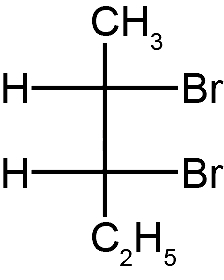
B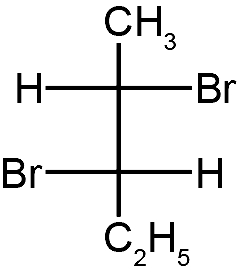
C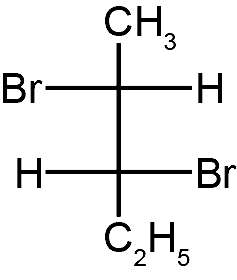
D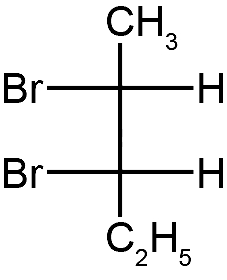
Solution
(A) The reaction of an alkene with $Br_2$ proceeds via the formation of a cyclic bromonium ion intermediate. The $Br^-$ ion then attacks the bromonium ion from the side opposite to the bridged bromine atom,resulting in anti-addition. For the given alkene,$CH_3-CH=CH-C_2H_5$ (pent$-2-$ene),the anti-addition of $Br_2$ leads to the formation of a pair of enantiomers as the major products. These are represented by the structures in options $A$ and $D$ (or equivalent representations of the enantiomeric pair).
0 likesView Solution
10
ChemistryEasyMCQWBJEE · 2018
$CH_{3}C \equiv CMgBr$ can be prepared by the reaction of:
A
$CH_{3}C=CBr$ with $MgBr_{2}$
B
$CH_{3}C \equiv CH$ with $MgBr_{2}$
C
$CH_{3}C \equiv CH$ with $KBr$ and $Mg$ metal
D
$CH_{3}C \equiv CH$ with $CH_{3}MgBr$
Solution
(D) $CH_{3}C \equiv CMgBr$ is a Grignard reagent derived from a terminal alkyne.
It can be prepared by the acid-base reaction between propyne $(CH_{3}C \equiv CH)$ and methylmagnesium bromide $(CH_{3}MgBr)$.
The terminal hydrogen of the alkyne is acidic and reacts with the basic Grignard reagent to form the alkynyl magnesium bromide and methane gas.
The chemical equation is:
$CH_{3}C \equiv CH + CH_{3}MgBr \longrightarrow CH_{3}C \equiv CMgBr + CH_{4}$
It can be prepared by the acid-base reaction between propyne $(CH_{3}C \equiv CH)$ and methylmagnesium bromide $(CH_{3}MgBr)$.
The terminal hydrogen of the alkyne is acidic and reacts with the basic Grignard reagent to form the alkynyl magnesium bromide and methane gas.
The chemical equation is:
$CH_{3}C \equiv CH + CH_{3}MgBr \longrightarrow CH_{3}C \equiv CMgBr + CH_{4}$
0 likesView Solution
11
ChemistryEasyMCQWBJEE · 2018
Which of the following sets of oxides is arranged in the order of basic,amphoteric,and acidic?
A
$SO_{2}, P_{2}O_{5}, CO$
B
$BaO, Al_{2}O_{3}, SO_{2}$
C
$CaO, SiO_{2}, Al_{2}O_{3}$
D
$CO_{2}, Al_{2}O_{3}, CO$
Solution
(B) The correct set of oxides arranged in the order of basic,amphoteric,and acidic is $BaO, Al_{2}O_{3}, SO_{2}$.
$BaO$ is a metal oxide of an alkaline earth metal,which is strongly basic.
$Al_{2}O_{3}$ is a well-known amphoteric oxide,reacting with both acids and bases.
$SO_{2}$ is a non-metal oxide,which is acidic in nature.
$BaO$ is a metal oxide of an alkaline earth metal,which is strongly basic.
$Al_{2}O_{3}$ is a well-known amphoteric oxide,reacting with both acids and bases.
$SO_{2}$ is a non-metal oxide,which is acidic in nature.
0 likesView Solution
12
ChemistryEasyMCQWBJEE · 2018
The main reason that $SiCl_{4}$ is easily hydrolysed as compared to $CCl_{4}$ is that
A
$Si-Cl$ bond is weaker than $C-Cl$ bond
B
$SiCl_{4}$ can form hydrogen bonds
C
$SiCl_{4}$ is covalent
D
$Si$ can extend its coordination number beyond four
Solution
(D) The main reason that $SiCl_{4}$ is easily hydrolysed compared to $CCl_{4}$ is that silicon $(Si)$ has vacant $3d$-orbitals,which allow it to extend its coordination number beyond four.
Water molecules can coordinate with the vacant $d$-orbitals of the $Si$ atom in $SiCl_{4}$,facilitating the hydrolysis process.
In contrast,carbon $(C)$ lacks $d$-orbitals and cannot expand its coordination number beyond four,making $CCl_{4}$ resistant to hydrolysis by water.
Water molecules can coordinate with the vacant $d$-orbitals of the $Si$ atom in $SiCl_{4}$,facilitating the hydrolysis process.
In contrast,carbon $(C)$ lacks $d$-orbitals and cannot expand its coordination number beyond four,making $CCl_{4}$ resistant to hydrolysis by water.
0 likesView Solution
13
ChemistryEasyMCQWBJEE · 2018
Which of the following is least thermally stable?
A
$MgCO_3$
B
$CaCO_3$
C
$SrCO_3$
D
$BeCO_3$
Solution
(D) The thermal stability of alkaline earth metal carbonates increases down the group as the electropositive character of the metal increases.
The order of thermal stability is: $BeCO_3 < MgCO_3 < CaCO_3 < SrCO_3 < BaCO_3$.
$BeCO_3$ is the least thermally stable because the small size of the $Be^{2+}$ ion leads to high polarization of the carbonate ion,making it unstable.
It is so unstable that it must be stored in an atmosphere of $CO_2$ to prevent decomposition: $BeCO_3 \rightarrow BeO + CO_2$.
The order of thermal stability is: $BeCO_3 < MgCO_3 < CaCO_3 < SrCO_3 < BaCO_3$.
$BeCO_3$ is the least thermally stable because the small size of the $Be^{2+}$ ion leads to high polarization of the carbonate ion,making it unstable.
It is so unstable that it must be stored in an atmosphere of $CO_2$ to prevent decomposition: $BeCO_3 \rightarrow BeO + CO_2$.
0 likesView Solution
14
ChemistryEasyMCQWBJEE · 2018
Equal weights of ethane and hydrogen are mixed in an empty container at $25^{\circ} C$. The fraction of total pressure exerted by hydrogen is
A
$1: 2$
B
$1: 1$
C
$1: 16$
D
$15: 16$
Solution
(D) Let the weight of both ethane $(C_2H_6)$ and hydrogen $(H_2)$ be $W \ g$.
Number of moles of $C_2H_6$ $(n_{C_2H_6})$ = $\frac{W}{30}$.
Number of moles of $H_2$ $(n_{H_2})$ = $\frac{W}{2}$.
According to Dalton's law of partial pressures, the fraction of total pressure exerted by a gas is equal to its mole fraction $(\chi)$.
$\chi_{H_2} = \frac{n_{H_2}}{n_{H_2} + n_{C_2H_6}} = \frac{\frac{W}{2}}{\frac{W}{2} + \frac{W}{30}}$.
$\chi_{H_2} = \frac{\frac{W}{2}}{\frac{15W + W}{30}} = \frac{W}{2} \times \frac{30}{16W} = \frac{15}{16}$.
Thus, the fraction of total pressure exerted by hydrogen is $\frac{15}{16}$ or $15: 16$.
Number of moles of $C_2H_6$ $(n_{C_2H_6})$ = $\frac{W}{30}$.
Number of moles of $H_2$ $(n_{H_2})$ = $\frac{W}{2}$.
According to Dalton's law of partial pressures, the fraction of total pressure exerted by a gas is equal to its mole fraction $(\chi)$.
$\chi_{H_2} = \frac{n_{H_2}}{n_{H_2} + n_{C_2H_6}} = \frac{\frac{W}{2}}{\frac{W}{2} + \frac{W}{30}}$.
$\chi_{H_2} = \frac{\frac{W}{2}}{\frac{15W + W}{30}} = \frac{W}{2} \times \frac{30}{16W} = \frac{15}{16}$.
Thus, the fraction of total pressure exerted by hydrogen is $\frac{15}{16}$ or $15: 16$.
0 likesView Solution
15
ChemistryDifficultMCQWBJEE · 2018
How many moles of electrons will weigh $1 \ kg$?
A
$6.023 \times 10^{23}$
B
$\frac{1}{9.108} \times 10^{31}$
C
$\frac{6023}{9108} \times 10^{54}$
D
$\frac{1}{9.108 \times 6.023} \times 10^{8}$
Solution
(D) Mass of one electron = $9.108 \times 10^{-31} \ kg$.
Number of electrons in $1 \ mole = 6.023 \times 10^{23}$.
Mass of $1 \ mole$ of electrons = $(9.108 \times 10^{-31}) \times (6.023 \times 10^{23}) \ kg = 9.108 \times 6.023 \times 10^{-8} \ kg$.
Number of moles that weigh $1 \ kg = \frac{1}{9.108 \times 6.023 \times 10^{-8}} = \frac{1}{9.108 \times 6.023} \times 10^8 \ moles$.
Number of electrons in $1 \ mole = 6.023 \times 10^{23}$.
Mass of $1 \ mole$ of electrons = $(9.108 \times 10^{-31}) \times (6.023 \times 10^{23}) \ kg = 9.108 \times 6.023 \times 10^{-8} \ kg$.
Number of moles that weigh $1 \ kg = \frac{1}{9.108 \times 6.023 \times 10^{-8}} = \frac{1}{9.108 \times 6.023} \times 10^8 \ moles$.
0 likesView Solution
16
ChemistryEasyMCQWBJEE · 2018
$A$ metal $M$ (specific heat $0.16 \ J \ g^{-1} \ K^{-1}$) forms a metal chloride with $65\%$ chlorine present in it. The formula of the metal chloride will be:
A
$MCl$
B
$MCl_2$
C
$MCl_3$
D
$MCl_4$
Solution
(B) According to the Dulong-Petit law,the approximate atomic mass of the metal is $\approx \frac{6.4}{\text{Specific heat}} = \frac{6.4}{0.16} = 40 \ g \ mol^{-1}$.
In the metal chloride,the percentage of chlorine is $65\%$,so the percentage of metal $M$ is $35\%$.
The equivalent weight of the metal is calculated as $\frac{\text{Mass of metal}}{\text{Mass of chlorine}} \times 35.5 = \frac{35}{65} \times 35.5 \approx 19.11$.
The valency $n$ is given by $\frac{\text{Approximate atomic mass}}{\text{Equivalent weight}} = \frac{40}{19.11} \approx 2.09 \approx 2$.
Thus,the formula of the metal chloride is $MCl_2$.
In the metal chloride,the percentage of chlorine is $65\%$,so the percentage of metal $M$ is $35\%$.
The equivalent weight of the metal is calculated as $\frac{\text{Mass of metal}}{\text{Mass of chlorine}} \times 35.5 = \frac{35}{65} \times 35.5 \approx 19.11$.
The valency $n$ is given by $\frac{\text{Approximate atomic mass}}{\text{Equivalent weight}} = \frac{40}{19.11} \approx 2.09 \approx 2$.
Thus,the formula of the metal chloride is $MCl_2$.
0 likesView Solution
17
ChemistryEasyMCQWBJEE · 2018
Which of the following sets of quantum numbers is not possible?
A
$n=3, l=0, m=0$
B
$n=3, l=1, m=-1$
C
$n=2, l=0, m=-1$
D
$n=2, l=1, m=0$
Solution
(C) For a given value of $n$,the azimuthal quantum number $l$ can have values from $0$ to $n-1$.
For a given value of $l$,the magnetic quantum number $m$ can have values from $-l$ to $+l$ including $0$.
In option $C$,$n=2$ and $l=0$.
For $l=0$,the only possible value for $m$ is $0$.
Therefore,$m=-1$ is not possible for $l=0$.
For a given value of $l$,the magnetic quantum number $m$ can have values from $-l$ to $+l$ including $0$.
In option $C$,$n=2$ and $l=0$.
For $l=0$,the only possible value for $m$ is $0$.
Therefore,$m=-1$ is not possible for $l=0$.
0 likesView Solution
18
ChemistryEasyMCQWBJEE · 2018
The number of unpaired electrons in $Ni$ (atomic number $= 28$) is:
A
$0$
B
$2$
C
$4$
D
$8$
Solution
(B) The atomic number of $Ni$ is $28$.
Its electronic configuration is: $1s^2 2s^2 2p^6 3s^2 3p^6 4s^2 3d^8$.
In the $3d$ subshell,there are $8$ electrons.
According to Hund's rule,these $8$ electrons are filled in the $5$ $d$-orbitals as follows:
First,$5$ electrons are filled singly,and then the remaining $3$ electrons are paired.
This results in $3$ paired orbitals and $2$ singly occupied (unpaired) orbitals.
Therefore,the number of unpaired electrons in $Ni$ is $2$.
Its electronic configuration is: $1s^2 2s^2 2p^6 3s^2 3p^6 4s^2 3d^8$.
In the $3d$ subshell,there are $8$ electrons.
According to Hund's rule,these $8$ electrons are filled in the $5$ $d$-orbitals as follows:
First,$5$ electrons are filled singly,and then the remaining $3$ electrons are paired.
This results in $3$ paired orbitals and $2$ singly occupied (unpaired) orbitals.
Therefore,the number of unpaired electrons in $Ni$ is $2$.
0 likesView Solution
19
ChemistryEasyMCQWBJEE · 2018
Among the following,which are extensive variables?
A
$H$ (Enthalpy)
B
$p$ (Pressure)
C
$E$ (Internal energy)
D
$V$ (Volume)
Solution
(A, C, D) Extensive properties are those whose values depend on the quantity or size of matter present in the system.
$H$ (Enthalpy),$E$ (Internal energy),and $V$ (Volume) are all extensive properties because they scale with the amount of substance.
$p$ (Pressure) is an intensive property as it is independent of the amount of matter.
Therefore,$H$,$E$,and $V$ are extensive variables.
$H$ (Enthalpy),$E$ (Internal energy),and $V$ (Volume) are all extensive properties because they scale with the amount of substance.
$p$ (Pressure) is an intensive property as it is independent of the amount of matter.
Therefore,$H$,$E$,and $V$ are extensive variables.
0 likesView Solution
20
ChemistryDifficultMCQWBJEE · 2018
During a reversible adiabatic process,the pressure of a gas is found to be proportional to the cube of its absolute temperature. The ratio $\frac{C_p}{C_V}$ for the gas is:
A
$\frac{3}{2}$
B
$\frac{7}{2}$
C
$\frac{5}{3}$
D
$\frac{9}{7}$
Solution
(A) For a reversible adiabatic process,the relation between pressure $(P)$ and temperature $(T)$ is given by $P^{1-\gamma} T^\gamma = \text{constant}$.
This can be rearranged as $P \propto T^{\frac{\gamma}{\gamma-1}}$.
Given: $P \propto T^3$.
Therefore,$\frac{\gamma}{\gamma-1} = 3$.
$\gamma = 3\gamma - 3$.
$2\gamma = 3$.
$\gamma = \frac{3}{2}$.
Since $\gamma = \frac{C_p}{C_V}$,the ratio is $\frac{3}{2}$.
This can be rearranged as $P \propto T^{\frac{\gamma}{\gamma-1}}$.
Given: $P \propto T^3$.
Therefore,$\frac{\gamma}{\gamma-1} = 3$.
$\gamma = 3\gamma - 3$.
$2\gamma = 3$.
$\gamma = \frac{3}{2}$.
Since $\gamma = \frac{C_p}{C_V}$,the ratio is $\frac{3}{2}$.
0 likesView Solution
21
ChemistryMediumMCQWBJEE · 2018
The heat of neutralisation of a strong acid and a strong base is $13.7 \ kcal$. The heat released when $0.6 \ mole$ $HCl$ solution is added to $0.25 \ mole$ of $NaOH$ is: (in $kcal$)
A
$3.425$
B
$8.22$
C
$11.645$
D
$13.7$
Solution
(A) The heat of neutralisation for the reaction between a strong acid and a strong base is defined as the heat released when $1 \ mole$ of $H^+$ ions reacts with $1 \ mole$ of $OH^-$ ions to form $1 \ mole$ of $H_2O$,which is $13.7 \ kcal$.
The balanced chemical equation is:
$HCl + NaOH \longrightarrow NaCl + H_2O; \Delta H = -13.7 \ kcal \text{ per mole of } H_2O \text{ formed}$.
Given amounts:
$HCl = 0.6 \ mole$
$NaOH = 0.25 \ mole$
Since $NaOH$ is the limiting reagent,the amount of $H_2O$ formed is determined by the amount of $NaOH$ present,which is $0.25 \ mole$.
Heat released $= \text{Heat of neutralisation} \times \text{moles of } H_2O \text{ formed}$
Heat released $= 13.7 \ kcal/mole \times 0.25 \ mole = 3.425 \ kcal$.
The balanced chemical equation is:
$HCl + NaOH \longrightarrow NaCl + H_2O; \Delta H = -13.7 \ kcal \text{ per mole of } H_2O \text{ formed}$.
Given amounts:
$HCl = 0.6 \ mole$
$NaOH = 0.25 \ mole$
Since $NaOH$ is the limiting reagent,the amount of $H_2O$ formed is determined by the amount of $NaOH$ present,which is $0.25 \ mole$.
Heat released $= \text{Heat of neutralisation} \times \text{moles of } H_2O \text{ formed}$
Heat released $= 13.7 \ kcal/mole \times 0.25 \ mole = 3.425 \ kcal$.
0 likesView Solution
22
ChemistryMCQWBJEE · 2018
If $\int f(x) \sin x \cos x \, dx = \frac{1}{2(b^2 - a^2)} \log f(x) + c$,where $c$ is the constant of integration,then $f(x)$ is equal to
A
$\frac{2}{(b^2 - a^2) \sin 2x}$
B
$\frac{2}{ab \sin 2x}$
C
$\frac{2}{(b^2 - a^2) \cos 2x}$
D
$\frac{2}{ab \cos 2x}$
Solution
(C) Given $\int f(x) \sin x \cos x \, dx = \frac{1}{2(b^2 - a^2)} \log f(x) + c$.
Differentiating both sides with respect to $x$,we get:
$f(x) \sin x \cos x = \frac{1}{2(b^2 - a^2)} \cdot \frac{f'(x)}{f(x)}$.
Using $\sin x \cos x = \frac{\sin 2x}{2}$,we have:
$f(x) \cdot \frac{\sin 2x}{2} = \frac{1}{2(b^2 - a^2)} \cdot \frac{f'(x)}{f(x)}$.
Multiplying by $2$,we get:
$f(x) \sin 2x = \frac{1}{b^2 - a^2} \cdot \frac{f'(x)}{f(x)}$.
Rearranging the terms:
$(b^2 - a^2) \sin 2x \, dx = \frac{f'(x)}{(f(x))^2} \, dx$.
Integrating both sides:
$(b^2 - a^2) \int \sin 2x \, dx = \int (f(x))^{-2} f'(x) \, dx$.
$(b^2 - a^2) \left( -\frac{\cos 2x}{2} \right) = -\frac{1}{f(x)} + C_1$.
Assuming the constant of integration $C_1 = 0$ for the functional form:
$\frac{(b^2 - a^2) \cos 2x}{2} = \frac{1}{f(x)}$.
Therefore,$f(x) = \frac{2}{(b^2 - a^2) \cos 2x}$.
Differentiating both sides with respect to $x$,we get:
$f(x) \sin x \cos x = \frac{1}{2(b^2 - a^2)} \cdot \frac{f'(x)}{f(x)}$.
Using $\sin x \cos x = \frac{\sin 2x}{2}$,we have:
$f(x) \cdot \frac{\sin 2x}{2} = \frac{1}{2(b^2 - a^2)} \cdot \frac{f'(x)}{f(x)}$.
Multiplying by $2$,we get:
$f(x) \sin 2x = \frac{1}{b^2 - a^2} \cdot \frac{f'(x)}{f(x)}$.
Rearranging the terms:
$(b^2 - a^2) \sin 2x \, dx = \frac{f'(x)}{(f(x))^2} \, dx$.
Integrating both sides:
$(b^2 - a^2) \int \sin 2x \, dx = \int (f(x))^{-2} f'(x) \, dx$.
$(b^2 - a^2) \left( -\frac{\cos 2x}{2} \right) = -\frac{1}{f(x)} + C_1$.
Assuming the constant of integration $C_1 = 0$ for the functional form:
$\frac{(b^2 - a^2) \cos 2x}{2} = \frac{1}{f(x)}$.
Therefore,$f(x) = \frac{2}{(b^2 - a^2) \cos 2x}$.
0 likesView Solution
23
ChemistryMediumMCQWBJEE · 2018
$C_{4}H_{10}O$ $\xrightarrow{K_{2}Cr_{2}O_{7} / H_{2}SO_{4}} C_{4}H_{8}O$ $\xrightarrow{I_{2} / NaOH, \text{Warm}} CHI_{3}$
Here,$N$ is
Here,$N$ is
A
Butan-$1$-ol
B
Butan-$2$-ol
C
Diethyl ether
D
$2$-Methylpropan-$1$-ol
Solution
(B) The given sequence of chemical reactions is:
$C_{4}H_{10}O$ $\xrightarrow{K_{2}Cr_{2}O_{7} / H_{2}SO_{4}} C_{4}H_{8}O$ $\xrightarrow{I_{2} / NaOH, \text{Warm}} CHI_{3}$
$(N)$
Step $1$: The compound $N$ is oxidized by $K_{2}Cr_{2}O_{7} / H_{2}SO_{4}$ to a ketone $(C_{4}H_{8}O)$. This indicates that $N$ is a secondary alcohol.
Step $2$: The ketone formed undergoes the iodoform reaction with $I_{2} / NaOH$ to produce iodoform $(CHI_{3})$. This confirms that the ketone must have a methyl group attached to the carbonyl carbon (i.e.,it is a methyl ketone).
Butan-$2$-ol $(CH_{3}CH(OH)CH_{2}CH_{3})$ is a secondary alcohol. Upon oxidation,it yields butan-$2$-one $(CH_{3}COCH_{2}CH_{3})$,which is a methyl ketone and gives a positive iodoform test.
Therefore,$N$ is butan-$2$-ol.
$C_{4}H_{10}O$ $\xrightarrow{K_{2}Cr_{2}O_{7} / H_{2}SO_{4}} C_{4}H_{8}O$ $\xrightarrow{I_{2} / NaOH, \text{Warm}} CHI_{3}$
$(N)$
Step $1$: The compound $N$ is oxidized by $K_{2}Cr_{2}O_{7} / H_{2}SO_{4}$ to a ketone $(C_{4}H_{8}O)$. This indicates that $N$ is a secondary alcohol.
Step $2$: The ketone formed undergoes the iodoform reaction with $I_{2} / NaOH$ to produce iodoform $(CHI_{3})$. This confirms that the ketone must have a methyl group attached to the carbonyl carbon (i.e.,it is a methyl ketone).
Butan-$2$-ol $(CH_{3}CH(OH)CH_{2}CH_{3})$ is a secondary alcohol. Upon oxidation,it yields butan-$2$-one $(CH_{3}COCH_{2}CH_{3})$,which is a methyl ketone and gives a positive iodoform test.
Therefore,$N$ is butan-$2$-ol.
0 likesView Solution
24
ChemistryMediumMCQWBJEE · 2018
Methoxybenzene on treatment with $HI$ produces
A
iodobenzene and methanol
B
phenol and methyl iodide
C
iodobenzene and methyl iodide
D
phenol and methanol
Solution
(B) Methoxybenzene (anisole) on treatment with $HI$ produces phenol and methyl iodide.
This reaction occurs because the $C_{aryl}-O$ bond is stronger than the $C_{alkyl}-O$ bond.
The carbon of the phenyl group is $sp^{2}$-hybridised,which gives the $C_{aryl}-O$ bond a partial double bond character,making it resistant to cleavage.
Consequently,the nucleophilic iodide ion attacks the less sterically hindered methyl group,resulting in the formation of phenol and methyl iodide $(CH_3I)$.
This reaction occurs because the $C_{aryl}-O$ bond is stronger than the $C_{alkyl}-O$ bond.
The carbon of the phenyl group is $sp^{2}$-hybridised,which gives the $C_{aryl}-O$ bond a partial double bond character,making it resistant to cleavage.
Consequently,the nucleophilic iodide ion attacks the less sterically hindered methyl group,resulting in the formation of phenol and methyl iodide $(CH_3I)$.
0 likesView Solution
25
ChemistryMediumMCQWBJEE · 2018
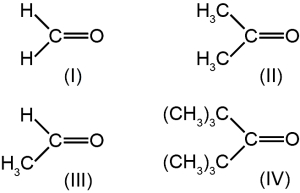
The correct order of reactivity for the addition reaction of the following carbonyl compounds with ethylmagnesium iodide is:
A
$I > III > II > IV$
B
$IV > III > II > I$
C
$I > II > IV > III$
D
$III > II > I > IV$
Solution
(A) The correct order of reactivity for the nucleophilic addition reaction of the given carbonyl compounds with ethylmagnesium iodide is $I > III > II > IV$.
This order is determined by two primary factors:
$(i)$ Inductive effect: Alkyl groups are electron-releasing. As the number of alkyl groups attached to the carbonyl carbon increases,the electron density on the carbonyl carbon increases,which reduces its electrophilicity and thus decreases reactivity towards nucleophilic attack.
$(ii)$ Steric effect: As the number and size of alkyl groups attached to the carbonyl carbon increase,the steric hindrance around the carbonyl carbon increases,making it more difficult for the nucleophile to attack.
Therefore,formaldehyde $(I)$ is the most reactive,followed by acetaldehyde $(III)$,acetone $(II)$,and finally di-tert-butyl ketone $(IV)$.
This order is determined by two primary factors:
$(i)$ Inductive effect: Alkyl groups are electron-releasing. As the number of alkyl groups attached to the carbonyl carbon increases,the electron density on the carbonyl carbon increases,which reduces its electrophilicity and thus decreases reactivity towards nucleophilic attack.
$(ii)$ Steric effect: As the number and size of alkyl groups attached to the carbonyl carbon increase,the steric hindrance around the carbonyl carbon increases,making it more difficult for the nucleophile to attack.
Therefore,formaldehyde $(I)$ is the most reactive,followed by acetaldehyde $(III)$,acetone $(II)$,and finally di-tert-butyl ketone $(IV)$.
0 likesView Solution
26
ChemistryEasyMCQWBJEE · 2018
If aniline is treated with conc. $H_{2}SO_{4}$ and heated at $200^{\circ}C$,the product is
A
anilinium sulphate
B
benzenesulphonic acid
C
m-aminobenzenesulphonic acid
D
sulphanilic acid
Solution
(D) When aniline is treated with conc. $H_{2}SO_{4}$,it first forms anilinium hydrogen sulphate.
Upon heating this salt at $200^{\circ}C$,it undergoes a rearrangement reaction (sulphonation) to form $p$-aminobenzenesulphonic acid,which is commonly known as sulphanilic acid.
The reaction proceeds through the formation of a zwitter ion.
Upon heating this salt at $200^{\circ}C$,it undergoes a rearrangement reaction (sulphonation) to form $p$-aminobenzenesulphonic acid,which is commonly known as sulphanilic acid.
The reaction proceeds through the formation of a zwitter ion.
0 likesView Solution
27
ChemistryMediumMCQWBJEE · 2018
The possible product$(s)$ obtained from the reaction of cyclobutyl amine with $HNO_{2}$ is/are:
A
Cyclobutanol
B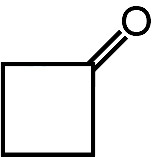
C
Cyclopropylmethanol
D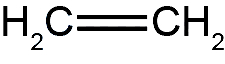
Solution
(A AND C) The reaction of cyclobutyl amine with $HNO_{2}$ produces a diazonium salt,which is unstable and loses $N_{2}$ to form a cyclobutyl carbocation. This carbocation can undergo ring contraction to form a more stable cyclopropylmethyl carbocation. Both carbocations can then react with water to form their respective alcohols. Therefore,the products are cyclobutanol and cyclopropylmethanol. The reaction sequence is as follows:
$1. \text{Cyclobutylamine} + HNO_{2} \rightarrow \text{Cyclobutyl diazonium ion} + H_{2}O$
$2. \text{Cyclobutyl diazonium ion} \rightarrow \text{Cyclobutyl carbocation} + N_{2}$
$3. \text{Cyclobutyl carbocation} \xrightarrow{\text{Ring contraction}} \text{Cyclopropylmethyl carbocation}$
$4. \text{Cyclobutyl carbocation} + H_{2}O \rightarrow \text{Cyclobutanol} + H^{+}$
$5. \text{Cyclopropylmethyl carbocation} + H_{2}O \rightarrow \text{Cyclopropylmethanol} + H^{+}$
$1. \text{Cyclobutylamine} + HNO_{2} \rightarrow \text{Cyclobutyl diazonium ion} + H_{2}O$
$2. \text{Cyclobutyl diazonium ion} \rightarrow \text{Cyclobutyl carbocation} + N_{2}$
$3. \text{Cyclobutyl carbocation} \xrightarrow{\text{Ring contraction}} \text{Cyclopropylmethyl carbocation}$
$4. \text{Cyclobutyl carbocation} + H_{2}O \rightarrow \text{Cyclobutanol} + H^{+}$
$5. \text{Cyclopropylmethyl carbocation} + H_{2}O \rightarrow \text{Cyclopropylmethanol} + H^{+}$
0 likesView Solution
28
ChemistryMediumMCQWBJEE · 2018
The ease of hydrolysis in the compounds $CH_3COCl$ $(I)$,$(CH_3CO)_2O$ $(II)$,$CH_3COOC_2H_5$ $(III)$ and $CH_3CONH_2$ $(IV)$ is of the order:
A
$I > II > III > IV$
B
$IV > III > II > I$
C
$I > II > IV > III$
D
$II > I > IV > III$
Solution
(A) The reactivity of carboxylic acid derivatives towards nucleophilic acyl substitution (such as hydrolysis) depends on the leaving group ability of the substituent attached to the acyl group.
The weaker the base,the better the leaving group.
The order of basicity of the leaving groups is $Cl^{-} < CH_3COO^{-} < C_2H_5O^{-} < NH_2^-$.
Therefore,the order of leaving group ability is $Cl^{-} > CH_3COO^{-} > C_2H_5O^{-} > NH_2^-$.
Thus,the order of ease of hydrolysis is: $CH_3COCl$ $(I) > (CH_3CO)_2O$ $(II) > CH_3COOC_2H_5$ $(III) > CH_3CONH_2$ $(IV)$.
The weaker the base,the better the leaving group.
The order of basicity of the leaving groups is $Cl^{-} < CH_3COO^{-} < C_2H_5O^{-} < NH_2^-$.
Therefore,the order of leaving group ability is $Cl^{-} > CH_3COO^{-} > C_2H_5O^{-} > NH_2^-$.
Thus,the order of ease of hydrolysis is: $CH_3COCl$ $(I) > (CH_3CO)_2O$ $(II) > CH_3COOC_2H_5$ $(III) > CH_3CONH_2$ $(IV)$.
0 likesView Solution
29
ChemistryMediumMCQWBJEE · 2018
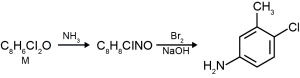
Identify $M$ in the following sequence of reactions:
A
$3-$chloro$-4-$methylbenzoyl chloride
B
$4-$chloro$-3-$methylbenzoyl chloride
C
$4-$chloro$-3-$chloromethylbenzaldehyde
D
$3-$chloro$-4-$methylbenzoyl chloride (isomer)
Solution
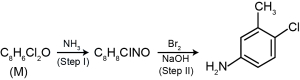
0 likesView Solution
30
ChemistryMediumMCQWBJEE · 2018
The half-life of $C^{14}$ is $5760 \ years$. For a $200 \ mg$ sample of $C^{14}$,the time taken to change to $25 \ mg$ is (in $years$)
A
$11520$
B
$23040$
C
$5760$
D
$17280$
Solution
(D) Given: Half-life of $C^{14}$,$t_{1/2} = 5760 \ years$.
Initial amount,$N_0 = 200 \ mg$.
Final amount,$N_t = 25 \ mg$.
Radioactive decay follows first-order kinetics.
We can use the relation: $N_t = N_0 \times (1/2)^n$,where $n$ is the number of half-lives.
$25 = 200 \times (1/2)^n$
$1/8 = (1/2)^n$
$(1/2)^3 = (1/2)^n$
Therefore,$n = 3$.
Total time $t = n \times t_{1/2} = 3 \times 5760 \ years = 17280 \ years$.
Alternatively,as shown in the diagram:
$200 \ mg$ $\xrightarrow{t_{1/2}} 100 \ mg$ $\xrightarrow{t_{1/2}} 50 \ mg$ $\xrightarrow{t_{1/2}} 25 \ mg$.
Total time = $3 \times 5760 \ years = 17280 \ years$.
Initial amount,$N_0 = 200 \ mg$.
Final amount,$N_t = 25 \ mg$.
Radioactive decay follows first-order kinetics.
We can use the relation: $N_t = N_0 \times (1/2)^n$,where $n$ is the number of half-lives.
$25 = 200 \times (1/2)^n$
$1/8 = (1/2)^n$
$(1/2)^3 = (1/2)^n$
Therefore,$n = 3$.
Total time $t = n \times t_{1/2} = 3 \times 5760 \ years = 17280 \ years$.
Alternatively,as shown in the diagram:
$200 \ mg$ $\xrightarrow{t_{1/2}} 100 \ mg$ $\xrightarrow{t_{1/2}} 50 \ mg$ $\xrightarrow{t_{1/2}} 25 \ mg$.
Total time = $3 \times 5760 \ years = 17280 \ years$.
0 likesView Solution
31
ChemistryMediumMCQWBJEE · 2018
The nucleus $^{64}_{29}Cu$ accepts an orbital electron to yield:
A
$^{65}_{28}Ni$
B
$^{64}_{30}Zn$
C
$^{64}_{28}Ni$
D
$^{65}_{30}Zn$
Solution
(C) The process described is electron capture,where the nucleus $^{64}_{29}Cu$ captures an orbital electron $(-1e^0)$.
In this process,the atomic number decreases by $1$ while the mass number remains constant.
The nuclear equation is: $^{64}_{29}Cu + _{-1}e^0 \longrightarrow ^{64}_{28}Ni$.
Thus,the product is $^{64}_{28}Ni$.
In this process,the atomic number decreases by $1$ while the mass number remains constant.
The nuclear equation is: $^{64}_{29}Cu + _{-1}e^0 \longrightarrow ^{64}_{28}Ni$.
Thus,the product is $^{64}_{28}Ni$.
0 likesView Solution
32
ChemistryDifficultMCQWBJEE · 2018
Silver chloride dissolves in excess of ammonium hydroxide solution. The cation present in the resulting solution is
A
$[Ag(NH_3)_6]^+$
B
$[Ag(NH_3)_4]^+$
C
$Ag^+$
D
$[Ag(NH_3)_2]^+$
Solution
(D) $AgCl$ dissolves in excess $NH_4OH$ to form a soluble complex,diamminesilver$(I)$ chloride.
The chemical reaction is:
$AgCl(s) + 2NH_4OH(aq) \rightarrow [Ag(NH_3)_2]Cl(aq) + 2H_2O(l)$
The complex dissociates in solution as:
$[Ag(NH_3)_2]Cl \rightarrow [Ag(NH_3)_2]^+ + Cl^-$
Thus,the cation present in the resulting solution is $[Ag(NH_3)_2]^+$.
The chemical reaction is:
$AgCl(s) + 2NH_4OH(aq) \rightarrow [Ag(NH_3)_2]Cl(aq) + 2H_2O(l)$
The complex dissociates in solution as:
$[Ag(NH_3)_2]Cl \rightarrow [Ag(NH_3)_2]^+ + Cl^-$
Thus,the cation present in the resulting solution is $[Ag(NH_3)_2]^+$.
0 likesView Solution
33
ChemistryMediumMCQWBJEE · 2018
Ferric ion forms a Prussian blue precipitate due to the formation of
A
$K_4[Fe(CN)_6]$
B
$K_3[Fe(CN)_6]$
C
$Fe(CNS)_3$
D
$Fe_4[Fe(CN)_6]_3$
Solution
(D) The ferric ion $(Fe^{3+})$ reacts with potassium ferrocyanide $(K_4[Fe(CN)_6])$ to form a Prussian blue precipitate of ferric ferrocyanide,which is $Fe_4[Fe(CN)_6]_3$.
The chemical reaction is: $4Fe^{3+} + 3[Fe(CN)_6]^{4-} \rightarrow Fe_4[Fe(CN)_6]_3$.
The chemical reaction is: $4Fe^{3+} + 3[Fe(CN)_6]^{4-} \rightarrow Fe_4[Fe(CN)_6]_3$.
0 likesView Solution
34
ChemistryEasyMCQWBJEE · 2018
What amount of electricity can deposit $1 \ mole$ of $Al$ metal at cathode when passed through molten $AlCl_3$?
A
$0.3 \ F$
B
$1 \ F$
C
$3 \ F$
D
$1 / 3 \ F$
Solution
(C) The reduction reaction at the cathode is given by:
$Al^{3+} + 3e^{-} \longrightarrow Al$
From the stoichiometry of the reaction,$1 \ mole$ of $Al^{3+}$ ions requires $3 \ moles$ of electrons to be reduced to $1 \ mole$ of $Al$ metal.
Since $1 \ mole$ of electrons carries a charge of $1 \ Faraday$ $(F)$,the total electricity required is $3 \ F$.
$Al^{3+} + 3e^{-} \longrightarrow Al$
From the stoichiometry of the reaction,$1 \ mole$ of $Al^{3+}$ ions requires $3 \ moles$ of electrons to be reduced to $1 \ mole$ of $Al$ metal.
Since $1 \ mole$ of electrons carries a charge of $1 \ Faraday$ $(F)$,the total electricity required is $3 \ F$.
0 likesView Solution
35
ChemistryMediumMCQWBJEE · 2018
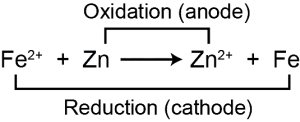
Given the standard half-cell potentials $(E^{\circ})$ as: $Zn \rightarrow Zn^{2+} + 2e^{-}$; $E^{\circ} = +0.76 \ V$ and $Fe \rightarrow Fe^{2+} + 2e^{-}$; $E^{\circ} = +0.41 \ V$. Then the standard e.m.f. of the cell with the reaction $Fe^{2+} + Zn \rightarrow Zn^{2+} + Fe$ is:
A
$-0.35 \ V$
B
$+0.35 \ V$
C
$+1.17 \ V$
D
$-1.17 \ V$
Solution
(B) The given cell reaction is $Fe^{2+} + Zn \rightarrow Zn^{2+} + Fe$.
Oxidation half-reaction: $Zn \rightarrow Zn^{2+} + 2e^{-}$,$E^{\circ}_{ox} = +0.76 \ V$.
Reduction half-reaction: $Fe^{2+} + 2e^{-} \rightarrow Fe$,$E^{\circ}_{red} = -0.41 \ V$ (since $E^{\circ}_{ox}$ for $Fe$ is $+0.41 \ V$,the reduction potential $E^{\circ}_{red} = -E^{\circ}_{ox}$).
The standard e.m.f. of the cell is:
$E^{\circ}_{cell} = E^{\circ}_{ox} + E^{\circ}_{red}$
$E^{\circ}_{cell} = 0.76 \ V + (-0.41 \ V) = +0.35 \ V$.
Oxidation half-reaction: $Zn \rightarrow Zn^{2+} + 2e^{-}$,$E^{\circ}_{ox} = +0.76 \ V$.
Reduction half-reaction: $Fe^{2+} + 2e^{-} \rightarrow Fe$,$E^{\circ}_{red} = -0.41 \ V$ (since $E^{\circ}_{ox}$ for $Fe$ is $+0.41 \ V$,the reduction potential $E^{\circ}_{red} = -E^{\circ}_{ox}$).
The standard e.m.f. of the cell is:
$E^{\circ}_{cell} = E^{\circ}_{ox} + E^{\circ}_{red}$
$E^{\circ}_{cell} = 0.76 \ V + (-0.41 \ V) = +0.35 \ V$.
0 likesView Solution
36
ChemistryEasyMCQWBJEE · 2018
White phosphorus $P_{4}$ has the following characteristics:
A
$6$ $P-P$ single bonds
B
$4$ $P-P$ single bonds
C
$4$ lone pairs of electrons
D
$P-P-P$ angle of $60^{\circ}$
Solution
(A, C, D) White phosphorus $(P_{4})$ consists of a discrete tetrahedral molecule.
It contains $6$ $P-P$ single bonds and $4$ lone pairs of electrons (one on each phosphorus atom).
The $P-P-P$ bond angle in the tetrahedral structure is $60^{\circ}$.
Therefore,options $A$,$C$,and $D$ are correct characteristics of white phosphorus.
It contains $6$ $P-P$ single bonds and $4$ lone pairs of electrons (one on each phosphorus atom).
The $P-P-P$ bond angle in the tetrahedral structure is $60^{\circ}$.
Therefore,options $A$,$C$,and $D$ are correct characteristics of white phosphorus.
0 likesView Solution
37
ChemistryEasyMCQWBJEE · 2018
$Cl_{2}O_{7}$ is the anhydride of
A
$HOCl$
B
$HClO_{2}$
C
$HClO_{3}$
D
$HClO_{4}$
Solution
(D) $Cl_{2}O_{7}$ is the anhydride of $HClO_{4}$.
An acid anhydride is a compound that reacts with water to form an acid.
The reaction is:
$Cl_{2}O_{7} + H_{2}O \longrightarrow 2HClO_{4}$ (Perchloric acid)
$Cl_{2}O_{7}$ is the oxide of chlorine in its highest oxidation state $(+7)$,which corresponds to perchloric acid $(HClO_{4})$.
An acid anhydride is a compound that reacts with water to form an acid.
The reaction is:
$Cl_{2}O_{7} + H_{2}O \longrightarrow 2HClO_{4}$ (Perchloric acid)
$Cl_{2}O_{7}$ is the oxide of chlorine in its highest oxidation state $(+7)$,which corresponds to perchloric acid $(HClO_{4})$.
0 likesView Solution
38
ChemistryEasyMCQWBJEE · 2018
At room temperature,the reaction between water and fluorine produces
A
$HF$ and $H_2O_2$
B
$HF, O_2$ and $F_2O_2$
C
$F^{-}, O_2$ and $H^{+}$
D
$HOF$ and $HF$
Solution
(C) Fluorine is a powerful oxidizing agent. It reacts vigorously with water at room temperature to produce oxygen gas and hydrofluoric acid $(HF)$. In an aqueous medium,$HF$ dissociates into $H^{+}$ and $F^{-}$ ions. The chemical equation for the reaction is:
$2F_2 + 2H_2O \rightarrow 4H^{+} + 4F^{-} + O_2$
$2F_2 + 2H_2O \rightarrow 4H^{+} + 4F^{-} + O_2$
0 likesView Solution
39
ChemistryEasyMCQWBJEE · 2018
Which one of the following is a condensation polymer?
A
$PVC$
B
$Teflon$
C
$Dacron$
D
$Polystyrene$
Solution
(C) $Dacron$ is a condensation polymer. It is also known as $Terylene$.
It is a polymer obtained by the condensation reaction between $Ethylene \ glycol$ and $Terephthalic \ acid$ at $420-460 \ K$ in the presence of a zinc acetate-antimony trioxide catalyst.
The reaction is as follows:
$nHOCH_2CH_2OH + nHOOC-C_6H_4-COOH \xrightarrow{420-460 \ K} [-O-CH_2CH_2-O-CO-C_6H_4-CO-]_n + 2nH_2O$
It is a polymer obtained by the condensation reaction between $Ethylene \ glycol$ and $Terephthalic \ acid$ at $420-460 \ K$ in the presence of a zinc acetate-antimony trioxide catalyst.
The reaction is as follows:
$nHOCH_2CH_2OH + nHOOC-C_6H_4-COOH \xrightarrow{420-460 \ K} [-O-CH_2CH_2-O-CO-C_6H_4-CO-]_n + 2nH_2O$
0 likesView Solution
40
ChemistryMediumMCQWBJEE · 2018
$[X] +$ dil. $H_{2}SO_{4} \longrightarrow [Y]:$
Colourless,suffocating gas
$[Y] + K_{2}Cr_{2}O_{7} + H_{2}SO_{4} \longrightarrow$
Green colouration of solution
Then,$[X]$ and $[Y]$ are
Colourless,suffocating gas
$[Y] + K_{2}Cr_{2}O_{7} + H_{2}SO_{4} \longrightarrow$
Green colouration of solution
Then,$[X]$ and $[Y]$ are
A
$SO_{3}^{2-}, SO_{2}$
B
$Cl^{-}, HCl$
C
$S^{2-}, H_{2}S$
D
$CO_{3}^{2-}, CO_{2}$
Solution
(A) According to the question,$[X] +$ dil. $H_{2}SO_{4} \longrightarrow [Y]$ (a colourless,suffocating gas).
$[Y] + K_{2}Cr_{2}O_{7} + H_{2}SO_{4} \longrightarrow$ Green colouration of the solution.
Sulphites $(SO_{3}^{2-})$ react with dil. $H_{2}SO_{4}$ to release sulphur dioxide $(SO_{2})$ gas,which is colourless and has a suffocating odour.
The reaction is: $SO_{3}^{2-} + 2H^{+} \longrightarrow SO_{2} + H_{2}O$.
$SO_{2}$ acts as a reducing agent and reduces acidified potassium dichromate $(K_{2}Cr_{2}O_{7})$ from $Cr(VI)$ (orange) to $Cr(III)$ (green) as $Cr_{2}(SO_{4})_{3}$.
The reaction is: $K_{2}Cr_{2}O_{7} + H_{2}SO_{4} + 3SO_{2} \longrightarrow K_{2}SO_{4} + Cr_{2}(SO_{4})_{3} + H_{2}O$.
$[Y] + K_{2}Cr_{2}O_{7} + H_{2}SO_{4} \longrightarrow$ Green colouration of the solution.
Sulphites $(SO_{3}^{2-})$ react with dil. $H_{2}SO_{4}$ to release sulphur dioxide $(SO_{2})$ gas,which is colourless and has a suffocating odour.
The reaction is: $SO_{3}^{2-} + 2H^{+} \longrightarrow SO_{2} + H_{2}O$.
$SO_{2}$ acts as a reducing agent and reduces acidified potassium dichromate $(K_{2}Cr_{2}O_{7})$ from $Cr(VI)$ (orange) to $Cr(III)$ (green) as $Cr_{2}(SO_{4})_{3}$.
The reaction is: $K_{2}Cr_{2}O_{7} + H_{2}SO_{4} + 3SO_{2} \longrightarrow K_{2}SO_{4} + Cr_{2}(SO_{4})_{3} + H_{2}O$.
0 likesView Solution
41
ChemistryMediumMCQWBJEE · 2018
Out of the following outer electronic configurations of atoms,the highest oxidation state is achieved by which one?
A
$(n-1) d^8 n s^2$
B
$(n-1) d^5 n s^2$
C
$(n-1) d^3 n s^2$
D
$(n-1) d^5 n s^1$
Solution
(B) The highest oxidation state is achieved by $(n-1) d^5 n s^2$,which corresponds to a maximum oxidation state of $+7$. This is because the $(n-1) d$-electrons can participate in bonding along with $n s$-electrons,as their energy levels are comparable. The oxidation states for the given configurations are summarized below:
| Electronic configuration | Oxidation state |
| :--- | :--- |
| $(n-1) d^8 n s^2$ | $+2, +3, +4$ |
| $(n-1) d^3 n s^2$ | $+2, +3, +4, +5$ |
| $(n-1) d^5 n s^1$ | $+2, +3, +4, +5, +6$ |
| $(n-1) d^5 n s^2$ | $+2, +3, +4, +5, +6, +7$ |
| Electronic configuration | Oxidation state |
| :--- | :--- |
| $(n-1) d^8 n s^2$ | $+2, +3, +4$ |
| $(n-1) d^3 n s^2$ | $+2, +3, +4, +5$ |
| $(n-1) d^5 n s^1$ | $+2, +3, +4, +5, +6$ |
| $(n-1) d^5 n s^2$ | $+2, +3, +4, +5, +6, +7$ |
0 likesView Solution
42
ChemistryMediumMCQWBJEE · 2018
$A$ compound formed by elements $X$ and $Y$ crystallises in a cubic structure,where $X$ atoms are at the corners of a cube and $Y$ atoms are at the body centre. The formula of the compound is:
A
$XY$
B
$XY_{2}$
C
$X_{2}Y_{3}$
D
$XY_{3}$
Solution
(A) The number of $X$ atoms at the corners of the cube is $8$. Since each corner atom contributes $\frac{1}{8}$ to the unit cell,the total number of $X$ atoms per unit cell is $8 \times \frac{1}{8} = 1$.
The number of $Y$ atoms at the body centre is $1$. Since the body-centered atom is entirely within the unit cell,the total number of $Y$ atoms per unit cell is $1$.
Therefore,the ratio of $X:Y$ is $1:1$,and the formula of the compound is $XY$.
The number of $Y$ atoms at the body centre is $1$. Since the body-centered atom is entirely within the unit cell,the total number of $Y$ atoms per unit cell is $1$.
Therefore,the ratio of $X:Y$ is $1:1$,and the formula of the compound is $XY$.
0 likesView Solution
Vedclass Products
For Students
Vedclass Test Series
Mock tests in real WBJEE style covering Chemistry with performance analysis. 5-day free trial.
Start Free TrialFor Teachers
Exam Paper Generator
Generate Set A/B/C/D Chemistry papers from 7.5L+ questions in 2 minutes. 3 chapters free.
Try FreeFor Institutes
Online Exam Module
Run live WBJEE mock exams with unlimited students, 360° analytics & white-label branding.
See DemoFrequently Asked Questions
How many Chemistry questions are in WBJEE 2018?
There are 42 Chemistry questions from the WBJEE 2018 paper on Vedclass, each with a detailed step-by-step solution in English.
Are WBJEE 2018 Chemistry solutions available in English?
Yes. All solutions on this page are in English. You can also switch to English or Hindi using the language buttons above the questions.
Can I practice WBJEE 2018 Chemistry as a timed test?
Yes. Use the Vedclass Test Series to attempt a full WBJEE mock test covering Chemistry with time limits and instant score analysis.
Can teachers create Chemistry papers from WBJEE previous year questions?
Yes. The Vedclass Exam Paper Generator lets teachers mix WBJEE Chemistry questions and generate Set A/B/C/D papers in minutes.
For Teachers & Institutes
Build a Custom Chemistry Paper
Pick WBJEE 2018 Chemistry questions, set difficulty, and generate Set A/B/C/D in 2 minutes.